-
DANCE LESSONS aka DANCING LESSONS
June 25, 1950

“Dance Lessons” aka “Dancing Lessons” aka “George Takes Dancing Lessons” is episode #94 of the radio series MY FAVORITE HUSBAND broadcast on June 25, 1950 on the CBS Radio Network. This is the final episode of season two. The third and final season begins on September 2, 1950.
Lucille Ball had mentioned in an interview that she might use the 1950 summer hiatus to make a movie based on the life of Robert Capa in Europe with Desi in the lead, but those plans never materialized. Instead, she spent the summer doing promotion for Fancy Pants, her film with Bob Hope, which premiered on July 19, 1950.
Synopsis ~
Liz cons George in to taking her to a nightclub by telling him it is to celebrate their anniversary but it is actually to celebrate the anniversary of the last time they went out to a dinner dance.

Note: This episode very loosely inspired the very first aired episode of “I Love Lucy” “The Girls Want To Go To A Nightclub” (ILL S1;E1) on October 15, 1951, although it was actually filmed second. The similarities are mostly thematic.

“My Favorite Husband” was based on the novels Mr. and Mrs. Cugat, the Record of a Happy Marriage (1940) and Outside Eden (1945) by Isabel Scott Rorick, which had previously been adapted into the film Are Husbands Necessary? (1942). “My Favorite Husband” was first broadcast as a one-time special on July 5, 1948. Lucille Ball and Lee Bowman played the characters of Liz and George Cugat, and a positive response to this broadcast convinced CBS to launch “My Favorite Husband” as a series. Bowman was not available Richard Denning was cast as George. On January 7, 1949, confusion with bandleader Xavier Cugat prompted a name change to Cooper. On this same episode Jell-O became its sponsor. A total of 124 episodes of the program aired from July 23, 1948 through March 31, 1951. After about ten episodes had been written, writers Fox and Davenport departed and three new writers took over – Bob Carroll, Jr., Madelyn Pugh, and head writer/producer Jess Oppenheimer. In March 1949 Gale Gordon took over the existing role of George’s boss, Rudolph Atterbury, and Bea Benaderet was added as his wife, Iris. CBS brought “My Favorite Husband” to television in 1953, starring Joan Caulfield and Barry Nelson as Liz and George Cooper. The television version ran two-and-a-half seasons, from September 1953 through December 1955, running concurrently with “I Love Lucy.” It was produced live at CBS Television City for most of its run, until switching to film for a truncated third season filmed (ironically) at Desilu and recasting Liz Cooper with Vanessa Brown.
REGULAR CAST

Lucille Ball (Liz Cooper) was born on August 6, 1911 in Jamestown, New York. She began her screen career in 1933 and was known in Hollywood as ‘Queen of the B’s’ due to her many appearances in ‘B’ movies. With Richard Denning, she starred in a radio program titled “My Favorite Husband” which eventually led to the creation of “I Love Lucy,” a television situation comedy in which she co-starred with her real-life husband, Latin bandleader Desi Arnaz. The program was phenomenally successful, allowing the couple to purchase what was once RKO Studios, re-naming it Desilu. When the show ended in 1960 (in an hour-long format known as “The Lucy-Desi Comedy Hour”) so did Lucy and Desi’s marriage. In 1962, hoping to keep Desilu financially solvent, Lucy returned to the sitcom format with “The Lucy Show,” which lasted six seasons. She followed that with a similar sitcom “Here’s Lucy” co-starring with her real-life children, Lucie and Desi Jr., as well as Gale Gordon, who had joined the cast of “The Lucy Show” during season two. Before her death in 1989, Lucy made one more attempt at a sitcom with “Life With Lucy,” also with Gordon.
Richard Denning (George Cooper) was born as Louis Albert Heindrich Denninger Jr., in Poughkeepsie, New York. When he was 18 months old, his family moved to Los Angeles. Plans called for him to take over his father’s garment manufacturing business, but he developed an interest in acting. Denning enlisted in the US Navy during World War II. He is best known for his roles in various science fiction and horror films of the 1950s. Although he teamed with Lucille Ball on radio in “My Favorite Husband,” the two never acted together on screen. While “I Love Lucy” was on the air, he was seen on another CBS TV series, “Mr. & Mrs. North.” From 1968 to 1980 he played the Governor on “Hawaii 5-0″, his final role. He died in 1998 at age 84.
Gale Gordon (Rudolph Atterbury) had worked with Lucille Ball on “The Wonder Show” on radio in 1938. One of the front-runners to play Fred Mertz on “I Love Lucy,” he eventually played Alvin Littlefield, owner of the Tropicana, during two episodes in 1952. After playing a Judge in an episode of “The Lucy-Desi Comedy Hour” in 1958, he would re-team with Lucy for all of her subsequent series’: as Theodore J. Mooney in ”The Lucy Show”; as Harrison Otis Carter in “Here’s Lucy”; and as Curtis McGibbon on “Life with Lucy.” Gordon died in 1995 at the age of 89.
Bea Benadaret (Iris Atterbury) was considered the front-runner to be cast as Ethel Mertz but when “I Love Lucy” was ready to start production she was already playing a similar role on TV’s “The George Burns and Gracie Allen Show” so Vivian Vance was cast instead. On “I Love Lucy” she was cast as Lucy Ricarodo’s spinster neighbor, Miss Lewis, in “Lucy Plays Cupid” (ILL S1;E15) in early 1952. Later, she was a success in her own show, “Petticoat Junction” as Shady Rest Hotel proprietress Kate Bradley. She starred in the series until her death in 1968.
Ruth Perrott (Katie, the Maid) was also later seen on “I Love Lucy.” She first played Mrs. Pomerantz, a member of the surprise investigating committee for the Society Matrons League in “Pioneer Women” (ILL S1;E25), was one of the member of the Wednesday Afternoon Fine Arts League in “Lucy and Ethel Buy the Same Dress” (ILL S3;E3), and also played a nurse when “Lucy Goes to the Hospital” (ILL S2;E16). She died in 1996 at the age of 96.
Bob LeMond (Announcer) also served as the announcer for the pilot episode of “I Love Lucy”. When the long-lost pilot was finally discovered in 1990, a few moments of the opening narration were damaged and lost, so LeMond – fifty years later – recreated the narration for the CBS special and subsequent DVD release.
GUEST CAST

Peter Leeds (Speedy Krause / Headwaiter)
was born in Bayonne, NJ, and was seen as the Reporter questioning the Maharincess of Franistan in “The Publicity Agent” (ILL S1;E31). He starred with Lucy in the films The Long, Long Trailer (1953) and The Facts of Life (1960) with Bob Hope. Coincidentally, he also appeared in “Lucy and Bob Hope” (ILL S6;E1) as well as an episode of “Here’s Lucy” in 1971.

Hal March (Waiter) first appeared on the "I Love Lucy” in “Lucy Fakes Illness” (ILL S1;E16) using his own name to play an actor posing as the doctor who diagnoses Lucy with ‘golbloots.’ March got his first big break when he was cast as Harry Morton on “The George Burns and Gracie Allen Show” in 1950. He eventually lost the part to Fred Clark who producers felt was better paired with Bea Benaderet, who played Blanche, and here plays Iris Atterbury. He stayed with the show in other roles, the last airing just two weeks before his appearance as Eddie Grant in “Lucy is Matchmaker” (ILL S2;E27). In 1966 he was seen on “The Lucy Show.”

Veola Vonn (Starlight Girl / Miss Crawford / Secretary) played the Emcee of “Your Favorite Celebrity On TV”, the show Ricky goes on shackled to Lucy in “The Handcuffs” (ILL S2;E4). In real life, she was married to Frank Nelson, a character actor regularly appearing on “My Favorite Husband” and “I Love Lucy”. Before that, she was married to Hanley Stafford, whose final screen credit was as Principal Westcott on “The Lucy Show” in 1963.
EPISODE

The episode opens with Liz and George dressing for an evening out at a nightclub. It is their anniversary – of the last time they went to a nightclub! The Atterbury’s are joining them there. George has trouble fitting into his tux. Liz intimates that he has gotten fat.
The Atterburys greet them at the club (”George boy! Liz girl”). The girls are excited, while the boys would rather play canasta. As usual, Liz has trouble catching the attention of the waiter. When she does (by screaming), she causes him to drop a tray. She then makes fun of his French accent. When the waiter is chastised by his boss, his accent suddenly disappears!
After dinner, the boys complain that the tables in the club are too close together.
IRIS: “They are pretty close, Liz. I got my elbows buttered three times.”
The music starts, but the boys are reluctant to dance, despite sarcastic hints by the girls.
LIZ (to George): “What about you, Najinsky?”

Vaslav Najinsky (1890-1950) was a Polish ballet dancer often cited as the greatest male dancer of the early 20th century. Born in Kiev to Polish parents, Nijinsky grew up in Imperial Russia but considered himself to be Polish. He was celebrated for his virtuosity and for the depth of his characterizations. He could dance en pointe, a rare skill among male dancers at the time, and was admired for his seemingly gravity-defying leaps. Najinsky died just 2 and a half months prior to this broadcast, so his name would have been in the news when the script was written.
Liz laments that they don’t go dancing as often since they got married.
LIZ: “Ever since we said ‘I do’ there are so many things we don’t!”

This classic line of dialogue was repeated verbatim in the first episode of “I Love Lucy” “The Girls Want To Go To A Nightclub” (ILL S1;E1). It was considered by producer Jess Oppenheimer to be the funniest line of the entire series. Perhaps both series’!
Speedy Krause, the club MC, interrupts the arguing with some bad jokes from the bandstand.
SPEEDY: “There are celebrities here tonight. Oh, pardon me, madam. I thought you were Boris Karloff.”

Boris Karloff (1887-1969) was born William Henry Pratt in Surrey, England. He is primarily known for his roles in horror films. He portrayed Frankenstein’s monster in Frankenstein (1931), Bride of Frankenstein (1935) and Son of Frankenstein (1939). He also appeared as The Mummy (1932). In 1947, he starred with Lucille Ball in the film Lured.
In 1950, he worked exclusively on television.
The boys quickly become bored with Speedy’s unfunny routine.
RUDOLPH: “This act would even be bad on television.”

In 1950, television was still in its infancy, and quality programming was scarce.
Five million TV sets were sold as the price dropped from $500 in 1949, to a more manageable $200. In 1950, just under 20 percent of American homes had a television set.
The floor show starts with the scantily clad Starlight Cuties, which causes the boys to drool and the girls to look for the exit. The Cuties head out onto the club floor to find dance partners. The boys suddenly turn into Najinsky!

The moment feels very much like “The Country Club Dance” (ILL S6;E25) where the husbands all vie for the attention of sexy Diana Jordan (Barbara Eden).
The Starlight Cutie that approaches George and Rudolph even has a southern drawl like Diana’s. While the boys are ogling the Cutie, the girls flee the club and the act ends.
Next morning at the bank, George and Rudolph talk about their debacle of an evening at the nightclub. The girls suddenly drop by the office to forgive their husbands – under two conditions:
1. They take them dining and dancing monthly.
2. They take dancing lessons – starting this afternoon!Mr. Atterbury is excited at the prospect:
RUDOLPH: “I’ve seen those girls who teach at Arthur Murray’s.”

Arthur Murray (1895-1991) was a ballroom dancer and businessman, whose name is most often associated with the chain of dance studios that bear his name.

A month after this episode aired, Murray premiered the television show “The Arthur Murray Party” which was basically one long advertisement for their studios. It aired until 1960. In 1962, Lucille Ball and Arthur Murray were two of the many guests celebrating the 14th anniversary of “The Ed Sullivan Show.”

In “The Young Fans” (ILL S1;E20), Lucy tries to give love-struck Arthur Morton dance lessons, but confesses to Ricky that “Arthur Morton is no Arthur Murray.” Murray’s name is also mentioned in Desi Arnaz’s popular song, “Cuban Pete”: “And Cuban Pete doesn’t teach you in a hurry like Arthur Murray.”
However, Liz isn’t sending them to Arthur Murray, but to Professor Crawford’s School of the Dance, where she went as a child. Instead of being greeted by a befuddled old Professor, they meet his daughter, a breathless sexpot who immediately agrees to be their instructress.
Time passes. At the Cooper home, Katie the maid opens the door to Iris who has been shopping for their monthly nightclub outings. The boys have been attending lessons faithfully. Just then, Miss Crawford phones to leave a message for “Bright Eyes” Cooper! The jig (literally) is up! Liz and Iris realize why their husbands have been so regularly attending dance class. Liz and Iris dash to the dance studio to surprise the boys and let them know they have found out who they dancing with!

In
“The Girls Want To Go To A Nightclub” (ILL S1;E1)
Lucy and Ethel disguise themselves as country bumpkins in order to teach their husbands a lesson for looking for dates. Oddly, the radio version is more realistic, but less laugh-out-loud funny. The physical comedy of the television version is the reason it was chosen as the series premiere over “Lucy Thinks Ricky is Trying to Murder Her” which was filmed before, but aired fourth.
As punishment, Liz and Iris instruct the boys to dance with each other!
LIZ: “Don’t they make a lovely couple!”
End of Episode
1950, Arthur Murray, Barbara Eden, Bea Benadaret, Bob Hope, Bob LeMond, Boris Karloff, CBS TV, Dancing, Desi Arnaz, Fancy Pants, Frank Nelson, Gale Gordon, Hal March, I love lucy, Lucille Ball, My Favorite Husband, Najinsky, Peter Leeds, Radio, Richard Denning, Ruth Perrott, Veola Vonn, Vivian Vance, William Frawley -
LIZ CHANGES HER MIND
June 24, 1949

“Liz Changes Her Mind” is episode #50 of the radio series MY FAVORITE HUSBAND broadcast on June 24, 1949 on the CBS Radio Network. This was the only “My Favorite Husband” episode to be repeated. It aired again on September 30, 1950.
Synopsis ~ When Liz has trouble making up her mind, George decides she must finish everything she starts.

This program was used as a basis for “I Love Lucy” “Lucy Changes Her Mind” (ILL S2;E21) first broadcast on CBS TV on March 30, 1953.

~ from Laughs, Luck… and Lucy by Jess Oppenheimer
REGULAR CAST

Lucille Ball (Liz Cooper) was born on August 6, 1911 in Jamestown, New York. She began her screen career in 1933 and was known in Hollywood as ‘Queen of the B’s’ due to her many appearances in ‘B’ movies. With Richard Denning, she starred in a radio program titled “My Favorite Husband” which eventually led to the creation of “I Love Lucy,” a television situation comedy in which she co-starred with her real-life husband, Latin bandleader Desi Arnaz. The program was phenomenally successful, allowing the couple to purchase what was once RKO Studios, re-naming it Desilu. When the show ended in 1960 (in an hour-long format known as “The Lucy-Desi Comedy Hour”) so did Lucy and Desi’s marriage. In 1962, hoping to keep Desilu financially solvent, Lucy returned to the sitcom format with “The Lucy Show,” which lasted six seasons. She followed that with a similar sitcom “Here’s Lucy” co-starring with her real-life children, Lucie and Desi Jr., as well as Gale Gordon, who had joined the cast of “The Lucy Show” during season two. Before her death in 1989, Lucy made one more attempt at a sitcom with “Life With Lucy,” also with Gordon.
Richard Denning (George Cooper) was born as Louis Albert Heindrich Denninger Jr., in Poughkeepsie, New York. When he was 18 months old, his family moved to Los Angeles. Plans called for him to take over his father’s garment manufacturing business, but he developed an interest in acting. Denning enlisted in the US Navy during World War II. He is best known for his roles in various science fiction and horror films of the 1950s. Although he teamed with Lucille Ball on radio in “My Favorite Husband,” the two never acted together on screen. While “I Love Lucy” was on the air, he was seen on another CBS TV series, “Mr. & Mrs. North.” From 1968 to 1980 he played the Governor on “Hawaii 5-0″, his final role. He died in 1998 at age 84.
Gale Gordon (Rudolph Atterbury) had worked with Lucille Ball on “The Wonder Show” on radio in 1938. One of the front-runners to play Fred Mertz on “I Love Lucy,” he eventually played Alvin Littlefield, owner of the Tropicana, during two episodes in 1952. After playing a Judge in an episode of “The Lucy-Desi Comedy Hour” in 1958, he would re-team with Lucy for all of her subsequent series’: as Theodore J. Mooney in ”The Lucy Show”; as Harrison Otis Carter in “Here’s Lucy”; and as Curtis McGibbon on “Life with Lucy.” Gordon died in 1995 at the age of 89.
Bea Benadaret (Iris Atterbury / New Secretary) was considered the front-runner to be cast as Ethel Mertz but when “I Love Lucy” was ready to start production she was already playing a similar role on TV’s “The George Burns and Gracie Allen Show” so Vivian Vance was cast instead. On “I Love Lucy” she was cast as Lucy Ricardo’s spinster neighbor, Miss Lewis, in “Lucy Plays Cupid” (ILL S1;E15) in early 1952. Later, she was a success in her own show, “Petticoat Junction” as Shady Rest Hotel proprietress Kate Bradley. She starred in the series until her death in 1968.
Ruth Perrott (Katie, the Maid) was also later seen on “I Love Lucy.” She first played Mrs. Pomerantz (above right), a member of the surprise investigating committee for the Society Matrons League in “Pioneer Women” (ILL S1;E25), as one of the member of the Wednesday Afternoon Fine Arts League in “Lucy and Ethel Buy the Same Dress” (ILL S3;E3), and also played a nurse when “Lucy Goes to the Hospital” (ILL S2;E16). She died in 1996 at the age of 96.
Bob LeMond (Announcer) also served as the announcer for the pilot episode of “I Love Lucy”. When the long-lost pilot was finally discovered in 1990, a few moments of the opening narration were damaged and lost, so LeMond – fifty years later – recreated the narration for the CBS special and subsequent DVD release.
GUEST CAST

Frank Nelson (Waiter) was born on May 6, 1911 (three months before Lucille Ball) in Colorado Springs, Colorado. He started working as a radio announcer at the age of 15. He later appeared on such popular radio shows as “The Great Gildersleeve,” “Burns and Allen,” and “Fibber McGee & Molly”. This is one of his 11 performances on “My Favorite Husband.” On “I Love Lucy” he holds the distinction of being the only actor to play two recurring roles: Freddie Fillmore and Ralph Ramsey, as well as six one-off characters, including the frazzled train conductor in “The Great Train Robbery” (ILL S5;E5), a character he repeated on “The Lucy Show.” Aside from Lucille Ball, Nelson is perhaps most associated with Jack Benny and was a fifteen-year regular on his radio and television programs.
Nelson repeated the role of the waiter in the “I Love Lucy” episode based on this radio episode.

“My Favorite Husband” was based on the novels Mr. and Mrs. Cugat, the Record of a Happy Marriage (1940) and Outside Eden (1945) by Isabel Scott Rorick, which had previously been adapted into the film Are Husbands Necessary? (1942). “My Favorite Husband” was first broadcast as a one-time special on July 5, 1948. Lucille Ball and Lee Bowman played the characters of Liz and George Cugat, and a positive response to this broadcast convinced CBS to launch “My Favorite Husband” as a series. Bowman was not available Richard Denning was cast as George. On January 7, 1949, confusion with bandleader Xavier Cugat prompted a name change to Cooper. On this same episode Jell-O became its sponsor. A total of 124 episodes of the program aired from July 23, 1948 through March 31, 1951. After about ten episodes had been written, writers Fox and Davenport departed and three new writers took over – Bob Carroll, Jr., Madelyn Pugh, and head writer/producer Jess Oppenheimer. In March 1949 Gale Gordon took over the existing role of George’s boss, Rudolph Atterbury, and Bea Benadaret was added as his wife, Iris. CBS brought “My Favorite Husband” to television in 1953, starring Joan Caulfield and Barry Nelson as Liz and George Cooper. The television version ran two-and-a-half seasons, from September 1953 through December 1955, running concurrently with “I Love Lucy.” It was produced live at CBS Television City for most of its run, until switching to film for a truncated third season filmed (ironically) at Desilu and recasting Liz Cooper with Vanessa Brown.
THE EPISODE
The story opens with Liz driving to pick up George at the bank. Liz is not a very good driver – she can’t make up her mind which direction to go or what dress to wear.
They are meeting the Atterbury’s at the Green Room for dinner, despite the fact that she is wearing her blue dress and will clash with the décor.

On “I Love Lucy” the Ricardos and the Mertzes can’t decide where to dine but end up at the Roof Garden, despite the menus saying Jubilee Club.
Liz finally gets the attention of a waiter (Frank Nelson) but then decides to move tables.

On TV, Nelson wears thick eyeglasses to reinforce the visual comedy.
LIZ / LUCY: “Does everyone have everything they need?” GEORGE / ETHEL: “I have three knives.”
IRIS / FRED: “I beat ya. I’ve got a full house: three forks and a pair of spoons.”The scene that follows is virtually the same as it is on television.
Liz sneezes, feeling a draft at their new table by the window, and spots another empty table nearby.
RUDOLPH / FRED: “Stand by for another troop movement!”
Liz crashes into the waiter mid-move. He spills a tray of shrimp cocktails all over Mr. Atterbury.
On TV, the waiter returns with the tray, looks around for the Ricardos and Mertzes, who have moved a third time. When Lucy gets his attention, he immediately hands her the tray, grabs his hat and coat, and leaves without a word!
At home that night, an embarrassed George chastises Liz for her inability to make a decision.
GEORGE: “Why are you so wishy-washy?”
LIZ: “I can’t help it. My father was a wishy and my mother was a washy.”George revolts against the adage that women are allowed to change their minds. He even threatens to spank her! He gives his wife an ultimatum: Finish what you start! Liz agrees and they kiss and cuddle as the scene fades out.
Next morning, Liz asks Katie to help her clean out the desk, a project she started but never finished.
KATIE: “It’s the only desk where the pigeon holes have pigeons in ‘em.”
In the desk, Liz finds a newspaper with the headline “McKinley Assassinated”! She remembers Iris gave it to her because there was a good recipe on the back.

William McKinley was the 25th president of the United States from 1897 until his assassination on September 14, 1901. The comedy here stretches reality, as the newspaper would be 48 years old at the time of broadcast! Perhaps Iris had saved it after its publication date and passed it on to Liz.
Digging a little deeper into the cluttered desk, Liz finds love letters from George. In one unfinished letter Liz threatens to leave George, but never mailed the letter. Remembering her promise, she mischievously decides to finish it and send it to George at work special delivery.
At the office, George and Rudolph are playing darts when George’s giggly new secretary (Bea Benadaret, doing a second voice that sounds very much like Betty Rubble on “The Flintstones”) brings in a special delivery letter. It is a letter from Liz’s old sorority inviting her to a reunion, sent in care of George. The boys decide to leave early and that night convince the girls to go to the reunion. After they leave, the secretary comes in with one more special delivery letter (the one from Liz) – but George has already gone! The scene is set for a profusion of confusion!

On television, Lucy finds a love letter to an old boyfriend, not Ricky, and decides to finish it and allow Ricky to discover it in order to make him jealous. When Ricky decides the letter is not real, but written recently to make him jealous, he decides to call her bluff and mail it for her!
At home that night, Liz and Iris await their husbands return. Iris expects George to be furious, but he isn’t! She brings up the special delivery letter, non-plussed.
IRIS: “What do you think about it?”
GEORGE: “I think you ought to go!”
LIZ: “Rudolph Atterbury! I think you even agree with that heel!”
RUDOLPH: “I do! As a matter of fact, as long as Liz is going I think you should go too!”The girls leave in tears; the boys are mystified. Over a drawn-out tearful dinner at the Green Room, Liz and Iris commiserate. Katie informs the boys of the real letter, and they realize their mistake. They find the girls at the restaurant and make up. The waiter brings their lamb chops and all ends happily!

On television, Ricky follows Lucy and Ethel to the old boyfriend’s place of business, a fur salon, where they spy on Lucy. She has just discovered that her handsome beau has aged into a shorter, fatter, balder man (”Looks like my hunk has shrunk!”). Just as Ricky is getting jealous, Lucy reveals the truth. Just before they leave however, it is revealed that the short bald man is not Tom Henderson at all – and that the real Tom is a dreamboat! Ewwwwwwww!
FAST FORWARD

This is one of the episodes performed in 2014 by L.A. Theatre Works starring Marilu Henner (Liz), Jeff Conaway (George), Alley Mills (Iris), and Harold Gould (Rudolph).
-
DREAM GIRL
June 23, 1947

On this date in 1947, Lucille Ball opened in DREAM GIRL, produced at McCarter Theatre, Princeton, New Jersey for the Princeton Festival.
The comedy had originally opened on Broadway on December 14, 1945, starring Betty Field and written and directed by Elmer Rice (then married to Ms. Field).
In 1937, Lucille Ball had performed on the McCarter Stage in the play HEY DIDDLE DIDDLE opposite Conway Tearle. The play launched a short tour headed to Broadway, but Tearle’s illness forced it to close in Washington DC, postponing Lucille’s Broadway debut. That would have to wait until 1960′s Wildcat.

Lucille Ball was the Queen of Comedy long before television. In this DREAM GIRL program bio, she continues the fib that she was born in Butte, Montana, finding it more exotic than Jamestown, NY.
Ball played the role of Georgina Allerton, a daydreaming bookshop owner. Subsequently, she toured the show, playing Boston, Detroit, Toronto, San Francisco, Oakland, Brooklyn, and the Bronx.
SYNOPSIS ~ Twenty-two year-old debutante Georgina is the owner of a small unsuccessful bookstore. She also writes novels. She has an overactive imagination and regularly escapes reality by means of her romantic daydreams about three men in her life, which are acted out on stage. The play’s time span covers a single day of Georgina’s life, during which several successive extravagant and often comic daydreams are portrayed.

The play’s fantasy sequences seemed tailor-made for Ball’s style and comic wit. In a way, Georgina was a prelude to the “Lucy” character on TV, who is dreaming her way out of her suburban life – and sometimes succeeding. In the play, Georgina’s imagination takes her to:

A balcony in Mexico…

The maternity ward of a hospital…
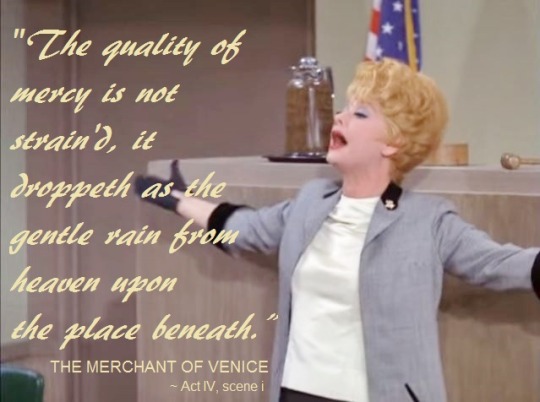
A stage where she plays Shakespeare’s Portia

A street where she is a ‘woman of the night’ in a scarlet red dress.


On two notable occasions, Lucy Ricardo’s fantasy or dream life manifested itself on our TV screens. In “Ricky’s Old Girlfriend” (ILL S3;E12) Lucy dreams of what her life would be like if Ricky left her to go on tour with his former partner, sexy Carlotta Romero.
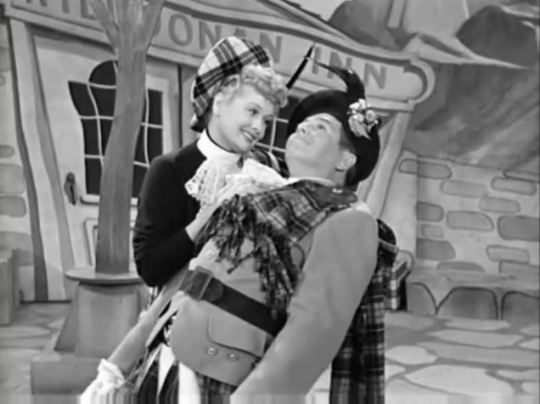
In “Lucy Goes To Scotland” (ILL S5;E17) Lucy dreams of visiting her ancestral home in Scotland while visiting London. Having just come from seeing a West End Musical, she dreams in the musical comedy format!

In “Lucy and the Dummy” (ILL S5;E3), after MGM offers Lucy a contract, she imagines fame and fortune but is fully awake. Lucille Ball pantomimes the joys and sorrows of stardom while a Theremin gives the sequence a dream-like, surreal quality. Lucy Ricardo is most like DREAM GIRL’s Georgina in this short reverie.

In “Lucy and the Monsters” (TLS S3;E18), Lucy Carmichael has a nightmare after watching a scary horror movie. The dream takes her and Viv to a haunted house where they encounter a variety of typical movie monsters and then turn into witches themselves – all before waking up.
DREAM GIRL CAST & CREW

Herbert Kenwith (Producer) later directed 14 episodes of “Here’s Lucy” between 1969 and 1970. Dede Ball warned Kenwith that her daughter was indeed the bitch everyone said she was. Lucille snapped back: “I am not! Only when I’m working.”
Jack Benny (to Herbert Kenwith, about Lucy): “Herbert, you ought to call a psychiatrist for her.”
Jus Addiss (Director) was the life partner of DREAM GIRL actor Hayden Rorke. Barbara Eden (who, like Rorke, also guest-starred on “I Love Lucy”) later remembered that Addiss and Rorke were “unabashedly gay” and often invited the “I Dream of Jeannie” cast over for parties.
Jo Mielziner (Settings) had also done the scenery for the Broadway premiere of DREAM GIRL in 1945. From 1949 to 1970 Mielziner won 9 Tony Awards. His designs were adapted by Richard Burns for the tour starring Ball.

The play co-starred Scott McKay as the imaginative writer. McKay played the role of Wilbur in the 1958 pilot for TV’s “Mr. Ed” but was replaced on the series by Alan Young.

Hayden Rorke, best known as Dr. Bellows in “I Dream of Jeannie”, was also in the cast. Lucy later employed him to play the Ricardo’s new neighbor, whom she suspects to be a spy, on “I Love Lucy.” He later returned to play a judge on a 1971 episode of “Here’s Lucy.”
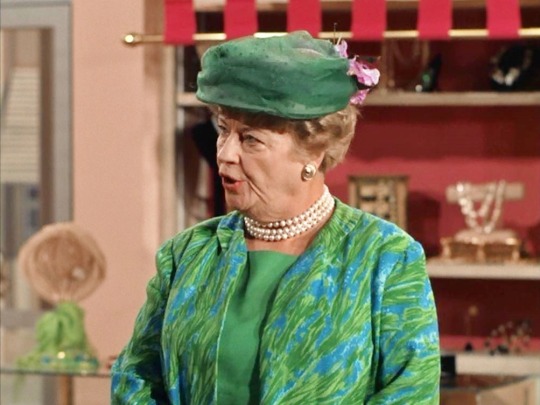
Barbara Morrison was an English-born actress who came to Hollywood in the late 1940s. She did two episodes of “The Lucy Show” and three episodes of “Here’s Lucy.”
Lela Bliss went on to play Mrs. Shellhammer in the 1947 film Miracle on 34th Street, which also starred William Frawley.
Andrew Duggan later did an episode of Desilu’s TV series “The Greatest Show on Earth” (1964). He is best remembered as the voice of the Father in Disney’s theme park attraction The Carousel of Progress.
Phil Arthur appeared on Broadway from 1948 to 1952, his last play with Henry Fonda (Lucy’s one-time boyfriend) and Frances Baviar (Aunt Bee on “The Andy Griffith Show”). He began on television in 1949 and his last job on the small screen was as a background player on “Perry Mason” from 1961 to 1966.
Dorothy Elder began doing television in 1950, but her career only lasted until 1955, as a regular on “True Romances”.

Alan Hewitt was a veteran of sixteen Broadway shows, including the original production of Death of a Salesman (1949) and Call Me Madam starring Ethel Merman (1950). From 1964 to 1966 he played Detective Brennan on “My Favorite Martian.” In 1964, he appeared on an episode of “The Lucy Show.”

The Newark Star-Ledger review of DREAM GIRL, June 24, 1947. [Thanks to Eric C. Schwarz, research librarian extraordinaire, for the review.]
POST PRINCETON!

In January 1948, Lucille got the opportunity to recreate the role in Los Angeles, but fell ill with a virus shortly after it opened and the show closed prematurely. Because Ball was known for her film roles, promotion often said that she was appearing “Live In Person” – which seems obvious in a live theatre production!


Handbill for the Los Angeles production that was cut short by Ball’s illness. Lela Bliss took over for Barbara Morrison.


Souvenir program from the Brooklyn engagement at Brandt’s Flatbush Theatre in July 1947. It includes an excerpt from a write-up by Hall Barnell for Actors Cues about the rehearsal he attended at Malin Studios and a sketch of Ball from that day.

Detroit Music Hall – signed program.

Boston Production at the historic Shubert Theatre – signed program.

San Francisco production at the Curran Theatre.

During this San Francisco engagement, Ball’s husband was not far away! Five blocks, to be exact. It is likely that Lucy and Desi stayed at the Palace Hotel while she was performing at the Curran. It is also likely that Desi’s performances were in lieu of a hotel bill for the couple!

“I have seen other productions of this play, but the only actress whose performance really delighted me was Lucille Ball. She lacked… tender wistfulness, but her vivid personality and expert timing kept the play bright and alive.” ~ Edgar Rice, Playwright

It is pretty clear that this photo was an early version of photo shop. Although it was created during the time of the play, it is quite obviously a manipulated photo.

In August 1947, the show had finally reached what was known as “the subway circuit” – a group of New York City borough theatres that were not considered Broadway. Meanwhile, in Princeton, the summer season continued with yet another show produced by Kenwith and Kennedy, “Horace”. The Billboard review of August 30 was of the opinion that Lucille Ball was simply playing Lucille Ball, and that audiences were okay with that.

This sterling silver cigarette case was a gift to Lucy from the DREAM GIRL company and is engraved on the front: “With Grateful appreciation TO OUR ‘DREAM GIRL’ December 1947.” The lid has the engraved signatures of the company, 17 in all, including actors Scott McKay, Guy Standing, and Andy Duggan. The item came up for auction after the death of Gary Morton.

While Lucy and the DREAM GIRL company were touring, they knew that a film adaption had been made and was awaiting release. It starred Betty Hutton and MacDonald Carey, but did not open to the public till later in 1948. Lucille Ball and Desi Arnaz took a chance on Hutton in 1959, giving her a CBS sitcom “The Betty Hutton Show” which ended after 30 episodes.

In 1955, while Lucille Ball was busy with “I Love Lucy,” NBC made DREAM GIRL into a TV film starring Vivian Blaine. It featured “Lucy” character actors Hal March and Ida Moore.

Ten years later, it was turned into a Broadway musical named Skyscraper, with the play adapted by Peter Stone (”1776″) and starred Julie Harris in her first musical. It earned five Tony nominations. Charles Nelson Reilly guest-starred on “Here’s Lucy” in 1970. Peter Marshall played Lucy’s brother-in-law Hughie on “The Lucy Show” in 1963. Choreographer Michael Kidd also did the dances for Wildcat starring Lucille Ball in 1960.
-
THE CAVALCADE OF AMERICA: “SKYLARK SONG”
June 21, 1948

The Cavalcade of America ran on NBC Radio from 1935 to 1953. It featured events from American history, usually dramatizing the positive aspects of the nation’s past. Additionally, the show attempted to end criticism of its sponsor, the Du Pont Company due to negative publicity from profiting by producing gunpowder during World War I.

Throughout the years, actors and actresses from Broadway and Hollywood were featured. The show was broadcast live from the Longacre Theatre in NYC and repeated later in the day.

In 1952, the series was transferred to NBC television and lasted until 1957, nearly identical to the run of “I Love Lucy” on CBS. For six months the radio and television versions also overlapped. The TV version featured “Lucy” actors Robert Foulk, Dayton Lummis, Byron Foulger, Maurice Marsac, Ross Elliott, Roy Roberts, Hayden Rorke, Pierre Watkin, Will Wright, Nestor Paiva, Joi Lansing, Dorothea Wolbert, Don Rickles, Burt Mustin, Lurene Tuttle, Gladys Hurlbut, Paul Picerni, Richard Reeves, James Flavin, Larry J. Blake, Peter Graves, Rhodes Reason, Irving Bacon, Milton Frome, Eleanor Audley, Joe Mell, Mary Ellen Kay, Mario Siletti, John Banner, Harry Bartell, Robert Carson, William Fawcett, Mabel Paige, June Whitley Taylor, Iron Eyes Cody, Strother Martin, Norma Varden, Madge Blake, Ellen Corby, Dick Elliott, Vivi Janiss, Ida Moore, Elizabeth Patterson, Frank J. Scannell, Herb Vigran, and William Schallert.
Synopsis: “Skylark Song” by Virginia Radcliff is the story of Grace Moore, charting her climb from a small southern church choir to star of the Metropolitan Opera House in New York City.

Grace Moore (December 5, 1898 – January 26, 1947) was an operatic soprano and actress in musical theatre and film. Born in Slabtown, Tennessee, she was nicknamed the “Tennessee Nightingale.” Her films helped to popularize opera by bringing it to a larger audience. She was nominated for the Academy Award for for her performance in One Night of Love. In 1947, Moore died in a plane crash at the age of 48. She published her autobiography in 1944 titled You’re Only Human Once.

In 1953, a film about her life was released titled So This Is Love starring Kathryn Grayson and Lucy’s friend Merv Griffin. The movie featured “Lucy” players Herb Vigran, Victorio Bonanova, Moroni Olsen, Mario Siletti, Ray Kellogg, Olin Howland, Tristram Coffin, Jack Chefe, and Barbara Pepper as Fat Girl with Sailor in Nightclub!

Lucille Ball (Grace Moore) may be the last person on earth one would consider to play one of the most famous opera singers of all time – but this was radio – and recordings of Grace Moore and studio singers were used to supplement the program. Ball affects a slight southern accent during the broadcast. Operatic trills and other miscellaneous singing by the character was provided by Marjorie Brett and Marjorie Hamilton.

Lucille Ball signed the contract for “Skylark Song” on June 11, 1948 and was paid $3,500 for her work.

The story starts when Moore is 17, convincing her father to allow her to attend music school. She goes to New York City where her father tells her to “only take parts in Shakespeare”. She tells him she will report to theatrical impresario David Belasco to ask him if she can play Juliet.

GRACE: “Hark! What light through yonder window breaks…”
Belasco stops her. Moore is reciting Romeo’s speech because that is the role she played in school. Lucille Ball purposely does a very stilted rendition, with a large country twang.
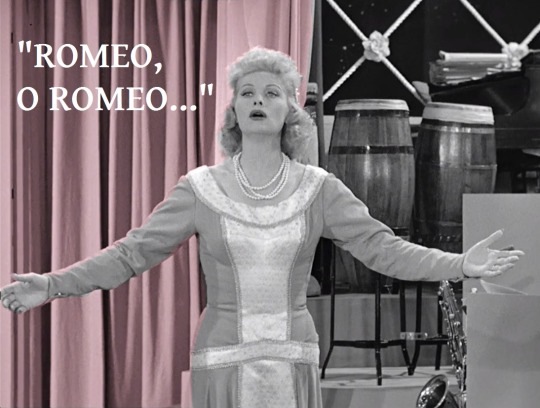
Lucy Ricardo also did Romeo and Juliet in school, later hoping to repeat her triumph with Orson Welles.

Belasco sends her to see composer and producer George Gershwin, who unfortunately hasn’t got a job for her.

In 1920, Moore finally lands a job in the chorus of a Broadway show called “Hitchy-Koo.” The show was produced by Raymond Hitchcock (hence the unusual name) with music by Jerome Kern (”Showboat”).
GRACE: “Well, Daddy, what do you think of your skylark, now?”

Grace lands an audition at the Metropolitan Opera but is told that her Broadway work has damaged her classically-trained voice and sent away.

GRACE: “I’m either a skylark or a mud hen. There’s nothing in between.”
A fortune teller named Carmen tells her that she should go to Europe and make her name. In a montage sequence, Moore trains in Europe. Now at the peak of her vocal range, Grace finally gets a job at the Metropolitan Opera as Mimi in La Boheme.

Her proud father and mother attend Grace’s triumphant opening night.

Announcer Ted Pearson sums up Grace’s remarkable journey, as well as her tragic death in a plane crash in Denmark.

Pearson reminds us that next week on The Cavalcade of America Basil Rathbone will play Thomas Jefferson in “The Common Glory”…

…and that Lucille Ball will soon be seen in the Paramount Picture Sorrowful Jones, despite the fact that the film will not premiere until a year later, June 1949. Filming began on April 7, 1948.
-
FATHER’S DAY
The death of Lucille Ball’s father at an early age had a great impact. Throughout the four situation comedies built around her, the “Lucy” characters had mothers, but references to their fathers was rare. Here’s a tribute to the precious few dads found in the Lucyverse!

Henry “Had” Durrell Ball (1887-1915) ~ Father of Lucille Ball and Fred Ball.

Desiderio Alberto Arnaz y Alberni II (1894-1973) ~ Father of Desi Arnaz and grandfather of Lucie Arnaz and Desi Arnaz IV. Desi Jr. is now the father of two.

Ricky Ricardo (aka Ricardo Alberto Fernando Ricardo y de Acha aka Enrique Alberto Fernando Ricardo y de Acha III) ~ Father of Ricky Ricardo Jr. (Keith Thibodeaux). Actually, Ricky’s son was played by 8 actors over the course of the series.

In “Return Home From Europe” (ILL S5;E26), Ricky insists that he is not the father of baby Cheddar Chester!
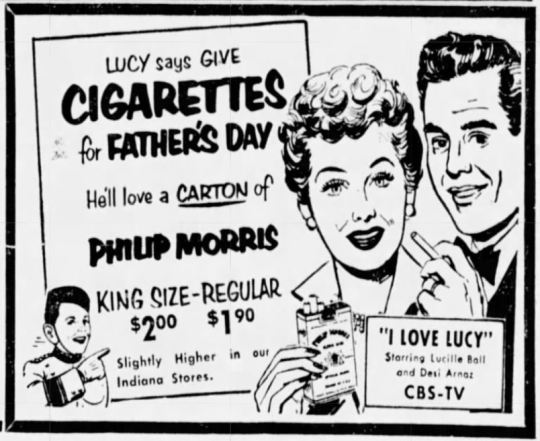
Below are all the fathers on “I Love Lucy”!
But first, a (Father’s Day) word from our sponsor!
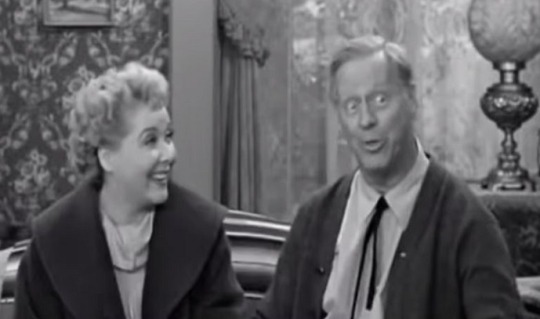
Will Potter ~ Father of Ethel Mertz. Besides Ricky himself, Will Potter (Irving Bacon) is the only father of the main characters on “I Love Lucy.” Although all four have living mothers (two of whom are characters on the show), only Ethel’s father is alive and well and appears on screen in “Ethel’s Hometown” (ILL S4;E16).

Charlie Appleby ~ Father of Stevie. Charlie makes two appearances on the series, although each time he is played by a different actor: Hy Averback played him in “Baby Pictures” (ILL S3;E5) and George O’Hanlon (inset photo) in “Lucy and Superman” (ILL S6;E13).

Harry Munson ~ Father of Billy. Harry and Grace live about a mile from the Ricardos in Connecticut. Harry is played by Tristram Coffin in two episodes: “Lucy Misses the Mertzes” (ILL S6;E17) and in “The Country Club Dance” (S6;E25).

Ralph Ramsey ~ Father of Bruce Ramsey. The Ramseys live across from the Ricardos in Westport. Ralph (Frank Nelson) was only seen in two Connecticut-based episodes: “Lucy Gets Chummy With The Neighbors” (ILL S6;E18) and “Country Club Dance” (ILL S6;E25), although Nelson appeared in many more episodes as different characters.

Danny Williams ~ Father of Rusty, Linda and Terry, although Terry does not appear in “Lucy Makes Room For Danny”, the cross-over episode that brought “The Danny Thomas Show” to CBS. In fact, for its first three years, the show was known as “Make Room for Daddy.” Subsequently, Thomas did a sequel called “Make Room for Granddaddy” and Lucille Ball guest-starred on it in 1971.

The Sheriff of Bent Fork, Tennessee ~ Father of twin girls Teensy and Weensy. Will Wright played the character in “Tennessee Bound” (ILL S4;E15).

Mr. Stanley ~ Father to nine girls! When “Lucy Goes To The Hospital” (ILL S2;E16), Ricky meets a man in the fathers’ waiting room (played by Charles Lane) anxiously awaiting the birth of his latest (and he says last) child, whom he hopes will be a boy. His hopes are dashed – times three over!

The Italian Farmer ~ in “Lucy’s Bicycle Trip” (ILL S5;E24), claims to have nine children: Teresa, Sofia, Luigi, Pietro, Dino, Gino, Rosa, Mario, and Antonio! The Farmer is played by Mario Siletti, but his “multi bambini” remain off screen!

Ernie Kovacs ~ Father of Kippie and Bette, unseen but mentioned characters in “Lucy Meets the Mustache” (LDCH S3;E3) in 1960. The girls are said to be making friends with Little Ricky, while their father entertains at Lucy and Ricky’s (last) party.
Moving on to the Fathers of “The Lucy Show”…

Theodore J. Mooney ~ Father of Bob, Ted, Arnold, and Rosemary, who was never seen, but is said to live in Trenton and to have had a baby, making Mr. Mooney a grandfather as well! Gale Gordon played Mr. Mooney from 1963 to 1968. If the character was ever given a spin-off, it might have been called “My Three Sons”!

Father Time ~ Played by Sherman Bagley (Ralph Hart) in “Chris’s New Year’s Eve Party” (TLS S1;E14). He is accompanied by Baby New Year played by Jerry Carmichael (Jimmy Garrett). In the series, Sherman’s father Ralph is mentioned, but never seen. Jerry’s dad is deceased and never given a name.

Kenneth Westcott ~ Father of Debbie, who is a friend of Lucy Carmichael’s daughter Chris and Principal of their high school in 1963′s “Lucy is a Chaperone” (TLS S1;E27). He is played by Hanley Stafford.

Mr. Sanford ~ Father of Timmy, who is having a birthday where Lucy and Viv are hired as party planners and the entertainment in “Kiddie Parties, Inc.” (TLS S2;E2). Mr. Sanford is played by Lyle Talbot. If he was ever given a sequel, it might be called “Sanford and Son”!

Jonathan Winslow ~ Father of Charlie, Danny and Bobbie (aka Roberta) in “Lucy the Babysitter” (TLS S5;E16). What Lucy doesn’t realize is that the Winslow children are actually baby chimps! Mr. Winslow was played by Jonathan Hole.

In “Lucy and Harry’s Tonsils” (TLS S2;E5), Mr. Phillips (Jack Collins) plays an father expecting his first child who believes Mr. Mooney is there for the same reason, while Mr. Mooney thinks Mr. Phillips is there for a tonsillectomy!
Phillips (having his third child) is similar to the character of Mr. Stanley (who is having his ninth – all girls!) in “Lucy Goes to the Hospital” (ILL S2;E16).

“Lucy Becomes a Father” (TLS S3;E9) finds single mom and widow Lucy Carmichael trying to be both mother and father to her son, Jerry. She joins five other cub scout dads on a weekend away, trying desperately to do what the other dads do. The fathers include (left to right): Hal Smith as Mr. Wilson, George ‘Red’ Fox as George (hidden), Gale Gordon as Mr. Mooney, George Niese as Mr. Carter, and Buster West as Tom. Coincidentally, Gale Gordon had the surnames Carter in “Here’s Lucy” and Wilson in “Dennis the Menace” but neither were dads!

In the play “The Founding of Danfield” staged in “Lucy and Arthur Godfrey” (TLS S3;E23) in 1965, Godfrey plays “Daddy” of Lucybelle (Lucy Carmichael), and [spoiler alert] Conrad P. Field (Mr. Mooney) turns out to be the daddy of the Honest-But-Poor Piano Player Dan (Vinnie, played by Max Showalter). In real life, Godfrey was the father of three.

The Father of Our Country ~ George Washington, as embodied by Lucy Carmichael when “Lucy and Viv Open a Restaurant” (TLS S2;E20). Viv (Vivian Vance) dresses a George’s wife, Martha, to promote their new Colonial-themed restaurant.

In “Lucy the Gun Moll” (TLS S4;E25), Lucille Ball plays both Lucy Carmichael and a look-alike gun moll named Rusty, who performs the Cole Porter song “My Heart Belongs to Daddy”!
And now the Dads of “Here’s Lucy”….

Mr. Caldwell ~ Father of Laurie in “Mod, Mod Lucy” (HL S1;E1), the very first episode of “Here’s Lucy.” Lew Parker played the over-protective dad of teenage Laurie (Nancy Roth). His wife is played by Nancy Howard. Parker was best known for playing the father of another TV character, Ann Marie (Marlo Thomas) on “That Girl.” In real-life, Marlo’s father was Lucy’s friend and co-star – one of the most famous daddies on TV – Danny Thomas!

On “Lucy and Johnny Carson” (HL S2;E11), while appearing on “The Tonight Show” and playing Stump the Band, Lucy Carter chooses a song titled “Snoops the Lawyer” that she says her father sang to her when she was a child. This is the only mention of her father on the series. Coincidentally, Ball’s real mother is one of the audience members (Carson is sitting on the arm of her chair). Since the song was not written until 1920, and Lucille Ball’s real father Henry died in 1915, this cannot be a real-life recollection from Lucy.

Lee Wong ~ Father of Linda Chang and Sue Chin in “Lucy the Laundress” (HL S2;E17). The single father and business owner was played by James Hong.

Moose Manley ~ Father of milquetoast Wally in “Lucy and Wally Cox” (HL S2;E21). Moose was played by Alan Hale Jr. and his timid son by Wally Cox (insert).

Harrison Otis Carter the First ~ Great Grandfather of Harry Carter IV (aka Harry). Gale Gordon’s image was used to create Harry’s great grandfather. Harry claims he was one of the founders of Sinclairville, New York, and was father of 17 children!
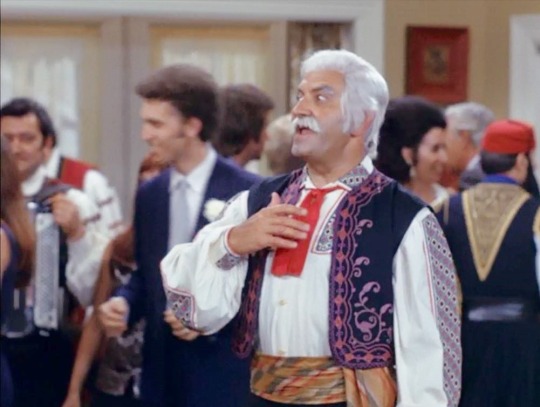
Konstantin Kasos ~ Grandfather of the Bride in “Lucy’s Wedding Party” (HL S3;E8). The role was played by Bruce Gordon (”The Untouchables”) who was really just 55 years old playing a 77 Greek granddaddy.

Vincent Price – Father of Victoria aka “Little Vicky”, the name of Price’s real-life daughter, who is mentioned by Lucy, but does not appear in the episode “Lucy Cuts Vincent’s Price” (HL S3;E9).

Alfredo Colucci ~ Father of Ricardo, Anna Maria, Louisa, Luigi, Vincenzo, Dino, Lucrezia, Alfredo Jr., Margarito, Bruno, Rosa, and Frederico – all of whom appear in the final moments of “Lucy and Harry’s Italian Bombshell” (HL S4;E3) starring Kaye Ballard. Emile Autuori plays Alfredo, but the twelve children appear uncredited.

Claude Wolff ~ Husband of Petula Clark, who was noticeably pregnant when they played themselves on a “Here’s Lucy” in 1972. In real-life, Wolff became a dad for the third time with the birth of his first son, Patrick.

Harry Carter (Gale Gordon) finally got to play a working class dad to two unambitious teens when he appeared in a TV commercial during “Lucy and Cousin Ernie’s Fun Farm” (HL S1;E23) in 1969.

Harry Carter (Gale Gordon) pretends to be a husband and father (to be) when he convinces Lucy to play his pregnant wife to scare of a domineering suitor (Jean Willes) in “Lucy, The Part-Time Wife” (HL S3;E14).

The Lucyverse has plenty of room for fathers of all kinds. Father Lambros (Paul Picerni) showed up for a Greek wedding in “Lucy’s Wedding Party” (HL S3;E8).
And Finally, “Life With Lucy
All Lucy Fathers come back to Gale Gordon – a man who never had children in real life!

Curtis McGibbon ~ Father of Ted McGibbon and Grandfather of Ted’s children Rebecca and Kevin. Gale Gordon played Curtis, the patriarch on “Life With Lucy,” with Larry Anderson as Ted, Jenny Lewis as Becky, and Philip Amelio as Kevin.

In “Mother of the Bride” (LWL S1;E8) in 1986, Lucy Barker and her sister Audrey (Audrey Meadows) mention their father during a private conversation in the kitchen.
-
BE A PAL aka BE A PAL TO YOUR HUSBAND
June 18, 1950

“Be A Pal” aka “Be A Pal To Your Husband” is episode #93 of the radio series MY FAVORITE HUSBAND broadcast on June 18, 1950 on the CBS Radio Network.
Synopsis ~ Liz feels thinks George would rather not spend time with her anymore, so she tries everything she can think of to be a pal to her husband.
REGULAR CAST

Lucille Ball (Liz Cooper) was born on August 6, 1911 in Jamestown, New York. She began her screen career in 1933 and was known in Hollywood as ‘Queen of the B’s’ due to her many appearances in ‘B’ movies. With Richard Denning, she starred in a radio program titled “My Favorite Husband” which eventually led to the creation of “I Love Lucy,” a television situation comedy in which she co-starred with her real-life husband, Latin bandleader Desi Arnaz. The program was phenomenally successful, allowing the couple to purchase what was once RKO Studios, re-naming it Desilu. When the show ended in 1960 (in an hour-long format known as “The Lucy-Desi Comedy Hour”) so did Lucy and Desi’s marriage. In 1962, hoping to keep Desilu financially solvent, Lucy returned to the sitcom format with “The Lucy Show,” which lasted six seasons. She followed that with a similar sitcom “Here’s Lucy” co-starring with her real-life children, Lucie and Desi Jr., as well as Gale Gordon, who had joined the cast of “The Lucy Show” during season two. Before her death in 1989, Lucy made one more attempt at a sitcom with “Life With Lucy,” also with Gordon.
Richard Denning (George Cooper) was born as Louis Albert Heindrich Denninger Jr., in Poughkeepsie, New York. When he was 18 months old, his family moved to Los Angeles. Plans called for him to take over his father’s garment manufacturing business, but he developed an interest in acting. Denning enlisted in the US Navy during World War II. He is best known for his roles in various science fiction and horror films of the 1950s. Although he teamed with Lucille Ball on radio in “My Favorite Husband,” the two never acted together on screen. While “I Love Lucy” was on the air, he was seen on another CBS TV series, “Mr. & Mrs. North.” From 1968 to 1980 he played the Governor on “Hawaii 5-0″, his final role. He died in 1998 at age 84.
Gale Gordon (Rudolph Atterbury) had worked with Lucille Ball on “The Wonder Show” on radio in 1938. One of the front-runners to play Fred Mertz on “I Love Lucy,” he eventually played Alvin Littlefield, owner of the Tropicana, during two episodes in 1952. After playing a Judge in an episode of “The Lucy-Desi Comedy Hour” in 1958, he would re-team with Lucy for all of her subsequent series’: as Theodore J. Mooney in ”The Lucy Show”; as Harrison Otis Carter in “Here’s Lucy”; and as Curtis McGibbon on “Life with Lucy.” Gordon died in 1995 at the age of 89.
Bea Benadaret (Iris Atterbury) was considered the front-runner to be cast as Ethel Mertz but when “I Love Lucy” was ready to start production she was already playing a similar role on TV’s “The George Burns and Gracie Allen Show” so Vivian Vance was cast instead. On “I Love Lucy” she was cast as Lucy Ricarodo’s spinster neighbor, Miss Lewis, in “Lucy Plays Cupid” (ILL S1;E15) in early 1952. Later, she was a success in her own show, “Petticoat Junction” as Shady Rest Hotel proprietress Kate Bradley. She starred in the series until her death in 1968.
Ruth Perrott (Katie, the Maid) was also later seen on “I Love Lucy.” She first played Mrs. Pomerantz (above right), a member of the surprise investigating committee for the Society Matrons League in “Pioneer Women” (ILL S1;E25), as one of the member of the Wednesday Afternoon Fine Arts League in “Lucy and Ethel Buy the Same Dress” (ILL S3;E3), and also played a nurse when “Lucy Goes to the Hospital” (ILL S2;E16). She died in 1996 at the age of 96.
Bob LeMond (Announcer) also served as the announcer for the pilot episode of “I Love Lucy”. When the long-lost pilot was finally discovered in 1990, a few moments of the opening narration were damaged and lost, so LeMond – fifty years later – recreated the narration for the CBS special and subsequent DVD release.
GUEST CAST

Hans Conried (Professor Millmoss / Joe) first co-starred with Lucille Ball in The Big Street (1942). He then appeared on “I Love Lucy” as used furniture man Dan Jenkins in “Redecorating” (ILL S2;E8) and later that same season as Percy Livermore in “Lucy Hires an English Tutor” (ILL S2;E13) – both in 1952. The following year he began an association with Disney by voicing Captain Hook in Peter Pan. On “The Lucy Show” he played Professor Gitterman in “Lucy’s Barbershop Quartet” (TLS S1;E19) and in “Lucy Plays Cleopatra” (TLS S2;E1). He was probably best known as Uncle Tonoose on “Make Room for Daddy” starring Danny Thomas, which was filmed on the Desilu lot. He joined Thomas on a season 6 episode of “Here’s Lucy” in 1973. He died in 1982 at age 64.

“My Favorite Husband” was based on the novels Mr. and Mrs. Cugat, the Record of a Happy Marriage (1940) and Outside Eden (1945) by Isabel Scott Rorick, which had previously been adapted into the film Are Husbands Necessary? (1942). “My Favorite Husband” was first broadcast as a one-time special on July 5, 1948. Lucille Ball and Lee Bowman played the characters of Liz and George Cugat, and a positive response to this broadcast convinced CBS to launch “My Favorite Husband” as a series. Bowman was not available Richard Denning was cast as George. On January 7, 1949, confusion with bandleader Xavier Cugat prompted a name change to Cooper. On this same episode Jell-O became its sponsor. A total of 124 episodes of the program aired from July 23, 1948 through March 31, 1951. After about ten episodes had been written, writers Fox and Davenport departed and three new writers took over – Bob Carroll, Jr., Madelyn Pugh, and head writer/producer Jess Oppenheimer. In March 1949 Gale Gordon took over the existing role of George’s boss, Rudolph Atterbury, and Bea Benaderet was added as his wife, Iris. CBS brought “My Favorite Husband” to television in 1953, starring Joan Caulfield and Barry Nelson as Liz and George Coope. The television version ran two-and-a-half seasons, from September 1953 through December 1955, running concurrently with “I Love Lucy.” It was produced live at CBS Television City for most of its run, until switching to film for a truncated third season filmed (ironically) at Desilu and recasting Liz Cooper with Vanessa Brown.
This script is a revision of "Be Your Husband’s Best Friend” episode #21 of “My Favorite Husband” aired December 8, 1948. The program was aired before Liz and George’s last name was changed from Cugat to Cooper. Hans Conried was in that episode as well.
This program was the basis for “I Love Lucy” episode “The Camping Trip” (ILL S2;E29)
and parts of the identically titled “Be a Pal” (ILL S1;E2).

“Jell-O Everybody!”
The episode opens with Liz and George having an argument over breakfast about where to spend their evening. Liz wants to go to a symphony concert, while George wants to play poker.
At their club luncheon, Liz and Iris listen to a guest speaker talk about “How To Be Happy, Though Married”. Professor Phillip Millmoss (Hans Conried) suggests the ladies be a pal to their husbands. Liz wonders why it has to be the woman who gives in – but Millmoss tells her to consult his new book (page 65):
PROFESSOR MILLMOSS (reading): “Be your husband’s best friend. Be like his dog. You’ll never hear a man arguing with his dog!”

On “I Love Lucy,” the book Lucy Ricardo takes advice from was written by Dr. Humphries. Unlike the radio version, the author is not a character in the script. When taking his advice doesn’t work out the way she hoped, Lucy quips “Doctor Humphries can go jumphries.”
Liz resolves to employ the “Millmoss Treatment” with George and sits beside him to read the evening newspaper. Liz pretends to be interested in the sports section.

LIZ (reading headline): “Williams Bags Crown By TKO in eighth.″
Liz pronounces TKO phonetically as ‘Tuh-Ko” although George corrects her. The exchange was repeated verbatim between Lucy and Ricky in
LIZ (reading): “Midget Racing! They oughta be ashamed making those little men racing around the track.”
George sarcastically calls Liz Ted Husing, and then Red Barbar.

Ted Husing (1901-62) was one of CBS Radio’s most popular sportscasters. By 1950 his salary was an astronomical million dollars! Red Barber (1908-92) was a play-by-play announcer for major league baseball, then announcing for the Brooklyn Dodgers and holding down his own CBS TV sports show “Red Barber’s Club House.”
LIZ (reads): “Now they’re racing little girls! It says so right here,‘Yesterday at Tanforan a race was won by a three year-old maiden!’ She certainly was carrying a lot of money for a little girl. She had $2,000 in her purse.”

The line is virtually identical on television, except that Tanforan (a horse racetrack outside San Francisco) was changed to the more familiar Churchill Downs.
George / Ricky then refers to Liz / Lucy as Grantland Rice (1880–1954), a sportswriter known for his elegant prose, although the reference was removed for TV syndication when Rice died in 1954. It was restored for the DVD release. Clueless Liz / Lucy think he is a food!
Liz is determined to join in the poker game that evening, despite not knowing anything about the card game. Lucy also tried this tactic on “Be A Pal”.
LIZ / LUCY (looking over her cards): “There’s her sister! What do you have?”
MR. ATTERBURY / FRED: “I shouldn’t talk, but tell your two Andrews Sisters not to wait up for LaVerne!”

Interestingly, the poker players consist of Joe (also voiced by Hans Conried), George, and Mr. Atterbury played by Gale Gordon. Gordon was on the short-list to play Fred Mertz on “I Love Lucy,” so it is fitting that these lines were given to William Frawley in the TV version. The Andrews Sisters were a close-harmony singing group most popular during World War II. In 1969 Lucy played LaVerne Andrews on an episode of “Here’s Lucy” that guest-starred Patty Andrews as herself. Lucille Ball’s daughter, Lucie Arnaz (not yet born at the time of the radio show) took the role of the third Andrews sister, Maxene.
Mr. Atterbury suggests that George take Liz on a rigorous camping trip to dissuade her from being George’s ‘pal’. Iris warns Liz about her husband’s plan, just as Ethel does in “The Camping Trip.” Liz / Lucy recruits Iris / Ethel to turn the tables at the campsite.
Liz and George engage in a fishing contest, just like Lucy and Ricky. Iris / Ethel arrives with some store-bought trout to fool George / Ricky.

LIZ: “Throw them to me, Iris. That way I can tell George I caught them.”
On radio, George becomes suspicious. It seems Iris has purchased LAKE trout, not the kind found in a stream. On TV this is goof is omitted.
Liz / Lucy challenges George / Ricky to a footrace back to camp.
GEORGE / RICKY: “Since I’m a man, I’ll give you a head start.”
LIZ / LUCY: “Since I’m a woman, I’ll take it!”Back at camp, Liz is patiently waiting for George, having hitched a ride back in Iris’s car.

LIZ / LUCY: “I got back so early, I had time to wash my hair.”
Next morning Liz and Iris conspire to make George think she’s an expert duck hunter and sharp-shooter! The same scenario is repeated in “The Camping Trip” with some minor line changes. Liz takes aim at the tree, and on cue Iris tosses a duck at her feet.
GEORGE: “I don’t get it. Liz. First you catch a Lake Trout in a stream, now you shoot a duck marked Birdseye Frozen Foods!”
Lucille Ball (as Liz) then does her classic spider face “Ewww!” On television, the duck Ethel has bought is not the frozen variety, but one freshly plucked!

RICKY: “You know, that’s pretty good shooting. Not only did you kill the duck, but you knocked its feathers off and cleaned it, too!”
It is likely that CBS did not want to give an unpaid promotional mention to the Birdseye Company, although the thawed bird resembles the classic rubber chicken that is so associated with vaudeville comedy.
The main difference in this scene on radio and television is that Liz demonstrates her shooting skill with the horseshoe AFTER the duck hunting, but before it on television. When Iris is exposed, Liz and George decide to stop being pals and go back to being just husband and wife.
BOB LEMOND: “Watch for Lucille Ball in ‘Fancy Pants’ with Bob Hope.”

Fancy Pants was a musical adaptation of Ruggles of Red Gap that premiered on July 19, 1950. It was the second of four films Ball and Hope did together.
A short commercial for Sugar Crisp follows the mention of Ball’s film. A final rendition of the Jell-O pudding jingle ends the program.
1950, Be A Pal, Bea Benadaret, Birdseye Company, Bob Hope, Bob LeMond, CBS Radio, CBS TV, Churchill Downs, Desi Arnaz, Fancy Pants, Gale Gordon, Grantland Rice, Hans Conried, I love lucy, Jell-O, Jello, Lucille Ball, My Favorite Husband, Red Barber, Richard Denning, Ruth Perrott, Tanforan, Ted Husing, The Andrews Sisters, The Camping Trip, Vivian Vance, William Frawley -
TELEVISION aka GEORGE RUINS A NEIGHBOR’S TV aka THE TELEVISION SUIT
June 17, 1949

“Television” aka “George Ruins a Neighbor’s TV” aka “The Television Suit” is episode #49 of the CBS Radio series MY FAVORITE HUSBAND broadcast on June 17, 1949. It later served as the basis for the “I Love Lucy” episode “The Courtroom” (ILL S2;E7) first aired November 10, 1952.
Synopsis ~ Liz and George’s visit to their next-door neighbors, the Stones, turns into a disaster when George tries to repair the Stones’ new television set by himself.
REGULAR CAST

Lucille Ball (Liz Cooper) was born on August 6, 1911 in Jamestown, New York. She began her screen career in 1933 and was known in Hollywood as ‘Queen of the B’s’ due to her many appearances in ‘B’ movies. With Richard Denning, she starred in a radio program titled “My Favorite Husband” which eventually led to the creation of “I Love Lucy,” a television situation comedy in which she co-starred with her real-life husband, Latin bandleader Desi Arnaz. The program was phenomenally successful, allowing the couple to purchase what was once RKO Studios, re-naming it Desilu. When the show ended in 1960 (in an hour-long format known as “The Lucy-Desi Comedy Hour”) so did Lucy and Desi’s marriage. In 1962, hoping to keep Desilu financially solvent, Lucy returned to the sitcom format with “The Lucy Show,” which lasted six seasons. She followed that with a similar sitcom “Here’s Lucy” co-starring with her real-life children, Lucie and Desi Jr., as well as Gale Gordon, who had joined the cast of “The Lucy Show” during season two. Before her death in 1989, Lucy made one more attempt at a sitcom with “Life With Lucy,” also with Gordon.
Richard Denning (George Cooper) was born as Louis Albert Heindrich Denninger Jr., in Poughkeepsie, New York. When he was 18 months old, his family moved to Los Angeles. Plans called for him to take over his father’s garment manufacturing business, but he developed an interest in acting. Denning enlisted in the US Navy during World War II. He is best known for his roles in various science fiction and horror films of the 1950s. Although he teamed with Lucille Ball on radio in “My Favorite Husband,” the two never acted together on screen. While “I Love Lucy” was on the air, he was seen on another CBS TV series, “Mr. & Mrs. North.” From 1968 to 1980 he played the Governor on “Hawaii 5-0″, his final role. He died in 1998 at age 84.
Ruth Perrott (Katie, the Maid) was also later seen on “I Love Lucy.” She first played Mrs. Pomerantz, a member of the surprise investigating committee for the Society Matrons League in “Pioneer Women” (ILL S1;E25), as one of the member of the Wednesday Afternoon Fine Arts League in “Lucy and Ethel Buy the Same Dress” (ILL S3;E3), and also played a nurse when “Lucy Goes to the Hospital” (ILL S2;E16). She died in 1996 at the age of 96.
Bob LeMond (Announcer) also served as the announcer for the pilot episode of “I Love Lucy”. When the long-lost pilot was finally discovered in 1990, a few moments of the opening narration were damaged and lost, so LeMond – fifty years later – recreated the narration for the CBS special and subsequent DVD release.
Gale Gordon (Rudolph Atterbury) and Bea Benadaret (Iris Atterbury) are mentioned, but not in this episode.
GUEST CAST

Hans Conried (The Process Server) first co-starred with Lucille Ball in The Big Street (1942). He then appeared on “I Love Lucy” as used furniture man Dan Jenkins in “Redecorating” (ILL S2;E8) and later that same season as Percy Livermore in “Lucy Hires an English Tutor” (ILL S2;E13) – both in 1952. The following year he began an association with Disney by voicing Captain Hook in Peter Pan. On “The Lucy Show” he played Professor Gitterman in “Lucy’s Barbershop Quartet” (TLS S1;E19) and in “Lucy Plays Cleopatra” (TLS S2;E1). He was probably best known as Uncle Tonoose on “Make Room for Daddy” starring Danny Thomas, which was filmed on the Desilu lot. He joined Thomas on a season 6 episode of “Here’s Lucy” in 1973.

Frank Nelson (Frank Stone) was born on May 6, 1911 (three months before Lucille Ball) in Colorado Springs, Colorado. He started working as a radio announcer at the age of 15. He later appeared on such popular radio shows as “The Great Gildersleeve,” “Burns and Allen,” and “Fibber McGee & Molly”. This is one of his 11 performances on “My Favorite Husband.” On “I Love Lucy” he holds the distinction of being the only actor to play two recurring roles: Freddie Fillmore and Ralph Ramsey, as well as six one-off characters, including the frazzled train conductor in “The Great Train Robbery” (ILL S5;E5), a character he repeated on “The Lucy Show.” Aside from Lucille Ball, Nelson is perhaps most associated with Jack Benny and was a fifteen-year regular on his radio and television programs.

Mary Lansing (Mary Stone) was best known for playing Martha Clark and ten other characters in Mayberry on “The Andy Griffith Show” and “Mayberry R.F.D.”, both filmed at Desilu. Lucy lovers might remember her as the voice of weepy Cynthia in “Over The Teacups”, the Broadway play that the Ricardos and Mertzes attend in “Ethel’s Birthday” (ILL S4;E9). She met Frank Nelson performing on radio. They married in 1933 and had two children. Lansing appeared with him frequently on the “Jack Benny Program” during the 1950s.

Alan Reed (Harry, the Judge) is probably best remembered as the voice of Fred Flintstone where he acted opposite Bea Benadaret (Iris Atterbury), who voiced Betty Rubble on the animated series. His only television appearance with Lucille Ball was on “The Lucy Show” in 1963, an episode which also featured Frank Nelson. In 1967, he did an episode of the Desi Arnaz series “The Mothers-in-Law”.

“My Favorite Husband” was based on the novels Mr. and Mrs. Cugat, the Record of a Happy Marriage (1940) and Outside Eden (1945) by Isabel Scott Rorick, which had previously been adapted into the film Are Husbands Necessary? (1942). “My Favorite Husband” was first broadcast as a one-time special on July 5, 1948. Lucille Ball and Lee Bowman played the characters of Liz and George Cugat, and a positive response to this broadcast convinced CBS to launch “My Favorite Husband” as a series. When Bowman was not available Richard Denning was cast as George. On January 7, 1949, confusion with bandleader Xavier Cugat prompted a name change to Cooper. On this same episode Jell-O became its sponsor. A total of 124 episodes of the program aired from July 23, 1948 through March 31, 1951. After about ten episodes had been written, writers Fox and Davenport departed and three new writers took over – Bob Carroll, Jr., Madelyn Pugh, and head writer/producer Jess Oppenheimer. In March 1949 Gale Gordon took over the existing role of George’s boss, Rudolph Atterbury, and Bea Benaderet was added as his wife, Iris. CBS brought “My Favorite Husband” to television in 1953, starring Joan Caulfield and Barry Nelson as Liz and George Cooper. The television version ran two-and-a-half seasons, from September 1953 through December 1955, on air concurrently with “I Love Lucy.” It was produced live at CBS Television City for most of its run, until switching to film for a truncated third season filmed (ironically) at Desilu and recasting Liz Cooper with Vanessa Brown. In addition to being aired on the CBS Radio Network, the episodes were heard on the Armed Forces Radio Network, where the commercials were omitted.
THE EPISODE

“Television throws ‘My Favorite Husband’ for a loss, and the whole neighborhood into night courts.” ~ Mason City Globe-Gazette radio listing
As the episode opens, Liz and George are discussing their upcoming summer vacation. Liz has packed five suitcases – just for herself.

George is concerned that Liz’s swimsuit may be too skimpy, a subject explored again in “LIz Learns To Swim” (June 11, 1950) as well as on a couple of episodes of “I Love Lucy.”

Liz and George realize that they do not know any of their neighbors well enough to ask them to water their lawn while they are away. Liz knows the first names (Frank and Mary) of the Stones next door because she read a postcard that was accidentally delivered to their house. George says that he hopes Liz didn’t read the message, but Liz lets it slip that “Mrs. Stone’s mother had a lumbago attack at Lake Tahoe.” On “I Love Lucy” Fred Mertz also chastised his wife about reading postcards delivered to their tenants. In 1951′s “Drafted” (ILL S1;E11) Fred say about Ethel…
FRED: “Some people build model airplanes. Ethel reads postcards.”
At the Stone home, Frank and Mary welcome the Coopers. Frank Nelson (Mr. Stone) does his trademark “Weeeeeell!” and the audience laughs, recognizing it from “The Jack Benny Program.” Mrs. Stone (Mary Lansing) asks if they would like to watch television. The Coopers do not yet own a television set, but Liz casually remarks that they don’t miss it.
LIZ: “I crawl in the Bendix and sing and George watches me through the little window.”

The Bendix Corporation (1924-1983) licensed their name to a line of electric clothes washing machines. The 1937 Bendix Home Laundry had a glass porthole door, a rotating drum and an electrically driven mechanical timer. The machine was able to auto-fill, wash, rinse and spin-dry. Bendix Home Appliances was later sold to Avco who sold it to Philco.

In 1952, Lucille Ball actually played a talking washing machine in a full-length Westinghouse industrial film called Ellis in Freedomland.

Six years later, when Desilu partnered with Westinghouse to present “The Westinghouse-Desilu Playhouse,” Ball did another industrial film for them titled Lucy Buys Westinghouse where she actually got inside the machine, fulfilling Liz Cooper’s off-the-cuff comment of 1949.

The idea of Liz pretending to be performing on television by getting inside a household appliance also recalls when Lucy Ricardo hollowed out their television set to help Ricky picture her doing a TV commercial in the now-famous Vitameatavegamin episode of 1952.

On “I Love Lucy”, it was the Mertzes who did not yet own a television set. By the end of 1949, 4.2 million US homes had a television. By 1953, 50% of all American households owned one. The increase was credited to “I Love Lucy” and the 1953 Republican and Democratic National Conventions.

Frank turns on his TV and after it warms up (a common problem with early televisions), the only program on any station seems to be wrestling. One channel is actually airing lady wrestling!
MARY: “Oh, they have more than wrestling, Mrs. Cooper. Sometimes they have boxing and baseball.”
Televised sports, especially wrestling and boxing, were the primary attraction in the early days of television, especially for male viewers. Long-haired blonde wrestler Gorgeous George was even mentioned on “I Love Lucy.”
ETHEL: “Our grandmothers must have had arms like Gorgeous George.” ~ ‘Pioneer Women’
In “Ricky’s Movie Offer” (ILL S4;E6) the Grocery Boy asks Lucy what she’s supposed to be in her Marilyn Monroe dress and wig, Fred quips “Gorgeous George.”

Nearly every time Ricky and Fred watch television it is to see a boxing match, such as in “Ricky and Fred are TV Fans” (ILL S2;E30) in 1953. That episode, like this radio broadcast, also featured Frank Nelson.
When the TV reception is fuzzy, Frank and George feel they can fix it themselves, much to the disbelief of their wives. Frank takes the back off the set:
FRANK (reading): “Back of this set should be removed by a qualified television repairman only.”
On “I Love Lucy” the warning is similar:

FRED (reading): “Danger! High Voltage! Do not remove this back under any circumstances!”
Both Frank and George and Ricky and Fred cause their sets to explode by fooling around with some loose wires! The wrecked TV results in name calling by both couples and the Stones / Mertzes threaten to sue the Coopers / Ricardos.
Next morning at breakfast, the Coopers are worried that a lawsuit will prevent them from going on vacation. Katy the Maid reports that there is a strange man at the door, whom they immediately suspect may be a process server. Liz tells Katie to lie and say that they are away for a fortnight in the Catskills. Katie answers the door nervously,
KATIE: “They left for a catnap in the Fortskills. I mean a nightcap in the Footskills.”
The Process Server (Hans Conried) surprises the Coopers when they sneak out the back door. They have been served!

TRIVIA! Ironically, on TV the Process Server (Harry Bartell) at first asks the Ricardos where the Lewis apartment is, to throw them off the track. On “I Love Lucy,” Miss Lewis was an elderly tenant played for one episode (”Lucy Plays Cupid”) by Bea Benadaret, the actress who usually plays Iris Atterbury on “My Favorite Husband,” although she is not in this episode. Hans Conried appeared as Dan Jenkins and Percy Livermore on “I Love Lucy,” episodes that book-ended “The Courtroom” during season two!
George writes out Liz’s testimony, including stage directions telling her when to flirt with the Judge. Ricky Ricardo and Fred Mertz do the same thing on “I Love Lucy.” When Liz rehearses her testimony aloud, she states the date and time of the event as “June 13, 1949 at approximately 7:35pm” which was the real time and date of the broadcast. To keep the television version from becoming ‘dated’ – any reference to dates is purposefully omitted. Lucy instead tells the Judge (Moroni Olsen) the events happened “about three weeks ago.”

In the courtroom, George and Frank act as their own attorneys just as Ricky and Fred will do in “The Courtroom”. For economy sake, the radio script omits the character of the Bailiff who swears in the witnesses, although the character is part of the television script. Both scripts also include the flirtatious ‘stage directions’ for Lucy and Liz to appeal to the Judge’s vanity.
LIZ: “…when Mr. Stone suggested we watch television flutter eyelids at jury.”
On television, Lucy hikes up her skirts instead of fluttering her eyelids. Since TV is a visual medium, during her testimony she just does it, rather than says it.

TRIVIA: When the Ricardos and the Mertzes go to court again in “Lucy Makes Way for Danny” on the “Lucy-Desi Comedy Hour”, the judge who Lucy and Ethel try to flirt with by hiking up their skirts is played by Gale Gordon, who usually plays Rudolph Atterbury on “My Favorite Husband,” although he is not in this episode.
The final gag of the Judge’s TV also exploding is the same on radio and TV, except Liz intimates that they are headed for the city jail instead of the happy ending on television where the Judge encourages the couples to forgive one another and sends them home friends.
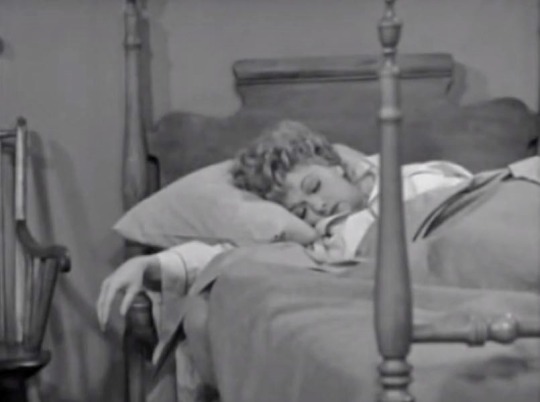
CODA
George and Liz are in bed and George cannot sleep. Liz encourages him to yawn to induce sleep. It works! ZZZZZZZZZZZZZZ
-
LUCY BALL HALL?
JUNE 16, 1938

Before meeting Desi Arnaz while making Too Many Girls, Lucille Ball was actually engaged to be married to divorced film director Alexander Hall, seventeen years her senior.

Alexander Hall made his stage debut in 1898 at age four. He entered films in 1914 as an actor. Leaving the film industry to serve in the army in World War I, he returned in 1917 and re-entered the business, but this time as an editor and assistant director. He made his directorial debut in 1932. He turned out a number of light, sophisticated comedies, the best known of which is the charming fantasy Here Comes Mr. Jordan (1941), for which he received an Oscar nomination.

Hall directed William Frawley (Fred Mertz) in two films: Miss Fane’s Baby Is Stolen (1934) which also starred Irving Bacon, who later played Fred Mertz’s father-in-law Will Potter; and Down To Earth (1947) which also starred Edward Everett Horton, who played randy butcher Mr. Ritter on “I Love Lucy.”

He also directed the 1934 comedy Little Miss Marker, which later was remade as Sorrowful Jones in 1949 starring Lucille Ball.
Al introduced Lucille to Ed Sedgwick, who later served as godfather to her two children. It was reported that Ball even moved into Hall’s Beverly Hills mansion for a time.
“I enjoyed his company, his advice and guidance, but was not in love with him.” ~ Lucille Ball

Director Al Hall and actress Lucille Ball were photographed at the Hollywood Pantages Theater preview of My Little Chickadee in early February 1940. Less than two months later, Hall’s film The Doctor Takes a Wife opened in limited release. The Columbia picture featured future “I Love Lucy” players Irving Bacon, Charles Lane, Vernon Dent, Olin Howland, Myra Marsh, and William Newell.

“Lucille Ball, the blonde comedienne, and Al Hall, Director, were snapped here at Ray Haller’s Cafe, a Hollywood night spot.” Ray Haller’s Cafe was located on Hollywood and Vine, and shortly afterward became known as Sardi’s, a favorite hangout of film stars, just as the New York Sardi’s is for Broadway.

In this 1935 photo Lucy is a brunette. She would not adopt her signature red locks until 1943′s DuBarry Was A Lady, filmed in technicolor.
After Lucille broke the engagement with Hall to date and marry Desi Arnaz, Hall married Jule Cassell, with whom he had a son. He married once more, to Marjorie Hunter.

In 1956, Lucy and Desi hired Hall to direct their 1956 film Forever Darling. Coincidentally, both Forever Darling and Here Comes Mr. Jordan had angels as characters!
Alexander Hall died at age 74 after having a stroke in July 1968.

In 2001, Ben Mendelsohn played Hall in “The Shirley Temple Story” a teleplay developed by Disney.
-
MARY WICKES
June 13, 1910 – October 22, 1995

Mary Wickes (nee Mary Isabella Wickenhauser) was born in St. Louis, Missouri, to parents who were theatre buffs. A smart student, Mary skipped two grades and graduated from High School at age 16. In college, she majored in English and Political Science, though shifted her career goals to acting at the suggestion of a professor.

Wickes’ first Broadway play was Spring Dance in 1934, acting alongside Phil Ober, who married Vivian Vance in 1941. Her second Broadway role was in Stage Door (1936) although she was not asked to repeat her role in the 1937 film. One of the RKO contract players cast in the film version was Lucille Ball.

In The Man Who Came to Dinner, her seventh Broadway show in 1939, she played Nurse Preen, a role she repeated in the 1942 film, her Hollywood debut. She did the role twice more on television in 1949 and 1972. During her busy film and television career, she often played prim, professional women, secretaries, nurses, nuns, and housekeepers, who made sarcastic quips. She left Broadway in 1948, and did not return for another 30 years.

Wickes did not do nearly as much radio work as many actors in Hollywood did, probably because she was busy on Broadway, but she did act opposite Lucy and Desi’s friend and house guest Orson Welles doing radio plays for the “Mercury Theatre” program. She was also sometimes heard in the 1950 series “Crime Does Not Pay.”
On December 19, 1949, in a one-hour live “Studio One in Hollywood” presentation on CBS (a weekly anthology series), Mary Wickes became the first actor to play Mary Poppins, almost 15 years before Julie Andrews immortalized the magical nanny on screen.

Lucille Ball and Mary Wickes were more than just co-stars. Wickes was a close personal friend to Lucille Ball, who often went on vacation with the family.
According to Ball’s daughter, Lucie Arnaz, Wickes was her mother’s most constant friend throughout her life.

Wickes was actually a regular on television a couple of years before Lucille Ball, as part of the cast of “Inside U.S.A.” (1949-1950). Lucille Ball guest-starred on the series in November 1949. The show was done in New York and Lucy was delayed in getting to the studio for rehearsals, so Mary Wickes was asked to stand in for her. When she finally arrived, Lucy observed Wickes and was impressed with her work. They were friends from then on.

A year later, Ball joined her film co-star Bob Hope on his television show, “The Star Spangled Revue”, which also featured Mary Wickes.

In February 1952, Ball hired Wickes to play one of her most memorable characters, Lucy Ricardo’s ballet mistress, Madam LaMond, on “I Love Lucy.” This would be Wickes’ only performance on the series.

Although she did not return to “I Love Lucy”, Wickes still maintained a relationship with Desilu, appearing on 21 episodes of “The Danny Thomas Show” from 1956 to 1958. She played Danny’s no-nonsense Press Agent, Liz O’Neill.

At the end of the first season of “The Lucy Show,” however, Wickes returned to Lucy’s TV family. In her first appearance, her character actually used her birth name, Mrs. Wickenhauser in “Lucy and the Runaway Butterfly” (TLS S1;E29) in 1963.

A few months later, Wickes is back. This time as Frances, one of Lucy’s friends, at the start of season two, which was shot (but not aired) in color. Fran takes the role of Charmian, opposite Lucy’s Cleopatra, at the Danfield Community Theatre.

Fran was also a member of the Danfield Women’s Auxiliary Fire Department, alongside Lucy and Viv. So when they form a softball team, Fran and Audrey (Mary Jane Croft) also get involved.

Fran’s final appearance finds her and the other volunteer fire fighters taking life-saving courses in order to impress Mr. Mooney and the bank trustees to save their brigade. When that fails, Lucy sets a small fire in the bank, intending to be the hero and put it out – but naturally the plan fails.
When the series re-set the action in Los Angeles, Fran was left behind, and Wickes instead appeared as a series of different characters, starting with Lucy’s Aunt Gussie, in “Lucy and the Sleeping Beauty” (TLS S4;E9) in 1965. The dozing beauty of the title is not Wickes, but guest star Clint Walker.
In 1966, Lucille Ball’s favorite game show, “Password”, hosted not one, but two ‘Lucille Ball & Friends’ weeks! Mary Wickes played during the November week. When Mary Wickes learns they are playing for money, she says “We have to give it to Lucy and Gary.” Lucy says “That’s not true!” Lucy and Mary win the second game in 28 seconds.
In 1967, Wickes returns to “The Lucy Show” to play Mrs. Winslow, a mother in urgent need of a babysitter. Lucy answers the call, not knowing her little ones are actually chimpanzees! Oh, and there’s a baby elephant, too!
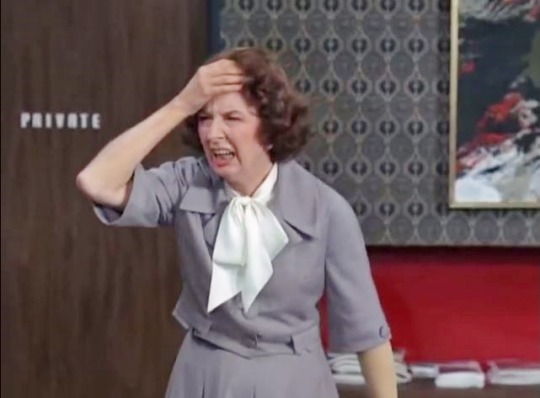
A few months later, when Robert Goulet guest stars, Wickes plays his frazzled assistant, Miss Hurlow. With Goulet having three personalities, it’s no wonder she’s frazzled.
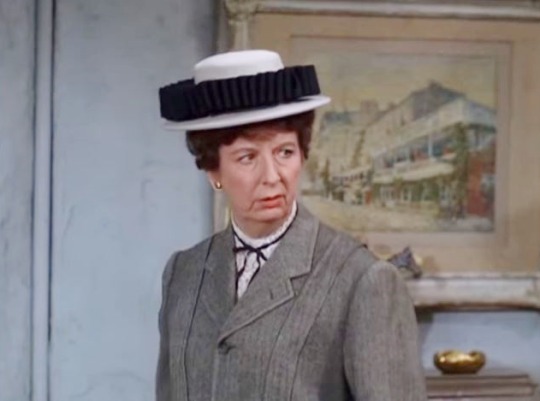
On her final “Lucy Show” appearance (her 8th), Wickes plays another eccentric aunt of Lucy Carmichael’s, Aunt Agatha, a mystery guest who comes to visit and makes turns Lucy’s life upside down by making her take part in her strenuous health and fitness routine.
Once Lucille Ball re-boots “The Lucy Show” as “Here’s Lucy” there is an attempt to make Wickes into a recurring character. She plays Isabel, a secretary in the same building as The Unique Employment Agency.

The attempt only lasts two episodes, however: “Lucy Goes on Strike” (HL S1;E16)…

…and “Lucy Gets Her Man” (HL S1;E21). Wickes only has 40 seconds of screen time at the very start of the episode. Mary Jane Croft joined the show shortly afterwards as Mary Jane Lewis, serving much the same function.
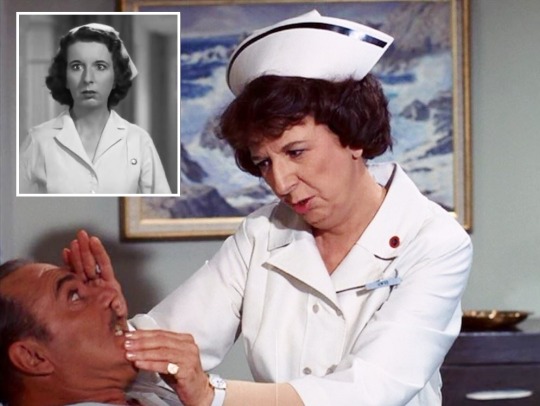
A few months later, however, she was back. This time returning to her nurse’s uniform she filled out so expertly in The Man Who Came To Dinner (inset photo), to play Nurse Hurlow in “Lucy and Harry’s Tonsils” (HL S2;E5). Perhaps coincidentally, Wickes uses the same surname she used as Robert Goulet’s secretary on “The Lucy Show.” Perhaps it was the same woman who got fed up with the craziness of show business and went into nursing? Or, more likely, the writers just ran out of names!

For the first time, Wickes’ character doesn’t have a name, but she gets most of the laughs, as the personal care attendant of a germ-phobic little old lady with a gigantic diamond that needs cutting. Wickes spends most of her screen time spraying everyone she meets with an aerosol disinfectant! Wally Cox plays the nervous jeweler.
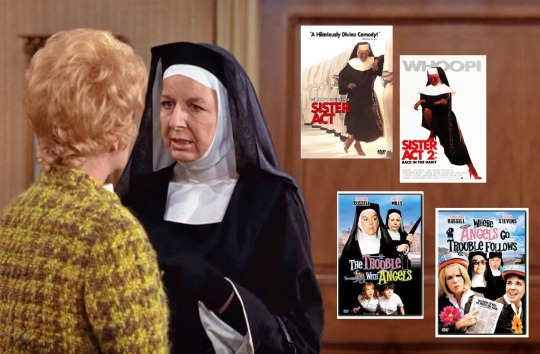
Wickes then gets into a habit she finds hard to break, when she plays Lucy’s sister-in-law, Sister Paula, in “Lucy’s All-Nun Band” (HL S4;E8) in 1971. Although Wickes only played two nuns on the big screen, in The Trouble with Angels (1966) and Sister Act (1992), both films had sequels where she reprised her roles.
“Women like me. They think I’m wholesome or something.” ~ Mary Wickes
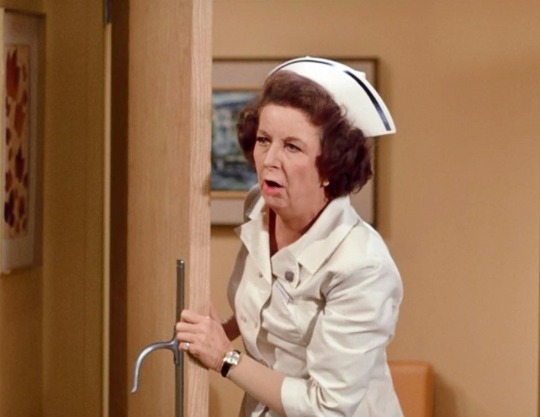
At the start of season 5, with Lucille Ball / Lucy Carter’s leg in a cast, she naturally returned to her whites to play Nurse Sylvia Ogilvy in both “Lucy’s Big Break” (HL S5;E1) and the next episode, “Lucy and Eva Gabor are Hospital Roomies” (HL S5;E2). The two episodes are both linked by Lucy’s recovery in the hospital.

In “Lucy Plays Cops and Robbers” (HL S6;E14), Wickes plays Violet Barker, Lucy’s neighbor. Her husband is played by sitcom veteran Al Lewis of “Car 54″ and “The Munsters”. They are part of Lucy’s neighborhood watch group. The surname Barker will also be used for Lucy’s character on her final sitcom, “Life With Lucy.”
In her final appearance on the series, Wickes goes to the old west when Lucy is elected honorary sheriff of a one-horse town called Cartridge Belt. Wickes plays Clara Simpson, the town philanthropist.

In the last episode aired of “Here’s Lucy” there is a character named Mary Winters, a character written to be played by Mary Wickes, or at the very least, with Mary Wickes in mind. The role was filled by a very Mary Wickes-like actress, also named Mary, Mary Treen.

Lucille Ball and Mary Wickes collaborated one last time on television in “Lucy Calls The President” a 1977 TV special that reunited Lucy with many of her favorite supporting cast members. Wickes once again plays Lucy’s aunt, Miss Millie Baker. The special has the Whittaker family rolling out the red carpet because they believe that President Jimmy Carter and family are going to visit!

Life after Lucy included appearing as a recurring character on “The Father Dowling Mysteries” from 1989 to 1991, as well as her film roles in Sister Act and Little Women.

In 2013, Steve Taravella wrote a biography of Wickes titled Mary Wickes: I Know I’ve Seen That Face Before.
Mary Wickes died of complications following hip surgery on October 22, 1995, aged 85. She made a $2 million bequest in memory of her parents, establishing the Isabella and Frank Wickenhauser Memorial Library Fund for Television, Film and Theater Arts at the Washington University in St. Louis.
“I love playing good comedy with a heart, comedy which touches the audience.” ~ Mary Wickes
-
LUCY USES UP HER ALLOWANCE!
June 12, 1978

On June 12, 1978, Lucy Ricardo finally got her household allowance again, having used it all up in 1953 and for the next 25 years!

LUCY: “I’ve used up my allowance till June the twelfth.”
ETHEL: “That not bad.”
LUCY: “June the twelfth 1978?”The exchange happens in the second scene of “The Million Dollar Idea” (ILL S3;E13) broadcast on January 11, 1954, but filmed November 28, 1953.

Coincidentally, in the previous episode, Lucy had a nightmare that Ricky left her for a sexy Cuban dancer and she is reduced to begging outside their theater with a grown-up Little Ricky on her lap, 25 years in the future – 1978!

In 1978, Ricky and Carlotta’s fans have also aged 25 years – although Ricky and Carlotta have not!

In reality, the last time we saw Lucy Ricardo was in April 1960, so there’s no way of knowing what she was doing in 1978. Coincidentally, June 12, 1978 is a Monday, the day of the week when all new Lucy programs first aired.
MAKING ALLOWANCES

In “The Quiz Show” (ILL S1;E5), Ricky cuts off Lucy’s allowance until she can catch up with her household accounts. To make some extra cash, she goes on the radio quiz show ‘Females Are Fabulous’.

When “Lucy Wants New Furniture” (ILL S2;E28), Ricky is angry that Lucy has bought new furniture against his wishes and brings it all down to the club untill she can pay for it out of her allowance.

In “The Business Manager” (ILL S4;E1) Ricky hires Mr. Hickox (Charles Lane) to watch over Lucy’s finances. He pays all the household bills out of Lucy’s allowance, leaving her a mere $5 for herself.

On season one of “The Lucy Show” Charles Lane (as banker Barnsdahl) is once again responsible for doling out Lucy’s allowance, apparently from a trust fund left to her by her late husband. Like Mrs. Ricardo, Lucy Carmichael was always wheedling Mr. Barnsdahl – and later Mr. Mooney – to give her a few more dollars.
In real life, performer Lucille Ball spent 1978 doing tributes: to the fabulous ‘50s, Gene Kelly, Henry Fonda, Milton Berle, Bob Hope, Jimmy Stewart, CBS, General Electric, the Ohio Jubilee, and even (unbelievably) Nashville!

The closest Lucille gets to June 12th is a television appearance with Gary Morton and Lucie Arnaz on “Dinah!” on June 5, 1978.

On June 12, 1978, Ron Howard appeared on the cover of People Magazine. Howard had played Opie in “The Andy Griffith Show” filmed on the Desilu backlot. He became fascinated with the film making process, gave up acting, and became a director.

TV Guide listings for June 12, 1978
9am – “Donahue” features ERA opponent Phyllis Schlafly, who was recently played by Cate Blachett in “Mrs. America” the final episode of which mentioned Lucie Arnaz. Cate Blanchett is slated to play Lucille Ball in a biopic about Lucy. Ball promoted Mame on “Donahue” in 1974.
9:30am – “Hollywood Squares” hosted by Peter Marshall,
who played Lucy Carmichael’s brother-in-law Hughie in “Lucy’s Sister Pays a Visit” (TLS S1;E15) in 1963 and Dr. Carter in “Happy Anniversary and Goodbye” in 1978.
10am – Lucille Ball might watch one of her favorite hosts Alex Trebek on “High Rollers”, a game show she had appeared on in 1977.
11am – The morning rerun of “I Love Lucy” was “Equal Rights” (ILL S3;E4).
6pm & 10pm – Two airings of “The Odd Couple” starring Tony Randall, who had appeared on “Here’s Lucy” in September 1971.

Here’s what things will cost Lucy when she finally gets her allowance again on June 12, 1978. Hopefully, Ricky has raised her allowance to match the cost of living! If they are still in Westport and are still in the chicken business, they don’t need to worry about the cost of eggs!
-
Subscribe
Subscribed
Already have a WordPress.com account? Log in now.
 Papermoon Loves Lucy