-
THE PORTRAIT ARTIST
August 6, 1948

“The Portrait Artist” aka “The Portrait Painter” aka “The Portrait” is episode #3 of the radio program MY FAVORITE HUSBAND broadcast on August 6, 1948 on the CBS Radio Network.
Synopsis ~ Liz is having her portrait painted by a handsome but gruff artist. George gets jealous and fakes illness, and he is attended to by a sexy young nurse – causing the green-eyed monster to rear between both Cugats!

MAIN CAST
Lucille Ball (Liz Cugat) was born on August 6, 1911 in Jamestown, New York. She began her screen career in 1933 and was known in Hollywood as ‘Queen of the B’s’ due to her many appearances in ‘B’ movies. With Richard Denning, she starred in a radio program titled “My Favorite Husband” which eventually led to the creation of “I Love Lucy,” a television situation comedy in which she co-starred with her real-life husband, Latin bandleader Desi Arnaz. The program was phenomenally successful, allowing the couple to purchase what was once RKO Studios, re-naming it Desilu. When the show ended in 1960 (in an hour-long format known as “The Lucy-Desi Comedy Hour”) so did Lucy and Desi’s marriage. In 1962, hoping to keep Desilu financially solvent, Lucy returned to the sitcom format with “The Lucy Show,” which lasted six seasons. She followed that with a similar sitcom “Here’s Lucy” co-starring with her real-life children, Lucie and Desi Jr., as well as Gale Gordon, who had joined the cast of “The Lucy Show” during season two. Before her death in 1989, Lucy made one more attempt at a sitcom with “Life With Lucy,” also with Gordon.
Richard Denning (George Cugat) was born as Louis Albert Heindrich Denninger Jr., in Poughkeepsie, New York. When he was 18 months old, his family moved to Los Angeles. Plans called for him to take over his father’s garment manufacturing business, but he developed an interest in acting. Denning enlisted in the US Navy during World War II. He is best known for his roles in various science fiction and horror films of the 1950s. Although he teamed with Lucille Ball on radio in “My Favorite Husband,” the two never acted together on screen. While “I Love Lucy” was on the air, he was seen on another CBS TV series, “Mr. & Mrs. North.” From 1968 to 1980 he played the Governor on “Hawaii 5-0″, his final role. He died in 1998 at age 84.
Ruth Perrott (Katie, the Maid) was also later seen on “I Love Lucy.” She first played Mrs. Pomerantz, a member of the surprise investigating committee for the Society Matrons League in “Pioneer Women” (ILL S1;E25), was one of the member of the Wednesday Afternoon Fine Arts League in “Lucy and Ethel Buy the Same Dress” (ILL S3;E3), and also played a nurse when “Lucy Goes to the Hospital” (ILL S2;E16). She died in 1996 at the age of 96.
GUEST CAST

John Hiestand (Cory Cartwright) served as the announcer for the radio show “Let George Do It” from 1946 to 1950. In 1955 he did an episode of “Our Miss Brooks” opposite Gale Gordon in which he once again had the surname Cartwright.
The role of Cory Cartwright was originated by Hal March but Hiestand very quickly replaced him. March did, however, stay with the show and appears from time time as various characters.

Jeff Chandler (Damon Welch) was known for his prematurely gray hair and striking good looks as a young man. On radio, he was on “Our Miss Brooks” as Mr. Boynton with Eve Arden. When the series moved to television in 1952, Chandler was replaced by Robert Rockwell. Chandler died at age 42 from blood poisoning after an operation.

William Johnstone (Doctor) is best known for his voice work as the title character on “The Shadow” from 1938 to 1943, replacing Lucille Ball’s friend Orson Welles. He played John Jacob Astor in the 1953 film Titanic.

Mary Shipp (Nurse Mary Ann McCarthy) was a radio and TV actress and the second wife of CBS Executive Harry Ackerman. Shipp played a recurring character on CBS’s “My Friend Irma” (1954-55) which featured Gale Gordon’s mother Gloria and Hal March, who was the first actor to play Cory Cartwright.

“My Favorite Husband” was based on the novels Mr. and Mrs. Cugat, the Record of a Happy Marriage (1940) and Outside Eden (1945) by Isabel Scott Rorick, which had previously been adapted into the film Are Husbands Necessary? (1942). “My Favorite Husband” was first broadcast as a one-time special on July 5, 1948. Lucille Ball and Lee Bowman played the characters of Liz and George Cugat, and a positive response to this broadcast convinced CBS to launch “My Favorite Husband” as a series on July 23, 1948. Bowman was not available Richard Denning was cast as George. On January 7, 1949, confusion with bandleader Xavier Cugat prompted a name change to Cooper. On this same episode Jell-O became its sponsor. A total of 124 episodes of the program aired from July 23, 1948 through March 31, 1951. After about ten episodes had been written, writers Fox and Davenport departed and three new writers took over – Bob Carroll, Jr., Madelyn Pugh, and head writer/producer Jess Oppenheimer. In March 1949 Gale Gordon took over the existing role of George’s boss, Rudolph Atterbury, and Bea Benaderet was added as his wife, Iris. CBS brought “My Favorite Husband” to television in 1953, starring Joan Caulfield and Barry Nelson as Liz and George Cooper. The television version ran two-and-a-half seasons, from September 1953 through December 1955, running concurrently with “I Love Lucy.” It was produced live at CBS Television City for most of its run, until switching to film for a truncated third season filmed (ironically) at Desilu and recasting Liz Cooper with Vanessa Brown.
This episode aired on Lucille Ball’s 37th birthday, August 6, 1948.
At this point in the series, George and Liz are still named Cugat. Their surname will be changed to Cooper in 1949 to avoid confusion with a famous Latin bandleader. No, not Desi Arnaz – Xavier Cugat! Also, the show had yet to introduce Iris and Rudolph Atterbury, the secondary characters, similar to Fred and Ethel on “I Love Lucy.” The character of Cory Cartwright, a handsome bachelor friend of the couple, will shortly be phased out. He was initially played by Hal March, but here played by John Hiestand.

Marital jealousy and painting were also the subjects of “My Favorite Husband” the CBS television show on November 29, 1955.
THE EPISODE
Announcer Bob LeMond sets up the premise of the series:
Ten years ago the town’s most eligible bachelor, George Cugat, married socially prominent Elizabeth Elliott. The lavish wedding kept the society columns all over the country in copy for weeks. The New Yorker said:
“The bride and groom were dressed with the nth degree of smartness. The best man was a polo pony.”
The Hearst Papers said:
“The bride and groom were dressed handsomely and attracted comments from guest Douglas MacArthur.”
And The Reader’s Digest said:
“The bride and groom were dressed.”

The joke lies in the brevity of the Digest’s comments. The Reader’s Digest was known for their publication of abridged novels, short stories, and articles that could be read in one sitting. Ricky was seen reading the Digest in “Lucy Writes a Novel” in 1954. That same year, a biography of Ball by Eleanor Harris was included in the Digest – condensed, naturally. Ball appeared on the covers in 1990 and 2003.

Douglas MacArthur (1880-1964) was a five-star general and Chief of Staff of the United States Army during the 1930s. He played a prominent role in the Pacific theater during World War II. At the time of broadcast, he was running for President of the United States, but was defeated in the primaries by Dewey, who was narrowly defeated in the election by Harry S. Truman. In “Lucy and the Submarine” (1966) Mr. Mooney(Gale Gordon) tells Lucy he’s going on a two-week training, but warns her (in his best deep-voiced, measure tones) that “I shall return!” These were the immortal words spoken by MacArthur when he escaped the Philippines after being surrounded by the Japanese in March 1942.
It is morning at the Cugat home and while George is having breakfast, Katie the maid is trying to help Liz fit into a tight-fitting and slinky evening gown in preparation for having her portrait painted. Katie suggests wearing a different dress for the portrait, but Liz is worried that they might move to Boston one day, and she doesn’t want her portrait banned!

“Banned in Boston” was a phrase employed from the late 19th century through the mid-20th century, to describe a literary work, song, motion picture, or play which had been prohibited from distribution or exhibition in Boston, Massachusetts. During this period, Boston officials had wide authority to ban works featuring “objectionable” content, and often banned works with sexual content or foul language. In 1944, just a few years before this broadcast, Boston banned the book Forever Amber by Kathleen Winsor, which was referred to on “I Love Lucy” as Forever Ember.
Liz goes down to breakfast in her slinky evening gown and tells George that she is having her portrait painted by noted artist Damon Welch.
LIZ: “They say he’s very big and strong and muscular like, uh…who’s that rugged tall actor in the movies? The one with the big arms and broad shoulders?”
GEORGE: “Marjorie Main.”
LIZ: “No, Victor Mature.”Marjorie Main (1890-1975) was a character actress who just a few months before this broadcast earned an Oscar nomination for The Egg and I. In 1954 she was a supporting player in Lucy and Desi’s The Long, Long Trailer (1953).

Victor Mature (1913-99) was a stage, film, and television actor who starred in several movies during the 1950s, and was known for his dark hair and smile. Mature and Lucille Ball acted together in Seven Days Leave (1942) and Easy Living (1949).
Bachelor Cory Cartwright (John Hiestand) visits the Cugats with exciting news about his date last night:
CORY: “She had a smile like Lana Turner, a voice like Dinah Shore, she kissed like Paulette Goddard.”
LIZ: “Do you date her or buy tickets to her?”
Lana Turner (1921-55) achieved fame as both a pin-up model and a film actress. In the mid-1940s, she was one of the highest-paid actresses in Hollywood and one of MGM) biggest stars. In 1943, she did a cameo in Lucille Ball’s Du Barry Was a Lady. Turner was mentioned in three episodes of “I Love Lucy.”
Dinah Shore (1916-94) was a singer, actress and television personality, as well as a top-charting female vocalist of the 1940s. She achieved even greater success on television, mainly as hostess of a series of variety and talk programs, although she guest starred on “Here’s Lucy” in 1971. Ball made numerous appearances on Shore’s talk shows as well.
Paulette Goddard (1910-90) was major star of Paramount Pictures in the 1940s. She was nominated for an Academy Award for Best Supporting Actress for her performance in So Proudly We Hail! (1943). She did three films with Lucille Ball between 1933 and 1934: Roman Scandals, The Bowery, and The Kid.
George comes home from work and asks Liz about progress on the portrait. Liz was impressed by Welch’s world experience. George feels inadequate. He makes her tell him how much she loves him.
LIZ: “Hold me tighter. Make believe I’m a tube of toothpaste and pop my cap off!”
Dejected that Liz wants him to take up painting like Damon Welch, George goes to bed without his supper.
The second act begins with George deciding to stay home, pretending to be sick in order to keep an eye on Liz and Welch. Katie admits Damon for their sitting. Welch doesn’t believe George is sick.
DAMON: “You should get out-of-doors; do some exercises. Run the mile, do some chin-ups, push-ups, chop some wood, mow the lawn, pull some weights…”
LIZ: “Tote that barge, lift that bale!”
Liz chimes in with lyrics from the song “Old Man River” by Oscar Hammerstein II and Jerome Kern, written for the 1927 musical Show Boat. A revival of the musical ran on Broadway in 1946. There was a radio adaptation in 1944. In “Never Do Business With Friends” (1953), Lucy Ricardo analogizes her housework without an electric washing machine to that of the slaves who sing “Old Man River”:
LUCY: “Carrying this heavy basket – up and down, up and down. My muscles straining, body all aching and racked with pain. Fold those shirts, lift those sheets.”
RICKY: “Now, look, Old Man River, will you dry up?”The doctor arrives and examines George, finding nothing whatever the matter with him. His diagnosis is extreme jealousy-itis. He summons his new nurse, Mary Ann McCarthy (Mary Shipp), whose beauty stops George in his tracks.
Downstairs, Liz is still being painted by Damon, but not nearly fast enough for her liking. She complains that he still hasn’t painted her hair! She doesn’t like seeing herself bald!
LIZ: “I look like my mother was frightened by Guy Kibbee!”
MONTY: “I’ll paint in your hair when I see fit, and not a second sooner. Until that time you’ll remain an egg-head and like it!”
Guy Kibbee (1882-1956) was a stage and film actor. In the 1935 film Mary Jane’s Pa, Kibbee prepares a breakfast dish which consists of a hole cut out of the center of a slice of bread, and an egg cracked into it, all of which is fried in a skillet. It became known as Guy Kibbee Eggs but is also known as eggs in a basket. Liz is no doubt comparing her bald head on the canvas with the eggs. I didn’t hurt the comparison that Kibbee was also bald! Kibbee appeared with Lucille Ball in Don’t Tell The Wife (1937) and Joy of Living (1938).
George hears Damon and Liz laughing and comes downstairs to confront them but Damon sends him back upstairs. Liz wonders if George is jealous just as George is heard laughing upstairs with Nurse McCarthy. Liz goes upstairs to confront her husband! George says he’s had a relapse!
GEORGE: “I accidentally plugged my electric heating pad into the radio and H.V. Kaltenborn got into bed with me!”

Hans von Kaltenborn (1878-1965) was a radio commentator who was heard regularly on the radio for over 30 years, beginning in 1928. He was known for his highly precise diction, his ability to ad-lib, and his knowledge of world affairs. In 1948, Kaltenborn played himself in The Babe Ruth Story which co-starred William Frawley (Fred Mertz).
George, still suspicious of Liz and Damon, goes downstairs to discover that Liz has dismissed the painter so George wouldn’t be sick and Miss McCarthy would go.
After a message from the announcer about participation in community projects (a post-war endeavor), George and Liz engage in some bedtime repartee before they kiss and say goodnight. End of episode!
1948, Banned in Boston, Bob LeMond, Dinah Shore, Douglas MacArthur, Forever Amber, Guy Kibbee, H.V. Kalenborn, Jeff Chandler, John Hiestand, Lana Turner, Lucille Ball, Marjorie Main, Mary Shipp, My Favorite Husband, Old Man River, Paulette Goddard, Radio, Readers Digest, Richard Denning, Ruth Perrott, The Portrait Artist, Victor Mature, William Johnstone -
SORROWFUL JONES
JULY 4, 1949

Sorrowful Jones is a remake of the 1934 Shirley Temple film, Little Miss Marker. In the film, a young girl is left with the notoriously cheap Sorrowful Jones (Bob Hope) as a marker for a bet. When her father does not return, he learns that taking care of a child interferes with his free-wheeling lifestyle. Lucille Ball plays a nightclub singer who is dating Sorrowful’s boss.
Although the official opening night in Hollywood took place on Independence Day 1949, it was premiered in New York City a month earlier, and seen in Australia on June 24, 1949.
Directed by Sidney Lanfield
Produced by Robert L. Welch
Written by Edmund Hartmann and Melville Shavelson based on a story by Damon RunyonCREDITED CAST

Lucille Ball (Gladys) was born on August 6, 1911 in Jamestown, New York. She began her screen career in 1933 and was known in Hollywood as ‘Queen of the B’s’ due to her many appearances in ‘B’ movies. With Richard Denning, she starred in a radio program titled “My Favorite Husband” which eventually led to the creation of “I Love Lucy,” a television situation comedy in which she co-starred with her real-life husband, Latin bandleader Desi Arnaz. The program was phenomenally successful, allowing the couple to purchase what was once RKO Studios, re-naming it Desilu. When the show ended in 1960 (in an hour-long format known as “The Lucy-Desi Comedy Hour”) so did Lucy and Desi’s marriage. In 1962, hoping to keep Desilu financially solvent, Lucy returned to the sitcom format with “The Lucy Show,” which lasted six seasons. She followed that with a similar sitcom “Here’s Lucy” co-starring with her real-life children, Lucie and Desi Jr., as well as Gale Gordon, who had joined the cast of “The Lucy Show” during season two. Before her death in April 1989, Lucy made one more attempt at a sitcom with “Life With Lucy,” also with Gordon, which was not a success and was canceled after just 13 episodes. She died on April 26, 1989 at the age of 77.
Ball’s singing voice is provided by Annette Warren, who also sang for her in Fancy Pants and later provided the singing voice for Ava Gardner in Show Boat. Her first screen dubbing was for Lured featuring Lucille Ball, although Warren did not dub Lucy’s voice. She provided the singing voice for Pepper (Iris Adrian) in the Bob Hope film The Paleface (1947).
Bob Hope (Sorrowful Jones) was born Lesley Townes Hope in England in 1903. During his extensive career in virtually all forms of media he received five honorary Academy Awards. In 1945, Desi Arnaz was the orchestra leader on Bob Hope’s radio show. Ball and Hope did three other films together. He appeared as himself on the season 6 opener of “I Love Lucy.” He did a brief cameo in a 1964 episode of “The Lucy Show.” He died in 2003 at age 100.
Mary Jane Saunders (Martha Jane) makes her film debut. She went on to do a season of TV’s “Tales of the Welles Fargo” (1960-61) and made two appearances on “My Three Sons”: one with William Frawley and one with William Demarest.
William Demarest (Regret) is best remembered as Uncle Charlie on “My Three Sons,” a role created after the death of William Frawley. Demarest and Frawley appeared together on screen in The Farmer’s Daughter (1940). He was nominated for an Academy Award in the biography, The Jolson Story (1946). Demarest did two other films with Lucille Ball: Fugitive Lady (1934) and Don’t Tell The Wife (1937). He died in 1983 at age 91.
Bruce Cabot (Big Steve) appeared with Lucille Ball in 1934′s Men of the Night. In 1950, he joined Hope and Ball once again in Fancy Pants. His main claim to fame is rescuing Fay Wray from King Kong (1933).
Tom Pedi (Once Over Sam) did one season of the short-lived sitcom “Arnie” (1970-71). He was in the 1980 remake of Little Miss Marker, upon which Sorrowful Jones is based.
Paul Lees (Orville Smith) was blinded by enemy artillery during his service in World War II. He received 32 military decorations and ribbons, including the Legion of Merit. Despite his lack of vision, Lees learned to act and signed a contract with Paramount. He would memorize script dialog by having someone read it to him twice.
Houseley Stevenson (Doc Chesley) was a British-born character actor who had just finished doing The Paleface with Bob Hope.
Ben Weldon (Big Steve’s Bodyguard) appeared on “I Love Lucy” as the thief who breaks in to the Ricardo apartment to steal “The Fur Coat” (ILL S1;E9). He was seen in a season one episode of “The Lucy Show.”
Emmett Vogan (Psychiatrist) did four movies with Lucille Ball previous to this one. In 1954 he played Mr. Bolton in The Long, Long Trailer.
Thomas Gomez (Reardon) was an Oscar nominee for Ride the Pink Horse the previous year. In 1953 he was seen as Pasquale #2 on CBS’s “Life With Luigi”.
He did a 1964 episode of “My Three Sons” with William Demarest.UNCREDITED CAST (with connections to Lucille Ball)
Ethel Bryant (Nurse) was also seen with Lucille Ball in Broadway Bill (1934), another film involving a racehorse.
John Butler (Jack – Bettor on Green Diamond) was also seen with Lucille Ball in The Affairs of Annabel (1938).
Bill Cartledge (First Jockey) was also seen with Lucille Ball in The Joy of Living (1938).
Maurice Cass (Psychiatrist) was also seen with Lucille Ball (and John Butler) in The Affairs of Annabel (1938).
Michael Cirillo (Horse Player) joined Bob Hope in Paleface and Son of Paleface as well as Critic’s Choice with Hope and Ball in 1963.
Charles Cooley (Shorty) was seen with Hope and Ball in Fancy Pants (1950) as well as a dozen other Bob Hope films. He also was a regular on “The Bob Hope Show” on television.
James Dearing (Spectator) was in eight other Lucille Ball films between 1936 and 1954.
Jay Eaton (Horse Player)
was in eight other Lucille Ball films between 1937 and 1946.
Chuck Hamilton (Police Officer) was seen in the background of eight other Lucille Ball films from 1937 to 1950.
Selmer Jackson (Doctor) was in six other Lucille Ball films between 1933 and 1949.
Kenner G. Kemp (Bookmaker) was in seven other Lucille Ball films between 1936 and 1960 as well as doing background work on a 1965 episode of “The Lucy Show.”
Bob Kortman (Horse Player) was in four other Lucille Ball films between 1934 and 1950.
George Magrill (Horse Player) makes the last of his nine film appearances with Lucille Ball. He started in 1933 with Broadway Thru A Keyhole.
John Mallon (Horse Player) was also seen with Hope and Ball in Fancy Pants (1950).
John ‘Skins’ Miller (Jockey) was also seen with Hope and Ball in Fancy Pants (1950) and previously with Ball in The Big Street (1942).
Frank Mills (Horse Player) makes the last of his ten film appearances with Lucille Ball. He started in 1933 with The Bowery.
Ralph Montgomery (Horse Player) was one of the policeman on the scene in “Lucy Goes To The Hospital” (ILL S2;E16) in 1953.
Ralph Peters (Taxi Driver) was also seen with Lucille Ball in The Big Street (1942).
Suzanne Ridgeway (Nightclub Patron) was also seen with Lucille Ball in That’s Right – You’re Wrong (1939) and The Magic Carpet (1951).
Arthur Space (Plainclothes Policeman) was in four other films with Lucille Ball between 1945 and 1950.
Bert Stevens (Nightclub Patron) was a background player in four Lucille Ball films as well as one episode of “I Love Lucy,” and many of “The Lucy Show.”
Sid Tomack (Waiter at Steve’s Place) was also seen in The Fuller Brush Girl (1950) with Lucille Ball.
Harry Tyler (Blinky) did three other films with Lucille Ball between 1937 and 1950.
Walter Winchell (Himself, Voice Over) was a journalist and radio host who was the narrator of Desilu’s “The Untouchables.” He also joined the cast in their satire of the series on “Lucy The Gun Moll” (TLS S4;E25).

The film was made at Paramount Studios in Hollywood, with location shooting in New York City. This was Lucille Ball’s 70th film!

The New York Times, August 16, 1947. Note that Lucille Ball is not mentioned. (Thanks to @ericthelibrarian for the scan)
THE STORY

Sorrowful Jones (Bob Hope) is a New York bookie who keeps his operation hidden behind a trap door in a Broadway barber shop. He suffers a financial setback when a horse named Dreamy Joe, owned by gangster Big Steve Holloway (Bruce Cabot), unexpectedly wins a race and Jones has to pay all the bettors.
Jones learns that the race was fixed by Big Steve, who tells him about giving the horse a “speedball.” It turns out Big Steve has informed all the bookies in his circle of friends about the fixed race, and demands a sum of $1,000 from each one of them in exchange for this information.
Before the next race, Jones learns Dreamy Joe will lose, but still takes bets on the horse from his customers. He even takes a bet from gambler Orville Smith (Paul Lees), who leaves his four-year-old daughter Martha Jane (Mary Jane Saunders) as collateral. Orville overhears a phone call where Big Steve reveals that the race is fixed, so he is killed by one of Big Steve’s goons, Once Over Sam (Tom Pedi). Jones is forced to take care of Martha Jane and brings her home with him.

The next day Jones gets help from his ex-girlfriend, burlesque performer Gladys O’Neill (Lucille Ball).
Big Steve tells Jones he is being investigated by the racing commission so he is quitting the race-fixing business. Big Steve plans to make one final race before he gets out of the game, where he is fixing it so that Dreamy Joe will win. He also transfers the ownership of the horse to Martha Jane, unaware that she is Orville’s daughter. After the race, Big Steve will kill the horse by giving it a high dose of “speedball.”

Jones tries to find Martha Jane’s mother, but discovers she is dead. Gladys suggests that Jones give all of Dreamy Joe’s winnings to Martha Jane to help her survive, or she will contact the police and tell them about Jones’ operation. She has no knowledge of Big Steve’s plan to fix the race.

Big Steve finds out that Martha Jane is Orville’s daughter, so Jones must hide her to protect her from being killed. When hiding on a fire escape’s landing, Martha Jane falls down and is seriously injured. In a coma, the little girl calls out for Dreamy Joe.
In order to save Martha Jane and wake her up, Jones and his partner Regret (William Demarest) steal the horse from Big Steve at the race track. They take it into the hospital room where Martha Jane lies. Martha Jane wakes up and the police find out that Big Steve is responsible for Orville’s murder.
After Big Steve is arrested, Jones proposes to Gladys. The police want Martha Jane to be placed in an orphanage, but Jones and Gladys, who have married, decide to adopt the girl. They go away on their honeymoon together with their newly adopted daughter.
TRIVIA & BACKGROUND

“Little Miss Marker” (1932), a short story by Damon Runyon, inspired the film Sorrowful Jones.

Damon Runyon’s 1940 short story “Little Pinks” served as the basis for the Lucille Ball / Henry Fonda film The Big Street (1942).

Little Miss Marker (1934) starring Adolphe Menjou as Sorrowful Jones and Dorothy Dell as Bangles Carson. Shirley Temple as Marthy Jane. The film was directed by Alexander Hall, Lucille Ball’s one-time fiance.
Sorrowful Jones (1947) starring Bob Hope as Sorrowful Jones and Lucille Ball as Gladys O’Neill. Mary Jane Saunders as Martha Jane.
40 Pounds of Trouble (1962) starring Tony Curtis as Steve McCluskey and Suzanne Pleshette as Chris Lockwood. Claire Wilcox as Penelope Piper.
Little Miss Marker (1980) starring Walter Matthau as Sorrowful Jones and Julie Andrews as Amanda Worthington. Sarah Stimson as the Kid.

“Lux Radio Theater” broadcast a 60 minute radio adaptation of the movie on November 21, 1949 with Bob Hope and Lucille Ball reprising their film roles.

“Havin’ a Wonderful Wish (Time You Were Here)” by Jay Livingston with lyrics by Ray Evans is sung by Lucille Ball (dubbed by Annette Warren).

“Miss Beverley Hills of Hollywood” comic book issue #6, January / February 1947 promoted the film. Lucille Ball still is purporting to have been born in Butte, Montana. Here her birth date is also incorrect: August 6, not August 8. Note how much the Drama Teacher resembles Lucy’s mother, Dede Ball.

Lucille Ball advertising both Armstrong Tires and Sorrowful Jones.

Lucille Ball advertising Sealright Sanitary Containers using Sorrowful Jones.

In “The Bob Hope Christmas Special” (1973) Lucy opens a small wooden box and removes a lock of Hope’s hair she says she snipped from his head when they were making Sorrowful Jones together.

The film was mentioned when Lucille Ball and Bob Hope guested on “Dinah!” in 1977.

In 1989, after Ball’s passing, a clip from the film was incorporated into “Bob Hope’s Love Affair With Lucy.”
-
RIP HUGH DOWNS
1921-2020

Hugh Downs was born on February 14, 1921 in Akron, Ohio. A regular television presence from the mid-1940s through to the end of the 1990s, for several years he held the certified Guinness World Record for the most hours on commercial network television, before being surpassed by Regis Philbin. Downs served as announcer/sidekick for “Tonight Starring Jack Paar” from 1957 to 1962, co-host of the NBC News program “Today” from 1962 to 1971, host of the game show “Concentration” from 1958 to 1969, and anchor of the ABC News magazine “20/20″ from 1978 to 1999. He died on July 1, 2020 (appropriately enough) at age 99.

Downs first met Lucille Ball in his capacity as substitute host of “Tonight Starring Jack Paar” on December 29, 1960. This was Lucille Ball’s very first appearance on “The Tonight Show”. Eight months after her divorce, she also brings along her children Lucie and Desi Jr.. Lucy is in New York City (where the show was then done) appearing in the Broadway musical Wildcat.

Ball returned to “Tonight” just two weeks later, on January 12, 1961, again to promote Wildcat, but Paar was still on vacation. This time Arlene Francis is the guest host and Hugh Downs is the announcer / co-host, a role taken by Ed McMahon when Johnny Carson takes over “Tonight”.

On January 26, 1961, her third and final appearance on Paar’s incarnation of “Tonight”, she finally is interviewed by the host in the title with Hugh Downs nearby as announcer / co-host. She is in the company of her “I Love Lucy” co-star Vivian Vance.
Cyril Ritchard, Arthur Treacher, and Joan Fairfax are also on the show that night. Lucy was still in New York appearing in Wildcat. Ten days later, Wildcat went on a two-week hiatus due to Lucille Ball’s illness.

-
REMINISCING
July 1, 1949

“Reminiscing” is episode #51 of the CBS Radio series MY FAVORITE HUSBAND broadcast on July 1, 1949.
Synopsis ~
Liz is working on her scrapbook, and she and George reminisce about when Liz learned to drive and got her license, when Liz signed an affidavit swearing never to interrupt George’s stories again, and when the butcher thought that Liz had a crush on him.
REGULAR CAST

Lucille Ball (Liz Cooper) was born on August 6, 1911 in Jamestown, New York. She began her screen career in 1933 and was known in Hollywood as ‘Queen of the B’s’ due to her many appearances in ‘B’ movies. With Richard Denning, she starred in a radio program titled “My Favorite Husband” which eventually led to the creation of “I Love Lucy,” a television situation comedy in which she co-starred with her real-life husband, Latin bandleader Desi Arnaz. The program was phenomenally successful, allowing the couple to purchase what was once RKO Studios, re-naming it Desilu. When the show ended in 1960 (in an hour-long format known as “The Lucy-Desi Comedy Hour”) so did Lucy and Desi’s marriage. In 1962, hoping to keep Desilu financially solvent, Lucy returned to the sitcom format with “The Lucy Show,” which lasted six seasons. She followed that with a similar sitcom “Here’s Lucy” co-starring with her real-life children, Lucie and Desi Jr., as well as Gale Gordon, who had joined the cast of “The Lucy Show” during season two. Before her death in 1989, Lucy made one more attempt at a sitcom with “Life With Lucy,” also with Gordon.
Richard Denning (George Cooper) was born as Louis Albert Heindrich Denninger Jr., in Poughkeepsie, New York. When he was 18 months old, his family moved to Los Angeles. Plans called for him to take over his father’s garment manufacturing business, but he developed an interest in acting. Denning enlisted in the US Navy during World War II. He is best known for his roles in various science fiction and horror films of the 1950s. Although he teamed with Lucille Ball on radio in “My Favorite Husband,” the two never acted together on screen. While “I Love Lucy” was on the air, he was seen on another CBS TV series, “Mr. & Mrs. North.” From 1968 to 1980 he played the Governor on “Hawaii 5-0″, his final role. He died in 1998 at age 84.
Gale Gordon (Rudolph Atterbury) had worked with Lucille Ball on “The Wonder Show” on radio in 1938. One of the front-runners to play Fred Mertz on “I Love Lucy,” he eventually played Alvin Littlefield, owner of the Tropicana, during two episodes in 1952. After playing a Judge in an episode of “The Lucy-Desi Comedy Hour” in 1958, he would re-team with Lucy for all of her subsequent series’: as Theodore J. Mooney in ”The Lucy Show”; as Harrison Otis Carter in “Here’s Lucy”; and as Curtis McGibbon on “Life with Lucy.” Gordon died in 1995 at the age of 89.
Bea Benadaret (Iris Atterbury) was considered the front-runner to be cast as Ethel Mertz but when “I Love Lucy” was ready to start production she was already playing a similar role on TV’s “The George Burns and Gracie Allen Show” so Vivian Vance was cast instead. On “I Love Lucy” she was cast as Lucy Ricarodo’s spinster neighbor, Miss Lewis, in “Lucy Plays Cupid” (ILL S1;E15) in early 1952. Later, she was a success in her own show, “Petticoat Junction” as Shady Rest Hotel proprietress Kate Bradley. She starred in the series until her death in 1968.
Ruth Perrott (Katie, the Maid) was also later seen on “I Love Lucy.” She first played Mrs. Pomerantz, a member of the surprise investigating committee for the Society Matrons League in “Pioneer Women” (ILL S1;E25), as one of the member of the Wednesday Afternoon Fine Arts League in “Lucy and Ethel Buy the Same Dress” (ILL S3;E3), and also played a nurse when “Lucy Goes to the Hospital” (ILL S2;E16). She died in 1996 at the age of 96.
Bob LeMond (Announcer) also served as the announcer for the pilot episode of “I Love Lucy”. When the long-lost pilot was finally discovered in 1990, a few moments of the opening narration were damaged and lost, so LeMond – fifty years later – recreated the narration for the CBS special and subsequent DVD release.
GUEST CAST

Frank Nelson (Motor Vehicles Clerk) was born on May 6, 1911 (three months before Lucille Ball) in Colorado Springs, Colorado. He started working as a radio announcer at the age of 15. He later appeared on such popular radio shows as “The Great Gildersleeve,” “Burns and Allen,” and “Fibber McGee & Molly”. This is one of his 11 performances on “My Favorite Husband.” On “I Love Lucy” he holds the distinction of being the only actor to play two recurring roles: Freddie Fillmore and Ralph Ramsey, as well as six one-off characters, including the frazzled train conductor in “The Great Train Robbery” (ILL S5;E5), a character he repeated on “The Lucy Show.” Aside from Lucille Ball, Nelson is perhaps most associated with Jack Benny and was a fifteen-year regular on his radio and television programs.

Hans Conried (Mr. Dabney, the Butcher) first co-starred with Lucille Ball in The Big Street (1942). He then appeared on “I Love Lucy” as used furniture man Dan Jenkins in “Redecorating” (ILL S2;E8) and later that same season as Percy Livermore in “Lucy Hires an English Tutor” (ILL S2;E13) – both in 1952. The following year he began an association with Disney by voicing Captain Hook in Peter Pan. On “The Lucy Show” he played Professor Gitterman in “Lucy’s Barbershop Quartet” (TLS S1;E19) and in “Lucy Plays Cleopatra” (TLS S2;E1). He was probably best known as Uncle Tonoose on “Make Room for Daddy” starring Danny Thomas, which was filmed on the Desilu lot. He joined Thomas on a season 6 episode of “Here’s Lucy” in 1973.

“My Favorite Husband” was based on the novels Mr. and Mrs. Cugat, the Record of a Happy Marriage (1940) and Outside Eden (1945) by Isabel Scott Rorick, which had previously been adapted into the film Are Husbands Necessary? (1942). “My Favorite Husband” was first broadcast as a one-time special on July 5, 1948. Lucille Ball and Lee Bowman played the characters of Liz and George Cugat, and a positive response to this broadcast convinced CBS to launch “My Favorite Husband” as a series. When Bowman was not available Richard Denning was cast as George. On January 7, 1949, confusion with bandleader Xavier Cugat prompted a name change to Cooper. On this same episode Jell-O became its sponsor. A total of 124 episodes of the program aired from July 23, 1948 through March 31, 1951. After about ten episodes had been written, writers Fox and Davenport departed and three new writers took over – Bob Carroll, Jr., Madelyn Pugh, and head writer/producer Jess Oppenheimer. In March 1949 Gale Gordon took over the existing role of George’s boss, Rudolph Atterbury, and Bea Benaderet was added as his wife, Iris. CBS brought “My Favorite Husband” to television in 1953, starring Joan Caulfield and Barry Nelson as Liz and George Cooper. The television version ran two-and-a-half seasons, from September 1953 through December 1955, on air concurrently with “I Love Lucy.” It was produced live at CBS Television City for most of its run, until switching to film for a truncated third season filmed (ironically) at Desilu and recasting Liz Cooper with Vanessa Brown. In addition to being aired on the CBS Radio Network, the episodes were heard on the Armed Forces Radio Network, where the commercials were omitted.
This is the final episode of Season One of MY FAVORITE HUSBAND.
An audio excerpt from this episode was included on the CD that came with the book Laughs, Luck…and Lucy by Jess Oppenheimer.
THE EPISODE
The episode opens with Liz spread out on the living room floor scrap-booking. George reminds her they are supposed to go to the movies and he hates to miss the first three minutes. Liz says that it doesn’t matter because:
LIZ: “It’s always the same: MGM presents… (roars like a lion).”

Liz is referring to the Metro Goldwyn Mayer logo, a lion with his head through a celluloid ribbon that reads ‘Ars Gratia Artis’ (art for arts sake). The lion – named Leo, naturally – roared and the motion picture began.

In 1954, Lucy and Desi began a business relationship with MGM, making several motion pictures for them and even having Ricky Ricardo work for the studio on "I Love Lucy”.
Liz finds a picture of their car – before she got into an accident and wrecked it! She ran it into a house! Flashback to George teaching Liz to drive.

The script for the reminiscence is nearly identical to the scene in “Liz Learns To Drive” aka “Driving Lessons” aka “Learning To Drive” in episode #18 on November 13, 1948, from when the characters were known as the Cugats. This is not a ‘clip’ from that episode, but a recreation of it, including guest actor Frank Nelson as the Motor Vehicles Clerk.

Their new Hudson has a starter button – not a key. Liz mistakes the cigarette lighter and the radio dial for the starter button. Naturally, she has difficulty with the clutch. Everything goes smoothly – if Liz can just remember to drive on the right side of the road! A near traffic accident scares George, but only makes Liz angry at the other driver. George has Liz stop at the Motor Vehicle Department to get her license.

On “I Love Lucy,” Ricky taught Lucy how to drive with some of the same communication problems. Most of the dramatic moments during the lesson happen off-screen. Over-confident Lucy then feels she can teach Ethel to drive, too!
The Motor Vehicles Clerk (Frank Nelson) takes Liz’s application.
CLERK: “Race?”
LIZ: “Of course not. I don’t even have a license yet.”On the application Liz gives her address as 321 Bundy, her age as 21 (!), her weight as 118lbs, blue eyes…
LIZ: “And my hair is red.”
CLERK: “Naturally.”
LIZ: “Well, just a henna rinse now and then.”He then gives Liz and eye test.
CLERK: “Read those letters on the wall over there.”
LIZ: “M.E.N.”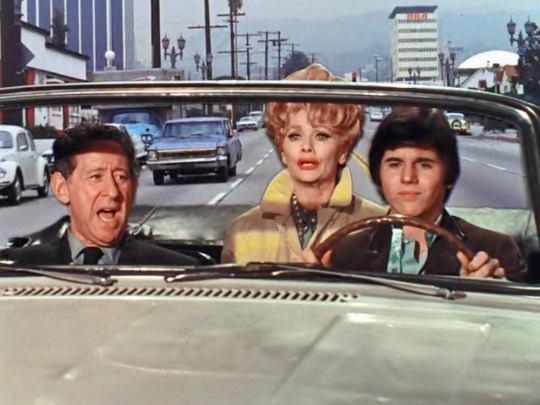
On “Here’s Lucy” Lucy Carter took her son Craig to get his license. Mrs. Carter also faced impatient clerks and a hair-raising driver’s test.
Back in the present, Liz finds a recipe for making Jell-O, which cues a commercial for their sponsor. Bob LeMond ties in the upcoming Independence Day holiday with a Jell-O raspberry pie recipe. “Back to the Coopers…”
Two hours later, the Coopers still haven’t left for the movie. Still going through the scrapbook pile of photos and papers, Liz finds an affidavit.
“I, Liz Cooper, solemnly swear I will not interrupt my husband’s stories, even if I’ve heard them a hundred times.”

Flashback to the night George made Liz sign the affidavit. This scene is from “Old Jokes and Old Stories” episode #37 on March 25, 1949. As with the previous reminiscence, it is not a clip, but a recreation with minor textural alterations.
The Atterburys are over for dinner, and George is once again monopolizing the conversation with his funny but familiar old stories.
LIZ (to Katie): “One person snickers and George thinks his last name is Jessel.”

George Albert ‘Georgie’ Jessel (1898-1981) was famous as a multi-talented entertainer widely known by his nickname, the "Toastmaster General of the United States,” due to his frequent role as the master of ceremonies at political and entertainment gatherings. In 1948, he was honored by the Friars Club, of which he was’ the Abbot’ in a ceremony that was later turned into a short newsreel film.
George launches into a story about their Honeymoon. Everyone has heard it so he tries to tell the story of a picnic, but Liz keeps interrupting and correcting his recollections.

Some of the same dialogue will be recycled on “I Love Lucy” in “Equal Rights” (ILL S3;E4), first aired on October 24, 1953. The rest of the TV episode was based on another episode of “My Favorite Husband” titled “Women’s Rights, Part I” aired on March 5, 1950.
GEORGE / RICKY: “We got there about 10 o’clock.”
LIZ / LUCY: “It was twelve o’clock.”
GEORGE / RICKY: “What’s the difference?”
RUDOLPH / FRED: “Two hours.”Back to the present time, with Liz and George still pawing through the scrap book materials. Liz discovers an old Valentine from George. Flashback to a Valentine’s Day past…

This final reminiscence is based on “Valentine’s Day” aka “Valentine’s Day Mischief” broadcast on February 11, 1949. As with the previous two flashbacks, this is not a clip, but a recreation of the script, including using the original cast, Hans Conried, as Mr. Dabney.
Liz screams “I love you, George” at the top of her voice to prove her affection for him. Liz discovers that Katie has a boyfriend. She has written Mr. Dabney the butcher a romantic poem. Liz calls him “old heavy thumbs”.
KATIE: “Some people may have better beef, but his liver’s good. And no one has oxtail and pig’s feet like him!”
Katie is embarrassed to give the Valentine poem to him, so she asks Liz to do it. Mr. Dabney (Hans Conried) arrives with a delivery from ‘Dabney’s: The Home of Happy Ham Hocks!’ Naturally, Mr. Dabney thinks Liz is the one who has a crush on him, not Katie.
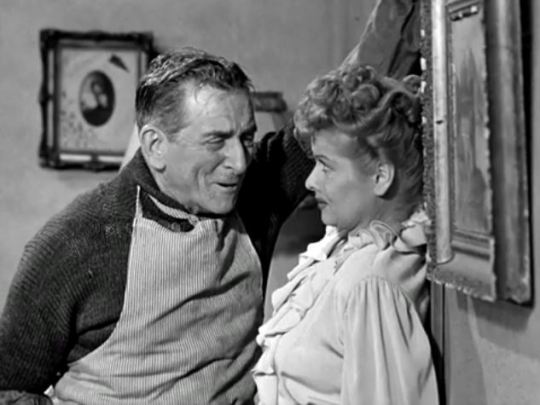
The situation will be used again in “Lucy Plays Cupid” (ILL S1;E15) first aired on January 21, 1952. On TV, the butcher is named Mr. Ritter and he is played by Edward Everett Horton (above). The one who has a crush on him (since the Ricardos do not have a maid) is Miss Lewis, played by (ironically) Bea Benadaret, who plays Iris Atterbury in this episode of “My Favorite Husband.”
Katie’s Valentine is scented!

MR. DABNEY: “And how did you know my favorite aroma – Swift Premium!”
Mr. Dabney reads the poem aloud:
“If you be mine, then I’ll be thine
And set your heart a-quiver.
Say you’ll be my Valentine
And bring two pounds of liver!The poem is signed “Your bashful redhead”. We learn that Katie also has red hair!
MR. DABNEY: “Listen, two houses may have red roofs, but you don’t pick the one with saggin’ foundation!”
Back in the living room in the present time, Liz and George realize they have missed the movie – it is two in the morning! The Coopers hug and kiss.
LIZ: “Honey, you’re my favorite husband!”
The episode ends, but Lucille Ball returns for a Jell-O commercial with announcer Bob LeMond. They sing “Row Row Your Boat” with Jell-O lyrics! The big finish,
“J.E.L.L.O, now you’re on the ball.
Jell-O is wonderful, sponsors are marvelous,
We’ll see you next fall!”
Lucy interrupts Bob to say a special thank you to director Jess Oppenheimer, as well as thanking the entire cast and crew by name. Lucy reminds the listeners they will all be back on the second of September. Bob adds that audiences should see Lucille Ball in Sorrowful Jones with Bob Hope.
 1948 Hudson, Bea Benadaret, Bob Hope, Bob LeMond, CBS, Desi Arnaz, Desi Arnaz Jr., Edward Everett Horton, Frank Nelson, Gale Gordon, George Jessel, Hans Conried, Here’s Lucy, I love lucy, jack gilford, Lucille Ball, Lucy, MGM, My Favorite Husband, Radio, Ruth Perrott, Scrapbook, Sorrowful Jones, Swift Premium, tv
 -
CARL REINER
March 20, 1922 – June 29, 2020

Carl Reiner was a legend of American comedy, having achieved success as an actor, director, producer, and recording artist. He won nine Emmy Awards, three as an actor, four as a writer, and two as a producer. He also won a Grammy Award for his “2,000 Year Old Man” album, based on his comedy routine with Mel Brooks.
During the early years of television comedy from 1950 to 1957, he co-wrote and acted on “Your Show of Shows” starring Sid Caesar. In the 1960s, Reiner was best known as the creator, producer, writer, and actor on “The Dick Van Dyke Show” filmed by Desilu.
CARL REINER: “’I Love Lucy’ was performed by maybe the most beautiful and best comedian of all time in Lucille Ball. The only thing I felt about it is that it was not my kind of show because it was a husband and wife against each other. My wife and I were two people against the world. When I finally did a show, we had two people that loved each other, didn’t fool each other and went on with their lives with the problems that exist for most people.” (2017)
At the “Tenth Annual Emmy Awards” in 1958, “I Love Lucy’s” William Frawley (Fred Mertz) was defeated by Carl Reiner. Lucille Ball did not attend because the show was sponsored by Plymouth and the Arnaz’s were then in an exclusive agreement with Ford.

Reiner and actress Polly Bergen pose with their statuettes. Reiner won for best continuing supporting performance by an actor in a dramatic or comedy series for “Caesar’s Hour.” Bergen won best single performance by an actress in a lead or support role for “Playhouse 90: Helen Morgan Story."

In 1959 The Westinghouse-Desilu Playhouse presented “Martin’s Folly” starring Carl Reiner and Tony Randall. It also starred Phil Ober, George O’Hanlon, and Bart Braverman, all of whom had appeared on “I Love Lucy”.

Lucille Ball and Carl Reiner were not seen on the same program until February 1961 when both were guests of Ed Sullivan on “Toast of the Town”. Lucille Ball sang from her Broadway show Wildcat while Reiner his “The 2000 Year Old Man” routine with Mel Brooks.

Lucille Ball was a presenter at the “The 14th Annual Primetime Emmy Awards” on May 22, 1962, where Carl Reiner won for his writing of “The Dick Van Dyke Show.”

In 1965, Carl Reiner was one of the writers who created “Salute To Stan Laurel” on CBS. Ball did a couple of sketches, one with her comedy mentor Buster Keaton.

Carl Reiner and Lucille Ball made cameo appearances in the 1967 film A Guide For the Married Man, starring Walter Matthau and directed by Gene Kelly.

During “The 20th Annual Primetime Emmy Awards” on May 19, 1968, Lucille Ball won her fourth (and final) competitive Emmy Award in a show broadcast on NBC from The Hollywood Palladium. Reiner attended as a previous winner, having earned a group writing Emmy the previous year.

Ball and Reiner were just two of the many celebrities attending “A Tribute to Mr. Television, Milton Berle” on March 26, 1978.

Lucille Ball and Carl Reiner were both interviewed by Dinah Shore on “Dinah!” on June 5, 1978.
Lucy is joined by her husband Gary, her daughter Lucie, and colleague Robert Osborne.

“High Hopes: The Capra Years” on December 24, 1981, took a look at the career of film director Frank Capra featuring Lucille Ball, Carl Reiner, Burt Reynolds, and James Stewart.
Ball had starred in his 1934 feature Broadway Bill. Ten years later he produced the short film “G.I. Journal” in which Ball played herself.
During “An All-Star Party for Lucille Ball” in 1984, Carl Reiner introduces and interviews Sid Caesar as (all the way from Germany) Professor Ludwig Von Blearyeyes, the world’s most renowned viewer of Lucille Ball’s television shows.

On October 3, 2013, Reiner guest-starred on “Two and a Half Men” as Marty Pepper, a 91 year-old television producer. In the episode, he thinks he remembers ‘banging’ Lucille Ball in the house where they are eating dinner. The episode is actually titled “I Think I Banged Lucille Ball” and was the second episode of their eleventh season.
“Most of the shows [on the air then] were battle of sexes. [I Love] Lucy certainly was a battle of the sexes. A lot of deception, a lot of people fooling everybody. The Van Dyke show was based on my wife and I. We were worthy adversaries, we argued about things — but we were two against the world.” ~ Carl Reiner, 1998
In 2000, Reiner was the recipient of the prestigious Kennedy Center Mark Twain Prize for American Humor. He was the third person ever so honored.
On December 24, 1943, Reiner married singer Estelle Lebost. The two were married for 64 years until her death in 2008. Estelle delivered the line "I’ll have what she’s having” in the deli scene of their son Rob’s 1989 film When Harry Met Sally. She died on October 25, 2008, at age 94.
He was the father of Rob Reiner (born 1947); author Annie Reiner (born 1949); and painter, actor, and director Lucas Reiner (born 1960).
Carl Reiner died on July 29, 2020 of natural causes at age 98.

“Inviting people to laugh with you while you are laughing at yourself is a good thing to do. You may be the fool but you’re the fool in charge.” ~ Carl Reiner
-
THE MOCAMBO
January 3, 1940 – June 30, 1958

The Mocambo was a nightclub in West Hollywood, California, at 8588 Sunset Boulevard on the Sunset Strip.
Lucille Ball and Desi Arnaz were frequent guests at the Mocambo and were close friends of the co-owner Charlie Morrison. Morrison’s partner (in name only, mostly) was Felix Young.

The Mocambo was once described as “a mixture of imperial Rome, Salvador Dali, and a birdcage.” Interiors were designed by Tony Duquette with murals by Jane Berlandina. Duquette was an uncredited costume designer on Ziegfeld Follies (1945), which featured Lucille Ball. The dominant feature was a large aviary containing 21 parakeets, 4 macaws, and a cockatoo. The club’s opening was scheduled for New Year’s Eve 1939, but was delayed when animal rights activists asserted that the loud noise might negatively impact the birds! Morrison died a year before the club closed. He was broke at the time of his death, so Frank Sinatra volunteered to sing at the club for two weeks to make enough money to pay for his funeral.

Lucy and Desi at the Mocambo in July 1942.

Bonita Granville with Lucy and Desi at the Mocambo in 1943.

Lucy and Desi at the Mocambo in 1949. On June 6, 1949, LA Examiner reporter Dorothy Manners wrote:
“Desi Arnaz and his gang open at the Mocambo, June 21.”
Desi remarried Lucille Ball in a Catholic ceremony on June 19, 1949.

Lucy and Judy Garland in a Charleston dance contest at the Mocambo in 1950.

The idea for “Hollywood Anniversary” (ILL S4;E24) came from the fact that Desi Arnaz threw a surprise anniversary party for Lucy at the Mocambo on November 30, 1953. After a huge cake was served, a TV set was wheeled out and the guests watched the “I Love Lucy” episode “Too Many Crooks” (ILL S3;E9).

Lucy and Desi with Gordon and Sheila MacRae at The Mocambo in the 1950. Sheila MacRae was featured in “The Fashion Show” (ILL S4;E20).

Lucy and Desi at the Mocambo during the 1950s. During the 1950s Marilyn Monroe used her influence to get Ella Fitzgerald booked at the club, thereby reinvigorating her career. Contrary to popular belief, Fitzgerald was not the first black singer to play the Mocambo.

The Mocambo’s main stage was the inspiration for the Tropicana set.

In “Hollywood Anniversary” the Mocambo was recreated on the “I Love Lucy” soundstage. The club was previously mentioned in “Don Juan and the Starlets” (S4;E17) as the nightclub hosting the party for the premiere that Ricky is invited to – without Lucy.

~ From Bright Boulevards, Bold Dreams by Donald Bogle
Among the many celebrities who frequented the Mocambo were:
Clark Gable and Carole Lombard, Humphrey Bogart and Lauren Bacall, Errol Flynn, Charlie Chaplin, Elizabeth Taylor, Judy Garland, Henry Fonda, Lana Turner, Ava Gardner, Bob Hope, James Cagney, Sophia Loren, Janet Leigh and Tony Curtis, Natalie Wood and Robert Wagner, Grace Kelly, Debbie Reynolds and Eddie Fisher, Howard Hughes, Kay Francis, Marlene Dietrich, Theda Bara, Tyrone Power, Gene Tierney, Jayne Mansfield, John Wayne, Ben Blue, Ann Sothern, and Louis B. Mayer.

Universal Studios in Orlando replicated the exterior of the nightspot on their backlot. The buildings actually house studio administrative offices. For many years, the theme park also hosted a Lucille Ball museum and gift shop.
The West Hollywood Mocambo IS NOT connected to the El Mocambo nightclub in Toronto, Canada. That location opened in 1948 and is still around today. It is also NOT related to the Mocambo restaurant in Calcutta, India, which is said to be the oldest nightspot in India, opening in 1956.
-
SAX APPEAL

On June 28, 1846, musician / inventor Adolphe Sax filed 14 patents for his new invention: the saxophone. Initially crafted from wood, Sax’s instrument flared at the tip to form a music-amplifying bell. Although the saxophone quickly became popular with French army bands, the Belgian-born Sax spent decades in court trying to fend off knockoffs and made only meager profits before his patents expired in 1866. US production began in 1888 when Charles Conn of Elkhart, Indiana, started manufacturing the instruments for military bands.

Lucille Ball had briefly played the saxophone as a child. When the “I Love Lucy” writers discovered this they asked Lucy if she could still play. She replied “No, but give me a week.” By the time rehearsals for “The Saxophone” (ILL S2;E2) started she knew enough to get by. In fact, she practiced so much that she played a little too well and had to consciously remember to play the wrong notes. Writer Madelyn Pugh later said,
“As for Lucy playing the saxophone – she was a writer’s dream. No matter what we asked her to do – ride a lawnmower, jump on a trampoline, walk on stilts – she never said ‘No,’ just ‘Give me a few days to learn it.’”
In his autobiography, A Book, Desi Arnaz said,
“We could’ve had Lucy fake playing the xylophone and the sax, while someone off-camera did it, but it wouldn’t have been as funny as Lucy struggling to do it well herself.“

Lucy demonstrates her musical skill for Ethel on her newly rediscovered saxophone. She toots out a halting, off-pitch version of “Glow-Worm.” “The Glow-Worm” is a song from Paul Lincke’s 1902 operetta Lysistrata. She claims that she was in the marching band in high school.

It isn’t long before the whole building knows that Lucy has rediscovered the saxophone!

Ralph Brady of the Desi Arnaz / Ricky Ricardo orchestra has a solo riff (his ‘audition’) at the start of the scene at the Tropicana and is then asked to go to the office and make the deal. Of course, in reality Brady had been with the band all along but the show hoped viewers wouldn’t recognize him.

This frees up his chair for the next candidate – Lucy! She dresses and talks like a stereotypical ‘hip’ musician of the 1920s and ‘30s.

Lucy Ricardo picked up the sax again in “Lucy’s Club Dance” (S3;E25)…

and in “Ragtime Band” (S6;E21), although in that episode “Sweet Sue” is the only song Lucy can play, not “Glow Worm.”

Lucy Carmichael played the sax in 1964′s “Ethel Merman and the Boy Scout Show” (TLS S2;E19) while a skeptical Mr. Mooney (Gale Gordon) looks on.

Lucy Carter played the sax during the talent portion of the Secretary Beautiful Pageant in “Lucy Competes with Carol Burnett” (HL S2;E24).
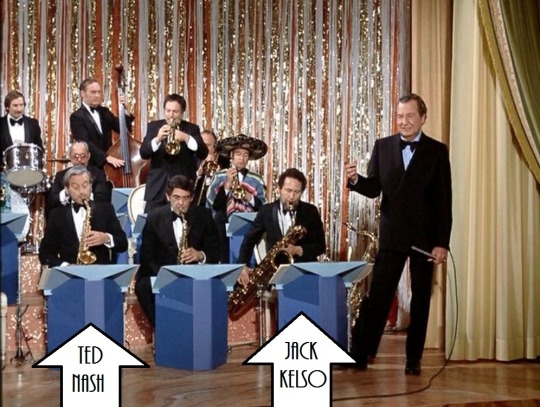
Bandleader Phil Harris has not one, but two sax players (Ted Nash and Jack Kelso) in his orchestra when he appears on a 1974 episode of “Here’s Lucy”.

Rudy Vallee ‘plays’ the sax in a 1970 episode of “Here’s Lucy.” Or does he?

In 1971′s “Lucy and Her All-Nun Band” (HL S4;E8), Lucy Carter subs on sax for a sick sister.

In that episode, she gets a lesson from Freddy Martin, a saxophonist and bandleader who first gained national attention in 1940 and continued on through the 1970s leading one of the most popular bands of the Big Band Era.
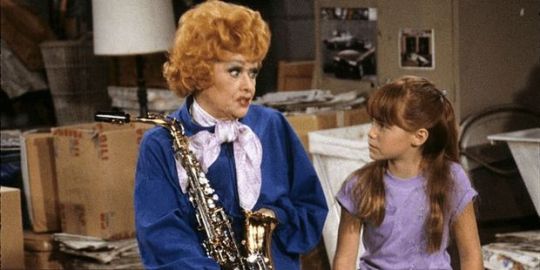
Lucy Barker wants to pass on her love of the saxophone to her granddaughter (Jenny Lewis) on an episode of “Life With Lucy” (1986).

When Lucy Barker pulls the saxophone from the trunk, the audience immediately applauds remembering when Lucy Ricardo played sax on “I Love Lucy.”

When Becky reads the inscription her grandmother had placed on her saxophone for her, she at first reads “made in Elkhart, Indiana.” Conn and Buescher both made saxophones in the city of Elkhart. Founder Gus Buescher was first employed by Conn until he broke off to become their main competition. Buescher became the main supplier of student-grade saxophones to the H&A Selmer Company, which later joined with Conn. The Buescher brand was retired by Selmer in 1983.

At the Lucy-Desi Museum in Jamestown, New York, iconic items of Lucy Ricardo’s include her precious saxophone.
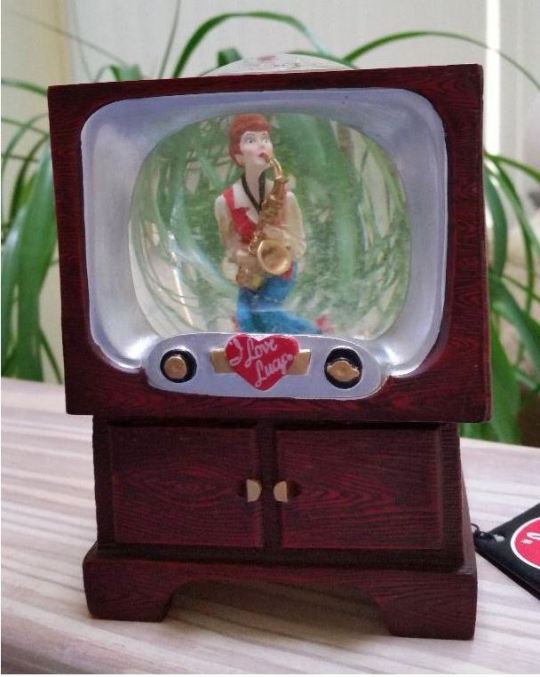
-
MORONI OLSEN
June 27, 1889

Moroni Olsen was born in Ogden, Utah, to Mormon parents. During World War I, he sold war bonds for the US Navy. In 1923, Olsen organized the ‘Moroni Olsen Players’ in Ogden. He got his start on Broadway in 1920 starring as Jason (of the Argonauts) in Medea alongside “Lucy” cast member Byron Foulger. He did nine more Broadway plays through 1935, including playing opposite Helen Hayes in Mary of Scotland, a role he would repeat in the film version with Katharine Hepburn in in 1936. His final two roles on Broadway were opposite another great, Katherine Cornell: Romeo and Juliet and The Barretts of Wimpole Street.

After Broadway, he made his film debut in a 1935 adaptation of The Three Musketeers. A young RKO contract player named Lucille Ball can be glimpsed among the background players. He later played a different role in a 1939 comedy version of the story, starring Don Ameche as D’Artagnan and the Ritz Brothers. He even did a third version titled At Sword’s Point (aka Sons of the Musketeers) starring “Lucy” guest star Cornel Wilde. Olsen returned to the role of Porthos, now elderly, that he created in 1935. Alan Hale Jr. played his son, also named Porthos.

A year later, in 1936, Lucille Ball’s name was finally among the credits (though not yet on the poster) with Olsen in The Farmer in the Dell.

His most famous role was the voice of the Slave in the Magic Mirror in Walt Disney’s Snow White and the Seven Dwarfs (1937). He was also heard but not seen as the voice of Joseph, the senior angel in It’s a Wonderful Life (1946).

Olsen did two films with William Frawley: Rose of Washington Square (1939) and We’ve Never Been Licked (1943).

In Kay Kyser’s That’s Right, You’re Wrong (1939) a brunette Lucille Ball was was finally on the poster, and Olsen was not!

In 1952, Olsen appeared as the Judge on the “I Love Lucy” episode “The Courtroom” (ILL S2;E7). Olsen previously played a Judge in East of the River (1940) starring John Garfield and Off the Record (1939) with Pat O’Brien.

In 1954, he played Mr. Tewitt in Lucy and Desi’s The Long, Long Trailer. Olsen plays the man Taci (Desi) dissuades from buying a trailer as the film begins. The film is told in flashback to justify his opinion.

In October 1954, Olsen played a police officer on an episode of “December Bride”, a Desilu series featuring “I Love Lucy” actors Harry Cheshire, Verna Felton, and Sam McDaniel.

A month later, Olsen died of a heart attack at age 65. He left one film and one television episode to be aired posthumously. Unmarried with no children, Olsen was survived by his nephew, Edward.

-
THE MAYER TWINS
June 26, 1952

Michael Leo and Joseph David Mayer were born on June 26, 1952, in Los Angeles, California. They are the twin sons of Max and Eva June Mayer.

Between 1953 and 1956, the brothers alternated in the role of Little Ricky in 32 episodes of “I Love Lucy.” They succeeded twins Richard Lee and Ronald Lee Simmons, who played the role for six episodes.
James John Ganzer played Little Ricky in the hospital as a newborn.
The Mayers were the 4th and 5th actors to play the part. Although Keith Thibodeaux is best remembered as Little Ricky, the Mayer Twins played him in more episodes.
When the Simmons Twins were not aging as quickly as the TV character, auditions were held for their successor. Desi Arnaz saw a photo of the Mayer twins at a picnic and liked what he saw, even though they do not share Desi / Ricky’s Latin heritage.

It was common for twins to alternate in a single role on television and film in order to meet strict child labor regulations and to assure that if one child was uncooperative or cranky, the other could quickly take his place and filming continue. One of the most famous twins to play a major role on a television series was Diane and Erin Murphy, who played Tabitha Stevens on “Bewitched” from 1966 and 1972, despite the fact that they were fraternal, not identical, twins.

Except for the personal memories of the Mayers and some cast and crew members, it is not generally known which twins is on camera at any point. Although one of the twins has a small scar under his chin, it was not visible on camera. While many children have baby pics, the Mayers have the ultimate in home movies!

Their first appearance was in “Ricky’s LIFE Story” at the start of season 3.

The way Caroline Appleby holds Little Ricky is hysterical. Perhaps his diaper needs changing?

Father and Son – and Godfather, too!

Baby’s first steps!

Lucy is scared for their safety!

In her nightmare, Lucy users her son to convince Ricky not to leave them for Carlotta. The rabbit-themed hat and overalls helped identify the character when he aged 25 years in Lucy’s dream!

Daddy feeds his son. Hopefully nothing too spicy!

Looking at the family albums.

Going for a spin in his new stroller!

Comforting her cranky son.

Sleepy Little Ricky. Many shots of the character in his crib were done as ‘insert’ shots, meaning that they were not part of the filming of the scene, but were done later on – after the audiences had left – so the cameras and lighting could reposition for the shot. The film was later edited into the master shot to create as seamless story.

Gruff Fred bonds with his godson. There is a story that Little Ricky’s friend Little Stevie (Steven Kay) was afraid of William Frawley – and his fear reads on his face during “Lucy and Superman”.

Lucy coaches her son acting, hoping he’ll be the next Jackie Coogan.
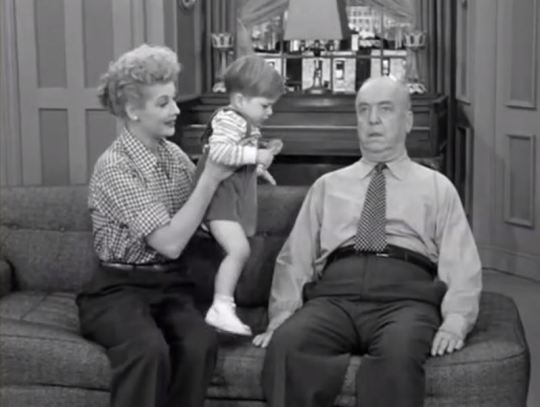
Lucy uses Fred’s godson to rouse him from his catatonic state after losing money on his vintage Cadillac.

Grandma McGillicuddy and babysitter Matilda Trumbull help Little Ricky say goodbye to his parents and godparents as they say “California Here We Come”!

Fashionable Little Ricky in Palm Springs.
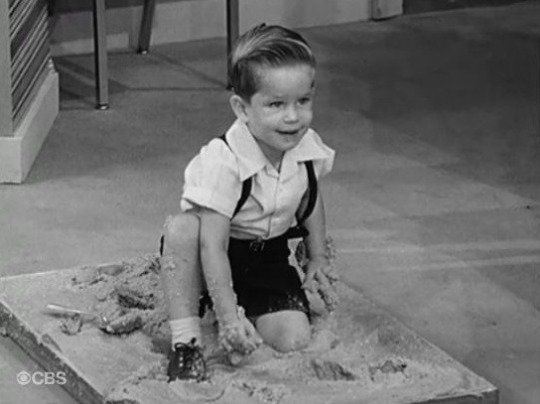
In “Lucy and John Wayne” Director James V. Kern had a tough time coaxing little Michael Mayer to play in the cement for the scene where Little Ricky ruins the newly-made footprints. It took 90 minutes of overtime shooting to get the brief insert shots. It seems the boy was afraid to get his red shoes dirty so Lucy had to promise to buy him a pair of new pair to make him happy. The slab that Little Ricky played in was not wet concrete, but oatmeal!
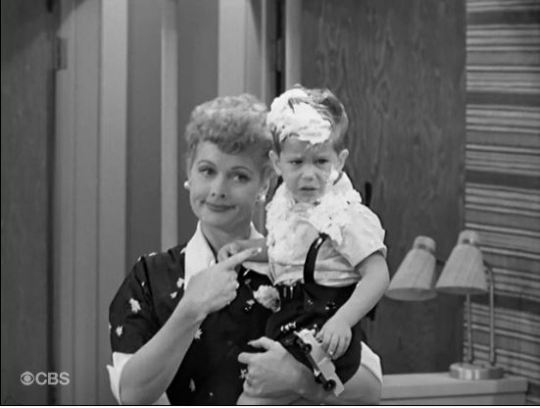
Similarly, what was supposed to be shaving cream was actually whipped cream! Fussy actor Michael (or is it Joe?) looks pretty unhappy about cream on his new suit!

The twins’ real-life mother, Eva Jean Mayer appeared as an extra in “Homecoming” first broadcast on November 7, 1955. After greeting her son, Lucy hands him off to his real mother for the rest of the scene.

Little Ricky is wondering what his mom is doing in his hospital bed!

In “Bon Voyage” the entire cast and crew got to fly in the helicopter except Mike and Joe. Mike remembers being upset over this.

The Mayer Twins’ final appearance was in “Lucy Gets Homesick in Italy” at the end of season 5. At the end of Joe and Mike’s stint on “I Love Lucy,” they were making $150 a week. This was considered full-time pay for the time.
Like the other actors to play Little Ricky, the Mayers were never given screen credit for their work.
TWINS / NOT TWINS

“I Love Lucy” famously used both twins on screen in “Tennessee Bound” which featured Marilyn and Rosalyn Borden as Teensy and Weensy.

In “The Amateur Hour” the Hudson Twins were actually played by non-related actors David Stollery and Sammy Ogg, who were made to appear identical using costumes and make-up.
LIFE AFTER LUCY

THE MAYER TWINS were born Presbyterian and Jewish, although the family later became Mormons and leaders in the LDS Church, including doing missionary work.
When they were about 12 years old, Eva Jean took them to the filming of Yours, Mine and Ours. Lucy recognized their mother and they visited for a few minutes. Eva Jean said Lucy was always very professional.
They graduated from Crescenta Valley High School in 1970.
Joseph became a special education teacher at a high school in North Hollywood, California.

Joseph married Ruth Adel Miller Salway in 1995, his second wife. They have ten children!

The Mayer Twins visit Jamestown!

Exit stage right!
-
Love, Lucy – The Collection
All new Lucille Ball-inspired cosmetics! Officially endorsed and licensed by Desilu Too!
-
Subscribe
Subscribed
Already have a WordPress.com account? Log in now.
 Papermoon Loves Lucy