-
WHO’S QUITTING!
July 31, 1954

The July 31, 1954 issue of TV Guide (volume 2; number 31) featured actor William Bendix on the cover with the headline: “Who’s Quitting! Say Lucy and Desi”.
The last day of the listings in this Guide is August 6, 1954, Lucille Ball’s 43rd birthday!

The inside article is by Desi Arnaz, who takes the opportunity to correct the rumor that they are quitting their hit show, “I Love Lucy,” then preparing its fourth season. Desi reports that Lucy’s casual remark that she’d ‘like’ to quit was rhetorical and not based in reality. In fact, they were contractually obliged to Philip Morris (their sponsor) to continue until 1956. After that, CBS had the right to ask for two further seasons, taking the couple to 1958. Desi mentions that there had been some casual talk about Lucy and Vivian Vance directing a project together for Desilu. [Such a project never came to pass.] He states that by the end of their contract that they will have done 175 films. [In fact, they did 179, not including filming the “Christmas Special”, new intros for re-runs, and the unaired pilot.]
Desi predicts that they may do monthly hour-long specials, several years in advance of “The Lucy-Desi Comedy Hours”, proving that even by mid-1954, the idea of cutting back their hectic schedule was discussed. Desi even theorizes that they might go fishing in Cuba! [All travel to Cuba would be stopped by the end of the 1950s.]
One thing that Desi makes very clear is to dispel the rumor that “I Love Lucy” may go on with another actress in the role of Lucy Ricardo.
“There will never be an ‘I Love Lucy’ without Lucille Ball. Period. Exclamation point!”
TV Guide’s headline is slightly misleading by the use of the exclamation point. It should actually read “Who’s Quitting?” which is essentially what Desi is wondering. You can almost hear it spoken in his Cuban accent! In all fairness to TV Guide, summer was devoid of new programming and TV Guide was looking to sell magazines by putting provocative headlines and images about top shows on the cover. This no doubt increased sales, even if there was nothing to watch.
ABOUT THE COVER:

William Bendix was then starring in the NBC sitcom “The Life of Riley”. First heard on radio starring William Bendix, the series moved to TV in 1948 starring Jackie Gleason in the title role. It lasted until 1950. In 1953, the series returned with it’s original radio star (and the lead of its film version), William Bendix. At the time this TV Guide was issued, the series had just finished its second season and was readying its third (of six).

The show regularly featured two “I Love Lucy” players, Gloria Blondell (Honeybee) and Herb Vigran (Muley). Blondell played Grace Foster in “The Anniversary Present” (ILL S2;E3) in 1952 and Herb Vigran played various “Lucy” characters like Jule, Joe, and Hal Sparks.

Other actors who showed up on both “Lucy” and “Riley”: Mary Jane Croft, Richard Deacon, Vivi Janis, George O’Hanlon, Nancy Kulp, Dayton Lummis, James Burke, Florence Lake, Mary Ellen Kay, Benny Rubin, Ray Kellogg, Howard McNear, Norman Leavitt, Pierre Watkin, and Bobby Jellison.

From the Northeast Edition, a mention of “Public Defender” being moved to “I Love Lucy’s” time-slot for the summer. The episode listed in this edition featured “I Love Lucy’s” Madge Blake.

In 1946 Lucille Ball and William Bendix appeared together in the film The Dark Corner.
INSIDE THE ISSUE:

Photo feature of TV starlets Natalie Wood, Lauren Chapin, Sheilah James, Eleanor Donahue, and Elena Verdugo in swimsuits at the beach!

Feature on character actor Vaughn Taylor and his cats.

Photo feature on the Truex family of actors. Ernest Truex had appeared with Lucille Ball in Dance, Girl, Dance (1940).

Photo feature on the real names of favorite stars. Included is Eunice Mary Quedens (aka Eve Arden) who played herself in “Hollywood at Last!” (ILL S4;E16).

Profile on TV favorite Bea Benaderet. Benadaret had co-starred with Lucille Ball on “My Favorite Husband” and was her first pick for the role of Ethel Mertz. She played spinster Miss Lewis on “I Love Lucy.”
-
LUCY, DESI & THE WHITING GIRLS
July 30, 1955

On July 30, 1955, TV Guide (volume 3, number 31, issue 122) featured Lucille Ball, Desi Arnaz, Barbara and Margaret Whiting, stars of “Those Whiting Girls” (1955).

The cover photograph of the Arnaz’s and the Whitings was credited to Charles Rhodes. During the 1940s, Rhodes was photographer for Fawcett Publications and often photographed movie star Lucille Ball.

This is Lucille Ball’s sixth national TV Guide cover out of a total of 39. A little more than two years earlier, she was on the first national edition with her newborn son, Desi.

“Those Whiting Girls” was a Desilu-produced summer replacement series that premiered on July 4, 1955. A second series of the situation comedy was aired during the summer of 1957. The cover was symbolic of the Whiting Girls taking over “I Love Lucy’s” Monday night time slot on CBS while they were on hiatus.

The series was written by Bob Carroll and Madelyn Pugh, the “I Love Lucy” writers. “I Love Lucy” director James V. Kern helmed the premiere and one other episode.

The Whitings were pop and country singers although Margaret was more interested in acting than her sister Barbara. Their father is composer Richard A. Whiting. Margaret was the inspiration for his classic song “On the Good Ship Lollipop.”

The only other actor to appear in all 26 episodes of “Those Whiting Girls” was Mabel Albertson, who played their mother, Eleanor. She is best remembered by TV viewers as Darrin Stephens’ mother on “Bewitched” (1964-71). Her first appearance on “Bewitched” was aired just four days before her only episode of “The Lucy Show.” In 1956 she had appeared with Lucille Ball in the film Forever Darling. Her brother, Jack Albertson, appeared on “I Love Lucy” in “Bon Voyage” (ILL S5;E13) the same time as Forever Darling was in movie theatres.

In 1957, Jerry Paris (later of “The Dick Van Dyke Show”) appeared in 13 episodes as the Whitings’ accompanist, Artie. He later directed a couple of episodes of “Here’s Lucy,” including the most famous, “Lucy Meets the Burtons” (HL S3;E1) in 1970, but was not compatible with Lucille Ball and dismissed before his contract was up.
In 1955, Beverly Long played the recurring role of Daisy Dunbar, the girls’ best friend.
Over the two seasons, “I Love Lucy” cast members Norma Varden, Herb Vigran, and Maxine Semon also appeared on the show.
The episode listed in this TV Guide was “The Carnival Incident’ (S1;E5) on August 1, 1955. In it, Barbara learns a lesson in showmanship at the campus carnival. When her boy friend persuades her into serving as the lure who gets dunked when baseball throwers hit the target, she tries to get sister Margaret to take her place. Margaret sings “Meet Me at the Station.”

The show was sponsored by Proctor and Gamble, General Foods, and Max Factor.

When “The Handcuffs” (ILL S2;E4) was re-run at the end of season 4 in 1955, Lucy and Desi (as themselves), standing in the Hollywood hotel room set, tell the TV audience they are going on vacation for the summer (“13 weeks, to be exact” Lucille says) and reminds them to tune in to the new Desilu show “Those Whiting Girls” starring Margaret Whiting and her sister Barbara, which filled their time slot during the summer.

Much later, the series was mentioned by Desi Arnaz Jr. on a February 1976 episode of “Saturday Night Live” on NBC.

Over the masthead is a headline that teases an article about the Arthur Godfrey scandal during 1955. The Mariners were a four-piece all-male racially integrated group (two white and two African American members). Arthur Godfrey hired them, and they were regulars on his radio show and later his television shows for several years.The presence of the integrated Mariners brought complaints from Southern politicians and Southern CBS affiliates, which Godfrey publicly and scathingly rebuffed. Despite this, Godfrey summarily fired the group in 1955. The Mariners then guested on other shows and appeared on New York radio, but with diminishing popularity.

Another inside article was “The Rise and Fall of Mr. Peepers” (aka Wally Cox). Cox was one of Lucille Ball’s favorite performers and appeared on several episodes of “The Lucy Show” and “Here’s Lucy.”

The cover also promoted (in a corner banner) a contest to win a role on a television show! The winner would play Dr. Tim Watson in “Dr. Hudson’s Secret Journal” for at least three episodes. Entrants had to be male (sorry ladies) and between the ages of 17 and 21 (sorry Dad). The role eventually went to Joe Walker, who appeared on the medical series in late 1956 and early 1957. This was his only screen credit. Young actor Harvey Grant appeared on one episode of the series in 1955, just before playing Kenneth Hamilton, Lucy Ricardo’s dance partner on the S.S. Constitution. Sammy Ogg, who played one of Lucy’s terrible Hudson twins, was also in a 1956 episode. Coincidentally, Jerry Paris of “Those Whiting Girls” played a doctor on the show. The cast also included “The Lucy Show” actors Vito Scotti and Max Showalter.

The back cover featured a message from Ted Mack, the host of “Ted Mack’s Amateur Hour.”
For More About TV Guide and “I Love Lucy” Click Here!
-
RUDY VALLEE
July 28, 1901

Rudy Vallée was born Hubert Prior
Vallée in Vermont and raised in Maine. He started his career as a saxophone player and singer and became a popular bandleader, hosting a hit radio program in the 1930s.
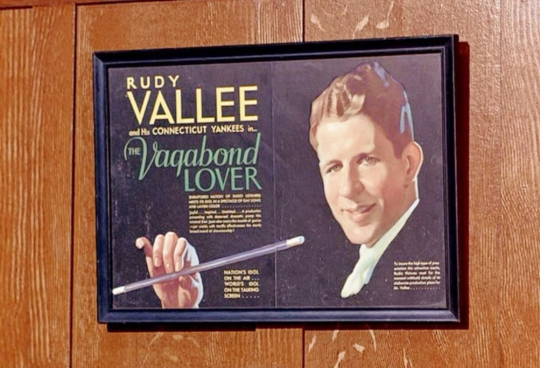
His first film was 1929’s The Vagabond Lover. He also wrote a popular song of the same title. He was known as a crooner, and often depicted singing through a megaphone. On Broadway he appeared in How To Succeed in Business Without Really Trying and repeated his role in the film version in 1967. That same year he played “Batman” villain Lord Marmaduke Ffogg.

Vallée played himself in “Lucy Takes a Cruise to Havana,” the first episode of “The Lucy-Desi Comedy Hour” in 1957.

Vallée
had no scenes with Cesar Romero, although the two had been seen together in 1949′s The Beautiful Blonde from Bashful Bend. Both would play “Batman” villains: Romero as The Joker and Vallée
as Lord Marmaduke Ffogg. Vallée had also appeared on “Hedda Hopper’s Hollywood” in 1942.
In 1956 and 1957, Rudy Vallee did two appearances on the Desilu sitcom “December Bride” once again playing himself. The second appearance aired just a month after Vallee appeared on “Lucy-Desi Comedy Hour.”

He also played himself on a 1970 episode of “Here’s Lucy”.
The plot has Vallée waiting tables to pass the time until his music comes back into style. To help him make a come-back, Lucy convinces Kim to help update his look and sound while Harry gets him a booking at the local teen hangout.

When the full length portrait of Vallée in a raccoon coat is revealed, Vallée says he wore the coat in his first picture, Varsity Hero. In reality Vallée’s first film (aside from two shorts playing himself) was The Vagabond Lover in 1929. Vallée himself was not a fan of the film. In a 1980 interview, he jokingly quipped,

“They’re still fumigating the theaters where it was shown. Almost ruined me. In fact, I think it’s only shown in penitentiaries and comfort stations.”

The “Here’s Lucy” set depicting Vallée’s home was decorated with items brought in from Vallée’s private collection, including a Whiffenpoof Trophy and a small red megaphone with a letter “Y” on it. Both of these were likely given to him by Yale University, home of the Whiffenpoofs.
Vallée
was married four times and was known to be difficult to work and live with.
“I’ll admit I have a too-quick temper.” ~ Rudy
Vallée

Vallée
died in 1986 at age 84. His childhood home is now a registered landmark.

-
DESILU SOLD!
July 27, 1967

Desilu Productions was formed in 1950 by Lucille Ball and her then-husband, Desi Arnaz. The name was a portmanteau of the couple’s first names and was originally applied to the Ball-Arnaz ranch.

Desilu was one of many television production companies that sprung up all over the Hollywood catering to the growing needs of the increasingly popular medium of television. The success of “I Love Lucy” enabled Desilu to expand throughout the 1950s.

When RKO Pictures went bankrupt in 1957, Desilu bought its studios and other location facilities. These acquisitions gave the Ball-Arnaz TV empire a total of 33 sound stages – four more than Metro-Goldwyn-Mayer and eleven more than Twentieth Century-Fox had in 1957.

Desilu operated the physical facilities bought from RKO, which included the main Gower Street Studio in Hollywood, next door to Paramount Pictures. It also consisted of a studio in Culver City and the ‘40 Acres’ backlot – most famous for being Mayberry in “The Andy Griffith Show.”

On the lot there was a small theatre called Desilu Playhouse where Lucy hosted the Desilu Workshop, a training ground for new performers.

After the breakup of the Ball-Arnaz marriage in early 1960, Desilu remained successful.

In 1962, Ball bought out Arnaz and became the first female Hollywood mogul ever to run a major motion picture studio, albeit a reluctant one, as Ball never wanted to be a businesswoman. It was shortly after her second marriage to comedian Gary Morton in 1961, that she left the minutiae of the studio’s business and financial affairs to her new husband by naming him Co-Chairman of the Board of Directors.

During Ball’s time as sole owner, Desilu developed popular series such as “Mission: Impossible” (1966), “Mannix” (1967), “That Girl” (1966), and “Star Trek” (1966).

By April 1964, Desilu found itself in financial trouble – partly due to the fact that husband Morton was inexperienced at running a motion picture studio. “The Lucy Show” was their only remaining self-made production, even though other shows were still produced on the lot as consignments (rentals) from other production companies.

Ball’s success as an actress continued until February 1967, when Ball announced she would sell Desilu to Gulf+Western, a decision which was formalized on July 27, 1967. The act of selling Desilu to Gulf+Western brought the studio under the same parent company as its next-door neighbor Paramount Pictures. The event was commemorated the next day by a dramatic ceremony in which Ball cut a ribbon of film stock which had replaced a wall between the two production studios. Lucille Ball left the Desilu lot the very same day (taking her own hugely popular “The Lucy Show” with her, the only studio asset not included in the sale), directly after the ownership transfer ceremony.

After selling Desilu, rather than working for Paramount, Ball established her own production company, Lucille Ball Productions (LBP) in 1968. The company went to work on her new series “Here’s Lucy” that year. The program ran until 1974 and enjoyed several years of ratings success. LBP continues to exist, and its primary purpose is residual sales of license rights for “Here’s Lucy.”

Television shows produced by or taped at Desilu
- The Jack Benny Program (CBS; 1950-1964/NBC; 1964–1965)
- I Love Lucy (CBS; 1951–1957)
- Our Miss Brooks (CBS; 1952–1956)
- The Danny Thomas Show a.k.a. Make Room for Daddy (ABC; 1953–1957/CBS; 1957–1964)
- Private Secretary (CBS; 1953–1957)
- December Bride (CBS; 1954–1959)
- The Life and Legend of Wyatt Earp (ABC; 1955–1961)
- Meet McGraw (NBC; 1957–1958)
- The Lucy–Desi Comedy Hour (CBS; 1957–1960)
- Whirlybirds (Syndicated; 1957–1960)
- The Real McCoys (ABC; 1957–1962/CBS; 1962–1963)
- The Ann Sothern Show (CBS; 1958–1961)
- The Untouchables (ABC; 1959–1963)
- The Andy Griffith Show (CBS; 1960–1968)
- The Lineup a.k.a. San Francisco Beat (CBS; 1954–1960)
- Sheriff of Cochise a.k.a. United States Marshal a.k.a. U.S. Marshal (Syndicated, 1956–1960)
- Harrigan and Son (ABC; 1960–1961)
- My Three Sons (ABC; 1960–1965/CBS; 1965–1972)
- The Dick Van Dyke Show (CBS; 1961–1966)
- The Lucy Show (CBS; 1962–1968)
- You Don’t Say! (NBC; 1963–1969)
- My Favorite Martian (CBS; 1963–1965)
- The Greatest Show on Earth (TV series) (ABC; 1963–1964)
- Gomer Pyle, USMC (CBS; 1964–1969)
- I Spy (NBC; 1965–1968)
- Hogan’s Heroes (CBS; 1965–1971)
- Star Trek (NBC; 1966–1969)
- Family Affair (CBS; 1966–1971)
- That Girl (ABC; 1966–1971)
- Mission: Impossible (CBS; 1966–1973)
- Mannix (CBS; 1967–1975)

-
LUCILLE BALL DUSTS OFF HER SLAPSTICK
by Aljean Harmetz for The New York Times, August 3, 1986

On Stage 1 at the old Samuel Goldwyn studio on a hot day in the middle of last month, Lucille Ball came back. Barking the familiar laugh that blends a strangling Airedale with a porpoise, mugging for assistant directors and stagehands who weren’t even born when “I Love Lucy” went on the air in 1951, Lucille Ball came back to weekly television – 12 years after she left it.
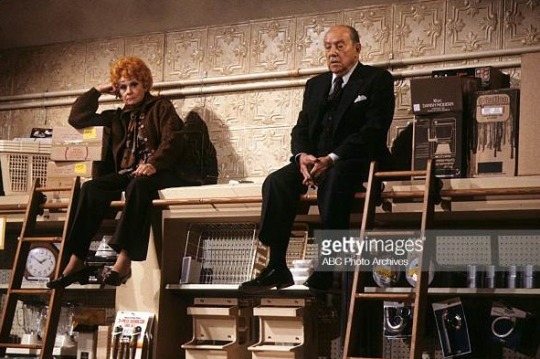
Whether she was named Lucy Ricardo or Lucy Carmichael or Lucy Carter, whether she was the daffy housewife pinned to her kitchen wall by a loaf of homemade bread or the wacky widow wheedling a different sort of dough from a sour-faced banker, Lucille Ball was the queen of slapstick television comedy from 1951 to 1974. Now, a few weeks away from her 75th birthday, she is waiting to slide across a hardware store on a wheeled ladder in the first episode of a new series, “Life With Lucy.” It will be shown Saturday nights at 8 on ABC, starting in late September.

This time, she is Lucy Barker, a widow and a grandmother. In the initial episode, she moves into the Pasadena home of her daughter and son-in-law and her two grandchildren and takes over half-ownership of a hardware store run by the fuddy-duddy father of her son-in-law. He is, of course, played by Gale Gordon, her employer and comedic nemesis on “The Lucy Show” and “Here’s Lucy.” During the past few years, Mr. Gordon, who is 80, has been traipsing around the country performing in musical comedies.
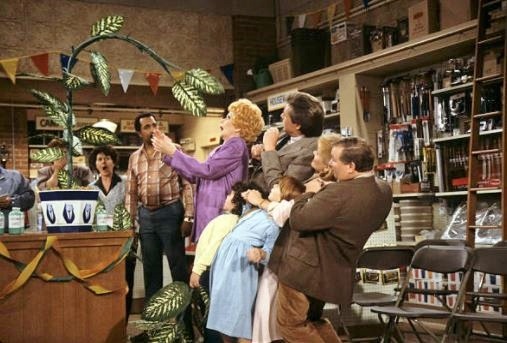
Industry observers have serious doubts that “Life With Lucy” will succeed. In a recent printed forecast, Joel Segal, vice president and a buyer of commercials on prime-time television programs for the Ted Bates Advertising Agency, said that Miss Ball is “a broad physical comedienne who may have some difficulty doing boffo comedy in the midst of her eighth decade.”

“Everyone predicted ‘I Love Lucy’ would be a flop,” says Bob Carroll, unconcernedly. Mr. Carroll and his partner, Madelyn Davis, have been writing for Lucille Ball for 38 years, since her radio show, “My Favorite Husband,” in 1948. More recently, the team spent eight years as executive producers of the CBS situation comedy “Alice.”
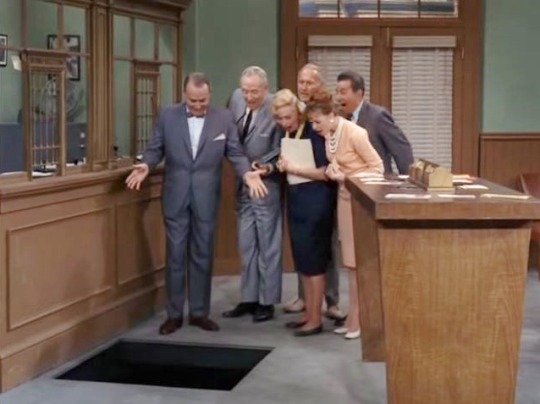
Just today, Mr. Carroll and Miss Davis have discovered there is a pit under Stage 1. “So, we can have something where Lucy goes through a tarp into the basement,” says Miss Davis with delight.

When “Life With Lucy” was being planned this past spring, Miss Davis did offer one concession to Miss Ball’s age. “I said, ‘We won’t fly you,’ ’’ says Miss Davis, referring to putting a wire on an actor so he can do stunts. Miss Ball’s answer: ’’Oh, I can fly!’’
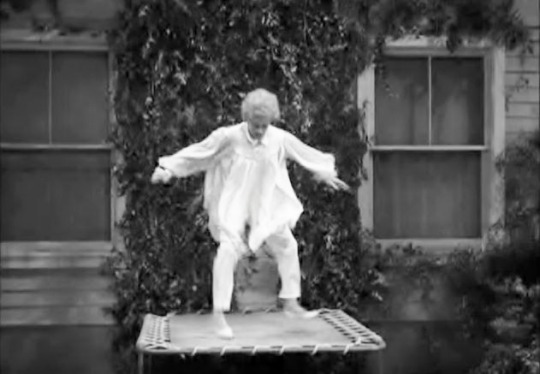
At first glance, at least, Miss Ball seems to be remarkably agile and limber. ’’I’m not dropping out of an airplane or jumping up and down on a trampoline this first show,” she says. ’‘But the Lucy character is the same as ever. To her, nothing is impossible. She’s going for it. This show is Lucy at another time in her life.“ And, indeed, as in all her earlier series, Miss Ball will be the centerpiece of every episode.

Wearing an over-sized yellow shirt over white slacks, with a gold print scarf tied loosely at her throat, Miss Ball is eating lunch in a huge dressing-room suite that her husband, Gary Morton, has already spent a week making homey. Although, to television audiences, she is indelibly married to Desi Arnaz – it was a national event when their son, Ricky Ricardo, was born on ’’I Love Lucy” in 1953 – she was divorced from Mr. Arnaz some 28 years ago and has been married to Mr. Morton, a comedian and producer, for nearly 25 years.

The walls are full of pictures Mr. Morton has hung, including a poster for Miss Ball’s 1974 movie – her last movie – “Mame.” Oddly, it was at this studio that her film career began in 1933. She was a “Goldwyn Girl,” a long-legged showgirl, in “Roman Scandals,” starring Eddie Cantor.
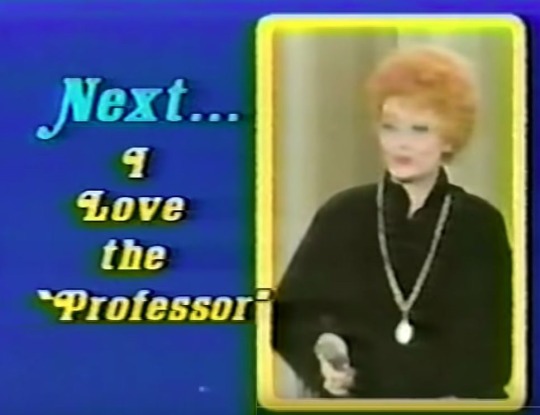
There is no single reason why she has returned to the grind of weekly television. “We went to Florida last year and did seminars, and people kept saying, ‘Please come back, please come back,’ and we started thinking about it,” says Mr. Morton. “She was bored,” says Madelyn Davis. “Lucy doesn’t want to sit at home in a rocking chair, going through her scrapbooks.”

Certainly, money was not the lure. Miss Ball and Mr. Arnaz were the first television stars to put their series on enduring film instead of impermanent kinescope, and some old “Lucy” show is being run on some television channel somewhere on any given day. Since CBS refused to allow Miss Ball and Mr. Arnaz to film in front of a audience, they decided in 1951 to borrow $5,000 and create their own space in which to film their pilot live. “That’s how we came to own the show,” Miss Ball says 35 years later, and there is still a tinge of wonder in her voice.

She paints her lips into a huge cupid’s bow and tosses the familiar red hair. “I’ve missed doing a television series,” she says. ’‘I didn’t realize it until two or three years ago, after I had paid back all the guest appearances to Carol Burnett and Bob Hope and the others, all the promises I had made, all the charity I had to catch up on.“
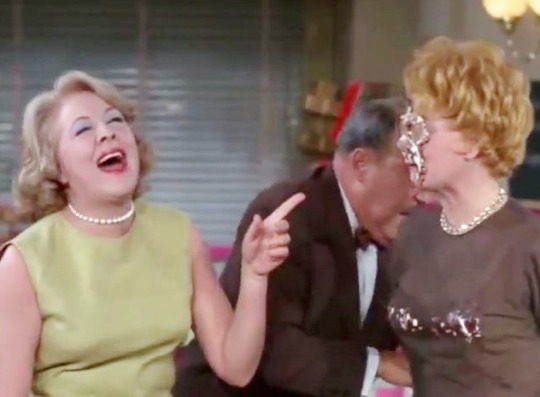
But there was a psychological barrier to overcome. ’’I missed Viv so much. And I couldn’t bear the thought of going on without her,” Miss Ball says. Vivian Vance, who died in 1979, had been Miss Ball’s friend and partner-in-mischief on all the “Lucy” series. On “Life With Lucy,” Lucy Barker will be provided with no woman friend or confidante. Miss Ball pushes the idea away with her hands. “No way, no way,” she says. “That’s one thing I draw the line on.” She says she decided to go for a new series because, with “The Bill Cosby Show,” “the cycle for this sort of thing, family
shows, came around again. I wouldn’t have to do a pilot. And Gale was available and so were my writers. Gale is the strength, the one I upset so he can hardly stand it and he recoils comedically. Hopefully, we’ll find plenty for him to bluster about.” (1)
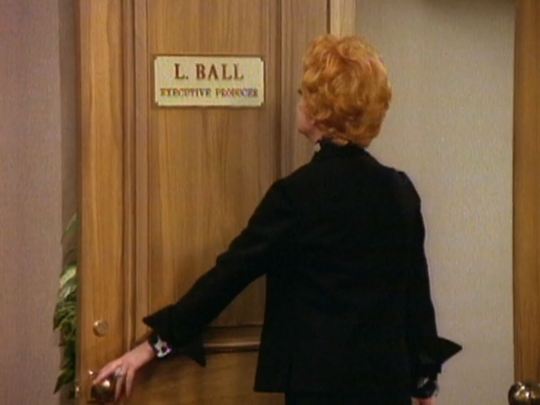
As always, Lucille Ball has creative control. “Young network executives are not going to walk in and tell Lucy what’s funny,” says Mr. Morton. The series is a co-venture of Lucille Ball Productions and Aaron Spelling Productions. It was Mr. Spelling who got Miss Ball excited -“like a war horse,” he says – about doing another series. And it was Mr. Spelling who made ABC commit to a firm order for 22 episodes, an unusually high number nowadays (2). “I’m sick of this prejudgment by age,” he says. “Does Bob Hope work? Does George Burns work?”

Across the television dial from “Life With Lucy,” at 9 P.M., on NBC’s “Golden Girls,” the dialogue is crammed with sexual jokes and middle-aged widows bring men home to bed. Although Miss Davis speaks of “Life With Lucy” as “vintage Lucy turned into a today’s woman,’’ the show will have no sexual humor. ’’She’s never cared for that,’’ says Miss Davis. Instead, according to Miss Ball, ’’one premise will be my first date since my husband died, with a mother-daughter switch, the daughter worrying when her mother doesn’t get home on time.”
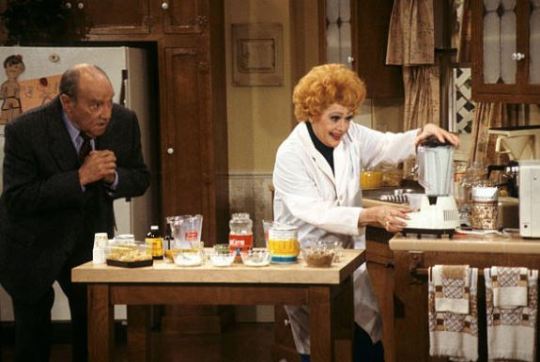
By “bringing the Lucy character up to date,’’ Miss Ball and Miss Davis mean that ’’Life With Lucy” will provide a stronger, less-dependent Lucy. “She was always kind of childlike,” says Miss Davis, “afraid of her husband’s disapproval, saying, ‘Ricky will kill me!’ We wouldn’t do that today. She’s into jogging and health foods, a grandmother and not a scatterbrained wife. She’s gotten a little smarter through the years, and a little more worldly. In several scripts she says things like, ‘Why am I clinging to the past?’ And she tries to see things through her grandchildren’s
eyes.”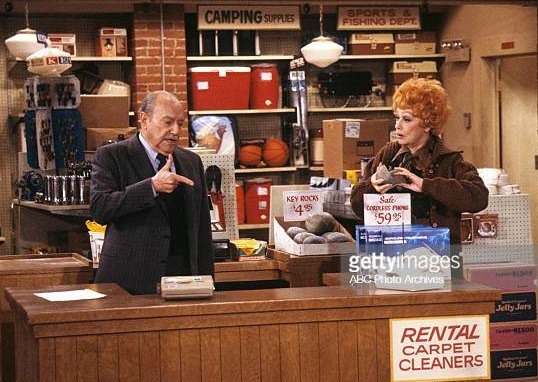
“Lucy is not as dependent on anyone, except under the blowtorch of Gale,” says Miss Ball. ’‘I go into the hardware store and re-arrange everything alphabetically and give them apoplexy.“
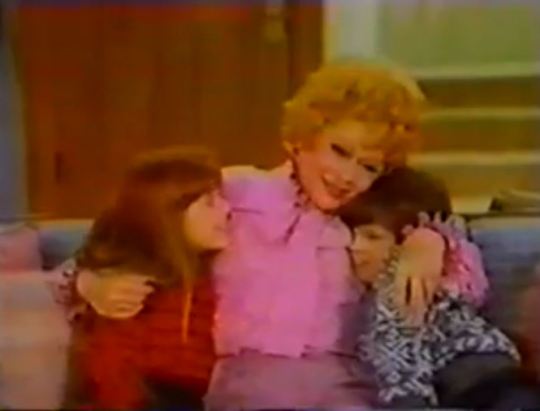
She is standing inside the hardware-store set on Stage 1, waiting to rehearse among the rakes and hoses and bins of plastic tubing. The two young children who play her grandchildren pass the time by playing with flashlights on an open shelf. When the rehearsal begins, they come too tentatively into the shop. Told to walk faster, they are still too slow. Patiently, Miss Ball takes them by the hand and demonstrates. She bursts into the shop, shouting ’’Grandpa!”

The hardware store was her idea. “It gives us a lot of gadgets to work with,” she says, grinning.
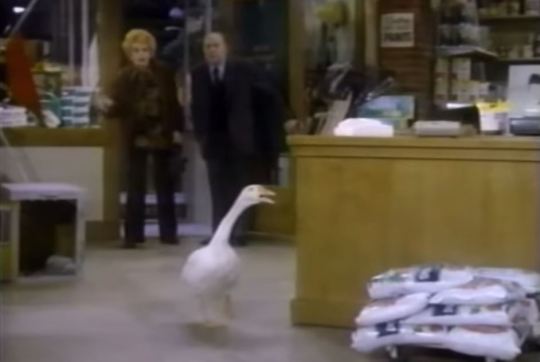
In the first show, she fights with a defective fire extinguisher. The following week, the problems will be with a guard goose. (3) “She doesn’t mind working with animals,” says Miss Davis. ’‘We’ve had her with three sheep, a chimp and an elephant, and milking a cow.’‘ (4) Eventually, she will convince Mr. Gordon to put his inventory on a computer and will manage to erase it. And there is always that sliding ladder.
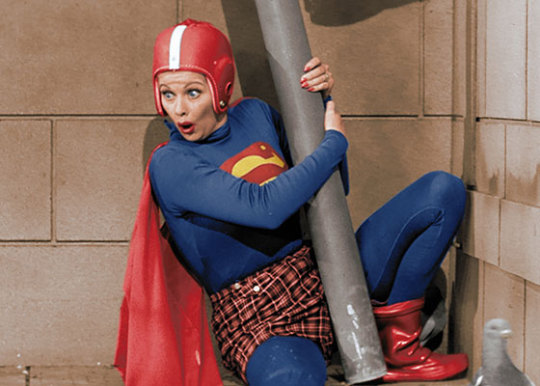
There is also sleight of mind. “We didn’t have as much physical comedy as you think,” says Mr. Carroll of the old “Lucy” shows. “She wore funny outfits and was in funny situations – out on a ledge with pigeons on her head.’’ (5)
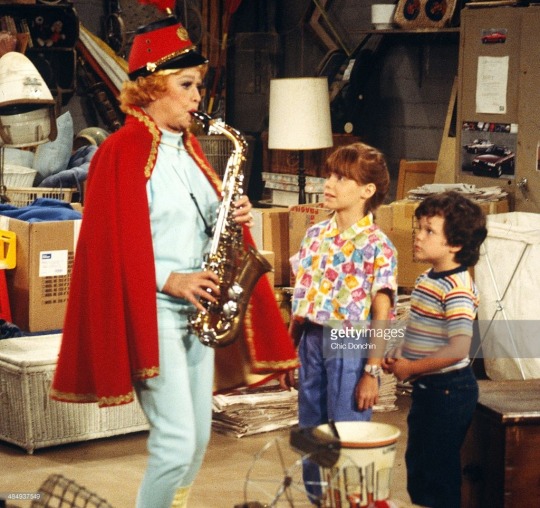
In equivalent ’’Life With Lucy” scenes, she will drink a health-food concoction and turn as rubbery as an octopus. Or, in classic “Lucy” style, she will get her hand stuck in a saxophone. The sax is sitting on a desk in her dressing room. She really plays, although badly. In her spare moments, she is trying to strengthen her lips so she can struggle through the whole “Marines’ Hymn” for a scene with a high-school band in a future show.

During one of the endless waits between scenes, Miss Ball’s chair becomes surrounded by crew members eager to listen. “What are you going to do now, Director Man?” she teases Peter Baldwin. A few moments later, Mr. Baldwin tells her to deliver a line from the third step of the stairs of the three-story gabled stage house. Instantly, Miss Ball decides that the line works more amusingly from the bottom step instead. “You don’t give a chance for a laugh, if you don’t wait,” she explains to the director who is 25 years her junior.

“I didn’t expect it to last,” Miss Ball said later of “I Love Lucy.” “Nobody wanted me to go into television. Everybody at Metro [M-G-M], where I was under contract, said I was out of my mind. And then, when Desi and I went on a tour and there were 5,000 people outside a steel fence at the Miami Airport and they trampled it, and people knocked down a plate-glass window at the lobby of one hotel – we didn’t know what was happening.” (6)
That was a long time ago. Today is a different country. Will re-cycled “Lucy” seem old-fashioned? (7)

While Miss Ball and her husband were wavering, a friend pushed them over the edge to “Life With Lucy.” “Why not?” the friend told them. ’‘You have nothing to lose.“ Whatever happens, says Mr. Morton, is ’’icing on the cake.”
FOOTNOTES aka HINDSIGHT IS 20/20
(1) Although Lucille did not want a female co-star, the final episode aired featured Audrey Meadows as Lucy’s sister. Critics remarked on their comic chemistry and theorized that had Meadows been a regular cast member the show might have stood a chance. Too little, too late.
(2) The series order was reduced to 13, with only 8 episodes airing. A 14th was being plan when the ax fell.
(3) “Lucy and the Guard Goose” was filmed second, but was replaced with “Lucy Makes a Hit With John Ritter” to boost ratings with a guest star. “Lucy and the Guard Goose” was moved to episode 9, but the show was cancelled after episode 8 on November 15, 1986, and “Guard Goose” went un-aired. Ironically, a clip of the episode featuring the goose was already part of the opening credit sequence, leaving viewers wondering “what’s with the goose?”
(4) Madelyn Martin is under-rating Lucy’s experience with animals. On “The Lucy Show” there was a pen full of sheep, not just three. On television alone, Ball has worked with seven chimps, three elephants, and milked two cows! This in addition to other animals of almost every description.
(5) Carroll is referring to “Lucy and Superman” (1956) where Lucy Ricardo impersonates the Man of Steel to surprise her son, making her entrance through a window populated by pigeons.
(6) Ball is remembering an experience in November 1956 when Lucy and Desi visited Miami in advance of their setting several episodes of “I Love Lucy”.
(7) Very quickly it became apparent that the answer was “no” – America and the critics did not embrace “Life With Lucy”, which was cancelled after eight episodes, much to the dismay of Ball, who was devastated by its failure.
[The article’s text has been reprinted verbatim. The images have been added to enhance the reading experience. Some images property of Getty Images Inc.]

-
TYPEWRITER TESSIE!
Lucy and the Typewriter

On July 23, 1829, American William Austin Burt patented a machine called the “Typographer” which is listed as the first typewriter. The London Science Museum describes it as “the first writing mechanism whose invention was documented”. Burt never found a buyer for the patent, so the invention was never commercially produced.
By the mid-19th century, the increasing pace of business communication had created a need for mechanization of the writing process. From 1829 – 1870, many printing or typing machines were patented by inventors in Europe and America, but none went into commercial production.
The first typewriter to be commercially successful was patented in 1868. It looked “like a cross between a piano and a kitchen table”.
Remington began production of its first typewriter on March 1, 1873. It had a QWERTY keyboard layout, which was slowly adopted by other typewriter manufacturers.

An electric typewriter was first produced by the Blickensderfer Manufacturing Company in 1902.
In 1928, Delco, a division of General Motors, purchased Northeast Electric, and the typewriter business was spun off as Electromatic Typewriters, Inc. In 1933, Electromatic was acquired by IBM, launching the IBM Electric Typewriter Model 01 in 1935. By 1958, IBM was deriving 8% of its revenue from the sale of electric typewriters.
IBM and Remington Rand electric typewriters were the leading models until IBM introduced the IBM Selectric typewriter in 1961, which replaced the typebars with a spherical element (or typeball) slightly smaller than a golf ball, with reverse-image letters molded into its surface.


Lucille Ball and William Holden in ‘Miss Grant Takes Richmond’ (1949).
Towards the end of the commercial popularity of typewriters in the 1970s, a number of hybrid designs combining features of printers were introduced. These often incorporated keyboards from existing models of typewriters and dot-matrix printers.

The 1970s and early 1980s were a time of transition for typewriters and word processors. Due to falling sales, IBM sold its typewriter division in 1991 to the newly formed Lexmark, completely exiting from a market it once dominated.

The increasing dominance of personal computers, desktop publishing, the introduction of low-cost, high-quality laser and inkjet printers, and the pervasive use of web publishing, e-mail and other electronic communication techniques have largely replaced typewriters in the United States.

The Dark Corner (1946)

Lucy Ricardo used a typewriter when she wrote her operetta, her novel, and her play!


Lucy Ricardo’s novel “Real Gone With the Wind” was typed by Lucy on a manual typewriter.

When a last minute offer to buy her manuscript surfaces, Lucy is forced to retype her novel after it has been torn to shreds!

Lucy Carmichael takes a job as a legal secretary which requires her to type, answer the phone, and bring the boss a glass of water – all at the same time! She is hopping around the office like a kangaroo!

When Lucy Carmichael was a reporter for the Danfield Tribune, typing was part of the job. Upon closer examination, Lucille Ball is loading paper with writing already on it into the typewriter! Probably her script!

Lucy Carmichael typed a letter to her Congressman about the need for a Fire Department. The Congressman just happens to have the same name as Vivian Vance’s husband, John Dodds!

Lucille Ball and Bob Hope in Critic’s Choice (1963). Typing opening night reviews was how critics did their job before computers!

A heavily disguised Lucy Carmichael spies over the shoulder of a soap opera script writer who is deciding the outcome of her favorite show! From the crumpled papers next to his typewriter, things aren’t going well.
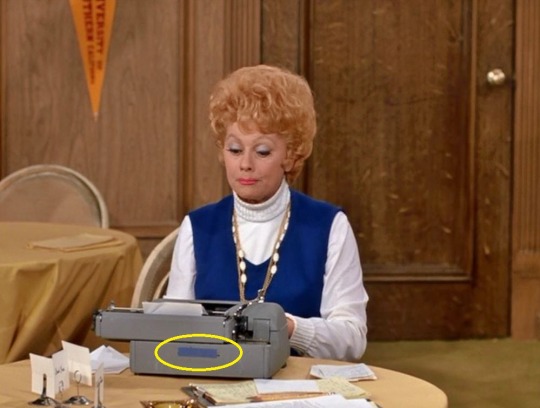
Lucy Carter typing up O.J. Simpson’s speech notes. On TV the brand name of the typewriter was sometimes covered with tape!

Guyana issued a Lucy at the typewriter stamp! 400 Guyanese Dollars is equal to about two US Dollars!

When “Here’s Lucy” needed an extra to play a secretarial candidate, Lucille Ball’s own private secretary, Wanda Clark, was given the job due to her amazing typing speed! What Clark didn’t tell Ball was that she had been typing on an early electric typewriter for years – and the prop on the set was a standard model! She was terrified!

Typing was not just for girls anymore! Craig Carter (Desi Arnaz Jr.) uses a typewriter on “Here’s Lucy” to do his homework.

Moving the Unique Employment Agency into Lucy’s home during her recuperation meant typing letters for Harry before the moving men had even left!

When she is replaced by a computer, Lucy Carter goes to work in the typing pool of another company.

A hilarious typewriter ballet was choreographed to “The Flight of the Bumble Bee”!

Trying to do Lucy’s job – Mr. Mooney causes her electric typewriter to explode!

When Lucy and Carol Burnett compete in the Secretary Beautiful Pageant, the first prize is a new electric typewriter – but what if the results are a tie? The solution to the quandary is never mentioned!


-
RED SCARE!
July 22, 1940

Being the Ricardos (2021) is built around several real-life events in the lives of Lucille Ball and Desi Arnaz. Perhaps the most critical is the accusation that Lucille Ball was a Communist. Pointedly, the Los Angeles Herald Express used red (the color of communism and Ball’s famous locks) ink for a rare above-the-masthead accusation.

When Lucille Ball registered to vote in 1936 and 1938, she listed her party affiliation as Communist. But there was more to the story.

To sponsor the Communist Party’s 1936 candidate for the California State Assembly’s 57th District, Ball signed a certificate stating, “I am registered as affiliated with the Communist Party.” The same year, she was appointed to the State Central Committee of the Communist Party of California, according to records of the California Secretary of State. In 1937, Hollywood writer Rena Vale, a self-identified former Communist, attended a Communist Party new members’ class at Ball’s home, according to Vale’s testimony before the United States House of Representatives’ Special House Un-American Activities Committee (HUAC), on July 22, 1940. Two years later, Vale affirmed this testimony in a sworn deposition:

“Within a few days after my third application to join the Communist Party was made, I received a notice to attend a meeting on North Ogden Drive, Hollywood; although it was a typed, unsigned note, merely requesting my presence at the address at 8 o’clock in the evening on a given day, I knew it was the long-awaited notice to attend Communist Party new members classes…on arrival at this address I found several others present; an elderly man informed us that we were the guests of the screen actress, Lucille Ball, and showed us various pictures, books, and other objects to establish that fact, and stated she was glad to loan her home for a Communist Party new members class.” ~ Rena Vale

On September 4, 1953, Ball met privately with HUAC investigator William A. Wheeler in Hollywood and gave him sealed testimony. She stated that she had registered to vote as a Communist “or intended to vote the Communist Party ticket” in 1936 at her socialist grandfather’s [Fred C. Hunt] insistence. She stated she “at no time intended to vote as a Communist”.

Ball stated she has never been a member of the Communist Party “to her knowledge” … [She] did not know whether or not any meetings were ever held at her home at 1344 North Ogden Drive; stated… [that if she had been appointed] as a delegate to the State Central Committee of the Communist Party of California in 1936 it was done without her knowledge or consent; [and stated that she] did not recall signing the document sponsoring Emil Freed for the Communist Party nomination to the office of member of the assembly for the 57th District.

Immediately before the September 11, 1953, filming of “The Girls Go Into Business”, Desi Arnaz, instead of his usual audience warm-up, told the audience about Lucy and her grandfather. Reusing the line he had first given to Hedda Hopper in an interview, he quipped:
“Lucy has always had a clear conscience about this. She has never been a Communist, and what’s more, she hates every Communist in Hollywood. The only thing red about Lucy is her hair, and even that is not legitimate.”

The moment was recreated in the TV bio-film Lucy (2003) starring Rachel York as Lucy and Danny Pino (above) as Desi.

In the film Being the Ricardos, writer / director Aaron Sorkin changes history and omits the famous line from Desi’s warm-up, replacing it with a live phone call from J. Edgar Hoover himself. Sorkin also changes the episode filmed that week from “The Girls Go into Business” to “Fred and Ethel Fight” (S1;E22) in order to show the inner working of Lucille’s comic mind.

The studio audience gave Lucy a rousing round of applause, and in December of that year the “I Love Lucy” cast was invited to perform at the White House, President Dwight Eisenhower thereby confirming her innocence.

The day after the filming, the Arnazes held a press conference at their Chatsworth Ranch. When asked about the damage to her career, Lucille Ball answered, “I have more faith in the American people than that. I think any time you give the American people the truth they’re with you.”

TV Guide columnist Dan Jenkins stood up and said “Well, I think we all owe Lucy a vote of thanks, and I think a lot of us owe her an apology.” Lucy and Desi walked over to where Jenkins was standing and gave him a huge hug. Jenkins later said, “From that time on, we were very good friends.”

FBI Director J. Edgar Hoover said in a 1956 interview that Lucy and Desi were among his favorite stars. He was twice mentioned on “I Love Lucy.”

One of Hoover’s fans took offense, and that letter is in the FBI file on Ball. “I’m wondering if there is not a mistake or misquote of some kind since it lists Lucy and Desi among your favorite entertainers who you think set a good example for the youth of America.”

Fast forward to Lucille Ball’s sudden passing on April 26, 1989. One of the New York City television stations sent a reporter to the street in front of the Alvin Theatre (where Lucy had done Wildcat in 1960) to deliver the sad news to the metropolitan area. By this time, the Alvin’s name had been changed to the Neil Simon Theatre. The marquee, prominently visible to TV news watchers, was for a new musical called Senator Joe, which had closed in previews six weeks earlier. Its producer was accused of financial misconduct and landed in jail.

The one-act musical by Hair director Tom O’Horgan included Lucille Ball in its comic opera treatment of Senator ‘Joe’ McCarthy. Coincidentally, the theatre later hosted Cher the Musical, in which Lucille Ball was a supporting character.
-
VIVIAN VANCE
July 26, 1909


Vivian Vance was born Vivian Roberta Jones in Cherryvale, Kansas in 1909, although her family quickly moved to Albuquerque, New Mexico where she was raised. She had extensive theatre experience, co-starring on Broadway with Ethel Merman in Anything Goes. She was acting in a play in Southern California when she was spotted by Desi Arnaz and hired to play Ethel Mertz, Lucy Ricardo’s neighbor and best friend. The pairing is credited with much of the success of “I Love Lucy.” She won a 1954 Emmy Award for playing the role and was nominated three more times.
Not know for her film work, she did two films pre “I Love Lucy” and one major film – The Great Race (1965) – after it.
Vance was convinced to join the cast of “The Lucy Show” in 1962, but stayed with the series only through season three, making occasional guest appearances afterwards. She made a total of six appearance on “Here’s Lucy.” She also joined Lucy for a TV special “Lucy Calls the President” in 1977. Vance died two years later.
Here’s a collection of screen shots in honor of the greatest second banana television has ever known – Vivian Vance.


-
VERNA FELTON
July 20, 1890

Verna Felton (1890-1966) made her professional stage debut at the age of 10 as ‘Little Verna Felton,’ working extensively on stage.

Felton was one of the most successful performers in radio, and soon went on to television.

She played the persistent Mrs. Day (mother of Dennis) on “The Jack Benny Show” (1955-62).

She received two Emmy nominations for her role in the Desilu series “December Bride,” playing Hilda Crocker from 1955 to 1959 opposite Spring Byington as Lily. In one episode, producer Desi Arnaz guest-starred as himself.

Felton played the character again on “Pete and Gladys” a spin-off of “December Bride” starring Harry Morgan and Cara Williams, doing 26 episodes from 1960 to 1961.

Desilu also produced “The Ann Sothern Show” (Desi Arnaz, Executive Producer) on which Felton did an appearance in 1960. A year earlier, Lucille Ball played Lucy Ricardo on the show, which was a reformatted version of “Private Secretary”. Lucille Ball and Ann Sothern were friends and frequent co-stars after an early rivalry at RKO.

On “I Love Lucy” Felton portrayed Mrs. Porter, the no-nonsense housekeeper in “Lucy Hires a Maid” (ILL S2;E23).

Felton was also featured in “Sales Resistance” (ILL S2;E17), playing Mrs. Simpson, a housewife to whom Lucy tries to sell a Handy Dandy vacuum cleaner – only to find out that she has no electricity!

For Walt Disney, Felton voiced three elephants: Elephant Matriarch and Mrs. Jumbo in Dumbo (1941), as well as Winifred in The Jungle Book (1967).

She played two Queens: The Queen of Hearts in Disney’s Alice in Wonderland (1951) and Queen Leah in Sleeping Beauty (1959).

Her more human characters included Aunt Sarah in Lady and the Tramp (1955) and – a rare non-Disney female – Pearl Slaghoople, Wilma’s mother, on “The Flintstones”.

She also voiced two wand-wavers: Flora in Sleeping Beauty and – perhaps most famously – The Fairy Godmother in Disney’s Cinderella (1950), where she introduced the song “Bibbidi-Bobbidi-Boo” to the world.

Felton was married to radio actor Lee Millar for six years when when they appeared together on Broadway in Appearances, a few months before the crash of ‘29.

They had one child together, Lee Millar Jr., who made four appearances on “I Love Lucy,” most notably as Chip Jackson, the emcee who introduces the acts in “Lucy and the Dummy” (ILL S5;E3).
Verna Felton died on December 14, 1966 at age 76.
-
FANCY PANTS
July 19, 1950

Fancy Pants is based on the 1915 novel Ruggles of Red Gap by Harry Leon Wilson,
which was adapted for the stage by Harrison Rhodes and opened on Broadway on December 25, 1915. It featured songs by Sigmund Romberg and Harold Atteridge and ran for 33 performances. It was first filmed in 1918 (starring Taylor Holmes and Lillian Drew), again in 1923 (starring Edward Everett Horton and Louise Dresser), and a third time in 1935 (starring Charles Laughton and Mary Boland). In 1957, seven years after Fancy Pants, a television version of Ruggles of Red Gap was made starring Michael Redgrave and Imogene Coca.
The film premiered in Hollywood on July 19, 1950.

Lucille Ball on set with director George Marshall and her stunt double.
Produced by Robert L. Welch
Welch had just produced Sorrowful Jones (1949) with Hope and Ball.
Directed by George Marshall
Marshall had already directed Hope and Ball in Sorrowful Jones (1949). He was known to have a knack for location shooting and Ball rehired him to direct the location shooting during season two of “Here’s Lucy” in 1969.
Written by Edmund Hartmann and Robert O’Brien, with contributions from Iz Elinson, Richard L. Breen, Frank Butler, Barney Dean, Richard English, and Richard Flournoy
Of this group, O’Brien and Elinson would write for Lucille Ball on “The Lucy Show” and “Here’s Lucy”.

Costume Design by Mary K. Dodson
Dodson was under contract to Paramount from 1944 to 1951, working under master designer Edith Head. She previously designed Sorrowful Jones starring Ball and Hope.

Synopsis: In 1905, an American actor (Arthur Tyler) impersonating an English butler named Humphry is hired by a nouveau riche woman (Effie Floud) from New Mexico to refine her husband and her headstrong daughter (Aggie). Complications ensue when the town believes Arthur to be an Earl, and President Roosevelt decides to pay a visit.

A down-on-his-luck English Lord takes a liking to Agatha and to impress her (and her haughty mother) hires a troupe of actors to portray his family and staff at his friend’s empty mansion. The actors use their stage names when meeting Effie and Aggie.
CREDITED CAST

Lucille Ball (Agatha Floud, American Debutante) was born on August 6, 1911 in Jamestown, New York. She began her screen career in 1933 and was known in Hollywood as ‘Queen of the B’s’ due to her many appearances in ‘B’ movies. With Richard Denning, she starred in a radio program titled “My Favorite Husband” which eventually led to the creation of “I Love Lucy,” a television situation comedy in which she co-starred with her real-life husband, Latin bandleader Desi Arnaz. The program was phenomenally successful, allowing the couple to purchase what was once RKO Studios, re-naming it Desilu. When the show ended in 1960 (in an hour-long format known as “The Lucy-Desi Comedy Hour”) so did Lucy and Desi’s marriage. In 1962, hoping to keep Desilu financially solvent, Lucy returned to the sitcom format with “The Lucy Show,” which lasted six seasons. She followed that with a similar sitcom “Here’s Lucy” co-starring with her real-life children, Lucie and Desi Jr., as well as Gale Gordon, who had joined the cast of “The Lucy Show” during season two. Before her death in April 1989, Lucy made one more attempt at a sitcom with “Life With Lucy,” also with Gordon, which was not a success and was canceled after just 13 episodes. She died on April 26, 1989 at the age of 77.
Ball’s singing voice is provided by Annette Warren, who also sang for her in Sorrowful Jones (1949). She provided the singing voice for Pepper (Iris Adrian) in the Bob Hope film The Paleface (1947).

Bob Hope (Mr. Arthur Tyler / ‘Humphrey’ aka ‘Oliver Grimes’ aka ‘Fancy Pants’) was born Lesley Townes Hope in England in 1903. During his extensive career in virtually all forms of media he received five honorary Academy Awards. In 1945, Desi Arnaz was the orchestra leader on Bob Hope’s radio show. Ball and Hope did three other films together. He appeared as himself on the season 6 opener of “I Love Lucy.” He did a brief cameo in a 1964 episode of “The Lucy Show.” He died in 2003 at age 100.
Hope’s screen credit reads: “Starring Mr. Robert Hope (Formerly Bob)”.
After his name credit, Hope appears, puts on a monocle and says to the audience: “No popcorn during my performance, peasants!"
Bruce Cabot (Cart Belknap, Aggie’s Fiancee) appeared with Lucille Ball in 1934′s Men of the Night. In 1949, he joined Hope and Ball in Sorrowful Jones. His main claim to fame is rescuing Fay Wray from King Kong (1933).
Jack Kirkwood (Mike Floud, Aggie’s Father) was born in Scotland and made his Hollywood debut in 1947, just three years before this, his only film with Lucille Ball. His final role was in the failed 1961 sitcom “One Happy Family”.
Lea Penman (Effie Floud, Aggie’s Mother) was a Broadway actress from 1917 to 1949, including the original Annie Get Your Gun with Ethel Merman. This is her only film with Lucille Ball.
Hugh French (George Van Basingwell, Aggie’s Suitor) was a London-born performer who started out as a chorus boy. He gave up acting in the 1950s and became a top agent, numbering Richard Burton among his clients.
Eric Blore (Lionel Boswell / ‘Sir Wimbley, 13th Earl of Brinstead’) was an English actor who had done four films with Lucille Ball between 1935 and 1938, including Top Hat. He did only one film after Fancy Pants and died in 1959.
Joseph Vitale (Wampum, the Floud’s Hired Hand) did six other films with Bob Hope; three before Fancy Pants, and three after. He appeared in red face in 1949′s Paleface, which is probably how he got this role.
John Alexander (President Teddy Roosevelt) also played Teddy Brewster in Arsenic and Old Lace (1944), a character who is under the delusion that he is Teddy Roosevelt. In 1959, he turned up as a General on “Sergeant Bilko” in an episode where Lucille Ball had a brief cameo.

Norma Varden (Gwendolyn Fairmore / ‘Lady Maude Brinstead’)
is probably best known for playing Frau Schmidt, the somewhat circumspect housekeeper at the Von Trapp mansion in 1965′s The Sound Of Music. Lucy fans will remember her as weepy Mrs. Benson, who Lucy Ricardo convinces to swap apartments in “The Ricardos Change Apartments” (ILL S2;E26) in 1953. The London-born actress turned up on an episode of “The Lucy Show”.Virginia Keiley (Julia Dorset / ‘Cousin Rosalind, Duchess of Dover’)
was born in April 1918 in Jersey, Channel Islands. She was known for Rose of Tralee (1942) and The Strange Case of Dr. Manning (1957). She died in 1990 in London, England.
Colin Keith-Johnston (Sir Twombley, Friend of George) was an English actor making his only film with Lucille Ball and Bob Hope. He is best known for the film Berkeley Square (1933).
Joe Wong (Wong, the Floud’s Cook)
was born in Manila, Philippines as Jose Ocampo Cobarrubias. At the time, he was a regular singer on “The Ken Murray Show” (1950), one episode of which also featured Lucille Ball and Desi Arnaz.
UNCREDITED CAST (with connections to Lucille Ball)
Grace Albertson (Dolly) was seen with Lucille Ball as the Perfume Girl in Du Barry Was a Lady (1943).
Hank Bell (Barfly) played Hank in Valley of the Sun (1942) with Lucille Ball.

Oliver Blake (Mr. Andrews) played Zeb Allen, who buys Ricky and Fred’s old clothes in “Changing The Boys’ Wardrobe” (ILL S3;E10) in 1953. He also was seen as Mr. Judlow in The Long, Long Trailer (1954).
Wanda Cantlon (Cowgirl) was Lucille Ball’s stunt double and appeared in three previous films with her, including playing her maid in Miss Grant Takes Richmond (1949).
Chester Conklin (Guest) was also an uncredited extra in Valley of the Sun (1942) starring Lucille Ball.
Charles Cooley (Parson) had just been seen with Hope and Ball in Sorrowful Jones (1949) as well as a dozen other Bob Hope films. He also was a regular on “The Bob Hope Show” on television.
Edgar Dearing (Mr. Jones)
makes his seventh appearance in a Lucille Ball film and will also appear in The Long, Long Trailer (1953).
Alex Frazer (Stagehand) also appeared with Lucille Ball in Lured (1947).
Sam Harris (Umpire) was one of Hollywood’s busiest background performers, doing eleven films with Ball before Fancy Pants and three after. On TV he was an extra on “I Love Lucy,” “The Lucy-Desi Comedy Hour,” and “The Lucy Show.”
Percy Helton (Mayor Fogarty) appeared on Desilu’s “December Bride” and Desi Arnaz’s “The Mothers-in-Law” in addition to scores of other television programs.
Robin Hughes (J. Cunliffe Coots / ‘Cyril’ aka ‘Detective Kirk’) appeared in a 1959 episode of “The Westinghouse-Desilu Playhouse” hosted by Desi Arnaz.
Hughes is uncredited, despite having an integral role in “Lady Alecia’s Pearls” and having a fair amount of dialogue.
Olaf Hytten (Stage Manager) has appeared with Ball in the 1934 film Bulldog Drummond Strikes Back.
Bob Kortman (Henchman) recently appeared with Ball and Hope in Sorrowful Jones (1949) as well as two 1934 films with Lucille Ball.
John Mallon was also seen with Hope and Ball in Sorrowful Jones (1949).
Mira McKinney (Mollie) also was in A Woman of Distinction with Lucille Ball, also in 1950.
Howard M. Mitchell was also in Murder at the Vanities and Jealousy with Lucille Ball, both in 1934.

Ida Moore (Betsy) played Mrs. Knickerbocker on “I Love Lucy” in “The Club Election” (ILL S2;E19) in 1953.
Hope Sansberry (Millie) made her screen debut in Fancy Pants. She was a recurring character on “Sergeant Bilko” including the episode that featured Lucille Ball “Bilko’s Ape Man” in 1959.

Almira Sessions (Belle) later played a Little Old Lady in “Jack Benny’s Carnival Nights” featuring Lucille Ball in 1968.
OPENING NARRATION

“January 6th, 1912. William Howard Taft, president of these United States, signs an Enabling Act admitting the territory of New Mexico into the Union as the 47th state. From a far day in 1850, the stubborn frontiersmen of this great territory asserted their rights to statehood. This, then, is not the story of how New Mexico won its heartbreaking struggle for admission. Rather, it is an account of one of the reasons the struggle took 62 years.This, then, is the saga of a lost cause and one man who helped to lose it.”
THE MUSIC

Jay Livingston plays the songs for Lucy and Bob while Ray Evans looks on.

The songs “(Hey) Fancy Pants!” and “Home Cookin’” were written by Jay Livingston and Ray Evans and sung by Annette Warren dubbing Lucille Ball.

The musical score was by Van Cleve, who had also scored Sorrowful Jones (1949).

When Aggie and Humphrey are wandering the New Mexico desert and see mirages, the underscoring utilizes Theramin, played by Hollywood’s master of Theramin, Dr. Samuel Hoffman. Hoffman also provided the ethereal music when Lucy Ricardo daydreams about fame and fortune in Hollywood during “Lucy and the Dummy” (ILL S5;E3) in 1955.
TRIVIA

Paramount began production on this film in 1947, with Mel Epstein slated as producer, Edmund Hartmann working on the screenplay, and Betty Hutton as the star. News items report that Hutton declined the role, and that the studio attempted to borrow Jane Russell from Howard Hughes to co-star with Hope, but the deal fell through. The production was canceled, and was rekindled in 1949.

Some scenes were shot on location in Santa Fe, New Mexico, and at Busch Gardens and Chatsworth in Los Angeles.

Fred Astaire dropped by the set of Fancy Pants, just in time to watch Bob Hope go through a few dance steps.
This movie was made just before Lucille Ball got pregnant with her daughter Lucie, and before “I Love Lucy” was in development. At the time, Ball was starring on radio in “My Favorite Husband.” This was her 74th film.

The film’s working titles were The Lady of Lariat Loop, Lariat Loop and Where Men Are Men.

The interior set representing the first floor of Norma Desmond’s mansion in Sunset Boulevard (1950) starring Gloria Swanson was also used in this film, giving fans of that classic a rare opportunity to see it in full color.
In a scene involving Lucille Ball and Bob Hope on a mechanical horse, Hope took a tumble and suffered a mild concussion on August 1, 1949.
Production was delayed by his injury and a series of script changes.
“In making a film with the gay and
carefree title Fancy Pants, I was
thrown from a prop horse seven feet
high. I landed on my back on a cement floor. Lucille Ball was supposed
to be giving me riding lessons, and
George Marshall, the director, wanted more action and more jiggle for
the closeups. He ordered
the restraining straps removed from the prop
steed. When it started its
mechanical bucketybucking, it went faster
and faster. Then it tossed
me off. I was still conscious when they carried
me out, and I was sure I
had broken something
important. They took me
to Hollywood Presbyterian Hospital and laid
me under the x-ray machine. Aside from a sore
back and a sorer head, I
was all right.” ~ Bob Hope
This was the second of four feature films that Bob Hope and Lucille Ball made together. The first was Sorrowful Jones (1949). Fancy Pants was followed by Critic’s Choice (1963) and The Facts of Life (1960).

The original finale, in which a fleeing Bob Hope and Lucille Ball were to be rescued by surprise guest star Roy Rogers, was abandoned just before the scene was shot.

The film made $2.6 million dollars at the box office.

DC Feature Films Comic Book – Fall 1950

Bob Hope and Lucille Ball often included the names of their recent films when a spokesperson for products and services.


Fancy Pants was Included among the American Film Institute’s 2000 list of the 500 movies nominated for the Top 100 Funniest American Movies.
FAST FORWARD

In “Lucy Becomes a Sculptress” (ILL S2;E15) in 1953, Lucy and Ricky are looking at their baby pictures (real photos of Lucy and Desi) and Lucy asks if they called him fancy pants!

"Lux Radio Theater” broadcast a 60 minute radio adaptation of the movie on September 10, 1951, with Bob Hope and Lucille Ball reprising their film roles. Norma Varden also returned and Gail Bonney (Mrs Hudson on “I Love Lucy”) was added to the cast.

The gag of Eric Blore’s Sir Wimbley speaking in an incomprehensible English accent was repeated in “Lucy Meets The Queen” (ILL S5;E15) in 1956.

New Mexico would also be the setting of “Ethel’s Hometown” (ILL S4;E16) in 1955. It is reckoned that Ethel Mae Potter was born in Albuquerque around 1905, the same year that Fancy Pants takes place. The town was chosen because it was also the hometown of Vivian Vance, who was raised there but born in Cherryvale, Kansas.

In “The Celebrity Next Door” (LDCH S1;E2) Richard Deacon plays Tallulah Bankhead’s British butler, Winslow. Also in that same episode, Fred Mertz pretends to be Lucy Ricardo’s butler!

The documentary film “Hollywood Without Make-Up” (1963) by Ken Murray includes behind-the-scenes footage of Ball filming Fancy Pants, including Lucy doing a stunt with a break-away table.

On a 1964 episode of “The Danny Kaye Show” guest star Lucille Ball and Kaye play actors who’s co-stars are stranded in a snowstorm and can’t get to the theatre. Kaye and Ball portray all the characters, including English butlers, maids, Lords and Ladies.

Some of the butlers of “Here’s Lucy,” including Gale Gordon, pretending to be Lucy’s butler!

Fancy Pants ends with a chase sequence on a railroad sidecar, a device which was also integral to the chase sequence in “Lucy Hunts Uranium” (LDCH S1;E3) with Fred MacMurray.

On the talk show “Dinah!: Bob Hope: The Road to Hollywood” on April 15, 1977, Ball appears with Hope to promote his new book The Road To Hollywood. Lucy mentions the film in her interview.

In “Happy Birthday, Bob: A Salute to Bob Hope’s 75th Birthday” on May 29, 1978 a clip from the film is included during a tribute (introduced by Lucy) to his female co-stars.

A clip from the film is also included in “Bob Hope’s Love Affair with Lucy” (1989) a tribute special Hope made after Ball’s death.

Sold at auction in 2015: “Cotton khaki riding trousers worn by Lucille Ball in ‘Fancy Pants’ (Paramount), co-starring Bob Hope. Interior label handwritten “Miss Lucile [sic] Ball." The starting bid was $500,with an estimated value of $1,000 to $2,000. The winning bid price was not disclosed.

Two of Lucille Ball’s dresses designed by Mary K. Dodson.
-
Subscribe
Subscribed
Already have a WordPress.com account? Log in now.
 Papermoon Loves Lucy