-
LOOK! MEN ARE MESSY!
August 14, 1951

For the final shot of “Men Are Messy” (ILL S1;E8), the “I Love Lucy” props department mocked up a magazine cover using the actual August 14, 1951 edition of Look (volume 15, #17). The episode was filmed on October 25 and aired on December 3, 1951.

Lucy’s hillbilly photo covers up a trio of real Universal Studios starlets: Joyce Holden, Peggy Dow, and Julia Adams. The other cover photos are of Pope Pius XII, author Gayelord Hauser, and the B-47 Jet.

This episode is based on Lucy’s radio show “My Favorite Husband” “George Is Messy” broadcast June 4, 1950. In that script, the magazine that is mentioned in the final moments is Young Homemakers, not Look.

Look was a biweekly magazine published from 1937 to 1971, with an emphasis on photographs rather than articles. A large-sized magazine of (11″ x 14″), it was a direct competitor to Life, which began publication months earlier and ended in 1972, a few months after Look shut down.
Inside this issue of Look:

- Full page ad for Happy Go Lovely, an RKO musical comedy with David Niven, Vera-Ellen, and Cesar Romero

- Full page ad for Cyrano de Bergerac, with Jose Ferrer.
- Gayelord Hauser author of the book Look Younger, Live Longer.

- Tarzan actor Lex Barker married Arlene Dahl, and is vacationing in Oklahoma.

- Look reporter and photographer Ben Kocivar goes up in a B-47 Bomber.

- Two page ad for Walt Disney’s Alice in Wonderland.

- The Pope’s secret plans in case of war.

- Tennis player Art Larsen.
- 16 top economists predict what the dollar will buy in December.
- America’s ten most televised women.
- Movie review of A Streetcar Named Desire.
- How Hollywood stars are created: includes Tony Curtis, Piper Laurie, Rock Hudson, and others.
- The great American sandwich.

- Full page color Camel Cigarettes ad with opera star Rise Stevens.
On the date this issue hit the newsstands, the publishing world changed forever with the death of William Randolph Hearst, one of the most powerful and wealthiest men in America. He was the model for the Orson Welles film Citizen Kane (1941). Hearst, however, did not own Look magazine. Look was founded by Mike Cowles of Des Moines, Iowa, and owned by Cowles Media.

Look is also prominently featured in “Lucy Gets Ricky on the Radio” (ILL S1;E32) with Lucille Ball on the cover…

…and “Ricky Loses His Temper” (ILL S3;E19), with French actress Jeanmarie on the cover.

“Redecorating” (ILL S2;E8) opens with Ricky napping with the August 26, 1952 issue of Look Magazine over his face.
Model Jean Zahorsky is on the cover showing off ‘dormitory duds’. It was no coincidence that this particular magazine and issue was used. It contained:
- A full page Philip Morris ad with Lucille Ball and Desi Arnaz.
- An article about CBS building a 25 acre city in Hollywood (Studio City) to house its television operations.
- A review of the Bob Hope film Son of Paleface.

It was even used for one of the flashback intro of a re-run during Lucille Ball’s pregnancy leave. Notice that Vivian Vance puts her hand over Ball’s photo, obscuring it from camera. It was common for Lucy and Desi to repay magazines providing coverage of their show with on-air placement.

Although the script changes the real-life musician’s magazine Down Beat to Half Beat, Look Magazine plays itself. From 1952 to 1971 Lucille Ball appeared on the cover of Look nine times!
More about LOOK, LIFE & TIME Magazines and Lucy!

RICKY: “Lucy, this man is not from Half-Beat Magazine.”
LUCY: “He ain’t?”
PHOTOGRAPHER: “No, I’m from Look Magazine!”
LUCY: “Ewwww!”1951, Alice In Wonderland, Art Larsen, B-57 Bomber, Camel Cigarettes, Cesar Romero, Cyrano De Bergerac, David Niven, Gaylord Hauser, Happy Go Lovely, I love lucy, Jose Ferrer, Look, Look Magazine, Lucille Ball, Magazines, Men Are Messy, My Favorite Husband, Pope Pius XII, Richard Denning, Rise Stevens, Vera-Ellen -
THE BIG STREET
August 13, 1942

- Producer: Damon Runyon
- Director: Irving Reis
- Screenplay: Leonard Spigelgass, based on the short story “Little Pinks” by Damon Runyon, first published in Collier’s magazine.
- Dance Staging: Chester Hale
- Gowns: Renie
- Miss Ball’s Dancing Costume: Freddy Wittop
- Miss Ball’s Make-Up: Perc Westmore
The film is sometimes referred to as Damon Runyon’s The Big Street.

The film premiered in New York City at the RKO Palace on August 13, 1942. That same day Disney’s long-awaited Bambi opened at Radio City Music Hall. At the Capitol, Orson Welles’ The Magnificent Ambersons, also starring Agnes Moorehead and Gil Perkins, continued its run. Nearby, at the Albee, a second-run cinema, Top Hat (1935) starring Ginger Rogers and Lucille Ball was playing. The Big Street opened nationally September 4, 1942.
“Love is something that gets you one room, two chins, and three kids.” ~ Gloria Lyons (Lucille Ball)

PRINCIPAL CAST
Lucille Ball (Gloria Lyons aka ‘Her Highness’) was born on August 6, 1911 in Jamestown, New York. She began her screen career in 1933 and was known in Hollywood as ‘Queen of the B’s’ due to her many appearances in ‘B’ movies. With Richard Denning, she starred in a radio program titled “My Favorite Husband” which eventually led to the creation of “I Love Lucy,” a television situation comedy in which she co-starred with her real-life husband, Latin bandleader Desi Arnaz. The program was phenomenally successful, allowing the couple to purchase what was once RKO Studios, re-naming it Desilu. When the show ended in 1960 (in an hour-long format known as “The Lucy-Desi Comedy Hour”) so did Lucy and Desi’s marriage. In 1962, hoping to keep Desilu financially solvent, Lucy returned to the sitcom format with “The Lucy Show,” which lasted six seasons. She followed that with a similar sitcom “Here’s Lucy” co-starring with her real-life children, Lucie and Desi Jr., as well as Gale Gordon, who had joined the cast of “The Lucy Show” during season two. Before her death in 1989, Lucy made one more attempt at a sitcom with “Life With Lucy,” also with Gordon.
Gloria’s singing voice was provided by Martha Mears, who also did Ball’s singing in DuBarry Was a Lady (1944).

Henry Fonda (Augustus Pinkerton II aka ‘Little Pinks’) first worked with Lucille Ball in the 1935 film I Dream Too Much. When Lucille Ball first got to Hollywood, the two actually briefly dated. They collaborated on the TV special “The Good Years” (1962) and the film Yours, Mine and Ours (1968). During the 1970s, Fonda and Ball often turned up on the same awards and tribute shows.
Fonda was nominated for three Oscars, winning in 1982 for On Golden Pond. He also won an honorary Oscar in 1981.
Fonda died in 1982 at age 77.

Barton MacLane (Case Ables) was seen in the film The Maltese Falcon (1941) but is probably best remembered for his final role, the blustery General Peterson on “I Dream of Jeannie” (1965-69).
“A fat man’s always listening to love stories, but he’s never go any to tell.” ~ Nicely Nicely Johnson
Eugene Pallette (Nicely Nicely Johnson, The Greatest Eater Alive) was seen as Friar Tuck in Robin Hood (1938) and in Mr. Smith Goes To Washington (1939).
The character of Nicely Nicely Johnson was played by Stubby Kaye, who reprised the role he played on Broadway, in the film version of Runyon’s Guys and Dolls (1955). He was so named because his usual reply to the question “How are you doing?” was typically “Nicely nicely, thank you!”

Agnes Moorehead (Violette Shumberg) was a classically trained performer who collaborated with Orson Welles on Citizen Kane (1941) and The Magnificent Ambersons (1942). She is best remembered as Samantha’s exotic mother Endora on the TV series “Bewitched” (1964-72).
Violette weighs 100 pounds, four ounces.
“She has a very large capacity for groceries.” ~ Pinks (about Violette)

Sam Levene (Horsethief) originated the role of Nathan Detroit in the Broadway stage musical of Runyon’s Guys and Dolls. Singing great Frank Sinatra played Nathan Detroit in the movie version in 1955.

Ray Collins (Professor B) also collaborated with Orson Welles on Citizen Kane (1941) and The Magnificent Ambersons (1942), along with Agnes Moorehead. He is best remembered for playing Lieutenant Tragg on “Perry Mason” from 1957 to 1965.

Marion Martin (Mimi Venus) would also be seen with Lucille Ball in Abbott and Costello in Hollywood (1945). Although she was often cast as a brassy stripper, showgirl or tough gun moll, off screen she was known to be extremely shy and retiring.
“That dame is a lump of mud!” ~Gloria (about Mimi)

William Orr (Decatur Reed) was an actor turned executive. As the head of WB Television for nine years, he was executive producer of the studio’s early forays into the medium, helping to put ABC on the prime-time map with a steady staple of westerns and detective shows. In 1959 he received a Golden Globe for his contributions to television.

Vera Gordon (Mrs. Lefkowitz)
emigrated with her family from Russia when she was seven years old. She became involved in the theatre and was active in silent films and early talkies. She had previously appeared with Lucille Ball in 1938′s Having Wonderful Time.

George Cleveland (Col. Venus) makes his fourth film appearance with Lucille Ball. In 1949 they also did Miss Grant Takes Richmond. He is best remembered for playing Gramps on “Lassie” (1954-57).

Ozzie Nelson (Himself) was considered the pre-eminent TV dad of the 1950s thanks to his successful family sitcom “The Adventures of Ozzie and Harriet” (1952-66). Before TV fame, he was a bandleader with his wife Harriet the lead singer. Nelson later appeared on several talk shows with Lucille Ball.
UNCREDITED CAST (with connections to Lucille Ball)
Baby (Gloria’s Pekingese Dog)

Louise Beavers (Ruby, Gloria’s Maid) went on to appear in three more films with Lucille Ball: DuBarry Was a Lady (1943), Lover Come Back (1946), and The Facts of Life (1960).
Charles Cane (McCarty, Holland Tunnel Policeman) also appeared with Lucille Ball in The Dark Corner (1946) and as one of the theatre patrons at “Over The Teacups” in “Ethel’s Birthday” (1954) which also featured Big Street extras Bess Flowers, James Conaty, Sam Harris, and Harold Miller.

Jack Chefe was seen as a Paris waiter in “Lucy Meets Charles Boyer” (ILL S5;E19) and played a bellhop in “Lucy and John Wayne” (ILL S5;E2) and had also appeared in five films with Lucille Ball, including playing a waiter in Forever, Darling. Of Chefe’s 358 film roles, 165 were waiters!
James Conaty (Nightclub Patron)
was also seen with Lucille in I Dreamed Too Much (1935), Lured (1947), and The Long Long Trailer (1953). He was one of the theatre patrons at “Over The Teacups” in “Ethel’s Birthday” (1954) which also featured Big Street extras Bess Flowers, Charles Cane, Sam Harris, and Harold Miller.

Hans Conried (Waiter) played Harry Martin in “Redecorating” (ILL S2;E8) and Percy Livermore in “Lucy Hires an English Tutor” (ILL S2;E13), both in 1952. He also did two episodes of “The Lucy Show,” both as her music tutor Dr. Gitterman in 1963.
Pedro de Cordoba (Doctor) was also seen with Lucille Ball in Five Came Back (1939).

Helen Dickson (Florida Club Patron) had appeared with Lucille Ball in Carnival (1935) and Two Smart People (1946). She was one of the aging flapper showgirls in “Ricky Loses His Voice” (ILL S2;E9) in 1952.
Jimmy Dime (Truck Driver / Stunts) was seen with Lucille Ball in 1951′s The Magic Carpet. He did a half dozen episodes as a background players on Desilu’s “The Untouchables” (1959-61).
Eddie Dunn (Mulvaney) was also part of Ziegfeld Follies (1945) featuring Lucille Ball.
Jay Eaton (Late Night New York Nightclub Patron) did a total of nine films with Lucille Ball between 1934 and 1949, including her other Damon Runyon film Sorrowful Jones (1949).

Bess Flowers (Florida Nightclub Patron) aka ‘Queen of the Extras’ made numerous uncredited background appearances on both “I Love Lucy” and “The Lucy Show.” She holds the record of the most film collaborations with Lucille Ball: 17.
Karen X. Gaylord (Florida Club Patron) was also part of Ziegfeld Follies (1945) featuring Lucille Ball.
Charlie Hall (Caviar Waiter) also did Kid Millions with Lucille Ball and went on to do four more films with her until 1942.
William Halligan (Detective) was also with Lucille Ball in 1940′s You Can’t Fool Your Wife.
Art Hamburger (Joe Duffle, Eating Contest Opponent) makes his final of three screen appearances. He became an associate director. This is his only time working with Lucille Ball.
Joe Duffle is from Boston and weighs 337 and a half pounds. There is some irony that Nicely Nicely (then Violette’s) eating contest opponent is actually named Hamburger.
Mary Halsey (Showgirl) also did Seven Days Leave with Lucille Ball in 1942.
Sam Harris (Passerby on Florida Boardwalk) was in the background of a dozen Lucille Ball films, as well as being seen on “I Love Lucy,” “The Lucy-Desi Comedy Hour” and “The Lucy Show.” He was one of the theatre patrons at “Over The Teacups” in “Ethel’s Birthday” (1954) which also featured Big Street extras Bess Flowers, Charles Cane, James Conaty, and Harold Miller.
Jack Herrick (Mindy’s Customer) was also seen with Lucille Ball in The Bowery (1933).
John Indrisano (Mug at Mindy’s) was also seen with Lucille Ball in The Facts of Life (1960).
Tiny Jones (Small Friendly Neighbor) was seen with Lucille Ball in A Girl, A Guy, and a Gob (1934) and Five Came Back (1939).
Donald Kerr (Pete the Passer)
appeared in eight films with Lucille Ball between 1936 and 1954.
Wilbur Mack (Florida Club Patron) appeared in three more films with Lucille Ball: Thousands Cheer (1943), Ziegfeld Follies (1945), and Lured (1947).
George Magrill (Mug at Mindy’s / Stunts) appeared with Lucille Ball in ten films between 1933 and 1949.
Richard Martin also did Seven Days Leave with Lucille Ball in 1942
Tony Merlo (Mug at Mindy’s) was also seen with Lucille Ball in Dance, Girl, Dance (1940) and Broadway Bill (1934).
John ‘Skins’ Miller (Truck Driver) was also with Lucille Ball in Fancy Pants (1950) and Sorrowful Jones (1949).

Harold Miller (Florida Club Patron)
shares 13 film credits with Lucille Ball.
He was one of the theatre patrons at “Over The Teacups” in “Ethel’s Birthday” (1954) which also featured Big Street extras Bess Flowers, Charles Cane, James Conaty, and Harold Miller.
Harris would return for “Lucy and the Loving Cup” (S6;E12) as a subway strap hanger. He appeared in six episodes of “The Lucy Show,” the last one being as a party guest on “My Fair Lucy” (1965).
Bert Moorhouse (Florida Club Waiter) did nine films with Lucille Ball from 1933 to 1954.
Frank Moran (Mug at Mindy’s) makes his final of five film appearances with Lucille Ball.
George Noisome (Newsboy) also appeared with Lucille Ball in That’s Right, You’re Wrong (1939).
Barry Norton (Florida Club Patron) was also seen with Lucille Ball in Nana (1934) and Dance, Girl, Dance (1940).
Frank O’Connor (Police Captain at Holland Tunnel) did nine films with Lucille Ball from 1933 to 1946.

Gil Perkins (Mug / Stunts) was aboard the train when Lucy and Ricky headed home from California in “The Great Train Robbery” (ILL S5;E5). He was seen in The Fuller Brush Girl (1950) with Lucille Ball. He made one appearance on “Here’s Lucy” (above right) in 1970.
Bob Perry (Toupee, Associate of Ables / Stunts) was also seen with Lucille Ball in Stage Door (1937) and Joy of Living (1938).
Ralph Peters (Florist) was also with Lucille Ball in Sorrowful Jones (1949).

Addison Richards (Dr. Mitchell) played the American Consul in “Lucy Goes To Mexico” (LDCH 1959) as well as three other films with Lucille Ball.
Dewey Robinson (Truck Driver) did five other films with Lucille Ball.
Shimen Ruskin (Waiter Captain at Florida Club) was previously seen with Lucille Ball in Having Wonderful Time (1938) but is best remembered as Mordcha in the film Fiddler on the Roof (1971).
Hector V. Sarno (Friendly Neighbor) was also with Lucille Ball in Muss ‘em Up (1936).

Harry Shannon (Florida Doctor) was seen with Lucille Ball and Desi Arnaz in Too Many Girls (1940). He played Jim White (above center), photographer in “Men Are Messy” (ILL S1;E8) in 1951. He is probably best remembered as the father of Rose (Rosalind Russell) in Gypsy (1962).
Walter Soderling (Doctor at Mindy’s) was with Lucille Ball in Easy To Wed (1946).
Mary Stuart (Showgirl) was also seen with Lucille Ball in Seven Days Leave (1942). She is best remembered for her four decade run as Mary on “Search for Tomorrow”.
Elliott Sullivan (Tramp) was also in That’s Right, You’re Wrong (1939) and Next Time I Marry (1938) with Lucille Ball.
Harry Wilson (Fethington) did four other films with Lucille Ball between 1934 and 1950. He was also an extra on Desilu’s “Untouchables” (1959-62).
Marie Windsor (Florida Club Patron) was also in Critic’s Choice (1963) with Lucille Ball.

BIG STREET OPENING
“Loser’s Lane – the sidewalk in front of Mindy’s Restaurant on Broadway – is not as high-toned a trading center as Wall Street, but the brokers are a lot more colorful. Generally they prefer to put their money on a prizefight or horse race, but when the action slows, anything can happen and it usually does. Tonight, for example, the citizens of the Lane are discussing the latest contest in their usual quiet way…”
BIG STREET TRIVIA
The Big Street was a nickname for Broadway, where this movie’s plot starts, and where all Runyon’s stories take place. The film opens at West 50th and Broadway in New York City, with the marquee of the Capitol Theatre in the background.

Damon Runyon originally wanted to cast Charles Laughton and Carole Lombard in the lead roles, but neither one was interested in the project. The two had previously paired on White Women (1933) and They Knew What They Wanted (1940), Lombard suggested the producer consider her friend Lucille Ball and, despite pressure by RKO to hire a better-known actress, Runyon offered her the role. Unaccustomed to playing series roles, Lucille asked advice from Laughton on how to approach such a difficult part. Laughton told her not to hold back: “If you are going to play a bitch, play a bitch!”

Ball later recalled that at the time she was cast, “nothing much seemed to be happening for me at the studio. My $1000 weekly paycheck came regularly, but I was still a regular among the Bs.”
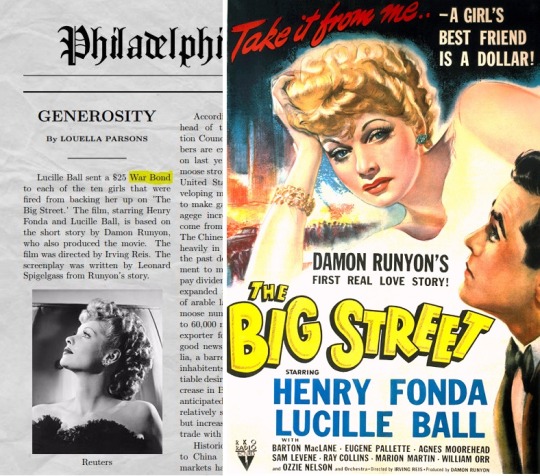
Philadelphia Daily News ~ June 6, 1942
Reports that Lucille Ball sent a $25 War Bond to each of the ten girls that were fired from backing her up on “The Big Street”.
During filming, Lucy’s new husband Desi Arnaz felt so insecure about leaving Lucy and Fonda alone together that he’d often pop by the set to keep an eye on them. His paranoia so exasperated director Irving Reis that he finally banned him from the set.
This was Lucille Ball’s favorite of her nearly 80 films. She felt her performance was unjustly ignored by the Academy.

The vocals for “Who Knows?” by Harry Revel and Mort Greene, performed by Gloria in Case’s Manhattan club, were provided by Martha Mears. The character later reprises the song with Ozzie Nelson and his orchestra in the Miami nightspot.

The film was re-released in 1955, at the height of Lucille Ball’s television success. Although Fonda remains first billed, Ball’s photo clearly indicates that she is the drawing card.

Damon Runyon also created the source material for the hit Broadway musical Guys and Dolls (1950), which starred Robert Alda, who went on to make several appearances on “The Lucy Show.” The two stories share the character of Nicely Nicely Johnson. When the film version was made by MGM in 1955, Lucy and Desi were also under contract to the studio. A brief clip of the film was inserted into the middle of an episode of “I Love Lucy” called “Lucy and the Dummy” (S5;E3), although the clip was removed after its initial airing. Further, when Lucille Ball first came to Hollywood, before becoming a contract player at RKO, she worked for Sam Goldwyn as one of the Goldwyn Girls. In Guys and Dolls, the Hot Box Girls are played by the Goldwyn Girls.

In 1949, Lucille Ball starred in another film based on a Damon Runyon story, Sorrowful Jones, a remake of the 1934 Shirley Temple film, Little Miss Marker.

Damon Runyon was a big fan of Lindy’s, a Manhattan restaurant famous for their cheesecake, and wrote the eatery into his books as Mindy’s. The musical Guys and Dolls, based on Runyon’s writings, immortalizes Lindy’s in one of its songs.
In “Ricky’s Contract” (ILL S4;E10), Lucy tells Fred and Ethel that Ricky took his entire band to Lindy’s to celebrate learning that he had been offered a movie contract.
In The Big Street, a sympathetic Pinks decides to take Gloria to Florida to recuperate – by pushing her wheelchair the entire way – starting with the Holland Tunnel! Although Lucy and Fonda never left Hollywood, the locations are achieved by rear projection and establishing footage.

The Holland Tunnel figures into “I Love Lucy,” not once – but twice. In “The Marriage License” (ILL S ), after finding out that her marriage license may be invalid, Lucy goes on a twelve hour walk to East Orange, New Jersey. “How I ever got through the Holland Tunnel, I don’t know.”

The Holland Tunnel will be mentioned again three years later in “Lucy Learns to Drive” (ILL S4;E11). Reportedly, she tried to make a u-turn in the Holland Tunnel resulting in traffic being tied up to East Orange, New Jersey.

Action is also set in Miami Beach, Florida. Pinks and Gloria hitchhike there to visit with Nicely Nicely and Violette who are operating a night spot there.

In “Off To Florida” (ILL S6;E6), Lucy and Ethel also hitchhike to Miami Beach Florida after being left on the side of the road by their ride share, a suspected hatchet murderess. They arrive at the North Miami train station covered in chicken feathers from riding in the back of a poultry truck.

Doting Pinks has a pet name for haughty Gloria: ‘Your Highness’. In Florida, her friends conspire to get people to come and hear her sing by fibbing that she is the Princess of Corolia, a fictional place.

In “The Publicity Agent” (ILL S1;E31), Lucy conspires to get Ricky more publicity by pretending to be a fawning fan of royal blood: ‘The Maharincess of Franistan’!
FAST FORWARD!

On a 1971 episode of “The Dick Cavett Show" with guests Lucille Ball, Carol Burnett, and Lucie Arnaz, Lucie compliments her mother’s dramatic performance in the film.
The film is referenced in the television film Lucy & Desi: Before the Laughter (1991)
A poster for the film is on Lucy’s dressing room wall in Lucy, a 2003 TV movie.
The Big Street turns up in the TV listings in the low budget film Hollywood Mouth (2008) starring Joe Bologna.
A clip from the film is featured in a montage during “AFI Life Achievement Award: A Tribute to Henry Fonda” a 1978 special attended by Lucille Ball.
Henry Fonda: The Man and His Movies (1982) contains dressing room and dance floor scenes with Lucille Ball.
The Emmy-winning documentary Lucy and Desi: A Home Movie (1993) features a brief clip from the movie.
When Cher is TCM Guest Programmer in 2011, she selects The Big Street as one of her films to be aired.

In December 1948, Lucille Ball reprised her role on radio with John Garfield taking the role of Pinks.

The Big Street on VHS.

The Big Street is available on DVD from Warner Home Video. It is also part of the Lucille Ball Collection DVD, which also includes Dance, Girl, Dance, DuBarry Was A Lady, Critic’s Choice, and Mame.

-
BOB CARROLL JR.
August 12, 1918

Born Robert Gordon Carroll in McKeesport, Pennsylvania, his family moved to Florida when he was three years old. The family also moved to California for a time in conjunction with Carroll Sr.’s work, but eventually settled back in St. Petersburg, Florida.

Bob Carroll Jr. attended St. Petersburg College where he studied French. In 1940, he broke his hip in an accident. While recovering, he heard about a script writing contest sponsored by a local radio station and ended up winning first prize.
His brother-in-law helped him get a job as the front desk clerk for CBS Radio in Hollywood, California. He eventually worked his way up to the publicity department and from there to writer.
Carroll was teamed with Madelyn Pugh and the two created a partnership that lasted more than 50 years, writing approximately 400 television and 500 radio scripts. Though they briefly dated, they married other people.

While writing for Steve Allen’s local radio show, the duo became interested in writing for Lucille Ball’s new radio series “My Favorite Husband”. One week they paid Allen to write his own show so that they could focus their energies on creating a submission for “My Favorite Husband”. Successful, the pair wrote for Ball’s popular radio program for its 2½-year duration.

Carroll and Pugh helped develop and create a vaudeville act for Lucille Ball and her husband, Desi Arnaz, which became the basis for the pilot episode of “I Love Lucy”. Together they tackled 39 episodes per season for the run of the show.

Pugh and Carroll were nominated for three Emmys for their work on “I Love Lucy”;

The pair also wrote episodes of Ball’s subsequent series: The first five episodes of “The Lucy-Desi Comedy Hour” (acting as script consultant for the other seven);

As part of the “Westinghouse-Desilu Playhouse” Bob and Madelyn wrote a script for Lucille Ball – her first non-Lucy Ricardo role – “K.O. Kitty”;

The first two seasons of “The Lucy Show”;

29 episodes of “Here’s Lucy”;

and, in 1986, Ball’s final sitcom, “Life With Lucy.”
Although Carroll was not an actor, he sometimes was in front of the camera, his distinctive facial hair making him instantly identifiable.

As Lucy’s artistic great grandfather in “Lucy the Sculptress” (ILL S2;E15)…

As a passenger on the SS Constitution in “Bon Voyage” (ILL S5;E13)…

As a patron of an outdoor cafe in “Paris at Last” (ILL S5;E18)…

As a roulette player in “Lucy Goes to Monte Carlo” (ILL S5;E25)….

As a spectator in “Lucy and the Little Leauge” (TLS S1;E28).

As the final scene of “Lucy’s Last Birthday” (ILL S2;E25) opens at the Tropicana, Ricky thanks
“Pugh and Carroll – the two greatest contortionists in America today.”
This inside joke refers to the fact that the writers tried out all of Lucy’s stunts before they wrote them into the script.

In “Pregnant Women are Unpredictable” (ILL S2;E11), Lucy can’t decide on what to name her unborn baby. After an episode full of male / female name possibilities (including Unique and Euphonious) the episode ends with Lucy saying,
"You don’t love little Robert or Madelyn!”

In 1955, Carroll and Pugh created a summer sitcom to take the place of “I Love Lucy” titled “Those Whiting Girls” starring singing sisters Barbara and Margaret Whiting as themselves. It returned for the summer of 1957 as well, sponsored by Max Factor.

They created and wrote the successful Desi Arnaz-produced series “The Mothers-in-Law” (1967-69) which starred Lucille Ball’s longtime MGM pals Eve Arden and Kaye Ballard. Producer Desi did two cameos on the show.

Just prior to that, working with Desi and not Lucy, they created “The Carol Channing Show” (1966), but the pilot was not picked up for production.

They also wrote the story for the film (a rare non-TV endeavor) Yours, Mine and Ours (1968) based on the book “Who Gets the Drumstick” by Helen Beardsley.

Carroll and Pugh served as executive producers and did some writing for the hit television series “Alice”, starring Linda Lavin, for which the duo won a Golden Globe Award. Desi Arnaz appeared on the sitcom in 1978.

In 1979 Lucille Ball recruited Carroll and Davis to pen one last adventure: “Lucy Calls The President” – an hour-long special featuring many of Ball’s former co-stars.

He co-authored Madelyn Pugh Davis’ memoir, Laughing with Lucy, released September 2005.

Carroll died in 2007 after a brief illness. He was 88 years old.

He was survived by a daughter, Christina Carroll, of Los Angeles.
Alice, Bob Carroll Jr., Desi Arnaz, Here’s Lucy, I love lucy, K.O. Kitty, Life With Lucy, Linda Lavin, Lucille Ball, Lucy-Desi Comedy Hour, Madelyn Davis, Madelyn Martin, Madelyn Pugh, My Favorite Husband, The Carol Channing Show, The Lucy Show, The Mothers in Law, Those Whiting Girls, Vivian Vance, Yours Mine and Ours -
RICHARD REEVES
August 10, 1912

Richard Reeves was born on August 10, 1912 in New York City as Richard Jourdan Reeves.
Although he specialized in playing henchmen, gangsters and street thugs, he actually came from a well-off family; his father was a bank executive he and grew up in an upscale section of Queens, New York. He studied music in school; and then, at the age of 18, he worked as a seaman, spending much of his time in the 1930s aboard ships. Reeves served in the US Army during World War II, reaching the rank of sergeant.
He has the distinction of playing the most gangsters / thugs in TV series based on comic books. He appeared in five episodes of “Adventures of Superman” (1952), as well as appearing in a failed pilot called “The Adventures of Superboy” in 1961. He also appeared in the first episode of “Batman” (1966), although not as a villain.
He is no relation to Steve Reeves (Goliath) or George Reeves (Superman).

Reeves’ first appearance with Lucille Ball was as Hank, one of Ricky and Fred’s poker buddies in “Be a Pal” (ILL S1;E2), the second episode aired in 1951.

Next up he played jealous husband and neighbor Bill Foster in “The Gossip” (ILL S1;E24). Bill is married to Grace, about whom Lucy makes up a story of marital infidelity. SPOILER ALERT: In the end, he is in league with Ricky to get the best of Lucy!

His third appearance with Lucille Ball was as one of the thugs that threaten the Maharincess of Franistan in “The Publicity Agent” (ILL S1;E31, left). SPOILER ALERT! It is later revealed that he has been recruited by Ricky and Fred to impersonate an assassin and that his real name is Bill. Does this mean that Bill is Bill Foster, Grace’s husband? If so, Reeves joins a select group of actors who played a recurring character on “I Love Lucy.” The next time we hear of the Fosters it is Grace (Gloria Blondell) who gets the camera time, while Bill is away on business in…

“The Anniversary Present” (ILL S2;E3), where Ricky arranges to buy Lucy an anniversary gift from upstairs neighbor Grace (who works for a jeweler), but Lucy thinks the two are having an affair. Coincidentally, although Bill Foster is not in the episode, Reeves is – at least his voice is! When jealous Lucy listens at the furnace pipe (”the snooper’s friend”) to hear Ricky and Grace talking, she also hears an argumentative neighbor lady (Barbara Pepper) calling her husband Albert (Richard Reeves) to come to lunch! Pepper and Reeves are never seen and are not credited, but their voices are unmistakable.

For the fourth of his eight series appearances Reeves plays a lighting technician on a ladder at the Tropicana. Although he does not have a character name, he does have a line of dialogue in “Lucy is Enceinte” (ILL S2;E10), where Lucy announces that she is expecting a baby.

Reeves doesn’t have a character name in “The Indian Show” (ILL S2;E24) either, although he certainly has one of the funniest lines of the show. Reeves plays an actor (with a broad New York accent) hired to play a Native American in Ricky’s show.

In “Equal Rights” (ILL S3;E4) Reeves is (for once) a good guy, playing one of New York’s men in blue in the episode’s final moments. For the first time on the show – and perhaps to make him look noticeably different – he has a mustache!

In “The French Revue” (ILL S3;E7), Reeves is back at the Tropicana, this time as a stage hand / security guard charged with physically removing Lucy when she sneaks into the club in disguise. Reeves was likely hired for his physical size and strength, as he (and Fred Aldrich, left) have to lift Lucy off the ground.

For his final appearance on the series Reeves breaks out of his usual casting tropes – acting a character role not relying on his size or playing a tough guy. He plays Lester Bike, host of ‘Millikan’s Chicken-Mash Hour” in “Tennessee Ernie Hangs On” (ILL S3;E29).
Reeves was absent from seasons 4, 5, and 6 as well as all 13 episodes of “The Lucy-Desi Comedy Hour” but kept busy on and off the Desilu lot.

His final appearance opposite Lucille Ball was in “Lucy Drives a Dump Truck” (TLS S1;E24) in 1963. Once again he is back in blue as one of (Brewster) New York’s finest.

In 1959 and 1960, he appeared in two episodes of “The Ann Sothern Show” produced by Desilu and filmed on the Desilu lot.

In June 1961, he was back on the Desilu lot to film an episode of “Angel” written by Jess Oppenheimer and co-starring “Lucy” cast member Doris Singleton (Caroline Appleby).

From 1959 to 1963, Reeves did six episodes of Desilu’s hit gangster series “The Untouchables” – all as different characters – but not all tough guys.

He returned to wearing blue for Desilu in an episode of “Glynis” a series by Jess Oppenheimer starring Glynis Johns that last only 13 episodes in late 1963.

He kept his uniform on for one of two appearance in “My Three Sons” filmed on the Desilu lot in 1962 and 1965. In the first he appeared with William Frawley (Fred Mertz) and in the second with Doris Singleton (Caroline Appleby).
He died on March 17, 1967, age 54 from cirrhosis of the liver. Fittingly, his final screen appearance was posthumously playing a hit man (uncredited) in the James Bond film Casino Royale (1967).
-
TV DIGEST
August 9, 1952

On August 9, 1952 Lucy and Desi were featured on the cover of TV Digest, a competitor of TV Guide as part of their inside story “Visiting The Stars on Vacation”. The Digest was eventually absorbed by TV Guide when it went national in March 1953.

The Atlanta edition of TV Digest used this same cover image two weeks later, on August 23, 1952. The back cover is a full page ad for Atlanta’s Pat Murphey, an appliance business. Coming on the heels of the July presidential conventions, Murphey is pitching renting or buying a DuMont TV in preparation for the November election between GOP incumbent Dwight D. Eisenhower (IKE) and the Democrat challenger Adlai Stevenson.
The three bathing beauties also gracing the cover are not identified. This is a composite photo and the Arnazs’ and the three women were not photographed together.

Both magazines feature this Jerry Doyle cartoon “How TV Stars Take Vacations”.
- Lucille Ball is depicted with knitting needles and a stork with a doctors’ bag nearby, anticipating the birth of her baby in January 1953.
- Abe Burrows was a Broadway and radio author who spent the summer furiously writing (hence the sweat) and appearing on the TV panel show “The Name’s The Same”.
- Bob Hope and Sid Caesar, two of radio and TV’s most prolific comic actors, spent the summer of 1952 playing golf.
- Bert Parks is probably best remembered as the emcee of the Miss America Pageant. During 1952, Parks had several TV shows ending in the spring and beginning in the fall. He spent his summer boating.
- Red Skelton later talked about his summer vacation in the mountains and the beach on the September 28 episode of “The Red Skelton Show”. On the October 5 episode he talked about an earthquake that summer. On July 16, 1952, Central California was rocked by a 7.5 earthquake with 12 casualties. Skelton was hospitalized for an undisclosed ailment in the summer of 1952, explaining his depiction carrying a large bottle of prescription medication.
- Sam Levenson was a panelist on the CBS series “This Is Show Business” along with playwright George S. Kaufman and Abe Burrows. On the same date this issue of TV Digest was published (August 9, 1952) Levenson was featured on the cover of their rival TV Forecast. Levenson spent the summer being a new father.
- Perry Como was joining other recording artists of the time by transitioning to television. The summer of 1952 looks to have been spent on outdoor activities like fishing.
- Jimmy Durante was a vaudeville comic and film star who, during 1952, hosted “All Star Revue”. On July 28, 1952, Durante was featured on the cover of TV Forecast, a rival publication of TV Digest.
- Donald O’Connor was a song and dance man who had two films in release during the summer of 1952: Singin’ in the Rain and Francis Goes To West Point.
Of the above celebrities, only Sam Levenson and Abe Burrows (both basically writers) never appeared on television with Lucille Ball.
Other articles, ads, and features in this edition of TV Digest:

Bob Hope Exhibition Golf Tour with Jimmy Demaret ~ Both Hope and Demaret appeared on “I Love Lucy” as themselves. Golf was a favorite pastime of Desi Arnaz.
Perry Como & Ed Sullivan ~ Lucy and Desi made several appearances on “Toast of the Town” aka “The Ed Sullivan Show” starting in 1954. Como appeared on the show in 1950 and 1956.

Sid Caesar’s Family ~ Caesar married Florence Levy in 1943 and they had three children together. Caesar guest-starred on “The Lucy Show” in 1968.
Arthur Godfrey (below left) ~ Hosted the lead-in program to “I Love Lucy” in 1951. He guest-starred on “The Lucy Show” in 1965. He was also an aviator.

“Guiding Light” (above right) ~ The soap opera began airing on CBS on June 30, 1952. It was canceled in 2009. In 1977, CBS stopped network reruns of Lucille Ball sitcoms in order to allow “Guiding Light” to expand to a full hour.
Guy Madison & Andy Devine (below left) ~ played Wild Bill Hickok and Pete ‘Jingles’ Jones in the TV series “The Adventures of Wild Bill Hickok” (1951-58) on CBS.

“Racket Squad” (above right) ~ was a CBS crime drama from 1950 to 1953 originally sponsored by Philip Morris, just like “I Love Lucy.”
Robert Montgomery & Angela Lansbury (below left) ~ were then collaborating on a second installment of his NBC show “Robert Montgomery Presents” (1950-58) which aired in 1953. They first collaborated in 1950. Lucille Ball later played the role Lansbury made famous on stage in the musical Mame.

The Dave Garroway Story (above right) ~ Dave Garroway was then the host of the new NBC morning program “Today”. In 1952 he also hosted the first five episodes of “All Star Summer Revue” until it was taken over by Jan Murray on August 2. He interviewed Lucille Ball on his short-lived series “Garroway” in 1970.

Lucille Ball was also seen on the cover of TV Digest in October 1951 (her first on such a guide), May 1952, October 1952, November 1952, and December 1952.

The cover photo was part of a larger photo shoot of Lucy and Desi in a motorboat.
1952, Abe Burrows, Andy Devine, Angela Lansbury, August 1952, Bert Parks, Bob Hope, Dave Garroway, Desi Arnaz, Donald O’Connor, Guy Madison, Jimmy Demaret, Jimmy Durante, Lucille Ball, Lucy and Desi, Perry Como, Racket Squad, Red Skelton, Robert Montgomery, Sam Levenson, Sid Caesar, The Adventures of Wild Bill Hickok, The Ed Sullivan Show, The Guiding Light, tv, TV Digest -
HAPPY BIRTHDAY, LUCY!
August 6, 1911

MIND READER’S ASSISTANT: (whispering) “What’s your birthday?”
LUCY RICARDO: (whispering) “August the sixth.”
MIND READER’S ASSISTANT: “August the sixth what?”
LUCY RICARDO: “August the sixth period.”


AUGUST 6 in LUCY HISTORY

Filming Seven Days Leave (1942)

“My Favorite Husband” (aired August 6, 1948)

Filming The Facts of Life (1960)

-
PARLEY BAER
August 5, 1904

Parley Baer was born in Salt Lake City, Utah. He studied drama at the University of Utah. Early in his career, Baer was a circus ringmaster and publicist before entering military service in World War II. In the 1950s, he had a job training wild animals at Jungleland and was a docent at the Los Angeles Zoo. The highlight of his radio career was originating the role of Chester in the radio version of “Gunsmoke”, a role played by Dennis Weaver on television. Baer is perhaps best known for his recurring roles as Mayor Stoner on “The Andy Griffith Show” and Doc Appleby in “The Dukes of Hazzard.”
“Radio is the most nearly perfect medium for an actor. If you have an audience of 5 million people listening to you, you’re giving 5 million performances.” ~ Parley Baer

On radio, he did four episodes of “Grandby’s Green Acres” starring Gale Gordon and Bea Benadaret, a summer fill-in for Lucille Ball’s “My Favorite Husband.” Baer would also later appear in four episodes of the television version, “Green Acres” (1965-71).

Baer’s first collaboration with Lucille Ball was playing MGM’s Mr. Reilly in “Ricky Needs an Agent” (ILL S4;E29).
Disguised as Miss McGillicuddy, Ricky’s agent, Lucy is determined to see Dore Schary herself, but remembers that they previously met, so she meets with another Metro executive Reilly instead.

Baer returned to the series as Connecticut furniture salesman Mr. Perry in “Lucy Gets Chummy with the Neighbors” (ILL S6;E18). Neighbor Betty Ramsey (Mary Jane Croft) takes Lucy to her favorite showroom, where Lucy mistakes stock numbers for price tags and goes over the budget Ricky allowed her.

Baer made five appearances on “The Lucy Show.” In his first appearance he is Mr. Evans, who sells Lucy Carmichael a sheep to help maintain her lawn in “Lucy Buys a Sheep” (TLS S1;E5) in 1962.

Two years later (finally in color) Baer returns to “The Lucy Show” to play Jack T. Kasten, a humorless Danfield judge that has to tolerate an overzealous “Lucy the Meter Maid” (TLS S3;E7) in 1964.

In “Lucy and the Undercover Agent” (TLS S4;E10) in 1965, Baer played Colonel Dietrich (codename HIM) of US Intelligence.
After seeing a James Bond film, Lucy, the Countess and Mr. Mooney find themselves embroiled in a spy caper that ends up with Lucy disguised as Carol Channing.

When Lucy develops super strength in “Lucy the Superwoman” (TLS S4;E26) in 1966, she is examined by Dr. Davis (Baer) to determine the source of her sudden power.

Baer once again dons judge’s robes when “Lucy Sues Mooney” (TLS S6;E12) in 1967. This would be his last appearance on the series, but not his last with Ball…

On “Here’s Lucy” he played Dr. Cunningham, Harry Carter’s psychiatrist, in “Lucy’s Vacation” (HL S3;E17)…

and in “Lucy’s Bonus Bounces” (HL S4;E16). There may have been intentions to make Dr. Cunningham a recurring character, but this never came to pass.
ON THE DESILU LOT…

Between 1952 and 1955, Baer made three appearances on “Our Miss Brooks” starring Gale Gordon and Eve Arden.
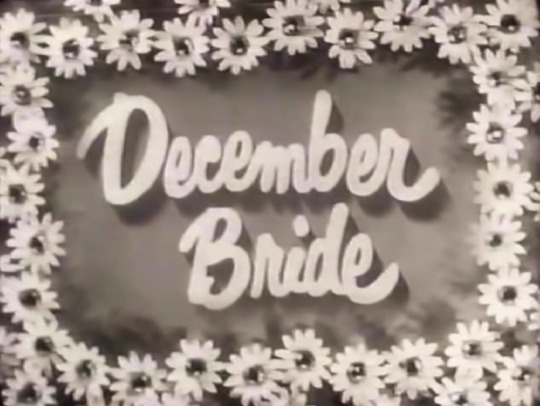
In 1956, he made an appearance on the Desilu sitcom “December Bride” starring Verna Felton.

In May 1959, he did an episode of Desilu’s “Whirlybirds” a series about helicopter pilots. He shared the screen with Herb Vigran, who Baer is sometimes mistaken for and who also did several Lucy-coms.

That same year, Baer did “The Hanging Judge” a non-Lucy-Desi episode of “The Westinghouse-Desilu Playhouse”. The show was hosted by Desi Arnaz.

From 1956 to 1960, Baer did three episodes of “The Danny Thomas Show” aka “Make Room for Daddy”, a show that moved to CBS in 1959 and did a crossover episode with “The Lucy-Desi Comedy Hour”. In one episode, Baer acted with Mary Wickes (Madame Lamond), and in another he appeared opposite Shirley Mitchell (Marion Strong). The series was not produced by Desilu, but it was shot at their studio.

In 1960, Baer did one episode of the short-lived Desilu series “Harrigan and Son” about a father / son law firm.

In April 1961, Baer did an episode of “Angel” shot on the Desilu lot. In his episode, he played the title character of “The Dentist” and acted opposite Doris Singleton (Carlolyn Appleby), a recurring character on the short-lived series.

Perhaps his most famous work on the Desilu backlot was as Mayberry Mayor Roy Stoner in seven episodes of “The Andy Griffith Show” from 1962 to 1963.

Back on the bench as a Judge on “My Living Doll” on the Desilu backlot for an episode aired in February 1965. The short-lived series was about a psychiatrist (Bob Cummings) entrusted with the care of a sexy robot (Julie Newmar).

In 1966 and 1967, Baer did two episodes of “Gomer Pyle U.S.M.C” on the Desilu backlot. In 1966, Gomer Pyle (Jim Nabors) turned up in a cameo on “The Lucy Show.” At the end of 1967, Lucille Ball sold Desilu to Paramount and Gulf + Western.
In 1946, Baer married Ernestine Clarke and they had two children. Baer died in November 2002 after a stroke.
 Angel, Bob Cummings, December Bride, Desi Arnaz, Gale Gordon, Gomer Pyle, Harrigan and Son, Herb Vigran, Here’s Lucy, I love lucy, Jim Nabors, Julie Newmar, Lucille Ball, Mary Jane Croft, My Living Doll, Our Miss Brooks, Parley Baer, Ted Cassidy, The Addams Family, The Andy Griffith Show, The Danny Thomas Show, The Lucy Show, tv, Verna Felton, Westinghouse Desilu Playhouse, Whirlybirds
 -
TV WEEK / TV GUIDE – GALE GORDON
August 4, 1962

On August 4, 1962, Gale Gordon appeared on the cover of TV Week, a supplement to the Sunday Chicago Tribune newspaper. At the time, most all newspapers provided some sort of pull-out, stand-alone TV and/or radio guide.
Although Lucille Ball was then filming episodes of her new series, “The Lucy Show” for CBS, her return to television after leaving Lucy Ricardo behind in April 1960, Gordon’s appearance here is not related to the famous redhead.
In March 1962, Gordon had finished up playing Uncle Paul in CBS’s “Pete and Gladys” (1960-62). The show aired its final episode in June 1962. In May he was introduced as John Wilson on “Dennis the Menace,” filling in after the illness and eventual death of Joseph Kearns, who played George Wilson. Kearns was seen on “I Love Lucy” as Dr. Tom Robinson and as the Theatre Manager of “The Most Happy Fella.” Although Lucille Ball was anxious to re-team with Gordon (her “My Favorite Husband” radio foil and first choice for the role of Fred Mertz) for her comeback in “The Lucy Show,” he had already signed on to play Mr. Wilson and was contractually obliged to stay with the show until it ended in spring 1963. It was then that Ball decided not to let him get away again and quickly dismissed the actor playing her banker (Charles Lane) and hired Gordon to play the new role of Theodore J. Mooney. This pairing lasted until the end of their lives, reprising their comic relationship in “Here’s Lucy” and “Life With Lucy.”

The Chicago Trib’s placement of Gordon on their cover was not accidental, it was timed to coincide with the cover of their main competitor, TV Guide, the national magazine and pre-eminent source of TV listings in the US. On the very same date, Gordon shared the cover with his co-star on “Dennis the Menace”, Jay North. Gordon’s first TV Guide cover was in 1955, sharing the cover with Eve Arden, his co-star on “Our Miss Brooks.”

A 1966 episode of “The Lucy Show” reunited North and Gordon, who played his rambunctious nephew, Wendell Mooney. His uncle calls him a “menace”!
INSIDE TV WEEK

“The Many-Voiced GALE GORDON Overcame a Speech Defect”
Born as Charles Aldrich in London, England, he had a cleft plate. He had two painful surgeries and then speech lessons to improve his speaking abilities. When he was 8 years old his mother (Gloria Gordon of “My Friend Irma”) moved them to New York City to pursue acting work, where she suggested her son changes his name to Gale Gordon. While working in a Canadian production of “The Dancers”, actor Richard Bennett noticed Gale’s slight speech impediment and encouraged him to develop his voice. He studied with such dedication that his voice became what John Barrymore said was one of the best voices on radio with perfect dictation. In 1926, Gale Gordon made his debut on the radio and by 1933 he was the highest paid radio actor in Hollywood earning $150 a week, including on a show starring Lucille Ball, “My Favorite Husband.”
“Audrey Meadows Rebels Against Kitchen Slave Roles”
Meadows is perhaps best remembered for her portrayal of Alice, the deadpan wife of Ralph Kramden (Jackie Gleason) on “The Honeymooners” (1955-56) as well as on episodes of “The Jackie Gleason Show” (1957).

During the summer of 1962, Meadows was seen on screens in That Touch of Mink, playing opposite Gig Young in the Cary Grant / Doris Day film.

In 1986, Meadows played Lucille Ball’s sister on “Life With Lucy”. Although critics admired the chemistry between Ball and Meadows, they hated the show, which was canceled after that episode aired.
TV WEEK LISTINGS

The listings for Monday, August 6, 1962 include a morning re-run of “I Love Lucy,” (no episode details, however) and an evening re-run of “Lucy Goes To Alaska” (LDCH S2;E3), first aired in February 1959. Monday evenings were typically Lucy nights on CBS, and the tradition continued after the cancellation of “The Lucy-Desi Comedy Hour” and before Ball returned to Monday’s with “The Lucy Show” in October 1962.

The evening also features a re-run of “Pete and Gladys” on CBS, although the episode is not one of the nine that featured Gale Gordon.

A cartoon depicts a husband on the roof adjusting a TV antenna while the wife shouts up about the picture. Before the advent of cable television, good reception relied upon a properly adjusted antenna!

Coincidentally, this was also the subject of a season one episode of “The Lucy Show” in November 1962.

Lucille Ball appeared on the cover of the Chicago Trib’s TV Week at least ten times, including in November 1956, October 1963, January 1965, March 1966, December 1967, May 1970, and June 1976.
It is also coincidental that Monday, August 6, 1962 was Lucille Ball’s 51st birthday.
-
MYRNA LOY
August 2, 1905

Myrna Loy was born Myrna Adele Williams in Radersburg (near Helena), Montana.
When she was thirteen, Myrna’s father died of influenza in the great flu pandemic of 1918, and the rest of the family moved to Los Angeles. She was educated in L.A. and the Westlake School for Girls where she caught the acting bug. She started at the age of 15 when she appeared in local stage productions in order to help support her family.
Her first film was a small part in the production of What Price Beauty? (1925). Later, she appeared in Pretty Ladies (1925) along with Joan Crawford. She was one of the few stars that would start in the silent movies and make a successful transition into the sound era.

Moving to MGM she got two meaty roles: One was in the The Prizefighter and the Lady (1933), and the other as Nora Charles in The Thin Man (1934) with William Powell. Myrna would appear in five more in the series.

In 1946, she was seen in The Best Years of Our Lives, which went on to win 7 competitive Oscars, including Best Picture. Loy won Best Actress at the Brussels World Film Festival. “I Love Lucy” favorite Tennessee Ernie Ford appears in an uncredited role. “Lucy” extras who appeared include Harry Cheshire, James Conaty, Lawrence Dobkin, Harold Miller, and Bert Stevens.
NAME GAMES!

When her father was travelling by train in early 1905, he went through a small station called ‘Myrna’ – he eventually named her after that station.
Changing last name from Williams to Loy was suggested by legendary pulp writer Paul Cain (aka Peter Ruric). Lucille Ball also flirted with a stage name, going by Diane Belmont for several years.
FATHER FIGURES!

Lucille Ball initially claimed to have been born in Montana, while Loy actually was! Both Loy and Ball’s fathers died of illness while they were young girls. Ball’s father succumbed to Typhoid in 1914, while Loy’s was a victim of the Flu pandemic of 1918. Like Lucy, once successful, Loy returned to her hometown, Radersburg, Montana (above), posing in front of her parents’ home.
LOY & LUCILLE!

The only time Loy and Ball appeared in the same film was in Broadway Bill (1934), a Frank Capra film for Columbia. Broadway Bill was filmed between June 18 and August 16, 1934 at Columbia Studios in Hollywood, and on location at Tanforan Race Track in San Bruno, California. Lucille Ball was 23 years old at the time and was a blonde!

Lucille Ball played a telephone operator, uncredited. Also in the film were future “I Love Lucy” cast members Charles Lane, Irving Bacon, and Bess Flowers.
GINGER SNAPS!

Lucy wasn’t the only star in Hollywood to be a redhead. Myrna Loy managed to show off her red tresses in the 1929 Warner Brothers musical, The Show of Shows, which contained Technicolor sequences, one of which still survives.
HOLLYWOOD ROYALTY!

Loy was a big box-office draw. In 1936, she was named Queen of the Movies and Clark Gable the king in a nationwide poll of movie goers. Her popularity was at its zenith. Lucille Ball, at the zenith of her television success, was dubbed the Queen of Comedy.
GIVING A DAMN!

Both Loy and Ball (among many others) were considered for the role of Scarlett O’Hara in Gone with the Wind (1939).
SMOKE SCREEN!

In 1938, Loy signed on to do print ads for Lucky Strike cigarettes. 15 years later, it was Lucy who was hawking tobacco, for Philip Morris, who also sponsored “I Love Lucy.” The competition for smokers loyalty was so fierce that the word “lucky” was banned from “I Love Lucy” scripts, causing the ‘Lucky Buck’ competition to be re-named the ‘Bonus Buck’ contest!
GOING WITH THE FLO!

Loy appeared in the film The Great Ziegfeld (1938), which won an Oscar, while Ball was featured in Ziegfeld Follies (1946). Loy, who received second billing for this film, does not actually appear on screen until 2 hours and 15 minutes into the movie.
Coincidentally, Loy’s Thin Man co-star William Powell plays Ziegfeld in both films! This was the fourth of 14 films pairing William Powell and Myrna Loy.
In real life, Lucille Ball was actually fired by Ziegfeld from his touring production of Rio Rita in the early 1930s.
ARE YOU NOW OR HAVE YOU EVER BEEN?

Myrna Loy, Fredric March and Lucille Ball took a stand against being accused of Communism
when two radio broadcasts called “Hollywood Fights Back” protested the HUAC hearings in October and November 1947.
LADY / WED!

The 1936 film Libeled Lady starring Myrna Loy and Spencer Tracey was remade ten years later as Easy To Wed (1946) starring Lucille Ball and Van Johnson. In the remake, Ball did not play the character originated by Loy, which was taken by Esther Williams. Lucy played the role originated by Jean Harlowe.
MGM MURMURS!

A New York Times item mentioned a collaboration between Lucille Ball, Myrna Loy and Clark Gable in 1944. The film never came to pass. Gable’s first film after his military service was MGM’s Adventure (1945) with Greer Garson and Joan Blondell. Ball did Without Love (1945), also for MGM.
ANGEL / FOREVER!

Forever Darling was originally entitled Guardian Angel and had been written as a vehicle for Myrna Loy and William Powell. The script had been languishing unfilmed at Metro-Goldwyn-Mayer for several years. It was finally picked up and polished for Lucy and Desi.
MOTHER(S) OF THE YEAR(S)!

Myrna Loy played the mother of 12 kids in Cheaper By The Dozen (1950). In 1968, Lucille Ball made a similar film titled Yours, Mine and Ours with Ball the mom of 18! The two films have many common scenes:
- The kids line up for their week’s ration of clean sheets and toothpaste;
- The older daughters have troubles with unbashful beaus;
- The youngsters get in pillow fights;
- There is a suspected case of the flu;
- Jealousies grow between the two sets of children;
- There are four small visitors (all under 5 years of age) who invite themselves to their parents’ wedding night and crawl under the covers.
BROADWAY AMBITION!

Loy had ambitions to act on Broadway, and finally made her one and only appearance in a 1973 production of The Women. Lucille Ball also had Broadway aspirations. She finally made her one and only appearance in late 1960 in Wildcat. Both women had done regional stage productions that for one reason or another failed to transfer to Broadway.
GREASE IS THE WORD!

In the opening shots of the 1978 film Grease, there’s a white statue of a girl outside Rydell High – filmed at Venice High School, California, where Myrna Loy was a student. She posed for it when she was 16! Lucie Arnaz was the studio’s original choice for promiscuous Betty Rizzo (a role that went to Stockard Channing), but Lucy refused to let her do a screen test! The film featured Ball’s friend and Desilu star Eve Arden (”Our Miss Brooks”) as the principal. The film takes place in 1959/1960, when “I Love Lucy” was wrapping up its history-making run on television.
BIOGRAPHY!

Loy wrote an autobiography, Myrna Loy: Being and Becoming, published in 1987. Lucille Ball’s autobiography Love, Lucille, was published posthumously in 1996.
HONORS!

Both Lucille Ball and Myrna Loy were honored at “The Kennedy Center Honors”; Lucy in 1986 and Loy in 1988.
LAST LOOKS!

In 1991, Loy was given an Honorary Oscar In recognition of her extraordinary qualities both on screen and off, with appreciation for a lifetime’s worth of indelible performances. Loy was not present at the awards ceremony. She gave her acceptance speech live via satellite from her Manhattan apartment. This was her last appearance on TV. Similarly, Lucille Ball’s appearance as a presenter at the March 29, 1989 Oscar telecast was her last appearance on TV before her death on April 26, 1989.
By the time Myrna Loy passed away, on December 14, 1993, at the age of 88, she had appeared in 129 motion pictures.

-
Subscribe
Subscribed
Already have a WordPress.com account? Log in now.
 Papermoon Loves Lucy