-
LIZ’S MOTHER HAS SECOND THOUGHTS
September 3, 1948

“Liz’s Mother Has Second Thoughts” (aka “Mother’s Surprise”) is episode #7 of the radio series MY FAVORITE HUSBAND broadcast on September 3, 1948.
Synopsis ~
Liz’s mother Adele Elliott is all set to marry Houston oil man Dan Carson, but suddenly gets cold feet.
This episode was written by the series’ original writers, before the characters changed their name from Cugat to Cooper. It was also before Jell-O came aboard to sponsor the show and before the regular cast featured Bea Benadaret and Gale Gordon as the Atterburys.

“My Favorite Husband” was based on the novels Mr. and Mrs. Cugat, the Record of a Happy Marriage (1940) and Outside Eden (1945) by Isabel Scott Rorick, which had previously been adapted into the film Are Husbands Necessary? (1942). “My Favorite Husband” was first broadcast as a one-time special on July 5, 1948. Lucille Ball and Lee Bowman played the characters of Liz and George Cugat, and a positive response to this broadcast convinced CBS to launch “My Favorite Husband” as a series. Bowman was not available Richard Denning was cast as George. On January 7, 1949, confusion with bandleader Xavier Cugat prompted a name change to Cooper. On this same episode Jell-O became its sponsor. A total of 124 episodes of the program aired from July 23, 1948 through March 31, 1951. After about ten episodes had been written, writers Fox and Davenport departed and three new writers took over – Bob Carroll, Jr., Madelyn Pugh, and head writer/producer Jess Oppenheimer. In March 1949 Gale Gordon took over the existing role of George’s boss, Rudolph Atterbury, and Bea Benaderet was added as his wife, Iris. CBS brought “My Favorite Husband” to television in 1953, starring Joan Caulfield and Barry Nelson as Liz and George Coope. The television version ran two-and-a-half seasons, from September 1953 through December 1955, running concurrently with “I Love Lucy.” It was produced live at CBS Television City for most of its run, until switching to film for a truncated third season filmed (ironically) at Desilu and recasting Liz Cooper with Vanessa Brown.
MAIN CAST
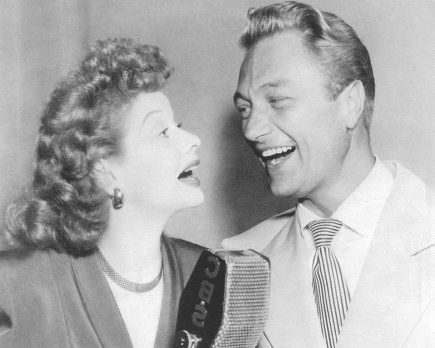
Lucille Ball (Liz Cugat) was born on August 6, 1911 in Jamestown, New York. She began her screen career in 1933 and was known in Hollywood as ‘Queen of the B’s’ due to her many appearances in ‘B’ movies. “My Favorite Husband” eventually led to the creation of “I Love Lucy,” a television situation comedy in which she co-starred with her real-life husband, Latin bandleader Desi Arnaz. The program was phenomenally successful, allowing the couple to purchase what was once RKO Studios, re-naming it Desilu. When the show ended in 1960 (in an hour-long format known as “The Lucy-Desi Comedy Hour”) so did Lucy and Desi’s marriage. In 1962, hoping to keep Desilu financially solvent, Lucy returned to the sitcom format with “The Lucy Show,” which lasted six seasons. She followed that with a similar sitcom “Here’s Lucy” co-starring with her real-life children, Lucie and Desi Jr., as well as Gale Gordon, who had joined the cast of “The Lucy Show” during season two. Before her death in 1989, Lucy made one more attempt at a sitcom with “Life With Lucy,” also with Gordon.
Richard Denning (George Cugat) was born Louis Albert Heindrich Denninger Jr., in Poughkeepsie, New York. When he was 18 months old, his family moved to Los Angeles. Plans called for him to take over his father’s garment manufacturing business, but he developed an interest in acting. Denning enlisted in the US Navy during World War II. He is best known for his roles in various science fiction and horror films of the 1950s. Although he teamed with Lucille Ball on radio in “My Favorite Husband,” the two never acted together on screen. While “I Love Lucy” was on the air, he was seen on another CBS TV series, “Mr. & Mrs. North.” From 1968 to 1980 he played the Governor on “Hawaii 5-0″, his final role. He died in 1998 at age 84.
Bob LeMond (Announcer) also served as the announcer for the pilot episode of “I Love Lucy”. When the long-lost pilot was finally discovered in 1990, a few moments of the opening narration were damaged and lost, so LeMond – fifty years later – recreated the narration for the CBS special and subsequent DVD release.
GUEST CAST

John Hiestand also played the role of Cory Cartwright on the series. He served as the announcer for the radio show “Let George Do It” from 1946 to 1950. In 1955 he did an episode of “Our Miss Brooks” opposite Gale Gordon.

William Johnstone is best known for his voice work as the title character on “The Shadow” from 1938 to 1943, replacing Lucille Ball’s friend Orson Welles. He played John Jacob Astor in the 1953 film Titanic.

Sarah Selby (Louise Elliott, Liz’s Mother) started as a radio actress and made her screen debut voicing Prissy the Elephant in Walt Disney’s Dumbo (1941). When “My Favorite Husband” transferred to television (without Ball, who was then two years into “I Love Lucy”), Selby appeared in an episode as a maid (above right). She also appeared on “I Love Lucy” as Dorothy Cook in “The Matchmaker” (ILL S4;E4) – the trapped ‘fly’ to Sam Carter’s ‘spider’. She is perhaps best known for her recurring role as a storekeeper on TV’s “Gunsmoke” from 1961 to 1972.
In other episodes of the series, Mrs. Elliott’s first name is Adele.
THE EPISODE
ANNOUNCER: “This is the story of Mr. and Mrs. Cugat – the record of a happy marriage. Two people who live together – and like it!”
As the episode opens, Liz and George are packing their suitcases to visit her mother in the country for the weekend. George cannot drive with Liz because he has a board meeting but will join her later. They wonder what announcement Mother has to make and remember her last big announcement – sponsoring a wrestler named the Hawk. George promises to forcibly remove any new wrestlers! Liz laughs at the idea.
GEORGE: “Obviously you’ve never heard of Gorgeous George.”
LIZ: (romantically) “You ARE gorgeous, George.”
George is referring to George Raymond Wagner (1915–63), known as Gorgeous George because of his blonde hair. He was mentioned on “I Love Lucy” in “Pioneer Women” (ILL S1;E25) and “Ricky’s Movie Offer” (ILL S4;E6).
Looking to pack her swimsuit, George chides Liz for it being too much too skimpy.
LIZ: “You’re too prudish.”
GEORGE: “You’re too nudish.”
On “I Love Lucy” Ricky also was unhappy about the size of Lucy’s swimsuit. In “Off To Florida” (ILL S6;E6) Ricky at first thinks Lucy’s new swimsuit is for Little Ricky! Lucy also buys a swimsuit that Ricky feels is too revealing when shopping for their California trip in “Getting Ready”(ILL S4;E11). The subject will be broached again on “My Favorite Husband” in “Liz Learns To Swim” in June 1950.
Greeting her mother Liz quickly tries to guess her big news.
LIZ: “Chickasaw Indian tap dancing?”
MOTHER: “Chickasaw Indian tap dancing? Hmmm… I wonder whether they teach that at Arthur Murray?”
LIZ: “We’re not talking about Arthur Murray.”Although Liz is being facetious about the tap dancing, there really is a Chickasaw tribe of indigenous Americans. The are mainly found in the Southwestern United States.

LUCY: “Arthur Morton is no Arthur Murray.”
Arthur Murray is also quite real. He taught dance and franchised his dancing schools starting in 1925. He was mentioned on “I Love Lucy” in “The Young Fans” (ILL S1;E20. above). The song “Cuban Pete,” which Ricky sang in “The Diet” (ILL S1;E4) , includes the line “And Cuban Pete don’t teach you in a hurry, like Arthur Murray.” Murray will be mentioned again on “My Favorite Husband” in “Dancing Lessons” (June 1950).
Mother finally breaks the news: she is getting married. Liz’s knees buckle! His name is Daniel Carson from Houston, Texas, an oil tycoon.
Although it is not stated whether Liz’s father is dead or just divorced from Louise, absent fathers will be a continuing theme in Lucille Ball’s career, just as it was in her real life due to her father’s sudden death when she was just four. Like Liz, Lucy Ricardo will have an independent (and somewhat quirky) mother, but no father. Lucys Carmichael, Carter, and Barker all have children, but deceased husbands and fathers.

Asking more about her mother’s intended, Mother compares him (loosely) to a movie star.
MOTHER: “He’s just like Gary Cooper. Well… they’re both men.”
Gary Cooper (1901-61) was mentioned three times on “I Love Lucy”. Lucy Ricardo disguised herself as the monosyllabic actor for the benefit of Carolyn Appleby in “Lucy and Harpo Marx” (ILL S4;E28).

Mother met Carson when they both were buying tickets to a Randolph Scott picture.
Since then, they’ve corresponded.
“My Dear Louise. Howdy. Love Dan. PS: Will you marry me?”
Although no specific film title is mentioned, Mother and Mr. Carson were probably attending Albuquerque, which opened in February 1948, around when Liz says her mother traveled there. The film starred future “I Love Lucy” player Irving Bacon (Ethel’s father Will Potter). Coincidentally, Lucille Ball did two films with Randolph Scott: Follow the Fleet (1936) and Roberta (1935).
George arrives at Mother’s. Liz refuses to tell him Mother’s secret, so George gets even by saying that he has a secret, too. He teases her that it has something to do with Myra Ponsenby and a hayride.

Myra Ponsenby is George’s old flame. The character originated in the original George and Liz Cugat stories by Isabel Scott Rorick. Myra was played by Patricia Morrison (above right) in the 1942 film Are Husbands Necessary? and the character is mentioned and featured on several radio episodes before the name change to Cooper.
Dan arrives for dinner. Mother introduces Liz and George. Dan admires George’s strong handshake. After dinner (or “grub” or “chuck” as he refers to meals), Dan reveals that he bought his oil-filled property for $650,000 from the local Indians and reveals that he has an 18 year-old horse named Shotgun.
LIZ: “Do you feed him or load him?”
The doorbell rings and Dan’s friend Slim enters. Slim is going to be the best man at the wedding. Slim gives Mother a gift – he is going to provide all the music for the wedding. He introduces the ‘Sons of the Singing Sagebrush’ who sing “You Are My Sunshine” and “I’m a-Headin’ for the Last Round-Up”. They finish up with a western version of “Oh, Promise Me.”

DAN: “Lu is loco for the Sons, ain’t ya, Lu?”
”You Are My Sunshine“ was popularized by Jimmie Davis and Charles Mitchell in 1939. Davis was a country music singer and Louisiana governor from 1944–1948 and 1960–1964. “Oh, Promise Me” is an 1887 art song by Reginald de Koven and Clement Scott. Viv Bagley (Vivian Vance) sang it when Lucy Carmichael’s sister got married in “Lucy’s Sister Pays a Visit” (TLS S1;E15) and it was also sung in a 1972 episode of “Here’s Lucy.”
Liz’s mother decides that she needs to get out of the wedding just when Carson gets a telegram that his horse Shotgun is ill. Dan leaves Mother a box of dirt and departs.
LIZ: “It’ll make a nice Christmas present for people who don’t have dirt.”
Before George can break the news to Mother that Dan has gone, Liz reveals that it was her who sent the telegram!
In a bedtime coda, the Cugats declare their love for one another. Liz ends her protestations of love with “Would you get up and get me a glass of water?” He does.

In real-life however, the story was quite different. Desi Arnaz told columnist Earl Carroll that on their wedding night in 1940, Desi asked Lucy to get out of bed and get him a glass of water, which she did without a word. Next morning, however, Lucy spoke up: “Listen, you – the next time you want a glass of water you get it yourself!’”
LIZ: “Goodnight, Cuddle Puddle.”
GEORGE: “Goodnight, Little Drip.”TRIVIA

Two days after this episode was broadcast (September 5, 1948) The Amarillo News reported:
Lucille Ball, who once worked! as a chorus girl at Columbia for $50 a week, goes back to the studio at a six-figure salary for Miss Grant Took Richmond. Just before Columbia fired her, she was the foil for the Three Stooges. Lucille says today: "Columbia fired me because there wasn’t anything left for the Three Stooges to hit me with.”
Her new airshow, “My Favorite Husband,” based on the Mr. and Mrs. George Cugat characters, is one of Hollywood’s best fall prospects. Richard Denning plays the husband. When someone asked Lucille’s husband, Desi Arnaz why he wasn’t doing the show with her, he cracked: “I guess I’m not the type.”
Not only does this item promote Lucille Ball’s upcoming film (filming began in March 1949), but it hints that Lucy and Desi were not happy about CBS not allowing Desi to play her husband on radio. After the original George Cugat, Lee Bowman, was unavailable, Lucy pitched Desi for the role, but CBS insisted on the more ‘believable’ Richard Denning.
-
HUSBANDS ARE SLOPPY DRESSERS
September 2, 1950

“Husbands Are Sloppy Dressers” (aka “Best Dressed Men in Town” aka “Selling Old Clothes to the Junkman”) is episode #95 of the radio series MY FAVORITE HUSBAND broadcast on September 2, 1950.
This was the first episode of the third season of MY FAVORITE HUSBAND. There were 31 new episodes, with the season ending on March 31, 1951.
Synopsis ~ Liz and Iris are embarrassed by the sloppy clothes that George and Rudolph wear at home, so they sell the boys’ old clothes to the junkman. They attempt to reform their husbands’ dress habits.

It served as the basis for “Changing The Boys’ Wardrobe” (ILL S3;E10) of “I Love Lucy” filmed on November 5, 1953 and first aired on December 7, 1953 on CBS TV.
The radio show is included on the “I Love Lucy” DVD for comparison.
Since radio listeners had to use their imaginations about the boys’ wardrobes, the plot was much more plausible than on television, where Ricky and Fred’s sudden slovenliness is a departure from their usually impeccable appearance.

“My Favorite Husband” was based on the novels Mr. and Mrs. Cugat, the Record of a Happy Marriage (1940) and Outside Eden (1945) by Isabel Scott Rorick, which had previously been adapted into the film Are Husbands Necessary? (1942). “My Favorite Husband” was first broadcast as a one-time special on July 5, 1948. Lucille Ball and Lee Bowman played the characters of Liz and George Cugat, and a positive response to this broadcast convinced CBS to launch “My Favorite Husband” as a series. Bowman was not available Richard Denning was cast as George. On January 7, 1949, confusion with bandleader Xavier Cugat prompted a name change to Cooper. On this same episode Jell-O became its sponsor. A total of 124 episodes of the program aired from July 23, 1948 through March 31, 1951. After about ten episodes had been written, writers Fox and Davenport departed and three new writers took over – Bob Carroll, Jr., Madelyn Pugh, and head writer/producer Jess Oppenheimer. In March 1949 Gale Gordon took over the existing role of George’s boss, Rudolph Atterbury, and Bea Benaderet was added as his wife, Iris. CBS brought “My Favorite Husband” to television in 1953, starring Joan Caulfield and Barry Nelson as Liz and George Coope. The television version ran two-and-a-half seasons, from September 1953 through December 1955, running concurrently with “I Love Lucy.” It was produced live at CBS Television City for most of its run, until switching to film for a truncated third season filmed (ironically) at Desilu and recasting Liz Cooper with Vanessa Brown.
MAIN CAST

Lucille Ball (Liz Cooper) was born on August 6, 1911 in Jamestown, New York. She began her screen career in 1933 and was known in Hollywood as ‘Queen of the B’s’ due to her many appearances in ‘B’ movies. With Richard Denning, she starred in a radio program titled “My Favorite Husband” which eventually led to the creation of “I Love Lucy,” a television situation comedy in which she co-starred with her real-life husband, Latin bandleader Desi Arnaz. The program was phenomenally successful, allowing the couple to purchase what was once RKO Studios, re-naming it Desilu. When the show ended in 1960 (in an hour-long format known as “The Lucy-Desi Comedy Hour”) so did Lucy and Desi’s marriage. In 1962, hoping to keep Desilu financially solvent, Lucy returned to the sitcom format with “The Lucy Show,” which lasted six seasons. She followed that with a similar sitcom “Here’s Lucy” co-starring with her real-life children, Lucie and Desi Jr., as well as Gale Gordon, who had joined the cast of “The Lucy Show” during season two. Before her death in 1989, Lucy made one more attempt at a sitcom with “Life With Lucy,” also with Gordon.
Richard Denning (George Cooper) was born Louis Albert Heindrich Denninger Jr., in Poughkeepsie, New York. When he was 18 months old, his family moved to Los Angeles. Plans called for him to take over his father’s garment manufacturing business, but he developed an interest in acting. Denning enlisted in the US Navy during World War II. He is best known for his roles in various science fiction and horror films of the 1950s. Although he teamed with Lucille Ball on radio in “My Favorite Husband,” the two never acted together on screen. While “I Love Lucy” was on the air, he was seen on another CBS TV series, “Mr. & Mrs. North.” From 1968 to 1980 he played the Governor on “Hawaii 5-0″, his final role. He died in 1998 at age 84.
Bea Benadaret (Iris Atterbury) was considered the front-runner to be cast as Ethel Mertz but when “I Love Lucy” was ready to start production she was already playing a similar role on TV’s “The George Burns and Gracie Allen Show” so Vivian Vance was cast instead. On “I Love Lucy” she was cast as Lucy Ricarodo’s spinster neighbor, Miss Lewis, in “Lucy Plays Cupid” (ILL S1;E15) in early 1952. Later, she was a success in her own show, “Petticoat Junction” as Shady Rest Hotel proprietress Kate Bradley. She starred in the series until her death in 1968.
Gale Gordon (Rudy Atterbury) had worked with Lucille Ball on “The Wonder Show” on radio in 1938. One of the front-runners to play Fred Mertz on “I Love Lucy,” he eventually played Alvin Littlefield, owner of the Tropicana, during two episodes in 1952. After playing a Judge in an episode of “The Lucy-Desi Comedy Hour” in 1958, he would re-team with Lucy for all of her subsequent series’: as Theodore J. Mooney in ”The Lucy Show”; as Harrison Otis Carter in “Here’s Lucy”; and as Curtis McGibbon on "Life with Lucy.” Gordon died in 1995 at the age of 89.
Ruth Perrott (Katie, the Maid) was also later seen on “I Love Lucy.” She first played Mrs. Pomerantz, a member of the surprise investigating committee for the Society Matrons League in “Pioneer Women” (ILL S1;E25), as one of the member of the Wednesday Afternoon Fine Arts League in “Lucy and Ethel Buy the Same Dress” (ILL S3;E3), and also played a nurse when “Lucy Goes to the Hospital” (ILL S2;E16). She died in 1996 at the age of 96.
Bob LeMond (Announcer) also served as the announcer for the pilot episode of “I Love Lucy”. When the long-lost pilot was finally discovered in 1990, a few moments of the opening narration were damaged and lost, so LeMond – fifty years later – recreated the narration for the CBS special and subsequent DVD release.
GUEST CAST

Hans Conried (Mr. Adams / Newspaper Photographer) first co-starred with Lucille Ball in The Big Street (1942). He then appeared on “I Love Lucy” as used furniture man Dan Jenkins in “Redecorating” (ILL S2;E8) and later that same season as Percy Livermore in “Lucy Hires an English Tutor” (ILL S2;E13) – both in 1952. The following year he began an association with Disney by voicing Captain Hook in Peter Pan. On “The Lucy Show” he played Professor Gitterman in “Lucy’s Barbershop Quartet” (TLS S1;E19) and in “Lucy Plays Cleopatra” (TLS S2;E1). He was probably best known as Uncle Tonoose on “Make Room for Daddy” starring Danny Thomas, which was filmed on the Desilu lot. He joined Thomas on a season 6 episode of “Here’s Lucy” in 1973. He died in 1982 at age 64.
THE EPISODE
ANNOUNCER: “As we look in on the Coopers tonight…”
The episode opens on a quiet evening at home with Liz and George, who is smoking his pipe. The Atterbury’s drop by to see if the Coopers want to go to the movies.
RUDOLPH: “’The Men’ is down at the corner.”
GEORGE: “They is?”Rudolph explains that he means the film The Men starring Marlon Brando, making his screen debut.

The United Artists film had opened wide on August 25, 1950, just a week before this broadcast. The Stanley Kramer drama concerns a paralyzed war (Brando) vet coming to terms with life without the use of his limbs.

Marlon Brando was first mentioned on “I Love Lucy” (by first name anyway) at the start of “Lucy Visits Grauman’s” (ILL S5;E1) in 1955. The film’s female star, Teresa Wright, was in the studio audience for the filming of “Be A Pal” (ILL S1;E2) just a year later.

When this script was adapted for television in 1953, the Ricardos and Mertzes are heading to the movies to see “That picture we’ve been trying to get to for weeks with Marilyn Monroe.” The movie is likely Gentlemen Prefer Blondes, which premiered in New York City in July 1953 or How To Marry A Millionaire, which was also in release at the time.

To convince George to go, Rudy adds that “it’s a double feature with Jane Russell.” Coincidentally, Jane Russell was also in Gentlemen Prefers Blondes with Marilyn Monroe. In this case, however, Russell had no new film in release in 1950, so the buxom actress’s name was being used due to her popularity with male audiences. If a Jane Russell picture had been on a double feature with The Men, it would likely have been The Paleface, a 1948 film she did with Lucy’s pal Bob Hope.

Liz objects to George not wearing a jacket and tie to the movies. Iris adds that she had the same argument with Rudolph before leaving home. George reasons that in a dark movie theatre no one will see him wearing a tee shirt and green slacks. George and Rudolph go to the bedroom for George to dress but get an idea to teach the girls a lesson by ‘over-dressing’ in elaborate costumes made-up of odds and ends from the closet. Through carefully crafted dialogue, the radio listeners get a vivid picture of how exotic George and Rudy must look:
- A tail coat and striped trousers George wore to a wedding six years ago
- Golf socks with the trousers tucked inside to look like knee britches
- A lace doily pinned at the throat
- A silk handkerchief tucked into a sleeve
- Liz’s blue lace bed jacket
Rudolph dubs them ‘Beau Brummell’ and ‘Lord Chesterfield’.

Beau Brummell (1778-1840) was an iconic figure in Regency England, the arbiter of men’s fashion and friend of King George IV. He is credited with introducing the modern men’s suit worn with a necktie. Lord Chesterfield aka Philip Dormer Stanhope, 4th Earl of Chesterfield (1694-1773) was a British statesman, diplomat, man of letters, and an acclaimed wit of his time, often dispensing advice on fashion and grooming. The Chesterfield coat (with a velvet color) and Chesterfield sofa (tufted) were named after him. Lucille Ball’s favorite brand of cigarettes, Chesterfields, was named after Chesterfield County, Virginia, which, in turn, was named for Lord Chesterfield and his ancestors.

The television version omits the references to Brummell and Chesterfield, but does mention Little Lord Fauntleroy and Raggedy Andy! However, in “Fan Magazine Interview” (ILL S3;E20), Lucy refers to an overdressed Fred the “Beau Brummell of plumbers” when he wears a derby and bow tie to fix the sink while a reporter is interviewing Lucy.

Although this scene is not included in the television script, a version of it is found in “The Charm School” (ILL S3;E15) where Ricky and Fred don elaborate finery from a bygone era to teach the girls a lesson about being themselves.
Meanwhile, back in the Cooper’s living room, Liz and Iris complain about their husbands’ shabby wardrobe.
IRIS (about George’s worn trousers): “He’s really attached to those pants, isn’t he?”
LIZ: “Sometimes I think it’s vice-versa. He doesn’t just hang them in the closet, he stands them up in the corner. And when he gets a hole in them, I don’t mend it, I solder it.”Acting posh, the boys parade their finery in front of the horrified girls. They all agree to revert to their worn duds in order to see the movies and the first act fades out.
The next morning, Liz is griping to Katie the Maid about marriage. An idea hits her and she recruits Katie to help: she is going to round up all George’s old clothes and give them away, forcing him to start anew. One item stops Katie in her tracks:
KATIE: “Not his rain hat! That’s sacred!”
LIZ: “It’s also holey.”At the office, George gets a call from a Mr. Adams (Hans Conried), the local used clothing dealer, who has just gotten a ‘hot shipment’ of old clothes acquired from Liz and Iris. On television, the character is named Zeb Allen (Oliver Blake), but he sums up his business strategy exactly the same:
MR. ADAMS / ZEB ALLEN: “Buying men’s old clothes from their wives is a tidy little business, but I make my real money selling them back to the husbands.”

Although Hans Conried was not cast as Zeb Allen, he did play another shady businessman with a similar scheme. In “Redecorating” (S2;E8), second-hand furniture dealer Dan Jenkins (Hans Conried) buys the Ricardo’s old furniture for $75, but when Rick wants to buy it back he charges $500!

MR. JENKINS: “I’m a lousy businessman, but I like the way you sing ‘Babalu’ so I’ll take it.”

Rudolph comes up with a way to get even with the girls. He tells George to go to Miller’s Department Store and ask for new clothing boxes. After buying back the clothes from Mr. Allen, they will put them in the boxes and tell the girls they ‘bought’ some clothes. Liz lies and tells George that the cleaning fluid she was using to wash his old clothing caught fire and burned them up! George reveals the content of the boxes. The scenario is identical on “I Love Lucy,” down to the dialogue, except that Miller’s Department Store was replaced by Brooks Brothers, an upscale New York City men’s clothiers.
LIZ / LUCY: “Ewww. They sure did a good job of sewing those ashes back together.”
George spanks Liz as punishment. This demeaning of a spouse unfortunately continued on “I Love Lucy,” where the abusive behavior now seems in particularly bad taste.
Next day, Rudolph tells George that the Retail Merchants Association has voted them Best Dressed. (Rudolph is Chairman of the Selection Committee.) Photos are to be taken on the steps of City Hall with their wives. Katie gives Liz and Iris the message that the boys want them to dress up and “look their best” for dinner. Liz decides to get even by wearing George’s old clothes instead. She even loans Iris some of George’s tatters. One of the monstrosities Liz describes is a necktie that Iris admits they gave George for Christmas!

Just as in “I Love Lucy” the girls show up in the boys’ threadbare duds (to the Tropicana on TV, not City Hall). The photographer (also played by Hans Conried) takes their picture and informs the girls that not only will they be in the newspaper, but they’ve also been on television since their arrival! On “I Love Lucy” the photographer was played by Lee Millar. It is ironic that a radio show ends with a reference to television, the very medium that Lucille Ball would redefine for the remainder of her career. At this point, Ball was in negotiations to move the show to television, but under her own terms – with her husband Desi.
“YOO HOO! BOB LEMOND!”

As usual, just before the show ends, Lucille Ball and Announcer Bob LeMond do a scripted Jello commercial. To start the new season, Lucy plays a shy young country girl visiting the city for the first time and LeMond is the city slicker. Lucy uses the same husky, raspy voice she created for the cello-playing Professor (”Have you seen a feller called Ricky Riskerdo?”) in both the unaired pilot and “The Audition” (ILL S1;E6). The voice was familiar to Lucille as she had used it all summer while touring with Desi during her summer hiatus.

While LeMond tries to describe Jell-O’s flavors (”sweet talk”), Lucy would rather neck (”Kiss me!”).

LeMond ends the broadcast with a plug for Lucille Ball’s current film, Fancy Pants, starring Bob Hope.
-
TV SHOW: LUCY & DESI
September 1952

The September 1952 edition of TV Show Magazine featured Lucille Ball and Desi Arnaz on the cover in a romantic pose. The magazine was a publication of ANC (American News Company). ANC was founded in 1867. The company’s abrupt 1957 demise caused a huge shakeup in the publishing industry, forcing many magazine, comic book, and paperback publishers out of business.

During September 1952, “I Love Lucy” premiered their second season, kicking off with “Job Switching” (ILL S2;E1) on September 15, followed by “The Saxophone” (ILL S2;E2) on September 22, and “The Anniversary Present” (ILL S2;E3) on September 29.
WHY YOU DON’T SEE GOOD MOVIES ON TV
An inside article promoted above the masthead asked why television was not showing ‘good’ movies. The common thought was that television was usurping cinema attendance and that showing recent films would cut into the business of second run theatres. In the early 1950s there was great rivalry between television and cinema. This topic was addressed on “I Love Lucy”. In “Lucy Gets Ricky on the Radio” (ILL S1;E32) in May 1952, the foursome watch a movie on TV.

LUCY: “That little girl is Margaret O’Brien, isn’t it?”
RICKY: “Look again – it’s Shirley Temple.”
FRED: “Look again – it’s Mary Pickford!”Not only does this comment on the sorry state of TV reception, it also demonstrates that the film they are watching is much older than they expected! Mary Pickford was born in 1892, while Margaret O’Brien was just 15 years old in 1952.

In “Baby Pictures” (ILL S3;E5) in November 1953, station manager Charlie Appleby is trying to impress the Ricardos about his TV station’s offering of motion pictures:
CHARLIE: “We’ve got the newest moving pictures in town. I bought a block of films yesterday, and I want to tell you that they’re going to make television stars out of some of the actors. Now, just remember their names: Conway Tearle and Mabel Normand.”
Both were silent film stars and died in the 1930s!

In “Don Juan is Shelved” (ILL S4;E22) in March 1955, real-life MGM studio executive Dore Schary was supposed to play himself, but he backed out claiming an acute kidney infection. Some sources say he may have had second thoughts about appearing on television, a rival medium. After all, film-making, not television, paid Schary’s salary. At the last minute, Vivian Vance’s husband Phil Ober played the role instead.
ALL ABOUT TALLULAH
Another inside article is about stage and screen star Tallulah Bankhead.
Bankhead wrote a bestselling autobiography Tallulah: My Autobiography (Harper & Bros.) that was published in 1952.

Tallulah Bankhead was born in 1903 in Huntsville, Alabama, and left home at the age of 15 to appear on the New York stage. Like Lucille Ball, she was considered for the role of Scarlett O’Hara in Gone With the Wind (1939). She was briefly married to John Emery who had appeared on “I Love Lucy” as Harold the Tramp in “The Quiz Show” (ILL S1;E5) and as angry neighbor Mr. Stewart in “Little Ricky Gets a Dog” (ILL S6;E14). Bankhead died in 1968.

Lucille Ball does her ‘darling’ Tallulah Bankhead imitation in “Ricky Asks for a Raise” (ILL S1;E35). She first did it (with costumes) in “Lucy Fakes Illness” (ILL S1;E16). The real Tallulah Bankhead would guest star on “The Celebrity Next Door,” the second episode of “The Lucy–Desi Comedy Hour” in 1957 and would prove to be one of Lucy’s most difficult co-stars.
JIMMY DURANTE HAS WHAT IT TAKES
Another inside article talks about Jimmy Durante, who at the time was one of several rotating hosts of “All Star Revue” (aka “Four Star Revue”) on NBC, then entering its third season.

Jimmy Durante (1893-1980) was a multi-talented performer who was distinguished by his bulbous nose. In “Lucy Meets Harpo Marx” (ILL S4;E28) Lucy Ricardo dons a novelty store mask and trench coat to impersonate Durante for a nearsighted Carolyn Appleby. He made a cameo appearance on “The Lucy Show” in February 1966. Lucille Ball had an uncredited role in his 1935 film Carnival.

In December 1965, Lucille Ball appeared with Durante (as well as Jerry Lewis and Danny Thomas) on “The Wonderful World of Burlesque”.

In May 1969, Desi Arnaz sang a duet with Durante on “The Lennon Sisters Hour”. Durante calls Desi’s conga drum a “Cuban waste basket”! In “Hollywood at Last!” (ILL S4;E16), Durante’s caricature on the wall at the Brown Derby restaurant takes up two frames – one for his nose.
MORE LUCY & DESI IN ‘TV SHOW’

Lucy and Desi were back on the cover of TV Show just seven months later, in March 1953.

Vivian Vance contributed to the June 1953 issue with an article titled “Lucy’s Baby” credited to ‘Ethel Mertz’.

Desi contributed at story to the April 1954 issue about the television revolution.
-
LUCY DAY at the WORLD’S FAIR!
August 31, 1964

Monday, August 31, 1964, was declared Lucille Ball Day at the 1964 World’s Fair in Queens, New York. The event featured a live appearance by Ball, who spent from 10am to 6pm visiting various pavilions at the fair.

At the time, Ball was about to premiere the third season of “The Lucy Show” on CBS. Coincidentally, the show also aired on Mondays and took place in New York State. Although the new season had not yet premiered, CBS New York City re-ran “I Love Lucy” at 10:30am – the very same time Lucy Day kicked off at the Hollywood USA Pavilion. Air transportation for Lucille Ball, Gary Morton, and Lucille’s mother Dede was provided by American Airlines by support from General Foods, sponsor of “The Lucy Show.”
ABOUT THE FAIR

The 1964 / 1965 New York World’s Fair featured over 140 pavilions, 110 restaurants, represented 80 nations, 24 US states, and over 45 corporations sponsoring exhibits or attractions, all at Flushing Meadows–Corona Park in Queens, New York City. The immense fair covered 646 acres on half the park, with numerous pools or fountains, and an amusement park with rides near the lake. Hailing itself as a “universal and international” exposition, the fair’s theme was “Peace Through Understanding”. The theme was symbolized by a 12-story-high stainless-steel model of the earth called the Unisphere, built on the foundation of the Perisphere from the 1939 World’s Fair. The fair ran for two six-month seasons: April 22 to October 18, 1964, and April 21 to October 17, 1965.

Macy’s and CBS were involved and about 100 press from all over the country were flown in for the day-long event.

A press photo from Lucy Day at the World’s Fair.

Lucille Ball rode in the Fair’s official white Cadillac convertible visiting pre-arranged destinations throughout the grounds. She was accompanied by her mother Dede (above, lower right) and (at times) her husband, Gary Morton.

The parade included the St. Lucy Band from St. Lucy High School in Newark, New Jersey. Every band member wore a red wig! Lucille repeatedly commented that her hair didn’t really look like that!

At some point Lucille was accompanied in the car by her former co-star, gossip columnist Hedda Hopper.

According to Albert Fisher, Director of Television for the New York World’s Fair Corporation:
“Somehow, the notorious newspaper columnist Hedda Hopper, who was at one time one of the most powerful columnists in the world, managed to get into the convertible with Lucy. Hopper was known for wearing large outlandish wide-brimmed hats. Her hat not only kept poking Lucy in the eye, more important, Hedda Hopper was upstaging the star attraction. Lucy became angrier by the minute at Hopper’s antics. After about a half-hour of this, the beloved TV star turned to me and startled me with a string of four-letter words that would truly make a sailor blush. She made it clear to me that if Hedda Hopper were not out of the car at the next stop, Lucy was prepared to call it quits and leave the Fair!”

Fisher diplomatically solved the problem by offering Hopper a special (but separate) VIP tour while Lucy made her appearances. Hopper’s vanity was suitably appeased and Ball continued her parade stops with Hopper occasionally joining her at specific press locations.

Fittingly, Lucille’s first stop is the Hollywood USA Pavilion.

The Pavilion’s front was a replica of Grauman’s Chinese Theatre, where Lucy and Hopper put their hand prints in wet cement. Ironically, Lucille Ball is one of the few stars who has never had an actual slab at the real Grauman’s in Hollywood. In 1956, “I Love Lucy” did an entire episode centered around the Chinese Theatre and its historic forecourt.

In the International area, the People’s Republic of China rolled out the red carpet for Lucy (literally) and she was adorned with a traditional pearl headdress.

In Africa she posed with a tribal doll and an African drummer. In Morocco Lucy, Dede and Hedda ate traditional dates and drank tea.

In Indonesia, Lucy was showered with chrysanthemum petals. It was here that she was feted with an honorary luncheon. It was attended by James Aubrey, head of CBS and former New York Governor Charles Poletti (seated above). After lunch, Lucy had time to rest and do a complete wardrobe change in the VIP suite before her tour continued. She claimed the new clothes were due to being caught in the rain.

At one point, Lucy stopped to conduct the fair’s City Service Band as they played “Hey Look Me Over” from her 1960 Broadway show, Wildcat.

The parade continued past the SC Johnson’s Wax Pavilion, one of the most iconic structures at the fair.

It housed the Golden Rondelle Theatre, where the immensely popular film To Be Alive was shown. The golden orb, minus the arches, was later moved to the company’s headquarters in Racine, Wisconsin, where the short film is still shown today.

At the New York State Pavilion, Lucy pauses to be interviewed by CBS local news reporter Jim Jensen. She talks about the hot and rainy weather while supporting herself leaning on Gary’s back. They joke about Lucy’s hair color, compared to that of the band’s inexpensive and garish red wigs. Gary takes it in stride.

At the New York State Pavilion, Lucy is presented with an award and entertains the crowd by dancing The Twist, something she also did on “The Lucy Show.”

Newsreel cameras capture a rare candid moment in her jam-packed day, as she travels in a crowded elevator to see the view from the towers of the New York State Pavilion. The poster for Lucy Day is just behind her.

At the Hawaiian Pavilion, another hat for Lucy!

The busy day concludes at the Spanish Pavilion, where Lucy is entertained by Flamenco dancers before being called onstage for a special presentation.
TRIVIA

At some point during her special day at the Fair, Lucy was reunited with Johnny Roventini, the living mascot of “I Love Lucy’s” first sponsor, Philip Morris cigarettes.

Five days after Lucy Day, Lucille Ball was back on the cover of TV Guide. The cover illustration was by Al Parker and the article by Richard Gehman.

Lucille Ball attended the New York World’s Fair in 1939 as well, although as a young film star, she could never have dreamed that 25 years later she would be celebrated with a special day on the very same location.

Six years earlier, in 1933, Lucille Ball (then Diane Belmont from Butte, Montana) stopped at the Chicago World’s Fair (aka The Century of Progress Exposition) with the Goldwyn Girls headed west on to make the film Roman Scandals. They performed on bandleader Ben Bernie’s popular radio show from the Pabst Blue Ribbon Casino.

In “Lucy and the Scout Trip” (first aired March 30, 1964) Lucy and Viv’s cub scout troop is trying to win tickets to the World’s Fair, which opened three weeks after the episode aired. The Boy Scouts of America presented “The Wonderful World of Scouting” at the Fair.

In “Lucy and the Great Bank Robbery” (TLS S3;E5) two distinguished gentlemen (John Williams and Lloyd Corrigan) claim that they have come to New York to visit the Fair and found no lodgings, so Lucy rents them a room. As the title reveals, the men have more than the Fair on their minds. Due to the great influx of tourists to Queens during the Fair, it was not uncommon for residents to rent rooms to visitors. The episode was filmed in early June 1964, but not aired until October 19, 1964, one day after the Fair closed for the winter. It re-opened in April 1965 for one final season.

The “Lucy Show” Season 3 DVD features bonus content about Lucy Day. It is produced by Thomas J. Watson and hosted by Tony Maietta with special guest Albert Fisher, who narrates the mostly silent newsreel footage of the day.

On September 24, 1964, Lucille Ball and Gary Morton played “Password”. Lucy’s first partner is James Horn from Hubbard City, Texas, who says he spent the summer working at the Texas Pavilion at the New York World’s Fair. Host Allen Ludden says that the most popular day at the fair was ‘Lucille Ball Day.’

Although the Unisphere is the only structural element of the fair still standing in Flushing Meadow Park, historical markers have been installed around the grounds, including one about Lucy Day.

Construction workers erecting the markers remembered Lucille Ball Day: Lucy Stood Here!
-
FRED MACMURRAY
August 30, 1908

Frederick Martin MacMurray was born in Kankakee, Illinois. His aunt was a vaudeville performer and actress. Before MacMurray was two years old, his family moved to Madison, Wisconsin, where his father was a music teacher. He later attended school in Quincy, Illinois before earning a full scholarship to Carroll College in Waukesha, Wisconsin. At Carroll, MacMurray played the saxophone in numerous local bands. He did not graduate from the college.
Before signing with Paramount Pictures in 1934, he appeared on Broadway in Three’s a Crowd (1930) and alongside Bob Hope in Roberta (1933).

Fred MacMurray (1908-91) appeared in over 100 films in his career. He is perhaps best remembered for the film Double Indemnity (1944).
MacMurray’s name was first mentioned by Ethel in 1953 in “The Black Eye” (ILL S2;E20) when flowers arrive for Lucy mistakenly signed “Eternally yours, Fred.”

LUCY: “Oh, now, Ethel, you certainly don’t think that these are from Fred Mertz, do you?”
ETHEL: “Well, this card certainly wasn’t written by Fred MacMurray.”
MacMurray’s 1954 film The Caine Mutiny was often mentioned on “Lucy” sitcoms, often in the context of the film’s source material, a book and a play. In “Lucy Writes A Novel” (ILL S3;E24), Lucy plans to name the sequel to her novel “Sugar Cane Mutiny,” a pun on Cuba’s main export and the title of the (then) recently released film.
In “Guess Who Owes Lucy $23.50?” (HL S1;E11) Van Johnson orders security guards to escort Lucy Carter out of the studio. A bitter Lucy says that now she’s glad he got court martialed The Caine Mutiny.

The first time that MacMurray appeared on screen with Lucille Ball was in “Lucy Hunts Uranium” a 1958 episode of “The Lucy-Desi Comedy Hour” set in the Nevada desert and Las Vegas. MacMurray played himself, and was briefly joined by his real-life second wife, June Haver. The storyline has MacMurray competing with Lucy for a claim on Uranium discovered in the desert.

Lucille Ball later said that MacMurray was “fine enough” in this episode, but she really had to work with him on his comic timing, especially in the telephone booth scene. Ball and MacMurray clearly had different styles.
MY THREE SONS

MacMurray is perhaps best remembered for playing Steve Douglas on “My Three Sons” (1960-72).

MacMurray and the long-running show was on the cover of TV Guide nine times!

From 1960 to 1965, MacMurray was joined by William Frawley as Bub O’Casey, the family’s live-in maternal grandfather.

When Frawley left the show due to ill-health he was replaced by another Desilu alumni, William Demarest, as Uncle Charley. Demarest did three films with Lucille Ball. For Christmas 1959, Frawley and Demarest both appeared with Lucy and Desi in “The Desilu Revue”. At the time, Demarest was working on the Desilu lot appearing in NBC’s “Love and Marriage.”

On “My Three Sons” two of Steve Douglas’ “sons” had been seen on “The Lucy Show”: Don Grady (Robbie Douglas) had played Chris Carmichael’s friend Bill and Barry Livingston (Ernie Douglas) had played Mr. Mooney’s son Arnold. Ted Eccles, who assumed the role of Arnold Mooney when Barry Livingston was busy on “My Three Sons,” also did an episode. Ralph Hart (who played Viv Bagley’s son Sherman), Jimmy Garrett (Jerry Carmichael) and Candy Moore (Lucy Carmichael’s daughter Chris) were also on the show.
Other “Lucy” performers on “My Three Sons” include: Mary Wickes, Doris Singleton, Shirley Mitchell, Barbara Pepper, Verna Felton, Kathleen Freeman, Jerry Hausner, Reta Shaw, Elvia Allman, Eleanor Audley, Burt Mustin, Olan Soule, Alberto Morin, Herb Vigran, Bill Quinn, Barbara Perry, Nancy Kulp, George Neise, Maxine Semon, Flip Mark, Roy Roberts, Lou Krugman, Ted Eccles, Richard Reeves, Dorothy Konrad, Ed Begley, Gail Bonney, Jay North, Rolfe Sedan, Tyler McVey, J. Pat O’Malley, Paul Picerni, Sandra Gould, Richard Deacon, Mabel Albertson, Joan Blondell, Leon Belasco, Dayton Lummis, Lurene Tuttle, Robert Foulk, Dick Patterson, Jamie Farr, Larry J. Blake, Amzie Strickland, Barbara Morrison, Louis Nicoletti, Frank Gerstle, Willy Lally, Gil Perkins, Tommy Ferrell, Eve McVeagh, Remo Pisani, Dub Taylor, Frank J. Scannell, Ray Kellogg, Romo Vincent, Stafford Repp, Jay Novello, and Leoda Richards.

The show’s Dialogue Coach / Director was Adele Sliff, whose name was used in the dialogue of “In Palm Springs” when Rock Hudson tells Lucy and Ethel a sad story. Adele was also the “I Love Lucy” script clerk.

In 1961, MacMurray took part in “This is Your Life: William Frawley” in tribute to his co-star. Naturally, Lucille Ball also took part in the show.

MacMurray was cast as Frank Beardsley in Yours, Mine and Ours (1968) opposite Lucille Ball, but withdrew and the role went to Henry Fonda.

In 1978, Lucy and MacMurray took to the dais to tribute Henry Fonda in “AFI Salutes Henry Fonda”.

Two months later, Lucy and Fred were both seen in “Happy Birthday, Bob: A Salute to Bob Hope’s 75th Birthday” taped at the John F. Kennedy Center.

In 1986, they were both back for “AFI Achievement Award: A Tribute to Billy Wilder”. Curiously, neither MacMurray nor Ball had ever worked with Wilder.

The last time Lucy and MacMurray shared the small screen (with June Haver) was at the “All-Star Party for Clint Eastwood” in 1986.
He married Lillian Lamont on June 20, 1936, and the couple adopted two children.

After Lamont died of cancer on June 22, 1953, he married actress June Haver the following year. The couple adopted two more children in 1956. MacMurray and Haver’s marriage lasted 37 years, until Fred’s death at age 83 in 1991.

-
LURENE TUTTLE
August 29, 1906

Lurene Tuttle was born in Pleasant Lake, Indiana into a family with strong ties to entertainment. Her father had been a performer in minstrel shows and her grandfather managed an opera house and taught drama. Lurene discovered acting after moving with her family to Glendale, Arizona. After her family moved to Southern California, Tuttle appeared in productions at the Pasadena Playhouse, then joined the vaudeville troupe. By the Great Depression, Tuttle put her vocal versatility to work in radio, and within a decade, she became an in-demand actress in the medium often appearing in 15 shows per week. She became known as the “First Lady of Radio”.

In radio, Lurene’s best known part was as Effie, Sam Spade’s girl-Friday on “The Adventures of Sam Spade” opposite Howard Duff. “Lucy” performer Sandra Gould (Nancy Johnson in “Oil Wells”) played the ‘new secretary’ while Tuttle was on vacation in June 1948. When Duff played himself on a 1959 episode of “The Lucy-Desi Comedy Hour” (along with his real-life wife, Ida Lupino), Duff mentioned the radio series. When Duff left the series in 1950, Tuttle stayed on with Stephen Dunne playing Spade.

Dunne had starred in “Danger, Dr. Danfield” heard on ABC radio from 1946 to 1947. Dunne had a small role in Lucille Ball’s Miss Grant Takes Richmond (1949) and was in several episodes of the short-lived TV series “My Favorite Husband” based on Lucille Ball’s radio show. Busy Lurene Tuttle was also in “Danger, Dr. Danfield”. Is this where they got the name for the fictional New York suburb where Lucy Carmichael lived?

Lurene Tuttle was cast on “I Love Lucy” as the outgoing president of The Wednesday Afternoon Fine Arts League in “The Club Election” (ILL S2;E19) in 1953.
“Well…Um….Alright….Caucus!”

On film she played the brief part of the sheriff’s wife Mrs. Chambers in Alfred Hitchcock’s horror classic Psycho (1960).

That same year she played her only leading role on film in the low budget movie Ma Barker’s Killer Brood (1960), about the real-life Kate Barker (1873-1975), mother of several ruthless criminals during the 1930s. The film also featured “Lucy” actors Tristram Coffin (Harry Munson) and Paul Dubov. Barker was mentioned in “Lucy and the Great Bank Robbery” (TLS S3;E5) and “Lucy Puts Main Street on the Map” (TLS S5;E18). Ma Barker was parodied as Ma Parker in a 1970 episode of “Here’s Lucy” starring Carole Cook.

Tuttle went on to appear with Lucy in the 1960 film Critic’s Choice. She plays one of the actors in Sisters Three, the play written by Lucy’s character, Angela Ballantine.

From 1957 to 1964 Tuttle played three different characters on “The Danny Thomas Show,” filmed on the Desilu lot, one with Lucy’s pal Mary Wickes. The Williams Family of “The Danny Thomas Show” moved into the Ricardo home in a 1958 cross-over episode of “The Lucy-Comedy Hour”.

Tuttle has the distinction of being the only actor to play four different defendants on “Perry Mason” (1957-66). She played two other characters as well, for a total of six appearances.

Staying on the Desilu backlot in 1960 and 1964 she did two episodes (as different citizens of Mayberry) on “The Andy Griffith Show.”

In 1964 she was also on the Desilu lot for an episode of the short-lived “My Living Doll” starring Julie Newmar and Bob Cummings. Tuttle had done two episodes of “The Bob Cummings Show” in 1956.

Also in 1960 (and 1961) she did two episodes of Desilu’s “The Ann Sothern Show”. To kick off the show’s second season in October 1959, Lucille Ball played Lucy Ricardo on a cross-over episode. Desi Arnaz was Executive Producer of the series.

In 1961 she did two episodes of “Pete and Gladys” as Mrs. Slocum. The series was a spin-off of Desilu’s “December Bride” starring Verna Felton and Harry Morgan.

She was nominated for an Emmy for her role of Hannah Yarby on “Julia” (1968-70) starring Diahann Carroll.

She has two stars on Hollywood Boulevard; one for radio and one for television.

In 1928 Tuttle married actor Melville Ruick (above), and had a daughter. Tuttle and Ruick divorced in 1945. In 1950 she married engineer Frederick W. Cole. She sued him for divorce in 1956. Tuttle’s daughter, Barbara, died in 1974.
Lurene Tuttle died from cancer May 28, 1986. Her Sam Spade radio co-star Howard Duff, delivered her eulogy:
“She could just take hold of a part and do something with it…I think she never met a part she didn’t like. She just loved to work; she loved to act. She’s a woman who was born to do what she was doing and loved every minute of it.”

-
CHARLES BOYER
August 28, 1899

Charles Boyer was born in Figeac, Lot, France, the son of a merchant. Boyer was a shy, small town boy who discovered the movies and theatre at the age of eleven.
He performed comic sketches for soldiers while working as a hospital orderly during World War I. In 1920 in Paris, his quick memory won him a chance to replace the leading man in a stage production and became a theatre star overnight. In the 1920s, he not only played a suave and sophisticated ladies’ man on the stage but also appeared in several silent films. Boyer was first brought to Hollywood by MGM who wanted him to be in a French version of The Big House (1930).Boyer became a naturalized citizen of the United States in 1942.

As his career progressed, he appeared in more than 80 films between 1920 and 1976. He was nominated for four Oscars: Conquest (1937), Algiers (1938), Gaslight (1944), and Fanny (1961). He received an honorary Oscar in 1943 for establishing the French Research Foundation in Los Angeles.

During World War II, First Lady Eleanor Roosevelt recruited Boyer, Desi Arnaz, and other stars to be part of her Hollywood Victory Caravan. He stands next to Desi and just behind Laurel and Hardy with his coat draped over his shoulders. The stars traveled the country promoting the sale of War Bonds.

On Broadway, he won a special Tony Award in 1952 “for distinguished performance in ’Don Juan in Hell’, thereby assisting in a new theatre trend”. He was also nominated in 1963 as Best Actor for Lord Pengo.

Boyer and Lucille Ball only worked together once – on “I Love Lucy” in 1956. Boyer played himself in an episode set in Paris during season 5′s trip through Europe. The episode was filmed in January 1956 in Hollywood and first aired on March 5, 1956. This episode was originally written with Maurice Chevalier in mind.
BOYER: “We have a word for [Lucy] in French: ‘balle de vis.’”
RICKY: “What does that mean?”
BOYER: “Screwball.”
The premise of the episode has Lucy Ricardo thinking every man she sees is Charles Boyer. When she spots the real Boyer, Ricky first manages to convince him to pretend to be Maurice DuBois, a second rate actor who just happens to look like the star.

In this episode, Boyer mentions “Four Star Playhouse” (1952-56), a CBS anthology series sponsored by Singer and Bristol Myers. Boyer, Ida Lupino, David Niven, and Dick Powell alternated starring in episodes. By the time this episode of “I Love Lucy” aired, the series was in its final months.

In the end, everything that can go wrong, does, and Boyer leaves with a sat-upon hat, an ink-stained shirt, a torn overcoat, and a nasty lump on his forehead.

Charles Boyer was reportedly so vain about his appearance that he refused to wear his own clothes for the scene. It was Desilu practice not to supply wardrobe for guest-stars. Fastidious Boyer also didn’t want to wear clothing from Desilu’s wardrobe department, which he deemed inferior. Desi had to give Boyer one of his own overcoats and wanted disappearing ink to be used instead of real ink. Before Boyer agreed to do the scene, Desilu props master Jerry Miggins actually had to try out the disappearing ink on his own shirt to prove it would not stain.

In a 1967 episode of “The Lucy Show” Lucy Carmichael and Mary Jane (Mary Jane Croft) watch Gaslight (1944) on TV. Lucy sums up the plot for Mary Jane: “Charles Boyer tries to convince Ingrid Bergman that she is seeing things that aren’t there.” This inspires Lucy to try to make Mr. Cheever think that he is going crazy, much like the plot of the film.
“That love at first sight should happen to me was Life’s most delicious revenge on a self-opinionated fool.” ~ Charles Boyer

Boyer was married to British actress Pat Paterson, whom he met at a dinner party in 1934. They appeared together in Hollywood Goes To Town (1938). The marriage lasted 44 years until her death. Boyer’s only child committed suicide at age 21. He was playing Russian roulette after separating from his girlfriend. On August 26, 1978, two days after his wife’s death from cancer, and two days before his own 79th birthday, Boyer committed suicide with an overdose of Seconal.
“Don’t say, au revoir, dear. Just say goodbye.” ~ Charles Boyer on “I Love Lucy”

-
LUCILLE BALL: WE LOVE LUCY
September 12, 2020

‘Lucille Ball: We Love Lucy’ premieres Saturday, September 12 at 8pm ET / 5pm PT on Reelz.
“Lucille Ball didn’t just make millions of people laugh uproariously. She blazed a whole new path for women in the entertainment industry that still resonates today. Her bravery and willingness to try absolutely anything to elicit a chuckle changed the rules of television and made I Love Lucy a cultural phenomenon that averaged more than 30 million viewers per episode.”

“Lucille Ball: We Love Lucy” traces her journey from growing up on the dirt roads of Jamestown New York to stepping under the glittering lights of Hollywood. After moderately successful movie roles she became the Lucy the world knows and loves when “I Love Lucy” hit the airwaves. And the TV world was never the same. Ball continued to dazzle audiences with her inimitable physical comedy on “The Lucy Show” and “Here’s Lucy” but she was surprisingly serious off camera with her signature work ethic driving every move. Along with her husband and co-star Desi Arnaz the couple were shrewd enterprising business partners who when not on screen making audiences laugh had formed their own studio in Desilu Productions which was a groundbreaking move at the time. And even after their marriage failed Ball doubled down on her ambitions buying out Arnaz from Desilu Production and making history as the first female head of a major studio. Ball continued to build her entertainment empire with Desilu Productions cranking out hits for TV including introducing the world to the “Star Trek” and “Mission: Impossible” mega-franchises.”

“Comedy legends Carol Burnett, Lily Tomlin, Debra Messing and Suzanne Somers share their personal stories of how they were uniquely inspired by Ball’s comic genius, and Keith Thibodeaux recalls his experiences on set as the TV son Little Ricky on “I Love Lucy”. “Lucille Ball: We Love Lucy” is produced by AMS Pictures.”
In 2019, Reelz produced “Autopsy: The Last Hours of Lucille Ball”.
-
BYRON FOULGER
August 27, 1899

Byron Kay Foulger was born in Ogden, Utah. He attended the University of Utah and started acting through in community theatre. He made his Broadway debut in March 1920 in a production of Medea featuring Moroni Olsen (the Judge in “The Courtroom”), and performed in four more productions with Olsen on the ‘Great White Way’, back-to-back, ending in April 1922. He then toured with Olsen’s stock company, and ended up at the Pasadena Playhouse, where he both acted and directed.
Foulger made his film debut in 1933 for RKO, just like Lucille Ball. Oddly, the two never appeared together despite him doing nearly 300 films from 1933 to 1952. In 1940, he did three films with William Frawley (Fred Mertz).

In 1952, Lucy and Foulger were both part of a color Westinghouse industrial film called Ellis in Freedomland. Foulger played a night watchman in a department store while Lucy was the voice of Lina the Launderette (aka Washing Machine).

BYRON (to Lucy): “You don’t have any friends, do you?”
LUCY (tearing up): “No, I don’t!”Foulger’s television career featured nearly 100 appearances but Lucy fans are bound to remember him as the spokesman of The Friends of the Friendless in “Lucy’s Last Birthday” (ILL S2;E25) in 1953.

DORIS: “Oh, shut up, Fred!”
It took a dozen years for Fouger to re-team with Lucy, in 1965′s “My Fair Lucy” (TLS S3;E20). He played Fred Dunbar, the henpecked husband of Doris (Reta Shaw).
The character is named after Lucy’s brother, Fred, who also gave his first name to the landlord on “I Love Lucy.”

FRED: “Oh, shut up, Doris!”
The Countess (Ann Sothern) recruits Lucy Carmichael to con the Dunbars into financing her charm school by pretending to be transformed a la Eliza Doolittle in My Fair Lady. Foulger also worked with Sothern on two episodes of “My Mother the Car” in 1965 and 1966.

MR. TRINDLE (pointing excitedly to Lucy): “Yes! That’s the one! I’ll never forget in a thousand years! That’s her!”
Two years later, Foulger was back on “The Lucy Show” to play Mr. Trindle, owner of a jewelry store supposedly robbed by Lucy in “Lucy Meets the Law” (TLS S5;E19). This would be his last appearance opposite Lucille Ball.
FOULGER at DESILU!

Three years after his appearance on “I Love Lucy,” Foulger was seen on an episode of “Our Miss Brooks” with Eve Arden and Gale Gordon, filmed on the Desilu lot and aired on CBS.

In 1957 and 1958, he did two episodes of the CBS Desilu sitcom “December Bride” starring Verna Felton and Harry Morgan.

In 1958, he did two episodes (as different characters) on “The Danny Thomas Show” filmed at Desilu Studios.

In 1959, he did an episode of Desilu’s hit mobster series “The Untouchables”.

In the mid-1960s Foulger was on the Desilu lot to film three episodes of “The Andy Griffith Show” playing different characters each time.

Foulger was seen on all three of CBS’s inter-connected rural sitcoms: “The Beverly Hillbillies” (1962 & 1965), “Green Acres” (1966), and the recurring role of Mr. Guerney and Wendell Gibbs on 22 episodes of “Petticoat Junction” (1965-69).
From 1926 until his death he was married to actress Dorothy Adams, having one child, Rachel. Foulger died of heart trouble on April 4, 1970 at the age of 70.
-
VAN JOHNSON
August 26, 1916

Van Johnson was born Charles Van Dell Johnson in Newport, Rhode Island. Johnson performed while in high school. He moved to New York City after graduation in 1935 and joined the off-Broadway review Entre Nous. His acting career began in earnest in the Broadway revue New Faces of 1936. In 1939, George Abbott cast him in Rodgers and Hart’s Too Many Girls in the role of a college boy and as understudy for all three male leads.

He had an uncredited role in the film adaptation of Too Many Girls (1940) which costarred Lucille Ball and Desi Arnaz. Johnson was about to move back to New York when Lucille Ball took him to Chasen’s Restaurant, where she introduced him to MGM casting director Billy Grady. This led to screen tests by Hollywood studios. Warner Brothers put him on contract at $300 a week, although it only lasted six months. Johnson was soon signed by Metro-Goldwyn-Mayer.

He was also seen with Lucy in the MGM film Easy to Wed (1946), a remake of one Libeled Lady with Jean Harlow, William Powell, Myrna Loy, and Spencer Tracy.
“The Screen Guild Theater” broadcast a 30 minute radio adaptation of the movie on February 16, 1948 with Van Johnson and Esther Williams reprising their film roles.
“Lux Radio Theater” broadcast a 60 minute radio adaptation of the movie on February 27, 1950 with Van Johnson reprising his film role.

On February 14, 1954, Johnson, Lucy, and Desi, joined many other celebrities on “Toast of the Town” as they marked “MGM’s 30th Anniversary”. Lucy and Desi were promoting their MGM film The Long, Long Trailer.

In “Getting Ready” (ILL S4;E11), Lucy takes a break from preparing for their trip to California to ‘name-drop’ (including Johnson’s) on the telephone with Marion:
LUCY: “Would you like me to give a message to any of the gang out there? You know, Clark, or Cary, or Van, or Marlon?”
Van Johnson is the only one of those stars (Gable, Grant, and Brando) that Lucy Ricardo (and viewers) actually meets during her Hollywood stay.

In “Hollywood Anniversary” (ILL S4;E24), Ricky plants a fake publicity article about their star-studded anniversary party at the Mocambo. Van and Evie Johnson are among the stars mentioned as attendees. Sadly, Ricky later admits to Lucy that “none of those peoples are coming!”

Evie Lynn Abbott was first married to Keenan Wynn (who was in Easy To Wed with Van and Lucy). She married Van Johnson on the very day of her divorce from Wynn – January 25, 1947 – only four hours after the divorce was finalized. Wynn was Johnson’s best friend and had spent a month recuperating from a near-fatal car accident at the Wynn family home. During his recovery word got back to Louis B. Mayer at MGM that sparks had flown between Evie and Johnson. The film mogul saw this as a way to dispel rumors about Johnson’s sexuality. Although they were genuinely in love, Mayer cemented the deal by providing unusual career concessions for Keenan.
According to her son, Ned Wynn, Van Johnson later left Evie for a male tennis instructor. Evie and Van divorced in May 1968. They had one child together; Schuyler.

Shortly afterward, Johnson played himself on one of the most popular episodes of “I Love Lucy,” “The Dancing Star” (ILL S4;E27), a show originally intended for Ray Bolger. Lucy and Desi always knew that they could call upon their friend and co-star to do a guest appearance, but timing was crucial.

Johnson was scheduled to have been “The Star Upstairs” (ILL S4;E25), but was then appearing in advertising for Lucky Strike cigarettes and could not work out the conflict with “I Love Lucy” sponsor Philip Morris in time for the filming, so he was was replaced by Cornel Wilde. This was Johnson’s television debut.

In the episode, Van is performing at the hotel where the Ricardos and Mertzes are staying. When Lucy’s New York pal Caroline Appleby visits, Lucy has to hastily convince Johnson to incorporate her into his act.

The two sing and dance to “How About You?” by Burton Lane and Ralph Freed.
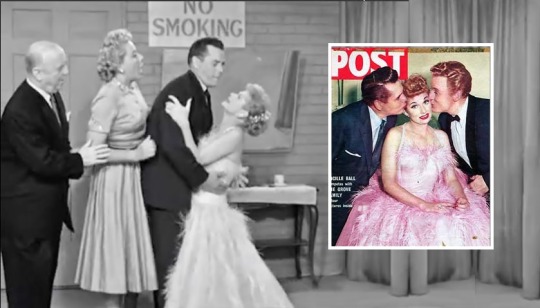
In tandem with this episode, Lucy, Desi and Van Johnson appeared on the cover of the cover of Scotland’s Picture Post Magazine in September 1955. Although the show aired in the US in May, overseas airings were typically later. Except for the studio audience attending the filming in March 1955, this may be the public’s first glimpse of Lucy’s ostrich feathered gown in glorious color!

After Van Heflin turned down the role of Elliot Ness on Desilu’s crime drama
“The Untouchables” (1959) it was offered to Johnson. He turned it down as well. The role eventually went to Robert Stack.
In October 1960, Johnson did a guest spot on Desilu’s “The Ann Sothern Show” as television writer Terry Tyler. Lucille Ball had played Lucy Ricardo on the series a year earlier.

Like many character actors of the time, Johnson played a “Batman” villain: The Minstrel, in 1968 (right). In 1957, he had played “The Pied Piper” on television and Minstrel was undoubtedly inspired by that role.

In 1968, Johnson was billed below Lucille Ball and Henry Fonda in Yours, Mine and Ours.

Johnson plays a naval officer who fixes up his friend (Henry Fonda) with a nurse. Between the two of them, they have 19 kids!
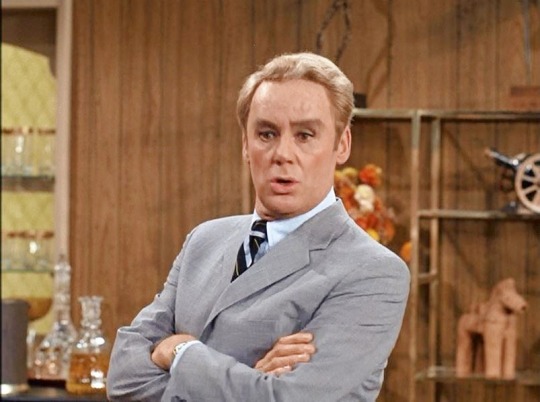
The film was referenced when Johnson played himself (and his nefarious doppelganger) in “Guess Who Owes Lucy $23.50″ (HL S1;E11).
Van Johnson (Impostor): “I loved working with that kooky redhead.”
Lucy Carter: “Personally, I thought she was much too young for Henry Fonda.”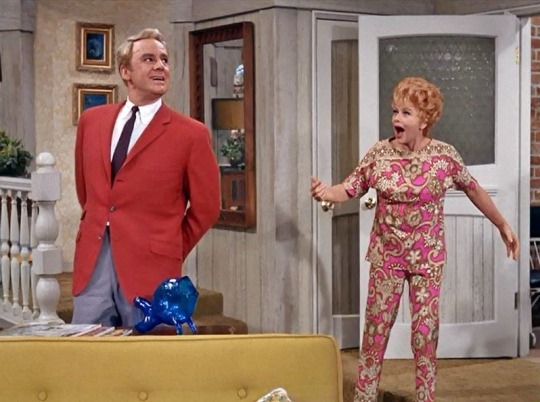
Lucy Carter loans Van Johnson money to fix his car – but the man turns out to be an impostor. In return, Lucy wants the real Van Johnson to fly to Dallas to sing “Happy Birthday” to a cow named Ethel! (No kidding!)

In the episode, Lucy Carter praises Johnson’s film The Romance of Rosy Ridge (1946), claiming to have seen it 17 times! The film was Janet Leigh’s screen debut.

Angry at Johnson, Lucy says that she’s glad he got court martialed in The Caine Mutiny. This is the second mention of The Caine Mutiny on the series. The previous one referred to the book by Herman Woulk that served as the basis for the screenplay. A stage play adaptation was mentioned on “Lucy Meets Orson Welles” (ILL S6;E3) by Miss Hannah, Lucy’s high school drama teacher.
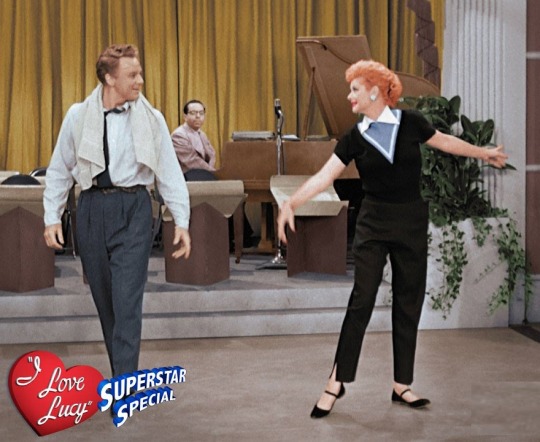
In May 2017 CBS revived “The I Love Lucy Superstar Special” with colorized versions of “The Dancing Star” (ILL S4;E27) starring Van Johnson and
“Lucy Meets Harpo Marx” (ILL S4;E28).

Van Johnson was nominated for a Primetime Emmy Award for playing March Goodwin in “Rich Man, Poor Man” (1976). He lost to Gordon Jackson of “Upstairs Downstairs.”

In 1985, Lucille Ball, Lucie Arnaz, Van Johnson and 97 other celebrities were part of “Night of 100 Stars II” at Radio City Music Hall.

In the 1980s and ‘90s Johnson returned to theatre, touring and playing dinner theatres as well as appearing on Broadway in the musical La Cage Aux Folles in 1985. His last musical role was as Cap’ Andy in Show Boat in 1991.
In 1993, he was included in the Emmy-Winning documentary film “Lucy & Desi: A Home Movie”.

In 2000, Johnson remembered Lucille Ball as part of “Finding Lucy,” a documentary on PBS.
He died in 2008 at age 92.
-
Subscribe
Subscribed
Already have a WordPress.com account? Log in now.
 Papermoon Loves Lucy