-
MAURICE CHEVALIER
September 12, 1888

Maurice Chevalier was born on September 12, 1888 in Paris. He started in show business in 1901. He was singing at a café when it was suggested he audition for a local musical. He got the part. Chevalier made a name as a mimic and a singer. In 1909, he became the partner of the biggest female star in France, Fréhel a partnership that ended in 1911. He went to London, where he found new success, even though he still sang in French.
During World War I he enlisted in the French army. He was wounded in battle, captured and placed in a POW camp by the Germans. During his captivity he learned English from fellow prisoners.
After the war, Chevalier went back to Paris and created several songs still known today, such as “Valentine”. He met the American composers George Gershwin and Irving Berlin and came to Broadway in 1922.

“The cinema is rather like a beautiful woman whom you would court only by telephone.” ~ Maurice Chevalier
When talking pictures arrived, he made his Hollywood debut in 1928 with Paramount Pictures and created his first American role in Innocents of Paris.

In 1930, he was nominated for the Academy Award for Best Actor for his roles in The Love Parade (1929) and The Big Pond (1930). In 1959, he won an honorary Oscar for his contributions to the world of entertainment. He won a special Tony Award for contributions to theatre in 1968.

In “The French Revue” (ILL S3;E7) in 1953, Chevalier did not appear, but everyone impersonated him by donning straw hats and singing “Louise,” a song he introduced to the world in 1929. Later at the Tropicana, Ricky sings “Valentine,” another of Chevalier’s signature tunes.
He sang it for himself (with Ricky and Little Ricky) in 1958′s “Lucy Goes To Mexico” (LDCH S2;E1).

While it might seem odd to have iconic Frenchman Chevalier in an episode that takes place in Mexico, Lucy and Desi had always wanted Chevalier on the show, and time was running out. In addition, his 1958 Oscar-winning film Gigi was an MGM movie, and Lucy and Desi had done two films for the studio, The Long Long Trailer (1953) and Forever, Darling (1956).

In addition to Gigi, Chevalier was tapped for several other French-themed musical films: Can-Can (1960) and Fanny (1961).

In 1960′s Pepe, a showcase for Cantiflas starring Dan Dailey and Shirley Jones, Chevalier was one of 35 stars playing themselves. He was in the company of other “Lucy” actors Jimmy Durante, Sammy Davis Jr., Hedda Hopper, Ernie Kovacs, Jay North, Edward G. Robinson, Cesar Romero, and Dean Martin. The film was set in Mexico (just like Chevalier’s episode of “The Lucy-Desi Comedy Hour”) and the Sands Casino in Las Vegas (the location of yet another “Lucy-Desi Comedy Hour.”)

The logical time for Chevalier to guest star was during their trip to Europe. But Chevalier was not available, and the episode that had been written for him was re-written for film star Charles Boyer.

The only other time Chevalier and Ball were on screen together was for “A Tribute To Eleanor Roosevelt on her Silver Jubilee” as part of “Sunday Showcase” in 1959 on NBC.

In “The Danny Kaye Show with Lucille Ball” (1962) Kaye sang, danced, and told a story imitating Maurice Chevalier’s English accent.

Following in her mother’s footprints, Lucie Arnaz (as Kim Carter) imitated Maurice Chevalier singing “Louise” in a 1970 episode of “Here’s Lucy.” Kim is showing off for her brother Craig’s home movie camera.

In 1922 Chevalier met Yvonne Vallée, a young dancer, who became his wife in 1927. They divorced in 1933
divorced on grounds of incompatibility. Chevalier took up with dancer Nita Raya shortly after but never remarried.

In 1970 he sang the title song for Walt Disney’s The Aristocats. This marked his last contribution to the film industry. Maurice Chevalier died on New Years Day 1972 in Paris. He was 83 years old.
On his death the Times of London wrote: “Paris has lost another piece of its history and of its legend”.
“An artist carries on throughout his life a mysterious, uninterrupted conversation with his public.” ~ Maurice Chavalier

-
BALL and BERLE are BACK!
September 12, 1952

TV GUIDE ~ Volume 5, #37
This pre-national TV Guide for the New York region chose to colorize the photograph on the cover, which is a composite shot of Lucille Ball and Milton Berle, not one posed together. New York being the most important of the television markets, an attractive color cover was expected, while regions throughout the country used a one-color print and black and white (un-retouched) photos.

New England chose green, maintaining the original monochrome of the photographs.

In the original photograph, Lucille is smoking a cigarette. The photographer and date of the photograph are not known with certainty.
This is the fourth (of five) of Lucille Ball’s pre-national TV Guide covers. She was on the first National edition in April 1953, as well as a record 38 others!

Listings for Monday, September 15, 1952 include the season two premiere of “I Love Lucy,” “Job Switching” (ILL S2;E1), an episode that achieved iconic status in the annals of television history.

In 1996, TV Guide included this episode as part of its “100 Most Memorable Moments in TV History” ranking it # 2. The special “TV’s Funniest of the Funniest,” ranked it first among the 30 funniest moments in TV history. Not surprisingly, this is one of Lucille Ball’s favorite episodes and was depicted on a TV Guide “I Love Lucy” collectible cover in October 2001.

The listings also show “I Love Lucy” CBS lead-in “Arthur Godfrey’s Talent Scouts”. Godfrey helped promote “I Love Lucy” during season one and would guest star as himself on “The Lucy Show” in 1965.

Opposite “I Love Lucy” on NBC (and heavily promoted in the Guide) is “The Paul Winchell / Jerry Mahoney Show” starring master ventriloquist Winchell and his dummy Jerry Mahoney. In 1966, Winchell played himself on “The Lucy Show” while Lucy substituted for Tessie Mahoney, Jerry’s cousin. Winchell went on to play character roles in a couple of other “Lucy” shows.

At 10:45pm on channel 5, “Boxing Interviews” welcomed guest Grantland Rice.
While reading the sports pages together in 1953′s “The Camping Trip” (ILL S2;E29), Ricky refers to Grantland Rice. Lucy says “Sure, I’ve heard of it, but I’ve never tasted it.” Grantland Rice (1880–1954) was a sportswriter known for his elegant prose.
BALL & BERLE ARE BACK!

The article promoted on the cover is found on page 8. It features an advance look at the new “I Love Lucy” episode with a still of Ricky licking chocolate off Lucy’s face. This would be America’s first glimpse of the now-legendary episode, which was filmed in March 1952. The brief article announces that Lucille Ball will be having another baby and has adjusted her filming schedule so as not to interfere with airing new programs during her pregnancy leave. It adds the news that Lucy Ricardo will ALSO be expecting a baby! The article goes on to announce some minor changes to Berle’s show as well.

Just as Lucy ‘owned’ Mondays, Berle held down Tuesdays for NBC.

Page 36 of the local New York edition allows for some small ads for restaurants and Broadway plays, two of which were Rodgers and Hammerstein musicals mentioned on “I Love Lucy.” In “No Children Allowed” (ILL S2;E22), Lucy gets tired of hearing Ethel announce how she saved them from eviction even though their lease prohibits babies. In front of everyone, Lucy says,
“That scene has had more performances than ‘South Pacific’!“
By the time the episode aired, the Pulitzer Prize-winning musical by Rodgers and Hammerstein was in the 4th year of its 1,925 performances.
The King and I will be mentioned in “The Celebrity Next Door” (LDCH 1957) when Tullulah Bankhead gets frustrated during the PTA show by a youth choir.
“Who are these children, left over from ‘The King and I’?”
The Broadway musical had closed three years earlier, but the film version was barely a year old and earned five Oscars that year.
These are just two of the many references to Rodgers and Hammerstein (aka Dick and Oscar) and their blockbuster Broadway musicals on “I Love Lucy.”

Page 11 of the New York edition has an ad for Belmont Park, a now-defunct racetrack in Long Island. When just a struggling model and actress, Lucille Ball adopted the name Diane Belmont, inspired by Belmont Park.

The back cover of the New York edition promotes WNBT (later WNBC, the NBC flagship station in Manhattan) and their Saturday night line-up.
“All Star Revue” with George Jessell, Dorothy Kristen, Tony Martin, and Joe DeMaggio.

In May 1952, Lucy and Desi joined Ed Wynn, one of the show’s rotating hosts on the series also known as “Four Star Revue”. This was also their first time on another network (NBC) since signing with CBS to do “I Love Lucy.”
“Your Show of Shows” starring Sid Caesar and Imogene Coca with guest Marilyn Maxwell. This was their season four premiere.

Caesar appeared with Lucille Ball in the 1967 film A Guide for the Married Man and played himself on a March 1968 “The Lucy Show.”

“Your Hit Parade” featuring Dorothy Collins, Snooky Lanson, June Valli, and Raymond Scott and his orchestra. The format was to sing the seven top rated popular songs for the week. This was their second season premiere. In June 1952, Milton Berle (who shares the cover with Ball) appeared on the show, presumably not as a singer!
Speaking of Milton Berle…

Lucille Ball and Desi Arnaz appeared on “The Milton Berle Show” on February 22, 1949, although Berle was out sick, replaced by Walter O’Keefe, delaying a Berle and Ball collaboration until 1950, when Berle hosted “Show of The Year: Cerebral Palsy Telethon” on June 10 and Lucy and Desi were guests. In the decade that followed, Berle (on NBC) and Ball (on CBS) both became the biggest stars of television, but still managed to collaborate on each others shows, most notably in 1959 on “The Lucy-Desi Comedy Hour” episode “Milton Berle Hides Out at the Ricardos” (LDCH E11) and (in return) on “Sunday Showcase: The Lucy-Desi Milton Berle Special” on NBC also in 1959. He did three episodes of “The Lucy Show” and one “Here’s Lucy.” Ball and Berle would also grace the cover of the third National Edition of TV Guide in April 1953, appearing in an illustration showing them as the ‘totem pole of television’ that also featured Imogene Coca, Sid Caesar, and Arthur Godfrey.

That same week, TV Guide’s competition TV Digest featured Marion Marlowe and Frank Parker, two singers on the “Arthur Godfrey Show”, inferring a romantic relationship between the two. Lucille Ball was pictured among stars in an ad for subscriptions.

Another competitor, TV Forecast, had Larry Storch of “Cavalcade of Stars” on their cover.
1952, All Star Revue, Arthur Godfrey, Belmont Park, Cavalcade of Stars, CBS, Desi Arnaz, Ed Wynn, Four Star Revue, Frank Parker, Grantland Rice, I love lucy, Job Switching, Larry Storch, Lucille Ball, Marion Marlowe, Milton Berle, NBC, Paul Winchell, Sid Caesar, South Pacific, The King and I, tv, TV Guide, Your Hit Parade, Your Show of Shows -
SEPTEMBER 11
Since 2001, the date September 11th has been a date associated with the life-changing terrorist attacks on America. But previously, the date was one of the busiest in the Lucille Ball calendar, with memorable performances of her three hit sitcoms in three decades. Lucille Ball’s mission in life was to make us laugh – even in our darkest moments. So while we remember the events of 2001, let’s take a quick tour through the date in the life of Lucille Ball.
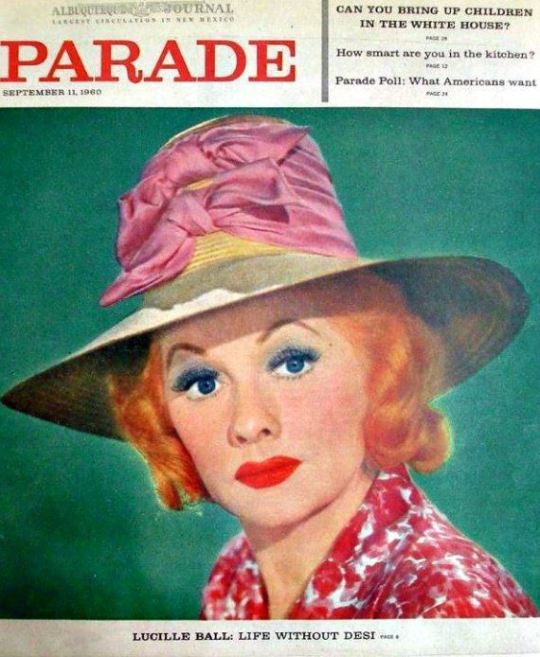
1960
The September 11, 1960 issue of Parade Magazine (which was inserted into Sunday newspapers nationwide) featured a unique and colorful portrait of Lucille Ball. The article inside was “Lucille Ball: Life Without Desi”. The couple formally divorced in April 1960, five months earlier. This coincided with her last appearance as Lucy Ricardo. Although this would be the first September since 1951 that she wasn’t on series television, she was still working; promoting her new film with Bob Hope called Critic’s Choice. Toward that end, two weeks later, she appeared on “The Garry Moore Show.”
1937

On September 11, 1937 Hollywood columnist Jimmy Starr of the LA Evening Herald Express, rated the film Stage Door as ‘Outstanding’ stating that “smaller roles were excellently portrayed by Lucille Ball and others.”
1943

The Hollywood Bond Cavalcade, a 16-city, two week railroad tour of American by a dozen Hollywood celebrities, comes to New York City on September 11, 1943 for a gala performance at Madison Square Garden designed to sell war bonds to defray the debt incurred by the USA during World War II. Desi Arnaz had gone on a similar tour the year before – but 1943 was Lucy’s turn. Much of America was still reeling financially and emotionally from the effects of the War.
1953

Perhaps the most dramatic September 11th in Lucille Ball’s life came in 1953, when she was accused of being a Communist by the House Un-American Activities Committee (HUAC).

The news broke on the very same night that “The Girls Go Into Business” (ILL S3;E2) went before the cameras in Desilu’s brand new studio. Needless to say, the news could not be ignored, and prompted Desi’s now famous remarks in his pre-show welcome:
“Lucy has always had a clear conscience about this. She has never been a Communist, and what’s more, she hates every Communist in Hollywood. The only thing red about Lucy is her hair, and even that is not legitimate.”
1955

On Sunday, September 11, 1955, CBS airs the 22nd of 25 repeats of early episodes of “I Love Lucy” under the umbrella title of “The Sunday Lucy Show”. Under the impression that few viewers had a TV set when the series first began,CBS polled viewers to decide which episodes to air in their early Sunday evening time slot (6pm). This week’s entry is “New Neighbors” (ILL S1;E21) from 1952.
1961

On September 11, 1961 CBS aired the fourth and final re-run of “I Love Lucy” to fill a month-long scheduling gap. This is the last prime-time airing of the series in a regular time slot.
1967

On September 11, 1967, Lucille Ball kicks off the sixth and final season of “The Lucy Show” with Milton and Ruth Berle playing themselves.

This was one of many appearances by Milton Berle, who appeared on all of Lucille Ball’s CBS sitcoms, despite being the reigning king of NBC. While all was hysterical on screen, there was a lot of life-changing activity going on for Lucille Ball.

This is the last episode directed by Maury Thompson, who had started working for Desilu in 1956. Ball heard that Thompson wanted a raise and decided to dismiss him and bring back the show’s original director, Jack Donohue.

Having made Desilu profitable again, Ball had just agreed to take the big step of selling Desilu to Paramount, dissolving the company by the end of 1967 and starting up her own Lucille Ball Productions (LBP) to produce a new sitcom, “Here’s Lucy,” rather than work for Paramount. This was perhaps the biggest business decision that Executive Lucy would make in her entire career.
1972

After season 4 of “Here’s Lucy” wrapped, Lucille Ball experienced a run of bad luck. First, the final episode of the season was designed as a pilot for a spin-off series starring Lucie Arnaz, but CBS declined to pick-up the show for production. At the same time, Vivian Vance, who was being eyed as a reliable sidekick for Lucy should Lucie get her own show, was diagnosed with breast cancer. Finally, in January 1972 on a ski trip to her condo in Snowmass, Colorado, Lucille Ball broke her leg. Instead of canceling the series, Ball had the injury written into the scripts, so that Lucy Carter would also have a broken leg. Almost all of this season’s scripts had to be quickly rewritten or postponed. The injury meant that Ball would have to limit her physical comedy and musical numbers and re-think the show’s overall dynamics. It also meant that her plans to start filming the musical film Mame would be put on hold until her injuries healed. The September 11, 1972 episode that kicked off this extended plot-line was titled “Lucy’s Big Break” (HL S5;E1).

To add to that, earlier in the day on September 11, 1972 Ball made her first appearance on Dinah Shore’s syndicated talk show “Dinah’s Place”. Lucy makes Irish coffee and tells Dinah how she broke her leg.

The night before this episode aired (September 10, 1972), Lucille Ball had appeared on “A Salute to Television’s 25th Anniversary” on ABC, getting an award alongside Bob Hope. Quite a busy 24 hours for Lucy fans!
1984

The week of September 11, 1984, Lucille Ball, now 73 years old, begins a week of appearances on the pantomime game show “Body Language” playing against Charles Nelson Reilly and hosted by Tom Kennedy. She returned to the show over Christmas week in 1984. Lucy was also depicted on the box cover of the board game of Body Language, as well as doing TV commercials for the game. The show managed only a fraction of the audience of other daytime games and CBS canceled the game in late 1985 after only one season on the air.
Through the years, many of Lucille Ball’s co-stars passed away on September 11:

1959 ~ Paul Douglas died at age 52. He played himself in “Lucy Wants A Career” (LDCH E9) which aired just five months before his death.

1970 ~ Chester Morris died at age 69. He appeared in Five Came Back (1939, above) and The Marines Fly High (1940) with Lucille Ball.

1987 ~ Lorne Green died at age 72. The star of NBC’s “Bonanza” from 1959 to 1973. He appeared with Lucille Ball on “Dean Martin’s 1968 Christmas Show,” “Dinah Shore’s Like Hep!”, “Swing Out Sweet Land,” and “Zenith’s A Salute to TV’s 25th Anniversary.”

1994 ~ Jessica Tandy died at age 85. Tandy and Lucille Ball were both recipients of “The Kennedy Center Honors” in December 1986. The ceremony was televised on CBS on Boxing Day 1986.

1998 ~ Dane Clark died at age 86. He was the star of Desilu’s “Wire Service” (1956-57), did two episode of Desilu’s “The Untouchables” (1962-63) and appeared with Desi Arnaz Jr. in “Police Story” in 1976.

2003 ~ John Ritter died at age 54. Lucille Ball was an outspoken fan of John Ritter, hosting a ‘best of’ special for his hit sitcom “Three’s Company” in 1982. Ritter guest-starred as himself on her final sitcom, “Life With Lucy” (1986).

2004 ~ Fred Ebb died at age 76. Ebb produced and wrote the Shirley MacLaine TV special “Gypsy in My Soul” (1976) that co-starred Lucille Ball.
THE GREATEST TRIBUTE

-
PAUL HARVEY
September 10, 1882

Paul Harvey was born as Roy Paul Harvey on September 10, 1882 in Sandwich, Illinois.

He starred on Broadway in The Awful Truth (1922, above left with Bruce McRae and Ina Claire) and repeated his role in the film in in 1929, which is now presumed lost, although it was remade twice (without Harvey) in 1937 and 1953 as the musical Let’s Do It Again.

He did a dozen plays on the Great White Way, but his most successful stage appearance was in Dinner at Eight (1932, above with Constance Collier), although his role was taken in the 1933 film by Wallace Beery.

He started doing films in 1915 and eventually specialized in supportive dads, nervous corporate types, military men, judges, lawyers, or priests, notably, Reverend Galsworthy in Father of the Bride (1950) and its sequel Father’s Little Dividend (1951).

He was also seen in Spellbound (1945), Calamity Jane (1953) and High Sierra (1941). During his long career he amassed more than 200 screen credits.
Between 1934 and 1943, Harvey did seven films with Lucille Ball:

“The Affairs of Cellini” (1934) ~ Harvey played an Emissary and Lucille Ball was uncredited as a Lady in Waiting.

“Kid Millions” (1934) ~ Harvey played Sheikh Mulhulla and Lucille Ball was one of the Goldwyn Girls (uncredited).

“Broadway Bill” (1934) ~ Harvey played James Whitehall while Lucille Ball was an uncredited telephone operator.

“The Whole Town’s Talking” (1935) ~ Harvey played J.G. Carpenter and Lucille Ball was an uncredited bank employee.

“I’ll Love You Always” (1935) – Harvey played Sandstone with Lucille Ball playing a character known as Lucille (uncredited).

“The Marines Fly High” (1940) ~ Lucille Ball is finally above the title as Joan Grant with Paul Harvey as Colonel Hill.

“Easy To Wed” (1946) ~ Ball played Gladys Benton and Harvey played Curtis Farwood in their final big screen venture.
Then came television. His first appearance was in a 1951 episode of the CBS anthology series “The Bigelow Theatre” (1950-51). Before joining the cast of “I Love Lucy,” William Frawley did three episodes of the series, as did Elizabeth Patterson (Mrs. Trumbull) and Kathryn Card (Mrs. McGillicuddy). Frawley had done three feature films with Harvey, from 1935 to 1948.

“Lucy” fans probably remember Harvey best as the art critic from the New York Times who visits the Ricardo apartment to assess Lucy’s talent in “Lucy the Sculptress” (ILL S2;E15) first aired in January 1953 but filmed in November 1952. In this episode he gets to use his own surname.

Little does Mr. Harvey know that Lucy’s sculpture is not made of clay, but Lucy! The jig is up when he hilariously tries to lift the bust from the table! Harvey had done three films with Shepard Menken, who plays the art store owner in the episode, although the two share no scenes together.

Coincidentally, on the evening this episode was filmed (November 7, 1952), CBS’s sitcom “Our Miss Brooks” (filmed at Desilu) aired an episode titled “Living Statues” which also starred Paul Harvey as Mr. Stone (!). Instead of clay, a sticky furniture finish caused people to get stuck – making them appear to be living statues. Lucy’s comic foil on radio Gale Gordon, appeared with Eve Arden, and Richard Crenna, all of whom would make appearances on “I Love Lucy.”

In 1954, he was back on the Desilu lot in the Desilu-produced sitcom “December Bride.” He returned in 1955 for another episode, this one featuring Kathryn Card, who also played Mrs. McGillicuddy, Lucy Ricardo’s mother on “I Love Lucy.”

Although not a Desilu series, in 1955 Harvey did two episodes of CBS’s “My Little Margie,” which was sponsored by Philip-Morris and promoted on “I Love Lucy,” when it served as their summer replacement series.
Paul Harvey was married to actress Ottye Henrietta Cramer and before that to Merle Stanton.

His final big screen role was posthumous, as the Royal Physician in The Ten Commandments (1956) starring Charleton Heston.
His final appearances on television were all posthumous, on “The Roy Rogers Show” (1951-57). He died on December 15, 1955.
 Broadway, Broadway Bill, Calamity Jane, CBS, Constance Collier, December Bride, Desi Arnaz, Desilu, Dinner at Eight, Easy To Wed, Father of the Bride, Father’s Little Dividend, High Sierra, I love lucy, I’ll Love You Always, Ina Claire, Kid Millions, Lucille Ball, Lucy is a Sculptress, My Little Margie, Our Miss Brooks, Paul Harvey, Spellbound, The Affairs of Cellini, The Awful Truth, The Marines Fly High, The Ten Commandments, tv, Vivian Vance, William Frawley
 -
ReelzChannel on Facebook Watch
“We Love Lucy” – Saturday, September 12, 2020 on Reelz
-
ANGELA CARTWRIGHT
September 9, 1952

Angela Margaret Cartwright was born in Altrincham, Cheshire, England, in 1952.

Shortly after Angela’s birth, the family – including older sister Veronica, also an actress – moved to Los Angeles.

She made her first film appearance at the age of three years as Paul Newman’s character’s daughter in Somebody Up There Likes Me (1956)…

and appeared with Rock Hudson and Sidney Poitier in Something of Value (1957), which was labeled ‘Adult Entertainment’.

Cartwright joined the cast of “Make Room for Daddy” (later “The Danny Thomas Show”) in 1957 at the age of five.

“Make Room for Daddy” (aka “The Danny Thomas Show”) ran from 1953 to 1957 on ABC and from 1957 to 1964 on CBS. In March 1953, Danny Thomas chose Desilu Studios to film it using its three-camera method, perfected on “I Love Lucy,” which ran concurrently on CBS.

Shortly after the third season finished filming, Jean Hagen (who played Margaret, the Mother) left the show. It was explained that Margaret had died suddenly off-screen. In a four-part story arc that began in April 1957, son Rusty fell ill with the measles and Danny hired Kathy O’Hara (Marjorie Lord), a young Irish nurse, to look after him. Kathy was a widow with a little girl named Linda (then played by Lelani Sorenson). Not surprisingly, Danny quickly fell in love with Kathy, as did the kids.
When “I Love Lucy” went off the air (in its half-hour format) in 1957 and “Make Room for Daddy” was facing cancellation, CBS acquired the show and moved “Make Room for Daddy” into “Lucy’s” old time slot.
With the change of network, the producers also changed Kathy’s daughter. Lelani Sorenson was replaced by Angela Cartwright as Linda. Linda was adopted by Danny, and the show’s ratings dramatically increased. Never underestimate the ‘cute’ factor!

In “Lucy Makes Room for Danny” (LDCH S2;E2) on December 1, 1958, Lucy and Ricky sublet their Connecticut home to the Williams family (of “Make Room for Daddy”). When Lucy proves an over-protective landlady, the arguing families end up in court!

The night this “Comedy Hour” premiered, “Make Room for Daddy” also aired and concerned Little Linda’s tonsillitis, a subject previously covered by “I Love Lucy” in “Nursery School” (ILL S5;E9). Despite only a half hour passing for viewers, Linda is in perfect health when she arrives on the Ricardo’s doorstep at 9 o’clock!

This cross-over sets in motion a curious anomaly:
- Lucy Ricardo meets Danny Williams (Danny Thomas) and his TV family on this episode of “The Lucy-Desi Comedy Hour”;
- Danny Williams drives through the small town of Mayberry and meets Sheriff Taylor, which spawns “The Andy Griffith Show”;
- “The Andy Griffith Show” is where the Gomer Pyle (Jim Nabors) character began, before getting his own show;
- Gomer, although unnamed and uncredited, turns up on “The Lucy Show,” although here she is Lucy Carmichael, not Lucy Ricardo (even though both women share the maiden name McGillacuddy);
- The upshot of all of this is that Lucy Ricardo and Lucy Carmichael both exist in the same world.

Along with her TV brother Rusty Hamer and Keith Thibodeux as Little Ricky, the young stars are called to testify in court about their parents’ poor behavior! Unexpectedly, the children are more polished and reasonable than their elders.

Linda gets some personal time with the judge, played by Gale Gordon. Linda suggests the final verdict: that Fred take Ethel to Florida for two months. She reasons that it will (a) cure him of being a miser, and (b) thaw his frozen ears!

RICKY RICARDO (about Linda): “She’s a regular Lucy Junior!”
In a quid-pro-quo programming move, Lucy and Desi played Lucy and Ricky on “The Danny Thomas Show” on a January 6, 1959 episode titled “Lucy Upsets the Williams Household.”
While rehearsing a nightclub show together, Danny Williams invites Ricky and Lucy Ricardo to move in to his apartment. Lucy and Kathy, meanwhile, are spending up a storm at the department stores. To curb their spending, the boys cut off their charge accounts in this battle of the sexes. The character of Linda is only briefly in the story and has no scenes with Lucille Ball.

Cartwright again played Linda Williams in “Make Room For Granddaddy” (1970-71). In January 1971, once again “Daddy” and “Lucy” cross-over, with Lucille Ball playing Lucy Carter of “Here’s Lucy”, Kathy’s old friend, coming to New York for a visit.

When Danny comes home from a trip, there is a series of accidental flirtations between Lucy Carter and Danny that make her believe he is being unfaithful to Kathy. The episode is alternately titled “Lucy and the Lecher” and (less controversially) “Lucy, the Houseguest.” Angela is then 18 years old. This time she gets to stay in the room for Lucy’s arrival!

In 1965 Angela played the role of Brigitta Von Trapp in The Sound Of Music, perhaps her most recognizable role, in one of the most famous films of all time. The film also featured “Lucy” alumni Norma Varden (as housekeeper Frau Schmidt), as well as background actors Leoda Richards, Bert Stevens, Norman Stevans, Bernard Sell, Monty O’Grady, William Meader, Sam Harris, Gertrude Astor, Leon Alton, and Steve Carruthers. The original stage musical (which did not feature Cartwright) was on Broadway at the same time that Lucille Ball was doing Wildcat. The musical’s composers, Rodgers and Hammerstein (aka Dick and Oscar) were frequently mentioned on “I Love Lucy.”

Also in 1965, Cartwright returned to television to play Penny, youngest member of the Space Family Robinson, on “Lost in Space” (1965-68). The Irwin Allen science fiction series went from a black and white drama in its first season, to a color comedy in its second and third.
In the season one opening credits, the only character identified by name is Penny.
Cartwright was 13 when the series began. “Lucy” alumni who made guest appearances in “Space” include Fritz Feld, Reta Shaw, Wally Cox, Michael J. Pollard, Strother Martin, John Carradine, Hans Conried (who also played her Uncle Tonoose on “Daddy”), Al Lewis, Stanley Adams, Arte Johnson, Norman Leavitt, Helen Kleeb, and Janos Prohaska. Cartwright has remained involved in the franchise, doing cameo appearances in the 1998 re-boot and the 2019 TV series.

Cartwright was back on the Desilu lot to guest star on two episodes of “My Three Sons” in 1965 and 1969.

Angela’s older sister Veronica made two appearances with her sister on “Make Room for Daddy” in 1959 and 1961, one with Lucy’s good friend and co-star Bob Hope. Veronica also appeared on “The Twilight Zone,” a show introduced on “The Westinghouse-Desilu Playhouse” in 1958 with Desi Arnaz standing in for Rod Serling as host.

Angela Cartwright married actor Steve Gullion in 1976. They have two children.

She has been a photographer for 30 years. She is also a fashion designer. Her work is displayed at her studio in Studio City, Los Angeles.
Angela Cartwright, Barry Livingston, Billy Mumy, Danny Thomas, Desilu, Gale Gordon, Here’s Lucy, Jean Hagen, Keith Thibodeaux, Linda Williams, Lost in Space, Lucille Ball, Make Room for Daddy, Make Room for Granddaddy, Marjorie Lord, My Three Sons, Somebody Up There Likes Me, Something of Value, Steve Gullion, The Danny Thomas Show, The Lucy-Desi Comedy Hour, The Sound of Music, tv, TV Guide, Twilight Zone, Veronica Cartwright -
LOOK! TV: TURN ON OR TURN OFF?
September 7, 1971

The September 7, 1971 issue of LOOK Magazine (volume 35, number 18) dedicated their entire issue to the medium of television. Inside, there is a feature titled “Lucille Ball, the Star That Never Sets…” by Laura Bergquist on page 54.

The photograph on the cover is slightly distorted to give it the look of an image through a TV screen. The shot was taken by Douglas Bergquist in January 1971.

The issue presents a variety of viewpoints about the state of television. Is it ‘tired’ or is there an infusion of new energy to take it into the new decade? John Kronenberger writes an article that asks if cable television is the future. Hindsight tells us that it was not only the future, but is now the past.

“Lucille Ball, the Star That Never Sets…” by Laura Bergquist.

Bergquist first interviewed Lucille Ball in 1956 for the Christmas issue of Look.

The photograph is by Douglas Kirkland, a Canadian-born photographer, who not coincidentally, also took the photograph used on the cover. This shot was taken in the garden of Ball’s home in June 1971.
At age 24, Kirkland was hired as a staff photographer for Look magazine and became famous for his 1961 photos of Marilyn Monroe taken for Look’s 25th anniversary issue. He later joined the staff of Life magazine.
Bergquist launches the article talking about her friend Sally, who is besot with watching Lucille Ball reruns, preferring Lucy over the news. Under the headline, she sums up the purpose of her interview: “Sorry, Sally. But Lucy is a serious, unfunny lady. So how come she’s a top clown of the fickle tube for twenty years, seen at home 11 times weekly and in 77 countries?”
LUCILLE BALL: THE STAR THAT NEVER SETS…
(Lucille Ball’s quotes are in BOLD. Footnote numbers are in parentheses.)
My neighbor Sally, nine, turns out to be a real Lucy freak. Though she likes vintage-house-wife I Love Lucy best, she’ll watch Lucille Ball 11 times a week, if permitted. That’s how often Madame Comedy Champ of the Tube, come 20 years this October, can be caught on my local box. Ten reruns, plus the current Here’s Lucy on Monday night, CBS prime time. Friends, that’s 330 weekly minutes of Lucy, which should be rank overexposure. Did you know that even the U.S. man-on-the-moon walkers slipped in ratings, second time around?
Quel mystery. Variety last fall announced that old-fashioned sitcoms and broad slapstick comedy are passé, given today’s hip audiences. With one big exception – Lucy. When the third Lucy format went on in ‘68, reincarnating Miss Ball as a widowed secretary (with her real-life son, Desi Jr., now 18, and Lucie Jr., 20), Women’s Wear Daily said not only were the kids no talent, but the show was “treacle.” “One giant marshmallow,” quoth the Hollywood Reporter, “impeccably professional, violence-free, non-controversial … 100% escapism."
Miss Ball: "Listen, that’s a good review. I usually get OK personal notices, but the show gets knocked regular.”
So why does Sally, like all the kids on my block, love slapstick, non-relevant Lucy? “Because she’s always scheming and getting into trouble like I do, and then wriggling her way out of it.” A 44-year-old Long Island housewife: “Of course I watch. I should watch the news?” When the British Royal Family finally unbent for a TV documentary, what was the tribe watching come box-time? Lucy, over protests from Prince Philip. (1)
“I’ve been a baby-sitter for three generations,” says Miss Ball briskly. “Kids watch me during the day [she outpulls most kiddy shows]. Women and older men at night. Teen-agers, no. They look at Mod Squad. Intellectuals, they read books or listen to records…. You know I even get fan mail from China?” MAINLAND CHINA? “Hong Kong, isn’t that China?” No. “Where is it anyway?”
The Statistics on the Lucy Industry are numbing. In recent years, she has run in 77 countries abroad, including the rich sheikhdom of Kuwait, and Japan, where, dubbed in Japanese yet, she’s been a long-distance runner for 12 years. Where are all those funny people of yesteryear – Jackie Gleason, the Smothers Brothers, Sid Caesar, the Beverly Hillbillies – old reliables like Ed Sullivan, Red Skelton? Gone, all gone, form the live tube – except for reruns dumped by sponsors, out of fashion, murdered in the ratings.
Even this interview is a rerun. Fifteen years ago, I sat in Miss Ball’s old-timey movie-star mansion in Beverly Hills, wondering how much longer, oh Lord, could Lucy last? She has a different husband, a genial stand-up comic of the fast-gag Milton Berle school, Bronx-born Gary Morton, 49. He replaced Desi Arnaz, her volatile Cuban spouse (and costar and partner) of 20 years, who lives quietly in Mexico’s Baja California, alongside a pool shaped like a guitar, with a second redhead wife. “Ever been here before?” asks Gary, now her executive producer, who’s brightened the house decor. “Used to be funeral-parlor gray, right?”
Otherwise, the lady, like her show, seems preserved in amber. Though newly 60, she could be Sally’s great-grandmother. Of a Saturday, she’s unwinding from a murderous four-day workweek. Her pink-orange-fireball hair is up in rollers. Her black-and-blue Rolls-Royce, inherited from her friend, the late Hedda Hopper, is parked in the driveway. But in attitude and opinion, she comes across Madame Middle America, despite the shrewd show-biz exterior. Good egg. Believer in hard work, discipline, Norman Vincent Peale. Deadeye Dickstraight, she talks astonishingly unfunny – about Vietnam, Women’s Lib, about which she feels dimly, marriage to Latins, books she toted up to her new condominium hideaway in Snowmass, Colo. “Snow” is her new-old passion, a throwback to her small-town Eastern childhood. For the first time in family memory, this lifelong workhorse actually relaxed in that 9,700-foot altitude for four months this year, learning to ski, reading Pepys, Thoreau, Shirley MacLaine’s autobiography, “37 goddamned scripts, and all those Irvings” (Stone, Wallace, etc.). She had scouted for a mountain retreat far away from any gambling. Why? Is she against gambling? “No, I’m a sucker. I can’t stay away from the tables.”
From yellowing notes, I reel off an analysis by an early scriptwriter. Perhaps she comes by her comic genius because of some “early maladjustment in life, so you see commonplace things as unusual? To get even, to cover the hurt, you play back the unhappy as funny?”
Forget any deep-dish theorizing. “Listen, honey,” says Miss B, drilling me with those big blue peepers, “you’ve been talking to me for four, five hours. Have you heard me say anything funny? I tell you I don’t think funny. That’s the difference between a wit and a comedian. My daughter Lucie thinks funny. So does Steve Allen, Buddy Hackett, Betty Grable.”
BETTY GRABLE THINKS FUNNY? “Yeah. Dean Martin has a curly mind. oh, I can tell a funny story about something that happened to me. But I’m more of a hardworking hack with an instinct for timing, who knows the mechanics of comedy. I picked it up by osmosis, on radio and movie lots [she made 75 flicks] working with Bob Hope, Bert Lahr, the Marx Brothers, the Three Stooges – didn’t learn a thing from them except when to duck. Buster Keaton taught me about props. OK, I’m waiting.”
Well, I hedge, I caught Miss Ball in a few funny capers on the Universal lot this week. Like one day, in her star bungalow, she throws a quick-energy lunch in the blender – four almonds, wild honey, water, six-year-old Korean ginseng roots, plus her own medicine, liver extract. “AAAGH,” she gags, then peers in the mirror at her hair, which is a normal working fright wig, “Gawd,” she moans, “it looks as if I’d poked my finger into an electric-light socket!” No boffo line, but her pantomimed horror makes me laugh out loud. Working, she is fearless – dangling from high wires, coping with wild beasts. She talks of animals she’s worked with, chimps, bears, lions, tigers. “I love ’em all, especially the chimps, but you can’t trust their fright or panic. Like that baby elephant who gave a press job to a guest actress.” (2) What’s a press job? “Honey, once an elephant puts his head down, he keeps marching, right through walls.” Miss Ball puts her own head down, crooks an arm for a trunk, and voila, is an elephant. Funny as hell. So off-camera she’s no great wit, but then is Chaplin?
Four days a week, through the Thursday night filming before a live audience, she labors like some hungry Depression starlet. Monday a.m., she sits at the head of a conference table, lined by 12 staffers, editing the script. Madame Executive Tycoon in charge of everything, overseeing things Desi used to do. Also the haus-frau, constantly opening windows for fresh air and emptying ashtrays. She wears black horn-rims, three packs of ciggies are at the ready. “Do I have to ask for a raise again?” she impatiently drills the writers, “I’ve done that 400 times.” “QUIET!” she yells during rehearsal, perching in a high director’s chair, a la Cecil B. DeMille. “Isn’t somebody around here supposed to yell quiet?” She frets about the new set. “Those aisles – they’re a mile and a half wide. What for?” The audience is too far away, she won’t get the feedback from their laughs are her life’s blood. (Once I hear Gary Morton on the phone, in his British-antiqued executive office, saying: “We need your laugh, honey. Go down to the set and laugh; that’s an order.”)
That physical quality about her comedy, a la the old silent movies or vaudeville – which were the big amusements of her youth – seems to transcend any language. (A Moscow acting school, I was told, shows old Lucy clips as lessons in comic timing.) So what did she learn from that great Buster Keaton?
“At Metro, I kept being held back by show-girl-glamour typing. I always wanted to do comedy. Buster Keaton, a friend of director Eddy Sedgwick, spotted something in me when I was doing a movie called DuBarry – what the hell was the name? – and kept nagging the moguls about what I could do. Now a great forte of mine is props. He taught me all about ’em. Attention to detail, that’s all it is. He was around when I went out on a vaudeville tour with Desi with a loaded prop.” What’s that? “Real Rube Goldberg stuff. A cello loaded with the whole act – a seat to perch on, a violin bow, a plunger, a whistle, a horn. Honey, if you noodge it, you’ve lost the act. Keaton taught me your prop is your jewel case. Never entrust it to a stagehand. Never let it out of your sight when you travel, rehearse with it all week.” Ever noodge it? “Gawd, yes. Happened at the old Roxy in New York. I was supposed to run down that seven-mile aisle when some maniac sprang my prop by leaping out and yelling ‘I’m that woman’s mother! She’s letting me starve.’” What did you do? “Ad-libbed it, and I am one lousy ad-libber.”
After 20 years, isn’t she weary of playing the Lucy character? “No, I’m a rooter, I look for ruts. My cousin Cleo [now producer of Here’s Lucy] is always prodding me to move. She once said Lucy was my security blanket. Maybe. I’m not erudite in any way, like Cleo. But why should I change? Last year was big TV relevant year, and I made sure my show wasn’t relevant. Lucy deals in fundamental, everyday things exaggerated, with a happy ending. She has a basic childishness that hopefully most of us never lose. That’s why she cries a lot like a kid – the WAAH act – instead of getting drunk.”
Aha! Is Lucy the guileful child-woman, conniving forever against male authority – whether husband or nagging boss – particularly FEMALE? (“None of us watch the show,” sniffed a Women’s Libber I know, “but she must be an Aunt Tom.” Still, I ponder, hasn’t that always been the essence of comedy, the little poor-soul man – or woman – up against the biggies?)
“I certainly hope so. You trying to con me into talking about Women’s Lib? I don’t know the meaning of it. I never had anything to squawk about. I don’t know what they’re asking for that I don’t have already. Equal pay for equal work, that’s OK. The suffragettes rightly pressed a hard case – and when roles like Carry Nation come along, they ask me to play them, perhaps because I have the physical vitality. But they’re kind of a laughingstock, aren’t they? Like that girl who gave her parents 40 whacks with an ax? Didn’t Carry Nation ax things, was she a Prohibitionist or what?” (3)
She’d just said nix to playing Sabina, in the movie of Thornton Wilder’s The Skin of Our Teeth. Why? “I didn’t understand it.” She turned down The Manchurian Candidate for the same reason. “Got that Oh Dad, Poor Dad script the same week and thought I’d gone loony.” If she makes another movie, she’ll play Lillian Russell in Diamond Jim with Jackie Gleason, “a nice, nostalgic courtship story that won’t tax anyone’s nerves.” (4)
Is Miss Ball warmed by the comeback of old stars in non-taxing Broadway nostalgia shows like No, No, Nanette? (5)
“Listen, I studied that audience. I saw people in their 60’s and 70’s enjoying themselves. That had to be nostalgia. The 30’s and 40’s smiled indulgently, that Ruby Keeler is up there on the stage alive, not dead. For the below 30’s, it’s pure camp. I don’t put it down, but it’s not warm, working nostalgia, but the feeling ‘Ye gods, anything but today’
"Maybe I’m more concerned about things that I realize. I told you politics is definitely not on my agenda – I got burned bad, back in the ’40’s signing a damned petition as a favor. (6) Just say the word ‘politician,’ and I think of chicanery. Too many subversive angles today. But I must be one of millions who are so fed up, depressed, sobbing inside, about the news…the atrocities, the dead, the running down of America. You can’t obliterate the news, but the baddest dream is that you feels so helpless.
"I was sitting in this very chair one night, flipping the dial, and came to Combat! There were soldiers crouching in bushes, a helicopter hovering overhead. Nothing happening, so I make like a director, yelling, ‘Move it! This take is too LONG!’ It turned out to be a news show from Vietnam. That shook me. There I was criticizing the director, and real blood was dripping off my screen… That drug scene bugs me. It’s ridiculous, self-indulgent. We’re supposed to be grateful if the kids aren’t on drugs. They’re destroying us from within, getting at our youth in the colleges. OK, kids have to protest, but how can they accomplish anything if they’re physically shot?
"One of the reasons I’m still working is that people seem grateful that Lucy is there, the same character and unchanging view. There’s so much chaos in this world, that’s important. Many people, not only shut-ins, depend on the tube, too much so – they look for favorites they can count on. Older people loved Lawrence Welk. They associated his music with their youth. Now he’s gone. It’s not fair. (7) They shouldn’t have taken off those bucolic comedies; that left a big dent in some folks’ lives. Maybe we’re not getting messages anymore from the clergy, the politicians, so TV does the preaching. But as an entertainer, I don’t believe in messages.
"Some Mr. Jones is always asking why am I still working – as if it were some crime or neurotic. OK, I’ll say it’s for my kids. But I like a routine life, I like to work. I come from an old New England family in which everyone worked. My grandparents were homesteaders in New York and Ohio. My mother worked all her life – during the Depression in a factory.”
What does she think of the new “relevant” comedy like All in the Family? “I don’t know… It’s good to bring prejudice out in the open. People do think that way, but why glorify it? Those not necessarily young may not catch the moral. That show doesn’t go full circle for me.”
Full circle?
“You have to suffer a little when you do wrong. That prejudiced character doesn’t pay a penance. Does he ever reverse a feeling? I’m for believability, but I’m tired of hearing ‘pig,’ ‘wop,’ ‘Polack’ said unkindly. Me, I have to have an on-the-nose moral. Years ago, the Romans let humans be eaten by lions, while they laughed and drank – that was entertainment. But I’m tired of the ugly. Fred Astaire and Ginger Rogers dancing, that’s my idea of entertainment. Anything Richard Burton does is heaven. Easy Rider scared me at first because I knew how it could influence kids. But at least that movie came full circle. They led a life of nothing and they got nothing. Doris Day, I believe in her. Elaine May? A kook, but a great talent. Barbra Streisand? A brilliant technician.”
On her old ten-minute daily interview radio show, (8) she once asked Barbra, like any star-struck civilian: How does it feel to be only 21, a big recording artist and star of the Broadway hit Funny Girl? “Not much,” said Barbra. “That cool really flustered Lucille. It violated everything she believes in,” says cousin Cleo Smith, who grew up with Miss B in small-town Celoron, N.Y. “For her, nothing ever came easy. She didn’t marry until she was 30, or become a really big star until she was 40. She’s still so hard on herself, sets such rigorous standards for herself as an actress and parent. She honestly believes in all the old maxims, that a stitch in time saves nine, etc. She’s literal-minded, a bit like Scarlett O’Hara. Does what needs doing today, and to hell with tomorrow.”
Her self-made wealth a few years ago was reckoned at $50 to $100 million. After her divorce, she reluctantly took over the presidency of the Desilu studio and sold it six years later to the conglomerate Gulf & Western for nearly $18 million. Does that make her the biggest lady tycoon in Hollywood? (The 179 original I Love Lucy reruns now belong, incidentally, to a CBS syndicate; her second Lucy Show, to Paramount. She owns only the current Here’s Lucy – OK, go that straight?)
“Hah! Like Sinatra, I owe about three and a half million bucks all the time. That figure is ridiculous. All my money is working. I lost a helluva lot in the stock market last year and haven’t recouped it. It’s an illusion that people in show biz are really rich. The really filthy rich are the little old ladies in Boston, the old folks in Pasadena, who’ve had dough for years and haven’t been seen since.”
The divorce from Desi Arnaz can still set her brooding. “It was the worst period of my life. I really hit the bottom of despair – anything form there on had to be up. Neither Desi nor I has been the same since, physically or mentally, though we’re very friendly, ridiculously so. Nobody knows how hard I tried to make that marriage work, thinking all the trouble must be my fault. I did everything I could to right that ship, trotting to psychiatrists. I hate failure, and that divorce was a Number One failure in my eyes… Anything in excess drives me crazy. He’d build a home anyplace he was, and then never be around to enjoy it. I was so idealistic, I thought that with two beautiful babies, and a beautiful business, what more could any man want? Freedom, he said, but he had that. People don’t know what a job he did building that Desilu empire, what a great director and brilliant executive he was yet he let it all go….Maybe Latins have an instinct for self-destruction…”
Was that the conflict, a Latin temperament married to an old-fashioned American female? “It has a helluva lot to do with getting into it and getting out. The charm. But they keep up a big facade and don’t follow through. No, the machismo didn’t bother me, I like to play games too.
"Desi and I had made an agreement that if either of us wanted to pull out of Desilu, the other could buy. I wanted to go to Switzerland with the kids, anywhere to run away, but he wanted out. The I found out that for five years, our empire had taken a nose dive, and if I wanted to get my money back, I had to rebuild it first. For the first time in my life, I was absolutely terrified – I’d never run any show or a big studio. When I came back from doing the musical Wildcat on Broadway, I was so sick, so beat, I just sat in that backyard, numb, for a year. I’d had pneumonia, mononucleosis, staph, osteomyletis. Lost 22 pounds. Friends told me the best thing I could do physically, psychologically, was go back to work, but could I revive Lucy without Desi, my old writers, the old crew?”
You didn’t like being a woman executive? “I hated it. I used to cry so much – and I’m not a crier – because I had to let someone go or make decisions I didn’t understand. There were always two sides to every question, and trouble was I could see both sides. No one realizes how run-down Desilu was. The finks and sycophants making $70,000 a year, they were easy to clean out. Then during the CBS Jim Aubrey regime, I couldn’t sell the new pilots we made – Dan Dailey, Donald O’Connor, Ethel Merman. I couldn’t sell anything but me.” (9)
Was it tough to be a woman bossing men? “Yeah. It puts men in a bad spot. I could read their minds, unfortunately, wondering who is this female making this decision, not realizing that maybe I’d consulted six experts first. I’m all wrong as an executive, I feel out of place. I have too many antennae out, I’m too easily hurt and intimidated. But I can make quick surgical incisions. I’ve learned that much about authority – give people enough rope to hand themselves, stand back, let them work, but warm them first. Creative people you have to give special leeway to, and often it doesn’t pay off. Me, I’m workative, not creative. I can fix – what I call ‘naturalize.’ I’m a good editor, I can naturalize dialogue, find an easier way to do a show mechanically.
But I didn’t make the same marriage mistake twice. Gary digs what my life is, why I have to work. We have tranquility. We want the same things, take care of what we have.”
She shows me Gary’s dressing room, closets hung with shirts and jackets – by the dozen. “My husband is a clothes and car nut, but it’s a harmless vice. Better than booze or chasing women, right?” (His cars include a 1927 Model T Ford, a Mercedes-Benz 300 SL, an Astin Martin, a Rolls-Royce convertible.)
“Anyone married to me has an uphill climb. Gary and I coped by anticipating. We knew we should be separated eight, nine months a year, so he tapered off his act, found other thing to do – making investments, building things. He plays the golf circuit, Palm Springs, Pebble Beach, and tolerantly lets me stay at Snowmass for weeks. Sun just doesn’t agree with me. He didn’t come into the business for five years. I didn’t want to put him in a position in which he would be ridiculed. I could tell that he was grasping things – casting, story line. I said, ‘You’ve been a big help to me. You should be paid for it.’ ”
On a Friday night, I dine with the Mortons. Dinner is served around 6:30, just like in my Midwest hometown. Lucille is still fretting about this week’s show – “over-rehearsed; because there were so many props, the fun had gone out of it.” Gary, just home from unwinding his own way – golfing with Milton Berle, Joey Bishop – asks if I’d like something to drink with dinner? Coke or ginger ale? “No? I think we have wine.” No high living in this house, but the spareribs are superb. “Laura asked me an interesting question,” he tells his wife. “Like isn’t there a conflict when a husband in the same business – comedy – marries a superstar? I told her I’d never thought of it before.”
They met the summer when Lucille was rehearsing Wildcat, and he was a stand-up comic at Radio City Music Hall, seven days a week. “We both came up the hard way,” he says. “I got started in World War II, clowning for USO shows. I’ve been in show biz for 30 years and can appreciate what she goes through. Lucy can’t run company by herself. Maybe with me around, when she walks on the set, her mind is at peace. I pop in from time to time, on conferences, rehearsals. I can tell from her if things are going well, if the laughter is there. She’s a thoroughbred, very honest with me, a friend to whom I can talk about anything. She never leaves me out of her life; that’s important for a man. Do you know how many bets were lost about our marriage lasting? It’s been nearly ten years now, and I’ve slept on the couch only once.”
Past dinner, we adjourn promptly to the living room, and a private showing of Little Murders. It’s not a pretty movie of urban American life, and Lucy talks back indignantly to the screen. (10) The flick she rally like was George Plimpton’s Paper Lion, with the Detroit Lions, which she booked under the illusion it was an animal picture. “At the end, 12 of us here stood up and cheered, and I wrote every last Lion a fan note. You know that picture hardly made a dime?”
On a house tout, I’d noted the Norman Rockwell and Andrew Wyeth albums in the living room, and a memo scotch-taped to her bathroom wall: “Get Smart with N.V.P.”
N.V.P. Is that Norman Vincent Peale, her old friend and spiritual mentor? “Yes. He marred me and Gary. I still adhere to his way of thinking because he preaches a day-to-day religion that I can understand. Something workable, not allegory. Like how do you get up in the morning and just get through the day?
"Dr. Peale taught me the art of selfishness. All it means is doing what’s right for you, not being a burden to others. When I was in Wildcat, he dropped around one night saying, ‘I hear you’re very ill, and working too hard.’ ‘Work never hurt anybody,’ I protested. But he reminded me I had two beautiful children to bring up, and if I was in bad shape, how could I do it? I’ve learned you don’t rake more leaves than you can get into the wheelbarrow. I’ve always been moderate, but I was too spread around, trying to please too many people. You don’t become callous, but you conserve your energies.”
What about her kids? Passing a newsstand, I’d noted a rash of fan mags blazoned with headlines about Desi Jr., something of a teen-age idol, and at 18 a spitting image of old pop. (A rock star at 12, he’d recently garnered very good notices indeed for a movie role in Red Sky at Morning.) “Why Lucille Ball’s Son Is So Bitter About His Own Mother,” read the El Trasho covers. “Patty Duke Begs Desi Jr. To Believe Her: ‘You Made Me Pregnant.’ ” Does the imbroglio bother this on-the-nose moralist?
“I worked for years for a quiet personal life and to have to personally impinged on, with no recourse, is hard. I brought Patty to the house, feeling very maternal about her, saying look at this clever girl, what a big talent she is. Now, I can thank her for useless notoriety. She’s living in some fantastic dreamworld, and we’re the victims of it. Desi being the tender age of 17 when they met, she used him. She hasn’t proved or asked for anything. I asked Desi if he wanted to marry her and he said no. My daughter helped outfit the baby, which Patty brought to the house, but did she ever say thank you?
"Desi’s going to CIA this fall.” Not the CIA? No, the new California Institute of the Arts, where he’ll study music. “Yes, he’s very much like his father, too much sometimes – I just hope he has Desi’s business acumen. I’m glad he didn’t choose UCLA or Berkeley or a school full of nonconformists. Lucie just now wants marriage and babies – maybe she’ll go on to college later.
"I took the kids out of school deliberately. Desi was at Beverly Hills High, Lucie at Immaculate Heart.”
Why? “I didn’t like the scene – it was the usual – pregnant girls, drugs.” That goes on at Immaculate Heart? Sure. “A lot of girls who boarded there were unhappy misfits, and Lucie was already working in the nunnery. All the friends she brought home were the rejected. I’m that way myself.”
Did they mind, well, your stage-managing their lives? “No, they were as sick of that weird high school scene as I was. I made them a proposition – told them to think it over for a month, while I was in Monaco. Do you want to be on the show? I told them the salary would be scale, that most would be put in trust. They’d be tutored and not able to graduate with their classes. They both thought they were going to the coast, but working with a tutor, they really got turned on by books for the first time. They wanted to be in show business, and I wanted to keep an eye on them.”
Of course her show is nepotism, she grants. “Cleo thought a long time before becoming the producer, wondering if it wasn’t overdoing family. Nobody seems to be suffering from it, I told her.” Thursday night show time is like a tense Broadway opening night. Gary Morton, in stylish crested blazer, warms up the audience, heavy with out-of-town tourists. “Lucy started out with another fellow, can’t remember his name…. What is home without a mother? A place to bring girls.” Lucille bursts out onstage, exuding the old MGM glamour, fireball hair ablaze, eyelashes inches long, in aquamarine-cum-rhinestone kaftan. “For God’s sake,” she implores, “laugh it up! We want to hear from you… Gary, have you introduced my mom?” Indeed he has. Loyal, durable, 79-year-old Desiree “DeDe” Ball, her hair pink as Lucille’s, has missed few of the 409 Lucy shows filmed to date, and is on hand as usual with 19 personal guests. Gary also asks for big hands for Cleo, and her husband Cecil Smith, TV critic for the LA Times, who has also appeared on the show. (11)
One day Desi Jr. wanders on the set, just back from visiting his father in Mexico. He’d gone with Patty Duke and the baby. The young man does have Latin charm, and apparently talent. I ask him a fan-mag query: Is it rough to be the spin-off of such famous show-biz parents?
“Well, I grew up with kids like Dean Martin, Jr., and Tony Martin, Jr., and we had a lot in common.” What? “We all had houses in Palm Springs.” Any generational problem with Mom? “She’s found the thing she’s best at, and sticks to it. As long as she has Snowmass, she has an escape, some reality. I realize she lives half in a man’s world, and that must be tough on a woman. My father – he worked hard for years, and then he’d had it. This is silly, weird, he felt. He aged more in ten years than he had in 40. I’m like him. I feel life is very short. He’s had major operations recently, and he’s changed a lot.”
Patty Duke is six years older than Desi Jr., paralleling the six-year age gap that separated parents Lucy and Desi. “Patty is a lot like my mother, the same drive, and strong will, a perfectionist…But I’m never going to get married. Marriage is unrealistic, expecting you to devote a whole life unselfishly to just one person. Do you know people age unbelievably when they marry? From what I’ve seen, 85 percent of married couples are miserable; 14 percent, just average; one percent, happy.” (12)
His mother’s own childhood, in little Celoron, an outspring of Jamestown, N.Y., was oh-so-different from her kids’. “She was always a wild, tempestuous, exciting child,” say Cleo, “doing things that worried people, plotting and scheming, though she knew she’d get in trouble.” Interesting, because that’s one basic of the Lucy format, Miss B forever finagling second bananas like Vivian Vance into co-trouble. “One summer, she conned me into running away. It was only to nearby Fredonia, but in her sneaky way she really wanted to catch up to a groovy high school principal who was teaching there. He played it very cool, calling Mom and telling her we were staying overnight in a boarding house. On his advice, when we got home, DeDe acted as if we hadn’t been away. That devastated Lucille, no reaction, nothing.”
The classic Lucy story line also has her conniving against male authority, whether husband or boss, now played by Gale Gordon. “I need a strong father or husband figure as catalyst. I have to be an inadequate somebody, because I don’t want the authority for Lucy. Every damned movie script sent me seems to cast me as a lady with authority, like Eve Arden or Roz Russell, but that’s not me.
"No, I don’t remember my own father,” says Miss Ball. “He was a telephone lineman who died of typhoid at 25, when I was about three. I do remember everything that day, though. Hanging out the window, begging to play with the kids next door who had measles… The doctor coming, my mother weeping. I remember a bird that flew in the window, a picture that fell off the wall.
"My brother Fred [who was born after her father’s death] was always very, very good. He never did anything wrong – he was too much to bear. I was always in trouble, a real pain in the ass. I suppose I wasn’t much fun to be around.” To this day, says Cleo, Lucille suspects Fred is her mother’s favorite, even though DeDe has devoted her whole life to this daughter.
Family ties were always fierce-strong. After her father’s death, “We lived with my mother’s parents, for a while. Grandpa Hunt was a marvelous jack-of-all-trades, a woodturner, eye doctor, mailman, bon vivant, hotel owner. [And also an old-fashioned Populist-Socialist.] He met my grandmother, Flora Belle, a real pioneer woman and pillar of the family, when she was a maid in his hotel. She was a nurse and midwife, an orphan who brought up four pairs of twin sisters and brothers all by herself. He took us to vaudeville every Saturday and to the local amusement park. When Grandma died at 51, all us kids had to pitch in, making beds, cooking.
"Yeah, I guess I am real mid-America, growing up as a mix of French-Scotch-Irish-English, living on credit like everyone else, paying $1.25 a week to the insurance man, buying furniture on time. But it was a good, full life. Grandpa took us camping, fishing, picking mushrooms, made us bobsleds. We always had goodies. I had the first boyish bob in town and the first open galoshes.
"My mother then married Ed Peterson, a handsome-ugly man, very well-read. He was good to me and Freddy but he drank too much. He was the first to point out the magic of the stage. A monologist came to town on the Chautauqua circuit. He just sat onstage with a pitcher of water and light bulb and made us laugh and cry for two hours. For me, this was pure magic. When I was about seven, Ed and mother moved to Detroit, leaving me with his old-fashioned Swedish parents, who were very strict. I had to be in bed at 6:30, hearing all the other kids playing outside in the summer daylight. Maybe it wasn’t that traumatic, but I realize now it was a bad time for me. I felt as if I’d been deserted. I got my imagination to working, and read trillions of books.”
The adult Lucille, talking to interviewers, used to go on and on about her “unhappy” childhood, little realizing that she was reflecting on her mother, to whom she is passionately devoted. “Just how long do you think you lived with the Petersons?” asked DeDe one day in a confrontation. “Three YEARS? Well I tell you it was more like three weeks.”
“I left home at 15, much too early, desperate to break into the big wide world. Looking for work in New York show biz was ugly, without any leads or friends or training other than high school operettas and plays and Sunday school pageants. I was very shy and reticent, believe it or not, and I kept running home every five minutes. I got thrown in with older Shubert and Ziegfeld dollies and, believe me, they were a mean, closed corporation. I don’t understand kids today who get easily discouraged and yap about doing their own thing. Don’t they know what hard work is? Where are their morals? I always knew when I did wrong, and paid penance.”
Yet she was venturesome enough to sit in on some recent Synanon group-therapy sessions for drug addicts. “They wanted me to raise some money, and I wanted to find out what it was about. The games were fascinating, wonderful, until I couldn’t take it any more. The other participants kept bugging me: What are you here for? Are your children drug addicts? I had to start making up problems.”
For two decades, she’s been risking her neck in those murderous ratings, outlasting long-ago competitors like Fulton Sheen, and now up against such pleasers as pro football and Rowan and Martin. (13)
Suppose the ratings drop, what would she do?
No idea. “Might take a trip on the Inland Waterway form Boston to Florida. In my deal with Universal, I can make specials, other movies, TV pilots. I wouldn’t have to ski ‘spooked’ at Snowmass.” What’s that? “Honey, I have to be careful. If I break a leg 500 people are out of work. (14) I’d be happy in some branch of acting with some modicum of appreciation. Listen, it never occurred to me, in life that I’d fail ever, because I always appreciated small successes. I never had a big fixed goal. When I was running Desilu, it drove me wild when people asked, ‘Aren’t you proud to own the old RKO studio where you once worked as a starlet?’ What $50-a-week starlet ever walked around a lot saying, ‘I want to own this studio’?
"I don’t know what you’ve been driving at, what’s your story line? But it’s been interesting, talking.”
FOOTNOTES: HINDSIGHT IS 20/20

(1) This refers to a rare 1969 BBC documentary about Britain’s royal family that gave the public an inside look at the life of the Windsors. In one scene, the family was watching television, and on the screen was “I Love Lucy”, much to the chagrin of Prince Philip. Queen Elizabeth and Prince Philip were mentioned on the series, especially in the episode “Lucy Meets the Queen” (ILL S5;E15).

(2) Lucy is referring to a 1967 episode of “The Lucy Show” titled “Lucy The Babysitter” (TLS S5;E16) in which Lucy Carmichael babysits three rambunctious chimps for their parents, played by Jonathan Hole and Mary Wickes. In the final moments of the show, Wickes reveals a fourth sibling – a baby elephant! The animal went wild and pushed Wickes (what Ball described as a “press job”) into one of the prop trees. The trainer had to physically subdue the elephant to get it away from Wickes, who injured her arm. The final cut ends with the entrance of the baby elephant.

(3) Lucy is conflating (probably intentionally) the stories of real-life prohibitionist Carrie Nation (1846-1911), who famously hacked up bars and whisky barrels with an axe, and Lizzie Bordon (1860-1927), who famously hacked up her parents with an axe. (Photo from the 1962 TV special “The Good Years” starring Lucille Ball and Henry Fonda.)

(4) There was never a film version of Thornton Wilder’s play Skin Of Our Teeth which was on Broadway in 1942 starring Tallulah Bankhead as Sabina, the role offered to Ball. There were several television adaptations; one in Australia in 1959; one in England the same year starring Vivian Leigh as Sabina; one in the USA in 1955 starring Mary Martin (above) as Sabina; and a filmed version of a stage production starring Blair Brown as Sabina in 1983. Although it is possible that Lucille Ball might have been considered for the role of the sexy housemaid Sabina in 1955, the article says that the role was “just” offered to her, so it probably refers to a 1971 project that never materialized. Wilder’s story tracks a typical American family from New Jersey from the ice age through the apocalypse.

(5) In 1971, there was a popular revival of the 1925 musical comedy No, No, Nanette on Broadway. The cast featured veteran screen star Ruby Keeler and included Helen Gallagher (playing a character named Lucille, coincidentally), Bobby Van, Jack Gilford, Patsy Kelly and Susan Watson. Busby Berkeley, nearing the end of his career, was credited as supervising the production, although his name was his primary contribution to the show.
The 1971 production was well-reviewed and ran for 861 performances. It sparked interest in the revival of similar musicals from the 1920s and 1930s. The original 1925 cast featured Charles Winninger, who played Barney Kurtz, Fred’s old vaudeville partner on “I Love Lucy.” In that same episode (above), they sing a song from the musical, "Peach on the Beach” by Vincent Youmans and Otto Harbach. Like the revue in the episode, the musical is set in Atlantic City, New Jersey.

(6) Lucy is referring to her 1936 affidavit of registration to join the Communist Party. Lucille said she signed it to appease her elderly grandfather. The cavalier act caught up with Ball in 1953, when zealous red-hunting Senator Joe McCarthy tried to purge America of suspected Communists. Although many careers were ruined, Ball escaped virtually unscathed.

(7) The popular big band music series “The Lawrence Welk Show” (1955) was unceremoniously canceled in 1971 by ABC, in an attempt to attract younger audiences. What Lucy doesn’t mention is that four days after this magazine was published, the show began running brand new shows in syndication, which continued until 1982. Welk, despite not being much of an actor, played himself on “Here’s Lucy” (above) in January 1970.

(8) “Let’s Talk To Lucy” was a short daily radio program aired on CBS Radio from September 1964 to June 1964. Most interviews (including Streisand’s) were spread over multiple installments.

(9) To showcase possible new series (pilots) Desilu and CBS aired “Vacation Playhouse” (1963-67) during the summer when “The Lucy Show” was on hiatus. This would often be the only airing of Lucy’s passion projects. “Papa GI” with Dan Dailey as an army sergeant in Korea who has his hands full with two orphans who want him to adopt them. The pilot was aired in June 1964 but it was not picked up for production. “Maggie Brown” had Ethel Merman playing a widow trying to raise a daughter and run a nightclub which is next to a Marine Corps base. The pilot aired in September 1963, but went unsold. “The Hoofer” starring Donald O’Connor and Soupy Sales as former vaudevillians aired its pilot in August 1966. No sale!

(10) Little Murders (1971) was a black comedy based on the play of the same name by Jules Feiffer. The film is about a young nihilistic New Yorker (Elliott Gould) coping with pervasive urban violence, obscene phone calls, rusty water pipes, electrical blackouts, paranoia and ethnic-racial conflict during a typical summer of the 1970s. Definitely not Lucille Ball’s style of comedy! Paper Lion (1968) was a sports comedy about George Plimpton (Alan Alda) pretending to be a member of the Detroit Lions football team for a Sports Illustrated article.

(11) Cecil Smith appeared in “Lucy Meets the Burtons” (HL S3;E1) in 1970 playing himself, a member of the Hollywood Press with a dozen other real-life writers. The casting was a way to get better coverage of the episode (featuring power couple Dick Burton, Liz Taylor, and her remarkable diamond ring). The gambit worked and the episode was the most viewed of the entire series.

(12) Desi Jr.’s 1971 views on marriage did not last. He married actress Linda Purl in 1980, but they divorced in 1981. In October 1987, Arnaz married dancer Amy Laura Bargiel. Ten years later they purchased the Boulder Theatre in Boulder City, Nevada and restored it. They lived in Boulder with their daughter, Haley. Amy died of cancer in 2015, at the age of 63.

(13) From 1952 to 1957, Catholic Bishop Fulton J. Sheen hosted the inspirational program “Life Is Worth Living”, winning an Emmy Award in 1953, alongside winners Lucille Ball and “I Love Lucy.” “Here’s Lucy” was programmed up against “Monday Night Football” on ABC and “Rowan and Martin’s Laugh-In” on NBC. Instead of ignoring her competition, Ball embraced them by featuring stories about football and incorporating many of the catch phrases and guest stars from “Laugh-In.”

(14) Lucy spoke too soon! Just a few months after this interview was published Ball did indeed have a skiing accident in Snowmass and broke her leg. With season five’s first shooting date approaching, Ball was faced with either ending the series or re-write the scripts so that Lucy Carter would be in a leg cast. She chose the latter, even incorporating actual footage of herself on the Snowmass slopes (above) into “Lucy’s Big Break” (HL S5;E1).

Elsewhere in the Issue…
“This Was Our Life” by Gene Shalit includes images of Lucille Ball in the collage illustration.

A week after this issue of Look hit the stands, the fourth season of “Here’s Lucy” kicked off with guest star Flip Wilson and a parody of Gone With the Wind. Three days later, Ball guest-starred on his show.

Not to be outdone, LOOK’s rival LIFE also devoted an entire issue to television, on news stands just three days later.

Naturally, “I Love Lucy” didn’t escape mention! I’m not sure why the show’s run is bifurcated: 1952-55, 1956-57. Actually, the show began in 1951 and ran continually until 1957.

Click here for more about Look, Life and Time!
1971, Cecil Smith, Cleo Smith, Desi Arnaz Jr., Douglas Kirkland, Flip Wilson, Here’s Lucy, I love lucy, Laura Bergquist, Lawrence Welk, Let’s Talk To Lucy, Little Murders, Look Magazine, Lucille Ball, Lucy, Mary Martin, Mary Wickes, No No Nanette, Paper Lion, Royal Family, Skin of Our Teeth, Snowmass, Television, The Good Years, The Lucy Show, TV Guide -
IRVING BACON
September 6, 1893

Irving Bacon was born in St. Joseph, Missouri, as Irving Von Peters. He was a character actor who appeared in hundreds of films, mostly as bewildered small-town blue collar workers. His film debut came in 1923 with a small role in a silent film of Eugene O’Neill’s Anna Christie starring Blanche Sweet.

He appeared in three Best Picture Oscar winners: It Happened One Night (1934), You Can’t Take It with You (1938), and Gone with the Wind (1939). In 1939 alone he made 35 films!
Additionally, he filmed a total of seven movies with Lucille Ball, but they share the big screen only five times due to both being left on the cutting room floor!

The Bowery (1933) in which Lucy and Bacon played uncredited roles.

Broadway Bill (1934) in which Lucy played a telephone operator and Bacon a hamburger stand owner – both uncredited.

I’ll Love You Always (1935) in which Lucille played a small role using her own first name and Bacon played a theatre manager. Again, both were uncredited.

There Goes My Girl (1937) starred Lucy’s RKO friend Ann Sothern. Bacon played a policeman (uncredited). Although Lucille Ball filmed scenes for the film, they were deleted prior to release.

You Can’t Fool Your Wife (1940) finally saw Lucille Ball above the title, although Irving Bacon remained uncredited as a clerk.

A Girl, a Guy and a Gob (1941) with Lucille Ball as the leading lady, Dot Duncan, and Bacon (finally credited) as Albert Merney.

Look Who’s Laughing (1941) starred Lucille Ball as Julie Patterson. Bacon filmed scenes for the comedy, but they were deleted.

In the late 1930s and early 1940s, he played the weary postman in Columbia Pictures’ Blondie film series. One of his bigger roles was as a similarly flustered postman in the thriller Cause for Alarm! in 1951 (above, with Loretta Young). He even played a postman on a 1957 episode of “Leave It To Beaver”.
His first foray into the medium of television was on “Silver Theatre” (1949-50), a CBS anthology series in May 1950 based on the successful radio show of the same name. Bacon played a policeman in “Lady With Ideas.” His second job on television would be on “I Love Lucy.”

His first appearance on “I Love Lucy” was as Mr. Willoughby in “The Marriage License” (ILL S1;E26), in 1952. Mr. Willoughby was the proprietor of the Eagle Hotel in Connecticut, where Lucy and Ricky get stranded after Ricky forgets his wallet at home on the way to the Byram River Beagle Club to re-affirm his marriage vows.

Mr. Willoughby wore many hats – everyone except the Mayor, which was the purview of his wife, played by future Mrs. Trumbull Elizabeth Patterson. Patterson did eight films with Bacon from 1932 to 1950. One of his hats was a bellboy’s cap that provided a clever on-air plug for the show’s sponsor, Philip Morris, imitating the call of cigarette maker’s living mascot, Johnny Roventini. Conveniently, Mr. Willoughby forgets the name of the product – but certainly TV viewers didn’t!

In between appearances on “I Love Lucy” Bacon was seen three times on “My Little Margie” (1952-55). Although it was not a Desilu show, it premiered on CBS as the first summer replacement for “I Love Lucy” on June 16, 1952, under the sponsorship of Philip Morris cigarettes. By the time Bacon appeared on the series in 1954, however, the show had moved to NBC with Scott Paper as its sponsor.

Bacon returned to “I Love Lucy” in early 1955 as Ethel Mertz’s father, Will Potter, in “Ethel’s Hometown” (ILL S4;E15), despite being only eight years older than Vivian Vance. Although all four of the principal characters had living mothers (two of whom were characters on the show), only Ethel’s father is alive and well and appears on screen.

A year later, Bacon was back at Desilu to film an episode of their other hit sitcom, “December Bride”. Both episode plot lines were essentially borrowed from “I Love Lucy.”

In “Chicken Farm” (January 14, 1957) Bacon plays a chicken farmer where Hilda loses a ring during a tour of a hatchery they are hoping to invest in. This combines the plots of “Lucy Raises Chickens” (ILL S6;E19) filmed just three days after this “December Bride” first aired and “Building A Bar-B-Q” (ILL S6;E24) filmed March 14, 1957. Perhaps Desilu got a discount on baby chicks and wanted to put them to maximum use?

His second episode was “Handcuffs” (March 14, 1956) which was very similar to “The Handcuffs” (ILL S2;E4) from 1952. In this episode, Bacon played the locksmith, cleverly named Mr. Bolton. Coincidentally, on “I Love Lucy” the locksmith was played by Will Wright (above center), who appeared with Bacon in “Chicken Farm!” Just like Bacon, Wright also returned to “I Love Lucy” as a totally different character; the Sheriff of Ben Fork in “Tennessee Bound” (ILL S4;E15), both during the Hollywood trip.

In 1958, Bacon was back on the Desilu backlot for an episode of ABC’s “The Real McCoys”. The episode co-starred Madge Blake, who also played two different characters on “I Love Lucy”: hat store owner Mrs. Mulford, and prospective new tenant Martha who is afraid of heights.

In 1959, Bacon was again employed by Desilu for and episode of their helicopter series “Whirlybirds”, which was inspired by their experiences filming “Bon Voyage” (ILL S5;E13).

His final screen appearances was a posthumous one, on an episode of “The Dick Van Dyke Show” that aired three weeks after his death on February 5, 1965. The series was filmed at Desilu Cahuenga Studios and Bacon played a shoe store customer. He shared the screen with “Lucy” performers Richard Deacon, Milton Frome, and Amzie Strickland.

In 1921 Bacon married Freda Lee Scoville, and they had a son and a daughter. She died in 1928 and in June 1930, he married Margaret Beaver, and they had a son, Frank. They divorced in 1934 and Bacon married Bernice Peters in 1937. They were married for the rest of his life.
A Girl A Guy and a Gob, Broadway Bill, December Bride, Gone With The Wind, I love lucy, I’ll Love You Always, Irving Bacon, It Happened One Night, Look Who’s Laughing, Lucille Ball, My Little Margie, The Bowery, The Dick Van Dyke Show, The Real McCoys, There Goes My Girl, Whirlybirds, You Can’t Fool Your Wife, You Can’t Take It With You -
THE CHANGE IN LUCILLE BALL
September 5, 1964

This issue of TV Guide was published just two weeks before the debut of season three of “The Lucy Show” on September 21, 1964. Although the series was now being filmed in color (thanks to the foresight of Lucille Ball), CBS still insisted on airing them in black and white. This would be the final season that viewers would be forced to see a monochrome redhead.

The cover illustration of Lucille Ball is by Al Parker, one of the artists that founded the Famous Artists School in 1948. The school was based in Westport, Connecticut, which was also where the Ricardos moved to in 1956 on “I Love Lucy.” Parker also contributed an illustration of Lucille Ball (inset) for the June 12, 1971 TV Guide cover.

Published by Triangle Publications, this was issue #597, volume 12, number 36, published on September 5, 1964. Lucille Ball is the TV Guide Cover Queen with a record 39 covers to her credit, including the very first national edition in 1953.
By the 1960s, TV Guide was the most read and circulated magazine in the United States. Each issue’s features were also promoted in a weekly television commercial.

That Saturday, September 5, 1964, CBS presented a rerun of “Lucy’s Summer Vacation” (LDCH S2;E5) from June 1959. The listing notes that Lucille Ball is profiled on page 18. Throughout the Guide, titles are often shortened. Here, “The Lucy-Desi Comedy Hour” is known simply as “Lucy-Desi Hour.”

On Monday, September 7, 1964, the morning re-run of “I Love Lucy” was “Lucy Meets John Wayne” (ILL S5;E2). At 10:30, there was a re-run of “The Real McCoys” (here just called “McCoys”) which was filmed at Desilu. That was followed by a rerun of “Pete and Gladys”, a sequel sitcom to the Desilu show “December Bride.” Notice that this Chicago NBC affiliates (channels 5, 16, 39) is airing nearly all color programming, while CBS (2, 13, 22) has none. RCA, the parent company of NBC, was ahead of most all others in the development of color television, both in transmission and television sets. CBS was working on a rival system that never materialized.
THE COVER STORY…

“They Still Call Her Lucy” – by Richard Gehman
The Name’s The Same, The Facade’s Unchanged, But Behind Them Is A Woman Vastly Different From Her Days With Desi

Author Richard Gehman contrasts the Lucille Ball he interviewed in 1959 (just before the divorce) and 1960 (during Wildcat on Broadway) with the Lucille Ball he is meeting today, noting her confidence and a pride in her work previously absent.
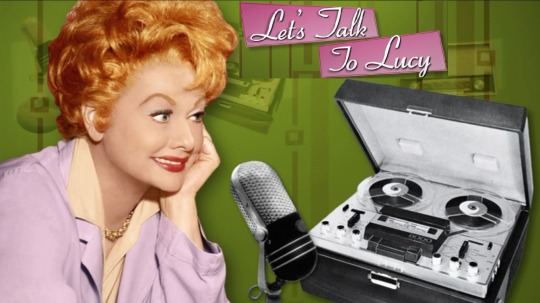
During the interview, Lucy’s husband Gary Morton enters with a tape recorder, and talks about her upcoming CBS radio show “Let’s Talk To Lucy.” The first 10 minute program would air on September 7, 1964 with an interview of Danny Kaye.

Gehman compares Lucille Ball’s loving glance at Gary to that of Elizabeth Taylor. Coincidentally, exactly six years later, on September 5, 1970, Lucille Ball was back on the cover of TV Guide with none other than Elizabeth Taylor, promoting the much-touted episode of “Here’s Lucy” featuring Richard Burton, Liz, and her enormous diamond ring.
ALSO IN THE ISSUE…

“The Prettiest Indian He Ever Came Across” – Profile of Kamala Devi, wife of Chuck Connors. Earlier in 1964, Devi appeared on an episode of “My Three Sons” opposite William Frawley. Chuck Connors played himself on an episode of “Here’s Lucy” in 1973.

“He’s Only A Part-Time Panther” – Profile of Italian singer Sergio Franchi. He appeared with Lucille Ball on “The Ed Sullivan Show” in 1970. The title refers to the fact that a female reporter once said that he “moves like a panther.”

“Vaudeville’s Resurgence at the Hollywood Palace” – “The Hollywood Palace” (1964-70) was an ABC TV variety series that kicked off as a mid-season replacement in January 1964. Desi Jr. and his band appeared on the show in 1968.

Former FCC Chairman “Newton N. Minow Revisits Television” – During his first speech as FCC chairman in 1961, Minow famously referred to television as a “vast wasteland.” He left his post in 1963. He was awarded the Presidential Medal of Freedom by President Barack Obama on November 22, 2016.
“To my way of thinking, that speech was badly misinterpreted. It didn’t condemn all of television. It said there are great things in television which are unique in uniting and serving the country, but you, the broadcasters, have got to remember that you are trustees for all of us. That you have got to pay more attention to your obligations to children. You’ve got to pay more attention to not only the bottom line, but to public service.” ~ Newton N. Minow

“Profiles in Courage: The Program That Started with President Kennedy” ~ “Profiles in Courage” (1964-65) was an NBC anthology series that presented episodes in the lives of true-life historical figures who each faced a crisis in their life. Based on the 1955 book by John F. Kennedy, the series was shot at Desilu Studios. Listings for Friday, September 11, 1964 on the facing page include a rerun of “The Ann Sothern Show” produced by Desilu.

-
HOLLYWOOD BOND CAVALCADE
September 4, 1943

On September 4, 1943, the Hollywood Bond Cavalcade departed
to raise money for America’s Third War Loan. It began in Washington DC and went through 16 American cities before ending in San Francisco 21 days later. Millions of Americans flocked to these events buying war bonds as their tickets, with seat prices ranging from $18.75 to $1 million. After crossing 10,091 miles, the campaign raised a total of $40,110,000 and pushed America’s War Loan over the $2 billion mark.
The Hollywood Victory Committee was an organization founded on December 10, 1941 during World War II to provide a means for stage, screen, television and radio performers that were not in military service to contribute to the war effort through bond drives and improving morale for troops. It was associated with the Screen Actors Guild. The Committee organized events between January 1942 until August 1945. Its first chairman was Clark Gable.

This was not the first such event. In 1942, Desi Arnaz participated in the Hollywood Victory Caravan. He was joined by stars Joan Bennett, Joan Blondell, Charles Boyer, James Cagney, Claudette Colbert, Jerry Colonna, Bing Crosby, Olivia de Havilland, Cary Grant, Charlotte Greenwood, Bob Hope, Frances Langford, Laurel and Hardy, Bert Lahr, Groucho Marx, Frank McHugh, Ray Middleton, Merle Oberon, Pat O’Brien, Eleanor Powell, and Risë Stevens.
The Caravan show played in 12 cities and netted over $700,000 for Army and Navy relief funds. [Note that in the above Minneapolis welcome sign, Desi’s surname is mis-spelled!]
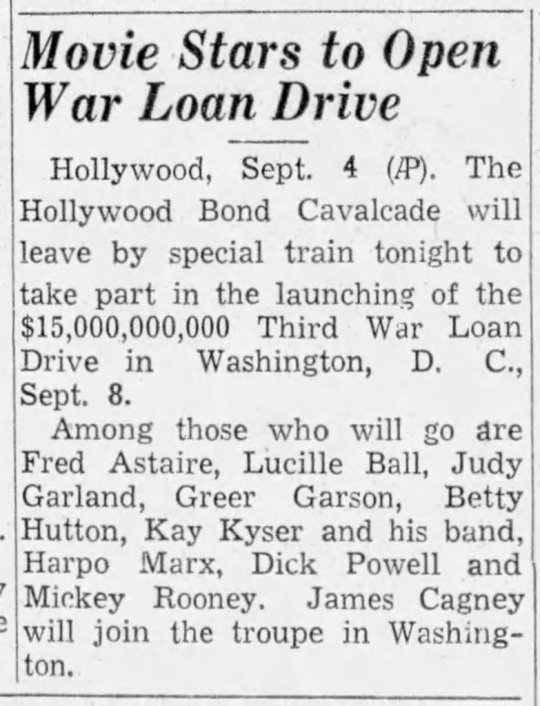
Along with Lucille Ball, some of the celebrities involved included:

James Cagney ~ had just opened his film Johnny Come Lately on September 3, 1943.
Judy Garland ~ won a 1940 special Oscar for her contributions to film. In September 1943, she released Thousands Cheer (co-starring Lucille Ball) and two months later, Girl Crazy with Mickey Rooney.

Mickey Rooney ~ was also in Thousands Cheer with Garland and Ball, as well as premiering Girl Crazy with Judy Garland in November 1943. Rooney won Oscars in 1939 and 1940. In 1966 he played himself on an episode of “The Lucy Show.”

Kay Kyser ~ was a bandleader who made his film debut with Lucille Ball in That’s Right – You’re Wrong. He made four films in 1943, including Thousands Cheer.

Paul Henreid ~ was most known for playing Victor Laszlo in Casablanca (1942). His name was mentioned on “I Love Lucy” in “The Adagio” (ILL S1;E12) when Ricky lights two cigarettes at once, just a Paul Henreid did for Bette Davis in 1942′s Now Voyager.
Greer Garson ~ won Oscars in 1940, 1942, and 1943, for Mrs. Miniver, her most recent success at the time. She had a film in release called The Youngest Profession and was about to debut another hit, Madame Curie.
Betty Hutton ~ was an actress and singer who was seen that summer of ‘43 in Let’s Face It, starring Bob Hope.
Kathryn Grayson ~ was yet another Cavalcade member starring in Thousands Cheer.

Harpo Marx ~ is best known for the act he developed with his brothers that was a hit on Broadway and screen. He was a silent clown in an over-sized raincoat and fright wig. Lucy and Harpo had appeared together in Room Service in 1938. In 1955, he guest-starred on “I Love Lucy” (S4;E28) as himself.
Fred Astaire ~ was one of Hollywood’s most legendary dancers. In July 1943 he released The Sky’s The Limit with Joan Leslie. In 1943, he had already done three musical films with Lucille Ball, and was about to film a fourth – Ziegfeld Follies. His name was mentioned on two episodes of “I Love Lucy.”
Olivia DeHavilland ~ was a two-time Oscar nominee at the time of the Cavalcade. She memorably played Melanie Wilkes in Gone With The Wind in 1939.
Martha Scott ~ was a 1940 Oscar nominee for the screen version of Our Town. Her film Hi Diddle Diddle was in release during the summer of 1943.
Dick Powell ~ was preparing to premiere Riding High with Dorothy Lamour in November 1943. He was about to start filming Meet the People with Lucille Ball, which opened in 1944.
The stars participated upon behest of the US Treasury Department.

A special 11-car Union Pacific Railroad train carried the stars from Los Angeles, to Washington DC for the kick-off.

Union Pacific Railroad provided access to their new Domeliner for location and second unit footage on “I Love Lucy” during “The Great Train Robbery” (S5;E5).
Tour Schedule:
- Sept 4 – Depart Los Angeles
- Sept 8 – Washington, DC
- Sept 9 – Philadelphia
- Sept 10 – Boston
- Sept 11 – New York
- Sept 12 – Pittsburgh
- Sept 13 – Cleveland
- Sept 14 – Detroit
- Sept 15 – Cincinnati
- Sept 16 – Chicago
- Sept 17 – Minneapolis
- Sept 18 – St Louis
- Sept 20 – New Orleans
- Sept 21 – Dallas
- Sept 22 – San Antonio
- Sept 25 – San Francisco
- Sept 26 & 27 – Los Angeles

A Typical Cavalcade Performance (depending on celebrity availability)
Kay Kyser served as master of ceremonies and started the show with his band’s theme “Thinking Of You”. James Cagney came on to read a poem – “What Do We Do When We Buy A Bond” – and did two numbers and a dance from Yankee Doodle Dandy, for which he had recently won the Academy Award. Dick Powell then crooned some of his hits: “Don’t Give Up The Ship,” “Let’s Get Lost,” “In My Arms,” and “Happy Go Lucky”.
Harpo Marx would intermittently chase a blonde across the stage. He eventually settled down to play two harp solos, bang on the piano, wheeze on the harmonica, and finally played a pantomime poker game with Lucille Ball, who had appeared with Harpo in Room Service in 1938 and learned physical comedy at his knee. Harpo ended the game by cutting the cards with an ax!
After Fred Astaire danced, Kyser brought down the house with a burlesque imitation of his style. Mickey Rooney did imitations of Franklin Roosevelt, Eleanor Roosevelt, Herbert Hoover, Wendell Wilkie, and then played the drums.
Betty Hutton performed some hot boogie-woogie. Judy Garland sang “The Man I Love,” “Embraceable You,” and “Blow, Gabriel, Blow.”
Greer Garson urged continued bond purchases, saying, “If we relax, if we don’t back the attack, the war will go on indefinitely.”

Upon arrival in Washington DC on September 8, Lucille Ball and the stars paraded through the streets in military jeeps, waving to the assembled crowds on their way to the Washington Monument. A similar parade was held in most all subsequent cities.

After departing DC, the stars embarked on a 15 city ‘barn-storming’ tour of American cities.

September 9 ~ the Cavalcade played Philadelphia’s Convention Hall…

…and moved to play Boston on September 10.

September 11 ~ at Madison Square Garden in New York City. It was here that Betty Hutton announced her engagement to camera manufacturer Ted Briskin. They tied the knot in 1945 but the marriage ended in divorce in 1951.

September 12 ~ Pittsburgh, Pennsylvania. The newspapers promoted its arrival with this photo from their Los Angeles departure.

September 13 ~ the Cavalcade rolled through Cleveland, Ohio the stars spoke to an assembly of Defense Workers. That night, at the Civic Auditorium, Kay Kyser auctioned off an American flag for $10,000,000 and two pounds of butter and a three pound steak for $100,000 each!

September 14 ~ Detroit, Michigan

September 15 ~ Cincinnati, Ohio.
Stars rode into town on chartered Cincinnati Street Railway buses kicked off at Union Station. Lucille Ball is 8th from the right, next to Harpo Marx.

September 16 in Chicago’s Soldier Field.

September 17 in Minneapolis, Minnesota.

September 18 in St. Louis, Missouri at the Kiel Auditorium. Most of the stars lodged at the Hotel Jefferson, where police had to chase 300 autograph hounds out of the lobby. They also had to drag a high school girl out from beneath Fred Astaire’s bed. In another incident, surging fans shattered a plate glass window, which tore Judy Garland’s dress to shreds.

September 19 was left as an ‘open’ day in New Orleans, Louisiana, before their official performances on September 20 at the Tad Gormley Stadium.
Variety reported the crowd at 50,000, The States stated it was between 65,000 and 75,000, while The Item claimed 100,000 showed up, despite the actual venue only seating 35,000!

September 21 in Dallas, Texas at the Cotton Bowl…
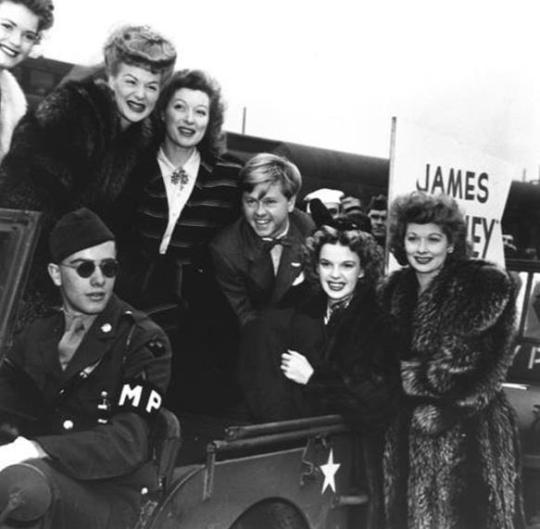
…and in San Antonio, Texas on September 22.

September 25 in San Francisco to perform…

…and on September 26 went home to Los Angeles to conclude the 10,000 mile tour. A crowd of 6,000 greeted them at the station in Glendale as the Navy Band played “California, Here I Come."

The song would memorably be sung on “I Love Lucy” to launch the Hollywood episodes in 1955.

Lucille Ball helped sell bonds throughout her career. Click here for a look at Lucy and US Savings Bonds!
-
Subscribe
Subscribed
Already have a WordPress.com account? Log in now.
 Papermoon Loves Lucy