-
1970 ‘GEORGIE’ AWARDS
September 20, 1970

On Sunday, September 20, 1970, “The Ed Sullivan Show” presented the AGVA (American Guild of Variety Artists) Entertainer of the Year Awards. The awards are nicknamed the Georgies, after showman George M. Cohan. The award statuette was in his likeness.
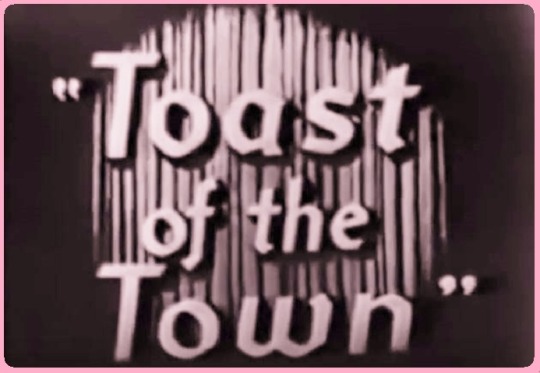
This is the opening episode of “The Ed Sullivan Show’s” 23rd season. The long-running variety series premiered on June 20, 1948 with the title “Toast of the Town.” On September 25, 1955 (the start of season 9) the series was re-titled “The Ed Sullivan Show”. On February 9, 1964 the Beatles made their “Ed Sullivan” debut. The Beatles’ three 1964 Sullivan appearances were among the highest rated TV programs of the 1960’s.
In 1967, Ed’s NYC studio, Studio 50, was officially re-named The Ed Sullivan Theater. CBS cancelled the series in 1971. The final new show aired on March 28, 1971, followed by several weeks of reruns.
The Entertainer of the Year Awards were taped Caesars Palace Las Vegas. This was the first annual Georgie Awards.
THE HONOREES


Lucille Ball presents the Georgie Award for Best Female Comedy Star of the Year to Carol Burnett. From 1966 to 1971 Lucy and Carol alternated appearing on each other’s television shows. Three days before these awards aired, they both did cameo appearances on “The Dean Martin Show.” This was one of Ball’s 11 appearances on “The Ed Sullivan Show” between 1954 and 1970.

Tommy Smothers (of The Smothers Brothers) presented the Georgie Award to Flip Wilson, Best Male Comedy Star of the Year. From 1968 to 1971, Tom and Flip appeared on each other’s television shows. Like Lucy and Carol, three days before these awards aired, they both did cameo appearances on “The Dean Martin Show.”

Actor Marc Copage presents Outstanding Animal Act trophy to Tanya The Elephant. Tanya had previously appeared on “The Ed Sullivan Show” in 1967 and 1969.

Milton Berle presents an award to Radio City Music Hall. President of Radio City Music Hall James Gould accepts. In 1938, Milton Berle was featured in the film Radio City Revels. In 1998, Berle celebrated his 90th birthday on the Radio City stage. This marked Berle’s fourth appearance on “The Ed Sullivan Show.”

Danny Thomas presents the Golden Georgie Award to Jimmy Durante, who is not there to accept the award. Thomas and Durante appeared on screen together more than 15 times from 1950 to 1969, including an episode of “The Danny Thomas Show” titled “Durante and Danny” in 1966.

Ed Sullivan presents an award to Bob Hope. This is Hope’s seventh time appearing on “The Ed Sullivan Show.”
PERFORMANCES

Sullivan introduces a pre-taped clip of Barbra Streisand singing “On A Clear Day” at Vegas’s International Hotel. She is named Best Female Singer of Year.

Blood Sweat and Tears perform “Lucretia Mac Evil". They are named Best Group of the Year.

Tom Jones is named Best Male Singer of the Year. He performs “Cabaret” from the musical of the same name.

Melba Moore is named Best New Young Star. She sings “I Got Love" from the musical Purlie.

The Peter Gennaro Dancers perform. They worked extensively on “The Kraft Music Hall” from 1960 to 1971.

The Flying Alexanders trapeze act performs.
1970, Barbra Streisand, Blood Sweat and Tears, Bob Hope, Carol Burnett, CBS, Danny Thomas, Emmett Kelly, Flip Wilson, Georgie Awards, Jimmy Durante, Lucille Ball, Melba Moore, Milton Berle, Peter Gennaro Dancers, Radio City Music Hall, Tanya the Elephant, The Ed Sullivan Show, The Flying Alexanders, Tom Jones, Tommy Smothers, tv -
ELVIA ALLMAN
September 19, 1904

Elvia Beatrice Allman was born on September 19, 1904 in Enochville, North Carolina. She started her performing career on radio in the 1920s, as both a storyteller and singer. This led to work voicing cartoon characters for Warner Brothers. Simultaneously, she was pursuing stage acting, appearing at the Pasadena Playhouse.
Allman made her film debut as an actress in 1940’s The Road to Singapore as a homely woman who pursues Bob Hope.

On radio, she worked with Lucille Ball on “My Favorite Husband”.
Her first TV credit came in August 1951, in an episode of “Hollywood Theatre Time” written by “I Love Lucy” scribes Bob Carroll and Madelyn Pugh Davis. This undoubtedly led to her first encounter with Lucille Ball.

Allman’s first episode of “I Love Lucy” is also one of the most memorable in TV history: “Job Switching” (ILL S2;E1) in September 1952. She played the strident foreman of Kramer’s Candy Kitchen.

This portrayal has been seen numerous times across various media, and often imitated, but perhaps none more brilliantly than on “Will & Grace” where Lucie Arnaz played the role originated by Allman.
“I’m thrilled to be invited to the party and will do my best to honor the memory of Elvia Allman’s iconic performance.” ~ Lucie Arnaz

NEIGHBOR: “Do you wanna see Minnie or don’t ya?”
Allman returned to the show as one of Minnie Finch’s neighbors in “Fan Magazine Interview” (ILL S3;E17) in 1954, quite a change of pace.

NANCY GRAHAM: “When did you first meet…himmm?”
Changing gears once again she played prim magazine reporter Nancy Graham in “The Homecoming” (ILL S5;E6) in 1955. The character is probably a tribute to Sheilah Graham, who was an English-born Hollywood journalist.

Graham suggests that her article will be titled “NOW I AM HIS SLAVE” by LUCY RICARDO, a title that would raise more than a few eyebrows, even in 1955!

She made two appearances on “The Lucy–Desi Comedy Hour“ – first as Ida Thompson, Westfield’s PTA director who is enamored of Tallulah Bankhead in “The Celebrity Next Door” (LDCH S1;E2) in December 1957. The character is likely named in honor of Maury Thompson, who was the show’s long-time camera coordinator.

She was Milton Berle’s over-protective secretary when “Milton Berle Hides Out at the Ricardos” (LDCH S3;E1) in 1959.

Allman would also be seen on two episodes of “The Lucy Show.” First as a customer shopping for a new hat when Lucy takes a job at Stacey’s Department Store in “Lucy Bags a Bargain” (TLS S4;E17) in 1966. Allman flips her wig when Lucy bungles the sale!

Her second, and final Lucycom appearance, was in “Lucy The Babysitter” (TLS S5;E16) in 1967. Allman finally gets to use her own name to play the manager of an employment agency visited by Mrs. Carmichael. Coincidentally, the name of the business is the Unique Employment Agency, which will also be the name of the Employment Agency on “Here’s Lucy.” This pretty much brings things full circle for Allman, whose first episode of “I Love Lucy” featured the Acme Employment Agency, the agency that places Lucy and Ethel at Kramer’s Candy Kitchen!

Allman’s final screen appearance with Lucille Ball reunited her with Bob Hope: “Bringing Back Vaudeville” on November 16, 1971 on NBC.

Back in 1952, the same year Allman did her first “I Love Lucy” episode, she was a recurring character on NBC’s answer to “Lucy”, “I Married Joan” which – like “Lucy” – also filmed at General Service Studios. Consequently, the two shows shared many performers. Allman played Aunt Vera for six episodes during season one.

In May 1953, Allman did a single episode of “Our Miss Brooks,” filmed by Desilu. She appeared opposite Eve Arden, Gale Gordon, Richard Crenna, and Gloria McMillan, all of who appeared on “I Love Lucy.”

In October 1954, she played a maid on the Desilu filmed “Make Room for Daddy”.
In 1958, to symbolize the show’s move to CBS, the Williams family moved into the Ricardo home in Westport. In return, Lucy and Desi guest-starred on “The Danny Thomas Show” as the Ricardos.

Also in 1954, Allman started appearing on Desilu’s “December Bride,” doing six episodes until 1959, mostly playing Sara Selkirk.
In 1957, Executive Producer Desi Arnaz appeared as himself. In 1960 she was featured on the very first episode of the sequel series, “Pete and Gladys” and did another episode in 1962.

In October 1958, she did a day on Desilu’s “The Ann Sothern Show.” In November 1959,Lucille Ball played Lucy Ricardo on the series’ season two premiere.

In January 1961, Allman played Henrietta Swanson on “The Andy Griffith Show” filmed on the Desilu backlot.

A few months later, she did a day on “The Real McCoys”, also filmed on the Desilu backlot.

In June 1964, Allman did an installment of “Vacation Playhouse” – a Desilu anthology series of possible pilots.

In 1963 and 1965, Allman did episodes of “The Dick Van Dyke Show” filmed at Desilu Studios. The second featured Amzie Strickland, who also appeared with her in “Lucy Bags a Bargain” (TLS S4;E17).

Allman has the distinction of appearing in all three of CBS’s inter-connected rural sitcoms (albeit as different characters): “The Beverly Hillbillies” (as Elverna Bradshaw); “Petticoat Junction” (as Selma Plout); and “Green Acres” (as Cora Watson).
Her final screen appearance was on a 1989 episode of “Murder She Wrote” starring Angela Lansbury.
Her first husband, Wesley B. Tourtellotte, was a musician whom she married in 1930. The marriage was short-lived and produced one child. Her second was Charles Pyle, who was often called Cash and Carry Pyle, an Illinois theater owner and sports agent. They married in 1937 but he died of a heart attack two years later.
Her third and last marriage, to Jerome Bayler, lasted 33 years until his death in 1978.

Allman died on March 6, 1992, aged 87.
-
FALL PREVIEW ‘53
September 18, 1953
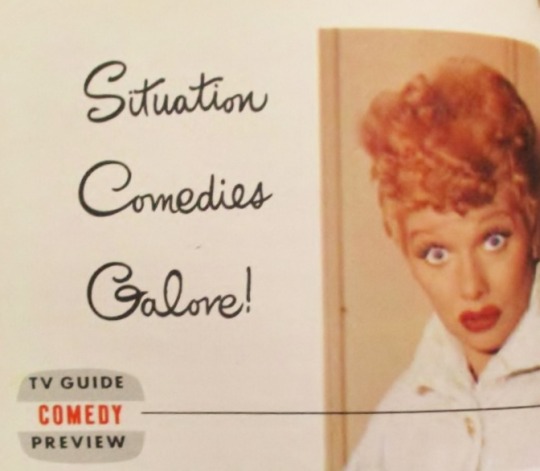
On September 18, 1953, TV Guide, now a national publication, published their first Fall Preview issue. This became an annual and much anticipated tradition with the magazine. Although TV Guide national edition was only 25 issues old, Lucille Ball had already been featured on three covers and would go on to be seen on 36 more.

TV Guide (volume 1, number 25) hit news stands on September 18, 1953. It provided television listings for programs from September 18 to 24, 1953.

The editorial content of the issue was broken down by genre. Naturally, Lucille Ball and “I Love Lucy” headed up the “Situation Comedy” section.
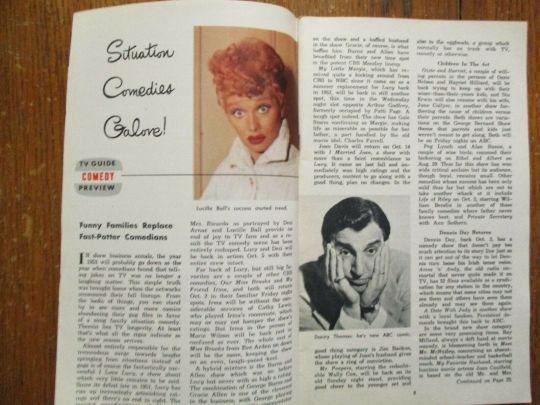
“Almost entirely responsible for laughs springing from situations instead of gags is, of course, the fantastically successful ‘I Love Lucy’, a show about which very little remains to be said. Since its debut in late 1951, ‘Lucy’ has run up increasingly astonishing ratings and there’s no end in sight. The marital misadventures of Mr. and Mrs. Ricardo as portrayed by Desi Arnaz and Lucille Ball provide no end of joy to TV fans and as a result the entire TV comedy scene has been reshaped.”

In 1953, “I Love Lucy” did not return to the airwaves until October 5th, kicking off their third season with “Ricky’s Life Story” (ILL S3;E1), an episode filmed in May 1953. T
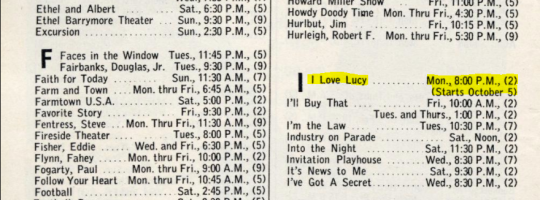
he day before this issue hit the stands, the series filmed “Lucy and Ethel Buy the Same Dress” (ILL S3;E3), which aired on October 19, 1953. Lucy and Desi were still dealing with her being accused of being a communist a week earlier.


Although the Arnaz Family loved to get away to Hawaii, they could not have spent a month there from September 15, 1953. They filmed “Lucy and Ethel Buy The Same Dress” on September 17th and “Equal Rights” on September 24th. The TV Teletype (Hollywood) was complied by Dan Jenkins. The reporter’s name was given to the used furniture salesman played by Hans Conried in “Redecorating” in 1952.

The article on Comedy goes on to discuss returning shows like “Our Miss Brooks,” “My Friend Irma,” “My Little Margie,” “I Married Joan,” “Mr. Peepers,” “Ozzie and Harriet,” “Ethel and Albert,” “Life of Riley,” “Amos ‘n’ Andy” and “A Date With Judy.”

Comedy Newcomers for 1953…

“My Favorite Husband” based on Lucille Ball’s hit radio show. Lucy’s role is now taken by Joan Caulfield. The CBS sitcom lasted until 1955.

“Meet Mr. McNutley” aka “The Ray Milland Show.” It lasted two season on CBS.

“Life With Danny” later retitled “Make Room for Daddy” and then “The Danny Thomas Show.” The show became a juggernaut lasting until 1965 and launching several sequels and spin-offs, including “The Andy Griffith Show.” Thomas was inspired by Desi Arnaz to use a multi-camera film shoot and filmed the show at Desilu. In 1958, the series moved to CBS and did a cross-over with “The Lucy-Desi Comedy Hour” to mark the shift in networks.

“Pride of the Family” starring Paul Hartman and Fay Wray and Natalie Wood in her only regular TV series. The ABC show lasted only one season.

“Bonino” starring opera singer Ezio Pinza and Mary Wickes as his housekeeper. The comedy lasted only six episodes on NBC.

“Jamie” starring Oscar-nominated and Golden Globe-winning child actor Brandon De Wilde (Shane). ABC canceled the series two episodes into the second season because of a business dispute with its show’s sponsor.

“Marge and Jeff” was a nightly 15-minute sitcom from the DuMont Television Network featuring Marge Greene (who also wrote the episodes) and Jess Cain as newlyweds living in New York City. It ran 27 episodes.

“Topper” was about an uptight banker, Cosmo Topper, and the ghosts that only he could see or hear, George and Marion Kerby. Based on the hit film of 1937, the series ran two seasons on CBS.

“Life With Father” was based on the long-running Broadway play and hit film of 1947, this sitcom debuted on CBS and lasted until July 1955. It focused on the lives of the Day family in 1880s New York. Viewers had trouble keeping track of the numerous cast changes with the children (one son was played by three different actors). Despite being seen in black and white by most viewers, this live series was actually broadcast in color beginning in September 1954, the first such show produced in Hollywood.

“Private Secretary” was a mid-season replacement that started airing in February 1953, so not technically a ‘new’ comedy. The show featured Lucy’s friend Ann Sothern as Susie McNamara, private secretary. It was filmed at General Service Studios, just like “I Love Lucy.” When the series was mired in contract disputes and reformatted as “The Ann Sothern Show,” Desilu entered the picture as producer. Interestingly, the September 20, 1953 episode concerned Susie wanting a trip to Havana, Cuba.
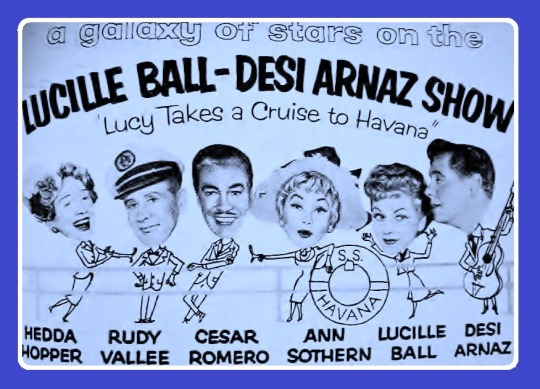
The very first episode of “The Lucy-Desi Comedy Hour” in 1957 depicted Susie MacNamara and her fellow private secretary Lucy McGillicuddy on a 1940 cruise to Havana, where Lucy meets her future husband, Ricky Ricardo! Lucy Ricardo also turned up on “The Ann Sothern Show” where Ann played Katie O’Connor. The upshot is that both Susie and Katie lived in the same world as Lucy Ricardo!

-
LOOK: FALL TV FORECAST
September 17, 1957

Look Magazine (volume 21, #19) featured the 1957 Fall TV Forecast on the cover, including a photograph of Lucille Ball, Desi Arnaz, and Richard Keith (aka Keith Thibodeaux) by Bob Vose.

At the time of publication, “I Love Lucy” had ended its half-hour format and was about to launch an hour-long show airing every other month. It would become known as “The Lucy-Desi Comedy Hour.” Fred, Ethel, and Little Ricky would be back for the new iteration, including the first one, “Lucy Takes A Cruise To Havana” (LDCH S1;E1) in November 1957.

The trio previously appeared on the cover of Look in December 1956, just ten months earlier, also photographed by Bob Vose. Vose was a regular contributor to the magazine.

The article (page 72) was titled Fall TV Forecast: New Labels…Old Ideas.

On page 52, there is question and answer column with Norman Vincent Peale. It is well known that Lucille Ball was an inveterate disciple of Peale’s and strongly believed in his philosophy of living. Lucille and Gary Morton were even married by Dr. Peale (author of the best-seller The Power of Positive Thinking) in an intimate ceremony at his Marble Collegiate Church in November 1961.
Others On The Cover:

Clint Walker and Venetia Stevenson (photo by Maurice Terrell) ~ Walker played the title character in “Cheyenne” a western then entering its third season on ABC. The series continued for seven seasons, ending in 1963. Stevenson did only one episode of the series, in October 1957. The series returned on September 24, 1957.

In 1965 Clint Walker played Frank Winslow, Lucy’s hunky boyfriend, in “Lucy and the Sleeping Beauty” (TLS S4;E9) and “Lucy and Clint Walker” (TLS S4;E24).

Alfred Hitchcock (photo by Maurice Terrell) ~ was also entering his third season on television, as host of the anthology series “Alfred Hitchcock Presents” (1955-62).

In “Lucy Meets the Mustache” (LDCH S3;E3) Lucy wants to open a sealed letter Ricky has written to his Uncle Carlos in Cuba, so she tries a inserting a knitting needle under the flap, a method she says she saw in an Alfred Hitchcock movie. The scene is underscored with “Funeral March of a Marionette” by Charles Gounod, which served as the theme tune of “Alfred Hitchcock Presents”.

Gisele MacKenzie (photo by Philip Harrington) ~ was a Canadian-American singer best known for her appearances on “Your Hit Parade.” She made her last appearance on the show ten days before this issue was published. She premiered “The Gisele MacKenzie Show” on September 28, 1957. The live show ran only one season on NBC.

In November 1952, Gisele MacKenzie and Lucille Ball were both part of “Stars in the Eye” a televised celebration of the opening of CBS Television City in Hollywood. At the time, MacKenzie was a newcomer and Ball was representing “I Love Lucy.” A year before this magazine was published, Lucy, Desi, and MacKenzie were guests on the same “Toast of the Town” with Ed Sullivan.

Perry Como (photo by Philip Harrington) – hosted a weekly hour-long variety show called “The Perry Como Show”, which premiered in September 1955. It was so popular that in the 1956-57 television season it reached ninth in the Nielsen ratings, the only show on NBC that season to land in the top ten. It was then entering its third season and would end in 1959.

In a 1972 episode of “Here’s Lucy” starring pregnant Petula Clark, Lucy insists that that the British songbird be allowed to sit during her recording session, saying that
Bing Crosby, Perry Como, and Frank Sinatra all sat down when singing! Early in his career, Como was a spokesman for Chesterfields, Lucille Ball’s favorite brand of cigarettes. The only time they were seen on the same screen was at the 1987 Kennedy Center Honors induction of Como, although Ball was there to introduce fellow honoree Sammy Davis Jr.

NEW TV – FALL 1957
- September 14 – Have Gun – Will Travel (1957-63) on CBS
- September 18 – Wagon Train (1957–65) on NBC
- September 21 – Perry Mason (1957–66) on CBS
-
September 21 –
The Polly Bergen Show (1957-58) on NBC
- September 22 – Maverick (1957–61) on ABC
- October 3 – The Pat Boone-Chevy Showroom (1957–60) on ABC
-
October 3 –
The Real McCoys (1957-63) on ABC, filmed at Desilu
- October 4 – Leave It to Beaver (1957–63) on CBS
- October 10 – Zorro (1957–59) on ABC

Click here for more Lucy, Look, Life and Time!
-
LIZ AND THE GENERAL
September 17, 1948

“Liz and the General” (aka “Making Friends with General Timberlake”) is episode #8 of the radio series MY FAVORITE HUSBAND broadcast on September 17, 1948.
Synopsis ~ Liz befriends an eccentric neighbor, General Timberlake.
Note: This episode was aired before the characters names were changed from Cugat to Cooper. It was also before Jell-O came aboard to sponsor the show and before the regular cast featured Bea Benadaret and Gale Gordon as the Atterburys.

“My Favorite Husband” was based on the novels Mr. and Mrs. Cugat, the Record of a Happy Marriage (1940) and Outside Eden (1945) by Isabel Scott Rorick, which had previously been adapted into the film Are Husbands Necessary? (1942). “My Favorite Husband” was first broadcast as a one-time special on July 5, 1948. Lucille Ball and Lee Bowman played the characters of Liz and George Cugat, and a positive response to this broadcast convinced CBS to launch “My Favorite Husband” as a series. Bowman was not available Richard Denning was cast as George. On January 7, 1949, confusion with bandleader Xavier Cugat prompted a name change to Cooper. On this same episode Jell-O became its sponsor. A total of 124 episodes of the program aired from July 23, 1948 through March 31, 1951. After about ten episodes had been written, writers Fox and Davenport departed and three new writers took over – Bob Carroll, Jr., Madelyn Pugh, and head writer/producer Jess Oppenheimer. In March 1949 Gale Gordon took over the existing role of George’s boss, Rudolph Atterbury, and Bea Benaderet was added as his wife, Iris. CBS brought “My Favorite Husband” to television in 1953, starring Joan Caulfield and Barry Nelson as Liz and George Coope. The television version ran two-and-a-half seasons, from September 1953 through December 1955, running concurrently with “I Love Lucy.” It was produced live at CBS Television City for most of its run, until switching to film for a truncated third season filmed (ironically) at Desilu and recasting Liz Cooper with Vanessa Brown.
MAIN CAST

Lucille Ball (Liz Cugat) was born on August 6, 1911 in Jamestown, New York. She began her screen career in 1933 and was known in Hollywood as ‘Queen of the B’s’ due to her many appearances in ‘B’ movies. “My Favorite Husband” eventually led to the creation of “I Love Lucy,” a television situation comedy in which she co-starred with her real-life husband, Latin bandleader Desi Arnaz. The program was phenomenally successful, allowing the couple to purchase what was once RKO Studios, re-naming it Desilu. When the show ended in 1960 (in an hour-long format known as “The Lucy-Desi Comedy Hour”) so did Lucy and Desi’s marriage. In 1962, hoping to keep Desilu financially solvent, Lucy returned to the sitcom format with “The Lucy Show,” which lasted six seasons. She followed that with a similar sitcom “Here’s Lucy” co-starring with her real-life children, Lucie and Desi Jr., as well as Gale Gordon, who had joined the cast of “The Lucy Show” during season two. Before her death in 1989, Lucy made one more attempt at a sitcom with “Life With Lucy,” also with Gordon.
Richard Denning (George Cugat) was born Louis Albert Heindrich Denninger Jr., in Poughkeepsie, New York. When he was 18 months old, his family moved to Los Angeles. Plans called for him to take over his father’s garment manufacturing business, but he developed an interest in acting. Denning enlisted in the US Navy during World War II. He is best known for his roles in various science fiction and horror films of the 1950s. Although he teamed with Lucille Ball on radio in “My Favorite Husband,” the two never acted together on screen. While “I Love Lucy” was on the air, he was seen on another CBS TV series, “Mr. & Mrs. North.” From 1968 to 1980 he played the Governor on “Hawaii 5-0″, his final role. He died in 1998 at age 84.
Bob LeMond (Announcer) also served as the announcer for the pilot episode of “I Love Lucy”. When the long-lost pilot was finally discovered in 1990, a few moments of the opening narration were damaged and lost, so LeMond – fifty years later – recreated the narration for the CBS special and subsequent DVD release.
GUEST CAST

John Hiestand (Cory Cartwright) served as the announcer for the radio show “Let George Do It” from 1946 to 1950. In 1955 he did an episode of “Our Miss Brooks” opposite Gale Gordon.

Hans Conried (General Timberlake) first co-starred with Lucille Ball in The Big Street (1942). He then appeared on “I Love Lucy” as used furniture man Dan Jenkins in “Redecorating” (ILL S2;E8) and later that same season as Percy Livermore in “Lucy Hires an English Tutor” (ILL S2;E13) – both in 1952. The following year he began an association with Disney by voicing Captain Hook in Peter Pan. On “The Lucy Show” he played Professor Gitterman in “Lucy’s Barbershop Quartet” (TLS S1;E19) and in “Lucy Plays Cleopatra” (TLS S2;E1). He was probably best known as Uncle Tonoose on “Make Room for Daddy” starring Danny Thomas, which was filmed on the Desilu lot. He joined Thomas on a season 6 episode of “Here’s Lucy” in 1973. He died in 1982 at age 64.
The actress voicing Miss Winifred Higgins, the librarian, is not credited.
THE EPISODE
ANNOUNCER: “This is the story of Mr. and Mrs. Cugat – the record of a happy marriage. As we look in on the Cugat’s this morning, the scene is familiar…”
The episode opens at breakfast, where Liz is upset that George has buried himself in the morning newspaper instead of paying attention to her.

This was a common complaint on early episodes of “I Love Lucy” as well. Ricky often didn’t lift his eyes from behind the newspaper.
Feeling sorry for herself, Liz wishes that she was a better cook.
GEORGE: “It was very smart of you to butter the toast with Unguentine so it wouldn’t burn!”

Unguentine is a commercially available topical skin ointment that helps alleviate minor burns and irritations, mostly from sunburn. It was originally introduced in 1893 and is still sold today. It will be mentioned on “I Love Lucy” when Lucy Ricardo gets a painful sunburn just before Lucy is to model a Don Loper original in “The Fashion Show” (ILL S4;E20).
Liz retorts that although she isn’t a good cook, George isn’t very handy around the house either! They call a truce and kiss and make-up. Liz warns George not to kiss her in front of the windows, lest neighbor General Timberlake see them. George lists some of the General’s eccentricities, but Liz thinks he’s sweet. George doubts he was even in the military.
Outside, randy bachelor Cory Cartwright honks his horn. He’s come to pick up George for work.
LIZ: “That car is built for parking not driving! It has reclining seats, indirect lighting, hot and cold running chorus girls… that isn’t a car, it’s a nightclub!”
Cory enters and brags about last night’s date, Daphne McCormick and shows George her photo.CORY: “Look at those lines, that color, the modern design, and all those extras too! She’s the reason Good Sam turned bad!”

Good Sam is a romantic comedy starring Gary Cooper as a Good Samaritan who is helpful to others at the expense of his own family. Coincidentally, the film featured William Frawley, who would be Lucille Ball’s co-star just three years later. It also featured Irving Bacon, who would play Frawley’s father in law on “I Love Lucy”! The RKO film was released on September 1, 1948. The term ‘Good Samaritan’ refers to a Bible Parable that encourages people to help others who are in danger or in need.
George and Cory go off to work and Liz decides to pay a visit on old General Timberlake. The General claims to have been the youngest officer at the Battle of Bull Run, but Liz says that would have been 80 years ago.

The Battle of Bull Run (the name used by Union forces), also known as The Battle of Manassas (the name used by Confederate forces), was the first major battle of the Civil War and was a Confederate victory. The battle was fought on July 21, 1861 just north of the city of Manassas, Virginia and about 30 miles west-southwest of Washington, D.C.
Liz notices some new medals on the General’s uniform and gets close enough to read one: “Jubilee Sale Sears and Roebuck” implying that he got the medal from a catalog.

Sears, Roebuck and Co., commonly known as Sears, was founded in 1893 as a mail ordering catalog company and began opening retail locations in 1925. They celebrated their 50th Jubilee in 1936.
The General confesses that he’s been ‘keeping company’ with the librarian Winifred Higgins, but they had a quarrel due to an overdue library book. Liz remembers her as the gray-haired librarian.
GENERAL: “Don’t let that gray hair fool ya, though. She may be an old edition, but she’s still got a beautiful table of contents!”
The General gets teary-eyed at his loneliness and Liz, feeling sorry for him, invites him over that afternoon for tea.
Liz tells Katie the Maid that the General is coming over. Katie says the General never remembers her.
KATIE: “The other day I was sitting in the upstairs window mending Mr. Cugat’s striped pajamas and he said ‘Well, Barbara Fritchie!’ I shouted back ‘Shoot if you must, this old gray head, but spare Mr. Cugat’s pajama bottoms’!”

Barbara Fritchie (or Frietchie) is the title (and the heroine) of an 1863 Civil War poem by John Greenleaf Whittier (1807-92). Katie is paraphrasing its most famous line, “Shoot if you must, this old gray head.”

The very last line of the “I Love Lucy” series in 1957 also paraphrased the famous quote. Lucy replaces the word “gray” with “red,” removing her tricorn hat and wig as she does so. Painted completely gray to resemble a statue, the reveal of Lucy’s flaming red locks (her trademark despite the hit series never being broadcast in color) gets a laugh from the studio audience.
Katie remember that her first husband Clarence fought on dozens of battles.
LIZ: “With Pershing?”
KATIE: “No. With me!”
General John Joseph “Black Jack” Pershing (1860-1948) was a senior United States Army officer. He served most famously as the commander of the American Forces on the Western Front in World War I. He died six weeks before this episode was aired. Millburn Stone will play Pershing in the 1955 film The Long Gray Line starring Lucy’s lifelong friend, Maureen O’Hara.
The General arrives and Liz’s offer of tea immediately launches him into a tale of his fracas at the Boston Tea Party.
LIZ: “General, the Boston Tea Party was 150 years ago. Don’t tell me you were there.”
GENERAL: “No. But it makes a colorful story, doesn’t it?”
The Boston Tea Party was a political protest in Boston, Massachusetts, on December 16, 1773. The target was the Tea Act of May 10, 1773, which allowed the British East India Company to sell tea from China in American colonies without paying taxes. Demonstrators, some disguised as Native Americans, destroyed an entire shipment of tea by dumping it into Boston Harbor.

The Boston Tea Party will be joked about on a 1964 “Jack Benny Program.” When Betsy Ross wonders where Paul is, his wife (Lucy) says that a few weeks ago he told her he was at a tea party in Boston, but she found out he was on a wild wing-ding on a boat.
The General convinces Liz to restage the Battle of San Juan Hill in the living room with Liz as Teddy Roosevelt. This is the start of a continuing theme of “My Favorite Husband”. In future, Liz will learn to swim and to play baseball without ever leaving the house – all under the tutelage of characters played by Hans Conried.

The Battle of San Juan Hill (July 1, 1898) was a major battle of the Spanish–American War (April – August 1898). Teddy Roosevelt (later President) was leader of the Rough Riders who prevailed that day.
Later, they re-enact the battle between Generals Lee and Sherman. Liz plays the outskirts of Atlanta.
LIZ: “What do you do? Get a match and set me on fire?”

During the Civil War, the city of Atlanta, Georgia, became a target for the Union army. General William Tecumseh Sherman and his troops captured the city in 1864. In order to weaken the Confederate military organization, Union troops burned Atlanta to the ground before they moved on. The act was famously depicted in the 1939 film Gone With the Wind.
Next up, the General wants Liz to take Bunker Hill (the living room lamp). He charges at the lamp, which is noisily destroyed.
LIZ: “So long, Bunker Hill.”

The Battle of Bunker Hill was fought on June 17, 1775, during the early stages of the Revolutionary War. The battle is named after Bunker Hill in Charlestown, Massachusetts, which was peripherally involved in the battle. Liz’s sentiment “So long, Bunker Hill” may be referring to the USS Bunker Hill, a battleship that survived a kamikaze attack during World War II and was finally decommissioned in 1947, just 18 months prior to this broadcast.
LIZ: “My troop is pooped!”
Liz decides to re-enact the Ride of Paul Revere with Katie as the North Church and the General charging right out the front door.
 Paul Revere (1734 -1818) was an American silversmith, engraver, and Patriot in the American Revolution. He is best known for his midnight ride to alert the colonial militia in April 1775 to the approach of British forces before the battles of Lexington and Concord, as dramatized in Henry Wadsworth Longfellow’s poem, “Paul Revere’s Ride” (1861).
Lucy and Jack Benny play Paul and Rachel Revere on a 1964 “Jack Benny Program.” When Paul gets word that the British are coming, he tries to sneak out without Rachel knowing. To keep him home, Rachel knocks him out cold. She then realizes he is telling the truth. She has no choice but to make his famous ride for him. Paul revives just as Rachel goes off shouting “The British are coming! The British are coming!”
LIZ: “If he comes back, tell him Molly Pitcher deserted.”

Molly Pitcher is a nickname given to a woman said to have fought in the Revolutionary War. Many historians now regard “Molly Pitcher” as folklore rather than history, or suggest that Molly Pitcher may be a composite image inspired by the actions of a number of real women. The name itself may have originated as a nickname given to women who carried water to men on the battlefield during War.
That evening George comes home from work and notices Liz is lethargic.
LIZ: “I’m so tired I can barely move my rear echelon.”
The couple smooch – first as Atlanta, then as the entire South.GEORGE: “Sit on my lap, Scarlet O’Hara!”

George compares Liz to the heroine of the book and film Gone With The Wind. Coincidentally, when the 1939 film was being cast, Lucille Ball would actually be considered for the role. It eventually went to Vivian Leigh. Ball subsequently played the role in September 1971, during a sketch on “Lucy and Flip Go Legit” (HL S4;E1).
The General phones to invite Liz to go to the museum with him tomorrow. She volunteers George to go along! If they don’t go, the General wants to reenact the burning of Rome, with George as Nero!

The Great Fire of Rome occurred in July, 64 AD. In the aftermath of the fire, two thirds of Rome had been destroyed. Emperor Nero blamed the devastation on the Christian community in the city, initiating the empire’s first persecution against the Christians. Legend has it that Nero fiddled while Rome burned.
After their exhausting day at the museum and target practice in the backyard, Liz and George reconnoiter to plan their next move. Liz decides that the only way to pre-occupy the General is to patch up his romances with Librarian Winifred Higgins. She contrives to invite them both to dinner.
GEORGE: “Give them one ear of corn between them, and they’re bound to get together.”
The dinner doesn’t go well. The two barely talk to one another, despite Liz’s best efforts. Conversation is at a standstill. Winifred is still angry because The General tends to leave food in his library books.
WINIFRED: “How does it look when you open a history book and find the Pilgrims setting foot on a piece of salami?”
Rather than talk to Winifred, the General would much prefer to spend time with Liz. Miss Higgins leaves in tears.
Later, The General drops by to tell the Cugats that he’s patched up with Miss Higgins. He confesses, that his attentions to Liz were all to make Miss Higgins jealous.
A final tag has Liz and George in bed wondering which of them will get up and open the window. George gives in, but the window is stuck. George sees a burglar in striped pajamas trying to get in!
LIZ: “George, you’re trying to raise the mirror!”
The couple kiss goodnight.

Although this installment has no direct corollary to the television series “I Love Lucy,” there are similarities to
“Lucy Plays Cupid” (ILL S1;E15).
The General is similar to Mr. Ritter and Miss Higgins similar to Miss Lewis, with Liz / Lucy trying to get the couple together.
1948, Barbara Fritchie, Battle of Bunker Hill, Battle of San Juan Hill, Bob LeMond, Boston Tea Party, Bull Run, Burning of Rome, Gone With The Wind, Good Sam, Hans Conried, I love lucy, Jack Benny, Lucille Ball, Molly Pitcher, My Favorite Husband, Radio, Revolutionary War, Richard Denning, Sears Catalog, The Long Gray Line, Unguentine -
THE BANK OUTING BASEBALL GAME
September 16, 1949

“The Bank Outing Baseball Game” (aka “Baseball”) is episode #54 of the radio series MY FAVORITE HUSBAND broadcast on September 16, 1949.
This was the third episode of the second season of MY FAVORITE HUSBAND. There were 43 new episodes, with the season ending on June 25, 1950.

The date this episode first aired, a Gallup Poll listed Bob Hope as America’s most popular comedian. Milton Berle finished second while Jack Benny, Red Skelton and Fibber McGee and Molly rounded out the top five. Coincidentally, a few years before this episode aired, Hope had become partial owner of the Cleveland Indians baseball team.
Synopsis ~ Liz is determined not to be left out of the baseball game at the Annual Bank Outing, so she persuades her neighbor Mr. Wood to teach her how to play the game.

“My Favorite Husband” was based on the novels Mr. and Mrs. Cugat, the Record of a Happy Marriage (1940) and Outside Eden (1945) by Isabel Scott Rorick, which had previously been adapted into the film Are Husbands Necessary? (1942). “My Favorite Husband” was first broadcast as a one-time special on July 5, 1948. Lucille Ball and Lee Bowman played the characters of Liz and George Cugat, and a positive response to this broadcast convinced CBS to launch “My Favorite Husband” as a series. Bowman was not available Richard Denning was cast as George. On January 7, 1949, confusion with bandleader Xavier Cugat prompted a name change to Cooper. On this same episode Jell-O became its sponsor. A total of 124 episodes of the program aired from July 23, 1948 through March 31, 1951. After about ten episodes had been written, writers Fox and Davenport departed and three new writers took over – Bob Carroll, Jr., Madelyn Pugh, and head writer/producer Jess Oppenheimer. In March 1949 Gale Gordon took over the existing role of George’s boss, Rudolph Atterbury, and Bea Benaderet was added as his wife, Iris. CBS brought “My Favorite Husband” to television in 1953, starring Joan Caulfield and Barry Nelson as Liz and George Coope. The television version ran two-and-a-half seasons, from September 1953 through December 1955, running concurrently with “I Love Lucy.” It was produced live at CBS Television City for most of its run, until switching to film for a truncated third season filmed (ironically) at Desilu and recasting Liz Cooper with Vanessa Brown.
MAIN CAST

Lucille Ball (Liz Cooper) was born on August 6, 1911 in Jamestown, New York. She began her screen career in 1933 and was known in Hollywood as ‘Queen of the B’s’ due to her many appearances in ‘B’ movies. With Richard Denning, she starred in a radio program titled “My Favorite Husband” which eventually led to the creation of “I Love Lucy,” a television situation comedy in which she co-starred with her real-life husband, Latin bandleader Desi Arnaz. The program was phenomenally successful, allowing the couple to purchase what was once RKO Studios, re-naming it Desilu. When the show ended in 1960 (in an hour-long format known as “The Lucy-Desi Comedy Hour”) so did Lucy and Desi’s marriage. In 1962, hoping to keep Desilu financially solvent, Lucy returned to the sitcom format with “The Lucy Show,” which lasted six seasons. She followed that with a similar sitcom “Here’s Lucy” co-starring with her real-life children, Lucie and Desi Jr., as well as Gale Gordon, who had joined the cast of “The Lucy Show” during season two. Before her death in 1989, Lucy made one more attempt at a sitcom with “Life With Lucy,” also with Gordon.
Richard Denning (George Cooper) was born Louis Albert Heindrich Denninger Jr., in Poughkeepsie, New York. When he was 18 months old, his family moved to Los Angeles. Plans called for him to take over his father’s garment manufacturing business, but he developed an interest in acting. Denning enlisted in the US Navy during World War II. He is best known for his roles in various science fiction and horror films of the 1950s. Although he teamed with Lucille Ball on radio in “My Favorite Husband,” the two never acted together on screen. While “I Love Lucy” was on the air, he was seen on another CBS TV series, “Mr. & Mrs. North.” From 1968 to 1980 he played the Governor on “Hawaii 5-0″, his final role. He died in 1998 at age 84.
Bea Benadaret (Iris Atterbury) was considered the front-runner to be cast as Ethel Mertz but when “I Love Lucy” was ready to start production she was already playing a similar role on TV’s “The George Burns and Gracie Allen Show” so Vivian Vance was cast instead. On “I Love Lucy” she was cast as Lucy Ricarodo’s spinster neighbor, Miss Lewis, in “Lucy Plays Cupid” (ILL S1;E15) in early 1952. Later, she was a success in her own show, “Petticoat Junction” as Shady Rest Hotel proprietress Kate Bradley. She starred in the series until her death in 1968.
Gale Gordon (Rudolph aka Rudy Atterbury) had worked with Lucille Ball on “The Wonder Show” on radio in 1938. One of the front-runners to play Fred Mertz on “I Love Lucy,” he eventually played Alvin Littlefield, owner of the Tropicana, during two episodes in 1952. After playing a Judge in an episode of “The Lucy-Desi Comedy Hour” in 1958, he would re-team with Lucy for all of her subsequent series’: as Theodore J. Mooney in ”The Lucy Show”; as Harrison Otis Carter in “Here’s Lucy”; and as Curtis McGibbon on "Life with Lucy.” Gordon died in 1995 at the age of 89.
Ruth Perrott (Katie, the Maid) was also later seen on “I Love Lucy.” She first played Mrs. Pomerantz, a member of the surprise investigating committee for the Society Matrons League in “Pioneer Women” (ILL S1;E25), as one of the member of the Wednesday Afternoon Fine Arts League in “Lucy and Ethel Buy the Same Dress” (ILL S3;E3), and also played a nurse when “Lucy Goes to the Hospital” (ILL S2;E16). She died in 1996 at the age of 96.
Bob LeMond (Announcer) also served as the announcer for the pilot episode of “I Love Lucy”. When the long-lost pilot was finally discovered in 1990, a few moments of the opening narration were damaged and lost, so LeMond – fifty years later – recreated the narration for the CBS special and subsequent DVD release.
GUEST CAST

Hans Conried (Mr. Benjamin Wood) first co-starred with Lucille Ball in The Big Street (1942). He then appeared on “I Love Lucy” as used furniture man Dan Jenkins in “Redecorating” (ILL S2;E8) and later that same season as Percy Livermore in “Lucy Hires an English Tutor” (ILL S2;E13) – both in 1952. The following year he began an association with Disney by voicing Captain Hook in Peter Pan. On “The Lucy Show” he played Professor Gitterman in “Lucy’s Barbershop Quartet” (TLS S1;E19) and in “Lucy Plays Cleopatra” (TLS S2;E1). He was probably best known as Uncle Tonoose on “Make Room for Daddy” starring Danny Thomas, which was filmed on the Desilu lot. He joined Thomas on a season 6 episode of “Here’s Lucy” in 1973. He died in 1982 at age 64.
Although his first name is not mentioned here, it will be in future episodes.
THE EPISODE
ANNOUNCER: “Come with us to the quiet little town of Sheridan Falls and let’s look into the brown house at 321 Bundy Drive where the Coopers live. They’re entertaining George’s boss, Mr. Atterbury, and his wife. And the subject under discussion is the forthcoming annual bank outing.”
The episode opens with Liz and Iris discussing what to wear to the bank outing. George disapproves of Liz’s new play suit.
LIZ: “George thinks it’s too daring. He says there’s too much play and not enough suit.”
It is typical for George to disapprove of Liz’s revealing wardrobe choices, although the conversation generally revolves around swimwear. Iris wonders if she should wear her new blue slacks.RUDY: “Why do they call them slacks? I’ve never seen any in them.”
George and Rudolph imitate the girls by feminizing their own wardrobe predicament, another comedic tact the boys have done before. George and Rudolph reveal that they have been named team captains. Iris says she’ll get a bottle of Absorbine Junior.
Absorbine Jr. is a fast absorbing, deep penetrating topical pain reliever. It provides relief from sore muscles and cramps as well as athlete’s foot. The Absorbine company was established in 1892 as a lineament for horses. A version for humans (Absorbine Jr.) was introduced in 1903 and is still sold today.
Rudolph and George tell their wives that they won’t be playing at all, because the teams are comprised of husbands and wives, and they have no confidence in them on the baseball diamond. The girls beg to be allowed to play, despite knowing nothing about the game.
RUDOLPH: “Forget it, DiMaggio.”

Joe DiMaggio (1914-99) was a professional baseball player who played his entire career for the New York Yankees. He was nicknamed “Joltin’ Joe” and “The Yankee Clipper” for his batting skill. The summer of 1949 was when DiMaggio shined the brightest. He batted .381 against the Red Sox that year, with six homers through 13 games.The Yanks would eventually win the World Series in 1949, the first of a record five straight.

Joe DiMaggio was mentioned on “I Love Lucy” in “Lucy is Enceinte” (ILL S2;E10), Fred gives Lucy a signed baseball for his future ‘godson’. When he asks Lucy to read out the signature, she at first says “Spalding,” the ball’s brand name, but then finds it is signed by Joe DiMaggio.
In “Ragtime Band” (ILL S6;E21), Little Ricky asks Fred, “Who’s Joe ‘Maggio?”George rhapsodizes about his college baseball career, telling a story they’ve all heard before.
GEORGE: “There’s a certain group of spectators who will never forget the afternoon of August 25, 1933.”
This date was actually Lucille Ball’s 22nd birthday. 1933 was Ball’s first year in Hollywood, and the year her first four films were released.
After George does a dramatic play-by-play of his big college game victory, Liz says:
LIZ: “Thank you, Ted Husing.”

Edward ‘Ted’ Husing (1901-62) was among the first to lay the groundwork of sports reporting on television and radio. In 1946, Husing left CBS sports to pursue a career as a disk jockey and was succeeded by Red Barber. “The Ted Husing Bandstand” ran from 1946 to 1954.
The scene ends with the wives begging to play, and the boys uniformly shouting “no”! That night in bed, Liz wakens in tears about being left out of the baseball game, feeling she is being left out.
Next day, Liz tells Katie the Maid she’s decided to learn how to play baseball. Iris drops by with books about how to play baseball. Katie reads out the rules. The doorbell rings. It is the Cooper’s neighbor, Mr. Wood (Hans Conried), who is lonesome, despite having eleven children. He volunteers to teach the girls baseball. After all, he saw a World Series game once. He mentions Babe Ruth.

George Herman ”Babe“ Ruth Jr. (1895-1948) was a professional baseball player whose career spanned 22 seasons, from 1914 through 1935. Nicknamed "The Bambino” and “The Sultan of Swat”, he began his career as a pitcher for the Boston Red Sox, but achieved his greatest fame playing with the New York Yankees.

Ruth was mentioned on a 1963 episode of “The Lucy Show” when Lucy and Viv’s sons join Little League. [Desi Arnaz Jr. played billy Simmons in the show, and Ball posed for this publicity still with her son.]

It is here that the episode starts to vaguely resemble “The Golf Game” (ILL S3;E30) in 1954. In it, Lucy and Ethel decide they want to play golf with their husbands, despite the boys saying they known nothing about the game. In fact, they don’t, so they fall for whatever ridiculous rules the boys make-up. Coincidentally, this sport-themed episode was filmed on Hans Conried’s 37th birthday. The Little League-themed “Lucy Show” mentioned above was first aired on Conried’s 45th birthday!
Using the living room as their baseball diamond and sofa cushions as bases, Mr. Wood attempts to teach the girls the finer points of baseball.

In “Lucy and the Winter Sports” (TLS S3;E3) in 1964, Mr. Mooney attempts to teach Mrs. Carmichael how to ski without ever leaving the living room. Needless to say, the results are equally disastrous.

This is not the last time Mr. Wood (played by Hans Conried) will teach Liz an outdoor sport in her own living room. In June 1950 Conried returns to the series to play Mr. Wood, who teaches Liz to swim – without ever getting wet!
Mr. Wood’s frantic lesson turns into a loosely familiar version of the famous “Who’s On First” comedy routine perfected by Bud Abbott and Lou Costello.
LIZ: “Who’s on third?”
MR. WOOD: “Abbott and Costello!”
Although the routine had been around in different forms since vaudeville, Abbott and Costello first put their baseball spin on the routine in 1938. In 1999, Time Magazine named the routine Best Comedy Sketch of the 20th Century. In 1945, Lucille Ball played herself in their movie Abbott and Costello in Hollywood.
Mr. Wood gives up on his coaching, but Liz reveals that she’s already signed them up for the game!

A bank outing will also be the subject of “Lucy and Clint Walker” (TLS S2;E24) in 1966. Lucy and Clint win the balloon race, but baseball is not on the agenda.
The day of the Bank Outing, Liz and Iris are enjoying hot dogs. Iris orders a second hot dog with pickle, mustard, chili sauce, ketchup, lettuce, butter, salt, pepper, and a dash of horseradish!
RUDY: “Iris, at least give the hot dog a fighting chance.”

Iris’s voracious appetite is a character trait that was later ascribed to Ethel Mertz. Baseball and hot dogs are classic Americana. The two were combined when Lucy Ricardo pretends to be a hot dog vendor to get a message to Bob Hope at Yankee Stadium in the “I Love Lucy” season six opener.
George has worn his old college baseball uniform. Mr. Wood is acting as umpire. George’s strategy is to keep Liz on the bench till the team gets in a tight spot.
RUDY: “Iris is up first. Has anyone seen the old bat? Oh, there it is on the ground.”
Miraculously, Iris hits a ball out of the park! Shocked, she doesn’t run the bases.
Later, the score is ten to nothing with the Cooper side down but when the score quickly ties and Liz is still on the bench. At batting practice, George accidentally hits himself in the head with a bat! George passes out and Liz is up at bat! Liz starts out facing the catcher! With two strikes, Liz hits the ball!
Later, George revives and Liz tells him that they won by one run – made by her! Rudy reveals that they won by default when Liz got hit by the ball, forcing the runner at third to walk home and win the game!
MORE BALL AT BAT!

In addition to the episodes cited above, Lucille Ball also suited up in 1963′s “Lucy and Viv Play Softball” (TLS S2;E3).

Lucy Carmichael’s son got to meet Jimmy Pearsall of the Los Angeles Angels in the very first episode of “The Lucy Show” to take place in California.

In real life, Lucille Ball batted for Wildcat on the Broadway Show League in 1961. Julie Andrews of Camelot was catcher, and Joe E. Brown was umpire!

The year before this episode of “My Favorite Husband” aired (1948), the great Babe Ruth signed a game-used baseball that was then also signed by Lucille Ball and Rod Carew.

Batting practice for Kathleen (Lucille Ball) in The Dark Corner (1946).

Putting her Best Foot Forward for a pitch in 1943.

Like mother, like daughter! In 2011, the New York Yankees invited Lucie Arnaz to throw out the first pitch to mark Latin Heritage Month.
Abbott and Costello, Absorbine Junior, Babe Ruth, Baseball, Bea Benadaret, Best Foot Forward, Bob Hope, Bob LeMond, Clint Walker, Desi Arnaz, Desi Arnaz Jr., Gale Gordon, Hans Conried, I love lucy, Joe DiMaggio, Lucie Arnaz, Lucille Ball, My Favorite Husband, Picnic, Richard Denning, Ruth Perrott, Softball, Ted Husing, The Dark Corner, The Lucy Show -
LAWRENCE DOBKIN
September 16, 1919

Lawrence ‘Larry’ Dobkin was born in New York City and went on to become a successful character actor and director with a career spanning seven decades.

Dobkin was a popular performer during the Golden Age of Radio. His voice was used to narrate the classic western “Broken Arrow” (1950). He was one of five actors who played detective Ellery Queen in “The Adventures of Ellery Queen.” In “The New Adventures of Nero Wolfe” (1950–51), Dobkin played detective Archie Goodwin opposite Sydney Greenstreet.
“The few of us who are left…” Dobkin later said of his radio days, “…keep telling each other that we never had it so good.”

He started screen acting in 1946 with Best Picture winner The Best Years of Our Lives.

From 1960 to 1985, Dobkin was a busy TV director. He directed episodes of Desilu series’ (or series’ filmed at Desilu) such as “Star Trek,” “The Real McCoys,” “My Living Doll,” and “The Andy Griffith Show.”
His film performances include Never Fear (1949), Sweet Smell of Success (1957) and North by Northwest (1959).
Dobkin was recognizable for his bald head, so he wore hats in two of his three appearances on “I Love Lucy.” Oddly, he was not cast in “Ricky Thinks He’s Getting Bald” (ILL S1;E34)!

MAX: “Just caught this dame with her hand in the till!”
Dobkin first played Max, the diner counter man in “Ricky and Fred Are TV Fans” (ILL S2;E30) in 1953. When Lucy needs change for the payphone, she helps herself to the cash register while Max and the policeman are glued to the boxing match on the diner’s TV. Busted!

In “Equal Rights” (ILL S3;E4) Dobkin played Xavier, who is either the maitre’ d or headwaiter of the unnamed restaurant where the Ricardos and Mertzes dine. It is unclear if Xavier is his real name, or if Desi is just ad-libbing based on the first name of his former employer Xavier Cugat. Ricky bribes (tips?) Xavier to make Lucy and Ethel wash dishes to pay for their meals, a common TV and movie trope of the time.

XAVIER: “What are you trying to do? Skip out without paying?”
Although this is an Italian Restaurant, Dobkin does not attempt an Italian accent. The part might have been better cast with Louis Nicoletti, one of the show’s regular Italian-American performers, who plays a policeman in the episodes final scene.

Also in 1953, Dobkin did an episode of “Our Miss Brooks” starring Gale Gordon. The series was filmed by Desilu Studios.

COUNTERFEITER: “As you Americans say: No Overhead!”
His third and final appearance on “I Love Lucy” was as a counterfeiter in “Paris at Last” (ILL S5;E18), where he does show of an accent. His shady transaction outside the American Express office gets Lucy into a pile of merde!

In early 1957, he guest starred on Desilu’s “Whirlybirds” and “The Danny Thomas Show” featuring Mary Wickes.

Although he was never seen, he was part of television history from 1960 to 1963. Preceding the closing credits of each episode of the landmark ABC television network series “Naked City”, he could heard saying "There are eight million stories in the naked city, and this has been one of them.“

In April 1959, he did a day on Desilu’s “The Ann Sothern Show.”
In November, Lucille Ball played Lucy Ricardo on the series’ season two premiere.

In 1959 and 1960, Dobkin did two episodes of the anthology series “The Westinghoue-Desilu Playhouse” introduced by Desi Arnaz, who also acted as Executive Producer.

A series that grew out of “Westinghouse-Desilu Playhouse” was “The Untouchables.” Wearing a toupee, Dobkin played Dutch Schultz on three episodes of the series in 1959/60.

Dobkin was nominated for an 1968 Emmy
for playing Dr. Gettlinger in "Do Not Go Gentle Into That Goodnight,” an episode of “CBS Playhouse”.

A 1998 live recreation of “My Favorite Husband”, billed as "Lucy’s First Sitcom: A 50th Anniversary Reunion,” featured Dobkin and “I Love Lucy” veterans Doris Singleton, Shirley Mitchell, Janet Waldo, Peggy Rea, and Roz and Marilyn Borden. Suzanne LaRusch play Liz Cooper and Dwayne Hickman (TV’s Dobie Gillis) played her favorite husband George.

He recorded excerpts from “Laughs, Luck.. and Lucy” by Jess Oppenheimer for the “I Love Lucy" DVD release.
He had one daughter, Debra Dobkin, by his first wife, Frances Hope Walker.

In 1962, he married actress Joanna Barnes (above); they had no children. Dobkin married actress Anne Collings in 1970 and had two children.

On October 28, 2002, Dobkin died of heart failure at his home in Los Angeles. He was 83 years old.
-
PHIL ARNOLD
September 15, 1909

Philip Arnold was a prolific character actor born on September 15, 1909 in Hackensack, New Jersey. He appeared in approximately 200 films and television shows between 1938 and 1968 – in bit parts most of the time.

Perhaps most famously, Arnold was a regular in the “Three Stooges” movies doing six films with them between 1947 and 1963. Lucille Ball also worked with the Stooges in a 1934 film, but later said “the only thing I learned from them is when to duck!”

His third TV appearance was on “I Love Lucy,” but his first was a November 1951 episode of the crime series “Boston Blackie” followed by an appearance as the milkman on a 1952 episode of “Life With Elizabeth” in 1952.

LUCY: “It looks like my hunk has shrunk!”
Phil Arnold was first seen on “Lucy” as fur salon owner Mr. Henderson at the end of “Lucy Changes Her Mind” (ILL S2;E21). At first sight, Lucy thinks that he is her long-lost beau, Tom Henderson, but he turns out to be Tom’s brother, Harry. When Lucy discovers her error, she gives out her famous spider face: “Ewww!”

MAN: “Oh, girls! I’m down in 914. If Eddie won’t let you in, I will!”
In “Lucy is a Matchmaker” (ILL S2;E27), Arnold plays a man in a hotel corridor who encounters Lucy and Ethel banging on Eddie Grant’s door. The passing man pauses just long enough to invite them to HIS room, intimating that he thinks Lucy and Ethel might be ‘working girls’ or (at the very least) dangling the idea of a menage au trois! This was quite a risque gag in a show that already featured marital infidelity as its core plot.

Both “Lucy” episodes were directed by William Asher, who no doubt also had something to do with Arnold being cast in another series he directed, “Make Room for Daddy” (aka “The Danny Thomas Show”). He made four appearances on the series (all as different characters) from 1953 to 1964 – from the first season to the last. Asher cast Arnold again on a 1965 episode of “Bewitched”. In 1967, Arnold appeared as Smokey Bear on an episode of “The New Danny Thomas Show” which also featured his “Three Stooges” colleague Joe Besser.

In November 1959, Arnold was once again employed by Desilu for an episode of “The Ann Sothern Show” with Executive Producer Desi Arnaz. A month earlier, Lucille Ball played Lucy Ricardo on the series’ season two premiere.

In 1962, he did an episode of “Pete and Gladys”, a sequel to Desilu’s popular sitcom “December Bride”. It was written by “I Love Lucy” alumni Schiller and Weiskopf and directed by “Lucy’s” James V. Kern. Frequent “Lucy” background player Alberto Morin was also in the cast.

Also that year, Arnold did the first of his two appearances on “The Dick Van Dyke Show”, also filmed on the Desilu lot. The second episode aired in 1963, the same year that…

…Arnold was seen as a Deputy Sheriff in “The Real McCoys” with Richard Crenna, Charles Lane, and J. Pat O’Malley. The series was filmed at Desilu Studios and moved from ABC to CBS for its final season.

In 1965, he did a guest appearance on the short-lived series “My Living Doll” starring Julie Newmar and filmed at Desilu Studios.

The last time Phil Arnold and Lucille Ball appeared on the same program (but not in the same scene) was the 1966 Bob Hope special “15 of My Leading Ladies" or “Richard Burton Eat Your Heart Out”. Arnold plays a newsstand owner in a scene with Swedish film star Signe Hasso.

Ball turns up later as herself in a subsequent sketch about being cast in Hope’s re-make of Gone With The Wind.

Gomer Pyle (Jim Nabors) made a cameo appearances on “The Lucy Show” (TLS S5;E9) in which Lucy Carmichael is drafted!
A year later, Arnold once again played a news agent, back on the Desilu lot for the first of his three appearances on “Gomer Pyle USMC.”

Nabors also played Gomer Pyle on the only episode of “The Andy Griffith Show” featuring Phil Arnold in 1963. The show was filmed on the Desilu backlot.

Phil Arnold died in May 1968 of a heart attack, age 58. His final two films, The Shakiest Gun in the West starring Don Knotts and Skidoo starring Jackie Gleason, were both released posthumously.
 Bob Hope, Boston Blackie, Desilu, Dick Van Dyke, don knotts, Gomer Pyle USMC, I love lucy, Jackie Gleason, Jim Nabors, Julie Newmar, Life With Elizabeth, Lucille Ball, My Living Doll, Pete and Gladys, Phil Arnold, Shakiest Gun in the West, skidoo, The Andy Griffith Show, The Ann Sothern Show, The Dick Van Dyke Show, The Real McCoys, tv, Vivian Vance
 -
HOOSIER ‘DANCE’ GIRLS: MISS HARA & MISS O’BALL
September 14, 1940

On September 14, 1940, Lucille Ball and Maureen O’Hara reached the end of their whirlwind press tour to promote their new RKO film Dance, Girl, Dance.
Ball and O’Hara made four personal appearances between screenings of the film, introduced by local radio star Roy Brandt of WFBM.

On September 1, 1940, The Indianapolis Sunday Star is already reporting the possibility of Ball and O’Hara appearing live at the Circle.

Before arriving in Indianapolis, the final stop on their tour, the pair were in Washington DC, and posted for this photograph. Lucille and Maureen became inseparable while shooting this film, and remained lifelong friends until Ball’s death in 1989. O’Hara was having lunch with Lucy during the filming (June 1940) when Ball first saw her future husband Desi Arnaz. On November 30, 1940, the couple were married in Connecticut.

The film had premiered two weeks earlier, August 30, 1940. It was directed by one of Hollywood’s only female directors, Dorothy Arzner (above), who was also a lesbian. The film employed a young film editor named Robert Wise, who would go on to direct the iconic films West Side Story (1961) and The Sound of Music in 1965. Gowns were credited to Edward Stevenson, who would do wardrobe design on all Lucille Ball’s sitcoms.

The film opened in Indianapolis, Indiana at the Circle Theatre. The theatre was given its name because it is on Monument Circle. It was built in 1916 as a “deluxe movie palace.” In 1984, after extensive renovation, it reopened as home to the Indianapolis Symphony Orchestra. In December 1996, it was renamed the Hilbert Circle Theatre after being endowed by philanthropist Stephen Hilbert. The theatre holds 1,660 seats and is home to a Wurlitzer theatre organ.

“[They] will sing, dance and do dramatic bits during their four appearances.” ~ Indianapolis News, September 14, 1940
In 1940, Lucille Ball was still claiming Butte, Montana, as her birthplace. She felt it was more exotic than Jamestown, New York.

“Miss Ball has a joyous spirit that frequently breaks out into deep-throated, hearty laughter.” ~ Indianapolis News, September 14, 1940

This article notes that Lucy continued on to Chicago to meet up with the cast of George Abbott’s Too Many Girls. This was undoubtedly to meet Desi Arnaz, who she met while shooting the RKO film version back in Hollywood. In 1940, the stage version was still touring and a hit Chicago’s Grand Opera House. A romantic rendezvous was doubtless planned.

~ Louella Parson, September 25, 1940

The article also states that Lucille will do a film with Charles Laughton titled Mr. Pinky. No such film was ever made and Ball and Laughton never acted together, although she did work several times with his wife, Elsa Lanchester. In real life, Mr. Pinky was the name of Charles Laughton’s cat! It is possible that this project refers to the film Brighton Rock (1947), which was based on a 1938 novel and a 1940 West End play about a young mobster named Pinkie Brown. The article notes that Laughton will soon be in Chicago doing his famous readings of the Gettysburg Address and the 23rd Psalm.


O’Hara states that she “has a grudge against Hitler.” World War II was in full force and travel restrictions prevented O’Hara from visiting her native Ireland. The darkest days of the London blitz dominated the headlines worldwide.

~ Philadelphia Enquirer, August 19, 1940

The article also references Ball’s beginning to film the (yet untitled) Harold Lloyd film. The famous silent film comic was a great influence on Ball. He became a film producer and the movie was eventually titled A Girl, a Guy, and a Gob (1941). Lucy was the “Girl”, George O’Brien was the “Guy” and George Murphy played the “Gob” (a slang word for sailor).

The Indianapolis papers reviewed the film, describing Lucille Ball as “pert and mercenary”.

At the Circle, Dance, Girl, Dance was a double feature with Flowing Gold, a 1940 Warner Brothers release starring John Garfield, Frances Farmer and Pat O’Brien.

At a previous stop on the tour in Chicago on September 8, the film was on a double feature with Men Against The Sky, a 1940 RKO action / adventure film.

The film featured Donald Briggs, who would play the recurring character of Eddie Collins (Viv’s boyfriend) on season one of “The Lucy Show.”

On September 5, the pair met Cincinnati, Ohio, Mayor James Garfield Stewart, in advance of their appearance at the Palace Theatre.
-
RETA SHAW
September 13, 1912

Reta M. Shaw was born in South Paris, Maine, on September 13, 1912. Her father was an orchestra leader. Shaw’s younger sister was actress Marguerite Shaw. The daughter and granddaughter of women who believed in spiritualism, Shaw reportedly once told a newspaper interviewer that she had been “brought up on a ouija board." She was a graduate of the Leland Powers School of the Theater in Boston, Massachusetts.

Shaw’s first credited appearance on the Broadway stage was in 1947’s It Takes Two. She appeared in as Mabel in the original production of The Pajama Game in 1954 (above), recreating her role in the 1957 film, as well the Broadway production of Picnic, which she also did on film in 1955.

She is probably best known for her role as housekeeper Mrs. Brill in the blockbuster Disney classic Mary Poppins (1964).

Shaw made her TV debut with an episode of the anthology series “Armstrong Circle Theatre” in December 1952.

In 1958, Shaw was hired by Desilu to play the recurring role of Flora McCauly on “The Ann Sothern Show”. Shaw did eight episodes in 1958 and 1959. Desi Arnaz was the Executive Producer and Lucille Ball guest-starred on the series as Lucy Ricardo in 1959. Shaw would later perform opposite Ann Sothern on “The Lucy Show”.

In October 1961, Shaw did a guest spot on “Pete and Gladys” a spin-off of Desilu’s “December Bride.” Coincidentally, she shared the screen with Gale Gordon as Uncle Paul.

Also in 1961, Shaw returned to Desilu’s “The Real McCoys” a series she first did in 1957. The show featured Richard Crenna, who played Arthur Morton in “The Young Fans” (ILL S1;E20) and was a regular on “Our Miss Brooks.”

Shaw first collaborated with Lucille Ball in 1962 with “Lucy Misplaces $2,000″ (TLS S1;E4). Shaw played a girthy grandma attending a carnival with her granddaughter.

Shaw (whose character is un-named) also happens to be sitting on one of Lucy’s lost $500 bills! Shaw’s imposing frame was definitely a factor in her casting. This was her first encounter with Lucy, but not her last.

In December 1962, Shaw was back on the Desilu lot to play Big Maude Tyler, an escaped convict on “The Andy Griffith Show.” The role was quite a departure for Shaw. Two years later Shaw was back in Mayberry as Eleanora Poltice, a character more in keeping with Shaw’s usual casting.

Also in 1962, Shaw made her first appearance on “My Three Sons” (filmed on the Desilu lot) opposite William Frawley as Bub. The next time she did the show was the vert first appearance of William Demarest as Uncle Charley.

Shaw was back on “The Lucy Show” (with Byron Foulger as her henpecked husband) as Dora Dunbar in “My Fair Lucy” (TLS S3;E20), a parody of the blockbuster film My Fair Lady. Coincidentally, in 1964 Reta Shaw starred in another blockbuster, Oscar-nominated film musical, Mary Poppins.

A good sport, Shaw ends the episode with a glass of punch poured down her dress by the Countess (played by her former co-star Ann Sothern) and a rebellion by her husband Fred! “Oh, shut up, Doris!” Once again cast for her size, The Countess calls Dora “fat lady”.

In December 1965 Shaw did a single episode of “The Dick Van Dyke Show” (filmed on the Desilu lot). Coincidentally, she shared the episode with Jerry Hausner, who played Jerry the Agent on “I Love Lucy.”

Shaw makes a third appearance on "The Lucy Show” when “Lucy Goes To A Hollywood Premiere” (TLS S4;E20) in 1966. Shaw plays Mrs. Foley, a neighbor of Lucy’s about to move back to Iowa and give up her lucrative stand selling maps to the star’s homes, a job she’s had for 15 years. Lucy takes over and makes a terrible mess of things.

In 1967, Shaw was reunited with Byron Foulger, who played her henpecked husband Fred on “My Fair Lucy,” for an episode of the short-lived “The Danny Thomas Hour” filmed at Desilu Studios.

On “Here’s Lucy,” Shaw first played Mabel Ryker in “Lucy, the Process Server” (HL S1;E3). Here Shaw uses the same first name she had in The Pajama Game on stage and screen, Mabel. Shaw was also cast in one of the new series’ first few episodes, just like she was on “The Lucy Show.”

Mrs. Ryker is the elusive woman to whom Lucy must serve her first summons. This episode was seen just two days after the third episode of…

“The Ghost and Mrs. Muir” starring Shaw as housekeeper Martha Grant. The show (based on the film of the same name) ran for two seasons on NBC, from 1968 to 1970. Although unrelated to Lucy or Desilu, Shaw performed alongside many “Lucy” cast members.

Another non-Desilu show on which Shaw often appeared was “Bewitched”. She did a total of four appearances over the entire run of the sitcom: in 1964 and 1965 as Bertha, and in 1966 and 1972 as Aunt Hagatha. All but one episode was directed by former “I Love Lucy” director William Asher. In one episode she appeared opposite Madge Blake (above) who did two episodes of “I Love Lucy” and one of “The Lucy Show.”

In “Lucy and the Group Encounter” (HL S5;E14) in 1972, Shaw played Rita Forrester,
the owner of Forrester Publications, a client of Carter’s Unique Employment Agency. The name was actually a form of her real-life married name, Reta Forester. Shaw married only once, to actor William Forester in 1952. They were both in the film of The Pajama Game. They divorced ten years later and had one daughter, Kathryn Anne Forester.

When a pencil starts to roll off the desk, Reta Shaw tries to grab it before it hits the ground, but is unsuccessful. A consummate professional, Shaw continues the scene as if it never happened!

Shaw’s final appearance opposite Lucille Ball was as Mrs. Witherspoon in “Lucy’s Tenant” (HL S6;E7) in 1973. Witherspoon is the first to respond to Lucy’s ad to rent a room now that Kim has moved out. While the credits list her as MISS Witherspoon, Lucy addresses her as MRS. Witherspoon. Shaw enters with Lucille Ball early in the episode, so she benefits from Ball’s enthusiastic entrance applause.
MRS. WITHERSPOON: “I don’t approve of men, loud music, alcohol, and…um…whoop-de-doing.”
LUCY CARTER: “Well, we might ‘woop’ once in a while, but there’s very little ‘de-doing’!”Lucy ends up renting the room to the equally undesirable Kermit Boswell (Jackie Coogan).

Shaw’s final screen appearance was in the Disney film Escape to Witch Mountain in 1975. She died in 1982 at age 69.
-
Subscribe
Subscribed
Already have a WordPress.com account? Log in now.
 Papermoon Loves Lucy