-
LOOK! LUCY is UNTOUCHABLE!
September 27, 1960

Robert Stack and Lucille Ball appeared on the cover of Look Magazine (volume 24, number 26) on September 27, 1960 in connection with three entertainment articles.

The photo of Lucille Ball is credited to Charlotte Brooks.
Charlotte Finkelstein Brooks was a staff photographer for Look from 1951 to 1971 and the only woman staff photographer in the magazine’s history.
The photograph of Robert Stack is by Earl Theisen.
LUCY LEAVES TV FOR BROADWAY

In Fall 1960 Lucille Ball moved to New York City to star in a Broadway musical (produced by Desilu) named Wildcat. Ball had divorced her husband Desi and left Lucy Ricardo behind in April 1960 and was looking for new opportunities. Ball naturally brought her two children, Lucie (age 9), and Desi Jr. (age 7) to New York.
“I will never do another TV series, however. It could never top ‘I Love Lucy’ and I’d be foolish to try.”
As we now know, Lucille Ball reversed this decision in mid-1962, when Desilu needed a financial boost and CBS was eager to have their queen back on the throne. Wildcat proved a bigger challenge than the 49 year-old Ball had bargained for. Eight performances a week took its toll on her health, and she had to close the show prematurely after a short run. The article also mentions Desilu’s plans to do a TV special based on her experiences on Broadway. The special was scripted, but never produced.
HOW ‘THE UNTOUCHABLES’ HYPOED TV’S CRIME WAVE

“The Untouchables” originally aired as a segment of the anthology series “Desilu Playhouse” in April 1959. Desi Arnaz was the executive producer and introduced the two-part story. It was picked up as a regular series by ABC for the 1959 season. Season 2 would begin on October 13, 1960. This article credits (for better or worse) the show with the increased popularity of crime drama on television. The show was not without its critics, including from singer Frank Sinatra, who saw it as anti-Italian-American. Despite this, the series ran three more years and spawned TV and movie remakes.

Six years after this article was written, Lucille Ball invited the “Untouchables” cast to perform a satire of the series on “The Lucy Show”. Because star Robert Stack had vowed not to do comic incarnations of his character on other shows, the character names were changed, but the comparison was unmistakable.

TEN YEARS OF TV: How It’s Better, How It’s Worse, What’s Ahead
Although television existed before 1950, mainstream programming and television set sales didn’t really kick in until the ‘50s. The success of “I Love Lucy” furthered both the art of television and its popularity with the public.

This was Lucille Ball’s third of nine LOOK covers from 1953 to 1971, its final year of publication.
Click here for more Lucy, Look, Life and Time!

The same date this issue of LOOK hit the stands, Garry Moore returned to television with a third season of his hit show. This episode features Lucille Ball commenting on bloopers of her kissing Bob Hope during filming of The Facts of Life. Ball was then doing pre-publicity for the film, which would premiere on November 14, 1960.
-
FRANK GERSTLE
September 27, 1915

Francis M. Gerstle was born in New York City on September 27, 1915.
He appeared in 60 films between 1950 and 1970 and 110 television programs between 1951 and 1970. He was usually seen in stern authoritarian roles as cops, doctors, or military types.

Gerstle (above left) uttered one of the most famous film noir lines as a doctor in D.O.A. (1949), telling a poisoned yet alive Edmond O’Brien, “You’ve been murdered." This marked his screen debut.

He made his television debut with a 1952 episode of CBS’s crime drama “Racket Squad”.
During the summer of 1953, “Racket Squad,” another Philip Morris-sponsored show, replaced “I Love Lucy” till fall.

Gerstle first appeared with Lucille Ball in “The Indian Show” (ILL S2;E24) in 1953. He played Herman, the shorter Indian (he was 5′7.5″ tall) who appears at Lucy’s door with Richard Reeves.

Thinking they are wild Indians (not the actors they truly are) like the ones in the book she is reading, Lucy goes on attack to save her child.

Gerstle returned to the series to play the helicopter pilot who flies Lucy out to the S.S. Constitution in “Bon Voyage” (ILL S5;E13) in 1956, the most expensive episode of the series ever filmed.

Above, Lucy rehearses the scene while a somewhat bored Gerstle looks on. This scene gave Lucy and Desi an idea for a series: “Whirlybirds” (1957-60). It is no surprise that Gerstle appeared on the second episode of the helicopter drama in 1957.

In between episodes, he played a gas station attendant in Lucy and Desi’s MGM film The Long, Long Trailer (1953).
Gerstle did one episode of “Make Room for Daddy” (1953) and one of “Our Miss Brooks”, both with connections to Desilu and Lucille Ball.

In 1959 and 1960, Gerstle appeared on Desilu’s hit mobster series, “The Untouchables.”

On the Desilu backlot, Gerstle was the subject of “The Manhunt” on “The Andy Griffith Show” in the show’s second episode in October 1960.

Gerstle was reunited with Richard Reeve (Tall Indian in “The Indian Show”) for an episode of the short-lived Desilu sitcom “Glynis” in October 1963.

A year later he was reunited with William Frawley (Fred Mertz) for an episode of “My Three Sons”. Gerstle played a policeman. The series was filmed at Desilu Studios.

In 1967 and 1969, Gerstle was seen on “Gomer Pyle: USMC” a spin-off of “The Andy Griffith Show.” The 1967 episode was filmed at Desilu, but by 1969, the studio was owned by Paramount. In 1966, Gomer Pyle (Jim Nabors) did a cameo on “The Lucy Show.”

Gerstle’s final appearance with Lucille Ball was in “Jack Benny’s Birthday Special” in 1969. From 1960 to 1963 he did four episodes of “The Jack Benny Program.”

Frank Gerstle died on February 23, 1970 at age 54. Two weeks later, he posthumously appeared on “Mannix,” a crime drama that did a crossover with “Here’s Lucy” in 1971.
-
EXTRA! EXTRA! LUCY IN THE PAPES!
September 26, 1952

Friday, September 26, 1952 was a particularly busy news day for Lucille Ball. “I Love Lucy” had just kicked off season two with the iconic “Job Switching” episode and followed up with the memorable “The Saxophone”. That day, several press releases and Lucille Ball references hit the nation’s newspapers all at once! Let’s take a look…

UP (United Press later known as United Press International or UPI) released the above story by Aline Mosby. After one highly successful season of “I Love Lucy” on television, movie studios were eager to woo Ball back to the silver screen. At this time, television’s increasing popularity threatened movie attendance, competing for consumers’ entertainment dollar. Ball states that she doesn’t know if she’ll ever work in a “theatre movie” again. Of course, that proved not to be true. Although she was much more selective in her film roles after 1951, Ball did six films after “I Love Lucy,” with varying degrees of success: The Long, Long Trailer (1953), Forever Darling (1956), The Facts of Life (1960), Critic’s Choice (1962), Yours Mine and Ours (1968), and Mame (1974).

Aline Mosby (1922-98) mostly wrote for UPI. She was the first American woman correspondent assigned by a major news service to the Moscow Kremlin and later Beijing. While in Russia, she famously met and interviewed Lee Harvey Oswald in 1959, four years before he assassinated John F. Kennedy. Mosby was also the first journalist to report on the Marilyn Monroe nude calendar in March 1952, just six months before this article. In 1962 she appeared as a contestant on “To Tell The Truth”.
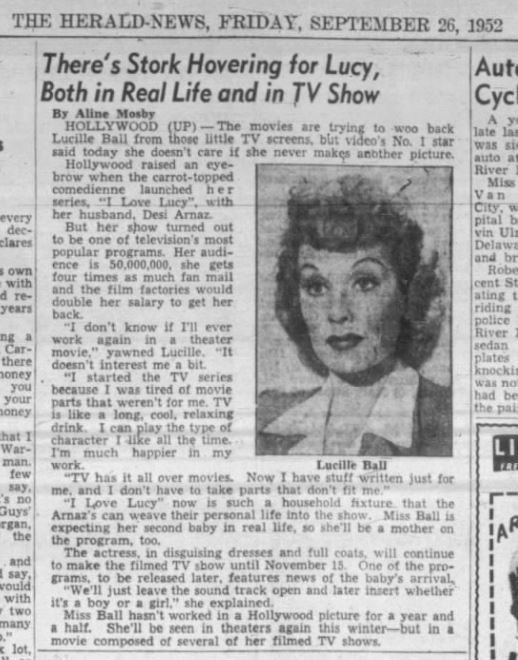
While newspapers generally reprinted a UP article verbatim, they were free to edit for space. Here the end of the article (omitted in some papers) talks about Lucille Ball’s pregnancy and how it will affect her television show. Her claim that they will leave the gender a mystery by keeping the soundtrack open proved not to be the case. When Lucille Ball discovered that she would have a boy, it was determined that the Ricardo baby would also be a boy, although the news was kept from the public and the press until the baby’s birth on January 18, 1953.

The last lines of the article talk about a film comprised of several “I Love Lucy” episodes. Shortly after the end of the first season of I Love Lucy, Lucille and Desi decided to cash in on their show’s popularity by compiling several episodes of the first season of the series into a movie. A test screening in Bakersfield, California, went very well but MGM demanded the film be shelved because they felt it would diminish interest in the upcoming film, The Long, Long Trailer. The I Love Lucy movie was ultimately forgotten until it was discovered and released on DVD in 2000.


In addition to editing for space, newspapers were free to create their own headlines and to add photographs to go along with the UP article.

In lieu of using the UP article, some newspapers used the quotes of Mosby’s story to create their own news item.

The same date this UP article appeared, RKO Boston took out an ad announcing a “Fuller Brush” double feature! The Fuller Brush Girl (1950) was already two years old when this article appeared. It was a sequel to The Fuller Brush Man (1948) starring Red Skelton, who does a cameo in the sequel. RKO Boston is clearly trying to cash in on the popularity of “I Love Lucy” and trying to woo people away from the small screen and into their cinema. They could not have known about the Mosby article’s appearance on the same day.

The Fuller Brush Girl, however, was not Lucille Ball’s most recent film as of September 1952. That would be 1951′s The Magic Carpet, a film that Ball did begrudgingly for Columbia. Her poor experience with The Magic Carpet was one of her greatest incentives to make the leap to television. On September 26, 1952, a Fort Worth, Texas, second run cinema and a St. Louis, Missouri, drive-in were presenting the film, which performed poorly at the box office during its initial release.

Also on September 26, 1952, Lucille Ball was mentioned in a NEA (National Enterprise Association) article by Erskine Johnson about actor Jack Carson’s plans to do a filmed sitcom in the style of “I Love Lucy.” Canadian-born Carson was then on television as one of four rotating hosts of "All Star Playhouse”. Carson’s reasoning for eschewing a studio audience? “You can’t do a show in front of 500 people intended for four people in a living room.” History begs to differ. Carson’s sitcom never came to pass. He had done three films with Lucille Ball in 1937 and 1938.

On the same date, in Erskine’s own syndicated column, he mentions that Desilu is creating merchandise to capitalize on “I Love Lucy’s” popularity. Like Hedda Hopper, Erskine Johnson was an actor turned Hollywood gossip columnist. He appeared with Lucille Ball in the 1938 film That’s Right – You’re Wrong.

All three of the items mentioned were indeed marketed, although Erskine mistakenly calls Desi’s drum bongos instead of conga drums and only the pattern for the smoking jacket was produced.

Also on September 26, 1952 (in Chicago only) in Larry Wolters’ ‘Television News and Views’ column, Lucille Ball is mentioned. WGN-TV’s plans to create a Monday night sports block will be programmed against “I Love Lucy,” the number one show in the United States. For three decades Lucille Ball’s sitcoms would hold down Monday nights on television.

Not to be outdone, Earl Wilson’s syndicated ‘It Happened Last Night’ column briefly mentioned Lucy! Apparently, Lucille denied being related to actress Suzan Ball, despite Suzan saying the contrary! Records show that they are indeed related. Their common ancestor was a great grandfather, Clinton Ball, making them second cousins.

Finally, and most incredibly, on September 26, 1952, it was announced that the Tea Association of the USA had bestowed The Golden Teapot awards to six individuals, including Lucy and Desi, representing television.

The Awards were bestowed for the recipients personal use of tea and the use of tea in film and television scenes. It is unknown which of these applies to Lucy and Desi!

While the nation was reading about Lucy in their Friday newspapers, “I Love Lucy” was busy working – filming “Lucy Changes Her Mind” – which wouldn’t air until March 30, 1953.
-
LUCKY PARTNERS
September 25, 1944

“Lucky Partners” was a presentation of Lux Radio Theatre, broadcast on CBS Radio on September 25, 1944.

It is based on a 1940 RKO film of the same name directed by Lewis Milestone which in turn was based on the 1935 French film Good Luck. Lucky Partners the movie starred Ronald Colman and Ginger Rogers in their only film together. The radio script was adapted by John Van Druten from the screenplay by Allen Scott.
This is the second radio adaptation of the film. In April 1941 The Screen Guild Theater broadcast a 30 minute radio adaptation with Ginger Rogers reprising her film role. In this adaptation, the role is played by Rogers’ friend Lucille Ball.
Synopsis ~ A man and a woman go partners on a winning sweepstakes ticket. In return for partnering, the man insists they go on a platonic honeymoon, despite the woman’s engagement to another man. When things get more than platonic, the man’s past is exposed and everyone ends up in court.

Lux Radio Theatre (1935-55) was a radio anthology series that adapted Broadway plays during its first two seasons before it began adapting films (”Lux Presents Hollywood”). These hour-long radio programs were performed live before studio audiences in Los Angeles. The series became the most popular dramatic anthology series on radio, broadcast for more than 20 years and continued on television as the Lux Video Theatre through most of the 1950s. The primary sponsor of the show was Unilever through its Lux Soap brand.
CAST

Lucille Ball (Jean Newton) was born on August 6, 1911 in Jamestown, New York. She began her screen career in 1933 and was known in Hollywood as ‘Queen of the B’s’ due to her many appearances in ‘B’ movies. “My Favorite Husband” eventually led to the creation of “I Love Lucy,” a television situation comedy in which she co-starred with her real-life husband, Latin bandleader Desi Arnaz. The program was phenomenally successful, allowing the couple to purchase what was once RKO Studios, re-naming it Desilu. When the show ended in 1960 (in an hour-long format known as “The Lucy-Desi Comedy Hour”) so did Lucy and Desi’s marriage. In 1962, hoping to keep Desilu financially solvent, Lucy returned to the sitcom format with “The Lucy Show,” which lasted six seasons. She followed that with a similar sitcom “Here’s Lucy” co-starring with her real-life children, Lucie and Desi Jr., as well as Gale Gordon, who had joined the cast of “The Lucy Show” during season two. Before her death in 1989, Lucy made one more attempt at a sitcom with “Life With Lucy,” also with Gordon.

Don Ameche (David Grant aka Paul Knight Somerset) began screen acting in 1935 and was immensely popular with audiences. He had a career resurgence in 1985 when he won an Oscar for Cocoon at age 77. Ameche was supposed to be featured in 1970′s “Lucy Competes With Carol Burnett” (HL S2;E24), but he withdrew and the script was rewritten for Dean Martin, who also withdrew. The role was eventually played by Robert Alda. Consequently, this radio production is the only time Don Ameche acts opposite Lucille Ball. In 1973′s “Lucy’s Tenant” (HL S6;E7) Mary Jane says she remembers seeing a movie starring Mary Astor, Jack Oakie, and Don Ameche but the three stars were never in the same film.

Arthur Q. Bryan appeared with Lucille Ball in Look Who’s Laughing (1941). He is best remembered as the original voice of Elmer Fudd in the Warner Brothers cartoons.He also was an accomplished radio actor appearing for ten seasons as Doc Gamble on “Fibber McGee and Molly.” In 1952′s “Ricky Loses His Voice” (ILL S2;E9) he played Mr. Chambers, new owner of the Tropicana, a former vaudevillian looking to return to the stage.

Verna Felton (Aunt Lucy) made her professional stage debut at the age of 10 as ‘Little Verna Felton,’ working extensively on stage. Felton was one of the most successful performers in radio, and soon went on to television. She played the persistent Mrs. Day on “The Jack Benny Show” (1955). She memorably played Lucy Ricardo’s maid, Mrs. Porter, as well as making one other appearance on “I Love Lucy.” She received two Emmy nominations for her role in the Desilu series “December Bride,” playing Hilda Crocker from 1955 to 1959 opposite Spring Byington, who, coincidentally, was in the original film of Lucky Partners playing the role she assays here, Aunt Lucy!
Carlton Kadell (Frederick ‘Freddy’ Victor Harper III) starred as “Sky King” for ABC radio. He also was heard in the “Tarzan” serials.
Leo Cleary was primarily known as a radio performer, but did two films in 1940 with Lucille Ball: You Can’t Fool Your Wife and Dance, Girl, Dance.
Norman Field began screen acting in 1945, just a few months after this radio program first aired. On radio, he was heard in hundreds of programs, including “Chandu the Magician,” “Mystery is My Hobby” and many installments of “Lux Radio Theatre.”
Noreen Gammill was a radio performer who voiced Catty the Elephant in Walt Disney’s Dumbo. She was later on screen as a background player in “The Andy Griffith Show,” filmed at Desilu Studios.
Leona LeDoux was a radio actor in the 1940s, specializing in children’s voices for such shows as, “One Man’s Family,” “Blondie,” and “Baby Snooks.” Here, she is part of a live commercial for Lux.
Eddie Marr was born on Valentine’s Day 1900 in Jersey City, New Jersey. In 1938 he was seen with Lucille Ball in The Affairs of Annabel. Along with Lucille Ball, he was in the 1966 TV special “Bob Hope: 15 of My Leading Ladies" playing Joan Caulfield’s chauffeur. He was also with Lucy in “The Bob Hope Show: Bringing Back Vaudeville” in November 1970.
Charles Seel was a former vaudevillian and radio actor who acted in early silent films. Regularly on screen after 1937, he usually played small roles such as clerks, bartenders, and shopkeepers. From 1961 to 1974 Seel was a recurring character on TV’s “Gunsmoke”.
Harry Tyler did four films with Lucille Ball from 1937 to 1950. He appeared in more episodes of “Alfred Hitchcock Presents” than any other actor.
John M. Kennedy (announcer)
ACT ONE

The episode is introduced by producer Cecil B. DeMille, who asks the audience to help pick the play and stars for the show’s tenth anniversary by submitting a postcard. He tells a story about Adolph Menjou in London that acts as a message about Lux Soap.
Our story unfolds in the Greenwich Village neighborhood of New York City with the casual meeting of David, a care-free artist (Ameche) and a girl delivering books (Ball). He wishes her “good luck” and they go their separate ways. The girl, Jean, goes home to tell her Aunt Lucy (Verna Felton) that after a man wished her good luck – she was given an expensive dress that was headed for the trash after a marital squabble.
Jean spies David on the street and rushes out to offer him a business proposition. She asks him to meet her at Nick and Nick’s, a neighborhood bar and grill.
David gets a visit from Wendell, his lawyer and friend who begs him to come back to Chicago, despite his checkered past there.
At Nick and Nick’s Jean buys the last sweepstakes ticket. She is feeling lucky because of the dress and feels David may be her good luck charm. Jean is hoping to win enough money to marry her sweetheart, an insurance salesman named Freddy. David will go in on the ticket with Jean under the proviso that she let him pay for their honeymoon, which he calls “our honeymoon.”
Angry about the “our honeymoon” insult, Jean introduces David to hot-head Freddy, her future husband, who hauls David into the back alley, presumably to avenge his sweetheart’s honor. Instead, however, they return laughing instead of bruised. David has convinced Jean that they will honeymoon as brother and sister and offers that Freddy can tag along.
Freddy holds on to the sweepstakes ticket for safekeeping. They have to figure out whether to wager it all on a horse or play it safe for a smaller cut of the winnings. David and Jean listen for the results of the race on the radio. They do not win. Freddy calls and it reveals that he sold her half of the ticket for $6,000 before the race! But he only sold her half, not David’s, who has lost it all. Jean gives David half anyway and David insists on the full terms of the agreement: to take her on a platonic honeymoon. Jean agrees to the ‘experiment’.
End of Act One.
A live commercial for Lux Soap consists of a letter from a consumer, Mrs. Willett, presented by Sally and Mrs. Kennedy.
ACT TWO

DeMille introduces the second act.
Jean and David are off on their ‘experimental honeymoon’ in a car David bought in her name. Jean wants to stop at a Western Union office to send a wire to Aunt Lucy and Freddy.
They arrive at a hotel in Niagara Falls, honeymoon capital of the world. Checking in as brother and sister, they go to their separate hotel rooms. They have breakfast together. David has sent Jean flowers. The hotel has taken it upon themselves to move them to adjoining rooms! An angry Freddy arrives to check up on his future wife. After finding no hint of misconduct, Freddy agrees to leave but is still not satisfied that everything is on the up-and-up. He checks in at a nearby hotel, asking for a 2am wake-up call.
In the evening, David calls Jean from his bedroom. He asks her to meet him in the hotel lobby and to wear her ‘lucky dress’. An older couple unknown to them asks them to join them on the terrace garden. They lead them to a bridge and the old man asks David to carry her over the bridge and to kiss her. The older couple performed the same ritual 50 years earlier and, thinking Jean and David are a romantic couple, want them to have the same happiness.
Rather than risk any further romance, Jean decides to go to bed. At 2am, Freddy loudly knocks on what he thinks is David’s door, but Jean answers it. They have swapped again so that Jean can have the room with the fireplace. Freddy uses a fire axe to get into David’s room, but he’s nowhere to be found. Freddy calls the front desk and is told David has checked out, but left a note for Jean.
Speeding away from Niagara Falls, a policeman pulls David over, who is driving the car he put in Jean’s name. They go off to find Jean to explain. End of Act Two.
Pause for station identification. During the break DeMille announces that the National Safety Council’s Colonel Stillwell (in New York) is presenting Lever Brothers and the show with an award. [Archival recordings do not present Stillwell’s remarks, just DeMille’s.]
ACT THREE

DeMille catches us up that Freddy, David, and Jean are facing a judge in a small town outside Niagara Falls. David reveals that he is really named Paul Knight Somerset. They are put in jail till the judge can make some sense of things.
Next morning, the case is tried. David’s true identity has the town abuzz. David’s lawyer and friend, Wendell is there to represent him, but is dismissed so that David / Paul can represent herself.
Aunt Lucy testifies that David gave her an expensive dress and bought the ticket. The hotel clerk testifies that David wanted adjoining rooms for illicit purposes. Freddy testifies that David’s newfound celebrity has changed his view of David. Jean takes the stand and explains the ‘experiment’. She is cross-examined by David, addressing himself as “my client”. The judge asks some questions that make David look like a scandalous womanizer.
David cross-examines himself to clarify his true intentions and feelings for Jean. It turns out that some paintings he published in a book got him sued for libel and was put in jail on principal.
The judge convicts Freddy of being a dope and destroying a hotel door with a fire axe.
The judge acquits Jean for being naïve and too trusting.
The judge is not happy with David’s record and conduct in court. Jean objects to the judge’s comments. The spectators cheer Jean’s defense of David.
The judge makes Jean and David admit that they are in love and throws the case out of court.
David and Jean are driving back to New York. He proposes a new ‘experiment’ involving a gold ring and a local justice of the peace. They are not headed to New York City after all, but to Niagara Falls! End of Play.
CURTAIN CALL

A live commercial for lux involves a little girl and mother hanging laundry on the line.
DeMille returns to talk to Lucille Ball and Don Ameche.

Lucille reveals that Don Ameche is forming his own motion picture company and making the story of Doctor Wassell starring Gary Cooper and Laraine Day. This turns out to be a disguised promotion for the 1944 film The Story of Dr. Wassell, based on the life of real-life Navy Officer, Corydon M. Wassell, directed by DeMille himself.

DeMille announces next week’s show will star Walter Brennan, Jeanne Crain, and Charlotte Greenwood recreating their original screen roles in Home in Indiana, a film released in July 1944. The studio audibly audience gasps!
DEMILLE: “Goodnight to you, from Holly-wood!”

The announcer wraps up by asking consumers to save waste fats and greases to help fight the war. He reminds listeners to send in their postcards suggesting stories and stars for the tenth anniversary broadcast.

“Lucky Partners” was produced through cooperation with RKO, producers of Bride by Mistake.

Don Ameche is mentioned as appearing in Greenwich Village, a 20th Century Fox film.

Lucille Ball appeared courtesy of MGM, producers of the Technicolor picture Kismet. Interestingly, Lucille Ball is not promoted as being in the MGM film Meet The People, which had premiered in New York City two weeks earlier and was still in release as of this broadcast.
TRIVIA

The story opens in Greenwich Village, a bastion of bohemian artists and romantics that thrived in the 1940s. It was the setting for My Sister Eileen, a 1938 book that inspired a 1940 play and 1942 film. It also was the setting of Don Ameche’s 1944 film. The above pulp novel was published in 1943.

Acting as his own lawyer, David cross-examines himself in court, something Lucy Carmichael later did in a 1964 episode of “The Lucy Show.”

Honeymoons and Niagara Falls have gone together for nearly two centuries. In a 1964 episode of “The Lucy Show,” Lucy’s daughter wants her mother to think she’s eloping so she leaves out a travel brochure for Niagara Falls!

Sweepstakes were the pre-cursor to public lotteries. In the 1950s newspapers offered Lucky Buck contests, asking readers to compare serial numbers published in the newspaper with their own bills. This was the subject of “Bonus Bucks” (ILL S3;E21) in 1954, where like David and Jean, the Ricardos and Mertzes split the winnings – if they can just claim them in time!

In 1949, Lucille Ball desperately wanted to do Cecil B. DeMille’s The Greatest Show on Earth, but when she asked Columbia’s Harry Cohn to loan her out to MGM, he sadistically cast her in The Magic Carpet, thinking that it was such an awful script that Ball would refuse to do it, then he could suspend her, and refuse to loan her out. Instead, Lucille called his bluff and cheerfully accepted the film, knowing that it was a quickie that would be wrapped by the time The Greatest Show on Earth started filming. Fate intervened and Lucille got pregnant with her daughter Lucie and never got to make the film. It was her husband Desi Arnaz who went into business mode and told Lucy to “grab her $85,000 fee and run.” DeMille is quoted as saying,
“Congratulations Mr. Arnaz, You are the only man to ever fuck his wife, Cecil B. DeMille, Paramount Pictures, and Harry Cohn, all at the same time.”
-
SHEILA MACRAE
September 24, 1921

Sheila Margaret Stephens was born in London in 1921, but evacuated with her parents to Long Island, New York, in 1939, shortly before the onset of World War II. She became a naturalized US citizen in March 1959.

In 1941, she married actor and singer Gordon MacRae. They often appeared on the stage together. They were the parents of two daughters, actresses Heather and Meredith MacRae, and two sons, William Gordon MacRae and Robert Bruce MacRae. The couple divorced in 1967.

Using her maiden name, Sheila made her screen debut in her husband’s film Backfire in 1950. It was quickly followed by three more 1950 films: Caged, Pretty Baby, and Katie Did It.

Her TV debut came in February 23, 1953 with “The Romantic Type”, an installment of NBC’s “Hollywood Opening Night” anthology series hosted by Jimmy Fidler.

Two months later, in April 1953, she appeared on “The Jackie Gleason Show” as a guest. On that same show, Gleason did a “Honeymooners” sketch starring Audrey Meadows as Alice Kramden. Little did MacRae know then that she would take over the role in 1966 and play her until 1970. Coincidentally, the episode where she made her “Honeymooners” debut also featured Pert Kelton as Alice’s Mother. Kelton originated the role of Alice Kramden in 1951, before “The Honeymooners” was made into a series. In January 1954, Gordon MacRae was guest host for “The Jackie Gleason Show” while Gleason was on vacation and invited his Sheila on as a special guest.
All of MacRae’s color “Honeymooner” co-stars eventually worked with Lucille Ball:

- Jackie Gleason (Ralph Kramden) ~ Did a cameo as Ralph Kramden on the second episode of “Here’s Lucy” in 1968. He also played opposite Ball in “Three for Two” in 1975.

- Art Carney (Ed Norton) ~ Did two Lucille Ball Specials: “Happy Anniversary and Goodbye” (1974) and “What Now, Catherine Curtis?” (1976).

- Jane Kean (Trixie Norton) ~ Guest starred in a 1966 episode of “The Lucy Show” titled “Lucy and the Soap Opera” (TLS S4;E19).

On September 29, 1954, Sheila and Gordon MacRae and Lucy and Desi Arnaz were on the red carpet for the star-studded premiere of the film A Star Is Born. Live television interviews from the Pantages Theatre later appeared as bonus material for the film’s DVD.

Two months later she filmed “The Fashion Show” (ILL S4;E20) playing herself opposite fashion designer Don Loper. On the show and in real life, MacRae was a founding member of S.H.A.R.E., a charitable organization formed by wives of Hollywood celebrities.
Although she organizes the charity fashion show for Loper, MacRae does not participate in it.

MacRae and Ball did not appear on the same program again until 1966 with “Jackie Gleason’s 51st Birthday Celebration”.
In 1967 MacRae married Ronald Wayne, a television producer who also worked extensively with Gleason.

MacRae’s last dramatic screen role was on an April 1993 episode of “Murder She Wrote” starring Angela Lansbury and featuring Neil Patrick Harris.
MacRae died suddenly in March 2014 in Englewood, New Jersey, aged 92, at the Lillian Booth Actor’s Home.

“She lived a good life and she lived a long time.” ~ Allison Mullavey, granddaughter
-
KNITTING BABY BOOTIES
September 24, 1948

“Knitting Baby Booties” is episode #10 of the radio series MY FAVORITE HUSBAND broadcast on September 24, 1948.
Synopsis ~ Liz is knitting baby booties for an expectant friend, and George and Mr. Atterbury think Liz is pregnant.
Note: This episode was aired before the characters names were changed from Cugat to Cooper. It was also before Jell-O came aboard to sponsor the show and before the regular cast featured Bea Benadaret and Gale Gordon as the Atterburys.

“My Favorite Husband” was based on the novels Mr. and Mrs. Cugat, the Record of a Happy Marriage (1940) and Outside Eden (1945) by Isabel Scott Rorick, which had previously been adapted into the film Are Husbands Necessary? (1942). “My Favorite Husband” was first broadcast as a one-time special on July 5, 1948. Lucille Ball and Lee Bowman played the characters of Liz and George Cugat, and a positive response to this broadcast convinced CBS to launch “My Favorite Husband” as a series. Bowman was not available Richard Denning was cast as George. On January 7, 1949, confusion with bandleader Xavier Cugat prompted a name change to Cooper. On this same episode Jell-O became its sponsor. A total of 124 episodes of the program aired from July 23, 1948 through March 31, 1951. After about ten episodes had been written, writers Fox and Davenport departed and three new writers took over – Bob Carroll, Jr., Madelyn Pugh, and head writer/producer Jess Oppenheimer. In March 1949 Gale Gordon took over the existing role of George’s boss, Rudolph Atterbury, and Bea Benaderet was added as his wife, Iris. CBS brought “My Favorite Husband” to television in 1953, starring Joan Caulfield and Barry Nelson as Liz and George Cooper. The television version ran two-and-a-half seasons, from September 1953 through December 1955, running concurrently with “I Love Lucy.” It was produced live at CBS Television City for most of its run, until switching to film for a truncated third season filmed (ironically) at Desilu and recasting Liz Cooper with Vanessa Brown.
MAIN CAST

Lucille Ball (Liz Cugat) was born on August 6, 1911 in Jamestown, New York. She began her screen career in 1933 and was known in Hollywood as ‘Queen of the B’s’ due to her many appearances in ‘B’ movies. “My Favorite Husband” eventually led to the creation of “I Love Lucy,” a television situation comedy in which she co-starred with her real-life husband, Latin bandleader Desi Arnaz. The program was phenomenally successful, allowing the couple to purchase what was once RKO Studios, re-naming it Desilu. When the show ended in 1960 (in an hour-long format known as “The Lucy-Desi Comedy Hour”) so did Lucy and Desi’s marriage. In 1962, hoping to keep Desilu financially solvent, Lucy returned to the sitcom format with “The Lucy Show,” which lasted six seasons. She followed that with a similar sitcom “Here’s Lucy” co-starring with her real-life children, Lucie and Desi Jr., as well as Gale Gordon, who had joined the cast of “The Lucy Show” during season two. Before her death in 1989, Lucy made one more attempt at a sitcom with “Life With Lucy,” also with Gordon.
Richard Denning (George Cugat) was born Louis Albert Heindrich Denninger Jr., in Poughkeepsie, New York. When he was 18 months old, his family moved to Los Angeles. Plans called for him to take over his father’s garment manufacturing business, but he developed an interest in acting. Denning enlisted in the US Navy during World War II. He is best known for his roles in various science fiction and horror films of the 1950s. Although he teamed with Lucille Ball on radio in “My Favorite Husband,” the two never acted together on screen. While “I Love Lucy” was on the air, he was seen on another CBS TV series, “Mr. & Mrs. North.” From 1968 to 1980 he played the Governor on “Hawaii 5-0″, his final role. He died in 1998 at age 84.
Ruth Perrott (Katie, the Maid) was also later seen on “I Love Lucy.” She first played Mrs. Pomerantz, a member of the surprise investigating committee for the Society Matrons League in “Pioneer Women” (ILL S1;E25), as one of the member of the Wednesday Afternoon Fine Arts League in “Lucy and Ethel Buy the Same Dress” (ILL S3;E3), and also played a nurse when “Lucy Goes to the Hospital” (ILL S2;E16). She died in 1996 at the age of 96.
Bob LeMond (Announcer) also served as the announcer for the pilot episode of “I Love Lucy”. When the long-lost pilot was finally discovered in 1990, a few moments of the opening narration were damaged and lost, so LeMond – fifty years later – recreated the narration for the CBS special and subsequent DVD release.
GUEST CAST

John Hiestand (Cory Cartwright) served as the announcer for the radio show “Let George Do It” from 1946 to 1950. In 1955 he did an episode of “Our Miss Brooks” opposite Gale Gordon.

Jean Vander Pyl (Miss Johnson, Mr. Atterbury’s Secretary / Admitting Nurse) is best known as the voice of Wilma Flintstone for the Hanna-Barbera cartoon “The Flintstones.” Coincidentally, Wilma’s best friend was voiced by Bea Benadaret, who also played Iris Atterbury, Liz’s best friend on “My Favorite Husband.” On radio she was heard on such programs as “The Halls of Ivy” (1950–52) and on “Father Knows Best” before it moved to TV. She died in 1999 at age 79.

Laurette Fillbrandt (Jane Kendall) was born in Zanesville, Ohio in 1915. She was married to radio announcer Russell Young and made her debut on local radio in 1934. In 1935 she began acting in Chicago on network radio programs. She is best remembered for playing Fay and Evie, two of the daughters on the popular “Ma Perkins” in addition to her many other radio credits. She died in 2000.
Jane’s husband is named Norman.

Hans Conried (Mr. Atterbury, George’s Boss at the Bank) first co-starred with Lucille Ball in The Big Street (1942). He then appeared on “I Love Lucy” as used furniture man Dan Jenkins in “Redecorating” (ILL S2;E8) and later that same season as Percy Livermore in “Lucy Hires an English Tutor” (ILL S2;E13) – both in 1952. The following year he began an association with Disney by voicing Captain Hook in Peter Pan. On “The Lucy Show” he played Professor Gitterman in “Lucy’s Barbershop Quartet” (TLS S1;E19) and in “Lucy Plays Cleopatra” (TLS S2;E1). He was probably best known as Uncle Tonoose on “Make Room for Daddy” starring Danny Thomas, which was filmed on the Desilu lot. He joined Thomas on a season 6 episode of “Here’s Lucy” in 1973. He died in 1982 at age 64.
Later, Mr. Atterbury and his wife Iris would become recurring characters and the role will be assumed by Gale Gordon.
THE EPISODE
ANNOUNCER: “It is morning at the Cugat house and Katie the maid has gone out to the mailbox to see if the postman has left any ads or blotters and Liz is cooking breakfast and George is still upstairs dressing…”

Essentially, Katie is looking for junk mail. Before the advent of ballpoint pens, fountain pens needed their ink ‘blotted’ on a paper surface as to avoid large pools of ink when first writing a card, letter, or note. Eventually advertisers took advantage of this and the ‘blotters’ were also imprinted with advertising and mailed out to potential customers for various businesses and services. The above blotter is for the film Ziegfeld Follies, which featured Lucille Ball.
Liz calls George down to his favorite breakfast: burnt toast. Liz coaxes a ‘zipless’ kiss out of George:
Katie the Maid chimes in about her first husband Clarence.
KATIE: “Now there was a kisser!”
GEORGE: “Good?”
KATIE: “No. Ugly.”As usual, George buries his head in the morning newspaper. He peruses the financial page for the stock market.
GEORGE: “I have to keep an eye on the bulls and the bears so that some wolf in sheep’s clothing doesn’t make me the goat. I work in a bank.”
LIZ: “Sounds like the Chicago Stockyard!”
 Liz is punning on the other meaning of the word stock, meaning livestock. The Union Stock Yard, was the meatpacking district in Chicago for more than a century, starting in 1865. The district was operated by a group of railroad companies that acquired marshland and turned it into a centralized processing area, helping Chicago become known as the "hog butcher for the world” and the center of the American meatpacking industry for decades.
The Yards closed on the last day of July 1971, after several decades of decline.
Liz reads that Jane Kendall is expecting a baby. Also in the morning mail is a bill from Barkley Brothers Department Store. Liz tries to change the subject, but she has gone over her allowance – again. George says he can’t raise Liz’s allowance because old man Atterbury at the bank passed him by for a raise.

Lucy Ricardo frequently went over her allowance, at one point using it up until June 12th – 1978! In another episode, Ricky hired a “Business Manager” to help Lucy manage her household finances. Coincidentally, like this radio episode, it also talked about the stock market. Lucy’s ‘stravagances forced Ricky to ask for a raise from his boss, too! Coincidentally, Mr. Littlefield was played by Gale Gordon, who would eventually play George’s boss, Mr. Atterbury, on “My Favorite Husband”!
Liz says that her mother gave her a book to read: How To Win Friends And Influence People. Liz promises to be more thrifty in future and only pay cash – for things they don’t need!

How to Win Friends and Influence People is a self-help book written by Dale Carnegie, published in 1936. It is one of the best-selling books of all time. Carnegie had been conducting business education courses in New York since 1912.
Later in the day, Katie discovers Liz knitting baby booties for Mrs. Kendall. Liz is trying to be thrifty by knitting, instead of buying, the booties, although she’s broken her word and had to pay on credit for the many skeins of yarn.
Bachelor Cory Cartwright (John Hiestand) drops by to brag to Liz about his latest date.
CORY: “I met the most beautiful girl at a beautiful party in a beautiful penthouse last night. The beautiful girl and I spent a beautiful evening looking at the beautiful moon.”
LIZ: “Sounds beautiful.”
CORY: “Not quite. She had an ugly husband!”Cory notices her knitting and immediately thinks she’s expecting. Liz thinks he’s talking about her newfound skill at knitting. They hilariously talk at cross purposes and Cory goes off to telephone Mr. Atterbury about the Cugat’s good news.

Here the plot starts to hint at what would become “Drafted” (ILL S1;E11), a 1951 episode of “I Love Lucy” where Ricky and Fred see Lucy and Ethel knitting and also think they are expecting babies. The main plot of the TV episode, however, was inspired by a 1951 episode of “My Favorite Husband” titled “George Is Drafted – Liz’s Baby” (#115).
After Cory’s phone call, Mr. Atterbury (Hans Conried) has his secretary Miss Johnson (Jean Vander Pyl) summon George to his office. George thinks he is being called on the carpet for not getting a wealthy Florida woman’s big account. Mr. Atterbury thinks George is talking about Liz, and George thinks Mr. Atterbury is talking about the Florida woman! More farcical mis-understandings. George gets a raise from Mr. Atterbury, who thinks he is helping his growing new family.
Back at home, George begs Liz for a kiss. They play a word game and George wins a kiss from Liz. George is about to tell Liz the good news about his raise and suddenly sees Liz’s hidden knitting. George thinks Liz is having a baby! Liz thinks he is surprised at her knitting skill!
LIZ: “Didn’t think I could do it, did ya?”
When Liz points out that the surplus yarn could knit enough booties for triplets, George passes out, thinking he is to become a father three times over!
Liz and Katie carry George upstairs and put him to bed. When Katie wants to give George a snort of brandy, Liz worries it may be Vitalis, like it was when Katie gave it to Liz to revive her!

Vitalis is a men’s hair grooming product introduced in the 1940s by Bristol Myers. It is comprised mostly of an alcohol-based ingredient simply known as “V7″. The product was meant to avoid grease-based products then used by many men. It is still sold today.
At the bank, George and Cory talk about Liz’s delicate condition, neither one knowing they have misunderstood. George says he asked Liz if she had strange cravings for unusual foods, like “ice cream with melted cheese poured over and a dill pickle on top.”

The craving for unusual food combinations (mostly featuring pickles and ice cream) was a frequent comedy trope, partly based in fact. At the end of “Ricky Has Labor Pains” (ILL S2;E14), a genuinely enceinte Lucy Ricardo sends Ricky on a midnight mission to find pistachio ice cream with hot fudge and sardines on top! Ricky delivers, much to Lucy’s delight!

When Lucy Carter is pretending to be pregnant on “Lucy, The Part-Time Wife” (HL S3;E14), she tells Nurse Gertrude that she has a craving for a big dill pickle and a bowl of vanilla ice cream! Nurse Gertrude delivers, much to Lucy’s dismay!
Calling home to check on Liz, Katie tells George that Liz has gone to the hospital! George panics but rushes off to the hospital with Cory.
Meanwhile, Liz is in a taxi with Jane Kendall, who has gone into labor and wants Liz to stay at her side until her husband Norman gets there. While waiting for Liz (whom he thinks is the one in labor), George buys his unborn son electric trains, a baseball bat, a drum and bugle, and football helmet. Cory suggests a rattle instead.
GEORGE: “Rattle’s are for kids. My son is going to play right tackle for Princeton.”
CORY: “I hope he’s in shape. They play their first game next week.”
Princeton University is a private Ivy League university in Princeton, New Jersey. Founded in 1746 it is the fourth-oldest institution of higher education in the United States. Cory is spot-on about Princeton Football playing their first game of the season next week. They began the 1948 season on October 2nd. Playing a home game, they lost to Brown University 20 to 23. In June 1947, Lucille Ball starred in the play Dream Girl at McCarter Theatre, in residence at Princeton University. Ball, who as an infant briefly lived nearby in Trenton, had also performed in Princeton in 1937.
Cory suggests that Liz and George’s baby might be a girl.
GEORGE: “Oh, no! I can’t be a girl! Liz wouldn’t do that to me!”

In “Lucy is Enceinte” (ILL S2;E10), Fred is so sure Lucy’s baby is going to be a boy, he gives his future godson a New York Yankees cap, a glove, and a signed ball. While the Arnaz’s knew the sex of their unborn child, the Ricardos did not. Even the “I Love Lucy” baby doll merchandised during this period was sexless to prevent spoilers!
George and Cory go home and set up the trains while they are waiting for the big news. Liz casually arrives home and nonchalantly announces the baby was born an hour ago! George is aghast!
GEORGE: “What does he look like?”
LIZ: “He looks like Norman Kendall!”Before things get dangerously scandalous, the hospital phones and reports that Mrs. Kendall has given birth again – to a girl – twins! Liz now realizes what George was thinking.LIZ: “Congratulations, George! Now you’re a mother, too!”
Later, Liz refuses to let George read the evening paper. Why? She doesn’t want him to confuse her with Mitzi, Mrs. Jordan’s cockier spaniel!
Confusion between a cockier spaniel and a wife will also be the final plot twist of “The Seance” (ILL S1;E7), in which everyone believes superstitious Mr. Merriweather’s late wife was named Tilly, when in fact Tilly was actually his deceased cockier spaniel!
In the usual bedtime tag, Liz asks George if she can sit on the side of his bed, which she thinks is higher than hers. They play a word game that George loses and he must reward his wife with a big kiss.
The wording above the above dialogue clearly suggests that George and Liz sleep in separate beds! No wonder they have been married ten years and not had a baby! This was not unusual on television and in post-Hays Code films. On “I Love Lucy” Lucy and Ricky were generally in single beds, although sometimes pushed together. The one time we glimpse the bedroom of Fred and Ethel (above) – a childless couple – they very clearly have single beds!
LIZ: “Goodnight, George!”
1948, Baby Booties, Bob LeMond, cockier spaniel, Dale Carnegie, Dream Girl, Hans Conried, Here’s Lucy, I love lucy, Jean Vanderpyl, John Hiestand, Knitting, Laurette Fillbrandt, Lucille Ball, My Favorite Husband, Pickles and Ice Cream, pregnancy, Princeton University, Radio, Richard Denning, Ruth Perrott, Union Stock Yards, Vitalis, Vivian Vance -
JAMES BURKE
September 24, 1886

James Burke made his stage debut in New York around 1912 and went to Hollywood in 1933. He made over 200 film appearances during his career between 1932 and 1964 including The Maltese Falcon (1948). Between 1934 and 1948, Burke did eight films with another prolific character actor, William Frawley (Fred Mertz). In 1934, he made Ruggles of Red Gap, a film that was re-made by Lucille Ball and Bob Hope in 1950.
He began working in films in 1932, just before Lucille Ball’s arrival in Hollywood. Between 1933 and 1938, Burke appeared in four films that also featured Lucille Ball:

The Bowery (1933) ~ Burke and Ball were uncredited, as were future “Lucy” alumni Charles Lane (Mr. Hickox) and Irving Bacon (Will Potter). Burke played a recruiting officer.

Blood Money (1933) ~ Ball and Burke are uncredited. She was in the racetrack scene and Burke played a detective in the pool hall.

Joy of Living (1938) ~ Burke plays Mac and Ball is Salina Pine. Charles Lane also appears in the film.

The Affairs of Annabel (1938) ~ Lucille Ball plays the title role, Annabel Allison, and James Burke is Muldoon.

Burke made his television debut just ten days prior to “I Love Lucy” – on October 5, 1951, as a regular character in “Mark Saber” aka “Mystery Theatre” (1951-53) playing Sergeant Tim Maloney, police sidekick to the title detective played by Tom Conway. When the show returned in 1957 as “Saber of London” (aka “The Vise”) the title role had been recast and Burke’s role had been eliminated. During his 164 episodes of “Mark Saber” Burke worked with many “Lucy” alumni like Shirley Mitchell, Louis Nicoletti, Frank Scannell, Larry J. Blake, Virginia Barbour, and Dick Elliott.

Burke re-teamed with Lucille Ball in early 1954 as Mr. Watson, owner of “The Diner” (ILL S3;E27). Ricky grows tired of the business called show and convinces the Mertzes to partner with him in a corner eatery. Culture and couple clash ensue and a diner divided amongst itself cannot stand: A Little Bit of Cuba battles for customers with A Big Hunk of America and no one wins!

In the end, we learn that sneaky Mr. Watson (Burke) makes money by buying and selling the diner to naïve entrepreneurs, a discovery that earns him a taste of his own custard!

In December 1957, Burke returned to Desilu to film “Lucy Wins a Racehorse”, an installment of the “Westinghouse-Desilu Playhouse” and the fourth episode of what would be known in syndication as “The Lucy-Desi Comedy Hour.”

Burke plays the man who delivers Whirling Jet (the horse of the title) to the Ricardos after they win a cereal box top contest. Burke (above left) breaks the old show business rule ‘never work with kids or animals’ by starring here with both! Frawley and Burke (above left) should know better: they both were featured in The Lemon Drop Kid (1934), a story that also involves both a child and a racehorse!

His casting in “The Lucy-Desi Comedy Hour” was likely linked to also being featured in “The Crazy Hunter” which aired in December 1958. As usual, the episode was introduced by Desi Arnaz.

His final screen appearance was on a May 1962 episode of “The Law and Mr. Jones.”
Burke was married to Eleanor Durkin making them Burke n’ Durkin. Burke died in 1968 at age 81 from heart ailments.

-
RIP JIMMY GARRETT
1954-2021

James Coleman Garrett was born in Los Angeles, California, on September 23, 1954. Garrett is best known for playing Jerry Carmichael, the son of Lucille Ball’s Lucy Carmichael on “The Lucy Show”.

Before being cast by Lucy, a six year-old Garrett made his screen debut on a December 1960 episode of “The Twilight Zone” (a show that began on “The Westinghouse-Desilu Playhouse) as a child who begs a down-and-out street corner Santa (Art Carney) for “a big turkey pot Christmas dinner”.

A year later he was seen in the feature film The Second Time Around playing Debbie Reynolds’s son. The film also featured Andy Griffith.

In March 1962, he played the son of Shirley Mitchell (Lucy’s Marion Strong), new neighbors on “Mr. Ed.”

In early 1962 Desilu purchased the rights to “Suzuki Beane”, a book written in 1961 by Sandra Scoppettone. A television pilot was made, with Katie Sweet as Suzuki and Jimmy Garrett as Henry, but the series was not picked up. It was to be part of a Victor Borge-hosted anthology series. No doubt this pilot was instrumental in Garrett being cast on “The Lucy Show.”

During the summer of 1962, Garrett was cast as Lucy Carmichael’s son, Jimmy. He was a regular character for seasons one and two, a recurring character in season three, and then disappeared from the series. During Garrett’s audition, Ball loved the way Garrett delivered his lines. Vivian Vance once noted that Jimmy had the “Fred Mertz” lines!

Garrett’s image appeared on the box cover for “The Lucy Show” Game. The game was suggested for ages 9 to adult, so technically Garrett was not old enough to play when it was first issued.

His character was even in “The Lucy Show” Gold Key Comic Books, although Jerry was given blue hair!

Paper dolls! Here his hair color is correct, but the pose is odd!

Garrett was immortalized by legendary illustrator Robert Thompson.

Garrett did 54 episodes of the series from 1962 to 1965.
- During season 1, he does not appear in episode 27.
- During season 2, he does not appear in episodes 1, 2, 5, 9, 11, 16, 17, 20, 24, 25, 27 and 28.
- During season 3, he does not appear in episodes 1, 3, 4, 7, 8, 11, 14, 15, 16, 17, 20, 21, 23, 24, 25 and 26.
- During season 4 he appeared in two episodes.
BEING ‘JERRY’ WITH A CAPITAL ‘B’!

Breakfast with the Brood!

Biking through the living room!

Beethoven!

Big voices “buzz around buzz around”!

“I’ll bet we’re the only people in the world two have two Christmas trees. One is green and one is – you’ll pardon the expression – white.” ~ Jerry Carmichael

Baby New Year 1962!

Badge Boys! Junior Firefighters finding poor wiring.

Buy this! Doing an ‘in character’ commercial for Jell-O with Vivian Vance and Ralph Hart.

Biding their time while the plumber installs a shower in their room, Jerry says that at the YMCA, “They frown on filth!”

Boxing Pip Corn!

Black Eyes & Bruises!

Band of Boy Scouts!

A back and forth brew-ha-ha about how to measure rocket fuel! (Seriously!)

Baseball! (Although this is the first time Garrett is on the series in color, CBS aired the episode in black and white.)

His Best Buddy! With Barry Livingston as Arnold Mooney #1.

Bedtime!

Blue boy in a blue uniform!

Big time sub fans!

Bandages! Lucy and Viv practice their nursing skills on the boys.

Broadway Birdies go “bob-bob-bobin’ along” with Ethel Merman.

Borscht Belt Boy Scout! Telling a joke during the Boy Scout Show.

Blaring the Beatles!

Bunkhouse at camp!

Boy in the band! With Ted Eccles as Arnold Mooney #2.

Book Look!

Boo Blaster!

Beau Brummels! For the entrance of the Countess!

When Lucy and Mr. Mooney relocate to California in season 4, Jimmy Garrett is in the first episode, but then Jerry is packed off to Boarding school – this time for good. Well, almost…

Jerry comes home for the holidays in 1964 to join Mr. Mooney and the Bank’s choir, conducted by Lucy. This is Garrett’s final appearance in the role.

As Garrett’s commitment to Lucy came to an end, he did a day playing a paper boy on “Burke’s Law” (1963-66) an ABC crime drama starring Gene Barry and Sal Mineo.

During this same time, he appeared on an episode of “My Three Sons” (1960-72) appearing opposite his Barry Livingston, who played Jerry Carmichael’s best friend Arnold Mooney, and Don Grady, who played Chris Carmichael’s boyfriend Bill in “Lucy is a Chaperone” (TLS S1;E27), although Garrett did not appear in that episode. The series was filmed on the Desilu lot.

In 1966, Garrett’s character came back in name only – although it wasn’t the right name!
When Lucy receives a letter from her son in the beginning of this episode, she calls him ‘Jimmy’ instead of correctly calling him ‘Jerry.’ According to Geoffrey Mark Fidelman’s The Lucy Book, when Lucille Ball was handed the script for the first time, she complained that they had used the wrong name. She was reminded that it was ‘Jimmy’ Garrett who played ‘Jerry’ Carmichael. Ball still insisted that she was right and the reference was left as ‘Jimmy.’ However it came about, it certainly is one of the biggest mistakes of the series.

In 1966, Garrett played a British Hooligan in the feature film Munster Go Home.

His final acting credit, also in 1966, was courtesy of Desi Arnaz. He was cast in the pilot of “The Carol Channing Show,” but the show was not picked up for series. It was then – at age 12 – he left acting for good. But not show business….
As an adult, he worked first as a talent agent, and then a production accountant. He has been behind the scenes in such popular shows as “America’s Next Top Model,” “The Apprentice” and “Shark Tank.”

Garrett was profiled in the 2016 book X Child Stars: Where Are They Now? by Kathy Garver and Fred Ascher. He often attends various meet and greets and collectibles shows, giving interviews and signing autographs. An interview with adult Garrett is a bonus feature on the season one “Lucy Show” DVDs.

In 2015 he was recognized by the Southern California Motion Picture Council for his contributions to the entertainment industry.

Jimmy Garrett died of complications from diabetes at age 66. He was father to two children, Amelie and Spencer, from his marriage to ex wife, Laura Johansen.
-
THE ATTIC
September 23, 1949

“The Attic” (aka “Trapped in the Attic”) is episode #55 of the radio series MY FAVORITE HUSBAND broadcast on September 23, 1949.
This was the fourth episode of the second season of MY FAVORITE HUSBAND. There were 43 new episodes, with the season ending on June 25, 1950.
Synopsis ~ One of George’s old Glee Club friends is in town and George wants to find his old ukulele, so he and Liz search for it in the attic but get locked in.

“My Favorite Husband” was based on the novels Mr. and Mrs. Cugat, the Record of a Happy Marriage (1940) and Outside Eden (1945) by Isabel Scott Rorick, which had previously been adapted into the film Are Husbands Necessary? (1942). “My Favorite Husband” was first broadcast as a one-time special on July 5, 1948. Lucille Ball and Lee Bowman played the characters of Liz and George Cugat, and a positive response to this broadcast convinced CBS to launch “My Favorite Husband” as a series. Bowman was not available Richard Denning was cast as George. On January 7, 1949, confusion with bandleader Xavier Cugat prompted a name change to Cooper. On this same episode Jell-O became its sponsor. A total of 124 episodes of the program aired from July 23, 1948 through March 31, 1951. After about ten episodes had been written, writers Fox and Davenport departed and three new writers took over – Bob Carroll, Jr., Madelyn Pugh, and head writer/producer Jess Oppenheimer. In March 1949 Gale Gordon took over the existing role of George’s boss, Rudolph Atterbury, and Bea Benaderet was added as his wife, Iris. CBS brought “My Favorite Husband” to television in 1953, starring Joan Caulfield and Barry Nelson as Liz and George Coope. The television version ran two-and-a-half seasons, from September 1953 through December 1955, running concurrently with “I Love Lucy.” It was produced live at CBS Television City for most of its run, until switching to film for a truncated third season filmed (ironically) at Desilu and recasting Liz Cooper with Vanessa Brown.
MAIN CAST

Lucille Ball (Liz Cooper) was born on August 6, 1911 in Jamestown, New York. She began her screen career in 1933 and was known in Hollywood as ‘Queen of the B’s’ due to her many appearances in ‘B’ movies. With Richard Denning, she starred in a radio program titled “My Favorite Husband” which eventually led to the creation of “I Love Lucy,” a television situation comedy in which she co-starred with her real-life husband, Latin bandleader Desi Arnaz. The program was phenomenally successful, allowing the couple to purchase what was once RKO Studios, re-naming it Desilu. When the show ended in 1960 (in an hour-long format known as “The Lucy-Desi Comedy Hour”) so did Lucy and Desi’s marriage. In 1962, hoping to keep Desilu financially solvent, Lucy returned to the sitcom format with “The Lucy Show,” which lasted six seasons. She followed that with a similar sitcom “Here’s Lucy” co-starring with her real-life children, Lucie and Desi Jr., as well as Gale Gordon, who had joined the cast of “The Lucy Show” during season two. Before her death in 1989, Lucy made one more attempt at a sitcom with “Life With Lucy,” also with Gordon.
Richard Denning (George Cooper) was born Louis Albert Heindrich Denninger Jr., in Poughkeepsie, New York. When he was 18 months old, his family moved to Los Angeles. Plans called for him to take over his father’s garment manufacturing business, but he developed an interest in acting. Denning enlisted in the US Navy during World War II. He is best known for his roles in various science fiction and horror films of the 1950s. Although he teamed with Lucille Ball on radio in “My Favorite Husband,” the two never acted together on screen. While “I Love Lucy” was on the air, he was seen on another CBS TV series, “Mr. & Mrs. North.” From 1968 to 1980 he played the Governor on “Hawaii 5-0″, his final role. He died in 1998 at age 84.
Ruth Perrott (Katie, the Maid) was also later seen on “I Love Lucy.” She first played Mrs. Pomerantz, a member of the surprise investigating committee for the Society Matrons League in “Pioneer Women” (ILL S1;E25), as one of the member of the Wednesday Afternoon Fine Arts League in “Lucy and Ethel Buy the Same Dress” (ILL S3;E3), and also played a nurse when “Lucy Goes to the Hospital” (ILL S2;E16). She died in 1996 at the age of 96.
Bob LeMond (Announcer) also served as the announcer for the pilot episode of “I Love Lucy”. When the long-lost pilot was finally discovered in 1990, a few moments of the opening narration were damaged and lost, so LeMond – fifty years later – recreated the narration for the CBS special and subsequent DVD release.
Bea Benadaret (Iris Atterbury) and Gale Gordon (Rudolph Atterbury) do not appear in this episode.
GUEST CAST

Hans Conried (Mr. Benjamin Wood / Jimmy the Paper Boy) first co-starred with Lucille Ball in The Big Street (1942). He then appeared on “I Love Lucy” as used furniture man Dan Jenkins in “Redecorating” (ILL S2;E8) and later that same season as Percy Livermore in “Lucy Hires an English Tutor” (ILL S2;E13) – both in 1952. The following year he began an association with Disney by voicing Captain Hook in Peter Pan. On “The Lucy Show” he played Professor Gitterman in “Lucy’s Barbershop Quartet” (TLS S1;E19) and in “Lucy Plays Cleopatra” (TLS S2;E1). He was probably best known as Uncle Tonoose on “Make Room for Daddy” starring Danny Thomas, which was filmed on the Desilu lot. He joined Thomas on a season 6 episode of “Here’s Lucy” in 1973. He died in 1982 at age 64.
The character’s first name is not mentioned here, but it is in other episodes where Conried plays Mr. Wood.
THE EPISODE
ANNOUNCER: “Even in the happiest of marriages both the husband and wife have little habits that prove annoying over the years. With the Coopers it’s George’s habit of reading the newspaper at the breakfast table.
Well, unable to break him of this habit Liz is setting up a counter irritant. As we look in on them now she has just started a barrage of toast munching… It’s a war of nerves!”
The episode opens at breakfast, where Liz is upset that George has buried himself in the morning newspaper instead of paying attention to her.

This was a common complaint on early episodes of “I Love Lucy” as well. Ricky often didn’t lift his eyes from behind the newspaper.
LIZ: “I’ll speak to Katie and asks her to buy quieter bread. Or, I could puree the bread and eat it with a spoon.”
The phone rings. It is George’s old friend Charlie Nichols. Charlie is a Bullfrog, a member of their college Glee Club.
Liz translates the slangy conversation between the old friends for Katie.
George riffs a few notes of “Yes Sir, That’s My Baby” into the phone with Charlie.

"Yes Sir, That’s My Baby” is a popular song from 1925 written by Gus Kahn and Walter Donaldson. A week before this episode aired, it was also the title of a Universal motion picture starring Donald O’Connor and Gloria DeHaven. In 1980 the film was referenced in “Lucy Moves To NBC” which featured O’Connor and DeHaven in a show-within-a-show sitcom called “The Music Mart”.
Liz anticipates that George will want to find his old ukulele for his reunion with Charlie. Naturally, she’s right and naturally Liz has no idea where it is! George reminds her of the time she disposed of all his old clothes, a hint at a future episode titled “Husbands Are Sloppy Dressers” (E95) which would become “Changing The Boys’ Wardrobe” on “I Love Lucy”.
GEORGE: “A man’s old clothes are filled with sentiment.”
LIZ: “That’s sediment, not sentiment!”
On “I Love Lucy” saxophone wasn’t the only instrument she was able to play. Lucy first plays the ukulele in “Ricky Loses His Voice” (ILL S2;E9), “Little Ricky Gets Stage Fright” (ILL S6;E4), and again in “Don Juan Is Shelved” (ILL S4;E22). Lucy Carmichael strummed the uke in “Lucy’s College Reunion” (TLS S2;E11). Fast forward to 1972 and Lucy and Kim Carter play the ukulele in “Lucy Goes Hawaiian: Part 2″ (HL S3;E24).
Liz denies having thrown away George’s prized ukulele. Liz asks George the last time he saw it and he says it was “just the other night at the alumni dinner” – in 1938! Liz says it’s probably in the attic, and off they go to look for it.

On “I Love Lucy,” Lucy Ricardo visited the attic to find a musical instrument, too – “The Saxophone” (ILL S2;E2). Of course, she finds other memories along the way. This was the series’ only visit to the attic of 623 East 68th Street.
In the attic, George thinks he sees a prowler – but it is just Liz’s old dress dummy!

Lucy Carter and her kids visits the attic for antiques and get a lesson in family history lesson in “Lucy Takes Over” (HL S2;E23). When first entering the darkened attic, Lucy screams when she runs into the dress dummy, just like George!
The box marked ‘ukulele’ is actually filled with ski boots! Liz’s labeling system has resorted in confusion about what’s inside each box.
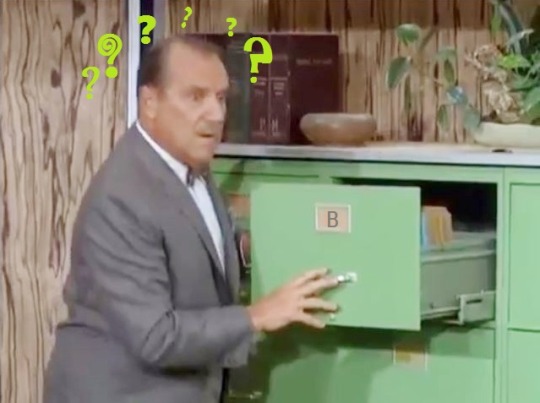
This warped logic foreshadows Lucy Carmichael and Lucy Carter’s crazy filing system on “The Lucy Show” and “Here’s Lucy.” It never failed to confound Mr. Mooney / Harry (Gale Gordon).
Liz finds her corsage collection – dried flowers of corsages given to her by high school boys. George finds his old electric train. Liz wants to throw out the trains, while George wants to toss the corsages.

"Lucy Goes To Sun Valley” (LDCH S1;E5) opens with Lucy searching the living room closet for Ricky’s guitar strings. While doing so, she runs across a pressed corsage of violets that Ricky gave to her during their courtship.
Hours later, Liz and George still haven’t thrown away anything and still haven’t found the ukulele. They agree to try again after lunch – but the attic door is locked. George calls for Katie – but she’s gone downtown to take George’s Glee Club sweater to the cleaners and is then off for the afternoon.
From the attic window, Liz yells to neighbor Mr. Wood (Hans Conried) but he is working on his motorcycle and can’t hear them. Jimmy the Paper Boy (also Conried) thinks they want their newspaper tossed through the attic window. It hits George square in the face.
George decides to ram the door with his shoulder like they do in the movies, but to no avail.
GEORGE: “They must use fake doors in pictures.”
LIZ: “Maybe they use real men!”George has landed on his ukulele, which emerges unharmed. He strums and sings a few more bars of “Yes Sir, That’s My Baby” – much to Liz’s chagrin.

More time passes and they are still locked in the attic. Liz notices the calendar on the attic wall says March.
LIZ: “I wonder if it’s been a tough winter?”
Liz starts to cry, but George wants her to laugh it off and think of it as an exciting adventure. Hunger starts to set in. Liz finds a piece of their ten year-old wedding cake. Petrified!. She spies a piece of cheese in a mousetrap!

It is here the episode starts to foreshadow “Lucy in the Swiss Alps” (ILL S5;E21) in which the Ricardos and Mertz’s are trapped in an Alpine cabin due to an avalanche, where hunger is also an issue.
Panic sets in – Liz is stir crazy and wants George to jump out of the window to get help. George gets the idea to make a rope ladder out of old drapes and lower Liz to the ground.

The idea of escaping a high confinement by knotting sheets (or blankets or curtains) together to form a rope ladder is a familiar trope. It was later used in “The Star Upstairs” (ILL S4;E25) when Lucy Ricardo finds herself trapped in Cornel Wilde’s upstairs suite and chooses this method of escape.
LIZ: “Just a moment. Who’s lowering whom?”
GEORGE: “I’m lowering you’m!”
LIZ: “Over my’m dead body you’m are!”
This exchange is very similar to “Vacation from Marriage” (ILL S2;E6) which finds Lucy and Ethel trapped on the roof when the door locks behind them. Lucy gets the idea to put a plank across the alleyway (five flights up) to the neighboring building, but naturally she wants Ethel to go first! Ethel is reluctant to be the one to go first!
Practically speaking, Liz is not strong enough to hold George’s weight, so she has to be the one to be lowered. As Liz climbs onto the window ledge, Mr. Wood sees her and thinks she’s going to kill herself! He rushes into the attic to save her.
MR. WOOD: “You have so much to live for. You’re young! You’re beautiful! You’re vibrant! Think of your husband! Think of the children!”
LIZ: “I don’t have any children.”
MR. WOOD: “Well I have eleven children, you can have a couple of mine.”Liz explains that she wasn’t suicidal but that they were locked in the attic. She demonstrates by shutting the door – accidentally locking them in again! Katie arrive just in time and admits that she’s been home the whole time – asleep on her good ear! Just as they are about to leave – the wind slams the door shut. Katie calmly announces that the firemen will let them out when they arrive after the explosion.
LIZ: “What explosion?”
KATIE: “I left the pressure cooker on the stove!”
-
DESIREE ‘DEDE’ BALL
September 21, 1892

Desiree Evelyn Hunt was born on September 21, 1892 in Jamestown, New York.
Her ancestors were mostly English, but a few were Scottish, French, and Irish. Some were among the earliest settlers in the original thirteen colonies, including Elder John Crandall of Westerly, Rhode Island, and Edmund Rice, an early emigrant from England to the Massachusetts Bay Colony.

Nicknamed ‘DeDe’ by her family and friends, she was active in show business herself at one time, starring as a concert pianist in Jamestown.

In 1910, Dede married Henry Durrell Ball. She gave birth to two children: Lucille in 1911, and Fred in 1915. While Dede was still pregnant with Fred, Henry Ball (a telephone lineman on assignment with his wife and child in Michigan) contracted typhoid fever and died. Now a widow, Dede returned to Jamestown, where Lucille and Fred were raised by their grandfather (Fred Hunt), an eccentric socialist who enjoyed the theater and frequently took the family to vaudeville shows. Fred, Lucille, and their mother all lived together with the Hunts for a time in the nearby town of Celoron.
In 1918, Dede met a Swedish Lutheran salesman named Edward Peterson, and married him to provide for her family.
“My mother then married Ed Peterson, a handsome-ugly man, very well-read. He was good to me and Freddy but he drank too much. He was the first to point out the magic of the stage. When I was about seven, Ed and mother moved to Detroit, leaving me with his old-fashioned Swedish parents, who were very strict. I felt as if I’d been deserted.” ~ Lucille Ball, 1971

In 1927, a neighborhood child was paralyzed by a shot accidentally fired from a gun Fred’s grandfather had given him for his birthday. The resultant publicity and lawsuit forced Dede’s father to sell his house and enter bankruptcy. After this incident (which was referred to in the family as "the break-up”), the family had to split up and never lived together in one place again.

Dede’s daughter Lucille had aspirations beyond Jamestown and went to New York City to take acting lessons. The instructor called Dede to tell her that she was wasting her money and that Lucille was not talented. Undaunted, Lucille continued to search for her dream, becoming a model and accepting a job to go to Hollywood to be a Goldwyn Girl. To get to this point, Lucille all but erased her family history in Jamestown, calling herself Diane Belmont from Butte, Montana.

Once Lucille was established in Hollywood, Dede, Grandpa Hunt, and brother Fred joined her. In 1934, Dede divorced Edward Peterson and became her daughter’s biggest supporter and staunchest confidante. It is said that Dede Ball was in the audience for every filming of every “Lucy” show. It was not unusual for Desi or Lucille’s second husband to introduce Dede during their warm-up of the studio audience. Dede was frequently there with invited guests.

In “Lucy is Her Own Lawyer” (TLS S2;E23) in 1964, Viv testifies in court that due to the excessive barking of the neighborhood dogs she overslept and missed a sale at Dede’s Dress Shop! Alligator bags were half price! This is the first (but not the last) mention of Dede’s Dress Shop in fictional Danfield, New York. It is mentioned again in “Lucy Meets A Millionaire” (TLS S2;E24

When her daughter was honored by having a day dedicated to her (”Lucy Day”) at the 1964 World’s Fair in New York, Dede rode along in the parade car and enjoyed the exlusive tour of the Fair with her famous daughter.

When Lucille played “Password” in August 1965, a quick camera scan of the studio audience during the opening titles proved that loyal and supportive Dede was there – even for a game show.

Ditto in 1966!

Dede didn’t just attend Lucy’s shows, but any show Lucy was on. When Ball appeared on a 1968 episode of “The Carol Burnett Show”, Burnett brought Ball onstage during her traditional opening Q&A with the audience. Lucy introduced her mother, who was greeted by a warm round of applause by her fellow audience members.

Although not an actress, Dede turned up in as a member of Johnny Carson’s audience in “Lucy and Johnny Carson” (TLS S2;E11) in 1969. [Note that Dede is wearing the same outfit she wore to “The Carol Burnett Show” the year before.] Johnny addresses some of his dialogue to Dede, who reacts appropriately. Art imitating life!

In July 1972, “The Merv Griffin Show” did a show about the mother’s of famous personalities. Dede was joined by the mothers of Lenny Bruce, David Jannsen, Jack Jones, and Jack Carter, who had been the best man at her daughter’s wedding to Gary Morton.

In “Lucy Goes To Prison” (HL S5;E18) in 1973, Lucy Carter goes undercover as a bank robber named Dede Peterson, which was her mother’s married name. When Mrs. Carter introduces herself to her fellow cellmate (Elsa Lanchester), there is a small laugh and the sound of one or two people clapping from the studio audience. It is likely Gary Morton, Lucie Arnaz, or another relative who gets this inside joke.

More art imitating life happened when “Lucy Carter Meets Lucille Ball” (HL S6;E22) in 1974. Lucille Ball has a framed photo of Dede on the wall in her dressing room.

In 1973, Dede even visited Lucille on location when she was filming Mame (1974).
Dede Ball died on July 20, 1977, in Los Angeles, of natural causes after being in ill health for some time. She was buried at Lakeview Cemetery in Jamestown. She was 84 years old. Lucille survived her mother by a dozen years, but missed her every single day.

-
Subscribe
Subscribed
Already have a WordPress.com account? Log in now.
 Papermoon Loves Lucy