-
MARY EMERY
October 4, 1896

Mary Emery was born Margarita Cabazos on October 4, 1896 in Monterrey, Nuevo Leon, Mexico, although she was raised in Texas. She made 14 film and TV appearances form 1935 and 1952, all in uncredited bit roles before appearing twice on “I Love Lucy” in the series’ 4th and 6th seasons. She was also a Flemenco dancer and sometimes used the name Amora Emery.

Her screen debut was in a now-lost silent film titled Craig’s Wife, based on the play of the same name. Her first talkie was 1935′s Love Me Forever, which also featured Spring Byington, star of Desilu’s “December Bride” (1954-59).

Emery continued doing small roles in films, first working with Lucille Ball in The Fuller Brush Girl in 1950. Her uncredited role was described as ‘Woman Watching TV Fashion Show’!

Emery was cast as Madre Ricardo for her Latin heritage and her passing resemblance to Desi Arnaz’s real mother, Dolores de Acha (right). Being in The Fuller Brush Girl probably didn’t hurt either!

Coincidentally, Mary Emery was born on the same date (October 4) as Kathryn Card, who played Mrs. McGillicuddy, Lucy’s mother for nine episodes! Card was four years older. The two never shared any scenes together.

Emery’s television debut came in “Lucy’s Mother-In-Law” (ILL S4;E7). Mother Ricardo has come from Cuba to see her grandson. Unfortunately for Lucy, she speaks no English!

In the episode, Lucy meets her Cuban mother-in-law for the first time. To help bridge the language barrier, she enlists the help of Ricky’s new mind-reading act.

She returned as Mrs. Ricardo when “The Ricardos Visit Cuba” (ILL S6;E9) in December 1956.

Like Lucy Ricardo / Lucille Ball, Ricky’s / Desi’s father was out of the picture. During the trip, Little Ricky meets his Abuela and Tio Alberto for the first time.

This was Mary Emery’s last screen appearance. She retired from acting and died in Los Angeles in 1988 at age 81, just eight months before Desi’s real mother Dolores.
-
KATHRYN CARD
October 4, 1892

Kathryn Card was born as Catherine Sheehan in (or near) Butte, Montana, on October 4, 1892. She had a brother George and sisters Mary and Anna.
She did radio roles in the late 1930s and films in the 1940s but is most famous for playing Mrs. McGillicuddy, Lucy Ricardo’s absent-minded mother on “I Love Lucy” in the 1950s.
Coincidentally, many years before Ball ever met Card or cast her as her mother, Ball claimed her birthplace was Butte, Montana, instead of Jamestown, New York. Some sources say that Card was actually born in Havre, Montana, and picked Butte for its recognition factor, much like Lucille did.

In 1930, Card appeared on Broadway in Room of Dreams at the Empire Theatre.

Her first screen credit was in 1945 for her role as Louise in Kiss and Tell, starring Shirley Temple. She made her television debut in April 1951 with an episode of “The Bigelow Theatre” titled “The Big Hello” alongside Jimmy Cagney, Cesar Romero, and Raymond Burr.

Although she joined the cast of “I Love Lucy” in 1954, it wasn’t as Mrs. McGillicuddy, Lucy’s mother, but as Minnie Finch, who Lucy believes may be having an affair with her husband – but quickly is quickly convinced of she is mistaken. “Fan Magazine Interview” (ILL S3;E17) is best remembered for its scandalous reference to Alfred Kinsey, who was then conducting surveys about sex. Card gets to deliver the line – and she does it flawlessly.
Like Elizabeth Patterson and Irving Bacon, who both did one-off characters before being cast as Mrs. Trumbull and Ethel’s father Will Potter, Card earned a recurring role in the series as Lucy’s scatter-brained mother, Mrs. McGillicuddy. She made nine appearances on the series – and one on “The Lucy-Desi Comedy Hour,” but never had a first name! She constantly called her son-in-law Mickey instead of Ricky, although it was hard to tell if she did it on purpose or just couldn’t remember! The character trait was also given to another famous mother-in-law, Endora on “Bewitched” (deliciously played by Agnes Moorehead), who consistently called Darin ‘Durwood’.

Coincidentally, Card was born on the same date (October 4) as Mary Emery who played Mrs. Ricardo, Ricky’s mother, in two episodes! Emery was four years younger. The two never shared any scenes together.

In “California Here We Come” (ILL S4;E13) in January 1955, Lucy’s mother suddenly shows up and wants to go to Hollywood, too! She says that she’s never been west of Youngstown, Ohio, and wants to take her book (“The Story of Our Family”) to Dore Schary. Instead of driving, Mrs. M flies there with Little Ricky, becoming his babysitter while the gang enjoy their Hollywood adventure.

In “The Hedda Hopper Story” (ILL S4;E21) three months later (there must have been delays at the airport!), Mrs. M arrives in Hollywood. It turns out that she didn’t realize that her seatmate was the one and only Hedda Hopper!

When “Don Juan is Shelved” (ILL S4;E22) a week later, Mrs. M constantly asks “Who’s Dore Schary?” despite being the first character to mention the MGM Producer in “California Here We Come”! She also shares a scene with Little Ricky’s Teddy bear, a prop she carried out to the car when packing for the road trip. [The bears were being commercially sold and needed the air time! The prop also indicated that Little Ricky was just offstage, without trucking the child actor on set.]

In “Hollywood Anniversary” (ILL S4;E24), Lucy’s Mother and Bobby the Bellboy accompany Lucy to the Mocambo after she has a spat with Ricky on their wedding anniversary.

“In Palm Springs” (ILL S4;E26), it is Mrs. M that watches Little Ricky, while Lucy and Ethel gab with Rock Hudson about Adele Sliff.

Taking the train home in “The Great Train Robbery” (ILL S5;E5), Mother is charge of the baby while Lucy runs amok pulling the emergency brake while avoiding jewel thieves!

From planes and trains to ships, Mrs McGillicuddy bids “Bon Voyage” (ILL S5;E13) to Lucy and Ricky on their European trip, but Lucy can’t help giving her son one last hug – and misses the boat!

LUCY (on telephone): “Mother? This is Lucy. I’m calling from Florence.”
MRS. MCGILLICUDDY (sleepy): “Oh. Hello, Florence.”
The last time we see Mrs. McGillicuddy in the half-hour series (as well as the Mayer Twins) is when “Lucy Is Homesick in Italy” (ILL S5;E22) when Lucy makes a ‘longa-distanza telefono’ call to wish her son a happy birthday – forgetting all about the time difference.

Mrs. McGillicuddy makes one last appearance, but this time on “The Lucy-Desi Comedy Hour’s” penultimate episode, “The Ricardos Go To Japan” (1959). As usual, Mrs. M is left home to babysit Little Ricky, this time played by Keith Thibodeaux.
CARD PLAYER FOR DESILU!

In 1955, Card played Mrs. Finch on “The Danny Thomas Show” filmed at Desilu Studios. The episode also featured Will Wright (Bent Fork Sheriff, left) and Sam Hearn (Lucy’s Doc Peterson).

In 1955 and 1956, Card did episodes of Desilu’s “December Bride” with Jack Albertson and Joan Banks, who were also in episodes of “I Love Lucy” with her. In 1957, Executive Producer Desi Arnaz appeared on the series as himself.

In 1958 card was on the Desilu lot to film an episode of the short-lived “The Eve Arden Show”. Her episode also featured Shirley Mitchell (Marion Strong).

Her final screen appearances was as Mrs. Wadlington in the movie musical The Unsinkable Molly Brown in 1964, which was released posthumously.
“I’m told they drive UP and down the avenue…. as she shouts greetings to passers-by!” ~ Mrs. Wadlington about Molly Brown
She was married to Frank Sullivan (a radio performer) and had one daughter, Ada, by her first husband, surname Card, but first name unknown. Ada was raised mostly by Kathryn’s sister Anna.
Kathryn Card died on March 1, 1964 after a heart attack. She was 71 years old.
In 2003, the TVLand Awards nominated Card as Favorite TV In-Law. She lost to Agnes Moorehead as Endora in “Bewitched.”

-
YOUNG MATRONS’ LEAGUE TRYOUTS
October 2, 1948

“Young Matron’s League Tryouts” is episode #11 of the radio series MY FAVORITE HUSBAND broadcast on October 2, 1948.
Synopsis ~ Liz tries to butter up George in hopes that he’ll let her try out for the play that the Young Matrons League will be performing.
Note: This episode was aired before the characters names were changed from Cugat to Cooper. It was also before Jell-O came aboard to sponsor the show and before the regular cast featured Bea Benadaret and Gale Gordon as the Atterburys.
This was the first episode scripted by Jess Oppenheimer. The show moved from Fridays at 9:00-9:30 pm to Saturdays at 7:00-7:30 pm.

“My Favorite Husband” was based on the novels Mr. and Mrs. Cugat, the Record of a Happy Marriage (1940) and Outside Eden (1945) by Isabel Scott Rorick, which had previously been adapted into the film Are Husbands Necessary? (1942). “My Favorite Husband” was first broadcast as a one-time special on July 5, 1948. Lucille Ball and Lee Bowman played the characters of Liz and George Cugat, and a positive response to this broadcast convinced CBS to launch “My Favorite Husband” as a series. Bowman was not available Richard Denning was cast as George. On January 7, 1949, confusion with bandleader Xavier Cugat prompted a name change to Cooper. On this same episode Jell-O became its sponsor. A total of 124 episodes of the program aired from July 23, 1948 through March 31, 1951. After about ten episodes had been written, writers Fox and Davenport departed and three new writers took over – Bob Carroll, Jr., Madelyn Pugh, and head writer/producer Jess Oppenheimer. In March 1949 Gale Gordon took over the existing role of George’s boss, Rudolph Atterbury, and Bea Benaderet was added as his wife, Iris. CBS brought “My Favorite Husband” to television in 1953, starring Joan Caulfield and Barry Nelson as Liz and George Cooper. The television version ran two-and-a-half seasons, from September 1953 through December 1955, running concurrently with “I Love Lucy.” It was produced live at CBS Television City for most of its run, until switching to film for a truncated third season filmed (ironically) at Desilu and recasting Liz Cooper with Vanessa Brown.
MAIN CAST

Lucille Ball (Liz Cugat) was born on August 6, 1911 in Jamestown, New York. She began her screen career in 1933 and was known in Hollywood as ‘Queen of the B’s’ due to her many appearances in ‘B’ movies. “My Favorite Husband” eventually led to the creation of “I Love Lucy,” a television situation comedy in which she co-starred with her real-life husband, Latin bandleader Desi Arnaz. The program was phenomenally successful, allowing the couple to purchase what was once RKO Studios, re-naming it Desilu. When the show ended in 1960 (in an hour-long format known as “The Lucy-Desi Comedy Hour”) so did Lucy and Desi’s marriage. In 1962, hoping to keep Desilu financially solvent, Lucy returned to the sitcom format with “The Lucy Show,” which lasted six seasons. She followed that with a similar sitcom “Here’s Lucy” co-starring with her real-life children, Lucie and Desi Jr., as well as Gale Gordon, who had joined the cast of “The Lucy Show” during season two. Before her death in 1989, Lucy made one more attempt at a sitcom with “Life With Lucy,” also with Gordon.
Richard Denning (George Cugat) was born Louis Albert Heindrich Denninger Jr., in Poughkeepsie, New York. When he was 18 months old, his family moved to Los Angeles. Plans called for him to take over his father’s garment manufacturing business, but he developed an interest in acting. Denning enlisted in the US Navy during World War II. He is best known for his roles in various science fiction and horror films of the 1950s. Although he teamed with Lucille Ball on radio in “My Favorite Husband,” the two never acted together on screen. While “I Love Lucy” was on the air, he was seen on another CBS TV series, “Mr. & Mrs. North.” From 1968 to 1980 he played the Governor on “Hawaii 5-0″, his final role. He died in 1998 at age 84.
Ruth Perrott (Katie, the Maid) was also later seen on “I Love Lucy.” She first played Mrs. Pomerantz, a member of the surprise investigating committee for the Society Matrons League in “Pioneer Women” (ILL S1;E25), as one of the member of the Wednesday Afternoon Fine Arts League in “Lucy and Ethel Buy the Same Dress” (ILL S3;E3), and also played a nurse when “Lucy Goes to the Hospital” (ILL S2;E16). She died in 1996 at the age of 96.
Bob LeMond (Announcer) also served as the announcer for the pilot episode of “I Love Lucy”. When the long-lost pilot was finally discovered in 1990, a few moments of the opening narration were damaged and lost, so LeMond – fifty years later – recreated the narration for the CBS special and subsequent DVD release.
GUEST CAST

John Hiestand (Cory Cartwright) served as the announcer for the radio show “Let George Do It” from 1946 to 1950. In 1955 he did an episode of “Our Miss Brooks” opposite Gale Gordon.

Jean Vander Pyl (Ann) is best known as the voice of Wilma Flintstone for the Hanna-Barbera cartoon “The Flintstones.” Coincidentally, Wilma’s best friend was voiced by Bea Benadaret, who will later play Iris Atterbury, Liz’s best friend on “My Favorite Husband.” On radio she was heard on such programs as “The Halls of Ivy” (1950–52) and on “Father Knows Best” before it moved to TV. She died in 1999 at age 79.

Elvia Allman (Miss Worthingill) was born on September 19, 1904 in Enochville, North Carolina. She started her performing career on radio in the 1920s, as both a storyteller and singer. Allman’s first episode of “I Love Lucy” is also one of the most memorable in TV history: “Job Switching” (ILL S2;E1) in September 1952. She played the strident foreman of Kramer’s Candy Kitchen.
Allman returned to the show as one of Minnie Finch’s neighbors in “Fan Magazine Interview” (ILL S3;E17) in 1954. Changing gears once again she played prim magazine reporter Nancy Graham in “The Homecoming” (ILL S5;E6) in 1955. She made two appearances on “The Lucy–Desi Comedy Hour“ – first as Ida Thompson, Westfield’s PTA director in “The Celebrity Next Door” (LDCH S1;E2) and as Milton Berle’s secretary when “Milton Berle Hides Out at the Ricardos” (LDCH S3;E1) in 1959. On “The Lucy Show” she was seen in “Lucy Bags a Bargain” (TLS S4;E17) and in “Lucy The Babysitter” (TLS S5;E16). Allman died on March 6, 1992, aged 87.

Hans Conried (Dr. Rhineholdt Schweinkampf, a Psychiatrist) first co-starred with Lucille Ball in The Big Street (1942). He then appeared on “I Love Lucy” as used furniture man Dan Jenkins in “Redecorating” (ILL S2;E8) and later that same season as Percy Livermore in “Lucy Hires an English Tutor” (ILL S2;E13) – both in 1952. The following year he began an association with Disney by voicing Captain Hook in Peter Pan. On “The Lucy Show” he played Professor Gitterman in “Lucy’s Barbershop Quartet” (TLS S1;E19) and in “Lucy Plays Cleopatra” (TLS S2;E1). He was probably best known as Uncle Tonoose on “Make Room for Daddy” starring Danny Thomas, which was filmed on the Desilu lot. He joined Thomas on a season 6 episode of “Here’s Lucy” in 1973. He died in 1982 at age 64.
Conried uses a broad German accent as the Psychiatrist, a common trope due to the popularity of Dr. Sigmund Freud.
THE EPISODE
ANNOUNCER: “Let’s look in on them now as Liz waits George to come down to breakfast…”
Liz tells Katie the Maid to cook the breakfast, but that she’ll serve it. She’s looking to butter up George for a favor.
The phone rings and it is Ann asking Liz to lunch. She declines because it is the afternoon of the Young Matrons’ League play auditions. She tells Ann that the famous Hollywood director Anatol Brodney (a former resident of Sheridan Falls) will be in the audience opening night! The audition notice is in the society column of today’s paper.

In “Pioneer Women” (ILL S1;E25) Lucy and Ethel are anxious to gain membership in a group called The Society Matron’s League if they can pass muster with its haughty examining committee, Mrs. Pettebone and Mrs. Pomerantz. This group is clearly modeled on The Young Matrons League on “My Favorite Husband,” a group that is mentioned in several episodes of the series. Although Lucy always declined to reveal her age, television was a visual medium so the word “young” had to be replaced!
GEORGE: “Are YOU cooking breakfast?”
LIZ: “Well, you’re my favorite husband.”
GEORGE: “What do you want from me, Liz?”While waiting for his breakfast, Liz tells George to read the paper, which just happens to be open to the society column.
GEORGE (reading aloud): “Overheard at tea: People wouldn’t be so incompatible if the men had more income and the girls were more pattable!”
When George sees the audition notice, he calls the participants jackasses. Liz was in the play last year, so she takes issue with his assessment. George puts his foot down and won’t let Liz audition. She already knows that this year the play will be John Loves Mary.

John Loves Mary was a real life comedy written by Norman Krausner that opened on Broadway at the Booth Theatre on February 4, 1947 before moving a month later to the Music Box Theatre for the remainder of its run. It closed on February 7, 1949 after 423 performances. The play won an award for Best Costumes at the very first Tony Awards in 1948. The cast included Max Showalter, who would guest star in several episodes of “The Lucy Show”. The play also served as the Broadway debut of Cloris Leachman, who understudied Nina Foch. In February 1949, just a few months after this broadcast, the film version was released, although it was in production during January and February. It was known for being the film debut of Patricia Neal, who took the role originated by Nina Foch on Broadway. The film starred Ronald Reagan, who, as President of the United States, would bestow Lucille Ball with her Kennedy Center Honor in 1986. It also featured Paul Harvey, who would play the New York Times art critic on “Lucy is a Sculptress” (ILL S2;E15). Irving Bacon (Mr. Willoughby and Will Potter) is also in the film. .
Liz tells George about the Hollywood director who is going to be in the audience and says she just might land a big Hollywood contract.
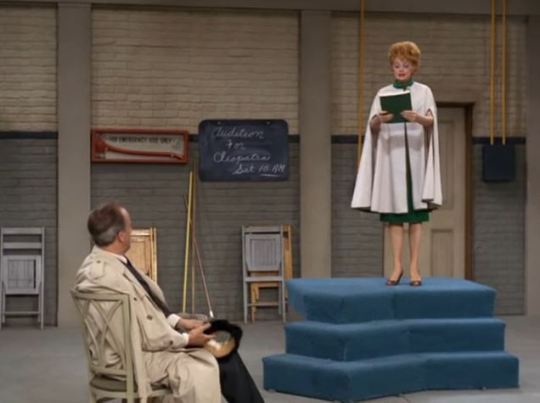
Liz is not the last Lucy character to try out for an amateur theatrical production. In 1963 Lucy Carmichael auditioned for the role of Cleopatra for the Danfield Community Players. She landed the role!
LIZ: “What has Betty Grable got that I haven’t got? Or Lana Turner?”

Betty Grable (1916-1973) made two films with Lucille Ball when they were both at RKO in the mid-1930s. She married actor Jackie Coogan in 1937 but divorced him in 1940. A pin-up girl, she was known for her shapely legs. In the late 1940s, 20th Century Fox insured her legs with Lloyd’s of London for a quarter of a million dollars.
Although she never appeared on the half-hour "I Love Lucy,” the mention of her name alone often stirred Fred’s libido, much to Ethel’s chagrin. In “Ricky’s Screen Test” (ILL S4;E7) Grable is mentioned as one of Ricky’s possible Don Juan co-stars. Her final screen appearance was in a 1958 “Lucy-Desi Comedy Hour” playing herself opposite her husband, Harry James.

Lana Turner (1921-1995) was as famous for her tight-fitting sweaters as Grable was for her shapely legs. She had appeared as herself in DuBarry Was A Lady starring Lucille Ball in 1943. She was mentioned on three episodes of “I Love Lucy” but never appeared on the series.
Once George has gone to work, Liz quickly phones back Ann and tells her that although George has forbidden it, she is going to the audition anyway. She claims that she isn’t looking for Hollywood fame, but wants to be able to prove to George that she can get it.

Housewife Liz’s search for fame is a character trait the writers would bring to Lucy Ricardo on “I Love Lucy.” The main difference is that Lucy truly wants to be famous, whereas Liz just wants to prove she has what it takes to get it!
Bachelor Cory Cartwright (John Heistand) drops by to report on his latest girlfriend, listed in his little black book as Mary Johnson, RHRW. The RH means Red Head and the second R stands for Real. (The audience laughs, perhaps knowing that Lucille Ball is NOT a real redhead.) The final letter is his kissing guide: W is for Wow! Liz asks if she is listed in his little black book? She is: Liz Cugat RHRWIWG. (Apparently Liz is supposed to be a real redhead). The WIWG stands for “Wish I Were George”! Liz demurs. Awww!
Cory lets it slip that he and George are having lunch with Anatol Brodney, who Cory knows from his college days. Liz wants Cory to bring George and Anatol home for dinner so that she can really show off her talent. He promises to try.

On “I Love Lucy,” the Ricardos and Mertzes also conspire to show off for a visiting Hollywood rep in “The Mustache” (ILL S1;E23). Lucy is a harem dancer, mainly due to the need to disguise the full beard she’s accidentally glued to her face. The Mertzes do an Arabian Nights act complete with snake charming, while Ricky croons ballads.

This idea would also be part of “Ricky’s Movie Offer” (ILL S4;E5), in which Lucy and the neighbors are sure that Ricky is bringing home a Hollywood talent scout, so they get their acts read. Lucy as Marilyn Monroe, Fred and Ethel as apache dancers, Mrs. Trumbull as a castanet singer, and the grocery delivery boy playing the trumpet!
At the auditions, Miss Worthingill of the Drama Department of Sixley College (Elvia Allman) is introduced to talk about her acting method. Liz gets up to audition for the role of a matron of 36, although she doesn’t think she can play someone quite so old.
[Ball is actually 37 at time!] The scene involves displaying an array of emotions from laughter to tears, plus chastising a dog who won’t get off the sofa. Miss Worthingill deems Liz a strong contender for the part.
George unexpectedly comes home for some papers and is told by Katie that Liz came home and locked herself in her room. Listening at the door, they hear Liz rehearsing – first crying, then laughing, then barking like a dog. They overhear Liz say the line “Take me in your arms!” and George decides to go in and confront her. Searching the room, he whistles for the dog and looks in the closet and under the bed, naturally finding neither dog, nor secret lover!
LIZ: “What did you expect to find? The Toni twins?”

Liz is jokingly referring to a series of print ads for Toni Home Permanent that depicted two twins with identical hairstyles and asked which one had the Toni, and which one had the more expensive salon perm. The promotion was so popular that the slogan “Which Twin Has The Toni?” became a part of common parlance. In addition, the Toni name itself became the name for a generic home permanent.
The Gillette Safety Razor Company acquired The Toni Company in 1948, the year of this broadcast.
To hide that she was rehearsing for her final audition, Liz tells George she had a nightmare. Or a ‘day-mare’, since it is daytime.
A worried George decides to talk to a psychiatrist (Hans Conried) for advice about Liz. Hearing George’s surname, the doctor asks:
DOCTOR: “Xavier?”
GEORGE: “George! I can’t even hold a tune.”
This is a reference to the Cuban bandleader Xavier Cugat (1900-1990). Lucille Ball’s husband Desi Arnaz was once employed by Cugat and looked at him as a mentor. Although the characters that inspired “My Favorite Husband” were originally named Cugat, it became apparent that there was confusion about the uncommon surname – especially considering the Arnaz / Cugat connection. By the end of 1948 it was decided that the name Cugat would be changed to Cooper to avoid the confusion – and any rumored legal action by the bandleader himself. Coincidentally, when creating the television characters inspired by Liz and George, Lucy and Ricky, they first considered Lopez. However, there already was a Larry Lopez, who was (what else?) a bandleader! So they became Lucy and Ricky Ricardo.
George tells the Psychiatrist about Liz’s condition. The Doctor volunteers to come to the Cugat home for dinner to better diagnose Liz. IN order not to alarm her, George tells Liz that he is bringing home an old college chum named Art Jones. Liz naturally thinks it is Anatol Brodney that George is bringing home!

In “The Inferiority Complex” (ILL S2;E18) Ricky is worried about Lucy’s mental health and also consults a psychiatrist. Like George, Ricky brings him home to observe Lucy. So she doesn’t discover their plan, he calls himself Chuck Stewart, an old friend of Ricky’s.
Thinking that the psychiatrist is really the Hollywood director, Liz trots out the array of emotions and characters to impress him! First, a sexy Mae West voice:.
LIZ (ala Mae West): “Hello, boys. I’m certainly glad you came up to see me. There’s a sofa over there, Mr. Jones. Why don’t you get out of that hard chair and slip into something more comfortable?”

Mae West (1893-1980) was a stage and screen performer who capitalized on her sex appeal and was well-known for her scandalous sexual innuendo. In a 1977 episode of “Donny & Marie” (above) Lucille Ball did her Mae West impersonation yet again!
Liz immediately switches character to that of a desperate, scorned woman, wildly attacking George for his indiscretions:
LIZ (wildly): “You beat me with a cane and pushed my poor broken body down the stairs! I don’t care for myself, but you pushed the children after me!”
GEORGE: “The children? I did not!”
LIZ (flatly): “Then where are they?”Liz leaves the room in crocodile tears and the doctor advises daily treatments. George opens the front door and it is Liz with a shawl on her head, talking like a bleating goat, begging for change.

LIZ (bleating): “Will you buy a poor old lady’s violets? I haven’t eaten for a week.”
George rings for Katie, but Liz enters as a Cockney maid.

LIZ (Cockney): “Alright, alright! I’m comin’ guv’nor. Don’t get on about it!”
When George tells her to quit it, she drops to the floor to become a South seas Native girl!
LIZ (deep voice): “Me Tondelayo! Me love white man. You don’t love me?”

During a sketch in “Danny Thomas’ The Wonderful World of Burlesque” in 1966, Lucille Ball wears a leopard print dress and a black wig and struts in seductively saying “I am Tondelayo,” the same words and voice she uses here on “My Favorite Husband” in 1948, 18 years earlier.
As Liz is prostrate on the floor, the doorbell rings. It is Cory Cartwright, who has with him (as promised) a guest for dinner – Anatol Brodney! Liz faints.
Later, Mrs. Worthingill calls and George answers the phone. She tells George that Liz got the part, but George says Liz has given up the theatre for good. Just after George hangs up, Liz, who has been listening on the extension phone, tells Mrs. Worthingill to disregard what George said – she’ll be at rehearsals first thing in the morning! End of episode!
-
LUCY & BEDROCK! (TWIST! TWIST!)
Lucille Ball & “The Flintstones”

“The Flintstones” was TV’s first primetime animated sitcom. It was produced by Hannah-Barbara animation and ran on ABC TV from 1960 to 1966. Following the show’s cancellation, a film called The Man Called Flintstone, a musical spy caper that parodied James Bond, was released that same year. The show was revived in the early 1970s and several different series and made-for-TV movies. The original show also was adapted into a live-action film in 1994, and a prequel, The Flintstones in Viva Rock Vegas, which followed in 2000.

Although not officially recognized by its creators, the show bears a very strong resemblance to TV’s “The Honeymooners”. Fred and Wilma Flintstone are reminiscent of Ralph and Alice Kramden, and they have best friends and neighbors Betty and Barney Rubble that are very similar to Ed and Trixie Norton. The original “Honeymooners” (1955-56) also was spun-off into future iterations, including musical episodes, just like “The Flintstones.”

Lucille Ball admired “Honeymooners” creator and Jackie Gleason and Gleason even played Ralph Kramden on “Here’s Lucy.” Ball also worked with the show’s other stars: Art Carney (in “Happy Anniversary and Goodbye” and “What Now Catherine Curtis”), Audrey Meadows (in “Mother of the Bride” on “Life With Lucy”) and even Jane Kean, who played Trixie in the color “Honeymooners” (who was seen on a 1966 episode of “The Lucy Show”).
CAST CONNECTIONS

Jean Vander Pyl (Wilma Flintstone / Pebbles) worked with Lucille Ball on several episodes of “My Favorite Husband” radio show in 1948.

Alan Reed (Fred Flintstone) played a train station luncheon counter attendant in “Lucy Visits The White House” (TLS S1;E23) in 1963, while also playing Fred Flintstone on ABC. He later appeared on an episode of Desi Arnaz’s “Mothers-in-Law”.

Bea Benadaret (Betty Rubble) was one of Lucille Ball’s favorite performers. She played Iris Atterbury on “My Favorite Husband” and was Ball’s first choice to play Ethel Mertz. Instead, she played Miss Lewis in “Lucy Plays Cupid” (ILL S1;E15).

Mel Blanc (Barney Rubble) was a master of voices best known for Bugs Bunny. He also worked extensively with Jack Benny, once with Lucille Ball. He did two films with Lucille Ball: The Fuller Brush Girl (1950) and G.I. Journal (1944). In 1969, Blanc did some ADR (dialogue replacement) work on “Here’s Lucy.”

Hal Smith (Various Voices) is probably best known as Otis the Drunk on “The Andy Griffith Show”. He appeared with Lucille Ball in the 1963 film Critic’s Choice and did three episodes of “The Lucy Show” and one of “Here’s Lucy.”

Howard Morris (Various Voices) played Howard Coe in “Lucy and the Golden Greek” (TLS S4;E2) in 1965.

Allan Melvin (Various Voices) is best remembered as Sam the Butcher on “The Brady Bunch” and Barney Hefner on “All in the Family.” In 1956, as Corporal Henshaw on “Sergeant Bilko,” he did was seen with Ball in “Bilko’s Ape Man.” Melvin and Ball also appeared together on the 8th Anniversary of “The Ed Sullivan Show” In 1954.

Harvey Korman (The Great Gazzoo / Various Voices) is best remembered for his work with Carol Burnett on “The Carol Burnett Show”, several times with Lucille Ball. He also appeared on “The Lucy Show” three times.

Janet Waldo (Mrs. Slaghoople / Hedda Rocker / Various Voices) is best remembered for voicing Judy Jetson on another Hanna-Barbera cartoon series, “The Jetsons” (1962-87). She played Peggy “Keep Jiggling” Dawson on “I Love Lucy” and Lucy Carmichael’s sister Marge on “The Lucy Show.”

Frank Nelson (Rockbind / Rocky Stone / Various Clerks) did two recurring characters on “I Love Lucy” – Freddie Fiillmore and Ralph Ramsey, in addition to other characters. His distinctive voice was heard on “My Favorite Husband” and he made one appearance, as the harried train conductor, on “The Lucy Show.”

June Foray (Granny / Nurses) was one of the most famous voice artists in Hollywood, most famous for Rocket J. Squirrel. Coincidentally, Warner Brothers recruited Foray to replace Bea Benadaret as Granny in their cartoons. On “I Love Lucy” she provided the bark of Fred the dog.

Paula Winslowe (Mrs. Slate / Various Voices) played Mrs. Martha Conklin on “Our Miss Brooks” opposite Gale Gordon. On “I Love Lucy” she was one of the passengers on the S.S. Constitution in “Second Honeymoon” (ILL S5;E14) and a patient (in wheelchair, above) in “Lucy Plays Florence Nightingale” (TLS S2;E14). She was the voice of Bambi’s mother in the 1942 Disney film Bambi.

Verna Felton (Pearl Slaghoople) received two Emmy nominations for her role in the Desilu series “December Bride,” playing Hilda Crocker from 1955 to 1959. She did two episodes of “I Love Lucy,” including playing Lucy’s stern maid, Mrs. Porter. Felton voiced many characters for Disney.

Howard McNear (Doctor) played Mr. Crawford, Little Ricky’s music teacher on “I Love Lucy.” McNear went on to play Floyd the Barber on “The Andy Griffith Show” from 1961 to 1967, filmed on the Desilu backlot. He was also seen in Lucy and Desi’s 1953 film The Long, Long Trailer.

Herb Vigran (Cop) was one of the busiest character actors in Hollywood. He played Jule, Ricky Ricardo’s music agent on two episodes of “I Love Lucy” in addition to playing movie publicist Hal Sparks in “Lucy is Envious” (ILL S3;23). He was seen in the Lucy-Desi film The Long, Long Trailer and six episodes of “The Lucy Show” – all as doctors!

Ginny Tyler (Daisy) voiced Clementine the sheep in “Lucy Buys a Sheep” (TLS S1;E5) and the bird voices in “Lucy Gets the Bird” (TLS S3;E12) and one episode of “Here’s Lucy.” She did the voice of the sheep in Disney’s 1964 hit Mary Poppins. Although she died in 2012, her voice can still be heard in the chorus of birds outside The Enchanted Tiki Room at Disneyland and Walt Disney World.

Willard Waterman (Gus Gravel) was a versatile voice actor who appeared on hundreds of radio shows in the 1930s and 40s. He is probably best remembered for playing “The Great Gildersleeve” on both radio and TV. He was seen on “The Lucy Show” in “Lucy and The Plumber” (above) and “Lucy the Rain Goddess” (S4;E15).

Jerry Hausner (Clyde) was best remembered for playing Jerry, Ricky’s agent on “I Love Lucy” (including the pilot). He also did one appearance on “The Lucy Show.”

Sam Edwards (Agent) played the star-struck bellboy in “Lucy Meets the Queen” (ILL S5;E15). He was also the voice of the adult Thumper in Bambi (1942).

Sandra Gould (Various Voices) was best remembered as Gladys Kravitz on “Bewitched”. She made two appearances on “I Love Lucy” and one (above) on “The Lucy Show.”

Ann-Margret (Ann Margrock) was one of several celebrity guest stars to be honored with character on “The Flintstones”. She was also a guest star (as herself) on “Here’s Lucy” in 1970 and had appeared on Ann-Margret’s 1969 special.

Elizabeth Taylor (Pearl Slaghoople in The Flintstones live action film, 1994) was one of Hollywood’s most glamorous and popular stars when she guest starred with husband Richard Burton on “Here’s Lucy” in 1970. It is odd, then, that she was cast as Pearl Slaghoople, a character that was previously considered frumpy.

Paul Winchell (Umpire / Thief / Reporter in “Wind Up Wilma” – 1981) was best known as a ventriloquist, but he was also an accomplished character actor who appeared in two episodes of “The Lucy Show” and two of “Here’s Lucy.”

Arte Johnson (”Flintstone Kids” – 1989) was best known as a cast member on “Rowan and Martin’s Laugh-In”. He also did an episode of “Here’s Lucy” as an eccentric bird watcher.

George O’Hanlon (”Flintstone Kids” – 1989) was best remembered as the voice of George Jetson on “The Jetsons,” another hit Hanna-Barbera cartoon. On “I Love Lucy” he was one of two actors to play Charlie Appleby.
"I Love Lucy” and “The Flintstones”

First, Lucille Ball bears more than a passing physical resemblance to Wilma Flintstone. In “The Flintstones” it is clear that Fred is the leading character and most stories revolve around Fred and Barney, rather than Lucy and Ethel. The tried and true formula of a leading couple and the best friends / neighbors as the secondary characters is used in “I Love Lucy”, “The Honeymooners” and “The Flintstones”.
Here are a few more tangible connections:

The animated Lucy and Desi that opened pre-syndication airings of “I Love Lucy” were created by the Hanna-Barbera unit at MGM.

And both shows were sponsored by cigarette companies; “I Love Lucy” by Philip Morris and “The Flintstones” by Winston.

Wilma and
Betty trying to sneak into the Water Buffalo convention in "Ladies
Night at the Lodge” (1964) while disguised as men was very close to Lucy and Ethel disguising themselves as male reporters to infiltrate Ricky’s daddy shower in “Ricky Has Labor Pains” (1953).
The plot of “Operation Switchover” (1964) recycles the premise and many of the same plot elements of “Job Switching” (1952) especially with the domestic disasters on Ricky and Fred’s end: scorched clothes while ironing, a fallen cake, and overflowing rice on the stove.

Like Lucy Ricardo, Wilma Flintstone’s pregnancy was incorporated into the storyline. It was originally thought that like Lucy, Wilma would have a boy, but merchandisers pointed out that there were more opportunities for products for girls, so Pebbles was born. Like Lucille Ball, Jean Vander Pyl (who voiced Wilma) was pregnant at the time of recording and gave birth to her son on the day “The Blessed Event” originally aired on February 22, 1963.
- Fred and Barney undertake a rehearsal for the big moment, including Betty rehearsing telephoning the doctor, just like Ricky and the Mertz’s do for Lucy when ‘the time has come’.
- Wilma seems to get cravings for unusual foods including hot fudge and sardines that Fred dutifully supplies, just like Ricky did for Lucy.
- In the father’s waiting room, a man worries his wife might deliver more than one baby, just like Mr. Stanley (Charles Lane) on “I Love Lucy.”

In “Operation Switchover” a character named Hedda Rocker from Good Cavekeeping Magazine is obviously inspired by Hedda Hopper, the famous gossip columnist who appeared on two episodes of “I Love Lucy” as herself.

Arthur Murray, who’s innovate dance instruction method and dance studios became iconic, is parodied on “The Flintstones” as Arthur Quarry. In a 1965 episode, he was named Arthury Murrayrock.

In “Lucy Meets the Mustache” (LDCH S3;E3) Lucy wants to open a sealed letter so she tries a inserting a knitting needle under the flap, a method she says she saw in an Alfred Hitchcock movie. The scene is underscored with “Funeral March of a Marionette” by Charles Gounod, which served as the theme tune of “Alfred Hitchcock Presents”. On “The Flintstones” he is parodied as Alvin Brickrock.

Hollyrock star Rock Quarry is a tribute to Rock Hudson, but talks like Gary Cooper. Hudson guest-starred on an episode of “I Love Lucy” set in Palm Springs. Previously, Lucy dressed as Gary Cooper (complete with his trademark ‘yup’) to fool near-sighted Caroline Appleby.

An
episode titled “The
Soft Touchables” is
modeled after Desilu’s hit gangster series “The
Untouchables.” “The Lucy Show” parodied their own show in
an episode titled “Lucy The Gun Moll” (TLS S4;E25) in 1966
starring “The Untouchables Cast” but using different
character names.
Wilma
and Betty’s favorite television show “Peek-A-Boo
Camera” catches
Fred and Barney acting silly in a 1963 episode that is clearly
modeled after TV’s “Candid Camera” created by Allen Funt.
In 1971, “Lucy
and the Candid Camera” (HL
S4;E14) also featured Funt in hidden camera shot plot. Lucy
Carmichael also get involved in a hidden camera television show
in “Lucy
and the Beauty Doctor” (TLS S3;E24).
In that show, the program was called “The Boiling Point.”
The hit Broadway and movie musical movie My Fair Lady inspired many satires (some in name only) including “My Fair Freddy” (1966) and “My Fair Lucy” (TLS S3;E20) in 1965!

In “Fred Flintstone Woos Again” (1961) Wilma convinces Fred to renew their wedding vows after realizing the official who originally married them wasn’t fully licensed! On “I Love Lucy” Lucy realized that their wedding was also invalid when she found an error on their license. They go to the spot they first wed to renew their vows, just like “The Flintstones”.

In “Dial ‘S’ for Suspicion” (1962) Wilma’s devotion to a murder mystery novel causes Fred to wonder if Wilma is trying to away with him. In “Lucy Thinks Ricky Is Trying To Do Away With Her” (ILL S1;E4) Lucy’s devotion to a murder mystery novel causes her to wonder if Ricky is trying to do away with her!

When Wilma can’t keep up with the housework, she hires a maid in “Wilma the Maid” (1963). The same situation happened in the Ricardo home in “Lucy Hires a Maid” (ILL S2;E23). While the Flintstone’s maid is an earthy Italian woman named Rockabrigida, the Ricardo’s maid is a humorless woman named Mrs. Porter. Coincidentally, Mrs. Porter was played by Verna Felton, who voices Pearl Slaghoople on “The Flintstones”.

When superhero “Superstone” is hired for a birthday party but can’t make it – Fred takes his place. On “I Love Lucy” when Superman is promised for Little Ricky’s party, but can’t make it, Lucy takes his place – nearly!

In “How To Pick A Fight With Your Wife” (1966) spats between spouses escalate to such a degree that the couples split: Fred and Barney are thrown together as roommates, while Wilma and Betty are bunking together at the other house. In “Vacation from Marriage” (ILL S2;E6) much the same thing occurs between the Ricardos and the Mertzes!

The real comparison with Lucy and Desi is something Joe Barbera could have only hoped for in 1960 — enduring popularity. Lucy is still justifiably loved by hoards of fans and “I Love Lucy” is on the air somewhere. “The Flintstones” remains a part of the popular culture, 60 years after the show’s debut.
-
WOMEN’S CLUB ELECTION
September 30, 1949

“Women’s Club Election” (aka “Liz Is Elected Women’s Club Treasurer”) is episode #56 of the radio series MY FAVORITE HUSBAND broadcast on September 30, 1949.
This was the fifth episode of the second season of MY FAVORITE HUSBAND. There were 43 new episodes, with the season ending on June 25, 1950.

The script was later adapted for television as “The Club Election” (ILL S2;E19) first aired on February 16, 1953.
Synopsis ~ George has cause for alarm when Liz is elected treasurer of the local women’s club because he knows how much trouble she has with figures but Liz has a surprise for him.

“My Favorite Husband” was based on the novels Mr. and Mrs. Cugat, the Record of a Happy Marriage (1940) and Outside Eden (1945) by Isabel Scott Rorick, which had previously been adapted into the film Are Husbands Necessary? (1942). “My Favorite Husband” was first broadcast as a one-time special on July 5, 1948. Lucille Ball and Lee Bowman played the characters of Liz and George Cugat, and a positive response to this broadcast convinced CBS to launch “My Favorite Husband” as a series. Bowman was not available Richard Denning was cast as George. On January 7, 1949, confusion with bandleader Xavier Cugat prompted a name change to Cooper. On this same episode Jell-O became its sponsor. A total of 124 episodes of the program aired from July 23, 1948 through March 31, 1951. After about ten episodes had been written, writers Fox and Davenport departed and three new writers took over – Bob Carroll, Jr., Madelyn Pugh, and head writer/producer Jess Oppenheimer. In March 1949 Gale Gordon took over the existing role of George’s boss, Rudolph Atterbury, and Bea Benaderet was added as his wife, Iris. CBS brought “My Favorite Husband” to television in 1953, starring Joan Caulfield and Barry Nelson as Liz and George Coope. The television version ran two-and-a-half seasons, from September 1953 through December 1955, running concurrently with “I Love Lucy.” It was produced live at CBS Television City for most of its run, until switching to film for a truncated third season filmed (ironically) at Desilu and recasting Liz Cooper with Vanessa Brown.
MAIN CAST

Lucille Ball (Liz Cooper) was born on August 6, 1911 in Jamestown, New York. She began her screen career in 1933 and was known in Hollywood as ‘Queen of the B’s’ due to her many appearances in ‘B’ movies. With Richard Denning, she starred in a radio program titled “My Favorite Husband” which eventually led to the creation of “I Love Lucy,” a television situation comedy in which she co-starred with her real-life husband, Latin bandleader Desi Arnaz. The program was phenomenally successful, allowing the couple to purchase what was once RKO Studios, re-naming it Desilu. When the show ended in 1960 (in an hour-long format known as “The Lucy-Desi Comedy Hour”) so did Lucy and Desi’s marriage. In 1962, hoping to keep Desilu financially solvent, Lucy returned to the sitcom format with “The Lucy Show,” which lasted six seasons. She followed that with a similar sitcom “Here’s Lucy” co-starring with her real-life children, Lucie and Desi Jr., as well as Gale Gordon, who had joined the cast of “The Lucy Show” during season two. Before her death in 1989, Lucy made one more attempt at a sitcom with “Life With Lucy,” also with Gordon.
Richard Denning (George Cooper) was born Louis Albert Heindrich Denninger Jr., in Poughkeepsie, New York. When he was 18 months old, his family moved to Los Angeles. Plans called for him to take over his father’s garment manufacturing business, but he developed an interest in acting. Denning enlisted in the US Navy during World War II. He is best known for his roles in various science fiction and horror films of the 1950s. Although he teamed with Lucille Ball on radio in “My Favorite Husband,” the two never acted together on screen. While “I Love Lucy” was on the air, he was seen on another CBS TV series, “Mr. & Mrs. North.” From 1968 to 1980 he played the Governor on “Hawaii 5-0″, his final role. He died in 1998 at age 84.
Bea Benadaret (Iris Atterbury) was considered the front-runner to be cast as Ethel Mertz but when “I Love Lucy” was ready to start production she was already playing a similar role on TV’s “The George Burns and Gracie Allen Show” so Vivian Vance was cast instead. On “I Love Lucy” she was cast as Lucy Ricarodo’s spinster neighbor, Miss Lewis, in “Lucy Plays Cupid” (ILL S1;E15) in early 1952. Later, she was a success in her own show, “Petticoat Junction” as Shady Rest Hotel proprietress Kate Bradley. She starred in the series until her death in 1968.
Ruth Perrott (Katie, the Maid) was also later seen on “I Love Lucy.” She first played Mrs. Pomerantz, a member of the surprise investigating committee for the Society Matrons League in “Pioneer Women” (ILL S1;E25), as one of the member of the Wednesday Afternoon Fine Arts League in “Lucy and Ethel Buy the Same Dress” (ILL S3;E3), and also played a nurse when “Lucy Goes to the Hospital” (ILL S2;E16). She died in 1996 at the age of 96.
Bob LeMond (Announcer) also served as the announcer for the pilot episode of “I Love Lucy”. When the long-lost pilot was finally discovered in 1990, a few moments of the opening narration were damaged and lost, so LeMond – fifty years later – recreated the narration for the CBS special and subsequent DVD release.
Gale Gordon (Rudolph Atterbury) does not appear in this episode.
GUEST CAST

Hans Conried (Mr. Benjamin Wood) first co-starred with Lucille Ball in The Big Street (1942). He then appeared on “I Love Lucy” as used furniture man Dan Jenkins in “Redecorating” (ILL S2;E8) and later that same season as Percy Livermore in “Lucy Hires an English Tutor” (ILL S2;E13) – both in 1952. The following year he began an association with Disney by voicing Captain Hook in Peter Pan. On “The Lucy Show” he played Professor Gitterman in “Lucy’s Barbershop Quartet” (TLS S1;E19) and in “Lucy Plays Cleopatra” (TLS S2;E1). He was probably best known as Uncle Tonoose on “Make Room for Daddy” starring Danny Thomas, which was filmed on the Desilu lot. He joined Thomas on a season 6 episode of “Here’s Lucy” in 1973. He died in 1982 at age 64.
Conried played Mr. Wood on several episodes. Wood is a neighbor of the Coopers with eleven children!

Frank Nelson (Derelict) was born on May 6, 1911 (three months before Lucille Ball) in Colorado Springs, Colorado. He started working as a radio announcer at the age of 15. He later appeared on such popular radio shows as “The Great Gildersleeve,” “Burns and Allen,” and “Fibber McGee & Molly”. Aside from Lucille Ball, Nelson is perhaps most associated with Jack Benny and was a fifteen-year regular on his radio and television programs. His trademark was playing clerks and other working stiffs, suddenly turning to Benny with a drawn out “Yeeeeeeeeees?”
Nelson appeared in 11 episodes of “I Love Lucy”, including three as quiz master Freddy Fillmore, and two as Ralph Ramsey, plus appearance on “The Lucy-Desi Comedy Hour” – making him the only actor to play two different recurring roles on “I Love Lucy.”
Nelson returned to the role of the frazzled Train Conductor for an episode of “The Lucy Show” in 1963. This marks his final appearance on a Lucille Ball sitcom.

Elvia Allman (Marge Van Tassel) was born on September 19, 1904 in Enochville, North Carolina. She started her performing career on radio in the 1920s, as both a storyteller and singer. This led to work voicing cartoon characters for Warner Brothers. Simultaneously, she was pursuing stage acting, appearing at the Pasadena Playhouse. Allman made her film debut as an actress in 1940’s The Road to Singapore as a homely woman who pursues Bob Hope. Allman played the strident forewoman of Kramer’s Kandy Kitchen in “Job Switching” (ILL S2;E1). She would return to the show as one of Minnie Finch’s neighbors in “Fan Magazine” (ILL S3;E17) and as reporter Nancy Graham in “The Homecoming” (ILL S5;E6). She made two appearances each on The Lucy–Desi Comedy Hour“ and ”The Lucy Show.“
On “I Love Lucy,” Lucy Ricardo frequently was heard talking to a club woman named Marge on the telephone, but her last name was never mentioned. When we finally get to meet Marge she is played by Charlotte Lawrence.
Naomi Brubaker and other Women’s Club Members are played by uncredited performers.
EPISODE

The episode opens late evening at the Cooper’s where Liz is typing and George is reading a book. Liz complains about Mr. Woods’ kids ringing the doorbell – but it is just the bell on the typewriter. Liz is typing her acceptance speech for tomorrow’s women’s club election. She reads the speech aloud for George:
LIZ: “Ladies of the Sheridan Falls Women’s Club: First, I want to thank everyone who voted for me. You will not be disappointed. I’ll do my best to be a good _______ this year.”

On "I Love Lucy” the Sheridan Falls Women’s Club was known as The Wednesday Afternoon Fine Arts League.
Liz will fill in the blanks once she is elected. She is sure to be elected to some office, as everyone in the club is an officer – all 25! The only office Liz is not expected to be elected to is Treasurer, which always goes to Naomi Brubaker, whose husband is a CPA.
Next day at the Club meeting, Iris (as President) makes announcements and reads the election results. As Iris owns the clubhouse furniture, she is naturally re-elected President. Vice President goes to Phyllis Brown, though Liz assumes it will be her. Secretary goes to Marge Van Tassell (Elvia Allman), although Liz expects it to be her. Instead, Liz has been elected 25th Honorary Exalted Alternate. The bad news is that although Naomi is re-elected treasurer, she must resign as her husband the CPA has been transferred to California. Because Liz’s husband George is a banker, Liz’s nomination and election is rushed through, much to her dismay.
IRIS: “Liz, you’ve been elected! This is a democracy! It’s the will of the people!”
LIZ: “It is not! I’m a people and I didn’t even get a chance to peep!”
Liz’s rush to read her acceptance speech before her name is even announced is very similar to Lucy Ricardo’s rising to acknowledge her nomination before her name is read aloud in “The Club Election”. Liz and Lucy’s hopes are dashed each time Madam President announces a new result.
George is concerned about Liz’s election to treasurer because of her inability to do her household accounts. He lays down the law: if her household accounts don’t balance, then she must resign! Liz confides in Katie the Maid that the Club’s books are a real disaster.

On “I Love Lucy,” Lucy Ricardo’s household accounts became so messy that Ricky hired “The Business Manager” (ILL S4;E1) to try to make sense of them. Charles Lane played Mr. Hickox.
Liz asks neighbor Mr. Wood (Hans Conried) for help with the club’s books. She has plans to build a new clubhouse, but she doesn’t know the difference between income and expenses and can’t add 9 and 9. Mr. Wood says the club only has forty cents in their ledger!
LIZ: “What kind of a clubhouse can you buy for forty cents!?”
MR. WOOD: “Maybe you should settle on a club sandwich.”
After a commercial by announcer Bob LeMond for Jello Vanilla Tapioca Pudding, the story resumes. It is the first of the month and George wants to see Liz’s household books, but she is forty dollars short, so she tricks him into thinking he is late for work by setting the clocks forward. Liz gets an idea to transfer the money from the club to the household accounts and back again!
At the meeting, Liz reports a surplus of $100. Marge wants to contribute the money to the Sheridan Falls Boys Club. The donation is voted through although Liz knows this will spoil her scheme to juggle the books.
Back at home, she confesses to Katie that she didn’t give the Boy’s Club the full amount. To clear her guilty conscience she decides to give the rest of the money to the first needy charity she sees. She opens the front door and coincidentally a derelict (Frank Nelson) is passing by. She give him the forty dollars.
When George comes home to see her books, Liz faces the music, fearing the worst. Just then the doorbell rings. It is the Derelict who hands her $740. He took her $40 and bet it on a horse at Belmont who came in 16 to 1! Liz gladly returns to face George!
- At one time, early in her career, Lucille Ball went by the name Diane Belmont, naming herself after the New York Racetrack!
In a live Jello commercial, Lucy plays a tourist in sunny France and Bob LeMond a Frenchman flirting with her. He says he reminds her of Jello Tapioca Pudding!
LUCY: “Well, tap my ‘oka’ – these Frenchmen really know how to make love!”
In the usual bedtime tag, Liz wakes George from a sound sleep to report she’s had a dream of being in the desert. He is sure she wants him to get her a glass of water. Instead, he brings a whole pitcher and dumps it on her! End of episode.
Bob LeMond reads a pitch for men to join the military, highlighting educational opportunities. He reminds listeners that Lucille Ball can be seen in the film Miss Grant Takes Richmond. The film had premiered just ten days before this broadcast.

-
MY THREE SONS at 60!
September 29, 1960

“My Three Sons” was a situation comedy produced at Desilu Studios. It premiered on ABC TV on September 29, 1960 and finished its first run on April 13, 1972, with 380 episodes making it the second-longest running live-action sitcom in TV history after “The Adventures of Ozzie and Harriett” (1952-66).

Seasons 1 through 5 were aired in black and white on CBS. In 1965 it moved to CBS when ABC declined to underwrite the costs of airing in color.
The series was initially filmed at Desilu Studios in Hollywood, but at the start of the 1967–68 season, the cast and crew began filming the series at the CBS Studio Center in Studio City, California due to Lucille Ball’s sale of Desilu to Gulf + Western, which owned Paramount Pictures. The sale also affected the filming location of another family sitcom, “Family Affair.”
Incredibly, “My Three Sons” ran concurrently through both “The Lucy Show” and “Here’s Lucy.” Both Steve Douglas and Lucy Carmichael (and later Carter), where single parents raising children.

September 16, 1965 was a big night for CBS airing the very first episode of “My Three Sons” after moving from ABC titled “The First Marriage”. It was also the first episode of the series broadcast in color, something “The Lucy Show” did three days earlier with “Lucy at Marineland” (TLS S4;E1).
The premise of the series is a widowed father (Steven Douglas) raising his three boys with help of his extended family. Initially, the three sons were Chip, Robbie, and Mike, but in 1967 Mike was written out and replaced by Ernie, whom Steve adopted. The extended family at first consisted of Bub, Steve’s father-in-law and the boys’ maternal grandfather, but in 1964, that character was replaced by Uncle Charley, Steve’s uncle and Bub’s brother.

The leading role was played by film star Fred MacMurray, who the series was built around – including his hectic schedule. To suit MacMurray, scenes would be shot out of sequence and even alone on a soundstage and later edited to create a complete episode. This was not MacMurray’s first time at Desilu. In 1958 he played himself on the “Lucy-Desi Comedy Hour” in “Lucy Hunts Uranium” set in the Nevada desert outside Las Vegas. He was joined by his second wife, actress June Haver. MacMurray (1908-91) appeared in over 100 films in his career but is perhaps best remembered for the film Double Indemnity (1944), which Lucy references in this episode. MacMurray’s name was first mentioned by Ethel in 1953 in “The Black Eye” (ILL S2;E20) when flowers arrive for Lucy mistakenly signed “Eternally yours, Fred.”
Although Lucille Ball was their landlord (and ultimate boss) she never acted on the show, but many of the actors who appeared on Lucille Ball’s sitcoms did appear on “My Three Sons”.

From 1960 to 1965, MacMurray was joined by William Frawley as Bub O’Casey, the family’s live-in maternal grandfather. Of course, Frawley came to fame on “I Love Lucy” as the crusty landlord Fred Mertz. Frawley had worked with MacMurray in the 1935 film, Car 99. When Frawley had to leave the show due to ill-health (and it was too costly to insure him) he was replaced by another Desilu alumni, William Demarest, as Uncle Charley. Like his previous co-star, Vivian Vance, Frawley was not especially fond of Demarest personally or as an actor. Demarest had, however, done three films with Lucille Ball. Frawley kept watching “My Three Sons” on his TV set bitterly. He never really got over being replaced by Demarest. On March 3, 1966, Frawley died of a heart attack.

For Christmas 1959, Frawley and Demarest both appeared with Lucy and Desi in “The Desilu Revue” (above with “December Bride’s” Spring Byington). At the time, Demarest was working on the Desilu lot appearing in NBC’s “Love and Marriage.”

On “My Three Sons” two of Steve Douglas’ boys had been seen on “The Lucy Show”: Don Grady (Robbie Douglas) had played Chris Carmichael’s friend Bill and Barry Livingston (Ernie Douglas) had played Mr. Mooney’s son Arnold. Ted Eccles, who assumed the role of Arnold Mooney when Barry Livingston was busy on “My Three Sons,” also did an episode.

The children of “The Lucy Show,” Ralph Hart (who played Viv Bagley’s son Sherman), Jimmy Garrett (Jerry Carmichael), and Candy Moore (Lucy Carmichael’s daughter Chris) were also on episodes of “My Three Sons.”
Other “Lucy” performers who were on “My Three Sons” include:
- Mary Wickes ~ Jeri Schronk (1964)
- Doris Singleton ~ Helen & Margaret, 8 episodes (1964-70)
- Shirley Mitchell ~ Sally, 2 episodes (1968)
- Barbara Pepper ~ Mrs. Brand (1966)
- Verna Felton ~ Mub (1962)
- Kathleen Freeman ~ Lady Checker (1967)
- Jerry Hausner ~ Various Characters, 2 episodes (1964 & 1966)
- Reta Shaw ~ Various Characters, 2 episodes (1962 & 1965)
- Elvia Allman ~ Maude Prosser (1967)
- Eleanor Audley ~ Mrs. Vincent, 9 episodes (1969-70)
- Burt Mustin ~ Various Characters, 5 episodes (1962-70)
- Olan Soule ~ Various Characters, 5 episodes (1963-70)
- Alberto Morin ~ Professor Madoro (1967)
- Herb Vigran ~ Caretaker (1967)
- Maurice Marsac ~ Various Characters, 3 episodes (1964-72)
- Tim Mathewson ~ Various Characters, 3 episodes (1962-63)
- Bill Quinn ~ Doctors, 4 episodes (1964-66)
- Barbara Perry ~ Mrs. Thompson & Mrs. Hoover, 3 episodes (1964-72)
- Nancy Kulp
~ Various Characters, 2 episodes (1962)
- George N. Neise ~ Various Characters, 2 episodes (1960 & 1967)
- Maxine Semon ~ Various Characters, 2 episodes (1964 & 1967)
- Roy Roberts ~Various Characters, 2 episodes (1965 & 1967)
- Lou Krugman ~ Various Characters, 2 episodes (1966 & 1967)
- Richard Reeves ~ Various Characters, 2 episodes (1962 & 1965)
- Dorothy Konrad ~ Various Characters, 2 episodes (1961 & 1962)
- Ed Begley ~ Various Characters, 2 episodes (1962 & 1968)
- Gail Bonney ~ Various Characters, 2 episodes (1965 & 1970)
- Rolfe Sedan ~ Various Characters, 2 episodes (1968 & 1971)
- Tyler McVey ~ Various Characters, 2 episodes (1962 & 1967)
- J. Pat O’Malley ~ Various Characters, 2 episodes (1963 & 1964)
- Paul Picerni ~ Various Characters, 2 episodes (1965 & 1967)
- Sandra Gould ~ Various Characters, 2 episodes (1963 & 1964)
- Richard Deacon ~ Elderly Man (1960)
- Mabel Albertson ~ Mrs. Proctor (1964)
- Joan Blondell ~ Harriet Blanchard (1965)
- Leon Belasco ~ Professor Lombardi (1966)
- Dayton Lummis ~ Dr. Blackwood (1963)
- Lurene Tuttle ~ Natalie Corcoran (1968)
- Robert Foulk ~ Pop Action (1962)
- Dick Patterson ~ Bunny Baxter (1963)
- Jamie Farr ~ Itchy (1964)
- Larry J. Blake ~ Policeman (1968)
- Amzie Strickland ~ Cora Dennis (1968)
- Barbara Morrison ~ Mrs. Murdock (1969)
- Louis Nicoletti ~ Caddy Master (1962)
- Frank Gerstle ~ Policeman (1964)
- Gil Perkins ~ Painter (1963)
- Tommy Ferrell ~ Mr. Griffith (1964)
- Eve McVeagh ~ Clara (1966)
- Remo Pisani ~ Pepe (1970)
- Dub Taylor ~ Judge (1963)
- Frank J. Scannell ~ Emcee (1968)
- Ray Kellogg ~ Henshaw (1965)
- Romo Vincent ~ Charley (1964)
- Stafford Repp ~ Sergeant Perkins (1969)
- Jay Novello ~ Vincenzo (1966)
- Leoda Richards ~ Restaurant Patron (1966)
CHILD STARS!
Other child stars who appeared on “My Three Sons” included Butch Patrick (“The Munsters”), Jay North (“Dennis the Menace”), Oscar-winner Jodie Foster, Angela Cartwright (“Make Room for Daddy”), Flip Mark (”Lassie”), John Walmsley (”The Waltons”), Tony Dow (“Leave It To Beaver”), Erin Moran (“Happy Days”), Maureen McCormick (”The Brady Bunch”), Ann Jillian (Gypsy), and Heather Menzies (The Sound of Music).

On November 22, 1977, ABC TV (and Dick Clark Productions) brought together a reunion of two of television’s favorite sitcoms "The Partridge Family” and “My Three Sons.” Hosted by Shirley Jones and Fred MacMurray this would be the only time that the surviving cast members would get together to celebrate the series which included clips, a song from David Cassidy, and an update of what each cast member was doing in 1977.

Also in 1977, some of the stars of the series reunited on a morning program titled “The Early Show”, including Stanley Livingston (Chip Douglas), Barry Livingston (Ernie Douglas), Tina Cole (Katie Miller Douglas), and Don Grady (Robbie Douglas).
TRIVIA

In “Lucy Helps Danny Thomas” (TLS S4;E7) in 1965, there is a large framed photo of Fred MacMurray in the studio hallway. He is joined by other Desilu stars like Jim Nabors (of “Gomer Pyle USMC”), Andy Griffith (of “The Andy Griffith Show”) and Danny Thomas (of “The Danny Thomas Show”).

-
LUCY CLOWNS AGAIN!
September 29, 1962

On September 29, 1962, Lucille Ball again graced the cover of TV Guide. This was just one of her 39 TV Guide covers, having appeared on the very first national edition in 1952.

The unique and memorable cover photo – which seems to capture the 51 year-old Ball leaping in mid air – was taken by Philippe Halsman (1906-1979). In 1951 Halsman was commissioned by NBC to photograph various popular comedians of the time including Milton Berle, Sid Caesar, Groucho Marx, and Bob Hope.

He captured many of the comedians in mid-air, which went on to inspire many later ‘jump’ pictures of celebrities including the Ford family, The Duke and Duchess of Windsor, Marilyn Monroe, and Richard Nixon. His first TV Guide cover was in 1955 and he did more than 30 more.

In 1950, Halsman took this now-iconic photo of Lucille Ball.

The inside article was written by Edith Efron (1922-2001). She became a writer and, later, senior editor of TV Guide in the 1960s and 1970s, where she wrote celebrity profiles, political columns and editorials.

“She
seems at first to be made up of disparate and clashing bits and
pieces: the absurdly orange hair… the sharp, indifferent blue
eyes… the fringe of black lashes, each standing out spikily… the
unsmiling pink lips, painted heartshape, over the real lines of pain
beneath the heavy make-up… the strong handshake… the cold, shy
manner… the brusque speech… the stiff-legged, almost boyish
stride.”
Efron equates the brand new “Lucy Show” without Desi to Gone With The Wind with Scarlett and no Rhett. Efron assesses the newly minted “corn” as a an “unsettling” and “odd experience.”

Monday, October 1, 1962 saw the premiere of Lucille Ball’s much-anticipated new sitcom, “The Lucy Show” on CBS. Once again, the Queen is on her throne on Monday nights, this time as a widowed mother of two, sharing a suburban house with her best friend, a divorcee with a child of her own, played by her former partner in crime, Vivian Vance. The first episode aired was titled “Lucy Waits Up for Chris” and featured Lucille Ball on a trampoline!

The Guide lists that the World Series will begin on NBC on Wednesday in Los Angeles, with a resurrection of the old “Subway Series” between the Dodgers and their old sparring partners the New York Yankees. Except it didn’t start on Wednesday, and when it did, it wasn’t the Dodgers who took on the Yankees, but the San Francisco Giants. It’s also a lesson in what can happen when you’re a publication working under a deadline!

Going pretty much unmentioned is that on Monday, October 1, 1962, Johnny Carson assumed hosting of “The Tonight Show” for the very first time. Johnny Carson and “The Tonight Show” would be integrated into an episode of “Here’s Lucy” in 1969.

Lucille Ball made 20 appearances on “The Tonight Show With Johnny Carson” although a few were with guest hosts.

Earlier in the day on NBC another famous host made his debut with “The Merv Griffin Show” (1962-86). Lucille Ball made four appearances on the chatfest between 1971 and 1980.

Also this week, the Desilu series “The Real McCoys” moved to CBS after five years on ABC. Kathy Nolan had left her role as Kate so Luke was a now a widow. This was the beginning of the end for the once-popular series. Norma Varden appeared in the season opener, directed by its star, Richard Crenna.

Desilu’s other big series (before “The Lucy Show”) was “The Untouchables” – which was then two episodes into its fourth and final season. Gilbert Seides reviewed the series in this issue.

The entire main cast would join “The Lucy Show” for a satire on the series in 1966. To preserve the show’s integrity, the characters had different names, but were clearly recognizable to viewers.


-
SYNDICATED COLUMNS
September 28, 1951

On September 28, 1951, Erskine Johnson’s syndicated column reported that Lucille Ball’s new television show would be shot in front of a studio audience on a Hollywood soundstage, something that had not been done before.

Erskine’s column lays out how audiences will participate, the shooting schedule of a typical show, and the adaptations made to General Service studios. Although Erskine talks about three cameras, history says that the series experimented with four cameras in early episodes, a system that proved too cumbersome. As time went on, close-up and insert shots filmed after the studio audience left became less and less common.

On the date this article was published, “I Love Lucy” was filming its fourth episode, “The Diet”, but the show had not yet been seen by the viewing public. The premiere would be on Monday, October 15, 1951.
Like Lucy’s friend and colleague Hedda Hopper, Erskine Johnson was a performer who became a Hollywood gossip columnist.

Not to be outdone, in his September 28, 1951 column Walter Winchell included a quick mention of Lucille Ball’s salary for filming The Magic Carpet, her final feature film before beginning “I Love Lucy”. In today’s dollars (accounting for inflation), Lucy earned nearly $850,000 for two week’s work!
Walter Winchell (like Erskine Johnson) also gave up a career on the stage for journalism. Winchell and Desilu had a love-hate relationship, but he is best remembered today as the narrator of Desilu’s “The Untouchables.”

In yet another syndicated column, this one by Barbara Brent and aimed at female readers, Lucille Ball is mentioned in a plug for Woodbury Cold Cream.

Ball was one of many Hollywood starlets who did print ads and radio commercials for Woodbury products, a company formed in 1870.

On September 28, 1951, Inez Gerhard’s Star Dust column anticipated the premiere of “I Love Lucy” on October 15.

On September 28, 1951, the Palace in Palm Beach, Florida, was showing Sorrowful Jones, Lucille Ball’s 1949 film with Bob Hope. It was on a double bill with G-Men starring James Cagney, a 1935 Warner Brothers film.

September 28, 1951 was the final screening of The Fuller Brush Girl. The film was already a year old when being shown at this Greenville, Ohio drive-in movie theatre. It was on a double bill with Bodyhold, a 1949 comedy from Columbia Pictures that featured future “Lucy” performers Hillary Brooke, Allen Jenkins, and Roy Roberts.

Finally, at the Corral Drive-In Theatre in Moline, Illinois, Fancy Pants was on screen on September 28. This has to be one of the most confusing examples of creative shared billing in the history of advertising. Bob Ball? Lucille Hope? Despite the confusing ad, the 1950 film could be viewed in comfort thanks to the Drive-in’s promise to heat your car – free of charge!
-
JOHN MYLONG
September 27, 1892

John Mylong (aka Jack Mylong-Münz aka Johnny Mylong) was born as Adolf Heinrich Münz in Vienna Austo-Hungaria (now Austria). A Russian-Jewish character actor, he first acted on stage in 1912 and was briefly popular in German films of the early 1930’s. After the annexation of Austria by Germany in 1938, he emigrated to the United States. In Hollywood, he played assorted characters in B-movies under the name ‘John Mylong’, wisely changing his original name, Adolf. In 1941 he starred in the Theatre Guild’s production of Somewhere in France, which was headed to Broadway, but closed in Washington.

After arriving in Hollywood, his first American film was The Devil Pays Off (1941) for Republic Pictures. He was uncredited, but naturally played a German character in this war-time drama. He continued doing films in Hollywood and adopted American citizenship in 1948.

He began doing television in 1952 with “The Sound of Waves Breaking”, an episode of “Lux Video Theatre” featuring Natalie Schaffer and Teresa Wright.
Mylong did two episodes of “I Love Lucy,” both part of its season five trip to Europe story arc.

On February 26, 1956 he was seen as a gendarme in “Paris at Last” (S5;E18).

Mylong plays the officer who speaks both French and German (second from left) in the famous tag-team translation scene. The other characters say he’s from Strasbourg but Mylong was originally born in Vienna. On December 20, 2019, CBS broadcast a colorized version of “Paris at Last”.

Seven weeks later he returned to the series as the Monte Carlo Casino Manager in “Lucy Goes To Monte Carlo” (S5;E25). After Lucy mistakenly gambles her way into a small fortune, he tries to make sense of her confusion and clarifies that Lucy cannot simply walk away from her enormous winnings!

In 1959, he returned to Desilu to play a role in “Perilous” an installment of “The Westinghouse-Desilu Playhouse” starring Joan Fontaine and Maximilion Schell. The series was produced by Desi Arnaz, who introduced the episode on camera.

In 1965, he was at Desilu Studios one last time for an episode of “The Dick Van Dyke Show” titled “Uhny Uftz”, a story about flying saucers! The episode also featured Lucy-alumni Madge Blake and Ross Elliott.

Mylong’s final screen appearance came in January 1967 with an episode of CBS’s “Jericho”, a short-lived World War II espionage series in color!
Mylong died in Beverly Hills on September 8, 1975 at age 82.







-
Subscribe
Subscribed
Already have a WordPress.com account? Log in now.
 Papermoon Loves Lucy