-
RIP Tom Kennedy
1927-2020

Tom Kennedy was born James Edward Narz in Louisville, Kentucky.
He was the younger brother of host Jack Narz (1922-2008). The brothers wanted to avoid the perceived conflict of having two announcers with the same last name promoting competing products. Kennedy was a television host best known for his work in game shows.

From 1957 to 1958, Kennedy was the Announcer for the Betty White TV series “Date with the Angels” which was loosely based on the Elmer Rice play Dream Girl, a play that Lucille Ball appeared in 1947.

Kennedy’s first successful game show was owned by Desilu: “You Don’t Say!” (1963-75). Although Ball never appeared on the show, Lucy’s co-stars Vivian Vance and Gale Gordon did. She game show earned him an Emmy nomination in 1967 (the winner was Mike Douglas), the same year Lucille Ball won for “The Lucy Show.”

In 1970, Kennedy broke out of his game show mold to host a 90-minute syndicated talk show “The Real Tom Kennedy Show.” It lasted just one season. The chat-fest shared guests with “Here’s Lucy” such as Ruta Lee, Foster Brooks, Charles Nelson Reilly, and Bob Crane.

In 1980 he assumed hosting of “Password Plus,” which following the illness (and later death) of original host Allen Ludden.

Lucille Ball started appearing on “Password” in 1963. It was her favorite game show. Her first appearance with Kennedy as host was the during the first week in March 1981. Ball played with Betty White (Ludden’s widow), her “Lucy Show” TV boyfriend Dick Martin, and her real-life and “Here’s Lucy” TV son Desi Arnaz Jr.

Ball returned for All-Celebrity Week in December 1981, although no information is available about these programs. Although Ball returned to “Password” in 1986 when when it was re-invented as “Super Password,” Tom Kennedy did not. Hosting tasks were assumed by Bert Convy when Kennedy moved on to host “Body Language.” In a surprise twist, he returned as a celebrity contestant in January 1987.

Kennedy also hosted “Body Language,” a game show produced by Mark Goodson Productions which aired on CBS from June 4, 1984 until January 3, 1986. Pantomime and charades were a favorite pastime of Lucille Ball.

Ten years earlier, Lucille Ball had promoted a Milton Bradley board game of the same name, so when a television version finally premiered, Ball did two 1984 week-long guest stints; one in September and another in December.
“I don’t like how some game shows today humiliate people and reward contestants for dishonesty. An example of this is ‘The Weakest Link’ (2000 & 2020). The host puts down contestants for incorrect responses while the object of the game is to vote off other contestants, mainly those that help the team succeed. I think it’s a reflection of how selfish and cynical society today is at large, and I’m not a fan of it at all.” ~ Tom Kennedy
Kennedy retired in 1989. In 2005, Kennedy and his brother, Jack Narz, both received the Game Show Congress’ Bill Cullen award for lifetime achievement.
Kennedy was married to Betty Jane Gevedon. He died at age 93, survived by his three children. His nephew reports that he passed away peacefully.

-
PAUL DUBOV
October 10, 1918

Paul Dubov was born in Chicago, Illinois in 1918. He became a busy character actor appearing on radio, television, and films. His first film was Little Tough Guy (1938), one of the Dead End Kids movies. From 1942, he was a Universal contract player and was often found in the films of Samuel Fuller. He was seen on TV for the first time in April 1952 with an episode of “Gang Busters”. On radio, he was the second person to portray the title character on “The Adventures of Frank Race” (1949-1950).

Although Dubov never made a film with Lucille Ball, he did appear (uncredited) with William Frawley (Fred Mertz) in We’ve Never Been Licked (1943).

In October 1952 Dubov appeared on “I Love Lucy” in “The Handcuffs” (S2;E5). Dubov played Jerry, Ricky’s agent, a role usually played by Jerry Hausner. It is unclear whether this is supposed to be the same character and if so – why Hausner (who played the character subsequently) did not appear.
This puts Dubov in a small group of actors who played “I Love Lucy” characters originated by another performer:
- Little Ricky – originated by John Michael Ganzer, but played by the Simmons Twins, the Mayer Twins, and Keith Thibodeaux.
- Marion Strong – originated by Margie Liszt, assumed by Shirley Mitchell.
- Charlie Appleby – originated by Hy Averback, assumed by George O’Hanlon.
- Grace Munson – originated by Hazel Pierce, assumed by Ruth Brady.

In 1958, Dubov was seen on “The Westinghouse-Desilu Playhouse” in “The Night The Phone Rang” by Aaron Spelling starring Eddie Albert. Executive Producer Desi Arnaz introduced the story.

In 1959, “The Westinghouse-Desilu Playhouse” presented a two-part pilot for “The Untouchables.” In the pilot, Dubov played Jack Rossman. When the show was picked up for series, Dubov returned for three episodes, playing various characters from 1961 to 1962.

In 1960, Dubov was back with the Ricardos, this time as Crandall, Ernie Kovacs’ chauffeur in “Lucy and the Mustache” (LDCH S3;E3). In the episode, Lucy disguises herself as Crandall, who has a mustache, just like his boss. This was the last time America would see Lucy, Ricky, Fred, and Ethel. Coincidentally, in September 1958, Dubov appeared on an installment “The Dinah Shore Chevy Show” in which Ernie Kovacs made a cameo appearance from the audience. Kovacs’ wife Edie Adams was co-hosting.

From 1959 to 1961 Dubov played the recurring character of Michel on Desilu’s “The Ann Sothern Show” in six episodes. Lucille Ball played Lucy Ricardo on the series in October 1959, although the episode did not include Dubov’s Michel.

From 1958 to 1962, Dubov appeared on “The Danny Thomas Show” seven times as 5 different characters. On his first two episodes he played a Maitre d’. In 1967 he played a Maitre d’ on “That Girl,” a series starring Thomas’ daughter, Marlo. “The Danny Thomas Show” was filmed on the Desilu lot and in late 1958 and early 1959, the Williams’ and the Ricardos’ made reciprocal appearances on each others’ shows.

In 1963 Dubov married screenwriter Gwen Bagni with whom he created the 1965 TV series "Honey West”. In 1966, Dubov acted in an episode of the series.

In 1979, Dubov was nominated for an Emmy Award for writing the mini-series Backstairs at the White House. It lost to The Jericho Mile. Dubov died 10 days later, on September 20, 1979, at age 60 of cancer.
-
TV GUIDE: BACKSTAGE TOUR
October 9, 1954

Lucille Ball appeared on the cover of the October 9 -15, 1954 TV Guide (#80). This was Lucille Ball’s fifth cover of the National Edition of TV Guide. She would appear on a total of 39 covers, more than any other person, including the very first National Edition in 1953.

An ad for this issue lists the articles inside:


- Behind-the-Scenes Tour with Lucy ~ A photo shoot of the “I Love Lucy” soundstage, inside and out. Eight photographs give TV Guide readers an inside look at the studios that filmed “I Love Lucy” including a rare look at a filming (or rehearsal) in progress.

- Shake-Up Ahead for Berle Show? ~ Originally Berle’s show was titled “Texaco Star Theatre,” but when Texaco dropped sponsorship it became “The Milton Berle Show”. Instead of being seen weekly, it would now rotate with two other variety hours. Berle and singer Charlie Applewhite made the cover earlier in 1954. Berle’s seventh season premiere aired on September 21, 1954. Although Lucy and Berle were on Rival networks, Berle finally met the Ricardos on both his show and theirs in the late 1950s. He then went on to be seen on both “The Lucy Show” and “Here’s Lucy.”

- “Medic” – Strong Medicine ~ “I Love Lucy’s” competition on NBC is a new medical show called “Medic”, which this week aired its fourth episode, getting a two week jump on “Lucy.” The series scored a TV Guide cover (featuring star Richard Boone) in 53 weeks later, in October 1955, the start of its last season.

- Private Secretary’s Boss ~ Lucille Ball’s friend Ann Sothern’s “Private Secretary” aired the 4th episode of their third season. There is also an article in this edition focusing on Don Porter, who played Sothern’s talent agent boss, Peter Sands. The series ran until 1957, when business disputes resulted in Sothern re-formatting her show as “The Ann Sothern Show” which Desilu helped produce. Subsequently, Sothern appeared on the very first “Lucy-Desi Comedy Hour” in 1957 (set in 1940) as her now-retired “Private Secretary” character, Susie MacNamara, cruising to Havana with Lucy McGillicuddy and looking for romance. Sothern returned the ‘help’ when Lucille Ball was looking for a character to replace Vivian Bagley on “The Lucy Show.” The series created the Countess, who partnered with Lucy Carmichael in several episodes, but was never a series regular.

- Martin Kane in “Big Town” ~ An article about actor Mark Stevens, who played the title role on the recently-cancelled detective series, “Martin Kane,” now appearing on “Big Town” another series in the same genre, as Steve Wilson.

- Easy Going George Skinner ~ In 1953, Skinner was the host of the very first television program broadcast in color. By 1954 he had a new daytime program on CBS, “The George Skinner Show”. Skinner had made his on-camera debut with “Quick on the Draw” and followed up with Philadelphia’s first video disk jockey program, “Whirligig.”

On Saturday, October 9, 1954, the first day of the Guide’s listings, a new episode of “My Favorite Husband” aired, the fifth of their second season. Joan Caulfield and Barry Nelson take the roles of Liz and George Cooper originated on radio by Lucille Ball and Richard Denning. Coincidentally, the series is also aired on CBS, but is otherwise not connected to Lucille Ball. Although nowhere near as popular as “I Love Lucy,” the sitcom did manage to score a cover of TV Guide just three weeks later!

This issue of TV Guide listed “Mertz and Kurtz” (ILL S4;E2) on Monday, October 11, 1954. It featured guest star Charles Winninger (right) as Barney Kurtz, Fred’s old vaudeville partner, now down on his luck.

During the 1954-55 season, “I Love Lucy” served as lead in to “December Bride” Desilu’s newest situation comedy, aired its second episode “Lily is Bored”, one that featured Shirley Mitchell (Lucy’s friend Marion Strong) and Elvia Allman (Lucy’s Candy Factory Foreman). Allman would also be seen two days later on a new episode of “The Danny Thomas Show” playing a maid. “December Bride” starred Spring Byington (above) and Verna Felton (Lucy’s maid Mrs. Porter). Executive Producer Desi Arnaz would eventually appear on the series as himself to boost ratings. The series finally landed a cover in March 1956.

This issue was also used as set decoration on the set of “The Andy Griffith Show” despite the fact that it was at least seven years old by the time show was shot on Desilu’s backlot.

Lucy’s contemplative gaze has made this a favorite cover with collectors. It has even found its way onto merchandise, such as this flip top lighter!
-
YOUNG MATRONS’ LEAGUE PLAY
October 9, 1948
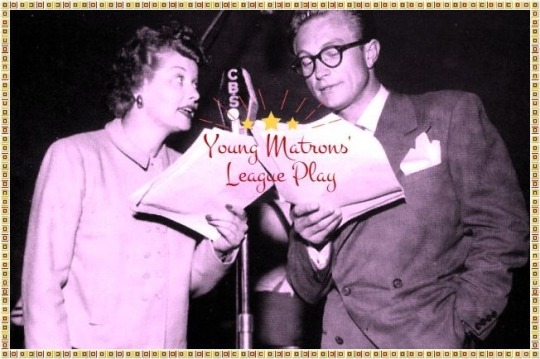
“Young Matron’s League Play” is episode #12 of the radio series MY FAVORITE HUSBAND broadcast on October 9, 1948.
Synopsis ~
George finds out that Liz is in the Young Matrons’ League play and finds a clever way to surprise her!
Note: This episode was aired before the characters names were changed from Cugat to Cooper. It was also before Jell-O came aboard to sponsor the show and before the regular cast featured Bea Benadaret and Gale Gordon as the Atterburys.

“My Favorite Husband” was based on the novels Mr. and Mrs. Cugat, the Record of a Happy Marriage (1940) and Outside Eden (1945) by Isabel Scott Rorick, which had previously been adapted into the film Are Husbands Necessary? (1942). “My Favorite Husband” was first broadcast as a one-time special on July 5, 1948. Lucille Ball and Lee Bowman played the characters of Liz and George Cugat, and a positive response to this broadcast convinced CBS to launch “My Favorite Husband” as a series. Bowman was not available Richard Denning was cast as George. On January 7, 1949, confusion with bandleader Xavier Cugat prompted a name change to Cooper. On this same episode Jell-O became its sponsor. A total of 124 episodes of the program aired from July 23, 1948 through March 31, 1951. After about ten episodes had been written, writers Fox and Davenport departed and three new writers took over – Bob Carroll, Jr., Madelyn Pugh, and head writer/producer Jess Oppenheimer. In March 1949 Gale Gordon took over the existing role of George’s boss, Rudolph Atterbury, and Bea Benaderet was added as his wife, Iris. CBS brought “My Favorite Husband” to television in 1953, starring Joan Caulfield and Barry Nelson as Liz and George Cooper. The television version ran two-and-a-half seasons, from September 1953 through December 1955, running concurrently with “I Love Lucy.” It was produced live at CBS Television City for most of its run, until switching to film for a truncated third season filmed (ironically) at Desilu and recasting Liz Cooper with Vanessa Brown.
MAIN CAST

Lucille Ball (Liz Cugat) was born on August 6, 1911 in Jamestown, New York. She began her screen career in 1933 and was known in Hollywood as ‘Queen of the B’s’ due to her many appearances in ‘B’ movies. “My Favorite Husband” eventually led to the creation of “I Love Lucy,” a television situation comedy in which she co-starred with her real-life husband, Latin bandleader Desi Arnaz. The program was phenomenally successful, allowing the couple to purchase what was once RKO Studios, re-naming it Desilu. When the show ended in 1960 (in an hour-long format known as “The Lucy-Desi Comedy Hour”) so did Lucy and Desi’s marriage. In 1962, hoping to keep Desilu financially solvent, Lucy returned to the sitcom format with “The Lucy Show,” which lasted six seasons. She followed that with a similar sitcom “Here’s Lucy” co-starring with her real-life children, Lucie and Desi Jr., as well as Gale Gordon, who had joined the cast of “The Lucy Show” during season two. Before her death in 1989, Lucy made one more attempt at a sitcom with “Life With Lucy,” also with Gordon.
Richard Denning (George Cugat) was born Louis Albert Heindrich Denninger Jr., in Poughkeepsie, New York. When he was 18 months old, his family moved to Los Angeles. Plans called for him to take over his father’s garment manufacturing business, but he developed an interest in acting. Denning enlisted in the US Navy during World War II. He is best known for his roles in various science fiction and horror films of the 1950s. Although he teamed with Lucille Ball on radio in “My Favorite Husband,” the two never acted together on screen. While “I Love Lucy” was on the air, he was seen on another CBS TV series, “Mr. & Mrs. North.” From 1968 to 1980 he played the Governor on “Hawaii 5-0″, his final role. He died in 1998 at age 84.
Ruth Perrott (Katie, the Maid) was also later seen on “I Love Lucy.” She first played Mrs. Pomerantz, a member of the surprise investigating committee for the Society Matrons League in “Pioneer Women” (ILL S1;E25), as one of the member of the Wednesday Afternoon Fine Arts League in “Lucy and Ethel Buy the Same Dress” (ILL S3;E3), and also played a nurse when “Lucy Goes to the Hospital” (ILL S2;E16). She died in 1996 at the age of 96.
Bob LeMond (Announcer) also served as the announcer for the pilot episode of “I Love Lucy”. When the long-lost pilot was finally discovered in 1990, a few moments of the opening narration were damaged and lost, so LeMond – fifty years later – recreated the narration for the CBS special and subsequent DVD release.
GUEST CAST

John Hiestand (Cory Cartwright) served as the announcer for the radio show “Let George Do It” from 1946 to 1950. In 1955 he did an episode of “Our Miss Brooks” opposite Gale Gordon.

Bea Benadaret (Miss Worthingill, Play Director) was considered the front-runner to be cast as Ethel Mertz but when “I Love Lucy” was ready to start production she was already playing a similar role on TV’s “The George Burns and Gracie Allen Show” so Vivian Vance was cast instead. On “I Love Lucy” she was cast as Lucy Ricarodo’s spinster neighbor, Miss Lewis, in “Lucy Plays Cupid” (ILL S1;E15) in early 1952. Later, she was a success in her own show, “Petticoat Junction” as Shady Rest Hotel proprietress Kate Bradley. She starred in the series until her death in 1968.
In the previous episode, Miss Worthingill was played by Elvia Allman. In 1949, Bea Benadaret will play the regular role of Iris Atterbury, Liz’s best friend.

Hans Conried (Adrian LaHoya, Costume Designer) first co-starred with Lucille Ball in The Big Street (1942). He then appeared on “I Love Lucy” as used furniture man Dan Jenkins in “Redecorating” (ILL S2;E8) and later that same season as Percy Livermore in “Lucy Hires an English Tutor” (ILL S2;E13) – both in 1952. The following year he began an association with Disney by voicing Captain Hook in Peter Pan. On “The Lucy Show” he played Professor Gitterman in “Lucy’s Barbershop Quartet” (TLS S1;E19) and in “Lucy Plays Cleopatra” (TLS S2;E1). He was probably best known as Uncle Tonoose on “Make Room for Daddy” starring Danny Thomas, which was filmed on the Desilu lot. He joined Thomas on a season 6 episode of “Here’s Lucy” in 1973. He died in 1982 at age 64.

Jay Novello (Cabbie) appeared on “I Love Lucy” as superstitious Mr. Merriweather in “The Seance" (ILL S1;E7), Mario the gondolier in “The Visitor from Italy” (ILL S6;E5), and nervous Mr. Beecher in “The Sublease” (ILL S3;E31). He also appeared on two episodes of “The Lucy Show,” but Novello is probably best remembered for playing Mayor Lugatto on “McHale’s Navy” in 1965.
Beatrice, Miss Worthingill’s assistant, and the Stage Manager are played by uncredited performer.
THE EPISODE
While George is singing in the shower, Liz tells Katie the Maid not to tell him that it is opening night of the play. Liz gets a telephone call from Mrs. Worthingill, director of the play, to remind her that Adrian will be at her home for a costume fitting at 10am sharp! Liz is momentarily taken aback, thinking she is talking about the world famous costume designer Adrian, not Adrian La Hoya.

Adrian Adolph Greenburg (1903-1959), widely known simply as Adrian, was an American costume designer whose most famous work was for The Wizard of Oz and hundreds of Metro-Goldwyn-Mayer films such as Du Barry Was A Lady (above) starring Lucille Ball. He was usually credited onscreen with the phrase “Gowns by Adrian”.
George comes down to breakfast and says that he has the day off because the bank is closed. Liz needs an excuse to get George out of the house for her fitting. She tells George she’s sick.
LIZ: “Look at my tongue. There’s a coat I.J. Fox would be proud of!”

I.J. Fox is one of the nation’s leading furriers. The company is based in Boston, where in 1934 they built a historic art deco store on Washington Street.
George then thinks Liz might be expecting a baby. George decides to go golfing, only if Liz will promise to call the doctor.
Later, Katie answers the doorbell. It is Adrian the costumer (Hans Conried). George comes home unexpectedly and sees Liz wearing a bustle and thinks that she is swollen and assumes Adrian is the doctor.
GEORGE: “What’s wrong with my wife?”
ADRIAN: “Nothing. It’s not as bad as it looks. All I have to do is to take few inches off of her hips and tighten the droop in her back. Her peplum is dragging.”Confusion reigns with the costumer and George talking at cross purposes about Liz’s condition / costume. George leaves the house and learns from Adrian’s waiting cabbie that he’s not a doctor, but a costumer, and that Liz is in the play. George is suspicious of Adrian’s integrity with his wife.
The Cabbie says that his wife was having a weekly Monday night rendezvous with a man at the Laundromat.
GEORGE: “What did you do?”
CABBIE: “I bought her a Benidx. Now I don’t know where she goes on Monday nights.”
The Bendix Corporation (1924-1983) licensed their name to a line of electric clothes washing machines. The 1937 Bendix Home Laundry had a glass porthole door, a rotating drum and an electrically driven mechanical timer. The machine was able to auto-fill, wash, rinse and spin-dry. Bendix Home Appliances was later sold to Avco who sold it to Philco. Bendix was mentioned again on “My Favorite Husband” in “Television” (Jun 17, 1949).
George decides to have a talk with Miss Worthingill. George arrives just as an actor has dropped out of the play. Miss Worthingill sees George and gets an idea.
MISS WORTHINGILL: “Come in, Mr. Barrymore! That profile! That noble carriage! That resonant voice! That wavy blonde hair! Those white teeth! Those flaring nostrils! You’re gorgeous. What did you say your name was?”
GEORGE: “Cugat. George Cugat.”
MISS WORTHINGILL: “Gorgeous George!”
Miss Worthingill is referring to John Barrymore (1882-1942), born John Sidney Blyth, a stage, screen and radio actor of distinction. He was known for his dramatic flare and classic profile. She then calls George ‘Gorgeous George’ (to the delight of the audience). George Raymond Wagner (1915–63) was a wrestler known as Gorgeous George because of his blonde hair. He was mentioned on “I Love Lucy” in “Pioneer Women” (ILL S1;E25) and “Ricky’s Movie Offer” (ILL S4;E6).
George agrees to play the part on the proviso that Miss Worthingill not tell Liz that he is subbing for the ailing actor until they meet on stage.
George goes to Adrian’s costume shop with Cory for a fitting and is given a pair of skimpy tights, which he objects to wearing.
CORY: “George is allergic to tights. He was doing a quick change on the stage in college once. When called for his tights, they thought he said lights!”

This same gag was told by Fred Mertz to Barney Kurtz in “Mertz and Kurtz” (ILL S4;E2) in 1954.
George tries on the tights and finds them tight. Adrian disagrees, saying:
ADRIAN: “The costumer is always right!”

This clever wordplay takes a moment to earn its laugh. Adrian is punning on the old business motto that “the customer is always right,” a phrase that dates back to 1909, originally coined by London retailer Harry Selfridge to assure customers that they would get good service at his store.
Adrian offers George a suit of armor, but his son has the legs as mufflers on his car. Adrian gives George the tights and a girdle to take home, just in case. When Liz leaves the room, George ducks out to get to the theatre. Liz finds the girdle and tights in George’s suit pocket and suspects marital infidelity!

Fred Mertz wore a suit of armor in a play starring Lucy in “The Celebrity Next Door” (LDCH S1;E2) starring Tallulah Bankhead. Ricky tried on a suit of armor during pre-production for Don Juan in “Hollywood at Last!” (ILL S4;E16, right).
Adrian arrives with the armor for George. To keep his identity a secret, George wears his visor down. Liz plays Lady Alice and George is Sir Edward in an unnamed costume drama.
Oops! In the previous episode, the Young Matron’s League play Liz auditioned for was a modern play titled John Loves Mary.
LIZ / LADY ALICE: “Hark! Do I hear a footfall?”

This will also be Lucy Ricardo’s first line of dialogue during her big scene in “Ricky’s Screen Test” (ILL S4;E7) for Don Juan.
Onstage in their scene, Lady Alice lifts the visor and sees it is really George! She instantly starts to have an argument in a stage whisper about the girdle she found in his pocket.
Liz throws a lit cigarette into George’s armor and extinguishes it with a seltzer bottle, ruining Miss Worthingill’s play. Later, Liz is trying to extricate George from the suit, now rusted shut and tells him if he doesn’t tell her the truth about the girdle, he will have to go live at the Smithsonian Institute.

Smithsonian Institution (dubbed ‘the Nation’s attic’) are museums located primarily in Washington DC. The Smithsonian was first mentioned in reference to Ethel’s old washing machine in “Never Do Business with Friends” (ILL S2;E31) and will be mentioned again in reference to the antique Cadillac that Fred buys for the trip to Hollywood in “Getting Ready” (ILL S4;E11). A portrait of Lucille Ball is part of the Smithsonian Portrait Gallery.
Liz and George kiss and make-up and the episode ends!
-
TOO MANY GIRLS
October 8, 1940

Too Many Girls was an RKO film musical based on the stage musical of the same title. It was produced and directed by George Abbott, who had also directed the Broadway production. The music was composed by Richard Rodgers, the lyrics by Lorenz Hart, and the book was by George Marion, Jr. although the screenplay was adapted by John Twist.

Too Many Girls opened on Broadway on October 18, 1939, at the Imperial Theatre, running to April 21, 1940, and transferred to the Broadway Theatre on April 22, 1940, closing on May 18, 1940. The cast featured Desi Arnaz, Diosa Costello, Marcy Westcott, Eddie Bracken, Richard Kollmar, Van Johnson, and Hal Le Roy. Musical Staging was by Robert Alton, scenery by Jo Mielziner, and costumes by Raoul Pène Du Bois.

The musical takes place in Skowhegan, Maine and Pottawatomie College in Stop Gap, New Mexico.
Synopsis ~ Connie Casey, an energetic celebrity heiress, wants to go to Pottawatomie College in Stop Gap, New Mexico, her father’s alma mater, to be near her latest beau, British playwright Beverly Waverly. To protect her, and without her knowledge, her tycoon father sends four Ivy League football players as her bodyguards, Clint Kelly, Jojo Jordan, Manuelito and Al Terwilliger, who sign a contract with an ‘anti-romance’ clause. They also join the college’s terrible football team, which immediately becomes one of the best in the country. Clint falls in love with Connie, but when she discovers he is her bodyguard, she decides to go back East. The bodyguards follow her, leaving the team in the lurch. The people of Stop Gap go after them, and they are brought back just in time for the big game. Connie declares her love for Clint, and he leads the team to victory.
PRINCIPAL CAST

Lucille Ball (Consuela ‘Connie’ Casey) was born on August 6, 1911 in Jamestown, New York. She began her screen career in 1933 and was known in Hollywood as ‘Queen of the B’s’ due to her many appearances in ‘B’ movies. “My Favorite Husband” eventually led to the creation of “I Love Lucy,” a television situation comedy in which she co-starred with her real-life husband, Latin bandleader Desi Arnaz. The program was phenomenally successful, allowing the couple to purchase what was once RKO Studios, re-naming it Desilu. When the show ended in 1960 (in an hour-long format known as “The Lucy-Desi Comedy Hour”) so did Lucy and Desi’s marriage. In 1962, hoping to keep Desilu financially solvent, Lucy returned to the sitcom format with “The Lucy Show,” which lasted six seasons. She followed that with a similar sitcom “Here’s Lucy” co-starring with her real-life children, Lucie and Desi Jr., as well as Gale Gordon, who had joined the cast of “The Lucy Show” during season two. Before her death in 1989, Lucy made one more attempt at a sitcom with “Life With Lucy,” also with Gordon.

Desi Arnaz (Manuelito Lynch) was born in Santiago, Cuba on March 2, 1917. After leaving Cuba, he formed his own Latin band, and literally launched the conga craze in America. It was on the set of Too Many Girls (1940) that he and Lucille Ball met. They soon married and approximately 10 years later formed Desilu Productions and began the “I Love Lucy” shows in 1951. Desi and Lucille had two children, Lucie Arnaz and Desi Arnaz Jr. At the end of “The Lucy-Desi Comedy Hour” in 1960, the two divorced. He was diagnosed with lung cancer and died on December 2, 1986 at age 69.
Manuelito: “I’m not conceited. I am the greatest player in fifty years, but I’m not conceited.”

Richard Carlson (Clint Kelly) makes his first and last appearance with Lucy and Desi, although his wife, Mona, was featured as one of Don Loper’s models on “The Fashion Show” (ILL S4;E20) in 1955.
Ann Miller (Pepe) had appeared with Lucille Ball in three films: Stage Door (1937), Having Wonderful Time (1938), and Room Service (1938). In 1954, she appeared with the Arnazes on “MGM’s 30th Anniversary Tribute”.
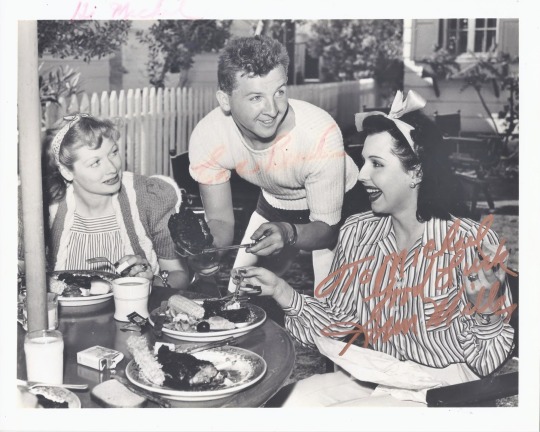
Eddie Bracken (Jojo Jordan) makes his only screen appearance with Lucy and Desi, although he was part of the Broadway cast of Too Many Girls and was friends with the Arnazes off screen as seen in the above photo with Ann Miller and Lucy.
JOJO: “Well, I’m not exactly wonderful, but I’m awfully attractive in a dynamic sort of way.”
Frances Langford (Eileen Eilers) makes her only appearance with Lucy and Desi. She worked extensively with Bob Hope on his USO tours.
Hal LeRoy (Al Terwilliger) makes his only screen appearance with Lucy and Desi, although he was part of the Broadway cast of Too Many Girls.
Libby Bennett (Tallulah Lou) makes her only screen appearance in Too Many Girls. She had also been seen in the Broadway stage production.

Harry Shannon (Mr. Harvey Casey) appeared with Lucille Ball in 1942′s The Big Street. On “I Love Lucy” he played Jim White the photographer in “Men Are Messy” (ILL S1;E8) in 1951 (above center). Musical fans will remember Shannon as Rosalind Russell’s father in the 1962 musical film Gypsy.
Mrs. Teweksbury says Mr. Casey is one of the richest individuals in the country. He reportedly has $7.50 more than Henry Ford. He is Connie’s father and Chairman of Casey Conglomerated Industries.
Douglas Walton (Beverly Waverly) was a Canadian-born actor making his only appearance with Lucy and Desi. He played poet Percy Shelley in the film The Bride of Frankenstein (1935). He left film acting in 1950, before the advent of television.
Beverley Waverly is a British playwright.
Chester Clute (Lister) did four films with Lucille Ball before Too Many Girls and four after it.
Lister is an alumni of
Pottawatomie
College, like his boss Mr. Casey.
Ivy Scott (Mrs. Tewksbury) was also in the stage production of Too Many Girls and only did one more film in Hollywood, Higher and Higher in 1943.
Mrs. Tewksbury is the proprietor of The Hunted Stag (or, as Mr. Lister calls it, The Stunted Hag), an Inn where the boys are waiters.
Byron Shores (Sheriff Andaluz) makes his only screen appearance with Lucy and Desi. He was also seen in the stage production of Too Many Girls. His last film was in 1944.
UNCREDITED FILM CAST

Iron Eyes Cody (Indian) made a career of playing Native American characters despite the fact that he was of Italian ancestry. He next worked with Lucy and in 1942’s Valley of the Sun, again as an American Indian character. He played an Eskimo in a 1959 episode of “The Lucy-Desi Comedy Hour,” but is probably best remembered as the Indian that sheds a single tear in the ‘Keep America Beautiful’ ads that ran from 1971 to the 1980s.
Jay Silverheels (Indian) also played a Native American character in Valley of the Sun (1942) with Lucille Ball. He was best known for playing Tonto on “The Lone Ranger”.
Chief John Big Tree (Chief)

Harry James (Orchestra Leader) also played himself in Lucille Ball’s Best Foot Forward in 1943. With his wife, Betty Grable, he was seen in “Lucy Wins a Racehorse” (LDCH S1;E4) in 1958.

Van Johnson (Chorus Boy) was also seen with Lucy in the films Easy to Wed (1946) and Yours, Mine and Ours in 1968. He played himself on one of the most popular episodes of “I Love Lucy,” “The Dancing Star” (ILL S4;E27) and played both himself and a look-alike on “Here’s Lucy” in 1968. He was also a member of the Broadway cast of Too Many Girls.
Johnson has only two lines of dialogue in the film but is often visible in group scenes.
Shep Houghton (Chorus Boy) made two other films with Lucille Ball and was seen in the background of two episodes of “The Lucy Show” and one episode of “Here’s Lucy.” Houghton was one of the Winkie Guards in 1939’s The Wizard of Oz and a Southern Dandy in Gone With the Wind (1939).
John Benton (Chorus Boy)

Mildred Law (Coed) appeared on “I Love Lucy” in “Return Home From Europe” (ILL S5;E26) playing a TWA flight attendant who attends to Lucy’s cheesy baby, Chester. This was her penultimate screen credit.
Pamela Blake (Coed) also appeared uncredited with Lucille Ball in Stage Door (1937).
Amarilla Morris (Coed) was seen with Desi Arnaz in the 1942 film Four Jacks and a Jill as the girl in the revolving door.
Other Coeds: Janet Lavis, Ellen Johnson, Vera Fern, Peggy Drake, Zita Baca, Anna Mae Tessle
Homer Dickenson (Mr. Casey’s Butler) immediately followed this film with A Girl, A Guy, And A Gob (1941) also starring Lucille Ball.
Grady Sutton (Football Coach) from 1935 to 1945, Sutton did five films with Lucille Ball.
Dorothy Vernon (Faculty Extra) also did The Bowery (1933) and Valley of the Sun (1942) with Lucille Ball.
Dan White (Faculty Extra) had a small role in the 1970 TV special “Swing Out Sweet Land” in which Lucille Ball voiced the Statue of Liberty.
Others: Sethma Williams (Marie), Tommy Graham (Hawker), Averell Harris (Detective), Michael Alvarez (Joe)

WHEN LUCY MET DIZZY
Lucille Ball met Desi Arnaz for the first time at the RKO studio commissary, while Too Many Girls was in rehearsals. She was in full costume and make-up after performing a fight scene for another film, Dance, Girl, Dance (1940, above): she wore a slinky gold dress slit halfway up the thigh and sported a black eye. Arnaz was seated at the same table as director George Abbott, who introduced the two. Arnaz was not impressed by Ball, thinking she “looked like a two-dollar whore who had been badly beaten by her pimp.“ After the encounter, he asked Abbott to fire Ball from Too Many Girls, claiming she was “too tough and common for the role.” He also advised that her reputation as Queen of the B movies might negatively impact his much-anticipated film debut, advice Abbott thankfully ignored.
“A Cuban skyrocket burst over my horizon!” ~ Lucy about Desi

“Those damned big beautiful blue eyes!” ~ Desi about Lucy
That night, Arnaz was rehearsing “She Could Shake the Maracas" when Ball walked in, now wearing a yellow sweater and tight-fitting beige slacks. Not recognizing her, Arnaz turned to the piano player and whispered “Man, that is a honk of woman!“ The pianist reminded Arnaz of his earlier meeting with Ball. Lucille approached them to say hello. "Miss Ball?” Arnaz said, just to make sure that there was no mistake. “Why don’t you call me Lucille? And I’ll call you Dizzy.”
Lucy and Desi have very little interaction in the film, but when he sees Connie for the first time, he gets weak in the knees and falls to the ground, in awe of her beauty. Despite this, Manuelito’s romance is with Pepe, not Connie. History re-wrote that chapter!

TOO MANY SONGS!
- Heroes in the Fall – Male Chorus
- You’re Nearer – Connie, Pepe, Eileen, and Tallulah Lou
- Pottawatomie – Mr. Casey and Chorus
- ‘Cause We Got Cake – Eileen and Chorus
- Spic ‘n’ Spanish – Manuelito and Pepe
- Love Never Went to College – Eileen
- Look Out! – Eileen and Pepe
- I Didn’t Know What Time It Was – Connie, Clint, and Jojo
- You’re Nearer – Connie, Manuelito, Eileen, Pepe, and Tallulah Lou
- Conga
Songs cut from the Broadway show:
- Tempt Me Not – Manuelito, Clint, and Chorus
- My Prince – Connie
- I Like To Recognize the Tune – Jojo, Connie, Eileen, Clint, and Al
- The Sweethearts of the Team – Eileen
- She Could Shake The Maracas – Pepe and Manuelito
- Too Many Girls – Manuelito
- Give It Back To The Indians – Eileen

TOO MANY TRIVIA!
-
RKO paid $100,000 for the rights to the Broadway musical.
- Filming on Too Many Girls began on June 22, 1940.
-
Camerman Russell Metty briefly took over shooting for Frank Redman when Redman had to attend a funeral.
- Uncredited performers Van Johnson and Harry James would go on to be two of the film’s biggest stars, except for Lucy and Desi, eclipsing many of the film’s principal cast like Hal LeRoy, Douglas Walton, and Libby Bennett.
- Lucille Ball’s vocals were dubbed by Trudy Erwin, one of Kay Kyser’s singers.
- Everyone imported from Broadway (except Hal LeRoy) was making their screen debut with Too Many Girls.
- After making the film, Van Johnson and Mildred Law returned to the Broadway production. Instead of chorus roles, Johnson assumed the role of Jojo (originated by Bracken) and Law now played Tallulah Lou, originated by Leila Ernest.
- On Broadway the character of Connie was originated by Marcy Wescott in her final Broadway stage role.
TOO MANY REFERENCES!

Each of Connie’s bodyguards plays football for an Ivy League college: Yale, Harvard, and Princeton. Manuelito is still deciding on a college, but is considering Princeton, where Clint goes. There is talk about a contentious game that includes Princeton. In Lucille Ball’s radio show “My Favorite Husband” (1948), George Cugat (later Cooper) hopes his future son will play for Princeton, his alum. Coincidentally, Lucille Ball did two plays at Princeton University’s resident theatre company, McCarter: Hey Diddle Diddle (1937) and Dream Girl (1947).

One of the characters mentions movie star Ginger Rogers, one of the top female box office stars of the time. She was also a good friend of Lucille Ball
having done five films together. Rogers’ mother Lela tajght acting classes at RKO, later inspiring Ball to create the Desilu Playhouse at Desilu Studios. Rogers played herself on a 1971 episode of “Here’s Lucy.”

Mr. Casey compares his daughter Connie with Lucretia Borgia (1480-1519) was the illegitimate daughter of a pope and his mistress, a famous beauty, notorious for the suspicious deaths and political intrigue that swirled around her. Today her name has become synonymous with a beautiful, but scheming woman who would stop at nothing – including murder – to get what she wants. In 1949, Lucille Ball’s friend played Lucretia Borgia for Paramount in Bride of Vengeance.

Although Pottawatomie College and the town of Stop Gap are fictional, Pottawatomie is the name of a Native American tribe, although they were mostly found in the Great Lakes region, not in New Mexico. The Pottawatomie Massacre occurred from May 23 to May 26, 1856, resulting in the death of five pro-slavery settlers north of Pottawatomie Creek in Franklin County, Kansas. This was one of the many violent episodes in Kansas preceding the American Civil War.

TOO MANY CRITICS!
Too Many Girls premiered on October 8, 1940 at Loew’s Criterion Theatre in New York. Critical reviews were generally positive, although Bosley Crowther of The New York Times wrote that Too Many Girls was “a pleasant, light-hearted and wholly ingenuous campus film" but that director George Abbott “has permitted it to sag in the middle, at which point the thin spots baldly show. If the intention was to be impressive, it has failed. For ‘Too Many Girls’ is a simple, conventional rah-rah picture, without any place for pretense. And there is not enough to it, on the whole, for Mr. Abbott to squander dancers recklessly.”

TOO FAST FORWARD
This film’s earliest documented television presentations began in Los Angeles Tuesday May 8, 1956 on KHJ (Channel 9), much to the chagrin of Lucille Ball and Desi Arnaz who were embarrassed by it, and objected to its frequent showings to no avail.

In 1977, the music of Too Many Girls was rereleased on vinyl with performers Nancy Andrews, Johnny Desmond, Estelle Parsons, and Anthony Perkins!

The film is referenced in “Lucy & Desi: Before the Laughter” a 1991 TV movie about starring Frances Fisher (above) and Maurice Bernard, as well as “Lucy” (2003), another TV film in which Lucy (Rachel York) and Desi (Danny Pino) meet on the set; Desi in his football uniform and Lucy bruised from the filming of Dance, Girl, Dance.
Clips from the film are featured in Lucy and Desi: A Home Movie (1993).
-
GEORGE NEEDS A RAISE
October 7, 1949
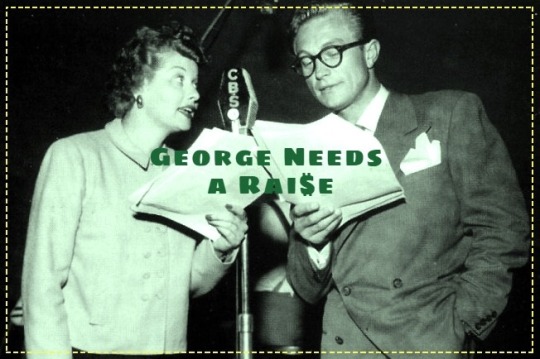
“George Needs a Raise” (aka “George Tries for a Raise”) is episode #57 of the radio series MY FAVORITE HUSBAND broadcast on October 7, 1949.
This was the fifth episode of the second season of MY FAVORITE HUSBAND. There were 43 new episodes, with the season ending on June 25, 1950.

The script was later adapted for television as “Ricky Asks for a Raise” (ILL S1;E35) first aired on February 16, 1953.
Synopsis ~ Liz tries every trick in the book to convince Mr. Atterbury to give George a raise. To get results she even resorts to selling apples in front of the bank where he is employed.

“My Favorite Husband” was based on the novels Mr. and Mrs. Cugat, the Record of a Happy Marriage (1940) and Outside Eden (1945) by Isabel Scott Rorick, which had previously been adapted into the film Are Husbands Necessary? (1942). “My Favorite Husband” was first broadcast as a one-time special on July 5, 1948. Lucille Ball and Lee Bowman played the characters of Liz and George Cugat, and a positive response to this broadcast convinced CBS to launch “My Favorite Husband” as a series. Bowman was not available Richard Denning was cast as George. On January 7, 1949, confusion with bandleader Xavier Cugat prompted a name change to Cooper. On this same episode Jell-O became its sponsor. A total of 124 episodes of the program aired from July 23, 1948 through March 31, 1951. After about ten episodes had been written, writers Fox and Davenport departed and three new writers took over – Bob Carroll, Jr., Madelyn Pugh, and head writer/producer Jess Oppenheimer. In March 1949 Gale Gordon took over the existing role of George’s boss, Rudolph Atterbury, and Bea Benaderet was added as his wife, Iris. CBS brought “My Favorite Husband” to television in 1953, starring Joan Caulfield and Barry Nelson as Liz and George Cooper. The television version ran two-and-a-half seasons, from September 1953 through December 1955, running concurrently with “I Love Lucy.” It was produced live at CBS Television City for most of its run, until switching to film for a truncated third season filmed (ironically) at Desilu and recasting Liz Cooper with Vanessa Brown.
MAIN CAST

Lucille Ball (Liz Cooper) was born on August 6, 1911 in Jamestown, New York. She began her screen career in 1933 and was known in Hollywood as ‘Queen of the B’s’ due to her many appearances in ‘B’ movies. With Richard Denning, she starred in a radio program titled “My Favorite Husband” which eventually led to the creation of “I Love Lucy,” a television situation comedy in which she co-starred with her real-life husband, Latin bandleader Desi Arnaz. The program was phenomenally successful, allowing the couple to purchase what was once RKO Studios, re-naming it Desilu. When the show ended in 1960 (in an hour-long format known as “The Lucy-Desi Comedy Hour”) so did Lucy and Desi’s marriage. In 1962, hoping to keep Desilu financially solvent, Lucy returned to the sitcom format with “The Lucy Show,” which lasted six seasons. She followed that with a similar sitcom “Here’s Lucy” co-starring with her real-life children, Lucie and Desi Jr., as well as Gale Gordon, who had joined the cast of “The Lucy Show” during season two. Before her death in 1989, Lucy made one more attempt at a sitcom with “Life With Lucy,” also with Gordon.
Richard Denning (George Cooper) was born Louis Albert Heindrich Denninger Jr., in Poughkeepsie, New York. When he was 18 months old, his family moved to Los Angeles. Plans called for him to take over his father’s garment manufacturing business, but he developed an interest in acting. Denning enlisted in the US Navy during World War II. He is best known for his roles in various science fiction and horror films of the 1950s. Although he teamed with Lucille Ball on radio in “My Favorite Husband,” the two never acted together on screen. While “I Love Lucy” was on the air, he was seen on another CBS TV series, “Mr. & Mrs. North.” From 1968 to 1980 he played the Governor on “Hawaii 5-0″, his final role. He died in 1998 at age 84.
Gale Gordon (Rudolph Atterbury) had worked with Lucille Ball on “The Wonder Show” on radio in 1938. One of the front-runners to play Fred Mertz on “I Love Lucy,” he eventually played Alvin Littlefield, owner of the Tropicana, during two episodes in 1952. After playing a Judge in an episode of “The Lucy-Desi Comedy Hour” in 1958, he would re-team with Lucy for all of her subsequent series’: as Theodore J. Mooney in ”The Lucy Show”; as Harrison Otis Carter in “Here’s Lucy”; and as Curtis McGibbon on "Life with Lucy.” Gordon died in 1995 at the age of 89.
Gordon also played the boss Alvin Littlefield in the television version of this script on “I Love Lucy.”
Bea Benadaret (Iris Atterbury) was considered the front-runner to be cast as Ethel Mertz but when “I Love Lucy” was ready to start production she was already playing a similar role on TV’s “The George Burns and Gracie Allen Show” so Vivian Vance was cast instead. On “I Love Lucy” she was cast as Lucy Ricarodo’s spinster neighbor, Miss Lewis, in “Lucy Plays Cupid” (ILL S1;E15) in early 1952. Later, she was a success in her own show, “Petticoat Junction” as Shady Rest Hotel proprietress Kate Bradley. She starred in the series until her death in 1968.
Ruth Perrott (Katie, the Maid) was also later seen on “I Love Lucy.” She first played Mrs. Pomerantz, a member of the surprise investigating committee for the Society Matrons League in “Pioneer Women” (ILL S1;E25), as one of the member of the Wednesday Afternoon Fine Arts League in “Lucy and Ethel Buy the Same Dress” (ILL S3;E3), and also played a nurse when “Lucy Goes to the Hospital” (ILL S2;E16). She died in 1996 at the age of 96.
Bob LeMond (Announcer) also served as the announcer for the pilot episode of “I Love Lucy”. When the long-lost pilot was finally discovered in 1990, a few moments of the opening narration were damaged and lost, so LeMond – fifty years later – recreated the narration for the CBS special and subsequent DVD release.
GUEST CAST
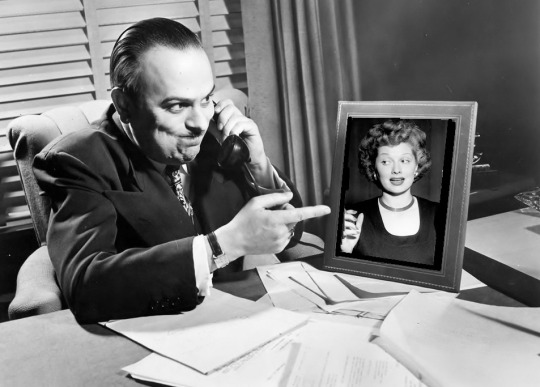
Frank Nelson (Waiter) was born on May 6, 1911 (three months before Lucille Ball) in Colorado Springs, Colorado. He started working as a radio announcer at the age of 15. He later appeared on such popular radio shows as “The Great Gildersleeve,” “Burns and Allen,” and “Fibber McGee & Molly”. Aside from Lucille Ball, Nelson is perhaps most associated with Jack Benny and was a fifteen-year regular on his radio and television programs. His trademark was playing clerks and other working stiffs, suddenly turning to Benny with a drawn out “Yeeeeeeeeees?” Nelson appeared in 11 episodes of “I Love Lucy”, including three as quiz master Freddy Fillmore, and two as Ralph Ramsey, plus appearance on “The Lucy-Desi Comedy Hour” – making him the only actor to play two different recurring roles on “I Love Lucy.” Nelson returned to the role of the frazzled Train Conductor for an episode of “The Lucy Show” in 1963. This marksed his final appearance on a Lucille Ball sitcom.
EPISODE
ANNOUNCER: “As we look in on the Coopers it is morning. Katie is singing in the kitchen.”

The song Katie is singing is “Some Enchanted Evening” written by Rodgers and Hammerstein for their 1949 hit musical South Pacific, which had just opened five months earlier on Broadway and would continue until 1954. “Some Enchanted Evening” became a pop standard and was covered by many artists, including Frank Sinatra and Perry Como, who’s version hit #1 in 1949.

The stage show would be a punch line in “No Children Allowed” (ILL S2;E22). Ethel allows the Ricardos to stay in their apartment despite a clause in the lease forbidding children. She later repeatedly brags about her good deed. “My friendship with the Ricardos means more to me than all the money in the world…” She repeats the speech so often that Lucy quips: “That scene has had more performances than ‘South Pacific’!“ Authors and producers Richard Rodgers and Oscar Hammerstein II dominated Broadway from 1943 to 1959 and were frequently mentioned on “I Love Lucy,” often as just ‘Dick and Oscar.’
Liz enters and wants to know why Katie is so cheerful. Katie attributes it to Mr. Nagy, the mailman.
LIZ: “Katie, have you been playing post office?”
KATIE: “No, but I have been giving him a cup of coffee every morning. That’s three kinds of coffee I have to make every morning. He’s Silex. I’m an old-fashioned boil drinker, and you and Mr. Cooper are drip!”
Katie is referring to a coffee brewing system marketed by the Silex Company (now Proctor Silex). The name Silex is almost synonymous with any glass vacuum pot. At the 1939 New York World’s Fair, the Silex Company’s exhibit was dominated by a seven-foot replica of a Silex glass coffee maker in operation.
It was considered superior to boiled water, drip coffee, or metal percolators.
Liz is desperately waiting for a bill from Miller’s Department Store that is due in today’s mail. Liz has overspent on a red velvet suit she couldn’t resist. George confronts her about the $98 expense and her history of her over-spending. Both Miller’s Department Store and Mr. Nagy the Mailman are running references on “My Favorite Husband”.
Liz encourages George to ask for a raise. George says he hinted at wanting a raise from Mr. Atterbury. Liz wants George to bring it up at dinner, as they are dining with the Atterburys that night. Liz begs George not to pick up the check and let Mr. Atterbury do it.
LIZ: “Every time the check comes he’s looking down at his fingers. You’d think he just discovered Uranium under his fingernails.”

Uranium is a very heavy metal found in most rocks that can be used as a source of concentrated energy. It was first identified in 1789 and named after the planet Uranus. As early as 1949, Popular Science Magazine started highlighting uranium hunting as a hobby using a device known as the Geiger Counter. In 1958, “The Lucy-Desi Comedy Hour” joined the scores of other television shows and films by presenting “Lucy Hunts Uranium”.
The Coopers resolve to order the most expensive items on the menu and let Mr. Atterbury pay. That night,while Rudolph and Iris are waiting for the Coopers at the restaurant, Iris laments that George never picks up the bill. They resolve to let the Coopers pay tonight’s check and to order the most expensive items on the menu.
The waiter (Frank Nelson) comes by and they start with four bottles of imported Champagne. [Note: All Champagne is imported. Domestic is called sparkling wine.] Liz orders a Porterhouse steak and Iris orders a double lobster thermidor. The waiter feigns excitement about waiting on such big spenders.

Of all the roles Frank Nelson played on “I Love Lucy,” only once did he play a waiter: in "Lucy Changes Her Mind” (ILL S2;E21), repeating the role he created in “Liz Changes Her Mind”, episode 50 of “My Favorite Husband.”
Lobster Thermidor is a French dish consisting of a creamy mixture of cooked lobster meat and brandy stuffed into a lobster shell with a mustard sauce. Due to expensive ingredients, it is usually considered a dish primarily served on special occasions. Porterhouse Steak is a T-bone cut of beef.
The origin of the term "porterhouse” is disputed, with several cities and establishments claiming to have coined it.
Owing to its large size and the fact that it is one of the most prized cuts of beef, Porterhouse are generally considered one of the highest quality steaks, and prices at are accordingly high.
After dinner, everyone is stuffed and the waiter wants to know who will pay.
WAITER: “Will this be cash or do you want to finance it?”
Rudolph drops his fork and George claims he left his wallet in his other suit, fulfilling Liz and Iris’s predictions about how the men will avoid paying the bill.
Next day, Liz preps George on asking for a raise. Liz role plays with George giving him the bravery he needs to ask for a salary increase.
In Mr. Atterbury’s office, George can’t get out the words. Mr. Atterbury tells George he just fired Joe Ridgley for asking for a raise. Instead, George sheepishly asks for the key to the washroom!
At home, Liz is dismayed to hear that George didn’t have the guts to ask, and vows to Katie to do her utmost to campaign on his behalf with Mr. Atterbury.
LIZ (about George): “Oh, he’s so wishy-washy. And if he doesn’t stop being so wishy I’ll have to take in washy.”
Later, Mr. Atterbury calls George in to his office and tells him of Liz’s ‘campaign’ consisting of four anonymous phone calls, and three telegrams, one of which said:
“I think you should give my brother a raise – signed Gary.”

Gary Cooper (1901-1961) was one of the most popular and successful actors in Hollywood. In 1949 he could be seen in the Warner Brothers picture It’s a Great Feeling. Cooper was mentioned in two episode of “I Love Lucy” but never acted opposite Lucille Ball. She did, however, impersonate him in “Lucy and Harpo Marx” (ILL S4;E28) in 1955.
As George and Rudolph are leaving for lunch, a rock comes crashing through the window with a note tied to it:
“Dear Mr. Atterbury – George Cooper deserves a raise. Signed, an important depositor. PS: Sorry, I thought the window was open.”
When the men go to lunch, Liz is on the street disguised as an apple seller!
LIZ (in a trembling voice): “Apples! Apples! Buy an apple, Mister. Buy an apple and help a starving vice president and his wife!”

Liz’s apple seller was inspired by the Damon Runyon story “Madame La Gimp” which was made into the 1933 Frank Capra film Lady for a Day, starring May Robson as Apple Annie. It was remade in 1966 as Pocketful of Miracles starring Bette Davis. In 1972, Lucy Carter went undercover as “Dirty Gertie” (HL S5;E10), a direct nod to the story and films.
Later George phones home to tell Liz he’s been fired! It seems Liz sent 10 rag-tag children to his office yelling “Daddy I’m hungry!” Liz says she borrowed them from Mr. Wood next door.

In “Lucy Plays Cupid” (ILL S1;E15), Lucy Ricardo suddenly invents ten children, to dissuade an amorous butcher (Edward Everett Horton) and push him toward an elderly spinster (Bea Benadaret) who is sweet on him! Coincidentally, Bea Benadaret played the spinster, and plays Iris Atterbury in this radio episode. Liz says her ten were borrowed from Mr. Wood who was usually played by Hans Conried. In other episodes he had 11 children, so one is either too young or otherwise engaged!
Katie reminds Liz to cancel her sky-writing order. Liz gets an idea. Instead of writing out “George Cooper Needs A Raise” she will send a new message. She phones the skywriter:
LIZ: “Hello. This is Mrs. George Cooper. What? No, I didn’t order ‘She’s lovely. She’s engaged. She uses Pond’s’.”

As the skin-care business became more competitive in the 1920s, Pond’s tried to boost sales through an extensive advertising campaign based on testimonials. The new campaign, which began in 1924, attempted to give Pond’s cold and vanishing creams more cachet by having them endorsed by socialites and members of aristocracy. Pond’s continued to use testimonials through the ‘She’s Engaged, She’s Lovely, She Uses Pond’s’ campaign of the 1940s and beyond. [For plot purposes only apparent at the very end, the writers reverse the order of the slogan, putting “she’s lovely” before “she’s engaged.”]
Liz tells the skywriter to spell out “MR. ATTERBURY IS A STINKER” in letters a mile high! Liz goes down to the bank to assure Mr. Atterbury sees it.
At the same time, Mr. Atterbury tells George that instead of being fired, he’s being promoted; from third vice president to executive third vice president. Liz arrives and at first refuses to acknowledge Mr. Atterbury.
LIZ: “Come on, George. Get your things and let’s leave this marble sweatshop!”
George breaks the good news to Liz of his promotion and all three go off for a celebratory drink. Outside on the street, Mr. Atterbury sees some skywriting starting and stops to see what it will spell out. A shocked Liz let’s out an “Aye-yia-yai-yai-yai!”
Coincidentally, this a Spanish exclamation of surprise often let out by Ricky Ricardo on “I Love Lucy,” so it is odd to hear patrician Elizabeth Elliott Cooper use it. In real-life, Lucille Ball had been married to Desi Arnaz for nearly nine years, so she was quite used to it!
The skywriting starts with “MR”…
LIZ: “It’s probably just an ad for that show, ‘Mr. Roberts’. Come on, let’s go.”

The show Liz is referring to is the Broadway adaption of the 1946 book Mr. Roberts by Thomas Heggen. The play opened in February 1948 and went on to win a Tony Award for Best Play (the first ever) and closed in August 1950. Henry Fonda, who dated Lucille Ball briefly when she first got to Hollywood, played the lead and got a Tony as well. The play opened at the Alvin Theatre, where Lucille Ball would star in Wildcat a dozen years later. Fonda repeated his role in the 1955 film. There was also a radio adaptation in 1953, and a short-lived NBC television series in 1965.
The skywriting continues: “MR. ATT…”
Liz asks Mr. Atterbury to tie her shoelaces. George points out that she is wearing pumps.
More skywriting: “ATTERB…
LIZ: “It’s probably an ad for that piano player, José Atterby.”

Liz is referring to José Iturbi (1895-1980), who was a Spanish conductor, pianist and harpsichordist. He appeared in several Hollywood films of the 1940s, notably playing himself in the musicals Thousands Cheer (1943) with Lucille Ball, his first big role.
The final letters of the name are spelled out: “ATTERBURY”. Liz still tries to convince him the skywriting has nothing to do with him.
LIZ: “It’s that soft drink. (Liz sings) ‘Atterbury hits the spot! Five full ounces, that’s a lot!”

Liz is paraphrasing the Pepsi-Cola jingle written for radio in the 1930s by Austen Croom-Johnson and Aland Kent. Liz says “Five full ounces” instead of “12 full ounces”. Most soft drinks sold a 6 ounce bottle for a nickel. Pepsi sold 12 ounce bottles for the same price. It was recorded in 55 languages, played in Symphony Hall, and more than one million records were released to jukeboxes.
Finally, the full message appears in the sky: “MR. ATTERBURY IS LOVELY!” Mr. Atterbury is touched and Liz is (to say the least) surprised. They all go off happily for a drink! End of episode.
[Although it isn’t overtly stated, we must assume that the skywriters got the Pond’s ad mixed up with the Cooper ad, explaining the sudden message change!]
1949, Apple Annie, Bea Benadaret, Bob LeMond, Desi Arnaz, Frank Nelson, Gale Gordon, Gary Cooper, Here’s Lucy, I love lucy, Jose Iturbi, Lobster Thurmidor, Lucille Ball, Mr. Roberts, My Favorite Husband, Pepsi-Cola, Pond’s, Porterhouse Steak, Radio, Richard Denning, Ricky Ricardo, Ruth Perrott, Silex, Some Enchanted Evening, Uranium -
LIZ BECOMES A SCULPTRESS
October 7, 1950
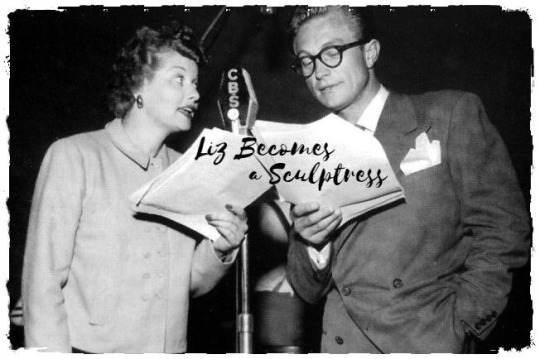
“Liz Becomes a Sculptress” (aka “Liz the Sculptress” aka “Liz Turns Sculptress”) is episode #100 [some sources say #99] of the radio series MY FAVORITE HUSBAND broadcast on October 7, 1950.
This was the fifth episode of the third season of MY FAVORITE HUSBAND. There were 31 new episodes, with the season ending on March 31, 1951.

This program was the basis for “I Love Lucy” episode titled “Lucy Becomes a Sculptress” (ILL S2;E15), first aired on January 15, 1953.
Synopsis ~ Liz decides that she needs a hobby, and the proprietor of the local arts and crafts store convinces her she’s a natural artistic genius when it comes to sculpting clay.

“My Favorite Husband” was based on the novels Mr. and Mrs. Cugat, the Record of a Happy Marriage (1940) and Outside Eden (1945) by Isabel Scott Rorick, which had previously been adapted into the film Are Husbands Necessary? (1942). “My Favorite Husband” was first broadcast as a one-time special on July 5, 1948. Lucille Ball and Lee Bowman played the characters of Liz and George Cugat, and a positive response to this broadcast convinced CBS to launch “My Favorite Husband” as a series. Bowman was not available Richard Denning was cast as George. On January 7, 1949, confusion with bandleader Xavier Cugat prompted a name change to Cooper. On this same episode Jell-O became its sponsor. A total of 124 episodes of the program aired from July 23, 1948 through March 31, 1951. After about ten episodes had been written, writers Fox and Davenport departed and three new writers took over – Bob Carroll, Jr., Madelyn Pugh, and head writer/producer Jess Oppenheimer. In March 1949 Gale Gordon took over the existing role of George’s boss, Rudolph Atterbury, and Bea Benaderet was added as his wife, Iris. CBS brought “My Favorite Husband” to television in 1953, starring Joan Caulfield and Barry Nelson as Liz and George Cooper. The television version ran two-and-a-half seasons, from September 1953 through December 1955, running concurrently with “I Love Lucy.” It was produced live at CBS Television City for most of its run, until switching to film for a truncated third season filmed (ironically) at Desilu and recasting Liz Cooper with Vanessa Brown.
MAIN CAST

Lucille Ball (Liz Cooper) was born on August 6, 1911 in Jamestown, New York. She began her screen career in 1933 and was known in Hollywood as ‘Queen of the B’s’ due to her many appearances in ‘B’ movies. With Richard Denning, she starred in a radio program titled “My Favorite Husband” which eventually led to the creation of “I Love Lucy,” a television situation comedy in which she co-starred with her real-life husband, Latin bandleader Desi Arnaz. The program was phenomenally successful, allowing the couple to purchase what was once RKO Studios, re-naming it Desilu. When the show ended in 1960 (in an hour-long format known as “The Lucy-Desi Comedy Hour”) so did Lucy and Desi’s marriage. In 1962, hoping to keep Desilu financially solvent, Lucy returned to the sitcom format with “The Lucy Show,” which lasted six seasons. She followed that with a similar sitcom “Here’s Lucy” co-starring with her real-life children, Lucie and Desi Jr., as well as Gale Gordon, who had joined the cast of “The Lucy Show” during season two. Before her death in 1989, Lucy made one more attempt at a sitcom with “Life With Lucy,” also with Gordon.
Richard Denning (George Cooper) was born Louis Albert Heindrich Denninger Jr., in Poughkeepsie, New York. When he was 18 months old, his family moved to Los Angeles. Plans called for him to take over his father’s garment manufacturing business, but he developed an interest in acting. Denning enlisted in the US Navy during World War II. He is best known for his roles in various science fiction and horror films of the 1950s. Although he teamed with Lucille Ball on radio in “My Favorite Husband,” the two never acted together on screen. While “I Love Lucy” was on the air, he was seen on another CBS TV series, “Mr. & Mrs. North.” From 1968 to 1980 he played the Governor on “Hawaii 5-0″, his final role. He died in 1998 at age 84.
Bea Benadaret (Iris Atterbury / Miss Crawford) was considered the front-runner to be cast as Ethel Mertz but when “I Love Lucy” was ready to start production she was already playing a similar role on TV’s “The George Burns and Gracie Allen Show” so Vivian Vance was cast instead. On “I Love Lucy” she was cast as Lucy Ricardo’s spinster neighbor, Miss Lewis, in “Lucy Plays Cupid” (ILL S1;E15) in early 1952. Later, she was a success in her own show, “Petticoat Junction” as Shady Rest Hotel proprietress Kate Bradley. She starred in the series until her death in 1968.
It is not unusual for radio performers to double up on voices, especially if they have very little to do as their principal character. Iris only has a brief phone chat with Liz before Miss Crawford’s entrance. It would not make sense to hire another actress for the role when Benadaret was under contract.
Bob LeMond (Announcer) also served as the announcer for the pilot episode of “I Love Lucy”. When the long-lost pilot was finally discovered in 1990, a few moments of the opening narration were damaged and lost, so LeMond – fifty years later – recreated the narration for the CBS special and subsequent DVD release.
Gale Gordon (Rudolph Atterbury) and Ruth Perrott (Katie the Maid) do not appear in this episode.
GUEST CAST

Hans Conried (Carl, Art Store Owner) first co-starred with Lucille Ball in The Big Street (1942). He then appeared on “I Love Lucy” as used furniture man Dan Jenkins in “Redecorating” (ILL S2;E8) and later that same season as Percy Livermore in “Lucy Hires an English Tutor” (ILL S2;E13) – both in 1952. The following year he began an association with Disney by voicing Captain Hook in Peter Pan. On “The Lucy Show” he played Professor Gitterman in “Lucy’s Barbershop Quartet” (TLS S1;E19) and in “Lucy Plays Cleopatra” (TLS S2;E1). He was probably best known as Uncle Tonoose on “Make Room for Daddy” starring Danny Thomas, which was filmed on the Desilu lot. He joined Thomas on a season 6 episode of “Here’s Lucy” in 1973. He died in 1982 at age 64.
The Professor (aka Sam) and Muscles Malcolm the model are played by uncredited performers.
THE EPISODE
ANNOUNCER: “As we look in on 321 Bundy Drive, Sheridan Falls, it’s late afternoon. Liz is just arriving home from her club meeting, and is met at the door by George.”
Liz has had a very educational day at the club today. They had a lecture on older people and how they can be kept happy and useful, but as Liz has no hobbies, the lecturer pointed out that she’s on a slippery slope to being lonely and unhappy when she gets older. So she’s going to get a hobby!

On “I Love Lucy,” the motivation for Lucy Ricardo to take up art as a hobby is so that her baby will be born into a cultured household. Lucy shows Ricky a portrait of her great-grandfather (above).
After some conversation about who will pre-decease whom (and whether they will re-marry), Liz vows to go down to the art store first thing in the morning to get a hobby.

Liz enters Carl’s Arts and Crafts shop and is welcomed by Carl.
CARL: “I have all media. What do you usually like to work in?”
LIZ: “Oh, just an old housedress.”
On TV, Lucy is confused by the term ‘media’ and likes to work in ‘an old smock.’ On TV the art store clerk will be played by Russian-born Leon Belasco (right) who had done three movies with Lucille Ball between 1939 and 1944. William Abbott, the shop owner, is played by Shepard Menken.
Liz flirts with the idea of finger painting. After all, she already has fingers!
LIZ: “Are these the right kind of fingers?”
CARL: “You can start with those. Later on I’ll sell you some better ones.”Instead, Carl convinces Liz to try sculpting with their in store clay display. Carl suddenly is taken aback by her handling of the clay! It becomes apparent to the listener that Carl is more salesman that art lover. He gushes over her primative squeezings.
CARL: “All the world is waiting for a squeezer like you!”
Carl calls over an art critic (whom he calls “the Professor”) who just happens to be browsing in the shop. They both fawn over her lump of clay, even falling to their knees in admiration. Liz is convinced to spend $25 on clay and leaves the shop feeling she is destined for greatness. Once she is gone, the men drop their pretense and we learn that “The Professor” is really a clerk named Sam.CARL: “The next aspiring artist to come in I get to be the Professor. You have all the fun!”

The idea of a convincing a customer to make a purchase by staging a deceptive scenario will also be used on in “The Girls Go Into Business” (ILL S3;E2) in which dress shop owner Mrs. Hansen (Mabel Paige) tries to convince Lucy and Ethel her shop does a booming business by recruiting two ‘shoppers’ (Kay Wiley and Barbara Pepper) to buy lots of merchandise while Lucy and Ethel look on in amazement. The scam works and Lucy and Ethel buy the store.
George comes home from work to find Liz has set up an art studio in his den. To George’s surprise Liz is wearing an artist’s smock and a tam.
LIZ / LUCY: “This is the official outfit of all us sculptressessss.”
GEORGE / RICKY: “All us whatressesessss?”Liz proudly shows off her latest work to George, who teases her about not knowing exactly what it is. Finally, he says it is a bunch of grapes and Liz bursts into tears. She’s sculpted a man’s head!

On TV, Ricky guesses Lucy’s first sculpture is supposed to be a boy and his dog or a girl and her dog but Lucy says it is a child at its mother’s knee. Ethel guesses it is the nose on somebody’s face.
After Bob LeMond does a commercial for Jell-O (”You can turn out a work of art with Jell-O!”), the story resumes with Liz sobbing and George comforting her. Liz says she’d do much better if she could hire a model. George volunteers as her model but Liz quickly rejects him. George asks why.
LIZ: “Your muscles. They’re all in your coat.”
George takes off his coat and shit to prove he has what it takes to model.LIZ: “Well! Gypsy Rose Cooper!”

Liz is referring to the famous strip tease artist and burlesque performer Gypsy Rose Lee (born Rose Louise Hovick, 1911–1970), whose life was the inspiration for the Broadway musical and film Gypsy in 1959. Above, Gypsy Rose Lee visited the set of “I Love Lucy” during the filming of “Hollywood Anniversary” in February 1955.
Liz unfavorably compares George’s physique to the Discus Thrower, a Greek sculpture completed at the start of the Classical Period, depicting a youthful athlete throwing discus, circa 460–450 BC. Liz measures George’s ‘bicups’ (biceps) but they fall short.

On “I Love Lucy,” Ricky avoids being a model, but Fred is recruited to pose as the Discus Thrower – and throws his back out in the process!
George scolds Liz for spending so much money on her ‘hobby’ – $50, which is equal to more than $500 in today’s economy. George demands she return everything to the art store and Liz bursts into tears again.
The next day, Liz telephones Iris to tell her that she has hired a model anyway. The doorbell rings and it is ‘Muscles Malcolm’ from the modeling agency. To Liz’s surprise he wants to pose ‘au naturel’ but Liz convinces him to wear a tiger skin.
George comes home early from dinner so Liz quickly stashes Malcolm in the closet. George sees Malcolm’s street clothes. Liz tries to convince him that they are his clothes! Malcolm suddenly sneezes from inside the closet.
LIZ (quickly): “I didn’t hear anything. Nobody sneezed!”
GEORGE (suspicious): “I didn’t say anyone did.”
In “The Saxophone” (ILL S2;E2), Ricky stashes a handsome man in the closet to turn the tables on Lucy. Writer Madelyn Pugh remembers: “For some reason, Bob [Carrol Jr.] and I liked the idea of people hiding in a closet. We used it in this show, and in a couple of other ‘Lucys.’ We even used it in the pilot of ‘The Mothers-in-Law’ fifteen years later – and it always got a laugh!”
The jig is up and Malcolm emerges from the closet. Surprisingly, George is not mad at all. He leaves the house calmly, but Liz smells a rat.
George returns with a giggly girl named Miss Crawford (also Bea Benadaret). George is going to take up painting and Miss Crawford is his model.MISS CRAWFORD: “Do you want me to pose draped or undraped? I usually pose undraped.”
LIZ: “Draped. You’ve got a bad enough cold already.”NOTE: This line gets the biggest audience reaction of the entire episode, perhaps because of the intimation of nudity or because Bea Benadaret’s voice sounds very scratchy. Perhaps the audience knows that she is under the weather and feels in on the joke?

In the live Jell-O commercial, Lucille Ball, in a seductive voice, tells Bob LeMond claims she always wanted to be…a ballet dancer! Instead, Ball switches to her “Professor” voice; a deep, husky, and blunt tone.
LUCILLE BALL: “I ain’t gonna do the Jell-O jiggle. I had an accident. I had on my new shoes; they’re kinda sharp. I spun six times. Once for strawberry like this. Once for raspberry like this. Once for cherry, like so. And once for orange, lemon and lime, like this. Darn that Jell-O jiggle, I dun it again. I dug myself right into the ground!”

ANNOUNCER: “Lucille Ball can currently be seen in Columbia’s laugh-fest ‘The Fuller Brush Girl’. Watch for it when it comes to your city.”
A recorded commercial for Instant Sanka coffee and the Jell-O jingle ends the broadcast.
FAST FORWARD!

The television version of this script ends very differently. Lucy tries to pass off her own head as an example of her art work. Ricky invites an important art critic to assess it, and he attempts to buy Lucy’s head and take it with him! The highly visual ending, with Lucille Ball’s head stuck through a table and covered with clay, works much better than the radio conclusion.
This isn’t the last time Lucy had a brush (pun intended) with the visual arts.

In “Lucy Goes To Art Class” (TLS S2;E15) in 1964, Lucy Carmichael also visited an art store and took a drawing to meet an eligible bachelor (Robert Alda).

In “Lucy and Uncle Harry’s Pot” (HL S5;E21) in 1973, Lucy Carter took up pottery in order to recreate a vase she’s broken which had sentimental value to Harry.
-
LIFE: 30 MILLION DOLLAR GAMBLE
October 6, 1958

The October 6, 1958 (volume 45, #14) issue of LIFE included a multi-page article about Lucy and Desi’s purchase of RKO Studios. In the above photo Desi clutches a book about famous novelists. Desilu Playhouse developed teleplays based on many great works of literature.

The cover photo featured France Nuyen, star of the upcoming Broadway play The World of Suzie Wong opposite William Shatner. Nuyen later signed to reprise the role on screen but after five weeks of location shooting executive producer Ray Stark replaced her with Nancy Kwan, who was touring the United States and Canada as the understudy to the lead in the road company performing the play.

LIFE was given access to Desilu for this article. Photographs were by Leonard McCombe. In 1945, at age 22, McCombe began working for Life Magazine. He became known for his candid work and an knack for seizing the moment in which people are at their most revelatory.

$30 MILLION DESILU GAMBLE ~ talks about Lucy and Desi’s purchase of RKO Studios for $6 million in late 1957. The sale actually included several properties, including the historic Forty Acres backlot where many series were shot, even when not produced by Desilu directly. The article names two new series that Desilu will produce: “The Walter Winchell File” (1957-1959) a fact-based crime anthology series, and “This is Alice” a sort of “Dennis the Menace” for girls starring Patty Ann Gerrity. It ran one season.

DYNAMIC DESI GETS IN ALL THE ACTS ~ discusses Desi as Producer and Director, not to mention President, Husband and Actor.

THEY GIVE A LOOK AT COMING SHOW ~ While this article was being written and photographed, Lucy and Desi were filming “Lucy Goes To Mexico” featuring Maurice Chevalier.

It was the first episode of season two of the hour-long format of “I Love Lucy” and the first to be sponsored by Westinghouse.

Speaking of Westinghouse, while all this was going on, Lucy and Desi filmed a studio tour promotional film to be shown to Westinghouse representatives. In it, Lucy pursues the Westinghouse salesman on the tour in order to outfit her dressing room with the latest appliances. Not coincidentally, this issue of LIFE and “Lucy Goes To Mexico” were released to the public on the very same day – October 5, 1958.

HARD-WORKING RECREATION IS EARNED BY HARD WORK ~ The issue also looks at how the Arnaz family carving out some personal time in their busy schedule: Going to a ballgame with Desi Jr. and Keith Thibodeaux, a picnic with little Lucie and Desi Jr., a day at the racetrack, and fishing with the great Jimmy Durante.

After their divorce in 1960, Desi Arnaz sold his shares in Desilu to Lucille Ball, making her the first President and CEO of a motion picture studio. Ball sold the studios to Gulf + Western / Paramount in late 1967.
-
LUCY’S 39 HONKY TONK PARTS!
October 5, 1942

Lucille Ball was profiled in the October 5, 1942 LIFE Magazine (volume 13, number 14) in connection with her upcoming MGM musical film DuBarry Was A Lady.

The cover image promoted an inside article about ‘eye catching hats.’ [Note: this is not Lucille Ball!]

The article about Lucille Ball was part of the Movies section and titled “Lucille Ball Wins First Chance as Big-Time Star” on page 116.

DuBarry Was A Lady was Ball’s 39th film. Filmed in color, this was the film for which Lucille earned the moniker Technicolor Tessie by dying her hair its enigmatic red. The article appraises this as Ball’s ‘big break’ at film stardom. It mistakenly says that Ball was a Broadway chorus girl in Rio Rita. Ball was hired by Flo Ziegfeld for the third road company of the musical, but was quickly fired.
“Lucille herself…is ambitious, hard, flamboyant, and luxury-loving. Yet paradoxically, she is generous, funny, extremely sensitive, and a crack poker player…”

LIFE was given access to Ball’s trampoline rehearsal for their photo shoot. She is being put through her ‘bouncy’ paces by dance coach Charles Walters. Walters was veteran of the 1939 Broadway version of DuBarry starring Ethel Merman. He had just worked with Ball on Seven Days’ Leave (1942) and would work on four more films, two episodes of “Here’s Lucy,” and two “Lucille Ball Specials.”

The finished trampoline bed scene in full costume and on set.

The film opened on May 30, 1943 in New York City.
-
STANLEY FARRAR
October 4, 1910

Stanley Farrar was born in Alameda, California, on October 4, 1910. He moved to Los Angeles, where he worked in radio, and he also appeared as a character actor in films and television shows.

His first screen role was an uncredited background appearance in 1947′s Fear in the Night starring Paul Kelly and Ann Doran. He made his TV debut in a 1950 episode of “The Lone Ranger” (above, with Clayton Moore).

Farrar did two episodes of “I Love Lucy”. The first was “Home Movies” (ILL S3;E20) in March 1954. Lucy and the Mertzes turn the Ricardo apartment into a mini movie studio to film their own Western musical drama to show to “the most powerful man in show business, Mr. Bennett Green.” In reality, Bennett Green was the name of Desi’s stand-in! He also made 20 appearances on the show as well as “The Lucy Show” (inset photo), but in this instance the character is played not by Green, but by Stanley Farrar.

Farrar returned to the series to play the Ferry Officer in “Staten Island Ferry” (ILL S5;E12). He is the one to wake a drowsy Lucy and Fred to inform him that they’ve had several trips on the Ferry, not just one!

In December 1963, he did a single episode of “The Greatest Show on Earth”, a Desilu circus series based on the Cecil B. DeMille film. It just so happened to be the one episode that featured Lucille Ball as “The Lady in Limbo”. Farrar played the circus’s business manager. Jack Palance starred.

In April 1964, Farrar played a small role in “The Lucille Ball Comedy Hour: Mr. & Mrs.” with Bob Hope. He was a board member in a boardroom scene along with Bennett Green – the actor whose name he was given on his first appearance with Lucy!

Ferrar also appeared in two episodes of “The Lucy Show.” When “Lucy Meets Danny Kaye” (TLS S3;E15) in 1964, Kaye is in the company of two business associates, one played by Farrar (right) and the other by Hal Taggart.

In the opening scene of “Lucy and Arthur Godfrey” (TLS S3;E25) in 1965, Farrar plays a member of the Danfield Community Players.
STAN at DESILU

Between 1958 and 1962, Farrar played three different doctors on six episodes of Desilu’s “The Real McCoys”.

From 1961 to 1965, Farrar turned up as various citizens of Mayberry in “The Andy Griffith Show” filmed on the Desilu backlot. He was in four episodes. In one (above) he played a pickle judge at the county fair! One of those episodes featured former Little Ricky Keith Thibodeaux.

Farrar did small roles in two episodes of Desilu’s hit crime series “The Untouchables” both in 1962.
His final screen appearance was on the short-lived TV series “Mr. Deed Goes To Town” in October 1969.
He was married to Margo Farrar and they had three children, Paul, Michael, and Christopher. After 30 years in the industry, he retired to Mendocino, California, where he became an active member of the local artistic and dramatic community.
Stanley Farrar died of a heart attack while on stage in a play in Mendocino, California. He was 63 years old.
 Bennett Green, Bob Hope, Desi Arnaz, Gale Gordon, Home Movies, I love lucy, Lady in Limbo, Lucille Ball, mr. and mrs., Stanley Farrar, Staten Island Ferry, The Andy Griffith Show, The Greatest Show on Earth, The Lone Ranger, The Lucy Show, The Real McCoys, The Untouchables, tv, Vivian Vance, William Frawley
-
Subscribe
Subscribed
Already have a WordPress.com account? Log in now.
 Papermoon Loves Lucy