-
THE FOOTBALL GAME
October 28, 1950

“The Football Game” (aka “The Homecoming Football Game”) is episode #103 [some sources say #102] of the radio series MY FAVORITE HUSBAND broadcast on October 281, 1950.
This was the seventh episode of the third season of MY FAVORITE HUSBAND. There were 31 new episodes, with the season ending on March 31, 1951.
Synopsis ~
Liz and Iris are determined not to go to the annual State University homecoming football game with the boys, until the boys tell them they aren’t planning to take them along this time.

The plot bears some similarities to 1954′s “The Golf Game” (ILL S3;E30), in which Lucy and Ethel are tired of being left out of the boys’ sporting pursuits. They first turn the living room into a basketball court and then want to learn golf so they can spend more time with Ricky and Fred.

“My Favorite Husband” was based on the novels Mr. and Mrs. Cugat, the Record of a Happy Marriage (1940) and Outside Eden (1945) by Isabel Scott Rorick, which had previously been adapted into the film Are Husbands Necessary? (1942). “My Favorite Husband” was first broadcast as a one-time special on July 5, 1948. Lucille Ball and Lee Bowman played the characters of Liz and George Cugat, and a positive response to this broadcast convinced CBS to launch “My Favorite Husband” as a series. Bowman was not available Richard Denning was cast as George. On January 7, 1949, confusion with bandleader Xavier Cugat prompted a name change to Cooper. On this same episode Jell-O became its sponsor. A total of 124 episodes of the program aired from July 23, 1948 through March 31, 1951. After about ten episodes had been written, writers Fox and Davenport departed and three new writers took over – Bob Carroll, Jr., Madelyn Pugh, and head writer/producer Jess Oppenheimer. In March 1949 Gale Gordon took over the existing role of George’s boss, Rudolph Atterbury, and Bea Benaderet was added as his wife, Iris. CBS brought “My Favorite Husband” to television in 1953, starring Joan Caulfield and Barry Nelson as Liz and George Cooper. The television version ran two-and-a-half seasons, from September 1953 through December 1955, running concurrently with “I Love Lucy.” It was produced live at CBS Television City for most of its run, until switching to film for a truncated third season filmed (ironically) at Desilu and recasting Liz Cooper with Vanessa Brown.
MAIN CAST

Lucille Ball (Liz Cooper) was born on August 6, 1911 in Jamestown, New York. She began her screen career in 1933 and was known in Hollywood as ‘Queen of the B’s’ due to her many appearances in ‘B’ movies. With Richard Denning, she starred in a radio program titled “My Favorite Husband” which eventually led to the creation of “I Love Lucy,” a television situation comedy in which she co-starred with her real-life husband, Latin bandleader Desi Arnaz. The program was phenomenally successful, allowing the couple to purchase what was once RKO Studios, re-naming it Desilu. When the show ended in 1960 (in an hour-long format known as “The Lucy-Desi Comedy Hour”) so did Lucy and Desi’s marriage. In 1962, hoping to keep Desilu financially solvent, Lucy returned to the sitcom format with “The Lucy Show,” which lasted six seasons. She followed that with a similar sitcom “Here’s Lucy” co-starring with her real-life children, Lucie and Desi Jr., as well as Gale Gordon, who had joined the cast of “The Lucy Show” during season two. Before her death in 1989, Lucy made one more attempt at a sitcom with “Life With Lucy,” also with Gordon.
Richard Denning (George Cooper) was born Louis Albert Heindrich Denninger Jr., in Poughkeepsie, New York. When he was 18 months old, his family moved to Los Angeles. Plans called for him to take over his father’s garment manufacturing business, but he developed an interest in acting. Denning enlisted in the US Navy during World War II. He is best known for his roles in various science fiction and horror films of the 1950s. Although he teamed with Lucille Ball on radio in “My Favorite Husband,” the two never acted together on screen. While “I Love Lucy” was on the air, he was seen on another CBS TV series, “Mr. & Mrs. North.” From 1968 to 1980 he played the Governor on “Hawaii 5-0″, his final role. He died in 1998 at age 84.
Gale Gordon (Rudolph Atterbury / Police Announcer) had worked with Lucille Ball on “The Wonder Show” on radio in 1938. One of the front-runners to play Fred Mertz on “I Love Lucy,” he eventually played Alvin Littlefield, owner of the Tropicana, during two episodes in 1952. After playing a Judge in an episode of “The Lucy-Desi Comedy Hour” in 1958, he would re-team with Lucy for all of her subsequent series’: as Theodore J. Mooney in ”The Lucy Show”; as Harrison Otis Carter in “Here’s Lucy”; and as Curtis McGibbon on “Life with Lucy.” Gordon died in 1995 at the age of 89.
Bea Benadaret (Iris Atterbury) was considered the front-runner to be cast as Ethel Mertz but when “I Love Lucy” was ready to start production she was already playing a similar role on TV’s “The George Burns and Gracie Allen Show” so Vivian Vance was cast instead. On “I Love Lucy” she was cast as Lucy Ricardo’s spinster neighbor, Miss Lewis, in “Lucy Plays Cupid” (ILL S1;E15) in early 1952. Later, she was a success in her own show, “Petticoat Junction” as Shady Rest Hotel proprietress Kate Bradley. She starred in the series until her death in 1968.
Bob LeMond (Announcer) also served as the announcer for the pilot episode of “I Love Lucy”. When the long-lost pilot was finally discovered in 1990, a few moments of the opening narration were damaged and lost, so LeMond – fifty years later – recreated the narration for the CBS special and subsequent DVD release.
Ruth Perrott (Katie the Maid) does not appear in this episode.
GUEST CAST

Frank Nelson (Tom Nelson, Sportscaster / Irate Fan) was born on May 6, 1911 (three months before Lucille Ball) in Colorado Springs, Colorado. He started working as a radio announcer at the age of 15. He later appeared on such popular radio shows as “The Great Gildersleeve,” “Burns and Allen,” and “Fibber McGee & Molly”. Aside from Lucille Ball, Nelson is perhaps most associated with Jack Benny and was a fifteen-year regular on his radio and television programs. His trademark was playing clerks and other working stiffs, suddenly turning to Benny with a drawn out “Yeeeeeeeeees?” Nelson appeared in 11 episodes of “I Love Lucy”, including three as quiz master Freddy Fillmore, and two as Ralph Ramsey, plus appearance on “The Lucy-Desi Comedy Hour” – making him the only actor to play two different recurring roles on “I Love Lucy.” Nelson returned to the role of the frazzled Train Conductor for an episode of “The Lucy Show” in 1963. This marked his final appearance on a Lucille Ball sitcom.

James Bernard Hausner (Stadium Ticket Seller), known professionally as Jerry Hausner, was a radio and television actor, best known as Ricky Ricardo’s agent in “I Love Lucy” and as the voice of Waldo in “Mr. Magoo” and several characters such as Hemlock Holmes, The Mole, Broodles and Itchy in “The Dick Tracy Show.” On Broadway, Hausner had the role of Sammy Schmaltz in Queer People (1934). On radio, he was a regular on such shows as “Blondie”, “The Jim Backus Show”, “The Judy Canova Show”, “Too Many Cooks”, and “Young Love”. Hausner died of heart failure on April 1, 1993. He was 83 years old.

GeGe Pearson (Pretty Female Fan) did two other episodes of “My Favorite Husband.” She will play a New York City tourist in “Lucy Visits Grauman’s” (ILL S5;E1) in 1955. She did the episode with her husband, Hal Gerard. The two actors were married in real-life. In 1956 the couple returned to CBS to appear in the same episode of “Damon Runyon Theatre.” She is perhaps best remembered as the voice of Crusader Rabbit. The couple died just a year apart in 1975 and 1976.
There is a second Female Fan who does not have any lines.
THE EPISODE
ANNOUNCER: “As we look in on the town of Sheridan Falls, it’s morning, and Iris Atterbury is coming up the walk of the Cooper family home at 321 Bundy Drive. Suddenly she gets a horrified look on her face and starts running up the steps!”
Iris repeatedly rings the Cooper’s doorbell and when Liz answers she tells her to call the police! There’s a bear in the Cooper’s backyard. Liz says it isn’t a bear, but George’s raccoon coat. Liz is airing it out in time for football season. Rudolph Atterbury is also a football fan and Iris, too, is dreading it.
LIZ: “I just got a mental picture of them in their official costumes: raccoon coat, rooters cap, cowbells, and ukulele.”

Full-length raccoon skin coats became all the rage with men, especially Ivy League collegiate types, in the 1920s and ‘30s. In 1935, the leading men’s fashion magazine Men’s Wear reported: “The raccoon coat is back in fashion. More were seen at the climax football games in the East this season than at any time in the past ten years.”
When the Great Depression hit however, the fur fad quickly disappeared. The trend also heavily influenced jazz musicians. Fred Mertz wore one to be cool in “Lucy Has Her Eyes Examined” (ILL S3;E11) in 1953, and Craig Carter wore won in “Lucy and The Co-Ed” (HL S3;E6) in 1970. Both times the men were trying to evoke a roaring ‘20s atmosphere. Crooner Rudy Vallee wore one in real life, so he also did so again when he guest starred as himself on “Here’s Lucy” in 1970.

A rooters cap was a hat worn to a ‘root’ for the team at a sports event. It was generally in the team colors and sometimes had other identifying marks on it.

Ukuleles were also associated with the 1920s and college life. A raccoon coat and a ukulele were standard at Ivy League football games of the ‘20s and ‘30s. Lucy Carmichael plays the ukulele at her college reunion in a 1963 episode of “The Lucy Show.” Not surprisingly, Rudy Vallee was also associated with the ukulele. Lucille Ball had a rudimentary knowledge of the instrument and played it in several sitcoms. On “My Favorite Husband” Liz and George get trapped in “The Attic” looking for his college ukulele.

Cowbells were originally made to keep track of grazing cattle, but became associated with football fans as noisemakers in the ‘20s and ‘30s. They were so ubiquitous that the bells were even banned at some stadiums.
Liz and Iris vow that she is not going to go this year, even though they have gone every year of their marriage.
GEORGE & RUDOLPH (chanting): “Rickety-Rax! Rickety-Rax! Come on State! Give ‘em the axe! Yayyyy!!!”
Liz and Iris decide to break the news to the boys that they aren’t going – when the boys tell them they aren’t taking them! Liz and Iris are indignant! They suddenly reverse their previous position on homecoming. The girls think the boys want to ogle the co-eds without their disapproving eyes.
IRIS: “I can hardly wait to get to the game and watch that old quarterback make a home run.”
LIZ: “Iris, it’s not a home run, it’s a touchdown. And isn’t a quarterback, it’s a second baseman.”
RUDOLPH: “It’s a shame not to take them along, George. Wouldn’t they love to see the jockey run 65 yards to a knockout?”The boys agree that if the girls can learn all about football by game day, they can go along. Liz says that Rudolph has a book on it in the attic. They find the book in an old trunk. It is dated 1906.
IRIS: “Who wrote the book, Liz? Red Grange? Ty Cobb?”
LIZ: “No, it must be the guy whose name is written on the cover: Rugby.”
Harold Edward ”Red“ Grange (1903-91) was an American football halfback for the University of Illinois, the Chicago Bears, and the short-lived New York Yankees football teams. He wrote his autobiography in 1953. Tyrus “Ty” Raymond Cobb (1886-1961) was an American Major League Baseball outfielder. Cobb spent 22 seasons with the Detroit Tigers, the last six as the team’s player-manager, and finished his career with the Philadelphia Athletics. Both athletes had candy named after them in the 1920s.

The girls argue whether it is called a scrimmage or a scrummage, as it says in the book. They think the boys have been using the wrong terms all along!
Iris and Liz have mistaken American Football for Rugby Football, an earlier form of football that originated in British schools. In 1880, the US College Football Rules Convention proposed that the “scrummage” be replaced with a "line of scrimmage” where the team with the ball started with uncontested possession. This change effectively started the evolution of the modern game of American football away from its rugby origins.
Liz reads out the rules as Iris listens intensely. End of Act One.
ANNOUNCER: “As we look in on the Coopers once again it’s two evenings later and we find Liz and Iris getting ready to impress George and Mr. Atterbury with their knowledge of football.”
Liz and Iris sprinkle their conversation with their newly-learned Rugby terms, much to the confusion of the boys. The talk about State’s players.
LIZ: “Of course, we can’t expect any Rawson Robertshaws.”
RUDOLPH: “Rawson Robertshaw? Who’s he?”
LIZ: “Ha! He was only the first free quarterback to disengage himself from the scrummage in order to assist the side hooker in getting the ball out of the scrum.”
Albert Rawson Robertshaw (1861-1920, left, with his brothers) was an English rugby footballer who played in the 1880s. Robertshaw won caps for England while at Bradford FC in 1886 against Wales, Ireland, and Scotland, and in 1887 against Wales, and Scotland.
Rudolph realizes that they have learned from the book in his attic about Rugby, not American football. The boys tell the girls to stay home and watch the game on television.
At the game, Rudolph is winded from climbing so high to get to their seats, especially in their bulky raccoon coats. They discover that there are two attractive girls (GeGe Pearson) sitting in their seats who refuse to move! The boys decide just to sit next to them, even though they are not together.

Watching from the Atterbury home on television, the play-by-play is provided by sportscaster Tom Nelson (Frank Nelson), who turns the camera on a quaint pair of oddly-dressed men high in the stands. It is George and Rudolph! Liz and Iris see their husbands sitting next to the two young girls! Iris is so mad she throws something at the TV screen and it shatters. They grab their coats and head for the stadium to confront them.
The stadium ticket seller (Jerry Hausner) says the game is sold out so Liz and Iris get an idea. They will disguise themselves as hot dog vendors to get in!

In the 1956 season six opener of “I Love Lucy,” Lucy Ricardo disguises herself as a hot dog vendor to get closer to Bob Hope at Yankee Stadium.
George and Rudolph immediately recognize their wives.
LIZ: “Red hots! Get yer red hots!”
IRIS: “Ice cold pop! I don’t know where mom is, but I’ve go pop on ice!”Red Hots were another name for hot dogs or frankfurters. Pop is a regional term for a carbonated beverage, known in other parts of the US as soda or coke. Here the writers skillfully play on the double meaning of pop, which is another term for father and ice, which can also mean “in trouble” or “detained”.
George and Rudolph make a run for it – right onto the playing field. Sportscaster Tom Nelson reports that two the two men in the raccoon coats are being pursued by two hot dog vendors. They tackle the men, and the police storm the field to break up the melee.
Back at home, Liz is comforting a groggy George. The phone rings. Someone who saw Liz on television has offered her a job playing tackle for the Los Angeles Rams!
End of Episode!
 1950, Bea Benadaret, Bob Hope, Desi Arnaz Jr., Football, Frank Nelson, Gale Gordon, Gege Pearson, Here’s Lucy, Homecoming, I love lucy, Jerry Hausner, Lucille Ball, My Favorite Husband, Raccoon Coat, Radio, Rawson Robertshaw, Red Grange, Richard Denning, Rugby, The Lucy Show, Ty Cobb, Ukulele, William Frawley
 -
ELSA LANCHESTER
October 28, 1902

Elsa Sullivan Lanchester was born in Lewisham, London.
She studied dance in Paris under Isadora Duncan, whom she disliked. When the school was discontinued due to the start of the World War I, she returned to the UK.
“My parents were always a bit arty. They were ‘advanced’. They supported pacifism, vegetarianism, socialism, atheism and all that.” ~ Elsa Lanchester
Her cabaret and nightclub appearances led to more serious stage work and it was then that Lanchester first met actor Charles Laughton. They were married two years later and continued to act together from time to time, both on stage and screen. Lanchester made her film debut in The Scarlet Woman (1925) alongside author Evelyn Waugh.

She was nominated for Academy Awards for Come To The Stable (1949) and Witness for the Prosecution (1957). Her most memorable role, however, was as Mary Shelley and the Monster’s Bride in Bride of Frankenstein (1935), a sequel to James Whale’s Frankenstein (1931). Later in her career she starred in popular comedies like Murder By Death (1976) and musicals like Mary Poppins (1964), among others.

Lanchester made her television debut in “Music and Mrs. Pratt” in October 1953, a production of the “Studio One” anthology series. Lanchester played Mrs. Pratt.

In April 1955, she did a television version of the 1936 play and 1937 film “Stage Door”, which featured Lucille Ball. It was part of “The Best of Broadway” anthology series. Lanchester played Mrs. Orcutt.
“Stardom is all hard work, aspirins and purgatives.” ~ Elsa Lanchester

Lucy fans recognize Lanchester as Edna Grundy, the eccentric woman that Lucy and Ethel share a ride with in “Off To Florida” (ILL S6;E6). The girls think Grundy may be an escaped hatchet murderess and vice versa! Grundy drives off and leaves Lucy and Ethel stranded.

The Oscar-nominated actress received $2,000 for appearing in the episode, just $500 less than she was paid for The Bride of Frankenstein twenty years earlier. In “Lucy Writes a Play” (S1;E17), Ricky jokes that Ethel looks like the Bride of Frankenstein in her Spanish mantilla.

Eighteen years later, Lanchester once again worked with Lucille Ball, this time playing ex-con Mumsie Westcott on a 1973 episode of “Here’s Lucy” “Lucy Goes to Prison” (HL S5;E18). Westcott was the surname of the “Here’s Lucy” props master.

Mumsie is an imprisoned bank robber who has hidden $300,000 but the police don’t know where. The undercover prisoner will receive a reward if they help find the stolen loot and the Unique Employment Agency will get 15% of that fee. The prisoner (Lucy) will receive $400 a week while in the clink, no matter what the outcome. Naturally, Lucy volunteers for the assignment.

Lanchester draws on her early days in the British music hall, singing snatches of songs and little dances, to create this odd, gin-guzzling lady criminal.

Lanchester’s final screen appearance was in 1980 comedy Die Laughing starring Robby Benson.

Her husband, Charles Laughton, died in 1962. Lanchester talked about her open (and child-less) marriage:
“We both needed other company. I met his young men, and I had a young man around and Charles didn’t even argue.”
Elsa Lanchester died on Boxing Day 1986.

-
DON GARNER
October 24, 1923

Don Garner was born Gordon Garner in Greeley, Colorado. He attended Gardena High School in Gardena, California, and Los Angeles City College. Garner appeared in a total of 37 motion pictures plus network television. During the Korean War, he traveled with actor Raymond Burr in a USO tour in the Far East. He played delivery boys in two episodes of “I Love Lucy” in 1954.

His screen debut came in 1945′s Captain Eddie starring Fred MacMurray. The cast also include “I Love Lucy” performers Chick Chandler, Olin Howland, Harry Shannon, and Virginia Brissac.

He made his television debut in a November 1952 episode of “Biff Baker, U.S.A.” starring Alan Hale Jr. and Randy Stuart as husband and wife spies behind the Iron Curtain.

“Gee, I hope one of these is a bonus buck!”
His first episode as the Ricardo delivery boy was in “Bonus Bucks” (ILL S3;E21) first aired on March 8, 1954. Perhaps it wasn’t customary, but Lucy fails to tip the delivery boy, counting out exactly $3.85 for her groceries.

The boxes are stuffed with cartons of Philip Morris cigarettes, the program’s main sponsor! Smoking was clearly as important as eating in the Ricardo household.

“Where do you want these?”
Garner also played a delivery boy in “The Diner” (ILL S3;E27) just six weeks later. He delivers the cream pies that will be integral to the pie-throwing finale. He is instructed to put the tray of pies on the line so they can be divided between Little Bit of Cuba and Big Hunk of America.

His final screen appearance was in a 1957 episode of “Hawkeye and the Last of the Monicans” starring Johnny Hart and Lon Chaney, Jr. The series was filmed in Canada.
From 1965 to 1985 Garner was Artist in Residence at Fontbonne College (now Fontbonne University) in St Louis, MO. He was the Director of the Theatre Department when he retired in 1985.
Garner died in 2012 from natural causes.
He was survived by his partner of forty-four years, Russell McMahan.

“Once in a young person’s lifetime, if they are lucky, they happen upon another human being who alters their artistic perception of the world forever and who enriches them beyond measure in shades too brilliant for words to pursue.” ~ Student about Professor Garner
-
JOHNNY CARSON
October 23, 1925

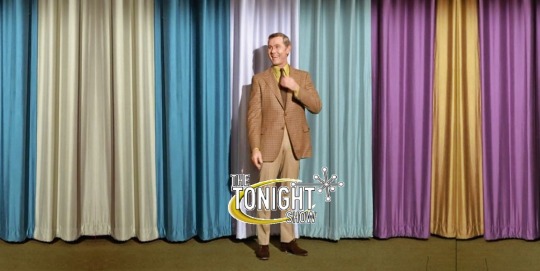
John William Carson was a television host, comedian, writer, and producer best known as the host of “The Tonight Show Starring Johnny Carson” (1962–1992). He was born in Corning, Iowa, and moved to Nebraska at age 8. Carson joined the Navy in 1943. He attended the University of Nebraska and studied journalism but with a keen interest in comedy writing.

His first on camera credit was an afternoon television show called “The Squirrel’s Nest” in 1949 in Omaha. Carson also wrote the program.

Carson’s first brush with Lucille Ball came in February 1961 as a panelist (along with Betsy Palmer, Harry Morgan, and Bess Myerson) on “I’ve Got a Secret”. Guest Lucille Ball was then starring on Broadway in the musical Wildcat. Moore tells Lucy that her secret will be to get the panel to imitate her based on words that appear on the screen.
During Carson’s turn, the word is “ROMANTIC” and then “TIPSY.”
In May 1962, Carson is host of the 14th Annual Emmy Awards, at which Lucille Ball is a presenter.
They would also be host and presenter for the 23rd Annual Emmy Awards in 1971. Lucille Ball is not nominated for “Here’s Lucy”, despite the fact that there were only three nominees in her category. Gale Gordon lost to Edward Asner (”The Mary Tyler Moore Show”) and the writers were nominated for “Lucy Meets the Burtons” but lost to “The Mary Tyler Moore Show.” Lucy attended the Awards with her husband Gary, her daughter Lucie, and her then son-in-law Phil Vandervoort.
At the 36th Annual Emmy Awards in 1980, Lucille Ball was again a presenter, but this time Carson was a nominee, not the host. The hosting duties were taken by Tom Sellek.

A few weeks later, Carson and Ball are on hand at the 14th Anniversary of “The Ed Sullivan Show.” Lucille Ball makes a cameo appearances riding atop an elephant!

In “Jack Benny’s Carnival Nights” (March 1968), Benny’s all-star cast includes Johnny Carson as a carnival barker introducing Luscious Lucille (Lucille Ball), the red-headed bombshell.

Barker: “The girl who made Little Egypt surrender to the Israelis, Luscious Lucille is the most fantastic dancing girl in all history. When Lucille made her first appearance, Gypsy Rose Lee retired, Lily St. Cyr burst her bubble, and Sally Rand grabbed her fans and flew back to Capistrano.”

Later in the special, Carson plays Jack Benny’s son, Jackie, an aspiring TV comic. Lucy played Jackie’s worn-out mother, Agnes.

In July 1968 Lucille Ball made her first appearance on “The Tonight Show with Johnny Carson,” having already been a guest on the show hosted by Jack Paar. She was there to promote her new show, “Here’s Lucy.”
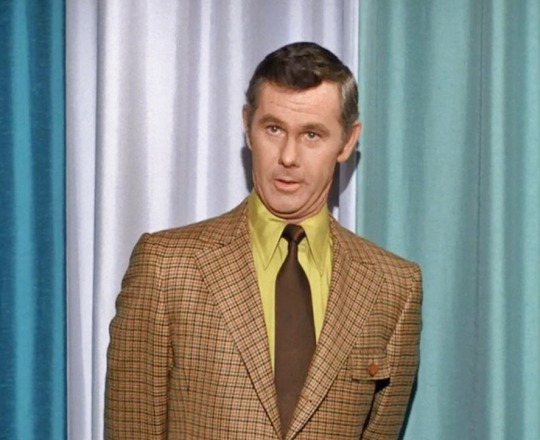
She returned to the guest chair in August 1969, and November 1969, where she brought rehearsal footage of Carson on “Here’s Lucy.”
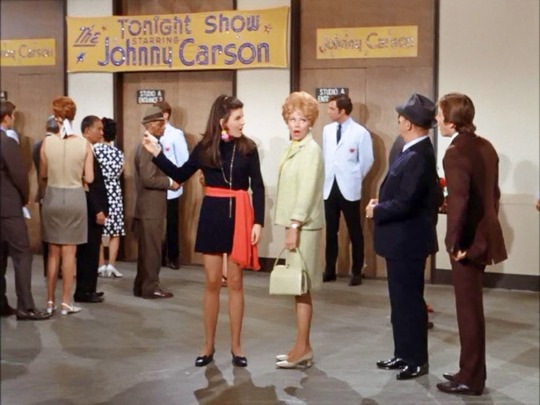
“Lucy and Johnny Carson” (HL S2;E11) aired on December 1, 1969.
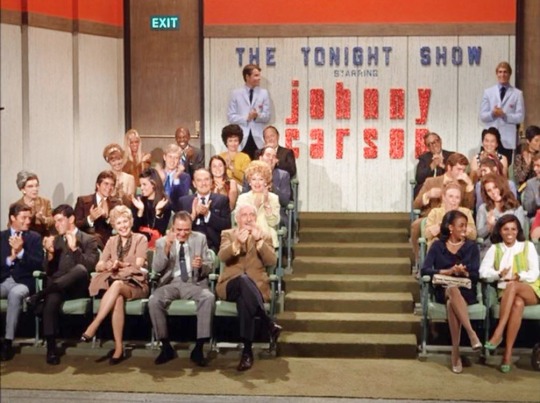
Johnny Carson and Ed McMahon play themselves as Lucy Carter goes to see “The Tonight Show”. In fact, the episode was not shot at the set of the “Tonight Show,” but one replicated by “Here’s Lucy” on their soundstage at Paramount.
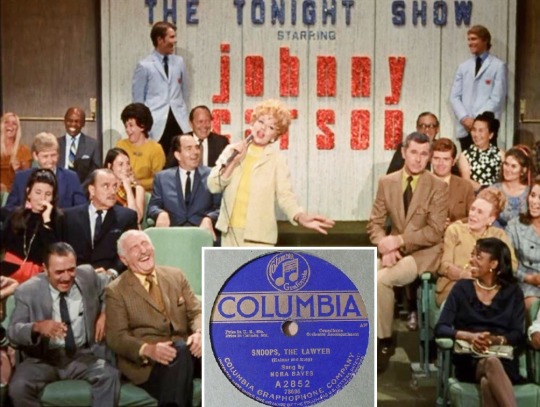
Lucy Carter is picked to play Stump the Band, a staple audience interaction sequence of “The Tonight Show.” Lucy sings “Snoops the Lawyer” a song she says she learned from her father.
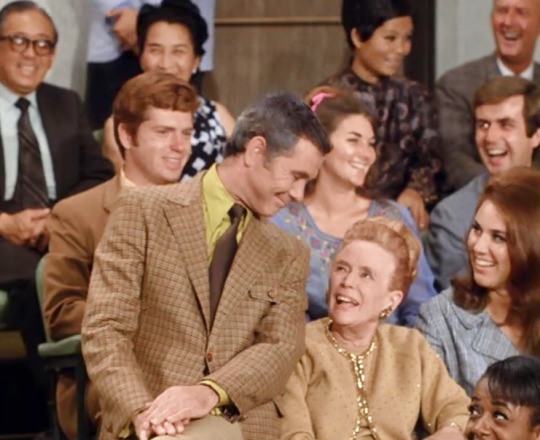
Speaking of parents, sitting just across the aisle from Lucy is her real-life mother, Dede Ball. Carson even directs some of his lines toward her.
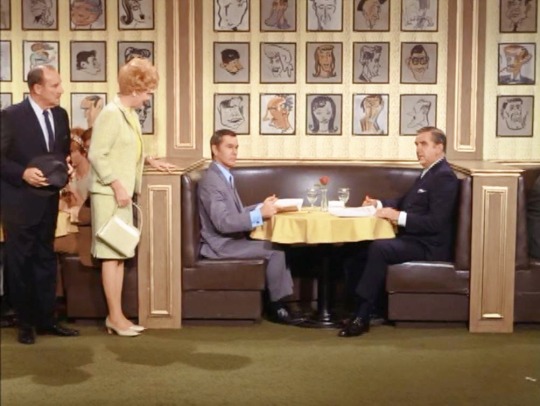
After the show, Harry and Lucy see Johnny and Ed at the Brown Derby restaurant. The Brown Derby scene is very similar to the Brown Derby scene in “Hollywood at Last!” (ILL S4;E16) aka “L.A. at Last!”.
- In “Lucy and Johnny Carson,” Lucy jumps up when she sees Gregory Peck and causes the waiter to spill a tray of drinks on Carson.
- In “Hollywood at Last!” Lucy jumps up when she sees Gregory Peck and causes the waiter to spill a tray of cream pies on William Holden.

The episode opens with a spoof of the TV series “Mission: Impossible” (1966-73), which was a Desilu / Paramount series.

In 1970, Lucille Ball made two more appearances on “The Tonight Show with Johnny Carson”: in February and November.

In between, in September 1970, Carson, Ball and other stars helped Dean Martin kick off the sixth season of “The Dean Martin Show.”
Lucile Ball made several more appearances on “The Tonight Show starring Johnny Carson” throughout the 1970s:
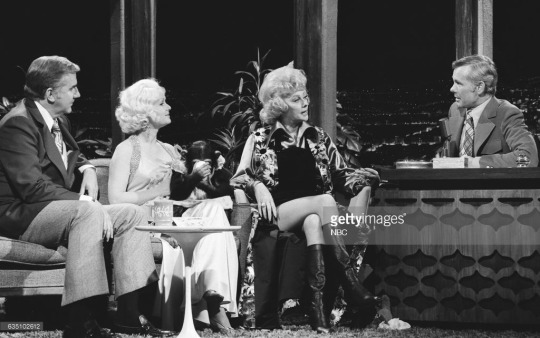
1971 ~ May and August
1973 ~ November
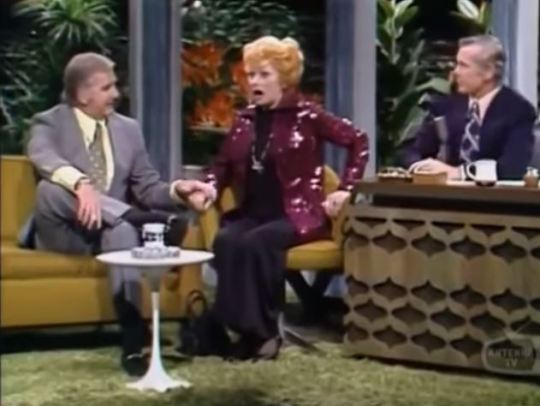
1974 ~ March (with surprise guest Desi Arnaz Sr.)
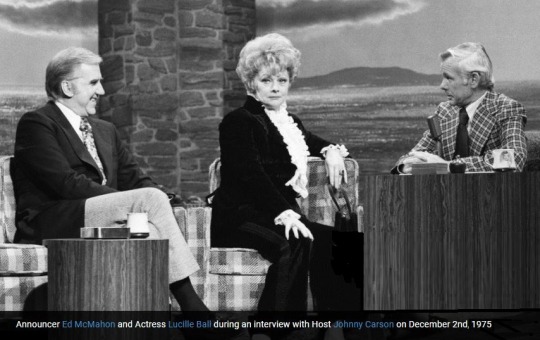
1975 ~ December
1977 ~ April and November
1980 ~ February
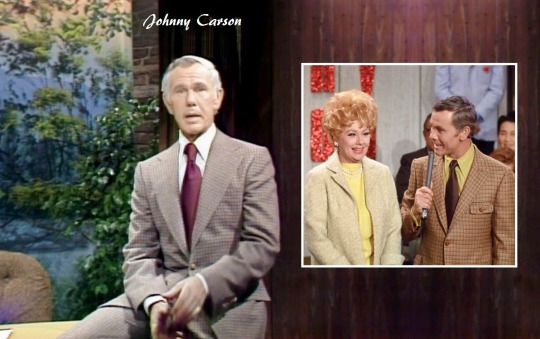
In 1976, Carson was happy to participate in “CBS Salutes Lucy: The First 25 Years” recalling his time on her show in a segment titled “Being Upstaged.”

In 1978, Carson and Ball did two tribute shows: “A Tribute To Mr. Television Milton Berle” and “Happy Birthday, Bob!” a celebration of Bob Hope’s 75th birthday at the Kennedy Center.

On May 6, 1979, Johnny Carson received an award from the Friars Club during a testimonial dinner at Waldorf-Astoria and friends such as Lucille Ball was accompanied by her husband Gary Morton and daughter Lucie Arnaz.

In 1980, Lucille Ball made the momentous decision to break with CBS and sign a contract with NBC. The event was publicized by a fact meets fiction special titled “Lucy Moves To NBC” in which the NBC stars welcome Ball to the Peacock Network. Carson played himself. Lucy’s Secretary announces Carson’s entrance into her office just as Ed McMahon did on “The Tonight Show with Johnny Carson”: “Heeeeeere’s Johnny!” Carson comes in with the “Tonight Show” theme music playing. Breaking the fourth wall, he cuts off the studio audiences’ applause with a sweeping gesture and they instantly fall silent, just as he did on his talk show. Carson delivers some one-liners about his favorite target, Burbank. There is also some innuendo about Johnny Carson’s work schedule at NBC. In 1980,after more than a year of speculation, Carson finally re-negotiated his contract with the network for a shorter work week, only doing one hour a night, four nights a week. Perhaps not so coincidentally, the evening this special aired, Johnny’s guest was Bob Hope, who will be the next NBC star through Lucy’s office door.

Although Lucy’s tenure at NBC yielded very little, she did join Bob Hope on numerous specials, including “Bob Hope Buys NBC?” in May 1985. Ball and Carson both have cameos in the tongue-in-cheek program.

As years went on, Ball and Carson were often part of tribute shows for other celebrities:
- “AFI Achievement Award: A Tribute to Billy Wilder” ~ March 6, 1986
- “America’s Tribute to Bob Hope” ~ March 5, 1988
- “AFI Life Achievement Award: A Salute to Jack Lemmon” ~ March 10, 1988

Their final appearance on screen together was for “The Fifth Annual Television Academy Hall of Fame” on January 23, 1989, just a few months before Ball’s death. She inducted her friend Red Buttons into the Hall of Fame. Both Lucy and Johnny were former honorees.
Johnny Carson was married four times – twice to his second wife Joanna. He had three children. He died in 2005, age 79, of emphysema. He will forever be known as “The King of Late Night”.
Carson received six Emmy Awards, the Television Academy’s 1980 Governor’s Award, and a 1985 Peabody Award. He was inducted into the Television Academy Hall of Fame in 1987. Carson was awarded the Presidential Medal of Freedom in 1992 and received a Kennedy Center Honor in 1993.
-
HAYDEN RORKE
October 23, 1910

Hayden Rorke was born as William Henry Rorke in Brooklyn, New York. Hayden was his mother’s maiden name. He was best known for playing Colonel Alfred E. Bellows on the 1960s sitcom “I Dream of Jeannie.” He studied drama in high school and attended the American Academy of Dramatic Arts. He began his stage career in the 1930s.

During World War II, he enlisted in the United States Army, where he made his film debut in the musical This Is the Army starring Ronald Reagan playing a soldier uncredited.

Following the war, he left the Army and did small parts on Broadway and regional theatre, including Dream Girl starring Lucille Ball in 1947. This was Rorke’s first encounter with Ball, but not his last. He returned to Hollywood for the film Lust for Gold (1949), again uncredited. He finally got his first screen credit later that year in Rope of Sand starring Burt Lancaster. His best known films were When World’s Collide (1951) and All That Heaven Allows (1955).

Rorke made his TV debut on “I Love Lucy” in “The New Neighbors” (ILL S1;E21) in early 1952.

Rorke and K.T. Stevens played the O’Briens, new tenants at 623 East 68th Street. They are actors rehearsing a scene, which Lucy overhears and mistakes them for spies plotting to blow up the capitol!

In 1971, after 129 episodes of “Jeannie”, Rorke was seen as a Judge on “Here’s Lucy” in “Lucy and the Raffle” (HL S3;E19).

Lucy and Kim are hauled in front of a Judge to explain why they are running a raffle without a permit.

In November 1965, Rorke played A.J. Considine on “The Taylors In Hollywood,” an episode of “The Andy Griffith Show,” a series shot on the Desilu lot. Considine is the director of a movie based on Andy Taylor’s life titled “Sheriff Without a Gun”. The episode also featured “Lucy” players Herb Vigran, Ross Elliott, and Sid Melton.

On the sitcom “I Dream of Jeannie” Rorke played the incredulous Dr. Alfred Bellows from 1965 to 1970, even returning for a “Jeannie” reunion special in 1985, his last screen project. He died in 1987. At the time of his passing, he had done nearly 150 films and television shows.

In 2011, Rorke’s “Jeannie” costar Barbara Eden gave an interview to TV Guide in which she revealed that Rorke was gay and had a longtime romantic partner director Justus Addiss (above). The two met on the film Project Moonbase in 1953. Addiss directed Rorke in four episodes of “The Schlitz Playhouse” (all in 1955) and one episode of “Goodyear Summer Originals” in 1956.

-
THE QUIZ SHOW
October 23, 1948
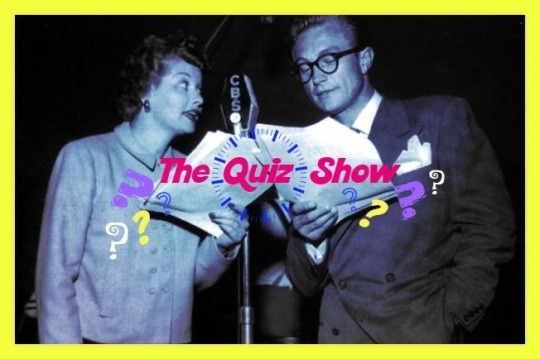
“The Quiz Show” is episode #14 of the radio series MY FAVORITE HUSBAND broadcast on October 23, 1948.
Synopsis ~ Liz and George need a new dishwasher, and Cory gets them a chance to win one on the radio quiz show, “His and Hers.”

This script was used as the basis for the “I Love Lucy” episode “Lucy Gets Ricky On the Radio” (ILL S1;E32) first aired on May 19, 1952.
Note: This episode of “My Favorite Husband” was aired before the characters names were changed from Cugat to Cooper. It was also before Jell-O came aboard to sponsor the show and before the regular cast featured Bea Benadaret and Gale Gordon as the Atterburys.

“My Favorite Husband” was based on the novels Mr. and Mrs. Cugat, the Record of a Happy Marriage (1940) and Outside Eden (1945) by Isabel Scott Rorick, which had previously been adapted into the film Are Husbands Necessary? (1942). “My Favorite Husband” was first broadcast as a one-time special on July 5, 1948. Lucille Ball and Lee Bowman played the characters of Liz and George Cugat, and a positive response to this broadcast convinced CBS to launch “My Favorite Husband” as a series. Bowman was not available Richard Denning was cast as George. On January 7, 1949, confusion with bandleader Xavier Cugat prompted a name change to Cooper. On this same episode Jell-O became its sponsor. A total of 124 episodes of the program aired from July 23, 1948 through March 31, 1951. After about ten episodes had been written, writers Fox and Davenport departed and three new writers took over – Bob Carroll, Jr., Madelyn Pugh, and head writer/producer Jess Oppenheimer. In March 1949 Gale Gordon took over the existing role of George’s boss, Rudolph Atterbury, and Bea Benaderet was added as his wife, Iris. CBS brought “My Favorite Husband” to television in 1953, starring Joan Caulfield and Barry Nelson as Liz and George Cooper. The television version ran two-and-a-half seasons, from September 1953 through December 1955, running concurrently with “I Love Lucy.” It was produced live at CBS Television City for most of its run, until switching to film for a truncated third season filmed (ironically) at Desilu and recasting Liz Cooper with Vanessa Brown.
MAIN CAST

Lucille Ball (Liz Cugat) was born on August 6, 1911 in Jamestown, New York. She began her screen career in 1933 and was known in Hollywood as ‘Queen of the B’s’ due to her many appearances in ‘B’ movies. “My Favorite Husband” eventually led to the creation of “I Love Lucy,” a television situation comedy in which she co-starred with her real-life husband, Latin bandleader Desi Arnaz. The program was phenomenally successful, allowing the couple to purchase what was once RKO Studios, re-naming it Desilu. When the show ended in 1960 (in an hour-long format known as “The Lucy-Desi Comedy Hour”) so did Lucy and Desi’s marriage. In 1962, hoping to keep Desilu financially solvent, Lucy returned to the sitcom format with “The Lucy Show,” which lasted six seasons. She followed that with a similar sitcom “Here’s Lucy” co-starring with her real-life children, Lucie and Desi Jr., as well as Gale Gordon, who had joined the cast of “The Lucy Show” during season two. Before her death in 1989, Lucy made one more attempt at a sitcom with “Life With Lucy,” also with Gordon.
Richard Denning (George Cugat) was born Louis Albert Heindrich Denninger Jr., in Poughkeepsie, New York. When he was 18 months old, his family moved to Los Angeles. Plans called for him to take over his father’s garment manufacturing business, but he developed an interest in acting. Denning enlisted in the US Navy during World War II. He is best known for his roles in various science fiction and horror films of the 1950s. Although he teamed with Lucille Ball on radio in “My Favorite Husband,” the two never acted together on screen. While “I Love Lucy” was on the air, he was seen on another CBS TV series, “Mr. & Mrs. North.” From 1968 to 1980 he played the Governor on “Hawaii 5-0″, his final role. He died in 1998 at age 84.
Ruth Perrott (Katie, the Maid / Mrs. Van Tassle) was also later seen on “I Love Lucy.” She first played Mrs. Pomerantz, a member of the surprise investigating committee for the Society Matrons League in “Pioneer Women” (ILL S1;E25), as one of the member of the Wednesday Afternoon Fine Arts League in “Lucy and Ethel Buy the Same Dress” (ILL S3;E3), and also played a nurse when “Lucy Goes to the Hospital” (ILL S2;E16). She died in 1996 at the age of 96.
Mrs. Van Tassel only giggles. Since Perrott is the only other female in the show, the role would fall to her. In other episodes, Mrs. Marge Von Tassle is played by Elvia Allman.
Bob LeMond (Announcer) also served as the announcer for the pilot episode of “I Love Lucy”. When the long-lost pilot was finally discovered in 1990, a few moments of the opening narration were damaged and lost, so LeMond – fifty years later – recreated the narration for the CBS special and subsequent DVD release.
GUEST CAST

John Hiestand (Cory Cartwright) served as the announcer for the radio show “Let George Do It” from 1946 to 1950. In 1955 he did an episode of “Our Miss Brooks” opposite Gale Gordon.

Frank Nelson (Smiley Stembottom, Radio Host) was born on May 6, 1911 (three months before Lucille Ball) in Colorado Springs, Colorado. He started working as a radio announcer at the age of 15. He later appeared on such popular radio shows as “The Great Gildersleeve,” “Burns and Allen,” and “Fibber McGee & Molly”. Aside from Lucille Ball, Nelson is perhaps most associated with Jack Benny and was a fifteen-year regular on his radio and television programs. His trademark was playing clerks and other working stiffs, suddenly turning to Benny with a drawn out “Yeeeeeeeeees?” Nelson appeared in 11 episodes of “I Love Lucy”, including three as quiz master Freddy Fillmore, and two as Ralph Ramsey, plus appearance on “The Lucy-Desi Comedy Hour” – making him the only actor to play two different recurring roles on “I Love Lucy.” Nelson returned to the role of the frazzled Train Conductor for an episode of “The Lucy Show” in 1963. This marked his final appearance on a Lucille Ball sitcom.

Hans Conried (Mr. Atterbury, George’s Boss) first co-starred with Lucille Ball in The Big Street (1942). He then appeared on “I Love Lucy” as used furniture man Dan Jenkins in “Redecorating” (ILL S2;E8) and later that same season as Percy Livermore in “Lucy Hires an English Tutor” (ILL S2;E13) – both in 1952. The following year he began an association with Disney by voicing Captain Hook in Peter Pan. On “The Lucy Show” he played Professor Gitterman in “Lucy’s Barbershop Quartet” (TLS S1;E19) and in “Lucy Plays Cleopatra” (TLS S2;E1). He was probably best known as Uncle Tonoose on “Make Room for Daddy” starring Danny Thomas, which was filmed on the Desilu lot. He joined Thomas on a season 6 episode of “Here’s Lucy” in 1973. He died in 1982 at age 64.
Hans Conried played Mr. Atterbury in several episodes until the role was assumed by Gale Gordon and became a series regular in 1949.

Herb Vigran (Harry, George’s Friend / Radio Announcer) made several appearances on “My Favorite Husband.” He would later play Jule, Ricky’s music union agent on two episodes of “I Love Lucy”. He would go on to play Joe (and Mrs. Trumbull’s nephew), the washing machine repairman in “Never Do Business With Friends” (S2;E31) and Al Sparks, the publicity man who hires Lucy and Ethel to play Martians on top of the Empire State Building in “Lucy is Envious” (S3;E23). Of his 350 screen roles, he also made six appearances on “The Lucy Show.”

Rolfe Sedan (Mr. Charles Van Tassle) first worked with Lucille Ball in the 1934 film Kid Millions. When Lucy Ricardo ate snails in “Paris at Last” (ILL S5;E18), Sedan played the Chef who was outraged that Lucy wants to put ketchup on his food. He is probably best remembered as Mr. Beasley the mailman on “The George Burns and Gracie Allen Show.”
Mr. Van Tassel is a lawyer who lives in Sheridan Falls. He is also competing on “Mr. & Mrs.”
THE EPISODE
ANNOUNCER: “It’s morning and George Cugat is seated alone at the breakfast table. Liz is helping Katie the maid in the kitchen by fixing the toast.”

From the dining room, George hears Liz scraping the toast and knows that breakfast has been burned – again! George has tried to fix the faulty toaster. He tightened the spring to make the toast pop up better.
LIZ: “You’d better apologize to Katie. She fell into the sink running back to catch a high fly. And if it ever learns to throw a curve we’re really in trouble.”
GEORGE: “Well, what do you do? Buy a new one?”
LIZ: “Either that or buy Katie a fielder’s mitt.”
The toaster proved to be one of Lucille Ball’s favorite props on “I Love Lucy”. Many episodes began with the toast popping up into mid-air and Lucy (or Ricky) catching it (or not)!
Liz compares George’s morning kisses to coffee – they wake her up.
GEORGE: “I have a confession to make. My caffeine’s been removed.”
(GEORGE and LIZ kiss)
LIZ: “Mmmm. Sanka!”
GEORGE: “You’re welcome!”
Sanka was one of the first caffeine-free brands of coffee. It came to the USA in 1910 as Dekafa, but was re-branded in 1914 as Sanka, a name derived from the French “sans caffeine”. Sanka was a sponsor of “I Love Lucy” after their relationship with Philip Morris ended. They were included on the animated sequences leading into commercial breaks.
A commotion in the kitchen finds Katie fighting off the automatic dishwasher run-amok! Liz pleads with George to buy a new dishwasher if only to insure that they don’t lose Katie.

George insists that women have it too easy, stating that pioneer women didn’t have a lot of electronic gadgets to do their housework.
LIZ: “Of course they didn’t. And where are those women today? Dead!”

A failed attempt at getting Ricky and Fred to buy them automatic dishwashers brings the same accusation from Ricky and response from Lucy in “Pioneer Women” (ILL S1;E25) in 1952. They agree to turn back the clock to see who can cope with life without electronic gadgets – the men or the women.
Liz says that without a new dishwasher, she’ll have to help Katie with the dishes and get dishpan hands – not very kissable. George still refuses. They argue who (or whom) will tell Katie that she isn’t getting a new dishwasher.
Later, Liz invites Cory Cartwright over to ask him if he knows of any radio give-away shows where she might win a dishwasher. She notices he has bottle of Tabu on a string – fishing for women!

Tabu is a perfume from Dana that started marketing in the US in the 1940s. The scent is primarily of patchouli oils. It was called the “forbidden” scent!
Cory has friend that produces radio giveaway shows and provides Liz a long list of the many items that are up for grabs, ending with “Arrowhead Springs”!

Arrowhead Springs is a mountainous neighborhood of San Bernardino, California. It is named for a geographical formation in the side of the mountain that resembles a large arrowhead. A resort and spa sprung up at the foot of the mountains. In 1948, Life Magazine brought attention to Arrowhead Springs with a photo shoot featuring 6 Hollywood fashion models, which is likely why it is on Cory’s list!
Cory phones his friend, Smiley Stembottom, host of “His & Hers” – a husband and wife game show. Liz is doubtful George will want to participate, but promises to get George to listen to the broadcast airing that night.

On “I Love Lucy,” the radio quiz show was known as “Mr. and Mrs. Quiz” and Frank Nelson’s host character was named Freddy Fillmore instead of Smiley Stembottom.
After dinner, Liz convinces Liz to stay home and listen to the radio, something she rarely does and George knows it. Liz spurts out several nonsensical titles of shows she says she listens to:

- “Portia Faces John’s Other Wife” ~ a mash-up of “John’s Other Wife” (1936-42) and “Portia Faces Life” (1940-53).
- “Ma Perkins Can Be Beautiful” ~ a mash-up of “Ma Perkins” (1933-60) and “Life Can Be Beautiful” (1940-56)
- “When A Girl Marries It Pays To Be Ignorant” ~ a mash-up of “When A Girl Marries” (1939-57) and “It Pays To Be Ignorant” (1942-51), a comedy show sponsored by Philip Morris.
- “Libbey Owens: Girl Glassblower” ~ Libbey-Owens-Ford was a North American glass manufacturer in business from 1930 to 1986.
Liz suggests a quiz show, but George is resistant. He calls them “horrible” and full of “a lot of silly characters making fools of themselves in front of a microphone.”
On the radio, host Smiley Stembottom (Frank Nelson) of “His & Hers” introduces Mr. and Mrs. Paul Roni. He asks them the jackpot question: “What is stored at Fort Knox?” Liz answers “gelatine”. The answer, as George knows, is gold.

Liz is thinking of Knox Gelatine, not the Kentucky military installations that are home to much of America’s gold supply. Charles Knox developed the world’s first pre-granulated gelatine. He packaged dried sheets of gelatin and then hired salesmen to travel door-to-door to show women how to add liquid to the sheets and use it to make aspics, molds, and desserts. Gelatin is also the prime ingredient of Jell-O, a dessert that will become the main sponsor of “My Favorite Husband” in 1949. Fort Knox, the gold depository, will be frequently mentioned by money-grubbing Mr. Mooney and Harry Carter (both played by Gale Gordon) on “The Lucy Show” and “Here’s Lucy,” respectively.
Smiley signs off by announcing the contestants for next week: Mr. and Mrs. Tom LeFevre, Dr. and Mrs. Charles Van Tassle, and Mr. and Mrs. George Cugat. Liz hasn’t had time to tell him and George is furious!
The phone rings and it is Harry (Herb Vigran), George’s friend, who ribs him about being on a quiz show, comparing it to “Queen for a Day”!

“Queen for a Day” had women competing for prizes by disclosing their hardships for an audience vote. It began as a radio program in 1945 and moved to television in 1947. Its final queen was crowned in 1964. The show was mentioned by Ethel Mertz as a way for Lucy to get Ricky’s name in the press on “The Publicity Agent” (ILL S1;E31) in 1952. Instead, she pretends to be the Maharincess of Franistan!
George’s boss Mr. Atterbury (Hans Conried) calls and instead of being angry, he thinks it is a great idea as it will give the bank publicity and prove how smart bankers can be.
Next day, George brings home a bunch of reference books to bone up for the quiz. He asks Liz a history questions to test her:

“What is the Monroe Doctrine?” ~ Liz doesn’t know for sure, but thinks it is about the guy who sang “Racing With the Moon.” Imitating Vaughn Monroe in a gravlley voice, she sings a few bars before George cuts her off.
It actually refers to President James Monroe. The Monroe Doctrine (1823) warns European nations that the United States will not tolerate further colonization or puppet monarchs.

They move on to Natural History:
“What is the name of and animal with long, sharp, fangs and a shaggy head who stalks his prey at night?” ~ This reminds Liz of Corey Cartwright!
The real answer is undoubtedly wolf. In parlance of the 1940s, it was also an analogous term for a womanizing man. Hence the term “wolf whistle”.
George resolves that on the show he will answer all the questions and Liz will just stand there smiling.
The day of the quiz, Cory consoles a worried Liz by telling her that he has the answer sheet, thanks to last night’s date with Adele, the producer’s secretary. Although Liz is sure it is wrong, she sneaks a peak at the answers anyway.
- Al Jolson
- The sap runs every two years.
- “Life With Father”
- To scrap the barnacles off of her hull.
Liz memorizes the answers, even though she doesn’t know the questions.
On “I Love Lucy” there were only three questions before the jackpot question, not four. Also, the prize was $500, not a new automatic dishwasher.
Before leaving for the studio, Liz is dressing and repeating the answers to herself. George reminds her that he will answer all the questions.
At the studio, the show begins with the announcer (Herb Vigran) introducing Smiley and three couples. Mr. Atterbury cheers from the audience when the Cugats are introduced. Smiley announces that because the men on the show are so intelligent (a lawyer, a doctor, and a banker) they have thrown out the easy questions they were going to use in favor of more difficult ones.
Attorney Mr. Van Tassle (Rolfe Sedan) is first up. Whatever Smiley says, Mrs. Van Tassel just giggles. His question is:
- Q (Smiley): “Who discovered the Fountain of Youth and claimed he could live forever?”
- A (Mr. Van Tassle): “Ponce de
León.”

In “Desert Island” (ILL S6;E8) in 1956,
Ricky announces that he’s going to be in a film about the history of the state of Florida. The state’s history begins in 1513 with its founding by Spanish explorer Ponce de León. Ricky says he will appear in the ‘modern’ scenes playing with his band in the hotel nightclub.
Meanwhile, just offstage, presumably while the LeFevre’s are answering their questions, Liz and George nervously review their procedure: George will do all the talking – or so he thinks! Liz and George are called to the stage.
-
Q (Smiley): “Who discovered the Fountain of Youth and claimed he could live forever?”
- A (Liz): “Al Jolson.”

Al Jolson was the name of a popular jazz singer of the time. He was a rival of William Frawley (Fred Mertz) in vaudeville. A film of his life was released in 1946 and in early 1948 it was done for radio starring Jolson as himself.

On “I Love Lucy” the first question is different: “To whom do you make your federal tax check out on March 15?” but instead Fillmore asks “What is the name of the animal that fastens itself to you and drains you of your blood?” The answer Lucy memorized was “The collector of Internal Revenue.” when the real answer was “A vampire bat.” [Tax Day was first set on March 1st in 1913. It was moved to March 15th in 1918 before being finally set as April 15th in 1955.]
Smiley asks the Cugats his second question:
- Q (Smiley): “What is your congressman’s term of office?”
- A (Liz): “The sap runs every four years.”
Liz is wrong. The answer is every six years.
This is the same question that will be asked on “I Love Lucy”, although on radio we never hear the original question that Lucy / Liz is answering: “How do subfreezing temperatures in the arctic affect the growth of trees?”
George begs to be allowed to answer. Smiley asks question number three:
- Q (Smiley): “What has caused America to have such a large increase in population?”
- A (Liz): “Is it ‘Life With Father’?”

Life With Father holds the record for being the longest-running non-musical Broadway play in history. It opened in November 1939 and played until April 1947 amassing 3,224 performances. The play was written by Howard Lindsay and Russel Crouse, adapted from stories compiled in 1935 by Clarence Day.
The play was adapted into a 1947 feature film and a 1953-55 CBS television series running concurrently with “I Love Lucy.”
Smiley asks his fourth and final question:
- Q (Smiley): “Why did the French people put Marie Antoinette under the sharp blade of the guillotine?
- A (Liz): “To scrape the barnacles off her hull!”
Liz is wrong again. George never got a chance to answer. They become the first couple never to get any of the answers right.
The real answer is not given on the show, but after the French monarchy was abolished in 1792, Marie Antoinette was convicted of treason and executed by having her head cut off in a public square.
Since the jackpot counts for 100 points, George and Liz could still win the electric dishwasher – plus the bonus prize of 300 dirty dishes. Liz finally realizes that they switched the questions after she memorized them!
- Jackpot Q (Smiley): “At the last session of the big four foreign minsters in Paris, when Russia and the United States were in disagreement, what did Andrey Vyshinsky say to Secretary of State Marshall?”
- A (Liz): “I give up, George. Let’s go home.”

A Big Four Conference of foreign ministers in June and July 1946 involved much haggling between the Soviet and Western ministers. However, the attendees managed to agree on final treaties with Italy, Hungary, Romania, Bulgaria, and Finland. George C. Marshall was Secretary of State under Harry S. Truman between 1947 and 1949.
Liz gets it right. She has won the new dishwasher!

On “I Love Lucy” the bonus (aka jackpot) question was "What did George Washington say when crossing the Delaware?” Ricky is truly queasy at how poorly he’s doing on the show, so he blurts out to Lucy, “Please let me sit down. This is making me sick!” which was the correct answer!
LIZ: “I didn’t even know I spoke Russian!”
In the usual bedtime tag scene, Liz and George are in bed trying to sleep. She wonders if George ever pretends. George appeases her.
GEORGE: “I pretend I’m all alone on a deserted island and I see coming toward me a girl with flowers in her hair. Now what do you pretend?”
LIZ: “I pretend she’s ugly. Goodnight, George!”Al Jolson, Arrowhead Springs, Bob LeMond, Fort Knox, Frank Nelson, Hans Conried, Herb Vigran, I love lucy, Knox Gelatine, Life With Father, Lucille Ball, Monroe Doctrine, My Favorite Husband, Ponce de Leon, Queen for a Day, Radio, Richard Denning, Rolfe Sedan, Ruth Perrott, Sanka, Tabu, The Quiz Show, Toaster -
RIP MARGE CHAMPION
1919-2020

Marjorie Celeste Champion (née Belcher) was a dancer and actress. She performed as an actress and dancer in film musicals, and in 1957 had a television show based on song and dance. She made her New York stage debut in 1943. In 2001, she appeared as Emily Whitman in the Broadway revival of Follies.

In 1937 she was paid $10 a day to be the live action model for Snow White in the animated film. Her first husband was Disney animator Art Babbit. The marriage lasted just three years.

In 1947 she married dancer Gower Champion. Together, they had two sons. They were even on the cover of LIFE together in 1949. They divorced in January 1973.
She married a third time to TV and film director Boris Segal, who died after four years of marriage.

At the 24th Annual Academy Awards in March 1952, Marge and Gower Champion were presenters…

…along with red heads Danny Kaye and Lucille Ball. George Stevens brought home the Oscar for Best Achievement in Direction for A Place in the Sun , Humphrey Bogart won Best Performance by an Actor in The African Queen, Vivien Leigh won Best Performance by an Actress for her role in A Streetcar Named Desire, and An American in Paris won Best Motion Picture.

Marge was mentioned on “I Love Lucy” in the 1956 episode “Lucy and Bob Hope” (ILL S6;E1). The song “Nobody Likes the Ump” includes a soft shoe dance break.
HOPE (aside): “If Marge sees this, Gower’s finished!”

Champion won an Emmy in 1975 for “Queen of the Starlight Ballroom”.

In March 1985, Marge Champion, Lucille Ball, Lucie Arnaz and 98 other celebrities participated in “Night of 100 Stars II” at Radio City Music Hall.
-
HY AVERBACK
October 21, 1920

Hyman Jack Averback was an accomplished Producer / Director and Actor who was born in Minneapolis and moved to California with his family when he was 9. He graduated from the Edward Clark Academy Theater in 1938 and eventually got a job announcing at KMPC Beverly Hills before World War II.

As part of the Armed Forces Radio Service, he entertained troops in the Pacific with his program of comedy and music. He created the character of Tokyo Mose, a lampoon of Japan’s Tokyo Rose.
After his discharge, his big break came when he was hired to announce “The Jack Paar Show”, which replaced Jack Benny on radio for the summer of 1947. He became the announcer for Bob Hope on NBC in September 1948.

His first screen appearance as an actor was under the name Hy Averbach in Cry Danger (1951) starring Dick Powell and Rhonda Fleming.

In October 1951 he made his television debut (as himself) on “Chesterfield Sound Off Time” on NBC.

In October 1953 he created the role of Charlie Apppleby, husband of Lucy’s ‘frenemy’ Caroline, in “Baby Pictures” (ILL S3;E5). Charlie was the manager of a television station. The next time we see Charlie Appleby he will be played by George O’Hanlon (inset photo) in “Lucy and Superman” (S6;E13).

“Dad, I’m gonna make you the Cuban Liberace!” ~ Charlie Pomerantz
Averback returned to the show to play another Charlie, Charlie Pomerantz, in “The Hedda Hopper Story” (S4;E20). Pomerantz was Ricky’s Hollywood Press Agent. The character was named after the West Coast Publicity Agent for Philip Morris, the show’s main sponsor.

In 1954 and 1955, Averback did two episodes of “The Danny Thomas Show,” filmed by Desilu. In late 1958 and early 1959, the Williams’ and the Ricardos’ made reciprocal appearances on each others’ shows.

In May 1955, Averback played Mr. Harmon on an episode of Desilu’s “December Bride”. In 1957, Executive Producer Desi Arnaz appeared on the series as himself.

From 1952 to 1956 he did seven episodes of “Our Miss Brooks,” also filmed at Desilu. He mostly played Roberto Romeo with Gale Gordon as Osgood Conklin.

Hy Averback served as the Announcer for the first episode of “The NBC Comedy Hour” (previously known as “The Colgate Comedy Hour”) in January 1956. That episode also starred William Frawley (Fred Mertz), crossing network lines.

When “Brooks” went off the air, he switched to “Box” – and also moved from acting to behind the cameras as director. He directed two episodes of “The Box Brothers” (aka “The Brothers”) starring Gale Godon, but the show was not a success.

After its failure, he returned to Desilu Studios to direct “The Real McCoys” and ended up directing 102 episodes from 1957 to 1960. He was once again directing an “Our Miss Brooks” co-star; this time Richard Crenna. His work earned him a 1959 Emmy nomination. A 1960 episode he directed featured Doris Singleton (Caroline Appleby, his “Lucy” wife) as a character named Ethel!

Averback is best remembered for directing 20 episodes of “M*A*S*H” (1972-82) which earned him his second and third Emmy nominations.

His final screen project was directing the pilot of “The Last Precinct” in 1986.
He was married to Dorothy Averback. He died on October 14, 1997.

A former announcer, he was the voice of the "M*A*S*H” loudspeaker operator. In one episode, he says
”…and that’s it from me, Hy Averback.“
-
SAFE DRIVING WEEK
October 21, 1950
“Safe Driving Week” (aka “Safety Drive”) is episode #102 [some sources say #101] of the radio series MY FAVORITE HUSBAND broadcast on October 21, 1950.
This was the sixth episode of the third season of MY FAVORITE HUSBAND. There were 31 new episodes, with the season ending on March 31, 1951.
Synopsis ~
When Liz gets a traffic ticket on the day George is Safety Week chairman, George decides to lock the car in the garage and hide the key.

“My Favorite Husband” was based on the novels Mr. and Mrs. Cugat, the Record of a Happy Marriage (1940) and Outside Eden (1945) by Isabel Scott Rorick, which had previously been adapted into the film Are Husbands Necessary? (1942). “My Favorite Husband” was first broadcast as a one-time special on July 5, 1948. Lucille Ball and Lee Bowman played the characters of Liz and George Cugat, and a positive response to this broadcast convinced CBS to launch “My Favorite Husband” as a series. Bowman was not available Richard Denning was cast as George. On January 7, 1949, confusion with bandleader Xavier Cugat prompted a name change to Cooper. On this same episode Jell-O became its sponsor. A total of 124 episodes of the program aired from July 23, 1948 through March 31, 1951. After about ten episodes had been written, writers Fox and Davenport departed and three new writers took over – Bob Carroll, Jr., Madelyn Pugh, and head writer/producer Jess Oppenheimer. In March 1949 Gale Gordon took over the existing role of George’s boss, Rudolph Atterbury, and Bea Benaderet was added as his wife, Iris. CBS brought “My Favorite Husband” to television in 1953, starring Joan Caulfield and Barry Nelson as Liz and George Cooper. The television version ran two-and-a-half seasons, from September 1953 through December 1955, running concurrently with “I Love Lucy.” It was produced live at CBS Television City for most of its run, until switching to film for a truncated third season filmed (ironically) at Desilu and recasting Liz Cooper with Vanessa Brown.
MAIN CAST

Lucille Ball (Liz Cooper) was born on August 6, 1911 in Jamestown, New York. She began her screen career in 1933 and was known in Hollywood as ‘Queen of the B’s’ due to her many appearances in ‘B’ movies. With Richard Denning, she starred in a radio program titled “My Favorite Husband” which eventually led to the creation of “I Love Lucy,” a television situation comedy in which she co-starred with her real-life husband, Latin bandleader Desi Arnaz. The program was phenomenally successful, allowing the couple to purchase what was once RKO Studios, re-naming it Desilu. When the show ended in 1960 (in an hour-long format known as “The Lucy-Desi Comedy Hour”) so did Lucy and Desi’s marriage. In 1962, hoping to keep Desilu financially solvent, Lucy returned to the sitcom format with “The Lucy Show,” which lasted six seasons. She followed that with a similar sitcom “Here’s Lucy” co-starring with her real-life children, Lucie and Desi Jr., as well as Gale Gordon, who had joined the cast of “The Lucy Show” during season two. Before her death in 1989, Lucy made one more attempt at a sitcom with “Life With Lucy,” also with Gordon.
Richard Denning (George Cooper) was born Louis Albert Heindrich Denninger Jr., in Poughkeepsie, New York. When he was 18 months old, his family moved to Los Angeles. Plans called for him to take over his father’s garment manufacturing business, but he developed an interest in acting. Denning enlisted in the US Navy during World War II. He is best known for his roles in various science fiction and horror films of the 1950s. Although he teamed with Lucille Ball on radio in “My Favorite Husband,” the two never acted together on screen. While “I Love Lucy” was on the air, he was seen on another CBS TV series, “Mr. & Mrs. North.” From 1968 to 1980 he played the Governor on “Hawaii 5-0″, his final role. He died in 1998 at age 84.
Ruth Perrott (Katie, the Maid) was also later seen on “I Love Lucy.” She first played Mrs. Pomerantz, a member of the surprise investigating committee for the Society Matrons League in “Pioneer Women” (ILL S1;E25), as one of the member of the Wednesday Afternoon Fine Arts League in “Lucy and Ethel Buy the Same Dress” (ILL S3;E3), and also played a nurse when “Lucy Goes to the Hospital” (ILL S2;E16). She died in 1996 at the age of 96.
Bob LeMond (Announcer) also served as the announcer for the pilot episode of “I Love Lucy”. When the long-lost pilot was finally discovered in 1990, a few moments of the opening narration were damaged and lost, so LeMond – fifty years later – recreated the narration for the CBS special and subsequent DVD release.
Gale Gordon and Bea Benadaret (Rudolph and Iris Atterbury) do not appear in this episode.
GUEST CAST

Elvia Allman (Marge Van Tassle) was born on September 19, 1904 in Enochville, North Carolina. She started her performing career on radio in the 1920s, as both a storyteller and singer. Allman’s first episode of “I Love Lucy” is also one of the most memorable in TV history: “Job Switching” (ILL S2;E1) in September 1952. She played the strident foreman of Kramer’s Candy Kitchen. Allman returned to the show as one of Minnie Finch’s neighbors in “Fan Magazine Interview” (ILL S3;E17) in 1954. Changing gears once again she played prim magazine reporter Nancy Graham in “The Homecoming” (ILL S5;E6) in 1955. She made two appearances on “The Lucy–Desi Comedy Hour“ – first as Ida Thompson, Westfield’s PTA director in “The Celebrity Next Door” (LDCH S1;E2) and as Milton Berle’s secretary when “Milton Berle Hides Out at the Ricardos” (LDCH S3;E1) in 1959. On “The Lucy Show” she was seen in “Lucy Bags a Bargain” (TLS S4;E17) and in “Lucy The Babysitter” (TLS S5;E16). Allman died on March 6, 1992, aged 87.
Lucy characters have always had a peripheral character named Marge. In this case, the character largely takes on the action that might normally be taken by Iris Atterbury. It is likely that Bea Benadaret was not available that week, so the character was rewritten for Elvia Allman as Marge Van Tassle.

Sheldon Leonard (Motorcyle Cop) was born Leonard Sheldon Bershad in New York City in 1907. In 1953 he played fast-talking salesman Harry Martin, who sells Lucy Ricardo the Handy Dandy vacuum cleaner in “Sales Resistance” (ILL S2;E17). He played himself on a 1967 episode of “The Lucy Show.” Leonard was an integral part of the Desilu family off-screen as well, directing “Make Room for Daddy” including an episode that featured Lucy and Ricky Ricardo in 1959. He was one of the creators of “The Andy Griffith Show,” also filmed at Desilu. Leonard may be best remembered as the Nick, the bartender in the classic film It’s a Wonderful Life (1945). He died in 1997.
THE EPISODE

ANNOUNCER:
“As we look in on the town of Sheridan Falls, where the Coopers live, it’s an average Wednesday morning. The traffic on Elm Street is fairly heavy, the cars are moving along about as usual, except – wait a minute! Pull over to the curb! Here comes a woman driver! It’s Liz Cooper driving!”Liz is pulled over by a policeman (Sheldon Leonard), although she’s unclear why. He says that Liz made the wrong arm signal when turning left.

Turn signal lights in cars didn’t become common until later in the 1950s. Before that, letting everyone know which way one planned to turn was by using the hand signals above, which were taught in driving classes.
When Liz asks what he is writing, he facetiously calls it a story for Reader’s Digest about ‘The Most Unforgettable Person I’ve Ever Met’! Naturally, it is a traffic ticket.

Reader’s Digest was known for their publication of abridged novels, short stories, and articles that could be read in one sitting. Ricky was seen reading the Digest in “Lucy Writes a Novel” in 1954. That same year, a biography of Ball by Eleanor Harris was included in the Digest – condensed, naturally. Ball appeared on the covers in 1990 and 2003. “My Most Unforgettable Character” was a regular feature, along with “Life in These United States.”
Arriving home Liz is greeted by Katie the maid, who encourages her to face George and tell him about the ticket. After a kiss, George has big news, but so does Liz. She allows him to go first. He has been chosen as Chairman of Sheridan Falls Safe Driving week by the Chamber of Commerce. Liz now cannot possibly tell George about the ticket!

Safe Driving campaigns were not unusual in post-war America. Roads were seeing increased traffic as automakers vied for consumer dollars. For example, Cynthia Gary was crowned Queen of Safe Driving and reigned over the 1950 Safe Driving Week campaign sponsored by the St. Paul Junior Chamber of Commerce.
The doorbell rings. Liz is saved by the bell! While Liz is answering the door, Katie spills the beans about the citation to George! George tells her that he knows about her ticket. He tells her about the Safety Week celebrations.
GEORGE: “They’re having a big ceremony at the site of the new automobile club. There’s going to be a parade of all the drivers in town who haven’t gotten a ticket in ten years.”
LIZ: “Well, that’ll be a short parade.”To keep Liz from getting any more tickets during his Safety Week, he takes her up on her off-handed suggestion to lock the car in the garage for the week. George will have the key to the garage in his pocket. Liz will have to walk!
GEORGE: “I’ll take you to a movie after dinner. There’s a movie that reminds me of your driving: ‘Panic in the Streets’!”

Panic in the Streets is a 1950 film noir directed by Elia Kazan. It was shot exclusively on location in New Orleans, Louisiana. It starred Richard Widmark (“The Tour”), Zero Mostel (DuBarry Was A Lady and "Carol +2″), and Paul Douglas (”Lucy Wants A Career”). The film was released a month before this broadcast.
At the end of the week, Liz is visited by Marge Van Tassel (Elvia Allman). Liz has a plan and needs her help. She has had mishap and lost the front fender to an anonymous accident. Naturally, she doesn’t want George to find out.
LIZ: “Somewhere in this town there’s a car with five fenders.”

Note: A fender is different than a bumper because it’s a metal structure that frames the wheel well of your car, instead of the front or back. The fender extends between the front door to the front bumper covering the front wheels of the vehicle.
Without the key, Liz and Marge plot to take the drastic action of taking the garage door off!LIZ: “I guess it’s either take down the garage door or start hunting for a very thin, flat mechanic.”

In the act break, there is a public service announcement to debunk the misconception that the US finances most of the cost of the mutual defense program of NATO.
ANNOUNCER: “As we look in on the Coopers once again we find Liz and Marge Van Tassel in the backyard, gently removing the garage door.”
There is a great splintering of wood as Marge and Liz finally gain access to the car. Unfortunately, they don’t have the car key! Looking for a way to start the car without the key, they look under the hood.
LIZ: “Hmmmm… It’s a motor alright!”
Liz toys with the idea of pulling out the plugs leading to the spark plugs. Marge thinks the fan belt is a little propeller. Liz insists it is an electric fan to keep the mechanic cool. Somehow, Liz connects two wires and the car starts! Leaving the garage, she backs over the doors!
In “The Not So Popular Mechanics” (HL S5;E22) in 1972, Lucy Carter and Mary Jane take apart Harry’s prized Rolls Royce thinking it will be easy to give it a home oil change! They end up with a puzzle they cannot put back together!
Once pn the street, Liz realizes she can’t turn! The steering wheel is locked! It isn’t long before they have a hit and run accident and lose another fender! The collision at least knocks the car at an angle. But the wrong angle. They are facing the opposite direction of the repair shop!
LIZ: “Well, we have a choice, Marge. We can back-up ten blocks or drive around the world!”
MARGE: “I’ve seen you back-up. It’d be quicker to drive around the world!”
LIZ: “I just hope there’s a good mechanic in Hong Kong!”
When “Lucy Learns To Drive” (ILL S4;E12) in 1955, she also has a traffic accident – with herself!
It isn’t long before Liz comes face to face with another car, who passes them on the wrong side because she’s three feet from the left curb! A policeman pulls them over – the same officer who issued Liz the ticket. To explain her driving on the left, Liz decides to adopt a British accent.
LIZ: “Pip-pip, cheerio, hallo there, Bobbie!”

Lucy will use her British accent when “I Love Lucy” visits London and the British countryside in early 1956. British policeman are known as Bobbies after Sir Robert Peel (1778-1850), who helped establish their modern police force.
The Officer tests her by asking her to sing the British Anthem. Marge and Liz sing “London Bridge is Falling Down.”
In “Lucy in London” (1966), The Dave Clark Five perform a medley of “London Bridge is Falling Down” and “Pop Goes the Weasel, instead of the real anthem, “God Save the Queen”. The London Bridge seen in the special is the old London Bridge (1831-1967). A year after filming, this bridge was dismantled and sold while a new version (that still stands today) was built to replace it. The old London Bridge was reassembled in Lake Havasu City, Arizona, opening in 1971, where it remains the number one tourist attraction.
The policeman insists on driving the car away from the curb, but runs over his own motorcycle in the process!
Marge and Liz drive away, leaving the motorcycle cop in tears, clutching only his handlebars.

Fred Mertz backs wrecks his motorcycle when “Ricky Sells The Car” (ILL S5;E4) in 1955. He, too, is left clutching only the handlebars!
Marge and Liz notice that the traffic has gotten slower and heavier and that spectators are crowded on the sidewalks. They are in George’s Safety Week Parade for drivers with no tickets in the last ten years! Rather than let George Liz stops suddenly and causes a multi-car collision.
LIZ: “I see a wreck.”
MARGE: “Just one?”
LIZ: “Yep. Just one. But it’s three blocks long. There are very few drivers left in this town who haven’t had an accident in the last ten years.”George comes down from the reviewing stand and angrily insists that he will move the car himself – despite Liz’s attempted warnings not to…

-
LIZ’S SUPERSTITIONS
October 21, 1949
“Liz’s Superstitions” (aka “Superstition”) is episode #59 of the radio series MY FAVORITE HUSBAND broadcast on October 21, 1949. This episode is sponsored by Jell-O.
This was the seventh episode of the second season of MY FAVORITE HUSBAND. There were 43 new episodes, with the season ending on June 25, 1950.
Synopsis ~
A chirping cricket in the Cooper’s hearth is driving George crazy, but Liz is convinced it means good luck. When Liz insists that it isn’t lucky to banish a cricket, George gets upset with her superstitions.

“My Favorite Husband” was based on the novels Mr. and Mrs. Cugat, the Record of a Happy Marriage (1940) and Outside Eden (1945) by Isabel Scott Rorick, which had previously been adapted into the film Are Husbands Necessary? (1942). “My Favorite Husband” was first broadcast as a one-time special on July 5, 1948. Lucille Ball and Lee Bowman played the characters of Liz and George Cugat, and a positive response to this broadcast convinced CBS to launch “My Favorite Husband” as a series. Bowman was not available Richard Denning was cast as George. On January 7, 1949, confusion with bandleader Xavier Cugat prompted a name change to Cooper. On this same episode Jell-O became its sponsor. A total of 124 episodes of the program aired from July 23, 1948 through March 31, 1951. After about ten episodes had been written, writers Fox and Davenport departed and three new writers took over – Bob Carroll, Jr., Madelyn Pugh, and head writer/producer Jess Oppenheimer. In March 1949 Gale Gordon took over the existing role of George’s boss, Rudolph Atterbury, and Bea Benaderet was added as his wife, Iris. CBS brought “My Favorite Husband” to television in 1953, starring Joan Caulfield and Barry Nelson as Liz and George Cooper. The television version ran two-and-a-half seasons, from September 1953 through December 1955, running concurrently with “I Love Lucy.” It was produced live at CBS Television City for most of its run, until switching to film for a truncated third season filmed (ironically) at Desilu and recasting Liz Cooper with Vanessa Brown.
MAIN CAST

Lucille Ball (Liz Cooper) was born on August 6, 1911 in Jamestown, New York. She began her screen career in 1933 and was known in Hollywood as ‘Queen of the B’s’ due to her many appearances in ‘B’ movies. With Richard Denning, she starred in a radio program titled “My Favorite Husband” which eventually led to the creation of “I Love Lucy,” a television situation comedy in which she co-starred with her real-life husband, Latin bandleader Desi Arnaz. The program was phenomenally successful, allowing the couple to purchase what was once RKO Studios, re-naming it Desilu. When the show ended in 1960 (in an hour-long format known as “The Lucy-Desi Comedy Hour”) so did Lucy and Desi’s marriage. In 1962, hoping to keep Desilu financially solvent, Lucy returned to the sitcom format with “The Lucy Show,” which lasted six seasons. She followed that with a similar sitcom “Here’s Lucy” co-starring with her real-life children, Lucie and Desi Jr., as well as Gale Gordon, who had joined the cast of “The Lucy Show” during season two. Before her death in 1989, Lucy made one more attempt at a sitcom with “Life With Lucy,” also with Gordon.
Richard Denning (George Cooper) was born Louis Albert Heindrich Denninger Jr., in Poughkeepsie, New York. When he was 18 months old, his family moved to Los Angeles. Plans called for him to take over his father’s garment manufacturing business, but he developed an interest in acting. Denning enlisted in the US Navy during World War II. He is best known for his roles in various science fiction and horror films of the 1950s. Although he teamed with Lucille Ball on radio in “My Favorite Husband,” the two never acted together on screen. While “I Love Lucy” was on the air, he was seen on another CBS TV series, “Mr. & Mrs. North.” From 1968 to 1980 he played the Governor on “Hawaii 5-0″, his final role. He died in 1998 at age 84.
Ruth Perrott (Katie, the Maid) was also later seen on “I Love Lucy.” She first played Mrs. Pomerantz, a member of the surprise investigating committee for the Society Matrons League in “Pioneer Women” (ILL S1;E25), as one of the member of the Wednesday Afternoon Fine Arts League in “Lucy and Ethel Buy the Same Dress” (ILL S3;E3), and also played a nurse when “Lucy Goes to the Hospital” (ILL S2;E16). She died in 1996 at the age of 96.
Bob LeMond (Announcer) also served as the announcer for the pilot episode of “I Love Lucy”. When the long-lost pilot was finally discovered in 1990, a few moments of the opening narration were damaged and lost, so LeMond – fifty years later – recreated the narration for the CBS special and subsequent DVD release.
Bea Benadaret and Gale Gordon (Iris and Rudolph Atterbury) do not appear in this episode.
GUEST CAST

Frank Nelson (Mr. Acme, from the Acme Exterminating Company) was born on May 6, 1911 (three months before Lucille Ball) in Colorado Springs, Colorado. He started working as a radio announcer at the age of 15. He later appeared on such popular radio shows as “The Great Gildersleeve,” “Burns and Allen,” and “Fibber McGee & Molly”. Aside from Lucille Ball, Nelson is perhaps most associated with Jack Benny and was a fifteen-year regular on his radio and television programs. His trademark was playing clerks and other working stiffs, suddenly turning to Benny with a drawn out “Yeeeeeeeeees?” Nelson appeared in 11 episodes of “I Love Lucy”, including three as quiz master Freddy Fillmore, and two as Ralph Ramsey, plus appearance on “The Lucy-Desi Comedy Hour” – making him the only actor to play two different recurring roles on “I Love Lucy.” Nelson returned to the role of the frazzled Train Conductor for an episode of “The Lucy Show” in 1963. This marks his final appearance on a Lucille Ball sitcom.

Anne Whitfield (Joanne Wood) is best remembered for her signature role as the younger daughter of Phil Harris and Alice Faye on their hit radio show. Although she never appeared on screen with Lucille Ball, she did a 1962 episode of Desilu’s “The Untouchables.” She is best known for playing Susan in the 1954 film White Christmas. She was 11 years old in 1949 when this episode of “My Favorite Husband” was broadcast. As of this writing she is 82 years old and living in Washington state.
Joanne is one of the many children of the Cooper’s neighbor Mr. Benjamin Wood, usually played by Hans Conried.
THE EPISODE
ANNOUNCER: “As we look in on the Coopers tonight we see a romantic little family scene. Liz and George are having dinner by candlelight.”
Liz loves dining by candlelight, but George isn’t so enthusiastic, facetiously mistaking Liz for the pot roast. Liz begins to cry, upset that George doesn’t appreciate her romantic gesture. Liz blames the dinner’s failure on her walking under a ladder that morning. George indicts Liz’s superstitions as…
GEORGE: “Silly, sentimental, feminine nonsense!”
He makes Liz promise to stop believing in superstitions. The kiss and make-up, although Liz still can’t help knocking wood. Liz can’t explain the superstition of knocking on wood.LIZ: “I know. If you knock on wood, and the termite knocks back, you know the wood’s no good!”

The roots of the superstition of knocking on wood may may be in Celtic or German folklore, in which supernatural beings are thought to live in trees, and can be invoked for protection. In these instances, people might knock on or touch wood to request good luck, or to distract spirits with evil intentions. The knocking was also supposed to prevent evil spirits from hearing your speech and as such stop them from interfering. Alternatively, some traditions have it that by knocking upon wood, you would awaken and release the benevolent wood fairies that dwelt there. In 1954, Lucy’s friend Danny Kaye released a film titled Knock on Wood. In this case, the ‘wood’ of the titled refers to a ventriloquists dummy.
Liz explains that other superstitions can be considered helpful precautions.
LIZ: “If you walk under a ladder it might fall on you. If a black cat walks in front of you, you might trip over it.”

Black Cats have long been associated with witches and witchcraft. They were commonly known as ‘familiars’ for those practicing the dark arts. They are also considered bad luck. The superstition was reinforced by the 1934 Universal horror film The Black Cat, based on the Edgar Allan Poe story.

The superstition that it’s bad luck to walk under a ladder originated in ancient Egypt. An open stepladder or a ladder leaning against a wall forms a triangle and Egyptians regarded this shape as sacred (witness their pyramids).
George emphatically pounds the table when insisting that Liz give up her superstitions, and spills the salt. Naturally, Liz insists that he throw some over his shoulder to break the curse. He angrily rises from the table just as Katie is serving the coffee, and she spills it all over!

When Lucy Ricardo is photo-bombing Fernando Lamas in “Lucy Goes to Sun Valley” (1958), he is banging the back of the pepper shaker. He then throws some over his right shoulder into Lucy’s face causing her to sneeze and ruin Ethel’s snapshot. Perhaps they do it differently in Lamas’ native Argentina, but the old superstition goes that when SALT is spilled throw a dash over your LEFT shoulder to blind the devil who lurks there. Here Lamas tosses PEPPER over his RIGHT shoulder! The spilled coffee, however, is a similar result!
Katie says she doesn’t believe in salt throwing but she does knock wood.
KATIE: “I’m a wood-knocker, but I’m not a salt-thrower.”
GEORGE: “I’m trying to decide whether to be a maid-knocker or a wife-thrower!”Next morning, Liz tells Katie that last night George broke a mirror and stomped on it just to prove it wasn’t bad luck! He’s now bandaging his foot.

Broken Mirrors are considered a sign of bad luck and if you break a mirror you are in for seven years of misfortunes. An ancient myth was that mirrors have magical powers, including the power to foresee the future and are thought to be devices of the Gods. Breaking a mirror would terminate its powers, the soul would be astray form the body, and misfortunes would be brought upon the one whose reflection it last held. It was the Romans who added the seven years bad luck. This derived from the belief that it took seven years for life to renew itself.
The doorbell rings. It is little Joanne Wood (Anne Whitfield) from next door.
LIZ: “How are you?”
JOANNE: “Fine, thanks.”
LIZ: “How’s your father?”
JOANNE: “Fine, thanks.”
LIZ: “And your four sisters?”
JOANNE: “Fine, thanks.”
LIZ: “And your six brothers?”
JOANNE: “Fine, thanks.”
LIZ: “And your mother?”
JOANNE: “Exhausted, thanks.”Joanne has come over to return the umbrella her father borrowed. George insists it is not his umbrella and wants to open it to see the monogram. Liz warns him that it is bad luck to open an umbrella in the house.

Legend has it that ancient Egyptians believed that opening an umbrella indoors – away from the sun – was a disrespectful act that would anger the sun god, who would then take out his wrath on everyone in the house in which the umbrella had been opened.
The reason we avoid opening umbrellas indoors today, however, is that they include a metal frame triggered by a spring mechanism that allows them to open quickly—and dangerously.
George insists on defying the superstition and a hammer pops out of the umbrella and lands on his foot!
JOANNE: “Daddy wondered where that hammer was!”
Turns out little Joanne is also a wood-knocker!
Liz reads the paper’s weather report and remarks about the disparity between the minimum and maximum temperatures.
LIZ: “George, why is it that Min never gets as hot as Max?”
George is bothered by the sound of a cricket chirping in the hearth. Liz doesn’t want George to kill the cricket because it is bad luck.
LIZ: “Run little Jiminy!”

For thousands of years, it has been considered lucky to have a cricket on the hearth, especially in Asian countries where crickets were once used as ‘watchdogs’: when danger approached, the cricket’s chirping would stop. Superstition dictates that it’s bad luck to kill a cricket, even on accident. Liz calls the cricket Jiminy after a character in Pinocchio, which was filmed in 1940 by Walt Disney. In the film, Jiminy Cricket sings "When You Wish Upon a Star”, widely considered the Walt Disney Company’s signature song.
George gives Liz an ultimatum: He is leaving the house until the cricket is gone.

A commercial by Bob LeMond promotes Jell-O puddings with a quick and easy recipe for a chocolate roll.
ANNOUNCER: “It’s been two hours since George, the mighty hunter, gave up the chase and returned to his cricket blind. Liz is still on the trail.”
Liz and Katie have been searching for the cricket all over the house, even tempting him out of hiding with a tin cricket left over from last Halloween.

A clicker, sometimes called a cricket, is any device that makes a clicking sound, usually when deliberately activated by its user. They were originally used for training animals, but were also marketed as party favors.
Liz develops a mysterious call and response code using her tin clicker, thinking she is flirting with him!
The doorbell rings. It is Mr. Acme (Frank Nelson) from the Acme Exterminating Company. He is dismayed to learn that he’s been called out for a single cricket.

The fictional Acme Corporation features prominently in the Warner Brothers Road Runner / Wile E. Coyote cartoons as a running gag featuring outlandish products and complicated contraptions fail catastrophically. The Road Runner cartoon short “Fast and Furry-ous” was released in September 1949 and introduced the Acme Super Outfit. The word ‘acme’ is derived from Greek meaning the peak, zenith, or prime.
Mr. Acme sprays a DDT bug balm in the room and charges Liz $5.00.

In the 1940s DDT (Dichlorodiphenyltrichloroethane)
was heavily advertised for home and agricultural use. In the late 1960s and early ‘70s DDT was frequently in the news regarding its harmful effects on humans, wildlife, and the environment and was eventually banned. On “The Lucy Show” the DDTs were a long-haired pop group and on “Here’s Lucy” they were the letters of Harry’s college fraternity, Delta Delta Tau. Both times the writers were punning on the pesticide which was in the news regularly.
Before she can pay him, the cricket chirps. He is still alive! Mr. Acme says that female crickets make no sound so Liz’s tin cricket is useless. He adds that they can’t see from behind so he sneaks up behind the cricket with a glass jar. It evades him again.
MR. ACME: “I’m going to resort to plan 4X!”
LIZ (dramatic voice): “A deadly new insecticide?”
MR. ACME: “Worse than that!”
LIZ (dramatic voice): “Atomic fission?”
MR. ACME: “Worse than that! I’m going to smash him over the head with a mallet!”In the process, the bookcase falls!
The cricket chirps.
He tries again. A lamp breaks!
The cricket chirps.
He tries again. A vase shatters!
The cricket chirps.
He tries again. The coffee table crumbles!
The cricket chirps.He removes every stick of furniture from the room.
MR. ACME: “There are only three of us in this room. Only two of us will leave here alive.”
LIZ: “I hope one of them is not a cricket!”George opens the door and then Joanne walks in, looking for her pet cricket (whose name is Rollo). The cricket jumps into her hand, much to the aggravation of Mr. Acme. The room is a shambles, but they intended to redecorate anyway. The end!
In the Lucille Ball / Bob LeMond live Jell-O commercial, Liz longs to be in one of those daytime radio serials (aka soap operas).
[organ music plays]
LEMOND: “Listen now to ‘Jell-O’s Other Pudding”.

The title is a pun on the popular radio soap “John’s Other Wife” (1936-1942).
Lucy plays Grandma Chocolate and Bob LeMond plays Dr. Jell-O discussing her daughter Butterscotch. Lucy then plays Little Vanilla, Grandma Chocolate’s rambunctious granddaughter.
In the usual closing bedroom tag, Liz and George are sleeping when a neighborhood cat screeches.
GEORGE: “What’s that?”
LIZ: “Well it ain’t Bing Crosby.”
A huge multimedia star from 1934 to 1954, Bing Crosby was a leader in record sales, radio ratings, and motion picture grosses. Lucille Ball did a few motion pictures with Crosby’s ‘Road’ co-star Bob Hope. Crosby was mentioned on five “I Love Lucy” episodes. In one, Ricky says that in Hollywood, he’s “Gonna make that Crosby look like a bum!” Although they never acted together on screen, Lucille Ball and Bing Crosby were seen on several of the same variety shows.
Liz tells George to do something about the cat, but he doesn’t know how. Liz solves the problem by throwing something at it.
GEORGE: “What did you throw at him?”
LIZ: “Our cat! Goodnight, George!”Announcer Bob LeMond reminds listeners to watch for Lucille Ball in Miss Grant Takes Richmond.

The film had opened on September 20, 1949.
Acme Corporation, Anne Whitfield, Bing Crosby, Bob LeMond, Fernando Lamas, Frank Nelson, Jell-O, Jiminy Cricket, Knock on Wood, Lucille Ball, Miss Grant Takes Richmond, My Favorite Husband, Radio, Richard Denning, Ruth Perrott, Superstitions, The Big Street, The Black Cat, The Lucy Show, The Lucy-Desi Comedy Hour, Vivian Vance
-
Subscribe
Subscribed
Already have a WordPress.com account? Log in now.
 Papermoon Loves Lucy