-
SHIRLEY MITCHELL
November 4, 1919

Shirley Mitchell was born in Toledo, Ohio, on November 4, 1919. She started her acting career on radio in Chicago but soon moved to Los Angeles. Mitchell was a regular on radio in series such as “Fibber McGee and Molly” and “The Great Gildersleeve”. She became friends with Lucille Ball in the late 1940s when she was featured in four episodes of “My Favorite Husband.”

She made her screen debut in 1944′s Jamboree, about two rival bands competing for the same spot on a radio show. Mitchell played Alice Darling.
She made her television debut on August 17, 1951 on an episode of “Hollywood Theatre Time” (aka “Hollywood Premiere Theatre”) an anthology series. “I Love Lucy” writers Bob Carroll Jr. and Madelyn Pugh were writers on the series, and had also been writers of “My Favorite Husband.” That was quickly followed by an episode of “Personal Appearance Theatre” (December 1951) opposite Jane Darwell.

In 1952 and 1953, Mitchell made four appearances as different characters on “I Married Joan,” NBC’s answer to “I Love Lucy.” There she worked with “Lucy” alumni Margie Liszt, Ross Elliott, Hal March, and Joseph Kearns. “Lucy” and “Joan” were both filmed at General Service Studio.

Starting in 1953, and for the next ten years, Mitchell would make a total of eight appearances on “Make Room for Daddy” aka “The Danny Thomas Show”. The series was filmed at Desilu, and Danny Thomas and Lucille Ball had a long-lasting work relationship. When the series moved to CBS for the final years of its run, it took the timeslot of “The Lucy-Desi Comedy Hour.” The two shows did reciprocal crossover appearances.

Mitchell reunited with Lucille Ball on “I Love Lucy” playing Marion Strong, a member of the Wednesday Afternoon Fine Arts League. Her first episode was “Lucy and Ethel Buy the Same Dress” (ILL S3;E3) in October 1953. This is not, however, the character’s first appearance. Marion was previously played by Margie Liszt, an actress Mitchell worked with on “I Married Joan.”

Mitchell went on to play the character twice more. In “Lucy Tells the Truth” (ILL S3;E6) three weeks later, Lucy has to tell the honest truth to Marion about her featured hat and inane cackling:
LUCY: “I’ve been waiting ten years for you to lay that egg.”

In “Lucy’s Club Dance” (ILL S3;E25) Lucy creates an all-girl band. Marion is the troupe’s publicist and doesn’t play in the band. This is the character’s last appearance on the series, but we learn her husband’s name is Bill. The need to have actresses who could play specific instruments probably side-lined Mitchell from the main action of this episode.

Even though the character never appeared again, Marion was someone Lucy sometimes mentioned, as in this telephone conversation from “Staten Island Ferry” (ILL S5;E12) in 1956. In real life, Marion Strong was a high school friend of Lucille Ball’s who later married Norman Van Vlack. Lucy Ricardo interchangeably uses Marion’s surnames and mixes her fictional and real husbands!

In early 1956, Mitchell did two episodes (playing two different characters) on “Our Miss Brooks” opposite Gale Gordon and Eve Arden. The series was produced at Desilu Studios and Lucille Ball counted Arden and Gordon as two of her most cherished co-stars. Desi Arnaz even appeared on one episode of the series.

In 1957, Mitchell did a day on the Desilu series “The Real McCoys” starring Richard Crenna. Although Crenna was a regular on “Our Miss Brooks,” he did not appear on either of Mitchell’s episodes.

In 1954 and 1958 she appeared on episodes of Desilu’s “December Bride” starring Verna Felton and (in one episode) Elvia Allman. Like “Our Miss Brooks” Desi also made an appearance on this show as well.

In 1960 and 1961, Mitchell re-teamed with Doris Singleton (Caroline Appleby) on the Desilu series “Angel”. Mitchell played Blanche and Doris played Susie on this short-lived comedy.

In 1960, she became a recurring character on “Pete and Gladys” a sequel sitcom to Desilu’s “December Bride” that was otherwise not connected to Desilu. Mitchell played Janet Colton in 13 episodes of the series.
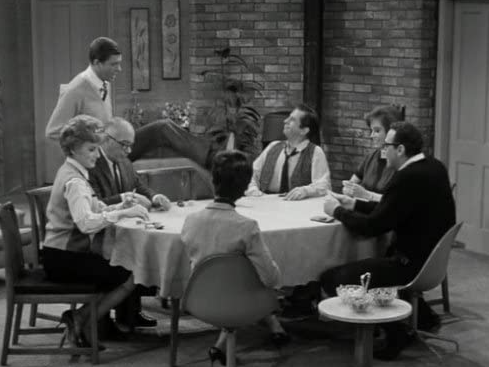
In 1962 and 1964, Mitchell made appearances on “The Dick Van Dyke Show” which was filmed at Desilu.

In 1968 Mitchell played Sally on two episodes of “My Three Sons” shot on the Desilu backlot.

That saem year she did two episodes of Desi Arnaz’s sitcom “The Mothers-in-Law” where she was reunited with Desi and Eve Arden. She played Margaret Cornell in both appearances. In one, she was joined by June Whitely Taylor who had also been a member of the Wednesday Afternoon Fine Arts League! Taylor here played a character named Mrs. Trumbull! This is not surprising as Desi had managed to employ his “I Love Lucy” writers to pen the series.

In 1970, she again played a character named Marion on “The Debbie Reynolds Show”. Naturally, the writer was “Lucy” scribe Jess Oppenheimer.
Mitchell continued to act up through her final screen appearance in 1990 on “The Fresh Prince of Bel-Aire.”
In 1946, she married Dr. Julian Frieden. The engagement party was held at the home of Dinah Shore. They had two children and were divorced in 1974. In 1992, she married songwriter Jay Livingston, and the two remained married until his death in 2001.
Shirley Mitchell died of heart failure on November 11, 2013, seven days after her 94th birthday.

-
THE TWO MRS. COOPERS / LIZ’S BIRTHDAY
November 4, 1950 / November 25, 1950

“The Two Mrs. Coopers” is episode #104 of the radio series MY FAVORITE HUSBAND broadcast on November 4, 1950.
This was the seventh episode of the third season of MY FAVORITE HUSBAND. There were 31 new episodes, with the season ending on March 31, 1951.
Synopsis ~ It’s Liz’s birthday and she wants to forget all about it but she doesn’t want George to forget it! George mistakenly thinks that it is his mother’s birthday and buys her present which Liz thinks is for her. But then he realizes that he has invited his mother’s friends over for a surprise party!
[On all known sources, this episode and “Liz’s Birthday” (November 25, 1950) are the same program. It is likely that one or the other has been lost. Because the titles might fit both programs, there is no consensus on which is lost and which is extant!]

“My Favorite Husband” was based on the novels Mr. and Mrs. Cugat, the Record of a Happy Marriage (1940) and Outside Eden (1945) by Isabel Scott Rorick, which had previously been adapted into the film Are Husbands Necessary? (1942). “My Favorite Husband” was first broadcast as a one-time special on July 5, 1948. Lucille Ball and Lee Bowman played the characters of Liz and George Cugat, and a positive response to this broadcast convinced CBS to launch “My Favorite Husband” as a series. Bowman was not available Richard Denning was cast as George. On January 7, 1949, confusion with bandleader Xavier Cugat prompted a name change to Cooper. On this same episode Jell-O became its sponsor. A total of 124 episodes of the program aired from July 23, 1948 through March 31, 1951. After about ten episodes had been written, writers Fox and Davenport departed and three new writers took over – Bob Carroll, Jr., Madelyn Pugh, and head writer/producer Jess Oppenheimer. In March 1949 Gale Gordon took over the existing role of George’s boss, Rudolph Atterbury, and Bea Benaderet was added as his wife, Iris. CBS brought “My Favorite Husband” to television in 1953, starring Joan Caulfield and Barry Nelson as Liz and George Cooper. The television version ran two-and-a-half seasons, from September 1953 through December 1955, running concurrently with “I Love Lucy.” It was produced live at CBS Television City for most of its run, until switching to film for a truncated third season filmed (ironically) at Desilu and recasting Liz Cooper with Vanessa Brown.
MAIN CAST

Lucille Ball (Liz Cooper) was born on August 6, 1911 in Jamestown, New York. She began her screen career in 1933 and was known in Hollywood as ‘Queen of the B’s’ due to her many appearances in ‘B’ movies. With Richard Denning, she starred in a radio program titled “My Favorite Husband” which eventually led to the creation of “I Love Lucy,” a television situation comedy in which she co-starred with her real-life husband, Latin bandleader Desi Arnaz. The program was phenomenally successful, allowing the couple to purchase what was once RKO Studios, re-naming it Desilu. When the show ended in 1960 (in an hour-long format known as “The Lucy-Desi Comedy Hour”) so did Lucy and Desi’s marriage. In 1962, hoping to keep Desilu financially solvent, Lucy returned to the sitcom format with “The Lucy Show,” which lasted six seasons. She followed that with a similar sitcom “Here’s Lucy” co-starring with her real-life children, Lucie and Desi Jr., as well as Gale Gordon, who had joined the cast of “The Lucy Show” during season two. Before her death in 1989, Lucy made one more attempt at a sitcom with “Life With Lucy,” also with Gordon.
Richard Denning (George Cooper) was born Louis Albert Heindrich Denninger Jr., in Poughkeepsie, New York. When he was 18 months old, his family moved to Los Angeles. Plans called for him to take over his father’s garment manufacturing business, but he developed an interest in acting. Denning enlisted in the US Navy during World War II. He is best known for his roles in various science fiction and horror films of the 1950s. Although he teamed with Lucille Ball on radio in “My Favorite Husband,” the two never acted together on screen. While “I Love Lucy” was on the air, he was seen on another CBS TV series, “Mr. & Mrs. North.” From 1968 to 1980 he played the Governor on “Hawaii 5-0″, his final role. He died in 1998 at age 84.
Gale Gordon (Rudolph Atterbury) had worked with Lucille Ball on “The Wonder Show” on radio in 1938. One of the front-runners to play Fred Mertz on “I Love Lucy,” he eventually played Alvin Littlefield, owner of the Tropicana, during two episodes in 1952. After playing a Judge in an episode of “The Lucy-Desi Comedy Hour” in 1958, he would re-team with Lucy for all of her subsequent series’: as Theodore J. Mooney in ”The Lucy Show”; as Harrison Otis Carter in “Here’s Lucy”; and as Curtis McGibbon on “Life with Lucy.” Gordon died in 1995 at the age of 89.
Ruth Perrott (Katie, the Maid) was also later seen on “I Love Lucy.” She first played Mrs. Pomerantz, a member of the surprise investigating committee for the Society Matrons League in “Pioneer Women” (ILL S1;E25), as one of the member of the Wednesday Afternoon Fine Arts League in “Lucy and Ethel Buy the Same Dress” (ILL S3;E3), and also played a nurse when “Lucy Goes to the Hospital” (ILL S2;E16). She died in 1996 at the age of 96.
Bob LeMond (Announcer) also served as the announcer for the pilot episode of “I Love Lucy”. When the long-lost pilot was finally discovered in 1990, a few moments of the opening narration were damaged and lost, so LeMond – fifty years later – recreated the narration for the CBS special and subsequent DVD release.
GUEST CAST

GeGe Pearson (Miss Perkins, Mr. Atterbury’s Secretary / Miss LeNoy) did two other episodes of “My Favorite Husband.” She will play a New York City tourist in “Lucy Visits Grauman’s” (ILL S5;E1) in 1955. She did the episode with her husband, Hal Gerard. The two actors were married in real-life. In 1956 the couple returned to CBS to appear in the same episode of “Damon Runyon Theatre.” She is perhaps best remembered as the voice of Crusader Rabbit. The couple died just a year apart in 1975 and 1976.

Bea Benadaret (Miller’s Department Store Clerk / Miss Morton) was considered the front-runner to be cast as Ethel Mertz but when “I Love Lucy” was ready to start production she was already playing a similar role on TV’s “The George Burns and Gracie Allen Show” so Vivian Vance was cast instead. On “I Love Lucy” she was cast as Lucy Ricardo’s spinster neighbor, Miss Lewis, in “Lucy Plays Cupid” (ILL S1;E15) in early 1952. Later, she was a success in her own show, “Petticoat Junction” as Shady Rest Hotel proprietress Kate Bradley. She starred in the series until her death in 1968.
Although she normally plays Iris Atterbury, Benadaret often voice smaller female roles in the series, in lieu of hiring another actress. She also played a Miller’s Department Store clerk in 1948′s “Liz Sells Dresses.” Benadaret uses the ‘old lady’ voice she will use as Miss Lewis. Coincidentally, Morton is the surname of her character on “The George Burns and Gracie Allen Show” (1950-58) on which she played Blanche Morton for the first time two weeks earlier. Her commitment to Burns and Allen prevented Benadaret from accepting the role of Ethel Mertz on “I Love Lucy.” Even more coincidentally, Morton would become Lucille Ball’s surname when she married comic Gary Morton (nee Goldaper) in 1961.
EPISODE
ANNOUNCER: “As we look in on the Coopers it’s morning and we find Katie the maid in the kitchen. Liz Cooper is just coming into the room.”
Upon seeing Liz, Katie begins to sing “Happy Birthday” until Liz tells her that she had her last birthday a year ago today.
LIZ: “Today I’m 33. That’s more than halfway to 35. I’m practically 40!”

This means that Liz Cooper was born on November 4, 1917. Lucille Ball was actually 39 when this broadcast aired. She was born on August 6, 1911. Lucy Ricardo’s birthday was celebrated in “Lucy’s Last Birthday” (ILL S2;E25), although she always declined to reveal her true age. Lucy Carter also celebrated her birthday in
a 1968 episode of “Here’s Lucy.”
Liz wants George to forget her birthday, too. George comes in to remind her of an important date: It’s Saturday and he told her to call the plumber last Wednesday about the leaky bathroom basin! George leaves for work without remembering Liz’s birthday. She dissolves into tears.

An hour later, Liz is still weepy. Katie tells Liz it is normal for husbands to forget birthdays. Liz decides to calling Mr. Atterbury, George’s boss, and drop a hint. Liz phones him claiming to be a close relative of George’s and sings “Happy Birthday” in an unrecognizable nasal voice.
Mr. Atterbury summons George into his office and imitates the voice on the phone. George tells Mr. Atterbury he’s sure it isn’t Liz’s birthday. He thinks her birthday is June 3 – of February 8 – or in the Spring sometime. He finally comes to the conclusion that it must have been his mother hinting about her birthday! He runs out to Miller’s department store to buy her a present.

The store clerk (Bea Benadaret) recognizes George and assumes he is shopping for his wife. Much to the clerk’s surprise, George buys a wool flannel nightgown and goes off to look for a cake that will hold 65 candles. George fills out a card for the clerk to send out with the gift.
Meanwhile, Liz comes to the bank and explains to Mr. Atterbury about her cryptic phone message. Mr. Atterbury realizes that George is shopping for the wrong Mrs. Cooper, but doesn’t tell Liz. When she goes, he phones the store to stop him. He talks to the clerk, who tells him what George has bought. Mr. Atterbury tells the clerk not to send the nightgown, but substitute a suede jacket instead.

The package arrives from Miller’s Department Store. Liz is curious so she opens the package. It is the suede jacket she’s wanted! Liz wants to wear the jacket out to the store to show it off.
George phones the office to report he will be delayed because he can’t find a big enough cake for 65 candles. He speaks to Miss Perkins (GeGe Peterson) who tells him that Mr. Atterbury is out looking for George to to tell him that it’s not his mother’s birthday, but his wife’s! Thinking he’s sent his wife a flannel nightgown, George rushes home to intercept the package before Liz can open it!
George arrives home and looks to see if the package is in the closet. Just then, Liz comes back and he has to hide in the closet to make sure she doesn’t see him. She goes to put the jacket back in the box in the closet. Hearing a noise in the kitchen, she ducks into the closet, too, just in case it is George. The two are hiding in the dark in the same closet!

Writer Madelyn Pugh remembers: "For some reason, Bob [Carroll Jr.] and I liked the idea of people hiding in a closet. We used it in [’The Saxophone’], and in a couple of other ‘Lucys.’ We even used it in the pilot of ‘The Mothers-in-Law’ fifteen years later – and it always got a laugh!”
Once the shock wears off, Liz confesses: she’s opened the present and loves it. George, still thinking it is a flannel nightgown, is confused. Liz says she wore it out shopping. George is confounded! Liz says she took it off, gave it to the clerk to try on, and then carried it over her arm all the way home. George is shocked!
Mr. Atterbury arrives and asks about the suede jacket, which confuses George even more. Liz wonders how he knew! Mr. Atterbury whispers to George what he did.

The doorbell rings: it is the guests for the surprise party George arranged for his mother: two elderly ladies, Miss Morton and Miss LeNoy (Bea Benadaret and GeGe Pearson). Whenever the ladies start to ask the whereabouts of George’s mother, George and Mr. Atterbury loudly sing “Happy Birthday”!
MISS LENOY: “They sure sing a lot, don’t they?”
MISS MORTON: “Loudly, too.”The old ladies realize that someone’s made a ‘boo-boo’ and they are at the wrong party, so they play along. They ladies have brought presents, which Liz excitedly opens.
Miss LeNoy gives Liz an embroidered night cap and Miss Morton give her a hot water bottle for her lumbago.
LIZ: “What makes you think I have lumbago?”
MISS MORTON: “Doesn’t everybody?”
LIZ: “Well, no.”
MISS MORTON: “Keep it, dear. You will.”
Lumbago is generalized pain in the lower back and was often relieved by the warmth from a hot water bottle (or bag). These were made of rubber and designed to be filled with warm water. Lucy uses one on ‘old Ricky’ in “The Young Fans” (ILL S1;E20) in 1952.
The ladies have brought a cake but had to bring it around to the back door because the heat from the 65 candles was overwhelming! George knows it will give away that George thought it was mother’s, not Liz’s, birthday! Katie enters with the cake ablaze!
MISS MORTON: “I ain’t seen a blaze like that since the Chicago Fire!”

The Great Chicago Fire of October 1871 killed approximately 300 people, destroyed roughly 3.3 square miles of the city, and left more than 100,000 residents homeless.
The fire is claimed to have started in or around a small barn belonging to the O’Leary family on DeKoven Street. Officials never determined the exact cause of the blaze, but legend says that a cow kicked over a lantern. The 1938 film In Old Chicago dealt with the blaze and featured “Lucy” actors Charles Lane and Bess Flowers.
Liz is challenged to blow out the candles, but it takes several attempts. Once extinguished Liz counts the candles and puts two and two together. Katie thinks fast and makes up a story.
KATIE: “I told Mr. Cooper that you felt that you were getting old and he figured that if he gave you a real old lady’s party it would make you see how young you really are!”
Liz starts crying tears of joy.
LIZ: “I’m married to the most thoughtful man in the world!”
Liz loves her coat so much she vows she will even wear it to bed to remind her of how wonderful George is. She sees the card in the box with the jacket and reads it. This was the card George put in the box with the flannel nightgown meant for his mother.
LIZ (reading): “Hope this keeps you warm in bed tonight!”
End of Episode

-
FASHION LETS IT’S HAIR DOWN
November 4, 1973

On November 4, 1973, Lloyd Stewart of the Star-Telegram wrote about Lucille Ball and Shirley Jones meeting the fashion press at the Burbank Studios (TBS) in Hollywood.

[Pre-spell check! The headline misspells “its”! This is the possessive contraction which would read “Fashion Lets It Is Hair Down”!]


On the same date, syndicated entertainment columnist Rex Reed did a story on Madeline Kahn, who was hired to play Agnes Gooch in Mame, but was dismissed before shooting began.


-
LUCY’S COURTSHIP BECOMES HER FIRST NEW TV SHOW
November 3, 1957

On November 3, 1957, syndicated columnist Margaret McManus wrote about Lucille Ball and Desi Arnaz’s new venture, “The Lucy-Desi Comedy Hour”, which began airing on November 6, 1957 with “Lucy Goes to Havana”, an origin story of the Ricardos first meeting. The 75-minute program featured Hedda Hopper, Cesar Romero, Rudy Vallee, as well as Vivian Vance, William Frawley, and Richard Keith, returning to their “I Love Lucy” roles. This article was excerpted from the Detroit (MI) Free Press.


-
TV GUIDE(S)
November 2, 1957

The November 2, 1957 edition of TV Guide (Vol. 5, No. 44, issue #240) featured Lucille Ball on the cover in a caricature by noted artist Al Hirschfeld. This was Hirschfeld’s tenth TV Guide cover. This was Lucille Ball’s eighth of 39 covers, having appeared on the cover of the very first national edition in April 1953. It was her second cover in 1957 and her second caricature.

Albert Hirschfeld (1903-2003) was an American caricaturist best known for his black and white portraits of celebrities and Broadway stars. In 1945, Hirschfeld and his wife Dolly gave birth to a daughter named Nina. Hirschfeld is known for hiding Nina’s name (“NINA”), in most of the drawings he produced after her birth. From time to time he lamented that the gimmick had overshadowed his art.
In 2002, Al Hirschfeld was awarded the National Medal of Arts.

The inside article is titled “Desi Arnaz Tells Why He Abandoned ‘I Love Lucy’”. At the end of the 1956-57 season, Lucy and Desi made the decision to end the half-hour “I Love Lucy” episodes that had been a ratings winner for CBS since October 1951. The Ricardos and Mertzes, however, would live on in a series of hour-long programs later known as “The Lucy-Desi Comedy Hour”. The intervening weeks would be dedicated to producing stand-alone programming based on world literature and newly-developed Desilu pilots, like “The Untouchables.”

The article features color photos from the new format’s first entry, “Lucy Takes A Cruise To Havana” feauring Ann Sothern, Hedda Hopper, Rudy Vallee and Cesar Romero. Although the episode begins pretty much where the half-hour series left off in 1957 Westport, it quickly flashes back to how Lucy and Ricky first met in 1940 Havana.

An ad for the issue, which also contained articles on pop singer Guy Mitchell, Lucy’s former co-star Ginger Rogers, singer Jo Stafford, Lucy’s neighbor and friend Jack Benny, actor Peter Lorre, and child actress Margaret O’Brien.

An ad for the ‘galaxy of stars’ appearing on the new “Lucille Ball-Desi Arnaz Show”.

The new format was much-anticipated, causing local TV guides and logs to also devote their cover to Lucy and Desi. The Chicago Daily Tribune’s TV Week (a Sunday supplement), called the new series a dream come true for Lucy and Desi. Although the characters “Take a Trip to Havana” the episode (with the exception of Desilu establishing footage) was shot in Hollywood.

TV Life, another listings magazine, also put Lucy and Desi on the cover. Lucy had also been on the cover in 1956, and would be again in 1957.

The inside article is titled “Laughs They Didn’t Want” and also details the creation of the new hour-long format and it’s first program, “Lucy Takes A Cruise To Havana”.

That month TV Stage (not a listings magazine), also had Lucille Ball on the cover, although singer / actor Pat Boone was the main cover face. Lucille Ball was the predominant cover figure on TV Stage in 1954, 1955, 1956, and earlier in 1957.
-
SHEPARD MENKEN
November 2, 1921

Shepard Menken was born in New York City on November 2, 1921. He is sometimes billed as “Shep” Menken or Shepard Menkin.

He made his film debut in 1949 with a supporting role in The Red Menace, in which he played Henry Solomon. The film dealt with the growing fear of communism, something that would threaten Lucille Ball’s career in 1953.

In 1952, Menken appeared in MGM’s The Great Caruso, which also featured future “I Love Lucy” actors Mario Siletti, Harry Dar Boggia, Ernesto Molinari, Bess Flowers, Bert Stevens, and Harold Miller.

In March 1951, he made his television debut on “The George Burns and Gracie Allen Show” co-starring Bea Benadaret, who had played Iris Atterbury on Lucy’s radio show “My Favorite Husband.”

On New Year’s Eve 1951, Menken made the first of his four appearances on “I Love Lucy” as Jean Valjean Raymond, Lucy’s French dance teacher in “The Adagio” (ILL S1;E12).

Ethel calls Raymond the only French insult she can think of – Crepe Suzette.

A year later, in January 1953, Menken played William Abbott, the Art Store Owner, in “Lucy Becomes a Sculptress” (ILL S2;E15). Turns out, Mr. Abbott is scamming his customers, in league with his clerk (Leon Belasco, right).

At the end of 1953, Menken was back in a different role; Lucy and Ricky’s optometrist in “Lucy Has Her Eyes Examined” (ILL S3;E11).

Although Lucy has sent Ricky for an eye exam, it turns out Lucy is the one with vision problems! The doctor gives her some eye drops that blur her vision and drastically steer her off course in her dance routine at the Tropicana.

In February 1956, he returned to his French accent to play Charpontier, a shady sidewalk artist, in “Paris at Last” (ILL S5;E18).

Poor but talented street artists wearing berets is a typical film and television trope. Menken plays it to the hilt.

Although Lucy believes she’s bought an original Charpontier, it turns out she’s been scammed by Menken yet again!
In 1958, Menken began doing voice over work, which would keep him busy for the rest of his career. He worked with recognizable animated figures like Mr. Magoo, Spider-Man, Alvin and the Chipmunks, and Garfield the Cat.

The last time he was seen on screen was in a 1971 episode of “Mission: Impossible” a series originally filmed at Desilu (later Paramount). “Here’s Lucy” did a satire on the show in October 1968 although it featured none of the original cast.
Shepard Menken died on January 2, 1999, at the age of 77.

-
RIP SEAN CONNERY
1930-2020

Sir Thomas Sean Connery (August 25, 1930 – October 31, 2020) was a Scottish-born actor and producer. He is best known as the first actor to portray the character James Bond in film, starring in seven Bond films between 1962 and 1983.
Connery retired from acting in 2006. His achievements include one Academy Award, two BAFTA Awards and three Golden Globes. He received a lifetime achievement award with a Kennedy Center Honor in 1999. Connery was knighted in 2000 for services to film drama.Connery and Lucille Ball never acted opposite one another, but did appear together on two television award shows towards the end of her life.

In 1988, both were in attendance for “AFI Salutes Jack Lemmon.” Host Julie Andrews introduced film clips from Lemmon’s most acclaimed films. The audience is full of celebrity friends, including including Connery and Ball, although neither takes the stage or speaks.


Connery and Ball were both presenters at what would be her final TV appearance, the “The 61st Annual Academy Awards” on March 29, 1989. Connery presented alongside Michael Caine and was photographed with Roger Moore, who also played James Bond.

Ball presented with Bob Hope. She died three weeks later.

In a 1966 episode of “The Lucy Show,” steaming open a sealed envelope, Lucy says she feels just like James Bond. In mid-1966, Ian Fleming’s dashing British spy was being played on screen by Sean Connery. Thunderball was released in December 1965.

Sean married actress Diane Cilento in 1962 and they had a son, Jason Connery, born on January 11, 1963. The couple separated in February 1971 and divorced 2½ years later. In 1975 he married Micheline Roquebrune (above) and has three stepchildren through his marriage to Micheline. He is also a grandfather. His son, Jason and his ex-wife, actress Mia Sara had a son, Dashiell Connery, in 1997.

Connery died in his sleep on October 31, 2020, aged 90, at his home in Nassau in the Bahamas. His son Jason stated that he “had been unwell for some time”.
-
JOAN BANKS
October 30, 1918

Joan Elinor Banks was born in Petersburg, West Virginia. She studied Russian ballet as a girl and her talent earned her a scholarship to the American Academy of Dramatic Art. She attended Hunter College.
Banks was a regular on the popular 1930s radio series “Gangbusters.” She married fellow “Gangbusters” actor Frank Lovejoy in 1940.
Banks also spent some time on the tremendously popular radio show “My Friend Irma” featuring Gale Gordon’s real-life mom, Gloria. This is where the first name of Mr. Mooney’s unseen wife Irma comes from on “The Lucy Show.”

In 1943, she appeared on Broadway in the comedy The Snark Was A Boojum (a titled inspired by Lewis Carroll) alongside her real husband Lovejoy and future TV dad “Dickie” Van Patten. It opened and closed in one weekend.

Her screen debut came in the film Cry Danger, which was also the debut of “I Love Lucy’s” Hy Averback. It started filming in June 1950 and premiered in February 1951. Before it could open, she made her television debut on October 4, 1950, in the anthology series “Stars Over Hollywood.”

“I Love Lucy” fans best remember her for her third television project, “Fan Magazine Interview” (ILL S3;E17) in which she played reporter Eleanor Harris assigned to do a story on Ricky Ricardo’s wife aka Lucy Ricardo.

In addition to writing the story, Harris is also the photographer for the article. Despite Banks’ solid work playing the girl reporter, the episode is most remembered for Lucy’s encounter with Minnie Finch, played by Kathryn Card, who would later play Lucy Ricardo’s mother! Although Card and Banks have no scenes together, they would both be back at Desilu in May 1956 for an episode of “December Bride” produced by Desi Arnaz.

Eleanor Harris is the name of a real-life writer who did many articles and features on Lucy and Desi over the years. She published the book The Real Story of Lucille Ball.

In 1955 she was seen on an episode of “Make Room for Danny” (filmed at Desilu) as a real estate agent. The episode also featured George O’Hanlon (the second Charlie Appleby on “I Love Lucy”). This was several years before the “The Danny Thomas Show” moved to CBS and did a cross-over episode with “The Lucy-Desi Comedy Hour.”

From 1953 to 1955, Banks played Sylvia Platt on “Private Secretary” starring Ann Sothern. Although not a Desilu production, its lead character Susie MacNamara (Sothern) did a cross-over with the very first “Lucy-Desi Comedy Hour”. At the same time, Desilu produced Sothern’s new show, “The Ann Sothern Show” which also did an “I Love Lucy” crossover.

Later in her career, Banks appeared as Mrs. Hadley in the television series “National Velvet” (1960-62) and five episodes of “Perry Mason” from 1957 to 1964 as various characters.

On October 2, 1962, Banks’ husband Frank Lovejoy died of a heart attack. At the time, they were appearing together in a Paramus, New Jersey stage production of Gore Vidal’s play The Best Man (in a role he had done to great acclaim on Broadway), but they had been off the night he was stricken. Lovejoy and Banks had two children together. He was 50 years old.

Her final screen role reunited her with her “I Love Lucy” director William Asher for an October 1967 episode of “Bewitched”. Banks played wealthy country club member Margaret Baxter and MacDonald Carey played her husband Joe.
Banks remarried to Allan Raymond Johnson in 1969.

Banks’ career in radio returned after her work in television subsided, and she appeared in 33 episodes of “CBS Radio Mystery Theater” from 1974 to 1980.
Joan Banks died in 1998 from lung cancer at the age of 79.

-
SAMMY OGG
October 30, 1939

Sammy Ogg was born on October 30, 1939 in Lexington, Virginia, although his family, including his older brother Jimmy, soon moved to California. He is best remembered by Lucy fans for playing one of the mischievous Hudson Twins on a memorable season one episode of “I Love Lucy.”

He made his screen debut playing a tough kid (uncredited) in the 1947 film Lost Honeymoon starring Franchot Tone. He was seven years old. In 1951 he made two more uncredited film appearances; in The Day The Earth Stood Still and Week-End With Father. He also had an uncredited role in Cecil B. DeMille’s The Greatest Show on Earth. The 1952 circus film nearly starred Lucille Ball, but she had to withdraw due to pregnancy. It wasn’t long, however, before the two would share a screen credit.

Looking for extra money to pay for a dress she’s purchased, Lucy is hired to babysit by Mrs. Hudson. What Mrs. Hudson doesn’t tell Lucy is that she has two sons, not one – and that both are holy terrors!

Ogg (right) played Jimmy Hudson opposite David Stollery as Timmy. The two actors were not related and were made to look like twins using costumes and make-up.

On Christmas Day 1953, Ogg was seen on “Our Miss Brooks” (filmed at Desilu) starring Gale Gordon and a cast full of “I Love Lucy” performers.

The following year, he played the first date of Terry Williams, youngest daughter on “The Danny Thomas Show” (aka “Make Room for Danny”) filmed at Desilu. This was several years before the show changed networks and did a cross-over with “The Lucy-Desi Comedy Hour.”

From 1955 to 1957 Ogg played Joe in several “Spin and Marty” films and television shows alongside his Lucy ‘twin’ David Stollery, who played Marty in the Disney production.

From 1952 to 1959, Ogg made seven appearances on the series “Dragnet,” each time as a different character.

His penultimate screen appearance was on the series “Union Pacific” with his older brother Jimmy Ogg (1929-86).

His final screen appearance, in July 1959, was in “The Joseph Cotten Show: On Trial” starring Rod Steiger.
Sammy Ogg left show business and became a minister.

In 2007, Hudson Twins David Stollery (age 66) and Sammy Ogg (age 68) sang “Ragtime Cowboy Joe” with Lucy-impersonator Diane Vincent on the Tropicana set at the Lucy-Desi Museum in Jamestown, New York.

The special event was part of Lucy-Desi Days.

-
HALLOWEEN SURPRISE PARTY
October 28, 1949

“Halloween Surprise Party” (aka “The Halloween Party” aka “The Surprise Halloween Party”) is episode #60 of the radio series MY FAVORITE HUSBAND broadcast on October 21, 1949, sponsored by Jell-O.
This was the eighth episode of the second season of MY FAVORITE HUSBAND. There were 43 new episodes, with the season ending on June 25, 1950.
Synopsis ~
The Atterburys decide to throw a Halloween surprise party for Liz and George, but when Liz hears about their party at the beauty salon, she thinks that she and George just weren’t invited.

“My Favorite Husband” was based on the novels Mr. and Mrs. Cugat, the Record of a Happy Marriage (1940) and Outside Eden (1945) by Isabel Scott Rorick, which had previously been adapted into the film Are Husbands Necessary? (1942). “My Favorite Husband” was first broadcast as a one-time special on July 5, 1948. Lucille Ball and Lee Bowman played the characters of Liz and George Cugat, and a positive response to this broadcast convinced CBS to launch “My Favorite Husband” as a series. Bowman was not available Richard Denning was cast as George. On January 7, 1949, confusion with bandleader Xavier Cugat prompted a name change to Cooper. On this same episode Jell-O became its sponsor. A total of 124 episodes of the program aired from July 23, 1948 through March 31, 1951. After about ten episodes had been written, writers Fox and Davenport departed and three new writers took over – Bob Carroll, Jr., Madelyn Pugh, and head writer/producer Jess Oppenheimer. In March 1949 Gale Gordon took over the existing role of George’s boss, Rudolph Atterbury, and Bea Benaderet was added as his wife, Iris. CBS brought “My Favorite Husband” to television in 1953, starring Joan Caulfield and Barry Nelson as Liz and George Cooper. The television version ran two-and-a-half seasons, from September 1953 through December 1955, running concurrently with “I Love Lucy.” It was produced live at CBS Television City for most of its run, until switching to film for a truncated third season filmed (ironically) at Desilu and recasting Liz Cooper with Vanessa Brown.
MAIN CAST

Lucille Ball (Liz Cooper) was born on August 6, 1911 in Jamestown, New York. She began her screen career in 1933 and was known in Hollywood as ‘Queen of the B’s’ due to her many appearances in ‘B’ movies. With Richard Denning, she starred in a radio program titled “My Favorite Husband” which eventually led to the creation of “I Love Lucy,” a television situation comedy in which she co-starred with her real-life husband, Latin bandleader Desi Arnaz. The program was phenomenally successful, allowing the couple to purchase what was once RKO Studios, re-naming it Desilu. When the show ended in 1960 (in an hour-long format known as “The Lucy-Desi Comedy Hour”) so did Lucy and Desi’s marriage. In 1962, hoping to keep Desilu financially solvent, Lucy returned to the sitcom format with “The Lucy Show,” which lasted six seasons. She followed that with a similar sitcom “Here’s Lucy” co-starring with her real-life children, Lucie and Desi Jr., as well as Gale Gordon, who had joined the cast of “The Lucy Show” during season two. Before her death in 1989, Lucy made one more attempt at a sitcom with “Life With Lucy,” also with Gordon.
Richard Denning (George Cooper) was born Louis Albert Heindrich Denninger Jr., in Poughkeepsie, New York. When he was 18 months old, his family moved to Los Angeles. Plans called for him to take over his father’s garment manufacturing business, but he developed an interest in acting. Denning enlisted in the US Navy during World War II. He is best known for his roles in various science fiction and horror films of the 1950s. Although he teamed with Lucille Ball on radio in “My Favorite Husband,” the two never acted together on screen. While “I Love Lucy” was on the air, he was seen on another CBS TV series, “Mr. & Mrs. North.” From 1968 to 1980 he played the Governor on “Hawaii 5-0″, his final role. He died in 1998 at age 84.
Gale Gordon (Rudolph Atterbury / Police Announcer) had worked with Lucille Ball on “The Wonder Show” on radio in 1938. One of the front-runners to play Fred Mertz on “I Love Lucy,” he eventually played Alvin Littlefield, owner of the Tropicana, during two episodes in 1952. After playing a Judge in an episode of “The Lucy-Desi Comedy Hour” in 1958, he would re-team with Lucy for all of her subsequent series’: as Theodore J. Mooney in ”The Lucy Show”; as Harrison Otis Carter in “Here’s Lucy”; and as Curtis McGibbon on "Life with Lucy.” Gordon died in 1995 at the age of 89.
In need of a male voice to do the Police Announcer, Gordon pitches in. The muffled sound of the car radio helps disguise his distinctive voice.
Bea Benadaret (Iris Atterbury) was considered the front-runner to be cast as Ethel Mertz but when “I Love Lucy” was ready to start production she was already playing a similar role on TV’s “The George Burns and Gracie Allen Show” so Vivian Vance was cast instead. On “I Love Lucy” she was cast as Lucy Ricardo’s spinster neighbor, Miss Lewis, in “Lucy Plays Cupid” (ILL S1;E15) in early 1952. Later, she was a success in her own show, “Petticoat Junction” as Shady Rest Hotel proprietress Kate Bradley. She starred in the series until her death in 1968.
Bob LeMond (Announcer) also served as the announcer for the pilot episode of “I Love Lucy”. When the long-lost pilot was finally discovered in 1990, a few moments of the opening narration were damaged and lost, so LeMond – fifty years later – recreated the narration for the CBS special and subsequent DVD release.
Ruth Perrott (Katie the Maid) does not appear in this episode. Katie is said to be on vacation.
GUEST CAST

Hans Conried (Traffic Cop) first co-starred with Lucille Ball in The Big Street (1942). He then appeared on “I Love Lucy” as used furniture man Dan Jenkins in “Redecorating” (ILL S2;E8) and later that same season as Percy Livermore in “Lucy Hires an English Tutor” (ILL S2;E13) – both in 1952. The following year he began an association with Disney by voicing Captain Hook in Peter Pan. On “The Lucy Show” he played Professor Gitterman in “Lucy’s Barbershop Quartet” (TLS S1;E19) and in “Lucy Plays Cleopatra” (TLS S2;E1). He was probably best known as Uncle Tonoose on “Make Room for Daddy” starring Danny Thomas, which was filmed on the Desilu lot. He joined Thomas on a season 6 episode of “Here’s Lucy” in 1973. He died in 1982 at age 64.

Jay Novello (Harrison Q. Negley, the Postman) would appear on “I Love Lucy” as superstitious Mr. Merriweather in “The Seance” (ILL S1;E7), nervous Mr. Beecher in “The Sublease” (ILL S3;E31), and Mario the gondolier in “The Visitor from Italy” (ILL S6;E5). He also appeared on two episodes of “The Lucy Show,” but dapper Novello is probably best remembered for playing Mayor Lugatto on “McHale’s Navy” in 1965.
THE EPISODE
ANNOUNCER: “As we look in on the Coopers, it’s late afternoon and George Cooper is on his way home from the bank. He just got his car out of Miller’s Garage where he left it to be overhauled and is on his way to Sally’s Beauty Parlor where he left his wife Liz – to be overhauled. He pulls to a stop by an attractive girl standing on the corner.”
The attractive girl is Liz. She can’t open the car door because her nail polish isn’t dry. Liz laments that George isn’t more of a gentleman. She is upset about some gossip she heard from her beauty operator, Sally.
LIZ: “Who do you think is giving a party and not invited us?”
GEORGE: “Elsa Maxwell?”
Elsa Maxwell (1883-1963) was a famous gossip columnist and professional hostess renowned for throwing parties for royalty and high society figures. In an episode of “I Love Lucy” titled “Housewarming” (ILL S6;E23) in 1957, Ethel Mertz refers to Betty Ramsey as “the Elsa Maxwell of Westport”. Maxwell’s mention is the first, but not the last, foreshadowing of “Housewarming” in this radio show.
Liz finally tells George that it is the Atterburys! They are giving a masquerade party on Halloween night. George says that their invitation will probably be in the morning mail.
LIZ: “Well if it isn’t, I know what I’m going to do: I’m going to R.S.V.P. without being A.S.K.E.D.!”
Next morning at breakfast, Liz is anxiously waiting at the window for the mailman. Liz theorizes that Mr. Negley the postman is late because Katie is off and not there to give him a morning cup of coffee.Katie is sweet on Mr. Negly.
Mr. Negley (Jay Novello) is at the door. He tells Liz he likes Katie. Liz listens patiently, but just wants her mail.
MR. NEGLEY: “Someday, if things go well, maybe she’ll let me put my stamp on her envelope. I’d love to change her zone number to mine. But she’s really too good for me. She’s first class matter. She’s better than that. She’s air mail special delivery! Registered!”
LIZ: “Look, Mr. Negley, someday I hope you and Katie settle down and raise a lot of little postcards, but right now… will you please give me our mail?”
Zone Numbers were the pre-cursor to the modern American Zip (Zone Improvement Plan) Codes. Zone Numbers were first adopted in 1943 because after World War II people sending more mail. Also, the post office was hiring a lot of new and inexperienced workers to replace those who had gone to fight the war, and the numerical city codes made it easier for those new people to sort the mail quickly. The Zone Numbers were replaced by more specific ZIP Codes (which often incorporated the existing Zone Number) in 1963.
Mr. Negley finds a letter for her, but Liz grabs it so fast it tears in half!
LIZ (reading her half): “You are cordially invited…”
MR. NEGLEY (reading his half): “To bring your car home for service.”Liz tussles with Mr. Negley to search his mailbag, unsorting all his mail.
MR. NEGLEY (angry): “Just leave me alone. And if you’re talking about Mrs. Atterbury’s party, I delivered those invitations last week and you didn’t get one and I’m glad, do you hear me? Glad, glad, glad!“
Later at the Atterbury’s, Iris excitedly informs Rudolph that Liz has just phoned and is coming right over. Mr. Atterbury is upset that he can’t watch television.
RUDOLPH: “I have to miss “Hopalong Cassidy”? This may be the night he gets killed!”
LIZ: “I guarantee he won’t!”
“Hopalong Cassidy” made the leap from books and movies to the small screen on June 24, 1949, kicking off the legacy of the Western on television. These were not new, but simply cut-down versions of the feature films that were in cinemas from 1935 to 1948. The film / TV series had William Boyd in the title role. Iris mentioned the TV program two weeks earlier in “Too Many Television Sets”.
Iris confirms the plan that they are giving a surprise Halloween Party for the Coopers at their home! She reminds Rudolph not to mention Halloween during the Coopers’ visit.
When the Coopers arrive, no one has much to talk about so Liz asks what they are doing for Halloween. She drops hints about being invited to a party. Liz thinks Iris is about to extend the long-awaited invitation, but instead she invites Liz to help collect newspapers for the Salvation Army.

In a March 1963 episode of “The Lucy Show” Lucy Carmichael, Vivian Bagley, and Audrey Simmons (Mary Jane Croft) collect newspapers for salvage in order to pay for new uniforms for the Danfield Volunteer Fire Department.
When the subject turns to everyone’s plans for Halloween, the Atterburys lie and tell the Coopers that Iris’s mother is ill so they are having dinner with her.
RUDOLPH: “Yes, we always spend Halloween with the old witch!”
Liz is indignant about the snub and the Coopers leave in a huff. They toy with creating Halloween mischief, but decide instead to throw their own Halloween party and not invite the Atterburys.In Part Two, Liz is on the telephone inviting people to HER party. She calls Mary, Bette Rae, Margaret – 14 couples in all – and everyone has the same excuse – sick mothers. Liz starts to cry. All her friends have turned her down. She feels like a social outcast.GEORGE: “Well, forget it baby. We’ll take a course at Arthur Murray’s and be successes again.”

In “Housewarming,” Lucy Ricardo also starts to cry when she believes none of her friends care about her enough to attend her housewarming party. Arthur Murray (1895-1991) was a ballroom dancer and businessman, whose name is most often associated with the chain of dance studios that bear his name. Dance lessons were purported to increase a person’s social skills and create a better social life. Arthur Murray is mentioned in “The Young Fans” (ILL S1;E20), and in Desi Arnaz’s popular song, “Cuban Pete”. On “My Favorite Husband,” he was mentioned in “Dance Lessons” (naturally).
Liz has a new idea. They will go to the Atterbury party in disguise. They will ask about the Coopers and see how their friends respond. Driving over, George and Liz are dressed as policemen carrying loaded (water) pistols. For fun, Liz decides to tune their radio to the police band and they hear a report about thieves in Halloween costumes crashing parties and burgling houses.
George is pulled over for going too slow. At first, the traffic cop (Hans Conried) thinks they are real policemen. He soon starts to get suspicious and asks to see Liz’s badge.
COP (reading): “Post Toasties Junior G-Men.”

The Junior G-Men was an American boys club during the late 1930s and early 1940s. It was started by Melvin Purvis, a former FBI agent who helped lead the manhunt on John Dillinger. He hosted a children’s radio program in 1936 called "Junior G-Men” and listeners could join the club to receive badges, manuals and secret agent props. Purvis became the face of General Foods’ Post Toasties breakfast cereal in the late 1930s.
George confesses he’s not a cop but a bank Vice President. He asks the Cop to drive home with him so he can provide proper identification. When they get there, they see people creeping in their back door! Liz says they’d better call the police!
COP: “Whaddya think I am? Western Union?”

The Western Union Company is a worldwide financial services and communications company founded in 1851. Until it discontinued the service in 2006, Western Union was the leading American company in the business of transmitting and delivering telegrams. In the 1930s and 40s, their telegram delivery boys wore navy blue uniforms, not unlike police officers. On “I Love Lucy” telegrams and Western Union messengers were often involved in episodes to deliver news or other plot information.

Stealthily entering the Cooper house, they are greeted with shouts of surprise and Liz realizes that the Halloween Party was for them all along. The Cop is still suspicious that they are all in it together and everyone thinks the real Cop is in a masquerade costume! Liz is happy to see so many people.
LIZ: “Oh, George! And we thought nobody liked us!”
In the live Jell-O commercial, Lucille Ball pretends to be a fortune teller named Crystal Ball.

LEMOND: “Good afternoon. Are you Madame Ball?
BALL: “Cross my palm with silver.”
LEMOND: “But your hand is bandaged! What – what happened?”
BALL: “My last customer crossed my palm with silver.”
LEMOND: “Well, who was he?”
BALL: “The Lone Ranger!”
“The Lone Ranger” is an western drama television series that aired on began airing just a month before this broadcast in 1949. Silver was the name of the Lone Ranger’s horse!
LeMond asks Crystal to gaze into her ball and see if there is anything about Jell-O pudding.
LUCY: “Let’s see, there’s the results for tomorrow’s races; we don’t want those. Uh, the inauguration of our next president; no, no, no. Uh, who’s going to play in the Rose Bowl game? No, no, no. Nope, nothing here about Jell-O Chocolate Pudding.”

1949 was not a presidential election year. Harry S. Truman had won a second term in November 1948 and was inaugurated was seeking a second term in January 1949. The next US President would be elected in November 1952: Dwight D. Eisenhower. The 1950 Rose Bowl was played at the Rose Bowl in Pasadena, California on Monday, January 2nd. Ohio State Buckeyes, upset the California Golden Bears 17–14.
LUCY: “Well! Look at all the Jell-O Puddings! Everyone’s crazy about them! Old people are saying: ‘Jell-O Puddings are fine.’ Young people are saying: ‘Jell-O Puddings are great!’ Gay people are saying: (Lucy Laughs) ‘Jell-O Puddings are swell’!“

“My Favorite Husband” was described as “The Gay Family Series”. In 1949, the term gay referred to happy go-lucky / carefree – not to being homosexual. Although the term existed within the LGBTQ community, it was not commonplace until the 1960s.
FAST FORWARD!

In the early 1960s, Halco manufactured a Lucille Ball Halloween costume. Kids could trick or treat as Lucy!
-
Subscribe
Subscribed
Already have a WordPress.com account? Log in now.
 Papermoon Loves Lucy