-
WILDCAT
December 17, 1960
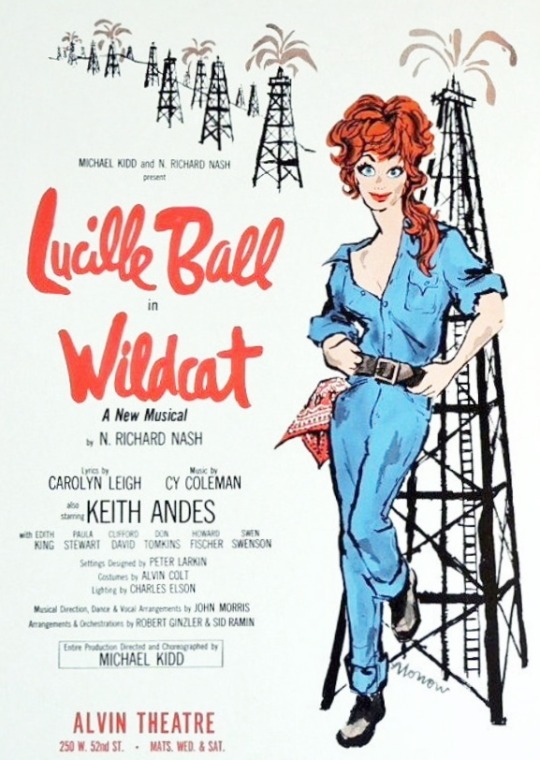
Wildcat is a musical comedy about Wildcat Jackson and her sister who come to oil country in 1912 to strike it rich. She runs into the prowess of Joe Dynamite, and a battle of the sexes and the oil tycoons ensues.

Wildcat wasn’t written with the 48 year-old queen of comedy in mind so when she showed interest, the script by N. Richard Nash had to be radically re-written.

At the start of the 1960’s Ball’s career was taking a new direction. She was leaving her TV personae Lucy Ricardo (as well as her real-life husband Desi Arnaz) behind for newer horizons. It was their company Desilu that would produce Wildcat with Lucy having say over who would be cast as her co-star. After several of her first choices proved not available (including Clint Eastwood), she settled on Keith Andes.

Although Ball was not known for her singing (a fact she traded on in “I Love Lucy”) or her dancing (which she was far better at), she had the determination of Wildcat Jackson to attempt it eight times a week.

Director and choreographer Michael Kidd – known for his athletic dances – would put Ball through her paces. The score was by Cy Coleman with lyrics by Carolyn Leigh, giving Ball the rousing anthem “Hey, Look Me Over!” and the tuneful “What Takes My Fancy.”

The out-of-town critics were mixed, but obviously adored the red-headed star. The show was headed up the New Jersey Turnpike in trucks headed for Broadway when a serious blizzard stranded the caravan, causing the opening night to be delayed.

With just two previews under their belt, the show opened at the Alvin Theatre (now the Neil Simon) on December 17, 1960. Box office sales were buoyed by audiences expecting to see Lucy Ricardo, not Lucille Ball as Wildy Jackson, so eventually Ball interpolated more and more of her trademark comic inflections into her character.

Then Ball took ill. She left the show for a bit with the idea to return and continue the run. But upon her return she collapsed on stage. Producers decided to close the show for as long as it took her to recover and resume when her strength and health had returned. But the musicians union insisted upon payment during the hiatus, which made the wait financially unfeasible.

All in all, Wildcat lasted 171 performances. It wasn’t Ball’s only musical, however. In 1974 she took on the title role in the film of Mame with mixed to poor critical reactions.

“Then I go to New York with the two children, my mother and two maids. We have a seven-room apartment on 69th Street at Lexington. I’ll start rehearsals right away for a Broadway show, ‘Wildcat.’ It’s a comedy with music, not a musical comedy, but the music is important. I play a girl wildcatter in the Southwestern oil fields around the turn of the century. It was written by N. Richard Nash, who wrote ‘The Rainmaker.’ He is co-producer with Michael Kidd, the director. We’re still looking for a leading man. I want an unknown. He has to be big, husky, around 40. He has to be able to throw me around, and I’m a pretty big girl. He has to be able to sing, at least a little. I have to sing, too. It’s pretty bad. When I practice, I hold my hands over my ears. We open out of town – I don’t know where – and come to New York in December.” ~ Lucille Ball, TV Guide, July 16, 1960
THE SCORE
Lyrics by Carolyn Leigh and Music by Cy Coleman

Act I
- I Hear – Townspeople
- Hey, Look Me Over – Wildy and Jane
- Wildcat* – Wildy and Townspeople
- You’ve Come Home – Joe
- That’s What I Want for Janie* – Wildy
- What Takes My Fancy – Wildy and Sookie
- You’re a Liar – Wildy and Joe
- One Day We Dance – Hank and Jane
- Give a Little Whistle and I’ll Be There – Wildy, Joe, The Crew
- Tall Hope – Tattoo, Oney, Sadie, Matt and Crew
Act II
- Tippy Tippy Toes – Wildy and Countess
- El Sombrero
- Corduroy Road
- You’ve Come Home (Reprise) – Joe
(*) Songs cut sometime after opening night.
THE CAST

Lucille Ball (Wildcat Jackson) was born on August 6, 1911 in Jamestown, New York. She began her screen career in 1933 and was known in Hollywood as ‘Queen of the B’s’ due to her many appearances in ‘B’ movies. With Richard Denning, she starred in a radio program titled “My Favorite Husband” which eventually led to the creation of “I Love Lucy,” a television situation comedy in which she co-starred with her real-life husband, Latin bandleader Desi Arnaz. The program was phenomenally successful, allowing the couple to purchase what was once RKO Studios, re-naming it Desilu. When the show ended in 1960 (in an hour-long format known as “The Lucy-Desi Comedy Hour”) so did Lucy and Desi’s marriage. In 1962, hoping to keep Desilu financially solvent, Lucy returned to the sitcom format with “The Lucy Show,” which lasted six seasons. She followed that with a similar sitcom “Here’s Lucy” co-starring with her real-life children, Lucie and Desi Jr., as well as Gale Gordon, who had joined the cast of “The Lucy Show” during season two. Before her death in 1989, Lucy made one more attempt at a sitcom with “Life With Lucy,” also with Gordon, which was not a success and was canceled after just 13 episodes.

Keith Andes (Joe Dynamite) was born John Charles Andes in Ocean City, New Jersey, in 1920. Andes played Lucy Carmichael’s boyfriend Bill King on “The Lucy Show” in “Lucy Goes Duck Hunting” (TLS S2;E6) and “Lucy and the Winter Sports” (TLS S3;E3) and played Brad Collins in “Lucy and Joan” (S4;E4) co-starring Joan Blondell. Andes took his own life in 2005 after being diagnosed with terminal cancer.
Valerie Harper (Dancer, right) became one of television’s most recognizable stars as “Rhoda” (1974-78) a spin-off of “The Mary Tyler Moore Show.” She appeared in at “Kennedy Center Presents” honoring Lucy in 1986. She died in August 2019 after a long battle with brain cancer.

Paula Stewart (Janie) appears in the fourth of her six Broadway musicals between 1951 and 1965. Her only series television appearance opposite Lucille Ball was in “Lucy and Harry’s Tonsils” (HL S2;E5) in 1969. In 2017, she published a memoir titled Lucy Loved Me, about her friendship with Lucille Ball.
Hal Linden (Matt, replacement) became one of television’s most recognizable stars as “Barney Miller” (1974-82). He appeared at an “All-Star Party for Lucille Ball” in 1984 and at “Kennedy Center Presents” honoring Lucy in 1986.
- Howard Fischer (Sheriff Sam Gore)
- Ken Ayers (Barney)
- Anthony Saverino (Luke)
- Edith King (Countess Emily O’Brien)
- Clifford David (Hank)
- HF Green (Miguel)
- Don Tomkins (Sookie)
- Charles Braswell (Matt)
- Bill Linton (Corky)
- Swen Swenson (Oney)
- Ray Mason (Sandy)
- Bill Walker (Tattoo)
- Al Lanti (Cisco)
- Bill Richards (Postman)
- Marsha Wagner (Inez)
- Wendy Nickerson (Blonde)
- Betty Jane Watson (Wildy Understudy)
- Dancers: Barbara Beck, Robert Bakanic, Mel Davidson, Penny Ann Green, Lucia Lambert, Ronald Lee, Jacqueline Maria, Frank Pietrie, Adriane Rogers, John Sharpe, Gerald Tiejelo
- Singers: Lee Green, Jan Leighton, Urylee Leonardos, Virginia Oswald, Jeanne Steele, Gene Varrone
MRS. MORTON

Lucy met Gary Morton while doing Wildcat on Broadway. She put off their first date due to her rigorous performance schedule. Eventually, he showed up with a pizza just when Lucy was craving one. They married on November 19, 1961.

Comic Jack Carter served as best man at Lucy and Gary’s wedding in 1961. A few weeks later he married Paula Stewart, who played Lucy’s sister Janie in Wildcat. He acted in “Lucy Sues Mooney” (TLS S6;E12).
“HEY LOOK ME OVER!”

On June 4, 1976 Lucille is joined by Valerie Harper and Dinah Shore on “Dinah!” to sing her signature song from Wildcat, “Hey, Look Me Over.”

When Lucille Ball was celebrated at “The Kennedy Center Honors” in December 1986, Valerie Harper, Beatrice Arthur, and Pam Dawber sang a song parody of the “I Love Lucy” theme expressing their affection for Lucy. The medley ends with a specially-tailored “Hey Look Me Over”.
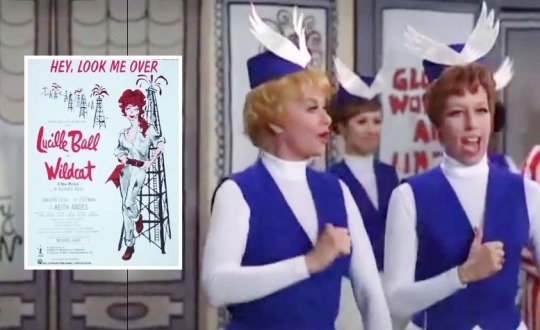
In “Lucy and Carol Burnett: Part 2″ (TLS S6;E15) on December 11, 1967, Lucy, Carol, and the ensemble perform “Hey, Look Me Over” with specially written lyrics to suit the episode’s theme of air travel.

In “Lucy Meets Danny Kaye” (TLS S3;E15) on December 28, 1964, the opening of “The Danny Kaye Show” is underscored with the music to “Hey, Look Me Over.”

While David Frost is trying to sleep during a transatlantic flight, Lucy wears her headset and hums along to “Hey Look Me Over” while tapping it out on the glasses with her cutlery. The scene is from “Lucy Helps David Frost Go Night-Night” (HL S4;E12) aired on November 12, 1971.

In “Lucy and Petula Clark” (HL S5;E8) in 1972, Lucy Carter leaves the office singing “Hey Look Me Over.”

On “Life With Lucy,” Lucy’s grandson Kevin plays on the YMCA soccer team The Wildcats. The name of the team is probably a reference to Lucille Ball’s only Broadway show.

In the second scene of “Breaking Up Is Hard To Do” (1986), an un-aired episode of “Life With Lucy”, Lucy comes down the stairs of the living room singing “Hey Look Me Over.”
WILDCAT WILDCARDS

In April 1961, Lucille Ball played softball in Central Park for the Broadway Show League when she was appearing in Wildcat. Julie Andrews (starring in Camelot) was the catcher! The catcher was Joe E. Brown.

In the play Love! Valour! Compassion! Buzz, a gay musical theater aficionado (Nathan Lane on Broadway) breaks the fourth wall (a common conceit of the play) to tell the audience something personal about himself.

The song title was also the title of a 2018 revue about rarely produced musicals at City Center in New York City. Performer Carolee Carmello called it her “hair homage to Lucille Ball.”


~ From the memoir Under the Radar by Clifford David, who played Hal in Wildcat
-
BARRY LIVINGSTON
December 17, 1953

Barry Gordon Livingston was born in Los Angeles, California. He is best known for playing Ernie Douglas on the television series “My Three Sons” (1963–72). He is the younger brother of Stanley Livingston, who played Ernie’s older brother Chip on the show.

He made his television debut on a November 6, 1961 “Danny Kaye Special” on CBS. The very next night he made his acting debut on NBC in an episode of “The Dick Powell Theatre” starring Mickey Rooney.

In January 1962 he worked on the Desilu lot for the first time in an episode of “The Dick Van Dyke Show” titled “The Talented Neighborhood” (above right). Also in the episode was “I Love Lucy” regular Doris Singleton.
After 16 episodes of “The Adventures of Ozzie and Harriet” as Barry, he was hired to play Jerry Carmichael’s friend and classmate Arnold Mooney, son of Lucy Carmichael’s nemesis, banker Theodore J. Mooney, on “The Lucy Show.”

Livingston first played the character in “Lucy Gets Locked in the Vault” (TLS S2;E4), the same episode that also introduced Gale Gordon as Mr. Mooney. Lucy is determined to prove her home haircutting skills on young Arnold, and ends up giving him a Mohawk. In the above scene, Livingston is wearing a wig to accomplish the stunt.

Livingston returned to the role at the end of the season in “Lucy and the Scout Trip” (TLS S2;E24). Arnold (above left) was in the same cub scout troop as Jerry (Ralph Hart), and Billy Simmons (Desi Arnaz Jr., center).
“There’s nothing scarier than seeing Lucille Ball coming at you with a pair of shears!”
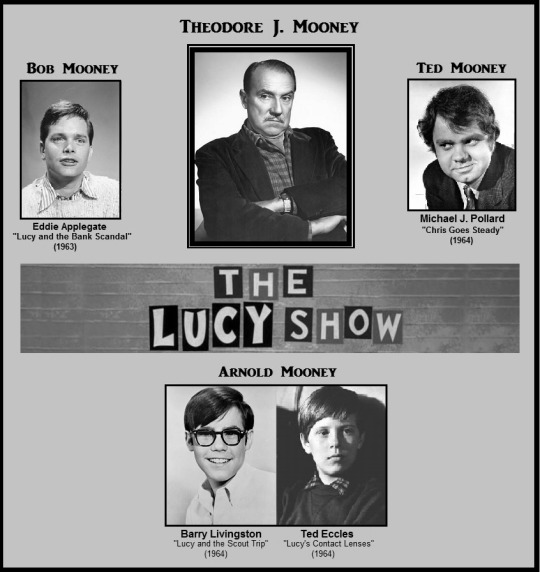
When the character was next seen, Livingston had already been hired for “My Three Sons” so the role of Arnold Mooney was assumed by Ted Eccles in “Lucy’s Contact Lenses” (TLS S3;E10). Arnold had older brothers named Bob (Eddie Applegate) and Ted (Michael J. Pollard). He also had an unnamed sister in Trenton NJ and a mother named Irma. Neither women were ever seen on screen.

On October 31, 1963, Livingston joined the cast of ABC “My Three Sons” as next door neighbor Ernie Thompson. The show was filmed on the Desilu lot. His older brother, Stanley Livingston, was already a series regular as Chip Douglas. When Tim Considine (Mike Douglas) left the series two years later, Livingston joined the cast permanently (his character was adopted into the family, keeping the show’s title intact) and remained with the series until its end in 1972 doing 335 half-hour episodes.
The children of “The Lucy Show,” Ralph Hart (who played Viv Bagley’s son Sherman), Jimmy Garrett (Jerry Carmichael), and Candy Moore (Lucy Carmichael’s daughter Chris) were also seen on various episodes of “My Three Sons.” Livingston also worked with William Frawley (Fred Mertz) as Uncle Bub. Fred MacMurray, who played Ernie’s stepdad Steve Douglas, had played himself on an episode of “The Lucy-Desi Comedy Hour” in 1958.

During his run on “My Three Sons”, Livingston took time to do a comedy pilot for Desilu called “The Two of Us” (aka “Barnaby’s Castle”) starring Billy Mumy and Mary Jane Croft. It was eventually aired as part of “Vacation Playhouse,” a summer replacement series showing failed pilots and other one-off programs. The show aired on August 29, 1966.

On November 22, 1977, ABC TV (and Dick Clark Productions) brought together a reunion of two of television’s favorite sitcoms “The Partridge Family” and “My Three Sons.” Hosted by Shirley Jones and Fred MacMurray this would be the only time that the surviving cast members would get together to celebrate the series which included clips, a song from David Cassidy, and an update of what each cast member was doing in 1977. Also in 1977, some of the stars of the series reunited on a morning program titled “The Early Show”, including Stanley Livingston (Chip Douglas), Barry Livingston (Ernie Douglas), Tina Cole (Katie Miller Douglas), and Don Grady (Robbie Douglas).

In 1983, he married Karen Huntsman and they have two children. Livingston has continued his acting career.

-
TV GUIDE: LOST & FOUND
December 16, 1989

On December 16, 1989, Lucille Ball was featured on the cover of TV Guide on a side bar story about the long-lost “I Love Lucy Christmas Special”. The main cover story profiled Neil Patrick Harris star of “Doogie Howser M.D.” a series about a young prodigy doctor.

The inside article was penned by Neane Rudolph. This was one of many posthumous TV Guide cover images for Lucille Ball, who passed away eight months earlier.

The article states that the show was first discovered and partly aired after Ball’s death and gradually was restored to completion for this December 18, 1989 broadcast.

The first telecast in 1989 was entirely in black and white, although in 1990 the wrap-around segments (new material) was colorized, but kept the flashbacks in black and white. Eventually, the episode was fully colorized and became a Christmas tradition for CBS, pairing it with a newly colorized episode from the 179 episode catalog of “I Love Lucy” programs. This tradition has been paused in 2020, likely due to the worldwide pandemic’s disruption of resources to colorize a companion episode. It is, however, available on DVD.

In addition to the article about the special, there is an ad from the CBS affiliate and a TV Guide Close-Up talking about the special and its 33 year absence from the airwaves.

Ratings Winner! The special easily won its time slot for CBS with a rating of 18.5, against the second half hour of ABC’s “McGyver” (11.6), Fox’s “21 Jump Street” (5.4), and the ABC TV remake of “A Connecticut Yankee in King Arthur’s Court” (11.5). The special’s lead-in was a re-run of “Major Dad” (13.6). It was the ratings winner that evening, even beating “Monday Night Football” by a half a ratings point. Clearly, there was an appetite for Lucy, and this incentivized CBS to pursue future telecasts from their catalog of “Lucy” episodes.


On the same date (Saturday, December 16, 1989) The Cedar Rapids (IA) Gazette’s TV Vision supplement featured the special on their front page. The article was written by Jay Bobbin of Tribune Media Services.

Michael Hill of the Baltimore Evening Sun dedicated his syndicated column to the special, although it appeared in papers on various dates. On December 16th it was printed in The Owensboro (KY) Messenger-Inquirer, among others.

Lisa Meals of the Jackson (TN) Sun, chose to profile local Lucy-lover Darlene Allen’s reaction to the unearthed Christmas special.

Even Canada got excited about the special when Mike Boone of the Montreal Gazette included it in his Channels column.


Perhaps not coincidentally (since the he is a central part of the Christmas episode), December 16, 1989 also saw a spate of articles about Keith Thibodeaux, who played Little Ricky. Many concentrated on his drumming career, but some talked of him being the last surviving cast member. The Christmas Special, however, was not the central topic of the various articles, which were from AP and Gannett sources.
-
GEORGE’S CHRISTMAS PRESENT
December 16, 1949

“George’s Christmas Present” (aka “The Christmas Present Switch”) is episode #67 of the radio series MY FAVORITE HUSBAND broadcast on December 16, 1949.
Synopsis ~ Liz vows to finish knitting George a sweater by Christmas. She finds George’s Christmas presents for her and exchanges it too early.
This was the 16th episode of the second season of MY FAVORITE HUSBAND. There were 43 new episodes, with the season ending on June 25, 1950.
This episode has been fully animated using the original soundtrack. The animation was created in 2010 by Wayne Wilson and is available to view on Vimeo.

“My Favorite Husband” was based on the novels Mr. and Mrs. Cugat, the Record of a Happy Marriage (1940) and Outside Eden (1945) by Isabel Scott Rorick, which had previously been adapted into the film Are Husbands Necessary? (1942). “My Favorite Husband” was first broadcast as a one-time special on July 5, 1948. Lucille Ball and Lee Bowman played the characters of Liz and George Cugat, and a positive response to this broadcast convinced CBS to launch “My Favorite Husband” as a series. Bowman was not available Richard Denning was cast as George. On January 7, 1949, confusion with bandleader Xavier Cugat prompted a name change to Cooper. On this same episode Jell-O became its sponsor. A total of 124 episodes of the program aired from July 23, 1948 through March 31, 1951. After about ten episodes had been written, writers Fox and Davenport departed and three new writers took over – Bob Carroll, Jr., Madelyn Pugh, and head writer/producer Jess Oppenheimer. In March 1949 Gale Gordon took over the existing role of George’s boss, Rudolph Atterbury, and Bea Benaderet was added as his wife, Iris. CBS brought “My Favorite Husband” to television in 1953, starring Joan Caulfield and Barry Nelson as Liz and George Cooper. The television version ran two-and-a-half seasons, from September 1953 through December 1955, running concurrently with “I Love Lucy.” It was produced live at CBS Television City for most of its run, until switching to film for a truncated third season filmed (ironically) at Desilu and recasting Liz Cooper with Vanessa Brown.
MAIN CAST

Lucille Ball (Liz Cooper) was born on August 6, 1911 in Jamestown, New York. She began her screen career in 1933 and was known in Hollywood as ‘Queen of the B’s’ due to her many appearances in ‘B’ movies. With Richard Denning, she starred in a radio program titled “My Favorite Husband” which eventually led to the creation of “I Love Lucy,” a television situation comedy in which she co-starred with her real-life husband, Latin bandleader Desi Arnaz. The program was phenomenally successful, allowing the couple to purchase what was once RKO Studios, re-naming it Desilu. When the show ended in 1960 (in an hour-long format known as “The Lucy-Desi Comedy Hour”) so did Lucy and Desi’s marriage. In 1962, hoping to keep Desilu financially solvent, Lucy returned to the sitcom format with “The Lucy Show,” which lasted six seasons. She followed that with a similar sitcom “Here’s Lucy” co-starring with her real-life children, Lucie and Desi Jr., as well as Gale Gordon, who had joined the cast of “The Lucy Show” during season two. Before her death in 1989, Lucy made one more attempt at a sitcom with “Life With Lucy,” also with Gordon.
Richard Denning (George Cooper) was born Louis Albert Heindrich Denninger Jr., in Poughkeepsie, New York. When he was 18 months old, his family moved to Los Angeles. Plans called for him to take over his father’s garment manufacturing business, but he developed an interest in acting. Denning enlisted in the US Navy during World War II. He is best known for his roles in various science fiction and horror films of the 1950s. Although he teamed with Lucille Ball on radio in “My Favorite Husband,” the two never acted together on screen. While “I Love Lucy” was on the air, he was seen on another CBS TV series, “Mr. & Mrs. North.” From 1968 to 1980 he played the Governor on “Hawaii 5-0″, his final role. He died in 1998 at age 84.
Ruth Perrott (Katie, the Maid) was also later seen on “I Love Lucy.” She first played Mrs. Pomerantz, a member of the surprise investigating committee for the Society Matrons League in “Pioneer Women” (ILL S1;E25), as one of the member of the Wednesday Afternoon Fine Arts League in “Lucy and Ethel Buy the Same Dress” (ILL S3;E3), and also played a nurse when “Lucy Goes to the Hospital” (ILL S2;E16). She died in 1996 at the age of 96.
Bob LeMond (Announcer) also served as the announcer for the pilot episode of “I Love Lucy”. When the long-lost pilot was finally discovered in 1990, a few moments of the opening narration were damaged and lost, so LeMond – fifty years later – recreated the narration for the CBS special and subsequent DVD release.
Gale Gordon (Rudolph Atterbury) and Bea Benadaret (Iris Atterbury), do not appear in this episode, although their characters are mentioned.
GUEST CAST

Frank Nelson (Miller’s Exchange Counter Clerk) was born on May 6, 1911 (three months before Lucille Ball) in Colorado Springs, Colorado. He started working as a radio announcer at the age of 15. He later appeared on such popular radio shows as “The Great Gildersleeve,” “Burns and Allen,” and “Fibber McGee & Molly”. Aside from Lucille Ball, Nelson is perhaps most associated with Jack Benny and was a fifteen-year regular on his radio and television programs. His trademark was playing clerks and other working stiffs, suddenly turning to Benny with a drawn out “Yeeeeeeeeees?” Nelson appeared in 11 episodes of “I Love Lucy”, including three as quiz master Freddy Fillmore, and two as Ralph Ramsey, plus appearance on “The Lucy-Desi Comedy Hour” – making him the only actor to play two different recurring roles on “I Love Lucy.” Nelson returned to the role of the frazzled Train Conductor for an episode of “The Lucy Show” in 1963. This marks his final appearance on a Lucille Ball sitcom.

Eleanor Audley (Mother Cooper) would later play Eleanor Spalding, owner of the Westport home the Ricardos buy in “Lucy Wants To Move to the Country” (ILL S6;E15) in 1957, as well as one of the Garden Club judges in “Lucy Raises Tulips” (ILL S6;E26).
EPISODE

ANNOUNCER: “As we look in on the Cooper’s it’s morning and there are seven shopping days left until Christmas.”
Liz is pressing Katie the Maid about what George may have bought her for Christmas. She is knitting George a sweater, but wants a fur coat from George. Liz sings “Jingle Bells” as George comes down to breakfast.
“Jingle Bells”
by James Lord Pierpont (1822–93)
was sung in the “I Love Lucy” Christmas tag, the “I Love Lucy Christmas Special” (above, colorized), as well as in “Lucy Goes to Sun Valley,” a 1958 episode of “The Lucy-Desi Comedy Hour.” Lucy says that Ricky proposed to her at Christmastime, so their ‘song’ is “Jingle Bells,” or – as Ricky pronounces it – “Yingle Bells.” The song was also sung by Lucy Carmichael and Vivian Bagley in “Together for Christmas” (TLS S1;E13) in 1962.Liz is acting lovey-dovey, but George is on to her games – he won’t tell her what he is getting her for Christmas.
LIZ: “Are you getting me a mink stole?”
GEORGE: “If I got you a mink, it would have to be stole!”George tells Liz he’s already bought it and that it is in the hall closet – but warns her to leave it alone! After George leaves for work, Liz is tempted to take a peek. She reasons she might need to go into the closet for routine reasons, and ‘clumsily’ rips the paper off the box. It is empty, except for a note that says
I THOUGHT I TOLD YOU TO STAY OUT OF HERE, NOSY!
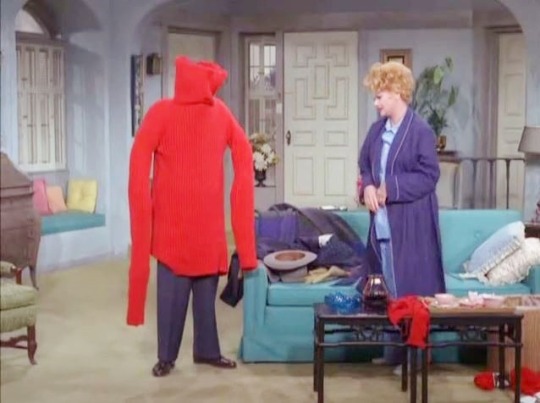
Liz is adamant that George is just getting a sweater and starts knitting. Katie doesn’t even recognize it as a sweater. It has two neck holes and a sock knitted to the sleeve! Liz laments that she can’t knit like George’s mother, who Liz calls Nosy Rosy. Katie reminds Liz that Mother Cooper is coming over for a visit.
Mother Cooper (Eleanor Audley) waltzes in without ringing the bell. She first thinks the sweater is a dust rag, then a dog sweater. Liz tells her that it is a sweater for George and Mother laughs.
MOTHER (laughing): “I could die!”
LIZ (grimly): “Yes, but you won’t.”
Mother has come over to tell Liz that she will be spending Christmas with Aunt Bessie, instead of with her and George. Before she goes, she bluntly tells Liz to give up on knitting; she hasn’t got the talent. Mother turns to go.
LIZ: “Are you driving, or shall I call the Yellow Broomstick Company?”

Liz is essentially calling her mother-in-law a witch! The Yellow Cab was a taxicab company in Chicago founded in 1907 by John D. Hertz, who later began the Hertz Rent-A-Car Company. In early 1950, Red Skelton, a frequent co-star of Ball’s, released the MGM film The Yellow Cab Man. Although it had not yet premiered, shooting was completed by October 1949 and Lucille Ball may have been short-listed for the role played by Gloria De Haven.
Before she departs, Mother Cooper tells Liz she has knit her son a beautiful cashmere sweater for Christmas, making Liz even more intent on making hers even better and more beautiful.
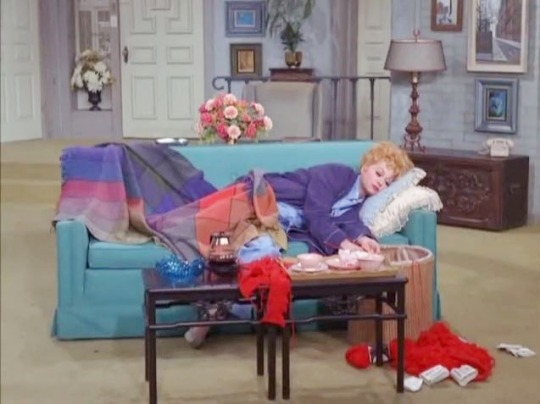
In Part Two, Katie discovers Liz asleep with the knitting needles in her hands, exhausted. After an all-nighter, Katie still sees that the sweater still has three sleeves!
At breakfast, Liz’s eyes are so bloodshot she mistakes milk for tomato juice! When George discovers that she’s been knitting him a sweater, he laughs. After George goes to work, Katie discovers another wrapped box in the closet. Liz opens it to reveal a bright red dress from Miller’s Department Store. Liz is upset because she cannot wear red with her hair coloring.
LIZ: “If I put that dress on, I’ll look like an ad for Unguentine!”

Unguentine is a commercially available topical skin ointment that helps alleviate minor burns and irritations. It was originally introduced in 1893. It was mentioned on “I Love Lucy” in “The Fashion Show” (ILL S4;E20) in 1955.

Liz dashes off to Miller’s to try and exchange the red dress for one in green. While waiting on line at the exchange counter, Liz busily knits. At the head of the line, the clerk (Frank Nelson) is confused as to why Liz is exchanging a present BEFORE Christmas! He sarcastically tells her she should exchange the red dress for a black one and give it a henna rinse!
Miller’s Department Store is mentioned in “Husbands Are Sloppy Dressers” (S3;E1) and “The Two Mrs. Coopers” (S3;E7).
LIZ: “Oh, I’ll bet you’re a scream when you get out your chicken inspector badge.”

Lucille Ball started coloring her hair with Henna Rinse (an Egyptian hair dye) in 1942 for the film Du Barry Was a Lady, to set herself apart in Technicolor movies. Irma Kusely, Ball’s hairstylist, later said that Ball had a safe of it in her garage! In “Pioneer Women” (ILL S1;E25) in 1952, Fred Mertz struts around and proudly declares “I am the chicken inspector!” This is 1920s slang for a man who has an eye for young woman. He even wears a novelty badge!
Liz rushes home to tell Katie she exchanged the red dress for one in Kelly green. George calls to tell Liz that he is bringing his mother home to give her a Christmas present before she goes to Aunt Bessie’s! Liz realizes that this is the dress that she just exchanged.

Liz rushes back to Miller’s to be greeted by the same sarcastic clerk, who can’t understand why she wants yet another exchange.
Back at home, Liz tells Katie she successfully re-exchanged the green dress for the red one. Katie tells Liz that she finished knitting the sweater for her and has tucked it into the desk drawer.

George and his mother come home and Liz gives her the present – only to find out from George that the gift she handed Mother is for her, not Mother Cooper! While George is getting his mother’s REAL present, Mother Cooper asks Liz how the sweater is coming along. Liz opens the desk drawer and Mother Cooper accuses her of buying the sweater not making it.
As she’s getting into the taxi, George notices a piece of yarn leading from the taxi, up the sidewalk and into the desk! Mother Cooper has secretly taken the sweater so as not to be upstaged by Liz. Now the sweater has unraveled, leaving only two inches on the needles!
END OF EPISODE

Announcer Bob LeMond reminds listeners to watch for Lucille Ball in the Columbia Picture Miss Grant Takes Richmond.
1949, Bob LeMond, CBS, Chicken Inspector, christmas, Eleanor Audley, Frank Nelson, Henna Rinse, I love lucy, Jingle Bells, Knitting, Lucille Ball, Miss Grant Takes Richmond, My Favorite Husband, Radio, Richard Denning, Ruth Perrott, The Lucy Show, The Yellow Cab Man, Unguentine, William Frawley, Yellow Cab -
THE CHRISTMAS CARDS
December 16, 1950

“The Christmas Cards” (aka “Christmas Card Pictures”) is episode #110 of the radio series MY FAVORITE HUSBAND broadcast on December 16, 1950.
This was the 12th episode of the third season of MY FAVORITE HUSBAND. There were 31 new episodes, with the season ending on March 31, 1951.
Synopsis ~
Liz and George have their pictures taken for their Christmas cards, but then can’t agree on which shot to use.

“My Favorite Husband” was based on the novels Mr. and Mrs. Cugat, the Record of a Happy Marriage (1940) and Outside Eden (1945) by Isabel Scott Rorick, which had previously been adapted into the film Are Husbands Necessary? (1942). “My Favorite Husband” was first broadcast as a one-time special on July 5, 1948. Lucille Ball and Lee Bowman played the characters of Liz and George Cugat, and a positive response to this broadcast convinced CBS to launch “My Favorite Husband” as a series. Bowman was not available Richard Denning was cast as George. On January 7, 1949, confusion with bandleader Xavier Cugat prompted a name change to Cooper. On this same episode Jell-O became its sponsor. A total of 124 episodes of the program aired from July 23, 1948 through March 31, 1951. After about ten episodes had been written, writers Fox and Davenport departed and three new writers took over – Bob Carroll, Jr., Madelyn Pugh, and head writer/producer Jess Oppenheimer. In March 1949 Gale Gordon took over the existing role of George’s boss, Rudolph Atterbury, and Bea Benaderet was added as his wife, Iris. CBS brought “My Favorite Husband” to television in 1953, starring Joan Caulfield and Barry Nelson as Liz and George Cooper. The television version ran two-and-a-half seasons, from September 1953 through December 1955, running concurrently with “I Love Lucy.” It was produced live at CBS Television City for most of its run, until switching to film for a truncated third season filmed (ironically) at Desilu and recasting Liz Cooper with Vanessa Brown.
MAIN CAST

Lucille Ball (Liz Cooper) was born on August 6, 1911 in Jamestown, New York. She began her screen career in 1933 and was known in Hollywood as ‘Queen of the B’s’ due to her many appearances in ‘B’ movies. With Richard Denning, she starred in a radio program titled “My Favorite Husband” which eventually led to the creation of “I Love Lucy,” a television situation comedy in which she co-starred with her real-life husband, Latin bandleader Desi Arnaz. The program was phenomenally successful, allowing the couple to purchase what was once RKO Studios, re-naming it Desilu. When the show ended in 1960 (in an hour-long format known as “The Lucy-Desi Comedy Hour”) so did Lucy and Desi’s marriage. In 1962, hoping to keep Desilu financially solvent, Lucy returned to the sitcom format with “The Lucy Show,” which lasted six seasons. She followed that with a similar sitcom “Here’s Lucy” co-starring with her real-life children, Lucie and Desi Jr., as well as Gale Gordon, who had joined the cast of “The Lucy Show” during season two. Before her death in 1989, Lucy made one more attempt at a sitcom with “Life With Lucy,” also with Gordon.
Richard Denning (George Cooper) was born Louis Albert Heindrich Denninger Jr., in Poughkeepsie, New York. When he was 18 months old, his family moved to Los Angeles. Plans called for him to take over his father’s garment manufacturing business, but he developed an interest in acting. Denning enlisted in the US Navy during World War II. He is best known for his roles in various science fiction and horror films of the 1950s. Although he teamed with Lucille Ball on radio in “My Favorite Husband,” the two never acted together on screen. While “I Love Lucy” was on the air, he was seen on another CBS TV series, “Mr. & Mrs. North.” From 1968 to 1980 he played the Governor on “Hawaii 5-0″, his final role. He died in 1998 at age 84.
Bob LeMond (Announcer) also served as the announcer for the pilot episode of “I Love Lucy”. When the long-lost pilot was finally discovered in 1990, a few moments of the opening narration were damaged and lost, so LeMond – fifty years later – recreated the narration for the CBS special and subsequent DVD release.
Ruth Perrott (Katie, the Maid) was also later seen on “I Love Lucy.” She first played Mrs. Pomerantz, a member of the surprise investigating committee for the Society Matrons League in “Pioneer Women” (ILL S1;E25), as one of the member of the Wednesday Afternoon Fine Arts League in “Lucy and Ethel Buy the Same Dress” (ILL S3;E3), and also played a nurse when “Lucy Goes to the Hospital” (ILL S2;E16). She died in 1996 at the age of 96.
Gale Gordon (Rudolph Atterbury) and Bea Benadaret (Iris Atterbury) do not appear in this episode, although Liz does have a phone conversation with Iris where her voice is not heard by the listeners.
GUEST CAST

Jay Novello (Professor Sergei Pagolovsy) would appear on “I Love Lucy” as superstitious Mr. Merriweather in “The Seance” (ILL S1;E7), nervous Mr. Beecher in “The Sublease” (ILL S3;E31), and Mario the gondolier in “The Visitor from Italy” (ILL S6;E5). He also appeared on two episodes of “The Lucy Show,” but dapper Novello is probably best remembered for playing Mayor Lugatto on “McHale’s Navy” in 1965.
Professor Sergei Pagolovsky is a professional photographer, who also goes door to door selling his services. Novello generally plays Mr. Nagy, the Sheridan Falls Postman in love with Katie.
EPISODE
ANNOUNCER: “As we look in on the Coopers this evening, George is sitting in the living room reading the paper, when Liz makes an announcement.”

Liz announces that this is the night they must pick our their Christmas cards. Turns out, Liz is selling Kris Kringle Christmas Cards this year. So far, she only has three orders – including theirs. Card #14 reads…
LIZ: “This is the season of holly and spruce,
So Merry Christmas to you, Uncle Bruce!”Or, if you don’t have an Uncle Bruce, #14A…
LIZ: “This is the season of spruce and holly,
So Merry Christmas to you, Uncle Jolly!”George says his only Uncle’s name is Uncle Gilhooley.
LIZ: “This is the season that we know as Yule-y,
so Merry Christmas to you, Uncle Gilhooley.”When George finds out he has to pay retail, and doesn’t get a discount from his own wife, he insists they be printed from “George Cooper and Friend.” To get her name on the card she foregoes her commission.
She tries to sell cards to Katie, the Maid. But it turns out Katie is also working for Kris Kringle Christmas Card Company. Katie’s only sale was to herself. Liz quickly phones Iris Atterbury to make a sale, but same thing.Iris is a Kris Kringle Card vendor, too!
The doorbell rings and it is a special delivery letter from George’s mother. It says that she can’t come for Christmas this year, but would like a photo of them. Liz reads where her mother-in-law tells George to stand apart from Liz so that she can cut her out later! Liz decides to make their Christmas Cards themselves!

Announcer Bob LeMond does a Jell-O commercial, giving a quick holiday recipe.
ANNOUNCER: “As we look in on the Coopers once again it is two days later. Two days that Liz has spent diligently carving a linoleum block to hand-print their Christmas cards.”
Liz reveals the finished product but Katie can’t read the message because Liz didn’t carve the letters backward so that they come out the right way. As it is it says “REPOOC EGROEG dna ZIL morf SAMTSIRHC YRREM”!

Linocut (also known as lino print, lino printing, or linoleum art) is a printmaking technique, a variant of woodcut in which a sheet of linoleum is used for a relief surface. The linoleum sheet is then inked with a roller and then impressed onto paper or fabric.
The doorbell rings and it is a salesman (Jay Novello). His product? Personalized photo Christmas cards from the Pagolovsky Studio of Photographic Arts. Liz orders before the salesman has even finished his spiel. Professor Sergei Pagolovsky himself will take the photos this afternoon. Liz immediately realizes that her mother-in-law will get a photo after all.
That afternoon George and Liz report to the photo studio. Turns out the salesman is Professor Pagolovsky himself! Liz does everything to make sure she is as close to George as possible. They take a photo with their heads together.
Later, George brings home the developed photographs for Liz to see. They cannot decide on which one to use. The photos that Liz likes, George doesn’t. The photos the George likes, Liz doesn’t! They go back and forth until they settle on one where they both look lousy!

Lucy Ricardo also had trouble picking a good photo of herself when applying for a passport in “Staten Island Ferry” (ILL S5;E12) in 1956.
Liz goes down to the photographic studio to change the photo. Reviewing the proofs, she chooses one she says will make George look good – but actually favors her. A short time later, George also visits the studio to make a change. He picks a photo that he says will flatter Liz, but actually favors himself!
When the cards arrive, Liz warns George that the Professor may have printed the wrong photo on their card – knowing she has changed it. Opening the cards, she is surprised to see the photo that favors George! She cries, refusing to send the cards. She throws them in the fireplace.
George tells her to go right out in the snow and buy some replacement cards. When he goes to the closet to get her coat, he comes back with some surprising news. She doesn’t have to go out and get new cards because they have three boxes of fully stamped and addressed cards in the closet. He forgot to mail last year’s cards!

In the live Jell-O commercial, Lucille Ball is Professor Dorothea Theodora, a famous lady archeologist in Egypt. LeMond is interviewing her for the Scientific Gazette.
LEMOND / INTERVIEWER: “I’d like to ask you a question.”
LUCY / DOROTHEA: “Well, shoot the query, dearie.”He asks her to read Egyptian hieroglyphics, which she translates into a description of Jell-O desserts.
Ooops! LeMond also translates the hieroglyphics and trips over the word ‘delectable’ at first saying ‘detectable’. Lucy, as Dorothea Theodora, ad libs “You can’t even read English”!
END OF EPISODE

-
GAIL BONNEY
December 15, 1901

Gail Bonney was born Goldie Bonowitz in Columbus, Ohio. She has a twin sister. Her screen career began in the late 1940s and continued for three decades.

Her first screen credit came in January 1948 playing a gossipy woman (uncredited) in Slippy McGee.

Bonney was seen in two 1950 films featuring Lucille Ball. In March 1950, she played an uncredited bicyclist in A Woman of Distinction in which Lucille Ball had a cameo as herself. In Spain the film was titled The Teacher’s Scandals. Gale Gordon also had an uncredited role in the film.

Her first television appearance was on a 1951 episode of “The Stu Erwin Show” aka “Trouble With Father” on ABC.

In September 1950, Bonney was seen in the Lucille Ball film The Fuller Brush Girl.
When Ball is mistaken for a babysitter and tied up by some children playing Cowboys and Indians, she is rescued by the real babysitter, played by actress Gail Bonney.

Two years later, Gail Bonney played Mrs. Hudson in “The Amateur Hour,” (ILL S1;E14) hiring Lucy Riccardo to babysit her twin boys, who tie Lucy up while playing Cowboys and Indians. The episode was filmed on December 7, 1951, and first aired on January 14, 1952.

In 1955 Bonney did two episodes of “Our Miss Brooks” filmed at Desilu and featuring Eve Arden and Gale Gordon.

Bonney played Madeline Schweitzer on Desilu’s “December Bride” for four episodes in 1955 and 1956. In February 20, 1956, Executive Producer Desi Arnaz played himself on an episode titled “The Sunken Den”.

Bonney did an episode of “The Westinghouse-Desilu Playhouse” titled “Six Guns for Donegan” in October 1959. Desi Arnaz was the on-screen host of the anthology series.

She returned to Desilu to film an April 1961 episode of the short-lived series “Angel” that also featured Gale Gordon and Doris Singleton.

That year she also played a nurse (uncredited) on the Desilu-hit crime drama “The Untouchables”.

In October 1963 she did an episode of the Desilu show “Glynis” in which she played opposite vaudeville great Eddie Foy Jr. It also featured Keith Andes, who played Lucy Carmichael’s boyfriend and her leading man on Broadway.

She returned to do a 1965 episode of “The Lucy Show” titled “Lucy and The Ceramic Cat” (TLS S3;E16). Although she is listed in the closing credits, she has no dialogue and is not recognizable. It is possible that her lines were edited out of the final cut.

In 1965 and again in 1970, Bonney was on the Desilu set of “My Three Sons” starring Fred MacMurray and in one episode Roy Roberts.

Speaking of ugly cats, Bonney (right) appeared as one of three witches in “Catspaw” a 1967 episode of Desilu’s now-iconic space series “Star Trek.”

Bonney’s final appearance on a Lucy sitcom was in a 1968 episode of "Here’s Lucy” titled “Lucy and Eva Gabor” (HL S1;E7). Bonney played Dolores, a member of Lucy’s bridge club who visits specifically to meet Gabor.

Dolores asks Eva for her autograph – on a copy of The Caine Mutiny, the 1951 Pulitzer Prize–winning novel by Herman Wouk. Delores didn’t have Eva’s book at home so she grabbed something off of the shelf!

Bonney, Benny, and Ball were all part of “Jack Benny’s Birthday Special” on February 17, 1969. Between 1957 and 1964, Bonney had appeared on half a dozen episodes of “The Jack Benny Program”.

Unconnected to Desilu or Lucille Ball, Bonney appeared on all three of CBS’s rural sitcoms: “Petticoat Junction” (1965-66), “The Beverley Hillbillies” (1967), and “Green Acres” (1965) – all as different characters.

Like Lucille Ball, Bonney once worked with The Three Stooges. In 1958 she was seen in their short “Flying Saucer Daffy.” Ball had done a short film of theirs in 1934 titled “Three Little Pigskins”.

Bonney’s final screen role was as a librarian on the Animal House-like “Delta House” TV series in February 1979.
Bonney married Joseph Solomon in 1953. She died on December 7, 1984 at age 82.
 A Woman of Distinction, Angel, Beverly Hillbillies, December Bride, Delta House, Eva Gabor, Gail Bonney, Glynis, Green Acres, Here’s Lucy, I love lucy, Jack Benny, Lucille Ball, My Three Sons, Our Miss Brooks, Petticoat Junction, Slippy McGee, Star Trek, The Fuller Brush Girl, The Lucy Show, The Three Stooges, The Untouchables, Trouble With Father, tv, Westinghouse Desilu Playhouse
 -
JOHN HART
December 13, 1917

John Lewis Hart (sometimes credited as John Hilton) was born in Los Angeles. He grew up in San Marino and graduated from South Pasadena High School. His mother was a drama critic for the Pasadena Star-News and he later trained at the Pasadena Playhouse where he was discovered by a Paramount talent agent.
In his early career, Hart appeared mostly in westerns.
Although Hart played mostly minor roles in some fairly well known films, he was probably best known for having replaced Clayton Moore in the television series The Lone Ranger for one season (1952–53).

Hart began his screen career in 1937 with an uncredited bit part in Daughter of Shanghai. Hart served in the military during World War II, momentarily pausing his burgeoning acting career.
“I had big parts in lousy movies and lousy parts in big movies. I never made a lot of money, but it sure was fun.” ~ John Hart

He made his television debut in a 1952 episode of “Gang Busters” playing an airline pilot.

A year later, he did the first of his three appearances on “I Love Lucy” in “Lucy Changes Her Mind” (ILL S2;E21) aired on March 30, 1953, although filmed on September 26, 1952, while simultaneously playing Matthew in “The Living Bible” and the title role in “The Lone Ranger.” Producer Jess Oppenheimer didn’t want to pay too much for the actor who would play Tom Henderson, a character who only says two words at the very end of the show. He wrote in the script that he wanted “the most handsome hunk of man anyone ever saw for $15.56.” Hart was cast.

In 1955, Hart returned to play a hunky lifeguard who tries to save Lucy from drowning in the hotel pool – even though Ricky is supposed to be the one to come to her rescue for publicity reasons. “The Hedda Hopper Story” (ILL S4;E21) first aired on March 14, 1955, but was filmed on February 3, 1955.

Hart’s lifeguard can’t figure out why Lucy is fighting him off in the pool instead of cooperating with him!

Ricky jumps in a moment too late, and it two against one in the pool tussle!

Although it was highly unusual, Hart was also hired for the very next episode, “Don Juan in Shelved” (ILL S4;E22) playing a studio executive meeting poolside (the same pool where he tried to save Lucy a week earlier) with MGM’s Dore Schary (Phil Ober).

Because he plays two different characters in back-to-back episodes, he was made to look noticeably different, wearing glasses, a suit and tie, and even a touch of gray in his hair! The character leaves before Lucy enters and the two have no scenes together.

He was back at Desilu Studios for an episode of “The Ann Sothern Show” which aired on February 29, 1960. Lucille Ball guest-starred on the series as Lucy Ricardo in 1959.

Also in 1960, Hart was one of the partygoers in the film musical Bells Are Ringing who sing “Drop That Name”, a song by Comden and Green that rhymes “Lauren Bacall” with “Lucille Ball”!

His final screen role was playing the Lone Ranger on an episode of “Happy Days” that aired in February 1982.

Hart met his wife, Canadian actress Beryl Braithwaite, on the set of the 1957 series “Hawkeye and the Last of the Mohicans”. They wed ten days later. The union lasted 52 years. Hart had two children, a son Nathaniel (aka Buddy) and a daughter Robyn.
John Hart died on September 20, 2009 in Mexico from dementia at age 91.

“I’ve been the ‘other’ Lone Ranger for 50 years. There are worse things people could call me.” ~ John Hart
-
LUCILLE BALL CHATS ABOUT CHRISTMAS DINNERS
December 12, 1971

Lucille Ball, in conversation with Helen Dorsey for Family Weekly, a Sunday supplement.


“Christmas Is for children, and it’s not quite as much fun now that the children are grown up. We still enjoy Christmas though – it’s always been very important in our family.”
“We all patterned ourselves from my grandmother Hunt [Flora Belle Orchutt Hunt. Lucille’s maternal grandmother.] She was something special because she did everything: made all the presents, decorations for the tree and did all the cooking. There were always 16, 18 or 25 for Christmas dinner. It was real New England!”
“Grandmother Hunt was a real pioneer lady. She cooked everything, especially rhubarb pie, my grandfather’s favorite. My grandparents raised and butchered their own hogs and raised chickens. We had a huge truck garden, and my grandmother canned everything from that garden.”
"Traditionally, our Christmas feast was a big turkey with sage-pork dressing, cranberry sauce, two or three kinds of pie, puddings, biscuits, gravy, and maple syrup from our end of the country. (Lucille Ball spent much of her childhood in Celoron Village near Jamestown, N.Y.) I particularly remember her strawberry shortcake, hot biscuits with melted butter, strawberries canned fresh from the garden and real whipped cream. There were always walnuts grown on our trees.”
“I lived with my grandparents as a child, my father was dead and my mother was working, my Granddaddy was our father. He was a very lighthearted, cute man, funny but very strict. He was a disciplinarian, but he loved vaudeville and loved to take us places. He taught us things like looking for mushrooms (which, incidentally, has to be taught), and fishing, swimming and tobogganing. He was a wood turner and would make all those things by hand–our doll furniture, playhouses and slides. He’d make sure we went roller skating and ice skating in the winter. We even fished through the ice in Chautauqua Lake for muskie, bass and perch.”
"My mother’s getting ready for Christmas now. She and my aunt Helen have been making persimmon cake at Christmas for years. I don’t know where they got recipe – it’s been in the family years. My mother gets the persimmons and lets them ripen, then starts baking the cakes early, wraps them, and gives them away as Christmas gifts. Mother also makes cranberry sauce. She makes it as many times a year she can get cranberries. We might have as many as 16 cans going around the family every year!”
"My main role at Christmas is being Santa Claus. I usually start shopping early in September. I’ve got a lot of good help, too, from Wanda, my secretary. If I see something I like, she gets all the information, and we put in the orders early and try and get a head start. [Traditionally, Lucille sends out about 600 gifts to friends and crew who have worked with her over the years.]”
"I don’t know where we’ll spending Christmas this year – maybe in Snowmass [her mountain ski retreat in Colorado] or little Lucy’s new house. Her house is so adorable. I haven’t heard her say what she plans cook for Christmas, but she’s such a marvelous cook. She may try doing a turkey.”
"I do most of my cooking Snowmass: New England boiled dinner: chicken, steaks, chops, brisket, or fresh fish we get up there. I cook big breakfasts, pancakes, ham and eggs or bacon. Altitude’s supposed to make some difference in cooking if you go according to the book, but I found out that you don’t have to make adjustments in recipes.”
“A lot of funny things happen to me in the kitchen! Because I don’t cook that often these days, it’s very difficult for me to time a dinner so everything gets out of the oven, off the stove and on the able at just the correct time. Or I’ll prepare a salad, fix the rest of the dinner and go back and find he salad still in the refrigerator. I’ve gone even farther than that. I once gave a dinner party for eight people and forgot to ask the people!“

LUCILLE BALL’S CHRISTMAS PERSIMMON CAKE
- 3 tbsps. butter
- 2 cups sugar
- 2 cups persimmon pulp
- 2 cups chopped walnuts
- 1 cup seedless raisins
- 1 cup chopped dates
- 1 tbsp. grate orange peel
- 4 cups sifted cake flour t
- 4 tsps. baking soda
- 3 tsps. baking powder
- 2 tsps. ground cinnamon
- ½ tsp. ground cloves
- ½ tsp. ground allspice
- ½ tsp. ground nutmeg
- 1 cup milk
- 2 tsps. pure vanilla extract
In a large mixing bowl cream butter with sugar. Add persimmon pulp, nuts, raisins, dates and orange peel; mix well. Sift flour with baking soda, baking powder and spices. Add flour mixture alternately with milk beginning and ending with flour. Stir in vanilla extract. Turn batter into 2 well-greased 9 x 5 x 3-inch loaf pans. Bake in a preheated 300° F. oven 1% hrs. (or until a cake tester inserted into center comes out dean.) Turn out onto wire rack and cool. Garnish, if desired, with glace fruits and nuts arranged in a row down the center of the cake. Yield: 2 loaf cakes

FRESH CRANBERRY SAUCE
- 1 Ib. fresh cranberries
- 1 medium orange
- 2 cups sugar
Wash, remove stems from cranberries; dry well. Grind cranberries in food chopper set on medium setting. Quarter orange, remove seeds and grind peel and all with medium setting. Add the sugar. Mix all ingredients together well, chill in refrigerator 3 hrs.
-
RIP ‘THE 21 CLUB’
1930 – 2021

The 21 Club, Manhattan’s iconic nightspot and restaurant, will close for good by March 2021. The former prohibition-era speakeasy is located at 21 West 52nd Street (hence the name) in New York City.

Perhaps the most famous feature of 21 is the collection lawn jockeys adorning the balcony above the entrance.

In “Vacation From Marriage” (ILL S2;E6) Lucy and Ethel tell their husbands they have been to 21 four times (“That’s 84!”).

In “Mr. and Mrs. TV Show” (ILL S4;E24), Lucy tells Ricky she met a TV producer while having lunch at 21 with Carolyn Appleby.

In “Lucy Wants A Career” (LDCH S2;E4) newly employed television presenter Lucy Ricardo says that after signing her new contracts everyone went out to 21.

In “Lucy Goes Duck Hunting” (TLS S2;E6), Viv says that she and her boyfriend Eddie will probably go to 21 for dinner, take in a Broadway show, and then go dancing at the Waldorf.

– from the book “Contemporary American Business Leaders” (1990)


~ May 10, 1946

~ January 16, 1950
[Note: Slightly Out of Focus, a biopic about photographer Bob Capa starring Lucy and Desi, was never filmed.]
-
TV GUIDE: STILL IN THE DRIVER’S SEAT
December 10, 1955

TV GUIDE ~ Volume 3, no. 50, issue #141, week of December 10 – 16, 1955. This was Lucille Ball’s sixth of 39 covers. Image by Paul Hesse.
Paul Hesse (1896-1973) was born in New York City. While attending Pratt Institute he experimented with photography. After World War I he became a poster illustrator, but grew impatient with its time-consuming aspects. After reading all the photography books in the New York Public Library, he set out on a photographic career. In the mid-1920s, he established a successful commercial photography studio. Later he resettled in Los Angeles, where his Sunset Strip studio became a gathering place for advertising and motion picture industry notables.

“STILL IN THE DRIVER’S SEAT” discusses that “I Love Lucy” is still popular, despite the cancelation of many sitcoms.

On Monday, December 11, 1955, “I Love Lucy” aired “Ricky’s European Booking” (ILL S5;E10) filmed on November 10, 1955. At 8:30pm, Desilu’s “December Bride” aired.

In the episode, Ricky sang “Forever Daring” with the Pied Pipers, promoting the upcoming film of the same title starring Lucy and Desi.


Also on December 10, 1955, Hedda Hopper’s syndicated column reported that Forever Darling would premiere on Valentine’s Day 1956.


On the December 10, 1955 TV News column by Bob Chess, it was announced that Desilu would produce a new series titled “Father Duffy of Hell’s Kitchen” starring Lloyd Nolan. Before filming, Nolan withdrew over script changes and Karl Malden stepped in. The title was changed to “Danny Violin” but never went before the cameras.

Saturday evening, December 8, 1955, in Shreveport, Louisiana, TV station KSLA ran rebroadcasts of “I Love Lucy” at 5:30, although they called it “The Lucy Show.”

This Casper, Wyoming, newspaper predicted the demise of the half-hour “I Love Lucy.”
-
Subscribe
Subscribed
Already have a WordPress.com account? Log in now.
 Papermoon Loves Lucy