-
TRYING TO CASH THE PRIZE CHECK
December 9, 1950

“Trying To Cash The Prize Check” (aka “The ‘Everybody Wins’ Prize Check”) is episode #109 of the radio series MY FAVORITE HUSBAND broadcast on December 9, 1950.
Synopsis ~ Liz goes on the radio quiz show and wins a check for $500, but she only gets to keep it if she can cash it within 25 minutes, and the banks are all closed!
This was the 15th episode of the third season of MY FAVORITE HUSBAND. There were 43 new episodes, with the season ending on June 25, 1950.

“My Favorite Husband” was based on the novels Mr. and Mrs. Cugat, the Record of a Happy Marriage (1940) and Outside Eden (1945) by Isabel Scott Rorick, which had previously been adapted into the film Are Husbands Necessary? (1942). “My Favorite Husband” was first broadcast as a one-time special on July 5, 1948. Lucille Ball and Lee Bowman played the characters of Liz and George Cugat, and a positive response to this broadcast convinced CBS to launch “My Favorite Husband” as a series. Bowman was not available Richard Denning was cast as George. On January 7, 1949, confusion with bandleader Xavier Cugat prompted a name change to Cooper. On this same episode Jell-O became its sponsor. A total of 124 episodes of the program aired from July 23, 1948 through March 31, 1951. After about ten episodes had been written, writers Fox and Davenport departed and three new writers took over – Bob Carroll, Jr., Madelyn Pugh, and head writer/producer Jess Oppenheimer. In March 1949 Gale Gordon took over the existing role of George’s boss, Rudolph Atterbury, and Bea Benaderet was added as his wife, Iris. CBS brought “My Favorite Husband” to television in 1953, starring Joan Caulfield and Barry Nelson as Liz and George Cooper. The television version ran two-and-a-half seasons, from September 1953 through December 1955, running concurrently with “I Love Lucy.” It was produced live at CBS Television City for most of its run, until switching to film for a truncated third season filmed (ironically) at Desilu and recasting Liz Cooper with Vanessa Brown.
MAIN CAST

Lucille Ball (Liz Cooper) was born on August 6, 1911 in Jamestown, New York. She began her screen career in 1933 and was known in Hollywood as ‘Queen of the B’s’ due to her many appearances in ‘B’ movies. With Richard Denning, she starred in a radio program titled “My Favorite Husband” which eventually led to the creation of “I Love Lucy,” a television situation comedy in which she co-starred with her real-life husband, Latin bandleader Desi Arnaz. The program was phenomenally successful, allowing the couple to purchase what was once RKO Studios, re-naming it Desilu. When the show ended in 1960 (in an hour-long format known as “The Lucy-Desi Comedy Hour”) so did Lucy and Desi’s marriage. In 1962, hoping to keep Desilu financially solvent, Lucy returned to the sitcom format with “The Lucy Show,” which lasted six seasons. She followed that with a similar sitcom “Here’s Lucy” co-starring with her real-life children, Lucie and Desi Jr., as well as Gale Gordon, who had joined the cast of “The Lucy Show” during season two. Before her death in 1989, Lucy made one more attempt at a sitcom with “Life With Lucy,” also with Gordon.
Richard Denning (George Cooper) was born Louis Albert Heindrich Denninger Jr., in Poughkeepsie, New York. When he was 18 months old, his family moved to Los Angeles. Plans called for him to take over his father’s garment manufacturing business, but he developed an interest in acting. Denning enlisted in the US Navy during World War II. He is best known for his roles in various science fiction and horror films of the 1950s. Although he teamed with Lucille Ball on radio in “My Favorite Husband,” the two never acted together on screen. While “I Love Lucy” was on the air, he was seen on another CBS TV series, “Mr. & Mrs. North.” From 1968 to 1980 he played the Governor on “Hawaii 5-0″, his final role. He died in 1998 at age 84.
Gale Gordon (Rudolph Atterbury) had worked with Lucille Ball on “The Wonder Show” on radio in 1938. One of the front-runners to play Fred Mertz on “I Love Lucy,” he eventually played Alvin Littlefield, owner of the Tropicana, during two episodes in 1952. After playing a Judge in an episode of “The Lucy-Desi Comedy Hour” in 1958, he would re-team with Lucy for all of her subsequent series’: as Theodore J. Mooney in ”The Lucy Show”; as Harrison Otis Carter in “Here’s Lucy”; and as Curtis McGibbon on “Life with Lucy.” Gordon died in 1995 at the age of 89.
Bea Benadaret (Iris Atterbury) was considered the front-runner to be cast as Ethel Mertz but when “I Love Lucy” was ready to start production she was already playing a similar role on TV’s “The George Burns and Gracie Allen Show” so Vivian Vance was cast instead. On “I Love Lucy” she was cast as Lucy Ricardo’s spinster neighbor, Miss Lewis, in “Lucy Plays Cupid” (ILL S1;E15) in early 1952. Later, she was a success in her own show, “Petticoat Junction” as Shady Rest Hotel proprietress Kate Bradley. She starred in the series until her death in 1968.
Bob LeMond (Announcer) also served as the announcer for the pilot episode of “I Love Lucy”. When the long-lost pilot was finally discovered in 1990, a few moments of the opening narration were damaged and lost, so LeMond – fifty years later – recreated the narration for the CBS special and subsequent DVD release.
Ruth Perrott (Katie, the Maid) does not appear in this episode.
GUEST CAST

Frank Nelson (’Happy’ Hal Brubaker) was born on May 6, 1911 (three months before Lucille Ball) in Colorado Springs, Colorado. He started working as a radio announcer at the age of 15. He later appeared on such popular radio shows as “The Great Gildersleeve,” “Burns and Allen,” and “Fibber McGee & Molly”. Aside from Lucille Ball, Nelson is perhaps most associated with Jack Benny and was a fifteen-year regular on his radio and television programs. His trademark was playing clerks and other working stiffs, suddenly turning to Benny with a drawn out “Yeeeeeeeeees?” Nelson appeared in 11 episodes of “I Love Lucy”, including three as quiz master Freddy Fillmore, and two as Ralph Ramsey, plus appearance on “The Lucy-Desi Comedy Hour” – making him the only actor to play two different recurring roles on “I Love Lucy.” Nelson returned to the role of the frazzled Train Conductor for an episode of “The Lucy Show” in 1963. This marked his final appearance on a Lucille Ball sitcom.
Nelson adds one more quizmaster to his list of credits with ‘Happy’ Hal Brubaker. He joins Smiley Stembottom and Freddy Fillmore.

Bobby Jellison (Mr. Uh-Uh-Uh) will play the recurring character of Bobby the bellboy throughout the Hollywood episodes of “I Love Lucy”. Viewers may also remember him as the milkman in “The Gossip” (S1;E24). He makes one more appearance as another luggage jockey in “Lucy Hunts Uranium,” a 1958 episode of “The Lucy–Desi Comedy Hour”.

Jerry Hausner (Loan Store Clerk) was best known as Ricky Ricardo’s agent in “I Love Lucy” and as the voice of Waldo in “Mr. Magoo” and several characters such as Hemlock Holmes, The Mole, Broodles and Itchy in “The Dick Tracy Show.” On Broadway, Hausner had the role of Sammy Schmaltz in Queer People (1934). On radio, he was a regular on such shows as “Blondie”, “The Jim Backus Show”, “The Judy Canova Show”, “Too Many Cooks”, and “Young Love”. Hausner died of heart failure on April 1, 1993. He was 83 years old.

Wally Maher (Mr. Trimble, the Grocer) was born on August 4, 1908 in Cincinnati, Ohio. He was known for Mystery Street (1950), The Reformer and the Redhead (1950) and Hollywood Hotel (1937). He was heard with Lucille Ball in the Lux Radio Theatre version of “The Dark Corner” (1947), taking the role originated on film by William Bendix. He died on December 27, 1951.

Sandra Gould (Woman in Audience) is probably best remembered as the second actor to play Gladys Kravitz on “Bewitched” (1966-71). On “I Love Lucy,” she played Nancy Johnson in “Oil Wells” (ILL S3;E18) and makes a brief appearance as an alarmed strap-hanger in “Lucy and the Loving Cup” (ILL S6;E12). In 1962 she appeared in the fourth episode of “The Lucy Show” as a bank secretary.
EPISODE
ANNOUNCER: “As we look in on the Coopers this morning, they’re at breakfast, and from the way Liz is looking at George, she’s either madly in love or has some ulterior motive in mind.”
Liz wants to buy a new dress to wear to the club dance on Saturday, which costs $89.50. George won’t allow it but Liz is determined to get it by hook or by crook.Later the doorbell rings and it is Iris Atterbury. A downbeat Liz tells Iris about the dress she wants. Iris is going to a radio broadcast and wants Liz to go along to cheer herself up – and possibly win enough money to buy the new dress.
The show is called “Everybody Wins” hosted by ‘Happy’ Hal Brubaker (Frank Nelson), a local radio game show. It is sponsored by Grandma Grimes Cold Cream. The first contestant is the woman with the reddest hair – Liz Cooper! Another woman in the audience (Sandra Gould) objects!
WOMAN: “Are you kiddin’ sister? At home, I’m a redhead. Next to you, I’m a brunette!”
Liz wins a $500 check just for stating her name. The catch is, Liz must cash the check in 25 minutes without telling anyone it is a stunt for a radio show. She’s assigned a man (Bobby Jellison) to watch her to be sure. Liz confesses that her husband is a banker. Brubaker reminds her that the show went on the air at 3pm when the banks close.

Liz and Iris tear out of the studio toward the bank. They bang on the door to get the guard’s attention. Liz sees George but can’t tell him why she needs to get in. Their watchdog chaperone intervenes with a warning “Uh uh uh!” every time Liz starts to explain. Mr. Atterbury comes by and Iris asks him to cash the check, but Mr. Atterbury says to come back in the morning. Liz pleads with him, but Mr. Atterbury cites state law. Liz stages a fake stick-up to get the cash. Mr. Atterbury points out that she hasn’t got a gun.
With twelve minutes left, Liz and Iris start out to look for somewhere else to cash the check.
End of Part One

Bob LeMond does a Jell-O commercial that gives a recipe for a quick dessert during the holidays.
ANNOUNCER: “As we look in on the Coopers again, Liz and Iris have just left the bank to try to find another place to cash the $500 check from ‘Everybody Wins’ which Liz can keep if she can cash it in the next 15 minutes. George and Mr. Atterbury have prepared to return to their work.”
At the bank, Mr. Atterbury and George are alone. He turns on the radio.MR. ATTERBURY: “I wouldn’t want anyone to know that we go over the books with ‘Arthur Godfrey’”!

Arthur Godfrey (1903-83) was a tremendously popular host and entertainer. His CBS morning radio show “Arthur Godfrey Time” aired five times a week. He also had an evening program titled “Arthur Godfrey’s Talent Scouts” which soon transitioned to television. It was the lead-in to “I Love Lucy” in 1951 and promoted Godfrey did on-air promotion for “Lucy.” Many years later Godfrey guest-starred as himself on “The Lucy Show.” Although tremendously popular whenever he aired, Godfrey was noticeably absent from afternoons, so it is unlikely that George and Mr. Atterbury tune in to his program at 3pm.
When the radio comes on, however, it is tuned to “Everybody Wins”, not Arthur Godfrey.
HAPPY HAL BRUBAKER (over radio): “Thank you, Mrs. Malone for being such a good sport and jumping off the high ladder with an umbrella. You missed the mattress so you don’t get a prize. Thanks anyway, and we hope that little old leg of yours mends soon!”

This verbal gag is brought vividly to life on television with the appearance of a heavily bandaged former winner Mrs. Peterson (Hazel Pierce) who went over Niagara Falls in a barrel!
George and Mr. Atterbury tune in just in time to hear Hal Brubaker report that Liz Cooper has not yet returned from cashing her check! They realize what all her secrecy was about and, after a brief disagreement, they fill their pockets with cash and race off to find her!

Liz and Iris see a loan shop sign “Do You Need Money? Hmmm?” in neon. The clerk (Jerry Hausner) tells them he will deduct the interest and the carrying charges giving her $14.32 with $50 weekly re-payments for 36 weeks! To get $500 they need to borrow $13,000!
They run out of the shop with only six minutes left. George and Mr. Atterbury spot them, but rather than explain and waste time, the girls duck into a taxi to go to Trimble’s Grocery, where Liz is sure Mr. Trimble will give her the cash.
Elderly grocer Mr. Trimble (Wally Maher) is in a chatty mood, wanting to talk about a mushy eggplant he sold her. He agrees to cash the check but is slow counting out the money from the cash drawer, making Liz a nervous wreck. He finally finishes, only to misread the check and count out $5.00 instead of five hundred!

Liz and Iris give up and go back to the radio station. Meanwhile, George and Mr. Atterbury give up chasing Liz and Iris and decide to go to the radio station. Liz arrives with a minute and a half to go. Defeated, she tears up the check just as the boys come racing in with the $500 cash. With 45 seconds to go they scramble to reassemble the check! Liz finds the final piece just as time expires.
Brubaker reveals that he tricked her. The “Uh Uh Uh” man had the money all the time and would have cashed the check had Liz just asked. George is outraged and punches Brubaker in his ‘Happy’ face! As a consolation, George agrees to give Liz the money anyway – plus $89.50 for the new dress.
LIZ: “Oh, George! You really are my favorite husband!”
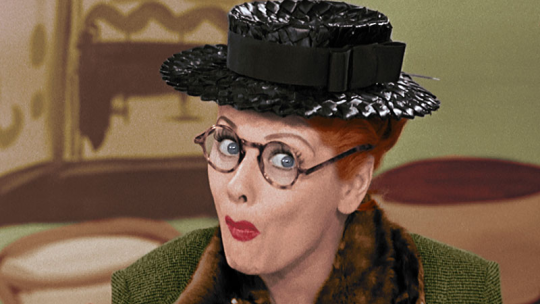
In the final live Jell-O commercial, Lucille Ball takes on the character of a famous lady novelist and Bob LeMond is her interviewer. Lucy adopts a nasal voice as Elizabeth Dopplefinger Hopenshmice. The voice is similar to the one she will do as Isabella Clump in “The Million Dollar Idea” (ILL S3;E13). Elizabeth says she first imagines a book cover and then writes a story around it. Bob LeMond says he would like to see a bowl of Jell-O on the cover of a book, but Elizabeth prefers a more romantic cover and kisses him. LeMond still wants Jell-O on the cover.

Bob LeMond reads the credits. There is a recorded message from Instant Sanka.
END EPISODE
-
THE FRENCH LESSONS
December 9, 1949

“The French Lessons” (aka “Eavesdropping on French Lessons”) is episode #66 of the radio series MY FAVORITE HUSBAND broadcast on December 9, 1949.
Synopsis ~ Liz and Iris are humiliated when they can’t read the menu at a French restaurant, so they decide to take French lessons. The lessons lead to the prospect of a duel between her favorite husband George and her amorous French teacher.
This was the 15th episode of the second season of MY FAVORITE HUSBAND. There were 43 new episodes, with the season ending on June 25, 1950.

Note: This program was the basis for the “I Love Lucy” episodes “The Adagio” (ILL S1;E12), filmed on November 23, 1951 and aired on New Year’s Eve 1951, as well as “The French Revue” (ILL S3;E7), filmed on October 15, 1953 and aired a month later.

“My Favorite Husband” was based on the novels Mr. and Mrs. Cugat, the Record of a Happy Marriage (1940) and Outside Eden (1945) by Isabel Scott Rorick, which had previously been adapted into the film Are Husbands Necessary? (1942). “My Favorite Husband” was first broadcast as a one-time special on July 5, 1948. Lucille Ball and Lee Bowman played the characters of Liz and George Cugat, and a positive response to this broadcast convinced CBS to launch “My Favorite Husband” as a series. Bowman was not available Richard Denning was cast as George. On January 7, 1949, confusion with bandleader Xavier Cugat prompted a name change to Cooper. On this same episode Jell-O became its sponsor. A total of 124 episodes of the program aired from July 23, 1948 through March 31, 1951. After about ten episodes had been written, writers Fox and Davenport departed and three new writers took over – Bob Carroll, Jr., Madelyn Pugh, and head writer/producer Jess Oppenheimer. In March 1949 Gale Gordon took over the existing role of George’s boss, Rudolph Atterbury, and Bea Benaderet was added as his wife, Iris. CBS brought “My Favorite Husband” to television in 1953, starring Joan Caulfield and Barry Nelson as Liz and George Cooper. The television version ran two-and-a-half seasons, from September 1953 through December 1955, running concurrently with “I Love Lucy.” It was produced live at CBS Television City for most of its run, until switching to film for a truncated third season filmed (ironically) at Desilu and recasting Liz Cooper with Vanessa Brown.
MAIN CAST

Lucille Ball (Liz Cooper) was born on August 6, 1911 in Jamestown, New York. She began her screen career in 1933 and was known in Hollywood as ‘Queen of the B’s’ due to her many appearances in ‘B’ movies. With Richard Denning, she starred in a radio program titled “My Favorite Husband” which eventually led to the creation of “I Love Lucy,” a television situation comedy in which she co-starred with her real-life husband, Latin bandleader Desi Arnaz. The program was phenomenally successful, allowing the couple to purchase what was once RKO Studios, re-naming it Desilu. When the show ended in 1960 (in an hour-long format known as “The Lucy-Desi Comedy Hour”) so did Lucy and Desi’s marriage. In 1962, hoping to keep Desilu financially solvent, Lucy returned to the sitcom format with “The Lucy Show,” which lasted six seasons. She followed that with a similar sitcom “Here’s Lucy” co-starring with her real-life children, Lucie and Desi Jr., as well as Gale Gordon, who had joined the cast of “The Lucy Show” during season two. Before her death in 1989, Lucy made one more attempt at a sitcom with “Life With Lucy,” also with Gordon.
Richard Denning (George Cooper) was born Louis Albert Heindrich Denninger Jr., in Poughkeepsie, New York. When he was 18 months old, his family moved to Los Angeles. Plans called for him to take over his father’s garment manufacturing business, but he developed an interest in acting. Denning enlisted in the US Navy during World War II. He is best known for his roles in various science fiction and horror films of the 1950s. Although he teamed with Lucille Ball on radio in “My Favorite Husband,” the two never acted together on screen. While “I Love Lucy” was on the air, he was seen on another CBS TV series, “Mr. & Mrs. North.” From 1968 to 1980 he played the Governor on “Hawaii 5-0″, his final role. He died in 1998 at age 84.
Gale Gordon (Rudolph Atterbury) had worked with Lucille Ball on “The Wonder Show” on radio in 1938. One of the front-runners to play Fred Mertz on “I Love Lucy,” he eventually played Alvin Littlefield, owner of the Tropicana, during two episodes in 1952. After playing a Judge in an episode of “The Lucy-Desi Comedy Hour” in 1958, he would re-team with Lucy for all of her subsequent series’: as Theodore J. Mooney in ”The Lucy Show”; as Harrison Otis Carter in “Here’s Lucy”; and as Curtis McGibbon on “Life with Lucy.” Gordon died in 1995 at the age of 89.
Bea Benadaret (Iris Atterbury) was considered the front-runner to be cast as Ethel Mertz but when “I Love Lucy” was ready to start production she was already playing a similar role on TV’s “The George Burns and Gracie Allen Show” so Vivian Vance was cast instead. On “I Love Lucy” she was cast as Lucy Ricardo’s spinster neighbor, Miss Lewis, in “Lucy Plays Cupid” (ILL S1;E15) in early 1952. Later, she was a success in her own show, “Petticoat Junction” as Shady Rest Hotel proprietress Kate Bradley. She starred in the series until her death in 1968.
Ruth Perrott (Katie, the Maid) was also later seen on “I Love Lucy.” She first played Mrs. Pomerantz, a member of the surprise investigating committee for the Society Matrons League in “Pioneer Women” (ILL S1;E25), as one of the member of the Wednesday Afternoon Fine Arts League in “Lucy and Ethel Buy the Same Dress” (ILL S3;E3), and also played a nurse when “Lucy Goes to the Hospital” (ILL S2;E16). She died in 1996 at the age of 96.
Bob LeMond (Announcer) also served as the announcer for the pilot episode of “I Love Lucy”. When the long-lost pilot was finally discovered in 1990, a few moments of the opening narration were damaged and lost, so LeMond – fifty years later – recreated the narration for the CBS special and subsequent DVD release.
GUEST CAST

Hal March (Waiter) first appeared on the "I Love Lucy” in “Lucy Fakes Illness” (ILL S1;E16) using his own name to play an actor posing as the doctor who diagnoses Lucy with ‘golbloots.’ March got his first big break when he was cast as Harry Morton on “The George Burns and Gracie Allen Show” in 1950. He eventually lost the part to Fred Clark who producers felt was better paired with Bea Benaderet, who played Blanche, and here plays Iris Atterbury. He stayed with the show in other roles, the last airing just two weeks before his appearance as Eddie Grant in “Lucy is Matchmaker” (ILL S2;E27). In 1966 he was seen on “The Lucy Show.”

Rolfe Sedan (Jacques Duval, the French Teacher) first worked with Lucille Ball in the 1934 film Kid Millions. When Lucy Ricardo ate snails in “Paris at Last” (ILL S5;E18), Sedan played the French Chef who was outraged that Lucy wants to put ketchup on his food. He is probably best remembered as Mr. Beasley the mailman on “The George Burns and Gracie Allen Show.”
THE EPISODE
ANNOUNCER: “Tonight is a big social event in Sheridan Falls. A very swanky new French café is opening, with admittance by invitation only. The Coopers are dressing in their best formal clothes…”
George is having trouble with his collar button and they are due to meet the Atterbury’s for dinner at 8pm. Liz worries that they will not be able to read the menu if it is in French, so they plan to let the Atterburys order first and then order the same thing.

At the restaurant, Rudolph and Iris are waiting for the Coopers to arrive. Like George, Rudolph is also having trouble with a tight-fitting collar. Iris has spotted the menu and it is indeed all in French. They decide to let the Coopers order first and order whatever they decide upon.

The waiter (Hal March) arrives to take their order. Both the Atterburys and the Coopers hedge about who will order first. Doing ‘one potato / two potato’ in French, the waiter determines that Liz will be the first to order. She randomly points to something on the menu and, despite his attempted protestations, insists that he serve it!
WAITER: “Very well, Madam. Four orders of ‘closed on Mondays’.”
In TV’s "The French Revue” (ILL S3;E7), the waiter was played by Alberto Morin. Instead of ordering ‘closed on Mondays’, Lucy Ricardo orders ‘closed on Sundays.’ “I Love Lucy” aired on Monday nights and at the height of its success, business would sometimes close on Mondays due to everyone staying home to watch television!
The next day, Liz confesses to Katie the Maid that they couldn’t read the menu, so they hired a French tutor, who is first going to the Atterbury home, then to the Coopers’. Iris telephones to try out some of her newly learned French words. Iris reports that the teacher is a 31 year old bachelor.
The doorbell rings and it is Jacques Duval (Rolfe Sedan), the French Teacher. Instead of working at the dining room table, Duval insists that they sit together on the sofa – close. When Liz insists she is happily married, Jacques is unfazed and asks her to sit even closer.

Oops! Lucille Ball makes a tiny dialogue error when she says “My husband and I treat each other and trust each other implicitly.” She was probably not supposed to say “treat” but continues uninterrupted.

Duval teacher her the French words for pencil (le crayon) and pen (la plume).
LIZ: “Suppose I go to a restaurant and they aren’t serving pens and pencils?”
Liz repeats back a couple of standard French phrases and is duly impressed with herself.
LIZ: “I’m a regular parasite!”
Liz is mistaking ‘Paris-ite’ (a resident of Paris), for its homonym ‘parasite’ (an organism that thrives of the blood of another). The more usual word for a resident of the French capitol would be ‘Parisian.’
Next day, Liz is happily singing “The Last Time I Saw Paris” while she dials Iris.

“The Last Time I Saw Paris” was composed by Jerome Kern, with lyrics by Oscar Hammerstein II, published in 1940. It was sung in the 1941 film Lady Be Good by Ann Sothern and won the 1941 Oscar for Best song. Kate Smith had a top ten hit with the song in 1940 and Dinah Shore sang it in the 1946 film Till The Clouds Roll By.
Liz and Iris exchange pleasantries in French, before Liz reveals that she was flattered that Duval made advances – until she naturally said no. It turns out he did no such thing with Iris, much to her dismay!
At the bank, Rudolph and George are talking about their wives’ French lessons and how the teacher has a reputation as a cad. George immediately wonders if he flirted with Liz.
MR. ATTERBURY: “If a man will pass up Marjorie Main, he doesn’t pass up Betty Grable.”

Mr. Atterbury is comparing his wife Iris to 59 year-old character actress Marjorie Main and Liz Cooper to sexy pin-up girl Betty Grable. Main would star with Lucille Ball in the 1953 film The Long, Long Trailer. Grable would guest-star on a 1958 episode of “The Lucy-Desi Comedy Hour.” At the time of broadcast, Grable was on screens in The Beautiful Blonde of Bashful Bend while Main was seen in Feudin’, Fussin’ and A-Fightin’.
At the Cooper home, Jacques Duval is giving Liz another French lesson. She is having great trouble with the masculine and feminine of the language.
DUVAL: “With French, everything is either masculine or feminine. You Americans don’t have that.”
LIZ: “How long you been in this country, Jack?”
Meanwhile, George and Mr. Atterbury sneak into the house to spy on Liz and Duval. The listen at the kitchen door. George mistakes “Comment allez-vouz” (”How are you”) for “come out to the alley” and bursts into the room indignantly. Duval is offended at George’s assumption of impropriety and challenges him to a duel! The duel is set for tomorrow morning at dawn in the cemetery.
Later, Duval calls and Liz answers. He wants to back out of the duel, frightened of the outcome. Liz tells him she will tell George it is off, but decides to hold off until he is at the cemetery, just to teach him a lesson for not trusting her.
At the cemetery it is cold, dismal and foggy morning. George wonders why Duval picked the cemetery.
LIZ: “It saves time. It eliminates the middle man. I only hope my second husband has your courage.”
Liz spots a crowd of people including some photographers. It is Mr. Atterbury looking to get some publicity for the bank! Duval has turned up after all, and Liz is alarmed. Duval only came to get some publicity for his French classes.

Liz secretly instructs both men to shoot high over each others’ heads. While still pacing away there is a loud bang and both men drop to the ground! Mr. Atterbury wonders how they got shot since he loaded the guns with blanks!
LIZ: “Nobody got shot! A photographer dropped a flashbulb and they both fainted!”
END OF EPISODE
-
GLADYS HURLBUT
December 9, 1898

Gladys Hurlbut was an actress born in Dresden, a city in the Finger Lakes Region of Upstate New York, although some sources report that she was born in Norwich, Connecticut. She began her acting career on Broadway in 1920 and appeared in seven plays through 1949. As a playwright, she wrote three plays produced on Broadway, the last of which featured Elizabeth Patterson (Lucy’s Mrs. Trumbull) and K.T. Stevens (Lucy’s Mrs. O’Brien). She also collaborated with Pulitzer Prize-winner Josh Logan and Tony-winning director George Abbott to write the books of two musicals.

Hurlbut’s final Broadway play was the 1949 sequel to Life With Father, titled Life With Mother, which failed to equal the phenomenal success of the original.

In 1951, Hurlbut did her first screen role, playing Mrs. Conger in The Mating Season. In 1953 she made her television debut on “The Chevron Theatre” in “The Worried Man.”

In 1954 Hurlbut worked with Lucille Ball and Desi Arnaz playing Mrs. Bolton in The Long, Long Trailer.

From 1954 to 1956 she played Mrs. Harriet Conroy for three out of four appearances on the NBC sitcom “It’s A Great Life”. She shared the screen with Francis Bavier, Joseph Kearns, Gail Bonney, and Madge Blake.

In 1957, she returned to Broadway – but this time as an audience member on “I Love Lucy” in “Lucy’s Night in Town” (ILL S6;E22),
first aired on March 25, 1957 and filmed on February 21, 1957. Hurlbut plays the woman at The Most Happy Fella whose purse Lucy mistakes for Ethel’s.

Hurlbut returned to Desilu to portray Mayberry moonshiner Clarabelle Morrison (left) in “The Andy Griffith Show” episode “Alcohol and Old Lace”. Charity Grace (right) played her sister Jennifer in a story that foreshadowed the Baldwin Sisters on TV’s “The Waltons” (1972-81). The title of the episode was taken from the title of the 1939 play and 1944 Frank Capra film comedy Arsenic and Old Lace which featured two elderly sisters who poisoned people using arsenic-laced elderberry wine.

Her final screen role was making three appearances on Desilu’s “The Ann Sothern Show” from 1960 to 1961. She played Mrs. Gray opposite Louis Nye as her husband Delbart. In 1959, Lucille Ball guest-starred on the series as Lucy Ricardo.
Hurlbut was married to Charles DelaVergne. She died on January 25, 1988 in Woodstock, New York, at age 89.
-
THREE LITTLE PIGSKINS
December 8, 1934

Three Little Pigskins is a 1934 Columbia Pictures short subject directed by Raymond McCarey and starring slapstick comedy team The Three Stooges. It is the fourth entry in the series starring the comedians, who released 190 short films for the studio between 1934 and 1959.
Synopsis ~ Moe, Larry and Curly are hired to promote a university football team. They’re soon mistaken for the school’s famous star athletes, “The Three Horsemen.” As the star athletes, they are hired by a gangster to secretly play on his professional team, but of course the boys know nothing about football.

PRINCIPAL CAST

The Three Stooges were an American vaudeville and comedy team active from 1922 until 1970. Their hallmark was physical farce and slapstick. Six Stooges appeared over the act’s run with only three active at any given time. In this film they are:
- Moe Howard (Moe) born Moses Horwitz in 1897. Died 1975.
- Larry Fine (Larry) born Larry Feinberg in 1902. Died 1975.
- Curly Howard (Curly) born Jerome Horwitz in 1903, Moe’s younger brother. Died in 1952.
This short film is the only time the three worked with Lucille Ball.

Lucille Ball (Daisy Simms). This is Ball’s 17th film to be released since 1933. It is her 13th in 1934 alone.
Gertie Green (Lulu Banks) makes the third of her four screen appearances.
Phyllis Crane (Molly Gray) was also seen with Lucille Ball in Broadway Bill and Men of the Night, both in 1934.
UNCREDITED CAST (in alphabetical order)

Harry Bowen (Boulder Dam PR Man) also appeared with Lucille Ball in The Whole Town’s Talking (1935) and Dummy Ache (1936).
Lynton Brent (1st Man Panhandled by Moe) appeared with Lucille Ball in seven other films between 1934 and 1939.
Bobby Burns (Man Panhandled by Larry) also appeared with Lucille Ball and Harry Bowen in Dummy Ache (1936).
Charles Dorety (2nd Photographer) also appeared with Lucille Ball in His Old Flame (1935).
Milton Douglas (Henchman) makes his only appearance with Lucille Ball.
Oscar ‘Dutch’ Hendrian (Referee) did five other films with Lucille Ball between 1934 and 1935.
William J. Irving (1st Photographer) did five other films with Lucille Ball between 1933 and 1935.
Johnny Kascier (Man Panhandled by Curly) makes his only appearance with Lucille Ball.
Walter Long (Joe Stacks)
also appeared with Lucille Ball in The Whole Town’s Talking (1935).
Roger Moore (Pete, Joe’s Henchman) also appeared with Lucille Ball in Meet the People (1944) and The Fuller Brush Girl (1950).
The role of Joe is sometimes attributed to Joseph Young.
Jimmy Phillips
(2nd Man Panhandled by Moe) also appeared with Lucille Ball in The Whole Town’s Talking (1935)
Larry Wheat
(3rd Man Panhandled by Moe) appeared with Lucille Ball in Thousands Cheer (1943).
PIGSKIN TRIVIA

Three Little Pigskins was filmed from October 25 to 30, 1934 in and around Los Angeles.

The film’s title is a multiple pun, derived from the children’s nursery rhyme the Three Little Pigs, along with ‘pigskin’ being a synonym for a football.

In 1924, Mermaid Comedies produced Pigskin, starring silent comedy short starring Lige Conley.

In 1936 a film titled Pigskin Parade premiered earning its leading man an Oscar nomination.

The second half of the film was shot at Gilmore Stadium, and its name on the scoreboard appears in several shots. The Los Angeles stadium was newly built in 1934 and had a seating capacity of 18,000. The football team the Stooges play against was from Loyola Marymount University, a regular tenant of Gilmore Stadium.
The Cubs on the scoreboard refers to the Westwood Cubs, who had played at the stadium on the October 28, 1934. The Tigers refers to the Occidental Tigers, a college team from Los Angeles. Neither team appears in the film.

Coincidentally, the stadium was demolished in 1952 to make way for CBS Television City, a production facility that was opened by Lucille Ball as the network’s reigning star, although “I Love Lucy” never filmed there. One of their major tenants was the Hollywood Stars Baseball team, which Fred Mertz mentions during “In Palm Springs” (ILL S4;E26) in March 1955.

There is also a shot that includes a billboard for Gilmore Oil, including its trademark symbol, a red lion.
The Gilmore Oil Company was an independent oil company in California founded by Arthur Fremont Gilmore, whom the stadium was named for. At its peak, they operated over three thousand gas stations on the West Coast. In the 1940s, the company was acquired and then merged into a group which eventually became Mobil.

The address 6317 Yucca Street on the poster behind Curly and Moe was the actual location of filming. Coincidentally, it is about a quarter mile from the Stooges’ Star on the Hollywood Walk of Fame. the location is now the Los Angeles campus of The American Musical and Dramatic Academy (AMDA).

Boulder Dam College is a fictional school. Boulder Dam is located in Clark County, Nevada and was under construction at the time of filming. It named Boulder Dam in 1933 and dedicated in 1935 and opened in 1936. It was renamed Hoover Dam in 1946.

Beyond the stadium can be glimpsed the Fairfax Theatre sign. The Fairfax Theatre opened in 1930 as part of a larger retail complex. The theatre was ‘triplexed’ in the 1980s but closed for good in 2010 after roof damage from heavy rains. The owner was unwilling to make repairs although the façade still remains.

Later in her career, Lucille Ball (apparently referring to the seltzer squirting scene) would remark,
“The only thing I learned from The Three Stooges was how to duck. I still got wet!”

While Lucille Ball was filming Three Little Pigskins, The Affairs of Cellini, in which she played an uncredited lady in waiting, was in wide release, having premiered in late August 1934.

Moe Howard once called Three Little Pigskins “a humdinger of bangs and bruises,” as it marked the first time the Stooges flatly refused to perform a stunt. In the film, during the game the boys are stopped by photographers to pose for a picture, when the football players then tackle them. The team consisted of genuine college football players, and the Stooges were afraid of being hurt. Larry Fine, the smallest and lightest of the three, told director Raymond McCarey, “We’ve never used stunt doubles before but we certainly need them now.“

The fact that both Curly and Larry had been hurt a few days earlier (Curly broke his leg riding down the dumbwaiter and Larry lost a tooth due to a mistimed punch) reinforced the trio’s decision to opt out of the scene.
Less than an hour after the exchange, the studio found three stunt doubles made up to look like the Stooges. Two of the three were seriously injured as were all four photographers.

A planned concluding scene had the Stooges, years later, telling the story to their sons. It is unknown if this scene was ever filmed, but publicity photos exist of the Stooges, each with a young actor, all made up and dressed to resemble their older counterparts.

In 1996, Exclusive Premiere created limited edition action figures of the Stooges in costumes from the film.
PIGSKIN PROGRESS

As a young model and actress, Lucille Ball didn’t just take film jobs. Here she poses with Billie Seward at Bovard Field in Los Angeles.

In 1949, Lucille Ball and Victor Mature starred in a film about a professional football player, Easy Living.

Ball’s radio show “My Favorite Husband” tackled gridiron gimmickry in 1950.
For a further look at Lucy and the Gridiron, click here!
-
SIR CEDRIC & JOHNSON GET ANSWERS ON LUCILLE’S DRESS
December 5, 1946

[This is syndicated columnist Erskine Johnson’s regular Hollywood column. The column was not always published on the same date in every newspaper. The column has been reprinted verbatim.]
Sir Cedric Hardwicke (1893-1964) was an English-born actor who had great success on stage and screen in England and the United States. At the time of this article, he had already been seen with Lucille Ball in 1942′s Valley of the Sun. During this interview, he was filming Lured (1947) which also featured Lucille Ball. The title was changed to “Personal Column” because staff at the Production Code Administration thought the word “lured” sounded too much like “lurid”. Director Douglas Sirk felt the title change confused potential audiences and led to the film’s box-office failure and the film eventually reverted to it’s original title.

by Erskine Johnson, Hollywood, Dec. 5 (NEA)
We were talking to Sir Cedric Hardwicke but looking at Miss Lucille Ball.
Lucille is much prettier than Hardwicke, and, what with the gown she was partially wearing for the movie “Personal Column,” it was very difficult not to look at her.
It was a very long dress from waist down, for it reached the floor. But from the waist up it was short so short that there was more of Lucille Ball showing than there was of her dress.
Anyhow, we were discussing the current inflation with Sir Cedric “I sometimes wonder,” he said, “how long it can keep up.”
“As long as the adhesive tape holds,” we suggested.
“Pardon?” said Sir Cedric. Then he noticed we were looking at Lucille Ball, and he turned to look at her, too.
“Anyway,” he said, “it can’t go on forever."
Then he took another quick look at Lucille. "Elastic, possibly,” he murmured. “Rubber elastic."
"Maybe spirit gum,” we ventured.
Down To Business
Lucille disappeared into her dressing room. We gave Sir Cedric our undivided attention.
“Who do you think is the best actor on the screen?"
Sir Cedric said that question was very difficult to answer. "I have my own opinion as to who are the top stage actors but it’s difficult to choose standards for judging a film actor. So many technical factors must be considered."
“Such as…?"
"The camera, lighting, the cutting room. About the time a film actor decides he has achieved quite a professional standing, along comes some actor even a child who has never acted before, and his simplicity and naturalness make the veteran look affected."
Lucille came out of her dressing room. "Celluloid, maybe,” Sir Cedric suggested, hopefully. “Or flesh-colored piano wire."
Lucille walked by. "Maybe it’s whale-bone,” we said.
“Could be,” replied Hardwicke. “Or just faith."
Sir Cedric Breaks Down
"Did you ever think you would like to direct a motion picture?” we asked.
“I wouldn’t mind if I didn’t have to be my own producer, too. I was one of the producers on a Hollywood made picture, but I was considerably handicapped in achieving the prestige our more prominent producers enjoy, ulcers, you know.”
"It was a humiliating experience. I didn’t dare show my face at Romanoff’s for weeks."
Lucille Ball walked by again, and this time she stopped.
"Do you mind if I ask you a question, Lucille?” said Sir Cedric, brashly. “We two have been wondering what is holding up your dress, and…“
"Oh, that’s easy,” said Lucille. “It’s concealed spring-steel wire.‘
She walked off, laughing. We blushed and looked at Sir Cedric. He was blushing, too, but much more than we were.
He has more to blush with having a very high forehead. It gets higher every year.

In the same newspaper, on the same page as Johnson’s column, was an ad for a cinemas showing a double feature including Cuban Pete, Desi Arnaz’s 1946 film. Lucy and Desi had just celebrated their sixth wedding anniversary.

This Arnaz double feature had its final screening on December 5, 1946, in a Michigan cinema. Ball’s The Dark Corner and Two Smart People had premiered earlier in the year and were still in cinemas nationwide.

Meanwhile, in a Hollywood newspaper on December 5, 1946, this made the news.

The INS (International News Service) fleshed out the item a bit, adding the name of her co-star and the nurse. Could it have been the same dress ogled by Hardwicke and Johnson?

While in the very same Hollywood newspaper on the very same date, this more lighthearted item about Lucy and the upcoming holiday.
-
BE YOUR HUSBAND’S BEST FRIEND
December 4, 1948

“Be Your Husband’s Best Friend” (aka “Be a Pal to Your Husband”) is episode #21 of the radio series MY FAVORITE HUSBAND broadcast on December 4, 1948.
Synopsis ~ Liz buys a book that says that the way to get along with your husband is to share all of his interests. With that in mind, she joins him in a poker game and tags along on a camping trip.
Note: This episode was aired before the characters names were changed from Cugat to Cooper. It was also before Jell-O came aboard to sponsor the show and before the regular cast featured Bea Benadaret and Gale Gordon as the Atterburys.

The script was also re-written as a 1950 episode of “My Favorite Husband” also titled “Be a Pal” and broadcast June 18, 1950. This was to account for the change in the characters surnames from Cugat to Cooper.

This program was also the basis for the “I Love Lucy” episode “Be a Pal” (ILL S1;E2) filmed on September 21, 1951 and first aired on October 22, 1951. The main difference is the radio versions do not include the famous Carmen Miranda lipsynch scene.

This radio version also contains story elements in its second half that were later incorporated into “The Camping Trip” (ILL S2;E29).

“My Favorite Husband” was based on the novels Mr. and Mrs. Cugat, the Record of a Happy Marriage (1940) and Outside Eden (1945) by Isabel Scott Rorick, which had previously been adapted into the film Are Husbands Necessary? (1942). “My Favorite Husband” was first broadcast as a one-time special on July 5, 1948. Lucille Ball and Lee Bowman played the characters of Liz and George Cugat, and a positive response to this broadcast convinced CBS to launch “My Favorite Husband” as a series. Bowman was not available Richard Denning was cast as George. On January 7, 1949, confusion with bandleader Xavier Cugat prompted a name change to Cooper. On this same episode Jell-O became its sponsor. A total of 124 episodes of the program aired from July 23, 1948 through March 31, 1951. After about ten episodes had been written, writers Fox and Davenport departed and three new writers took over – Bob Carroll, Jr., Madelyn Pugh, and head writer/producer Jess Oppenheimer. In March 1949 Gale Gordon took over the existing role of George’s boss, Rudolph Atterbury, and Bea Benaderet was added as his wife, Iris. CBS brought “My Favorite Husband” to television in 1953, starring Joan Caulfield and Barry Nelson as Liz and George Cooper. The television version ran two-and-a-half seasons, from September 1953 through December 1955, running concurrently with “I Love Lucy.” It was produced live at CBS Television City for most of its run, until switching to film for a truncated third season filmed (ironically) at Desilu and recasting Liz Cooper with Vanessa Brown.

MAIN CAST
Lucille Ball (Liz Cugat) was born on August 6, 1911 in Jamestown, New York. She began her screen career in 1933 and was known in Hollywood as ‘Queen of the B’s’ due to her many appearances in ‘B’ movies. “My Favorite Husband” eventually led to the creation of “I Love Lucy,” a television situation comedy in which she co-starred with her real-life husband, Latin bandleader Desi Arnaz. The program was phenomenally successful, allowing the couple to purchase what was once RKO Studios, re-naming it Desilu. When the show ended in 1960 (in an hour-long format known as “The Lucy-Desi Comedy Hour”) so did Lucy and Desi’s marriage. In 1962, hoping to keep Desilu financially solvent, Lucy returned to the sitcom format with “The Lucy Show,” which lasted six seasons. She followed that with a similar sitcom “Here’s Lucy” co-starring with her real-life children, Lucie and Desi Jr., as well as Gale Gordon, who had joined the cast of “The Lucy Show” during season two. Before her death in 1989, Lucy made one more attempt at a sitcom with “Life With Lucy,” also with Gordon.
Richard Denning (George Cugat) was born Louis Albert Heindrich Denninger Jr., in Poughkeepsie, New York. When he was 18 months old, his family moved to Los Angeles. Plans called for him to take over his father’s garment manufacturing business, but he developed an interest in acting. Denning enlisted in the US Navy during World War II. He is best known for his roles in various science fiction and horror films of the 1950s. Although he teamed with Lucille Ball on radio in “My Favorite Husband,” the two never acted together on screen. While “I Love Lucy” was on the air, he was seen on another CBS TV series, “Mr. & Mrs. North.” From 1968 to 1980 he played the Governor on “Hawaii 5-0″, his final role. He died in 1998 at age 84.
Ruth Perrott (Katie, the Maid) was also later seen on “I Love Lucy.” She first played Mrs. Pomerantz, a member of the surprise investigating committee for the Society Matrons League in “Pioneer Women” (ILL S1;E25), as one of the member of the Wednesday Afternoon Fine Arts League in “Lucy and Ethel Buy the Same Dress” (ILL S3;E3), and also played a nurse when “Lucy Goes to the Hospital” (ILL S2;E16). She died in 1996 at the age of 96.
In this episode we learn the names of all seven of Katie’s ex-husbands: Clarence, Peter, Harold, Oscar, Engelbert, and Yancy.
Bob LeMond (Announcer) also served as the announcer for the pilot episode of “I Love Lucy”. When the long-lost pilot was finally discovered in 1990, a few moments of the opening narration were damaged and lost, so LeMond – fifty years later – recreated the narration for the CBS special and subsequent DVD release.
GUEST CAST

Hans Conried (Professor Philpot Millmoss) first co-starred with Lucille Ball in The Big Street (1942). He then appeared on “I Love Lucy” as used furniture man Dan Jenkins in “Redecorating” (ILL S2;E8) and later that same season as Percy Livermore in “Lucy Hires an English Tutor” (ILL S2;E13) – both in 1952. The following year he began an association with Disney by voicing Captain Hook in Peter Pan. On “The Lucy Show” he played Professor Gitterman in “Lucy’s Barbershop Quartet” (TLS S1;E19) and in “Lucy Plays Cleopatra” (TLS S2;E1). He was probably best known as Uncle Tonoose on “Make Room for Daddy” starring Danny Thomas, which was filmed on the Desilu lot. He joined Thomas on a season 6 episode of “Here’s Lucy” in 1973. He died in 1982 at age 64.
Conried will recreate this role in 1950, when the script is rewritten for the Coopers as “Be A Pal.” The only difference is that his first name is Philip, not Philpot. On television, the author remains off screen throughout.

Joseph Kearns (Joe, Poker Player) appeared on “I Love Lucy” as the psychiatrist in “The Kleptomaniac” (ILL S1;E27) and later played the theatre manager in “Lucy’s Night in Town” (ILL S6;E22). His most famous role was as Mr. Wilson on TV’s “Dennis the Menace” (1959). When he passed away during the show’s final season, Lucy regular Gale Gordon took over for him, playing his brother.
In future iterations of this script, this character’s dialogue is assumed by Mr. Atterbury (Gale Gordon) and on TV by Fred Mertz (William Frawley).

John Hiestand (Cory Cartwright) served as the announcer for the radio show “Let George Do It” from 1946 to 1950. In 1955 he did an episode of “Our Miss Brooks” opposite Gale Gordon. Cory was a regular character who was eventually written out of the series when the Atterbury’s (Gale Gordon and Bea Bendaret) were introduced.

Jean Vander Pyl (Marge) is best known as the voice of Wilma Flintstone for the Hanna-Barbera cartoon “The Flintstones.” Coincidentally, Wilma’s best friend was voiced by Bea Benadaret, who will later play Iris Atterbury, Liz’s best friend on “My Favorite Husband.” On radio she was heard on such programs as “The Halls of Ivy” (1950–52) and on “Father Knows Best” before it moved to TV. She died in 1999 at age 79.
THE EPISODE
ANNOUNCER: “Let’s look in on the Cugats and see what they’re doing. Oh, but hold your hats. Liz and George are having an argument about their plans for their evening. Liz wants to go to a symphony concert and George wants to have a poker game! (As a fight announcer) And in this corner wearing a pink satin housecoat and weighing 120 pounds, ‘Battling Liz Cugat.’ And in this corner wearing a grey pinstripe suit and weighing 170 pounds is her husband ‘Gorgeous George’. Well, the first round ended in a draw and here comes the second round!”

‘Gorgeous George’ was the stage name of professional wrestler George Raymond Wagner (1915–63), so named because of his long, blonde hair. He was mentioned on “I Love Lucy” in “Pioneer Women” (ILL S1;E25) and “Ricky’s Movie Offer” (ILL S4;E6).
Liz and George lament that they argue so much since getting married. George wonders why men have to wear formal clothes to a concert.
LIZ: “Because when they fall asleep the stiff shirt keeps them from falling over.”

In “Lucy the Music Lover” (TLS S1;E8) it was Lucy Carmichael, not her tuxedo-clad date, that fell asleep during a classical music concert. At least she didn’t drop her opera glasses!
Liz turns on the waterworks, but George still refuses to go to the concert.
GEORGE: “And I hope Leopold falls flat on his Stokowski!”

Leopold Stokowski (1882-1977) was one of the leading conductors of the early and mid-20th century, he is best known for his long association with the Philadelphia Orchestra and his appearance in Disney’s Fantasia (1940) with that orchestra.
Liz tells Katie the Maid she will be going to a woman’s club luncheon to hear a talk about marriage. Katie tells her that she has been married six times: Peter, Harold, Oscar, Engelbert, and Yancy, which she remembers because it spells out ‘P.H.O.E.Y’. She’s intentionally left off her first husband Clarence because it wouldn’t spell ‘phoey’!

At their club luncheon, Liz and Marge (Jean Vander Pyl) listen to a guest speaker talk about “How To Be Happy, Though Married”. Professor Philpot Millmoss (Hans Conried) suggests the ladies be a pal to their husbands. Liz wonders why it has to be the woman who gives in – but Millmoss tells her to consult his new book on sale at the door for seventy nine cents.
Note: In the 1950 revision, Marge was replaced with Iris (Bea Benadaret), but the author was still played by Hans Conried. In the television version, the author remains off screen and Ethel Mertz (Vivian Vance) takes the Marge / Iris lines.
Liz resolves to employ the “Be A Pal Treatment” with George and sits beside him to read the evening newspaper. Liz pretends to be interested in the sports section.

LIZ (reading): “Williams Bags Crown By TKO in eighth.″
Liz pronounces TKO phonetically as ‘Tuh-Ko” although George corrects her. The exchange was repeated verbatim between Lucy and Ricky in “The Camping Trip.”
LIZ (reading): “Midget Racing! They oughta be ashamed making those little men run around the track.”
George sarcastically calls Liz Ted Husing, and then Red Barbar.

Ted Husing (1901-62) was one of CBS Radio’s most popular sportscasters. By 1950 his salary was an astronomical million dollars! Red Barber (1908-92) was a play-by-play announcer for major league baseball, then announcing for the Brooklyn Dodgers and holding down his own CBS TV sports show “Red Barber’s Club House.”
LIZ (reading): “They’re racing little girls! It says so right here,‘Yesterday at Tanforan a race was won by a three year-old maiden!’ She certainly was carrying a lot of money for a little girl. She had $2,000 in her purse.”

The line is virtually identical on television, except that Tanforan (a horse racetrack outside San Francisco) was changed to the more familiar Churchill Downs.

George / Ricky then refers to Liz / Lucy as Grantland Rice (1880–1954), a sportswriter known for his elegant prose, although the reference was removed for TV syndication when Rice died in 1954. It was restored for the DVD release. Clueless Liz / Lucy think he is a food!
Liz is determined to join in the poker game that evening, despite not knowing anything about the card game. Lucy also tried this tactic in the television version of “Be A Pal”.
The other poker players are Joe (Joseph Kearns) and Cory Cartwright (John Hiestand), George’s bachelor friend.

In the 1950 radio re-write, Joe was voiced by Hans Conried (doubling with Millmoss) and Gale Gordon as Mr. Atterbury, a role previously played in earlier episodes by Hans Conried. On television, the poker players were Fred Mertz (William Frawley), Hank (Richard Reeves, left) and Charlie (Tony Michaels, right).
LIZ CUGAT / LIZ COOPER / LUCY RICARDO (looking over her cards): “There’s her sister! What do you have?”
JOE / MR. ATTERBURY / FRED: “I shouldn’t talk, but tell your two Andrews Sisters not to wait up for LaVerne!”

The Andrews Sisters were a close-harmony singing group most popular during World War II. In 1969 Lucy played LaVerne Andrews on an episode of “Here’s Lucy” that guest-starred Patty Andrews as herself. Lucie Arnaz took the role of the third Andrews sister, Maxene.
A few days later, George confides in Cory that Liz has been driving him crazy by sticking to his side like glue, trying to be interested in everything that he is. George decides to go away on a camping trip to get away from her for a while. Cory suggests that George take Liz with him and make the trip so rigorous that she will regret trying to ‘be a pal’.

At the end of Act One, there is a public service announcement about NATO – the newly-formed North Atlantic Treaty Organization.
Katie warns Liz about her husband’s plan, having overheard George and Cory talking. Liz spills the beans to Cory and blackmails him to turn the tables on George at the campsite.
Liz and George engage in a fishing contest, just like Lucy and Ricky in
“The Camping Trip”. When Liz pretends to know all about fishing, George calls her sarcastically dubs her Izaak Walton.

Izaak Walton (1594-1683) was an English writer known for The Compleat Angler (1653), a famous prose and poetry celebration of fishing. His name was mentioned by Mr. Mooney before ‘fishing’ for Viv’s glasses in “The Loophole in the Lease” (TLS S2;E12) in 1963.
Once George is out of sight, Cory arrives with some store-bought fish to fool George.

LIZ: “Throw them to me, Cory. That way I can tell George I caught ‘em.”
George and Liz decide to bet on who can hike back to the campsite fastest. Luckily, Liz has Cory waiting in a car to assure that she wins!

Back at camp, Liz is patiently waiting for George, who trudges in weary and parched. Liz confesses that she got back so early she had time to wash her hair so there is no water.
Next morning Liz and Cory conspire to make George think she’s an expert duck hunter and sharp-shooter! Liz takes aim at the tree, and on cue Cory tosses a duck at her feet.

GEORGE: “I don’t get it. Liz. First you catch a Lake Trout in a stream, now you shoot a duck marked Birds Eye Frozen Foods!”

In the early 1900s, Clarence Frank Birdseye II of Montclair, New Jersey, received patents for the development of improved methods to freeze fish for commercial production. In 1922, he formed a company, Birdseye Seafood, Inc., Birdseye created a new company, General Seafood Corporation, to promote this method. In 1929, Birdseye sold his company and patents for $22 million to General Foods Corporation which founded the Birds Eye Frozen Food Company. Although primarily marketing frozen vegetables, they have occasionally sold other foods as well.

A target practice ensues where a discretely hidden away Cory clangs an anvil every time Liz shoots at a distant horseshoe. A suspicious George gets wise to Cory and Liz’s scheme and trains his rifle on on the tree. A frightened Cory comes down but all ends happily.

LIZ (to George): “Let’s not be pals or companions. Let’s not be even be friends anymore. Let’s just go back to being man and wife.”
In the bedtime tag, Liz tries to wake a sleeping George. She sees a note pinned to his chest that says:
DEAR PAL. YES, I AM ASLEEP. I TOOK A SLEEPING PILL TO MAKE SURE OF IT. GOOD NIGHT.
LIZ: “Aww…isn’t he cute? Goodnight, George.”
1948, Be A Pal, Birds Eye Frozen Foods, Birdseye, Bob LeMond, CBS Radio, Clarence Birdseye, Desi Arnaz, Duck Hunting, Gorgeous George, Grantland Rice, Hans Conried, I love lucy, Izaak Walton, Jean Vander Pyl, John Hiestand, Joseph Kearns, Leopold Stokowski, Lucille Ball, My Favorite Husband, NATO, Radio, Red Barber, Richard Denning, Richard Reeves, Ruth Perrott, Tanforan, Ted Husing, The Andrews Sisters, The Camping Trip -
Lucille Ball Reaches Top After Battle For Stardom
December 4, 1953


When you see Lucille Ball cavorting about the Ricardo apartment in the CBS Television “I Love Lucy” series, you can rest assured that he expert comedienne is giving her all to the role of Lucy Ricardo.
It is doubtful, in fact, that there is another TV trouper who gives as much of her physical and mental energies as does Lucille to the preparation of a comedy show. She gears herself up for each performance, works like a demon, and has been known to faint dead away after the director called ‘cut’ for the final scene.
Being “on the ball” is no novelty to Lucille. At the beginning of her theatrical career in the role of a Broadway model she almost lost her life in an automobile accident, and was told that she would never walk again. It took her eight months in bed and three years of persistent effort to reverse the doctor’s gloomy prediction. And from then on, her luck changed and she skyrocketed to the show business goal on which he’d set her eye since childhood.
Lucille and Desi Arnaz were married in 1940, and it was 10 years later, when they were touring the country with comedy act, that she got word of an impending visit from the stork. It was also at this time that they made the audition program for “I Love Lucy,” which was promptly sold, and made its debut Oct. 15. 1951.
The daughter, Lucie Desiree Arnaz. was born July 17, 1951. And it is well known that a second child was on its way in the fall of 1952 when Lucille was doing ‘enceinte" scenes for the TV show. And the newspapers made much of the fact that Desiderio Alberto Arnaz IV arrived January 19, 1953 on a TV show day which presented the birth of the Ricardo’s baby boy as the theme of script.
Born in Jamestown, N.Y., August 6, the daughter of Fred and Desiree Ball, mining engineer and concert pianist respectively, Lucille was taken at the age of two to Wyandotte, Mich., and then to Jamestown, N.Y. Mrs. Ball started her daughter’s music lessons at the age of five, then enrolled her in the Chautauqua Institute of Music for two seasons.
At 15, Lucille entered the John Murray Anderson dramatic school in New York and was told at the end of the first year of study, that she’d be better off applying her energies in some ether field. Determined to show her teacher that she could make good in show-business.
Miss Ball landed a chorus job in the third road company of Ziegfeld’s “Rio Rita” and lost the job after five weeks of rehearsal. Three other chorus jobs followed, none of which lasted beyond the rehearsal period. Her “first real job on Broadway” was as a soda jerk in a drug store.
A job as a $25-a-week model for a wholesale dress company led to a modelling job with Hattie Carnegie. Then came the tragic accident in Central Park, and three years and eight months of learning to walk again.
Back to work as a model, Lucille was featured in magazine and billboard cigarette advertisements, and Hollywood scouts brought her to the film capital for a showgirl role in Eddie Cantor’s “Roman Scandals.” Columbia Pictures gave her a contract as a stock player, and Lucille, convinced that her luck finally had turned, sent for her mother, grandfather and sister to join her in California. But it turned out to be just another stumbling block. The morning after she’d wired her family, the studio decided to dissolve its stock company.
When the family arrived, Lucille was working as an extra at Paramount. Bit parts and extra roles in a number of pictures kept Lucille busy but not prosperous, until she was cast in “Roberta.” RKO officials, impressed by her work, gave her a contract. When not busy before the cameras, she was a mainstay of the studio’s Little Theatre.
Her performance in the second lead in “The Girl from Paris” drew Broadway’s attention to Miss Ball, and she was offered a lead in the musical, “Hey Diddle, Diddle.” After satisfying her yen to perform on the Great White Way, “Stage Door” and “Too Many Girls.” In the latter picture, she was co-starred with Desi Arnaz. They were married Nov. 30, 1940, in Greenwich, Conn.
Back from her honeymoon, Lucille walked into her first really big break, a role in “The Big Street,” based on a story by Damon Runyon. Overnight, it made her a star. In it, she played a showgirl who was paralyzed from the hips down. Her own three-and-a-half years in a similar predicament enabled her to play the role so convincingly that she had every studio bidding for her services.
She signed with MGM on her birthday in 1942. Her first assignment at MGM was the title role in the Technicolor production, “Du Barry Was A Lady.” Stellar roles followed in “Best Foot Forward” and “Meet The People."
After completing "East To Wed” with Van Johnson, she headed for New York to be with her husband, then out of the Army and on his way to success in the orchestra business.
Shortly after completing “Her Husband’s Affairs,” Miss Ball went on tour as star of Elmer Rice’s play. “Dream Girl.” Between pictures and stage appearances, Lucille and her husband live at Desilu, their five-acre ranch at Northridge, some 30 miles from Hollywood.
Lucille, who is five feet, six inches tall and weighs 120 lbs. sleeps in a bed seven by seven feet. She likes spicy dishes and enjoys knocking around the house in dungarees.
In her role as Lucy Ricardo in “I Love Lucy,” she is starred as the feminine half of a closely-knit married couple. And that’s the role she plays in real life.
-
MARRYING OFF PEGGY MARTIN
December 2, 1950

“Marrying Off Peggy Martin” (aka “Trying To Marry Off Peggy Martin”) is episode #107 of the radio series MY FAVORITE HUSBAND broadcast on December 2, 1950.
This was the twelfth episode of the third season of MY FAVORITE HUSBAND. There were 31 new episodes, with the season ending on March 31, 1951.
Synopsis ~
Liz tries to play matchmaker for Peggy Martin with one of George’s clients, but both the client and George think that Liz is going after the guy for herself.

Note: This program was used as a basis for the “I Love Lucy” episode “Lucy Is Matchmaker” (ILL S3;E27), first aired on May 25, 1953. On television the names have been changed. Mr. Paxton becomes Eddie Grant and Peggy Martin becomes Sylvia Collins (who we never see). Fred Mertz takes the dialogue assigned to Mr. Atterbury and Ethel Mertz takes the lines previously assigned to Iris in the radio script.

“My Favorite Husband” was based on the novels Mr. and Mrs. Cugat, the Record of a Happy Marriage (1940) and Outside Eden (1945) by Isabel Scott Rorick, which had previously been adapted into the film Are Husbands Necessary? (1942). “My Favorite Husband” was first broadcast as a one-time special on July 5, 1948. Lucille Ball and Lee Bowman played the characters of Liz and George Cugat, and a positive response to this broadcast convinced CBS to launch “My Favorite Husband” as a series. Bowman was not available Richard Denning was cast as George. On January 7, 1949, confusion with bandleader Xavier Cugat prompted a name change to Cooper. On this same episode Jell-O became its sponsor. A total of 124 episodes of the program aired from July 23, 1948 through March 31, 1951. After about ten episodes had been written, writers Fox and Davenport departed and three new writers took over – Bob Carroll, Jr., Madelyn Pugh, and head writer/producer Jess Oppenheimer. In March 1949 Gale Gordon took over the existing role of George’s boss, Rudolph Atterbury, and Bea Benaderet was added as his wife, Iris. CBS brought “My Favorite Husband” to television in 1953, starring Joan Caulfield and Barry Nelson as Liz and George Cooper. The television version ran two-and-a-half seasons, from September 1953 through December 1955, running concurrently with “I Love Lucy.” It was produced live at CBS Television City for most of its run, until switching to film for a truncated third season filmed (ironically) at Desilu and recasting Liz Cooper with Vanessa Brown.
MAIN CAST

Lucille Ball (Liz Cooper) was born on August 6, 1911 in Jamestown, New York. She began her screen career in 1933 and was known in Hollywood as ‘Queen of the B’s’ due to her many appearances in ‘B’ movies. With Richard Denning, she starred in a radio program titled “My Favorite Husband” which eventually led to the creation of “I Love Lucy,” a television situation comedy in which she co-starred with her real-life husband, Latin bandleader Desi Arnaz. The program was phenomenally successful, allowing the couple to purchase what was once RKO Studios, re-naming it Desilu. When the show ended in 1960 (in an hour-long format known as “The Lucy-Desi Comedy Hour”) so did Lucy and Desi’s marriage. In 1962, hoping to keep Desilu financially solvent, Lucy returned to the sitcom format with “The Lucy Show,” which lasted six seasons. She followed that with a similar sitcom “Here’s Lucy” co-starring with her real-life children, Lucie and Desi Jr., as well as Gale Gordon, who had joined the cast of “The Lucy Show” during season two. Before her death in 1989, Lucy made one more attempt at a sitcom with “Life With Lucy,” also with Gordon.
Richard Denning (George Cooper) was born Louis Albert Heindrich Denninger Jr., in Poughkeepsie, New York. When he was 18 months old, his family moved to Los Angeles. Plans called for him to take over his father’s garment manufacturing business, but he developed an interest in acting. Denning enlisted in the US Navy during World War II. He is best known for his roles in various science fiction and horror films of the 1950s. Although he teamed with Lucille Ball on radio in “My Favorite Husband,” the two never acted together on screen. While “I Love Lucy” was on the air, he was seen on another CBS TV series, “Mr. & Mrs. North.” From 1968 to 1980 he played the Governor on “Hawaii 5-0″, his final role. He died in 1998 at age 84.
Gale Gordon (Rudolph Atterbury) had worked with Lucille Ball on “The Wonder Show” on radio in 1938. One of the front-runners to play Fred Mertz on “I Love Lucy,” he eventually played Alvin Littlefield, owner of the Tropicana, during two episodes in 1952. After playing a Judge in an episode of “The Lucy-Desi Comedy Hour” in 1958, he would re-team with Lucy for all of her subsequent series’: as Theodore J. Mooney in ”The Lucy Show”; as Harrison Otis Carter in “Here’s Lucy”; and as Curtis McGibbon on “Life with Lucy.” Gordon died in 1995 at the age of 89.
Bea Benadaret (Iris Atterbury) was considered the front-runner to be cast as Ethel Mertz but when “I Love Lucy” was ready to start production she was already playing a similar role on TV’s “The George Burns and Gracie Allen Show” so Vivian Vance was cast instead. On “I Love Lucy” she was cast as Lucy Ricardo’s spinster neighbor, Miss Lewis, in “Lucy Plays Cupid” (ILL S1;E15) in early 1952. Later, she was a success in her own show, “Petticoat Junction” as Shady Rest Hotel proprietress Kate Bradley. She starred in the series until her death in 1968.
Bob LeMond (Announcer) also served as the announcer for the pilot episode of “I Love Lucy”. When the long-lost pilot was finally discovered in 1990, a few moments of the opening narration were damaged and lost, so LeMond – fifty years later – recreated the narration for the CBS special and subsequent DVD release.
Ruth Perrott (Katie, the Maid) does not appear in this episode, although she is mentioned.
GUEST CAST

Hans Conried (Herb Paxton) first co-starred with Lucille Ball in The Big Street (1942). He then appeared on “I Love Lucy” as used furniture man Dan Jenkins in “Redecorating” (ILL S2;E8) and later that same season as Percy Livermore in “Lucy Hires an English Tutor” (ILL S2;E13) – both in 1952. The following year he began an association with Disney by voicing Captain Hook in Peter Pan. On “The Lucy Show” he played Professor Gitterman in “Lucy’s Barbershop Quartet” (TLS S1;E19) and in “Lucy Plays Cleopatra” (TLS S2;E1). He was probably best known as Uncle Tonoose on “Make Room for Daddy” starring Danny Thomas, which was filmed on the Desilu lot. He joined Thomas on a season 6 episode of “Here’s Lucy” in 1973. He died in 1982 at age 64.
Herb Paxton is an unmarried client of George’s looking to build a factory in Sheridan Falls. When the script was rewritten for television the character’s name was changed to Eddie Grant and the role was played by Hal March.

Sandra Gould (Marge, Bridge Player) is probably best remembered as the second actor to play Gladys Kravitz on “Bewitched” (1966-71). On “I Love Lucy,” she played Nancy Johnson in “Oil Wells” (ILL S3;E18) and makes a brief appearance as an alarmed strap-hanger in “Lucy and the Loving Cup” (ILL S6;E12). In 1962 she appeared in the fourth episode of “The Lucy Show” as a bank secretary.
In the television script, the character was changed to Caroline Appleby and played by Doris Singleton.
Leone Ledoux (Bridge Player) was a provider of baby crying sound effects for radio programs that including “The Lux Radio Theater” for CBS during the late 1930’s through the ‘40’s. Her one television credit was the sitcom “Happy” (1960-61).
In the television script, the character was changed to Pauline Lopus and played by Peggy Rhea.
THE EPISODE
ANNOUNCER: “As we look in on the Coopers, it’s afternoon, and we find Liz Cooper entertaining her Tuesday Bridge Club. Throughout the room there’s a quiet concentration on the cards…”
The girls are gabbing about Peggy Martin’s behavior at a recent dance and how their husband’s behaved in her presence.
MARGE: “What’s she got that we haven’t got?”
LIZ: “No husband.”They resolve to find Peggy Martin a husband.
On television, the bridge club will consist of Lucy, Ethel, Caroline Appleby (Doris Singleton) and Pauline Lopus (Peggy Rhea).
George comes home for dinner with an important client and a bachelor. George warns her “no matchmaking”! Liz wonders why a handsome, successful man like Mr. Paxton is unmarried.
The next day, Liz calls Iris to tell him about Mr. Paxton, the perfect man for Peggy Martin. Knowing that Paxton is staying at the Sheridan Arms Hotel, she decides to go down there and see him.

On television, the Sheridan Arms Hotel becomes The Sherry-Plaza. The name is a amalgamation of the real Sherry-Netherland and Plaza Hotels in New York City.
Mr. Paxton is happy to see Liz – a little too happy – thinking that she has come there for a romantic affair. Liz tries to avoid his advances. Liz explains about Peggy Martin, but Mr. Paxton thinks that SHE is Peggy Martin. Liz sets a date for Peggy and Paxton to meet at 5pm at the corner of Main and Elm and quickly leaves, her dignity intact!
At home, Liz calls Iris to tell her that Peggy can’t meet Paxton after all. Liz decides she will go to the corner of Main and Elm at 5 o’clock and tell him so herself.
At the bank, Mr. Atterbury is finishing a meeting with Mr. Paxton. Paxton confides that he has a hot date with a married woman who came to his hotel to ‘make a date for a friend’. Mr. Atterbury gives him directions to Main and Elm. After Paxton leaves, Mr. Atterbury phones George and tells him about Paxton’s date and they go off to spy on them and see who this married mystery woman really is!
Watching from the car, Mr. Atterbury and George see that it is Liz! George is furious! Liz sees them and comes over. George punches Mr. Paxton in the jaw.
On television, Lucy meets Eddie in the lobby of the hotel, which is where Ricky and Fred see them together.
Back at home, a teary-eyed Liz finishes telling George the whole story and vows never to be a matchmaker again. They kiss and make up.
On the phone with Iris, Liz tells her she’s through with meddling. Liz says that she’s just seen Peggy at the beauty parlor and that she’s anxious to meet Mr. Paxton. As Liz is the only one who knows him, she reluctantly agrees to make the introductions.

Liz and Iris go over to his hotel and knock on the door. Paxton quickly slams the door on her. Iris explains that all they wanted to do was set up a date between him and Peggy Martin. Since Peggy is in the lobby, he decides he will go down and meet her. In the meantime, he invites the girls to try on some of his negligee stock, which he will offer them wholesale.
George and Mr. Atterbury come to the hotel to apologize and go right up to Paxton’s room. Knocking on the door, they see Liz and Iris in the room wearing expensive negligees!
GEORGE: “Liz! You! Here! In a negligee! You must be out of your mind!”
MR. ATTERBURY: “Iris! You! Here! In a negligee! He must be out of his mind.”
On television, the joke is repeated verbatim (with the obvious exception of the different character names) and gets just as big an audience reaction as it does here on radio!
Liz tells the truth of what happened, but the men don’t believe a word of it, so Liz spins a more fanciful tale, intimating that they are absolutely having a fling! Just then the phone rings and it is Mr. Paxton, who says he will be having a drink with Peggy Martin in the lobby.
Liz demands an apology – and that they buy them the negligees, too!
END OF EPISODE
-
KEITH THIBODEAUX
December 1, 1950

Keith Thibodeaux (aka Richard Keith) was born on December 2, 1950, in Lafayette, Louisiana.
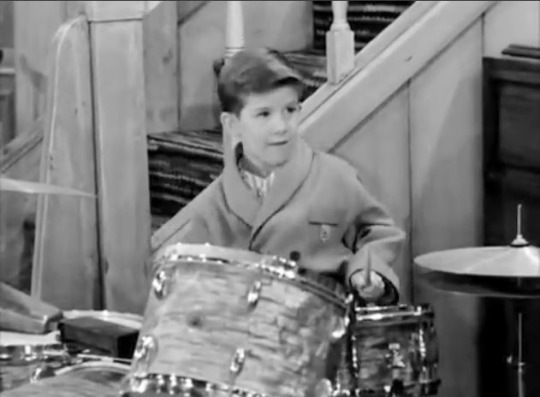
At the age of three he was making $500 a week touring as a drummer with the Horace Heidt Orchestra.

When he was five, his father took him to audition for the role of Little Ricky Ricardo on the hit sitcom “I Love Lucy”.

LUCILLE BALL: “Okay, he’s cute, but what does he do?”

Keith played the drums for the Arnaz’s and landed the job immediately.
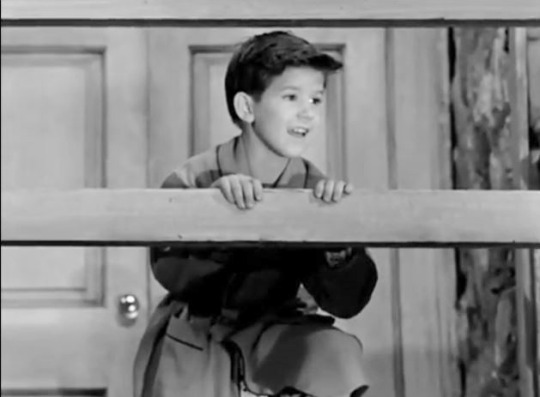
Fearing no one would be able to pronounce his Cajun last name, Desi Arnaz made his professional name Richard Keith, although it was never listed in the credits.

“I really think the person I identified with the most was Desi Arnaz because of his Latin culture; I was a Cajun from Louisiana and our cultures were very similar, and the fact that he was a percussionist and I was a percussionist, we had something in common. When he died I really took his death harder than anyone else’s.” ~ Keith Thibodeaux

When the half-hour series ended in 1957, Keith (as well as the rest of the main cast) was also seen in “The Lucy-Desi Comedy Hour”.

Despite being part of twelve of the thirteen episodes, he was simply billed simply as Little Ricky in the opening credits.

Sadly, although Little Ricky made the jump to the hour-long format, his dog Fred did not.
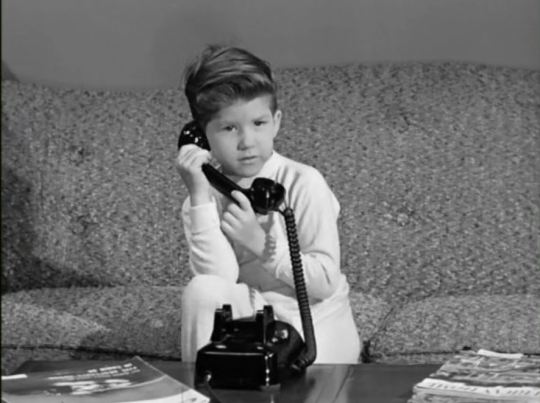
All together, Thibodeaux appeared in 24 of the 26 episodes of season six of “I Love Lucy” starting with “Lucy and Bob Hope” (ILL S6;E1) and finishing with “The Ricardos Dedicate a Statue” (ILL S6;E26).

At Desilu Thibodeaux got to work with such show business legends as Bob Hope, Orson Welles, George ‘Superman’ Reeves, Claude Akins, Hedda Hopper, Tallulah Bankhead, Danny Thomas, Betty Grable, Milton Berle, Fred MacMurray, Maurice Chevalier, and Ernie Kovacs, among others.

Thibodeaux was treated like a member of the family by Lucy and Desi, who welcomed someone they knew and trusted to be friend to Little Lucie and Desi Jr.

At the same time, Keith’s father was also employed by Desilu, causing some friction in the close working relationship between the Thibodeauxs and the Arnazes.

This closeness also contributed to confusion between Desi Arnaz Jr. and Keith Thibodeaux. Seeing Keith in Lucy’s company so often, people assumed he was her son, not an actor.

He does not appear in the season six episodes “Lucy Wants To Move To The Country” (ILL S6;E15) and “Visitor from Italy” (ILL S6;E5).

Thibodeaux was the 8th and last performer to play the role of Little Ricky. He was preceded by a newborn infant James Ganzer, the Simmons Twins, the Mayer Twins, and two uncredited and unidentified ‘dream’ Little Rickys featured in “Ricky’s Old Girlfriend” (ILL S3;E12).

He also appeared in the “I Love Lucy” Christmas Show in December 1956, which included both newly filmed footage and clips from previous episodes. After not being part of the syndication package, it was discovered and colorized for primetime holiday viewing in 1989 and has been repeated annually.

Although on screen Little Ricky got to travel to Miami Beach and Cuba, the episodes were all filmed on the Desilu soundstage in Hollywood.

In 1964, Thibodeaux appeared for a split second in an episode of “The Lucy Show” titled “Lucy is a Process Server” (TLS S2;E27). Initially he was featured in a comedic sequence at a train station in which a vending machine malfunctions. However, the scene was cut when the show ran too long. After the episode was edited, Thibodeaux is only seen for a moment, entering the station. Nevertheless, Thibodeaux remained in the credits listed as Richard Keith, the actor who played “Little Boy.”

It is possible that his very brief wordless cameo on this episode of “The Lucy Show” was timed to capitalize on him being on the Desilu lot to film “The Andy Griffith Show.” CBS broadcast repeats of “The Lucy Show” on April 6 and April 13, 1964. Coincidentally, on April 6 “The Andy Griffith Show” (which followed Lucy on CBS) broadcast an episode that starred Richard Keith (aka Little Ricky) as Opie’s pal Johnny Paul Jason.

After his parents separated in 1966, Keith, his mother, and siblings moved back to Louisiana where he graduated from Lafayette High School. He left Louisiana for Mississippi in late 1969 to pursue a career with the band David and the Giants.

In 1976, he met and married a ballet dancer Kathy Denton. Thibodeaux, his wife and daughter Tara (born 1979), eventually settled in Jackson, Mississippi, where they founded Ballet Magnficat in 1986.

Thibodeaux’s autobiography Life After Lucy was published in 1994.
-
TORBEN MAYER
December 1, 1884

Torben Meyer was born in Denmark in 1884 and did more than 70 European films before immigrating to the United States. He was generally cast as thick-accented waiters, butlers, and doctors.

His most prominent role was in Judgment at Nuremberg (1961), but he also appeared as a wealthy Dutch banker in Casablanca (1942).
Musical fans might spot him in Music in the Air (1934), Call Me Madam (1953) starring Ethel Merman, Anything Goes (1956) NOT starring Ethel Merman, and Li’l Abner (1959).
For horror fans, he was strangled by the monster in Bride of Frankenstein (1935) and was a gypsy in Frankenstein Meets the Wolf Man (1943).

Mayer played Albert (above right) in the Astaire and Rogers film Roberta (1935) in which Lucille Ball appeared as an uncredited fashion model.

The following year the roles were reversed and it was Meyer who went uncredited, while Lucille Ball was billed as Gloria Wilson in The Farmer in the Dell. The film also starred Moroni Olsen, who later played the Judge on the “I Love Lucy” episode “The Courtroom” (ILL S2;E7).

In November 1953, he made his first appearance on television on the anthology series “The Cavalcade of America” acting opposite Stacy Keach and Maurice Marsac.

Meyer played the unnamed Swiss bandleader who rescues the gang from the avalanche in “Lucy and the Swiss Alps” (ILL S5;E21) first aired in March 1956.

His final screen role was on TV’s “I Dream of Jeannie” in December 1966.
Meyer died in 1975 at the age of 90.
During his long career he appeared in 255 films and television shows!
-
Subscribe
Subscribed
Already have a WordPress.com account? Log in now.
 Papermoon Loves Lucy