-
THE CHRISTMAS STAG
December 23, 1950

“The Christmas Stag” (aka “Jolly Rovers Christmas Stag”) is episode #111 of the radio series MY FAVORITE HUSBAND broadcast on December 23, 1950.
Synopsis ~ George says he is attending a holiday fundraiser, but Liz suspects it is nothing more than an excuse for a stag party. To discover the truth, Liz disguises herself as Santa Claus and infiltrates the party.

Note: In the title, the word ‘stag’ refers to a ‘stag party’, an all-male gathering, not to a male deer!
This was the 17th episode of the third season of MY FAVORITE HUSBAND. There were 43 new episodes, with the season ending on June 25, 1950.

“My Favorite Husband” was based on the novels Mr. and Mrs. Cugat, the Record of a Happy Marriage (1940) and Outside Eden (1945) by Isabel Scott Rorick, which had previously been adapted into the film Are Husbands Necessary? (1942). “My Favorite Husband” was first broadcast as a one-time special on July 5, 1948. Lucille Ball and Lee Bowman played the characters of Liz and George Cugat, and a positive response to this broadcast convinced CBS to launch “My Favorite Husband” as a series. Bowman was not available Richard Denning was cast as George. On January 7, 1949, confusion with bandleader Xavier Cugat prompted a name change to Cooper. On this same episode Jell-O became its sponsor. A total of 124 episodes of the program aired from July 23, 1948 through March 31, 1951. After about ten episodes had been written, writers Fox and Davenport departed and three new writers took over – Bob Carroll, Jr., Madelyn Pugh, and head writer/producer Jess Oppenheimer. In March 1949 Gale Gordon took over the existing role of George’s boss, Rudolph Atterbury, and Bea Benaderet was added as his wife, Iris. CBS brought “My Favorite Husband” to television in 1953, starring Joan Caulfield and Barry Nelson as Liz and George Cooper. The television version ran two-and-a-half seasons, from September 1953 through December 1955, running concurrently with “I Love Lucy.” It was produced live at CBS Television City for most of its run, until switching to film for a truncated third season filmed (ironically) at Desilu and recasting Liz Cooper with Vanessa Brown.
MAIN CAST

Lucille Ball (Liz Cooper) was born on August 6, 1911 in Jamestown, New York. She began her screen career in 1933 and was known in Hollywood as ‘Queen of the B’s’ due to her many appearances in ‘B’ movies. With Richard Denning, she starred in a radio program titled “My Favorite Husband” which eventually led to the creation of “I Love Lucy,” a television situation comedy in which she co-starred with her real-life husband, Latin bandleader Desi Arnaz. The program was phenomenally successful, allowing the couple to purchase what was once RKO Studios, re-naming it Desilu. When the show ended in 1960 (in an hour-long format known as “The Lucy-Desi Comedy Hour”) so did Lucy and Desi’s marriage. In 1962, hoping to keep Desilu financially solvent, Lucy returned to the sitcom format with “The Lucy Show,” which lasted six seasons. She followed that with a similar sitcom “Here’s Lucy” co-starring with her real-life children, Lucie and Desi Jr., as well as Gale Gordon, who had joined the cast of “The Lucy Show” during season two. Before her death in 1989, Lucy made one more attempt at a sitcom with “Life With Lucy,” also with Gordon.
Richard Denning (George Cooper) was born Louis Albert Heindrich Denninger Jr., in Poughkeepsie, New York. When he was 18 months old, his family moved to Los Angeles. Plans called for him to take over his father’s garment manufacturing business, but he developed an interest in acting. Denning enlisted in the US Navy during World War II. He is best known for his roles in various science fiction and horror films of the 1950s. Although he teamed with Lucille Ball on radio in “My Favorite Husband,” the two never acted together on screen. While “I Love Lucy” was on the air, he was seen on another CBS TV series, “Mr. & Mrs. North.” From 1968 to 1980 he played the Governor on “Hawaii 5-0″, his final role. He died in 1998 at age 84.
Gale Gordon (Rudolph Atterbury) had worked with Lucille Ball on “The Wonder Show” on radio in 1938. One of the front-runners to play Fred Mertz on “I Love Lucy,” he eventually played Alvin Littlefield, owner of the Tropicana, during two episodes in 1952. After playing a Judge in an episode of “The Lucy-Desi Comedy Hour” in 1958, he would re-team with Lucy for all of her subsequent series’: as Theodore J. Mooney in ”The Lucy Show”; as Harrison Otis Carter in “Here’s Lucy”; and as Curtis McGibbon on “Life with Lucy.” Gordon died in 1995 at the age of 89.
Bea Benadaret (Iris Atterbury) was considered the front-runner to be cast as Ethel Mertz but when “I Love Lucy” was ready to start production she was already playing a similar role on TV’s “The George Burns and Gracie Allen Show” so Vivian Vance was cast instead. On “I Love Lucy” she was cast as Lucy Ricardo’s spinster neighbor, Miss Lewis, in “Lucy Plays Cupid” (ILL S1;E15) in early 1952. Later, she was a success in her own show, “Petticoat Junction” as Shady Rest Hotel proprietress Kate Bradley. She starred in the series until her death in 1968.
Bob LeMond (Announcer) also served as the announcer for the pilot episode of “I Love Lucy”. When the long-lost pilot was finally discovered in 1990, a few moments of the opening narration were damaged and lost, so LeMond – fifty years later – recreated the narration for the CBS special and subsequent DVD release.
Ruth Perrott (Katie, the Maid) does not appear in this episode.
GUEST CAST
The male voice(s) of the Passerby, the Gas Station Attendant, and the Floorwalker at Miller’s Department Store are all uncredited and unidentified.
EPISODE
ANNOUNCER: “As we look in on the Coopers this tonight, Liz and George are entertaining George’s boss Mr. Atterbury and his wife Iris. Dinner is over and the foursome is in the living room.”
Over coffee, Liz and Iris wonder what they will wear to the women’s club play on Saturday night. The men remind their wives that they will not be going with them to the play because it is the same night as the Jolly Rovers Annual Party, always held on the Saturday night before Christmas.
The Jolly Rovers is a fictional service organization in fictional Sheridan Falls with the goal of rewarding the town’s newsboys. Their origins lie in the fact that years earlier a poor newsboy gave money to a down-and-out traveling salesman to help him get food and shelter during the holidays. When the salesman became successful, he decided to start the Jolly Rovers to reward all newsboys at Christmas time.
While George insists it is a charity event to benefit Sheridan Falls’ newsboys, the women are convinced it is really an opportunity for an all-male stag party. Liz is sure there will be drinking, dancing girls, and a showgirl popping out of a cake!

By the 1950s, scantily-clad women popping out of cakes (generally made of cardboard or other construction materials) was common during various social events such as office gatherings, conventions, and bachelor parties. The idea was depicted in the popular 1950 film Singing in the Rain, where Debbie Reynolds’ character jumps out of a cake.
Next day, Iris drops by on her way to the market. Both agree that the party is nothing more than an excuse for a stag party. At first, Liz wants to have her own ‘doe’ party – with all girls. The idea quickly seems silly and they decide to try to sneak in to the men’s party instead. Liz decides they will dress in men’s clothing borrowed from George’s closet. But first, Liz has to hide her hair.
LIZ: “After all, how many men have hair the color of mine?”
IRIS: “As a matter of fact, how many WOMEN have hair the color of yours?”
Lucy and Ethel disguise themselves as men to infiltrate a ‘daddy shower’ in “Ricky Has Labor Pains” (ILL S2;E14) in 1953. Like Liz and Iris, they are sure this is a stag party – and they are right – complete with drinking and naughty stories. Due to CBS standards, there are, however, no dancing girls or cakes with girls in them!
To test their disguises, they try to pass themselves off as men to a passersby on the street. Adopting a husky voice, Liz asks a stranger for the time. He instantly spots her as a woman because she forgot to take off her lipstick and is still carrying a purse!

Iris and Liz go home; their disguises have been a failure. Liz refuses to give up. The doorbell rings. It is a man come to pick up the Santa Claus suit for the party. Liz suddenly gets a new idea and tells him that the party has been cancelled.
End of Part One

Announcer Bob LeMond does a live commercial for Jell-O desserts for the holiday season.
ANNOUNCER: “As we look in on the Coopers again, Liz has just sent away the man who was to play Santa Claus, telling him the party has been called off. Then she breaks the news to Iris…”

Iris thinks she should be the Santa, since she is shaped more like Santa than Liz, but Liz is determined to be the Jolly Rovers Santa because the suit is in her closet and possession is nine tenths of the law!

On the way to the party dressed as Santa, Liz’s car runs out of gas. She pulls into a filling station, where the attendant recognizes her voice but refuses to sell her gas on credit because she hasn’t paid her past repair bills.

Dressed as Santa, Liz goes across the street to Miller’s Department Store to cash a check for gas money. The floorwalkers immediately mistake her for their regular store Santa, who is late back from his dinner break. They quickly usher Liz to Santa’s throne to greet the long line of waiting youngsters.

Liz cleverly gets out of doing Santa duty by shouting to the assembled customers that Miller’s will give everybody free items to everybody! The store manager agrees to let her cash a check if she’ll just leave the store immediately.
Meanwhile, at the Jolly Rovers’ holiday party, Rudolph announces that Santa Claus has finally arrived. Liz enters in full Santa regalia, and the men suspect nothing.

At first, Liz expects a scantily-clad girl popping out of a cake, but there’s only a tap dancer who had to cancel.
Liz then expects a naughty story about ‘the farmer’s daughter’, but gets the heart-warming tale of how the Sheridan Falls Jolly Rovers were established.
George notices that ‘Santa’ has dropped something.

GEORGE: “It’s a lipstick!”
‘SANTA LIZ’: “It possibly belongs to Rudolph, my red-lipped reindeer!”When Rudolph tells Liz that it is time to give out the presents to the newsboys waiting in the next room, Liz gradually realizes that she’s been wrong all along. The party is indeed a charity event, not a holiday stag!

Mortified, she fakes illness in order to make a quick exit, but Rudolph insists Santa be escorted to the mens’ locker room to rest. On her way down the hall, Liz blurts out to her escort that she is in fact a woman. After a heart-wrenching confession about her motives, Liz realizes that her male escort is Iris!

IRIS: “You’re not the only one masquerading as a man.”
LIZ: “C’mon, let’s get outta here, boy!”
In the live Jell-O commercial Lucille Ball plays Penelope, a British explorer’s wife in deepest, darkest Africa, and Bob LeMond her ‘boy’. Gale Gordon plays Chumley, her proper husband. Their ‘boy’ comes in to sound the alarm about an imminent rhino attack, while Penelope and Chumley calmly converse about tea and the joys of Jell-O. Before listing the last Jell-O flavor, the Rhino devours Chumley.
PENELOPE: “What a way to go: right between ‘lemon’ and ‘lime’.
END OF EPISODE
-
BUYING A DREAM, LUCILLE BALL’S GOAL
December 23, 1945

Below is an article by Philip K. Scheuer in the Los Angeles Times published on December 23, 1945, and reprinted verbatim. Except for the above headshot, photographs were added for editorial enhancement.
Philip K. Scheuer wrote about film for the Los Angeles Times from the 1920s until 1967.

Bold Italics indicate quotes by Lucille Ball. Footnotes (bolded numbers in parentheses) are added for historical perspective. Words in [brackets] are foul language used by Ball, but not published by the Times.

It was the first day of shooting on “The Dark Corner.” Lucille Ball, playing secretary to Mark Stevens, sat at a typewriter, typing. The more-observant noted, with surprise, that she used the touch system. When Director Henry Hathaway called lunch, an alert member of the crew salvaged what Mark Stevens’ secretary had written.

“Dear Mr. Hathaway,” it read, “If you knew how [god damned] nervous I was today you wouldn’t dare shoot the picture and you would call the whole thing off and then you wou— ” The line ended abruptly, and Miss Ball was off on a new tack.
“LUCY IS A SISSY,” she snapped, three times.
First-Day Jitters
When she got back from lunch, the sheet of paper was again in her typewriter. With grateful surprise Miss Ball read “Dear Lucy: Would it help you to know that I’m nervous as hell myself?" The postscript was signed, "Love, H.H.”
First-day jitters are common in Hollywood, even with hard-shelled veterans like Hathaway. To Lucille Ball, beginning her debut as a 20th Century Fox star, it must have been an occasion in which triumph was not unmixed with her trepidation.

More than a decade earlier, a Goldwyn Girl on loan, she had worked at the same studio in a “Bottoms Up” (1) number for $75 a week. Her pre-picture deal for “The Dark Corner”, is reliably reported to call for a flat payment of $75,000.
Independence Earned
It is quite a come-up for a girl whose occupations are listed in prosaic type as “showgirl, soda jerker, stenographer, fashion and commercial model, extra, stock girl.“ Lucille earned her independence the hard way; but there is no evidence that the experience embittered her or caused her, in turn, to slap people around. She is honest, she is blunt, and she can talk tough – but no more so than when she was dialing Central Casting and being answered, “Nothing today."

Besides 20th, both R.K.O. and M.G.M., two of her alma maters, are begging her to sign contracts. "But frankly,” she said, “I don’t care when I do another picture. Desi is out of the Army and I want to be with him and I want to have a baby. In fact, twins."
Double Nursery
Desi is her husband, Desi Arnaz; they have been married five, years, more than three of which he spent in service. His wife is so sure it will be twins that she is planning a double nursery. Seems it runs in the family her grandmother was one of five sets. Lucille has even predicted their sexes: the boy will be Desi Jr. and the girl Susan (2) for good friend Susan Peters. She’s buying that dream.

Besides the double nursery, the Arnazes are mapping other concessions to a rosy future: an enlarged playroom for their Northridge ranch, a helicopter (the landing field is already laid out); a modern electric kitchen in which Desi can indulge his penchant for Cuban dishes, and Lucille hers for American; and so I was calmly assured a PT boat "for going fishing.” I had a quick mental picture of the Arnaz family dashing about spearing the finny tribe, but said nothing. It’s none of my business.
Excellent Portrayal

Lucille Ball has given one fine, true performance on the screen. That was in Damon Runyon’s “The Big Street” in 1942. It was a distinctive tragicomedy about the blind devotion of a busboy (Henry Fonda) to a selfish, shallow showgirl who is crippled in a fall and Miss Ball gave it everything she had. Playing the part largely in a wheelchair must have had a special meaning to her, for Lucille was herself injured in an auto accident and told she would never walk again. By gritting her teeth and persevering, she was on her feet again in three years and four months.
Laughton’s Advice

“I’ve never had another part like that,” she admitted. “It was Charles Laughton who advised me, ‘If you’re going to play a [bitch], play one!’ and I did.” She brightened. “In spite of his illness, Mr. Runyon has told friends he is writing another story for me. I only hope I will get the chance to play it!” (3) Last seen as the wisecracking companion of Keenan Wynn in “Without Love,” Lucille still has three unreleased pictures at Metro. They are “Ziegfeld Follies,” “Easy to Wed” and “Time for Two.“ (4) That should hold people for a while, she thinks; meanwhile there’s Desi, and fun.
* * * * * * * *
FOOTNOTES

(1) In the Fox film "Bottoms Up” (1934) Lucille Ball was a Goldwyn Girl in the number “Waitin’ at the Gate for Katy”.

(2) Lucille Ball never had twins. Her second child was indeed a girl, but named Lucie (aka Little Lucy) not Susan. Susan Peters (1921-52) was a film, stage, and television actress who appeared in over twenty films over the course of her decade-long career. In January 1945 she was critically injured in a hunting accident that left her paralyzed and in a wheelchair. This is likely why Lucille wanted to name her daughter after her. She died in 1952 at age 31, just 15 month after the birth of Lucie Arnaz.

(3) Lucille Ball did indeed do another Damon Runyon story, “Sorrowful Jones” in 1949, but it was not written expressly for Lucy, but based on his 1932 story “Little Miss Marker,” which had previously been filmed in 1934. Damon Runyon died a year after this article was published, in December 1946.

(4) MGM’s “Time for Two” was renamed “Two Smart People” and premiered June 4, 1946. It co-starred John Hodiak and Lloyd Nolan.
-
FLIP MARK
December 22, 1948

Flip Mark was born Philip Mark Goldberg on December 22, 1948 in New York City.
“This agent was on the phone with a photographer offering some modeling for a red-haired, freckle-faced boy. I filled the bill exactly. The agent covered the phone receiver and asked my mother, ‘what’s his name’? Phillip Goldberg my mom said. That won’t work, the agent said. Does he have a nickname? Flip, she answered. That’s good, the agent said. Does he have a middle name? Mark, she answered. The agent uncovered the receiver and said, His name is Flip Mark. That’s literally how I got the name. It was that fast.”

He made his screen debut at age nine on a December 1957 episode of “The Phil Silvers Show” aka “Sergeant Bilko”. Lucille Ball did a cameo on the series in March 1959.

Mark’s first feature film role was as Flip Rhinelander in the 1959 film The Journey, starring Yul Brynner.

In the 1959-60 television season, Mark appeared five times as Flip Rogers on the CBS series, “Lassie.” Location footage for the series was shot at Desilu. In December 1959 Lassie was featured on “The Desilu Revue” starring Lucille Ball and Desi Arnaz.

In 1960 Mark was cast as Brook Hooten on the Desilu series “Guestward Ho!.”

Vivian Vance starred in the pilot episode but when CBS passed on the show, fearing Vance was too associated with Ethel Mertz. Desi Arnaz re-cast with Joann Dru as Brook’s mother and the series was picked up by ABC. It lasted only one season; 38 episodes.

In January 1962, Mark played the leader of a secret gang joined by Opie on an episode of “The Andy Griffith Show,” shot on the Desilu backlot.

In the 1962-63 season, he had a regular role as Larry Walker on Desilu’s series “Fair Exchange.”

Mark guest starred on “The Lucy Show” in “Lucy and the Missing Stamp” (TLS S3;E14) on December 21, 1964. His character was named Junior White.

Two years later he returned to the series to play a kid selling maps to the stars home in “Lucy Goes to a Hollywood Premiere” (TLS S4;E20) on February 7, 1966.

In 1966 and 1968 Mark did episodes of “My Three Sons,” shot on the Desilu lot.

In February 1969, Desi Arnaz hired Mark for an episode of his sitcom “The Mothers-in-Law”. Mark played Felix, a grocery store clerk and delivery boy, opposite Eve Arden and Kaye Ballard.

Mark’s final screen role was as a college student on a December 1972 episode of “The Streets of San Francisco.” The series creator Quinn Martin was married to Madelyn Pugh, one of Lucille Ball’s regular writers.
After leaving Hollywood, Mark developed an interest in flying and became a flight attendant. He flew for 5 years, before becoming part of the company that trained flight attendants. After his wife’s death from cancer, he got a job as a 911 operator in Phoenix, Arizona, where he worked for more than 15 years.
-
CONCERNING LUCILLE BALL…
December 22, 1947

On December 22, 1947, the Oakland (CA) Tribune reported that Lucille Ball was opening in the comedy Dream Girl. The newspaper misspells the name of Ball’s hometown as JOMESTOWN NJ instead of JAMESTOWN NY. Lucy says that she was “red-headed” at the time, although most sources say she first dyed her hair red for her Technicolor movie Du Barry Was A Lady in 1943.

On the very same page of the Oakland (CA) Tribune was a brief item about Ball’s appearance in the comedy Dream Girl, which she began acting in at Princeton’s McCarter Theatre on June 23, 1947. Hayden Rorke (”I Dream of Jeannie”) was also in the cast.

Still on the same page of the same Oakland newspaper was an ad for Her Husband’s Affairs at the Piedmont, starring Ball and Franchot Tone.

On December 22, 1947, Sheila Graham’s syndicated gossip column reported that Lucille Ball had signed to do a picture a years staring with a remake of Twentieth Century with Franchot Tone. The project never came to pass. Ball never did another film with Tone. Ball’s first film with Columbia turned out to be Miss Grant Takes Richmond with William Holden in 1949.

Meanwhile, in the Sacramento (CA) Bee on December 22, 1947, theatre critic Mila Landis called Dream Girl “Gay, Amusing Nonsense”.

In Pasadena (CA) the Uptown offered Her Husband’s Affairs and the Strand was playing Lured. The former was released in September and the latter in November.
-
HELLO BROADWAY – GOODBYE, TV! / DESILU REVUE
December 20, 1959

[On December 20, 1959, many US newspapers carried stories about Lucille Ball’s plans to do Broadway, as well as her upcoming “Desilu Revue” and the end of the “Lucy-Desi Comedy Hour”. Italics indicate quotes from Lucille Ball. The indented text and footnotes offers historical context on the articles, which are otherwise reproduced verbatim.]

Lucille Ball is giving up TV for Broadway. But this doesn’t mean she’s either splitting up with her husband or has decided to ‘take things easy.’ She and Desi Arnaz have big things planned for the future. Christmas Day she’ll show off 16 young actors whom she has ‘mothered’ through the tough part of their show business career. In mid-January she’ll do her last ‘Lucy’ show. Then she’ll turn her mind to Broadway. ~ By BetteLou Peterson
About the middle of January an era will come to an end. Lucy Ricardo, the TV character, will roll her eyes, wave her arms and confuse her patient, long suffering band-leading husband for the last time. Lucille Ball and Desi Arnaz, with guest Ernie Kovacs, will film “The Redhead Meets the Mustache.” (1) January 15 (2) for April viewing. It will be the last original Lucy script. “For the first time in nine years,” said Lucille Ball from Hollywood, ‘I’ll be free of any TV commitments. Sad? Nope, not at all. ‘Lucy’ has had a good, long life. I’m ready to take the next step.“
The next step is a Broadway play. Long a rumor, Miss Ball says it is now definite that she will be in New York in September. The vehicle is still in doubt. A ‘dramedy’ (a new word for comedy-drama), "The Big Blonde,” (3) bad been announced but now, according to Miss Ball, Sammy Cahn and Jimmy Van Heusen (4) have come up with an idea for a musical. She likes it, but doesn’t want to make a decision until she sees the book.
“It’s not easy to pick a play,” said Miss Ball. “I’ve got to be very careful This Is something I’ve had in mind for years remember Broadway was my first goal, not the movies. The producers met my terms, and I’ve got to admit they weren’t very tough terms because I really wanted to do it. There comes a time you know when you have to quit, even a success. I hope my timing is right. I’m grateful to ‘Lucy.’ She made me a star. I don’t count the years in the movies. Oh sure, my name was above the title but I never felt like a star.“
With Lucy heading east with no plans for Desi in the venture, it looked to Hollywood gossips as though the Ball-Arnaz marriage might be on the rocks. To add fuel, stories spread that Desilu, their TV film producing firm, was on the selling block. "We’ve been through those divorce rumors before,” said Lucy sounding tired. “We’re used to it. I’m grateful that so far the children haven’t heard them. They’re still so young, they wouldn’t understand. It’s going to be rough when they’re older and more conscious of these things. (5) As for the offers to buy Desilu, we’ve had those ever since we started. You always get offers to buy a going concern. Most of the offers for things that aren’t for sale come from people who only want to make their own stock go up in value.” (6)
FOOTNOTES FROM THE FUTURE
- (1) The show was eventually titled “Lucy and The Mustache” and was aired on April 1, 1960. Fittingly, it was April Fool’s Day.
- (2) This date seems to settle some disagreement about when this episode was actually filmed. Naturally, filming dates may have changed after publication.
- (3) “Big Blonde” was the title of a 1929 Dorothy Parker semi-autobiographical short story. It was dramatized for television in 1980 starring Sally Kellerman.
- (4) Lucille Ball eventually starred in Wildcat, which was written by Cy Coleman (music) and Carolyn Leigh (lyrics) and opened on December 16, 1960. Van Heusen and Cahn eventually wrote the title song for a 1962 Garsin Kanin play Come On Strong, which starred Lucille Ball’s friend Van Johnson and ran only 36 performances.
- (5) Rumors of the end of the Arnaz-Ball marriage hovered over nearly everything written about them during this period. Despite Lucy’s assertion to the contrary whenever the subject was brought up, she filed for divorce just four months later. This was their second divorce decree, but this time it was finalized.
- (6) Desilu Studios was eventually sold to Paramount / Gulf + Western in 1968. Ball continued production of “Here’s Lucy” under LBP (Lucille Ball Productions) renting space at Paramount, but retaining creative control of her series.


IT TAKES 16 TO MAKES LUCILLE BALL’S DREAM TRUE


On Christmas Day, Lucille Ball is going to share a dream come true with you. On the “Desilu Playhouse Christmas Show” (CBS-TV, Friday, 9 p.m.) Lucille will show off 16 of the young people who make up the Desilu Workshop. These performers are the cream of thousands Lucy and her co-workers auditioned; part of the 22 people who have worked two years at the Desilu Workshop. Six of the original workshoppers have already left for other show business jobs as a result of their Desilu showcasing.
In January of 1958 when Desilu bought the old RKO lot where she worked as a young movie starlet, Lucy found, still standing, the Studio Club, a theater where Lela Rogers (Ginger’s mother) had helped young actors and actresses learn their craft by giving plays and revues. Lucy reclaimed the building, repaired it, and, with husband Desi Arnaz’ blessing, launched the Desilu Workshop not school but a showcase where young professionals could learn by doing. The culmination of the project was the presentation on stage of the “Desilu Revue” last October. Planned for two week run, it played for month to critical and audience acclaim. The Revuers included Marilynn Lovell, a Detroit girl, with year of nightclub and TV work behind her. Currently, she is touring to plug a new record. Her husband, comedian Howie Storm, was also chosen for the workshop.


This week’s special holiday Desilu Playhouse offering. Friday at 9pm on Channel 10, has been in preparation for well over a year. “The Desilu Revue,” in which Lucille Ball will introduce 16 young, little-known singers, dancers and comedians, is the first dividend for TV viewers from a pet project Lucy conceived more than two years ago.
All the participants are enrollees at the Desilu Workshop where, for more than a year now, they have been drawing weekly salaries of approximately $80-$85 just for learning their show-business crafts.
“It’s not a school,” Miss Ball told us. “I just thought I’d like to give talented youngsters production people and writers as well as performers a place to work and to gain experience before live audiences and TV cameras. I remembered from my own starting days all the confusion and conflict.”
“We furnished them with a place to study, a choreographer, a vocal coach and a pianist. And we put them under contract, because the kids needed to eat, too."
Two things made the Workshop possible: the acquisition by Desilu, the Lucille Ball-Desi Arnaz production outfit, of the spacious RKO lot, where Lucy promptly commandeered an old store room for conversion into a 200-seat theater, and the switch from weekly CBS half-hour "I Love Lucy” escapades to monthly hour-long “Lucille Ball-Desi Arnaz Show” episodes.
“That gave me more time.” Lucy sighed, “but I’ve found myself much busier than ever before. Sometimes I felt sorry I ever got into it. Also, I’ve always preferred to leave responsibilities to others. Well, it’s been a lesson. Now I’m always conscious of others’ responsibilities."
About two dozen ‘students’ were winnowed from some 2,000 applicants. "The first day,” Miss Ball recalled, “I auditioned 70 before I collapsed. They carried me out. After that I looked at no more than 10 or 12 a day.”
She evolved plans for a revue, to be staged on the Desilu lot. “We considered all kinds of titles,” she laughed. “ ‘Something’s Happening,’ ‘Something Ought to Happen,’ ‘Take It Away,’ ‘Zoom,’ ‘Stardust.’”
Another appropriate tag would have been "Lucy’s Folly.” Even with capacity audiences, she estimated, the show would have to lose at least $1000 a week. It finally opened October 6 as “The Desilu Revue” with Carole Cook, Georgine Darcy, Marilynn Lovell, Dick Kallman, Bob Osborne, Roger Perry, Howie Storm and others and was hailed as a ‘Desi-lulu.’
Encouraged by the response, Lucy and Desi filmed highlights of the show for use on TV. “My initial desire,” Lucy insisted, “was the best interests of ‘my kids.’ But eventually the Workshop may pay off for everybody. Not only in programs like this one, but by providing a talent pool for other Desilu productions.”
At least one of those productions, “The Desilu Playhouse,” has run into a major setback, perhaps the first in the meteoric nine-year-old TV career of Mr. and Mrs. Arnaz. Effective next month, the weekly show, most lavish of Desilu’s numerous video offerings, will be cut back to alternate weeks, and it may vanish in June. (Even before the present season began, Lucy had forebodings about the CBS-dictated switch of the show from Mondays to Fridays. “It’s sure not to improve the ratings,” she predicted. “Putting us opposite ’77 Sunset Strip,’ something strong against something strong, was sort of a compliment I guess.”) (1)
There have been rumblings of Desilu discord, financial and marital, talk that Lucy and Desi may surrender their controlling interests in the company they founded, rumors that their 19-year marriage is on the verge of dissolution. Lucy-herself pooh-poohs the latter reports. (2)
However, a ‘trial separation’, at least as performers, is almost a certainty. Lucy and Desi have been making solo “Desilu Playhouse” appearances. Desi went abroad alone to shoot one upcoming drama, and Lucy is eyeing a “Perils of Pauline” type comedy. (3) Next season she hopes to take a year-long sabbatical from TV, to star in a Broadway play. “God willing,” she added hastily. “I’ve never made plans so far ahead. But it’s something I’ve always wanted to do, and Desi’s all for shoving me from the nest."
She has no particular yen to play a non-comic role, even though she concedes it would be ‘good showmanship’ and feels ‘straight’ acting is ‘easier.’ "I don’t care what I do,” she said, “just so the script is good.” She has her favorites among comedians: “Dean Martin breaks me up. I like Jan Murray, Jerry Lewis I liked him with Dean. I love to watch Ed Wynn, but more in dramatic things. Ann Sothern I really love! I enjoyed Dick Shawn at Las Vegas, but maybe from a craps table lots of things look good.”
“I don’t dig the sick comedians, and I stay away from them. Mort Sahl? He’s not sick; he’s erudite. But I get terrified watching someone like Don Rickles, the way he perspires, as if he’s going to have a heart attack. One evening Desi and I were his target, but it went right over my head. It reminded me of certain members of the English press, their faces contorted while they’re asking ugly questions they’re forced to ask, doing something they don’t particularly enjoy.” (4)
She doesn’t keep tab on other TV comedians (“I’m not just a comedy fan”), but, for that matter, because of her crowded schedule she rarely gets to watch television at all. “I have to make an appointment to see a TV show,” she said. Daytime ‘Lucy’ reruns, she reported, are popular with two members of the Arnaz household Lucie Desiree, age eight, and Desiderio Arnaz IV, age six.
“They used to say of Lucy and Ricky Ricardo, ‘They’re on!’ but now they call out to me, ‘Hurry, you’re on!’.”
FOOTNOTES FROM THE FUTURE
- (1) “77 Sunset Strip” was an hour-long action crime drama that aired on ABC-TV from 1958 to 1964. It was nominated for Emmys in 1959 and 1960.
- (2)
Rumors of the end of the Arnaz-Ball marriage hovered over nearly everything written about them during this period. Despite Lucy’s assertion to the contrary whenever the subject was brought up, she filed for divorce just four months later. This was their second divorce decree, but this time it was finalized.
- (3) The title of the project Desi Arnaz went abroad to film is not known, but it it was likely in his capacity as producer, not performer. The Perils of Pauline was a 1947 comedy film about silent film star Pearl White. It was directed by George Marshall, who had also directed Lucille Ball in several films. It was based on a 1914 silent serial and early talkie in 1933. It was remade as a TV pilot in 1967 starring Pamela Dodge. When it went unsold, it was re-edited into a feature film. A Lucille Ball “Pauline” project (or anything similar) never materialized. Instead, after Broadway, she returned to playing ‘Lucy’ for CBS.
- (4) Despite her dislike of the insult comedy of Don Rickles, he guest-starred on a 1967 episode of “The Lucy Show” as a washed-up prize fighter named Eddie. Perhaps due to Lucy’s opinion of his comedy, the episode seems to straight-jacket Rickles’ humor and is not as funny as it might have been had he played a character based on himself.


A pretty Allentonian plays a leading role in "The Desilu Revue,” musical variety show produced at Lucille Ball’s Desilu Workshop Theatre in Hollywood, which will be the special Christmas presentation on television’s “Desilu Playhouse,” Friday night.
She is Shirley Mellner, whose father, Harry Mellner, resides at 437 Linden St., Allentown.
Viewers won’t see or hear Miss Mellner on the forthcoming video production, but in her job as production assistant to Miss Ball, she takes an important part in the big holiday show. According to a spokesman for Desilu Productions Inc. in Hollywood, Miss Mellner is a “one-woman clearing house for the workshop."
Active in CLT
The native Allentonian, who was active in Allentown’s Civic Little Theatre and Bethlehem’s Drawing Room Theatre, handles all assignments involving the workshop’s 20 young actresses and actors.
The workshop, itself, is the dream child of Lucille Ball. The famous comedienne organized the workshop theatre to utilize the promising young talent of the many television productions which come out of the Desilu Studios.
Today the workshop is the largest talent program of its kind in Hollywood, with its various members achieving success in filmed television, motion pictures and other entertainment media. It is unique in that all workshop actors and actresses are permitted to accept outside assignments. Here, again, is where Miss Mellner enters the scene. Her desk is the clearing house for these outside assignments to other TV shows and various legitimate theatrical activities.
Coordinates Program
Miss Mellner also coordinates all the activities of the workshop, itself, such as placing people on call, dealing with their agents, keeping their biographies up-to-date, handling the business operation and keeping tab on costs involved in the workshop.
Miss Mellner has been associated with various phases of the theatrical world since her graduation from Allentown High School and Moravian College. One of the localite’s first top jobs was as assistant to the producer on the "Toast of the Town” TV series, which is now “The Ed Sullivan Show."
She also was assistant producer of the "Actor’s Studio” television series during the time when such famous names as James Dean, Richard Boone, Eva Marie Saint, Grace Kelly, Ben Gazarra and Paul Newman were there.
Worked with Manulis
Miss Mellner assisted Martin Manulis on the first CBS color dramatic series, “Best of Broadway.” She also wrote and appeared on a nightly show with Jack Lescoulie on CBS in New York, and then worked on the “Foreign Intrigue” film series in Stockholm, Sweden.
She was associate producer on NBC’s “Ernie Kovacs” shows, working on the famous ‘no dialogue’ production, which later won the Sylvania award and the Brussels Festival award for comedy. She served as assistant producer on the “You Are There” and the “Danger” television series at CBS, as well as the network’s “Ken Murray Show."
In her position with the Desilu Workshop Theatre, Miss Mellner has been working very closely with Miss Ball in planning for Friday night’s show. The star is personally producing the presentation, as well as appearing in the top comedy role, along with her husband, Desi Arnaz, and Vivian Vance and William Frawley of "I Love Lucy” fame. The young actors and actresses of the workshop are featured in the revue.
In addition, there will be guest appearances by such personalities as Ann Sothern, Spring Byington, Rory Calhoun and his wife, Lita Baron, John Brom-field, Hugh O’Brian, William Demarest, columnist Hedda Hopper and canine star, Lassie.
Shirley Mellner eventually became a producer helming 1963′s ‘Love is A Ball,’ which, despite its title, had nothing to do with Lucille Ball!


The comparison to Chaplin was not lost on Miss Ball, who did her Charlie Chaplin impersonation on a 1962 New Year’s Eve episode of “The Lucy Show” and then again on the same series in 1966 with Mickey Rooney.


This is the last of five dispatches on television’s top female personalities. By Rick Du Brow, Hollywood (UPI)
The story is making the rounds here about the catty actress who remarked at a dinner party: “Isn’t it too bad that Lucille Ball isn’t on television much any more?"
"Yeah,” came the squelch, “I guess she’s satisfied with just owning it."
And that just about sums up Lucy’s status in TV these days. "I Love Lucy,” probably the most successful show in TV history, could have gone on as long as Lucy and her husband, Desi Arnaz, wanted it to. But they prefer to make only occasional appearances on their “Westinghouse-Desilu Playhouse”, for instance and devote themselves mainly to running Desilu Inc.
Desilu is larger than any movie studio ever was. It has 35 sound stages and is the world’s largest producer of filmed TV. “I’m not going to work forever,” said Lucy. “I want to stay home and take care of my two children (Lucie, seven, and little Desi, six).
All For The Kids
"Our whole producing program is on a 20-year plan. It’s all for our kids. The company is in their name.”
For the pop-eyed comedienne, who was born in Butte, Mont., and brought up in Jamestown, N.Y., (1) Desilu is the epitome of a fantastic career that looked at first as if it would go nowhere.
Her first four Broadway jobs, as a chorus girl, ended in four prompt dismissals. Then, just as she was gaining recognition as a Hattie Carnegie model in 1927, she nearly lost her life in an automobile accident and was told she would never walk again. “My car skidded on a turn in Central Park one afternoon and I came to in Bellevue Hospital,” she recalled. “They told me I had been thrown clear, landed in a snow bank and lay there until a policeman found me.”
"They kept me in bed for eight months. Then I had a wheelchair for three years. When they let me up I carried weights on my legs. Then I walked on crutches with weighted shoes. Finally, I was able to get around on a cane.”
"I never believed the doctors for one moment, because I knew deep down in me that I would walk if I kept on trying.”
Still In There
Five years after the crack-up, she went back to work for Miss Carnegie. Hollywood scouts spotted her in magazine and billboard cigarette advertisements and brought her here for a show-girl role in Eddie Cantor’s “Roman Scandals."
After the usual bit parts, she impressed filmland in "Roberta” and went on to mane a series of smash movies, including “Stage Door,” “Too Many Girls,” “The Big Street,” “DuBarry Was A Lady,” “Best Foot Forward’ and "Meet the People."
It was while making "Too Many Girls” that she met Desi, her co-star. In 1940, they were married, and she became Mrs. Desiderio Alberto Arnaz de Acha III.
These days, Lucy divides her time between the children and directing Desilu’s wardrobe, commissary and workshop for young acting hopefuls. She is vice president of Desilu, and she leaves most of the business details to Desi, the president.
“Most of my life has been an obstacle race,” said Lucy, “but I’m still in there running."
FOOTNOTES FROM THE FUTURE
- (1) As late as 1959, the press are still saying that Lucille Ball was born in Butte, Montana. She was born in Jamestown, New York, although she briefly lived in Montana while her father worked as a telephone lineman.


Sixteen miracles will come to pass in this town of wonders on Christmas Day when the electronic fairyland of television will show the old tale with a new pleat: Lucille Ball’s “Desilu Revue”.
No network television show has offered a planned production of this type before. Hollywood is tiered with dancers, singers and actors who are long on talent but short on credits.
The 16 who will flash across TV’s threshold on Christmas Day must have been tagged "miracle” somewhere along the line. Just one Christmas ago they languished in the cellar of show business anonymity. This Christmas, they will be headliners on a network show.
They are a fair cross-section of American youth’s bid for theatrical prominence.
- Majel Barrett of Cleveland studied law for a year but finally succumbed to the lure of the stage.
- Carole Cook of Abilene, Tex;, was signed out of the Versailles Club, New York, by Lucy.
- Dick Kallman of Dixville Notch, N.H., was once Sophie Tucker’s protégé.
- Marilynn Lovell of Detroit toured the obstacle course of night clubs and local TV before joining the Revue.
- Bob Osborne of Colfax, Wash., played in 24 resident theaters before arriving in Hollywood.
- Roger Perry of Davenport, Iowa, was discovered by Lucy in a Hollywood drama class.
- Howie Storm of New York City is a graduate of the Borscht Circuit of the Catskill Mts.
The stories won’t quit. It is Christmas, Cinderella and Horatio Alger rolled into one for 16 miracles Dec. 25.
-
MABEL PAIGE
December 19, 1880

Mabel Paige Roberts was born in New York City. She
began acting at age four and by age 11 was appearing in stock theatre. From 1934 to 1951 she appeared in six Broadway plays.

In the Southern states, she became a particular favorite and was dubbed ‘The Idol of the South.‘

Between 1914 and 1953 she acted in more than 50 films. In her first silent movies she co-starred with a ‘pre-Laurel’ Oliver Hardy. The shorts were shot in Jacksonville by Lubin Pictures.
She left show business from 1918 to 1941 to raise a family. Her husband, Charles W. Richie, died in 1931, making her a single mother. They were married for 23 years.

Her first speaking role in film was as Nurse Eckles in 1942′s My Heart Belongs To Daddy starring Richard Carlson, who had been in Too Many Girls (1940) with Lucille Ball and Desi Arnaz.

Paige starred with Lucille Ball in the movie Her Husband’s Affairs (1947).

Her first television role was on a 1950 episode of “Life of Riley” starring Jackie Gleason. She played Mrs. Whitaker.

MRS. HANSEN: “Oh, you’re the dearest, sweetest girls in all the world and how do you want to handle the down payment?”
LUCY: “Uh, well, what did you have in mind?”
MRS. HANSEN (bluntly): “Money.”
Lucy fans will remember Paige as Mrs. Hansen, the scheming owner of the dress shop purchased by Lucy and Ethel in “The Girls Go Into Business” (ILL S3;E2). The episode was filmed on September 11, 1953, the same day that Lucille Ball was accused of being a communist. It was aired on October 12, 1953.

Coincidentally, she first played a character named Mrs. Hanson (an apartment building manager much like Fred Mertz) in The Mating of Millie (1948).

The same year she did “I Love Lucy” (1953), Paige played another character named Whitaker on “Make Room For Daddy”, filmed on the Desilu lot.
In 1958, the series switched from ABC to CBS and did reciprocal crossover episodes with “The Lucy-Desi Comedy Hour.”

Her final posthumous screen appearance was an episode of “Cavalcade of America” titled “Young Andy Jackson” airing March 23, 1954.
Paige died in Van Nuys, California from a heart attack on February 9, 1954. She was 73 years old.

-
IS SHE A NATIONAL HABIT? and OTHER PRESS
December 19, 1965

On Sunday, December 19, 1965, the TV Tab supplement to the Rochester (NY) Democrat and Chronicle, published an article by UPI’s Vernon Scott about the staying power of Lucille Ball.
The article is reprinted verbatim below, with direct quotes from Lucille Ball in bold and italics.

By VERNON SCOTT, HOLLYWOOD (UPI)
“Institution” is an unflattering term for beautiful redhead, but it fits Lucille Ball who, after 14 years in television, is still among the top 10 in the ratings.
Mention “Lucy” in the civilized world, and people everywhere know who you’re talking about.
Lucy’s unprecedented longevity as a television comedienne is all the more remarkable in that she began as a starlet in “Roman Scandals” with Eddie Cantor back in 1933.
Remarkable because she alone among her contemporaries is still a major star. The life span of starlets is usually five years. If a girl can act, she may survive for 15 years. But once a starlet’s measurements have been exploited and her youthful beauty fades she dissolves into the scenery on the back lot.
But Lucy? She’s been going strong for 32 years.
Her figure is terrific. Better than most of this season’s sex kittens. On screen she appears a youthful 35. In person her features are animated, her blue eyes brimming with mischief and intelligence.
What’s more, Lucy has survived on the strength of her own comic genius. When she and Desi parted it was predicted Lucy couldn’t carry on alone. Wrong. The same was said when Vivian Vance departed last season. Wrong.
“The Lucy Show” title says it all. She stands alone.
Asked how she managed to go on and on, Lucy said: “My personal life may have something to do with it. I’ve almost always enjoyed good health. I take care of myself. I don’t drink. I’m happily married, and I don’t let work interfere with being a good wife and mother.”
Is she, indeed, an institution? "I never thought it unflattering to be an institution. The idea appeals to me. I credit the steadfastness of my viewers for my longevity on television. I’ve become a national habit.”
"And children love my show, too. I think people began tuning in to the old ‘I Love Lucy’ show because Desi and I were married on-screen and off. It was different. We had strong audience identification with other married couples.”
"Later when Vivian and I carried on as a couple of women trying to raise kids without a man around, we still had a great deal of identification with a large segment of the population.”
"We also knew what not to do. We kept away from vulgarity, distasteful subjects and unwholesomeness.”
Lucy still failed to touch on the element that makes her such a popular favorite. She doesn’t really know. Perhaps no one does.
I think it is that she is the only comedienne who combines humor sometimes outlandish clowning with beauty, sex appeal and, most Importantly, femininity. Even with her hair frowzed, her face dirty and clothes in tatters she looks like a female should look.


The TV Tab also provided listings, including one for a Monday, December 20, 1965 repeat of “The Lucy Show” episode “Lucy in the Music World” (TLS S4;E3) first aired on September 27, 1965.

Meanwhile, in Iowa’s The Courier on December 19, 1965, TV critic Ken Murphy wrote about Milton Berle and Lucille Ball, the king and queen of TV comedy.

Murphy is talking about “Lucy Saves Milton Berle” (TLS S4;E13) first aired on December 6, 1965.


In Long Beach (CA) the Evening News and Independent-Press-Telegram Tele Vues took a look at Lucy’s partner in crime, Gale Gordon with this article from Bert Resnik’s column Bert’s Eye View:

IF SANTA CAN FIND it in his heart to forgive the on-screen, blowhard shouting of Gale Gordon, television’s meanest man could have the following in his Christmas stocking: A drill-press, a shaper-planer and a band-saw.
Gale, who currently is flipping his lid as blustering banker Theodore J. Mooney on CBS-TV’s Monday “The Lucy Show,” is a do-it -yourselfer magna cum laude.
He does it himself on a 100-acre ranch in the San Ysidro Mountains near Borrego Springs.
It is doing that utilizes a 37-horsepower, 4-wheel, lightweight tractor that Santa, in the guise of his wife of 28 years, Virginia, gave to him a previous Christmas.
It is more than just a tractor to Gale.
“It is therapy for me,” he said.
In addition to the therapeutic tractor, the hoped-for drill press, planer and handsaw, Gale has a cement-mixer (an anniversary present) and numerous tools.
“I can work all day long mixing cement and to me this is the same as going to the opera for some people. It’s completely relaxing.”
THERE IS NO therapy for Gale in bombastically blowing his top onscreen. He’s not knocking it, mind you. Just don’t get the idea that it’s the best way to prevent ulcers – not that Gale has one.
He enjoys the flip-wigging for two reasons: It gets laughs and it brings money.
Both have been coming quite persistently since, as Mayor La Trivia in the “Fibber McGee and Molly” era, he hollered his first roof down.
On television he’s blustered as the meany school principal in “Our Miss Brooks,” was Uncle Paul in the “Pete and Gladys” series and served a stint as Mr. Wilson for “Dennis the Menace."
It is blustering, incidentally, that highly challenges Gale’s acting abilities.
For off-screen, he’s the opposite kind of man.
"People who exhibit temper are very disagreeable,” he said. “I don’t like to be disagreeable.”
"By nature, I’m a very placid person. Very little disturbs me."
In his 43-year-career, Gale learned by observing more temperamental show-business personalities that: "Temper is such a waste of time."
It is a career that has been marked by an appearance in the 1928 silent movie, "Temptress,” with Greta Garbo.”
“She’s the most ethereal and beautiful creature I’ve ever seen in my life,” he said. “Her ability is in the tremendous appeal she has for the audience.”
It is a career that included a radio role as, leading man in “The Mary Pickford Show” in the 1930s. "She was very charming, very considerate."
Eve Arden, the title star of "Our Miss Brooks,” has “no equal” in her style of sophisticated comedy. Miss Arden, Gale and other members of that television series’ cast “were a family."
It is Lucille Ball, however, with whom Gale finds it most stimulating to work. "I admire her above all women her ability, her knowledge of theater and for a very keen sense – an instinct, actually – of what will p!ay funny to an audience.”
"I’d rather be a supporting player for Lucy than be a starring player myself under any of the most favorable conditions.”

The Honolulu (HI) Star-Bulletin printed this brief mention on December 19, 1965, regarding children of celebrities going into show business.

While across the Pacific, in The San Francisco (CA) Examiner, columnist John J. Miller reported on Lucille Ball’s day in tax court.
-
GOLD MEDAL AWARDS
December 19, 1952

The pre-national TV Guide (Volume V, #51) for December 19 to 25, 1952, was a special issue dedicated to their Annual Gold Medal Awards. Lucille Ball is at 12 o’clock in the circular collage of heads surrounding the medal.

- Best Actress: Maria Riva
- Best Actor: John Forsythe

- Best Comedienne – Lucille Ball. Her new baby is scheduled to arrive mid-January. Desi hopes it’ll be a boy. Lucille won’t say. In a blessed event, she’ll go back to cutting up before the telefilm cameras by mid-March. The ‘I Love Lucy’ doll is already big business – joining such fast-moving merchandise as the ‘I Love Lucy’ He and She pajamas. Runner-up: Imogene Coca.

- Best Mystery-Crime Show: “Dragnet”
- Best Comedian: Jackie Gleason
- Best Master of Ceremonies: Ed Sullivan
- Most Popular Musical Show: “Your Hit Parade”
- Best Commercial: Arthur Godfrey’s
- Best Dramatic Show: “Robert Montgomery Presents”
- Best Quiz Show: “What’s My Line?”
- Best Sportscaster: Bill Stern

- Most Glamorous Girl in TV: Roxanne (aka Dolores Rosedale)
- Most Interesting New Personality: Julius LaRosa
- Best Western Show: “Roy Rogers”
- Best News Show: “John Cameron Swayze”
- Best Educational Show: “Zoo Parade”
- Best Interview Show: “Mike and Buff”
- Best Movie Show: “The Early Show”
- Best Classical Musical Show: “The Voice of Firestone”

The next day (March 20, 1952), Lucille Ball accepted her award for ‘Best Comedienne’ after the filming of “No Children Allowed” (ILL S2;E22). This was Lucille Ball’s first episode back after her pregnancy leave.

The episode that premiered that week and is listed in the Guide – on Monday, December 22, 1952 – was “Lucy’s Show-Biz Swan Song” (ILL S2;E12), which concluded with the ‘Christmas Tag’ first seen in 1951.

-
BETTY GRABLE
December 18, 1916
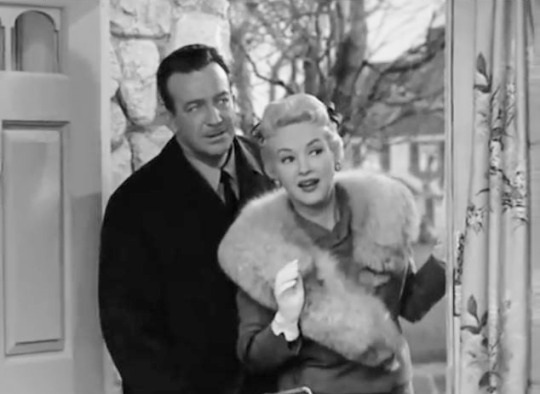
Elizabeth Ruth Grable was born in St. Louis, Missouri, the youngest of three children. Nicknamed ‘Betty’ as a child, she was pressured by her mother to become a performer. She was entered in multiple beauty contests, many of which she won or for which she achieved considerable attention.

A 12-year-old Grable and her mother traveled to Hollywood in 1929, hoping to achieve stardom. To get her daughter jobs, Lillian Grable lied about her daughter’s age, claiming she was 15. That same year, she made her uncredited film debut as a chorus girl in the all-star revue Happy Days (1929).

In 1930, at age 13, Grable (under the pseudonym Frances Dean) became one of the original Goldwyn Girls, along with Ann Sothern, Lucille Ball and Paulette Goddard. Grable appeared with Lucille Ball in the short A Night at the Biltmore Bowl (1935), Old Man Rhythm (1935), and Follow the Fleet (1936).

In late 1939, Betty Grable dated Desi Arnaz when the two were concurrently appearing on Broadway; him in Too Many Girls and her in Du Barry Was a Lady. Coincidentally, Lucille Ball did the 1943 film of Du Barry, taking the lead from Ethel Merman. Grable’s role was re-written and she was not part of the film.

Throughout her career, Grable was a celebrated sex symbol. Her bathing suit poster made her the number-one pin-up girl of World War II. Grable’s legs were insured by her studio for $1 million as a publicity stunt.
“I became a star for two reasons, and I’m standing on them.” ~ Betty Grable

On an October 1948 episode of Lucille Ball’s radio series “My Favorite Husband” Liz Cugat (Lucy) wonders aloud: “What’s Betty Grable got that I haven’t got?”

Although she began doing television in 1953 on variety and talk programs, her first scripted program was an episode of “Star Stage” titled “Cleopatra Collins”. Grable played an ex-Miss America. She quickly followed-up by playing Lily Garland in “Twentieth Century” for “Ford Star Jubilee”, an adaptation of the 1932 play about movie stars on a train.

On a November 15, 1954 episode of “I Love Lucy,” Betty Grable’s name is mentioned by Lucy Ricardo as one of the many Hollywood stars she is looking forward to meeting should Ricky get the role of Don Juan.

Once in Hollywood, Lucy gets to see Betty Grable’s Beverly Hills home in “The Tour” (ILL S4;E30) in May 1955. The driver (Benny Rubin) describes the home as a ‘ranch style’.
A few months later, just before returning home from Hollywood, Lucy and Ethel visit the forecourt of Grauman’s Chinese Theatre and see Betty Grable’s leg imprint in a slab of cement.

ETHEL: “What are you doing?”
LUCY: “Comparing my leg to Betty Grable’s.”
ETHEL: “Oh, it looks identical.”
LUCY: “Oh, to you and me maybe, but I doubt it would fool Harry James.”On February 15, 1943, Grable did indeed leave her leg print and signature in wet cement for the forecourt.

Her final scripted role on TV was playing herself in “Lucy Wins A Racehorse”, an installment of “The Lucy-Desi Comedy Hour” on “Westinghouse Desilu Playhouse”. It was filmed in December 1957 and aired on February 3, 1958.

The episode’s theme grew from the James’ and Arnaz’s shared love of horses and horse-racing.

In it, Grable appears with her second husband, bandleader Harry James, who she married in 1943 and with whom she had two children. The couple divorced in 1965. She had first married actor Jackie Coogan, but their relationship lasted only a three years (1937-1940).

Grable and James do a full out musical performance in the Ricardo living room titled “The Bayamo” in which Grable shows off her legendary legs and James plays his iconic trumpet.
“She was everything to him. It was always Lucy, Lucy, Lucy. She was his life.” ~ Betty Grable, about Desi Arnaz

In the 1969 Dinah Shore TV special “Like Hep!” Betty Grable’s name is dropped in the title song sung by Dinah, Lucy, and Diana Ross. That’s hep!
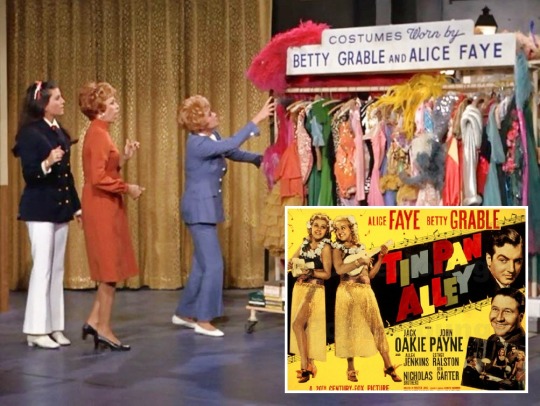
Grable’s name was also mentioned in the February 1971 “Here’s Lucy” episode “Lucy and Carol Burnett aka The Hollywood Unemployment Follies” (TLS S3;E22). During the episode they ogle a wardrobe rack conspicuously labeled COSTUMES WORN BY BETTY GRABLE AND ALICE FAYE. Faye and Grable did two films together, Tin Pan Alley (1940) and Four Jills in a Jeep (1944).

In a November 1971 episode of “Here’s Lucy” Dan Dailey dictates a letter to Betty James and Lucy Carter correctly guesses that he is writing to Betty Grable, who did four films with Dailey.
Betty Grable died at age 56 of lung cancer on July 2, 1973 in Santa Monica, California.

-
LIZ’S NEW DRESS
December 18, 1948

“Liz’s New Dress” is episode #23 of the radio series MY FAVORITE HUSBAND broadcast on December 18, 1948.
Synopsis ~ Liz is determined to have a new dress to wear to he Atterburys’ party, even if she has to make it herself!
Note: This episode was aired before the characters names were changed from Cugat to Cooper. It was also before Jell-O came aboard to sponsor the show and before the regular cast featured Bea Benadaret and Gale Gordon as the Atterburys.

“My Favorite Husband” was based on the novels Mr. and Mrs. Cugat, the Record of a Happy Marriage (1940) and Outside Eden (1945) by Isabel Scott Rorick, which had previously been adapted into the film Are Husbands Necessary? (1942). “My Favorite Husband” was first broadcast as a one-time special on July 5, 1948. Lucille Ball and Lee Bowman played the characters of Liz and George Cugat, and a positive response to this broadcast convinced CBS to launch “My Favorite Husband” as a series. Bowman was not available Richard Denning was cast as George. On January 7, 1949, confusion with bandleader Xavier Cugat prompted a name change to Cooper. On this same episode Jell-O became its sponsor. A total of 124 episodes of the program aired from July 23, 1948 through March 31, 1951. After about ten episodes had been written, writers Fox and Davenport departed and three new writers took over – Bob Carroll, Jr., Madelyn Pugh, and head writer/producer Jess Oppenheimer. In March 1949 Gale Gordon took over the existing role of George’s boss, Rudolph Atterbury, and Bea Benaderet was added as his wife, Iris. CBS brought “My Favorite Husband” to television in 1953, starring Joan Caulfield and Barry Nelson as Liz and George Cooper. The television version ran two-and-a-half seasons, from September 1953 through December 1955, running concurrently with “I Love Lucy.” It was produced live at CBS Television City for most of its run, until switching to film for a truncated third season filmed (ironically) at Desilu and recasting Liz Cooper with Vanessa Brown.

Lucille Ball (Liz Cugat) was born on August 6, 1911 in Jamestown, New York. She began her screen career in 1933 and was known in Hollywood as ‘Queen of the B’s’ due to her many appearances in ‘B’ movies. “My Favorite Husband” eventually led to the creation of “I Love Lucy,” a television situation comedy in which she co-starred with her real-life husband, Latin bandleader Desi Arnaz. The program was phenomenally successful, allowing the couple to purchase what was once RKO Studios, re-naming it Desilu. When the show ended in 1960 (in an hour-long format known as “The Lucy-Desi Comedy Hour”) so did Lucy and Desi’s marriage. In 1962, hoping to keep Desilu financially solvent, Lucy returned to the sitcom format with “The Lucy Show,” which lasted six seasons. She followed that with a similar sitcom “Here’s Lucy” co-starring with her real-life children, Lucie and Desi Jr., as well as Gale Gordon, who had joined the cast of “The Lucy Show” during season two. Before her death in 1989, Lucy made one more attempt at a sitcom with “Life With Lucy,” also with Gordon.
Richard Denning (George Cugat) was born Louis Albert Heindrich Denninger Jr., in Poughkeepsie, New York. When he was 18 months old, his family moved to Los Angeles. Plans called for him to take over his father’s garment manufacturing business, but he developed an interest in acting. Denning enlisted in the US Navy during World War II. He is best known for his roles in various science fiction and horror films of the 1950s. Although he teamed with Lucille Ball on radio in “My Favorite Husband,” the two never acted together on screen. While “I Love Lucy” was on the air, he was seen on another CBS TV series, “Mr. & Mrs. North.” From 1968 to 1980 he played the Governor on “Hawaii 5-0″, his final role. He died in 1998 at age 84.
Ruth Perrott (Katie, the Maid) was also later seen on “I Love Lucy.” She first played Mrs. Pomerantz, a member of the surprise investigating committee for the Society Matrons League in “Pioneer Women” (ILL S1;E25), as one of the member of the Wednesday Afternoon Fine Arts League in “Lucy and Ethel Buy the Same Dress” (ILL S3;E3), and also played a nurse when “Lucy Goes to the Hospital” (ILL S2;E16). She died in 1996 at the age of 96.
Bob LeMond (Announcer) also served as the announcer for the pilot episode of “I Love Lucy”. When the long-lost pilot was finally discovered in 1990, a few moments of the opening narration were damaged and lost, so LeMond – fifty years later – recreated the narration for the CBS special and subsequent DVD release.
GUEST CAST

Frank Nelson (Sylvester) was born on May 6, 1911 (three months before Lucille Ball) in Colorado Springs, Colorado. He started working as a radio announcer at the age of 15. He later appeared on such popular radio shows as “The Great Gildersleeve,” “Burns and Allen,” and “Fibber McGee & Molly”. Aside from Lucille Ball, Nelson is perhaps most associated with Jack Benny and was a fifteen-year regular on his radio and television programs. His trademark was playing clerks and other working stiffs, suddenly turning to Benny with a drawn out “Yeeeeeeeeees?” Nelson appeared in 11 episodes of “I Love Lucy”, including three as quiz master Freddy Fillmore, and two as Ralph Ramsey, plus appearance on “The Lucy-Desi Comedy Hour” – making him the only actor to play two different recurring roles on “I Love Lucy.” Nelson returned to the role of the frazzled Train Conductor for an episode of “The Lucy Show” in 1963. This marks his final appearance on a Lucille Ball sitcom.
Mr. Sylvester owns and operates a high end boutique.

Joseph Kearns (Rudolph Atterbury, George’s Boss) appeared on “I Love Lucy” as the psychiatrist in “The Kleptomaniac” (ILL S1;E27) and later played the theatre manager in “Lucy’s Night in Town” (S6;E22). His most famous role was as Mr. Wilson on TV’s “Dennis the Menace” (1959). When he passed away during the show’s final season, Lucy regular Gale Gordon took over for him, playing his brother.
This is the character’s introduction. He will also be played by Hans Conried, before the character is made a regular with the casting of Gale Gordon.

Frances Chaney (Marge Van Tassle) was a Ukrainian-born actress who was active in radio programs produced by the Armed Forces Radio Service. She was married to both Ring Lardner Jr. and his brother David. She played the recurring character of Jeanne Culpepper on TV’s “The Edge of Night” from 1958-69.
EPISODE
ANNOUNCER: “As we drop in on the Cugats this morning we find them still upstairs getting dressed…”
Liz asks George to button up the back of her dress, kissing her while he does. He tells her the Atterbury’s are having a party tomorrow night. Liz complains that she has nothing to wear, which George anticipates since she always says the same thing. George opens her closet to prove her wrong.

GEORGE: “What about this red one?”
LIZ: “The color’s all wrong for me. With my red hair and that red dress I’ll look like I’m peeking out of a carrot.”Liz wishes it was a New Year’s Eve party so she could just wear some ribbons around her middle and go as 1949. Liz jokingly says that she’s going to have a new dress for the party if she has to make it herself. George reminds her that the pioneer women made their own dresses by shearing the sheep and weaving the cloth!
LIZ: “You’re right, George. On your way home from work, pick me up a couple of sheep!”
George thinks this is a great idea for Liz to make her own dress so Liz accepts the challenge!

“Pioneer Women” (ILL S1;E25) in March 1952 also challenged Lucy to a pioneer lifestyle and “Lucy Buys a Sheep” (TLS S1;E5) in October 1962, but to mow her grass, not to give her wool!
That afternoon, Liz tells Katie the Maid that she has been reading up on sewing in order to make her dress. Liz has bought 25 yards of purple material. Katie says she only needs three! Liz has also bought a pattern but is confused.
LIZ: “What part of me is my Buttericks?”
KATIE: “That’s the name of the pattern maker!”
The Buttericks Company was formed in the 1860s and is still in business today. Lucille Ball partnered with Hollywood Patterns during her RKO years and her photo was used on many patterns. In the 1950s, Advance Patterns licensed the image of Lucy and Desi to market “I Love Lucy”-themed patterns for men and women.
Liz tries to cut out her dress, but forgets to unfold the fabric, creating eight sleeves!

She decides to leave the cutting to Katie and she will do the sewing. She finally finishes, but she can’t get the dress on because she sewed up the neck and arm holes. She tries fixing it with the scissors, but instead makes it strapless and backless!
The dress is a complete failure, but Liz decides to tell George she is wearing it anyway, hoping he’ll insist she buy a new dress for the party.

In “Lucy Wants New Furniture” (ILL S2;E28) in June 1953, Lucy makes her own dress to save money so she can afford new furniture. The results are similarly dreadful!
After dinner, Liz presents her ‘new look’ to George who says it looks great! But he only said it so as not to hurt her feelings. They cuddle and coo and laugh about it.
GEORGE: “It’s a lucky thing for you the marriage contract doesn’t contain a sanity clause.”
LIZ: “Oh, George! There is no sanity clause!”
After all their canoodling, Liz still wants the a new dress and George still says no! Liz tells Katie that she will buy a dress anyway and just charge it!
At the bank, Mr. Atterbury (Joseph Kearns) commiserates with George about his wife wanting a new dress.
MR. ATTERBURY: “I’d be happy to buy clothes for Iris, but she’s so darn big. It’d be cheaper to have her reupholstered. Around the holidays, it’s dangerous for her to lie down with an apple in her mouth!”

Starting in Spring 1949, the role of Rudolph’s wife, Iris Atterbury, will be played by Bea Benadaret, a sturdy woman, but arguably not fat. But this is, after all, radio.
Mr. Atterbury has an idea: take an old dress from each woman and give it to the other as new! The aren’t troubled by sizes or fashion. He tells George to go to a high class boutique like Sylvester’s to get some empty boxes for the old dresses.
At the same time, Liz and her friend Marge Van Tassle are shopping – at Sylvester’s! Mr. Sylvester (Frank Nelson) grandly presents himself to his new customers. He makes them take a ‘loyalty oath’.
SYLVESTER: “Are you now or have you ever been, a shopper in Macy’s basement?”

In “The Fashion Show” (ILL S4;E20 in 1955, while shopping at Don Loper’s Salon in Hollywood, Ethel Mertz says that she’s more comfortable in Gimbel’s basement. Their flagship store held a long-standing rivalry with neighbor Macy’s, which was prominently featured in “Lucy Meets Orson Welles” (ILL S6;E3). In both stores bargains would generally be found in their basement levels.

“Are you now or have you ever been..” is the exact phrase that was used by US Federal investigators questioning those suspected of being communists during the ‘red scare’ of the late 1940s and ‘50s. No doubt Lucille Ball herself faced this question in September 1953, when she was accused of being a communist sympathizer.
Having passed Sylvester’s loyalty test, he shows them some high-priced gowns. Sylvester tempts them but they cannot afford anything in the shop. When he goes off to get more to show them, Liz gets an idea. Since she has her purple monstrosity with her, she decides to attach a Sylvester price tag to it and see what he’ll charge for it!
Pointing to the garment’s belt made from mens’ garters, Liz insists it must be a French import.
LIZ: “It says so, right here on the garter – it says Paris!”

From 1908, Paris was a manufacturer of belts, suspenders and men’s sock garters. Despite their name, Paris was made in the USA by A. Stein & Company. Sock garters are no longer manufactured due to the creation of synthetic fabrics that cling to the leg, keeping the sock from falling.
Liz admits she played a trick on Sylvester and that she created the gown. Just then, Marge sees George come through the door. The girls leave in a hurry. George buys a couple of dress boxes from Mr. Sylvester, which he initially wants to charge George $25 for! George offers him a dollar and he takes it!

The idea of passing off used clothing in new garment boxes was used in “Changing the Boys’ Wardrobe” (ILL S3;E10) in December 1953. To get even with Lucy for selling his old clothes, Ricky gets some empty boxes from Brooks Brothers and puts his re-purchased garments inside.
George comes home early with her present in a Sylvester’s box. Liz immediately spots it as Iris Atterbury’s old dress!
LIZ: “I’ve seen her wear it! Thursday night, May 12, 1938. She walked into the country club dance at 8:33pm. She walked in with door with Alice Sturm, who was wearing a blue taffeta formal with a pink jacket and some tiny cerise flowers tucked into the yellow sash.”

In real life, on Thursday May 12, 1938, Lucille Ball’s new film Go Chase Yourself starring Joe Penner opened wide in cinemas across America after an April 22, 1938 premiere.
George admits his joke. Liz is tearful. George is repentant and agrees to buy her a new green dress she admired at Sylvester’s! He dashes off before they close but returns with the purple dress instead. After a moment of disappointment from Liz, he admits he was just kidding and has bought her the green dress, too!

LIZ: “Oh, George! You’re my favorite husband!”
After a public service announcement about the importance of the US Constitution, Liz and George return for the conclusion.
Liz wakes George in the middle of the night to ask what he has bought her for Christmas. She hints that she wants a mink coat! He says he knows already because she squeezed out the word ‘mink’ in toothpaste on the bathroom mirror!
GEORGE: “So you know what I’m going to get you?”
LIZ: “What?”
GEORGE: “A new tube of toothpaste!”END OF EPISODE
-
Subscribe
Subscribed
Already have a WordPress.com account? Log in now.
 Papermoon Loves Lucy