-
KISSING THE YEAR IN!
December 29, 1951

Lucille Ball and Desi Arnaz appeared on the cover of TV-Radio Life on December 29, 1951, the final issue of the year.
FORECASTS FOR ‘52

Of the predictions by Fleetwood Lawton (as told to Arlene Garber), the prospect of color television is mentioned. Lawton was correct: a successful color television system based on a system designed by RCA began commercial broadcasting on December 17, 1953. CBS was developing it’s own technology, and refused to use the RCA / NBC system, causing color TV to be more than a decade away for the Tiffany network. Lucille Ball was not seen in color until the early 1960s.
Lawton’s prediction that the Korean War would end in early 1952 did not come to pass. The conflict ended in July 1953.
Lawton’s prediction that the 1952 presidential race would depend on who the Republicans nominated assumed that incumbent Democrat Harry S. Truman would seek another term. Instead, he withdrew from the race and Adlai Stevenson ran instead. In November 1952, Stevenson was defeated by Dwight David Eisenhower, who ran as a Republican.

The issue includes a profile of Cy Howard, a television writer and producer by Ted Hilgenstubler titled “I’m A Lonesome Guy”. Howard was the writer-producer of “My Friend Irma” on radio and television, a series that featured Gale Gordon’s mother Gloria Gordon and likely gave Mr. Mooney’s wife her first name on “The Lucy Show.”
In 1963, Howard partnered with Desilu for the Ethel Merman pilot “Maggie Brown” which was never sold to series. He was also Executive Producer on the Desilu series’ “Guestward Ho” (1960) and “Fair Exchange” (1962-63). He won a 1969 Emmy Award for writing “The Smothers Brothers Comedy Hour.”

The magazine’s listings include a new episode of “I Love Lucy” titled “The Adagio” (ILL S1;E12) first aired on New Year’s Eve.

This was not Lucille Ball’s first time on the cover of Radio-TV Life. She had appeared on the cover in 1949, 1950, 1953, 1956, and 1958. The magazine began life as Radio Life in March 1940, only listing Los Angeles radio programs. It became Radio Life & Television in 1949 and TV Radio Life in 1950, finally becoming Television Life with radio as a footnote a year later. It ceased publication in 1958.
-
LOOK! TV’S FAVORITE FAMILY!
December 28, 1954


The Arnaz Family (Lucy, Desi, Lucie, and Desi Jr.) appeared on a Christmas-themed cover of Look magazine on December 28, 1954.

Inside on page 10 is an article with four photos of Lucy and Desi with the kids shopping for toys.

At the time, little Lucie was 3 and Desi Jr. was 22 months.
Also included in the issue:
- 5th Annual TV Awards
- Miss America Lee Meriwether
- Guy Lombardo
- Rocky Graziano
- Fashion Wear by the Christmas Fire
- Men’s White Winter Jackets
- 20,000 Leagues Under the Sea movie review
- Christmas Recipes
20,000 Leagues Under The Sea was a Disney film that featured “Lucy” alumni past and future Kirk Douglas (”The Lucy Show”), James Mason (Forever Darling), Dayton Lummis, Eddie Marr, and Herb Vigran.
In 1970, orchestra leader Guy Lombardo appeared on “The Merv Griffin Show” with Lucille Ball and Gary Morton.
In 1977, Miss America Lee Meriwether appeared on “Circus of the Stars 2″ with Lucille Ball as ringmaster.

The Awards were turned into a television show “The Look Magazine Awards” which aired on December 18, 1954.

Honorees included George Gobel, Fred Coe, Jack Webb, John Cameron Swayze, Groucho Marx, “Ding Dong School”, “Cavalcade of Sports”, “Omnibus”, “Garry Moore”, “Toast of the Town”, “See It Now”, Bishop Fulton J. Sheen, and the “United States Steel Hour.”
Of the awardees, Lucille Ball was a frequent guest on “Toast of the Town” (later known as “The Ed Sullivan Show”). Edward R. Murrow was parodied on “I Love Lucy” by Elliott Reid in “Face to Face” aka “The Ricardos are Interviewed” (ILL S5;E7) in 1955. Lucille Ball guested on Garry Moore’s “I’ve Got A Secret” in 1956 and 1961.

Lucille Ball made the cover of Look nine times during from 1937 to 1971, when the magazine printed its final issue.
Look Magazine frequently turned up on “I Love Lucy”. Click here to see some of it’s appearances.
On the date this magazine was published, “I Love Lucy” was on Christmas break, having just filmed “The Fashion Show” (ILL S4;E20) on December 23, 1954. On TV, the Ricardos and the Mertzes were just about to embark on their cross-country journey with “Getting Ready” (ILL S4;E11) aired on December 11, the last new episode of 1954.
-
CHRISTMAS AT SUN VALLEY / DIVORCE RUMORS
December 27, 1959


The “television show” referenced in the byline was “Lucy Goes To Sun Valley” (LDCH S1;E5).

On Sunday, December 27, 1959, The Twin Falls (ID) Times-News did a story with photos about the annual influx of celebrities, including Lucille Ball, who spend their holidays at Sun Valley.

Charles Denton also added grist to the rumor mill about the Arnaz marriage. The title “This Week’s Lucy-Desi Rumor” implies that gossip about the couple was a regular feature of Denton’s column!

Meanwhile, also on December 27, 1959, syndicated columnist Hy Gardner mused on rumors that Lucy’s marriage was about to end. Despite Lucy’s denial, the divorce papers were issued just four months later.

The newswire story wraps the divorce rumor in an item about Lucille Ball’s popularity in Japan.


In Florabel Muir’s “Behind Hollywood’s Silken Curtain” column, she talks about a press party held at Desilu Studios thrown to introduce a new detective series “Miami Undercover” starring Lee Bowman and former boxer Rocky Graziano. Landlady Lucille Ball turned up to mock spar with Graziano, capturing the attention of the photographers. Except for the first two episodes, the series was shot entirely in Miami Beach, with the cast and crew lodged at the Eden Roc Hotel, where the Ricardo’s and Mertzes stayed when visiting Florida during season 6 of “I Love Lucy.” The series wouldn’t debut until October 1961, 22 months after the party, and only lasted 38 episodes.

Despite being December, the Airway Drive-In Theatre in St. Louis, Mo, was offering a triple bill that included Lucille Ball’s Miss Grant Takes Richmond (1949). The film was already ten years old at the time, so it was likely programmed to capitalize on Lucille Ball’s television popularity and to provide the bill with a comedy.
-
BROADWAY BILL
December 27, 1934

- A Columbia Motion Picture
- Directed by Frank Capra
- Produced by Harry Cohn
-
Written by Robert Riskin, based on the short story “Strictly Confidential” by Mark Hellinger

Lucille Ball played a telephone operator, uncredited. Also in the film were future “I Love Lucy” cast members Charles Lane, Irving Bacon, and Bess Flowers.

Synopsis ~ Warner Baxter plays the carefree heir of a wealthy, highly-respected family. Baxter’s cold but socially correct wife Helen Vinson forces her husband into the family business, but Baxter would rather spend his time at the racetrack. He buys a nag named Broadway Bill and tries to build the horse into a winner, if he doesn’t bankrupt himself first.

Only Baxter’s sister-in-law Myrna Loy and black stable hand Clarence Muse have faith in Broadway Bill. The horse wins a crucial race, but dies suddenly at the finish line. Baxter is comforted and given encouragement by Loy, who is now his sweetheart, Vinson having long since washed her hands of her “irresponsible” husband.

TRIVIA
- This was Lucille Ball’s 16th film. She was a blonde in the film, playing a busy telephone operator.
- Columbia Pictures bought the rights to the story “Broadway Bill” by theatrical impresario Mark Hellinger for $8,000.

- The film had its world premiere on Thanksgiving Day, November 30, 1934, at Radio City Music Hall in NYC and opened wide in the rest of the country on December 27, 1934.
- Director, Frank Capra disliked the final product, and in an effort to make it more to his liking, he remade the film in 1950 as Riding High.
- After Paramount Pictures bought the rights to this film, the studio pulled it from circulation to avoid competition with Frank Capra’s remake Riding High (1950). The film remained unseen until it was re-released in the 1990s.
Modern prints carry the Paramount logo before the opening credits and after the closing credits.
- Raymond Walburn (Pettigrew) and Clarence Muse (Whitey), Douglass Dumbrille, Ward Bond, Frankie Darro, and Charles Lane all played the same roles in the remake, Riding High (1950), although some of their respective character names are different.
- Clara Blandick and Margaret Hamilton appeared together later in The Wizard of Oz (1939).

Coincidentally, Hartford’s Loewe’s ran the film on a double bill with Redhead – although it had nothing to do with Lucille Ball, who was a blonde at the time of making Broadway Bill.


Also on December 27, 1934, and also dealing with horses, the above item says that Lucille Ball was an ardent polo enthusiast! Oh, really?

-
RICHARD WIDMARK
December 26, 1914

Richard Weedt Widmark was born in Sunrise Township, Minnesota, but grew up in Illinois, moving frequently because of his father’s job as a traveling salesman. He attended Lake Forest College, where he graduated in 1936.
He made his debut as a radio actor in 1938 and by 1941 he was heard daily in the title role of the daytime serial “Front Page Farrell”.

Widmark appeared on Broadway in 1943 in F. Hugh Herbert’s Kiss and Tell and in William Saroyan’s Get Away Old Man, which ran for 13 performances. He was unable to join the military during World War II because of a perforated eardrum. He was in Chicago appearing in a stage production of Dream Girl with June Havoc (in the same role played by Lucille Ball in a different production of the play) when 20th Century Fox signed him to a seven-year contract.

During his career he made more than 75 motion pictures. He made his mark on Hollywood with his debut in the 1947 film Kiss of Death (1947) which earned him a Best Supporting Actor Oscar nomination and a Golden Globe Award for Most Promising Newcomer.
He lost the Oscar to Edmund Gwenn in Miracle on 34th Street. It’s hard to compete with Santa Claus!

Widmark made his TV acting debut playing himself on “I Love Lucy” in the episode “The Tour” (ILL S4;E30), which aired on May 30, 1954, but was filmed on April 14, 1955. In the episode, Lucy and Ethel go on a bus tour of the Hollywood homes, and decide to disembark in front of Richard Widmark’s mansion to pick a souvenir grapefruit.

After scaling the wall, Lucy gets trapped on the inside and has to exit through the house, at exactly the same time as Ricky and Widmark come back from their lunch meeting! The second-unit footage of Widmark’s Beverly Hills mansion the home depicted actually belonged to Lucy and Desi, although only doubles for Lucy and Ethel went on location.

Although in this episode he is depicted as a big game hunter – even pointing a gun at Lucy – by 1975 he had changes his views:
“I know I’ve made kind of a half-assed career out of violence, but I abhor violence. I am an ardent supporter of gun control.”

While chatting with Ricky, Widmark gets in a plug for his new film A Prize of Gold, which was released a few months after this episode aired.
Although that was their last time acting together, Widmark and Ball were both present for “AFI Salutes Henry Fonda” which aired on March 15, 1978 as well as the “Friar’s Club Tribute to Gene Kelly” on November 9, 1985. Widmark had done five films with Fonda, and 1958′s Tunnel of Love with Kelly.

His final screen appearance was in 1991′s True Colors, in which he played a Senator.
Widmark married writer Jean Hazelwood in 1942, and was briefly the father-in-law of baseball legend Sandy Koufax. After Hazelwood’s death in 1997, he married Susan Blanchard, becoming son-in-law of Oscar Hammerstein II, a name frequently mentioned on “I Love Lucy.”

“I don’t care how well known an actor is – he can still live a normal life, if he wants to. I still believe it. That’s the trouble with actors. If they’re not recognized, they think it’s all over.” ~ Richard Widmark, 1971
Richard Widmark died on March 24, 2008, at age 93.

-
EQUAL PARTS TALENT & HARD WORK
December 26, 1965

Below is a verbatim reprint an article by Edgar Penton based on his interview with Lucille Ball. Bolded and italicized text indicates quotes from Ball. The publication may vary by newspaper. The above illustration was by Robert Thompson.

During a recent discussion between a television producer and a network program executive on the problem of casting a top role for a big television variety special, the latter remarked, “If we could just get somebody like Lucille Ball we’d be in clover."
The producer mulled that statement over for all of one second and said, "There is only one Lucille Ball, and if you can’t get Lucy there’s no such thing as somebody like her.”
That statement comes pretty close to a capsule explanation of Miss Ball’s unparalleled success as a star in all phases of the entertainment business.
Of course, Lucy’s career can’t be embraced with a single anecdote, but it serves to underscore the fact that there really IS only one Lucille Ball.
From that landmark evening, Oct. 15, 1951, when CBS launched a new comedy series called “I Love Lucy,” to the present, Lucille Ball has never left the hearts and screens of the nation’s television viewers.
The vivacious and irrepressible comedienne enjoys the distinction of being the only star to score twice in a hit television series her latest, of course, the current “The Lucy Show” still on CBS, Monday evenings.
To evaluate the success of a Lucille Ball, however, a person must go beyond the popularity of a television show. Let’s take a look at Lucy, herself, and then perhaps we can understand something about the talent that creates so many memorable moments of entertainment.
Lucy (hardly anyone calls her Lucille, except her mother) candidly attributes her success to hard work. As a matter of fact, that’s the advice she gives to all newcomers who ask her how to make the grade -in show business.
“I know it sounds rather easy and simple to tell an eager youngster to get out and work hard,” Lucy explains, “and they get a lot of advice like that from parents. But show business is no different than any other business.”
"If you want to reach the top, you’ve got to start somewhere near the bottom. Learn to be a good listener and remember what you learn.”
"Of course, luck sometimes plays a part in everyone’s career, but you can’t rely on it. Even if fortune did place you in an advantageous position would you be prepared to deliver? I like busy people who know their capabilities and utilize them at the proper time.”
"It may only be part of the overall goal, but there’s nothing wrong in having a series of goals, and realizing one at a time.”
"It’s great for the confidence, and will win you respect and recognition at a time when you least expect it."
Miss Ball says she considers it necessary for an aspiring performer to be able to communicate with others, exchange ideas and philosophies, develop a sense of values, and not to expect what you don’t deserve.
"When I was a youngster my family taught me that you get out of life what you put into it,” Lucy says.
“By the time a lot of people learn the soundness of that philosophy, they find it’s too late to retreat to a sensible position, and spend much of their lives trying to overcome ill – conceived notions about what life owes them.”
"Faith in yourself and your ambitions doesn’t necessarily mean you have to put aside all the graces in your race for success. Yet I say you can afford to be a little selfish as you progress.”
"But I don’t mean ‘selfish’ in a negative sense. For example, be selfish about your time. Don’t waste it. Don’t let a party or a good time dilute your effectiveness on the job. Don’t try to do too many things to the point of not being able to do a few things well."
Lucy says that during her early years she felt a great insecurity about her own ambitions. She thought her personality was flat, that she had no poise; after losing half-a-dozen jobs . she was just about ready to give up show business.
"I felt down, but not quite out,” Lucy recalls. “Even when a New York drama coach told me but kindly ; that I was not cut out for the entertainment world, something within me wouldn’t quit. I took other jobs, in, around and near the theater.”
"I finally got a job as a model. I wasn’t acting or performing in a true sense, but I gained confidence and I haven’t stopped working since."
Few would argue the point that Lucy is one of the hardest working gals in show business, but it should also be recalled that the spirited redhead from Jamestown, N.Y. brought a little item into the entertainment marketplace called talent.
Over the years she has managed to shape her endowments into what today is regarded as one of the great comedic talents of our time.
Her ability to grasp a situation or scene and transform it into riotous fun is one of the many reasons why her appearance is sheer joy to watch. And she has also developed a remarkable ability to do startling, realistic impressions of other personalities.
Tribute to Lucy’s rare and wonderful versatility as a comedienne comes from every writer who has had the opportunity to pen a scene or create a characterization for any of Miss Ball’s adventures before the cameras.
Her long-time writers on “I Love Lucy,” Bob Carroll Jr., and Madelyn Martin, Bob Schiller and Bob Weiskopf, who came back to launch Lucy’s return to television on “The Lucy Show,” admit they create some almost impossible situations for Lucy.
But they have never been able to stump the adept Miss Ball, who didn’t mind one bit swinging from a chandelier, going up with a balloon or flying like Peter Pan.
Milt Josefsberg, principal writer on the current Lucy Show, says that he no longer has misgivings about whether Lucy is capable of meeting demands of certain scripts.
"Since I’ve been on the show, Lucy has wrestled a bear, played with a porpoise and single-handedly wrecked an entire motion picture set. Yet when she is earthbound, she’s peerless when it comes to timing and delivery.”
Today, Miss Ball is the president of Desilu Productions, largest television film producing facility in the world. She is the mother of two talented youngsters (Lucie, 14, and Desi Jr., 12, children of her marriage to Desi Arnaz), and the wife of comedian Gary Morton (they just celebrated their fourth anniversary).
She just completed a season of radio on CBS (”Let’s Talk to Lucy”), took time out to star in two one-hour television specials, completed a year as national chairman of the Easter Seal Campaign, and is talking about plans for next year.
Like Lucy said, it takes hard work.

Although the text of the article was basically the same in all newspapers (sometimes edited for length), syndicated columns would often feature different headlines, photos and other enhancements. This is the headline and photo collage of the same Edgar Penton article in another newspaper.

On the same date, Chicago television editor Larry Walters retired after 36 years and counted Lucille Ball as one of his most memorable performers.


On December 26, 1965, the Miami News reported that Vivian Vance was returning to the Coconut Grove Playhouse to perform in the Neil Simon play Barefoot in the Park. In August 1965, co-star Darryl Hickman and Vance had appeared on the TV game show “Call My Bluff” together.

The day after these articles hit newspapers, a new episode of “The Lucy Show” premiered titled “Lucy Discovers Wayne Newton” (TLS S4;E14).
-
LUCY & DESI’S TOTS HUNG UP STOCKINGS, TOO!
December 25, 1955


By LOUELLA O. PARSONS ~ INS Motion Picture Editor, Hollywood
Merry Christmas! In the home of Lucille Ball and Desi Arnaz today as in homes all over the world the family is gathered around the Christmas tree. They, too, wish you a happy Yuletide with peace on earth good will toward men.
Lucy and Desi have hung up stockings in the traditional Santa Claus fashion for little Luci Desiree, age 4, and little Desiderio IV, age 2.
For weeks, Lucy and Desi, who sell America’s best known name brand — marriage — to millions of TV fans, have been shopping. Because at this season of the year they are so typical of family life, I did a combined interview with them.
Digressing from Christmas for a moment, I asked Lucille if she weren’t worn out doing a show every week.
“It would be harder if we weren’t just playing our-selves” she said. “So many of the incidents in our shows are things that have happened to us in real life.“
Last month Lucy and Desi celebrated their 15th wedding anniversary and I asked Desi to what he attributed their happiness.
He said “A sense of humor and the ability to laugh. Often when we’ve had words, one of us sees the absurdity of it and starts laughing, If people would laugh more marriages would last longer.“
“Lucy and I have been happy ever since we were remarried in the church” he continued. “You know as well as anyone that our first years of marriage were pretty stormy: in fact, so stormy that Lucy and I separated”
“Realizing how we have averted trouble in our private life with a sense of humor” said Lucy. “We know that a laughing audience Is a listening audience and that’s why we try to get all of this into our shows.”
“Like all married couples we have our disagreements but before we know it one of us will interrupt to say “What a perfect situation for ‘I Love Lucy’. That’s how so many of our marital problems have been incorporated on film.”
Recently a psychiatrist wrote the Amazes that a half hour of watching their show on TV often solves problems that ordinarily might require weeks of treatment.
“In our new picture ‘Forever Darling’ we use the device of a guardian angel (James Mason) to smooth out our marriage” said Desi. “It’s a marriage that started out at top speed but is gradually slowing down to a prosaic crawl.”
“Our angel spurs the wife on to develop an interest in her husband’s work — scientific research so we have her accompany him on a camping expedition Lucy in the woods! Need I say more?"
Then Desi went on to tell me “When we were first married Lucille and I actually did go on a camping trip I’ll never forget the first night Lucille wanted to leave the light in our tent on I said no The light went out.
“A half hour later Lucy let out an unearthly scream. Two yellow eyes were glaring at us. An owl had flown into our tent. We spent the rest of the night with the light on!”
The story of Lucille Ball and Desi Arnaz is stranger than any fiction. Lucille, whose perfect timing has been a model for many other comediennes, was at a standstill career-wise when TV came into her life.
She started as a Goldwyn girl and made a few pictures but offers were not coming in as fast as Lucille wanted. I remember her carrot-y red hair, which has been toned down.
Desi was playing nightclubs and their constant separations were not the best thing in the world for their marriage. Besides, he was not having any luck In motion pictures either.
Then about five years ago they did their first "I Love Lucy” show on television and were an immediate success. Their Monday night show became a must in homes all over the country.
They formed the Desilu Company and started other TV shows until today the names of Lucille Ball and Desi Arnaz are household words. Their success has been sensational.


Newspapers who reprinted Parsons’ column were free to create their own headline, focusing on any aspect of the column they chose.
-
LOOK! THE DESI-LUCY LOVE STORY
December 25, 1956

On this date in 1956, Lucille Ball, Desi Arnaz, and Keith Thibodeaux were on the cover of Look Magazine, volume 20, number 26. This was a ‘Christmas Extra’ edition. Photographs were by Robert Vose.
This was Lucille Ball’s fifth of nine Look covers from 1952 to 1971.
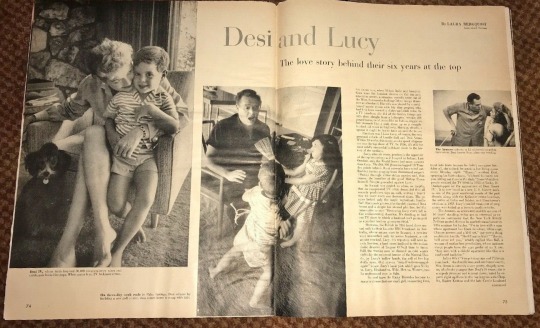
“Desi and Lucy: The Love Story Behind their Six Years at the Top”
The inside interview is by Laura Bergquist, who would interview Lucille Ball again for the September 7, 1971 edition of Look.
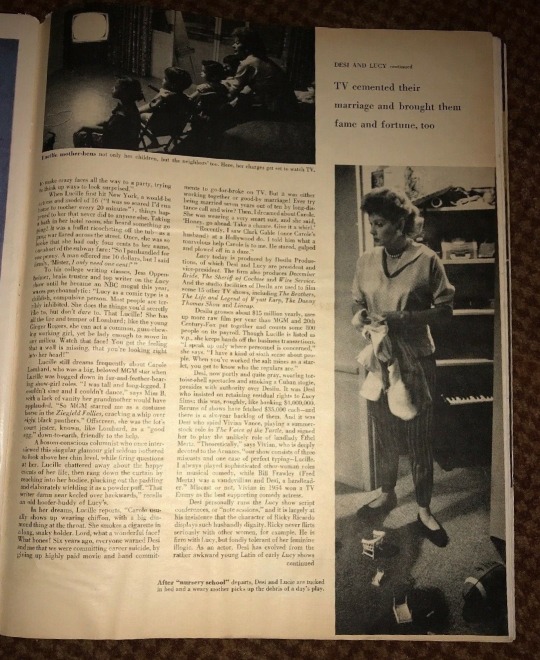
“TV cemented their marriage and brought them fame and fortune, too.”
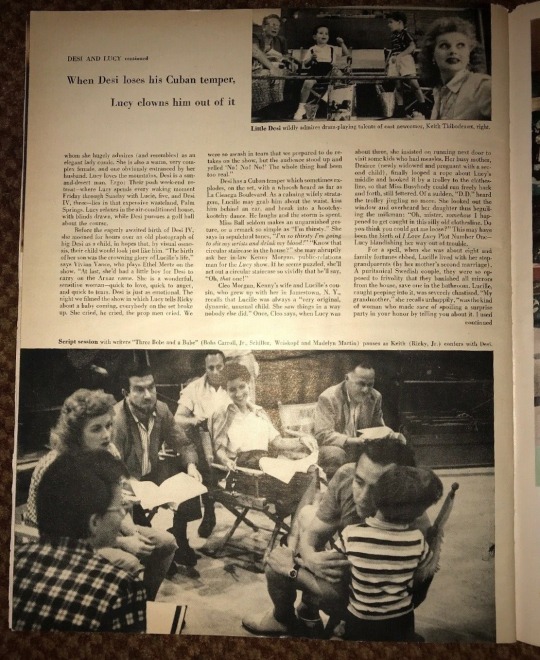
“When Desi loses his Cuban temper, Lucy clowns him out of it.”

The day before this magazine was published, “I Love Lucy” presented their first “Christmas Show” which consisted of clips from three episodes and new holiday wrap-around footage. It wasn’t seen again until 1989. It was first colorized in 1990.

Christmas Day 1956 newspapers reported that Lucy and Desi sent out two Christmas cards: one of mom and dad and another smaller one from their kids.

Earl Wilson item, December 25, 1956.
-
LUCY IN THE MORGUE!
December 24, 1936


The article is slightly misleading in that the title of the RKO film Once Over Lightly was changed to Don’t Tell The Wife, released in March 1937. Although the film did feature Lucille Ball and Guy Kibbee, Gene Raymond was not in the film.

Ball and Raymond were together in RKO’s There Goes My Girl, which didn’t begin filming until March 1937. It is possible that Raymond was cut from Don’t Tell The Wife before release, but there is no record of that happening. Further complicating things, Lucille Ball’s scenes were deleted from There Goes My Girl, so although she filmed the picture, she is not in it!

Jimmy Fidler (1900-88) was a former silent film actor turned journalist and a radio host, much in the vein of Hedda Hopper. His syndicated column “Jimmie Fidler’s Hollywood” appeared in 150 newspapers.
-
THE SLEIGH RIDE
December 23, 1949

“The Sleigh Ride” (aka “Christmas Caroling In A Stolen Sleigh”) is episode #67 of the radio series MY FAVORITE HUSBAND broadcast on December 23, 1949.
Synopsis ~ Liz is taken for a sleigh ride (figuratively and literally) when she and her neighbors borrow a milkman’s horse and make a jingle bell trip to the countryside for a yule log. The party turns sour down when the horse insists upon making all the stops on his milk route.
This was the 12th episode of the second season of MY FAVORITE HUSBAND. There were 47 new episodes, with the season ending on June 25, 1950.

“My Favorite Husband” was based on the novels Mr. and Mrs. Cugat, the Record of a Happy Marriage (1940) and Outside Eden (1945) by Isabel Scott Rorick, which had previously been adapted into the film Are Husbands Necessary? (1942). “My Favorite Husband” was first broadcast as a one-time special on July 5, 1948. Lucille Ball and Lee Bowman played the characters of Liz and George Cugat, and a positive response to this broadcast convinced CBS to launch “My Favorite Husband” as a series. Bowman was not available Richard Denning was cast as George. On January 7, 1949, confusion with bandleader Xavier Cugat prompted a name change to Cooper. On this same episode Jell-O became its sponsor. A total of 124 episodes of the program aired from July 23, 1948 through March 31, 1951. After about ten episodes had been written, writers Fox and Davenport departed and three new writers took over – Bob Carroll, Jr., Madelyn Pugh, and head writer/producer Jess Oppenheimer. In March 1949 Gale Gordon took over the existing role of George’s boss, Rudolph Atterbury, and Bea Benaderet was added as his wife, Iris. CBS brought “My Favorite Husband” to television in 1953, starring Joan Caulfield and Barry Nelson as Liz and George Cooper. The television version ran two-and-a-half seasons, from September 1953 through December 1955, running concurrently with “I Love Lucy.” It was produced live at CBS Television City for most of its run, until switching to film for a truncated third season filmed (ironically) at Desilu and recasting Liz Cooper with Vanessa Brown.
MAIN CAST

Lucille Ball (Liz Cooper) was born on August 6, 1911 in Jamestown, New York. She began her screen career in 1933 and was known in Hollywood as ‘Queen of the B’s’ due to her many appearances in ‘B’ movies. With Richard Denning, she starred in a radio program titled “My Favorite Husband” which eventually led to the creation of “I Love Lucy,” a television situation comedy in which she co-starred with her real-life husband, Latin bandleader Desi Arnaz. The program was phenomenally successful, allowing the couple to purchase what was once RKO Studios, re-naming it Desilu. When the show ended in 1960 (in an hour-long format known as “The Lucy-Desi Comedy Hour”) so did Lucy and Desi’s marriage. In 1962, hoping to keep Desilu financially solvent, Lucy returned to the sitcom format with “The Lucy Show,” which lasted six seasons. She followed that with a similar sitcom “Here’s Lucy” co-starring with her real-life children, Lucie and Desi Jr., as well as Gale Gordon, who had joined the cast of “The Lucy Show” during season two. Before her death in 1989, Lucy made one more attempt at a sitcom with “Life With Lucy,” also with Gordon.
Richard Denning (George Cooper) was born Louis Albert Heindrich Denninger Jr., in Poughkeepsie, New York. When he was 18 months old, his family moved to Los Angeles. Plans called for him to take over his father’s garment manufacturing business, but he developed an interest in acting. Denning enlisted in the US Navy during World War II. He is best known for his roles in various science fiction and horror films of the 1950s. Although he teamed with Lucille Ball on radio in “My Favorite Husband,” the two never acted together on screen. While “I Love Lucy” was on the air, he was seen on another CBS TV series, “Mr. & Mrs. North.” From 1968 to 1980 he played the Governor on “Hawaii 5-0″, his final role. He died in 1998 at age 84.
Ruth Perrott (Katie, the Maid) was also later seen on “I Love Lucy.” She first played Mrs. Pomerantz, a member of the surprise investigating committee for the Society Matrons League in “Pioneer Women” (ILL S1;E25), as one of the member of the Wednesday Afternoon Fine Arts League in “Lucy and Ethel Buy the Same Dress” (ILL S3;E3), and also played a nurse when “Lucy Goes to the Hospital” (ILL S2;E16). She died in 1996 at the age of 96.
Bob LeMond (Announcer) also served as the announcer for the pilot episode of “I Love Lucy”. When the long-lost pilot was finally discovered in 1990, a few moments of the opening narration were damaged and lost, so LeMond – fifty years later – recreated the narration for the CBS special and subsequent DVD release.
Gale Gordon (Rudolph Atterbury) and Bea Benadaret (Iris Atterbury) do not appear in this episode.
GUEST CAST

Hans Conried (Mr. Wood, The Cooper’s Neighbor / Mr. Gundelfinger, Antique Store Owner) first co-starred with Lucille Ball in The Big Street (1942). He then appeared on “I Love Lucy” as used furniture man Dan Jenkins in “Redecorating” (ILL S2;E8) and later that same season as Percy Livermore in “Lucy Hires an English Tutor” (ILL S2;E13) – both in 1952. The following year he began an association with Disney by voicing Captain Hook in Peter Pan. On “The Lucy Show” he played Professor Gitterman in “Lucy’s Barbershop Quartet” (TLS S1;E19) and in “Lucy Plays Cleopatra” (TLS S2;E1). He was probably best known as Uncle Tonoose on “Make Room for Daddy” starring Danny Thomas, which was filmed on the Desilu lot. He joined Thomas on a season 6 episode of “Here’s Lucy” in 1973. He died in 1982 at age 64.
Mr. Wood has eleven children. Mr. Gundelfinger was born Mr. Gundelfoot, but is in the process of changing it to Smith.

Frank Nelson (Policeman) was born on May 6, 1911 (three months before Lucille Ball) in Colorado Springs, Colorado. He started working as a radio announcer at the age of 15. He later appeared on such popular radio shows as “The Great Gildersleeve,” “Burns and Allen,” and “Fibber McGee & Molly”. Aside from Lucille Ball, Nelson is perhaps most associated with Jack Benny and was a fifteen-year regular on his radio and television programs. His trademark was playing clerks and other working stiffs, suddenly turning to Benny with a drawn out “Yeeeeeeeeees?” Nelson appeared in 11 episodes of “I Love Lucy”, including three as quiz master Freddy Fillmore, and two as Ralph Ramsey, plus appearance on “The Lucy-Desi Comedy Hour” – making him the only actor to play two different recurring roles on “I Love Lucy.” Nelson returned to the role of the frazzled Train Conductor for an episode of “The Lucy Show” in 1963. This marked his final appearance on a Lucille Ball sitcom.

Jay Novello (Mr. Negley, the Postman) appeared on “I Love Lucy” as superstitious Mr. Merriweather in “The Seance" (ILL S1;E7), Mario the gondolier in “The Visitor from Italy” (ILL S6;E5), and nervous Mr. Beecher in “The Sublease” (ILL S3;E31). He also appeared on two episodes of “The Lucy Show,” but Novello is probably best remembered for playing Mayor Lugatto on “McHale’s Navy” in 1965.
EPISODE
ANNOUNCER: “As we look in on the Coopers today they’re in the living room preparing to decorate their Christmas tree. George is snipping a twig here and one there to balance the tree and Liz is just bringing in the ornaments.”
Liz is appalled that George has cut so many limbs off the tree trying to balance it.
GEORGE: “I only cut a few twigs off the top.”
LIZ: “A few twigs? I’m up to my spine in pine.”
On “The I Love Lucy Christmas Show” (1956) Fred Mertz also tries to balance the Christmas tree by cutting off ‘a few limbs’!
Liz wishes they could turn back the clock to earlier days when folks went out caroling in a sleigh to get their Christmas tree and a Yule log. George thinks that is just propaganda, but Liz shows them the Christmas card from the Ronys. George wonders Liz would even get a sleigh in this day and age. George agrees if she can get a sleigh, he will go caroling with her.

Later, Liz calls Sam’s Livery Stable to rent a sleigh. They think she’s kidding and hang up. Mr. Wood comes to the door. He is looking to hide out from his 11 children on Christmas vacation. Hanging up all eleven stockings make it look like the washing machine exploded in the living room. Liz asks Mr. Wood if he can carol, and he launches into a robust chorus of “Deck the Halls”. Liz explains her predicament and Mr. Wood says that he knows the owner of the antique store, Joe Gundelfinger, has one.

In the final scene of “Together for Christmas” (TLS S1;E13), carolers enter the Carmichael living room singing “Deck the Halls.”
At Gundelfinger’s Antique Shop, the old, rickety sleigh is in the front yard, holding pots of ivy. The store is closed because Gundelfinger is at court having his name changed again, so Liz and Mr. Wood decide to “borrow” the sleigh. They have to pull it home but lack the ‘manpower’.
Mr. Negly (Jay Novello), the postman shows up. He is too tired to help but joins in with a less robust chorus of “Deck the Halls.” He decides to go home and get his motorcycle to pull the sled.

On the day of the caroling, everyone is bundled up and ready to go: Liz, Katie, Mr. Negley, Mr. Wood, and last but not least George. Mr. Negley forgets to put the harness on and cycles off without them.
End of Part One

Bob LeMond does a commercial for Jell-O, giving out a holiday recipe.
Part Two
ANNOUNCER: “The sleigh proved too much of a load for Mr. Negley’s motorcycle and we find our old fashioned carolers heeding that old fashioned advice: get a horse. They’re trudging down the street, horse-ward bound.”
The milkman has said he would loan them his horse. On the way there, they pass a warm-looking home, so the frozen carolers decide to serenade the homeowners with a chorus of “Jingle Bells” to see if they’ll get invited inside for a hot drink and to warm themselves by the fire. Instead, they get sprayed with a seltzer spritzer!

In “Lucy Goes To Sun Valley” (LDCH S1;E5), Lucy says that Ricky proposed to her at Christmastime, so their ‘song’ is “Jingle Bells,” or – as Ricky pronounces it – “Yingle Bells.” “Jingle Bells” was heard annually on the show as part of the Christmas Tag and then “The ‘I Love Lucy’ Christmas Show” (1956). It was also sung on “Together For Christmas” (TLS S1;E13) in 1962.
When Katie is trying to pour out a cup of hot chocolate during the caroling, a passerby throws a coin into the cup as if they were buskers. A policeman (Frank Nelson) comes along and believes them to be panhandlers! George introduces himself, and just as the officer is about to protest, Liz compliments his baritone voice and he allows them to go.
At the police station, Mr. Gundlefinger (Hans Conried, again) arrives to report the theft of his sleigh. At first, the policeman (Frank Nelson, again) believes he is talking about an automobile.
GUNDELFINGER: “It was out in front of my shop with ivy in it.”
POLICEMAN: “Ivy who?”
GUNDELFINGER: “Just ivy. Little leaves and stems.”
POLICEMAN: “Oh. What was the make?”
GUNDELFINGER: “Flexible Flyer. Their big model.”
POLICEMAN: “Oh, sedan, huh?”
GUNDELFINGER: “No. One horse open.”
Flexible Flyer is best known for the sled of the same name, a steerable wooden sled with steel runners first patented in 1889. Flexible Flyer, however, did not manufacture passenger sleighs like the one discussed in here.
Mr. Gundelfinger says he has a buyer for the sleigh and needs to get it back! The policeman calls him Kris Kringle and suspects him to be a crackpot.

At the same time, the Cooper carolers have gotten the horse hitched up and are singing up a storm. The policeman ‘pulls them over’ and tells them to go home. Liz insists they can take the sleigh back later.
The policeman pursues them, but the horse stops at every milk stop, allowing the cop to catch up! George takes the reins, but the horse refuses to turn. The horse bolts, leaving them stranded in the middle of an intersection in a stolen sleigh. The officer will escort them back to the antiques store if they can just move the sleigh out of the street. With George and the other men pulling it and Liz at the reins, they are finally successful.

In the live Jell-O commercial, Lucille Ball plays a little girl going to see Santa at the North Pole and Bob LeMond is Santa Claus. Santa refuses to make his rounds this year. He isn’t in the mood. The little girl tries to bribe him with sweets. He is reluctant until she promises him Jell-O! Santa agrees to make his rounds and the little girl wishes everyone a Merry Christmas!
ANNOUNCER: “Watch for Lucille Ball in the Columbia picture ‘Miss Grant Takes Richmond’.”

-
Subscribe
Subscribed
Already have a WordPress.com account? Log in now.
 Papermoon Loves Lucy