-
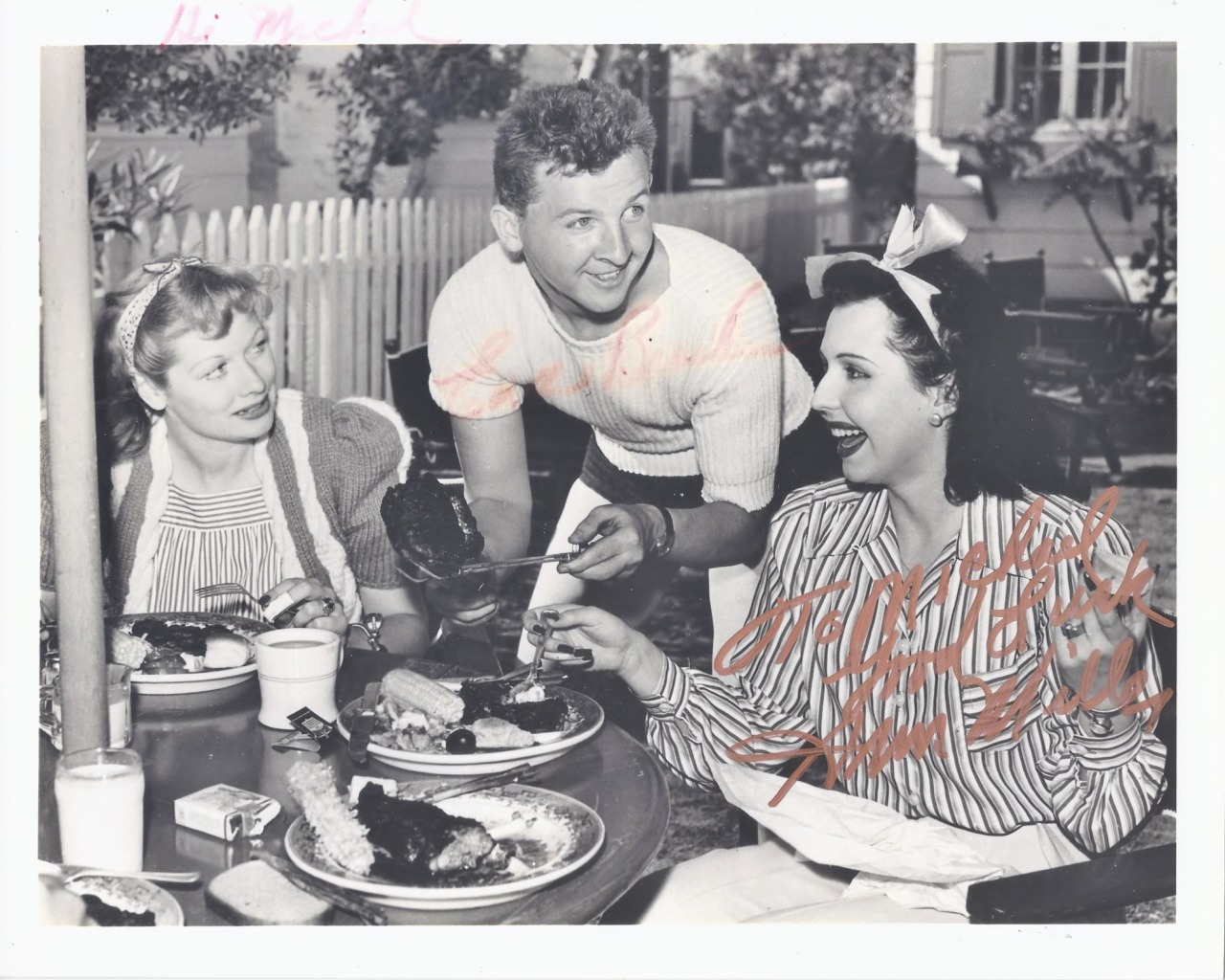
Lucille Ball, Eddie Bracken, Ann Miller
-
Lucy Ball(s)
-
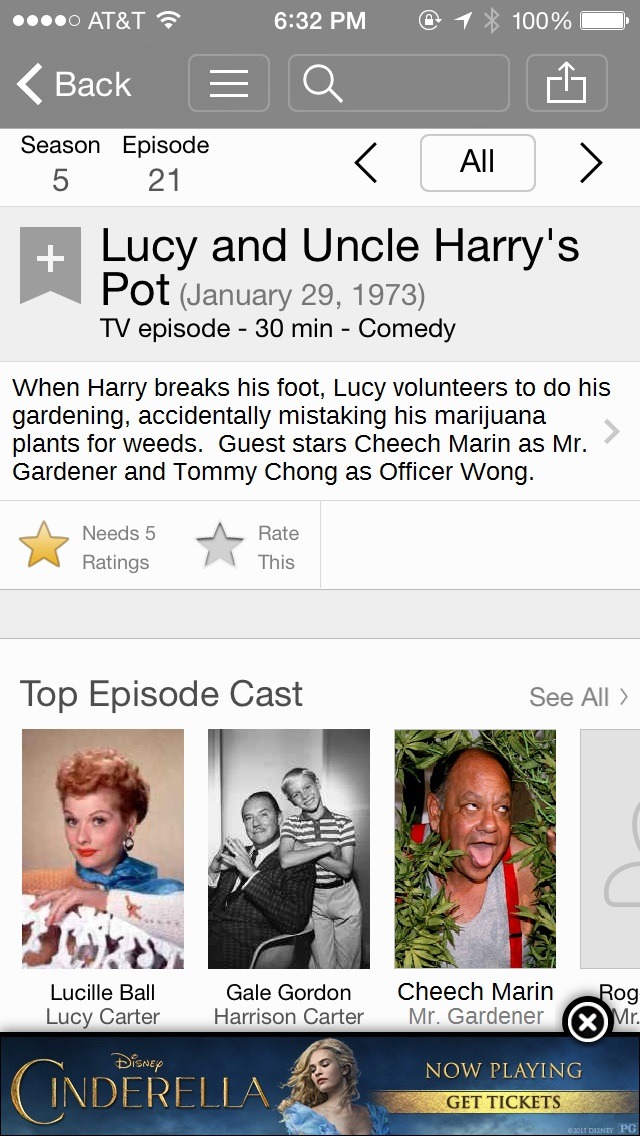
Lucy and Uncle Harry’s Pot
-

Lucy – The Motion Picture
-
“Staten Island Ferry”

(S5;E12 – January 2, 1956) Directed by James V. Kern. Written by Jess Oppenheimer, Madelyn Pugh, Bob Carroll, Jr., Bob Schiller and Bob Weiskopf. Filmed on November 24, 1955 at Ren-Mar Studios. Rating: 45.2/63
Synopsis ~ The Ricardos and the Mertzes prepare for their ocean voyage to Europe by getting their passports in order – when Fred suddenly remembers he gets seasick!

The episode opens with Lucy on the telephone with Marion Van Vlack (nee Strong), a character that appeared in several previous episodes. She was named in honor of Lucille Ball’s real-life Jamestown friend, who, like her TV counterpart, also married a man named Norman.

For the trip, Lucy plans to learn French, Ethel plans to learn Italian, Fred plans to learn German, and Ricky (of course) is going to take over when they go to Spain. We never see the gang in Spain or in any Spanish-speaking country. Ricky’s Spanish does come in handy during the hilarious translation scene at the police station in “Paris at Last” (S5;E18, above).
Ethel is learning to speak Italian.
ETHEL: By the time we get to Italy, you won’t be able to tell me from Gina Lollobridgida.

The Italian-born film star Gina Lollobridgida was known as ‘the most beautiful woman alive’. When this episode was being filmed, her film Beautiful But Dangerous was in cinemas. She will be mentioned again in “Lucy’s Italian Movie” (S5;E23). Both Lollobridgida and Lucille Ball would be part of Bob Hope’s 1982 special “Women I Love: Beautiful But Funny” (above).

In 1968′s “Guess Who Owes Lucy $23.50″ (HL S1;E11) Lucy pretends to be a made-up Italian film star named Gina Linguini, who bears more than a passing resemblance to Gina Lollobridgida.
So far, Fred’s German extends to knowing how to order nine different kinds of beer.
Rough Translation! When Fred is talking to Lucy in German, he calls her “Fräulein”; which is the German word for “miss”. He should have called her “Frau”, the German word for “missus”.
He also says “Geben Sie mir ein Stein Würzburger” and Ethel translates it as “Give me a glass of beer”. A “Stein-Würzburger” is actually a wine sort from the mountain Würzburger and the word “stein” means stone. “Give me a glass of beer” would be “Geben Sie mir ein Glas Bier”.
Anticipating her Jacques Marcel adventure in “Lucy Gets a Paris Gown” (S5;E20), Lucy has learned the French for “How much is that dress in the window?” and “Wrap it up. I’ll take it!”

Ethel is going to use her Aunt Martha’s luggage for the trip to Europe. Coincidentally, both Lucy and Ethel have aunts named Martha. Lucy’s aunt inspired the salad dressing in “The Million Dollar Idea” (S3;E13) and Ethel’s aunt is mentioned as a possible new tenant in “The Ricardos are Interviewed” (S5;E7).

LUCY: (about her passport photo) I look like Frankenstein!
ETHEL: Well, shake hands with your bride.Little did the pair know that they would be taking a road trip with the Bride of Frankenstein (Elsa Lanchester) in “Off to Florida” (S6;E6). Lanchester played the title role in the 1935 Universal horror classic.

About her photo Lucy laments, “It looks like my face was put on hot and it ran” and strikes a lopsided grimace. This is the exact same face she would make in “Paris at Last” (S5;E18) when trying to convince the gendarme that her passport photo is really her; a terrific callback by the writers.

This is the first mention of the S.S. Constitution. Although the idea of a transatlantic crossing was first mentioned two episodes earlier in “Ricky’s European Booking” (S5;E10), Desilu’s financial arrangements with the American Export Lines hadn’t been ironed out at the time. Curiously, Fred waits two weeks to voice his fears about getting sick on the crossing.

In the subsequent episode, “Bon Voyage” (S5;E13), Lucy brings a huge bottle of seasickness pills on board the S.S. Constitution, just in case!
Accounting for the fact that Little Ricky is not in the episode, Lucy says “Don’t worry about the baby. I’m gonna leave him at nursery school all day.” The Mayer Twins will make only one more appearance on the series in ”Lucy Gets Homesick in Italy” (S5;E22) before the character is assumed by Richard Keith.

The Staten Island Ferry first began shuttling passengers and automobiles from Manhattan and Staten Island in 1817. The five mile journey takes about 22 minutes each way and has been free of charge since 1997. At the time this episode was filmed, however, the one-way fare was a nickel. In the first episode of “The Lucy–Desi Comedy Hour” in 1957 guest star Ann Sothern mentions the Staten Island Ferry and its five cent fare.

Notably, this episode contains the only lengthy interaction between Fred (William Frawley) and Lucy alone. Ethel jokingly says Fred gets seasick when she has too many waves in her hair. Fred admits that he went to Europe by ship during World War One, but says that “it wasn’t my idea.” Ethel first mentioned her husband’s seasickness several months earlier in “Lucy and the Dummy” (S5;E3) when Ricky wants to go ’‘dipsy” [deep sea] fishing. Curiously, Fred’s mal de mer is not mentioned at all during the first episode of “The Lucy-Desi Comedy Hour,” which finds the Mertzes on a belated honeymoon cruise to Cuba in 1940.

The ferry boat seen in the episode’s second unit footage is named the ‘Gold Star Mother,’ which entered service in 1937. It was named in honor of the American Gold Star Mothers Inc., an organization formed to provide support for mothers who lost children during World War One. The name came from the custom of war mothers hanging a Service Flag in the window of their homes. The Service Flag had a blue star for those who survived and a gold one for those who had perished.

After retirement from service in the early 1970s, the Gold Star Mother was used as a floating drug rehabilitation center and facetiously nicknamed ‘Gold Star Methadone.’
The footage of the ferry making multiple round trips while Fred and Lucy slept was accomplished by simply running the film backwards!

This episode marks the fourth and final appearance (on the half hour series) of veteran character actor Charles Lane as the Passport Clerk. Lane (1905-2007) was featured in hundreds of films and television shows over his 102 years. He was a survivor of the 1906 San Francisco earthquake and one of the first actors to join the Screen Actors Guild. He also played a casting agent in “Lucy Tells the Truth” (S3;E6), Mr. Hickox in “The Business Manager” (S4;E1), and expectant father Mr. Stanley in “Lucy Goes to the Hospital” (S2;E16). He was featured in two episodes of “The Lucy-Desi Comedy Hour” and went on to play banker Mr. Barnsdahl in the first season of "The Lucy Show.” The character was eventually replaced by Gale Gordon as Mr. Mooney. He had done seven films with Lucille Ball between 1933 and 1949 as well as five films with William Frawley.

Stanley Farrar (Ferry Officer) was previously seen in “Home Movies” (S3;E20) playing Bennett Green (not to be confused with Desi’s stand-in and frequent bit player). He also did two episodes of “The Lucy Show.”

Renita Reachi (Ferry Passerby) was Vivian Vance’s camera and lighting stand-in for “I Love Lucy” and “The Lucy Show.” She was was a costumer and made occasional crowd background appearances in “The Lucy Show”, “Here’s Lucy” and the Lucille Ball films Yours, Mine and Ours (1968) and Mame (1974).

Also aboard is Joan Carey, a frequent background player who would go on to become Lucille Ball’s stand-in during “The Lucy Show.” On the left is Desi Arnaz’s stand-in, Bennet Green.

ETHEL: I thought you were the one that got seasick.
FRED: She made me look like Admiral Nimitz!Chester William Nimitz was head of the U.S. Navy during World War II. On September 2, 1945, Nimitz signed for the United States when Japan formally surrendered on board USS Missouri in Tokyo Bay. October 5, 1945, was officially designated as "Nimitz Day” in Washington, DC.

FRED (about a drowsy Lucy): She’ll be alright. She’s taking a little nap.
CLERK: Looks to me like she’s taken a little nip!
At the end of the original broadcast a public service announcement was aired for ‘Truth Dollars,’ which were purchased to help Radio Free Europe broadcast behind the Iron Curtain.
 1956, Aunt Martha, Bride of Frankenstein, CBS, Charles Lane, Desi Arnaz, Ethel Mertz, Frankenstein, Fred Mertz, Gina Lollobridgida, Gold Star Mothers, Here’s Lucy, I love lucy, Lucille Ball, Lucy, Lucy Ricardo, Marion Strong, Marion Van Vlack, passport photos, Passports, Radio Free Europe, Ricky Ricardo, seasickness, Stanley Farrar, Staten Island Ferry, Truth Dollars, tv, U.S.S. Constitution, Vivian Vance, William Frawley
 -
“Lucy Goes to Scotland”

(S5;E17 ~ February 20, 1956) Directed by James V. Kern. Written by Jess Oppenheimer, Madelyn Pugh, Bob Carroll, Jr., Bob Schiller, and Bob Weiskopf. Filmed January 6, 1956 at Ren-Mar Studios.
The
title of the episode is a bit misleading. Although they are in the
United Kingdom, Lucy only dreams of going to Scotland, but never
actually goes there.Lucie Arnaz has said that this was the first episode that she was allowed to attend the filming. She would have been four years old at the time.

The
inspiration for this episode is clearly Lerner and Loewe’s 1947
musical Brigadoon. Lucy’s dream of Scotland is also in musical
comedy form; the name of the village in the musical is the similarly-sounding
Kildoonan; and the two-headed dragon appears once every 30 years,
just as the village of Brigadoon appears once every 100 years. Both
also feature a sword dance and bagpipes. Although
the show had closed in London several years earlier, the film
version was released in 1954, a little over a year before this
episode’s filming. It was produced by MGM (the Arnazes studio of choice) and featured Van Johnson, who Lucy danced with in “The Dancing Star” (S4;E27).
Immediately after this episode was aired for the first time (February 20, 1956), Desi Arnaz played himself on “December Bride,” a sitcom produced by Desilu and aired on CBS Monday evenings at 9:30pm. The episode was titled “The Sunken Den” (S2;E20). Desi Arnaz appears as a neighbor whose house begins to sink due to a construction error.
The series starred Verna Felton who had played Lucy’s intimidating maid Mrs. Porter as well as the woman without electricity to whom Lucy tries to sell a Handy Dandy vacuum cleaner. The episode also featured Joseph Kearns (”The Kleptomaniac” and “Lucy’s Night in Town”) and Richard Deacon (”The Celebrity Next Door” and Desi’s series “The Mothers-in-Law.”) as Lucy and Desi’s butler.

Lucy
and Ricky return to the (fictional) Hotel Wimbelshire from an evening of
theatre-going in London’s West End. Fred
gives Lucy a toy dragon that he bought for Little Ricky. This
plants the seed for her dream that Fred and Ethel are a two-headed
dragon.

In fact, the dragon toy is of Chinese origin, not from Scotland. The toy is an articulated Chinese dragon made of bamboo that has a hole in the base to insert a bamboo stick as seen on the show, similar to the vintage example pictured here.

Ricky
says that Lucy wants to go to Scotland to look up some of her
mother’s relatives. But since McGillicuddy is her mother’s married
name, she would actually need to be looking for her father’s clan.
Lucy says that her
great-great-great-grandfather, Angus MacGillicuddy, lived in the town
of Kildoonan in Northern Scotland, located between Golspie and
Ullapool. Although there is no real Kildoonan, the latter two are
actual Scottish towns. There is, however, a town named Kildonan (one
‘o’), located due North of Golspie.
Plans
originally called for this episode to be broadcast in color, but it
proved too expensive. However, color photos and home movies by Desi
Arnaz still exist. In 2007 they served as a visual guide for the
episode to be digitally colorized. The colorized version was only
released as a bonus feature on DVD and
is the only one of the colorized episodes not aired on
broadcast television.
Larry
Orenstein,
who plays Mr. Ferguson, the mayor of Kildoonan, also wrote the
songs. When he played Lucy and Desi the first song he wrote, Desi
said that he should play the role himself because nobody would be
able to sing it better than he had. During rehearsal of “The
Dragon Waltz,” Desi asked for the chorus to sing. Orenstein
explained that in the printed music the “chorus” meant the
main section of the song, not a group of people singing. He was
surprised that an experienced musician like Desi Arnaz wouldn’t know
the difference. Orenstein jokingly said, “If
I had written ‘refrain’ instead of ‘chorus,’ would you have stopped
singing altogether?” Desi didn’t think the remark was funny and an actual chorus did end
up singing the song’s chorus. In season six, Orenstein wrote
“Nobody Loves the Ump” for “Lucy and Bob Hope” (S6;E1).
The
five original songs have music by Eliott Daniel:- “’Tis Nae a Braw Bricht Nicht”
- “A McGillicuddy Is Here"
- "I’m in Love with a
Dragon’s Dinner" - "Two Heads Are Nae Better Than One”
- “The Dragon Waltz”

During “The Dragon Waltz”
Lucy pulls a long-playing record out of her blouse. Ricky reads the
label which says ‘Xavier McCugat’ and tosses it away in disgust.
This is yet another in a long line of references to Latin American
bandleader Xavier Cugat, Desi’s former employer and colleague, and
Ricky’s rival.
When
the terrible two-headed dragon senses Lucy entering its cave, it
says “Fee-fi-fo-fuddy,
I smell the blood of a McGillicuddy!”
This is a riff on lines from the nursery rhyme Jack in the
Beanstalk, “Fee-fi-fo-fum,
I smell the blood of an Englishman,”
which dates back to 1596.
Considering that Vivian Vance and William
Frawley were incompatible off-screen, it must have been fairly uncomfortable for the pair to share the same song, let alone the
same costume.
The Townspeople of Kildoonan
- Betty
Allen
makes her only appearance on the series.
She was only the second African-American performer on the series,
after Sam McDaniel, who played Sam the Porter in “The Great Train
Robbery” (S5;E5). Coincidentally, she was a background singer for
the 1954 film of Brigadoon and was also seen in the film Singin’ in the Rain (1952). - Betty
Noyes was
also in the Singin’ in the Rain, dubbing Debbie Reynolds’ voice
for the song “Would You?” In 1941 she sang “Baby Mine” in
Disney’s Dumbo. - Norma
Zimmer
was also in Singin’ in the Rain as a chorus girl. Years
later, she would become famous as Lawrence Welk’s Champagne Lady. - The town of Kildoonan was also populated with singers John
Gustafson, John Hynd, Robert E. Hamlin, Ann Ellen Walker, Dick Byron,
and
Chuck
Schrouder.
The choreography was by Jack Baker, who worked on future “Lucy” sitcoms.

In
the original script, the episode ended with Lucy waking up and
getting a reply to her telegram to Kildoonan which said that there
are no McGillicuddys left in town but offering to prepare a
special dinner if she ever came to visit. Still reeling from her dream,
Lucy says “I’ll be the
main course!” The
filmed ending has Lucy waking up and hitting Ricky with her pillow,
calling him a coward for not saving her from the dragon.
“Lucy
Goes to Scotland” joins other show-within-a-show episodes:- “The
Pleasant Peasant” in “The Operetta” (S2;E5); - “The Perils of
Pamela” / “A Tree Grows in Havana” in “Lucy Writes a Play”
(S1;E17); - “The Enchanted Forest” in “Little Ricky’s School
Pageant” (S6;E10).

Lucy would again don kilts (with Vivian Vance)
in a 1964 episode of “The Lucy Show” when she forgets to book a
bagpipe band for a political rally.
The “I Love Lucy” collectible bear for this episode!
1954, 1956, Bagpipes, Betty Allen, Betty Noyes, Brigadoon, Broadway, CBS, Desi Arnaz, Dragon, I love lucy, Kildoonan, Kilts, Larry Orenstein, Lerner and Loewe, London, Lucille Ball, Lucy, Lucy Goes to Scotland, Musical, musical comedy, Norma Zimmer, Ricardo, Ricky, Scotland, sword dance, tv, Vivian Vance, William Frawley, Xavier Cugat -
“The Operetta”

(S2;E5 ~ October 13, 1952) Directed by Marc Daniels. Written by Jess Oppenheimer, Madelyn Pugh and Bob Carroll, Jr. Filmed May 23, 1952 at General Service Studios. Rating: 64.5/62
Synopsis ~ The Wednesday Afternoon Fine Arts League is putting on an operetta and Lucy is in charge. As treasurer, she has no money in the club account so she has to write the show herself! Needless to say, Ricky and the Mertzes are in the cast as well.
This was one of five episodes filmed in during May 1952 and held for broadcast the following season in order to extend Lucille Ball’’s pregnancy leave. It was the last show to be directed by Marc Daniels, who always regretted that it was not filmed in color.

The date this episode first aired Lucille Ball and Desi Arnaz were on the cover of Quick, a news weekly magazine. The inside article asked “Why do They Love Lucy?”

According to an article in a 1953 issue of Newsweek, this was the first episode Lucie Arnaz was allowed to stay up and watch. She would have been just 14 months old at the time.

Oops! In this episode Lucy is club treasurer, but during “The Club Election” (S3;E19) in season 3, she acts as though she’s never been treasurer. In fact, she whispers to Ethel, “I wouldn’t be treasurer if they handed it to me on a silver platter.” Grace Munson is elected instead.

“The Pleasant Peasant” by Ethel ‘Romberg’ and Lucy ‘Friml’ and starring ‘John Charles’ Ricardo.
These are references to composers Sigmund Romberg and Rudolf Friml, as well as Charles John Thomas, a popular baritone of the time. In 1915 Thomas starred on Broadway in a Friml operetta called The Peasant Girl which included a song called “The Gypsy” sung by ‘Celeste and Chorus.’ “The Pleasant Peasant” even includes a parody of “The Drinking Song” from Romberg’s The Student Prince.

This is not the only time Lucy turns author. She also wrote a novel and a play.

When Ricky questions Lucy about the operetta’s authorship, she invokes the name Victor Herbert. Herbert was considered the father of American operetta, writing 43 musical shows including Babes in Toyland (1905) and Naughty Marietta (1910).

During their living room rehearsals, Ricky calls Lucy Mrs. DeMille, a reference to film director Cecil B. DeMille. In 1951, DeMille wanted Lucille Ball for a role in his circus-themed film The Greatest Show On Earth, but Lucy was pregnant at the time, so the role went to Gloria Grahame. In 1979,
Lucille Ball was the recipient of the Golden Globes Cecil B. DeMille Award.

When Ricky confidentially talks to Ethel about Lucy’s poor singing voice, he says the title of the series:
RICKY: “You know, I love Lucy…”

According to the DVD, the official names of the operetta’s songs are:
- “The Pleasant Peasant Girls”
- “The Good Squire Quinn”
- “Lily of the Valley”
- “Queen of the Gypsies”
- “The Troops of the King”
- “Good Prince Lancelot”
All the songs were written by series composer Eliot Daniel, who wrote the show’s theme song and also penned the music for the musical theater dream when “Lucy Goes to Scotland” (S5;E17). The series writers supplied some of the lyrics.

Initially, Lucy wants to play Lily of the Valley and intends for Ethel to play Camille. Ethel smiles excitedly, thinking that she might be playing the heroine of the Alexander Dumas story The Lady of the Camellias – filmed with Greta Garbo as Camille (1936).

When she hears that Camille is actually a snaggle-toothed gypsy, Ethel challenges Lucy to a sing-off which ends with Lucy sourly crooning “I’ve Been Working on the Railroad.” Realizing she’s lost, Lucy gives in, saying “Where do I go to get my teeth snaggled?”

SQUIRE QUINN / FRED: “Lots of ale and stout are on my shelf, and I take a drop or two myself.”
As innkeeper Squire Quinn, Fred says he has to go and “polish off a few tankards.” William Frawley was known to have a drinking problem, a fact that nearly prevented him being approved by the network for the role. Desi Arnaz vouched for him, making him promise never to miss work due to drinking.

LILY / ETHEL: “When other girls go walking, on their arms they have a swell beau, but whenever I go walking, on my arm is just my elbow!”
Vivian Vance sings “Lily of the Valley” in a legit soprano style consistent with operetta until the finale chorus, however, when she breaks into a bluesy barroom belt! In later episodes, Ethel sometimes sings “Lily of the Valley” to herself while she’s doing housework.

It is rumored that Ethel’s Lily of the Valley look was modeled after Mary Pickford in her early films.
Because the repo men come to take back the unpaid scenery and costumes, we never see the end of the operetta. According to Lucy’s description of the show, there were two acts, with 18 scenes in the first act alone. The plot involved Lily being kidnapped by highway men because their leader had been turned into a frog by a wicked witch. Lily is really the frog / leader’s long-lost sister, separated from him when they were tadpoles. Later the Prince (who thinks he’s a peasant but is really a frog) goes to work for Squire Quinn at the Inn on the River Out.

Oops! When the repo men are taking away the costumes and scenery, as they are removing Ricky’s trousers, one of the chorus members can be seen waiting backstage for her cue to enter screaming.

Oops! It is apparent that Desi’s song “Lily” was pre-recorded because when he struggles with pulling a flower from the flower bed, he momentarily forgets to lip synch the words!
Cutting Room Floor! This episode originally had a scene where Lucy asks Ricky to be in the operetta, but It was cut for time. Ricky gives Lucy notes about why her various methods of persuasion (smooching, pestering, and wheedling) won’t work on him. When Lucy starts crying, he gives in saying, “I can’t stand crying. I’ll do it.” Ricky says that Fred asked him to be in it, and he thought that they might get a few laughs out of it.

PRINCE LANCELOT / RICKY: “There was Mercedes, Rosaline, Betty and Sue, Dorothy, Janice, and sweet Mary Lou. Audrey, Bebe, and Anastelle, but that’s all over with now.”
The series writers incorporated the names of women close to them, including Madelyn Pugh’s sisters (Rosalind and Audrey), Bob Carroll’s sisters (Dorothy, Betty, and Janice), and Jess Oppenheimer’s sister (also Janice), wife (Estelle), and secretary (Mercedes).
Oops?! While Ricky is singing, a stagehand passes between the backdrop and the curtain behind him. This could be a member of the chorus, but the hairline looks masculine. It may be one of the repo men getting into position. Because this is supposed to be an amateur theatrical performance, this isn’t really a blooper – but it does briefly distract the viewer.

In this episode, the members of the Wednesday Afternoon Fine Arts League are not the usual group, but were likely cast for their singing ability. Myra Marsh returns to play the club chairwoman, a role she created in “Lucy Writes a Play” (S1;E17).

In addition to introducing the production (just as she did with “The Perils of Pamela” / “A Tree Grows in Havana”), she takes the role of trumpeter soldier.

PEASANT GIRLS / CHORUS: “With a happy mom and happy pappy, we’re so happy that we’re almost sappy!”
The other women of the ensemble are not credited, although IMDb claims that Betty Jaynes is among them. Jaynes was a contract player in MGM musicals and was short-listed to play the jazz-singing Princess in 1939’s The Wizard of Oz until the role was eliminated.

The episode features some simple effects. After the chairwoman pokes her head through the parted curtain there is a discreet edit in the film and the curtain becomes an entirely different curtain; one that rises (instead of parts) on a tableau of the peasant girls.

Such tableau were common in theatrical presentations at the turn of the last century.

When Lucy makes her entrance from the well, there is a puff of smoke. Watch carefully and you’ll see that the smoke is actually coming from behind the well, not the well itself. The same effect was used in “Lucy Does a TV Commercial” (S1;E30) when Ricky plugs in the TV while Lucy is inside the hollowed out set.
FAST FORWARD!

Ricky will also loses his pants during his screen test for Don Juan.

“Little Ricky’s School Pageant” (S6;E10), another episode with a theatrical performance, also includes an enchanted frog (Fred) and a witch (Lucy). In that episode, Ethel also gets to play the ‘ingenue’ role.

Lucille Ball was particularly fond of dressing up as crazy characters like this and for many years sent out autographed photos of herself as the Queen of the Gypsies. Both Barbie and The Hamilton Collection issued popular dolls of Lucy as Camille. It remains one of the most popular images seen on “I Love Lucy” merchandising.

A clip from the episode was shown in the tribute “The Kennedy Center Honors: A Celebration of the Performing Arts” (1986)

The necklace is now on view at the Lucy-Desi Museum in Jamestown, New York.
 1952, Barbie, Camille, CBS, Ethel Mertz, Fred Mertz, Friml, Hamilton Collection, I love lucy, Lucille Ball, Lucy, Lucy Ricardo, Myra Marsh, Queen of the Gypsies, Ricardo, Ricky Ricardo, Romberg, The Pleasant Peasant, tv, Victor Herbert, Vivian Vance, Wednesday Afternoon Fine Arts League, William Frawley
 -
“Tennessee Ernie Visits”

(S3;E28 ~ May 3, 1954) Directed by William Asher. Written by Jess Oppenheimer, Madelyn Pugh and Bob Carroll, Jr. Filmed April 1, 1954 at Ren-Mar Studio. Rating: 57.3/80
Synopsis ~ Ernie Ford shows up in the big city with his guitar and a letter of introduction from Lucy’s mother.

The date this episode was filmed (April 1, 1954) President Eisenhower and Congress authorized the founding of the United States Air Force Academy in Colorado. 15 years later, “Here’s Lucy” opened their second season with a two-part episode shot on location at the Academy.

This is the first of a two-episode guest appearance of Tennessee Ernie Ford, a popular country singer of the 1950s. Although basically playing himself, this was his first credited ‘acting’ job, and happened before his big hit with the song “Sixteen Tons” in 1955.

The following episode, detailing how the Ricardos eventually get rid of their hillbilly house guest, is titled “Tennessee Ernie Hangs On” (S3;E29).

His appearance was so successful that he appeared a third time when the gang travels through his (fictional) home town of Bent Fork, Tennessee, on their way to Hollywood. He is the only guest star to appear in three episodes using his own name. He was the first of many celebrity guest stars on the series.

In 1958, Ford appeared in a commercial for Ford Motor Company (no relation!) that was created especially for an episode of "The Lucy–Desi Comedy Hour.”

Ford went on to make alliterative appearances on both "The Lucy Show” (as Homer Higgins) and "Here’s Lucy” (as Ernie Epperson) and also on "The Red Skelton Show” (as Loser Lumpkin) and the Desilu-produced "Make Room For Daddy” (as Kentucky Cal).

Ford is first mentioned on season one of "I Love Lucy” in “Lucy Writes a Play” (S1;E17), when playwright Lucy mistakenly dubs herself the next Tennessee Ernie, instead of Tennessee Williams.

The scene with Lucy and Ricky playing Scrabble before Ernie arrives was cut from the syndicated version. The Ricardos weren’t new to playing Scrabble, however. It is first mentioned in “Sentimental Anniversary” (S3;E16) when Ethel sees the card table set up and asks if they are playing the word game. Scrabble was first marketed in 1938 and is still one of the world’s best selling board games.

After Lucy Carter gets back from the hospital in 1972′s “Harrison Carter, Male Nurse” (HL S5;E3), bed-ridden Lucy suggests they play Scrabble!

Lucille Ball loved word games like Scrabble and “Password”. Dottie the Scrabble Lady created this vintage Lucille Ball Scrabble tile pendant.

This is the first mention of Mrs. McGillicuddy (who would eventually be played by Kathryn Card), Lucy’s scatter-brained mother. In her letter, she calls Ricky ‘Xavier,’ a step up from her usual ‘Whats-His-Name.’ This is a reference to Xaviar Cugat, Desi Arnaz’s former employer and Ricky Ricardo’s professional rival. Later in the series Mrs. McGillicuddy (who is never given a first name) will generally call her son-in-law ‘Mickey.’

Director William Asher repeated this trope when directing the TV series "Bewitched” (1964-72). Darrin Stephens’ mother-in-law Endora (played by Agnes Moorehead) consistently called her son-in-law ‘Durwood.’

The letter explains that Ernie is Lucy’s mother’s friend’s roommate’s cousin’s middle boy.
- Mrs. McGillicuddy’s friend is Flo Pauline Lopus.
- Ella Scott Porter was Flo Pauline’s old college roommate.
- Ella’s cousin (Ernie’s mother) married a Ford and had three boys.
- Ernie was the middle boy, his older brother was George, and his younger brother was Roger.

In real-life, Flo Pauline Lopus was the name of a childhood friend of Lucille’s from Celoron, New York. On the series, Lopus was played by Peggy Rea in “The Club Election” (S2;E19). In fact, Lucy Ricardo, Lucy Carmichael (“The Lucy Show”), and Lucy Carter (“Here’s Lucy”) all had friends named Pauline Lopus!
In the original script, Lucy’s letter from her mother arrived late because Mrs. McGillicuddy forgot to put a stamp on it and had to re-send it.
Sitcom Logic Alert! After hearing that Ernie is headed to NYC, Ricky moans that they have already had three visitors this month, but doesn’t say who they were. He wants Lucy to write back to her mother to tell Ernie not to come, but never thinks of telephoning. Perhaps Mrs. McGillicuddy does not have a telephone?


Fred calls Ernie ‘Li’l Abner,’ a reference to the Al Capp comic strip that featured a muscular but dim-witted hillbilly hero named Abner Yokum. The comic ran from 1934 to 1977 and spawned a Broadway musical in 1956 and a two feature films (1940 and 1959). In “First Stop” (S4;E14), Fred calls the run down One Oak Cafe and Cabin "Lower Slobbovia,” which is a term first used in 1946 by Al Capp in his comic strip. Capp created a fictional nation that was unenlightened and socially backward and the term entered popular culture when referring to any place hopelessly stuck in the past.

Pretending to be a ‘wicked city woman’ (like his mother warned him about), Lucy ‘vamps’ Ernie wearing the same tight black dress she wore in “The Charm School” (S3;E15) three months earlier. Lucy also wears a black wig, something she tried out for the first time two episodes earlier (albeit a different style) in “The Black Wig” (S3;E28). The character was very similar to a Theda Bara-type vamp that Lucille Ball had played on “The Ed Wynn Show” on Christmas Eve 1949.

When Lucy brings home a huge amount of groceries for her new house guest, two cartons of Philip Morris cigarettes can be seen prominently poking out the shopping bags. Apparently, Ernie was also a heavy smoker! Philip Morris was the show’s sponsor at the time and any opportunity to integrate the name or brand imaging was utilized.

"The Wabash Cannonball” is sung and played on guitar by Ford, waking Lucy and Ricky from a sound sleep, and then again just before Lucy enters as the ‘wicked city woman.’ The song’s first documented appearance was on sheet music published in 1882, titled “The Great Rock Island Route” and credited to J.A. Roff. A revised version was made famous by Roy Acuff in 1936. Ford sings the song again in the next episode, “Tennessee Ernie Hangs On” (S3;E29).

While the storyline continues in the next episode, both shows are enjoyable on their own. Future linked episodes include “The Dancing Star” and “Lucy Meets Harpo Marx” (S4;E27 and E28) and “Lucy Visits Grauman’s” and “Lucy and John Wayne” (S5; E1 and E2).
-
“Mertz and Kurtz”

(S4;E2 ~ October 11, 1954) Directed by William Asher. Written by
Jess Oppenheimer, Madelyn Pugh and Bob Carroll, Jr. Filmed July 1, 1954 at Ren-Mar Studios.
Rating: 47.1/65

Synopsis ~ Fred’s old vaudeville partner is in town, so the Mertzes pretend to be wealthier than they really are to impress him. But it turns out that he has been doing some pretending as well!

This is one of five episodes filmed at the end of season three, but saved for the start of season four. Although it was the last one filmed (the only episode of the series to actually film in the month of July), it was aired second in the new season.

The week this episode first aired, Lucille Ball was on the cover of TV Guide.

This edition of TV Guide later turned up on many episodes of “The Andy Griffith Show” which was filmed on the Desilu backlot.

In real life, William Frawley had a vaudeville act with his wife, Edna Louise Frawley. When the two divorced, Frawley was a solo act before his film career took off.
Oops! Fred’s former vaudeville partner, Barney Kurtz, was named Ted Kurtz in “The Ballet” (S1;E19), although he was only mentioned, not seen.
Barney is originally from Indianapolis, just like Fred. He is played by stage and screen star Charles Winninger. When the Arnazes were casting the part of Fred Mertz in 1951, Winninger was one of the actors considered for the role. In reality, both Frawley and Winninger were vaudeville veterans, although there is no record of them performing on the same bill.

Charles Winninger is probably best remembered for playing Cap’n Andy Hawks in the original 1927 Show Boat on Broadway. He reprised the role in the 1936 film (photo above). He became so associated with the character that he played various iterations of it on radio and in the 1953 film The Perilous Journey. He played Abel Frake in Rodgers and Hammerstein’s first film, State Fair (1945). In addition to Show Boat, his Broadway credits include playing Jimmy Smith in the 1925 production of No, No, Nanette as well as its sequel Yes, Yes, Yvette. Although he made only a handful of television appearances, he co-starred as Charlie Farrell’s father in “The Charlie Farrell Show” which was a summer replacement for “I Love Lucy” in 1956. Winninger died in 1969 at the age of 84.
According to Lucy, Fred and Barney were billed as “Laugh Till It Hurts with Mertz and Kurtz” – a comedy song and dance act. It is unclear how Ethel fits into the picture, but it is apparent that she was around during this time from her shared reminiscences at dinner. In “The Passports” (S5;E11) Lucy gets trapped inside of Fred’s old vaudeville trunk, which has ‘Mertz and Mertz’ (not ‘Mertz and Kurtz’) written on the side.
Fred is nervous about meeting his former partner after so long, determined to prove he’s been successful, too.
ETHEL: “If he soft shoes through the living room one more time singing ‘Red Red Robin’, I’m gonna let him have it right in the beak!”

“When the Red, Red Robin (Comes Bob, Bob, Bobbin’ Along)”
is not sung during this episode, but William Frawley sang it in “Lucy and Ethel Buy the Same Dress” (S3;E3, above). Written in 1926 by Harry Woods, the song was popularized by Al Jolson (Frawley’s vaudeville rival). In 1953 it was recorded by Doris Day. On “The Lucy Show” Lucy’s all-girl barbershop quartet considers singing the song, too.
Ethel comes over to borrow Lucy’s silver tray, her antique cruet set, her damask table cloth and napkins, and her good silver.
ETHEL: “What else can I borrow that’s better than what I’ve got?”
LUCY: “How about Ricky?”
Oops! At one point, Ethel can’t remember Lucy’s ‘maid name’ and in a panic shouts “Lucy! Ducy! Desi! Bessie!” Mrs. Ricardo had employed her own domestic help, Mrs. Porter, in “Lucy Hires a Maid” (S2;E23) although she was more housekeeper than proper maid.

At dinner, Barney fibs about his command performances at the London Palladium and his visits to Buckingham Palace. In “Lucy Meets the Queen” (S5;E15) Lucy and Ricky perform for the Queen at the London Palladium and Lucy and Ethel see (from the outside) Buckingham Palace.
Ethel asks Barney about a performer named Venus Jones, which in real-life is the name of Vivian Vance’s sister. While ‘Bessie’ (aka Lucy) clumsily serves dinner, Barney and the Mertzes ramble off such names as:
- Sliding Jim Crane
- Kravitz and Lane
- The Shardi Sisters
- The Flying Harrisons
- Mr. and Mrs. Carl Guppy
- The Costellos
- Frank Parise
- Adolph Gonzalez
- and John Fugle the fire-eater
Barney jokes that Alexander the Great, a mind reader, is now working for the Income Tax Department.
It is unclear if any of these are real-life vaudeville personalities or the writer’s inventions.

After dinner, Fred and Barney perform a couple of songs a cappella. "Oh By Jingo!” was a 1919 novelty song by Lew Brown and Albert Von Tilzer originally featured in the Broadway show Linger Longer Letty and heard on screen in Incendiary Blonde (1945) starring Betty Hutton.

“I Want A Girl Just Like The Girl (That Married Dear Old Dad)” was written in 1911 by vaudevillians Harry Von Tilzer and William Dillon. It is heard in Show Business and The Jolson Story (1946). It has since gone on to become a barbershop quartet standard.
Fred repairs the lock on the Ricardo’s front door, something he will do again in “Ricky’s Movie Offer” (S4;E6), just a month later. Both times Fred swears the lock is fixed and someone immediately comes barreling through the door!

Stephen Wootton (Little Barney) was nine years old at the time of filming and had been acting since the age of seven. He returned to Desilu for 1959 episode of "Westinghouse Desilu Playhouse” which was introduced by Desi Arnaz and starred William Frawley. He left acting in 1962 and died in 2014. In the photo above, the woman at the next table is Hazel Pierce, Lucy’s camera and lighting stand-in and frequent extra. Both look like lost souls!
LET’S REVUE!

At the Tropicana, Ricky stages a Gay ‘90s revue for Barney, set in Atlantic City, New Jersey. Fred and Barney play dairymen attending a convention, Lucy and Ethel are bathing beauties, and Ricky is the handsome lifeguard. The girls make their entrance in a wicker rolling chair, the sort actually used on the Boardwalk in Atlantic City and still seen today. Atlantic City was a popular spot for conventions.

"Peach on the Beach” by Vincent Youmans and Otto Harbach was originally written for the 1925 Broadway musical No, No, Nanette which (coincidentally) starred Charles Winninger. The story involves three couples who find themselves together at a cottage in Atlantic City in the midst of a blackmail scheme.
Oops! The song is supposed to end with a soft shoe instead of finishing the lyric “We’d make a peach of a —” but one of the girls starts to sing “pair” before stopping herself!
CONVENTIONEER FRED: “Would you like a mint smash?”
BATHING BEAUTY ETHEL: “Not on your tintype!”A mint smash is a cocktail usually containing whisky, mint, and fruit. A tintype is
a photograph taken as a positive on a thin tin plate. Both items were typical of the turn of the last century.

“By the Beautiful Sea” was written by Harry Carroll and Harold R. Atteridge in 1914. The song was originally recorded by the Heidelberg Quintet, topping the early American music charts in the summer of 1914, during the outbreak of World War I.
When Lucy and Ethel and Barney and Fred step inside the bath house, there is a noticeable edit in the film before the number starts to allow the actors time to change clothes.

“They Go Wild Over Me” was written by Joseph McCarthy and Fred Fisherin 1917. McCarthy also wrote the lyrics for the 1919 Broadway show Irene. Desi Arnaz lifted weights all week to make his biceps visibly pop on cue during the song.

“On the Boardwalk to Atlantic City” was written by Josef Myrow and Mack Gordon for the 1946 film Three Little Girls in Blue, about three sisters from Red Bank NJ who spend their inheritance on a trip to Atlantic City, where they hope to snare rich husbands. A version of the song by the The Charioteers was a #12 hit in 1946, the same year it was covered by crooner Dick Haymes, who (bringing things full circle) had appeared in State Fair with Charles Winninger!
There are three performers who do not sing that appear in the act. They are not identified or credited. Beside Hazel Pierce and Stephen Wooten, there are two male audience members that are also unidentified and uncredited.

FAST FORWARD! Hard to Get Good Help…

Maid For You! In the second episode of “The Lucy–Desi Comedy Hour,” Lucy asks Ethel to be her maid to impress Tallulah Bankhead. Ethel is highly insulted, forgetting that four years earlier she asked Lucy to do the very same thing when Barney came to town. In a 1964 episode of “The Lucy Show” both Lucy and Viv pretended to be maids for Mrs. Van Vlack (Norman Varden).

Lucy’s maid uniform is now in the collection of the Lucy-Desi Museum in Jamestown, New York. However, upon comparison with the one Lucille Ball wore in this episode, they are not exactly the same.

Dolls By Maria created this one-of-a-kind dolls based on Lucy and Ethel’s Atlantic City gay ‘90s wear.
 1954, Abel Frake, Atlantic City, Barney Kurtz, Broadway, Cap’n Andy, CBS, Charles Winninger, Desi Arnaz, Ethel Mertz, Fred Mertz, I love lucy, I Want a Girl Just Like The Girl, Lucille Ball, Lucy, Maid, musicals, No No Nanette, Oh By Jingo, On the Boardwalk in Atlantic City, Peach on the Beach, Ricky Ricardo, Show Boat, State Fair, Stephen Wootton, Tallulah Bankhead, tv, Vaudeville, Vivian Vance, William Frawley
 -


I Love Lucy Theatre Etiquette
-
Subscribe
Subscribed
Already have a WordPress.com account? Log in now.
 Papermoon Loves Lucy