-
Barbara Pepper
Barbara Pepper and Lucille Ball were friends from their showgirl days and also appeared in six films together. She was one of Lucy’s top choices to play Ethel Mertz. Lucy stayed true to her friend by keeping her gainfully employed. She was seen (or heard) in ten episodes of “I Love Lucy”:
- “Breaking the Lease” (S1;18) – Party Guest [top right]
- “The Freezer” (S1;E29) – Woman in Butcher Shop
- “The Anniversary Present” (S2;E3) – Voice of the Woman in 4B
- “Ricky Loses His Voice” (S2;E9) – Chorus Girl [top left]
- “Lucy Goes to the Hospital” (S2;E16) – Nurse [below]
- “Lucy’s Last Birthday” (S2;E25) – Member of Friends of the Friendless [bottom right]
- “The Girls Go Into Business” (S3;E2) – Hanson’s Dress Shop Customer
- “Sentimental Anniversary” (S3;E16) – Party Guest
- “The Homecoming” (S5;E6) – Neighbor [bottom left]
- “The Tour” (S4;E30) – Woman on Bus

Pepper is perhaps best remembered for her role as the first actor to play Doris Ziffel (‘mother’ to Arnold the pig) on “Green Acres.” She died in 1969 at the age of 54.

-
“Ricky Loses His Voice”

(S2;E9 ~ December 1, 1952) Directed by William Asher. Written by Jess Oppenheimer, Madelyn Pugh and Bob Carroll, Jr. Filmed August 22, 1952 at General Service Studios. Rating: 74.1/91
This was the last episode filmed before Lucille Ball’s pregnancy leave, the show’s pregnancy storyline, and ‘flashback’ episodes.
This episode has the distinction of being the highest rated episode of the half-hour series.

“One day in Mexico the radio picked up a station from the USA.
I know the people heard just what occurred a corny program known as ‘Giveaway.’
They heard a lady win a diamond pin, a sable, and a brand-new limousine.
She took home all the loot and more to boot for knowing 12 and 5 are 17.
That day in Mexico the radio was heard by one whose name was Don Jose.
He said if that’s what goes on all those shows I think I go for visit right away.
He got his papers quick and then a ticket on a plane for Hollywood and Vine.
He got to town at 8, and sure as fate He wound up in a studio at 9.
He knew that Mexico would hear the show and he was set to make his family proud.
And so he whistled and he raised his hand and yelled until they picked him from the crowd.
He got the biggest score and what is more he even won the jackpot of the show.
He blew his top because the prize it was an airplane trip right back…
To Mexico!”Oops! After Ricky finishes rehearsing the novelty song he asks his accompanist Marco (Marco Rizo) to telephone Lucy. Marco mistakenly responds “Okay, Des” instead of “Okay, Rick.”
While Ricky sings there is a pack of Philip Morris cigarettes (the show’s sponsor) on top of the piano. Not surprisingly, no one ever suggests that Ricky’s vocal problems may be exacerbated by his smoking!
This opening scene is usually cut from most syndicated reruns.

The next scene opens in the hallway outside the Ricardo apartment. Lucy has trouble getting her key to work in the door.
LUCY: (to Ethel) “For the rent you charge you could have bigger keyholes.”
Although this bit takes only ten seconds, one wonders why it is there at all. Surely the door is not REALLY locked and Lucille Ball is just miming putting her key in the lock to open the door. If the moment is scripted – why? For that matter, why have the hallway scene (and set) at all?

The furniture Lucy won at the Home Show in “Redecorating” (S2;E8) was unveiled for the first time here. The Tropicana set was also given a face lift starting with this episode. The reason the bedroom furniture was changed was because the network censors wanted to make sure that Lucy and Ricky did not appear to be sleeping in the same bed now that Lucille Ball was pregnant.
This is one of the first times an episode makes a reference requiring viewers to have seen the previous episode. You have to have seen “Redecorating” to fully understand the new furniture that is littering the living room. As previously noted, the Home Show prize was five rooms of new furniture and the Ricardos only have three rooms. Here we only see two rooms of new furniture.

Ethel strikes a pose!
Due to Ricky’s laryngitis, Lucy decides that she will have to stage the new show at the Tropicana. Fred convinces her to revive “The Flapper Follies of 1927,” a fictional revue Fred claims to have performed at the Palace. When Lucy looks suitably impressed (thinking he means the Palace Theatre NYC), he adds that it was The Palace in Jamestown, New York.

Located in Lucy’s hometown, the real-life venue opened in 1923 and is now known as the Reg Lenna Center For The Arts. In 1956 it was the site of the premiere of Lucy and Desi’s film Forever, Darling. It frequently hosts performances held in connection with Lucy-Desi Days and Lucille Ball’s birthday celebrations.

On the shelf behind Ricky are two Hummel figurines. Hummels gained popularity in the post war years when US soldiers stationed in West Germany began sending them home.
On the left is Hummel #65 “Farewell" and on the right is Hummel #50 "Volunteers.”
The figurines of little children seem to emphasize Ricky’s child-like refusal to take his medicine.

Ethel says that when Fred is sick he is like Baby Snooks, which is a child character made famous by vaudevillian turned stage and screen star Fanny Brice.
We learn that Ethel broke her ankle the year before this episode took place, although we never saw or heard anything about it during season one.

Examining Ricky, Lucy says his throat is as colorful as the Carlsbad Caverns.

The real-life New Mexico National Park is famous for its colorful caves.
With his scratchy voice, Ricky tries to croon a few notes of “Babalu,” which Lucy says sounds pretty “Baba-lousy!”
Ricky goes from not wanting to eat breakfast at all to asking Lucy for orange juice, coffee, buttered toast, bacon, and poached eggs.

Arthur Q. Bryan (Mr. Chambers, the new owner of the Tropicana) had appeared with Lucille Ball in Look Who’s Laughing (1941). He is best remembered as the original voice of Elmer Fudd in the Warner Brothers cartoons. He also was an accomplished radio actor appearing for ten seasons as Doc Gamble on “Fibber McGee and Molly.” Mr. Chambers (a former vaudevillian himself) is the new owner of the Tropicana, but we never learn why Alvin Littlefield (played by Gale Gordon) is no longer around. This is the first and last time we will ever see or hear about Mr. Chambers. The next owner of the Tropicana is Ricky Ricardo himself, who purchases the club at the start of season six and re-names it Club Babalu.

The rest of the episode (7 minutes of air time) takes place at the newly redecorated Tropicana and is devoted to the “Flapper Follies of 1927″.
One of the patrons at the Tropicana is Bert Stevens, who in real-life was the younger brother of Barbara Stanwyck. He was an extra in hundreds of movies and television shows, including nine episodes of “The Lucy Show,” several of which with his wife, Caryl Lincoln. Some of his most famous films include Citizen Kane (1941), North by Northwest (1959), and The Sound Of Music (1965).
Renita Reachi is also in the audience. She was a costumer for “The Lucy Show” from 1966 to 1968. She was also Vivian Vance’s camera and lighting stand-in for “I Love Lucy” and “The Lucy Show.” She was a costumer and/or made crowd appearances on “Here’s Lucy” and the Lucille Ball films Yours, Mine and Ours (1968) and Mame (1974).

Joan Carey (Tropicana Patron) was born Joan Somerville Norbury in Yorkshire, UK. She carved out a brief career as an actress and dancer before moving to small roles in front of and behind the camera. In 1952, she became a regular fixture as a “Lucy” background artist through 1974. She served as Lucille Ball’s stand-in from the fourth season of “The Lucy Show” until at least the penultimate season of “Here’s Lucy.” [Thanks to The Lucy Lounge for this Joan Carey siting!]

Lucy calls the transformation ‘colorful’ but since we are watching in black and white, we’ll have to take her word for that. We do see the huge conga drum center stage and the hands playing it on the back wall.

The show begins with a now-recovered Ricky crooning to the original follies girls of 1927, now considerably older. “Sweet and Lovely” is credited to Gus Arnheim and Neil Moret with lyrics by Harry Tobias. In fact, Arnheim, for whom this work became a theme song for his orchestra, was not a composer and probably was not involved in the song’s composition. Neil Moret is a pseudonym of Charles N. Daniels, who is probably the sole composer of the music for the song.

The aging Flapper Chorus Girls include Barbara Pepper, Hazel Pierce, Gertrude Astor, and Helen Dickson.
- Gertrude Astor was the first actress to sign a contract with Universal in 1915, although she began screen acting in 1911. She began her career playing trombone on a riverboat.
- Barbara Pepper (above right) makes her third of nine appearances on the series. She’s the flapper who can’t remember what year it is. A friend of Lucille Ball’s from their Goldwyn Girl days, she was considered for the role of Ethel Mertz in 1951, but her depression over the death of her husband and her subsequent addiction to drink lost her the role. She went on to play Arnold the Pig’s mother, Florence Ziffel, on "Green Acres.”
- Hazel Pierce (above left) was Lucy’s camera and lighting stand-in and appears in dozens of episodes in the background, occasionally getting a line as well. She is the flapper who says “I’m an angel!”
Pierce, who is usually a poker faced performer who has trouble with focus during scenes, is here having the time of her life singing and dancing! She also played the heavily bandaged Mrs. Peterson on “The Quiz Show” (S1;E5) and the woman who wins the TV raffled off by the Ladies Overseas Aid in “Ricky’s European Booking” (S5;E10).
- Helen Dickson had appeared in three films with Lucille Ball: Carnival (1935), The Big Street (1942), and Two Smart People (1946).

Oops! The microphone cord gets underfoot when Pierce is bringing off and nearly trips up Ricky. But since the act is supposed to feel impromptu, it works perfectly.

Fred and Ethel sing “Carolina in the Morning,” a song famously recorded by Al Jolson. William Frawley always claimed to have introduced this song to the world in his vaudeville act. The rivalry between the two also surrounded "My Mammy,” which Frawley claimed Jolson also ‘stole’ from him. “Carolina in the Morning” was written by Walter Donaldson and Gus Kahn and turned up on Broadway in The Passing Show of 1922. Frawley sang it in The Lemon Drop Kid (1934), as well as in “Lucy’s Show Biz Swan Song” (S2;E12), which also featured a roaring ‘20s revue.
Frawley sang the song he so loved one more time on screen in a 1963 episode of "My Three Sons.”
The episode is one of the few where the date (year) is specifically mentioned. Generally, mentioning the year was discouraged as it might ‘date’ the show for future broadcasts. Here, the flappers introduce Lucy as “We’d like to have you meet a little bit of heaven – the queen of all the flappers of 1952.” But Barbara Pepper goes on autopilot and says 1927 instead. Since ‘heaven’ and ‘twenty seven’ are the better rhyme, she can be forgiven!

Lucy plays the ukulele and sings "Has Anybody Seen My Girl?” written by Ray Henderson, Sam Lewis, and Joe Young in 1925.

A backstage look at Lucille Ball’s preparation for this scene.

Due to Lucille Ball being pregnant at the time, her flapper costume included a giant bow across her stomach to hide her ‘baby bump’!

“The Charleston” was composed in 1923, with lyrics by Cecil Mack and music by James P. Johnson. Ginger Rogers danced to the music in 1942’s Roxie Hart. In the 1946 films Margie and It’s a Wonderful Life the song was played during the school dance scenes.
Even Mr. Chambers gets into the act doing the Charleston. When Ricky sees him dancing, he says out loud “Mr. Chambers!” It was obviously not loud enough to be heard over the orchestra, so the line was dubbed during post-production. This is a process known as ADR (automated dialog replacement). It was rarely done on “I Love Lucy” except when it was vital for the audience to understand a joke or plot point.
FAST FORWARD FLAPPERS!

In “Lucy’s Show Biz Swan Song” (S2;E12), Ethel asks to Lucy if she can borrow the cloche that she wore in the Flapper Follies. Technically, it is not the exact same wardrobe item from the previous season.

Lucy would later perform this same song (again with ukulele) in “Little Ricky Gets Stage Fright” (S6;E4). Lucy again performed the song on a December 1963 episode of “The Lucy Show.”
The 1920s were a frequent source of inspiration when Lucycoms wanted a musical or dramatic entertainment.

On a 1968 episode of “The Lucy Show”, Lucy Carmichael, Viv, and Joan Crawford perform “Speak Easy Daze” set during prohibition. It also includes “The Charleston”.

Lucy also played a 1920s flapper named Rusty two years earlier in “Lucy the Gun Moll” (TLS S4;E25), a satire on the Desilu TV show “The Untouchables” (1959-63).

In a 1970 episode of “Here’s Lucy” the Carters (and Robert Alda) perform a 1928 college musical that Harry authored.

In a 1972 episode of “Here’s Lucy” Lucy, Kim, Harry and Ruth Buzzi perform in a 1920s musical comedy sketch.

In a 1973 episode of “Here’s Lucy” Mary Jane Croft and Vanda Barra are flappers as part of the Girl Friday Follies.

In 1977, Lily Tomlin used audio from this episode for her one woman show Lily Tomlin: Appearing Nitely. Time Magazine’s cover piece on the show calls her the new “Queen of Comedy”, a title generally accorded to Lucille Ball.
1920s, Al Jolson, Arthur Q. Bryan, Barbara Pepper, Bert Stephens, Carolina In The Morning, Charleston, Desi Arnaz, Elmer Fudd, Ethel Mertz, Fred Mertz, Gertrude Astor, Has Anybody Seen My Gal, Hazel Pierce, Helen Dickson, I love lucy, Joan Carey, Lucille Ball, Lucy, Lucy Ricardo, Marco Rizo, Ricky Ricardo, The Lucy Show, The Passing Show of 1922, Ukulele, Vivian Vance, William Frawley -
“No Children Allowed”

(S2;E22 ~ April 20, 1953) Directed by William Asher. Written by
Jess Oppenheimer, Madelyn Pugh, and Bob Carroll, Jr. Filmed on March 20, 1953 at General Service Studios. Rating 68.3 / 89
Synopsis ~ Little Ricky’s crying is keeping the building awake. When Mrs. Trumbull says that the lease forbids children, Ethel insists that the Ricardos can stay. Somehow Ethel’s breaking the rule causes a rift!
This was Lucille Ball’s first episode back after her pregnancy leave, which began in mid-September 1952. It was, however, the fifth episode aired since Lucy Ricardo had given birth.

For some reason, Lucy’s hair is styled differently here but it returned to its classic bun style the very next episode.

This is the first appearance of Mrs. Trumbull. While at first adversarial, by the end of the episode she has been established as a caring figure and Little Ricky’s regular babysitter. The character is played by Elizabeth Patterson, who returns to the series after playing Mrs. Willoughby in “The Marriage License” (S1;E26). Patterson (or Patty, as she was known on the set) would play Mrs. Trumbull in nine more episodes until 1956.
Oops! Vivian Vance makes a rare flub and calls the new character “Mrs. Trimble who lives upstairs.” In “Vacation from Marriage” (S2;E6) and several other episodes,
it is established that the Ricardos live on the fourth and top floor of 623 East 68th Street. Yet now, Mrs. Trumbull lives directly over them on the fifth floor.

Little Ricky’s crib bolster has the Lucy and Desi cartoon stick figure drawings on it. The scenes with the actual baby were shot after the audience went home while a doll stood in for him during filming with the audience. Almost all of the crying heard in the episode was done off-screen by Jerry Hausner, who usually played Jerry the Agent.
This is the first episode where Little Ricky is played by the Simmons Twins, Richard and Ronald Lee, who would share the role for the rest of season two. They received $25 each per episode!

A Westclox Big Ben alarm clock is used for the opening establishing shot. In the close-up, the name can be clearly seen just below the center of the clock.

Later, when Fred is doing his mockingbird imitation to soothe his crying godson, the Westclox logo has disappeared!

Ethel allows the Ricardos to stay in their apartment despite a clause in the lease forbidding children. She later repeatedly brags about her good deed. “My friendship with the Ricardos means more to me than all the money in the world…” She repeats the speech so often that Lucy quips: “That scene has had more performances than ‘South Pacific’!“ By the time the episode aired, the Pulitzer Prize-winning musical by Rodgers and Hammerstein was in the 4th year of its 1,925 performances and just about to move from the Majestic to the Broadway Theatre to finish its run. It is currently the 34th longest running show in Broadway history.

If there were two people in the entertainment industry more powerful and popular than Lucille Ball and Desi Arnaz, it was Richard Rodgers and Oscar Hammerstein II. In "Redecorating” (S2;E8) Ricky claims to have tickets for the opening of a new Rodgers and Hammerstein show. In “Ricky Needs an Agent” (S4;E29), Lucy pretends to be Ricky’s agent bragging to studio head Dore Schary “Of course, I can’t reveal their names, but Oscar and Dick are just wild about the boy.” In the 1950s even the average American knew that she was referring to Rodgers and Hammerstein.

After Ethel’s ‘performances,’ Lucy calls her ‘Tallulah’ Mertz, a reference to stage and screen star Tallulah Bankhead. Lucy impersonated Bankhead in “Lucy’s Fake Illness” (S1;E16) and then quickly imitated her husky voice in “Ricky Asks for a Raise” (S1;E35).

The star herself would make a guest appearance as “The Celebrity Next Door,” a 1957 episode of “The Lucy–Desi Comedy Hour.”

This episode will serve as the model for “Little Ricky Gets a Dog” (S6;E14) in which new tenant Mr. Stewart threatens to move out due to Fred the dog’s incessant yelping. In both episodes, stipulations in the lease are points of contention. Although it is not brought up, Mrs. Trumbull has a cat, so she is in violation of the lease prohibiting pets!

Lucy and Ethel are both having friends over for bridge, requiring six actors to play the bridge players, all of whom were (or would become) regular day players on the show:
- Vivi Janiss makes her first appearance on the series. She would later play Louanne Hall in “The Charm School” (S3;E15).
- Margie Liszt makes her third and final appearance on the series. In “The Club Election” (S2;E19) her character name was Marion Strong. Although Marion Strong appeared in future episodes, she was played by Shirley Mitchell.
- Peggy Rea appears in her third of four episodes. In “The Club Election” (S2;E19) her character name was Pauline Lopus. Here Ethel calls her Dorothy.
- June Whitley Taylor will return as one of the club members in her only other episode “The Camping Trip” (S2;E29).
- Kay Wiley appears for the second of four times on the series. She is probably best remembered as Martha, the Kansas tourist facing women from Mars atop of the Empire State Building in “Lucy Is Envious” (S3;E23).
- Charlotte Lawrence (below) only appeared in one other episode, “The Homecoming” (S5;E6) where her character name was Marge.

George J. Van Dorp, water commissioner of Toledo, Ohio, in 1953, contended that there was a correlation between the popularity of a television show and the amount of water his constituency used.

While “I Love Lucy” was on, water pressure was consistently high. As soon as a commercial came on, the pressure dropped because people used the bathroom, flushing the toilet and running the taps. Van Dorp reported that on April 20, 1953, when “No Children Allowed” went on the air, use of water in Toledo dropped thirteen percent, and at the end of the episode it shot up by twenty-one percent.

Ricky croons a bit of “Rock-a-bye Baby” to his son, a song he sung at the Tropicana just before learning that “Lucy is Enceinte” (S2;E10).

After the evening’s filming, Lucille Ball was presented with a special award from the editors of TV Guide magazine – a New York-based publication that was about to go national. The magazine’s readership had selected Lucy as TV’s “Best Comedienne.”
FAST FORWARD

In 1985, the sitcom “Kate & Allie” did an episode titled
“If She Goes, I Go” (S2;E14) which shared the same basic plot of “No Children Allowed”. Two years later, “Kate & Allie” did a Lucy & Ethel dream sequence, with stars Jane Curtain (Allie) as Lucy and Susan St. James (Kate) as Ethel.
1953, Baby, CBS, Charlotte Lawrence, Desi, Desi Arnaz, Elizabeth Patterson, Ethel Mertz, Fred Mertz, I love lucy, Jerry Hausner, Kay Wiley, Little Ricky, Lucille Ball, Lucy, Lucy Ricardo, Margie Liszt, Mrs. Trumbull, musicals, No Children Allowed, Oscar Hammerstein II, Peggy Rea, Richard Rodgers, Ricky Ricardo, Rodgers and Hammerstein, Simmons Twins, South Pacific, tv, Vivian Vance, William Frawley -
“Lucy Wants New Furniture”

(S2;E28 ~ June 1, 1953) Directed by William Asher. Written by
Jess Oppenheimer, Madelyn Pugh and Bob Carroll, Jr. Filmed May 1, 1953 at General Service Studios. Rating: 59.6/90

Synopsis ~ When Lucy buys a new sofa and coffee table without Ricky’s permission, he says she’ll have to pay for it out of her allowance. To save money, Lucy attempts to make her own clothes and gives herself a home perm.

The day after this episode first aired, Queen Elizabeth II was officially crowned. It was the first coronation to be televised but failed to match the ratings received by “Lucy Goes to the Hospital” (S2;E16) which depicted the birth of Little Ricky just six months earlier. Two weeks later, Her Majesty was depicted on the
May 29, 1953
cover of TV Guide when “Ricky and Fred are TV Fans” (S2;E30, above).
The Ricardos will perform in front of the new monarch in “Lucy Meets the Queen” (S5;E15).

The day this episode was filmed (May 1, 1953) Lucille Ball’s former co-star and friend Eve Arden was on the cover of TV Guide. Arden do a cameo as herself on “I Love Lucy” in 1955. Adren starred in “Our Miss Brooks” a CBS television sitcom filmed by Desilu. The show also starred Gale Gordon, Lucy’s past radio and future television foil.

Lucy won a whole apartment full of new furniture from the home show only six months earlier in “Redecorating” (S2;E8).
Of course, this was before they swapped with the Bensons in “The Ricardos Change Apartments” (S2;E26). There was only one episode between that episode and this one, “Lucy is Matchmaker” (S2;E27), but much of that episode was set outside of the new apartment.

The episode opens with Lucy and Ricky putting Little Ricky (The Simmons Twins) to bed in his new nursery, a room that was introduced in the previous episode “Lucy is Matchmaker” (S2;E27).

The camera then tracks into their new bedroom, a room viewers are seeing for the first time after “The Ricardos Change Apartments” (S2;26) two weeks earlier. In the previous episode, the same set (re-dressed) was used as Eddie Grant’s hotel room.

As the camera pans into the living room, the fourth wall is broken for home viewers, who see edge of the set walls. As odd as this is, this sort of shot will be repeated in future episodes.

Blooper Alert #1 ~ As Lucy is about to show Ricky an ad for the new furniture, a camera shadow moves across the front of the desk.

Blooper Alert #2 ~ Immediately afterward, Lucy angrily snaps open the newspaper and the it rips in two along the fold!

Lucy replaces her “ratty old couch” and “nasty old coffee table” with a brand new sectional sofa and coffee table for just $299.
Changing the furniture had a practical side as well. It kept the mostly apartment-bound series visually interesting to viewers. Lucy once again gets impulsive when shopping for furniture in “Lucy Gets Chummy with the New Neighbors” (S6;E18) when she moves to Connecticut.

Ethel says that when Ricky finds out Lucy bought new furniture “there is going to be the best fight since Dempsey fought Willard.” In 1919, Jess Willard (1881-1968) lost the heavyweight title to Jack Dempsey (1895-1983) in one of the most severe beatings in a championship bout. Although a boxing reference is rare and somewhat out of character for Ethel, she doubtless picked up a lot about the sport from Fred, who was supposedly a Golden Gloves boxer in 1909 (despite that fact that it didn’t exist until 1923).

Lucy acts casual by pretending to read the latest issue of Women’s Home Companion (May 1953). Lucy read this same issue a month earlier in “Lucy Hires a Maid” (S2;E23). Another issue of the publication was in a hotel newsstand in “Lucy is Matchmaker” (S2;E27).
For More About the Magazines on “I Love Lucy” Click Here!

Blooper Alert #3 ~
When hiding the new furniture from Ricky by stowing it in the kitchen, Lucy must repeatedly run through the Mertz’s living room and through a door on the LEFT, which presumably leads to their kitchen and back porch. In all other episodes set in the Mertz apartment, the door to the kitchen is on the RIGHT and there is a window on the LEFT.

RICKY:
Where’s
the butter?
LUCY: Butter?RICKY:
Yeah, butter.
LUCY:
What
do you wanna do with it?RICKY:
I thought I’d put some on my bread.
LUCY:
Butter
on bread?!RICKY:
Yeah!
LUCY:
I’ll
never get used to your strange Cuban dishes!It’s easy to forget that Lucy and Desi were one of the first bi-cultural couples on television. Desi Arnaz was partly responsible for promoting the craze for all things Latin during the 1950s.

Ricky discovers that Lucy has hidden some new furniture in the kitchen, and corners her there to confront her about it. Her only escape is through the kitchen-to-living-room opening, and she has to climb down by stepping first on the desk, then on the chair to get to the floor.

When the camera pulls back to a wide shot, four brackets can be seen holding the chair to the floor to avoid tipping and falling as Lucy, followed by Ricky, quickly exit the kitchen by this unusual route.

Later, when Lucy goes to get Ricky the box of salt, the label is very clearly taped over to prevent the brand name from being on air.
Lucy reminds Ricky that the Carrolls are giving a big party at the club on Saturday night, hoping he’ll allow her one last trip to the beauty salon.

He doesn’t and Lucy is forced to give herself a home permanent. Coincidentally, later on one of the series’ main sponsors was Lilt Home Permanent, although unlike Philip Morris cigarettes, the product was only featured in isolated commercials and promotions, not during the actual show. “The Carrolls” is a reference to Bob Carroll, Jr., one of the “I Love Lucy” writers.

To pay Ricky back for the new furniture, Lucy serves an economical breakfast includes a shot glass of orange juice, a minuscule sausage, a tiny egg, and a piece of toast the size of a half dollar. In “The Matchmaker” (S4;E4) a cost conscious Lucy serves Ricky a similarly unsuitable breakfast consisting of a glass filled with orange seeds, a raw strip of bacon heated with a lit match, two raw eggs on a plate, and a cup of coffee made with hot water and potting soil. All of this is served up in specially lit close-ups of the Ricardos’ Franciscan Ivy dishes.

Lucy is supposed to be saving money but rents a sewing machine, despite not known how to thread a bobbin.
LUCY: (To Ethel) Do you know what the bobbin is? (Lucy activates the machine, points) Oh, that must be it, it’s bobbin’ up and down!
When Lucy models her homemade dress, Lucy says she made her dress with her own two hands
ETHEL: It looks like you made it with your own two feet!

The resulting fashion creation looks a bit like Lucy’s dress after she went through the laundry starch vat in “Bonus Bucks” (S3;E21). Lucy likens her over-permed hair to a chrysanthemum, and Fred calls her Little Orphan Annie. The Harold Gray comic strip character (1924-2010) was famous for her mass of curly red hair. Trying to read a soaking wet newspaper, Cornel Wilde (”The Star Upstairs”) says “I thought President Eisenhower was playing golf with Little Orphan Annie.” In a 1966 episode of “The Lucy Show” Mr. Mooney calls Lucy Carmichael an “over-aged Orphan Annie.”
FURNITURE FAST FORWARD!

1957 ~ “Lucy Gets Chummy With The Neighbors” (S6;E18)

1962 ~ “Lucy and Her Electric Mattress” (TLS S1;E12)

1963 ~ “Lucy Decides To Redecorate” (TLS S2;E8)

1966 ~ “Lucy Bags a Bargain” (TLS S4;E17)

1966 ~ “Lucy The Bean Queen” (TLS S5;E3)
-
“Lucy and Ethel Buy the Same Dress”

“We’re going to be on television!”
(S3;E3 ~ October 19, 1953) Directed by William Asher.
Written by Jess Oppenheimer, Madelyn Pugh and Bob Carroll, Jr. Filmed September 17, 1953 at Ren-Mar Studios. Rating: 57.3/80
Synopsis ~
Lucy and Ethel are excited to appear on TV with their club, until they buy the same dress, which tests their “Friendship”.

This episode is based on an episode of Lucy’s radio show “My Favorite Husband” titled “Liz Appears on Television” aired April 23, 1950. In it, Liz (Lucy) and Iris (Bea Benaderet) buy the same dress for a TV appearance celebrating Friendship Week. On TV, Iris is replaced by Ethel and testimonials to friendship become a song.

After showing off Little Ricky (Michael and Joseph Mayer) to the club women, Lucy takes him to his room. In Lucy’s absence, co-president Ethel takes over the meeting.
Oops! There seem to be a couple of edits between Ethel’s “The next thing on our agenda” and Lucy’s “I’ll take over now Ethel.” Perhaps the episode was running long and was edited for time. After Lucy takes over the gavel, Ethel says “That’s doing pretty good, isn’t it?” to one of the club women. The line comes out of nowhere and relates to nothing that came before it. In addition, a portion of the beginning part of the meeting was deleted for syndication but restored for the DVD.

This is the first time since “The Club Election” (S2;E19) that we see Lucy and Ethel serving as co-presidents of the Wednesday Afternoon Fine Arts League, which Fred calls the “Claw and Cackle Club.” Similarly, in “Lucy Writes a Play” (S1;E17), Ricky calls it the “Claw and Cackle Society.”

Besides Caroline Appleby, the only member returning for this episode is Marion Strong.
Doris Singleton makes her fourth of ten appearances as Caroline Appleby.
This time, however, Marion is being played by a different actor. Shirley Mitchell takes the role of Marion Strong previously played by Margie Liszt. She went on to play the character twice more: in “Lucy Tells the Truth” (S3;E6) and “Lucy’s Club Dance” (S3;E25).
Cast member Hazel Pierce is also among the group but not identified as Grace Munson, the role she previously played. Pierce was Lucy’s camera and lighting stand-in and appeared in small roles in many episodes.
Actor Ruth Perrott is also in the scene, but also not given a character name. Perrott makes her third and final appearance on the series. She first played Mrs. Pomerantz, a member of the surprise investigating committee for the Society Matrons League in “Pioneer Women” (S1;E25), and also played a nurse when “Lucy Goes to the Hospital” (S2;E16). Perrott was a regular cast member of “My Favorite Husband” playing Katie the Maid.
Later in the episode, Lucy lists the other club members: Luanne Hall, Jane Sebastian, and Rosalyn McKee. If Pierce and Perrott played one of these characters, that means that one club woman missed the meeting. These are all completely different club members than seen in “The Operetta” (S2;E5), probably because those actors were required to sing.
“We have a whole half hour on television!”
The half-hour is on Monday night from midnight to 12:30, so technically Tuesday morning. Monday was always “I Love Lucy” Night!

This is the first time that we learn that Caroline Appleby’s husband, Charlie, is the manager of a local television station. We will meet Charlie in “Baby Pictures” (S3;E5), just two weeks later.
Marion Strong memorably states that her qualifications to be chairman include being “Mistress of Ceremonies at the Senior Shenanigans of the Rappahannock School for Girls.” Although there is no such school, there is a St. Margaret’s School, an all-girls academy located on the banks of the Rappahannock River in northern Virginia.
LUCY: “Next to sugar, Cuba’s biggest export is ham.”

Others on Lucy’s planned bill of fare include:
- Luanne Hall playing piano
- Jane Sebastian’s bird calls
- Carolyn Appleby’s Lionel Barrymore impression (which Lucy thought was Bette Davis)
- Rosalyn McKee reciting Joyce Kilmer’s poem “Trees”
Louanne Hall would show up in “Charm School” (S3;15) played by Vivi Janiss. Jane Sebastian was the name of a real-life friend of Vivian Vance. Her name turned up several times, but she never was seen on screen.

In this episode, we hear the first of Ethel’s three different middle names: Here Fred calls her Ethel Louise (the same as William Frawley’s ex-wife); in “The Million Dollar Idea” (S3;E13) her middle name is Roberta (Vivian Vance’s actual middle name); and in “Ethel’s Home Town” (S4;E15) it is Mae (“Ethel Mae Potter, We Never Forgot Her!”).

Although we never see the rest of the acts on the TV show, Fred auditions with “When the Red, Red Robin (Comes Bob Bob Bobbin’ Along).” Written in 1926 by Harry Woods, the song was popularized by Al Jolson, with whom William Frawley had a long-standing rivalry. The same year this episode first aired it was recorded by Doris Day.

The highlight of the episode is undoubtedly Lucy and Ethel’s performance of the Cole Porter classic “Friendship.” While the song is now closely song is associated with the 1934 musical Anything Goes, it was actually written for Ethel Merman and Burt Lahr to sing on Broadway in DuBarry Was a Lady (1939).

Lucy played Merman’s role in the 1943 movie version of DuBarry with Red Skelton and Gene Kelly. When Lucy and Ethel perform it here, she repeats some of the same choreography she did in the film. Merman, unhappy that Lucy took her role in DuBarry and was now singing ‘her’ song on national television, insisted that “Friendship” be inserted into a 1954 TV version of Anything Goes starring Burt Lahr that she did just six months later. The song has remained in Anything Goes ever since. The song has been performed as both a duo and a trio.
When using reverse psychology to try to get Ricky interested in being emcee of their show, Lucy facetiously suggest Dan Jenkins, who Ethel says plays tissue paper and comb. This is also the name of the second hand furniture dealer played by Hans Conried in “Redecorating” (S2;E8). In real life, Dan Jenkins was the name of a reporter who supported the Arnazes.

Ethel says she got her dress at Macy’s, while Lucy got hers at Gimbel’s. Macy’s will be extensively promoted in “Lucy Meets Orson Welles” (S6;E3), and Gimbel’s (basement) will be mentioned by Ethel in “The Fashion Show” (S4;E19). The flagship stores of the two department stores were extremely competitive, as famously depicted in the film Miracle on 34th Street (1947) featuring William Frawley. Of the two, only Macy’s is still in business today.
Wardrobe designer Elois Jenssen joined the series for season three. This was her second episode and she had the formidable task of creating two identical dress that were both realistic and sturdy, but easily pulled apart on camera. She also designed the wrap-around blouse Lucy wears during the club meeting and other episodes. Lucy loved it so much that she often wore it in real life as well.

Just before Lucy and Ethel rehearse “Friendship” for the boys, Ricky is reading the September 21, 1953 edition of Life Magazine.
For this episode, the desk and piano switch positions in the apartment so that Desi can face the camera while playing the piano for Lucy and Ethel’s rehearsal.

Of the foursome, it was always Ethel who was able to play the piano, not Ricky. Naturally, in this scene it can only be Fred or Ricky since Ethel is singing a duet with Lucy. In this case, the piano accompaniment was performed just off-screen by a professional pianist (possibly Marco Rizo) and Desi just mimes it.
Ooops! For a few seconds, Desi’s hands come nowhere near the keys!

Mrs. Trumbull (Elizabeth Patterson) is mentioned as baby sitting with Little Ricky, but does not appear in this episode.

When leaving for the TV studio, Ricky gets a pack of Philip Morris cigarettes from a plainly labeled carton in the hutch, a quick visual plug for the sponsor’s product.

Ricky’s solo on the TV show is "Vaya con Dios.” The Spanish-language song was written by Larry Russell, Inez James, and Buddy Pepper, and first recorded by Anita O’Day in December of 1952. Les Paul and Mary Ford had a #1 recording of the song in 1953, the same year this episode premiered. In fact, when Ricky is introducing his song, he says “It’s become quite popular in the last couple of months.” Later in the season, Lucy includes footage of Ricky singing this song in her “Home Movies” (S3;E20).

FAST FORWARD!

Mattel issued Lucy and Ethel Barbie Dolls based on this episode.

In a 2000 episode of the quiz show “Jeopardy!” (S26;E95), this episode was the subject of a $200 clue in the category “Classic Sitcom Episodes”.
1953, Anything Goes, Barbie, Broadway, CBS, Cole Porter, Doris Singleton, Dress, DuBarry Was A Lady, Elois Jenssen, Ethel, Ethel Merman, Friendship, Gene Kelly, Hazel Pierce, I love lucy, Lucille Ball, Lucy, musicals, phillip morris, Red Skelton, Ruth Perrott, Shirley Mitchell, tv, Vaya Con Dios, Vivian Vance -
“The French Revue”

(S3;E7 ~ November 16, 1953) Directed by William Asher. Written by
Jess Oppenheimer, Madelyn Pugh and Bob Carroll, Jr. Filmed October 15, 1953 at Ren-Mar Studios.
Rating: 60.0/81
Synopsis ~ A trip to a French restaurant makes Lucy think she should take French lessons, which then inspires a French revue at the Tropicana.
This episode is based on Lucy’s radio show, “My Favorite Husband,” titled "The French Lessons” #66 broadcast December 9, 1949.
This episode was filmed on the series’ second anniversary. The first episode aired on October 15, 1951.


While Lucy and Ricky lived in their first apartment (Seasons 1 & 2) there was always a little touch of France on screen. The above painting by Maurice Utrillo “Restaurant au Mont Cenis” (1922) was hung prominently on the back wall of the living room above the piano, or the desk. The actual print was gifted to Lucille’s costume designer Elois Jennsen and auctioned off upon her death.

The episode opens in Little Ricky’s nursery where Lucy is putting him in his nightclothes before going out to dinner. During the scene, Little Ricky (The Mayer Twins) picks up an item off his changing table and it falls to the floor. Desi watches it go, but does not pick it up!
Mrs. Trumbull and Caroline Appleby are mentioned, but do not appear in this episode.

Entering the dining room of the un-named French restaurant, Lucy remarks that it is just like being in Paris, something that she will get to experience for for real in season five, when three episodes are set in the City of Light.
Frequent “I Love Lucy” background performer Leoda Richards can be seen dining in the back right corner of the French Restaurant. Richards also filled out the background on “The Lucy Show” and “Here’s Lucy.”
The Ricardos expect Fred to know French because he was in France during World War One. The Mertzes expect Ricky to know French because of the similarities between the Romance languages. They all end up bluffing and stalling, finally requesting four orders of “closed on Sundays.” The only English on the menu is ‘Acme Printing Company’ (a Union shop, according to Fred). The waiter orders for them: “La specialite de la maison: un petit roti, des petits pois, et el quelque chose de pomme de terre frite,” which translates into “roast meat, peas, and some kind of fried potatoes.”

Fred’s military history as a dough boy in France during World War One is discussed. When he is frustrated that he cannot read the French menu, Ethel reminds him that he was only there for three weeks and that the restaurant doesn’t serve ‘Hinky-Dinky Parlez-Vous.’ “Mademoiselle from Armentières” (aka “Hinky-Dinky Parlez-Vous”), was a song sung by soldiers during World War One. Fred sang it in “Equal Rights” (S3;E4) and does so again in “The Passports” (S5;E11) and “Paris at Last” (S5;E18).

When waiter Robert DuBois (Alberto Morin) offers to give Lucy French lessons for free, Ethel facetiously intimates that he might want something romantic from Mrs. Ricardo. The first thing DuBois asks Lucy is whether her husband is home or not, hinting that Ethel might have been right!
Alberto Morin was not French, but was actually born in Puerto Rico. He had appeared on the series as Carlos, one of Ricky’s “Cuban Pals” (S1;E28). The surname ‘DuBois’ will be used again as Charles Boyer’s pseudonym in “Lucy Meets Charles Boyer” (S5;E19).
For this episode, the piano has been moved from its usual place under the window to under the kitchen shutters. This seems to be solely so Ricky can plunk out a few notes of “Louise” without turning his back to the camera.

When DuBois is teaching Lucy French, he says the word “cat” but Lucille Ball says “What?” in order to get Morin to repeat it. Ball would typically do this if an actor spoke a key word when the studio audience was still laughing. Had the audience not clearly heard the word, the joke would not be funny.

DuBois explains why some words are preceded by “Le” and others by “La”:
DUBOIS: “In French, everything it is either masculine or feminine. You Americans don’t have that.”
LUCY: “You haven’t been in this country very long, have you?”Like most waiters, DuBois is really in show business and simply wants to audition for Ricky at the Tropicana. This is reminiscent of when “Lucy Hires an English Tutor” (S2;E13) who agrees to provide free grammar lessons provided he be allowed to sing at the club.

Fred and Ethel demonstrate their Apache dance.
Ethel enjoys the slapping part best. In “The Adagio” (S1;E12), Frenchman Jean Valjean Raymond is recruited to teach Lucy the Apache dance, but he has more than dancing on his mind, so Fred steps in to teach Lucy instead.

Lucy says that a French revue at the club would be very popular:
LUCY: “Folies Bergere type stuff and the Can-Can stuff and Moulin Rouge and Toulouse-Lautrec paintings all around.”

Earlier in 1953, the John Huston film Moulin Rouge starring José Ferrer and Zsa Zsa Gabor was nominated for seven Academy Awards. However, Lucy may have been simply referring to the actual Paris night spot and not the film.
Also earlier in 1953 Can-Can, a musical by Cole Porter, opened on Broadway. It starred Hans Conried, who played Percy Livermore in “Lucy Hires an English Tutor” (S2;E13), a similar plot. The musical was choreographed by Michael Kidd, who would also put Lucille Ball through her paces when she did Wildcat in 1961. The 1960 film version of Can-Can starred Maurice Chevalier, who is mentioned several times in this episode! Again, Lucy may be just referring to the dance, not the musical.
The underscoring for the scene transitions incorporates the tune “Frère Jacques,” a traditional French nursery rhyme as well as hints of ”La Marseillaise,“ the national anthem of France.

At one point everyone imitates Maurice Chevalier by donning straw hats and singing “Louise,” a song he introduced to the world in the 1929 film Innocents of Paris.

Later at the Tropicana, Ricky sings “Valentine,” another of Chevalier’s signature tunes.
Background dance music features “Aquellos Ojos Verdes” (aka "Green Eyes”) by Nilo Menendez.

When Ricky forbids Lucy from coming anywhere near the club during the revue, Lucy bets him $50 she can get in anyway, and tries a number of clever disguises, like hiding under a lampshade.

When being picked up by security, a figure can be seen watching from offstage. This is likely a member of the crew, but might also be a cast member not in the scene.
Fred Aldrich (Security Guard on right) makes his third of five appearances on the series, the first of which was as the Butcher in “The Freezer” (S1;E29). Richard Reeves (Security Guard on left) makes his seventh of eight appearances, having notably played neighbor Bill Foster (Grace’s jealous husband) in two episodes in season one.

Lucy also tries to sneak in as a hairy double-sided worker in overalls…

As well as in a bass case carried by a disguised Ethel.

Finally, she dresses as a dowdy dowager, a character visually reminiscent of Mrs. Worthington Proudfoot in “Ricky Asks For a Raise” (S1;E35). Dancing behind Lucy in the above screen grab is background player Leoda Richards, who was also seen in the French restaurant at the start of the episode!
The dowager chats briefly with the Tropicana head waiter, played by frequent “I Love Lucy” background player Louis Nicoletti.

Also in the Tropicana audience is Joan Carey (yellow arrow), a frequent background performer and Lucille Ball’s stand-in from the fourth season of “The Lucy Show” through “Here’s Lucy”. [Thanks to the Lucy Lounge for this siting!]

Naturally, Lucy eventually works her way into the show, wreaking havoc in a line of Can-Can dancers. Knowing he has been beaten, Ricky pays off the bet mid-dance!
FUTURE ‘FRENCH CONNECTIONS’!

Lucy clearly didn’t continue with the French lessons for very long because when preparing for the Europe trip, she has to study French all over again. The above still photo was from one of the short intros created to introduce repeat episodes, in this case, the repeat was to air while the gang was preparing for their trip to Europe.

Lucy and the gang were immersed in French culture during their trip to Europe, starting with “Paris at Last” (S5;E18)…

Continuing in “Lucy Gets a Paris Gown” (S5;E19)…

and “Lucy Meets Charles Boyer” (S5;E20)…

and concluding their European trip in Nice when “Lucy Goes To Monte Carlo” (S5;E25).

Maurice Chevalier guest eventually stars as himself in “Lucy Goes to Mexico,” a 1958 episode of “The Lucy–Desi Comedy Hour”. In it, Chevalier and Ricky also sing “Valentine” with a verse by Little Ricky! Lucy once again does her Chevalier impersonation and sings “Louise.”

Lucille Ball was the guest star on a 1962 “Danny Kaye Show” in which a sketch had them both dining at an elegant French restaurant…
KAYE: “Where the menu is in French, and the waiters are in French, and the prices are insane. The food is not only in French, but in Brandy, Cognac, and pure alcohol. You can get drunk just by breathing the napkin.”
And sure enough, Lucy does! During the special, Kaye told a story imitating Maurice Chevalier’s accent.

In 1967 Lucy Carmichael met a French movie star played by Jacques Bergerac.

Lucy’s adventures were translated into many languages, including French!

Lucy and Viv played maids in a 1964 episode of “The Lucy Show” and served the meal with an international flair. France was represented by the bread course, naturally. Norman Varden is the hostess.

In real life, Lucille Ball took her kids Lucie and Desi Jr. on a trip to France in 1959.

In the October 5, 2001 edition of Entertainment Weekly, Debra Messing and Eric McCormack (”Will & Grace”) recreated a moment from “The French Revue”!
-
“The Charm School”
I think it’s gonna be a good thing for television!

(S3;E15 ~ January 25, 1954) Directed by William Asher. Written by Jess Oppenheimer, Madelyn Pugh and Bob Carroll, Jr. Filmed December 10, 1953 at Ren-Mar Studios. It was the 81st episode filmed.
Synopsis ~ After seeing the boys give a pretty girl the eye, Lucy and Ethel decide to go to charm school.

For viewers, the episode is probably best remembered for a guest appearance by Natalie Schafer as Charm School proprietress Phoebe Emerson. Born in 1900 in Red Bank, New Jersey, Schafer went on to fame as Mrs. ‘Lovey’ Howell on the long-running sitcom “Gilligan’s Island” (1964-67).

The week before this episode first aired, Schafer made an appearance on CBS TV’s "Topper” as a character named (coincidentally) Mrs. Vance. Two years later Schafer co-starred in Lucy and Desi’s film Forever, Darling (1956). Additionally, she starred in 20 Broadway shows. She died in 1991. Curiously, even in the restored DVD, Shafer and the other supporting cast are not announced over the final credits.

Louann and Bill Hall, friends of the Ricardos, make their first and last appearance in this episode. The couple is played by Vivi Janiss and Tyler McVey, both of whom were veteran character actors. McVey played hundreds of roles on TV and film, dozens of them sheriffs. He went on to play bit parts in three more “I Love Lucy” episodes. Janiss was previously seen as one of the club women in “No Children Allowed” (S2;E22). On Broadway, she introduced the song “I Like the Likes of You” in Ziegfeld Follies of 1934. Her first husband, Robert Cummings, later appeared on "The Lucy Show.”

The episode also featured fashion model and actress Eve Whitney, who used her own name for her character. She had appeared in four films with Lucille Ball from 1943 to 1945. Her real-life husband Eddie Maxwell wrote the lyrics to the song "There’s a Brand-New Baby in Our House” which was commercially released by Desi Arnaz. After this episode, Whitney did one more acting job and then retired from show business to become a real estate agent. Her ‘date’ for the Ricardo’s party is Tom Williams, played by Maurice Hill. This is Hill’s one and only appearance on the series.
The episode opens with a small gathering at the Ricardo apartment where the men and women are in two different rooms. Luann explains:
“We like talking about babies and clothes and recipes and they like to talk about sports and politics.”
This statement broadly encompasses gender roles in 1950s America. The desire to break through these role restrictions is the basis for many “I Love Lucy” story lines.

The premise of men in one room / women in the other was briefly explored in the flashback intro that was written two years earlier for “The Quiz Show” (S1;E5), the very first such flashback intro used to innovate the concept of the re-run and buy time during Ball’s pregnancy.

When Lucy likens men and women to goats and sheep, Ethel remarks: “Maybe we’d better go down to Abercrombie & Fitch and see if they sell goat-mating calls.” Although A&F are known today for apparel for young people (and their generally provocative advertising), the retailer was first opened in 1892 as a sporting goods store with a flagship location on Madison Avenue.

In the boys conversation Desi Arnaz ad-libs a story about golf game – at California’s Thunderbird Country Club and Golf Course – 2,500 miles from New York City.
RICKY: “You know, the whole membership of the Thunderbird Club was around the 18th hole. All I had to do was make this measly two-foot putt to win, and I missed it!
Lucille Ball and husband Desi Arnaz were early celebrity residents of Rancho Mirage, with a home at Thunderbird Country Club built in 1951, the same year “I Love Lucy” debuted. Desi was a keen golfer and Lucille and he spent a lot of their free time in their Rancho Mirage home facing the ninth and 18th fairways. Desi made a similar slip when he wore a Thunderbird Club hat in “The Golf Game” (S3;E30).

At the party, the men talk about how soon color might be introduced on television.
BILL: “Well, there are two schools of thought on that matter. Some people think it’s just around the corner. Others think it’s gonna be a year or two.”
In reality, it was just six months away. Television’s first prime time network color series was “The Marriage,” a situation comedy broadcast live by NBC in the summer of 1954. NBC was owned by RCA, who led in the technology to broadcast color programming. CBS was developing their own technology, so was reluctant to get on the bandwagon. It wasn’t until 1962 that Lucille Ball was seen in color on CBS, and then not even on her own program.
Despite real-life conversations on the subject between producers and CBS, “I Love Lucy” was never shot or broadcast in color. Jess Oppenheimer said that color wasn’t necessary for a comedy show, unless it enhanced the comedy. Also, in 1954 color television sets were very expensive (about $1,200) and very few Americans had them. Ricky says he read an article by Harry Ackerman. Ackerman was the TV producer who first encouraged the filming of “I Love Lucy” in front of a live studio audience. He even appeared as a Network Sponsor in “The Audition” (S1;E6).

As a group, the men and women try talking about Tom Williams (Maurice Hill) – but the conversation leads right back to sports when someone mentions the last time they saw Tom was at the fights at Madison Square Garden.

When they return to the kitchen after their failed attempt at mixed gender conversation, the topic turns to the sport of kings – prize fighting, something the boys were frequently obsessed with on the show. The last scene of the very first aired episode “The Girls Want to Go to a Nightclub” (S1;E2) was set at the fights. Also, in “Ricky and Fred Are TV Fans” (S2;E30, above), the boys are glued to the television to watch a match between Murphy and The Kid.

Here, real life bouts between Ezzard Charles, ‘Jersey Joe’ Walcott and Rex Layne are mentioned. Fred even brings up Jack Dempsey and Bob Fitzsimmons, both of whom were dead by the time Fred was barely twenty. During the series, Fred is mentioned as being a Golden Gloves boxer, so it stands to reason he would know his pugilistic history.
Oops! Desi originally ad-libs about a fight between Charles and Layne before correcting himself (with Bill Frawley’s help) that it was Charles and Walcott. Perhaps Desi was thinking of Charles Lane, a character actor that had already appeared on the series twice and would go to make several more appearances.

The square plastic cookie jar on the kitchen counter (likely red) was made by Lusterware.

This ad from 1954 shows that it is part of a larger set, priced at $9.95.

“Bad morning!” Lucy catches the toast – two pieces – as they discuss the events of the previous evening. Seeing an ad for the same charm school that Eve Whitney attended, Lucy and Ethel hatch a plan.

Hit Your Marks! While Lucy and Ethel are at the charm school, when they’re standing in front of Miss Emerson’s desk, in the wide shots a small tape mark can be seen on the floor in front of Lucy’s feet. Then when Lucy and Ethel are in sweatpants two small tape marks can be seen on the floor, and when Ethel walks to the other side of the room to join Lucy, there’s another tape mark which Vivian even looks down at to confirm her foot’s position.

Lucy and Ethel visit Phoebe Emerson Charm School for their free Beauty Analysis and CQ (Charm Quotient) check-up. The analysis grades on four points: skin & make-up, hair, voice, and posture.

Miss Emerson scores Lucy a 30 and Ethel a 32 out of 100.


Despite archival photographs of Lucy and Ethel using the exercise equipment at the Charm School, the footage was not used in the final cut. Going into commercial, the theme music swells and you can just hear Ethel say something and Miss Emerson look over to Ethel – but by then the animation has taken over. There was obviously more to the scene, but it was cut for time. Too bad, as it looks like a lot of laughs!

Never one to let go of a funny idea, Lucy Carmichael and the Countess (Ann Sothern) wore matching sweat suits and used the exercise equipment in a 1965 episode of “The Lucy Show.”

The slinky black dress Lucy wears to impress Ricky will be worn again when she tries to ‘vamp’ Cousin Ernie Ford as the ‘wicked city woman’ in “Tennessee Ernie Visits” (S3;E28).

Ethel looks as glamorous as she ever has or will, which must have pleased Vivian Vance, who was required to remain ‘frumpy’ for her role.

Ricky is dressed as as a French courtier from the 17th century, while Fred resembles a cross between Mr. Peanut and Mr. Monopoly.

Lucy will get overly dolled-up again in “Country Club Dance” (S6;E25) where she is also in a dress so tight she can’t sit down, and Ethel has her hair pulled back tight.

The Franklin Mint and the Bradford Exchange issues collectible figures based on the episode.
Mrs. Trumbull is mentioned, but not seen. Also not appearing or mentioned is Little Ricky.

-
“Fan Magazine Interview”

“Trust is the basis of every happy marriage. You may quote me.”
(S3;E17 ~ February 8, 1954) Directed by William Asher. Written by Jess Oppenheimer, Madelyn Pugh, and Bob Carroll, Jr. Filmed on January 7, 1954 at Ren-Mar Studios. It was the 83rd episode filmed. Rating: 62.4/83
Synopsis ~ Magazine journalist Eleanor Harris doing a feature story on the Ricardo’s marriage, at the same time that Ricky’s agent concocts a publicity scheme inviting women on the Tropicana mailing list to a phony date.

The day after this episode first aired, Mabel Paige died of a heart attack at age 73. Paige had played Mrs. Hansen, owner of the dress shop Lucy and Ethel buys in “The Girls Go Into Business” (S3;E2). Paige had also starred with Lucy in the movie Her Husband’s Affairs (1947).
The episode opens on an unusually messy apartment and an unkempt looking couple waking up. Breakfast conversation is about the household budget, as usual.

Oops! As Lucy tells him it’s time to get up, Ricky is asleep in the bed on the left of the screen. In most episodes, Ricky’s bed was always the one on the right, closest to the door, presumably because Ricky always came home in the middle of the night, after Lucy was already asleep. Perhaps the couple were having marital relations?

Oops! Although the apartment is in complete disarray, the props that Lucy and Desi need are close at hand: the orange squeezer, coffee percolator (with coffee already inside), Ricky’s newspaper – all right where they need to be for the scene to go forward.
The next morning, when Eleanor Harris arrives, the apartment is spotless and Lucy and Ricky put on an air of forced formality that is very reminiscent of the affected style they present for “Breakfast With Ricky and Lucy,” the department store-sponsored morning show in “Mr. and Mrs. TV Show” (S4;E24). The previous morning’s minimal breakfast option of bacon OR egg has now grown into a choice of waffles with sausages, omelets with ham, and eggs Benedict. Waffles are a favorite breakfast food of the Ricardos. For dinner, Lucy busts the budget and serves shrimp cocktail, steak, and Crepe Suzette, made by Ethel. In “The Adagio” (S1;E12) Ethel insultingly called Jean Valjean Ramon a “crepe Suzette.”

Eleanor Harris was the name of a real magazine writer who wrote about Lucy and Desi as early as 1940. She also authored a book titled The Real Story of Lucille Ball published about the same time this episode was first aired. It was not unusual for Lucy and Desi to try and thank writers and magazines for their support in this way. The character is played by Joan Banks, making her one and only appearance on the series. She was simultaneously playing the recurring role of Sylvia Platt on Desilu’s “Private Secretary.”

The camera Banks uses in the episode is a Kodak Pony 135 with a special side flash attachment. It should be noted that in real life it would be unusual for a writer to act as her own photographer.

When magazine writer Eleanor Harris is taking photographs of Ricky and Lucy, she prepares her camera in a way that may surprise modern viewers – she moistens the metal end of each flashbulb by putting it in her mouth. This was done to coat the metal contact on the bulb with saliva, and ensure the electrical conductivity between the camera and the bulb.

When Fred arrives to fix the leaky faucet in a derby and bow tie, Lucy calls him the “Beau Brummell of plumbers.” Beau Brummell (1778-1840) was an iconic figure in Regency England, the arbiter of men’s fashion and friend of King George IV. He is credited with introducing the modern men’s suit worn with a necktie. He claimed he took five hours a day to dress and recommended that boots be polished with champagne. Brummell’s name famously turns up in the musicals Annie (1977) and Cats (1981).
Oops! When Ethel opens the door to the Ricardo’s kitchen during the second morning, you can see William Frawley waiting for his cue!

This is another episode were someone refers to Ricky’s “shoe-button eyes” and Ricky mispronounces ‘psychiatrist’ as ‘fee-suh-key-uh-tryst,’ something he began doing in season one.
RICKY: “I awoke refreshed and with a song on my lips.”
To prove his point, Ricky quickly launches into “Vesti La Giubba” from the opera Pagliacci, but is silenced by Lucy’s kiss.

LUCY: “After all, there’s no business like show business. You may quote me.”
Lucy is actually quoting Irving Berlin, who wrote the song “There’s No Business Like Show Business” for the musical Annie Get Your Gun in 1946.

The postcard that Jerry sends out to 3,000 women on the Tropicana mailing list reads:
Dearest ______, how about a date Saturday night? Will you meet me at the Tropicana Club? ~ Ricky Ricardo
Jerry mistakenly makes out two cards for Minnie Finch, whose address is given as 1433 Tudor Street, Bronx, New York, NY. This is a fictitious address, although there is a Tudor Place in the Bronx.
Oops! When Lucy tells Ethel of her suspicions about Ricky she grabs Minnie Finch’s card out of Ethel’s hand, and just as Lucy stands up the camera tilts upward, and we can briefly see part of the top of the set.

LUCY: “If some woman was trying to take Fred away from you, you’d sing another tune.”
ETHEL: “Yeah, ‘Happy Days Are Here Again’.”"Happy Days Are Here Again” is a 1929 song by Jack Ager and Milton Yellen. It is probably best remembered as Franklin D. Roosevelt’s 1932 presidential campaign song. It is also closely associated with Barbra Streisand, who first recorded it in 1962.

This episode marks the first appearance of Kathryn Card as Minnie Finch, although she would be best remembered for playing Lucy’s mother, Mrs. McGillicuddy, in nine episodes from 1955 to 1959.

The episode is probably best remembered for a near scandalous reference to Dr. Alfred Kinsey, who published groundbreaking reports on sex a few years before this episode was filmed.

Minnie has a jealous husband, Joe (an unseen character), who punches Ricky and gives him a black eye. Ricky previously got a shiner in “The Black Eye” (S2;E20) and will get one again in “Lucy Goes To Sun Valley,” a 1958 episode of "The Lucy–Desi Comedy Hour.”

Elvia Allman (Minnie’s Neighbor with glasses and hat) is probably best remembered as the strident forewoman of Kramer’s Candy Kitchen in “Job Switching” (S2;E1) and would return to play journalist Nancy Graham in “The Homecoming” (S5;E6). On “The Lucy-Desi Comedy Hour” she was Milton Berle’s secretary and Ida Thompson, the PTA director enamored of Tallulah Bankhead. She would also be seen on two episodes of “The Lucy Show.”

Hazel "Sunny” Boyne (Minnie’s Neighbor) had played Maggie, the Tropicana cleaning lady, in “Men Are Messy” (S1;E8) and would return as a passenger on the City of Los Angeles during “The Great Train Robbery” (S5;E5).

During filming, Jerry Hausner (Jerry the Agent) and Desi Arnaz got into an argument on the set. The basis for the argument was that he was not able to hear his cues during a telephone scene. Hausner quit the show and never appeared on the series again. His character had been an integral part of the pilot, but was diminished when the show was re-fashioned to include the Mertzes. Despite his heated departure, he did turn up on a 1963 episode of “The Lucy Show” and a decade later on "Here’s Lucy.”
-
“The Fashion Show”

(S4;E20 ~ February 28, 1955) Directed by William Asher. Written by Jess Oppenheimer, Madelyn Pugh and Bob Carroll, Jr. Filmed December 23, 1954 at Ren-Mar Studios.
Rating: 55.2/70

Synopsis ~ When Ricky gives Lucy permission to by an original Don Loper dress, she naturally overspends. She comes up with a plan to get Ricky’s sympathy and the dress for free!
This was the last episode to be filmed in 1954 before the holiday hiatus. The cast and crew returned the first week in February 1955 to film “The Hedda Hopper Story” (S4;E20).
Don Loper (1906–72) was an American fashion designer as well a screenwriter, choreographer, producer, actor, and assistant to MGM musicals producer Arthur Freed. He began his career as a dancer and was teamed with Ginger Rogers in Lady in the Dark (1944). Loper is also known for introducing Judy Garland to her future husband, director Vincente Minnelli, who directed Lucille Ball in Ziegfeld Follies (1945) and The Long, Long Trailer (1953). According to Sheila MacRae, Loper was possibly the first openly gay man to ever appear on TV as himself, and not pretend to be straight. Despite this, he was married and divorced three times before 1938.

Sheila MacRae (aka Mrs. Gordon MacRae) is probably best remembered as the third actress to play Alice Kramden on “The Honeymooners.” Her husband was the handsome leading man of the Rodgers and Hammerstein film musicals Oklahoma! (1955) and Carousel (1956). Lucy had the episode written in order to cheer up Sheila MacRae, who was depressed from a recent miscarriage. MacRae later said that two of the wives were drunk the night of filming! She declined to specify which two. Your guess?

To avoid talking about Lucy buying a designer dress, Ricky buries his head in Daily Variety. The headline indicates that 1955 will be a good year for the motion picture industry compared to the previous year.

Fred and Ethel are planning a trip to Pomona and want Lucy to come along. Fred wants to sell the apartment building in New York and buy an orange grove.
ETHEL: “You don’t known anything about raising oranges.”
FRED: “So what? The oranges know what to do. (Seeing a badly sunburned Lucy) If the orange crop fails, I can always raise tomatoes.”
Dropping numerous hints about her celebrity husband, Loper invites Lucy to be part of the fashion show. He asks Lucy to wear a tweed suit because Mrs. Alan Ladd (nee Sue Carol) wants to wear dress similar to the one Lucy bought. During the fashion show viewers never see Mrs. Alan Ladd. Lucy replaces vacationing Mrs. Joel McCrea (nee Frances Dee), because, according to Sheila MacRae, she is in Europe. Although she organizes the charity fashion show, MacRae does not participate in it.

The money from the fashion show is going to SHARE, Inc., a non-profit philanthropic organization founded in 1953 by women dedicated to raising funds for the children with special needs.

Ethel states that she’s more comfortable in Gimbel’s basement. Gimbel Brothers was a department store which opened in 1887 and went out of business in 1987. Their flagship store held a long-standing rivalry with neighbor Macy’s, highlighted in the film Miracle on 34th Street (1947). Macy’s was prominently featured in “Lucy Meets Orson Welles” (S6;E3). Gimbel’s NYC flagship store had three basement levels where customers could find deep discounts thereby creating the first ‘bargain basement.’ The term has since entered popular culture.

Ethel mentions that Jane Sebastian will be jealous of Lucy’s Don Loper dress. In real-life, Jane Sebastian was a good friend of Vivian Vance, who was godmother to Jane’s (then) ten year-old son, John Sebastian, who founded the band Loving Spoonful in the mid 1960s.

Amzie Strickland (Amzie, the saleswoman) had appeared in three films with Lucille Ball between 1945 and 1950. She also played a salesgirl in a 1966 episode of "The Lucy Show.” A popular radio actress, she was heard on more than 3,000 programs.

When a badly burned Lucy still insists on doing the fashion show, Ethel says:
ETHEL: “What are you going to wear? A coat of Unguentine?”

Unguentine is a commercially available topical skin ointment that helps alleviate minor burns and irritations. It was originally introduced in 1893. Lucille Ball’s sunglasses shadow was likely inspired by their ad.

We get to see six outfits worn by Hollywood wives in the fashion show. All were part of Don Loper’s 1955 collection called Facade.

Brenda Marshall (aka Mrs. William Holden) was born in the Philippines as Ardis Ankerson. This was her 20th and final screen appearance. Her husband was the show’s first celebrity guest star in “Hollywood at Last” (S4;E16). Marshall wears “Heathcliff,” a beige street suit of cashmere wool with taffeta. The jacket is lined in brown silk to match the blouse.

Jeanne Martin (aka Mrs. Dean Martin) was not a performer. Her husband later guest-starred as himself in 1966 episode of “The Lucy Show.” Martin wears “Baldini,” a dancing costume with re-embroidered lace and an Italian satin coat.

Frances E. Neal (aka Mrs. Van Heflin) began her career on Broadway and made her screen debut with a small role in Citizen Kane (1941). This was her last screen appearance after just five films. Her husband won an Oscar in 1943 for Johnny Eager. Neal wears “Parma,” a dancing costume with sequined re-embroidered lace. Mindful that the show is in black and white, Loper says that the coat is violet satin lined with fuchsia and purple stripes.

Marilyn Johnson (aka Mrs. Forrest Tucker) made her final of 25 screen appearances with this episode. Her husband is probably best remembered as Sergeant O’Rourke on the classic TV sitcom “F Troop” (1965). Johnson died in 1960 at the young age of 37. She wears “Sonata,” a ballgown in a color Loper calls ‘pink mink.’ The dress has Chantilly lace re-embroidered with sequins.

Mona Carlson (aka Mrs. Richard Carlson) was born Mona Mayfield in Texas in 1918. She was not an actress and this was her only screen appearance. Carlson wears “Royal Scandal,” a Kelly green dress made of French peau de soie with pink roses on the back.

Lucy Ricardo (aka Mrs. Ricky Ricardo) wears “French Dandy,” a suit made of imported Irish tweed. featuring a three-quarter length jacket fitted at the waist with a peplum and a very narrow skirt.

The music underscoring the fashion show is "Embraceable You,” written by George Gershwin in 1928 for an un-produced operetta. It was eventually included in Girl Crazy and is now part of the 1992 Broadway musical Crazy for You. The lyrics are not heard in this episode.

Oops! During the fashion show sequence Bennett Green, Desi’s stand-in and frequent extra on the series, appears in two different places at the same time: he is in front at the right of the stairs where the clothes are modeled, and he is also sitting behind Ethel at the back of the room! Busy Bennett!
Sitting next to Green is
Vivian Vance’s camera and lighting stand-in
Renita Reachi. She was a costumer for “The Lucy Show” from 1966 to 1968 and was a costumer and/or made crowd appearances on “Here’s Lucy” and the Lucille Ball films Yours, Mine and Ours (1968) and Mame (1974).
FAST FORWARD FASHION!

In “Lucy Gets a Paris Gown” (S5;E20), Lucy wants a Jacques Marcel dress but Ricky produces a note from from his wallet, dated the day “The Fashion Show” was first aired. It reads:
“If Ricky buys me a Don Loper original, I will never ask him for another expensive dress as long as I live. Signed, Lucy Ricardo.”
Lucy rips it up claiming that it is obviously a forgery. Nowhere in “The Fashion Show” is the note referred to.

The episode resulted in Lucy wearing one of the most memorable fashion designs of the entire series – perhaps in television history. Designer Edwards Stevenson was charged with creating the fashion faux pas!

In another possible callback to this episode, during “In Palm Springs” (S4;E26) Lucy sunbathes dressed in a long robe and hat to avoid getting sunburn. She quips “I paid for the sun. It’s my business whether I use it or not!”

Once a salesgirl, always a salesgirl! Amzie Strickland also helps beautify women, this time in the hat department of Stacey’s, on “The Lucy Show.”

Lucy Carmichael did an impromptu fashion show in a restaurant to get close to Danny Kaye while Lucy Carter did the same thing to help out her daughter Kim, who got her first job at a fashion boutique.

Ashton Drake created a doll based on this episode, complete with her sun-burned face! The doll also played sound bytes from the episode!

This episode was colorized and broadcast on CBS on December 22, 2017, teamed with “The ‘I Love Lucy’ Christmas Show.” The episode was edited resulting in the total absence of Mrs. Dean Martin from the fashion show.

Tom Ford is a fashion designer who launched his eponymous luxury brand in 2006, having previously served as the Creative Director at luxury fashion houses Gucci and Yves Saint Laurent.

Reality TV in an alternate Lucyverse!

Oscar-nominated films in an alternate Lucyverse!
1955, Amzie Strickland, CBS, Dean Martin, Desi Arnaz, Don Loper, Embraceable You, Ethel Mertz, Forrest Tucker, Frances E. Neal, Gordon MacRae, I love lucy, Jeanne Martin, Joel McCrea, Lucille Ball, Lucy, Marilyn Johnson, Mona Carlson, Ricky Ricardo, Share Inc., Sheila MacRae, Sue Carol, Sunburn, The Fashion SHow, tv, Tweed Suit, Van Heflin, Vivian Vance, William Carlson, William Holden -
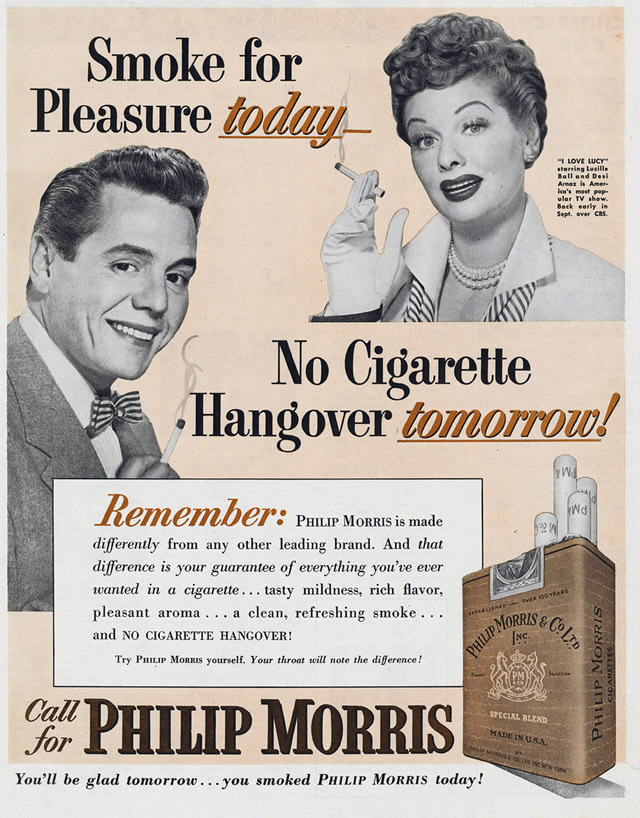
Call For Philip Morris!
-
Subscribe
Subscribed
Already have a WordPress.com account? Log in now.
 Papermoon Loves Lucy