-
“Ethel’s Birthday”

(S4;E9 ~ November 29, 1954) Directed by William Asher. Written by
Jess Oppenheimer, Madelyn Pugh and Bob Carroll, Jr. Filmed October 7, 1954 at Ren-Mar Studios. Rating: 47.3/66
Synopsis ~ It’s Ethel’s birthday and she gets two memorable presents: Hostess Pants and tickets to the theatre. An argument with Lucy over the former threatens to spoil the latter.
There are “I Love Lucy” episodes dedicated to Ethel’s birthday, Lucy’s birthday (“Lucy’s Last Birthday” S2;E25), and two about Little Ricky’s birthday (“Lucy Gets Homesick in Italy” S5;E22, and “Lucy and Superman” S6;E13), but apparently only women and children celebrated birthdays in the 1950s, as no episode is devoted to either Ricky or Fred’s birthday, although Fred’s is mentioned during “Too Many Crooks” (S3;E9) as a plot device.
Vivian Vance’s actual birthday was July 26th, but the show was typically on hiatus during July.

The episode opens with Lucy cleaning up Little Ricky’s toys. Among them is Cleo, a goldfish bathtub toy based on a character from Disney’s 1940 film Pinocchio. Ricky had a wet encounter with Cleo when “The Ricardos Change Apartments” (S2;E20). Little Ricky’s wooden blocks are Hi-Lo Safety Blocks with inter-locking grooves made by Halsam Products Co., which was founded in 1917 by brothers-in-law Harold Elliot and Sam Goss, Jr. (“Hal+Sam”).
Halsam was purchased by Playskool and they discontinued the Hi-Lo blocks in the early 1970s.
Ethel wants Lucy to help convince Fred to buy her a practical birthday gift. Last year he gave a mystery present that was “too long to be a stole and too short to be a volleyball net.”
RICKY: “What birthday is it, Ethel?”
ETHEL: “Oh, it’s mine.”
Ethel forbids Fred from revealing her real age, but Fred clues us in using the birthdays of Speedy Cleaners (40th) and Goldblatt’s Delicatessen (50th). In real-life, Vivian Vance was 45, so the formula works.
- Note to Lucy and Ethel: Birthdays should not be confused with anniversaries. Birthdays are only for living things, not businesses!
- Note to Viewers and Readers: Speedy Cleaners should not be confused with Speedy Laundry, which Lucy visits chasing her Bonus Buck!
The girls drop so many hints about Ethel’s special day that Ricky thinks it may be HIM that forgot LUCY’s birthday!

Ricky immediately produces an emergency box of chocolates which has cards for every ‘missed’ occasion. Despite Lucy’s disastrous experience with chocolates in “Job Switching” (S2;E1), a box of chocks remains the ‘go to’ gift from a repentant husband. Even if they are three years old!

Charged by Fred with buying a gift for Ethel, Lucy ignores his suggestion that she wants a new toaster (one of Lucille Ball’s favorite props on the show) and selects a pair of hostess pants that might look more appropriate on a court jester.

LUCY (about the hostess pants): “I saw them last month in Harper’s Bazaar.”
ETHEL: “Well, they’re certainly bizarre!”
Founded in 1867, Harper’s Bazaar is a monthly women’s fashion magazine. It is still published today.

As hideous as the hostess pants are, they were a real fashion item! This page from a 1950s Sears Catalog calls a similar item ‘Pedal Pushers’ – priced $3.59. Unlike Lucy, who thinks they would be perfect for all those ‘smart dinner parties’ – Sears markets them as picnic wear. Of course, the pair on the show have been bejeweled to add to their… uniqueness.

ETHEL: “What I can’t figure out is how they got them to fit in a box of Cracker Jacks.”
Cracker Jack is caramel coated popcorn snack sold in a box that contained a small, inexpensive toy inside. Ethel usually compares her wedding ring to the prize in a box of Cracker Jack.
A rift between the friends arises when Lucy reveals that it was her – not Fred – who picked the pants. The rift soon grows into a full-out war of words:
ETHEL: “I refuse to go to the theater with anyone who thinks I’m a hippopotamus.”
LUCY: “All I did was intimate that she was a little hippy. But on second glance, she has got the biggest ‘potamus’ I’ve ever seen.”
After calling the girls ‘mules’ because of their stubborn nature, Fred refers to Ethel as ‘Francis.’ Francis the Talking Mule was the ‘star’ of seven feature films released between 1950 and 1956. At the time this episode was filmed, the fourth entry in the series, Francis Joins the WACS, had just been released. The previous year, Francis Covers the Town had featured Lucy regular Gale Gordon, as well as John Breen and Harold Miller, who coincidentally can both be glimpsed in the audience of Over the Teacups!

Ricky gets tickets for the foursome to see the play Over The Teacups. The fictional show is said to be “the biggest hit in town.”

The tickets cost Ricky $6.60 each! That same season Broadway producer David Merrick raised the top ticket price for his musical Fanny (which was on the cover of Life Magazine the week this episode first aired) to an unprecedented $7.50! Accounting for inflation, the cost of one ticket to Over the Teacups should today cost approximately $65, a far cry from the hundreds of dollars that a seat at a Broadway show actually costs today.
Although we never see the actors in the play, we hear Mary Lansing as the weepy Cynthia. In real life Lansing was married to Frank Nelson, who is best remembered as Freddy Fillmore and Ralph Ramsey on the series. She sometimes appeared with Nelson on Lucy’s radio show, “My Favorite Husband.”
English actor Richard Kean voiced the character of John, who breaks the news to Cynthia about the death of their mutual friend. The DVD of this episode has the option to listen to the full dialogue between John and Cynthia from Over the Teacups. On the show, much of their dialogue isn’t clear due to Ethel and Lucy’s bickering and the studio audience’s laughter.

The quick gag with the binoculars strap was borrowed from “New Neighbors” (S1;21) when spying on the O’Briens as they move in.

Geographical Error! The theatre program that Ethel and the other playgoers read is not from a New York theatre. The back page advertises the Sartu and Turnabout Theatres, both located in Hollywood. Although the title of the play is not known, there is a photo of a man and a woman on the cover, who might be John and Cynthia. In the upper right hand corner of the program cover is the logo for The Playgoer, a Southern California magazine similar to New York’s Playbill, distributed free at live theatres.
When Ethel first comes into the theatre she is impressed that they are sitting in Loge seats! In this case, the Loge is the first few rows of the balcony or mezzanine that overhang the orchestra section (ground floor) and generally have an ideal, unobstructed view of the stage. Curiously, this theatre has no ushers and patrons have to find their own seats!

Lucy and Ethel’s animosity carries over into the theatre, much to the dismay of the audience around them.

Oops! When the man behind Lucy and Ethel tries to grab the binoculars from them, the strap briefly gets caught on the arm rest. Lucille Ball quickly releases it for him before he turns the binoculars into monoculars!

This episode required a dozen extras to play the audience. Among them is Bess Flowers (arrow), who was dubbed ‘Queen of the Extras’ in Hollywood and is credited with more than 700 film and TV appearances from 1923 to 1964. She was also in the audience when the foursome attend The Most Happy Fella in season 6. She later made five appearances on “The Lucy Show.” Not surprisingly, Flowers was a founding member of SEG, the Screen Extras Guild (now part of SAG) in 1945.
The other theatergoers attending Over the Teacups have various Lucy-related credits, although it turned out to be a bit of a Big Street (1942) reunion, with four background players from the Lucille Ball / Henry Fonda film re-united for this episode.
- John Breen played a race spectator in “Lucy Wins a Racehorse,” a 1958 episode of “The Lucy-Desi Comedy Hour.”
- Charles Cane was seen with Lucy in The Big Street (1942) and The Dark Corner (1946).
- Joan Carey was a frequent background player and later became Lucille Ball’s stand-in during “The Lucy Show.”
- James Conaty co-starred with Lucille in I Dreamed Too Much (1935), The Big Street (1942), Lured (1947), and The Long Long Trailer (1953).
- Stuart Hall was seen in a 1960 installment of “Westinghouse Desilu Playhouse” hosted by Desi Arnaz.
- Sam Harris shares 13 film credits with Lucille Ball, including The Big Street (1942). After this episode, Harris would return for “Lucy and the Loving Cup” (S6;E12) as a subway strap hanger. He appeared in six episodes of “The Lucy Show,” the last one being as a party guest on “My Fair Lucy” (1965), a riff on My Fair Lady (1964), in which he also played a party guest!
- Harold Miller was in eight Lucille Ball films including The Big Street (1942). He will next be seen strolling the deck of the S.S. Constitution in “Second Honeymoon” (S5;E14).
- Fred Rapport returned to the show for “The Country Club Dance” (S6;E25) that introduced Barbara Eden as Diana Jordan.
- This was Jack Reitzen’s only appearance with Lucille Ball, but he did return to Desilu for three episodes of “The Untouchables” between 1961 and 1963.
- Norman Stevans makes his first appearance with Lucille Ball, but went on to appear in the films Forever Darling (1956), Yours Mine and Ours (1968) and Mame (1974), in addition to two episodes of “The Lucy-Desi Comedy Hour” and two of “Here’s Lucy.”
- Finally, the ubiquitous Hazel Pierce (white circle) is in the audience, Lucy’s camera and lighting stand-in and a frequent extra on the series. She also appeared in 19 episodes of “The Lucy Show,” the films Forever Darling (1956), The Facts of Life (1960), and as a waitress in a 1958 episode of “The Lucy-Desi Comedy Hour.”
The gang would return go to the theatre again to see the real-life musical The Most Happy Fella in “Lucy’s Night in Town” (S6;E22). As with Over the Teacups the cameras only show the auditorium, and we viewers only hear the play’s audio, and do not see the onstage action.

As the episode fades out during Lucy and Ethel’s teary reconciliation, the orchestra infuses a few notes of “Auld Lang Syne” into the closing theme.

FAST FORWARD!

When switching seats with the boys during Over The Teacups, Lucy loses a shoe. When she goes to the theatre in 1957 to see The Most Happy Fella in “Lucy’s Night in Town” (S6;E22), the boys and the girls once again switch seats and Ethel loses her purse! Once again “Queen of the Extras” Bess Flowers is seated behind them!

Lucy Carter went to a birthday party for Ethel in a 1968 episode of “Here’s Lucy” – Ethel the cow, that is! The episode also features background player Norman Stevans, who is in the audience for Over the Teacups!
-
“First Stop”

(S4;E14 ~ January 17, 1955) Directed by William Asher. Written by Jess Oppenheimer, Madelyn Pugh, and Bob Carroll, Jr. Filmed November 11, 1954 at Ren-Mar Studios. It was the 111th episode filmed. Rating: 50.6/65

The episode utilizes second unit footage of the Pontiac driving through Ohio with actor doubles.
Synopsis ~ The gang’s first stop on the way to California finds them stopping at the rundown One Oak Cabins and Cafe somewhere off Route 48 in Ohio. When the place fails to provide good food or good sleep, the foursome try to sneak away in the night.
On the way west they continually see signs advertising Aunt Sally’s Pecan Pralines.

LUCY: Fifty miles to Aunt Sally’s Pecan Pralines.
ETHEL: Well, we’re closing in on her. The first sign we saw said ‘Two hundred miles to Aunt Sally’s Pecan Pralines.’
FRED: I’m surprised she has time to make pralines—she’s so busy making signs.Later…
LUCY: 300 yards to Aunt Sally’s!
ETHEL: 200 yards!
FRED: 100 yards!
RICKY: Just around the bend!
LUCY: You have just passed Aunt Sally’s.In real life, there actually is an Aunt Sally’s Pralines, but it is in Louisiana, not Ohio. It was established in 1935 in New Orleans, so it is possible the “I Love Lucy” writers were inspired by the business, which (unlike the fictional one) is still in operation today. Interestingly, Lucy and the Mertzes pronounce it “praw-leen,” when, as New Yorkers, they would be more likely to say “pray-leen” as it is commonly pronounced in the Northeast.

Oops! When Lucy’s double gets out of the car to check the sign on the door of Aunt Sally’s, she is wearing a dark coat and a dress. In the studio-filmed scenes inside the car, Lucille Ball wears a light-colored tweed coat and slacks.

Fred notes that they just left Pennsylvania and they’re headed for Indiana, indicating that the group intends on visiting Fred’s home state, although we never see it on air. Since the group left New York City at the end of the day in “California, Here We Come” (S4;E12), it stands to reason that if they’ve just left Pennsylvania there were stops in New York State the previous day (maybe in Lucy’s hometown of Jamestown) that the viewers don’t see and are never discussed. This is supported by the map Lucy drew up in the previous episode.

The roadside dive is run by the laid-back, disheveled, George Skinner played by Olin Howlin. Howlin started acting in silent films in 1918 and had small roles in such classics as Gone With the Wind (1939, left), Little Women (1949), and The Blob (1958). He also appeared with William Frawley in the less-than-classic Ambush (1939) and Crime Doctor’s Manhunt (1946). He and Irving Bacon have the distinction of being the only actors to appear in both the 1937 and 1954 versions of A Star Is Born. Coincidentally, Bacon was also in Gone With the Wind and would play Ethel’s father, Will Potter, in “Ethel’s Hometown” (S4;E15) just two weeks later!

One Oak Cafe’s outdated menu offers such mouth-watering fare as steak sandwiches with French fries and coleslaw, roast beef with baked potato, and fried chicken with biscuits. Unfortunately for the foursome, all he has ‘in stock’ are stale Swiss cheese sandwiches wrapped in wax paper. During a close-up of the rubbery sandwich (above), it can be seen that the menu is actually a portion of the script with some of the lines crossed out!

The inedible sandwiches cost the gang a dollar a piece. Mr. Skinner then tells them about the nearby Golden Drumstick, a restaurant that serves a turkey dinner with all the trimmings – dressing, cranberry sauce, green salad, and homemade peach shortcake – for only one dollar! But then dashes their hopes by telling them that they went out of business due to the low price.
Price Check! The $4.80 bill for the cheese sandwiches would cost more than $45 in today’s economy!

In return for am eighty cent entertainment tax Mr. Skinner (badly) croons and strums a bit of “I’m Afraid to Come Home in the Dark,” a song written by Harry Williams and Egbert Van Alstyne in 1907. It would also be sung by Harry Morgan in a 1974 episode of "M*A*S*H.”

Fred calls One Oak "Lower Slobbovia,” which is a term first used in 1946 by Al Capp in his comic strip "Li’l Abner.” Capp created a fictional nation that was unenlightened and socially backward and the term entered popular culture when referring to any place hopelessly stuck in the past.

A special set was constructed for the scene in the dilapidated cabin. The room was built on a set of springs and was shaken to simulate the trains going by.

Lucille Ball praises the Desilu crew who took care of the technical aspects of the episode.

Ethel offers to trade beds with Lucy and Ricky, claiming that she and Fred have a sagging old mattress back home in New York just like the one in the cabin’s double bed.

The only time the series ever showed the Mertz bedroom was in “Vacation from Marriage” (S2;E6) and they had two single beds, not a double. The “Home Sweet Home” sign over the cabin’s bathroom door is the same as the one seen in the Mertz bedroom in that episode.

LUCY: I wonder if this bed stops in Chicago?
One of the bed’s legs was anchored which allowed the bed to pivot when pulled by cables.
Cables are seen in two parts of this episode: on the front of the Pontiac, to pull it when the gang leaves the motel; and on the bed in the cabin, to pull it across the room when the trains go by.

When the car is outside the motel, it has no windshield nor window glass other than the vent window, and the headlights have a dull, white covering, probably to eliminate glare or reflections from studio lights.
Although Mr. Skinner has a gas pump outside the café (above right), Ricky never mentions getting gas – something of prime concern on most road trips. Nor do Mr. Skinner’s signs mention “fuel” – a major selling point for wooing drivers to stop. Of course, the gas pumps may be dry or broken – like most everything else at One Oak!

The script helps the audience understand some of the visual jokes.
- Before going into the bathroom to change for the night, Ethel doubles back for her toothpaste, which she left in the suitcase. The first train passes by while Ethel is in the bathroom. When she emerges her face is covered in toothpaste! The joke pays off better if you know Ethel is brushing her teeth while in the bathroom.

- After the second train passes by, moving the double bed across the cabin, Ricky loudly announces that the oncoming train is coming the other way. “It’s coming the other way now!” This sets up the idea that the bed will now travel back across the room in the opposite direction.

This episode is sometimes cited as the first time a man and woman shared a bed on television, but that’s not entirely true. A now-forgotten sitcom called "Mary Kay and Johnny” (1947-50) takes that distinction. Like Lucy and Desi, Johnny and Mary Kay Stearns were also married in real life. However, since Fred and Ethel take over the sagging double bed from the Ricardos, Vivian Vance and William Frawley are technically the first UNMARRIED people to share the same bed on TV. Mary Kay was also the first woman to be pregnant on TV, a fact that is also sometimes mistakenly attributed to Lucille Ball.

-
“The Hedda Hopper Story”


(S4;E21 ~ March 14, 1955) Directed by William Asher. Written by Jess Oppenheimer, Madelyn Pugh, and Bob Carroll, Jr. Filmed February 3, 1955 at Ren-Mar Studios. Rating: 50.3/69
Synopsis ~ Ricky is looking for some publicity in Hollywood so he hires a publicist who concocts a stunt to get the attention of journalist Hedda Hopper.

Despite the fact that she only appears in the show’s final moments, this episode is centered around one of Hollywood’s most powerful and colorful gossip columnists, Hedda Hopper. Born Elda Furry in Pennsylvania, Hopper she was originally an actress in silent pictures. She later starred with Lucille Ball in Bunker Bean (1936) and That’s Right-You’re Wrong (1939). During the 1950s she reinvented herself as a reporter and became famous for her outrageous hats as well as her long-standing rivalry with fellow gossip columnist Louella Parsons.
Hopper played herself in the film Sunset Boulevard (1950) and made one more appearance with Lucy and Desi on the very first “The Lucy–Desi Comedy Hour” in 1957. She appeared on “The Desilu Revue” (1959) in return for Lucy appearing on her special “Hedda Hopper’s Hollywood” a few weeks later. She died in 1966 at age 80. She bequeathed her black-and-blue Rolls-Royce to Lucille Ball.

In films and television, Hopper has been portrayed by such actors as (clockwise from top left): Helen Mirren (Trumbo),
Tilda Swinton (Hail, Caesar!),
Jane Alexander (Malice in Wonderland), Judy Davis (“Feud”),Fiona Shaw (RKO 281),
and Katherine Helmond (Liz: The Elizabeth Taylor Story).

In “The Gossip” (S1;E24) Ricky and Fred indulge in idle chatter about the goings on at the Tropicana and Lucy refers to them as “Hedda and Lolly” – the first of many references to Hopper and Parsons that would populate the series.

Coincidentally, Hedda Hopper, who is to interview Ricky about his role in Don Juan, actually appeared in a silent version of Don Juan (1926) as the Marchesia Rinaldo. The title role was played by matinee idol John Barrymore.

The Ricardo’s New York City home phone number is Murray-Hill 5-9505
(695-9099).
This is the third and final phone number heard on the air. The first was Murray-Hill 5-9975 (695-9975) and the second was Circle-7-2099 (247-2099).
Bobby the bellboy delivers a telegram from Mrs. McGillicuddy addressed to ‘Mickey Mikado,’ which Bobby jests might have had to be forwarded to Japan. The scrambled surname is a nod to Gilbert and Sullivan’s 1885 operetta The Mikado, which is set in a fictional Japanese village. About the telegram Fred says, “Just be thankful you didn’t have to wait till it came back from Japan marked ‘not known at this pagoda.’” “The Ricardos Go To Japan” in a 1959 episode of “The Lucy-Desi Comedy Hour.” Coincidentally, Ricky also sings “Cuban Pete” in Japan, but as “Tokyo Pete” (above).

Ricky really has no right to complain about his mother-in-law’s mangling of his name as he calls Hedda Hopper ‘Hedda HOOPER’ throughout the episode as well as when she comes to Westport in 1957!

When it comes to celebrities Lucy’s mother is a fan of silent film stars Ramon Navarro, Francis X. Bushman, and Rudolph Valentino, who she adored in The Sheik (1921). She even sings a few bars of "The Sheik of Araby,” a song written as a response to the film’s popularity. While in Hollywood Mrs. McGillicuddy wants to see the house where Valentino lived. Coincidentally, the homes of Navarro, Bushman, and Lucille Ball, would all be featured on the 1960 NBC special “Hedda Hopper’s Hollywood.”

MRS. MCGILLICUDDY (To Ricky, about Valentino): “You’re not fit to touch the hem of his burnouse!”

RICKY (about gossip columnists): “All they talk about is Marilyn Monroe, Marilyn Monroe, Marilyn Monroe.”
This quote might well apply to “I Love Lucy” itself, since the star is very frequently mentioned on the series. In “Ricky’s Movie Offer” (S4;E5) Lucy even dresses up like Marilyn Monroe. Monroe’s 1953 film Gentlemen Prefer Blondes later inspired some of the plot of “Second Honeymoon” (S5;E14) aboard the S.S. Constitution.


Hedda Hopper is at the fictional Beverly Palms Hotel to attend the annual Motion Picture Mothers Club tea. This real-life organization was formed in 1939 as a small social group of ladies whose children were involved in film and (later) television business. It still exists today.

The dress Lucy wears for her dive into the pool is the same one she wore in the 1953 color film The Long, Long Trailer. The dress must have been sturdily built, as it takes quite a beating both times! [Notice the Tropicana set behind Lucy and Desi in the photo on the left. While the gang was in Hollywood, this set was not used.]

“Cuban Pete” is heard again for the first time since “The Diet” (S1;E3), where it was teamed with Lucy’s version, “Sally Sweet.” Yet another variation of the song, “Texas Pete,” will be sung by Ricky in “Lucy Goes to the Rodeo” (S5;E8) as well as “Tokyo Pete” in “The Ricardos Go To Japan” in 1959. In 1946, Desi Arnaz played himself in a film called Cuban Pete where he sang the title song. The song was composed by Joseph Norman under the name José Norman in 1936, and recorded by Louis Armstrong in 1937. It was later famously sung by Jim Carrey in the film The Mask (1994).

Ricky’s new press agent Charlie Pomerantz (Hy Averback) tells Ricky “Dad, I’m going to make you the Cuban Liberace.” Ricky glares at him (with hidden subtext) and says “I don’t know about that.” Liberace’s flamboyant personality and style are not something that macho Latin Ricky (or Desi Arnaz) wanted to emulate. Liberace would guest star as himself on a 1970 episode of "Here’s Lucy.” He was mentioned in the dialogue of two previous “I Love Lucy” episodes due to his having a hit television series.
Hy Averback (Charlie Pomerantz) had already played another Charlie on “I Love Lucy” – Charlie Appleby in “Baby Pictures” (S3;E5), although the character would be re-cast with George O’Hanlon in season six. Averback transitioned from acting to directing, becoming Emmy nominated for “M*A*S*H.” The character of Charlie Pomerantz was named after the West Coast Publicity Agent for Philip Morris, the show’s main sponsor.

Pomerantz later flatters the handsome lifeguard (John Hart) by pretending to mistake him for Burt Lancaster. The topical reference capitalizes on Lancaster wet and in a swimsuit in 1953’s On the Waterfront. He then tells the lifeguard he’d be perfect for the lead in the new Esther Williams picture. Esther Williams was famous for her MGM ‘aqua musicals’ but she and Lucille Ball had also appeared together in the 1946 films Easy to Wed and Ziegfeld Follies. She would soon be among the stars listed as attending Lucy’s anniversary party at the Macombo in “Hollywood Anniversary” (S4;E23). But, as Ricky later confessed to Lucy, “None of those peoples are coming.”

John Hart (Handsome Lifeguard) had already appeared on the series as handsome furrier Tom Henderson in “Lucy Changes Her Mind” (S2;E21). Hart had replaced Clayton Moore in the title role on "The Lone Ranger.” His last TV appearance was also as The Lone Ranger, on a 1981 episode of "Happy Days.”
Renita Reachi (Poolside Guest) was Vivian Vance’s camera and lighting stand-in for “I Love Lucy” and “The Lucy Show” as well as a costumer for “The Lucy Show” from 1966 to 1968. She was a costumer and/or made crowd appearances on “Here’s Lucy” and the Lucille Ball films Yours, Mine and Ours (1968) and Mame (1974).

Hazel Pierce (Poolside Guest) was Lucille Ball’s camera and lighting stand-in throughout “I Love Lucy.” She also made frequent appearances on the show. Of her many on-camera appearances on “The Lucy Show” only once was she given a character name and credited, in “Lucy Plays Cleopatra” (S1;E1). She was also an uncredited extra in the film Forever Darling (1956).
Recurring performers Kathryn Card (Mrs. McGillicuddy), Bob Jellison (Bobby the bellboy), and the Mayer Twins (Little Ricky) also appear in the episode. The ‘baby’ actually earns a round of applause from the studio audience when carried in by Lucy. Mrs. Trumbull (played by Elizabeth Patterson) is mentioned, but not seen on screen.

After this episode, Lucy and Desi did a public service announcement for the U.S. Olympic team, which was in need of funds for the 1956 summer games in Australia.
LUCY: Hi. We came back to tell you something. Something that’s important to all of us.
DESI: It’s about the Olympic Games.
They’re going to be held next year in Melbourne, Australia, and our team must be there to win.
It’s up to us, to every American, who wants to see the Stars and Stripes flying above the victor stands, to see the funds available.
LUCY: You see, the teams behind the iron and bamboo curtains are government-subsidized, but our team is really our team, yours and mine.
It’s only gonna be there if we prove that we want it there with our contributions.
DESI:You want to know something?
The Pan-American games in Mexico City are on right now, and because we didn’t raise enough money, we couldn’t send the succer team.
LUCY: Honey, not ‘sucker,’ soccer.
DESI: All right, all right.
But our team isn’t there, and we can’t let this happen in the Olympics.
LUCY: Let’s show our Olympic team how we feel about them and show the world how we feel about our country.
DESI: Send your contributions to U.S.
Olympic Fund, care of your local postmaster.
LUCY: That’s U.S.
Olympic Fund, care of your local postmaster.
Commercials during the original broadcast introduced Marlboro Cigarettes. Although the brand had been around since 1924, it was previously marketed to women. These commercials were the first to re-brand the product as a cigarette for men.
FAST FORWARD

Hopper returned to interview Lucy and Ricky at their Westport home in the very first episode of “The Lucy-Desi Comedy Hour” in 1957. Unfortunately, this was a rare 75-minute “Comedy Hour” and Hopper’s opening and closing scenes are usually cut to fit the program into an hour-long format.

In a reciprocal appearance, Lucille Ball appeared as herself on “Hedda Hopper’s Hollywood” (January 10, 1960) promoting The Desilu Workshop.

In return, Hopper made an appearance on “The Desilu Revue” (December 1959), a Christmas show-within-a-show performed by members of the Desilu Workshop and including guest-appearances by celebrities in the Desilu TV family.
 1955, Bobby Jellison, CBS, Charlie Pomerantz, Cuban Pete, Desi Arnaz, Hats, Hedda Hopper, Hy Averback, I love lucy, John Hart, Kathryn Card, Louella Parson, Lucille Ball, Lucy, Marlboro Cigarettes, Mayer Twins, Mikado, Ricky, Ricky Ricardo, Swimming Pool, The Lone Ranger, The Long Long Trailer, tv, US Olympic Team, Valentino, Vivian Vance, William Frawley
 -
“Lucy and Harpo Marx”

(S4;E28 ~ May 9, 1955) Directed by William Asher. Written by Jess Oppenheimer, Madelyn Pugh and Bob Carroll, Jr. Filmed March 24, 1955 at Ren-Mar Studios.
Rating: 42.9/63
Synopsis ~ Lucy promises Carolyn Appleby she will meet some real Hollywood celebrities. Now she’s got to deliver. Stealing her eyeglasses and dressing up as some famous stars, she manages to fool Carolyn. Then the real Harpo Marx shows up only to discover Lucy dressed up as him.
The episode is sometimes just referred to simply as “Harpo Marx” because it features a guest appearance by the famous non-verbal comedian. The previous episode, “The Dancing Star” (S4;E27) featuring Van Johnson, was actually filmed after this episode, perhaps to accommodate the schedules of the guest stars.

Lucy and Harpo had appeared together in Room Service in 1938 for RKO Studios. He was said to be her ‘favorite’ Marx Brother. By 1955 Lucy and Desi owned RKO and had re-named it Desilu Studios. Just before the filming, Harpo suffered a heart attack and his doctors discouraged him from doing the show. Thankfully for TV comedy history, he ignored their wishes.

Harpo Marx was born Adolph Marx on November 23, 1893, in New York.

He was the second of five brothers: Julius (Groucho), Milton (Gummo), Leonard (Chico), and Herbert (Zeppo). He quit school after kindergarten to help support his family by taking a job as a delivery boy. His musical talent was developed by learning to play his grandmother’s harp. In 1922, he and his brothers left vaudeville to perform on Broadway, and soon landed in Hollywood making movies together throughout the 1930s and 40s.

Harpo never spoke on screen and was usually seen in a fright wig, battered top hat, and wearing a trench coat, all of which he does in this episode.

Lucy and Ethel fancifully mention inviting Princess Margaret for tea. She was the younger sister of Elizabeth II, who had been on the throne only two years at the time this episode was first aired. Margaret had a reputation of being extraordinarily social for a royal. She was often photographed by the press at balls, parties, and night-clubs.

Once again, Marilyn Monroe is mentioned, with Lucy wondering if Ethel might pass for Monroe to a near-sighted Carolyn. After Ethel tries to walk like Marilyn, Lucy decides that “nobody is that near-sighted!” In “Ricky’s Movie Offer” (S4;E5) Lucy and Ethel argue about who looks more like Marilyn Monroe. Fred says he looks more like Marilyn than either of them! Monroe’s name is dropped in five episodes.
Oops! When giving instructions to Ethel, Lucille Ball momentarily trips over her words when saying “the important thing for dew…you’d…to remember is…”

Preparing for Caroline’s visit, Lucy puts out flowers and chocolates in her glass Fostoria ‘American’ Compote Candy Dish. The dish was previously used in “Lucy’s Schedule” and “The Ricardos Are Interviewed.”
Ethel explains away the absence of Mrs. McGillicuddy (Kathryn Card) and Little Ricky (the Mayer Twins) by saying that they’ve gone to the zoo.

Doris Singleton makes her penultimate of her ten appearances as Lucy’s friend Carolyn Appleby. A New Yorker, Carolyn is conveniently on her way to Hawaii to join her husband Charlie, but stops over in Los Angeles to see Lucy. All of this is established in “The Dancing Star.”

Once Carolyn arrives, Lucy mentions that “Ronnie and Benita” might drop by but quickly corrects herself, fibbing that they’d dropped by last week. She is referring to Oscar winner Ronald Colman and his wife Benita Hume. Lucille Ball was an un-credited extra in Colman’s 1934 film Bulldog Drummond Strikes Back.

The full celebrity guest list for Lucy’s faux Hollywood party consists of Gary Cooper, Clark Gable, Bing Crosby, Walter Pidgeon, Jimmy Durante, and Harpo Marx. After making sure Carolyn is without her glasses, Lucy uses masks from the magic shop on the boulevard for her impersonations.

As Gary Cooper, she answers most questions with Cooper’s trademark “yep” or “nope” something he memorably did in the 1949 Warner Brothers picture It’s a Great Feeling. Cooper was mentioned in two previous episode of “I Love Lucy.”

As Clark Gable, Lucy pretends he has laryngitis, accounting for his gruff voice and Ethel’s warning that Carolyn not get too close lest she catch his cold. Lucille Ball was great friends with Gable’s third wife, Carole Lombard. Gable is mentioned in seven other episodes.

As Jimmy Durante, Lucy paraphrases some of Durante’s famous sayings: “What a catastrastrope” (instead of catastrophe), something he often said on his NBC radio show. On his departure, Lucy/Durante says “Goodnight Mrs. Appleby, whoever you are.” This is a variation on Durante’s famous radio sign-off “Goodnight Mrs. Calabash, wherever you are.”

A few episodes earlier, Durante’s nose took up two frames at the Hollywood Brown Derby. Lucille Ball had an uncredited role in Durante’s 1935 film Carnival.

Sitcom Logic Alert! When the real Harpo Marx enters instead of Lucy, one wonders if Ethel is as near-sighted as Carolyn. She is face to face with the famous comic and can’t see that it isn’t Lucy or a magic store mask! Also, Carolyn’s vision has improved enough to be chased around the hotel room by Harpo without bumping into the furniture!
We don’t see Lucy’s impersonation of Bing Crosby or Walter Pidgeon. According to “The Dancing Star,” Cary Grant and Marlon Brando were also supposed to be at the party, but since that episode was filmed after this one, it’s understandable why the guest list had discrepancies.

Harpo plays “Take Me Out to the Ball Game” on the harp, an arrangement done by his son Billy. The song was written in 1908 by Jack Norworth and Albert Von Tilzer. It was featured in the 1935 Marx Brothers film A Night at the Opera as well as in a 1949 film called Take Me Out to the Ball Game starring Frank Sinatra.

Bill Marx wrote about his experiences working with his dad in his memoir Son of Harpo Speaks, sharing memories of Harpo and Lucille Ball recreating the Marx Brothers’ famous mirror scene:
“I was 18 years old at the time. Dad said, ‘We’re going to do an ‘I Love Lucy’ episode. I want you to write something for me to play on the show.’ I had this summer job at Desilu as a page or an usher, because they shot all these shows before a live audience. They had me as an usher for this episode, and at the same time, I was continuing on as I had since I was 12 years old, as my dad’s prop man. I went back and forth, doing both those jobs at the time. I was there for the entire week of rehearsals, which were really most fascinating.”

The mirror routine first performed by Groucho in Duck Soup (1933). Lucy insisted on lots of rehearsal while Harpo was inclined to improvise, so the routine had to be re-filmed after the studio audience left to get it right.

Although it may look seamless in the final edit, the scene is actually many takes edited together. After the final take of the mirror routine, Harpo remained behind and played the harp for the cast and crew while Vivian Vance sang. Shortly after the episode aired, Harpo had another heart attack but survived for another nine years, dying at the age of 75 from complications following heart surgery.

FAST FORWARD!

On May 19, 2017, CBS aired this episode and “The Dancing Star” (S4;E27) colorized as “I Love Lucy: Superstar Special”. The episode was edited for television, removing Lucy masquerading as Gary Cooper, Ethel walking like Marilyn Monroe, and much of Harpo’s harp solo.

On a 1974 “Dick Cavett Show” Cavett tells Lucille Ball that this is one of his favorite episodes. He introduces a clip from the show. Before it rolls, Lucy adds that although Harpo was a dear man, he usually worked alone and could not remember his own routine with her from take to take.

On a 1984 episode of the game show “Body Language” Lucille Ball is given the clue “Marx Brothers.” She chooses to imitate Groucho instead of Harpo. Her partner guesses it correctly. Two years later, Groucho’s son Arthur was a writer on “Life With Lucy.”

Jimmy Durante did a cameo as himself (along with his wife Margie Little) in a 1966 episode of “The Lucy Show.”

In a 2005 episode of “The Gilmore Girls” the characters talk about this episode, and also reference “Don Juan is Shelved” and “Don Juan and the Starlets.”

A July 2007 episode of “TV Land Confidential” featured clips of Harpo and Lucy from this episode.
MARX MERCH!


 Benita Hume, Chico Marx, Clark Gable, Desilu, Doris Singleton, Duck Soup, Ethel Mertz, Fred Mertz, Gary Cooper, Groucho Marx, Harp, Harpo Marx, I love lucy, Jimmy Durante, Lucille Ball, Lucy, Marilyn Monroe, Princess Margaret, RKO, Ronald Colman, Room Service, Take Me Out To The Ballgame, Vivian Vance, William Frawley
 -
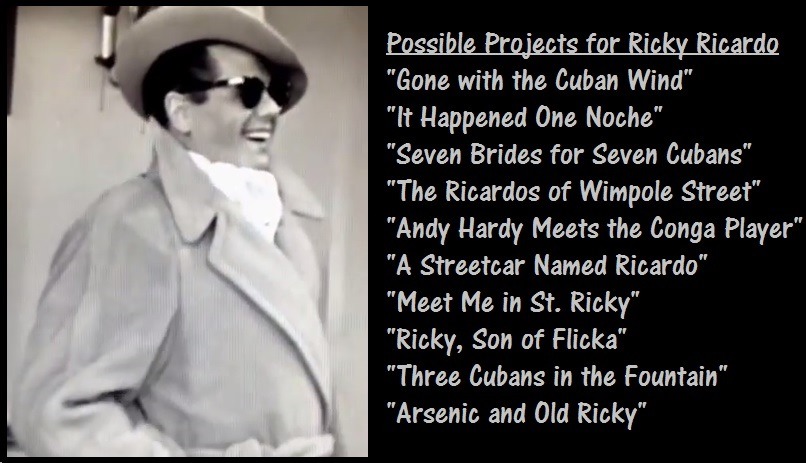
Possible Projects for Ricky Ricardo
-
“Lucy Visits Grauman’s”

(S5;E1 ~ October 3, 1955) Directed by James V. Kern. Written by Jess Oppenheimer, Madelyn Pugh, Bob Carroll, Jr., Bob Schiller, and Bob Weiskopf. Filmed September 9, 1955 at Ren-Mar Studios.
Rating: 42.7/61
Synopsis ~ The trip to Hollywood is coming to an end and Lucy has her heart set on one last great souvenir – John Wayne’s footprints from the forecourt of Grauman’s Chinese Theatre!

The day this episode first aired (October 3, 1955) Rock Hudson was on the cover of LIFE Magazine. Hudson had guest-starred on “I Love Lucy” at the end of season four.

No doubt William Frawley was pre-occupied during the filming of this episode due to the World Series. Frawley was a long-time New York Yankees fan and reportedly had it in his original contract that he would get time off should they be in the World Series. The 1955 World Series matched the Brooklyn Dodgers against the Yankees, with the Dodgers winning the Series in seven games to capture their first championship in franchise history. It would be the only Series the Dodgers won while based in Brooklyn, as the team relocated to Los Angeles after the 1957 season.
This is the first episode to be written by new writers Bob Schiller and Bob Weiskopf. As a season 5 premiere, the episode wasn’t very well-received. Critics took issue with the script, saying that the episode was only enjoyable because of Lucille Ball’s ad-libs. Needless to say, the critics mistook carefully scripted dialogue written by the new writers for ad-libs delivered by masterful Lucille Ball. Also new this season is Irma Kusely, who took over for Bert French as Lucy’s hairstylist. Kusely had previously done Lucy’s hair while she was pregnant during season two. In honor of her return, Ball works her first name into the script of the next episode in this two-part opener.

The episode opens with Lucy, Fred, and Ethel thowing a party for Ricky to celebrate the completion of his movie, although the title of the film will go unmentioned for the rest of the series.
For a native New Yorker, Lucy has an unusually cultured way of pronouncing ‘caviar’ as ‘cah-viahr.’
Oops! Perhaps it was intentional to give it a ‘home made’ quality, but the banner omits the possessive apostrophe in “Hollywood’s”!

Seven months earlier, Marlon Brando (1924-2004) won an Oscar for 1954′s On The Waterfront. A month later, in New York City, his film Guys and Dolls premiered. The film was promoted with a scene inserted into “Lucy and The Dummy” (S5;E3) which airs two weeks later.
RICKY: “Well, I guess Brando and I do have a lot in common.”
FRED: “Yeah, I can’t understand either of you when you talk.”Brando was famous for muttering his lines under his breath. Most actors of the time were taught to use proper diction and projection. This became his ‘trademark’.
Fred makes a bad joke that the only Marlon he knows is “Marlon” Monroe.

Perhaps the two most famous actors of their generation, Monroe and Brando were rumored to have briefly dated in 1955.
When Ricky arrives, they regale him with “Happy Party To You” a somewhat awkward rendition of the traditional “Happy Birthday” song.

When Lucy learns her time in Hollywood is drawing to a close, we get to see Lucy and the Mertzes’ prized souvenir collection, which includes:
- a Robert Taylor-autographed orange
- a Richard Widmark-autographed grapefruit
- a handkerchief with Lana Turner’s lipstick print on it (Fred’s)
- a tin can that was crushed by Cary Grant’s left rear tire
- menus from the Hollywood Brown Derby
- matchbooks from Ciro’s
- an ashtray from the Beverly Hilton
- chopsticks from the Beachcomber
Of these places, viewers only saw the Brown Derby and Lucy picking the grapefruit from Widmark’s backyard. Interestingly, references to Lucy’s prized produce were cut from the syndicated version of the show, probably to make time for more commercials. Ethel’s line about not being able to look at Fred and smile at the same time was also cut out from the syndicated version.

When Lucy is unpacking in “The Homecoming” (S5;E6), some of these same props will be seen once again.
Begging to stay longer (six years?), Lucy tells Ricky that she still has yet to see:
- Coconut Grove
- Olvera Street
- The Hollywood Bowl
- Catalina Island
- Grauman’s Chinese Theatre
Fred repeatedly states that he has yet to see Ava Gardner, so it can be inferred that when he heard her paged at the Brown Derby in “Hollywood at Last!” (S4;E16), he didn’t actually catch sight of her.
Although Fred and Ethel want to see Catalina, Lucy wants to see Grauman’s Chinese Theatre, and she has the car. Grauman’s it is.

Graumans Chinese Theatre was opened by Sid Grauman on May 18, 1927 in partnership with Mary Pickford and Douglas Fairbanks, located at 6925 Hollywood Boulevard along the historic Hollywood Walk of Fame. Their first premiere was Cecil B. DeMille’s The King of Kings (1927). Grauman had already built an opulent movie palace in 1922 called the Grauman’s Egyptian Theatre, which also still stands today. In 1973, Grauman’s Chinese was renamed Mann’s Chinese, and a few years ago TCL Chinese Theatre, which is (ironically) a Chinese held company.

The huge marquee glimpsed in the episode’s establishing footage promoting The Tall Men starring Clark Gable and Jane Russell has long since been removed, leaving an open forecourt and a better view of the iconic pagoda entrance. The film premiered on September 22nd, meaning that the footage was shot after the studio portions of the episode and inserted before the October 3, 1955 air date. Blood Alley, the film that Lucy briefly mentions to Ethel while standing on John Wayne’s block
premiered on October 1st, two days before this episode aired.
Wayne promotes the film more thoroughly in the next episode.
The reason the Chinese Theatre is such a popular tourist stop is the many footprints in cement that adorn the theatre’s forecourt. History differs on exactly how the tradition got started, but many say it was Norma Talmadge accidentally stepping into wet cement arriving for a premiere. Sid Grauman himself said he accidentally did the same thing during the theatre’s construction, then convinced Mary Pickford to do likewise.

In this episode, Lucy and Ethel find slabs dedicated to:
- Gloria Swanson
- Tyrone Power
- Joan Crawford
- Gary Cooper
-
Harold Lloyd’s eyeglasses
- Trigger’s horseshoe
- Betty Grable’s leg
- and, of course, John Wayne
When trying to fit her leg into the print of Betty Grable’s, Lucy mentions Grable’s husband Harry James. Little Did Lucy know that Betty Grable and James would guest star on “Lucy Wins a Racehorse,” a 1958 episode of “The Lucy–Desi Comedy Hour.” Lucy finds that her feet are smaller than Joan Crawford’s. Likewise, Joan Crawford will appear on a 1968 episode of "The Lucy Show.”

In reality, there are approximately 200 cement slabs in Grauman’s forecourt, all selected by private committee. Somewhat surprisingly, Lucille Ball has never been among them! John Wayne does indeed have his boot prints at Grauman’s, but it is not the same as the one seen in the episode. The real-life slab is inscribed “Sid – there are not enough words. John Wayne, January 25, 1950” while the prop in the episode simply has his signature and boot prints.

To get rid of John Wayne-seeking tourists at Grauman’s, Lucy says that she and Ethel are sitting on Bill Holden’s footprints, and that Ethel is President of the Bill Holden Fan Club. Their disastrous encounter with Holden at the Brown Derby was seen in “Hollywood at Last!” (S4;E16), the first of the California-set episodes.

Fred calls Lucy and Ethel’s scheme to steal Wayne’s footprints “regular Bellevue bait”! Bellevue Hospital, founded on March 31, 1736, is now the oldest public hospital in the United States. Located on First Avenue in the Kips Bay neighborhood of Manhattan, Bellevue Hospital first earned notoriety for its psychiatric facilities, home to New York City’s mentally ill in a time when they were simply called crazy, demented, or freaks.

This episode is directly linked to the following one, “Lucy and John Wayne” (S5;E2), in which Lucy tries to get Wayne to reproduce the footprints to avoid her going to jail. Both episodes, however, can be enjoyed on their own. This is also true of loosely linked episodes “The Dancing Star” (S4;E27) and “Lucy Meets Harpo Marx” (S4;E28).
The cement used in this episode was mostly made of Styrofoam with some solid material added so that Ricky could chip away at with the hammer. Why there is a hammer on the dresser of Fred’s hotel room is never fully explained!

Hal Gerard and Ge Ge Pearson played the tourists, Mr. and Mrs. Irving Massey of New York City. We don’t learn the character’s names until the next episode, when Ricky reads aloud the newspaper report of the footprint’s disappearance. The two actors were married in real-life. A year later the couple returned to CBS to appear in the same episode of “Damon Runyon Theatre.” Pearson had appeared on a few episodes of Lucy’s radio show "My Favorite Husband.” She is perhaps best remembered as the voice of Crusader Rabbit. The couple died just a year apart in 1975 and 1976.

Clarence Straight and Ben Neims played the policemen. This is just one of many law enforcement officials Straight played throughout his career. Neims only has one other television credit of record: a 1956 episode of "Schlitz Playhouse of Stars,” also on CBS.

Also passing through the forecourt is Vivian Vance’s camera and lighting stand-in Renita Reachi (black dress). She was also a talented costumer who made several background appearances on the series as well as “The Lucy Show”.

While one of the policemen is gone, the other stands in Gary Cooper’s footprints and says “Yup” something Cooper frequently said in the 1949 Warner Brothers picture It’s a Great Feeling. Lucy did the same thing when she imitated Cooper for nearsighted Caroline Appleby in “Lucy and Harpo Marx” (S4;E28).

Little Ricky is played by The Mayer Twins.

This is the first episode to be sponsored by General Foods, who primarily used the series to promote their signature product, Sanka an instant decaffeinated coffee. The name Sanka is derived from the French (SAns CAffeine).
FAST FORWARD

Although she was never asked to do this for Grauman’s, Lucy and Hedda Hopper put their handprints in cement during Lucy Day at the 1964 World’s Fair in New York.

On May 20, 2016, CBS re-broadcast this episode colorized and in primetime along with “Lucy and John Wayne” (S5;E2) under the title “The I Love Lucy Superstar Special.”

In 1978, during a timeline on “CBS on the Air: A Celebration of 50 Years” a still photo from this episode overlaps 1954 and 1953, despite the fact that the actual air date was 1955!
1955, Ben Neims, Bob Schiller, Bob Weiskopf, CBS, Clarence Straight, Crusader Rabbit, Desi Arnaz, Ethel, Footprints, Fred, Gege Pearson, Grauman’s Chinese Theatre, Hal Gerard, Hollywood, I love lucy, John Wayne, Lucille Ball, Lucy, Mertz, Ricardo, Ricky, Sanka, The Tall Men, Vance, Vivian, Vivian Vance, William Frawley
-
Subscribe
Subscribed
Already have a WordPress.com account? Log in now.
 Papermoon Loves Lucy