-
“Lucy Hires an English Tutor”

(S2;E13 ~ December 29, 1952) Directed by William Asher. Written by Jess Oppenheimer, Madelyn Pugh and Bob Carroll, Jr. Filmed on October 24, 1952 at General Service Studios. It was the 48th episode filmed. Rating: 68.1/91
Synopsis ~ Pregnant Lucy is worried that the gang doesn’t speak proper enough English for the baby, so she arranges for grammar lessons. Mr. Livermore, the tutor she enlists, is looking to get into show business.

The episode opens with Lucy knitting, a trope for expectant mothers explored in “Drafted” (ILL S1;E11).

Ricky comes in with bags.
RICKY: There’s only one place in town that sells a papaya juice milkshake.

Ricky is referring to Papaya King, a New York institution. The original Papaya King opened in 1932 on the Upper East Side of Manhattan. The restaurant originally only served drinks made from fresh tropical fruits.

He’s also brought Lucy a pickle, which she dips in the milkshake. Craving pickles is another popular trope about pregnant women. It was explored further in “Lucy, the Part-Time Wife” (HL S3;E14, above) in 1970.

Although she tells Ricky she doesn’t care what sex the baby turns out to be, Lucy is secretly hoping for a girl, so she buys frilly dresses for her future daughter.

Ricky is counting on a boy, so he brings home a football and a baby sports jersey that says ‘HAVANA U 1974.’ He want his son to walk the same campus he did – University of Havana in Cuba. Ricky even sings the “Notre Dame Fight Song” in Spanish, with Havana U lyrics.

Founded in 1728, the University of Havana is the oldest university in Cuba, and one of the first to be founded in the Americas. When this episode was written and filmed, the University was in the news. After the government was taken over by Batista in March 1952, the University became a center of anti-government protests. Batista closed the University in 1956. The Castro regime re-opened it in 1959, but by that time American travel to Cuba was no longer possible. In real life, Desi Arnaz finished high school in Florida and then went right to work.

Likewise, Little Ricky’s real-life counterpart Desi Arnaz, Jr. didn’t attend college. In 1974 he went right to work as well, making the western film Billy Two Hats with Gregory Peck and the TV special “California My Way” with his dad.

This starts Lucy worrying whether her child will be well-educated, but knows that it will be difficult with Ricky’s thick accent.

On her bedroom shelf we see a selection of reference books, among them a set of decorative hard bound history books ”The Great Events of the Great War Volumes 1-7″ (1923) edited By Charles F. Horne and Walter F. Austin.

Also on the shelf are porcelain Colonial figurines made in Occupied Japan. These made many appearances on the show.

Lucy asks Ricky to read from a storybook to prove that he doesn’t know English as well as he thinks he does. In the story, Ricky pronounces ‘boughs’ as ‘booges’, ‘rough’ as ‘row’, ‘through’ as ‘thruff’, and ‘cough’ as ‘coo’. The book that Lucy gives Ricky to read from is actually a Peter Pan children’s book published by Wonder Books in 1952. The prop department redacted the title for the scene but one can still see the characters on the front cover and the Wonder Books insignia on the back.

The choice of book may not have been coincidental since the guest star, Hans Conried, had just voiced Captain Hook for the Disney animated feature film of Peter Pan to be released just a month later, in February 1953.

So that her child will be surrounded by people who speak properly, Lucy hires a teacher named Percy Livermore to tutor the gang in grammar and elocution. Unsurprisingly, he has show-business ambitions.
LIVERMORE (To Ricky): In lieu of the remuneration for my tutelage, I am to be permitted to introduce my talents into your nocturnal bistro.
The writers came up with this witty exchange, which is very much like Abbott and Costello’s “Who’s On First?” routine:
LIVERMORE: I want you all to promise me that there are two words that you will never use. One of these is ‘swell’ and the other one is ‘lousy.’
LUCY: OK, what are they?
LIVERMORE: One of them is ‘swell’ and the other one is ‘lousy’.
FRED: Well, give us the lousy one first.
Hans Conried (Mr. Percy Livermore) first worked with Lucille Ball in the 1942 film The Big Street and extensively on her radio show “My Favorite Husband.” On “I Love Lucy” he had just played Mr. Jenkins, used furniture salesman (above), a month earlier in “Redecorating” (S2;E8). Three years later he would once again be employed at Desilu in “Make Room For Daddy” (1955-64, starring Danny Thomas) playing Uncle Tonoose.

On “The Lucy Show” he made two appearances as Dr. Gitterman, a drama / music coach. The first was in “Lucy’s Barbershop Quartet” (TLS S1;E19) in 1963.

Gittereman returned the following season in “Lucy Plays Cleopatra” (TLS S2;E1).

In 1973 he appeared on an episode of “Here’s Lucy” starring Danny Thomas, who he was then intractably associated with because of “Make Room for Daddy.” Conried died in 1982 at the age of 64.

Fred trivializes Livermore’s classes by dressing as Buster Brown. Buster Brown was a comic strip character created in 1902 by Richard F. Outcault. Adopted as the mascot of the Brown Shoe Company in 1904, Buster Brown, his sweetheart Mary Jane, and his dog Tige, were well-known to the American public in the early 20th century. The character’s name was also used to describe a popular style of suit for young boys.
ETHEL: All right, Buster Brown, go downstairs and get out of that silly outfit.

TIPPY TIPPY TOE by Percy Livermore
PERCY: I Tippy Tippy Toe through my garden
Where all the pretty flowers dwell.
There’s a rare perfume in my garden
And I just love to stand there and smell.And as I Tippy Tippy Toe along,
All the pretty flowers seem to sing this song:RICKY: Derry down pip pip,
LUCY: Dilly dilly day,
ETHEL: Hey nonny nonny,
FRED: Rippity pippity-ay!FRED: Derry down ding dong,
ETHEL: Dilly dilly do,
LUCY: Hey nonny nonny,
RICKY: Rippity pippity poo!Oops! Ricky tells Mr. Livermore that Lucy’s going to have a baby in “Feb-ri-ary.” But Little Ricky’s birthdate ends up being January 19, 1953, a few weeks earlier than predicted.
At the end of the episode, Mr. Livermore has been persuaded to see things Ricky’s way and, much to Lucy’s shock, bursts into an impromptu chorus of “Babalu!”

The episode’s original airing included a promo for “My Little Margie” (1952-55), a CBS TV series starring Gayle Storm and Charles Farrell. During its three season run, “I Love Lucy” cast members who appeared on the sitcom included: Irving Bacon, Kathryn Card, Herb Vigran, Florence Bates, Harry Cheshire, Fritz Feld, Tristram Coffin, Byron Foulger, Mabel Paige, George O’Hanlon, Norma Varden, Vincente Padula, Joseph Kearns, and Maurice Marsac. Roy Roberts, who later played Mr. Cheever on “The Lucy Show,” made six appearances on the series.
 1952, 1974, Babalu, Billy Two Hats, Buster Brown, Captain Hook, Cuba, Desi Arnaz, Desi Arnaz Jr., Disney Productions, Ethel, Fred Mertz, Gregory Peck, Hans Conreid, I love lucy, Lucille Ball, Lucy, Lucy Ricardo, Make Room for Daddy, My Little Margie, Peter Pan, Ricky, tv, Uncle Tonoose, University of Havana, Vivian Vance, William Frawley
 -
“The Anniversary Present”

(S2;E3 ~ September 29, 1952) Directed by Marc Daniels. Written by
Jess Oppenheimer, Madelyn Pugh and Bob Carroll, Jr. Filmed May 9, 1952 at General Service Studios. Rating: 69.1/66
Synopsis ~ Ricky looking to buy Lucy some genuine pearls from neighbor Grace Foster, who works for a jeweler. Naturally, Lucy fears Ricky is straying.
This was one of five episodes filmed in May 1952 and held for broadcast the following season. Of the five, it was the first one filmed, but aired third.

As a young starlet at RKO, Lucille Ball modeled pearls for Deltah Pearls, “the world’s finest reproductions.”

As the episode Lucy serves coffee to the painters outside her bedroom window, which effectively sets up the physical arrangements for the stunts in the final scene. This screen grab is is not exactly her best side!
Making Ricky’s breakfast, Lucy leaves lots of hints about their upcoming anniversary.
- She leaves her wedding ring next to his breakfast plate. Ricky scolds her for not wearing it. We learn it cost Ricky $50.
- She cooks him rice for breakfast, a grain traditionally showered on brides and grooms after the nuptials. Ricky thinks Lucy is trying to remind him of his youth in Cuba, where he commonly ate rice for the morning meal.
- She parades in front of him holding a bunch of carrots as a bouquet and a dishtowel as a veil humming “The Wedding March”. Ricky doesn’t even notice.
- She circles the 19th on the calendar. Ricky guesses that it is the day they pick up the garbage.
Lucy serves orange juice from a can, coffee from an electric percolator, and rice cooked in a double boiler, to which Ricky adds butter, salt and pepper. She never gets to serve the scrambled eggs he asked for, because he abruptly leaves to see ‘Fred’ (actually Grace Foster).
This is one of the few episodes that takes place on a specific date. This scene takes place the morning of Saturday, March 17, 1952. Although this is St. Patrick’s day, there is no mention of it, even by Irishman Fred.

A polka-dot print Elois Jenssen dress was part of Lucy Ricardo’s wardrobe since the start of “I Love Lucy.” This is an early variation (with starched bow and pointed collar) of the look that will become iconic of Lucy Ricardo in April 1953. That dress featured a white bib neckline and wider cuffs, but retained the polka-dot pattern.

Lucy has their wedding anniversary circled in red on the calendar: the 19th. In “Hollywood Anniversary” (S4;E24), Ricky cannot remember the date, so he contacts the records office back in Connecticut, which wires him the info that the they were married on the 7th.
Although Lucy and Desi’s real-life wedding anniversary was November 30th, they were re-married in a Catholic Church on June 19, 1949, so the 19th does have some sentimental significance.
The postcard at the top of the calendar (some sort of municipal building) is there to obscure the month (and perhaps the year). This keeps the episode as timeless as possible. In 1952, the only month with this day / date configuration is May, the same month the episode was filmed. Not coincidentally, the date is a Monday, the day that “I Love Lucy” always aired.

The breakfast scene ends with a close-up of the empty drainboard as Lucy starts washing dishes. Unfortunately, the empty orange juice can steals the focus and the next scene (with dishes washed) doesn’t open with the same shot, but rather a medium shot of Lucy drying the dishes, so the ‘time lapse’ effect is muddied. Although we can clearly read the word “Juice” the brand name is redacted by tape. Lucy opens the can with the old-fashioned hand-held can-opener.
Grace Foster was first mentioned in “The Gossip” (S1;E24) where her husband Bill makes an appearance (played by Richard Reeves), but Grace is only mentioned – as a ravishing blonde! In this episode Bill is out-of-town and Grace (Gloria Blondell) has become a brunette.

Grace Foster is played by Gloria Blondell, younger sister of Joan Blondell. Gloria co-starred with Ronald Reagan in Accidents Will Happen (1938). Most of her work in the 1940’s was as the voice of Disney’s Daisy Duck. A few months after this episode of “I Love Lucy” she was cast as Honeybee (an Ethel Mertz-type neighbor) in “The Life of Riley” starring William Bendix. She did 30 episodes of the series.

Also in this episode is ubiquitous TV character actor Herb Vigran as Jule, Ricky’s music union agent. He had played the same role in the previous episode, “The Saxophone” (S2;E2). He would go on to play Joe (and Mrs. Trumbull’s nephew), the washing machine repairman in “Never Do Business With Friends” (S2;E31) and Al Sparks, the publicity man who hires Lucy and Ethel to play Martians on top of the Empire State Building in “Lucy is Envious” (S3;E23). Of his 350 screen roles, he also made six appearances on “The Lucy Show.”

Coincidentally, Vigran was also in the cast of “The Life of Riley,” playing Riley’s co-worker, Muley. Vigran and Gloria Blondell shared five episodes, but (just as on this episode of “I Love Lucy”) never had any scenes together!

Grace works for Joseff Jewelry Company. In real life, Joseff of Hollywood (Jeweler to the Stars) has supplied gems to stars and motion pictures since 1928 and still in business today. Lucille wore their pieces in films like DuBarry Was a Lady (1943) and Annabel Takes a Tour (1938).

Lucille Ball wears a necklace and bracelet by Joseff of Hollywood. The company provided most of the more ornate pieces worn on “I Love Lucy”. This mention was their way of saying thank you.

Oops! Leading into the rehearsal at the Tropicana, there is a quick shot of an unidentified crew member moving a lighting instrument in front of a chalk board announcing the rehearsal. The lighting instrument is stenciled DLP for Desilu Productions! It was probably thought that viewers would not know what DLP stood for and it wasn’t considered a blooper.

Ricky sings “Down Argentina Way” by Mack Gordon and Harry Warren. It was originally sung by Betty Grable and Don Ameche in the film Down Argentine Way (1940) and was nominated for an Oscar.

When Lucy and Ethel go to the basement to listen at the furnace pipe (”the snooper’s friend”) the voices of the couple in 4B (“Albert!”) are not credited but sound like Barbara Pepper and Richard Reeves, two character actors that appeared in many episodes during the series. Ironically, Reeves played Bill Foster, Grace’s jealous husband in
“The Gossip” (S1;E24). The furnace pipe as an intercom was also part of “The Gossip”. The furnace will also be seen in “The Freezer” (S1;E29), where it is hastily used to hide meat!

Here Ethel treats the furnace like it is a ham radio, just as she did her crystal ball in “The Seance” (S;E7) when trying to contact Tilly.

In the close-up of Ethel on the painter’s scaffolding, a Jantzen billboard is clearly seen on the backdrop. Jantzen is a swimwear company founded in 1916 that is still in business today. The brand featured a logo image of a young woman, dressed in a red one-piece swimsuit and bathing cap, assuming a diving posture with outstretched arms and an arched back. Known as the Jantzen "Diving Girl”, the image became famous throughout the world during the early twentieth century.

Ethel’s painter’s cap has the Sinclair Paint logo written on it. Sinclair was a Southern California business that started as a single paint store in 1928 but built itself into a major manufacturer of paint products for the region. The company was absorbed by corporate mergers in the 1980s. Like Joseff Jewelers, it is unlikely that these SoCal businesses would be found on the East Coast.

Sitcom Logic Alert! Post-war brownstone apartment buildings were made of brick and were not often painted like suburban houses, so the premise is faulty, despite being well plotted out.

Perhaps this white paint is meant for the window trim only, because it certainly would not be used to paint an entire building. Practically speaking, of course, white paint showed up best on camera and in black and white film!

WTF? In the final moments, Ricky tries to put the expensive strand of pearls on a paint-soaked Lucy. He isn’t able to close the clasp quick enough and they slip off and fall to the floor. Lucille Ball notices them slipping, but realizes she can’t do anything about it, so she just forges ahead. Imagine doing a retake with all that paint everywhere? If these pearls were truly expensive, however, they ought to have been more careful! But this is television, so a happy ending is more important!
FAST FORWARD!

This was the first of three ‘Anniversary’ episodes. The second was “Sentimental Anniversary” (S3;E16) in February 1954.

The third was “Hollywood Anniversary” (S4;E24) in April 1955.

At the end of “The Anniversary Present” Ricky buys Lucy a strand of genuine pearls, but by 1959, just seven years later, Lucy has seemingly forgotten all about them and begs Ricky to buy her a strand when “The Ricardos Go To Japan” (1959) to replace the imitation ones Ricky bought her at Macy’s basement.

In 2017 a double strand of pearls owned and worn by Lucille Ball turned up on The History Channel’s “Pawn Stars”. It sold for $325, although the owner was seeking $500.

This is not the first time that stenciled production equipment was seen on camera. It happened twice on “Here’s Lucy” filmed by Lucille Ball Productions (LBP) the successor to DLP.
-
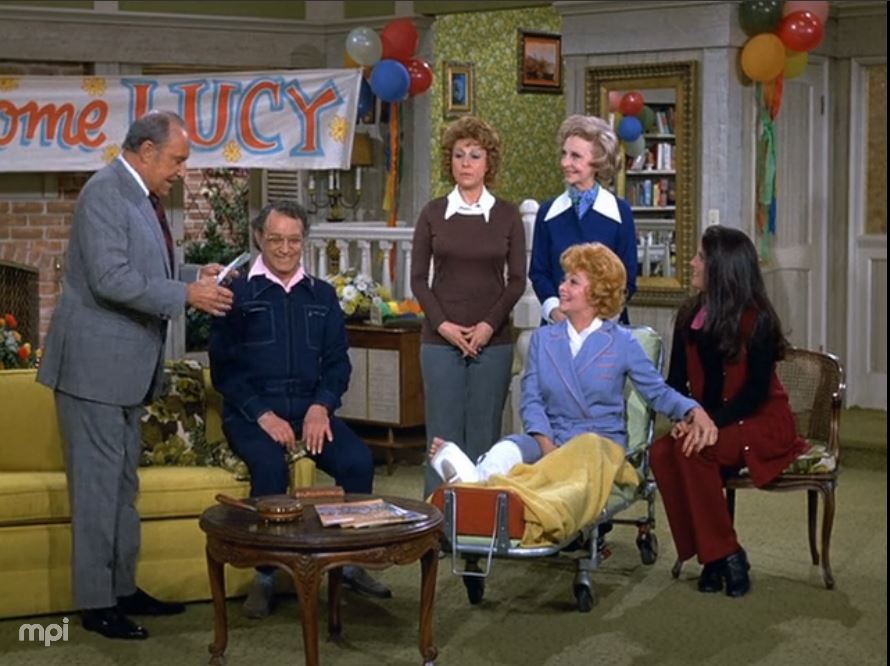
Twenty years after Gale Gordon guest starred on the I LOVE LUCY episode “The Schedule” (S1;E33 ~ 1952), he reads a schedule for Lucy’s care-givers (aka her friends) in the episode “Harrison Carter, Male Nurse” on HERE’S LUCY
(S5;E3 ~ 1972) .
MARY JANE: You know Lucy was supposed to be here 15 minutes ago!
HARRY: She’s even late when she comes home from the hospital!
-
“Lucy’s Schedule”

(S1;E33 ~ May 26, 1952) Directed by Marc Daniels. Written by
Jess Oppenheimer, Madelyn Pugh, and Bob Carroll, Jr. Filmed April 18, 1952 at General Service Studios. Rating: 51.7/81
Synopsis ~ After being late for dinner with his new boss, Ricky is determined to teach Lucy the importance of punctuality, so he puts her on a rigid time schedule.

This script is based on Lucille Ball’s radio show “My Favorite Husband” episode “Time Budgeting” aired on April 22, 1949, on the CBS radio network. Interestingly, although Gale Gordon played the boss on “My Favorite Husband,” that week the role was played by Hans Conried. This episode of “I Love Lucy” feels long overdue hearing Gale Gordon speak the lines originally written for Rudolph Atterbury, now Alvin Littlefield.

The date this episode first aired (May 26, 1952), Lucille Ball was on the cover of Time Magazine.
This marks the first television teaming of Gale Gordon and Lucille Ball. Their on-screen partnership will continue until 1986.
The episode opens with the Ricardos preparing to join the Mertzes to go to the movies to see Gary Cooper in High Noon. In this case, Lucy would have been early, not late, since the film didn’t premiere in Manhattan until July 24th, two months after the episode aired!

Lucy dressed as Cooper to impress near-sighted Carolyn Appleby in season 4’s “Lucy Meets Harpo Marx” (S4;E28). He will be mentioned again when “Lucy Goes To Grauman’s” (S5;E1). The mention of High Noon is usually cut for time from the syndicated episode, but was restored for the DVD release.

Ethel seems to need a schedule more than Lucy – she is so tardy she has to go to the movies in her bloomers!

A closer look at the actual timetable reveals that Lucy spends 77 minutes a day on the telephone and 123 minutes taking a nap and doing her hair!
RICKY: “Fifteen minutes for this, fifteen minutes for that…”
LUCY: “Oh, I’m going to need a lot more than 15 minutes for that.”
While waiting for the tardy Ricardos, Mr. Littlefield reads the May 25, 1952 issue of American Weekly. The cover art is titled “Raining Car Wash” by Euclid Shook.

Gale Gordon (Alvin Littlefield) was born Charles T. Aldrich Jr. and was said to be the highest paid radio artist of the 1930’s. He was in such demand that he often did two or more radio shows a day. His professional collaboration with Lucille Ball started in 1938 as the announcer of Jack Haley’s “The Wonder Show” (Wonder Bread was their sponsor). He played Mr. Atterbury on Lucy’s “My Favorite Husband” and was a front-runner for the part of Fred Mertz on “I Love Lucy.” In addition to Mr. Littlefield, he played a Judge in “Lucy Makes Room for Danny,” a 1958 episode of “The Lucy–Desi Comedy Hour.” He went on to play Theodore J. Mooney in “The Lucy Show,” Harrison Otis Carter in "Here’s Lucy,” Omar Whittaker in “Lucy Calls The President,” and Curtis McGibbon in “Life with Lucy.” He died in 1995 at the age of 89.

Edith Meiser (Phoebe Littlefield) performed with the Marx Brothers on radio and wrote scripts for Helen Hayes’s first radio serial “The New Penny,” and for the “Sherlock Holmes” series. She made her Broadway debut in 1923 and appeared in more than 20 shows, including Garrick Gaieties, Sabrina Fair, and The Unsinkable Molly Brown.

In 1941 Meiser appeared in the Broadway musical Let’s Face It! co-starring Vivian Vance (top right). The two introduced the Cole Porter song “A Lady Needs a Rest.” Meiser was a member of the Actor’s Equity board of governors and the chairwoman of the Equity Library Theater. She died in 1993 at the age of 95.

When Mrs. Littlefield learns that Lucy’s allowed herself to be put on a household schedule, she calls Lucy a ‘Benedict Arnold.’ Benedict Arnold (1741-1801) was an American military officer who served as a general during the Revolutionary War, fighting for the Continental Army before defecting to the British in 1780. Arnold planned to surrender to the British forces, but the plot was discovered and he fled to the British. His name quickly became synonymous with treason and betrayal because he led the British Army in battle against the very men he once commanded. In “The Mustache” (S1;E23) Lucy disapproves of Ricky’s new facial hair so she calls Ethel upstairs to confirm her opinion, but Ethel actually likes Ricky’s mustache. Lucy calls her ‘Benedict Ethel.’

When the three couples sit down to a ‘scheduled’ dinner, Meiser seems to really enjoy the antics, even tossing an extra biscuit at Gordon’s back!
The speed-dinner that Lucy serves to the Littlefields consists of split pea soup, salad with radishes, steak, peas, and biscuits. To make a point, Lucy makes sure the men don’t get to taste a bite of it!
Meisner and Gordon will return as the Littlefields in “Ricky Asks for a Raise” (S1;E35). It would have been great to see the Littlefields become recurring characters, but it is likely that the actors’ busy schedule didn’t allow for it!

Having missed dinner, Lucy eats all the after-dinner mints in Mrs. Littlefield’s candy dish. The glass dish is a Fostoria ‘American’ Compote Candy Dish.

Five years later, the Ricardos have the same candy dish. It can be seen in “Lucy and Superman” (S6;E13).

The dinner the Ricardos just missed featured “stuffed, thick” pork chops, baked potatoes “with big globs of cheese and butter” and “fresh, tender” asparagus tips with Hollandaise sauce.

To stave off her hunger pangs, Lucy tries to bite into one of the Littlefield’s wax apples!

Mr. Littlefield likens Ricky to Simon Legree, who was the sadistic slave owner in Harriet Beecher Stowe’s 1852 novel Uncle Tom’s Cabin. In the final episode of the series, Lucy calls Ricky “Senor Simon of Legree” when he demands Fred the dog demonstrate what he learned at obedience school. In a 1964 episode of “The Lucy Show,” Lucy asks Viv why she didn’t follow the dog when he ran away. Viv calls Lucy Simon Legree and says “she lost the scent when he crossed the river,” a direct reference to the novel. The book was also alluded to in:
- “Lucy and the Countess Lose Weight” (TLS S3;E21)
- “Lucy Gets Caught Up in the Draft” (TLS S5;E9)
- “Lucy, the Philanthropist” (TLS S6;E11)
- “Lucy Gets Involved” (TLS S6;E17)
Clearly, the book was a favorite of the “Lucy” writers! Coincidentally, in the book, Lucy is the name of a very old and feeble slave woman helped by Uncle Tom on Legree’s plantation.
LUCY (putting on a catcher’s mitt): “Ethel! Let’s have those biscuits!”

I wonder if Lambert’s was inspired by this episode?
FAST FORWARD!

A clip from this episode was included in the 2006 BBC series “Girls Who Do: Comedy” (S3;E1) presented by Dawn French.
Broadway, Cole Porter, Danny Kaye, Desi Arnaz, Edith Meiser, Ethel, Ethel Mertz, Fred Mertz, Gale Gordon, Gary Cooper, Here’s Lucy, High Noon, I love lucy, Jack Haley, Let’s Face It, Lucille Ball, Lucy, Lucy Ricardo, musicals, My Favorite Husband, Radio, Ricky, Ricky Ricardo, Schedule, The Lucy Show, The Wonder Show, Vivian Vance, William Frawley -
“The Kleptomaniac”

(S1;E27 ~ April 14, 1952) Directed by Marc Daniels. Written by
Jess Oppenheimer, Madelyn Pugh, and Bob Carroll, Jr. Filmed on March 7, 1952 at General Service Studios. Rating: 63.3/85
Synopsis ~ Ricky assumes Lucy is a compulsive thief when she is discovered secretly collecting items for a club bazaar and having a huge roll of cash.
LUCY: “It’s my mad money."
RICKY: "There’s two hundred dollars here."
LUCY: "I get awfully mad.”The final act of the show has the girls pretending to be gangsters – ‘Lucy the Lip’ and ‘Babyface Ethel’.

The show opens with Lucy trying to flip pancakes “like they do in restaurants”. One falls off the ceiling onto Ethel’s head! Ricky sees his pancake breakfast and thinks they are tortillas. Or are they called hotjacks? Or flapcakes? They settle on hotcakes.

Lucy says “I made them with Aunt Jemima Tortilla Mix.” Lucy is joking about Aunt Jemima brand pancake mix first marketed in 1889. The Quaker Oats Company first registered the Aunt Jemima trademark in April 1937. In 2021, Aunt Jemima rebranded their products as the Pearl Milling Company.
Lucy and Ethel share an outrageous memory of what could have made a hilarious episode of the series, had it not happened the summer before the show aired!
LUCY: “After what happened at the Fourth of July carnival last year Ricky made me promise that I wouldn’t get mixed up in any more club affairs.”
ETHEL: “You weren’t very bright throwing all those skyrockets and Roman candles in a fireplace.”
LUCY: “Well, who uses a fireplace in July? He should have looked before he threw that match in there.”
ETHEL: “Poor Ricky. His eyebrows didn’t grow in for a month.”
LUCY: “You remember those little baby toupees he wore over each eye?”
Lucy shows Ethel wear she’s hidden the items she’s gotten donated. The camera gives us a unique angle from the end of the hallway, near the bedrooms. Notice that the framed print of Degas “The Star” on the right, which later moved to the end of the hallway when the Ricardo’s moved apartments, where it turned up in most every living room scene.

Ethel schemes with Lucy to get rid of Fred’s favorite cuckoo clock, something he won at Coney Island, a beach and boardwalk summer destination in Brooklyn featuring rides (such as the Wonder Wheel), food (like Nathan’s famous hot dogs), and games of chance. Note the pack of Philip-Morris cigarettes on the table in front of the clock. In this case, the sponsor’s product is merely setting dressing – nobody smokes in the scene.

Lucy hides the clock under a voluminous overcoat. When caught in the act by Ricky and Fred, the clock signals that Lucy has something to hide. This scene contains a prime example of Lucille Ball’s brilliant comic timing as she tries to justify the kooky cuckoo!

When Ethel informs Lucy that Ricky has hired a ‘fee-suh-key-a-tryst’ (Ricky’s pronunciation of ‘psychiatrist’), Lucy and Ethel are determined to teach him a lesson by pretending to have become wanton criminals. [In the above publicity photo, Vivian Vance’s sweater pulls up revealing her belly. As an actress who still thought herself glamorous, I wonder if Vance minded this revealing shot? Since it was season one of this new show, perhaps she did not feel empowered to request it be reshot? The reveal is also in the episode itself.]

Believing his wife has embarked on a life of crime, Ricky brings home psychiatrist Dr. Tom Robinson (Joseph Kearns). Kearns later played the theatre manager in “Lucy’s Night in Town” (S6;E22). He went on to play Mr. Wilson on TV’s “Dennis the Menace” (1959). When he passed away during the show’s final season, Lucy regular Gale Gordon took over for him, playing his brother.

Before ‘Lucy the Lip’ and ‘Babyface Ethel’ return from their heist, Fred discovers a ground plan of the Chase Manhattan Bank – 72nd Street branch. Now simply known as Chase Bank, there are currently three branches on 72nd Street, just four streets north of where the Ricardo’s lived.

LUCY: “I got two of ‘em – a flatfoot and a private eye. I got the flat in the foot and the foot in the eye!”
Lucy confesses to Dr. Robinson that her life of crime includes robbery….

purse snatching….
LUCY: “I grabbed this one quicker than I thought!”
and picking pockets.
LUCY: “I picked a peck ‘a pockets!”

Under hypnosis (and with a knowing wink to Ethel), Lucy reverts to childhood, with a story and a voice doubtlessly influenced by Ginger Rogers in the 1942 film The Major and the Minor.
“It all started when I was a little girl. I was riding on the streetcar one day and I looked up and I saw a box and it said, ‘take one.’ So I took one. From then on, I took anything that came into my pretty head even though it didn’t say ‘take one.’ I took a bright new penny. I took a bicycle. I took a little boy. But my mother made me give him back.”
She reveals her biggest caper was a burglary from the Clyde Beatty Circus. Clyde Beatty and his lion taming act was featured in The Greatest Show on Earth (1952), a film released just a few months before this episode aired. Lucy was cast in the film, but had to withdraw when she became pregnant.Gloria Grahame assumed her role.

Oops! When the camera pulls back, viewers can see that the coffee table is on blocks to give it added height for the actors.

Lucy reveals her circus haul – a live baby elephant! The series had just featured a horse two weeks ago in “Pioneer Women” (S1;E25) – clearly nothing would stand in the way of a good laugh – even the unpredictability of working with live animals!
FAST FORWARD!

Lucy flipping pancakes that get stuck to the ceiling is similar to when Lucy learns to toss pizza in “Visitor from Italy” (S6;E5). In this case, the dough is sucked up through the vent and lands on the sidewalk outside the pizzeria!

Lucy and Ethel again pretend to be gun-wielding gangsters in “Lucy Wants to Move to the Country” (S6; E15). Once again they brag about a crime spree that includes an attempt on the Chase National Bank. In “The Kleptomaniac” ‘Babyface Ethel’ refers to Lucy as ‘Brain’. In “Lucy Wants to Move To The Country” is is Ricky (an unwitting accomplice) who is referred to as ‘The Brains’.

Lucy Carmichael and Viv Bagley would go under hypnosis in a 1965 episode of “The Lucy Show” titled “Lucy Stockholder” (TLS S3;E25).

Lucy went ‘under’ again when she encountered Pat Collins, dubbed the “hip hypnotist” in a 1966 episode.

During the first season of “The Lucy Show” Lucille and Vivian worked again worked with an elephant – this time a fully grown one named Jumbo!

In 1965, Lucille Ball rode down a NYC street atop an elephant for the premiere episode of “The Steve Lawrence Show.” Clearly missing out on playing Angel the elephant trainer meant Ball had something to prove.

In “The Kleptomaniac,” When Dr. Robinson takes Lucy’s Tommy gun away from her, he says “Let’s put little Tommy to bed, shall we?” Hearing Kearns say “Little Tommy” is reminiscent of his role as George Wilson on “Dennis the Menace” where he played opposite Jay North as Dennis Mitchell and Billy Booth as little Tommy Anderson, Dennis’s best friend.

In 2001, a Polish remake loosely based on “I Love Lucy” titled “Kocham Klara” (”I Love Clara”), presented “Kleptomania” loosely based on this episode and co-written with the cooperation of the original “I Love Lucy” writers.
Klara is preparing an auction for poor children and collects items that will be auctioned. She does so in secret from Kuba, who forbade her to organize the auction after auctioning his golf clubs without his knowledge a year earlier. Kuba discovers items buried in kitchen cabinets and becomes suspicious that his wife is a kleptomaniac. He decides to seek the help of a specialist.
-
“Pioneer Women”

(S1;E25 ~ March 31, 1952) Directed by Marc Daniels. Written by Jess Oppenheimer, Madelyn Pugh and Bob Carroll, Jr. Filmed on February 22, 1952 at General Service Studios. Rating: 66.0/86
Synopsis ~ The boys bet the girls that they can survive without using anything invented after 1900, including electricity, all while Lucy and Ethel are pursuing membership in a snooty women’s club. There’s also that huge loaf of bread!

The day this episode first aired, Life Magazine’s cover image was from the phenomenally successful comic strip Li’l Abner by Al Capp. The satiric strip ran for 43 years; from August 13, 1934 through November 13, 1977.
The characters of Abner, Daisy Mae, and the other eccentric residents of Dogpatch USA were made into a Broadway musical in 1956, which was filmed in 1959.
- The last celebrity guest star of the last episode of “The Lucy-Desi Comedy Hour” was Edie Adams, who won a Tony Award for playing Daisy Mae. In 1968, she appeared on an episode of “The Lucy Show” “Mooney’s Other Wife” (TLS S6;E18).
- Fred Mertz called Cousin Ernie (Tennessee Ernie Ford) Li’l Abner because of his down-home twang.
- In “First Stop” (S4;E14) Fred calls One Oak “Lower Slobbovia,” which is a term first used in 1946 by Al Capp in “Li’l Abner” to describe a place that was unenlightened and socially backward.
This was said to be William Frawley’s favorite episode. He was born in 1887 and enjoyed acting as ‘technical adviser’ regarding what a middle class 19th century family might (and might not) have.
- FRED (to Ethel): What are you wearing that bustle for, honey? You don’t need it.
- LUCY: Pay no attention to him. You leave it on.
- ETHEL: I’m not wearing a bustle.
Tired of just cooking and cleaning, Lucy and Ethel do the math:

They report to the living room and give the boys an ultimatum!
- LUCY: We’re revolting!
- RICKY: No more than usual.

The men bet the women that they can do without modern luxuries longer than the girls.
- LUCY: What do you want to bet?
- FRED: How about $10?
- ETHEL: What’s the matter with $20?
- RICKY: Well, what’s the matter with $30?
- LUCY: What’s the matter with $50?
- FRED: What was the matter with $10?

We also get a rare glimpse of the Ricardo’s and Mertzes back porch and balcony but it is much different from the one shown in “Never Do Business With Friends” (S2;E31), which was after they switched apartments with the Bensons.

Something definitely not from 1900 was Lucy’s 1951 Westinghouse Frost Free Refrigerator, which appears on several episodes from that season. It was widely promoted in print publications and on TV and had a prominent position in the Ricardo kitchen. The Ricardos also had a Westinghouse vacuum cleaner (although it was called a Handy Dandy on the show). This was nearly six years before Desilu partnered with Westinghouse to create the “Westinghouse Desilu Playouse,” the program that would present “The Lucy-Desi Comedy Hour” for its last two seasons.

The episode is best remembered for the huge loaf of bread Lucy bakes by misreading the number or yeast cakes in the recipe (3, not 13)! When the cost of constructing a prop loaf proved too high for producer Desi, they enlisted L.A.’s Union Baking Company to bake a real loaf. The final product was rye bread, as rye lasts longer without spoiling.

A rare candid shot with the clapper board in the photo.

- LUCY: Homemade bread and home churned butter!
After the filming, the giant loaf was carved up and enjoyed by cast, crew, and the studio audience. Everyone in the studio audience got a slice of bread!

“And YOU get a slice. And YOU get a slice. And YOU get a slice!”
GUEST CAST

A subplot has Lucy applying for membership in The Society Matrons League, whose investigating committee is headed by Mrs. Pomerantz and Mrs. Pettebone. The name Pettebone was inspired by Jean Pettebone, a CBS photographer, and Pomerantz by Charles Pomerantz, a Phillip Morris press representative. On Lucy’s radio show “My Favorite Husband” there was a similar club called The Young Matron’s League. Television being a visual medium, the word “Young” would have been a stretch for Lucy and Ethel!
Mrs. Pomerantz (below right) was played by Ruth Perrott. Perrott had played Katy, the maid on Lucille Ball’s radio show “My Favorite Husband.” She returned to “I Love Lucy” to play a nurse in “Lucy Goes to the Hospital” (S2;E16) and again as one of the members of the Wednesday Afternoon Fine Arts League in “Lucy and Ethel Buy the Same Dress” (S3;E3).

Mrs. Pettebone (above left) is played by Florence Bates (nee Rabe) who was born in 1888. After earning her degree in mathematics, Florence went to law school and became the first woman attorney in the history of the state of Texas. She traveled abroad extensively and was fluent in many languages. After the crash of 1929, she moved to California where she auditioned for the part of Miss Bates in the Pasadena Playhouse production of Jane Austen’s Emma. It launched a career playing snooty matrons and demanding dowagers. As a nod to her good fortune, she changed her last name to Bates. In 1940, she was cast by Alfred Hitchcock as Mrs. Edythe Van Hopper in Rebecca. She was equally adept at comedy, appearing as Danny Kaye’s prospective mother-in-law in The Secret Life of Walter Mitty (1947) and as the inebriated Russian dance teacher, Madame Dilyovska, in On the Town (1949). She was an avid knitter, and could usually be found knitting between takes. Bates continued in films until her death in 1954, just two years after this episode. Now that’s a true pioneer woman!

An uncredited actor delivers the telegram. It conveys the news that Lucy and Ethel have an appointment at the Waldorf to be reviewed by the Society Matrons League.
TRIVIAL PURSUITS – 1900′s Edition!

The episode had the Desilu props people searching for such unusual items as a tin bathtub, hand-cranked coffee grinder, a butter churn, a log saw, oil lamps, and a live horse, the first (but not the last) equine cast member of the series.

Making breakfast during their first day of the bet, Lucy hand grinds Ricky’s coffee adding a whole egg – shells and all! When Ricky grimaces, she quips “My grandmother was Swedish.” This is one of the first mentions of Lucy’s family history. We don’t know if she means her maternal or paternal grandmother or if she is just joking. The 2018 colorized version of the episode omits this line and much of the business of making coffee.

While not a musical episode, Ricky briefly hums “Vesti la Giubba” from Pagliacci, an Italian-language opera written by
by Ruggero Leoncavallo in 1892. Ricky’s musical education was obviously quite extensive. Later, Fred sings “The Fountain in the Park,” also known as “While Strolling Through the Park One Day,” a song written by Ed Haley in 1884.

Lucy’s interview with the Society Matrons League is supposed to take place at the Waldorf, the epitome of swanky Manhattan hotels. Six weeks later Lucy rented a room there when she pretends to be the regal Maharincess of Franistan in “The Publicity Agent” (S1;E31). Two years later, Lucy’s well-to-do school chum Cynthia Harcourt (Mary Jane Croft) took digs at the Waldorf while canvassing for donations in 1954′s “Lucy is Envious” (S3;E23).

After churning butter Ethel’s fingers are gripped like they are still clutching the churn pole. She remarks “Our grandmothers must have had arms like Gorgeous George.” George Raymond Wagner (aka Gorgeous George) was a professional wrestler known for his curly blonde hair and flamboyant manner. In the 1950s, televised wrestling matches made stars of wrestlers like Wagner. He was mentioned again in “Ricky’s Movie Offer” (S4;E6). When Pete the Grocery Boy asks Lucy what she’s supposed to be in her Marilyn Monroe dress and wig, Fred replies “Gorgeous George.”

Lucy demands that Ricky buy her an automatic dishwasher. He counters with rubber gloves! Although first invented in the mid-1920s, power dish washers were not commonly available to homeowners until the 1950s, and even then were extremely costly. Lucy gets a new automatic clothes washing machine
in “Sales Resistance” (S2;E17) and once again in “Never Do Business With Friends” (S2;E31), just five months later.
BLOOPER SQUAD – How They Lost the Bet but Didn’t Know It!

When Fred gets into his turn-of-the-century clothing, he struts around proudly and declares “I am the chicken-inspector!” This is slang for a womanizer; a man who has an eye for young woman. He even wears the novelty badge! However, this expression was not coined until the 1920s, so Fred’s poor memory has unwittingly lost the bet for the men.

When the inspection committee makes a surprise visit to the Ricardo apartment, the electric lamp in the background is on. Since the couples had agreed to live like pioneers the lamp should not have been on. Earlier in the episode, Lucy even mentioned buying lanterns to avoid using electric lights.

After Lucy and Ethel put the bread dough in the oven to bake, Lucy suggests they kill time by playing Canasta. The card game was not invented until the late 1940’s and so they couldn’t be playing it if they were following the rules of the bet.
FAST FORWARD! Future Pioneers

Lucy does an impromptu chorus of “Strolling Through The Park” in “Lucy’s Show-Biz Swan Song” (S2;E12, inset). In 1971′s “Lucy’s Lucky Day” (HL S4;E15), Lucie Arnaz and Gale Gordon also perform the song.

The 2003 TV biopic Lucy starring Rachel York as Lucille Ball / Lucy Ricardo and Rebecca Hobbs as Vivian / Ethel, recreates the bread-baking sequence from this episode.

On December 14, 2018 CBS presented a colorized version of this episode as part of their annual “I Love Lucy” Christmas Special. As usual, the newly colorized episode was teamed with “The I Love Lucy Christmas Show”.
SELLING BREAD! Episode Merchandise

The Franklin Mint issued a porcelain doll commemorating this episode. The doll came with a loaf of bread and clothing that closely matched the episode.


-
“Lucy Writes a Play”

(S1;E17 ~ February 4, 1952) Directed by Marc Daniels. Written by
Jess Oppenheimer, Madelyn Pugh, and Bob Carroll, Jr. Filmed on December 22, 1951 at General Service Studios. It was the 17th episode filmed. Rating: 55.6/75
Synopsis ~
Playwright Lucy pens a drama with a Cuban locale. She figures Ricky for the star. The hitch: he refuses the part. So she changes her play from Cuba to England and has Fred take Ricky’s spot. However, Ricky has decided to surprise Lucy and appear in the play…only problem is he has the wrong script!

This episode is partly based on the radio show “My Favorite Husband” episode “Liz Substitutes in a Club Play” aired January 6, 1951. On radio, the group sponsoring the play contest was called The Young Matrons League. This name would later inspire The Society Matrons League in “Pioneer Women” (S1;E25). The radio episode guest starred Mary Shipp, who was the second wife of Harry Ackerman, the CBS executive who did a cameo in “The Audition” (S1;E6) and was mentioned in the dialogue of “The Charm School” (S3;E15).

This episode introduces us to the Wednesday Afternoon Fine Arts League! Which Ricky sarcastically calls the Wednesday Afternoon Fang and Claw Society. For a play-writing contest, Lucy has written a play called "A Tree Grows in Havana” – a tender, moving, heart-rending story of a Cuban tobacco picker and his love for the plantation owner’s daughter. The title is inspired by A Tree Grows in Brooklyn, which was a book and a film in the mid-40’s. There was even a Broadway musical of the same title starring Shirley Booth that closed two weeks before the episode filmed.

Ethel shows off her costume while humming “The Habanera” (aka “L’amour est un oiseau rebelle”) from Carmen, a four-act French opera by Bizet that takes place in Seville, Spain. Ironically, the word ‘Habanera’ means Music or Dance of Havana, the city of Ricky Ricardo’s birth!
Sample dialogue from Lucy’s masterpiece:
-
Ethel: [reading from Lucy’s script] “You look very pretty, Lucita. Your hair is shining, your eyes are bright, and your nose is continued on the next page.”
- Ethel: [reading from Lucy’s script] “I think you go there to meet your liver.”
- Lucy: [correcting her] “Lover!”
- Ethel: “I think you go there to meet your lover, that worthless, good-for-nothing tobacco picker.”
- Ricky:
[reading from Lucy’s script] “I am sorry to hear you don’t feel well, Mamasita. Are you having trouble with your lover?”
- Lucy: [correcting him] “Liver!”
- Ricky: “Are you having trouble with your liver?”

Ricky sarcastically calls Lucy “Mrs. Shakespeare.” William Shakespeare (1564-1616) is considered the world’s most-produced playwright. When Lucy meets Orson Welles (above), she brags that she played Juliet (in Romeo and Juliet) in High School.
Miss Mitchell, Club Chairwoman: “You have just seen Mrs. Glazingham’s play entitled ‘Pearl One, Drop Two, or Much Ado about Knitting.’”
For Ricky, the script is a little too close to home:
- Ricky: “Now, wait a minute, Wait a minute. What’s the idea of making fun of me in this play?”
- Lucy: “Fun of you?”
- Ricky: “Yeah, look at the way you got "don’t” spelled: D-U-N-T.”
- Lucy:“Well, that’s a typographical error.”
- Ricky: [continues reading] “Someday I will become famous "by singing a song called ‘Babalu’”? [To Lucy] Who is this Cuban tobacco picker who plays the conga drums and sings “Babalu”?
- Lucy: “Guess.”
- Ricky: “Sir Cedric Hardwicke?”
- Lucy: “No.”
- Ricky: “John Charles Thomas?”
- Lucy: “No.”
- Ricky: “Lassie?”
- Lucy: “All right, Ricky.
I wrote the whole thing with you in mind.”
John Charles Thomas (1891-1960) was a popular operatic baritone and recording artist. In “The Operetta” (S2;E5) Ricky is referred to as “John Charles Ricardo.”
Sir Cedric Hardwicke (1893-1964) was an English character actor who had a stage and screen career that spanned more than five decades. He was reputedly George Bernard Shaw’s favorite actor. He appeared with Lucille Ball in Valley of the Sun (1942) and Lured (1947).
Lassie was one of the world’s most popular canine stars. After a string of films, the TV series “Lassie” (about the adventures of a collie dog) was seen on CBS from 1954 to 1971. Lassie was mentioned again on “I Love Lucy” in “The Young Fans” (S1;E20) as well as episodes of “The Lucy Show” and “Here’s Lucy.” The dog makes an appearance on “The Desilu Revue” in 1959.

Ricky declines to act in it which forces so Ethel suggests Fernando (aka Fred) as a replacement. He promptly arrives in costume humming “The Toreador Song” (“Votre toast, je peux vous le rendre”) from Carmen.

Lucy decides to re-write the script to an English comedy titled “The Perils of Pamela” (a nod to the several films titled The Perils of Pauline directed by Lucille Ball’s friend George Marshall) starring Fred instead of Ricky.

Some sample dialogue from her re-written opus:
- Lucy: “What’s the mater, Matter? Uh, what’s the matter, Mater?”
- Lucy: “Pater won’t be down for tea. We just buried him. Had to. Dead, you know.”
- Fred: “Would you pour me a spot of tea, my dear louse? [looks at script closer] I mean Louise.”
Edna Louise Broedt was the name of William Frawley’s ex-wife. They toured in vaudeville as “Frawley and Louise”. Louise is also one of the three middle names ascribed to Ethel. This one was spoken by Fred, naturally.
Voice from Audience: “I think it stinks!”
Several references included in the episode’s script proved eerily prescient:

Seeing Ethel in her mantilla, Ricky says she looks like the Bride of Frankenstein. Elsa Lanchester (who played the bride in the 1935 film) would appear as a suspected hatchet murderess in “Off To Florida” (S6;E6).

Lucy hopes to become “the next Tennessee Ernie.” Ricky says she means Tennessee Williams. Tennessee Ernie Ford would make three guest appearances on the show.

Miss Mitchell, the chairwoman of the Wednesday Afternoon Fine Arts League is played by Myra Marsh, who reprises her role in “The Operetta” (S2;E5) the following season. To stall for time, she recites “The Song of Hiawatha” by Longfellow. The poem would also be recited by Lucy in “The Indian Show” (S2;E24).

As Pamela, Lucy dresses in a riding costume which she would later also wear in “The Fox Hunt” (S5;E16) and the film Mame (1974).

Maury Thompson can be briefly glimpsed as the play’s Stage Manager. He was the show’s script supervisor and camera coordinator. He would also work behind the scenes on “The Lucy Show.”
Lucy says the play contest will be judged by movie producer Darryl B. Mayer. This unseen character is a mash-up of movie producers Darryl F. Zanuck of Warner Brothers and Louis B. Mayer of MGM. Zanuck worked with Lucille Ball on six films between 1933 and 1934. After conflicts with Dore Schary, Louis B. Mayer left MGM the same year this episode was filmed.

This is not the last time Lucy would pick up the pen as an author. She wrote “The Pleasant Peasant” in “The Operetta” (S2;E5) and a biographical novel titled “Real Gone With the Wind” in “Lucy Writes a Novel” (S3;E24).
 A Tree Grows in Brooklyn, Babalu, Bride of Frankenstein, Darryl F. Zanuck, Desi Arnaz, Elsa Lanchester, Ethel, Fred, I love lucy, John Charles Roberts, Lassie, Longfellow, Louis B. Mayer, Lucille Ball, Lucy, Mame, Maury Thompson, My Favorite Husband, Orson Welles, play, Ricky, Shakespeare, Sir Cedric Hardwicke, Stage, Tennessee Ernie Ford, tennessee williams, The Perils of Pauline, The Song of Hiawatha, Vivian Vance, William Frawley
 -
-
“Men Are Messy”

(S1;E8 ~ December 3, 1951) Directed by Marc Daniels. Written by Jess Oppenheimer, Madelyn Pugh and Bob Carroll, Jr. Filmed October 25, 1951 at General Service Studios.
Rating: 42.1/65
Synopsis ~ Tired of Ricky’s messy habits, Lucy divides the apartment in half – he can be a slob in his half, but not hers. Unfortunately, Ricky is going to appear in a magazine spread, and the photographer is coming to the divided apartment!
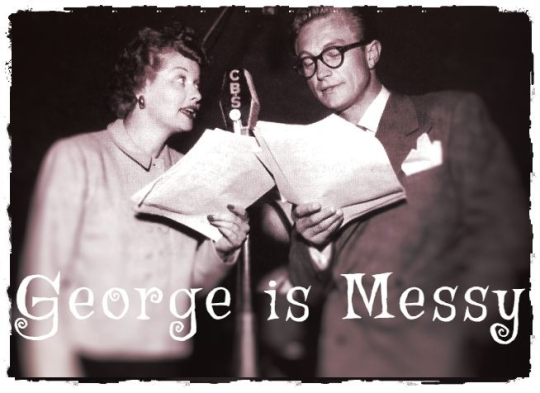
This episode is based on Lucy’s radio show, “My Favorite Husband” (episode #91) “George is Messy” broadcast June 5, 1950. The episode included the voice talents of Lucille Ball’s future “I Love Lucy” cast co-stars Eleanor Audley, Mary Jane Croft, and Harry Bartell.

It’s no wonder that Ricky peels off his jacket and sweater vest as soon as he comes home; he is sweating profusely! In reality, the intense heat of the studio lighting required for filming created a great deal of stifling heat on set. In the 1950s, men’s deodorant was usually pitched by sports figures.

Before Lucy tosses his jacket on his head, Ricky is reading the New York Times. The headline and photo are about college football with mentions of Harvard, Cornell, Navy, and Columbia. This is most likely from October 21, 1951.
For more about the newspapers seen on “I Love Lucy” ~ Click Here!

Lucy is fed up with Ricky’s mess, so she divides the apartment in half with a white ribbon. At one point Lucy tears the last cigarette in the pack in half.
LUCY: ”I’ll have Philip, you can have Morris.“
When Philip Morris was no longer a sponsor, the brief scene was cut and not seen again until the DVD release.

When Fred and Ethel come over, Fred (William Frawley) is dressed in a fancy suit and even fancier tie. He looks like a gambler from a Damon Runyon novel! This gives the actor something to transition to when he joins Ricky on the ‘slum’ side of the apartment and removes his jacket, tie, and shoes.

When Lucy and Ricky BOTH answer the phone (it is on the line!) Ricky has to listen, while Lucy has to repeat his words into the mouthpiece to convey the message to Kenny, his press agent. Desi Arnaz stumbles over the words, struggling to remember that for the show, Down Beat has been changed to Half Beat. Lucille Ball imitates his broken English (Febreeary and ‘splain) but does not repeat his bloopers! When Desi has to say the name of the magazine again later in the episode, he also momentarily trips over his words.

When Lucy learns that a photographer is coming over she assumes he is from Half Beat Magazine, a musician’s rag. Half Beat is actually a veiled reference to the popular Down Beat Magazine (est. 1934). Unfortunately, the photographer is not from Half Beat, but from LOOK magazine. Two years later, Lucy and Desi would make the covers of both LOOK and DownBeat in real life!

Perusing Half Beat, Lucy notices an article about Tommy Dorsey. The famous bandleader and his orchestra had been featured with Lucille Ball in the 1943 film Du Barry Was A Lady.
RICKY: “My press agent told me I was going to get the next spread. It was going to be ‘Ricky Ricardo at Home’.”
LUCY: “What magazine was it supposed to be in? Better Homes and Garbage?”Although many magazines were mentioned on “I Love Lucy” this is the only implied mention of Better Homes and Gardens.

For the final shot, the props department mocked up a cover using the actual August 14, 1951 edition of Look Magazine. Look will be prominently featured in “Lucy Gets Ricky on the Radio” (S1;E32) and “Ricky Loses His Temper” (S3;E19). From 1952 to 1971 Lucille Ball appeared on the cover of Look nine times!

To really make her point, Lucy turns the apartment into a slum, saying "Welcome to Tobacco Road!" Tobacco Road was a the title of a 1941 film as well as a long-running Broadway play concerning poverty-stricken Georgia sharecroppers. Irving Bacon, who would go on to play Ethel Mertz’s father, Will Potter, had a small role in the film.

The episode features fine support by Hazel ‘Sunny’ Boyne as Maggie, the Tropicana’s Irish cleaning woman, dancing with Ricky during his rehearsal. She would go on to play one of Minnie Finch’s neighbors ("Fan Magazine” S3;E17) and a passenger on “The Great Train Robbery” (S5;E5). A former dancer, Boyne was born on Independence Day 1883 and was 68 years old when this episode was filmed.
This musical moment is often considered one of the sweetest and most endearing of the series. The studio audience starts to applaud after the dance break, before the song slows down for its big finish.

Ricky sings “The Straw Hat Song”, a song Desi Arnaz wrote and was introduced by him in the 1949 film Holiday in Havanna. Ricky actually starts the episode whistling the song when he comes home from the club in the opening scene. Arnaz later performed the song in the 1955 film Forever Darling, as well as in a 1967 episode of his sitcom “The Mothers-in-Law” (above photo) with his son Desi Arnaz Jr. playing the drums.

Ricky’s press agent Kenny was played by Desilu’s actual press agent, Kenny Morgan (above right), who also was Lucille Ball’s cousin-in-law! The Look Magazine photographer was Harry Shannon. Musical fans will probably remember Shannon as Rosalind Russell’s father (“You ain’t getting eight cents from me, Rose!”) in the 1962 musical film Gypsy.

When Ricky tries to call Lucy and warn her about the Look Magazine photographer, Lucy is gabbing on the phone to Marge, Lucy’s favorite phone-a-friend. Lucy is chatting with Marge at the start of “The Gossip” (S1;E24), “Redecorating the Mertzes’ Apartment” (S3;E8), and
“Ricky’s Screen Test” (S4;E7). We finally get to meet Marge, one of Lucy’s club friends, in “No Children Allowed” (S2;E22) and
“The Homecoming” (S5;E6) where she is played by Charlotte Lawrence (above inset photo). The character may be a hold-over from Lucy’s radio show “My Favorite Husband,” which had a character named Marge Van Tassle.
On the desk in front of Lucy is a neatly stacked spread of magazines including Look and Life.
For more about the magazines seen on “I Love Lucy” – Click Here!

When Ethel delivers the message that a magazine photographer is coming home with Ricky, Lucy thinks it is just for Half Beat Magazine, not the nationally prestigious Look, so she conspires to get even with ‘messcat’ Ricky by turning the apartment into a regular pig pen!
LUCY: “Oh, it ain’t a regular one, but it’ll do.”

There are metal garbage cans, laundry lines of long underwear, a spare tire, and live chickens! Among the hanging laundry, Ethel turns up as ‘Grandma’!
‘GRANDMA’ ETHEL: “I didn’t mind the washing machine, but I durn near passed out coming through the wringer!”
FAST FORWARD!
This episode was re-aired during Lucille Ball’s maternity leave, with an added "flashback” intro. Ethel and Fred are all excited because there’s an article about Ricky in the new issue of Look. Ricky acts like it’s no big deal. When looking for scissors to cut out the article, Ethel finds a whole stack of copies that Ricky bought, blowing his cover. Ricky said that he bought so many copies to make up for the last time he got an article in Look. This leads in to the threesome reminiscing about how Lucy ruined the last Look photo shoot.

The ‘white line’ showed up again when the Ricardos and the Mertzes fought about “The Diner” they had purchased. This line divided “A Little Bit of Cuba” (the Ricardo side) from “Big Hunk of America” (the Mertz side), with one stool bisected down the middle!

On April 7, 1966 “The Munsters” did an episode titled “A
House Divided” in which an argument between Herman (Fred Gwynn) and Grandpa (Al Lewis) causes them to paint a line down the middle of the house.
On a 1995 episode of “The Simpsons”, messy Homer divides the house in two after a disagreement with his wife, Marge. He compared it to this episode of “I Love Lucy”!

In the 1991 film Thick as Thieves, Al (Gerry Quigley) divides his apartment in half, with one half for him and the other for Lisa (Carolyn Dunn), after finding out that Lisa is dating Hal (Karl Pruner).

In a 1998 episode of the sitcom “The Jamie Foxx Show”, Jamie divides the apartment after a disagreement with roommate Braxton (Christopher B. Duncan). Their tastes in “I Love Lucy” episodes differs.

In 2001, a Polish remake loosely based on “I Love Lucy” titled “Kocham Klara” (”I Love Clara”), presented “Men Are Messy People” loosely based on this episode and co-written with the cooperation of the original “I Love Lucy” writers.
Klara cleans the apartment, and Kuba, after returning home, makes a terrible mess in five minutes. An argument breaks out between the spouses, as a result of which, a desperate Clara draws a line dividing their apartment into two halves. She will keep her half perfectly clean and Kuba can live in dirt and mess. The next day, a photographer appears in the club where Kuba performs and wants to take some photos of him for a popular magazine. He would like to photograph him in his own apartment. Kuba, aware of the mess he left behind, calls home, but unfortunately the phone is busy all the time.
1951, CBS, Desi Arnaz, Desi Arnaz Jr., Down Beat Magazine, Ethel Mertz, Fred Mertz, Gypsy, Harry Shannon, Havana Holiday, Hazel Boyne, I love lucy, Kenny Morgan, Look Magazine, Lucille Ball, Lucy, Lucy Ricardo, Philip Morris, Ricky, The Diner, The Jamie Foxx Show, The Mothers in Law, The Munsters, The Simpsons, The Straw Hat Song, Thick as Thieves, Tobacco Road, tv, Vivian Vance, William Frawley -
“Lucy Thinks Ricky Is Trying to Murder Her”

(S1;E4 ~ November 5, 1951) Directed by Marc Daniels. Written by
Jess Oppenheimer, Madelyn Pugh and Bob Carroll, Jr. Filmed September 8, 1951 at General Service Studios. Rating: 36.5/56

The original shooting schedule for the first episode ever filmed. In future episodes, the actual film day would be shifted to Friday, but here it is a Saturday.

This was the fourth episode aired, but actually the very first to be filmed! “The Girls Want To Go To A Nightclub” (S1;E1) was aired first, premiering on October 15, 1951. It was felt that that it was funnier – with Lucy and Ethel dressing like hillbillies to pose as Ricky and Fred’s ‘dates’. Others contend that this episode had editing problems (mainly due to the cumbersome fourth camera) that prolonged the final edit and delayed its first airing. The episode does have its share of camera goofs, so this may indeed be the cause.

The plot for this show is partly based on “The Wills” (#80), an episode of Lucy’s radio show “My Favorite Husband” from the year before.

Contrary to popular belief, “I Love Lucy” was not the first TV show to shoot on film – that would be “Amos and Andy.” It was also not the first to use the ‘three camera technique’ – that honor goes to “Public Prosecutor.” In fact, this first episode used four cameras, which proved too crowded for the small studio. The show was, however, the first to do it all in front of a live audience, without stopping, like a play.

The date this episode first aired, Lucille Ball’s former on-screen co-star and friend Ginger Rogers was on the cover of Life Magazine. Twenty years later Rogers guest-starred with Lucy again on “Here’s Lucy”.
In order to keep the act breaks short, Lucy and Ethel ‘under-dressed’ their costumes. In future, Desi’s orchestra would play during the breaks to keep the audience entertained.

The first ‘gag’ of the series is an insert shot of Lucy dipping her crackers into facial cold cream instead of ‘Ye Old Cheddar Cheese’. It gets a giggle, but Ricky’s line “I took so many bows tonight my hip got a charlie horse!” earns the first real laugh of the series.

When Ethel says she has learned how to read fortunes using playing cards. Lucy says she doesn’t believe in that stuff. A few weeks later, in “The Séance” (S1;E7), Lucy believes in a lot of stuff like that!
There is a full plate of donuts on the table and Ethel does not touch them! In this first appearance Ethel’s fondness for food was not yet established.

The Queen of Hearts (Lucy) next to the Ace of Spades (Death) is a bad omen, according to Ethel. This is the second close-up insert shot of the episode. The first being the cold cream and cheddar cheese jars. These extreme close-ups were done after the audience left.

It only lasts for a second, but when Ricky opens the desk drawer to get some cigarettes to take to work, the Philip Morris logo is clearly visible on the carton. Future episodes would not be so sly about promoting the sponsor’s product.

Ricky makes an unusual fashion statement by wearing his bow tie tucked under his shirt collar. Although a French Continental Bow Tie was sometimes worn tucked under, this does not appear to be the type of tie Desi is wearing here.

Fleeing Ricky’s clutches, Lucy’s ‘bullet proof vest’ peeks out from her house coat, but Ricky does not comment on it.
When she runs into the living room Lucille Ball’s hand is on the skillet in order to release it from her waist and allow it to ‘accidentally’ drop to the floor. It is only then that Ricky notices it!
When Ricky denies he is going to shoot or strangle her, Lucy, with a glance back at the sink, says “Fortunately, I’m too big for the garbage disposal.” While in-sink garbage disposals were common in California homes, they were actually prohibited by law in New York City in order to protect the sewage system. The ban was lifted in 1977.

Lucy locks herself in the bedroom. Another (time consuming) insert shot.
RICKY: “Lucy is acting crazy!”
FRED: “Crazy for Lucy or crazy for ordinary people?”The character of Fred Mertz (William Frawley) is introduced 15 minutes into the episode.
Some unique aspects of this first-filmed show…

1. Lucy’s hairstyle is fuller and looser, not yet her trademark style!
There is no cityscape backdrop visible outside the Ricardo’s bedroom or kitchen windows as in later episodes, but there is a small tree visible outside both, suggesting they may have been meant to have a ground floor apartment. In “Cuban Pals” (S1;E28) their apartment number is revealed as 4A, so it was not likely yet decided on which floor they dwell.

LUCY: “No wonder they call it ‘The Mockingbird Murder Mystery.’ Every time I get that book in my hands it flies out the window!”
Lucy is engrossed in the (fictional) mystery novel The Mockingbird Murder Mystery. This is officially the first shot of “I Love Lucy”. Unfortunately, the word “mockingbird” is too long to fit on the cover on one line and still be visible to the camera and studio audience, so it had to be hyphenated, something that book publishers never do.

Next morning Lucy finds the book she accidentally tossed out of the bedroom window when she goes out to get the milk. It is dirty and has a banana peel in it. When Lucy washes it off in the sink, viewers can see it has illustrations in it! An illustrated murder mystery? Oh, and a note to Lucy – you don’t rinse books!

2. Ethel is dressed quite fashionably, not yet the ‘dowdy landlady’ look Lucy and Desi would later insist on!
Eventually, the show became an international hit and was eventual seen in eight countries and dubbed or subtitled in 22 foreign languages. Here is “I got a Mickey from Ricky” in Spanish!

A ‘Mickey” or Mickey Finn refers to spiking someone’s drink with a drug. It is most likely named after the bartender of the Lone Star Saloon in the Chicago. In December 1903, newspapers reported that Michael “Mickey” Finn was accused of using knockout drops to incapacitate and rob his customers. The first known example of the term being used is in 1915, which was 12 years after his trial. In modern times, the idea of Fred and Ricky drugging Lucy and Ethel is fairly unsavory. Bear in mind that not only was “I Love Lucy” finding a tone, but also dealing with a changing America.
Ricky tells Lucy not to worry, it is just a sleeping powder.
LUCY: “Ha! The sleep from which no one returns.”
Lucy is loosely paraphrasing Shakespeare. Hamlet compares death to
“The undiscovere’d country, from whose bourn
No traveler returns…“ ~ HAMLET III;i
3. One of the few times we see Ricky shirtless!
It sounds like Ricky is just scheduled to be the Tropicana performer for four weeks. He said that they might get to stay "another four weeks.” Clearly, his appearance there started out tentatively.

4. Ricky and Lucy’s single beds are pushed together for most of season one, instead of apart!
While they are definitely two beds, they might as well have been sleeping in the same bed. This configuration must have been hell for making the beds in the morning!

5. A
risqué
joke surrounding Ricky having an affair with a man named “Theodore”! Even the suggestion of homosexuality had to be handled carefully, and only in a humorous context.
An established vaudeville act, Hector and His Pals was also seen in the film Easter Parade in 1948.
The dog trainer Hector, calls one of the dogs by its real name ‘Yorkie’. In the episode, the dogs are named Ann, Mary, Helen, Cynthia, Alice, and Theodore.

As in the pilot, Jerry Hausner plays Jerry, Ricky’s agent. Ricky doesn’t seem to remember him at first. He is calling from a pay phone in New Jersey. They discuss firing Marilyn, Ricky’s girl singer. The name was probably chosen in homage to one of the biggest stars in Hollywood, Marilyn Monroe. In 1951 alone, Monroe starred in four feature films.
BLOOPER SQUAD!

The poster announcing Ricky’s extension at the Tropicana spells his last name with two C’s – RICCARDO! Like which floor of the building they live on, this was probably not yet formalized.

Right away in the first episode, a couple tiny technical goofs make it onto the screen. When Lucy and Ricky dance around the living room, we can briefly see the wall dividing the different sets and brief peek into their bedroom.

When Ricky takes a phone call and sits at the desk, you can briefly catch a glimpse of camera and lighting equipment on the right side of the frame.

When Lucy and Ethel confront Ricky at the club, Lucy yawns due to the sleeping pill she’s been slipped and Ethel yawns right after her. Ethel’s yawn was unscripted and Vivian Vance was simply responding in the moment to seeing Lucy yawn.
Notice that the full Tropicana set is not yet in place. It is hardly the “beautiful Tropicana” that the poster touted earlier in the episode.

The episode ends back in Lucy’s bedroom as it begun, reading The Mockingbird Murder Mystery. This time when Ricky startles her Lucy has a string to retrieve her book after it goes out the window! This coda was cut from the syndication version but restored for the DVD release. Several early episodes of the series featured comic codas, but these were quickly abandoned.

FAST FORWARD
This episode was rerun during Lucy’s maternity leave in season 2 on November 13, 1952. The new intro has Lucy telling Ricky about the great new murder mysteries she just bought that they can read instead of watching TV: Murder at Midnight, The Blood-Stained Stiletto and Gore. Ricky tells her she shouldn’t be reading this kind of book and reminds her about what happened in this episode. [cue flashback to “Lucy Thinks Ricky Is Trying To Murder Her”]

Lucy Carter thinks her brother in law / boss Harry (Gale Gordon) is trying to murder her in a 1969 episode of “Here’s Lucy.”


Scenes from this episode were recreated for the 1991 TV biopic Lucy and Desi: Before the Laughter starring Frances Fisher as Lucille / Lucy and Robin Pearson Rose as Vivian / Ethel.

Nope! Just the beginning!
1951, CBS, Desi Arnaz, dog act, Ethel, Frances Fisher, Fred Mertz, Hector and His Pals, Here’s Lucy, I love lucy, Jerry Hausner, Jess Oppenheimer, Karl Freund, Lucille Ball, Lucy, Lucy & Desi: Before the Laughter, Lucy Thinks Ricky is trying to murder her, Mark Daniels, Mickey Finn, New Jersey, payphone, Philip Morris, Ricky, Ricky Ricardo, Robin Pearson Rose, Sitcom, Tropicana, tv, Vivian Vance, William Frawley -
-
Subscribe
Subscribed
Already have a WordPress.com account? Log in now.
 Papermoon Loves Lucy