-
“Country Club Dance”

(S6;E25 ~ April 22, 1957) Directed by William Asher. Written by
Madelyn Martin, Bob Carroll, Jr., Bob Schiller, and Bob Weiskopf. Filmed on March 21, 1957 at Ren-Mar Studios.
Synopsis ~ The male population of Westport is all agog when sexy Diana Jordan visits. Lucy, Ethel and Betty Ramsey decide that getting glamorous is the best revenge!

Diana was played by a 25 year-old Barbara Eden who (as anyone with a TV probably knows) went on to don a pink harem costume as Jeannie the genii in “I Dream of Jeannie” in 1965. Contrary to popular belief, "I Love Lucy” was not Eden’s first screen appearance. She had been seen in a November 1956 episode of “West Point.” She had also made the film Back from Eternity, a remake of a Lucille Ball film called Five Came Back, which would not be released until later in 1957. Coincidentally, her co-star in that film was Tristram Coffin, who also played Diana’s cousin and Lucy’s Westport neighbor Harry Munson in this episode of “I Love Lucy.”

Even more coincidentally,
Hayden Rorke, another actor who found fame on “I Dream of Jeannie”, made his TV debut on “I Love Lucy” in 1952 (above, with K.T. Stevens). Rorke played Dr. Alfred Bellows opposite Eden for five seasons.

The storyline bears some similarity to "The Charm School” (S3;E15, inset), where Lucy and Ethel also fear their husbands are losing interest in them and get all dolled up. In both episodes, Lucy’s idea of glamour is wearing a dress too tight to even sit down in.

Ethel does her hair in a Grace Kelly style (inset), although Fred thinks it makes her look like at “wet Pekingese.” Betty applies loads of a exotic perfume, practically suffocating Ralph with the fumes.

Ethel is compared to Grace Kelly and Fred compares himself (not for the first time) to Yul Brynner. In 1957, both stars were in Oscar-nominated musical films: Kelly in High Society and Brynner in The King and I.

After his attempt at conversation with 20 year-old Diana, Ralph asks Ricky and Fred “Who’s Pat Boone?” In 1957 Pat Boone had three number one hits on the Billboard charts. According to a 1957 opinion poll of high school students, the pop singer was nearly the two-to-one favorite over Elvis Presley among boys and preferred almost three-to-one by girls. Elvis got his first and only mention on “I Love Lucy” in “Lucy Misses the Mertzes” (S6;E17).

When Lucy is standing and eating, the music the band is playing is the same as was on the car radio before Lucy and Ethel hear the news bulletin that leads them to think Mrs. Grundy (Elsa Lanchester) is the hatchet murderess in “Off to Florida” (S6;E6).

Usually when the Ricardos and the Mertzes have plans, Little Ricky stays overnight with a neighbor. In this case, both the Munsons and the Ramseys are attending the dance at the country club, so Little Ricky is sent to New York City to stay with the Applebys for the weekend. During a telephone conversation with Lucy, he says that they went to a Dodgers game at Ebbets field. The Brooklyn Dodgers played their final game at Ebbets Field on September 24, 1957, just five months after this episode aired. The stadium was demolished in 1960.

This marks the second appearance of extra Leoda Richards. She had appeared three weeks earlier in “Lucy’s Night in Town” (S6;E22). In 1934 she had appeared on Broadway in Anything Goes, which also starred a young Vivian Vance. Lucy employed Richards again on four episodes of "The Lucy Show” and the film Yours, Mine and Ours (1968).

Her main claim to fame is her appearance at the party given by Captain Von Trapp in The Sound of Music, standing next to Christopher Plummer during the song “So Long, Farewell.”

Betty and Ralph Ramsey are played by Mary Jane Croft and Frank Nelson. Croft played Betty Ramsey for five episodes, this being the second to last. She was also seen as Cynthia Harcourt in “Lucy is Envious” (S3;E23) and Evelyn Bigsby in “Return Home from Europe” (S5;E26). She became one of Lucille Ball’s good friends and returned as a recurring character on “The Lucy Show” and “Here’s Lucy” – both times using her own first name.
Frank Nelson is the only actor to play two recurring roles on “I Love Lucy”: Freddie Fillmore and Ralph Ramsey. He also appeared as six other characters. Although this is his last appearance on the half-hour series, he appeared in the first of the "The Lucy–Desi Comedy Hours” as well as a 1963 episode of “The Lucy Show.”

Grace and Harry Munson are played by Ruth Brady and Tristram Coffin. Diana is Grace’s 20-year-old cousin. Although Grace Munson had appeared on the series in “The Club Election” (S2;E19) she was then played by Lucy’s camera and lighting stand-in Hazel Pierce. Coincidentally, Pierce is also in attendance at the Country Club dance, so both Grace Munsons are in the same room at the same time! Bennett Green, Desi’s stand-in is also there. Ruth Brady was featured as Laura in Lucy and Desi’s film Forever, Darling (1956). Tristram Coffin had also played Harry Munson in “Lucy Misses the Mertzes” (S6;E17), picking up Little Ricky for an overnight with his son, Billy. The Munsons were first to move to Westport, inspiring the Ricardos with their reports of bucolic country life.

Other party guests include:
- Abduallah Abbas, who is also an extra in “Lucy Goes to Mexico,” a 1958 episode of “The Lucy-Desi Comedy Hour.”
- Mike Lally appeared in nine films with Lucille Ball between 1934 and 1963. He would return to play a spectator in the crowd when “The Ricardos Dedicate a Statue” (S6;E27) just two weeks later. He appeared on “The Lucy Show” in 1965.
- Murray Pollock played an airport extra in a 1959 episode of “The Lucy-Desi Comedy Hour” as well as three episodes of “Here’s Lucy.” In between, he did three episodes of “The Lucy Show” and the film Critic’s Choice with Lucille Ball.
- Fred Rappaport had first appeared on the series as one of the theatregoers at “Over the Teacups” in “Ethel’s Birthday” (S4;E8).

William Asher, the director of this episode, would later direct Barbara Eden in the short-lived sitcom "Harper Valley PTA” (1981-1982) and "I Dream of Jeannie… Fifteen Years Later,” a reunion special aired in 1985.

After filming was completed, Desilu gave some of its guest stars small gifts. This 10K gold-filled Zippo lighter was supposedly a gift to Eden. Depending on your interpretation of “BOUNTIFUL” it could also have belonged to Barbara Pepper.
FAST FORWARD

Barbara Eden later said in interviews that Lucy was a generous performer and caring person, contrasting to another (unnamed) female star she had worked with. Lucille Ball thought that Eden’s costume was not attractive enough, so Lucy and Irma Kusely (Lucy’s hairstylist) spent rehearsal time ‘bedazzling’ the dress. Ball offered to put Eden under contract at her Desilu Workshop, but Eden found out later that day that 20th Century Fox had picked up her option, so Eden graciously declined Lucy’s offer.

In May 2005, Barbara Eden came to Lucy-Desi Festival in Jamestown to share her recollections of Lucy in a one-person show.

"It was the third job I had in Los Angeles and she was so good to me. I can’t tell you how sweet she was. I had a dress on that she didn’t think was outstanding enough. She asked me to take it off and the next thing I knew, she was sitting there putting sparkling things all over it, just to make it look better.” ~ Barbara Eden, October 2017

Eden recalled that Lucy said to her “You know, you’re good!” and praised her ability to do comedy and project.

Eden and Ball later met again and did several award shows and specials together:
-
Bob Hope’s “Women I Love: Beautiful But Funny” (1982)
- “An All-Star Party for Lucille Ball” (1984)
- “The 38th Annual Primetime Emmy Awards” (1986)
- “An All-Star Party for Clint Eastwood” (1986)
- “Happy 100th Birthday Hollywood” (1987)
- “The Princess Grace Foundation Special Gala Tribute to Cary Grant” (1988)
 1956, Anything Goes, Barbara Eden, CBS, Country Club Dance, Desi Arnaz, Ethel Mertz, Frank Nelson, Fred Mertz, Grace Kelly, Hazel Pierce, I Dream of Jeannie, I love lucy, Jeannie, Keith Thibodeaux, Leoda RIchards, Little Ricky, Lucille Ball, Lucy, Lucy Ricardo, Mary Jane Croft, Pat Boone, Ricky Ricardo, Ruth Brady, The Sound of Music, Tristram Coffin, tv, Vivian Vance, William Frawley, Yul Brynner
 -
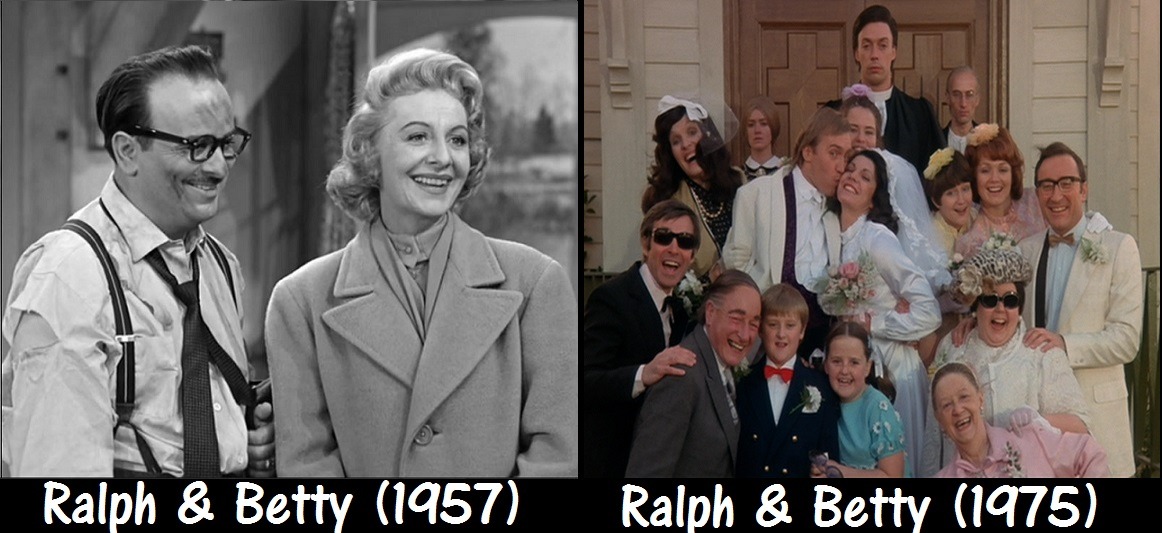
Ralphs & Bettys (Now & Then)
-
Westport and The Ramseys

So Little Ricky could be raised in the country, the Ricardos move to Connecticut! The change in location was the idea of writer Bob Weiskopf, who had done the same thing when his son was born. He sent co-writer Madelyn Pugh to his former home town of Westport, Connecticut, on a reconnaissance mission. To show her around, he asked his friends Ralph and Betty Alswang. Ralph was a highly successful Broadway designer of more than 90 plays and musicals. He also was an architect who designed Broadway’s Uris Theatre (now the Gershwin Theatre) and Paul Newman’s Westport home. They took photos of town landmarks, as well as several houses that would serve as inspiration for the Ricardo residence. One of those belonged to Oscar and Tony nominated actor Arthur Kennedy.


Back in California it was finally decided that instead of an invented town, the Ricardos would put down roots in Westport. Real references to the town would crop up for in next ten episodes (Yankee Doodle Dandy Day, the town hatchery, the Minuteman statue).
Along with a new home came new neighbors, Ralph and Betty Ramsey. In return for their tour, Weiskopf named the characters after the Alswangs. For their surname he honored another of his former Westport neighbors, Alice and Charles Ramsey. On screen, the couple would be played by series vets Frank Nelson (best remembered as Freddie Filmore) and Mary Jane Croft (who had played Cynthia Harcourt and Evelyn Bigsby).

Of course, today Westport is known for its historic Westport Country Playhouse. I wonder what the series would have been like had they moved instead to Millburn, New Jersey, near another famous Playhouse?
-
“Lucy and Superman”

(S6;E13 ~ January 14, 1957) Directed by James V. Kern. Written by
Madelyn Martin, Bob Carroll, Jr., Bob Schiller and Bob Weiskopf. Filmed November 15, 1956 at Ren-Mar Studios.
Rating: 48.1/65
Synopsis ~ In order not to disappoint her son, Lucy pretends to be the Man of Steel at Little Ricky’s birthday party when the ‘real’ Superman happens to arrive!

This copy of the original script was autographed by Richard Keith (probably by a parent), writers Bob Schiller, Bob Carroll Jr. and Bob Weiskopf, Assistant Director Jay Sandrich, Hairsytlist Irma Kusely, Editor Dann Kayn and Camera Coordinator Maury Thompson. The cast list show’s that Martha’s husband was named Herbert and that they needed to cast pigeons!
This episode was filmed after “Little Ricky Gets a Dog,” but broadcast first. This may be because Fred and Ethel are still searching for a tenant to live in the empty apartment in this episode, but Mr. Stewart is introduced as the new tenant in “Little Ricky Gets a Dog.” Also, Lucy mentions wanting to move to the country in “Little Ricky Gets a Dog,” so it’s the perfect set-up for the big move.

This episode was colorized and aired on CBS on May 17, 2015 as part of the “I Love Lucy Superstar Special.” Ironically, while this episode of “I Love Lucy” was originally filmed and aired in black and white, “The Adventures of Superman” was filmed in color (starting season 3) but still aired in black and white. This mirrors what happened with “The Lucy Show” in the 1960s, which also filmed its third season in color, but was still aired in black and white.

“Hollywood at Last!” shared something in common with “Adventures of Superman” – the establishing shot of Los Angeles City Hall. Built in 1927, it remained the tallest structure in the city for more than 30 years and became an icon of Los Angeles. It was prominently featured at the beginning of each episode of “Adventures of Superman.”

George Reeves (Superman) is never mentioned by name in the dialogue or in the original credits. Lucie Arnaz later theorized that this was not to destroy the illusion that Superman was real to the many children who watched the show. In syndication, an announcer credit was added for Reeve. Reeve starred in “Adventures of Superman” from 1952 to 1958, filming one of its six phenomenally successful seasons at RKO, which was purchased by Lucy and Desi and re-named Desilu just a few months after this episode aired. George Reeves at first didn’t want to do this episode, unless he had his stunt man with him, but director James Kern agreed.

Two of the most iconic and instantly recognizable costumes in television history! Some fans have noticed that the Superman uniform worn by George Reeves on “I Love Lucy” is the second one, the one recreated for their color filming. As “Lucy” was filmed and aired in black and white, the first costume would have photographed better. Ironically, when the episode was colorized in 2015, the blues are quite vivid and the reds come alive.

Keith Thibodeaux (Little Ricky) later said that this was his very favorite episode.
Because Desilu had obtained the license to use the actual Superman logo, they weren’t shy about using it! They even got permission to use the show’s theme music, composed by Leo Klatzkin.

Actors who were also seen on “Adventures of Superman” and their (characters) on “I Love Lucy”:
- Doris Singleton (Caroline Appleby)
- Elizabeth Patterson (Mrs. Trumbull)
- Tristram Coffin (Harry Munson)
- Herb Vigran (Jule / Al Sparks / Joe)
- Claude Akins (Himself aka ‘Giant Native’)
- Hayden Rorke (Mr. O’Brien)
- Phil Arnold (Harry Henderson / Man in Hotel Hallway)
- Milton Frome (Bill Henderson)
- Pierre Watkin (Mr. Dorrance)
- Dick Elliott (Tourist at Empire State Building / Yankee Stadium Spectator)
- Maurice Marsac (Maurice / Waiter)
- Frank J. Scannell (Buffo the Clown)
- Lou Krugman (Hollywood Director / Jewelry Salesman / Club Manager)
- Joi Lansing (Herself / Miss Low Neck)
- Larry Dobkin (Counterman / Waiter / Counterfeiter)
- Rolfe Sedan (Paris Chef)
- Eve McVeagh (Roberta the Hairdresser)
- Norman Varden (Mrs. Benson)
- Danni Sue Nolan (Mr. Reilly’s Secretary)
- Harry Cheshire (Sam Johnson)
- Ken Christy (Ken the Detective / Dock Agent)
- Robert Foulk (Brooklyn Policeman)
- Sid Melton (Jockey / Bellboy / Shorty)
- Bert Stevens (Tropicana Patron)
- Harold Miller (Theatre Patron / Ship Passenger)
- Hans Moebus (Man on Dock)
- Ernesto Molinari (Vineyard Boss)
- Jack Chefe (Bellhop / French Waiter)
- Bess Flowers (Tropicana Patron / Theatre Patron)
- Monty O’Grady (Ship’s Passenger / Man at Airport)

As the episode opens, Ricky and Little Ricky are watching “Adventures of Superman” on TV. Superman fans have said that this excerpt was not from the original series, but created for “I Love Lucy” using Reeve’s double. The wires holding Superman up are clearly visible in the shot and it was commonly known that Reeve disliked using wires because of an incident early in the show’s creation.
As “Superman” ends, an announcer reminds children that Superman will be appearing in the New York area at Macy’s. The department store was mentioned several times in season six, with a scene taking place there in “Lucy Meets Orson Welles.” The push may have been an attempt by the Tiffany Network to woo the famous Macy’s Thanksgiving Day Parade away from NBC, a move that failed.

The Mertzes buy a box of party supplies for Little Ricky’s birthday. Although Ethel wants them to be a gift, Fred reminds Lucy that they cost $5.32.

Because company is coming, Lucy puts out some nuts in her glass Fostoria ‘American’ Compote Candy Dish. The dish was previously used in “Lucy’s Schedule” and “The Ricardos Are Interviewed.”
When Lucy sends Little Ricky off to bed, she reminds him to say his prayers. This is one of the rare mentions of anything religious on “I Love Lucy.” This might have been an ad-lib by Lucille Ball, who was not affiliated with any particular church (she married a Catholic and later a Jew), but believed in God.
The Appleby’s come over for a social evening that Ethel calls “the bore war” because the couples only talk about their children. As the scene opens, Caroline is in mid-sentence talking about a film.
CAROLINE: “And he picked up Marilyn Monroe, slung her over his shoulder and carried her off!”

Although the title is never mentioned, the film they are discussing is Bus Stop, starring Marilyn Monroe and Don Murray. It was released in August 1956, two and a half months before this episode was filmed. Frequent “Lucy” character actor Hans Conried has a featured role in the film.

The episode marks the only appearance of George O’Hanlon as Charlie Appleby. O’Hanlon voiced the patriarch George on the animated series “The Jetsons” (1962-87). Five years earlier his ‘daughter Judy’ (Janet Waldo) had played Peggy on “The Young Fans” (S1;E20).

When we last saw Charlie in “Baby Pictures” (S3;E5) he was played by Hy Averback, although Charlie had previously been mentioned in “Lucy and Ethel Buy the Same Dress” (S3;E3). Before this episode, Averback returned to the show to play another Charlie, Charlie Pomerantz, in “The Hedda Hopper Story” (S4;E20). Confused? Not half as much as poor Caroline! Whichever actor played him, they were both proud of their son, Little Stevie.
This is the last of ten appearances of Doris Singleton as Caroline Appleby. Singleton would, however, appear on several episodes of “The Lucy Show” and “Here’s Lucy.”
Oops! Lucy says Little Ricky was born at 11 o’clock in the morning, but in “Lucy Goes to the Hospital” (S2;E16) Ricky is in mid-performance at the Tropicana NIGHTclub when the baby is born!
Next day, Lucy is picking up after Little Ricky.

His ‘Tricky Trolley’ makes a second appearance after having been seen in the cupboard during “The Ricardo’s Change Apartments” more than three years earlier. At that point Little Ricky was being played by the Mayer Twins.

Picking up Little Ricky’s toys, Lucy holds one of his “Superboy” comic books. It is the December 1956 issue (#53), hot off the presses during filming. Ironically, on the cover, Superman is looking at television! Even more ironically, inside the comic book was an ad titled “Draw Bob Hope”. Hope had just appeared on the season opener of “I Love Lucy.”
Lucy asks Ricky to ask Superman to come to Little Ricky’s birthday party. It seems Ricky met him when they were in Hollywood, although this is the first time viewers are hearing about it.

Oops! When Lucy calls Caroline to tell her the news about Superman, Little Stevie is reading the same issue of “Superboy” that Little Ricky has and Lucy is holding just before the call. Could it be the same copy? None-the-less, the orientation of the magazine means that the young actor is looking at it sideways! It appears to be a BB gun ad on the back, a typical comic book sponsor of the period.

Stevie Appleby was played by Steven Kaye, who the previous year had played Jordan Benedict III (age 4) in the film Giant. The character of Little Stevie had appeared briefly in two previous episodes, but was played by an unknown child actor. This was the second and final screen credit for Kaye. In addition to reading the magazine sideways, in the above screen shot from the episode he is caught breaking the cardinal rule – looking into the camera! Didn’t he learn anything working with James Dean?

Although Kaye’s first name was also Stevie (in a show where Lucy played Lucy), it is a mere coincidence because the character was named three years earlier for “Baby Pictures” (above). The question is – if Little Ricky has a father named Ricky, why does Little Stevie have a father named Charlie?
Ethel bursts in with her mother’s good silver, hiding it from Fred, who has a trip to the pawn shop in mind. They haven’t been able to rent 3B, the empty apartment down the hall from the Ricardos, and Fred is worried. This is another mention of Ethel’s mother, a character we never meet when we visit “Ethel’s Home Town.” Instead of the silver, Fred wants to pawn his old mandolin, an instrument we never see him playing or hear about again.
ETHEL: “You won’t get more than fifty cents on that.”
FRED: “Well, fifty cents is two hamburgers, and that’ll keep us eating for another day.”
Two years earlier, when they ran “The Diner” (above), they were charging fifteen cents for a hamburger. At the time, McDonald’s and other fast food joints were all at the same price – 15 cents. Perhaps Fred is having his burger at someplace fancy?

Hearing that Superman can’t make it (he’s leaving for Terre Haute – or as Ricky says Terry Hoot), Lucy decides to masquerade as ‘the man of steel’ hoping the kids won’t notice. Even Ethel isn’t convinced.

Lucy has invited ten 5 year-olds to Little Ricky’s party, although only nine little actors (including Stevie) actually show up. They play pin-the-tail on the donkey and London Bridge. Little Stevie keeps his eye on Fred during the game! William Frawley was said not to be very fond of children.

This episode also features Madge Blake as Martha, a prospective new tenant who has a fear of heights (so why she’d want to live on a third floor walk-up is a mystery). Blake had already appeared on “I Love Lucy” as hat shop proprietor Mrs. Mulford in “Ricky Loses His Temper” (S3;E19). She also played Aunt Anastacia in Lucy and Desi’s 1954 film The Long, Long Trailer.
Martha’s husband Herbert
is played by Ralph Dumke.
His name is not spoken or credited but it is in the original script. A year earlier he had appeared as Henry Opdyke in Lucy and Desi’s film Forever, Darling.
Looking out the window of the empty apartment agoraphobic Martha goes into a panic:
HERBERT: “Was it a bird?”
MARTHA: “No.”HERBERT:
“Was it a plane?”
MARTHA: “No.”HERBERT:
“Well, what was it, dear?”
MARTHA: “It was Superman!”
This is the same dialogue exchange that began “Adventures of Superman” opening sequence.

To appreciate Lucy’s predicament on the ledge, a rare insert shot of her POV is used – including a passing bus and taxi on ‘68th Street’. This isn’t Lucy’s first time out on the ledge. She went out there before to spy on Ricky and the Mertzes in “Lucy Cries Wolf.”

Oops! In that episode, the ledge only extended to the wall but now it extends around the corner and under the vacant apartment window, an architectural anomaly only possibly on television.
Navigating the ledge by side-stepping the birds, Lucy has time for a few pigeon jokes. Because she is dealing with the unpredictability of live animals, some of these may have been unscripted:
- “Shoo! Go deliver your messages!”
- “Why don’t you go to Central Park? There’s a million statues over there.”
- (About the pigeon on her shoulder) “Oh, why don’t you get off and walk?”
- “I wish I knew some pidgin English.”
- “Everybody off! (One flies away) Aw, ya big sissy!”
- “Heard any good stories lately?”
Some fans have pointed out that Lucille Ball must have been terrified to do this scene, not because of the heights (she was actually only a few feet above ground), but because of her bird phobia. It supposedly developed at age 4 when her mother told her that her father had died of typhoid.
A picture fell from the wall and there were birds sitting in the window, which she took as a bad omen. Lucy later said in her autobiography,
“I don’t have a thing about live birds, but pictures of birds get me.”

Oops! Superman makes an impressive entrance bursting through the kitchen shutters. Unfortunately, Ricky just asked all the kids to close their eyes, so they didn’t see it!

Because the backdrop and the window were only a few feet apart, Lucy casts a distinct shadow during her specially lit medium shots from inside the apartment.

Madge Blake did a 1964 episode of “The Lucy Show” before creating the role for which she is best remembered – Aunt Harriet Cooper on TV’s “Batman” (1966-68). This makes her one of the few TV actors who had the distinction of appearing with Superman and Batman, although she shares no scenes with George Reeves. Blake is just one of many actors who appeared on “Lucy” sitcoms and “Batman”. Their “Batman” roles are in (parentheses).
“I Love Lucy” and “The Lucy-Desi Comedy Hour”
- Tristram Coffin (Ambassador)
- Jerry Mathers (Pop, the Stage Doorman)
- Van Johnson (Minstrel)
- Tallulah Bankhead (Black Widow)
- Ida Lupino (Casandra)
- Howard Duff (Cabala)
- Edward Everett Horton (Chief Screaming Chicken)
- Allen Jenkins (Little Al)
- Norma Varden (Mrs. Monteagle)
- Milton Berle (Louis the Lilac)
- Alberto Morin (Octave Marbot)
- Dick Kallman (Little Louis Groovy)
- Ben Weldon (Foo Young)
- Jesslyn Fax (Bon Bon)
“The Lucy Show” and “Here’s Lucy”
- Ethel Merman (Lola Lasagna)
- Rudy Vallee (Lord Marmaduke Ffogg)
- Stafford
Repp (Chief O’Hara) - Victor Buono (King Tut)
- Vincent
Price (Egghead) - Vito Scotti (Matey Dee)
- Ellen Corby (Mrs. Green)
- Sammy Davis
Jr. (Himself) - Art
Linkletter (Himself) - Cesar Romero (Joker)
- Alan Hale
Jr. (Gilligan) - Shelley Winters (Ma Parker)
- Liberace (Chandell)

This is one of only two times that it rains on “I Love Lucy”, and the only time anyone actually gets wet. The other episode was “In Palm Springs” during season four. This is also one of only two “I Love Lucy” episode to use un-caged birds! The other is “Lucy Raises Chickens”.

To rescue Lucy from the ledge, Superman easily pushes the Ricardo piano out of the way thanks to special casters that (at the time) were only available in Chicago. One wonders how Lucy so easily loaned the piano to Ethel during when preparing for “Lucy’s Club Dance” two years earlier.

Oops! The window valance has white fringe on it when seen from the outside, but no fringe when viewed from inside the apartment. The sheers that are normally over the living room window have been removed for this episode leaving only the drapes.

The end credits carried the National Comics copyright for “Superman character, feats, and narration.”

After the closing credits of the original airing, Gale Gordon and Bob Sullivan appeared for a quick promo of “The Brothers” (later changed to “The Box Brothers”) Tuesday nights on CBS. The one-season sitcom was filmed at RKO / Desilu Studios.
FAST FORWARD!

Lucy Carmichael inexplicably gets Superman-like strength in “Lucy, the Superwoman,” a 1966 episode of “The Lucy Show.”

Lucy Carter contends with dozens of pigeons in a 1974 episode of “Here’s Lucy.”

In November 1995, “Lois and Clark: The New Adventures of Superman” (S3;E6) did a black and white “I Love Lucy” satire in which Clark Kent / Superman was Ricky, saving Lois / Lucy (Terri Hatcher) and the Mertzes from a time bomb!

A “Lucy Meets Superman” skit was performed at the 2012 Superman Celebration in June 2012.
SELLING SUPERMAN


Dolls by Maria uses a Barbie doll for their one-off Lucy dolls.

“Lucy Meets Superman” meets “Superman Meets ‘I Love Lucy’“


-
“Visitor From Italy”

(S6;E5 ~ October 29, 1956) Directed by James V. Kern. Written by Madelyn Martin, Bob Carroll, Jr., Bob Schiller and Bob Weiskopf. Filmed September 24, 1956 at Ren-Mar Studios. Rating: 45.5/62

Synopsis ~
When the Venetian gondolier the Ricardos met in Europe shows up in New York, a series of misunderstandings results in Lucy working at a pizza parlor.
This is the last episode before the gang travels to Florida and Cuba.

Ricky says that Mario’s face is awfully familiar.
Well, it should be! Actor Jay Novello appeared in two previous episodes: as superstitious Mr. Merriweather in “The Seance” (S1;E7)…

and the nervous Mr. Beecher in “The Sublease” (S3;E31).

He later also appeared on two episodes of “The Lucy Show” (see below) but dapper Novello is probably best remembered for playing another Mario, Mayor Mario Lugatto on “McHale’s Navy” (1965).

The episode also features Italian-born Eduardo Ciannelli playing Mr. Martinelli, owner of the pizza parlor where Mario (then Lucy) is employed. Ciannelli starred on Broadway in 19 plays, starting in musicals, but re-inventing himself as a dramatic actor and earning a Tony nomination for his final appearance in The Devil’s Advocate in 1961. He eventually returned to Italy, where he died in 1969.

Finally, the episode features Aldo Formica, who was not an actor, but Hollywood’s most famous pizza chef then employed at Miceli’s Pizza. He was hired to teach Lucy how to twirl pizza dough in the air and also appeared in the episode. He made only one other screen appearance, also twirling pizzas, on “Maude” in 1975.

In the early 1960s he opened Aldolino’s Italian Restaurant in Asuza, California, which is still in business today. Their menu features a photo of this episode on the cover.

Peter Brocco (Dominic Orsatti) was a popular character actor with nearly 300 credits on film and TV. He also appeared on Broadway acting in Shakespeare alongside Estelle Winwood. On “I Love Lucy,” Brocco was seen as one of the judges when “Lucy Raises Tulips” (S6;E26) and acted with Lucille Ball in the film Miss Grant Takes Richmond (1949).

James Flavin (Immigration Officer) also appeared with Jay Novello in “Lucy and the Safe Cracker” (TLS S2;E5) where he played a cop named Sgt. Wilcox. He returned two episodes later to play Sgt. Wilcox again in another bank-themed episode, “Lucy and the Bank Scandal” (TLS S2;E7). Flavin appeared in four films with Lucille Ball, including playing a police sergeant in Without Love (1945). During his long career he played so many officers of the law that his IMDB photo is of him in a police uniform!

Louis A. Nicoletti (Waiter) was a regular “I Love Lucy” background player and later directed episodes of “The Lucy Show” and “Here’s Lucy.”

Keith Thibodeaux (briefly) plays Little Ricky. He has one line (”Hello, Daddy!”) and is on camera only a few seconds.

A perfectionist with props, Lucille Ball practiced making pizzas by throwing dough in the air at Miceli’s Pizza Parlor in Hollywood. She became so good at it that she later made pizzas for the cast and crew at Miceli’s.

Lucy tells Mario that he doesn’t have to go to work due to the “Taft-Hartley Visitors-from-Italy-Who-Work-in-Pizzerias-Get-Every-Third-Day-Off” Amendment. The Taft–Hartley Act is a 1947 federal law that prohibits certain union practices and requires disclosure of certain financial and political activities by unions.

While trying to guess where Mario is from, the mention Florence, Rome, Naples, Genoa, and San Remo.
LUCY: “I know! He’s that friend of the Lederers that was so nice to us.”

In real life, Frank and Marion Lederer were great friends of Lucille Ball. Frank Lederer and Lucy were both in the film A Woman of Distinction in 1950, but they also socialized off camera as well.
They finally realize that Mario was their Gondolier on the Grand Canal in Venice. Mario presents Lucy a slip of paper to locate his brother Dominic. Lucy says it says he is in San Francisco. Mario has only ten dollars to get there so he resolves to go to work; but at what?
LUCY: “It’s slack season for gondoliers in New York.”
FRED: “Unless you go down to Canal Street.”
Canal Street is a major east–west street in Lower Manhattan, New York City. It runs through the neighborhood of Chinatown, and forms the southern boundary of Little Italy. At one time, the area did actually feature a canal, but it was filled in by 1819 and Canal Street opened a year later.
Fred’s pun doesn’t go over well with Ethel, who jabs him with her elbow. For the audience, the joke relies on knowing New York City, and only gets a mild chuckle from the California studio audience.

Viewers only saw visits to Florence, Rome, and San Remo. If we had seen an episode titled “Lucy Visits Venice,” it might have featured a guest star like Pat Boone and had Lucy filling in for Mario in the gondola. Maybe!
PIZZA PRESENT-A!

We not only get to see the inside of Martinelli’s Pizza, but the exterior as well.
Trying to convince Mr. Martinelli to let her sub for Mario, Lucy fibs “People from Rome write me for my pizza recipe.” Actually, it is Naples, not Rome, that is famous for its pizza. Margherita pizza was invented in Naples in 1889, and it’s still popular in the city today.

Oops! When Lucy is at the pizzeria attempting to spin the pizza the tray of dough balls in front of her goes from nearly empty to full between shots.
There is also the sticky oven door saga:
- When Lucy first ditches the unsuccessfully thrown dough into the top over, the door to the bottom oven pops open. She shuts it and continues.
- It happens a second time when she bumps into the ovens, so she tosses in that dough and slams it shut again.
- A second later it happens a third time and Lucy just shuts it and continues.
- Although Lucy throws yet another wad of dough in the top oven and slams the door hard, there is a nearly imperceptible edit which indicates that perhaps the lower door popped open yet a fourth time! Knowing Lucille Ball, she likely called “Cut!” and asked someone to fix the damn oven door!”

Lucy tosses the pizza dough high in the air and it gets sucked up the vent and doesn’t come down! There was probably a stagehand hanging from the rafters to catch it.

The disappearing dough then plops down on the curb outside the pizzeria window! It looks like an actual concrete street curb, so this quick insert shot was probably filmed outside the studio.

Thanks to High Definition television, a close-up of the pizza ovens reveals that these are not real ovens, but wooden facsimiles made by Desilu. The grain of the painted wood is clearly visible. The handle is a wooden dowel.
Oops! Lucy hid the bulk of her mistakes in the other ovens, so why is this one the only one belching black smoke?

Pizza industry aficionados have claimed that a New York pizzeria in 1956 would not have had a machine to flatten the dough. At that time they were still doing it by hand. Machines were much more common in Los Angeles pizzerias.
PIZZA PAST-A!

When “Lucy Changes Her Mind” (S2;E21) she can’t decide between Italian and Chinese food, so Fred suggests “Ravioli Foo Yung or Chicken Chow Pizza”!


When in Rome – make pizza jokes! In “Lucy’s Italian Movie” (S5;E23) there are two!

The plot for this episode bears more than a passing resemblance to “Tennessee Ernie Visits” (S3;E28) and “Tennessee Ernie Hangs On” (S3;E29) in which a visitor from out of town overstays his welcome and will not accept charity to move on.
PIZZA FUTURE-A!

In 1969′s “Lucy and the Generation Gap” (HL S2;E12),
the proprietor of Murphy’s is named Murphy Irving Fong, originally from San Francisco. Lucy Carter avoids eating pizza to preserve her figure. Her son Craig says “Look what it did for Sofia Loren” so Lucy digs in.

Lucy Carmichael get a make-over that’s actually on a hidden camera television show in “Lucy and the Beauty Doctor” (TLS S3;E24). The phony beauty treatment includes tomato sauce, provolone, and olive oil – turning Lucy’s face into a living pizza!

In 1968′s “Lucy and Miss Shelley Winters” (HL S1;E4), Lucy catches Shelley snacking on a pizza pie she’s hidden in the record player between the LPs. Could one of them be “That’s Amore?”

Jay Novello returned to work with Lucille Ball as a former safe cracker turned candy maker in 1963′s “Lucy and the Safe Cracker” (TLS S2;E5).

Their last collaboration was as another Italian character, restaurateur Tony DiBello in 1964′s “Lucy Meets a Millionaire” (TLS S2;E24).
SELLING PIZZA!

A puzzlement! The box is actually shaped like a pizza box!
1956, Aldo Formica, Aldolino Italian Restaurant, Canal Street, CBS, Desi Arnaz, Eduardo Ciannelli, Frank Lederer, Here’s Lucy, I love lucy, Italian Restaurant, Jay Novello, Keith Thibodeaux, Little Ricky, Louis Nicoletti, Lucille Ball, Lucy, Miceli’s, Peter Brocco, pizza, Ricky, Shelley Winters, Sitcom, Taft-Hartley, Tennessee Ernie Ford, The Lucy Show, tv, Venice, Vivian Vance, William Frawley -
Lucy and The Great Caruso

The episode “Lucy’s Bicycle Trip” (1956) and other “I Love Lucy” episodes provide many connections to the 1951 MGM bio-flick The Great Caruso (1951) starring Mario Lanza.

When cycling through Italy, the gang takes shelter in the barn of a farmer played by Mario Siletti who played Papa Caruso.

Later, Lucy bumps heads with an Italian border guard played by Harry Dar Boggia, who played a bellhop in the film.

But the connections don’t end there. Several other actors in the film would go on to earn “I Love Lucy” credits. Most recognizable is probably Ernesto Molinari, who was also a bellhop in the film and played the vineyard boss who assigns Lucy to stomp grapes in “Lucy’s Italian Movie."

Shepard Menken played Fucito in the film, but he would also be seen in four different episodes of “I Love Lucy,” playing Frenchmen Jean Valjean Raymond and Charpontier, as well as art store owner William Abbott and Lucy and Ricky’s eye doctor?

‘Queen of the Extras’ Bess Flowers was in the audience for "Over the Teacups” (“Ethel’s Birthday”) and was also in the audience for Caruso’s Lucia di Lammermoor. Also in the audience for “Over the Teacups” was Harold Miller, a party guest in “Caruso.”
Most obscure of all, Bert Stevens was a Tropicana guest in “Ricky Loses His Voice” and billed as ‘Man in the Street’ in the film. Next time you are watching The Great Caruso, look out for these familiar faces!
-
“Lucy in the Swiss Alps”

(S5;E21 ~ March 26, 1956) Directed by James V. Kern. Written by Jess Oppenheimer, Madelyn Pugh, Bob Carroll, Jr., Bob Schiller, and Bob Weiskopf. Filmed February 23, 1956 at Ren-Mar Studios. Rating: 43.9/62

Synopsis ~ After a mistake in booking, the Ricardos and Mertzes go mountain climbing in the Swiss Alps and get stranded in a cabin after an avalanche.

This is the seventh of a dozen episodes set in Europe.

On the day this episode was filmed (February 23, 1956), Desi Arnaz was awarded a Golden Globe Award for his contributions to television comedy. This was the first Globe Awards to include television. Lucille Ball evoked a colossal laugh from attendees when she exclaimed, “This is a most frightening audience!”

Ethel supposedly sat on Fred’s glasses while they were in Paris, so Fred mis-read ‘Locarno’ for ‘Lucerne’ and sent Ricky’s band to the wrong city.


Lucerne is a compact city in central Switzerland that sits amid snow-capped mountains on the north end of Lake Lucerne. It serves as a gateway to hiking and skiing destinations in the nearby Rigi and Pilatus mountains as well as the Alps. Locarno, on the other hand, is an Italian-speaking resort city in southern Switzerland, on Lake Maggiore at the base of the Alps.It will take Ricky’s band nearly three hours by train to get from Locarno to Lucerne.

Oops! The episode is set in Lucerne but outside there are big mountains. Although Switzerland is famous for the Alps, Lucerne is in the lowland.

Just in case the band doesn’t arrive in time, Fred recruits a Swiss band who plays a very plodding oom-pah-pah version of “La Cucaracha.” They are much more at home playing das “Schnitzelbank,” a German-language song for children that is similar in its repetitive structure to Mitch Miller’s "Must Be Santa.”
Coincidentally, William Frawley performed an English version of
“Schnitzelbank,”
in the short World War II propaganda film “The Yankee Doodler.”

The Swiss bandleader is played by veteran character actor Torben Meyer. Meyer was born in Denmark in 1884 and did more than 70 European films before immigrating to the United States. He was generally cast as thick-accented waiters, butlers, and doctors.
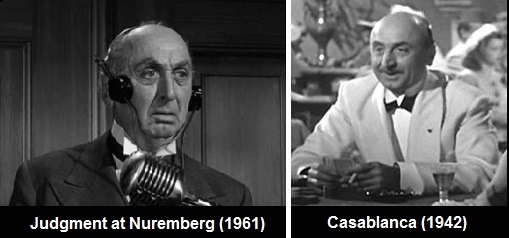
His most prominent role was in Judgment at Nuremberg (1961), but he also appeared as a wealthy Dutch banker in Casablanca (1942). Musical fans might spot him in Music in the Air (1934), Roberta (1935) also starring Lucille Ball, Call Me Madam (1953) starring Ethel Merman, Anything Goes (1956) NOT starring Ethel Merman, and Li’l Abner (1959). He was also strangled by the monster in Bride of Frankenstein (1935) and was a gypsy in Frankenstein Meets the Wolf Man (1943). From 1910 to 1965 he appeared in 255 films and television shows! Meyer died in 1975 at the age of 90.

On the wall of the Ricardo’s hotel room there is a framed Medieval print from the "Codex Manesse” of Walther von Klingen, a medieval songbook written and illustrated between 1304 and 1340 in Zürich. Von Klingen (1220-1286) was a Swiss-born minstrel and composer.


After an al fresco picnic atop a mountain, it starts to snow and the gang take refuge in an abandoned cabin.

Before the avalanche, Fred opens the cabin door and lets out a loud whistle, hoping to attract “one of those St. Bernards” because he could “use a shot of brandy.”

The St. Bernard is a breed of very large working dogs from the Swiss Alps and northern Italy originally bred for rescue. Their name comes from the monks of a hospice located at the treacherous St. Bernard’s pass in the Western Alps. They are traditionally depicted with a small brandy barrel around their necks, supposedly for those stranded by avalanche to drink for warmth and sustenance while awaiting rescue. The monks claim that this story is apocryphal, despite it turning up in many films, cartoons, and television shows.

Lucy Ricardo previously encountered a St. Bernard named Cap when trying to hide from Ricky in William Holden’s mansion in “The Tour” (S4;E30).

Lucy and Kim Carter struggle to bathe a large St. Bernard named Tinkerbell in “The Bow-Wow Boutique” (HL S6;E5).

After five hours of being stranded in the cabin (although only a few minutes of screen time), Lucy remembers that she has saved one of her “man-sized” sandwiches from lunch.

The last time Lucy had a comic encounter with a cheese sandwich it was just outside Cincinnati, Ohio – the ‘special of the day’ at Mr. Skinner’s One Oak Cafe in “First Stop” (S4;E13). Ironically, it was a SWISS cheese sandwich!

Ricky tries to see daylight up the flue of the stove, but gets a face full of soot instead.

Ricky and Fred also got a face full of soot when eavesdropping on their wives through the furnace pipe in “The Gossip” (S1;E24). Lucy dubs them the “Coal Dust Twins,” a pun on the Gold Dust Twins, the logo of a popular washing powder of the time represented by two black boys.

The dialogue references the 1954 MGM musical Seven Brides for Seven Brothers. Not coincidentally, MGM had just released the Lucy / Desi film Forever, Darling.
“You remember that picture ‘Seven Brides for Seven Brothers’? Somebody shot a pistol and it caused a great, big avalanche.”

Sure enough, Lucy slams the door causes an great, big avalanche, burying the cabin. Later, Ethel asks “How’d they get out in ‘Seven Brides for Seven Brothers’? Lucy replies that “They waited for the spring thaw!”

Coincidentally, the avalanche scene in the film was shot in Sun Valley, Idaho, a favorite resort destination of the Arnazes and also the setting of a 1958 episode of "The Lucy–Desi Comedy Hour” (above). The film’s male lead, Howard Keel, would appear in a 1969 episode of “Here’s Lucy” and Ruta Lee (who played Ruth, one of the seven brides), would do two episodes of “The Lucy Show,” including one as herself.

In “Ricky Needs an Agent” (S4;E29), “Seven Brides for Seven Cubans” is just one of the off-the-cuff titles Lucy suggests MGM’s Mr. Reilly produce for Ricky rather than release him from his contract – but to no avail – “heeee’s released!”


This is the second time an “I Love Lucy” European vacation episode emulated the plot of an MGM motion picture. The first was “Second Honeymoon” (S5;E14) which duplicates several memorable plot points from the 1953 MGM film Gentlemen Prefer Blondes starring Marilyn Monroe.

Metro Goldwyn Mayer (MGM) was also heavily promoted during the trip to Hollywood as they had just produced Lucy and Desi’s first film The Long, Long Trailer (1954).

When they think the end is near, Lucy cries that she’s too young to die. Ethel tearfully adds “So am I.” Fred facetiously smiles as if he’s about to say something rude, but doesn’t, but the studio audience snickers anyway. Fred then confesses that he’s charged the Ricardos $10 more in rent each month than the rest of his tenants. Ethel admits that she’s always given the Ricardos back the extra $10. In turn, Ethel confesses that she was really 19 when they married. Fred admits that he always knew that she was really 24. Ricky wisely declines to confess anything, just in case they are rescued. Smart Cuban!
Fast Forward!

Just three episodes later, in “Lucy’s Bicycle Trip” (S5;E24), Lucy complains that her traveling companions are not adventurous enough and talks about their visit to Switzerland.
LUCY (to Ricky and the Mertzes): “You wouldn’t climb to the top of the Eiffel Tower. You wouldn’t ride the ski lift in Switzerland. You won’t swim in the Mediterranean and now you don’t want to bicycle along the Italian Riviera.”
This confirms that there were many adventures in Europe that were not depicted in the episodes. Apparently, Lucy wanted to go skiing but got some resistance.

Lucy and the gang also frolicked in the snow during several “Comedy Hours”: “Lucy Goes to Sun Valley,” “Lucy Makes Room for Danny” (above), and “Lucy Goes to Alaska”, which all feature snow scenes.

A new partner at the Unique Employment Agency (Tony Randall) took Harry and Lucy mountain climbing in a 1971 episode of “Here’s Lucy.”

During the 1960s Lucille Ball and Gary Morton vacationed in Switzerland, staying at the Palace Hotel in Gstaad. The luxury hotel opened in 1913. It is still in business today.

Throughout the ‘60s and ‘70s, the hotel gained a reputation as a celebrity getaway destination. Besides Lucy, actors like Elizabeth Taylor, Richard Burton, Sophia Loren, Grace Kelly, Roger Moore, and many others spent a great deal of time there. [The above snapshot and postcard were part of a collection of Lucille Ball’s travel photos that was auctioned off.]

In 1991, People Magazine did a story on the romance between Lucille Ball and Desi Arnaz and quoted Lucy’s close personal friend Lillian Briggs:
“Desi was the love of Lucy’s life. It was romantic, passionate, everything you could imagine in a love affair, and she was deeply hurt by what happened. They had tried like three times to get a divorce, but Lucy had always stopped it. Finally she planned to move to Switzerland, take her kids and get out of Hollywood.”

Lucille Ball would have been in good company in Switzerland. In 1953, film comedy legend Charlie Chaplin escaped the pressures of Hollywood and took permanent residence
Corsier-sur-Vevey overlooking Lake Geneva. Had Lucille Ball followed suit, we would have been deprived of “The Lucy Show” and “Here’s Lucy” – so Switzerland’s loss was our gain!

In 2021, the new Paramount Plus streaming service used images of Lucy and Ricky climbing the mountain in their roll out commercial, featuring stars and characters from CBS and Paramount shows. Fittingly, Lucy and Desi are in black and white!
1955, Bride of Frankenstein, Call Me Madam, Casablanca, Denmark, Desi Arnaz, Ethel Merman, film, Forever Darling, Frankenstein Meets the Wolfman, Hollywood, I love lucy, Judgment at Nuremberg, Lana Turner, Li’l Abner, Lucille Ball, Lucy, Lucy in the Swiss Alps, Merry Widow, MGM, Music in the Air, No No Nanette, Ricky, Roberta, Seven Brides for Seven Brothers, Sitcom, Switzerland, Torben Meyer, tv, Yolanda and the Thief -
“Nursery School”

(S5;E9 ~ December 5, 1955) Directed by James V. Kern. Written by
Jess Oppenheimer, Madelyn Pugh, Bob Carroll, Jr., Bob Schiller and Bob Weiskopf. Filmed November 3, 1955 at Ren-Mar Studios. Rating: 42.8/59
Synopsis ~ Lucy is reluctant to enroll her son in nursery school, but even more reluctant to leave him alone overnight in the hospital after having his tonsils removed.

The date this episode premiered, actor Paul Harvey died at age 73. In addition to doing seven films with Lucille Ball, he played the art critic from the New York Times in “Lucy Becomes a Sculptress” (S2;E15).

This is the last episode before the trip to Europe storyline begins.

Lucy says that she’s been reading Dr. Spock since Little Ricky was born. Benjamin McLane Spock (1903-98) was a pediatrician whose 1946 book Dr. Spock’s Baby and Child Care is one of the best-sellers of all time. The year this episode was filmed he published his third book, Feeding Your Baby and Child.
- In “Little Ricky’s School Pageant” (S6;E10), Lucy calls Ricky “a regular Cuban Dr. Spock” when he tries to diagnose his son’s stage fright.
- Convincing their sons to deliver a cake for them, Viv calls Lucy Carmichael “The Dr. Spock of Danfield” in a 1964 episode of “The Lucy Show.”

Oops! Little Ricky is called a 3-year-old several times in this episode, but in “Lucy Gets Homesick in Italy” (S5;E22) five months later, he is celebrating his third birthday!

A Mattel Jolly Jack-in-the-Box Music Box 1952 No. 461 is used by Lucy.

Had the toy been turned toward the camera, the name would have shown and American would have seen the hideous face of one of the most nightmarish clowns in toy history!

Lucy dubs her landlady “Ethel Bean-Spiller” when she feels uncomfortable about lying to Ricky about the baby going to Nursery School. Lucy is mad that she let the cat out of the bag about her plan to enroll Little Ricky, but not actually send him to Nursery School.
RICKY (to Ethel): “I wouldn’t know anything around here if you didn’t come up once in a while and spin the beans out of the cat bag.”

The first painting Little Ricky makes at nursery school is interpreted as an elephant sailing a houseboat. Lucy says he will be another “Grandpa Moses,” a reference to renowned folk artist Anna Mary Robertson Moses (aka Grandma Moses, 1860-1961) who didn’t begin painting until the age of 78.

Olan Soule plays Little Ricky’s physician, Dr. Gettelman. Soule was a busy character actor who can be seen on reruns of “Dragnet” (1951) and "The Andy Griffith Show” (1960). Born in 1909, he is a descendant of three Mayflower passengers. At the age of 17, he launched his stage career and became involved in radio work in 1933. He was on the radio show "Bachelor’s Children” for 10 years becoming involved in film and television work when the show moved to Hollywood. In real-life, Dr. Eugene Gettelman was the name of the Arnazes pediatrician, caring for both Lucie and Desi Jr. The real Dr. Gettelman died in 2009 at the age of 100.

The teddy bear that Lucy smuggles into the hospital was later manufactured for retail sale, as were the pajamas Lucy wears before sneaking out of the apartment to deliver it to him.

The teddy bear makes multiple appearances in the series, although it is not always the same bear. Mrs. McGillicuddy even packs it in the Pontiac before it is decided that she and Little Ricky will fly out to California instead of drive.

Little Ricky is hospitalized for a tonsillectomy but Lucy is distraught that parents are not allowed to stay overnight with their children.
If the Ricardo’s address were real, they would only have one block to travel to the nearest hospital, the Weill-Cornell Medical Center (above), located at 525 East 68th Street on the East River.

The two speaking nurses in the episode had also played maids on the series. Iva Shepard (Day Nurse) played a maid at the Beverly Palms hotel in “Don Juan and the Starlets” (S4;E17). This was her last screen credit before leaving the business.

Stuffing the teddy bear under her coat, Lucy is at first mistaken for a maternity case! The last time Lucy was at the hospital she really was – when “Lucy Goes To The Hospital” (S2;E16) to bring Little Ricky into the world.

Maxine Semon (Night Nurse) played a maid at the Sands Hotel in a 1958 episode of "The Lucy–Desi Comedy Hour,” and can be glimpsed in the Yankee Stadium scene of “Lucy and Bob Hope” (S6;E1).

Lucy and Vivian’s camera and lighting stand-ins Hazel Pierce and Renita Reachi play nurses in scrubs. Both are uncredited and have no lines. Pierce also played a nurse in “Lucy Goes to the Hospital” (S2;E16). Seeing these nurses gives Lucy an idea how to get to Little Ricky’s room without being noticed.

When Lucy has to convince the doctor not to operate on her patient (the teddy bear), she says he lives “all the way out in New Rochelle”! New Rochelle is a city in Westchester County, in the southeastern portion of New York state. It is a popular bedroom community of Manhattan because of it has easy access to Routes 95 and the New Haven railroad line. On “The Dick Van Dyke Show,” which aired on CBS concurrently with “The Lucy Show,” Rob and Laura Petrie lived in New Rochelle.
- In a 1962 episode of “The Lucy Show”, Lucy mistakenly buys Viv an electric bed that runs amok. “If Aunt Viv ever fell asleep and left the motor running she’d wake up halfway to New Rochelle.” Lucy and Viv lived in (fictional) Danfield, New York.
- A year later, the Food Editor of the New Rochelle Bulletin calls Lucy for an interview about Crazy Crunch, her new caramel corn product.

Robert Brubaker (Orderly) holds the distinction of being the only actor to play two re-occurring roles on TV’s "Gunsmoke.” On "I Love Lucy,” that honor belongs to Frank Nelson. Allan Ray (Orderly) had appeared as the clapstick man during “Ricky’s Screen Test” (S4;E6) and a waiter at the Brown Derby in “Hollywood at Last!” (S4;E16). He was also seen in the Lucille Ball films A Woman of Distinction (1950), Critic’s Choice (1963), and four episodes of "The Lucy Show,” all in 1963.

Howard Hoffman plays Dr. Barnett (center), the head surgeon who faints at the sight of a teddy bear. Hoffman had just 25 screen credits compared to Soules’ 250.

Twins Joseph and Michael Mayer played Little Ricky as a toddler from season 3 through season 5. They will do just two more episodes before the role is assumed by Keith Thibodeaux. The episode ends with mother and child (and bear) sleeping side by side – a rare quiet fade-out for “I Love Lucy”!
FAST FORWARD!

It’s deja vu for Lucille Ball when Lucy Carmichael also sneaks around a hospital in scrubs for a 1964 episode of “The Lucy Show.”

In a 1969 episode of “Here’s Lucy,” another one of Lucy’s relatives gets his tonsils out – her brother-in-law Harry (Gale Gordon).
-
“The Ricardos Change Apartments”

(S2;E26 ~ May 18, 1953) Directed by William Asher. Written by Jess Oppenheimer, Madelyn Pugh, and Bob Carroll, Jr. Filmed April 16, 1953 at General Service Studio. Rating: 60.5/98

Synopsis ~ Feeling cramped since the baby was born, Lucy convinces Ricky that they should change apartments with the Bensons upstairs.

~ Los Angeles Times, May 18, 1953

The same evening this episode first aired (May 18, 1953), “Studio One” presented “The Laughmaker” starring Jackie Gleason and Art Carney. Although their series “The Honeymooners” didn’t premiere on CBS until 1955, Gleason and Carney performed it for the first time as a 6-minute sketch on the Dumont Network on October 5, 1951, ten days before “ I Love Lucy” premiered on CBS. In the 1970s, Lucille Ball would act opposite both Jackie Gleason and Art Carney (separately) in her “Lucille Ball Specials.”
As of this episode, Jerry Hauser (Jerry the Agent) became the official “I Love Lucy” announcer for which he earned $70 per week.
After the switch, Little Ricky gets a private nursery. The Ricardos also gain a living room window, which will come in handy for Lucy’s forays onto the ledge in “Lucy Cries Wolf” (S4;E3) and “Lucy and Superman” (S6;E13). The move also eliminates the pesky step up into the kitchen that must have been annoying to both cast and crew.

The Ricardo’s new apartment number is 3B, but will change to 3D in “Lucy Tells the Truth” (S3;E6) for the sake of a joke. Unable to lie at an audition, Lucy says that she has appeared in 3D. When the casting director says “You mean third dimension?” Lucy is forced to admit that she means the number on her apartment.

Mrs. Benson is played by Norma Varden, who is probably best known for playing Frau Schmidt, the somewhat circumspect housekeeper at the Von Trapp mansion in 1965′s The Sound Of Music. The London-born actress turned up on an episode of “The Lucy Show” just a year before. She first met Lucille Ball when she played Lady Maude in the 1950 film Fancy Pants. Mrs. Benson is married to Mr. Benson (naturally), although we never see him, or learn either of their first names. They have one newly married daughter. It is apparent that Mrs. Benson is not fond of either her husband (“Meh!”) or her new son-in-law (“That nincompoop!”).

Although we never see Mrs. Benson again, she is mentioned twice. In “Lucy Has Her Eyes Examined” (S3;E11), Ricky borrows some ice cream from her rather than go all the way down to the drug store. In “The Business Manager” (S4;E1), Lucy has the Bensons on her shopping list when she is doing the marketing for the entire building.

The framed print above the mantel in the old apartment is “Farm Scene” by Margo Alexander (1894-1965) from her series of California Artist Provincials. This is a busy folk art print that seems to add to the effect when Lucy wants to convince Ricky their apartment is too small. Alexander was known for her paintings in the style of tapestry.

Speaking of paintings, the landscape above the piano, later turns up on “The Andy Griffith Show” – another Desilu production!

From under the cushion of the armchair, Ricky pulls out a rubber frog toy which when squeezed sticks out it’s tongue! This was actually a TV tie-in (one of the first) called Froggy the Gremlin. The character made it’s debut on radio’s “Buster Brown Gang” in 1944 which was brought to television in 1951 as “Smilin’ Ed’s Gang” with Froggy as a puppet and – occasionally – a life-sized costume character. The childrens’ program was seen on CBS from 1951 to 1953. When host Smilin’ Ed McConnell died in 1954, Andy Devine took over the show.

Also under the chair cushion, Ricky finds his son’s bath toy, Cleo the goldfish from the Disney film Pinocchio (1940). When Ricky squeezes her, Cleo spits in his face!

Under the sofa cushion, both Ethel and Ricky discover Little Ricky’s Buzzy Bee pull toy, a version of which was made by Fisher-Price from 1950 to 1985. At the time, it sold for sixty cents!

In the hutch (which usually holds cartons of Philip Morris cigarettes), Lucy has stored Little Ricky’s Tricky Trolley (a Mattel toy which also turns up four years later in “Lucy and Superman”), and his metal Fire Chief Action Pull Toy #34.

To convince Ricky that they need to move, Lucy virtually buys out an entire toy store, cramming the living room with Lionel Trains, a playground slide, a blow-up clown, two teddy bears, a bow and arrow set, a crib, a bicycle, a tricycle, Chinese checkers, a layette, a scooter, a child’s desk, a small plush chair, an infant swing, a child’s table and chair, several beach balls, a toy bus, an inflatable bop-em toy, and a two-seat whirlybird contraption!

Lionel Trains will also be under the tree in 1956′s “The ‘I Love Lucy’ Christmas Special.” Ricky is nearly sitting on the famous “I Love Lucy” Teddy Bear, which was offered for retail sale and seen in many other episodes.

Oops! Vivian Vance makes a rare flub when she tells Lucy she is not going to help her move the furniture. She says “If you think I’m going to help you marry – carry all this furniture” obviously thinking of the word “move” but knowing the word in the script is “carry.” Lucy was a stickler for going by the script.

This is one of those episodes where Ricky spanks Lucy, but since she is behaving like a child in a child-like playground / apartment, it doesn’t seem quite as offensive as it usually does.

The episode ends with Lucy, Fred and Ethel all doing Lucy’s trademark spider face: “Ewwwwwwwwww!”
FAST FORWARD!

When “Lucy’s Sublets the Office” (TLS S4;E21) in 1972, the Unique Employment Agency over-flows with toys and looks very similar to the Ricardo living room when Lucy wanted to convince Ricky that their tiny apartment was not longer big enough for their growing family. There’s even a sliding board entrance, just as there was 19 years earlier!

-
“The Great Train Robbery”

(S5;E5 ~ October 31, 1955) Directed by James V. Kern. Written by
Jess Oppenheimer, Madelyn Pugh, Bob Carroll, Jr., Bob Schiller and Bob Weiskopf. Filmed October 5, 1955 at Ren-Mar Studios. Rating: 42.1/62

Synopsis ~ When the gang takes the train home from Hollywood, Lucy gets involved with a jewel thief!
The above publicity photo was colorized for the cover of Dell’s “I Love Lucy” comics, volume 1, #13, November / December 1956.
The title The Great Train Robbery is a tribute to a 1903 film of the same name. Although a Western, it was filmed in Milltown, New Jersey. The film was inspired by Scott Marble’s 1896 stage play, and may also have been inspired by a 1900 train robbery perpetrated by Butch Cassidy. There were also films of the same title in 1963 and 1978.

While “Getting Ready” (S4;E11) for the trip to Hollywood, Lucy considers the train, reading the Union Pacific Railroad timetable. The brochure was redacted for the filming because no deal existed between UPR and Desilu at the time.

The idea of taking the train back to New York was set-up in the previous episode “Ricky Sells the Car” (S5;E4), in which Lucy mentions the Union Pacific Railroad and that “they have those new dome-liner observation cars and diners on that train,” both of which will be seen here. Astra Dome observation cars were indeed new, having been introduced earlier in 1955. Once aboard the Porter tells Ricky “You can set your watch by the dome-liner.” Union Pacific Railroad operated the City of Los Angeles train from 1936 to 1971, when Amtrak took over national train service in the USA. Although it is not mentioned, the train route terminated in Chicago, where, presumably, the foursome got a connecting train to New York City, perhaps the famed 20th Century Limited

To simulate the emergency braking of a speeding train, Desilu wanted more than just actors reacting to a jolting camera, so sets were built on a spring mechanism that was triggered by the emergency brake itself. When Lucy pulled the handle, it caused the entire set to lurch forward in a sudden movement. All this is demonstrated in the special features section of the DVD release.

This same sort of set was constructed to replicate the passing of an unseen train at One Oak Cafe & Cabins in “First Stop” (S4;E14) on the journey TO Hollywood.

As this was a nearby location, Vivian Vance, William Frawley, Kathryn Card, Frank Nelson (the conductor) and Sam McDaniel (the porter) were all featured in the footage on the platform and doubles were not used. Lucille Ball and Desi Arnaz, however, do not appear in any of the second unit location footage. This is the only time principal cast members (instead of doubles) went on location during the half-hour series. In the above photo, the scene on the left is on location while the one on the right is in the studio.

In the original 1955 premiere there were a couple of scenes (without dialogue) showing the Mertzes going into the actual dining car and being escorted to a table on the second floor dome-liner. The scenes were cut because reflections of lights seen through the windows made it clear the train was speeding along the tracks. However, this scene occurred when the train was still in the station. Rare 16mm film footage of the scenes was discovered and allowed the cut scenes to be added to the 2005 DVD release.
A short scene of the Mertzes boarding the train on the platform (complete with sound), assisted by the Porter and the Conductor, was still included in future syndicated broadcasts.

The Life Magazine Lucy clutches was previously seen in “Ricky’s Life Story” (S3;E1). It was the May 11, 1953 edition featuring a fashion model wearing ‘dressy denim’.

On the back cover of one of her magazines is an ad for Jell-O Instant Pudding. Jell-O was the main sponsor of Lucille Ball’s radio show My Favorite Husband.

In the lounge car, the reading matter on the coffee table consists of The Atlantic Magazine, Union Pacific Railroad Timetables, and TV Guide – although what use TV Guide is on a moving train in 1955 is anyone’s guess.

The newspaper read by the jewel thief has no front page but is definitely a show business trade paper due to the music-related articles and ads.
Lucy brags that this is her first time on a train. It won’t be her last, however; because the gang travels by train again on the way to Rome in “Lucy’s Italian Movie” (S5;E23) where Lucy also suspects a man of suspicious behavior. As Ricky says, perhaps Lucy watches “too many foreign films.” There is also a scene set on a train headed to Las Vegas in “Lucy Hunts Uranium,” a 1958 episode of “The Lucy–Desi Comedy Hour.” Although we don’t see it, Lucy must have frequently taken the train from Westport to New York City during season six.

Looking around for spies, Lucy compares the train to the Orient Express, a real-life luxury train that began service across Eastern and Western Europe in 1883. It’s connection with crime was well-known through Agatha Christie’s 1934 novel Murder on the Orient Express. In 1955, the Christie book was re-released in the UK and Graham Green also published a book titled Orient Express.

From 1951 to 1955, Philip Morris sponsored "I Love Lucy”, with Lucy and Desi pitching the product and Philip Morris controlling the content of the program. In 1955, Philip Morris became an alternate sponsor with Procter and Gamble, eventually bowing out altogether by the end of that year. This is their last hurrah. Ricky doesn’t go have to go the smoking car to light up because in 1955 every car was a smoking car!

In the episode, the train’s first stop is Riverside, California, but in reality the City of Los Angeles also sometimes made a station stop in East Los Angeles.

When Lucy peeks into Mr. Estes’ compartment (formerly occupied by her mother) the headrests have the Pullman mark on them. The Pullman Car Company, founded by George Pullman, manufactured railroad cars specializing in luxury sleeper cars. Pullman was founded in 1862 and built its last sleeping car in 1956, just a few months after this episode aired.

LUCY: “I have never seen more diamonds outside of Tiffany’s window!”
Tiffany & Co. is a luxury jewelry retailer, headquartered in New York City. Their flagship store inspired the book and film Breakfast at Tiffany’s. Founded in 1837 and known for their blue gift boxes, they are still in business today. Coincidentally, CBS was known as ‘The Tiffany Network’ but had no affiliation with the firm. When Lucy left NBC in 1981, she gifted some people gold Tiffany alarm clocks engraved with the NBC logo.

The lounge car is decorated with a large poster for Sun Valley, Idaho. The first destination winter resort in the US, the city was developed in 1936 by W. Averell Harriman, chairman of the Union Pacific Railroad, primarily to increase ridership on trains headed West. It proved a favorite get-away for many celebrities, including Lucille Ball and Desi Arnaz. A 1958 episode of “The Lucy-Desi Comedy Hour” was set there and featured extensive location footage of the cast.
Tackling who she thinks is the jewel thief, Lucy brags that she will call her memoir “I Was A Woman for the FBI” and later says “Anything for J. Edgar!” After this episode aired, J. Edgar Hoover, head of the FBI at the time, sent a very nice letter to Lucille Ball saying how much he enjoyed hearing his name mentioned in the episode.

Two years before writing the fan letter, Hoover had opened what became a 50-page spy file on Lucille Ball when a House Committee on Un-American Activities probe revealed she had once registered to vote as a communist. In a 1964 episode of “The Lucy Show” Viv calls Lucy ‘J. Edna Hoover.’

Frank Nelson (Conductor) will play just one more character before creating the role of Ralph Ramsey when the Ricardos move to Connecticut. He was seen three times as Freddy Fillmore making him the only actor to play two recurring roles on the series. He perfected his character skills on a variety of radio and television shows, most notably “The Jack Benny Show” (1953-63). Lucy employs Nelson as a Conductor again in a 1963 episode of "The Lucy Show.” Both episodes also featured Vivian Vance and Louis Nicoletti, just as this one does.

Lou Krugman (Mr. Estes, the Jewelry Salesman) made such a positive impression on Lucy as the director in “Lucy Gets Into Pictures” (S4;E18) that the role of Paul, Club Babalu’s new manager, was created especially for him at the start of season six, although he only played the role twice. He made three appearances on “The Lucy Show” between 1963 and 1965.

Harry Bartell (Jewel Thief) was previously seen as the process server in “The Courtroom” (S2;E7) and a waiter at the Brown Derby in “Hollywood at Last!” (S4;E16).

Sam McDaniel (Sam, the Porter) is the brother of Hattie McDaniel of Gone With The Wind fame. He had appeared with a young Lucille Ball in Broadway Through a Keyhole (1933) and Kid Millions (1934). McDaniel has the distinction of being the first of only two African Americans to appear on “I Love Lucy” and the only one with a character name and lines. The other was singer Betty Allen, who would appear as a Kidoonan townsperson in “Lucy Goes To Scotland” (S5;E17).

Oops! No Peeking! Porter Sam McDaniel waits for his cue with the door open a crack! Or maybe he just wanted to watch the great Lucille Ball work?

The Police Detective is Joseph Crehan, who had previously appeared with Lucille Ball in There Goes My Girl (1937), Ziegfeld Follies (1947), and The Fuller Brush Girl (1950). Throughout his fifty year screen career he played Ulysses S. Grant nine times!

The various train passengers are played by:
- Gil Perkins, who had done the films The Big Street (1942) and The Fuller Brush Girl (1950) with Lucille Ball. He would return for a 1970 episode of "Here’s Lucy.”
-
Hubie Kerns was a stuntman who played minor roles in films and was a Fireman on a 1962 episode of “The Lucy Show.” Kerns was Adam West’s stunt double on “Batman” and did stunts for the Lucille Ball film Mame (1974).
- Joan Carey served as Lucille Ball’s stand-in from the fourth season of “The Lucy Show” until at least the penultimate season of “Here’s Lucy.”
- Saul Gross (aka Saul Gorss) was later seen as a stunt actor in “Lucy and the Return of Iron Man” (S4;E11) in 1966.
-
Evelyn Finley was one of Hollywood’s rare female stunt performers.
-
Lila Finn was stunt double for Vivien Leigh in Gone With the Wind (1939).
- Brandon Beach was also an extra in The Long, Long Trailer (1953) and would also be glimpsed in Critic’s Choice (1963).
- Hazel Boyne had previously played Maggie the cleaning lady in “Men are Messy” (S1;E8) and one of Minnie Finch’s neighbors in “Fan Magazine” (S3;E17).
- Hazel Pierce and Renita Reachi, Lucy and Vivian’s camera and lighting stand-ins, are among the passengers aboard.
- Another “I Love Lucy” regular Louis Nicoletti, plays the newspaper reporter.
The episode also features recurring cast Kathryn Card as Mrs. McGillicuddy and the Mayer Twins as Little Ricky.
FAST FORWARD – CHOO CHOO!

Little Ricky has always had a fondness for Toy Trains. Wooden Keystone Railroad was seen in “Little Ricky Gets Stage Fright” (S6;E4) and Lionel Trains in “The Ricardos Change Apartments” (S2;E26).

It’s standing room only for Fred on the train to Rome in “Lucy’s Italian Movie” (S5;E23).

In “Lucy and the Loving Cup” (S6;E12) takes that underground train known as the New York City subway. When “Tennessee Ernie Visits” (S3;E28) he described it as “a hole in the ground with some steps a-going down into it” where there were “a bunch of people a-standin’ there looking in a ditch. We took off like a scalded gander and that driver never got that thing outta that hole!”

The North Miami Train Station is the setting for the final scene of “Off to Florida” (S6;E6). The scene is comprised of both second unit location footage and studio-shot scenes. Lucy and Ethel’s doubles walk the tracks.

The Westport Train Station is the setting for confusion when “Lucy Misses the Mertzes” (S6;E17). It is here Ethel utters the name of the king of rock and roll – Elvis! This would be his one and only mention on the series.

Lucy and Ricky return to the Westport Station (the exterior) in the very last episode of “The Lucy-Desi Comedy Hour” (1960).

When “Lucy Hunts Uranium” (LDCH 1958) the gang travel the Union Pacific Railroad again. Onboard they meet Fred MacMurray.

From a lavish compartment to a rough and tumble handcar – Lucy and Fred (MacMurray) ride the rails!

In a 1959 episode of “The Lucy-Desi Comedy Hour” working woman Lucy Ricardo meets her husband for a few minutes a day at Grand Central Station – perhaps the world’s most famous train station. Lucy works mornings in Manhattan, while Ricky works nights at Club Babalu, while both live in Westport.

In 1963 Frank Nelson recreated his role as the frustrated train conductor on “The Lucy Show” when Lucy Carmichael and Viv Bagley take their scout troop to Washington DC via train.

In that same episode, Lucy misses the train and tries to catch up with it on horseback!

The Danfield Train Station is the main setting for “No More Double Dates” (TLS S1;E21).

Lucy Carmichael revisits the Danfield Train Station in 1964 where she passes a boy that looks awfully familiar. It is Keith Thibodeaux, who played Little Ricky Ricardo from 1956 to 1960!

As a young film star, Lucille Ball joined other Hollywood start on board the Union Pacific Special to promote War Bonds.

Lucy and Desi took a ‘special’ train to promote their film Forever Darling in 1956.

Lucy Comes Home is a documentary film about Lucille Ball’s return to Jamestown during her promotion of Forever Darling. This photo depicts them on the Santa Fe Railroad’s “Forever Darling Special”.

The Goldwyn Girls (with a blonde Lucille Ball at the extreme right) all hitch a ride on the train headed West to do movies! Look out Hollywood! Lucy’s gal-pal Barbara Pepper is also in this line-up. Can you pick her out?
1955, Brandon Beach, CBS, City of Los Angeles, Desi Arnaz, Domeliner, Ethel Mertz, Frank Nelson, Fred Mertz, Gil Perkins, Harry Bartell, Hazel Boyne, Hazel Pierce, I love lucy, Joseph Crehan, Kathryn Card, Lou Krugman, Louis Nicoletti, Lucille Ball, Lucy, Lucy Ricardo, Mayer Twins, Ricardo, Ricky Ricardo, Sam McDaniel, The Great Train Robbery, tv, Union Pacific Railroad, Vivian Vance, William Frawley
-
Subscribe
Subscribed
Already have a WordPress.com account? Log in now.
 Papermoon Loves Lucy