-
“Ricky and Fred Are TV Fans”

“I’m tired of playing second fiddle to a television set.”
(S2;E30 ~ June 22, 1953) Directed by William Asher. Written by
Jess Oppenheimer, Madelyn Pugh and Bob Carroll, Jr. Filmed May 22, 1953 at General Service Studios. Rating: 43.8/64
Synopsis ~ The girls feel neglected when the boys are glued to the TV to watch boxing. Lucy’s plan to get their attention ends with them getting arrested!

This episode skillfully combines concerns about urban crime with America’s growing television obsession. In 1948 less than one-half of one percent of the nation had had a TV but by April 1953 more than one-third of all US homes owned a set. Shows like “I Love Lucy” drove TV set sales, which increased demand for more (and better) programming.

The episode opens on Ricky reading TV Guide with HM Queen Elizabeth II on the cover. This episode aired three weeks after her coronation. On September 9, 2015, Elizabeth became the longest serving monarch in British history, surpassing Queen Victoria. In the Lucyverse, Lucy and Ricky perform for the newly crowned monarch in “Lucy Meets the Queen” (S5;E15). Of course, Lucille Ball and newborn Desi Junior graced the cover of the very first TV Guide in April 1953, just two months before this episode was filmed.

In the living room an alarm clock (curiously facing away from Ricky, but toward the camera) goes off, letting the boys know that it is time to turn on the TV to watch the fight. 10:05 is a curious time for a fight to begin – let alone to set an alarm!
The championship boxing match that Ricky and Fred are watching pits ‘The Kid’ against Murphy. A heavyweight boxer named Irish Bob Murphy famously fought Jake LaMotta in June 1952. Kid Gavilán was a welterweight boxer from (unsurprisingly) Cuba, who was world champion in 1952. Naturally Ricky bets on ‘The Kid’, while Irishman Fred is in Murphy’s corner.

The announcer says the fight is coming from the “Rainbo Arena – the largest stadium in the East.” This could be a reference to the historic Chicago venue that was demolished in 2003. Chicago, however, is generally considered the Midwest, not the East. Later in the episode Ethel makes reference to the Madison Square Garden, a more likely sight of a championship boxing match. The gang will perform at the Garden in “Lucy Goes to the Rodeo” (S5;E8).

ETHEL (about Fred): “Ya know he’s got himself trained so he can do anything in less that a minute.”
This comment is supposed to refer to the amount of free time between rounds of a boxing match, although the audience’s extended laugh and Lucy’s pause implies a racier double entendre!
Two episodes earlier, in “Lucy Wants New Furniture” (S2;E28), there is a reference to the historic 1919 prize fight between Jack Dempsey and Jess Willard. Also in that episode, forced to economize, Lucy cuts out her new dress using a razor blade because the only kind of scissors she had were cuticle scissors. Here, Lucy instantly pulls a huge pair of shears from the kitchen drawer with which to cut the wires!
Sitcom Logic Alert! Had Lucy cut the wires with the metal scissors without protective gloves, she would have been electrocuted!

ETHEL: “Listen, I happen to own this building!”
COP: “Yeah, and I’m J. Edgar Hoover.”That same year, Director of the FBI J. Edgar Hoover opened what became a 50-page ‘spy file’ on Lucille Ball when a House Committee on Un-American Activities probe revealed she had once registered to vote as a communist. Hoover was mentioned on “The Great Train Robbery” (S5;E5), after which he wrote Lucille Ball a fan letter!

The rooftop setting was used earlier in the season for “Vacation from Marriage” (S2;E6) with Lucy and Ethel hiding from their husbands and getting locked out.

Sponsor Philip-Morris took advantage of the diner setting to decorate the set with advertising.

The special of the day is Franks & Potato Salad and Tomato Soup. Some of the 1953 menu prices:
- Roast Beef Sandwich – 40 cents
- Ham & Cheese Sandwich – 40 cents
- Grilled Cheese Sandwich – 25 cents
- Pie – 15 cents
- Ham & Lettuce – 30 cents
The sign for Ham & Lettuce and… has been redacted, but probably said Coca-Cola or Pepsi-Cola. Underneath that a Philip Morris signs says “Don’t Forget Cigarettes”. The diner also offers waffles, corned beef, French dip, pork & beans, a plate lunch, toasted cheese, and SANDWICHES!

Oops! The New York Police Department has no Precinct 31, but Precincts 30 and 32 are in the Manhattan North NYPD Borough. Had the address of the Mertz apartment house not been in the East River, it would also be in the Manhattan North Borough.

LUCY (to the Policeman): “My hair is naturally red – isn’t it Ethel?”
ETHEL: “Uh, look Lucy, let’s not add perjury to our other charges.”When mistakenly arrested, Lucy are suspected to be ‘Sticky Fingers Sal’ and ‘Pickpocket Pearl’, respectively. In “Too Many Crooks” (S3;E9) both are thought to be Madame X. In “Lucy Cries Wolf” (S4;E3) Lucy is abducted by robbers and tied up.
It is eventually discovered that Sticky Fingers Sal and Pickpocket Pearl were arrested June 15, 1952 and sentenced and committed to ten years at the state prison farm on May 12, 1953, clearing Lucy and Ethel.

Larry Dobkin plays Max, the diner counter man. He will return to the series to play a waiter in “Equal Rights” (S3;E4) and then as a counterfeiter in “Paris at Last” (S5;E18).

Allen Jenkins (Officer Jenkins, badge #585) first wore blue for Desilu in “New Neighbors” (S1;E21) and would return to the force for “Too Many Crooks” (S3;E9). He was seen in the 1939 film Five Came Back with Lucille Ball. He also voiced Sergeant Dibble on the cartoon "Top Cat” (1961-62). Frank Nelson (Desk Sergeant Nelson) is probably best remembered as quiz master Freddy Fillmore, although he made a dozen appearances on the show, including playing Ralph Ramsey in season 6.
Sitcom Logic Alert! Sergeant Nelson keeps his gun under the counter. Officer Jenkins leaves Lucy’s shears lying on the counter top. So much for the care of deadly weapons and evidence!
Mrs. Trumbull and Little Ricky are mentioned, but do not appear in this episode.

FAST FORWARD

In the first season of “The Lucy Show” (1962) Lucy Carmichael and Viv also go up on the roof and get involved with TV reception!

When Lucy Carmichael joins the thin blue line as a meter maid in 1964, Viv calls her J. Edna Hoover! He is also mentioned (“Anything for J. Edgar!”) in “The Great Train Robbery” (ILL S6;E5) in 1955. After this episode aired, J. Edgar Hoover, head of the FBI at the time, sent a very nice letter to Lucille Ball saying how much he enjoyed hearing his name mentioned in the episode.
-
“Lucy is Matchmaker”

(S2;E27 ~ May 25, 1953) Directed by William Asher. Written by
Jess Oppenheimer, Madelyn Pugh and Bob Carroll, Jr. Filmed April 25, 1953 at General Service Studios.
Synopsis ~ The girls are tired of Sylvia Collins flirting with their husbands so when Fred’s bachelor pal Eddie Grant arrives in town, Lucy plots to get Sylvia and Eddie together, although he somehow thinks it is Lucy who is interested.

The episode is based on Lucy’s radio show “My Favorite Husband” “Trying to Marry Off Peggy Martin,” broadcast December 2, 1950. The Peggy Martin character was re-named Sylvia Collins for television.
The date this episode first aired was also the date the first public television station in the United States officially began broadcasting – KUHT from the campus of the University of Houston.

That same day, Life Magazine devoted its cover to the film Gentlemen Prefer Blondes starring Marilyn Monroe and Jane Russell. “I Love Lucy” would borrow heavily from the plot of the film in 1956 with “Second Honeymoon” (S5;E14). Russell was mentioned once on the series, while Monroe scored four mentions. Russell appeared on several TV specials with Lucille Ball, mostly due to their mutual friend and co-star Bob Hope.

This is another title with poor grammar. Bear in mind that viewers never saw titles on screen. The original script shows that the title was first “Lucy is A Matchmaker” and that it was the 62nd episode shot. The early script (before casting was complete) also lists a character of “Desk Clerk” which was not in the final cut. Curiously, the Maître d’ stand is listed as a set needed, but the character of the Maître d’ is not on the cast list. The word “Flat” before the set descriptions indicates that this would be a static shot with little or no camera movements so a full, three-dimensional set was not needed – just a background ‘flat’ wall. The “Two Women” extras turned out to be the same actors who had previously played Pauline Lopus and Caroline Appleby. The name “Tony” handwritten at the top could refer to trumpet player Tony Terran, although there is no reason he would require a script. It is more likely the first name of an actor reading a yet uncast role – possible Tony Michaels, who had already played Charlie in “Be a Pal” (S1;E2) and will return to play the Laundryman in “Bonus Bucks” (S3;E21). The final cast did not include anyone named Tony or Anthony.

Over a game of Bridge, Lucy, Ethel, Caroline and Pauline talk about the previous nights party and how their husbands paid more attention to sexy Sylvia Collins than to them. Their attention to Sylvia is compared to the Olympic games. When Sylvia need a light for her cigarette, the boys raced across the room in the “indoor cigarette lighting sprint”. Ethel says she never knew her “little fat torchbearer” could run that fast. Lucy adds that Cuba seemed to be taking the most first prizes. Although there were no Olympic Games in 1953, Lucy and Desi were supporters of the US Olympic Fund for the 1956 Olympics, doing a post-show PSA (public service announcement) after “The Hedda Hopper Story” (S4;E20).

Lucy also says that Ricky taught Sylvia how to play “Babalu” on an upturned waste paper basket. Although not sung here, it had already been heard on the series a half dozen times by April 1953, and would be heard many more times before the series concluded.

Eddie is staying at the fictional Sherry-Plaza Hotel. The name is a amalgamation of the The Sherry-Netherland and The Plaza Hotels in New York City.

The Mertzes’ phone number in this episode is Circle 7-2099 although both the Ricardos’ and Mertzes’ telephone numbers changed often throughout the series. This is the same number Ethel will hold up on a placard when pitching Aunt Martha’s Old Fashioned Salad Dressing in “The Million Dollar Idea” (S3;E13). This episode features quite a lot of telephone conversations and cigarette smoking – sometimes simultaneously! It also off-handedly deals with marital infidelity with Eddie’s casual assumption that Lucy is looking to cheat on Ricky.

The scene with Lucy putting the baby to bed was cut from the syndicated version. Lucy coos to the crying baby that “you’ve got your own little bed in your own little room” referring to the nursery. At this point baby Little Ricky is played by the Simmons Twins, Richard and Ronald Lee. The Ricardos switched apartments in the previous episode, so this is the very first time we see the elaborately decorated nursery.

According to their long-gone website, Dolly Toy Company products were featured on “I Love Lucy, thus making their Mother Goose Wall Pin-Ups part of ‘The World’s Most Famous Nursery’. You can spot the Pin-Ups in Little Ricky’s nursery — there’s Jack Jumping Over The Candlestick and what appears to be Mary and Her Little Lamb.

Hal March (Eddie Grant) first appeared on the show in “Lucy Fakes Illness” (S1;E16) using his own name to play an actor posing as a doctor who diagnoses Lucy with ‘golbloots.’ March got his first big break when he was cast as Harry Morton on “The George Burns and Gracie Allen Show” in 1950. He eventually lost the part to Fred Clark who the producers felt was better paired with Bea Benaderet, who played Blanche. He stayed with the show in other roles, the last airing just two weeks before this appearance here as Eddie Grant. In 1966 he was seen on “The Lucy Show.”
Eddie reveals that his uncle was in show business. He was a magician who sawed a girl in half. Hinting at matrimony, Lucy wonders if Eddie wouldn’t like his own girl to saw in half!

Ricky is seen sitting on the sofa reading the May 3, 1953 issue of American Weekly Magazine, which just happens to to contain an article titled “It Happened To Us – The Story of Desi and Me” by Lucille Ball. This is not the the first time that Lucy and Desi have given screen time to magazines that have promoted them or the show. It happened with Look Magazine in “Lucy Gets Ricky on the Radio” (S1;E22) and with McCall’s Magazine in “Ricky Has Labor Pains” (S2;E14).

In the hotel, Fred passes a magazine stand with copies of “Showmen’s Trade Review”, a magazine about film production that published from 1933 to 1957. A May 7, 1949 editorial said,
“Television is competition, just as is anything that bids for the time people have to devote to entertainment. But with video’s competition comes a new medium possessing a great potential for advertising the attractions of a picture through trailers shown right in the home.“

The magazine stand also has copies of:
- American Magazine
- Collier’s
- Cosmopolitan
- Good Housekeeping
- House & Garden
- Liz Taylor
- McCall’s
- Newsweek (3 editions)
- Sunset
- True Crime
- True Love Stories
- True Stories
- Vogue
- Woman’s Home Companion

The magazine stand also prominently displays advertising for the show’s sponsor, Philip Morris cigarettes, featuring their living mascot Johnny Roventini.
For more about magazines seen on “I Love Lucy”, click here!

Doris Singleton and Peggy Rea repeat their roles as Caroline Appleby and Pauline Lopus, Lucy and Ethel’s friends from The Wednesday Afternoon Fine Arts League. This will be Rea’s last appearance, while Singleton will be seen in eight more episodes.

William Hamel briefly reprises his role as the Tropicana Maitre d’, a part he’d played three times before. In this episode, however, he gets no screen credit or announcer mention. Phil Arnold plays the man in the hotel corridor who invites Lucy and Ethel to his room. He was last seen as fur salon owner Harry Henderson in “Lucy Changes Her Mind” (S2;E21). Phil Arnold encounters Lucy and Ethel banging on Eddie’s hotel room door. He pauses just long enough to invite them to HIS room, intimating that he thinks Lucy and Ethel might be ‘working girls’ or (at the very least) dangles the idea of a ménage au trois!

Desi’s camera and lighting stand-in Bennett Green can be glimpsed at the very beginning of the hotel lobby scene, plopping a stack of magazines on an end table. He operates the new stand and takes the coin Fred lays down for the newspaper. Don’t blink, or you’ll miss him! Same goes for Joan Carey, a frequent background performer and Lucille Ball’s stand-in from the fourth season of “The Lucy Show” through “Here’s Lucy”. [Thanks to the Lucy Lounge for this siting!]
Although we hear quite a bit about Sylvia Collins (most of it negative), viewers never get to see the blonde bombshell that caused all the trouble. Also talked about but not seen on camera is Marion Strong (Lucy is talking to her on the phone) and Mrs. Trumbull, who Lucy gets to mind the baby while she gets into trouble!
Geoffrey Mark Fidelman, author of The Lucy Book, says it best:
"For the staid 1950s, there certainly are a lot of ‘I Love Lucy’ episodes of suspected marital infidelity.”

Lucy’s negligee costs $139.50. Adjusted for inflation, that same negligee would cost more than $1,200 today! This is more than double what Lucy usually spends on her dresses.

The interior of Eddie’s hotel room (925) is actually the same set that will become the Ricardos’ new bedroom. It hasn’t been seen yet by viewers since they just switched apartments in the previous episode.
FAST FORWARD – MATCHMAKER, MATCHMAKER!
This was not the first nor the last time matchmaking would be part of a “Lucy” sitcom.

During season one, Lucy tried to play matchmaker between Mr. Ritter and Miss Lewis in
“Lucy Plays Cupid” (S1;E15). Like with Eddie Grant, Mr. Ritter thought it was Lucy who was interested in him.

Just a year later, Lucy is trying to fix up Dorothy and Sam in the similarly titled “The Matchmaker” (S4;E4). The same analogy of the ‘spider and the fly’ used in this episode about Eddie and Sylvia, is used about Sam and Dorothy.

In a 1959 cross-over episode of Desilu’s “The Ann Sothern Show” (S1;E1), Lucille Ball guest stars as Lucy Ricardo, who finds out that her old friend Katy (Sothern) is unmarried and plays matchmaker to fix her up with her boss, Mr. Devry, using herself as bait.

Lucy Carmichael served as matchmaker for her teenage daughter Chris when she meets Mr. Mooney’s son, Ted, in a 1964 episode of “The Lucy Show.”

In 1965, Lucy Carmichael went undercover as the world’s most famous matchmaker, Dolly Levi from the musical Hello, Dolly! The play that the musical was based was titled The Matchmaker by Thornton Wilder. Perhaps the world’s second most famous matchmaker, Yente the Matchmaker in Fiddler on the Roof, was originally played on stage by Lucy’s Mame co-star, Beatrice Arthur.

During the first season of “Here’s Lucy” Lucy Carter tried computer matchmaking to fix up her brother-in-law Harry, but ended up pairing him with her old friend Vivian Jones in “Lucy, the Matchmaker” (HL S1;E12).
-
“The Club Election”

“You know, television has changed the thinking of the entire world.”
(S2;E19 ~ February 16, 1953) Directed by William Asher. Written by Jess Oppenheimer, Madelyn Pugh, and Bob Carroll, Jr. Filmed on September 12, 1952 at General Service Studios. Rating: 69.0/92
Synopsis ~ It’s election time at the Wednesday Afternoon Fine Arts League, and Lucy and Ethel are vying for the presidency!

The script was based on “Women’s Club Election” (aka “Liz Is Elected Women’s Club Treasurer”) episode #56 of Lucille Ball’s radio series MY FAVORITE HUSBAND broadcast on September 30, 1949.

Two days after this episode first aired (February 18, 1953) and two weeks after Lucille and the show won Emmy Awards, Lucy and Desi signed an $8 million deal to continue “I Love Lucy” through 1955.

This is one of five episodes filmed in late summer of 1952 and saved for broadcast until after Lucille Ball started her maternity leave. All included opening scenes that mentioned and/or showed the Ricardo baby and then flashed back to an earlier story. These opening scenes were normally discarded when the episodes were repeated or in syndication but are preserved on DVD.

This episode opens with Ricky feeding the baby when Ethel stops by to see Lucy, who is out shopping for the baby.
Ethel wants to remind Lucy that their club is having nominations for officers, which prompts Ricky recall the last time the group held elections [insert episode here].

The opening includes an insert shot of infant Ricky Ricardo Jr. This is probably footage of James John Ganzer shot after his birth to be newborn Little Ricky. The blankets are the same as the insert shot from “Lucy Goes To The Hospital” where we meet the character for the first time, although they do not match the swaddling Ricky holds in this flashback opening.

This is the first appearance of the characters Marion Strong and Lillian Appleby, played by Margie Liszt and Doris Singleton, respectively. When we next see Marion Strong she will be played by Shirley Mitchell and Lillian Appleby will have her first name changed to Carolyn. Doris Singleton later said that Lucille Ball didn’t like the sound of the name Lillian for some reason. She suggested Doris use her real first name, but Doris didn’t like that idea. So, Lucy just came up with Carolyn on the spot. Interestingly, the script originally listed her name as Applegate, but Lucy changed all the club members’ names to those of people she knew in real life. Lillian Appleby was Lucy’s favorite elementary school teacher while the others were personal friends of hers. Singleton made ten appearances on the show, as well as several on “The Lucy Show” and “Here’s Lucy,” where she finally relented and allowed her characters to be named Doris!

In this episode, Grace Munson is played by Hazel Pierce (Lucy’s stand-in and frequent day player) although the role would later be played by Ruth Brady when she shows up in season six. It seems Grace and her husband Harry also made the move to Connecticut.
The club woman sitting on the couch between Marion Strong and Grace Munson is not identified – neither the actress nor the character.

Whoever she is, she turns up again at the end of the episode dancing at the Tropicana. Hazel Pierce (Grace Munson) is also seen on the dance floor, which begs the question, if Lucy and Ethel arrive at the Tropicana directly from the club elections, why weren’t these key officers at the meeting instead of out nightclubbing?

The outgoing club president who conducts the meeting remains nameless, but is played by Lurene Tuttle. A busy character actress, she went on to appear with Lucy in the 1960 film Critic’s Choice. Also in 1960 she appeared as Mrs. Chambers in Alfred Hitchcock’s Psycho. She was nominated for an Emmy in 1970 for her supporting role on “Julia.”

This is the second of four appearances for Peggy Rea who plays Pauline Lopus, the club woman who nominates Grace Munson for Treasurer. Inexplicably, the voice over announcer during the original end credits of this episode calls her character “Susan.” Perhaps this was the name of the character in an early draft of the script? The character name Pauline Lopus was taken from one of Lucille Ball’s best friends in Celoron, New York. The name is mentioned again in “Tennessee Ernie Visits” (S3;E28) as well as in a 1962 episode of “The Lucy Show” and a 1968 episode of “Here’s Lucy.” Rea made her “I Love Lucy” debut as a nurse in “Lucy Goes to the Hospital” (S2;E16). Rea is perhaps best remembered as Rose on TV’s “The Waltons” (1971).

Oops! When Ricky is eating out of the can of pork and beans, the top of the label has tape hiding the brand name, although it looks like is probably Van Camp’s.

LUCY: “Didn’t you watch the conventions on television?”
In July 1952 both the Republican and Democratic National Conventions were televised live from Chicago. Although the conventions were also televised in 1948, few Americans owned a TV set to watch them. This time, an estimated 70 million voters watched the broadcasts, which ended with the nominations of Adlai Stevenson II and Dwight D. Eisenhower. There is a popular myth that Stevenson lost the election because of backlash from interrupting airings of “I Love Lucy” with hour-long campaign ads. Another story has Stevenson receiving a telegram from a Lucy fan that read: “I love Lucy, but I hate you.” Eventual victors Ike and Mamie would be mentioned in “Ricky Asks for a Raise” (S1;E35) and Mamie again in “The Golf Game” (S3;E30). Politics or other current events were rarely mentioned on “I Love Lucy,” perhaps contributing to its longevity.

Blooper Alert! In Lucy’s close-ups, the handwriting on the tally board changes! This probably indicates that the close-ups were done at another time.

Ida Moore (Mrs. Knickerbocker, Ruth’s mother-in-law) had appeared with Lucy in the 1950 film Fancy Pants.
Desi Arnaz also sang “Cuban Cabby” on the show’s pilot. This is the first time he sings “Cielito Lindo” (by
Quirino Mendoza y Cortes) a song that will also be heard in “Ricky’s Hawaiian Vacation,” “Sales Resistance,” “The Freezer,” and “Second Honeymoon.”
Jerry Hausner (Jerry the Agent) also provided the baby cries in the scene introducing the flashbacks.
 1953, Adlai Stevenson, Desi Arnaz, Doris Singleton, Dwight D. Eisenhower, Ethel Mertz, Ethyl, Fred Mertz, Hazel Pierce, I love lucy, Ida Moore, Lucille Ball, Lucy, Lucy Ricardo, Lurene Tuttle, Mamie, Margie Liszt, Peggy Rea, Ricky Ricardo, Signal Oil, The Club Election, tv, Vivian Vance, Wednesday Afternoon Fine Arts League, William Frawley
 -
“Redecorating”

(S2;E8 ~ November 24, 1952) Directed by William Asher. Written by Jess Oppenheimer, Madelyn Pugh and Bob Carroll, Jr. Filmed August 15, 1952 at General Service Studios. Rating: N/A
Synopsis ~ Lucy and Ethel are determined to win new furniture at the Home Show so they sit by the telephone until they get the call. Ricky and Fred come up with a plan to convince them they’ve won so they can go to a Broadway opening. The plan backfires when Lucy sells all their old furniture to make way for their winnings!
The plot is based on Lucy’s radio show, “My Favorite Husband” #36, “Giveaway Program” which aired March 18, 1949.
This episode was prompted by Lucille Ball herself, who said of the existing stage furniture “I just got tired of it.”
The plot to this episode is very similar to “Ricky’s Contract” (S4;E10) where Fred leaves a phony message that Ricky has gotten his movie role just to relieve the tension of his waiting by the phone.

Starting with this episode, Irma Kusely (above) takes over for Roberta “Bert” French as Lucy’s hairdresser. Kusely would continue doing Lucy’s hair for her later sitcoms. Both women’s first names were worked into the series dialogue; Bert in “The Black Wig” (S3;E26) and Irma in “Lucy and John Wayne” (S5;E2).

At the time of filming, Lucille Ball was already four months pregnant, although it was not yet part of the storyline on the show. To hide her condition, Lucy dressed in loose-fitting clothes throughout the episode. The big announcement would come two weeks later in “Lucy is Enceinte” (S2;E10).

The episode opens with Ricky napping with the August 26, 1952 issue of Look Magazine over his face. Most magazines were post-dated, but this would have been fresh off the newsstand at filming. Ricky may have fallen asleep while reading:
-
A full page Philip Morris ad with Lucille Ball and Desi Arnaz.
- An article about CBS building a 25 acre city in Hollywood (Studio City) to house its television operations.
- A review of the Bob Hope film Son of Paleface.
Oops! As soon as Fred comes in, Ricky sits up and lights up a Philip Morris cigarette! Two cigarettes pop out instead of one, so Desi just tosses the spare on the coffee table.
Lucy and Ethel are out at the Home Show, an exhibition of furniture and home decorating ideas that they have previously attended. Fred says that last time they came back from the Home Show they were both in tears about the state of their current furnishings. Fred dubs them “the Sobbsey Twins”! Fred is making a pun based on The Bobbsey Twins, the principal characters of a long-running series of children’s novels written under the pseudonym Laura Lee Hope. There were a total of 72 books published from 1904 to 1979. 1952 saw the publication of the 45th book, The Bobbsey Twins at Whitesail Harbor. Lucy and Ethel were frequently referred to as “the Bobbsey Twins” throughout the series.

Home Shows were generally held indoors in large exhibition halls and displayed not only furniture, but decorating ideas, landscaping, and the latest concept in gracious living. They are still popular today. The prize for the drawing at the Home Show Lucy and Ethel attended is five rooms of new furniture. The Ricardos only have three rooms (bathroom excluded) so what will they do with the extra two?

Ricky has gotten four seats to the opening night of a new Rodgers and Hammerstein (inset) musical, just one of many references to the legendary Broadway team on the series. In reality, no new Rodgers and Hammerstein show opened in New York City between the filming date (August 1952) and the air date (November 1952), although The King and I and South Pacific were still in their original runs. The next R&H musical to open will be Me and Juliet in May 1953, six months after this episode was broadcast.

Next morning, at the corner drug store, Fred grabs a magazine the back cover of which is a full page ad for a book about car repair. The ad appeared in many periodicals of the 1940s and ‘50s.
Ricky has come there to use the phone since Lucy won’t allow him to use theirs at home. In the 1950s, public payphone booths were everywhere. A sign in the booth says that a call cost 10 cents!

This is the third time the drugstore set is used, although filmed from a slightly different angle this time. A Philip Morris (the show’s sponsor) poster can be glimpsed over Ricky’s shoulder in the close-ups. Unlike today, drugstores would often have a food service counter where they served light fare. For courage, Fred orders a double chocolate malted from Hazel. Ricky grins knowing that William Frawley often ordered doubles – of hard liquor! Although the character remains off screen this time, Hazel Pierce (Lucy’s camera and lighting stand-in and frequent extra) played the role of the soda jerk in “Fred and Ethel Fight” (S1;E22).

Did Desilu wardrobe purposely choose this necktie to match the striped wallpaper that Lucy selects to redecorate the bedroom?
Hans Conried plays second hand furniture man Dan Jenkins. Conried had been seen with Lucille Ball in the 1949 film The Big Street. He would return to the show to play dandy Percy Livermore in “Lucy Hires an English Tutor” (S2;E13). On television he is fondly remembered as Uncle Tonoose on the long-running Desilu series “Make Room For Daddy” (1955-64). He also starred as music teacher / drama coach Dr. Gitterman on two episodes of “The Lucy Show” and with his “Daddy” co-star Danny Thomas on an 1973 episode of “Here’s Lucy.”

In real life, Dan Jenkins was the name of a journalist friend of the Arnazes who wrote a column for TV Guide. When Lucille Ball was accused of being a communist Jenkins stood up and said “Well, I think we all owe Lucy a vote of thanks, and I think a lot of us owe her an apology.” Lucy and Desi walked over to where Jenkins was standing and gave him a huge hug. Jenkins later said, “From that time on, we were very good friends.” His last interview with Lucy was in 1986 during “Life with Lucy.” His name was also mentioned in “Lucy and Ethel Buy The Same Dress” (S3;E3) as a possible emcee for their television show. His qualifications? He plays tissue paper and comb!

In this episode Lucy’s telephone has a party line, a local loop telephone circuit that is shared by multiple subscribers. Party line systems were used to provide telephone service starting with the first commercial switchboards in 1878. Party lines provided no privacy and were frequently used as a source of entertainment and gossip. Objections about one party monopolizing a line were common and eavesdropping remained an ongoing concern. By the end of the 20th century, party lines had been phased out in the United States.

Two months before this episode was filmed (possibly inspiring the writers) The Saturday Evening Post (June 7, 1952) did a cover story on Party Lines.

Instead of using a split screen in editing, the party line scene is accomplished by a fixed camera aimed at a double set built at a right angles. On the left side the set wall is decorated with a print called “The Harvest” by F. Molina Campos, an Argentinian artist. His prints were given away and published on calendars by the Minneapolis-Moline Power Implement Company staring in 1942.
Florence Halop (left) and Margie Liszt play the women on the party line. Liszt (whose character is referred to as Agnes) returned to the show to play Marion Strong in “The Club Election” (S2;E19) and “No Children Allowed” (S2;E22), although Shirley Mitchell assumed the role of Marion Strong starting in season 3. Florence Halop had just been cast to replace Bea Benadaret in a radio show moving to CBS TV called “Meet Millie” when she filmed this episode. She wouldn’t work for Lucy again until 1974, when she played a Little Old Lady on a Western-themed episode of “Here’s Lucy.” In 1985, she replaced Selma Diamond (who had died of lung cancer) as the bailiff on “Night Court.” Coincidentally, Halop, also a heavy smoker, died less than a year later of the same disease.
The way Lucy cleverly dispenses with the party-line gabbers in order to free up the phone line earns a lingering round of applause from the studio audience.

The centerpiece of the episode is ‘Lucy and Ethel Paper Hangers’ as they haphazardly attempt to wallpaper the Ricardo bedroom. In the medium shots of Lucy and the wallpaper, we can see the name of the wallpaper along the edge: Provincial Stripe by Wilson-Foord. Scott Wilson (1889-1972) and Frederick ‘Fritz’ A. Foord (1899-1968) were artists and designers who partnered from 1945 to 1954. From 1924 to 1929, Foord was an art director at Paramount Pictures. The border actually should have been cut off before Lucy and Ethel applied the paper to the wall!

Oops! At
the end of the episode, when Ricky and Lucy walk into the bedroom to
see the new wallpaper, you can quickly glimpse William Frawley
waiting for his cue in the background before he quickly ducks out of
sight. Fred’s entrance is still several minutes away.
ETHEL: “You’ll have to hang on the mattress to keep from falling out of bed.”
When Ricky comes home unexpectedly, he reveals that Lucy didn’t really win the Home Show contest. He convinces Mr. Jenkins to sell him back his own furniture (now ‘valuable antiques’) – for a steep profit of $320!

MR. JENKINS: “I’m a lousy businessman, but I like the way you sing ‘Babalu’ so I’ll take it.”
This is not the first shady businessman that the gang run across in their adventures. Others who scam them with similar schemes include:
- Harry Martin of The Handy Dandy Company in “Sales Resistance” (S2;E17)
- Mrs. Hansen of Hansen’s Dress Shop in “The Girls Go Into Business” (S3;E2)
- Zeb Allen of Allen’s Used Clothing in “Changing the Boys’ Wardrobe” (S3;E10)
- Mr. Watson of Bill’s Place in “The Diner” (S3;E27)

Fred arrives with the news that he never carried out
Ricky’s plan meaning the phone call from the Home Show was the real
thing! Happy ending!FAST FORWARD FURNISHINGS!
This is the first of many episodes where Lucy gets new furniture.

Just a few months later, “Lucy Wants New Furniture” (S2;E28) again!

“Redecorating the Mertzes’ Apartment” (S3;E8) also results in new furniture for the Ricardos while the Mertzes get their old stuff.

“Lucy Gets Chummy with the Neighbors” (S6;E18) finds Lucy and Betty Ramsey shopping for new furniture to redecorate her Connecticut home.

Lucy Carmichael also decided to redecorate her Danfield home in a 1963 episode of “The Lucy Show” that was actually shot over two seasons. The first 22 minutes of the show were filmed before the summer hiatus after season 1 and the last scene (right) showing the home’s new look was filmed after production resumed in September.
1952, Desi Arnaz, Ethel Mertz, Florence Halop, Fred Mertz, Furniture, Hans Conreid, Home Show, I love lucy, Lucille Ball, Lucy, Lucy Ricardo, Margie Liszt, Party line, Philip Morris, Redecorating, Ricky Ricardo, Rodgers and Hammerstein, Saturday Evening Post, Telephone, tv, Vivian Vance, William Frawley -
-
“The Handcuffs”

(S2;E4 ~ October 6, 1952) Directed by Marc Daniels. Written by
Jess Oppenheimer, Madelyn Pugh and Bob Carroll, Jr. Filmed May 16, 1952 at General Service Studios. Rating: 67.7/64
Synopsis ~ When Lucy feels Ricky is neglecting her for work, she handcuffs herself to him using Fred’s magic act handcuffs. Unfortunately, they are not trick handcuffs – but genuine Civil War manacles given to Fred at a 1919 police benefit. Naturally, Fred doesn’t have the key!

This episode is based on Lucy’s radio show “My Favorite Husband" titled “Liz and George Are Handcuffed” (#69), broadcast December 30, 1949.
This was one of five episodes filmed in May 1952 and held for broadcast the following season. Although it was the 37th episode filmed, it was aired 39th.

Some of the wrap-around footage for the 1953 “I Love Lucy” feature film was shot the same evening as this show, although this episode itself was not part of the unreleased film. The above photo of Desi welcoming the audience is in front of the Ricardo living room, the TV studio dressing room, and the Tropicana set.
HOCUS! POCUS! DOMINOCUS!

The episode opens with doing a magic act for a bored Lucy, Ricky and Ethel. His first feat is to make a pack of cigarettes ‘re-appear’. Naturally, William Frawley holds a pack of Philip Morris Cigarettes, the show’s sponsor.
During Fred’s stale magic act, Ethel jokingly calls Fred “Houdini”. Harry Houdini (nee Erick Weisz, 1874-1926) was one of the world’s most renowned magicians, illusionists, and escape artists. One of his best-known escapes was from iron shackles.
Judging by the laughter on the soundtrack, there were quite a few young people in the studio audience that night.
LUCY: “But Ricky, tonight is Monday. You were going to take me to a movie and dinner.”
Once again the action is set on a Monday night, which was quickly becoming known as “I Love Lucy” night in America. All Lucille Ball’s sitcoms would air on Monday nights. In this episode, we find out Ricky’s night off is on Mondays.

Lucy says that the last movie she was the one with the guy named Ben who won a chariot race. Lucy is referring to Ben-Hur: A Tale of the Christ, a 1925 silent film starring Ramon Navarro in the title role. Lucille Ball’s good friend Carole Lombard was in the film as an uncredited extra. The story was re-made in 1959 starring Charleton Heston as Ben Hur.

To mark the passage of time, the series makes use of the ‘fast forward clock’ trope frequently seen in movies of the period. In this case, the hands quickly advance from 5:00pm to 8:15pm. The Toleware Wall Clock can be seen over the mantel in the Ricardo’s living room for most of the early episodes. In a rare color photo (inset above) we see that the octagonal clock was a deep red color with hand painted gold floral decorations.
Tole clocks are usually made of painted tin.

After handcuffing Ricky while he sleeps on the sofa, Lucy runs her fingers over his lips to wake him. Somewhat inexplicably, Ricky groggily stirs and says “Here kitty, kitty, kitty,” as if calling to a pet cat! Is this a dream? If so, why is he looking around for the cat? Very odd behavior!

Fred’s handcuffs turn out not to be trick handcuffs, but genuine Civil War handcuffs given to him when he did a police benefit in 1919. The American Civil War was fought from 1861-1865 making the cuffs around 90 years old at the time of the episode. Fred never had a key to unlock them.

Locksmith Mr. Walters recognizes Ricky because he and his wife Abigail went to the “Tipicanny Nightclub” on their 40th wedding anniversary to hear him sing that “Bobolink” number.

Mr. Walters is played by Will Wright, who will return to the series to play Bent Fork sheriff (and father of Teensy and Weensy) in “Tennessee Bound” (S4;E14). In 1949 he appeared with Lucille Ball in the film Miss Grant Takes Richmond. He is not related to Wil Wright’s, Lucille Ball’s favorite place to get ice cream.

Walters says that before becoming a locksmith he had show-business aspirations and once won an amateur dance contest.
WALTERS: “My friends all said I’d make another Freddy Astaire.”
Fred Astaire (1899-1987) was one of Hollywood’s most admired performers, and known for his singing and dancing, especially with Lucille’s former movie co-star Ginger Rogers. From 1935 to 1945, Astaire and Ball did four films together. Astaire was previously mentioned in the dance-themed episode “The Adagio” during season one. Will Wright had an uncredited role in Astaire’s 1946 film Blue Skies.
When Walters doesn’t have the right key, he says he has to “dash on home” to get it. Someone in the studio audience can be heard saying the word “Dash!” in disbelief that a codger like Walters could dash anywhere!

Walters lives in Yonkers, and claims he can get there and back in two hours – although he doesn’t specify if that is by cab, subway, bus, or foot. Ironically, the 13 mile trip actually takes him five hours because he locked himself out of his house!

In “The Handcuffs” the real showcase for Lucy’s knack for physical comedy is the bedroom scene where Lucy and Ricky discover it will be impossible to undress or sleep on their accustomed sides of the bed! This is where Lucille Ball’s dedication to rehearsal really pays off. Although it was meticulously planned, the intricate series of maneuvers looks completely spontaneous, yet remains blissfully funny.
Writers Bob Carroll Jr. and Madelyn Pugh first tried out the handcuff routine and then gave it to director Marc Daniels who worked out the routines with his wife (and “I Love Lucy” camera coordinator), Emily, before instructing Lucille and Desi.

When Ricky picks up Lucy to plop her face down on her side of the bed, he mutters “Eleven years of marriage, twenty-two pounds”! A year earlier, in “The Diet” (S1;E3, above), Lucy says that she was 100 pounds when she got married but is now 132, a gain of 22 pounds. It is unusual for the writers to keep track of such minutiae, but it appears that Lucy Ricardo has maintained that 132 pound weight for a full year!
To assure that the stars weren’t injured by the metal handcuffs, Lucy and Desi both have Ace bandages wrapped around their wrists.
Oops! When Lucy and Ricky attempt to undress while handcuffed together, Ricky takes off his tie in the bedroom. But when they walk out into the living room, his tie is back around his neck.

Ricky is late for his appearance on the TV show “Your Favorite Celebrity on TV ‘Guest Stars’.” Lucy’s plan is for her to stick her free arm through the show curtain while he sings, disguising fact that one arm is shackled to his wife!

Oops! One of the doors from the Ricardos’ apartment building is visible behind Ricky’s agent in the hallway of what is supposed to be the television studio.
In this episode Jerry the Agent is not played by Jerry Hausner (as he usually is) but by Paul Dubov. Two months later, Hausner returned to the role that he originated in the pilot. Dubov later played Crandall, Ernie Kovacs’ chauffeur, in “Lucy Meets the Mustache,” the very final episode of “The Lucy–Desi Comedy Hour” in 1960.
Here we learn that Jerry has “a wife and two kids” and that he gets the standard 10% of whatever Ricky makes.

The voice of the stage manager is uncredited, but is likely one of the “I Love Lucy” creative staff.

Ricky is interviewed and introduced by Veola Vonn. In real-life Vonn was married to Frank Nelson (inset), who played Freddy Fillmore and Ralph Ramsey, among others.

Lucy’s flamboyant arm threatens to upstage Ricky’s vocal rendition of “In Santiago, Chile (’Tain’t Chilly at All) by Albert Games and Jimmy Carroll. The song was recorded in 1951 by Xavier Cugat on Columbia Records, (not surprisingly) a division of CBS.
Ricky says he has also recently recorded versions of “Similau” and “(You Can in) Yucatan.” Desi Arnaz recorded both songs in 1952.

The background music for Ricky’s curtain call is a song entitled “A Romantic Guy, I” which later became the theme for “The Bob Cummings Show” (1955-59).

Two scenes were cut from the final script; one where Ricky danced with the TV show hostess thus revealing Lucy hiding behind; and another where Lucy is forced to take Ricky to the beauty parlor because they are handcuffed.
FAST FORWARD – CUFF LINKS!

This episode was re-run at the end of season 4, introduced by announcer Roy Rowan standing in front of the MGM office set used in “Ricky Needs an Agent” (S4;E29). At the end of the repeated show, Lucy and Desi (as themselves), standing in the Hollywood hotel room set, tell the TV audience they are going on vacation for the summer (“13 weeks, to be exact” Lucille says) and reminds them to tune in to the new Desilu show “Those Whiting Girls” starring Margaret Whiting and her sister Barbara, which filled their time slot during the summer of 1955.

The arm through the curtain gag was so successful that Lucy used it in each of her subsequent sitcoms: on “The Lucy Show” episode “Lucy the Music Lover,” and (perhaps most famously) on the “Here’s Lucy” episode “Lucy Meets the Burtons,” where she gets Elizabeth Taylor’s diamond ring stuck on her finger just prior to its reveal to the press.

The CBS / Desilu series “December Bride” also did an episode titled “The Handcuffs” which also involved two of the series regulars manacled together and not being able to shed the shackles. The locksmith was played by Irving Bacon, who would play Ethel’s father, Will Potter, in 1955.

The gag of being handcuffed together was used in “The Honeymooners” episode “Unconventional Behavior” (S1;E33) in 1956. Ed Norton (Art Carney) and Ralph Kramden (Jackie Gleason) are cuffed together. Like Lucy and Ricky, they also have trouble with the sleeping arrangements – on a train!

In 1966, “Green
Acres” did an episode entitled “The
Deputy” (S1;E24) in which Oliver (Eddie Albert) is appointed temporary deputy of Hooterville and takes the opportunity to show Lisa (Eva Gabor) how handcuffs work. Of course, he has no idea where the key is!
The premise was also used on the “Handcuffed” (S4;E18), a 1980 episode of “Three’s Company.” This sitcom was admired by Lucille Ball, who hosted a one hour retrospective special about the series in 1982. John Ritter (Jack Tripper) guest-starred as himself on a 1987 “Life With Lucy.”

On a 1989 episode of “Hey Dude” titled “Ted and Brad Get Handcuffed” (S1;E10), the teens also contend with sleeping while shackled together!

Miley (Cyrus) and Lilly (Emily Osment) had to go through the episode in handcuffs in the 2007 “Hannah Montana” episode “Cuffs Will Keep Us Together”(S2;E2).
-
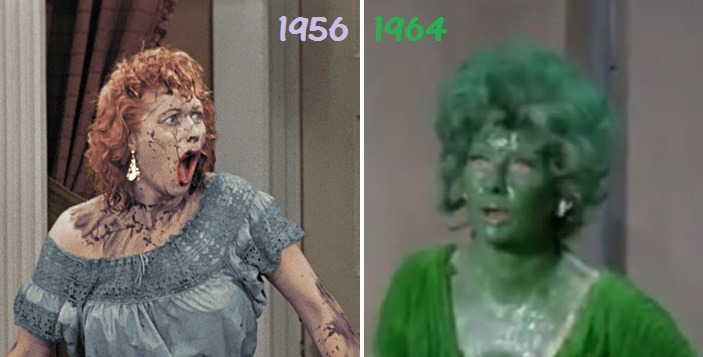
In “Lucy’s Italian Movie” (S5;E23 of “I Love Lucy”) Lucy Ricardo meets an Italian and ends up turning purple from a vat of grapes.
In “Lucy Meets a Millionaire” (S2;E24 of “The Lucy Show”) Lucy Carmichael meets an Italian and ends up turning green from a vat of dye.
-
“Lucy Gets Ricky on the Radio”

“Not watch television!?!? What else is there to do?”
(S1;E32 ~ May 19, 1952) Directed by Marc Daniels. Written by Jess Oppenheimer, Madelyn Pugh and Bob Carroll, Jr. Filmed April 11, 1952 at General Service Studios. Rating: 57.9/85
Synopsis ~ When
their TV breaks down, the gang tunes in to a radio quiz show.
Surprisingly, Ricky correctly guesses the answers to all of the
questions, so the next day Lucy signs them up to be on the show.
Little did she know that the quiz was a delayed broadcast and that
Ricky overheard the answers while at the studio!
This episode is
based on Lucy’s radio show, “My Favorite Husband” #15, “Quiz
Show,” which aired October 23, 1948. In the radio version, the
show was called “His and Hers,” but here is re-titled “Mr. and
Mrs. Quiz.”
The day this episode was filmed (April 11, 1952) CBS debuted “Faye Emerson’s Wonderful Town”, a multi-camera musical variety half-hour hosted by a woman who was (at the time) known as “the first lady of television.” Faye Emerson was mentioned by Fred Mertz in “Lucy Does a TV Commercial” (S1;E30) just two weeks earlier in what was probably a subliminal plug for her upcoming series.

Before turning on the TV, Ricky enjoys reading about himself in the new Look Magazine! Lucille Ball is on the cover with the caption “Why Desi’s Dizzy for Lucy”.

The article is titled “This Is Lucy” by Desi Arnaz. In return for the publicity provided by magazines, the issues were often used on screen.
FOR MORE ABOUT THE MAGAZINES SEEN ON THE SERIES, CLICK HERE!
Instead of watching TV, Lucy suggests conversation instead.
LUCY: “What about those elections?”
RICKY: (enthusiastic) “What about ‘em?”
LUCY: (at a loss) “Well, they had ‘em alright.”The 1952 Presidential election was still six months away. The past tense indicates elections that had already occurred. Who was on the ballot is left deliberately ambiguous. The show was never overtly political.

Despite this, however, the day this episode first aired Time Magazine featured Georgia Senator Richard Russell Jr. on its cover. Russell competed in the 1952 Democratic presidential primary, but was shut out of serious consideration by northern Democratic leaders who saw his support for segregation as untenable.

Newsweek also published a story about the upcoming election in its May 19, 1952 edition: “Will [Adlai] Stevenson Stop [Estes] Kefauver?” In addition they asked the question: “Where is TV Headed?” with Arthur Godfrey on the cover. Godfrey was one of Lucille Ball’s favorite performers and she convinced him to do a guest spot on “The Lucy Show” in 1965, when he had fallen out of favor with the public.

Oops! A microphone and stand can be seen on the right of the frame in this shot. The show actually used boom microphones to record the sound. This is a stranded prop from the “Mr. and Mrs. Quiz” radio show scene.
After their disastrous attempt at conversation, Lucy gives up and switches on the set. Before
the TV breaks down, the foursome are watching a movie.LUCY:
“That little girl is Margaret O’Brien, isn’t it?”
RICKY:
“Look again – it’s Shirley Temple.”
FRED: “Look again –
it’s Mary Pickford!”
All
three women were famous child stars of their time: Mary Pickford (right) in the
1920s, Shirley Temple (center) in the 1930s, and Margaret O’Brien (left) in the 1940s. Lucille Ball
had appeared with O’Brien in the film Thousands Cheer in 1943.
After Lucy and Ricky both lose a tug of war with the dial (these people have terrible luck with televisions!), they listen to the radio, tuning in to “Mrs. and Mrs. Quiz” with Mr. and Mrs. Eric Finley as that night’s contestants. The surname Finley was used again by the same writers 25 years later when Ruth Kobart guest-starred on “Life With Lucy” as Mrs. Finley. Prior to that, a 1963 episode of “The Lucy Show” (same writers) mentioned Tommy Finley, the home-run king of Danfield High. Four years later the name turned up again as the name of the flower shop where Eddie the boxer (Don Rickles) worked during the day. Clearly the name Finley was important to one of Lucy’s writers!
Whoever provides the voice of Mr. Finley (”Er…was it Arizona?”) uses a southern drawl. The voice of Nancy, Freddy Fillmore’s secretary (”Yes, Mr. Fillmore?”) sounds like someone is pinching her nose to disguise her voice, so it well may be Vivian Vance, the only other fabulous female in the episode.

This
is the second of three times Frank
Nelson
plays quiz master Freddy Fillmore. His first appearance was as host
of radio’s "Females are Fabulous” in “The Quiz Show”
(S1;E5). In 1956, when cast as Ralph Ramsey, Nelson will become the only actor to appear in two recurring characters on the series.
Fillmore’s office displays a plaque noting that he was given the Showmanship Award for Best Quiz Master. The rest of the inscription is deliberately garbled. They had no idea modern audiences would have DVD and HD TV! Curiously, when Lucy and Fillmore meet in his office, there is no “remember me?” conversation about her appearance on “Females Are Fabulous”.

FIllmore has also decorated his wall with an 1888 poster with artwork by Jules Cheret. Cadet Roussel was a comic and mime known for his trademark props: a red umbrella and a bi-corn hat. The poster advertises a performance at the Paris Hippodrome.

Fillmore’s third appearance took him to television with “Be a Good Neighbor,” a quiz
show seen in “Ricky’s
Hawaiian Vacation” (S3;E22, above). In 1952, many radio programs were transitioning to television, and some were often on both radio and TV simultaneously. “I Love Lucy” (briefly) and “My Favorite Husband” are two good examples.
Everyone on the series loved Roy Rowan’s announcing for "Mr. and Mrs. Quiz” so much that he then became the announcer for “I Love Lucy.”

In the scene where Lucy goes to his office to try and
steal the answers, Fillmore shows Lucy a Philip Morris poster
excited about how his show has gotten the attention of a major
sponsor based on Ricky’s appearance. This scene was edited out for
syndication. For the DVD release, the original scene was restored
intact. The sponsor’s name is never spoken aloud.
Young Robert
Ellis plays
Tommy, Freddy Fillmore’s Office Boy. He had appeared with Lucille Ball in
the 1949 film Easy Living. He went on to play Dexter Franklin
the TV series “Meet Corliss Archer” (1954-55) and Ralph
Grainger on “The George Burns and Gracie Allen Show” from 1956
to 1958. He died at the age of 40 in 1973.
Of
the three quiz questions that Ricky answers correctly sitting in his
living room, only one has been affected by history: “Who
was the youngest man to be inaugurated President of the United
States?”
In 1960, 43 year-old John F. Kennedy become the youngest person ever
to ever be INAUGURATED President. Ricky’s answer of Theodore
Roosevelt was correct at the time. Fillmore is careful to use the
word INAUGURATED rather than ELECTED, since Roosevelt assumed the
office at the age of 42 after McKinley was assassinated in 1901.
Had Fillmore said ELECTED, the correct answer in 1952 would have been
Ulysses S. Grant (age 46).The
most obvious case of the answers being affected by post-1952 history
is when Lucy forgets if Alaska and Hawaii are part of the 48 states
(she thinks there are 46). In 1952, both states were US territories
working toward statehood, but it did not actually happen until 1959.
The correct answer today to the question “What was the last state
to be admitted to the union?” is Alaska (August 21, 1959). At
the time of filming,
however, Arizona was indeed the last state admitted to the union
(Valentine’s Day 1912). Ironically, the Ricardos and Mertzes will travel to Alaska to celebrate its statehood in “Lucy Goes to Alaska,” a 1959 episode of “The Lucy-Desi Comedy Hour.”
Behind Fillmore, Tommy keeps track of the Ricardo’s score on a chalk tally board.

Although
Lucy thinks she has stolen and memorized the correct answers for the
broadcast, on this occasion Freddy Fillmore has opted to pick the
questions from a fishbowl instead, just to keep things honest. The
questions for Lucy and Ricky’s appearance, are:
#1
ORIGINAL QUESTION: To
whom do you make your federal tax check out on March 15?
#1
FISHBOWL QUESTION: What is the name of the animal that fastens itself
to you and drains you of your blood?
LUCY’S ANSWER:
The collector of Internal Revenue.REAL ANSWER:
A vampire bat.
TRIVIA:
Tax
Day was first set on March 1st in 1913. It was moved to March 15th in 1918 before being finally set as April 15th in 1955, where it remains today.
#2
ORIGINAL QUESTION: How
do subfreezing temperatures in the arctic affect the growth of trees?
#2
FISHBOWL QUESTION: What is a senator’s term of office?
LUCY’S ANSWER:
The sap runs every two years.REAL ANSWER:
A senator’s term is six years.#3
ORIGINAL QUESTION: Why
was the steamship Ile de France put in dry dock recently?#3
FISHBOWL QUESTION: Why did the French people put Marie Antoinette
under the sharp blade of the guillotine?LUCY’S ANSWER:
To scrape the barnacles off her hull.REAL ANSWER:
Not given on the show, but after the French monarchy was abolished in
1792, Marie Antoinette was convicted of treason and executed by
having her head cut off in a public square.
TRIVIA:
The Ile de France was put in dry dock in 1949 to return the ship
from Wartime service back to use as a passenger vessel, increasing
her tonnage and reducing the number of stacks from three to a more
fashionable two.
BONUS
QUESTION: What did George Washington say when crossing the
Delaware?RICKY: (truly queasy at how poorly he’s doing on the
show) Please let me sit down. This is making me sick!
The painting Fillmore refers to is by Emanuel Leutze (1851).
-
“Fred and Ethel Fight”

(S1;E22 ~ March 10, 1952) Directed by Marc Daniels. Written by Jess Oppenheimer, Madelyn Pugh, and Bob Carroll, Jr. Filmed January 30, 1952 at General Service Studio. Rating: 59.5/61
Synopsis ~ When the Mertzes have a marital spat, Lucy comes up with a plan to get them back together by inviting both to dinner, with neither aware that the other is also coming. By the end of dinner, the Mertzes leave reconciled, but the Ricardos are now at each others’ throats!
FRED: “I saw it last week on television!”
This episode is based on a real-life incident in which the Arnazes tried to mediate a fight between friends and were successful, but ended up fighting themselves.

On the date this episode first aired (March 10, 1952) General Fulgencio Batista led a military coup led in Cuba appointing himself “provisional president”. While the decade was marred by great political turmoil for the island nation, corruption allowed businesses to thrive in Desi Arnaz’s homeland. Ironically, the Winnipeg Free Press front page ran the story of the revolt along with the human interest story of a Canadian navy veteran meeting his son “Little Rickie” for the first time! This was ten months before Lucy gave birth to Little Ricky / Desi Jr.!

On the day this episode was filmed (January 30, 1952) Lucille Ball was featured on the cover of People Today magazine. Ironically, the front page also teased as story about new methods of birth control. At the time, Ball was trying to get pregnant to conceive her second child. Her success was announced just a couple of months later. By December 8, 1952, Lucy Ricardo was enceinte too!

During their fight, Fred is said to be staying at the ‘Y’. The YMCA (Young Men’s Christian Association) was founded in 1844 to put Christian principles into practice by developing a healthy “body, mind, and spirit.” Until the late 1950s, YMCAs in the United States were built with hotel-like rooms called residences or dormitories. Today YMCAs with residences have become extremely rare, although some still remain. A new YMCA was an integral part of the second episode of “The Lucy Show” including have several scenes take place there.
Due to Lucy’s insistence on interfering in the Mertz’s personal affairs, Ricky compares Lucy to Dorothy Dix, the ‘Dear Abby’ / Ann Landers of her day.

Elizabeth Meriwether Gilmer (1861-1951) was widely known by the pen name Dorothy Dix, was a journalist and columnist. As the forerunner of today’s popular advice columnists, Dix was America’s highest paid and most widely read female journalist at the time of her death. Her advice on marriage was syndicated in newspapers around the world with an estimated audience of 60 million readers. Dix died just one month prior to this episode being filmed.
Ricky also calls Lucy by her full name: Lucy Esmerelda McGillicuddy Ricardo for the second week in a row, having already mentioned her middle name in “New Neighbors” (S1;E21). Lucille Ball’s real middle name is actually Desiree, after her mother.
Although Ricky disapproves of Lucy’s plan, he gives in:
RICKY: “I guess the cast is dead.”
LUCY: “The cast is dead? Wait, don’t tell me. The die is cast?”
RICKY: “That’s what I said!”
During Lucy and Ricky’s argument at the dinner table, Lucy criticizes Ricky’s English, which leads to Ricky ranting in Spanish. The rough translation of what he says is how he studied English for many years at universities and that he speaks English better than everyone else sitting at the dinner table.

Lucy promises Fred that she’s invited “a cute young chick” as Fred’s dinner date. When Ethel walks into the room, Fred is disappointed.
FRED: “Is that your idea of a cute young chick? You’ll never shop for my poultry!”
According to stories that emerged as the series went along, there was no love loss between Vivian Vance and William Frawley. The start of this episode must have been easy for the actors to play!

On the dinner table there is a fancy lace tablecloth. This is a Quaker Lace tablecloth model #4161. It has a floral design with baskets of daffodils around the edge and a distinctive oval motif in the center. It is a cotton machine lace tablecloth measuring 65″ by 80″.

Commiserating at the corner drugstore, Fred orders a grape juice while Ricky eats a peanut butter sandwich.

The drugstore wall is decorated with huge advertising signs depicting Johnny Roventini, the “Call for Philip Morris” bellboy mascot. Product placement was not uncommon in the series, although direct verbal references to Philip Morris were often cut for syndication after their sponsorship lapsed. Lucy’s stand-in and frequent extra Hazel Pierce plays the soda jerk. This exact drugstore set would be used again two weeks later in “The Gossip” (S1;24). In that episode, Fred calls out for “Hazel” but the Pierce does not actually appear on camera.
On the magazine rack is a copy of the February 1952 issue of PIC, a movie magazine, with Marilyn Monroe on the cover. Monroe was mentioned a record 8 times on “I Love Lucy” – only equaled by Clark Gable.
Ethel’s plan to get the Ricardos back together involves Lucy pretending to be hit by a bus! Meanwhile, Fred’s plan is to pretend the apartment is on fire with Ricky swooping in to save Lucy’s life.

When Lucy thinks there’s a fire, she rushes to save her bottles of henna rinse, her Egyptian hair dye. Lucille Ball started coloring her hair in 1942 for the film Du Barry Was a Lady, to set herself apart in Technicolor movies. Lucy’s concern about saving her henna was only slightly exaggerated, as Irma Kusely, Ball’s hairstylist, later could attest!

“She had a safe of it in my garage. She loved to gamble and when we did a show in Las Vegas, she met a very wealthy sheikh and he heard about her problem about [running out of] the henna and he said he would send her the henna. And he did. There was a lot of it left when she left this world, but I had to give it to the estate. I don’t know what little Lucie did with it…” ~ Irma Kusely

If Lucy’s extensive bandaging looks familiar, a similar look was sported earlier in the season by Hazel Pierce in “The Quiz Show” (S1;E5, right) as Mrs. Peterson, the woman on “Females are Fabulous” who went over Niagara Falls in a barrel. In real life, Peterson was Lucille Ball’s step-father’s surname.

FRED: “She said my mother looks like a weasel.”
LUCY: “Ethel, apologize.”
ETHEL: “I’m sorry your mother looks like a weasel.”In “Fred and Ethel Fight” we hear about both Fred and Ethel’s mothers! Both are occasionally mentioned throughout the series, although never seen. ‘Going home to mother’ was a typical trope of the time for disgruntled wives. We do get to meet Ethel’s father, Will Potter, in “Ethel’s Home Town” (S4;E15, above).

FAST FORWARD!

In 2001, a Polish remake loosely based on “I Love Lucy” titled “Kocham Klara” (”I Love Clara”), presented “Family Skirmishes” loosely based on this episode and co-written with the cooperation of the original “I Love Lucy” writers.
Hanna and Jan have been arguing. Clara, wanting to reconcile them, invites them to a joint dinner. As a result, Hanna and Jan reconcile, but an argument breaks out between Clara and Cuba. Independently, both Hanna and Jan try to reconcile the marriage. Hanna has quite a risky idea how to reconcile Clara with Cuba. Unfortunately, Jan comes up with an even riskier idea.

The film Being the Ricardos (2021) has a quick shot of the script for this episode. The names in the title are reversed to read “Ethel and Fred Fight” but this may not be an error. Script titles often changes from draft to draft. In the film, the page states that it is the fourth episode of season two, while in reality it ended up being the 22nd episode of season one. It also states that it is episode 204. The actual episode number was 22.

There is also footage of Lucy in the head-to-toe bandages.
-
“The Ballet”

(S1;E19 ~ February 18, 1952) Directed by Marc Daniels. Written by Jess Oppenheimer, Madelyn Pugh, and Bob Carroll, Jr. Filmed on January 11, 1952 at General Service Studios. Rating: 53.9/73
Synopsis ~ Ricky is putting together a cavalcade of show business and needs a pair of burlesque comics and a ballet dancer. Naturally, Lucy thinks she’s right for both!
LUCY (to Ricky): “Here I am with all this talent bottled up inside of me and you’re always sitting on the cork.”

The same day that this episode first aired, LIFE Magazine hit the newsatands containing an inside article about Lucille Ball concentrating on her clowning skills in this episode. The cover was rightfully dedicated to England’s newly crowned Queen, Elizabeth II.

This episode has two classic Lucy moments: (1) rehearsing the ballet with Madam LeMond and (B) rehearsing the vaudeville routine “Slowly I Turn” with the burlesque comic. The writers skillfully blend both bits for a hysterical finale at the Tropicana that brilliantly combines music, dance, and comedy.

Lucy tells Ricky that in school she was in a dance recital in school “The Dance of the Flowers.” She is probably referring to the Tchaikovsky piece from The Nutcracker. She says she was the only petunia to have a solo. Conveniently, she still has the costume in a trunk! After Fred tells Ricky as stale joke (if he promises not to use it.), Lucy demonstrates, with Ethel at the piano providing accompaniment.

If you doubt that Lucy Ricardo had a secret passion for ballet, look at how she decorated her bedroom! Visions of sugarplum (fairies) danced in her head!

Some viewers have identified Erze Ivan as the blonde dancer in the rehearsal room. She was assistant choreographer on the Mickey Rooney film All Ashore in 1953.
MADAME LEMOND: “I think we should go to the barre.”
LUCY: “Oh, good, because I’m awful thirsty.”
Ballet mistress Madame LeMond (”the premiere ballerina of the French Ballet”) was portrayed by Lucille Ball’s longtime friend Mary Wickes. Born Mary Isabella Wickenhauser in 1910, she only appeared on “I Love Lucy” once, but she guest starred on Lucille Ball’s later series’ “The Lucy Show” 8 times and on “Here’s Lucy” 9 times, as well as appearing on the 1977 TV special “Lucy Calls The President.” On the big screen she is perhaps best remembered as Nurse Preen in 1942’s The Man Who Came to Dinner (a role she also did on Broadway and television) and as Sister Mary Lazarus in two Sister Act films. She died in 1995. Her final role was voicing a gargoyle named Laverne in Disney’s The Hunchback of Notre Dame.

The surname LeMond is no doubt a tribute to Bob LeMond (1913-2008), the announcer for Lucille Ball’s radio show “My Favorite Husband” (1948-51) as well as for the pilot episode of “I Love Lucy”.
Lucille Ball herself took four years of ballet. Despite this, she later claimed that getting her leg stuck on the ballet barre was unscripted. Gregg Oppenheimer, son of the show’s head writer Jess Oppenheimer, confirmed that the scenario was fully laid out in the script.

The burlesque comic was played by Frank J. Scannell, who had appeared with Lucy in Abbott and Costello in Hollywood (1945) and Lover Come Back (1946). He would go on to do a 1971 episode of “Here’s Lucy.” “Slowly I Turn” is a classic vaudeville sketch, which utilizes props like cream pies and soda siphons.

In this case the trigger word for their deployment is the name ‘Martha,’ in order to coincide with Ricky’s finale song “Marta (Rambling Rose of the Wildwood).” The song was written in 1931 by Moisés Simons and made popular by Arthur Tracy and (later) Tony Martin. During the “Slowly I Turn” scene between Ball and Scannell you can hear Desi Arnaz’s distinctive guffaw as he watched from the audience.

When the scene opens at the Tropicana, the Ricky Ricardo orchestra is playing “Green Eyes” and patrons are dancing. “Green Eyes” was originally written in Spanish under the title “Aquellos Ojos Verdes” by Adolfo Utrera and Nilo Menéndez in 1929. The English translation was made by Eddie Rivera and Eddie Woods in 1931. Desi Arnaz was one of many who recorded the song.
Nancy the harpist gets a lot of screen time in this scene!

Among the many formally dressed background performers at the Tropicana are:
- Joan Carey (top left above) who later became Lucille Ball’s standby on “The Lucy Show”.
- Barbara Pepper ~ Lucille’s friend from her Goldwyn Girl days.
- Bennett Green ~ Desi’s camera and lighting stand-by and frequent extra. Green dances with Pepper as the scene opens.
- Hazel Pierce ~ Lucille’s camera and lighting stand-in and frequent extra. Pierce sits at a table near the door where Lucy makes her entrance.
Oops! Lucy accidentally drops her rubber club during the dance, but quickly picks it up without missing a beat. Also, notice that the bandmember playing the maracas has a piano bench set in front of him to hold Lucy’s props. His facial expressions during the “Martha” routine are hysterical.

Lucy and Desi pose for a photographer from LIFE magazine, while a crew member wipes up the cream on the floor!

Lucille Ball performed the routine with Phil Silvers on “General Foods Opening Night” (1963).

FIRSTS!
- This is the first (but not the last) time Lucy and Ricky get a pie in the face. “The Diner” (S3;E27) ends in an all-out cream pie battle involving that also involves the Mertzes.
- The first time Lucy was hit with a soda siphon was on “The Quiz Show” (S1;E5), which also includes references to Niagara Falls.
- This is the first mention of Fred’s vaudeville partner, Ted Kurtz. He will make an appearance in “Mertz and Kurtz” (S4;E2), although his first name is then Barney.

This is one of three episodes that formed the unreleased “I Love Lucy Movie” (1953). The other two are “The Benefit” (S1;E13) and “Breaking the Lease” (S1;E18).
FAST FORWARD!

The ‘bucket-over-the-door’ gag was repeated with paint on a 1968 episode of “Here’s Lucy.” This time it is Gale Gordon who gets drenched, as was the show’s tradition.

In 1986, Keith Thibodeaux (Little Ricky) and his wife Kathy founded Ballet Magnificat, the world’s premiere Christian ballet company. It is still in operation today.

Stamp of approval (1999)!

“The Ballet” served as inspiration for various modern-day collectibles, including more than one Lucy doll in a tutu! Christmas ornaments, stamps, figurines, picture frames, snow globes, and other merchandise followed. A bas! A bas!
-


-
Subscribe
Subscribed
Already have a WordPress.com account? Log in now.
 Papermoon Loves Lucy