-
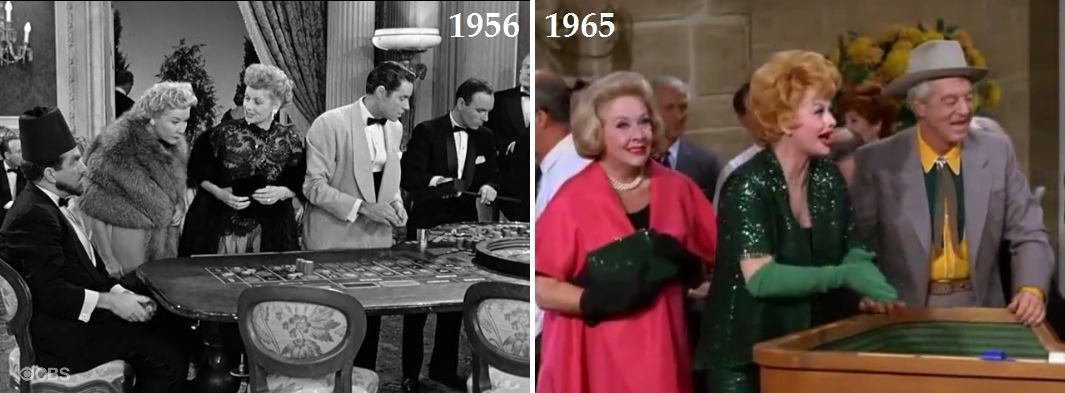
In “Lucy Goes To Monte Carlo” (S5;E25 of I LOVE LUCY), Lucy inadvertently gambles herself into a small fortune – and loses it all in an instant!
In “Lucy Visits Las Vegas” (S3;E17 of THE LUCY SHOW), Lucy inadvertently gambles herself into a small fortune – and loses it all in an instant!
-
“Ricky Loses His Temper”

(S3;E19 ~ February 22, 1954) Directed by William Asher. Written by Jess Oppenheimer, Madelyn Pugh and Bob Carroll, Jr. Filmed January 21, 1954 at Ren-Mar Studios. Rating: 56.8/80
Synopsis ~ Can Lucy stop from buying a new hat longer than Ricky can help losing his temper? Lucy’s going to do everything she can to assure she wins the bet!

The day before this episode first aired (February 21, 1954) Lucille Ball appeared on “What’s My Line?” As Mystery Guest, she used the same odd voice she created when she played a Martian at the top of the Empire State Building in “Lucy is Envious” (S3;E23). Host John Daly tells the panel that Lucy is speaking Martian. That episode was filmed on February 16, 1954, just five days before this quiz show.
“I should have never married a hot-blooded Cuban. I should have married a cold-blooded Swede!”

The manager of Jeri’s Hats is Mrs. Mulford, played by Madge Blake. Blake will next be seen as Martha, a prospective tenant, in “Lucy and Superman” (S6;E13). She also starred with Lucy and Desi as Aunt Anastacia in The Long, Long Trailer (1954). Blake did a 1964 episode of “The Lucy Show” before creating the role for which she is best remembered – Aunt Harriet Cooper on TV’s “Batman” (1966-68).

The new Lucy bought at her shop cost $49.50, which would is approximately $480 in today’s economy (adjusted for inflation). For some reason Mrs. Mulford’s hat shop is named Jeri’s.

Max Terhune plays himself in the episode. Terhune was a skilled vaudevillian who specialized in ventriloquism. On the Orpheum Circuit his dummy was known as ‘Skully Null’ but was re-named ‘Elmer Sneezeweed’ for the movies. Terhune was listed as one of the top ten money-making stars in Westerns from 1937 to 1939, appearing as Max ‘Alibi’ Terhune in a string of B-movie ‘oaters.’

Lucille Ball would work with one of the greatest ventriloquists of all time in a 1966 episode of “The Lucy Show.” Paul Winchell returned for future episodes of the show without his puppets. Early in her career she also appeared with the father of ventriloquism, Edgar Bergen (and his sidekick Charlie McCarthy) in Look Who’s Laughing (1941).

Ricky knows that ventriloquist Max Terhune has been getting $250 a week at the Domino Club, but now his agent wants double that at the Tropicana. The fictional Domino Club was also the name of the gin joint “Lucy the Gun Moll” (S4;E25, above), a 1966 episode of “The Lucy Show” satirizing Desilu’s own “The Untouchables.”

Byron Kane plays Morris Williams, Terhune’s agent. His character name is doubtless a reversal the famous talent agency William Morris. Kane turns up as a subway strap-hanger in “Lucy and the Loving Cup” (S6;E12). Later in his career he became a voice over artist and producer.
Little Ricky is mentioned, but conveniently remains off-camera. The messenger delivering Lucy’s new hat is played by Desi’s camera and lighting stand-in Bennett Green, although he has no lines.
Lucy’s Schemes to Make Ricky Lose His Temper!

This is one episode where COLOR would have been an asset. First we hear Mrs. Mulford’s vivid description of a hat to Lucy: “It’s all covered with little pearls. And it’s a lovely shade of turquoise.” Then there’s Lucy’s provoking use of the tomato juice in the dribble glass when Ricky is wearing a white dinner jacket for publicity photos: “It’s a lovely shade of red, isn’t it?”

Lucille Ball pronounced tomato “to-mah-to” but felt that Lucy Ricardo would pronounce the word as “to-may-to.” However, she slips and says “to-mah-to juice” before quickly correcting herself. Let’s call the whole thing off!

To push an exhausted Ricky to exploding, Lucy noisily munches on saltine crackers before spilling the entire box in Ricky’s bed. Lucy’s brand of crackers is Snow Flake Saltines, made by Nabisco. The brand eventually re-named their saltines Premium.

Another tactic to provoke Ricky’s Latin temper is to crack nuts while Ricky is trying to sleep!

Lucy’s two-tone wooden bowl came with a matching mallet. It is likely produced by Standard Specialty Company of San Francisco who made products from the California Redwood Forests.

Just when Ricky is settling in for the night, Lucy suddenly turns on the radio, which blares the boisterous ragtime hit “They’ll Be A Hot Time in the Old Town Tonight” composed in 1896 by Theodore August Metz.
Her bedside clock-radio is a Westinghouse Model H-420T5, which cost around $30 in the early 1950’s. Coincidentally, in 1957 Lucy and Desi partnered with Westinghouse to promote their products and produce their anthology series.

Lucy is seen reading the March 9, 1954, issue of LOOK magazine. French actress Jeanmarie is on the cover. Could her short black hair have inspired “The Black Wig” (S3;E26) just six weeks later? Lucille Ball made the cover of LOOK nine times during from 1937 to 1971, when the magazine printed its final issue.

Also in this episode, Ricky is reading the January 12, 1954 TV Guide with “I’ve Got A Secret” on the cover on. This same issue turns up again in “Lucy’s Club Dance” (S3;E25, above). Lucille Ball was on the panel show four times between 1956 and 1966.

Ricky’s temper would reach his zenith in when Lucy pretends to be his agent and gets him ‘released’ from his contract at MGM in “Ricky Needs an Agent” (S4;E29).

A couple of years later, TV’s Ralph Kramden (Jackie Gleason) would mine comedy gold from losing his temper on “The Honeymooners.” Instead of counting to ten (in Spanish) as Ricky does, Ralph recites a little rhyme: “Pins and needles, needles and pins. It’s a happy man who grins.”

Post Script! This episode’s theme of watching one’s temper is still valid today, but the specifics of the plot are mired in the 1950s. Most women no longer crave hats as ‘must-have’ fashion items. Also, Ricky gives Lucy ‘an order’ to return the hat and takes her over his knee for a spanking as the show fades out. Needless to say, neither of these things would still be acceptable (let alone funny) on television today.
-
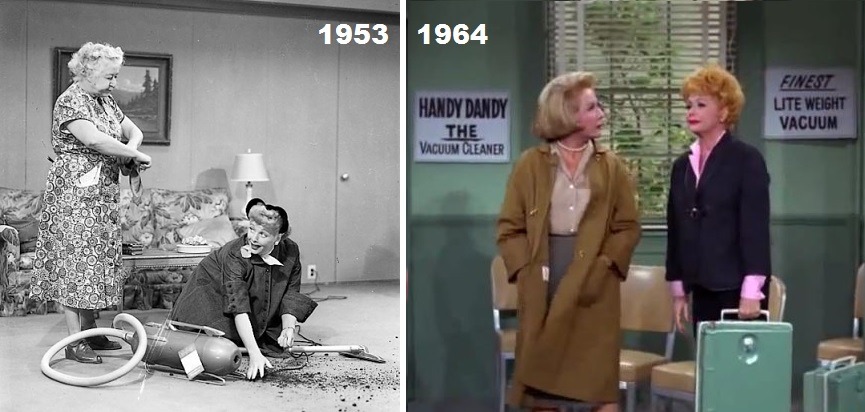
In “Sales Resistance” (S2;E17 of I LOVE LUCY) Lucy sold Handy Dandy Vacuum Cleaners door to door.
In “Lucy and the Missing Stamp” (S3;E14 of THE LUCY SHOW) Lucy sold Handy Dandy Vacuum Cleaners door to door.
-
“Lucy Has Her Eyes Examined”

“I was just thinking about a television show I saw last night…”
(S3;E11 ~ December 14, 1953) Directed by William Asher. Written by Jess Oppenheimer, Madelyn Pugh and Bob Carroll, Jr. Filmed November 12, 1953 at Ren-Mar Studios. Rating: 55.2/80

Synopsis ~ A new Broadway musical is casting and Lucy and the Mertzes want to land parts. Unfortunately, Lucy’s eye exam leaves her a nearsighted mess just before the big audition.

The date this episode first aired Tempo, a pocket news magazine, did a cover story on COLOR TV: WHEN, WHAT, HOW MUCH. For CBS, those answers would be several years off; for Lucy fans, more than a decade! Two weeks earlier, Lucy and Desi were on the cover of Tempo (November 30, 1953).
This episode has two callbacks:

1. Ricky gets some ice cream from Mrs. Benson, who now lives upstairs in 4A, the Ricardo’s old apartment. Although she does not actually appear in this episode, she was last seen in “The Ricardos Change Apartments” (S2;E26).

2. Ethel asks Lucy if she can borrow the cloche Lucy wore in “Ricky Loses His Voice” (S2;E9), the last time that the show had a 1920s theme. It should be noted that it is not the exact same costume piece.

The episode opens with Alberto Calderon playing the huge conga drum in a rehearsal scene with Ricky. Calderon even has a line. In this scene, all the members of the Ricky Ricardo Orchestra are playing conga drums, with the exception of Nancy the harpist.

Bill Parker drops by to ask a favor of his old friend Ricky. The theatre he is using for auditions for his upcoming Broadway musical has been taken over by a television show. In the early 1950s,
due to the increased production of television programs,
many legitimate theatres were rented by TV producers and networks. Some theatres eventually reverted to presenting live theatres, while others remained TV studios or were closed entirely when new studios were built specifically designed for television.
We also learn that Parker has decided to return to the theatre after a career in movies – waiting till “pictures make up their mind”. We never learn exactly what he means by that.
Dayton Lummis (Bill Parker) was born on August 8, 1903, in Summit, NJ. On the series he went on to play Mr. Eaton, Lucy’s potential publisher, in “Lucy Writes a Novel” (S3;E24), as well as Mr. Sherman, Ricky’s MGM Studio rep, in “Hollywood at Last!” (S4;E16).

Ethel translates the Variety headline for Lucy: “Parker Preps Prod for Pitts Preem” as “Parker Prepares Production for Pittsburgh Premiere.” The article goes on to say “William Parker, formerly legit prod, currently top pic exec, seeks thesps for flesh tuner.” Ethel doesn’t translate this section, but it means that “William Parker, formerly a theatrical producer, currently a top motion picture executive, is casting actors for a live stage musical.” Variety began publishing in 1905 and is still around today. It has long been known for its industry jargon, or ‘Varietyese,’ as it has been dubbed.

The musical is titled “The Professor and the Co-Ed” and it sounds reminiscent of Good News, a real-life 1927 legit tuner (Varietyese for ‘stage musical’) also set on a college campus in the roaring ’20s. Good News was made into a film in 1930 and then remade in 1947.
King Cat has his own ‘hip’ language, using words and phrases that the gang barely understand.
- “Let’s drag it, baby!”
- “Man, that’s the coolest!”
- “Frantic, man! Frantic!”
- “Dad, this cat’s real nervous!”
- “He thinks we’re really wiggy, man!”
- “That coat’s a gasser!”

All three versions of Good News include the song "The Varsity Drag,” which Fred and Ethel sing in this episode. A musical about college co-eds must have been familiar territory to the Arnazes. Too Many Girls was Desi Arnaz’s 1939 Broadway debut and the 1940 film version introduced (literally) Desi to Lucy.

When Mr. Parker innocently comes for dinner at the Ricardos, Lucy and the Mertzes burst into a rousing rendition of “There’s No Business Like Show Business” from Irving Berlin’s Annie Get Your Gun (1949). The song would later be quoted by Lucy in “Baby Pictures” (S3;E5) and be sung by its originator, Ethel Merman, in a 1964 episode of “The Lucy Show.”

This is the first of four episodes where Lucille Ball wears this colorful red and blue dress by Elois Jenssen.

Lucy is taught to jitterbug by Arthur ‘King Cat’ Walsh, a Canadian-born actor / dancer using his own name on the show. Appropriately enough, he made his film debut playing a jitterbugging soldier in Stage Door Canteen (1943). He previously appeared with Lucy in two MGM musicals, Ziegfeld Follies (1945) and Easy to Wed (1946), both times playing office boys.

The tune that Lucy and Walsh jitterbug to is called “Stompin’ at the Savoy,” a 1934 jazz standard composed by Edgar Sampson. It is named after the famed Harlem nightspot the Savoy Ballroom in New York City, not for the equally famous London hotel.

Lucille and King Cat have three dance sequences together:
- Lucy’s first lesson, in her apartment, where she is tossed around like a rag doll, even losing her shoes.
- The audition at the Tropicana, where Lucy and King Cat execute the Jitterbug flawlessly.
- The final performance, where Lucy’s eyes are dilated and she comically makes a mess of the dance.
Each one of these is integral for the final scene (and the title) to pay off. Lucille Ball would throw herself fully into learning whatever was required for the script that week. Whether it was playing the saxophone, twirling pizza dough, or operating a pottery wheel. Ball would hire an expert in the field to teach her the skill, and often (as with Walsh) give them a role in the show.

Ricky tries to read the Snellen Chart. The chart was named after the Dutch ophthalmologist Herman Snellen, who developed the chart in 1862. Ophthalmologists now use an improved chart known as the LogMAR chart.

Ricky’s mis-pronunciation of "homecoming” was not scripted. Desi really did have trouble saying that word.

Shepard Menken plays the Ricardo’s Optometrist. He had previously appeared as Jean Valjean Raymond in “The Adagio” (S1;E12) and as Mr. Abbott in “Lucy Becomes a Sculptress” (S2;E15). He will return to the series to play Charpontier, a shady sidewalk artist, in “Paris at Last” (S5;E18).
We see the eye doctor through Lucy’s blurry vision, a camera technique that was rarely used in “I Love Lucy”. Generally, the camera was an anonymous observer and did not take on the perspective of the characters.

Ethel refers to the stumbling Lucy as ‘Miss Magoo’, a reference to Mr. Magoo, a nearsighted cartoon character voiced by Jim Backus that first appeared in 1949. Mr. Magoo cartoon shorts were nominated for Oscars in 1950 and 1952, and would go on to win the award in both 1954 and 1956. In this time period, many films were preceded by a cartoons when shown in cinemas.

In the Tropicana audience for the performance / audition is Hazel Pierce, Lucille Ball’s camera and lighting stand-in and frequent background player. Desi’s stand-in Bennett Green is her table-mate.

Louis A. Nicoletti plays a Tropicana waiter who Lucy mistakes for King Cat during her short-sighted dance. Vivian’s stand-in Renita Reachi sits at the table with Bill Parker.

We never learn if Lucy, King Cat, or the Mertzes got the parts in “The Professor and the Co-Ed” but it is hard to imagine them working on Broadway doing eight shows a week!
FAST FORWARD in FOCUS!

Lucy Carmichael has vision problems in a 1964 episode of “The Lucy Show.” After getting contact lenses, Lucy looses one in the batter for a batch of chocolate cakes!

“Here’s Lucy” also did their version of a 1920s college musical comedy in a 1970 episode titled “Lucy The Co-Ed” (HL S3;E6). The musical also features the song “Varsity Drag” from Good News.

The classic coonskin coat is also worn in 1970 on “Here’s Lucy” by Craig Carter (Desi Arnaz Jr.) and (in a different episode) crooner Rudy Vallee.

This episode was recreated as part of “I Love Lucy Live On Stage” which toured the country.
1953, Alberto Calderon, Annie Get Your Gun, Arthur King Cat Walsh, Broadway, CBS, Dayton Lummis, Desi Arnaz, Ethel Mertz, Fred Mertz, Good News, I love lucy, Jitterbug, Lucille Ball, Lucy, Lucy Has Her Eyes Examined, Lucy Ricardo, Mr. Magoo, Musical, Ricky Ricardo, Shepard Menken, Stompin at the Savoy, THere’s NO business Like Show Business, Too Many Girls, Tropicana Club, tv, Variety, Varsity Drag, Vivian Vance, William Frawley -
Domestic Drama!
You can’t get good help these days!

Lucy pretends to be a maid to impress Fred’s old vaudeville partner in “Mertz and Kurtz” (I LOVE LUCY S4;E2).

Ethel pretends to be a maid to impress Tallulah Bankhead in “The Celebrity Next Door” (THE LUCY-DESI COMEDY HOUR S1;E2)

Lucy gets a maid of her own: Mrs. Porter (Verna Felton, left, in “Lucy Hires a Maid” of I LOVE LUCY S2;E23) and Mrs. Putnam (Kathleen Freeman, right, in “Lucy Gets Her Maid” of THE LUCY SHOW S3;E11). In both cases Lucy is intimidated by the maid, downplays the amount of work involved, and ends up fixing her lunch!

Lucy and Vivian both end up pretending to be maids for Mrs. Van Vlack (Norma Varden in “Lucy Gets Her Maid” of THE LUCY SHOW S3;E11).

Norma Varden played the weepy Mrs. Benson in “The Ricardos Change Apartments” (S2;E26 of I LOVE LUCY). Varden is best remembered for playing Frau Schmidt, the housekeeper / maid at the Von Trapp mansion in the movie THE SOUND OF MUSIC (1965).
1953, 1964, CBS, Charles Winninger, Ethel Mertz, Fred Mertz, I love lucy, Julie Andrews, Kathleen Freeman, Lucille Ball, Lucy, Lucy Carmichael, Lucy Gets Her Maid, Lucy Hires a Maid, Lucy Ricardo, Maid, Mertz and Kurtz, Norma Varden, Tallulah Bankhead, The Celebrity Next Door, The Lucy Show, The Lucy-Desi Comedy Hour, The Ricardos Switch Apartments, The Sound of Music, tv, Verna Felton, Vivian Bagley, Vivian Vance, William Frawley -
-
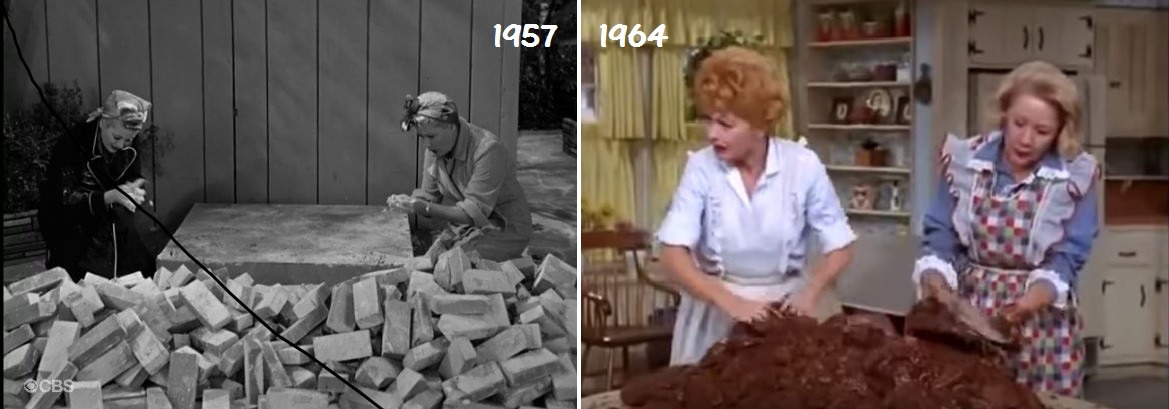
In “Building a Bar-B-Q” (S6;E24 of “I Love Lucy”) Lucy thinks she’s lost her wedding ring in a Bar-B-Q, so she spends all night looking through wet cement!
In “Lucy’s Contact Lenses” (S3;E10 of “The Lucy Show”)
Lucy thinks she’s lost her contact lens in a cake batter, so she spends all night looking through chocolate cakes!
-
“Baby Pictures”

“Television
isn’t going to last. It’s just a fad. Like flagpole-sitting or
swallowing goldfish.”(S3;E5 ~ November 2, 1953) Directed by William Asher. Written by
Jess Oppenheimer, Madelyn Pugh and Bob Carroll, Jr. Filmed October 1, 1953 at Ren-Mar Studios.
Rating: 61.4/82
Synopsis ~ Who has the cuter baby: the Ricardos or the Applebys? In this episode, Lucy’s motherly pride may just lose Ricky a chance at his own TV variety show.

Coincidentally, on the day this episode first aired, Time Magazine did a cover story on the advent of the amateur photographer – “every man his own artist.” This is certainly true of Ricky and Charlie Appleby, who are camera crazy with the birth of their sons.

At the start of the episode Lucy and Ricky can’t wait to look at the new pictures of Little Ricky. At first, Lucy thinks they’ve given Ricky the wrong photos:
LUCY: “They gave you the wrong pictures! This is a picture of twins!”
Well, Lucy isn’t far from wrong. The photos are of twins – Michael and Joseph Mayer. The snapshot is actually a double-exposure. The Mayer Twins will play the role until the end of season five when Keith Thibodeaux assumes the role.
Technically speaking, the close-up insert shots of the photographs were done without the studio audience present and then edited into the scene in post-production.

In one of the baby pictures, Little Ricky is playing with the “I Love Lucy” baby doll, which was commercially available to viewers. The doll was offered just after Lucy announced her pregnancy. The doll was sexless to appeal to both girls and boys and not give away the sex of the unborn Ricardo baby. In the photo, the doll’s outfit is embroidered “Ricky Jr.” Ethel remarks on it.

Nudity on “I Love Lucy”? Yep! Albeit, just a glimpse of Little Ricky’s bare behind. Lucy says the photo is good enough to be on the cover of Body Beautiful magazine!

Although it was a made up magazine at the time, one year later to the day Body Beautiful, a ‘physique magazine’, premiered. Definitely not what the writers intended! They might also have been thinking about the B-movie Miss Body Beautiful aka The Body Beautiful, released just a month before this episode was filmed.

Cleaning up Little Ricky’s toys for the Appleby’s visit, Lucy holds a Roly Poly Panda made by Softskin as well as a Turtle toy. Both toys have been seen in other episodes.

This is Doris Singleton’s fifth of ten appearances as Caroline Appleby, although this is the first time we sense a genuine rivalry between Lucy and
Caroline. This is the first time we get to see her husband, local TV station manager Charlie Appleby (Hy Averback), although he was mentioned in “Lucy and Ethel Buy the Same Dress” (S3;E3). Averback returned to the show to play another Charlie, Charlie Pomerantz, in “The Hedda Hopper Story” (S4;E20), although the next time we see Charlie Appleby he will be played by George O’Hanlon (inset photo) in “Lucy and Superman” (S6;E13).
Trying to impress the Ricardos about his TV station’s offering of motion pictures Charlie Appleby says:
CHARLIE: “We’ve got the newest moving pictures in town. I bought a block of films yesterday, and I want to tell you that they’re going to make television stars out of some of the actors. Now, just remember their names: Conway Tearle and Mabel Normand.”

Both were silent film stars and died in the 1930s!
A protege of Mack Sennett, Conway Tearle’s career bounced between Broadway and Hollywood. One of his last starring roles was in Hey Diddle Diddle, a comedy that premiered at McCarter Theatre in Princeton, NJ in 1937 and also featured a 26 year-old Lucille Ball. The play was scheduled to open on Broadway but closed after one week in Washington DC due to Tearle’s declining health. Mabel Normand had appeared with Charlie Chaplin and Fatty Arbuckle, sometimes also writing and directing movies. Her later career was marred by scandal.
In 1974 her life was depicted in the musical Mack and Mabel by Jerry Herman and Michael Stewart.

Charlie’s assertion that television will make ‘stars’ out of motion picture actors pretty much sums up the careers of Lucy and Desi, both of whom were active in movies before the advent of television. In July 1953, TV Guide did a story on Lucy and Desi returning to the world of film as superstars.
The uncredited baby playing Stevie Appleby had just gotten over the measles before filming. Little Ricky and Little Stevie are both said to be 13 months old. The next time we see Little Stevie is in “Lucy and Superman,” four years later, where his is played by Steven Kay.

Here we also get our first glimpse of the Appleby apartment, decorated with early American furniture. When we see it in the very next episode aired “Lucy Tells the Truth” (S3;E6) it will be radically (and quite quickly) redecorated with Chinese modern.

Scurrying around her apartment to straighten up when Lucy visits unexpectedly, we see that Little Ricky and Little Stevie have the same taste in toys! Mr. Squawker, a rubber duck squeeze toy manufactured by Rempel Manufacturing, and a tin drum made by Ohio Art. Both are also seen in the Ricardo apartment.

Oops! At one point the camera pans too far to the left and we can see the curtains that mask the left wall of the set!
Lucy and Caroline Trading Barbs!

As if on cue, Little Stevie gives a little laugh after Lucy’s line! When Caroline calls Little Ricky “a chubby, puffy little boy” Stevie’s arm swings up and swats Doris Singleton in the face!

Sinking to Caroline’s level of one-upsmanship, Lucy implies that Little Ricky speaks Spanish!

Lucille Ball and Doris Singleton handle this sarcastic banter like seasoned pros. In retrospect, the relationship is similar to the one Mame had with her ‘bosom buddy’ Vera Charles in Lucy’s film of the musical Mame (1974). One expects them to burst into song!

When Caroline takes the children into the next room, she carries Little Ricky horizontally! When she brings him out, she holds him at arm’s length!

Over the Appleby’s fireplace is the same octagonal Toleware painted tin clock that the Ricardos have! What are the odds? 🙂

While Ethel is gossiping with Lucy, Fred informs her that the chicken in her oven is burned. Fred jokes:
FRED: “If we had three and twenty more of them we could bake them into a pie.”
Fred is referencing the nursery rhyme “Six a Song of Sixpence” a verse of which calls for “four and twenty blackbirds baked in a pie.” The English rhyme dates back to the 18th century. Four and twenty equals 24.

Knowing that her confrontation with Caroline will jeopardize Ricky’s TV show on Charlie’s station, Lucy tries to tell him it is not a good idea after all. She claims that television is “just a fad like flagpole sitting or swallowing goldfish.” Both of these odd fads were common college pranks of the 1920s and ‘30s. They will be mentioned again in several episodes of “The Lucy Show”.

Claiming that Charlie’s TV station gets poor reception (a common problem of broadcast television of the time) and will distort his good looks, Lucy makes a funny face and warbles a few notes of “Babalu”.
Trying to convince Ricky that fame is fleeting, Lucy recites:
LUCY: “Yesterday they told you you will not go far. Tomorrow on your dressing room they hang a star?”

These are lyrics from the 1946 Irving Berlin song “There’s No Business Like Show Business” from the musical Annie Get Your Gun. Lucy and the Mertzes sing a rousing rendition of the song in “Lucy Has Her Eyes Examined” (S3;E10). The song was originally sung on Broadway by Ethel Merman, who made it her signature tune. Merman played herself on two episodes of "The Lucy Show” which (natur’lly) featured the song.

In the end, Ricky appears on Charlie’s TV variety show singing
“In Acapulco.” The song was written by Marc Gordon and Harry Warren in 1945 for the Betty Grable film Diamond Horseshoe. It can be heard on the collection of Desi Arnaz songs called Babalu Music.

As the show ends we discover what Lucy had to do to get Ricky back on the television show. Lucy Ricardo presents “the most beautiful baby in the world – Little Stevie Appleby!”
1953, Annie Get Your Gun, Babalu Music, Baby Pictures, Carolyn Appleby, Conway Tearle, Desi Arnaz, Doris Singleton, Ethel Merman, Ethel Mertz, Fred Mertz, George O’Hanlon, Harry Warren, Hy Averback, I love lucy, In Acapulco, Lucille Ball, Lucy Ricardo, Mabel Normand, Ricky Ricardo, Snapshots, THere’s NO business Like Show Business, tv, Vivian Vance, William Frawley -
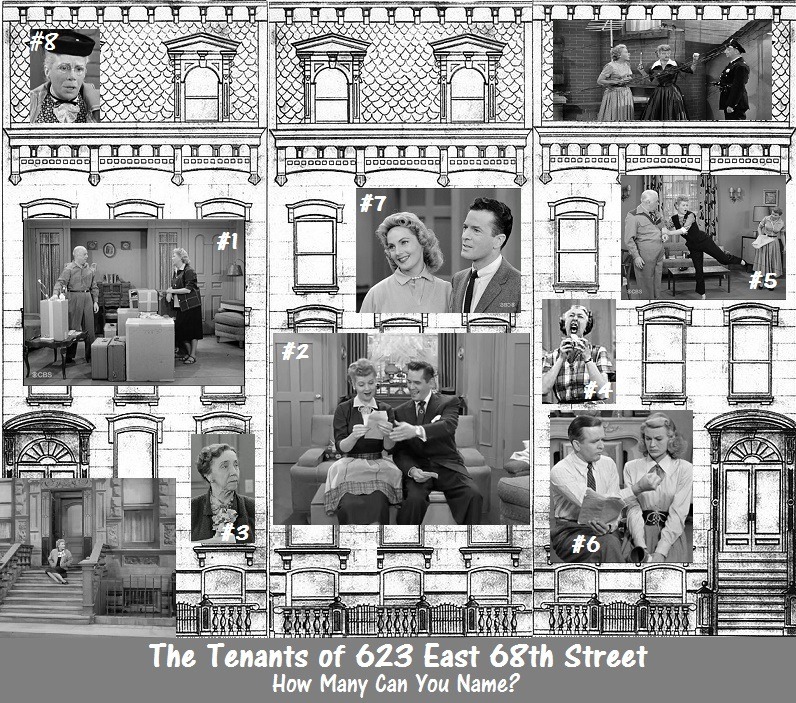
The Tenants of 623 East 68th Street
How many can you name?
-
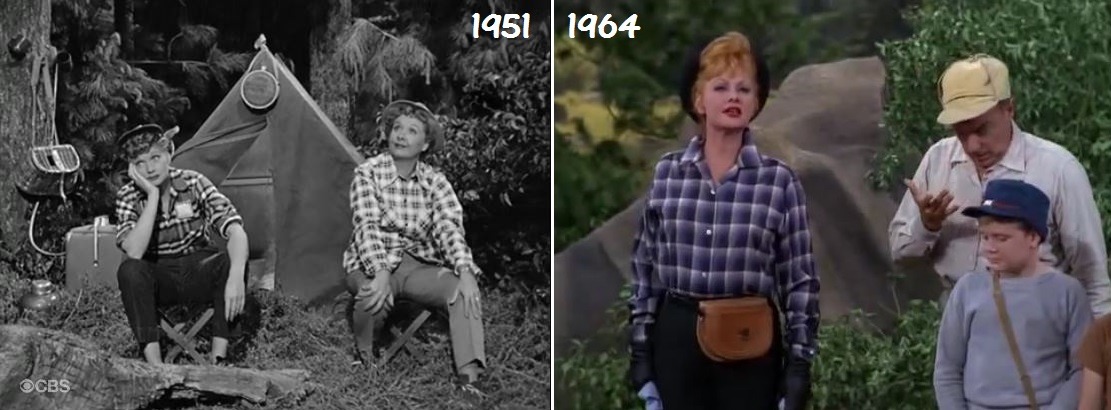
In “The Camping Trip” (S2;E29 of “I Love Lucy”) Lucy wants to go camping, but Ricky is determined to make it as hard as possible for her!
In “Lucy Becomes a Father” (S3;E9 of “The Lucy Show”)
Lucy wants to go camping, but Mr. Mooney is determined to make it as hard as possible for her!
-
Subscribe
Subscribed
Already have a WordPress.com account? Log in now.
 Papermoon Loves Lucy