-
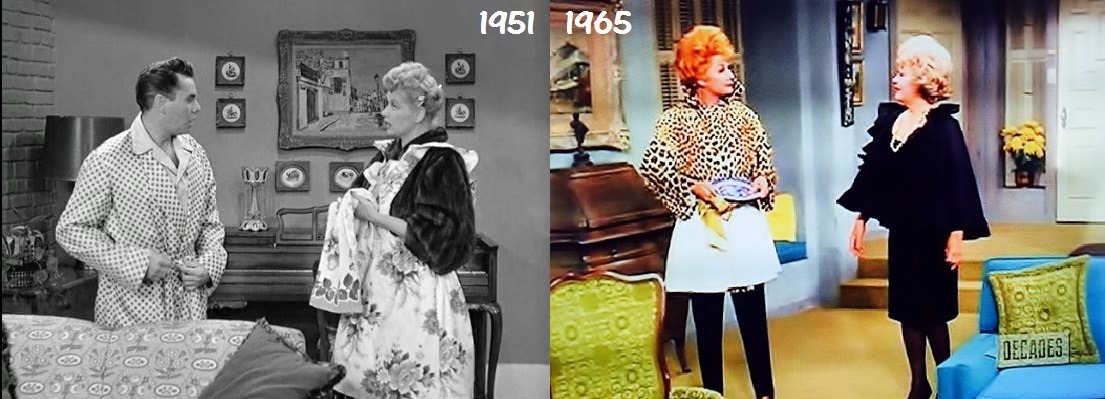
In “The Fur Coat” (S1;E9 of I LOVE LUCY), Lucy loves her new fur coat so much, she even wears it to bed and while washing the dishes!
In “Lucy the Stunt Man” (S4;E5 of THE LUCY SHOW),
Lucy loves her new fur coat so much, she even wears it to bed and while washing the dishes!
-
“Don Juan and the Starlets”

(S4;E17 ~ February 14, 1955) Directed by William Asher. Written by Jess Oppenheimer, Madelyn Pugh and Bob Carroll, Jr. Filmed on December 9, 1954 at Ren-Mar Studios. Rating: 51.3/67
Synopsis ~ When Ricky takes publicity photos with four glamorous starlets, Lucy gets jealous. Her jealousy turns to anger when it looks like Ricky stayed out all night at a Hollywood premiere.
This episode humorously capitalizes on Lucy’s fear that Ricky is womanizing, something Lucille Ball later acknowledged was a problem with her real-life marriage to Desi Arnaz.

Lucy reveals that she met Ricky when Marion Strong asked her to go on a blind date with a Cuban drummer 15 years ago. Clearly, the writers had forgotten about this when creating the first episode of “The Lucy–Desi Comedy Hour,” which explains that Lucy met Ricky while on a cruise to Cuba with her friend Susie MacNamara (Ann Sothern).

Before things get tense, the gang was planning to visit Knott’s Berry Farm.
LUCY: “The only knots you’ll see today will be on Ricky’s head!”
The Buena Park California amusement park was founded in 1920, growing out of the Knott family’s roadside stand selling jams and jellies. Knott’s Berry Farm is still in operation today and one of the Los Angeles area’s top tourist attractions.
Disneyland would open nearby just five months after this episode aired.

Ethel says she spotted Robert Taylor down at the pool. Although Taylor never guest-starred on the series, in “The Tour” (S4;E30) Lucy mentions that she met him at the Farmers Market and got his autograph on an orange.

Ricky claims that after the premiere he attended the party at the Mocombo. The Mocombo night club opened in 1941 on Sunset Boulevard in Hollywood. Lucy and Desi were frequent guests. The club’s main stage was the inspiration for the Tropicana set. “Hollywood Anniversary” (S4;E23) would have a scene set at the Mocombo based on the Arnazes real-life anniversary party.
Ross Elliott (Ross, the publicity agent) returned to the show for “Bullfight Dance” (S4;E22) and “Hollywood Anniversary” (S4;E23), having formerly played the director of the Vitameatavegamin commercial in “Lucy Does a TV Commercial” (S1;E30). He will go on to appear on episodes of “The Lucy Show” (also as a director) and “Here’s Lucy.”

The four starlets go by their real names:
- Dolores Donlon later became a Playboy playmate and was chosen to be Miss August in 1957.
In real life was married to Victor M. Orsatti, a Desilu producer whose name often was used as an unseen Ricardo friend.
- Maggie Magennis made her screen debut with this episode. She made only ten (mostly uncredited) TV appearances.
- Beverly Thompson was a Former Earl Carroll showgirl who signed as a Paramount Pictures starlet in 1945 but spent her career playing bit parts and walk-ons. Lucille Ball played an Earl Carroll showgirl in the film Murder at the Vanities (1934).
- Shirley Tegge was an extra on Hitchcock’s Strangers on a Train (1951). After this episode, she made only one more screen appearance before retiring.
FRED (To Ricky): “You’ll never get out of this one. Just turn around and head back for Cuba.”


Ricky is seen holding a metal waste basket decorated with an antique song sheet music reproduced from an original copper plate print by engraver George Bickham (1706–71).


Iva Shepard (the Maid) started acting in silent films in 1910 and left the business in 1918. She came out of retirement for “I Love Lucy,” making her sound film debut! She returned to the series to play a nurse in “Nursery School” (S5;E9). This would be her last screen appearance.

Oops! After Fred fibs to Lucy about Ricky spending the night, when Fred walks over to the door just as Ethel walks in, the shadow of the boom mic can be seen moving at the top right corner of the screen.
1955, Beverly Thompson, CBS, Desi Arnaz, Dolores Donlon, Don Juan and the Starlets, Ethel Mertz, Fred Mertz, Hollywood, I love lucy, Iva Shepard, Knotts Berry Farm, Lucille Ball, Lucy, Lucy Ricardo, Maggie Magennis, Mocombo, Ricky Ricardo, Robert Taylor, Ross Elliott, Shirley Tegge, tv, Vivian Vance, William Frawley - Dolores Donlon later became a Playboy playmate and was chosen to be Miss August in 1957.
-
“Wing Ding”
The 60s According to Lucy
-
“Getting Ready”

(S4;E11 ~ December 13, 1954) Directed by William Asher. Written by Jess Oppenheimer, Madelyn Pugh and Bob Carroll, Jr. Filmed October 21, 1954 at Ren-Mar Studios. Rating: 47.6/66
Synopsis ~ Planes, trains or automobiles – or even the bus – are the modes of transportation that Lucy considers for the trip to California. They finally decide to go by car – with the Mertzes in the back seat – until they see the car Fred buys!

After convincing Ricky that they should fly, Lucy gets that look in her eye while perusing the train brochure. Lucy is reading the Union Pacific Railroad Time Table. The props department has skillfully redacted the UPR name from the top and their shield emblem. In reality, the Union Pacific did not operate East of the Mississippi, betraying the show’s Southern California roots!

The Union Pacific Railroad will be featured (unredacted) in “Ricky Sells The Car” (S5;E4, above) and “The Great Train Robbery” (S5;E5).
Oops! When Ricky says “You’d better read the bus folder first” Lucy quickly replies, “Don’t be silly. The bus!” and gives him the train folder to make the reservation. Lucille Ball should have said, “Don’t be silly. The train!” No doubt Ball was thinking ahead…

After committing to the train, Lucy gets engrossed in the idea of going by bus. She peruses the bus schedule, which has also been redacted to obscure the brand name: Greyhound.
RICKY: “Look, Lucy, this whole thing was my fault. It was something that I said that started this whole thing.”
LUCY: “What’d you say?”
RICKY: “I do.”This line is reminiscent of writer Jess Oppenheimer’s favorite line of the series: “Ever since we said, ‘I do’ there are so many things we don’t!” from “The Girls Want To Go To a Nightclub” (S1;E1). Like the series’ title itself, the line reminds us that despite Lucy’s crazy antics, the show is really about the Ricardo’s marriage.

Al Hergersheimer is a used car salesman from Brooklyn who used to be in vaudeville with Fred. He sells him a dilapidated 1923 blue Cadillac convertible for $300. Al’s phone number is NEvins 8-2098. This was indeed a Brooklyn exchange. On the rotary telephone, the NE stood for 63.

When the car finally drives down East 68th Street, the viewers get to see the front of the Mertzes apartment building for the very first time. It will be seen in the next two episodes, “Lucy Learns to Drive” (S4;E12) and “California Here We Come!” (S4;E13) as well as upon their return to NYC in “Homecoming” (S5;E6).
When Ethel is sad about the Ricardos leaving, Lucy reassures her that they will only be gone a month. Ethel says that she knows they will end up staying in California longer. It’s a good thing the Mertzes end up going along, because Ethel was absolutely right! In real time, the trip actually lasts 11 months!

LUCY: “We can see the Grand Canyon, Pike’s Peak, Yosemite.”
Two episodes later, in “California Here We Come!” (S4;E11), all four travelers agree that they definitely want to see the Grand Canyon. If they did (their route certainly would have made it possible) viewers never got to see it.
Interestingly, “The Grand Canyon Suite” was the signature theme of Philip Morris, an “I Love Lucy” sponsor. During season one, “The Grand Canyon Suite” (by Ferde Grofé, 1929) was heard as the show opened, seguing into the familiar “I Love Lucy” theme half-way through the opening credits.

Finally agreeing on who is going, who is paying, and how they will get there, the group launch into a quick chorus of “California, Here We Come” as the show goes to commercial. The song will be sung in full during the episode that bears its name two weeks later.
Mrs. Trumbull and Little Ricky are mentioned, but do not appear in this episode.

FRED: “You forget that lovely trip you took to Minnesota.”
ETHEL: (sarcastic) “Oh, that was a lot of fun. I went to Mayo Brothers to have my gallstones taken out.”The Mayo Clinic in Rochester, Minnesota, was founded in 1889 by brothers Charles and William Mayo, built from their father’s medical practice. It has consistently been considered one of the top rated medical centers in the world. This must have held true in 1954 as well, or Ethel probably would have had the procedure done in a New York City hospital.

LUCY: (on the phone) “Would you like me to give a message to any of the gang out there? You know, Clark or Cary or Van or Marlon? Oh, all right. (writing) Tell Bill Holden that Marion Van Vlack saw ‘Sabrina’ five times!
In her telephone conversation with her friend Marion Van Vlack, name-dropping Lucy is referring to Clark Gable, Cary Grant, Van Johnson, and Marlon Brando. Of the first four Lucy (and the viewers) only meet Van Johnson in “The Dancing Star” (S4;E27). Johnson was friends of the Arnazes having appeared with them in Too Many Girls (1940) and with Lucy in Easy to Wed (1946). A masked and mute Lucy dresses up as Clark Gable for nearsighted Carolyn Appleby in “Lucy and Harpo Marx” (S4;E28).
William Holden (long-rumored to have had an affair with Lucille Ball) famously ran into Lucy at the Brown Derby in “Hollywood at Last!” (S4;E16). His film Sabrina was released a month prior to this episode being filmed. In 1955 it was nominated for six Oscars, winning for costumes.

Sabrina is a 1954 romantic comedy-drama directed by Billy Wilder, based on Samuel A. Taylor’s play Sabrina Fair. In addition to Holden, the movie starred Humphrey Bogart and Audrey Hepburn. “I Love Lucy” and “Lucy Show” character actors Ellen Corby and Nancy Kulp play supporting roles.

Talking in his sleep during a nap on the sofa, Ricky is dreaming of Hollywood.
RICKY: “No. No, Mr. Zanuck. My price is a million dollars, Mr. Zanuck.”
Darryl F. Zanuck (1902-79) was a film producer and studio executive. At the time the episode was filmed he was with 20th Century Fox. In 1954, his film The Egyptian was in wide release. He produced six of Lucille Ball’s films in the 1930s.

In “Never Do Business With Friends” (S2;E31), Ethel complains that her washing machine is old enough to belong in the Smithsonian Institution. Dubbed ‘the Nation’s attic’, the Smithsonian museums are located in Washington DC. Although the bulk of “I Love Lucy” memorabilia is held by the Lucy-Desi Museum in Jamestown, New York, a portrait of Lucille Ball is part of the Smithsonian Portrait Gallery.
As Fred toddles off to get his $500 back, he asks Ricky for train fare.
FRED: “Have you got 15 cents for the subway?”
The current base fare on the NYC subway is between $2.75 and $3.00! The NYC subway will be prominently featured in “Lucy and the Loving Cup” (S6;E12).

The episode ends with a rare self-referential moment on “I Love Lucy.” In reality, CBS is an acronym for the Columbia Broadcasting System. It was founded in 1927 and is still broadcasting today. CBS owns the rights to all images from “I Love Lucy”. Thank you, CBS!
FAST FORWARD!

In a 1963 episode of “The Lucy Show” (set in Danfield NY) ‘Friendly Al, Used Car Dealer,’ is mentioned as a TV sponsor. Perhaps he is ‘Friendly Al’ Hergersheimer – or his son?

Used car dealer Cheerful Charlie (Milton Berle) sells the Carter Family a 1940 Packard with a paint job Uncle Harry calls “sick-o-delic.” Like Fred’s Cadillac, it is a lemon that explodes upon ignition!
-
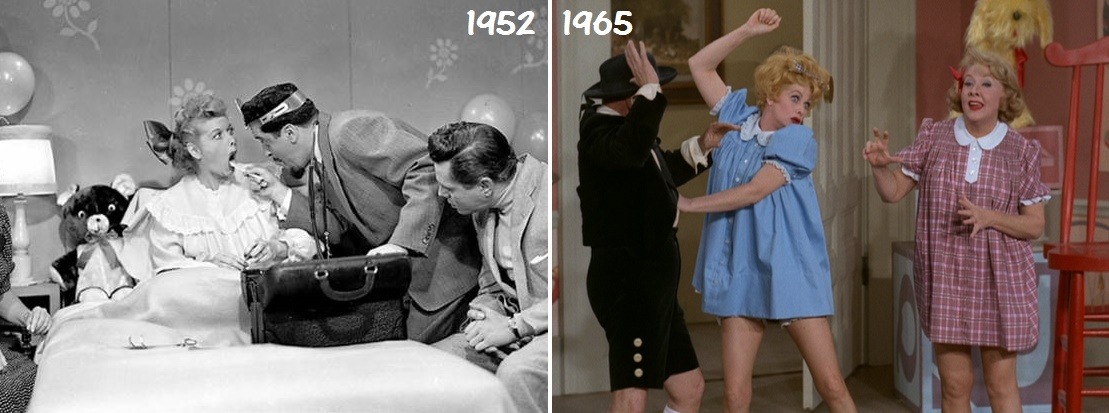
In “Lucy Fakes Illness” (S1;E16 of I LOVE LUCY), Lucy pretends to regress to childhood to convince a dubious Ricky to put her in the act!
In “Lucy the Stockholder” (S3;E25 of THE LUCY SHOW),
Lucy pretends to regress to childhood to convince a rich doctor to deposit money in her bank!
-
“Ricky’s Contract”

‘Did I tell you the funny thing I heard on television the other night?’
(S4;E10 ~ December 6, 1954) Directed by William Asher. Written by Jess Oppenheimer, Madelyn Pugh and Bob Carroll, Jr. Filmed October 14, 1954 at Ren-Mar Studios. Rating: 49.7/67
Synopsis ~ Ricky is on ‘pins and niddles’ waiting to hear from Hollywood about his screen test, so Fred has the crazy idea to write a message that Ricky got the job so he’ll stop worrying! Fred should leave the crazy plans to Lucy!
The plot to this episode is very similar to “Redecorating” (S2;E8) where Fred makes a phony phone call about winning home show furniture just like he leaves a phony note about Ricky landing the movie role.
Starting with this episode the focus of the show is solely on the Hollywood trip.

In 1954 CBS toyed with the idea of making the transition to color. The cost of producing color episodes was about double, but the network had allocated funds to do some experimental installments. In fact, CBS actually aired 38 segments of various programs in color during 1954. Theories persist that at one point this rather simple episode was slated to be the first “I Love Lucy” to be filmed and broadcast in color. It was even listed that way in TV Guide. Unfortunately, it never happened. In fact no episodes of “I Love Lucy” or “The Lucy–Desi Comedy Hour” episodes were ever shot or aired in color. The first season of “The Lucy Show” in 1962 was shot in black and white, but starting with the second season the show was filmed in color. Unfortunately, although shot in color, seasons two and three were aired in black and white and it wasn’t until the fall of 1965 that viewers finally saw Lucy’s famous red hair in vivid color!
Oops! Ricky mistakes the sound of Lucy’s spoon in the jam jar for the ringing of the telephone, but when the phone does ring, it is a buzzing noise, not a bell ring!

In this episode we learn that Fred puts all the rent money in a secret hiding place – one that Ethel has known about for 24 years! We also learn that Fred calls his rumbling stomach ‘Charlie’!

Lucy, Fred and Ethel do everything they can think of to distract Ricky: corny jokes, funny faces (Lucy’s Pekingese dog), and a good old ‘community sing’ featuring “When You’re Smiling.” The song was first written in 1929, but most famously performed by Louis Armstrong. Lucy previously made her ‘Pekingese’ face to amuse the baby in “The Indian Show” (S2;E24).

At the start of the second scene, set in the Tropicana, percussionist Pepin Betancourt has two lines of dialogue. Accompanist Marco Rizo is in the lower left. They were part of both the Desi Arnaz and the Ricky Ricardo Orchestras. Although Marco has no lines of dialogue, Lucy talks to him over the telephone and says his name numerous times.

Ricky rehearses “I’ll See You in C.U.B.A.” a song by Irving Berlin that was introduced in The Greenwich Village Follies in 1919. The revue was so successful that it moved uptown to Broadway. The song was previously sung on the series in “The Mustache” (S1;E23).

Taking messages and babysitting while Lucy is at the beauty parlor, Ethel thinks she is talking to Marge, one of Lucy’s favorite telephone friends, and mistakenly calls Caroline one of Lucy’s gabby friends. She then realizes she is actually talking to Caroline, not Marge! Oops!
On the telephone, Lucy speaks with unseen characters named Sue and Mr. Green. Sue may be an homage to Lucille Ball’s second cousin, Susan (aka Suzan) Ball. Mr. Green (who answers the phone at the Tropicana) may be a tribute to frequent day player and Desi’s camera and lighting stand-in Bennett Green. Other characters referred to but seen in previous episodes are Caroline Appleby (Doris Singleton), Little Ricky (The Mayer Twins) and talent scout Ben Benjamin (Frank Nelson).

When Ricky gets the good news, he takes his band members to celebrate at Lindy’s. Lindy’s was a NYC deli restaurant opened by Leo Lindermann in 1921 at 1626 Broadway. A second location opened in 1929 at 1655 Broadway. The original Lindy’s location closed in 1957. The brand all but disappeared in 1969 but was resurrected ten years later at 825 7th Avenue only to close for good in 2018. They were world famous for their cheesecake. Lindy’s was known for naming sandwiches after celebrities. “Comic Combo #2″ was named The Lucille Ball: salami and Swiss on rye, although later it was changed to turkey and Swiss with lettuce, tomato, and bacon on white toast. Which is more appropriate?

Milton Berle was a regular at Lindy’s. When Berle guest-starred on “The Lucy-Desi Comedy Hour” in 1959 he said “Lindy promised to name a sandwich after me if I gave up my table by the door.”
When Ricky comes home and sees that Lucy and the Mertzes have something to tell him, he at first thinks that they want the charter for the “Ricky Ricardo Fan Club #1″.
RICKY: “Yes, you may have the sharter.”
LUCY (to Fred and Ethel): “How about that? We got the sharter.”Looking for any excuse to leave, Fred says he’s going to get his autograph book, which he says he left in Indiana. Although the exact location of his birth was never stated, Fred later says he was born and raised on a farm in the Midwest, possibly in Steubenville, Ohio, although in one episode Ethel claims that Fred’s mother comes once a year from Indiana.

RICKY: “I’m gonna make that Crosby look like a bum!”
A huge multimedia star from 1934 to 1954, Bing Crosby was a leader in record sales, radio ratings, and motion picture grosses, so it makes perfect sense that unknown Ricky Ricardo should aspire to be as successful as Crosby. Lucille Ball did a few motion pictures with Crosby’s ‘Road’ co-star Bob Hope. Crosby was mentioned on four other “I Love Lucy” episodes. Although they never acted together on screen, the pair were seen on several of the same variety shows.

Ethel says Ricky in his movie star finery looks “just like Buddy Rogers.” Buddy Rogers (1904-99) was a matinee idol popular in early films when he was known as “America’s Boyfriend.” Lucille Ball was an uncredited extra in his 1935 film Old Man Rhythm. As star of Wings (1927), the very first film to win an Academy Award, he played himself on an airline-themed episode of “The Lucy Show” in 1967.

As the episode ends with the gang jumping for joy about Ricky landing the part, the orchestra plays “Hooray for Hollywood!”, a song by Johnny Mercer and Richard A. Whiting that was first heard in the 1937 movie Hollywood Hotel. It will be reprised with special lyrics in a 1971 episode of “The Lucy Show.”
CONTRACT COMEDY!

During “I Love Lucy” Lucille Ball drew up ‘joke’ contracts for the cast. Vivian Vance read hers aloud on Dinah Shore’s talk show in 1975. This is the source of the serious rumor that Lucille Ball contractually required Vivian to remain overweight and frumpy while playing Ethel Mertz.

In a 1971 episode of “Here’s Lucy,” Lucy Carter draws up a contract WITHOUT a dotted line to convince Harry (Gale Gordon) he needs his eyes checked! Here she brags about the stunt to her son, Craig (Desi Arnaz Jr.).

When “Lucy Moves To NBC” in 1980, Fred Silverman (Gary Imhoff) unfurls her contract, which is quite lengthy! Her lawyer (Robert Alda) and backgammon partner (Ruta Lee) try not to look shocked!
FAST FORWARD

We don’t hear much about The Ricky Ricardo Fan Club until “Don Juan Is Shelved” (S4;E21) when Lucy, her mother, and the Mertzes hastily put one together that resembles Frank Sinatra’s bobby-soxers.

On an episode of “December Bride” (produced by Desi Arnaz) Hilda and Lily (Verna Felton and Spring Byington) crash a meeting of the Desi Arnaz Fan Club to get a word with the Latin star. The episode premiered right after “Lucy Goes To Scotland” (S5;E17) on February 20, 1956.

The scene between Ethel and Fred with the notepad by the phone was used for a 2006 Medicare drug benefit ad. Voice-over actors imitated Vivian Vance and William Frawley, while the actors’ mouths were digitally altered to match the new dialog concerning a change in Medicare rules. The commercial had Ethel convincing Fred that the new plan was cost-efficient and they should join it: “If Fred Could Have Done It, He Would Have.”
1919, 1954, Bing Crosby, Broadway, CBS, Desi Arnaz, Ethel Mertz, Fred Mertz, Greenwich Village Follies, Hollywood, I love lucy, I’ll See You in C.U.B.A, Irving Berlin, Lucille Ball, Lucy, Lucy Ricardo, Pekingese, Ricky Ricardo, Ricky’s Contract, tv, TV Guide, Vivian Vance, When You’re Smilin, William Frawley -
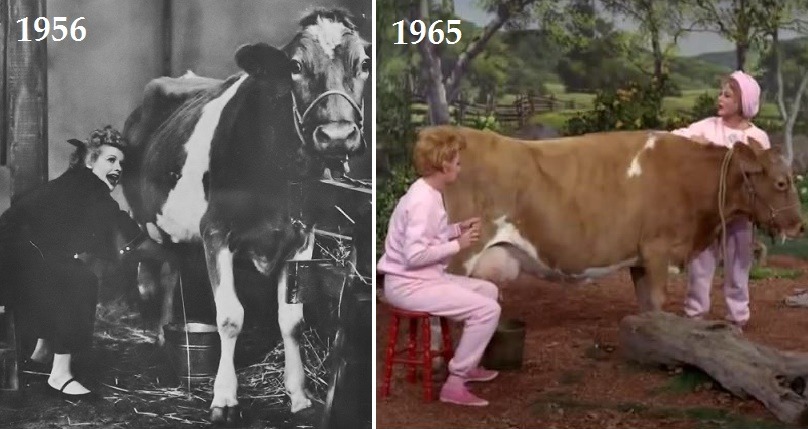
In “Lucy’s Bicycle Trip” (S5;E24 of I LOVE LUCY), Lucy is so hungry and thirsty that she tries her hand at milking a cow!
In “Lucy and the Countess Lose Weight” (S3;E21 of THE LUCY SHOW),
Lucy is so hungry and thirsty that she tries her hand at milking a cow!
-
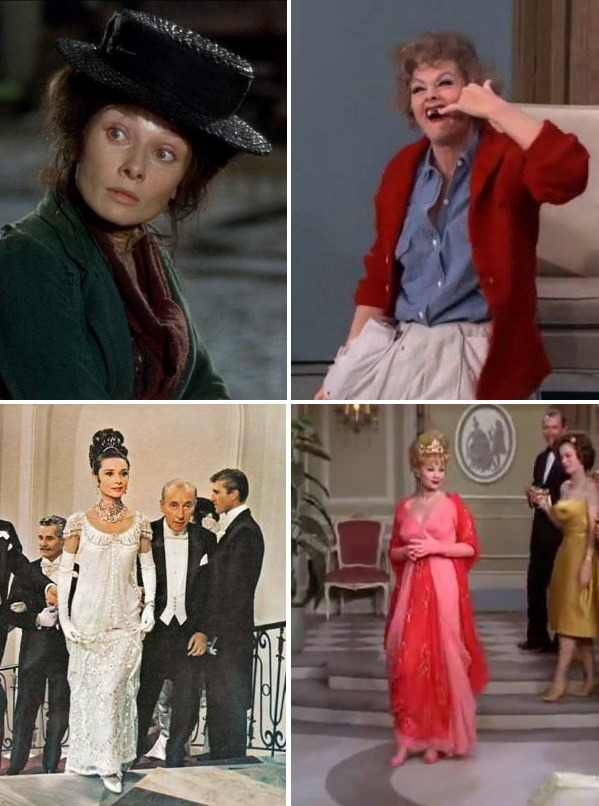
Shortly after the film version of MY FAIR LADY opened in theatres in November 1964, Lucy did her own version on THE LUCY SHOW titled “My Fair Lucy” (S3;E20). Lucy’s Henry Higgins was The Countess Framboise (Ann Sothern), who instructed charwoman Eliza Lumpwhomper (Lucy) to recite “The rain in Maine stays mainly on the grain” before dramatically transforming her into a glamorous and regal lady in a tiara attending a ball.
-
“The Matchmaker”

(S4;E4 ~ October 25, 1954) Directed by William Asher. Written by
Jess Oppenheimer, Madelyn Pugh and Bob Carroll, Jr. Filmed June 10, 1954 at Ren-Mar Studios. Rating: Not Available
Synopsis ~ To nudge them into matrimony, Lucy invites her her dating friends Sam and Dorothy to dinner with the intention of holding up her marriage to Ricky as a model union. But when the dinner turns disastrous, Ricky angrily paints a bleak picture of marriage to Sam. Lucy, of course, has plans to get even!

The premise of the show is similar to “Lucy is a Matchmaker” (S2;E27) with Eddie Grant and Sylvia Collins replaced by Sam Carter and Dorothy Cook as the objects of Lucy’s matchmaking scheme – even the episodes’ titles are similar.
This is one of five episodes filmed at the end of season three, before the company went on summer hiatus, but saved for broadcast at the start of season 4 in October 1954. It is the 101st episode aired.

ETHEL (To Lucy): “Who ya trappin’ now, Daniel Boone?”
Ethel compares Lucy ‘trapping’ men into marriage with Daniel Boone (1734-1820), hunter, fur trapper and trailblazing American frontiersman whose name is synonymous with the exploration and settlement of Kentucky. In a 1964 episode of “The Lucy Show,”
Mr. Mooney (Gale Gordon) compares his wilderness tracking skills to that of Daniel Boone.

Ethel then calls Lucy “Cupid”, hearkening back to when Lucy tried to fix up Miss Lewis with Mr. Ritter in “Lucy Plays Cupid” (S1;E15).

To lend authenticity to Lucy’s rosy depiction of married life, Fred and Ethel agree to pretend to be lovebirds, an act that is quickly dropped as soon as Sam and Dorothy leave.
Milton Frome (Sam Carter) returned to work with Lucy in a 1965 episode of “The Lucy Show” starring Milton Berle as well as a 1972 episode of “Here’s Lucy” starring Donny Osmond, in which he played Henry the Waiter – not to be confused with the nearsighted character of the same name played by Frank Nelson in “Lucy Changes Her Mind” (S2;E21).

Sarah Selby (Dorothy Cook) started as a radio actress and made her screen debut voicing Prissy the Elephant in Walt Disney’s Dumbo (1941). Also providing elephant voices for the film was Verna Felton, who played Mrs. Porter in “Lucy Hires a Maid” (S2;E23). Selby appeared on a 1951 episode of Lucy’s radio show “My Favorite Husband.” When the radio series unsuccessfully transferred to television (without Ball, who was then two years into “I Love Lucy”), Selby appeared in a few episodes. She is perhaps best known for her recurring role as a storekeeper on TV’s “Gunsmoke” from 1961 to 1972.

Lucy uses the adorable Little Ricky as incentive for Sam and Dorothy to mate. The baby is played by The Mayer Twins. As usual, insert shots of the baby were done after the studio audience had left.
During the dinner party, Ricky tells Dorothy and Sam that he started in show business at age 12. The episode confirms once again that the Ricardos have been married for 12 years and the Mertzes for 25, although a telegram delivered at the end of the episode says that Lucy and Ricky have been married for 13 years.

When Lucy hears her dinner is burning, she runs from the nursery on one side of the apartment to the kitchen, on the other. This is done with one continual camera shot, passing through walls and eventually landing on the stove. Before the camera has a chance to re-focus, however, a glimpse of the border curtain next to the end of the kitchen wall can be glimpsed!

At breakfast the next morning, Ricky is reading The New York Bulletin,
a fictional newspaper that was likely created by the oldest paper prop maker in Hollywood, The Earl Hayes Press. Note that the burnt toast is already pre-loaded into the toaster behind Desi.

Oops! This is the same copy of the newspaper that he was reading the week before in “Lucy Cries Wolf” (S4;E3, above). In both cases, Ricky is reading the FINAL EDITION at breakfast. Big city newspapers published a morning and evening edition, which would be the last (or final) edition of the day.
According to Ricky’s grim description of Lucy’s nighttime beauty regimen:
- her face is covered with grease
- she wears blinkers over her eyes
- her chin is in a hammock
- she has wire cages in her hair

Coming to breakfast with cold cream on her face and curlers in her hair, Lucy systematically fulfills the harsh picture of married life Ricky described to Sam the night before. Lucy serves her husband a breakfast that includes
- a juice glass filled with orange seeds
- a raw strip of bacon heated by a lit match
- two raw eggs cracked onto a plate
- burnt toast (from which she rhythmically scrapes the charcoal)
- and her famous cup of ‘mud’ – coffee brewed by adding hot water to a spoonful of dirt scooped from a potted plant on the windowsill
Oops! When Lucy plops the scraped toast on the table, it falls on the floor. While the camera is on Lucy getting the dirt for the coffee, Desi picks it up and puts it on the table.

When an angry Ricky doesn’t come home from work one night, Fred placates a worried Lucy by saying “Suppose we wait a couple of weeks and notify Ellery Queen.” Ellery Queen was a fictional detective who first appeared in print in 1928 and was heard on radio in the 1940s. Between 1935 and 1942 Ellery Queen was the subject of a series of B-movies. The year this episode aired ‘Ellery Queen’ penned the mystery novel “The Glass Village,” although it is one of the few where the famed detective does not appear nor is he even mentioned.

Prior to that brilliant solution, Fred sarcastically says:
FRED: “You’ll probably find him down at the police station, wearing a cop’s hat and eating an ice cream cone.”
Fred is relying on a trope seen in many films. An ice cream cone was thought to have the power to cheer up a distraught child. A nearly identical joke was spoken by Fred when Little Ricky wandered away in “Ricky Minds The Baby” (S3;E14).

Oops! When Fred slips into Lucy’s bed, he drops his slippers on the floor and tucks himself in. When Ricky arrives home, the slippers have disappeared!

When Ricky offers flowers and candy to Lucy (or so he thinks – it is really Fred under the covers), the bookcase at the headboard of the bed holds a copy of Kathleen Norris’s 1929 novel Storm House. Norris (1880-1966) was a prolific writer, churning out 87 novels, two omnibuses, four collections of short stories, one play, and ten non-fiction works. The book was re-issued in 1943 with the dust jacket seen above.


A telegram then arrives (at 5am!) to announce that Dorothy ‘Spider’ and Sam ‘Fly’ have decided to tie the knot after all! The messenger who delivers the early morning telegram is played by Bennett Green, Desi’s camera and lighting stand-in and frequent background performer.

Ricky apologetically returns home with flowers and a huge heart-shaped box of chocolates for Lucy. I suppose the memory of Lucy fainting at the sight of a five pound box of chocolates after coming home from Kramer’s Candy Kitchen in “Job Switching” (S2;E1) was long forgotten! Knowing Ethel’s appetite, Ricky hands the chocolates to her. Fade out!

A few minor observations about this episode that go unmentioned:
- Lucy is wearing a shear apron with a heart-shaped pocket. This not only matches the episode’s theme, but the logo of the show.
- Lucy has not to subtly chosen a ceramic bride as the centerpiece of the table. Hint! Hint!
- There is a pack of Philip Morris cigarettes on the mantle, although in all the chaos, no one has time to smoke them!
FAST FORWARD! MATCHMAKER, MATCHMAKER
This was not the first nor the last time matchmaking would be part of a “Lucy” sitcom.

During season one, Lucy tried to play matchmaker between Mr. Ritter and Miss Lewis in “Lucy Plays Cupid” (S1;E15). Like with Eddie Grant (see below), Mr. Ritter thought it was Lucy who was interested in him.

“Lucy is Matchmaker” (S2;E27) found Lucy fixing up Fred’s friend Eddie Grant (Hal March) with Sylvia Collins
(an off-screen character). Eddie somehow thinks Lucy is trying to match him with her instead! Another matchmaking fail!

In a 1959 cross-over episode of Desilu’s “The Ann Sothern Show” (S1;E1), Lucille Ball guest stars as Lucy Ricardo, who finds out that her old friend Katy (Sothern) is unmarried and plays matchmaker to fix her up with her boss, Mr. Devery (Don Porter), using herself as bait.

Lucy Carmichael served as matchmaker for her teenage daughter Chris (Candy Moore) when she meets Mr. Mooney’s son, Ted (Michael J. Pollard), in a 1964 episode of “The Lucy Show.”

In 1965, Lucy Carmichael went undercover as the world’s most famous matchmaker, Dolly Levi from the musical Hello, Dolly! The play that the musical was based was titled The Matchmaker by Thornton Wilder.

During the first season of “Here’s Lucy” Lucy Carter tried computer matchmaking to fix up her brother-in-law Harry (Gale Gordon), but ended up pairing him with her old friend Vivian Jones (Vivian Vance) in “Lucy, The Matchmaker” (HL S1;E12).

On a non-matchmaking note, Ethel’s dowdy terrycloth bathrobe turns up on not one, but two episodes of “Here’s Lucy”, once worn by superstar Ann-Margret! To be fair, both Lucy and Ann-Margret are deliberately trying to look downmarket when wearing Ethel’s hand-me-down. Ethel also wears the robe in “Breaking the Lease” (S1;E18) when Fred dons his fashionable chandelier chapeau!
MATCHMAKER MERCH!

2016 Hamilton Collection “The Matchmaker” figurine based on Lucille Ball’s first outfit in the episode. Limited edition, handcrafted and hand-painted. Number 5 of 6 in the series.
-
“Lucy Writes a Novel”

“You’ll
get no more books from me, so go watch television!”
(S3;E24 ~ April 5, 1954) Directed by William Asher. Written by
Jess Oppenheimer, Madelyn Pugh, and Bob Carroll, Jr. Filmed March 4, 1954 at Ren-Mar Studio.
Rating: 51.5/75
Synopsis ~ Hearing that a housewife got $10,000 for writing a book, Lucy decides to become a novelist! Much to the chagrin of Ricky, Fred and Ethel, her subject will be a thinly disguised (and outrageously romanticized) version of her own life.

The date this episode first aired was also the 43rd birthday of Gordon Jones. Like Lucille Ball, he was born in 1911. He had a wife named Lucille and appeared with Ball in two films and posthumously in an episode of “The Lucy Show” in 1963.
Before we talk about the episode itself, let’s talk about…
TYPE CASTING!

To type her novel, Lucy uses a Remington SJ Typewriter (top left), although the brand name has been taped over on the front of the typewriter facing the camera. Lucy already had a fling at being a writer in “The Operetta” (S2;E5, center) and in “Lucy Writes a Play” (S1;E17, bottom right) where she also combined elements of her own life with her writing. In that episode, Lucy used an Underwood Universal Typewriter.

In the film Miss Grant Takes Richmond (1949), Lucille Ball had trouble with the typewriter ribbon! Remember those?

When Lucy Carmichael becomes a reporter at the Danfield Tribune, she loads paper in the typewriter that already has been typed on!

As a secretary, Lucy Carter also had trouble with her typewriter in “Lucy’s Replacement” (HL S4;E19).

Typewriter brand names were still being redacted in 1973′s “The Big Game” (HL S6;E2).

Harry Carter didn’t have much luck with Lucy’s new (made in Japan) electric typewriter in “Lucy the Crusader” (HL S3;E5).

When Lucille Ball was looking to cast a bit player to play a lightning-fast typist on “Here’s Lucy,” Ball could think of no one faster than her own personal secretary, Wanda Clark, who got the role! What Clark didn’t tell Lucy was that she was used to typing on an electric, and the on-set typewriter was a manual!

Lucy says “My novel may turn out to be another ‘Gone with the Wind’!“ Margaret Mitchell’s Pulitzer Prize-winning Civil War saga was first published in 1936. Lucy naturally compares Ricky to Rhett Butler and herself to Scarlett O’Hara. When the Oscar-winning film version was being cast in 1938, Lucille Ball was considered for the leading role.

Lucy’s roman à clef is met with some disagreement from her husband:
LUCY: "A lonely immigrant arriving in New York Harbor on a cattle boat. As your leaky Cuban cattle boat steamed into New York Harbor, tears cascaded down your cheeks as you saw the Statue of Liberty for the first time. You clutched your knapsack to you – your pitiful little bundle that contained all your worldly belongings – and you wept unashamedly. You made a vow that someday you would be a famous orchestra leader.”
RICKY: “You crazy or something? You know darn well I came here by plane – from Havana to Miami Beach – and I wasn’t lonely; I had 14 musicians with me.”In the Lucy-verse, Ricky Ricardo was an established musician coming to America to seek fame and fortune, whereas in real life Desi Arnaz came to Miami alone on a boat – a poor teenager from Santiago, Cuba, fleeing Batista’s revolution. Lucy names him ‘Nicky Nicardo’ in her book. Nicky was also the first name of Desi’s character in The Long, Long Trailer (1953).


When Ethel Mertz (or as she is known in Lucy’s novel, Ethel Nertz) finds a hidden copy of Lucy’s tell-all tome rolled up in the window shade over the stove, she lights up the fireplace and tells Lucy: “We pulled down the kitchen blind and changed the name of your novel to ‘Forever Ember.’” Fred remarks that “There’s nothing like a good book IN a roaring fire!” Forever Amber is a 1944 romance novel by Kathleen Winsor set in 17th-century England. It was made into a film in 1947 starring Cornel Wilde, who appeared in “The Star Upstairs” (S4;E25). This is the first time the fireplace in the Ricardo apartment is actually lit and used for more than just leaning on the mantle.


Lucy plans to name the sequel to her novel “Sugar Cane Mutiny,” a play on Cuba’s main export and the 1951 Pulitzer Prize-winning novel The Caine Mutiny by Herman Wouk. The book was turned into a Broadway play which premiere just two months before this episode was filmed and was mentioned by Lucy’s high school drama teacher Miss Hannah (Ellen Corby) in “Lucy Meets Orson Welles” (S6;E3). Two months after “Lucy Writes a Novel” aired, the book was made into a feature film starring Van Johnson, who starred in “The Dancing Star” (S4;E27).

Surprisingly, Lucy’s receives an acceptance letter from Dorrance and Company Publishers. Founded in 1920, Dorrance Publishing is a real firm still operating in Pittsburgh, PA. Unfortunately, they want to include it in a writing textbook, heading up the chapter “Don’t Let This Happen To You.”

Try and Stop Me by Bennett Cerf can by glimpsed on the Ricardo bookshelves in “The Inferiority Complex” (S2;E18) and “Ricky Has Labor Pains (S2;E14).

Pierre Watkin (Mr. Dorrance) had appeared with Lucille Ball in the films Bunker Bean (1936), DuBarry Was a Lady (1943), and Her Husband’s Affairs (1947). He returned for a 1959 episode of “The Lucy–Desi Comedy Hour.” Watkin was hired to take over the role of Perry White on “Adventures of Superman” but star George Reeves died shortly after and the show was canceled. Reeves guest-starred on “I Love Lucy” as the man of steel in “Lucy and Superman” (S6;E13) and coincidentally also appeared as Brent Tarleton in the film Gone With The Wind.

Dayton Lummis (Mel Eaton) returns to the series after playing producer Bill Parker in “Lucy Has Her Eyes Examined” (S3;E11). Lummis was born on August 8, 1903, in Summit, NJ. He went on to play Ricky’s MGM Studio rep in “Hollywood at Last!” (S4;E16).
A NOVEL FAST FORWARD

The novel Gone With the Wind makes a cameo appearance in “Lucy’s Lucky Day” (HL S4;E15). Lucy Carter finds an overdue library book – Gone With The Wind – which she says took out when it was first published.
For More About Lucille Ball’s Unique Relationship to GONE WITH THE WIND Click Here!

The Caine Mutiny turns up in “Lucy and Eva Gabor” (HL S1;E7). A member of Lucy’s Bridge Club (Gail Bonney) asks Eva for her autograph, on a copy of The Caine Mutiny, the 1951 Pulitzer Prize–winning novel by Herman Wouk. Seems Lucy’s pal didn’t buy Eva’s book, so she grabbed something off her home bookshelf for her to inscribe!

Okay, nobody in “Lucy the Crusader” (HL S3;E5) actually reads Philip Roth’s racy 1969 novel Portnoy’s Complaint, but during Lucy Carter’s neighborhood meeting to talk about consumer gripes, a woman recognized as Mrs. Portnoy (Kathleen Hughes) stands up to voice a complaint – about a malfunctioning garage door!

In that same episode, Lucy reads Eva’s hot new novel Valley of the Puppets, which was clearly inspired by Jacqueline Susann’s Valley of the Dolls, first published in 1966.

In “Milton Berle Hides out at the Ricardos” (LDCH September 29, 1959), Milton Berle had just published his first (and only) novel, Earthquake written with John Roeburt. Lucy takes an interest in it to convince Berle to star in the Westport PTA show.

Arouse and Beware by MacKinlay Kantor and Tender is the Night by F. Scott Fitzgerald turn up on the newsstand paperback rack of the Danfield train station in “No More Double Dates” (TLS S1;E21). Lucy is too busy avoiding Viv and her date to take time for reading!

-
Subscribe
Subscribed
Already have a WordPress.com account? Log in now.
 Papermoon Loves Lucy