-
“Ricky Minds The Baby”

(S3;E14 ~ January 18, 1954) Directed by William Asher. Written by Jess Oppenheimer, Madelyn Pugh and Bob Carroll, Jr. Filmed December 3, 1953 at Ren-Mar Studios. Rating: 59.4/78
Synopsis ~ Ricky has a week off while the Tropicana is being repainted, so he steps up to mind the baby and give Lucy a much-needed rest. But when Ricky and Fred get distracted by a football game on TV, Little Ricky wanders away and Lucy is furious. Fred finds the boy and sneaks him back into his crib, leaving everyone wondering what happened.

As the episode opens, Lucy is watching television through the kitchen shutters while eating dinner. America’s obsession with television – greatly aided by the popularity of “I Love Lucy” – was growing by leaps and bounds. Although we hear the program’s background music (provided by the Desi Arnaz Orchestra) we don’t see the television, or learn the name of the show Lucy’s obsessed with.

When the Mertzes drop by there is the obligatory jibe at Ethel’s enormous appetite. Lucy offers her some stale brownies, which when dumped on the table, actually break a plate, too stale even for Ethel!
Oops! Notice that the plate that breaks is not one of Lucy’s Fransiscan Ivy dishware. It is likely a prop plate especially made to break when hit by the brownies, which were likely made of a hard, heavy material.

Oops! Fred and Ethel mention they are married twenty-three (23) years but in “The Courtroom” (S2;E7), aired a year earlier, they are married twenty-five (25) years. And a year before that, in “The Girls Want to Go To a Nightclub” (S1;E1) they were celebrating their eighteenth (18) wedding anniversary at the fights!

The highlight of this very simple episode is Ricky telling a bedtime story to his son – “La Caperucita Roja” (“Little Red Riding Hood”) in Spanish. Desi Arnaz does a wonderful job acting out the classic fairy tale while inserting just enough English words for it to be funny to the viewers. Instead of the traditional basket of sweets, the version taught to Ricky by his Cuban mother has Little Red taking her granny a basket full of frijoles, tortillas, and vino (aka wine)!
Oops! Desi Arnaz only makes one noticeable mistake during the four minute-long story: after the ‘Hunter’ has slain the ‘Wolf’, Ricky, in Little Red’s high-pitched voice, says “Gracias, Senor Lobo” instead of “Gracias, Senor Hunter”. He quickly corrects himself.

As Ricky is telling the story, insert shots of Little Ricky listening in his crib show that his bolster is embroidered with the cartoon stick figures of Lucy and Desi from the show’s original opening credits. In the final shot, where the baby rolls over to go to sleep, the position of the cartoon figures is reversed indicating the film had been flipped in editing, likely to indicate that the baby has turned away from Ricky to go to sleep.
As soon as Ricky puts the baby in his crib, he begins to cry. It is likely that Desi Arnaz played the rest of the scene to an empty crib and that the baby was taken off set. The insert shots of the baby in the crib were likely done separately, then edited into the final cut.

To assure that the potential crying of child actors didn’t hold up the filming, this is one of the few episodes not filmed in front of a live audience. It would also allow lots of time for the filming of the important close-up reaction shots of the baby that are integral to scene. Despite this, the laughs heard on the episode are real. The filmed episode was shown to a live audience, and that laughter was recorded and added to the soundtrack.

The Mayer Twins, Michael and Joseph, were the fourth and fifth actors to play the role of Little Ricky, following the Simmons Twins and before Keith Thibodeaux. The Mayer twins grew up in Southern California around the time child labor laws were tightening. Stricter laws meant younger twins became a hot commodity, primarily for the fact that they could be switched out. The boys made $150 a day on the series. Their parents decided it was best for the twins to quit show business early. Mike eventually became a high school teacher, while Joe worked in print services. Today, they are retired and live in Gem County, Idaho.

In the second scene (the next morning), the comedy comes from Lucy trying to sleep in, while still worrying about the baby. In one tracking shot, the camera moves from the nursery, into the bedroom, through the hallway, into the living room, and to the kitchen several times – passing through the walls as it does. Except for the Tropicana set (located just behind the kitchen door) – this was the entire expanse of the “I Love Lucy” soundstage.

For breakfast Ricky makes himself a Spanish omelet with green peppers, green onions, and mushrooms. He makes Little Ricky a bowl of oatmeal.
Lucy thinks she hears the baby crying, but Ethel explains that it is just Mrs. Trumbull’s cat. The building’s no pet policy is a point of contention when “Little Ricky Gets a Dog” (S6;14), although Mrs. Trumbull earlier orders a can of All Pet for her cat in “The Business Manager” (S4;E1).

Oops! Lucy walks out of Ethel’s apartment wearing a pair of sling-back shoes. When she enters her own apartment, she is wearing ankle-strap shoes instead. Did she change footwear in the foyer?

FRED (ad libs to Little Ricky): “Who do you like in the fifth at Santa Anita?”
Santa Anita Park is a thoroughbred racetrack located in Arcadia, California, which was frequently visited by Lucille Ball. It was mentioned on two episodes of “Here’s Lucy”: “Lucy Competes With Carol Burnett” (HL S2;E24) and “The Bow-Wow Boutique” (HL S6;E5). While this may seem like an odd reference for a New Yorker like Fred Mertz, William Frawley was featured in The Lemon Drop Kid (1951) starring Bob Hope, which was shot on location at Santa Anita Racetrack.

Little Ricky’s toys include the famous “I Love Lucy” teddy bear that appears in many episodes and was made commercially available. Fred tries to divert the child with
Mr. Squawker, a rubber duck squeeze toy manufactured by Rempel Manufacturing of Akron, Ohio, that also turns up when “Lucy Tells the Truth” (S3;E6). Also on the coffee table is a roly poly panda toy made by Softskin. Little Ricky is teething on a rubber bunny toy.

We also get a look at Cleo, a bath toy from Disney’s Pinocchio (1940) that spit water in Ricky’s face when “The Ricardos Change Apartments” (S2;E26).
Sitcom Logic Alert! Whatever Fred is hiding under his coat, it certainly isn’t shaped like Little Ricky! In the very next scene, the child is outside of the coat, making it clear by comparison that the boxy lump in Fred’s coat was probably not Little Ricky!

“Bye-Bye, Baby!”

FRED: “Every time a kid wanders away, you go down and look in the police station and you find them there eating an ice cream cone.”
Fred is relying on a trope seen in many films and early television. An ice cream cone was thought to have the power to cheer up a distraught child.

After Fred hangs up the phone when Lucy suddenly returns for her gloves, Ricky has to kick the very long phone cord out of the way so he can pull out a chair and sit down. Desi tries to be nonchalant about it, but the cord was underfoot and had to be moved in order for the scene to continue.

As the episode ends, Fred is the only one who really knows the full story; Lucy, Ricky, and Ethel are completely mystified about how Little Ricky suddenly appeared back in his crib!
FAST FORWARD

Thematically, this episode is similar to “Little Ricky Gets Stage Fright” (S6;E4) in which Ricky spends some quality time alone with his son, then played by Keith Thibodeaux.
-
“Lucy Meets the Queen”

(S5;E15 ~ January 30, 1956) Directed by James V. Kern. Written by Jess Oppenheimer, Madelyn Pugh, Bob Carroll, Jr., Bob Schiller, and Bob Weiskopf. Filmed December 15, 1955 at Ren-Mar Studios. Rating: 54.3/74
Synopsis ~ On their first day in London, Lucy and Ethel go looking for Queen Elizabeth, but no luck. When they arrive back at the hotel, Ricky tells her she’s going to be presented to the Queen the next evening and Lucy begs to be part of the show.

This is the first of a dozen episodes set in Europe and the first of three set in England.
The gang stay at the (fictional) Wimbleshire Hotel, in a room with a view of St. Paul’s Cathedral and Buckingham Palace – a geographical impossibility.

This episode was doubtless inspired by Danny Kaye’s November 1948 Command performance for King George and Princess Elizabeth at the Palladium Theatre. In fact, Kaye is referenced in this episode:
Lucy: Have you ever seen the Queen?
Bellhop: No, ma’am. But I came frightful close during the coronation. I just missed her. But I did catch a glimpse of him.
Lucy: Philip?
Bellhop: No, ma’am. Danny Kaye.
In a 1959 episode of “The Lucy–Desi Comedy Hour” Lucy complains about how many meals she’s cooked as a housewife.
Ricky (reading Variety): It says here that Danny Kaye is going to London to give another command performance for Queen Elizabeth.
Lucy: I wonder what the Queen is cooking for Phil tonight?Like Lucy, Kaye was adept at physical comedy as well as verbal wit. He appeared on “The Lucy Show” in 1964 and Ball appeared on his show twice.

On their hunt for Her Majesty, Lucy and Ethel go directly to Buckingham Palace, the Queen’s London residence. Completed in 1850 and remodeled in 1913, stock footage used in the episode shows that not much has changed in sixty years.
In this episode Phillip Wilcox is Ricky’s European agent at International Artists. Although he goes unseen, his first name was chosen to coincide with Queen Elizabeth’s husband, Philip Mountbatten, leading to a funny misunderstanding when Ricky calls ‘Philip’ on the phone.

At the time of filming (December 1955), a pound was worth $2.80. Fred gave Ethel 10 pounds, thinking it was ten dollars. He was horrified to find out that it was nearly $30. Ricky explains the (then) English currency:
Ricky: A pound is $2.80. There are 20 shillings in a pound. Each shilling is worth 14 cents. There are seven shillings in a dollar and 12 pennies in one shilling.
Fred, notoriously stingy, doesn’t tip tuppence or thrupence – he tips nuppence! In February 1971, British currency was changed to reflect the decimal system, phasing out the farthing, haypenny, thrupenny bit, sixpence, shilling, two bob bit, crown, and half crown.

The costume Lucy wears during the pony routine is the same one that she wore when upstaging Ethel’s act in “Ethel’s Home Town” (S4;E15). It was refashioned from the Marilyn Monroe gown she wore in “Ricky’s Movie Offer” (S4;E5).

The writers insert a callback to the opening of season five.
Ricky (to Lucy): Back in Hollywood, you came home with John Wayne’s footprints. I don’t want to find Big Ben ticking right next to my bed.

The London Palladium is a 2,286-seat West End theatre located on Argyll Street in the City of Westminster. It was opened on Boxing Day 1910 and has long been the home of Royal Variety Performances. In 1966′s “Lucy in London” (above) Lucy Carmichael and Anthony Newley are sight-seeing and drive up to the legendary venue in their motorcycle and side-car. This was the first time a “Lucy” show went on location overseas.

Ethel clutches a copy of the Britain 1955 edition of Fodor’s Modern Guides. For that era, this was new concept in guides books which became essential for the 1950s traveler.

Fred: There’ll always be an England.
Fred is quoting the title of a song popular during World War II sung by Dame Vera Lynn.

Robert Shafto plays the man on the street in front of Buckingham Palace who speaks incomprehensible British English. He had a brief career playing character roles between 1952 and 1959.

The stoic, stone-faced Buckingham Palace Guard that Lucy tries in vain to make smile goes unbilled and uncredited. This scene would later be copied verbatim in the 1959 TV special “Ethel Merman on Broadway.”

Nancy Kulp plays the hotel maid who teaches Lucy how to curtsy. Born in Harrisburg, PA, Kulp would return to Desilu for a 1959 special with Milton Berle and Lucille Ball and a 1962 episode of “The Lucy Show” but she will always be remembered as Miss Jane Hathaway, the upright secretary of banker Drysdale on CBS’s “The Beverly Hillbillies” (1962-71).
The role earned her an Emmy nomination in 1967.

She also appeared in the Lucille Ball and Desi Arnaz film Forever Darling, again playing a maid. Here she shares a scene with another TV legend, Natalie Schafer, who played charm school proprietress Phoebe Emerson on “I Love Lucy” before shooting to stardom as Lovey Howell on “Gilligan’s Island.”

The star-struck Bellhop is played by Sam Edwards, who was the voice of the adult Thumper in Bambi (1942). His final role was Bill Anderson in “Little House on the Prairie” from 1979 to 1983.

Joan Carey (Autograph Seeker, uncredited) was born Joan Somerville Norbury in Yorkshire, UK. She carved out a brief career as an actress and dancer before moving to small roles in front of and behind the camera. In 1952, she became a regular fixture as a “Lucy” background artist through 1974. She served as Lucille Ball’s stand-in from the fourth season of “The Lucy Show” until at least the penultimate season of “Here’s Lucy.”
Carey is the woman in the tweed jacket and black hat who gives Lucy and piece of paper for an autograph. She is also the same woman who hands it back to her after it has been signed. She has great trouble keeping her hat on during the busy crowd scene!
The choreography for the circus number is credited by announcer Johnny Jacobs to Jack Baker. Baker began staging dance for Desilu in 1956 and worked with Lucille Ball through 1971 on all her sitcoms, even directing full episodes.

The pony dancers in Ricky’s circus act are Betty Scott and Patti Nestor. This was Scott’s final screen appearance, having danced in An American in Paris (1951) and Singin’ in the Rain (1952). This was Nestor’s second and last film appearance after just doing the Ruth Etting bio-pic Love Me or Leave Me (1955).

HM Queen Elizabeth II ascended the throne on February 6, 1952, after the death of her father King George VI. Her official coronation was held on June 2, 1953. It was the first coronation to be televised. When Little Ricky was born more people watched that episode than watched the coronation of Queen Elizabeth II six months later. The crowning came one day after the airing of “Lucy Wants New Furniture” (S2;E28).
ROYAL MUSINGS ~

by Troy Patterson – December 17, 2017

“Ricky and Fred Are TV Fans” (S2;E30) opens with Ricky reading TV Guide with Queen Elizabeth prominently on the cover.

In a 1966 episode of “The Lucy Show,” Lucy Carmichael pretends to be talking to Elizabeth and Philip while Mrs. Mooney’s expensive ring is on her finger. She even attempts a (half) curtsy.

In “Lucy Meets Harpo Marx” (S4;E28) Lucy and Ethel fancifully mention inviting Princess Margaret for tea. Margaret was the younger sister of Elizabeth II and known to be extraordinarily social.

Lucille Ball had a pony act when she appeared as an equestrian circus star in an episode of “The Greatest Show on Earth” (1963).

Lucy is briefly seen as The Queen in “Lucy in London” (1966) during Anthony Newley’s performance at the London Palladium, the same location Ricky Ricardo performed at in 1956.

Earlier in the show, Newley briefly donned the helmet of the Welsh Guard.

Michael Stern, who worked as Lucy’s personal assistant and was considered by Ball to be her biggest fan, remembered a royal encounter:
“In London… I was able to slip up to Queen Elizabeth at a public tree-planting ceremony in Kensington Gardens. I said, ‘Back home in the States I work for Lucille Ball,’ and the Queen smiled and said, ‘Tell her I said hello and asked how she was doing.’ After I got home, I told Lucy about that. She said, ‘The Queen knows who I am?’ She called Gary and said ‘Guess what! The Queen told Michael to say hello to me!’ She was as excited as a kid.”

According to one online source, Lucille Ball and Elizabeth II are cousins!

Lucy’s Royal Queendoms!
- Queen of the Gypsies
- Queen of the ‘Bs’ (movies)
- Palm Springs Queen of the Desert
- Queen of Comedy
- Bean Queen
- Westinghouse Queen of the House
VIVAT LUCY!
 1956, Betty Scott, Buckingham Palace, CBS, Command Performance, Coronation, Danny Kaye, Desi Arnaz, England, Ethel Mertz, Fred Mertz, I love lucy, London, London Palladium, Lucille Ball, Lucy, Lucy Meets the Queen, Lucy Ricardo, Nancy Kulp, Palladium Theatre, Patti Nestor, Queen Elizabeth II, Ricky Ricardo, Robert Shafto, Sam Edwards, tv, TV Guide, Vivian Vance, William Frawley
 -
“Little Ricky Gets Stage Fright”

(S6;E4 ~ October 22, 1956) Directed by James V. Kern. Written by
Madelyn Martin, Bob Carroll, Jr., Bob Schiller and Bob Weiskopf. Filmed June 21, 1956 at Ren-Mar Studios. Rating: N/A
Synopsis ~ Preparing for his first music school recital, Little Ricky gets nervous. How will Lucy deal with his son’s stage fright?
At the start of season six, “I Love Lucy” welcomed a new cast member, Keith Thibodeaux (aka Richard Keith) as Little Ricky. After filming two star-centered episodes featuring Bob Hope and Orson Welles, the writers devoted some time to developing the character of Ricky Ricardo, Jr. The young actor was the 8th to play the role, but the first to have dialogue. He was hired for his remarkable resemblance to Desi Arnaz and his talent at playing the drums.
This episode was inspired by Keith Thibodeaux, who also suffered from stage fright. At one point a hypnotist was brought in to help with the problem, something Lucy and Ricky do not resort to with Little Ricky.

This episode was a follow-up to “Little Ricky Learns To Play the Drums” (S6;E2), although (oddly) it was filmed before it. This means that Little Ricky has his first drum concert before he even learns how to play the drums!
Probably the schedules of the two celebrities necessitated that the filming and broadcast orders to be juggled.

The night this episode premiered, “Father Knows Best” aired an episode titled “Be A Pal To Your Son” which also focused on the father / son dynamic.

Fred is fixing a loose railing on the Ricardo back porch in this episode. It’s said that this railing has needed fixing for five years. Could this be the same railing that broke when the washing machine fell off the back porch in “Never Do Business with Friends” (S2;E31)?

Just like in “Lucy Goes To The Hospital” (S2;E16), everyone is in charge of one item of Little Ricky’s drum set as they nervously depart for the recital – the only thing they forget is Little Ricky himself!

Mr. Crawford, Little Ricky’s music teacher, is played by Howard McNear. McNear went on to play Floyd the barber on “The Andy Griffith Show” from 1961 to 1967, a CBS series filmed on the Desilu backlot. He was also seen in Lucy and Desi’s 1953 film The Long, Long Trailer.

Like all the children in the episode, little Diana Van Fossen uses her own name, playing a squeaky, out-of-tune rendition of “Swanee River” on the violin. The song was previously heard in a counterpoint with “Humouresques” in “The Bullfight Dance” (S4;E22). Van Fossen was still acting as of 1994, when she was in the film Imaginary Crimes starring Harvey Keitel.
Earl Robie, the 10 year-old ukulele player, was the most experienced of the child performers on the show, having appeared in eight films and TV shows such as “Lassie” and “The Loretta Young Show.” Ironically, despite his credits, his character gets the measles and doesn’t get to perform with the Dixieland Band in the final scene at the Club Babalu. Naturally, Lucy steps in. Or – more accurately – kneels in!
Other members of the band include Laurie Blaine (flute), Buddy Noble (bass), Robert Norman (trumpet), Larry Gleason (accordian), and Jeffrey Woodruff (trombone).

Marjorie Bennett (Mrs. Van Fossen, Diana’s mother) was an Australian-born actress who started appearing in silent films in 1916. A former bathing beauty, she was seen as Charlie Chaplin’s landlady in Limelight (1952). She was also heard in the Disney classics One Hundred and One Dalmatians (1961) and was an extra in Mary Poppins (1964).

When Ricky goes into his son’s room to talk about his stage fright, the boy is playing with his Keystone Tot Railroad, a wooden train set made by the Keystone Manufacturing Company. The box can be seen tucked under the bed.

The wind-up drummer bear toy was made in Japan and sold in both brown and white fur. Fred says he bought it for .49 cents! In 2016, a similar bear sold on Ebay for $19.99.

The set for Little Ricky’s bedroom and the set for the Club Babalu dressing room are actually the same space, re-dressed. The double doors of the bedroom closet are removed and the furniture changed, but the layout is the same.

“Has Anybody Seen My Gal?” is the tune performed in the finale. The 1920s hit was also heard as part of the Flapper Follies four years earlier in “Ricky Loses His Voice” (S2;E9). In that episode Lucy also played the song on the ukulele (inset photo), so it was Earl Robie’s fate to be replaced by Lucy, who already knew both the instrument and the tune!

Author Geoffrey Mark Fidelman, eloquently critiques this episode in The Lucy Book:
“The scene between Ricky and his son in the bedroom is more reminiscent of ‘Father Knows Best’ than this series. Although it is well written and performed, it doesn’t really fit the format.”

Ironically, the week this episode was filmed, “Father Knows Best” was on the cover of TV Guide.
FAST FORWARD – Ukulele Talk!

In “Don Juan is Shelved” (S4;E21), Lucy sadly reprised her ukulele solo of “Has Anybody Seen My Gal?” moping about Ricky’s unemployment.

In a 1963 episode of “The Lucy Show”, Lucy Carmichael played “Has Anybody Seen My Gal?” on the ukulele at her college reunion.

Lucille Ball finally learned a new tune on the ukulele for a 1971 episode of “Here’s Lucy.” Lucy Carter sang “Ukulele Talk” with her daughter Kim aboard a cruise to Hawaii.
1956, CBS, Desi Arnaz, Diana Von Fossen, Dixieland Band, Earl Robie, Fred Mertz, Has Anybody Seen My Gal, Howard McNear, I love lucy, Keith Thibodeaux, Little Ricky, Little Ricky Gets Stage Fright, Lucille Ball, Lucy, Lucy Ricardo, Marjorie Bennett, Richard Keith, Ricky Ricardo, Swanee, tv, William Frawley -
“Return Home from Europe”

(S5;E26 ~ May 14, 1956) Directed by James V. Kern. Written by Jess Oppenheimer, Madelyn Pugh, Bob Carroll, Jr., Bob Schiller and Bob Weiskopf. Filmed April 5, 1956 at Ren-Mar Studios. Rating: 38.4/62

Synopsis ~ Lucy has promised her mother a present from Europe – a rare Italian cheese. When plans change for their trip home, Lucy must find a way to smuggle a 25 pound cheese on board the plane!

This is the last episode of season 5 and the last episode for writer / producer Jess Oppenheimer. He left for NBC due to creative differences at Desilu. Film editor Dann Cahn later said “After [Jess left], the show changed. Jess had a spark that was missed. A lot of the flavor of the show came from Jess Oppenheimer.”
The season ended at #2 in the ratings, with a 46.1 share, down from 49.3 the previous season, and the lowest of the previous seasons. The top spot was taken by CBS’s “The $64,000 Question”, the first time since season 1 that “I Love Lucy” was not #1. It was also the shortest of all six seasons with just 26 episodes, compared to the previous season’s 30. In addition, it ended a week earlier in the calendar than season 4. Clearly the show was winding down while competition for viewership was increasing.

During season 5, CBS continued to air reruns of “I Love Lucy” on a regular basis. But they moved the time slot from Sundays at 6 to Saturdays at 6:30. The reruns now aired under the title “The Lucy Show” (not to be confused with Lucille Ball’s 1962 sitcom of the same name), and aired all season. After that, CBS decided to stop rerunning the show and it was sold into syndication.
Unfortunately, Desilu’s other TV series, “Our Miss Brooks,” was cancelled at the end of this season. As the filming for the fifth season ended, Lucille Ball and Desi Arnaz were tired. The production schedule was hectic, and they had little time for their kids. Plus, the writers were saying that they were starting to run out of ideas. Lucy and Desi wanted to end the series. So they planned for this fifth season to be the last. This last episode of this season was intended to be the last episode of the series. But CBS balked at this. They pleaded for more episodes. So Lucy and Desi relented, and decided to do one more season.

The night this episode originally aired, “I Love Lucy” was followed by Desilu’s other hit show, “December Bride.” That particular episode features Kathryn Card (Mrs. McGillicuddy), Verna Felton (Lucy’s Maid), and Jack Albertson (Airport Dispatcher in “Bon Voyage”).

After “December Bride,” “Studio One” presented “The Genie of Sutton Place” starring young Harvey Grant as a 13 year-old orphan who finds a genie in a lamp. Grant played Kenneth Hamilton, the little boy Lucy is set-up with aboard the S.S. Constitution, on their way to Europe, bringing things full circle.

Just as coincidental, “I Love Lucy’s” lead-in “The George Burns and Gracie Allen Show,” aired a new episode that night called “Back from Paris” (S6;E33). George and Gracie were also depicted on an airplane returning home from Europe! Wave to Lucy, George!

The writers got the idea for this episode from something similar that happened to Bob Carroll, Jr. when he was coming home from Europe. Carroll saw customs officials open a huge 20 pound wheel of cheese because they thought the owner might be trying to smuggle jewels in it.

The episode opens with the same establishing shot of Nice as the previous episode “Lucy Goes To Monte Carlo” (S5;E25).

Lucy and Ethel have nearly identical souvenir hauls. Both have models of the Eiffel Tower, wooden shoes. a straw hat, and a doll of the Buckingham Palace Guard, a character they encountered in “Lucy Meets The Queen” (S5;E15).

Lucy’s wooden shoes are for Marion Van Vlack. A bottle of My Sin perfume is for Mrs. Trumbull, who whispered the somewhat provocative name of the fragrance request to Lucy in “Bon Voyage” (S5;E13). Marion Van Vlack was the real-life name of one of Lucille Ball’s friends from Jamestown.
If Marion’s gift is the result of a stop in Holland, the viewers (sadly) don’t see it.

The Ricardo’s hotel room contains the trunk that Lucy got stuck in during “The Passports” (S5;E11) now draped with Lucy’s dresses, ready to be packed. Also atop the suitcase is a Cinzano ashtray. Cinzano is an Italian brand of vermouth.
At that time Cinzano was still a family run business based in Turin Italy that had been around since the 1700’s. The “I Love Lucy” set dresser added well chosen European pieces to evoke a European flair.
FOR MORE ABOUT THE DECOR OF THE MONTE CARLO HOTEL ROOM, CLICK HERE!
When Ricky gets an offer to play the Roxy Theatre (New York City), they must fly home to get there in time. Ricky is determined to play the Roxy, even if flying everyone home will mean he ends up making no money doing it.

One of Desi Arnaz’s first big gigs was at the Roxy Theatre. It was on the stage of the Roxy that he publicly announced that he and Lucy had eloped on November 30, 1940. They returned to the venue ten years later to try out the material that would become the basis for “I Love Lucy.”
In this episode, Ricky has a long-distance telephone conversation with the manager of the Roxy, Mr. Rothafel. In reality, this was the name of the founder of the Roxy, Mr. Samuel ‘Roxy’ Rothafel (‘Roxy’ was Rothafel’s nickname). A troupe of dancers he discovered were known as the Roxyettes, although later renamed the Rockettes. Rothafel died in early 1936, however, so this was probably Desi’s way of honoring the man whose legacy gave him his start.

When Ricky comes up with the idea to fly home instead of take the steamship, Lucy evokes the name Peter Pan, the main character of the J.M. Barrie children’s story of the boy who would’t grow up – but could fly (without help from Pan Am, that is). In “Lucy Hires An English Tutor” (S2;E13, above), pregnant Lucy made Ricky read aloud from the book to test his command of the English language. On “The Lucy Show,” Lucy Carmichael claims to have played Captain Hook in “Peter Pan” while in school. On “Here’s Lucy,” Lucy Carter calls Mary Jane ‘Peter Pan’ when the subject of growing old is brought up.
Ricky tells Lucy that airlines only allow 66 pounds in luggage with $2.00 a pound for overage. This means all Lucy’s souvenirs must travel by boat while only necessities go by air. Lucy refuses, however, to leave behind the 25 pound Italian cheese she bought for her mother to thank her for her babysitting services of Little Ricky while they were in Europe.
RICKY: “For all the money she’s cost me, I could have hired Dr. Spock.”

Benjamin McLane Spock (1903-98) was a pediatrician whose 1946 book Dr. Spock’s Baby and Child Care is one of the best-sellers of all time. Ricky and Lucy consulted the book during the episode “Nursery School” (S5;E9, above). When Lucy Carmichael uses reverse psychology on her son on “The Lucy Show” Viv calls her “the Doctor Spock of Danfield.”

Ricky books passage on Pan American World Airways (PAA) President Clipper Service. The Clipper in the insert shot is named Bald Eagle. They will also use Pan Am when flying from Miami Beach to Havana in “The Ricardos Visit Cuba” (S6;E9).

There are two insert shots of Pan Am aircraft, one taking off and one in mid-flight. The DC-7C (nicknamed “seven seas”) first entered service for Pan Am in December 1955 and was dubbed “the zenith of piston-engine technology.”

Pan Am had 27 DC-7Cs flying during 1956. By 1958, jet travel began to overtake propeller airplanes.

The PAA logo is visible on blankets and tote bags which Ethel proudly shows off to Fred. These items were likely provided by Pan Am for the use of their name and images of their aircraft.

During the flight, Ethel reads the April 9, 1956 issue of Time Magazine. Coincidentally, the cover story is about the President of American Express and also features a travelers cheque, a steamship, and an airplane! Ralph Reed issued the first Amex card in October 1958. The Ricardos and Mertzes used their international service to forward and receive mail during the trip. This episode also mentions American Express in the dialogue:
RICKY: “I stopped by American ‘Spress and gave them our forwarding address in New York.”
LUCY: “Hey, did they have any good mail for us at American ‘Spress?”Oops! Although it may be assumed that this magazine was obtained by Ethel at the airport newsstand, there is a mailing sticker on the lower left corner, indicating it was a subscription copy received through post office delivery!
FOR MORE ABOUT THE MAGAZINES SEEN ON THE SERIES, CLICK HERE!
Under the impression that babies fly for free, Lucy disguises her 25 pound cheese as a hefty newborn.

Lucy calls her baby Cheddar, before quickly correcting herself to Chester. Her seatmate says her baby is named Caroline, a name already familiar to viewers as it is the name of Lucy’s friend Caroline Appleby.
The woman sitting next to Lucy is named Evelyn Bigsby and she is played by Mary Jane Croft. This is Croft’s first series appearance since playing Lucy’s old school chub Cynthia Harcourt in “Lucy is Envious” (S3;E23). She will return in season 6 as Connecticut neighbor Betty Ramsey. Croft became one of Lucy’s best friends in both “The Lucy Show” and “Here’s Lucy,” always playing a character named Mary Jane. Her last screen appearance was in “Lucy Calls the President” (1977).

In real life, Evelyn Bigsby was the name of a journalist who often wrote about “I Love Lucy” and other Desilu programs. Mary Jane Croft later said that she loved this episode.

Evelyn and Lucy are using Nursmatic Insta-Valve screw top baby bottles. In 1961, Nursmatic was sold to Hankscraft, who where later obtained by Gerber.

To convince Evelyn that her cheese is really a child, Lucy takes a gulp of formula while she thinks Evelyn isn’t looking. Lucy’s expression of revulsion is hysterical – as is Evelyn’s when she catches Lucy swigging from the bottle!

Oops! After the flight attendant tells Lucy that babies are not free on overseas flights, the camera pans in and outside the window a couple of black objects can be seen in the lower end of the window. Much too dark for clouds, these were probably steel cleats designed to hold the sky backdrop in place.

This line has to go down as one of the funniest in “I Love Lucy” history!

When Lucy finds out that babies pay 10% of the regular fare, she and Ethel get rid of most of the cheese by eating it. The rest is secretly stuffed inside Ricky’s band instruments.

Mildred Law played the Pan Am flight attendant. She had appeared as a co-ed in Too Many Girls in 1939, the motion picture where Lucy and Desi first met. After this episode, Law did one more TV appearance before retiring from screen work.

Ray Kellogg plays the Airline Officer. Kellogg played the barking Assistant Director (“Roll ‘em!”) in “Ricky’s Screen Test” (S4;E6) and also appeared in “Bullfight Dance” (S4;E22). He did seven episodes of “The Lucy Show” and two episodes of “Here’s Lucy.”

Although it is not specifically mentioned, it is likely that the plane landed at Idlewild Airport, which was officially named New York International Airport when it first opened in 1948. It was re-named John F. Kennedy International Airport (JFK) in 1963. This is the same airport where Lucy hired the helicopter in “Bon Voyage” (S5;E13).

Frank Nelson (US Customs Officer) was primarily known as Freddy Fillmore and has the distinction of being the only actor to play more than one recurring character when he takes the role of Ralph Ramsey in “Lucy Gets Chummy With The Neighbors” (S6;E18). Coincidentally, his wife Betty will be played by Mary Jane Croft (Evelyn Bigsby).

Lucy models “the latest thing from Paris” in front of the US Flag. In 1956 the flag had 48 stars. This version of the US flag was in use the longest of any version of ‘Old Glory’. In 1958 it would add one more star to represent the statehood of Alaska. The 49-star flag was only circulated for a year before Hawaii boosted the stars to 50, creating the flag we fly today. When Lucille Ball was born in 1911, the flag only had 46 stars, imminently awaiting the statehoods of Arizona and New Mexico.

Once on the ground in the USA, Desi’s stand-in and frequent day player Bennett Green plays the reporter. He calls the newsreel cameraman “Vic” which may have been the background actor’s real first name.

Since none of Desi’s band members would agree to have their instruments stuffed with gooey cheese, Desilu prop man Jerry Miggins rented the brass instruments from Ellis Mercantile Company in Hollywood. After the filming he spent an entire day cleaning the cheese out of them before returning them to the rental company! Watching the episode in High Definition, the band instruments are tarnished and in rough condition. The trumpet is black!

RICKY: “You know something, Lucy? Being married to you isn’t easy – but it sure is a lot of fun!”
FAST FORWARD FLIGHTS!

The last episode of Season 5 of “Here’s Lucy” was also supposed to be the series conclusion, until Lucille Ball relented and agreed to a sixth season. Ball liked the symmetry since both her previous sitcoms lasted six seasons. Plus, at the time it was the ideal number for ‘stripping’ – running daily in syndication!

The Ricardos and Mertzes also traveled Pan Am to Cuba during season 6.The same airline cabin set and props are used from “Return Home from Europe.”

They also traveled by plane (on United this time) to Alaska to celebrate its statehood…

…and later all the way to Japan, also on United.

Lucy wreaked havoc when seated next to Gale Gordon in a scene from a 1962 Victor Borge Comedy special which was re-staged nearly verbatim four years later on “The Lucy Show.”

Lucy Carmichael’s flight to London was merely suggested over the opening credits of “Lucy in London”! Heaven knows what went on during the long TWA flight! Unable to afford to shut down Heathrow Airport, the production waited until a TWA jet was on the tarmac and then quickly shot Lucy disembarking from it! The above photo from the opening credits was created in post-production.

Lucy Carmichael and Carol Tilford (Carol Burnett) caused in-flight chaos as flight attendants in a two-part episode of “The Lucy Show.” They were employed by the fictional Globe World Airlines.

In Lucille Ball’s third appearance on “The Carol Burnett Show” (1969), two competitive flight attendants encounter a mysterious passenger (Harvey Korman) with a Spanish accent.
LUCY: “Where are you from, sir? Havana?”
HARVEY: (alarmed) “Havana? What makes you think I’m from Havana?”
LUCY: “Well, if it’s one thing I know, it’s a Cuban accent.”
Lucy Carter never got off the ground in this on-location adventure at LAX!

Lucy even tried sky diving! The food must have been pretty bad to cause her to leave mid-flight!

Lucy Collins flew off into the sunset with Dean Martin in his private plane at the end of “Lucy Gets Lucky” (1975). Lucky indeed!
1956, CBS, Dann Cahn, Desi Arnaz, Ethel Mertz, Evelyn Bigsby, Frank Nelson, Fred Mertz, I love lucy, Jerry Miggins, Jess Oppenheimer, Lucille Ball, Lucy, Lucy Ricardo, Mary Jane Croft, Mildred Law, My Sin, Pan Am, Return Home From Europe, Ricky Ricardo, Roxy Theatre, Samuel Rothafel, tv, Vivian Vance, William Frawley -
“Paris at Last”

(S5;E18 ~ February 27, 1956) Directed by James V. Kern. Written by Jess Oppenheimer, Madelyn Pugh, Bob Carroll, Jr., Bob Schiller, and Bob Weiskopf. Filmed on January 12, 1956 at Ren-Mar Studios. Rating: 49.7/67
Synopsis ~ Lucy is finally in Paris and wants to do typical tourist things… like buying forged paintings, eating snails, and passing counterfeit francs! Naturally, she gets into trouble!
As with all of the European episodes, the episode was filmed completely in Hollywood, with stock location footage of Paris. The opening depicts a montage of Paris landmarks with a ghosted image of Lucy in various reaction shots.

The day this episode first aired in 1956, “The Tony Martin Show” on NBC aired its final episode. Although the primetime variety show was not in direct competition with “I Love Lucy,” Lucille Ball had done several movies with Martin and both were on stage at the 1989 Academy Awards, Lucille Ball’s last television appearance.

The gang are staying at the Royal Hôtel (conveniently with a picture-postcard view of the Eiffel Tower). Fred enters singing “Mademoiselle from Armentières,” a song popular with World War I soldiers.
FRED: “What a town! Hasn’t changed a bit. Everything is exactly the same as it was in 1918.”
ETHEL: “Present company excepted.”The episode reminds us that Fred joined the Army as a doughboy and went overseas by boat. He was only stationed in France for three weeks, but made it to the rank of corporal.

Although primarily known for their credit cards today, in the 1950s American Express was an international banking company that issued travelers checks and was a trusted source of currency exchange. Their international offices were equipped with reading and writing rooms which offered the latest American newspapers and magazines. They also maintained a post office where clients’ letters could be forwarded. In this episode, the actual Paris American Express office at Rue Scribe and Rue Auber is seen, presumably in stock footage. As of today, American Express is still located there.

The exchange rates in the episode are quoted in US dollars and French Francs. In 2002, France switched their officially currency to the Euro.

Lawrence Dobkin plays the counterfeiter Lucy encounters on the street. He had already played a frustrated waiter in “Equal Rights” (S3;E4) and the Diner Counter Man who has Lucy arrested in “Ricky and Fred Are TV Fans” (S2;E30).

Shepard Menken (Pierre Charpontier, the sidewalk artist) also played another Frenchman, Jean Valjean Ramond, in “The Adagio” (S1;E12). He was also the art store owner in “Lucy Becomes a Sculptress” (S2;E15) and the eye doctor in “Lucy Has Her Eyes Examined” (S3;E11).

Fritz Feld plays the Tour Guide. Although he does not do it here, his trademark was to ‘pop’ his mouth by slapping it with the palm of his hand. He had appeared with Lucy in two 1938 films, Go Chase Yourself and The Affairs of Annabel.
Lucy and Vivian’s camera and lighting stand-ins Hazel Pierce and Renita Reachi are in the crowd of tourists with Ethel, led by Fritz Feld.
Actually born in Paris, background player George Nardelli was seen with Lucille Ball in the films Jealousy (1934), Stage Door (1937), and would later do Critic’s Choice (1963).

Lucy chooses to dine at the La Porte Montmartre street cafe. Maurice Marsac (the Waiter) had previously played the Tropicana Maître D’ in “Ricky Asks for a Raise” (S1;E35). He was born in France in 1915.

When Lucy requests ketchup for her snails, the Chef goes into an untranslated rant. Above is a rough approximation of what he is actually saying! Clearly the actor was told told to ad-lib based on the situation. American-born Rolfe Sedan plays the indignant French Chef protective of his Snails Burgundy! Sedan started his career as a nightclub performer, also performing in vaudeville with Al Jolson. With Lucille Ball, he appeared in the movie Kid Millions (1934) and returned for a 1963 episode of “The Lucy Show.”

Blooper Alert! Perhaps it was an oversight or maybe it was a sly tribute to the show’s origins, but the bottle of wine on Lucy’s table is not French, but Paul Masson, a California vintage! Their coin and crest logo is clearly visible in the medium shots.

The café patron in the beret who toasts Lucy is actually series writer Bob Carroll, Jr.. His writing partner, Madelyn Pugh, is seated next to him, although she is off camera during the toast.

Above is a Paris café named La Porte Montmartre. Could it be the inspiration for the one patronized by Lucy?

Trevor Ward plays the gendarme who arrests Lucy for passing the fake Francs. He had just appeared as the Cockney groom at the English country estate in “The Fox Hunt” (S5;E16) two episodes earlier. In real life Ward was not French, American, or English – he was Welsh!

When Lucy is hauled down to the Paris police station, the writers invoke the Bastille and Devil’s Island. The Bastille was a legendary fortress and state prison during the French Revolution, demolished in 1790.

Devil’s Island was a notorious remote penal colony located in French Guiana but criminals were sent there from all parts of the French empire. It was closed in 1953, less than two years before this episode was filmed.

Lucy describes Ricky to the gendarmes as a “Spanish Chevalier.” Ricky not only wore a straw hat, he also wore it at an angle just like Maurice Chevalier. Chevalier was originally supposed to guest star in one of the Paris episodes, but was unavailable. He eventually guest starred (as himself) in “Lucy Goes To Mexico”, a 1958 episode of "The Lucy–Desi Comedy Hour” (above right).

When the episode was re-aired during more politically-correct times, Lucy’s line “Nobody speaks English. They are all foreigners!” was cut out by cable channel TV Land.

Ramsay Hill plays the police desk sergeant who only speaks French. This is his one and only role on the series, but he served as technical adviser on the 1947 film Lured starring Lucille Ball. He was born in Georgetown, Guyana.
Johnny Mylong plays the gendarme who speaks both French and German. The other characters say he’s from Strasbourg but Mylong was originally born in Vienna, Austria. He soon returns to the series as the Casino Manager in “Lucy Goes To Monte Carlo” (S5;E25).
The German and Spanish-speaking Drunk is played by Vicente Padula, who would return shortly to play Signore Nicoletti, the Hotel Manager, in “Lucy Gets Homesick in Italy” (S5;E22) where he speaks only Italian. He would go on to play a Havana nightclub owner on the very first episode of “The Lucy–Desi Comedy Hour” in 1957. Despite playing an Italian, a Frenchman, and a Cuban, Padula was actually an Argentinian by birth!

The original script had an extended ending: After everyone reveals their identical paintings back at the hotel, the police arrive and say that Ricky paid Lucy’s bail with counterfeit money. It seems Charpontier used the counterfeit money Lucy used to buy his painting to later give Ricky change when he bought his copy of the painting – and those were the fake bills that paid the bail!
Sound confusing? It was! So much so that it was cut and the show fades out with the foursome laughing at the folly of everyone buying the same painting.

Following this episode, Lucille and Desi did a 30 second public service announcement for “Heart Month”. The couple were stalwart supporters of the Heart Fund of the American Heart Association. Ironically, Lucille Ball died of an aortic dissection, a heart-related ailment.

On December 20th 2019, CBS aired a colorized version of “Paris at Last” teamed with their annual rebroadcast of the “I Love Lucy” Christmas Special. It became the 17th colorized episode of the series. To see what was cut from this prime-time airing, click here.
 1956, Bob Carroll Jr., CBS, Desi Arnaz, Ethel Mertz, France, Fred Mertz, Fritz Feld, I love lucy, Johnny Mylong, Lawrence Dobkin, Lucille Ball, Lucy, Lucy Ricardo, Madelyn Pugh, Maurice Marsac, Paris, Paris at Last, Paul Masson, Ramsay Hill, Ricky Ricardo, Rolfe Sedan, Shepard Menken, Snails, tv, Vicente Padula, Vivian Vance, William Frawley
 -
“Ricky’s European Booking”

(S5;E10 ~ December 12, 1955) Directed by James V. Kern, and written by Jess Oppenheimer, Madelyn Pugh, Bob Carroll, Jr., Bob Schiller, and Bob Weiskopf. Filmed November 10, 1955 at Ren-Mar Studios. Rating: 46.4/73
Synopsis ~ Just a month after coming home from Hollywood, Ricky is booked on a tour of Europe with his band. Unfortunately, he can’t afford to take Lucy along. Lucy comes up with a scheme to raise the money herself by creating a fake charity and raffling off a new television.

The night this episode of “I Love Lucy” was filmed (November 10, 1955) Mary Jane Croft (Evelyn Bigsby) was heard as the voice of Cleo the Basset Hound on “The People’s Choice.” Croft worked on nearly all of the NBC sitcom’s episodes from 1955 to 1958.

Little Ricky’s wooden blocks are Hi-Lo Safety Blocks with inter-locking grooves made by Halsam Products Co., which was founded in 1917 by brothers-in-law Harold Elliot and Sam Goss, Jr. (“Hal+Sam”). Halsam was purchased by Playskool and they discontinued the Hi-Lo blocks in the early 1970s. These same blocks were first seen in “Ethel’s Birthday” (S4;E9).

When Fred correctly predicts exactly how Lucy will react to the news of Ricky’s booking, he says “Just call me Dunninger.” Fred is referring to Joseph Dunninger (1892-1975), known as ‘The Amazing Dunninger’ for his world-famous mentalist act. He was one of the pioneer performers of magic on radio and television.

When Ricky comes home to tell Lucy that he can’t take her to Europe, Lucy is wearing her brown top and skirt with the the vertical arrows. This is the second of three times Lucille Ball wore this Elois Jenssen creation. This time, her top is a lighter shade of brown than when she was jailed in Tennessee.
Excited Lucy prematurely picks up the telephone to tell Caroline the good news. Lucy’s friend Caroline Appleby was played by Doris Singleton. The character was last seen in “Lucy and Harpo Marx” (S4;E28) and will make one more appearance in “Lucy and Superman” in 1957. After hanging up with Caroline, Lucy calls Josephine, but Ricky cuts the call short to tell her the bad news.
Ethel bursts in to say the butcher told her about Lucy’s trip to Europe. Through an elaborate game of telephone, Caroline Appleby told Marion Strong, Marion told the grocery boy, the grocery boy told the butcher, and the butcher told Ethel. Marion Strong was seen on camera four times. Marion Strong was played by Shirley Mitchell in three of her four appearances. The character was originated by Margie Liszt in her first episode.
LUCY: “Marion Strong is just a hop, skip, and a blab from Caroline Appleby.”

Cynical Ethel thinks Ricky doesn’t want to take Lucy along, intimating that Ricky might stray and break his marital vows!
ETHEL: “He’s a man, isn’t he? What a set-up for him: three glorious weeks in Europe; just a band; no wives along.”
Ricky gets on the telephone to find a band manager.
RICKY: “Barney, how would you like your old job back? Oh, you’re working for Cugie now, huh?”
Ricky is referring to his rival (and Desi Arnazes’ friend and colleague) Xavier Cugat. Cugat was often mentioned by Ricky on the series. He eventually offers Fred the job, in recognition of his managing his own vaudeville act.
Like Josephine, Barney is a character we never meet and never hear about again. Coincidentally (perhaps), an actor named Barney appears later in the script. Lucy mentions her mother, who will babysit with Little Ricky (another character mentioned but not seen in this episode) while they are away.

Oops! When Lucy holds up a protest sign “Ricky Ricardo Unfair” while marching through the living room, an audience member can distinctly be heard saying “He’s unfair!”

Before going to Hollywood, the Ricardos used an ivy pattern coffee service. But now Lucy and Ricky are using the same service that they had at the Beverly Palms Hotel. This is the same style cup that Lucy doused her flaming nose in when meeting William Holden. The modern cups and saucers were made by Franciscan Ware. The Franciscan Tiempo style was produced from 1949 to 1954 and featured a squared shape.
Ricky says that the total expense for Lucy and Ethel to go to Europe will be $3,000. At first, Lucy and Ethel scrounge around their apartments to find the money. They raise:
- $9.73 from in between sofa cushions
- $29.25 in the sugar bowls
- $28.16 from piggy banks
-
$15.36 from GTHP (Going Through Husband’s Pants)

All Ethel finds in Fred’s pants pockets are an old Woodrow Wilson button and some lint. Woodrow Wilson was the 28th President of the United States, serving two terms from 1913 to 1921. Lint is lint.
After rattling off the numbers listed above, Lucy says they have $200.16, when the total of the four sources mentioned actually only comes to $82.50. This means that before the scene started, Lucy iterated income that totaled $117.66!

Ethel thinks they should play the Irish Sweepstakes, but Lucy says the odds are too high. The Irish Sweepstakes were created in Ireland in the 1930s to help fund hospitals. Despite tickets being illegal outside Ireland, millions of tickets were sold in the US, the UK and Canada, where lotteries were generally illegal. In 1956, the “Sweeps” were as close as the US got to a lottery. It was previously mentioned in “Bonus Bucks” (S3;E21).
To raise the remaining $2,800 Lucy comes up with the idea to hold a raffle. Ethel thinks that it may be dishonest because only needy causes hold raffles, a concern that Lucy quickly dismisses claiming they they are the neediest causes she knows. In real life, Lucille Ball was very philanthropic and raised money for a variety of charities. While it seems a little shallow of Lucy Ricardo to think she was ‘needy’, it bears remembering that this is a sitcom, not real life!
LUCY: “All we have to do for our needy cause is come up with a good phony name.”
Ethel offers the name ‘Two Bundles for Britain.’ Lucy says “No. It has to be real.”

In fact, Bundles for Britain was real! The war relief effort was started in 1940 by American Natalie Wales Latham (above) as a knitting circle in a store front in New York City. Socks, gloves, hats, sweaters, and scarves were made and shipped to Britain. Within Sixteen months, Bundles expanded into an organization with 975 branches and almost a million contributors. By 1941, Bundles had also shipped ambulances, surgical instruments, and medicines, along with used clothing of all sorts. The group is mentioned again in “Bon Voyage” (S5;E13) when Fred says that the sea air has increased Ethel’s appetite on the ship.
FRED: “Wait till she finds out the food’s free. She’ll be the biggest bundle Britain’s ever seen.”

Lucy and Ethel finally dub their bogus charity Ladies Overseas Aid.
LUCY: “We’re ladies, we want to go overseas, and boy do we need aid!”

At the drawing, the TV is won by Hazel Pierce, Lucy’s camera and lighting stand-in and frequent series extra. Ethel even says her real name out loud when she wins. Pierce usually doesn’t have lines but here quite naturally exclaims “Oh! That’s me! I won!”

Vivian Vance’s camera and lighting stand-in Renita Reachi (foreground) is in the crowd as well.

Dorothea Wolbert also uses her own name to play a surprise visitor – the head of the real (at least in the Lucyverse) Ladies Overseas Aid all the way from Indiana. Wolbert began doing silent films in 1916. She specialized in playing maids, cleaning women, and little old ladies. She passed away three years after this episode aired. In the original script, her character name was named Mrs. Osborne.

Barney Phillips (Mr. Jamison, the man from the District Attorney’s Office) is probably best remembered for playing the bartender with the third eye in the 1961 “The Twilight Zone” episode “Will the Real Martian Please Stand Up?.” Just before this appearance on “I Love Lucy,” he played a recurring character on “Dragnet.”

Henry Antrim (Mr. Feldman of Feldman’s Appliance Store) appeared in the Oscar-winning film The Heiress in 1949. An accomplished stage actor, he appeared in eight Broadway plays from 1936 to 1945. In the original script his character was named Mr. Mellman. As a side note, it appears that Feldman’s Appliance Store does a big business in doorbells! This wall unit was probably pulled from pre-existing stock and previously used in another television show or film on the Desilu lot.

Series regular and Assistant Director Louis A. Nicoletti (left) plays the Recording Engineer. He is in the booth with three other uncredited, bespectacled gentlemen.

Ricky and The Pied Pipers appear recording the theme song for the Arnazes upcoming film Forever, Darling. The Pied Pipers are a singing group first formed in 1938. They most famously sang with Tommy Dorsey and Frank Sinatra, who was originally a member himself. The group is still performing today. Over the years, 16 different vocalists have performed as the Pied Pipers, most notably Jo Stafford. They appeared with Lucille Ball in Du Barry Was a Lady in 1943. In this episode, the group is comprised of Lee Cotch, Clark Yokum, Allen Davies, and Sue Allen.

“Forever, Darling” (the song) was written for the film by Sammy Cahn and Bronislau Kaper. It was (naturally) released on MGM Records.
Sadly, the song was generally edited out of the syndicated version of this episode but was restored for the DVD.

Interestingly, although the Pied Pipers recorded the song with Desi for records, in the Forever, Darling film itself soundtrack it is sung by the Ames Brothers. On February 5, 1956, Desi Arnaz and the Ames Brothers appeared on “The Ed Sullivan Show” singing “Forever, Darling” to promote the film.

While in the recording studio Ricky receives an exciting call from the steamship company about their crossing. There is no mention of the S.S. Constitution because the deal between American Export Lines and Desilu had not yet been finalized. The studio scene heavily promotes MGM the film’s distributor, who Ricky worked for when in Hollywood. On the way out the door, Ricky pats a Leo the Lion plush doll on the head and says “Bye, Leo!”

Leo was a puppet that was featured on the CBS show “MGM Parade” hosted by George Murphy (above). Murphy’s introductions and interviews were set in an office decorated with Oscars, plaques, and a lion puppet in a tuxedo nicknamed ‘Little Leo’ inspired by the roaring lion that started MGM films. Murphy and his guests would often converse with the puppet during the show. Lucy and Desi appeared on “MGM Parade” in February 1956 to promote Forever, Darling, although they only talked to Murphy, not Leo. Although this seems like an insignificant passing moment on “I Love Lucy,” viewers of both shows in the 1950s would have easily recognize Leo sitting by the door.
FAST FORWARD!

This plot was recycled on a 1971 episode of “Here’s Lucy” which finds Lucy Carter holding an illegal raffle to pay the taxes on the new car her daughter Kim (Lucie Arnaz) has won. The episode also features a government official and a little old lady!

Looking for cash between the sofa cushions also yielded a political button in a 1969 episode of “Here’s Lucy.” Lucy’s daughter Kim (Lucie Arnaz) finds a ‘Win With Willkie’ button. Wendell Willkie was the 1940 Republican nominee for President.

Using the same search method, Lucy Carmichael found a ‘Vote for Dewey’ button under the sofa in “Lucy Gets the Bird” (TLS S3;E12). Thomas E. Dewey was the Republican presidential nominee in 1948, but lost to President Harry S. Truman in one of the greatest upsets in presidential election history.

In a 1962 episode of “The Lucy Show,” Lucy Carmichael visits Herb’s Appliance Store to find out about a television set. Herb seems to stock far fewer doorbells than Mr. Feldman.
1955, barney phillips, Desi Arnaz, Dorothea Wolbert, Dunninger, Ethel Mertz, Forever Darling, Fred Mertz, GTHP, Hazel Pierce, Henry Antrim, I love lucy, Ladies Overseas Aid, Lucille Ball, Lucy, Lucy Ricardo, Ricky Ricardo, Ricky’s European Booking, The Pied Pipers, tv, Vivian Vance, William Frawley, Xavier Cougat -
“Lucy and John Wayne”

(S5;E2 ~ October 10, 1955)
Directed by James V. Kern. Written by Jess Oppenheimer, Madelyn Pugh, Bob Carroll, Jr., Bob Schiller, and Bob Weiskopf. Filmed September 15, 1955 at Ren-Mar Studios. Rating:
41.1/61

Synopsis ~ Lucy
and Ethel are in trouble with the police after stealing John Wayne’s
footprints from Grauman’s Chinese Theatre the night before. Since the
slab is in a million pieces, they need to convince John Wayne to make
a new one.
This is a rare two-part season-opener. The writers
skillfully insert the backstory into the opening dialogue for the
benefit of those who didn’t see the previous episode “Lucy Visits
Grauman’s” (S5;E1, above). They also have Wayne provide a ‘callback’ to
Lucy’s encounter with William Holden in the previous season’s “Hollywood at Last!” (S4;E16).
John Wayne was born Marion Morrison in 1907. He made his film debut in 1926 and rose to become an iconic presence in the Western film genre. He was nominated for three Oscars, winning in 1969 for True Grit. He epitomized rugged masculinity and was famous for his distinctive voice and walk. His nickname ‘Duke’ came from his own pet Airedale. Wayne returned to work with Lucy in a 1966 episode of “The Lucy Show,” also titled “Lucy and John Wayne.” He died in 1979 at the age of 72.

As the episode opens, Lucy is reading about herself on the front page of the newspaper and calls Ethel to give her the news!
When Lucy tries to dispose of the paper by dropping it over the balcony, it comes flying up a few moments later. Lucy says the paper belongs to the Millers downstairs. Ricky is puzzled: “The Millers?” Joe Miller was a saxophone player with the Desi Arnaz / Ricky Ricardo orchestra, so this might be a reference to him. Mr. Miller’s voice (”I saw it come from your balcony”) is not credited or identified.

Oops! When Ricky slams the newspaper down on the coffee table, the force causes a cigarette or cigarillo to jump out of the ashtray and roll across the coffee table! Luckily, it appears to have been extinguished.

When Lucy forgets her hairdressing appointment, she she gets a phone call from someone named Irma and rushes off. Irma Kusely was Lucy’s real-life hairdresser. Despite the pressure to replace the footprints in time for the premiere, Lucy and Ethel are not happy that the newspaper called them a “dishwater blond and a frowzy redhead.”

With a wink at Ricky, Wayne pretends to be in pain from the iron grip of “bone-crusher Mertz.” Fred apologizes and adds “I used to box a bit when I was younger.” In previous episodes it was established that Fred was a Golden Gloves boxer. It is nice to hear this subtle callback to Fred’s backstory.

While Lucy is mistakenly troweling over John Wayne’s signature (thinking it is Ricky’s forgery) a fly lands on the frame of the slab and makes its way all the way down to the corner!

Director James V. Kern had a tough time coaxing little Michael Mayer to play in the cement for the scene where Little Ricky ruins the newly-made footprints. It took 90 minutes of overtime shooting to get the brief insert shots. It seems the boy was afraid to get his red shoes dirty so Lucy had to promise to buy him a pair of new pair to make him happy.

Regular ‘extra’ Louis Nicoletti plays the man who holds the poster for Wayne’s approval and is likely the voice calling Wayne to the set.

John
Wayne only received $280 for this appearance, but did the show
primarily to promote his new movie Blood Alley, which was
released just ten days prior to the episode’s initial airing. During
the scene set in his trailer on the set, a huge poster from the film
is brought in for his approval. Wayne requests that it also be shown
to Mr. Wellman, referring to the film’s director, William
Wellman. Earlier, Lucy also mentions The High and the Mighty (1954), a film also directed by Wellman starring Wayne. Wellman had
won an Oscar for writing A Star is Born (1937) and was
nominated again for directing The High and the Mighty.
Wayne’s trainer, Ralph
Volkie,
appears here as George the masseur. In addition to keeping Wayne
in good physical shape, Volkie shared the screen with him in 16
films.
The episode utilizes the Desilu soundstage at Ren-Mar Studios to stand in for the studio where Wayne is shooting his latest picture. The new film is never named, but it has a scene in which Wayne must wear swim trunks.

Oops! In the last scene, when Ethel arrives with her new ‘pal’ – the Duke, Lucy elbows Ricky out of the way to get to him. Desi is standing right up against the arm of the chair and the seat lifts into the air as he falls back on it, trying not to fall. While this bit of business was probably planned, it didn’t go quite as well as expected. Luckily Desi stayed on his feet and the scene continued.

One of the six bellhops carrying Wayne’s final slabs into the Ricardo suite is played by Russian-born Jack Chefe (extreme left). He would later play the Waiter in “Lucy Meets Charles Boyer” (S5;E19) and also appeared in five films with Lucy, including Forever, Darling. Next to Chefe is Edwin Rochelle in his only series appearance. He may, however, have been inadvertently seen on the show when a clip from the film Guys and Dolls was inserted into the MGM Executive Show in “Lucy and the Dummy” (S5;E3). Rochelle played one of the gamblers. On the extreme right is Bennett Green, Desi’s camera and lighting stand-in, in one of his many ‘blink-and-you’ll-miss-him’ appearances. The other two actors remain unidentified. All six are uncredited.

One of the prop slabs (made of Styrofoam and fiberglass) was put up for auction. It was originally meant as a gift for Wayne at the wrap party, but he left early and it was given to someone else instead. Funny enough, the signature on the prop slabs is NOT John Wayne’s!

If you are wondering why Bobby the bellboy (Bob Jellison) is not one of the bellboys in this scene, consider that these actors had no lines and were walk-on extras. Jellison was a featured performer and would have to have been paid more money.

FAST FORWARD

On May 20, 2016 CBS re-broadcast this episode colorized and in primetime along with “Lucy Visits Grauman’s” (S5;E1) under the title “The I Love Lucy Superstar Special.”

In a 1966 episode of “The Lucy Show” Lucy Carmichael also meets John Wayne, in an episode with an identical title to this one.

In 1966′s “Lucy Dates Dean Martin” (TLS S4;E21) John Wayne’s saddle was an auction item for the Westland Bank Charity Ball.

In 1968′s “Lucy and Lawrence Welk” (HL S2;E18), visiting bestie Vivian Jones (Vivian Vance) returns from a tour of Universal Studios and brags that she saw John Wayne’s saddle.

In 1968′s “Lucy, the Matchmaker” (HL S1;E12), visiting bestie Vivian Jones (Vivian Vance) lies and tells Lucy Carter that she is in town to do a movie with John Wayne.

At the end of 1968′s “Lucy and Eva Gabor” (HL S1;E7), Lucy is dictating a script to Eva, invoking the names of Cary Grant and John Vane (Wayne).

In 1969′s “Lucy the Fixer” (HL S1;E14), Lucy Carter’s son Craig is on the football team – he is a substitute offensive guard on the third team.Lucy reminds him that John Wayne started out as an extra. Wayne’s first twenty films from 1926 to 1930 were as an uncredited background performer.

In 1971′s “Someone’s On the Ski Life with Dinah” (HL S4;E7) Uncle Harry says that Lucy is “about as delicate as John Wayne.”

In 1971′s “Lucy and the Celebrities” (HL S4;E10) all the celebrities are played by master mimic Rich Little – including John Wayne.

“Everything You Wanted to Know About Jack Benny But Were Afraid to Ask”
was a themed 1971 Jack Benny special with Lucille Ball, George Burns, Dionne Warwick, Phil Harris, John Wayne, Bob Hope, and Dr. David Reuben, who wrote the book being satirized in the title.

Also in 1971,“Swing Out, Sweet Land” was a star-studded patriotic special featuring John Wayne. Lucille Ball voiced the Statue of Liberty.

In 1976 “CBS Salutes Lucy: The First 25 Years” included a tribute from John Wayne. He emerges from a back lot saloon and jokingly says that of all his on-screen opponents, the most formidable one was Lucy.

Two years later, Wayne hosted “General Electric All-Star Anniversary” marking the one-hundredth anniversary of the General Electric Company. Lucille sang, danced, and chatted with the host.
SELLING JOHN WAYNE!

The ‘I Love Lucy” Monopoly made a token in the style of John Wayne’s footprints. Instead it says “Hollywood” and gives the date of the episode’s first airing.
1955, Bennett Green, Blood Alley, CBS, Desi Arnaz, Edwin Rochelle, Grauman’s Chinese Theatre, Hollywood, I love lucy, Jack Chefe, John Wayne, Little Ricky, Louis Nicoletti, Lucille Ball, Lucy Ricardo, Mayer Twins, Ralph Volkie, Ricky Ricardo, The Duke, The High and the Mighty, tv, Vivian Vance, William Frawley, William V. Wellman -
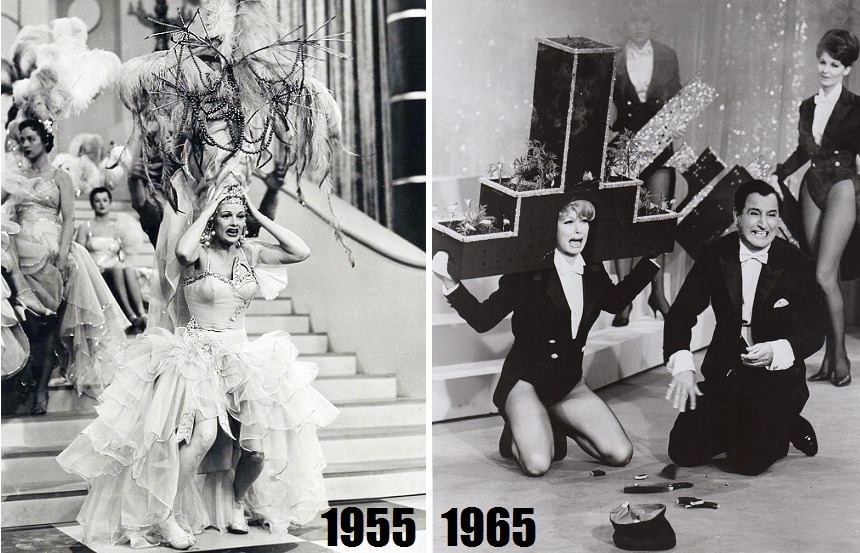
In “Lucy Gets Into Pictures” (S4;E18 of I LOVE LUCY), Lucy the showgirl has trouble balancing a huge headdress while walking down a flight of steps on camera.
In “Lucy Helps Danny Thomas” (S4;E7 of THE LUCY SHOW),
Lucy the showgirl has trouble balancing a huge headdress while walking down a flight of steps on camera.
-
“Bullfight Dance”

(S4;E23 ~ March 28, 1955) Directed by William Asher. Written by Jess Oppenheimer, Madelyn Pugh, and Bob Carroll, Jr. Filmed on February 17, 1955 at Ren Mar Studios. Rating: 51.2/68
Synopsis ~ When Lucy is asked to write an article for Photoplay about what it’s like being married to Ricky, she uses it to blackmail him to get to perform in a TV benefit for the Heart Fund.

To type her responses to the article’s questions, Lucy uses a Hermes Baby Typewriter. No doubt the compact model was on loan from the hotel!

The Heart Fund was a favorite charity of the Arnazes in real-life, too. During June 1956, they did a tag for an episode that reminded viewers that it was heart month and to support their local heart association.

The day this episode was first aired (March 28, 1955), Reba McEntire was born in McAlester, Oklahoma. Reba appeared with Lucille Ball on the 1988 “Bob Hope Birthday Special”, one of Lucy’s last TV appearances. In her 1995 special “Reba Live!” (above) Reba imagined doing a sitcom in the style of her favorite comedian, Lucille Ball. It is titled “I Love Flucy”.

In 2005, when TV Guide decided to eliminate their small-sized edition, Reba McEntire was asked to recreate their cover of Lucy stomping grapes from “Lucy’s Italian Movie” (S5;E23). In 2014, it was rumored that McEntire was in the running for an “I Love Lucy” reboot.

PhotoPlay was a fan film magazine first issued in 1911, the same year Lucille Ball was born. Its last issue was published in 1980. Ball was frequently mentioned in the publication and appeared on their cover in 1971, 1973, 1974, and March 1975.

In the 1938 film The Affairs of Annabel, Lucille ball played an actress who was featured on the cover of Photoplay!

Ricky anxiously watches over Lucy as she writes about him for Photoplay. He pretends to read the Hollywood Reporter.

Seeing Ricky on edge, Ethel comes to the rescue.
ETHEL: “Come on, Ricky. We’ll take you down to Wil Wright’s and buy you an ice cream soda. They’ve got 24 flavors, and I’ve only tasted 20.”

Lucille Ball was a big fan of Wil Wright’s Ice Cream, which is most likely why it was mentioned by gourmand Ethel. Virtually unknown on the East Coast, Wil Wright’s was a chain of old time ice cream parlors that dotted the West Coast until going out of business in the mid-1970s. Their rich recipe and variety of flavors made them a favorite of stars like Lucy and Marilyn Monroe – sort of the Baskin-Robbins of their day.

The scenes of the benefit television show (“Coast-to-Coast” for the Heart Fund), hosted by Ricky and featuring Lucy in the bullfight number of the episode’s title, are introduced with an establishing shot of the newly-opened CBS Television City building at 7800 Beverly Boulevard in Los Angeles, California. Although “I Love Lucy” was one of CBS’s strongest shows, Desilu was already happily ensconced at Ren Mar Studios. Lucy, Desi, Bill and Vivian did, however, participate in “Stars in the Eye,” the CBS special celebrating the grand opening.

To show off her musical prowess, Lucy briefly belts out “Let Me Go, Lover!”, a popular song, was written by Jenny Lou Carson and Al Hill, a pseudonym used by Fred Wise, Kathleen Twomey, and Ben Weisman. It was featured on the television program Studio One on November 15, 1954, a half hour after “Ricky’s Screen Test” (S4;E7). It was originally sung by Joan Webber, whose version hit number one, but it was also covered by Theresa Brewer and Patti Paige.

“Dear Old Donegal” is a traditional Irish folk song popularized by Bing Crosby and written by Steve Graham. The sequence with Fred and Ethel performing this song on the Heart Fund show (in full Irish regalia) is often cut in syndication, along with their brief rehearsal of the song earlier in the episode.

“Humoresques” is a piano composition by Antonín Dvořák written in 1894. It is one of the most famous piano pieces ever, although the lyrics used here were written much later. It is sung in counterpoint with “Old Folks at Home” (aka “Swanee River”) a minstrel song written by Stephen Foster in 1851. Ricky decides Lucy can’t handle the complexity of the piece and decides to put her in a bull costume while he sings “Fernando the Matador,” which seems to be an original song written for the show, perhaps by Elliott Daniel.

Roy Kellogg had played the assistant director (“Roll ‘em!!!”) in “Ricky’s Screen Test” (S4;E6) and returns here as the prop man in charge of the bull costume. Kellogg would return to Desilu for seven episodes of “The Lucy Show” and two episodes of “Here’s Lucy.” Of those nine appearances, he played a policeman in six of them!

Ross Elliott is back as the Publicity Agent, reprising his role from “Don Juan and the Starlets” (S4;E17). This time, however, he is listed as playing himself. Although using his own name for the character, Elliott was an actor playing a publicist, not a publicist appearing as himself.

The final look for the bull costume was no doubt inspired by Ferdinand the Bull, the story of the flower-loving bull, who’d rather pick, than face the picador. The character was integral to the story of Lucille Ball’s 1940 film Dance, Girl, Dance.

When Lucy plays the feminine bull for Ricky’s matador act, she kisses Ricky on the cheek while in the costume. This might have been inspired by a story about Lucy and Desi’s pet cow, Duchess of Devonshire, that they kept at their Chatsworth ranch. The Duchess loved Desi and once came in through the bedroom window to kiss Desi on the cheek while he was in bed.

During the rehearsal, Ricky yells offstage to Marco. Marco Rizo was Ricky / Desi’s accompanist.
FLASH FORWARD! LOTS OF BULL!

When “Lucy Goes To Mexico” in a 1958 episode of “The Lucy-Desi Comedy Hour” she gets to be the matador instead of the bull and has to fight a real bull! Naturally, a double for Lucy was used when fighting the actual bull. A double for the bull was used for scenes with the actual Lucille Ball!

Lucy’s feminine bull head prop turns up again on “The Lucy Show” in a 1967 episode titled “Viv Visits Lucy” (TLS S5;E15).

Although not mentioned by name, Wil Wright’s distinctive red striped bag was used when Lucy got some ice cream in when “LUCY PLAYS COPS AND ROBBERS”, a 1973 episode of “Here’s Lucy.”

Lucille Ball pantomimed a “BULLFIGHT” ‘dance’ on the game show “Body Language” in 1984. Exercise guru Richard Simmons was her partner.

Coincidentally, the first time Ricky Ricardo appeared on film he was wearing a pajama top with a snorting bull on the back! This is from the “I Love Lucy” pilot, which wasn’t shown to the public until 1990.

-
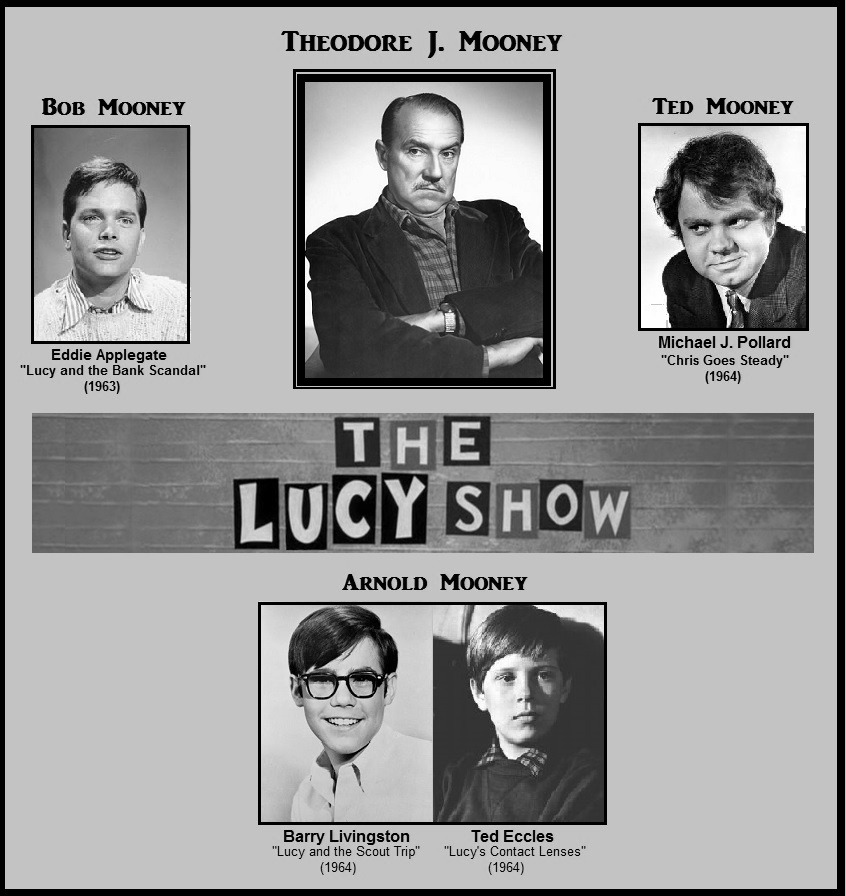
Meet the Mooney Boys!
-
Subscribe
Subscribed
Already have a WordPress.com account? Log in now.
 Papermoon Loves Lucy