-
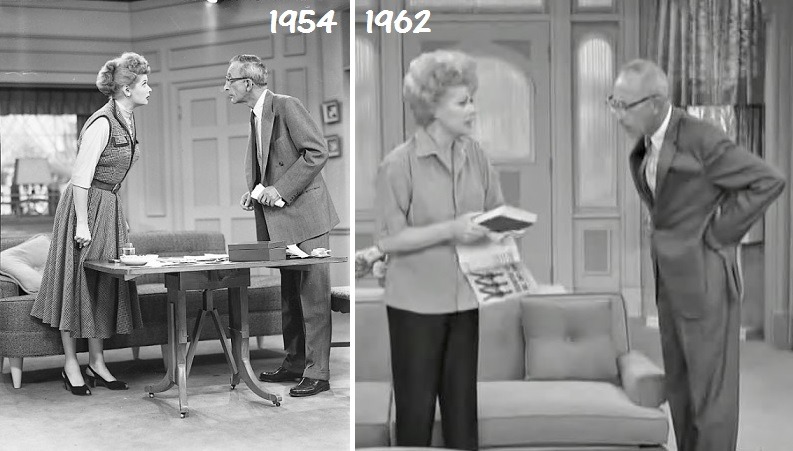
On I LOVE LUCY, Lucy’s finances were put in the hands of a tightfisted money manager played by Charles Lane.
On THE LUCY SHOW, Lucy’s finances were put in the hands of a tightfisted money manager played by Charles Lane.
-
“Lucy Learns to Drive”

(S4;E12 ~ January 3, 1955) Directed by William Asher. Written by Jess Oppenheimer, Madelyn Pugh, and Bob Carroll, Jr. Filmed October 28, 1954 at Ren-Mar Studios. It was the 109th episode filmed. Rating: 52.8/69
Synopsis ~ Ricky buys a new car to drive to California and Lucy immediately wants to get in the driver’s seat – to disastrous results, of course!

This is the second of three episodes where the gang prepare for the trip to California. The three episodes are inter-dependent, but best appreciated sequentially.

This is the first non-Philip Morris sponsored episode and introduced Proctor and Gamble as a sponsor, promoting their new blue Cheer laundry detergent.
LUCY: If we’re gonna live in Los Angeles, I have to know how to drive.
RICKY: Lucy, please, they got enough traffic problems in Los Angeles already.These lines were clearly written by Californians for a Los Angeles-based audience. Although LA’s traffic and smog problems are now legendary, in 1955 it would have been a local, not a national issue.

When Fred hears about the money he’s lost on the Cadillac, he goes into a comatose state!

The Mayer Twins play Little Ricky in this episode. This is their second season playing the character. Their regular sitter, Mrs. Trumbull (Elizabeth Patterson), is mentioned, but not seen.

Ethel claims that she doesn’t know how to drive, but she drove Lucy around during “The Camping Trip” (S2;E29). We only ever see Ricky give Lucy one driving lesson but she must have passed some sort of test, because she drives the Pontiac in both “First Stop” (S4;E13) and “Tennessee Bound” (S4;E14). By the time “The Lucy–Desi Comedy Hour” is filmed, Lucy Ricardo is a full-fledged driver. Lucy’s argument about how she should know how to drive in case someone gets sick on the trip is the same one she used as Stacy in The Long, Long Trailer (1953).

Ethel sarcastically compares Lucy (with her one hour of driving experience) to Barney Oldfield. Berna Eli Oldfield was an automobile racer whose name was synonymous with speed in the first part of the 20th century. He began racing in 1902 and continued until his retirement in 1918. He was the first man to drive a car at 60 miles per hour. He was inducted into The Automotive Hall of Fame in 1968.


The 1955 Pontiac Star Chief convertible used starting with this episode was part of a product placement deal with General Motors. The script even has Ricky promoting that the car’s 180 horsepower and automatic transmission.
Pontiac replaced its straight eight with a new V-8 engine in 1955.
In her book Laughing with Lucy, writer Madelyn Pugh says that each of the writers received a new car for two years because of this agreement.

To avoid the glare from the studio lighting, the windshields of the cars were removed.

The two cars were specially wired to be connected and separated. Neither car was actually driven on set.

When Lucy starts to drive the old 1922 Cadillac with the new Pontiac in tow, you can see a cable near the ground pulling the cars off.

When Ricky comes back from giving Lucy her first driving lesson, he babbles in Spanish. The translation is:
“It is impossible.
What happened is impossible.
You cannot explain to anyone what happened today in the tunnel.
What horror! How outrageous! If you tell someone, they won’t believe it!”
New Jersey’s ‘bridgegate’ scandal has nothing on Lucy, whose antics create 13 miles of gridlock and congestion. In the next episode “California, Here We Come!” (S4;E12), the tunnel is mentioned again when it is said that the overloaded Pontiac would never make it through the Holland Tunnel.

ETHEL (blank stare, long pause): No, you stay here and tell that story. I’ll drive the car to the garage.

LUCY: We’d better get away with it, or Ricky and Fred will be planting their footprints somewhere and it won’t be Grauman’s Chinese Theater.
The Hollywood landmark and premiere movie theater gets its own episode in “Lucy Visits Grauman’s” (S5;E1), above.

Editor’s Favorite! Outside of their classic stunts, this episode contains some of the best verbal interplay between Lucy and Ethel of the entire series. Lucille Ball, in deference to Vivian Vance’s truthful yet funny performance, even gives her the punch line: “What cars?” This is one of my favorite moments from the entire series.

At the end of the episode, Ricky tells Lucy what he thinks of her shenanigans, once again in Spanish. Here’s the translation:
“I do not know where to start. What’s wrong? Did you lose your sense? What do you have in your head? Don’t you have anything stuck in your head? Is the head dead? Do not you have anything here completely? One day I’m going to take you as if you were a chick and I’m going to take you by the neck and I’m going to put my fingers here and… (mimes strangling. Lucy quickly kisses him.)”

Although Ricky states that he used the Cadillac as a trade in to buy the new Pontiac, the vehicle actually turns up again, driven by Fred and Ethel, in “Lucy Hunts Uranium” (1958).

Backstage during the filming.
 1955, Automobiles, Barney Oldfield, Cadillac, CBS, Cheer, Desi Arnaz, East Orange NJ, Ethel Mertz, Fred Mertz, General Motors, Grand Central Station, Grauman’s Chinese Theatre, Henna Rinse, Holland Tunnel, I love lucy, Los Angeles, Lucille Ball, Lucy, Lucy Learns To Drive, Lucy Ricardo, Madelyn Pugh, Philip Morris, Pontiac Star Cheif, Procter and Gamble, Ricky Ricardo, tv, Vivian Vance, William Frawley
 -
“The Business Manager”

(S4;E1 ~ October 4, 1954) Directed by William Asher. Written by Jess Oppenheimer, Madelyn Pugh and Bob Carroll, Jr. Filmed June 17, 1954 at Ren-Mar Studios. Rating: 50.9/72

Synopsis ~ Tired of Lucy’s over-spending, Ricky hires a business manager. When all he gives her is $5 spending money, Lucy finds a way to outwit him and make extra money in the process!

This was the 100th episode filmed. After the filming, Lucy and Desi hosted a
party with a cake that said “The first 100 are the hardest." The episode was saved for the opening of season four, although for some reason “Lucy Cries Wolf” (S4;E3) and “The Matchmaker” (S4;E4), which were filmed before it, were broadcast later.

Right after this season four premiere on October 4, 1954, CBS debuted a new sitcom filmed by Desilu titled “December Bride” starring Spring Byington, Verna Felton (Lucy’s maid, Mrs. Porter), and Harry Morgan. This premiere episode featured Sam McDaniel, who will play the porter in “The Great Train Robbery” (S6;E5), the first black actor on “I Love Lucy.” He was also Oscar-winner Hattie McDaniel’s brother! It will also feature Moroni Olson, who played the Judge in “The Courtroom” (S2;E7). Desi Arnaz will play himself in a 1956 episode of the series, which ran until May 1959.
Waffles are a favorite breakfast for the Ricardos. As this episode opens, Lucy uses a new Westinghouse ‘Grill-n-Waffler’ Waffle Iron. In the above video, their spokeswoman Betty Furness demonstrates the product. She would also do TV ads with Lucy and Desi when Westinghouse sponsors “The Lucy-Desi Comedy Hour”.

Oops! Lucy was making waffles when the utilities were turned off so when she opens the waffle iron, there she finds nothing but gooey batter. The question is, why does the audience laugh when Lucy first puts the batter in the waffle maker, before it is discovered that the electricity is off? It is likely that the laugh track was added knowing the outcome of the joke, but without thinking of it from the audience’s perspective. It might also be due to this being a second or third take so the studio audience knew the outcome.

Lucy pours Ricky a nice cup of cold water while he reads the New York Daily Bulletin.

Groundhog Day Alert! If Ricky is looking at the newspaper for any current news, he’ll be disappointed. This is the same edition of the New York Daily Bulletin he read in “The Matchmaker” and “Lucy Cries Wolf,” which was the 100th episode aired. These are three of five episodes filmed at the end of Season 3 in June 1954, but saved for the start of Season 4.

When Ethel is calling her friend at the power company, the camera gets a back view of the planter on the ledge. It is also a nightlight! Apparently the light is not used as a nightlight as the cord is wound around the bulb’s base. One less item to bump up the unpaid power bill!

The Ricardos’ business manager was named after the Arnazes real-life business manager and Desilu vice-president Andrew Hickox. One of television’s most recognizable character actors Charles Lane makes his third of four appearances on the series, this time as Mr. Andrew Hickox. He would make two more appearances with the Ricardos on "The Lucy–Desi Comedy Hour” and go on to play another money-manager who frustrates Lucy, banker Barnsdahl on the first season of "The Lucy Show.” From 1933 to 1949 he appeared in seven films with Lucille Ball. He also appeared in five films with William Frawley.

During this time, Charles Lane was a recurring character on the NBC series “Dear Phoebe” starring Peter Lawford. It aired opposite CBS’s “Our Miss Brooks” starring Eve Arden. Sponsored by Campbell Soup, the series only lasted two seasons.
Lucy’s household debts include:
- $11.25 for telephone
- $8.75 for gas and electric
- $15.00 for cleaning and laundry
- $20.00 for the milk bill
- a total of $55. That is the equivalent of more than $500 today!

Lucy tries to flatter Mr. Hickox into giving her more money by comparing him to Clark Gable, a name that was frequently mentioned in the series, especially in season four as the gang headed to Hollywood. Lane actually did two films with Clark Gable one of which, 1958′s Teacher’s Pet, is seen above. While Gable never guest-starred on the "I Love Lucy” Lucy and the third Mrs. Gable, Carole Lombard, were friends and Gable appeared with Lucy on a 1944 radio play “China Seas.” In “Lucy and Harpo Marx” (S4;E28),
Lucy wears a Clark Gable mask to fool near-sighted Caroline Appleby.RICKY (to Fred): “Mr. Hickox? He makes you look like Diamond Jim Brady.”

James Buchanan Brady (1856-1917) was a real-life millionaire and philanthropist who was fond of jewels (hence the nickname). He had a longtime relationship with singer Lillian Russell. In the late 1960s, Lucy was announced to play Russell to Jackie Gleason’s Brady in a film project that never materialized. In future, the writers frequently compare thrifty characters (like Mr. Mooney on “The Lucy Show” above) to Diamond Jim Brady. Left with only $5 for the entire month (which she loses to Ethel betting she can’t wheedle Mr. Hickox out of more money), Ethel rubs it in by announcing she’s going shopping.

ETHEL: (To Lucy) “Anything I can get for you? There having a sale down at Saks.”
Saks Fifth Avenue, is a luxury department store that was founded in 1867 with their flagship store in Manhattan. The store still exist today and Saks now has stores nationwide. Packages from Saks were extensively used as props at the beginning of season 6, when Lucy and Ethel shopped for their trip to Florida.
Taking on the shopping of the entire building, Lucy thumbs through her shopping lists: “Benson, Williams, Trumbull.” Mrs. Benson (played by Norma Varden) made an appearance in “The Ricardos Change Apartments” (S2;E26), but no tenant named Williams ever appeared on the series. If the writers had longer memories, they might have mentioned Miss Lewis, who lived in the building and was even mentioned once after her only appearance by Bea Benadaret in “Lucy Plays Cupid” (S1;E15).

Mrs. Trumbull’s shopping list:
- a can of green beans
- a box of saltine crackers
- a large roasting chicken
- a quart of milk
- a bottle of sherry (”COOKING sherry”) = $4.23
After Mrs. Trumbull (Elizabeth Patterson) asks Lucy to buy her a can of All Pet cat food tomorrow, Lucy writes “Tuesday: Buy Can All Pet.”
Interestingly, the action of this scene is set on a Monday, the day of the week “I Love Lucy” aired and a day that became synonymous with all things Lucy.
When Ricky and Fred see the note pad, they think the cat food is a stock and that Lucy’s food market is the stock market.
FRED: “Get ready for another crash.”
The exact name of the cat food / fake stock Can All Pet (Canadian Allied Petroleum) wasn’t thought up until the day of filming. It was probably due to CBS lawyers trying to avoid actual stock names!
Mrs. Trumble owns a cat, but in “Little Ricky Gets a Dog” (S6;E14) Fred states that the lease says no pets allowed. According to Mrs. Trumble in “No Children Allowed” (S2;E22), she and the Ricardos signed the same lease. In an earlier episode, a worried Lucy mistakes the meow of Mrs. Trumbull’s cat for Little Ricky’s cry.

Ethel’s shopping list:
- a loaf of bread
- waxed paper
- a large jar of mayonnaise
- a sack of flour = $3.80
These same items shopped today would cost both Mrs. Mertz and Mrs. Trumbull a minimum of $18 each. The total amount Lucy owes the grocer in the end is $473, which is like owing $4,270 today! Luckily, Ricky gives her $500 from his stock market windfall to cover the debt.

Product Placement! This episode features quite a few products. Although most have their labels turned away from the camera, a few brand names are visible.
- Kellogg’s Corn Flakes – In 1954 artist Norman Rockwell did the art for the boxes. There was generally a free toy inside.
- Kellogg’s Rice Krispies – In the 1950s, in addition to Snap, Crackle and Pop, there was briefly a fourth gnome named Pow who represented the ‘explosive nutritional value’ of Rice Krispies.
- Quaker Oats Puffed Rice – The cereal’s slogan was “shot from guns”!
- Hills Bros Coffee – The brand name has been redacted by matching tape, but their distinctive can is recognizable due to the font and their logo of an Arab drinking coffee called "the taster”.

LUCY: (Listening) “Lucy to Little Small Voice. Lucy to Little Small Voice. Come in, Little Small Voice. Over.”
The episode ends with Ricky still thinking that Lucy has a “little small voice” that gives her stock tips. It would be interesting to know if Ricky ever found out the truth about Lucy’s marketing scheme!
FA$T FORWARD

In 1954, Lucy Ricardo’s finances were put in the hands of a tightfisted money manager played by Charles Lane. In 1962, Lucy Carmichael’s finances were put in the hands of a tightfisted money manager played by Charles Lane. The character was written out to make way for Gale Gordon to play Theodore J. Mooney.
1954, Andrew Hickox, Budget, Can All Pet, Canadian Allied Petroleum, CBS, Charles Lane, Desi Arnaz, Diamond Jim Brady, Elizabeth Patterson, Ethel Mertz, Fred Mertz, I love lucy, lillian russell, Lucille Ball, Lucy, Lucy Ricardo, Mrs. Trumbull, Ricky Ricardo, Stock Market, Super Market, The Business Manager, tv, Vivian Vance, William Frawley -
“Lucy’s Club Dance”

(S3;E25 ~ April 12, 1954) Directed by William Asher. Written by Jess Oppenheimer, Madelyn Pugh and Bob Carroll, Jr. Filmed March 11, 1954 at Ren-Mar Studios.
Rating: 59.1/85

Synopsis ~ With
the treasury of the Wednesday Afternoon Fine Arts League $1.14, it is
suggested they host a dance. When Ricky won’t volunteer his
services, the members form an all-girl orchestra that is woefully
inept!
This
episode was rerun during season five with a new opening in which Lucy and Ethel
are studying French books for the upcoming trip to Europe. Ricky
enters and announces he’s booked to play the London Palladium. A
messenger delivers two large gift-wrapped boxes, which turn out to
contain travel toothbrushes as a going-away present from the
Wednesday Afternoon Fine Arts League – which is all their budget
could afford. This leads remembering the club dance as a way to
raise money for the club. Very few of these ‘intros’ survive as they were not part of syndication and only aired once or twice.
At
the beginning of the club meeting, all the girls are gossiping about
the marital problems of Jim and Dorothy Wynn. They are the same
couple who sent Ricky flowers when he fibbed about his sprained
ankle in “Lucy Tells the Truth” (S3;E6). Lucy wants to know if
Jim really gave Dorothy a black eye. Lucy should know not to trust
gossip about black eyes, since “The Black Eye” (S2;E20) Lucy got
from Ricky tossing her a book was the source of lots of gossip!
ETHEL: “When Lucy plays the saxophone, it sounds like a moose with a head cold. I heard her play ‘Glow Worm’ once and no way.”
Ethel is referring to Lucy’s attempt at joining Ricky’s act in “The Saxophone” (S2;E2).

The song that the girls try to play for the club dance is “Twelfth Street Rag.” It was published by Euday L. Bowman in 1914. Years earlier, a friend of Bowman’s opened a pawn shop on 12th Street. Bowman is rumored to have said “If you get rich on those three balls, I’ll write a piece on three notes to make myself rich.” The result became one of the best-selling rags of the ragtime era.
In Ricky’s group, Marco Rizo plays the piano, Ralph Brady is on trombone, and Tony Terran on trumpet.
Ethel’s keyboard skills seem to come and go. Here she barely can plunk out a tune, but in “Breaking the Lease” (S1;E18) and “The Operetta” (S2;E3), she’s another Liberace! Marion Strong (Shirley Mitchell) is the troupe’s publicist and doesn’t play in the orchestra. This is the character’s last appearance on the series, but we learn her husband’s name is Bill. Besides Ethel on the ’88’s’, Lucy plays her saxophone, Carolyn Appleby (Doris Singleton) plays the drums, Marie plays the trumpet, and Jane (Fern Jaros) plays the trombone. The latter three un-credited performers are new to the cast, and were likely hired for their familiarity with the instruments.

Blooper Alert! During the club meeting, Caroline mentions that Neeva Summer plays the violin and indicates the woman on her right. Marion chimes in that Jane Beebo plays the trumpet, pointing to the woman on her left. But when the troupe is assembled in Ethel’s apartment, Lucy introduces the violinist as Marie and the trombonist as Jane Beebo. It was probably Lucille Ball who mis-identified the band members since she had the most dialogue to contend with while Doris Singleton and Shirley Mitchell only have a couple of lines, and probably would have gotten them right.

When news that Ricky is involved with Lucy’s group hits the papers, Lucy does everything she can to avoid him seeing the news!

Oops! The
headline of the New York Gazette reads "Bond Issue Defeated.”
The same exact prop newspaper was used in “Ricky’s Old Girlfriend”
(S3;E12).RICKY: “Fred, would you like to get your coat and take a little stroll down to the corner newsstand with me?”

As Ricky and Fred round the corner headed for the newsstand, they are in front of Roseland, and the 8th Avenue Subway. It seems Ricky and Fred’s “little stroll” to get a newspaper has taken them past quite a few “corners” from their East 68th Street apartment house.
Oops! The station for the 8th Avenue (IND) subway near Roseland was at 50 Street and 8th Avenue, a block South and another (long) block West.

The Roseland Ballroom was originally located at Broadway and 51st Street, but this location was torn down in 1956 (two years after this episode first aired) and move to 52nd and Eighth. That location closed for good in 2014.

At the news stand, there are three different issues of TV
Guide displayed:- February 26, 1954 issue featuring Liberace. Liberace was mentioned three times on “I Love Lucy” and will guest star as himself on a 1970 episode of “Here’s Lucy.”
- March 12, 1954 issue featuring Maria Riva, actress and daughter of Marlene Dietrich. Lucy would play Dietrich from The Blue Angel in a 1971 episode of “Here’s Lucy.”
-
January 12, 1954 issue with “I’ve Got A Secret” on the cover. Lucille Ball appeared on the game show four times.
There are also glimpses of periodicals like Art Photography, Auto Age, Life, Readers Digest, Sports, and National Geographic.
About the newspapers, Ricky mentions the morning and afternoon editions. At the time, there were seven daily newspapers in New York City, and most of them published a morning and an afternoon/evening edition. Today, newspapers are lucky to publish once a day, if they haven’t gone online completely.

The newsstand also has a rack of paperback pulp novels in a display rack labeled Lion Books. Lion was formed in 1949 and sold in 1957. Their titles were 25 cents and sometimes featured provocative cover art.

“Ricky Loses His Temper” (S3;E19) features the same issue with “I’ve Got A Secret” on the cover. The Arnazes felt a debt of gratitude to the magazine for putting
Lucy on the cover of their very first national edition exactly one
year before this episode aired.
Two weeks after it was broadcast, Lucy graced yet another TV Guide cover, one of two in 1954. Lucy has been seen on a total of 36 TV Guide covers, more than any other person.

While Lucy is taking care of the newspaper problem, Ethel sits with Little Ricky, who is mentioned but not seen in this episode. Typically, Lucy would call Mrs. Trumbull for babysitting services.
For More about “I Love Lucy” and TV GUIDE Click Here!
For More about Magazines Seen on “I Love Lucy” Click Here!
For More about Newspapers Seen on “I Love Lucy” Click Here!

Oops! When Ricky’s ‘dragtime’ band files out to take their places through a curtain.But after the last man is through the curtain, just before Ricky emerges, head down in embarrassment, a nearly imperceptible film edit was made. If you look closely you can tell by the movement of the curtain.
This
is reportedly one of Desi Arnaz’s least-favorite episodes, but he never said
why. Perhaps it was having his band dress in drag in the final
scene? This was five years before the release of Some Like It
Hot, in which Tony Curtis and Jack Lemmon dress like women to
join an all-girl band. Marilyn Monroe, a star frequently mentioned
on “I Love Lucy,” was also in the film.
One of the best known
all-girl orchestras was led by Phil Spitalny, who frequently
appeared on Ed Sullivan’s “Toast of the Town” in the early 1950s. In “Lucy Is Jealous of Girl Singer” (S1;E10), Ricky
threatens his band by saying “The
first fellow who acts like he’s playing in his sleep is going to
get traded to Phil Spitalny.” In
a way, that threat was made good in “Lucy’s Club Dance!”
FAST FORWARD!

The idea of Ricky refusing to lend his services and Lucy forming an ad-hoc band to play in public was explored again during Season 6 in “Ragtime Band” (S6;E21).
Dances were popular social events in the 1950s and ‘60s. Here’s a look at some dances attended by Lucy…

Sexy Diana Jordan (Barbara Eden) certainly was the attraction at Westport’s “Country Club Dance.” If she had a ‘dance card’ this might be what it looked like. Diana’s heart belonged to Pat Boone!

Lucy Carmichael is also invited to a country club dance – but can’t get her skates off in this 1964 episode of “The Lucy Show.”

If a dance is thrown by the super rich, it is known as a soiree or a ball.
Lucy Carmichael models herself after a fair lady named Eliza Doolittle in this 1965 episode of “The Lucy Show.”

Here Lucy Carter is on the arm of a joker named Tony Rivera (Caesar Romero) in a 1969 episode of “Here’s Lucy.”

If it was drag that made Desi Arnaz uncomfortable, it didn’t seem to bother William Frawley, who wore a wig and make-up in “Ricky Asks For A Raise” (S1;E35). In future Lucy-coms, Gale Gordon also often proved that “females are fabulous.”
For A Tribute To Lucy’s Best Drag Click Here!
12th Street Rag, 1954, All-Girl Orchestra, CBS, Desi Arnaz, Doris Singleton, Drag, Ethel Mertz, Fred Mertz, I love lucy, Lucille Ball, Lucy, Lucy Ricardo, Lucy’s Club Dance, Magazines, News Stand, Newspaper, NYC Subway, Phil Spitalny, Ricky Ricardo, Roseland Ballroom, Saxophone, Shirley Mitchell, Some Like It Hot, tv, TV Guide, Twelfth Street Rag, Vivian Vance, Wednesday Afternoon Fine Arts League, William Frawley -
“Lucy’s Show-Biz Swan Song”

(S2;E12 ~ December 22, 1952) directed by William Asher, written by Jess Oppenheimer, Madelyn Pugh and Bob Carroll, Jr. Filmed on October 17, 1952. This was the 47th episode of the series. Rating: 64.9/90
Synopsis ~ Ricky is producing a Gay ‘90s revue at the club, and Lucy wants to get into the act – even though she is several months pregnant!

To hide her pregnancy, Lucy decides to sing “Roll Out The Barrel” – until she is reminded that it is not a gay 90s song. [It was written in 1927.]

As for this being Lucy’s show business swan song, in “The Indian Show” (S2;E24), just a few months later, Ricky once again reminds Lucy that her primary job now is now to take care of the baby, and cites her performance in this episode as her farewell to the stage.

“Presenting those incomparable exponents of mellifluous melody, heartwarming harmony, and appropriate terpsichore – the Merry Mertzes!”
Fred and Ethel do an impromptu audition for Ricky with “Carolina in the Morning,” which they first sang in the ‘Flapper Follies of 1927’ scene in “Ricky Loses His Voice” (S2;E9). They hastily remind Ricky of the appearance and that he thought they were pretty good. The song was was written in 1922 by Gus Kahn and Walter Donaldson and introduced to the world by none other than William Frawley (Fred Mertz) in his vaudeville act.

Frawley sang the song on screen in The Lemon Drop Kid (1951) and again on a 1963 episode of "My Three Sons.”

Lucy grabs a parasol and does an impromptu chorus of “While Strolling Through the Park One Day,” which is actually titled “The Fountain in the Park” and was written by Ed Haley around 1880. It was sung by Judy Garland in the 1940 film Strike Up the Band. Fred sang a bit of the song earlier in the year in “Pioneer Women” (S1;E25).

In 1971′s “Lucy’s Lucky Day” (HL S4;E15), Lucie Arnaz and Gale Gordon perform the song again.

Next day at the Tropicana, Jerry (Jerry Hausner) tells Ricky that an act called McGillicuddy and Mertz are there to audition. Just over his shoulder, pianist Marco Rizo eagerly anticipates Jerry handing him the sheet music.

Lucy and Ethel sing "By the Light of the Silvery Moon” which was written in 1909 by Gus Edwards and Edward Madden. A few months after this episode first aired, Doris Day appeared in a film of the same name, which also starred Lucy’s good friend Mary Wickes.

Oops! If you look closely during Lucy and Ethel’s performance of the song in this episode, you can see Lucy discreetly pull a string on her skirt, which made the pantaloons fall down.

"Goodnight, Ladies” is a mid-19th century folk song attributed to Edwin Pearce Christy that was originally intended to be sung in a minstrel show. Meredith Willson wove the song into the score of his 1957 Broadway musical The Music Man, in which it was sung by a barbershop quartet. The 1962 film version also starred Mary Wickes.

“Sweet Adeline” was first published in 1903 with lyrics by Richard H. Gerard to music by Harry Armstrong, from a tune he had written in 1896. It is now considered a barbershop standard, even lending its name to a worldwide association of female barbershop singers. Rumor has it that William Frawley was really not happy having Lucy sing this song off-key. Even though her terrible singing voice was part of Lucy’s character, Frawley hated to hear a cherished classic butchered. He later equated Lucy’s off-key singing to "shit on baked Alaska.” Of course, Lucille Ball was very capable of carrying a tune, and had to consciously try to sound bad.

In a 1963 episode of “The Lucy Show,” Lucy and Vivian Vance again sing in a barbershop quartet, this one comprised of volunteer female firefighters called The Four Alarms. Once again, Lucy is not originally involved in the quartet but wangles her way in when someone drops out. Once again they get to sing “By the Light of the Silvery Moon.”

For some reason this episode ran short, so Desi’s friend and fishing buddy Pepito the Clown (aka Pepito Pérez) was asked to come and do his act, which was edited in to the episode afterwards. Pepito had appeared in the pilot and he was supposed to reprise his scene for "The Audition” (S1;E6), but he wasn’t available at that time so Buffo the Clown was used instead.

Most of Pepito’s act in the pilot is repeated here, minus the lion trainer bit, which wasn’t in the pilot. Ricky calls it his “imitation of Clyde Beatty,” a name that is evoked when Lucy steals the baby elephant in “The Kleptomaniac” (S1;E27). Even the instrumental music that plays while Pepito reveals his over-sized wristwatch is exactly the same as in the pilot. Pepito does his imitation of a baby cry, which is ironic since when Little Ricky is born, he will provide the off-screen crying during season two.

The entire costume Pepito wears in this episode is now in the Lucy-Desi Museum and Center for Comedy in Jamestown, New York. This extra scene was filmed November 7, the night “Lucy Becomes a Sculptress” (S2;E15) was produced.

To further fill the show, the Santa Claus / Christmas tag that aired after 1951’s “Drafted” (S1;E11) was added onto the end. The 4-minute Christmas greeting for viewers depicted the Ricardos and Mertzes are all dressed as Santa Claus singing “Jingle Bells” around a Christmas tree. Suddenly there are five Santas – Lucy, Ricky, Fred, Ethel – and the real thing. “Merry Christmas, everybody!”

This scene was not filmed in front of a live audience and was later cut for syndication and reruns. In season six (Christmas 1956), this premise would be fleshed out to a full special episode that would be considered ‘lost’ until 1989. In that special, parts of the barbershop quartet finale in this episode were used as flashbacks.
Coincidentally, the barbershop quartet ended up being one of the flashbacks in the 1956 “I Love Lucy Christmas Show.”

When this episode originally aired, Alfred Lyons, head of Philip Morris, appeared in a commercial that basically inferred that “I Love Lucy” could be canceled if viewers didn’t buy more of their cigarettes. I guess he didn’t see the GIANT cigarette that Pepito was smoking in his act!

In the 2005 movie, Monster in Law, when Jennifer Lopez is flipping through the channels on her television, she stops at the barber shop number in this episode.
1952, Barbershop Quartet, By the light of the Silvery Moon, Carole Cook, CBS, Clyde Beatty, Desi Arnaz, Dorothy Konrad, Ethel Mertz, Fred Mertz, Gay 90s, Goodnight Ladies, I love lucy, Lion, Lucille Ball, Lucy, Lucy Ricardo, Lucy’s Show-Biz Swan Song, Pepito Perez, Pepito the Clown, phillip morris, Ricky Ricardo, Strolling Through the Park, Sweet Adeline, The Fountain in the Park, The Lucy Show, tv, Vivian Vance, William Frawley -

- In “Lucy’s Show-Biz Swan Song,” a 1952 episode of I LOVE LUCY, Lucy and Vivian Vance sing “By the Light of the Silvery Moon” and Lucy wangles her way into performing with a barbershop quartet.
- In “Lucy’s Barbershop Quartet,” a 1963 episode of THE LUCY SHOW, Lucy and Vivian Vance sing “By the Light of the Silvery Moon” and Lucy wangles her way into performing with a barbershop quartet.
-
“The Inferiority Complex”
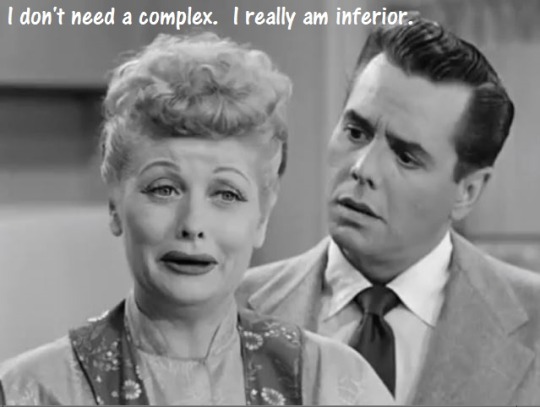
What do you say we all watch the television?
(S2;E18 ~ February 2, 1953) Directed by William Asher. Written by Jess Oppenheimer, Madelyn Pugh, and Bob Carroll, Jr. Filmed September 6, 1952 at General Service Studios. It was the 46th episode filmed. Rating: 69.9/90
Synopsis ~ Lucy feels she can’t do anything right, so Ricky gets her professional help.

This episode is partly based on Lucy’s radio show, “My Favorite Husband”
episode #116 titled “Liz’s Inferiority Complex” broadcast
February 3, 1951.This is the second of five episodes filmed in late summer / early fall
1952 and saved for broadcast until after Lucille Ball started her
maternity leave. All five included opening scenes that mentioned or
showed the new Ricardo baby – then flashed back to an earlier story.
These opening scenes were normally cut when the episodes were
repeated and in syndication.
The 1953 original broadcast of this episode opens with Fred coming into
the Ricardo apartment where he finds Ricky surveying a coffee-table
full of gifts for Lucy. She is still in the hospital with newborn Little Ricky – but she’s getting a little depressed. One of the other ladies in the maternity ward just delivered triplets and another had twins. “Lucy thinks she short changed me,” Ricky explains. The triplets may have belonged to the Stanleys, born the same night as Little Ricky in “Lucy Goes to the Hospital” (S2;E16). Ricky hopes
the gifts (including fancy bed jacket that Fred models above) will cheer Lucy up. Ethel arrives, and the threesome remember an earlier occasion on which Lucy got depressed. At that point, we flashback to “The Inferiority Complex.” This was an oblique reference to post-partum depression, a condition that affects many new mothers.
On the day this episode originally aired (2/6/53), actor Alan Curtis died. Curtis had appeared in three films with Lucille Ball: One Live Ghost (1936), Winterset (1936), and Don’t Tell The Wife (1937).

The day this episode was filmed (9/6/52), the first Canadian television station went on the air in Montreal.

When Ricky insults Lucy for her inability to tell a joke, Lucy indignantly replies “Well! I’m sorry I’m not Milton Berle.” Milton Berle was a pioneer on television, hosting “Texaco Star Theatre” from 1948 to 1956 on NBC. He was one of “I Love Lucy’s” biggest competitors for ratings. After his show ended, he guest-starred on an episode of the “Lucy-Desi Comedy Hour” titled “Milton Berle Hides Out at the Ricardos” (1959) and the pair repaid him by appearing on one of his specials. Berle appeared on two episodes of “The Lucy Show” and “Here’s Lucy.” He died in 2002.

Gerald Mohr played psychiatrist Henry Molin MD, who masquerades as Ricky’s old friend ‘Chuck Stewart.’ The character was named after Henry D. ‘Bud’ Molin, a film editor on the show. Mohr (who bears a resemblance to Humphrey Bogart) makes his only appearance on the series. In return, Lucy and Desi appeared on his show “Sunday Showcase” that same year. He also made an appearance on “The Lucy Show” in “Lucy and Phil Harris” (TLS S6;E20) first aired on February 5, 1968. In 1920 Mohr’s father was killed in a tragic accident and he was raised by his mother and maternal grandfather, who was a psychologist and associate of Dr. Sigmund Freud, the famed psychoanalyst. Mohr became a fervent student of Freud as a result of this association. He doubtless used that knowledge to play Dr. Molin – or maybe not!

A lot of the humor in the episode comes from Ricky’s inability to pronounce the word ‘psychiatrist.’ He continually pronounces it ‘fee-suh-key-uh-trist.’ He even looks it up under ‘F’ in the phone book!

Bennett Cerf’s book “Try and Stop Me” (1944), can be glimpsed behind Lucy when she is sitting on the sofa. It was the first of a series of joke books compiled by Cerf, founder of Random House. It sold more than a million copies in its first two years of publication. The book also shows up in Lucy’s headboard bookcase in “Ricky Has Labor Pains” (S2;E14). Cerf is mentioned by Lucy in Lucy Writes a Novel” (S3;E24): “You had your chance, Bennett Cerf!” He was a frequent panelist on “What’s My Line?” on which Lucy guest starred four times between 1955 and 1965.


As a last resort, Ricky and the Mertzes use reverse psychology to lift Lucy’s spirits. Reverse psychology was a common plot point in the series. They later use it when “Little Ricky Gets Stage Fright” (S6;E4) to get him to play his drums. Later that same season, the girls use it on the boys to make them think they would be better at “Building a Bar-B-Q” (S6;E24).

Although it sometimes backfires, here the ploy works – except now they are
forced to listen to Lucy’s off-key rendition of the song “Who?” written by Jerome Kern and Oscar Hammerstein II. Coincidentally, it was introduced to the world by Paul Frawley, William Frawley’s brother, in the 1925 Broadway musical Sunny. Hammerstein was frequently mentioned on “I Love Lucy” – sometimes by just his first name.
Lucy tells a story about two guys named Pat and Mike, which also happens to be the title of a hit 1952 film starring Spencer Tracy and Katharine Hepburn.

Blooper Alert! Over the final credits announcer Johnny Jacobs says “The
part of Dr. Stewart was played by Gerald Mohr” instead of “The part of Dr. Molin was played by Gerald Mohr.”1953, Bennett Cerf, Broadway, Bud Molin, CBS, Desi Arnaz, Ethel Mertz, Gerald Mohr, Henry Molin, I love lucy, Jerome Kern, Lucille Ball, Lucy, Lucy Ricardo, Oscar Hammerstein II, Paul Frawley, Reverse Psychology, Ricky Ricardo, Sunny, The Inferiority Complex, Try and Stop Me, tv, Vivian Vance, Who?, William Frawley -
“The Saxophone”

(S2;E2 ~ September 22, 1952) Directed by William Asher. Written by
Jess Oppenheimer, Madelyn Pugh and Bob Carroll, Jr. Filmed June 6, 1952 at General Service Studios.
Rating: 67.5/65
Synopsis ~ When Ricky won’t take Lucy on tour, she dig out her saxophone in order to join the band! When that doesn’t work, she tries to convince him that leaving her behind might not be good for their marriage.
It was the 40th episode filmed but the 37th aired. It was the last filmed before an abbreviated summer hiatus (July 1952) in order to prepare for Lucille Ball’s pregnancy leave.


The date this episode went in front of the cameras regional TV Guide (New York and New England) had Lucy and Desi on the cover: “The Marriage That Fooled Hollywood”!
The episode’s plot parallels real life in that “I Love Lucy” was created to keep Desi at home with Lucy, and not on the road where he might encounter admiring (female) fans. Here, Lucy wants to go on the road with Ricky to prevent him from meeting admiring (female) fans.

Lucille Ball had briefly played the saxophone as a child. When the writers discovered this they asked Lucy if she could still play. She replied “No, but give me a week.” By the time rehearsals started she knew enough to get by. In fact, she practiced so much that she played a little too well and had to consciously remember to play the wrong notes. Writer Madelyn Pugh later said,
“As for Lucy playing the saxophone – she was a writer’s dream. No matter what we asked her to do – ride a lawnmower, jump on a trampoline, walk on stilts – she never said ‘No,’ just ‘Give me a few days to learn it.’"
In his autobiography, A Book, Desi Arnaz said,
“We could’ve had Lucy fake playing the xylophone and the sax, while someone off-camera did it, but it wouldn’t have been as funny as Lucy struggling to do it well herself.“

The episode opens with Lucy in the attic. This is the only time in the series that we see the attic of 623 East 68th Street. In an steamer trunk Lucy finds a couple of her old hats. One is a fancy bonnet she says she wore on 5th Avenue for the Easter parade, which was not a formal parade, but an informal stroll on Easter morning in order to show off one’s Easter finery. The tradition started in the 1880s and inspired Irving Berlin to write the song "Easter Parade” for the 1933 Broadway musical As Thousands Cheer. The song later served as the basis for the 1948 MGM film Easter Parade.

The other hat is a floppy cloche Lucy says she wore during her Greta Garbo period. She even sucks in her cheeks to complete Garbo’s gaunt look. Swedish-born Greta Garbo was an Academy Award-winning film star who left show business in 1941. Unlike Lucy, who stayed in public life till her death, Garbo became a legendary recluse.

Lucy also finds a mounted fish Ricky caught at Chautauqua Lake. Ethel dubs it a “rainbow sardine.”

When she finds her saxophone, she mentions to Ethel that she was in the high school marching band in Celoron in order to date a football player.
Celoronis located on Lake Chautauqua, a small suburb of Jamestown, New York.
In later episodes, Lucy preferred to say she was from Jamestown – or West Jamestown, as in “The Passports” (S5;E11).
Lucy demonstrates her musical skill for Ethel on her newly rediscovered saxophone. She toots out a halting, off-pitch version of “Glow-Worm.” "The Glow-Worm” is a song from Paul Lincke’s 1902 operetta Lysistrata. It was originally translated into English by Lilla Cayley Robinson and was used in the 1907 Broadway musical The Girl Behind the Counter as a last minute replacement for another song. Johnny Mercer later expanded and revised Robinson’s lyrics for a recording by The Mills Brothers, the same year this episode aired.

When Ethel requests “Star Dust” – it sounds exactly like “Glow-Worm”! ”Star Dust“ (or “Stardust”) was composed in 1927 by Hoagy Carmichael with lyrics added by Mitchell Parish in 1929. It became an American standard and is one of the most recorded songs of the 20th century with over 1,500 recordings. Shame we never hear it!

When his regular sax player gets ill just before the tour, Ricky gets on the phone to prospective replacements and calls Ralph Brady, who was the real-life saxophonist in the Desi Arnaz orchestra.

Brady has a solo riff (his ‘audition’) at the start of the scene at the Tropicana and is then asked to go to the office and make the deal.

This frees up his chair for the next candidate – Lucy! She has taken Fred’s advice to heart and dresses and talks like a stereotypical musician of the 1920s and ‘30s.

Lucy asks about Nancy, the harpist, who was also a real member of the orchestra. Ricky also mentions Marco. Marco Rizo was the orchestra’s pianist and Desi’s childhood friend. Both Nancy and Marco are in the above photo with Desi.

When Ricky tells Lucy she can’t come on the tour, she hatches a plan to make him wary of leaving her home alone: a secret lover.

Lucy pretends to be reading the November 1951 issue of Holiday Magazine. Holiday was a travel magazine published from 1946 to 1977 with more than one million subscribers at its height. The magazine employed writers such as Truman Capote, Joan Didion, James Michener, and E.B. White. The magazine was relaunched as a bi-annual publication in 2014, located in Paris, but written in English.

When Lucy asks Ricky for “a piece of the paper” she opens it so that the camera has a clear view of ads for Schaefer Beer and Johnnie Walker Whiskey.

This same copy of the newspaper also appeared on in “Job Switching” (S2;E1), a week earlier. In the late 1940s, Lucille Ball did print ads for Schaefer Beer.

Ricky recruits Jule, his musician’s union agent, to send over a few guys to participate in a scenario that will get back at Lucy for making up a mystery lover.
One of TV’s busiest character actors Herb Vigran (Jule) makes his series debut in this episode and immediately returns in “The Anniversary Present” (S2;E3) to play the same character. He will also play Mrs. Trumbull’s nephew Joe, the washing machine repairman, in “Never Do Business With Friends” (S2;E31) and Al Sparks, the publicist who turns Lucy and Ethel into Martians, in “Lucy is Envious” (S3;E23). Vigran also played the man who sold Lucy and Desi The Long, Long Trailer (1953) and returned to work for Lucy in six episodes of "The Lucy Show” between 1963 and 1966.

The handsome man hiding in the closet is played by Charles Victor, who makes his only appearance in the series. Victor was just 5 days older than Lucille Ball. Three other men are also hidden in there, but they go un-credited.

Count on Lucy to turn the tables once again and get back at Ricky! One of the boys must have spilled the beans to Lucy, who then got Jule in on the act.
FAST FORWARD!

Lucy Ricardo picked up the sax again in “Lucy’s Club Dance” (S3;E25)…

and in “Ragtime Band” (S6;E21), although in that episode “Sweet Sue” is the only song Lucy can play, not “Glow Worm.”

Lucy Carmichael played the sax in 1964′s “Ethel Merman and the Boy Scout Show” (TLS S2;E19) while a skeptical Mr. Mooney (Gale Gordon) looks on.

In 1971′s “Lucy and Her All-Nun Band” (HL S4;E8),
Lucy Carter subs on sax for a sick sister. [Say that three times fast!] The episode features noted saxophonist Freddy Martin.

When "Lucy Competes With Carol Burnett” (HL S2;E24) in the 1970 Miss Secretary Beautiful Pageant, Mrs. Carter’s talent is a playing the saxophone. Although Lucille Ball usually played either “Sweet Sue” or “Glow-Worm,” this time she attempts “Little Brown Jug.”

Bandleader Phil Harris has not one, but two sax players in his orchestra when he appeared on a 1974 episode of “Here’s Lucy”.

Lucy Barker wants to pass on her love of the saxophone to her granddaughter (Jenny Lewis) on an episode of “Life With Lucy” (1986).
SAXY MERCH!


CLOSET CASE!

Writer Madelyn Pugh remembers:
"For some reason, Bob [Carrol Jr.] and I liked the idea of people hiding in a closet. We used it in this show, and in a couple of other ‘Lucys.’ We even used it in the pilot of ‘The Mothers-in-Law’ fifteen years later – and it always got a laugh!”
When the boys are “Drafted” (S1;E11, bottom right), seven surprise party guests are hidden in the closet. Lucy and Ricky hide in the closet to celebrate their “Sentimental Anniversary” (S3;E16. left) and Lucy hides in the closet of the “New Neighbors” (S1;E21, top right) when caught snooping around their apartment.

“The Mothers-In-Law” (1967-69) was a sitcom created by Desi Arnaz starring Eve Arden and Herbert Rudley (above, in the closet) as well as Kaye Ballard and Roger C. Carmel.

Among the “couple of ‘Lucys’” mentioned by Pugh is a 1973 episode of “Here’s Lucy” where Lucy Carter, her family, and friends all get locked in her living room closet. Six is the same number of people stuffed in the closet during
“Drafted” (S1;E11) bringing things full circle!
1952, CBS, Celoron NY, Charles Victor, Chautauqua Lake, Desi Arnaz, Easter Parade, Ethel Mertz, Fred Mertz, Glow Worm, Greta Garbo, Herb Vigran, Holiday Magazine, I love lucy, Jamestown NY, Lucille Ball, Lucy, Lucy Ricardo, Ralph Brady, Ricky Ricardo, Sax, The Glow-Worm, The Saxophone, tv, Upstate NY, Vivian Vance, William Frawley -
“The Amateur Hour”
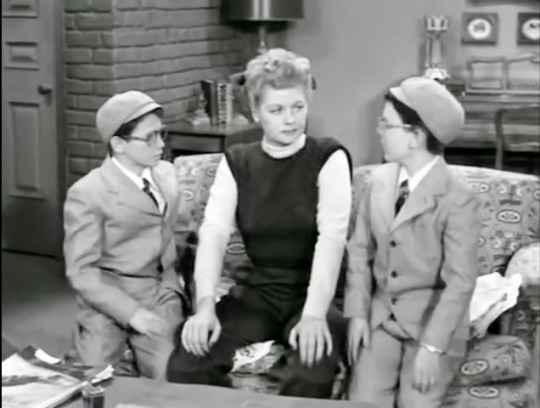
(S1;E14 ~ January 14, 1952) Directed by Marc Daniels. Written by Jess Oppenheimer, Madelyn Pugh, and Bob Carroll, Jr. Filmed December 7, 1951 at General Service Studio. It was the 14th episode filmed.
Rating: 50.1/72

This story was partly based on “Baby Sitting” episode #62 of Lucy’s radio show "My Favorite Husband,” broadcast November 11, 1949.
Synopsis ~ Needing money to pay for a new dress, Lucy replies to a newspaper ad for a baby sitter. She ends up trying to control unruly twins and then performing with them in an amateur talent show!

Lucy’s expensive dress might seem like a bargain at $59.95, but today the same dress would cost nearly $600! How will she convince Ricky to let her keep it?

Ethel makes a more practical purchase – but still needs to convince Fred to let her keep it!

This is the first time the Ricardos’ address of 623 East 68th Street is mentioned in the show. If the address really existed, it would be right in the middle of New York’s East River! In reality, East 68th Street terminates in the mid-500’s at FDR Drive.
William Frawley (Fred Mertz) does not appear in this episode. This is one of four episodes in which Fred is absent – all in season one. Frawley had a clause in his contract that he would be excused from work if the New York Yankees were in the World Series, which they were during the filming of “The Quiz Show” (S1;E5). One or two lines sound as they they may have been re-assigned to Ethel, but written for Fred. For example:
LUCY: It’s just a little boy.
Now, what do you think I better have ready for him when he gets here?
ETHEL: A little girl.Also absent, but at least mentioned by name, is Jerry Hausner as Ricky’s agent, Jerry. Hausner was in the pilot and was considered a regular character for the first season.

As Ricky leaves the kitchen, viewers get a good look at two items on Lucy’s kitchen wall: a match holder and a ceramic salt box. Although both familiar items in early 20th century kitchens, they are rarely seen today. Oddly, the set designer has placed them near the sink, rather than the stove, where they were most commonly found. Salt and matches needed to be kept dry and away from moisture.

When the twins tie up Lucy playing cowboys and Indians, the scene is very reminiscent of a scene from the 1950 Lucille Ball film The Fuller Brush Girl.

The rooster pattern on the salt box matches the front of the kitchen counter. In this episode we see more of the counter than in any other episode because it is used as a chalkboard by one of the twins! Seeing so much of the counter is a bit disorienting for TV viewers – who might have thought the counter was against the “fourth wall”. Practically speaking this counter could be moved out of the way for better camera angles of the kitchen set.

While reading the The New York Times help wanted ads, Lucy reads Ricky a list of available jobs: Stenographer, Bookkeeper, Cook, Lady Wrestler. When Lucy and Ethel seek employment in “Job Switching” (S2;E1), they visit an employment agency where the clerk reads off a similar list of job openings: Stenographer, Bookkeeper, Cantometer Operator, Dental Technician, Insurance Adjuster, before offering them positions Kramer’s Kandy Kitchen. One of the series’ most iconic moments might never have occurred had Lucy and Ethel lied their way into being Cantometer Operators instead of candy makers!
This is one of the only times a real newspaper (as opposed to one created as a prop) was used in the series. The New York Times was founded in 1851 and still printed today.
LUCY: This is terribly unfair. Apparently you can’t get a job in this town unless you can do something!

An ad for babysitter at fifty cents an hour seems too good to be true, so Lucy calls about it and gets the job. Thinking she’s sitting for one boy – she’s actually minding two!
Lucille Ball wore shin guards to protect her from the twins kicking her repeatedly, but she still ended up badly bruised.

Unlike the the Borden twins (Teensy and Weensy in “Tennessee Bound,” S4;E14), the rambunctious Hudson twins were not actually twins or even brothers, but two young actors costumed to look identical.

David Stollery (Timmy Hudson) was 10 years old at the time this episode was filmed. His first screen appearance was in A Connecticut Yankee in King Arthur’s Court (1949). He later played Marty on the “Spin and Marty” serials on “The Mickey Mouse Club.” When Disney created “The New Adventures of Spin and Marty” in 2000, he made a cameo appearance as Commissioner Stollery. He left show business to join the automobile industry and is credited with the design of the 1978 Toyota Celica.
Sammy Ogg (Jimmy Hudson) was a 12 year-old actor originally from Virginia. He made his screen debut at the age of 6. His most TV credits include 7 episodes of "Dragnet” between 1952 and 1959. From 1955 to 1957 he played Joe in several “Spin and Marty” films and television shows alongside his Lucy ‘twin’ David Stollery!

Gail Bonney (Mrs. Hudson) had appeared in two 1950 films with Lucille Ball: The Fuller Brush Girl and A Woman of Distinction. She re-teamed with Lucy in a 1965 episode of "The Lucy Show” and a 1968 episode of "Here’s Lucy.”

Coincidentally, Ricky is the host of the Blue Bird Club’s Amateur Contest that Mrs. Hudson and the twins are entered in. For the cash prize, Lucy agrees to take Mrs. Hudson’s place.

The scene opens on stage with Ricky thanking “Little Willie Mae, who played the guitar with her feet,” an act I wish were shown in the episode! It can’t be more ridiculous than the woman who sings like a chicken featured in “Lucy Tells the Truth” (S3;E6)! In reality, Willie Mae (Barker) was name of the Arnazes’ maid and nanny. In Lucy’s final sitcom "Life with Lucy,” Lucille Ball’s character was named Lucy Barker in her honor.

The song "I’m Breaking My Back (Putting Up A Front For You)” was written by Ozzie Nelson and Al Jones in 1947. The original featured back-up vocals by Harriet Hilliard (Nelson). At the same time as “I Love Lucy” was airing on CBS, the married couple had a show on ABC called “The Adventures of Ozzie and Harriet.”
The name “Blue Bird Club” was doubtless inspired by the label that issued the song: Bluebird Records. It was known for its low-cost releases, primarily of blues and jazz in the 1930s and 1940s. It was founded in 1932 as a lower-priced RCA Victor subsidiary label. Bluebird concentrated on producing and selling music inexpensively. It created what came to be known as the “Bluebird sound”, which influenced rhythm and blues and early rock and roll.

“Ragtime Cowboy Joe” was sung in a 1940 film of the same name. It was written in 1912 by Lewis F. Muir, Grant Clarke, and Maurice Abrahams. It was recorded by bandleader Eddy Howard in 1947 and was later covered by Jo Stafford, as well as the Chipmunks.

Lucy would dress like a cowboy again in “Home Movies” (S3;E20). As stunt performer ‘Iron Man Carmichael’ Lucy does the same in 1965, in an image that would become part of “The Lucy Show” opening credits.

The boys secretly have their frog Elmer in their pocket. A special close-up insert shot of the frog jumping down the back of Lucy’s shirt had to be done after the studio audience had departed.

In 1967, Lucy Carmichael takes a babysitting job for triplets who turn out to be a trio of chimpanzees!
Lucy Ricardo (1952): Listen, for $5 an hour I’d sit with a baby gorilla.
Be careful what you wish for!

In 2007, Hudson Twins David Stollery (age 66) and Sammy Ogg (age 68) sang “Ragtime Cowboy Joe” with Lucy-impersonator Diane Vincent during one of her “I Love Lucy” tribute shows.

The morning that this episode was originally aired, NBC launched “The Today Show,” a program that is still on the air today. Dave Garroway was the show’s first host.
 1952, Allie Wrubel, CBS, David Stollery, Desi Arnaz, Diane Vincent, Ethel Mertz, Fred Mertz, Gail Bonney, Hudson Twins, I love lucy, I’m Putting Up A Front, kitchen, Lucille Ball, Lucy, Lucy Ricardo, Match Holder, new york times, Ragtime Cowboy Joe, Ricky Ricardo, Salt Box, Sammy Ogg, Spin and Marty, The Amateur Hour, The Lucy Show, Today Show, tv, Vivian Vance, Walt Disney, William Frawley
 -
“Lucy Misses the Mertzes”

(S6;E17 ~ February 11, 1957) Directed by William Asher. Written by
Madelyn Martin, Bob Carroll, Jr., Bob Schiller and Bob Weiskopf. Filmed on December 20, 1956 at Ren-Mar Studios. Rating: 38.8/50

Synopsis ~ When the Ricardos finally leave the Mertzes apartment and move to Westport, separation anxiety sets in for both couples.
The episode opens in the Mertzes apartment on the day the Ricardos are finally moving out. Ricky is eager to become a “country square” and a looking forward to being “suburbaneeties.” The last mover leaves and Ricky announces that it is time to go. There is an awkward silence between Lucy and Ethel – two friends not knowing how to say goodbye. The scene beautifully straddles the line between drama and comedy. Even grumpy old Fred wipes away a tear.

In a moment that can only be described as ‘adorable’ Little Ricky imitates Lucy and Ricky by carrying Fred the dog across the threshold of their new home.
Sitcom Logic Alert! In the Act 2 opener, each of the foursome successively ‘forget’ that they are no longer living in the same building – let alone the same state – and start calling and looking for each other before catching themselves. The scene feels somewhat contrived; the viewer can believe it happening once (maybe), but not four times in a row!

The Westport train station is decorated with American Red Cross posters, a favorite item of the Desilu set decorators. They were previously glimpsed decorating the butcher shop in “The Freezer” (S1;E29), the rented hall in “Ricky Has Labor Pains” (S2;E14) and the subway train in “Lucy and the Loving Cup” (S6;E12, right). The magazine stand has a TV Guide with Victor Borge on the cover dated December 8-14, 1956. The episode was filmed a week later.

This is the first episode to mention the exact Connecticut town the Ricardos have moved to. The boy delivering the fruit basket says “Welcome to Westport!” Writer Madelyn Pugh visited the town in early December 1956, and was convinced that instead of a ‘fictional’ town, they should use Westport, Connecticut. Betty and Ralph Answanger (a Broadway set designer and his wife who’s first names were given to the Ricardo’s new neighbors, the Ramseys) showed Pugh around and then later sent her photos of various Westport locations, including the train station.

Fred is reading The Sporting News with a full page ad for L&M cigarettes on the back page. The episode was filmed five days before Christmas, so it is a holiday-themed ad. The show is no longer sponsored by Philip Morris, so things like this are no longer forbidden.

This episode is actually sponsored by Lilt:
JOHNNY JACOBS (Announcer): "’I Love Lucy’ starring Lucille Ball and Desi Arnaz, was brought to you by new Lilt, the only home permanent with squeeze-bottle magic. The fastest, easiest home permanent ever.”
$$ 1957 $$
- Fred complains that he spent $2 on a taxi to Grand Central and $6.16 on train tickets. In 2015 a one-way off-peak train ticket from Grand Central to Westport (bought at the station) cost $12.50, just about double what Fred paid in 1957. The two mile taxi ride from East 68th Street to Grand Central, however, would today cost a whopping $17.88!
- Ethel’s precious $16 shoes (which Fred won’t leave without retrieving) would cost $143 today.
-
When the Ricardos arrive at their new home, they find that the Mertzes have sent a $10 fruit basket, which was an expensive gift for miser Fred. today that $10 basket would cost nearly $90! The basket also contains jars of jam and a book.

Ethel has to wait to use the train station pay phone because “Some teenager was talking to her girlfriend about that Elvis what’s-his-name.” This marks the only mention of Elvis Presley on the series. On January 6, 1957, a month prior to this episode’s airing, Presley made his third and final appearance on Ed Sullivan’s “Toast of the Town.” In this broadcast Elvis was only shown from the waist up! A month prior to filming of this episode in December 1956, Elvis’ movie Love Me Tender was released. A few days later it was announced that Elvis had been drafted. It was around this time that the phrase “Elvis has left the building” was first uttered.

Oops! When Lucy can’t get to sleep because of all the country quiet she suggests that Ricky take up snoring, presumably because he doesn’t snore. But in “Bullfight Dance” (S4;E22) Lucy has to fill out a questionnaire about Ricky for a magazine which asks if Ricky snores. She answers yes by spelling out the sounds that Ricky makes when he snores.

A single bed turns into a family affair! Actor Keith Thibodeuax seems to be really enjoying this scene!

Lucy has packed their Telchron Dorm model electric alarm clock previously seen in “Lucy Hates To Leave” (S6;E16). Unfortunately, the electric cord is showing, which was against Telchron corporate policy!

Oops – Part 2! There is a fireplace in the Ricardos’ bedroom. We won’t see the bedroom again until 1958 on The Lucy-Desi Comedy Hour episode #7, “Lucy Makes Room for Danny” when the fireplace has mysteriously disappeared.

“Lots of happiness in your new home. From your dear friends, Fred and Ethel.”

While waiting to surprise the Ricardos, Fred and Ethel enjoy some fruit from the basket they sent them.
Fred took a bite out of an apple from the fruit basket, the close-up shot showed an ORANGE with a bite taken out of it. But maybe Fred ate the orange when the camera wasn’t on him.
Ethel eats a banana, which seems to be a her favorite since she also selected it from the bon voyage fruit basket in “Second Honeymoon” (S5;E14).

In the close-up of the fruit the top right of the frame is occupied by a cigarette box. It is a chalkware box made by Borghese. It might also be used as a trinket or jewelry box.

Tristram Coffin would return to play neighbor Harry Munson again in “The Country Club Dance” (S6;E25). In that episode we also meet his wife, Grace, played by Ruth Brady, although in “The Club Election” (S2;E19) the role was played by Hazel Pierce. The Munsons moved to Westport before the Ricardos and the couples reside about a mile away from one another. They also have a little boy, Billy, who – along with Stevie Appleby – will become one of Little Ricky’s pals.

The scene at the train station is a in the best tradition of farce, with both couples narrowly missing one another in the same space.

Jess Kirkpatrick plays the Westport Train Station Agent. He would return for a brief appearance in “Lucy Goes to Alaska,” a 1959 episode of “The Lucy–Desi Comedy Hour.”

Little Ricky is played by Keith Thibodeaux (aka Richard Keith) and Fred the Dog is played by Danny.

Gary Gray (Delivery Boy) was 21 years old at the time and had been a child actor, making his film debut at age 5. He continued to act until 1962 when he started a pool maintenance company to support his family. Gray died in 2006 at age 69.

Robert Bice (Moving Man) specialized in background characters, making hundreds of appearances in the 1950s.
From the above screen shot, we see that parakeets Mildred and Charles and goldfish Phil and Alice made the move! These pets were introduced in “Little Ricky Gets a Dog” (S6;E14).
Mrs. Trumbull is mentioned (by Fred) but does not appear in the episode.
1957, CBS, Desi Arnaz, Elvis Presley, Ethel Mertz, Fred Mertz, Fred the dog, I love lucy, Jess Kirkpatrick, Keith Thibodeaux, Little Ricky, Lucille Ball, Lucy, Lucy Misses the Mertzes, Lucy Ricardo, Red Cross, Richard Keith, Ricky Ricardo, Sporting News, Tristram Coffin, tv, Vivian Vance, Westport Connecticut, William Frawley
-
Subscribe
Subscribed
Already have a WordPress.com account? Log in now.
 Papermoon Loves Lucy