-
“Lucy Meets Orson Welles”

(S6;E3 ~ October 15, 1956) Directed by James V. Kern. Written by
Madelyn Martin, Bob Carroll, Jr., Bob Schiller and Bob Weiskopf. Filmed June 14, 1956 at Ren-Mar Studios. Rating: 43.8/62
Synopsis ~ Ricky tries to pack Lucy off to Florida rather than have her involved in Orson Welles’ act at the new Club Babalu.
This is one of four episodes filmed at the end of season 5, but held over until the start of season 6. During the opening dialogue Lucy complains about the ‘miserable’ winter weather in New York, despite the fact that the episode aired in the autumn and was filmed in the spring! It was originally broadcast on the 5th anniversary of the series premiere.

Although this episode was filmed before “Little Ricky Learns To Play the Drums” (S6;E2), it was aired after it in order to feature the new Little Ricky, Keith Thibodeaux, who only appears briefly in “Lucy and Bob Hope” (S6;E1), which kicked off the final season of half hour episodes. This move also avoids two celebrity episodes in a row and reaffirms the series’ domestic premise.

Orson Welles (Himself) was under contract to Desilu to film a pilot for an anthology series called “The Fountain of Youth,” which wasn’t aired until 1958 and did not result in a series. Despite that, it won a Peabody Award, the only pilot to ever do so. It featured “I Love Lucy” guest cast Madge Blake, Nancy Kulp, and Joi Lansing. Welles and Lucille Ball had shared radio bills in the late 1930s.

When Welles arrived in Hollywood in 1939, Ball was a contract player at RKO Studios. To squelch rumors that he was a homosexual, the studio sent Lucy to escort him to a premiere to be photographed. He later recalled,
“We went to see the opening of some movie or other—I simply picked her up at her house and we went to the movie and got photographed and came home and I said ‘Good night,’ and that was the end of that. That was the end of that romance, but it was the beginning of a long friendship.”

On February 5, 1956 Lucy and Desi appeared with Welles on Ed Sullivan’s “Toast of the Town.” They were there to promote their film Forever Darling. Welles was there to promote his revival of his King Lear at New York’s City Center, which he initially performed in a wheelchair due to injuries to both ankles. By the time he performed it on “Toast of the Town” (aka “The Ed Sullivan Show”) Welles was using a crutch.
The Oscar-winning actor and director was down on his luck and was invited to stay in the Arnaz guest cottage. Notorious for his drinking and rude behavior, Lucy had to find a way to politely get rid of her guest so she decided to have this episode written for him so she could pay him a salary. With that in mind, Desilu paid him the exorbitant sum of $15,000! Ball’s memories of Welles were mixed. “I had a real love-hate relationship with Orson,” she said towards the end of her life. “His mind was awesome…but he was also a pain in the ass.”

In the episode, Welles is at Macy’s autographing the 1953 re-issue of his 1939 recording Julius Caesar on Columbia Records, a division of CBS, naturally. Although the re-issue was already three years old, it was used as a plot device.

On the wall behind Welles are ads for CBS’s newer albums like The B.G. Six, a 1956 recording by the Benny Goodman Sextet. In “The Publicity Agent” (S1;E31) Lucy reads that the Shah of Persia has a standing order for all Benny Goodman’s records, which inspires her disguise as the Maharincess of Franistan.

Macy’s is mentioned again in “Lucy and Superman” (S6;E13). In Mame (1974), Lucy goes to work at Macy’s in order to pay the bills after the stock market crash.

When Ricky asks her how her pre-Florida shopping trip went, Lucy coyly replied, “I found a lot of cute things at Macy’s.” The soundbite later turned up in a Macy’s TV commercial.

When Welles first sees Lucy in a skin-diving mask and flippers he says “My ‘Man From Mars’ broadcast was 18 years ago. What kept you?” Welles is referencing his legendary radio show “War of the Worlds,” which aired on Halloween eve 1938.

Adapted from the H.G. Wells book of the same name, Welles framed the presentation as a newscast of a real Martian attack on a small New Jersey town, causing widespread panic by those who did not hear the show’s introduction as fiction. “War of the Worlds” is the likely inspiration for “Lucy is Envious” (S3;E23), where Lucy and Ethel to play Martians as part of a publicity stunt. In the show, their antics also inspire widespread panic, according to the newspapers.

Star-struck Lucy compares Welles to some of the greatest classically-trained actors of the 20th century – all British!
LUCY: “I think you’re the greatest Shakespearean actor in the whole world. I think you’re better than John Gielgud. I think you’re better than Maurice Evans. I think you’re better than Sir Ralph Richardson.”
WELLES: “You left out Laurence Olivier.”In 1965, Orson Welles directed and acted in the Shakespeare-inspired film Chimes at Midnight and cast John Gielgud. Maurice Evans is probably best remembered for his TV role as Samantha’s warlock father on “Bewitched.”

Blooper Alert! When
Ricky returns home for his briefcase, it is nowhere to be seen. In
the next shot, the briefcase appears prominently on the piano.Ricky says to Welles, “I saw your act in Las Vegas and I thought you were just great.” In real life, Welles had just finished up an extended run at the Riviera Hotel where he mixed magic with soliloquies of Shakespeare. It is unclear, however, just when Ricky was able to go to Las Vegas. The gang visit the Nevada town in a 1958 episode of “The Lucy–Desi Comedy Hour.”

Thinking she’s doing Shakespeare with Welles, not magic, Lucy invites her Jamestown High School drama coach, Miss Hanna, played by Ellen Corby. Corby was actually the same age as Lucille Ball at the time of the filming – 45. Like Welles, she was also from Wisconsin. She went on to fame as the kindly grandmother on the long-running series “The Waltons,” playing the role from 1971 till 1997, two years before her death.

Miss Hanna mentions that she is directing The Caine Mutiny Court-Martial. Based on the 1951 Pulitzer Prize-winning novel, the play opened on Broadway in 1954 starring Lucy’s movie co-star Henry Fonda. A film version (with the titled shortened to The Caine Mutiny) premiered in June 1954 starring “I Love Lucy” guests ‘dancing star’ Van Johnson, ‘giant native’ Claude Akins, and ‘uranium hunter’ Fred MacMurray.
Lucy says she was Juliet at Jamestown High School opposite Herman Shlupp as Romeo. In real life, before quitting Jamestown High School to go to New York City, Lucille Ball was in a production of Charley’s Aunt.

Lou Krugman (Club Babalu Manager) is probably best remembered as the director in “Lucy Gets Into Pictures” (S4;E18) where Lucy is a showgirl who can’t balance her headdress. It is said that Lucy was so impressed by Krugman’s performance that she insisted he appear on future episodes. Here he repeats the role he played in the season six opener “Lucy and Bob Hope” (S6;E1). He later also starred in several episodes of “The Lucy Show.”
Jack Rice (Macy’s Floorwalker) was a busy character actor who appeared in eight films with Lucille Ball between 1934 and 1947.

Fred Aldrich (Sports Department Clerk) marks the last of five appearances on the series – all in bit parts. He had appeared with Lucy in Abbott and Costello in Hollywood in 1945 and in The Long, Long Trailer in 1953.

Two of the packages Lucy holds in the above screen shot are from Saks Fifth Avenue, a rival department store that used a thatch pattern on its gift boxes and bags. Saks boxes were used in both ”Lucy and Bob Hope” (S6;E1).
and “Off To Florida” (S6;E5) so they were probably pulled from the props department.

Voit sports products are extensively featured in the Macy’s display case. Founded in 1922, the company was sold to AMF a year after this episode aired. In addition to sports balls, they also manufactured scuba and diving equipment. Because there are no other brands on display, it is likely that Voit supplied the props in return for exclusive brand name exposure.

Tucked away in the back corner of the Macy’s set is a gun cabinet! It showcases Weatherby hunting guns: “Tomorrow’s Rifles Today”! Based in Wyoming, Weatherby’s was founded in 1945 by Roy Weatherby who ran a sporting goods store.

Seeing Double! Among the many Macy’s customers / Orson Welles fans is series regular Hazel Pierce (circled), Lucy’s camera and lighting stand-in. Pierce also turns up in the front row at Welles’ Club Babalu performance.

Although the Tropicana has been completely redecorated as Club Babalu for season six, the set decorators rely on their stock of Red Cross Posters for the background!
They can also bee seen in the rented hall in “Ricky Has Labor Pains” (S2;E14), the butcher shop in “The Freezer” (S1;E29), and in the Westport train station in “Lucy Misses the Mertzes” (S6;E17), to name just a few.

Miss Hanna travels from Jamestown to see her former student with her high school cast of The Caine Mutiny. As usual on TV, the students look a bit older than high schoolers.

Oops! The young lady from Jamestown in the final scene also was in the crowd at Macy’s! Whoever this young extra is, she got a rare opportunity to be in two scenes! Generally, background players are not allowed to ‘repeat’ in an episode.

The show’s climax involves Welles levitating ‘Princess Loo-Si’ and then leaving her in air, defiantly reciting Juliet’s lines. The illusion involved the use of a couple of broomsticks.
According to Jim Brochu’s book, Lucy in the Afternoon, Lucy later said,
“It was the most painful experience of my life. Worse than childbirth. It felt like the broom was up my ass, and I had to stay on the goddamned thing for at least five minutes.” Also, Welles struggled to fit into the biggest set of tails the costume department had to offer. “He put me on the broom for the dress rehearsal, and made some sweeping gestures and ‘rrrrip!’ The tails split right up the back. There was no time to get another set so [the costumer] cut some black cloth and pinned it the best she could. If you look at the show, you see how self-conscious he is about turning his back to the audience. God, that show was a stinker!”

According to Stefan Kampfer’s book Ball of Fire, Welles observed Lucy from the wings and remarked,
“I am watching the world’s greatest actress.”

In the original script there was a deleted scene of Fred and Ethel trying to convince Welles that they could do Shakespeare, too. The scene was filmed, but was cut for time. It took place right after Lucy’s failed audition for Welles at the Club Babalu. Color photos of the two in Shakespearean garb can be seen on the DVD.
FAST FORWARD! Orson, Trickery, & Shakespeare

In a 1972 episode of “Here’s Lucy,” Mary Jane (Mary Jane Croft) enters Lucy’s office and says hello and Lucy knows who it is without looking up from her typewriter. When Mary Jane asks how she knew, Lucy says she didn’t think it was Orson Welles, a joke about Mary Jane’s high pitched, squeaky voice, compared with Welles’ deep, mellow baritone.

In a 1966 episode of “The Lucy Show,” Lucy goes to work in a department store called Stacey’s and also gets into trouble in the sporting goods department wearing a diving mask and snorkel.
MAGIC TO DO! “Abracadabra”

In the 1964 TV special “Mr. and Mrs.” Lucille Ball and Bob Hope as Bonnie and Bill Blakely, the stars of America’s number one television show. The opening scene has Bonnie trying on her costume for a magic act when she’s called to an important board meeting. (Like Lucille Ball, Bonnie was also the studio president!) One by one the tricks included in her costume are released in front a stuffy board headed by Gale Gordon.

In the 1981 cable special “Magic of the Stars” Lucille Ball and Milton Berle make their first foray into cable television with this HBO special starring in which Lucy executes feats of levitation.

In an un-aired episode of “Life With Lucy” (1986), Lucy Barker’s son-in-law Ted (actor / magician Larry Anderson) volunteers to teach her some magic for the Greatest Grandma Talent Show. Lucy, billing herself as “Grandma the Great”, puts on a magic show in the living room for the family. It isn’t very magical.
LUCY: “I can’t sing, I can’t dance, I can’t tell jokes, I can’t do magic. I’m a well-rounded flop!”
WILL POWER! “To Be or Not To Be (Funny)”

When “Lucy Writes a Play” Ricky sarcastically calls Lucy “Mrs. Shakespeare.”

In “The Lucy Show” season two opener in 1963 (the first filmed in color) “Lucy Plays Cleopatra” and Vivian Vance is an unlikely Marc Antony. The play is part Shakespeare, part George Bernard Shaw.

In a 1966 episode of “The Lucy Show,” Mrs. Carmichael finds herself addressing a ‘jury’ on a TV soap opera and quotes from Shakespeare’s The Merchant of Venice, a play which also features a legal action and a female attorney.

In “Lucy in London” (1966) Lucy Carmichael performs a scene from Shakespeare’s The Taming of the Shrew playing Kate opposite Peter Wyngard’s Petruchio. Lucy’s only line: “Never!”

In a 1970 episode of "Here’s Lucy,” classically-trained Welsh actor Richard Burton recites from Richard II while fixing a sink disguised as a plumber named Sam.

In a 1969 episode of “Here’s Lucy,” Uncle Harry (Gale Gordon) says that he was in Romeo and Juliet in college. Because it was an all-men’s college, he played Juliet. He stands up in the middle of a pizzeria and delivers Juliet’s monologue; the same one recited by Lucy Ricardo in 1956.
1956, Bennett Green, CBS, Cleopatra, Desi Arnaz, Desilu, Elizabeth Taylor, Ellen Corby, Fountain of Youth, Fred Aldrich, Hazel Pierce, I love lucy, Jack Rice, Julius Caesar, Lou Krugman, Lucille Ball, Lucy, Lucy Meets Orson Welles, Lucy Ricardo, Macy’s, Magic, Orson Welles, Richard Burton, Ricky Ricardo, Romeo and Juliet, Shakespeare, The Caine Mutiny Court-Martial, tv, Vivian Vance, War of the Worlds -
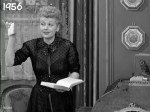


- In a 1956 episode of I LOVE LUCY, Lucy hides food around the room, pretending to be on a hunger strike to get Ricky to buy her a dress!
- In a 1962 episode of THE LUCY SHOW, Lucy hides food around the room, hiding from Viv that she’s making a home-cooked dinner for her boyfriend!
- In a 1968 episode of HERE’S LUCY, Lucy discovers food hidden around the room by Shelley Winters, who is supposed to be on a diet!
-
“Lucy Gets a Paris Gown”

(S5;E20 ~ March 19, 1956) Directed by James V. Kern. Written by
Jess Oppenheimer, Madelyn Pugh, Bob Carroll, Jr., Bob Schiller, and Bob Weiskopf. Filmed February 16, 1956 at Ren-Mar Studios. Rating: 48.4/63

Synopsis ~ Lucy is in Paris, the center of the fashion world, so naturally she sets her sights set on owning a Jacques Marcel original.

Two days prior to this episode’s first airing (March 17, 1956), Lucille Ball won the Emmy Award for Best Actress in a Continuing Performance. The series was not nominated. William Frawley lost to Art Carney in “The Honeymooners.” The “I Love Lucy” writers were nominated but lost to “The Phil Silvers Show.” Vivian Vance and Desi Arnaz (once again) were not nominated.

The same night this episode first aired (March 19, 1956), CBS aired a new episode of “December Bride” immediately following “I Love Lucy.” The episode was titled “The Handcuffs,” and like the 1952 “I Love Lucy” episode of the same name, it concerned two of the series regulars shackled together – and then not being able to unlock their manacles. The series starred Verna Felton who had played Lucy’s intimidating maid Mrs. Porter as well as the woman without electricity that Lucy tries to sell a Handy Dandy vacuum cleaner. Like the “Lucy” episode, the cast included a locksmith. This one (cleverly named Mr. Bolten) was played by Irving Bacon. Bacon is best remembered as Ethel’s Father Will Potter, but also played Mr. Willoughby in “The Marriage License” (S1;E26).

If the kitchen in the above scene from “December Bride” looks vaguely familiar, it should – both series’ were filmed by Desilu. Everything is in the same place as in the Ricardo kitchen, with slight decorative differences like the cabinet fronts and the Dutch door.

This is the second time Lucy has been obsessed with designer labels. The first was in Hollywood during “The Fashion Show” (S4;E19) where Lucy risked melanoma for a Don Loper original!

In Paris, when Lucy mentions wanting a Jacques Marcel dress, Ricky produces a note from from his wallet.
“February 28, 1955
If Ricky buys me a Don Loper original,
I will never ask him for another expensive dress as long as I live.
Signed, Lucy Ricardo”The date of the note is the same as the air date for
“The Fashion Show” (S4;E19). Lucy rips it up claiming that it is obviously a forgery. Writer Madelyn Pugh later said that the idea of the note traces back to Davis and Bob Carroll, Jr.’s partnership. They started writing notes as a way to reduce annoying each other with distracting thoughts or questions.

This is the third of three episodes set in Paris before the gang moves on to Switzerland.

Unlike Don Loper, Jacques Marcel is a fictional fashion designer. His first name is a tribute to the late Jacques Fath, a French fashion designer who is considered one of the greatest influences on haute couture. He died of leukemia in November 1954.

An uncredited actor (in glasses, above center) plays Jacques Marcel, although the character has no lines of dialogue.
“I Love Lucy” costume designer Edward Stevenson had the enormous task of designing the various Jacques Marcel dresses seen in the episode.

Stevenson had worked with Lucille Ball at RKO Studios and Lucy wooed him out of semi-retirement to replace Elois Jenssen. Along with Edith Head, he won an Oscar for the Lucille Ball / Bob Hope movie The Facts of Life in 1961. He died in 1968 after designing for “The Lucy Show” and “Here’s Lucy.”

ETHEL: “Look Lucy, there’s one of the models from the show.”
LUCY: “Did you ever see anything like that in your life?”
ETHEL: “Never. Absolutely out of this world.”
FRED: “That explains it. They’re from Mars!”
When Lucy and Ethel come back from shopping on the Champs-Elysees, Ricky smells perfume. Lucy says that she bought it for Mrs. Trumbull. The product name is not mentioned, but in “Bon Voyage” (S5;E13, above) Mrs. Trumbull whispers a request for Lucy to bring her back a bottle of My Sin. When Lucy is packing for her “Return Home from Europe” (S5;E26) she mentions the scent by name again.

Ethel buys a leopard print handbag.

This same bag was carried first by Lucy in “The Passports” (S5;E11). Perhaps Ethel wanted one just like Lucy’s or loaned it to her best friend? Ethel carries the purse again when she dressed like a gun moll in “Lucy Wants to Move to the Country” (S6:E15).

The idea for the burlap potato sack dresses comes from real life. In 1951 Marilyn Monroe took a series of high fashion photographs wearing a potato sack as a response to a journalist who said that she might look sexier in a burlap sack than her usual fashion choices. Monroe was regularly mentioned on “I Love Lucy” and her 1953 film Gentlemen Prefer Blondes had recently inspired the plot of “Second Honeymoon” (S5;E14).

Lucy first wore burlap at the end of “Mr. and Mrs. TV Show” (S4;E24) as her scary version of a Phipps make-over.

Lucy cheats on her avowed hunger strike by hiding food all around the hotel room:
- bologna and cheese are tucked into the pages of a book (pages 23 and 85, respectively);
- mustard fills a perfume atomizer;
- a loaf of bread is hidden inside a clock;
- lettuce for the sandwich is concealed under the skirting of a table lamp;
- milk is inside a vase of flowers;
- a roast chicken is in a camera case.

Believing her self-imposed fast, Ricky feels sorry for her and gives in.
When he suddenly decides to take a photo of Lucy as she opens the box that holds the new Jacques Marcel dress, he discovers her deception.

John Bleifer (the waiter at Restaurant Le Plaisir) makes his only appearance in the series, although he and Lucy were both extras in two 1933 films: Blood Money and The Bowery. Bleifer is actually Polish, not French, but he has very few lines to speak anyway.

Bleifer is the only non-regular cast actor credited, but the model that wears the champagne bucket on her head (Ethel’s faux Jacques Marcel), is actually Georgia Holt, mother of superstar singer Cher, who was nine years old at the time of the filming.

FAST FORWARD

This episode inspired the creation of two doll sets: a Lucy Barbie by Mattel, and pair of miniature Kelly dolls depicting both Lucy and Ethel. Naturally, they are dressed in their fake Jacques Marcel burlap sack dresses.

Georgia Holt plays a model again – this time in furs – on a 1966 episode of “The Lucy Show.”

Hiding food around the room was done by Lucy Carmichael in a 1962 episode of “The Lucy Show” when she and Viv both have plans to entertain their dates at home on the very same night. Lucy hides a trout in a loaf of bread and a tossed salad under a lampshade!

The comedy bit was used again in “Lucy and Miss Shelley Winters” (HL S1;E4) when Lucy Carter monitors dieting movie star Shelley Summers. Shelley hides a mini-fridge in a TV and sausage links in the sofa cushions.

In a 1973 episode of “Here’s Lucy,” a variation on this hidden-in-plain-sight theme was carried out by alcoholic writer David Benton Miller (Foster Brooks) who conceals booze in such unlikely places as a golf club, a golf ball, binoculars, a mantle clock, a squirting lapel flower, and a portrait of a wine cask, all while Lucy Carter is busily typing his manuscript.

In the new Broadway musical The Cher Show, one performer plays both Cher’s mother Georgia Holt and Lucille Ball!

Fred takes the ice bucket challenge!
1956, Barbie Dolls, burlap sacks, CBS, Cher, Desi Arnaz, Don Loper, Edward Stevenson, Ethel Mertz, Fashion, Fred Mertz, Georgia Holt, hunger strike, I love lucy, Jacques Fath, Jacques Marcel, John Bleifer, Kelly Dolls, Lucille Ball, Lucy Ricardo, Madelyn Pugh, Marilyn Monroe, Paris, Ricky Ricardo, tv, Vivian Vance, William Frawley -
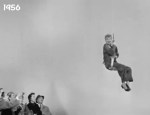


- In a 1956 episode of I LOVE LUCY, Lucy boarded a cruise ship by being lowered from a helicopter!
- In a 1957 episode of THE LUCY-DESI COMEDY HOUR (set in 1940), Lucy boarded a cruise ship by being lowered in a cargo net!
- In a 1971 episode of HERE’S LUCY, Lucy boarded a cruise ship by being lowered in a cargo net!
-
“Bon Voyage”

(S5;E13 ~ January 16, 1956) Directed by James V. Kern. Written by Jess Oppenheimer, Madelyn Pugh, Bob Carroll, Jr., Bob Schiller, and Bob Weiskopf. Filmed December 1, 1955 at Ren-Mar Studios. It was the 140th episode filmed. Rating: 50.3/66
Synopsis ~ The gang is on the gangway, ready to set sail for Europe – but Lucy misses the boat!

Instead of the usual opening music, the orchestra plays “Sailing, Sailing (Over the Bounding Main)” written in 1880 by Godfrey Marks, a pseudonym of British organist and composer James Frederick Swift (1847–1931.)

“Desi would pay for anything and Lucy would do anything” ~ Madelyn Pugh Davis, writer
This episode was the most expensive show ever produced at Desilu up to that time. The American Export Line and the S.S. Constitution (a real ocean liner) helped finance the show’s sets, as well as donating authentic props.

Lucy has some lines of dialogue that briefly describe the ship:
“It has a ballroom, a theater, some shops and even elevators!”
The script even manages to mention the Constitution’s sister ship, the S.S. Independence.

During the last day of rehearsals, Lucille and Desi celebrated their 15th wedding anniversary on set.

On the day this episode was filmed, Rosa Parks refused to give up her seat on an Alabama bus and was arrested, an act of defiance that was a cornerstone of the civil rights movement.

The Ricardos are assigned stateroom U185 on the Bridge Deck of the SS Constitution. Although there is a real cabin U185 (red circle) on the Constitution, it does not have portholes that overlook a promenade, something that will be key to the plot in the next episode, “Second Honeymoon” (S5;E12).

Lucy gets flowers from “Bill, Dani, and Jerry Asher.” William (Bill) Asher was an “I Love Lucy” director (although this episode is credited to James V. Kern), and Dani and Jerry were his wife and son. Her mother brings her a huge bottle of sea sickness pills, a callback to the previous episode “Staten Island Ferry” (S5;E12).
Lucille Ball’s skill at her craft is subtly apparent in this short stateroom scene. When Kathryn Card can’t get the big bottle out of her bag, Lucy immediately goes to help pull it out. She then lies the bottle horizontally on the end table, knowing the tall bottle stood up properly might interfere with camera shots. When kissing Mrs. Trumbull goodbye, Ball (somewhat awkwardly) kisses her on her left (downstage) cheek, keeping her own face toward the camera!

In the stateroom, Ethel immediately dives into the fruit basket.
ETHEL: I can’t help it. This sea air makes me hungry.
FRED: We haven’t even left the dock yet. (To the others) Wait till she finds out the food’s free. She’ll be the biggest bundle Britain’s ever seen.Ethel seems to have a taste for bananas. She is caught eating a banana in the next episode (center), and in “Lucy Misses the Mertzes” (S6;E17). The character trait continued on “The Lucy Show” with Vivian Bagley, so perhaps it was Vance who loved the fruit?

In his joke about Ethel’s weight, Fred makes reference to Bundles for Britain, a war relief effort started in 1940 by American Natalie Wales Latham (above) as a knitting circle in a store front in New York City. Socks, gloves, hats, sweaters, and scarves were made and shipped to Britain. Within Sixteen months, Bundles expanded into an organization with 975 branches and almost a million contributors. By 1941, Bundles had also shipped ambulances, surgical instruments, and medicines, along with used clothing of all sorts.
Ethel mentioned the organization in “Ricky’s European Booking” (S5;E10) when trying to think up a name for their phony charity.
ETHEL: You don’t suppose we could call it ‘Two Bundles for Britain’?
LUCY: No, it has to sound real.
Mrs. Trumbull makes a last minute request for French perfume. Embarrassed by the name, she whispers it to Lucy: My Sin! When Lucy is packing her souvenirs for their “Return Home from Europe” (S5;E26) she mentions bringing home a bottle of perfume for Mrs. Trumbull. The writers remembered this exchange months later.

The gimmick of Lucy’s skirt getting caught in the bike wheel was accomplished by moving a giant crate in front of Lucille Ball, inside which was concealed a stagehand who rigged the skirt to the bike without cutting the film. No doubt the side of the crate facing Lucy and the other actors was open. When the crate was wheeled away, the deed was done!

When Lucy tries to jump onto the ship from the gangplank, the trunk she got locked inside of in “The Passports” (S5;E11) can be seen on the deck. The trunk was dug out of storage by Fred to store the band uniforms for the trip.
Although Lucy loses her skirt, throughout the entire ordeal she never loses her hat!

The tug boat that pulls the Constitution out of New York harbor has a large white M painted on it. This is the insignia of the Moran Company, who began business in 1880 and are still in operation today.

The pilot boat that Lucy misses was likely one of the Sandy Hook Pilots, who have been navigating vessels through New York harbor for more than 300 years.

Lucy says in this episode that she’s never been on a plane before, which is why she was scared to ride in the helicopter. So the Pan Am flight in “Return Home from Europe” (S5;E26) is Lucy Ricardo’s first airplane trip. With all the fuss about smuggling the cheese, the fact is never mentioned.

The Dock Agent directs Lucy to Idlewild Airport, which was officially named New York International Airport (as we see in an insert shot) when it first opened in 1948. It was re-named John F. Kennedy International Airport (JFK) in 1963, in memory of the slain President. The name ‘Idlewild’ can still be heard in the theme song to “Car 54, Where Are You?”

Although the episode employs second unit footage of the airport, the ship, and the New York skyline (featuring the Empire State Building), the cast never left the Desilu soundstage in Hollywood.


A stunt double for Lucy can be seen in the distance shots of the actual helicopter. This performer was the wife of a friend of film editor Dann Cahn. When viewing the footage, even Lucille Ball was surprised at home much she looked like her! A dummy was lowered from the helicopter when filming the mid-air descent.

On the sound stage, Lucille Ball did the lowering onto the deck itself. The above rare photo shows Lucille Ball rehearsing the stunt. Early in her movie career, Lucy fell doing a similar stunt and injured her back so she was naturally nervous. The cast and crew didn’t discover her fear until just prior to filming. It is said that about 90 minutes before the cameras rolled Lucille Ball passed out from anxiety – much like Lucy Ricardo does after realizing the enormity of what she’s done!

Their experience filming this episode served as the inspiration for Desilu to create the series “Whirlybirds” (1957-60), which premiered exactly one year later on CBS. It was about a helicopter company hired to perform all types of jobs. “Bon Voyage” cast member Tyler McVey was seen in two episodes of the series. Other “I Love Lucy” cast members showing up on “Whirlybirds” include: Robert Foulk, Harry Bartell, Robert Stevenson, Claude Akins, Hans Conried, Lawrence Dobkin, Strother Martin, Phil Ober, Parley Baer, Charles Lane, Norman Leavitt, Doris Singleton, Bill Erwin, Irving Bacon, Sid Melton, and Herb Vigran. Bob Galbraith, who did the stunt pilot work on “Bon Voyage” worked on all 111 episodes of the series.
It was later noted by viewers that it is against the law to put someone on a ship via a helicopter, despite the pilot saying “It’s done all the time!”

Oops! When Ricky is lifted off the deck hanging onto Lucy’s legs, he accidentally kicks Vivian Vance in the face. Luckily, she turned quickly enough and wasn’t hurt.

Passengers & Crew ~~~
Tyler McVey (Ship’s Officer) had already appeared as Bill Hall in “The Charm School” (S3;E15). He would also appear in the very next episode on board the S.S. Constitution, “Second Honeymoon” (S5;E14) arranging young Kenneth Hamilton as Lucy’s shuffleboard partner. He would return to the series in a bit role during “Lucy Raises Chickens” (S6;E19). He appeared extensively on television, mostly as sheriffs in Westerns.

Ken Christy (Dock Agent) had played Fred’s friend Ken, the detective, investigating the new tenants from Texas in “Oil Wells” (S3;E18). The month “Bon Voyage” was filmed, Christy finished his two-year run on the series “Meet Corliss Archer,” also on CBS.

The dispatcher at the airport is played by Jack Albertson, who would go on to win a 1969 Oscar for The Subject Was Roses. He would also play Grandpa Joe in the 1971 movie Willy Wonka & the Chocolate Factory, but he is perhaps best known as ‘the man’ on the TV series “Chico and the Man,” which won him a 1974 Emmy.

RICKY: I don’t know. I don’t like the idea of Lucy taking a hell-ya-copter. That’s too risky.
FRED: Yeah. For the hell-ya-copter.The helicopter pilot is played by Frank Gerstle, who had previously appeared as the shorter Indian, Herman, in “The Indian Show” (S2;E24), as well as a gas station attendant in The Long, Long Trailer (1953).
Sadly, Bob Gilbreath, who actually piloted the helicopter in the location shots, would die in a helicopter crash five years later.
Pat Goldin played the messenger boy whose bike snags Lucy’s skirt. This is his only appearance on the series. He is best known for playing Willie Dugan (his screen debut) in Bringing Up Father (1946) as well as its four ‘Jiggs and Maggie’ sequels.

The episode also features series regulars Kathryn Card as Mrs. McGillicuddy, Elizabeth Patterson as Mrs. Trumbull (in her penultimate appearance), and The Mayer Twins as Little Ricky (also making their next-to-last appearance).
Ben Niems (Officer on Gangplank) was previously seen as one of the policemen in “Lucy Visits Grauman’s” (S5;E1).

Uncredited background performers on the ship and dock include:
- Bob Carroll, Jr. (Passenger at the Rail with Ethel) was one of the writers of this episode. Carroll will also have cameos at the outdoor cafe in “Paris at Last” (S5;E18) and at the roulette table in “Lucy Goes to Monte Carlo” (S5;E25).
- Herschel Graham (Passenger) was seen with Lucille Ball in the 1947 film Lured. After this, he would also be seen in her 1960 film The Facts of Life, as well as “Lucy Goes to Mexico” (1958) and two episodes of “The Lucy Show.”
- Marion Gray (Passenger) makes her only appearance with Lucille Ball, but can be seen in the background of the musical films Singin’ in the Rain (1950), The Bandwagon (1953), and White Christmas (1954).
- Bennett Green (Dock Worker / “All Ashore” voice) was Desi Arnaz’s camera and lighting stand-in for the entire series. He often had small roles in the episodes as well.
- Hans Moebus (Man on Dock) was a German-born actor who appeared as an uncredited background performer in hundreds of movies and TV shows, including the Lucille Ball films DuBarry Was a Lady (1943), A Woman of Distinction (1950), and The Facts of Life (1960). Moebus was also in two episodes of “The Lucy Show.”
- Ron Nieman (Passenger) would not be seen with Lucille Ball again until 1970, when he played an uncredited moving man in “Lucy Takes Over” (HL S2;E23).

Oops! The female extra on the dock when Lucy gets her skirt caught in the bicycle is simultaneously seen on the deck when Ricky and Fred are watching the event!

At the end of the original broadcast, there was a tag scene to promote the upcoming film (and record) Forever, Darling. Although cut for syndication, the DVD restores this tag scene. Lucy and Desi [or is it Ricky?] are seen sitting in deck chairs.
LUCY: Did you see the ship’s newspaper? They just raved about your new MGM record of Forever, Darling.’ They said it’s gonna be one of the top records of the year. Let’s get them to play it on the public address system. I know how modest you are, but think what a treat it would be for the passengers.”
[Song plays on public address system. The couple kiss. Roll credits.]

This episode was originally sponsored by Golden Fluffo, a butter flavored shortening.
1956, American Export Lines, Bennett Green, Bob Carroll Jr., CBS, Desi Arnaz, Elizabeth Patterson, Ethel Mertz, Forever Darling, Frank Gerstle, Fred Mertz, Helicopter, I love lucy, Jack Albertson, Kathryn Card, Ken Christy, Little Ricky, Lucille Ball, Lucy, Lucy Ricardo, My Sin, ocean liner, Pat Goldin, Ricky Ricardo, S.S. Consitution, The Mayer Twins, tv, Tyler McVey, Vivian Vance, William Frawley -
“Ricky Needs An Agent”

(S4;E29 ~ May 16, 1955) Directed by William Asher. Written by
Jess Oppenheimer, Madelyn Pugh, and Bob Carroll, Jr. Filmed April 7, 1955 at Ren-Mar Studio. Rating: 39.2/63

Synopsis ~ When Ricky’s career stalls, Lucy pretends to be his agent – to disastrous results!

In the early 1940s, Desi Arnaz was under contract to MGM and had a similar problem after Bataan.

Jerry Hausner originated the role of Ricky’s agent in the un-aired pilot and 14 episodes through season three, but during his last appearance in “Fan Magazine” (S3;E19) Hausner and Arnaz had a major disagreement which caused the character to be written out of the show – hence “Ricky Needs an Agent.”

On the day this episode was filmed (April 7, 1955) Hollywood silent screen legend Theda Bara died at age 69.
- One one of Lucille Ball’s very first television appearances in 1949, she played Theda Bara in a sketch on “The Ed Wynn Show”.
- In “Tennessee Ernie Visits” (S3;E28) Lucy disguised herself as a Theda Bara-type vamp to scare off Ernie – to no avail.
- When the Danfield Little Theatre stages a play about Cleopatra, Lucy Carmichael says she should get the part because she saw the film twelve times. Sarcastically, Viv says “She means the one with Theda Bara.” Viv is referring to a 1917 silent film starring Bara in the title role.
- In a 1968 episode of “Here’s Lucy” Lucy Carter plays up to a movie producer, causing Harry to call her “Theda Bara”.

The list of publicity stunts Ricky has done since being in Hollywood includes:
- Dedicating a new freeway
- Crowning the Queen of the Automobile Show (LUCY: “Ricky’s crowned more queens than the Archbishop of Canterbury.”)
- Opening a new supermarket
- Judging a dog show
- Tossing in the first soapy sponge at a mammoth car wash
- Judging a mambo contest by dancing with 100 college girls
- Singing at the opening of a new bowling alley
The scrapbooks of Ricky’s publicity stunts that Lucy looks through at the beginning of the episode are some of Lucille Ball’s real-life scrapbooks. They were also seen in “Sentimental Anniversary” (S3;E16).
Disguised as Miss McGillicuddy, Ricky’s agent, Lucy is determined to see Dore Schary herself, but remembers that they previously met (in “Don Juan is Shelved”), so she meets with another Metro executive named Mr. Riley instead.

The part of the plot regarding Lucy getting Ricky fired by claiming he has fabulous (although fictional) offers elsewhere is very similar to Lucy’s ploy in “Ricky Asks for a Raise” (S1;E35).

Trying to suggest possible film projects for Ricky, Lucy (and the writers) insert him into the titles of some of Hollywood’s best-known movies:
- “Ricky, Son of Flicka” / Thunderhead, Son of Flicka (1945)
- “A Streetcar Named Ricardo” / A Streetcar Named Desire (1951)
- “Gone With the Cuban Wind” / Gone With the Wind (1939)
- “Three Cubans in a Fountain” / Three Coins in the Fountain (1945)
- “It Happened One Noche” / It Happened One Night (1934)
- “Seven Brides for Seven Cubans” / Seven Brides for Seven Brothers (1954)
- “Meet Me in St. Ricky” / Meet Me in St. Louis (1944)
- “The Ricardos of Wimpole Street” / The Barretts of Wimpole Street (1957)
- “Andy Hardy Meets the Conga Player” / Andy Hardy Meets Debutante (1940)
- “Arsenic and Old Ricky” / Arsenic and Old Lace (1944)
Not all of the films were made by MGM. Gone With the Wind and Seven Brides for Seven Brothers were both mentioned on other “I Love Lucy” episodes.

Lucy drops the names Dick and Oscar, which she knows Mr. Reilly will recognize as Richard Rodgers and Oscar Hammerstein II, the Broadway musical composers and producers, two of the most powerful names in show business during the 1950s. Their names and shows are mentioned throughout the series.

When Lucy tells Ricky that she has gotten him released from his contract (“Heeeeeee’s released!”) Ricky has a temper tantrum and is the angriest we ever see him on the series. Props master Dick Henrikson made the various hotel bric-a-brac that Ricky and Lucy smash.

Eagle-eyed viewers have noticed that the small statue starts to bend as soon as Ricky touches it, betraying that it is made of a malleable material.
During the fit of temper the writers provide callbacks to previous episodes:
- “This is worse than the time you loused up my screen test!” [“Ricky’s Screen Test” (S4;E6)]
- “It’s worse than when we got arrested in Tennessee!” [“Tennessee Bound” (S4;E14)]
- “It’s worse than when we were handcuffed together for 48 hours!” [“The Handcuffs” (S2;E4)]
- “It’s worse than when I loused up your nightclub act!” [Take your pick!]
Oops! Lucy says that she and Ricky were handcuffed together for 48 hours, but it was really only 24 hours.

In this episode, Ricky doesn’t have a movie to star in. But in “Lucy Visits Grauman’s” (S5;E1) the gang is celebrating Ricky having finished making a movie which means during the summer hiatus between seasons four and five, Ricky had time to make a film. Or – more likely – the writers hoped that the viewers would have forgotten this plot point by the time the new season started in the Fall of 1955.

Parley Baer (Mr. Reilly) would return to the series to play Mr. Perry, the furniture store clerk in “Lucy Gets Chummy With the Neighbors” (S6;E18). He was also in five episodes of "The Lucy Show” and two "Here’s Lucy” shows. He is perhaps best known for his recurring roles of Mayor Stoner on "The Andy Griffith Show” and Doc Appleby in "The Dukes of Hazzard.”

Helen Kleeb (Miss Klein, Mr. Reilly’s secretary) makes her only appearance on the series, but is recognizable as Mamie, one of the eccentric Baldwin Sisters on “The Waltons” (1972-1981) and a series of Waltons specials.

Coincidentally, Kleeb also appeared with Parley Baer in the a 1962 episode of “The Andy Griffith Show,” also shot at Desilu.
FAST FORWARD! ‘CALL MY AGENT’ EDITION!

Guest-star Milton Berle’s agent is played by Milton Frome in a 1966 episode of “The Lucy Show.”

Tommy Farrell played Van Johnson’s agent / manager in “Guess Who Owe’s Lucy $23.50?” (HL S1;E11) in 1968.

Lew Parker played Joan Crawford’s agent in 1968′s “Lucy and the Lost Star” (TLS S6;E22).

He returned to
“Here’s Lucy” in 1971 to play an agent who promotes his own talents over those of his clients.

Jesse White played an agent / con-man in a 1972 episode of “Here’s Lucy.”

In 1973, when Lucy Carter and daughter Kim book a TV commercial for pickles, Uncle Harry (Gale Gordon) takes on the role of their agent.

Guest-star Frankie Avalon’s agent is played by Robert Hogan in a 1973 episode of “Here’s Lucy.”

Backtracking a bit, in 1954 Byron Kane played Morris Williams, ventriloquist Max Terhune’s agent in “Ricky Loses His Temper” (S3;E19). His character name is doubtless a reversal the famous talent agency William Morris.

-
“Hollywood Anniversary”

(S4;E24 ~ April 4, 1955) Directed by William Asher. Written by Jess Oppenheimer, Madelyn Pugh, and Bob Carroll, Jr. Filmed on February 24, 1955 at Ren-Mar Studios.
Rating: 51.1/72
Synopsis ~ Ricky has forgotten the date of their anniversary, but he has a scheme to convince Lucy that he knew it all along.

The idea for this episode came from the fact that Desi Arnaz threw a surprise anniversary party for Lucy at the Mocambo on November 30, 1953. After a huge cake was served, a TV set was wheeled out and the guests watched the “I Love Lucy” episode “Too Many Crooks” (S3;E9). It was a Monday night, after all!

Ricky and Lucy’s anniversary is said to be the 7th of the month but in “The Anniversary Present” (S2;E3) their anniversary was on the 19th. While Ricky forgot his anniversary date in “The Fur Coat” (S1;E9), he remembered the date in both seasons 2 and 3. Here in season 4 he suddenly develops a case of ‘selective amnesia.’

To find out the anniversary date, Ricky sends a wire to the Greenwich, Connecticut, Hall of Records. Just like Lucy and Desi, Lucy and Ricky were married there at the Byram River Beagle Club in 1940. “The Marriage License” (S1;E26) is partly set there.
RICKY: [on telephone] “Hello, give me Western Union, please. Western Union? I want to send a wire to Green-wich Connecticut, to the head of the license, uh, bureau. That’s right. Look, here’s the message: Wire me the information of the date of the marriage of Lucille McGillicuddy, and Ricardo Alberto Fernando Ricardo y Acha. Ricardo. Yeah, yeah, as in Montalban. Yeah. Alberto. Alberto – A.L., you know, like Albert – put an O at the end. Alberto, yeah. Fernando. Yes, as in Lamas, yes. Ricardo y Acha. Acha, Acha. Thank you, but I’m not sneezing. It’s a name. Well, it’s not funny to me.”

Two years later in “Lucy Raises Tulips” (S6;E26), Lucy calls her husband by a slightly different name: Enrique Alberto Fernando Ricardo y de Acha III. Desi Arnaz’s real-life full name is Desiderio Alberto Arnaz y de Acha III.

Fernando Lamas would guest-star with Lucy and Desi in “Lucy Goes To Sun Valley” (1958). Ricardo Montalban guest-starred in “Lucy and Her Prince Charming” (HL S5;E12) in 1972. It was once said that Lucille Ball had performed with all of Hollywood’s Latin heartthrobs!

The list of celebrity guests supposedly coming to Lucy’s Mocambo party includes these real-life Hollywood couples:
- Esther Williams and Ben Gage
- Elizabeth Taylor and Michael Wilding
- Robert Taylor and Ursula Thiess
- Van and Evie Johnson
- Cary and Betsy Grant
- June Allyson and Dick Powell

Of these, Lucy only meets Robert Taylor and Van Johnson, and only the latter actually guest stars – in “The Dancing Star” (S4;E27). Johnson had done the stage version of Too Many Girls with Desi in 1939, and the film with both in 1940.

Lucy Ricardo met Robert Taylor at the farmer’s market where he autographed on orange for her. At the time, he was married to Ursula Thiess, who was then under contract to RKO (soon to become Desilu Studios).

June Allyson had worked with Lucille Ball in two movie musicals in 1943: Best Foot Forward and Thousands Cheer. The following year they did Meet the People together, in which her husband Dick Powell also starred.

Lucy Ricardo caught sight of Cary Grant at the Brown Derby, but it is never mentioned if she actually met him. In 1984, Grant attended “All-Star Party for Lucille Ball” reading a tribute letter from the President of the United States.

Lucille Ball starred with Esther Williams in Easy to Wed (1946) and Ziegfeld Follies (1945).

The swim star’s husband Ben Gage and Lucy finally worked together on two episodes of “The Lucy Show."

Elizabeth Taylor and Michael Wilding were husband and wife at the time of this episode, but she would later appear with her fifth (and sixth!) husband Richard Burton on a 1970 episode of "Here’s Lucy.”

Interestingly, while Ricky is frantically trying to set up the Mocambo party with many phone calls, he nervously taps his fingers on the desk chair. This is foreshadowing to “In Palm Springs” (S4;E26), where Ricky’s finger-tapping gets on Lucy’s nerves. Ross Elliott makes his second and final appearance as Ross, Ricky’s publicist.

The Mocambo night club opened in 1941 on Sunset Boulevard in Hollywood. Lucille Ball and Desi Arnaz were frequent guests and friends of the owner.

The club’s main stage was the inspiration for the Tropicana set. The Mocambo was recreated on the “I Love Lucy” soundstage. The club was previously mentioned in “Don Juan and the Starlets” (S4;E17). The Mocambo closed for good on June 30, 1958. Vivian’s stand-in Renita Reachi sits in the background at the table against the wall. The woman with her back to the camera in the foreground is Joan Carey, who was a frequent background player and later became Lucille Ball’s stand-in during “The Lucy Show.”

The dress worn by Lucy for the Macambo scene was designed by Elois Jenssen and features an elegant, sheer black gown with glamorous applique bodice, rose-tinted underlining and crinoline petticoat.
Mattel made a Lucy Barbie doll dressed in this outfit.

This gown was later worn by Lucy in the episode "Lucy Goes to Monte Carlo” (S5;E25).

It is also the dress she wears on the US postage stamp made in her honor.

“The Anniversary Waltz” was written by Dave Franklin and Al Dubin in 1941. The arrangement called for violins, and as the Ricky Ricardo / Desi Arnaz orchestra did not have a string section, Harold Stern and His Violins appeared through the courtesy of the Flamingo Las Vegas Hotel & Casino. As Lucy enters the club, the orchestra and Stern’s violinists are playing “La Vie en Rose.” It was the signature song of French songstress Edith Piaf, who wrote the melody and the lyrics (which we don’t hear) in 1945. Piaf was a regular performer at the Macambo during the mid-1950s, including the year this episode was filmed.

The episode also features series regulars Kathryn Card as Mrs. McGillicuddy, Bob Jellison as Bobby the bellboy, and the Mayer Twins as Little Ricky.

This is the first episode for the show’s new sponsor, Procter and Gamble’s Lilt Home Permanent.
ANNIVERSARY SCHMALTZ
Wedding Anniversaries were a go-to storyline on “I Love Lucy.”

1951 – “The Girls Want To Go To A Nightclub” (S1;E1) Mertz Anniversary

1951 – “The Fur Coat” (S1;E9) Ricardo Anniversary

1952 – "The Anniversary Present” (S2;E3) Ricardo Anniversary

1954 – “Sentimental Anniversary” (S3;E16) Ricardo Anniversary

-
“California, Here We Come!”

(S4;E13 ~ January 10, 1955) Directed by William Asher. Written by Jess Oppenheimer, Madelyn Pugh, and Bob Carroll, Jr. Filmed on November 10, 1954 at Ren-Mar Studios. It was the 110th episode filmed. Rating: 50.1/65

Synopsis ~ Just as the foursome are ready to leave for Hollywood, Lucy’s mother suddenly shows up and wants to go, too!
This is Kathryn Card’s first appearance as Mrs. McGillicuddy, who says that she’s never been west of Youngstown, Ohio. Card was on the show the previous season as former Tropicana customer Minnie Finch in “Fan Magazine” (S3;E17). Finch is the disheveled woman who thinks Lucy and Ethel are from The Kinsey Institute.
Mrs. McGillicuddy wants to take her book (“The Story of Our Family”) to Dore Schary, but in “Don Juan Is Shelved” (S4;E21) she repeatedly asks “Who’s Dore Schary?” This is either a memory lapse by the scatterbrained Mrs. McGillicuddy or the “I Love Lucy” writers.
Trivia! Although Card makes 9 appearances as Lucy’s mother (including a brief one on “The Lucy–Desi Comedy Hour”) we never learn her first name! In real life, Lucille Ball’s mother was named Desiree but known as Dede.

Mrs. McGillicuddy tells Lucy that Marion Strong Van Vlack (and presumably Marion’s husband, Norman) moved “way up on the old Hunt Road.” This road (County Touring Road 33) really exists in Jamestown, New York, and it was named for Lucy’s mother’s family, the Hunts. During the series, the character was played by both Shirley Mitchell and Margie Liszt.
On the way to Hollywood,
- Ethel wants to see the Ozark Mountains and the Carlsbad Caverns;
- Ricky wants to see New Orleans and the Rockies;
- Fred wants to see Cincinnati, Niagara Falls, and
Salt Lake City;
- All four want to see the Grand Canyon.

Lucy maps the route, but says “The only thing is, we have to go through New York three times on the way to Chicago.” If Lucy is taking these suggestions to heart in her map-making above, she doesn’t get anywhere near New Orleans but it looks like she intends on visiting her hometown of Jamestown. Of course, their actual route varied greatly.

Here’s a promotional map that was created many years later for video marketing purposes. We have no idea if they actually visited some of these locations.

Viewers only see their stops at:
- Skinner’s One Oak Cabins, somewhere in Ohio;
- The courthouse of Bent Fork, Tennessee;
- A roadside motel in Amarillo, Texas;
- The home of Ethel’s father and the Little Theatre in Albuquerque, New Mexico.
If their later trip to Europe is any guide, however, there are stops that were not seen on screen in episodes.

The 1955 Pontiac Star Chief Convertible is laden down with the following items:
- 7 various size suitcases;
- 2 beach umbrellas;
- A picnic basket and thermos;
- 3 large stacks of clothing boxes tied with twine;
- assorted hat and dress boxes;
- 1 covered wicker laundry basket;
- Ricky’s guitar and conga drum;
- Ricky’s golf clubs;
- Little Ricky’s teddy bear, crib, high chair, and stroller;
- 1 large canvas duffel bag;
- 3 large cardboard cartons.

Not to mention there needed to be room for 5 adults and a baby! Lucy likens it to a laundry wagon and Ethel says she “could have loaded it better with a pitchfork.”
Ricky remarks that they “couldn’t even get through the Holland Tunnel” the way the car is loaded down, but the group left Manhattan via the George Washington Bridge (GWB), not the Holland Tunnel. The GWB is much closer to their fictional East 68th Street address than the Holland Tunnel, which is miles downtown.

When Mrs. McGillicuddy suggests flying to California with Little Ricky instead, Lucy agrees “It doesn’t cost hardly anything to send the baby on the plane.” But later in “Return Home From Europe” (S5;E26) she mistakenly believes babies travel for free! Again, this is either a memory lapse by the scatterbrained (former) Miss McGillicuddy or the “I Love Lucy” writers. Elizabeth Patterson (right) plays Mrs. Trumbull and the Mayer Twins play Little Ricky.

The George Washington Bridge (GWB) connects Washington Heights, New York, with Fort Lee, New Jersey, on Route 95 across the Hudson River. It was first opened to traffic in 1931 and carries approximately 106 million vehicles per year, making it the world’s busiest motor vehicle bridge.

After the Pontiac drives off down 68th Street, the episode employs a mix of second unit footage of a duplicate vehicle with four actor doubles driving to the on ramp and over the bridge. Footage shot during that day also is used in rear projection for the driving sequence.

The scene where the Ricardos and Mertzes sing while crossing the bridge is the first process shot ever used on television. According to head editor Dann Cahn:
"I packed up and I met an agency in New York and I went across the George Washington Bridge and made that famous first process shot for television – which was when they went across the bridge singing ‘California Here We Come.’ They were in the Pontiac with the top down, but they were sitting on the sound stage with the audience. And behind them was the what we called a process film plate, which I shot out of the rear end of a station wagon going across the bridge, and it was projected behind them on the screen. And that was the first process photography for television.”

Oops! In the scene playing behind the foursome, you can see the Pontiac driving on the bridge behind them! This was footage shot by the director, still unsure of how it might be used.

The song "California, Here I Come” that lends its name to the title and is performed at the end of the episode was featured in the Al Jolson Broadway musical Bombo written by Bud De Sylva and Joseph Meyer. Jolson recorded the song in 1924. At one point, Fred sings part of the chorus as a short solo in a manner that is reminiscent of the syncopated style associated with Al Jolson. A rivalry existed between William Frawley and Al Jolson which dates back to when Jolson became known for singing “My Mammy,” a song Frawley claimed to have introduced on stage in his vaudeville act.

Images of the famous scene have been featured on all sorts of collectible merchandise. The scene is often used to typify the series and is considered an iconic representation of the joys of automobile travel and America of the 1950s. It is a rare time when all four principal cast members are shown together, smiling and facing front.

In addition to “I Love Lucy” Monopoly, there was a “California Here We Come” special edition version of Monopoly.

2021 Precious Moments Figurines by the Hamilton Collection / Bradford Exchange.
 1955, Al Jolson, California Here I Come, California Here We Come, CBS, Dann Cahn, Desi Arnaz, Elizabeth Patterson, Ethel Mertz, George Washington Bridge, Hollywood, I love lucy, Jamestown NY, Kathryn Card, Little Ricky, Lucille Ball, Lucy, Lucy Ricardo, Margie Liszt, Monopoly, Mrs. McGillicuddy, Mrs. Trumbull, Pontiac Star Cheif, Ricky Ricardo, Shirley Mitchell, Teddy Bear, tv, Vivian Vance, William Frawley
 -
“Mr. and Mrs. TV Show”

“This is going to be one of the biggest television programs to hit town in years!”
(S4;E5 ~ November 1, 1954 / April 11, 1955) Directed by William Asher. Written by Jess Oppenheimer, Madelyn Pugh and Bob Carroll, Jr. Filmed June 24, 1954 at Ren-Mar Studios. Rating: 48.7/67.
Synopsis ~ Ricky has a chance to do an ‘at-home’ TV breakfast show, and naturally Lucy wants to be in it. Things go well until Lucy discovers Ricky only let her do the show because the sponsor insisted. Then revenge is what is served for breakfast!

Only about half of the country got to see this episode when it debuted November 1, 1954. CBS affiliates chose to air a filmed political commercial from the Republican Party.
The 1954 United States Senate elections was a midterm election in the first term of Dwight D. Eisenhower’s presidency.
Non-affiliate stations still showed “I Love Lucy.” CBS affiliates aired the episode five months later on April 11, 1955. Since the characters were already in California, a flashback opening had Lucy mentioning the Mr. and Mrs. TV Show as a way to try and get into Ricky’s next gig. On that date non-affiliate stations saw a rerun of “Ricky Loses His Voice” (S2;E9) with the flashback dialogue changed. Instead of Lucy talking about the Mr. and Mrs. TV Show, she mentioned the Flapper Follies.
This episode was filmed on June 24, 1954, one of four episodes completed at the end of season three but held over till the start of season four, so with the delay it was actually ten months between filming and broadcast, the longest of any episode.

Lucy and Caroline meet Mr. Cromwell lunching at 21. Lucy and Ethel first said they were going to 21 in “Vacation from Marriage” (S2;E6). The rather upscale 21 Club opened in 1922 and is still in business today. It is a restaurant and former prohibition-era speakeasy located at 21 West 52nd Street (hence the name).
Caroline Appleby is mentioned, but does not appear. Typically, there is absolutely no mention of the baby during the episode!
Oops! When Lucy says the line “a sponsor who’s looking for a show” the audio you hear was dubbed in after filming. Watch Lucy’s lips in the scene – she switched the words and said “a show who’s looking for a sponsor.” The original flub was restored for the DVD.

LUCY: “Empress Josephine, Dolley Madison, Mamie Eisenhower… We’re all behind our husbands, guiding their destinies. We’re puppeteers behind the scenes, pulling the strings.”
(Ricky enters)
ETHEL: “Well, here’s Howdy Doody now.”- This is third mention of First Lady Mamie Eisenhower on the series, the others being in in “Ricky Asks for a Raise” (S1;E35) and “The Golf Game” (S3;E30).
- Lucy played Empress Josephine to Gale Gordon’s Napoleon in a 1967 episode of “Here’s Lucy.”
- Howdy Doody was a cowboy marionette that starred with his creator ‘Buffalo’ Bob Smith on an extremely popular children’s television show on NBC from 1947 until 1960. Next to “I Love Lucy,” “The Howdy Doody Show” best epitomizes 1950s television.

Ricky goes to Cromwell’s office at Cromwell Thatcher and Waterbury Advertising and he turns out to be a sort of Madison Avenue Mrs. Malaprop, mixing his metaphors for comic effect. It is actually his assistant Mr. Taylor who first comes up with the idea of a husband and wife show, but it is quickly shot down by Mr. Cromwell. A few moments later Cromwell has the same idea and Taylor has to act as if it is being proposed for the first time. Typical sitcom trope – the acquiescent toady! This three minute scene gives Ricky and the men a chance to do some physical comedy (”Think!”) and verbal wordplay – without Lucille Ball.
Mr. Cromwell is played by John Litel. He was seen with Lucy in the 1950 film The Fuller Brush Girl.

Lee Millar (Mr. Taylor, Mr. Cromwell’s Assistant) was first seen as the announcer in “The Quiz Show” (S1;E5) and then played the photographer in “Changing the Boys’ Wardrobe” (S3;E10). He will go on to play Chip Jackson, host of the MGM executive’s show, introducing “Lucy and the Dummy” (S5;E3) as well as appearing on a 1964 episode of “The Lucy Show.” Millar is the son of actress Verna Felton, who appeared on “I Love Lucy” twice in 1953, most famously as Mrs. Porter, Lucy’s belligerent maid.
Later, Mr. Taylor is also the stage manager for the broadcast! Bennett Green, Desi’s camera and lighting stand-in, plays the camera man.

The agency is looking for a show for Phipps Department Store.Early television was very sponsor-driven, with ad agencies acting as liaisons between sponsors and the networks to create programming. This is why show’s often had a company’s name in them, such as the “Westinghouse Desilu Playhouse.”

Although “I Love Lucy” mentioned Macy’s and Gimbels and used Saks Fifth Avenue gift boxes for props, Phipps Department Store was supposed to be a fictional business for reasons that become clear when Lucy’s plan goes into action. Perhaps unbeknownst to CBS or Desilu, there actually was a Phipps Department Store, located in Batavia, Illinois, a suburb of Chicago. This real-life Phipps was open from 1948 to 1990.

The office scene opens with a close-up of Mr. Cromwell’s dictation machine made by SoundScriber Corporation of New Haven. It records sound with a groove embossed into soft vinyl discs with a stylus, not unlike early record players and recorders.
Although Ricky is reluctant to include Lucy, when Cromwell suggests Taylor see if Cugat is available, Ricky quickly gives in. Although Desi Arnaz and Spanish-American bandleader Xavier Cugat were colleagues, the series depicts them as rivals. As Ricky leaves the office, he is speaking Cromwell’s language: “Don’t worry, sir, we’ll boil the water before it passes under the bridge that the train track is on.” Cugat was initially the surname of the characters on Lucy’s 1948-50 radio series “My Favorite Husband,” before it was changed to Cooper in 1950.

“Breakfast with Ricky and Lucy” was inspired by “Breakfast with Dorothy and Dick.” This daily radio chat show aired from 1945 through 1963, and starred Dorothy Kilgallen, journalist and reporter, and her husband Richard Kollmar, a Broadway actor and producer.

Dorothy and Dick often appeared together on “What’s My Line?” where she was a regular panelist. Kollmar had appeared with Desi Arnaz on Broadway in Too Many Girls (1939), although his role went to Richard Carlson in the 1940 film version. [You may remember that Carlson’s wife Mona appeared was introduced by Don Loper in “The Fashion Show” (S4;E19).] There was another popular husband and wife radio breakfast show called “Hi Jinx” that starred model and actress Jinx Falkenburg and publicist Tex McCrary, which made the leap to television in 1948. Both of these pairings inspired Lee Kalcheim’s 1982 off-Broadway play Breakfast with Les and Bess.

Ricky asks Lucy to sing “Sweet Sue” for him as a way to trick her into doing the Mr. and Mrs. show. This is the first time we’ve heard “Sweet Sue” since “Breaking the Lease” (S1;E18). It will be heard again in “Ragtime Band” (S6;E21). “Sweet Sue, Just You” was written in 1928 by Victor Young and Will J. Harris. The song was written for (or about) silent film star Sue Carol (1906-1982). When she’s done with her off-key rendition, Ricky applauds. Perhaps unsure of how to respond, the “I Love Lucy” studio audience follows suit.

For the sake of Ricky’s gag line “That voice! What station is it on?” when Lucy is crooning “Sweet Sue”, a clock radio has been put in the kitchen. It is a Capehart C-14 made by Capehart Corporation. Founded in 1927, they went into bankruptcy in March 1939 and were taken over by Farnsworth Television & Radio Corp., who kept using the name Capehart for products like this clock radio. Founder Philo Taylor Farnsworth (1906-71) made many crucial contributions to the early development of all-electronic television. Without Farnsworth, “I Love Lucy” might not have been possible as we now know it. It is unlikely anyone knew this when choosing this prop, which will quickly disappear after this episode.

ETHEL: “Is Mr. Taylor gone? I wanted to ask him if this dress would look alright on television. What do you think?”
LUCY: “It’s just perfect. You’ll look like a test pattern.”Used since the early days of television but seldom seen today, a test pattern was typically broadcast at times when the transmitter is active but no program was being broadcast such as at sign-on and sign-off. They were originally physical cards at which a camera was pointed, and used for calibration, alignment, and matching, of cameras.

The sound byte of Fred saying, “Hello out there in TV land!” was used by the cable channel TV Land when they were showing “I Love Lucy” and other classic sitcoms.

Lucy looks quite glamorous in her white floor-length nightgown with matching bow. This moment gives Lucy and Desi a chance to break the fourth wall and talk directly to the camera, something they only did once – at the end of the “Christmas Show”.
Oops! While singing the Phipps Department Store jingle, William Frawley messes up the lyrics “first on your list of shopping tips.” He probably blamed Vivian!

The writers skillfully crafted dialogue that Lucy could spin positively or negatively by varying her delivery. Waffles are a favorite breakfast food of the Ricardos, usually reserved for special occasions. In the 1950s it was not uncommon for a department store to run a restaurant, soda fountain, or tea room, in order to keep female shoppers in the store longer.

Lucy’s sets her breakfast table with a Quaker lace cloth. In the late 19th century, the Quaker Lace Company made it possible for middle class households to afford the opulence of lace by producing beautiful machine-crafted lace. The company continued to offer all manner of lace items throughout the 20th century, and in the process became a household name.
We get a look at an RCA Television camera. This was not an “I Love Lucy” camera. The RCA logo (which should be located in a red circle next to the word ‘television’) appears to have been removed. NBC was a subsidiary of RCA and competed with CBS in the race to create color television.

LUCY (singing): “Phipps are a great big bunch of gyps!”

Lucy’s burlap sack is from the Pasco Packing Company of Dade City, Florida. Founded in 1951, they shipped citrus products nationwide. The company is still in business today as Lykes Pasco Inc. The sack has been turned inside out and upside down so that the Pasco name is nearly undetectable to viewers. This is not the last time Lucy Ricardo would wear burlap for a gag. But as fans, you are way ahead of me!
1954, 21 Club, CBS, Desi Arnaz, Dorothy Kilgallen, Empress Josephine, Ethel Mertz, Fred Mertz, Gale Gordon, Here’s Lucy, I love lucy, John Litel, Lee Millar, Lucille Ball, Lucy, Lucy Ricardo, Mr. and Mrs. TV Show, Richard Kollmar, Ricky Ricardo, Sue Carol, Sweet Sue, tv, Vivian Vance, William Frawley -


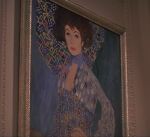
For the 1974 movie MAME, set decorators created a portrait inspired by Gustav Klimt’s “Portrait of Emilie
Flöge” (1902). The painting hung at the top of the stairs in Mame’s New York City brownstone and is clearly visible during the song “It’s Today.” Klimt also painted “Portrait of Adele Bloch-Bauer I” (1907) which was the subject of the 2015 film WOMAN IN GOLD, starring Helen Mirren.
-
Subscribe
Subscribed
Already have a WordPress.com account? Log in now.
 Papermoon Loves Lucy