-
“Tennessee Ernie Hangs On”

(S3;E29 ~ May 10, 1954)
Directed by William Asher. Written by Jess Oppenheimer, Madelyn Pugh and Bob Carroll, Jr. Filmed April 8, 1954 at Ren-Mar Studios.
Rating: 55.6/80
Synopsis ~ Ernie is still boarding with the Ricardos, much to their annoyance. In order to help him get home, they try to raise money to pay for his travel.

CLICK HERE TO READ ABOUT “TENNESSEE ERNIE VISITS”
This is the second of a two-part guest appearance by Tennessee Ernie Ford, a popular country singer of the 1950s. This was his first credited ‘acting’ job and happened before his big hit with the song “Sixteen Tons” in 1955.
Ernie Ford spouts some humorous country wisdom, which he doubtless helped the “I Love Lucy” writers insert into the script:
- "Mama always said I had a lot of get-up-and-go, so I’ll just get up and go."
- "I stayed with you while you was eatin’ high on the hog and I’m gonna stick to you while you’re down around the hocks."
- "Don’t say the preserves is spoilt till you’ve took the lid off the jar."
- "As the whale said when he seen Jonah standing on the bank, ‘I ain’t a-swallerin’ that.’”
- "Right after the last twang of the guitar, I’ll be a-headin’ home quicker than a bobcat with a burr under his tail.”

The episode opens with Ethel returning Little Ricky’s Bubble-O-Bill Bubble Hat! The flying saucer-themed toy was made by Mattel. Although Little Ricky (The Mayer Twins) is mentioned, he does not appear on screen.

Sitcom Logic Alert! The Ricardos’ TV set ‘explodes’ when Ernie tries to slap Cousin Lester Bike (a fellow Bent Forkian) on the back during an episode of “Millikan’s Chicken-Mash Hour.” Apparently Ernie is so naive he doesn’t know the difference between a televised image and a real person!
The Ricardos don’t have much luck with television sets: the one they gave to the Mertzes was faulty and led them to “The Courtroom” (S2;E7) and Lucy disemboweled hers in “Lucy Does a TV Commercial” (S1;E30).

“The Wabash Cannonball” is performed by Ford while sitting alone in the Ricardo apartment “jest a-pickin’ and a-singin’.” The song’s first documented appearance was on sheet music published in 1882, titled “The Great Rock Island Route” and credited to J.A. Roff. A revised version was made famous by Roy Acuff in 1936 and it was a staple song of the Carter Family, which included June, who would later marry Johnny Cash, who also performed the song.

“Millikan’s Chicken-Mash Hour” was a fictional country music TV program, but there were real-life examples as well, the first ever called “Village Barn,” broadcast from 1948 to 1950 from a New York City nightclub. Others included “Hayloft Hoedown,” “ABC Barn Dance,” “Saturday Night Jamboree,” “Windy City Jamboree,” “The Old American Barn Dance,” and “Midwestern Hayride” – all on rival networks. The most famous entry into the genre, “Hee Haw,” did air on CBS, but didn’t come along until 1969.

Richard Reeves (Lester Bike) makes the last of his eight appearances on the series. He made one appearance on “The Lucy Show” in 1963 and might have gone on to appear in “Here’s Lucy” but he died in 1967 at the age of 54. He is probably best remembered as Bill Foster (Grace’s jealous husband) in “The Gossip” (S1;E24).

“Y’all Come” was written and recorded in 1953 by Arlie Duff. It rose to number seven on the Billboard country charts. Here, some special lyrics and arrangements include references to “Babalu.” It is sung and played by Ernie Ford and ‘His Four Hot Chicken Pickers: Lucy on washboard, Ethel on kazoo, Fred on the jug, Ricky on the conga drum, and Ernie on guitar.

Lucy plays a Brass King
washboard manufactured by the National Washboard Company. It is labelled “Top Notch, Soap Saving Sanitary Front Drain, Do Not Rub Hard, The Board Will Do The Work!” The prop department painted out The Brass King logo on the upper left side.
FAST FORWARD!

Ford’s appearances were so successful that he returned for a third time when the gang travels through his (fictional) home town of Bent Fork, Tennessee, on their way to Hollywood in "Tennessee Bound” (S4;E14). No other celebrity guest star made three appearances.

In 1958, Ford sold Fords during the “Lucy-Desi Comedy Hour.”

Ford went on to play alliteratively-named characters on both “The Lucy Show” (as Homer Higgins) and "Here’s Lucy” (as Ernie Epperson) and also on "The Red Skelton Show” (as Loser Lumpkin) and the Desilu-produced “Make Room For Daddy” (as Kentucky Cal).

Lucille Ball appeared on “The Tennessee Ernie Ford Special” on November 16, 1968. a month later Ball and Ford both did cameos on “The Dean Martin Christmas Show.” Ball’s appearance on Ford’s special was her was her way of repaying him for appearing on “The Lucy Show” in February 1967.

This is the first, but not the last time the Ricardos have trouble getting rid of a house guest who over-stayed his welcome. In “Visitor from Italy” (S6;E5), Mario (Jay Novello) comes to visit his brother Sam but ends up at the Ricardo’s instead. Like Ernie, Mario is too proud to accept the money that would enable him to leave.

The custom-made leather glove with thimble tips that Lucy wears during “Y’All Come” are now in a museum. These must have been used for rehearsals or recording session as the ones Lucy wears on screen are short gloves with ribbons.
1954, Bent Fork, Bubble Hat, CBS, Desi Arnaz, Ernie Ford, Ethel Mertz, Fred Mertz, Here’s Lucy, I love lucy, Lucille Ball, Lucy, Lucy Ricardo, Millikan’s Chicken-Mash Hour, Richard Reeves, Ricky Ricardo, Tennessee Ernie Ford, Tennessee Ernie Hangs On, Tennessee Ernie Visits, The Lucy Show, tv, Vivian Vance, Wabash Cannonball, William Frawley, Y’All Come - "Mama always said I had a lot of get-up-and-go, so I’ll just get up and go."
-
“The Black Wig”

(S3;E26 ~ April 19, 1954) Directed by William Asher. Written by Jess Oppenheimer, Madelyn Pugh, and Bob Carroll, Jr. Filmed March 25, 1954 at Ren-Mar Studio. Rating: 55.8/77
Synopsis ~ Lucy dons a black wig, believing it changes her appearance enough to test Ricky’s marital fidelity.

This episode is based on Lucy’s radio show, “My Favorite Husband,” episode #48 titled “Hair Dyed” and broadcast June 10, 1949.

This episode was filmed on March 25, 1954, the day of the 26th Annual Academy Awards. It was at this ceremony that William Holden won the Oscar for Stalag-17 that made him “I Love Lucy’s” first Academy Award-winning guest star just a year later. Nominees Richard Burton and Eddie Albert would be future “Here’s Lucy” co-stars. Presenters and performers like Elizabeth Taylor, Kirk Douglas, Dean Martin, and Donald O’Connor would also go on to be featured on “Lucy” television shows.

Also on March 25, 1954, RCA began selling the first all-electronic color television sets. The RCA CT-100 had a 15-inch screen and sold for $1,000, which is the equivalent of nearly $8,000 in today’s money.
Admiral and Westinghouse sets had beaten RCA to the market but the RCA model had the ability to also handle black and white (called ‘backwards technology’), making it the industry leader. NBC, owned by RCA, became the leader in color TV, even adopting the colorful peacock as their network symbol.

At the start of the episode the gang is returning from seeing a movie and Lucy is acting peculiar. Ricky explains that “Every time she goes to a movie she comes out as the heroine.” In this case the heroine is a raven-haired Italian whose husband has been taken to jail and left her with twelve children that she has to support by working in the rice field.

Lucy begins sensuously running her fingers through her hair, just as she would later do to impress film director Vittorio Philippi in “Lucy’s Italian Movie” (S5;E23, above). She even says the same Italian phrase: “Arrivederci, mi amore!”

This is the last time Lucy wears this Elois Jenssen original.

When Fred claims he didn’t understand the film, Ethel says that if it isn’t Donald Duck, it is over his head! Donald Duck is an animated character from Walt Disney Studios that first appeared in 1934. At the time of the episode, a motion picture usually was preceded by a cartoon short. Donald Duck was the subject of hundreds of such films. The last Donald Duck film “Donald’s Diary” was released March 5, 1954 (three weeks before this episode’s filming) by RKO Studios, which would later become Desilu. Daisy, Donald’s girlfriend, was voiced by Vivi Janiss, who played LuAnn in “The Charm School” (S3;E15) and was one of the club women in “No Children Allowed” (S2;E22). Her first husband was Lucy favorite Bob Cummings. Coincidentally, the day this “I Love Lucy” episode was filmed, Donald’s creator, Walt Disney, won four Oscars for his various film projects,

Ricky sarcastically calls her Lucille Magnani, a nod to Italian film actress Anna Magnani. Magnani gained international renown in Roberto Rossellini’s 1945 film Rome, Open City. A few weeks before this episode was filmed she released Jean Renoir’s The Golden Coach and Anita Garibaldi, a historical romance. The “I Love Lucy” writers could not have known then that she was just a year away from her Academy Award-winning role in Tennessee Williams’ The Rose Tattoo.

Curiously, although Magnani was a brunette, she had shoulder length hair in her films. Lucy’s desire for a short Italian haircut is probably also inspired by Italian Gina Lollobrigida, who had several films in release at the time, and American Elizabeth Taylor, who sported short dark hair throughout much of the 1950s, including in her latest film at the time of this episode, The Girl Who Had Everything.

RICKY: “All people in the world are divided into two groups: men and women. Now, men have short hair, and women have long hair. That’s the difference between them. I don’t want my son to be confused. He should know whether he should call you mother or father.”
No doubt Caitlyn Jenner and the transgender community would have sent Ricky’s head spinning! In real life, Desi Arnaz did indeed prefer Lucy’s hair a bit longer. Lucy Ricardo’s trademark bun was born because of this.

Ethel supports Lucy’s announcement that she wants an Italian hair cut, reminding them of when she styled her hair in a poodle cut.
ETHEL: “People couldn’t take their eyes off me.”
FRED: “Yeah. They thought you were Harpo Marx.”A year later, Ethel would come face-to-face with the real Harpo Marx (above). It was nearsighted Carolyn Appleby who couldn’t take her eyes off Harpo!

Douglas Evans (Doug, the salon owner) had appeared with Lucy in the 1942 film Seven Days’ Leave as well as with William Frawley in 1950’s Kill the Umpire. This would be his only series appearance.

Lucy’s hairdresser is named Roberta, named after real-life “I Love Lucy” season one hairdresser, Roberta ‘Bert’ French. Eve McVeagh makes her only appearance on the series but returned to work for Lucy in a 1973 episode of “Here’s Lucy.”

The night this episode was filmed (March 25, 1954), Eve McVeagh (Bert) appeared on an episode of “Dragnet” titled “The Big Drink” (S3;E30). It also starred Claude Akins, who will play himself (aka ‘Giant Native’) in “Desert Island” (S6;E8) and Olan Soule, who will play Little Ricky’s pediatrician in a December 1955 episode.

When Ricky is ‘pretend’ flirting with Lucy, he says “I could even tich you how to Rumba.” According to Desi Arnaz’s autobiography A Book, this is the same pick-up line he used on Lucy in real life back in 1940.

The little Italian restaurant where Lucy and Ethel arrange to meet their husbands is called Tony’s. Interestingly, “The Diner” (S3;E27) and the “The Black Wig” had their filming and broadcast order switched. So, with a few cosmetic alterations, Bill’s Diner became Tony’s Italian Restaurant. The back wall of ice boxes is common to both sets.

The trope of a woman dropping a glove to get a man’s attention was popular in the early 20th century. A chivalrous man would stop and pick up the glove for a lady, thereby facilitating an introduction. It’s also considered bad luck to drop a glove, and then pick it up yourself.

When Ethel tries on the wig, Fred recognizes her immediately and says,
“What in Sam Hill have you done to your hair?”
‘Sam Hill’ is a euphemism for ‘hell’ a curse word not permitted on television in 1954. Writer H.L. Mencken suggests that it was derived from ‘Samiel’, the name of the Devil in Der Freischütz, an opera performed in New York City in 1825. Others suggest that it is merely because the two words sound similar.
Sitcom Logic Alert! ~ Ricky and Fred immediately recognize their wives despite their disguises. Lucy and Ethel, however, are unreasonably gullible to believe that the boys would not recognize them or at least their voices.

When Lucy asserts that the black wig is the latest fashion, Fred retorts that on Ethel, it looks more like “life with Luigi.” “Life With Luigi” was a radio comedy that transferred to television. It premiered on CBS one season after “I Love Lucy,” but was not a success, lasting only a year before briefly returning to radio. One of the ‘Italian’ characters was played by Alan Reed, who later voiced Fred Flintstone. Two years earlier, both “Luigi” and “Lucy” were part of “Stars in the Eye”, a 1952 CBS special that celebrated the opening of Television City Studios.

Making plans for a disguised double date with their own husbands, Ethel says she hasn’t seen Fred move so fast since he “backed into a hot radiator in his union suit.” A union suit is a type of one-piece long underwear.
The first union suit was patented in 1868 as "emancipation union under flannel”. Fred wore his union suit to model when “Lucy Becomes a Sculptress” (S2;E15).

For her disguise, Ethel prevails upon her friend Mother Carroll, a wardrobe mistress at a Broadway revue. The name is probably an homage to series writer Bob Carroll, Jr. Ethel ends up with not one, but several costumes: a Native American squaw (dress), a geisha girl (wig), and an Eskimo (coat). Lucy quips that she looks like “an ad for a trip around the world!”

Mrs. Trumbull (Elizabeth Patterson) and Little Ricky (the Mayer Twins) are mentioned but not seen on camera.
The waiter at Tony’s is played by regular day player Louis A. Nicoletti and the Man on the Street who picks up Lucy’s dropped glove is played by Desi’s stand-in and frequent extra Bennett Green. There is a second male passerby who also tries to pick up the glove, but he goes uncredited.
Blooper Alerts!
Oops! Unusually, this episode features more than a couple of line flubs: Bert interrupts Lucy mid-line and both Fred and Ricky have word transpositions in their scene together.

Hit Your Marks! A couple of times, the actors marks (tape on the floor) are seen on camera!
FAST FORWARD

Lucy Carmichael also wore a black wig on several episodes of “The Lucy Show” (1962-68) – mostly while trying to disguise her telltale red hair.

Lucy Carter also wore a darker wig when the situation called for it on “Here’s Lucy” (1968-72).

After being a brunette in her film Mame (1974), Lucille Ball wore the dark wigs on several television interviews.

Lucille Ball played a raven-haired vixen in “Danny Thomas’s Wonderful World of Burlesque” (1965) opposite comic actor Jerry Lewis, one of their few collaborations.

For a song and sketch on “Ann Margret: From Hollywood With Love” (1969 both stars changed their hair colors, which were fairly similar off-screen.

On her 1975 special “Three for Two” with Jackie Gleason, Lucille Ball went brunette for one of the three playlets.

In 1995, some of the fringe along the front of Ethel’s costume was removed as part of the original dress’ restoration. The few strands came up for auction in 2007.
-
Portable restrooms seen parked on lower Broadway, NYC.
-
“Pregnant Women are Unpredictable”

(S2;E11 ~ December 15, 1952) Directed by William Asher. Written by Jess Oppenheimer, Madelyn Pugh and Bob Carroll, Jr. Filmed October 10, 1952 at General Service Studios. Rating: 68.1/92
Synopsis ~ Lucy can’t make up her mind about what to name the baby and then thinks Ricky only cares about her because she is in the family way.
The word ‘pregnant’ wasn’t allowed to be used in any of the show’s dialogue, but ironically, was used in the title. The viewing audience did not actually see the titles of the episodes, which at this point were mostly used internally. The word ‘expectant’ might have been substituted, since Fred actually says, “Expectant mothers are the most unpredictable creatures in the world.”

The episode opens with Lucy reading from a book titled “Infant Care” and practicing bathing and diapering with a doll.

In 1952, an “I Love Lucy” infant doll was marketed by the American Character Doll Company, retailing for $9.98. Since the sex of the baby was not known on the show, the doll did not specify a gender either!

The names Gregg and Joanne – two of Lucy’s name choices – are the names of producer / head writer Jess Oppenheimer’s children. The names Robert and Madelyn (saved for the final line of the show) were chosen to honor writers Bob Carroll and Madelyn Pugh. Other names Lucy considers are:
- Scott or Pamela
- Philip or Cynthia
- John or Mary
- Romeo or Juliet
- Pierrepont or Sharon
As soon as Lucy considers naming the baby Philip if it’s a boy, Ricky sarcastically chimes in “and Morris if it is a girl?” The writers cleverly work in the name of the show’s sponsor once again!
LUCY: “I want the names to be unique and euphonious.”
RICKY: “Okay, Unique if it is a boy, and Euphonious if it is a girl.”Fred thinks the baby will be named after him. Little does he know that the baby’s dog will be named after him instead!

Searching the cupboards for the waffle mix, Ricky actually has it in his hand: Aunt Jemima Pancake & Waffle Mix. Aunt Jemima pancake mix debuted in 1889 and the Quaker Oats Company first registered the Aunt Jemima trademark in April 1937. Aunt Jemima originally came from a minstrel show as one of their pantheon of stereotypical Black characters. It is still a brand leader, although in 2020 they retired the Aunt Jemima character for good. He also holds a box of Carnation Corn Flakes. Although the Carnation company still exists, they stopped making Corn Flakes some time in the 1960s. However, the product was only sold on the West Coast, so it wouldn’t have been found in a New Yorker’s cupboard.

After helping Ricky locate the waffle iron and the waffle mix (while she’s supposed to be resting), he asks her to find the salt. On Lucy’s stove top are three shakers: salt, pepper, and Accent, a seasoning blend comprised primarily of MSG. Owens of Illinois marketed a three-shaker set, which Lucy owned.

Lucy’s favorite breakfast is waffles. Lucy tries to make waffles in “The Business Manager” (S4;E1), but learns the electricity has been turned off after already pouring the batter in the waffle iron. She again serves waffles when they are on “Breakfast With Ricky and Lucy”, the TV show sponsored by Phipps Department Store in “Mr. and Mrs. TV Show” (S4;E5).

Ricky and Fred’s experiment in waffle-making results in a mess of a kitchen – not unlike their attempt at making dinner in “Job Switching” (S2;E1).

Bennett Green, Desi’s camera and lighting stand-in and frequent on-camera talent, plays the Deliveryman. This time he wears a mustache to look slightly different. Lucy doesn’t bother to tip!

At the Tropicana, the Ricardos and the Mertzes are dancing to the Ricky Ricardo orchestra playing “You Belong to Me” by Pee Wee King, Chilton Price, and Redd Stewart. It was first recorded by Sue Thompson, but was soon covered by Patti Page, and then Jo Stafford, who made it one of the top-charting songs of 1952.

Background player Bess Flowers is seen dancing at the Tropicana, something she also did the night Lucy’s pregnancy was announced in “Lucy is Enceinte” (S2;E10). Coincidentally, Lucy is wearing the same outfit she wore then. By the end of her career, had appeared in more than 700 films and TV shows. She was featured in many “I Love Lucy” episodes, most noticeably directly behind Lucy and Ricky during the “Over The Teacups” scene in “Ethel’s Birthday” (S4;E8). She was seen in the background of 17 Lucille Ball films and also made five appearances on “The Lucy Show.”

Also dancing at the Tropicana is Joan Carey. She was born Joan Somerville Norbury in Yorkshire, UK and carved out a brief career as an actress and dancer before moving to small roles in front of and behind the camera. In 1952, she became a regular fixture as a “Lucy” background artist through 1974. She served as Lucille Ball’s stand-in from the fourth season of “The Lucy Show” until at least the penultimate season of “Here’s Lucy.”

Ricky sings “Cheek to Cheek” written by Irving Berlin for the 1935 movie Top Hat. It was originally sung (and danced) by Fred Astaire and Ginger Rogers. Coincidentally, a blonde Lucille Ball had a small (uncredited) role in that movie as a sales girl in a flower shop. The song was nominated for Academy Award in 1936.

-
“Sales Resistance”

“It looked so easy when the man did it on television.”
(S2;E17 ~ January 26, 1953) Directed by William Asher. Written by Jess Oppenheimer, Madelyn Pugh and Bob Carroll, Jr. Filmed on August 29, 1952 at General Service Studios. It was the 45th episode filmed. Rating: 71.3/92
Synopsis ~ When Lucy buys yet another new gadget from a fast-talking salesman (Sheldon Leonard), Ricky complains that she’s “got no sales resistance.”
This is the first flashback episode after Lucy went into the hospital to have the baby. This episode, like the following four, utilized a flashback intro. These five episodes were originally written and filmed from August to September 1952 (before the seven baby shows) in order to allow Lucille Ball enough time to relax before her baby was due and give her time to rest up after the birth. They were saved for telecast after the baby shows aired; hence the flashback approach.

Ricky sings “There’s a Brand-New Baby at Our House” into a reel-to-reel tape recorder at the beginning of this episode, the song that Desi Arnaz wrote with Eddie Maxwell on the occasion of Lucie Arnaz’s birth in 1951. This scene was cut for syndication but is included in the DVD release. After the episode aired, announcer Johnny Jacobs promoted that the song (he calls “The Baby Song”) was available on Columbia Records (a division of CBS, naturally) with the “I Love Lucy” theme song on the flip side.
When Ethel asks Ricky if he wrote the song, he replies that he wrote it for Lucy. But since Lucie and Lucy are pronounced the same, he may be talking about his daughter!
Trivia! Desi Aranz whistled and hummed a bit of this song during the season opener, “Job Switching” (S2;E1) nine weeks before it was announced that Lucy Ricardo would have a baby.

Ricky is seen using a 1953 Webcor Reel to Reel tape recorder from Webster-Chicago. In the show, Ricky says that the woman sharing a hospital room with Lucy sold it to them to record the baby’s first words.

This is one more than 25 episodes where Lucy wears her now-iconic blue polka dot dress designed by Elois Jenssen. This is one of two variations where the bib neck was replaced by a large flat white collar and bow. It would turn up again at a garage sale held by Lucy Carter on “Here’s Lucy!”

Sheldon Leonard plays the fast-talking salesman Harry Martin. In addition to being a busy Hollywood actor, Leonard was the director of Desilu’s “Make Room For Daddy,” even directing Lucy and Desi in a 1959 episode of the show. He guest starred as himself in a 1967 episode of “The Lucy Show.” With William Frawley he appeared in Joe Palooka in Winner Take All (1948) and Abbott and Costello Meet the Invisible Man (1951). He is probably most famous for playing the bartender in It’s a Wonderful Life (1946).

The Handy Dandy Kitchen Helper “peels and splices, cuts and rices, skins and dices, at lowest prices.” It is supposed to take a full potato and cut it into 16 identical slices – but not for Lucy. It is supposed to cut her time in the kitchen by two hours per day!
Oops! Lucy at first says it costs $7.98, but later in the same scene quotes it as $7.95.

In the kitchen, we get a good look at Lucy’s Peerage Brass pitchers. What is perhaps most noticeable, however, are Lucille Ball’s thick false eyelashes!

A Westinghouse vacuum cleaner was used in the episode. “It’s the famous Dyna-matic Tank Cleaner with a twelve-piece set of attachments to make all your home cleaning easy. And with all this you get the speedy floor polisher to keep your floors shiny and protected. All this at one remarkable price.” A 1950 newspaper ad gave the ‘remarkable’ price as $49.95, which is equivalent to nearly $500 in today’s economy.

Ironically, Lucille Ball and Desi Arnaz later sold Westinghouse products when they sponsored “The Desilu Playhouse”. They even created a special film to show sales teams provisionally titled “Lucy Buys Westinghouse”.

Before she was a TV star, radio personality Lucille Ball appeared in print ads for Hoover vacuums!

Three episodes later, Lucy is seen using an upright vacuum cleaner in “The Black Eye” (S2;E20). Hoover executives saw the episode of “I Love Lucy” in which Lucille Ball peddled vacuum cleaners door to door and cut a deal with the show’s producers to have one of its products, and especially its brand name, displayed whenever a vacuum appeared in the plot. The vacuum in “The Black Eye” (S2;E20) was a Hoover upright model 62. It later inspired collectible salt and pepper shakers!
Harry Martin: “Madam, that ten-dollar bill, that sawbuck, that one-tenth of a c-note is all yours if this Handy Dandy vacuum cleaner fails to clean up all this dirt in less than two minutes flat.”

Lucy buys “the works” for $8.95, but Martin then up-sells Lucy, charging extra for the hose, the extra long electric cord ($5), the attachments ($2.50 each), a utility lamp, a carrying case for the cleaner, a carrying case for the attachments, a switch that turns it on and off, and the gray metal cover itself. The total comes to $102.40 plus Martin throws in the Kitchen Helper for $1.50 extra! This is the equivalent nearly a thousand dollars today, so Ricky’s reaction is justified.

Mrs. Simpson, the woman who didn’t pay her electric bill, was played by Verna Felton, the same actress who portrayed Mrs. Porter the maid just a few months later in “Lucy Hires a Maid” (S2;E23). Felton also played Hilda Crocker on the 1954-59 Desilu TV series “December Bride.” She provided voices for several classic Disney animated movies and Wilma’s mother on the classic 1960-66 cartoon series “The Flintstones.” She is the mother of Lee Millar, who made four appearances on “I Love Lucy,” most famously in “Lucy and the Dummy” (S5;E3) as the emcee who introduces the clip from Guys and Dolls, which, coincidentally, co-starred Sheldon Leonard! In a 1962 episode of “My Three Sons” Felton played Mub, the female counterpart to William Frawley’s Bub, in a fantasy dream sequence.

Lucy loses one of her shoes trying to sell the vacuum cleaner. It got stuck in the door of 310 East 69th Street. Above, the address as it looks today!

Lucy compares herself to Willy Loman, the title character in Death of a Salesman, a Pulitzer Prize-winning play by Arthur Miller first produced on Broadway in 1949 and made into an Oscar-nominated film in 1951.
Telegraphing his entrance from down the hall, Ricky sings an a capella verse of “Cielito Lindo,” a Mexican song popularized in 1882 by Quirino Mendoza y Cortés (1859–1957). It was first heard in “The Freezer” (S1;E29), and later heard again in “The Club Election” (S2;E19), “Ricky’s Hawaiian Vacation” (S3;E22), and “Second Honeymoon” (S5;E14). It is second only to “Babalu” in the number of performances on the series.
FLASH FORWARD

Lucy says she saw the Handy Dandy Slicer demonstrated on television. In November 1955, “The Honeymooners” Ralph Kramden and Ed Norton (Jackie Gleason and Art Carney) pitched a kitchen device on television asking the time-worn question: “Can it core a apple?”


In 1964, Lucy again sold Handy Dandy Vacuum Cleaners door to door in an episode of “The Lucy Show” co-starring Vivian Vance.

In 1965, Sheldon Leonard turned salesman again – this time vending cigars – as part of “Danny Thomas’ Wonderful World of Burlesque” also starring Lucille Ball.

“Lucy Meets Sheldon Leonard” (TLS S5;E22) in 1967. Mrs. Carmichael runs into producer / director Leonard, this time playing himself.

In 2004, Mattel’s Barbie Lucy issued a “Sales Resistance” doll. Note the vacuum cleaner in the background!

Gillian Anderson (”The X-Files”) as Lucy Ricardo in “Sales Resistance.”
1953, Cielito Lindo, Death of a Salesman, Desi Arnaz, Ethel Mertz, Fred Mertz, Handy Dandy, Hoover, I love lucy, Lucille Ball, Lucy, Lucy Ricardo, Ricky Ricardo, Sales Resistance, Sheldon Leonard, There’s A Brand New Baby in Our House, Vacuum Cleaner, Verna Felton, Vivian Vance, Westinghouse, William Frawley -
“Breaking the Lease”

“You know, a little more practice and we could do singing commercials for television.’’
(S1;E18 ~ February 11, 1952) Directed by Marc Daniels. Written by Jess Oppenheimer, Madelyn Pugh, and Bob Carroll, Jr. Filmed January 5, 1952 at General Service Studios. It was the 18th episode filmed. Rating: 53.4/73
Synopsis ~ When a late-night sing-along gets a bit too late-night for the Mertzes, they suddenly threaten to evict the Ricardos – unless they can break the lease!

There was some thought about creating an “I Love Lucy” radio show to run in conjuncture with the television series as was being done at the time with the CBS hit show “Our Miss Brooks.” On February 27, 1952 [the year on the above image is incorrect], a sample show was produced, but it never aired. This was a pilot episode, created by editing the soundtrack of the television episode “Breaking the Lease”, with added Arnaz narration. It included commercials for Philip Morris, which sponsored the TV series. Philip Morris eventually sponsored a radio edition of “My Little Margie” instead. Here’s Ricky’s opening narration:
“Hello. I’m Ricky Ricardo and I’m the guy who loves Lucy. The
whole thing started ten years ago. I had just come to this country
from Cuba and I didn’t know much about your customs. The first girl
I had a date with was Lucy. It was a romantic night and after all I
had a reputation to live up to as a Latin lover so I kissed her
goodnight. It was right then that she told me that under the
Constitution of the United States if a man kisses a girl he has to
marry her. Then I found out that she tricked me. I didn’t care.
Because after all, if I hadn’t married her, I’d would have married
someone else. And Lucy’s just like any other American girl, who is
pretty, charming, witty, and partly insane.”This account of Lucy and Ricky’s first meeting contradicts a couple of others, most dramatically the one told in “Lucy Takes a Cruise To Havana” (1957) set in 1940.

The episode opens with the gang harmonizing to “I Want A Girl (Just Like the Girl That Married Dear Old Dad),” a popular song of 1911 composed by Harry Von Tilzer and William Dillon. It has become a barbershop quartet standard. The song appears in Show Business (1944) and The Jolson Story (1946). William Frawley had a well-known rivalry with fellow vaudevillian Al Jolson. Appropriately, the song will be reprised in the vaudeville-themed episode “Mertz and Kurtz” (S4;E2).

Singing around the piano, the men are sporting pullover tops, something they rarely are seen wearing in in future episodes. They are drinking root beer from mugs, and of course there is a pack of Philip Morris cigarettes and an ashtray on the piano. The same pack of cigarettes and ashtray turn up in the bedroom on Lucy’s vanity. She brushes her hair exactly 100 strokes before bedtime.

This is the first time "Sweet Sue” is sung on the show. It will be heard again in “Mr. and Mrs. TV Show” (S4;E5) and “Ragtime Band” (S6;E21). “Sweet Sue, Just You” was written in 1928 by Victor Young and Will J. Harris. The song was written for (or about) silent film star Sue Carol (1906-1982). Throughout the series, Lucy’s off-key singing voice is a reoccurring plot point, but here when she’s singing with Ricky and the Mertzes, her singing voice sounds fine.
When Fred and Ethel leave the Ricardo’s apartment after singing “Sweet Sue,” they go off in opposite directions once in the hallway. They also did this in “The Courtroom” (S2;E7). Either space was tight backstage or (more likely) Vivian Vance and William Frawley couldn’t wait to get away from one another once they were safely off camera!

The argument between Lucy and Ricky about keeping the window open or closed came from a real-life dispute between Lucy and Desi. Lucy always was hot and wanted the windows open, whereas Desi always wanted the windows shut.
As in many of the early episodes, there were often special insert shots and differently lit close-ups filmed to enhance the cinematography. These were later eliminated except for those that were needed to clarify a joke.

The Harwood Manufacturing Corporation actually produced “I Love Lucy” matching pajamas (not the style in this episode, however), that sold for $6.95 a pair and came in men’s and women’s sizes.
Sitcom Logic Alert! Fred and Ethel’s sudden change of attitude seems overly-contrived and unbelievable. Unlike a future episode where they “pretended” to be disagreeable in order not to hold back Ricky’s career moves, no such justification is given here.

This is the first all-out fight between the Mertzes and the Ricardos. The two couples later squabble over a television in “The Courtroom” (S2;E7) and over a washing machine in “Never Do Business With Friends” (S2;E31). This is the first time jokes are made about Fred finding Ethel’s wedding ring inside a box of Cracker Jack. Ethel makes a similar joke in “Bonus Bucks” (S3;E21) and “Building a Bar-B-Q” (S6;E24).

In this episode, when Lucy is packing to move out, on the coffee table is a magazine with Lucy and Desi on the cover – probably a local edition of TV Guide, before the publication went national. In ’‘Ricky Has Labor Pains” (S2;E14) a pregnant Lucy is seen reading McCall’s with the words “I Love Lucy” clearly written on the cover.

When Fred and Ethel come upstairs to ‘throw in the towel’ in the lease battle, Fred has a chandelier on his head that apparently fell on him. Lucy and Desi have a difficult time keeping a straight face when the Mertzes enter the apartment with covered in ceiling plaster. Apparently this was the first time they had seen them in them fully ‘plastered’!
Oops! When the band is playing in the Ricardos’ apartment, a flash can be seen from a flash photograph taken by an audience member.
It is revealed that the previous summer, the Ricardos and the Mertzes went on vacation together in Atlantic City. The New Jersey seaside resort will be the setting of the Tropicana revue in “Mertz and Kurtz” (S4;E2).

In the crowd of extras at the Ricardo ‘jam session’ are Lucy and Desi’s stand-ins, Hazel Pierce and Bennett Green, as well as Lucy’s long-time friend (and contender for the role of Ethel) Barbara Pepper (below). Green makes the second of his 18 credited appearances on the show as a bum, but he is more often seen as a messenger or delivery man. Pierce makes the second of her 13 credited appearances, having first played the woman who went over Niagara Falls in a barrel in “The Quiz Show” (S1;E5). Using her own name, Pierce wins the TV that the Ladies Overseas Aid raffles off in “Ricky’s European Booking” (S5;E10).

Pepper makes the first of her 8 credited appearances here, but she is probably best remembered as the dress shop ‘customer’ (actually Mrs. Hansen’s accomplice) in “The Girls Go Into Business” (S3;E2).

“El Break-o the Lease-o” is really titled “Jarabe Tapatío” but is better known as “The Mexican Hat Dance.” It has come to symbolize Mexico around the world. It dates back to the 18th century but became internationally famous after Russian dancer Anna Pavlova added it to her repertoire after visiting Mexico in 1919.
“El Cumbanchero” was written by Rafael Hernández, a composer of Puerto Rican popular music around the early 1940s. The song was previously heard in “Lucy is Jealous of Girl Singer” (S1;E10).

Ethel’s chenille bathrobe will turn up on two episodes of “Here’s Lucy” – one time worn by Ann-Margret!

This is the second of three episodes that were to comprise the “I Love Lucy” movie. The others were “The Benefit” (S1;E13) and “The Ballet” (S1;E19), with new footage between episodes to help transform the three plots into one coherent storyline. Like the proposed radio show, the movie was never released.

FAST FORWARD!

In 2001, a Polish remake loosely based on “I Love Lucy” titled “Kocham Klara” (”I Love Clara”), presented “Termination” loosely based on this episode and co-written with the cooperation of the original “I Love Lucy” writers.
The Zapalscy and the Nowaks organize an evening of live songs. Everyone is having a great time. When the Nowaks return to their apartment, Klara and Kuba continue their fun. The Nowaks quickly change their minds about their neighbors.
1952, Barbara Pepper, Bennett Green, Breaking the Lease, CBS, Desi Arnaz, El Cumbanchero, Ethel Mertz, Fred Mertz, Hazel Pierce, I love lucy, I Want A Girl Just LIke The Girl Who Married Dear Old Dad, Lucille Ball, Lucy Ricardo, Pajamas, Ricky Ricardo, Sweet Sue, The I Love Lucy Movie, The Mexican Hat Dance, tv, Vivian Vance, William Frawley -
“Lucy Raises Chickens”

(S6;E19 ~ March 4, 1957) Directed by William Asher. Written by Madelyn Martin, Bob Carroll, Jr., Bob Schiller, and Bob Weiskopf. Filmed on January 17, 1957 at Ren-Mar Studios. Rating: 51.2/68

Synopsis ~ In order to pay for the high cost of living in the country, the Ricardos decide to raise chickens for eggs. The Mertzes move to the country to help out, but when Lucy and Ethel prematurely buy 500 baby chicks, things get out of control!

Coincidentally, the night this episode went before the cameras (January 17, 1957) CBS aired an episode of “The Bob Cummings Show” titled “Bob Gives Pamela the Bird” (S3;15), which focused on bird-watcher Pamela Livingstone’s crush on Bob. Pamela was played by Nancy Kulp, who had played the cockney maid who teaches Lucy the proper way to curtsy in “Lucy Meets The Queen” (S5;E15). In addition to being seen in the Lucy / Desi film Forever Darling (1956), Kulp would return to Desilu for a 1959 special with Milton Berle and Lucille Ball and a 1962 episode of “The Lucy Show”. She will always be remembered, however, as Miss Jane Hathaway, the upright / uptight secretary of banker Drysdale on CBS’s “The Beverly Hillbillies” (1962-71). Curiously, Miss Jane was also a bird-watcher! Bob Cummings would meet Lucy Ricardo when “The Ricardos Go To Japan”, the penultimate episode of “The Lucy-Desi Comedy Hour” in 1959. Cummings also did two episodes of “Here’s Lucy,” once playing Bob Collins, the same character he is playing in “Bob Gives Pamela The Bird.”

Lucy’s system of paying bills is similar to the one she used in “The Quiz Show” (S1;E5) – throwing them in the air to see which ones land face up. Here she spins them on a Lazy Susan (Ricky calls it a ‘Lousy’ Susan) and pays the ones that don’t fly off. The Desilu prop men put a lump of adhesive on the middle of the Lazy Susan and you can clearly see her firmly push one bill down so it would be the only one not fly off. The ‘winner’ is Connecticut Light and Power! The Ricardo’s bills include:
- Heating $52
- Telephone $23
- Electric $18.75
- Water $16
- Groceries $88
- Tree Surgery $50
Lucy states that eggs cost 75 cents a dozen. The writers also include a callback to the $3,000 Lucy spent on new furniture in “Lucy Gets Chummy with the Neighbors” (S6;E18).

The baby chicks were so noisy in the studio that you can hear them peeping off-stage before they are introduced.
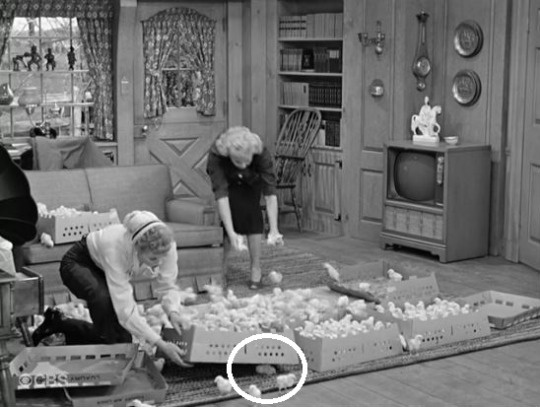
During the scene when Lucy and Ethel are feeding the baby chicks in the den, Lucy breaks open the side of the first box of chicks and tilts the box toward the feed spread on the newspapers. As she is lowering the box, there are a few chicks under the box that attempt to run away. You can hear Lucy ad-lib “Get out from under there.” Unfortunately, Lucy doesn’t see one chick and it is trapped underneath the box. For the rest of the scene you can see some movement from the chick wiggling beneath it.

Blooper Alert! When Little Ricky comes in the front door, you can briefly see the hand and arm of someone ushering him in.

The chicks were prevented from walking off the set was by a low line of wire fencing along the perimeter of the set. When the chickens are running free in the living room, you can glimpse the fencing in the lower right corner of the screen. Sadly, one of the baby chicks broke free and was accidentally crushed under the cameras.

Before the chicken plan entices them out to Connecticut, we learn that the Mertzes have visited the Ricardos every weekend since their move. While the Mertzes are in the country, Mrs. Trumbull’s sister (a character we never meet) will manage the apartment building. According to their agreement, Fred won’t receive a salary for taking care of the chickens. Instead, he will receive free room and board, as well as a share of the egg profits. The writers had always intended for the whole gang to move to Connecticut and they introduce them with an anonymous letter. After the sender is revealed (Fred), Ethel says that Lucy and Ricky should have known something was up because Fred used an Easter Seal rather than waste postage!

Writer Madelyn Pugh remembers:
“When Lucy and Desi lived in Chatsworth [in the San Fernando Valley, north of Los Angeles], they raised chickens. They were the oldest chickens in the world, because [Lucy] didn’t have the heart to kill them. One day, Lucy got up and did her impression of her old chickens. We remembered it and used it in this episode."

As a child, Lucille Ball and her brother Fred were in charge of taking care of chickens and other the other animals her stepfather kept. Lucy does a variation on her chicken impression in “Lucy’s Mother-in-Law” (S4;E7) when pantomiming what’s for dinner: chicken and rice.

Although a specific issue of House & Garden was not seen on camera, the plot involved a team of reporters from the magazine visiting the Ricardo’s colonial home in Westport. When they show up at the end of the episode, they are horrified to see the gang herding hundreds of baby chicks through the living room!

Not coincidentally, the May 1957 issue (above) of House & Gardens contained an article about Lucille Ball titled “Is Lucy Still Lovable?”
This is Mary Jane Croft’s second of five appearances as Betty Ramsey, having first played Cynthia Harcourt in “Lucy is Envious” (S3;E23) and Evelyn Bigsby in “Return Home from Europe” (S5;E26). Tyler McVey plays the man from House and Garden Magazine who takes one look at Lucy herding the chickens and says “I don’t think so!” He is making his fourth and final appearance on the series and is best remembered as the Social Director on the S.S. Constitution in “Second Honeymoon” (S5;E14). Mary Alan Hokenson played the woman from House and Garden Magazine who, taking in the chaotic scene at the Ricardo home, says “Oh, dear, no!” Hokenson played Mission Band ‘doll’ Agatha in Guys and Dolls (1955), which was previewed during the initial broadcast of “Lucy and the Dummy” (S5;E3) in 1955.

This is the first episode sponsored by Ford Motor Company, which runs a long commercial featuring Lucy and Desi in their new Skyliner retractable hard top. After season six ended, Desi convinced Ford to sponsor a series of hour long specials which eventually became known as The Lucy–Desi Comedy Hour.”
FAST FORWARD!

In 1999, The Republic of Senegal issues a series of stamps featuring colorized images from this episode. The stamps have since become much-desired collectibles.

Lucille Ball does yet another variation of her chicken walk when luring the fictional Weewowk bird in a 1974 episode of “Here’s Lucy” titled “Lucy is a Bird-Sitter” (HL S6;E15).

On a 1969 episode of “Green Acres” titled “Everywhere A Chick Chick” (S4;E14), the Monroes bungle the building of the chicken coup and Oliver (Eddie Albert) and Lisa (Eva Gabor, above) must come up with a way to keep their baby chicks warm. They obviously were not “I Love Lucy” fans!

On a 2001 episode of “Gilmore Girls” titled “That Damn Donna Reed” (S1;E14), Lorelai (Lauren Graham) is bird-sitting for Stella and panics when the bird is nowhere to be found. She invokes Lucy Ricardo and this classic episode.
 1957, CBS, chickens, chicks, Desi Arnaz, Ethel Mertz, Ford Skyliner, Fred Mertz, Gilmore Girls, House & Garden, House and Garden Magazine, I love lucy, Lucille Ball, Lucy, Lucy Raises Chickens, Lucy Ricardo, Mary Alan Hokenson, Mary Jane Croft, Ricky Ricardo, tv, Tyler McVey, Vivian Vance, William Frawley
 - Heating $52
-
“Lucy and Bob Hope”

(S6;E1 ~ October 1, 1956) Directed by James V. Kern. Written by Madelyn Martin, Bob Carroll, Jr., Bob Schiller, and Bob Weiskopf. Filmed on June 5, 1956 at Ren-Mar Studios. Rating: 48.7/71

Synopsis ~ Sighting Bob Hope at Yankee Stadium, Lucy hopes to persuade him to appear at Ricky’s club. To get close enough to him, she disguises herself first as a hot-dog vendor, then as a tobacco-chewing baseball player. In the finale, she joins Bob and Ricky to perform at Ricky’s nightclub, the newly-re-named Club Babalu.
On an episode of “The Ed Sullivan Show” that aired the day before season six premiered, Desi announced that plans for the new season included visiting New Orleans and having Jack Benny and Maurice Chevalier as guest stars. As usual with Hollywood, plans changed:
- The New Orleans trip was later switched to Florida.
- Jack Benny, the Arnaz’s real-life neighbor, never guest starred on “I Love Lucy,” but did three episodes of “The Lucy Show” and five of “Here’s Lucy.”
- Maurice Chevalier, who had been imitated in “The French Revue” (S3;E7), would guest star in a 1958 episode of of "The Lucy–Desi Comedy Hour.”

This is the first episode of the final season of the half-hour series. Season six brings a lot of changes to the show due largely to the departure of co-creator, head writer, and producer Jess Oppenheimer.
This is also the first episode for Robert de Grasse as director of photography. De Grasse had worked on five films with Lucille Ball.

Keith Thibodeaux makes his series debut as Little Ricky. He is the eighth and final person to play the role on screen. He was chosen from an open casting call, despite Lucy’s doubts about his acting skills. His drumming and his resemblance to Desi won him the role. He would go on to play the character for 23 more half-hour episodes, and 12 of the 13 hour-long episodes. Although he took the stage name Richard Keith, he was always billed as simply “Little Ricky,” which may have contributed to the confusion between him and Lucy and Desi’s real son, Desi Arnaz Jr. After “I Love Lucy” ended in 1960, he stayed in the Desilu family playing one of Opie’s friends Jimmy John Jason in 13 episodes of “The Andy Griffith Show.” He was very briefly seen in an episode of “The Lucy Show” in 1964. His is now married and has a Christian rock band called David and the Giants.
After Little Ricky’s first scene, when he scampers off to his bedroom for a nap, the studio audience give him a round of applause. Mid-scene applause was a rarity on “I Love Lucy.”

Ricky has become part owner of the Tropicana and is re-opening it under the name Club Babalu.
Writer Bob Carroll reasoned that Ricky Ricardo was making around $20,000 a year by season six, so he could afford such an investment.
When hearing that Lucy and Ethel are out shopping for the re-opening of the Club, Fred typically reacts:
FRED: “If you hadn’t bought a piece of the Tropicana, I wouldn’t be buying a piece of Saks Fifth Avenue.”
When “The Girls Go Into Business” (S3;E2) buying Hansen’s Dress Shop they excitedly say “Saks Fifth Avenue, look out!”

Saks Fifth Avenue is a chain of luxury department stores owned opened in 1867. Its main flagship store is located on Fifth Avenue, New York City.

The props people used genuine Saks gift boxes with their distinctive thatched pattern.

Fred refers to Ethel’s ‘charga-plate’ the predecessor to the modern credit card. Used until the early ‘60s, they were made of aluminum or white metal plates, about the size of a dog tag, and embossed with the customer’s name and address. Fred threatens to “pound the letters down” indicating that they did not have a number, as modern credit cards do. Charga-plates were issued mostly by department stores, but also by a few oil companies. American Express, a company frequently mentioned on the series during the trip to Europe, was still two years away from issuing its first card when this episode was first broadcast.
Bob Hope was born Lesley Townes Hope in England in 1903. During his extensive career (in virtually all forms of media) he received five honorary Academy Awards. He died at the age of 100.

In 1945 Desi Arnaz was the orchestra leader on Bob Hope’s NBC radio show. Prior to this episode, Lucille Ball and Bob Hope had made two films together: Sorrowful Jones (1949) and Fancy Pants (1950). After this episode they did two more films together: The Facts of Life (1960) and Critic’s Choice (1963). Hope made a cameo appearance in a 1962 episode of "The Lucy Show” that starred Jack Benny. Lucy and Hope appeared together in dozens of television programs, including Ball’s final appearance at the 1989 Oscars.
When “I Love Lucy” was the top show on television, Hope walked up to Desi and said “YOU are getting laughs”?
When talking about Hope to Fred, Ricky mentions the name of his real-life agent, Jimmy Saphier. Saphier helped hope take his act from musicals and radio into film and television. He remained Hope’s agent until his death in 1974.

Bob Hope owned a part of the Cleveland Indians so a baseball themed plot seemed natural, including a scene set at Yankee Stadium during an Indians / Yankees game.
The original Yankee Stadium (built in 1923) was located in the Bronx, New York City, and was the home field of the New York Yankees, one of the city’s Major League Baseball franchises. At one point Ricky, fearing Lucy and Bob Hope will run into each other at the game, says “there’s 80 thousand people out there.” That’s a slight exaggeration. Yankee Stadium actually held just over 57,500 sports fans. The stadium hosted 6,581 Yankees regular season home games during its 85-year history. It was razed in 2010 to build a new stadium one block north.

Although there is one establishing shot (above) of the stadium exterior, the sequence was not filmed on location, but at Desilu Studios in Hollywood. The day before this episode aired, the Yankees’ regular season had concluded with a loss to the Boston Red Socks and Cleveland losing to the Detroit Tigers. Two days after this episode first aired, the Yankees entered the World Series against the (then) Brooklyn Dodgers, winning in game seven.

When he first signed on to play Fred Mertz in 1951, William Frawley had it in his contract that if the Yankees were ever in the World Series, he would be granted time off to attend the games. This clause resulted in a few ‘Fred-less’ episodes early in the show’s run. Frawley’s final motion picture was the Yankees-themed Safe at Home with Ralph Houk (above), Mickey Mantle, and Roger Maris as themselves. Mantle is mentioned by Frawley at the start of this episode.

In “Ragtime Band” (S6;E21), Ethel sarcastically refers to Fred as “Babe Ruth” when he gets thrown out of Little Ricky’s little league game. Yankee Stadium was commonly called “The House that Ruth Built.”
LITTLE RICKY: “Who’s Joe ‘Maggio?”
FRED: “’Who’s Joe ‘Maggio?’ You talk more like your father everyday.”
In “Lucy is Enceinte” (S2;E10), Fred gives Lucy a signed baseball for his future ‘godson’. When he asks Lucy to read out the signature, she at first says “Spalding,” the ball’s brand name, but then finds it is signed by Joe DiMaggio, a center fielder who played his entire 13-year career for the Yankees.

During the filming of this episode Bob Hope used cue cards, reportedly the first time they had been used on “I Love Lucy.” Hope was a busy star and an old friend, so Lucy didn’t insist that he memorize his lines like other actors on the show.

The cue cards were held by prop man Jerry Miggins, who also had the thankless job of throwing the baseball that hits Hope on the head!

On his first entrance, a young fan (David Saber) asks Hope for an autograph. Before granting it, he asks the boy “Have you seen my latest picture, ‘The Iron Petticoat?’” The boy eagerly replies, “Yes, sir.”

However, The Iron Petticoat (1956) co-starring Katherine Hepburn, didn’t premiere in the US until early January 1957, three months after this episode aired. In the same breath, Hope manages to promote his television show and remind us that he owns a piece of the Indians. Coincidentally, the film was produced and directed by Ralph and Betty! Not the Ramseys, but Betty Box and Ralph Thomas.

Before Lucy takes over, the hot dog vendor is played by Bennett Green, who was also Desi’s camera and lighting stand-in and appeared in the background of many episodes, often being given a line or two.

When Lucy is disguised as a hot dog vendor she asks Hope to pass hot dogs and money back and forth – even making change – he quips “All of a sudden, I feel like UNIVAC.” UNIVAC (UNIVersal Automatic Computer) was an early computer made by Remington Rand that at the time was used mainly for weather forecasting, but later that month would correctly predict that outcome of the 1956 Presidential election.

Sitting in the box next to Hope is Dick Elliott (”Mr. Mustard”) and Maxine Semon (”Miss Relish”), who both order hot dogs from Lucy with Hope as the go-between.
Dick Elliott did two films with Lucille Ball and two others with Bob Hope before playing Tourist from Topeka at the top of the Empire State Building in “Lucy is Envious” (S3;E23).
Maxine Semon was one of the Nurses when Little Ricky went to the hospital in “Nursery School” (S5;E9) and the hotel maid when “Lucy Hunts Uranium" (1958).

Lucy’s pestering proves such a distraction that Hope doesn’t see a vital play of the game.
HOPE: “Oh, no! Al Rosen hits a home run and I gotta miss it!”
Albert Leonard Rosen (1924–2015), nicknamed “Flip” and “The Hebrew Hammer”, was a third baseman and right-handed slugger for the Cleveland Indians from 1947 to 1956. Although the writers couldn’t have known it when the episode was filmed in June 1956, Rosen played his last Major League Game the day before this episode first aired, retiring for health issues. Even more coincidentally, Rosen (who lived to age 91) died in Rancho Mirage, California, the same place Desi Arnaz had built a home and a hotel, just outside Palm Springs.

Lou Krugman (Paul) made such a positive impression on Lucy as the director in “Lucy Gets Into Pictures” (S4;E18) that the role of the Club Babalu’s manager was created especially for him, although he only played it once more. He made three appearances on “The Lucy Show” between 1963 and 1965.

Peter Leeds (Mr. Krausfeld, Yankee Stadium Guard) had played a reporter interviewing the Maharincess of Franistan in “The Publicity Agent” (S1;E31), as well as appearing as the garage manager in The Long, Long Trailer (1953). He often played policemen on television, and returned to work with Lucy as a cop in a 1971 episode of “Here’s Lucy.”
In his brief scene, we learn that Mr. Krausfeld has a wife named Phoebe.

Henry Kulky (Trainer) was born on August 11, 1911 in Hastings-on-Hudson, New York, just five days and 400 miles from Lucille Ball!

Ralph Sanford (Security Guard) had appeared with Lucille Ball in her 1940 film Dance, Girl, Dance and three films with Bob Hope.

When Lucy disguises herself as a baseball player, she wears a Cleveland Indians uniform with #19 on it. This was the number worn by Bob Feller (1918-2010), who, like Al Rosen, also played his entire career for the Indians and also retired the day before this episode was first aired. Lucy probably didn’t know it, but had Ricky not tipped off part-owner Bob Hope that this was Lucy in disguise, he certainly would have known it was not Feller!

When Hope says that he has a specialty song and dance number about baseball for three people, Ricky replies:
RICKY: “Well, I’m not exactly Gene Kelly, but I’d love to do it with you.”
Gene Kelly was
a Hollywood legend for his effortless dancing. Two years before this episode aired, Lucy and Desi had appeared with Kelly in “MGM’s 30th Anniversary Tribute.” The Oscar-winning performer did four films with Lucille Ball between 1943 and 1967. In 1978 Lucille Ball appeared on the TV tribute special “Gene Kelly: An American in Pasadena.” Two years later he appeared with Hope and Lucy in “Lucy Moves to NBC.” Kelly died in 1996 at age 83.

When Ricky will not let Lucy be the third person in the number, she bursts into tears.
HOPE: “Aw, now. Come, come. Ballplayers never cry.”
This line, coupled with Lucy in a baseball uniform, cannot help but remind present-day viewers of the 1992 film A League of Their Own, where Tom Hanks utters one of the most famous lines in film history: “There’s no crying in baseball!” The film was directed by Penny Marshall, whose career in front of the camera was often compared to that of Lucille Ball. Her brother, actor / director Garry Marshall, who has a small role in the film, wrote for “The Lucy Show” between 1964 and 1966.

The song "Nobody Likes the Ump” was written especially for this episode with lyrics by Larry Orenstein, the same man who wrote the songs for the musical dream in “Lucy Goes to Scotland” (S5;E17). The music was written by Eliot Daniel. Jack Baker did the choreography. Baker, Daniel, and Orenstein all get a spoken credit at the end of the episodes.
The song includes a soft shoe break for Hope.
HOPE: “If Marge sees this, Gower’s finished!”

Hope is referring to Marge and Gower Champion, stage and screen choreographers and dancers were married from 1947 to 1973.
Oops! As the song ends, Lucy appears to still have the tiles attached to the bottom of her shoes. As the audience applauds, Lucy’s tiles vanish from her shoes!

Desi Arnaz hurt his back badly while rehearsing this number, so filming was postponed from a Thursday night to a Tuesday night.
“Thanks for the Memory” was written in 1938 by Ralph Rainger and Leo Robin for the film The Big Broadcast of 1938 starring Hope and Dorothy Lamour, although in the film Hope sang the song with Shirley Ross. It became associated with Bob Hope, who used it as his theme song. Here it features new lyrics that pertain to the episode.
HOPE
(after being kissed by Lucy): “I may never go back to NBC!”
He did, of course. Ball was loyal to CBS until 1980, when she announced that she was going to NBC with a big primetime television special. Sadly, the partnership only resulted on her appearing in more Bob Hope specials. Both NBC and CBS passed on her final series, “Life With Lucy” which was picked up by producer Aaron Spelling’s network of choice, ABC.
The episode’s sponsors were Squeeze Bottle Lilt, and Instant Sanka.

FAST (BALL) FORWARD!
In return for appearing on “I Love Lucy,” the cast did a guest spot on a Bob Hope special on NBC just three weeks later. In the sketch Hope wonders what “I Love Lucy” would be he had married Lucy instead of Desi. The set is a duplicate of the Ricardos’ living room. Lucy and Vivian Vance play their usual roles, but Bob Hope plays Ricky and Desi plays Fred. William Frawley played Captain Blymore, a tenant in the building. For some reason Lucy is hiding a seal in the closet. Of course, she is asked to play the seal’s musical instrument just as she did in “The Audition” (S1;E6) when playing the ‘saxavibratronophonovitch.’ Here she calls the instrument a ‘dramazuzaxylaphonavitch.’ Hope makes fun of Ricky’s English using the same line he did on “I Love Lucy” – “You’re trying to tell me something.” He also manages to make a Cleveland Indians joke. The skit is included on the DVD “Lucy’s Lost Episodes.”

Baseball, little league, and softball were the themes of several episode of “The Lucy Show,”

After Lucille Ball’s death, Bob Hope hosted a TV special honoring his friend.
1956, Baseball, Bob Hope, CBS, Cleveland Indians, Club Babalu, Desi Arnaz, Ethel Mertz, Fred Mertz, Henry Kulky, I love lucy, Keith Thibodeaux, Little Ricky, Lou Krugman, Lucille Ball, Lucy, Lucy Ricardo, New York Yankees, Peter Leeds, Ricky Ricardo, The Iron Petticoat, Tropicana, tv, UNIVAC, Vivian Vance, William Frawley, Yankee Stadium -
“The Passports”

(S5;E11 ~ December 19, 1955) Directed by James V. Kern. Written by Jess Oppenheimer, Madelyn Pugh, Bob Carroll, Jr., Bob Schiller, and Bob Weiskopf. Filmed November 17, 1955.
Rating: 44.2/62
Based on Lucy’s radio show “My Favorite Husband” #121 broadcast in March 1951, also titled "The Passports.”
Synopsis: Getting ready to go to Europe, Lucy can’t find her birth certificate and must find someone to vouch for her identity in order to obtain a passport. When unable to get a school chum’s affidavit, she schemes to stow away in a steamer trunk!

This episode was sponsored by Golden Fluffo, a vegetable shortening. The golden color was to emulate butter and set it apart from its rival Crisco, both made by Procter & Gamble. Although no longer available in the USA (P&G introduced Butter Flavored Crisco), Fluffo is still sold in Canada.
In reality, this episode has little to do with the gang getting their passports; that would be the following episode, “Staten Island Ferry” (S5;E12). Lucy’s passport will also be part of “Paris at Last!” (S5;E18) and the main subject of “Lucy’s Bicycle Trip” (S5;E24). It might have been titled “The Trunk” if that didn’t give away the show’s comic ending.

At the start Lucy announces their European travel destinations, although she mentions Venice, Holland, and Madrid, they did not end up being being featured on the show. In “Return Home from Europe” (S5;E26), Lucy wants to pack wooden shoes she bought for Marion Van Vlack, likely a souvenir of Holland which indicates that there were places the foursome visited that were not seen on the air. The trip was originally scheduled to last three weeks, but like the trip to California, ended up being longer.

Based on the dates in this episode, Lucy Ricardo was born in 1921, ten years after Lucille Ball’s birth in 1911. We also learn that Lucy was born in West Jamestown not Jamestown itself. Technically, there is no ‘West Jamestown,’ although there is now a Jamestown West, a census-designated place (CDP) located near Jamestown in Chautauqua County, New York. It is also known as West Ellicott because of its location in the town of Ellicott. Lucille Ball was born in Jamestown proper and spent most of her childhood in Celoron, both communities adjacent to Jamestown West. The above postcard is dated 1910. Had it been taken a few years later, it could accurately depict the episode’s story of Helen pushing baby Lucy in her pram!

To vouch for her age in an affidavit, Lucy tracks down her childhood babysitter Helen Erickson, played by Sheila Bromley. Bromley was a former Miss California making her only appearance on the series. She had appeared in two 1935 Columbia Pictures films with Lucille Ball and like Ball, was also born in 1911.

The
leopard-print bag Lucy carries will be also used as the handbag Ethel buys while shopping in “Lucy Gets A Paris Gown” (S5;E20).
Ethel carries the purse again when she dressed like a gun moll in “Lucy Wants to Move to the Country” (S6:E15).
Reminiscing, Helen says she used to call Lucy ‘droopy drawers’ because of her sagging bloomers. In her posthumously published autobiography, Lucille Ball revealed that this was her childhood nickname as well.
Lucy remembers that Helen has been married twice since Lucy last saw her.
LUCY: Her first husband’s name was Sears.
RICKY: You don’t suppose her second husband’s name could be… No, I guess that’s impossible.
Ricky is inferring that the name might be ‘Roebuck.’ Richard Sears and Alvah Roebuck founded the retail giant Sears Roebuck as a mail order (catalog) company in 1886, although the brand is now known simply as Sears.

Helen’s current husband is New York City lawyer Sidney Kaiser played by Robert Stevenson, who is credited here as Robert Forest. Like Bromley, Stevenson made his one and only appearance on the series with this episode.


The Kaiser apartment actually uses the framework of the set for Carolyn Appleby’s New York City apartment (left), seen in “Lucy Tells the Truth” (S3;E6) and “Baby Pictures” (S3;E5).
In real life there, in 1927, there was a boy named Warner Erickson who lived on Lucille Ball’s street who was accidentally shot by a neighbor girl during a target practice set up by Fred Hunt, Lucy’s grandfather. A lawsuit was brought against Hunt causing Lucy’s family to have to move from their Celoron home to a Jamestown apartment.

The trunk has ‘Mertz & Mertz’ written on it, which was probably the name of Fred and Ethel’s vaudeville act. They bought the trunk from a man who had a seal act and he cut a hole in the side so the seal could breathe. Lucy does a quick imitation of a seal, just as she did in “The Audition” (S1;E6) when playing the saxavibratronophonovitch, before becoming locked in the trunk.
Lucille Ball was claustrophobic in real life so she hated being stuck inside the trunk, but was always game to try whatever the script demanded of her.

A Lucy doll made by the Franklin Mint used a replica of the trunk as the wardrobe container for the doll’s outfits.

The trunk even inspired a collectible cookie jar!
Ricky comes home with “the boat tickets”. Although it was decided that the Ricardos and Mertzes would go to Europe on an ocean liner, the promotional arrangements with the American Export Line (owners of The SS Constitution) were not in place until the last minute, so the “boat” was not specified by name.
Although Lucy and the Mertzes need birth certificates in order to get their passports, Ricky mentions his “naturalization papers” because he is a foreign-born citizen.
Oops! When Desi Arnaz is supposed to answer the phone he’s so engrossed with laughing at William Frawley’s line about Lincoln signing Ethel’s birth certificate that Lucy ad-libs by saying, "The phone, honey.” Desi was supposed to ask about the Mertzes’ trunk prior to answering the phone, but he saved himself by asking about it after saying hello.

Lucy sings “Skip to the Lou” with Doc Peterson to prove her identity when trapped in the trunk. The character was probably named after Ed Peterson, Lucille Ball’s step-father. He is played by Sam Hearn in his only appearance on the series, although he did return for a 1959 episode of “The Lucy–Desi Comedy Hour.” Hearn was also a musical comedy performer on Broadway between 1915 to 1929.

“Skip to the Lou” is a popular children’s song and partner-stealing dance from the 1840s. It was the theme song of the first successful TV soap opera "Hawkins Falls, Population 6200,” which aired its final installment just a few months before “The Passports” was first broadcast. The song was also recorded by Judy Garland and Nat King Cole in 1944.
LUCY: Doc, I was bitten by a cat once on my ear and you took some stitches. It was Fred Bigelow’s cat.
DOC: Yeah, that’s right.
LUCY (pushing her ear to the hole in the trunk): Well, look. Maybe you can see the scar.
DOC: Scar or no scar, you couldn’t be Lucille McGillicuddy. She had brown hair!
ETHEL: Look at the roots – the roots!In real-life, Fred Bigelow was the proprietor of Bigelow’s Department Store in Jamestown. A young Lucille Ball applied for a job at the ribbon counter, but was turned down, a decision which allowed her to pursue her show business aspirations.

Bigelow’s later turned up in a 1965 episode of “The Lucy Show”!

Knowing he is going back to Paris, where he fought during World War I, Fred squeezes into his old army uniform.
FRED: Now, don’t make fun of us dough boys.
LUCY: Dough boys? Whoever put the dough in that boy used too much yeast!Any reference to “too much yeast” instantly recalls the over-sized loaf of bread Lucy baked in “Pioneer Women” (S1;E25) in 1952. She misreads the recipe, which calls for 3 cakes of yeast, not 13!
As Fred marches in, he sings "Mademoiselle from Armentières” (aka “Hinky-Dinky Parlez-vous”), a song sung by soldiers during World War I. Fred also sang it in “Equal Rights” (S3;E4). The tune (without lyrics) was also Clarabell’s theme on "Howdy Doody” (1947-60).

Oops! In the scene where Ricky and his pianist Marco Rizo rehearse in the Ricardo’s apartment, Ricky begins drumming on the trunk with Lucy inside, upon finishing the song Marco says he’s got to go using the actor’s name and not the character’s name.
MARCO: Bueno, Desi. Tengo que ir.
RICKY: ¿Tienes que ir? El tiempo entrará. Iré contigo al subway!It is likely that Lucille Ball was NOT actually in the trunk during this short scene. Although Ricky says that the trunk has a “pretty good tone”, Desi Arnaz rubs his hands from beating on the unforgiving walls of the trunk!

At the end of the episode, Lucy gets a letter from her mother, who is supposedly away on a road trip to New England. Apparently she didn’t get very far, since she writes that they had car trouble in West Jamestown! She also encloses Lucy’s birth certificate!

Rizo goes uncredited, but always used his real name on the series. An uncredited actor (probably Bennett Green, Desi’s camera and lighting stand-in) plays the messenger who delivers Lucy’s birth certificate at the end, saving the day!
 1955, Bigelow’s Department Store, Birth Certificate, CBS, Desi Arnaz, Dough Boy, Ethel Mertz, Fred Mertz, I love lucy, Jamestown NY, Kaiser, Lucille Ball, Lucy, Lucy Ricardo, Mademoiselle from Armentieres, Ricky Ricardo, Robert Forest, Robert Stevenson, Sam Hearn, Sears, Sheila Bromley, Skip to My Lou, The Passports, trunk, tv, Vaudeville, Vivian Vance, William Frawley, World War I
 -
“The Dancing Star”

(S4;E27 ~ May 2, 1955) Directed by William Asher. Written by
Jess Oppenheimer, Madelyn Pugh, and Bob Carroll, Jr. Filmed March 30, 1955 at Ren-Mar Studio. Rating: 41.5/65

Synopsis ~ Carolyn Appleby is in town and expecting to see Lucy rubbing elbows with celebrities so Lucy convinces Van Johnson to play along with her deception.

Ray Bolger was originally going to be “the dancing star,” but he was replaced with Van Johnson (1916-2008). Johnson was a very good friend of Lucy and Desi’s. He starred with both of them in Too Many Girls in 1940 and met Desi when the two of them did the Broadway version of the show in 1939.

Johnson was scheduled to have been “The Star Upstairs” (S4;E25), but was then appearing in advertising for Lucky Strike cigarettes and could not work out the conflict with “I Love Lucy” sponsor Philip Morris in time for the filming, so he was was replaced by Cornel Wilde. Johnson was also seen with Lucy in the films Easy to Wed (1946) and Yours, Mine and Ours in 1968, the year he also guest-starred on a 1968 episode of “Here’s Lucy.”

Carolyn (Doris Singleton) stops in California to visit Lucy and Ethel on her way to Hawaii with her husband Charlie. This is the first time we hear that Carolyn wears glasses, a plot point that will extend into the next episode, “Lucy Meets Harpo Marx” (S4;E28). In reality, the episodes were filmed in reverse order to accommodate the stars’ schedules. Lucy lies to Carolyn that Cary Grant, Walter Pidgeon, and Marlon Brando are coming to an open house party she’s giving the next day. At the end of the episode, Carolyn says that she can’t wait to see "Clark, Bing, and Cary,” so at some point Lucy must have told her that Clark Gable and Bing Crosby were also coming to the ‘party.’ Although Lucy fibs and says Hedy Lamarr is also poolside with Pidgeon and Gable, Lamarr doesn’t make the guest list for the open house.

The night before this episode was filmed, Marlon Brando won an Oscar for On the Waterfront, a fact that Lucille Ball manages to casually work into the dialogue at the last minute: “He got the Academy Award, you know.”

LUCY (to Ethel): “You think of something.”
ETHEL: “Listen, if Einstein can’t work out a problem, you don’t hand it to Mortimer Snerd.”Ethel is comparing Lucy’s talent for scheming with arguably the most intelligent man alive and her’s with a ventriloquist’s dummy. Nobel Prize-winning physicist Albert Einstein died two weeks after this episode was filmed. The same date this episode first aired, LIFE Magazine published an article about Einstein’s death. Mortimer Snerd was a puppet of master ventriloquist Edgar Bergen, who created the hillbilly character to contrast with his upper class, monocle-wearing sidekick Charlie McCarthy.

While Van Johnson is napping poolside, he is catching up on his Hollywood gossip with the May 1955 issue of Modern Screen magazine. Filmed at the end of March 1955, this would have been hot-off-the-presses. June Allyson is on the cover. Allyson and Lucille Ball did three films together in the 1940s. Along with Van Johnson, Allyson and her husband Dick Powell were listed as guests on the fake publicity release for Lucy’s “Hollywood Anniversary” (S4;E23) a month earlier.

When Lucy picks the magazine up off his lap and starts ‘pretending’ to read it, a glimpse of an article on Rock Hudson can be seen. It is about his romantic association with talent agent Phyllis Gates. Gates met Rock Hudson in October 1954 and were married on November 9, 1955, shortly after he finished filming Giant. They separated in 1957 and divorced in 1958. This was a ‘lavender’ marriage to cover for Hudson’s homosexuality. Coincidentally, Hudson had played himself on “I Love Lucy” in the previous episode, “In Palm Springs” (S4;E26).

At poolside, Vivian Vance’s stand-in Renita Reachi is wearing a dress last worn by Lucy in the “The Sublease” the previous season. Also in the audience, with her back to the camera, is Joan Carey, a frequent background player who would take over as Lucille Ball’s stand-in during “The Lucy Show.” [Thanks to The Lucy Lounge for these trivia items!]

Blooper Alerts! When Lucy flubs her line and says “It’s true, I van – I danced with Van Johnson this afternoon,“ Desi ad libs by saying, "Dance with Vance?! What is that? She’s gone!” Lucy faces upstage a bit to hide her laughter. With a co-star named Vivian Vance, the error is understandable. In the very next scene Fred asks Lucy if she’s nervous and says “jance” instead of “dance,” Lucy quickly ad libs “You’re just as nervous as I am!” and William Frawley just as quickly replies “I know it!’

Eagle-eyed viewers will recognize the framed print of the Edgar Degas painting “The Star” in the Mertzes hotel room (#317) at the Beverly Palms Hotel as the same one that hangs in the Ricardos hallway at 623 East 68th Street back in New York City. Even the framing is identical.
“The Beverly Palms Hotel takes great pride in presenting Van Johnson and partner!”
The nightclub announcer’s voice that introduces Van and Lucy is the show’s usual announcer, Johnny Jacobs.

Another cross-country coincidence is Ricky’s piano player Marco Rizzo, who accompanies Van Johnson and Lucy during the rehearsal scene. Johnson refers to him by his first name.
Background performer Flower Parry is in the audience for Lucy and Van’s performances. Parry had been married to actor Jackie Coogan in the early 1940s and was spotted on two other episodes. She was most frequently seen as a courtroom spectator on “Perry Mason” (1959-63).

Van Johnson’s usual redheaded dance partner is named Hazel, which is probably a reference to Lucy’s stand-in Hazel Pierce. Hazel gets sick and Johnson recruits Lucy to do the routine at a sold-out performance. In this instance Lucy stands in for Hazel – literally!

The song "How About You?” by Burton Lane and Ralph Freed was first heard in the 1941 movie Babes on Broadway, where it was sung by Judy Garland and Mickey Rooney. The tune (without lyrics) was also heard in All About Eve (1950) and was sung by Anne Bancroft in Don’t Bother to Knock (1952). Two months before Van and Lucy sang it, Lucy’s real-life next door neighbor Jack Benny performed it on his TV show with his wife Mary and guest star Gary Crosby (Bing’s son). In its different iterations the lyric “Greta Garbo’s looks” was variously “Franklin Roosevelt’s looks” and “James [Jimmy] Durante’s looks.” Lucy did her Greta Garbo imitation in “The Saxophone” (S2;E2). Garbo’s Camille (1936) is mentioned in Lucy’s mid-song patter. Camille also starred Robert Taylor, who signed Lucy’s orange at the Farmer’s Market.

Oops! At the end of Lucy and Van Johnson’s dance, Ricky and the Mertzes are in the audience applauding as Lucy walks through the curtain to head backstage. In the next shot, as Lucy walks through the curtain, we catch a glimpse of Desi Arnaz standing waiting for his cue.
FAST FORWARD!

In 1968′s “Guess Who Owes Lucy $23.50?” (HL S1;E11), Lucy Carter loans Van Johnson money to fix his car – but the man turns out to be an impostor. In return, Lucy wants the real Van Johnson to fly to Dallas to sing “Happy Birthday” to a cow named Ethel.

This “Here’s Lucy” episode works in a not-so-subtle plug for Lucille Ball’s latest film Yours, Mine and Ours, in which Van Johnson is a featured player.

The scene with Lucy dancing with Van Johnson in her feather dress is actress Fran Drescher’s favorite “I Love Lucy” moment. She said that as a child she would watch this scene in awe at how beautiful and talented Lucy was, and that this was one of the things that inspired her to become an actress. Drescher was such a big Lucy fan that she even had an “I Love Lucy” themed episode of her TV show "The Nanny.”

On May 19, 2017 CBS aired this episode and “Lucy Meets Harpo Marx” (S4;E28) colorized as “I Love Lucy: Superstar Special”. The episode was edited for broadcast to make room for more commercials.
 1955, 1955 Academy Awards, Babes on Broadway, Carolyn Appleby, CBS, Desi Arnaz, Doris Singleton, Edgar Degas, Ethel Mertz, Eye Glasses, Fran Drescher, Fred Mertz, Greta Garbo, Here’s Lucy, How About You?, I love lucy, Lucille Ball, Lucky Strike, Lucy, Lucy Ricardo, Marlon Brando, Near Sighted, Ricky Ricardo, The Dancing Star, tv, Van Johnson, Vivian Vance, William Frawley
-
Subscribe
Subscribed
Already have a WordPress.com account? Log in now.
 Papermoon Loves Lucy