-
Lucy, the Superwoman
S4;E26
~ March 21, 1966
Synopsis
When
a heavy computer falls on Mr. Mooney’s foot, Lucy has a rush of adrenaline to lift it up. From then on, she has super-strength and wreaks havoc with her
new-found power. Lucy the superwoman is then brought into a lab to be examined by
scientists.Directed by Maury Thompson ~ Written by Elroy Schwartz
Regular
Cast
Lucille
Ball (Lucy Carmichael), Gale Gordon (Theodore J.
Mooney), Mary Jane Croft (Mary Jane Lewis)Guest
Cast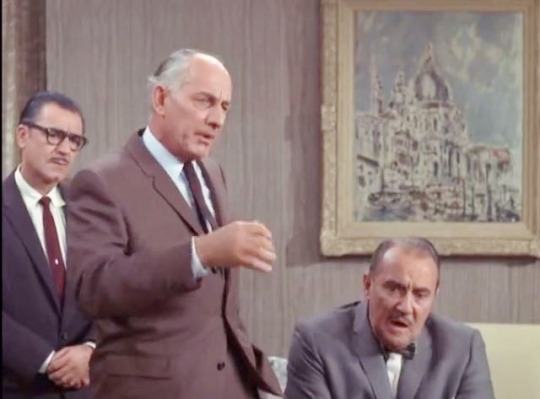
Robert
F. Simon (Dr.
Robert F. Simon) had
a ten year run on Broadway (1942-52), in which he cut his teeth as
actor and stage manager in everything from drama to musical comedy.
He served as understudy to Lee
J. Cobb
as
Willy Loman in Arthur
Miller’s
Death
of a Salesman.
He was seen with Lucille Ball in the 1960 film The
Facts of Life
and in a 1963 episode of “The Greatest Show on Earth.”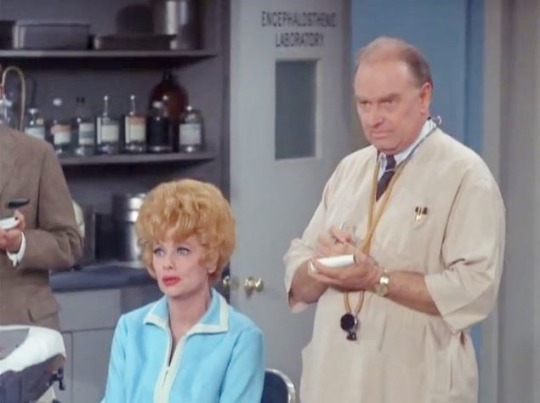
Parley
Baer
(Dr. Davis) previously
played MGM’s Mr. Reilly in “Ricky
Needs an Agent” (ILL S4;E29)
and
the furniture salesman Mr. Perry in “Lucy
Gets Chummy with the Neighbors” (ILL S6;E18).
This is the fourth of his five appearances on “The Lucy Show.” He
also made two appearances on “Here’s Lucy.” He is perhaps best
known for his recurring roles as Mayor Stoner on “The Andy Griffith
Show” and Doc Appleby in “The Dukes of Hazzard.”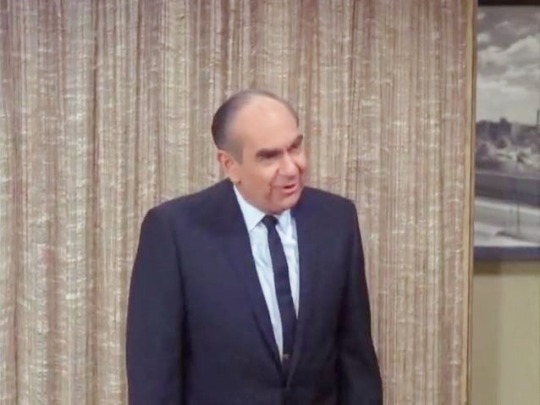
Herb
Vigran
(Mr. Vigran) played
Jule, Ricky Ricardo’s music agent on two episodes of “I Love
Lucy” in addition to playing movie publicist Hal Sparks in “Lucy
is Envious” (ILL S3;23).
He was seen in the Lucy-Desi film The
Long, Long Trailer.
He played the role of the baseball umpire (and eye doctor) in two
previous
episodes.
He will be seen in just one more episode of “The Lucy Show.”Jack Perkins (Terrible Tony, a Wrestler) was a stuntman and actor often cast for his ability to play drunk. He also has quite a few credits as a brawler and a bartender. This is his last episode of “The Lucy Show.”
Lucy claims to have seen Terrible Tony on television.
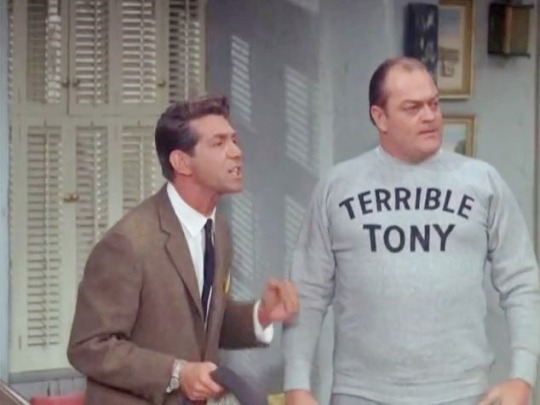
Joel
Marston
(George Denton, Reporter for the Daily Gazette, above left) previously
appeared as the supermarket clerk in “Lucy
and Joan” (S4;E4).
Marston was an internationally known dog breeder and proprietor of
Starcrest Kennels in California. This is his final appearance on the
series. He retired to Jacksonville, Florida, where he became a water
aerobics instructor.Eddie,
the Daily Gazette photographer, is uncredited.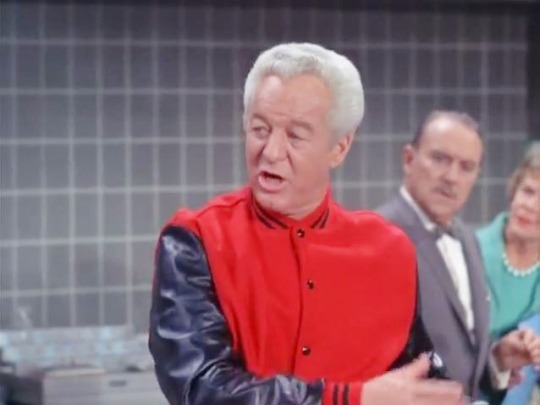
Robert
S. Carson (Coach
from the US Women’s Olympic Team) played
bank employee Mr. Potter in “Lucy Saves Milton Berle” (S4;E13)
and “Lucy
at Marineland” (S4;E1).
He
was a busy Canadian-born character actor making the fifth of his six
appearances on the series. He also made five appearances on “Here’s
Lucy.”Natalie
Masters
(Woman from Whamo Breakfast Cereals, below) was seen as a saleswoman in
“Lucy Bags a Bargain” (S4;E17). She played
private eye “Candy Matson” on the radio series of the same name,
which ran on NBC from 1949 to 1951. This is her last appearance on
“The Lucy Show.”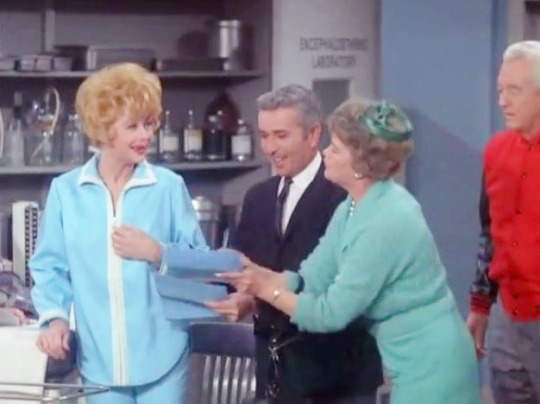
John
Perri (Man
from Full-of-Pep Vitamins, above center) was previously seen as a supermarket
checker in “Lucy and Joan” (S4;E4). He was
seen on Broadway in The
Boy Friend (1954),
the musical that introduced Julie Andrews. This is his final
appearance on “The Lucy Show.”
Joyce
Perry
(Lab Secretary) makes the first of two appearances on the series.
She was also a screen writer, receiving Emmy nominations for “Days
of Our Lives” and winning a WGA (Writers Guild of America) Award in
1975 for “Search for Tomorrow.”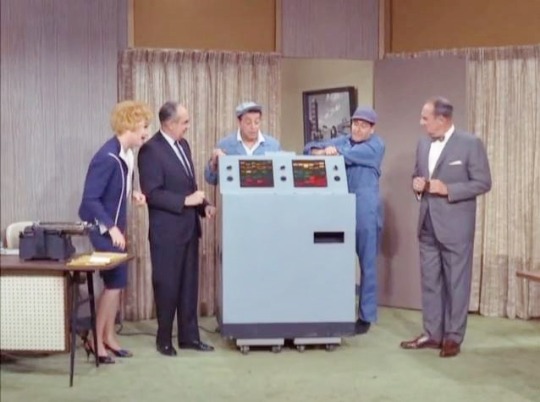
Sid
Gould
(Sid, Computer Deliveryman) made
more than 45 appearances on “The Lucy Show,” all as background
characters. He also did 40 episodes of “Here’s Lucy.” Gould
(born Sydney Greenfader) was Lucille Ball’s cousin by marriage to
Gary Morton.Bennett
Green (Computer
Deliveryman #2) was Desi Arnaz’s stand-in during “I Love Lucy.”
He does frequent background work on “The Lucy Show.”Gould
and Green have no lines as the Deliverymen. The two also played
Deliverymen in “Lucy the Robot” (S4;E23) delivering the very
large box containing Lucy as Major Fun Fun.Alberto Morin (Bank Employee, uncredited) was born in Puerto Rico, and appeared in some of Hollywood’s most cherished films: Gone with the Wind (1939), Casablanca (1943), and Key Largo (1948). He was Carlos, one of Ricky’s “Cuban Pals” (ILL S1;E28) and the Robert DuBois in “The French Revue” (ILL S3;E7). His many background appearances on “The Lucy Show” and “Here’s Lucy” were all uncredited.
Hazel Pierce (Bank Employee, uncredited) was Lucille Ball’s camera and lighting stand-in throughout “I Love Lucy.” She made frequent on-camera appearances on the show. She was also an uncredited extra in the film Forever Darling (1956).
One other uncredited performer plays a bank employee who comes to Mr.
Mooney’s aid when the computer falls on his foot.
This
is the final episode of season 4. Overall, season 4 rated #3 (a 27.7
share) in the Nielsen Ratings, the highest rating of the series thus
far. The official DVDs of season 4 (with bonus material) were first
released on April 26, 2011.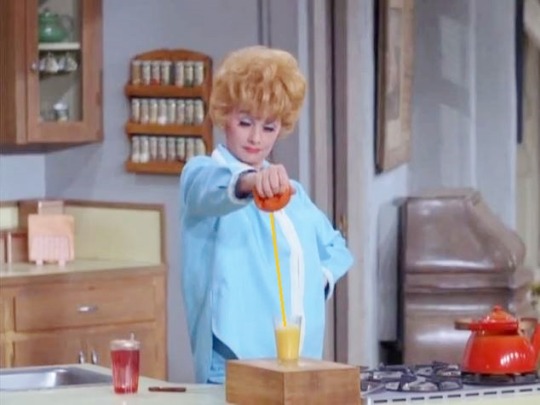
This
is the first of three episodes written by Elroy Schwartz. He
was born in Passaic, New Jersey, in 1923 and was the brother of
Sherwood Schwartz. As such, he wrote several episodes of his
brother’s most popular series: “Gilligan’s Island” and “The
Brady Bunch.”
Indeed, the premise of this episode was taken from a script of “Gilligan’s Island”! On the series, the castaways discover cans of vegetables that turn out to be radioactive. Gilligan eats the spinach (the same vegetable that gave Popeye strength) and develops super-human strength. It was aired six months after this episode of “The Lucy Show” – September 26, 1966 – also on CBS.

The idea of a sudden onset of super-human strength (aka ‘Hysterical Strength’) was a familiar trope on television, but based on real-life anecdotes, mostly about parents lifting cars to rescue their children. Comic book artist Jack Kirby claims he saw a woman lift a car off her baby, which inspired him to create the Incredible Hulk, whose first appearance was in 1962.
On
the same evening this episode first aired (March 21, 1966), ABC
broadcast the last new episode of “Ben Casey” starring Vince
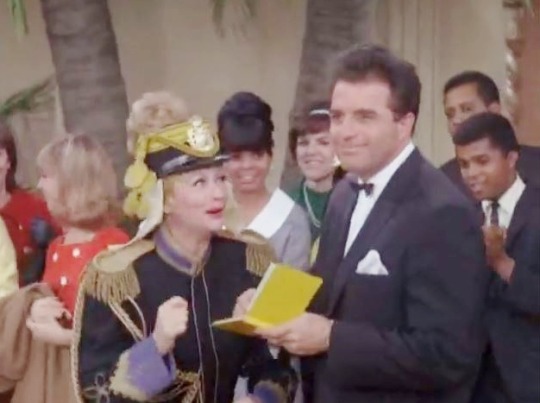
Edwards. Edwards did a cameo in “Lucy Goes to a Hollywood
Premiere” (S4;E20, above). “Ben Casey” was filmed at Desilu Studios. The series finale was directed by Marc Daniels, who had directed 39 episodes of “I Love Lucy” from 1951-53.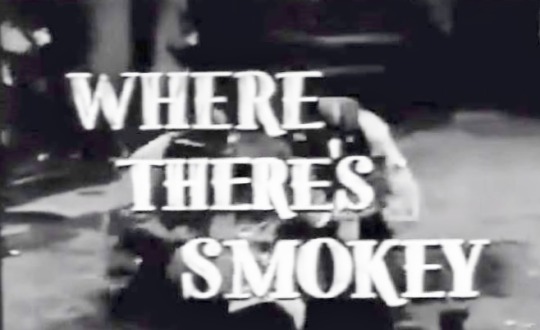
“The
Lucy Show”
was replaced for the summer (July-September 1966) by the
fourth season of “Vacation
Playhouse,”
an anthology series of
unsold TV comedy pilots.
One was titled “Where There’s Smokey” starring Gale Gordon as a
Fire Chief. The pilot was completed in 1959 but not aired until
August 1, 1966. When the pilot wasn’t picked up, Gordon took the
role of Mr. Heckendorn, the landlord on “Make Room for Daddy,”
also filmed at Desilu. On August 29, 1966, “Vacation Playhouse”
aired “The Two of Us” starring “Lucy Show” cast members Mary
Jane Croft (Mary Jane) and Barry Livingston (Arnold Mooney).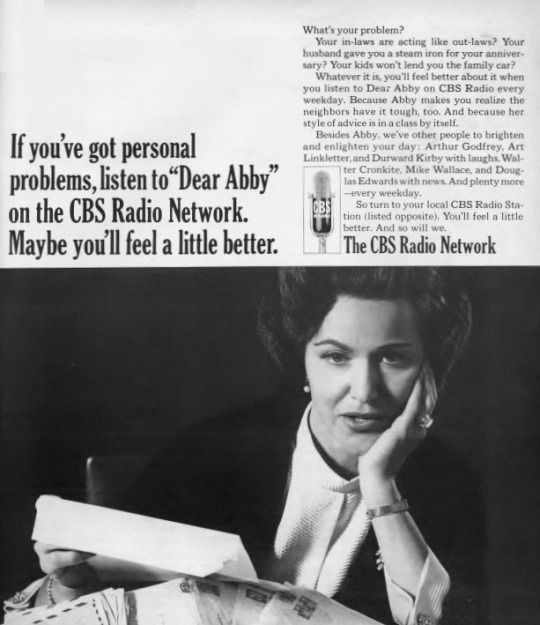
When
Mr. Mooney is getting a computer in his office, Lucy wants to ask it
for dating tips. Mr. Mooney replies that it is a computer, not “Dear
Abby.” Dear
Abby
is
an advice
column
founded
in 1956 by Pauline
Phillips
under
the pen name ‘Abigail Van Buren’ and carried on today by
her daughter, Jeanne
Phillips. In 1965, CBS aired a radio version of Dear Abby’s column. Lucille Ball also had a CBS radio series at the time.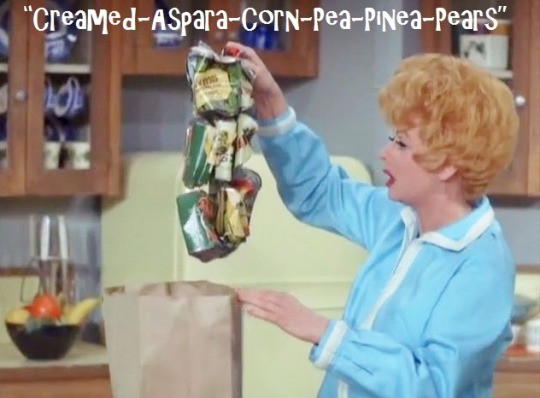
In this episode, Lucille
Ball’s hairstyle (probably a wig) has longer bangs and sides. This
could be to cover the ‘lift tape’ (a sort of non-surgical face lift)
that she wore on camera starting around this time.
To decide where to put the computer in the office, Mr. Vigran feeds it a punch card. Punch cards were widely used through much of the 20th century in the data processing industry. The IBM 12-row / 80-column punched card format came to dominate the industry. Many early digital computers used punched cards as the primary medium for input of both computer programs and data. While punched cards are now obsolete as a storage medium, as of 2012, some voting machines still used punch cards to record votes.
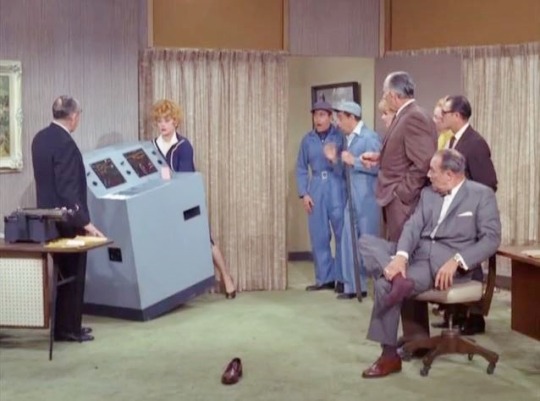
When
Lucy lifts the computer the second time (just to prove she can), she
gets a round of applause from the studio audience! This happens
again when she lifts the desk in her apartment. Apparently the audience completely invests in the silly premise that Lucy has
developed super human strength.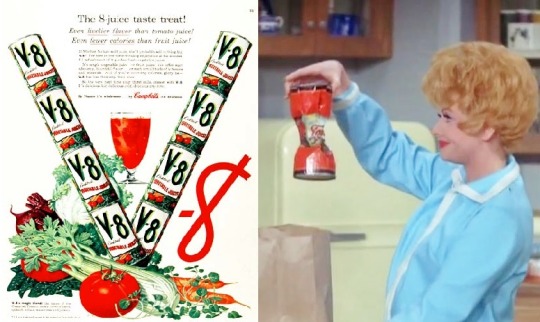
When
Lucy inadvertently crushes the can of tomato juice, she says in a
childlike voice: “Boy,
it sure doesn’t look like tomato juice!” In the 1960s “Wow,
it sure doesn’t taste like tomato juice!”
was the advertising slogan for V8,
a beverage manufactured by Campbells.
V8
got its name from the fact that it originally contained the juice of
eight different vegetables.
It
was first marketed in 1933 and is still sold today.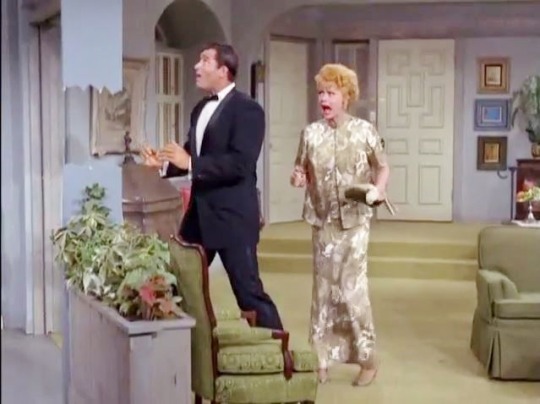
Lucy
swats a fly with a rolled up magazine and breaks a support column in
half. This is the same column that muscular Frank Winslow broke in
half when he was startled awake and went into a karate chop in “Lucy
and the Sleeping Beauty” (S4;E9). The column in “Lucy, the Superwoman” is much narrower
than the one seen above.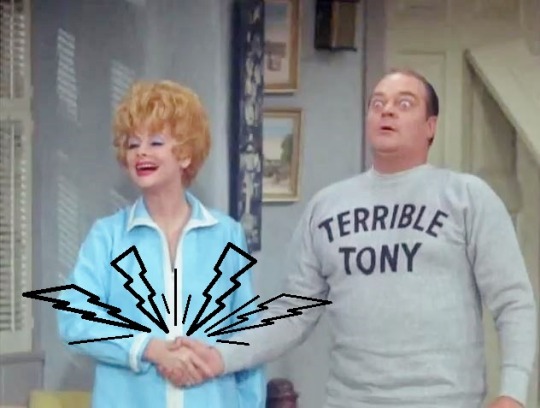
When
Lucy breaks the blood pressure machine causing a spurt of liquid into
the air, Mr. Mooney shouts “Thar
she blows!”
“Thar
she blows”
is what the lookout on a whaling ship would shout when seeing a whale
surface and blowing air out of its blowhole.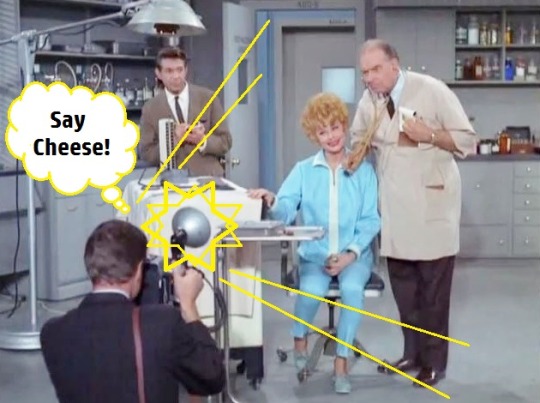
When
Lucy sneezes and blows the paperwork off the shelves, Mr. Mooney says
“Now
I know why they name hurricanes after women.” In
1953, after a brief two-year period of using the Greek alphabet,
meteorologists began using female
names for hurricanes.
In 1979, after much pressure from women’s groups, male names were
integrated into the naming. Hurricanes now alternate between male and
female names.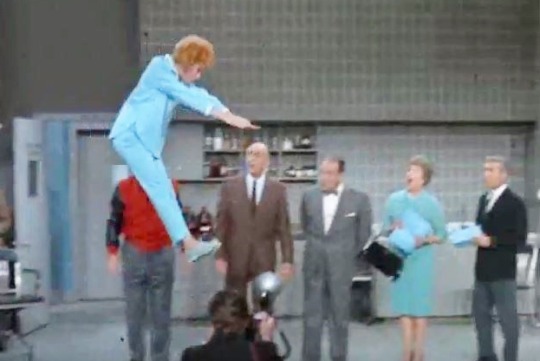
Lucy’s
twenty foot standing broad jump and hurdle stunts were accomplished
by speeding up the film and putting Lucy on wires.
It is likely that most of the lab scenes were shot without a studio audience due to the nature of the stunts involved. Also telling is that after Lucy does her first ‘flight’ the studio audience does not applaud, as they had for the much simpler stunts earlier in the show.
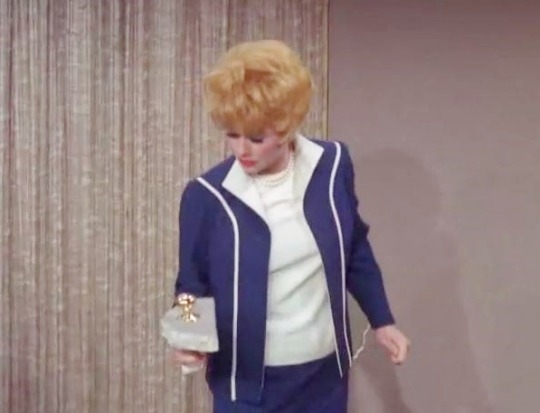
Examples of Lucy’s super human strength:
- She
lifts Mr. Mooney off his feet into the air when helping him up - She
breaks the return carriage off her typewriter - She
staples a document and breaks off the end of her desk - She
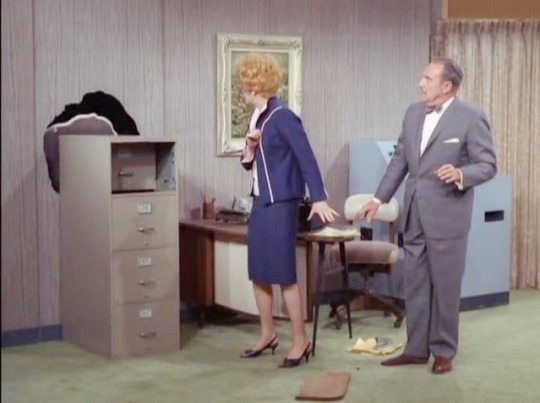
closes a file cabinet drawer which smashes a hole in the wall - She
rips the doorknob off Mr. Mooney’s office door and then rips the door
off as well - She
closes her apartment door with a kick and splits it in two - She
squeezes her grocery bag and collapses a can of tomato juice and cans
of vegetables - She
tears the door off her refrigerator - She
squeezes 6oz of juice from a 3oz orange - She
pulls the bottom off an ice cube tray - She
swats a fly and breaks a pillar in half - She
empties a full glass of cranberry juice in one sip - She
saws through a table when cutting a slice of roast beef - She
brings a professional wrestler to his feet with a handshake - She
causes paperwork to fly off the shelves with a sneeze - She
breaks a blood pressure machine - She
kicks a tray into the air when her reflexes are tested - She
nearly deafens the doctor when she talks into his stethoscope - She
pitches an iron shot put ball through a glass window pane and a brick
wall - She
jumps twenty feet in her first attempt at the standing broad jump - She
hurdles in the air over three men who are bending over
Callbacks!
Mary
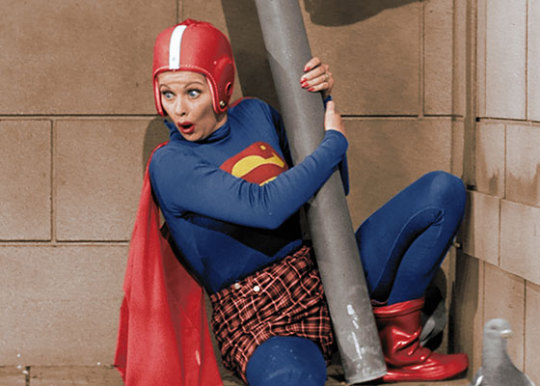
Jane says that the TV reporters are calling Lucy “Superman with
prettier muscles.” In 1957, Lucy Ricardo pretended to
be the man of steel in “Lucy and Superman” (ILL S6;E13).
Lucille Ball also used wires to ‘fly’ as the Witch in “Little Ricky’s School Pageant” (ILL S6;E10).

And again in “Danny Thomas’s the Wonderful World of Burlesque” aired just a few months before this episode of “Here’s Lucy”.
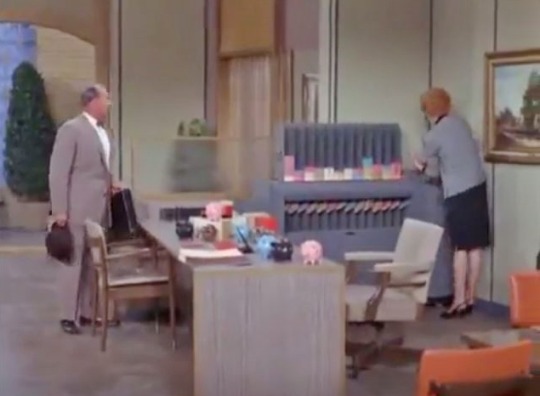
Lucy
operated a similar massive gray computer that was located in the bank
lobby at the start of “Lucy and Bob Crane” (S4;E22), although
neither she nor Mr. Mooney mention it in this episode.Fast Forward!
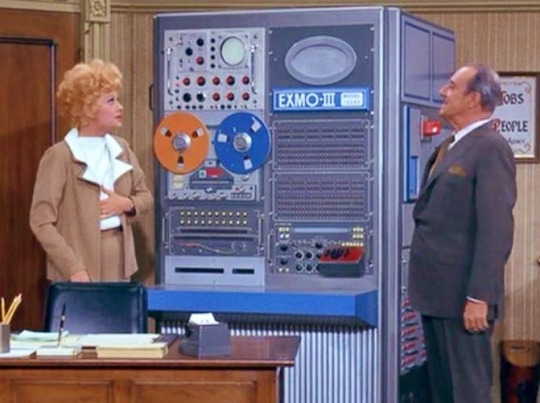
In 1972, Harry Carter also gets a computer installed in the office to help with the workload in “Lucy’s Replacement” (HL S4;E19).

Mrs. Carmichael wants to ask the new computer for dating tips like it is a mechanical Dear Abby. Two years later, Lucy Carter consulted a computer for dating tips in “Lucy the Matchmaker” (HL S1;E12).

The desk that Lucy Carmichael lifts with ease will turn up again as set decoration for Harry Carter’s Home in “Lucy’s Wedding Party” (HL S3;E8) in 1970. Lucy Carter dusts it, but doesn’t lift it!
Blooper
Alerts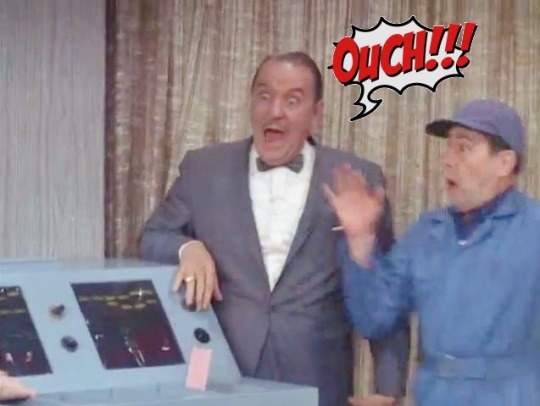
Keep Jiggling, Viggie! When the computer is first installed, Mr. Vigran has a bit of trouble getting the second dolly out from underneath the computer so it can fall on Mr. Mooney’s foot. After a few seconds of jiggling, it comes free.
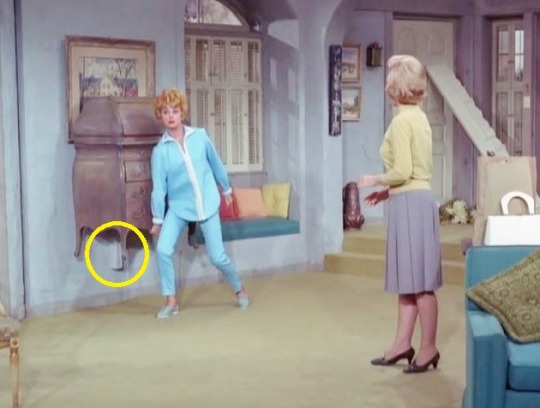
Desk Work! When
Lucy lifts the desk in her apartment, the track for raising it off
the ground can be seen underneath, despite being painted the color of
the wall.

Super-Strong Sweet Tooth! Lucy comes home from work holding a shopping bag and 5 pink bakery boxes. Why does a woman living alone need five boxes of baked goods? The boxes were a familiar item on the show and the Desilu props department must have had quite a few in stock! Also, if Lucy went shopping on her way home, why doesn’t she have any stories of the mayhem she must have caused in the stores to tell Mary Jane when she comes over?

I’ve Got A Beef! When Lucy picks the roast beef up off the floor, we can see that the roast has been glued to the plate!

At the lab, Dr. Davis asks Lucy if she’s ever had any accidents. She says that except for fender benders, she hasn’t. She must have forgotten that she suffered a blow to the head and got amnesia just two years earlier!

“Lucy, the Superwoman” rates 2 Paper Hearts out of 5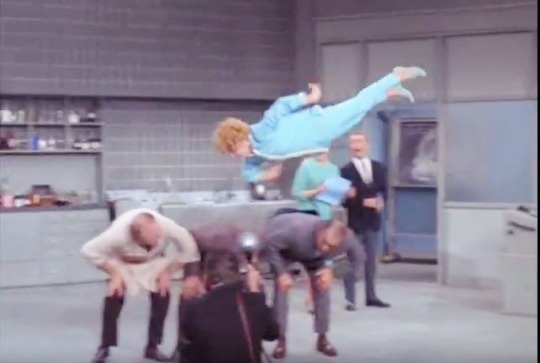 Bennett Green, Computer, Dear Abby, Elroy Schwartz, Gale Gordon, Herb Vigran, hurricanes, Jack Perkins, Joel Marston, John Perri, Joyce Perry, Lucille Ball, Lucy the Superwoman, Mary Jane Croft, Natalie Masters, Parley Baer, Robert F. Simon, Robert S. Carson, season 4, Sid Gould, Superman, The Lucy Show, The Two of Us, V8, Vacation Playhouse, Where There’s Smokey
 - She
-
Lucy the Gun Moll
S4;E25
~ March 14, 1966

Synopsis
In
an “Untouchables” parody, a Federal Agent says that Lucy looks
just like the chanteuse gun moll of a bank robber about to be
released prison. For a $5,000 reward, Lucy agrees to become the gun
moll and help find the hidden loot.Regular
Cast
Lucille
Ball (Lucy Carmichael / Rusty Martin), Gale Gordon (Theodore J.
Mooney)Mary
Jane Croft (Mary Jane Lewis) does not appear in this episode.Guest
Cast
Robert
Stack
(Federal Agent Briggs) played Eliot Ness on “The Untouchables.”
He was in the series pilot for Desilu and (along with Walter
Winchell) was the only actor to appear in every episode as well as
the pilot. In 1957, he earned an Oscar nomination for Written
on the Wind.
When he took the role of Eliot Ness, he expected that the pilot
would fail. From 1987 to 2002 he was the host of TV’s “Unsolved
Mysteries.” Stack died in 2003 at age 84.
Bruce
Gordon
(Big Nick) played Frank Nitti on “The Untouchables” in 30
episodes. Gordon had appeared
on Broadway in the long-running play Arsenic
and Old Lace (1941-44)
with Boris Karloff. He was also on Broadway with Charlton Heston and
Katherine Cornell in Antony
and Cleopatra
(1947-48). His heavy-featured look and gravelly voice led him to be
typecast as gangsters.
He died in 2011 at age 94.Nick calls Rusty ‘Doll’.

Steve
London
(Detective Lane, left)
appeared as Agent
Jack Rossman on “The Untouchables” for 63 episodes, although he
often had little or no dialogue.
After
this his career waned he attended law school he practiced under his
birth name Walter Gragg. He died in 2014 at age 85.
Walter
Winchell
(Narrator
Voice) was a journalist and radio host who was the narrator of “The
Untouchables.” Along with Robert Stack, he was the only person to
be part of every episode as well as the show’s pilot. His voice was
heard (uncredited) in the 1949 Lucille Ball film Sorrowful
Jones.
Winchell is said to have coined
the phrase, “America – love it or leave it." He “left it” in 1972 when he died at age 74.Marl Young (Piano Players, uncredited) was the show’s musical arranger and become “Here’s Lucy” musical director. He often appeared on camera when episodes included music.
Duke
Fishman (Domino
Club Audience, uncredited) was also an extra in 8 episodes of “The
Untouchables.” His birth name was Marcus, but he was known as ‘the
Duke of Catalina’ so he adopted Duke as his first name.Kathryn Janssen (Domino Club Audience, uncredited) began doing background work in 1966. This is her second of at least 4 “Lucy Show” appearances. She went on to be spotted in three episodes of “Here’s Lucy”.
Background
performers play the other members of the Domino Club audience. There is also a jazz quartet playing back-up for Lucy / Rusty.
In
the episode’s title the term ‘gun moll’ refers to a female
companion of a professional criminal. The word ‘moll’ derives
from ‘molly,’ a euphemism for ‘whore’ or ‘prostitute’ in 17th century England.
In real life, Bonnie Parker (companion of Clyde Barrow) and Mae Capone
(wife of Al Capone) were gun molls. Fictional gun molls include
Breathless Mahoney (Dick Tracy) and Tallulah (Bugsy Malone).
The September 27, 1960 Look Magazine with both Lucille Ball and Robert Stack on the cover!

The Untouchables was first an autobiographical memoir by Eliot Ness co-written with Oscar Fraley, published in 1957.

According to testimony from Aladena Fratianno (aka Jimmy the Weasel), a Mafia boss-turned-FBI informant, the Mafia ordered the assassination of producer Desi Arnaz in 1966, because they didn’t like that “The Untouchables” was focusing attention on the Mafia and because of the show’s portrayal of Italians. Fratianno said that two hitmen hid themselves near Arnaz’s house one night waiting for him to show up, but he never did. Shortly afterwards, the assassination order was rescinded when they realized that Arnaz’s murder would cause the Mafia more trouble than it was worth.
it is worth noting, however, that Arnaz actually sold his share of Desilu to Lucille Ball in 1962, so he didn’t even own the company behind the show in 1966. So it seems highly unlikely that Fratianno’s confession is accurate and that his story is mere exaggeration by a known criminal.

This
episode was filmed on Thursday, February 10, 1966. On that evening,
Lucille Ball (and singer Kate Smith) appeared on “The Dean Martin Show” on NBC in return
for Martin’s appearance on “Lucy Dates Dean Martin” (S4;E21),
which would air four days later, on Valentine’s Day.
Less than 24
hours before filming, Sophie Tucker died. Tucker co-starred in the
1938 Broadway show that introduced “My Heart Belongs to Daddy,”
which Lucy sings in this episode. Lucille Ball would play Tucker on a
Bob Hope TV special in 1977.
“The
Untouchables” started out as a two-part pilot episode of “Westinghouse
Desilu Playhouse” in April 1959. The show was introduced by Desi
Arnaz and starred Robert Stack and the voice of Walter Winchell, both
of whom were cast in the series, which began in October 1959 on CBS.
The final episode was aired in May 1963. Lucille Ball, who was then
the President of Desilu, got an angry letter from Frank Sinatra about the show’s negative depiction of
Italian-Americans.“Lucy Show” actors who also appeared on “The
Untouchables” include: Harvey Korman, Richard Reeves, Lou Krugman,
Oscar Beregi, George DeNormand, Joe Mell, Stanley Farrar, Byron
Foulger, Nestor Paiva, Louis Nicoletti, Ross Elliott, Beverly Powers,
Amzie Strickland, Eleanor Audley, Alan Hale Jr., Jay Novello, Bert
Stevens, Hans Moebus, Bess Flowers, Leoda Richards, Bernard Sell,
Norman Leavitt, Sam Harris, Hal Taggart, George Barrows, Steve
Carruthers, James Gonzales, John Banner, Stafford Repp, Hazel Pierce, Charles Lane, and Joan Blondell.
Like “I Love Lucy” and “The Lucy Show” Dell created comic books based on the series.

In 1962, Desilu licensed “The Untouchables” to make bubble gum…


… as well as a play set and arcade target game by Marx!

In 1987 the
series inspired a feature film starring Kevin Costner as Eliot Ness
and Robert DeNiro as Al Capone.
In 1991, Robert Stack reprised the role he made famous in the TV Movie “The Return of Eliot Ness” on NBC.

A 1993 TV reboot of the series
lasted two seasons on CBS.
“The
Untouchables” theme music is also heard in this episode. It was
composed by Nelson Riddle. Riddle was born in Oradell, New Jersey,
but grew up in nearby Ridgewood. Riddle wrote music for four TV
movies with Lucille Ball, including “Lucy Gets Lucky” (1975) with
Dean Martin.
In
2007, “The Untouchables” Season 1 DVD included a bonus track of
this episode of “The Lucy Show.” This was before “The Lucy
Show” episodes were restored and released on DVD, making it this episode’s first appearance on home video.
Although
he had nothing against comedy, Robert Stack said he always refused to
play any sort of satire or parody of Eliot
Ness.Apparently, when his boss (Lucy) asked, he relented and did this
one-off episode. This could be the reason that the characters are all
given very different names than their “Untouchables”
counterparts, despite there being three years since its
cancellation.
Lucy
didn’t want Walter Winchell to be part of the episode at all because
of how poorly he treated her during the Red Hunt of 1953. Her
ex-husband, Desi Arnaz, told her that Winchell’s narration was
strictly business, and she eventually agreed. In the 1940s, Winchell
had reported that newlyweds Lucy and Desi were expecting a baby when
no one else knew. She lost the baby. Still, Desi slyly incorporated
Winchell’s name into his song “We’re Having a Baby” written for
little Lucie’s birth: “You’ll
read it in Winchell, that we’re adding a branch to our family tree.”
Further adding to this ‘in-joke’, in “Ricky Has Labor Pains” (ILL
S2;E19) the script mentions an article in Winchell’s column that is
all about Lucy Ricardo having a baby, but very little about Ricky’s
career.

All
the members of “The Untouchables” guest cast receive entrance
applause from the studio audience.
The
name ‘Rusty Martin’ was probably derived from Lucy’s hair color and the surname of Mary Martin, who introduced the song “My
Heart Belongs to Daddy” (music and lyrics by Cole Porter) in the
1938 Broadway musical Leave
It to Me.
Marilyn
Monroe sang it in
the 1960 film Let’s
Make Love.
Lucy
wants an apple vending machine for the employees at the bank. Mr.
Mooney says they already have a cigarette machine, a candy machine, a
coffee machine and a soft drink dispenser.
Although vending machines
offering fresh fruit are rare in today’s world, the Fruit-O-Matic
Company started to manufacture such machines around 1950. Before
that, fruit was also generally available available in Automats (a
sort of cafeteria of vending machines) located in big cities.
Fruit-O-Matic Apple Machines were made in California and were mostly
found in schools and other youth and health oriented locations.
Rusty’s “Ain’t Jar” (similar to a ‘Swear Jar’) where she puts a quarter every time she says “ain’t” is actually a Hills Brothers Coffee Can with the brand name redacted with masking tape! A can of Hills Brothers Coffee was also seen on the stove on “I Love Lucy.”

Mr.
Mooney vouches for Lucy’s identity to Agent Briggs, saying they were
neighbors back in Danfield.
Lucy
intimates that Briggs looks like someone famous. Although she
doesn’t say the name Robert Stack (or Eliot Ness), that is the
inference. At the end of the episode, Briggs talks about Big Nick’s
‘series’ of crimes and ‘series’ of arrests. Lucy says she thinks
Briggs should give Nick a break because they’ve spent so much time
together in the same ‘series.’
Rusty’s
dressing room is decorated with black and white photographs of
Lucille Ball performing. Behind Stack is a photo of Lucy singing
“Jitterbug Bite” in the 1940 film Dance,
Girl, Dance.
Ball met Desi Arnaz while filming this movie. It was filmed at RKO,
the studio that became Desilu.
Lucy
breaks the fourth wall at the end of the episode and addresses the
audience, something of a rarity for Ball and her shows. The other actors bow to the studio audience! The last
time Lucy talked to the audience / camera was on the “I Love Lucy Christmas Special” and
the previous Christmas tags, where the cast wished the viewing audience a Merry Christmas.Callbacks!

Lucy
Ricardo pretended to be a gun moll to ‘The Brains’ (aka Ricky) in
“Lucy Wants to Move to the Country” (ILL S6;E15). Ethel Mertz is
gun moll to ‘Fingers’ (aka Fred) who "packs a rod” (aka gun)
which turns out to be a water pistol.
Lucy Carter agreeing to be a decoy for the Federal Agents is reminiscent of when Lucy Ricardo agrees to help the FBI catch a jewel thief. in “The Great Train Robbery” (ILL S5;E5). Lucy brags that she will call her memoir “I Was A Woman for the FBI.”
Fast Forward!

Lucy would again play a 1920s flapper named Rusty in the episode “Lucy and the Lost Star” (S6;E22) which co-starred Vivian Vance and Joan Crawford.

Lucy plays a gun moll named Joyce the 1969 Dinah Shore special “Like Hep!” Dinah plays the detective and Dick Martin her mobster boyfriend. Lucy sings a few bars of “Hey, Big Spender,” a song from the musical Sweet Charity.

Although doppelgangers Lucy Carmichael and Rusty Martin are in the same scene, they do not appear on camera together. This would be saved for when Lucy Carter meets Lucille Ball on a 1974 episode of “Here’s Lucy.”

Lucille Ball and Robert Stack were both exhibits at the Movieland Wax Museum in Corona Park, California. Postcards were issued of their figures. The Museum opened in 1962 and closed for good in 2005. It was mentioned in “Lucy and Lawrence Welk” (HL S2;E18) where Mary Jane’s friend was the manager.

Lucille Ball also breaks the fourth wall to wink to the camera in “Lucy and Harry’s Memoirs” (HL S5;24). This was supposed to be the series finale, but at the last minute a tag was added to leave the door open for a sixth season.

A publicity still from the episode is displayed at the Lucy-Desi Museum in Jamestown, New York. (photo by Maggie St. Thomas)
Blooper
Alerts
An
intentional blooper! Robert
Stack’s character Agent Briggs ‘mistakenly’ hands Lucy a card that
says “Rose Marie’s School for Models.” Stack’s wife was
named Rosemarie.
Born Rose Marie Bowe, right out of school she became a
model and cover girl as the winner of pageant titles, including “Miss
Tacoma”. Eventually she relocated to Los Angeles, where she
ultimately made the cover of Life magazine and started working in films.
She ended her career to raise a family after marrying Stack in 1956.
“Lucy the Gun Moll” rates 4 Paper Hearts out of 5
1959, 1966, Bruce Gordon, CBS, Cole Porter, Dance Girl Dance, Dean Martin Show, Desi Arnaz, Duke Fishman, Eliot Ness, Frank Nitti, Fruit-O-Matic, Gale Gordon, Gun Moll, Leave it to Me, Lucille Ball, Lucy the Gun Moll, Marilyn Monroe, Mary Martin, My Heart Belongs To Daddy, Nelson Riddle, Robert Stack, Rose Marie Bowe, Sophie Tucker, Steve London, The Lucy Show, The Untouchables, tv, Walter Winchell, Westinghouse Desilu Playhouse -
Lucy and Clint Walker
S4;E24
~ March 7, 1966

Synopsis
Lucy
wants to knit a sweater for her boyfriend for his birthday. After she
cleverly obtains his measurements, she finds out he hates the color
she has chosen.Regular
Cast
Lucille
Ball (Lucy Carmichael), Gale Gordon (Theodore J. Mooney), Mary Jane
Croft (Mary Jane Lewis)Guest
Cast
Clint
Walker
(Frank
Winslow) is probably best remembered as the title character in
“Cheyenne” (1955-62), TV’s first hour-long western.
In real
life, he had a twin sister named Lucille. Walker previously appeared
as Frank Winslow in “Lucy and the Sleeping Beauty” (S4;E9). He died just 9 days before his 90th birthday in 2018.Frank
says he was born in Iowa and from a family of five sisters. As a
kid, he got second prize in a spelling bee winning a pair of roller
skates. He didn’t want the first prize, a red sled. He hates the
color red because the teacher circled his bad grades in red ink.Sid
Gould
(Sid, Off Screen Voice) made more than 45 appearances on “The Lucy
Show,” all as background characters. He also did 40 episodes of
“Here’s Lucy.” Gould (born Sydney Greenfader) was Lucille
Ball’s cousin by marriage to Gary Morton.Gould
appeared as Sam, another one of Frank’s construction workers, in
“Lucy and the Sleeping Beauty” (S4;E9).Bennett
Green
(Bank Employee at the Picnic, uncredited) was Desi Arnaz’s stand-in during “I
Love Lucy.” He does frequent background work on “The Lucy Show.”Bennett and a female partner are disqualified from the balloon race as the picnic scene opens.
Monty O’Grady (Bank Employee at the Picnic, uncredited) was first seen with Lucille Ball in The Long, Long Trailer (1953) and played a passenger on the S.S. Constitution in “Second Honeymoon” (ILL S5;E14). He was a traveler at the airport when “The Ricardos Go to Japan” (1959). He made a dozen appearances on the series and a half dozen more on “Here’s Lucy.”
Shirley Anthony (Bank Employee at the Picnic, uncredited) made a couple of appearances on “The Lucy Show” and was spotted more than a dozen times on “Here’s Lucy.” From 1994 to 1999 she played Sally on “The Rockford Files” TV movies.
Kathryn Janssen
(Bank Employee at the Picnic, uncredited) began doing background work in 1966. This is her first of at least 4 “Lucy Show” appearances. She went on to be spotted in three episodes of “Here’s Lucy”.

Lightning (Frank’s Basset Hound) who seems to have a propensity to fall asleep, much like his master did in “Lucy and the Sleeping Beauty” (S4;E9).
[From the seams on the fabric, the back of the directors chair Lightning sits on has been turned back-to-front, probably to hide the imprinted name of its on-set owner – Lucille Ball? Clint Walker?]
Other uncredited male and female background performers play the Bank Employees at the
Annual Picnic.
The
episode was filmed on February 3, 1966.
It was aired for the first time on March 7, 1966. That night, Lucy and Clint competed with powerhouse actors Charles Bronson on “The Legend of Jesse James” (ABC) and Jack Nicholson on “Dr. Kildare” (NBC).

The working title of this episode was “Lucy and the Sweater.” The script was revised on January 29, 1966.

Frank
is the owner of Winslow Construction. In this episode he is building
residential homes instead of a skyscraper, as he did in his previous appearance.
Lucy
reads a Columbia-Minerva catalog, a company that made yarn and
other knitting and millinery products. They were founded in 1902 and
today are known as Minerva Mills.
Frank’s
birthday is the same day as the Westland Bank’s Annual
Employee picnic.
When
Lucy oversleeps, Mr. Mooney says he has had one of the quietest
morning’s since Roosevelt closed the banks.
On March
6, 1933, after
a month-long run on banks, President Franklin
Delano Roosevelt
proclaimed a Bank Holiday that shut down the American banking system.
When the banks reopened on March 13, depositors stood in line to
return their hoarded cash.
Frank
plays the harmonica at the picnic. Apparently the bank picnic is
open to more than just bank employees. Lucy brings along Frank, Mary
Jane, and her boyfriend Harold (who is not seen on camera). In an earlier scene, Lucy asks Frank if he likes a turkey sandwich. Frank says no – the whole turkey. So Lucy brings a whole roasted turkey to the picnic.
Lucy’s
transistor radio is seen at the picnic. This is a frequently used
prop on the show, even before Lucy moved to California.
For
winning the balloon race, Lucy and Frank win a Lawrence Welk album
complete with bubble pipe. Lawrence
Welk was
a hugely popular bandleader who would appear as himself on a 1970
episode of “Here’s Lucy.” Welk called his orchestra and
singers ‘The Champagne Music Makers’ so a soap bubble machine was
often used to imitate the bubbles from a glass of Champagne.
A KNIT / SWEATER YARN!

Inspired by “Lucy Writes a Play” (ILL S1;E17).

A blonde Lucille Ball struggles with the knitting needles alongside Patricia Wilder (left) and Anne Shirley, knitting behind the scenes at RKO in 1936.

Lucille Ball knitting a sweater at home! From the February 1942 Photoplay / Movie Mirror magazine.

Sweater humor in “The Freezer” (ILL S1;E29). Does Uncle Oscar like the color red? Or just black and white?

A pink sweater, not red, was the cause of all the trouble crossing the border when “Lucy Goes To Mexico” (LDCH 1958).

Socks, not sweaters, are the reason to take up knitting when Ricky and Fred are “Drafted” (ILL S1;E11).
FRED: “When a woman cries for no reason, sits down and knits tiny little things, what else?”

“Lucy Hires an English Tutor” (ILL S2;E13) opens with enceinte Lucy knitting, a common TV trope for expectant mothers.

Mrs. Rachel Revere also picked up the knitting needles for her man Paul in a 1964 “The Jack Benny Program” featuring Lucille Ball.

A department store sweater sale caused an angry fight between Lucy and an aggressive shopper in “Lucy Bags a Bargain” (S4;E17). Someone obviously got the last red sweater!

For his birthday, Kim Carter gives her brother Craig a turtle neck sweater she knit herself. It turns out to be short on turtle and long on neck in a 1969 episode of “Here’s Lucy.”
Flashbacks!

The August 1957 TV Star Parade cover featured Lucille Ball and Clint Walker. Coincidentally, Lawrence Welk is also on the cover, as well as being mentioned in this 1966 episode!

A year earlier, Walker also appeared as Frank Winslow in “Lucy and the Sleeping Beauty” (S4;E9). Their romance went to great heights! In “Lucy and Clint Walker,” however, there is no mention of this “sleeping beauty’s” violent reactions to being suddenly awoken! In this follow-up, it is his canine companion Lightning who is the real sleeping beauty! Lightning is nowhere to be found in the previous outing.

This
episode features a sleepy basset hound named Lightning. “Kiddie Parties
Inc.” (S2;E2) featured a sleepy blood hound named Thunderbolt.Fast Forward!

Lawrence Welk appeared as himself (along with his bubbles) on a 1970 episode of “Here’s Lucy.”

Lucy Barker also dates the head of a construction company (Peter Graves) in “Love Among the Two-By-Fours” (LWL S1;E3) in 1986.
Blooper
Alerts!
Dating Game! Mary
Jane says she wishes she had a boyfriend as handsome and well built
as Frank. She says that her boyfriend Harold is short and skinny and
has a size 2 neck. In “Lucy and the Golden Greek” (S4;E2) her
boyfriend was named Jim (Robert Fortier, above) who was tall, handsome and
muscular, just like Frank.
Shut the Door! When
Lucy comes home with the bags of yarn, she does not shut the front
door. Mary Jane walks through it and also does not shut it. This is
typical of “The Lucy Show.”
Practicality Problem! The
idea to knit a fire engine red wool sweater to give to a macho construction
worker as a birthday gift at a warm-weather Southern California
picnic is a somewhat impractical idea. But it’s the thought that counts!
Tape Measure Trickery! When Lucy is trying to take Frank’s measurements without him noticing, he looks directly at her little green tape measure, which also makes a clicking noise as the tape is drawn out. Perhaps Frank is playing along so as not to spoil the surprise?

“Lucy and Clint Walker” rates 3 Paper Hearts out of 5

-
Lucy the Robot
S4;E23
~ February 28, 1966

Synopsis
Lucy
convinces her new neighbor to invent a robot to keep Mr. Mooney’s
visiting nephew busy, but when the Robot falls down a flight of
steps, Lucy must take its place.Regular
Cast
Lucille
Ball (Lucy Carmichael), Gale Gordon (Theodore J. Mooney)Mary
Jane Croft (Mary Jane Lewis) does not appear in this episode.Guest
Cast
Jay
North
(Wendell Mooney) will
forever be remembered for giving life to the comic strip hellion
“Dennis
the Menace”
(1959) on TV. During the show’s final season, North played opposite
Gale Gordon as John Wilson. “Dennis the Menace” was canceled in
1963. In the ensuing three years North became a teenager with a deeper
voice and red hair instead of blonde. Two weeks prior to this
episode airing, North guest starred on an episode of “My Three
Sons” with Barry Livingston, who played Mr. Mooney’s youngest son,
Arnold (so Wendell’s cousin) in two season 2 episodes. North left
Hollywood and screen acting in 1985. He later reported that he was unhappy as a child actor and was abused by his aunt, who was his guardian. As of 2017, he was working as a
prison guard in Florida.Wendell
is Mr. Mooney’s 13 year-old nephew. He is staying with his Uncle Theodore and Aunt Irma while his parents are on a two week vacation. The character is described as a rambunctious child, not unlike Dennis Mitchell. The
difference is that Wendell has a sour disposition, while Dennis’s
outlook was generally sunny.
Vito Scotti (Sam Boscovitch) played the Fencing Instructor in “Lucy Digs Up a Date” (S1;E2), the second episode of the series in 1962. He was born in San Francisco, but spent much of his youth in Naples, Italy. His first role with Lucille Ball was as a Tijuana shopkeeper in “Lucy Goes to Mexico,” a 1958 episode of “The Lucy-Desi Comedy Hour.” He also had a small role in the Bob Hope / Lucille Ball film The Facts of Life (1960). Scotti is probably best remembered for his recurring role as Captain Fomento on “The Flying Nun” (1967-1969). He died in 1996 at age 78.
Sam lives in the apartment downstairs from Lucy.

Dorothy
Konrad
(Mrs. Fletcher, Wendell’s Babysitter) played
Danfield volunteer firefighter Dorothy Boyer in several season one
episodes as
well as several other characters. This is her final series
appearance.In the scope of the plot, Mrs. Fletcher might well have been Irma Mooney. Konrad certainly matches Mr. Mooney’s previous descriptions of her. Instead, however, Mr. Mooney claims his wife is at a commando reunion. It is likely that that they wanted to continue the gag of keeping Mrs. Mooney off-screen.

Larry
Dean
(Major Fun Fun, the Robot) was
a mime who specialized in playing robots, which he also did on
episodes of “Lost in Space” and “Bewitched.” He previously
played the Mechanical Butler (another robot) in Bigelow’s
Department Store window in “Lucy
and the Ceramic Cat” (S3;E17).Dean’s first entrance gets a round of applause from the studio audience, although it sounds very much like ‘canned’ applause, added later to fill the slight pause of his march step.

Sid
Gould
(Delivery Man) made
more than 45 appearances on “The Lucy Show,” all as background
characters. He also did 40 episodes of “Here’s Lucy.” Gould
(born Sydney Greenfader) was Lucille Ball’s cousin by marriage to
Gary Morton.Bennett
Green
(Bennett, Delivery Man) was Desi Arnaz’s stand-in during “I Love
Lucy.” He does frequent background work on “The Lucy Show.”Green
is barely seen on camera here, staying behind the large gift wrapped
box containing Lucy the robot during its delivery to the Mooney home. If Sid
Gould had not addressed him by name, he would be impossible to
identify because he is also uncredited.

The TV sitcom “Dennis the Menace” (based on the comic strip) aired from 1959 to 1962. In the show’s final season, the long-suffering character of neighbor George Wilson was written out due to the death of actor Joseph Kearns.
Gale Gordon was added to the cast as George’s brother, Henry.
Kearns had played two characters on “I Love Lucy” – a psychiatrist in season one, and a theatre manager in season six.

When Lucille Ball was finally convinced to return to network television in 1962, she naturally wanted Gordon to join her, but he was unable to due to his prior commitment to “Dennis the Menace” so Mrs. Carmichael’s put-upon banker was played by Charles Lane. Lane was also on “Dennis” as the recurring character of druggist Mr. Finch. He played the role six times before leaving for “Lucy”, his final episode airing just a day before his penultimate episode of “Lucy”!

This was the second time that Gordon and Ball failed to connect contractually, when he was offered, but turned down, the role of Fred Mertz in 1951 after playing a similar character on Lucy’s radio show “My Favorite Husband.” When “Dennis” was canceled and Gordon was finally free, Ball wasted no time in hiring Gordon and had Lane’s character Mr. Barnsdahl written out in order to make way for new banker Theodore Mooney.
“Dennis the Menace” also had a character named Theodore Mooney – a police sergeant (George Cisar). He was often seen in the company of Lucy Elkins (Irene Tedrow) and John Wilson (Gale Gordon).

Besides Gordon, Lane, and Kearns, “Dennis” also featured “Lucy Show” and/or “I Love Lucy” alumni like:
- Mary Wickes (Miss Cathcart)
- Edward Everett Horton (Uncle Ned)
- Kathryn Card (Mrs. Biddy)
- Parley Baer (Captain Blast)
- Elvia Allman (Edna)
- Tyler McVey (Mr. Carlson)
- Dub Taylor (Opie Swanson)
- Norman Leavitt (various roles)
- Bob Jellison (Announcer)
- Richard Reeves (Mr. Kelly)
- Lurene Tuttle (Mrs. Courtland)
- Nestor Paiva (Gamali)
- Jonathan Hole (Addison Brook)
- Stanley Adams (Jerry Richman)
- Willard Waterman (Otis Quigley)
- Harry Cheshire (Mr. Petry)
- Eve McVeagh (Mrs. Purcell)
- Harvey Korman (Bowers)
- Stafford Repp (Lt. Wheeler)
- Verna Felton (Aunt Emma)
- Madge Blake (Mrs. Porter)
- Ellen Corby (Miss Douglas)
- Eleanor Audley (Mrs. Pompton)
- and frequent extras Leoda Richards, Leon Alton, Olan Soule, Larry J. Blake, George DeNormand, and Monty O’Grady

On
the date this episode first aired (February 28, 1966) “The Lucy
Show’s” CBS TV lead-in was an episode of “I’ve Got a Secret”
with guest star Vivian Vance (Ethel Mertz / Vivian Bagley). It would
be her last of six appearances on the quiz show.
Also on February 28, 1966, actor Jonathan Hale died at age 74. He had appeared with Lucille Ball in Her Husband’s Affairs (1947) and Easy To Wed (1946).

Following
the previous week’s episode, an episode of “The Andy Griffith Show” (also filmed at Desilu
Studios) featured Vito Scotti (Sam Buscovitch). The episode also co-starred Jamie Farr (above left), who was featured in “Lucy the Rain Goddess” (S4;E15).
After
Sam’s explosion causes Lucy’s TV to short out, she asked if he was in
New York during the big blackout.
The
Northeast
Blackout of 1965
occurred on Tuesday, November 9, 1965, affecting parts of Ontario
in
Canada, Connecticut,
Massachusetts,
New
Hampshire,
New
Jersey,
New
York,
Rhode
Island,
Pennsylvania,
and Vermont.
Over 30 million people were left without electricity for up to 13
hours.
Lucy
says she’s a big fan of inventors like Thomas Edison and Alexander
Graham Bell because she’s always making telephone calls and turning
on lights.
Alexander Graham Bell (1847-1922, left) is the inventor of the telephone. Thomas
Alva Edison (1847-1931, right)
is credited as the inventor of the light bulb.Sam tells Lucy that he was a fat kid. Lucy confesses to Sam that she had braces and flaming red hair. This confession indicates that Lucy Carmichael’s hair is naturally red (albeit maybe not that particular shade), and not dyed, as Lucy Ricardo’s was.

We
learn that Mr. Mooney has a cat named Cleo.
It was probably named for Cleo
Morgan (nee
Mandicos aka Cleo Smith) who was Lucille Ball’s first cousin,
although the two were raised as sisters. Morgan later became a
producer on “Here’s Lucy.” Mr. Mooney also has a Sheepdog named
Nelson. Neither Cleo nor Nelson appear on camera in this episode.
MR. MOONEY: (Into telephone) “Tell him not to put Cleo’s head in the goldfish bowl!”
Hearing that Wendell is putting Cleo’s head in the goldfish bowl is reminiscent of the relationship between Figaro the cat and Cleo the goldfish in Disney’s 1940 animated film Pinocchio. The pair were given their own short film in 1943.

Cleo (the toy) made an appearance on “I Love Lucy” in May 1953.

This
is the first time we see the inside of Mr. Mooney’s California house.
In “Lucy Helps the Countess” (S4;E8) he flirted with the idea of
moving into an ultra-modern high rise apartment in Cucamonga.
Lucy
suggests the expressionless Robot would be a good replacement for Ed
Sullivan.
The famous TV show host was nicknamed “Old Stoneface” for
his unsmiling demeanor. From 1954 to 1968 Lucille Ball made 10
appearances on “The Ed Sullivan Show.” Ed Sullivan and his show
were also mentioned several times on “I Love Lucy.”
When
the Robot is leaving Sam’s apartment as well as when Lucy is marching
around the Mooney living room, the underscoring is “Parade
of the Wooden Soldiers”
(also known as “Parade of the Tin Soldiers” or “March of the Wooden Soliders”) composed by
Leon Jessel in 1897.
‘In’ Jokes!
- Wendell
to Lucy / Major Fun Fun: “Boy,
I’m gonna have a BALL with you!” - Wendell
to Lucy / Major Fun Fun: “This
HAIR doesn’t look real.”
[Lucille Ball’s color was the result of Henna dye and she sometimes
wore wigs on the show.] - Mr.
Mooney to Lucy about Wendell: “You
will keep that MENACE subdued for the next eight days!”
Callbacks!

The
exploding television set is reminiscent of “The Courtroom” (ILL
S2;E7) in which both the Mertzes and the Judge’s TV sets explode.
Lucy spanking Wendell as punishment, is reminiscent of the many episodes Ricky spanked Lucy, one of the most controversial aspects of the show to modern audiences. Today, even corporal punishment of one’s own children is frowned upon and would not be depicted on television in a comic way.

Lucy Carmichael previously encountered a robot butler (also played by mime Larry Dean) in “Lucy and the Ceramic Cat” (S3;E16).

In
Sam’s kitchen cupboard, there is a box of Kiddie Cookies, a fictional
product first
seen on “The Talent Discoverers Show” in “Lucy
and the Plumber” (S3;E2)
and then again in the Los Angeles supermarket during “Lucy and
Joan” (S4;E4).
Lucy Carmichael: “What would keep a 13 year-old boy happy?”
Sam Boscovitch: “How about a 13 year-old girl?”
~ “Lucy the Robot” 1966
Lucy Ricardo: “It’s just a little boy. Now, what do you think I better have ready for him when he gets here?”
Ethel Mertz: “How about a little girl?”

In Sam’s apartment there is a toy Ferris wheel that was first seen back in Danfield in “Vivian Sues Lucy” (S1;E10). It belonged to Jerry, Lucy’s son.

After the Robot leaves Sam’s apartment there is an off-camera crash, and Lucy Carmichael walks back in carrying the Robot’s head and leg. In “The Ricardos Dedicate a Statue” (ILL S6;E27), Lucy Ricardo leaves her Westport home, there is an off-camera crash, and Lucy walks back in carrying the statue’s head and leg. Lucy Ricardo pleads with Mr. Silvestry, the statue’s creator, to make another statue, just as Lucy Carmichael pleads with Sam to make another robot. Lucy Ricardo then takes the statue’s place for the unveiling, just as Lucy Carmichael assumes the identity of the Robot in the gift box.
Blooper
Alerts
Me Too! When Lucy meets Sam Buscovitch for the first time, he says he just moved from New York. Oddly, Lucy does not say “Me too!” This would be a natural response from a recent transplant to the West Coast.
Sitcom Logic Alert! It takes Sam a total of 15 seconds to ‘fix’ and ‘adjust’ Lucy’s television set! It then receives broadcasts from Hong Kong, more than 7,000 miles away!
Door is Ajar! When
Sam rushes into Lucy’s apartment after the explosion, he leaves the
door wide open, which is usual on “The Lucy Show.” After the
Delivery Men leave the Mooney house, they also leave the front door open.
Sitcom Logic Alert 2! Both Wendell and Mrs. Fletcher touch Lucy but still don’t realize she is a real person, not a robot.
Floor Plan! During the second scene in Sam’s apartment, his kitchen
table and chairs have disappeared. Lucy’s
desk at the bank is now back inside Mr. Mooney’s office. In the
previous episode, “Lucy and Bob Crane” (S4;E22), she was
re-assigned to New Accounts with a desk in the bank’s lobby.Fast Forward!

A more realistic robot will be featured in the “Life With Lucy” episode “Lucy Makes Curtis Byte the Dust” (LWL S1;E6) in 1986. His name is Rupert.

A still from this episode was incorporated into the photo montage on the Season 4 DVD box cover.

“Lucy the Robot” rates 2 Paper Hearts out of 5 1966, Alexander Graham Bell, Bennett Green, Blackout of 1965, CBS, Cleo Morgan, Dorothy Konrad, Ed Sullivan, Gale Gordon, Inventor, Jay North, Larry Dean, Lucille Ball, Lucy the Robot, March of the Toy Soldiers, Parade of Wooden Soldiers, Robot, Sid Gould, The Lucy Show, Thomas Edison, Tin Soldier, Toy Soldier, tv, TV Set, Vito Scotti
 -
Lucy and Bob Crane
S4;E22
~ February 21, 1966

Synopsis
Actor Bob
Crane opens a new account at the bank and asks Lucy out to dinner.
When his new war film needs a stuntman, Mr. Mooney volunteers Iron
Man Carmichael. Although she wants to appear demur to Crane, she
takes the job.Regular
CastLucille
Ball (Lucy Carmichael), Gale Gordon (Theodore J. Mooney)Mary
Jane Croft (Mary Jane Lewis) does not appear in this episode.Guest
Cast
Bob
Crane
(Himself) was born in 1928 in Waterbury, Connecticut. After being a
disc jockey for many years, he turned to acting at the age of 33. He
is best known as the clever Colonel Hogan in the CBS POW camp sitcom
“Hogan’s Heroes” (1965-1971) which was filmed at Desilu Studios.
In 1975 he starred in “The Bob Crane Show” which lasted only 13
episodes. In 1978 Crane
was brutally murdered in a Scottsdale hotel room. His murder remains
a mystery to this day.
Crane’s
life and death were the subject of the 2002 film Auto
Focus starring
Greg
Kinnear
as
Crane.
This episode was Crane’s only screen credit alongside Lucille Ball.
John
Banner
(Sergeant Schultz) was born in Vienna in 1910. He achieved
television immortality for his portrayal of the Luftwaffe POW camp
guard Sergeant Schultz in the TV series “Hogan’s
Heroes.”
Ironically, Banner was a Jew and had been in a German concentration
camp himself. Like Crane, he was in all 168 episodes of the series,
the only two cast members to have that distinction. He also played
the character in a sketch titled “Freddie’s Heroes” on “The Red
Skelton Hour” with Crane as Hogan. His catchphrase as
Schultz was “I
know nothing!”
which he repeats in this episode of “The Lucy Show.” He died in
his home city Vienna in 1973.
Oscar
Beregi
(Wolfgang Schmidt the Director) was a Hungarian-born actor who made a
career out of playing foreign bad guys. He is most recognized for
playing Eva Gabor’s father on “Green Acres” despite being only a
year older than her. Beregi did two episodes of “Hogan’s Heroes”
with Crane and Banner, in 1966 and 1970. This is his only appearance
with Lucille Ball.Beregi was probably cast for his resemblance to Werner Klemperer, who played Colonel Klink on “Hogan’s Heroes.” He also wore a monocle.

Larry
Dean
(Assistant Director) was
a mime who specialized in playing a robot. He also did this on
episodes of “Lost in Space” and “Bewitched.” He previously
played the mechanical butler in Bigelow’s store window in “Lucy
and the Ceramic Cat” (S3;E17).
He returns to “The Lucy Show” in the next episode “Lucy and the
Robot” (S4;E23).Sid
Gould
(Sid, the Waiter) made
more than 45 appearances on “The Lucy Show,” all as background
characters. He also did 40 episodes of “Here’s Lucy.” Gould
(born Sydney Greenfader) was Lucille Ball’s cousin by marriage to
Gary Morton.Dale
Van Sickel
(German Soldier) was
a Hollywood stunt man and actor whose career began in 1933. He
appeared with Lucille Ball in the films Roberta
(1935)
and There
Goes My Man
(1937).
He appeared in all three of the ‘Iron Man Carmichael’ episodes of
“The Lucy Show.”Other
background performers play the bank customers, the diners at the
restaurant, and the German soldiers.

This
is the last episode of six written by Edmund Beloin and Henry Garson.
This is also the last of the three ‘Iron Man Carmichael’ episodes they penned.
The previous two were “Lucy the Stunt Man” (S4;E5) and “Lucy
and the Return of Iron Man” (S4;E11).
The
script was dated January 4, 1966, and was originally titled “There’s
No Business Like the Iron Man Business.” The action described in
the above page varies significantly from the final edit.
“Hogan’s
Heroes” was filmed at Desilu Studios. Interiors were done at
Desilu Culver City and exteriors at what was known as ’40 Acre Lot.’
During its six year run, “Lucy Show” cast that appeared on
“Hogan’s Heroes” included Doris Singleton, Parley Baer, Kathleen
Freeman, Lou Krugman, Hans Conreid, and George DeNormand.
Both
Lucille Ball and Bob Crane were nominated for 1966 Emmy Awards. She
lost to Mary Tyler Moore (“The Dick Van Dyke Show”) and he lost
to Dick Van Dyke. “Hogan’s Heroes” was nominated for Best Comedy
Series (“The Lucy Show” was not) but again lost to “The Dick
Van Dyke Show.”
Lucy
has a new responsibility at the bank running a huge, loud punch-card
driven computer. After the computer sprays shredded paper in Mr.
Mooney’s face, Lucy is re-assigned to ‘new accounts’ and must move her
things from one desk in the lobby to another. Previously, Lucy’s
desk was in Mr. Mooney’s office.
Instead
of entrance applause, Crane gets applause when Lucy recognizes him
and says his name.Although
Crane was essentially playing himself on this episode, for the
purposes of creating a flirtation with Lucy, Crane is single. In
reality he was married to Anne Terezian, with whom he had three
children. They divorced in 1970.
Lucy
says Crane is his favorite solider since Captain Kangaroo. “Captain
Kangaroo”
was
a children’s television series that aired weekday mornings on CBS
from October 1955 to December 1984. Captain Kangaroo was previously
mentioned in “Chris’s
New Year’s Eve Party” (S1;E14)
and “Lucy Teaches Ethel Merman to Sing” (S2;E18).
Bob
Crane knows the work of Iron Man Carmichael, having seen him in the
movie Bad
Day at Laredo. This
is a direct reference to “Lucy the Stunt Man” (S4;E5) although
the cowboy movie had no title during the episode. Mr. Mooney
references Lucy as Iron Man being shot out of a canon, a direct
reference to the big stunt Lucy did in “Lucy and the Return of
Iron Man” (S4;E11), a pirate movie that was also untitled.
Lucy:
“If a man like Bob Crane thinks I’m shy and demur, then I’m going
to be just as shy and demur as Rebecca of Sunnybrook Farm.”Mr.
Mooney:
“Rebecca
of Sunnybrook Farm? You are more like The Unthinkable Molly Brown!”
Mr.
Mooney is making a pun on the 1960 stage musical and the 1964 film
The
Unsinkable Molly Brown,
about Margaret Brown who survived the sinking of the Titanic. The
Broadway production ran at the same time as Wildcat
starring Lucille Ball. Rebecca
of Sunnybrook Farm
is
the title of a 1903 children’s novel by Kate Douglas Wiggin that
tells the story of Rebecca Randall and her two stern aunts in a
village in Maine. The hallmark of Rebecca’s character was her
cheerful optimism in the face of adversity. Mr. Mooney previously
mentioned the book / character in “Lucy and the Winter Sports”
(S3;E3).
Lucy
lives at the Glenhall Apartments.
This is the first time in 22 episodes that the complex has been
named. Crane says he owns a home on 993 Elm in Beverly Hills. This
would be about a mile from where Lucille Ball actually lived on
Roxbury Drive.New
depositors to the bank get a calendar, a piggy bank, a pen wiper, a pencil sharpener, and a little speedy electric shoe polisher!
When
Mr. Mooney asks Schmidt if he has ever heard of Iron Man Carmichael,
Schmidt replies “Has
Huntley ever heard of Brinkley?”
Newscasters Chet
Huntley
(1911-1974) and David
Brinkley
(1920-2003) were co-hosts of the NBC evening news show “The
Huntley-Brinkley Report” from 1956 to 1970.
In
return for getting Iron Man Carmichael for Crane’s new film, Mr.
Mooney is given the part of General Van Plump. The movie is a
World War One epic with Crane playing the lead as an American
aviator. John Banner’s cameo as Sergeant Schultz is handled by Crane
saying: “Schultz!
You’re in the wrong war!”
For
their dinner date, Lucy wears a powder blue garden party dress,
matching gloves, and wide-brimmed hat. She resembles Little Bo Peep
more than Rebecca of Sunnybrook Farm. She says her perfume is called
‘Breath of Daisy Dew.’
As
Iron Man Carmichael Lucy crashes through the ceiling hanging from her parachute
strings. Lucille Ball will repeat this stunt in “Lucy, the
Skydiver,” a 1970 episode of “Here’s Lucy.”
With
Lucy / Iron Man hanging in the air and Bob Crane is turning on a wheel,
Mr. Mooney / General Von Plump and the German soldiers do a bit of
the “Schnitzelbank,” a German call and repeat song or chant (Mr.
Mooney speaks it). It is similar in structure to the American song
“Must Be Santa” by Mitch Miller. William
Frawley
(Fred Mertz) performed
an English version of this song in the 1942 World War II propaganda
musical The
Yankee Doodler.
A version without lyrics was played by the Swiss Band that rescued
the Ricardos and the Mertzes from the avalanche in “Lucy in the
Swiss Alps” (ILL S5;E21).Callbacks!

Playing
a German solider give Lucy the chance to be the misfit who does the
opposite of the formation and what the commander says. She first did
this in “Lucy and the Military Academy” (S2;E10) and then again
as one of the doormen in “Lucy Goes to a Hollywood Premiere”
(S4;E20).
Lucy
hanging in air with the broom is visually reminiscent of when Lucy
Ricardo played the Witch in “Little Ricky’s School Pageant” (ILL
S6;E10).Blooper
Alerts
The
nautical restaurant is really Lucy’s apartment re-dressed with
different walls. This is obvious from the two steps up in the back
and the green wall-to-wall carpet, identical to those found in Lucy’s
flat at the Glenhall Apartments.
“Lucy and Bob Crane” rates 4 Paper Hearts out of 5
1966, Bob Crane, Captain Kangaroo, CBS, Chet Huntley, Dale Van Sickel, David Brinkley, Desilu, Edmond Beloin, Gale Gordon, Harry Garson, Hogan’s Heroes, Huntley and Brinkley, Iron Man Carmichael, John Banner, Larry Dean, Lucille Ball, Lucy and Bob Crane, Oscar Beregi, parachute, Rebecca of Sunnybrook Farm, Schnitzelbank, Sid Gould, Stunt Man, Stunts, The Lucy Show, The Unsinkable Molly Brown, tv, World War One, WWI -
Lucy Dates Dean Martin
S4;E21
~ February 14, 1966

Synopsis
Dean
Martin’s stunt double Eddie makes a date with Lucy to take her to a charity
ball, but when he is suddenly called to the set, Dean takes Lucy to
the event instead, pretending he is Eddie.Regular
Cast
Lucille
Ball (Lucy Carmichael), Gale Gordon (Theodore J. Mooney), Mary Jane
Croft (Mary Jane Lewis)Guest
Cast
Dean
Martin
(Himself / Eddie Feldman) was
born Dino Paul Crocetti in Steubenville, Ohio,
in 1917. He made his screen debut in a short playing a singer in Art
Mooney’s band, but his first big screen role was 1949’s My Friend
Irma with Jerry Lewis. This began a partnership that would be one of
the most successful screen pairings in cinema history. Later, he
also worked frequently members of “the Rat Pack”: Frank
Sinatra, Joey Bishop, Peter Lawford, and Sammy Davis Jr. His persona
was that of a playboy, usually seen with a glass of booze and a
cigarette. Martin and Lucille Ball appeared on many TV variety and
award shows together and made the TV movie “Lucy Gets Lucky” in
1975. He died on Christmas Day in 1995 at age 78.Stunt man Eddie Feldman supposedly acted on the Broadway stage.

Tommy
Farrell
(Harry) appeared
in “Lucy and the Beauty Doctor” (S3;E24). He was on Broadway in
three plays between 1942 and 1947. Farrell will appear in six
episodes of “Here’s Lucy.”
Sid
Gould
(Bandleader) made
more than 45 appearances on “The Lucy Show,” all as background
characters. He also did 40 episodes of “Here’s Lucy.” Gould
(born Sydney Greenfader) was Lucille Ball’s cousin by marriage to
Gary Morton.Roy
Rowan
(Radio Announcer, uncredited) was the off-camera announcer for every episode of
“I Love Lucy” as well as “The Lucy Show” and “Here’s
Lucy.” He was also the voice heard when TV or radio programs were
featured on the plot of all three shows. He made a couple of on
screen appearances as well.Leon
Alton
(Charity Ball Attendee, uncredited, below left) appeared
with Lucille Ball in The
Facts of Life
(1960)
and Critics
Choice (1963).
He also was seen in three episodes of “Here’s Lucy.”
Leoda
Richards
(Charity Ball Attendee, red dress, uncreidted) made
at least three background appearances on “I Love Lucy.” In 1934, she appeared on Broadway in Anything
Goes,
which also starred a young Vivian Vance. This is the second of her
four episodes of “The Lucy Show.” She was also in the Lucille
Ball film Yours,
Mine and Ours (1968).Richards is the woman in the red dress who says “I’ve always been a fan of yours, Dean.” The blonde in blue, who also has a line, has not been identified.
Paul Power (Charity Ball Attendee, uncredited) was seen in two films with Lucille Ball, two episodes of “I Love Lucy,” and three episodes of “The Lucy Show.”
Rudy Germane (Charity Ball Attendee, uncredited) did three films with Lucille Ball as well as a “Sunday Showcase: The Lucy-Desi Milton Berle Special” in 1959.
Uncredited background performers play the waitstaff, musicians, and other guests attending the Charity Ball.

Appropriately for a ‘dating’ episode, this episode was first aired on Valentine’s Day 1966.

This
episode was filmed January 6, 1966, the first one of the new year. Coincidentally, that same night “The Dean Martin Show” aired its first episode of the new year on ABC TV.
Immediately following the initial broadcast of this episode on February 14, 1966, “The Andy Griffith Show” featured Keith Thibodeaux (aka Richard Keith aka Little Ricky) in his last of 13 appearances in Mayberry.

Lucille
Ball cited this episode as her personal favorite of the entire
series. She also said that outside of Vivian Vance, Dean Martin was one of the few people who always made her laugh.
Lucille Ball’s first appearance with Dean Martin was on his radio show with Jerry Lewis in December 1948. Lucy was then the star of her own radio show, “My Favorite Husband.”

This episode continues the depiction of Lucy as a maven of Hollywood collectibles
and trivia which originated with the previous week’s episode “Lucy
Attends a Hollywood Premiere” (S4;E19, above).
Lucille
Ball tries out a new hairstyle in this episode.During their cocktail conversation, Lucy mentions to Eddie that the first time she saw Dean Martin was he working with Jerry. ‘Eddie’ replies “Jerry who?” Lucy mentions their ‘split up’ – a time when Martin and Jerry Lewis went their separate ways after two decades of performing together. Lewis later said he initiated the split in order to allow Dean to shine in his own right. In talking about their break-up, Lucille Ball might very well be speaking about her own high-profile split with Desi Arnaz, also a pairing of a musician and comic actor that also made the public worry about their subsequent careers and personal lives.

For his part, Lewis never appeared on a Lucy sitcom, but did act opposite Ball in “Danny Thomas’s Wonderful World of Burlesque” in 1965 and “The Jack Benny Birthday Special” in 1969.

During the 1960s, Martin’s son Dino joined with
Lucy’s son Desi Jr. and Billy Hinsche to form the teen boy band Dino, Desi and Billy.
In return for Martin appearing on this episode of “The Lucy Show,”
Lucille Ball appeared on “The Dean Martin Show” (above, with Kate Smith) which aired four
days earlier on February 10, 1966.
EDDIE: “Dean’s drinking is all exaggerated… Actually, he doesn’t care for the stuff.
LUCY: “He doesn’t?”
EDDIE: “No, but I like a little sauce, if you’ve go something.”Martin’s legendary propensity for drinking was used for humor in this and several
previous episodes. Much to his dismay, Lucy Carmichael makes martinis with lemon juice in place of vermouth and white
cooking wine for gin.
Dean
Martin gets entrance applause from the studio audience as Eddie
Feldman AND as then again as himself.
Eddie
Feldman says that while Lucy is attractive, she is no Liz Taylor.
Or Gina Lollobrigida. Or Brigitte Bardot. Elizabeth
Taylor
has been mentioned several times since Lucy arrived in Hollywood.
She was also mentioned on “I Love Lucy” and made a guest
appearance on “Here’s Lucy” as herself. Gina
Lollobrigida
was twice mentioned on “I Love Lucy” and appeared on “The Dean
Martin Show” twice in 1969. Brigitte
Bardot
is constantly voted one of the sexiest film stars in history.
Tickets to the Charity Ball cost $100 each.
The starting bid for the memorabilia is $1,000. For
the fundraising auction, Hollywood studios and celebrities donated:- Cary
Grant’s
pipe – Grant was an avid pipe smoker on screen and off, although he
became a militant anti-smoker later in life. He was mentioned five
times on “I Love Lucy.” - John
Wayne’s
saddle – Wayne was known for his roles as cowboys on horseback. He
played himself on a season 5 episode of “I Love Lucy” and will do
so again on a season 5 episode of “The Lucy Show.” Mr.
Mooney dictates a letter to Wayne, thanking him for donating the
saddle. The opening bid will be $1,000. Lucy is clearly enamored of
Wayne, just as Lucy Ricardo was in 1955. - Elvis
Presley’s
guitar – early in his career, the rock and roll icon generally
played guitar when he sang. Presley was was
mentioned by Ethel as “that Elvis What’s-His-Name” in “Lucy
Misses the Mertzes” (ILL S6;E17)
as well as three previous mentions on “The Lucy Show.” - Kirk
Douglas’s
bow – this is probably the golden bow Douglas used in Ulysses
(1954). Douglas made a cameo appearance in the previous episode,
“Lucy Goes to a Hollywood Premiere” (S4;E20). - Brigitte
Bardot’s
bikini – the voluptuous French film star was often scantily dressed
in her films. - Marlon
Brando’s
t-shirt – from A
Streetcar Named Desire
(1951) sent over by Warner Brothers. Brando was mentioned on “I
Love Lucy” the day after he won the Oscar for On
the Waterfront as well as in “Lucy Visits Grauman’s” (ILL S5;E1).
He appeared with Dean Martin in the 1958 film The
Young Lions. - Audrey Hepburn’s red beaded jacket – From Danger in Paris. [See Blooper Alert at the end of this blog for more about this item.]

About Audrey Hepburn’s red beaded jacket, Martin says “The last time I saw anything that fancy was on Liberace.” Piano player and entertainer Liberace was known for his flamboyant costumes. He was mentioned on “I Love Lucy” and played himself on an episode of “Here’s Lucy.”

The
band at the Charity Ball plays a medley:- ”(I’d
Like to Get You on a) Slow Boat to China“ –
by
Frank
Loesser,
published in 1948. - "On
the Sunny Side of the Street” –
a 1930
song
composed by Jimmy
McHugh
and
lyrics by Dorothy
Fields introduced in the Broadway musical Lew
Leslie’s
International Revue. - “This
Can’t Be Love”
– from
the 1938
Rodgers
and Hart
musical
The
Boys from Syracuse.
It
was also included in the 1962
musical
film,
Billy
Rose’s Jumbo.

Lucy
says her favorite albums are Frank Sinatra, Jack Jones, and Andy
Williams – leaving out Dean Martin, much to Martin’s chagrin. The
singers Lucy mentions are all contemporaries of Martin’s:- Jack
Jones – appeared on four episodes of “The Dean Martin Show” between 1965
and 1967. - Frank
Sinatra – was part of the ‘Rat Pack’ with Dean Martin and the two did ten films
together. Sinatra was roasted on “The Dean Martin Celebrity Roast”
in 1978. - Andy
Williams – hosted the 23rd Annual Golden Globe Awards on February 28, 1966 (just two weeks after
this episode of “The Lucy Show”) in which Dean Martin presented
the Cecil B. DeMille Award to John Wayne.

Instead of records, Lucy turns on the radio, which is playing an instrumental version of “Everybody Loves Somebody Sometimes” and naturally ‘Eddie / Dean’ sings along. The song was written in 1947 by Sam Coslow, Irving Taylor, and pianist Ken Lane. Although it had been recorded by others, it was Dean Martin’s 1964 recording that was #1 on the Billboard Pop Charts.

A radio bulletin (the voice of Roy Rowan) about Eddie Feldman saving Dean Martin’s leading lady from a runaway horse gives away the masquerade.
LUCY: “Why didn’t you tell me you were Dean Martin right off the bat? I’d have gone out with you anyway!”
Callbacks!

Dean Martin never appeared on “I Love Lucy,” but his wife did! Jeanne Biegger (billed only as Mrs. Dean Martin) appeared as herself wearing a Don Loper dress in 1955’s “The Fashion Show”
(ILL S4;E19). The couple divorced in
1973 and she died in August 2016. In this episode of “The Lucy Show” the fact that Dean is married is mentioned, although once again, her name is not specified.
Much
of the humor of the show is derived from the audience knowing that
Dean Martin is playing both parts, while the characters do not. This
concept was similar to what was supposed to be the source of humor in
“Don Juan is Shelved” (ILL S4;E21) with producer Dore Schary
playing himself as well as an actor Lucy hires to be Dore Schary.
The concept was thwarted, however, when Schary withdrew from the
episode just before filming, and the role of Dore Schary was assumed
by Phil Ober, Vivian Vance’s (then) husband.Fast Forward!

Dean Martin appeared as himself on “Ann-Margret: From Hollywood With Love”, a 1969 TV special that also starred Lucille Ball as herself and Celebrity Lu.

Although Dean Martin did not appear, his name was seen on the marquee of the Riviera Hotel when Lucy Carter went to Las Vegas in 1970’s “Lucy and Wayne Newton” (HL S2;E22). Martin was a Las Vegas mainstay at the Riviera.

Also in 1970, Lucille Ball (and dozens of other stars) make guest appearance on “The Dean Martin Show” season six opener.

Again in 1970, Lucy and Martin both did cameos on “Jack Benny’s 20th Anniversary Special” although the two did not share any scenes together.

This was also true of “Jack Benny’s Carnival Nights” in 1968, with both stars involved in separate scenes.

In 1975, Lucy Collins took a bus all the way to Las Vegas just to meet her idol, Dean Martin in “Lucy Gets Lucky”. Naturally, Lucy and Martin end up walking into the sunset together happily ever after. Like this “Lucy Show” episode, Dean again sings “Everybody Loves Somebody Sometime.”

That same year (1975), Martin hosted and roasted Lucille Ball on his “Dean Martin Celebrity Roast”, a series from Las Vegas.

A year later (1976), Martin also paid tribute to Lucille Ball on the TV special “CBS Salutes Lucy: The First 25 Years”.

In 1984, Martin again paid tribute to Lucy on an “All Star Party for Lucille Ball”, singing a specially written song about her.
Seeing Double!
Other episodes about celebrity doppelgangers like Eddie and Dean (different characters who look alike played by the same actor) include:

Plumber Harry Tuttle is a dead-ringer for comedian Jack Benny (and everyone tells him so) on a 1964 episode of “The Lucy Show.” In this case, the ‘real’ Benny never shows up.

Robert Goulet actually had two doppelgangers on a 1967 episode of “The Lucy Show”: Chuck Willis (left) and Arthur Finster (right).

“Lucy and Candid Camera” (HL S4;E14) starred host Allen Funt as himself and a criminal imposter who goes unnamed.

Lucille Ball’s old friend and film co-star Van Johnson also played his unnamed criminal imposter on a season one episode of “Here’s Lucy.”

And perhaps the best known example of the genre, Lucille Ball as herself and as Lucy Carter on a 1974 “Here’s Lucy.” This is the only time both characters occupy the same screen at the same time!
Blooper
Alerts
Fictional Film! Lucy admires (and later wears) a red beaded jacket she recognizes as one worn by Audrey Hepburn in 1937’s
Danger in Paris (aka
Cafe Colette aka
K-33). She says it was sent
over by Paramount. Danger in Paris
did not star Hepburn and was not
released by Paramount. This is likely something Lucille Ball wanted to wear so a story was made up for it.
Mary Jane Cut? When Eddie goes inside to get Lucy a wrap, the scene transitions with a flip wipe to his immediate return with the Hepburn jacket. As he comes in, we see Mary Jane leaving the terrace. It is unlikely that Mary Jane Croft would be an ‘extra’ in a scene – let alone be in wardrobe – just for this glimpse of her back!
Ladylike Behavior? Lucy invites ‘Eddie’ up to her apartment for a drink, something a single woman would likely not do in 1966 without connotations of ‘staying the night’. Of course, on a television show, the action needs a convenient place to be set, hence the apartment rather than a front porch or restaurant.

“Lucy Dates Dean Martin” rates 4 Paper Hearts out of 5
 Andy Williams, Audrey Hepburn, brigitte bardot, Cafe Colette, Cary Grant, Danger in Paris, Dean Martin, Elizabeth Taylor, Elvis Presley, Everybody Loves Somebody, Frank Sinatra, Gale Gordon, gina lollobrigida, Jack Jones, Jeanne Martin, John Wayne, Kirk Douglas, Leoda RIchards, Leon Alton, Lucille Ball, Lucy Dates Dean Martin, Marlon Brando, Mary Jane Croft, On the Sunny Side of the Street, Roy Rowan, Sid Gould, Slow Boat to China, The Lucy Show, This Can’t Be Love, Tommy Farrell
 - Cary
-


RIP Jimmy Piersall (1929-2017)
-
Lucy Goes to a Hollywood Premiere
S4;E20
~ February 7, 1966

Synopsis
Lucy
is movie mad! When her plans to go to a Hollywood premiere with Mary
Jane fall through, she disguises herself as one of the theatre’s
ushers to work the red carpet and get autographs from the
celebrities. The episode includes cameos from some genuine Hollywood
stars.Regular
Cast
Lucille
Ball (Lucy Carmichael aka ‘Smith’), Gale Gordon (Theodore J. Mooney)Mary
Jane Croft (Mary Jane Lewis) does not appear in this episode, but
Lucy does have a phone conversation with her.Guest
Cast
Reta
Shaw (Mrs.
Foley) started
her career on the stage in such hits as Picnic
(1953)
and The
Pajama Game (1954),
for which she also did the film versions. She is best known for
playing maids, such as in Disney’s Mary
Poppins (1964)
and TV’s “The Ghost and Mrs. Muir” (1968-1970). This is the
last of her three appearances on “The Lucy Show” and she will
make three more on “Here’s Lucy.”Mrs.
Foley (mother of Tom) is a neighbor of Lucy’s about to move back to
Iowa and give up her lucrative stand selling maps to the star’s
homes, a job she’s had for 15 years.
Ken
Delo
(Tom Foley) was a singer best known for his association with Lawrence
Welk. This is his only series appearance.Tom
is about to be inducted into the Army. The word ‘Foley’
(in Hollywood parlance) is the reproduction of sounds lost or absent
during filming restored to enhance the narrative. Foley Artists are
used for nearly all film and television projects.
Flip
Mark
(Kid Map Seller) was
born Philip Mark Goldberg in New York City. In 1965 he played a young
Steve Olson on “Days of Our Lives.” This is the second of his two
appearances on “The Lucy Show.”Mark left show business to become a 911 operator.
Coincidentally, Mark’s first appearance on the series was about stamp collecting, a hobby also mentioned here.

Eva
Pearson
(Old Lady Biker) had only five TV appearances to her credit from 1951
to 1966.Pearson does not actually drive the motorcycle. A stunt driver drives across the frame out of sight and Pearson emerges in an identical costume.

Robert
Foulk
(Officer Collins, Beverly Hills Police) played the Brooklyn policeman on the subway
platform in “Lucy and the Loving Cup” (ILL S6;E12). He will go
on to play six characters on “Here’s Lucy,” two of them
policemen.
Bert
Freed
(Miller) was the first
actor to play the role of Lt. Columbo, in a 1960 episode of “The
Chevy Mystery Show,” eight years before Peter
Falk
became
famous in the part.
From 1942 to 1945 he was seen in four Broadway plays. He was in the
1953 Lucy / Desi film The
Long Long Trailer.The
character is in charge of the doormen (ushers) at the Taj Mahal Theatre, acting as
sort of a drill sergeant. He claims he went to West Point. He is never referred to by name. It appears in the credits only.
Sid
Gould
(Dimitri Orloff) made
more than 45 appearances on “The Lucy Show,” all as background
characters. He also did 40 episodes of “Here’s Lucy.” Gould
(born Sydney Greenfader) was Lucille Ball’s cousin by marriage to
Gary Morton. Gould was married to Vanda Barra, who also appeared on
“The Lucy Show” starting in 1967, as well as on “Here’s
Lucy.”Orloff
is the (fictional) composer of “I Left My Kidney with Dr. Sidney,”
the theme song from the (equally fictional) film Doctors
and Nurses A-Go-Go.
Morgan
Justin
(Road Block) was born Claude
Olin Wurman
in 1926. He has only a half a dozen screen credits to his name.LUCY (to Road Block): “Every night before I go to sleep, I hope I dream about you.”
Road
Block is a (fictional) Hollywood heartthrob who Johnny Grant compares
to Tab
Hunter and
Rip
Torn,
who co-starred with Lucille Ball in Critic’s
Choice
(1963). Coincidentally, Miss Beverly Hills (Mimi Van Tysen) acted
alongside Torn in the film. The character of Road Block has no
dialogue. His date goes uncredited.Beverly
Powers aka Miss Beverly Hills (Mimi
Van Tysen, below) was born Beverly Jean Montgomery, but took the stage name Miss Beverly Hills after making her screen debut as Miss Beverly Hills in
a 1961 TV modernization of the Jack the Ripper story. She was seen
on Rip Torn’s arm in the Lucille Ball / Bob Hope film Critic’s
Choice
in 1963.The character name Mimi Van Tysen is likely an homage to another statuesque Hollywood blonde, Mamie Van Doren. To
comically contrast with her blonde bombshell appearance, Powers speaks with a funny nasal voice.
George
Barrows
(Coconuts Mulligan, above right) played
a gorilla in his very first screen credit, Tarzan
and His Mate (1934).
He donned the gorilla suit 18 more times from 1954 to 1978. His final
simian character was on “The Incredible Hulk.” This is his third
time as a gorilla on “The Lucy Show,” but he also played two human
characters on the series.Despite being played by a male actor, Coconuts is identified as a ‘she’. Mimi and Coconuts are stars of the (fictional) movie
Love in the Jungle.
Bennett
Green (Mr.
Albertini) was
Desi Arnaz’s camera and lighting stand-in during “I Love Lucy.” He does occasional
background work on “The Lucy Show.”Mr.
Albertini is a banker who brings Mr. Mooney to the premiere.Hazel
Pierce
(Celebrity
in White Fur Coat, uncredited) was Lucille Ball’s camera and lighting stand-in
throughout “I Love Lucy.” She also made frequent appearances on
the show. She was also an uncredited extra in the film Forever
Darling (1956).As
Pierce walks the red carpet (without an introduction), Lucy ironically asks “Are
you anybody?”Jerry
Rush
(Crowd Member, uncredited) makes
the third of his nine (mostly uncredited) appearances on the series.
He also did two episodes of “Here’s Lucy.”Bernard
Sell
(Crowd Member, uncredited) is
an English-born background player making his third and final
appearance on the series. He was also an extra with Lucille Ball and
Bob Hope in their films The
Facts of Life (1960)
and Critic’s
Choice (1963).
He later turns up on a 1971 two-part episode of “Here’s Lucy.”
Louise Lane (Crowd Member, uncredited) makes the last of her four background appearances on “The Lucy Show.”
George Bruggeman (Crowd Member, uncredited) was a passenger on the S.S. Constitution when Lucy and Ricky Ricardo has their “Second Honeymoon” (ILL S5;E14) in 1956. He was also an extra in the Lucille Ball / Bob Hope film The Facts of Life (1960).
George Ford (Photographer, uncredited) joined episode cast members Sid Gould, Bernard Sell, and Beverly Powers as an extra in the Lucille Ball / Bob Hope film Critic’s Choice (1963).
Celebrity Cameos

Johnny
Grant (1923-2008)
was
a
local Los Angeles area TV personality and the honorary Mayor of
Hollywood. He officiated over the unveiling of stars on the
Hollywood Walk of Fame from the 1960s until his death in 2008.
In 1980 he was granted his own star on the Walk of Fame. He was
affectionately known as “Mr. Hollywood.”

Kirk
Douglas
(1916-2020) was nominated for three Oscars and received an
honorary award in 1996. He was the father of actor Michael Douglas.
Despite a debilitating stroke in the 1990s, he lived to the age of 103!Douglas
arrives unescorted, introduced by Johnny Grant as “The
star of two great films: ‘The Heroes of Telemark’ and ‘Cast a Giant
Shadow.’” The Heroes of Telemark was
released in the UK in November 1965, but would not premiere in the US
for a month after this episode first aired. One month later (March
30, 1966), Cast
a Giant Shadow
premiered.
Jimmy
Durante
(1893-1980) was a multi-talented performer who was distinguished by
his bulbous nose. In “Lucy Meets Harpo Marx” (ILL S4;E28) Lucy Ricardo dons a novelty store mask and trench coat to impersonate Durante for a nearsighted Carolyn Appleby.Lucille Ball has an uncredited role in his 1935 film Carnival. In this episode, Durante is accompanied by his wife, Margie Little.

In “Hollywood at Last!” (ILL S4;E16), Durante’s caricature on the wall at the Brown Derby restaurant takes up two frames – one for his nose.
Johnny
Grant introduces Durante as “The Shnozzola.”
Vincent Edwards (1928-96) was probably best known as the title character on ABC TV’s “Ben Casey” (1961-66) which was filmed on the Desilu lot. A new episode of “Ben Casey” aired on ABC at 10pm on the night this episode of “The Lucy Show” premiered. It was directed by Marc Daniels, one of the directors of “I Love Lucy” and Jesse Wayne was the stunt coordinator, as he was for “The Lucy Show.”

LUCY (to Edwards): “Oh, doctor! Oh, doctor!”
Vincent Edwards has no dialogue.

Edward
G. Robinson
(1893-1973) was an actor best known for playing underworld
characters. Lucille Ball has an uncredited role in his 1935 film The
Whole Town’s Talking. Just
before this episode was filmed, Robinson starred in The
Cincinnati Kid
with Steve McQueen and Joan Blondell (a former Lucy co-star). “Lucy
Show” stunt coordinator Jesse Wayne was also in the film. Robinson
appears here with his wife, Jane
Adler Robinson.As
he is introduced on the red carpet, Robinson uses his cigar as a mini
machine gun. The Robinsons have no dialogue.
As part of its Famous People stamp series, the Republic of Guinee in Africa commemorated the 100th anniversary of Lucille Ball’s birth with a stamp.The packaging also depicted Edward G. Robinson!
Other
background performers play premiere guests and fans. In addition to
Lucy (incognito as Smith) the other doormen at the Taj Mahal Theatre state
their names: Evans, O’Sullivan, Drexler, Grabowski, and Sheffield. The actors may be using their own surnames.

Coincidentally, this episode wasa first aired eleven years ago to the day that the Ricardos and Mertzes arrived in Tinseltown in “Hollywood at Last” (ILL S4;E16) in 1955.

In an early draft of the script, the rather lengthy title of this episode was “Lucy Goes To A Hollywood Premiere at the Taj Mahal Theatre” – with a parenthetical proviso that it could be adapted to any variation that could legally be cleared.

At 10pm on CBS, an hour after this episode was originally broadcast, the variety / talent show “Hollywood Talent Scouts” aired. The program, hosted by Art Linkletter, featured established stars presenting new talent. That evening, one of the established stars was Victor Buono. The rotund actor would guest star on “Here’s Lucy” in 1969. Art Linkletter had just played himself on “The Lucy Show” a month earlier, and would do so again in 1970 on “Here’s Lucy”.

As of this episode, Lucy Carmichael and Lucy Ricardo both share a love for movies and film stars. In this episode, Mrs. Carmichael proves just as starstruck as Mrs. Ricardo.

As a movie star herself, Lucille Ball attended many Hollywood premieres, including for the 1954 film A Star is Born, where Lucy and Desi were interviewed live on television as they walked the red carpet.

Perhaps the most memorable (but un-telecast) premiere in Lucille Ball’s career took place in her hometown of Jamestown in early 1956. The film was Forever Darling.

In
April 2017 Ebay listed a 16mm print of this episode which sold for
$19.99.MR. MOONEY: “Forget Hollywood!”
LUCY: “How can I ‘forget Hollywood’ when I live here?!”It
cost $144 to ship Lucy’s movie magazine and poster collection air
express from Danfield to Hollywood.
Lucy tells Mr. Mooney that it is hobby, like collecting stamps. Mr.
Mooney was an avid stamp collector in “Lucy and the Missing Stamp”
(S3;E14), spending $3,000 for a rare stamp – but he still fails to be
sympathetic to the cost of Lucy’s hobby.
Lucy’s
movie poster collection includes: Radio
City Revels (1938),
which was filmed at RKO, the studio that became Desilu; The
Overland Express (1938);
and Suspicion (1941), another
RKO picture.
Memorabilia
crazy Lucy says she bought a pink chiffon nightgown from Lillian Goodman’s
Goodies for $75 that was worn by Doris Day in Pillow
Talk.
In reality, Lillian
Goodman
was a prominent Hollywood vocal coach. Doris Day
was
previously mentioned in “No
More Double Dates” (S1;E21)
and
“Lucy is a Soda Jerk” (S1;E23). The nightgown, however, is not seen in this episode.
Mr.
Mooney says he wouldn’t buy a second hand nightie if it had been worn
by Jack Lemmon in Some
Like It Hot.
Some
Like It Hot (1959) was
filmed at San Diego’s Hotel del Coronado, the same location that the
Ricardos and the Mertzes stayed at in “Lucy Goes to Mexico,” also
filmed in 1958.As
a result of her purchases and the shipping costs, Lucy’s bank account
has dwindled to $1.03.The
premiere is being held at the Taj
Mahal Theatre.
Although that is a fictional venue, it is undoubtedly inspired by Sid
Grauman’s international-themed movie palaces of the early 20th century.
In 1922, he opened The Egyptian Theatre, which was decorated in an
Egyptian motif inside and out. In 1927, he opened The Chinese
Theatre, with an exterior resembling a pagoda. The forecourt of the
theatre became the sight of slabs of celebrity footprints set in
concrete. The location was recreated at Desilu Studios for “Lucy
Visits Grauman’s” (ILL S5;E1). In this episode, Mimi Von Tysen and
her screen partner Coconuts Mulligan are due to put their footprints (and paw prints) in cement, reinforcing the comparison to Grauman’s Chinese.
Ironically, to this day, Lucille Ball is one of the few celebrities
who have never had their footprints in the forecourt.
One
of Lucy’s rare movie magazines has a (fictional) article titled “Marriage is Not
for Me” (supposedly) written by Elizabeth Taylor when she was 12
years old. Elizabeth Taylor did her first Hollywood film at age 10.
At the time this episode was filmed she had married her fifth
husband, actor Richard Burton. Elizabeth
Taylor
was mentioned in “Hollywood Anniversary” (ILL S4;E23) and more
recently in “Lucy Bags a Bargain” (S4;E17). She and Burton will
guest star as themselves in a 1970 episode of “Here’s Lucy.”
Lucy
says that as a child she had a pet canary named Rin Tin Tin. In Hollywood, Rin
Tin Tin was
a German Shepard police dog who appeared in movies, on radio, and in his own TV
series.
Mrs.
Foley says she watched Rock Hudson change a tire in front of her
Beverly Hills map stand. Rock
Hudson played
himself in “In Palm Springs” (ILL S4;E26).
Lucy
shows Mrs. Foley a February 1935 copy of Screen Play Magazine with
Carole
Lombard
on the cover. Lucy says “Wasn’t
she beautiful? I was just crazy about her.”
Lucy is talking as a fan, but Lucille Ball was talking as a friend.
Ball
was devastated by her tragic death in 1942.
Lucy
thinks ‘Will Power’ (aka willpower) is a star discovered washing dishes at The
Beachcomber. Don the
Beacomber
was a landmark Hollywood restaurant specializing in Chinese and
Polynesian fare as well as exotic drinks. It opened in 1933 and
closed in 1985. In “Lucy Visits Grauman’s” (ILL S5;E1, above), one of
Lucy Ricardo’s prized souvenirs of Hollywood are chopsticks from The
Beachcomber.
Everyone
mistakes Lucy’s impression of Edward G. Robinson (left) for Jimmy Cagney (right).
Jimmy
Cagney
was known in Hollywood for playing gangsters, but won a 1943 Oscar
for playing song and dance man George M. Cohan in Yankee
Doodle Dandy.
When
Mrs. Foley is to return to Iowa, Lucy takes over her spot selling
maps to the stars homes. Ironically, Lucille Ball’s Roxbury Drive
home was usually on those maps. People would often ring the doorbell
and ask for Lucy. Sometimes Ball herself would answer it.
Lucy
calls her competitor, the Kid, a shrewd businessman. He replies that
he got it from his uncle – Jack Benny. Jack
Benny’s
comic persona was that of a miser. He guest starred in “Lucy and
the Plumber” (S3;E2). Coincidentally, Benny’s home is next door to
Lucille Ball’s on Roxbury Drive and was also a destination on the
maps to the stars’ homes.
An
old lady on a motorcycle asks Lucy where Elvis Presley lives. Lucy
asks if she wouldn’t rather know where Lawrence Welk lived. It is
fair to say that Presley and Welk occupied the opposite spectrum of
musical styles and tastes in the mid 1960s. Elvis
Presley,
the rock and roll superstar, was mentioned by Ethel as “that Elvis
What’s-His-Name” in “Lucy Misses the Mertzes” (ILL S6;E17).
Presley and his hit song “Hound Dog” were mentioned in both “Lucy
the Music Lover” (S1;E8) and “Lucy’s Barbershop Quartet”
(S1;E18). Lawrence
Welk
was a hugely popular bandleader who would appear as himself on a 1970
episode of “Here’s Lucy.” Actor Ken Delo (Tom Foley) appeared
many times on Welk’s TV show.
As
the old lady races off on her motorcycle, Lucy shouts “Say
hello to Steve McQueen!”
Two of Steve McQueen’s favorite things were racing and motorcycles.
He famously rode a motorcycle in 1963’s The Great Escape. He would receive an Oscar nomination for The
Sand Pebbles
later in 1966.
When Mr. Mooney is hauled off by a policeman for not having a peddler’s license, he tells Lucy that he’ll probably end up on Devil’s Island. This is a reference to an infamous penal colony in French Guiana. A frequent punchline on the show despite being closed since 1953, it was first mentioned in “Paris at Last” (ILL S5;E18) and will be mentioned in several times on “Here’s Lucy.”

MILLER: “About face!
(The men turn. Lucy remains facing front.)
MILLER: “Smith! Didn’t you hear ‘about face?”
LUCY / SMITH: “No. What about it?”The uniforms of the Taj Mahal Theatre ushering squad are reminiscent of those of the French Foreign Legion during the mid 19th century and as seen in Hollywood films like Lawrence of Arabia (1962). The white cotton flap on the back of the hat was to protect from desert sun and sand. In the heyday of Hollywood, Roxy ushers were known for their meticulous uniforms and military precision.

When
Lucy hears Tom Foley must report for duty immediately and miss the
premiere, Lucy says he should ask the Army if he can go tomorrow instead.
Foley says “I
don’t think Lyndon would like it.” Lyndon
Baines Johnson
was the 36th President of the United States (1963 to 1969). In “Lucy the
Stockholder” (S3;E25) Lucy says she is going to send Lyndon a thank
you note for her tax refund. LBJ’s portrait is proudly on display at Mr. Mooney’s bank.
At the time of filming the Vietnam war was being waged. Coincidentally, on the same day this episode first aired, with its talk of Foley going into the Army, the headlines of the day featured news of President Johnson’s trip to Hawaii to discuss the subject with US General Westmoreland and a South Vietnamese delegation. The news must have dampened some of the comedy for viewers of the original telecast.
After all of that, we
never even learn the name of the film that is premiering!Callbacks!

Lucy
Ricardo thought she was going to her first Hollywood premiere in “Don
Juan and the Starlets” (ILL S4;E17), but Ricky only had enough
tickets for the starlets, not Lucy.
In
“The Tour” (ILL S4;E30), Lucy Ricardo and Ethel Mertz took a bus
tour of Beverly Hills with a map of the stars homes in hand. They
disembarked at Richard Widmark’s house, which (in the second unit
footage) was actually Lucille and Desi’s Beverly Hills home on
Roxbury Drive.
If Lucy Carmichael’s failure to keep up with her ushering squad seems familiar, it’s because she also failed to keep up in “Lucy and the Military Academy” (S2;E10).

Lucy’s autograph book is bright yellow so that Coconuts can believably mistake it for a banana and cause the chaos that results in…

…Mr.
Mooney falling into wet cement! Little Ricky
did the same thing in “Lucy and John Wayne” (ILL S5;E2) when the gang tries to replace Wayne’s footprints at Grauman’s Chinese Theatre. This brings things full circle!Blooper
Alerts
Hats
off! Lucy’s hat falls off while arguing with the Kid, but Lucille Ball lets
it lie in the gutter until a convenient break in the dialogue when
she can pick it up. It falls off again when Mr. Mooney startles her.
This time, she immediately retrieves it.
Glamour
Boy! Lucy goes incognito as a male doorman / usher at the Taj Mahal, yet she
is in full glamour make-up: red lipstick, blue eye shadow, and heavy
false eyelashes. It seems unlikely that anyone, especially Mr.
Mooney, would mistake her for a man.Funny
Girl! Announcer Johnny Grant (not really an actor) cannot keep from laughing when Lucy
does her funny marching steps.
Who
Wore it Better? On the red carpet, Road Block’s arm candy wears the
same green feathered hat that Lucy wore when she went incognito as
Pamela Pettebone in “Lucy Goes to Vegas” (S3;E17). In Vegas, Viv called it a “fresh crop of crab grass”!
Shoe Show! When Lucy removes her uniform to reveal her canary yellow evening gown (a rare color for Lucille Ball to wear), she does not change her shoes, and sashays into the theatre in the clunky men’s black lace-ups she wore as ‘Smith’! Ball takes a moment to fluff her hair after removing the hat, making it is clear that she was not wearing a wig for this episode, as he sometimes did.
Fast Forward!

Here, Lucy is terribly inept at keeping up with the martial precision of her fellow ushers. Later in 1966, Private Carmichael will be equally (yet hilariously) out of step when “Lucy Gets Caught Up in the Draft” (S5;E9).

In 1971, “Here’s Lucy” presented another episode jam-packed with Hollywood references. It also featured Gale Gordon and Sid Gould.

Long before David Permut became an Oscar-nominated producer, he was selling $3 maps to celebrity homes! The same year this episode first aired, a young Permut moved with his family to Los Angeles. Within three years, Permut was hawking his own self-created maps on the corner of Ladera and Sunset. On a very good day he could pull in $30 (about $180 today). The above map (not one of Permut’s) has the Arnaz mansion on the cover, along with the home of her dear friend and “Lucy Show” co-star Ann Sothern!

In the 1997 film Star Maps, a young man starts off selling maps to the stars homes as a foothold into Hollywood, but ends up in a world of male prostitution. Not exactly a subject that Lucy would tackle in 1966!

“Lucy Goes to a Hollywood Premiere” rates 4 Paper Hearts out of 5
 Bennett Green, Bernard Sell, Bert Freed, Beverly Hills, Beverly Powers, Edward G. Robinson, Eva Pearson, Flip Mark, Gale Gordon, George Barrows, George Ford, Hazel Pierce, Jerry Rush, Jimmy Durante, Johnny Grant, Ken Delo, Kirk Douglas, Lillian Goodman, Lucille Ball, Lucy Goes to a Hollywood Premiere, Morgan Justin, Pillow Talk, Radio City Revels, Reta Shaw, Robert Foulk, Sid Gould, Suspicion, The Lucy Show, The Overland Express, Vince Edwards
 -
Lucy and the Soap Opera
S4;E19~
January 31, 1966

Synopsis
The
star of Lucy’s favorite soap opera lives in her building and tells
her that his character’s fate is in question. Curious Lucy
disguises herself in a number of outrageous get-ups to gain access to
the show’s reclusive writer and learn how the show will turn out.Regular
Cast
Lucille
Ball (Lucy Carmichael), Gale Gordon (Theodore J. Mooney), Mary Jane
Croft (Mary Jane Lewis)Guest
Cast
Jan
Murray
(Peter Shannon) was a stand-up comedian who got his start on the
“borscht belt” circuit. He was a favorite guest on TV variety
and talk shows. This is his only appearance with Lucille Ball.
John
Howard
(Mr. Vernon) was seen in such Hollywood hits as The
Philadelphia Story (1940)
and Lost
Horizon
(1937). This is his only appearance opposite Lucille Ball.The
character is given no first name and only addressed as Mr. Vernon.
John
Alvin
(Director of “Camden Cove”) was a character actor who appeared as
Harry Barth on several episodes of “The Beverley Hillbillies”,
among his more than 170 other screen credits. This is his only
appearance opposite Lucille Ball.
Bennett
Green (‘Jury
Foreman’) was
Desi Arnaz’s stand-in during “I Love Lucy.” He does occasional
background work on “The Lucy Show.”
Jane
Kean
(Pussycat) is
probably best remembered for her association with Jackie Gleason,
assuming the role of Trixie Norton when “The Honeymooners” was
revived in 1966. This was her only appearance with Lucille Ball.
Sid
Gould
(‘Judge’) made
more than 45 appearances on “The Lucy Show,” all as background
characters. He also did 40 episodes of “Here’s Lucy.” Gould
(born Sydney Greenfader) was Lucille Ball’s cousin by marriage to
Gary Morton. Gould was married to Vanda Barra, who also appeared on
“The Lucy Show” starting in 1967, as well as on “Here’s
Lucy.”George
Bruggeman
(‘Juror’, uncredited) was a passenger on the S.S. Constitution when Lucy and Ricky
Ricardo has their “Second Honeymoon” (ILL S5;E14) in 1956.
Fellow Juror Bennett Green was also in that episode. He was also an
extra in the Lucille Ball / Bob Hope film The
Facts of Life
(1960).Roy
Rowan
(“Camden Cove” Announcer) was
the off-camera announcer for every episode of “I Love Lucy” as
well as “The Lucy Show” and “Here’s Lucy.” He was also the
voice heard when TV or radio programs were featured on the plot of
all three shows. He made a couple of on screen appearances as well.Paul Power (Clerk, uncredited) was seen in two films with Lucille Ball, two episodes of “I Love Lucy,” and three episodes of “The Lucy Show.”
Other
background performers play the other jurors and “Camden Cove”
production crew.

This
episode was filmed on December 9, 1965. On that date CBS aired “A
Charlie Brown Christmas” for the first time. It has since become a
holiday staple.
The
date this episode first aired (January 31, 1966) Mickey Rooney’s
fifth wife was found dead, the victim of a murder / suicide with her
boyfriend, just ten days after she separated from Rooney. Just one
week earlier, Rooney guest starred on “The Lucy Show” making
jokes about his alimony payments.
Less than 24 hours later, comic
actor Buster Keaton died at age 70. One of his last live
appearances was a TV tribute to Stan Laurel where he shared the stage
with Lucille Ball. Lucy and Keaton appeared together in the 1946
film Easy
to Wed.
The
“Camden Cove” cast of characters:- Roger Gregory – a banker
accused of embezzlement - Cynthia
– Roger’s daughter - Victoria
Carruthers – Roger’s sister-in-law, a librarian - Mr.
Camden – the town patriarch - Agnes
Forsythe – a waitress at the Camden Cove Tea Room who got amnesia - Mrs.
Thompson – whose only son was court-martialed and has eight months to
live - Dr.
Ingmar – who lost his glasses when he performed an appendectomy on
Victoria Carruthers
Marty
is the producer of “Camden Cove.”
Camden
Cove is described at “The Typical American Town” so it was
probably inspired by “Peyton Place,” a prime-time
soap
opera
which
aired on ABC
from
1964 to 1969. Like “Camden Cove,” it aired three nights a week
and dealt with the tangled relationships found in a small American
town. Danfield was compared to Peyton
Place
in “Lucy and Joan” (S4;E4).Gale
Gordon gets entrance and exits applause from the studio audience in
the opening scene. He even gets a smattering of entrance applause in
his second scene. Lucy gets entrance applause when she comes into
the courtroom, indicating that this final scene may have been filmed
first for logistical reasons, although Lucille Ball preferred not to
film out of sequence.
Mr.
Vernon says “Camden Cove” is his best work since playing the
voice of Oink-Oink in the “Piggy Pete” cartoons. Lucy compares
his talent to that of Richard Burton. Richard
Burton’s
name was last dropped in “Lucy Bags a Bargain” (S4;E17). He will
guest star with his wife Elizabeth Taylor on a 1970 episode of
“Here’s Lucy.”Lucy
says she was never too happy with the way Shakespeare handled Romeo
and Juliet; those crazy mixed up kids. She wanted them to live
happily ever after.To
find out the fate of ‘Roger Gregory’, Lucy disguises herself as a
male Japanese gardener from the Los Angeles Garden Club sent to
exterminate Japanese beetles. He says they are much worse than the
Beatles from England. This is a play on the homonyms ‘beetles’ and
‘Beatles,’ the tremendously popular rock and roll group from Great
Britain.
Many
viewers cite this as one of their least favorite episodes, due mainly
to the stereotypical portrayal of the Japanese gardener in both
appearance and speech. Although this sort of thing would be
unthinkable today, in 1961 Caucasian actor Mickey Rooney (guest star
of last week’s episode of “The Lucy Show”) played Mr. Yunioshi in
Breakfast
at Tiffany’s.
Despite the controversy, the film is still well regarded, just as
Lucille Ball’s reputation does not seem to have been marred by
creating yellow face (and previously red face) caricatures for the
sake of comedy.
Mr.
Mooney says that Peter Shannon, the writer of “Camden Cove,”
works from his rustic hideaway cabin atop Coldwater Canyon. In 1942,
Lucille Ball reported that while driving through Coldwater
Canyon
her temporary fillings started to pick up vibrations that sounded
like music. Buster Keaton was the one to alert Lucy that it might be
from radio transmission. The FBI tracked the source to the shack of
a Japanese gardener, who may or may not have been a spy. This
possibly apocryphal story (which Ball herself told on countless talk
shows) is doubtless the reason Shannon’s hideaway is located in
Coldwater Canyon and that Lucy disguises herself as a Japanese
gardener.
The
gardener says he has a family of 97 with cousins in Pasadena,
Glendale, Rodondo Beach, Cucamonga, and ‘Horrywood’ (“a little
suburb between Anaheim and Azusa”). Later, disguised a the little
old lady, she repeats the same list of cities. Then, as herself, Lucy
repeats it as she leaves the courtroom. Cucamonga
was the location of the ultra-modern apartment that Lucy and Rosie
try to sell Mr. Mooney in “Lucy Helps the Countess” (S4;E8).
Lucille Ball’s final resting place was originally Forest Lawn cemetery in
Glendale, but she was later exhumed and moved to Jamestown, New York, her birthplace.
Azusa
is the location of Aldolino Italian Restaurant, whose founder Aldo
Formica served as Lucille Ball’s instructor for throwing pizza dough
in the air in “Visitor from Italy” (ILL S6;E5) as well as
appearing in the episode himself.As
usual with “The Lucy Show” Lucy seems to have no control over the
hose spraying the insecticide, drenching Mr. Mooney.
A
hospitalized Peter Shannon says “I’m
only 39 and I’m on Medicare!” President
Johnson signed the
Medicare bill
into
law on July 30, 1965, just a few months before this episode was
filmed. Jan Murray (Shannon) was actually 49 at the time.
When
addressing the ‘jury’ Lucy concludes by saying:
“The
quality of mercy is not strain’d, it
droppeth as the gentle rain from heaven upon the place beneath.”
This
is a quote
from Act IV, scene one of Shakespeare’s The
Merchant of Venice,
a play which also features a legal action and a female attorney.Callbacks!


Lucy
manipulates Peter Shannon’s hospital bed so that he is sandwiched in,
just as she did to Mr. Mooney in “Lucy Plays Florence Nightingale”
(S2;E14).Blooper
Alerts

Wardrobe Repeat! As
the little old lady from the HHH (Happy Hospital Helpers) Lucy wears
the very same dress and wig that she wore as the little old lady from
Cucamonga in “Lucy Helps the Countess” (S4;E8).
“Lucy and the Soap Opera” rates 4 Paper Hearts out of 5A Charlie Brown Christmas, Azusa, Beatles, Bennett Green, Buster Keaton, Coldwater Canyon, Cucamonga, Gale Gordon, George Bruggeman, Glendale, Jan Murray, Jane Kean, John Alvin, John Howard, Lucille Ball, Lucy and the Soap Opera, Mary Jane Croft, Medicare, Mickey Rooney, Peyton Place, Richard Burton, Romeo and Juliet, Roy Rowan, Sid Gould, Soap Opera, The Lucy Show, The Merchant of Venice, Yellow Face - Roger Gregory – a banker
-
Lucy Meets Mickey Rooney
S4;E18~
January 24, 1966

Synopsis
Mickey
Rooney takes out a loan from Mr. Mooney’s bank to open an acting
school. Lucy and Mr. Mooney each wangle free acting lessons, which
culminates in a silent movie sketch.Regular
Cast
Lucille
Ball (Lucy Carmichael / ‘The Little Tramp’), Gale Gordon (Theodore J.
Mooney / ‘Shopkeeper’)Mary
Jane Croft (Mary Jane Lewis) does not appear in this episode.Guest
Cast
Mickey
Rooney
(Himself / ‘The Kid’) was
born Joe Yule Jr. on September 23, 1920 in Brooklyn, New York. He
first took the stage as a toddler in his parents vaudeville act at 17
months old. He made his first film appearance in 1926. The following
year, he played the lead character in the first Mickey McGuire short
film. It was in this popular film series that he took the stage name
Mickey Rooney.
He won a juvenile Oscar in 1934, which he shared with Deana Durbin.
He was nominated four more times and received an honorary Oscar in
1983. He appeared with Lucille Ball in the 1943 film Thousands
Cheer.
Rooney was married eight times. He died in 2014 at the age of 93.Dorothy
Konrad
(Acting Student / “Rich Woman’) played
Danfield volunteer firefighter Dorothy Boyer in several season one
episodes and will appear just once more in the series.George
Barrows
(‘Prisoner’) played
a gorilla in his very first screen credit, Tarzan
and His Mate (1934).
He donned the gorilla suit 18 more times from 1954 to 1978. His final
simian character was on “The Incredible Hulk.” His first
appearance on “The Lucy Show” was also as a gorilla, in“Lucy
and the Monsters” (S3;E18).
This is the second of his ‘human’ characters on the series.
The
Acting Students / ‘Keystone Cops’ are played by:- Jack
Perkins
was
a stuntman and actor often cast for his ability to play drunk. He
also has quite a few credits as a brawler and a bartender. He will
appear in one more episode of “The Lucy Show.”
- Fred
Krone was
a stuntman and actor. He was a
lifetime member of the Stuntman’s Association of Motion Pictures.
- Harvey
Parry was a stuntman and actor who
appeared with Lucille Ball in two films in the 1930s. He will do one
more episode of “The Lucy Show.”
- Sid
Gould
made
more than 45 appearances on “The Lucy Show,” all as background
characters. He also did 40 episodes of “Here’s Lucy.” Gould
(born Sydney Greenfader) was Lucille Ball’s cousin by marriage to
Gary Morton. Gould was married to Vanda Barra, who also appeared on
“The Lucy Show” starting in 1967, as well as on “Here’s
Lucy.”

Three
other female extras round out the acting class. A dog appears in the
silent movie sketch.
This
is the first and only episode written by Hugh Wedlock Jr. and Alan
Manings.
The
school Mickey Rooney wants to open is called The Players Showcase.
At
the start of the episode, Mr. Mooney is asking Lucy for the Nicoletti
file. Louis
Nicoletti
played bit parts on 20 episodes of “I Love Lucy.” His name was
given to the Florence hotel manager in “Lucy is Homesick in Italy”
(ILL S5;E22).To
extend the loan to Rooney, Mr. Mooney goes to check with Bank
President Mr. Cheever. The character will not be seen for another
year and will be played by Roy Roberts.
Lucy: “Mickey
Rooney the actor?”
Mr.
Mooney: “No,
Mickey Rooney the plumber!”In
“Lucy and the Plumber” (S3;E2) the plumber looked just like an
actor – Jack Benny.When
Lucy’s lipstick smears across her cheek due to a sudden shock, Mr.
Mooney says “You
look like Geronimo!”
Geronimo
(1829-1909) was a prominent Native American warrior from the Apache
tribe who led rebellions to protect his homeland. Mr. Mooney is
referring to the ‘Indian’ war paint.Mickey
Rooney mentions his alimony payments. At the time this episode was
filmed in late 1965, Rooney had been divorced four times. His fifth
wife died just one week after this episode first aired. He
re-married in September 1966 and would marry twice more before his
death.
Mr.
Mooney says to Lucy: “What
in the name of Bette Davis makes you think you can act?”
Bette
Davis
(1908-89) was a two-time Oscar winner who was nominated nine other
times. She was slated to appear as “The Celebrity Next Door” on
the “Lucy-Desi Comedy Hour” but withdrew at the last minute and
was replaced by Tallulah Bankhead.Lucy
lists her school acting credits: Mr. Roberts (in a 1948 play of the
same name), MacBeth (in Shakespeare’s tragedy of the same name),
Julius Caesar, and Captain Hook in Peter
Pan.
Apparently Lucy must have gone to an all-girls school since these
are all male roles! She fails to mention her experience playing
Cleopatra for the Danfield Community Players (S2;E1).
Praising
Mickey Rooney, Lucy tells him “Those
father and son talks with Judge Hardy helped a lot.”
Lucy is referring to Rooney’s portrayal of Andy Hardy in 16 films
between 1937 and 1958. Lewis Stone (above left) played Andy’s Judge father in all
but one. In the first film the father was played by Lionel
Barrymore.While
playing drunk during an improv, Rooney says to Lucy “What’s
new pussycat?” The expression was also the title of a 1965 film written by Woody
Allen as well as its title song nominated for an Oscar in 1966.
In
Rooney’s acting class, Mr. Mooney rehearses Mark Antony’s famous
speech from Shakespeare’s Julius
Caesar:
“Friends,
Romans, countrymen, lend me your ears.” Vivian Vance played Mark Antony to Lucy’s Cleopatra back
in Danfield.
The
underscoring to portions of the silent movie sketch is “Hello, Ma
Baby,’” a song written by Ida Emerson and Joseph E. Howard in 1899.
It is probably most associated with the singing and dancing frog in
the 1955 Merrie Melodies cartoon short “One Froggy Evening.”Callbacks!

The
Charlie Chaplin silent movie skit Lucy does with Mooney and Rooney is
reminiscent of the one she did with Vivian Vance in “Chris’s
New Year’s Eve Party“
(S1;E14).

An
improv class gives Lucille Ball a chance to do her chicken imitation.
She first walked like a chicken as Lucy Ricardo to lead 500 baby
chicks back into their boxes in “Lucy Raises Chickens” (ILL
S6;E19).Blooper
AlertsCuts! There
are obvious edits in the office scene, perhaps for time.
Hays Press! When
Lucy is nailing up the Theatre Guide poster on the studio wall, one
of the ads has the word ‘Palace’ in the same font found in the
newspaper in “Lucy, the Rain Goddess” (S4;E15) and “Ricky’s
Old Girlfriend” (ILL S3;E12)
in
1953! Most Hollywood prop newspapers were printed by the same company: the Hays Press.
Speilling! The
sign above the silent movie sketch grocery store say “Market Low
Prices on Meat’s” – with a possessive apostrophe.
“Lucy Meets Mickey Rooney” rates 4 Paper Hearts out of 5
 Andy Hardy, Bette Davis, Charlie Chaplin, Dorothy Konrad, Fred Krone, Gale Gordon, George Barrows, Geronimo, Harvey Parry, Hello Ma Baby, Improv, Jack Perkins, Julius Caesar, Keystone Cops, Lewis Stone, Louis Nicoletti, Lucille Ball, Mickey Rooney, Sid Gould, Silent Movie, The Kid, The Lucy Show, What’s New Pussycat
 - Jack
-
Subscribe
Subscribed
Already have a WordPress.com account? Log in now.
 Papermoon Loves Lucy