-
Lucy Bags a Bargain
S4;E17~
January 17, 1966

Synopsis
Lucy
wants to buy a new dinette set, but Mr. Mooney won’t give her the
money so she takes a job at the department store. She gets moved
around from department to department finally landing in sporting
goods, where she wreaks havoc.Regular
Cast
Lucille
Ball (Lucy Carmichael), Gale Gordon (Theodore J. Mooney)Mary
Jane Croft (Mary Jane Lewis) does not appear in this episode.Guest
Cast
Jonathan
Hole (Mr. Collins, Stacey’s Manager)
was seen in eight Broadway plays between 1924 and 1934. His screen
career began in 1951. This is the first of his three appearances on
the series. He also did two episodes of “Here’s Lucy.”
Barbara
Morrison (Mrs.
Walker)
was an English-born actress making the first of her two appearances
on “The Lucy Show.” She also plays an irate shopper in “Lucy’s
Working Daughter,” a 1968 episode of “Here’s Lucy,” in addition
to two other episodes.Mrs.
Walker says she is a close friend of the store’s owner as well as
being a large stock holder. The character’s name may have been
influenced by the 1947 film Miracle
on 34th Street
in which a mother and daughter named Walker (Maureen O’Hara and
Natalie Wood) have an encounter with Santa Claus while working at
Macy’s Department Store. William Frawley (Fred Mertz) was also in
the film.
Donald
Foster (Vernon Walker) was a veteran
of 31 Broadway shows between 1917 and 1956. On TV he is probably
best remembered as Herbert Johnson on “Hazel” (1961-1964). This
is his only appearance with Lucille Ball.
Elvia
Allman (Hat Customer) is best
remembered as the barking Candy Factory foreman in “Job Switching”
(ILL S2;E1) although she also played four other characters as well.
She will make one more appearances on the series in “Lucy the
Babysitter” (S5;E16).
Amzie
Strickland (Hat Saleswoman) appeared
with Lucille Ball in three films before playing Don Loper’s salesgirl
in “The Fashion Show” (ILL S4;E9).
Natalie
Masters
(Miss Murray, Home Funishings Saleswoman) played
private eye “Candy Matson” on the radio series of the same
name, which ran on NBC from 1949 to 1951.
She will make one more appearance on “The Lucy Show.”
Bennett
Green
(Customer) was
Desi Arnaz’s stand-in during “I Love Lucy.” He does occasional
background work on “The Lucy Show.”
Renita Reachi (Customer)

Joel
Marston (Father)
previously appeared as the supermarket clerk in “Lucy and Joan”
(S4;E4). Marston was
an internationally known dog breeder and proprietor of Starcrest
Kennels in California. This is the second of his three appearances on
the series. He retired to Jacksonville, Florida, where he became a
water aerobics instructor.
Sid
Gould
(Wilcox) made
more than 45 appearances on “The Lucy Show,” all as background
characters. He also did 40 episodes of “Here’s Lucy.” Gould
(born Sydney Greenfader) was Lucille Ball’s cousin by marriage to
Gary Morton. Gould was married to Vanda Barra, who also appeared on
“The Lucy Show” starting in 1967, as well as on “Here’s
Lucy.”Roy
Rowan
(Store Announcer) was
the off-camera announcer for every episode of radio’s “My Favorite Husband,” “I Love Lucy” as
well as “The Lucy Show” and “Here’s Lucy.” He was also the
voice heard when TV or radio programs were featured on the plot of
all three shows.
He made a couple of on screen appearances as well.
Barbara
Perry
(Customer with the Green Sweater) makes the second of her two appearances
on “The Lucy Show.” As of this writing she is still acting in TV
and film.Coincidentally, in her previous appearance as a frenzied housewife, Perry wore an over-sized cardigan sweater.
Renita Reachi (Customer, uncredited) was a costumer for “The Lucy Show” from 1966 to 1968. She was also Vivian Vance’s camera and lighting stand-in for “I Love Lucy” and “The Lucy Show.” She was a costumer and/or made crowd appearances on “Here’s Lucy” and the Lucille Ball films Yours, Mine and Ours (1968) and Mame (1974).
Reachi is the customer holding a green sweater who tells Lucy that the crowd is because sweaters are on sale.
Paula
Ray (Customer, uncredited)
makes
third and final appearance on the series. She was first seen as a
member of the Danfield Art Society in “Lucy Gets Her Maid”
(S3;E11).Louise Lane (Customer, uncredited) makes the third of her four background appearances on “The Lucy Show.”
Lovyss Bradley (Customer, uncredited) appeared several times on the Desilu series “The Untouchables”. This is her only appearances with Lucille Ball.
More
than two dozen uncredited female extras play the frenzied shoppers and store staff at the
bargain sale.
This
is the first and only episode written by Henry Taylor, who teamed
with Howard Ostroff, who penned two previous episodes in 1964.The
episode was filmed on October 21, 1965.
While
working days for Mr. Mooney at the Westland Bank, Lucy
moonlights at Stacey’s Department Store in the Westland Shopping
Center.The
dinette set that Lucy wants to buy is $99 plus tax but she looks at
the price tag upside down and thinks it is only $66.Lucy
tells the customer shopping for a cocktail hat (Elvia Allman) that
the black pillbox seems made especially for her, or Elizabeth Taylor.
She then adds that if she ran into Richard Burton it would confuse
him! Elizabeth
Taylor and Richard Burton
were married in 1964. They will guest-star as themselves on a 1970
episode of “Here’s Lucy.” Pillbox hats were popularized in the 1960s by First Lady Jacqueline Kennedy.
Lucy
says that she can even do the Watusi on stilts, but Mr. Collins tells
her to leave the dancing to Fred Astaire. The Watusi
was heard on the radio in “Lucy, the Rain Goddess” (S4;E15) and
danced by Lucy, Viv and their sons in “Chris’s New Year’s Eve
Party” (S1;E14). Dancer Fred
Astaire
starred in four films with Lucille Ball and was mentioned in the
dialogue of “I Love Lucy.”Walking
on stilts, Lucy says that they are marvelous in Los Angeles because
on a clear day you can see Catalina. Santa Catalina
Island is located 22 miles from downtown Los Angeles. During the
Ricardo’s and Mertz’s stay in Hollywood, they twice mention wanting
to go to Catalina, but never got there.
Mrs.
Walker calls Lucy Typhoid Mary. In “Lucy the Stock Holder”
(S3;E25) Mr. Mooney called Viv Typhoid Mary. Cook Mary
Mallon
(1869-1938) was an asymptomatic carrier of the typhoid virus. She is
said to have infected 22 people, three of whom died.
In
the course of her employment at Stacey’s, Lucy sells or demonstrates:
perfume, ladies’ hats, shoes, skin diving equipment, stilts, pogo
sticks, fishing poles, ping pong balls, basketballs, handballs, and a
motorized skateboard!Callbacks!

Stacey’s
Department Store is undoubtedly named to sound like Macy’s Department
Store. Lucy Ricardo shopped in Macy’s in “Lucy and Orson Welles” (ILL
S6;E2).
Lucille Ball’s Mame Dennis roller skated through Macy’s in the movie Mame
(1974).
Lucy
also goes furniture shopping and mistakes the prices in “Lucy Gets
Chummy with the Neighbors” (ILL S6;E18).
Lucy
first walked on stilts in “Lucy and Her Electric Mattress”
(S1;E12). As usual, she gets a round of applause from the studio
audience for the stunt.
While
working for Stacey’s, Lucy is transferred from department to
department just as Lucy Ricardo was when working for Kramer’s Candy
Kitchen in “Job Switching” (ILL S2;E2). The episode also
featured Elvia Allman. In this episode Jonathan Hole (Mr. Collins)
functions in the same capacity as Elvia Allman did in 1953, even
repeating some of the same dialogue.
Lucy
Carmichael wore scuba gear in “Lucy the Chaperone” (S1;E27) while
Lucy Ricardo wore a skin diving mask in Macy’s sporting goods
department in “Lucy Meets Orson Welles” (ILL S6;E3).
Back
in Danfield, Lucy also had problems at a department store when she
broke into Bigelow’s, a store named after one found in Lucille Ball’s
hometown of Jamestown, New York.Blooper
Alerts
Boom! As
Lucy is on stilts reaching for a hand ball for Mr. Mooney the camera
pans up and the shadow of the boom mic is visible.
“Lucy Bags a Bargain” rates 5 Paper Hearts out of 5
1966, Amzie Strickland, Barbara Morrison, Barbara Perry, Bennett Green, Catalina, CBS, Department Store, Donald Foster, Elizabeth Taylor, Elvia Allman, Gale Gordon, Henry Taylor, Howard Ostroff, Joel Marston, Jonathan Hole, Lucille Ball, Lucy Bags a Bargain, Macy’s, Natalie Masters, Paula Ray, pogo stick, Roy Rowan, Sid Gould, sporting goods, stilts, The Lucy Show, tv, Typhoid Mary, Watusi -
Lucy and Art Linkletter
S4;E16~
January 10, 1966

Synopsis
Lucy
is picked from Art Linkletter’s studio audience and challenged not to
utter a sound for 24 hours to win $200. Linkletter sends another
studio audience member to watch over her, and then arranges for
various shocking events to occur at her apartment to get her to
speak.Regular
Cast
Lucille
Ball (Lucy Carmichael), Gale Gordon (Theodore J. Mooney)Mary
Jane Croft (Mary Jane Lewis) does not appear in this episode.Guest
Cast
Art
Linkletter
(Himself) was born in 1912 in Moose Jaw, Canada. He
was the host of
“House
Party”
(aka “The Linkletter Show”) which ran on CBS
radio
and television for 25 years, and “People
Are Funny,”
on NBC
radio
and TV for 19 years.
Linkletter
had one of the longest
marriages
of
any celebrity in America, at nearly 75 years.
He was the father of five children. Art Linkletter will also play
himself on a 1970 episode of “Here’s Lucy.” He died in 2010 at
age 97.
Doris
Singleton
(Ruth Cosgrove) created the role of Caroline Appleby on “I Love
Lucy,” although she was known as Lillian Appleby in the first of
her ten appearances. This is the first of her two appearances on
“The Lucy Show.” She will also make four appearances on “Here’s
Lucy.”Coincidentally, Ruth Cosgrove is also the name of
Milton Berle’s wife. She will appear on “The Lucy Show” with her
husband in season five.
Jerome
Cowan (Dr. Metcalf) had appeared
with Lucille Ball in The Fuller Brush
Girl (1950) and Critic’s Choice
(1963). He was featured in such films as 1947’s
Miracle on 34th Street (with William Frawley) and as Miles Archer in 1941’s The Maltese
Falcon. He will appear in one
episode of “Here’s Lucy” in 1970.
George
Barrows
(Hilda, the Gorilla) played
a gorilla in his very first screen credit, Tarzan
and His Mate (1934).
He donned the gorilla suit 18 more times from 1954 to 1978. His final
simian character was on “The Incredible Hulk.” His first
appearance on “The Lucy Show” was also as a gorilla, in “Lucy
and the Monsters” (S3;E18). He also played human characters on two
episodes.
Ray
Kellogg
(The Cop) played
the loud, barking Assistant Director (“Roll
‘em!”)
in “Ricky’s
Screen Test” (ILL S4;E6)
and later appeared in “Bullfight
Dance” (ILL S4;E22).
This is the fourth of his seven episodes of “The Lucy Show.” He
also did two episodes of “Here’s Lucy.” Just as in his other
screen credits, most most time he played policemen.
Jack
Searl
(Armed One-Armed Fugitive) was
a fairly well-known child actor who gained a film following in the
‘30s. He previously
played a policeman in “Lucy Makes a Pinch” (S3;E8).
Barbara
Perry (Cheated on Wife) makes the
first of her two appearances on “The Lucy Show.” She died in 2019 at age 97.
Sid
Gould
(Deliveryman from the Acme Pet Store) made
more than 45 appearances on “The Lucy Show,” all as background
characters. He also did 40 episodes of “Here’s Lucy.” Gould
(born Sydney Greenfader) was Lucille Ball’s cousin by marriage to
Gary Morton. Gould was married to Vanda Barra, who also appeared on
“The Lucy Show” starting in 1967, as well as on “Here’s
Lucy.”
Leoda
Richards
(Studio Audience Member, uncredited) appeared on Broadway in 1934′s Anything
Goes,
which also starred a young Vivian Vance. She made at least three background appearances on “I Love Lucy.” This is the first of her
four episodes of “The Lucy Show.”
Coincidentally, Richards will also be glimpsed in the studio
audience of “The Art Linkletter Show” on “Here’s Lucy” in
1970.She was also in the Lucille Ball film Yours, Mine and Ours (1968).

Her
main claim to fame is her appearance at the party given by Captain
Von Trapp in The
Sound of Music,
standing next to Christopher Plummer during the song “So Long,
Farewell”.Paula Ray (Studio Audience Member, uncredited) makes the second of her three appearances on the series. She was first seen as a member of the Danfield Art Society in “Lucy Gets Her Maid” (S3;E11).
George
Holmes (Studio Audience
Member, uncredited) also did three films
with Lucille Ball: The
Facts of Life
(1960), Critic’s
Choice
(1963), and Mame
(1974).Hazel Pierce
(Studio Audience Member, uncredited)
was Lucille Ball’s camera and lighting stand-in throughout “I Love Lucy.” She also made frequent appearances on the show. She was also an uncredited extra in the film Forever Darling (1956).
Caryl Lincoln (Studio Audience Member, uncredited) was one of Lucy’s friends from her Goldwyn Girl days. Lincoln was the sister-in-law of actress Barbara Stanwyck.
Louise Lane (Studio Audience Member, uncredited) was a background artist who appeared in at least three other episodes of the series.
Two
dozen women (and one man) play the other studio audience extras at
“The Art Linkletter Show.”
This
episode went before the cameras on November 11, 1965. This
is the 100th episode of “The Lucy Show.” The series was originally not
supposed to last more than one season, but is now halfway through
season four. None of the original cast members are still with the
show and the location has been switched from New York to California.
It is a very different show than the one that began in the fall
of 1962.
In 1964, Lucille Ball appeared on “Art Linkletter’s House Party” to promote her new CBS radio show “Let’s Talk to Lucy.” It only lasted one season. Later in the show, Art Linkletter and Lucy recreated an old time radio broadcast with Lucy as the sound effects person.

ART LINKLETTER: “Welcome to the House Party!”
In January 1966 CBS aired new episodes of “House Party” daily at 2:30pm while “I Love Lucy” was in reruns at 10:30am.

The
premise of this episode was slightly adapted for a Season Three
episode of
“Here’s Lucy.”
Coming into the studio audience where Lucy is sitting, Linkletter calls her hair a ‘stop light’ and asks her if it is a wig or her real color.
LUCY: “Well, shall we just say it’s not a wig.”
Lucille Ball was in fact wearing a wig for this episode. Her real hair color (once upon a time) was brunette. It is fairly clear that Lucy is Linkletter’s ‘mark’ since there are several other redheads in the small studio audience.

In order to appease a curious doctor about her silence, Lucy plays a game of charades with him and Mr. Mooney to relate a traumatic incident that happened when she was 3 years old. While wheeling a pram through the zoo, a gorilla reached through the bars and grabbed her doll, eating it whole!

While Lucy is at home under her vow of silence, she passes the time reading Elite Magazine, a publication made up by the Desilu Props department. The same blue cover issue of Elite turns up several years later on a couple of episodes of “Here’s Lucy.”

A
one-armed man bursts into Lucy’s apartment waving a gun and saying
that a guy has been chasing him for three years. This is a reference
to the hit ABC series “The
Fugitive” (1963-67) on
which David Janssen was on the trail of a one-armed man who killed
his wife.
Three weeks after this episode of “The Lucy Show” was filmed,
Doris Singleton (Ruth Cosgrove) guest-starred on “The Fugitive.” The series was a Quinn Martin Production. Quinn Martin was a producer at Desilu and also married Madelyn Pugh, one of Lucille Ball’s longest lasting writers.Callbacks!

The episode is also similar to “Lucy Tells the Truth” (ILL S3;E6) in which Ricky bets that Lucy can’t go 24 hours without telling a lie. The episode also featured Doris Singleton as Caroline Appleby.

Seeing Lucy’s wide-eyed look, Mr. Mooney says to stop looking like an “over-aged Orphan Annie.” Little Orphan Annie was mentioned in several episodes of “I Love Lucy,” including at the end of “Lucy Wants New Furniture” (ILL S2;E28). The Harold Gray comic strip character (1924-2010) was famous for her mass of curly red hair and her pupil-less eyes.

Lucy
Ricardo was challenged not to be “The Gossip” (ILL S1;E24), which
also resulted in Lucille Ball playing charades, something she was
extremely adept at and enjoyed doing.
In “Lucy Puts Up a TV Antenna” (S1;E9), Lucy is on the roof having sent Viv into the house to check the TV reception. When Lucy asks what is keeping her, Viv yells up the chimney “I got carried away watching Art Linkletter. Come on down Lucy. He’s about to go through a lady’s purse.”
Blooper
Alerts
Location! Location! Location! Lucy’s
desk at the bank is no longer located in Mr. Mooney’s office but in
some indeterminate location. The color scheme of the bank is totally
different than in previous episodes.
Where The Set Ends! When
the Policeman is chasing the Fugitive through Lucy’s apartment, the
camera pans too high and we see one of the studio lights above the
set.
Also,
when the make-up box explodes and the chair collapses, the camera
pulls back to reveal where the edge of the carpet meets the concrete
stage floor. The
living room features a different arm chair with break-away legs so
Lucy can perform the gag of it collapsing under her.
“Lucy and Art Linkletter” rates 4 Paper Hearts out of 5

-
Lucy, the Rain Goddess
S4;E15~
January 3, 1966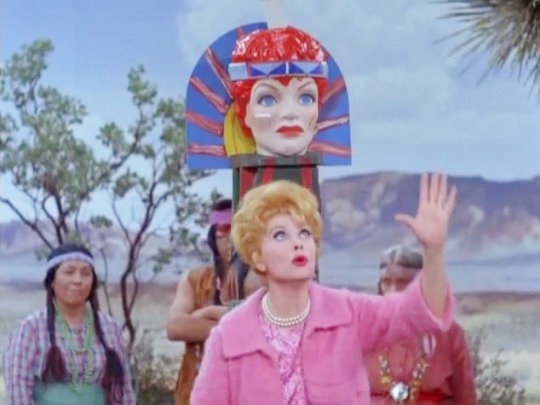

Synopsis
When
Mr. Mooney escapes to a dude ranch without signing some important bank papers, Lucy follows him and is mistaken for a rain goddess by a
nearby Native American tribe.Regular
Cast
Lucille
Ball (Lucy Carmichael), Gale Gordon (Theodore J. Mooney)Mary
Jane Croft (Mary Jane Lewis) does not appear in this episode,
although Lucy does have a phone conversation with her.Guest
Cast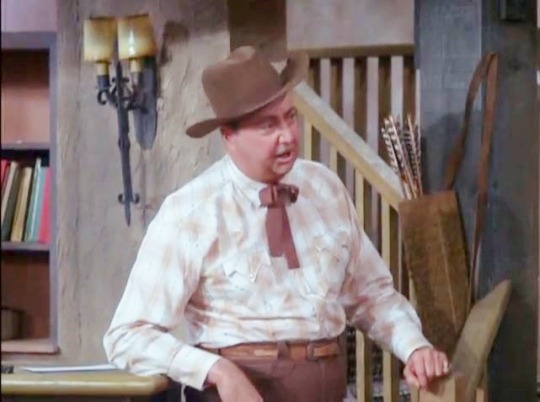
Willard
Waterman
(Tex Critter) was
a versatile voice actor who appeared on hundreds of radio shows in
the 1930s and 40s. He is probably best remembered for playing ‘The
Great Gildersleeve’ on both radio and TV. He previously played TV
host Greg Gregory in “Lucy and the Plumber” (S3;E2).Tex
Critter is the Tumbleweed Inn’s social director. The character’s
name is a pun on Tex Ritter, a
country music singer and movie actor popular from the mid-1930s into
the 1960s.
Ritter is mentioned in “Lucy Goes to the Rodeo” (ILL S5;E8). He is the father of sitcom star John Ritter, one of Lucille Ball’s favorites.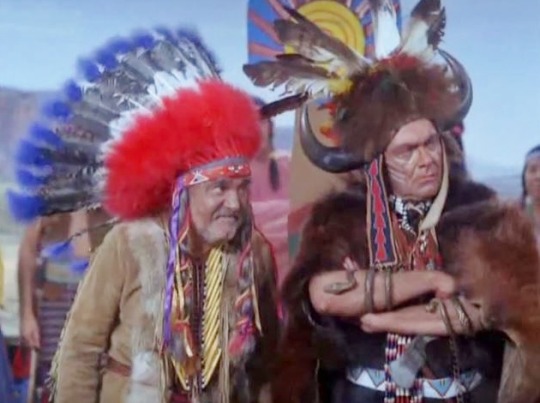
Douglas
Fowley (Chief, above left) was first seen with Lucille Ball in
the 1935 film musical Old Man Rhythm. In 1952 he played movie
director Roscoe Dexter in the film Singin’ in the Rain.The
Chief is Dick’s father.Larry Blake (Medicine Man,
above right) was a former vaudevillian who began doing movies in
1937. He will do eight episodes of “Here’s Lucy.”The
Medicine Man is Vince’s father.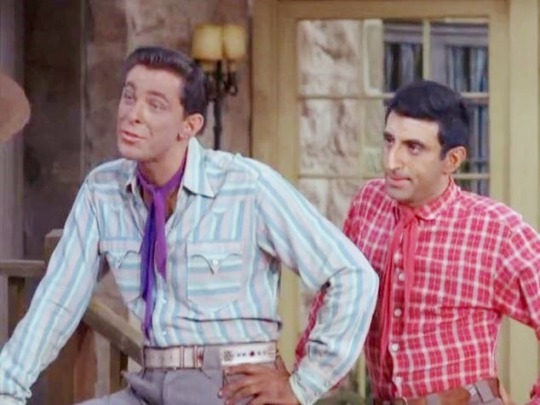
Jamie Farr (Vince,
above right) is probably best known as the cross-dressing Klinger on
TV’s “M*A*S*H” (1972-1983). This is his only appearance opposite
Lucille Ball.Vince’s
Indian name is ‘Wolf With Nose Like Anteater’.Alan
Reed Jr.
(Dick, above left) is the son of Alan Reed, who voiced Fred
Flintstone. Although this is his only appearance on “The Lucy
Show,” his father appeared in “Lucy Visits the White House”
(S1;E25).Dick’s
Indian name is ‘Running Bear Who Smell Like Skunk’.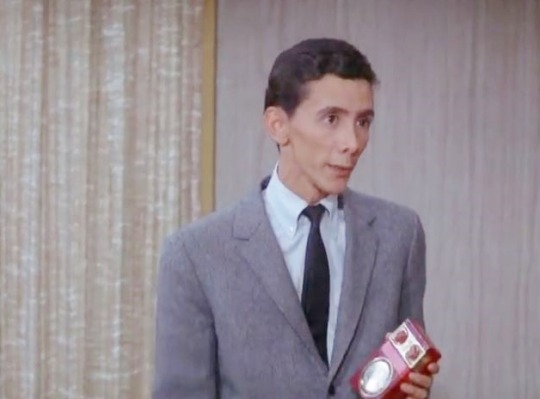
Marc
Cavell
(Herbie, Bank Office Boy) made his screen debut in 1949. This is his
only appearance with Lucille Ball.
Bennett
Green
(Ranch Guest, above right) was
Desi Arnaz’s camera and lighting stand-in during “I Love Lucy.” He does occasional
background work on “The Lucy Show.”Hazel
Pierce
(Ranch Guest, above left) was
Lucille Ball’s camera and lighting stand-in throughout “I Love
Lucy.” She also made frequent appearances on the show. Of her many
on-camera appearances on “The Lucy Show” only once was she given
a character name and credited, in “Lucy
Plays Cleopatra” (S1;E1).
She was also an uncredited extra in the film Forever
Darling (1956).
Renita Reachi (Ranch Guest, behind Lucy) was a costumer for “The Lucy Show” from 1966 to 1968. She was also Vivian Vance’s camera and lighting stand-in for “I Love Lucy” and “The Lucy Show.” She was a costumer and/or made crowd appearances on “Here’s Lucy” and the Lucille Ball films Yours, Mine and Ours (1968) and Mame (1974).

Bobby
Gilbert
(Ranch Guest) was
born Robert Wolf in 1898. A vaudevillian, he was one of the first
performers to play the South Pacific on USO tours during WWII. He was
an extra in such hit musical films as Some
Like It Hot
(1959), How
To Succeed in Business
(1967), Thoroughly
Modern Millie (1967)
and Bednobs
and Broomsticks (1971).
This is the second of his two appearances on “The Lucy Show.”Roy Rowan is the voice of the radio announcer. He generally voices any TV or radio broadcasts that are part of the plots of “The Lucy Show,” but has also appeared on camera.
Other
Ranch Guests and Native Americans are played by uncredited
performers.

This
is the first new episode of 1966. The script was finalized on
November 3, 1965. This is the first and only episode written by Brad
Radnitz and Bruce Howard. This was Radnitz’s first script for TV.It
sounds as if Gale Gordon is having vocal problems during the episode.
Lucy
jokingly calls Mr. Mooney Captain Bligh. William Bligh
(1754-1817) was a British navy captain of the HMS Bounty whose crew
staged a mutiny in rebellion of his tyranny. The story is the basis
four five films and a stage musical. Lucy is probably thinking of
the 1962 film Mutiny on the Bounty starring Trevor Howard as
Bligh and Marlon Brando as Mr. Christian.The
office boy’s transistor radio is blaring “Do the Watusi.” The
music, without lyrics, was also heard in “Chris’s New Year’s Eve
Party” (S1;E14).
Trying
to figure out where Mr. Mooney might have gone for his secret
get-away, she reads newspaper ads for the Tyrol Room, the Round-Up,
Spanish Hacienda, Lazy Days, and Shady Nook Nudist Colony. Lucy
rejects the idea of the nudist colony because she says Mr. Mooney
used to blush when he watched “Naked City.” “Naked
City” (1958-63)
was a TV series about the cases of New York’s 65 precinct. The metaphorical title comes from the final lines of the
show: “There
are eight million stories in the naked city. This has been one of
them.” Lazy
Days was also the name of
the health farm in “Lucy and the Countess Lose Weight” (S3;E21).

Mr.
Mooney’s secret getaway is the Tumbleweed Inn in Indian Rock (not to
be confused with the Indianweed Inn in Tumblerock), two hours outside
of Los Angeles, where he is known as ‘Hopalong’ and dresses in black
cowboy duds.
To
convince the Chief and the Medicine Man she is friendly, Lucy says:
“Me hate John Wayne.” John Wayne
played a cowboy in most of his films. He played himself on “I Love
Lucy” in 1955 and will do so again on a season 5 episode of “The
Lucy Show.”
When
asked to do a rain dance, Lucy asks the Native American drummer: “Do
you know ‘Stormy Weather’? How about ‘April Showers’? ‘Singin’ in
the Rain’?” “Stormy
Weather”
is a 1933 song written by Harold
Arlen
and
Ted
Koehler.
Ethel
Waters
first
sang it at The
Cotton Club in Harlem.
In 1965 it was covered by Bing Crosby. “April
Showers”
was written by Louis
Silvers and
B.G. De Sylva and introduced
by Al Jolson in the 1921 Broadway
musical Bombo.
“Singin’
In the Rain”
is by Arthur
Freed and
Nacio Herb Brown published
in 1929. It became the centerpiece of the 1952 musical
film of
the same name. Coincidentally, Douglas Fowley (the Chief) played a
supporting role in the film.
For
her improvised rain dance, Lucy does pantomime and a few steps of the
Charleston. She earns a round of applause from the studio audience.
To the rhythmic beat of the drum, she then launches into bumps and
grinds like a stripper, even miming removing gloves and tossing them
away. Instead of a cloud burst, they are showered with oil when
Vince and Dick strike a nearby gusher.As
was usual with films and TV shows of the time, the Native American
characters were played by white and mixed race actors of dark
complexion. The script also indulges in humor derived from
stereotypical speech patterns of Native Americans, although the
presence of two tribe sons (Dick and Vince) who speak and act like
most modern teens, helps keep the comedy in perspective.Callbacks!

This is not the first time Lucy was atop a totem pole. The April 17, 1953 edition of TV Guide (the third national edition ever) had Lucy and Little Ricky atop a TV totem pole featuring Cid Caesar, Imogene Coca, Milton Berle, and Arthur Godfrey, all TV icons of the early 1950s.

Lucy
dressed like a Native American squaw in both “Lucy and the Scout
Trip” (S2;E26) and “The
Indian Show” (ILL S2;E24) wearing the same exact outfit. This
costume is different – it is powder blue, a color that favored
Lucille Ball.Blooper
Alerts!
In
the prop newspaper, an ad for the Palace Theatre uses the same
font seen in a newspaper in “Ricky’s Old Girlfriend” (ILL S3;E12)
in 1953!
“Lucy, the Rain Goddess” rates 3 Paper Hearts out of 5
 Alan Reed Jr., April Showers, Bennett Green, Bobby Gilbert, Brad Radnitz, Bruce Howard, Captain Bligh, cowboys, Do the Watusi, Douglas Fowley, Dude Ranch, Gale Gordon, Hazel Pierce, Jamie Farr, John Wayne, Joshua Tree, Larry Blake, Lucille Ball, Lucy the Rain Goddess, Marc Cavell, Naked City, Native Americans, Rain Dance, Singin in the Rain, Stormy Weather, The Lucy Show, Totem Pole, Willard Waterman
 -
Lucy Discovers Wayne Newton
S4;E14~
December 27, 1965


Synopsis
When
Mr. Mooney’s dog runs away from Lucy, he turns up on Wayne Newton’s
farm. While there to retrieve him, Lucy hears Newton singing and
decides to introduce him to a record producer who just took a loan
out at the bank.Regular
Cast
Lucille
Ball (Lucy Carmichael), Gale Gordon (Theodore J. Mooney)Mary
Jane Croft (Mary Jane Lewis) does not appear in this episode,
although Lucy does have a telephone conversation with her.Guest
Cast
Wayne
Newton
(Himself) is
an American singer and entertainer. One of the best-known
entertainers in Las
Vegas,
he is known by the nicknames The ‘Midnight Idol,’ ‘Mr. Las Vegas’
and
‘Mr. Entertainment.’ His well-known songs include 1972’s “Daddy,
Don’t You Walk So Fast”
(#4 on the Billboard
chart),
“Years”
(1980),
and
his signature
song
“Danke
Schoen”
(1963). He will also play himself in two episodes of “Here’s
Lucy.”
Gary
Morton
(Mr. Morton) was
a comedian who worked the famed ‘Borscht Belt’ in the Catskills
Mountains. He met Lucille Ball shortly after her divorce from Desi
Arnaz and they married in November 1961. At her request, Morton gave
up his nightclub career and became a producer of “The Lucy Show.”
Morton also served as a warm-up comic for the show’s studio
audience. In early episodes of the series, his loud guffaw can be
heard on the laugh track. Frequent “Lucy Show” extra Sid Gould
was his cousin. He will make three appearances on “Here’s Lucy.”
Morton passed away in 1999.Mr.
Morton runs the Morton Record Company. Gary Morton is also “The Lucy
Show” Production Consultant.The
six disc jockeys and the band at the recording studio are uncredited.

This is the last new episode of 1965. The script was finalized on November 1, 1965. The previous week, Monday, December 20, 1965, CBS aired a rerun of “Lucy in the Music World” (S4;E3) where Lucy ‘discovers’ Mel Tinker (Mel Torme).

Wayne
Newton, although already a rising singer of pop songs, is literally
catapulted into stardom by this appearance. Wayne performs “Side
By Side”, “You’re Nobody ‘Til Somebody Loves You”, and
an ode to his cow, “Bessie the Heifer.”
“Bessie
The Heifer”
is
a 1951 country-western
novelty
song
written
by Jimmy
Dickens
and
Boudleaux
Bryant.
Nelson,
Mr. Mooney’s dog is a black and white sheepdog.
This is Nelson’s first appearance since “Lucy’s Contact Lenses”
(S3;E10). Although we have not heard if Mr. Mooney’s children have
moved west, his dog has. Nelson’s professional name was Lord Nelson.Mr.
Mooney invests $10,000 of his own money in Wayne Newton’s recording session, a considerable sum for such a notorious tightwad.
Lucy
tells Mr. Mooney Nelson was up late watching “Lassie.” The TV
series “Lassie” (about the adventures of a collie dog) was seen
on CBS from 1954 to 1971. Canine
star Lassie
was first mentioned on “I Love Lucy” in “The
Young Fans” (ILL S1;E20),
and most recently mentioned on “The Lucy Show” in “Lucy and the
Countess Have a Horse Guest” (S4;E6). Lassie made a guest appearance on “The Desilu Revue” in 1959.Lucy
mentions Mr. Mooney’s boss, Mr. Cheever, although the character will
not be seen on screen until season five, more than a year away. When
he does appear he will be played by Roy Roberts.Lucy
mentions that her grandmother had a farm when she was a kid.
In
addition to Nelson, Mr. Mooney’s sheep dog, Wayne Newton’s farm (and
later the recording studio) is populated by a donkey, a faun, a calf,
goats, a flock of geese, a turkey, a horse, two cows, chickens, a
rabbit, a lamb, and pigeons. A cow was last seen on “The Lucy
Show” in “Lucy and the Countess Lose Weight” (S3;E21). Pigeons
were used in “Lucy Helps the Countess” (S4;E8). A lamb (named
Clementine) was featured in “Lucy Buys a Sheep” (S1;E5). Horses
were used in “Lucy Visits the White House” (S1;E25), “Lucy and
Arthur Godfrey” (S3;E25) and “Lucy and the Countess Have a Horse
Guest” (S4;E6).In 2019, Wayne Newton talked to Fox News about Lucille Ball and this episode:

“I played a country boy singing to animals on ‘The Lucy Show,’ and CBS wanted her company Desilu to produce a series around that character,” the singer recalled. “Just before the final papers were signed, I get a call from Lucy saying, ‘Wayne, I haven’t been able to sleep. Can my husband and I fly to Vegas tonight and meet you?’
“When she got here, she said, ‘We’re going to say a name and I want your reaction: Jim Nabors,’. “I said, ‘Gomer Pyle.’ She said, ‘Unless you want to be this country boy the rest of your life, turn the series down because it will ruin your life.’ I thought that was the greatest example of someone, being the great star she was, caring that much about somebody else.”
Blooper
Alerts!
Lucy
has trouble saying “Delicious!” when eating Wayne’s oatmeal
cookies. She swallows and tries again. While Lucy is talking a goat
unexpectedly eats the cookie from Lucy’s hand. She jumps. As
Newton continues with the dialogue Lucy’s laughs a bit and then
quickly regains her composure. At one point, the calf starts to
nibble on Mr. Mooney’s trousers!
“Lucy Discovers Wayne Newton” rates 2 Paper Hearts out of 5
-
Lucy the Choirmaster
S4;E14~
December 13, 1965

Directed by Maury Thompson
Written by Bob O’Brien, Lila Garrett, Bernie Kahn
Synopsis
Lucy
celebrates her first Christmas in California. To continue a tradition
she started in Danfield, she convinces Mr. Mooney to allow carolers
to perform at the bank.Regular
Cast
Lucille
Ball (Lucy Carmichael), Gale Gordon (Theodore J. Mooney)Mary
Jane Croft (Mary Jane Lewis) does not appear in this episode.Guest
Cast
Lloyd
Corrigan
(Proprietor of the Christmas Tree Lot) was
a portly character actor who played bit parts in silent movies before switching his attention to writing and directing. He returned
to acting in the 1940s, appearing in two films with Lucille Ball. He
first appeared as Mr. Holly in “Lucy
Puts Up a TV Antenna” (S1;E9).
This is his final appearance on the series.
Teddy
Eccles (Barry,
left) previously
played Mr. Mooney’s son Arnold in “Lucy’s
Contact Lenses” (S3;E10).
He began his show business career at the age of 4 and was 9 years old
when he first appeared on “The Lucy Show.” His last screen
appearance was in 1977 and is now producing for television.
This
is his final appearance on the series.Jimmy
Garrett
(Jerry Carmichael, second from left) was
part of the original regular cast of “The Lucy Show” having
appeared in 54 episodes as Lucy’s son, Jerry. This is his final
appearance on the series.Robert
Roter
(Newton, second from right) was a child actor making his only
appearance on the series.Michael
Blake (Malcolm,
right) was a child actor whose career began at age two. He is now an
Emmy-winning make-up artist.Theodore
Miller
(Stanley, Singer on Skates) was a child actor making his TV debut.
He would do one episode of “Family Affair” in 1968 before leaving
the business. Miller was one of the few African Americans seen on
“The Lucy Show.”The
final credits list Miller as playing Lenny, despite Lucy calling him
Stanley.
Sid
Gould (Charley)
made more than 45 appearances on “The Lucy Show,” all as
background characters. He also did 40 episodes of “Here’s Lucy.”
Gould (born Sydney Greenfader) was Lucille Ball’s cousin by
marriage to Gary Morton. Gould was married to Vanda Barra, who also
appeared on “The Lucy Show” starting in 1967, as well as on
“Here’s Lucy.”The
final credits list Gould as playing Joe, despite Llloyd Corrigan
calling him Charley.
St.
Charles Boys Choir was
conducted by Paul
Salamunovich.
He
served as Director of Music at St.
Charles Borromeo Church
in
North
Hollywood, California,
for 60 years between 1949 and 2009. Later that year, they formed the Disneyland Boys Choir, with which Salamunovich recorded the It’s a Small World album of folk songs still sold at Disney theme parks.
“The Lucy Show” previously
recruited local boys to participate in their sports team-themed
episodes. The series’ first Christmas episode in 1962 featured the (uncredited) Mitchell Boys Choir.
Other
uncredited extras play the concert spectators and a passerby with a
dog at the Christmas tree lot. Lucy rattles off the other boys names:
Milton, Bruce, Lester, Steve, Walter, Jeff, Nelson, Homer, Lloyd, and
Linden, although it is difficult to know if these were their real
names or names contrived by the writers.

The same evening this episode first aired, the final episode of “The Steve Lawrence Show” aired at 10pm on CBS. Lucille Ball guest-starred on the premiere episode in September 1965, but the series was cancelled after just 14 episodes.

This
is one of two Christmas-themed episodes of “The Lucy Show.” The
first was “Together for Christmas” (S1;E13) during season one
when the Carmichaels lived with Viv and Sherman Bagley in Danfield, New York.
Lucy
reminds Mr. Mooney that back in Danfield she used to bring carolers
around for charity. Although carolers were part of “Together for
Christmas” (S1;E13), Mr. Mooney had not arrived in Danfield at the
time, so she must be referring to something not depicted on screen.
Mr.
Mooney’s office is full of two dozen colorfully wrapped Christmas presents. Among
others, he has bought presents for Doris Brown, his Aunt Clara (an
umbrella), and his nephew (a baseball bat). He bought Lucy a
hand-knit sweater imported from Italy but insists she return it to
pay for new gift wrap when she messes up his system of gift tags.
Lucy
reminds us that she is a widow who lives alone. Although daughter
Chris is not in the episode and not mentioned by name, Lucy does say
she bought gifts for the children (plural).
The red dress Lucy wears for the choir concert is the same one she will wear as Helen North on her first date with Frank Beardsley (Henry Fonda) in the film Yours, Mine, and Ours (1968).

Mr. Mooney compares himself to Scrooge. Ebenezer Scrooge was a miserly banker,
the central character of Charles Dickens’ 1843 novella A
Christmas Carol. The book was also mentioned in the 1962 Christmas episode as something Lucy’s father read to her every year.
Lucy
rehearses the choir in “The
Twelve Days of Christmas”,
pantomiming along to cue the boys. The choir uses the lyric “three
red hens” instead of the more traditional “three French hens.”
The
song, published in England in 1780 without music as a chant or rhyme,
is thought to be French in origin.The
choir sings “For He’s A Jolly Good Fellow” for Mr. Mooney twice.
According
to the Guinness Book of World Records,
“For
He’s a Jolly Good Fellow”
is the second-most popular song in the English language,
following “Happy Birthday to You” and “Auld
Lang Syne” (which is partly in Welsh).Callbacks!

Desilu
started doing a Christmas tag at the end of “I Love Lucy” in
1951. In 1956 they fleshed out the tag to a full
episode
featuring
clips. It did not enter syndication and wasn’t seen again until
1989 when the wrap-around segments (but not the clips) were
colorized. The fully colorized episode was seen in 1990 and has
become a holiday staple for CBS, airing along with a newly colorized
“I Love Lucy” favorite.Blooper
Alerts!

Lost Traditions! In
“Together for Christmas” (S1;E13, top), Lucy stated that she
traditionally has popcorn strings and candy canes decorating her
Christmas tree. Here, just three years later, both traditions are absent.Puberty! Newton’s
voice changes mid-song. In his argument with Barry his voice is
natural, but a minute later during “The Twelve Days of Christmas”
his voice is suddenly cracking in both song and dialogue.


“Lucy the Choirmaster” rates 3 Paper Hearts out of 51965, A Christmas Carol, Carolers, CBS, Chirstmas, For He’s A Jolly Good Fellow, Gale Gordon, Jimmy Garrett, Lloyd Corrigan, Lucille Ball, Lucy the Choirmaster, Michael Blake, Paul Salamunovich, Robert Roter, Sid Gould, St. Charles Boys Choir, Ted Eccles, The Lucy Show, The Twelve Days of Christmas, Theodore Miller, tv -
Lucy Saves Milton Berle
S4;E13~
December 6, 1965

Synopsis
When
Milton Berle is doing research to play an alcoholic, he disguises
himself as a drunk and visits the soup kitchen sponsored by Mr.
Mooney’s bank. Lucy and Mary Jane recognize him and so he tells them
he is Milton Berle’s twin brother, Arthur. Lucy vows to get even
with Milton Berle for neglecting his brother and causes an uproar at
a press party.Regular
Cast
Lucille
Ball (Lucy Carmichael), Gale Gordon (Theodore J. Mooney), Mary Jane
Croft (Mary Jane Lewis)Guest
Cast
Milton
Berle
(Himself) was
born Milton Berlinger in New York City on July 12, 1908. He started
performing at the age of five. He perfected his comedy in vaudeville,
early silent films, and then on radio, before taking his act to the
small screen, where he would be proclaimed “Mr. Television” and
later “Uncle Miltie.” He hosted “Texaco Star Theater” on
NBC from 1948 to 1956. The variety show was re-titled "The
Milton Berle Show” in 1954 when Texaco dropped their sponsorship.
The program was briefly revived in 1958, but lasted only one season.
In 1959 he played himself in “Milton Berle Hides out at the
Ricardos.” Berle continued to perform live, in films, and on
television specials for the remainder of his career. One of his
classic bits was to dress in drag, something only hinted at in this
episode. Berle will return for three episodes of "The Lucy Show”
and two episodes of “Here’s Lucy.” On all but one, he again
played himself. He died of colon cancer in 2002.
Milton
Frome
(Jerry Bike, Milton Berle’s Agent) played Sam, who Lucy Ricardo tried
to fix up with Dorothy, in “The Matchmaker” (ILL S4;E5). He will
also play a waiter in a 1972 episode of “Here’s Lucy” starring
Donny Osmond. He made a half a dozen appearances with Milton Berle
on “Texaco Star Theatre” from 1953 to 1956.The
Agent’s last name is never mentioned. It is the same as Lester Bike,
Ernie Ford’s friend and TV host in “Tennessee Ernie Hangs On”
(ILL S3;E29).
Robert
S. Carson
(Mr. Potter) also played Mr. Potter in “Lucy at Marineland”
(S4;E1). He was a busy Canadian-born character actor making the
fourth of his six appearances on the series. He also made five
appearances on “Here’s Lucy.”
Charles
Cantor
(Old Man, Autograph Hound) was a stage and radio actor making his
penultimate screen appearance before passing away nine months later.
Eleanor
Audley
(Eleanor, Columnist) was first seen with Lucille Ball as Mrs.
Spaulding, the first owner of the Ricardo’s Westport home in “Lucy
Wants to Move to the Country” (ILL S6;E15). She returned to “I
Love Lucy” to play one of the garden club judges in “Lucy Raises
Tulips” (ILL S6;E26). Audley was a New York born actress who
performed in eight Broadway plays between 1926 and 1944. She
specialized in snobbish society matron types, most notably as Eddie
Albert’s mother on TV’s “Green Acres” (1965). She is probably
best known, however, as the voice of two of Disney’s most memorable
animated villainesses: Lady Tremaine, the wicked stepmother in
Cinderella
(1950);
and the evil Maleficent in Sleeping
Beauty (1959).
This is her last appearance opposite Lucille Ball.Sid
Gould (Sid,
Reporter) made more than 45 appearances on “The Lucy Show,” all
as background characters. He also did 40 episodes of “Here’s
Lucy.” Gould (born Sydney Greenfader) was Lucille Ball’s cousin
by marriage to Gary Morton. Gould was married to Vanda Barra, who
also appeared on “The Lucy Show” starting in 1967, as well as on
“Here’s Lucy.”A
few of the others at the press party are played by:- Paul
Bradley
makes the last of his six appearances on “The Lucy Show” in
various roles. He will also be seen in two episodes of “Here’s
Lucy.” - Paul
Power was
seen in two episodes of “I Love Lucy” and two films with Lucille
Ball. - Louise Lane makes the first of her four background appearances on “The Lucy Show.”
- Hazel
Pierce
was Lucille Ball’s camera and lighting stand-in throughout “I
Love Lucy.” She also made frequent appearances on the show. Of her
many on-camera appearances on “The Lucy Show” only once was she
given a character name and credited, in “Lucy
Plays Cleopatra” (S1;E1).
She was also an uncredited extra in the film Forever
Darling (1956).
Other
uncredited extras play the other guests at the press party and the
men at the soup kitchen.
The
night this episode first aired (December 6, 1965) “The Lucy Show”
was followed by an episode of “The Andy Griffith Show” (filmed at
Desilu) which also featured Milton Frome (Jerry Bike).
Jerry
Bike’s office is decorated with large photographs of Danny Thomas and
Bob Hope.
When Berle arrives, he flips them open to reveal four
photos of Milton Berle instead. Danny Thomas recently guest starred
in “Lucy Helps Danny Thomas” (S4;E7) as well as appearing in
“Lucy Makes Room for Danny,” an episode of “The Lucy-Desi
Comedy Hour.” Bob Hope teamed with Lucy in numerous feature films
as well as appearing as himself in the season six opener of “I Love
Lucy.”
When
Berle and his agent are discussing him playing a serious role, Berle
mentions Joe Levine. Joe
Levine was
the producer of the 1966 film The
Oscar,
in which Berle played a dramatic part. Although the film had finished shooting at the time of this episode’s initial broadcast, it
would not be released until March 1966, so the already obscure
reference would be lost on viewers. The film (which is not mentioned
by name in the episode) also featured Paul Bradley, who is an extra
in this episode, as well as Jesse Wayne, “The Lucy Show” stunt
coordinator.
As
examples of actors who did research by “living” their roles,
Jerry Bike cites Paul Newman as a prizefighter and Marlon Brando as a
cowboy. Newman played boxer Rocky Graziano in the bio-pic Somebody
Up There Likes Me
in 1956. Brando played cowboy Rio in One-Eyed
Jacks
in 1961. Neither film is mentioned by name in the episode.Hearing
about Newman and Brando, Milton Berle facetiously wonders what role
Frank
Sinatra
is preparing for? This may be a reference to Sinatra’s love life after breaking off engagements to Lauren
Bacall in
1958 and Juliet
Prowse in
1962. It may also be referring to Sinatra’s ties to organized crime.
In 1963, he was stripped of his gaming license because a known
mobster was seen at his Lake Tahoe casino, one which Lucille Ball
herself was known to visit. Berle suggests he use Dean
Martin
as a role model to play a drunk. Martin’s affinity for alcohol has
been used as the source of humor previously on “The Lucy Show.”
Mr.
Mooney’s Westland Bank is sponsoring meals at the South Side Soup
Kitchen. Upon entering the run down soup kitchen, Milton Berle says
“I
was here once. Jack Benny took me here for dinner.”
Berle is playing upon Jack
Benny’s
persona of being a miser. Benny guest starred in “Lucy and the
Plumber” (S3;E2).Berle introduces himself as Herman Berman.
LUCY: "Herman Berman; that’s a funny name.”
HERMAN / BERLE: “That’s nothing. My sister’s name is Sherman Berman.”
“Kellam DeForest was the resident fact checker and researcher for Desilu scripts. There happened to be a man living in the Bronx whose name was Herman Sherman Berman. As meticulous as his research was to discover any real life persons with the same name, Kellam couldn’t catch them all. That’s why film and TV companies have errors and omissions insurance. I think they sent Mr. Berman on an expense-paid trip to Las Vegas and he didn’t sue.“ ~ Howard Rayfiel, Where The Hell is Desilu?

Lucy brings up
comedian Shelley
Berman.
On New Year’s Day 1961 Lucille Ball was a mystery guest on “What’s
My Line?” where Shelley Berman was one of the panelists.
When
Mary Jane first recognizes Berle as someone famous, Lucy thinks he’s
Jackie Gleason.
In “Lucy Helps Danny Thomas” (S4;E7) she mistakenly attributes
the catch phrase “And
away we go!” to
Thomas when it was actually Jackie Gleason’s.While
trying to remain incognito, Milton Berle mutters his famous
catch-phrase:
“I’ll kill you a million times.” His
cover is immediately blown.

When
Lucy is dressed as a poor flower seller, Mr. Mooney calls it a
“cheesy
Mary Poppins outfit.” Disney’s
Mary
Poppins
(1964) was an Oscar-winning film that featured Julie Andrews.
Although Mary Poppins never dressed as a poor flower seller, Julie
Andrews did dress this way on stage in My
Fair Lady as
Eliza Doolittle. My
Fair Lady and
Mary Poppins
were both Oscar contenders in 1965.Callbacks!

Milton
Berle also lined his office with photos of himself in “Milton Berle
Hides out at the Ricardos”, a 1959 episode of “The Lucy-Desi
Comedy Hour.”Fast Forward!

Two
seasons later, Lucy Carmichael will again meet Milton Berle for the
first time in "Lucy
Meets the Berles”
(S6;E1). The episode also features Mary Jane Croft and is directed
by Maury Thompson.
“Lucy Saves Milton Berle” rates 3 Paper Hearts out of 5
 1965, Bob Hope, CBS, Charles Cantor, Danny Thomas, Dean Martin, Eleanor Audley, Frank Sinatra, Gale Gordon, Hazel Pierce, Jackie Gleason, Joe Levine, Lucille Ball, Lucy Saves Milton Berle, Marlon Brando, Mary Jane Croft, Mary Poppins, Milton Berle, Milton Frome, One-Eyed Jacks, Paul Bradley, Paul Newman, Paul Power, Robert S. Carson, Shelley Berman, Sid Gould, Somebody Up There Likes Me, The Lucy Show, The Oscar, tv
 - Paul
-
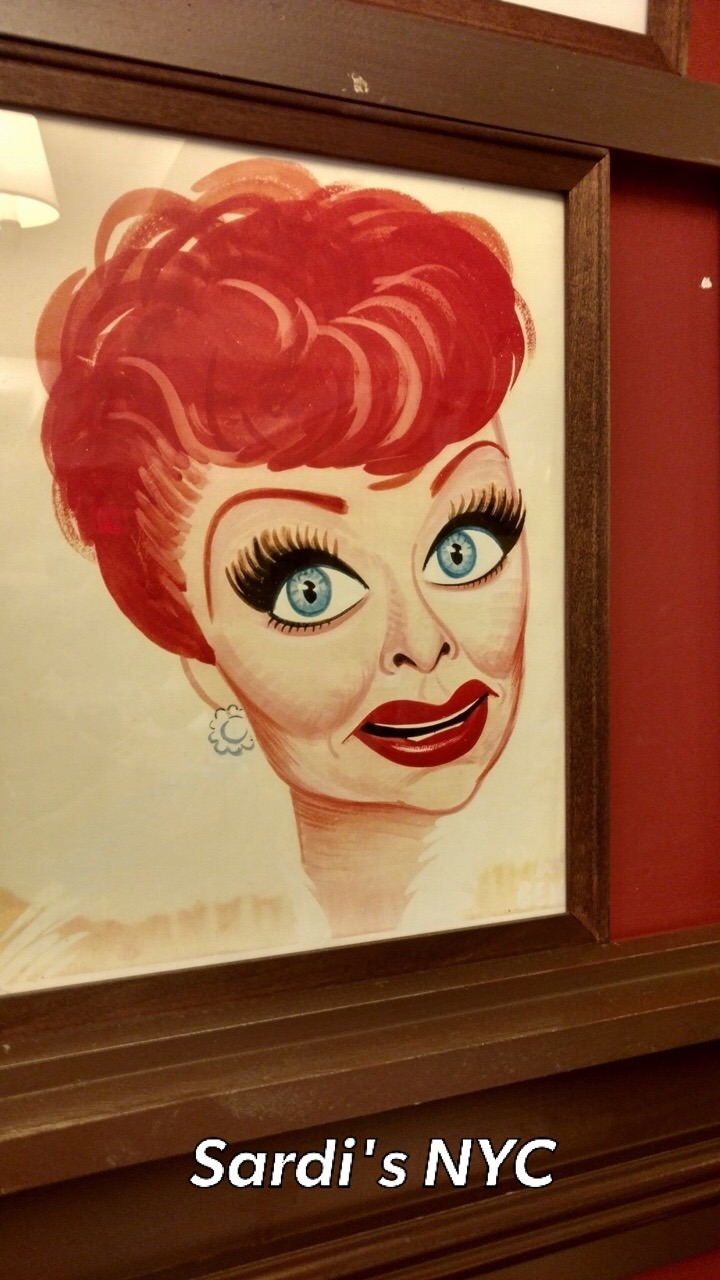
Sardi’s NYC
-
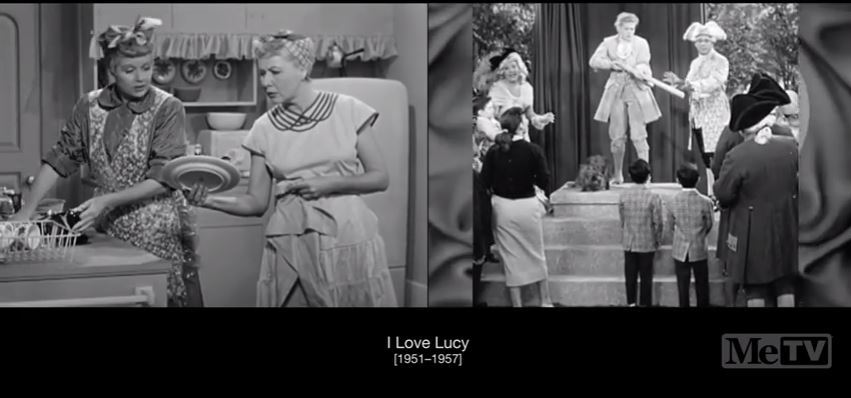
I LOVE LUCY ~ The first scene and the last.
-
Lucy and the Return of Iron Man
S4;E11~
November 29, 1965

Synopsis
Lucy
and Mary Jane spend a day at the track. When they place a bet for
Mr. Mooney, they mistakenly rip up his bet slip, so Lucy must go back
to work doing stunts as Iron Man Carmichael in order to pay Mr.
Mooney his winnings.Regular
Cast
Lucille
Ball (Lucy Carmichael), Gale Gordon (Theodore J. Mooney), Mary Jane
Croft (Mary Jane Lewis)Guest
Cast
Saul
Gorss
(Rusty) was a Hollywood actor and stunt man whose career began in
1931 with The
Front Page.
This is his only appearance with Lucille Ball.
Ross
Elliott
(Director) also played the director of Lucy’s famous Vitameatavegamin
commercial in 1952. He played Ross, Ricky’s publicity agent in three
other episodes. From 1961 to 1964 he played another TV director on
“The Jack Benny Program.” He will do one episode of “Here’s
Lucy.”
Sid
Gould
(Waiter) made more than 45 appearances on “The Lucy Show,” all as
background characters. He also did 40 episodes of “Here’s Lucy.”
Gould (born Sydney Greenfader) was Lucille Ball’s cousin by
marriage to Gary Morton. Gould was married to Vanda Barra, who also
appeared on “The Lucy Show” starting in 1967, as well as on
“Here’s Lucy.”
The
Racetrack Patrons are played by:- Monty
O’Grady
was first seen with Lucille Ball in The
Long, Long Trailer (1953)
and played a passenger on the S.S. Constitution in “Second
Honeymoon” (ILL S5;E14).
He was a traveler at the airport when “The
Ricardos Go to Japan” (1959).
He made a dozen appearances on the series and a half dozen more on
“Here’s Lucy.” - George
Hoagland was
an uncredited extra in hundreds of movies and TV shows, including
Lucy and Desi’s film The
Long, Long Trailer
in 1953. - Kenner
G. Kemp
appeared in seven films with Lucille Ball between 1936 and 1960. - Mike
Lally was
seen in two episodes of “I Love Lucy” and eight films starring
Lucille Ball. - Arthur
Tovey
was seen in the Lucille Ball film Critic’s
Choice
in 1960 and the TV special “Swing Out, Sweet Land” in 1970 in which Lucille Ball is the Statue of LIberty.
Other uncredited background performers play the racetrack patrons and the pirates.


This
is the second of three Iron Man Carmichael episodes where Lucy gets
to do stunts, this time in a pirate movie. The first (S4;E5) was a
western and the last (S4;E22) will be a war picture. All three
episodes were written by Edmond Beloin and Harry Garson and were
directed by Maury Thompson. Jesse Wayne was “The Lucy Show”
stunt coordinator. In this one and the first, the Directors were
played by actors who had also played directors on “I Love Lucy.”
We
learn that Mr. Mooney and his (never seen) wife Irma have been
married for 25 years.
At
the track, Mr. Mooney bets on Banker’s Dream, with odds of 25 to 1.
Lucy and Mary Jane bet on Redhead Mary.
Mr.
Mooney says that a banker at the racetrack is as conspicuous as Yul
Brynner standing among The Beatles. Actor Yul Brynner was known for
being bald while The Beatles were a rock group known for their long,
shaggy hair. The Beatles were mentioned in several episodes of “The
Lucy Show.” On “I Love Lucy” and “The Lucy-Desi Comedy Hour” follicle-challenged Fred Mertz (William Frawley) often compared himself to Yul
Brynner.
Mary
Jane has taken a job as a script girl at the studio.The
beach party movie being filmed on an adjacent sound stage is titled Who’s
the Dirty Meanie Who Stole Grandmother’s Bikini?
Before
Iron Man Lucy is shot out of the canon, she says “It’s
the only way to fly.”
This was the advertising slogan of Western Airlines a
US carrier that was in operation from 1926 to 1987, before merging
with Delta Airlines. In 1965 R&B singer Jewel Akens (“The Birds
and the Bees”) released a song titled “It’s the Only Way to
Fly.” The slogan was previously uttered in “Lucy Gets the Bird”
(S3;E12).Callbacks!

Lucy
Ricardo spent a good deal of time at the horse track – as a jockey
– in “Lucy Wins A Racehorse”, a 1958 episode of “The
Lucy-Desi Comedy Hour.”Blooper
Alerts!
Blooper? After Lucy / Iron Man is shot out of the canon, the camera pans over too far and a stage lighting instrument is in the frame! Because we know that a movie is being shot, it is not really a blooper.
Door is Ajar! Once
again, Mr. Mooney enters Lucy’s apartment but fails to shut the front
door.
“Lucy and the Return of Iron Man” rates 3 Paper Hearts out of 5

- Monty
-
Lucy and the Undercover Agent
S4;E10 ~ November 22, 1965


Synopsis
After seeing a James Bond film, Lucy, the Countess and Mr. Mooney find themselves embroiled in a spy caper that ends up with Lucy disguised as Carol Channing.
Regular Cast
Lucille Ball (Lucy Carmichael), Gale Gordon (Theodore J. Mooney)
Mary Jane Croft (Mary Jane Lewis) does not appear in this episode.
Guest Cast

Ann Sothern (Rosie Hannigan, the Countess Framboise) makes her last appearance on “The Lucy Show.” Sothern had appeared in the first “Lucy-Desi Comedy Hour” “Lucy Takes a Cruise to Havana” (1957) as Susie MacNamara, the same character she played on her show “Private Secretary” from 1953 to 1957. In return Lucille Ball played Lucy Ricardo on her show in 1959. Sothern appeared with Ball in five films between 1933 and 1943. She was nominated for an Oscar for her final screen appearance in The Whales of August in 1987. She is buried near her home in Sun Valley, Idaho, a place also dear to Lucy and Desi.

Jack Cassidy (Professor Zoorkin) made his Broadway debut at the age of 16 and became one of the most Tony-nominated actors in history, winning for She Loves Me, one year before this episode was filmed. He married actress Shirley Jones in 1956 and they had three sons, Patrick, David, and Shaun, all of whom followed in their parents footsteps in show business. He died in an apartment fire in 1976. This is his only appearance with Lucille Ball.

James Dobson (Sol Schwartz) was seen on “I Love Lucy” in “Ricky’s Movie Offer” (ILL S4;E5). This is his only appearance on “The Lucy Show.”


Parley Baer (Colonel Dietrich aka “Him”) previously played MGM’s Mr. Reilly in “Ricky Needs an Agent” (ILL S4;E29) and the furniture salesman Mr. Perry in “Lucy Gets Chummy with the Neighbors” (ILL S6;E18). This is the third of his five appearances on “The Lucy Show.” He also made two appearances on “Here’s Lucy.” He is perhaps best known for his recurring roles as Mayor Stoner on “The Andy Griffith Show” and Doc Appleby in “The Dukes of Hazzard.”

Sid Gould (Waiter) made more than 45 appearances on “The Lucy Show,” all as background characters. He also did 40 episodes of “Here’s Lucy.” Gould (born Sydney Greenfader) was Lucille Ball’s cousin by marriage to Gary Morton. Gould was married to Vanda Barra, who also appeared on “The Lucy Show” starting in 1967, as well as on “Here’s Lucy.”
Monty O’Grady (Restaurant Patron, uncredited) was first seen with Lucille Ball in The Long, Long Trailer (1953) and played a passenger on the S.S. Constitution in “Second Honeymoon” (ILL S5;E14). He was a traveler at the airport when “The Ricardos Go to Japan” (1959). He made a dozen appearances on the series and a half dozen more on “Here’s Lucy.”
Other uncredited background performers play the patrons of the restaurant.

This episode is sometimes listed as “Lucy, the Undercover Agent.”

Lucy, Rosie, and Mr. Mooney have just seen a James Bond film. Although the title is never mentioned, Goldfinger was released in the USA in January 1965. A few weeks after this episode aired, Thunderball premiered.

Zoorkin answers his cigarette case telephone and says “Napoleon who? You’ve got the wrong number!” This is a reference to the TV series “The Man From U.N.C.L.E.” (1964-1968) in which Napoleon Solo was played by Robert Vaughn.

Lucy tells Zoorken not to bend over around her or he may get a Judo chop. Back in Danfield, Lucy took Judo lessons. However, in the previous episode, “Lucy and the Sleeping Beauty” (S4;E9), she witnesses a Judo chop to her living room wall and doesn’t recognize it.

The writers picked the name “Sol” for the guard so that Lucy can sing “Hello, Solly!” to him. Carol Channing originated the title role in the Broadway musical Hello, Dolly! In January 1964 and played the part until August 1965. She won a Tony Award for her portrayal and would re-visit the role many times during her career.

Coincidentally, the role of Dolly was originally intended for Ethel Merman, who guest starred in two episodes of “The Lucy Show.” The musical was written by Jerry Herman (music) and Michael Stewart (Book) based on a play by Thornton Wilder.


In July 1965, just before filming this episode, Lucille Ball and Carol Channing were both mystery guests on “What’s My Line?” Ball used her ‘witch’s voice’, a voice she used on “Lucy and the Monsters” (S3;18). She announces that “The Lucy Show” will be moving to 8:30pm in the fall of 1965. Ginger Rogers, who would take over for Channing as Dolly Levi on Broadway, was also a mystery guest to promote her assuming Channing’s iconic role.

There was talk as early as February 1965 that Lucille Ball was a shoe-in to play Dolly in the feature film of the musical. Instead, the role went to Barbra Streisand, but not until 1969. Lucy got to do the film of Mame, Jerry Herman’s other Broadway hit musical, in 1974.

Mr. Mooney and the Countess disguise themselves as Carol Channing’s maid, Suzette, and her chauffeur. They come out of a Rolls Royce limousine with the license plate HHW-D60.

Because this is a female spy story, there is a mention of Mata Hari. Margaretha Geertruida MacLeod (1876-1917), better known by the stage name Mata Hari, was a Dutch exotic dancer and courtesan who was convicted of being a spy for Germany during World War I and executed by firing squad. Her name has since become synonymous with women spies. Greta Garbo played Mata Hari in a 1931 film.
Callbacks!

In 1953 Lucy Ricardo jumped to the conclusion that her “New Neighbors” (ILL S1;E21) were spies, when they were in fact TV actors rehearsing.
Blooper Alerts!

Faulty Logic Alert! The Countess orders a glass of vodka for Professor Zoorken and three glasses of water (in the same kind of glass) for herself, presumably to stay sober while pretending to be a spy. When the waiter brings the tray of four identical glasses to the table, she picks up a glass and drinks it without any regard for which one might be the vodka or the water. Similarly, Zoorken could have gotten a glass of water, and been suspicious.

“Lucy and the Undercover Agent” rates 4 Paper Hearts out of 5
 1965, Ann Sothern, Broadway, Carol Channing, CBS, Dolly Levi, Gale Gordon, Ginger Rogers, Goldfinger, Hello Dolly, Jack Cassidy, James Bond, James Dobson, Lucille Ball, Lucy and the Undercover Agent, Mata Hari, Monty O’Grady, Parley Baer, Sid Gould, spy, The Lucy Show, the man from u.n.c.l.e., tv, What’s My Line
-
Subscribe
Subscribed
Already have a WordPress.com account? Log in now.
 Papermoon Loves Lucy