-
Lucy and Carol in Palm Springs
S5;E8
~ November 7,
1966

Synopsis
Lucy’s
new roommate Carol gets a gig singing in Palm Springs with The
Vagabonds and wants Lucy to come along. Lucy has to fake illness to
get off work and then perform with the group to earn her stay. Carol
Burnett and Dan Rowan guest star.Regular
CastLucille
Ball (Lucy
Carmichael),
Gale Gordon
(Theodore J. Mooney)Mary
Jane Croft (Mary
Jane Lewis) does not appear in this episode.Guest
Cast
Carol
Burnett (Carol Bradford) got her first big break on “The Paul
Winchell Show” in 1955. Winchell guest starred with Lucy in “Lucy
and Paul Winchell” (S5;E4). A years later she was a regular on “The
Garry Moore Show.” In 1959 she made her Broadway debut in Once
Upon a Mattress, which she also appeared in on television three
times. From 1960 to 1965 she did a number of TV specials, and often
appeared with Julie Andrews. Her second Broadway musical was Fade
Out – Fade In which ran for more than 270 performances. From
1967 to 1978 she hosted her own highly successful variety show, “The
Carol Burnett Show.” This episode is the second of her five
appearances with Lucy as Carol Bradford. In return, Lucille Ball
made five appearances on “The Carol Burnett Show.” Burnett also
returned to star in three episodes of “Here’s Lucy,” once playing
herself. After Lucille Ball’s passing, Burnett was hailed as the
natural heir to Lucy’s title of ‘The Queen of TV Comedy.’Carol
Bradford is a librarian who likes to sing.
Dan
Rowan (Colin
Grant) was the comedy partner of Dick Martin, who played Lucy’s
boyfriend Harry on season 1 of “The Lucy Show.” He is best
known as the co-host of “Rowan and Martin’s Laugh-In” which aired
from 1968 to 1973 and earned him a 1972 Emmy Award. Earlier in 1966
he had appeared with Lucille Ball on “The Dean Martin Show.” He
will guest star on “The Carol Burnett Show” in 1969 and in return
she appeared on “Laugh-In” in 1972. This is the first of his two
appearances on “The Lucy Show.” He died in 1987 at age 65.Grant
is described as a millionaire sportsman,
“celebrated big game hunter, deep sea fisherman, and a fine
golfer.”
He is single, but considering marriage.
Jonathan
Hole
(Mr. Haskell, Hotel Manager) previously played Mr.
Collins, Manager of Stacey’s Department Store, in “Lucy Bags a
Bargain” (S4;E17). He was in eight Broadway plays between 1924 and
1934. Hole’s screen career began in 1951. This is the second of his
three appearances on the series. He also did two episodes of “Here’s
Lucy.”
William
Woodson
(Radio Reporter) previously played Danfield TV reporter Larry
McAdoo on “Lucy and the Safe Cracker” (S2;E5). TV viewers might
recognize his voice as the narrator on the opening credits of “The
Odd Couple” (1970-72): “Can
two divorced men share an apartment without driving each other
crazy?” This
is his final appearance on “The Lucy Show.”
Sid
Gould
(Tournament Committee Man) made
more than 45 appearances on “The Lucy Show,” all as background
characters. He also did 40 episodes of “Here’s Lucy.” Gould
(born Sydney Greenfader) was Lucille Ball’s cousin by marriage to
Gary Morton.
Dino
Natali (Musician, Bass), Dom Germano (Musician, Guitar),
Al Torrieri (Musician, Guitar), Attilio Rizzo (Musician,
Accordion) were all seen in the previous episode “Lucy Gets a
Roomate” (S5;E7).Although
not billed as such in the final credits, their group was known as The
Vagabonds. Unlike the previous episode, “Lucy Gets a Roommate”
(S5;E7), they are called by that name many times in this script.
Contrary to popular belief, Joe Pesci was not part of the group. They
all live across the hall from Lucy and have taken on Carol as their
girl singer. As in the previous episode, in the final credits,
Torrieri is listed as ‘Torre’ and Attilio Rizzo is listed as ‘Atillo
Risso.’ The electric guitar player and a drummer (probably Roger
Pearsall) are uncredited.Two
dozen uncredited male and female background players play the hotel
and golf tournament guests. Among them is Bennett
Green,
who served as
Desi Arnaz’s stand-in during “I Love Lucy” and had bit roles in
many episodes. He does frequent background work on “The Lucy
Show.”
This
is a stand-alone episode that directly follows-up on “Lucy Gets a
Roommate” (S5;E7) wherein librarian and amateur singer Carol
Bradford moves in to share Lucy’s apartment.
Although
he is not specifically mentioned by name, the script was designed as
a plug for Lucy’s good friend Bob Hope, who had recently taken over
hosting the The Palm Springs Golf Classic and renamed it The Bob
Hope Desert Classic.
The
tournament retained this name until 2012.
In
February 1966
Doug Sanders finished first with Arnold Palmer the runner-up. Desi
Arnaz, who co-founded Palm Springs’ Indian Welles Golf Course and
Country Club, frequently played in the classic.
Palm
Springs, California, was a favorite get-away destination of Lucille
Ball and Desi Anaz (as well as Gary Morton) who had a home there and
built a golf course and resort there. Their daughter Lucie Arnaz
recently relocated to the desert town where her parents were celebrated residents.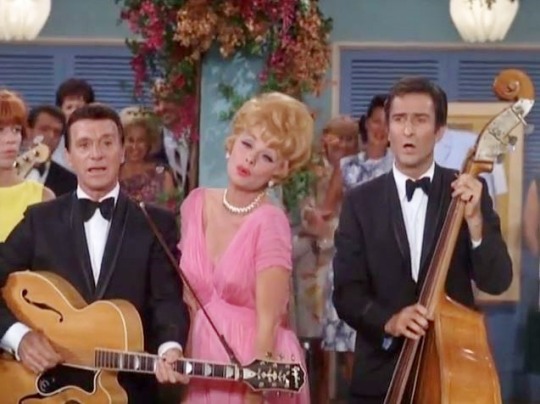
Carol
and The Vagabonds sing “The
Hukilau Song”
written by Jack Owens in 1948. This turns into “The
Hawaiian War Chant”
written by Johnny Noble, a composer who was a native Hawaiian. In
order to show Mr. Haskell that she’s a member of the band, Lucy
plays the cuica, a friction drum of Brazilian origin that makes a low
groaning sound.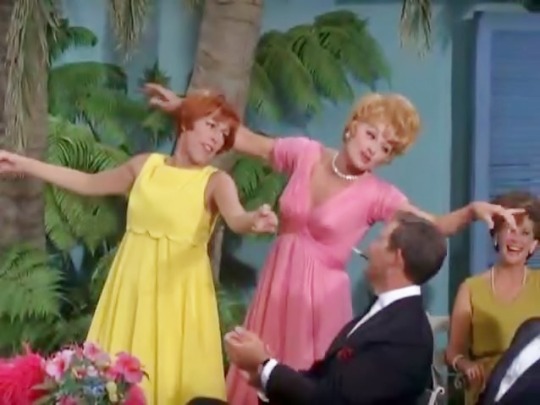
Lucy
and Carol later sing “Lazy
River,” which
was written by Hoagy Carmichael and Sidney Arodin in
1930.
The
golf tournament player board has the names of several important
members of “The Lucy Show” family. One of them is Lucy’s husband
(and newly-named “Lucy Show” Executive Producer) Gary Morton.
Morton played Lucy’s boyfriend in the golf-themed episode “Lucy
Takes Up Golf” (S2;E17). In “Lucy and Paul Winchell” (S5;E4),
Winchell gets a telephone call from someone named Gary asking him to
play golf. Another name on the board is Dick Martin, Rowan’s
real-life stand-up comedy partner and Lucy Carmichael’s boyfriend
during season 1. Ken Westcott was “The Lucy Show” props
master. Howie McClay was the name of Lucille Ball’s long-time
publicist. His name was used back in Danfield as the owner of the
hardware story. Ron Knox is “The Lucy Show” gaffer. Bob
O’Brien was the episode’s writer.
Carol
Burnett uses her trademark Tarzan yell in both this and the previous
episode, “Lucy Gets a Roommate”
(S5;E7). In that episode it was explained that Carol gets the hiccups
whenever she is nervous, which she does thinking about performing in
Palm Springs.
Searching
for an excuse to join The Vagabonds and get a free trip to Palm
Springs, Lucy offers that she can play “Glow
Worm” on the saxophone.
This was something that Lucy Ricardo regularly did on “I Love
Lucy,” although often the song was “Sweet Sue.”Callbacks!

In 1942, Lucy and Desi were seen in an episode of RKO’s ‘Picture People’ titled “Palm Springs Week End”. The couple were seen biking in the desert and taking snapshots of Lucy and the scenery.
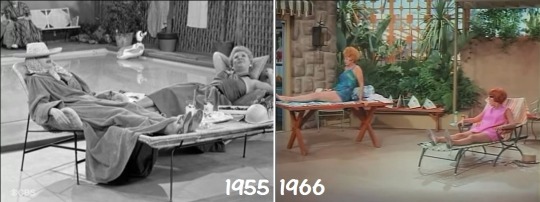
Lucy
Ricardo was “In Palm Springs” (ILL S4;E26) where she also sat out
in the sun, but because of a severe sunburn before her appearance in
“The Fashion Show” (ILL S4;E19), Lucy kept covered up!
“Lazy
River” was previously sung on the series by Roberta Sherwood in
“Viv Moves Out” (S2;E22).
This
was Sherwood’s only charting hit, landing at #57 in 1956.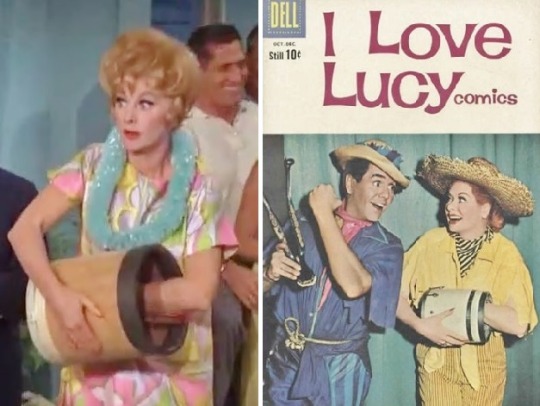
Lucy
Ricardo also played the cuica when the gang sang the calypso tune
“Man Smart (Woman Smarter)” in “Ragtime Band” (ILL S6;E20) in
1957, one year after it was a hit for Harry Belafonte. It was also a
staple song for The Grateful Dead!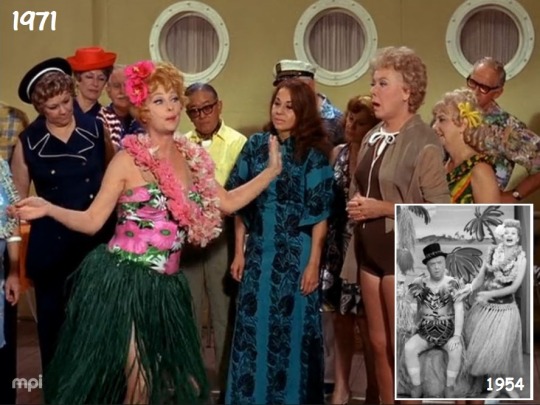
Lucy
Ricardo performed “The Hawaiian War Chant” in “Ricky’s Hawaiian
Vacation” (ILL S3;E22). Lucy would again perform the song in a
two-part 1971 episode of “Here’s Lucy” on a cruise to Hawaii with
Vivian Vance.Sitcom Logic Alert!

As
usual, Mr. Mooney turns up wherever Lucy is – or, in this case – isn’t supposed to be! He is partnered with heartthrob Colin Grant in
the golf tournament. Only in TV Land!
“Lucy and Carol in Palm Springs” Rates 3 Paper Hearts out of 5
1966, Al Torrieri, Attilio Rizzo, Bennett Green, Bob O’Brien, Carol Burnett, CBS, cuica, Dan Rowan, Dick Martin, Dino Natali, Dom Germano, Gale Gordon, Gary Morton, Glow Worm, golf, Hawaiian War Chant, Howard McClay, Hukilau Song, Ken Westcott, Lazy River, Lucille Ball, Lucy and Carol in Palm Springs, Palm Springs, Ron Knox, Sid Gould, The Lucy Show, The Palm Springs Desert Classic, The Vagabonds, tv -
Lucy Gets a Roommate
S5;E7
~ October
31, 1966
Synopsis
Carol Burnett guest stars as Lucy’s
new roommate, a shy librarian who happens to have a piercing laugh
and a tendency to hiccup loudly. When their musician neighbors
visit for a party, Lucy discovers she also has a powerful singing voice!Regular
CastLucille
Ball (Lucy
Carmichael),
Gale Gordon
(Theodore J. Mooney), Mary
Jane Croft (Mary
Jane Lewis)Guest
Cast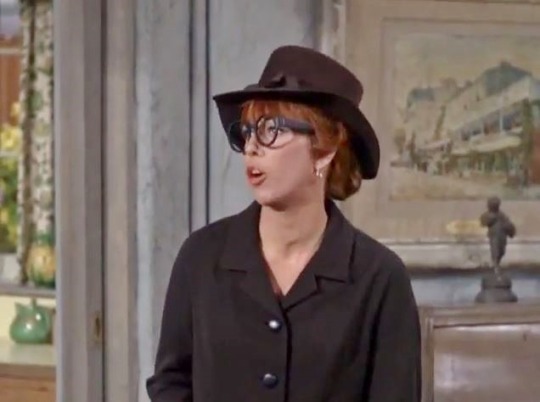
Carol
Burnett (Carol Bradford) got her first big break on “The Paul
Winchell Show” in 1955. Winchell guest starred with Lucy in “Lucy
and Paul Winchell” (S5;E4). A years later she was a regular on “The
Garry Moore Show.” In 1959 she made her Broadway debut in Once
Upon a Mattress, which she also appeared in on television three
times. From 1960 to 1965 she did a number of TV specials, and often
appeared with Julie Andrews. Her second Broadway musical was Fade
Out – Fade In which ran for more than 270 performances. From
1967 to 1978 she hosted her own highly successful variety show, “The
Carol Burnett Show.” This episode marks the first of her five
appearances with Lucy as Carol Bradford. In return, Lucille Ball
made five appearances on “The Carol Burnett Show.” Burnett also
returned to star in three episodes of “Here’s Lucy,” once playing
herself. After Lucille Ball’s passing, Burnett was hailed as the
natural heir to Lucy’s title of ‘The Queen of TV Comedy.’Carol
Bradford is a college graduate and employed as a librarian. To relax,
she sings and reads.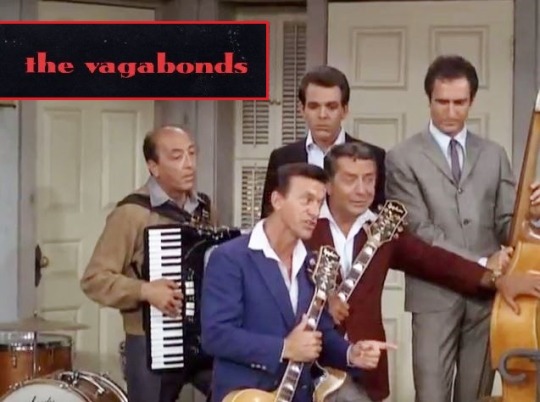
Dino
Natali (Mel, Musician, Bass), Dom Germano (Musician,
Guitar), Al Torrieri (Musician, Guitar), Attilio Rizzo
(Musician, Accordion), Roger Pearsall (Musician, Drums)
will all also be seen in the next episode “Lucy and Carol in Palm
Springs” (S5;E8).Although
not billed as such, this group of musicians (with the exception
of drummer Roger Pearsall) was collectively known as The Vagabonds.
Contrary to popular belief, Joe Pesci was not part of this group. The musicians live across the hall from Lucy and Mary
Jane. Torrieri (who does most of the talking) brings a pizza and a
bottle of Chianti to the party. Dino plays Mel, the shy one who
takes an interest in shy Carol. In the final credits, Torrieri is
listed as ‘Torre’ and Attilio Rizzo is listed as ‘Atillo Risso.’ As
the only non-Vagabond, pick-up musician Roger Pearsall goes
uncredited.
This
episode was filmed on Thursday, July 14, 1966. The episode was filmed on Bastille
Day and aired on Halloween!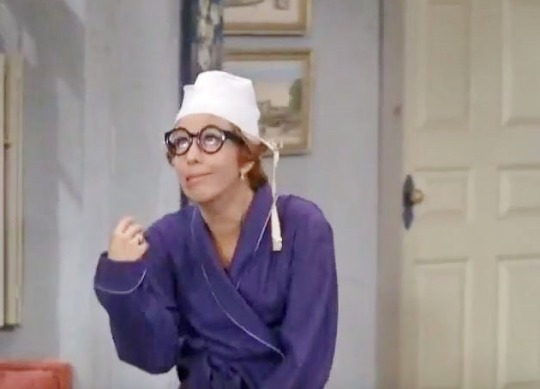
Carol
Burnett’s character name is consistent with other celebrities playing
characters (not themselves) on the show; using their own first name
and a different surname starting with the same letter. Mel Torme
became Mel Tinker; Joan
Blondell become Joan Brenner, and Roberta Sherwood became Roberta
Shaeffer.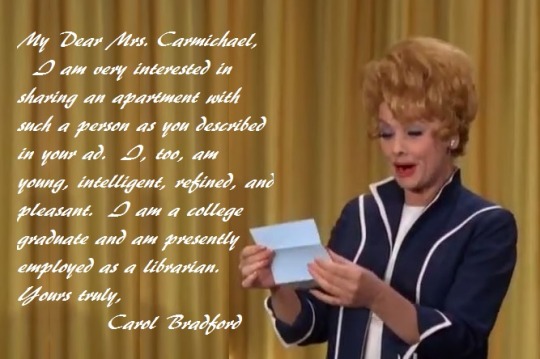
Lucy thinks Carol will be a suitable roommate if she is five foot six and a half inches tall – so they can wear each others clothes. We can infer that that is Lucille Ball’s height.
Carol
Burnett gets a warm round of entrance applause from the studio
audience.Carol Burnett uses her trademark Tarzan yell in both this and the following episode, “Lucy and Carol Visit Palm Springs” (S5;E8).
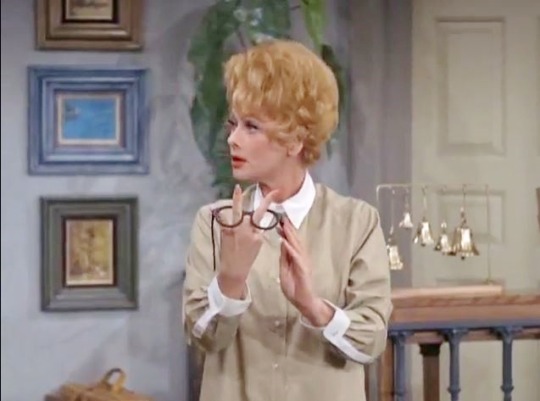
Carol
wears contact lenses, but wears eyeglasses (with no lenses) so that people won’t think she’s vain. “Lucy’s Contact Lenses” (S3;E10)
were the subject of a 1964 episode of “The Lucy Show.”
When Lucy Ricardo decided to write a novel, she also adopted glasses without lenses!
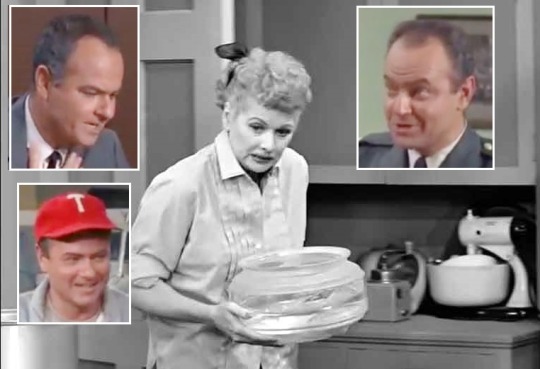
Carol’s
pet goldfish is named Harvey. This was a full year before Burnett
started working with Harvey Korman, who had already done three guest appearances on “The Lucy Show.” Carol says Harvey loves TV and
his favorite program is “Flipper” (1964-67), an NBC program set
on the Florida coast that concerned a boy and his pet dolphin,
Flipper. On “I Love Lucy” Little Ricky had a goldfish that Fred
Mertz nicknamed Moby.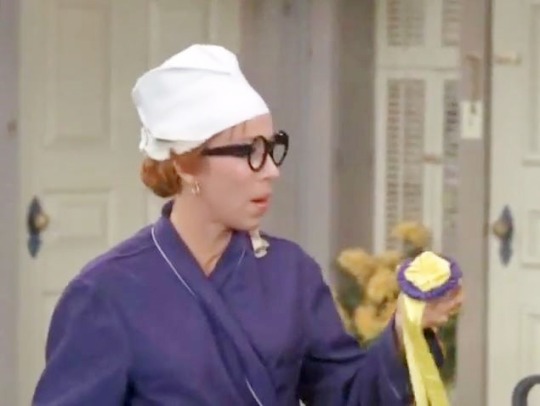
Carol
finds a prize ribbon on Lucy’s dresser. Lucy says she won fourth
place in a beauty contest. Carol laughs uncontrollably! Coincidentally, Lucy Carter and Carol Krausmeyer (Carol Burnett) compete in a beauty pageant on “Here’s Lucy” (1970).A
nervous Carol spouts off a few facts to impress the equally nervous musician Mel:- There are 6,950,000 books in the New York Public Library.
- The
first public library was founded in Peterborough, New Hampshire. - More
than 42,000 library books are stolen annually.
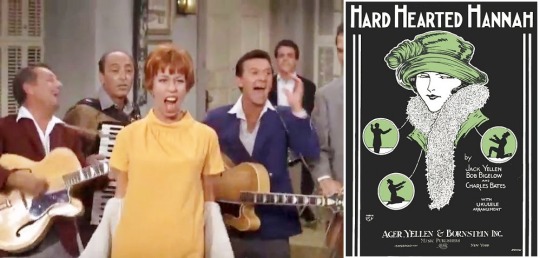
Carol
surprisingly sings a bluesy, belted version of “Hard
Hearted Hannah (the
Vamp of Savannah)”
written by Jack
Yellen,
Bob Bigelow, Charles Bates, and Milton
Ager.
The song was first published in June 1924.Callbacks!
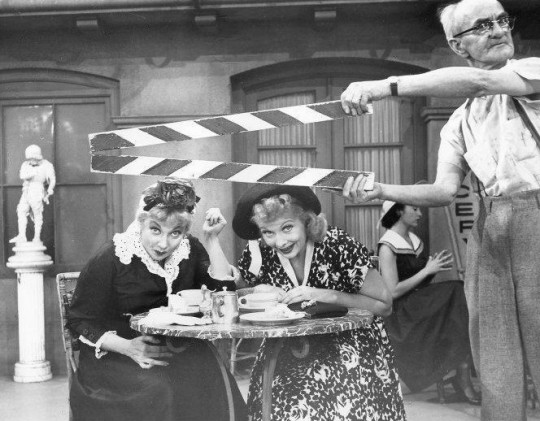
Hic?! Carol
says she always gets the hiccups when she gets nervous. In “Lucy
and the Sleeping Beauty” (S4;E9) Lucy says she always gets the
hiccups when she’s hungry. In “Lucy’s
Last Birthday” (ILL S2;E25) Lucy
Ricardo says she gets hiccups from crying. In “Lucy
Takes a Cruise to Havana” (above, set
in 1940), Lucy McGillicuddy tells Susie MacNamara (Ann Sothern) that she doesn’t get the hiccups very often!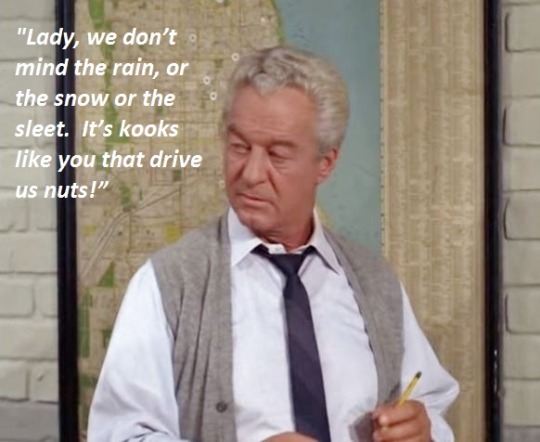
Musician Dom
Germano says “Neither rain nor sleet nor snow could keep us from
our appointed freeloading.” He
is paraphrasing the unofficial postman’s creed: “Neither
snow nor rain nor heat nor gloom of night stays these couriers from
the swift completion of their appointed rounds.”
The motto is inscribed on the James Farley Post Office in New York City,
facing Penn Station. The credo was previously parodied in “Lucy
and the Missing Stamp” (S3;E14) spoken by the Danfield Postmaster (Robert S. Carson, above).
Carol
hangs an ugly “Home Sweet Home” sampler in place of Lucy’s expensive
abstract painting. On “I Love Lucy,” Fred and Ethel Mertz had a
“Home Sweet Home” sign hanging in their bedroom in “Vacation from Marriage” (ILL S2;E6, inset photo). The same sign
turns up again over the bathroom door at One Oak Cabins in “First
Stop” (ILL S4;E13).Blooper
Alerts!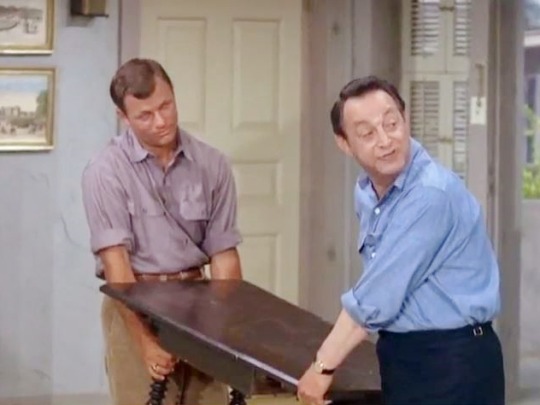
In
“Lucy the Bean Queen” (S5;E3) Lucy donated all her old furniture
to charity because she was buying new. In this episode, five weeks
later, she somehow has gotten the old furniture back!
“Lucy Gets a Roommate” rates 3 Paper Hearts out of 5
- There are 6,950,000 books in the New York Public Library.
-
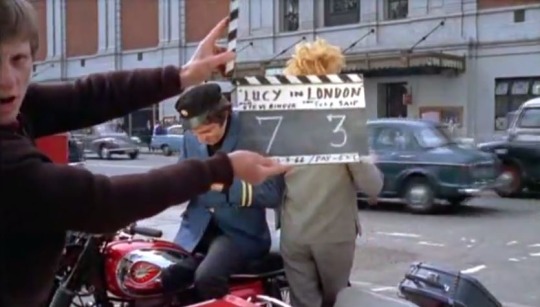
Lucy in London
October 24, 1966
Synopsis
Lucy Carmichael wins a trip to London in a jingle contest. It is a whirlwind, one day tour, with Anthony Newley as her guide. They visit such landmarks as Madame Tussaud’s, Carnaby Street, London Bridge, the Palladium Theatre, and an English country manor. On her tour, Lucy gets to sing with the Dave Clark Five, act Shakespeare with Peter Wyngarde, and model mod fashions to a Phil Spector song!
Cast
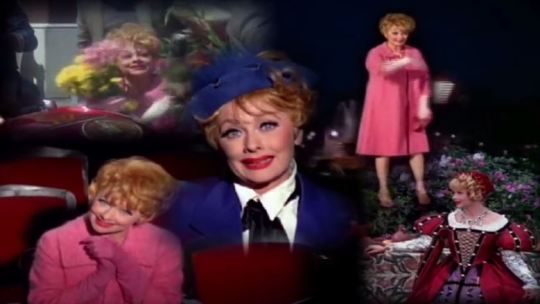
Lucille Ball (Lucy Carmichael) was halfway through her fifth season playing Lucy Carmichael on “The Lucy Show” (1962-1968).
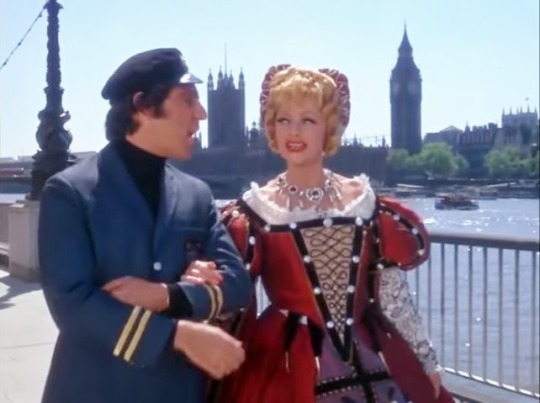
Anthony Newley (Anthony Armstrong Fitz-Faversham) was a London-born actor and singer who was perhaps best known for his collaboration with Leslie Bricusse on the film scores for Doctor Doolittle (1967, in which he also appeared) and Willy Wonka and the Chocolate Factory (1970, in which he also appeared singing the break-out hit “The Candy Man”). In April of 1966, just a month before “Lucy in London” filmed but before the special was aired, he released the film version of Stop the World – I Want To Get Off, a musical which he wrote (again with Bricusse) and starred in as Littlechap in London and New York. In 1965, he starred on Broadway in another musical he co-wrote
with Bricusse The Roar of the Greasepaint – The Smell of the Crowd.Anthony Armstrong Fitz-Faversham is Lucy’s tour guide from Royal Luxury Tours Ltd.
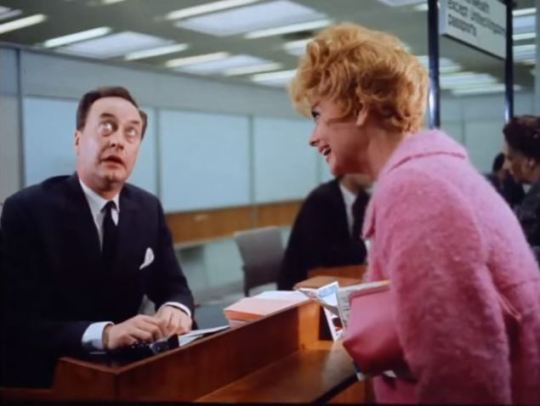
Frank Thornton (Customs Official) will be forever remembered as Captain Peacock, the imperious floor walker on “Are You Being Served?” He was also well known for playing Truly for 13 years on “Last of the Summer Wine.” Thornton died in 2013 at the age of 92.
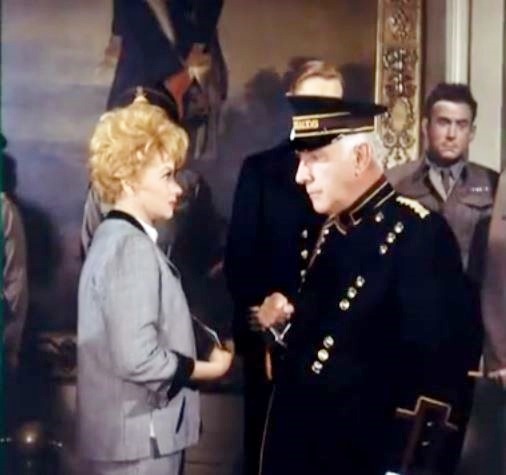
Winifred Hyde White (Hawkins, Madame Tussaud’s Guide) was a Gloucestershire-born actor who will probably be best remembered as Colonel Pickering in the 1964 film My Fair Lady. He was twice nominated for Broadway’s Tony Award as Best Actor in 1957 for The Reluctant Debutante, and in 1973 for The Jockey Club Stakes.
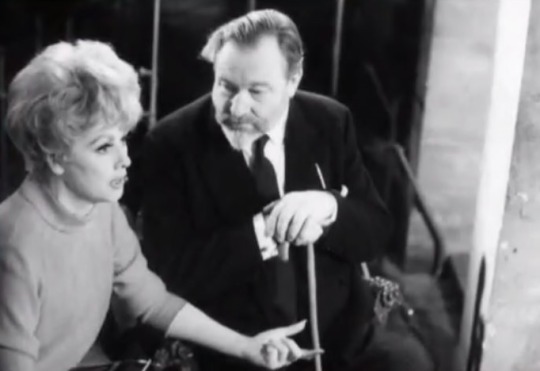
James Robertson Justice (Madame Tussaud’s Manager) was known for his bushy beard and booming voice. He is perhaps best remembered as Lord Scrumptious in Chitty Chitty Bang Bang (1963).
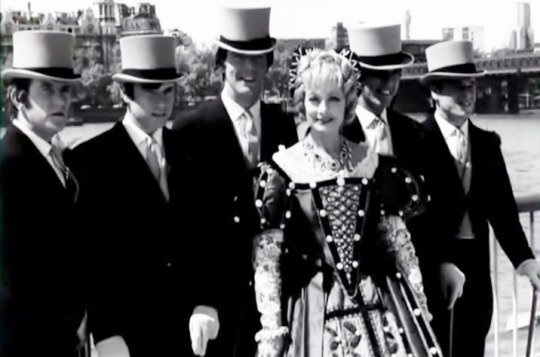
The Dave Clark Five (Themselves) was an English pop rock group made up of Dave Clark, Lenny Davidson, Denis Payton, Mike Smith, and Rick Huxley. Their single “Glad All Over” knocked the Beatles’ “I Want to Hold Your Hand”
off the top of the UK Singles Chart in January 1964. In 1966 they were regular performers on TV’s “Shindig.”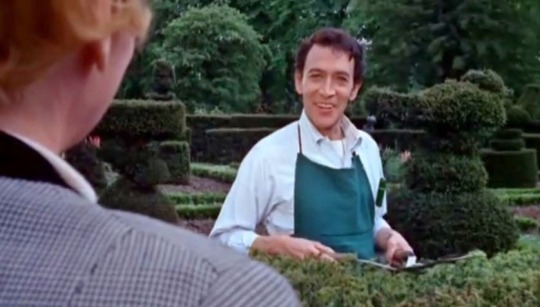
Peter Wyngarde (Himself / Petruchio) was born in France to an English father and French mother. Lucille Ball personally asked Wyngarde to appear in the special having seen him on Broadway in Duel of Angels starring
Vivien Leigh in1960 (while she was appearing in Wildcat). She was said to have been smitten by him, and was determined to find a way for the two of them to act together.“Lucy may’ve thought I was kidding, but if she wanted to play this straight she would be a marvelous Kate. Her looks are absolutely right as is her vitality. And she’s a good enough actress to be able to do it.” – Las Vegas Sun, October 23, 1966
Edna Morris (Woman at the Shakespeare Festival) was a Lancashire-born actress whose screen acting career began in 1946 at the age of 40.
Dennis Gilmore (‘Pops’ the Stage Doorman) was a Middlesex-born actor whose screen career spanned from 1953 to 2010.
Joby Blanshard was a Yorkshire-born actor who was seen on stage and screen from 1954 to 1986. He is perhaps most famous for playing Colin Bradley in 32 episodes of the early 1970s ‘science-fact’ series “Doomwatch.”
Jenny Counsell has just three other screen credits (as per IMDB) thelast of which was an uncredited appearance in Carry On Again Doctor (1969).
Bonnie Paul was the step-daughter of Burl Ives.
John Stone was a Welsh character actor and playwright.
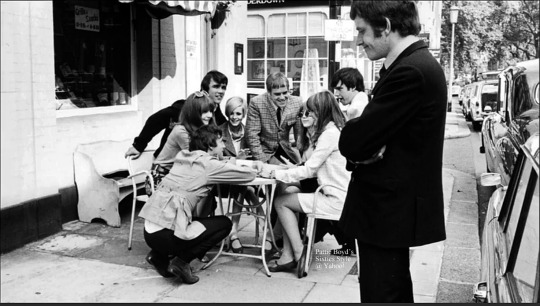
Twiggy was born Lesley Lawson. She became the world’s number one model at the time, so named for her slender figure. Twiggy eventually turned to acting on both stage and screen.
Chrissie Shrimpton was a model who (at the time) was dating Mick Jagger. She is the sister of Vogue model Jean Shrimpton.
Jenny Boyd was a fashion model and the sister of Pattie Boyd, who was then married to George Harrison of the Beatles. Boyd left modeling and took up transcendental meditation.

Samantha Juste becameknown on British television in the mid-1960s as the “disc girl” on the BBC’s “Top of the Pops.” In 1968 she married Micky Dolenz of the Monkees.
Roy Rowan (announcer) was the off-camera announcer for every episode of “I Love Lucy” aswell as “The Lucy Show” and “Here’s Lucy.” He was also the voice heard when TV or radio programs were featured on the plot ofall three shows. He made a couple of on screen appearances as well.

This special was part of Lucille Ball’s 1966-67 contract negotiations with CBS. She was supposed to star in three such ‘travel’ specials, but this is the only one that was ever realized. Ball originally planned to co-star with Mitzi Gaynor as two nuns touring Europe, followed by a French-based production called “Lucy in Paris,” and a Middle Eastern-set comedy called “Lucy in Arabia” or “Lucy in the Desert.”
This CBS special (in color!) first aired on October 24, 1966 in “The Lucy Show” time slot, but because it ran one hour, it pre-empted “The Andy Griffith Show.”
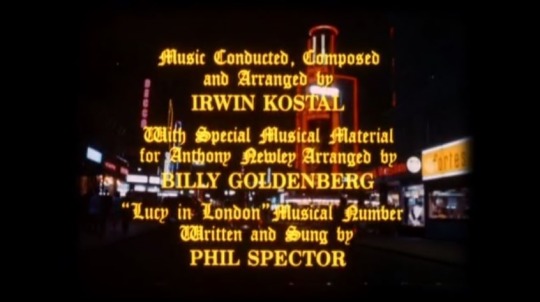
This script was written by Ron Friedman and Pat McCormick. This is Friedman’s only time writing for Lucille Ball. Also in 1966, Friedman was nominated for a Primetime Emmy Award for an episode of “The Danny Kaye Show.” McCormick went on to write one episode of “Here’s Lucy” in 1969. The special was co-produced and choreographed by David Winters, who had played A-Rab in the 1961 film West Side Story.
The budget for the special was $500,000. It came in under budget.
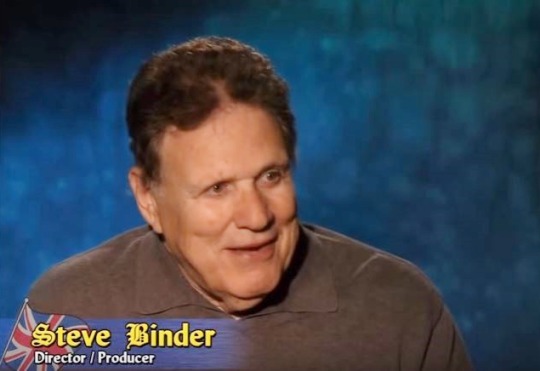
The special was produced and directed by Steve Binder, who specialized in award shows, concerts, and TV spectacles. It was sponsored by the Monsanto Company.

Regular Lucy viewers may remember that Lucy Ricardo went to London during season 5 of “I Love Lucy” although the cast and crew never left Hollywood to film, as they do here. “Lucy in London” was Desilu’s first international film project, not counting some second unit footage of Cuba and Mexico gathered for “The Lucy-Desi Comedy Hour.” Like Lucy Ricardo, Lucy Carmichael also visits the changing of the guard at Buckingham Palace and spends some time at an English country manor home located just outside London.
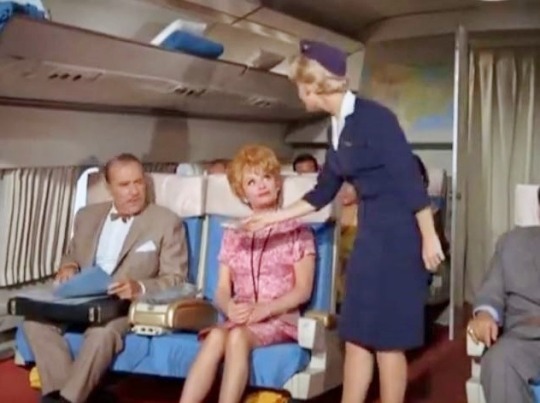
This special was a follow up to “The Lucy Show” episode “Lucy Flies to London” (S5;E6), which was filmed in September 1966, four months after the May location shooting of “Lucy in London.” Lucille Ball later said that May was her favorite month anywhere in the world. “Lucy Flies to London” (S5;E6) was shot completely at Desilu Studios in California, while “Lucy in London” was shot completely on Location in and around London.
The cast was supposed to include actor Laurence Olivier, but he withdrew from the project before filming began due to schedule conflicts. Lord Olivier was mentioned on “I Love Lucy” in “Lucy Meets Orson Welles” (ILL S6;E3).


Lucille Ball went through 15 different wigs during the production.Cleo Smith, Ball’s cousin and the executive in charge of this production, later recalled that problems arose in photographing the star on the London locations, where the use of heavy stage make-up and filtered lighting that was employed for her studio-based program could not repeated. Ball’s biographer Geoffrey Mark Fidelman would later remark that the actress “looked old” throughout the show due to difficulties in establishing flattering lighting for the outdoor sequences.
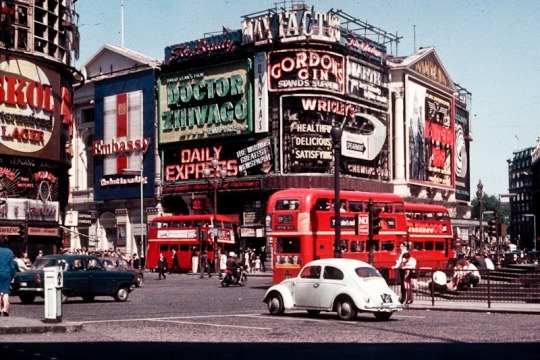
Under the supervision of Cleo Smith, Desilu sent a second unit crew ahead to film scenes with doubles of Lucille Ball and Anthony Newley as they traveled through London and environs on their motorcycle and sidecar.
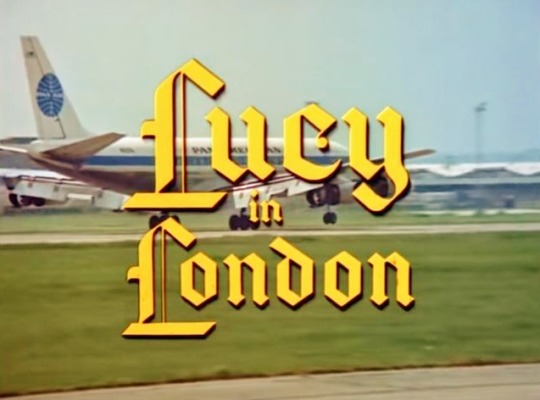
The special is divided up into acts, like a play, with titles on the screen – in Old English font, naturally!
The opening sequence of Lucy stepping off the Pan Am jet used only still photos shot by Life Magazine’s Bob Willoughby. His photographs were used in a montage format until Lucy meets her tour guide when traditional film storytelling begins. Director Steve Binder says that this was a creative decision due to the notoriety and artistry of Willoughby, not a cost-saving measure. The sequence also reflects a typical tourist like Lucy’s snapshots of their trip, an idea reinforced by the fact that Lucy wears a camera around her neck for much of her time in London.
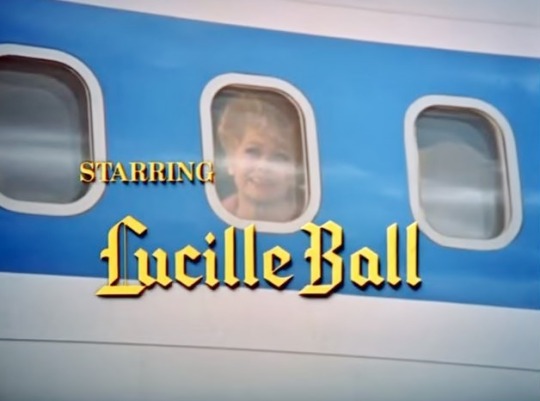
The sequence involving Lucy de-planing from the Pan Am clipper jet had to be accomplished in between flights already on the tarmac at Heathrow. No planes were available to be grounded for a day of shooting. Coincidentally (or perhaps not) Pan Am (which is no longer in existence) was also the carrier when Lucy Ricardo flew home from Europe and from Miami to Havana on “I Love Lucy.”
To ensure that Heathrow and other London locations were accessible to the film crew, a former Buckingham Palace official with the proper ‘connections’ was engaged by Desilu. It is unclear whether anyone was ‘bribed’ to open doors, but some locations did charge a user fee, which Desilu gladly paid. When Desilu asked about police protection for Lucille Ball during their shoot near London Bridge, Scotland Yard replied that they didn’t do that for anyone – not even the Queen! They did, however, guarantee that if the crew did not block traffic and cause any pedestrian problems, they would be sure all went well.
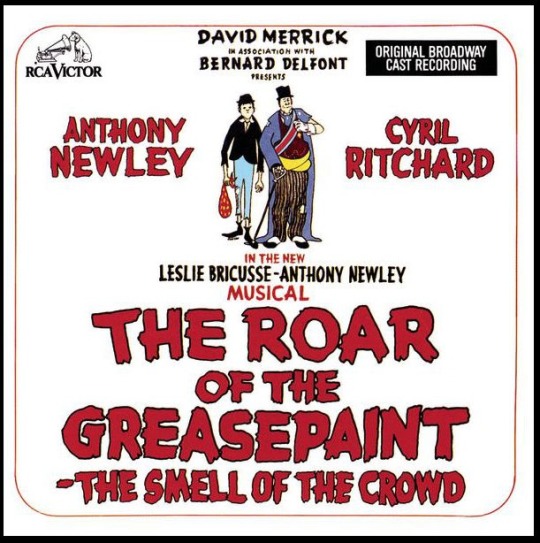
Newley sings “On a Wonderful Day Like Today” as he zooms off on his motorcycle with Lucy in his ‘top drawer’ sidecar. A chorus of schoolgirls on bicycles join in singing “The Beautiful Land.” Newley then sings a bit of “Sweet Beginning” as they drive through Piccadilly Circus. These songs are all from the musical The Roar of the Greasepaint – The Smell of the Crowd, which Newley co-wrote with Leslie Bricusse and starred in on Broadway in
1965. This is the show that gave Cleo Smith the idea to cast Newley, who only had a two week opening in his Doctor Dolittle shooting schedule to film the special with Lucy.On the banks of the Thames, Newley quickly sings a bar of “What Kind of Fool Am I?” a song he wrote and performed in Stop the World – I Want To Get Off. Speaking of banks, Lucy says she works in a bank back home where “her boss” makes her report at 8am. Interestingly, not much of Lucy Carmichael’s home life isdiscussed other than this.
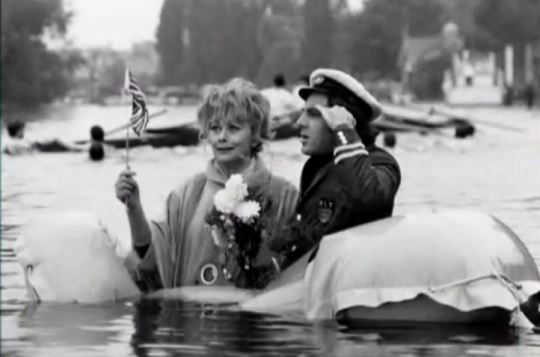
The stunt where Lucy and Anthony Newley sink into the River Thames was supposed to be shot in another location due to the fact that the Thames was reported to be polluted. At the last moment, Lucy decided it was funnier to actually do the stunt on location, despite the risks involved. As she did in “Lucy at Marineland” (S4;E1) and various other times in her career, Lucy did the stunt herself, not employing a stunt person or effects.

As Lucy and Tony’s punctured raft is sinking in the Thames, Newley salutes the Union Jack and sings a chorus of of “There’ll Always Be an England,” an English patriotic song written in 1939 by Ross Parker and Hughie Charles, and famously sung by Vera Lynn. In “Lucy Flies to London” (S5;E6), the episode of “The Lucy Show” that preceded this special, Mr. Mooney quotes the same song, dreading his secretary’s frenetic presence in England’s capital city.
Bronx-born singer / songwriter Phil Spector was commissioned to write and perform the title song “Lucy in London,” to which is set a montage of Lucy in and around London wearing mod fashions. A demo single of the song was recorded by Spector, but never released. The song comes about 15 minutes into the special and mentions The Dave Clark Five, who have actually not performed yet on screen. The montage features Lucy in mod fashions of the time and has cameos by top fashion models like Twiggy. The musical montage ends Act I.
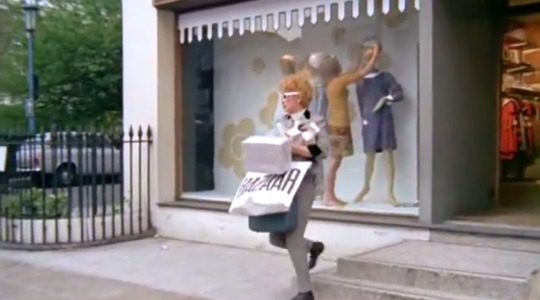
Several scenes were cut for time. The first was Lucy stepping out of Mary Quant’s London boutique Bazaar with packages and mod sunglasses. She gets into Newley’s sidecar and the two drive off.
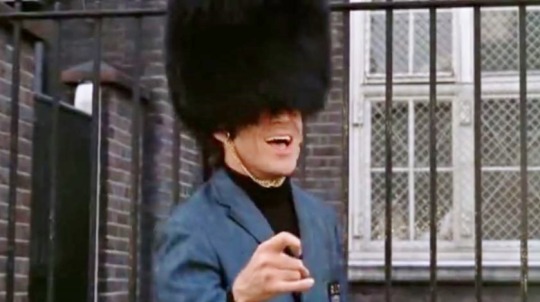
The second involved Newley donning a tall black fur hat and demonstrating to Lucy how silly the changing of the guard at Buckingham Palace is. Both scenes turn up on the “Lucy Show” season 5 DVD documentary about the special.

Another scene was filmed where Newley takes Lucy for a lunch of fish and chips, riding on a bicycle built for two. Only still photos remain of the scene which had Lucy trying to talk like a Cockney to a genuine London-born chip stall owner.
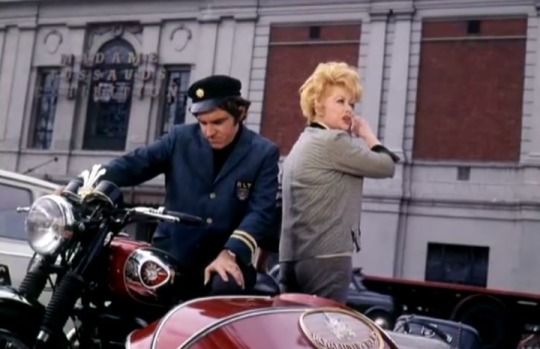
Madame Tussaud’s Wax Museum was (and still is) one of London’s busiest and most popular tourist attractions. The production was only allowed to film inside once the museum was closed and the last tourist had exited the building. In the Museum sequence, a wandering Lucy gets separated from her tour guide (Winifred Hyde White) and must be led to the Chamber of Horrors by the manager (James Robertson Justice) to catch up with her group. The scene called for a frightened Lucy to hit him over the head with a bottle. The production supplied candy glass prop bottles for the stunt, but somehow Lucy managed to pick up an actual glass bottle and Justice had to be hospitalized for stitches. Presently, Madame Tussaud’s Wax Museums in New York City and Las Vegas feature figures of Lucille Ball as Lucy Ricardo.
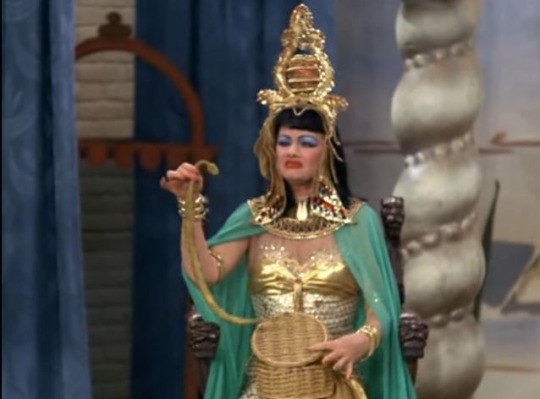
Before they go inside the waxworks, Newley teases Lucy that inside she’ll find Cleopatra and her Mark Antony. Lucy played Cleopatra onstage back in Danfield with Viv as her Mark Antony. Before going in Newley says “TTFN.” When Lucy asks what that means, he replies “Ta ta for now.” TTFN was a favorite expression of Winnie the Pooh’s pal Tigger. The voice of Tigger, Paul Winchell, guest starred on “The Lucy Show” just prior to this special. He once claimed that it was his idea to have Tigger say TTFN.
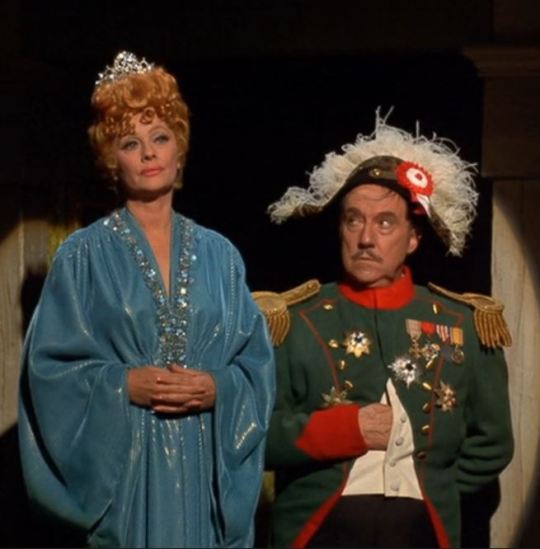
Inside the museum, Lucy tweaks the nose of Prince Philips’ wax ‘figger’. Prince Philip was mentioned recently in “Lucy with George Burns” (S5;E1) and several times on “I Love Lucy.” She also sees waxworks of Napoleon and Josephine. On an episode of “Here’s Lucy,” Lucy Carter and Harry (Gale Gordon) play Napoleon and Josephine during a séance.
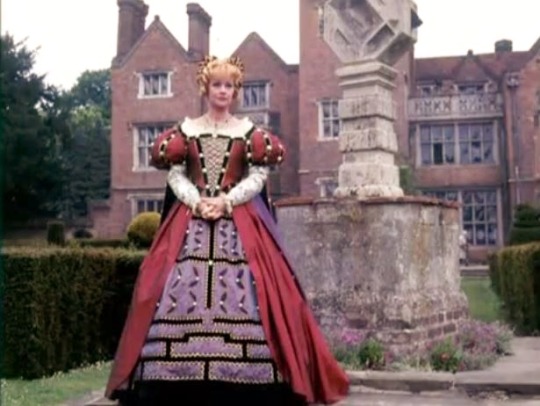
Great Fosters (not Grace Fosters!) is an English country manor from the Tudor period located in Egham, Surry, just outside of London. There is evidence that the de Imworth (later Fosters) family lived there as early as 1224. Now under the ownership of the Sutcliffe family, the historic building became a hotel in 1930, as it remains today, hosting tourists, wedding parties, and those looking for fine dining. When Lucy arrives they are hosting a Shakespeare Festival at their theatre in the gardens. Lucy brags to one of the actors (Peter Wyngarde) that she did Shakespeare’s Much Ado About Nothing in high school. Lucy and Wyngarde rehearse a scene from The Taming of the Shrew with
Lucy as Kate (her only line is “Never!”) and Wyngarde as Petruchio.
After Lucy flees taming by ‘Petruchio’ and runs from Great Fosters, Anthony Newley jokingly does an imitation of Stan Laurel saying “Well, Lucy, that’s another fine mess you’ve gotten us into.”
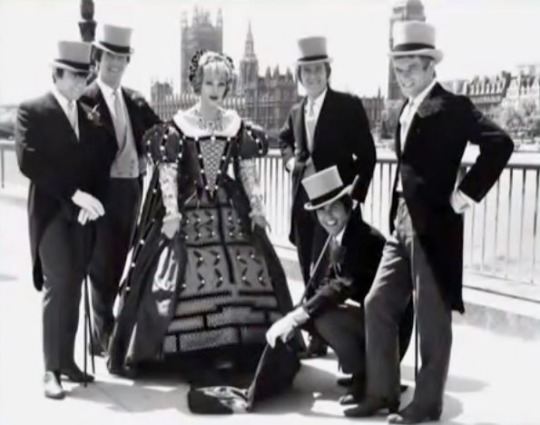
In front of Lucy, Newley, and The Dave Clark Five (in morning suits and top hats) perform a medley of “London Bridge is Falling Down” and “Pop Goes the Weasel.” It is interesting to note that the London Bridge seen in the background is the old London Bridge (1831-1967). A year after filming, this bridge was dismantled and sold while a new version (that still stands today) was built to replace it. The old London Bridge was reassembled in Lake Havasu City, Arizona, opening in 1971, where it remains the number one tourist attraction.
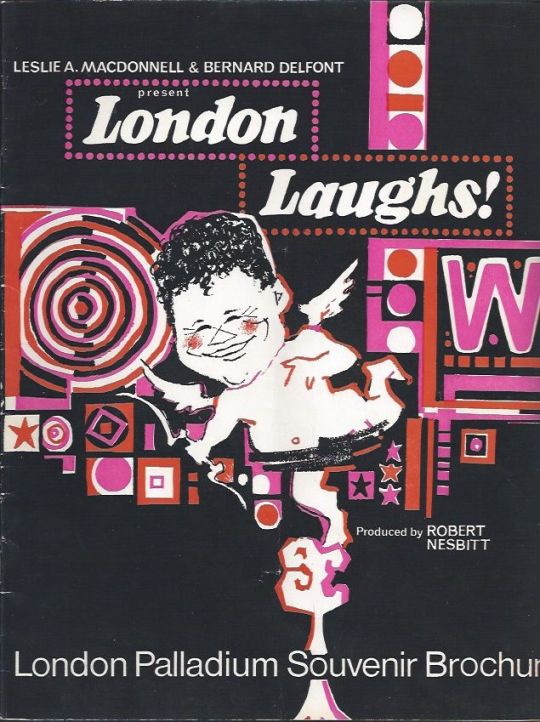
In Act IV, pulling up to the London Palladium, Lucy and Tony see the marquee for a show called London Laughs starring Harry Secombe, Jimmy Tarbuck, Thora Hird, Freddie Frinton, and Russ Conway. Instead, however, Newley takes Lucy to The Scala Theatre on Charlotte Street, off Tottenham Court Road. The theatre opened in 1903 seating 1,139 and boasts a large stage. Three years after “Lucy in London” filmed there, it was destroyed by fire and demolished. Today the site is the location of an apartment block.
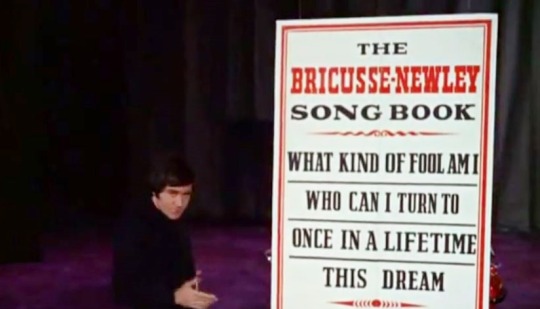
On the Scala stage, the special takes a slightly surreal turn with Newley suddenly presenting a full scale musical one-man show with lights, scenery, costume changes, and orchestra. He first sings “Fine Day in London” then “I’m Gonna Build a Mountain” (from Roar of the Greasepaint). He follows with “Once in a Lifetime” from Stop the World and “Nothing Can Stop Me Now,” also from Greasepaint.
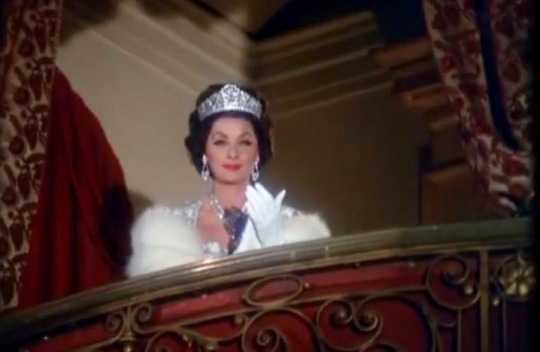
During “Look at That Face” (Greasepaint) he sings directly to Lucy, the Queen of Comedy, “the face that the world adores” and she becomes the Queen of England sitting in the Scala Theatre’s royal box. He ends the medley with “This Dream” (Greasepaint) and Lucy becomes the (male) orchestra conductor. After Newley leaves the stage, Lucy reappears as an Eliza Doolittle-type flower girl sitting in the front row of the balcony eating a piece of fruit.
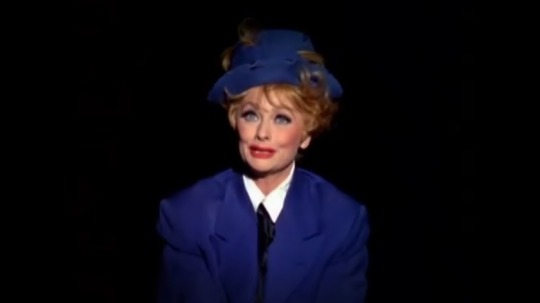
The special then takes on an even more dreamlike quality with Lucy on stage doing a pantomime in a spotlight. It looks like Lucille Ball is wearing the same over-sized suit that she wore as the Professor in the “I Love Lucy” pilot and “The Audition” (ILL S1;E6). The very end of the special, still on the Scala stage, singing about her “One Day in London” Ball seems to drop the Lucy Carmichael character and speak directly from the heart as she addresses the camera. It is some of the most moving acting Ball has done on television thus far.

Although nominated as Best Actress in a Comedy for “The Lucy Show,” Lucille Ball was not able to attend the Emmy Awards Ceremony on May 22, 1966 as she was filming “Lucy in London.” In any case, she lost to Mary Tyler Moore in “The Dick Van Dyke Show.”

Viewership was high for the special (finishing as the most-watched telecast of the week) but critical responses were very poor, with Variety complaining: “What had promised to be one of the season’s major specials turned out to be a major disappointment.” Perhaps because of this, Ball opted not to pursue the creation of the remaining two specials in her contract. If the critics did not approve of her stepping outside of what she was known for, she would give them more of what they expected.
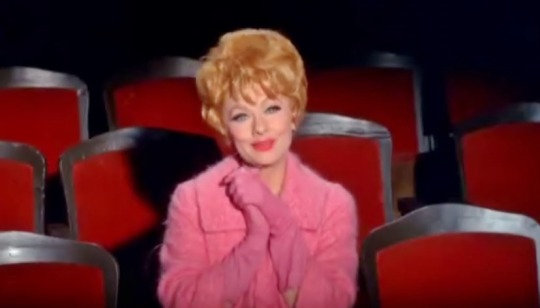
“Lucy in London” was aired just once – on October 24, 1966 – and was not seen again until the DVD release of the official fifth season of “The Lucy Show” as bonus material. As with “The ‘I Love Lucy’ Christmas Special,” “Lucy in London” was not included in “The Lucy Show” syndication package and is not counted in the official episode tally.
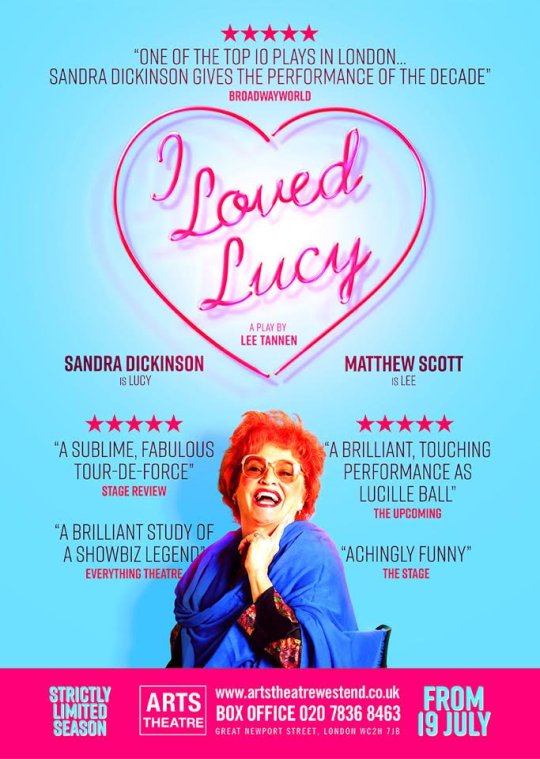
Although this special marked the only time Lucille Ball was seen on a London stage, after more than 50 years Lucy once again was in London (sort of) when Lee Tannen’s autobiographical play I Loved Lucy returned to London’s Arts Theatre during the summer of 2017. Sandra Dickinson played Lucy and New Jersey’s own Matthew Scott was Lee.

“Lucy in London” rates 4 Paper Hearts out of 5
 1966, Anthony Newley, Bonnie Paul, CBS, Chrissie Shrimpton, Cleo Smith, Dave Clark Five, Denis Gilmore, Edna Morris, Frank Thornton, Great Fosters, Heathrow Airport, Jenny Boyd, Jenny Counsell, John Stone, London, Lucille Ball, Lucy in London, Madame Tussaud’s Wax Museum, Mary Quant’s Bazzar, motorcyle, Peter Wyngarde, Piccadilly Circus, River Thames, Roy Rowan, sidecar, The Taming of the Shrew, tv, Twiggy, Winifred Hyde White
 -
Lucy Flies to London
S5;E6
~ October 17, 1966

Synopsis
Lucy
wins a trip to London but when she misses the plane, she must sit
next to Mr. Mooney on a flight to New York to make her connection.
First time flier Lucy causes havoc that is then blamed on Mr. Mooney.Regular
CastLucille
Ball (Lucy Carmichael), Gale Gordon (Theodore J. Mooney), Mary Jane
Croft (Mary Jane Lewis)Guest
Cast
Ben
Wrigley
(Unintelligible Ticket Agent, above right) was a British actor who appeared in My
Fair Lady
(1964) and Bednobs
and Broomsticks
(1971). He also did three episodes of “Here’s Lucy.”Walter
Burke
(Cedric, Cockney Ticket Agent, above left) was a highly recognizable
Irish-American character actor whose small stature and wizened
features frequently found him cast as a leprechaun (a role which he
played on more than one occasion). This was his only appearance with
Lucille Ball.
Pat
Priest
(Flight Attendant) is probably best remembered as the second actress
to play Marilyn on “The Munsters,” taking over the role from
Beverly Owen, who left after season 1. She currently lives in Idaho
restoring and selling homes.
James
Wellman
(Airport Traveler) made just a dozen TV and film appearances between
1962 and 1975.
Romo
Vincent
(Passenger #1,aisle seat) was a Broadway performer from 1942 to 1959.
He later appeared in two episodes of “Here’s Lucy.”Maury
Thompson (Passenger
#2, window seat) was the director of this episode (and all of seasons 4 and 5) of “The Lucy Show.” He started out as a camera coordinator on
“I Love Lucy.”
Joan
Swift
(Passenger #3, aisle seat behind Lucy) makes the first of her six
appearances on the series. Earlier in 1966, she appeared with Pat
Priest on an episode of “The Munsters.” Swift also did two
episodes of “Here’s Lucy.” Her final screen credit was 1975’s
“Lucy Gets Lucky” with Lucille Ball and Dean Martin.
Jerry
Rush
(Captain) makes
the third of his nine (mostly uncredited) appearances on the series.
He also did two episodes of “Here’s Lucy.”
This
episode is also known as “Lucy Goes to London.” It was
filmed on Thursday, September 15, 1966. It was designed as a lead-in
to the following week’s CBS special “Lucy in London,” which was
filmed on location in England in May 1966, four months earlier.
Although officially written by Bob O’Brien, former “Lucy Show”
and “I Love Lucy” writers Madelyn
Davis and Bob Carroll, Jr.
are credited with “special material.” This is because much of
the scene on board the airplane was taken directly from an unsold
pilot for an anthology series titled “The Victor Borge
Comedy Theatre.”
It was filmed just before the
official start of “The Lucy Show” and starred Lucille Ball, Gale
Gordon, and Norman Leavitt. The characters were unnamed.
The
night this episode first aired (October 17, 1966) Peter Marshall made
his debut as the host of “The Hollywood Squares.” Marshall had
played Lucy’s brother-in-law Hughie in “Lucy’s Sister Pays a Visit”
(S1;E15). Many “Lucy Show” cast members appeared on the
“Squares”: Wally Cox, Nancy Kulp, Ellen Corby, Jan Murray, Jack
Cassidy, Harvey Korman, Milton Berle, Bob Hope, Jay North, Ethel
Merman, Gale Gordon, Lucie Arnaz, Desi Arnaz, Jr., Desi Arnaz, and
Vivian Vance. Everyone but Lucille Ball herself!
Also
on the evening this episode first aired, Lucille Ball made her last
appearance on the quiz show “I’ve Got a Secret.” She was there
to promote her upcoming “Lucy in London” special by hosting a
Carnaby Street-style fashion show of London couture.The
premise for getting Lucy to London is that she wins a contest writing
a dog food jingle.Lucy does not sing, but recites it:
I
feed my doggy Arf Arf
I
buy it by the bunch.
I
know it’s tasty dog food
I
eat it myself for lunch.It is hard to believe this would win
a prize let alone a trip to London.
When
an excited Lucy leaves Mr. Mooney’s office headed for her trip, she
slams the door and glass panel next to it shatters. Mr. Mooney sighs
and say “And they think there’ll always be an England.” “There’ll
Always Be an England”
is an English
patriotic
song, written and distributed in the summer of 1939, which became
highly popular upon the outbreak of World
War II.
It was composed and written by Ross
Parker
and
Hughie
Charles,
and a popular version was sung by Vera
Lynn.
Lucy
is flying out of Los Angeles International Airport (LAX) on British
Imperial Airways, a fictional carrier.
Stock footage shows the
exterior of the airport. In the opening moments of “Lucy in
London,” the special that this episode sets up, Lucy arrives in
England on a Pan American jet. Presumably, during Lucy’s transfer in New
York, she switched carriers!
When
the flight attendant asks if there’s anything she can do for Lucy,
Lucy replies that maybe later she’ll have some “coffee,
tea or milk.” This was an often
heard phrase on airplanes as flight attendants did their beverage
service. In 1967, just a few months after this episode aired, the
book Coffee, Tea or Me?
was published, the alleged memoirs of two ‘stewardess’ and their
romantic and sexual escapades in the air.
When
Lucy is sitting right next to Mr. Mooney on her flight (not unusual
for “The Lucy Show”) she says “What a small world!”
Mr. Mooney replies that with her on it [the world], no wonder they
are racing for the moon. Although the US did not put an astronaut on
the moon until 1969, it was the goal of NASA for much of the 1960s.
In “Lucy Becomes an Astronaut” (S1;E16) Lucy and Viv were chosen
for a women in space program.Lucy
confesses that she’s never flown before. This must mean that her
cross country move from New York to California was by car, although
it is never overtly stated.Callbacks!

Lucy
Ricardo went to London (by ship) in “Lucy Meets the Queen” (ILL
S5;E15) in 1956. Once there, she, too, had an interaction with an
unintelligible Englishman (Robert Shafto).
Lucy
Ricardo hilariously traveled by plane on her “Return Home from
Europe” (ILL S5;E26) disguising a cheese as a baby.
She also flew
from Miami to Havana in “The Ricardos Visit Cuba” (ILL S6;E9), a
flight that was a lot less eventful. Both times, Desilu had a
promotion agreement with Pan American Airlines to promote their
clipper service. Stock footage of Pan Am planes were used, although
naturally the cast never left the Hollywood sound stage.
Lucy Ricardo was
later seen in an airport (though not in the air) in “The Ricardos
Go to Japan,” a 1959 episode of “The Lucy-Desi Comedy Hour.”
“Lucy Flies to London” rates 4 Paper Hearts out of 5
1966, Airplane, Airport, Ben Wrigley, CBS, Coffee Tea or Me, Gale Gordon, I’ve Got A Secret, James Wellman, Jerry Rush, Joan Swift, London, Lucille Ball, Lucy Flies to London, Lucy Goes to London, Mary Jane Croft, Maury Thompson, Pat Priest, Peter Marshall, Romo Vincent, The Lucy Show, There’ll Always Be An England, tv, Walter Burke -
Lucy and the Ring-a-Ding Ring
S5;E5
~ October 10, 1966
Synopsis
Mr.
Mooney buys his wife an expensive ring. When he allows Lucy to try
it on, she can’t get it off her finger!Regular
Cast
Lucille
Ball (Lucy Carmichael), Gale Gordon (Theodore J. Mooney), Mary Jane
Croft (Mary Jane Lewis)Guest
Cast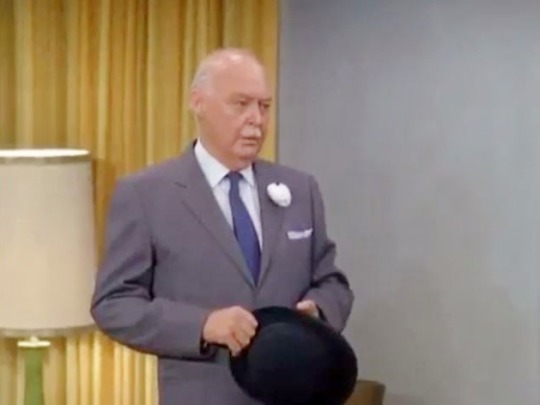
Don
Beddoe
(Mr. Barmarche) made his
Broadway in 1929 and enjoyed a decade-long career on the stage with
more than a dozen plays to his credit. Although he may have made some
minor appearances in silent films, Beddoe made his real transfer to
film work in 1937. He appeared with Lucille Ball in the 1949 film
Easy
Living.
This is his only series appearance.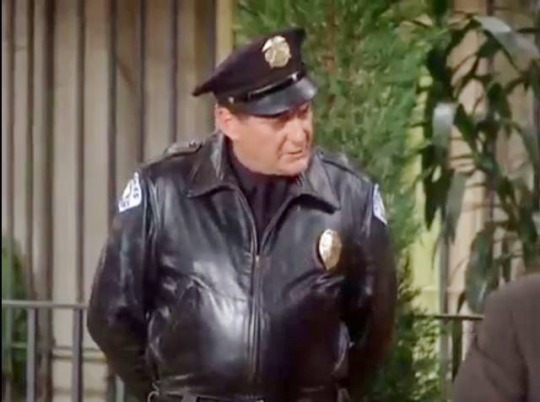
Ray
Kellogg
(Cop) played
the barking Assistant Director (“Roll
‘em!”)
in “Ricky’s
Screen Test” (ILL S4;E6)
and later appeared in “Bullfight
Dance” (ILL S4;E22).
This is the fifth of his seven episodes of “The Lucy Show.” He
also did two episodes of “Here’s Lucy.” Just as he does here,
most most time he played a policeman.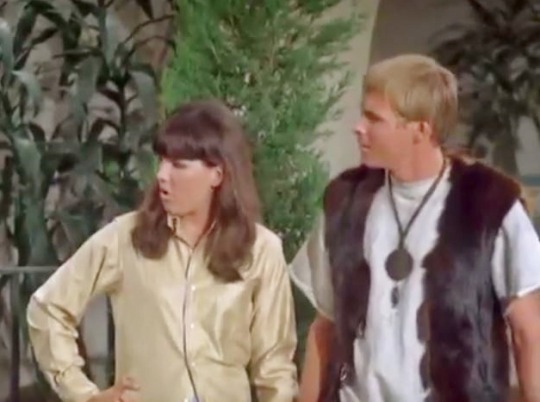
Lucie
Arnaz (Teenager)
was the real life 16 year-old daughter of Lucille Ball and Desi
Arnaz. She previously appeared on “The Lucy Show” as Cynthia, a
friend of Lucy’s daughter Chris. She also did background
appearances, most recently with her brother Desi Jr. in “Lucy at
Marineland” (S5;E1). She will do two more appearances of “The
Lucy Show” before becoming a regular on “Here’s Lucy.”Lucie’s
‘hippie’ boyfriend goes uncredited.
This
episode was filmed on Thursday, July 7, 1966.During
this extremely physical comedy-heavy episode, Gary Morton’s loud
guffaw can be heard clearly in the studio audience.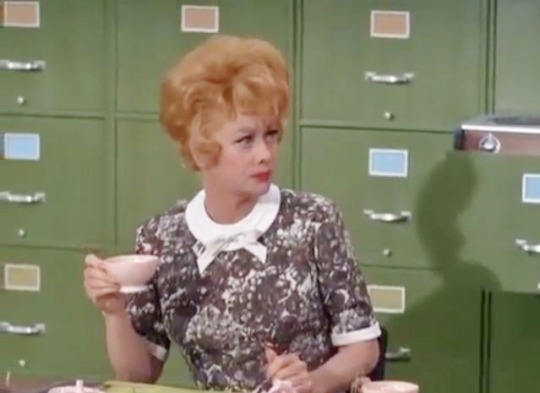
Having
lunch at her desk at the bank, Lucy uses the same pink Melmac cups
and saucers she has at home.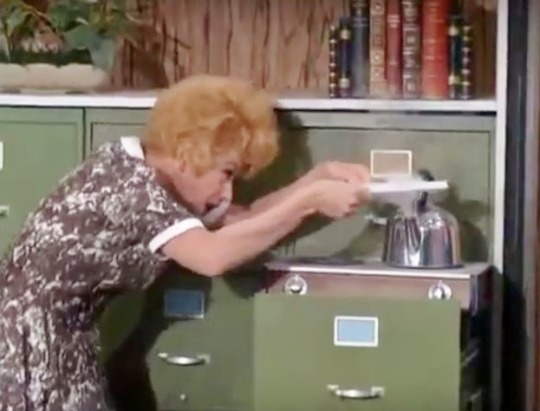
Steaming
open Mr. Mooney’s sealed envelope, Lucy says she feels just like
James Bond. In mid-1966, Ian Fleming’s dashing British spy
was being played on screen by Sean Connery. Thunderball was
released in 1965.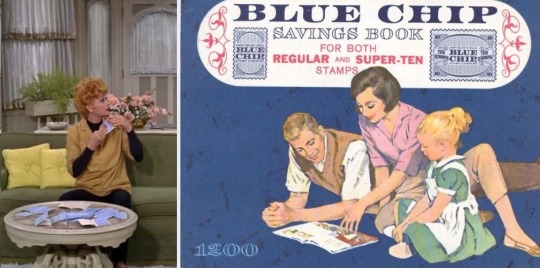
The
custom designed ring Mr. Mooney buys for his wife costs $6,000.
Adjusting for inflation, that would be like more than $45,000
today. Mr. Barmarche reiterates to Mr. Mooney that they do not give
trading stamps. Trading
Stamps were
small paper coupons given to customers by merchants in loyalty
marketing programs. When a customer accumulated a number of them,
they could be exchanged for premiums, such as personal items,
housewares, furniture, and appliances. In “Lucy, the Camp Cook”
(S3;E6) Mr. Mooney’s car runs out of gas because he wouldn’t stop at
a service station that didn’t give trading stamps! “Lucy Gets the
Bird” (S3;E12) begins with Lucy and Viv collecting trading stamps
hoping to earn a trip to Hawaii.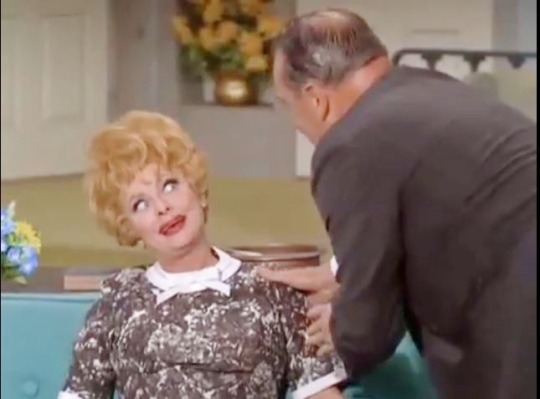
Conveniently,
Lucy has a condition where her fingers swell when someone yells at
her.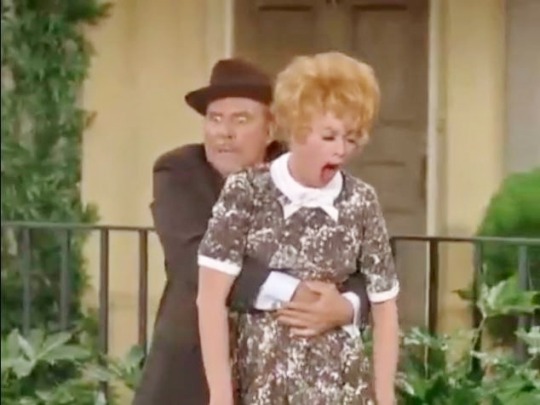
Mr.
Mooney gets a telephone call from someone named Miss Jones, if for no
other reason than for the telephone ring to startle an already
frazzled Lucy.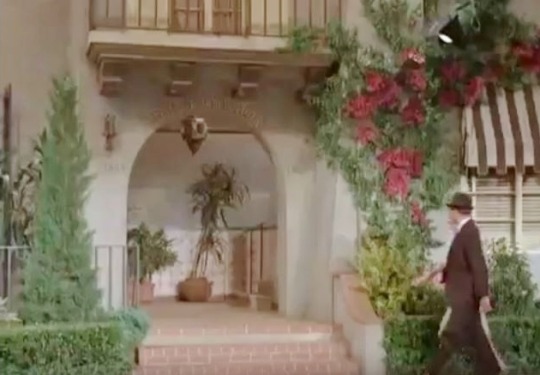
This
is the first time we see the exterior street entrance of Lucy’s
Glenhall Apartment complex.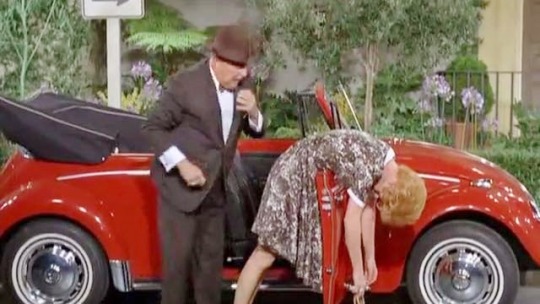
Mr.
Mooney drives a red Volkswagen convertible, a somewhat unusual choice
for a middle-aged banker during in the mid-1960s.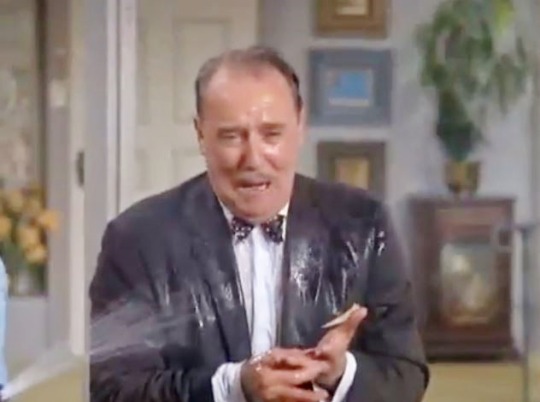
As
usual, Lucy has no control over the kitchen sink sprayer and gets Mr.
Mooney soaking wet.
The
plot of this episode was recycled for “Lucy Meets the Burtons”
(1970) where Lucy Carter tries on Elizabeth Taylor’s expensive ring
and can’t get it off her hand in time for a press event with Richard
Burton. The ending, however, of the “Here’s Lucy” episode was
more like “The Handcuffs” (ILL S2;E4), in which Lucy’s hand is
thrust through a curtain to hide the fact that she is shackled.Callbacks!
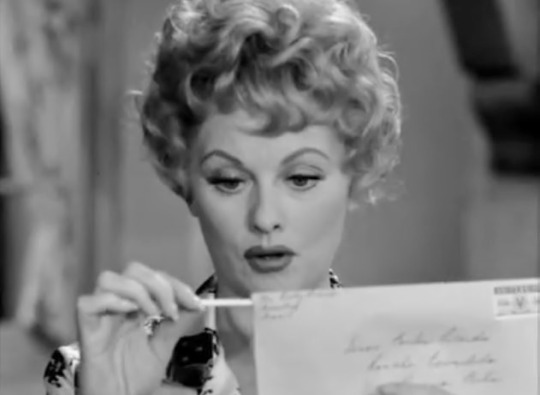
Lucy
and Mary Jane steam open an envelope, something that Lucy Ricardo did
when she thought Ricky was “Drafted” (ILL S1;E11) in 1951. By
1960, in “Lucy Meets the Mustache” (the very last time we ever
see the Ricardos and the Mertzes), Lucy has replaced kettle steam
with a carefully manipulated knitting needle.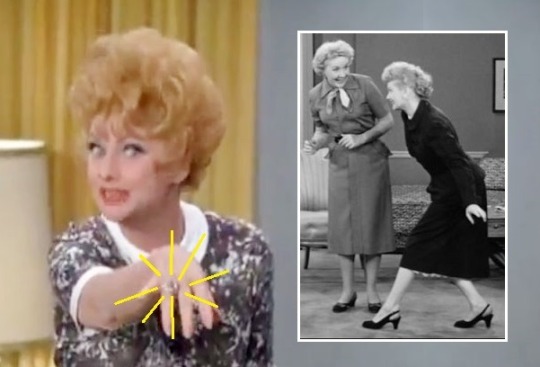
With
the fancy ring on her finger, Lucy pretends to be talking to Queen
Elizabeth and Prince Philip, even doing a curtsy. Lucy Ricardo
practiced curtsying for Elizabeth and Philip when “Lucy Meets the
Queen” (ILL S5;E15) after Ricky’s show at the Palladium.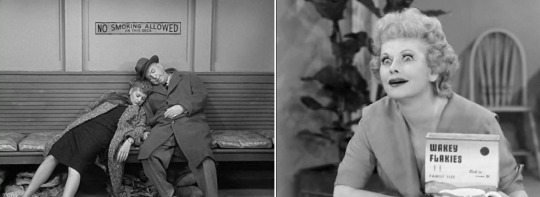
Lucy
takes far too many of her ‘relaxation pills’ and becomes groggy,
something that happened to Lucy Ricardo on the “Staten Island
Ferry” (ILL S5;E12) and then again as the co-host of a morning news
show with Paul Douglas in “Lucy Wants a Career” (1959).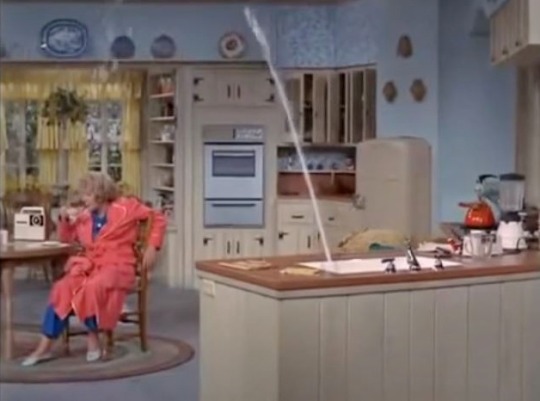
Lucy
also had garbage disposal woes back in Danfield in “Lucy the Coin
Collector” (S3;E13) and “Lucy the Disc Jockey” (S3;E26).Blooper
AlertsSitcom Logic Alert! Mr. Mooney’s ring falls down the drain and somehow lands up in Mary Jane’s washing in the laundry room! Unlikely, to say the least!
Continuity Issues! In
“Lucy the Bean Queen” (S4;E3), two episodes earlier, Lucy was
redecorating her apartment with new furniture but here she has
exactly the same furniture she has always had! There were no scenes
set in Lucy’s apartment in the intervening episode, “Lucy and Paul
Winchell” (S5;E4).
“Lucy and the Ring-a-Ding Ring” Rates 3 Paper Hearts out of 5
-
Lucy and Paul Winchell
S5;E4
~ October 3, 1966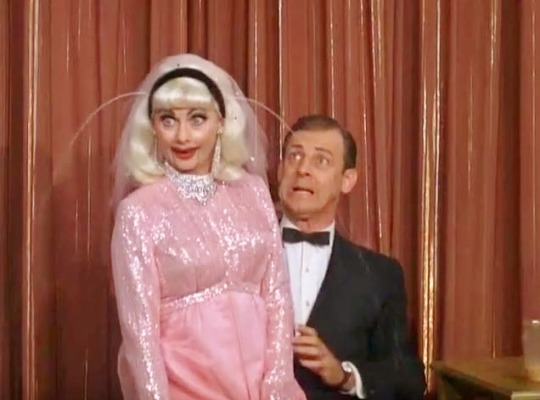

Synopsis
Lucy
convinces ventriloquist Paul Winchell to appear at the Annual
Banker’s Banquet. When Winchell is running late, he asks Lucy to
stop by and pick up his dummies. When she accidentally leaves them
in a taxi the understudy ‘dummy’ has to go on – Lucy!Regular
CastLucille
Ball (Lucy Carmichael), Gale Gordon (Theodore J. Mooney)Mary
Jane Croft (Mary Jane Lewis) does not appear in this episode but Lucy
does have a phone conversation with her.Guest
Cast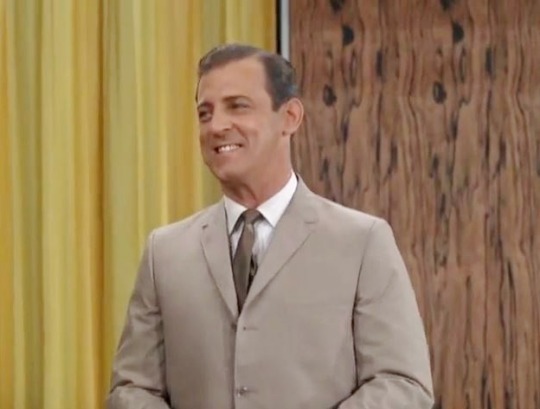
Paul
Winchell (Himself)
was born Paul Wilchinsky in 1922. Coming into the public eye in
1948, he became one of the most famous ventriloquists since Edgar
Bergen. He hosted the enormously popular children’s television show
“Winchell-Mahoney Time” (1964-68) in which he shared the
spotlight with Jerry Mahoney, one of his most popular characters.
Sadly, in a legal dispute over the syndication rights to the show,
all nearly 300 episodes were destroyed. Winchell is fondly
remembered as the voice of Winnie the Pooh’s pal Tigger and (later)
Papa Smurf. He returns to “The Lucy Show” to play Doc Putnam in
two linked episodes, “Main Street U.S.A.” (S5;E17) and “Lucy
Puts Main Street on the Map” (S5;18), as well as doing two episodes
of “Here’s Lucy.” Surprisingly, Winchell was also an inventor
who is credited with the artificial heart, among other innovations.
He died in 2005.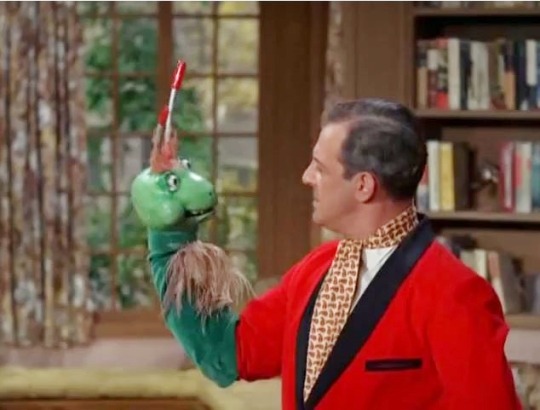
Snitchy
the Snail appeared
with Winchell on “The Dick Van Dyke Show” six months before this
“Lucy Show” appearance.
Tessie
Mahoney was
Jerry’s platinum blonde cousin. She was named after Winchell’s wife
Tessie Nina Moore. Many accused Tessie of just being Jerry Mahoney
in drag! Like Winchell, Tessie was from Brooklyn (and sounded it).
Jerry
Mahoney (above left) was
‘born’ around 1935. He was Paul Winchell’s co-host on
“Winchell-Mahoney Time.” Jerry Mahoney was
named after Winchell’s grade-school teacher, who encouraged him to
pursue ventriloquism. He was carved by Chicago-based figure maker
Frank Marshall. The original Marshall-carved Jerry Mahoney is now
‘living’ at the Smithsonian Institution in Washington DC.Knucklehead
Smiff (above right) was
‘born’ in 1951, sculpted by Winchell from a copy of Jerry Mahoney’s
head. He co-starred with Winchell and Jerry Mahoney on
“Winchell-Mahoney Time” and many other shows. Like Jerry Mahoney,
he now resides at the ‘Smiffsonian’ Institution, although neither are
currently accepting visitors!Sid
Gould
(Show
Announcer Voice) made more than 45 appearances on “The Lucy Show,”
all as background characters. He also did 40 episodes of “Here’s
Lucy.” Gould (born Sydney Greenfader) was Lucille Ball’s cousin
by marriage to Gary Morton.Gould
performed this same kind of uncredited voice over introduction when
“Lucy and George Burns” (S5;E1) performed together.Marge,
a voice on Lucy’s intercom is uncredited, as is the female voice of
the long distance operator. Marge was also the name of Lucy
Carmichael’s sister, a character seen in “Lucy’s Sister Pays a
Visit” (S1;E15).
Having
Paul Winchell as a guest star was Lucille Ball’s attempt to attract
younger viewers to “The Lucy Show.”Lucille
Ball seems to be having occasional vocal problems during this
episode.
Upon
meeting Paul Winchell, Lucy says
“I always read your column” mistaking
him for journalist Walter Winchell. Paul Winchell quickly corrects
her. She then says “I
just get hysterical watching you and Charlie McCarthy”
mistaking her for ventriloquist Edgar Bergen. Again, Winchell
quickly corrects her. Walter
Winchell (1897-1972)
was the narrator of Desilu’s “The Untouchables” and did the same
function for a parody episode on “The Lucy Show” titled “Lucy
the Gun Moll” (S4;E25). Edgar
Bergen
(1903-1978) appeared with Lucille Ball in the 1941 film Look
Who’s Laughing.Lucy
explains the bank’s interest rates to Paul Winchell: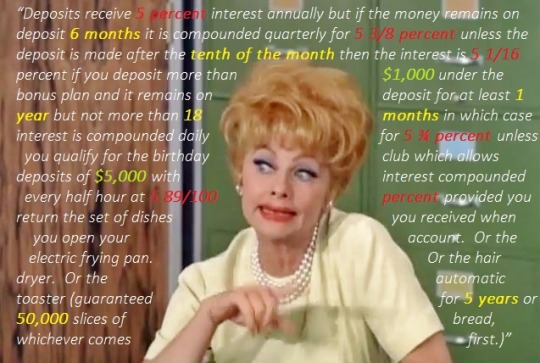
Lucy gave away toasters for new savings accounts back in Danfield when “Lucy
Takes a Job at the Bank” (S2;E21).In the previous episode, “Lucy the Bean Queen” (S5;E3) Lucy was redecorating her apartment. The reveal is delayed as this episode has no scenes taking place in Lucy’s home.
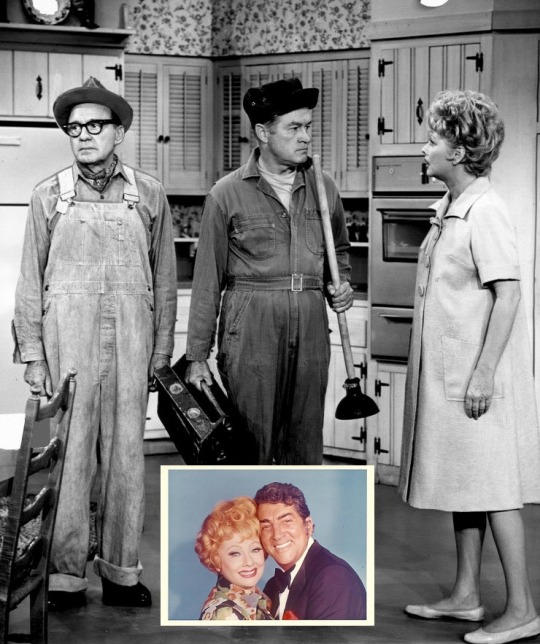
Mr.
Mooney returns to the office after failing to find a celebrity to
entertain at the Bankers Annual Banquet show. Bob
Hope
is doing a show for the Girl Scouts in Pismo Beach; Jack
Benny
is on a tour of Fort Knox; Dean
Martin
just had an operation to remove a brass rail pressing on his foot.
All three of these performers have guest starred on “The Lucy
Show.” Pismo Beach was thought to be a funny sounding name and was
often used as a punch line in comedy. Fort Knox is an Army base in
Kentucky where much of the nation’s gold supply is held, so the
reference trades on Jack Benny’s characterization of a being a miser.
Dean Martin’s comic persona was that of a heavy drinker, so the
reference is to the foot rail found at bars.
Lucy:
Oh, gee, aren’t there any other movie actors you could call?
Mr.
Mooney: Yes, yes, but they’re all too busy running for public
office.Mr.
Mooney is likely referring to Ronald Reagan, who ran for Governor of
California in 1966 and won (after this episode aired). He held
office until 1975 before setting his sights on the Presidency. In
1980 he was elected 40th President of the United States, an office he held until 1989. His
screen acting career began in 1937 and lasted right up until he
became Governor. Reagan appeared with Lucille Ball on two episodes
of “The Ed Sullivan Show” in the mid-1950s.
Paul
Winchell gets a phone call from someone named Gary asking him to play
golf. This is probably and inside joke about Production Consultant
(and Lucille Ball’s husband) Gary
Morton’s
fondness for playing golf.
In
the opening scene at Paul Winchell’s home, his character Irving
Think
(a mouse) is standing next to the telephone and
Ozwald
(with another figure’s head attached) is propped up on the sofa.
Ozwald was a commercially available doll resembling Humpty Dumpty
that required the user to paint eyes and a nose on his or her own
chin and hang the puppet upside down to create the character.After
Winchell offers to lend Lucy one of his dummies, Lucy and the episode
enters (what Winchell later calls) “the twilight zone.”
Winchell’s most famous dummies, Jerry Mahoney and Knucklehead Smiff,
become animated on their own, without any help from Winchell
(although he may still be providing the voices live). It is a
surreal moment for a show that tries to keep one foot in a somewhat
farcical version of reality (except perhaps for “Lucy the
Superwoman” S4;E26).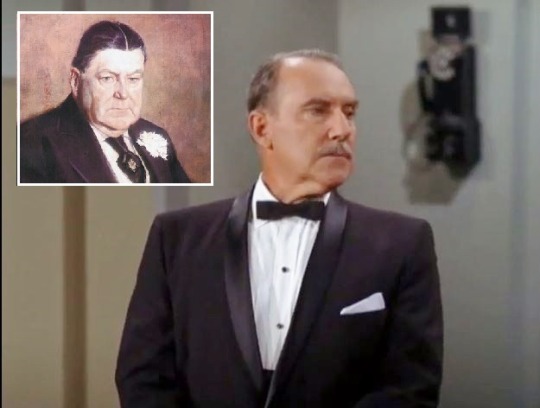
Lucy
describes her boss as Diamond Jim Mooney after Winchell says he
sounds like “the
last of the big spenders.” James
Buchanan Brady
(1856–1917)
was an American businessman, financier and philanthropist
of
the Gilded
Age
who had a particular affinity for precious stones and jewelry. His
had a longtime relationship with actress and singer Lillian Russell.
At one point, a TV biopic was planned starring Jackie Gleason with
Lucille Ball as Russell, but it never came to pass.Jerry
Mahoney and Knucklehead Smiff have a food fight with spaghetti, eggs,
and cream pies, something they often did on “Winchell-Mahoney
Time.”
Mr.
Mooney gets a telephone call from his boss, Mr. Cheever, a character
who won’t actually appear until the end of the season (played by Roy
Roberts).Although
Lucille Ball was game to conquer any comic task the writers created
for her, becoming an accomplished ventriloquist in a week was a tall
order, so Mrs. Carmichael’s lips move when manipulating the dummy she
borrows from Paul Winchell as workplace therapy.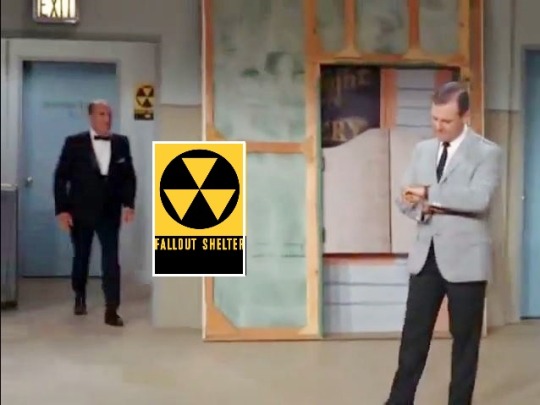
The
Bankers Annual Banquet and Show is being held at the Beverly Ritz
Hotel. Backstage there is a Fallout Shelter sign. After the Cuban
Missile Crisis in 1961 (the beginning of the ‘Cold War’ between
Russian and the United States), President Kennedy instructed that
sturdy large-capacity structures be designated fallout
shelters
in case of attack. The yellow and black sign with three triangles
inside a circle was used to alert the public that the building was
designated such a structure. The saloon door scenery used in the
silent movie sketch of “Lucy Meets Mickey Rooney” (S4;E18) is
also there, although the painted side is turned away from the camera.
As
Tessie Mahoney, Lucy suggests that they sing “Your Dime is My Dime”
because they are performing for an audience of bankers. This is a pun
on the song “My
Time is Your Time” written
by Leo
Dance and Eric Little in 1924.It was made famous by Rudy Valle who guest starred as himself on
“Lucy Takes a Cruise to Havana” (1957), the first “Lucy-Desi
Comedy Hour,” and does so again in a 1970 episode of “Here’s
Lucy.”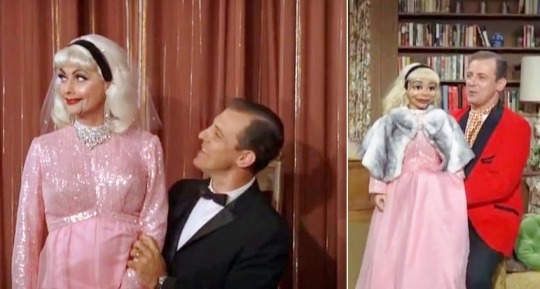
Winchell
(voicing Lucy / Tessie and himself) sings “What Does This Audience
Want?” an original song written especially for this episode. The
lyrics reference Milton
Berle,
who appeared in “Lucy Saves Milton Berle” (S4;E13).Callbacks!
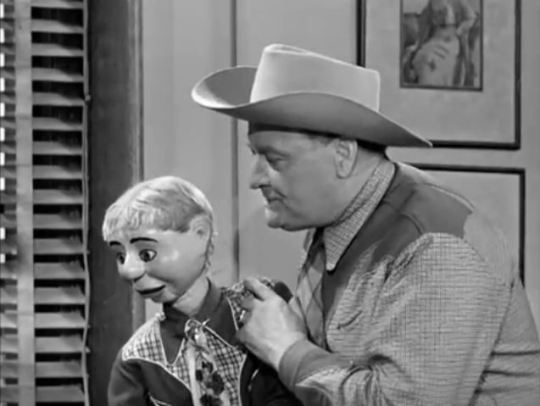
Ventriloquist Max Terhune played himself in “Ricky Loses His Temper” (ILL S3;E19). Terhune was a skilled vaudevillian who speciali
zed in ventriloquism. On the Orpheum Circuit his dummy was known as Skully Null but was re-named Elmer Sneezeweed in the movies. Terhune was listed as one of the top ten money-making stars in Westerns for 1937, 1938 and 1939, appearing as Max ‘Alibi’ Terhune in a string of B-movie ‘oaters.’
Actually
a call forward – to the stage and film musical Chicago
in
which a woman (Roxie Hart) becomes a ventriloquist’s doll during the
musical number “We Both Reached for the Gun.” Here, Lucy takes
on the persona of Tessie Mahoney, sitting on Paul Winchell’s knee
wearing a platinum blonde wig and pink dress singing “What Does
This Audience Want?”Blooper
AlertsPaul
Winchell wants to open a savings account at Westland Bank. Although
certainly this is within the bounds of reality, it is likely that a
big star like Paul Winchell would have his finances administered by a
Business Manager and would not be going to a local bank for a savings
account.
Mr.
Mooney’s Dictaphone explodes just by Lucy touching it.
None
of Lucy’s file cabinets are labeled. With Lucy’s wacky filing system
it doesn’t really matter anyway!
“Lucy Meets Paul Winchell” rates 4 Paper Hearts out of 5
 1966, Bob Hope, CBS, Chicago, Dean Martin, Diamond Jim Brady, Edgar Bergen, Gale Gordon, Gary Morton, Irving Think, Jack Benny, Jerry Mahoney, Knucklehead Smiff, Lucille Ball, Lucy Meets Paul Winchell, max terhune, Milton Berle, Ozwald, Paul Winchell, Ronald Reagan, Rudy Valle, Sid Gould, Snitchy, Tessie Mahoney, The Lucy Show, tv, Ventriloquism, Walter Winchell, Winchell-Mahoney Time
 -
Lucy the Bean Queen
S5;E3
~ September 26, 1966
Synopsis
Mr.
Mooney partners with an enterprising southern colonel to market
canned baked beans offering a double your money back guarantee. This
gives Lucy an idea how to raise enough money to pay for her new
furniture.Regular
CastLucille
Ball (Lucy Carmichael), Gale Gordon (Theodore J. Mooney), Mary Jane
Croft (Mary Jane Lewis)Guest
Cast
Ed
Begley
(Colonel Beauregard Bailey, above right) was born in 1901 in Hartford,
Connecticut. His first success was the 1947 Arthur
Miller
play
All
My Sons followed
by Inherit
the Wind (1955-57),
which ran for 806 performances on Broadway and won Begley the 1956
Tony Award for Best Featured Actor in a Play. In 1962 he won an
Oscar for his supporting role in Sweet
Bird of Youth.
His son is the actor Ed Begley Jr. This is his only appearance
opposite Lucille Ball. He died in 1970.Richard
Jury
(Addison, Sales Manager, above left) was born Richard Satriano in 1926. He
appeared occasionally on sitcoms of the time. This is his only
appearance on “The Lucy Show.”
Joseph
Mell
(Supermarket Manager #1) previously
played Bailiffs in “Lucy
the Meter Maid” (S3;E7)
and
“Lucy
is Her Own Lawyer” (S2;E23).
His first role on the series was as a Butcher in “Together
for Christmas” (S1;E13).
In 1964 he appeared in the TV special “Mr. and Mrs.” (aka “The
Lucille Ball Comedy Hour”), which featured many of the Desilu
regulars. Mell also appeared in a 1969 episode of “Here’s Lucy.”
In 1971, he was a Taxi Driver on “Lucy and the Lecher,” a
cross-over episode of Danny Thomas’s “Make Room for Granddaddy”
in which Lucille Ball played Lucy Carter, her character from “Here’s
Lucy.”In
the final credits, Mell is actually listed as 2nd Manager, but is the first supermarket manager on screen.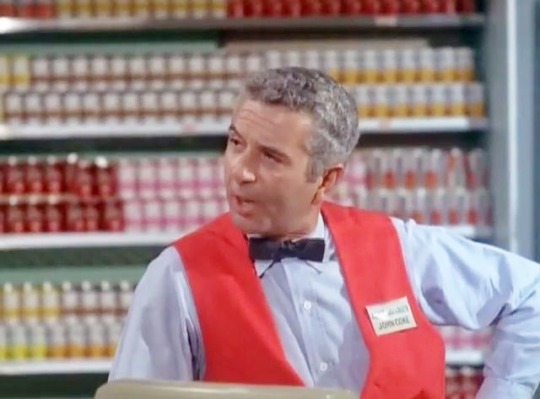
John
Perri
(John Coke, Supermarket Manager #2) played the Man
from Full-of-Pep Vitamins in “Lucy, the Superwoman” (S4;E26) and
was previously seen as a Supermarket Checker in “Lucy
and Joan” (S4;E4).
He was seen on Broadway in The
Boy Friend (1954),
the musical that introduced Julie Andrews. This marks his final
appearance on “The Lucy Show.”In
the final credits, Perri is listed as 3rd Manager, but is the second supermarket manager on screen. The
character name is not spoken or credited, but comes from the name
badge on his chest. The surname may also read ‘Cole’ or ‘Cone.’
Sid
Gould
(Furniture
Delivery Man #1, above right) made more than 45 appearances on “The Lucy Show,”
all as background characters. He also did 40 episodes of “Here’s
Lucy.” Gould (born Sydney Greenfader) was Lucille Ball’s cousin
by marriage to Gary Morton.Gould’s
furniture moving partner (above left) is uncredited.Bennett
Green (Furniture
Delivery Man #2) was Desi Arnaz’s stand-in during “I Love Lucy.”
He does frequent background work on “The Lucy Show.”Green’s
furniture moving partner goes uncredited. This is the third time
Gould and Green have played delivery men. They delivered Major Fun
Fun in “Lucy the Robot” (S4;E23) and the massive computer in
“Lucy, the Superwoman” (S4;E26). This time, however, they are
teamed with different partners.The
voice of Perkins
in the Bailey Beans sales department goes uncredited
This
episode was filmed June 30, 1966, just before the production broke
for summer hiatus.
Ed Begley (Colonel Bailey) is the first actor on “The Lucy Show” to have won a competitive acting Oscar at the time of his appearance. Four years earlier he had won Best Supporting Actor for Sweet Bird of Youth. Earlier in 1966, Mickey Rooney made a guest appearance on “The Lucy Show” having won an honorary Juvenile Oscar in 1938 along with Deana Durbin. Joan Crawford, who won the Academy Award in 1945, would guest-star on “The Lucy Show” in 1968. Coincidentally, the year Begley won, Joan Crawford accepted the Best Actress Award for Anne Bancroft, who was appearing in a play. Begley, however, is the only one to appear on “The Lucy Show” playing a character, while the others played themselves.
The first (and only) actor to have won a competitive Oscar at the time of his appearance on “I Love Lucy” was William Holden, who won for Stalag-17 in 1954.

This
is the first and only “Lucy Show” episode written by Phil
Leslie,
who started his career on radio writing for “Fibber McGee and
Molly” on which this “Lucy Show” plot is loosely based. It was
broadcast on the NBC Red Network on January 8, 1946 and was called
“Bean Counting Contest.” Jim
and Marian Jordan played Fibber and his wife Molly.
Leslie will
also write four episodes of “Here’s Lucy.”
To
prepare for this episode, Lucille Ball learned to drive a forklift
and spent much rehearsal time working to ensure she could maneuver it
on a dime.Colonel
Bailey and Mr. Mooney were formerly partners in Bailey’s Pickles.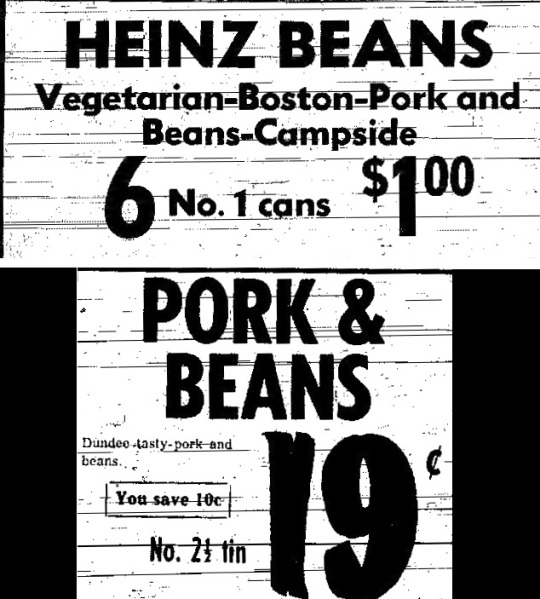
Lucy’s
pyramid scheme of rebates is based on the fact that Bailey’s
Barbecued Baked Beans cost 25 cents per can. Newspaper ads from
mid-1966 (above) offer Heinz and Dundee beans (on sale) for 19 and 20 cents
per can, so fictional Bailey’s is right in line with the cost of
their real-world competitors.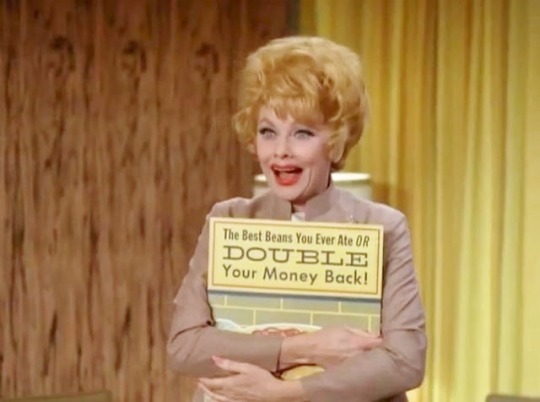
Lucy
intends to buy new furniture from the Royal Furniture Company for
$1,500 over three years, despite the fact that she has only paid back
$100 of the $800 her furniture cost the year before!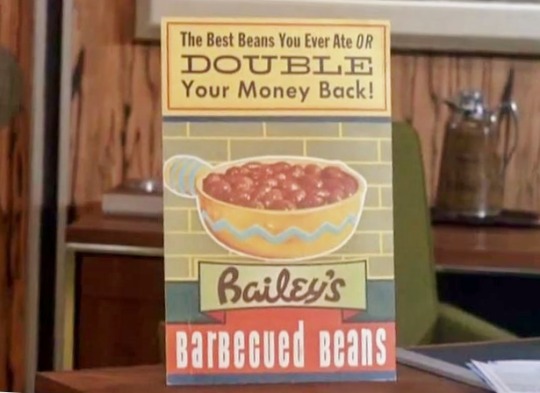
Lucy
says her mother baked the best beans she ever ate. In “Lucy with George Burns” (S5;E1) Lucy says her mother’s noodles were the best she ever ate.Recognizable
character actor Ed Begley receives entrance applause from the studio audience.
Mr.
Mooney notes that it costs five cents postage to send a letter. This
rate went into effect in 1963, rising a penny, and went up again
another penny in 1968. Today the cost is 47 cents, down from an
all-time high of 49 cents in 2014.
Lucille
Ball frequently had episodes written around redecorating so that the
show’s visuals would not become stagnant. Lucy Carmichael has only
had her California apartment furniture for a year. Although aired in
the fall, this episode was actually filmed before the production went
on summer hiatus, giving the set designers and decorators time to
make the changes. Lucy’s Danfield home (above) was redecorated in the hiatus
between seasons 1 and 2.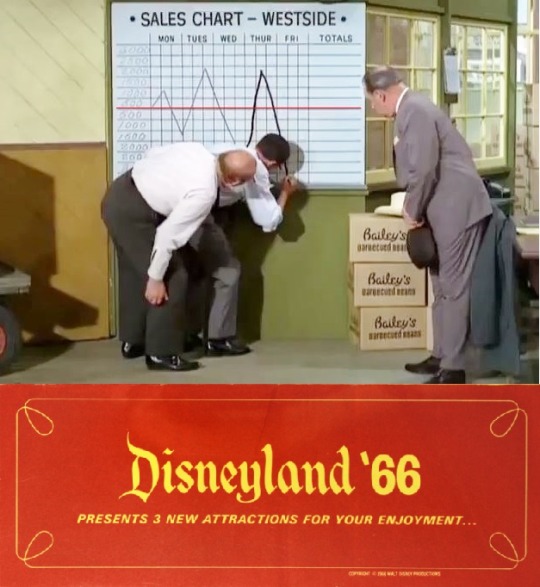
Colonel
Bailey says the Bailey’s Bean sales chart looks like a ride at
Disneyland. The now-iconic theme park in Orange County,
California first opened in 1955. In late 1965 Disney announced plans
to build a sister park in Orange County, Florida. Walt Disney World
opened in 1971.Bailey:
“Rome wasn’t built in a day, you know.”Mooney: “We’re
not in the construction business!”
“Rome
wasn’t built in a day”
was a plea for someone to be patient. The phrase was a French
proverb in the late 1100s but was not recorded in English until 1545.
Ironically, Mr. Mooney was recently in the construction business,
partnering with Winslow Construction Company in “Lucy
and the Sleeping Beauty” (S4;E9) and “Lucy and Clint Walker”
(S4;E24).Desilu
saves a salary by having the voice of Perkins in Colonel Bailey’s
sales department come from the overhead intercom system instead of an
onscreen actor.
Lucy
buys 3,000 cans of beans (in cases) and stores them in her (empty)
apartment. When she turns the cases into a sofa and armchair, she
calls the decorating style “early
pork and beans.”
Lucy
gets a phone call from Frank Winslow, whom she dated in “Lucy and
the Sleeping Beauty” (S4;E9) and “Lucy and Clint Walker”
(S4;E24). Frank owns a construction company and is loaning Lucy the
forklift.Bailey’s
Barbecued Beans jingle:Bailey’s Beans, Bailey’s Beans
Priced
for folks of every means.
Fix
a pot, cold or hot
Good
old Bailey’s Beans.
Don’t
delay, go today
To
your nearest store.
Hurry
up! Hurry up! Hurry up! Woah!
Buy Bailey’s Beans!Callbacks!

A 1949 episode of Lucille Ball’s radio show “My Favorite Husband” also dealt with beans: “OVER BUDGET – BEANS!” Liz (Lucille Ball) goes over her budget again by buying six cases of beans that were on special, so George cuts off her allowance. Soon they’re eating nothing but beans, and the electricity and telephone have been disconnected!

Baked
beans were a point of contention when Lucy Carmichael and Mr. Mooney
first met in “Lucy Gets Locked in the Vault” (S2;E24) where the
only food they had was a can of beans (but no opener).
In
“Redecorating” (ILL S2;E8) Lucy Ricardo schemes to get new
furniture by entering a drawing at the Home Show – 100 times!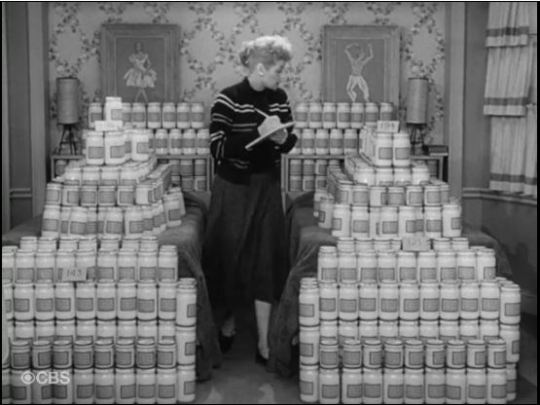
Having
an apartment full of baked beans is visually similar to Lucy Ricardo
having an apartment full of Aunt Martha’s Old Fashioned Salad
Dressing in “The Million Dollar Idea” (ILL S2;E13).

Mary
Jane getting trapped by stacked cartons of baked beans is visually
reminiscent of when Lucy Carmichael stacked recycled newspapers in
her Danfield home to sell to salvage to pay for the new Fire
Department dress uniforms. Just as Lucy drives a forklift in this
episode, “Lucy Drives a Dump Truck” (S1;E24) full of newspapers in
1963. Both episodes featured Mary Jane Croft.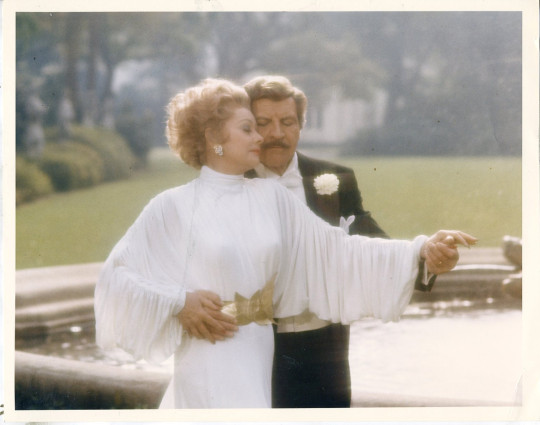
When
Lucy meets Colonel Beauregard Bailey, she turns on the southern
charm. Lucille Ball also tried to charm a southerner named
Beauregard (Robert Preston) as Mame in the 1974 film of the same name.Blooper
AlertsThe
safe in Mr. Mooney’s office in the previous episode is now gone and
the office has reverted to the way it looked at the start of season
5.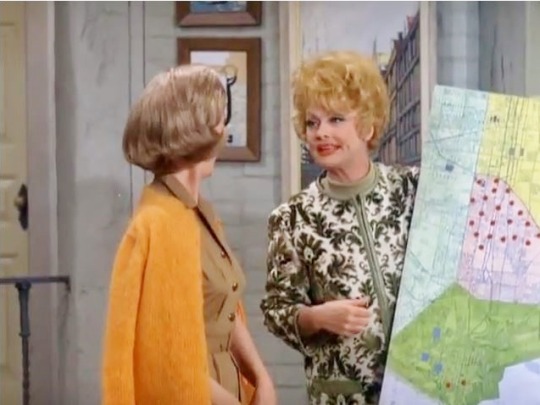
Lucy
says the two pinheads at the bottom of the supermarket map represent
her and Mary Jane. If that is so, they must be living in or around
the San Pedro area, not Hollywood. Also, if Mary Jane lives next
door to Lucy in the same complex the two pin heads should be adjacent
– or practically on top of one another.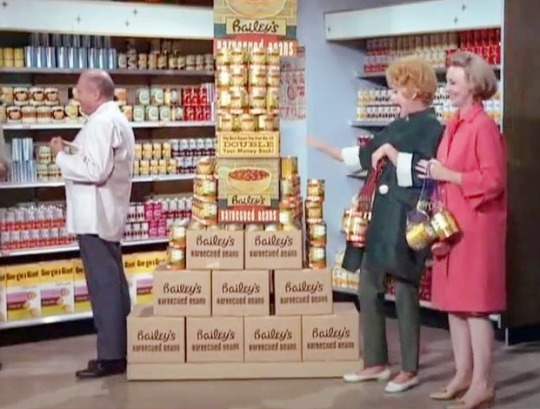
All
three supermarkets were filmed on the same set, slightly rearranged.
In supermarket #3, a shelf of bread has been moved in front of the
soda machine.
In supermarket #2 (top photo) you can see boxes of Kiddie
Cookies, a fictional product first seen on “The Talent Discoverers
Show” in “Lucy
and the Plumber” (S3;E2),
then in the Los Angeles supermarket during “Lucy
and Joan” (S4;E4),
and again on the the kitchen shelves of the inventor in “Lucy the
Robot” (S4;E23).Mr.
Mooney is investing his personal money in Bailey’s Barbecued Beans,
which might be a conflict of interest for a bank executive,
especially having a meeting on bank time.
After
Lucy and Mary Jane relax on their pork and bean box furniture, the
camera pulls back far enough to see where the edge of the
wall-to-wall carpet meets the gray cement of the studio floor. This
area had to remain uncarpeted to allow the heavy cameras to move
freely during filming. You can also see the actors’ ‘marks’ –
white tape denoting where the actors should stand to be in the camera
shot.
“Lucy the Bean Queen” rates 5 Paper Hearts out of 5
 1966, Baked Beans, Bennett Green, CBS, Clint Walker, Disneyland, Ed Begley, Fibber McGee and Molly, Fork Lift, Furniture, Gale Gordon, Grocery Stores, Joe Mell, John Perri, Lucille Ball, Lucy the Bean Queen, Mame, Mary Jane Croft, Phil Leslie, Redecorating, Richard Jury, Sid Gould, Supermarkets, The Lucy Show, tv
 -
Lucy and the Submarine
S5;E2
~ September 19, 1966

Synopsis
Mr.
Mooney goes on training maneuvers with his old Navy buddy and
forgets to sign some important papers before he leaves the bank. To get his signature, Lucy disguises herself as a sailor to follow him aboard a submarine but gets trapped inside when the sub takes a
dive.Regular
CastLucille
Ball (Lucy Carmichael), Gale Gordon (Theodore J.
Mooney)Mary
Jane Croft (Mary Jane Lewis) does not appear in this episode.Guest
Cast
Roy
Roberts
(Admiral, above left) was born Roy Barnes Jones in Tampa, Florida in 1906.
His early career was on the Broadway stage, gracing such plays as Old
Man Murphy
(1931), Twentieth
Century (1932),
The
Body Beautiful
(1935) and My
Sister Eileen
(1942).
In Hollywood, the veteran character actor clocked over 900 screen
performances in his 40 year career, most of which were authority
figures. He and Lucille Ball appeared together in Miss
Grant Takes Richmond
(1949). Halfway through season 5 of “The Lucy Show” he will
assume the role of Mr. Cheever, Mr. Mooney’s boss at the bank, a
character he will play for 14 episodes. He was seen as various
characters in 5 episodes of “Here’s Lucy.” In addition, he was a
regular on “McHale’s Navy” (Admiral Rogers), “The Beverly
Hillbillies” (John Cushing), “Bewitched” (Frank Stephens),
“Petticoat Junction” (Norman Curtis), and “Gunsmoke” (Harry
Bodkin). Roberts died in 1975 at age 69.Robert
Carson
(Commander Bill Moore, above right) played
bank employee Mr. Potter in “Lucy
Saves Milton Berle” (S4;E13)
and
“Lucy
at Marineland” (S4;E1).
He
was a busy Canadian-born character actor making his last appearance
on the series. He also made five appearances on “Here’s Lucy.”
Steven
Marlo
(Marine Guard) makes the first of his two appearances on “The Lucy
Show.” He will return for “Lucy Visits Viv” (S5;E15).
Sid
Gould
(Laundry
Man, uncredited) made more than 45 appearances on “The Lucy Show,”
all as background characters. He also did 40 episodes of “Here’s
Lucy.” Gould (born Sydney Greenfader) was Lucille Ball’s cousin
by marriage to Gary Morton.
Eddie
Ryder
(William Jones, Leering Sailor)
appeared as Bones Snodgrass on the “Our Miss Brooks” from 1953-54
under the name Eddie Riley. In addition to this episode, he was also
seen with Lucille Ball in the 1964 teleplay “Mr. and Mrs.”Jerry Rush (Jerry Rush, Sailor, uncredited) makes the third of his ten (mostly uncredited) appearances on the series. He also did two episodes of “Here’s Lucy.”
Larry Anthony (Larry Anthony, Sailor, uncredited) makes his only appearance with Lucille Ball.
Other
male background performers play sailors in the Navy yard and on the
submarine.
On
the same night this episode first aired (September 19, 1966), Roy
Roberts (the Admiral) was seen in “The Road West,” which followed
“The Lucy Show” on NBC.This
is the only episode written by the team of
Dirk Bensfield
and Perry
Grant.
Both were integral writers on “The Adventures of Ozzie and
Harriet” (1952-1966), which ended its long run earlier in in the
year, freeing them up to take freelance projects like “The Lucy
Show.”This
episode’s premise of Mr. Mooney forgetting to sign important bank
papers and Lucy following him to some exotic location is basically
the same as “Lucy the Rain Goddess” (S4;E15), but instead of a
dude ranch, the location is a submarine.
The
episode’s underscoring integrates “Anchors Aweigh,” the
march of the United
States Navy composed
in 1906 by Charles
A. Zimmermann.Lucille
Ball’s voice sounds a bit scratchy during portions of the episode,
perhaps as the result of illness combined with heavy smoking.
Mr.
Mooney tells Lucy he’s going on a two-week training, but warns her
(in his best deep-voiced, measure tones) that “I
shall return!” These
were the immortal words of General
Douglas MacArthur
when he escaped the Philippines after being surrounded by the
Japanese in March 1942.Coincidentally,
Lucy has a telephone conversation with Mr. Cheever, the Bank
President, in the same episode that features Roy Roberts (the
Admiral), who will play Mr. Cheever later in the season.
Lucy
Carmichael once again mentions that she is from Jamestown, which was
also the birthplace of Lucy Ricardo and the real hometown of Lucille
Ball.Mr.
Mooney says he received the Victory Medal when he was stationed on
the SS Porpoise submarine in the South Pacific during World War II.
Later we find out that Mr. Mooney made all that up to impress Lucy
and that he was actually a housing officer stationed just outside of
Wichita.
Film
editor John Foley uses a ‘flip wipe’ to denote the passage of time
when Lucy changes clothes in the laundry van. This editing technique
was only used in one previous episode of “The Lucy Show,” which
usually uses a standard ‘fade’ to transition between scenes.

The
episode also employs brief clips of stock footage of sailors working
on a docked submarine and (later) of a sub moving through the water
and then resurfacing.When
all the other sailors are holding up their ID and stating their names
to the guard in last name / first name order, Lucy says “Club,
Auto” and flashes her AAA
card!
Where
there’s water, rest assured Mr. Mooney will end up wet. In the
submarine his pants and shirt get drenched when he opens the hatch
after the sub is underway.
With
her floppy white sailor cap and bumbling demeanor, Lucy more than
resembles Gilligan, the goofy first mate of the SS Minnow on
“Gilligan’s Island,” a series that was then entering its third
and final season (of its original run) on CBS just as “Lucy” was
entering its fifth.Callbacks!

Back
in Danfield, Viv’s son Sherman owned a submarine lunchbox, which was
seen in “Vivian Sues Lucy” (S1;E10) and “Viv Moves Out”
(S2;E22).
Sherman and Lucy’s son Jerry played with a toy submarine in
“The Loophole in the Lease” (S2;E12).
A
deflated Mr. Mooney admits to being stationed in Wichita during the
war. Wichita was also used as a punchline by the Kansan couple atop
the Empire State Building in “Lucy is Envious” (ILL S3;E22) just
before Lucy and Ethel appear as women from Mars. Clearly they’re not
in Kansas anymore!Blooper
Alerts
Mr.
Mooney’s office changes configuration yet again. In the previous
episode there was a white wall and potted palm where a wood grain
wall and safe now are located.Gale
Gordon mistakenly mixes his metaphors when he barks at Lucy: “While
I’m gone I want this office tip ship shape.” He starts to say
“tip top shape” but the line is likely the nautical
metaphor “ship shape.”
Back
in Danfield, Lucy and Viv often proudly mentioned that they were
WAVES, a Navy reserve program for women during World War II. Yet
here, when Lucy hears of Mr. Mooney’s service in the Navy, she says
nothing about it.
As
usual, Lucy manages to go unnoticed disguised as a male sailor
despite her bright red lipstick, blue eye shadow, and heavy
eyelashes. Until she removes her sailor cap, that is – then the
jig is up!
“Lucy and the Submarine” rates 3 Paper Hearts out of 5

-
Lucy with George Burns
S5;E1
~ September 12, 1966

Synopsis
When
George Burns opens an account at the bank, he recruits Lucy to be his
new sidekick. When the act is a hit, Lucy must choose to go on tour
with Burns or stay with Mr. Mooney.Regular
CastLucille
Ball (Lucy Carmichael / Rusty Martin), Gale Gordon (Theodore J.
Mooney)Mary
Jane Croft (Mary Jane Lewis) does not appear in this episode.Guest
Cast
George
Burns (Himself)
was born Nathan Birnbaum in New York City in January 1896. He
married Gracie Allen in 1926 and the two formed an act (Burns and
Allen) that toured in vaudeville. They had their own hit show
“The George Burns and Gracie Allen Show” first on radio then on
CBS TV from 1950 to 1958, airing concurrently with “I Love Lucy.”
Burns and Desilu shared such talent as Bea Benadaret, Elvia Allman,
Ross Elliot, Maurice Marsac, Kathryn Card, Eleanor Audley, Sheldon
Leonard, Charles Lane, Irving Bacon, Hy Averback, Jay Novello,
Shirley Mitchell, Jerry Hausner, Roy Rowan, Benny Rubin, Tristram
Coffin, Mary Wickes, and many others. After Allen’s death in 1964
(two years before this “Lucy Show” episode), Burns reinvented
himself as a solo act. In 1976 he won an Oscar for playing one of The
Sunshine Boys.
He was also known for playing the title role in Oh,
God! (1978)
and its 1984 sequel Oh,
God! You Devil.
Burns and Ball appeared on many TV variety and award shows together.
He died at the age of 100.
Jack
Benny (Himself,
Telephone Voice) was
born on Valentine’s Day 1894. He had a successful vaudeville
career, and an even greater career on radio with “The Jack Benny
Program,” which also became a successful television show. George
Burns made a dozen appearances on the show between 1952 and 1964. He
was also the best man at Burns’ wedding to Gracie Allen in 1926.
Benny was a Beverly Hills neighbor of Lucille Ball’s and the two
were off-screen friends. He previously appeared on “The Lucy Show”
as Harry Tuttle (Jack Benny’s doppelganger) in “Lucy and the
Plumber” (S3;E2). He later appeared on three episodes of “Here’s
Lucy” (one opposite George Burns) and appeared with Ball and Burns on many TV
variety and award shows. Benny died in 1974.Jack
Benny is not listed in the final credits. George Burns says that
Benny is his agent.Sid
Gould
(Show Announcer Voice) made
more than 45 appearances on “The Lucy Show,” all as background
characters. He also did 40 episodes of “Here’s Lucy.” Gould
(born Sydney Greenfader) was Lucille Ball’s cousin by marriage to
Gary Morton.Joan
Carey (Telephone
Operator Voice) was born Joan Somerville Norbury in Yorkshire, UK. She carved out a brief career as an actress and dancer before moving to small roles in front of and behind the camera. In 1952, she became a regular fixture as a “Lucy” background artist through 1974. She served as Lucille Ball’s stand-in from the fourth season of “The Lucy Show” until at least the penultimate season of “Here’s Lucy.”
This
is the first episode of season 5, the
shortest half-hour season of any Lucille Ball series (except for the
ill-fated “Life
With Lucy”),
producing only 22 instead of the usual 26 episodes. This reduced
total was due to a special Ball did for CBS on location entitled
“Lucy
In London,” technically
not part of the series and not syndicated.The
title of this episode is often listed as “Lucy and
George Burns.” The episode was filmed in mid-June 1966, before the
cast and crew went on summer hiatus.
The
date this episode premiered (September 12, 1966) CBS presented the
series premiere of “Family Affair” (1966-71) starring Brian Keith
and Sebastian Cabot. The opening episode featured Phil Ober (Vivian
Vance’s ex-husband) and “Lucy Show” extras Barbara Perry and
Murray Pollack. “Family Affair” was produced by Edmund Beloin,
who had written a half dozen season 4 episodes of “The Lucy Show.”
Once again, “The Andy Griffith Show” (filmed at Desilu Studios)
followed Lucy in the CBS prime time lineup. That same morning, CBS
syndication ran a repeat of “Lucy Wants to Move to the Country”
(ILL S6;E15).

A
new opening title sequence was created that featured Lucy as
an animated jack-in-the-box. Lucille Ball reportedly
hated it, and it was only used in a handful of episodes at the start
of the season before being replaced by a slightly revamped version of
the kaleidoscope opening. However, because of poor editing, the theme
music to this opening was retained for several early fall 1966
episodes while the kaleidoscope opening was used.
The
jack-in-the-box opening hasn’t been shown in syndication since the
1970s but was recently restored for the DVD release.This
episode is in the public domain resulting in the availability of many inexpensive and low quality DVDs. There are 30 episodes of the
entire series that have somehow reverted to public domain. Only one
season 5 episode – “Lucy Puts Main Street on the Map” (S5;E18) –
is still under copyright protection.
In
Mr. Mooney’s office, Burns sings (a capella) a bit of Irving Berlin’s
“Lazy.”
The song was written in 1924 and sung by Bing Crosby in the film
Holiday
Inn
(1942) and Marilyn Monroe in There’s
No Business Like Show Business
(1954). Burns
then launches into a chorus of “Time
on my Hands,”
a song written by Vincent Youmans, Harold Adamson, and Mack Gordon in
1930 for the musical Smiles.
The
song was used in the Marilyn Miller biopic Look
for the Silver Lining (1949)
and in So
This Is Love (1953)
sung
by Kathryn Grayson.
Looking
for George Burns’ file in Lucy’s absence, Mr. Mooney opens the ‘B’
drawer to find “Martin, Miller, Munson, Murphy” – but no Burns.
This is the start of a running gag about Lucy’s unusual filing system
that will continue well into “Here’s Lucy.” Lucy explains that
the B’s are under the X’s because “that poor little file never
has anything in it.” Her mnemonic system of filing:Burns
reminds her of fire and fire reminds her of stove and stove reminds
her of pot roast and pot roast reminds her of noodles and noodles
reminds her of her mother (who made the best noodles) – therefore
the Burns file is located under ‘G’ – for gravy!Mr.
Mooney offers Burns a cigar. George Burns was rarely seen without a
cigar in his hand. He claimed to smoke up to ten cigars a day up
until his death at age 100.
Mr.
Mooney asks why Burns stopped working and went into retirement. He
replies that he like to work with women but that Carol Channing
went into Hello, Dolly!, Dorothy Provine went into
television [“The Alaskans” 1959-60], and Connie Stevens
went into pictures. Burns actually performed with all three of these
women at some point. What goes unmentioned is the death of Gracie
Allen. Perhaps Lucy and the writers felt that the public already
knew this information and would accept it as a given. On “The Lucy
Show” death is only ever mentioned in a humorous context. The word
was never mentioned to explain the absence of Lucy’s husband; just
that she was a widow. Lucy’s deceased husband never even had a first
name!
Lucille
Ball’s entrance comes four minutes into the action, cued by George
Burns saying he’s looking for “a girl with a pixie personality,
an eccentric, a real kook.” [Enter Lucy] Curiously, Lucy does
not get entrance applause – probably due to the fact that she was
typically introduced to the studio audience by Gary Morton, her
husband and warm-up act. Interestingly, when Lucy recognizes George
Burns and says his name aloud – despite the fact that he’s been on
screen for four minutes – the studio audience applauds. Lucy and
Burns both get entrance applause in the final dressing room scene
indicating that this scene (despite being the last in the script) was
filmed first for logistical reasons involving the sets.
Lucy
says that Ginger Rogers is her very favorite star. She
describes a film she saw on “The Late Late Show” in which Fred
Astaire and Ginger Rogers fell in love despite her accidentally
kicking him from the chorus line. Lucy is probably describing Follow
the Fleet (1936) or Roberta (1935) in which Lucille Ball
had supporting roles. Both films were made by RKO, which became
Desilu Studios.
Jack
Benny has booked Lucy and George into a club in Santa Monica. Their
act is very much in the style of Burns and Allen, where Lucy delivers
the set-up and George anticipates her punchlines. Lucy and Burns sing
“Some of These Days” and dance a soft shoe. “Some of These
Days” was written in 1910 by Shelton Brooks. It became
associated with Sophie Tucker, who Lucy impersonated in a 1970 Bob
Hope TV special.
The
Las Vegas bookers offer $10,000 for the act ($15,000 if Burns won’t
sing). Lucy turns down the offer in order to stay with Mr. Mooney at
the bank. [This is after all, the beginning of a new season, not the
end!]Callbacks!

In
“Lucy and the Dummy” (ILL S5;E3) Lucy Ricardo’s comedic dancing
routine with ‘Raggedy Ricky’ earns her a lucrative contract, but she
is conflicted if she should leave her husband and child for the
bright lights of Hollywood. In the end she turns the offer down, just
as Lucy Carmichael does here.Blooper
Alerts
Mr.
Mooney’s office has been reconfigured once again. There is a new door
(marked “Private”) just behind Mr. Mooney’s desk and there is a
new bank of green filing cabinets behind Lucy’s desk.
“Lucy with George Burns” rates 3 Paper Hearts out of 5
-
RIP Adam West (1928-2017)
Although Adam West never appeared on “The Lucy Show,” many of his “Batman” co-stars did!

MADGE BLAKE (Aunt Harriet Cooper on “Batman”) played a driver picking up a hitchhiking Mr. Mooney in “Lucy, the Camp Cook” (S3;E6).

STAFFORD REPP (Police Chief O’Hara on “Batman”) played Joe the Plumber when “Lucy and Viv Put in a Shower” (S1;E18).

REPP returned to play a wordless, put-upon Counterman in “Lucy is a Process Server” (S2;E27).

ETHEL MERMAN (villainess Lola Lasagna on “Batman”) played herself in two episodes: “Lucy Teaches Ethel Merman to Sing” (S2;E18) & “Ethel Merman and the Boy Scout Show” (S2;E19).

MILTON BERLE (villain Louie the Lilac on “Batman”) played himself in “Lucy Saves Milton Berle” (S4;E13).

BERLE returned to play himself once again in “Lucy Meets the Berles” (S6;E1).

VITO SCOTTI (Matey Dee in “The Penguin’s Nest” & “The Bird’s Last Jest”) played the YMCA Fencing Instructor in “Lucy Digs Up a Date” (S1;E2).

SCOTTI returned to play madcap inventor Sam Buscovich in “Lucy the Robot” (S4;E23).

ELLEN CORBY (Miss Green in “The Joker’s Flying Saucer”) played a Woman in the Park in “Lucy and the Runaway Butterfly” (S1;E29).

CORBY returned to play Miss Tanner, Mr. Mooney’s secretary in “Lucy Gets Locked in the Vault” (S2;E4).

ALAN HALE JR. (Gilligan, the diner cook in “The Ogg and I” starring Egghead) played Captain Burke in “Lucy Puts Out a Fire at the Bank” (S2;E9).

NORMA VARDEN (Mrs. Monteagle in “The Thirteenth Hat” starring The Mad Hatter) played the snooty socialite Mrs. Van Vlack in “Lucy Gets Her Maid” (S3;E11).

BEN WELDEN (Foo Young, Egghead’s henchman in “An Egg Grows in Gotham” & “The Egg Foes in Gotham”) played Mr. Cooper, the Brewster Salvage Man in “Lucy Drives a Dump Truck” (S1;E24).
-
Subscribe
Subscribed
Already have a WordPress.com account? Log in now.
 Papermoon Loves Lucy