-
Main Street U.S.A.
S5;E17
~ January 23,
1967

Synopsis
Lucy
and Mr. Mooney travel to a small town that is scheduled to get a new
freeway. When Lucy finds out how charming the town is, she leads the
band in opposing the highway.Regular
CastLucille
Ball (Lucy
Carmichael),
Gale Gordon
(Theodore J. Mooney)Mary
Jane Croft (Mary
Jane Lewis) and Roy
Roberts
(Mr. Cheever) do not appear in this episode.Guest
Cast
Mel
Tormé
(Mel Tinker) returns to play Lucy’s neighbor Mel having previously
played the role in “Lucy in the Music World” (S4;E3). He will
also play Tinker in the next episode, “Lucy
Puts Main Street on the Map” (S5;E18). Tormé
was
a musician nicknamed ‘the velvet fog’. He was best known as a
singer of jazz standards. He was also a jazz composer and arranger,
drummer, an actor in radio, film, and television, and the author of
five books. He composed the music for “The Christmas Song”
(“Chestnuts Roasting on an Open Fire”) and co-wrote the lyrics
with Bob Wells. He died in 1999 at the age of 73.Tinker
says that Bancroft is his home town and that his parents still live
there. Lucy calls him “Tink”.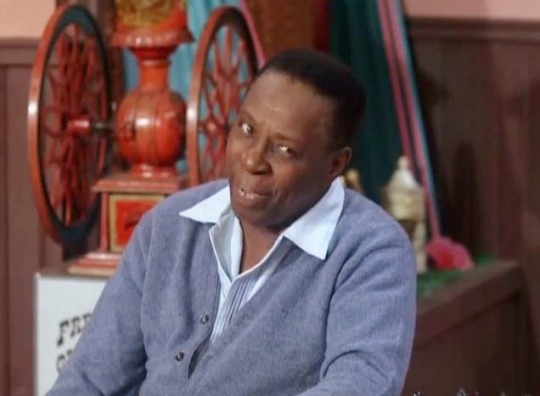
John
William Sublett (John
Bubbles) was known
as the ‘Father of Rhythm Tap’ and was the original Sportin’
Life on Broadway in Porgy
and Bess
(1935). Since he did not read music, George Gershwin himself had to teach him
the songs note by note. Sublett was his birth name but his stage name
was Bubbles, which he uses as his character name here. He will also
appear in the next episode “Lucy
Puts Main Street on the Map” (S5;18), after which he had a stroke
and had to retire from show business. He died in 1986.Although
not the first black performer on a Lucille Ball sitcom, Sublett has the
distinction of being the first to be be billed as a guest star and to
be an integral part in the storyline. The character sold his auto repair garage and bought the livery stables!
Paul
Winchell
(Doc Putnam) previously
played himself in “Lucy and Paul Winchell” (S5;E4). He was
born Paul Wilchinsky in 1922. Coming into the public eye in 1948, he
became one of the most famous ventriloquists since Edgar Bergen. He
hosted the enormously popular children’s television show
“Winchell-Mahoney Time” (1964-68) in which he shared the
spotlight with Jerry Mahoney, one of his most popular characters.
Winchell is fondly remembered as the voice of Winnie the Pooh’s pal
Tigger and (later) Papa Smurf. He returns to play Doc Putnam in “Lucy
Puts Main Street on the Map” (S5;18), as well as doing two episodes
of “Here’s Lucy.” Surprisingly, Winchell was also an inventor
who is credited with the artificial heart, among other innovations.
He died in 2005.Although
he was most famous as a ventriloquist, Paul Winchell does not do
ventriloquism in this episode.
Hal
Smith
(Mr. Weber) is
probably best remembered as Otis Campbell, the town drunk, on “The
Andy Griffith Show” (also filmed at Desilu) even though in real life he never drank
alcohol. He appeared with Lucille Ball in the 1963 film Critic’s
Choice.
This is the second appearance on “The Lucy Show.” He will also
play Mr. Weber in “Lucy
Puts Main Street on the Map” (S5;E18) and
did one episode of “Here’s Lucy” in 1972.In
1966, Smith first voiced the Owl in Disney’s animated “Winnie the
Pooh” featurettes. A year later, Paul Winchell joined the
franchise voicing Tigger. In 1981, Smith also assumed the role of
Pooh, succeeding Sterling Holloway, who (coincidentally) appeared on
an episode of “That Girl” the very day this “Lucy Show” was
filmed.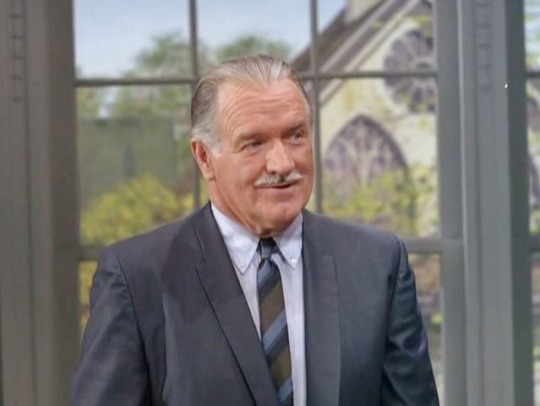
Barry
Kelley
(Mayor Adler) was seen on Broadway in the original cast of Oklahoma!
as
well as appearing opposite John Gielgud in Hamlet.
This is his only appearance with Lucille Ball.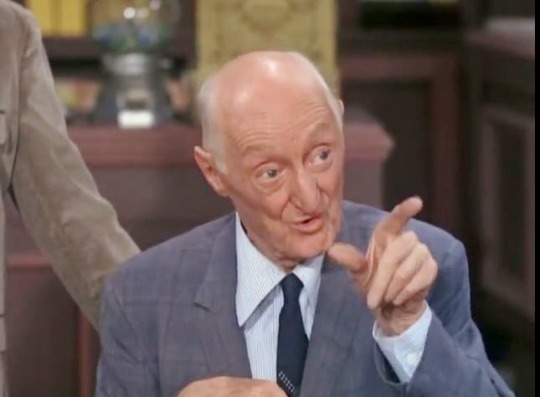
Burt
Mustin
(Old Uncle Joe) was born in 1884. He didn’t do his first film until
age 67, although his stage and radio career started earlier. He was
generally cast as the stereotypical little old man. He is probably
best remembered as Mr. Quigley on “All in the Family” and Mr.
Lanson on “Phyllis.” He will play Old Uncle Joe in the next
episode and do a 1973 episode of “Here’s Lucy.” Mustin also
played Uncle Jeff in Lucy’s Mame
(1974). He died at age 92.Uncle
Joe is said to be 105, although Mustin was merely 82 at the time of
filming.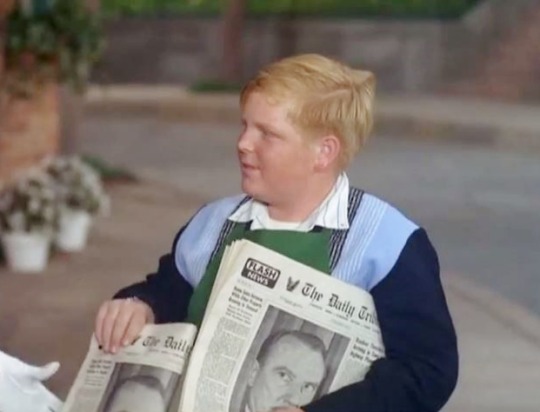
Jackie
Minty (Newspaper
Boy) was a child actor who had done two episodes of “The Munsters.”
A week after this episode of “The Lucy Show,” he appeared on “My
Three Sons,” his final screen credit before leaving Hollywood.Mabel
Smaney
(Townsperson, uncredited) was a busy Hollywood background artist
whose career spanned from 1939 to 1972.Max
Wagner
(Townsperson, uncredited) was another busy background artist. On the
night this episode of “The Lucy Show” first aired, he also
appeared as a townsperson on “The Andy Griffith Show,” which
followed “Lucy” on CBS.Farmer
Brown and the other citizens of Bancroft are played by uncredited
background artists.
This
is one of five episodes (of 156) that does not feature a characters’
name in the title and only one of ten that does not have “Lucy”
in the title.
The date this episode was first aired, Desilu Studios was busy filming “The Devil in the Dark”, an episode of “Star Trek” which aired on March 8, 1967. The episode featured “Lucy Show” background performers Janos Prohaska, Robert Hitchcock, and Monty O’Grady. Star William Shatner later said the episode was "exciting, thought-provoking and intelligent” and that “it contained all of the ingredients that made up our very best Star Treks.”

That evening, the episodes’s lead-in was “Mr. Terrific,” starring “Lucy Show” character actors Bill Quinn, Ellen Corby, and John McGiver (bottom left).
This episode was filmed on December 8, 1966.

This episode, like nearly all others in season five, somehow fell out of copyright protection and into public domain, resulting in its appearance on many discount home videos and YouTube reproductions.

Although stand-alone in their plots, this episode is
linked to the next one, “Lucy Puts Main Street on the Map”
(S5;E18), which also takes place in the small town of Bancroft.
Main
Street U.S.A. was also the name that Disneyland (and subsequently all Disney Magic Kingdom theme parks) gave to its iconic
shop-lined boulevard, an idealized version of an American main street
at the turn of the 20th century.
The Daily Tribune is Bancroft’s newspaper. It costs five cents a copy. As usual, all the prop newspapers were created by Hollywood’s Earl Hays Press. The top left corner of the paper has the words “Flash News” which appeared on many Hays newspapers on Lucycoms.

The episode is set entirely in the small town of Bancroft, a welcome change of pace for viewers.
Bancroft is located in
California (there is a state flag in the mayor’s office), but feels more like a mid-western or northeastern town.
Although this is a fictional location, there is a Bancroft outside of
San Francisco. At the time of filming, however, it was known as
Hookston, an unincorporated community in Contra Costa County. Bancroft / Hookston was also on a train line.
A brass band (playing “Main Street U.S.A.”) ‘welcomes’ Mr. Mooney to Bancroft!

Doc Porter’s General Store sells Fresh Ground Coffee for just 59 cents a pound! This is a real ‘old fashioned’ bargain as the national average in 1967 was 90 cents a pound. Between 1967 and 2019 coffee experienced an average inflation rate of 3.89% per year. In other words, coffee costing $20 in 1967 would cost $145 in 2019!

Next
to Doc Porter’s store is Grandma Thompson’s Bakery. This is likely a tribute to director Maury Thompson, the show’s Director and a long-standing member of the Desilu family. The new freeway is schedule to go right through Doc Porter’s store!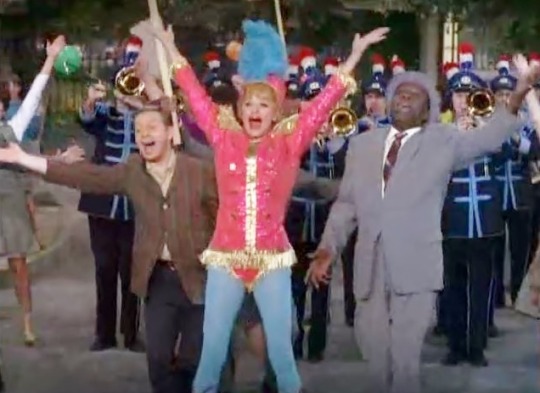
Mel
Tormé
wrote
the original song “Main
Street U.S.A.”
especially for the episode. The song is very reminiscent as Lucy’s signature song, “Hey Look Me Over” from the musical Wildcat, probably intentionally so. The song will be heard againin “Lucy Puts Main Street on the Map” (S5;E18). The ensemble was choreographed by series regular Jack Baker.

At the rally, one of the protest signs reads “Freeways Bring Smog”. Four days after this episode first aired in January 1967, Time Magazine devoted its cover story to air pollution with a photo of a smoggy Los Angeles. The topic of smog would also find its way into several “Lucy” scripts in the coming years.
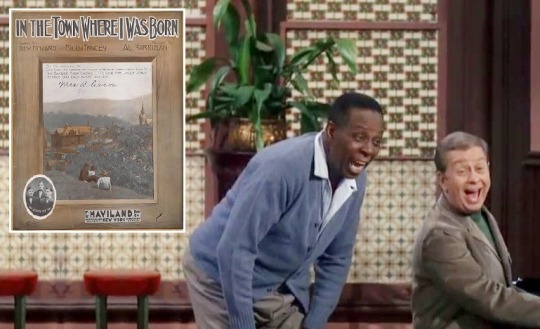
Mel
plays and sings with John Bubbles “In
the Town Where I Was Born”
a song written by Al Harriman, Dick Howard, and Bill Tracey in 1914.
During the song, Bubbles dances a soft shoe and Lucy joins in. “Lucy Show” regular staff member Marl Young arranged the dance music for Bubbles’ soft shoe.
Lucy
says that a marching band on a freeway could “start
off with 76 trombones and end up with one piccolo player.” “76
Trombones” is a show-stopping song from The
Music Man,
which first appeared on Broadway in 1957 and was filmed in 1962. The
film featured “Lucy Show” actors Mary Wickes, Ralph Hart, Charles
Lane, Max Showalter, Harry Hickox, John Breen, Ronnie Dapo, Ray
Kellogg, Natalie Masters, Larri Thomas, and Leon Altman. The final
song “Main Street U.S.A.” with Lucy dressed in a colorful drum
majorette outfit, is very much in the style of The
Music Man.
When
Lucy gets on her metaphorical ‘soap box’ about the evils of progress and the joys of small town life, Mr. Mooney
says
“Well, thank you Carrie Nation.” Carrie
Amelia Nation
(1846-1911) was
a radical member of the temperance
movement,
which opposed alcohol
before
the advent of Prohibition.
Nation led many rallies and protests in aid of her cause. The
temperance movement began in 1874 in Chautauqua, New York, very near
where Lucille Ball was born in 1911, the same year Nation died.Callbacks!

The character of Mel Tinker (Mel Torme) was introduced the previous season in “Lucy in the Music World” (S4;E3). He lived in the same L.A. apartment complex as Lucy and Mary Jane.

During
the chess match between Bubbles and Doc Porter, there is an argument
over “jiggling” – whether a chess piece was officially moved or merely “jiggled.” The word “jiggling” instantly recalls the “I Love Lucy”
episode “The Young Fans” (ILL S1;E20) in which Peggy (Janet
Waldo) is told to “keep jiggling” Ricky’s legs due to his rheumatism. The use of the word was controversial with
the censors, thinking it implied the “jiggling” of other parts of
the body!
A old fashioned soda fountain was also featured in “Lucy is a Soda Jerk”
(S1;E23).FAST FORWARD!

In March 2009, King of Prussia Plaza in Pennsylvania, hosted a three-dimensional walk-through fantasy exhibit titled “Rockwell’s America: Celebrating the Art of Norman Rockwell.” Through the window of the Appliance & Repair Shop on “Main Street USA,” vintage televisions played a black-and-white episode of “The Lucy Show.” Many Americans got their first view of the miracle of television through the appliance store window.

In December 2011, the episode was released on an official and newly restored DVD. Images of Lucy in her “Main Street” costume and sipping her strawberry soda were featured in the photo collage on the Season 5 slip case.

“Main Street U.S.A.” rates 3 Paper Hearts out of 5

-
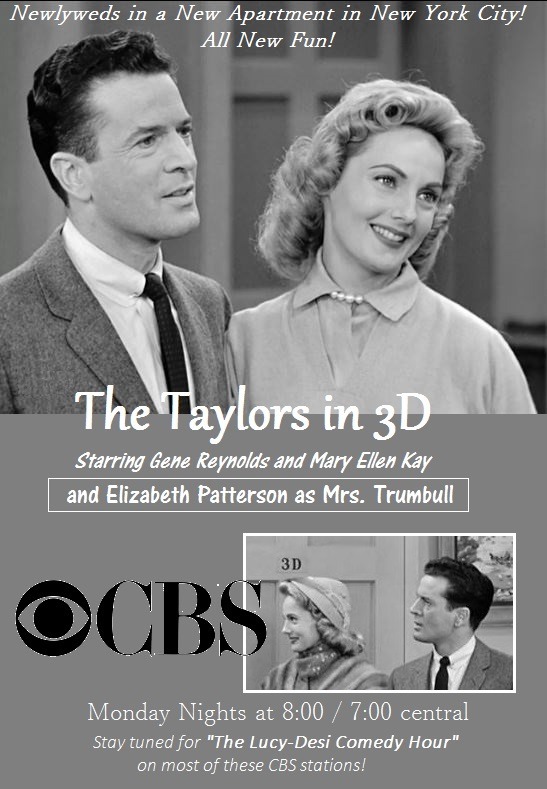
A little known (short-lived) sequel to “I Love Lucy”
-
Lucy the Babysitter
S5;E16
~ January 16,
1967

Synopsis
When
Mr. Mooney challenges Lucy to find another job, she goes to an
employment agency that sends her out to babysit – a family of
chimpanzees!Regular
Cast
Lucille
Ball (Lucy
Carmichael),
Gale Gordon
(Theodore J. Mooney)Mary
Jane Croft (Mary
Jane Lewis) and Roy
Roberts
(Mr. Cheever) do not appear in this episode.Guest
Cast
Mary
Wickes
(Mrs. Winslow) was one of Lucille Ball’s
closest friends and at one time, a neighbor. She made a memorable
appearances on “I Love Lucy” as ballet mistress Madame Lamond in
“The
Ballet” (ILL S1;E19).
In
her initial “Lucy Show” appearances her characters name was
Frances, but she then made four more as a variety of characters
including as Mary Jane’s Aunt Gussie. Wickes appeared in nine
episodes of “Here’s Lucy.” Their final collaboration on screen
was “Lucy Calls the President” in 1977.The
last time Wickes appeared on the series was “Lucy and the Sleeping
Beauty” (S4;E9) which starred Clint Walker as Frank Winslow, the
same surname that Mary Wickes is given here.
Elvia
Allman
(Miss Allman) is
best remembered as the barking Candy Factory foreman in “Job
Switching” (ILL S2;E1)
although
she also played four other characters on “I Love Lucy”.
She last
appeared on the series in “Lucy Bags a Bargain” (S4;E17)
co-starring Jonathan Hole, who also appears in this episode.Elvia Allman uses her own name in this episode. She runs the Unique Employment Agency.

Jonathan
Hole
(Jonathan Winslow) was
seen in eight Broadway plays between 1924 and 1934. His screen career
began in 1951. This is the second of his three appearances on the
series. He also did two episodes of “Here’s Lucy.”Joyce
Smith
(Sister) was a member of the English singing group The Vernon Girls,
first formed in Liverpool in 1953.
The
Marquis Chimps
began appearing on television in 1955. Their trainer was Gene
Detroy. They appeared in several TV commercials and on “The Ed
Sullivan Show.” The chimps were the (non-human) stars of the
sitcom “The Hathaways” (1961-62) in which a suburban couple kept
three performing chimps as their children. The program lasted just
one season on ABC. The act’s last TV appearance was in 1976.
Mary
Wickes says the chimps names are Danny (red striped shirt), Charlie
(black striped shirt), and Bobbie (short for Roberta, the baby).
Charlie was the only one to have been billed on “The Hathaways”
although “The Lucy Show” may have changed the names of the other
two to make the names easier for Lucy to say and remember.
This episode as well as the entire fifth season of “The Lucy Show” (except for “Lucy Puts Main Street on the Map”) inadvertently fell out of copyright protection and entered public domain resulting in many low-quality VHS and DVD editions.

A black and white publicity still sent to media outlets.

Seeing
Lucy trying to fix her new electric typewriter with the heel of her
shoe, Mr. Mooney says “Those
boots were made for walking,”
a reference to the Nancy Sinatra hit song of 1966 “These
Boots Are Made For Walkin’.”
Lucy prefers her old manual typewriter saying “Tom
Edison himself couldn’t work this one.” Although
Thomas Alva Edison (1847-1931) is credited with many modern
innovations, the typewriter is not one of them. The first
commercially viable typewriter is credited to inventor and politician
Christopher
Latham Sholes
(1819-90).Lucy is trying to get used to her new electric typewriter – if she can remember to plug it in! Once she gets the hang of it, she says:
“It practically types by itself! I bet someday they do invent a typewriter that types by itself!”
Is Lucy predicting the advent of voice recognition software? Her fanciful wish has become a reality – without the clunky hardware.

Lucy
Carmichael says she lives at the Glenhall Apartments, 780 North Gower
Street.
This was actually the address of Desilu Studios (formerly RKO, now
Paramount) in Hollywood!
When
doing a word association test with Miss Allman, Lucy connects “hair”
with “dye” and then remarks “I
just use a little henna.”
Lucille
Ball started coloring her hair with Egyptian henna in 1942, to set
herself apart in technicolor movies. Her hair stylist Irma Kusely was
instructed to keep the formula under top secret. In
“The Publicity Agent” (ILL S1;E31) Lucy claims that she’s “not
a ‘maharincess’ but a ‘henna-rinsess’.” When a heavily bandaged
Lucy thinks there’s a fire in the apartment during “Fred and Ethel
Fight” (ILL S1;E22) the only thing she tries to save are two
bottles of Henna Rinse!
She
then associates the word “carry” with “Grant,” remarking that
“these days he can use a babysitter.” In 1966, actor Cary
Grant
became a father at the age of 62 and retired from screen acting. A
favorite of Lucy Ricardo’s, Grant’s name was mentioned five times on
“I Love Lucy,” although the closest Lucille Ball ever got to
working with Grant was on TV variety specials and award shows.
To
demonstrate her fitness for a babysitting job, Lucy’s repeats her
mother’s child-rearing poem:
“If
you want a happy baby, here’s the thing to try.
Keep
one end fed and the other dry.”Lucy tells the woman at the employment agency that her two children are away at school, one of the few mentions of Chris and Jerry (who she last referred to as Jimmy) in quite a while.

Lucy tells Bobbie to say her prayers before going to bed and the chimp clasps her hands in the traditional praying position. This was obviously one of the ‘tricks’ that the chimps knew and was integrated into the script. “Lucy” shows rarely talk about religion. The notable exception is Lucy Ricardo telling Little Ricky to go to bed and say his prayers in “The I Love Lucy Christmas Show”.
The Winslows live at 1711
Valley Meadow Road. Valley Meadow Road is a real street in Sherman
Oaks, California, outside of Los Angeles, although in reality there
is no number 1711.
Then
entire second half of this episode consists of Lucille Ball (age 55)
ad libbing dialogue and business as the chimps went through certain
set comic routines, their trainer just off camera. A cigarette smoker, Ball is
noticeably winded by her ordeal with the unpredictable chimps.
This
is the first time live chimps have been part of a “Lucy Show”
episode. Previously, simian characters were played by actors in
monkey suits. The Marquis Chimps join a long line of live animal
actors Lucy has shared the set with: dogs, sheep, seals, dolphins,
donkeys,
deer, goats, geese, turkeys, chickens, rabbits, birds,
cows, horses, and bears. Many more will turn up in future episodes
and on “Here’s Lucy.”
Charlie
turns on the TV and a soap opera is on. Lucy tells him to turn it
off – he’s too young for “Peyton Place.” This is the third mention of the phenomenally successful TV show. Based
on a 1956 novel, “Peyton
Place” was
a primetime soap opera that aired on ABC from 1964 to 1969. The title
has become synonymous with the romantic problems and scandals of
small-town life. It was previously mentioned in “Lucy
and Joan” (S4;E4)
and
“Lucy’s Substitute Secretary” (S5;E14).
When
Lucy sings “Rock-a-bye Baby” to Bobby, Charlie gives her the
raspberry. Lucy says “Barbra
Streisand I’m not.”
From 1963 to 1968 singer Barbra
Streisand
was nominated for multiple Grammy Awards, winning several. At the
time this episode was filmed, Streisand had not yet made her first
film, an adaptation of her stage hit Funny
Girl in
1968.
She is now considered one of the most successful entertainment
artists in the history of show business.
Lucy
plays Brahms’ Lullaby on an electric organ that the Winslow’s just
happen to have in the chimps’ bedroom. Charlie once again gives Lucy
a raspberry so she says “if
you think you can do any better, you play.”
Naturally Charlie does! Both Lucy and Charlie’s playing is dubbed
from an offstage organ.
One of the toys in the chimp’s bedroom is Clancy The Great, a plastic-cast roller skating monkey, not unlike the Marquis Chimps, who also roller skate. He had pose-able arms and a removable cap. It was manufactured by Ideal Toys in 1963.
Callbacks!

Lucy
Ricardo was babysitter to rambunctious twins in “The Amateur Hour”
(ILL S1;E14). When taking the job, she tells Ethel that “for
$5 an hour I’d babysit with a baby gorilla!”
Be careful what you wish for! The
babysitting job to mind three Winslow “children” pays $5 and hour.
Fifteen years earlier Lucy Ricardo earned the same amount for sitting
with the Hudson twins. In
this episode Danny and Charlie Winslow play cowboys and Indians just
like Jimmy and Timmy Hudson did in 1952.
Elvia
Allman was also in the episode where Lucy Ricardo went to the Acme
Employment Agency and found employment at the Candy Factory in “Job
Switching” (ILL S2;E1).
Next to the chimps’ bunk bed is a yellow hound dog toy (possibly Disney’s Pluto), several of which were used in the toy factory scene in “Lucy and the Efficiency Expert” (S5;E13, inset photo).

Elephants are not new to Desilu. The final visual gag of “The Kleptomaniac” (ILL S1;E27) also featured a baby elephant. Lucy Carmichael dealt with a massive full-grown pachyderm in “Lucy Misplaces $2000” (S1;E4).
In 1965, Lucille Ball rode down a NYC street atop an elephant for the premiere episode of “The Steve Lawrence Show.” Ball was slated to play Angel the Elephant Girl in Cecil B. DeMille’s 1952 film The Greatest Show on Earth but fate intervened and Ball got pregnant and never got to make the film.
Flash Forward!

Lucy
visits the Unique Employment Agency when looking for a new job. This
is the name of the employment agency Lucy and Harry (Gale Gordon)
Carter work for in “Here’s Lucy.”
In
script supervisor Milt Josefsberg’s book on comedy writing, he described
how they reused the concept for a unique employment agency as the
basis for Lucille Ball’s new show. In this episode their motto is
“Odd Jobs for odd people” but in “Here’s Lucy” it is changed
to “Unusual jobs for unusual people.”
Live chimps were also seen on several episodes of “Here’s Lucy”.
Blooper
Alerts!
Experience Required! Lucy
tells Miss Allman that she has two years of business college but in
“Lucy’s College Reunion” (S2;E11), we learn that Lucy Carmichael attended
(fictional) Milroy University, a four-year liberal arts college.
Never Work With Children & Animals! Although
not seen on screen, the baby elephant brought on at the end of the episode went wild
and pushed Mary Wickes into one of the prop trees. The trainer had to
physically subdue the elephant to get it away from Wickes, who
injured her arm. Lucille Ball quickly scooped up the baby chimps in
her arms
to protect them. The final cut ends with the entrance of the baby elephant.
“Lucy the Babysitter” rates 4 Paper Hearts out of 5
1967, babysitter, Barbra Streisand, Cary Grant, CBS, Chimpanzees, Desilu, elephant, Elvia Allman, employment agency, Gale Gordon, Gower Street, Jonathan Hole, Joyce Smith, Lucille Ball, Lucy the Babysitter, Mary Wickes, Nancy Sinatra, Peyton Place, The Hathaways, The Lucy Show, The Marquis Chimps, tv -
Viv Visits Lucy
S5;E15
~ January 9,
1967

Synopsis
Viv
visits Lucy in Los Angeles and tells her some gossip about a Danfield
boy who is now hanging out on the Sunset Strip. Hoping to rescue the
once-promising college boy, Lucy and Viv try to blend in to track him down.Regular
CastLucille
Ball (Lucy
Carmichael),
Gale Gordon
(Theodore J. Mooney)Mary
Jane Croft (Mary
Jane Lewis) and Roy
Roberts
(Mr. Cheever) do not appear in this episode.Guest
Cast
Vivian
Vance
(Vivian Bunson) returns to the series in the role she created, Lucy’s
best friend and former roommate, Vivian Bagley (now Bunson). Vance
was
born Vivian Roberta Jones in Cherryvale, Kansas, in 1909, although
her family quickly moved to Albuquerque, New Mexico, where she was
raised. She had extensive theatre experience, co-starring on Broadway
with Ethel Merman in Anything
Goes.
She was acting in a play in Southern California when she was spotted
by Desi Arnaz and hired to play Ethel Mertz, Lucy Ricardo’s
neighbor and best friend. The pairing is credited with much of the
success of “I Love Lucy.” Vance was convinced to join the cast
of “The Lucy Show” in 1962, but stayed with the series only
through season three. She made half a dozen appearances on “Here’s
Lucy,” as well as joining Ball for a TV special “Lucy Calls the
President” in 1977. Vance died two years later.
Chet
Stratton (Airline
Official) was born in Paterson, New Jersey, in 1915. He was a
prolific actor in both New York and Hollywood, with 11 Broadway plays
to his credit between 1934 and 1953. Born
into a theatrical family, he toured as a child in repertory shows and
in vaudeville.
This is his only appearance opposite Lucille Ball.
Jerry
Rush
(Airline Gate Attendant) makes
the seventh of his nine (mostly uncredited) appearances on the
series. He also did two episodes of “Here’s Lucy.”
Steven
Marlo
(Hy, a Biker) appeared as the Marine Guard in “Lucy and the
Submarine” (S5;E2). This is his final appearance on the series.
Ray
Kellogg
(Motorcycle Officer, above right) played
the barking Assistant Director (“Roll
‘em!”)
in “Ricky’s
Screen Test” (ILL S4;E6)
and later appeared in “Bullfight
Dance” (ILL S4;E22).
This is the sixth of his seven episodes of “The Lucy Show.” He
also did two episodes of “Here’s Lucy.” Just as he does here,
most most time he played a policeman.John
J. ‘Red’ Fox (Patrolman
Harry McLeod, above left) was also best known for playing policemen, which is
what he did on five of his eight appearances on “The Lucy Show”
as well as three of his five episodes of “Here’s Lucy.”The
Patrolman is never addressed by his surname during the episode.
Ralph
Maurer
(Hairy Ape Doorman) was born Lev Mailer. This is his very first
screen appearance and his only one with Lucille Ball. He became a
respected acting teacher.
Les
Brown Jr.
(Herbie Watson aka Itchy) was the real life son of bandleader Les
Brown. He was best known for playing Jim Bailey on TV’s “The
Baileys of Balboa,” a one-season comedy on CBS from 1964-65. This
is his only appearance with Lucille Ball.Lucy
says she was at Herbie’s high school graduation. His parents are
Helen and Joe Watson, a barber from Danfield. Brown’s real
life father, Les Brown Sr. (the bandleader), was mentioned in “Viv
Moves Out” (S2;E22).
Charley
Britt
(Hairy Ape Dancer, above right) played Charley on “The Adventures of Ozzie and
Harriet” from 1961 to 1965. It was on a 1962 episode of the show
that he met his future wife, Pamela Austin. This is his only
appearance with Lucille Ball.Tony
Barro
(Hairy Ape Dancer, above left) has only one other credit (according to IMDB), a
1970 episode of “Pufnstuf.”Christopher
Riordan
(Hairy Ape Patron, uncredited) began his screen career in 1956 and is
still acting today. He plays Chris in the NBC show “Superstore.”Several
dozen other background performers play travelers at the airport, the
people on Sunset Strip, and patrons of The Hairy Ape.
This
episode was filmed on November 17, 1966. That evening Ralph Hart,
who had played Viv’s son Sherman, appeared on an episode of “My
Three Sons.” Also a regular on “My Three Sons” was Barry
Livingston, who twice played Mr. Mooney’s son Arnold.
The
evening this episode first aired (January 9, 1967) CBS gave “The
Lucy Show” a new lead-in titled “Mr. Terrific,” a mid-season
replacement and super hero series designed to fight the phenomenon of
“Batman” on ABC. The first episode of “Mr. Terrific”
featured character actor John McGiver (above center), who had played a Lawyer in
“Lucy is a Kangaroo for a Day” (S1;E7) and a Judge when “Lucy
is Her Own Lawyer” (S2;E23). He will play Lawyer Babcock opposite
Lucille Ball in 1974’s Mame.
“Mr. Terrific” proved ‘not so terrific’ in the ratings and lasted
just one season.
This
is Vivian Vance’s first appearance on the show since episode “Lucy
the Disc Jockey”
(S3;E26) at
the end of Season 3.
The very first line of the episode! Lucy Carmichael: Mistress of the Obvious!
Continuing to be clueless, Lucy looks up at the airplane arriving and mistakes the landing
gear for Viv!Even though the production previously used stock
footage of the exterior Los Angeles International Airport (LAX) in
“Lucy Flies to London” (S5;E6), they do not do so here. It looks
as though it is supposed to be a local airport.
Naturally,
the studio audience gives Vivian Vance a very warm round of entrance
applause.Viv
says her husband (Mr. Bunson) is handsome, tall, dark hair, blue
eyes, strong, and has lots of character. He will never be seen on camera.
Viv
tells Lucy that she is taking singing lessons back home. Her husband
calls her his “happy little canary.” Mr. Mooney remarks that
he’s never seen a 150 pound canary. Ironically, he will in 1971 when Viv (Jones) dresses as a canary to sing “Yellow Bird” (above) on a cruise ship to Hawaii on “Here’s Lucy.”This episode again resorts to jokes
about Viv’s weight and her propensity for overeating, saying that
she’s cut down to just six meals a day. She also remarks that is now
three hours younger due to the time change, contributing jokes about
age as well.When Viv relays that a former hometown boy, Herbie Watson, is hanging out on the Sunset Strip with long hair and a wristwatch for an earring, Lucy is determined that they should find him and set him right before his mother finds out! Viv is reluctant:
VIV: “I came here to see the sights.”
LUCY: “Well, then you’ve got nothing to worry about. You’re going to see the Sunset Strip, and believe me girl, that’s a sight!”
The
Sunset
Strip
is the name given to the mile-and-a-half stretch of Sunset
Boulevard
that
passes through West
Hollywood, California.
The Strip is probably the best-known portion of Sunset, embracing
boutiques, restaurants, rock clubs, and nightclubs
that
are on the cutting edge of the entertainment industry. In the
mid-1960s it became a major gathering place for the counterculture
and
the scene of the Sunset
Strip curfew riots of
November 1966 (the same month this episode was filmed). The riots
involved police and crowds of young club-goers, and inspired the
Buffalo
Springfield song
“For
What It’s Worth.”
When
the two policemen see Lucy with her foot up on their motorcycle, they
wonder aloud if the ‘new rules’ allow them to tell her to take her
foot off of it. This gets a loud round of applause from the studio
audience, reacting to the headlines of the day. Later, the nightclub
where Lucy and Viv are hanging out is raided by the police. The
charge? Violating the curfew laws! Straight from the headlines to
sitcom history. Six weeks later a low-budget film titled Riot
on the Sunset Strip
was released. “Lucy Show” and “Here’s Lucy” background actor
Dick Winslow had a small role in the film. For all its topicality,
this episode still presents some misconceptions about the youth of
the mid-60s. Viv and Lucy call the young people “kooks” and “weirdos.” It is clearly written from the somewhat skewed
perspective of the older generation.
The
Police Officer’s motorcycle is a 1958 Harley-Davidson Duo Glide.
Several other motorcycles are also parked on the street during the
scene.
Lucy
and Viv visit Sunset Strip dressed as an odd combination of beatniks,
hippies, and mods. There they pass by:- Hamburger Hovel – Home of
the Famous Bikerburger - Half Beat Harold’s (a record shop)
- Milt’s Mad Mod Pod (a boutique). The name Milt may be a tribute to
Milt Josefsberg, the show’s script supervisor.
About Toronto’s famous “Strip”, English writer Stephen Brook may well have been describing the opening scene of this episode:

Interestingly, Half Beat Harold’s was another Toronto landmark.


Above is the same portion of The Sunset Strip (8650 Sunset Boulevard) as it looks today.
The
reveal of the interior of The Hairy Ape nightclub, with its live band
and dancers in full swing, gets a round of applause from the studio
audience.
At
The Hairy Ape, two scruffy dancers ask Lucy and Viv if they know how
to dance The Arrow or The Rooster. Instead, Lucy and Viv show them
how to do The Lighthouse and The Chipmunk – which they make up on
the spot.
All four dances were created for the episode.
Biker
Hy asks “Vi” (Viv) and “Loose” (Lucy) if they belong to the
Sharks or the Cobras. Lucy replies that they are part of the
Bloomer Girls (an undercover outfit). Bloomers, a lightweight, loose-fitting leg
covering for women similar to pants, were first introduced to America
in 1851 by temperance advocate Amelia Bloomer. In the 1890s
all-female sports teams began adopting the mode of dress and became
known as ‘bloomer girls’. In “The Camping Trip” (ILL S2;E29)
Lucy and Ethel set up a basketball court in their living room and
Fred calls them “bloomer girls.” There was also a Broadway musical titled Bloomer Girls which was adapted for television in 1956 starring Keith Andes, who played the male lead opposite Lucille Ball in Wildcat on Broadway.The
young revelers at The Hairy Ape snap their fingers in approval of the
band’s performance. Unfortunately, it mixes with the studio
audience’s applause and is drowned out a bit. Snapping instead of
clapping was associated with the beatniks, who met in
‘underground’ coffee houses and bars for their performances.
Itchy
recites his “song” rather than sings it and strums a random chord
or two on his ‘gitbox’ in between verses. Similarly, Lucy picks up
the guitar to accompany Viv in her song, but only strums it once.
Lucy does not know how to play the guitar so it is odd to see her so
eagerly pick it up. It may be that Les Brown Jr. (despite his musical
lineage) did not either!
Itchy
tells Viv he doesn’t miss his parents because “that
‘Maggie and Jiggs’ action was pretty hard to take.”
Maggie
and Jiggs
(or Jiggs and Maggie)
was the colloquial name for a comic strip actually titled “Bringing
Up Father.” It was created by George McManus and ran from 1913 to
2000. The strip presented the life of a nouveau-riche American
family. It was translated to stage, radio, television and six
films.
Before
leaving The Hairy Ape, Viv takes the stage to sing “her best song”
– “I
Dream of Jeanie with the Light Brown Hair” by Stephen Foster (1826–64), first published in 1854. Lucy
and Rosie (Ann Sothern) sang it while drunk in “Lucy and the
Countess” (S3;E19). In some syndicated versions, Viv’s song is cut for time.Callbacks!

Inside
The Hairy Ape, the décor includes the female bull head Lucy Ricardo
wore in “Bullfight Dance” (ILL S4;E22) back in 1955. Clearly, the Desilu Props Department was raided for this episode!
A
female dancer in the club is wearing the same (or same type of) shift
dress worn by Lucy in the beach scene of “Lucy is a Chaperone”
(S1;E27), with
the face of a smiling girl with free-flowing pigtails on the back.
Here the face is worn on the front. It is interesting to see both of
these props / costumes in color for the first time!
The diamond-shaped drop earrings worn by the blond extra in the Hairy Ape are the same ones worn by Lucy Carmichael in the 1966 special “Lucy in London”.
Blooper
Alerts!Behind
Lucy’s desk, the file cabinet ID tags have changed again since the
previous episode. Lucy’s filing system must be its own off-screen comedy!
“Viv Visits Lucy” rates 4 Paper Hearts out of 5
1967, Beatniks, Bloomer Girls, CBS, Charley Britt, Chet Stratton, Christopher Riordan, Gale Gordon, hippies, Jeanie with the Light Brown Hair, Jerry Rush, Jiggs and Maggie, John J. Fox, Les Brown Jr., Lucille Ball, Mods, Motorcycles, Mr. Terrific, Ralph Maurer, Ray Kellogg, Steven Marlo, Sunset Strip, Sunset Strip Curfew Riots, The Lucy Show, Tony Barro, tv, Viv Visits Lucy, Vivian Vance - Hamburger Hovel – Home of
-
Lucy’s Substitute Secretary
S5;E14
~ January 2,
1967

Synopsis
While
Lucy takes a scheduled vacation, she is replaced by a temporary
secretary (Ruta Lee) that may threaten her job security. Instead of
going away, Lucy keeps an eye on her wearing some outrageous
disguises.
Regular
CastLucille
Ball (Lucy
Carmichael),
Gale Gordon
(Theodore J. Mooney), Mary
Jane Croft (Mary
Jane Lewis)Guest
Cast
Ruta
Lee (Miss
Audrey Fields) was
born Ruta
Mary Kilmonis in Montreal,
Quebec.
Her first big film was as one of the brides in Seven
Brides for Seven Brothers
in 1954. She started on TV in 1950 and has continually made guest
appearances on dozens of series. She will play herself in “Lucy
Meets the Berles” (S6;E1) as well as the TV film “Lucy Moves to
NBC” in 1980. As of this writing, Lee is still acting in films.Miss
Fields was formerly private secretary to the president of the North
Atlantic Trust Company.
Barbara
Morrison
(Mrs. Winkler) was
an English-born actress making the second of her two appearances on
“The Lucy Show.” She also plays an irate shopper in “Lucy’s
Working Daughter,” a 1968 episode of “Here’s Lucy,” in
addition to two other episodes.Mrs.
Winkler is a widow from Pasadena. She has a lot of cherries in her
hat.
Roy
Roberts
(Mr. Cheever) was
born Roy Barnes Jones in Tampa, Florida in 1906. His early career was
on the Broadway stage, gracing such plays as Old
Man Murphy
(1931), Twentieth
Century (1932),
The
Body Beautiful
(1935) and My
Sister Eileen
(1942). In Hollywood, the veteran character actor clocked over 900
screen performances in his 40 year career, most of which were
authority figures. He and Lucille Ball appeared together in Miss
Grant Takes Richmond
(1949). On “The Lucy Show” he first appeared as a Navy Admiral
in “Lucy and the Submarine” (S5;E2). As of this episode he
becomes a recurring character on the show doing 14 episodes through the end of the series. He was
seen as various characters in 5 episodes of “Here’s Lucy.” In
addition, he was a regular on “McHale’s Navy” (Admiral Rogers),
“The Beverly Hillbillies” (John Cushing), “Bewitched” (Frank
Stephens), “Petticoat Junction” (Norman Curtis), and “Gunsmoke”
(Harry Bodkin). Roberts died in 1975 at age 69.
This
is the first new episode of calendar year 1967. It was filmed on
November 10, 1966.
Before
it was available on DVD, this episode was screened using a 16mm print
for Lucy’s 2008 Birthday Celebration in Jamestown as part of “An
Evening with Ruta Lee.” Lee talked about her work with Ball and
shared anecdotes about the episode.Lee
first met Lucille Ball at Del Mar Racetrack. They bonded over their
love of polka dots! In 1974, Lee presented Ball with the Thalians
Philanthropy Award for her support of mental health awareness, the
first female every to receive the recognition.
Lucy
is scheduled to vacation in Lake Arrowhead, a resort community in the
San Bernadino Mountains of Southern California. In 1959, Lake
Arrowhead stood in for the 49th state during second unit and location shooting of “Lucy Goes to
Alaska,” an episode of “The Lucy-Desi Comedy Hour” guest
starring Red Skelton.When prospective depositor Mrs. Winkler announces that she “must get back to Pasadena” the laugh track adds a small reaction, perhaps to indicate that Mrs. Winkler is supposed to be the classic “little old lady from Pasadena.” As she is leaving she says she is tired of boy scouts trying to take her across the street!

Lucy
says Audrey Fields is a “one
woman Peyton Place.” Based
on a 1956 novel,“Peyton
Place”
was
a primetime soap opera that aired on ABC from 1964 to 1969. The title
has become synonymous with the romantic problems and scandals of
small-town life. It was previously mentioned in “Lucy and Joan”
(S4;E4).
Mary
Jane has borrowed a wig from the studio for Lucy to be a brunette on
her vacation. She says it was worn by Audrey Hepburn “in
the picture we saw.”
Four months before the filming of this episode, Hepburn premiered the
film How
To Steal a Million
directed by William Wyler.Mr.
Mooney dictates a letter to Mr. Cavanaugh about the Winkler account.
He warns Miss Fields not to get them mixed up – unfortunately
within earshot of jealous Lucy.
When
Lucy dresses up as Margot of Margot’s Mad Mad Mod Interiors she uses
a Connecticut lock-jaw accent and dresses in mod clothes reminiscent
of her wardrobe during 1966′s “Lucy in London.”
For
a painting over Mr. Mooney’s desk, “Margot” suggests a Salvador
Dali: “That
way, whenever anyone comes through the door they can say…. [finish
the joke yourself].” Salvador
Dali (1904-89)
was best
known for the striking and bizarre images in his surrealist work.
The joke puns on the Broadway musical (still playing at the time)
Hello,
Dolly!
Lucy sang from the show and dressed as the title character in “Lucy
and the Undercover Agent” (S4;E10).
To
shampoo the rugs in Mr. Mooney’s office, Lucy dresses up as Jose
Hernandez from Jose’s Rug Cleaners. “Jose” says he cannot come
back at night because he has to see Esther (siesta). When Mr. Mooney
asks him if he could go someplace else he replies “Si,
Tijuana. But I no wanna.”Callbacks!

Lucy
Ricardo also donned a variety of disguises to keep an eye on a man
(Ricky) in “Lucy is Jealous of Girl Singer” (ILL S1;E10).Blooper
Alerts!Sitcom Logic Alert! Despite knowing Lucy Carmichael for many years, Mr.
Mooney fails to recognize Lucy in her variety of disguises – an
age-old comedy contrivance.The Better To See U! New
larger letters have been added to the file cabinets.
Getting Gale Soggy! As
soon as we see “Jose’s” carpet cleaning machine overflowing with
suds, we know that more than the rug will be getting shampooed.
Naturally, Mr. Mooney is the target of her soapy hose. This time,
however, it is deliberate.
One Hat / Two Actors! When
Lucy impersonates Mrs. Winkler, her dress is bright pink, where Mrs.
Winkler’s is cherry red. Lucy’s hat, however, is still red. It is likely that both Lucille Ball and Barbara Morrison wore the same hat.
“Lucy’s Substitute Secretary” rates 5 Paper Hearts out of 5
-
Lucy and the Efficiency Expert
S5;E13
~ December 12,
1966

Synopsis
An
efficiency expert (Phil Silvers) takes over the bank and makes Lucy
his gal Friday. On a visit to a toy factory looking for a big loan,
Lucy must work the assembly line to prove that one worker can do the
job of four. She fails – spectacularly!Regular
CastLucille
Ball (Lucy
Carmichael),
Gale Gordon
(Theodore J. Mooney), Mary
Jane Croft (Mary
Jane Lewis)Guest
Cast
Phil
Silvers (Oliver
Kasten) was born Philip Silversmith in 1911 (the same year as Lucille
Ball). He started
entertaining at age 11. He made his Broadway debut in 1939. In 1952
he won a Tony Award in the Broadway musical Top
Banana in
which he played a TV star modeled on Milton Berle. His feature film
debut came in 1940. Silvers
became a household name in 1955 when he starred as Sergeant Ernest G.
Bilko in “You’ll
Never Get Rich,”
later re-titled “The
Phil Silvers Show.”
Lucille Ball did a cameo on his show in March 1959. In 1963, Lucy and Phil performed the classic ‘Slowly I Turned’ sketch for “CBS Opening Night.” The year after
“Lucy and the Efficiency Expert” was first aired, Ball and
Silvers both had bit parts in the film
A Guide for the Married Man
(1967). He died at the age of 74.Oliver
Kasten tells everyone to call him “OK” (his initials). He calls
Lucy “Red.” Lucy then addresses Mr. Mooney as “TM.” Kasten
has been married 12 years and has 12 children. Now that’s
efficiency!
Tol
Avery
(Mr. Grantland) was a Texas-born character actor making his only
series appearance, although he returns for a 1970 episode of “Here’s
Lucy.”Grantland
is the owner of The Grantland Toy Company and is asking the bank for a
million dollar loan.George
DeNormand
(Bank Employee) appeared
in three films with Lucille Ball from 1937 to 1963. This is the just
one of his many appearances on “The Lucy Show” and “Here’s
Lucy.”Hazel
Pierce (Bank
Customer) was
Lucille Ball’s camera and lighting stand-in throughout “I Love
Lucy.” She also made frequent appearances on the show. Of her many
on-camera appearances on “The Lucy Show.” She was also an
uncredited extra in the film Forever
Darling (1956).
Roy
Rowan
(Voice on the Toy Factory Loudspeaker) was the announcer
for every episode of “My Favorite Husband,” “I Love Lucy” as well as “The Lucy Show”
and “Here’s Lucy.” He was also the voice heard when TV or radio
programs were featured on the plot of all three shows. His first
on-camera appearance was in “Lucy
Takes Up Golf” (S2;E17).
Male
and female background actors play the other bank employees and
customers. Wendy and Betty are are the names of two assembly line
workers at The Grantland Toy factory but they go uncredited.
This
is the final episode of the 1966 calendar year. The next new episode
will be seen on Monday, January 2, 1967.
Mary
Jane repeats a joke she says she heard on “The Red Skelton Show”
(1951-71). Red
Skelton
was a celebrity guest star on “Lucy Goes to Alaska,” a 1959
episode of “The Lucy-Desi Comedy Hour.” He also starred with
Lucille Ball in the film Du Barry
Was a Lady (1943).
Skelton’s show aired on Tuesday nights on CBS.
In
turn, Lucy repeats a joke she heard on “The Jackie Gleason Show”
(1966-70). The show aired on Saturday nights on CBS. In addition to
specials with Lucille Ball, Jackie
Gleason made
a 1968 cameo appearance on “Here’s Lucy” as his most famous
character Ralph Kramden. On her way out of the office after
mentioning the show, Lucy does Gleason’s famous “away we go”
exit.
When
Lucy wonders aloud why Mr. Kasten repeats everything, Mr. Mooney says
that his mother was frightened by a bunch of radishes. Radishes have
been known to “repeat” on some people – a polite way of saying
“make them burp.” Mr. Mooney makes no reference to a television
show to excuse his bad joke.Mr.
Mooney (probably joking) says his wife is bald! Lucy says that Mr.
Mooney’s wife is taking karate lessons! Irma sounds like a
formidable presence. While it might seem a shame that she is never
seen on screen, it is far more fun to imagine her!
Mary
Jane says an efficiency expert was hired by her studio to help save
money on a picture called Gunfight
at Gower Gulch.
Desilu (formerly RKO, now Paramount) was located on Gower
Street in Hollywood. It was informally known as “The Gower
Studios.”
About
Kasten, Mr. Mooney says, “He
reminds me of a sergeant I once knew.”
This is an allusion to Sergeant
Bilko,
a character played by Phil Silvers on “The Phil Silvers Show”
(1953-59). The series ran concurrently with “I Love Lucy” on CBS.
Curiously, the studio audience does not react to the reference, nor
does the production add in any “canned” audience reaction.
As
usual, Mr. Mooney gets all wet when Lucy lifts the jug off the water
cooler while they are moving it. Lucy previously had trouble with an
office water cooler in “Lucy is a Kangaroo for a Day” (S1;E7).
When
Lucy efficiently combines two proverbs into one, Kasten remarks “By
George, I think she’s got it!”
This was the triumphant cry of Professor Henry Higgins in the stage
musical and 1964 feature film My
Fair Lady.
Lucy did a parody of the show titled “My Fair Lucy” (S3;E20).We
learn (for the fist time) that Mary Jane and Lucy are bowlers!
As
the hobby horses come down the conveyor belt, it is Lucy’s job to put
on the saddle, insert the saddle horn, attach the horse’s head, and
add its tail. In between, she is also supposed to immediately
respond to any orders heard on the factory loudspeaker.
On
the shelves of the factory is a real-life product called Nutty
Mad Indian.
It was a mechanical tin toy depicting a Native American warrior with
a silly expression on its face beating a tom-tom. The battery
operated toy was manufactured in the 1960s by Marx but would
definitely not be “PC” today.
The toys described as “six
yellow hound dogs” certainly resemble Disney’s dog Pluto. This is
not the first time a Disney character toy has been seen on a “Lucy”
show. Cleo the Goldfish (from Pinocchio)
was a prop in “The Ricardo’s Change Apartments” (ILL S2;E26).
Like Pluto, Cleo went unnamed in the episode.This
is the final mention of Bank President Mr. Cheever before he finally
appears on screen in the next episode, “Lucy’s Substitute
Secretary” (S5;E14), the first new show of 1967.Callbacks!

Conveyor
belts always mean trouble in the Lucyverse! The most famous conveyor
belt in television history was found at Kramer’s Candy Kitchen in
“Job Switching” (ILL S2;E1). Lucy Ricardo also got “carried
away” via conveyor belt searching a laundry sorting room for “Bonus
Bucks” (ILL S3;E21). Lucy Carmichael was swept away on a post
office conveyor belt (and subsequently bagged and tagged) in “Lucy
and the Missing Stamp” (S3;E14). When we see the conveyor belt at
Grantland Toys, we know exactly what to expect!Blooper
Alerts!
Say What? When
Kasten and Lucy are reciting common sayings, Phil Silvers says one
backwards: "A
penny earned is a penny saved.”
Out of context it might seem that Silvers is being funny by
reversing the adage, but when viewed in the episode, it is clear that
he was supposed to be setting up Lucy for the punchline and simply
forgot the correct line.Reputation Tarnisher! When
Lucy is placed in charge by Mr. Kasten, Mr. Mooney says that he’s
never been able to get her to do extra work in the past. In the
previous episode, “Lucy and the Monkey” (S5;E12), Lucy was said
to be overworked to the point of having hallucinations, even asked to
sell tickets to the Bank Benefit. She has also been known to work
from home. So what exactly is Mr. Mooney talking about?Snake-in-a-Box! When
the voice on the loudspeaker orders a jack-in-the-box, Kasten and
Lucy both open snake cans.
Efficient? Any
assembly line that suddenly adapts to fill “on demand” orders
would be highly inefficient, although Kasten seems more upset about
the employees taking a coffee break, something that has proven to
improve worker productivity.Floor Plan! The
lobby of the bank has once again been reconfigured to accommodate the
action of the episode.
“Lucy and the Efficiency Expert” rates 4 Paper Hearts out of 5
-
Lucy and the Monkey
S5;E12
~ December 5,
1966

Synopsis
Mary
Jane warns an over-worked and over-tired Lucy that she could start
having hallucinations. Meanwhile, Mr. Mooney gets a visit from his
old college friend, who has a monkey for a show business partner.
Lucy goes to a psychiatrist when she sees the monkey and thinks it is
Mr. Mooney!Regular
CastLucille
Ball (Lucy
Carmichael),
Gale Gordon
(Theodore J. Mooney), Mary
Jane Croft (Mary
Jane Lewis)Guest
Cast
Hal
March (Robert Bailey) was first seen on “I Love Lucy” in
“Lucy Fakes Illness” (ILL S1;E16) using his own name to play an
actor who impersonates a doctor. He was then lingerie salesman Eddie
Grant in “Lucy is Matchmaker” (ILL S2;E27). In 1967 he was
seen with Lucille Ball in the film A Guide for the Married Man.
March and Ball were close friends. This is their final
appearance together.Bob
Bailey is one of Mr. Mooney’s college friends who is scheduled to
entertain at the Bank Benefit with his new partner, Max (the Monkey).
Lew
Parker (Dr. Parker) is probably best remembered as the father of
Ann Marie, Marlo Thomas’ character on TV’s “That Girl” (1966-71).
This is the first of his five appearances on “The Lucy Show” and
he will return for two episodes of “Here’s Lucy.” He appeared on
Broadway in musicals from 1928 to 1972.
Janos
Prohaska (Max the Monkey) was an actor, stunt man, and animal
imitator who is probably best remembered as the talking cookie-mad
bear on “The Andy Williams Show” (1969) although due to his thick
Hungarian accent, his voice was dubbed. He returned to play animals
in three episodes of “Here’s Lucy.” Prohaska died in a plane
crash in 1974.
This
is the first of two episodes written by Sam
Locke and
Joel Rapp.
Both returned to pen “Lucy and the Pool Hustler” (S6;E13). The
writers get a lot of mileage out of the adage “Trying to make a
monkey out of me,” which implies that someone is being made a fool
of.
This
episode is sometimes referred to as “Mooney the Monkey.” The title uses the word “monkey” but the
animal in question looks like a very large chimpanzee. Perhaps
because of the actor’s size, it was purposely left vague which
species of primate it is. On “Here’s Lucy” Lucy Carter has an
encounter with a (fictional) “garboona,” a cross between a
gorilla and a baboon, also played by Janos Prohaska.
This
is not the first time simian characters have been seen on “The Lucy
Show.” Actor George Barrows was inside the gorilla costume in
“Lucy and the Monsters” (S3;E18), “Lucy and Art Linkletter”
(S4;E16), and “Lucy Goes to a Hollywood Premiere” (S4;E20, above). In
“Lucy the Babysitter” (S5;E16) Lucy Carmichael takes care of
several chimpanzees, but this time they are live animals, not actors
in costume!
Mr.
Mooney once again has a telephone conversation with his boss, bank
President Mr. Cheever, a character that has been referred to for
nearly a year, but not yet seen. When he appears two episodes from
now, he will be played by Roy Roberts.Lucy
is asked to sell tickets for the Bank’s Benefit “for a very worthy
cause.” There was also a Bank Benefit in “Lucy and Paul
Winchell” (S5;E4). Winchell rightfully questioned why a bank
needed a benefit. We never learn what the “very worthy cause”
is. We also never see the benefit show itself to find out what Bob
and Max do in their act.Mr.
Mooney asks Lucy for “the Gordon Reports,” an obvious reference
to the actor’s own surname.
Mary
Jane says she has a cousin named Barbara who suffered a nervous break
down and developed hallucinations.Mr.
Mooney once again mentions that his wife is away with her “commando
troop.” In “Lucy the Robot” (S4;E23) the famously unseen Irma Mooney went to her commando troop’s reunion. This seems to be the excuse
for Mrs. Mooney not appearing in scenes taking place in her own home.
Mr. Mooney never says exactly what a “commando troop” is or what Mrs. Mooney does as part of it.Hal
March (Bob Bailey) gets entrance applause from the studio audience,
but it is likely due to his showy entrance singing and dancing rather
than his star status.
Bob
Bailey wants to take Max the Monkey to lunch at the Brown Derby, but
he isn’t wearing a tie! The Hollywood Brown Derby was famously
visited by Lucy Ricardo in “Hollywood at Last!” (ILL S4;E16) and by Lucy Carter in “Lucy and Johnny Carson” (HL S2;E11).
A
worried and befuddled Lucy asks Mary Jane how to spell “psychiatrist”
– with a “p” or an “s”? On “I Love Lucy,” Cuban-born
Ricky pronounced it “Fee-suh-kee-uh-tryst” and was shocked to
learn that it was spelled with a “p”.
To
decorate the psychiatrist’s office, “The Lucy Show” props
department created medical diplomas with “Dr. Lew Parker” on
them. These are readable over Lucy’s shoulder in the medium shots.
They also created a plaque with Dr. Parker’s favorite saying:FACE YOUR FEAR AND IT WILL DISAPPEAR

Lucy
at first thinks Parker’s favorite psychiatrist is Freud, but it is
actually himself. Sigmund
Freud
(1856-1939) is arguably the most famous psychotherapist to have every
lived. He developed what is commonly known as “talk therapy.”
Visually, he had a goatee beard and carried a cigar, an image that
today can infer ‘psychiatrist’ all on its own.
This
is the second time we have seen the living room of Mr. Mooney’s home.
The first was in “Lucy the Robot” (S4;E23). In that episode,
however, there was a giant black and white framed photo of Mr. Mooney
over the fireplace.
Lucy (as Major Fun Fun) and Wendell (Jay North)
threw eggs at it in that episode. Here it has been replaced by a
landscape painting.
Mr.
Mooney calls Max a “simian Socrates.” Socrates
was an ancient Greek Philosopher born around 470BC. Mr. Mooney is
likely inferring that Max is intelligent and has powers of reason.
Like
Mr. Mooney, Max the Monkey reads the Wall
Street Journal!
The newspaper is considered the bible of the business world. It was
first published in 1889 and is still around today.Lucy
questions Dr. Parker’s methods, citing the “hypocritical
oath!”
The
Hippocratic
Oath
is historically taken by new physician to uphold specific ethical
standards.
Once
again Mr. Mooney uses a punch line that concludes with a reference to
Rebecca
of Sunnybrook Farm,
a
1903 children’s novel by Kate Douglas Wiggin that tells the story
of Rebecca Randall and her cheerful optimism in the face of
adversity. The book (and subsequent film) was first mentioned in
“Lucy and the Winter Sports” (S3;E3) and again in “Lucy and Bob
Crane” (S4;E22).
When
Max the Monkey grabs up all Lucy’s Bank Benefit tickets, she quips
“Maybe
he’ll take Tarzan and Jane.”
She is referring to the Lord of the Jungle, Tarzan,
and his mate Jane,
the subjects of a 1914 novel by Edgar Rice Burroughs. The characters
have been the inspiration for dozens of films, television shows, and
stage productions. Carol Burnett did her version of “the Tarzan
yell” in two previous “Lucy Show” episodes.Callbacks!

Lucy
Ricardo saw a psychiatrist in “The Kleptomaniac” (ILL S1;E27, above) and
“The Inferiority Complex” (ILL S2;E18).
On the shelf in Dr. Parker’s office is one of the title props from “Lucy and the Ceramic Cat” (TLS S3;E16).
Blooper
Alerts!
Sitcom
Silliness! Lucy’s hallucinations would have to be more serious than that as
she could actually touch the monkey as well. She also fails to
notice that the monkey never speaks.
“Lucy and the Monkey” rates 2 Paper Hearts out of 5
-
Lucy and Pat Collins
S5;E11
~ November 28,
1966

Synopsis
When
Mr. Mooney gets insomnia, Lucy takes him to see Miss Pat, “The Hip
Hypnotist.” Pat Collins guest stars.Regular
CastLucille
Ball (Lucy
Carmichael),
Gale Gordon
(Theodore J. Mooney), Mary
Jane Croft (Mary
Jane Lewis)Guest
Cast
Pat
Collins
aka Miss
Pat (Herself)
ran a nightclub on the Sunset Strip where she was known as “The Hip
Hypnotist.” She presented hypnotism for entertainment, and much of
her act on “The Lucy Show” was the same as what she did in
nightclubs (without the more risque remarks). A year after this
appearance, she played herself in the film Divorce
American Style.
She died in 1997 at the age of 62. A documentary film of her life
was created.Miss
Pat is appearing at The Royal Club.
Patricia
Cutts
(Fur Salon Salesperson) was an English-born actress who came to America to star
in films and stage plays. She was a replacement for the character of
Irene Malloy in Broadway’s The
Matchmaker
(1955) and did three more plays through 1966. This is her only
appearance with Lucille Ball.
Joan
Swift
(Fur Salon Maid) makes
the second of her six appearances on the series. Swift also did two
episodes of “Here’s Lucy.” Her final screen credit was 1975’s
“Lucy Gets Lucky” with Lucille Ball and Dean Martin.
Georgia
Holt
(Georgia, Model) was a fashion model who famously made a walk-on
appearance as one of Jacques Marcel’s burlap-clad models (the one
with the champagne bucket
on her head) in “Lucy Gets a Paris Gown” (ILL S5;E20). She is
the mother of superstar singer Cher, who was 19 years old when “Lucy
and Pat Collins” was filmed.A
few of the Audience Members at Pat Collins’ show include:Hazel
Pierce
was
Lucille Ball’s camera and lighting stand-in throughout “I Love
Lucy.” She also made frequent appearances on the show. This is just one of her many
on-camera appearances on “The Lucy Show.” She was also an
uncredited extra in the film Forever
Darling (1956).Leoda
Richards
made
at least three background appearances on “I Love Lucy.” This is
the third of her four episodes of “The Lucy Show.” She was also
in the Lucille Ball film Yours,
Mine and Ours (1968)
and did two episodes of “Here’s Lucy.” Her main claim to fame is
her appearance at the party given by Captain Von Trapp in The
Sound of Music,
standing next to Christopher Plummer during the song “So Long,
Farewell.”Richards sits directly behind and between Lucy and Mr. Mooney at the Royal
Club.Jerry
Rush makes
the fifth of his nine (mostly uncredited) appearances on the series.
He also did two episodes of “Here’s Lucy.”Sid
Gould
(Show
Announcer Voice) made more than 45 appearances on “The Lucy Show,”
all as background characters. He also did 40 episodes of “Here’s
Lucy.” Gould (born Sydney Greenfader) was Lucille Ball’s cousin
by marriage to Gary Morton.Gould
performed this same kind of uncredited voice over introduction in
“Lucy
and George Burns” (S5;E1)
and
“Lucy and Paul Winchell” (S5;E4).
This
is the first episode of season 5 to revert to a slightly modified
version of the ‘kaleidoscope’ opening credit sequence after beginning
the season with the ‘jack-in-the-box’ opening that Lucille Ball
disliked so much. In syndication, most all episodes were re-edited
to begin with the ‘kaleidoscope’ opening no matter which season they
were from.
Spending
their lunch hour at a swanky fur salon (to take advantage of the free
finger sandwiches), Lucy is shown a $16,000 dollar fur coat. The
saleslady says that there is only one other like it worn by the Queen
of England. When Lucy (acting posh) says it is not for her because
she and the Queen go to the same parties, she is shown a full length
chinchilla coat with a hem that detaches to become a stole. It costs
just $35,000 (the equivalent of more than $280,000 today). Mary Jane
and Lucy confide that they only have 27 cents between them.
On
“The Tonight Show with Jay Leno” on April 30, 2013 Georgia
Holt mentioned that she was in this episode.
Through
hypnotism, Miss Pat broke Mary Jane’s habit of biting her nails (as well as the nails of
her boyfriends).Mr.
Mooney dictates a letter to Rylander and Mosier. Mr. Mooney will also
dictate a letter to Rylander and Mosier in “Lucy Gets Involved”
(S6;E17). In a 1970 episode of “Here’s Lucy,” Carole Cook will
play a character named Lillian Rylander.
To
cure his insomnia, Mr. Mooney says he tried listening to Wayne King
records. Wayne
King
(1901-85) was a musician, songwriter, singer and orchestra leader
with a long association with CBS.
He was sometimes referred to as the
Waltz King because
much of his most popular music involved waltzes. During his career he
released 46 records. Obviously, Mr. Mooney is inferring that King’s
music is boring and could put a person to sleep.
Mr.
Mooney balks about appearing in Miss Pat’s act saying that he has to
uphold the dignity of the bank. Mr. Mooney has previously appeared
on stage doing some pretty outrageous things. Perhaps he questions the legitimacy of hypnosis or the fact that Miss
Pat’s act is performed in a night club (usually a place associated
with loose morals). Gale Gordon previously played nightclub owner
Alvin Littlefield on “I Love Lucy.”
“The
Lucy Show” sound department adds Theremin music to underscore Miss
Pat’s performance, adding an ethereal, science-fiction feeling to her
act. Theremin was also used to underscore Lucy Ricardo’s dream
sequence in “Lucy and the Dummy” (ILL S5;E3). The editors also
employ the “wavy screen” visual effect usually used to indicate a
dream sequence. It is timed to lead into a commercial break.
Under
hypnosis, Mr. Mooney indignantly tells Miss Pat he never turned a
cartwheel in his life. Actually, Mr. Mooney has turned several
cartwheels on “The Lucy Show.” It was one of Gale Gordon’s
special skills. Banker Mooney did a cartwheel in “Ethel Merman and
the Boy Scout Show” (S2;E19) as well as when he was hypnotized in
“Lucy the Stockholder” (S3;E25).
While
still hypnotized, Lucy and Mr. Mooney become Stan Laurel and
Oliver Hardy. In “Lucy in London” Anthony Newley did an
imitation of Stan Laurel and using Hardy’s iconic phrase “That’s another fine mess you’ve gotten us into,” which
Mr. Mooney paraphrases here.Callbacks!

This is not Lucy Carmichael’s first brush with hypnosis. In “Lucy Conducts the Symphony” (S2;E13) she hypnotized Wally Cox.

In “Lucy the Stockholder” (S3;E25) she pretended to be under hypnosis for an age regression experiment.

Lucy Ricardo was
hypnotized (or pretended to be) in
“The Kleptomaniac” (ILL S1;E27).
Like
the characters she played, Lucille Ball also loved furs. She was
often photographed in fur coats or stoles, even doing an ad for
Blackglama in 1984.
Back in Danfield, Lucy shopped at Madame
Fifi’s fur salon in “Lucy
Gets Amnesia” (S3;E4).
She also tried to make extra money to buy a fur coat in 1965′s “Lucy the
Stunt Man” (S4;E5).
In 1951, Lucy Ricardo briefly owned a genuine mink in “The
Fur Coat” (ILL S1;E9) before leaning it was a costume piece rented
for Ricky’s act.Blooper
Alerts!
Where The Floor Ends! When
the camera pulls back in the fur salon, it reveals were the carpeting ends and the cement stage floor begins. This also
happens in the wide shot of the Royal Club. This error is quite common on “The Lucy Show.”
“Lucy and Pat Collins” rates 3 Paper Hearts out of 5
1966, CBS, Cher, Fur Coat, Gale Gordon, Georgia Holt, Hazel Pierce, Hypnosis, Hypnotist, Jerry Rush, Joan Swift, Laurel and Hardy, Leoda RIchards, Lucille Ball, Lucy and Pat Collins, Mary Jane Croft, Miss Pat, Nightclub, Oliver Hardy, Pat Collins, Patricia Cutts, Sid Gould, Stan Laurel, The Hip Hypnotist, The Lucy Show, Theremin, tv, Wayne King -
Lucy and John Wayne
S5;E10
~ November 21,
1966

Synopsis
Mr.
Mooney asks Lucy to deliver some important contracts to the studio,
where she meets John Wayne and worms her way onto the set of his
latest picture. Naturally, Lucy doesn’t behave and causes more
trouble than a barroom brawl!Regular
CastLucille
Ball (Lucy
Carmichael),
Gale Gordon
(Theodore J. Mooney), Mary
Jane Croft (Mary
Jane Lewis)Guest
Cast
John
Wayne
(Himself / “Tall”) was
born Marion Morrison in 1907. He made his film debut in 1926 and rose
to become an iconic presence in the Western film genre. He was
nominated for three Oscars, winning in 1969 for True
Grit.
He
epitomized rugged masculinity and was famous for his distinctive
voice and walk. His nickname ‘Duke’ came from his own pet
Airedale. Wayne previously worked with Lucille Ball in a 1955 episode
of “I Love Lucy,” also titled “Lucy and John Wayne” (ILL
S5;E2). He died in 1979 at the age of 72.In
the film he is shooting, Wayne’s character is named Tall. Wayne was
6’4” and appeared in the 1944 film Tall
in the Saddle.
Joseph
Ruskin
(Joe, the Director) appeared in four of the “Star Trek” series,
the first being shot at Desilu. This is his only appearance on “The
Lucy Show,” but he also does a 1968 episode of “Here’s Lucy.”
Bryan
O’Byrne
(Bryan, the Assistant Director) was an actor and (later) acting
teacher who appeared in over 200 commercials. This is his only
appearances with Lucille Ball.
Morgan
Woodward
(“Pierce”) was seen on many TV Westerns but is perhaps best
remembered as Gibbs on “The Life and Legend of Wyatt Earp”
(1958-61). This is his only appearance with Lucille Ball.
Joyce
Perry (Joyce,
Studio Receptionist) makes
the second of her two appearances on the series. She was also a
screen writer, receiving Emmy nominations for “Days of Our Lives”
and winning a WGA (Writers Guild of America) Award in 1975 for
“Search for Tomorrow.”
Milton
Berle (Himself)
was
born Milton Berlinger in New York City on July 12, 1908. He started
performing at the age of five. He perfected his comedy in vaudeville,
early silent films, and then on radio, before taking his act to the
small screen, where he would be proclaimed “Mr. Television” and
later “Uncle Miltie.” He hosted “Texaco Star Theater” on NBC
from 1948 to 1956. The variety show was re-titled “The Milton
Berle Show” in 1954 when Texaco dropped their sponsorship. The
program was briefly revived in 1958, but lasted only one season. In
1959 he played himself in “Milton
Berle Hides out at the Ricardos.”
This
is the second of his three episodes of "The Lucy Show,” the
first being “Lucy Saves Milton Berle” (S4;E13). He also did two
episodes of “Here’s Lucy.” On all but one, he again played
himself. He died of colon cancer in 2002.Berle
makes a walk-through cameo appearance with no dialogue.Kay Stewart (Commissary Waitress) was the subject of a feature story in the first edition of Life Magazine, which focused on the fact that she was apparently the first female cheerleader at a major university (Northwestern). This is her only appearance with Lucille Ball.
Danny
Borzage (Accordionist)
appeared in 13 films with John Wayne from 1939 to 1967. He also
appeared with Wayne on a 1960 episode of “Wagon Train” directed
by John Ford. Both Borzage and Wayne were favorites of Ford’s. This
is his only appearance with Lucille Ball.Victor
Romito
(“Bartender”) makes the first of his two uncredited appearances
on “The Lucy Show.” He also appeared in four episodes of “Here’s
Lucy,” also uncredited. He was seen as an extra in the 1960
Lucille Ball / Bob Hope film Critic’s
Choice.
That same year he was seen with John Wayne in North
to Alaska,
and in 1962’s How
the West Was Won.
Jerry
Rush (Cameraman)
makes
the fifth of his nine (mostly uncredited) appearances on the series.
He also did two episodes of “Here’s Lucy.”The
‘Barflys’ (aka Stunt Men) are played by:- Jerry
Gatlin
was an actor and stunt man who later turns up in the Lucille Ball
film Mame
(1974). He appeared with John Wayne in 13 films between 1961 and
1975.
- Bill
Hart
was an actor and stunt man who appeared in three films with John
Wayne between 1960 and 1963. This is his only appearance with Lucille
Ball.
- Boyd
‘Red’ Morgan
is an actor and stunt man who will also be seen in four episodes of
“Here’s Lucy.” He did 11 films with John Wayne between 1956 and
1970.
- Chuck
Roberson
was
an actor and stunt man who played minor roles in many films. He was a
stunt double for John Wayne in more than 35 films and television
shows. He played one of the firemen who rescues Lucy and Viv from
their roof when “Lucy Puts Up a TV Antenna” (S1;E9), four years
earlier.

In
the commissary Mr. Simon “the director,” Ed Nelson (an actor with
an arrow in his chest), an actor named Will (who Nelson greets), and
more than a dozen other background players appear – all uncredited.

The episode indulges the old trope that movie actors eat lunch at the studio commissary in full costume and make-up. The commissary is named the Studio Cafe. We are reminded that Mary Jane works at the studio, although which studio is not made clear. Could it be Desilu?

Mr.
Mooney dictates a letter to John Wayne about his bank’s financial
participation in a “film
about a war wagon.”
Gale Gordon emphasizes the words “war
wagon”
because that is the actual title of the film, which was released in
May 1967. It co-starred Kirk Douglas, who made a cameo appearance in
“Lucy Goes to a Hollywood Premiere” (S4;E20). It also featured
Chuck Roberson and Boyd ‘Red’ Morgan who appear as Barflys in this
episode.
Lucy
mentions to Wayne that he usually stars opposite Maureen
O’Hara,
who also had red hair. Ball and O’Hara were both in the 1940 film
Dance,
Girl, Dance.
Lucy also mentions that Wayne is usually directed by John
Ford.
Ford and Wayne collaborated on 23 films between 1928 and 1963. Ford
directed Lucille Ball in the 1935 film The
Whole Town’s Talking.
Fawning
over John Wayne, Lucy mentions his recently released films Cast
a Giant Shadow
(March 1966), In
Harms Way
(1965),
and the Oscar-nominated The
Sands of Iwo Jima
(1949).
Lucy
says that Wayne has played characters who’ve served in every branch
of the service and that Bob Hope should play a Christmas show just
for him! Lucy’s film co-star and friend Bob Hope was known for
performing in USO shows overseas during the holidays to entertain the
American troops. Hope had a cameo in “Lucy and the Plumber”
(S3;E2).
In
the saloon scene, the accordionist plays “Golden
Slippers,” a
song penned
by James
A. Bland
in
1879.
It was famously used in the 1948 John Ford film Fort
Apache
starring John Wayne.
In
the Studio Cafe, Lucy mistakes a man named Mr. Simon for Burt
Lancaster.
They both are roughly the same build. She then mistakes the studio
doctor for Richard
Chamberlain,
a
joke referring to Chamberlain’s most popular role as “Dr. Kildare”
(1961-66) which ended its run on NBC a few months earlier. She then
mistakes Milton
Berle
for the janitor. Berle is oddly dressed in an ill-fitting suit, a
straw hat, and has a blacked-out tooth. He has a bewildered
expression on his face, as if he’s still in character for a hillbilly
movie. It is unclear how Lucy might mistake him for a studio
janitor.
Coincidentally,
“The Lucy Show” stunt coordinator was named Jesse Wayne (no
relation).Callbacks!

John
Wayne previously guest-starred as himself on "I Love Lucy”
in 1955. The episode was also titled “Lucy and John Wayne”
(ILL S5;E2).
Hanging
on the wall in the studio commissary is a black and white headshot of
Bob Crane from “Hogan’s Heroes” (1964-71), a TV show filmed at
Desilu. Crane
played himself in a parody of “Hogan’s Heroes” in “Lucy and Bob
Crane” (S4;E22).
Lucy
Carmichael was previously on the film set of a movie western when she
assumed the identity of Iron Man Carmichael in “Lucy the Stunt
Man” (S4;E5). Curiously, while Lucy Carmichael is telling the
director how to shoot the picture, she doesn’t mention her experience
as Iron Man. In 1954 Lucy Ricardo made her own
western movie in her apartment in “Home Movies” (ILL S3;E20).
Blooper
Alerts!
Who Am I? Lucy
reveals that her maiden name is MacGillicuddy, same as Lucy Ricardo. At
“Lucy’s College Reunion” (S2;E11), Lucy Carmichael said her
maiden name was Taylor. This
is the second week in a row that the Lucy character has “forgotten”
key information about her past. In last week’s “Lucy Gets Caught
Up in the Draft” (S5;E9) she said her son’s name was ‘Jimmy’ when
in fact it was ‘Jerry.’ Geoffrey
Mark Fidelman’s The
Lucy Book,
says
that although the production staff told Lucille Ball of her error,
she insisted that she was right and would not change the reference.
Perhaps this inconsistency about her birth name is also attributable
to the staff’s deference to Ball’s faulty memory?
Sitcom Logic Alert! When
Lucy sees Milton Berle in the commissary she says
“Wait’ll I tell the girls I nearly saw Milton Berle!” This
line sounds very much like Lucy Ricardo speaking, not Lucy
Carmichael. Lucy Carmichael has already met TV star Milton Berle in
“Lucy Saves Milton Berle” (S4;E13). Here, he looks directly at
Lucy and Mary Jane but does not acknowledge them despite the chaos
they previously brought to his life. Also, it is unclear which
“girls” Lucy is talking about since Mary Jane seems to be her
only female friend. Perhaps she is referring to the unseen
secretarial pool at the bank? Lucy Ricardo, however, would have
bragged to all the “girls” of the Wednesday Afternoon Fine Arts
League!
Lucy the Director! When
the Assistant Director calls the scene to be slated, he cups his hand
over his mouth and purposely garbles the title of the film. This was
a tactic Lucy Ricardo used many times on “I Love Lucy” when she
wanted to be purposely vague about important details like her age. Later, when the
Assistant Director shouts “Scene
856, Take One!”
Lucy corrects him under hear breath: “Take
Four!”
Lucy is right, but it is hard to determine if this was Lucy
Carmichael or Lucille Ball talking! This scene, with Lucy
Carmichael standing behind the camera and correcting the crew,
probably mirrored Ball’s own interactions with her “Lucy Show”
staff.
“Lucy and John Wayne” rates 2 Paper Hearts out of 5
 Bill Hart, Bob Crane, Bob Hope, Bryan O’Byrne, Burt Lancaster, Cast a Giant Shadow, Chuck Roberson, Danny Borzage, Gale Gordon, Golden Slippers, In Harm’s Way, Jerry Gatlin, Jerry Rush, John Ford, John Wayne, Joseph Ruskin, Joyce Perry, Kay Stewart, Lucille Ball, Lucy and John Wayne, Mary Jane Croft, Maureen O’Hara, Milton Berle, Red Morgan, Richard Chamberlain, The Lucy Book, The Lucy Show, The Sands of Iwo Jima, The War Wagon, Victor Romito
 - Jerry
-
Lucy Gets Caught Up in the Draft
S5;E9
~ November 14,
1966

Synopsis
Lucy
Carmichael gets an induction letter for a “Lou C” Carmichael
telling her to report for military duty. While Mr. Mooney is trying
to get it straightened out, a drill sergeant puts Lucy through the
paces rather than ignore protocol.Regular
CastLucille
Ball (Lucy
Carmichael),
Gale Gordon
(Theodore J. Mooney)Mary
Jane Croft (Mary
Jane Lewis) does not appear in this episode, but Lucy does have a
telephone conversation with her.Guest
Cast
Clark
Howat
(Army Lieutenant Howat) was
known for playing sobering law enforcement officials as well as
military, doctors and politicos. He was
a member of Jack
Webb’s
stock company and had a recurring role as Webb’s police captain on
“Dragnet.” This marks his only appearance with Lucille
Ball.Although
the character’s surname is not spoken aloud, it is written on his
office door.
Herb
Vigran
(Major Cooper, the Doctor) played
Jule, Ricky Ricardo’s music agent on two episodes of “I Love
Lucy” in addition to playing movie publicist Hal Sparks in “Lucy
is Envious” (ILL S3;23).
He was seen in the Lucy-Desi film The
Long, Long Trailer.
This is the last of his six episodes of “The Lucy Show.” He
played doctors in four of them! A month after this episode, he made
his second of four appearances on “Gomer Pyle: USMC” with Jim
Nabors.Although
the character’s surname and rank are not spoken aloud, it is written
on his office door.
Harry
Hickox (Marine Drill Sergeant) was best known for playing anvil
salesman Charlie Cowell in the 1962 film The Music Man. He
also played a Sergeant named King on “No Time for Sergeants”
(1964-65). When not playing sergeants, he specialized in sheriffs.
He will do three episodes of “Here’s Lucy,” all as policemen,
once as a sergeant!
Ben
Gage (Marine Lieutenant) was once married to Hollywood swimming starlet Esther Williams. His first screen appearance was as an
uncredited swimmer in her 1954 film Dangerous When Wet. Their
names were mentioned as attending Lucy and Ricky’s Mocambo
anniversary party in “Hollywood Anniversary” (ILL S4;E23, below).
They couple divorced in 1959. This is the first of Gage’s two “Lucy Show”
appearances. He will next play a policeman in “Lucy and Sid
Caesar” (S6;E23).
Jim
Nabors (“Gomer
Pyle”) was a square-jawed and amiable singer and actor born in 1930
in Alabama.
He started playing Gomer Pyle on “The Andy Griffith
Show” in 1962, which followed “The Lucy Show” on CBS prime time
and was filmed on the Desilu backlot. In 1964 his character was spun
off into his own series “Gomer Pyle: USMC” with Gomer enlisting
in the US Marines. The series
continued until 1969, although Nabors sometimes played the character
in TV specials and reunions. In 2013,
the 82-year-old Nabors married his life partner of 38 years, retired
firefighter Stan Cadwallader. He died in 2017 at age 87.Nabors
enters at the very end of the episode, but does not state his name
nor is he listed in the final credits. The gag depends on the TV
viewing audience having seen “Gomer Pyle: USMC.”
Sid
Gould
(Joe, the Postman) made
more than 45 appearances on “The Lucy Show,” all as background
characters. He also did 40 episodes of “Here’s Lucy.” Gould
(born Sydney Greenfader) was Lucille Ball’s cousin by marriage to
Gary Morton.
Marine
Sergeant Pierce (who demonstrates the rifle drill) and eight male
background performers play the other recruits and are not listed in
the credits.
The
final draft of this script was dated June 15, 1966. The episode was filmed on August 11, 1966. It is
sometimes referred to by the title “Lucy Gets Caught in the Draft”
(no “Up”) which could infer she was feeling a “draft” from an
open door or window, not that she was conscripted into military
service.
From
1940 until 1973, during both peacetime and periods of conflict, men
were drafted
to fill vacancies in the United
States Armed Forces
that
could not be filled through voluntary means. The draft ended when the
US moved to an all-volunteer military
force.
However, the Selective
Service System
remains
in place as a contingency
plan;
all male civilians between the ages of 18 and 25 are required to
register so that a draft can be readily resumed if needed.
Women have never had to register for the US draft, although a 2016
bill came close to making it a requirement.
Lucy
Carmichael has already served her country, as a WAVE in the US Navy
during World War II. This fact was often mentioned back in Danfield,
but hasn’t been discussed at all in California.Gale
Gordon gets some tepid entrance applause from the studio audience.Mr.
Mooney buys Lucy a sandwich that costs thirty five cents (around
$2.80 in today, adjusting for inflation). Lucy’s manicure cost $2
plus a fifty cent tip! That would be nearly $20 today.
This
is the first mention of Lucy’s son since his appearance in “Lucy
the Choirmaster” (S4;E14), more than a year earlier. At the end of
the episode, Mr. Mooney notes that Lucy is exempt from the draft
because she has two children. Her daughter, Chris Carmichael,
however, has not been mentioned by name since season 4 when Lucy said
she was attending college in Northern California.
Mr.
Mooney brags that he was an officer in the last war. In “Lucy and
the Submarine” (S5;E2) he also brags about his military experience,
but we later learned that he was a Navy housing officer stationed
outside of Wichita.
Lucy
compares Mr. Mooney to Simon
Legree,
the tyrannical slave owner in the Harriet Beacher Stowe’s 1852 novel
Uncle
Tom’s Cabin.
The book was previously referenced in “Lucy and the Countess Lose
Weight” (S3;E21) and “Lucy
is Her Own Lawyer” (S2;E23).
Most
of the humor in the episode comes from Lucy being a female in a
male-oriented environment like the US military (circa 1966). When
the doctor first sees Lucy, he infers that she may be a man in a
dress, a tactic that some used in order to be classified as
homosexual or transvestite, which was then considered an instant
“4-F” (rejection) from military service. The best example of
this ploy (although he was not successful) was the character of
Klinger (played by Jamie Farr, above) on TV’s “M*A*S*H.” Farr had guest
starred on “Lucy, the Rain Goddess” (S4;E15).In
the TV universe, this Gomer Pyle crossover brings the loop of shows
filmed at Desilu full circle: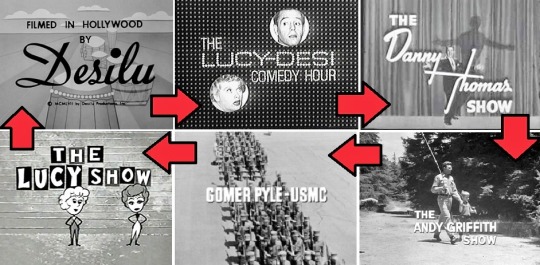
- Lucy
Ricardo would meet Danny Williams (Danny Thomas) and his TV family on
an episode of “The Lucy-Desi Comedy Hour”; - Danny Williams drives
through Mayberry and meets Sheriff Taylor, which spawns “The Andy
Griffith Show”; - “The
Andy
Griffith Show” is where the Gomer Pyle (Jim Neighbors) character
began before getting his own show; - and now Gomer, although unnamed
and uncredited, turns up on “The Lucy Show,” although here she is
Lucy Carmichael, not Lucy Ricardo (even though both women share the
maiden name McGillacuddy).
The
upshot of all of this is that Lucy Ricardo and Lucy Carmichael both
exist in the same world.
Ponder that, fans!
Jim
Nabors’ cameo as Gomer Pyle is similar to the way “Here’s Lucy”
presents a cameo by Jackie Gleason as Ralph Kramden from “The
Honeymooners” in “Lucy Meets Jack Benny” (HL S1;E2):- Both
arrive at the end of the episode, - Do not give their names,
- Play a
recognizable TV character dressed in their character’s costumes from
the show, - And get laughs based on viewers having watched their TV
shows!
Callbacks!
The
plot of this episode is similar to 1951’s “Drafted” (ILL S1;E11),
where Lucy Ricardo reads a letter from the Army that Ricky is to
report to Fort Dix. Lucy thinks he has been drafted, but he is
simply going there to entertain. Like many early episodes of “I
Love Lucy,” this plot is almost identical to “George Is Drafted,”
a January 1951 episode of Lucy’s radio show (co-starring Gale
Gordon) “My Favorite Husband.”
In
“Lucy Meets Orson Welles” (ILL S6;E3) Welles calls Lucy “the
Princess Loo Cee” during his magic act, another homonym of Lucy.
Lucy
Carmichael previously wore fatigues in “Lucy and the Military
Academy” (S2;E10) where she went undercover as a male soldier in
order to visit her son. She
also faced an obstacle course
consisting of a tire step, landing net climb, and a tunnel crawl.
Naturally, Lucy has trouble with every one of them
in both episodes.
In this episode, the tunnel crawl is made out of
wire and present on the course, but is not attempted by the recruits.
Coincidentally, both episodes begin with Sid Gould playing a mailman
delivering a letter from Lucy’s son in Military School.Blooper
Alerts!
What’s In A Name? When
Lucy receives a letter from her son in the beginning of this episode,
she calls him ‘Jimmy’ instead of correctly calling him ‘Jerry.’
According to Geoffrey Mark Fidelman’s The
Lucy Book, when Lucille Ball was
handed the script for the first time, she complained that they had
used the wrong name. She was reminded that it was ‘Jimmy’ Garrett who
played ‘Jerry’ Carmichael. Ball still insisted that she was right and
(picking their battles, probably) the crew left the reference as
‘Jimmy.’ However it came about, it certainly is one of the biggest
mistakes of the series.
Hair & Make-Up! Although
Lucy was at first mistaken for a man during the episode, her hair
wasn’t cut nearly as short as the other recruits and she still wears
her thick eyelashes.Period of Adjustment! In
clarifying the name error to the Doctor, Lucy says the letter was
meant for “Lou
period C period.”
Why would there be a period after “Lou”?Say It Again! If
Lucille Ball thought another actor’s line was not heard due to loud
audience laughter, she would say “What
did you say?”
to cue them to repeat it, which is just what she does with Jim
Nabors’ only line.
His Reputation Precedes Him! When
Nabors announces he is Lucy Carmichael’s replacement, Lucy laughs and
says to the Drill Sergeant “Good luck, buddy!” and the
Sergeant rolls his eyes in dismay. They both seem to know
who the new soldier is and his reputation for being a screw-up. But how?
“Lucy Gets Caught Up in the Draft” rates 3 Paper Hearts out of 5
1966, Andy Griffith Show, Ben Gage, CBS, Clark Howat, crossovers, Danny Thomas, Desilu, Drill Sergeant, Gale Gordon, Gomer Pyle, Gomer Pyle USMC, Herb Vigran, Jackie Gleason, Jamie Farr, Jerry Carmichael, Jim Nabors, Jimmy Garrett, Lucille Ball, Lucy Gets Caught Up in the Draft, No Time for Sergeants, Obstacle Course, Ralph Kramden, Sid Gould, The Lucy Show, The Lucy-Desi Comedy Hour, tv, Uncle Tom’s Cabin, US Army, US Marines - Lucy
-
Subscribe
Subscribed
Already have a WordPress.com account? Log in now.
 Papermoon Loves Lucy