-
Lucy Gets Her Diploma
S6;E5
~ October 9,
1967

Synopsis
When
Lucy finds out the bank has a new policy of only employing high
school graduates, she must go back to school to get her diploma in
order to keep her job.Regular
Cast
Lucille
Ball (Lucy
Carmichael),
Gale Gordon
(Theodore J. Mooney)Roy
Roberts
(Mr. Cheever) and Mary
Jane Croft (Mary
Jane Lewis) do not appear in this episode, although Mr. Cheever is
mentioned.Guest
Cast
Doris
Singleton
(Doris) created
the role of Caroline Appleby on “I Love Lucy,” although she was
known as Lillian Appleby in the first of her ten appearances. This is
the second of her two appearances on “The Lucy Show.” She will
also be seen on four episodes of “Here’s Lucy.”Doris
has very little to do with the main plot of this episode. This scene
might have been originally meant for Mary Jane but reassigned to
Lucy’s old friend Doris Singleton due to a conflict in Croft’s
schedule or illness.
Lucie
Arnaz (Patty
Martin) was
the real life daughter
of Lucille Ball and Desi Arnaz. She previously appeared on “The
Lucy Show” as Cynthia, a friend of Lucy’s daughter Chris. She
also did background appearances, most recently with her brother Desi
Jr. in “Lucy
at Marineland” (S5;E1).
She will do one more credited episode of “The Lucy Show” before becoming a
regular on “Here’s Lucy.”Arnaz
met her future husband Phil Vandervort (Alan) filming this episode.
The two were married from 1971 to 1977. Patty’s surname is not
mentioned in the dialogue.
Dave
Willock
(Mr. Willock, Math Teacher) has more than 200 screen credits
including the film classics What
Ever Happened to Baby Jane
(1962) and Hush…
Hush, Sweet Charlotte
(1964). This is his only appearance opposite Lucille Ball.The
character is credited only as ‘Math Teacher’ but referred to as ‘Mr.
Willock’ in the scene.
Sean
Morgan (Johnny
Harris) played Sean on “The Adventures of Ozzie and Harriet” from
1964 to 1966. Morgan was sometimes seen on the Desilu series’ “Star
Trek” and “Mannix.” He will also make an appearance on “Here’s
Lucy” in 1969.
Donald
Randolph
(History Teacher) started his screen acting career in 1946 and
appeared in the Hitchcock classic Topaz (1969). This is his only
appearance opposite Lucille Ball.
Olive
Dunbar
(Biology Teacher) turns up as a Librarian in a 1970 episode of
“Here’s Lucy.” Dunbar passed away in February 2017 at age 91.
Barbara
Babcock
(English Teacher) is probably best remembered for playing Grace
Gardener on “Hills Street Blues” (1981-87) for which she won an
Emmy Award. She was also a regular on “Dallas” (1978-82) as Liz
Craig. This is her only dramatic appearance with Lucille Ball.
Amy
Appleton
(Amy) according to IMDB, this is Appleton’s only screen credit.
Robert
Pine
(Steven Josephs, left) has more than 200 screen credits to his name.
He is the real-life father of actor Chris Pine. This is his only
appearance with Lucille Ball.Phil
Vandervort (Alan,
right) makes the first of his two appearances on “The Lucy Show.”
He also does 3 episodes of “Here’s Lucy.”Vandervort
met his future wife Lucie Arnaz (Patty Martin) while filming this
episode. The two were married from 1971 to 1977.
George
E. Carey
(Mr. Potter, Principal) was seen in the 1967 low budget film Riot on
Sunset Strip, which dealt with the famous Curfew Riots. “The Lucy
Show” also dealt with this event (albeit comically) in “Viv
Visits Lucy” (S5;E15).The
character is credited only as ‘Principal’ but referred to in the
dialogue as ‘Mr. Potter.’ Potter was the maiden name of Ethel Mertz
(Vivian Vance) on “I Love Lucy.”Roy
Rowan
(TV Announcer, uncredited) was
the off-camera announcer for every episode of “I Love Lucy” as
well as “The Lucy Show” and “Here’s Lucy.” He was also the
voice heard when TV or radio programs were featured on the plot of
all three shows. His first on-camera appearance was in “Lucy
Takes Up Golf” (S2;E17).The other high school students are played by uncredited background performers.

This
episode was filmed on June 29, 1967. It was written by Ray Singer
and Milt Josefsberg. A script from this episode later turned up
with handwritten notes from Lucille Ball about the episode’s writing:“I
expected more comedy from me after I went to school, not just from
the jibes of the kids — I think we’ll throw away a good opportunity
if you don’t see me trying hard at something
— somehow, I’m
too goody-goody doing everything right. Too much preaching from the
minute I get there — too soon for preaching. Gotta save it — goof
a bit & then get in your sermons — I don’t have to be teacher’s
pet from start to finish & that’s why it ain’t funny — schmaltzy
yes, but not funny. Talk to you later.”
On
the official Season 6 DVD package, one of the extras is this episode
with a dubbed Italian soundtrack. There is also a completely
different title sequence that features a neon design and the theme music from seasons 2 and 3.
The
day this episode was filmed (June 29, 1967) Jayne
Mansfield
was killed in an automobile crash at age 34. Only a month earlier
saw the release of A
Guide for the Married Man,
in which both she and Lucille Ball had cameos. It was her last film
appearance.
The
day this episode first aired (October 9, 1967) Che
Guevara,
who had led the Cuban Revolution, was assassinated in Bolivia. The
Cuban Revolution was about to come to a head when Desilu crews were
in Cuba to film second unit footage and establishing shots to be used
in “Lucy Takes a Cruise to Havana” (1957). Producer Desi Arnaz,
who fled the oppressive Cuban government in the 1930s, ordered his
team to get whatever footage they could and get out.
Lucille Ball also never graduated high school. She left to go to Drama School in New York City. In 1989 she was to receive an honorary degree from Jamestown Community College (which she financially supported) but passed away before the ceremony.

In Lucy’s apartment, Doris wants to watch The Slimy Monster from Outer Space on TV, but Lucy is obliged to watch an interview with Mr. Mooney on a public service program instead.
When
Mr. Mooney calls himself
“Thoughtful,
compassionate, considerate, kind” Lucy’s TV promptly explodes! The next morning Lucy tells
Mr. Mooney what happened and says she can’t wait for the summer
rerun. Desi Arnaz and Lucille Ball are largely credited with the
concept of ‘reruns’ in series television.
In
Biology class, Lucy is asked to explain the skeletal system, which,
of course, she does in song. “Dem
Bones” (also
called “Dry
Bones”
and “Dem
Dry Bones”) was composed by James
Weldon Johnson
(1871–1938)
although some sources also credit his brother, J. Rosomond Johnson.
It was first recorded by The Famous Myers Jubilee Singers in 1928.
After
Steve pours itching powder down her back, Lucy recites Hamlet’s
soliloquy. The line “Ay,
there’s the rub”
is particularly funny in this new context as Lucy seeks relief by rubbing up against the chalkboard.
Lucy
is attending Wilshire High School whose motto is ‘Seek Honor Through
Service.’ This seems to be a fictional high school, although there
was a Wilshire Junior High School in Fullerton, California.
During
her honorary valedictorian speech, Lucy says that her generation was
famous for fads like swallowing
live goldfish
and seeing
how many kids can fit into one phone booth.
Both of these are actual stunts popular with students in the 1920s
and 30s. Lucy also compares the music of today with that of her
generation, which had such important tunes as “The
Hut-Sut Song,” “Mairzy Doats (and Dozy Doats)” and
“Three Little Fishies (Itty Bitty Poo).”
Again,
all three are actual novelty songs from the 1930s and 40s. In
closing, Lucy quotes Socrates.
The
speech is purposely dramatic and inspirational rather than comic.
Lucy’s initial assessment of the script is right on target: Schmaltzy.Callbacks!

Back
in Danfield, Lucy went ‘back to school’ (night school courses) in
“Lucy and Viv Take Up Chemistry” (S1;E26).
Lucy
also has to publicly deal with itching when she has an allergic
reaction at a fancy soiree in “My Fair Lucy” (S3;E20).Blooper
Alerts!
Lucy
supposedly didn’t graduate high school because of measles during the
final exams, but this directly contradicts the premise of “Lucy’s
College Reunion” (S2;E11) in which she returns to her alma mater,
(fictional) Milroy University. “The Lucy Show” was notoriously
inconsistent, perhaps due to the show having so many writers.
The
portrait of George Washington that turned up behind Mr. Mooney’s desk
in “Lucy Gets Trapped” (S6;E2) is hanging in the math classroom.
“Lucy Gets Her Diploma” rates 4 Paper Hearts out of 5 1967, Amy Appleton, Barbara Babcock, CBS, Che Guevara, Dave Willock, Donald Randolph, Doris Singleton, Dry Bones, Gale Gordon, George E. Carey, Hamlet, High School, Itching Powder, Jayne Mansfield, Lucie Arnaz, Lucille Ball, Lucy Gets Her Diploma, Mairzy Doats, Olive Dunbar, Phil Vandervort, Robert Pine, Roy Rowan, Sean Morgan, Socrates, The Hut-Sut Song, The Lucy Show, Three Little Fishies, tv, Wilshire
 -
Lucy and the Starmaker
S6;E4
~ October 2,
1967

Synopsis
Mr.
Cheever gets his nephew (Frankie Avalon) a job at the bank, but the
young man has his heart set on a career in show business instead. After hearing him sing, Lucy
sets out to make his dreams a reality by getting a famous movie producer to come
to the bank.Regular
CastLucille
Ball (Lucy
Carmichael),
Gale Gordon
(Theodore J. Mooney), Roy
Roberts
(Mr. Cheever), Mary
Jane Croft (Mary
Jane Lewis)
Guest
Cast
Frankie
Avalon
(Tommy
Cheever) was born in Philadelphia in 1939. A recording star and
musician, Avalon’s movie career took off when paired with Annette
Funicello in Beach
Party
(1963) and its string of sequels. He played Teen Angel in Grease
(1978)
and considers “Beauty School Dropout” to be his most
popular song. He returned to work with Lucille Ball in a 1973
episode of “Here’s Lucy” titled “The Carters Meets Frankie
Avalon.”Tommy
is Mr. Cheever’s nephew. His uncle calls him ‘Thomas’ but Lucy calls
him ‘Tom.’ Tommy calls Mr. Cheever ‘Uncle Windy,’ a diminutive of
his uncle’s middle name ‘Winfield.’ We have yet to learn Mr.
Cheever’s first name.
Lew
Parker (Nelson
Penrose) is
probably best remembered as the restaurateur father of Ann Marie,
Marlo Thomas’ character on TV’s “That Girl” (1966-71). This
is the second of his five appearances on “The Lucy Show” and he
will return for two episodes of “Here’s Lucy.” From 1928 to
1973 he appeared in Broadway musicals, which must have come in handy
during this especially musical episode.Penrose is a movie producer at the studio where Mary Jane works. He is the
“Starmaker” of the title.George
DeNormand (Customer,
uncredited) appeared in three films with Lucille Ball from 1937 to
1963. This is the just one of his many appearances on “The Lucy
Show” and “Here’s Lucy.”William
Meader (Clerk,
uncredited) had appeared as an airport extra in “The
Ricardos Go to Japan,”
a 1959 episode of “The Lucy-Desi Comedy Hour.” He made many
appearances on “The Lucy Show,” most times as a clerk in Mr.
Mooney’s bank.Murray
Pollack
(Customer, uncredited) was
seen as one of the party guest in “Country
Club Dance” (ILL S6;E25),
the episode that introduced Barbara Eden. Coincidentally, he later
appeared on half a dozen episodes of “I Dream of Jeannie.” Like
William Meader, he was at the airport when “The
Ricardos Go to Japan”
(1959). He was seen in the 1963 movie Critic’s
Choice with
Lucille Ball. Here he makes the second of two appearances on “The
Lucy Show” and returned for three episodes of “Here’s Lucy.”Other
bank clerks and customers are played by uncredited background
performers.
This
is the first of three “Lucy Show” episodes co-written by veteran
TV comedy writer Seaman
Jacobs.
Jacobs teamed with Fred S. Fox, who had previously written for the
show. Jacobs and Fox will return to pen 27 episodes of “Here’s
Lucy.” Their final
draft of “Lucy and the Starmaker” was dated May 15, 1967.This is another episode that has fallen into public domain. Some unofficial releases title this episode “Catch a Rising Star” or “Lucy the Starmaker.”

The
day this episode first aired (October 2, 1967) Thurgood Marshall
was
sworn in as the first African-American justice of the United States
Supreme Court.
It was a year of change on the civil rights front. The first black
man to ever play a credited supporting role on a Lucille Ball sitcom
was John Bubbles in “Main Street U.S.A.” (S5;E17) and “Lucy
Puts Main Street on the Map” (S5;E18). In her personal life Ball
was pro civil rights, even insisting that her black maid be able to
ride the main elevator at her upscale New York apartment instead of
using the service elevator as was mandated.
That
same evening on CBS, Lucille Ball made the first of her four guest
appearances on “The Carol Burnett Show.” Burnett had played
Carol Bradford on two episodes of “The Lucy Show.” Lucy
considered Burnett a protege. The official Season 6 “Lucy Show”
DVD collection features a
sketch with Carol and Lucy as feuding car rental agencies at the
airport who beat up Tim Conway (above). Carol
Burnett will return to “The Lucy Show” for two more episodes,
this time playing a character named Carol Tilford.
The
day after this episode first aired Disney voice artist Pinto Colvig
died at age 75. He was
the original voice of Pluto and Goofy and provided all the dog barks
in “Lucy is Her Own Lawyer” (S2;E23).Frankie
Avalon gets a warm welcome from the studio audience.
Mr.
Mooney also had a nephew on the series, Wendell Mooney played by Jay
North in “Lucy the Robot” (S4;E23).
Mr.
Mooney offers Tommy a cigarette from a box on his desk and Tommy
smokes it. Unlike “I Love Lucy,” recreational smoking is not a
part of “The Lucy Show.” Smoking is only used if it is part of
the comic action of the scene and then only rarely. Lucille Ball,
however, was a life-long smoker off screen. In
1965, Congress required all cigarette packages carry a health
warning. In 1969, cigarette advertising on television and radio was
banned.
Lucy’s
trusty transistor radio makes yet another appearance. When she
switches it on while having lunch at her desk, it briefly plays a
jazzy version of “This
Can’t Be Love,”
a song
from
the 1938
Rodgers and Hart musical
The
Boys from Syracuse.
When
Lucy turns on the radio again, she hears a song she says is one of
her favorites, “Walking Happy.” Tommy agrees and performs it for
Lucy in the office. As ‘gaffe squad’ members have pointed out,
Avalon is poorly lip-syncing the song. It is the title tune from the 1966
Broadway musical Walking
Happy with
music by Jimmy
Van Heusen and
lyrics by Sammy
Cahn.
The show was nominated for six 1967 Tony
Awards,
including Best Musical, but won none. The
title song was originally meant to be used in the 1963 film Papa’s
Delicate Condition,
sung by Jackie
Gleason,
but was dropped before the film’s release. In the lyrics, the words
“chappie” and “bloomin’” betray that the show is set in
England. It was based on the play Hobson’s Choice by Harold
Brighouse.
When
Lucy expresses her thwarted theatrical ambitions, Tommy replies
“Well,
everyone can’t be another Annette Funicello.”
This is an inside reference to former Mousketeer and Frankie
Avalon’s frequent co-star on screen. They were so often paired that
the names ‘Frankie and Annette’ became one in the public’s mind.Lucy’s
wacky filing system (a running joke on the series) finds the bottles
of lemon pop filed under “C” for “Cold Lemon.”
After
singing for Lucy, Tommy says he never thought he had more than an
average voice. Lucy replies “if
that is an average voice Elizabeth Taylor is an average housewife.”
Glamorous
movie star Elizabeth
Taylor
was frequently mentioned on both “The Lucy Show” and “I Love
Lucy.” Taylor married actor Richard Burton in 1964 and the two
will appear together as themselves on “Here’s Lucy” in 1970.
When
Mr. Mooney cuts off Tommy’s ‘audition’ after a few notes Lucy says
“Dizzie
Gillespie would have had a better chance with Lawrence Welk!” John
Birks
Gillespie
(1917–
93) was a jazz
trumpeter,
composer, and singer.
He
was particularly known for his bluesy riffs and free-form style.
Lawrence
Welk (1903-92)
was
a hugely popular bandleader who would appear as himself on a 1970
episode of “Here’s Lucy.” He was known for his waltzes, a much
more structured and straight-laced musical sound than jazz. Gillespie would
definitely not be a good fit with Welk’s Champagne Music Makers. Welk
was previously mentioned in “Lucy and Clint Walker” (S4;E24).
When Mr. Mooney threatens to send Lucy to Fort Knox to be made into gold bars and carved up ingot by ingot, Lucy says to Tommy: “Who does he think he is? Goldfinger?” Goldfinger was a James Bond film released in the US in early 1965. The title character was a wealthy psychopath (played by Gert Fröbe) obsessed with gold. Fort Knox, an Army base in Kentucky where most of the US gold reserves are held, is also featured in Goldfinger. Mr. Mooney gets exit applause after laying out his gold-plated plan to fire Mrs. Carmichael.

After
luring producer Penrose to the bank on the pretense of verifying his
signature on a check, Tommy sings“I’m
Looking Over a Four Leaf Clover” written
by Harry Woods in 1927 but with original lyrics pertaining to the
episode.
Tommy,
with the full bank staff and customers participating, sings “When
the Feeling Hits You”
by Bobby Doyle. It was also the title of a 1965 album by Sammy Davis
Jr.
Tommy also plays the trumpet during the number, which is the musical talent that
got Avalon into show business as young man.Callbacks!

Lucy
previously tried to advance the career of a young male singer named
Wayne Newton in “Lucy Discovers Wayne Newton” (S4;E14).Blooper
Alerts!
During
some parts of the song “Walking Happy,” you can hear
Frankie Avalon singing, but his mouth isn’t moving.
It this were “RuPaul’s Drag Race,” Avalon would certainly be told
to sashay away!
During the number the camera pulls back too far and
we can see where the office carpeting meets the cement sound stage
floor. This is a regular occurrence on “The Lucy Show.”Mr.
Mooney says Mr. Cheever “owns” the bank! No one person “owns”
a bank. Banks
are ‘owned’ by investors who may or may not be depositors. Banks are
for-profit corporations, with declared earnings paid to stockholders
only.Lucy
tells Tommy that when she came out to Hollywood she wanted to be an
actress and it took her a long time to realize she just didn’t have
it. In previous episodes it was clear that Lucy’s brushes with show
business were more happenstance than the desire to fulfill career
goals. In “Lucy Meets Sheldon Leonard” (S5;E22) the TV producer
asks her if she’s ever done any acting and Lucy promptly replies “No,
sir.”
Lucy
offers Tommy a “bottle of pop.” Being raised on the East Coast,
Lucy would probably refer to the carbonated beverage as “soda” or
“soda pop.” The bottles also have no labels on them.
“Lucy and the Starmaker” rates 3 Paper Hearts out of 5 1967, Annette Funicello, Carol Burnett Show, CBS, Dizzie Gillespie, Elizabeth Taylor, Frankie Avalon, Gale Gordon, George DeNormand, Goldfinger, I’m Looking Over a Four Leaf Clover, Lawrence Welk, Lew Parker, lipsync, Lucille Ball, Lucy and the Starmaker, Murray Pollack, Roy Roberts, Seaman Jacobs, The Lucy Show, This Can’t Be Love, Thurgood Marshall, tv, Walking Happy, When The Feeling Hits You, William Meader
 -
Lucy and the French Movie Star
S6;E3
~ September 25,
1967

Synopsis
A
French movie star (Jacques Bergerac) is considering doing business
with the bank. When Lucy is invited to his hotel suite to get the
papers signed, she indulges in a bit too much champagne.Regular
Cast
Lucille
Ball (Lucy
Carmichael),
Gale Gordon
(Theodore J. Mooney), Roy
Roberts
(Mr. Cheever)Mary
Jane Croft (Mary
Jane Lewis) does not appear in this episode.Guest
Cast
Jacques
Bergerac
(Jacques DuPre) was born in Biarritz, France in 1927 as Jacques
Gilbert Henri Bergeruc. He was seen on screen in Gigi
(1958),
Les
Girls
(1957)
and The
Hypnotic Eye
(1960).
He ultimately left show business to work for Revlon in Paris.
Bergerac was the fourth husband of Ginger Rogers, the famed dancer /
actress who appeared on “Here’s Lucy” in 1971. They divorced in
1957. He died in 2014 in his homeland.DuPre
has formed the DuPre Production Company and is interested in doing
business with Westland Bank.

This
episode was filmed on May 11, 1967. This is one of a very few
episodes with just four characters; three regulars and a guest star.
“Lucy and Viv Reminisce” (S6;E16), will feature just three
actors: Lucille Ball, Vivian Vance, and Gale Gordon.
Jacques
Bergerac gets both entrance and exit applause from the studio
audience. It is, however, hard to tell if this is due to his showy
entrance and exit or his celebrity status. Lucy gets entrance
applause (and some “ahhhs”)
in scene two, but this may be due to her blue floral print dress.
Lucy coyly tells DuPres she ran home and “tossed
on this little old thing.”
Lucy
says she saw DuPre in the film Kisses
at Dawn
where he did his own stunts playing a lion tamer. He even goes so
far as to demonstrate, using an office chair and a whip (Lucy’s
raincoat belt) with Lucy acting as the lion. When Mr. Mooney bursts
in and sees the reenactment, he jumps to the conclusion that Lucy is
attacking DuPre, instead of the other way around!
DuPre
is staying at the (fictional) Plaza Royale Hotel. In her drunken
haze Lucy thinks she is on a very large boat. She mentions getting
off at Catalina. Catalina,
an island off the coast of Southern California, has been mentioned in
a couple of previous episodes: “Lucy
Helps the Countess” (S4;E8)
and
“Lucy
and Tennessee Ernie Ford” (S5;E21).
Reeling
out of DuPre’s suite, Lucy does Jackie Gleason’s famous “Away We
Go” exit move. She has done this on several previous episodes,
starting with “Lucy Helps Danny Thomas” (S4;E7).
DuPre
says that the Champagne is Chateau Bergerac 1959. Lucy says (and
later sings) that it was a very good year. In actuality, 1959 was
NOT such a very good year for Lucille Ball. She was facing the
imminent cancellation of “The Lucy-Desi Comedy Hour” and her
divorce from Desi Arnaz. It was a very good year, however, for Jacques Bergerac, who attended the Academy Awards to see his film Gigi win Best Picture. Bergerac lends his own surname to
the Champagne vintage.
“It
Was A Very Good Year”
is a
song Ervin
Drake
composed
in 1961 for Bob
Shane
and the
Kingston Trio.
It
was subsequently made famous by Frank
Sinatra, who
won the Grammy
Award for Best Male Vocal Performance
in
1966. The single peaked at #28 on the US
pop charts
and
became Sinatra’s first #1 single on the Easy
Listening charts.
While under the influence, Lucy sloppily croons “Darling,
Je Vous Aime Beaucoup,” which
was
written by Anna Sosenko in 1935. It
was introduced in the film Love
and Hisses by
Hildegarde
and
charted at # 21 in 1943.
The best-selling version of the song was recorded by Nat
King Cole in
1954
which
reached a peak Billboard
position
# 7.
When
Lucy doesn’t know how to reply in French, she says “Mademoiselle
from Armentières”
and then “Hinky-dinky
parlez-vous.”
“Mademoiselle
from Armentières” (aka “Hinky-Dinky Parlez-Vous”),
was a song sung by soldiers during World War One. In
“The French Revue” (ILL S3;E7) when
Fred Mertz (a veteran who fought in France and Germany) is frustrated
that he cannot read a French menu, Ethel reminds him that he was only
there for three weeks and that the restaurant doesn’t serve
Hinky-Dinky Parlez-Vous. Fred also sang the song in “Paris at
Last!” (ILL S5;E18).
Lucy
gets the hiccups from the Champagne. Then tries to get rid of the
hiccups by drinking even more Champagne. In
“Lucy
and the Sleeping Beauty” (S4;E9)
Lucy
says she always gets the hiccups when she’s hungry. In “Lucy’s
Last Birthday” (ILL S2;E25)
Lucy
Ricardo says she gets hiccups from crying. In “Lucy
Takes a Cruise to Havana” Lucy McGillicuddy tells Susie MacNamara (Ann Sothern)
that she doesn’t get the hiccups very often at all!
DuPres
very convincingly “puts the moves” on Lucy and she responds with
a great deal of girlish charm. It is an interesting side of the
character not often seen on the series due to Ball’s determination
that the Lucy not sacrifice her female independence by being in a
relationship. When the series began, Ball herself was going through
much the same thing.Callbacks!

Lucy
Ricardo was also enamored with a French movie star in “Lucy Meets
Charles Boyer” (ILL S5;E19). In “Lucy Goes to Mexico” (1957)
Lucy Ricardo is impressed by the talents of Maurice Chevalier, a
French-born film star who appeared in Gigi
with Jacques Bergerac.
This
is the third time we have seen Lucy Carmichael completely blotto.
The first was with Viv in “Lucy’s Sister Pays a Visit” (S1;E15)
when she over-spikes the wedding punch. The second was at a wine
tasting in “Lucy and the Countess” (S3;E19). Lucy Ricardo
famously got intoxicated on Vitameatavegamin (34% alcohol) in “Lucy
Does a TV Commercial” (ILL S1;E30).Blooper
Alerts!Lucy
tells DuPre that her mother is old fashioned Irish. In previous
episodes Lucy touted her Scottish heritage.A
light-weight aluminum chair replaces the usual plush guest chair next
to Mr. Mooney’s desk in order to accommodate DuPre’s (and later Mr.
Mooney’s) lion tamer bit.
The
ugly piece of bric-a-brac featured in “Lucy and the Ceramic Cat”
(S3;E16), now painted bright yellow, is seen on the table in the
hallway outside of DuPre’s hotel suite.
“Lucy and the French Movie Star” rates 4 Paper Hearts out of 5
-
Lucy Gets Trapped
S6;E2
~ September 18,
1967

Synopsis
Lucy
pretends to be sick to go to a big one-day sale, but when she wins
customer of the year, her picture will appear in the newspaper and
her lie will be exposed.Regular
Cast
Lucille
Ball (Lucy
Carmichael),Gale Gordon (Theodore J. Mooney),
Mary Jane Croft (Mary
Jane Lewis), Roy
Roberts
(Mr. Cheever)Guest
Cast
William
Lanteau
(Floorwalker) first appeared with Lucille Ball in The
Facts of Life
(1960). In addition to this episode of “The Lucy Show,” Lanteau
did four episodes of “Here’s Lucy.” He is best remembered for
playing Charlie the Mailman in the play and the film On
Golden Pond
(1981).
Bartlett
Robinson
(Mr. Wilkins) returned to star in a 1968 episode of “Here’s Lucy.”
Joan
Swift
(Laurie) makes the fourth of her six appearances on the series. Swift
also did two episodes of “Here’s Lucy.” Her final screen credit
was 1975’s “Lucy Gets Lucky” with Lucille Ball and Dean Martin.The
last time Swift was on the series she also played a bank secretary
wearing pink, but her name was Dottie.George
DeNormand (Clerk,
uncredited) appeared in three films with Lucille Ball from 1937 to
1963. This is the just one of his many appearances on “The Lucy
Show” and “Here’s Lucy.”William
Meader
(Clerk, uncredited) had appeared as an airport extra in “The
Ricardos Go to Japan,” a
1959 episode of “The Lucy-Desi Comedy Hour.” He made many
appearances on “The Lucy Show,” most times as a clerk in Mr.
Mooney’s bank.Leoda
Richards (Customer,
uncredited) made at least three background appearances on “I Love
Lucy.” This is the third of her four episodes of “The Lucy Show.”
She was also in the Lucille Ball film Yours,
Mine and Ours (1968)
and did two episodes of “Here’s Lucy.” Her main claim to fame
is her appearance at the party given by Captain Von Trapp in The
Sound of Music,
standing next to Christopher Plummer during the song “So Long,
Farewell.” Fellow extra William Meader is also at the party!The
other customers and store clerks are played by uncredited background
performers.
This
episode was filmed on May 4, 1967. This is the first episode of
Season 6 to be directed by Jack Donohue, who directed all of Seasons
1, 2 and 3. During the hiatus Lucille Ball dismissed director Maury
Thompson when she heard he was seeking a pay increase. In the title,
the word “trapped” is not to be taken literally; Lucy is never
confined to a space as she was when “Lucy Gets Locked in the Vault”
(S2;E4) with Mr. Mooney. Here the word means to be “trapped in a
lie.” This is one of the few episodes concentrating on the
principal cast, with no celebrity guest appearances.
This
episode, like 31 others (seven from Season 6), somehow fell into
public domain, free from copyright protection. In addition to low
quality videos, this led to it being staged by a community theatre as
a play, evidence of which can be found on YouTube!
This
is the second episode to take place at Stacey’s Department Store. Mr.
Wilkins says there are 59 departments in the store. Lucy worked in
several of them in “Lucy Bags a Bargain” (S4;E17) when she takes
a part-time job in order to pay for a new dinette set.
Lucy
gives her address as Glenhall Apartments, 780 North Gower Street,
Hollywood, which was the real address of the Desilu Productions
building.
This is the second time Lucy has said her address aloud. The first
was in “Lucy the Babysitter” (S5;E16).
The
refrigerator Lucy likes at Stacey’s (the only one on the sales floor,
actually) is labeled a Duchess and it sells for $299.99. This is a
fictional brand made up by the production. Lucy’s kitchen
is green and this appliance is peach, so it doesn’t seem a good fit
with her current design scheme.
The range and oven Lucy peruses is
made by Jiffy, another fictional manufacturer.
At
Stacey’s, Lucy discovers she has been named ‘customer of the year’ by
being the ten millionth customer to enter the Women’s Sporting
Apparel Department. Lucy wins a set of golf clubs, a set of luggage,
a washing machine, a dryer, a dishwasher, a color television set, and
a refrigerator (the same one from the appliance department) stocked
with food.
When
trying to hide the newspaper with her picture in it from Mr. Mooney,
she summarizes that “The
temperature’s up, the stock market’s down, and Little Orphan Annie is
lost again!” Little
Orphan Annie
was
a comic strip character drawn by Harold Gray (1924-2010) who later
got her own radio, film, and TV programs. It was recently mentioned
in “Lucy and Art Linkletter” (S4;E16) as well as several episodes
of “I Love Lucy,” including at the end of “Lucy
Wants New Furniture” (ILL S2;E28).
Orphan
Annie was
famous for her mass of curly red hair and her pupil-less eyes.
Mr.
Cheever awards Mooney an extra week’s salary as a bonus for the free
publicity. Then, he orders Mooney to pay Lucy an extra week’s salary
out of it. In a mean-spirited twist ending, Mr. Mooney only rewards
her with half a week’s salary.Callbacks!

Besides
Stacey’s, Lucy Carmichael also got into trouble at Bigelow’s
Department Store back in Danfield.
In “Lucy Meets Orson Welles”
(ILL S6;E3) Lucy Ricardo shops at Macy’s.
Lucy
Carmichael also pretended to be sick to get out of work in “Lucy
and Carol in Palm Springs” (S5;E8). In that episode Lucy told Mr.
Mooney she had the mumps!
Lucy Ricardo pretended to be sick in “Lucy
Fakes Illness” (ILL S1;E18) because Ricky wouldn’t let her into the
act!
Lucy
Carmichael is dangerous around refrigerators. In “Lucy the Disc
Jockey” (S4;E26) she pulled the guts out of her fridge. In order to
con Mr. Mooney into buying her a new one, Lucy wrecks her fridge in
“Lucy the Stunt Man” (S4;E5).Blooper
Alerts!
The
episode opens with Lucy at her desk reading Theatre Magazine. This
seems an unusual choice for Lucy Carmichael, whose only theatre
experience was the Danfield Community Players. It would seem more
appropriate to have her reading a movie magazine.
The
ad on the back of the newspaper is heavily (and obviously) redacted
in order to conceal brand names.
In
this episode a portrait of George Washington has replaced the skyline
painting behind Mr. Mooney’s desk. It is the famous portrait painted
by Gilbert Stuart in 1796. The portrait is there for the sake of a
brief bit of business and a few lines spoken by Lucy, but the skyline
painting returns in the next episode.
The
‘unbreakable’ tableware is Melmac, something Lucy Carmichael uses at
home. Why would she need to test the claim in the store?
“Lucy Gets Trapped” rates 4 Paper Hearts out of 5
1967, Bartlett Robinson, CBS, Department Store, Gale Gordon, George DeNormand, George Washington, Jack Donohue, Joan Swift, Leoda RIchards, Little Orphan Annie, Lucille Ball, Lucy Gets Trapped, Mary Jane Croft, Melmac, Newspaper, refrigerator, Roy Roberts, The Lucy Show, tv, William Lanteau, William Meader -
Lucy Meets the Berles
S6;E1 ~ September 11, 1967


Synopsis
Lucy needs to earn extra money, so she takes a job working as a secretary for Milton Berle. When Lucy hears overhears Berle rehearsing a love scene with Ruta Lee, she jumps to the conclusion that he is being unfaithful to his wife.
Regular Cast

Lucille Ball (Lucy Carmichael), Mary Jane Croft (Mary Jane Lewis)
Roy Roberts (Mr. Cheever) and Gale Gordon (Theodore J. Mooney), do not appear in this episode, although Gordon does receive screen credit at the start of the episode.
Guest Cast

Milton Berle (Himself) was born Milton Berlinger in New York City on July 12, 1908. He started performing at the age of five. He perfected his comedy in vaudeville, early silent films, and then on radio, before taking his act to the small screen, where he would be proclaimed “Mr. Television” and later “Uncle Miltie.” He hosted “Texaco Star Theater” on NBC from 1948 to 1956. The variety show was re-titled “The Milton Berle Show” in 1954 when Texaco dropped their sponsorship. The program was briefly revived in 1958, but lasted only one season. In 1959 he played himself in “Milton Berle Hides out at the Ricardos.” Berle continued to perform live, in films, and on television specials for the remainder of his career. One of his classic bits was to dress in drag, something only hinted at in this episode. Berle previously appeared on "The Lucy Show” in “Lucy Saves Milton Berle” (S4;E13) and did a cameo in “Lucy Meets John Wayne” (S5;E10). He also did two episodes of “Here’s Lucy.” On all but one, he again played himself. He died of colon cancer in 2002.

Ruth Berle (Herself) was born in 1921 as Ruth Cosgrove. Her only other ‘acting’ credit was playing herself on a 1962 episode of “The Jack Benny Show.” She married Milton Berle in 1953 and the two were together until her death in 1989. They had one child together.
Milton and Ruth are credited here as ‘Mr. and Mrs. Milton Berle.’ In “Lucy and Art Linkletter” (S4;E16) Doris Singleton played a character named Ruth Cosgrove.

Ruta Lee (Herself) returns to the series after playing Audrey Fields in “Lucy’s Substitute Secretary” (S5;E14). She was born Ruta Mary Kilmonis in Montreal, Quebec. Her first big film was as one of the brides in Seven Brides for Seven Brothers in 1954. She started on TV in 1950 and has continually made guest appearances on dozens of series. Lee also plays herself in the TV film “Lucy Moves to NBC” in 1980. As of this writing, Lee is still acting in films.

This is the first episode of Season 6, the final season of “The Lucy Show.” It is the last episode directed by Maury Thompson but was filmed on June 8, 1967 before the show went on hiatus. During the break, Lucille Ball heard that Thompson wanted a raise and decided to dismiss him and bring back the show’s original director, Jack Donohue. Having made Desilu profitable again, Ball decided to sell Desilu to Paramount, dissolving the company by the end of 1967.

In Season 6, Gary Morton (Lucy’s husband) became Executive Producer of the show. The kaleidoscope opening was used once again, but the theme music was re-orchestrated. Also the ‘glamour shot’ (above) of Ball at the end of the opening is a different clip than Season 5.

This episode was screened at Lucy’s 2008 Birthday Celebration in Jamestown as part of “An Evening with Ruta Lee.” Lee talked about her work with Ball and shared anecdotes about the episode. Lee first met Lucille Ball at Del Mar Racetrack. They bonded over their love of polka dots! In 1974, Lee presented Ball with the Thalians Philanthropy Award for her support of mental health awareness, the first female every to receive the recognition.

The same evening this episode first aired (September 11, 1967) NBC broadcast “The Danny Thomas Wonderful World of Burlesque IV.” In addition to Thomas, the variety show featured “Lucy Show” guest stars Tennessee Ernie Ford, Mickey Rooney, and Phil Silvers. The second edition of “The Wonderful World of Burlesque” in December 1965 featured Lucille Ball.
Due to the cancellation of “Mr. Terrific,” “The Lucy Show’s” new lead-in was “Gunsmoke,” one of CBS’s biggest and longest running hits.

The evening also saw the premiere of “The Carol Burnett Show” on CBS. Burnett had previously made two appearances on “The Lucy Show” as Carol Bradford. The premiere episode of Burnett’s now-iconic variety show guest starred Jim Nabors, who had done a cameo appearance as Gomer Pyle in “Lucy Gets Caught Up in the Draft” (S5;E9). Lucille Ball herself would make four appearances on the show, one during each of its first four seasons.

On September 10, 1967 CBS censored Pete Seegar’s anti-war song “Waist Deep in the Big Muddy” during “The Smothers Brothers Comedy Hour.” The network claimed the lyrics were an insult to President Johnson. Lucille Ball had also had her run-ins with the CBS censors during “I Love Lucy.” They asked that the writers find euphemisms for the word “pregnant” and once edited down a closing kiss between Lucy and Ricky that they claimed went on too long to be in good taste.

Lucille Ball gets entrance applause in scene two, indicating that the episode may have been shot out of sequence.

Lucy says to Mary Jane that Milton Berle doesn’t have his television show any more and is now producing pictures. Berle started on TV on NBC in 1948 with “Texaco Star Theatre” which continued to 1956. In 1958 he hosted “The Kraft Music Hall starring Milton Berle” (also on NBC) which ran until 1959. It was at this point that Berle appeared as himself on “The Lucy-Desi Comedy Hour” writing a book (Earthquake, a real-life novel) because he no longer had a series to film. In 1966, Berle attempted a prime-time TV comeback with a new comedy-variety series on ABC. Unfortunately, high budgets and big-name guest stars couldn’t lure viewers away from competing shows and the program was canceled after one season. Berle never had a regular series again. When this episode of “The Lucy Show” was filmed in June 1967 Berle had been absent from weekly TV for just 5 months.

Lucille does her impression of a seal again. This is something that Ball started in her road show with Desi Arnaz before “I Love Lucy” and then repeated on the show itself as ‘The Professor’. She most recently did it (with real seals) in “Lucy at Marineland” (S4;E1).
Berle says that the director of the movie he is producing, The Friendly Sky, is named Lou Jackson. In real life that is the name of Berle’s agent.

Milton: Do you understand, Ruth dear, I want to grow.
Ruth: Then you ought to stop smoking.
Milton (an inveterate cigar smoker) is referring to artistic growth, while Ruth is referring to the dangers of smoking. Although there is little concrete evidence that smoking stunts growth, the claim has been around a long time. The US Surgeon General issued its first report on the dangers of smoking in 1964. In 1965, Congress required all cigarette packages distributed in the United States to carry a health warning.

Berle and his director want Robert Wagner to play the philandering pilot in The Friendly Sky. Wagner’s screen acting career began in 1950. Three weeks after this episode first aired, Wagner’s new film Banner premiered. The film wasn’t in general release, however, until December 1967. In January 1968 Wagner appeared with Berle on “The Joey Bishop Show,” which also featured Desi Arnaz.
Callbacks!


Confusion caused by a conversation overheard on an open intercom is the basis for the plot of “Housewarming” (ILL S6;E23), a 1957 episode of “I Love Lucy.”
Blooper Alerts!

Two seasons earlier, Lucy Carmichael also met Milton Berle for the first time in "Lucy Saves Milton Berle” (S4;E13). The writers obviously did not think audiences would remember (or care) that Lucy had met the TV star previously. The earlier episode also featured Mary Jane Croft and was directed by Maury Thompson.

Berle calls his new project The Friendly Sky, but the title on the scripts is The Friendly Skies.


When Lucy dumps the salad on Milton Berle’s head, Ruta Lee cracks up so badly she’s unable to say her lines. Ruth Berle also finds herself laughing uncontrollably. Lucy (the consummate professional) is the only one who doesn’t start laughing.

“Lucy Meets the Berles” rates 4 Paper Hearts out of 5
1967, Caesar Salad, CBS, Danny Thomas, Gary Morton, intercom, Jim Nabors, Lou Jackson, Lucille Ball, Lucy Meets the Berles, Mary Jane Croft, Maury Thompson, Milton Berle, Robert Wagner, Ruta Lee, Ruth Berle, Ruth Cosgrove, Season 6, The Carol Burnett Show, The Lucy Show, The Smothers Brothers Comedy Hour, tv -
Lucy Meets Sheldon Leonard
S5;E22
~ March 6,
1967
Synopsis
Mr.
Mooney allows TV producer Sheldon Leonard to film a hold-up scene at the
bank. Lucy, trying earn a raise, thinks he is really a gangster and
is determined to foil his robbery.Regular
Cast
Lucille
Ball (Lucy
Carmichael),
Gale Gordon
(Theodore J. Mooney), Mary
Jane Croft (Mary
Jane Lewis)Roy
Roberts
(Mr. Cheever) does not appear in this episode, although Mr. Mooney
does have two phone conversations with him.Guest
Cast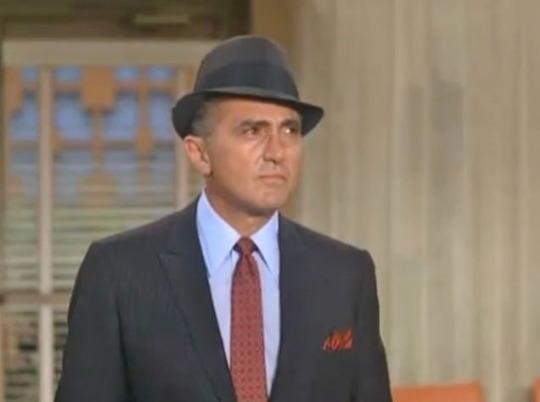
Sheldon
Leonard
(Himself)
was
born Leonard
Sheldon Bershad
in New York City in 1907. In 1953 he played fast-talking salesman
Harry Martin, who sells Lucy Ricardo the Handy Dandy vacuum cleaner
in “Sales Resistance” (ILL S2;E17). Leonard was an integral part
of the Desilu family off-screen as well, directing “Make Room for
Daddy” including an episode that featured Lucy and Ricky Ricardo in
1959. He was one of the creators of “The Andy Griffith Show,”
also filmed at Desilu. Leonard may be best remembered as the Nick,
the bartender in the classic film It’s
a Wonderful Life
(1945). He died in 1997. His
name served as a namesake for the characters Sheldon
Cooper
and
Leonard
Hofstadter
in
the sitcom “The
Big Bang Theory,”
as the writers are fans of his work.Sheldon
Leonard is a very important client of Westland Bank.
Fred
Stromsoe (Louie)
was an actor and stunt man who later appeared in a 1968 episode of
“Gomer Pyle: USMC” produced by Sheldon Leonard. This is his only
appearance with Lucille Ball.Stromsoe
does not have any dialogue.
Harvey
Parry (Harry, above right)
played one of the Keystone Cops in “Lucy Meets Mickey Rooney”
(S4;E18). He was an experienced Hollywood stunt man and actor who
appeared with Lucille Ball in The
Bowery
(1933) and There
Goes My Girl
(1937). He acted opposite Sheldon Leonard in To
Have and Have Not
(1944) and Guys
and Dolls
(1955).
George
Sawaya
(Pete) had a small role in the 1967 film A
Guide for the Married Man along
with Lucille Ball. Sawaya appeared in “I Spy,” “Gomer Pyle:
USMC,” and “The Andy Griffith Show,” all produced by Sheldon
Leonard.George DeNormand (Bank extra, uncredited) appeared in three films with Lucille Ball from 1937 to 1963. This is the just one of his many appearances on “The Lucy Show” and “Here’s Lucy.”
Judith Woodbury (Bank extra, uncredited) makes one of her many background appearances on “The Lucy Show.” She also appeared in one episode of “Here’s Lucy.”
Characters
such as the voice on the intercom, Maggie the teller, and the bank
customers go uncredited. Off-screen characters Frankie and Charlie
are referred to but never seen or heard.
This
is the final episode of Season 5 to be broadcast, although the
previous week’s episode “Lucy and Tennessee Ernie Ford” (S5;E21)
was actually the last filmed. “Lucy Meets the Berles” (S6;E1) was filmed before
the break but held over to the next season. At just 22 episodes,
Season 5 was the shortest of all Lucille Ball’s sitcoms with the
exception of “Life With Lucy,” which was canceled after 8
episodes. Season 5 ended in fourth place in the Nielsen
ratings (26.2 share), the same as Season 1 but down one place from
Season 4.
This is one of 30 episodes to have fallen into public domain, the results being it has been reproduced on low-cost, low-quality home video.

This
episode was filmed on Friday January 20, 1967, one day later than the
show’s usual filming day. The day after this episode was filmed,
actress Ann
Sheridan died
at age 51. Sheridan starred in Murder
at the Vanities
with Lucille Ball in 1934.
The
day this episode first aired (March 6, 1967) singer and actor Nelson
Eddy died at age 65. Eddy starred in a 1956 episode of “Make Room
for Daddy” produced and directed by Sheldon Leonard and shot at
Desilu Studios. In 1956, Eddy, Lucille Ball and Desi Aranz were all part of “MGM Parade” saluting romance. Eddy was mentioned by Rudy Vallee on the very first “Lucy-Desi Comedy Hour” in 1957. In 1971, Richard Deacon played Nelson Eddy to Carol Burnett’s Jeanette McDonald in “The Hollywood Unemployment Follies.” There’s no doubt that Ricky Ricardo’s Prince Lancelot in “The Pleasant Peasant” was heavily influenced by Nelson Eddy.
Lucy’s
excuse for being late to work is that the smog was so thick she
couldn’t find the bus. This is the second episode in a row to mention
Los Angeles’ smog problem. A week after this episode was filmed,
Time Magazine ran a cover story about it.
Lucy
jokingly says the last time she got a raise was on Flag Day – but
when the flag still had 48 stars. If this were factual, it would be
prior to July 3, 1959. The
next day the official flag of the United States went to 49 stars to
include Alaska, which last only one year until the most recent
iteration of the flag with 50 stars to represent Hawaii. We also know
this is a joke because Lucy did not meet Mr. Mooney until October
1963 and didn’t start working for him until 1965.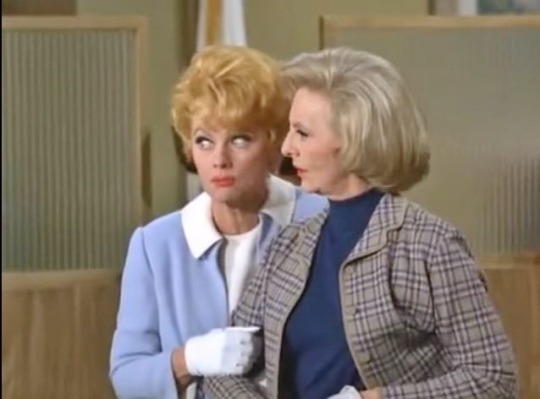
Lucille
Ball gets applause on her entrance into the third scene, indicating
the episode may have been shot out of sequence.Sheldon
Leonard also gets a round of applause from the studio audience when
he finally enters nearly 11 minutes into the action. Up until then,
the episode has been about Lucy wanting a raise.
Mr.
Mooney quotes the Bible when he says
“The laborer is worthy of his hire.” The
adage was also spoken by Chaucer and Gandhi.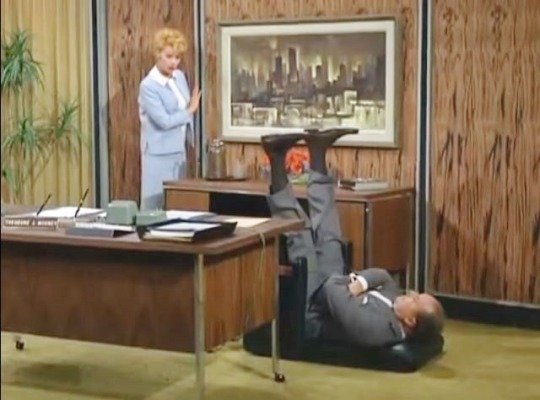
We
learn that Westland Bank is the third largest financial institution
in the city of Los Angeles with assets of 31 million dollars and 31
branches. We also hear that Mr. Mooney got his job with the bank by
marrying the boss’s niece. This means that Irma Mooney’s uncle was president of Westland Bank!
Over
the telephone, Mr. Cheever tells Mr. Mooney that Sheldon Leonard
produced “The Danny Thomas Show,” “Dick Van Dyke” and “I
Spy.” Leonard himself adds “Andy Griffith” (which followed “The Lucy Show” on the CBS Monday schedule) and “Gomer Pyle”
to his credits. Mr. Mooney and Leonard discuss his history of playing
gangsters as well as his transition to behind the camera. This
exposition also helps “Lucy Show” home viewers realize that
Leonard is more than just an actor, but a successful Hollywood
producer as well. Leonard introduces the concept of ‘shooting a
pilot’ – explaining to Mr. Mooney (and the viewers) that this does
not mean gunning down someone who flies airplanes!Mr. Mooney (perhaps jokingly) says he speaks seven languages – but not Lucy’s!
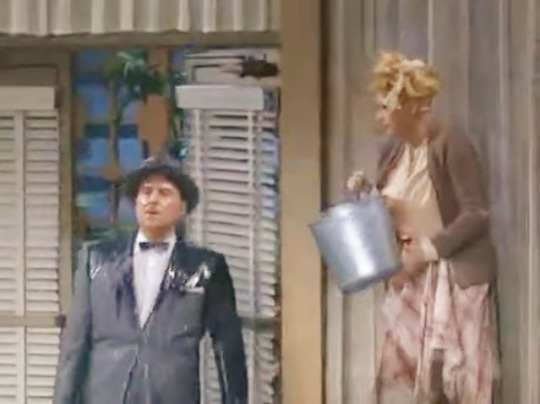
Mr.
Mooney ends up all wet – again – when Lucy throws a bucket of
water on him thinking he is a bank robber.
The end of the episode turns very meta when Leonard says:
“I suddenly got this idea for a new television series. It would be about this kooky red headed girl. She works in a bank and she gets into all sorts of impossible situations and… forget it. Nobody would ever believe it.”
Blooper Alerts!

Health Check! When Lucy reports for work, she kindly asks Mr. Mooney “How are you? “How is Mrs. Mooney?” but never asks about his children! Much like Lucy’s own offspring – out of sight, out of mind!
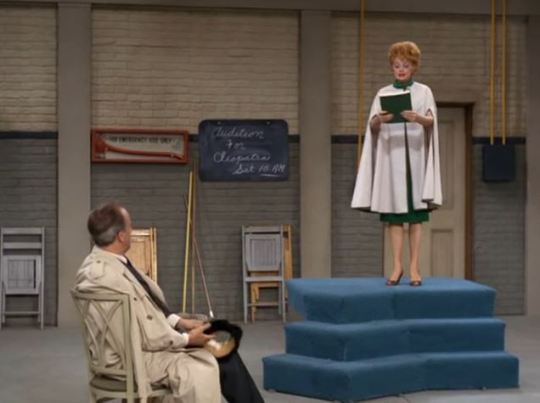
Credit Check? Leonard asks Lucy if she’s ever done any acting. Lucy says “No, sir.” Faithful viewers will know this is not true. Lucy Carmichael has appeared on stage (as Cleopatra), TV (with Danny Thomas) , and film (as Iron Man Carmichael).

Alarming Bravery! Lucy says that it it brave for Leonard to enter the bank through the front doors. She should have known something is up when the bank’s alarm didn’t go off!

Cart Conundrum! As scrub women, Lucy and Mary Jane push a cart labeled “LAUNDRY.” Why would a bank’s cleaning staff have a laundry cart? The laundry cart has been noticeably padded to accommodate Leonard’s stunt of falling into it, a stunt which he performs himself!
Callbacks!

Lucy convinces Mary Jane to play a scrub woman to go undercover, just as Lucy Ricardo convinced Ethel Mertz to do in “Cuban Pals” (ILL S1;E28).

Lucy asking Mr. Mooney (Gale Gordon) for a raise by sheepishly asking “You’re not going to give me a raise, are you?” is nearly identical to when Ricky sheepishly asked Mr. Littlefield (Gale Gordon) for a raise on a 1952 episode of “I Love Lucy.”

Sheldon Leonard and Gale Gordon both appeared in the feature film Here Come the Nelsons in 1952, eight months before the debut of the TV series “Ozzie and Harriet.”

Like Lucille Ball, Gale Gordon was directed by Sheldon Leonard when he made several appearances as Landlord Heckendorn (and other characters, including the Devil) on “The Danny Thomas Show” from 1959 to 1961.

Lucille Ball first worked with Sheldon Leonard when he played Harry Martin, slick salesman for the Handy Dandy Company in “Sales Resistance” (ILL S2;E17).
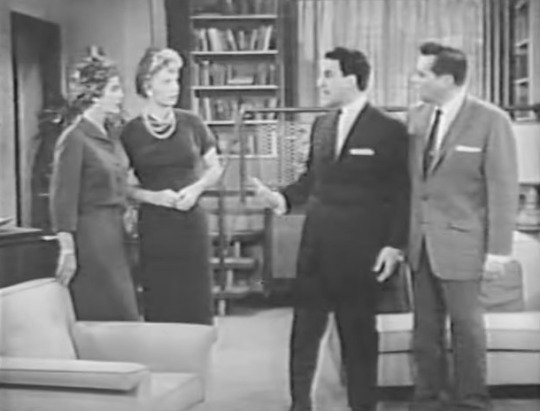
In January 1959, Sheldon Leonard directed Lucille Ball and Desi Arnaz (playing Lucy and Ricky Ricardo) on an episode of “Make Room for Daddy” titled “Lucy Upsets the Williams Household” (S6;E14), a reciprocal appearance for the cast of Thomas’s show appearing on “The Lucy-Desi Comedy Hour.”

In 1965′s “Danny Thomas’ Wonderful World of Burlesque II” featuring Lucille Ball, Sheldon Leonard made a cameo appearances as a cigar vendor in the theatre aisle. Ball and Leonard did not share any scenes.

In May 1966, both Lucille Ball and Sheldon Leonard participated in a documentary TV film titled “The Magic of Broadcasting”.
Fast Forward!

Before his death, Sheldon Leonard was interviewed by The Television Academy Foundation for The Archive of American Television to talk about the influence of Lucille Ball and Desi Arnaz on television.

In his 1995 book, And the Show Goes On: Broadway and Hollywood Adventures, Leonard wrote:
“Operating on the well-founded belief that a comedy show needs an audience to give it the authentic response that canned laughter can never duplicate, Desi brought in an audience to watch and react, while he used multiple-camera shooting technique borrowed from live TV.”

“Lucy Meets Sheldon Leonard” rates 4 Paper Hearts out of 5 1967, Andy Griffith Show, Ann Sheridan, Bible, CBS, Dick Van Dyke Show, Flag Day, Fred Stromsoe, Gale Gordon, gangster, George Sawaya, Gomer Pyle USMC, Harvey Parry, I Spy, Lucille Ball, Lucy Meets Sheldon Leonard, Make Room for Daddy, Mary Jane Croft, Nelson Eddy, season 5, Sheldon Leonard, Smog, The Lucy Show, tv
 -
Lucy and Tennessee Ernie Ford
S5;E21
~ February 27,
1967

Synopsis
Mr.
Mooney is in danger of losing his job if he doesn’t bring in some big
depositors. When Lucy hears that wealthy country music star Homer
Higgins (Tennessee Ernie Ford) is in town, she gives him a ‘down home’
welcome in order to get his business.Regular
CastLucille
Ball (Lucy
Carmichael),
Gale Gordon
(Theodore ‘Josh’ Mooney), Roy
Roberts
(Mr. Cheever)Mary
Jane Croft (Mary
Jane Lewis) does not appear in this episode.Guest
Cast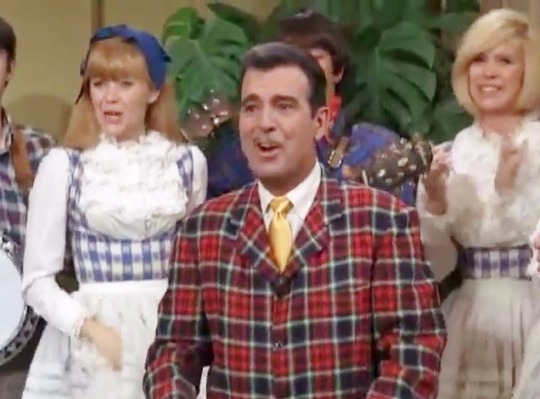
Tennessee
Ernie Ford
(Homer Higgins) was the first and only celebrity to make three guest star
appearances (playing a variation on himself) on “I Love Lucy.” A
popular country singer of the 1950s, this was his first credited
‘acting’ job, before his big hit with the song “Sixteen Tons”
in 1955. Ford was first mentioned on season 1 of “I Love Lucy”
in “Lucy
Writes a Play” (ILL S1;E17),
when playwright Lucy mistakenly dubs herself the next Tennessee
Ernie, instead of Tennessee Williams.
Ford
went on to make alliterative appearances on "Here’s Lucy”
(as Ernie Epperson), on "The Red Skelton Show” (as Loser
Lumpkin), and the Desilu-produced "Make Room For Daddy” (as
Kentucky Cal). He died in 1991.Homer
Higgins is said to be the nation’s number one country singer. He has
moved to California and is staying at the Palm Garden Hotel. His
annual income exceeds five million dollars.
Carole
Cook (Effie
Higgins) played
Thelma Green on the series when it was set in Danfield. She was a
protege of Lucille Ball’s during the Desilu Playhouse years.
Although born as Mildred Cook, Ball suggested she take the name
Carole, in honor of Lucy’s great friend, Carole Lombard. Cook also
went on to appear in five episodes of “Here’s Lucy.”Effie
is married to Homer.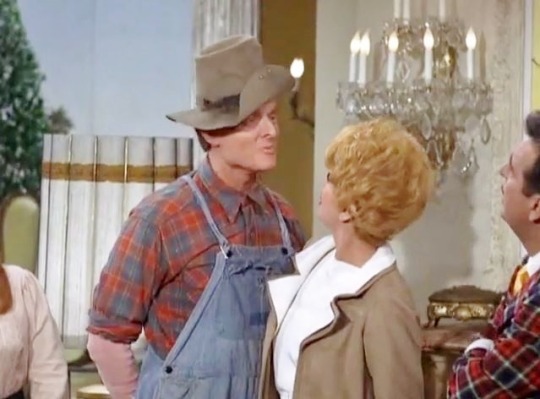
Robert
Easton (Iffie)
was usually cast as the dopey country bumpkin. He was a popular actor
and dialogue coach in over 200 film and TV projects. This is his
only appearance with Lucille Ball.Iffie
is Effie’s older brother, so named because “if he” was a girl,
they would have named him Effie.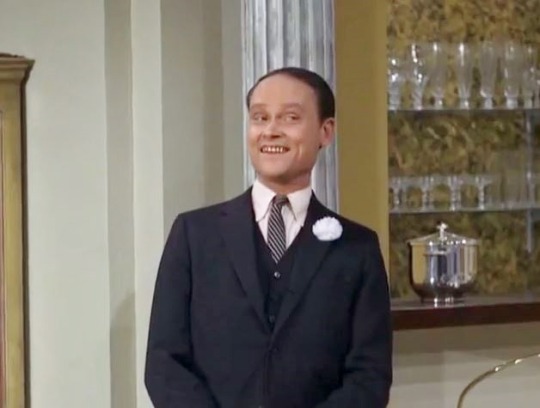
William
O’Connell
(Hotel Manager) makes his only appearance with Lucille Ball.
Joan
Swift
(Dottie) makes
the third of her six appearances on the series. Swift also did two
episodes of “Here’s Lucy.” Her final screen credit was 1975’s
“Lucy Gets Lucky” with Lucille Ball and Dean Martin.Like
Lucy, Dottie is a secretary at the Westland Bank.
The
Back Porch Majority
(Themselves) was
a folk
music
group
founded by Randy
Sparks
in
1963. It was intended to be a rehearsal space for The
New Christy Minstrels,
another group Sparks had established in 1961, but it ended up
becoming successful on its own. The group released six albums and was
chosen to provide entertainment at the
White
House in
1965. The group returned to back up Ernie Ford on a 1969 episode of
“Here’s Lucy.”
Bert
May
(Solo Dancer) made his screen debut in Ziegfeld
Follies
(1945) which also starred Lucille Ball. He danced in such film
musicals as Kismet
(1955),
Li’l
Abner
(1959), The
Music Man
(1962), Bye
Bye Birdie
(1963), Finian’s
Rainbow
(1968), and Hello
Dolly
(1969).May
makes a big entrance into the square dance through the bank’s double
doors.
Sid
Gould
(Bellboy, uncredited) made
more than 45 appearances on “The Lucy Show,” all as background
characters. He also did 40 episodes of “Here’s Lucy.” Gould
(born Sydney Greenfader) was Lucille Ball’s cousin by marriage to
Gary Morton.Roy
Rowan
(Radio Announcer, uncredited) was
the off-camera announcer for every episode of “I Love Lucy” as
well as “The Lucy Show” and “Here’s Lucy.” He was also the
voice heard when TV or radio programs were featured on the plot of
all three shows. He made a couple of on screen appearances as well.
The
other square dancers at the bank hoedown are uncredited.

This is director Maury Thompson’s last time working with Lucille Ball, and the final episode filmed for season five. Thompson wanted a raise and when the word leaked out while he was on vacation, Lucille Ball decided to fire him. The season finale, “Lucy Meets Sheldon Leonard” (S5;E22) was filmed before this episode and aired out of sequence.

The very athletic dance sequence that ends the episode was staged by choreographer Jack Baker. Marl Young, who worked on both this series as well as “Here’s Lucy” wrote original square dance music especially for the show.
This episode, like all but one from season five, and eight others from other seasons, have fallen out of copyright protection and into public domain. The result is that they have been sold on low-cost and low-quality home videos.

On
the evening this episode first aired (February 27, 1967) Keith
Andes,
who had played Lucy’s boyfriend Bill King as well as appearing
opposite Lucille Ball on Broadway in Wildcat,
appeared on “The Andy Griffith Show” which followed “The Lucy
Show” on CBS and was filmed at Desilu Studios. This same night, “Lucy’s”
lead in “Mr. Terrific” aired an episode about boxing, which was
the subject of the previous week’s “Lucy Show.”
Lucy
passes Mr. Mooney off as ‘Josh’ a good old country boy and says that
back in Cedar Creek County, Mrs. Mooney was a champion hog caller, which is how she ‘won’ Mr. Mooney.
Homer
and his family are staying at the (fictional) Palm Garden Hotel penthouse. The
Manager says “On
a clear day you can see Catalina.” This
same claim was made about the Cucamonga high rise apartment in “Lucy
Helps the Countess” (S4;E8). It is highly unlikely (even on a
smog-free day) to be able to see Catalina from Hollywood, which is
nearly sixty miles away. Although there is currently a Palm Garden
Hotel in Thousand Oaks, California, it was not built until the 1970s.
The writers created the name to sound upscale.
Homer
describes Lucy (in song) as “a pink haired gal.” His
brother-in-law Iffie says she has hair the color of orange juice!
When
Homer and his family walk into the palatial penthouse, “The Lucy
Show” feels very much like an episode of “The Beverly
Hillbillies,” also seen on CBS.
Roy Roberts (Bank President Mr.
Cheever) did six episodes of "The Beverly Hillbillies” as Bank President John
Cushing, a rival of banker Mr. Drysdale. It is very likely that “The
Lucy Show” cast Roberts as the much-anticipated Mr. Cheever after
seeing him play Cushing. Robert Easton (Iffie) appeared in both the TV series and
the 1993 film adaptation of “The Beverly Hillbillies.”
Homer
says “a clear
day in Los Angeles” is a pretty rare sight! This gets a loud round of applause from the
studio audience. The remarks refers to LA’s smog problem. In
January 1967, around the time this episode was filmed, Time Magazine
devoted its cover story to air pollution with a photo of a smoggy Los
Angeles front and center.
The song Homer sings at the bank hoe-down is titled “Ladies Auxiliary Barn Dance Saturday Night” which was released on the 1965 album “Meet the Back Porch Majority”.
Callbacks!

Lucy’s
trusty transistor radio, seen in several previous episodes, makes yet another appearance.
Passing
herself off as Mrs. Mooney, Lucy dresses as a ‘kissin’ cousin’ of the gap-toothed hillbilly she
played in the very first-aired episode of “I Love Lucy,” “The
Girls Want to Go to a Nightclub” (ILL S1;E1) back in 1951.
“Tennessee
Bound” (ILL S4;E14), the third appearance of ‘Cousin’ Ernie on “I
Love Lucy” also features a square dance with Ernie Ford as the
caller. This time around, Lucy is the caller.Fast Forward!

In November 1968, Lucille Ball appeared on “The Tennessee Ernie Ford Special” where she also blacked out her teeth for comic effect.

Ernie Ford and The Back Porch Majority will also appear on “Here’s Lucy” in 1969.

An image from this episode was used in the photo montage on the restored DVD Season 5 box cover.
Blooper
Alerts!
Ground Plan! Lucy’s
desk now seems to be in the bank lobby instead of in Mr. Mooney’s
office. The lobby has been remodeled once again, doubtless to
accommodate the hoedown scene.
Where the Floor Ends / Shut the Door! In
a long shot of the penthouse, the camera reveals where the edge of
the wall-to-wall carpeting meets the cement soundstage floor. Ernie forgets to shut the front door completely after admitting Lucy and ‘Josh’ (Mr. Mooney). After the scene is over and Lucy and ‘Josh’ are about to leave, perfectionist Lucille Ball actually shuts the door first, before opening it to leave!
“Lucy and Tennessee Ernie Ford” rates 4 Paper Hearts out of 5
 1967, Back Porch Majority, Bert May, Beverly Hillbillies, Carole Cook, Catalina, CBS, Ernie Ford, Gale Gordon, Hoedown, Joan Swift, Keith Andes, Los Angeles, Lucille Ball, Lucy and Tennessee Ernie Ford, Maury Thompson, Robert Easton, Roy Roberts, Roy Rowan, Sid Gould, Smog, Square Dance, Tennessee Ernie Ford, The Lucy Show, tv, William O’Connell
 -
Lucy the Fight Manager
S5;E20
~ February 20,
1967
Synopsis
When
Mr. Mooney has an argument with his wife, he orders flowers that are
delivered by ex-prize fighter Eddie Rickles (Don Rickles). Eddie
wants to buy a flower shop that will cost $3,000. When Mr. Mooney
won’t loan it to him, Lucy is determined to get him back in the ring
to earn it.Regular
CastLucille
Ball (Lucy
Carmichael),
Gale Gordon
(Theodore J. Mooney)Roy
Roberts
(Mr. Cheever) and Mary
Jane Croft (Mary
Jane Lewis) do not appear in this episode, although Lucy does have a
phone conversation with Mary Jane.Guest
Cast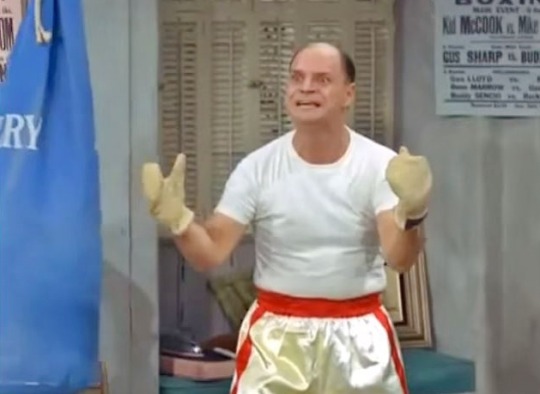
Don
Rickles (Eddie
Rickles) worked as a stand-up comic in nightclubs for nearly 20 years
before making his film debut in 1958. Rickles was known as an insult
comic and became a staple of Hollywood roasts. This is his first and
last acting appearance with Lucille Ball, but would be seen with her
on variety shows and specials through 1988. Rickles was the voice of
Mr. Potato Head in the animated Toy Story franchise. e died in
April 2017 at age 90.Eddie
is a former boxer now working as a delivery boy for Finley’s Florist,
which he wants to buy from Mr. Finley.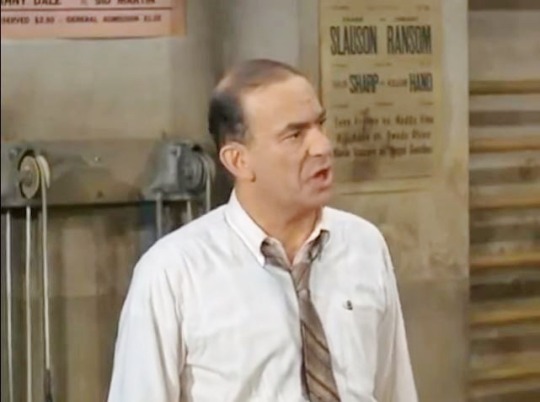
Cliff
Norton (Ike,
Sonny Shaw’s Manager) makes
the second of his two appearances on “The Lucy Show,” returning
for three episodes of “Here’s Lucy.” He did a 1972 episode of
“The Don Rickles Show.”The
character is never referred to by name in the dialogue.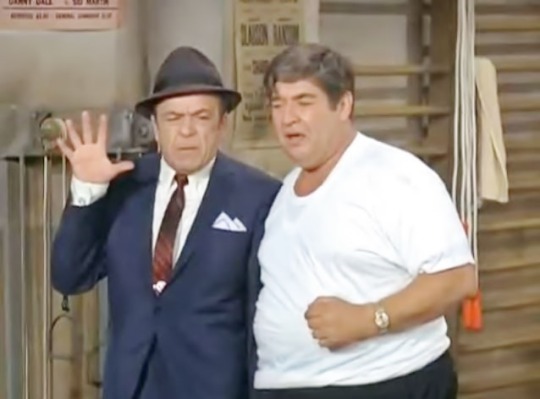
Lewis
Charles
(Nick, above left) was seen in eleven Broadway plays between 1939 and 1947. In
Hollywood, he is credited with over 160 films and TV shows. This is
his only appearance with Lucille Ball.The
character is obviously supposed to be a mobster. He bets on Sonny
Shaw and tells his trainer that he’d better win.Stanley
Adams
(Louie, Sonny Shaw’s Trainer, above right) makes the first of his three
appearances on “The Lucy Show.” He was also seen with Lucille
Ball in Critic’s
Choice
(1963). In 1960, he was seen with Don Rickles in the film The
Rat Race.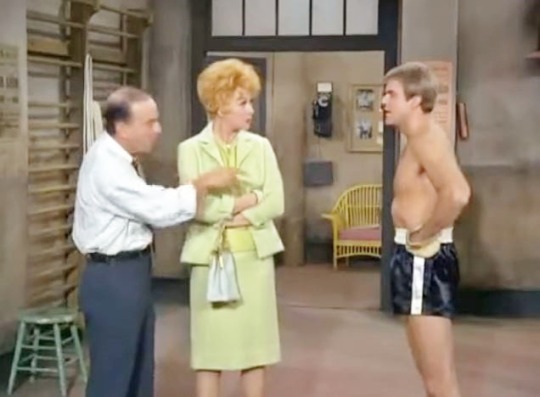
Bruce
Mars
(Sonny Shaw, a Young Prize Fighter) makes his only appearance on the
series but returns the following year for an episode of “Here’s
Lucy.”Mars
has no dialogue, but he looks good in his boxing trunks! He shows
more skin than has been seen before on “The Lucy Show.”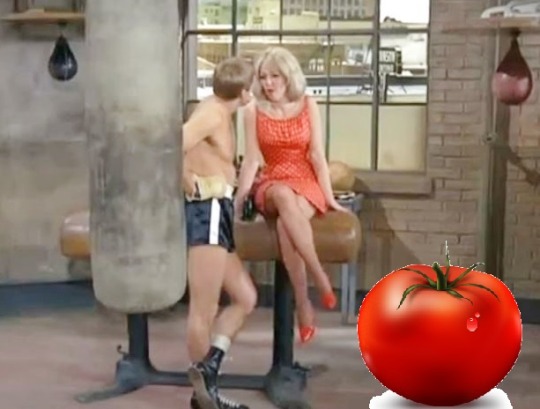
Sonny’s ‘Tomato’ and others at the gym go uncredited.
This
is the only episode written by Ronald Axe and Les Roberts.
The pair also wrote an episode of “The Andy Griffith Show”
(filmed at Desilu) that aired earlier in February 1967. “The Lucy
Show” was the lead-in to “The Andy Griffith Show” on CBS’s
Monday night primetime schedule.
This is one of more than 30 episodes of “The Lucy Show” that is in the public domain and not under copyright. Because of this, it appears on many low-quality, low-priced videos.
While
most actors got to use their own first names on the series (Lucy,
Mary Jane, Mel Torme, Joan Blondell) Don Rickles is called Eddie, but
uses his real surname. This is a rare example of Rickles doing scripted comedy NOT based on his brand of insult humor.Stand-up
comic Don Rickles made quite a name for himself as a sitcom guest
star at this time. Lucille Ball reportedly had a hard time working
with him because she never knew when he was kidding and when he
wasn’t.
The episode opens with Mr. Mooney on the telephone with his wife Irma. The character is often mentioned on the series, but never seen. Later in the episode, we learn that Irma is in charge of the Flower Show and wants to hire Eddie. The name ‘Irma’ was doubtless chosen for its association with the film, radio and television series “My Friend Irma” which starred Gale Gordon’s mother, Gloria Gordon, who died in 1962, the same year “The Lucy Show” began.
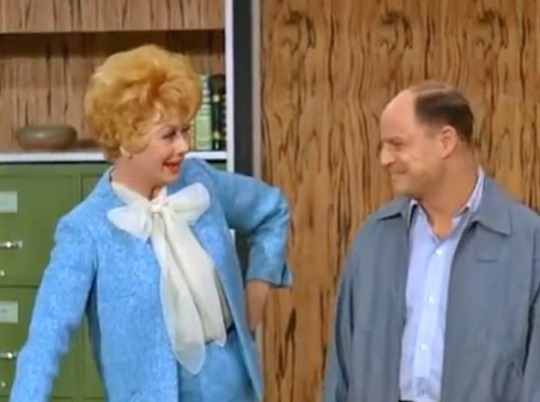
Lucy
says she likes flowers because she used to live over a funeral
parlor, although where and when we never find out!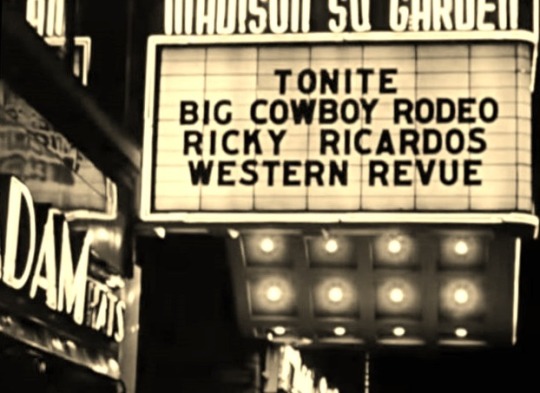
Mr.
Mooney says he saw Eddie Rickles knock out Joey Mitchell at Madison
Square Garden in 1962. Although there was a real professional boxer named Joey Mitchell, his career began and ended in 1923 and ever got anywhere near Madison Square Garden! But Lucy Ricardo did, when she performed in “Lucy Goes to a Rodeo” (ILL S5;E8) in 1955.
Mr. Mooney says former baseball
players generally open bowling alleys and boxers open saloons. Eddie
wants to open a flower shop. Mr. Mooney may have been thinking of Jackie Tavener (1897-1969), who was a professional baseball player from 1921 to 1934 and later
was the proprietor of a bowling alley in Fort Worth known as Tavener’s Playdium. In 1935, former heavyweight boxing champion Jack Dempsey opened Jack Dempsey’s Bar in midtown Manhattan. It closed in 1975, but was seen in many movies and television shows.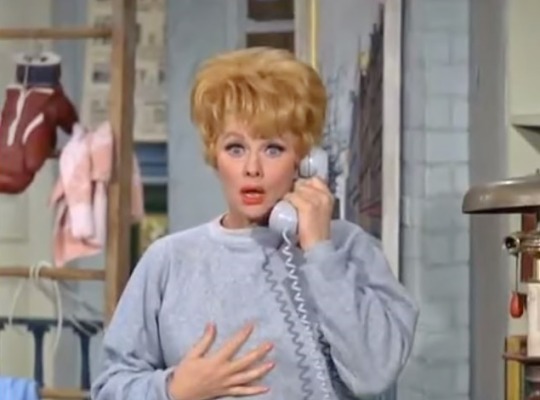
Lucy
mistakenly thinks Sandy Koufax is a boxer. Sanford
Koufax
is a former American Major League Baseball player who pitched 12
seasons for the Brooklyn / Los Angeles Dodgers from 1955 to 1966.
Koufax was first mentioned on the series in “Lucy and Viv Play
Softball” (S2;E3).
More
than once, the episode mentions ‘the Manassa Mauler’ Jack Dempsy.
William
Harrison
Dempsey
(1895–1983)
was a professional
boxer
who
competed from 1914 to 1927, and reigned as the world heavyweight
champion
from 1919 to 1926. He was mentioned on “I Love Lucy” several
times, mostly by Fred Mertz, who was a boxing fan and former Golden
Gloves champion.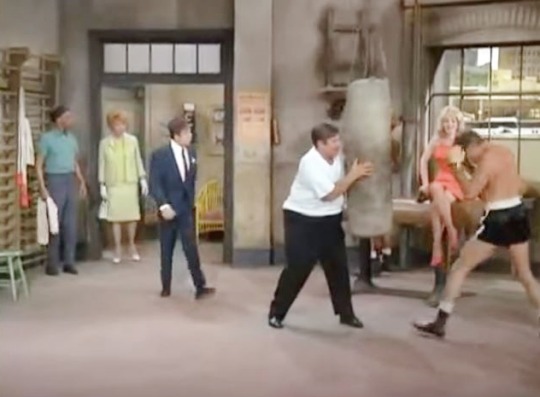
When
asked if Eddie Rickles is training at Lefty Lattimer’s Gym, Lucy replies
that he training at Killer Carmichael’s! She decorates her apartment with boxing posters, sets up a make-shift ring in the kitchen, fills her laundry bag up for sparring practice, replaces her lampshade with a bell, hangs a volleyball as a punching bag, and puts a mattress on the floor for calisthenics. She lies to Mr. Mooney about being sick, saying she has the mumps!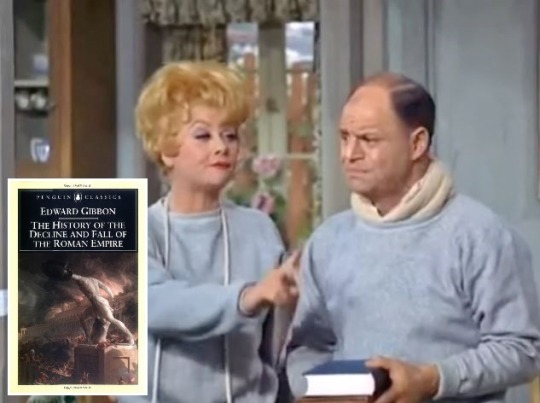
When
putting Eddie on the bathroom scales she makes him hold two big
books: “The Decline and Fall of the Roman Empire” and “Aunt
Fanny’s Cookbook” because the scales are off and that is the only
way to get an accurate reading. The
History of the Decline and Fall of the Roman Empire
was
written by English
historian
Edward
Gibbon,
which traces the trajectory of Western
civilization
from the height
of
the Roman
Empire
to
the fall
of
Byzantium.
It was published in six volumes from 1776 to 1889.Hardly reading one associates with Lucy Carmichael. Aunt Fannie’s
Cookbook, on the other hand…
Ball
and Rickles get a round of applause from the studio audience when
they jump rope in tandem.
At the end, Lucy knocks Eddie out with one punch and he realizes he has a glass jaw. This is a boxing expression for one who can easily be knocked out by punches to the jaw, a major drawback for a prize fighter.
Callbacks!
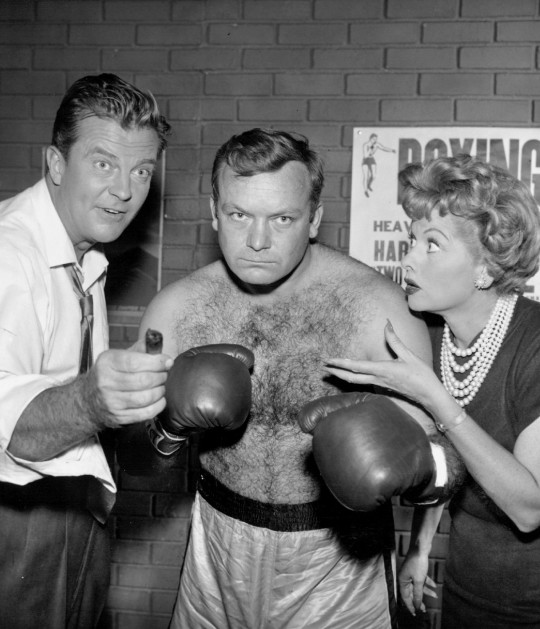
Lucy played a fight manager named Kitty Williams in a November 1958 episode of the “Westinghouse Desilu Playhouse” titled “K.O. Kitty” starring Matt Lundigan and Aldo Ray as the prize fighter. The anthology series (hosted by Desi Arnaz) also presented episodes of “The Lucy-Desi Comedy Hour.” Lucille Ball was supposed to play several more non-Lucy Ricardo roles on the series, but this was the only one that ever materialized. It was produced by Quinn Martin, who also came up with the story. It was written by Martin’s wife, Madelyn Pugh, and Bob Carroll Jr., the “I Love Lucy” writers who also worked on the first few seasons of “The Lucy Show.”
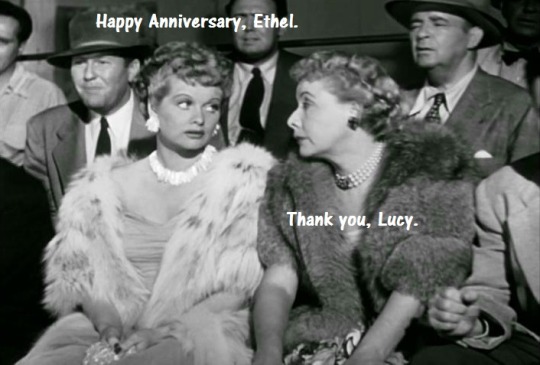
Lucy
Ricardo and Ethel Mertz ended up at the fights in the last scene of
1951’s “The Girls Want to Go to a Nightclub” (ILL S1;E1), the
very first “I Love Lucy” episode ever aired.
Everyone but Lucy
and Ethel seem to be watching the fights on television in “Ricky
and Fred are TV Fans” (ILL S2;E30).FAST FORWARD

Two years after this “Lucy Show” episode, Don Rickles played himself on the Desi Arnaz sitcom “The Mothers-in-Law” (S2;E24) produced and directed by Elliott Lewis, husband of Mary Jane Croft and was written by original “Lucy” writers Bob Carroll Jr. and Madelyn Davis.

Rickles was mentioned on “Lucy and Sammy Davis Jr.” (HL S3;E3) in 1970, jokingly saying her grouchy neighbor writes fan letters to Don Rickles.

Rickles is mentioned again in 1974′s “Milton Berle Is The Life of the Party” (HL S6;E19) when Berle calls him “the merchant of venom” on a telethon!

In February 1975, Rickles was on the dais to roast Lucille Ball on “The Dean Martin Celebrity Roast.” “Lucy Show” cast mates Vivian Vance, Gale Gordon, Dick Martin, Dan Rowan, Bob Hope, Milton Berle, Gary Morton, and Jack Benny (in his final TV appearance) were also on hand.

In 1976, both Rickles and Ball were part of “Bob Hope’s World of Comedy” although the two did not share any screen time.
Blooper
Alerts!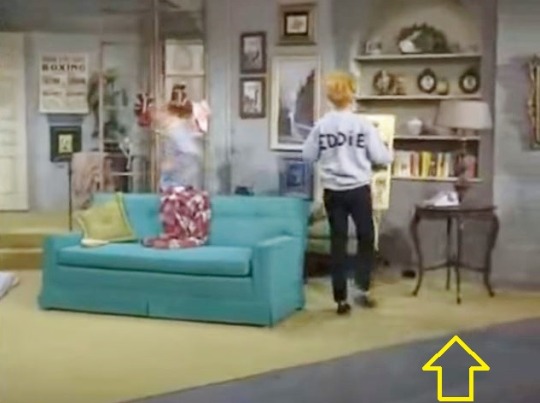
Where the Floor Ends! When
the camera pulls back for a long shot of Lucy’s living room, the
point where Lucy’s wall-to-wall carpeting meets the cement floor of
the soundstage can be seen.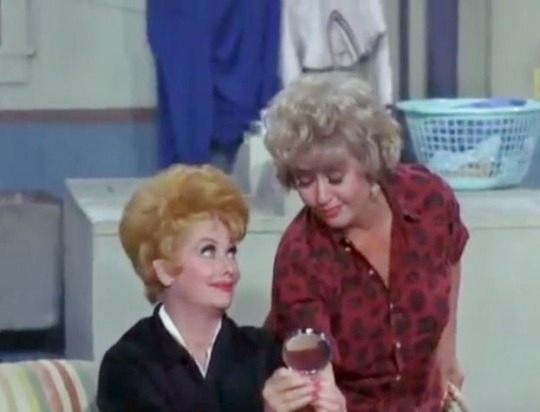
Super Hearing? Lucy
hears the timer buzzer on the washing machine and says her laundry is
done. In “Lucy and Joan” (S4;E4) it was established that Lucy’s
apartment complex has a laundry room.
Shoeless Joe! After throwing an air punch at Eddie and twirling to the ground, Lucy’s left shoe goes flying off her foot into the living room! A few moments later, Lucy steps out of her other shoe to finish the scene.

“Lucy the Fight Manager” rates 3 Paper Hearts out of 5
-
Lucy Meets the Law
S5;E19
~ February 13,
1967
Synopsis
Lucy
thinks she’s being arrested for littering when she is actually being mistaken for a
red-haired jewel thief.Regular
CastLucille
Ball (Lucy
Carmichael),
Gale Gordon
(Theodore J. Mooney), Mary
Jane Croft (Mary
Jane Lewis)Roy
Roberts
(Mr. Cheever) does not appear in this episode.Guest
Cast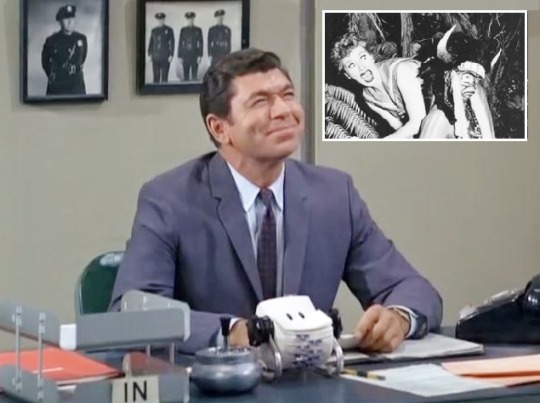
Claude
Akins
(Lieutenant
Finch) appeared as himself (playing a giant native) in “Desert
Island” (ILL S6;E8). He
is perhaps best remembered for playing Sheriff Lobo in “B.J. And
the Bear” (1978-79) and its sequel “The Misadventures of Sheriff
Lobo” (1979-81). Akins died in 1994.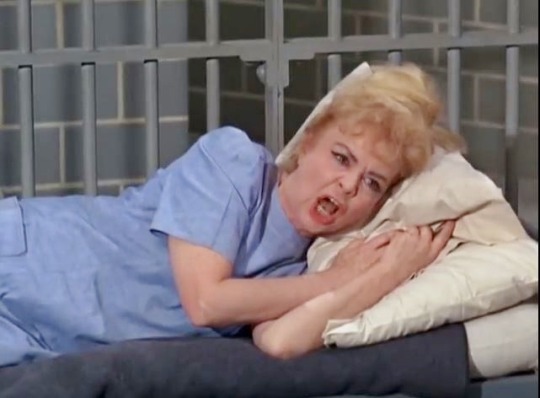
Iris
Adrian
(Hard Head Hogan) appeared on Broadway in the 1930s and was a
Ziegfeld girl. In Hollywood she did more than 160 films. This is
her only appearance with Lucille Ball.Hard Head is a bouncer in a beer hall. She is in jail for assault and battery.
Ken
Lynch (Officer
Peters, below left) started playing policemen on TV in 1950 and continued to do
so for much of his career. This is his only appearance with Lucille
Ball.
Joseph
Perry
(Officer Miller, above right) started his screen acting career in 1956. His final
credit was playing Nemo for seven episodes of “Everybody Loves
Raymond” in 1999. He died the following year. This is his only
appearance with Lucille Ball.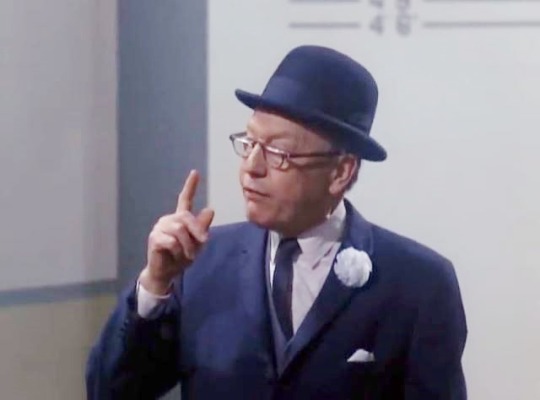
Byron
Foulger
(Mr. Trindle) had played the leader of the Friends of the Friendless
in “Lucy’s
Last Birthday” (ILL S2;E25).
He previously appeared on “The Lucy Show” in “My Fair Lucy”
(S3;E20).
Mr.
Trindle is the proprietor of the jewelry store that was robbed.
Jody
Gilbert (Matron
aka ‘Tinkerbell’) had appeared with Lucille Ball and Gale Gordon
on the 1952 special “Stars in the Eye” celebrating the opening of
CBS’s new Television City studios. She was a regular on the CBS series “Life With Luigi”. She will also appear in two
episodes of “Here’s Lucy,” in one of which she also plays a
prison matron.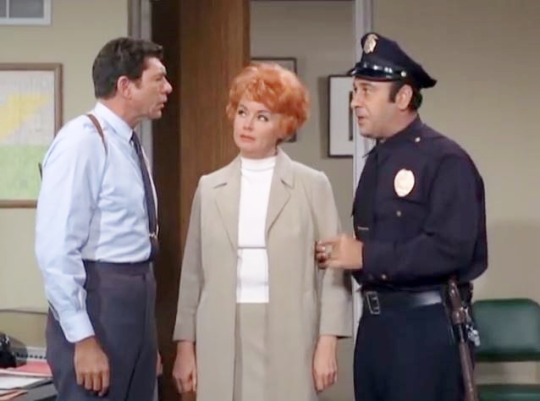
Two
passersby, the other women in the line-up, and the actual red-haired
jewel thief (above) are all uncredited. Interestingly, Hazel Pierce, who was
Lucy’s stand-in and frequent day player, is not in this episode.

Some video releases title this episode “A Case of
Mistaken Identity.” This is one of more than 30 episodes of “The Lucy Show” that have fallen out of copyright protection and are in the public domain, resulting in its appearance on many inexpensive video and DVD releases.
There was no new “Lucy Show” episode on Monday, February 6, 1967. Instead, CBS showed a repeat of “Lucy Gets Caught Up in the Draft” (S5;E9).

The final draft of the script was dated December 27, 1966. The above copy belonged to Julian Davidson, “The Lucy Show” music coordinator. The episode was filmed January 6, 1967, the first to be filmed after the holidays.

This
was the first and only episode written by Alan
J. Levitt.
It was also his first script for television. He went on to write
for “Maude” (1972-74) and one of Lucille Ball’s favorite sitcoms
“Three’s Company” (1977-78). Levitt shows a firm grasp of writing
farce, balancing Lucy’s belief that she has been arrested for
littering, with the audience’s knowledge that she is believed to be a
jewel thief, using cleverly worded dialogue that allows both Lucy and
police to have a conversation without giving away the misconception.
Mary
Jane tells Lucy that littering is against the “Keep America
Beautiful” Campaign. ‘Keep
America Beautiful’ was
founded in 1953 by a consortium of nonprofit organizations,
government agencies, concerned individuals, and American businesses
(including original “I Love Lucy” sponsor Philip
Morris).
‘Keep America Beautiful’ joined with the Ad
Council in
1961 to dramatize the idea that every individual must help protect
against the effects litter has on the environment. These included
the
popular 1963 television campaign “Every Litter Bit Hurts”
and the character ‘Susan Spotless’ in 1964. The organization is still
active today.
In
order not to implicate her friend, Lucy tells the policemen that Mary
Jane is the name of her cat. She says she likes to call the cat up
and say “What’s
new, pussycat?”
What’s
New Pussycat
was the name of a hit film of 1965 written by Woody Allen. Its title
song was nominated for an Oscar and was a big hit for Tom Jones.
When
thrown in the cell with a growling Hard Head, Lucy says she doesn’t
feel very welcome. The Matron remarks that “You’re
as welcome as the flowers in May.” “Welcome
as the Flowers in May”
was
a song written by Anne Young round 1903.Trying
to be tough, Lucy tells Hard Head Hogan her ‘handle’ is “Steel
Knuckles Carmichael” but her friends call her “Knuck.” Hogan
continually gets the name wrong, calling her ‘Muck’ and ‘Cluck.’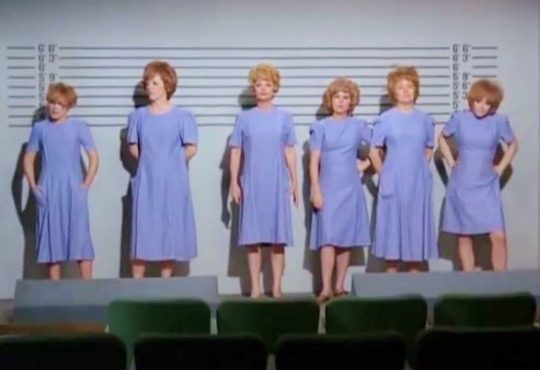
Mr.
Trindle can’t positively identify the jewel thief in a line up of red
headed women. He says he didn’t anticipate so many red heads. Lt.
Finch replies “What
did you figure on? A bunch of Yul Brynners?”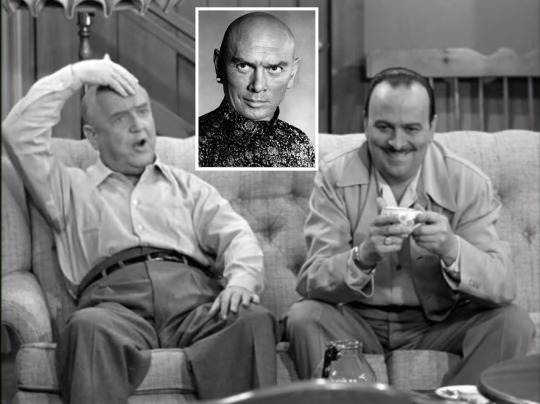
Yul
Brynner (1920-85)
was an actor known for his bald head. He was mentioned on “I Love
Lucy” several times, generally comparing him with Fred, who was
nearly bald himself. At the time of filming, Brynner had just been
seen in The
Return of the Magnificent Seven,
a sequel to 1960’s hit The
Magnificent Seven,
in which he also appeared.
Finch
says the women in the line up would make Ma Barker look like a camp
fire girl. This is the second episode in a row to mention Ma Barker.
Kate
Barker
(1873–1935)
was the mother of several criminals who ran the Barker gang. She
traveled with her sons during their criminal careers. Barker was also
mentioned in “Lucy
and the Great Bank Robbery” (S3;E5) and “Lucy Puts Main Street on the Map” (S5;E18).
Ma
Barker was parodied as Ma Parker in a 1970 episode of “Here’s
Lucy” (above) played by Carole Cook.Entering
the action late in the episode to vouch for Lucy, Gale Gordon gets a
smattering of entrance applause from the studio audience.Callbacks!
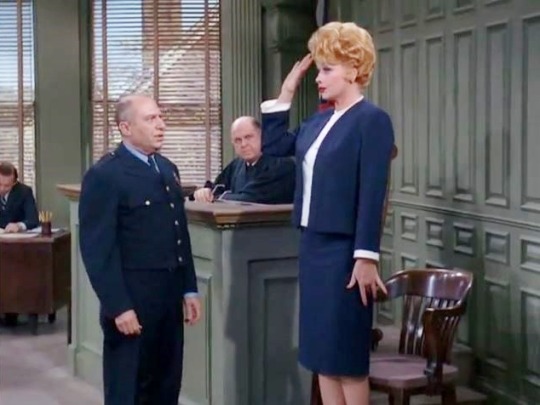
Although
never incarcerated before, Lucy Carmichael’s previous brushes with
the law include: “Lucy and the Runaway Butterfly” (S1;E29), “Lucy
is Her Own Lawyer” (S2;E23), “Lucy the Meter Maid” (S3;E7) and
“Lucy Makes a Pinch” (S3;E8).
Behind Bars! Lucy Ricardo was arrested
and in jail in several episodes: “New Neighbors” (S1;E21) in New
York City, “Tennessee Bound” (ILL S4;E14) in Bent Fork, and
“Lucy Takes a Cruise To Havana” (1957) in Havana. Lucy also comes very close
to going to jail in “Ricky and Fred art TV Fans” (ILL S2;E30) for
stealing change from a cash register, and in “Paris at Last”
(ILL S5;E18) for forging Francs!
More Mistaken Identity! In “Ricky and Fred are TV Fans” (ILL S2;E30) Lucy Ricardo is mistaken for jewel thief ‘Sticky Fingers Sal’, and hauled down for questioning, just as Lucy Carmichael is here.
Fast Forward!

Lucy
Carter voluntarily goes to jail in a 1973 episode of “Here’s Lucy” that
also features Gale Gordon and Jody Gilbert as a Matron. This time
her cellmate is Mumsie Westcott, played by Elsa Lanchester, who may
(or may not) have been criminal hatchet murderess Eleanor Holmby when
Lucy and Ethel go “Off to Florida” (ILL S6;E6).
Lucy Carter also got her mug shot taken in “The Case of the Reckless Wheelchair Drive” (HL S5;E6). Again, she makes her ‘criminal face’ for the camera.

Intentional mistaken identity is behind “Lucy Carter Meets Lucille Ball” (HL S6;E22) where a look-alike contest brings out several Lucy doppelgangers, including Lucille Ball herself!

“Lucy Meets the Law” rates 4 Paper Hearts out of 5

This woman looks a bit like Lucille Ball! Also, the book’s former owner’s initials are “LR” – Lucy Ricardo!
1967, A Case of Mistaken Identity, Alan J. Levitt, Byron Foulger, CBS, Claude Akins, Gale Gordon, Iris Adrian, Jail, Jewel Theif, Jody Gilbert, Joseph Perry, Keep America Beautiful, Ken Lynch, Line Up, Lucille Ball, Lucy Meets the Law, Ma Barker, Police, The Lucy Show, tv, Welcome as the Flowers in May, What’s New Pussycat, Yul Brynner -
Lucy Puts Main Street on the Map
S5;E18
~ January 30,
1967
Synopsis
Trying
to think of a way to help bring the town of Bancroft’s story to the rest of
America, Lucy and the town fathers stage a gun battle to get national
news coverage.Regular
CastLucille
Ball (Lucy
Carmichael),
Gale Gordon
(Theodore J. Mooney)Mary
Jane Croft (Mary
Jane Lewis) and Roy
Roberts
(Mr. Cheever) do not appear in this episode.Guest
Cast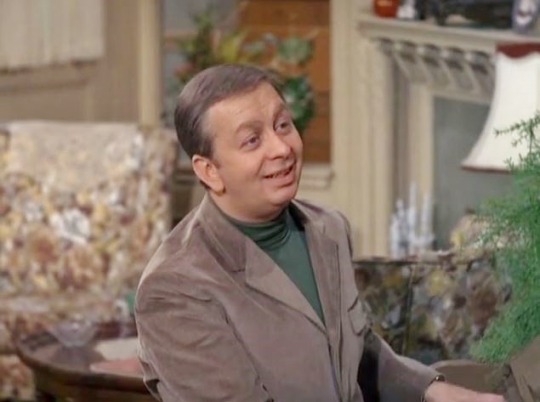
Mel
Tormé
(Mel Tinker) returns to play Lucy’s neighbor Mel having previously
played the role in “Lucy in the Music World” (S4;E3) and “Main
Street U.S.A.” (S5;E17). Tormé
was
a musician nicknamed ‘the velvet fog’. He was best known as a
singer of jazz standards. He was also a jazz composer and arranger,
drummer, an actor in radio, film, and television, and the author of
five books. He composed the music for “The Christmas Song”
(“Chestnuts Roasting on an Open Fire”) and co-wrote the lyrics
with Bob Wells. He died in 1999 at the age of 73.
John
William Sublett (John
Bubbles) was known
as the “Father of Rhythm Tap,” and was the original Sportin’
Life on Broadway in Porgy
and Bess
(1935). Since he did not read music, George Gershwin had to teach him
the songs note by note. Sublett was his birth name but his stage name
was Bubbles, which he uses as his character name here. He appeared in
the previous episode “Main Street U.S.A.” (S5;17). He had a stroke and had to
retire from show business. He died in 1986.Although
not the first black face on a Lucille Ball sitcom, Sublett has the
distinction of being the first to be be billed as a guest star and to
be an integral part in the storyline.
Paul
Winchell
(Doc Putnam) previously
played himself in “Lucy and Paul Winchell” (S5;E4). He was
born Paul Wilchinsky in 1922. Coming into the public eye in 1948, he
became one of the most famous ventriloquists since Edgar Bergen. He
hosted the enormously popular children’s television show
“Winchell-Mahoney Time” (1964-68) in which he shared the
spotlight with Jerry Mahoney, one of his most popular characters.
Winchell is fondly remembered as the voice of Winnie the Pooh’s pal
Tigger and (later) Papa Smurf. He played Doc Putnam in “Main Street
U.S.A.” (S5;17), as well as doing two episodes of “Here’s
Lucy.” Surprisingly, Winchell was also an inventor who is credited
with the artificial heart, among other innovations. He died in 2005.Paul Winchell
was most famous as a ventriloquist, but he does not do
ventriloquism in this episode. He cherished the opportunity to act without his dummies. Winchell learned to play violin for this episode.
Hal
Smith
(Mr. Weber) is
probably best remembered as Otis Campbell, the town drunk, on “The
Andy Griffith Show,” even though in real life he never drank
alcohol. He appeared with Lucille Ball in the 1963 film Critic’s
Choice.
This is the third of his three appearance on “The Lucy Show.” He reprises the role of Mr.
Weber last seen in “Main
Street U.S.A.” (S5;E17) and
did one episode of “Here’s Lucy” in 1972.In
the previous episode Mr. Weber could not get his tuba from around his
waist. In this episode he is still wearing it!
Burt
Mustin
(Old Uncle Joe) was born in 1884. He didn’t do his first film until
age 67, although his stage and radio career started earlier. He was
generally cast as the stereotypical little old man. He is probably
best remembered as Mr. Quigley on “All in the Family” and Mr.
Lanson on “Phyllis.” He played Old Uncle Joe in the previous episode and did a 1973 episode of “Here’s Lucy.” Mustin also
played Uncle Jeff in Lucy’s Mame
(1974). He died at age 92.
Carole
Cook (Aunt
Carrie) played Thelma Green on the series when it was set in
Danfield. She
was a protege of Lucille Ball’s during the Desilu Playhouse years.
Although born as Mildred Cook, Ball suggested she take the name
Carole, in honor of Lucy’s great friend, Carole Lombard. Cook also
went on to appear in five episodes of “Here’s Lucy.”Aunt
Carrie is a relative of Mel Tinker. The character did not appear in the previous episode.
Dan
Rowan
(Dan McGowan) was
the comedy partner of Dick Martin, who played Lucy’s boyfriend
Harry on season 1 of “The Lucy Show.” He is best known as the
co-host of “Rowan and Martin’s Laugh-In” which aired from 1968
to 1973 and earned him a 1972 Emmy Award. In 1966 he had appeared
with Lucille Ball on “The Dean Martin Show.” This is the second
of his two appearances on “The Lucy Show.” He died in 1987 at age
65.Dan
McGowan is a TV reporter with the National News Service.
Roy
Barcroft
(Police Chief Tinker) had more than 375 screen credits from 1931 to
1970. He played the Marshall in the screen adaptation of Oklahoma!
(1955). This is his only appearance with Lucille Ball.The
character is the father of Mel Tinker.
Bennett
Green (Cameraman
with National News Service, uncredited) was
Desi Arnaz’s stand-in during “I Love Lucy.” He does frequent
background work on “The Lucy Show.”
Some
of the Bancroft Townspeople (uncredited) are played by:- Walter
Bacon was last seen in “Lucy Wins a Racehorse,” a 1958
episode of “The Lucy-Desi Comedy Hour.” Bacon played ‘townsmen’
on many TV westerns. - Nick
Borgani appeared with Lucille Ball in the 1937 film Stage
Door. He will also be seen in two episodes of “Here’s Lucy.” - Victor
Romito was
last seen as the Bartender in “Lucy Meets John Wayne” (S5;E10).
He
also appeared in four episodes of “Here’s Lucy.” Romito was
an extra in the 1960 Lucille Ball / Bob Hope film Critic’s
Choice. - Glen
Walters was
a Canadian actress who’s career spanned from 1926 to 1973. This is
her only appearance with Lucille Ball. - Judith
Woodbury
makes the seventh of her eight (mostly) uncredited appearances on
“The Lucy Show.” She also appeared in one episode of “Here’s
Lucy.”
The
actor with the gray beard and overalls who is referred to as ‘Farmer
Brown’ in the previous episode “Main Street U.S.A.” (S5;17)
returns in this episode.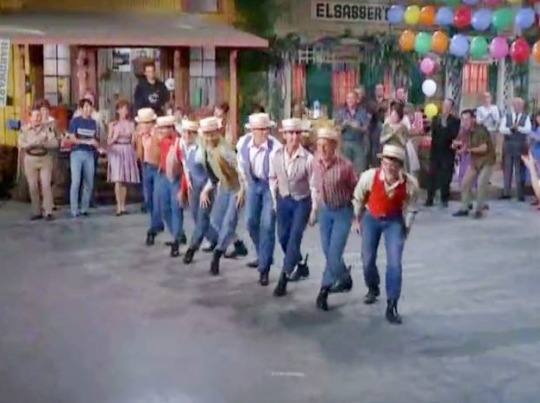
Other citizens of Bancroft are played by
uncredited background artists, most of whom were likely in the
previous episode as well.
This episode was filmed in mid-December 1966, shortly after the completion of
“Main Street U.S.A.” (S5;E17). Although
stand-alone in their plots, this episode is a continuation of the
previous one, which also takes
place in the small town of Bancroft.This is the only episode of
season five that is still under copyright protection and not in
public domain.
Coincidentally, this episode first aired on Dick Martin’s 45th birthday. He previously played Lucy Carmichael’s boyfriend Harry on the series. His comedy partner Dan Rowan plays a reporter in this episode.

The dance sequences were choreographed by Jack Baker.

Bancroft
is supposedly located in California, but feels more like a
mid-western or northeastern town. Although this is a fictional
location, there is a Bancroft outside of San Francisco. At the time
of filming, however, it was known as Hookston,
is an unincorporated community in Contra Costa County.
Mel
Tormé
wrote
the original song “Main
Street U.S.A.”
especially for these two episodes. It was first sung at the end of
the previous episode and is reprised at the start of this one. Here we learn that it was Lucy Carmichael who wrote the songs lyrics to Mel Tinker’s music. Torme also wrote and sings the ballad “In
Our Home Town,”
a tribute to small town life. In 1944 he had a hit with another ‘town’ song titled “Stranger in Town” and in 1959 released an
album titled Back
in Town.
As
‘Carrot Top Carmichael’ Lucy says she plans to be the “most
vicious, cold blooded killer since Ma Barker.”
Kate
Barker
(1873–1935, inset photo)
was the mother of several criminals who ran the Barker gang. She
traveled with her sons during their criminal careers. FBI director J.
Edgar Hoover described her as “the
most vicious, dangerous and resourceful criminal brain of the last
decade.” Barker was last mentioned in “Lucy and the Great Bank Robbery” (S3;E5). Ma
Barker was parodied as Ma Parker in a 1970 episode of “Here’s
Lucy” (above) starring Carole Cook (who plays Aunt Carrie here).
Behind
the TV camera atop the station wagon is a shop called Grandma
Thompson’s Bakery. This is likely a tribute to director Maury
Thompson and producer Tommy Thompson, who were not related.
Marl Young is credited with the dance music for John Bubbles.
Callbacks!
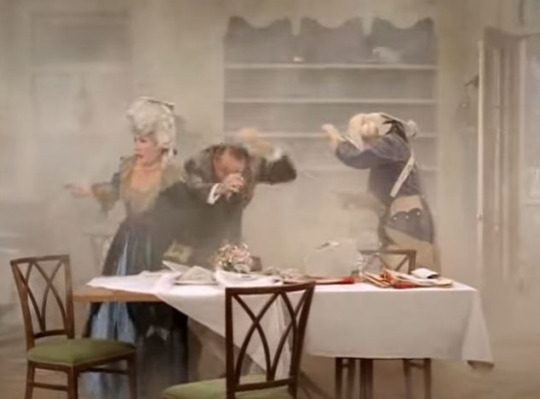
Back
in Danfield, construction of a new freeway was the cause of the
destruction of their roadside cafe when “Lucy and Viv Open a
Restaurant” (S2;E20).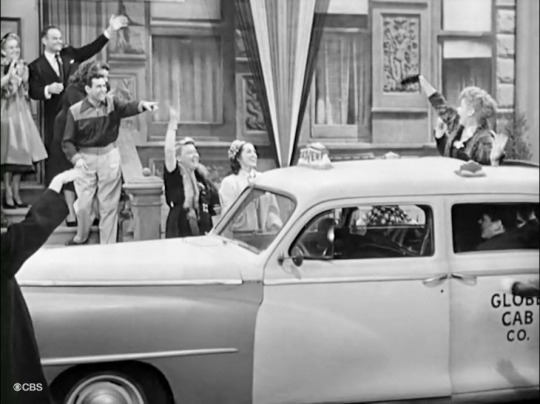
The
residents of East 68th Street planned a big block party when Ricky Ricardo came home from
Hollywood in “The Homecoming” (ILL S5;E6).Blooper
Alerts!
Sound Slip! Mel plays “Our Home Town” on an old upright piano, but on the soundtrack it is not a piano, but a harpsichord.

Popular Print! The painting above Lucy’s left shoulder in the Tinker parlor was previously seen in Lucy’s Danfield living room and later in Viv’s bedroom.
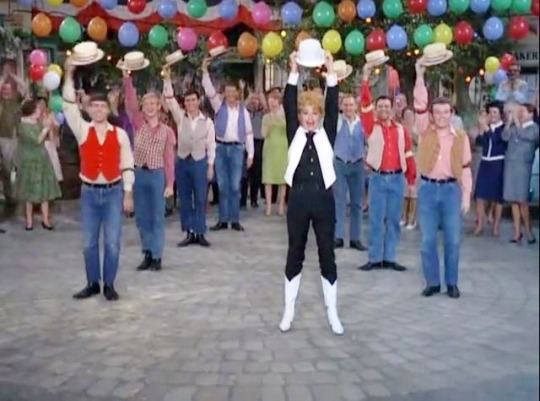
Smile For The Camera(s)! When
Lucy and Mel break into song for the TV news, they perform with
their backs to the camera, which is still atop the station wagon
behind them.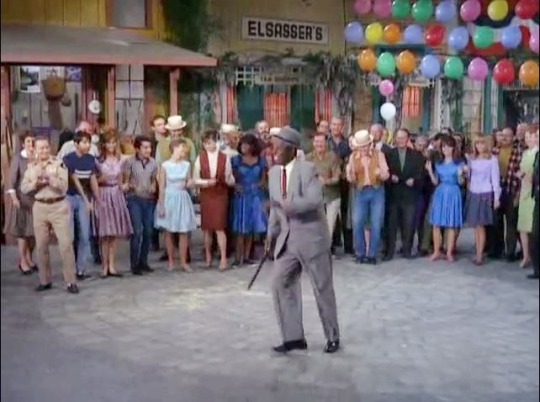
Bloody Bad Idea! Even though the gun battle is staged to woo reporter McGowan to Bancroft
to publicize a good cause, a pile of bullet-ridden corpses and a
whopping lie seem a dubious way to bring attention to the joys of
small town life. Ironically, right after the corpses get up, Mel
sings “it’s peaceful and quiet, there’s never a riot, in my home
town.”
Soft Goods at the Hardware Store! A sign in the window of the Hardware Store advertises an unusual item – Matador Scarfs! Why would a small-town hardware store stock matador scarfs?

Ready! Aim! Kerplunk! When
‘Carrot Top Carmichael’ surrenders, she throws her guns aside and
knocks a bright yellow tea kettle off the hardware store porch. When the tin kettle hits the deck, the lid pops off and rolls across the set!
Roll Call! Bancroft’s Mayor (played by Barry Kelley in the previous episode)
does not show up for the big block party / gun battle. Surely this would be an occasion suitable for the Mayor’s participation. Perhaps he disapproved of the entire escapade? More likely Desilu needed to keep their budget in mind in this expensive episode.FAST FORWARD!

Years later, Paul Winchell’s daughter April wrote about her father’s relationship with Lucille Ball, her mother Nina, and this episode:
Not everyone loved Lucy. My mother, for example, couldn’t stand her. And Lucy returned the favor. In fact, they had a showdown on the set of ‘The Lucy Show’ that remains the most artful display of bitchery I ever witnessed.
It all started when I was about six years old. I remember my dad getting off the phone and yelling for my mother. He had just been given a recurring role as Lucy’s Grandfather [*], and he was as excited as I had ever seen him.
It was a demanding part. He had to dance quite a bit, and even learn to play the violin. And since he was only about 45 at the time, he had to do it all wearing heavy old age make-up and a full wig. He spent hours under the hot lights, sometimes getting lightheaded in his three-piece tweed suit. All things considered, it was probably one of the hardest jobs my father ever had. And he loved every minute of it. My dad, Paul Winchell, was a ventriloquist, and by this time, he was already a very successful man.
Naturally, a puppet-free gig like this was important to him, and he took it very seriously. He rehearsed difficult dance routines in our garage at night, and worked long days on the set without complaint. And along the way, he and Lucy developed a lasting friendship based on mutual respect, a common work ethic and a shared affection for recreational drugs. Yes, my father loved his drugs. My mother, determined to save their marriage, began watching him vigilantly, and attempted to rid him of every acquaintance he used with. Unfortunately, she couldn’t broom Lucy from their lives. And so the three of them tried to find an uneasy peace, which was impossible.
It all came to a head during rehearsals for an episode called, "Lucy Puts Main Street on the Map”. This was a big two-parter, with lots of guest stars. On this particular day, my father was rehearsing a parade scene. This was a big, complicated musical number with close to a hundred people on the soundstage. There were majorettes, townspeople, a marching band, and of course, Gale Gordon, Vivian Vance [*] and Lucy herself, wearing white go-go boots and a white patent leather vest. My mother and I sat in the bleachers that would later hold the studio audience, watching my father work. And he was working very, very hard. Over and over again, he would run out into the middle of the street, do a jig, play a violin solo and disappear back into the crowd. My father had polio as a kid, and one of his legs was shorter than the other.
All the standing and dancing was taking a toll, so when Lucy stopped the action to look through the camera, he politely asked her if he could take a break. She was very understanding, and told him to sit with us for a while. She asked if he was thirsty, and when he said yes, a glass of orange juice instantly appeared. Dad made his way over to the bleachers, and we watched the scene for while. After drinking about half of the juice, he handed the glass to my mother, who took a sip. Suddenly, Lucy stopped the rehearsal.
“Wait a minute, wait a minute, cut, cut, cut,” she shouted.
The playback music of the marching band stopped abruptly, and everyone fell silent. Lucy turned and looked at my mother.
“What are you drinking?” she yelled.
“Who, me?"
"Yes, you. What are you drinking?"
"Orange juice."
"Did I buy that orange juice for you?"
"I gave it to her, Lucy,” my father said sheepishly.
“That’s not the point, Paul. I bought that juice for you. If I knew she was going to drink it, I’d have made her pay for it."
This was bad. This was very bad. My mother was not afraid of anyone, and I really expected this to get ugly in a hurry. She rose to her feet, and I braced myself. All the blood drained from my father’s face. Time stood still. Then she did something surprising. My mother turned to me, and held out her hand. I took it, and we began to leave. I looked over my shoulder and saw the entire cast watching us, stock-still. My mother pushed through the heavy stage door into the sunlight, and we were on our way.
By the time we got back to the studio, everyone had gone to lunch. My mother understood where my father was, and headed straight for Lucy’s trailer. She led me up the steps to the door, and without knocking, went in. Lucy and my father were sitting on the couch, eating lunch. When he saw my mother, he froze in terror, certain that the angel of death was passing over his career.
"Lucy,” my mother said, “I have something to say to you."
Lucy eyed my mother cautiously. "Yes, Nina?"
"I want you to know how sorry I am about what happened this morning."
My father’s shoulders sagged with relief.
Lucy was stunned. "Well, I … that’s okay, Nina. Don’t worry about it."
"No,” my mother continued, “I feel badly to have taken advantage of you when you’ve been so kind to us."
"Forget it,” she said.
“I will. But only after you’ve accepted this gift.”
My mother held out a gaily-wrapped box from Saks. Lucy genuinely did not know what to say. She looked at the box, then at my father, then at my mother, then me, then the box again. She took the box and carefully opened it. Inside was a pullover sweater made of glittering gold yarn. Metallic knits were all the rage those days, and it was obvious that mom had spent a good deal of money on it. Lucy held it up against herself, delighted. It set off her red hair and blue eyes beautifully. She looked up at my mother, who was smiling beatifically.
“Thank you, Nina."
"You’re welcome, Lucy."
My father was beaming. The next day, Lucy showed up on the set wearing the gold sweater. A few hours later, my mother arrived, wearing the exact same sweater in silver. I learned an important lesson that day. You can catch more flies with honey than you can with vinegar. And once you catch them, pull their little fucking wings off.
[*] These small facts are slightly incorrect. The character is not Lucy’s Grandfather and Vivian Vance was not in the show or on set. Chalk it up to the memory of a six year old!

“Lucy Puts Main Street on the Map” rates 2 Paper Hearts out of 5
1967, April Winchell, Bennett Green, Burt Mustin, Carole Cook, CBS, Dan Rowan, Gale Gordon, Glen Walters, Hal Smith, John Bubbles, Judith Woodbury, Lucille Ball, Lucy Puts Main Street on the Map, Ma Barker, Main Street U.S.A., Mel Torme, Nick Borgani, Paul Winchell, Roy Barcroft, The Lucy Show, tv, Victor Romito, Walter Bacon - Walter
-
Subscribe
Subscribed
Already have a WordPress.com account? Log in now.
 Papermoon Loves Lucy