-
GOING PLACES
August 12, 1937


An interesting new portrait of Lucille Ball, RKO Radio player. Miss Ball’s career is a bit unusual for a young actress, for she is building a name on the stage along with carving out a niche in the screen world. Lucille, after playing a featured part in Lily Pons’ “That Girl from Paris,” went East where she played the lead In the play, “Hey, Diddle Diddle.” She is back in Hollywood to resume screen work in “Stage Door,” In which she has a highly coveted role next to the starring Katharine Hepburn and Ginger Rogers.
FOOTNOTES FROM THE FUTURE

Unfortunately for Lucille, her stage career was fraught with bad luck. She was fired from the road company of Ziegfeld’s “Rio Rita” while still a model in New York. Her leading man in “Hey, Diddle Diddle” got seriously ill and the show closed before ever getting to Broadway. Ten years later she had slightly more luck with “Dream Girl”, which toured select cities, but as a revival of a recent success, never played Broadway. Nearly fifteen years later she tried again with the musical “Wildcat” which finally earned her a legitimate Broadway credit. It also seriously damaged her health, and she had to withdraw from the show, which closed shortly afterwards. Thankfully, television was where she would really shine.
-
WAR HEAD
August 11, 1942


-
LUCY IN NEVERLAND
1939-1973
Lucille Ball and her various film and television projects had a loose connection to Peter Pan, the boy who wouldn’t grow up from the J.M. Barrie story that served as a play in 1904, and a novel in 1911. It was later translated into numerous stage and screen adaptations, and inspired many others.

n 1953′s “Lucy Hires An English Tutor” (ILL S2;E13) pregnant Lucy made Ricky read aloud from the book to test his command of the English language. Fans will realize that the text Desi reads in the episode has nothing to do with Peter Pan! The children’s book is just a prop.

The choice of book may not have been coincidental since the guest star, Hans Conried (playing Mr. Livermore), had just voiced Captain Hook for the Disney animated feature film of Peter Pan to be released just a month later, in February 1953. Conried was a favorite of Lucille’s, having made dozens of guest appearances on her radio show “My Favorite Husband.”
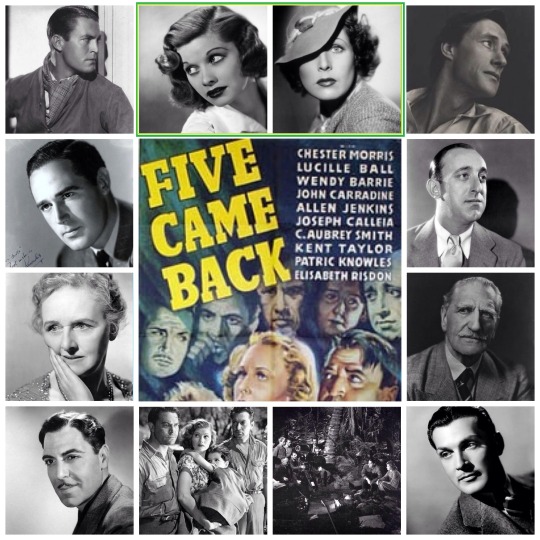
The ‘Peter Pan Connection’ actually began in 1939, when Lucille Ball starred in the RKO ensemble film Five Came Back. One of the ‘five’ was Wendy Barrie (top with Lucille). Although born as Marguerite Wendy Jenkins, she took the stage name Wendy Barrie in honor of her Godfather, author J.M. Barrie. Not coincidentally, Wendy is also the name of the eldest Darling child in “Peter Pan.”

In a March 8, 1955 episode of “Make Room for Daddy” titled “Peter Pan” Danny’s 7-year-old son Rusty imagines that he can fly like Peter Pan, so his father invites the theater’s elderly stagehand to the house to dispel the fantasy and bring Rusty back down to Earth. The characters lived in New York City and had seen Mary Martin (who did not appear in the episode) in the musical production at the Winter Garden Theatre. In reality, the stage production closed on February 26th to prepare for a live television broadcast on NBC, which aired on March 7, 1955, one night before this episode aired. Danny Thomas sings a song from the stage show at the end of the episode. Mary Martin was mentioned on “The Lucy Show” in 1964 by guest star Ethel Merman, who was also a big Broadway star like Martin.

In “Lucy the Gun Moll“ (TLS S4;E25) in 1966, Lucille Ball not only played Lucy Carmichael, but a nightclub singer named Rusty Martin who sang “My Heart Belongs To Daddy”. The name ‘Rusty Martin’ was probably derived from Lucy’s hair color and the surname of Mary Martin, who introduced the song in the 1938 Broadway musical Leave It to Me. Marilyn Monroe sang it in the 1960 film Let’s Make Love.

Desilu Studios was the filming location for "Make Room for Daddy”. When it switched from ABC to CBS in 1958, the show did a cross-over episode with “The Lucy-Desi Comedy Hour”. In return, Lucy and Desi appeared on “Make Room for Daddy.” Coincidentally, Hans Conried, who voiced Captain Hook in the Disney animated version, was a recurring character on “Make Room for Daddy” as Uncle Tonoose.

In “Return Home from Europe” (ILL S5;E26) aired on May 14, 1956, Ricky comes up with the idea to fly home from Europe instead of taking the steamship, When Ricky wonders whether he’ll make it back in time to perform at the Roxy, Lucy evokes the name Peter Pan, the main character of the J.M. Barrie children’s story of the boy who wouldn’t grow up – but could fly (without help from Pan Am, that is).

In “Vivian Sues Lucy” (TLS S1;E10), Lucy Carmichael calls Vivian ‘Tinkerbell’ due to her propensity for ringing her bedside bell while (supposedly) incapacitated.

In “Lucy and the Winter Sports” (TLS S3;E3) aired on October 5, 1964, Lucy Carmichael skis off the roof and lands on Mr. Mooney! He had just bent over to tie his shoe…

In 1966′s “Danny Thomas’ The Wonderful World of Burlesque” Lucille Ball performed an aerial ballet. Peter Foy, of the famous Foy Family (who did flying on Broadway for “Peter Pan” and other shows), was brought in to supply rigging and supervise Ball’s flight. Film of the act later became part of their archives.

In “Lucy Meet Mickey Rooney” (TLS S4;E18) in 1966, Lucy Carmichael claims to have played Captain Hook in “Peter Pan” while in school.

in “Lucy’s Tenant” (HL S6;E7) in 1973, Lucy Carter sarcastically calls Mary Jane Peter Pan when she brings up Lucy’s age!

In “The Bow Wow Boutique” (HL S6;E5) aired on October 8, 1973, a Saint Bernard is named Tinkerbell. In “Peter Pan” Tinkerbell is the name of the fairy who is Peter’s closest friend. Not coincidentally, the Darling children have a St. Bernard dog named Nana, who serves as a pet and a nanny.

February 1963
-
THEATRE CONCEPT
August 10, 1954


The concept of treating “I Love Lucy” as a theater play, with the camera representing the audience, was Desi Arnaz’s, according to Bill Asher, the program’s director.
“Nothing is supposed to be done you could not do in a theater,“ he said. (1)
“There is no fourth wall,” Asher added. ‘‘Something is wrong if the impression is given there is one.“ (2)
“Desi believes in letting the public use its imagination,” remarked the director. “When Lucy went across a plank from one building to another, a shot was suggested to give the idea she would fall some distance if she slipped. This was not acceptable to Desi.” (3)
PROCEDURE
After Arnaz, Lucille Ball, Vivian Vance, and William Frawley and any other members of the cast have worked together on a show a day and a half or two days, Jess Oppenheimer the chief writer comes in pencil in hand. He may look in the camera as well as sit and listen and observe.
The next night, Thursday, Bob Carroll and Madelyn Pugh, the other writers, see a performance. Their written comments are turned into Oppenheimer. The stars, Asher, and the writers, hold a round table.
No major changes are made after a show is filmed before studio audience.
# # #
FOOTNOTES FROM THE FUTURE

(1) Making “I Love Lucy” like a theatre play had its drawbacks. In early episodes, before the techniques of filming before a live audience were established, Lucy and Vivian sometimes had to under-dress their costumes (wearing one under another) to make sure they had time to change clothes between scenes where time passed. Filming under hot lights wearing two costumes can’t have been pleasant. Anything distracting, like changing lighting for close-ups, was done after the show was filmed, and edited into the final film, rather than make the audience stop and wait for something they could not see.

(2) Fourth Wall is a theatrical term referring to the wall of a stage setting that must be missing to allow the audience in a proscenium arch theatre see the production. Sometimes audiences get so used to the fourth wall being imaginary, that when it is not, it can be disorienting to the viewer. A good example of the fourth wall suddenly appearing is in “New Neighbors” (above) where a window shows up in a wall that previously was never seen!

Breaking the Fourth Wall means that the actor is playing to the audience or the camera. This was a rarity on “I Love Lucy.” In the Christmas Special (above) the cast (dressed in Santa Suits) turn to the camera / audience to say “Merry Christmas, everybody.” In general, breaking the fourth wall is discouraged.

(3) The article is referring to the rooftop scene from “Vacation from Marriage” (ILL S2;E6) aired on October 27, 1952.

By 1957, however, this type of shot seemed okay when Lucy is on the ledge dressed as Superman in “Lucy and Superman” (ILL S6;E13). What changed?
Zuma Palmer was a Hollywood columnist who pioneered coverage of radio. A native of Minnesota, Palmer was educated at USC and became radio editor of the Hollywood Citizen-News in 1928. Eddie Cantor and Ben Alexander were among radio performers who praised her at an appreciation banquet given by the Hollywood Advertising Club. After covering the development of radio and television entertainment, Palmer retired in 1961. She died in 1999 at the age of 94.
-
JOIN THE CIRCUS!
August 9, 1948


Later in August 1948…

“The Greatest Show on Earth” went into full-time rehearsal today as the $2,000,000 cast of 200 Hollywood stars and socialites started work on their routines as performers in the Saint John’s Hospital Guild benefit circus premiere.
At Pan-Pacific grounds, where the premiere of Ringling Brothers and Barnum and Bailey Circus will be held for benefit of the hospital Saturday night, John Farrow film director lent to the Guild by Paramount Studios, began putting his cut through their unusual paces.
Things unheard of were being rehearsed.
Said to be one of the moat hilarious acts is the one being rehearsed by William Bendix, Bob Hope, Mae West, and “Gorgeous” George. Bob Hope will be “Valet" for “Gorgeous" George when he wrestles William Bendix and Mae West will be the referee.
TAUGHT BY CLOWNS
Headed by Felix Adler, “King of Clowns,“ stars of 40 regular clown stars of Ringling Brothers and Barnum & Bailey Circus, spent the day with the film stars who will augment them in the ring, teaching them clown tricks, routines, makeup and wardrobe.
Their pupils and hosts while In Hollywood include Bing Crosby, Van Johnson Jack Carson, Lou Costello, Bud Abbott, Frank Sinatra, Eddie Albert, Roddy McDowall and Mickey Rooney. Walter Pidgeon was rehearsing his trapeze act while Greet Garson was hard at work on her aerial act; Ronald Reagan was doing double duty – rehearsing his work as a circus announcer and learning to ride some of the circus’ famous high-jumping horses.
Ann Sheridan was getting pointers at being an animal trainer; Harry James, who will lead the circus band, practiced some of the old tunes he used to play when he was in a circus; while Irene Dunne was taking lessons in stilt walking and pantomime from Cary Grant.
Betty Grable, Ann Miller, and even Hedda Hopper were learning how to ride some of Frank Whitbeck’s elephants.
Dick Powell, Jane Russell, and Randolph Scott worked on an old-time western- riding and shooting act.
CHARIOT RACES
June Allyson, Linda Darnell and Celeste Holm will take part in the chariot races attired as Roman maids pursued by Ralph Edwards in his Red Devil’s costume.
Jeanette MacDonald and Nelson Eddy will appear in the colorful pageant staged for the circus by John Murray Anderson "The Night Before Christmas” with Louella O. Parsons, Loretta Young and Ann Miller.
Rosalind Russell will appear as a “Trilby” in a magic disappearance and hypnotism act in which Gregory Peck will be “Svengali”.
Also set to appear in the circus are Ann Blyth, attired in a mermaid costume, Lucille Ball and Desi Arnaz will appear with some of the trained horses from their ranch, Ronald Colman, Alan Ladd, Burt Lancaster, Loretta Young, Marilyn Maxwell, Martha Hyer, Tim Holt, Lex Barker, Ann Sheridan, Maureen O’Sullivan and Steven Flagg.
# # #

After the event, officials numbered the cast a 209 (one newspaper went as high as 300!) and a sell out crowd of 10,000. They raised between 20 and $25,000 for the hospital. Other stars not mentioned above included:
- Danny Kaye
- Gary O’Brien
- Dean Stockwell
- Sabu and Nature Boy, riding elephants
- Dan Dailey
- Gary Cooper, as Robinson Crusoe
- Edgar Bergen, getting kissed by a giraffe
- Barry Fitzgerald, riding a buggy
- Keenan Wynn, barker for Gargantua the gorilla
- Ed Wynn, as a clown
- Dennis O’Keefe
- Buster Keaton
- Van Johnson
- Decorating floats were Virginia Bruce, Elizabeth Taylor, Dianna Lynn, Audrey Totter, Lizabeth Scott, June Havoc, Ella Raines
- Mr. and Mrs. William Powell, as Punch and Judy.
- Virginia Mayo, bareback rider
- Esther Williams
- Robert Cummings
- Rhonda Fleming
- Carmen Miranda, with a two-foot pile of artificial fruit on her head
- Glenn Ford
- Dorothy Lamour
- Loretta Young
- Peter Lawford, in a horse-drawn vehicle
- Claudette Colbert and Barbara Stanwyck riding sidesaddle
- Bob Preston and Preston Foster, selling programs
- Dennis Day, singing
- Ray Milland, horseback stunts
- Harpo Marx and Boris Karloff, clowning
A spokesman said between $200,000 and $250,000 was raised to build a 100-bed wing on St. John’s Hospital at Santa Monica.

If all this sounds eerily familiar, the idea of a circus staffed by celebrities was done on television titled “Circus of the Stars”. Lucille Ball was one of the ringmasters for the second edition in 1977.

Lucie Aranz wrangled elephants, fulfilling her mother’s one missed opportunity to play the elephant girl in Cecil B. DeMille’s film The Greatest Show On Earth in 1952. Ball was replaced by Gloria Graham.

Desilu later produced a television version of the film with the same title. Lucille Ball played a horse trainer in one episode in 1963.
For more about Lucy and the circus, click here!
- Danny Kaye
-
MODELING INTO THE MOVIES
August 8, 1936

By Jeannette Meehan, HOLLYWOOD
From the women’s angle, there are simply too many gorgeous newcomers in Hollywood. That fact is plain.
From the gentlemen’s angle, Hollywood is pleasantly crowded with the most alluring bits of femininity ever to delight the bald-headed row. This fact is even plainer. Oh, say it isn’t so, but there a new day dawning in the west for the Stage Door Johnnies.
Whence comes this influx of Eves? Who are these girls of such attractive physical make-up?
Well, sir, most of them are ex-models.
The highway and by-ways to Moviedom are past counting. Those most traveled have been the extra route, the beauty contest route or the I-have-a-relative route. Yesterday our newcomers were night club crooners, radio personalities and million-dollar heiresses. Today the majority of candidates for stardom are no longer being recruited from these avenues. It now quite obvious that any girl who has been a model approaches the casting office with an asset that permits her to pass up the waiting list.
Oh, phooey, what’s a model got that the others haven’t?
Well, when Radio Picture wanted five beauties for the fashion show sequence in “Roberta” they tested 30 girls, and then sent out an S.O.S. to the ranks of professional models. That was a year ago. Those five models so delighted the camera that they’re still under contract. (1)

Just a few months ago, when M-G-M went scouting for 22 modern Venuses for “The Great Ziegfeld”, they discovered that the ex-models had a lot more poise and personality than the kids who were merely movie struck. Eighteen of those 22 “Ziegfeld Girls” were former models. Fourteen of the 18 were given contracts. You just can’t argue with “figures” like that, or should I say with “figures like theirs"? (2)
“Model your way to the movies” isn’t just a catchy phrase. Models come to Hollywood already equipped with the elementary essentials which studios spend a great deal of time and money trying to hammer into inexperienced youngsters. Models have already served their apprenticeship to the art of carriage, grace and charm. They’ve already passed a certain type of beauty contest. The girl whose picture helps to sell beauty preparations has to have a face that leads you to believe that the product is worth trying. A pair of silk stockings modeled on muscle-bound or “spindle” legs would scarcely lure you to the hosiery department.
You never see a good model stumble over her train. She remains regal and sure-footed in the most confusing draperies.
Figuratively speaking, these girls are above reproach. Most fashion houses require that their models be above medium height, broad through the shoulders, slim through the hips, and that their proportions be symmetrically arranged. Thus, they’ve long since graduated from the routine of diets, masseurs, and classes for corrective posture that faces tire average beginner.
In other words, movie producers are finding out that modeling is a natural complement to screen work. Film executives are discovering that the girls who come to them from portrait and artists studios and from fashion salons are far ahead of those who approach Hollywood’s pot of gold with no training.
Not only that, but these ex-models seem to be well-mannered, well-educated girls whose off-screen poise and chic rivals that of their screen betters.

Oh, dear are they gorgeous? They’re enough to make us ordinary girls forget to look before we leap. Just for instance, take Pauline Craig [above] (3), an auburn-haired, statuesque beauty from Cleveland, O. She’s five feet six and one-half inches tall, weighs 118 pounds, and has a figure that only Jean Harlow (4) could be unconcerned about.
Miss Craig was a “Ziegfeld” girl – now she’s under contract. She skipped the first grade in motion picture training, and I guess we all know why. She was a model. Her glorious smile has appeared in hundreds of advertisements. As a fashion model she worked for I. Magnins. (5)
Are you wondering if these girls observe any general rules for the maintenance of health and beauty? Miss Craig will tell you that most of them prefer fresh air to smoky drawing rooms, and that they substitute milk for alcoholic beverages.
Incidentally, her hobby is collecting pictures of the Dionne quintuplets. (6)
Another girl recruited from the model ranks for “The Great Ziegfeld” was Wanda Perry (7), a vivacious brunet from Brooklyn. She’s five feet five and one-half inches tall, weighs 120 pounds, and has brown eyes.
With her classic features and her superb figure, there was a great demand for her in New York’s portrait galleries and exclusive clothing establishments. She has posed and modeled for Vogue, Harper’s Bazaar, McFadden Publications and for tooth paste ads.
With an already perfect camera presence, she is not to be enrolled in the studio’s kindergarten for beginners.
Over at Paramount there’s a queenly blond named Elizabeth Russell (8), probably the best known of former New York models. A favorite of such distinguished illustrators as Russell Patterson, James Montgomery Flagg, McClelland Barclay, Dean Cornwell, Paul Hesse, and Steichen, the photographer. Miss Russell is now in possession of a flattering long-term contract.
Artists agree that her features are photographically perfect. Artist or no artist, they’ll look perfect to you! She has modeled hose, nightgowns, and coiffures. Her blonde beauty has helped to sell cigarettes, jewels, soap, sheets, automobiles and first-aid kits. Very soon she’ll be helping Paramount sell “Girl of the Ozarks,” her first picture (9). Miss Russell is five feet eight inches tall, weighs 118 pounds, has blue eyes and naturally blond hair.
Another beautiful blonde who modeled her way to the movies is Louise Stuart (10), a former Chicago debutante. After graduating from Miss Mason’s Castle (11) she went to New York to visit former school chums. It was during one of these visits that she was persuaded to pose for cigarette ads. One good look at her flawless countenance, and modeling jobs were her for the asking. With plenty of time on her hands, and nothing to do with it, she went to work.
Miss Stuart attributes most of her success with the test director to her experience as a model. Posing for artists and photographers, she says, gave her a self-assurance which she has never lost. You’ll see her first in “Lady Be Careful.“ (12)
A third Paramount prize is Veda Ann Borg (13), a stunning, red headed girl from New York. Before the studio signed her to a long-term contract, her divine proportions and sparkling personality had created a sensation in the modeling field.
One of the most exquisite of Hollywood’s newcomers is brunette Anita Colby (14) who stands five feet seven inches tall without her high-heeled shoes. Her face has smiled at you from magazine covers, commercial advertisements and from the pages of the nation’s smartest fashion periodicals. Her beauty is attractively framed in poise, wit and charm. She is conversant with world affairs, music, art and literature. Pictorially speaking, she’s a model of perfection. Radio proudly points to her name on its contract list.
Radio has two other "model” charmers in the persons of Maxine Jennings (five feet eight inches tall), and Lucille Ball (five feet six and one-half inches tall). Miss Jennings (15), a former model for the famous couturier, Jean Patou, is a stately redhead as handsome a creature as you ever laid your eyes on. You’ll soon be seeing her in featured leads.

Miss Ball (above), a blue-eyed blonde from Montana (16) and former model for Hattie Carnegie, is considered an important trump in the studio’s hand. Her bosses have thus far cast her in wise-cracking roles, hoping to develop her into a counterpart of the late Lilyan Tashman (17) – but Lucille doesn’t seem to need much help along those lines. Her poise, her suave delivery and her flair for clothes have already added to the gaiety of nations and have cannoned her well along the road to stardom.
One of the most beautiful of the “model” brunettes is Hester Deane (18) who is doing much to enhance M-G-M productions. Her likeness on the backs of magazines has caused many a gentleman to change his brand of cigarettes, and she posed for automobile body advertisements long before the studio discovered that her presence on screen would “up” the grosses.
She was born in Oklahoma City. Her education included art and music. Now, when she isn’t modeling or working in pictures, she designs clothes, takes piano lessons, and studies philosophy.
A good look at Mary Jane Halsey (19) will have different reactions on you, depending on your sex. If you’re a woman, you’d just as soon she broke her neck.
Miss Halsey was born in Milwaukee. After her family moved to Los Angeles she became a model for a famous cosmetician. She is five feet six inches tall and weighs 120 pounds. She has blue eyes, and ‘shhhhhh’, she writes poetry.
If these “model” newcomers get any taller, a few of our leading men will have to wear stilts. Extreme height, which has sounded the gong for many a beginners’ career, doesn’t seem to be a handicap for the ex-models. When these lovely girls began to invade Hollywood, apparently the enthusiastic producers forgot all about the traditional physical specifications for screen heroines. There was a time when all actresses had to be extremely petite and slim, like Gloria Swanson and Colleen Moore, and, more recently, like Claudette Colbert and Margaret Sullavan (20). Unless you were a diminutive little trick about five feet two inches tall, and weighed less than 100 pounds, you might just as well have stayed on the farm. Greta Garbo and Kay Francis (21) were overlooked for a long time because of their height.
But the restrictions seem to have been called off. It appears that models can grow as tall as they like without the danger of facing dismissal from the casting office. Margaret Lyman (22), one of the prettiest of the model group to win a picture contract, stands five feet nine inches in her stocking feet, and weighs 129 pounds.
One of the most photographed models of the country, Miss Lyman has posed for Vogue, Harper’s Bazaar, The New Yorker and for cigarette and soft drink ads. She has brown hair and brown eyes. She wears a larger shoe than Garbo.
And no less charming is pretty Jane Hamilton [below] (23), another popular girl who found her way into pictures through the route of her professional success as a model.

# # #
FOOTNOTES FROM THE FUTURE

(1) “Roberta” was released by RKO on March 8, 1935. It was Lucille Ball’s 21st film. Models were needed for the fashion sequences. The film also employed models Virginia Carroll, Diane Cook, Lynne Carver, Lorraine DeSart, Betty Dumbries, Myrna Low, Margaret McChrystal, Marie Osborne, Wanda Perry, Donna Mae Roberts, and Kay Sutton. In addition to Lucille Ball, Wanda Perry, Maxine Jennings, and Jane Hamilton were in the film and profiled in this article.

(2) “The Great Ziegfeld” was MGM’s 1936 biopic of Florenz Ziegfeld, the showman who glorified female beauty on stage. Lucille Ball was not in this film, but was later part of the cast of “Ziegfeld Follies” (1951). This film employed dozens of showgirls and models to play the Ziegfeld Girls. Those profiled in this article include Pauline Craig, Wanda Perry, Hester Dean, Mary Halsey, and Margaret Lyman.
(3) Pauline Craig (1914-97) made her screen debut in “The Great Ziegfeld” but only did five more films, leaving the business in 1939.

(4) Jean Harlow (1911-37) likely did not know or care about Pauline Craig, even if Craig’s figure did give Harlow a run for her money. She was known as the original platinum blonde sex symbol. She died at age 26, at the peak of her popularity. MGM closed for her funeral.

(5) I. Magnin & Company was a San Francisco, California-based high fashion and specialty goods luxury department store. It expanded across the West into Southern California and the adjoining states of Arizona, Oregon, and later to Chicago, Illinois, and Washington, DC, metropolitan areas. Mary Ann Magnin founded the company in 1876 and named the chain after her husband, Isaac. The chain was bought out by Macy’s in 1994.

(6) The Dionne quintuplets (born May 28, 1934) are the first quintuplets known to have survived their infancy. The identical girls were born just in Ontario. All five survived to adulthood. The Dionne girls were born two months premature. The Ontario government and those around them began to profit by making them a significant tourist attraction. As of this writing, two of the girls are still living.

(7) Wanda Perry was born Helen Beuscher in Brooklyn, New York, on July 24, 1917. When she was sixteen, she was named Miss New York City, and was offered a movie contract by Earl Carroll. Helen moved to Hollywood and took her mother’s maiden name, Wanda Perry, appearing in films as a showgirl, an Earl Carroll Girl, a Goldwyn Girl, a dancer in “George White’s 1935 Scandals,” a fashion model, an extra, a bit player and a stand-in for Lucille Ball! Her final film was as an extra in Lucy’s Mame (1974).

(8) Elizabeth Russell (1916-2002) was the sister-in-law of Rosalind Russell. She started doing films in 1936 and finished her career in 1960. (9) “Girl of the Ozarks” (1936) was a Paramount film also starring Virginia Weidler, Henrietta Crossman, and Leif Erickson.
(10) Louise Stuart did two pictures for Paramount back-to-back in 1936. That was the extent of her film career.

(11) Miss Mason’s Castle is a reference to Miss C.E. Mason’s Suburban School for Girls in Tarrytown-on-Hudson, New York. It was open from the late 1880s to 1934. The castle was razed in 1944.

(12) “Lady Be Careful” (1936) did not feature Louise Stuart as is said here, although records could be incorrect. The film did feature Elizabeth Russell, however.

(13) Veda Ann Borg (1915-73) did her first film for Paramount in 1936, and was continually employed in Hollywood until 1963. She was the first actress cast as Honeybee Gillis in “The Life of Riley” TV series, replaced a short time later by Marie Brown, then Gloria Blondell.

(14) Anita Colby (1914-92) was born Anita Counihan. Early in her career, at $50 an hour, she was the highest paid model at the time. She was nicknamed “The Face” and appeared on numerous billboards and ads, many of them for cigarette advertisers. She did three films in 1936 alone, the same year she appeared on 15 magazine covers in a single month. In subsequent years she only acted in three more films, returning to modeling.

(15) Maxine Jennings (1909-91) did 10 films with Lucille Ball between 1935 and 1937. After 1938, her film appearances were sporadic. She made her final screen appearance on a 1968 episode of “Hawaii 5-O”.
(16) Lucille Ball (1911-89) is stated as being a blonde from Montana. She was actually a brunette from Upstate New York.

(17) Lucille is once again compared with Lilyan Tashman (1896-1934) a stage and screen actress known for her skill at verbal wit as well as her throaty delivery. She died at age 37, just one year after Lucille Ball arrived in Hollywood.

(18) Hester Dean became known as ‘The Girl with the Fisher Body’ after modeling for the Fisher Automobile Company. Her only film was “The Great Ziegfeld” (1936).

(19) Mary Jane Halsey (1913-89) was also in “The Great Ziegfeld” (1936) but by that time had done nearly a dozen films. She continued to act on screen until 1945.

(20) Gloria Swanson was 4′11″, Colleen Moore was 5′3″, Claudette Colbert was 5′5″, and Margaret Sullavan was 5′3″.

(21) Greta Garbo was 5′7″ (same as Lucille Ball), and Kay Francis was 5′9″.
(22) Margaret Lyman (1915-2002) was one of the models hired for “The Great Ziegfeld” in 1936. She did two more pictures before leaving screen acting behind.
(23) Jane Hamilton (1915-2004) was a Goldwyn Girl in “Roman Scandals” (1933) just like Lucille Ball. Hamilton, however, had done one previous film as a Goldwyn Girl, “Gold Diggers of 1933″. She did seven other films with Lucille Ball. Her final screen role was in 1949.
1936, Anita Colby, Claudette Colbert, Colleen Moore, Dionne Quintumplets, Elizabeth Russell, Girl of the Ozarks, Gloria Swanson, Goldwyn Girls, Greta Garbo, Hester Dean, I. Magnin, Jane Hamilton, Jean Harlow, Kay Francis, Lady Be Careful, Lilyan Tashman, Lucille Ball, Margaret Lyman, Margaret Sullavan, Mary Jane Halsey, Maxine Jennings, MGM, Pauline Craig, RKO, Roberta, The Great Ziegfeld, Vida Ann Borg, Wanda Perry -
GOING STRONG AT 50
August 8, 1961


Lucille Ball, who scrapped her way out of a wheelchair to become a towering star of American show business, turns the half-century mark tomorrow. (1)
She is still scrapping as she celebrates her 50th birthday. Although health problems forced her to quit the tough grind of the Broadway musical “Wildcat,” she’s looking ahead to work — and more work.
That’s the word from one of her closest associates, who said “All kinds of movie often waiting for her.” (2)
And two nights ago she told a friend: “I have never — ever — felt better in my life.”
Lucy, who spent three years in a wheelchair after an automobile accident in 1927, has gained about six pounds since bowing out of ‘Wildcat.” She has moved back to her home here in Beverly Hills, and is placing her children, Lucie, 10, and Desi IV, 8, in school.
She plans to spend her birthday with the children at Disneyland — and stay overnight there with them.
A friend said a chauffer probably will drive the children to her from Del Mar, Calif. the home of her ex-husband Desi Arnaz, with whom she starred in TV’s most successful show — “I Love Lucy.”
Lucy, of course, still has a big chunk of the vast Desilu empire carved from their TV show – the pinnacle of a life that began in Butte, Mont. She was taken to Jamestown N.Y. at 2 when her father— a mining engineer — died. (3)
At 15 she went to New York to study drama but failed.
“My first real job on Broadway” she said “was as a soda jerk in a drugstore.”
After that she became a model in the garment district. She had joined Hattie Carnegie’s exclusive staff of models and was on her way when the car accident struck. Told she might never walk again she refused to quit — and in 1932 she rejoined Miss Carnegie from where she progressed to movies.
The lanky redhead once said: “I hold no grudge against my yesterdays. They brought a great deal of fun and laughter and a lot of happiness. They proved the worth of many friends who are friends still.”
As for Hollywood:
“It is a town where a player may go almost unrecognized for 10 years then suddenly get three starring roles in succession. It is hard work to be a star — harder than ever because more is expected of you.
“Show business is highly competitive, the same as life itself, but it is more intensified. It is a survival of the fittest and an actress must take her rebuffs impersonally or she is beaten.
“It seems to me that she must know her good qualities and then make the best of them without worrying too much about her deficiencies. If you go around with your bad points on your mind they’re certain to show up in your personality. There’s no percentage in worrying about what you haven’t got.”
The other day she told a business associate: Just give me till Aug. 20 to rest up, see the kids and get straightened away. Then just point which direction you want me to go. I’ll be ready.”
# # #
FOOTNOTES FROM THE FUTURE

(1) Lucille Ball’s birthday was August 6, not August 9. It is possible that the article got bumped from the August 5 edition and that the date discrepancy was not changed.

(2) There may have been many offers, but after this date Lucille made very few films compared to her pre-TV career. In 1963 she co-starred with Bob Hope in “Critic’s Choice.” In 1967 she had a cameo in “A Guide for the Unmarried Man”. “Yours Mine & Ours” was released in 1968. Her final big screen film was “Mame” in 1974, a film several years in the making.

(3) Even in 1961, editors were still relying on Lucille’s ‘fantasy’ bio from the 1930s. To reiterate, she was born in Jamestown, not Butte. Her father was a lineman for the telephone company and died in Wyandotte, Michigan.

-
TV GUIDE: MAIDEN NAME GAME?
August 7, 2005

On August 7, 2005, Lucille Ball and Desi Arnaz appeared on the cover of TV Guide, (volume 32, issue #27320 although they were not the ‘cover story’ – that honor went to “CSI: Miami” featuring Emily Proctor and David Caruso. Lucy and Desi were on the top of the cover to promote a TV Trivia Quiz inside, teased with the question:
“What was Lucy’s maiden name on ‘I Love Lucy’?”
Although any fan worth their salt knows the answer, I won’t divulge it here!Just two months later, in October 2005, TV Guide published its final digest-size issue. One of nine collectible covers featured featured Reba McEntire recreating Lucy in the grape vat from “Lucy’s Italian Movie” (ILL S5;E.
Just two months later, in October 2005, TV Guide published its final digest-size issue. One of nine collectible covers featured featured Reba McEntire recreating Lucy in the grape vat from “Lucy’s Italian Movie” (ILL S5;E23) and a cover that matched one from TV Guide’s salute to Lucy’s 50 funniest moments in October 2001.
-
PASSAGE TO BORDEAUX
August 7, 1941

HOLLYWOOD. Aug 7— If you have read “Berlin Diary” — and it seems as if the whole world has read William Shirer’s day to day accounts of the events that led up to the war – you will interested to hear he is coming to Hollywood. (1) He will fly her weekends starting the last week in October to confer with Erich Pommer and Oliver H. P. Garrett (2) on “Passage to Bordeaux” the RKO thriller that is being prepared for production. (3) Shirer once was a foreign correspondent and was present at the historic Munich meeting of Hitler, Chamberlain, and Daladier. (4)
This movie is apparently giving Lucille Ball the opportunity for which the has been crying. She is to have the lead In “Passage to Bordeaux” with Robert Stevenson (5) handling the megaphone. Shirer will not actually do any writing — merely suggesting scenes and situations to Garrett the script writer.
# # #
FOOTNOTES FROM THE FUTURE

(1) Berlin Diary (“The Journal of a Foreign Correspondent 1934–1941”) is a first-hand account of the rise of Nazi Germany and its road to war, as witnessed by journalist William L. Shirer. Shirer covered Germany for several years as a radio reporter for CBS. The identities of many of Shirer’s German sources were disguised to protect these people from retaliation by the German secret police, the Gestapo. It sold almost 600,000 copies in the first year of its publication and was widely praised by academics and critics. This article makes it sound as if the book might become a film, but it is just its author who was Hollywood-bound, to be an advisor on a subject he knew well.

(2) Erich Pommer (1889-1966) was a German-born film producer and executive. Pommer was perhaps the most powerful person in the German and European Film Industries in the 1920s and early 1930s. He was producer of Fritz Lang’s landmark silent film Metropolis in 1927. During World War II he came to America, where he joined RKO. One of his first projects was producing Dance, Girl, Dance starring Lucille Ball and Maureen O’Sullivan.
Oliver H.P. Garrett (1894-1952) worked as a journalist before coming to Hollywood in 1927. He would later share an Oscar with Joseph L. Mankiewicz for best screenplay for Manhattan Melodrama (1934) and became a founding member and two term vice president of the Screen Writers Guild.

(3) So what happened to Passage to Bordeaux? Why was it never made? Loving Lucy (1982) by Bart Andrews and Thomas Watson sums it up pretty well. Instead, Lucille Ball was cast (some would say mis-cast) in the film Valley of the Sun, released in early 1942. The New York times labeled it “ambling” and others called it “forced”.

(4) On September 30, 1938, British and French prime ministers Neville Chamberlain and Edouard Daladier sign the Munich Pact with Nazi leader Adolf Hitler. The agreement averted the outbreak of war but gave Czechoslovakia away to German conquest.

(5) Robert Stevenson (1905-86) was a director and writer, known for Mary Poppins (1964, Oscar Nominee), Bedknobs and Broomsticks (1971) and King Solomon’s Mines (1937).

In 1944 Michael Curtiz (Casablanca) directed the similarly-titled Passage To Marseille, another French town like Bordeaux, in a WWII storyline meant to recapture the magic of Casablanca in 1942. Frequent “Lucy” performer Hans Conried had an uncredited role in the film.
-
IN THE BEGINNING…
August 6, 1933

Lucille Ball’s 22rd birthday coincided with her getting her name in the national newspapers! She was selected to travel to Hollywood with some other models to fill out the cast of Sam Goldwyn’s new Eddie Cantor film, “Roman Scandals”. She stayed and became one of the legendary figures of our time. Little did she know then, that there would not be a day during the next 100 years where her name would not be in the newspapers, her face on screens around the world, and her work celebrated as iconic.
Happy 110th Birthday, Lucille Desiree Ball.
-
Subscribe
Subscribed
Already have a WordPress.com account? Log in now.
 Papermoon Loves Lucy