-
I FEEL GREAT!
August 4, 1957


HOLLYWOOD – “I feel great. Everybody’s asking me how feel, and I have to tell ‘em I feel great because I do,“ says the world’s highest paid comedienne.
Lucille Ball is probably the only TV comic who can make that statement today and mean it. She and husband Desi Arnaz have consistently grabbed off the No. 1 rating in the TV surveys for six consecutive seasons.
Now they are busy rehearsing for a filming of their first hour-long Lucy show. They will do five of these for next season and a leading automobile sponsor is shelling out $500,000 to sponsor each one on CBS-TV. This first show is scheduled for airing sometime in November. (1)
Giving up the weekly Lucy series is tantamount to Lucy’s retiring as the undefeated champ. She and Desi both wanted to do this a couple of years ago but with the No. 1 rated show they were under pressure from both CBS and their sponsors to stay with it. (2)
Lucy and Desi wanted to quit while they were ahead. Last month they sold the 180 Lucy episodes to CBS for a price in the juicy neighborhood of $5,000,000. If this doesn’t keep the wolf from nagging their heels they can fall back on a half-dozen or more TV film shows being produced under their Desilu banner.
Another reason for quitting the weekly grind came from Madelyn Pugh and Bob Carroll, the writers who have been with Lucy and Desi from the beginning.
180 Story Lines
"We had to tell them,” says Bob, “that after 180 story lines there wasn’t much more we could do."
Bob and Madelyn are working on the hour shows which incidentally cannot be called ‘I Love Lucy’ because CBS now owns that title with the half-hour episodes. Lucy and Desi even had to get CBS’ permission to use their character names, the Ricardos and the Mertzes. Vivian Vance and Bill Frawley will be playing the latter couple in the 60-minute shows, too.
When the first of the big shows is filmed, it will be done in front of a 300-seat audience at Desilu Studios in Hollywood in the same way Lucy and Desi have always filmed.
"It’s goin’ to be real fancy for the audience though,” says Desi, who still cultivates his Cuban accent. “There’ll be an intermission and we’ll serve everybody sandwiches and thin’s."
Ann Sothern, Cesar Romero, Rudy Vallee and Hedda Hopper have been cast in this first film. Lucy and Ann take one of those vacation cruises to Havana and that’s where Lucy meets her dream man (Desi).
Lucy and Desi already are beginning to sit around and reminisce over their six hectic years as TV’s No. 1 entertainers. "Remember what Hubbell Robinson (CBS program v.p.) said when we first tried to sell the idea?” Desi asks Lucy.
“Yeah, he said ‘Who will believe that Lucy is married to a Cuban bandleader?’ Then I said ‘They gotta believe it because I am married to this Cuban bandleader,” Lucy recalls with a loud guffaw.
Then there was the second season when Lucy was actually going to have a baby and they decided to work the story right into the scripts.
“But the sponsor wasn’t too sure this was a good idea, and we had an awful time convincin’ them. We went to a priest, a rabbi, and a minister, and finally got the sponsor’s okeh” says Desi.
# # #
FOOTNOTES FROM THE FUTURE

(1) The first episode, unusually, was actually 75 minutes long. Desi insisted the material could not be cut, and fifteen minutes was borrowed from “The United States Steel Hour”. After the first airing, however, the show was cut to an hour, using voice-over narration by Desi to fill in the gaps. For the first season, “The Lucille Ball and Desi Arnaz Show” (as it was then called) was sponsored by Ford Motor Company. Seasons two and three were sponsored by Westinghouse. “Lucy Takes A Cruise To Havana” aired on November 6, 1957.

(2) “I Love Lucy” was scheduled to end after season five, with the Ricardos and Mertzes return from Europe. The network requested a sixth season, and Lucy and Desi agreed.
-
MEET THE PRESS
August 3, 1969


You are clued into the frank and tough talk to come by the way Lucille Ball swipes away with her handkerchief at the flies threatening the hors d’oeuvres The kerchief almost snaps like a wet towel.
The scene is the pool patio of her home on Beverly Hills’ Roxbury Drive and a cocktail party is in progress for visiting television editors.
Lucy has just emerged from the main house. She wears a powder blue double-breasted slack suit and saucer-sized sun glasses. In the blazing sun her orange hair has the color intensity of hot coals.
She has counted heads. Husband-producer Gary Morton is there. So are Desi Arnaz IV her son, and Lucy her daughter. And her TV side-kick Gale Gordon with his wife. Plus a half-dozen of her staff and CBS emissaries. There have been introductions all round to the newspaper types. It is time, she announces, to talk and she waves everybody into the big and comfortable pool house. A table has been positioned so that she can sit there presiding as she used to do at the stockholders’ meetings of the old Desilu Studios.
Almost immediately some wag fields her the question: “Lucy do you run the show?” She flashes him that big innocent TV look of hers. A staff member jumps up “Let’s all answer that one for her” There is a resounding “YES” from family-and-cast. Everybody laughs uproariously.
Very few questions are required to prime the pump. Lucy, it seems, has some matters of personal irritation on her mind and as far as she is concerned they come tumbling out without any prodding from her would-be interrogators.
First of all, she asks rhetorically, what’s all this business about whether she would retire? “I never said I wanted to quit or retire. There was a time when I was willing to quit but nobody asked me. Now I’ve set a date when I’ll retire”
A lot of ears perk up Somebody asks slyly — when? She’s waiting for that. Her answer is smilingly emphatic: “When I drop dead in my tracks.”
She turns then without anybody’s questioning to the matter of her longevity in television. This is her 18th year on the tube and it used to be talked about that she traded her popularity to CBS in return for its buying other shows produced by her company. This evokes an almost visible jet of steam out of the top of her carrot locks. “I never at any time sold any of the 20 shows our company produced on the basis of my returning each season. I’ve said that literally hundreds of times and nobody believed it.”
She went on to make it clear that she also dislikes the “big business” image which has adhered to her over the years. “I never like to talk about big money. I make my deal and that’s all. It’s been mostly a matter of legal procedures.”

As the star wades into these fiscal subjects your eye roams over the assemblage. Young Desi in tennis togs impassively studies the smoke curling up from a cigarette. Young Lucy clutches her hands around her knees and stares intently at her mother. Husband Gary sitting on a ledge at the back of the room swings his legs and smiles.
There has been no mention of Desi the elder the former husband Lucy’s co-performer and co-founder of Desilu Studios (now sold). Earlier this writer had chatted briefly with young Desi. He said he saw his father off and on and spends his summers as a rule at the father’s beach home at Delmar, south of Los Angeles.
The youngster asked if I knew his grandfather Dr. Desiderio Arnaz who lives in Coral Gables. (1)
But back to Lucy She’s telling us how many years it took to realize that as Lucille Ball she had attained V.I.P. status.
She reviews the years she spent trying to make it in show business, first on the stage, then as a model, and finally in the movies. Much of the time she says she stagnated. Until television came along.
“I never had any sense of importance. I was very pliable always willing to do what I was told It wasn’t until one day I saw in print somewhere some actress described as a ‘Lucille Ball type’ that I knew suddenly I was somebody and a part of the business.”
From there on the interview jumps from subject to subject.
I ask her whatever happened to the project Dean Martin’s producer Greg Garrison had for starring Martin, her, and Jackie Gleason in a revival of the musical “Guys and Dolls.” (2)
“I never said I would do it. Garrison kept publicizing it, but he never cleared it with me. I do still want to do ‘Diamond Jim’ with Jackie It’s just a matter of finding the time.” (3)
A lady editor wants to know how Lucy keeps her sinuous figure.
“I don’t particularly like food. I’m not very fond of meat, for example, except in the morning.”
Which brings a snort of disgust from her husband. “Can you imagine what it’s like to have to watch her eating corned beef or hamburger at 6 o’clock in the morning?”
The questions now go to the children. What are Desi’s plans? Does he want to make acting his future? “I want to be an actor for awhile but I don’t think I ever want to be one certain thing.”
Young Lucy, who, at 18, is two years older than her brother, is more sure of her future “I’ll go to college for awhile but I like acting. I’ll stay at it if I can.”
Would she somebody asks join the campus protest and carry a sign? Only if it says ‘wet paint’ quips she.
Lucy now introduces her cast veteran, Gale Gordon. He pays her extravagant compliments and talks a bit about his radio and early television days.
The interview’s late arrival is venerable George Marshall, who is now the show’s director. Lucy introduces him as “our sexy senior citizen.” Marshall goes back to the dawn of movies and is filled with fascinating anecdotes about his years in the business. (4)
The conversation turns to TV’s talk shows. Somebody suggests to Lucy that she would be a highly likely guest for Merv Griffin’s new show starting on CBS Aug 18. (5)
Lucy’s answer comes lancing back “That’s what you think. I don’t like him.” Which rocks everybody back. Why not? “Because he doesn’t know how to interview. He’s rude to his guests and he monopolizes the conversation.”
She doesn’t wait for the next question. “I’m wild about Dick Cavett (on ABC) I think he’s great And I told Bill Paley (board chairman of CBS) he should have him on our network. But Bill said ABC got him first and we’re out of luck.” (6)
Everybody is suddenly distracted by three teen-age girl fans leaning over a fence way up front. They’re begging to be allowed on the grounds. Morton jogs forward to shoo them away.
“This happens all the time,” says Lucy. “My God they used to picnic right in front of the house until our police department stopped them. Jimmy Stewart, who lives up the street, finally told me how to keep them away. Turn on the lawn sprinklers.”
Morton returns and takes everybody for a tour of their luxurious but very lived-in home. Lucy tells us a funny story about how Jack and Mary Benny had once been their next door neighbors sold their home then asked her to try to mediate a re-sale of the place back to them. Then we take our leave.
# # #
FOOTNOTES FROM THE FUTURE

(1) Dr. Desiderio Alberto Arnaz y Alberni II (1894-1973) was a Cuban politician and the father of Desi Arnaz. He graduated from the Southern College of Pharmacy in 1913 in Atlanta, Georgia. Desiderio Arnaz II was the youngest mayor of Santiago de Cuba (1923–32). When president Machado was overthrown in August 1933, Arnaz was arrested and jailed. Six months later, he was allowed to go into exile. He married Dolores “Lolita” de Acha y de Socias in 1916 and had one son, Desiderio “Desi” Arnaz III. He later had a daughter, Connie Arnaz (1932), with Anne M. Wilson, whom he married in 1941.

(2) Guys & Dolls was a 1950 stage musical by Frank Loesser, based on the stories by Damon Runyon starring Robert Alda, who appeared on several episodes of “The Lucy Show” and “Here’s Lucy”. It was filmed by MGM in 1955. During that time, Lucy and Desi were also under contract to MGM, so they prevailed upon “I Love Lucy” to insert a clip from the film into “Lucy and the Dummy” (ILL S5;E3). After its initial airing on October 17, 1955, the clip was removed from the film print, and for legal reasons, has never been restored. It is unclear whether Garrison’s project with Martin, Ball, and Gleason would have been a film revival, or a stage production. Whatever it was to be, Lucy wanted to have no part of it, perhaps remembering the rigors of performing on stage in Wildcat (1960). During her film career, Ball was in two films based on Damon Runyon material, The Big Street (1942), a film she claimed as her favorite, and Sorrowful Jones (1949). She also did a radio version of Runyon’s “Tight Shoes” in 1942. Ball and Gleason would have been cast as Miss Adelaide and Nathan Detroit, while Dean Martin would have played Sky Masterson, the romantic lead. Those roles were played by Vivian Blaine, Frank Sinatra, and Marlon Brando in the film. Obviously, the project never came to be.

(3) “Diamond Jim” was a project that Lucy dearly wanted to make with Gleason. He would play Diamond Jim Brady (1856-1917) to her Lillian Russell. Ball even went so far as to have a script written to further grab Gleason’s attention. Despite their best intentions, Gleason and Ball’s schedules never allowed for enough time to make the film.

(4) George Marshall (1891-1975) had directed Lucille Ball in Valley of the Sun (1942) and Fancy Pants (1950). He was considered an expert at location shooting, so when “Here’s Lucy” wanted to spend the first four episodes of Season 2 on location, Marshall was hired as director. He stayed on for seven more episodes of the sitcom before bowing out.

(5) Despite Lucille Ball’s rather harsh public assessment of Merv Griffin (1925-2007) at this August 1969 press party, Ball appeared on “The Merv Griffin Show” four times between 1971 and 1980! During her first appearance, the aforementioned George Marshall was also a guest!

(6) Lucille did seem to enjoy doing the talking to Dick Cavett, although she only got to do his chat show once, on March 7, 1974, in conjunction with her press tour for Mame.
-
CHATTING WITH SWERTLOW
August 2, 1973

BY FRANK SWERTLOW
Lucille Ball, the biggest star in the history of television, sits in her spacious Beverly Hills home chatting about her career.
Suddenly, almost in mid-sentence, she is interrupted by a loud knock at her front door.
Then another.
And another.
“That’s just a fan,” said Miss Ball calmly. “Just say we are not here."
Miss Ball was about to go on with her conversation when she was asked if it bothered her to have strangers frequently pounding at her door. Politely, she said no.
But, she admitted, it can be annoying, like the time convoys of tour buses parked outside her home.
"It was one great colony of carbon monoxide,” she said, adding that she eventually had to invoke a Beverly Hills ordinance to keep buses away. “But if I don’t put myself on a big estate behind gates, I can’t blame them. I’m very happy they feel that way about me."
While Ball, who began her career in show business during the 1930s, is no longer unraveled by the curious public, several bizarre incidents stand out.
The strangest, she said, took place on a Sunday afternoon when she and her longtime pal, Vivian Vance, were startled by a roar of police sirens. At the time, Miss Ball was recuperating from an operation on her big toes. Bruce Cabot stepped on one; a horse on the other. (1)
"This particular afternoon, we are sitting there, and I had these splints on my feet and Viv is under the hair dryer. We didn’t have any makeup on. Suddenly, we hear these sirens. Naturally, we thought they would go away. But they didn’t. We thought it might be an accident. So I hobbled over to the window to see what it was.
"Well, the place was just alive with police, motorcycle cops; car cops; an officer was standing in the middle of the intersection directing traffic. Then, four or five limousines pulled up. We were watching out the window, and all at once the doors of the limousines opened. ‘They are coming in here,’ I said.
"I think they were from Thailand, maybe "a maharaja or maharani or something like that. They had saris on, things in their noses. Beautiful women and tiny little men. They all had cameras around their neck.” Once Ball and Vance saw what was happening, they tried to rush upstairs to put some clothes and makeup on. It was too late. Ball was caught struggling up the stairs.
“They didn’t notice anything. There were 12 people, plus a public relations man, and they just paraded through the house. They wanted to take my picture in the backyard. "I didn’t know who they were. But as they were going out the door, Viv said: ‘We’ll have to drop in on you some day.’ And one of the little men bowed and said: ‘By all means.’ (2)
Right now, one version of a Lucille Ball television show is playing somewhere in the world. It seems Lucille Ball is always on. Clearly, she is the most successful performer in the history of television perhaps the richest.
~ Chicago Daily News
# # #
FOOTNOTES FROM THE FUTURE

(1) Actor Bruce Cabot’s most recent interaction with the redhead was in a 1964 Bob Hope special, “Have Girls, Will Travel”. He also starred with Ball in 1949′s Sorrowful Jones, and 1950′s Fancy Pants, both of which featured horses. Cabot died in May 1972.
(2) Vivian told this same story on “Dinah!” when she surprised Lucille Ball on an episode of Shore’s talk show aired on December 1, 1975, more than two years later. In the television version the foreign guests turned out to be the King of Siam (now Thailand) and his retinue. The punchline remained the same.

Frank Swertlow is an awarding-winning journalist who covered a 2002 civil trial against Michael Jackson and the 2005 criminal trial, both for People magazine. He is the co-author of "We, the Jury,” a profile of seven jurors who sent Scott Peterson to death row.
-
TRIPLE PLAY BALL
August 2, 1943


At the time, Desi was serving in the Army at a base in the San Fernando Valley, near Chatsworth, wear the couple lived. Edward Sedgwick (1892-1953) was a good friend of Lucille and Desi who worked for Desilu. He is credited with discovering Lucille Ball and directed the unreleased “I Love Lucy” movie. The last show he directed before he died was an episode of “I Love Lucy.”
Also on August 2, 1943…


More from the 2nd of August, 1943…


El 2 de agosto de 1943…


-
THE GRASS WIDOW(S)
August 1, 1948

In July and August during the summer of 1948, Columbia newbie Lucille Ball was playing musical chairs with film roles, swapping a part in the comedy “The Grass Widow” with Rosalind Russell’s next assignment, “Miss Grant Takes Richmond.” Both pix were to be directed by S. Simon Sylvan.

Lucille seems ideal for the role of ditzy secretary Ellen Grant, who takes the heart of young realtor / bookie Dick Richmond (Van Johnson).

By 1948, Lucille was in demand, and studios were lavishing scripts on her. She landed at Columbia. Her parting shot at RKO was first titled “Interference” before being re-named “Easy Living” with Mature and Tufts still on board. After “Widow” / “Richmond”, Lucy had ideas to do a picture with Desi about a photographer named Robert Capa. Sadly, that film was never made, but it did keep Lucille’s focus on transitioning from radio to television, and bringing Desi with her.

The reason for the swap (at least the reason given to the press) is that Roz wanted an all-out comedy, which, despite it’s title, “Grass Widows” was.

Her previous film had been a film adaptation of Eugene O’Neill’s stage drama about a Civil War widow, madness, and suicide, based on the ancient Greek drama “The Orestia.”

Despite the public’s reluctance and the press’s indifference, her role in “Mourning Becomes Electra” earned Roz a Golden Globe as well as an Oscar nomination.

When all was said and done, Roz passed on “The Grass Widow” which was never made. Ironically, one of Roz Russell’s most famous stage and screen creations was Auntie Mame. Lucy got to do the musical, even though Roz had nabbed the prime role of Mama Rose in “Gypsy” from the great Ethel Merman. Ironically, neither Roz nor Lucy were ever known for their vocal skills. Roz was only four years older than Lucille.

Instead, Russell returned to Lucy’s old stomping ground RKO and did “The Velvet Touch”, under the direction of Jack Gage. S. Sylvian Simon, who was supposed to direct “Grass Widow” produced Lucy’s “Miss Grant” and her “Fuller Brush Girl” (he had directed the first film, “The Fuller Brush Man”). His last project before his untimely death was the much-anticipated “Born Yesterday”. Every star in Hollywood seemed to be mentioned for the female lead of Billie Dawn – including Lucille Ball! She didn’t get it – but that’s another story!
-
FARM RELIEF
July 30, 1939


The glamour girls are finding out that they can get through a picture without 26 changes of costume.
Very seldom these days do you find a star going into tantrums about the news that she’ll have to worry along with shop girls clothes in shop girl parts.
Ending a Nuisance
Bette Davis is largely responsible for the new trend – she’ll wear gunny sack trimmed in cheesecloth if the role called for it! (1)
An example of the trend is Lucille Ball. Lucille came to Hollywood from a career as mannequin and artist’s model and immediately got a series of clothes-horse parts.
In RKO’s “Five Came Back,” Lucille wears one make-shift costume almost exclusively. (2)
Did she pout over this rebellion against fashion?
Here’s what she said:
“It was a nuisance when I was changing my costume for nearly every scene. I never could really put my mind on the business of acting.
"Now I don’t have to worry before every shot about the fit of my stockings or dress. I can think about my role and put all I’ve got into acting."
Between the Eyes
The swing away from stagey clothes began, gradually, with the advent of sound.
Designer Eddie Stevenson of RKO points out: (3)
"Silent pictures could glorify the clothes-horse and the excess decoration helped to fill the audience eye.
"Dialog made it essential that we watch the speaker and anything that hit the audience between the eyes was distracting. Today any costume that is so different it is noticeable is not a ‘good’ dress for a picture."
Girls, are there any questions?
Let’s leave Dor– La– r’s distracting sarong out of this! (4)
# # #
FOOTNOTES FROM THE FUTURE

(1) Bette Davis considered herself a character actress who played strong female characters, whether it be in period pictures, or modern dramas like “Dark Victory” (1939, above). Looking glamorous was not important to Davis, who would rather seduce an audience through the power of her performance than the way she looked.

(2) “Five Came Back” (1939) was a film about survivors of a plane crash stranded in the jungle, so Ball (and the rest of the cast) spent the majority of the film in the costume they wore when the plane went down.

(3) Edward Stevenson (1906-68) was named head designer for RKO Studios in 1936. His work on The Facts of Life (1960) with Edith Head and Lucille Ball earned him an Oscar.
He spent 18 years designing for Lucille Ball.

(4) In this parting line, “Dor— L—r” refers to Dorothy Lamour. Lamour was known around Hollywood as the ‘Sarong Girl’. In 1936 she donned her soon-to-be-famous sarong for her debut at Paramount, The Jungle Princess, and continued to play females in sarongs through the war years and beyond. The most famous of these was in the popular Bob Hope / Bing Crosby "Road” pictures.
-
PEOPLE TODAY: TWO-HEADED FAMILY
July 30, 1952

Lucille Ball and Desi Arnaz were on the cover of People Today (”a magazine about headline people”) on July 30, 1952. Inside featured nine photos of Lucille Ball making faces (”The Rarest Bird: A Clown With Glamour”) and Desi Arnaz warming up the studio audience at “I Love Lucy” (”Filmed before a live audience, Lucy costs $25,000 a show”).

People On Top
PRATFALLS PAY OFF
For Mr. and Mrs. Desiderio Alberto Arnaz y de Acha III, 1952 was a banner year: as Lucille Ball and Desi Arnaz, they proved that showmanship pays off.
The envy of Hollywood for their ownership (50% with CBS) of Desilu Productions, they saw their laugh-laden “I Love Lucy” TV show zoom to the top of the ratings. For once, all the experts agree, concede them the number one spot. “Lucy” (sponsor: Philip Morris), in a Trendex report, listed it as 49.6. Closest competitor: “Talent Scouts”, 38.1.
For pink-haired Lucille Ball, glamorous clown who wasted years on the B-movie circuit, the set-up is perfect: “Desi and I get to see each other and the baby (daughter Lucie Desiree, age one) and I only work four days a week!” Adds ex-rumba maestro Desi: “I play husban’ of beautiful redhead. I spik with Cuban accent. I lead a band. Very difficul’!”
# # #

Lucille Ball previously appeared on the cover of People Today (sans Desi) on January 30, 1952.
-
LUCILLE BALL: NUMBER 1, BUT STILL TRYING HARDER
July 29, 1974


Editor’s note: following is the final part in a series of eight profiles on America’s self-made women.
By PHYLLIS BATTELLE
“Success – whaddya you mean by that?” rasps Lucille Ball in that rowdy voice which strikes adoration into the hearts of Lucy lovers.
“If your concept of success is happiness in what you’re doing, in being a mother, in being a wife, then I’m a success. I’m also damned lucky that I have my health and guts life takes guts and that my work paid off.
“But if you’re talking of the kind of success that’s about dollars and cents, forget it. The real wealth is not out here in Hollywood. Its all highly taxable, honey, and who cares? Money has never been important to me. I hate looking at bills. I hate math. I’m a typical Leo: money-blind. What I’m saying is that not one of us out here has more than $25,000 to buy a stamp with!
“Pennies, Pickles Or Something"
So much for Lucy’s petty cash. Aside from stamp funds, she has assets: a million-dollar home in Beverly Hills, another in Palm Springs and an apartment near Aspen, Colo.; investments resulting from the sale of her Desilu Studios to Gulf & Western for $17 million in stock, her own Lucille Ball Productions Company: earnings from 23 years of “Lucy” series (now running in 77 countries); a percentage of “Mame”, the new super-movie musical; not to mention the proceeds from diligent work dating back to 1913, when she was two years old in Jamestown, N.Y., and spoke little pieces at the grocery store for pennies or pickles or something.
At 62, Lucille Ball Arnaz Morton is No. 1 – but still trying harder. (1) Husband Gary Morton says proudly, “Her work is an obsession and a labor of love, and as long as the public likes her shell never retire.”
Lucy recently did terminate her “Here’s Lucy” series, at least temporarily, but will hold her “business family” (about 500 staff and cast members) together while she produces TV specials. Now, she leers at her orange-haired image in a dressing room minor and says, “I’ve loved to work, always. I discovered very early that the way to please people was to make them laugh at me. So I appeared at church, school, Girl Scouts, anything and anywhere. Made the tickets, sold them, starred in my own shows. That seems backward now. That’s gone out. The business has been hanging itself, and the kids with it, by making stars and superstars out of strange, young people who don’t know their craft.”
Drums And Records
An example, Lucy says, could be found in her own son, Desi Arnaz, Jr. “When he was nine, he was very good on drums. Used to beat them while the records played as background. He got a group together with a couple of kids at school Dino Martin and Billy Hinsche and they called themselves Dino, Desi and Billy. Then Sinatra heard them, and they made a record and had a hit.
"A magazine took off on them, and they went on tour. Poor waifs – thank God, they didn’t have any more hits. But it left its mark, this being made a star when you don’t know anything at all, and after two years it was damn hard for Desi and the other kids to get back to doing their homework."
That sort of "big payoff for mediocrity” was not what happened in Lucy’s own youth. Her family in Jamestown was “lower than middle-class, hard working, had a truck garden and was never hungry."
Most Influential Man
Lucy’s father, a mining engineer, died when she was four. (2) Her stepfather was the most influential man in her early life. To encourage young Lucy’s "flair,” he took her to see Julius Tannen, a monologist. (3) “When I saw Tannen sitting on a empty stage in a dark theater, making people cry and then laugh – oh, it was magic, pure magic,“ she recalls.
At 16, she went to New York, where her stepfather entered her in drama school. "I found out how shy, awkward and unable to cope I was. The teachers put me down, said I had no talent whatever.” Lucy’s blue eyes flash. “New York frightened me. Still does. You have to take me out of the hotel on a leash to get me on the streets of New York today. Being tall, lithe and well-sculptured, Lucy took up modeling. But then, almost tragically, she contracted pneumonia with complications and was bedridden for eight months. It took three years of convalescence before she regained complete control of her legs. At 21, through an agent, she was hired to become a Sam Goldwyn showgirl in Hollywood for an Eddie Cantor film, “Roman Scandals”.
Would Take Any Part
“Out here in California, I knew as much as the rest of the girls in movies, which was nothing,” she says. “The difference was I would take any part. I never sought to be a star. I didn’t mind being typed. I wanted to be typed. One of the greatest thrills of my life was hearing a director say he wanted a Lucille Ball-type for a picture.
Of course, later it was different, she growls, "when they said they wanted a young Lucille Ball-type.
In 10 years as willing “Queen of the B movies,” Miss Ball was out of work only two days.
In 1939 she met a young Cuban bandleader named Desi Arnaz, and they married in 1940. From the beginning, their marriage was a difficult venture: Desi toured the United States with his group, while she stayed in Hollywood making movies. Then Desi served in the army, while Lucy starred not in films but a popular radio series, “My Favorite Husband”. They split. They tried again.
Finally, in 1951, in a desperate move to keep their marriage alive. Lucy sold CBS on what, at the time, seemed an unlikely television series: “I Love Lucy.”
It was the beginning of greater professional success, but not the end of domestic upheaval. Their first child, Lucie, was born when her mother was 40; Desi was born when Lucy was 43. But the much-adored children were not to save the marriage, and in 1960 – tearfully, knowing her diligent efforts had failed – Lucille divorced Desi, citing his outbursts of temperament, instability and violence. Desi did not contest the action.
In parting, they split a $20-million television empire. They are better friends today – at arms length, with new matrimonial ties – than they were during the 19 years of marriage.
Today, Lucy’s sense of well-being with one-time comedian Gary Morton (who is executive vice president of her production company), is obvious and delightful.
"It s really a super life, grins Gary, living with a thoroughbred.” Says Lucy, I guess its very possible to live without a good man. Possible, but no fun. To bake a cake is no fun without a man. It’s no fun to make a garden without a man to watch it grow.“
Lucy also is, and always has been, a proud and over-protective mother. Is that bad? I don’t think so."
A Share Of Problems
But despite Lucy’s mother-hen” closeness to Lucie, now 22, and young Desi. 20, the Arnaz offspring have strayed into their share of problems. Desi and actress Patty Duke had a much-publicized affair when he was 16 (and Patty was 28); later he became engaged to Liza Minnelli, but that broke up last summer. Lucie was married in 1971 to actor Philip Vandervort, but the couple quickly split.
Lucy is convinced her daughter, who is featured on “Here’s Lucy,“ will be a star. “Lucie,” her mom says, “has all the material of stardom – ability, inclination, vitality, intelligence, beauty, good sense and good taste.
“Wholesome Movies Alive"
In fact, one reason that Lucille Ball finally agreed after three years of rejecting the role to star in the movie “Mame” is that Gary convinced me it could keep wholesome movies alive for talented people like my daughter.
“This industry,” Lucy shudders, “has turned into a sex-and-violence factory. The whole thing’s ugly, with thousands of ugly people ripping-off their clothes and ripping-off the public. If that’s what makes good box office, and if box office is what they mean by success, then success is out of kilter!”
# # #
FOOTNOTES FROM THE FUTURE

(1) The advertising slogan “We Try Harder” was developed in 1962 for Hertz Rent-A-Car company, who was perpetually number two in popularity to Hertz Rent-A-Car. Lucille Ball and Carol Burnett satirized the campaign on “The Carol Burnett Show” on October 2, 1967.

(2) Henry Ball, Lucille’s father, was actually a telephone lineman, not a mining engineer. One story had Hunt as the executive of a mining company in Montana. his death certificate listed him as a ‘laborer’.

(3) Julius Tannen (1880-1965) was a monologist in vaudeville. He was known to stage audiences for his witty improvisations and creative word games. He had a successful career as a character actor in films, appearing in over 50 films in his 25-year film career. He is probably best known to film audiences from the musical Singin’ in the Rain, in which he appears as the man demonstrating a talking picture early in the film.
-
STAYING YOUNG
July 29, 1941

HOLLYWOOD (UP) – Lucille Ball has worked out a system for staying young in Hollywood – keep busy and don’t worry. (1)

“One nice thing about the town,” she said, “is that when it keeps you busy you don’t have time to worry. And when you don’t have time to worry, you don’t have time to grow old.” (1)

Miss Ball is busy enough at the moment to keep from worrying about anything further away than tomorrow’s lines. She is making “Look Who’s Talking” in which she co-stars with Edgar Bergen and Charlie McCarthy, Fibber McGee and Molly. (2)
It’s her 40th picture since she first came to Hollywood from Broadway eight years ago. (3)

Needed a Job
Although her worries are few now, she had plenty for a time before she began to catch on In pictures. She says there were many weeks when she could find nothing to do, and needed a job desperately.
If the pictures don’t come fast enough to keep her busy, she puts in time flying, playing polo, roller skating, and at her favorite hobby, woodcarving. (4) Since starting to work In R-K-O’s “Look Who’s Talking,” Miss Ball acquired a great urge to learn ventriloquism. Bergen’s been giving her lessons but progress has been slow so far. She still sounds more like Lucille Ball than anyone else. (5)
She hasn’t been too busy to fall In love and get married to Desi Arnaz, also an actor. They have a suburban home and Miss Ball says she is going to do all the decorating and landscaping herself. (6)
# # #
FOOTNOTES FROM THE FUTURE
(1) As of this date (July 29, 1941), Lucille Ball was just two weeks shy of her 30th birthday. ‘Young’ in Hollywood is a different thing than ‘young’ in the rest of the world!
(2) “Look Who’s Talking” was the working title of what eventually became known as “Look Who’s Laughing”.

Edgar Bergen and Charlie McCarthy were a popular ventriloquist team. Bergen was the ventriloquist, and McCarthy his sidekick. McCarthy was an upper class character, with a cultured voice, wearing a top hat, black tux, and a monocle. They conquered most all forms of media: stage, screen, television, and – yes – even radio! Bergen had other ‘partners’ but McCarthy was the most popular and successful. Bergen was the father of TV star Candace Bergen. Later in her career, Lucille frequently performed with ventriloquist Paul Winchell, who also performed without his puppets.

Fibber McGee and Molly were characters from a popular radio show (1935-59 created by married couple Jim (Fibber) and Marian (Molly) Jordan. One of their most frequent gags was the over-stuffed closet, which always was opened at the most inopportune times. “I Love Lucy” director William Asher tried to create a television version of the series, but the Jordans declined to appear in it, and it quickly disappeared.

(3) “Look Who’s Talking / Laughing” is said here to be Lucille’s 40th film since coming to Hollywood. Other, more reliable sources, number it as her 53rd. Those sources claim “Room Service” (1938) as her 40th film.

Lucille did not come from Broadway, strictly speaking. In the early 1930s she had been employed in a road company (rehearsing in NYC) of Flo Ziegfeld’s “Rio Rita,” but was fired. In 1937 she did a play called “Hey Diddle Diddle” that was scheduled for Broadway, but closed out of town. Her Broadway debut came in late 1960 with the musical “Wildcat”.

(4) Along with the usual line of puffery about Lucille Ball being born in Butte, her hobbies are similarly made up by an imaginative publicist. There is no proof that Lucille had a pilot’s license although there are some wild stories about her shooting crocodiles from her plane while soaring over the jungles of the Amazon. Lucille was photographed playing polo – on top of a donkey during an RKO charity stunt. Although she could ride a horse, she was not a competitive polo player. Lucille could roller skate – but it was generally for a role, not as a pastime. There is no evidence of Lucille’s woodcarving hobby.

(5) Having said all that, Lucille was game to try most anything – even ventriloquism – but generally it was for a role. As she always said “What I am is brave.”

(6) This refers to Desilu, the name given to Lucy and Desi’s Chatsworth Ranch in the San Fernando Valley.
-
GALE on LUCY: REAL PRO
July 28, 1966


By GALE GORDON (For Cynthia Lowry)
EDITOR’S NOTE – Gale Gordon is a familiar television face – usually apoplectic – that goes back to the old “Our Miss Brooks” and “Dennis the Menace” days. (1) Here he writes, with vast affection, of the joys of playing straight man for Lucille Ball.
HOLLYWOOD (AP) – I am sometimes stopped on the street or in a store by television fans and the routine usually goes like this:
Fan: Haven’t I seen you some place?
Me (modestly): Oh, it’s possible.
Fan (thinking hard): In the movies?
Me (losing confidence): Er, not recently.
Fan (in triumph): Aha! As soon as you spoke, I knew. You’re the banker in “The Beverly Hillbillies." (2)
Thoroughly crushed at this point I try to salvage my pride, pointing out the error while still maintaining a cordial rapport with the viewer. I do play a banker, but it isn’t the Bev. Then I produce the magic word – a short, simple word: Lucy.
You have heard the old old question, What’s in a name? Let me tell you some of the things this one does. It’s effect is immediate. I am suddenly treated like an exalted human being, all because I have seen, spoken to and worked with the one and only Lucille Ball.
My own regard for her is basked on different and more personal bases. She is an attractive, vivacious and amusing woman, but she is above all a pro, a professional. I mean someone who is not afraid to work at his job. Lucy works harder than anyone I have ever met. A pro puts some kind of characterization in motion. Even during early rehearsals, Lucy gets into character just sitting around a table reading.
Real pros never stop learning. They are always alert to new ideas, and Lucy welcomes suggestions from cast and crew alike. I love to play scenes with these great artists. These are moments that make years of struggle, disappointment and frustration worthwhile.
When you share a scene with a fine performer, you don’t have to act at all. You become for a moment the character you are portraying.
There are many attributes covered by the term "talent.” There is charm, humor, grace, a thousand other things, but there is a simple requirement very few possess: the ability to listen.
Good actors listen to what is being said. Lucy is attentive to every syllable and inflection she hears from a fellow artist. No matter how many times a scene is rehearsed, she reacts the last time as if she was hearing it for the first time.
I am often asked why I am so mean to Lucy, The answer, of course, is that the writers create the situation to begin with. But it also gives me great satisfaction to rant and rave and see Lucy’s eyes get bigger and bigger – and I get louder and louder. I know she is enjoying it as much as I am.
# # #
FOOTNOTES FROM THE FUTURE

(1) Gale Gordon played school principal Osgood Conklin on TV’s “Our Miss Brooks” from 1952 to 1956. Gordon had created the role on radio, and also played Conklin in an Our Miss Brooks film in 1957. The series ran concurrently with “I Love Lucy,” allowing Gordon time to only play one character on Ball’s hit series, Mr. Littlefield, although he played it in two early episodes. He wouldn’t be seen with Lucille Ball again until after Brooks, when he played a judge on “The Lucy-Desi Comedy Hour” in one episode.

In 1962, series Gordon succeeded Joseph Kearns on the “Dennis the Menace” TV series following the sudden death of Kearns. Kearns had played next door neighbor George Wilson and Gordon was introduced in the role of John Wilson, George’s brother. Timing again interfered with his collaborating with Ball. “The Lucy Show” started casting for its banker (who held Mrs. Carmichael’s purse-strings) just after Gordon had agreed to play John Wilson.
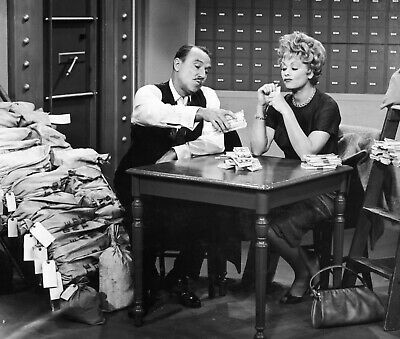
When “Dennis” ended in 1963, and character actor Charles Lane (playing Banker Barnsdahl for Lucy) had trouble memorizing lines, Ball snatched him up to play her new banker, Theodore J. Mooney – and the rest is TV history. Gordon’s comedy partner for the rest of his life would be Lucy.

(2) The banker on “The Beverly Hillbillies” (1962-1971) was named Milburn Drysdale and he was played by Raymond Bailey. He appeared in all 247 episodes of the CBS sitcom. Although he never acted on television with Lucille Ball or Gale Gordon, Bailey appeared on the Desilu shows “The Untouchables” (1960), “The Ann Sothern Show”, (1958 & 1960) “The Real McCoys” (1957), and “Whirlybirds” (1957). On “The Beverly Hillbillies” he acted opposite such “I Love Lucy” actors as Nancy Kulp (as his sidekick, Miss Hathaway), Bea Benaderet, Frank Wilcox, Elvia Allman, Ray Kellogg, Charles Lane, Joi Lansing, Shirley Mitchell, Doris Packer, Eleanor Audley, Maurice Marsac, Herb Vigran, Tristram Coffin, Hedda Hopper, Natalie Schaffer, Hans Conried, Ellen Corby, Lurene Tuttle, Hayden Rorke, Frank J. Scannell, Gail Bonney, Fritz Feld, Jil Jarmyn, and Desi’s stand-in, Bennet Green.

CYNTHIA LOWRY – was a TV reporter for the Associated Press. During her vacations, her column would be taken over by guest writers. Other articles about Lucille Ball include:
- June 13, 1965 – “Life Without Vivian”
- January 4, 1970 – “First Bird Leaves The Nest”
- July 4, 1972 – “Lucille Ball Writes” (guest columnist Lucille Ball)
Note ~ The many headlines at the top of this blog is because the same article (in this case by Gale Gordon, normally by Cynthia Lowry) was given a different headline in every newspaper her column appeared in. Newspapers who printed her column were free to create their own headlines, and edit for length. Also, of all the various places this article was printed, there was not one photograph of Gordon! This may be because Lowry’s contract did not allow space for editorial photographs.
-
Subscribe
Subscribed
Already have a WordPress.com account? Log in now.
 Papermoon Loves Lucy