-
RIP JANE POWELL
1929-2021

Jane Powell was born in Portland, Oregon, as Suzanne Lorraine Burce.
Through the 1940s and 1950s, she had a successful career in movie musicals. However, in 1957, her career in films ended, as she had outgrown her innocent girl-next-door image. She has made brief returns to acting in front of the camera – on television, in commercials, and in a workout video. She had a variety of roles on stage after the end of her movie career.

Powell’s greatest fame came as the star of MGM’s Seven Brides for Seven Brothers (1954) which was referenced on the “I Love Lucy” episode “Lucy in the Swiss Alps” (ILL S5;E21) in 1956, and
In “Ricky Needs an Agent” (ILL S4;E29) as “Seven Brides for Seven Cubans” when agent Lucille McGilliucuddy is proposing possible projects for Ricky so that MGM won’t release him from his contract. But, inevitably, ”He’s released.”
“I didn’t quit movies. They quit me.” ~ Jane Powell

Lucille Ball and Jane Powell appeared on the same television programs three times. On Valentine’s Day 1954, Ed Sullivan’s TOAST OF THE TOWN presented “MGM’s 30th Anniversary Tribute”. As new MGM stars for their film The Long, Long Trailer, Lucy and Desi walked the red carpet along with Powell, who later performed “The Jewel Song” from Faust. She was also seen in a clip from MGM’s Royal Wedding (1951).

In 1985, Powell joined Lucille Ball, Lucie Arnaz, and 97 other celebrities for “Night of 100 Stars II” at Radio City Music Hall.

Finally, both Powell and Ball were seen in “Happy 100th Birthday, Hollywood” on May 18, 1987.
This was a two-hour special on ABC TV that won an Emmy for editing.

Jane Powell was married five times and had three children. She was 92 years old.
-
RIP MICHAEL CONSTANTINE
1927 – 2021

Michael Constantine was born Constantine Joanides in Reading, Pennsylvania, to Greek parents. He made his Broadway debut in the hit play “Inherit the Wind” on April 21, 1955. On October 19, 1959, Constantine was part of the opening-night cast of the hit play “The Miracle Worker,” appearing in the role of Dr. Anagnos. It ran for 719 performances. He made his motion picture debut in The Last Mile (1959), but had already begun appearing in the medium in which he made his reputation, television, the year before.

Although he never acted opposite Lucille Ball or Desi Arnaz, he was employed by Desilu in their hit series “The Untouchables” playing five characters on the series from 1961 to 1963.

He was cast in the pilot for a Desilu series “Hide and Seek” which was not picked up for series but was aired on August 5, 1963 as part of “Vacation Playhouse”. The pilot was written by Jess Oppenheimer and starred Keith Andes, who had just played opposite Lucille Ball on Broadway and would play her boyfriend on two episodes of “The Lucy Show.”

On December 17, 1963, Constantine appeared on an episode of Desilu’s circus series “The Greatest Show on Earth”. The week before, Lucille Ball herself had appeared on the series.

On April 27, 1966, Constantine was seen on an episode of “The Dick Van Dyke Show” which was shot at Desilu Studios. On March 11, 1968 he back at Desilu Studios for an episode of “The Danny Thomas Hour”.

In 1969, he was back at the studio for an episode of “Mission: Impossible” although by that time the studio was known as Paramount.

He continued working on television, appearing with Lucie Arnaz in a 1988 episode of “Murder She Wrote.”

He found a career resurgence playing Gus in two “My Big Fat Greek Wedding” films and the television series.
He was 94 years old and left behind a wife and two children.
-
MY FAVORITE HUSBAND ~ Season 1, Part 2 (Cooper)
January 7, 1949 – July 1, 1949

“My Favorite Husband” ~ Season one aired on CBS Radio from July 5, 1948 to July 1, 1949. There were 51 half hour episodes. Starting in January 1949, the characters would have their last name changed to Cugat, the character of Cory Cartwright would was phased out, Gale Gordon and Bea Benadaret became regulars as the Atterburys, and the main sponsor became Jell-O.
Regular Cast: Lucille Ball as Elizabeth ‘Liz’ Cooper, Richard Denning as George Cooper, Ruth Perrott as Katie the Maid, Gale Gordon as Rudoph Atterbury, Bea Benadaret as Iris Atterbury, and Bob LeMond, Announcer.
Season 1 (Part Two) Guest Cast: Frank Nelson (11 episodes), Hans Conried (9 episodes),
Florence Halop (3 episodes), Jerry Hausner (2 episodes), Gerald Mohr (2 episodes), Alan Reed (2 episodes), Doris Singleton (2 episodes), Joe Kearns, Jack Edwards, Jean Vander Pyl, William Johnston, Verna Felton, GeGe Pearson, Pinto Colvig, Steve Allen, Elvia Allman, Gloria Blondell, John Heistand, John Heistand, Parley Baer, Peter Leeds, Shirley Mitchell, Wally Maher, Shirley Mitchell, Johnny McGovern, Ted DeCorsia, Milton Stark, and Mary Lansing.
To Experience the Full Episode Blogs – for both “My Favorite Husband” and “I Love Lucy” – simply click on the hyperlinked (underlined) text.
* = Episodes not available for preview or considered lost.

“Over Budget – Beans” (aka “Beans for Three Weeks”) ~ January 7, 1949
Synopsis ~ Liz goes over her budget again by buying six cases of beans that were on special so George cuts off her allowance. Soon they’re eating nothing but beans, and the electricity and telephone have been disconnected!

”Piano & Violin Lessons”
(aka “Professor Krausmeyer’s Talent Scouts”)
~ January 14, 1949
Synopsis ~ Liz takes up the piano to win a radio talent contest. To get even, George starts playing the violin. Who will win?

“The Marriage License Error” (aka “Marriage License”) ~ January 21, 1949
Synopsis ~ Liz and George find their marriage license and discover that instead of “George H. Cooper,” it says “George C. Hooper.” Now Liz is convinced that she and George aren’t legally married!
-
Portions served as the basis for The “I Love Lucy” episode “The Marriage License”

“The Absolute Truth” ~ January 28, 1949
Synopsis ~ Liz and George bet each other that they can each go for 24 hours without telling a lie. Even a little white one.
- Basis for the “I Love Lucy” episode “Lucy Tells the Truth”

“Speech for Civic Organization” (aka “Liz Debates Alaska in Town Forum”) ~ February 4, 1949
Synopsis ~ Liz, anxious to win the approval of an important dinner guest, simply agrees with everything he says. The guest is so impressed with her intelligence that he invites her to be a speaker at his next civic forum.

“Valentine’s Day” (aka “Valentine’s Day Mischief”) ~ February 11, 1949
Synopsis ~ Katie, the Maid, is sweet on Mr. Dabney, the butcher, and Liz offers to help. But when Liz’s Valentine to George gets switched with her check to pay the butcher’s bill, Mr. Dabney gets the wrong idea.
- Basis for the “I Love Lucy” episode “Lucy Plays Cupid”

“Secretarial School” (aka “Liz Attends Claremont Business School”) ~ February 18, 1949
Synopsis ~ George needs a new secretary, so Liz enrolls in secretarial school so she can fill the position.

“Absentmindedness” (aka “Liz’s Absent-mindedness”) ~ February 25, 1949
Synopsis ~ Liz goes to see a doctor about her absentmindedness, and then reports her car to be stolen when she forgets that George dropped her off at the doctor! Liz takes a memory course. It works in reverse and she ends up with amnesia and George finds himself in jail.
*“Mother-In-Law” ~ March 5, 1949
Synopsis ~ George’s mother comes to visit. Liz hopes to drive her out by spreading ragweed and other allergy-inducing plants around the house, but her plan backfires when George’s mother starts dating her allergist.
-
Gale Gordon and Bea Benaderet, do not play the Atterburys in this program. Bea Benaderet plays George’s mother, and Gale Gordon plays George’s mother’s boyfriend.

“Charity Revue” (aka “Red Cross Benefit Revue”) ~ March 11, 1949
Synopsis ~ Mr. Atterbury asks George to work up a song and dance routine for the local Red Cross Charity Review. At the same time Liz’s women’s club recruits her to perform.
- Basis for the “I Love Lucy” episode “The Benefit”
*”Giveaway Program” (aka “The Johnny Odell Program”) ~ March 18, 1949
Synopsis ~ Liz never misses her favorite giveaway radio program, “Ring the Bell With Johnny O’Dell.” She’s convinced that she’s going to get called on the phone and win the grand prize.
- Basis for the “I Love Lucy” episode “Redecorating”
*”Old Jokes and Old Stories” ~ March 25, 1949
Synopsis ~ Liz keeps stepping on George’s punch lines during an evening with the Atterburys. George finally puts his foot down, and Liz promises from then on to obey his every command. Things are going fine until George somehow gets the mistaken idea that Liz is so upset with this news that she is planning to run off with the Atterburys’ chauffer.

“April Fool’s Day” ~ April 1, 1949
Synopsis ~ As an April Fool’s joke, Liz plans to plant a lipstick-smeared handkerchief in George’s coat pocket.

“Gum Machine” (aka “The Principal of the Thing” aka “Demand Your Rights”) ~ April 9, 1949
Synopsis ~ George tells Liz that she needs to stand up for her rights and stop letting people push her around. So when Liz loses a penny in a broken gum machine, she vows to get her penny back no matter what the cost.

“Horseback Riding” (aka “Liz Takes Horseback Riding Lessons”) ~ April 15, 1949
Synopsis ~ George’s female co-chair for his horseback riding club’s upcoming weekend breakfast ride has Liz so jealous that she’s determined to overcome her fear of horses and learn to ride herself.

“Time Budgeting” (aka “George and His Trained Seals”) ~ April 22, 1949
Synopsis ~ George is so fed up with Liz’s being late for everything that he puts her on a strict schedule.
- Basis for the “I Love Lucy” episode “Lucy’s Schedule”
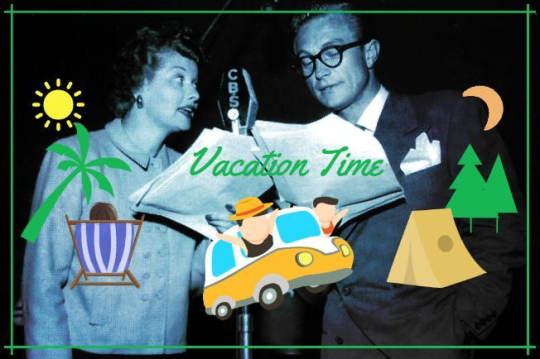
“Vacation Time” (aka “Trailer Vacation to Goosegrease Lake”) ~ April 29, 1949
Synopsis ~ It’s vacation time, and Liz and George have decidedly different plans. He wants to go camping with a trailer he borrowed from a friend, while she’s set on a glamorous vacation at Moosehead Lodge.
- Partly inspired the premise of the “My Favorite Husband” episode “Liz Learns To Swim”

“Overweight” (aka “The Five-Dollar-A-Pound Diet”) ~ May 6, 1949
Synopsis ~ After viewing some old home movies, Liz and Iris decide to go on a diet.
- Some elements later used to create the “I Love Lucy” episode “The Diet”

“Anniversary Presents” (aka “Tenth Anniversary Presents”) ~ May 13, 1949
Synopsis ~ George and Mr. Atterbury buy presents for their wives, and Iris’s present, a mink coat, is delivered to Liz’s house by mistake.
- Basis for the “I Love Lucy” episode “The Fur Coat”

“Getting Old” (aka “Liz Is Feeling Her Age”) ~ May 20, 1949
Synopsis ~ Scanning her old high school yearbook, Liz decides she’s old, and everything George does to try to snap her out of it just makes things worse. George tries to convince Liz that she’s as glamourous as ever. His tactics misfire so George is forced to hire a psychiatrist.
- Partly inspired the “I Love Lucy” episode “The Inferiority Complex”

“Liz in the Hospital” (aka “Liz Goes To The Hospital”) ~ May 27, 1949
Synopsis ~ The doctor pays a house call to see what’s wrong with George, and discovers that Liz needs to have her tonsils removed!

“Hair Dyed” (aka “Liz Gets Her Hair Dyed”) ~ June 10, 1949
Synopsis ~ After George warning Liz about the dangers of idle gossip, Liz’s chatty and absent-minded hair stylist forgets what she’s doing and mistakenly dyes Liz’s hair black. Nobody recognizes Liz, so she decides to flirt with George to test his fidelity. Gossip about Liz and George spreads all over town.
- The first part was the basis for the “I Love Lucy” episode “The Gossip” and the second half inspired “The Black Wig”

“Television” (aka “George Ruins a Neighbor’s TV” aka “The Television Suit”) ~ June 17, 1949
Synopsis ~ Liz and George’s visit to their next-door neighbors, the Stones, turns into a disaster when George tries to repair the Stones’ new television set by himself.
-
Basis for the “I Love Lucy” episode “The Courtroom”

“Liz Changes Her Mind” ~ June 24, 1949 & September 30, 1950 (rerun)
Synopsis ~ When Liz has trouble making up her mind, George decides she must finish everything she starts.
- Basis for “I Love Lucy” “Lucy Changes Her Mind”

“Reminiscing” ~ July 1, 1949
Synopsis ~ Liz is working on her scrapbook, and she and George reminisce about when Liz learned to drive and got her license, when Liz signed an affidavit swearing never to interrupt George’s stories again, and when the butcher thought that Liz had a crush on him.
-
-
PAPERMOON’S GUIDE TO MOVING!
August 17, 2021
I’m moving! After nearly nine years in a mobile home, I’ve decided it’s time to move on! Of course, I couldn’t do it without Lucy, so here’s my move – Lucy style!

Goodbye mobile home living – hello condo by the sea!

My real estate broker was a regular Rosie Hannigan (aka Countess Frambois), selling my place for much more than I paid for it!

Gone are the days when I could do the moving myself with a few friends! Does anyone still have a blotter???

So I hired professional movers to help me pack and get to my new home.

Yes, for a few days my trailer looked like the will-call department at Macy’s!

Moving day is always hectic, especially if you work from home or have a disability! Like Lucy Carter, I tick both boxes!

Finally, time to leave I took one last look around. I spent nine years here!

But as the moving van pulled away, I knew I made the right decision. I wonder if Lucy Barker felt that way when she moved in with her daughter?


My new address is a condominium that was formerly the Ritz-Carlton hotel! Anything named Ritz has gotta be amazing, right? After all, the Ritz Theatre in Newburgh NY launched the most famous pairing in TV history – Lucy and Desi!

This Ritz is located on the Boardwalk in iconic Atlantic City!

My apartment has a view of both the Boardwalk and the Beach!

Most appropriately, the Ritz is located across the street from the Tropicana Hotel & Casino!

Home!
-
ROUGH ROAD TO TOP
August 16, 1953

(1)

One of the more famous CBS-TV shows is “I Love Lucy.”
Its two chief characters – Lucille Ball and Desi Arnaz – have had a rocky road to their present status as one of the top comedy teams in the country.
At the end of Lucille’s first year in dramatic school she was told by her teachers that she was wasting her time and money, that she would never become an actress. She was fired from all four of her first jobs as a chorus girl. Later, as a model, she almost lost her life in an automobile accident and was told she would never walk again.
Revolution Factor
It was a revolution in Cuba and a mishap in World War II which were fateful turns in Arnaz’ trip to stardom. The Cuban revolution destroyed his family’s wealth, drove them to the United States. World War II got him a broken kneecap in basic training, and since he had been a professional entertainer, he was placed in limited service and assigned to entertain hospitalized G.I.s’.
Columbia Pictures gave Lucille a contract as a stock player, and, convinced that her luck finally had turned, she sent for mother, grandfather, and sister to join her in California. But, the morning after she wired her family, the studio decided to dissolve its stock company. When the family arrived, Lucille was working as an extra at Paramount.
Bit parts and extra roles in a number of pictures kept Lucille busy, but not prosperous, until she was cast in ’"Roberta.” RKO officials, impressed by her work, gave her a contract. When not busy before the cameras, she was a mainstay of the studio’s Little Theater. (2)
Offered Stage Lead
Her performance in the second lead in “The Girl from Paris" (3) drew Broadway’s attention to Miss Ball and she was offered a lead in the musical “Hey Diddle Diddle.” After satisfying her yen to perform on the Great White Way (4), she returned to Hollywood for "Stage Door” and “Too Many Girls.” In the latter picture, she was costarred with Desi Arnaz. They were married Nov. 30 1940 in Greenwich, Conn.
Back from her honeymoon, Lucille walked into her first really big break a role in "The Big Street,” based on a story by Damon Runyon (5). Overnight it made her a star.
Her first assignment at M.G.M. in 1942 was the title role in the Technicolor production "Du Barry Was a Lady” (6). Stellar roles followed in "Best Foot Forward” and "Meet the People” (7). After completing “Easy to Wed” with Van Johnson (8), she headed for New York to be with her husband, then out of the army and on his way to success in the orchestra business.
Starred on Tour
Shortly after completing "Her Husband’s Affairs,” (9) Miss Ball went on tour as star of Elmer Rice’s play "Dream Girl” (10) then worked with Sonny Tufts and Victor Mature in "Interference” for R.K.O. (11)
Lucille, Desi, arid their year-old daughter Lucy Desiree, live at Desilu, their five-acre ranch at Chatsworth, Calif. They raise cattle, chickens, dogs, and cats and dabble in farming. Enthusiastic fishermen they spend a lot of time on their boat.
Desiderio Alberto Arnaz y de Acha was born in Santiago, Cuba, son of the mayor. Desi’s mother, Dolores de Acha, was considered among the 10 most beautiful women In Latin America.
Three ranches totaling 100,000 acres, a palatial home in the city, a private island in Santiago Bay, speedboats, a fleet of motor cars, and a racing stable were all at the command of the youthful Desi during the pre-revolutionary days. His father, after eight years as mayor of Santiago, was made a member of the Cuban congress In 1932.
On Aug. 12, 1933, came the revolution. Congress was dissolved. Its members jailed. The Arnaz property was confiscated, the homes burned to the ground. In 24 hours everything was gone except $500 Desi’s mother had hidden. Desi and mother fled to Miami, devoted the next six months to efforts to free Papa Arnaz.
from prison. They were finally reunited in Florida.
For Desi, life in these United States for several years was hard but interesting: he worked at truck driving, train yard checking, taxi driving, bookkeeping, and, of all things, bird cage cleaning. Desi’s father managed to launch an importing business. It went broke when a shipment of fruit spoiled in transit.
Show business at this point finally caught up with Desi. His first job was playing guitar and singing with a seven-piece rhumba band at Miami’s Roney-Plaza Hotel (12). Xavier Cugat (13) spotted him, was impressed with this Cuban boy who was to be dubbed "The Tempo” by critics of modem music. After a year as featured vocalist with the Cugat band, Desi organized his own group of musicians and moved into the swank La Conga Café in Miami (14).
George Abbott’s Broadway hit "Too Many Girls” (15) was Desi’s next step up the ladder, in 1939. He played a Cuban football player, one of the leads, and played tropical drums. RKO bought the film rights and signed Desi to play his stage role. When the shooting was over Desi married the leading lady, Lucille Ball.
He spent from Feb. 1943 to Nov. 1945 in the Army, after which he toured the nation with his band playing theaters, dances, night clubs. He hasn’t been without a band since. In 1948, Desi made the Columbia film "Holiday in Havana.” (16)
He made a vaudeville tour with Lucille Ball and that convinced them they’d do well as a husband-and-wife team on television. The tour inspired the CBS-TV show “I Love Lucy,” which has been highly rated since it started. (17)
Desi Arnaz’s personality is as vibrant as the music he makes. He is friendly, direct in manner, has flashing dark brown eyes and brown hair. He’s an avid fisherman, rides and swims expertly: his tennis is the envy of his San Fernando Valley neighbors, Sue and Alan Ladd, Francis Lederer, Jackie Oakie, and the Andrews Sisters. (18) A good cook, he specializes in such tempting dishes as Ginger Beef and Bouillabaisse.
# # #
FOOTNOTES FROM THE FUTURE

(1) The photo is from “Be a Pal” (ILL S1;E2) aired on October 22, 1951, nearly two years earlier. There’s one thing missing from this file photo: Vivian Vance. The success of the show was its foursome, not threesome! If you look closely you can see the hands of the other poker players, Richard Reeves (Hank, left) and Tony Michaels (Charlie, right).

(2) Lucille did several plays at the RKO Little Theatre under the direction of Lela Rogers (above), Ginger’s mom. When Lucille later bought RKO, she dubbed it the Desilu Playhouse, a training ground for new young performers, often hand selected by Ball herself.

(3) “That Girl from Paris” (not “The” as the article states) was Lucille’s 33rd film. The light-hearted musical romance earned an Oscar nomination for Sound Recording. It was released on the first day of 1937.
(4) Lucille was indeed cast in the Broadway-bound comedy (it was not a musical, however) “Hey Diddle Diddle!” It opened in Princeton, New Jersey, the first of several out-of-town stops on the way to Broadway. What Lucille’s publicity omits is that the show never got further than Washington DC due to the serious illness of its leading man, Conway Tearle. So Lucy’s Broadway debut would have to wait – until 1960!

(5) “The Big Street” opened on September 4, 1942. It was based on a Damon Runyan short story about a night club singer (Lucille) embittered by an accident that left her in a wheelchair and her romance with a naïve admirer (Henry Fonda) named Pinks. Lucy later said it was her favorite of the many films she made. It was her 55th film.

(6) “Du Barry Was A Lady” premiered in August 1943. It was Lucille’s 57th film, but her first for MGM. She nabbed the role from her friend Ethel Merman, who had done the Cole Porter musical comedy on Broadway. It was filmed in color, and was the film that earned her the nickname “Technicolor Tessie” because of her bright orange hair – a color she committed to from then on, despite her roots! This is the film that introduced Lucy to the song “Friendship”, which she would also sing on “I Love Lucy.”

(7) In the musical comedy “Best Foot Forward” (1943) Lucille Ball played herself. It was her 58th film. “Meet The People” (1944) was a romantic comedy for MGM, Ball’s 60th film.

(8) In 1946 she released her 63rd film, “Easy To Wed” co-starring Van Johnson and Esther Williams. Lucille and Van had appeared together in “Too Many Girls” and he would appear on Lucy’s television shows.

(9) “Her Husband’s Affairs” (1947) was a romantic farce with Lucy teamed with Franchot Tone. It was her 69th film.

(10) Back to the stage, Lucille accepted the leading role in a revival tour of “Dream Girl” a fantasy comedy by Elmer Rice. Once again, the play launched in Princeton, but this time Broadway was not the goal. It had already played the Great White Way two years earlier. The play toured the country at select cities, landing Lucille back in California in late 1947. In one SoCal gig she was appearing simultaneously with Desi and his band just a few blocks away. No doubt this was by design.

(11) RKO’s “Interference” was re-named “Easy Living” (1949) and dealt with the world of professional sports, namely football. It co-starred Victor Mature and Sonny Tufts. It was Ball’s 71st film.

(12) The luxurious Roney Plaza Hotel in Miami Beach was located on the corner of Collins Avenue and 23rd Street.
It opened in 1925 and was demolished in 1968. The resort attracted a who’s who that included Hollywood stars and even the Duke and Duchess of Windsor. The hotel’s Bamboo Room & Restaurant was the place to be seen on the Beach for decades.
(13) Xaviar Cugat (1900-1990) was a Spanish musician and bandleader who spent his formative years in Havana, Cuba. A trained violinist and arranger, he was a leading figure in the spread of Latin music. In New York City he was the leader of the resident orchestra at the Waldorf–Astoria before and after World War II. He was a mentor and friend to Desi Arnaz, who kept his name before the public by making him a rival of Ricky Ricardo on “I Love Lucy” where his name became a punchline. In reality, Desi was grateful to Cugat, not jealous of him!
“I learned a lot from Xavier Cugat” ~ Desi Arnaz

(14) La Conga Café was located in New York City, not Miami, although the article may be referring to a different, lesser known establishment where Desi Arnaz performed. He became a regular headliner at La Conga, even issuing a record titled “La Conga” in 1939.

(15) Speaking of 1939 New York, Desi appeared in his only Broadway show in 1939, Rogers and Hart’s “Too Many Girls.” When the film rights were purchased by RKO, Desi was hired by director George Abbott to recreate his role. It was while filming this movie that he met Lucille Ball.

(16) “Holiday in Havana” was a Columbia picture released in October 1949.
The film is about a Cuban hotel busboy (Arnaz) who dreams of becoming a composer. His love interest was not Lucy, but Mary Hatcher.


(17) The Tour incorporated some of the same routines seen in the “I Love Lucy” pilot as well as early episodes of the series, most notably the “Cuban Pete / Sally Sweet” duet. The tour culminated at the Roxy in New York City, where Desi was playing when he married Lucille in 1940.

(18) Before moving to their Beverly Hills mansion, Lucy and Desi lived on a ranch in Chatsworth in San Fernando Valley. They dubbed their ranch home Desilu. About their neighbors:
- Alan Ladd (1913-64) was a chorus boy when Lucille was an Earl Carroll showgirl in Murder at the Vanities (1934). He was married to Sue Carol (1906-82) from 1942 until his death. Carol’s name was mentioned on “I Love Lucy” in “The Fashion Show” when Lucy selects the same Don Loper original that Carol has chosen to wear in the fashion show. She does not appear on screen.
- Francis Lederer (1899-2000) was a Hungarian-born actor. In 1960 he did an episode of Desilu’s “The Untouchables”. From 1941 until his death he was married to Marion Irvine.
- Jackie Oakie (1903-78) did four films with Lucille Ball between 1934 and 1938, including both “Annabell” movies.
- The Andrews Sisters were the pre-eliminant close-harmony girl group of their time. The consisted of Patty, Maxine, and LaVerne. They were mentioned on “I Love Lucy” in
“Be a Pal” in the same scene that the photo at the top of the article came from. In 1969, Patty Andrews guest-starred as herself on “Here’s Lucy”. Lucy and Lucie played the other two Andrews sisters.
-
LUCY: BLACKJACK ACE & TOILET CLEANER!
August 16, 1967


LAS VEGAS, Nev. – Two hundred and sixteen miles from Kanab, Utah (1) as the crow flies is this lovely sin-ridden town. Leaving the crows to fly it, I made the trip in an air-conditioned sedan across the desert and through the magnificent mountain scenery of Zion National Park (2), and before I knew it, there I was at the blackjack table In the Sands Hotel (3), with Lucille Ball sitting next to me and faring no better at drawing to a split pair of sevens.
No one ever will mistake Lucy for a Vassar girl from Long Island’s north shore (4), with tweed skirts and cardigan sweaters. She had on a white silk brocade dress with brown pinto-pony spots, a couple of clanking gold bracelets and a mammoth gold wedding ring looking like a beehive. Even my Picasso blue sports shirt from Honolulu couldn’t take the play away from her.
Between cards, Miss Ball commented not griped; just commented on the drawbacks of being well known. “You know when you go into those airplane washrooms and there’s a sign saying ‘Please leave this area clean for the next passenger’?” she asked. “Well, I must spend half my time in the air cleaning up there, because other people have been sloppy. If I come out and leave it the way I found it – everybody starts yakking ‘Lucille Ball was just in there. What a slob!’”
# # #
FOOTNOTES FROM THE FUTURE

(1) Kanab, Utah is located on Kanab Creek just north of the Arizona state line
as “Little Hollywood” due to its history as a filming location for many movies and television series, prominently westerns.

(2) Zion National Park is located in southwestern Utah near the town of Springdale and just thirty miles from Kanab.

(3) Sands Hotel was a historic hotel and casino on the Las Vegas Strip that operated from 1952 to 1996. The Sands was the seventh resort to open on the Strip. During its heyday, the Sands was the center of entertainment and hosted many famous entertainers of the day, most notably the Rat Pack. The Sands was prominently featured in “Lucy Hunts Uranium” (above) in 1958 and was briefly glimpsed in a montage that opens “Lucy and Wayne Newton” (HL S2;E22). The Sands would be razed in 1996 to make way for the The Venetian Resort and Casino.

(4) Vassar College is located in Poughkeepsie, New York. Founded in 1861, it was the second degree-granting institution of higher education for women in the United States. It became coeducational in 1969. The college is one of the historic Seven Sisters, the first elite women’s colleges in the U.S.
Mel Heimer was a television and New York columnist for King Features Syndicate. He wrote “My New York” from 1948 to his death in 1971. His work appeared in some 130 papers throughout the country.
-
A RED-HAIRED SQUIRREL
August 15, 1965


By PAUL MOLLOY, Chicago Sun-Times Special
Hollywood — She paced about with jerky, nervous movements and a furrowed brow, evoking the picture of a squirrel — if you can imagine a squirrel with red hair, tight slacks and a constant cigarette between its lips.
Now she left her place on the stage and perched on a stool to survey the positions of the other actors. Then she returned and went through her lines.
“No, no!“ she exclaimed. "I should be standing here — not there — when he comes through the door. Let’s try it again.”
They did and then she broke off again and walked up to a female extra and said: ‘‘I want you to have your hair down for this scene, and wear a pattern dress.”
A prop man started to tuck in the folds of a tablecloth. “No!” she cried. “Leave it that way. I want to be able to see under the table.”
The cast went through its lines again and the director — who hadn’t been doing too much directing at this point — signaled for another break. “What happens now?” the squirrel yelled. “Can I go do some studying?”
This was Lucille Ball, onetime New York waitress and now president of a corporation (Desilu) which takes in an annual gross of $25 million. And this was dress rehearsal for an episode of the Lucy show which in September will premiere another season for the comedienne.
I asked her if the real thing, the filming, was to go on that night.
“I hope not!” she yiped. “This is a rough one and we’re running behind. We film it tomorrow night before an audience. Every Thursday night is opening night around here.”
Miss Ball at work—whether acting out her role or “directing” — is a marvel to watch. She is a perfectionist, a serious actress and an earnest executive. Yet her flair for mischief seldom leaves her.
During filming of an outdoor scene in which she was dunked in water, a dog in the vicinity was heard to bark — ruining the take.
“Give that dog a check” she cried “I don’t want to do that scene again!”
During another scene two nuns who were visiting the set conversed in what they thought were inaudible whispers. But the whispers were loud enough to be caught on the soundtrack, and again the take was ruined.
“Somebody tell those nuns to stop praying.” Miss Ball wailed in mock misery.
Watching her in action, it’s difficult to believe the verdict of the director of the acting school which she joined when she was 15. He wrote to her mother and laid it on the line; “She has no talent” (that’s when she became a waitress).
As I left the sound stage I walked by her dressing room where she had gone, with Joan Blondell, to study her lines. She was still at it, full force.
The lady never seems to stop.
Said Desilu executive Howard McClay: “You have to run to stay ahead of her.”
Fly, I think, is a better word.
# # #
FOOTNOTES FROM THE FUTURE

Paul Malloy couldn’t have picked a worse time to visit the set of “The Lucy Show”. Perhaps the presence of a reporter added to the stress level. The mention of Joan Blondell means that Malloy was there during rehearsals for either “Lucy and Joan” (TLS S4;E4), which aired October 11, 1965, or “Lucy the Stunt Man” (TLS S4;E5), which aired October 18, 1965. Blondell was contracted for three appearances, but quit after the second when she had harsh words with Ball in front of the cast and crew. The particular words in question were “Fuck you, Lucille Ball!”
The two never reconciled. The very next episode, Lucy brought back Ann Southern as the Countess Framboise to fill the void left by the departure of Vivian Vance.
If it seems like Lucy did a lot of directing – she did. The director of record for these two episodes was Maury Thompson. Thompson, a former camera coordinator for Desilu, was only directing for the fourth time – which is likely why Ball hired him. He knew about Lucille’s control issues and wouldn’t balk at his creative authority being eclipsed by his boss / star. He remained as director until the end of the fifth season and was replaced by Jack Donohue, his predecessor.
-
REMINISCING
August 14, 1977


By Frank Swertlow, Chicago Daily News
BEVERLY HILLS – During the first years of television, Ed Wynn, the radio and stage comic, was trying to break into television with a half-hour comedy on CBS. (1)
One night, he invited a couple of second echelon performers to make an appearance: a comedienne, known as “Technicolor Tessie” for her blazing red hair, and a song-and-dance man, best remembered for hollering “babalu.”
Lucille Ball and Desi Arnaz were the couple, and they, like Wynn, were sampling the waters of the new medium. CBS had asked Miss Ball and her conga-drum pounding husband to develop a comedy show for television. Later, after months of thought and testing their ideas on the vaudeville circuit, the couple came up with “I Love Lucy,” the misadventures of Lucy and Ricky Riccardo. (2)
It made its debut on CBS in October 1951. More than a quarter of a century afterwards, “I Love Lucy” easily can vie for the honor of television’s most successful show. It was the archtype [sp] domestic comedy, the bumbling husband and his daffy wife. It gave birth to two other Lucy shows, a host of specials and a giant production company, Desilu.
“We spent months thinking about what we should do,” Miss Ball recalled. “We didn’t want to be the average Hollywood couple. Nobody would think you had any problems if you had a car and swimming pool and a nice house.
"Ultimately, we wanted a show in which people could identify with us. Everybody could understand what it was like to struggle for a buck. I was an ordinary, everyday, middle class housewife. I wore the same dress often. My husband worked and tolerated my mistakes. It was something that everyone could identify with."
With the debut of the TV series, Lucille Ball, the former Goldwyn girl who started her film career in the 1930s, had a new career.
"I never expected the show to go more than a year,” said Miss Ball. “I wanted to do the show on film so I could use them as home movies. Who knew about television then? It was a no-no to do TV work. The movie studios were against it."
To Miss Ball, who was not a new face to the public, the impact of her show was incredible. "We went to New York on a trip once and we were unprepared for what happened. People rushed up and wanted to touch you. They knew you, and called you by your first name. I had been in pictures for years, and most of the time I was never identified."
If the movers and shakers of the film industry who gave Miss Ball her start during the 1930s were alive, they would have been shocked. To them, simply and kindly, Lucille Ball was a B-movie queen, one of the many second-line actresses who never attained star billing, but who was an important ingredient to the motion picture industry.
Unlike many performers who labored under the cruel studio system, Miss Ball fondly remembered her early years in Hollywood. "It was nice to be under the umbrella of a studio. You always had a poppa. I loved it. I loved being part of the business. I would have swept floors just to be in it."
Miss Ball, however, did not forget the tactics of the brutal and disgusting lords of movieland. Harry "King” Cohn, the ruler of Columbia Pictures, stood out. “He made the biggest dent in everybody. He was ruthless. He always had to take a devious route.” (3)
Miss Ball, who is not exactly a pushover, laughingly recalled the time she outwitted the sly Cohn.
Miss Ball had received an offer to work in a Cecil B. DeMille film, but Cohn refused to loan her to the producer. He was being mean. Then, Cohn decided to drop her contract. To do it, he sent the actress a horrible script something that the trade called a lease breaker. “Oh, everybody was dying to play opposite John Agar and Raymond Burr,” she recalled jokingly. “I was going to be a harum [sp] girl.” Naturally, Cohn expected her to refuse and it would be the end of her contract. (4)
The savvy Miss Ball decided to do the film and collect her check. When she made this announcement there was an uproar. She coyly told her bosses: “Oh, I want to do the film. It’s a wonderful film."
Meanwhile, Miss Ball, who had been trying to get pregnant for years, found out she was going to have a baby. Now, she was in trouble. If Cohn found out, he would break her contract. "I only told my mother and my husband I was pregnant."
Keeping her lips sealed, she went ahead with Cohn’s film. "The wardrobe girl kept looking at me in my harum [sp] girl costume and saying, ‘What’s wrong with you, you are getting so big.’ "So, I told her, ‘Don’t worry, I ate a big meal last night. Just put a little more taffeta on my dress.’ Well, I finished the film and I collected my $85,000."
"Then I had to go to Mr. DeMille and tell him I couldn’t do his film. I was pregnant. ‘What,’ he said. And I replied. ‘I’m going to have a baby. ‘Get rid of it,’ he said. And he was serious.’ She declined. (5)
While Miss Ball’s career as a TV star is secure (she still has a contract with CBS) (6) she is not so certain about the state of the industry. Today, unlike when she started on the air, shows are yanked off the screen within a couple of weeks. This, she said, destroys performers.
"If a show is canceled, the actor takes the blame. He or she suffers for it. They suffer inside. The rejection – they failed. (7)
"I would fail. You can’t protect yourself. It’s out of your hands. It’s always Lucy failed or Rhoda failed or Farrah Sauset Fawcett Sauset, whatever her name is, failed. It’s rough.” (8)
Even so, Lucille Ball, the red-haired girl from Jamestown, N.Y., would still be on top.
# # #
FOOTNOTES FROM THE FUTURE

(1) Ed Wynn (1886-1966) was a vaudevillian who hosted “The Ed Wynn Show” on television from 1949 to 1950. Lucy and Desi guest-starred on the show.

(2) ‘Riccardo’ is probably a misspelling of ‘Ricardo’, but it was also the way their surname was spelled on “I Love Lucy” in early episodes!

(3) Harry Cohn (1891-1958) was a much-despised executive at Columbia Studios. Lucille Ball once facetiously told Louella Parsons that she liked Harry Cohn too much to ever sign a contract with him. What Lucille meant is that Cohn had a reputation for being difficult. Despite that fact, a casting draught forced her to sign with Columbia in 1949.

(4) Lucille Ball had often complained to Cohn about the quality of the pictures she had been doing at Columbia. At the time The Magic Carpet was made, Ball was only obligated to Columbia for one more film, and Cohn had producer Sam Katzman, who turned out most of Columbia’s low-budget “B” pictures, concoct a cheap Arabian Nights fantasy as a punishment to Ball for her constantly challenging him. More salacious writers insist that Cohn’s frustration with Ball was due to the fact that she would not submit to him sexually.

(5) The DeMille film in question was The Greatest Show on Earth, a movie set at the Ringling Brothers Barnum and Bailey circus. Lucille was set to play the elephant trainer, a role that went to Gloria Graham. It was a film Lucille really wanted to do – but she wanted a baby more. Later in life, Desilu created a TV version of the film. Lucille also guest-starred as the ringmaster on “Circus of the Stars II” in which Lucie Arnaz was featured as…. the elephant trainer!

(6) Lucille Ball had started working at CBS on radio and was considered their premiere star. In 1980, after her television shows had ended, she signed with NBC, a partnership that yielded very little except that Ball was obliged to appear on Bob Hope’s many specials, something she frequently did anyway. Both CBS and NBC declined her final series “Life With Lucy” which producer Aaron Spelling finally convinced ABC to air.

(7) Although this article was written ten years before “Life With Lucy”, Lucille could very well be describing her own devastation when the series was cancelled even before all the initial episodes aired. She was widely criticized and the series often turned up on “worst show” lists.

(8) Rhoda refers to a character on “The Mary Tyler Moore Show” that was played by Valerie Harper, a performer that appeared on Broadway with Lucille. In 1974, the character was spun off into its own eponymous sitcom which aired for four seasons.

Farrah Fawcett-Majors was a beautiful blonde actress and poster girl that burst onto the TV scene in the mid-1970s. A year after this interview, she was in the hit series “Charlie’s Angels” entering American iconography for her feathered hair and curvaceous figure the same way Betty Grable had in the 1940s.
-
NEW TV SHOW
August 14, 1962

HOLLYWOOD (UPI) – There is something ludicrous in the sight of a man trying to do a woman’s work. A man looks about as silly wielding a dust mop as a woman does trying to throw a baseball overhand.
But even funnier, I think is a woman trying to do a man’s work. I don’t mean in the professions or trades — I mean around the house. Certain household functions like climbing ladders and fixing light switches have a built in logic that is completely foreign to the feminine mind. (1)
I think this has a universally comedic element in it. It had better have — because that’s the premise of the new television show I’ll be doing on the CBS Television Network this fall under the title “The Lucille Ball Show.”
Maybe it should be named “The Lucy Show" (2) — because that’s the character I’ll be playing: The same improbable kook I had so much practice at playing on “I Love Lucy.“ She’s a widow with two children trying to be both the lady of the house and the man of the house. As you might suspect, if you knew Lucy, she approaches her problems in a kind of inside-out way. (3)
Like Most Women
Actually, Lucy is like most women, only more so.
After 11 years of playing Lucy it may be that I’ve acquired some of her characteristics, or maybe she has acquired some of mine. This question, if it must he answered, will have to be answered by someone else. But whatever the answer, I’d like to say that I love Lucy, too — and whatever changes in her situation, I’m going to do my best to day her the way she’s always been.
In this, I’m happy to report, I’ll have expert assistance. Vivian Vance will be with me for one thing. (4) Bob Carroll Jr., Madelyn Martin, Bob Weiskopf and Bob Schiller will be writing the new show (5) — and they are the ones who as writers of “I Love Lucy” made Lucy what she is as much as I did.
Desi Is Producer
And of course, Desi Arnaz will be the executive producer of the new series. (6)
A decade without a vacation can make you pretty tired and when we stopped filming “I Live Lucy” I was just that. But I didn’t take a vacation. I went into Broadway musical ‘“Wildcat,“ and by time I’d been in that show for a year (7), I was exhausted. So I took a year off — a sort of sabbatical — from work. It was a wonderful vacation and I finally had time to do a lot id things I’d never had time for before. I enjoyed it so much I didn’t get excited about the new series until Vivian and I started getting down to specific discussions with the writers and Elliott Lewis, our producer.
Then I suddenly realized how much I had missed Lucy.
I just hope everyone else has missed her as much.
# # #
FOOTNOTES FROM THE FUTURE

(1) This opening paragraph seems extremely sexist in the present day. Bear in mind that in 1961, America had not gone through the women’s liberation movement, and the culmination of the Equal Rights Amendment was still more than a decade away. Lucy’s gender role thoughts reflect a very 1950s ideal. The very first image of Lucy and Ethel in 1951 (above) was of them washing dishes. As the Lucy character ages, comedy based on these type of domestic stereotypes will wear thin.

(2) The working title of the show was “The Lucille Ball Show” but it was eventually changed to “The Lucy Show” before the first broadcast in October 1962. Lucille is not being entirely truthful with the public. In reality, when “I Love Lucy” / “The Lucy-Desi Comedy Hour” ended in April 1960, they were without their iconic star and ratings dipped. Similarly, Desilu was also facing financial trouble. The creation of a new show for Lucille was the natural answer to these problems, and Ball agreed to do it for one – possibly two seasons – but no more. As with “I Love Lucy”, however, syndication is where the real money was – and “The Lucy Show” would need more than two seasons to be successfully syndicated. So at the end of 1964, Ball re-upped, although the series changed greatly from its original premise.

(3) The premise of the show was borrowed from the book “Life Without George” by Irene Kampen, who got screen credit on every episode. In the book, Viv’s character was also a widow, but for TV was changed to a divorcee. Vivian played the first divorced female leading character on a TV sitcom.

(4) Vance agreed to return to Desilu, despite having moved East to live with her new husband. The rigorous schedule and great distance finally proved to much, and she left the series after season 3. She made guest appearances on “The Lucy Show” and “Here’s Lucy.”

(5) Writers Madelyn Martin (formerly Pugh), Bob Carroll Jr., Bob Schiller and Bob Weiskopf stayed with the series through the end of season two in spring 1964. They still received screen credits for all 156 episodes as ‘creators’. They left the show after being with Lucille since “My Favorite Husband” in 1948, claiming they were out of ideas!

(6) Desi Arnaz stayed as Executive Producer for 13 episodes. He had sold his shares in Desilu to Lucille, and wanted to usher in the new series. Once the show was on his feet, he resigned, but mutual agreement.

(7) Lucille began doing “Wildcat” on October 29, 1960 (out of town tryouts), and had undergone several weeks rehearsal prior to that. The show opened on Broadway on December 16, 1960. Eight performances a week singing and dancing proved taxing for the nearly 50 year old star, and she had to withdraw from the show due to exhaustion at the end of May 1961. Ball’s understudy assumed the role, and the show closed shortly afterwards. There were plans to bring it back in the fall (with or without Ball, no one knows), but they never materialized. All tolled, Ball was in the show for seven months, a few months shorter than the year she claims here. Preparations for such an endeavor, however, likely began months earlier than rehearsals, so it was likely close to a year all said and done.
-
MOM SETS HARD RULES
August 13, 1968


By HAROLD HEFFERNAN, North American Newspaper Alliance
HOLLYWOOD – “You kids are getting on-the-job training and I hope you realize bow lucky you are.” It was Lucille Ball talking. Her remark was addressed to a pair of young performers who will be featured on her new program next season.
“And the first thing you must learn,” continued the redheaded comedienne with a trace of scold in her voice, “is that we have strict rules around here. No shenanigans. You’re here to do a job and we want discipline first of all. We dare not fail to know our lines or the business we have to do before the camera. When the curtain goes up, just remember that the audience doesn’t care what our problems were in preparing the show. They only care about results."
Miss Ball plays Lucille Carter, a widow with two teenage children in her new series, "Here’s Lucy,” which will go out over the CBS-TV network in her familiar time slot of Monday evening.
The new cast members are, of course, her own children, Lucie Arnaz, 17, and Desi Arnaz, Jr., 15. They play Kim and Craig Carter, her stage children. For Lucie, who had a birthday July 17, show business is a completely new happening. On the other hand, Desi, Jr., still in high school, has already carved a name for himself, as a musician – a credit, by the way, that doesn’t seem to impress his mother since most of her stern advice is aimed directly at him. Junior is a carefree type, much like his father, whom Lucy divorced 10 years ago.
“ATTENTION to detail Is the difference between right and wrong,” Mother Ball expounded while members of the cast and crew looked on and listened to this unique exercise in family tutoring. “We pride ourselves on this show that we seldom have retakes or add or delete scenes. This takes experience and planning. We don’t expect perfection – not at the start anyway – but we do want it to be your goal.”
Young Desi, the lively, independent thinker, stirred restlessly in his chair, then got up and began pacing the stage nervously. “He’s going to be hard to direct,” Lucy confided. “He has the feeling that rehearsal is a bore and that if he has his lines learned by Thursday night (when the show is filmed) everything should be okay. He’s forever telling me he should be permitted to study and act in his own way. He hasn’t goofed yet, but I keep saying that we can’t go through the week having heart failure in fear that he might."
GORDY HENSMAN, a grizzled grip, who has known and worked with Lucy since 1937, when she broke in as a teenager at RKO Studio, was working the camera boom here on the Paramount lot – and doing some remembering.
"Lucy was the liveliest, most precocious kid I ever encountered in all my time on sound stages,” the old timer recalled fondly. “She was a great practical joker and was forever figuring out a way to have fun. I’ve often wondered why RKO didn’t take advantage of her natural talents for comedy. She was the swiftest and funniest ad libber I ever knew.
Her daughter is the dedicated performer, Lucy declared, looking proudly out to center stage as Lucie speaks her lines, letter-perfect. Tall, lithe and lovely (she stands almost 5-10), she has studied voice and, under the skilled direction of her mother, has become an expert at pantomime. "And she sings and dances far better than I ever could,” Lucy added. “But Desi procrastinates as an actor and never wants to take things seriously,” she complained. “He’s always asking questions about the production end of it and I have a feeling that is how he’ll wind up – producing or directing like his Dad.”
# # #

-
Subscribe
Subscribed
Already have a WordPress.com account? Log in now.
 Papermoon Loves Lucy