-
THE DANNY KAYE SHOW WITH LUCILLE BALL
November 11, 1962

Directed
by Greg GarrisonWritten
by Herbert Baker, Ernest Chambers, Sylvia FineDanny
Kaye
(Host) was
born David Kaminsky in 1911 and left school at the age of 13 to work
in the Borscht Belt of Jewish resorts in the Catskill Mountains. It
was there he learned the basics of show biz. In 1939, he made his
Broadway debut in Straw
Hat Revue,
but it was the stage production of the musical Lady
in the Dark in
1940 that brought him acclaim and notice from agents. Also in 1940,
he married Sylvia Fine, who went on to manage his career. She helped
create the routines and gags, and wrote most of the songs that he
performed. Danny could sing and dance like many others, but his
specialty was reciting tongue-twisting songs and monologues. In
1964 he appeared on “The Lucy Show” as himself and Lucy appeared
on his special in return. He died in 1987.
Lucille
Ball (Guest)
was born on August 6, 1911 in Jamestown, New York. She began her
screen career in 1933 and was known in Hollywood as ‘Queen of the
B’s’ due to her many appearances in ‘B’ movies. With Richard
Denning, she starred in a radio program titled “My Favorite
Husband” which eventually led to the creation of “I Love Lucy,”
a television situation comedy in which she co-starred with her
real-life husband, Latin bandleader Desi Arnaz. The program was
phenomenally successful, allowing the couple to purchase what was
once RKO Studios, re-naming it Desilu. When the show ended in 1960
(in an hour-long format known as “The Lucy-Desi Comedy Hour”) so
did Lucy and Desi’s marriage. In 1962, hoping to keep Desilu
financially solvent, Lucy returned to the sitcom format with “The
Lucy Show,” which lasted six seasons. She followed that with a
similar sitcom “Here’s Lucy” co-starring with her real-life
children, Lucie and Desi Jr., as well as Gale Gordon, who had joined
the cast of “The Lucy Show” during season two. Before her death
in 1989, Lucy made one more attempt at a sitcom with “Life With
Lucy,” also with Gordon, which was not a success and was canceled
after just 13 episodes.

In
1960, Kaye signed a $1.5 million contract for three annual specials
that would set the pattern for his later series. Although these
specials were not critically successful, audience ratings were
sufficient for CBS to offer the entertainer his own weekly series.
Because
it was the first television teaming of the two famous redheads, the
special was hailed as “A
Television First” and was also Lucille Ball’s first appearance in
color. Lucille Ball had only just started shooting the first season
of “The Lucy Show,” which was shot and aired in black
and white during season one.


The Detroit News dedicated its cover story to this special on the same day it premiered.

So did the Indianapolis TV Times – with a somewhat odd caricature of the stars.

Two
years later, Lucy appeared on another Danny Kaye special, and
referenced this 1962 appearance.
This
program was nominated for three 1963 Emmy Awards as well as a
Director’s Guild Award. At the 1963 Emmy’s Lucille Ball was also
nominated for her work on “The Lucy Show,” although she lost to
Shirley Booth in “Hazel.”
The day after this special aired, “The Lucy Show” first broadcast “Lucy Is A Kangaroo for a Day” (TLS S1;E7).

During
the special, Kaye sang, danced, and told a story imitating Maurice
Chevalier’s English accent. Chevalier had co-starred in “Lucy
Goes To Mexico” (1958), and was imitated by everyone on
“I Love Lucy” in “The
French Revue” (ILL S3;E7).
Lucille
Ball sang, danced (the Twist), and did imitations of Judy Garland,
Carol Channing, and Marlene Dietrich.
Three
years later, Lucy Carmichael would go undercover as Carol Channing in
“Lucy and the Undercover Agent” (TLS S4;E10), dressing as
Channing did in Hello, Dolly!
In 1971, Lucy Carter imitated Marlene Dietrich in “The Hollywood Unemployment Follies” (HL
S3;E22) singing “Falling
in Love Again (Never Wanted To)”
from the 1930 German film The
Blue Angel.
In that same episode there is a mannequin of Judy Garland as Dorothy
in The
Wizard of Oz,
although no one imitates her.Danny
Kaye and Lucille Ball play a couple visiting restaurants of different
ethnicities: Japanese, French, and Tahitian.
Danny Kaye (as himself) introduces each of the three sketches.
At
a traditional Japanese Restaurant, they are introduced to the art of
bowing, but don’t know exactly when to stop. Reminded to take off
their shoes, Kaye finds he has a hole in his sock. Lucy has trouble
sitting at the low table in her tight pencil skirt. Kaye lowers her
to the floor and slides her under the table but she keeps sliding
right under their table to that of the next diners.
Both have no idea
that they have to break apart the wooden chopsticks to use them,
until the waitress demonstrates. The bowl of dried noodles still ends up all over the floor.
A bowl of lychees frustrates the couple,
until Kaye has the brilliant idea to shoot them into Lucy’s mouth
using his chopstick as a pool cue. The entire sketch is done without
dialogue.
Lucille Ball also had fun with chopsticks at a Chinese
Restaurant in 1968’s “Lucy’s Birthday” (HL S1;E8).
In 1959, the Ricardos and the Mertzes traveled to Japan and went to a restaurant, except the girls were the geisha servers, not the diners!
In
the second sketch, this time with dialogue, Lucy (Miss Naomi
Dinsmore) and Kaye (Charlie), co-workers, are on a first date at an
elegant French Restaurant.

Kaye:
“Where
the menu is in French, and the waiters are in French, and the prices
are insane. The food is not only in French, but in Brandy, Cognac,
and pure alcohol. You can get drunk just by breathing the napkin.”
The
background music plays “La
Vie en Rose”
as
Lucy and Kaye enter. This same tune was playing at the Mocambo when
Lucy Ricardo entered in “Hollywood Anniversary” (ILL S4;E23).
Kaye
and Ball use common New York accents to heighten the idea that this
working class couple are out of their element. Kaye butchers the
pronunciation of ‘filet mignon’ and ‘petit fours.’ Everything at
this restaurant is doused in alcohol, including their salad.
Naomi:
“Say,
this salad dressing has a very delicate flavor.”
Charlie:
“Yeah.
Yeah, it has a… a regular aroma.”
Naomi:
“Yes, it’s pungent.”
Charlie:
“That’s
what it is! I was trying to think of the word. That’s it! It has a
definite punge.”
Naomi
reminisces about the Christmas party where Charlie lit his nose on
fire, which naturally brings to mind when Lucy Ricardo accidentally
lit her putty nose on fire while lighting a cigarette in “Hollywood
at Last! (ILL S4;E16).
Lastly,
the Andersons, a married couple, go to a tropical restaurant named
The Tahitian Typhoon.
Kaye:
“These
are usually, the most exotic, the most authentic, the most
uncomfortable, and… the most popular.”
They
are greeted by amaître d’
wearing a tuxedo, war paint, and a bone in
his nose. They are given a machete and rifle to find their way to
their table. On the way through the tropical foliage, Mrs. Anderson
steps in quicksand.Mr.
Anderson:
“Well
don’t struggle, you’ll only sink faster. I learned that in the
Amazon.”
Mrs.
Anderson:
“The
Amazon?”
Mr.
Anderson:
“Yeah,
it’s a restaurant in Cleveland.”
The
restaurant’s “rain effect” drenches Mrs. Anderson, soaking her
wide-brimmed hat.
When Lucy Ricardo intentionally fell into the hotel
swimming pool in “The Hedda Hopper Story” (ILL S4;E20), her
starched hat also comically wilted.
Refusing
to pay the check since they didn’t eat anything, the angry tribalmaître d’
claps his hands, mutters an incantation, and shrinks the
Andersons to pygmy size!
This
Date in Lucy History – November 11
“Lucy
and the Bank Scandal”
(TLS S2;E7) – November 11, 1963
“Lucy
and Eva Gabor”
(HL S1;E7) – November 11, 1968 -
LUCY on HOUSE PARTY
February
1965
Art
Linkletter
(Host) was born in 1912 in Moose Jaw, Canada. He was the host of
“House Party” (aka “The Linkletter Show”) which ran on CBS
radio and television for 25 years, and “People Are Funny,” on NBC
radio and TV for 19 years. Linkletter had one of the longest
marriages of any celebrity in America, at nearly 75 years. He was the
father of five children. Linkletter played himself in a 1966 episode
of “The Lucy Show” as well as a 1970 episode of “Here’s
Lucy.” He died in 2010 at age 97.Lucille
Ball (Guest)
was born on August 6, 1911 in Jamestown, New York. She began her
screen career in 1933 and was known in Hollywood as ‘Queen of the
B’s’ due to her many appearances in ‘B’ movies. With Richard
Denning, she starred in a radio program titled “My Favorite
Husband” which eventually led to the creation of “I Love Lucy,”
a television situation comedy in which she co-starred with her
real-life husband, Latin bandleader Desi Arnaz. The program was
phenomenally successful, allowing the couple to purchase what was
once RKO Studios, re-naming it Desilu. When the show ended in 1960
(in an hour-long format known as “The Lucy-Desi Comedy Hour”) so
did Lucy and Desi’s marriage. In 1962, hoping to keep Desilu
financially solvent, Lucy returned to the sitcom format with “The
Lucy Show,” which lasted six seasons. She followed that with a
similar sitcom “Here’s Lucy” co-starring with her real-life
children, Lucie and Desi Jr., as well as Gale Gordon, who had joined
the cast of “The Lucy Show” during season two. Before her death
in 1989, Lucy made one more attempt at a sitcom with “Life With
Lucy,” also with Gordon, which was not a success and was canceled
after just 13 episodes.
Jack
Slattery (Announcer)

“House
Party”
was
a daytime variety/talk
show
that aired on CBS
Radio
and on ABC
Radio
from 1945 to 1967.
The
show had an equally long run on CBS
Television
as “Art
Linkletter’s House Party”
and, in its final season, “The
Linkletter Show,”
airing
from 1952 to 1969.
The show featured everything from household hints
to hunts for missing heirs. A humorous monologue by Linkletter could
be followed by an audience participation quiz to win prizes, musical
groups, informal celebrity interviews and guest speakers from
assorted walks of life. The show’s best-remembered segment was “Kids
Say the Darndest Things,” in which Linkletter interviewed
schoolchildren between the ages of five and ten. During the segment’s
27-year run, Linkletter interviewed an estimated 23,000 children.
The show’s length varied from 15 minutes to 30 minutes. It started
airing in color in 1966.
In early 1965, Lucille Ball appeared on “House Party” to promote her CBS radio show “Let’s
Talk to Lucy.” Later in the show, Art Linkletter and Lucy
recreated an old time radio broadcast with Lucy as the sound effects
person.
In
January 1966 (two years after this episode) CBS TV aired new episodes of “House Party” daily at
2:30pm while “I Love Lucy” was in reruns at 10:30am.
In
1957, Desi Arnaz Jr., then only 5 years old, appeared on “House
Party” without any of his family members.
In
1962’s “Lucy
Puts Up a TV Antenna” (TLS S1;E9), Lucy Carmichael is on the
roof adjusting the aerial having sent Viv into the house to check the
TV reception. When Lucy asks what is keeping her, Viv yells up the
chimney“I
got carried away watching Art Linkletter. Come on down Lucy. He’s
about to go through a lady’s purse.”
In January 1966. Art Linkletter appeared as himself on “The Lucy Show.”

In December 1970, he did it again on “Here’s Lucy” in “Lucy Looses Her Cool” (S3;E13).

This
“House Party” episode can be viewed as one of the bonus features on the DVD “Lucy
Gets Lucky/Three for Two” from MPI.
In
his introduction, Linkletter notes that his radio show “House
Party” and Lucy’s new radio show “Let’s Talk to Lucy,” aired in
the same hour on CBS Radio (both show’s were 10 or 15 minutes long).
In September 1964, Lucy returned to radio as herself in “Let’s Talk to Lucy.” She was concurrently starring in “The Lucy Show” on CBS TV and wanted to talk to her audience as Lucille Ball rather than as a character. Among the celebrities Lucy interviewed were Danny Kaye, Dean Martin, Carol Burnett, Andy Griffith, Gale Gordon, Barbra Streisand, Bob Hope, Dinah Shore, Steve Allen, Mary Tyler Moore, Frank Sinatra, Doris Day, Andy Williams, and Eve Arden, among many others. Gary Morton was Lucy’s announcer. “Let’s Talk to Lucy” lasted one year.

Prior
to the start of “I Love Lucy,” both Lucille Ball and Desi Arnaz
were radio stars: Lucy on “My Favorite Husband” (1948 to 1951)
and Desi on “Your Tropical Trip” (1951).
“House
Party” is sponsored by new Final Touch Fabric Softener.
Art
Linkletter says that the audience’s loud ovation for Lucy was
spontaneous and unsolicited. He notes that the last time he heard
that much applause was for Dick Van Dyke. Lucy says that his is her
favorite program on television [meaning “The Dick Van Dyke Show’].
After the audience laughs at her slight to Linkletter, she
apologetically says she doesn’t have time to watch his show because
she’s working. “House Party” was indeed a daytime show, while
“The Dick Van Dyke Show” aired evenings.Lucy:
“I
don’t dig the fan mag type of interview.”
Art:
“It
is kind of fakey.”Lucy
brags about her family. Desi Jr. had just celebrated his twelfth
birthday and Lucie is 13 and a half. Lucy says that in school their
grades are “B plus” but that even though they ask, she can’t help
them with their homework – especially math.
Lucy
says she met Gary Morton while doing Wildcat
on Broadway. She was fixed up by a couple of friends, although put off their first date due to her rigorous performance schedule. Eventually, he showed up with a pizza just when Lucy was craving one. They married on November 19, 1961.
Linkletter
congratulates Lucy on being the National Chairman of Easter
Seals, and her upcoming visit to the White House in that capacity.
Linkletter says the year he was Chairman he met John F. Kennedy.
In
the show’s second half, Linkletter tells the audience they are going
to get a look at what it looked like ‘behind the microphones’ at a
radio show. He will play the star (Sam Sly), Jack Slattery (”House Party’s” announcer) will be the
announcer, and Lucy the sound effects ‘man’, in a melodrama called “Sam
Sly, Private Eye.” Lucy is not in character and wears the same
clothing as in her introduction. The comedy relies on her doing the
sound effects in time with the story.
Lucy’s
sound effects are made with simple, non-electronic items as well as
sounds from her own mouth.- When
making the sound of a ‘high powered car’ Lucy sputters into the
microphone, wiping the spit away from her lips afterwards. - Whenever
the announcer mentions ‘prison’ Lucy moves a wooden box back and
forth to create a sort of marching sound, possibly inmates marching
in formation. - Lucy
makes the sound of the wind with her lips. - When
Linkletter talks of mice running around, Lucy uses half coconuts,
making the sound of horses galloping.
Linkletter:
“I
said mice. Mice!”
Lucy:
“I’m
afraid of mice.”Lucy
provides assorted screams of Sadie, the damsel being rescued by Sam
Sly. At the last moment, an exhausted Lucy assumes the role of Sadie.Linkletter:
“Sadie,
speak to me. How do you feel?”
Lucy
(as
herself): “I’m
pooped.” - When
-
LUCY on CAVETT
“The Dick Cavett Show” ~ March
7, 1974
Dick
Cavett (Host)
is
an American television personality, comedian, and talk
show
host
notable for his conversational style and in-depth discussions. He
appeared regularly on television in for five consecutive decades,
from the 1960s through the 2000s.
Cavett
has been nominated for at least 10 Emmy
Awards
and
has won three.
He married actress Carrie Nye in 1964. She died in 2006.
Lucille
Ball was
born on August 6, 1911 in Jamestown, New York. She began her screen
career in 1933 and was known in Hollywood as ‘Queen of the B’s’
due to her many appearances in ‘B’ movies. With Richard Denning,
she starred in a radio program titled “My Favorite Husband” which
eventually led to the creation of “I Love Lucy,” a television
situation comedy in which she co-starred with her real-life husband,
Latin bandleader Desi Arnaz. The program was phenomenally successful,
allowing the couple to purchase what was once RKO Studios, re-naming
it Desilu. When the show ended in 1960 (in an hour-long format known
as “The Lucy-Desi Comedy Hour”) so did Lucy and Desi’s
marriage. In 1962, hoping to keep Desilu financially solvent, Lucy
returned to the sitcom format with “The Lucy Show,” which lasted
six seasons. She followed that with a similar sitcom “Here’s
Lucy” co-starring with her real-life children, Lucie and Desi Jr.,
as well as Gale Gordon, who had joined the cast of “The Lucy Show”
during season two. Before her death in 1989, Lucy made one more
attempt at a sitcom with “Life With Lucy,” also with Gordon,
which was not a success and was canceled after just 13 episodes.Fred
Foy
(Announcer)Archival
Footage from “I Love Lucy”:
Lucille Ball (Lucy Ricardo), Harpo Marx (as Himself), Desi Arnaz (as
Ricky Ricardo), William Frawley (as Fred Mertz), Vivian Vance (as
Ethel Mertz)
Archival
Footage from Mame:
Lucille Ball (Mame), Kirby Furlong (Young Patrick), Jane Connell
(Agnes Gooch), Ned Wertimer (Fred Kates), Roger Price (Ralph Devine),
John Wheeler (Judge Breghoff), Bea Arthur (Vera Charles)

“The
Dick Cavett Show” was
the title of several talk
shows
hosted
by Dick
Cavett
on
various television
networks.
From December 29, 1969 to January 1, 1975 it was aired on ABC late
night. Lucille Ball previously appeared on March 9,
1971 with Carol Burnett and her daughter Lucie. She would also appear on his first CBS variety show (also titled “The Dick Cavett Show”) on August 16, 1975.
The
Monday after this program aired (March 11, 1974), “Here’s Lucy”
broadcast its penultimate episode, “Where Is My Wandering Mother
Tonight?” (HL S6;E22).During
his opening monologue, Cavett references putting together a
“radicals” show, which was first discussed when he had Carol
Burnett as a guest (February 21, 1974). He says the show will air in
two weeks.
Before
bringing out Lucille Ball, Cavett runs a clip from Lucille Ball’s
screen debut, Roman
Scandals
(1933), unsure which of the blonde “slaves girls” is Lucy.
During
Cavett’s introduction of Lucille Ball, he notes that “I Love Lucy”
is seen four times a day, plus her current series (“Here’s Lucy”)
on Mondays. He adds that she has also done 76 motion pictures.
Discussing Roman
Scandals,
Lucy says she still has the g-string, but not the wig. Cavett adds
that the appearance of nudity was arousing to him as a young boy.Lucy
says that she is fond of gambling, but she said the thrill was gone
once she had money. Lucy
and Cavett bond over being of similar heritage: Scottish / English
(sans Cavett’s “dose of German”).
Lucy
admits that as a young model / actress she pretended to be from Butte, Montana,
instead of Jamestown, to sound more interesting. Ball lived there
briefly as an infant and studied up on the town to lend credence to
her fib. Lucy recalls reading her grandfather’s Zane Gray novels, and
watching William S. Hart and Pearl White serials. She remembers
pretending to be Madeline and Sassafrasa with her girlfriend. Lucy
says that she now loves Jamestown.Cavett
(about
Jamestown): “Is
there a plaque there someplace?”
Ball:
“No,
a plot. They have a hulluva cemetery.”
Curiously,
upon her death in 1987, Lucille Ball was first interred at Forest
Lawn in Hollywood. Her remains were later moved to the family plot
in Jamestown at the direction of her family. Today
the upstage New York town is virtually defined by being Ball’s
birthplace, with numerous plaques, murals, and statues.
After
a commercial, Lucy recounts (and slightly embellishes) the plot of
one of her favorite episodes of “I Love Lucy,” “Lucy’s
Italian Movie” (ILL
S5;E23) aka “Grape Stomping.” She talks about casting the
‘stocky’ Italian women to play Lucy Ricardo’s fellow grape stompers. According to Lucy, the women spoke no English and had to be directed via a translator.
It
is in this interview that Lucy puts forward the inaccurate idea
that the other actress in the vat was a real grape stomper from Napa
Valley when she was actually Teresa Tirelli D’Amico, an opera singer
and motion picture actress.Ball: (about her grape stomping partner) “She was half a ton!”

Ball:
(about
the stomping grapes) “It’s
like being in a vat of eyeballs.”
She
recounts how the fight with Tirelli in the vat got out of hand and
she was held under so long she thought she might drown!Ball:
“To
drown in a vat of grapes was not the way I had planned to go.”
Cavett
says that one of his favorite episodes is “Lucy
Meets Harpo Marx”
(ILL S4;E28). He introduces a clip from the show where Lucy Ricardo
does the mirror routine with Harpo. Before it rolls, Lucy adds that
although Harpo was a dear man, he usually worked alone and could not
remember his own routine with her from take to take. Cavett adds that
the routine was based on one in the Marx Brothers films Duck
Soup,
which Lucy appears not to have known or had forgotten. Cavett laments
that, due to legal restrictions, they can only air one minute of the
show.
After
a break, Cavett asks Lucy who she misses now that they’re gone. She
immediately replies Hedda Hopper, then adds Betty Grable, Lionel
Barrymore, Bobby Darin, and her “marvelous friend” Carole
Lombard. When Cavett asks about ‘Bogie’, she says she didn’t know
Humphrey Bogart, let alone miss him. She recalls that Clark Gable
would often visit, even after his wife Carole Lombard’s death. Lucy
says she always wanted to work with directors John Ford and Cecil B.
DeMille. She was supposed to be in DeMille’s 1952 film The
Greatest Show on Earth,
but got pregnant with Lucie, so the part went to Gloria Graham
instead.In 1963, Lucille Ball guest-starred on an episode of the TV
version of the film.Talking
of pregnancy, Lucy remembers not being able to use the word
“pregnant” on “I Love Lucy.”Ball:
“I
wanted to say “I feel like a pregnant goose” and they told me I
could say “I feel like an expectant swan.”Cavett
makes an odd comment about the bodily fluids in the film The
Exorcist that
makes the audience groan.
Cavett
rolls a one-minute clip from “Lucy
Goes To The Hospital”
(ILL S2;E16) where the Ricardos and Mertzes have calmly rehearsed
Lucy’s trip to the hospital, but all hell breaks loose when the
moment actually arrives. Resuming the conversation, Lucy remembers
that in preparation for depicting Lucy Ricardo as pregnant, they
assembled the sponsors, the network, and a panel of religious leaders
for advice.
After
the clip, a noise above their heads startles Cavett and Lucy. It
turns out to be a light breaking. Lucy
remarks that she is hyper-aware of lighting and technical matters
because on “I Love Lucy” they innovated filming with three
cameras, which relied heavily on proper lighting. Over the years she
has had to ‘train’ new directors and technicians.Lucy
says she doesn’t recall getting any hate mail, but when she and Desi
divorced she got “sad mail” begging her not to do it.Cavett:
“Are your feelings easily hurt?”
Ball:
“Yes,
I’m afraid so.”
Cavett:
“You
haven’t been toughened by years in a hard profession?”
Ball:
“No.
I’m very easily hurt.”Lucy
says that she’s basically a happy person. She is pleased with her
home life, her well-rounded children, and her work. Cavett tries to
insinuate that her husband Gary Morton might have an inferiority
complex being married to a legend but Lucy contradicts him, saying
Morton hadn’t even seen that many “Lucy” shows when they married.
Lucy also sets Cavett straight that she’s never felt inferior or
limited as a woman.
Turning
the subject to Lucy’s film Mame,
she says it took five months to shoot and a year and a half to
prepare. She says that ‘they’ waited a year and a half for her broken
leg to heal. Ball broke her leg in a skiing accident in 1972 shortly
before beginning season five of “Here’s Lucy.” The series
continued with new scripts incorporating her injury. Lucy says she’s
happy with the initial reviews of Mame
and glad to have made a ‘family’ picture. In the ensuing weeks and
months, the critical response to Lucy’s performance was not kind. It
is possible that they only showed Ball the positive reviews to spare
her feelings, which (as is stated above) were easily hurt.
Cavett
rolls a clip from an early scene where Mame introduces Young Patrick
to her friends at a gin and jazz-infused soiree. Lucille Ball seems
mildly distracted by the clip Warner Brothers selected, thinking it
was out of context.
Cavett
gets Lucy to confirm that “Here’s Lucy” is ending. Lucy says that
she has six years ‘product’ (enough for syndication) and plans to do
a project with Jackie Gleason about Diamond Jim Brady. She says she’s
frustrated that he’s lost nearly 60 pounds. This project, with Lucy
as Lillian Russell, never got off the ground, despite a finished
script. Instead, Lucy and Gleason did a special called “Three for Two” (above) which would air the following year.
Cavett
asks Lucy about Desi Jr.’s “somewhat Playboy existence.” She says
that it does worry her, but he is learning fast. Her son had a
relationship with Liza Minnelli that was fodder for tabloid gossip
due to their age difference.Ball:
“Yes, it bothers me. But I, too, love Liza. I miss Liza more than
he does. But you can’t domesticate Liza.”
Cavett
remembers seeing a documentary on Britain’s royal family where they
were all watching Lucy on television. Lucy says she’s never met the
Queen because every time she got invited to do a command performance,
she got pregnant. Lucy Ricardo, however, did have that honor in “Lucy
Meets the Queen” (ILL S5;E15) and briefly appear as HRH in “Lucy in London” (1966, above).
Finally,
Lucy tells the strange but true story of how she helped find spies
during World War Two with the help of her dental fillings! Driving
home from the studio late at night she heard Morse Code tapped out
which was emanating from the lead fillings in her mouth. Next day she
reported the location she heard the sounds to the authorities and
they discovered an underground Japanese radio station.
This
Date in Lucy History – March 7
"Lucy
and Clint Walker”
(TLS S4;E24) – March 7, 1966 -
LUCY & CAROL on CAVETT
“The Dick Cavett Show” ~ March 9, 1971

Directed
by David BarnhizerWritten
by David Axelrod, David Lloyd, Jim Mulholland, Tom Whedon
Dick
Cavett (Host)
is
an American television personality, comedian, and talk
show
host
notable for his conversational style and in-depth discussions. He
appeared regularly on television in for five consecutive decades,
from the 1960s through the 2000s.
Cavett
has been nominated for at least 10 Emmy
Awards
and
has won three.
He married actress Carrie Nye in 1964. She died in 2006.Lucille Ball was born on August 6, 1911 in Jamestown, New York. She began her screen career in 1933 and was known in Hollywood as ‘Queen of the B’s’ due to her many appearances in ‘B’ movies. With Richard Denning, she starred in a radio program titled “My Favorite Husband” which eventually led to the creation of “I Love Lucy,” a television situation comedy in which she co-starred with her real-life husband, Latin bandleader Desi Arnaz. The program was phenomenally successful, allowing the couple to purchase what was once RKO Studios, re-naming it Desilu. When the show ended in 1960 (in an hour-long format known as “The Lucy-Desi Comedy Hour”) so did Lucy and Desi’s marriage. In 1962, hoping to keep Desilu financially solvent, Lucy returned to the sitcom format with “The Lucy Show,” which lasted six seasons. She followed that with a similar sitcom “Here’s Lucy” co-starring with her real-life children, Lucie and Desi Jr., as well as Gale Gordon, who had joined the cast of “The Lucy Show” during season two. Before her death in 1989, Lucy made one more attempt at a sitcom with “Life With Lucy,” also with Gordon, which was not a success and was canceled after just 13 episodes.

Carol
Burnett got
her first big break on “The Paul Winchell Show” in 1955. A years
later she was a regular on “The Garry Moore Show.” In 1959 she
made her Broadway debut in Once
Upon a Mattress,
which she also appeared in on television three times. From 1960 to
1965 she did a number of TV specials, and often appeared with Julie
Andrews. Her second Broadway musical was Fade
Out – Fade In which
ran for more than 270 performances. From 1967 to 1978 she hosted her
own highly successful variety show, “The Carol Burnett Show.”
Lucille Ball made several appearances on “The Carol Burnett Show.”
Burnett guest starred in four episodes of “The Lucy Show” and
three episodes of “Here’s Lucy,” subsequently playing a
character named Carol Krausmeyer. After Lucille Ball’s passing,
Burnett was hailed as the natural heir to Lucy’s title of ‘The
Queen of TV Comedy.’Lucie
Arnaz is
the daughter of Lucille Ball and Desi Arnaz. She was born in 1951
just before the premiere of “I Love Lucy.” Despite rumors to the
contrary, Lucie Arnaz never appeared on “I Love Lucy.” Lucie
played Cynthia (as well as other characters) on “The Lucy Show”
and joined her mother and brother on “Here’s Lucy” (1968-74). She
has been twice married, to actor Phil Vandervort (1971) and
actor-writer Laurence Luckinbill (1980–present). She has three
children with Luckinbill: Simon, Joseph, and Katharine. She now lives
in Palm Springs, California, near the home once owned by her parents.Dr.
Ferdie Pacheco was
the medical doctor forMuhammad
Ali.
Bobby
Rosengarden
(Bandleader) was
a jazz
drummer
and
bandleader
on “The Steve Allen Show,” “The
Ernie Kovacs Show,”
“Sing
Along With Mitch,”
“The
Tonight Show” Band,
and “The Dick Cavett Show.” In
later years, Rosengarden was most often heard as the drummer with a
variety of all-star, swing-oriented
groups.
He died of Alzheimer’s
disease
in
Sarasota, Florida, at the age of 82.

“The
Dick Cavett Show” was
the title of several talk
shows
hosted
by Dick
Cavett
on
various television
networks.
From December 29, 1969 to January 1, 1975 it was aired on ABC late
night. Lucille Ball would appear again on March 7, 1974 to promote
her appearance in the film Mame.Here
is a timeline of acting collaborations between Lucille Ball and Carol
Burnett:- September 27, 1960 – “The Garry Moore Show” (S3;E1) Lucille Ball, Guest
- March 22, 1966 – “Carol + 2” Lucille Ball, Guest Star
- October 31, 1966 – “Lucy Gets a Roommate” (TLS S5;E7) Carol Burnett as Carol Bradford
- November 7, 1966 – “Lucy and Carol in Palm Springs” (TLS S5;E8) Carol Burnett as Carol Bradford
- October 2, 1967 – “The Carol Burnett Show” (S1;E4) Lucille Ball, Guest Star
- December 4, 1967 – “Lucy and Carol Burnett: Part 1” (TLS S6;E14) Carol Burnett as Carol Bradford
- December 11, 1967 – “Lucy and Carol Burnett: Part 2” (TLS S6;E15) Carol Burnett as Carol Bradford
- November 4, 1968 – “The Carol Burnett Show” (S2;E6) Lucille Ball, Guest
- January 27, 1969 – “Lucy and Carol Burnett” (HL S1;E17) Carol Burnett as Herself
- November 24, 1969 – “The Carol Burnett Show” (S3;E9) Lucille Ball, Guest
- March 2, 1970 – “Lucy Competes With Carol Burnett” (HL S2;E24) Carol Burnett as Carol Krausmeyer
- October 19, 1970 – “The Carol Burnett Show” (S4;E6) Lucille Ball, Guest
- February 8, 1971 – “Lucy and Carol Burnett” (HL S3;E22) Carol Burnett as Carol Krausmeyer

Cavett
introduces his bandleader, Bobby Rosengarden, who also does the
pre-show warm-up for the studio audience.Cavett:
“Robert
has an equivalency diploma from ‘Sesame Street’.”
In
his opening monologue, Cavett talks about going to see the boxing
match between Muhammad Ali and Joe Frazier at Madison Square Garden
the previous evening. It was known as the Fight of the Century.
Frazier won in 15 rounds unanimous decision.
After a commercial
break, Cavett introduces Ferdie Pacheco,Muhammad
Ali’s personal doctor. The
band plays “You Always Hurt the One You Love,” which Cavett
acknowledges as ‘their little joke,’ although he doesn’t mention the
song’s title. He came on the show to reassure the public that Ali did not have a broken jaw, as was widely rumored, from the previous night’s ‘fight of the century’ with Joe Frazier.
Then
Cavett brings out Lucie
Arnaz,
Lucille Ball’s daughter (age 19), who has just finished her third
year of playing Kim Carter on “Here’s Lucy.” She tells Cavett
that attending a Beverly Hills Catholic School was one of the worst
times of her life.
Lucie
laments that as a child she never got introduced to Paul Newman or
Marlon Brando, like the adults. She says instead she got to meet people like Mary
Wicks (above, on a Hawaiian vacation with the Arnaz family) and Wally Cox.
Lucie tells Cavatt that as a child her mother
allowed her to convert an unused garage into a little theatre for her
to put on plays. Lucy sent studio set builders to help with the
conversion. Arnaz excitedly remembers putting on Bye
Bye Birdie: “and
I played Ann-Margret!” Ann-Margret starred in the 1963 film version of the 1960 Broadway
musical. Ann-Margret also guest-starred in a 1970 episode of “Here’s
Lucy” (above) although Lucie had no scenes with her.
Cavett recalls when Ann-Margret came on his show in 1970 to
promote her latest film (C.C.
& Company)
with Joe Namath and left angry.
After
a break, Cavett introduces Carol
Burnett,
who was in New York to tape an episode of the fourth season of “The
Carol Burnett Show” that would air on March 22 as well as to entertain at an awards ceremony for Lucille Ball. The evening before
this interview, Carol’s show aired on CBS with guest stars Mike
Douglas and Bernadette Peters. The band plays her show’s theme song.
This is the first time Cavett and Burnett have met. Burnett tells a
story of her childhood, pretending to be her own twin sister (Karen)
from Canada, to fool a boy in her building.
Carol
says that she and her friends went to the Hitching Post Theatre to
see the Flash Gordon and Jungle
Girl (1941) serials,
starring Frances Gifford as Nyoka. Gifford had been in the
1937 film Stage Door with Lucille Ball. Gifford was also seen in
Tarzan
Triumphs
(1943), which may have been Burnett’s inspiration for her famous
Tarzan yell.Carol
says she’s a klutz, and practiced dancing in the closet. She credits
Ernie Flatt for making her look graceful on her show. Carol talks
about an anonymous benefactor who gave her a thousand dollars in 1952
so she could move to Manhattan.
In
the next segment, Cavett introduces Lucille
Ball.
The band plays the “I Love Lucy” theme. Lucy, for the first
time, tells the story of how she was fired by Flo Ziegfeld. Lucy
says at age 16 she auditioned at the Ziegfeld Theatre for a third
road show of the Broadway musical of Rio Rita. Lucy was fired after
five days. Sobbing on the street, she was approached by Henry Sharp,
Ziegfeld’s assistant, who told her to get on with her life.
Despondent, she tried to throw herself in front of a stretch limo,
which stopped before it could hit her.Cavett:
“If that car had been going faster, I would be talking to an empty
chair.”
Lucie:
“Two empty chairs!”
After
that setback, Lucy says she changed her name to Diane Belmont,
inspired by the Belmont Racetrack in Long Island. As a child she
called herself Madeline, after “The Light of the Western Stars’ by
Zane Gray. Lucy said she didn’t run away from home, but was allowed
to live with friends of the family on Dykeman Street in Manhattan to
go to the John Murray Anderson / Robert Milton Drama School. The
school wrote to Lucy’s mother and told her that she was wasting her
money. Lucy returned to Jamestown to finish high school.
As
a starving model in New York, Lucy relates how she was able to
survive by going to Nedicks, slipping into a recently vacated stool
at the counter, using the tip to order coffee, and eating their
uneaten half donut.
When
Cavett wonders whether Lucy and Carol have the desire to play serious
roles, Lucie reminds him that her mother did The
Big Street,
a 1942 dramatic film based on a story by Damon Runyon. Lucy
compliments Carol on her work, which leads into the next break. The
orchestra’s play out is “Hey Look Me Over,” a song Lucille Ball
introduced in the 1960 musical Wildcat.
Ball
and Burnett talk about their famous red hair and Paul Newman’s famous
blue eyes.
Carol and Cavett reveal their middle names (hers is Creighton, his is
Alva) and Cavett congratulates Lucille Ball on receiving the
International Radio and Television Society Gold Medal Award, the
first woman bestowed the honor. Carol Burnett, Harvey Korman, and Jim
Neighbors entertained at the ceremony held at the Waldorf Astoria on
March 11, 1971.
This
Date in Lucy History – March 9
“The
Black Eye” (ILL S2;E20) – March 9, 1953
“Lucy
Is Her Own Lawyer”
(TLS S2;E23) – March 9, 19641971, ABC, Ali, Ann-Margret, Bobby Rosengarden, Carol Burnett, David Axelrod, David Barnhizer, David Lloyd, Dick Cavett, Ferdie Pacheco, Fight of the Century, Frances Gifford, Frazier, Here’s Lucy, International Radio and Television Society, Jim Mullholland, Jim Neighbors, Jungle GIrl, Lucie Arnaz, Lucille Ball, Lucy, Mary Wickes, Sesame Street, The Carol Burnett Show, The Dick Cavett Show, Tom Whedon, tv -
LUCY ON “THE CAROL BURNETT SHOW” ~ PART 3
November 24, 1969 ~ S3;E9
Directed
by Dave PowersWritten
by Bill Angelos, Stan Burns, Mike Marmer, Hal Goodman, Larry Klein,
Don Hinkley, Kenny Solms, Gail Parent, Buz KohanCast
Carol
Burnett got
her first big break on “The Paul Winchell Show” in 1955. A years
later she was a regular on “The Garry Moore Show.” In 1959 she
made her Broadway debut in Once
Upon a Mattress,
which she also appeared in on television three times. From 1960 to
1965 she did a number of TV specials, and often appeared with Julie
Andrews. Her second Broadway musical was Fade
Out – Fade In which
ran for more than 270 performances. From 1967 to 1978 she hosted her
own highly successful variety show, “The Carol Burnett Show.”
Lucille Ball made several appearances on “The Carol Burnett Show.”
Burnett guest starred in four episodes of “The Lucy Show” and
three episodes of “Here’s Lucy,” subsequently playing a
character named Carol Krausmeyer. After Lucille Ball’s passing,
Burnett was hailed as the natural heir to Lucy’s title of ‘The
Queen of TV Comedy.’
Lucille
Ball was
born on August 6, 1911 in Jamestown, New York. She began her screen
career in 1933 and was known in Hollywood as ‘Queen of the B’s’
due to her many appearances in ‘B’ movies. With Richard Denning,
she starred in a radio program titled “My Favorite Husband” which
eventually led to the creation of “I Love Lucy,” a television
situation comedy in which she co-starred with her real-life husband,
Latin bandleader Desi Arnaz. The program was phenomenally successful,
allowing the couple to purchase what was once RKO Studios, re-naming
it Desilu. When the show ended in 1960 (in an hour-long format known
as “The Lucy-Desi Comedy Hour”) so did Lucy and Desi’s
marriage. In 1962, hoping to keep Desilu financially solvent, Lucy
returned to the sitcom format with “The Lucy Show,” which lasted
six seasons. She followed that with a similar sitcom “Here’s
Lucy” co-starring with her real-life children, Lucie and Desi Jr.,
as well as Gale Gordon, who had joined the cast of “The Lucy Show”
during season two. Before her death in 1989, Lucy made one more
attempt at a sitcom with “Life With Lucy,” also with Gordon,
which was not a success and was canceled after just 13 episodes.Supporting
CastVicki
Lawrence
was
born Vicki Ann Axelrad in Inglewood, California. She sent Carol
Burnett a newspaper clipping showing their uncanny resemblance to
her. Burnett called Vicki hoping to find an entertainer who could
play her kid sister on her variety show. Lawrence was chosen as the
kid sister and in the fall of 1967, she made her debut on the first
episode of “The Carol Burnett Show.” She spent 11 years with the
show and earned one Emmy Award and five more nominations. She created
the role of Mama in the Family Sketches, which was spun off to
“Mama’s Family.” An accomplished singer, her recording of “The
Night The Lights Went Out In Georgia” was number one and earned
a Gold Record. Lawrence attended the tribute shows “All Star Party
for Carol Burnett” in 1982 and “All Star Party for Lucille Ball”
in 1984.Harvey
Korman
got his
first big break as a featured performer on “The
Danny Kaye Show”
in 1963.
After
ten successful seasons he left “The
Carol Burnett Show”
in 1977 to appear in his own series which only lasted six episodes.
From 1964 to 1965 Korman appeared in three episodes of “The Lucy
Show” as various characters. He found screen success in many of the
films of Mel Brooks. Harvey Korman died in 2008 at age 81.Lyle
Waggoner was
a handsome leading man who had little success in films but found fame
as the announcer and character actor on “The Carol Burnett Show.”
He left the show in 1974 in a mutual agreement with the producers to
appear in “Wonder Woman.”Guest
CastGeorge
Carlin
was a stand-up comic who specialized in skewering social topics. He
is also noted for his masterful knowledge and use of the English
language. Carlin’s notorious “Seven Dirty Words” comedy
routine was part of a radio censorship case that made its way to the
Supreme Court in 1978.
He made a second appearance on “The Carol Burnett Show” in 1978.
Carlin died in 2008.
Sue
Vogelsanger (Herself,
in Audience and Archival Tape) was an audience member who wrote a
song for Burnett. Her husband sits next to her.
Gary
Morton (Himself,
in Audience, uncredited) is Lucille Ball’s second husband. He was a
producer on “The Lucy Show” and “Here’s Lucy” as well as
doing a few on-camera roles. His laugh can be heard from the studio
audience during the airline sketch.Two
uncredited extras play the parents in the Bob
& Carol & Ted & Alice
sketch and an uncredited actor plays the telegram delivery man in the
vaudeville sketch.
Timeline of collaborations between Lucille Ball and Carol Burnett (not including award and talk shows)
- September 27, 1960 – “The Garry Moore Show” (S3;E1) Lucille Ball, Guest
- March 22, 1966 – “Carol + 2” Lucille Ball, Guest Star
- October 31, 1966 – “Lucy Gets a Roommate” (TLS S5;E7) Carol Burnett as Carol Bradford
- November 7, 1966 – “Lucy and Carol in Palm Springs” (TLS S5;E8) Carol Burnett as Carol Bradford
- October 2, 1967 – “The Carol Burnett Show” (S1;E4) Lucille Ball, Guest Star
- December 4, 1967 – “Lucy and Carol Burnett: Part 1” (TLS S6;E14) Carol Burnett as Carol Bradford
- December 11, 1967 – “Lucy and Carol Burnett: Part 2” (TLS S6;E15) Carol Burnett as Carol Bradford
- November 4, 1968 – “The Carol Burnett Show” (S2;E6) Lucille Ball, Guest
- January 27, 1969 – “Lucy and Carol Burnett” (HL S1;E17) Carol Burnett as Herself
- November 24, 1969 – “The Carol Burnett Show” (S3;E9) Lucille Ball, Guest
- March 2, 1970 – “Lucy Competes With Carol Burnett” (HL S2;E24) Carol Burnett as Carol Krausmeyer
- October 19, 1970 – “The Carol Burnett Show” (S4;E6) Lucille Ball, Guest
- February 8, 1971 – “Lucy and Carol Burnett” (HL S3;E22) Carol Burnett as Carol Krausmeyer

A
week after this episode first aired, the script for Carol’s second
appearance on “Here’s Lucy” was finalized, although it would not
air until March 2, 1970.
Like
Lucille Ball’s sitcoms, “The Carol Burnett Show” also aired on
Monday
nights,
generally at 10pm.
Earlier that evening, “Here’s Lucy” aired “Lucy, the Cement
Worker” (HL S2;E10) guest-starring Paul Winchell.In
Carol’s opening remarks she tells the audience about a recent Halloween at her
home. She also tells the audience she was born in San Antonio, but
raised in Hollywood since the age of seven.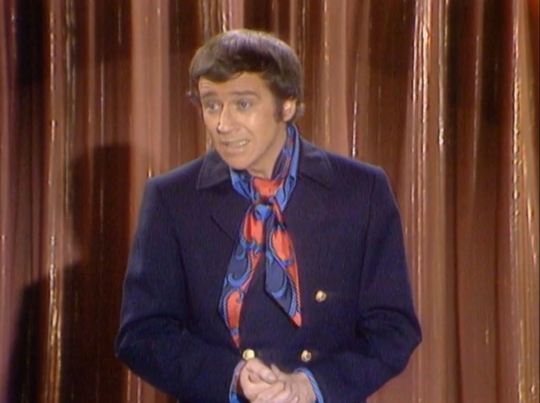
Carol
introduces George Carlin, who does a stand-up routine criticizing the
Emmy Awards’ bias in favor of big-budget shows. He compares late
night ‘shows’ like “Sermonette” and “The Star-Spangled Banner”
to the likes of “The Ed Sullivan Show.” He imagines a big-budge
version of “The FBI List of Most Wanted Men,” including a
commercial for The Justice Department.Carlin:
“Remember
for anti-trust or Commie bust, the Department that’s just, is really
a must! Don’t leave your family defenseless. And now,
heeeeeeeeere’s J. Edgar!”
(‘Tonight Show’ theme plays).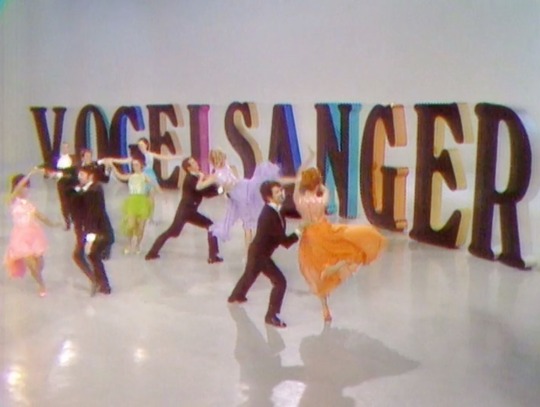
Carol
sings a song written by audience member Sue Vogelsanger. It is titled
“Just
Talkin’.” Vogelsanger and her husband are in the audience.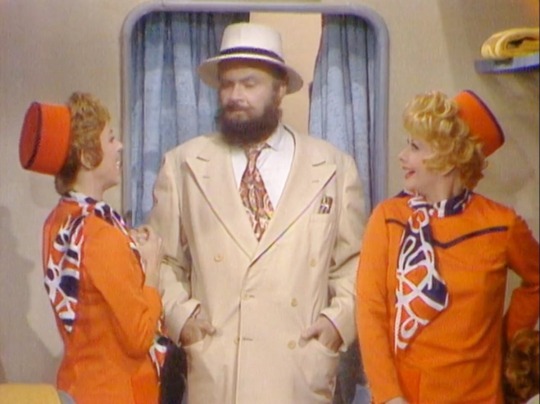
In
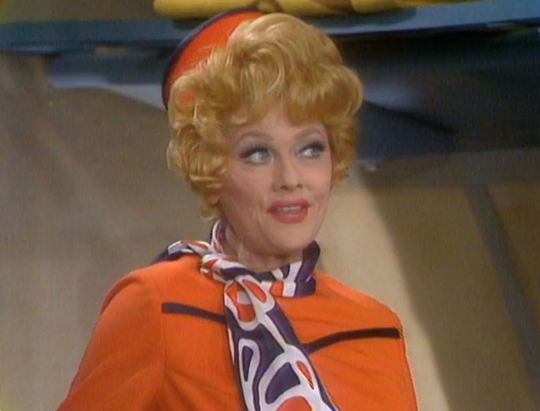
Lucille Ball’s first appearance on the show, two flight attendants
Finster (Carol) and Agnes Hooper (Lucille Ball) compete for a best
employee award from their employer, BWA. They encounter a mysterious
passenger (Harvey Korman) with a Fidel Castro-like beard, cigars
tucked in his breast pocket, and a Spanish accent.Hooper:
“Where
are you from, sir? Havana?”
Passenger:
(alarmed) “Havana?
What makes you think I’m from Havana?”
Hooper:
“Well,
if it’s one thing I know, it’s a Cuban accent.”This
meta moment relies on the audience knowing that Lucille Ball was
married to Desi Arnaz, a Cuban immigrant, as was his sitcom
counterpart, Ricky Ricardo.When
the passenger pulls out a gun, Hooper and Finster fight over who will
clean it for him. In the struggle, they inadvertently push him out
the plane door, foiling his hijacking.
Lucy Carmichael and Carol Bradford trained as flight attendants in a two-part “The Lucy Show” in 1967.
Lyle
and Vicki perform “Try
a Little Kindness”
by
Curt Sapaugh and Bobby
Austin,
first recorded by Glen
Campbell
less than a month earlier.The
second half of the show opens with Carol in the shower singing
“I Say A Little Prayer” written
by
Burt
Bacharach
and
Hal
David
for
Dionne
Warwick
in 1967.
The song opens, however, with a verse of “Singin’
in the Rain”
by
Arthur
Freed
and
music by Nacio
Herb Brown (1931).
At the end of the song, Carol leaves the shower, and the camera
reveals four soaking wet musicians in tuxedos inside.
Next
is a spoof of Bob
& Carol & Ted & Alice,
a controversial 1969 film about two couples who end up in bed
together. It was made into a short-lived TV series in 1973. Bob
(originally Robert Culp) is played by Lyle Waggoner, Carol
(originally Natalie Wood) is played by Carol Burnett, Ted (originally
Elliott Gould) is played by Harvey Korman, and Alice (originally Dyan
Cannon) is played by Lucille Ball.Ted:
“I’m
afraid the neighbors will talk.”
Alice:
“No,
they won’t.”
Carol:
“Why
not?”
Alice:
“We’re
the neighbors.”
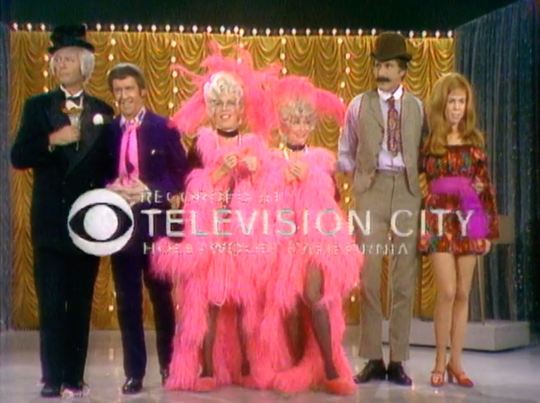
In
the final sketch, Harvey Korman plays Tommy Two Step, the emcee at an
old vaudeville theatre in 1919. Onstage, he introduces Polly (Carol)
and Dolly (Lucy), the Rock Sisters.
They sing “Happiness
Cocktail”
while strumming ukuleles. Dolly then breaks out a saxophone, and
Polly a coronet. Although Lucille Ball had a basic knowledge of both
saxophone and ukulele (and demonstrated it on her sitcoms), she is
pantomiming to the offstage orchestra, as is Carol. Lyle Waggoner
plays the theatre manager who fires the act.
Fast
forward to 1969, where fast-talking disc jockey Big Daddy (George
Carlin) desperately needs one more act for a big 100-group rock
concert. His dim-witted girlfriend / groupie Tondalayo (Vicki Lawrence) hires the
Rock Sisters by telegram, based on their name alone.
Polly:
“Our
gowns! Where are our gowns?”
Dolly:
“I
took them to the cleaners.”
Polly:
“Do
you think they’re ready?”
Dolly:
“They
should be. I took them in 1931.”
Oops!
During
the airline sketch, during a more serious moment with Carol and
Harvey, Lucy starts to smile, about to break character, but quickly
regains her composure.When
Lucy catches Harvey’s spat-out cigar in mid-air, Korman gives her a
long, admiring glance as if to say “Well done!” Gary Morton’s
laugh from the audience can be heard during this moment.When
Korman’s character loudly announces he’s got a gun and is hijacking
the plane to Cuba, the other passengers (background actors) don’t
react at all!
This
Date in Lucy History – November 24th
“Redecorating”
(ILL S2;E8) – November 24, 1952
-
LUCY ON “THE CAROL BURNETT SHOW” ~ PART 2
November 4, 1968 ~ S2;E6

Directed
by Dave PowersWritten
by Bill Angelos, Stan Burns, Mike Marmer, Hal Goldman, Al Gordon, Don
Hinkley, Kenny Solms, Gail Parent, Buz KohanCast

Carol
Burnett (Herself)
got her first big break on “The Paul Winchell Show” in 1955. A
years later she was a regular on “The Garry Moore Show.” In 1959
she made her Broadway debut in Once
Upon a Mattress,
which she also appeared in on television three times. From 1960 to
1965 she did a number of TV specials, and often appeared with Julie
Andrews. Her second Broadway musical was Fade
Out – Fade In which
ran for more than 270 performances. From 1967 to 1978 she hosted her
own highly successful variety show, “The Carol Burnett Show.”
Lucille Ball made several appearances on “The Carol Burnett Show.”
Burnett guest starred in four episodes of “The Lucy Show” and
three episodes of “Here’s Lucy,” subsequently playing a
character named Carol Krausmeyer. After Lucille Ball’s passing,
Burnett was hailed as the natural heir to Lucy’s title of ‘The
Queen of TV Comedy.’

Lucille
Ball (Herself)
was born on August 6, 1911 in Jamestown, New York. She began her
screen career in 1933 and was known in Hollywood as ‘Queen of the
B’s’ due to her many appearances in ‘B’ movies. With Richard
Denning, she starred in a radio program titled “My Favorite
Husband” which eventually led to the creation of “I Love Lucy,”
a television situation comedy in which she co-starred with her
real-life husband, Latin bandleader Desi Arnaz. The program was
phenomenally successful, allowing the couple to purchase what was
once RKO Studios, re-naming it Desilu. When the show ended in 1960
(in an hour-long format known as “The Lucy-Desi Comedy Hour”) so
did Lucy and Desi’s marriage. In 1962, hoping to keep Desilu
financially solvent, Lucy returned to the sitcom format with “The
Lucy Show,” which lasted six seasons. She followed that with a
similar sitcom “Here’s Lucy” co-starring with her real-life
children, Lucie and Desi Jr., as well as Gale Gordon, who had joined
the cast of “The Lucy Show” during season two. Before her death
in 1989, Lucy made one more attempt at a sitcom with “Life With
Lucy,” also with Gordon, which was not a success and was canceled
after just 13 episodes.Supporting
CastVicki
Lawrence
was
born Vicki Ann Axelrad in Inglewood, California. She sent Carol
Burnett a newspaper clipping showing their uncanny resemblance to
her. Burnett called Vicki hoping to find an entertainer who could
play her kid sister on her variety show. Lawrence was chosen as the
kid sister and in the fall of 1967, she made her debut on the first
episode of “The Carol Burnett Show.” She spent 11 years with the
show and earned one Emmy Award and five more nominations. She created
the role of Mama in the Family Sketches, which was spun off to
“Mama’s Family.” An accomplished singer, her recording of “The
Night The Lights Went Out In Georgia” was number one and earned
a Gold Record. Lawrence attended the tribute shows “All Star Party
for Carol Burnett” in 1982 and “All Star Party for Lucille Ball”
in 1984.Harvey
Korman
got his
first big break as a featured performer on “The
Danny Kaye Show”
in 1963.
After
ten successful seasons he left “The
Carol Burnett Show”
in 1977 to appear in his own series which only lasted six episodes.
From 1964 to 1965 Korman appeared in three episodes of “The Lucy
Show” as various characters. He found screen success in many of the
films of Mel Brooks. Harvey Korman died in 2008 at age 81.Lyle
Waggoner was
a handsome leading man who had little success in films but found fame
as the announcer and character actor on “The Carol Burnett Show.”
He left the show in 1974 in a mutual agreement with the producers to
appear in “Wonder Woman.”Guest
CastEddie
Albert
(Himself) had appeared with Lucille Ball in the 1950 film The
Fuller Brush Girl and
would guest-star as himself on “Here’s Lucy” in 1973.Nancy
Wilson
(Herself) makes the first of her six appearances on “The Carol
Burnett Show.”Don
Crichton (Count
Orloff, uncredited) was one of the Lester Flatt dancers. He also made
three appearances on “Here’s Lucy.”Dede
Ball (Herself,
in Audience) is Lucille Ball’s mother. She is said to have been in
the audience for every show Lucy ever did in front of live audience.Ernie
Anderson
(Himself, in Audience) replaced Lyle Waggoner as the show’s announcer
in 1974. In 1967 he starred with Tim Conway in the short-lived TV
series “Rango.”

Timeline
of collaborations between Lucille Ball and Carol Burnett (not
including award and talk shows)- September 27, 1960 – “The Garry Moore Show” (S3;E1) Lucille Ball, Guest
- March 22, 1966 – “Carol + 2” Lucille Ball, Guest Star
- October 31, 1966 – “Lucy Gets a Roommate” (TLS S5;E7) Carol Burnett as Carol Bradford
- November 7, 1966 – “Lucy and Carol in Palm Springs” (TLS S5;E8) Carol Burnett as Carol Bradford
- October 2, 1967 – “The Carol Burnett Show” (S1;E4) Lucille Ball, Guest Star
- December 4, 1967 – “Lucy and Carol Burnett: Part 1” (TLS S6;E14) Carol Burnett as Carol Bradford
- December 11, 1967 – “Lucy and Carol Burnett: Part 2” (TLS S6;E15) Carol Burnett as Carol Bradford
- November 4, 1968 – “The Carol Burnett Show” (S2;E6) Lucille Ball, Guest
- January 27, 1969 – “Lucy and Carol Burnett” (HL S1;E17) Carol Burnett as Herself
- November 24, 1969 – “The Carol Burnett Show” (S3;E9) Lucille Ball, Guest
- March 2, 1970 – “Lucy Competes With Carol Burnett” (HL S2;E24) Carol Burnett as Carol Krausmeyer
- October 19, 1970 – “The Carol Burnett Show” (S4;E6) Lucille Ball, Guest
- February 8, 1971 – “Lucy and Carol Burnett” (HL S3;E22) Carol Burnett as Carol Krausmeyer

Like
Lucille Ball’s sitcoms, “The Carol Burnett Show” was also aired
on Monday nights, generally at 10pm. There
was no new “Here’s Lucy” episode on November 4, 1968 due to it
being the eve of a Presidential Election. The next day, Republican
challenger
Richard
M. Nixon
defeated
Vice President Hubert
Humphrey,
and Independent
Party
candidate
George
Wallace.
In
Carol’s opening remarks she brings out Lucy, who introduces her
mother Dede, who is sitting in the audience. Carol asks Lucy about
working with her children, Lucie and Desi Jr., on her new show,
“Here’s Lucy.”Harvey
joins Carol for a sketch called “The Old Folks” where they
play two senior citizens in rocking chairs.Carol
introduces Nancy Wilson, who sings "The Folks Who Live on the
Hill”
(1937) by
Jerome
Kern
and Oscar
Hammerstein II.Carol
and Vicki play sisters (as they often did) named Carol and Chrissy,
in a sketch where Carol’s husband Roger (Harvey Korrman) brings home
his new boss, Mr. Bellows (Eddie Arnold), a health fanatic who
expects them both to be as fit as he is. In this sketch, Carol and
Roger’s last name is Bradford, just like Carol’s was in her first
appearances on “The Lucy Show” in 1966 and 1967.Sitting
alone in an empty bedroom, Eddie Albert sings “Father
of Girls” by
Ervin M. Drake, although it begins with a verse from “Soliloquy”
from Rodgers and Hammerstein’s Carousel.
In
the soap opera parody “As the Stomach Turns,” Carol (as Marion)
and Lucy (as Laura Peterson) are widows and funeral groupies. Vikki plays
Carol’s unmarried daughter with two infants in her arms.
Eddie Albert plays a
widower named Chester Marfack, a mortician. Nancy Wilson (as Julia)
arrives and announces her intentions to integrate Canoga Falls. In the final
moments a handsome stranger comes to the door (Lyle Waggoner,
naturally).This sketch was produced at the height of the civil rights movement and satirically reflected how television portrayed race. As in all real soap operas, the dialogue is delivered without irony or expression – almost deadpan.

Marion
(answering the door to Nancy Wilson): “Why, it’s a negro. (organ
sting) The first negro we’ve ever had in Canoga Falls.”
Julia:
“Hello. I’ve come to integrate your town.”
Marion:
“Wonderful news.”
Julia:
“My name is Julia. I graduated from college when I was 15, medical
school at 15, phi beta kappa, summa cum laude, and I’m up for the
Nobel Prize.”
Marion:
“Good for you, Julia.”
Julia:
“Well, I could have gone further, if it hadn’t been for
discrimination.”
Marion:
“Tell me, do you have a place to live yet?”
Julia:
“No, I don’t.”
Marion:
“Would you like to live here?”
Julia:
“Would I have to pay rent?”
Marion:
“I’m a liberal, but I’m not a fanatic. Tell me, are you
married?”
Julia:
“I’m a widow.”
Marion:
“Oh,
a black widow. I want to introduce you to my friends. Julia, this is Chester
Marfack, the town mortician. Chester, this is Julia, the town
negro.”
When
Julia says her name, the audience laughs with recognition. “Julia”
was one
of the first weekly series to depict an African
American
woman
in a non-stereotypical
role.
The show starred actress and singer Diahann
Carroll,
and ran for 86 episodes on NBC,
from
September 17, 1968, to March 23, 1971. Like the Julia of “As the
Stomach Turns,” the character was in the medical field and a widow. When this sketch first aired, the show had only been on for five weeks, but was hyped in the media for its take on a working woman of color.
The
finale is a tribute to the astrological sign Leo which happens to be
Lucy’s sign.
Nancy
teams with Carol for “The
Other Man’s Grass Is Always Greener”
by
Tony
Hatch
and
Jackie
Trent
which
was a 1967 hit for Petula
Clark.Special
lyrics about famous Leos are put to the song “Drop That Name”
written by Jule Styne for the musical Bells
Are Ringing
(1956). Names dropped include Henry Ford, Lawrence of Arabia, and
Orville Right. The song features quick black-out sketches about the
Leos as well as a photo montage of those mentioned.
As
Cleopatra, Nancy Wilson sings “A
Good Man is Hard To Find”
written in 1919 by Eddie Green and popularized by Bessie Smith.
Eddie Albert appears as Julius Caesar. Carol plays Queen Elizabeth I
singing the same song (with adapted lyrics). Harvey Korman appears as
Lord Essex. Lucy picks up the song as Catherine the Great, Empress
of Russia, glamorously attired in an all-white costume by Bob Mackie.Lucy:
“Peter the third, my royal spouse,
No
longer hangs around the house.I
think you’re cute Count Orloff, Potemkin, too.There’s
gotta be one Russian in the joint who’ll do.What
Catherine wants, she’s sure to get.No
man would dare to answer ‘nyet.’I’ll
have a royal ball, with one and all.So
you show up at seven, and you fill in at eight.”
Boys:
“Every Cossack knows the reason Catherine’s great.”
Lucy:
“Because a good man nowadays is hard to find!”
Throughout
the medley, Vicki Lawrence plays a troubadour with a lute,
introducing each new Leo in song.
Ooops!
When playing exercise fanatic Mr. Bellows, Eddie Arnold accidentally
trips on the platform leading to the front door. Luckily, he ends in
a sitting position.Earlier
in the same sketch, Carol grabs the bags of groceries from Vicki and
several boxes of food fly out, landing with a hollow thud. Vicki
retrieves one, but a milk carton is stranded on the set for the
entire sketch.In
the finale, Lucy’s last solo line “Treat
him right!”
is obviously not Lucille Ball singing.
This
Date in Lucy History – November 4th
“Lucy
Goes Duck Hunting”
(TLS S2;E6) – November 4, 19631968, A Good Man Is Hard to Find, As The Stomach Turns, Carol Burnett, Catherine the Great, CBS, Cleopatra, Dave Powers, Dede Ball, Don Crichton, Drop that Name, Eddie Albert, Elizabeth I, Ernie Anderson, Fathers of Girls, Harvey Korman, Julia, Leo, Lucille Ball, Lyle Waggoner, Nancy Wilson, Negro, Nixon, Race, The Carol Burnett Show, The Folks Who Live on the Hill, The Other Man’s Grass Is Always Greener, tv, Vicki Lawrence, Widows -
LUCY ON “THE CAROL BURNETT SHOW” ~ PART 1
October
2, 1967 ~ S1;E4
Directed by Clark Jones
Written by Stan Burns, Mike Marmer, Don Hinkley, Saul Turteltaub, Kenny Solms, Gail Parent, Bill Angelos, Buz Kohan
Cast
Carol
Burnett (Herself)
got her first big break on “The Paul Winchell Show” in 1955. A
years later she was a regular on “The Garry Moore Show.” In 1959
she made her Broadway debut in Once
Upon a Mattress,
which she also appeared in on television three times. From 1960 to
1965 she did a number of TV specials, and often appeared with Julie
Andrews. Her second Broadway musical was Fade
Out – Fade In which
ran for more than 270 performances. From 1967 to 1978 she hosted her
own highly successful variety show, “The Carol Burnett Show.”
Lucille Ball made several appearances on “The Carol Burnett Show.”
Burnett guest starred in four episodes of “The Lucy Show” and
three episodes of “Here’s Lucy,” subsequently playing a
character named Carol Krausmeyer. After Lucille Ball’s passing,
Burnett was hailed as the natural heir to Lucy’s title of ‘The
Queen of TV Comedy.’
Lucille
Ball (Herself)
was born on August 6, 1911 in Jamestown, New York. She began her
screen career in 1933 and was known in Hollywood as ‘Queen of the
B’s’ due to her many appearances in ‘B’ movies. With Richard
Denning, she starred in a radio program titled “My Favorite
Husband” which eventually led to the creation of “I Love Lucy,”
a television situation comedy in which she co-starred with her
real-life husband, Latin bandleader Desi Arnaz. The program was
phenomenally successful, allowing the couple to purchase what was
once RKO Studios, re-naming it Desilu. When the show ended in 1960
(in an hour-long format known as “The Lucy-Desi Comedy Hour”) so
did Lucy and Desi’s marriage. In 1962, hoping to keep Desilu
financially solvent, Lucy returned to the sitcom format with “The
Lucy Show,” which lasted six seasons. She followed that with a
similar sitcom “Here’s Lucy” co-starring with her real-life
children, Lucie and Desi Jr., as well as Gale Gordon, who had joined
the cast of “The Lucy Show” during season two. Before her death
in 1989, Lucy made one more attempt at a sitcom with “Life With
Lucy,” also with Gordon, which was not a success and was canceled
after just 13 episodes.Supporting
CastVicki
Lawrence
was
born Vicki Ann Axelrad in Inglewood, California. She sent Carol
Burnett a newspaper clipping showing their uncanny resemblance to
her. Burnett called Vicki hoping to find an entertainer who could
play her kid sister on her variety show. Lawrence was chosen as the
kid sister and in the fall of 1967, she made her debut on the first
episode of “The Carol Burnett Show.” She spent 11 years with the
show and earned one Emmy Award and five more nominations. She created
the role of Mama in the ‘Family’ sketches, which was spun off to
“Mama’s Family.” An accomplished singer, her recording of “The
Night the Lights Went Out In Georgia” (written by her then husband) hit number one and earned
a Gold Record. Lawrence attended the tribute shows “All Star Party
for Carol Burnett” in 1982 and “All Star Party for Lucille Ball”
in 1984.Harvey
Korman
got his
first big break as a featured performer on “The
Danny Kaye Show”
in 1963.
After
ten successful seasons he left “The
Carol Burnett Show”
in 1977 to appear in his own series which only lasted six episodes.
From 1964 to 1965 Korman appeared in three episodes of “The Lucy
Show” as various characters. He found screen success in many of the
films of Mel Brooks. Harvey Korman died in 2008 at age 81.Lyle
Waggoner was
a handsome leading man who had little success in films but found fame
as the announcer and character actor on “The Carol Burnett Show.”
He left the show in 1974 (by mutual agreement with the producers) to
appear in “Wonder Woman.”Tim
Conway
got
into comedy when he started writing and performing comedy skits
between morning movies on CBS. He became a regular performer on “The
Steve Allen Plymouth Show”
(1956). However, Conway would not earn true fame until starring as
Ensign Charles Parker on “McHale’s
Navy”
(1962).
This was his first appearance on “The Carol Burnett Show.” Even
though it is widely thought he was a series regular throughout the
whole show, he only became a regular in 1975.Guest
CastGloria
Loring
(Herself, Singer) later wrote the theme songs for “The Facts of
Life” and “Diff’rent Stokes.” She played Liz Chandler on “Days
of Our Lives” from 1981 to 1986.Durwood
Kirby
(Himself, from Audience) was the announcer of “The Garry Moore
Show” on which Carol Burnett was a featured player. He was married
to Mary Paxton Young, who sits next to him in the audience and is
also greeted by Burnett.Vikki
Dougan
(Bus Driver)Don
Crichton (Schultz, uncredited) was one of the Ernie Flatt Dancers and also made three appearances on “Here’s Lucy.”The
character’s name is probably meant to recall Sergeant Schultz, a
German character from “Hogan’s Heroes.”

Timeline
of collaborations between Lucille Ball and Carol Burnett (not
including award and talk shows):- September
27, 1960 – “The Garry Moore Show” (S3;E1) Lucille Ball, Guest - March
22, 1966 – “Carol + 2” Lucille Ball, Guest Star - October
31, 1966 – “Lucy Gets a Roommate” (TLS
S5;E7) Carol Burnett as Carol Bradford - November
7, 1966 – “Lucy and Carol in Palm Springs” (TLS S5;E8) Carol
Burnett as Carol Bradford - October
2, 1967 – “The Carol Burnett Show” (S1;E4) Lucille Ball, Guest
Star - December
4, 1967 – “Lucy and Carol Burnett: Part 1” (TLS S6;E14) Carol
Burnett as Carol Bradford - December
11, 1967 – “Lucy and Carol Burnett: Part 2” (TLS S6;E15) Carol
Burnett as Carol Bradford - November
4, 1968 – “The Carol Burnett Show” (S2;E6) Lucille Ball, Guest - January
27, 1969 – “Lucy and Carol Burnett” (HL S1;E17) Carol Burnett as
Herself - November
24, 1969 – “The Carol Burnett Show” (S3;E9) Lucille Ball, Guest - March
2, 1970 – “Lucy Competes With Carol Burnett” (HL S2;E24) Carol
Burnett as Carol Krausmeyer - October
19, 1970 – “The Carol Burnett Show” (S4;E6) Lucille Ball, Guest - February
8, 1971 – “Lucy and Carol Burnett” (HL S3;E22) Carol Burnett as
Carol Krausmeyer

Like
Lucille Ball’s sitcoms, “The Carol Burnett Show” also aired
on Monday nights, generally at 10pm. On October 2, 1967,
“The Lucy Show” aired “Lucy, and the Starmaker” (TLS S6;E4)
guest-starring Frankie Avalon.
In
the sketch “Cafe
Argentine,”
Carol and Lucy play Selma and Blanche, two secretaries on their lunch
hour. They decide to try a new place called the Cafe Argentine.
The
maitre d’ (Harvey Korman) says his name is Pedro, but he speaks with
a strident, barking German accent and makes them goose-step to their
table.Blanche: “Danke schoen.”
Pedro: “Oh, you speak Argentine?”
Blanche: “Just a few words I picked up from the manual that came with my Volkswagen.”
The girls feel uneasy when a periscope rises up from an
adjacent table and a sniper (Don Crichton) emerges from under a
silver cloche. When they ask to speak to the manager, Senor Jose, he
is the spitting image of Adolf Hitler. The girls run for their
lives.This
sketch was written shortly after headlines reported that several Nazis wanted for war crimes
were found hiding out in South America, particularly in Argentina.
Lucy
and Carol wear mod, bright-colored mini-dresses and go-go boots,
doubtless to increase the impact of the innovation of color TV. Costumes were designed by Bob Mackie.Carol
does a solo sketch that skewers various TV commercials aimed at housewives.Carol
and Vicki sing “I
Dig Rock and Roll Music,” a
1967 song by Peter Paul and Mary,
written by Paul
Stookey,
James Mason, and Dave Dixon.Tim
Conway does a solo sketch about a newscaster named Paul Bedford who is
forced to ad lib when his ‘news machine’ breaks down.
Lucy
and Carol stand in front of the curtain for some banter. At Lucy’s
insistence, Carol introduces her to Lyle Waggoner. Much to Carol’s
dismay, the two share a prolonged kiss and leave together.
Lucy
and Carol and Lucy competing car rental agents at the airport. Carol
for Mavis (“We Try Harder”), Lucy for Gertz (“We’re Number
One”). They vie for the business of a prospective customer played by Tim
Conway.Carol: “Watch it, green eyes.”
Lucy: “Green? My eyes are blue.”
Carol: “Oh? You have them dyed, too?”
The
Avis motto
“We Try Harder” was adopted in 1962 to put a positive spin
on their status as the second largest car rental company in the
United States while also taking a shot at larger competitor The
Hertz Corporation.
The slogan was used for 50 years before a re-branding in 2012.
In
the end, Conway goes off with a pretty blonde (Vikki Dougan) who says
“Why
not take the bus and leave the driving to us?”
This was the advertising slogan for Greyhound Bus Lines.Carol
introduces Gloria
Loring,
who she first saw on “The Merv Griffin Show.” Loring sings
“Going Out of My Head” by Teddy Randazzo and Bobby Weinstein,
initially
recorded by Little
Anthony & the Imperials
in 1964.
She then sings “Try
To Remember”
by Harvey Schmidt and Tom Jones for the musical “The Fantasticks”
in 1960.Carol
plays a poor, stay-at-home wife to a superhero named Super Guy Harvey
Korman. When he tries to hug her with his superhuman strength, Carol
compares herself to Fay Wray being mauled by King Kong. In a nod to
TV’s “Superman” (1952-58), he says
“I’ve leaped over a lot of buildings in a single bound. I’m really
beat.”
Lucy
and Carol play dance hall girls in a musical sequence featuring “See
What the Boys in the Back Room Will Have” by
Frank
Loesser and Frederick Hollander.
It was first performed by Marlene
Dietrich
in the film Destry
Rides Again
(1939).
The song turns into “Belly Up to the Bar, Boys” written by
Meredith Willson for the stage musical The
Unsinkable Molly Brown
in 1960, filmed in 1964.
This Date in Lucy History – October 2nd

“A
Home Is Not an Office”
(HL S5;E4) – October 2, 19721967, Avis, Belly Up To the Bar Boys, Carol Burnett, CBS, Clark Jones, Don Crichton, Durwood Kirby, Gloria Loring, Harvey Korman, Hertz, I Dig Rock and Roll Music, Lucille Ball, Lyle Waggoner, See What The Boys in the Backroom Will Have, The Carol Burnett Show, Tim Conway, Try To Remember, tv, Vicki Lawrence, Vikki Dougan - September
-
CAROL + 2
March 22, 1966

Directed
by Marc Breaux
Written
by Nat Hiken and Charles ShermanCAST

Carol
Burnett
(Herself)
got her first big break on “The Paul Winchell Show” in 1955. A
years later she was a regular on “The Garry Moore Show.” In 1959
she made her Broadway debut in Once
Upon a Mattress,
which she also appeared in on television three times. From 1960 to
1965 she did a number of TV specials, and often appeared with Julie
Andrews. Her second Broadway musical was Fade
Out – Fade In which
ran for more than 270 performances. From 1967 to 1978 she hosted her
own highly successful variety show, “The Carol Burnett Show.”
Lucille Ball made several appearances on “The Carol Burnett Show.”
Burnett guest starred in four episodes of “The Lucy Show” and
three episodes of “Here’s Lucy,” subsequently playing a
character named Carol Krausmeyer. After Lucille Ball’s passing,
Burnett was hailed as the natural heir to Lucy’s title of ‘The
Queen of TV Comedy.’
Lucille
Ball (Herself)
was born on August 6, 1911 in Jamestown, New York. She began her
screen career in 1933 and was known in Hollywood as ‘Queen of the
B’s’ due to her many appearances in ‘B’ movies. With Richard
Denning, she starred in a radio program titled “My Favorite
Husband” which eventually led to the creation of “I Love Lucy,”
a television situation comedy in which she co-starred with her
real-life husband, Latin bandleader Desi Arnaz. The program was
phenomenally successful, allowing the couple to purchase what was
once RKO Studios, re-naming it Desilu. When the show ended in 1960
(in an hour-long format known as “The Lucy-Desi Comedy Hour”) so
did Lucy and Desi’s marriage. In 1962, hoping to keep Desilu
financially solvent, Lucy returned to the sitcom format with “The
Lucy Show,” which lasted six seasons. She followed that with a
similar sitcom “Here’s Lucy” co-starring with her real-life
children, Lucie and Desi Jr., as well as Gale Gordon, who had joined
the cast of “The Lucy Show” during season two. Before her death
in 1989, Lucy made one more attempt at a sitcom with “Life With
Lucy,” also with Gordon, which was not a success and was canceled
after just 13 episodes.
Zero
Mostel
(Himself) was
an actor,
singer
and
comedian
of
stage and screen, best known for his portrayal of comic characters
such as Tevye
on
stage in Fiddler
on the Roof,
Pseudolus on stage and on screen in A
Funny Thing Happened on the Way to the Forum,
and Max
Bialystock
in
the original film version of The
Producers.
He won three Tony Awards for his Broadway appearances. His film debut
was alongside Lucille Ball in 1943’s Du
Barry Was a Lady.
He died in 1977 at age 62.John
Harlan
(Announcer)

This
is the
second of a multi-year series of television variety specials starring
Carol
Burnett. The first special was aired in 1962, featuring Burnett
and Julie
Andrews
“Julie and Carol at Carnegie Hall.”
The
special was sponsored by American
Motors Corporation (AMC)
which was formed in 1954 by the merger
of
Nash-Kelvinator
and
Hudson
Motor Car.
At the time, it was the largest corporate merger in US history. After
periods of intermittent but unsustained success, the company was
ultimately acquired by Chrysler
and ceased operation in 1988. The first commercial in the hour-long
program stars Sid Melton, who had appeared in three episodes of “The
Lucy-Desi Comedy Hour.” Although the AMC commercials are not
included on the DVD release, some of the kinescope prints still
retain the filmed commercials. The DVD does include, however, Carol
Burnett’s intro to two of the commercials.
The
inclusion of Lucille Ball was partly because CBS insisted on Burnett
having an established co-star for the special, and also because Ball
already had a contract with CBS for up to three specials (in addition
to “The
Lucy Show”)
for the 1966-67 season, of which she would only produce one, “Lucy
in London.”The
show was such a critical and ratings success that CBS rebroadcast it
on January 15, 1967. It was released on DVD
on
May 17, 2016. In April 2016, MeTV
broadcast
the special for the first time in 50 years.The
original airing straddled TV’s transition from black and white to
color. While “Carol + 2” was shot and aired in color, kinescope
prints exist in black and white as well. While “The Lucy Show”
was shot in color from Fall 1963, it wasn’t aired in color by CBS
until fall 1965.
The
day before this special aired, “Lucy, the Superwoman” (TLS
S4;E26) was broadcast for the first time.
Lucille
Ball and Carol Burnett first shared the small screen in 1960 on “The
Gary Moore Show,” where Carol was a regular and Lucy a guest. In
1966 and 1967 Burnett guest-starred in two two-part episodes of “The
Lucy Show.” Both appearances were as Carol Bradford, who was at
first Lucy’s Los Angeles roommate. In their second teaming the two
attended flight attendant school together. In 1969 Burnett played
herself on “Here’s Lucy,” and in 1970 she played another Carol,
Carol Krausemeyer, a fellow secretary competing in a beauty contest
with Lucy. In return, Lucille Ball guest-starred on “The Carol
Burnett Show” during one episode of each of her first four seasons.
Coincidentally,
Lucy, Carol and Zero all played Broadway’s Alvin (now Neil Simon)
Theatre in new musicals: Carol in Once
Upon a Mattress
(1960), Lucy in Wildcat
(1961), and Zero in A
Funny Thing Happened on the Way to the Forum
(1962). Lucy and Zero were on Broadway at the same time in 1961; she
with Wildcat,
he with Rhinoceros.
Carol and Zero were on Broadway at the same time in 1964; she in
Fade
Out – Fade In,
and he in Fiddler
on the Roof.
Burnett’s understudy in Fade
Out – Fade In was
Mitzi Welch, who wrote music for “The Carol Burnett Show” and the
song “You’re My Reason” for this special.
“Carol
+ 2” is also available
as a bonus feature on the Time Life box set “Carol Burnett’s Lost
Episodes.” It is also available on a stand-alone DVD release by Time Life. Interestingly, Zero Mostel is not mentioned or pictured on the cover, which is subtitled “The Original Queens of Comedy.”

In
the opening, Carol introduces Lucy and Zero, who laments that TV show
chatter is so artificial.Carol:
“I
would like to present a woman who has dazzled the world with her
charm and talent, who has conquered every phase of show business, who
is the first lady of television, and who wrote this introduction.”
After a commercial, Lucy
comes out and starts to play “Swanee
River”
on the banjo, but is interrupted by Carol. A
running gag throughout the special is Mostel or Lucy wanting to do a
solo act, but being interrupted.
Lucille
Ball had a rudimentary knowledge of several musical instruments, but
banjo was not one of them. She was miming to a pre-recorded track.
Two years later, she would once again mime playing the banjo, this
time with her daughter Lucie and Wayne Newton on a 1968 episode of
“Here’s Lucy.”
In
the first sketch, “10th Anniversary,”
Carol and Zero play a bitter couple named Florence and Fielding
Kissel who suddenly find out their marriage license is invalid. Whatever Florence says to him, he says “Shut up!” Whatever
Fielding says to her, she snaps “Drop dead!”
After discovering that they’re single again, they find themselves madly attracted to
one another, but when a second phone call says it was all a mistake,
they revert to being miserable marrieds again.During
the sketch Mostel croons a bit of “You
and the Night and the Music” by
Arthur
Schwartz
and Howard
Dietz.
The
song debuted in the Broadway show Revenge
with Music in
1934. He then launches into a bar of “The
Night Was Made For Love”
by Otto Harbach and Jerome Kern, written in 1931 for the Broadway
musical
The Cat and the Fiddle.
Finally, Mostel sings a verse of “Some
Enchanted Evening,”
written by Rodgers and Hammerstein for their 1949 Broadway musical
South
Pacific.
After
a commercial, the same characters return, but in a different mood. Florence is found gazing at her wedding photograph and
sings the ballad “You’re
My Reason” by
Mitzi Welch, while Fielding sleeps on the sofa. Welch composed all
the special material for “The Carol Burnett Show.” At the end of the song Fielding wakes up and quietly says “Shut up” and
she lovingly says “Drop dead” as the scene fades.After
a commercial break, Zero Mostel sits at a grand piano and starts ad
libbing a song with the odd lyrics “Millard
Fillmore is dead and nobody came to the funeral.”
Carol interrupts him and the scene transitions to the next sketch.
In
the sketch “Goodbye
Baby,”
Alice (Carol) is saying goodbye to her sister Rita (Lucy) at a bus
stop. Rita is about to leave on a two-week vacation to Miami but Alice won’t let her sister leave without first hearing her infant
baby say goodbye to his aunt. Alice’s insistence and Rita frustration about missing her
bus brings out the hidden animosity between the two sisters.
Alice:
(shouting)
“Jack
the Ripper! John Dillinger! Machine Gun Kelly!”
Rita:
“How
did they get into this?”
Alice:
“Oh,
they’re just some of the others who were rejected by their aunts when
they were eight months old.”
Lucy’s
Brooklyn accent starts off strong, but then quickly fades out
completely.
Zero takes
the stage and starts to sing “The Road to Mandalay”, a song by
Oley Speaks based on the poem by Rudyard Kipling. It was made famous
by Frank Sinatra in 1958. Instead, Lucy
and Carol slyly convince him to sing “If
I Were A Rich Man,” a song he introduced in the 1964 Broadway musical Fiddler
on the Roof
by Jerry Bock and Sheldon Harnick. Although Mostel had left the cast
of the musical by this time, the original cast album was still very
popular.
In
the sketch “What’s
Wrong with My Brother,”
Miss Cleaver (Carol) confides to her psychiatrist (Zero), that her
brother thinks he’s a frog.
To Miss Cleaver’s chagrin, the psychiatrist seems more concerned
about the symbolism behind her scratching her itchy nose, which causes her
to go to great (comic) lengths to avoid doing so.Once
again, Lucy comes out and starts to play “Swanee
River”
on the banjo, but this time she is interrupted by Zero.
In
the sketch “Bunny Club,” Carol plays Nellie, the wardrobe
mistress at the Bunny Club. Zero plays Eddie, the club’s bartender
who Nellie is sweet on. After he abruptly leaves, she dejectedly sings a
slow-tempo version of “Wait
‘Till the Sun Shines Nellie”
by Harry
Von Tilzer
and
Andrew
B. Sterling (1905).
For
much of the song, Carol sings to her own reflection in a mirror. In the
brief dialogue set-up, the word “Playboy” is never spoken,
although clearly that is the inference.Zero
takes the stage alone in a spotlight to lush orchestral music and
starts to sing in Italian. Naturally he is interrupted – this time by both
Carol and Lucy.
In
the final sketch, Carol and Lucy play Evelyn and Emily, cleaning
ladies who work nights at a New York City Talent Agency. The pair vicariously live the lives of show business producers. The establishing shot of the front door tells us that it is the William Morris
Talent Agency on the 34th floor of a skyscraper. The two charwomen are arguing over whether ‘they’ can afford
Cary Grant for an upcoming picture.
Emily:
“They
expect to make this picture for three million. They’re shooting in
Panavision. They’ve got a six week shooting schedule. Two weeks on
location in Utah. If they bring this picture in for a penny less
than five million four then I know nothing about show business!”Evelyn
says they’re trying to talk Warner Brothers into making Joan of
Arc with Jayne Mansfield.
Emily:
“Jayne Mansfield as Joan of Arc! Man, would she take long to burn!”
Evelyn
wonders if Cary Grant could do the picture if they offered him a
capital gains deal like Emily came up with for Marlon Brando in Mutiny
on the Bounty.
Evelyn: “It’s a lucky thing we work at night. If anyone here ever heard us talking about our big deals they’d drop a net on us and cart us away to the palace for peculiars.”

There is a photograph of Vivian Vance hanging on the wall of the office. Vance made her last regular appearance on “The Lucy Show” in April 1965 in order to spend more time at home on the East Coast, although she would return for two guest appearances in 1967 and 1968. Vance did no acting at all in 1966, only making two quiz show appearances as herself.
Emily:
“Are
you still going around with that doorman from the Paramount?”
Evelyn:
“Ralph
and I are engaged.”
Emily:
“Oh, brother!”
Evelyn:
“I
know you don’t approve of him.”
Emily:
“It’s
not him, Evelyn. But you know how I feel about show business
marriages. Just don’t come crying to me when your careers clash.”
Both
Lucille Ball and Carol Burnett were in show business marriages that
failed: Lucy to musician Desi Arnaz and Carol to producer Joe
Hamilton. The Hamiltons divorced in 1984 and the Arnazes in 1960.
This show was also written in the days when cinemas like the
Paramount had uniformed doormen to admit patrons.
The sketch ends with the
two charwomen doing a rousing song and dance number called “Chutzpah!”
Carol
ends the show by calling out
Zero and Lucy for a bow. Lucy and Carol are dressed in bright pink,
an indication that color television was trying to make an impression.
After a brief spot recognizing sponsor AMC, the trio sing “Bye
Bye.”The
DVD has a quick outtake of Carol saying goodnight to the studio
audience asking them to watch when the show airs to “up the
ratings.”
This
Date in Lucy History
– March 22
“Ricky’s
Hawaiian Vacation”
(ILL S3;E22) – March 22, 1954
“Lucy
and the Beauty Doctor”
(TLS S3;E24) – March 22, 19651966, Alvin Theatre, AMC, American Motors Corporation, Carol + 2, Carol + Two, Carol Burnett, Carol Plus 2, Carol Plus Two, CBS, Charles Sherman, Charwoman, Fiddler on the Roof, If I Were A Rich Man, Jayne Mansfield, John Harlan, Lucille Ball, Lucy, Marc Breaux, Mitzi Welch, Nat Hiken, Sid Melton, Some Enchanted Evening, Swanee River, The Night Was Made for Love, The Road to Mandalay, Wait Till The Sun Shines Nellie, William Morris, You and the Night and the Music, Zero Mostel -
THE LUCILLE BALL SHOW
“The Jack Benny Program” (S15;E2) ~ October 2, 1964

Produced
and Directed by Norman Abbott
Written
by Sam Perrin, Al Gordon, Hal Goldman, and George BalzerCAST
Jack
Benny (Himself
/ Paul Revere) was
born on Valentine’s day 1894. He had a successful vaudeville
career, and an even greater career on radio with “The Jack Benny
Program” which also became a successful television show. His screen
persona was known for being a penny-pincher and playing the violin.
Benny was a Beverly Hills neighbor of Lucille Ball’s and the two
were off-screen friends. Benny appeared on “The Lucy Show” as
Harry Tuttle (a Jack Benny doppelganger) in “Lucy
and the Plumber” (TLS S3;E2),
later did a voice over cameo as himself in “Lucy
With George Burns” (TLS S5;E1),
and played himself in “Lucy
Gets Jack Benny’s Account” (TLS S6;E6).
He was seen in four episodes of “Here’s Lucy.” Benny and Ball
appeared on many TV variety and award shows together. He died in
1974, a few weeks after taping “An All-Star Party for Lucille
Ball.”

Lucille
Ball (Herself
/ Rachel Revere) was born on August 6, 1911 in Jamestown, New York.
She began her screen career in 1933 and was known in Hollywood as
‘Queen of the B’s’ due to her many appearances in ‘B’
movies. With Richard Denning, she starred in a radio program titled
“My Favorite Husband” which eventually led to the creation of “I
Love Lucy,” a television situation comedy in which she co-starred
with her real-life husband, Latin bandleader Desi Arnaz. The program
was phenomenally successful, allowing the couple to purchase what was
once RKO Studios, re-naming it Desilu. When the show ended in 1960
(in an hour-long format known as “The Lucy-Desi Comedy Hour”) so
did Lucy and Desi’s marriage. In 1962, hoping to keep Desilu
financially solvent, Lucy returned to the sitcom format with “The
Lucy Show,” which lasted six seasons. She followed that with a
similar sitcom “Here’s Lucy” co-starring with her real-life
children, Lucie and Desi Jr., as well as Gale Gordon, who had joined
the cast of “The Lucy Show” during season two. Before her death
in 1989, Lucy made one more attempt at a sitcom with “Life With
Lucy,” also with Gordon, which was not a success and was canceled
after just 13 episodes.
Don
Wilson
(Announcer / George Washington) was Jack Benny’s announcer on radio
and (later) on television; a relationship that spanned over 30 years.
A portly man, he was usual the target of jokes about his weight. He
died in 1982 at age 81.
Arte
Johnson
(Charlie, Boom Mic Operator) won a 1969 Emmy Award for the characters
he created on “Laugh-In,” including a German soldier who
popularized the catch-phrase
“Very interesting…but stupid.”In 1974 he appeared as an eccentric ornithologist on “Here’s Lucy.”
The uncredited man below Johnson may be the actual boom operator for “The Jack Benny Program.”

Elisabeth
Fraser
(Betsy Ross) was a character actor best
remembered as Shelley
Winters’s
pal in the 1965 film A
Patch of Blue
and as Sgt. Bilko’s long-suffering girlfriend, Sgt. Joan Hogan, in
“The
Phil Silvers Show” (1955).
This is her only time working with Ball and Benny. She died in 2005
at age 85.
Hoke
Howell (The
Man) was a character actor best known as Ben on “Here Come The
Brides” (1968-70). He would do two more episodes of “The Jack
Benny Program.”The
Man alerts Paul Revere that it is
time for him to go on his famous midnight ride.Ned
Miller
(The Town Crier) was a regular cast member of “The Jack Benny
Program” who generally played small parts from 1961 to 1965.Mary
Young (Old
Woman) was born in New York City in 1879. This is her third an final
appearance on “The Jack Benny Program,” having previously played
Mildred Holmquist. Young appeared
in three Best Picture Academy Award winners: The
Lost Weekend
(1945), An
American in Paris
(1951), and Around
the World in 80 Days
(1956).Although
credited, there is no Old Woman character in the syndicated print of
the program.

Writer
Sam Perrin also wrote four episodes of “Here’s Lucy” between 1969
and 1971. George Balzer co-wrote 5 episodes of “Here’s Lucy,” two
with Perrin.
This
was Lucille Ball’s way of repaying Benny for his appearance on “The
Lucy Show” on September 28, 1964. “Lucy and the Plumber” (TLS
S3;E2) featured Benny as a plumber named Harry Tuttle, who also
happened to be a Jack Benny doppelganger.
NBC’s
lead in for this show was “Bob Hope Presents The Chrysler Theatre”
(S2;E1) which featured one of Lucille Ball’s favorite character
actors Reta Shaw. It aired opposite “Gomer Pyle USMC” on CBS,
which was filmed on the Desilu lot. The Monday (October 5) after this
Friday broadcast, “The Lucy Show” aired “Lucy and the Winter
Sports” (TLS S3;E3, above). The syndicated rebroadcast
date for this Jack Benny Program was on September 2, 1976.
The half-hour program was shot and aired in black and white, although color promotional photos exist.

The
orchestra plays “Love
In Bloom”
(Benny’s signature song) and Jack makes his entrance dressed in
formal white tie and tails to introduce his guest, Lucille Ball. To
Jack’s chagrin, Lucy comes out dressed as her hobo ‘professor’
character from 1951’s “The Audition” (ILL S1;E6), even getting on
her knees pretending to be a trained seal (something she also did in
“The Audition”) – quite the opposite of Jack’s dignified presence and introduction.
While
Lucy goes to change into something more appropriate, Jack tells a
joke told to him by Charlie, the boom mic operator (Arte Johnson).
When Jack continually gets the joke wrong, Charlie keeps interrupting
Benny until he finally tells the complete joke himself while Benny
stands helpless.
The
orchestra plays “A Pretty Girl is Like A Melody” and Lucy
re-emerges wearing a sleek blue and silver outfit, her elegance only
marred by the fact she has forgotten she still has her teeth black
out! Jack praises Lucy’s skills as an executive, leading to the
sketch about a famous woman from history: Rachel Revere, wife of
patriot Paul Revere.
Historical Context

Paul
Revere
(1734-1818) was a silversmith,
engraver,
early industrialist, and Patriot
in
the American Revolution.
He is best known for his midnight ride to alert the colonial militia
in April 1775 to the approach of British
forces
before
the battles
of Lexington and Concord.Rachel
Walker Revere
(1745-1813) was the second wife of Paul Revere. When
Rachel Walker married Paul Revere on October 10, 1773, she took on
the care of the six children from his first marriage. Rachel gave
birth to eight children, three of whom did not reach maturity.Elizabeth
Griscom
“Betsy”
Ross
(1752–1836)
is
widely credited with making the first American
flag.George
Washington
(1732–99)
was an American statesman and soldier who served as the first
President
of the United States
from
1789 to 1797 and was one of the Founding
Fathers of the United States.
He served as Commander-in-Chief
of
the Continental
Army
during
the American
Revolutionary War. As
a driving force behind the nation’s establishment he came to be known
as the “father
of the country,”
both during his lifetime and to this day.Lucille
Ball often said that there was some Ball blood in George Washington
since his mother’s maiden name was Mary Ball.
On
a 1973 episode of “Here’s Lucy” an antique chair is
said to have belonged to George Washington at his Mount Vernon home.
Earlier in 1964, Lucy Carmichael dressed up as George Washington in
“Lucy and Viv Open a Restaurant” (TLS S2;E20).

[In the promotional photo above the time on the grandfather clock has been set to midnight, the time that Longfellow’s poem says that Revere made his legendary ride!]
In
1775, a jealous Rachel Revere (Lucille Ball) is waiting up for her
husband Paul (Jack Benny) to come home when Betsy Ross (Elisabeth
Fraser) drops by to show off the new dress she’s made from a fabric
of stars and stripes.
Betsy:
“I
even have a piece of material left over. I hope I can think of
something to do with it!”Lucy
suggests she give it to one of the three men in the parade they saw
yesterday.Rachel:
“The
one with the fife and drum were alright, but the one in the middle
just looked ridiculous waving that empty pole.”
The joke is a somewhat inaccurate reference to the 1875 painting “Spirit of ‘76″ (aka “Yankee Doodle”) by Archibald Willard. It was painted to commemorate the nation’s centennial. Willard later painted variations on his original work, but most all feature two drummers, a fife player, and a flag in the background.

When
Betsy wonders where Paul is, she says that a few weeks ago he told
her he was at a tea party in Boston, but she found out he was on a
wild wing-ding on a boat.The Boston Tea Party was a political protest by the Sons of Liberty in Boston, Massachusetts, on December 16, 1773. In defiance of the Tea Act of May 10, 1773, which allowed the British East India company to sell tea from China in American colonies without paying any taxes, the demonstrators destroyed an entire shipment of tea by dumping it into the bay.

Paul
arrives home from a meeting at town hall about the British invasion
but Rachel is doubtful he’s being truthful.Adding to her suspicions, Rachel finds a long white hair on his jacket!
Paul says his best
friend can attest to his whereabouts. Lucy concedes that maybe she should be more
trusting.Rachel:
“After
all, who can you trust if you can’t trust Benedict Arnold?”
Paul:
“Benny
never did a dishonest thing in his life.”Benedict
Arnold
(1741-1801)
was a general
during
the American
Revolutionary War,
who fought for the American Continental
Army,
and later famously defected
to
the British
Army.
The name Benedict Arnold quickly became a byword
for treason
or
betrayal. On a 1952 episode of “I Love Lucy” Mrs. Littlefield
(Edith
Meiser)
calls Lucy Ricardo “a Benedict Arnold” when she finds out she
allowed Ricky to put her on a time schedule. She’s betrayed all
housewives!Paul
sings a few notes of “Hello Dolly” and Rachel automatically
assumes he’s carrying on with Dolley Madison.Paul:
“It’s
not Dolley Madison! This is a song that hasn’t even been written
yet!”
“Hello
Dolly” is
the title song of the Broadway musical of the same name by Jerry
Herman. It opened in January 1964, ten months earlier, and was an
immediate hit. A year later, Lucy Carmichael would go undercover as
Carol Channing wearing her Hello
Dolly
costume (above), even singing the title song.Dorothea
“Dolley” Madison
(1768-1849)
was the wife of James
Madison,
President of the United States from 1809 to 1817. She was noted for
her social graces, which boosted her husband’s popularity as
President.
George
Washington (Don Wilson) drops by. While he’s there, Lucy tries to
match the stray hair she found on Paul’s jacket that he claimed
belonged to Washington. In doing so, she removes his entire wig.Paul:
“George!
What happened?”
George:
“I
cannot tell a lie. I’m bald.”
When
Paul gets word that the British are coming, he tries to sneak out
without Rachel knowing.Paul:
“Rachel,
I must go! There’s a light burning in the steeple of the old North
Church.”
Rachel:
“Well,
let it burn. You’re not paying the bill!”To
keep him home, Rachel knocks him out cold. She then realizes he is telling the truth. She has no choice but to make his famous ride for
him. But first, she leaves him a note:“Paul, darling.
I’ve gone to warn the people the British are coming. If I’m not back
by tomorrow night, cancel my beauty shop appointment.”Paul
revives just as Rachel goes off shouting “The British are coming!
The British are coming!”Paul:
“Well
how do you like that. My wife is making the trip! Well, I hope
Longfellow doesn’t find out.”“Paul
Revere’s Ride“
(1860) is a poem
by
Henry
Wadsworth Longfellow
that
commemorates the actions of Paul
Revere
on
April 18, 1775, although with significant inaccuracies. It was first
published in the January 1861 issue of The
Atlantic Monthly.
It was later re titled "The Landlord’s Tale” in the
collection Tales
of a Wayside Inn.Lucy
and Jack come out in front of the curtain to say goodnight, still in
their colonial costumes. Lucy’s teeth are still blacked out!

Oops!
Rachel
Revere attaches a thick rope to Paul’s ankle. When he tries to go on
his famous ride, Rachel reels him back into the house by pulling on
the rope and Paul comes sliding back through the door flat on his
back. In the first shot, the rope has bunched up under his back. In
the next shot, the bunched up rope is no longer underneath him.When Jack Benny comes flying back through the front door, it is apparent that a stunt performer is standing in for Benny as he does not turn his face to the camera.

When
Lucy ‘reels in’ Paul on the rope, outside the open door the floor has
been taped for the set placement.
This
Date in Lucy History
– October
2nd
“Lucy
and the Starmaker” (TLS S6;E4) – October 2, 1967
“A
Home Is Not an Office”
(HL S5;E4) – October 2, 19721964, A Pretty Girl is Like A Melody, Al Gordon, American Flag, Arte Johnson, Benedict Arnold, Betsy Ross, Dolley Madison, Don Wilson, Elisabeth Fraser, George Balzer, George Washington, Hal Goldman, Hello Dolly, Hoke Howell, Jack Benny, Love in Bloom, Lucille Ball, Mary Young, NBC, Ned Miller, Norman Abbott, Paul Revere, Rachel Revere, Revolutionary War, Sam Perrin, Spirit of 76, Stars and Stripes, The Jack Benny Program, tv -
LUCY BUYS WESTINGHOUSE
Summer 1958

Cast

Lucille
Ball (Herself)
was born on August 6, 1911 in Jamestown, New York. She began her
screen career in 1933 and was known in Hollywood as ‘Queen of the
B’s’ due to her many appearances in ‘B’ movies. With Richard
Denning, she starred in a radio program titled “My Favorite
Husband” which eventually led to the creation of “I Love Lucy,”
a television situation comedy in which she co-starred with her
real-life husband, Latin bandleader Desi Arnaz. The program was
phenomenally successful, allowing the couple to purchase what was
once RKO Studios, re-naming it Desilu. When the show ended in 1960
(in an hour-long format known as “The Lucy-Desi Comedy Hour”) so
did Lucy and Desi’s marriage. In 1962, hoping to keep Desilu
financially solvent, Lucy returned to the sitcom format with “The
Lucy Show,” which lasted six seasons. She followed that with a
similar sitcom “Here’s Lucy” co-starring with her real-life
children, Lucie and Desi Jr., as well as Gale Gordon, who had joined
the cast of “The Lucy Show” during season two. Before her death
in 1989, Lucy made one more attempt at a sitcom with “Life With
Lucy,” also with Gordon, which was not a success and was canceled
after just 13 episodes.
Desi
Arnaz
(Himself)
was born in Cuba in 1917 and immigrated to America as a youngster.
He was a musician who married Lucille Ball in 1940 after
meeting her on the set of 1939’s Too Many Girls, which he had done
on stage in New York. In order to keep him ‘off the road’ Ball
convinced producers to cast him as her husband in a new television
project based on her radio show “My Favorite Husband.” The
network was convinced. In 1951, Arnaz and Ball began playing Lucy and
Ricky Ricardo, roles they would be identified with for the rest of
their lives. The couple had two children together, Lucie and Desi Jr.
In 1960, Ball and Arnaz divorced. Desi became a producer, responsible
for such hits as “The Mothers-in-Law” (1967-69). He re-married in
1963. Desi Aranz died in 1986, just a few years before Ball.William
Frawley (Himself)
was already a Hollywood veteran when he was hired by Desi Arnaz to
play Fred Mertz on “I Love Lucy.” After the series concluded he
joined the cast of “My Three Sons” playing Bub Casey. He did an
episode of “The
Lucy Show” in
October 1965 which was his final TV appearance before his death in
March 1966.
Vivian
Vance (Herself)
was born Vivian Roberta Jones in Cherryvale, Kansas in 1909, although
her family quickly moved to Albuquerque, New Mexico where she was
raised. She had extensive theatre experience, co-starring on Broadway
with Ethel Merman in “Anything Goes.” She was acting in a play in
Southern California when she was spotted by Desi Arnaz and hired to
play Ethel Mertz, Lucy Ricardo’s neighbor and best friend. The
pairing is credited with much of the success of “I Love Lucy.”
Vance was convinced to join the cast of “The Lucy Show” in 1962,
but stayed with the series only through season three, making
occasional guest appearances afterwards. She made a total of six
appearance on “Here’s Lucy.” She also joined Lucy for a TV
special “Lucy
Calls the President” in
1977. Vance died two years later.
Ross
Elliott (Mr.
Hayden, Westinghouse Executive)
played the director of Lucy’s famous Vitameatavegamin
commercial
in
1952. He played Ross, Ricky’s publicity agent in three other
episodes. From 1961 to 1964 he played another TV director on “The
Jack Benny Program.” He played a film director in “Lucy and the
Return of Iron Man” (TLS S4;E11) in 1965. His final appearance with
Lucille Ball was “Lucy, The Sheriff” (HL S6;E18) in 1974.Hazel
Pierce
(Extra on the Tijuana Street Set) was Lucille Ball’s camera and
lighting stand-in throughout “I Love Lucy.” She also made
frequent appearances on the show. She went on to make several on-camera
appearances on “The Lucy Show.” Pierce was an uncredited extra
in the film Forever
Darling (1956).Alan
Roberts
(Mexican Boy) was born Alan Costello. Also in 1958, he appeared on “Leave it to Beaver” as a Spanish boy who is befriends by the Beaver. His last screen credit was in 1965 and he died in 2008 at the age of 59.Although only seen from the back here, Roberts has a supporting role in “Lucy Goes to Mexico.”
Bennett Green (Voice of the Director) was Desi Arnaz’s camera and lighting stand-in during “I Love Lucy.” He also made frequent appearances on the show as well as on “The Lucy Show.”
Roy Rowan (Announcer) was the announcer for all Lucille Ball’s sitcoms and also made occasional on-camera appearances.
Extras
from the Tijuana Street scene of “Lucy Goes To Mexico” (LDCH
S2;E1).

"Lucy
Buys Westinghouse” (working title) is a promotional film intended for network
affiliates and the Westinghouse dealers when Desilu partnered with
the company for the “Westinghouse Desilu Playhouse” series. This
was an anthology series that presented a different story each week.
“The Westinghouse Desilu Playhouse” ran from 1958 to 1960 and
each episodes was introduced by Desi Arnaz, standing in front of a
show curtain (a stipulation of Westinghouse’s sponsorship). Lucy and Desi also sometimes participated in the
Westinghouse commercials, hosted by Betty Furness. This series
notably gave birth to “The Untouchables,” which was later
picked-up by Desilu for a full series, as well as “The Twilight
Zone.” Like “I Love Lucy,” the series originally aired on
Monday nights.“Lucy Buys Westinghouse” is the film’s unofficial title for reference purposes. It should not imply that Lucy buys the Westinghouse Corporation, just Westinghouse products.

It
would also present “The Lucy-Desi Comedy Hour” (originally titled
“The
Lucille
Ball-Desi Arnaz Show”)
which continued the escapades of the Ricardos and the Mertzes after
the cancellation of “I Love Lucy” in 1957. The first five of the
hour-long series’ 13 episodes were run as specials, sponsored by
Ford.
Westinghouse
Electric Corporation
was
founded on January 8, 1886
by
its founder George
Westinghouse
(1846–1914).
The corporation purchased CBS in 1995.There are no opening or closing credits, but it is likely that the film was directed by Jerry Thorpe and written by Bob Schiller and Bob Weiskopf, the team responsible for all the “Lucy-Desi Comedy Hours” during seasons 2 and 3. The “I Love Lucy” theme music is used.
Lucille Ball is referred to as Mrs. Arnaz, the only time she is ever called by her married name on film. Vivian Vance and William Frawley portray themselves, although like Lucy, their characters behave more like their fictional counterparts than the actors themselves. The half hour film includes footage of “Lucy Goes to Mexico” being filmed at Desilu Studios.
Desi
Arnaz gives a representative of Westinghouse a tour of Desilu
Studios (actually three studio properties) while Lucy tries to secretly place orders with him for
Westinghouse products. The Gower Street studio was formerly owned by RKO and with
the purchase came all the props and costumes, and stock film from
its earlier productions.
The
film was originally shot in black and white and included on a video
titled “Lucy’s Lost Episodes.” When the film was included
on an “I Love Lucy” DVD as a bonus feature, it was colorized. It
was never broadcast on television in its entirety and it is not known
if it was ever used for the purpose it was intended. The film
occasionally uses a laugh track.
At
the start of the film, Lucy is sitting at Desi’s desk, looking
through the Westinghouse catalog.
Lucy: “I was just reading about the all-new mobile speed Westinghouse vacuum cleaner. It’s a dilly!”

Desi’s office is decorated with
photographs of his children, Lucie and Desi Jr., as well as their Emmy
Awards and other memorabilia. Lucy
makes fun of the way Desi says ‘Westinghouse’ as ‘Westin-Gouse’. He
then calls their spokes people Betty Furness and John Cameron Swayze
‘Betty Furnace’ and ‘John Cameron Sweezie’.
Desi
mentions to Mr. Hayden the list of prestigious writers who want to
join the Desilu team: Aaron Spelling, Rod Serling, Adrian Spies, and
Garsin Kanin. Aaron Spelling directed “The Night the Phone Rang”
which (coincidentally) starred Ross Elliott (Mr. Hayden). Aaron Spelling
had appeared on “I Love Lucy” and in 1986 convinced Lucille Ball
to return to television with her last series, “Life With Lucy.” Rod Serling directed “The Time Element” which eventually led to
his series “The Twilight Zone.” New Jersey native Adrian Spies
directed six installments, including “So Tender, So Profane”
starring Desi Arnaz. There is no record of Garsin Kanin ever writing
for the “Westinghouse Desilu Playhouse” series.
Desi
says that the first show will be “Bernadette” (“Song of
Bernadette”) adapted by Ludi Claire, who also adapted “The Bridge
on San Luis Rey.” Desi is referring to the 1958 television
adaptation of “San Luis Rey,” not the 1944 feature film.When
Bill Frawley and Vivian Vance drop by to invite the Arnaz’s to lunch
at the commissary, Desi offers to pay in order to get Lucy out of his
hair during the tour.
Bill:
“Oh,
no you don’t. This is my treat. Fred Mertz might be a tightwad, but
not Bill Frawley.”
Vivian:
“Oh,
well, in that case Bill, we’ll go to Romanoffs.”
Bill:
“Romanoffs?”
Vivian:
“Okay, Fred Mertz, we’ll go to the commissary.”

Romanoffs
was a classy Hollywood restaurant that was mentioned several times on
“I Love Lucy.” Not surprisingly, it was also a favorite dining
spot of the Arnaz’s. Romanoffs
became known for their chocolate souffles and Noodles Romanoff. The
landmark eatery closed for good on New Year’s Eve 1962, although
the famous noodles can still be found in your frozen food case thanks
to Stouffers.
Vivian:
“Let’s
eat. I’m starved.”
Bill:
“Okay,
Ethel.”
Vivian:
“The
name is Vivian.”
Bill:
“The
name may be Vivian, but the appetite is Ethel.”Desi
and Mr. Hayden depart for their studio tour and Lucy recruits Vivian
and Bill to help her with her plans to get Westinghouse appliances
for her dressing room.
Vivian:
“Is
this a plot to put something over on Desi?”
Lucy:
“Well…”
Bill:
“As
Betty Furness would say, ‘You can be sure, if it’s Lucy.’”
Betty
Furness (1916-94) was the product spokesperson for Westinghouse’s television
commercials. She would conclude with their slogan “You
can be sure, if it’s Westinghouse.”
Desi
conducts the first part of the studio tour via helicopter. They first
fly over Desilu Gower, so named because it was located on Gower
Avenue. They then hover over Desilu Motion Picture Center, a flew
blocks away. This was where “I Love Lucy” was filmed from 1953.
Then they fly to Desilu Culver, located in Culver City,
also known as Forty Acres due to its size. This is where
MGM made Gone
with the Wind. They fly over a destroyed Tara, twenty years after the film was made.
Once
they land, Vivian and Bill distract Desi while Lucy (disguised as a
helicopter mechanic) approaches Mr. Hayden to order appliances. She
doesn’t get very far before Desi returns.
Desi
shows Hayden some painters working on the cave set for their “Song
of Bernadette” starring Pier Angeli. The same set was later
re-purposed for an episode of “Star Trek.” Vivian asks to speak
to Desi privately, while Bill directs Mr. Hayden to talk to the ‘man’
on the ladder. Lucy is disguised as one of the painters. Once again,
Lucy is interrupted when Desi returns.
Desi:
(to Vivian) “Are
you crazy or somethin’?”
Bill:
“What’s
the matter?”
Desi:
“Vivian
wants to play Bernadette.”
Bill:
“That
would be a miracle.”
Next,
they visit the Tijuana Street set that will be used for “Lucy Goes
To Mexico.” A director’s voice shouts
for quiet on the set, and they get to watch a scene being shot. This
scene (where a zebra cart stalls traffic in the street) is directly
from the “Lucy-Desi Comedy Hour.” Because it briefly features
Lucille Ball, Bill Frawley, and Vivian Vance (who are supposedly
standing nearby watching the scene being shot with Desi), the scene must have
been shot prior to the filming of “Lucy Buys Westinghouse” and
inserted later. Even Lucy can’t be in two places at once!
Desi
mentions that all the “Lucy-Desi Comedy Hour” Westinghouse
commercials will be themed to tie into the show. For “Lucy Goes To
Mexico” the theme is fiesta.
Westinghouse merchants will receive fiesta themed
signage and other promotional materials.
Unbeknownst
to them, Lucy is right behind them disguised as a window display
mannequin in a sombrero and serape. Through the use of pantomime
(Ball’s favorite skill) she orders a 21” television from Mr. Hayden.
During
a visit to the props department, William Frawley discovers a model he
says is King Kong. In fact, it is actually from Mighty
Joe Young (1949).
Lucy is then discovered by Hayden hiding in a gorilla costume.
Because Lucy’s dialogue is crystal clear beneath the gorilla mask
(and there is a slight delay in the gorilla’s corresponding
actions), it is likely that Ball was not actually inside the
costume.
Back
in Desi’s office, he tells Hayden that actor George
Murphy
is vice president of public affairs for Desilu and will act as their
Westinghouse good will ambassador. Murphy had done four films with
Lucille Ball, including A Girl, A Guy, and a Gob (1941, above).
Desi
discovers that Lucy’s dressing room is crowded with new Westinghouse
appliances including a pink roaster, a mint green blender, a 21”
television set, and a powder blue electric dryer – with Lucy hiding
inside it!Desi:
(to
viewers) “Well,
we’ll see you in October, folks. If she’s dry by then.”
 40 Acres, Adrian Spies, Alan Roberts, Bennett Green, Betty Furness, Desi Arnaz, Desilu, Desilu Gower, Garsin Kanin, George Murphy, Hazel Pierce, John Cameron Swayze, Lucille Ball, Lucy Goes To Mexico, Lucy-Desi Comedy Hour, Mertzes, Motion Picture Center, Pier Angeli, Ricardos, RKO Studios, Rod Serling, Romanoffs, Ross Elliott, Song of Bernadette, The Twilight Zone, The Untouchables, Vivian Vance, Westinghouse, Westinghouse Desilu Playhouse, William Frawley
-
Subscribe
Subscribed
Already have a WordPress.com account? Log in now.
 Papermoon Loves Lucy