-
EVERYTHING YOU ALWAYS WANTED TO KNOW ABOUT JACK BENNY *BUT WERE AFRAID TO ASK
March
10, 1971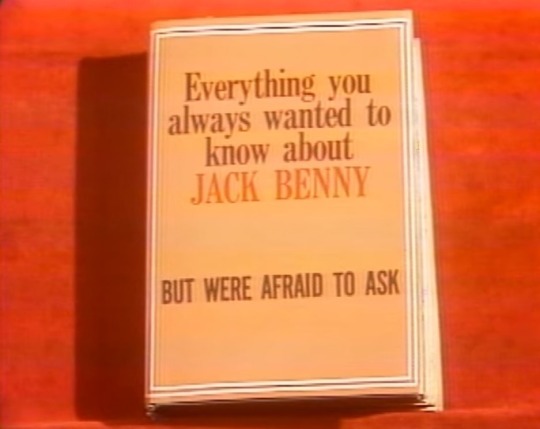
Produced
& Directed by Norman AbbottWritten
by Hal Goldman, Al Gordon, Hilliard Marks, Bucky Searles, Hugh
Wedlock Jr.STARRING
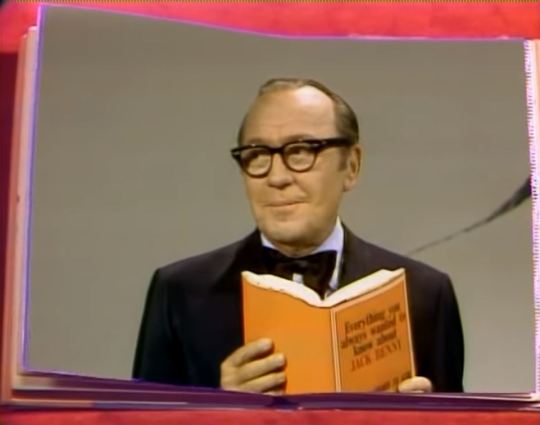
Jack
Benny
(Himself, Host) was
born on Valentine’s Day 1894. He had a successful vaudeville
career, and an even greater career on radio with “The Jack Benny
Program” which also became a successful television show. His screen
persona was known for being a penny-pincher and playing the violin.
Benny was a Beverly Hills neighbor of Lucille Ball’s and the two
were off-screen friends. Benny appeared on “The Lucy Show” as
Harry Tuttle (a Jack Benny doppelganger) in “Lucy
and the Plumber” (TLS S3;E2),
later did a voice over cameo as himself in “Lucy
With George Burns” (TLS S5;E1),
and played himself in “Lucy
Gets Jack Benny’s Account” (TLS S6;E6).
He was seen in four episodes of “Here’s Lucy.” Benny and Ball
appeared on many TV variety and award shows together. He died in
1974, a few weeks after taping “An
All-Star Party for Lucille Ball.”GUEST
STARS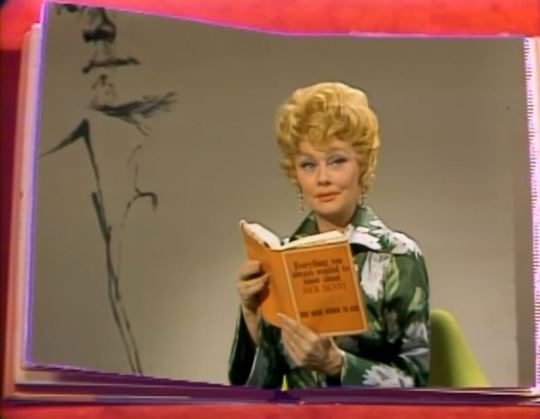
Lucille
Ball (Herself)
was born on August 6, 1911 in Jamestown, New York. She began her
screen career in 1933 and was known in Hollywood as ‘Queen of the
B’s’ due to her many appearances in ‘B’ movies. With Richard
Denning, she starred in a radio program titled “My Favorite
Husband” which eventually led to the creation of “I Love Lucy,”
a television situation comedy in which she co-starred with her
real-life husband, Latin bandleader Desi Arnaz. The program was
phenomenally successful, allowing the couple to purchase what was
once RKO Studios, re-naming it Desilu. When the show ended in 1960
(in an hour-long format known as “The Lucy-Desi Comedy Hour”) so
did Lucy and Desi’s marriage. In 1962, hoping to keep Desilu
financially solvent, Lucy returned to the sitcom format with “The
Lucy Show,” which lasted six seasons. She followed that with a
similar sitcom “Here’s Lucy” co-starring with her real-life
children, Lucie and Desi Jr., as well as Gale Gordon, who had joined
the cast of “The Lucy Show” during season two. Before her death
in 1989, Lucy made one more attempt at a sitcom with “Life With
Lucy,” also with Gordon, which was not a success and was canceled
after just 13 episodes.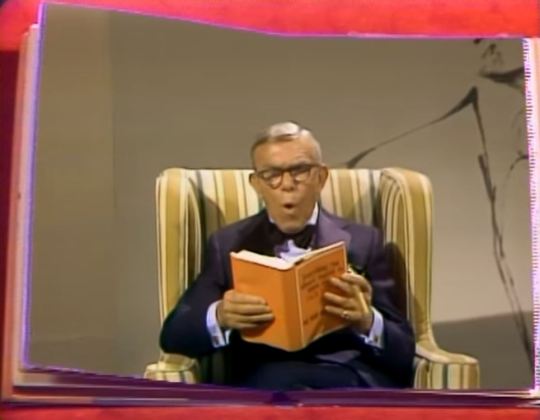
George
Burns
(Himself) was
born Nathan Birnbaum in New York City in January 1896. He married
Gracie Allen in 1926 and the two formed an act (Burns and Allen) that
toured in vaudeville. They had their own hit show “The George Burns
and Gracie Allen Show” first on radio then on CBS TV from 1950 to
1958, airing concurrently with “I Love Lucy.” He appeared as
himself on “The Lucy Show” (S5;E1) in 1966 as well as doing a
cameo on “Lucy and Jack Benny’s Biography” (HL S3;E11) in 1970.
After Allen’s death in 1964, Burns reinvented himself as a solo
act. In 1976 he won an Oscar for playing one of The
Sunshine Boys.
He was also known for playing the title role in Oh,
God! (1978)
and its 1984 sequel Oh,
God! You Devil.
Burns
and Ball appeared on many TV variety and award shows together. He
died at the age of 100.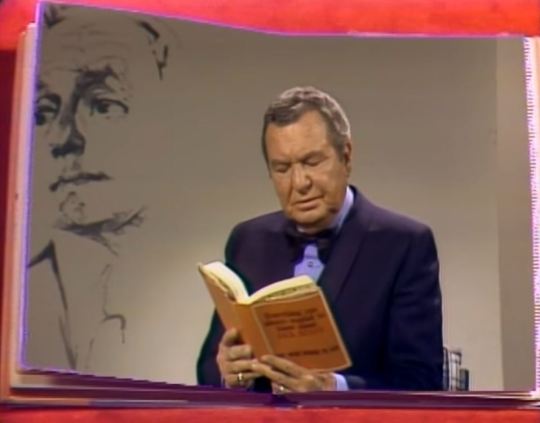
Phil
Harris
(Himself) was
a bandleader who became a comic radio star as a Jack Benny sidekick
in the 1930s. Although his fondness for booze was largely a creation
of the Benny’s writers, Harris played the part to the hilt. Harris
was mentioned in “Lucy
Gets Jack Benny’s Account” (S6;E6)
when
Benny made a reference to Harris’ persona as a lush. In “Lucy
and Joan” (S4;E4)
Joan
(Joan Blondell) says she’s been in pictures so long she saw Phil
Harris take his first drink. Harris appeared in 1968 episode of “The
Lucy Show” (S6;E20) and played himself in a 1974 episode of “Here’s
Lucy”
(S6;E21).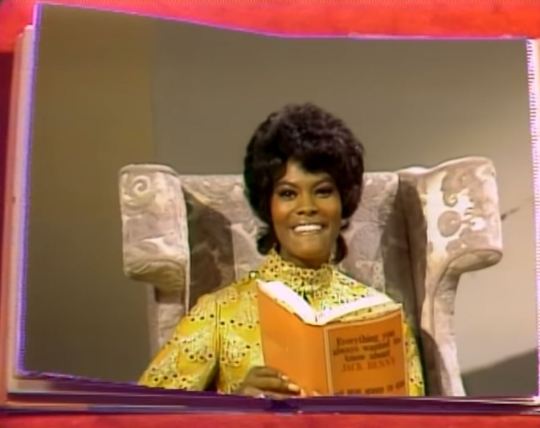
Dionne
Warwick
(Herself) was
born on December 12, 1940 in East Orange, New Jersey. Dubbed ‘the
Princess of Pop’,
Warwick
ranks among the 40 biggest hit makers of the rock era. She is second
only to Aretha
Franklin
as
the most-charted female vocalist of all time, with 56 singles making
the Billboard
Hot
100 between 1962 and 1998.In 1970 she appeared with Lucille Ball on “The Dean Martin Show”
and in 1984 would attend “An All Star Party for Lucille Ball.”
FEATURING
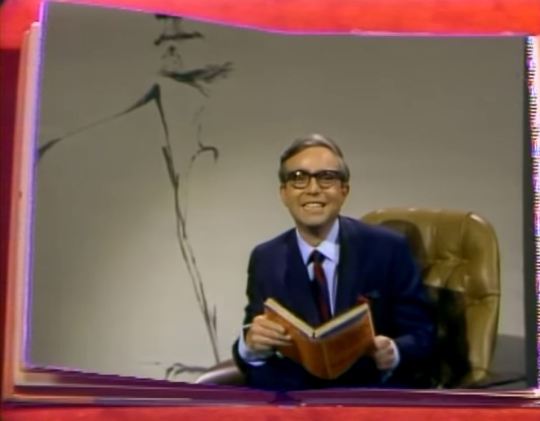
Dr. David Reuben
(Himself) is
most famous for his book Everything
You Always Wanted to Know About Sex* (*But Were Afraid to Ask)
published in 1969. That book inspired the 1972 film by Woody
Allen of the same name.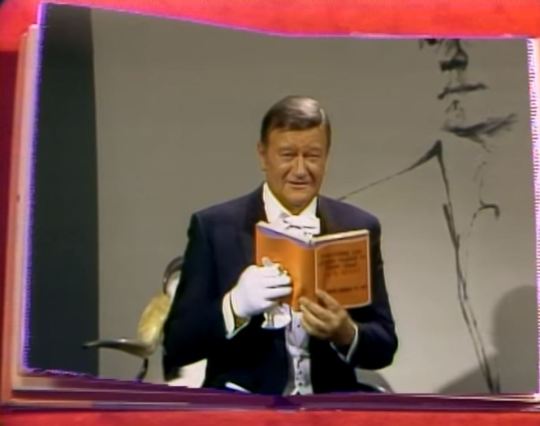
John
Wayne (Himself)
was
born Marion Morrison in 1907. He made his film debut in 1926 and rose
to become an iconic presence in the Western film genre. He was
nominated for three Oscars, winning in 1969 for True
Grit.
He
epitomized rugged masculinity and was famous for his distinctive
voice and walk. His nickname ‘Duke’ came from his own pet
Airedale. Wayne previously worked with Lucille Ball in a 1955 episode
of “I Love Lucy” (S5;E2)
and
a 1966 episode of “The Lucy Show” (S5;E10),
both
titled “Lucy
and John Wayne.”
He died in 1979 at the age of 72.The
opening announcer introduces him as “John Wayne as Marion Michael
Morrison.”
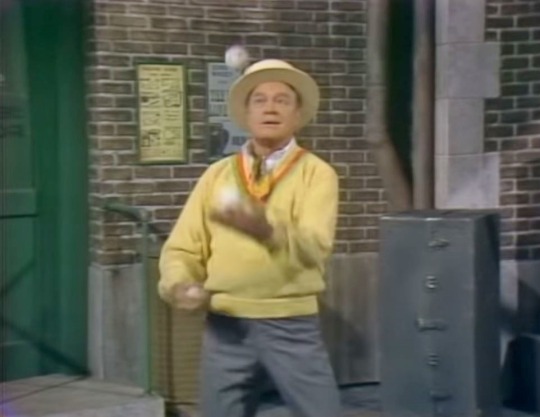
Bob
Hope
(Juggler, uncredited) was
born Lesley Townes Hope in England in 1903. During his extensive
career in virtually all forms of media he received five honorary
Academy Awards. In 1945 Desi Arnaz was the orchestra leader on Bob
Hope’s radio show. Ball and Hope did four films together. He
appeared as himself on the season
6 opener
of
“I Love Lucy.” He did a brief cameo in a 1964 episode of “The
Lucy Show.”
When
Lucille Ball moved to NBC in 1980, Hope appeared on her welcome
special.
He died in 2003 at age 100.Bob
Hope does a quick cameo as an inept juggler. He has no dialogue.SUPPORTING
CASTRemo
Pisani (Vaudeville
Agent) was
a stunt man and actor who made two appearances on “The Lucy Show.”
He was born in New Jersey in 1919 and died there in 2004.Tommy
Farrell (Film
Director) would
play Phil
Harris’ Arranger in a 1974 episode of “Here’s Lucy,” his last
of six appearances. Prior to that he was seen on two episodes of
“The Lucy Show.”David
Westberg
(uncredited)Bill
Baldwin
(Announcer) was seen on camera in a 1970 episode of “Here’s Lucy”
(S3;E2) but was best known as the fight commentator in the Rocky
movies.The
other showgirls
in the “Goldwyn Girl” sketch (two of whom have lines), chorus
boys, and the film crew,
are played by uncredited background performers.
The
show also employs a
monkey
and a large dog.
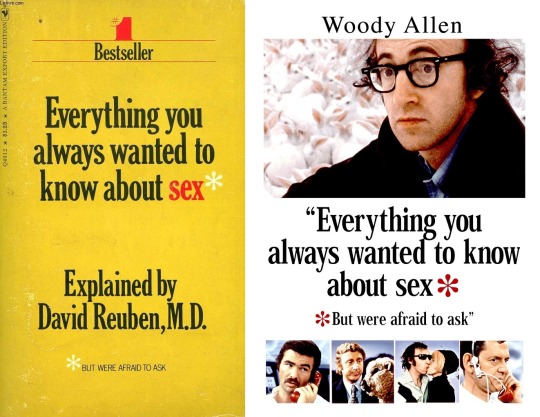
The
title of the special is a nod to the best-selling book Everything
You Always Wanted to Know About Sex* (*But Were Afraid to Ask)
published in 1969. That book would inspired the 1972 film by Woody
Allen. Benny mentions that there will be a film, but does not mention
Woody Allen.The
show was sponsored by Timex.
This is the second and last of his two specials for the sponsor.
The
special pre-empted “The
Kraft Music Hall.” By
the end of March, the show would air the final episode of the series,
which began in 1967. Over its run “The Kraft Music Hall”
featured Jack Benny, Bob Hope, Dionne Warwick, as well as familiar
faces like Desi Arnaz, Vivian Vance, Lucie Arnaz, and Desi Arnaz Jr.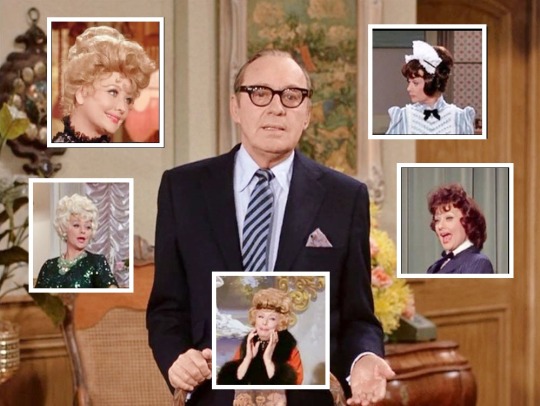
When
this special aired, “Here’s
Lucy”
had just wrapped its third season and Ball was preparing for the
fourth. This special is similar in content to “Lucy and Jack
Benny’s Biography” (HL S3;E11, above), which also took a look at Benny’s
personal history, with Lucy Carter playing all the women in his life.
That episode aired just five months prior to this special, in
November 1970.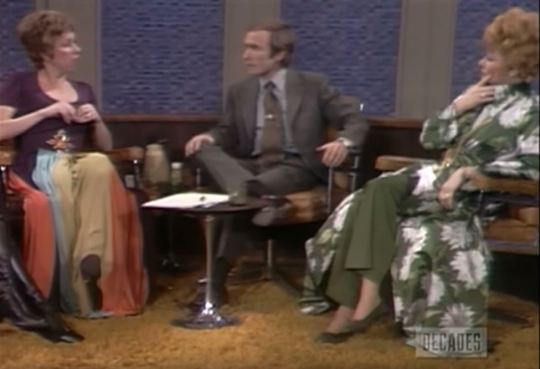
The
evening before this special, Lucille Ball appeared on “The
Dick Cavett Show” along
with Carol Burnett and Lucie Arnaz.After
some introductory remarks, Jack introduces Dr.
David Reuben,
who wrote the book Everything
You Always Wanted To Know…But Were Afraid To Ask.
Jack says he started to read the book, but he fainted on page ten.
Benny asks Dr. Reuben to come in closer to ask him a personal
question:Benny:
“Can
a man my age take something…. just so he can finish reading the
book?”
Reuben:
“Jack, why are we discussing my book? I mean, this show has nothing
to do with sex. It’s about you.”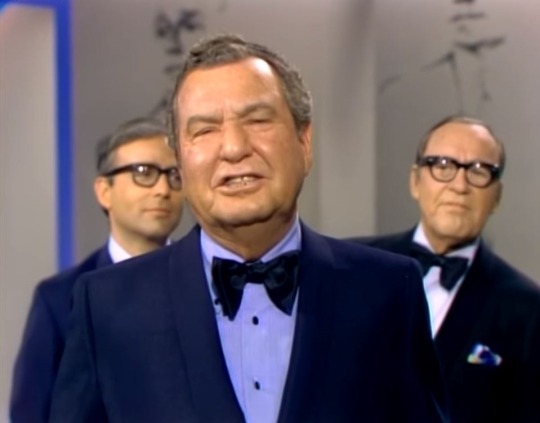
Benny tells the audience that he and Dr. Reuben were both born in Waukegan, Illinois. Phil Harris interrupts their conversation, calling Jack Benny a “stone-age Rhett Butler from ‘Gone With The Wind.’” Harris says that he has read Dr. Reuben’s book and that is on the shelf next to Rebecca of Sunnybrook Farm, which he uses to hide his bottle of bourbon.
Harris
says he wouldn’t have missed Jack’s 20th Anniversary Show for anything. Benny tells him that was four months
ago. Harris has to go call his wife Alice [Faye] but Benny convinces
him to sing a song instead. He starts to sing “That’s
What I Like About the South,” but
Benny stops him saying he’s heard him do that song a thousand times
and that the lyrics make no sense. Benny makes him start again so he
can point out how silly the lyrics are.Benny:
“How
does your mammy get a cakey by putting a pinch of salty on a hammy
and eggy?”
Harris:
“Does
Sarah Lee tell Betty Crocker?”Harris
resumes his song and gets as far as the lyrics “doo-wa-diddy” when Benny stops him again. He wheels in a giant map of the USA.
Benny:
“I
want you to show me one place on this map where it says Doo-Wa-Diddy.
I can see Walla Walla, Muskegon, Ashtabula, Waxahatchee, but where in
the name of Aristotle Onassis is Doo-Wa-Diddy?”
Phil
Harris would also sing “That’s What I Like About the South” on a
1974 episode of “Here’s Lucy” (S6;E21).
In a 1968 episode of “The
Lucy Show” (S6;E23) guest star Sid Caesar did a non-musical riff on
the song. Character actor Remo Pisani (Vaudeville Agent) was also
featured in that episode.
After
a commercial break for Timex Fashion Watches ($9.95 to $19.95), Benny
answers questions from his studio audience – all about his age.
George
Burns,
Benny’s closest friend, interrupts and tells him not to talk about
his age. He reminds him about when he wore a dress in the film
Charley’s
Aunt (1941).
Benny leaves the stage to Burns, who says that the audience can ask
him anything about Jack Benny.
In
response to a question about how they first met, a flashback sketch
begins at the Palace Theatre with Bob
Hope
in a wordless cameo as a ‘hopeless’ juggler.
George Burns is the
headliner and his shoeshine boy is Jack Benny. While working, Benny
idly sings (to the tune of Al Jolson’s “A Quarter To Nine”)“Your
shoes, are gonna twinkle and shine.
This
evening, for a quarter and a dime.”
The
flashback quickly ends and (back on the stage in the present) Benny
says the story was a lie. Burns admits it and the sketch re-starts
(without Hope). This time Benny is an organ grinder – complete with
a live monkey!This
version also quickly ends when Benny calls Burns a liar. Before he
can tell a third version of the story, Benny pushes him offstage and
a commercial starts for Timex electric watches (“You don’t have to
wind it”).
After
the break, Dionne
Warwick
sings “I
Got Love” by
Gary
Geld and Peter Udell,
a
song she released on her 1970 album Very
Dionne.
During a brief chat with Benny, she says her hometown is a little
place called Watsonville, North Carolina, about five miles south of
Do-Wa-Diddy. The audience applauds the callback to the earlier
sketch. Jack delivers his famous catch phrase “Now
cut that out!”
Warwick sings her encore, “Who
Gets the Guy.”
Warwick released the song by Burt Bacharach and Hal David in 1971.
The single rose to #15 on the Adult Contemporary Charts.Benny:
“For
some reason, comedy and sex don’t seem to go together. Really, how
many comedians can you think of that can be considered great lovers?
On the other hand, Valentino was no Zero Mostel.”
Benny
says he was never a ladies man, but Lucille
Ball
(nearly 40 minutes into the special) interrupts to says that Benny
always had sex appeal and calls him “blue eyes.” Lucy mentions
his wife, Mary [Livingstone]. Notice that Lucy is wearing the same outfit she wore the night before on “The Dick Cavett Show.”
Lucy
starts to tell a story about her first movie job in a film called
“Goldwyn
Girl” which
is the cue for another flashback. Ball’s first film was actually
titled Kid
Millions
(1934), although she was indeed one of the film’s Goldwyn Girls. They
were named after motion picture producer Samuel Goldman, who founded
a production company that released film through United Artists, and
later RKO. Lucille Ball and Desi Arnaz later bought RKO studios and
renamed it Desilu.
Goldwyn
Girl Lucy comes down a staircase wearing a headdress made of pink
balloons, inadvertently bursting her fellow Goldwyn Girls’ balloons
with her cigarette holder. The scene is instantly reminiscent of
“Lucy Gets Into Pictures” (ILL S4;E18) when Lucy Ricardo got her
first big break in movies as a showgirl.
Jack Benny arrives as the
much-celebrated star of the picture. In reality, Benny’s first
feature film was Chasing
Rainbows
in 1930. The first time Jack Benny and Lucille Ball really appeared
together was on television in 1952. When Benny kisses Lucille’s hand,
all the balloons in her headdress pop.They
are interrupted by a chorus boy who asks Benny for his autograph.Benny:
“What’s your name, boy?”
Wayne:
“Marion
Michael Morrison.”
Benny:
“Marion
Michael Morrison? No wonder you’re a chorus boy. You’ll never get
anywhere with a name like that.”
Wayne:
“Well,
I have been thinking of changing it, Mr. Benny. To Wayne.”
Benny:
“Wayne.
That’s not too bad. Wayne. How about Wayne Newton?”
Lucy:
“How
about John Wayne Newton?”
Wayne:
“That’s
worse than Marion Michael Morrison.”
Benny:
“Let
me give you some advice. You’re too big and tall and clumsy to be a
chorus boy. Why don’t you buy yourself a horse, a cowboy suit, and
put a black patch over your eye, and you’ll be in business. Be a
cowboy, get into Westerns and you’ll be a star.”
Wayne:
“But
that takes true grit!”
For
the record, John
Wayne’s
birth name was Marion Robert Morrison. His
middle name was changed to Mitchell (his mother’s maiden name) when
his parents decided to name their next son Robert.
Some sources, however, list him as Marion Michael Morrison. John
Wayne was his professional name. By the time Lucille Ball came to
Hollywood, he had done nearly fifty motion pictures. The 1969 movie
True Grit earned
Wayne his first and only Academy Award.Benny
gives Marion the perfect name: Myron
C. Handelman.
Although not an exact match, there was a popular comic named Stanley
Myron Handelman who appeared extensively on TV in the early 1970s.
When Wayne exits, Lucy asks for an autograph, and Benny signs the
back of her neck. George Burns appears as a janitor. Jack
immediately stops the sketch and says “THAT’S
how I met George Burns.”
The
scene shifts to young Jack Benny’s palatial Hollywood apartment.
Lucy comes by to “audition” for Benny, but is reluctant to enter his flat unchaperoned. Benny assures her there is
nothing to worry about and she comes in. A moment later a heavy
wrought iron gate immediately drops down in front of the door!
He
tries to give her a huge snifter of brandy, which she refuses. When
he bangs on the wall saying “There’s
nothing to worry about” a
fully made bed drops out of the wall with satin pillowcases saying
“His” and “Hers.” Lucy runs for the door.
Benny:
“It’s
not what you’re thinking.”
Lucy:
“I
know. It’s what YOU’RE thinking. I’m leaving!”
Benny:
“There’s
nothing to worry about, believe me!”He
bangs the wall again and a second fully made bed drops down in front
of her. She agrees to give him one goodnight kiss, but he faints dead
away. Lucy says
“How do you like that”
and slams her hand on the wall. Cue the third bed!
During
the final Timex commercial (the one where the watch is attached to
the bottom of a snow ski), Benny returns with Dr. Reuben to wrap up
the show. Reuben asks Benny if he’s serious about the violin. John
Wayne brings Benny his Stradivarius (“This
guy really works you to death!”).
To demonstrate his skill, Benny plays Mendelssohn’s
Concerto in E Minor.
As Benny is playing, the studio audience gets up and starts to walk
out as the final credits roll. Benny follows a few of them up the
aisle, playing all the while.
This
Date in Lucy History – March 10th
“Fred
and Ethel Fight”
(ILL S1;E22) – March 10, 1952
“Lucy
and Tennessee Ernie’s Fun Farm”
(S3;E23) – March 10, 19691971, Al Gordon, Bill Baldwin, Bob Hope, Bucky Searles, David Reuben, David Westberg, Dionne Warwick, Everything You Always Wanted to Know About Sex But Were Afraid to Ask, George Burns, Goldwyn Girl, Hal Goldman, Here’s Lucy, Hilliard Marks, Hugh Wedlock Jr., Jack Benny, John Wayne, Lucille Ball, Norman Abbott, Phil Harris, Remo Pisani, Stanley Myron Handelman, The Dick Cavett Show, The Kraft Music Hall, The Lucy Show, Timex, Tommy Farrell, tv, Vaudeville, Woody Allen -
JACK BENNY’S BIRTHDAY SPECIAL
February
17, 1969
- Directed
by Fred De Cordova - Produced
by Irving Fein - Written
by Hal Goldman, Al Gordon, Hilliard Marks, Sam Perrin, Dee Caruso,
Gerald Gardner

Jack
Benny
(Himself, Host / Cowboy) was
born on Valentine’s Day 1894. He had a successful vaudeville
career, and an even greater career on radio with “The Jack Benny
Program” which also became a successful television show. His screen
persona was known for being a penny-pincher and playing the violin.
Benny was a Beverly Hills neighbor of Lucille Ball’s and the two
were off-screen friends. Benny appeared on “The Lucy Show” as
Harry Tuttle (a Jack Benny doppelganger) in “Lucy
and the Plumber” (TLS S3;E2),
later did a voice over cameo as himself in “Lucy
With George Burns” (TLS S5;E1),
and played himself in “Lucy
Gets Jack Benny’s Account” (TLS S6;E6).
He was seen in four episodes of “Here’s Lucy.” Benny and Ball
appeared on many TV variety and award shows together. He died in
1974, a few weeks after taping “An
All-Star Party for Lucille Ball.”GUEST
STARSLucille
Ball (Herself
/ Lucille LaTour) was born on August 6, 1911 in Jamestown, New York.
She began her screen career in 1933 and was known in Hollywood as
‘Queen of the B’s’ due to her many appearances in ‘B’
movies. With Richard Denning, she starred in a radio program titled
“My Favorite Husband” which eventually led to the creation of “I
Love Lucy,” a television situation comedy in which she co-starred
with her real-life husband, Latin bandleader Desi Arnaz. The program
was phenomenally successful, allowing the couple to purchase what was
once RKO Studios, re-naming it Desilu. When the show ended in 1960
(in an hour-long format known as “The Lucy-Desi Comedy Hour”) so
did Lucy and Desi’s marriage. In 1962, hoping to keep Desilu
financially solvent, Lucy returned to the sitcom format with “The
Lucy Show,” which lasted six seasons. She followed that with a
similar sitcom “Here’s Lucy” co-starring with her real-life
children, Lucie and Desi Jr., as well as Gale Gordon, who had joined
the cast of “The Lucy Show” during season two. Before her death
in 1989, Lucy made one more attempt at a sitcom with “Life With
Lucy,” also with Gordon, which was not a success and was canceled
after just 13 episodes.Dan
Blocker
(Himself / Ringo) is best remembered for playing Hoss on “Bonanza”
for 13 seasons. In 1970, he joined Lucille Ball, Jack Benny, and
Ann-Margret in the patriotic special “Swing Out, Sweet Land.” He
died in 1972.Rouvaun
(Himself) was
born Jim Haun in Bingham,
Utah.
A child singer with the Mormon
Tabernacle Choir,
he went on to study voice and perform opera. Rouvaun was virtually
unknown until February 5, 1967, when he appeared in Las
Vegas
as
the headline singer leading the French stage revue Casino De Paris at
the Dunes
Hotel.
His son Jimmy
Haun
went on to become guitarist with the rock group Air
Supply.
This is one of only three TV appearances. He died in 1975.The
announcer’s opening credit for Rouvaun says “introducing Rouvaun.”Lawrence
Welk (Himself
/ New Sheriff) was
a musician, accordionist, bandleader, and television impresario, who
hosted the television program “The Lawrence Welk Show” from 1951
to 1982 on ABC. His style came to be known to his audiences as
‘champagne music.’ His catchphrase was “wunerful, wunerful”
spoken with his slight German accent. Welk’s trademarks included
his “uh-one,
uh-two” song
intro and a perpetual bubble machine (both of which are mentioned here). He played himself on a 1970
episode of “Here’s Lucy” (S2;E18). Welk died in 1992 at the age
of 89.The
announcer’s opening credit for Welk is “special guest star.”Ann-Margret
(Herself)
is one of Hollywood’s most enduring sex symbols, singers, and
actors. She made her screen debut in 1961’s A
Pocketful of Miracles
and
followed up with the critically acclaimed film musicals State
Fair
and
Bye
Bye Birdie.
After playing herself on a 1970 episode of “Here’s Lucy”
(S2;E20) she was nominated for Oscars for Carnal
Knowledge
(1971)
and Tommy (1975). In 2010, Ann-Margret won her first Emmy Award for
her guest appearance on “Law & Order: Special Victims Unit.”The
announcer’s opening credit for Ann-Margret is “as the Valentine
Girl.”Don
Wilson
(Himself
/ Sheriff) was
a portly man with a deep resonating voice that made him very popular
with sponsors in the early days of radio. He teamed with Jack Benny
on radio and when
Benny
made the move to television, Wilson made the move as well, until
1965, when “The
Jack Benny Program”
ended.Jerry
Lewis
(Himself)
was
a comedian, actor, and singer born in Newark, New Jersey in 1926. He was known for his slapstick humor and was originally paired up with
Dean
Martin,
forming the famed comedy team of Martin and Lewis.
His long-standing commitment to hosting the annual Muscular Dystrophy
telethon in 2010, after 44 years, earning him a nomination for the
Nobel Peace Prize in 1977. He was also presented
the French Legion of Honor in 1984. Lewis
died in 2014.Lewis
makes a cameo appearance and is not mentioned in the opening credits.Dennis
Day
(Himself)
was
an Irish singer who’s name and career were synonymous with Jack
Benny’s, working with the comedian on radio and TV. It was Benny
who gave him his big break in 1939 and Benny who kept him employed as
a singer and naive comic sidekick. His “Gee,
Mr. Benny!” became
a well-known catchphrase. Day would play second banana to the
comedian until Benny’s death in 1974. Day played an elderly
bachelor hunting on a 1967 episode of “The Lucy Show” (S6;E7).
Day died at age 72 of Lou Gehrig’s disease.Day
appears only in the final birthday party scene.SUPPORTING
CASTLarry
J. Blake appeared
as a Native American Medicine Man in “Lucy
the Rain Goddess” (TLS S4;E15).
He was an ex-vaudevillian who made nine “Here’s Lucy”
appearances.Benny
Rubin (Zeke)
played the bus driver in “The Tour” (ILL S4;E30). He
was briefly seen in two episodes of “The Lucy Show” as well as the
Desi Arnaz-produced sitcom “The Mothers-in-Law.”Gail
Bonney
is making her seventh and final appearance on a Jack Benny program.
She appeared
with Lucille Ball in the 1950 films A
Woman of Distinction and
The
Fuller Brush Girl.
She played Mrs. Hudson, mother of unruly twins, on “The
Amateur Hour” (ILL S1;E14)
as
well as in “Lucy
and the Ceramic Cat” (TLS S3;E16)
and “Lucy and Eva Gabor” (HL S1;E7).Mason
Curry
was seen on Desilu’s “The Untouchables” as well as playing Cousin
Eldon on “My Three Sons” and Deke Tuttle on “The Ghost and Mrs.
Muir.”Robert
Foulk played
the policeman on the Brooklyn subway platform in “Lucy
and the Loving Cup” (ILL S6;E12)
and
a Los Angeles Detective in “Lucy
Goes To A Hollywood Premiere” (TLS S4;E20).
He was in six episodes of “Here’s Lucy.”
The same evening this special aired, Foulk was also seen on “The
Outsiders,” which aired opposite “Jack Benny’s Birthday Special”
on ABC.Larry
Gelman
(Eskimo) was a character actor best known as Vinnie on “The Odd
Couple,” Dr. Bernie Tupperman on “The Bob Newhart Show,” and
Hubie Binder on “Maude.”Frank
Gerstle
was seen in two episodes of “I Love Lucy” as well as four episode
of “The Jack Benny Program.” He was also in The
Long, Long Trailer
(1954) with Lucille Ball.John
Harmon
was in two episodes of
“The Lucy Show” as well as a 1972 episode of “Here’s Lucy.”Bobby
Johnson
was seen in four episodes of “The Jack Benny Program.”Ray
Kellogg appeared
in two episodes of “I Love Lucy,” seven episodes of “The Lucy
Show, and two of “Here’s Lucy.” He also did four episodes of
“The Jack Benny Program.”Tyler
McVey
was in four episodes of “I Love Lucy” and two of “The Jack
Benny Program.”Ned
Miller
was in 23 episodes of “The Jack Benny Program.” Those are his
only screen credits.Olan
Soule (Joe,
the Janitor) played Little Ricky’s pediatrician in a 1955 episode of
“I Love Lucy” (S5;E9). He was also seen in four episodes of “The Jack
Benny Program.”Rolfe
Sedan
was seen with Lucille Ball in Kid
Millions (1935) and in one episode of both “I Love Lucy” and “The Lucy Show.”
He did eleven episodes of “The Jack Benny Program.”Alex
RomanCarole
Cook
(Lucille Ball’s Singing Voice, uncredited) played
Thelma Green on “The Lucy Show” as well as a host of other
characters. She was a protégé of Lucille Ball’s during the Desilu
Playhouse years. Although born as Mildred Cook, Ball suggested she
take the name Carole, in honor of Lucy’s great friend, Carole
Lombard. Cook appeared in five episodes of “Here’s Lucy” as
various characters and sometimes was a ghost singer for Lucille Ball.Pamelyn
Ferdin
(Texaco Girl, uncredited) was ten years old when she appeared here,
having just finished playing Cookie Bumstead in the series “Blondie.”
She is best known for voicing the character of Lucy (Van Pelt) in
several Charlie Brown specials. She left
the acting world in the 1980s and became a registered nurse.Trained Penguins (courtesy of Sea World San Diego)

The program celebrated Jack Benny’s 75th birthday, although one of his longest-standing comedy bits was that he was perpetually 39. His birthdate is February 14, 1894

The
same evening this program was broadcast, CBS aired “Lucy, the
Shopping Expert” (HL S1;E20). Lawrence Welk, who guest-stars here,
was mentioned on that show. Jack Benny was also mentioned, comparing
him with Diamond Jim Brady, a comparison that was also made on “The
Lucy Show.”
That night Jack Benny
also guest-starred on this special’s lead-in “Rowan and Martin’s
Laugh-In.”
This
Jack Benny special pre-empted “The Outsider” starring Darren
McGavin, a one-season crime drama.
Ann-Margaret
was a guest on “The Jack Benny Program” on April 2, 1961 (above). In
December 1968, Jack Benny guest starred on “The Ann-Margret Show.”

When
the announcer introduces Jack Benny, Lawrence Welk comes walking out
instead, lip-synching to Benny’s voice.
After a commercial break
(from Texaco) the real Benny is onstage and tells a story about going
to visit Lawrence Welk at his home, although thanks to an old map of
the stars homes, he winds up at a Kentucky Fried Chicken instead.
Welk joins him onstage to do imitations of Edward
G. Robinson (“Now look you guys, you keep muscling in on my
territory and I’m gonna let you have it, see.”) and and Cary Grant
(“Judy,
Judy, Judy.”) Needless to say, Welk’s impressions are
completely without skill and he makes absolutely no attempt to mimic
their unique voices.
After
Welk leaves, a line of penguins waddles across the stage. Benny
pretends it hasn’t happened and continues talking about his age,
reviving his famous gag of never being over 39 [he is 75]. He
asserts the old axiom that age is just a state of mind.Benny:
“Take
Maurice Chevalier. He just celebrated his 80th birthday. No there’s a man eighty years old and with him, every
little breeze still whispers Louise. With me, I catch a cold.”
Lucille
Ball joins him onstage to give him a happy birthday kiss. When Benny
says Lucy was his first choice, Lucy says she knows
that he first phoned Princess Margaret in England who said she might bring
her sister. Lucy says that the Queen hasn’t been on TV since the
Coronation. When money-minded Benny wonders who sponsored the Coronation, Lucy
says that “it
must have been some margarine company because suddenly there was a
crown on her head.”
For
the record, in 1952 “I Love Lucy” had better ratings for the
birth of Little Ricky than the Queen had for her Coronation. “Ricky and Fred
Are TV Fans” (ILL S2;E30) opens with Ricky reading a TV Guide with
Queen Elizabeth on the cover. This was history’s first
televised coronation. In 1956, Lucy
and Ricky performed for the newly-crowned (but unseen) monarch in
“Lucy
Meets the Queen” (ILL S5;E15).
The margarine company Lucy joked about is Imperial. Their popular TV
and print ads depicted a large crown magically appearing on the head
of whoever tasted their product. Lucy would joke about this ad
campaign again in a 1972 episode of “Here’s Lucy” (S5;E12).
After
Lucy leaves, Benny says “She’s
so funny. I’m amazed she doesn’t have her own show.”
At the time, “Here’s Lucy” was just wrapping up its first
season.
Rouvaun sings the aria “Vesti
la giubba”
from Pagliacci.
He then sings “The Impossible Dream” from
the 1965 musical Man
of La Mancha. Rouvaun
claims that it
“expresses the hope of America, the heart of America, and the dream
that is America,” despite
the fact that the story of Man
of La Mancha is
set in Spain during the 17th century. The show, however, was written by Americans and premiered in
the USA, so perhaps that is what Rouvaun meant.
After
the songs, Benny tries to assert that this is Rouvaun’s first
appearance on TV. Rouvaun corrects him, saying that he was on “The
Ed Sullivan Show.”
Benny wonders if Rouvaun was in the audience or on the stage (and
which pays more). Ed Sullivan had a tradition of asking celebrities in
his audience to stand up and wave. Being recognized from his audience
became a much-coveted opportunity for Hollywood celebrities. This
unique distinction was also discussed by Ricky Ricardo and his agent
in a 1955 episode of “I Love Lucy” (S5;E7).
Before Rouvaun leaves the
stage, another penguin comes by. Rouvaun sings a tribute to Jack
Benny, “Mr.
Wonderful”
written by Jerry
Bock,
George
David Weiss,
and Larry
Holofcener,
for the Broadway
musical
of the same name starring
Sammy
Davis Jr.
At the end of the song, Benny’s eyeglasses shatter as Rouvaun holds
out the last note.
After
another Texaco commercial, Benny introduces Dan Blocker as the
orchestra plays the “Bonanza” theme song. Blocker pulls his gun on Benny and a feather
pops out. He claims he got the idea from the “Harper Valley PTA.”
“Harper
Valley PTA”
is a country
song
written
by Tom
T. Hall
and
was a major international hit single
for
Jeannie
C. Riley
in
1968.
Blocker
says he’s in his tenth year on “Bonanza.” He thinks he’s been
invited on the show so that Benny can make fat jokes, like he did
with Don Wilson. Benny calls his former announcer “a big fat tub of lard,”
which causes Wilson to stand up from the audience and berate Benny.
Finding kinship in their girth, Wilson and Blocker go off together, determined
to form an act without Benny. A penguin on roller skates goes by
while a bemused Benny watches.
In
1973, Lucille Ball also worked with trained penguins on an episode of
“Here’s Lucy” (S5;E20).
Four
little girls dressed in Texaco fire hats and red slickers offer
Benny a birthday gift certificate for a fill-up at a Texaco
station. To Benny’s shock and chagrin, one of the little girls
correctly guesses Benny’s age – 75! Before they depart, they sing
the Texaco jingle: “You
can trust your car to the man who wears the star. The big, bright
Texaco star!”
With
Benny as the narrator, he presents a Western sketch. Dan Blocker,
dressed in bad-guy black, plays
a gunslinger named Ringo who’s real name is Irving Pincus. Irving
Pincus
(1914-84)
was the name of a TV producer and writer who created the situation
comedy
“The Real McCoys” (1957-63). The show was shot at Desilu and
employed many of Lucille Ball’s favorite character actors.
Throughout the sketch, narrator Benny confirms his predictions about the predictability of Western dramas. When someone is shot, for example, no one seems to call for a doctor!

When
the new sheriff in town (Lawrence Welk) hears that the dangerous Dalton Brothers are
headed to town… he quickly leaves on the first train out!
A dusty stage coach
arrives carrying the new school marm (Lucille Ball).
Benny enters the
story as a cowboy who unmasks the school marm as Lucille LaTour, a
dance hall girl. The camera goes in for a close-up of the purple
flower in Lucille’s hat and when it pans out again, she is dressed in
a dance hall girl costume and is performing on a riverboat stage.
Lucille (LaTour) sings
“Hey Big Spender,”
a song written by Cy Coleman and Dorothy Fields for the 1966 stage
musical Sweet
Charity.
Six weeks after this special, the film version starring Shirley MacLaine was released.
Lucille
Ball’s singing voice was dubbed by her friend and protégé Carole
Cook.
After
another Texaco commercial (this time about fueling up boats), Jack
Benny is seen walking through the darkened backstage, coat over his
arm, headed home, when he discovers a surprise birthday party. Former “Jack Benny Program” regular Dennis Day
surprises Benny to give his old boss a gift.
Jerry
Lewis enters bringing with him a giant Valentine’s / Birthday card for
Benny.
Ann-Margret emerges from the card, dressed in a skimpy Valentine’s
Day outfit with red hearts over her chest.
Dennis
Day sings “Cuando
calienta de sol”
(“Love Me With All Your Heart”) in Spanish by
Rafael Gaston Perez, Carlos Rigual, and Mario Rigual.
Benny accompanies him on the violin.
Day’s tenor voice breaks Benny’s
expensive Stradivarius violin.
They then discover the birthday cake is
being devoured by penguins.
Benny
is onstage alone about to close the show, when a stagehand give him
the script for a live Texaco commercial. As Benny rehearses the
script, the stage around him is swiftly transformed into a Texaco
station (to audience applause), with Benny behind the wheel of a car!In
the actual closing, Benny gets a ‘wire’ from George Burns. He starts
to read it, but stops. Apparently there is some language in it not
appropriate for television.
Benny calls Lucille Ball onstage and asks
her one last question.Benny:
“Lucy, now that the show is over, how about going out and having a
little drink with me?”
Lucy:
“Why
Jack Benny! I’m surprised at you! You’re a happily married man.
I’m a happily married woman. How could you make a suggestion like
that?”
Benny:
“I just asked you to go out and have a little drink with me, that’s
all.”
Lucy:
“Oh, sure. It sounds innocent enough. But it becomes a secret
rendezvous in a dimly lit cocktail lounge with romantic music playing
in the background. Really, I’m surprised at you, Jack. What would
Mary think?”
Benny:
“Mary’s coming with us.”
Lucy:
“Then forget it.” (Lucy walks off!) Al Gordon, Ann-Margret, Benny Rubin, Bobby Johnson, Dan Blocker, Dee Caruso, Dennis Day, Don Wilson, Frank Gerstle, Fred De Cordova, Gail Bonney, Gerald Garnder, Hal Goldman, Hilliard Markx, Irving Fein, Jack Benny, Jack Benny’s Birthday Special, Jerry Lewis, John Harmon, Larry Gelman, Larry J. Blake, Lawrence Welk, Lucille Ball, Mason Curry, Ned Miller, Ray Kellogg, Robert Foulk, Rouvaun, Sam Perrin, Tyler McVey
 - Directed
-
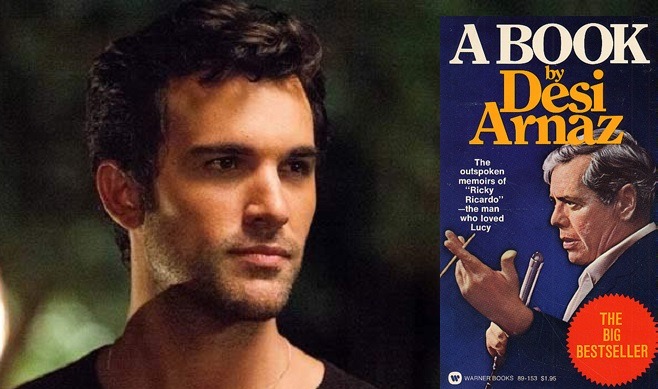
Juan Pablo Di Pace (”Fuller House”) has recorded the audio book of Desi Arnaz’s 1976 autobiography A BOOK. Coming soon!
-
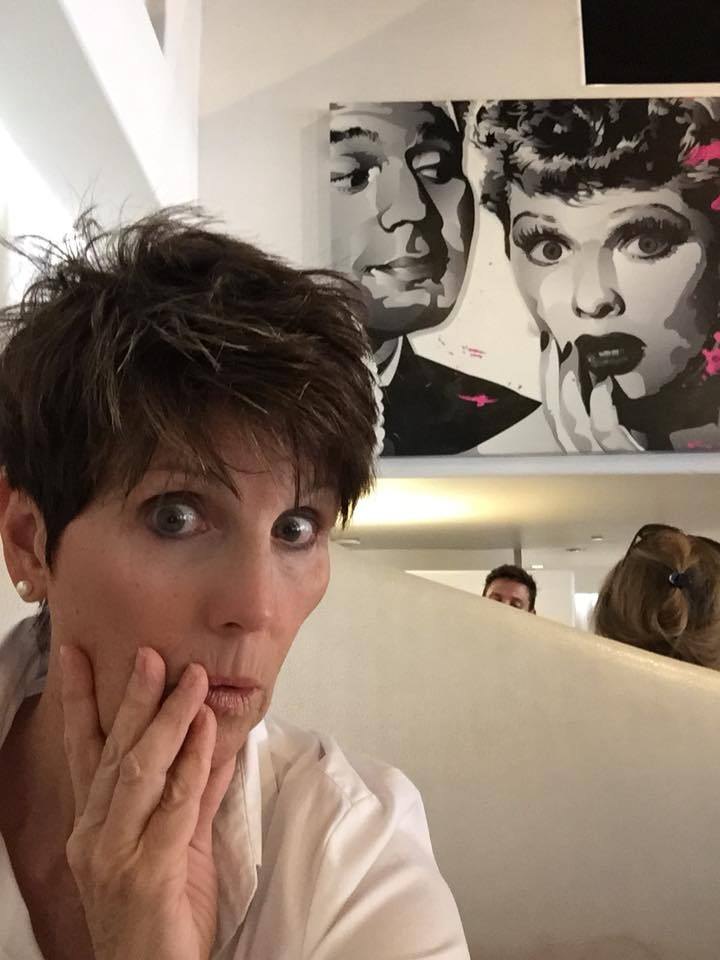
Like Mother / Like Daughter
-
Miss Richfield 1981 includes Lucille Ball in her parody song to “Hamilton”! She refers to Lucy as “the silly one.”
-

Papermoon Loves Lucy turned 3 today! The blog contains:
- 179 episodes of “I Love Lucy”
- 13 episodes of “The Lucy-Desi Comedy Hour”
- 156 episodes of “The Lucy Show”
- 144 episodes of “Here’s Lucy”
- 13 episodes of “Life with Lucy”
- Many, many specials and much more to come!
-
JACK BENNY’S CARNIVAL NIGHTS
March 20, 1968

Directed
by Fred De CordovaProduced
by Irving FeinWritten
by Hal Goldman, Al Gordon, Hilliard MarksScript
Consultant Milt JosefsbergJack
Benny
(Himself, Host) was
born on Valentine’s day 1894. He had a successful vaudeville
career, and an even greater career on radio with “The Jack Benny
Program” which also became a successful television show. His screen
persona was known for being a penny-pincher and playing the violin.
Benny was a Beverly Hills neighbor of Lucille Ball’s and the two
were off-screen friends. Benny appeared on “The Lucy Show” as
Harry Tuttle (a Jack Benny doppelganger) in “Lucy
and the Plumber” (TLS S3;E2),
later did a voice over cameo as himself in “Lucy
With George Burns” (TLS S5;E1),
and played himself in “Lucy
Gets Jack Benny’s Account” (TLS S6;E6).
He was seen in four episodes of “Here’s Lucy.” Benny and Ball
appeared on many TV variety and award shows together. He died in
1974, a few weeks after taping “An
All-Star Party for Lucille Ball.”GUEST STARS
Lucille
Ball (Luscious
Lucille / Woman on Pier / Agnes Kubelsky) was born on August 6, 1911 in Jamestown, New
York. She began her screen career in 1933 and was known in Hollywood
as ‘Queen of the B’s’ due to her many appearances in ‘B’
movies. With Richard Denning, she starred in a radio program titled
“My Favorite Husband” which eventually led to the creation of “I
Love Lucy,” a television situation comedy in which she co-starred
with her real-life husband, Latin bandleader Desi Arnaz. The program
was phenomenally successful, allowing the couple to purchase what was
once RKO Studios, re-naming it Desilu. When the show ended in 1960
(in an hour-long format known as “The Lucy-Desi Comedy Hour”) so
did Lucy and Desi’s marriage. In 1962, hoping to keep Desilu
financially solvent, Lucy returned to the sitcom format with “The
Lucy Show,” which lasted six seasons. She followed that with a
similar sitcom “Here’s Lucy” co-starring with her real-life
children, Lucie and Desi Jr., as well as Gale Gordon, who had joined
the cast of “The Lucy Show” during season two. Before her death
in 1989, Lucy made one more attempt at a sitcom with “Life With
Lucy,” also with Gordon, which was not a success and was canceled
after just 13 episodes.Johnny
Carson (Carnival
Barker / Jackie) was
born in 1925 in Corning, Iowa. He was a talk show host and comedian,
best known for his 30 years as host of “The Tonight Show”
(1962–92) for which he received six Emmy Awards. Johnny Carson and
Lucille Ball appeared together many times on TV specials and award
shows as well as his appearing as himself on a 1969 episode of
“Here’s Lucy” and “Lucy Moves to NBC” in 1980. He died in 2005
as an icon of late night television.Ben
Blue (Shandu
/ Tramp / Pickpocket) was born in 1901 in Canada. He appeared in
three films with Lucille Ball from 1943 to 1967. In July 1960 Jack
Benny starred him in an episode of his variety show. The comic actor
also did four films with Benny. He died in 1975.Paul
Revere & The Raiders
featuring Mark
Lindsey
(Themselves) had appeared a month earlier on “The Smothers Brothers
Comedy Hour.”SUPPORTING
CASTSid
Fields
(Emcee / Barker) is probably best remembered for his work with Abbott
and Costello. This is his only time working with Benny and Ball.Herb
Vigran
(Cop) played
Jule, Ricky Ricardo’s music agent on two episodes of “I Love
Lucy” in addition to playing movie publicist Hal Sparks in “Lucy
is Envious” (ILL S3;23).
He was seen in the Lucy-Desi film The
Long, Long Trailer.He was seen in 6 episodes of “The Lucy Show” as various
characters.Larry
J. Blake (Cop)
appeared
as a Native American Medicine Man in “Lucy
the Rain Goddess” (TLS S4;E15).
He was an ex-vaudevillian who made nine “Here’s Lucy” appearances.Almira
Sessions
(Old Lady on Midway) was a character actress who appeared with
Lucille Ball and Bob Hope in the 1950 movie Fancy
Pants.Benny
Rubin
(Tonto) played the bus driver in “The Tour” (ILL S4;E30). He
was briefly seen in 2 episodes of “The Lucy Show” as well as the
Desi Arnaz-produced sitcom “The Mothers-in-Law.”Larry
Billman
(Dancer, uncredited) was Lucy’s dance partner on “Lucy and
Tennessee Ernie’s Fun Farm” (HL S1;E23).CAMEOS
George
Burns (Martine)
was
born Nathan Birnbaum in New York City in January 1896. He married
Gracie Allen in 1926 and the two formed an act (Burns and Allen) that
toured in vaudeville. They had their own hit show “The George Burns
and Gracie Allen Show” first on radio then on CBS TV from 1950 to
1958, airing concurrently with “I Love Lucy.” In 1966 he
appeared as himself on “The Lucy Show” (S5;E1). After Allen’s
death, Burns reinvented himself as a solo act. In 1976 he won an
Oscar for playing one of The
Sunshine Boys.
He was also known for playing the title role in Oh,
God! (1978)
and its 1984 sequel Oh,
God! You Devil. Burns
and Ball appeared on many TV variety and award shows together. He
died at the age of 100.
Bob
Hope
(Himself) was
born Lesley Townes Hope in England in 1903. During his extensive
career in virtually all forms of media he received five honorary
Academy Awards. In 1945 Desi Arnaz was the orchestra leader on Bob
Hope’s radio show. Ball and Hope did four films together. He
appeared as himself on the season
6 opener
of
“I Love Lucy.” He did a brief cameo in a 1964 episode of “The
Lucy Show.”
When
Lucille Ball moved to NBC in 1980, Hope appeared on her welcome
special.
Like George Burns, he died at age 100.Danny
Thomas
(Himself) was
born Amos Muzyad Yakhoob Kairouz in 1912. His screen career began in
1947 but he was most famous for appearing on television in the
long-running show “Make Room for Daddy” (1953-1964), which was
shot at Desilu Studios. When the series moved from ABC to CBS in
1957, Thomas and the cast starred in a rare TV cross-over with “The
Lucy-Desi Comedy Hour” titled “Lucy
Makes Room for Danny.”
In
return, Lucy and Desi turned up on Thomas’s
show.
Fifteen years later, Lucy and Danny did yet another cross-over when
Lucy Carter of “Here’s Lucy” appeared on “Make
Room for Granddaddy.”
In
addition, Thomas also played an aging artist on a 1973 episode of
“Here’s
Lucy.”
Their final collaboration was on an episode of his short-lived sitcom
“The Practice” in 1976. Thomas
is fondly remembered for founding St. Jude Children’s Research
Hospital. He is also father to actress Marlo Thomas. He died in 1999.Dean
Martin
(Rip Van Rinkle) also
played himself (and his stunt man doppelganger Eddie Feldman) in
“Lucy
Dates Dean Martin” (TLS S4;E21)
in
1966. He was born Dino Paul Crocetti in Steubenville, Ohio, in 1917.
He made his screen debut in a short playing a singer in Art Mooney’s
band, but his first big screen role was 1949’s My
Friend Irma
with
Jerry Lewis. This began a partnership that would be one of the most
successful screen pairings in cinema history. Later, he also worked
frequently members of “the Rat Pack”: Frank Sinatra, Joey Bishop,
Peter Lawford, and Sammy Davis Jr. His persona was that of a playboy,
usually seen with a glass of booze and a cigarette. Martin and
Lucille Ball appeared on many TV variety and award shows together as
well as the special “Lucy Gets Lucky” in 1975. He died on
Christmas Day in 1995 at age 78.The
Smothers Brothers (Joe
Joe)
are
Tom and Dick, real-life brothers who are singers, musicians, actors,
and comedians. They starred
in several TV
variety shows and even appeared in stage musicals. Their show was
abruptly canceled by CBS in 1969 in a battle over censorship.Don
Drysdale
(Himself) was
a professional baseball
player
and television sports
commentator.
A pitcher
for
the Los
Angeles Dodgers
for
his entire career, Drysdale was inducted into the Hall
of Fame
in
1984.
He died in 1993 at age 53.

This
special was taped on January 13, 1968. It is available on DVD.
This
special was one of a series of ‘themed’ Jack Benny programs such as
“Jack Benny’s 20th Anniversary Special,” “The Jack Benny Birthday Special” and “Everything You Always Wanted to Know about Jack Benny” – all of which featured Lucille Ball.
NBC’s
lead in for “Carnival Nights” was “Chrysler Presents The Bob
Hope Show.” Hope’s guests were Paul Lynde, Arnold Palmer, Anne Bancroft, Jill St. John, and
singer Lou Rawls.
Nine
days earlier (March 11, 1968), “The Lucy Show” aired its final
episode. Lucille Ball was already preparing to start filming of “Here’s
Lucy” for the Fall.
The
show usually seen in this time slot (Wednesday 10pm on NBC) was “Run
For Your Life” starring Ben Gazzara. When the show returned the
following week, it was their series finale.
Script
Consultant Milt
Josefsberg was
also script supervisor for “The Lucy Show” and would go on to do
the same for “Here’s Lucy.” He wrote a book about Jack Benny in
1977 and won a 1978 Emmy Award for “All in the Family.”
A
1962 episode of “The Lucy Show” (S1;E4) was set at a carnival,
as would be a 1971 episode of “Here’s Lucy” (S4;E6).
In
addition to a large cast of actors, singers, dancers, and musicians,
special circus sideshow talent (sword swallower, fire eater,
contortionist) were sourced by talent coordinator
Simone Finner.

The
program opens with Bob Hope and Danny Thomas in workman’s clothes
erecting a carnival cloth that acts as the opening credits for the
show. They discuss Benny’s stinginess. Danny says that he is doing it
as a favor to General Sarnoff. David
Sarnoff
ruled
over a telecommunications
and
media
empire
that included both RCA and NBC, which became one of the largest
companies in the world. Named a Reserve Brigadier
General
of
the Signal
Corps
in
1945, Sarnoff was widely known as "The General.”
He died in 1971.Thomas
tells Hope that Benny has Elizabeth Taylor and Richard Burton doing
the station break. [He is joking. The famous couple do not appear.]
In
the darkness, the audiences hears “Everybody
Loves Somebody Sometime”
sung by Dean Martin and the lights come up on Jack Benny, not Dean
Martin, standing on the set for “The Dean Martin Show.” For his
grand entrance, Benny slides down a fire pole where a doctor, a
nurse, and two orderlies with a stretcher are waiting – just in
case.
Holding
a stack of cards and letters (“keep ’em coming”), he mentions his
wife Mary
Livingstone.
Lucille Ball played Livingstone (mouthing to her voice) in a 1970
“Here’s Lucy” (S3;E11).
Benny
thanks Dean Martin for the loan of his set. He is referring to “The
Dean Martin Show” (1965-74) on NBC. A new episode aired the day
after “Carnival Nights” featuring Desi Arnaz Jr. and his band
Dino Desi & Billy. Over the show’s eight seasons, Lucille Ball,
Jack Benny, George Burns, Johnny Carson, Danny Thomas, and The
Smothers Brothers all appeared on the show.
During
his monologue Benny reminds the audience that since Lucy’s new movie
Yours,
Mine and Ours,
Benny can’t afford her anymore. So they have developed a reciprocal
agreement to appear on each others shows. Indeed, “Lucy Visits Jack
Benny” is the second-aired episode of the new “Here’s Lucy”
show in October 1968. Jack also complains about Johnny Carson’s fee
– a whopping $30,000 while he only gets a mere $325 to appear on
“The Tonight Show.”
Benny
notes that the show’s carnival theme was inspired by the success of
Danny Thomas’ “The Wonderful World of Burlesque” (1965-67) and
“Chrysler Presents The Bob Hope Show: Shades of Vaudeville”
(February 1967).
The
opening number features singers and dancers around a carousel, being
introduced to various sideshow acts: the strong man, the fire-eater,
a contortionist, a man lying on a bed of nails, the world’s largest
and smallest men, and a sword swallower. The song also mentions a
bearded lady (later played by George Burns), a two-headed boy (later
played by The Smothers Brothers), and a red-headed shimmying female
(later played by Lucille Ball).
On
the midway, Johnny Carson plays a carnival barker who introduces us
to Luscious Lucille, the Red Headed Bombshell.
Barker:
“The girl who made Little Egypt surrender to the Israelis, Luscious
Lucille is the most fantastic dancing girl in all history. When
Lucille made her first appearance, Gypsy Rose Lee retired, Lily St.
Cyr burst her bubble, and Sally Rand grabbed her fans and flew back
to Capistrano.”All
of these are real-life burlesque dancers (strippers). There were at
least three dancers that went by the name Little
Egypt.
Gypsy
Rose Lee
(born Rose Louise Hovick) had her memoirs made into the stage and
screen musical Gypsy.
Lily
St. Cyr
(born Willis
Marie Van Schaack)
was famous for her provocative bubble baths. Sally
Rand
(born Hattie
Helen Gould Beck) was
most
noted for her ostrich feather fan
dance.While
that introduction rattles on, a pickpocket (Ben Blue) tries to steal
Jack’s wallet, which turns out to be wired to his ankle. When Jack
balks at the admission price of fifty cents, Johnny says it is only
ten cents due to Arthur Murray’s birthday.
Inside
the tent, Luscious Lucille plays Helen of Troy singing “It’s
So Nice To Have A Man Around the House” by
Harold Spina and Jack Elliott.
Next, Luscious Lucille plays Cleopatra
singing “Cleo”
to the tune of “Mame”, the title song from the Broadway musical
of the same name. In early 1968, Lucille Ball could not have known
that she would play the leading role in the 1974 film version of
Mame.
Lucy Carmichael played Cleopatra in the very first color-filmed
episode of “The Lucy Show” (S2;E1) in October 1963.
After
the break, Tom
and Dick Smothers play
Joe-Joe the Two-Headed Man in a one-line gag: “Mom
always liked your head best!”
Sid
Fields introduces mind reader Chandu, Mystic of the Orient (Ben
Blue).
Trying to guess the name of young lady in the audience,
Chandu gets hung up on the name Cosgrove. Cosgrove was the maiden
name of Milton Berle’s wife, Ruth. She appeared as herself on a 1967
episode of “The Lucy Show” (S6;E1).Fields:
“Chandu tell me, whose picture is on a one dollar bill? It’s a man
wearing a white wig.”
Chandu:
“Santa Claus.”
Fields:
“No, no. This man was born on a very famous day. On the 22nd of February about 200 years ago.”
Chandu: “Mickey
Rooney?”
Fields:
“No, he was called the father of his country.”
Chandu:
“Mickey Rooney!”
Fields: “No, Shandu, don’t you
remember? He crossed the Delaware River in a rowboat.”
Chandu:
“George Raft?”
Fields: “You’re half right.”
Chandu:
“George Half-Raft?”
Chandu:
“I know what a hippie is.”
Fields:
“What?”
Chandu: “A hippie’s a guy that dresses like
Tarzan, walks like Jane, and smells like Cheetah.”
On
the midway, a pair of cops (Herb Vigran and Larry J. Blake) are
looking for Sammy the Swindler (Benny). Sammy approaches an Old Lady
(Almira Sessions) to offer her gold stock.
Old Lady:
“Who needs gold stock? I’ve got Social Security and Medicare!”
Sammy:
(to us) “Now how can an honest swindler compete with the
government?”
Jokes
about Medicare were common in 1968 because the program was then
headline news. In 1965, Medicare health care benefits were added to Social Security and in
1966 a Medicare tax of 0.7% was added to pay for increased expenses.
By 1968, the tax had risen to 1.2%.
Fields
introduces Paul Revere and the Raiders (featuring Mark
Lindsay) to sing “Too Much Talk” and “Him
or Me." Coincidentally, Lucy and Benny played Mr. and Mrs. Paul Revere (the Revolutionary War hero) in a 1964 “Jack Benny Program.”
Back
on the midway, Carson hangs out a help wanted sign at the baseball
pitching booth and tries to persuade Jack Benny (who he calls ‘rube’)
to take the job as the target, assuring him that nobody can throw a
baseball anyway. Hearing it pays $5 an hour, Benny immediately takes
the job.
Unfortunately for him, first to “step right up” is Los
Angeles Dodgers pitcher Don Drysdale!
At
the penny arcade, a man steps up to a stereoscope titled
“Adventures of Schnookie” and the viewers are instantly
transported to the silent movie he is watching. It features a Buster
Keaton-esque Tramp on a pier (Ben Blue) when a poor woman looking to
end it all (Lucille Ball) comes by. To cheer her up, the Tramp
dances to “Tea For Two.” In return, he asks her to entertain him
with a song. Her singing (a sped-up garble on the soundtrack) is so
terrible, that the Tramp pushes her off the pier himself.
In real
life, Ben Blue and Lucille Ball worked together in the film Easy
to Wed (1946) directed by Buster Keaton. In 1965, Ball and Keaton
performed a silent sketch (also set on a bench) on the TV special “A
Salute To Stan Laurel.”
In
a one-line cameo, George Burns plays Martine the Bearded Lady.
He says that Mary [Livingstone, Jack’s wife] was supposed to do it, but he is Jack’s best friend. He corrects himself: was his
best friend.
The
next sketch starts with establishing footage of a trailer
driving through the desert. On the side it says “Kubelsky’s
Carnival – Best in the West.” Benjamin Kubelsky was Jack
Benny’s birth name. Inside the trailer Agnes (Lucy) and Jack are just
waking up in Corn Creek, New Mexico.
The trailer is
also occupied by all the sideshow performers including their grown
son Jackie (Johnny Carson) who aspires to be a TV comedian. In 1954
Lucille Ball and Desi Arnaz made the film The Long, Long Trailer. In the film, Herb Vigran (who plays a Cop here) played the man who sold them the trailer.
Jack:
“Hey, do you have enough food for lunch?”
Agnes: “Yeah,
we got low-cal drinks for the thin man, potatoes hi-cal for the fat
man, bones for the dog-faced boy, rusty nails for the sword
swallower, alphabet soup for the tattooed man, a glass of milk with a
couple of straws in it for the two-headed man, and shortnin’ bread for
the midget.”
In
the final segment the singers and dancers return from the opening as
the carnival moves on to the next location. In a sort of a curtain
call, the guest stars are all introduced riding on the carousel: Ben
Blue, Paul Revere & The Raiders, Johnny Carson, Lucille Ball (in
her Cleopatra costume), and host Jack Benny.Blooper Reel
Title Trouble! Although
the show is titled “Jack Benny’s Carnival Nights” the end
credits read “The Jack Benny Hour.”Oops! In
the trailer sketch, Jack reverses his line, "Because a carnival
that works together lives together.”

Spelling Bee! In Dean Martin’s cameo he is billed in the circus sign as
‘Rip Van Rinkle’ and underneath his ‘bed’ as ‘Rip Van Rinkel’.1968, Al Gordon, Ben Blue, Carnival, Carnival Nights, carousel, Cleopatra, Dean Martin, Don Drysdale, Fred De Cordova, George Burns, Hal Goldman, Herb Vigran, Hilliard Marks, Irving Fein, Jack Benny, Jack Benny’s Carnival Nights, Johnny Carson, Larry J. Blake, Lucille Ball, merry-go-round, midway, Milt Josefsberg, NBC, Paul Revere & The Raiders, Sid Fields, sideshow, The Jack Benny Hour, The Smothers Brothers, tv -
LIKE HEP!
April
13, 1969
Directed
by Marc Breaux ~ Executive
Producer George Schlatter ~ Written
by Chris Bearde and Coslough Johnson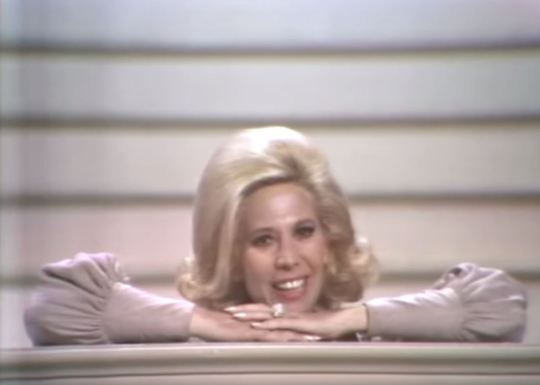
Dinah
Shore
(Herself, Host / Various Characters) was
born Fannye Rose Shore in 1916. She was a singer, actress, and
television personality, and the top-charting female vocalist of the
1940s. She rose to prominence as a recording artist during the Big
Band era, but achieved even greater success a decade later, in
television, mainly as hostess of a series of variety programs. Her
first recordings were with Desi Arnaz’s mentor, bandleader Xavier
Cugat, and she later changed her named to Dinah after her success
with the song of the same name. She was famous for blowing a kiss to
her audiences (“Mwah!”) at the end of each show.
Shore appeared
as herself on a 1971 episode of “Here’s Lucy” (S4;E7). Shore and
Ball appeared together on many television talk shows, specials and
award shows together. Her passions were golf, cooking, and painting.
Shore died in 1994.Lucille
Ball (Herself
/ Various Characters) was born on August 6, 1911 in Jamestown, New
York. She began her screen career in 1933 and was known in Hollywood
as ‘Queen of the B’s’ due to her many appearances in ‘B’
movies. With Richard Denning, she starred in a radio program titled
“My Favorite Husband” which eventually led to the creation of “I
Love Lucy,” a television situation comedy in which she co-starred
with her real-life husband, Latin bandleader Desi Arnaz. The program
was phenomenally successful, allowing the couple to purchase what was
once RKO Studios, re-naming it Desilu. When the show ended in 1960
(in an hour-long format known as “The Lucy-Desi Comedy Hour”) so
did Lucy and Desi’s marriage. In 1962, hoping to keep Desilu
financially solvent, Lucy returned to the sitcom format with “The
Lucy Show,” which lasted six seasons. She followed that with a
similar sitcom “Here’s Lucy” co-starring with her real-life
children, Lucie and Desi Jr., as well as Gale Gordon, who had joined
the cast of “The Lucy Show” during season two. Before her death
in 1989, Lucy made one more attempt at a sitcom with “Life With
Lucy,” also with Gordon, which was not a success and was canceled
after just 13 episodes.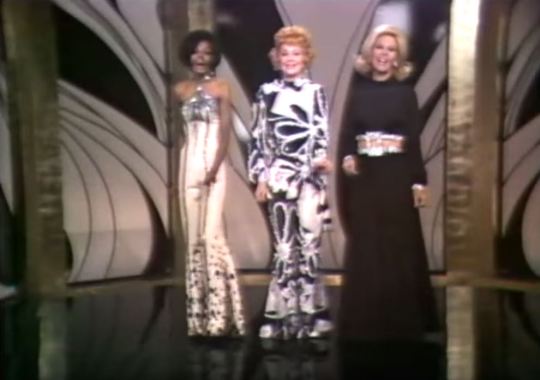
Diana
Ross (Herself
/ Various Characters) makes
her first television appearance as a solo act after many years of
headlining with The Supremes. The
group released a record-setting twelve number-one hit singles on the
Billboard Hot
100. As
an actress, she starred in Lady
Sings The Blues (1971),
Mahogany
(1975), and The
Wiz (1978).Ross
is credited by the announcer as Dinah’s “Extra Added Attraction
Guest”.Dick
Martin (Himself
/ Various Characters, below right) is
probably best remembered as the co-host of “Rowan & Martin’s
Laugh-In” from 1967 to 1973. He was born Thomas Richard Martin on
January 30, 1922, in Battle Creek, Michigan. As a teenager he lost a
lung to tuberculosis and used bottled oxygen for the rest of his
life. Martin was a writer for the popular radio show “Duffy’s
Tavern” before teaming up with Dan Rowan in the 1950s. They played
nightclubs and Las Vegas before Martin was cast as Lucy Carmichael’s
boyfriend Harry Conners on “The Lucy Show,” his ‘acting’
debut. He was married three times and died in 2008 of respiratory
failure.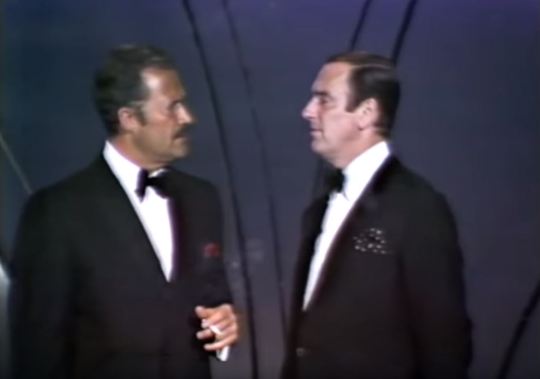
Dan
Rowan (Himself
/ Various Characters, above left)
is
best known as the co-host of “Rowan and Martin’s Laugh-In”
which earned him a 1972 Emmy Award. In 1966 he had appeared with
Lucille Ball on “The Dean Martin Show.” Rowan made two
appearances on “The Lucy Show” in 1966 and 1967. He died in 1987
at age 65.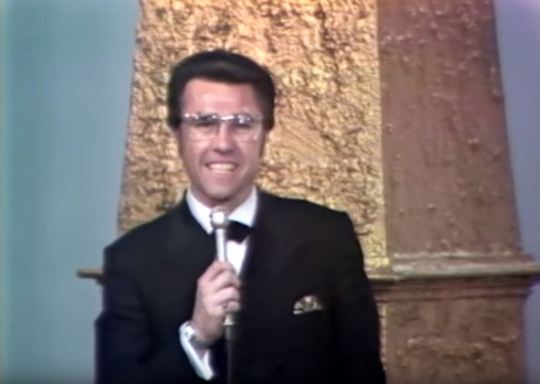
Gary
Owens
(Announcer / Emcee, uncredited) was also, not surprisingly, the
announcer for “Laugh-In.”Lorne
Greene
(Himself, uncredited) appears in his costume from “Bonanza” in a
couple of quick comic cut-aways.The
Smothers Brothers
(Themselves, uncredited) had a variety show that was opposite this
special on CBS. They were generally up against “Bonanza.”Tom
and Dick Smothers only appeared at the very end of the final credits, in
a one shot gag. The gag was not included in the rebroadcast.Greg
Morris (Nightclub
Patron, uncredited) was appearing in the Desilu spy thriller
“Mission: Impossible” at the time. He does not have any dialogue.Victor
Buono
(Corrupt Rival Gang Leader, uncredited) played “Batman” villain
King Tut from 1967 to 1968. A month before this cameo, he had
appeared on an episode of “Here’s Lucy” (S1;E21). He does not
have any dialogue.Jay Meyer (uncredited) was a singer and actor who performed with such stars as Ray Conniff, Jack Benny, Danny Kaye, and Tennessee Ernie Ford, just to name a few. Jay also worked for 13 years at Disneyland in the Golden Horseshoe Revue and became one of the singing ghosts busts in the Haunted Mansion. His career continued until his mid-seventies. He died in 2009.
Carole
Cook
(Lucy’s Singing Voice, uncredited) played
Thelma Green on “The Lucy Show” as well as a host of other
characters. She was a protege of Lucille Ball’s during the Desilu
Playhouse years. Although born as Mildred Cook, Ball suggested she
take the name Carole, in honor of Lucy’s great friend, Carole
Lombard. Cook appeared in five episodes of “Here’s Lucy” as
various characters and sometimes was a ghost singer for Lucille Ball.
About
the title: Hip v Hep ~ ‘Hip’
is
a slang
term for
fashionably current or to have an attitude in opposition to the
unfree (or un-cool) world. It entered common parlance after World War
II. In the 1940s the word ‘hep’ became used interchangeably (not
without controversy) with ‘hip,’ especially by Jazz musicians,
although ‘hip’ eventually proved the more time-tested of the two
terms. “Like Hep” the TV special seems to suggest that the term
‘hep’ is coming back, which proved not to be true. You hep?
In
the fall of 1969, George Schlatter also had Diana Ross as a guest on
two episodes of “Rowan & Martin’s Laugh-In.” The NBC smash
hit’s second half hour competed with “Here’s Lucy” on CBS. Both
Dan Rowan and Dick Martin had appeared many times on “The Lucy
Show” before their big success with “Laugh-In.” Interestingly,
“Here’s Lucy” frequently incorporated catch phrases from
“Laugh-In” like “Here
Come the Judge”
and “Sock
It To Me” in
order to stay contemporary. “Laugh-In” regulars Ruth Buzzi and
Arte Johnson guest starred on “Here’s Lucy.”
In
one of J. Randy Taraborrelli’s books about Diana Ross, he wrote that
Lucy and Dinah “gave
Diana hell”,
and took advantage of her inexperience with comedy. Other accounts, however, relate that Ross’s experience
with Lucy and Dinah was a good one. The “gave
her hell”
line just referred to the fact that hey worked her hard, but she
wasn’t intimidated because they were all working hard to make it
right. In the planning stages they all met at Lucy’s house to discuss
the special and everyone was very cordial. Diana and Lucy had a
friendly relationship after the special as well with Lucy praising
Ross’s performance in Lady
Sings The Blues.

In
a Diana Ross book, she’s quoted as saying Lucy and Dinah pretty much
ignored her. She may have been over-sensitive or it may be that Lucy
and Dinah found it hard to find common ground for chit-chat, their
backgrounds and ages being so different. When this special was shot,
Lucy was 57 (going on 58) Dinah was somewhere between 52 and 55
(depending on your source), while Diana was just 25.
Later
in 1969, Diana Ross appeared on television with The Supremes in
“G.I.T. on Broadway,” also produced by George
Schlatter.
That special also contained the song “Let The Sunshine In” from
the Broadway musical Hair.
Coincidentally,
NBC’s lead-in for “Like Hep” was the final episode of the Desi
Arnaz series “The Mother-In-Law.” That night’s episode was
directed by Elliot Lewis and featured his wife, Mary Jane Croft (Mary
Jane on “Here’s Lucy”). It was written by Lucy’s original writers Bob Carroll Jr. and Madelyn Davis.
More
coincidental, “Just Hep” was programmed opposite “The Smothers
Brothers” on CBS which that night guest starred Dan Rowan.
Following “The Smothers Brothers” was the Desilu produced series
“Mission: Impossible.”
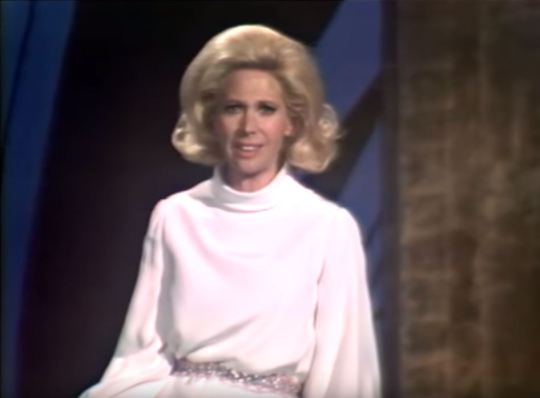
Dinah
makes her first entrance in an elegant setting singing “For
Once In My Life”
by
Ron
Miller
and
Orlando Murden in 1966 and popularized by Stevie Wonder. The song
was also recorded by Diana Ross. Dinah stops herself (literally,
thanks to special effects) and says that while “she” is singing
songs like that, the rest of us will be doing something that’s more
“like hep.”
After the opening credits, she finishes the song.After
the break, Dinah sings “Both
Sides, Now” by
Joni Mitchell, popularized by Judy Collins in late 1968.
After the song is over, Dinah bows and is instantly (thanks again to
technology) in a new outfit. Lucy bounds out to join her.Dinah:
“It’s
not easy to change clothes that fast on television thanks to all the
new restrictions on sex and violence. Senator Pastore – eat your
heart out!”
John
O. Pastore
is probably best remembered as the senator who was involved in
quizzing Fred Rodgers about the value of Public Television when it
was proposed that their Federal funding be raised by 20 million dollars. In
the end, the generally grouchy Pastore was won over by Mr. Rogers and
funding was increased to 22 million.Dinah
explains to Lucy that the term ‘hip’ has reverted to ‘hep’ again.
Which launches the song “Like
Hep”
written by Billie Barnes and W. Earl Brown especially for this
special. Diana Ross (in her first appearance) struts in for the
second chorus. Just as in “Laugh-In,” the song is occasionally
interrupted for a few quick comic exchanges about being ‘hep.’ Some of
the names mentioned in the fast-paced song include:- Terence
Stamp
– English actor famous for the films Billy Budd (1962, Oscar
nominee) and Far From the Madding Crowd (1966). - Betty
Grable
– American starlet famous for her shapely legs who starred in three
films with Lucille Ball in 1935 and guest-starred with her husband
Harry James on a 1958 “Lucy-Desi Comedy Hour.” - “Sock
it To Me” / “Bet Your Bippy”
– Catch-phrases popularized by “Laugh-In” that entered common
usage. - Andy
Warhol – pop artist and counter-culture celebrity who also produced films
and ran the famous Factory nightclub.
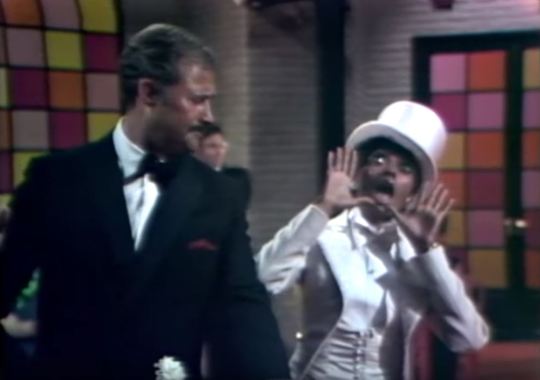
Dinah
introduces “The
Story of the Singing Detective,” which
opens in a nightclub located “in
the outskirts of beautiful lower New Jersey.”
Ross is singing a peppy “Baby
Love”
with four back-up dancers. Greg Morris (“Mission: Impossible”) is
sitting at a table with Dick Martin who constantly (and inexplicably)
wields a screwdriver. Dan Rowan is the “Boss” and Lucy is Joyce,
his “Moll.” Diana asks the Boss about her performance.Boss:
“You
do a great Minnie Pearl, but how’s your Judy Garland?”
Diana:
(singing) “Somewheeeeeeeeere…”
Boss:
“Work
on it.”Ross is attempting the song “Somewhere Over the Rainbow”, sung by Garland as Dorothy in the 1939 film The Wizard of Oz. Little did she know then that she would also play Dorothy in the 1978 film adaptation, The Wiz.
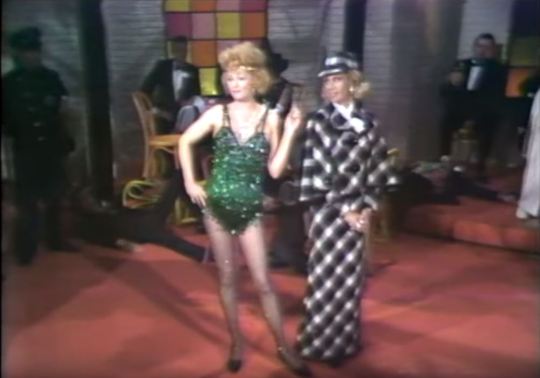
Joyce
takes the floor to sing a few bars of “Big
Spender”
written by
Cy
Coleman
and
Dorothy
Fields
for
the 1966 stage musical
Sweet
Charity.
The film version starring Shirley MacLaine was released two weeks
before this special first aired. Lucy’s belted vocals knock the
corrupt rival gang leaders dead – literally. [Note: This is likely not Lucille Ball’s voice, but that of her frequent ghost-singer,
Carole Cook.] Enter the Singing Detective played by Dinah looking like Sherlock Holmes by way of Las Vegas. The Singing Detective also has a ‘killer
voice’ and with a blast of “From
This Moment On”
(by Cole Porter) everyone in the nightclub (including Diana) drops
over dead!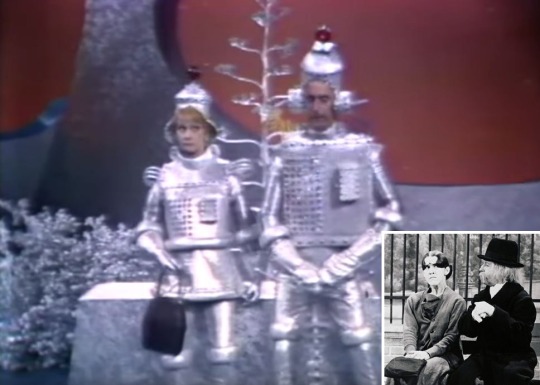
During a bit of brief banter between Lucy and Dick Martin he says he watches “Here’s
Lucy.” Dan Rowan introduces a ‘space age’ song: “The
Age of Aquarius”
from the musical Hair
sung by Diana Ross. The song pauses for Lucy and Dick to play robots who speak an unintelligible language. The robot
sketch slowly morphs into a parody of “Laugh-In’s” popular park
bench skit starring Ruth Buzzi as handbag-wielding Gladys Ormphby and Arte
Johnson as the muttering dirty old man Tyrone F. Horneigh. Lucille Ball did another version of the sketch in 1971′s “The Glen Campbell Goodtime Hour” with Arte Johnson himself.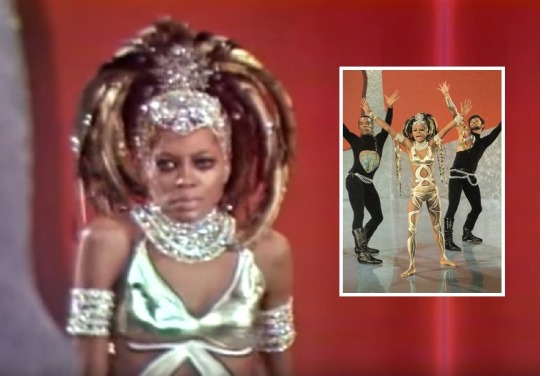
This
goes directly into Diana [wearing an outfit that only Cher would envy]
singing “Don’t
Ya Hear Me Calling To Ya?”
popularized by the Fifth Dimension and appearing on their 1969 album “The Age of Aquarius”.
It was also the ‘B’ side of the single. The song goes back to Diana
singing “The
Age of Aquarius / Let the Sunshine In.”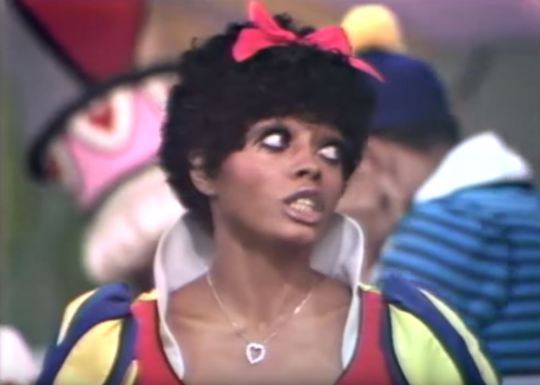
After
”station identification” [remember that?] the background music plays “When
You Wish Upon A Star”
and Dinah introduces “The
Fairy Godmother’s Revenge,”
a fairy tale parody set in Goosetown, a village populated by various storybook
characters. Diana plays Snow White [!], who is worried about the seven dwarfs,
who have gone on strike at the gold mine.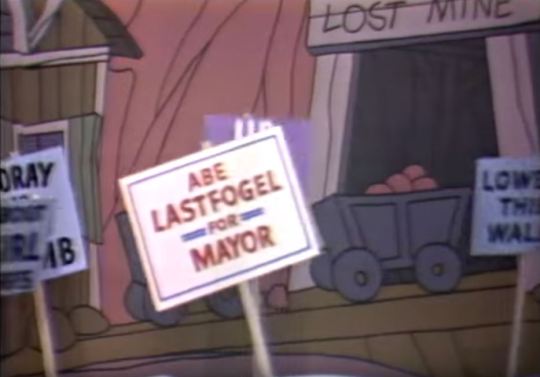
The dwarfs’ picket line is
behind a wall so only their protest signs can be seen. One of the
signs says “Abe Lastfogel for Mayor.” Abe Lastfogel was the
long-time president and agent of the William Morris Talent Agency.
When he died in 1984 he had worked for the agency for 72 years.
Unsurprisingly, he was Dinah Shore’s agent.Other
picket signs say:- “Shorter Hours, Smaller Work Days”
- “Mickey
Rooney for President” - “Raise the Floors”
- “Lower the
Ceilings” - “Movie Shorts for Lunch”
- “Rich Little is Nice”
- “More Short Term Loans”
- “We Love Teeny Boppers”
- “Hooray for Tom Thumb”
- “Up With Tiny Tim”
- “How About Some Girl Dwarfs”
- “Cheers for Jockey Shorts.”
Dick
Martin plays Little Boy Blue using a New Orleans drawl and Dan Rowan is
a rhyming Little Tommy Tucker. For help with the strike, Snow White
calls upon her Fairy Godmother (Lucy), and she magically appears.
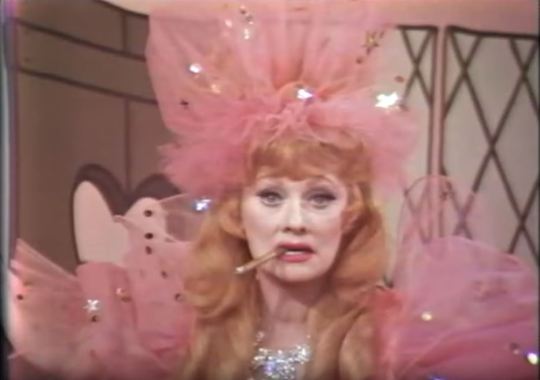
Lucy is wearing a pink Glinda-like dress and chomping on a cigar. She
is a grouchy Fairy Godmother, annoyed about being woken from her five
decade trance.Fairy
Godmother: (to
Little Boy Blue): “Are
those your real clothes or are you just trying to stay out of the
Army?”“Like
Hep” aired at the height of the Vietnam War and the attendant peace
movement. To avoid the draft, some men would claim psychological
exemption due to homosexual or transsexual behavior. This idea was
mined for comedy through the character Klinger (Jamie Farr) on TV’s
“M*A*S*H” (1972).Little
Boy Blue (about
the Fairy Godmother): “I
hear she’s been bugged ever since her twin sister did the stunts in
‘Mary Poppins’.”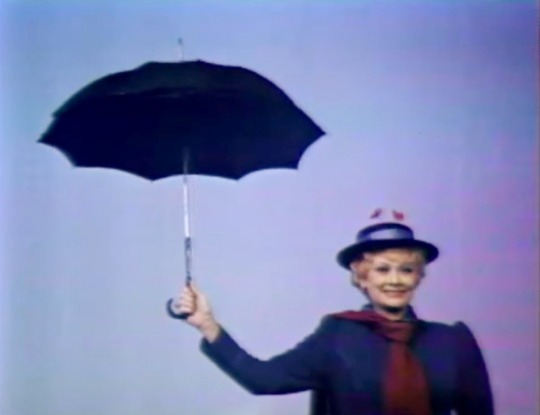
That’s
Lucy’s cue to go flying overhead (on very visible wires) as Mary Poppins, singing “A
Spoonful of Sugar.”
Once again, Lucy’s singing voice is probably dubbed by Carole Cook.
Dinah comes in and out as several fairy tale damsels: Little Miss Muffet looking for her tuffet; a girl
named Candy looking for a guru; and Little Bo-Peep looking for her
sheep.Trying
to make the mean Fairy Godmother smile, Bo-Peep and Snow White sing a
song that mashes up all the fairy tales into one and (at the end) even
includes suggestions of Dracula!Bo-Peep and Snow White:
“That’s our fairy
bippity-boppity-zippidy-bang-bang-chitty-chitty-doo-dah tale!”
As
Mary Poppins (“the
Fairy Godmother’s crazy stuntman sister”)
flies in to save the day, she collides mid-air with Ye Olde Flying
Nun. The TV series “The Flying Nun” starring Sally Field ran from
1966 to 1970 on ABC. The mean Fairy Godmother finally gives in to
the dwarfs’ demands. [General rejoicing.]Dinah:
“They
lived happily ever after. The dwarfs grew up and became Jim Arness.
The Fairy Godmother turned into an aardvark and ate Philadelphia. And
as you well know, the giant chicken and the giant rabbit ran off to
Athens together and became Spiro and Agnew.”Jim
(James) Arness played
Marshal
Matt Dillon from
1955 to 1975 on the TV series “Gunsmoke.” Greek-American Spiro
Agnew
was the recently elected Vice-President of the United States under
Richard Nixon.
In a break from the silliness, Dinah
sings “The
Windmills of Your Mind” by
Michel
Legrand and
Alan
and Marilyn Bergman for the
1968 film The
Thomas Crown Affair wining
the Academy Award for Best Song.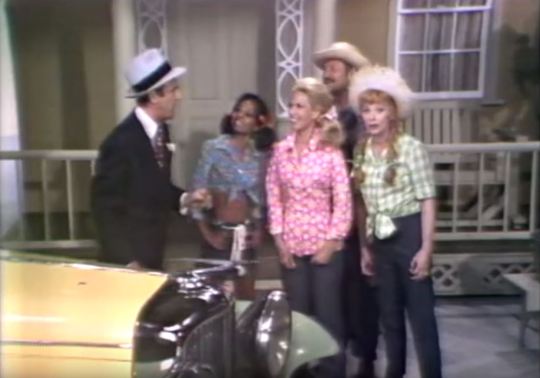
A
sketch about the country bumpkin Whitebread
Family
starts with a down-home song from Mandy (Lucy), Randy (Dinah) and
Sandy (Diana). A rich stranger rolls up (in a Rolls), and offers to
put them in “the show business.”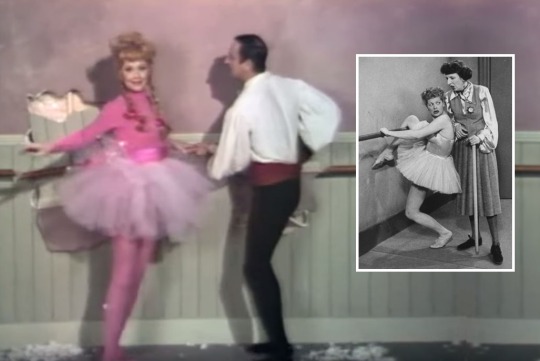
In a montage sequence, the three
girls each take ballet lessons. The sight of Lucy at the barre is
immediately reminiscent of “The Ballet” (ILL S1;E19), where Lucy
Ricardo was put through her paces by Madam Lamond (Mary Wickes). In
the next montage, the girls take music lessons. All the while, the
trio’s brother (Dan Rowan) is trying out his frog impressions while
holding a plate of apple pie with an American flag stuck in it. [No.
Really.]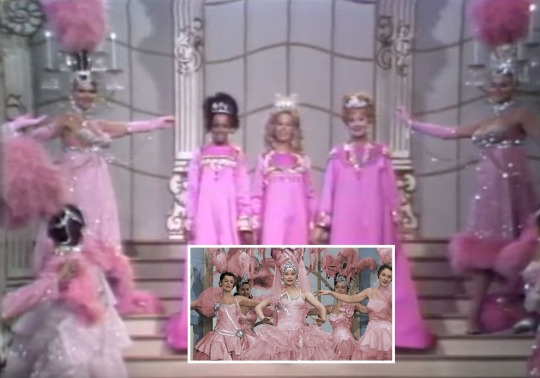
Flash
forward to “a
little more than four months later,” the Whitebreads are in Las Vegas doing their act, which begins with
“There’s
No Business Like Show Business”
by Irving Berlin. On a huge Ziegfeld-like staircase (the same from
earlier in the show), flanked by glittering showgirls and boys, the
now formally dressed Whitebreads sing…the same old country bumpkin
song the sketch started with! The image of Lucy poised at the top of a high staircase immediately brings to mind when “Lucy Gets Into Pictures” (ILL S4;E18).In
a serious segment, Dinah sings “Cryin’
Time,”
first written by Buck Owens in 1964. It won a 1967 Grammy Award for
Ray Charles.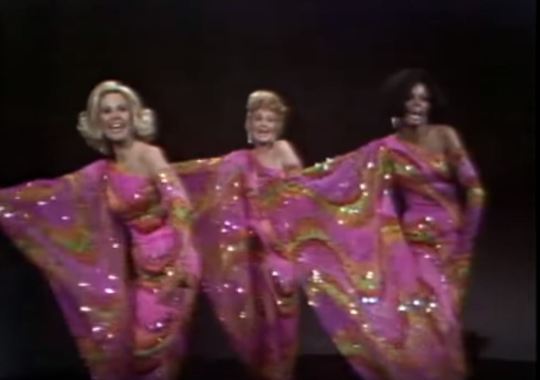
After
Dinah blows her trademark “Mwah!” goodnight smooch to the
audience, Lucy, Diana and Dinah sing an uptempo ‘hep’ version of
“Dinah”
written in 1925 by Harry Akst, Sammy Lewis, and Joe Young. It was
the song that inspired Shore’s stage name (she was born Fannye Rose)
and it became her signature song. The credits roll. [Finally!]

“Like
Hep” was rerun on NBC several years later, an unusual
occurrence as specials were rarely rerun. For the rerun, several moments were edited out:- The “Bonanza” reference;
- A reference to Nixon
adviser John Dean; - A reference to gravel-voiced Senate Minority
Leader Everett
Dirkson, who had
made an LP of patriotic speeches with patriotic music in the
background. One critic later compared Lucy’s singing voice in
Mame
to Dirksen’s.
Missing
from the end of the “Dinah” number as it was originally
run: Dinah interrupts the singing to announce “be
sure to tune in next week for the return of ‘Bonanza’” (the
9pm Sunday time slot the special was run in) followed by a shot of
the Smothers Brothers saying "Darn
it”
followed by a shot of Lorne Green chuckling. “The Smothers
Brothers Hour” was the first show CBS programmed opposite
“Bonanza” that actually made a dent in “Bonanza’s”
ratings.
This
Date in Lucy History – April
13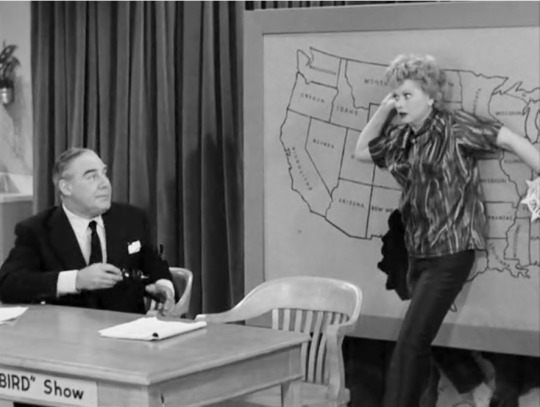
“Lucy
Wants A Career”
(LDCH) – April 13, 19591969, Andy Warhol, Betty Grable, Carole Cook, Chris Bearde, Coslough Johnson, Dan Rowan, Diana Ross, Dick Martin, Dinah Shore, Gary Owens, George Schlatter, Greg Morris, Hep, Here’s Lucy, Hip, Jan Meyer, John Pastore, Laugh-In, Like Hep, Lucille Ball, Marc Breaux, Mary Poppins, NBC, Rowan & Martin’s Laugh-In, Terrence Stamp, The Flying Nun, The Smothers Brothers, tv, Victor Buono - Terence
-
VAN DYKE & COMPANY
December 9, 1976
(S1;E9)

Directed by John Moffitt
Written by George Burditt, Garry Ferrier, Ken Finkelman, Mitch Markovitz, Don Novello, Pat Proft, Leonard Ripps, Mickey Rose, Aubrey Tadman, Paul Wayne, Dick Van Dyke

Dick
Van Dyke
(Himself, Host / Various Characters) was
born Richard Wayne Van Dyke in West Plains, Missouri, in 1925.
Although he’d had small roles beforehand, Van Dyke was launched to
stardom in the 1960 Broadway musical Bye
Bye Birdie,
for which he won a Tony Award. He reprised his role in the 1963 film.
He has starred in a number of other films throughout the years
including Mary
Poppins
(1964) and Chitty
Chitty Bang Bang
(1968).
From 1961 to 1966 he played TV writer Rob Petrie in “The Dick Van
Dyke Show.” He also starred in “The New Dick Van Dyke Show”
(1971-74), “Van Dyke & Company” (1976), and “Diagnosis
Murder” (1993-2001).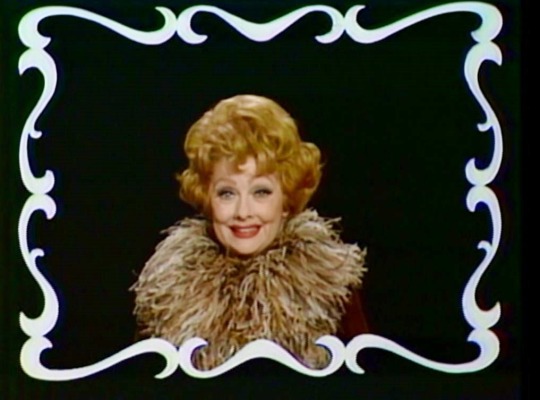
Lucille
Ball (Herself,
Various Characters) was born on August 6, 1911 in Jamestown, New
York. She began her screen career in 1933 and was known in Hollywood
as ‘Queen of the B’s’ due to her many appearances in ‘B’
movies. With Richard Denning, she starred in a radio program titled
“My Favorite Husband” which eventually led to the creation of “I
Love Lucy,” a television situation comedy in which she co-starred
with her real-life husband, Latin bandleader Desi Arnaz. The program
was phenomenally successful, allowing the couple to purchase what was
once RKO Studios, re-naming it Desilu. When the show ended in 1960
(in an hour-long format known as “The Lucy-Desi Comedy Hour”) so
did Lucy and Desi’s marriage. In 1962, hoping to keep Desilu
financially solvent, Lucy returned to the sitcom format with “The
Lucy Show,” which lasted six seasons. She followed that with a
similar sitcom “Here’s Lucy” co-starring with her real-life
children, Lucie and Desi Jr., as well as Gale Gordon, who had joined
the cast of “The Lucy Show” during season two. Before her death
in 1989, Lucy made one more attempt at a sitcom with “Life With
Lucy,” also with Gordon, which was not a success and was canceled
after just 13 episodes.
The
Lockers
was a male lock dance troupe first known as the Campbell Lockers
formed
by Toni
Basil
and
Don
Campbell
in
1971. They were pioneers of street dance.
They
appeared on “The Tonight Show,” “Saturday Night Live,” and
“What’s Happening!!” This is their final TV appearance.Andy
Kaufman
(Andy) was a performance artist and comedian. He is best
known for playing Latka Gravas on the TV sitcom “Taxi.” Andy
appeared in movies, on Broadway, did a one man show at Carnegie Hall,
enjoyed a brief professional wrestling career, and performed in
concerts nationwide.
He died in 1984 of lung cancer.Kaufman is not
credited in the opening title sequence nor in the closing voice over
credits. This was likely to lend veracity to his continual habit of ‘crashing’ the show and interrupting Van Dyke’s guests.L.A.
Mime CompanyJohn
Wheeler (Mr.
Haley, Network Executive) was in the New York stage productions of
Wonderful
Town
(also on TV in 1958) and Sweet
Charity
(also
the film 1969). He was seen opposite
Lucille Ball as Judge Breghoff in the movie Mame.
He appeared on one episode of “Here’s Lucy” (S6;E16) in 1974.
Coincidentally, he played Fred Mertz in the TV film “Lucy and Desi:
Before the Laughter” in 1991.Barry
Van Dyke (Honey
#2 / Helen’s Paramour) was Dick Van Dyke’s son born in July 1951,
just two weeks after Lucie Arnaz. Like Lucie, he made his screen
debut on his parent’s TV show in 1962 and went on to larger roles in
subsequent series’. Probably his most famous of those roles was as Steve
Sloan in “Diagnosis Murder” (1993-2001).It
is a bit odd that Van Dyke’s real son is playing (who is inferred to be)
his male lover in the “Honey, I’m Home” sketch.Judy
Von Wormer
had played one of the singers in “Lucy, The Co-Ed” (HL S3;E6) in
1970.Brian
Bruno and Barney, The Paul FamilyStu
Nahan (Announcer)

“Van
Dyke & Company” was
a short-lived variety show that aired on NBC from September 20, 1976
to December 30, 1976. A pilot episode was shot in October 1975, but
the series did not debut for another 11 months.
In
a 1965 appearance on “Art Linkletter’s House Party” Lucille Ball
said that “The Dick Van Dyke Show” was her favorite television
program. The series was shot at Desilu Studios. It took 11 years for Van Dyke and Ball to collaborate.
This is the first time Ball and Van Dyke have acted opposite each
other, although the two had appeared as guests on “Salute to Stan
Laurel” in 1965.
A week before her appearance on “Van Dyke &
Company,” Dick Van Dyke appeared on “CBS Salutes Lucy: The First
25 Years” paying tribute to Lucy’s skill at pantomime (something both were
adept at and demonstrate here) from the set of his show. In 2001, Van
Dyke co-hosted “I Love Lucy’s 50th Anniversary Special.”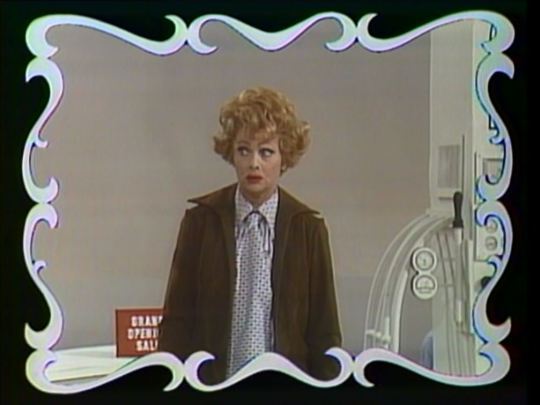
Genealogists claim that Lucy and
Van Dyke are distant relatives. They are 10th cousins, once removed.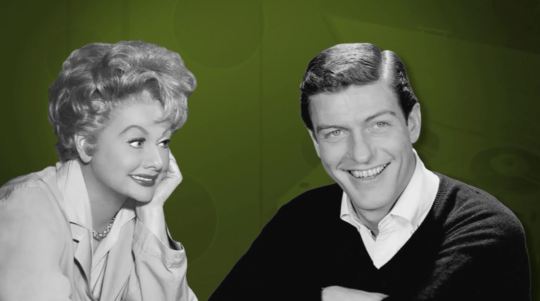
This
episode of “Van Dyke & Company” was aired by MeTV on August
6, 2017 (Lucy’s birthday). The entire series is available on DVD
from MPI Video. Bonus features include audio from Van Dyke as a
guest on “Let’s Talk to Lucy,” Ball’s 1964-65 radio show. For
this episode, only Andy Kaufman’s Elvis impersonation has been
omitted, likely due to royalty restrictions.On
December 15, 1976, less than a week after this episode of “Van Dyke
& Company” aired, Lucille Ball was on the dais for “The Dean
Martin Celebrity Roast” of Danny Thomas.
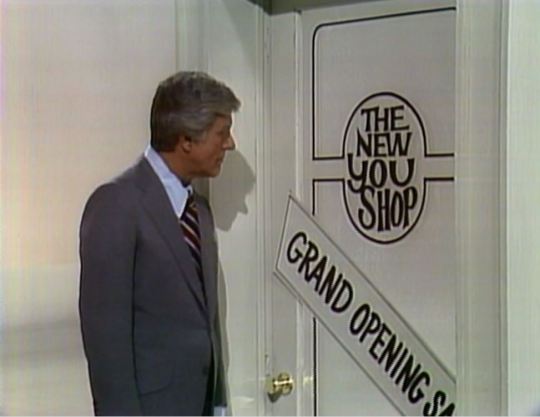
A
cold open (pre-credits) has Dick paying a visit to the grand opening
of “The
New You Shop” staffed
by Lucy, in a wordless physical comedy sketch. The premise has Lucy
selling new ‘body parts’ (invisible and pantomimed with the help of
sound effects) such as legs, chests, hands, faces, and feet.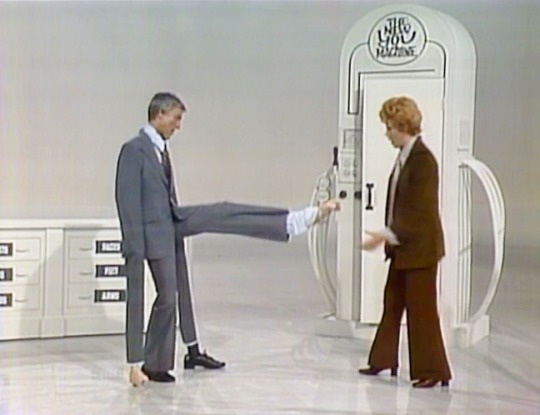
Trying
on the parts inside ‘The New You Machine’, something goes horribly
wrong. Dick emerges with arms that scrape the ground and a hand on
the end of his foot!
In
Dick’s monologue he demonstrates the differences in the family hour
format as opposed to later time slots using a fictional show called
“Honey,
I’m Home.” The
Family Viewing Hour was a policy established by the Federal
Communications Commission (FCC) in 1975. Under the policy, each
television network had the responsibility to air “family-friendly”
programming during the first hour of the prime time lineup (8 to 9 pm
Eastern Time).
“Van Dyke & Company” occupied the ‘Family Hour’ time slot.- “Honey,
I’m Home” 8pm to 9pm (‘Family Hour’) – Dick comes home to
find his wife waiting patiently on the sofa. - “Honey,
I’m Home” 9pm to 10pm – Dick comes home to find his wife kissing
another man. - “Honey,
I’m Home” 10pm to 11pm – Dick comes home to find the same couple
looking at a road map, but the ‘honey’ he’s come home to is the man,
not the woman! - He
attempts to show the audience “Honey, I’m Home” after midnight,
but quickly opens and shuts the door, horrified at what he’s seen
(and we don’t).
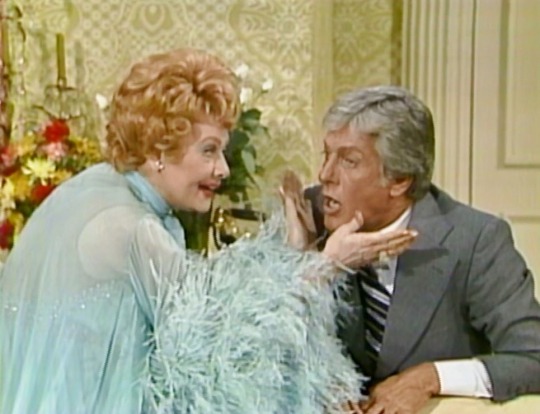
A
network executive (John Wheeler) appoints Richard (Dick) to Vice
President of Programming in order to get him to tell fading star
Marion
Lane
(Lucy) that her show has been canceled. Lucy receives a big ovation
from the studio audience, which indicates this may be the first
segment shot, with the cold open pre-taped without a studio audience.Marion
seems to know what he’s come for and quickly takes a liberal amount
of tablets.Richard:
“Marion,
what’s that you’re taking?”
Marion:
“Sleeping
pills.”
Richard:
“Wouldn’t you call that a kind of a heavy dose?”
Marion:
“I’d
call it an overdose.”Turns
out they were just breath mints. Still fearing the worst, Marion
momentarily straddles an open window. When he finally delivers the
bad news, she slaps him hard across the face, sending him careening
over the divan. The sketch has a surprise twist ending with Richard
being Marion’s husband!
Dick
is discovered chiseling a sculpture and telling the audience that
he’s always wanted Rudolf Nureyev as a guest. He finally got a call
from the dancer to tell him that he will be appearing – on “The
Gong Show.” “The Gong Show” was a low-budget amateur talent
show that had only premiered on TV a few months earlier. This set-up
is by way of introducing what Dick calls “the
most fabulous dancers around”
– The
Lockers.
After they perform their main act, Dick joins in, even wearing one of
their costumes.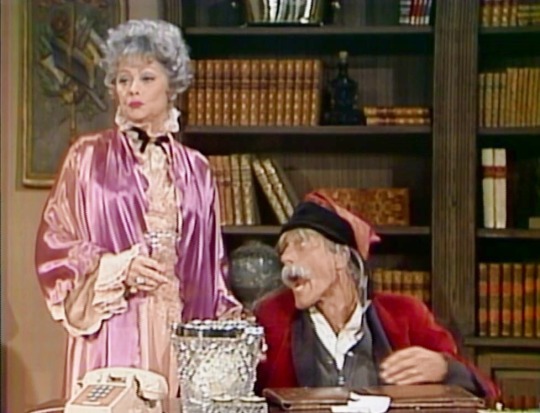
Dick
and Lucy play Helen
and Edgar,
a couple celebrating their 40th anniversary. Edgar is 115 years old,
and Helen is 75. She only married him thinking she would soon be a
rich widow. Van Dyke’s characterization of Edgar is reminiscent of
when he played the elderly banker Mr. Dawes Sr. in Mary
Poppins
(1964). Helen tries everything she can think of to hasten her
inheritance.She
cracks a champagne bottle on his head. Nothing.She
tries to guillotine him while blowing out the candles on their
anniversary cake. It misses.She
gives him a big anniversary kiss with an electrified wire. He is energized by it.She
offers him some fresh air out on the balcony (which they don’t have)
and pushes his wheelchair headlong out the terrace doors. Helen
thinks she’s finally succeeded in offing him, but he comes rolling
through the opposite door a few moments later, his wheelchair now a
mash-up of a trash can and mobility device.Helen
finally slips Edgar a mickey that does the trick – but first he
calls up the newspaper to place his own obituary. The sketch has a
twist ending with the entrance of Helen’s paramour (Barry Van Dyke),
who may be trying to do the same thing to her!
Dick
and Lucy are having some banter as themselves when Andy
Kaufman
arrives with his tape player wanting to be on the show. Although Dick
says that Andy should just go away, Lucy says that she’s seen Andy on
the show before, and that he always interrupts guests, and they’ve
all been very good sports about it. Lucy says that she just doesn’t
happen to be one and swiftly exits. Dick says Andy has previously
insulted Carl Reiner (S1;E4), Hal Linden (S1;E5), John Denver
(S1;E3), and now Lucy. Dick exits to find a security guard.Alone
with the audience, Kaufman starts with an imitation of “Sanford and
Son” saying (in his inimitable way, with clipped diction and
seemingly incapable of imitating Redd Fox)“Elizabeth.
I am coming to join you.”He then tackles ‘the Fonzie’ from “Happy Days”:
“Eh.
Eh. Sit on it you stupid nerd.”Again without a trace of intonation or nuance. Finally he does a sped
up Elvis Presley imitation. [This song has been omitted from the DVD
release, probably due to song royalty fees. It is apparent that it
has been edited out because the sketch on video quickly fades out and
Kaufman had not yet used the tape recorder he brought onstage at the
start.]
In
another silent pantomimed sketch (the second of the show), Lucy and
Dick play tourists taking photographs in a Tropical
Forest.
To get the perfect photo, Lucy and Dick virtually destroy the forest,
breaking off twigs, pulling up flowers, and cutting down trees.
Luckily, their picnic hamper comes equipped with a hacksaw and
dynamite!
In a final act of desecration, Lucy bulldozes the entire
area clear, turning the lush setting…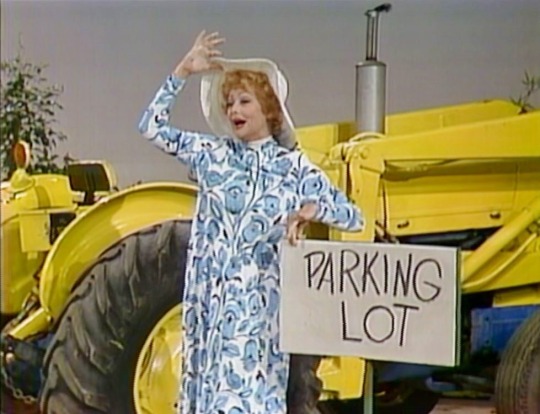
…into a parking lot!
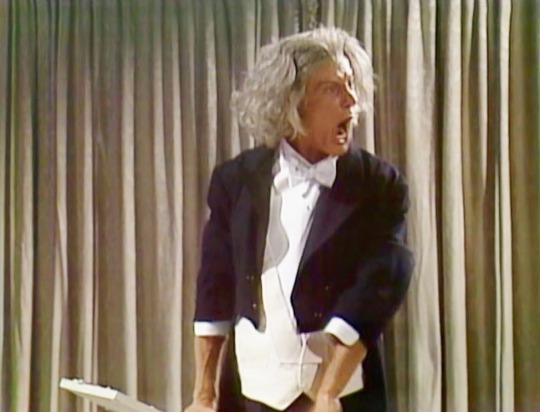
Dick
plays a long-haired Maestro
(in sneakers) but instead of an orchestra, he conducts dancers. When
the dancers go from classical to modern, the Maestro nearly gives up
trying to control them, but when the music turns to a Broadway sound,
even he joins in.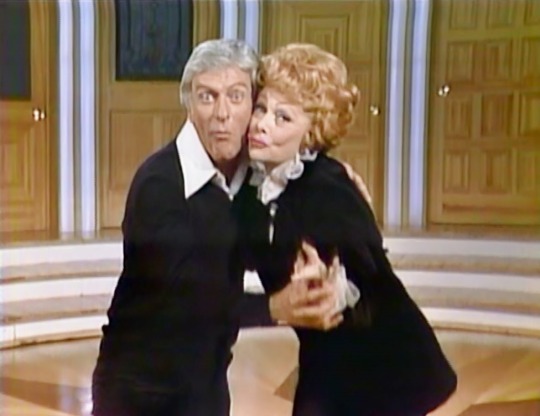
In
the closing, Dick sings “You
Make It So Easy”
to Lucy. The two do some simple, yet funny, dance steps as well.
This
Date in Lucy History – December 9
“Lucy
and the Military Academy”
(TLS S2;E10) – December 9, 1963
“Guess
Who Owes Lucy $23.50”
(HL S1;E11) – December 9, 1968
“An
All-Star Party for Lucille Ball” – December 9, 1984 - “Honey,
-
CBS SALUTES LUCY: THE FIRST 25 YEARS
November
28, 1976
With
Tributes By: William S. Paley, Desi Arnaz Sr., Milton Berle, Carol
Burnett, Richard Burton, Johnny Carson, Sammy Davis Jr., Gale Gordon,
Bob Hope, Danny Kaye, Dean Martin, Jimmy Stewart, Danny Thomas,
Vivian Vance, Dick Van Dyke, John Wayne, and Lucille Ball
Archive
Footage: Mary Wickes, *Harpo Marx, William Frawley, Pat Moran, Maury
Thompson, Edward Everett Horton, Teresa Tirelli, Ross Elliott, Jerry
Hausner, Bess Flowers, Dick Martin, Donald Briggs, Joe Ruskin, Bryan
O’Byrne, Danny Borzage, Morgan Woodward, Victor Romito, Elvia Allman,
John Williams, Lloyd Corrigan, Ernesto Molinari, Rosa Barbato, Eva
Gabor, *Lucie Arnaz, Larry J. Blake, Larry Keating, Robert Carson,
*John Bubbles, Paul Winchell, Mel Torme, *Ken Berry, *Red Skelton,
*George Burns, *Patty Andrews, *Wayne Newton, Jerry Newton, *Desi
Arnaz Jr., Tommy Amato, Don Vincent, *Jack Benny, *William Holden,
Harry Bartell, Hazel Pierce, Bennett Green, Dede Ball, Dick
Patterson, Roy Rowan, Vanda Barra, and +Eddie Albert*
credited in voice over
+
not on DVD releaseArchival
footage from: “I Love Lucy” (1951-57), “The Lucy-Desi Comedy
Hour” (1957-60), “The Lucy Show” (1962-68), “Here’s Lucy”
(1968-74), “Carol + 2” (1964), “The Danny Kaye Show with
Lucille Ball” (1962), and “Lucy In London” (1966).Some
stars mentioned in the opening credits by the announcer as “starring”
do not actually appear in newly created tributes, but only in archival footage.
This is likely due to negotiations with the stars agents (or estates)
who gave permission for their images to be used in exchange for
opening title credit. Those stars include: Patty Andrews, Jack Benny
(died 1974), Ken Berry, John Bubbles, George Burns, William Holden,
Harpo Marx (died 1964), and Wayne Newton, all of whom have considerable screen time in the clips. Although some of these
names might have been used to lure viewers into watching (and not tuning away from) the two-hour
program, it is probably not likely with someone like
John Bubbles.Some
of those absent from archival footage include Mary Jane Croft,
Kathryn Card, Doris Singleton, Charles Lane, Frank Nelson, Ann
Sothern, and Sid Gould, all of whom made many appearances opposite
Lucille Ball over the years.

The
program was very well received and received a 29 rating and 39 share
of audience, figures unheard of today. Because of the anniversary
theme of the show, it was never repeated.
The
special was issued on DVD by Image Entertainment. The cover photo is
of Lucille Ball at the Emmy Awards.
CBS used other artwork, inexplicably based on her costume from “Lucy Goes To Scotland”
(ILL S5;E17).
For
the DVD release, eight minutes of the show were trimmed for a total
running time of 97 minutes Among the missing segments was a tribute
to the late William Frawley, hosted by Gale Gordon, featuring Frawley
and Vivian Vance singing “Carolina in the Morning.” Frawley
died in 1966. In 1976 he was the only member of the main “I Love
Lucy” cast to have passed away. Also
missing is Lucy’s soft-shoe of “Makin’ Whoopee” with Eddie
Albert. It is possible that the owners of the music copyrights were
asking more for licensing fees than the DVD producers were willing to
pay or that Albert declined permission for his image to be used.
Naturally, it may also have just been an editorially decision to edit
the show.
This
special was produced before technology made restored, pristine prints
available. Scenes from “I Love Lucy” (owned by CBS) are the
clearest but clips from “The Lucy Show” and “Here’s Lucy”
(owned by others) are often quite poor.This special is billed “The First 25 Years” but sadly Lucille Ball would only work for another decade, and not at CBS. Although it seemed like the Tiffany Network (who adopted their ‘CBS eye’ logo the same month “I Love Lucy” premiered) and Lucy would never part, Ball joined NBC in 1980, announcing her changed allegiance with a star-studded special “Lucy Moves to NBC.” The partnership was short-lived, however. In 1986 CBS declined to pick-up “Life With Lucy” (perhaps still stinging from her departure), so it went to ABC. This means Lucille Ball was seen on all three major networks.
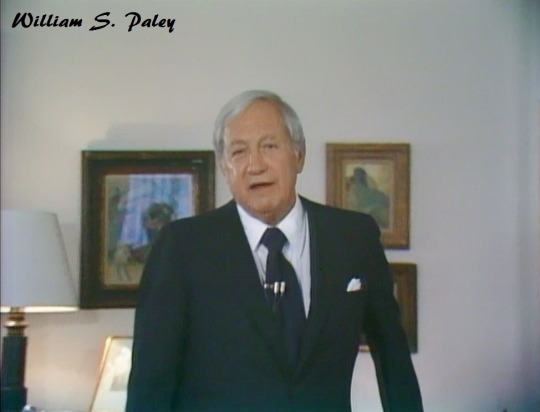
INTRODUCTION
The
tribute show is introduced by CBS Chairman William
S. Paley. In
1964 episode of “The Lucy Show” (TLS S3;E15), Danny Kaye
telephones Paley about getting tickets to his show for Lucy
Carmichael. Paley, however, was not seen or heard.To
kick things off, a montage of memorable moments of Lucy on TV is
underscored by Frank Sinatra singing “My Kind of Girl” by Leslie
Bricusse.
LUCY
& DESIA
clip from “The Audition” (ILL S1;E3) leads into an appearance by
Desi
Arnaz Sr. standing
outside Stage 2 of General Service Studios where “I Love Lucy”
was first shot. Desi describes this as a scene from their pilot. The
unaired “I Love Lucy” pilot (not seen until 1990), included this
same material, but it was re-staged for the actual series in October
1951. This leads into a compilation of clips of Lucy Ricardo making
fun of Ricky’s English. Desi estimates the he and Lucy did nearly 200
shows together. Including “The Lucy-Desi Comedy Hours” (13), the
un-aired pilot, and the “Christmas Special,” Desi is not far off.
The total comes to 194 shows, not counting their guest appearances on
other programs.
VITAMEATAVEGAMIN
Desi’s
awe and admiration of his ex-wife’s craft and talent is demonstrated
with a clip from the classic episode “Lucy Does a TV Commercial” (ILL S1;E30) aka
“Vitameatavegamin.” Arnaz watched Lucy do the scene just off camera and his recognizable laugh can be heard on the soundtrack.
HAVING
A BABYDesi
recalls the show that is closest to his heart: “Lucy is Enceinte”
(ILL S2;E10). The clip that follows has Ricky singing “We’re
Having a Baby (My Baby and Me)”
first written
in 1941 for the Broadway musical Banjo
Eyes.
For this special, the edit includes clips of other scenes of Lucy
Ricardo when expecting, including “Lucy Goes to the Hospital”
(ILL S2 E16).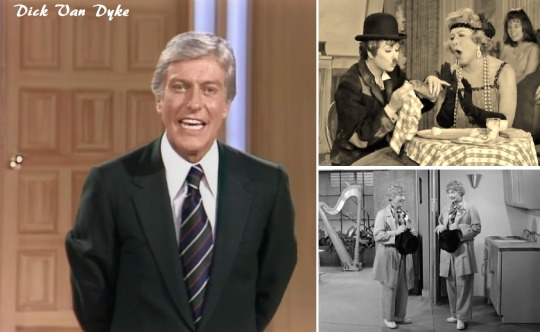
SILENT
COMEDYTo
introduce his segment, Dick
Van Dyke
begins with pantomiming netting a butterfly on the set of his
short-lived variety show “Van Dyke & Company.” A week later,
Ball would guest star on the series. This intro was probably filmed
at that time. Here he defines ‘mime’ for the audience and then
introduces a clip of Lucy doing a silent movie skit as Charlie
Chaplin from “Chris’s New Year’s Eve Party” (TLS S1;E14) and the
mirror routine in “Lucy Meets Harpo Marx” (ILL S4;E28).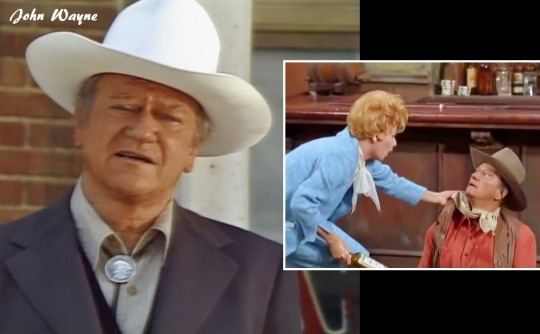
LUCY
& THE DUKEWestern
star John
Wayne emerges
from a back lot saloon and jokingly says that of all his on-screen
opponents, the most formidable one was Lucy. A clip from 1966’s “Lucy
and John Wayne” (TLS S5;E10) follows. In the scene Lucy Carmichael
is visiting the set of Wayne’s latest western and (naturally)
disrupts the shoot.
FRIENDS
FOREVERVivian
Vance,
drinking a cup of tea in her home, talks about her beginnings on
television as Mrs. Fred Mertz. Vance remembers the schemes Lucy got
her involved in, mostly to get Lucy into show business. Clips include
“The Operetta” (ILL S2;E5) with Lucy as Camille, the
snaggle-toothed Queen of the Gypsies. In the clip, the chorus upstage
her big number, “The Queen of the Gypsies” written by Eliot
Daniel, who also wrote the series’ theme song. Vance says they lived
out their childhood fantasies on screen, like working in a chocolate
factory. A clip from “Job Switching” (ILL S2;E1) has Lucy and
Ethel on the candy wrapping assembly line at Kramer’s Candy Kitchen.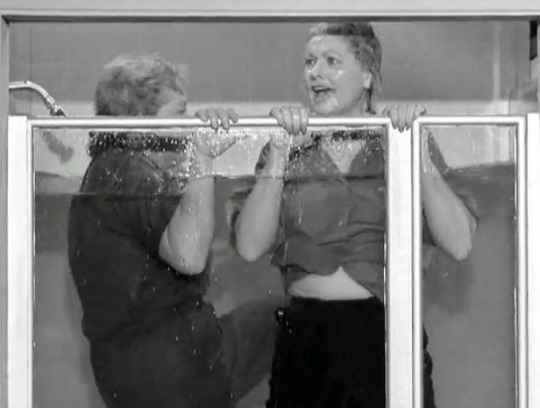
There
is also a clip from “Lucy and Viv Put in a Shower” (TLS S1;E18)
where Lucy Carmichael and Vivian Bagley install a home shower, only
to get trapped inside as it fills with water.
TWO
REDHEADSTo
the music of the theme from her show, Carol
Burnett (redhead #1) is
seen backstage, sitting in a director’s chair. She recalls meeting
Lucy for the first time, when she came to the second night of Once
Upon a Mattress
on May 12, 1959. Carol fondly recalls that Lucy always called her
“kid.” Carol introduces a clip from “Carol + 2” (1964) in
which Lucy and Carol play night cleaning ladies at a talent agency
singing “Chutzpah!”
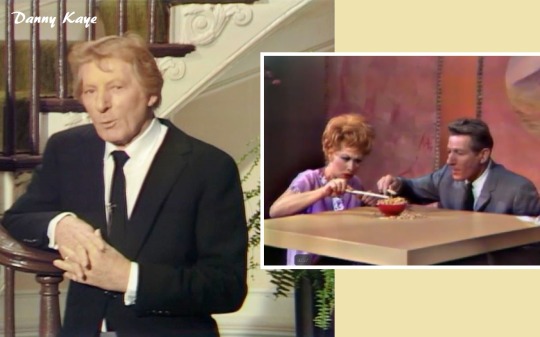
Danny
Kaye (redhead #2) comes down a staircase to talk about Lucy’s skill at physical comedy.Kaye:
“Calling
Lucille Ball ‘just’ a comedian is like calling Margot Fonteyne ‘just’
a dancer.”The
dance metaphor helps Kaye introduce a clip of Lucy’s dancer-like
physical agility in a sketch seen on the Emmy nominated “The Danny Kaye Show with Lucille Ball” (1962) in which Lucy and Kaye go to a
Japanese restaurant and must adapt to the customs of the Tea House –
all without dialogue.LUCY
AROUND THE WORLD
Kaye
reports that Lucille Ball is on television in 78 different countries.
This leads to clips from shows dubbed in French (“Lucy and the
Great Bank Robbery” TLS S3;E5)…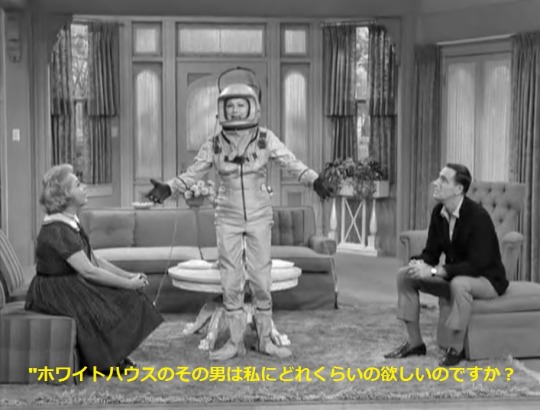
Japanese (“Lucy Becomes an
Astronaut” TLS S1;E16)…
Spanish (“Lucy Thinks Ricky Is Trying to
Murder Her” ILL S1;E4)…
and capped off with the famous grape
stomping scene from “Lucy’s Italian Movie” (ILL S5;E23), which
was already mostly in Italian, with (humorous) English subtitles.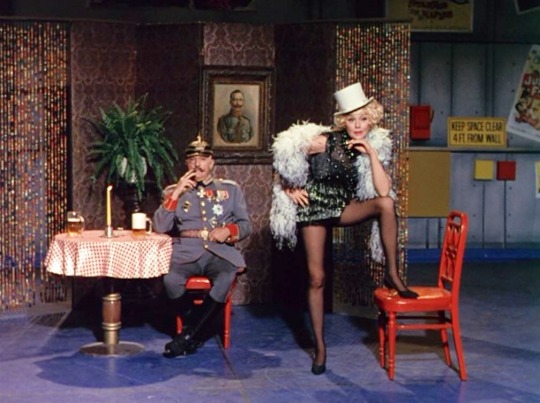
Kaye
states that Lucille Ball is so popular because she has universal
appeal. He introduces a clip from “The Hollywood Unemployment
Follies” (HL S3;E22) where Lucy Carter sings
“Falling
in Love Again (Never Wanted To)”
in costume as Marlene Dietrich from
the 1930 German film The
Blue Angel to
Gale Gordon.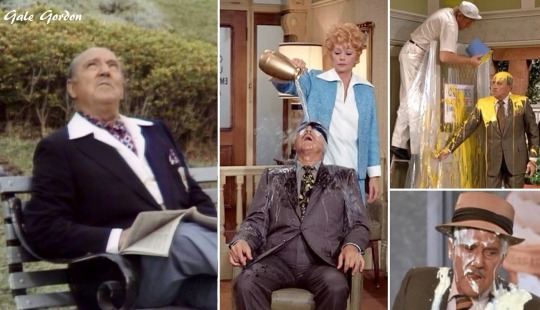
ALWAYS
GETTING ITThis
conveniently leads to discovering Gale
Gordon sitting
on a park bench. He says he likes the quiet of the park as opposed to
working with Lucy, because nothing can spill on him. He then casts a
cautionary glance at the sky and says “Watch
it, pigeons!”
A series of clips from “Here’s Lucy” reveals Gordon “getting
it” – getting wet, dirty, and generally messy through a variety of
assaults.
DANCING
FOOLSammy
Davis Jr.
is discovered dancing on a stage. Davis is one of the only stars in
the Tribute who appeared with Lucy on her show (in 1970), but is not
seen in archival footage.Sammy:
“That
lady does it all, man!”He
introduces clips of Lucy singing and dancing.- Lucy and John
Bubbles do a soft-shoe in “Main Street USA” (TLS S5;E17); - A
production number from “Lucy Helps Ken Berry” (TLS S6;E21); - A
hobo number with Red Skelton in “Lucy Goes to Alaska” (LDCH
1959); - A soft shoe from “Lucy with George Burns” (TLS S5;E1);
- Singing “The Pennsylvania Polka” with Lucie Arnaz and Patty
Andrews in “Lucy and the Andrews Sisters” (HL S2;E6); - Tthe big
finale from “Lucy Puts Main Street on the Map” (TLS S5;E18); - Playing banjo and singing “Waiting
for the Robert E. Lee”
with
Lucie Arnaz and Wayne Newton, while Desi Jr. plays drums in the
background in “Lucy Sells Craig to Wayne Newton” (HL S1;E9).

A
transitional clip from “Lucy Gets Jack Benny’s Account” (TLS
S6;E6) which ends with Lucy and Benny sinking in a pit of quicksand and leads into…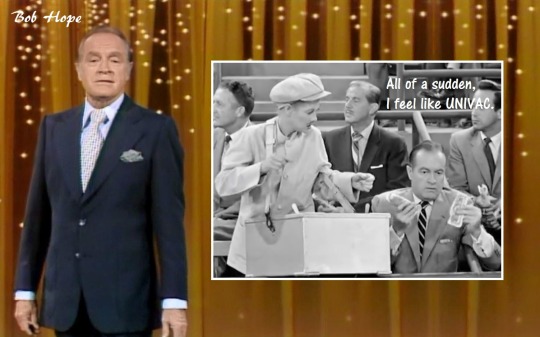
THANKS
FOR THE MEMORIESBob
Hope
singing his signature song “Thanks for the Memory” with special
lyrics about Lucy. A clip of “Lucy and Bob Hope” (ILL S6;E1) has
Lucy undercover as a hot dog vendor at Yankee Stadium and Hope
getting conked on the head with a fly ball. After the clip, Bob Hope
says that the title of world’s funniest lady is a tie between Lucille
Ball and Milton Berle, which is a cue for a clip from 1958’s “Milton
Berle Hides Out at the Ricardos” (LDCH 1958) with Milton Berle in full
drag as Mildred Burke.
STAR-STRUCK
Cut
to Milton
Berle
standing in front of the Hollywood Brown Derby to introduce a clip
from “Hollywood at Last!” (ILL S4;E16) starring William Holden.
The iconic derby-shaped eatery was closed and razed in 1980. The
derby dome could be glimpsed in the view from the Ricardo’s Hollywood
hotel room balcony. In the scene (set in a studio recreation of the
restaurant), Lucy can’t help but spy on the star in the next booth,
ending with her clumsily causing a waiter to dump a tray of food on
him.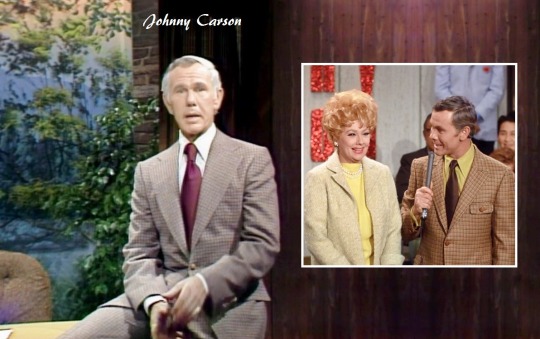
BEING
UPSTAGEDJohnny
Carson,
on the set of “The Tonight Show” reminisces about the time he
played himself on “Here’s Lucy” (S2;E11) where Lucy is picked
from his audience to play “Stump the Band” and wins by singing
“Snoops the Lawyer.” While she is singing, Carson sits on the
arm of an aisle seat occupied by Lucy’s real-life mom, Dede Ball.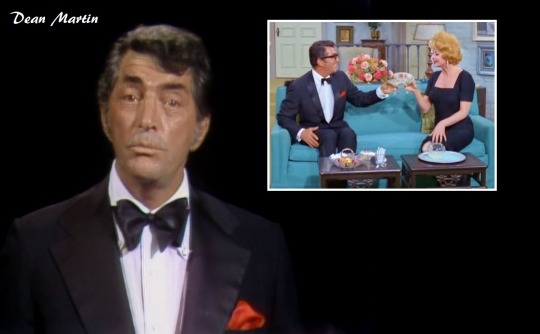
A
DATE WITH EDDIEFeldman, that is, not Albert! Dean Martin
says he loves working with Lucy. A clip from “Lucy Dates Dean
Martin” (TLS S4;E21) has Lucy dating a man she thinks is Dean’s
stunt double, Eddie Feldman, but is actually Martin himself filling
in for Feldman, who has to work. In the clip Martin sings “Everybody
Loves Somebody Sometime” causing Lucy Carmichael to
remark “You
even sing better than he does!”
SAM
THE PLUMBERRichard
Burton
comes out of his on-set trailer to talk about his 1970
guest-appearance on “Here’s Lucy” (S3;E1) where he tried to pass
himself off as Sam the Plumber, but is ensnared by Lucy, who has a
leaky sink. He recites Shakespeare while fixing the sink, but Lucy
Carter tells him not to quit his day job!
TWO
LEFT FEETDanny
Thomas,
is found standing on the set of his 1976 sitcom “The Practice.”
A month earlier, Lucille Ball guest-starred on the series, which only
lasted one season. He introduces a clip from “Lucy Helps Danny
Thomas” (TLS S4;E7), which has Lucy as a clumsy showgirl turning
Danny’s TV show production number of “Broadway Melody” upside
down!
25
YEARS OF LAUGHTERThe
last segment, James
Stewart stands
at a podium and introduces the lady of the hour (or two), the first
lady of television, Lucille Ball. Although Stewart was Ball’s friend
and neighbor, the two never acted opposite each other on film or
television. They appeared together on many award shows and specials.
He presents Lucy with a plaque from the National Academy of Arts and
Sciences for 25 years of laughter. A montage of moments from Lucy’s
quarter-century career is accompanied by the song “Look at that
Face” sung by Steve Lawrence as the credits roll.
This
Date in Lucy History – November 28th
“Lucy
and Pat Collins”
(TLS S5;E11) – November 28, 1966Carol + 2, Carol Burnett, CBS, CBS Salutes Lucy: The First 25 Years, Charlie Chaplin, Danny Kaye, Desi Arnaz Jr., desi arnaz sr., Gale Gordon, Harpo Marx, Here’s Lucy, I love lucy, John Bubbles, John Wayne, Ken Berry, Lucie Arnaz, Lucille Ball, Lucy, Lucy in London, Patty Andrews, Red Buttons, Sammy Davis Jr., The Danny Kaye Show with Lucille Ball, The Lucy Show, The Lucy-Desi Comedy Hour, tv, Vitameatavegamin, Vivian Vance, Wayne Newton, William S. Paley - Lucy and John
-
Subscribe
Subscribed
Already have a WordPress.com account? Log in now.
 Papermoon Loves Lucy