-
LUCY on KUP
April 22, 1977

“Kup’s Show” aka “The Irv Kupcinet Show” hosted by Irving Kupcinet started life in 1952 as a Chicago-based 15-minute interview show titled “At Random.” At the height of its popularity, the show was syndicated to over 70 stations throughout the United States. The series garnered 15 Emmy Awards along with a Peabody Award before ending in 1986. Unlike “Donahue” and “Oprah” – two other Chicago talk show successes – there was no studio audience and no phone phone calls were taken. Thanks to the host’s connections, the show still succeeded in attracting a wide array of celebrities from the world of film, television, sports, and politics.

Irving Kupcinet aka ‘Kup’ (Host) was born in 1912 in Chicago, Illinois. After attending college on a football scholarship, Kupcinet was drafted by the Philadelphia Eagles in 1935. His football career was cut short by a shoulder injury, which led to a job as a sports writer. He also wrote a short “People” section. It officially became known as “Kup’s Column” in 1948, distributed to more than 100 newspapers around the world. Histelevision career began in 1952 and in 1957 he was a fill-in host for “The Tonight Show.” In 1988, Kupcinet published his autobiography, Kup: A Man, an Era, a City. He died in 2003 at age 90.
GUESTS

Lucille Ball was born on August 6, 1911 in Jamestown, New York. She began her screen career in 1933 and was known in Hollywood as ‘Queen of the B’s’ due to her many appearances in ‘B’ movies. With Richard Denning, she starred in a radio program titled “My Favorite Husband” which eventually led to the creation of “I Love Lucy,” a televisionsituation comedy in which she co-starred with her real-life husband, Latin bandleader Desi Arnaz. The program was phenomenally successful, allowing the couple to purchase what was once RKO Studios, re-naming it Desilu. When the show ended in 1960 (in an hour-long format known as “The Lucy-Desi Comedy Hour”) so did Lucy and Desi’s marriage. In 1962, hoping to keep Desilu financially solvent, Lucy returned to the sitcom format with “The Lucy Show,” which lasted six seasons. She followed that with a similar sitcom “Here’s Lucy” co-starring with her real-life children, Lucie and Desi Jr., as well as Gale Gordon, who had joined the cast of “The Lucy Show” during season two. Before her death in 1989, Lucy made one more attempt at a sitcom with “Life With Lucy,” also with Gordon, which was not a success and was canceled after just 13 episodes. Ball previously appeared on “Kup’s Show” in 1970.
Earlier in the evening of April 22, Lucille Ball was honored by the Notre Dame Club of Chicago with their Excellence in Entertainment Award. Her mother, Dede, accompanied her to the ceremony.

Otto Preminger was born in the Ukraine in 1905 and came to America in 1936 to direct a play on Broadway. In 1937 he started directing in Hollywood and by his career’s end had been nominated for three Academy Awards. Interestingly, Otto Preminger was Producer of the Broadway incarnation of the play Critic’s Choice, which Lucille Ball and Bob Hope made into a film in 1963. He received screen credit in the film. In 1966, he made a rare appearance on “Batman” as arch villain Mr. Freeze. Preminger died in 1986.
At the end of the interview, Kup says that Preminger has a new film coming up, based on the life of Moshe Dayan. This film never came to pass.

Elizabeth Ashley was born Elizabeth Ann Cole in Ocala, Florida, in 1939. In 1959, she moved to New York and starred in plays off and on Broadway, eventually being nominated for three Tony Awards. Her television career began in 1961 and she is probably best known for her role in “Evening Shade” (1990-94) which earned her an Emmy nomination. Ashley played roles on “Mission: Impossible” and “Mannix,” both filmed by Desilu Studios.
At the end of the interview, Kup says that Ashley is appearing in the play Vanities at Chicago’s Drury Lane Theatre.

David Mamet was a Chicago native born in 1947. Starting off as a writer and performer, Mamet first gained acclaim for a trio of off-Broadway plays in 1976: The Duck Variations,Sexual Perversity in Chicago, and American Buffalo. He was awarded the Pulitzer Prize in 1984 for Glengarry Glen Ross. Mamet’s style of dialogue, marked by a cynical, street-smart edge, precisely crafted for effect, is so distinctive that it has come to be called ‘Mamet speak.’ Mamet and actress Lindsay Crouse were married in 1977 (the year of this interview) and divorced in 1990. He has also written screenplays, books, and poetry.
At the end of the interview, Kup says that Mamet has American Buffalo playing on Broadway and has new play called The Water Engine opening May 11. [This was the Chicago production. In December 1977 the play opened on Broadway.]
The Kup’s Show coffee cup seen in the opening credits is also used by the guests for their beverages. Lucille Ball and Elizabeth Ashley smoke frequently during the interview. All four guests are on the stage at the same time for the full hour. There are no commercial breaks, film clips, or still photos used. Unlike network shows, this program included some mild expletives and talk of sex, something not common on television in 1977.

A week before this interview (April 15, 1977), Lucy was interviewed by Dinah Shore on her syndicated talk show “Dinah!”
[Note: The first eight minutes of this interview have been lost. The author’s comments are in brackets.]

The topic is whether Lucille Ball would be a success in 1977 as she was in 1951. The other panel members all think Lucy would be just as big a hit now as she was then. She says that she’s done two or three specials [“Happy Anniversary and Goodbye” in 1974, “Three For Two” in 1975, and “What Now, Catherine Curtis?’ in 1976] and that they haven’t been all that successful. Viewers and networks seem to want Lucy to return to the sitcom format, but she feels conflicted. Mamet says he watched Lucy growing up. She says “I hope so!”

Lucy says that if she was taking her show for the first time to (say)
Freddy Silverman… (thumbs down gesture). Preminger insists if Lucy made a good show, Silverman would be the first to hire her. Lucy says that he actually wanted to be the first one to fire her, getting rid of the “oldies” like Jack Benny and herself. Kup interjects to tell viewers who Silverman is, telling them he was an executive with CBS, then ABC. [A couple of years after this interview, Silverman moved to NBC, where he actually hired Lucy. In the special “Lucy Moves To NBC” Silverman was played by Gary Imhoff, above left.]
Kup turns his attention to David Mamet, whom he says has a lot of foul language in his plays. Kup asks him to justify it. Mamet pauses for a moment and Preminger steps in to say “If the people he’s writing about talk like that, why shouldn’t he use it?”

Kup mentions The Moon is Blue (1953) and The Man with the Golden Arm (1955) as controversial Preminger projects. He is anti-censorship in a free society. For The Moon is Blue Preminger says he had to go to court to defend the use of the words ‘virgin,’ ‘pregnant,’ and ‘seduced.’ Lucy is about to tell the story of when she was expecting on television and couldn’t use the word
‘pregnant,’ but Preminger interrupts and the conversation takes another direction.Lucy: “We see the lines outside porno theatres, and we see a nice family picture with two or three people going into the theatre.”

Mamet mentions a 1976 book by Chicagoan Bruno Bettelheim called The Uses of Enchantment. [The book later inspired playwright James Lapine and composer Stephen Sondheim to create the 1987 musical Into The Woods.] Mamet compares violent fairy stories with violence in television and films. Mamet’s point is that the fairy stories assert that despite violence and unrest, good will triumph in the end, which (he says) is a false premise. Preminger says “If people don’t want to see violence they can turn off their sets.”

Lucy infers that a film like Jaws (1975) is too violent. Preminger says he doesn’t think it is a particularly good picture.
Ashley calls violence on television is a “cheap thrill” and bemoans that the medium doesn’t go for the “better thrill;” such shows as Lucy’s sitcoms, “The Honeymooners,” and “Mary Tyler Moore.” She asks Lucy if finding good writers and material isn’t the hardes thing to do. Mamet says good writers get no support from producers and distributors because “they can’t sell it.”

Preminger (to Lucy): “How can a woman with your success be so bitter?”
Lucy(taking a pill): “I’m not bitter, darling. I’m very grateful for what I have.”
Preminger:“Everything you’ve said here is bitter.”
Lucy: “Oh, you’re full of it. (slaps his hand)Ashley:“Bullshit,Otto.”

Kup says Lucy’s been quoted as saying that her success is one of the biggest flukes in show business. Lucy clarifies that it happened as a fluke. She wanted to get out of pictures and have children. Television just happened to come along at the right time. She remarks on the intimacy of television with the fans and says she loved being ‘typed.’ Kup says that in Desi’s book [A Book], Desi said that he still loves Lucy.

Kup asks Ashley if she fears growing old. Ashley admits to being 37. She says that she went into retirement for five years from age 25 to 30 and became a Beverly Hills housewife. “My career was shopping and lunch.” She returned to work at 30 in order to support her child after her divorce. She says that she’s doing the same play [Vanities by Jack Heifner], that Lucie Arnaz did in Los Angeles. Kup reminds Ashley that she did a lot of lousy movies, too.
Ashley: “They packed me up and sent me off to the happy farm before I retired.”
Lucy: (chiding her) “That was your own idea. I remember that. You wanted that.”
Ashley: “Oh,yeah. I mean I was a 23 year-old actress and what you’re supposed to have is a nervous breakdown.”
Lucy: “You wanted to go back to the womb and rest.”
Kup: “Is that true?”
Ashley: (with an indifferent flip of her hair) “Sure.”Kup directs his next question to Mamet, asking if “it all starts with the written word.” He calls himself a ‘method writer’ who writes in terms of actions. He learned how to write from being an actor first. Kup quotes Mamet saying that the women’s movement turned his head around. Ashley agrees that it was a cultural assumption that after motherhood women had no worth. Kup quotes from Preminger’s book: “Only two kind of women survive in Hollywood – those who are dominated by men and those who behave like men.”

Kup wonders why Preminger doesn’t write about his big fights with Lee J. Cobb and Dyan Cannon. Preminger reluctantly explains that while making Exodus (1960) Cobb could not remember 14 lines in the presence of hundreds of extras so Preminger filmed the scene in pieces. At the end, he asked Cobb to do all the lines together and Cobb refused. Preminger sent him home and cut the scene with the takes he had. Regarding Dyan Cannon, while making Such Good Friends (1971), Preminger says she would come late and sometimes leave the shoot mid-set requiring all her make-up to be reapplied while others waited. Preminger called her out for her non-professionalism. Kup says the fight was reportedly about Preminger superimposing her head on another woman’s naked body, an accusation he refutes.
Lucy says that she’d be scared to work for Preminger but she’d still like to work with him. [It becomes clear that Lucy is getting impatient with Preminger’s many excuses for his poor reputation. While he is speaking, she noisily roots around in her purse for something and conspicuously pours a glass of water.]

Kup credits Preminger with proving that “all black shows” like Porgy and Bess and Carmen Jones could be successful on screen. Kup also credits Preminger with putting screenwriter Dalton Trumbo’s name in the credits of Exodus despite him being blacklisted for communist affiliations.

Lucy talks about the time she herself was accused of being a communist in 1953, nearly being blacklisted as well.
Preminger: (about Mamet, who has been quiet) “While we are talking here, he is writing a play.”

Kup asks Ashley if she has changed since her youth. She says that her life has turned out pretty much the way she wanted, despite not feeling accepted. She says that she’s now working again and happily married after years of sexual dissolution.
Ashley: “You know how you spend years of your life in a sexual frenzy?”
Lucy: “I didn’t. I’ve been married all my life.”
Ashley: “I spent some time on the streets having an absolutely wonderful time behaving like a tart and a slattern for years. Maybe I got it out of my system.”
Lucy: (covering
her face and turning away) “Oh, Elizabeth! You did not!”Lucy claims Ashley is embroidering her past and won’t believe it. Lucy insists that the most Ashley ever did was carry a protest sign. Lucy concedes that she feels motherly toward Elizabeth.

Kup asks Lucy if she would ever consider writing an autobiography. Lucy says she has had several unauthorized biographies of herself so she has no plans to write about her life.
Lucy:“You can’t tell the truth until you’re 85 and I don’t want to live that long.”
[After Ball’s death in 1989 at age 77, an unfinished manuscript for an autobiography was found by her husband, Gary Morton. The last entry was dated 1964, so apparently Ball had already written her life story, but decided not to finish it or publish what she had written. It was finally released in 1996 under the title Love, Lucy.]
Kup observes that others have typified Lucy as a strong-willed person. Lucy denies this. She says that things boil inside her for a long time. She admits to having “a short fuse.” She says a reputation of being “strong-willed” comes from her longevity in the business. About her children, Lucy says her son shows “attitude” and that her daughter “is much more outgoing.”

Kup mentions that Lucie Arnaz will be seen in the new film Billy Jack Goes To Washington and that Desi is about to make Robert Altman’s A Wedding starring Carol Burnett and Lilian Gish. [The film was shot in and around Chicago and featured uncredited performances by many Chicago-based theatre actors like Laurie Metcalf, Gary Sinese, John Malkovich, Terry Kinney, and Joan Allen.] Lucy says that she’s glad she took Lucie and Desi Jr. out of school and put them on her show [“Here’s Lucy”].

Kup and Mamet talk about the origins of his new play The Water Engine. Mamet says it is an old story that was the basis for the Alec Guinness film The Man in the White Suit (1951).
Kup talks about a Mamet quote in the newspaper: “Almost everything we’ve been taught is wrong” (ie; religion, marriage, and allegiance to the state.) Mamet defends his position by saying those tenets are conscriptive. Preminger agrees with the playwright’s point of view. Ashley chimes in to question institutional values like marriage without strong convictions and morality behind it.

Lucy says the written word is failing young people and giving them a sense of hopelessness. Preminger tries to interject, but Lucy slaps his hand again “No, not yet!” Mamet defends his profession.
Mamet: “Are you accusing me of being hopeless, Lucy?”
Lucy: “Yeah.”
Mamet:“Quite the contrary.”Preminger asks Mamet how the population could survive without some sort of government. Mamet provides a complicated and somewhat convoluted analogy to a particular poker game, ending with the idea that government was based on a good idea, but that idea has been buried under masses of other ideas rendering the original useless.
Preminger: “I must confess that the whole conversation has gone over my head. I really don’t understand it. (to Lucy) For once, I’m on your side.”
Ashley chimes in to talk about the nature of ‘greed’ and the Bill of Rights. Mamet talks about greed after the apocalypse. [I’m not making this up!]
Before wrapping up, Kup politely corrects Ashley’s earlier statement that the phrase “government of the people,by the people, for the people” is not from the Constitution but was said by Abraham Lincoln in the Gettysburg Address.
Lucy: “Didn’t it get into the Constitution in any way?”
Kup: “No.”Kup apologizes to Mamet for starting out with a discussion about the foul language in his plays, which he says was brought up by critic Clive Barnes.
Mamet:“You cast me as the iconoclast, Kup. Anything I can do to serve you, is my
great pleasure.”
This Date in Lucy History – April 22nd

“Country Club Dance” (ILL S6;E25) – April 22, 1956

“Lucy and the Runaway Butterfly” (TLS S1;E29) – April 22, 1963
1977, A Wedding, American Buffalo, Billy Jack Goes to Washington, Chicago, Dalton Trumbo, david mame, Desi Arnaz, Desi Arnaz Jr., Dyan Cannon, Elizabeth Ashley, Exodus, Fred Silverman, Here’s Lucy, I love lucy, Irving Kupcinet, Jaws, Kup’s Show, Lee J. Cobb, Lucie Arnaz, Lucille Ball, Otto Preminger, The Irv Kupcinet Show, The Man in the White Suit, The Man with the Golden Arm, The Moon is Blue, The Uses of Enchantment, The Water Engine, tv, Vanities -
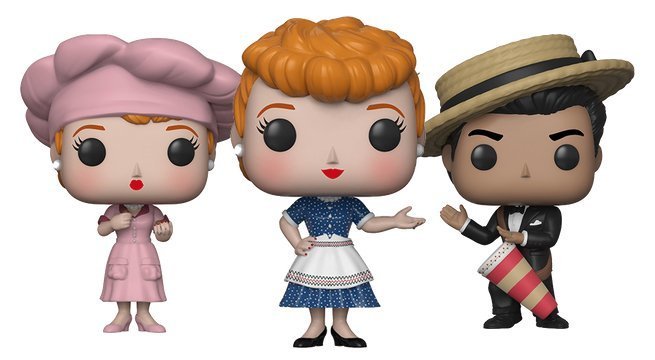
Pop “I Love Lucy” – pre-orders now taken!
-
LUCY on DONAHUE
March 15, 1974


Phil Donahue (Host) was born in Cleveland, Ohio, in 1935. After a stint
as a TV newsman, he took over a slot on a local television station
which became “The Phil Donahue Show.” After moves to Chicago and
then New York City, the show ended in 1996. In 1958, Phil Donahue
married Marge Cooney and had five children. The marriage ended in
1975, less than a year before this interview with Lucille Ball. In
1980, he married the daughter of Ball’s good friend, Danny Thomas –
Marlo Thomas, the star of TV’s “That Girl” (1965-71). Donahue was
awarded 20 Emmy Awards during his broadcasting career, ten for
Outstanding Talk Show Host, and 10 for “The Phil Donahue Show.”
He received the prestigious Peabody Award in 1980, and was inducted
into the Academy of Television Arts & Sciences Hall of Fame on
November 20, 1993.
“The Phil Donahue Show” aka “Donahue” started out in 1967
as a Dayton, Ohio, local call-in show aimed at women. In 1970 it
started to be seen nationwide, and by 1980, was seen in 218 cities
across the country. In 2002, “Donahue” was ranked twenty-ninth
on TV Guide’s list of the fifty greatest television shows of
all-time. In 1985, Donahue left Chicago for New York City with a
studio in NBC’s Rockefeller Center facility. In 1992, Donahue
celebrated the 25th anniversary of his long-running television
program with a NBC special in which he was lauded by his talk-show
peers. To some he was seen as having been eclipsed by both Oprah
Winfrey and Sally Jessie Raphael. After 29 years (26 in syndication)
and nearly 7,000 shows, the final episode aired on September 13,
1996, the culmination of what continues to be the longest continuous run
of any syndicated talk show in US television history.
Three days later, March 18, 1974 “Here’s Lucy” airs the last
episode of its sixth and final season, ending Lucille Ball’s nearly
23-years on television.
Mame had its world premiere at Radio City Music Hall on March 3,
and set and all-time one week box office record for the venue at
$400,000. The film opened wide on March 27, 1974.
This interview took place in the last months of “The Phil
Donahue Show” while in Dayton. By fall 1974, they had moved to
Chicago. True to his original mission, the audience is made up of
women, and there is only one male caller.Note: Images from the interview are of poor quality so have been supplemented with associated photos culled from the internet. The author’s observations are in [brackets].

After introducing Lucy, Donahue first says that – if he could sing
– he would sing “You coax the blues right out of the horn…”
and Lucy reminds him that it was written by Jerry Herman. She is
grateful that she didn’t have to sing it, but that it was sung to
her. Donahue mentions her co-star in Mame, Robert Preston, whom Lucy
calls her ‘Rhett Butler.’ Lucy said she made the picture for the ladies, feeling that it has been too many years since they had a picture where women were regaled with the love and affection that Beauregard (Preston) gave Mame.
Lucy praises 10 year old Kirby Furlong, who played young Patrick
Dennis, Mame’s nephew.
Donahue goes out on a limb to say that Lucy never really fit in in
Hollywood. Lucy agrees, saying that she loves Jamestown and New
England and that at heart she is a farmer with a green thumb.Donahue: “The picture cost nearly ten million bucks.”
Lucy:
“I don’t know how much it cost and I don’t care. Just so it’s good.
And it is.”Donahue can’t wait to show a clip from the film. It features the
title song, set on Beau’s southern plantation and stars Lucille
Ball (Mame), Robert Preston (Beau), Kirby Furlong (Young Patrick),
Lucille Benson (Mother Burnside), Ruth McDevitt (Cousin Fan), Burt
Mustin (Uncle Jeff), and Joyce Van Patten (Sally Cato). Lucy says that the scene was shot on the Disney Ranch.
Lucy recounts that Warner Brothers was ready to make the picture a
year and a half earlier, but Lucy broke her leg skiing in Aspen. Phil
says that the film Hello Dolly (1969), another Jerry Herman stage
musical translated to film, lost money, which Lucy isn’t too sure
about. When Donahue wonders if a film version of Mame was needed,
Lucy reiterates that she made it for the ladies, and that they
deserve it, just like The Great Gatsby (1974), which premiered in New
York City on March 27, the same day Mame opened wide across the
country.When Donahue asks her if negative reviews bother her, she quickly
says “Yes, I’m vulnerable. But so far the good ones have outweighed
the bad ones.” [When the dust settled, this was not the case.]
Lucy says the film has gotten off to a great start and Donahue
mentions that Radio City broke a box office record.
Donahue asks if she’d rather be home sipping orange juice on her
patio, Lucy emphatically says no, that this isn’t a terribly hard
promotional tour. She spent a week in New York, a week in Chicago,
and is now in Dayton, after which she will go on to Atlanta for a fox
hunt brunch at a plantation. She tells Phil that on several of her
stops, she wore various wigs (just as Mame does in the film) and
played charades. In Chicago they had a speakeasy party and she met
Mayor and Mrs. Daly.
Rushing to get some questions in before the break, Donahue
mistakenly says that “Here’s Lucy” has been canceled. Lucy rolls
her eyes and corrects him “In my whole life I have never been
canceled.” [Sadly, that would not hold true for Lucy’s final
series “Life With Lucy,” which was canceled by ABC in 1987 after
just eight episodes.] Lucy says she has “laid it aside,
temporarily” and that she is going to do some specials. [The first
of these specials, “Happy Anniversary and Goodbye,” aired six
months later.]
Lucy says that she needs to fatten up [Jackie] Gleason to play
Diamond Jim [Brady] in a script she’s had written. [This is a project
that never happened Instead, Ball starred him in one of her specials, “Three For Two” in 1975.] She mentions that her daughter,
Lucie Arnaz, is on a six-month national tour of the musical See Saw
and that Desi [Jr.] is doing the play Bus Stop, coming soon to the
Dayton area.
Cringing lest it be an inappropriate question, Phil asks if Desi
Jr. is going to get back together with Liza [Minnelli]. Lucy calmly says that
she doesn’t think they’ll get back together, but she loves Liza. Lucy
reminds Phil that she knew Liza before her children were born. [Her
father, Vincente Minnelli, directed Lucy in two films.]Lucy: “You cannot domesticate Liza. Liza’s a very special person
and she cannot be tamed.”After a commercial break, Donahue does what made him famous, goes
into the audience to create an interactive interview with Lucy.A woman asks if Lucy’s goal when she first came to Hollywood was
to become the Queen of Comedy, to which Lucy answers that she just
wanted to be part of the business. Lucy says the she chose comedy
after a two or three week period of reviewing television scripts that
were “all wrong.” Lucy says that she liked being “typed” as a
middle class housewife. It was not happenstance, it was by choice.Another woman praises Lucy’s physical fitness and youthful
appearance. Lucy claims to be twenty years younger in her head.
After breaking her leg, she has been very conscious of staying fit.
She says she doesn’t care for food in general, but that she likes to
cook. Except for breakfast, she only eats when she is hungry.
Someone asks where Lucy calls home. She says she’s lived for many
years in Beverly Hills and has a place in Palm Springs, and in
Snowmass, Colorado, which her mother [Dede Ball] loves to visit. She
says she keeps the Palm Springs place because her husband [Gary
Morton] is a golf nut.
A telephone caller (also named Lucy) asks Lucy how she feels about
following in the footsteps of Angela Lansbury in the role of Mame and
how she felt about Rex Reed’s negative review. Ball says she hasn’t
read it but that she and Reed are friends. Ball is curious how the
caller read the review because she was told it wasn’t out yet. The
caller admits she hasn’t read it, but flatters Lucy that it can’t be
correct because everything Lucy is in is good. Lucille Ball is
appreciative, although she can’t quite figure out that the woman is
on the telephone and not in the studio itself.
Donahue directs the question back to Angela Lansbury. Lucy says
that she told the studio for several years that Lansbury should do
the film version and was told that Lansbury didn’t want to do it
because she was caring for her son who was very ill in Ireland. [He
was a recovering addict. Lansbury re-emerged on the London stage in a
revival of Gypsy that moved to Broadway in the fall of 1974. She made
no films between 1971 and 1978. In 2009 Lansbury gave an interview
saying she was upset about being “passed over” for the film.]
A caller asks Lucy about the greatest experience in her life, and
the lowest point. Lucy unequivocally says that having children after
a ten year wait was the greatest. The lowest point was her divorce,
but she admits that she doesn’t have many low points.Phil wonders about Lucy’s longevity in the business. Lucy mentions
John Wayne and Jack Benny as examples. Lucy feels that movie stars
were in a much more glamorous business than television.Lucy: “I dig my work. And I know how to do it. I’m proud of
that.”
An audience member asks Lucy about Vivian Vance. Lucy says that
she’s married to publisher Bill Dodd, living in North Salem, New
York. She adds that she is writing a book and is very happy. [Vance’s
book was never published. In the summer of 1974 Vance returned to her
stage roots appearing in such shows as Everybody Loves Opal and Barefoot in the Park.]When she is asked about retirement, Lucy denies that rumor saying
she wouldn’t know what to do if she retired.Regarding reruns Lucy says “Three generations can turn me on
with the water faucet.” She adds that she has six years “product”
(“Here’s Lucy”) still to go into reruns. [Although “Here’s
Lucy” was syndicated, it did not do as well as Ball’s previous
sitcoms in reruns.]
One audience member says her favorite is the Candy Factory, which
Lucy says is hers, too. That and the one “in the great vat.” The
audience instantly knows that she is talking about “Job Switching”
(ILL S2;E1) and “Lucy’s Italian Movie” (ILL S5;E23).
A woman praises Lucy for working ‘clean.’ Lucy admits that Mame is
rated PG because there are lines from the original play and film
Auntie Mame and the stage musical that are considered classics,
despite containing mild expletives. [One of them is is likely to be
“Life is a banquet and most poor sons-of-bitches are starving to
death” which was changed to “poor suckers” for the 1958 film
Auntie Mame starring Rosalind Russell.]Lucy says she is not fond of ‘excess’ and is constantly donating
things to charities, recycling them rather than throwing them away.
Lucy says that charity begins at home, and at Christmas she donates
to her surrounding community and her employees. [Despite this Lucy
was deeply committed to national and international charities like
Easter Seals, the Heart Fund, and the March of Dimes.]
Regarding her iconic red hair, Lucy surprisingly says she might
change it, possibly to a black wig like Mame wears. There were seven
different wigs used in Mame to reflect the changing times. [Ball did
indeed wear a black wig on television in a 1975 interview with Dinah
Shore. Lucy Ricardo flirted with a change from her usual henna rinse
in “The Black Wig” (ILL S3;E26).]
A woman from Jamestown, New York, calls in to say that she has
home movies of when Lucy and Desi visited the town in February 1958.
She says she also knows the Van Vlacks and other people Lucy
frequently mentioned on her shows.
Regarding the fate of Desilu Studios, Lucy tells a caller that she
bought Desi out and sold the studios years ago and now just operates her own
company [Lucille Ball Productions aka LBP], renting space at Universal.
About Mame, Lucy says it took more than two years to make,
including a five month shoot. Lucy denies that her singing voice was
dubbed but readily admits she doesn’t have a great voice. She says
she subscribes to the philosophy as the composer Jerry Herman that
what the songs say is most important. As an aside she says to the
woman who asked “I wish it had been better.”Unfortunately, Donahue chooses this moment to screen the second
clip from Mame, the opening number “It’s Today” featuring Lucille
Ball as Mame and Kirby Furlong as a wide-eyed Patrick. Jane Connell
is seen as a nervous Agnes Gooch shielding Young Patrick from the
rambunctious revelers: “If any of these people are your Auntie
Mame, better you never know about it!”
An audience member asks why Lucy doesn’t do a nightclub act. Lucy
responds that she’s not a singer or a dancer and that her voice won’t
hold up to the rigors of continual performance. [When Lucy did
Wildcat on Broadway in 1960, a subject not broached in this
interview, Lucy was often out sick and dropped twelve pounds.]
A woman asks about the child who played Little Ricky. Lucy says
that his real name is Keith Thibodeaux and that he is now 22 or 23 years
old and takes care of his family of seven (brothers and sisters).
Lucy adds that he is a close friend of Desi Jr.
When asked if she ever wished she had a more private life, Lucy
thoughtfully says yes, especially when they [the press] are mean and
really try to be hurtful. [The critics’ reception of Mame was not the
last time she would be upset by cruel comments. The cancellation of
“Life With Lucy” in 1987 was a crushing blow to her pride. She
felt nobody wanted her kind of comedy anymore.]Lucy mentions that she has a brother [Fred Hunt] living in Arizona
and a first cousin [Cleo] who is like a sister to her, and is also
her producer.
About Gale Gordon now that “Here’s Lucy” has ended, Lucy says
that he travels and take care of his Borrego Springs ranch. She is
keeping him in mind for her upcoming specials but he is indifferent
about working again. [Gordon only starred in one of her specials,
1977’s “Lucy Calls the President.”]
For relaxation, Lucy says she just learned backgammon and she
loves word games. She still swims and rides her bicycle, but has had
to curtail some of her physical activity. [Lucy was obsessed with
backgammon and promoted several box games.]
Phil asks about being introspective and refers to when Desi Arnaz
was on his show. Lucy says she gets introspective but isn’t as
public about it as Desi.Lucy says he works at Universal, is happily remarried, and has a place in Del Mar.
[Arnaz wrote the autobiography A Book in
1976. It will soon be released on audio book as well.]As the credits roll, audience members come up to have their
photograph taken with Phil and Lucy.

In 1978, Lucille Ball and Phil Donahue met again when NBC televised a special celebrating the 25th Anniversary of TV Guide.
1974, Angela Lansbury, Auntie Mame, backgammon, Borrego Springs, Desi Arnaz, Desi Arnaz Jr., Desilu Studios, Donahue, Gale Gordon, Here’s Lucy, I love lucy, Jackie Gleason, Jamestown, Jerry Herman, Keith Thibodeaux, Kirby Furlong, Liza Minnelli, Lucille Ball, Lucy, Mame, Phil Donahue, Radio City Music Hall, Rex Reed, Robert Preston, The Great Gatsby, The Phil Donahue Show, TV Guide, Vivian Vance, wigs -
LUCY on DINAH!
1972-1978

Dinah
Shore was
born Fannye Rose Shore in 1916. She was a singer, actress, and
television personality, and the top-charting female vocalist of the
1940s. She rose to prominence as a recording artist during the Big
Band era, but achieved even greater success a decade later, in
television, mainly as hostess of a series of variety programs. Her
first recordings were with Desi Arnaz’s mentor, bandleader Xavier
Cugat, and she later changed her named to Dinah after her success
with the song of the same name. She was famous for blowing a kiss to
her audiences (“Mwah!”) at the end of each show. Her passions
were golf, cooking, and painting. Shore died in 1994.
“Dinah’s
Place” aired
from 1970 until 1974 on NBC
and
was canceled to make way for a network edition of the then-syndicated
game show “Name
That Tune.”
It won a 1973 and 1974 Emmy Award. Lucille Ball made three
appearances on this iteration. It was succeeded by…
“Dinah!”
(1974 to 1979) was
focused on celebrity interviews promoting recent motion pictures,
books and other television programs. It was a popular forum for
musical acts receiving national exposure performing short song sets
followed by a sit-down interview with Shore. A highly successful
vocalist and recording artist herself, Shore would usually sing at
least one song on each program; she sometimes dueted with musical
guests. Each episode was ninety minutes in length.
During the summer of 1976, the show was re-branded as “Dinah and
Friends.” “Dinah! was canceled by CBS in 1981.
Dinah
Shore guest starred as herself on a 1971 episode of “Here’s Lucy”
(S4;E7).
Ball and Diana Ross
appeared on “Like Hep!” a 1969 Dinah Shore special.
Lucy
interviewed Dinah Shore on her CBS radio show “Let’s Talk to Lucy”
on January 11, 12 & 13, 1965.
Dinah’s
PlaceSeptember 11, 1972
- Lucy
makes Irish coffee and tells how she broke her leg.
The
day before Lucy had appeared on “A Salute to Television’s 25th
Anniversary”
Dinah’s
PlaceMarch 26, 1974
- This
appearance was part of Lucy’s promotional tour for her new movie
Mame.
Two
days earlier she had appeared on “The Tonight Show.”

Dinah’s
PlaceJune 24, 1974
- Lucille
Ball talks about her role in Mame and
demonstrates ballet-barre exercises. - Lyle
Waggoner shows how to construct an art deco table.

The cape Lucy wore was made of swatches of all Lucille Ball’s costumes in the film Mame. Lucille Ball took several years of ballet lessons as a child.

Lucy at the barre instantly recalls Lucy Ricardo’s rehearsal with Madam LeMond (Mary Wickes) in “The Ballet” (ILL S1;E19).
Dinah!
November 4 or 6, 1974
- Lucy
shares the stage with the Kingston Trio and George C. Scott.

Lucy
promotes her upcoming special “Happy
Anniversary and Goodbye” airing November 10, 1974.
Dinah!
April 29, 1975

- Dinah’s
guest is Lucy’s Mame co-star Bea Arthur, who played Mame’s bosom buddy
Vera Charles in the film. Lucille Ball is only seen in archival footage of Mame. - Vic Damone is the musical guest.

Dinah!
May 15, 1975
- Dinah
hosts Lucy along with Vivian Vance, Zsa Zsa Gabor, Bert Parks, and
musical guest Sha Na Na.
Four
days later Lucille Ball was seen on “The 26th Annual Emmy Awards”
telecast.
Dinah!
September 23, 1975
- Dinah’s guests include Lucy, John Byner, and George Segal.
Dinah!
December 1, 1975
- Lucille
Ball is joined by her daughter Lucie Aranz, her co-star Vivian Vance,
her mother Dede Ball, and her friend Zsa Zsa Gabor.
In
this appearance, Lucy is wearing a dark wig with silver highlights.
Lucy’s special with Jackie Gleason “Three For Two” aired two days later.
Lucy
and Vivian had not seen each other in more than a year.
Vivian
says she’s been selling coffee, mostly. Vance was the spokesperson
for Maxwell House at the time.
Vance
produces a “mock contract” that Ball gave her (for laughs) years
earlier. It is this “contract” that has given rise to the rumors
that Vance was contractually obliged to stay overweight and dowdy
while working for Lucy.Vivian
also tells the story of how the King of Siam toured Lucy’s house
while the two of them were dying their hair.
Dinah!
June 4, 1976
- Lucy
is joined by Valerie Harper, Carol Burnett, and Gale Gordon.

Dinah
convinces Lucy and Valerie Harper to sing “Hey, Look Me Over”
from Wildcat.
Harper was in the chorus of the 1960 musical with Lucy.
Carol Burnett recalls meeting Lucy for the first time on her second night performing Once Upon a Mattress off Broadway.

Dinah
puts up a still photo from Carol’s first time on “The Lucy Show”
(TLS S5;E7) in 1966.
Dinah
puts up a second still photo although neither Carol nor Lucy can
identify it. It is from a January 1969 appearance on “Here’s
Lucy,” the only time Burnett played herself on one of Lucy’s shows.Gary
Morton’s loud guffaw can be heard in the studio audience.Carol
recalls Lucy giving her a baby shower, where her husband Gary
“roasted” the various baby gifts.
Lucy
talks about her co-stars and Dinah puts up a photo of Gale Gordon
from “Lucy and The Great Airport Chase” (HL S1;E18) in 1969.
Dinah runs film clips of Gale getting wet during “Here’s Lucy”
(although she calls it “The Lucy Show.”)
To Lucy’s surprise, Gale Gordon enters to
talk about it.
Lucy talks about doing scenes in the freezing
Colorado River during “Lucy Runs the Rapids” (HL S2;E4) in 1969.
Lucille Ball talks about her trepidation about doing television
without her radio stars Gale and Bea Benadaret, who got other jobs.
Lucy
says the most dangerous thing she’s done was to slide down a fire
pole full speed in “Lucy and Viv Are Volunteer Fireman” (TLS
S1;E16) in 1963.
She also was scared of working with the live
porpoises in “Lucy at Marineland” (TLS S4;E1) in 1965. Lucy says
the porpoises head-butted her in the kidneys underneath the water.
Dinah
asks Gale if he’s ever thought of getting even with Lucy. With a
gleam in his eye, Gordon pulls out a seltzer spritzer, and the other
women clear out as Lucy begs him not to do it! Of course, Gordon has
the spout facing himself and gets soaked. Unfortunately, the camera
is on the cowering women, not Gordon at the time.
Dinah!
July 23, 1976
- Dinah
interviews Lucy and her husband Gary Morton as well as actor Jimmy
Stewart. - Steve Lawrence and Eydie Gorme are the musical guests.

The musical husband and wife had played themselves in a 1973 episode of “Here’s Lucy” (HL S6;E3).

Dinah!
April 15, 1977
- Dinah
Shore salutes Bob Hope along with his movie co-stars Rosemary Clooney, Jane
Russell, Lucille Ball, Rhonda Fleming, and Dorothy Lamour.
Hope is there to promote his new book “The Road to Hollywood.”

Lucy
gets a standing ovation from the studio audience on her entrance.
Lucy
tells a story about their first movie together, Sorrowful
Jones (1949).
Hope wanted to insert more humor into the script, while Lucy wanted to play the
scene seriously. In the end, Lucy got her way.On
the film Fancy
Pants (1950),
Lucy says “I
nearly killed him”
doing the stunts. She praises the film’s director George Marshall.On The Facts
of Life (1960), it was Lucy who ended up in the hospital after taking a fall getting into a
boat.About
Critic’s
Choice (1963),
it is clear that this was a film Lucy didn’t want to do. Lucy and
Hope were obliged to do a 11-theatre promo tour to “sell” the
film. Hope calls it their only flop.
After
all the other ladies have joined the panel, Lucy adds that her
experience with Bob was that he was not over-anxious to rehearse.
Ball was a stickler for rehearsals.Regarding
Hope’s dancing, Lucy said “He
knows three steps and he’s used them for 30 years.”

Dinah!
November 16, 1977
- Dinah
Tributes “First Ladies” of the Entertainment Arts: Lucille Ball
(First Lady of Television), Ella Fitzgerald (First Lady of Jazz),
Elizabeth Taylor (First Lady of Motion Pictures), and Beverly Sills
(First Lady of Classical Music). Taylor is interviewed via remote
on the telephone.
Dinah
also accords Lucy the titles of First Lady of Show Business and
First Lady of Comedy.
Lucy’s
last sitcom special “Lucy Calls the President” aired five days
later. Dinah calls it “The Lucille Ball Special.” A clip
starring Steve Allen (who plays himself) is broadcast. John William
Young (center) is also in the scene.
Starting
alphabetically, Lucille
Ball
is Dinah’s first guest. She gets a standing ovation.
Audience
members ask questions of Lucy:Q: “What
do you think of women who dye their hair?”
A: Lucy deflects to Dinah, but then says a woman has a right to dye her
hair.Q:
“Did
you ever do anything with Sinatra?”
A:
Lucy gets a worried look on her face and wonders what she means.
Dinah says “Junior or Senior?” Lucy says they only have worked together on charity
functions.Q:
“Do
you drive your own car or do you have a chauffeur?”
A:
Lucy says she has her own car AND she has a chauffeur.Q:
“Is
either one of you jealous of each other?”
A:
Dinah goes to a commercial!
After
a break, Dinah asks Lucy if she could do any part of her career over,
would she. Lucy emphatically says no. Lucy says she met the US
First Lady Eleanor Roosevelt. They talked about canning vegetables
and raising children. She never got to know Bess Truman, who was a
quiet, private woman. Lucy recalls meeting Mamie Eisenhower at the
White House with the cast of “I Love Lucy.” She recalls that President Eisenhower didn’t let her get a word out in a receiving line. When meeting
President Johnson, she asked him if all receiving lines were like
that, and demonstrated the “keep it moving” handshake IKE gave her. According to Lucy, LBJ was
flung to the floor by her demo. Lucy met his wife Lady Bird later at their Texas home.Ella
Fitzgerald sings
“I’m Beginning To See The Light” by by
Duke
Ellington,
Don
George,
Johnny
Hodges,
and
Harry
James.Beverly
Sills
tells Lucy that she once got a review of her appearance in a comic
opera that compared to her to “Lucille Ball with high notes.”
Sills sings “Italian Street Song” by Victor Herbert and Rida
Johnson Young.
Elizabeth
Taylor
does a pre-recorded interview via remote. In 1974, Taylor played
herself on an episode of “Here’s Lucy.” Lucy has never met Sills
or Fitzgerald before this interview.In
the commercial break Ella Fitzgerald told Dinah that she hates singing
duets because she’s afraid of messing up. Dinah says that Lucie Arnaz
(who is not on the stage, but may be at the taping)
said “If
Ella messes up, it’s an album.”
Lucy praises her daughter’s sense of humor. Lucy talks about holding
her tongue during Wildcat.
She says she shut up “one too many times.” Dinah asks Lucy what
she wants her son and daughter to remember. She says she wants them
to hold onto the ‘little adventures’ they had together.
After
a break, Dinah congratulates Sills on getting a star on the Walk of Fame. Lucy says she’s never seen her star but that her mother found it and told her she should have it moved!Dinah
asks Lucy how she handles her anger. Lucy says she slams doors,
breaks dishes, and kicks a few things.
Dinah!
June 5, 1978
- Lucy is joined on Dinah’s couch by her husband Gary, her daughter Lucie, friend and colleague Robert Osborne, and Carl Reiner.
LUCY’S FRIENDS AND FAMILY ON DINAH!
- Lucie Arnaz made seven appearances between 1975 and 1978.
- Desi Arnaz Jr. made three appearances between 1975 and 1978.
- Vivian Vance made three appearances between 1975 and 1976.
- Gary Morton made three appearances between 1977 and 1978.

In 1960, Desi Arnaz Jr. and Richard Keith (Little Ricky) appeared on “The Dinah Shore Chevy Show.”
Beverly Sills, Bob Hope, Carol Burnett, Critic’s Choice, Desi Arnaz Jr., Dinah Shore, Dinah!, Dinah’s Place, Dorothy Lamour, Elizabeth Taylor, Ella Fitzgerald, eydie gorme, Gale Gordon, Happy Anniversary and Goodbye, Here’s Lucy, Jane Russell, Lucie Arnaz, Lucille Ball, Lucy, Lucy Calls The President, Richard Keith, Rosemary Clooney, Steve Allen, The Dinah Shore Chevy Show, The Facts of Life, The Lucy Show, The Steve Lawrence Show, Three For Two, tv, Vivian Vance - Lucy
-
BOB HOPE’S ALL-STAR COMEDY TRIBUTE TO VAUDEVILLE
March
25, 1977
Directed
by Dick McDonoughWritten
by Charles Lee, Gig Henry, Jeffrey Barron, Kathleen Green, Howard
Albrecht, Sol Weinstein, Sheldon Keller
Bob
Hope
was born Lesley Townes Hope in England in 1903. During his extensive
career in virtually all forms of media he received five honorary
Academy Awards. In 1945 Desi Arnaz was the orchestra leader on Bob
Hope’s radio show. Ball and Hope did four films together. He
appeared as himself on the season
6 opener of
“I Love Lucy.” He did a brief cameo in a 1964 episode of “The
Lucy Show.” When
Lucille Ball moved to NBC in 1980, Hope appeared on her welcome
special.
He died in 2003 at age 100.STARRING

Lucille
Ball was
born on August 6, 1911 in Jamestown, New York. She began her screen
career in 1933 and was known in Hollywood as ‘Queen of the B’s’
due to her many appearances in ‘B’ movies. With Richard Denning,
she starred in a radio program titled “My Favorite Husband” which
eventually led to the creation of “I Love Lucy,” a television
situation comedy in which she co-starred with her real-life husband,
Latin bandleader Desi Arnaz. The program was phenomenally successful,
allowing the couple to purchase what was once RKO Studios, re-naming
it Desilu. When the show ended in 1960 (in an hour-long format known
as “The Lucy-Desi Comedy Hour”) so did Lucy and Desi’s
marriage. In 1962, hoping to keep Desilu financially solvent, Lucy
returned to the sitcom format with “The Lucy Show,” which lasted
six seasons. She followed that with a similar sitcom “Here’s
Lucy” co-starring with her real-life children, Lucie and Desi Jr.,
as well as Gale Gordon, who had joined the cast of “The Lucy Show”
during season two. Before her death in April 1989, Lucy made one more
attempt at a sitcom with “Life With Lucy,” also with Gordon,
which was not a success and was canceled after just 13 episodes.
Bernadette
Peters was
then appearing in the CBS series “All’s Fair.” She is best known
for her work on Broadway, making her debut in 1959 and since earning
two Tony Awards and three Drama Desk Awards. Peters has also appeared
on the TV series “Mozart in the Jungle” and “The Good Fight.”
Vivian
Reed
was
twice nominated for Broadway’s Tony Award: in 1976 for Bubbling
Brown Sugar, and in 1992 for The
High Rollers Social and Pleasure Club.
Jack
Albertson
played the airport dispatcher
in “Bon Voyage” (ILL S5;E13) when Lucy Ricardo misses her sailing
and must be lowered to the ship by helicopter. He would go on to win
a 1969 Oscar for The
Subject Was Roses.
Albertson memorably played Grandpa Joe in the 1971 movie Willy
Wonka & the Chocolate Factory,
but
is perhaps best known as ‘the Man’ on the TV series “Chico and
the Man,” which won him a 1974 Emmy.Albertson
is billed as “special guest star.”
Captain
& Tennille were husband-and-wife
duo ‘Captain’ Daryl
Dragon
and Cathryn
‘Toni’ Tennille.
They created five albums certified gold or platinum and scored numerous
hits on the US singles charts, the most enduring of which included
"Love
Will Keep Us Together,”
“Do
That to Me One More Time,”
and “Muskrat
Love.”
They hosted their own television variety series on ABC
in
1976–77.Captain
& Tennille are billed as “special attraction.”
Jimmie
Walker
(Blue Cross Doctor) is probably best remembered as J.J. on the hit
CBS TV series “Good Times.”Walker
is billed as doing a “cameo.”FEATURING
Chaz
Chase
(Hungry Orderly) made
his name in vaudeville and burlesque in the 1920s by eating
anything and everything such as cardboard, flowers, and even lit
matches, cigars, and cigarettes.Jeffrey
Barron
(Humphrey Featherfax) was also one of the show’s writers. He won a
1982 Emmy for his work on “SCTV.”Screenwriter Barron
was likely cast because the character only says two words (“That’s
nice”) and hides behind a newspaper for the entire sketch.Ed
Beheler
(Jimmy Carter) appeared as President Jimmy Carter in five motion pictures
between 1977 and 1993.Sid
Gould (Thirsty
Patient)
made
more than 45 appearances on “The Lucy Show,” and nearly as many
on “Here’s Lucy.” Gould (born Sydney Greenfader) was Lucille
Ball’s cousin by marriage to Gary Morton. In real life he was married to Vanda Barra.Vanda
Barra (Screaming
Patient) made
over two dozen appearances on “Here’s Lucy” as well as
appearing in Ball’s two 1975 TV movies “Lucy Gets Lucky” and
“Three for Two”. She was also seen in half a dozen episodes of
“The Lucy Show.”Ysabel
MacCloskey
(Rich Matron) appeared with Lucille Ball in the 1968 film Yours,
Mine and Ours.
In 1971, she played Aunt Hagatha on two episodes of “Bewitched.”Louisa
Tennille
and
Melissa Tennille
(Captain & Tennille’s back-up singers, uncredited) were also two of Toni
Tennille’s three real-life sisters.John
Harlan
(Announcer)Les
Brown and His Band of Renown

This
special was taped over a period of three days at NBC’s Burbank
Studios (studio 3) at 3000 West Alameda Avenue in Burbank. The
90-minute special was sponsored by Texaco.After
Lucille Ball’s death, a clip from this special will be incorporated
into “Bob Hope’s Love Affair with Lucy,” Hope’s television
tribute to Ball.
Lucy
also appeared on her friend Danny Thomas’ “Wonderful World of
Burlesque” (1965) doing an aerial act titled “The Butterfly Ballet” wearing a costume by Bob Mackie and with flying by Foy.
On
“I Love Lucy” Fred and Ethel Mertz were ex-vaudevillians. In
“Mertz and Kurtz” (ILL S4;E2), Fred gets a visit from
his former partner, Barney Kurtz (Charles Winninger). Over dinner, they rattle off a list
of (likely fictional) past vaudevillians: Sliding
Jim Crane, Kravitz and Lane, The Shardi Sisters, The Flying
Harrisons, Mr. and Mrs. Carl Guppy, The Costellos, Frank Parise,
Adolph Gonzalez, and John Fugle the fire-eater. In real life, both William Frawley (Fred Mertz) and Charles Winninger were veterans of vaudeville and burlesque.
On
a 1969 episode of “The Carol Burnett Show,” Harvey Korman plays
Tommy Two Step, the emcee at a vaudeville theatre in 1919. Lucy
and Carol appear as a musical duo known as The Rock Sisters.
In
“Lucy and Jack Benny’s Biography” (HL S3;E11) a flashback is set
during Benny’s vaudeville days with Lucy Carter as his partner,
Debbie.

The
cold open of the show is Bob Hope in a backstage setting, recalling
that he learned his craft from some of the greats of vaudeville: Al
Jolson, Fred Allen, Eddie Cantor, Jack Benny, Fred Olson, Georgie
Jessel, Sophie Tucker, Bill “Bojangles” Robinson, Ted Lewis,
Eddie Leonard, Ken Murray, Joe Frisco, Pat Rooney, Harry Richmond,
Eva Tanguay, Burt Williams, Sir Harry Lauder (“Roamin’ in the
Gloamin’”), Milton Berle, Gallagher and Sheehan, Eugene and Willy
Howard, Webber and Fields, Smith and Dale (the original ‘Sunshine
Boys’), Fred and Adele Astaire, Olson and Johnson, Clayton Jackson
and Jimmy Durante, George M. Cohan, Will Rogers, Ed Wynn, Harry
Houdini, the Marx Brothers, the Ritz Brothers, the Dolly Sisters, the
Duncan Sisters, the Gumm Sisters (featuring Judy Garland), Ray
Bolger, Jack Haley, Burt Lahr, Joe E. Brown, Martha Raye, Joey Lewis,
W.C Fields, Benny Fields, Blossom Fields, and himself – Bob Hope.Most of the names are accompanied by still photos of the artists.

One
name conspicuously missing from Hope’s lengthy list of vaudevillians
is George
Burns. Ironically, the theme song to his television and radio show (“Love
Nest”) is used as musical introduction to the first sketch.
Although friendly rivals, they often appeared on the same shows
together.Hope’s
monologue mentions the current drought, the upcoming (49th)
Academy Awards, and the remake of King
Kong.
He jokes at length about President Carter and the national political
situation.
Later in 1977, Lucille Ball will also do a comedy special
with the same themes, “Lucy Calls the President,” featuring a
cameo by Lillian Carter, the President’s mother.
The backdrop (oil
cloth) that Hope stands in front of to do his monologue was also used
in “Bob Hope’s All-Star Tribute to Palace Theatre” in
January 1978.
The
first sketch is titled “The
Neglected Wife” starring
Bernadette Peters in the titular role, ignored spouse of Humphrey
Featherfax (Jeffrey Barron), who hides behind the morning papers and
only replies “That’s nice.” The wife only has the margarine to
talk to. When she lifts the lid, it says “butter”! This is a
joke about a ubiquitous television commercial from Parkay Margarine.
Bob Hope plays the iceman. Naturally the sketch contains a pun on
the title of the 1939 Eugene O’Neill play (and 1973 film) The
Iceman Cometh.Hope:
“Lombard
had her Gable, Minnie Mouse had her Mick. Every man has one woman but
the iceman has his pick.”
Captain
& Tennille sing “Can’t
Stop Dancin’”
by
John Pritchard Jr. and Ray
Stevens
which
became a Top 40 hit early in 1977. It was the first single released
from their third studio album Come
In from the Rain.
They are joined by two of Toni Tennille’s sisters, Louisa and Melissa.
Hope
and Jack Albertson sing “Who
Taught Us Everything?”
by Jule Styne and Bob Merrill with special lyrics for this show. The
song is from the 1964 Broadway musical Funny
Girl,
which was inspired by the life of vaudevillian Fanny Brice. The two
perform with straw hats and canes against a backdrop of photographs
of famous Vaudeville artists. The two wonder if vaudeville went to
die on “The Ed Sullivan Show.” Albertson does an imitation of
Eddie Cantor singing “If You Knew Susie.” Hope does an imitation
of Al Jolson (thankfully not in black face, as in the giant photo
behind him), singing “Toot, Toot, Tootsie.” As Ted Lewis (with
battered top hats) Hope and Albertson sing a medley of “Me
and My Shadow” and
“When My Baby Smiles at Me.”
The
next sketch is “The Housecleaners” and is inspired by the
vaudeville tenet of mayhem. The intro music is “We’re In the
Money.” The curtain rises on a posh room owned by a rich matron
(Ysabel MacCloskey). Hope and Lucy play house cleaners from the A1
Careful Cleaning Company named Leslie (Hope’s real name) and Ramona
(not Lucy’s real name). They sing their jingle (to the tune of “I
Write the Songs”):“We
clean the dirt that makes the whole world sneeze.
We
even dusted King Kong’s BVDs.”The
brag that they clean the apartment of two of the two biggest stars in
television: Sanford
and Son.
The sitcom about junk dealers starring Redd Foxx and Demond Wilson
aired on NBC from 1972 to 1977. The series finale was broadcast just
three days prior to this special.As in vaudeville, there are a few asides to the audience throughout the sketch.

The
sketch’s gimmick is that the home is equipped with a sprinkler system
set to go off if anyone even says the word “F – I – R – E”.
The two sing “April
Showers”
while they clean. While they play pranks on each other, Ramona
accidentally falls into the priceless painting creating what Bob Hope
describes as “The Mona Lucy.” Lucy’s face on the Mona
Lisa is a gag that was previously seen in “Lucy Goes To Art Class”
(TLS S2;E15) in 1964.
Ramona
pummels Leslie with down pillows, causing feathers to fly everywhere.
Hope quips “You
just killed the six million dollar duck.”
He is conflating the 1971 film “The Million Dollar Duck” and the
1974 TV series “The Six Million Dollar Man.” The two fence using
toilet plungers, wrecking the room in the process. Naturally, this is
when the rich matron unexpectedly returns.Seeing the mess, she
blurts out “You’re
fired!”
Saying the forbidden word (well, a form of it anyway), everyone looks
up waiting to get wet. Instead of the sprinklers going off, a
grinning Jimmy Carter (look-alike Ed Beheler) is lowered on a swing
holding a garden watering can.“Sorry
folks, this is as much water as you get during the drought.”
Vivian
Reed
(star of the hit Broadway musical Bubbling
Brown Sugar)
sings and dances (with the help of four male back-up dancers)
“They’ll Be Some Changes Made” / “After You’ve Gone.” Reed
was nominated for a 1976 Tony Award and won a Drama Desk and Theatre
World Award for her work with the show.
Bernadette
Peters sings a slow, torchy rendition of “Mean
to Me”
by Fred
E. Ahlert
and Roy
Turk. Close-ups reveal that Peters cries while singing
the song. She receives a tremendous ovation from the audience.
In
front of the show curtain, Bob Hope chats with
Daryl Dragon and Toni Tennille. Their banter pays (tongue-in-cheek)
tribute to the ‘little acts’ of vaudeville, but is actually a lead-in
to their next song, “Circles”
written by Toni Tennille. It is from their 1977 album Come
In From The Rain.
An
elegantly dressed Lucille Ball stands against the proscenium arch to
introduce “the last of the red hot mamas”….
Miss
Sophie Tucker,
played by Lucille Ball. She sings “Some
of These Days” by
Shelton
Brooks,
Tucker’s signature song.
Vivian
Reed and Hope exchange friendly banter in front of the show curtain.
At Hope’s request, she sings “God
Bless The Child”
by
Billie
Holiday
and
Arthur
Herzog, Jr.,
the show-stopping song from Bubbling
Brown Sugar.
Bernadette
Peters and Hope talk about the heyday of vaudeville. Passing behind
a dressing screen they emerge as baggy pants hobos singing “A
Couple of Swells”
by Irving Berlin, a song originally heard in the film Easter
Parade
(1948).
The
‘after piece’ sketch is titled “The
Hospital.”
At Mount Crazy Hospital, Bernadette Peters plays the sexy nurse,
Lucille Ball is the clumsy Dr. Spinebender, Bob Hope is the heavily
bandaged patient.
“Whether
you’re hit by a cab or stabbed by a cactus,
This
is the place to get malpractice.”Hope
(clutching
his chest): “It’s
my heart. I can’t get my ticker to flick it’s Bic’er.”
Lucy
(to Nurse): “Nursie,
don’t snicker, but I think he’s getting sicker quicker. You’d better
do your schticker. I’m gonna go have a shot of liquor.”Jimmie
Walker does
a cameo as a doctor who gives the patient Blue Cross – literally
painting a blue cross on Hope’s hospital gown.
Next, an orderly (Chaz Chase) arrives to “clean
up the room” and ends up eating a lit cigarette, a book of matches, and the Nurse’s carnation.When Lucy calls for two tablets, Jack Albertson appears as Moses holding the ten commandments. Hope quips “No matter where you go, Charleton Heston.” Heston played Moses the the Cecil B. DeMille Bible epic The Ten Commandments (1956).

Oops!
When
patient Hope gets up to leave, the cast on his leg starts to slip
off. Lucy ad libs “Put
your leg on.”Bob
Hope wraps up the show, sitting on a stool backstage just as at the
start. He sings “The
Curtain Falls”
by Sol Weinstein.
This
Date in Lucy History ~ March 25th
“Lucy’s
Night in Town” (ILL S6;E22) – March 25, 1957
“Lucy
Visits the White House” (TLS S1;E25) – March 25, 19631977, Al Jolson, Bernadette Peters, Bob Hope, Broadway, Bubbling Brown Sugar, Burlesque, Captain & Tennille, Chaz Chase, Dick McDonough, Ed Beheler, Eddie Cantor, Jack Albertson, Jimmie Walker, Jimmy Carter, John Harlan, Les Brown and His Band of Renown, Louisa Tennille, Lucille Ball, Lucy, Melissa Tennille, NBC, Sid Gould, Sophie Tucker, Ted Lewis, tv, Vanda Barra, Vaudeville, Vivian Reed, Ysabel MacCloskey -
LUCY on I’VE GOT A SECRET
1956
– 1966
“I’ve
Got a Secret” is
a panel game show derived from “What’s My Line?.” Instead of
celebrity
panelists trying to determine a contestant’s occupation, the panel
tries to determine a contestant’s ‘secret’; something that
is unusual, amazing, embarrassing, or humorous. The show premiered
on June 19, 1952 on CBS and ran until April 3, 1967. It began
broadcasting in black
and white,
switching to color in 1966. From
1952 to 1960 the show was done at CBS Studio 59, formerly the
Mansfield Theatre, now the Brooks Atkinson.
When
“I’ve Got A Secret” first went on the air it was an immediate
disaster, in part because producers Goodson-Todman tried too hard to
differentiate it from “What’s My Line?” It had an awkward
courtroom set in which the panelists would interrogate contestants
seated in a witness box. After the first broadcast, Goodson ordered
the set scrapped and a new one built which would mirror the “What’s My Line?” set. One of the show’s two sponsors
canceled so for the remainder of the first season the show only
aired every other week, alternating with “Racket Squad.”
The
show was originally hosted by radio and television personality Garry
Moore.
After several months of an ever-changing panel, game show host Bill
Cullen,
acerbic comedian Henry
Morgan,
TV hostess Faye
Emerson,
and actress Jayne
Meadows
became
the four regular panelists. In 1958, Emerson left the show to star in
a play and was replaced by actress Betsy
Palmer.
Later that year, Meadows relocated to the West
Coast
and
was replaced by former Miss
America
Bess
Myerson.
Other comedians and celebrities appeared as guests on the panel when
others were away. The announcer for most of the run was John Cannon.Moore
left the show after the 1963–64 season. When his comedy program “The
Garry Moore Show” was canceled by the network, Moore chose to retire
from television to travel the world with his wife. He was replaced by
Steve
Allen,
who left his own syndicated
talk show
to
take over the game.
A
typical episode featured two regular contestant rounds followed by a
celebrity guest round, occasionally followed by an additional regular
round, if time permitted. “I’ve Got a Secret” was more informal
than its sister show “What’s My Line?” in most respects. The
panel and host were generally on a first-name basis. The formal time
limit on questioning was removed early in the show’s run, and time
limits were set more for entertainment. The men on the panel always
wore informal suits or even sport jackets. The panel was introduced
at the start of each episode by the host (as opposed to by each
other, as on “What’s My Line?”), sometimes with a series of
descriptive puns, but generally without plugging their other
projects.“I’ve
Got a Secret,” along with “What’s My Line?” and “To Tell the
Truth,” were canceled
in
a mass axing of CBS’s remaining panel shows in 1967; the shows were
financially successful but were not drawing good ratings. Between
1952 and 1967, “I’ve Got a Secret” ranked among the top 30
television shows for ten out of fifteen seasons, peaking at #5 during
the 1957–58 season. The show was nominated for three Emmy Awards
during the 1950s.The
first theme music used on the show from 1952 to 1961 was “Plink,
Plank, Plunk!” by Leroy
Anderson.
The second theme, used from 1961 to 1962, was an upbeat arrangement
of the “Theme from A Summer Place” by Max Steiner. The
third theme, used from 1962 to 1967, was an upbeat
march composed by the show’s musical director Norman Paris and played
by a live studio combo.

February
8, 1956 at 9:30pmDirected
by Frank SatensteinThe
program is sponsored by Winston
cigarettes. Because of this, host Garry Moore smokes continually
throughout the program. Those contestants who stump the panel win a
carton of Winstons and a cash prize [$80 in 1956].

Garry
Moore (Host)
says that Faye Emerson is on vacation and that Lucille Ball will be
taking her place that evening. Unbeknownst to him (supposedly)
Lucille Ball shadows Moore on his entrance, making funny faces behind
his back. When he turns to introduce her they come face to face and
scream. Moore mentions that Lucy is there to promote her film Forever
Darling.John
Cannon
(Announcer)
The
Panel (left
to right)- Bill
Cullen
hosted
23 shows in his lifetime and earned the nickname “Dean of Game
Show Hosts”. Aside from his hosting duties, he also appeared as
a panelist / guest on many other game shows, including “To Tell The
Truth,” a sister show to “I’ve Got a Secret.” - Jayne
Meadows
was an actress who was also quite a popular game show panelist, often
beside her husband Steve Allen, whom she wed two years before this
telecast. In 1970 she appeared on an episode of “Here’s Lucy”
(S3;E16). She is sister to “Honeymooners” star Audrey Meadows,
who appeared with as Lucille Ball’s sister on an episode of “Life
With Lucy” (1987). - Henry
Morgan
(not to be confused with actor Harry Morgan) was
a frequent guest panelist on three of the most popular prime-time
game shows in the 1950s and ‘60’s: “I’ve Got a Secret,”
What’s My Line,“ and "To Tell the Truth.” - Lucille
Ball (Guest
Panelist). Two days earlier, “I Love Lucy” broadcast “The Fox
Hunt” (S5;E16) for the first time, part of the Ricardos and Mertzes
trip to Europe. A few days after this appearance on “I’ve Got A
Secret,” Ball returned to California to begin rehearsals for the
classic episode “Lucy Gets a Paris Gown” (S5;E20), in which Lucy
and Ethel are duped into wearing burlap bags as fashion. The episode
was filmed on February 16, 1956 and aired a month later.


The Contestants
- Bertha
Pierce
is from Olean, New York. Her secret is that she built the chairs that
the panel is sitting on. Lucy is put on the spot when asked to go
first. She notes that Olean is very close to her hometown of
Jamestown. Lucy is startled by the buzzer of the timer. Jayne Meadows
guesses the secret correctly. - Seymour
J. Seymour is
96 years old and appears on the stage with a patch on his eye, using
a cane. Moore says Seymour had a fall in the hotel the previous
evening. His secret is that he saw John Wilkes Booth shoot President
Lincoln on April 14, 1865. [Seymour
passed
away two months after the airing of the show.]
At the time, Seymour was the last living witness to the shooting.
Jayne Meadows guesses his secret and Moore gives Seymour the full
prize of $80. Before the show, Seymour informed Moore that he does
not smoke cigarettes, so he is given a can of Prince Albert pipe
tobacco instead. [In other instances, the sponsor was not so
amenable. Both Groucho Marx and Ernie Kovacs wanted to smoke their
trademark cigars on the show, but Winston forbade it. In the case of
Groucho, they eventually relented.] - Desi
Arnaz
(Guest Contestant) is introduced by his wife, reading a script
written by the show that comically goes on…and on… and on. The
panel leaves the stage while Moore and Arnaz discuss Forever
Darling,
which opens the next day at the Loewe’s State in NYC. [Lucy and Desi
expected the film to open at Radio City Music Hall, just like their
last MGM feature The
Long, Long Trailer.
But the Music Hall declined to premiere the film. They did not expect
it to be a blockbuster, which it was not.] Desi has planned to play
a trick on his wife by telling everyone else on the panel his
‘secret’ and telling them to pass their turn to Lucy. Desi’s secret
is “I love Lucy.” When Bill Cullen disqualifies himself, Lucy is
immediately suspicious. Lucy is totally confounded by being the only
player and she and Desi devolve into good-natured husband and wife
bickering. With a big smile of realization, Lucy finally gets it!
Before they depart, Moore reads a wire from the Heart Fund, thanking
Lucy and Desi for their time and energy on their behalf.

February
15, 1961 at 9:30pmDirected
by Franklin HellerThe
program is sponsored by Bristol Myers’ Bufferin. Doing a live pitch
for the pain remedy, Garry Moore says that an in-store display
features a mirror in which his face appears. The associate sponsor
was Clairol.
The
show begins with a cold open of Lucille Ball talking to the viewers:
“My
name is Lucille Ball and I’ve got a secret.”Garry
Moore (Host)
notes that Bill Cullen is on vacation and introduces the panel,
staring with Cullen’s replacement, Johnny Carson.John
Cannon (Announcer)
The
Panel (left to right)- Johnny
Carson
(Guest Panelist) did a dozen episodes of the game before assuming the
hosting duties of “The Tonight Show” in October 1962. He played
himself on a 1969 episode of “Here’s Lucy” (S2;E11). Ball made
many appearances on “The Tonight Show” during his tenure. - Betsy
Palmer was
an actress equally at home on Broadway, film and TV. She became
known for her many appearances in regional theatre, particularly at
New Jersey’s Paper Mill Playhouse. Later in her career she became
famous for her role in the 1980 horror film Friday
the 13th. - Henry
Morgan (not
to be confused with actor Harry Morgan) was
a frequent guest panelist on three of the most popular prime-time
game shows in the 1950s and ’60’s: “I’ve Got a Secret,”
What’s My Line,“ and "To Tell the Truth.” - Bess
Myerson
was a former Miss American (1945). She was the pageant’s first and
only Jewish winner. Myerson was a panelist and talk show guest on
many television programs.
The
Contestants- The
Smith Family
– four children from Kenmore New York (Herman, Theresa, Mary
Margaret, and Ralph) are introduced by Moore. Their secret is that
they each have a twin backstage. The Smith Family consists of 13
children. Henry Morgan guesses the secret. Moore says the odds of
such a thing happening are 40 million to one! - Pat
Patterson
from Washington DC sailed from there to Jacksonville, Florida… in a
paper boat made of water-proof cardboard and wood supports. The trip
took him six weeks. Patterson is a corrugated box manufacturer. The
boat itself is on the stage. Moore is a boating enthusiast.
The
panel is sent offstage while Moore introduces a filmed Clairol
commercial: “Only
her hairdresser knows for sure.”
He then introduces Lucille Ball.
Lucille
Ball
(Guest) was then starring on Broadway in the new musical Wildcat,
her only Broadway credit. Moore tells Lucy that her secret will be
to get the panel
to imitate her.
The panel returns for the questioning. The word “EXCITED”
appears on the screen to prompt Lucy. While Betsy Palmer is talking,
the word turns to “HAPPY” and Lucy laughs out loud continually.
The questioning turns to Henry Morgan and the word turns to
“DIGNIFIED” then to “SAD” – Lucy reacts accordingly. During
Bess Myerson’s turn the word is “NERVOUS”. During Carson’s turn,
the word is “ROMANTIC” and then “TIPSY.” They play out the
whole game even though someone gets it early. Moore later confesses
that (for the first time ever) he cheated in order not to spoil the fun.In
closing, there is an extended filmed commercial for next week’s
sponsor, Winston Cigarettes. The announcer also reminds viewers that
Bristol Myers also sponsors “Candid Camera” (consult your local
listings).

March
8, 1965 at 8:00pmDirected
by Paul AlterThe
program is sponsored by Toni Home Permanent.Steve
Allen
(Host) was a
humorist who starred in his own television show on another network
five nights a week. More than thirty years later, Allen would guest
star as himself on “Lucy
Calls the President” (1977). Allen tells viewers that half the panel is on vacationing so his ‘better half’ (Jayne Meadows) and Lucy’s ‘better half’ Gary
Morton will be sitting in for the absent Bill Cullen and Bess
Myerson.John
Cannon
(Announcer)
The
Panel (left to right)- Henry
Morgan (not
to be confused with actor Harry Morgan) was
a frequent guest panelist on three of the most popular prime-time
game shows in the 1950s and ’60’s: “I’ve Got a Secret,”
What’s My Line,“ and "To Tell the Truth.” -
Jayne Meadows was an actress who was also quite a popular game show panelist, often beside her husband Steve Allen, whom she wed two years before this telecast. In 1970 she appeared on an episode of “Here’s Lucy” (S3;E16). She is sister to “Honeymooners” star Audrey Meadows, who appeared with as Lucille Ball’s sister on an episode of “Life With Lucy” (1987).
- Gary
Morton
was a comedian who wed Lucille Ball in 1961. He acted as Producer on
“The Lucy Show” as well as making occasional on-camera
appearances and doing voice-overs. - Betsy
Palmer
was an actress equally at home on Broadway, film and TV. She became
known for her many appearances in regional theatre, particularly at
New Jersey’s Paper Mill Playhouse. Later in her career she became
famous for her role in the 1980 horror film Friday
the 13th.
The
Contestants- Marie
Rhodes
from Los Angeles is Marlon Brando’s stand-in. Betsy Palmer guesses
her secret. Her husband is his make-up man. She started on Mutiny
on the Bounty,
in order that she could be with her husband in Tahiti for the year it
took to make the film. The most recent film where she stood in for
Brando was Morituri,
which she says will be released soon. Rhodes has also stood in for
many other stars: Anna Magnani, Ben Grauer, Carol Williams, Judith
Anderson, Patricia Owens, and others. Steve Allen is fixated on Ben
Grauer. - Four
Lieutenants in
the US Armed Forces: Joe Amlong (Air Force), Billy Mills (Marines),
William Stowe (Navy), and Lones Wigger Jr. (Army) enter. Allen
declines to give their names at first. Their secret is that each has
won a gold medal in the 1964 Olympics in Tokyo.

Lucille
Ball (Guest)
was then finishing her third season of “The Lucy Show.” At
9pm that evening, CBS broadcast “Lucy and Arthur Godfrey” (TLS
S3;E23). The evening before, Lucy had appeared on “What’s My
Line?” She is introduced as the National Chairman for the Easter
Seals campaign.Before the show, questions were solicited for Lucille
Ball. The panel is asked to answer as if they were Lucy. Lucy gives her response as well.- “Are you temperamental?” Henry
Morgan says yes, but Lucy says no, but that she has flare-ups after
long periods of frustration. - “Are you a
natural redhead?” Jayne Meadows (also a bottle red head) and Lucy
both say “of course!” - “Who has
the final say at home?” Gary naturally says Lucy. Lucy says the
only thing she has the final say on is whether the windows stay open
or closed at night. - “Are you inherently
witty or do you have to have a script?” Betsy Palmer tactfully replies that Lucy
is inherently witty but that a good script helps. Lucy says she is
not witty, and that she doesn’t “think funny.” - “What is it like to be a millionaire?” Lucy seriously says
she is not a millionaire, which Henry Morgan doubts. Lucy says that
all her money goes into her business [Desilu Studios]. - “Do you do
your own cooking?” Jayne Meadows says that Lucy doesn’t cook.
Lucy says she can cook, but doesn’t have time and often let’s her
husband Gary plan the meals. Gary adds that Lucy makes meatballs
that taste like hockey pucks. - “Are you as funny offstage as you
are on?” Gary Morton says that Lucy doesn’t think she’s funny –
but she is. - “Why do you work so hard?” Jayne Meadows and Lucy
agree that she works so hard because she loves it. She mentions “The
Lucy Show.”

The
program ends with the women sitting on the mens’ laps, even Henry and
Betsy, the only two that are not husband and wife. Allen says that
the young people will be pleased to know that next week Neil Sedaka
will be the guest. As the final credits roll, the network announcer
promotes “The Lucy Show” guest starring Arthur Godfrey coming up
in a half hour’s time.
Two
weeks later Vivian Vance appeared on the “I’ve
Got a Secret” (guest hosted by Steve Allen). Vivian
purposely talked very fast because her ‘secret’ was that everything
they said was being written down in short-hand backstage.

October
17, 1966 at 10:30pmDirected
by Paul AlterThe
color telecast was sponsored by Westinghouse.
[Note: No color prints were available for preview, so the photographs
are in black and white.] The show is sponsored by Lucky Strike
cigarettes. [Ironically, during the early years of “I Love Lucy”
the show was sponsored by Philip Morris and the writers were
prohibited from using the word “lucky.”]Steve
Allen
(Host) was a
humorist who starred in his own television show on another network
five nights a week. More than thirty years later, Allen would guest
star as himself on “Lucy
Calls the President” (1977).
The
Panel (left to right)- Betsy
Palmer
was an actress equally at home on Broadway, film and TV. She became
known for her many appearances in regional theatre, particularly at
New Jersey’s Paper Mill Playhouse. Later in her career she became
famous for her role in the 1980 horror film Friday
the 13th. Steve
Allen introduces her as starring in Cactus
Flower on Broadway. - Henry
Morgan (not
to be confused with actor Harry Morgan) was
a frequent guest panelist on three of the most popular prime-time
game shows in the 1950s and ’60’s: “I’ve Got a Secret,”
What’s My Line,“ and "To Tell the Truth.” - Bess
Myerson
was a former Miss American (1945). She was the pageant’s first and
only Jewish winner. Myerson was a panelist and talk show guest on
many television programs. Steve Allen reminds the viewers that she
can also be seen on “Candid Camera.” - Bill
Cullen
hosted
23 shows in his lifetime and earned the nickname “Dean of Game
Show Hosts.” Aside from his hosting duties, he also appeared as
a panelist / guest on many other game shows, including “To Tell The
Truth,” a sister show to “I’ve Got a Secret.”
The
Contestants- Rufus
Harley (Contestant)
is at first identified only
as ‘Mr. X’. His secret is that he is a jazz musician who plays
the bagpipes. No one guesses his secret. Harley also appeared on “To
Tell the Truth” and in 1968 appeared on syndicated “What’s My
Line?” during its first week.
He
released two albums on Atlantic and plays “Feelin’ Good” with his
Jazz combo on the show. Fittingly, the background is a tartan plaid! - Howard
Goodrich
and his dog Fritz
(Contestant) whose secret is that both he and his dog are wearing
contact lenses. Henry Morgan asks Mr. Goodrich if HE has a tail. No
one guesses the secret.

Lucille
Ball (Guest).
Earlier in the evening, CBS broadcast “Lucy Flies To London”
(S5;E6) which was “The Lucy Show’s” set-up for the following
week’s location-filmed special “Lucy in London.” Lucy promotes
the special talking about her love for London, especially Carnaby
Street, and the mod fashions.To see if American people have taken to
these garments, the show has given 100 audience members voting buttons to
express their opinions. Three fashion models come out, while Lucy
describes their outfits. [Despite the show being broadcast in color,
Lucy still describes the vivid colors of the clothing, aware that not
all viewers will be watching on a color television.]
Before asking
the audience to vote, Steve Allen asks Lucy if she likes them. Lucy
hesitates, but says “On
some very young people, at some very special places, for a very short
time.” Before
finding out the result of the audience vote, Lucy guesses that just
35% of the audience will like them. The panel guesses that probably
only 15% to 35% will. Allen surprisingly reveals that only 7% of the studio
audience likes the mod fashions. [The clothing was supplied by Lord
and Taylor.]The
second poll asks the female audience which of the three looks the
audience favors. Lucy thinks ‘B’ will be the most popular, Betsy says
‘A’, Bill and Bess says ‘C’ and Henry agrees with Lucy that it is
‘B’. The results show that 54% of the women liked ‘A’ – the pant
suit; 10% prefer ‘B’ – the mini skirt; and 36% liked ‘C’ – the
vinyl look.The
men are then polled and Lucy and the panel stick with their previous selections. Steve Allen likes ‘C’. 54%
of men liked ‘C’; 40% liked ‘A’; and only 6% chose ‘B’.Lucy
asks a totally different question of the men; would their wives chose
a brand new kitchen or a fur coat. Lucy says that 95% will go for
the kitchen. The result says that 54% said their wives would want a
new kitchen. Lucy says that if the women were asked, they would
chose the kitchen.Bess Myerson, Betsy Palmer, Bill Cullen, Bufferin, Carnaby Street, CBS, Desi Arnaz, Forever Darling, Garry Moore, Gary Morton, Henry Morgan, I love lucy, I’ve Got A Secret, Jayne Meadows, John Cannon, Johnny Carson, Lucille Ball, Lucy in London, Steve Allen, tv, Vivian Vance, What’s My Line, Wildcat, Winston - Bill
-


RIP Pulitzer Prize-winning novelist Philip Roth.
His 1969 novel PORTNOY’S COMPLAINT was so popular that a reference to it made its way into “Lucy the Crusader” (HL S3;E5) in October 1970. At a meeting of neighborhood consumer advocates, Lucy Carter asks if anyone has any other complaints, and calls upon Mrs. Pornoy (Kathleen Hughes), who talks about her faulty garage door opener!
Philip Roth was 85 years old.
-




RIP Clint Walker ~ who is probably best remembered as the title character in “Cheyenne” (1955-1962), TV’s first hour-long western. In addition to his many film and TV credits, Walker appeared as Lucy Carmichael’s boyfriend, construction worker Frank Winslow in two episodes of “The Lucy Show” (1965 & 1966). In real life, he also had a twin sister named Lucille. Clint Walker was 90 years old.
-
LUCY on WHAT’S MY LINE?
1954-1965

“What’s My Line?” was a panel game show that aired on television from 1950 to 1967 on CBS. The game requires celebrity panelists to question a contestant in order to determine his or her occupation with panelists being called on to identify a weekly celebrity mystery guest. Guests entered and signed-in on a chalk board. The contestants’ occupations were seen by the home and studio audience. Cards flipped by the host told the audience how much money the contestant had earned by stumping the panel. It was traditional that the panel introduced each other in turn.
For all of its 17 years on the air, the show aired on Sunday evenings at 10:30pm from CBS Broadcast Center in New York City.

For all but four episodes, John Charles Daly was the host. It was directed by Franklin Heller for all but a handful of its 870 episodes.

Arlene Francis was panelist for 824 of those episodes, the most of any panelist. Several mystery guests appeared seven times: Hedda Hopper, Peter Lawford, and Jerry Lewis. As a rule, a person could not appear as a Mystery Guest more than once in a calendar year. However, there were four exceptions:
- Paul Newman on January 25 and November 8, 1959
- Carol Burnett on May 7 and December 17, 1961
- Steve Allen on March 8 and October 4, 1964
- Lucille Ball on March 7 and July 25, 1965
“What’s My Line?” is the longest-running prime time network television game-show in history. The show won three Emmy Awards for Best Quiz or Audience Participation Show in 1952, 1953, and 1958 and the Golden Globe for Best TV Show in 1962. In 2013,TV Guide ranked it #9 in its list of the 60 greatest game shows ever.

February 21, 1954 ~ S5;E25, #195
Although sponsored by Remington-Rand, the program ends with a live commercial for Stopette Deodorant, their associate sponsor.

The Panel (left to right)
- Dorothy Kilgallen is a popular columnist whose “Voice of Broadway” appears in the Journal American and papers coast to coast.
- Steve Allen a humorist who stars in his own television show on another network five nights a week. More than thirty years later, Allen would guest star as himself on “Lucy Calls the President” (1977).
- Arlene Francis has her own show “Talent Patrol” on another network on Thursday nights.
- Deborah Kerr (Guest Panelist) is the star of the film From Here to Eternity and the play Tea and Sympathy. She is sitting in for regular panelist Bennett Cerf, who is California. Kerr appears on behalf of the New York Lighthouse for the Blind.
John Daly (Host) was previously a news reporter for CBS radio’s “You Are There.” As an actor, he also played a news reporter in the short-lived TV series “The Front Page” (1949-50).
Dick Stark (Remington-Rand Spokesperson)
Arlene Gray (Stopette Deodorant Spokesperson)
The Contestants
- Frances Vaughn sits on the movie censor board in Kansas. Mrs. Vaughn stumps the panel and wins $50.
- Clifford Olson from North Carolina sells maternity clothes. Deborah Kerr guesses his occupation but Daly gives Olson the full prize anyway.
- Tom Wiswell from Brooklyn is a World Champion checkers player. They run out of time before the panel can guess, so Daly gives him the full prize.

The Mystery Guest
Lucille Ball uses the same voice she created when she played a Martian at the top of the Empire State Building in “Lucy is Envious” (ILLS3;E23). Daly tells the panel that Lucy is speaking Martian. The episode was filmed on February 16, 1954 just five days before this appearance. It aired on March 29, 1954. When Dorothy Kilgallen asks Lucy if she sings, Lucy says “eeew” and shakes her head no. Arlene Francis (in collaboration with Deborah Kerr) guesses that it is Lucy by asking if she’s lately had to take advantage of the last contestant’s products [maternity clothes]. The year prior, Lucy Ricardo gave birth to Little Ricky and Lucille Ball to Desi Arnaz Jr. Lucy puts in a pitch for donations to the Heart Fund. After Lucy leaves, Daly reminds the audience that Desi Arnaz was also on the show [November 2, 1952].

October 2, 1955 ~ S7;E5, #278
In 1955 the panel’s ‘pre-guesses’ have been eliminated and the main questioning begins immediately.
Guest air transportation was supplied by American Airlines.

The Panel (left to right)
- Dorothy Kilgallen is apopular columnist whose “Voice of Broadway” appears in the Journal American and papers coast to coast.
- Robert Q. Lewis (Guest Panelist) is the star of his own show on this network everyday [“The Robert Q. Lewis Show”]. He is substituting for Fred Allen.
- Arlene Francis promotes the new home game What’s My Line.
- Bennett Cerf is a columnist and publisher who was mentioned on “I Love Lucy” in “Lucy Writes a Novel” (ILL S3;E24): “You had your chance, Bennett Cerf!” In two episodes of the series a copy of Cerf’s book Try and Stop Me (1944) can be seen among the Ricardo’s reading matter.
John Daly (Host)
Dick Stark (Remington-Rand Spokesperson)
The Contestants
- Raymond Fadden operates the scoreboard at Brooklyn’s Ebbetts Field. Dorothy Kilgallen guesses Mr. Fadden’s occupation and says he must be very busy these days as the New York Yankees and Brooklyn Dodgers are in the midst of the World Series. [The Brooklyn Dodgers will go on to win their one and only series against the Yankees.]
- Victor G. Perry is from London, England. He is a professional pickpocket in a nightclub act. The panel is stumped. Daly flips the cards over when Mr. Lewis blurts out that Mr. Perry is a pickpocket. Mr. Perry wins by default and Daly relates that Mr. Perry performed for Her Majesty Queen Elizabeth, who quipped “Wonderful. It’s a good thing you’re honest.” Before leaving, Perry returns Daly’s billfold.

The Mystery Guests
Lucille Ball and Desi Arnaz. Robert Lewis succeeds in identifying Lucille Ball, but the panel can’t discern that there are two people. Mr. Lewis is so sure he’s seen Lucille Ball on television earlier in the evening, but it’s Miss Francis who identifies the couple. In conversation with Mr. Daly, the Arnaz’s mention that the fifth season of their hugely popular “I Love Lucy” sitcom will premiere the following evening [“Lucy Visits Grauman’s” ILL S5;E1]. The couple says that Mr. Lewis was correct – there was a rerun of an “I Love Lucy” episode earlier that day. They were in New York City to appear on “The Ed Sullivan Show” earlier that evening.
After Lucy and Desi leave, Dorothy Kilgallen (mindful of black and white television) tells female viewers that Lucy’s blouse was pink mink. Humorously, Robert Lewis tells the male viewers that Desi’s tie was blue.

January 1, 1961 ~ S11, #545
This is the first show to be sponsored by All-State Insurance.
Due to Faye Emerson’s leg injury, the panel does not enter and stays seated throughout.

The Panel (left to right)
- Arlene Francis is billed as the “delightful star of stage and television.”
- Shelley Berman is a comedian opening at the Empire room in New York City.
- Faye Emerson (Guest Panelist) was an actress who did a play at the Bucks County Playhouse with Shelley Berman in the summer of 1960. Emerson is substituting for Dorothy Kilgallen, who has a sore shoulder. Emerson was mentioned in “Lucy Does a TV Commercial” (ILL S1;E30) in 1952 by Fred Mertz (William Frawley).
- Bennett Cerf is a columnist and publisher who was mentioned on “I Love Lucy” in “Lucy Writes a Novel” (ILL S3;E24): “You had your chance, Bennett Cerf!” In two episodes of the series a copy of Cerf’s book Try and Stop Me (1944) can be seen among the Ricardo’s reading matter.
John Daly (Host) talks briefly about his recent trip to Hawaii.
The Contestants
- Ike Eisenhower and John Kennedy are girdle salesmen, their high-profile names notwithstanding. In January 1961, Massachusetts politician John F. Kennedy was just three weeks away from his inauguration as the 35th President of the United States. Dwight D. Eisenhower (aka Ike) was his predecessor in the White House. Faye Emerson guesses their jobs correctly.
- Ruby Logsdon is a house wrecker (not a home wrecker!) from Louisville, Kentucky. She owns the Blue Grass Wrecking Company. Arlene Francis guesses it very quickly. Almost too quickly!
- Mary and Creighton Coleman are husband and wife judges. Mary Coleman was also a Miss University of Maryland. Time runs out, but Faye Emerson guesses correctly at the last minute. Emerson is in disbelief: “That
lady’s a JUDGE!?!?”

The Mystery Guest
Lucille Ball uses a low, hushed voice to answer. At the time, Ball was appearing on Broadway in the musical Wildcat. Faye Emerson guesses by saying “Are you a red-headed wildcat?” Lucy says she’s lost twelve pounds doing the musical. She says how much she owes to “I Love Lucy.” Faye Emerson reminds everyone that Lucy and Bob Hope have a new film coming out, The Facts of Life. Emerson suggests it could be up for an award. [The film later earned five Oscar nods – none for acting – and won for Edith Head’s costumes. Ball and Hope were nominated for Golden Globes for their performances.]

May 5, 1963 ~ S14
The show has a new main sponsor (Geritol) and a new set.

The Panel (left to right)
- Arlene Francis is introduced by Johnny Olson as starring in the Broadway play Tchin-Tchin. [She had taken over two weeks earlier from the play’s original star, Margaret Leighton. The play closed two weeks later.]
- Buddy Hackett is a comedian opening soon in Philadelphia. Joey Bishop walks out instead. Hackett tells him he’s on next week. Bishop shrugs and leaves without a word. The evening prior, Hackett guest starred as himself on NBC’s “The Joey Bishop Show” which also featured Corbett Monica. Hackett says that he and Bishop are in town to see Monica perform at The Latin Quarter. [Five years later, Hackett will play a scam artist on a 1968 episode of “The Lucy Show” (S6;E19)].
- Dorothy Kilgallen is a nationally syndicated columnist for the Journal American.
- Bennett Cerf is introduced as “the publisher panelist.” He was mentioned on “I Love Lucy” in “Lucy Writes a Novel” (ILL S3;E24): “You had your chance, Bennett Cerf!” In two episodes of the series a copy of Cerf’s book Try and Stop Me (1944) can be seen among the Ricardo’s reading matter.
John Daly (Host)mentions the New York Mets at the end of the show. The team had just started its second season of play, their final at the Polo Grounds before moving into Shea Stadium in 1964. On May 5, 1963 the Mets played a double header, winning their evening game against the San Francisco Giants.
Johnny Olson (Announcer)
The Contestants
- Sonja Tyler gets a few wolf whistles from the studio audience. She is a dog catcher in Prince George’s County, Maryland. Bennett Cerf guesses it just before the cards are turned over.
- Eleanor Hansberry also gets some wolf whistles on her entrance. From Hollywood, Florida, Mrs. Hansberry makes ‘diet bread.’ Arlene Francis guesses bread, but not that it is diet bread. Hansberry says it has 46 calories and contains 7 vegetables.
- William Olsen works for the city of New York buildings department inspecting and testing rides at Coney Island Amusement Park. Time runs out so Daly turns over all the cards.

The Mystery Guests
Bob Hope and Lucille Ball sign in as Bob Ball and Lucy Hope. Dorothy Kilgallen guesses correctly on the third question: “Is one of you red-haired and the other ski-nosed?” They are there to promote their new film Critic’s Choice, which premiered three weeks earlier. Lucy and Hope are on a promotional tour, the eleventh of their 19 cities. Cerf also plugs Hope’s new book I Owe Russia $1,200. A week earlier, the final episode of the first season of “The Lucy Show” was aired but Lucy says she is going back [to Hollywood] to do “her show” with Vivian [Vance]. [Lucy and Hope had just come from being on “The Ed Sullivan Show” earlier that evening, also to promote Critic’s Choice.]

March 7, 1965 ~ S16;E27, #754
The show is sponsored by Supp-Hose Stockings. There is no advertising on the panel’s desk or on the cards.

The Panel (left to right)
- Arlene Francis is introduced by Johnny Olson as the “delightful star of stage and television.”
- Buddy Hackett is starring in the musical comedy hit I Had A Ball on Broadway.
- Dorothy Kilgallen is a nationally syndicated columnist for The New York Journal American. Hackett says she has never abused the freedom of the press.
- Martin Gabel (Guest Panelist) is starring in the hit musical Baker Street. He is substituting for Bennett Cerf, who is on vacation. [Gabel played Moriarty to Fritz Weaver’s Sherlock Holmes. The musical won a Tony Award for
costumes.]
John Daly (Host) Gabel introduces him as the “Rolls Royce of moderators.” Daly says he is going to write a new musical called “I Had a Ball on Baker Street.”
Johnny Olson (Announcer)
The Contestants
- Pete Sa from Edison, New Jersey, makes pizza. He owns a business called ‘Wot A Place: Pete Sa’s Pizza’ in Metuchen, NJ. Buddy Hackett guesses right.
- Scott Tutt is 19 years old and originally from Doylestown, PA, but now working in New York City. He makes artificial snow for Metropolitan Ski Slopes, Inc. which fabricates snow for use at Van Courtland Park, NY. No one guesses it and Daly turns over all the cards.
- Benita Caress is an agent in the US Passport Office in Rockefeller Center. She is from from Little Neck, Long Island. Time runs out and Daly turns over all the cards without anyone on the panel venturing a guess.

The Mystery Guest
Lucille Ball signs in merely as ‘Lucy.’ She does a nasal Woody Woodpecker-type voice, even doing the character’s unique laugh from time to time. Buddy Hackett asks her if she’s a male. She replies “Mostly no.” Lucy admits she has a television show on at present and Arlene Francis guesses that it is “dazzling redhead” Lucy Ball. Daly tells the audience that she is this year’s Easter Seals Chairman. Lucy says she had to beg to get on the show because there were a lot of stars in town. Lucy tells a story of her visit to the White House on behalf of Easter seals to meet President Johnson. She relates that she stood in a long receiving line practicing her thank you speech, but LBJ shook his hand and moved onto the next guest before she could get the first word out. Lucy and Daly put in a pitch for Easter Seals donations. [The next day, “The Lucy Show” aired “Lucy and Arthur Godfrey” (S3;E23). Also, a half hour after “The Lucy Show,” Ball appeared on “I’ve Got A Secret,” a sister show to “What’s My Line?” which was also was done in New York City.]

July 25, 1965 ~ S16;E47, #774
The show is sponsored by Poli-Grip.

The Panel (left to right)
- Dorothy Kilgallen is introduced by Johnny Olson as a popular columnist whose “Voice of Broadway” appears in papers coast to coast.
- Mike Douglas (Guest Panelist) is introduced by Kilgallen as the “delightful star of television and records.” This is Douglas’ first appearance on the show.
- Arlene Francis is introduced by Douglas as having spent a week with him on his show [“The Mike Douglas Show”] and opening at the Mount Tom Playhouse in Massachusetts in the new play Mrs. Dally Has a Lover.
[When the play moved to Broadway in September 1965, the title was shortened to Mrs. Dally. It ran 60 performances and earned a Drama Desk Award. It was produced by former “What’s My Line?” panelist Martin Gabel.] - Bennett Cerf is introduced by Francis as one of the “joys of Sunday night” and Random House publisher.
John Daly (Host) hosted the Miss Universe pageant in Miami the previous evening.
Johnny Olson (Announcer)
The Contestants
- Drew Frazer sells Sauna Baths (Finnish Dry Heat Baths). He works for The Viking Sauna Company in New York City and his saunas sell for $1200 to $2500 and reach an average temperature of 185F to 190F. Arlene Francis says that he builds them, but Cerf quickly capitalizes on her error and guesses he sells them.
- Edward Arenson Jr. makes fudge at the New York World’s Fair. He is known as ‘Eddie the Fabulous Fudge Maker’ and his candy business is in the Wisconsin Pavilion. He is originally from Toledo, Ohio, and is a pre-med student at Cornell University. The show runs out of time and no one correctly guesses. [The World’s fair opened in April 1964 and closed in October 1965. The Fair was mentioned in episodes of “The Lucy Show” as well.]
The Mystery Guests

Ginger Rogers and Carol Channing are there to promote the fact that Rogers is replacing Carol Channing in the leading role of Broadway’s Hello, Dolly! Their names are already on the chalk board as they enter and they put a check mark in a box above their name. The pair alternate answering in a squeaky, high pitched “Oui!” and “Non!” Bennett Cerf’s wife is Rogers’ niece, so when Cerf (not knowing it is two people) asks if she is related to his wife, Phyllis Fraser, Channing squeaks “Non!” The Broadway-savvy panel finally guesses it is a duo and their proper identities. Daly adds that while Ginger holds down the Broadway company, Channing will go on tour with the show, eventually to London. Ginger notes that they made the film The First Traveling Saleslady (1956) together. Carol says it was a terrible picture. She says they called it “Death of a Saleslady” and that they succeeded in closing RKO. “That’s not easy for two little girls to do all by themselves.” [In 1957, Lucille Ball and Desi Arnaz bought RKO studios, renaming it Desilu.] Cerf requests that the pair sing the last line of “Hello, Dolly!” together, which they do (in two vastly different keys). Carol credits Thornton Wilder (the playwright who created the character), Gower Champion (their director), and David Merrick (their producer) for their success.
[In November 1965, Lucille Ball will impersonate Channing as Dolly Levi on “The Lucy Show” (S4;E10). Lucy Carmichael dressed in the character’s costume and even sang a bit of the show’s title song. Ball and Rogers did five films together at RKO in the 1930s. She would play herself on a 1971 episode of “Here’s Lucy” (S4;E11).]

Lucille Ball signs in with her full name. She answers the questions with the same voice she used as Queen of the Gypsies in “The Operetta” (ILL S2;E5) and the fairy tale witch in “Little Ricky’s Pageant” (ILL S6;E10). Dorothy Kilgallen asks if she has bright red hair and Mike Douglas guesses Lucille Ball. Lucy is in New York City to work on the series premiere of “The Steve Lawrence Show.” [Airing September 13, 1965, the show only lasted seven episodes. Lawrence will appear on “Here’s Lucy” with with his wife Eydie Gorme in 1973]. Daly tells viewers that Lucy’s show [which he mistakenly calls “The Lucille Ball Show”] will be on a half hour earlier in the fall, moving from 9pm Mondays to 8:30pm.
 All-State Insurance, Arlene Francis, Arlene Gray, Baker Street, Bennett Cerf, Bob Hope, Buddy Hackett, Carol Channing, CBS, Critic’s Choice, Deborah Kerr, Desi Arnaz, Dick Stark, Dorothy Kilgallen, Faye Emerson, Ginger Rogers, Hello Dolly, I Had A Ball, I love lucy, Joey Bishop, John Daly, Lucille Ball, Martin Gabel, Robert Q. Lewis, Shelley Berman, Steve Allen, The Facts of Life, The Lucy Show, tv, What’s My Line
 -
BOB HOPE’S LOVE AFFAIR WITH LUCY
September
23, 1989
Produced
& Directed by Ellen BrownWritten
by Robert L. Mills, Martha Bolton, Jeffrey BarronLucille
Ball (Archival
Footage) was born on August 6, 1911 in Jamestown, New York. She began
her screen career in 1933 and was known in Hollywood as ‘Queen of
the B’s’ due to her many appearances in ‘B’ movies. With
Richard Denning, she starred in a radio program titled “My Favorite
Husband” which eventually led to the creation of “I Love Lucy,”
a television situation comedy in which she co-starred with her
real-life husband, Latin bandleader Desi Arnaz. The program was
phenomenally successful, allowing the couple to purchase what was
once RKO Studios, re-naming it Desilu. When the show ended in 1960
(in an hour-long format known as “The Lucy-Desi Comedy Hour”) so
did Lucy and Desi’s marriage. In 1962, hoping to keep Desilu
financially solvent, Lucy returned to the sitcom format with “The
Lucy Show,” which lasted six seasons. She followed that with a
similar sitcom “Here’s Lucy” co-starring with her real-life
children, Lucie and Desi Jr., as well as Gale Gordon, who had joined
the cast of “The Lucy Show” during season two. Before her death
in April 1989, Lucy made one more attempt at a sitcom with “Life
With Lucy,” also with Gordon, which was not a success and was
canceled after just 13 episodes.TRIBUTES BY
Bob
Hope
(Himself, Host) was
born Lesley Townes Hope in England in 1903. During his extensive
career in virtually all forms of media he received five honorary
Academy Awards. In 1945 Desi Arnaz was the orchestra leader on Bob
Hope’s radio show. Ball and Hope did four films together. He
appeared as himself on the season
6 opener
of
“I Love Lucy.” He did a brief cameo in a 1964 episode of “The
Lucy Show.”
When
Lucille Ball moved to NBC in 1980, Hope appeared on her welcome
special.
He died in 2003 at age 100.George
Burns
(Himself) was
born Nathan Birnbaum in New York City in January 1896. He married
Gracie Allen in 1926 and the two formed an act (Burns and Allen) that
toured in vaudeville. They had their own hit show “The George Burns
and Gracie Allen Show” first on radio then on CBS TV from 1950 to
1958, airing concurrently with “I Love Lucy.” He appeared as
himself on “The Lucy Show” (S5;E1) in 1966 as well as doing a
cameo on “Lucy and Jack Benny’s Biography” (HL S3;E11) in 1970.
After Allen’s death in 1964, Burns reinvented himself as a solo
act. In 1976 he won an Oscar for playing one of The
Sunshine Boys.
He was also known for playing the title role in Oh,
God! (1978)
and its 1984 sequel Oh,
God! You Devil.
Burns
and Ball appeared on many TV variety and award shows together. He
died at the age of 100.Danny
Thomas
(Himself) was
born Amos Muzyad Yakhoob Kairouz in 1912. His screen career began in
1947 but he was most famous for appearing on television in the
long-running show “Make Room for Daddy” (1953-64), which was
shot at Desilu Studios. When the series moved from ABC to CBS in
1957, Thomas and the cast starred in a rare TV cross-over with “The
Lucy-Desi Comedy Hour” titled “Lucy
Makes Room for Danny.”
In
return, Lucy and Desi turned up on Thomas’s
show.
Fifteen years later, Lucy and Danny did yet another cross-over when
Lucy Carter of “Here’s Lucy” appeared on “Make
Room for Granddaddy.”
In
addition, Thomas also played an aging artist on a 1973 episode of
“Here’s
Lucy.”
Thomas
is fondly remembered for founding St. Jude Children’s Research
Hospital. He is also father to actress Marlo Thomas. He died in 1999.Betty
White
(Herself) was born in 1922 and has the longest career of any female
entertainer. She is probably best known as Rose Nylund on “The
Golden Girls” and Sue Ann Nivens on “The Mary Tyler Moore Show.”
Although White and Ball never acted together, the two appeared
several times on “Password,” one of Lucy’s favorite game shows.
It was originally hosted by White’s husband, Alan Ludden. She last
shared the “Password” panel with Lucy in November 1988, just six
months before Ball’s death.Kirk
Cameron (Himself)
was
the star of ABC’s hit show “Growing Pains.” He appeared with
Lucille Ball on three other Bob Hope specials from 1986 to 1988.Les
Brown and His Band of Renown
(Orchestra) were the musical guests on the 1956 “The Bob Hope Chevy Show”
that satirized “I Love Lucy” with Hope playing Ricky Ricardo.John
Harlan
(Announcer)ARCHIVE
FOOTAGE- Doris
Singleton
(as Doris from “The
Bob Hope Christmas Special” ~ December 9, 1973) - Gary
Morton
(as Himself from “The
Bob Hope Christmas Special” ~ December 9, 1973) - Bobby
Jellison
(as a Gangster from “The
Bob Hope Show” ~September 24, 1962) - Desi
Arnaz
(as Fred Mertz from “The
Bob Hope Chevy Show” ~ October 6, 1956) - Vivian
Vance (as
Ethel Mertz from “The
Bob Hope Chevy Show” ~ October 6, 1956) - William
Frawley (as
Captain Blystone from “The
Bob Hope Chevy Show” ~ October 6, 1956) - Vitto
Scotti
(as Carlo from The Facts
of Life) - Peter
Leeds
(as Thompson from The Facts
of Life) - Joe
Ploski
(as Man at Drive-In from The Facts
of Life) - Mary
Jane Saunders
(as Martha Jane Smith from Sorrowful
Jones)
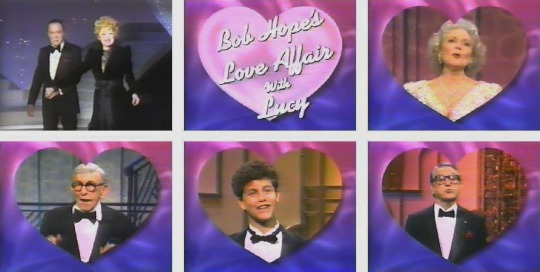
This
special aired on a Saturday evening at 10pm, traditionally a
difficult time for television programs. Luckily, its lead-in was the
season 5 premiere of the phenomenally successful “The Golden Girls”
(also featuring Betty White) which led the evening with a 23.5 share.
“Bob Hope’s Love Affair With Lucy” came in second, with a
respectable 19.3. It was up against College Football on ABC. Because
the special was 90 minutes and started on the half hour, its
competition on CBS was the last half hour of “Tour of Duty”
(season 3 premiere) and the series premiere of “Saturday Night With
Connie Chung.”Because
this special aired on NBC, no scenes from any of Lucille Ball’s CBS
sitcoms (or “Life with Lucy” on ABC) were included. Kirk Cameron
was an ABC star, but worked on several of Hope’s NBC specials.
Although Betty White never acted with Lucille Ball, the pair enjoyed
an off-stage friendship. White also was a perfect tie-in to keep
“The Golden Girls” fans tuned after the sitcom’s season opener.
Although Burns and Thomas both worked on screen with Lucy, no clips
of their collaborations were used. Also conspicuously missing is
Gale Gordon, who was part of Lucille Ball’s career since her days on
radio.[For more information about the clips, click on the hyperlinks, where available.]
BOB HOPE

The
special opens with a montage of clips of Lucille Ball’s entrances on
Bob Hope’s specials, underscored by the “I Love Lucy Theme.”
After a quick commercial break, Bob
Hope
enters to the sounds of his theme song “Thanks for the Memory.”Hope:
“Lucy
handled the media and television like she handled everything else,
with grace and style and a richness of color that didn’t need any
help from the peacock.”The
‘peacock’ Hope is referring to is the NBC logo. Lucille Ball left CBS
for NBC in 1980, but the move resulted in only one TV special (“Lucy
Moves To NBC”), one failed pilot (“Bungle Abbey”) and multiple
appearances on Bob Hope’s specials.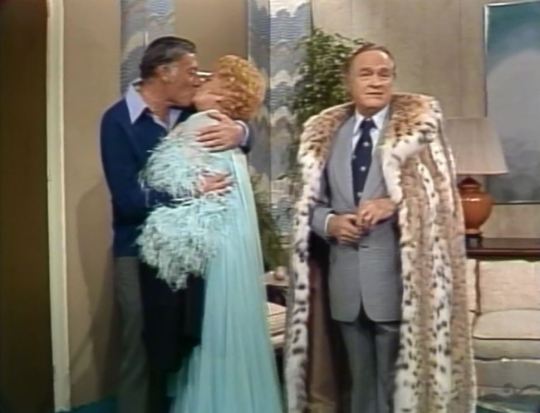
The
first clip in the 90-minute tribute is from “The
Bob Hope Christmas Special”
(December 9, 1973). Ball and Hope play themselves in a sketch about a
misunderstanding surrounding an expensive ring he’s bought for his
wife, but sent to Lucy’s home for safe keeping. Naturally,
Lucy thinks it’s for her. The clip features appearances by long-time
Lucy character actress Doris Singleton and Lucy’s husband Gary
Morton.
DANNY
THOMAS
Danny
Thomas calls Lucy his ‘landlady’ because “Make Room for Daddy”
was shot at Desilu Studios. He tells a funny anecdote from when Ball
appeared on his short-lived sitcom “The Practice” in 1976.Thomas:
“When
I worked on her show, she did most of the directing. And when she did
my show… she did most of the directing.”Thomas
talks about of their working relationship. He says that despite their
great friendship, Lucy would not divulge her age, even to him.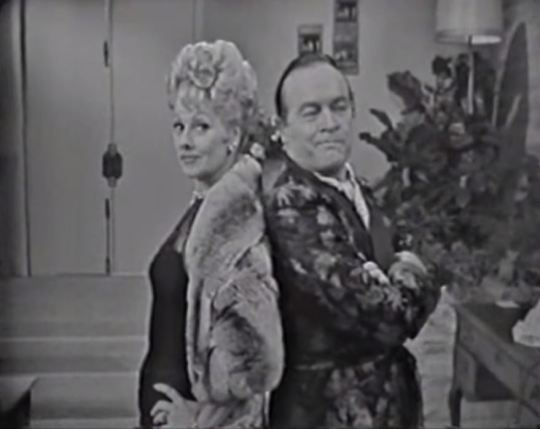
In a voice over, Bob Hope introduces a black and white clip
of a sketch from “The
Bob Hope Show” (October
24, 1962). In it Lucy plays a District Attorney and Bob a gangster
named Bugsy Hope. The 1962 clip edits out a bit that was
frighteningly prescient. A spray of gunfire comes through the window
and Lucy remarks “Just
what I wanted, a Jackie Kennedy hairdo.”
Considering the tragic events of November 1963, this clearly could
not be aired in 1989. Another change involves music royalties: in
the original, Lucy makes her entrance into Bugsy’s flat to the tune of
David Rose’s “The Stripper” (released in 1962) but in 1989 it is
replace by a similar sounding piece of music.Bugsy
Hope:
“I
don’t usually go for flatfeet, but the rest of you kind of makes up
for it.”
DA
Lucy: “I
don’t usually go for hoods, but you could use one.”In
the sketch, Hope makes Lucy laugh and drop character several times, a
rarity for Ball.
KIRK
CAMERON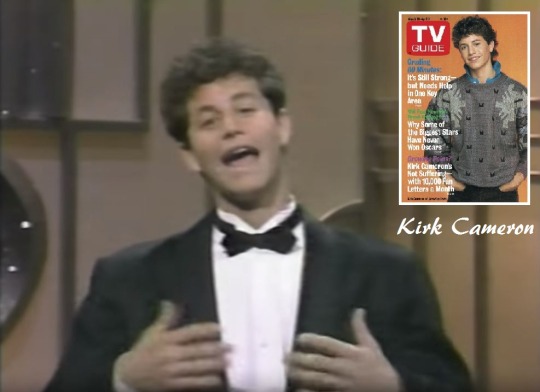
Kirk
Cameron (who had just turned 18) says that the first time he met
Lucille Ball on a May 1987 Bob Hope show at an Pope Air Force Base in
North Carolina. On a subsequent Hope special, Lucy needed a stand-in
to take a pie in the face and chose Cameron. He was unsure if it was
an honor or payback for making her wait outside her dressing room to
meet him the year before.Cameron:
“I think that I speak for a lot of people my age when I say that I
love Lucy.”

The
next clip is the satire of “I Love Lucy” featuring the entire
original cast (plus Hope and Tommy the trained seal). In “The
Bob Hope Chevy Show” (October
6, 1956), Hope introduces the sketch as himself wondering what it
would be like if he had married Lucy instead of Desi. It is presented
in its original black and white, although it was later colorized for
a video release. Not coincidentally, five days earlier the sixth and
final season of “I Love Lucy” began airing with “Lucy and Bob
Hope” (S6;E1).
GEORGE
BURNS
George
Burns affectionately recalls how Lucy was in show business 24 hours a
day. He says that he was married to a comedienne (Gracie Fields) but she couldn’t have been more different than Lucy.Burns:
“Lucy was all of show business wrapped up in this charming lady.”He
remembers an appearance with Lucy when they sang “Lazy”
by Irving Berlin. He sings a few bars. Burns says that he’s booked to
play the Palladium in London when he turns 100. Although he did live
to 100, his health declined at age 98 and this booking never came to
pass.
Bob’s
voice over introduces a couple of scenes from The
Facts of Life,
a black and white film that Hope and Ball did for United Artists in
1960. In the scene Larry (Hope) and Kitty (Lucy) are on a fishing
boat remembering old times when they realized they went to the same
high school together. In the second clip, Kitty and Larry realize
they can’t play cards without their glasses, but they can’t kiss with
them on either. Finally, Larry and Kitty are kissing at the drive-in
when they are spotted by the local dry cleaner. Lucy had just
finished playing Lucy Ricardo, with the final episode of “The
Lucy-Desi Comedy Hour” airing in April 1960.
BETTY
WHITE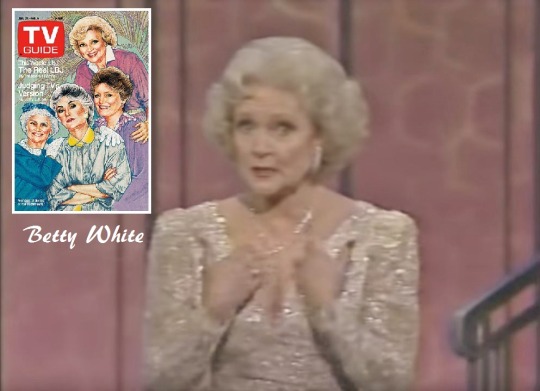
To
the accompaniment of “Thank You for Being a Friend” Golden Girl
Betty White is introduced. She lists three-word TV titles of the
’50s, “Our Miss Brooks,” “I Married Joan,” “Life with
Elizabeth,” “Father Knows Best,” and “I Love Lucy.” White
remembers that she shot her second series “Date With the Angels”
at Desilu Studios and that is where she first met Lucy.White:
“I
can still see her. Tall and built and she had a navy blue dress on
with white polka dots and this hair that made it look like her head
was on fire.”White
credits Lucille Ball with filming comedy using the three camera
system and a studio audience. White’s mother Tess and Lucy’s mother
Dede were great friends. Betty recalls the last time she saw Lucy, a
week before she went into the hospital. She says she can still recall
Lucy’s deep and abundant laughter that night. White let’s the
audience know that they shoot “The Golden Girls” at the old
Desilu lot.
Bob’s
voice introduces a clip from the film
Fancy Pants (1950)
with Bob Hope as Humphrey the butler and Lucy as Agatha, the daughter
of the man he works for. This movie was made just before Lucille
Ball got pregnant with her daughter Lucie, and before “I Love Lucy”
was in development. At the time, Ball was starring on radio in “My
Favorite Husband.”
Next is a dramatic scene from
Sorrowful Jones,
a film Hope and Ball did in 1949. Ball played Gladys and Hope was
Sorrowful (aka Humphrey).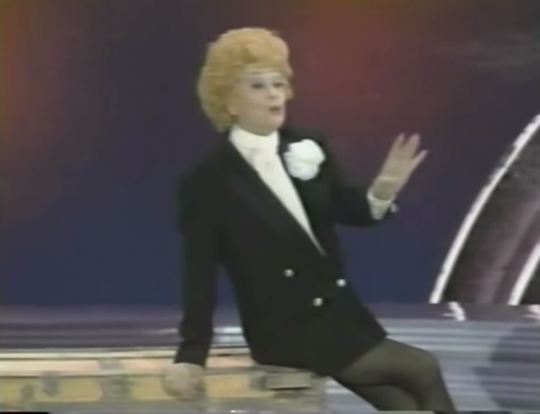
A
clip from “Happy
Birthday, Bob: 50 Stars Salute Your 50 Years with NBC”
(May 16, 1988) has Lucy singing
“Comedy Ain’t No Joke”
by Cy Coleman and James Lipton.
This leads directly into Lucy as
Sophie Tucker singing “Some
of These Days” from
“Bob
Hope’s All Star Comedy Tribute to Vaudeville”
(May 25, 1977).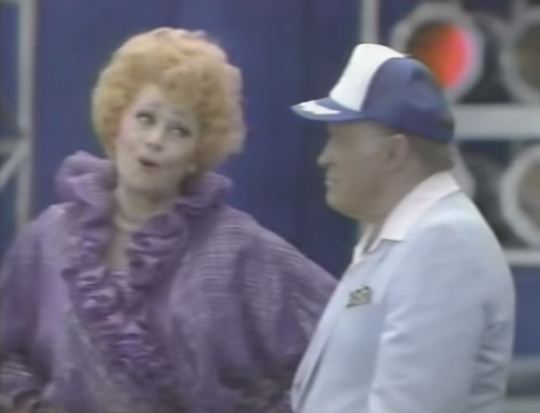
Lucy
and Bob sing “I
Remember It Well”
by Frederick Loewe from “Bob
Hope’s High-Flying Birthday Extravaganza”
(May 25, 1987). The song (originally from the film Gigi)
has special lyrics with references to their legendary partnership including
Fancy
Pants
and Facts
of Life.
Finally,
a clip of Lucy and Bob’s last appearance together at the
61st Annual Academy Awards telecast (March
29, 1989). This was also Lucille Ball’s last public appearance.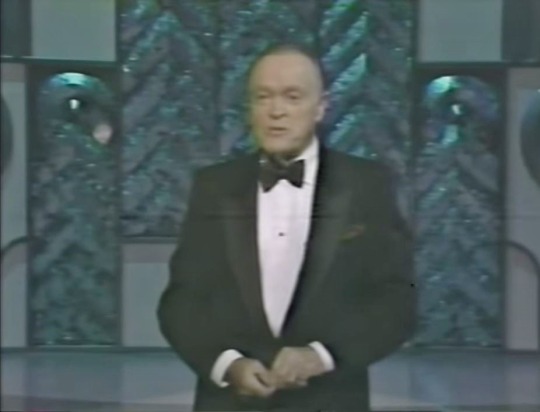
In his final remarks, Hope works in mentions of two of Lucy’s most
memorable comedy bits from “I Love Lucy”: “Hollywood at Last!”
(S4;E16) and “Lucy’s Italian Movie” (S5;E23).Hope:
“Whether
her nose caught fire or she was stomping grapes, Lucy got us all to
laugh. Thanks Lucille, for making life a ball.”The
closing credits appear over stills of Lucy and Bob on TV, some of
which were not included in the special.
This
Date in Lucy History – September 23rd
“Mod,
Mod Lucy”
(HL S1;E1) – September 23, 19741989, Betty White, Bob Hope, Bob Hope’s Love Affair With Lucy, Bobby Jellison, Danny Thomas, Desi Arnaz, Doris Singleton, Ellen Brown, Fancy Pants, Gary Morton, George Burns, Here’s Lucy, I love lucy, Joe Ploski, Kirk Cameron, Les Brown and His Band of Renown, Lucille Ball, Mary Jane Saunders, NBC, Peter Leeds, Robert L. Mills, Sorrowful Jones, The Facts of Life, The Golden Girls, tv, TV Guide, Vitto Scotti, Vivian Vance, William Frawley - Doris
-
Subscribe
Subscribed
Already have a WordPress.com account? Log in now.
 Papermoon Loves Lucy