-
BESS FLOWERS
November 23, 1898

Bess Flowers was known as “The Queen of the Hollywood Extras," appearing in more than 950 films and television shows in her 41-year career.

Born in Sherman, Texas, Flowers’ film debut came in 1923, when she appeared in Hollywood. She made three films that year, and then began working extensively. Many of her appearances are uncredited, as she generally played non-speaking roles. Not surprisingly, Flowers was a founding member of SEG, the Screen Extras Guild (now part of SAG) in 1945.
Bess Flowers holds the record for sharing the screen with Lucille Ball in more movies (not including TV shows) than any other performers: 17 films from 1933-1963.

Flowers finally did her first television show with “The Adventures of Superman” in October 1953. As usual, she played a well-dressed café patron.
Records for extras are often unreliable, but according to sources, Bess Flowers was seen in at least four episodes of “I Love Lucy”, including:

In "Lucy Is Enceinte” (ILL S2;E10) in 1952, she plays a woman at the Tropicana who blushes when Ricky nods in her direction to see if she is the woman announcing her blessed event.

In “Ethel’s Birthday" (ILL S4;E9) in 1954, Flowers was in the audience of “Over The Tea Cups”.

Source say that she was also in the audience of The Most Happy Fella during “Lucy’s Night In Town” (ILL S6;E22) in 1957. She is likely being confused with Norma Varden, who has a similar look and gets considerable air time during the episode. Many times, barring written records or screen credit, background artists like Flowers must rely upon eagle-eyed viewers for identification.

In 1959, Flowers was in the front row of the audience at the Desilu Playhouse for the “Desilu Revue”, a showcase of Desilu’s talent for the holiday season.

A month earlier she was one of the casino patrons in the “Sunday Showcase: The Lucille Ball-Desi Arnaz Milton Berle Special” which took place in Las Vegas.
She was also seen in at least five episodes of “The Lucy Show,” including:

Flowers (along with Lucille Ball’s camera and lighting stand-in Hazel Pierce) was a member of the Danfield Volunteer Fire Brigade in “Lucy and Viv Are Volunteer Firemen” (TLS S1;E16) in 1963…

…as well as in “Lucy Drives a Dump Truck” (TLS S1;E24) in 1963.

In “Chris’s New Years Eve Party” (TLS S1;E14) in 1962, Flowers was one of the New Years Eve revelers at the Elm Tree Inn.

Flowers was one of the posh diners at the Pink Pheasant in “No More Double Dates” (TLS S1;E21) in 1963. Lucy uses her open compact as a spy mirror!

She was a very vocal spectator in “Lucy and the Little League” (TLS S1;E28) in 1963. This was one of the rare times Flowers actually had a line of dialogue! This was her final appearance with Lucille Ball.

For Desilu, Flowers did four episodes of “The Untouchables” including the 1959 pilot.

She was one of the many extras for the “Westinghouse-Desilu Playhouse” production of “The Man in the Funny Suit” starring Ed and Keenan Wynn in 1960. As usual, Desi Arnaz introduced the episode on camera.

Also on the Desilu lot, Flowers did one episode of “My Three Sons” in March 1962 that also featured William Frawley, Fred MacMurray, Eve Arden, and Reta Shaw.

Her final role was in Good Neighbor Sam released in July 1964, her fourth film released within the month!
Flowers was first married in 1923 to Cullen Tate, an assistant director for Cecil B. DeMille. They had a daughter, and they were divorced in 1928. Her second marriage took place in 1929 to William S. Holman. They were divorced in 1930 and had one child.
Bess Flowers died on July 28, 1984, at age 85 in the Motion Picture & Television Country House and Hospital in Woodland Hills, California.

-
ALLAN RAY
November 23, 1909

Allan Ray was born Andrew Marinko in Swoyerville, Pennsylvania. His careen in Hollywood lasted thirty years, mostly playing background roles and smaller parts.

He made his uncredited screen debut in Dixie starring Bing Crosby and Dorothy Lamour.

He also had an uncredited role in 1950′s A Woman of Distinction in which Lucille Ball had a cameo.

He made his television debut doing two episodes of “Front Page Detective” in 1951.

He made two appearances on “Make Room for Daddy” in 1954. The series was filmed by Desilu. In the credits his first name was spelled Alan instead of Allan.

His first appearance on “I Love Lucy” was in “Ricky’s Screen Test” (ILL S4;E7) in 1954. Ray was the clapstick man who constantly rewrites the chalk board clapper for each new take in Ricky’s “Don Juan” screen test.

Ray was also in “Hollywood at Last” (ILL S4;E16) where he played a waiter at the Brown Derby. He serves Lucy spaghetti and has the tricky stunt of spilling the tray of cream pies on William Holden!

In “Nursery School” (ILL S5;E9) Ray is one of the masked and gowned medical staff in the operating room where Lucy causes havoc!

He made four appearances on “The Lucy Show” (all in 1963) starting with playing the Emcee in “Lucy’s Barbershop Quartet” (TLS S1;E17). He introduces The Four Alarms, the group comprised of Lucy Carmichael, Vivian Bagley, Dorothy Boyer (Dorothy Konrad) and Thelma Green (Carole Cook).

Next, Ray plays Harry, a man in the Danfield train station, in “No More Double Dates” (TLS S1;E21).

He was actually seen on a train in “Lucy Visits The White House” (TLS S1;E25). Frank Nelson repeated his role as the harried train conductor.

His final role on “The Lucy Show” was as a hunter in “Lucy Goes Duck Hunting” (TLS S2;E6). In the above screen shot he is standing just behind Sid Gould at the extreme right.

Also that year (1963) Ray played a hotel doorman in the Lucille Ball / Bob Hope film Critic’s Choice.

His final screen appearance was in the film The Don is Dead in 1973 in which he played a golf pro.
He died on May 22, 1998 in Palm Springs, California, at age 89.
-
LUCILLE & DESI SOLVE A PARENT PROBLEM
November 22, 1952

Lucille Ball and Desi Arnaz were on the cover of TV Digest for the week of November 22, 1952. The inside article was titled “Lucille and Desi Solve a Parent Problem.”

“With a baby due in January, how does the show stay on the air?”
The article reveals that the past summer hiatus was spent ‘banking’ enough episodes of the show to last through March 1953. Using a photo of Lucy tumbling through an open window in “The Anniversary Present” (ILL S2;E3) aired on September 29, 1952 but filmed on May 9, 1952, the article asserts that physical comedy will be temporarily omitted from future episodes. A candid photo depicts Lucille and Desi relaxing with their infant daughter, Lucille Desiree.

The inside listings include the original broadcast of “Redecorating” (ILL S2;E8) first aired on Monday, November 24, 1952. At the time of filming, Lucille Ball was already four months pregnant, although it was not yet part of the storyline on the show. To hide her condition, Lucy dressed in loose-fitting clothes throughout the episode. The big announcement would come two weeks later in “Lucy is Enceinte” (ILL S2;E10) aired on December 8, 1952.
IN OTHER NEWS…


Also on November 22, 1952, an Arlington Heights, Illinois, cinema offered a double bill of Cuban Pete (1944) starring Desi Arnaz and Lover Come Back (1946) starring Lucille Ball, which was retitled for its’ 1952 re-release Lucy Goes Wild to capitalize on the success of “I Love Lucy.” In the early 1950s cinemas were worried that competition from TV would make them obsolete.

The State Theatre in Richmond, Indiana, also wooed people away from the television into their popcorn palace, this time with second-run screenings of Look Who’s Talking (1941) and Too Many Girls (1940).
Nationwide, other cinemas were taking a similar tact with re-bookings of:
- Fancy Pants (1950) in Bunkie, Louisiana and Hazleton, Pennsylvania
- Sorrowful Jones (1949) in El Paso, Texas
- A double bill of The Fuller Brush Man (1948) and The Fuller Brush Girl (1950) in Dorchester, Massachusetts
- The Magic Carpet (1951) in Vancouver, British Columbia
- Too Many Girls (1940) in Miami Beach, Florida

In a San Mateo, California, newspaper, Bob Foster credited the success of “I Love Lucy” with saving General Services Studios from bankruptcy.

Meanwhile, in Hawaii, one of Lucy and Desi’s favorite vacation spots, an appliance dealership in Honolulu was tempting potential viewers to buy a set in order to see “I Love Lucy” and other great shows when network television broadcasts finally arrived on the island in December 1952.

Groff’s Hardware in New Holland, Pennsylvania, took out a classified ad to let readers know they were selling the “I Love Lucy” baby doll.

Erkskine Johnson did a story on the ubiquitous laugh track, getting a quote from “I Love Lucy” DP Karl Freund.
SATURDAY’S SYNDICATED STORIES!


Lucy’s friend and future co-star Hedda Hopper claimed Lucy often wore ribbons in her hair, making her look like a Christmas tree. B. Kaper is composer
Bronisław
Kaper, who scored Without Love (1945) starring Lucille Ball and would also score Forever, Darling starring Lucy and Desi in 1956.


Walter Winchell’s “Broadway and Elsewhere” reported that the latest “I Love Lucy” episode was “30 minutes long and a smile wide…” There was no new episode the previous Monday (November 17, 1952), so Winchell must be referring to “The Courtroom” (ILL S2;E7) which aired on Monday, November 10, 1952.


Erskine Johnson’s November 22, 1952, syndicated column “In Hollywood…” provided an anecdote about an “I Love Lucy” fan and the show’s record-setting viewership.

Dorothy Kilgallen’s syndicated column “Broadway: Gossip in Gotham” reported that Lucy and Desi were thinking about moving production of “I Love Lucy” to Cuba for tax reasons! As history knows, this never happened and sounds highly unlikely knowing Desi’s patriotic love of the USA.


Earl Wilson’s November 22, 1952 syndicated column “It Happened Last Night” closed with a barb attributed to Lucille Ball: “Will you please excuse me while you leave my table?”
-
WOMEN COMICS: WHY THEY TRY HARDER
November 21, 1971

Lucille Ball was on the cover and profiled in the November 21, 1971 issue of Parade, the national Sunday Newspaper Magazine supplement. The inside article was titled “Women Comics: Why They Try Harder” by associate editor Linda Gutstein.

The cover photo was taken from “Lucy and the Indian Chief” (HL S2;E3) in 1969.

The day after this article was published, “Here’s Lucy” premiered “Ginger Rogers Comes To Tea” (HL S4;E11) which was filmed in mid-July on an abbreviated schedule due to an impending actors’ strike.


“You’ve got to believe in what you do. There are actors and reactors. My forte has always been reacting. My writers put in longer and longer reactions.” ~ Lucille Ball

“Lucy is an exaggeration of the everyday housewife, and a happy exaggeration.” ~ Lucille Ball
The other female comics profiled in the article include:

Carol Burnett ~ one of Lucille Ball’s favorite funny ladies. Ball and Burnett took turns appearing on each others’ programs. Lucy lovingly referred to Burnett as “Kid”. Ball died on Burnett’s birthday and, as usual, flowers arrived at Burnett’s door that morning with love from Lucy.
“I play characters in my sketches. Men accept that humor.” ~ Carol Burnett

Joan Rivers ~ was a stand-up, and actress who Lucy encountered several times as a talk show host and once as actress on an episode of “Here’s Lucy” titled “Lucy and Joan Rivers Do Jury Duty” (HL S6;E9) in 1973.
“If a woman’s halfway good-looking, she’d rather be a singer.” ~ Joan Rivers

Phyllis Diller ~ was best known for her eccentric stage persona, her self-deprecating humor, her wild hair and clothes, and her exaggerated, cackling laugh. Diller and Lucille Ball never acted together, but did appear on various TV specials and talk shows together. In a 1972 episode of “Here’s Lucy,” female impersonator Jim Bailey ‘did’ Diller to a tee!
“You have to allow for some exaggerated qualities.” ~ Phyllis Diller

Nancy Walker ~ was a pint-sized musical comedy dynamo of stage and screen. Walker and Ball were both in the film Best Foot Forward (1943). On sitcoms, she is best remembered as Rhoda’s mother on “Rhoda” (1974-78).
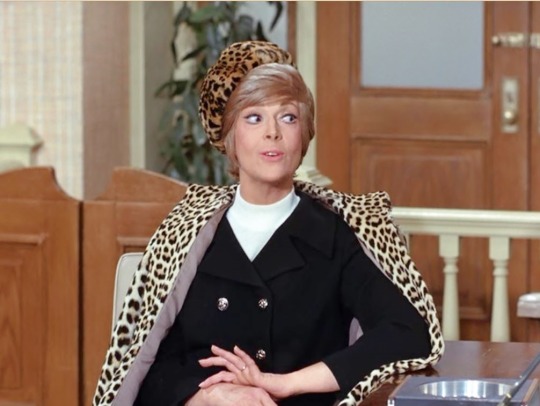
Jayne Meadows ~ was known for her infectious laugh and her extensive work in stage plays, teleplays, and in books. Her younger sister was Audrey Meadows, of “The Honeymooners” (1955) TV fame. She was married to host and raconteur Steve Allen. In 1970, she appeared on “Here’s Lucy”.

Audrey Meadows ~ sister of Jayne, was best known for playing long-suffering housewife Alice Kramden opposite Jackie Gleason on “The Honeymooners.” In 1986, she played Lucy’s sister on an episode of the short-lived series “Life With Lucy.”
Anne Meara ~ was part of a comedy team with her husband Jerry Stiller. She also appeared on sitcoms, films, and television commercials. Towards the end of her career, she appeared on “Archie Bunker’s Place.” Meara appeared with Ball on a March 1968 episode of Ed Sullivan’s “Talk of the Town”.
“You know, women and comics have a quality of vulnerability.” ~ Anne Meara

Totie Fields ~ was a stand-up comedian often compared to Don Rickles (because of her insult comedy) and Jackie Gleason (due to her size). She played Poopsie Bubkiss on a 1972 episode of “Here’s Lucy.”
“They didn’t know so they called me the female Jackie Gleason.” ~ Totie Fields

Kaye Ballard ~ was a musical comedy performer and sitcom star best known for playing one of “The Mothers-in-Law” in the Desi Arnaz sitcom opposite Eve Arden. She appeared on “Here’s Lucy” in 1971 in “Lucy and Harry’s Italian Bombshell” (S4;E3).

Eve Arden ~ was one of RKO’s ‘drop gag girls’ along with Lucille Ball appearing together in Stage Door (1937) and Having Wonderful Time (1938). She made a guest appearance as herself on “I Love Lucy” in 1955. She is best known for playing the title role in “Our Miss Brooks” and one of “The Mothers-in-Law” in the Desi Arnaz sitcom opposite Kaye Ballard.

Imogene Coca ~ was best remembered for playing opposite Sid Caesar on “Your Show of Shows”, which ran on NBC from February 1950 to June 1954. She only appeared together with Lucille Ball once, on Bob Hope’s “Women I Love: Beautiful But Funny” in 1982.

Nanette Fabray ~ was a beloved stage and screen performer who won two Emmy Awards for her work with Sid Caesar in 1956 (beating Audrey Meadows, Art Carney’s co-star) and in 1957 (beating Lucille Ball herself). Fabray had severe hearing loss and was an advocate for disability rights. She appeard opposite Lucy in “Happy Anniversary and Goodbye” in 1974.
Peggy Cass ~ was an actress best known for her Oscar-nominated performance in Auntie Mame (1949) opposite Rosalind Russell. Her only appearance with Lucille Ball was when she was Jack Paar’s sidekick on “Jack Paar Tonight” in May 1973.

Mary Tyler Moore ~ was best known as the star of “The Dick Van Dyke Show” (filmed at Desilu) and “The Mary Tyler Moore Show.” In March 1979 Lucille Ball guest-starred on her short-lived variety show “The Mary Tyler Moore Hour”.

Valerie Harper ~ was best known for her role as Rhoda Morgenstern on “The Mary Tyler Moore Show” and “Rhoda”. She got her start on the Broadway stage, singing in the chorus of Wildcat (1960) starring Lucille Ball.

Carol Channing ~ originated the title role in the Broadway musical Hello, Dolly! In January 1964 and played the part until August 1965. She won a Tony Award for her portrayal and would re-visit the role many times during her career. Lucille Ball produced an episode of “The Lucy Show” in which Lucy Carmichael goes undercover as Carol Channing.
Jo Anne Worley ~ was best known for her regular appearances on “Rowan and Martin’s Laugh-In,” which was programmed opposite “Here’s Lucy” in the late 1960s and early ‘70s. Unlike some of “Laugh-In” co-stars, she never worked with Lucille Ball.

Ruth Buzzi ~ like Worley, was one of the break-out stars of “Rowan and Martin’s Laugh-In”. She made an appearance on “Here’s Lucy” in 1972.
In 1986, Ruth Buzzi guest-starred (with John Ritter) on the second episode of “Life With Lucy.” She was nominated for five Emmy Awards and won a Golden Globe in 1973.
1971, Audrey Meadows, Carol Burnett, Carol Channing, Eve Arden, Female Comedians, Ginger Rogers, Here’s Lucy, Imogene Coca, Jayne Meadows, Jo Anne Worley, Kaye Ballard, Lucille Ball, Mary Tyler Moore, Nancy Walker, Nanette Fabray, Parade Magazine, Peggy Cass, Phyllis Diller, Ruth Buzzi, Totie Fields, tv, Valerie Harper -
GEORGE ATTENDS A TEENAGE DANCE
November 20, 1948

“George Attends a Teenage Dance” is episode #19 of the radio series MY FAVORITE HUSBAND broadcast on November 20, 1948.
Synopsis ~ Liz gives advice to her adolescent neighbor, Sally Hopkins, on how to snare the boy she likes, but her meddling only makes things worse.
Note: This episode was aired before the characters names were changed from Cugat to Cooper. It was also before Jell-O came aboard to sponsor the show and before the regular cast featured Bea Benadaret and Gale Gordon as the Atterburys.

This program was used as a basis for “The Young Fans” (ILL S1;E20) first broadcast in February 1952.

“My Favorite Husband” was based on the novels Mr. and Mrs. Cugat, the Record of a Happy Marriage (1940) and Outside Eden (1945) by Isabel Scott Rorick, which had previously been adapted into the film Are Husbands Necessary? (1942). “My Favorite Husband” was first broadcast as a one-time special on July 5, 1948. Lucille Ball and Lee Bowman played the characters of Liz and George Cugat, and a positive response to this broadcast convinced CBS to launch “My Favorite Husband” as a series. Bowman was not available Richard Denning was cast as George. On January 7, 1949, confusion with bandleader Xavier Cugat prompted a name change to Cooper. On this same episode Jell-O became its sponsor. A total of 124 episodes of the program aired from July 23, 1948 through March 31, 1951. After about ten episodes had been written, writers Fox and Davenport departed and three new writers took over – Bob Carroll, Jr., Madelyn Pugh, and head writer/producer Jess Oppenheimer. In March 1949 Gale Gordon took over the existing role of George’s boss, Rudolph Atterbury, and Bea Benaderet was added as his wife, Iris. CBS brought “My Favorite Husband” to television in 1953, starring Joan Caulfield and Barry Nelson as Liz and George Cooper. The television version ran two-and-a-half seasons, from September 1953 through December 1955, running concurrently with “I Love Lucy.” It was produced live at CBS Television City for most of its run, until switching to film for a truncated third season filmed (ironically) at Desilu and recasting Liz Cooper with Vanessa Brown.
MAIN CAST

Lucille Ball (Liz Cugat) was born on August 6, 1911 in Jamestown, New York. She began her screen career in 1933 and was known in Hollywood as ‘Queen of the B’s’ due to her many appearances in ‘B’ movies. “My Favorite Husband” eventually led to the creation of “I Love Lucy,” a television situation comedy in which she co-starred with her real-life husband, Latin bandleader Desi Arnaz. The program was phenomenally successful, allowing the couple to purchase what was once RKO Studios, re-naming it Desilu. When the show ended in 1960 (in an hour-long format known as “The Lucy-Desi Comedy Hour”) so did Lucy and Desi’s marriage. In 1962, hoping to keep Desilu financially solvent, Lucy returned to the sitcom format with “The Lucy Show,” which lasted six seasons. She followed that with a similar sitcom “Here’s Lucy” co-starring with her real-life children, Lucie and Desi Jr., as well as Gale Gordon, who had joined the cast of “The Lucy Show” during season two. Before her death in 1989, Lucy made one more attempt at a sitcom with “Life With Lucy,” also with Gordon.
Richard Denning (George Cugat) was born Louis Albert Heindrich Denninger Jr., in Poughkeepsie, New York. When he was 18 months old, his family moved to Los Angeles. Plans called for him to take over his father’s garment manufacturing business, but he developed an interest in acting. Denning enlisted in the US Navy during World War II. He is best known for his roles in various science fiction and horror films of the 1950s. Although he teamed with Lucille Ball on radio in “My Favorite Husband,” the two never acted together on screen. While “I Love Lucy” was on the air, he was seen on another CBS TV series, “Mr. & Mrs. North.” From 1968 to 1980 he played the Governor on “Hawaii 5-0″, his final role. He died in 1998 at age 84.
Ruth Perrott (Katie, the Maid) was also later seen on “I Love Lucy.” She first played Mrs. Pomerantz, a member of the surprise investigating committee for the Society Matrons League in “Pioneer Women” (ILL S1;E25), as one of the member of the Wednesday Afternoon Fine Arts League in “Lucy and Ethel Buy the Same Dress” (ILL S3;E3), and also played a nurse when “Lucy Goes to the Hospital” (ILL S2;E16). She died in 1996 at the age of 96.
Bob LeMond (Announcer) also served as the announcer for the pilot episode of “I Love Lucy”. When the long-lost pilot was finally discovered in 1990, a few moments of the opening narration were damaged and lost, so LeMond – fifty years later – recreated the narration for the CBS special and subsequent DVD release.
GUEST CAST

Barbara Eiler (Sally Hopkins) started acting as a teenager and appeared regularly on the radio programs “The Life of Riley,” “A Day in the Life of Dennis Day,” “The Fabulous Dr. Tweedy” and “Glamor Manor."

Gil Stratton (Jimmy Matthews) was a young actor who appeared in the stage and screen adaptation of Best Foot Forward (1943), the latter with Lucille Ball. He was also a professional sportscaster.

Florence Halop (Lena the Hyena, Party Line Gossip) was cast to replace Bea Benadaret in a radio show moving to CBS TV called “Meet Millie” when she was hired to play on of the two women on Lucy Ricardo’s party line in “Redecorating” (ILL S2;E8) also featuring Hans Conried. She wouldn’t work for Lucy again until 1974, when she played a Little Old Lady on a Western-themed episode of “Here’s Lucy.” In 1985, she replaced Selma Diamond (who had died of lung cancer) as the bailiff on “Night Court.” Coincidentally, Halop, also a heavy smoker, died less than a year later of the same disease.
Halop previously played a party Line Gossip in “Katie and Roscoe” on a Novmber 5, 1948 episode of MY FAVORITE HUSBAND.
Erwin Lee (Icky Williams) was also heard on the following week’s episode of MY FAVORITE HUSBAND, “Is There A Baby In the House?”
THE EPISODE
ANNOUNCER: “It’s morning, and Liz has just sat down to breakfast. George is still getting dressed upstairs.”
Liz is looking at the morning paper.
LIZ: “Who do you suppose got married?”
KATIE THE MAID: “Li’l Abner and Daisy Mae?”
The Al Capp comic strip Li’l Abner debuted in 1934. Almost from the start, Abner Yokum was being pursued for matrimony by Daisy Mae Scragg. The reading public found it quite a tease that the two were clearly destined to get together. They finally married in 1952, nearly four years after this broadcast. The event made the cover of LIFE Magazine.
Liz corrects her: it was Madelyn Smith and Jack Carroll.
LIZ: “She always wanted to be Madelyn Carroll!”
KATIE: “So did I, but I never got nearer than Marjorie Main!”
This joke must have pleased its writers, Madelyn Pugh and Bob Carroll Jr., who where a team, but not a couple. They must have pondered what her name would be if they did marry and came up with this joke. It relies on the listener knowing that Madeleine Carroll (1906-87) was once the world’s highest paid actress. She was born in Britain and found success on both sides of the Atlantic.

Katie claims she is more associated with Marjorie Main (1890-1974), a less glamorous actress who appeared with Lucille Ball and Desi Arnaz in The Long, Long Trailer (1954).
Liz takes credit for the marriage, bragging that she played matchmaker for the couple.
LIZ: “George says I’m always teaching some mouse to build a better man trap!”
Liz and Katie wonder why it takes George so long to shave in the morning. She knows his razor is sharp because she used it to scrape some chewing gum off her shoe. George finally comes down to breakfast, his face heavily bandaged.
LIZ: “You smell nice, George. What do you have on your face? Yeardley’s After Shave?”
GEORGE: “No, Wrigley’s Juicy Fruit.”
Yardley is a British personal care brand and one of the oldest firms in the world to specialize in cosmetics, fragrances and related toiletry products. Established in 1770, it is now owned by Indian conglomerate Wipro. Wrigley’s is an American chewing gum company founded in 1891 and based in Chicago, Illinois. It is the largest manufacturer and marketer of chewing gum in the world. Juicy Fruit was introduced in 1893 and is still sold today.
George is grumpy because Liz is overdrawn once again. Liz decides to tell the truth: she bought Madelyn Smith a new dress for her date with Jack Carroll. George is upset to hear she’s been matchmaking again. The doorbell rings. It is Sally Hopkins (Barbara Eiler), a giggling school girl who is sweet on George. Rather than face her, George leaves for work.
Sally assumes that George is middle-aged, guessing he is pushing 25.
LIZ: “Oh, yes, he’s pushing 25 alright. In fact, he’s pushed it nearly all the way to 40.”

The dialogue between young Sally and mature Liz, is nearly verbatim to the conversation between young Peggy (Janet Waldo), and Lucy Ricardo "The Young Fans” (ILL S1;E20).
Sally wants Liz to give her some tips for dealing with men. Liz tells Sally how to tell the three different types of men apart.
LIZ: “The bachelor walks around the car and opens the door for you. The fiancé reaches across you and pushes the door open from the inside. And the husband gets out, stands on the sidewalk, and says ‘Well, we haven’t got all night!”
Sally wants to ask Liz about one specific man: Jimmy Matthews.SALLY: He’s really terrif! Sensash! Collos! You know what I mean?”
LIZ: “Oh, but natch! He’s a patch!”
SALLY: “Jimmy has red hair, big sad eyes, and floppy ears. He looks just like Gregory Peck.”
LIZ: “Sounds more like Lassie.”
At the time this episode was aired both were huge box office stars: earlier in 1948, Gregory Peck had already been nominated for his third Academy Award. and Lassie had made several films, including one opening just five days after this broadcast. In 1959, Lassie appeared on “The Desilu Revue” Christmas special.
Sally wants to ask Jimmy on a date to a party, but she is not sure how. Liz tells her to make him jealous by making up a rival boyfriend and setting up a date with him.
Later, Sally rings the Cugat doorbell in tears. Jimmy merely congratulated Sally on getting a date and was not jealous at all. For her make-believe beau impetuous Sally made up the first name that came to mind: George Cugat. Liz promises that she’ll get George (aka ‘Smoothie’) to go on a date with her so Jimmy won’t know she was lying.
Liz turns on the romance to soften George up, but he refuses to go on a date with a teenage girl. Liz soon convinces him, however.
At the party, Sally is having a ‘keen’ time with her ‘keen’ date, George. Jimmy Matthews approaches and asks Sally to dance. She rejects him saying she prefers older men like George.
Back at the Cugat home, Liz and Katie wonder what is keeping George. She decides to call, but the phone is occupied by the party line. A woman (Florence Halop) who Liz calls Lena the Hyena is chatting away about her fear of heights. She claims she is using the line for psycho analysis. Liz listens in.
LENA: “Every night I dream about Joe DiMaggio, doctor. I dream he picks me up and swings me around. What does that mean?”
LIZ: “It means you’re an old bat!”
Joe DiMaggio (1914-99) was a center fielder who played his entire 13-year professional baseball career for the New York Yankees. He was mentioned several times on “I Love Lucy.” In 1954, he married Marilyn Monroe.
Liz cleverly gets rid of the party line patient by imitating her voice saying that she can’t pay the doctor, who promptly hands up! ‘Lena’ calls her therapist by name before hanging up: Dr. Lastfogel.

Abe Lastfogel was the long-time president and agent of the William Morris Talent Agency. When he died in 1984 he had worked for the agency for 72 years.
No sooner is the line free than the phone rings! It is Jimmy Matthews reporting that George is at the party with his girl! He says that Sally has fallen for George. Liz is jealous and tells Jimmy she will come right down and be his date.
Liz overhears Sally praising George’s dancing.
GEORGE: “It’s nothing that Arthur Murray couldn’t do.”
LIZ (to Jimmy): “He’s the only man Arthur Murray ever gave his money back to!”
Arthur Murray (1895-1991) taught dance and franchised his dancing schools starting in 1925. He even had a television program from 1950 to 1960 called “The Arthur Murray Party.” The song “Cuban Pete,” includes the line "And Cuban Pete don’t teach you in a hurry, like Arthur Murray.”
SALLY (to George) “You’re smarter than Doctor IQ!”
LIZ (interrupting loudly): “Give that lady a box of Snickers!”
GEORGE: “Liz!”
LIZ: “I’m going to push that lady off the balcony, doctor!”
“Dr. I.Q.” (1939-1950) was radio’s first major quiz show. It popularized the catch phrase "I have a lady in the balcony, Doctor." The show was sponsored by M&M Mars, makers of Snickers candy bars. The television version ran from 1953 to 1954, and again from December 1958 to March 1959.
SALLY: “George was going to be my partner in the Big Apple.”
LIZ: “That’s where he belongs: in a big apple, the worm!”
“The Big Apple” is a dance that was named from the location of its revival in the 1930s: The Big Apple Club in Columbia, South Carolina. In 1937, it became a national dance craze. The dance is discussed in “Lucy Becomes a Reporter” (TLS S1;E17) in 1963.
Jimmy announces that they are all going to play Post Office.
JIMMY: “Do you know how to play Post Office, Mrs. Cugat?”
LIZ: “Know how? When I was your age they used to call me Jim Farley.”
James Farley was the the 53rd US Postmaster General from 1933 to 1940. A native New Yorker, he was instrumental in the political careers of Alfred E. Smith and Franklin D. Roosevelt, having served as campaign manager to both. Farley was a Democratic candidate for US president in the 1940 presidential election, running against Roosevelt in the primary. In 1982, New York City’s iconic Penn Station post office was dedicated as the James A. Farley Building. It was seen in the film Miracle on 34th Street (1947) featuring William Frawley.
Post Office is a kissing party game played at teenage parties. It has been referred to in popular culture since at least the 1880s. The group playing is divided into two groups. One group goes into another room which is called "the post office”. To play, each person from the outer group individually visits “the post office”. Once there, they get a kiss from everyone in the room. They then return to the original room.
In "The Charm School" (ILL S3;E15), Ethel mentions that Fred suggested they play Post Office the previous night when a beautiful guest arrived at their dinner party. In “Kiddie Parties Inc.” (TLS S2;E2) Vivian says she played Post Office when she was younger.
When it is George’s turn, his ‘letter’ is for Sally Hopkins, although Liz cuts front of her. In the dark closet, Liz giggles like Sally. George whispers that she should just stay in the closet with him a few moments to make her jealous. Liz kisses him and George knows instantly that it is Liz. They ‘mail a few letters’ before opening the door. Everyone has gone home and the party is over! George and Liz go back into the closet to smooch!
End of Episode
1948, Abe Lastfogel, Arthur Murray, Barbara Eiler, Bob LeMond, CBS, Dr. IQ, Erwin Lee, Florence Halop, Gil Stratton, Gregory Peck, I love lucy, James Farley, Joe DiMaggio, Juicy Fruit, Lassie, Li’l Abner, Lucille Ball, Madeleine Carroll, Marjorie Main, My Favorite Husband, Party line, Post Office, Radio, Richard Denning, Ruth Perrott, The Big Apple, The Young Fans, Wrigley’s Gum, Yardley’s -
LUCY BECOMES MRS. MORTON
November 19, 1961


-
ELEANOR AUDLEY
November 19, 1905

Eleanor Audley was born Eleanor Zellman in Newark, New Jersey. Audley was a New York born actress who performed in eight Broadway plays between 1926 and 1944. She began using the last name Audley before 1940.
On radio, she appeared in several episodes of Lucille Ball’s “My Favorite Husband,” such as “The Mother-in-Law” (1949), “George is Messy” (1950), “Dinner for 12″ (1950), and “The Two Mothers-in-Law” (1951), in which she plays George’s mother, Letitia Cooper.

She specialized in snobbish society matron types, most notably as Eddie Albert’s high society mother on TV’s “Green Acres” (1965-69).

Audley’s film roles began in 1949 with an uncredited role in The Story of Molly X starring June Havoc.

Her first television appearances was in the pilot of “The Mickey Rooney Show” in 1954.

She is probably best known, however, as the voice of two of Disney’s most memorable animated villainesses: Lady Tremaine, the wicked stepmother in Cinderella (1950); and the evil Maleficent in Sleeping Beauty (1959). She served as the physical model for both characters.
Also for Disney, she provided the voice of Madame Leota, the disembodied head in the crystal ball of the Haunted Mansions, still heard in the theme parks today.

In 1956 she did a single appearance on “Our Miss Brooks” opposite Gale Gordon and Eve Arden, which was filmed by Desilu. She played an eccentric new headmistress named Mrs. Pryor.

Audley was first seen with Lucille Ball as Mrs. Spaulding, the first owner of the Ricardo’s Westport home in “Lucy Wants to Move to the Country” (ILL S6;E15). Her husband Gerald was played by Frank Wilcox.
Audley and Wilcox both appeared in the 1950 films Three Secrets and Gambling House as well as appearing together on a 1958 episode of “Jane Wyman’s Fireside Theatre” and a 1962 episode of “The Beverly Hillbillies,” in which Wilcox was a recurring character. After this episode they would again play husband and wife in a 1964 episode of "The Cara Williams Show” and again in two episodes of "Pete and Gladys” (1961 and 1962) – but not as the same couple!

Lucy changes her mind about moving to Connecticut and schemes to get their deposit back from the Spauldings by pretending to be undesirables. The plan backfires when the Spauldings defend themselves and Ricky suddenly shows up not knowing what is going on.

She returned to “I Love Lucy” to play one of the garden club judges in “Lucy Raises Tulips” (ILL S6;E26) in April 1957.

When Lucy accidentally runs over Ethel’s tulips with the lawn mower, she replaces them with wax ones. Little does she know, Ricky did the same thing to hers! The wax tulips melt in the hot summer sun, right in front of the judges (Audley and Peter Brocco).

After “I Love Lucy,” in 1959, she returned to Desilu for an episode of “The Real McCoys,” a Desilu production. That same year she also did two episodes of “The Ann Sothern Show” as Mrs. Thompson.

In March 1960, she did an episode of Desilu’s hit crime show “The Untouchables”. That same year she also did an episode of “The Danny Thomas Show,” filmed at Desilu.

For three out of her four appearances on “The Dick Van Dyke Show” from 1961 to 1963, she played Mrs. Billings. On those episodes, she appeared opposite “I Love Lucy” regulars Jerry Hausner and Shirley Mitchell. The show was filmed at Desilu Studios.

Audley appeared one last time with Lucille Ball in a “Lucy Saves Milton Berle” (TLS S4;E13) in 1965. She played a society reporter named Eleanor.
Audley died from respiratory failure on November 25, 1991. She was 86 years old.
-
LIZ THE MATCHMAKER
November 18, 1949
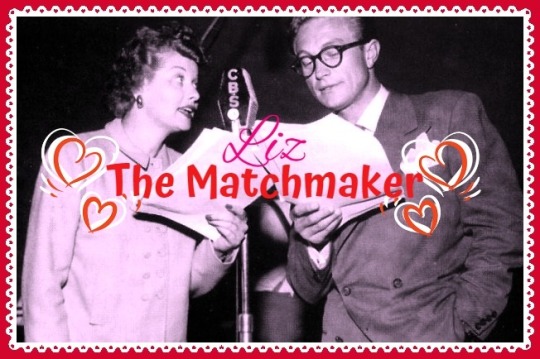
“Liz The Matchmaker” (aka “Katie and Mr. Negley”) is episode #63 of the radio series MY FAVORITE HUSBAND broadcast on November 18, 1949.
Synopsis ~ After dating Mr. Negley the postman for three years, Katie feels that their relationship is not going anywhere, so she enlists Liz’s help!
This was the 12th episode of the second season of MY FAVORITE HUSBAND. There were 43 new episodes, with the season ending on June 25, 1950.

Although similarly titled and themed, this radio episode is not the basis for the “I Love Lucy” episodes “Lucy Plays Cupid” (ILL S1;E15), “Lucy is a Matchmaker” (ILL S2;E27), “The Matchmaker” (ILL S4;E4), or “Lucy, the Matchmaker” (HL S1;E12) in 1968. Safe to say that meddling in the romantic affairs of others was a trait of all of the Lucy characters!

“My Favorite Husband” was based on the novels Mr. and Mrs. Cugat, the Record of a Happy Marriage (1940) and Outside Eden (1945) by Isabel Scott Rorick, which had previously been adapted into the film Are Husbands Necessary? (1942). “My Favorite Husband” was first broadcast as a one-time special on July 5, 1948. Lucille Ball and Lee Bowman played the characters of Liz and George Cugat, and a positive response to this broadcast convinced CBS to launch “My Favorite Husband” as a series. Bowman was not available Richard Denning was cast as George. On January 7, 1949, confusion with bandleader Xavier Cugat prompted a name change to Cooper. On this same episode Jell-O became its sponsor. A total of 124 episodes of the program aired from July 23, 1948 through March 31, 1951. After about ten episodes had been written, writers Fox and Davenport departed and three new writers took over – Bob Carroll, Jr., Madelyn Pugh, and head writer/producer Jess Oppenheimer. In March 1949 Gale Gordon took over the existing role of George’s boss, Rudolph Atterbury, and Bea Benaderet was added as his wife, Iris. CBS brought “My Favorite Husband” to television in 1953, starring Joan Caulfield and Barry Nelson as Liz and George Cooper. The television version ran two-and-a-half seasons, from September 1953 through December 1955, running concurrently with “I Love Lucy.” It was produced live at CBS Television City for most of its run, until switching to film for a truncated third season filmed (ironically) at Desilu and recasting Liz Cooper with Vanessa Brown.
MAIN CAST

Lucille Ball (Liz Cooper) was born on August 6, 1911 in Jamestown, New York. She began her screen career in 1933 and was known in Hollywood as ‘Queen of the B’s’ due to her many appearances in ‘B’ movies. With Richard Denning, she starred in a radio program titled “My Favorite Husband” which eventually led to the creation of “I Love Lucy,” a television situation comedy in which she co-starred with her real-life husband, Latin bandleader Desi Arnaz. The program was phenomenally successful, allowing the couple to purchase what was once RKO Studios, re-naming it Desilu. When the show ended in 1960 (in an hour-long format known as “The Lucy-Desi Comedy Hour”) so did Lucy and Desi’s marriage. In 1962, hoping to keep Desilu financially solvent, Lucy returned to the sitcom format with “The Lucy Show,” which lasted six seasons. She followed that with a similar sitcom “Here’s Lucy” co-starring with her real-life children, Lucie and Desi Jr., as well as Gale Gordon, who had joined the cast of “The Lucy Show” during season two. Before her death in 1989, Lucy made one more attempt at a sitcom with “Life With Lucy,” also with Gordon.
Richard Denning (George Cooper) was born Louis Albert Heindrich Denninger Jr., in Poughkeepsie, New York. When he was 18 months old, his family moved to Los Angeles. Plans called for him to take over his father’s garment manufacturing business, but he developed an interest in acting. Denning enlisted in the US Navy during World War II. He is best known for his roles in various science fiction and horror films of the 1950s. Although he teamed with Lucille Ball on radio in “My Favorite Husband,” the two never acted together on screen. While “I Love Lucy” was on the air, he was seen on another CBS TV series, “Mr. & Mrs. North.” From 1968 to 1980 he played the Governor on “Hawaii 5-0″, his final role. He died in 1998 at age 84.
Ruth Perrott (Katie, the Maid) was also later seen on “I Love Lucy.” She first played Mrs. Pomerantz, a member of the surprise investigating committee for the Society Matrons League in “Pioneer Women” (ILL S1;E25), as one of the member of the Wednesday Afternoon Fine Arts League in “Lucy and Ethel Buy the Same Dress” (ILL S3;E3), and also played a nurse when “Lucy Goes to the Hospital” (ILL S2;E16). She died in 1996 at the age of 96.
Bob LeMond (Announcer) also served as the announcer for the pilot episode of “I Love Lucy”. When the long-lost pilot was finally discovered in 1990, a few moments of the opening narration were damaged and lost, so LeMond – fifty years later – recreated the narration for the CBS special and subsequent DVD release.
Gale Gordon (Rudolph Atterbury) and Bea Benadaret (Iris Atterbury) do not appear in this episode.
GUEST CAST

Jay Novello (Mr. Negley, Postman) appeared on “I Love Lucy” as superstitious Mr. Merriweather in “The Seance" (ILL S1;E7), Mario the gondolier in “The Visitor from Italy” (ILL S6;E5), and nervous Mr. Beecher in “The Sublease” (ILL S3;E31). He also appeared on two episodes of “The Lucy Show,” but Novello is probably best remembered for playing Mayor Lugatto on “McHale’s Navy” in 1965.

Frank Nelson (Police Officer) was born on May 6, 1911 (three months before Lucille Ball) in Colorado Springs, Colorado. He started working as a radio announcer at the age of 15. He later appeared on such popular radio shows as “The Great Gildersleeve,” “Burns and Allen,” and “Fibber McGee & Molly”. Aside from Lucille Ball, Nelson is perhaps most associated with Jack Benny and was a fifteen-year regular on his radio and television programs. His trademark was playing clerks and other working stiffs, suddenly turning to Benny with a drawn out “Yeeeeeeeeees?” Nelson appeared in 11 episodes of “I Love Lucy”, including three as quiz master Freddy Fillmore, and two as Ralph Ramsey, plus appearance on “The Lucy-Desi Comedy Hour” – making him the only actor to play two different recurring roles on “I Love Lucy.” Nelson returned to the role of the frazzled Train Conductor for an episode of “The Lucy Show” in 1963. This marked his final appearance on a Lucille Ball sitcom.

Rolfe Sedan (Malt Shop Waiter) first worked with Lucille Ball in the 1934 film Kid Millions. When Lucy Ricardo ate snails in “Paris at Last” (ILL S5;E18), Sedan played the Chef who was outraged that Lucy wants to put ketchup on his food. He is probably best remembered as Mr. Beasley the mailman on “The George Burns and Gracie Allen Show.”
EPISODE
ANNOUNCER: “As we look in on the Coopers it’s morning and Liz and George are at the breakfast table.”

George spits out his eggs and wonders why his breakfast is so badly cooked. Liz says that Katie’s romance with Mr. Negley the mailman is not going well, so she’s distracted. Even the toast is burned!
Liz tells says she wants to help bring the maid and the mailman together but George warns her to stay out of it! Instead, George wants to warn Mr. Negley that Katie is trying to get a “wedlock headlock” on him! George makes Liz promise not to meddle, no matter how difficult it is.
In the kitchen, Katie is crying and singing: “I gotta right to sing the blues. I got a right to moan and cry.”

“I Gotta Right to Sing the Blues” is a popular song with music by Harold Arlen and lyrics by Ted Koehler, published in 1932 for the Broadway show Earl Carroll’s Vanities (1932) starring Milton Berle. The song became a jazz and blues standard. Popular recordings were by Cab Calloway, Louis Armstrong, and Billie Holliday.
Liz comes up with a loophole about her promise to not get involved in Katie’s romance: she will just listen, while Katie talks. Katie says that she and Mr. Negley go on several dates a week to the drive-in movie. Unfortunately, he drives a motorcycle. They also go to the park, where Mr. Negley plays canasta with the cop on the beat. Mr. Negley lives at the YMCA so she has no hopes of being invited over to dinner. Liz comes up with the idea to take George out to a movie that night, so that Katie and Mr. Negley will have the Cooper living room all to themselves.
Mr. Negley arrives to deliver the morning mail. Katie is too nervous to ask him to come over that evening, so Liz agrees to do it for her.
LIZ: “I thought I was Mr. Anthony, now I’m John Alden.”

Mr. Anthony (aka John J. Anthony) was the pseudonym of Lester Kroll, who from 1937 to 1953 dispensed marital advice on the radio through “The Good Will Hour”, later renamed “The John J. Anthony Hour.”

In “The Courtship of Miles Standish” by Henry Wadsworth Longfellow John Alden was asked by his friend, Miles Standish, to act as matchmaker for him with Priscilla Mullins. Priscilla made the classic response “Why don’t you speak for yourself, John?"
Mr. Negley finally agrees to the date and merrily goes off singing “Some enchanted evening, you will see a stranger…”

”Some Enchanted Evening“ is a show tune from the 1949 Rodgers and Hammerstein musical South Pacific. It has been described as ”the single biggest popular hit to come out of any Rodgers and Hammerstein show.“ Billboard Chart Records for “Some Enchanted Evening” in 1949 alone included Ezio Pinza (#7), Perry Como (#1), Frank Sinatra (#6), and Bing Crosby (#3).
That evening, Liz and George are at the movies. George wants to leave, but she must keep George out till 11:30 and it is only 9:30! Liz pretends to lose a shoe, which George dutifully searches for in the darkened theatre to no avail.

At 10:15, Liz and George are at the malt shop and Liz keeps ordering to kill time, despite getting gradually sick to her stomach. The Malt Shop waiter (Rolfe Sedan) tempts her with an “Eagles Nest”.
WAITER: “It has a base of pound cake and macaroon. On top of that, a scoop of mocha, black walnut, pistachio, peppermint, burnt almond, and tutti-frutti. And then a layer of whipped cream. A layer of chopped nuts. A layer of marshmallows. A layer of cherries. And then you flood the whole thing with hot fudge!”
Liz’s stomach churns!
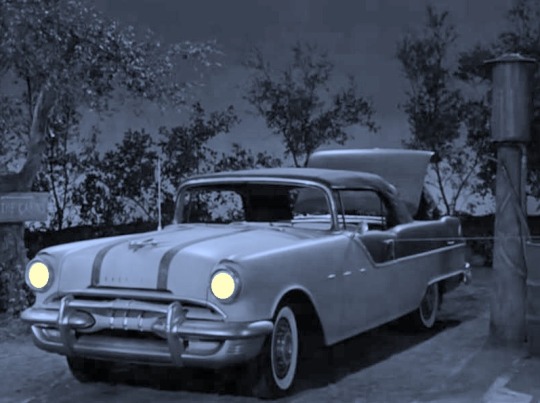
They drive home. It is a quarter to eleven. Liz blurts out that they can’t go in until 11:30. She makes George promise not to mad, and tells him the truth. He breaks his promise. Liz reminds him that in their courtship, it would be blissful to stay in the car an extra half hour with Liz, but that was a long time ago. He tries to kiss her, but logistics interfere.
GEORGE: “That’s funny. I can’t turn around. The steering wheel’s in the way. In the old days the cars were built different.”
LIZ: “In the old days, the stomach was built different.”Liz and George manage a smooch – one that lasts until 12:30!
Liz wants to be sure Mr. Negley is gone, so she peers through the living room window. A policeman (Frank Nelson) is watching them and wants to know what they are doing. He doesn’t believe they are the homeowners or that they were in the car smooching, not staking out the place! He hauls them down to the police station!
At 4:30 in the morning, George and Liz finally get home, exhausted from their ordeal. A worried Katie greets them. It turns out something came up and Mr. Negley didn’t come over after all!
LIZ: “Oh, no!!!”
End of Episode
-
LIZ GOES TO NIGHT SCHOOL
November 18, 1950

“Liz Goes to Night School” (aka “Balancing the Checkbook”) is episode #106 of the radio series MY FAVORITE HUSBAND broadcast on November 18, 1950.
This was the eleventh episode of the third season of MY FAVORITE HUSBAND. There were 31 new episodes, with the season ending on March 31, 1951.
Synopsis ~ Liz’s arithmetic skills are so bad, George sends her to night school where she somehow winds up in a math contest.

“My Favorite Husband” was based on the novels Mr. and Mrs. Cugat, the Record of a Happy Marriage (1940) and Outside Eden (1945) by Isabel Scott Rorick, which had previously been adapted into the film Are Husbands Necessary? (1942). “My Favorite Husband” was first broadcast as a one-time special on July 5, 1948. Lucille Ball and Lee Bowman played the characters of Liz and George Cugat, and a positive response to this broadcast convinced CBS to launch “My Favorite Husband” as a series. Bowman was not available Richard Denning was cast as George. On January 7, 1949, confusion with bandleader Xavier Cugat prompted a name change to Cooper. On this same episode Jell-O became its sponsor. A total of 124 episodes of the program aired from July 23, 1948 through March 31, 1951. After about ten episodes had been written, writers Fox and Davenport departed and three new writers took over – Bob Carroll, Jr., Madelyn Pugh, and head writer/producer Jess Oppenheimer. In March 1949 Gale Gordon took over the existing role of George’s boss, Rudolph Atterbury, and Bea Benaderet was added as his wife, Iris. CBS brought “My Favorite Husband” to television in 1953, starring Joan Caulfield and Barry Nelson as Liz and George Cooper. The television version ran two-and-a-half seasons, from September 1953 through December 1955, running concurrently with “I Love Lucy.” It was produced live at CBS Television City for most of its run, until switching to film for a truncated third season filmed (ironically) at Desilu and recasting Liz Cooper with Vanessa Brown.
MAIN CAST

Lucille Ball (Liz Cooper) was born on August 6, 1911 in Jamestown, New York. She began her screen career in 1933 and was known in Hollywood as ‘Queen of the B’s’ due to her many appearances in ‘B’ movies. With Richard Denning, she starred in a radio program titled “My Favorite Husband” which eventually led to the creation of “I Love Lucy,” a television situation comedy in which she co-starred with her real-life husband, Latin bandleader Desi Arnaz. The program was phenomenally successful, allowing the couple to purchase what was once RKO Studios, re-naming it Desilu. When the show ended in 1960 (in an hour-long format known as “The Lucy-Desi Comedy Hour”) so did Lucy and Desi’s marriage. In 1962, hoping to keep Desilu financially solvent, Lucy returned to the sitcom format with “The Lucy Show,” which lasted six seasons. She followed that with a similar sitcom “Here’s Lucy” co-starring with her real-life children, Lucie and Desi Jr., as well as Gale Gordon, who had joined the cast of “The Lucy Show” during season two. Before her death in 1989, Lucy made one more attempt at a sitcom with “Life With Lucy,” also with Gordon.
Richard Denning (George Cooper) was born Louis Albert Heindrich Denninger Jr., in Poughkeepsie, New York. When he was 18 months old, his family moved to Los Angeles. Plans called for him to take over his father’s garment manufacturing business, but he developed an interest in acting. Denning enlisted in the US Navy during World War II. He is best known for his roles in various science fiction and horror films of the 1950s. Although he teamed with Lucille Ball on radio in “My Favorite Husband,” the two never acted together on screen. While “I Love Lucy” was on the air, he was seen on another CBS TV series, “Mr. & Mrs. North.” From 1968 to 1980 he played the Governor on “Hawaii 5-0″, his final role. He died in 1998 at age 84.
Gale Gordon (Rudolph Atterbury) had worked with Lucille Ball on “The Wonder Show” on radio in 1938. One of the front-runners to play Fred Mertz on “I Love Lucy,” he eventually played Alvin Littlefield, owner of the Tropicana, during two episodes in 1952. After playing a Judge in an episode of “The Lucy-Desi Comedy Hour” in 1958, he would re-team with Lucy for all of her subsequent series’: as Theodore J. Mooney in ”The Lucy Show”; as Harrison Otis Carter in “Here’s Lucy”; and as Curtis McGibbon on “Life with Lucy.” Gordon died in 1995 at the age of 89.
Ruth Perrott (Katie, the Maid) was also later seen on “I Love Lucy.” She first played Mrs. Pomerantz, a member of the surprise investigating committee for the Society Matrons League in “Pioneer Women” (ILL S1;E25), as one of the member of the Wednesday Afternoon Fine Arts League in “Lucy and Ethel Buy the Same Dress” (ILL S3;E3), and also played a nurse when “Lucy Goes to the Hospital” (ILL S2;E16). She died in 1996 at the age of 96.
Bob LeMond (Announcer) also served as the announcer for the pilot episode of “I Love Lucy”. When the long-lost pilot was finally discovered in 1990, a few moments of the opening narration were damaged and lost, so LeMond – fifty years later – recreated the narration for the CBS special and subsequent DVD release.
Bea Benadaret (Iris Atterbury) does not appear in this episode.
GUEST CAST

Frank Nelson (Ed Trout, President of the West Newton Board of Education) was born on May 6, 1911 (three months before Lucille Ball) in Colorado Springs, Colorado. He started working as a radio announcer at the age of 15. He later appeared on such popular radio shows as “The Great Gildersleeve,” “Burns and Allen,” and “Fibber McGee & Molly”. Aside from Lucille Ball, Nelson is perhaps most associated with Jack Benny and was a fifteen-year regular on his radio and television programs. His trademark was playing clerks and other working stiffs, suddenly turning to Benny with a drawn out “Yeeeeeeeeees?” Nelson appeared in 11 episodes of “I Love Lucy”, including three as quiz master Freddy Fillmore, and two as Ralph Ramsey, plus appearance on “The Lucy-Desi Comedy Hour” – making him the only actor to play two different recurring roles on “I Love Lucy.” Nelson returned to the role of the frazzled Train Conductor for an episode of “The Lucy Show” in 1963. This marked his final appearance on a Lucille Ball sitcom.
Although Nelson is playing a School Board President, he gets to slip into the role of contest moderator, not unlike game show hosts Smiley Stembottom and Freddy Fillmore.

Shimen Ruskin (Richard Hill from West Newton Night School) was born as Shimen Druskin in Vilnius, Lithuania in 1907. He spent 18 years in the Yiddish theater before moving on to Hollywood and roles in 60 films, radio shows, and television projects. He made his screen debut in Having Wonderful Time (1938) which also featured Lucille Ball. In 1942, he played a waiter in Lucille Ball’s The Big Street. Like Ball, he was named as a communist during the ‘red scare’ of the 1950s. He died in 1976 at age 79.
EPISODE
ANNOUNCER: “As we look in on the Coopers, it’s afternoon at the Sheridan Falls National Bank and George Cooper has just received an urgent summons to the office of the president of the bank.”
Mr. Atterbury asks George why Liz’s accounts are in such disarray. Two tellers stayed up all night trying in vain to reconcile her accounts.
MR. ATTERBURY: “Look at this check: It’s dated the nineteenth of Octopus. And it’s payable to the the Shimian Fills Gas Cornfed.
GEORGE: “That’s the Sheridan Falls Gas Company”
MR. ATTERBURY: “Look at that signature: Mrs. Garage Cowpen!”Mr. Atterbury is quite sure Liz is overdrawn because of a note she’s written on the back of one of her checks:
MR. ATTERBURY (reading): “Dear Mr. Teller: If I don’t have enough money to cover this, please be a lamb and hold this check until next month.”

At the beginning of “Job Switching” (ILL S2;E1) in 1952, an angry Ricky Ricardo reads aloud the note Lucy’s written on the back of her bounced check to the beauty parlor: “Dear Teller, be a lamb and don’t put this through until next month.”
Given an ultimatum by Mr. Atterbury, George barrels home to confront Liz, who immediately dissolves into tears. George reviews Liz’s household accounts. Her addition skills are obviously lacking and her method of accounting is convoluted. Dinner is served an hour early so Katie can go to night school for beginning sewing. George gets an idea to send Liz to night school as well – for arithmetic.

On a 1962 episode of “The Lucy Show”, Lucy convinces Viv to join her in taking night school courses in chemistry and succeeds in blowing up the lab!
The following evening, George is eager for them to do something together, but Liz has to do homework! She convinces George to help her with her math problems. Liz tries to bring logic to simple addition based on the number of apples ‘Mary’ and ‘Susan’ have and it frustrates banker George.

On another night, Mr. Atterbury visits George while Liz is at night school. He says he is judging a math competition between Sheridan Falls Night School and West Newton Night Night School. He uses the Cooper phone to find out the name of the math champion that will represent Sheridan Falls and is shocked to hear it is Liz Cooper! Liz comes home and the men want to know how on earth she was selected to compete! She says it was because of George’s help with her homework that she was selected!

George decides that they will make an excuse and tell them that Liz cannot be there. Mr. Atterbury wants to say she has a broken leg but Liz is naturally reluctant. In lieu of a broken leg, Mr. Atterbury and George decide to teach Liz arithmetic even if it takes all night!

At the contest, Liz is very sleepy from pulling an all-nighter. Mr. Atterbury introduces the judges and contestants: Ed Trout (Frank Nelson), head of the West Newton Board of Education; West Newton contestant Mr. Richard Hill (Shimen Ruskin); and Mrs. George Cooper of Sheridan Falls.
The first question goes to Mr. Hill, who recites the Pythagorean theorem perfectly.

In mathematics, the Pythagorean theorem is a fundamental relation in Euclidean geometry among the three sides of a right triangle. It states that the area of the square whose side is the hypotenuse (the side opposite the right angle) is equal to the sum of the areas of the squares on the other two sides.

In the 1939 film The Wizard of Oz, the Scarecrow (Ray Bolger) is endowed with brains by the Wizard and suddenly spouts the Pythagorean theorem – except he gets it wrong!
The theorem applies to right triangles, not isosceles triangles . Also the theorem is that the squares of two legs equals the square of the hypotenuse! The Scarecrow probably should enroll in the Emerald City Night School!
Liz’s geometry question is a lot simpler – in fact, it is not a geometry problem at all.
MR. ATTERBURY: “If you had three geometry problems and I gave you two more geometry problems, how many would you have?”
LIZ: “Five?”Liz gets it right but is having trouble staying awake.
Staying awake will be a source of comedy for Lucille Ball for the rest of her career. Lucy Ricardo was groggy from too much Dramamine in “The Passports” (ILL S5;E11) and was later exhausted from her commuter lifestyle in “Lucy Wants a Career” (LDCH S2;E4); Lucy Carmichael can’t keep her head up during a classical concert in “Lucy the Music Lover” (TLS S1;E8); and in a 1971 episode of “Here’s Lucy,” Lucy Carter has severe jet lag and has trouble staying awake on an English chat show with David Frost.
Yawning, Liz inadvertently admits that Mr. Atterbury is her husband’s boss. Ed Trout is outraged, replacing him with an impartial judge – himself!

Liz is asked how many sides an octagon has. From the audience Mr. Atterbury and George drop hints by talking about what they ATE (8)! Asking what they are shouting FOR, Liz drowsily guesses four (4).
Mr. Hill is asked a square root question which he gets wrong. Liz is asked the same question. In the audience Mr. Atterbury quickly figures out the answer: 32, which is also Liz’s age. He shouts out: “Act your age Liz!” But a sluggish Liz guesses 22! Mr. Atterbury’s constant shout-outs frustrate Ed Trout.
ED TROUT (summing up): “Mr. Hill has missed one, Mrs. Cooper has missed one, and Mr. Atterbury hasn’t missed any!”
The final question is a complex series of math problems. Hill gets it wrong. Trout asks Liz, who is snoring.
ED TROUT: “I’d like your answer and no help from the audience, please. I’d like your own number.”
LIZ: “Oh. 5-1-3-4-0.”
TROUT: “That’s right!”
GEORGE: “I gave up when he asked for your own number!”
LIZ: “Own number? I thought he said phone number!”
Accidentally answering a crucial final question during a contest judged by Frank Nelson also happened to Ricky Ricardo in “Lucy Gets Ricky on the Radio” (ILL S1;E32) in 1952. Ricky is asked what George Washington said to his troops while crossing the Delaware. A clueless Ricky is getting queasy from his disastrous performance on the show and blurts out: “Please let me sit down. This is making me sick!” Winner!
End of Episode
-
ROCK HUDSON
November 17, 1925

Rock Hudson was born Roy Harold Scherer Jr. on November 17, 1925 in Winnetka, Illinois. One of the most popular movie stars of his time, Hudson’s screen career spanned four decades.

A prominent heartthrob of the Golden Age of Hollywood, he achieved stardom with his role in Magnificent Obsession (1954), followed by All That Heaven Allows (1955) and Giant (1956), for which he received a nomination for the Academy Award for Best Actor. Hudson also found continued success with a string of romantic comedies co-starring Doris Day: Pillow Talk (1959), Lover Come Back (1961), and Send Me No Flowers (1964).

Unhappy with the film scripts he was offered, Hudson turned to television and was a hit, starring in the popular mystery series McMillan & Wife (1971–77). His last role was as a guest star on the fifth season (1984–85) of the primetime ABC soap opera Dynasty, his final screen appearance before ill health forced him to retire.

Lucy fans remember his guest appearance as himself on “In Palm Springs” (ILL S4;E26) aired in April 1955, but filmed a month earlier.

In it, Lucy and Ethel retreat to Palm Springs to get away from their irritating husbands for a bit.

Ricky and Fred ask Rock Hudson to visit and tell them a morality tale about appreciating someone despite their flaws.

Hudson spins the tragic tale of Adele Sliff, who disliked her husband’s whistling – and then regrets it.

Eavesdropping Ricky and Fred come out of hiding and the foursome are happily together again.

At the time the episode was filmed, Hudson’s box office popularity had taken a dip – from #17 to #24. This may have played a role in his decision to do this, his first television show. Two years later – in 1957 – Hudson was #1 at the box office.

1955 was a busy year for Hudson. A week after this episode was filmed, Captain Lightfoot premiered. The film is mentioned in the episode. That was followed by One Desire in November, and All That Heaven allows in December.

Although Hudson was discrete about his sexuality, the above moment is telling. Instead of talking to the female extras seated in the background, Hudson gravitates toward a handsome, reclining male extra. Despite this, in November 1955, Hudson married Phyllis Gates, no doubt bowing to studio pressure. The marriage lasted less than three years.
ROCK DROPS!

In “Lucy Goes To A Hollywood Premiere” (TLS S4;E20) in 1966, Mrs. Foley (Reta Shaw) tells Lucy Carmichael that she watched Rock Hudson change a tire in front of her Beverly Hills map stand.

In “Lucy, the Philanthropist” (TLS S7;E7) in 1967, Mr. Mooney says from the side he is often mistaken for Richard Burton, but from the front it is Rock Hudson!

In “Lucy, the Matchmaker” (HL S1;E12) in 1968, Vivian says she can tell from Lucy’s face that her date was no Rock Hudson.

In “A Date for Lucy” (HL S1;E19) in 1969, Lucy Carter and Mary Jane are talking about dreams dates for a fancy soiree and mention Rock Hudson!

For the small screen version of “The Three Musketeers” that Flip Wilson is rehearsing in “Lucy and Flip Go Legit” (HL S4;E1) in 1971, Flip says that Rock Hudson is playing Anthos, Andy Williams is Porthos, and that he is the ‘token’ musketeer.

In “Lucy Gives Eddie Albert the Old Song and Dance” (HL S6;E6) in October 1973, Lucy, Mary Jane and Vanda are talking about Eddie Albert.
LUCY: “Eddie Albert has a beautiful home. I saw it when I went on a tour of the movie stars’ homes.”
MARY JANE: “Is that the same tour when you sneaked into Rock Hudson’s back yard and tried to peel an orange?”
In March 1985, Lucille Ball and Rock Hudson were two of the 100 stars on the Radio City Music Hall stage for “Night of 100 Stars II”. Sixth months later, Hudson died from complications due to AIDS. He was 59 years old.
-
Subscribe
Subscribed
Already have a WordPress.com account? Log in now.
 Papermoon Loves Lucy