-
THIS IS YOUR LIFE: WILLIAM FRAWLEY
January 8, 1961


“This Is Your Life” was a documentary series broadcast on NBC radio from 1948 to 1952, and on NBC television from 1952 to 1961. It was originally hosted by its creator and producer Ralph Edwards. In the program, the host surprised guests and then took them through a retrospective of their lives in front of an audience, including appearances by colleagues, friends, and family. Edwards revived the show in 1971 and Joseph Campanella hosted a version in 1983. Edwards returned for various specials in the late 1980s.

Ralph Edwards (Host) – played himself in the Lucille Ball film Seven Days Leave (1942). Edwards hosted 339 episodes of the original series, from April 1950 to August 1961.

William Frawley (Guest of Honor) was born in 1887 and was already a Hollywood veteran when he was hired by Desi Arnaz in 1951 to play landlord Fred Mertz on “I Love Lucy.” After the series concluded he joined the cast of “My Three Sons” (shot at Desilu) playing Bub Casey. His final screen appearance before his death in March 1966 was a cameo on “The Lucy Show”.
GUEST APPEARANCES (in alphabetical order)

Lucille Ball employed Frawley in 1951, despite his history of alcoholism. She became a friend of Frawley, employing him right up to his final days. Despite being a regular cast member of “I Love Lucy” for 9 years, Frawley and Lucille Ball rarely shared more than a few moments of screen time without Ricky or Fred present. The one exception is “Staten Island Ferry” (above).

Tim Considine played Mike Douglas on “My Three Sons” between 1960 and 1965, appearing in every one of Frawley’s 165 episodes of the series. He was 20 years old when they first met.

Don Fedderson was the Executive Producer of “My Three Sons.”

Edna Frawley was the ex-wife of William Frawley and his former vaudeville partner (as Edna Louise Mueller). They divorced in 1927.

Don Grady played Robbie Douglas on “My Three Sons” between 1960 and 1972, appearing in every one of Frawley’s 165 episodes of the series. He was 16 years old when they first met.

Fred Haney was the General Manager of the Los Angeles Angels. Frawley was an inveterate baseball fan. For years, Haney was one of the most popular baseball figures in Los Angeles. During the show, he presented Frawley with a lifetime baseball pass.

Erskine Johnson was a Hollywood gossip columnist who also appeared on the radio and in motion pictures.

Eugenie Leontovich was a Russian-born actress and writer who starred on Broadway with Frawley in “Twentieth Century” in 1932. In 1958 she won a Tony Award.

Stanley Livingston played Chip Douglas on “My Three Sons” between 1960 and 1972, appearing in every one of Frawley’s 165 episodes of the series. He was 10 years old when they first met.

Fred MacMurray first appeared with Frawley in the films Car 99 (1935) and The Princess Comes Across (1936), before playing himself on “The Lucy Desi Comedy Hour” (above) in which the gang hunted Uranium in the desert. MacMurray was the star of “My Three Sons” and appeared in all 165 of Frawley’s episodes.
Walter Meyer was William Frawley’s agent.
TRIVIA
William Frawley was the only member of the “I Love Lucy” regular cast to be celebrated on “This Is Your Life.”
Although it is no surprise that Vivian Vance did not attend, it is rather surprising that Desi Arnaz is not on the guest list. Arnaz championed Frawley to the network and sponsor when they objected to hiring him due to his alcoholism.
William Frawley received this honor while concurrently acting on “My Three Sons”. In the episode that aired three days earlier (January 5, 1961), Bub had to go out of town and Mike is tasked to hire a temporary maid – except he hires a marriage broker (Anne Seymour) instead! In the episode that aired the following week, Bub (Frawley) thought he was being replaced by Steve’s cousin Sylvia (Mary Jackson).
The names of the honorees was not disclosed before the broadcast. In the cast of William Frawley, one newspaper hinted that the guest of honor was “a familiar face” – “a kind of next door neighbor character”.
In addition to Frawley’s appearance on “This Is Your Life” on January 8, 1961, he was also seen in the afternoon rerun of “I Love Lucy.”
In many markets, the episode was rerun on Sunday, January 15, 1961 and then again on August 16, 1961.
On May 28, 1961, radio and TV writer Bob Thomas asked Ralph Edwards for his top five episodes of “This is Your Life.” William Frawley’s tribute was NOT among them. But coincidentally, a separate article about William Frawley’s role as Bub on “My Three Sons” by Cynthia Lowry was printed alongside it.

The Chicago Tribune for October 14, 1961 printed this letter to the editor. Ball may have been referring to the “Lucy on Broadway” special that was planned, but never materialized. Frawley, Vance, and Arnaz were scripted to participate, should the project have been realized.
-
JENNY LEWIS
January 8, 1976

Jenny Lewis was born on January 8, 1976, in Las Vegas, Nevada. During the mid-1980s, her parents divorced and she moved with her mom, Linda, to Los Angeles, California.
Aside from a Jell-O commercial, her screen acting debut came at age 7 in the pilot of ABC’s “Baby Makes Five” on April 1, 1983. For the series, however, she was replaced by Emily MoutIn.

In 1986, Lewis was cast as Becky McGibbon, Lucy Barker’s granddaughter on “Life With Lucy.” Lewis appeared in all 13 episodes opposite Lucille Ball, only 8 of which were first aired on ABC. The series was canceled by the end of 1986.

“Yes, Lucy was a bit rough around the edges, and yes, she constantly smoked cigarettes on the set. She would pull her face back with tape, sort of like a cheap face-lift.“
Lewis subsequently made one-off appearances on such shows as “The Golden Girls” (”Life With Lucy’s” main competition), “Mr. Belvidere”, “Growing Pains”, and “Roseann”.
In 1990, Lewis was cast in another short-run series, “Shannon’s Deal.” The following year she did 18 episodes of “Brooklyn Bridge” playing Katie Monahan.

In 1999, she gathered a couple of her friends and formed the band Rilo Kiley.

"I wouldn’t change it for the world. But when you’re a kid supporting your family, you’re forced to keep your eye on the prize. I have a great work ethic, from watching Lucille Ball, not necessarily my own family.”
-
COLUMBIA & THE PINK LADY
January 8, 1948


On January 8, 1948, it was announced that Lucille Ball had been signed by Columbia Pictures to do a film a year, the first of which was to be titled Pink Lady.

The news was covered by the Gray Lady – the New York Times – on January 8, 1948.


It was also hot news for of Hollywood’s top gossip columnists: Hedda Hopper…


…and Louella Parsons.

The film Pink Lady was never made. After doing Her Husband’s Affairs for Columbia in 1947, her next films for Columbia were Miss Grant Takes Richmond (1949), A Woman of Distinction (1950), The Fuller Brush Girl (1950), and The Magic Carpet (1951). Like many of her colleagues, Ball had already cast a speculative eye toward doing a regular radio series (”My Favorite Husband” 1948-51) and then on to television (”I Love Lucy” 1951-1957).

The Pink Lady was originally a Broadway musical comedy that played two seasons (1911 & 1912) making a star out of Hazel Dawn, who was then dubbed “The Pink Lady” by fans and the press. Virginia Van Upp was one of Hollywood’s few female writers and producers. For Columbia, she produced Gilda in 1946 starring Rita Hayworth. She made only one more film, Here Comes The Groom (1951) before retiring due to illness.
-
OVER BUDGET – BEANS!
January 7, 1949

“Over Budget – Beans” (aka “Beans for Three Weeks”) is episode #25 of the radio series MY FAVORITE HUSBAND broadcast on January 7, 1949 on the CBS Radio Network.
Synopsis ~ Liz goes over her budget again by buying six cases of beans that were on special so George cuts off her allowance. Soon they’re eating nothing but beans, and the electricity and telephone have been disconnected!
Episode Firsts!
- This is the first episode of 1949.
- This is the first episode in which the characters of George and Liz are named Cooper, instead of Cugat, to avoid comparison with the Latin bandleader.
- This is the first episode to be sponsored by General Foods’ Jell-O, which will continue their sponsorship for the rest of the series.
- This is the first episode in its new time slot – 8:30pm.

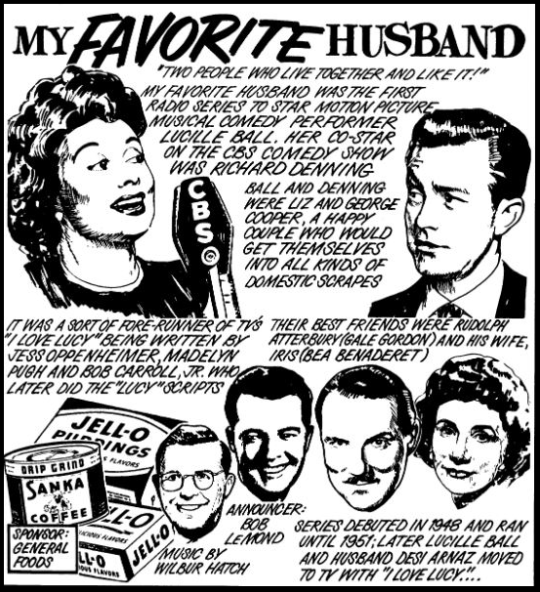
“My Favorite Husband” was based on the novels Mr. and Mrs. Cugat, the Record of a Happy Marriage (1940) and Outside Eden (1945) by Isabel Scott Rorick, which had previously been adapted into the film Are Husbands Necessary? (1942). “My Favorite Husband” was first broadcast as a one-time special on July 5, 1948. Lucille Ball and Lee Bowman played the characters of Liz and George Cugat, and a positive response to this broadcast convinced CBS to launch “My Favorite Husband” as a series. Bowman was not available Richard Denning was cast as George. On January 7, 1949, confusion with bandleader Xavier Cugat prompted a name change to Cooper. On this same episode Jell-O became its sponsor. A total of 124 episodes of the program aired from July 23, 1948 through March 31, 1951. After about ten episodes had been written, writers Fox and Davenport departed and three new writers took over – Bob Carroll, Jr., Madelyn Pugh, and head writer/producer Jess Oppenheimer. In March 1949 Gale Gordon took over the existing role of George’s boss, Rudolph Atterbury, and Bea Benadaret was added as his wife, Iris. CBS brought “My Favorite Husband” to television in 1953, starring Joan Caulfield and Barry Nelson as Liz and George Cooper. The television version ran two-and-a-half seasons, from September 1953 through December 1955, running concurrently with “I Love Lucy.” It was produced live at CBS Television City for most of its run, until switching to film for a truncated third season filmed (ironically) at Desilu and recasting Liz Cooper with Vanessa Brown.
REGULAR CAST

Lucille Ball (Liz Cooper) was born on August 6, 1911 in Jamestown, New York. She began her screen career in 1933 and was known in Hollywood as ‘Queen of the B’s’ due to her many appearances in ‘B’ movies. With Richard Denning, she starred in a radio program titled “My Favorite Husband” which eventually led to the creation of “I Love Lucy,” a television situation comedy in which she co-starred with her real-life husband, Latin bandleader Desi Arnaz. The program was phenomenally successful, allowing the couple to purchase what was once RKO Studios, re-naming it Desilu. When the show ended in 1960 (in an hour-long format known as “The Lucy-Desi Comedy Hour”) so did Lucy and Desi’s marriage. In 1962, hoping to keep Desilu financially solvent, Lucy returned to the sitcom format with “The Lucy Show,” which lasted six seasons. She followed that with a similar sitcom “Here’s Lucy” co-starring with her real-life children, Lucie and Desi Jr., as well as Gale Gordon, who had joined the cast of “The Lucy Show” during season two. Before her death in 1989, Lucy made one more attempt at a sitcom with “Life With Lucy,” also with Gordon.
Richard Denning (George Cooper) was born as Louis Albert Heindrich Denninger Jr., in Poughkeepsie, New York. When he was 18 months old, his family moved to Los Angeles. Plans called for him to take over his father’s garment manufacturing business, but he developed an interest in acting. Denning enlisted in the US Navy during World War II. He is best known for his roles in various science fiction and horror films of the 1950s. Although he teamed with Lucille Ball on radio in “My Favorite Husband,” the two never acted together on screen. While “I Love Lucy” was on the air, he was seen on another CBS TV series, “Mr. & Mrs. North.” From 1968 to 1980 he played the Governor on “Hawaii 5-0″, his final role. He died in 1998 at age 84.
Ruth Perrott (Katie, the Maid) was also later seen on “I Love Lucy.” She first played Mrs. Pomerantz (above right), a member of the surprise investigating committee for the Society Matrons League in “Pioneer Women” (ILL S1;E25), as one of the member of the Wednesday Afternoon Fine Arts League in “Lucy and Ethel Buy the Same Dress” (ILL S3;E3), and also played a nurse when “Lucy Goes to the Hospital” (ILL S2;E16). She died in 1996 at the age of 96.
Bob LeMond (Announcer) also served as the announcer for the pilot episode of “I Love Lucy”. When the long-lost pilot was finally discovered in 1990, a few moments of the opening narration were damaged and lost, so LeMond – fifty years later – recreated the narration for the CBS special and subsequent DVD release.
Gale Gordon (Rudolph Atterbury) and Bea Benadaret (Iris Atterbury) had not yet joined the cast as regular characters.
GUEST CAST

Frank Nelson (Mr. Taylor, an Important Client) was born on May 6, 1911 (three months before Lucille Ball) in Colorado Springs, Colorado. He started working as a radio announcer at the age of 15. He later appeared on such popular radio shows as “The Great Gildersleeve,” “Burns and Allen,” and “Fibber McGee & Molly”. This is one of his 11 performances on “My Favorite Husband.” On “I Love Lucy” he holds the distinction of being the only actor to play two recurring roles: Freddie Fillmore and Ralph Ramsey, as well as six one-off characters, including the frazzled train conductor in “The Great Train Robbery” (ILL S5;E5), a character he repeated on “The Lucy Show.” Aside from Lucille Ball, Nelson is perhaps most associated with Jack Benny and was a fifteen-year regular on his radio and television programs.

Parley Baer (Mr. Rafferty, the Grocer) played MGM’s Mr. Reilly in “Ricky Needs an Agent” (ILL S4;E29) and the furniture salesman Mr. Perry in “Lucy Gets Chummy with the Neighbors” (ILL S6;E18) which also featured Frank Nelson. He then made five appearances on “The Lucy Show” and was seen twice on “Here’s Lucy” as Harry’s psychiatrist. He is perhaps best known for his recurring roles as Mayor Stoner on “The Andy Griffith Show” and Doc Appleby in “The Dukes of Hazzard.”
Helen Burke (Radio Soprano / Telephone Operator) was seen in a 1955 episode of “The Adventures of Ozzie and Harriet”.
THE EPISODE

ANNOUNCER: “Every day in each American home an old native custom takes place. An ancient tribal ritual called ‘getting up in the morning. Everyone has his own interpretation on how this is to be done!”
GEORGE: “Ahh! I’m glad I’m alive.”
LIZ: “Bleh! I wish I was dead.”It’s 7:45am and George tries to rouse Liz out of bed, but she rolls over and begs him to go away. George threatens to take a photo of her in curlers and cold cream and Liz instantly bounds out of bed.In the kitchen, Liz asks Katie the Maid to make George an extra special breakfast to soften him up for looking at her January budget. She’s over budget – and it is only the seventh of the month. It was her New Year’s resolution to George to stay with budget. For his New Year’s Resolution, George promised to empty the ashtrays and not get any ashes on the rug – even though he doesn’t smoke! George comes down to breakfast. Liz tries snuggling him and covering him with kisses. George is on to her games. He demands to know what happened to the money. Liz claims she’s bad at arithmetic. Liz has her own bill-paying system. She separates her bills into three piles:
- Have To Pay
- Ought To Pay
- Doubt If I Ever Will Pay
She tosses Group 3 into the air. She picks them up by a system developed by Hoover – the vacuum cleaner, not the president.

Herbert Hoover (1874-1964) was the 31st President of the United States, serving from 1929 to 1933, during the Great Depression. The Hoover Vacuum Cleaner Company was founded in Ohio in 1908. They dominated the electric vacuum cleaner industry so much so that their name was synonymous with vacuums and vacuuming in England and Ireland. When not using the fictional Handy Dandy brand, Lucy Ricardo used a Hoover upright.
George freezes her household accounts and tells her they will spend no more money for the rest of January – even for food.

In “The Business Manager” (ILL S4;E1), Lucy Ricardo’s food budget is also frozen – but clever Lucy thinks she has found away around the restriction by doing the marketing for the entire neighborhood on credit!
Unfortunately, Liz has just bought six cases of beans, despite the fact they both hate beans, simply because they were on special!
Liz asks for a loan from her banker husband – putting up six cans of beans as collateral. But George says her credit is no good.
LIZ: “George Cooper, you’re a fiend!”
GEORGE: “Meet George Cooper, King of the Fiends!”
LIZ: “Meet Liz Cooper, Queen of the Beans.”
In a 1966 episode of “The Lucy Show” titled “Lucy The Bean Queen” (TLS S5;E3), Lucy Carmichael buys cases of beans on special in order to cash in on their double money back guarantee.

When George gets home from work that night (and for the next several days), Liz rattles off the menu for dinner:
- Bean Soup
- Bean Salad
- Baked Beans
- Bean Meringue Pie
- Bean Burgers
- Bean Sundae – Beans with Beans over them
- Beanies – Beans frozen into the shape of little hats

One day, George comes home and tells lunch that he had a big lunch bought for him by a client, Mr. Taylor. Liz wants the details – not of the client – but of the lunch! George taunts her describing big, thick, mouth-watering pork chops.
Liz suggests a movie, but they can’t afford it. George says they could get free passes to the regular theatre. They are presenting “The Late Christopher Bean.”

The Late Christopher Bean opened on Broadway in 1932 and played more than 215 performances. There was a London production in 1933. An MGM film version starring Lionel Barrymore premiered in November 1933. In 1955 there was a television version starring Phil Ober (husband of Vivian Vance).
They can’t even afford to play bridge with the Sturms’ – but George facetiously suggests staying home and playing “beanochle”!

Pinochle (aka pinocle or penuchle) is a card game for two to four players and played with a 48-card deck. It is derived from the card game bezique; players score points by trick-taking and also by forming combinations of cards into melds.
GEORGE: “Whatever happened to the fine art of conversation?”
LIZ: “Conversation? We couldn’t possibly have anything to say to each other. We’re married!”They reminisce about staying out late at Inspiration Point. George laughs about the time they went skiing and were snowed in at the lodge all night.
LIZ: “George! You never took me skiing in your life!”
Oops! Just in time, the lights suddenly go out! Liz hasn’t paid the electric bill!END OF PART ONE

A recorded public service announcement touts the Great American Dream. This was a post-war effort to boost industry, enterprise, and morale with the American public.
ANNOUNCER: “Liz Cooper has spent all her household money for January. Liz is beginning to crack under the strain.”
Liz realizes they have run out of candles and they are still in the dark. Katie understands George’s stubbornness thanks to her first husband Clarence. She decides to call Rafferty’s Grocery and charge all her items, telling George she found the money in an old purse.

MR. RAFFERTY (on the phone): “Rafferty’s Grocery and Delicatessen: If you can eat it, drink it, chew it, slice it, or smell it, we sell it!”
Liz asks Mr. Rafferty (Parley Baer) to send over six lamb chops, two potatoes, corn, peas, sugar, bread, butter, and milk. But Mr. Rafferty tells Liz that George has stopped her credit.
MR. RAFFERTY (on the phone): “Too bad, too. We got a real deal on beans!”
Liz hangs up and the phone immediately rings again. The operator (Helen Burke) informs Liz that her phone service is being disconnected.
The phone rings a third time and it is George. He has called a truce for the night because Mr. Taylor, an important client from the bank, is coming home for dinner. Liz is angry and is determined to teach him a lesson by keeping the lights off, wearing an old house dress, and gluing beans to sticks and calling it “bean on the cob”!
George and Mr. Taylor (Frank Nelson) pull up to the Cooper home and notice all the lights are out.
MR. TAYLOR: “I can’t wait to get a home-cooked meal. You know how it is when you’re traveling: beans, beans, beans!”

When they get inside, Liz is huddled weakly in the corner in the dark, claiming she is going mad with starvation. Liz gives Mr. Taylor the impression that she never leaves the house.
LIZ: “Tell me, what happened to Dewey?
MR. TAYLOR: “He lost.”
LIZ: “What a shame. I was sure he’d take Manila.”
This is a complicated joke that relies on Liz conflating Admiral George Dewey (1837-1917) with New York Governor Thomas E. Dewey (1902-71). Mr. Taylor (and the audience) think that Liz is referring to Governor Dewey, who ran for president against incumbent President Harry S. Truman and lost, despite a history-making headline to the contrary in the Chicago Daily Tribune the next day. Instead, Liz reaches back even further to reference Admiral Dewey, who is best known for his victory at the Battle of Manila Bay during the Spanish–American War in May 1898. If it wasn’t so obviously a joke, it would mean Liz hadn’t been outside in more than 50 years!
Mr. Taylor is indignant stating that he would never do business with a man who would treat his wife so shabbily. George tries to explain that it is all Liz’s joke. He summons Katie, who pretends to be George’s poor old, starving mother!
In bed that night, Liz asks if George if he is still mad at her. After all, she fixed Mr. Taylor a delicious steak dinner after she confessed to the joke. She tells George that she also got her accounts in order and has paid all the bills. George asks how she did it.

LIZ: “I wrote an article and sold it to the daily paper: 100 Different Ways to Fix Beans!”
END OF EPISODE
ANNOUNCER: “Lucille Ball will soon be seen in the Paramount Picture ‘Sorrowful Jones’.”

-
DANNY THOMAS
January 6, 1912

Danny Thomas was born Amos Muzyad Yakhoob Kairouz in Deerfield, Michigan and raised in Toledo, Ohio. His parents were from Lebanon. He attended Catholic schools and the University of Toledo.
Initially, Thomas performed in nightclubs, but reached a wider audience on radio in such shows as “The Bickersons” and “The Baby Snooks Show”.

His screen career began in 1947 but he was most famous for appearing on television in the long-running show “Make Room for Daddy” (1953-64), which was shot at Desilu Studios and was later known as “The Danny Thomas Show.”

When the series moved from ABC to CBS in 1957, Thomas and the cast starred in a rare TV cross-over with “The Lucy-Desi Comedy Hour” titled “Lucy Makes Room for Danny.”

In return for this appearance on “The Comedy Hour,” Lucy and Desi appeared as the Ricardos on “Make Room for Daddy” just a few weeks later (January 5, 1959).

In December 1959, Danny Thomas was one of many stars on the lot who appeared in “The Desilu Revue” – a holiday show-within-a-show featuring the young actors of Lucille’s Desilu Playhouse workshop.

Lucy (4) and Danny (5) both appeared on a September 1963 TV season preview called “General Foods Opening Night”.

In 1965 Lucille Ball guest starred on “Danny Thomas’ Wonderful World of Burlesque” on NBC, doing an aerial ballet!

In addition, a few weeks later, Thomas played himself on a 1965 episode of “The Lucy Show.”

In 1971, Lucy and Danny did yet another cross-over when Lucy Carter of “Here’s Lucy” appeared on “Make Room for Granddaddy.”

In 1973, Thomas played an eccentric Italian artist on the sixth season premiere of “Here’s Lucy”.

In 1976, Thomas talked about Lucy’s song and dance skills in “CBS Salutes Lucille Ball: The First 25 Years”.

That same year, Lucy played an eccentric hypochondriac on the second season premiere of Thomas’s sitcom “The Practice” (S2;E1).

In 1976, Lucille Ball paid tribute to her friend on “The Dean Martin Celebrity Roast: Danny Thomas” (S4;E2).

When CBS marked their 50th Anniversary with a week-long tribute in late March 1978, Lucille Ball and Danny Thomas were present to represent Monday nights.

After Ball’s death, Danny Thomas was part of 1989′s “Bob Hope’s Love Affair with Lucy” on NBC.

In addition to his performing career, Thomas is fondly remembered for founding St. Jude Children’s Research Hospital.

In 1936, he married Rose Marie Martell and they had three children, including actress Marlo Thomas. He died in 1999 a month after his 79th birthday.

-
IS THERE ANOTHER WOMAN?
January 6, 1950

“Is There Another Woman” (aka “The Other Woman” aka “The Question of Another Woman”) is episode #70 of the radio series MY FAVORITE HUSBAND broadcast on January 6, 1950.
Synopsis ~ Liz buys a book that lists the danger signs to look out for to tell if your husband is being unfaithful, and George has them all!
Liz then she finds herself innocently coupled with her husband’s boss!
This was the 19th episode of the second season of MY FAVORITE HUSBAND, the first of the new year and of the new decade (1950). There were 43 new episodes, with the season ending on June 25, 1950.

“My Favorite Husband” was based on the novels Mr. and Mrs. Cugat, the Record of a Happy Marriage (1940) and Outside Eden (1945) by Isabel Scott Rorick, which had previously been adapted into the film Are Husbands Necessary? (1942). “My Favorite Husband” was first broadcast as a one-time special on July 5, 1948. Lucille Ball and Lee Bowman played the characters of Liz and George Cugat, and a positive response to this broadcast convinced CBS to launch “My Favorite Husband” as a series. Bowman was not available Richard Denning was cast as George. On January 7, 1949, confusion with bandleader Xavier Cugat prompted a name change to Cooper. On this same episode Jell-O became its sponsor. A total of 124 episodes of the program aired from July 23, 1948 through March 31, 1951. After about ten episodes had been written, writers Fox and Davenport departed and three new writers took over – Bob Carroll, Jr., Madelyn Pugh, and head writer/producer Jess Oppenheimer. In March 1949 Gale Gordon took over the existing role of George’s boss, Rudolph Atterbury, and Bea Benaderet was added as his wife, Iris. CBS brought “My Favorite Husband” to television in 1953, starring Joan Caulfield and Barry Nelson as Liz and George Cooper. The television version ran two-and-a-half seasons, from September 1953 through December 1955, running concurrently with “I Love Lucy.” It was produced live at CBS Television City for most of its run, until switching to film for a truncated third season filmed (ironically) at Desilu and recasting Liz Cooper with Vanessa Brown.
MAIN CAST
Lucille Ball (Liz Cooper) was born on August 6, 1911 in Jamestown, New York. She began her screen career in 1933 and was known in Hollywood as ‘Queen of the B’s’ due to her many appearances in ‘B’ movies. With Richard Denning, she starred in a radio program titled “My Favorite Husband” which eventually led to the creation of “I Love Lucy,” a television situation comedy in which she co-starred with her real-life husband, Latin bandleader Desi Arnaz. The program was phenomenally successful, allowing the couple to purchase what was once RKO Studios, re-naming it Desilu. When the show ended in 1960 (in an hour-long format known as “The Lucy-Desi Comedy Hour”) so did Lucy and Desi’s marriage. In 1962, hoping to keep Desilu financially solvent, Lucy returned to the sitcom format with “The Lucy Show,” which lasted six seasons. She followed that with a similar sitcom “Here’s Lucy” co-starring with her real-life children, Lucie and Desi Jr., as well as Gale Gordon, who had joined the cast of “The Lucy Show” during season two. Before her death in 1989, Lucy made one more attempt at a sitcom with “Life With Lucy,” also with Gordon.
Richard Denning (George Cooper) was born Louis Albert Heindrich Denninger Jr., in Poughkeepsie, New York. When he was 18 months old, his family moved to Los Angeles. Plans called for him to take over his father’s garment manufacturing business, but he developed an interest in acting. Denning enlisted in the US Navy during World War II. He is best known for his roles in various science fiction and horror films of the 1950s. Although he teamed with Lucille Ball on radio in “My Favorite Husband,” the two never acted together on screen. While “I Love Lucy” was on the air, he was seen on another CBS TV series, “Mr. & Mrs. North.” From 1968 to 1980 he played the Governor on “Hawaii 5-0″, his final role. He died in 1998 at age 84.
Gale Gordon (Rudolph Atterbury) had worked with Lucille Ball on “The Wonder Show” on radio in 1938. One of the front-runners to play Fred Mertz on “I Love Lucy,” he eventually played Alvin Littlefield, owner of the Tropicana, during two episodes in 1952. After playing a Judge in an episode of “The Lucy-Desi Comedy Hour” in 1958, he would re-team with Lucy for all of her subsequent series’: as Theodore J. Mooney in ”The Lucy Show”; as Harrison Otis Carter in “Here’s Lucy”; and as Curtis McGibbon on “Life with Lucy.” Gordon died in 1995 at the age of 89.
Bea Benadaret (Mrs. Finley, Bookstore Owner / Iris Atterbury) was considered the front-runner to be cast as Ethel Mertz but when “I Love Lucy” was ready to start production she was already playing a similar role on TV’s “The George Burns and Gracie Allen Show” so Vivian Vance was cast instead. On “I Love Lucy” she was cast as Lucy Ricardo’s spinster neighbor, Miss Lewis, in “Lucy Plays Cupid” (ILL S1;E15) in early 1952. Later, she was a success in her own show, “Petticoat Junction” as Shady Rest Hotel proprietress Kate Bradley. She starred in the series until her death in 1968.
For Mrs. Finley, Benadaret uses the same ‘elderly’ voice she adopted to play Miss Lewis on “I Love Lucy”.
Ruth Perrott (Katie, the Maid) was also later seen on “I Love Lucy.” She first played Mrs. Pomerantz, a member of the surprise investigating committee for the Society Matrons League in “Pioneer Women” (ILL S1;E25), as one of the member of the Wednesday Afternoon Fine Arts League in “Lucy and Ethel Buy the Same Dress” (ILL S3;E3), and also played a nurse when “Lucy Goes to the Hospital” (ILL S2;E16). She died in 1996 at the age of 96.
Bob LeMond (Announcer) also served as the announcer for the pilot episode of “I Love Lucy”. When the long-lost pilot was finally discovered in 1990, a few moments of the opening narration were damaged and lost, so LeMond – fifty years later – recreated the narration for the CBS special and subsequent DVD release.
EPISODE
ANNOUNCER: “As we look in on the Coopers tonight, George is on his way to work and is about to drop Liz off at Finley’s bookstore, where she is going to practice that quaint American custom known as exchanging your Christmas presents.”
Liz didn’t like the book George gave her, but she read it anyway. When Liz asks for a kiss goodbye, George gets out of the car, which makes Liz think he is going to open her door for her, but his coat is just caught in the door.
LIZ: “Well! Thank you Sir Walter Raleigh!”

The story goes that Sir Walter Raleigh (1552-1618), a courtier to Queen Elizabeth I, laid his cape down over a puddle in the street so that Her Majesty would not get her feet wet. Although it is a good story, historians believe it really never happened. The Queen sentenced Raleigh to death, despite his gallantry.
Inside the bookshop, Liz is greeted by Mrs. Finley (Bea Benadaret), the proprietor. Mrs. Finley tries to tempt Liz with a spicy historical novel but when Liz isn’t interested pitches her “The Second Ten Years Are The Hardest” by Thomas J. Krandelston. Mrs. Finley reads out some of the danger signs to determine if a husband is losing interest:
MRS. FINLEY: “Does your husband read the newspaper at the breakfast table?”

Not only is this a continuing comedy trope on “My Favorite Husband,” it was also a habit of Ricky Ricardo’s that frustrated Lucy in numerous episodes of “I Love Lucy.”
MRS. FINLEY: “Number two: Does your husband remember to kiss you goodbye?”
At this point someone in the studio audience can be heard to say “Yes”! In fact, George just did!
MRS. FINLEY: “Does your husband open the car door for you?”
LIZ: “Wrap that book up, Mrs. Finley. That man knows what he’s talking about!”
“The Second Ten Years Are The Hardest” by Thomas J. Krandelston starts to sound like the inspiration for “How to Keep the Honeymoon From Ending” by Dr. Humphries read by Lucy Ricardo in “Be A Pal” (ILL S1;E2).
At home, Katie the Maid (Ruth Perrott) wonders why Liz is so engrossed in the book. The book gives several tests. The first one is for indifference:
- He doesn’t stand up when you enter the room.
- He doesn’t remember your anniversary.
- He has stopped doing nice little things for you, such as picking up a handkerchief or other items you may drop.
Liz resolves that she will test George after dinner, pretending that he has forgotten their anniversary.
- At dinner, Liz enters the dining room. George fails to stand up.
- Liz drops her handkerchief. George doesn’t pick it up.
When Liz asks George what day it is, he gives her a box of candy from the desk drawer. Liz has discovered his ‘emergency present’ – stowed away for three years just in case he should forget a special occasion.

This same gag was later used in “Ethel’s Birthday” (ILL S4;E9) in which Ricky misinterprets hints about Ethel’s birthday and immediately produces an emergency box of chocolates for Lucy, with cards for every ‘missed’ occasion!
Liz runs off crying!
Next day at the Bank, Mr. Atterbury (Gale Gordon) calls George into the office to ask why he has been looking so troubled – the bank auditors are coming. George tells his boss that Liz has been acting very strange.
MR. ATTERBURY: “Strange for Liz or strange for a normal person?”

This very funny line was recycled in “Lucy Thinks Ricky Is Trying To Murder Her” (ILL S1;E4), the very first episode of “I Love Lucy” filmed.
Ricky: “Lucy’s acting crazy!”
Fred: “Crazy for Lucy or crazy for ordinary people?”
It was rewritten yet again for “Drafted” (ILL S1;E11):
Ricky: “Lucy’s been acting strange lately.”
Fred: “Strange? How can you tell?”Mr. Atterbury says that his wife Iris went through the same phase. He tells George to make Liz feel special by taking her home some flowers, and then taking her out for dinner and dancing.

At home, Liz is still reading the book. She tells Katie what it says about husbands who seems disinterested:
- He feels inferior to you because you have a greater mentality.
- Perhaps there’s another woman.
This last item that makes Liz think. She reads out the sure signs of unfaithfulness:
- If for no reason at all he brings home a gift like a bouquet of flowers.
- If your husband suddenly starts romancing you and suggests dinner and dancing.
When George comes home with compliments, flowers, and an invitation to dinner and dancing, Liz dissolves into tears.
End of Part One

Bob LeMond does a live Jell-O commercial.
ANNOUNCER: “Well, it’s the next morning and Liz Cooper is feeling pretty blue because of ‘quote’ another woman ‘unquote’ in George’s life. Katie the Maid is commiserating with her.
When George comes down for breakfast, Liz gives him the cold shoulder. Katie does too! George goes into the other room to make a phone call to Mr. Atterbury, but Iris (Bea Benadaret) picks up. While George is talking to her, he asks if she knows why Liz is acting strangely toward him. He proposes they meet for lunch to talk about it.
In the kitchen, Liz fears he is calling ‘her’ and cracks open the door enough to hear the end of his conversation, saying goodbye to Iris. Liz is shocked and angry that she’s been betrayed by her best friend, so she marches down to the bank to confront Mr. Atterbury.
At the Bank, Liz is in tears, she can hardly tell him that George is having an affair, let alone that it is with Iris. When he finally gets it out of her, an angry Mr. Atterbury decides to fire George for poor judgment.

MR. ATTERBURY: “You know what that young upstart needs?”
LIZ: “Glasses?”Iris and George are having lunch when George says that he thinks Liz is having an affair – with Thomas J. Krandelston! Mr. Atterbury and Liz enter the restaurant, only to be be angrily confronted by Iris and George.
IRIS: “Well! If it isn’t Rudolph the red-nosed philanderer!”
The four way case of confusion is hashed out over lunch until everyone is satisfied that there has been a massive misunderstanding. Getting into the car to leave, George and Mr. Atterbury accidentally drive off without their wives!
MR. ATTERBURY: “Keep driving boy! Head for the border!”
End of Episode
In the live Jell-O commercial, Lucy and Bob LeMond are Napoleon and Josephine.

BOB / NAPOLEON: “Hi Josephine!”
LUCY / JOSEPHINE: “Hi Nap! Let’s cut a rug!”
BOB / NAPOLEON: “Why?”
LUCY / JOSEPHINE: “I’ve always wanted to cut a rug with a short nap!”BOB / NAPOLEON: “The heck with Waterloo, I – Napoleon – will stay her and have Jell-O with you!”
LUCY / JOSEPHINE: “Goodnight, Nappy!” -
LIZ SUBSTITUES IN A CLUB PLAY
January 6, 1951

“Liz Substitutes in a Club Play” (aka “The Young Matrons League Play”) is episode #113 of the radio series MY FAVORITE HUSBAND broadcast on January 6, 1951.
This was the 15th episode of the third season of MY FAVORITE HUSBAND. There were 31 new episodes, with the season ending on March 31, 1951.
Synopsis ~ Liz is determined to play the lead in the women’s club play, even if she has to keep the leading lady from showing up. There’s only one problem: Liz has learned the lines for the wrong play!

Note: In part, this program served loosely as the basis for the “I Love Lucy” episode “Lucy Writes A Play” (ILL S1;E17) filmed on December 22, 1951 and first aired on February 4, 1952.

This episode is sometimes confused with “Young Matron’s League Play” (season 1, episode 13) broadcast on October 9, 1948. Although a few of the ‘Cugat’ episodes were remade for the Coopers, this is not a remake, but a different script with a similar title.

“My Favorite Husband” was based on the novels Mr. and Mrs. Cugat, the Record of a Happy Marriage (1940) and Outside Eden (1945) by Isabel Scott Rorick, which had previously been adapted into the film Are Husbands Necessary? (1942). “My Favorite Husband” was first broadcast as a one-time special on July 5, 1948. Lucille Ball and Lee Bowman played the characters of Liz and George Cugat, and a positive response to this broadcast convinced CBS to launch “My Favorite Husband” as a series. Bowman was not available Richard Denning was cast as George. On January 7, 1949, confusion with bandleader Xavier Cugat prompted a name change to Cooper. On this same episode Jell-O became its sponsor. A total of 124 episodes of the program aired from July 23, 1948 through March 31, 1951. After about ten episodes had been written, writers Fox and Davenport departed and three new writers took over – Bob Carroll, Jr., Madelyn Pugh, and head writer/producer Jess Oppenheimer. In March 1949 Gale Gordon took over the existing role of George’s boss, Rudolph Atterbury, and Bea Benaderet was added as his wife, Iris. CBS brought “My Favorite Husband” to television in 1953, starring Joan Caulfield and Barry Nelson as Liz and George Cooper. The television version ran two-and-a-half seasons, from September 1953 through December 1955, running concurrently with “I Love Lucy.” It was produced live at CBS Television City for most of its run, until switching to film for a truncated third season filmed (ironically) at Desilu and recasting Liz Cooper with Vanessa Brown.
MAIN CAST

Lucille Ball (Liz Cooper / “Lady Genevieve / Susan”) was born on August 6, 1911 in Jamestown, New York. She began her screen career in 1933 and was known in Hollywood as ‘Queen of the B’s’ due to her many appearances in ‘B’ movies. With Richard Denning, she starred in a radio program titled “My Favorite Husband” which eventually led to the creation of “I Love Lucy,” a television situation comedy in which she co-starred with her real-life husband, Latin bandleader Desi Arnaz. The program was phenomenally successful, allowing the couple to purchase what was once RKO Studios, re-naming it Desilu. When the show ended in 1960 (in an hour-long format known as “The Lucy-Desi Comedy Hour”) so did Lucy and Desi’s marriage. In 1962, hoping to keep Desilu financially solvent, Lucy returned to the sitcom format with “The Lucy Show,” which lasted six seasons. She followed that with a similar sitcom “Here’s Lucy” co-starring with her real-life children, Lucie and Desi Jr., as well as Gale Gordon, who had joined the cast of “The Lucy Show” during season two. Before her death in 1989, Lucy made one more attempt at a sitcom with “Life With Lucy,” also with Gordon.
Richard Denning (George Cooper) was born Louis Albert Heindrich Denninger Jr., in Poughkeepsie, New York. When he was 18 months old, his family moved to Los Angeles. Plans called for him to take over his father’s garment manufacturing business, but he developed an interest in acting. Denning enlisted in the US Navy during World War II. He is best known for his roles in various science fiction and horror films of the 1950s. Although he teamed with Lucille Ball on radio in “My Favorite Husband,” the two never acted together on screen. While “I Love Lucy” was on the air, he was seen on another CBS TV series, “Mr. & Mrs. North.” From 1968 to 1980 he played the Governor on “Hawaii 5-0″, his final role. He died in 1998 at age 84.
Gale Gordon (Rudolph Atterbury) had worked with Lucille Ball on “The Wonder Show” on radio in 1938. One of the front-runners to play Fred Mertz on “I Love Lucy,” he eventually played Alvin Littlefield, owner of the Tropicana, during two episodes in 1952. After playing a Judge in an episode of “The Lucy-Desi Comedy Hour” in 1958, he would re-team with Lucy for all of her subsequent series’: as Theodore J. Mooney in ”The Lucy Show”; as Harrison Otis Carter in “Here’s Lucy”; and as Curtis McGibbon on “Life with Lucy.” Gordon died in 1995 at the age of 89.
Bea Benadaret (Iris Atterbury / “Attorney”) was considered the front-runner to be cast as Ethel Mertz but when “I Love Lucy” was ready to start production she was already playing a similar role on TV’s “The George Burns and Gracie Allen Show” so Vivian Vance was cast instead. On “I Love Lucy” she was cast as Lucy Ricardo’s spinster neighbor, Miss Lewis, in “Lucy Plays Cupid” (ILL S1;E15) in early 1952. Later, she was a success in her own show, “Petticoat Junction” as Shady Rest Hotel proprietress Kate Bradley. She starred in the series until her death in 1968.
Ruth Perrott (Katie, the Maid) was also later seen on “I Love Lucy.” She first played Mrs. Pomerantz, a member of the surprise investigating committee for the Society Matrons League in “Pioneer Women” (ILL S1;E25), as one of the member of the Wednesday Afternoon Fine Arts League in “Lucy and Ethel Buy the Same Dress” (ILL S3;E3), and also played a nurse when “Lucy Goes to the Hospital” (ILL S2;E16). She died in 1996 at the age of 96.
Bob LeMond (Announcer) also served as the announcer for the pilot episode of “I Love Lucy”. When the long-lost pilot was finally discovered in 1990, a few moments of the opening narration were damaged and lost, so LeMond – fifty years later – recreated the narration for the CBS special and subsequent DVD release.
GUEST CAST

Mary Shipp (Marge Van Tassle / “Bailiff”) was a radio and TV actress and the second wife of CBS Executive Harry Ackerman. Shipp played a recurring character on CBS’s “My Friend Irma” (1954-55) which featured Gale Gordon’s mother Gloria and Hal March, who was the first actor to play Cory Cartwright.
Marge’s husband Charlie is mentioned in the dialogue. The character has been heard on the series previously, played by other performers.

Herb Vigran (Mr. Martin, Director) made several appearances on “My Favorite Husband.” He would later play Jule, Ricky’s music union agent on two episodes of “I Love Lucy”. He would go on to play Joe (and Mrs. Trumbull’s nephew), the washing machine repairman in “Never Do Business With Friends” (S2;E31) and Al Sparks, the publicity man who hires Lucy and Ethel to play Martians on top of the Empire State Building in “Lucy is Envious” (S3;E23). Of his 350 screen roles, he also made six appearances on “The Lucy Show.”
Several years later, writer Madelyn Pugh became Madelyn Martin when she married producer Quinn Martin in 1955.
Characters spoken about but not heard are Betty Ricky, Kay St. Clair, Barbara Taylor, and Charlie Van Tassle.
THE EPISODE
ANNOUNCER: “As we look in on the Coopers, it’s evening and Liz and George are settling down in the living room. George is reading the paper and Liz is sitting across the room looking at him.”
Liz is thinking about the upcoming women’s club play she is starring in – hoping stardom doesn’t separate her from George. George tries to bring her down to earth and Liz confesses she doesn’t have the lead – yet! The auditions for the play are tomorrow morning. The name of the play is “The Milkmaid’s Dilemma or The Lady’s Not For Turning.”

The title is a pun on the hit 1948 play The Lady’s Not for Burning by Christopher Fry, a three act verse play set in the middle ages. In 1949 John Gielgud took the play on a provincial tour followed by a successful London run. Gielgud took the play to the United States, where it opened on Broadway on November 8, 1950 just two months before this broadcast. In October 1980, British Prime Minister Margaret Thatcher would also pun on the title, when she announced that “the lady’s not for turning” regarding her making a political U-Turn on policy.
George refuses to practice with Liz until she actually lands the role.
Next day at the auditions, Liz and Iris are waiting to hear what roles they get. Mr. Martin, the Director (Herb Vigran), announces the name of person chosen to play the lead, Lady Genevieve – Marge Van Tassle.
Liz is devastated, but thinks the second lead will be even more challenging. For Millicent, Lady in Waiting, he selects Betty Ricky.
Liz rationalizes that leads are dull, and she prefers character roles. For the role of Grandma Snavely, 106 year old witch, Mr. Martin casts Iris!
Liz is still undaunted, and anticipates getting asked to play the Maid. For the Maid, Mr. Martin selects Kay St. Clair.
Liz doesn’t even get cast as the Offstage Voice, which goes to Barbara Taylor.

This comedy bit – built on dashed expectations – with Liz standing to accept her role, but then getting disappointed, is very similar to the the routine in “The Club Election” (ILL S2;E19) where Lucy expects to be voted an officer of her Club, but isn’t even nominated. It is also very similar to “Little Ricky’s School Pageant” (ILL S6;E10) where Lucy doesn’t get the role she wants in her son’s school play.
Iris stands up and suggests Liz understudy the lead. Mr. Martin reluctantly agrees but Liz throws a tantrum and refuses – even threatening to quit the club. She storms out, promising never to darken their doors again!
Running home, Liz angrily tells Katie the Maid about what happened. Liz suddenly gets a brilliant idea: She will learn all the lines for the lead and somehow make sure that Marge Van Tassle doesn’t show up on opening night!

In “The Diet” (ILL S1;E3), Lucy Ricardo also schemes to get rid of the female lead in her husband’s show so that she can play the part. On television, Lucy’s methods are a bit more aggressive! In “The Celebrity Next Door” (LDCH S1;E2), Lucy gets jealous of Tallulah Bankhead playing the lead in the PTA play and arranges for her to be locked in the bathroom!
Part Two
ANNOUNCER: “As we look in on the Coopers once again, Liz is busy rehearsing the lead in the women’s club play. She knows it almost perfectly. In fact, the only thing she doesn’t know is that the club decided to do a different play!“
The night before the play opens, Mr. Atterbury drops by to talk with George while Iris is at rehearsal. George is glad his boss has come. He is worried.
GEORGE: “It’s Liz. She’s acting very weird.”
MR. ATTERBURY: “With Liz how can you tell?”
Variations on this line about Liz and Lucy’s crazy behavior can be found throughout “My Favorite Husband” and “I Love Lucy.” The closest match is from “Drafted” (ILL S1;E11):
Ricky: “Lucy’s been acting strange lately.”
Fred: “Strange? How can you tell?”In the next room, George has been hearing Liz rehearse her old English play but has no idea about her plan to learn all the lines and step in at the last moment. Mr. Atterbury suggests that the rejection from not being cast has pushed her into a psychologically altered reality, identifying with the character she didn’t get to play. The men decide to humor her by also talking in her exaggerated olde English style. When Liz comes into the room, she is confused.
LIZ: “Methinks you two are nuttier than fruitcake!”
Liz ducks into the kitchen to tell Katie of her plan. Marge’s husband is out of town at a convention so Liz telephones Marge and pretends to be a New York telephone operator who connects her to an anonymous woman. The woman tells Marge that her husband won’t be home for several days but doesn’t give a reason or say who she is. Marge immediately suspect her to be a floozy chorus girl that her husband Charlie is secretly having an affair with!

Liz does the voices of both the operator and the floozy. For the operator, Lucille Ball pinches her nose to create a nasal, distant sound. For the anonymous woman, Lucy uses a broad Brooklyn accent similar to the one she will use as Miss McGillicuddy, a platinum blonde Runyonesque doll, in “Ricky Asks For A Raise” (ILL S1;E35). Coincidentally, Gale Gordon was also in that episode as Mr. Littlefield.
Liz puts her costume under her overcoat and joins George and Mr. Atterbury for Iris’s opening night. Mr. Martin takes the stage to announce that Marge Van Tassle has been called out of town and the performance has been canceled. Liz stands up to announce that the evening is saved and that she know the role. She says “The show must go on!” and goes backstage.
George looks down at the printed program and sees the title – “The Trial of Susan Hathaway” – not “The Milkmaid’s Dilemma”. He realizes that Liz has learned the wrong play!

The curtain opens. Iris is playing a prosecuting attorney in a courtroom. Liz must take on the lead – Susan Hathaway, the accused – although she has no idea what to say. In response to the lawyer’s question of what she was doing on the night of the murder, Liz declares she laid siege to Dunstan Castle! When the attorney accuses her of murder, Liz retorts:
GENEVIEVE / LIZ: “Hold thy tongue, varlet! Watcheth what thy speaketh!”
When the lawyer (Iris) asks Susan why she killed her husband, Liz replies:
GENEVIEVE / LIZ: “He shot flaming arrows into my parapet!”
In a stage whisper, Iris urgently tells Liz that they need to get in the same century. Liz agrees and they resume the play.
LAWYER / IRIS: “Prithee, how did ye kill this knave?”
SUSAN / LIZ: “I took out my rod and let ‘em have it!”
LAWYER / IRIS: “No, I mean where did you shoot him?”
SUSAN / LIZ: “Right between the dungeon and the drawbridge.”
The onstage confusion between two disparate plays is the only similarity to
“Lucy Writes A Play” (ILL S1;E17). On television, the circumstances leading up to the onstage confusion are totally different, and so are the two plays: “A Tree Grows in Havana” and “The Perils of Pamela”.
At home after the show, Liz is devastated at her embarrassing performance in the play(s). George insists they take a look at the opening night newspaper review:
“A new star was born at the community theatre last night. Liz Cooper displayed comic talent rarely seen on the local boards. This reporter has never laughed so hard and I predict a brilliant future for her as a comedienne.”
Liz wonders aloud if when she gets to Hollywood she should get a swimming pool right away or wait awhile? George sighs.
END OF EPISODE

The ending of the episode is very similar to “Lucy and the Dummy” (ILL S5;E3) in which Lucy’s song and dance routine with a Ricky Ricardo doll goes terribly wrong – but the critics think it was a stroke of comedic genius. Lucy is offered a Hollywood contract and spends a few fanciful moments imaging her fame before deciding she didn’t want to leave her family for the big time.
-
WILLIAM NEWELL
January 6, 1894

William M. Newell was born in Millville, New Jersey. He is the brother of actress Elsa Newell. During his screen career he amassed more than three hundred appearances on films and television shows. Newell was familiar to fans of the Our Gang short subjects as Alfalfa’s father.

His first film was a Warner Brothers short titled “Then and Now” in January 1930 which was quickly followed by his first feature film Bombshell (aka Blonde Bombshell) playing Jean Harlow’s chauffeur.

In 1945 he was seen as a soldier (uncredited) in the Lucille Ball film Without Love starring Tracy and Hepburn.

In 1950, it was ‘blink and you’ll miss ‘em’ appearances for both Newell and Ball in A Woman of Distinction. Lucy did a cameo as herself and Newell played a bartender (uncredited).

Newell’s first television appearance was in a July 1952 episode of “My Little Margie” co-starring Roy Roberts and Hillary Brooke.

In 1955, he made an appearance on “Our Miss Brooks” (above right as Mike) co-starring Jack Kruschen (left) as his brother Dan. Eve Arden, Gale Gordon, Richard Crenna, and Gloria MacMillan were also featured in the episode, which aired on CBS and was filmed by Desilu.

In 1959, Newell finally came face to face with Lucille Ball as the hotel desk clerk in “Lucy Goes To Alaska” an episode of “The Lucy-Desi Comedy Hour” featuring Red Skelton.

The following year Newell did an episode of Desilu’s hit gangster series “The Untouchables” titled “The Tommy Karpeles Story.”

In 1963, he was seen as a hobo in an episode of Desilu’s “The Real McCoys” reunited with Richard Crenna, who also directed.

In April 1964 he was back at Desilu to play Mayberry’s jeweler Fred Sterling in an episode of “The Andy Griffith Show”. The episode featured Jim Nabors as Gomer Pyle, which leads to his final screen appearance, also at Desilu.

Newell played a bailiff in “Gomer, the Star Witness” (November 1965) on “Gomer Pyle USMC.” A year later, Jim Nabors did a cameo on “The Lucy Show” playing Gomer Pyle, bringing the Desilu world full circle.
William Newell died on February 21, 1967 at age 73.
-
HELEN KLEEB
January 6, 1907

Helen Kleeb was born in South Bend, Washington. She
began acting on stage and on radio in Portland, Oregon, in the late 1920s. She is best remembered as Miss Mamie Baldwin (one of the moonshiner Baldwin Sisters) on “The Waltons” (1972-81) as well as in four Waltons specials.

Her screen debut was also her television debut, at age 45, when she was featured on the anthology series “Rebound” on March 7, 1952.

In 1955, she played Miss Klein secretary to MGM’s Mr. Reilly (Parley Baer) in “Ricky Needs an Agent” (ILL S4;E29) filmed on April 7, 1955 and first aired on May 16, 1955. This was her only appearance on the series and the only time she acted opposite Lucille Ball.

Coincidentally, Kleeb also appeared with Parley Baer in the a 1962 episode of “The Andy Griffith Show,” also shot at Desilu.

In mid-August 1955, Kleeb showed up on “I Love Lucy’s” summer replacement series, produced by Desilu, “Those Whiting Girls.”

A year later, Kleeb was back at Desilu for their Western “The Sheriff of Cochise” in an episode titled “The Red-Haired Visitor.” No, that red-haired visitor was NOT Lucille Ball!

Continuing her annual visits to Desilu Studios, Kleeb did a September 1957 episode of “Date with the Angels” which was directed by James V. Kern, who’d performed the same job on the final two seasons of “I Love Lucy,” although William Asher directed Kleeb in “Ricky Needs an Agent.”

Two months later she was seen in an episode of “The Adventures of Jim Bowie” filmed at Desilu Studios.

In June 1959, Kleeb was on Desilu’s “The Ann Sothern Show.” Four months later, Lucille Ball guest-starred on the series as Lucy Ricardo.

From 1960 to 1961, Kleeb played the recurring character of secretary Miss Claridge (above center) on Desilu’s “Harrigan and Son” doing 5 out of its 34 episodes.

In 1962, she played a nurse on an episode of Desilu’s hit gangster series “The Untouchables.” This would be her final time appearing for Desilu, but she would continue acting on television, becoming a recognizable and best loved character actor.

Her final screen credit was playing Miss Mamie Baldwin on “A Walton Easter” (1997).
Kleeb was married to John Gerald Prendergast from 1937 to 1950 and Elmer Garrison from 1959 until her passing. She died on December 28, 2003 at age 96.

-
LUCY IS BACK!
January 5, 1962

The January 5, 1962 issue of Life magazine featured a cover photo triptych of Lucille Ball with the text “LUCY IS BACK!” and the description “A favorite warms up for her big TV return.” The cover photo was taken by Leonard McCombe.

Photographer Leonard McCombe was born on June 1, 1923 on the Isle of Man. He became a professional photographer at the age of 16. He moved to the United States and started working for Life at the age of 22 in 1945. He continued to work for the magazine until its closure in 1972.

This was one of several times McCombe photographed Lucille Ball for Life Magazine.
Pg. 74 ~ SPOTLIGHT: “A Lusty Return by Lucy, a Tuneful Romp for Julie: Two Queens Prepare for TV Shows.”

Although Lucille Ball returned to weekly television in October 1962 with “The Lucy Show”, the much-anticipated return heralded by this magazine cover is actually for a TV special called “The Good Years” co-starring Henry Fonda.

Based on a best-selling 1960 book by Walter Lord about the years leading up to World War One, the special was a hodge-podge of sketches and musical numbers about the time period 1900 through 1920. The 90-minute CBS presentation was a critical failure and has largely been forgotten.

Meanwhile, Julie Andrews was also gearing up for the February 11, 1962 airing of “The Broadway of Lerner and Loewe” a salute to the Broadway hit-makers. Andrews had starred in their My Fair Lady (1956) and Camelot (1960).

Ball and Andrew had both been on Broadway at the same time in early 1961. They even played softball together for the Broadway League! For the cameras, Ball bunted in her Wildcat holster and Julie was catcher in her Camelot crown! Joe E. Brown was referee for the charity outing. Except for a 1988 AFI Tribute to Jack Lemmon, Lucille Ball and Julie Andrews never appeared on screen together.

Coincidentally, the back cover of this January 5, 1962 issue is a full-page ad for Philip Morris cigarettes, the original sponsor of “I Love Lucy.”

This was only Lucille Ball’s second cover of a regular issue of Life Magazine. She previously appeared with her family on the cover of the April 6, 1953 edition. To thank the editors, Lucy and Desi created the “I Love Lucy” episode, “Ricky’s Life Story” (ILL S3;E1). Thereafter the magazine was frequently used as a prop on the series.

As an executive, film, television, and radio star, Ball was often written about and photographed inside Life, sometimes even referenced by name on the cover, without a photograph.

Ball also appeared on the covers of two special editions: “Remarkable American Women” in 1976, and “Classic Faces” in 1991.

The very same cover photo by Leonard McCombe turned up on the cover of Palm Springs Life in January 2002!
-
Subscribe
Subscribed
Already have a WordPress.com account? Log in now.
 Papermoon Loves Lucy