-
BART BRAVERMAN
February 1, 1946

Bartley Louis Braverman (aka Bart Bradley until 1962) was born in Los Angeles, California, on February 1, 1946. He is best known as Binzer on the ABC prime time series “Vega$” (1978–81) but Lucy fans remember him fondly as Giuseppe, the little Italian boy who claims to be celebrating his birthday.

He made his screen debut in the 1955 Columbia film Cell 2455, Death Row, which also starred Lucy players Eleanor Audley and Paul Dubov. Many of the same background performers who worked on “I Love Lucy” populated the film.

“Lucy Gets Homesick in Italy” (ILL S5;E22) was filmed on March 1, 1956 in Hollywood although it took place in Florence, Italy.

This was his fifth screen role.

Braverman played Giuseppe, a shoeshine boy from Florence, Italy.

The episode was first aired on April 9, 1956.

In 1958, Braverman returned to Desilu to do an episode of their “December Bride” that also featured former child actor Mickey Rooney as himself.

In 1999, Bart Braverman (center) attended the Loving Lucy Convention. Also on the panel were the Bordon Twins (Teensy and Weensy), Keith Thibodeaux (Little Ricky), and Doris Singleton (Caroline Appleby).
For many years, Bart suffered from epilepsy which caused seizures. This forced him to quit acting on live television and onstage. In 2005, he underwent brain surgery that cured his epilepsy.
Braverman married Patricia Lynn Arey in 1968. They were divorced ten years later. In 1982, he married Sharon Diane Dornfeld.

-
TALLULAH BANKHEAD
January 31, 1903

Tallulah Bankhead was born in 1903 in Huntsville, Alabama, and left home at the age of 15 to appear on the New York stage. Like Lucille Ball, she was considered for the role of Scarlett O’Hara in Gone With the Wind (1939).

From 1918 (the same year she did her first film) she was the star of the Broadway and London stages, appearing in such hits as The Little Foxes (1939), Private Lives (1948) and A Streetcar Named Desire (1956). In every case, Bankhead was passed over for the film versions of the plays.

She was briefly married to John Emery who had appeared on “I Love Lucy” as Harold the Tramp in “The Quiz Show” (ILL S1;E5) and as angry neighbor Mr. Stewart in “Little Ricky Gets a Dog” (ILL S6;E14).

Lucille Ball does her ‘darling’ Tallulah Bankhead imitation in “Ricky Asks for a Raise” (ILL S1;E35) in order to jam the Tropicana’s reservation lines.

With costumes and make-up, she took on Bankhead’s persona in “Lucy Fakes Illness” (S1;E16).

Tallulah Bankhead would guest star on “The Celebrity Next Door,” the second episode of “The Lucy–Desi Comedy Hour” in 1957 and would prove to be one of Lucy’s most difficult co-stars. It was only her second television credit in a scripted show.

Although Lucille and Desi feared the studio audience would not immediately recognize stage star Bankhead, her entrance applause was so enthusiastic that it had to be edited for time!

The writers must have cribbed from Bankhead’s resume for a list of her stage credits, but they neglected to notice that several of the plays mentioned were London productions only, not Broadway. The conversation then turns to the 1944 film Lifeboat, which Ethel says she saw in her hometown of Albuquerque.

For the scene in which Lucy serves Bankhead a Southern dinner, packages of frozen fried chicken (some of the first to be marketed) were used as food props. Bankhead, thinking it was homemade, raved that it was the best fried chicken she’d ever eaten!
During rehearsal for a telephone scene, Bankhead proclaimed that it was the first time a stage phone worked and she could actually hear someone on the other end!

When the script called for Bankhead to get covered in paint by a paint sprayer, she surprised everyone by entering the scene wearing sunglasses and a head covering to protect herself from the spray. Physical comedy was not Bankhead’s forte.

Bankhead later said about Lucille Ball: “She’s divine to work with! And Desi! He’s brilliant! He has a temper, however. But that’s because he’s fat! It worries him.”

Stories about the clash between Lucille Ball and Bankhead mostly center on work ethic. Kathleen Brady’s biography Lucille: The Life of Lucille Ball says that Bankhead rehearsed in a haze of alcohol and refused to learn her lines. Lucy was a stickler for rehearsals so naturally their styles clashed.

Bankhead died in 1968 at age 66.
-
THE HEART FUND
January 31, 1950

In addition to being television’s favorite performers, Lucy and Desi were philanthropists who were well-liked in the entertainment community, as witness this January 31, 1956 praise by syndicated columnist Herb Lyon.

By JOHN BARROW, CHICAGO (INS)
Lucille Ball and Desi Arnaz gave a street performance in Chicago Monday that made them yearn for home.
The thermometer read 14 degrees and Lucy, popping her wide blue eyes, exclaimed:
“I thought I’d freeze to death! And Desi – he’s never been so cold his life, not even in the Army. Oh, for California.”
But a fleeting grin showed she was only kidding. The couple left their sun-kissed hacienda to help launch the National Heart Fund drive.
Give Cold Performance
For 30 minutes Lucy and Desi stood on the windy city’s blustery corner of State and Madison Streets. Interviewed later in their hotel suite, Desi said: “You should have seen the band shivering. The piano man played mittens.” “The clarinet player turned blue,” Lucy said. “He had to play without gloves.”
Lucy, her copper-colored hair
peeking from beneath a wide-brimmed mink-trimmed hat, toyed with a pocket-size photo album of her four-year-old daughter, Lucie.
Live Near Comedian
Asked if they really have neighbors like the ones on their show, Desi said “We have neighbors alright.”
“But they’re nothing like that,” Lucy said. “They are Jack Benny and Mary Livingston.”
Desi said “He always says something about my playing the drums.“
“And we tell him about his violin,” Lucy said. “He practices all the time.”
Asked if they could play a duet, Desi gave a Latin shrug and asked “Ever hear ‘Love in Bloom’, played on bongos?”

Two Somerset women will be among those entertained by Lucille Ball and Desi Arnaz at a kickoff luncheon for Pittsburgh’s 1956 Heart Fund drive.
They are Miss Elizabeth Tims, executive secretary, Somerset County Heart Association, and Mrs. Eugene Lloyd, Somerset Borough Heart Sunday chairman.
The luncheon will be conducted February 2 at 12:30 p.m. in the terrace room of the Hotel William Penn, Pittsburgh. Dr. Andrew B. Fuller, associate professor of medicine, University of Pittsburgh and past president of the Western Pennsylvania Heart Association, will be the principal speaker. Others who will participate in the program will be Mayor David L. Lawrence and Bill Hinds of KDKA-TV.
In an appeal to the residents and business people of western Pennsylvania to support the 1956 heart fund drive generously, John R. Titzel, general chairman of the annual campaign, pointed out that the major portion of all proceeds from the drive will be used locally to combat the heart diseases through research, education and community service programs.
The drive is sponsored by the Western Pennsylvania Heart association which is affiliated with the American Heart association. The Somerset county heart fund campaign has a goal of $8,000, which it must endeavor to reach during the month of February.
~ ~ ~ ~ ~ ~ ~ ~ ~

The 1953 Heart Fund drive took the couple to Manhattan, coinciding with the premiere of The Long, Long, Trailer in December 1953.

Lucy and Desi even incorporated the Heart Fund into their television show in “Bullfight Dance” (S4;E23) aired on March 28, 1955.

During June 1956, they did a tag for an episode that reminded viewers that it was heart month and to support their local heart association.

The 1956 Heart Fund drive continued in Dallas in February.

Unconnected to matters of the heart (fund), this item, also date January 31, 1956, doesn’t seem to know that there nearly was an “I Love Lucy” movie, comprised of three episodes and behind the scene footage. MGM convinced Desilu to ‘kill’ the film after one preview, fearing the TV material would hurt their box office for The Long Long Trailer and Forever Darling.
-
DICK MARTIN
January 30, 1922

Dick Martin was born in Battle Creek Michigan as Thomas Richard Martin. He was best known for his role as the co-host of the sketch comedy program “Rowan & Martin’s Laugh-In” from 1968 to 1973. The series won him a 1969 Emmy Award.

His screen debut came as a background performer in the MGM film Father’s Little Dividend starring Spencer Tracy and Elizabeth Taylor. He wouldn’t make another film until 1958.
“I think the most fun I ever had was nightclubs. I loved nightclubs.” ~ Dick Martin
Martin and Dan Rowan formed a comedy team in 1952 and played in nightclubs throughout the United States and overseas.

His first TV appearance came in November 1956 appearing as with Dan Rowan on “The Walter Winchell Show”.
In February 1961, Lucille Ball appeared on “The Ed Sullivan Show” promoting Wildcat by doing songs from the show in character. Rowan and Martin were on the show that evening, so it is possible that it is here that Lucille Ball first met the pair and cast them on her show.
In Fall 1962, Dick Martin made his TV acting debut as Harry Connor, Lucy Carmichael’s next-door neighbor and sometimes boyfriend on “The Lucy Show.” He made ten appearances on the series before his character was written out. His schedule touring with Dan Rowan was difficult for Desilu and Ball did not want her character to have a serious relationship.

In “Lucy Digs Up a Date” (TLS S1;E2) first aired on October 8, 1962, it is established that Harry is an airline pilot and that he and Lucy have been dating, although their relationship is not serious. The character is referred to in the first act, but only enters during the episode’s final moments. This is the first of his ten appearances on the series – all in season one. He is mentioned but not seen in the series premiere “Lucy Waits Up for Chris“ (TLS S1;E1), where we meet his dog, Tiger.

In “Lucy is a Referee” (TLS S1;E3) aired on October 15, 1962, Harry coaches Lucy in hand signals when she volunteers to referee her son’s football game.

When “Lucy Misplaces $2,000″ (TLS S1;E4) on October 22, 1962, Harry tempts Lucy and Viv off their diets by bringing them fresh-baked donuts!

When “Lucy Becomes an Astronaut” (TLS S1;E6) aired on November 5, 1962, Harry is around to quell Lucy’s nerves about going into a NASA test capsule.

Episode #11 was originally intended to be a show titled “Lucy and Viv Fight Over Harry,” but it was shut down during rehearsal. The main reason is that it would have firmly established Lucy and Harry as having deep feelings for one another. Dick Martin was not available every week and Lucille Ball did not want her character to have a steady boyfriend. It had already been decided to phase out Harry, so this storyline would have been at cross-purposes with Lucille Ball’s long-range plans for the show and her character. This was the only episode of the series to be shut down while already in production.

Instead, episode #11 became “Lucy Builds a Rumpus Room” (TLS S1;E11) and aired on December 10, 1962. Harry was the intermediary in a serious argument between Lucy and Viv.

At “Chris’s New Year’s Eve Party” (TLS S1;E14) on December 31, 1962, Harry took a role in Lucy’s silent movie sketch, portraying the waiter to Lucy’s Charlie Chaplin.

When “Lucy’s Sister Pays a Visit” (TLS S1;E15) on January 7, 1963, Harry was in the wedding party, but does not have any lines in this episode. This is the second episode in a row that the actor hasn’t spoken. Martin was often away on the road with his comedy partner Dan Rowan during filming, so not having to memorize lines suited him fine.

When “Lucy and Viv Put in a Shower” (TLS S1;E18) on January 28, 1963, we learn that Harry’s favorite breakfast is Eggs Benedict.

HARRY: “If you’re going to ask me to elope again, it’s a bad night for it. My ladder’s broken.”
In “No More Double Dates” (TLS S1;E21) aired on February 18, 1963, it becomes apparent that the magic has gone out of their relationships when Lucy and Harry and Viv and Eddie can’t agree on where to go to dinner or what film to see!

“Lucy and Viv Learn Judo” (TLS S1;E22) on February 25, 1963, was the final appearance of Dick Martin as Harry Connors. Lucy practices what she has learned on Harry! Although Martin would not return to the series, his comedy partner Dan Rowan made two appearances in future episodes.

Dan and Rowan returned to the nightclub circuit until 1966, when they were asked to host the summer replacement series for “The Dean Martin Show.” They were groomed for the new show when they appeared on a February 1966 “Dean Martin Show” with Lucille Ball as guest. Martin and Ball were also both part of Martin’s 1968 Christmas show, doing quick cameos announcing the distribution of toys to needy organizations.
Despite the end to their acting together, Lucille Ball and Dick Martin appeared on many TV game shows, awards shows, specials, and variety shows together over the next 25 years. D

On Dinah Shore’s “Like Hep” (1969) Lucy and Martin recreate a robot version of the famous bench characters made famous on “Laugh-In” by Arte Johnson and Ruth Buzzi. Meanwhile both Johnson and Buzzi were also guest stars on “Here’s Lucy,” which was programmed against the second half hour of “Rowan and Martin’s Laugh-In”. Lucy was now competing with her former ‘boyfriend’ for viewers!

Later in the ‘hep’ show, Martin helped Lucy at the barre, in moments instantly reminiscent of “I Love Lucy.”

Dick Martin was on the dais for “The Dean Martin Celebrity Roast: Lucille Ball” on February 7, 1975.

Rowan and Martin played the Wright Brothers and Lucy voiced the Statue of Liberty in “Swing Out Sweet Land,” a November 1970 TV special celebrating American history.

When Lucille Ball co-hosted “The Mike Douglas Show” in November 1978, Dick Martin was a guest on the final of her five days along with Bob Hope, Joe Namath, and Susan Anton.

In August 1980, Martin and Ball were panelists on “Password Plus.”

The pair returned for “Password Plus: All-Celebrity Week” in March 1981.

Martin and Ball were present at “All-Star Parties” for Carol Burnett (1982) and Clint Eastwood (1986).

The second week in November 1988, Lucille Ball made her last game show appearance on “Super Password” before her passing in 1989. Dick Martin was also a panelist.

Dick Martin got married to singer Peggy Connelly in 1957 and they had 2 sons before divorcing. In 1971 he married English actress and model Dolly Read. Although they divorced in 1975, they re-married in in 1978 and were together until his death.

Martin died on May 24, 2008, age 86, of breathing complications. He had lost the use of a lung due to tuberculosis as a teenager and suffered respiratory problems late in life.
-
FUNNY FACE LUCILLE BALL
January 30, 1952

On January 30, 1952, Lucille Ball appeared on the cover of People Today, volume 3, number 4.

People Today was an adult magazine founded in 1950. The first issue was published on June 20, 1950 and featured Faye Emerson on the cover. It was a bi-weekly pocket digest originally published by Weekly Publications, publisher of Newsweek. Purchased by Hillman Periodicals end of January 1951, the small 4 X 6 magazine fit perfectly in the breast pocket of a gentleman’s suit coat or in a woman’s pocket book. One of the unique characteristics of People Today was the attractive photos of beautiful, sexy women often scantily clothed on the front and back covers. Because of this, People Today soon became categorized as a risqué or cheesecake periodical. People Today featured models, celebrities, the elite, news you can use and people in the know. The magazine featured many popular models such as Marilyn Monroe, Jayne Mansfield, Elizabeth Taylor, June Blair, and Jean Carroll. The magazine was sold to P.T. Publications, Inc. and published its final issue in 1977. It is not associated with the tremendously popular People Magazine.

The inside article focuses on Lucille Ball’s role as star and vice-president (and chief worrier) of Desilu Productions Inc. The photograph on page 17 is from “The Séance” (ILL S1;E7) which aired on November 26, 1951.

Photos on page 18 are from:
- “The Benefit” (ILL S1;E13) aired on January 7, 1952 (top)
- “Men Are Messy” (ILL S1;E8) aired on December 3, 1951 (bottom)
Photos on page 19 are from:
- “The Quiz Show” (ILL S1;E5) aired on November 12, 1951
- “The Adagio” (ILL S1;E12) aired on December 31,1951
Lucille Ball is compared by the writer to the late Carole Lombard, who happened to be a personal friend of Lucy’s as well as a talented comic actress.

The article says that the “I Love Lucy” studio audience has been filled by such luminaries as Rosalind Russell, Eve Arden, Arlene Dahl, Lex Barker, Laraine Day, and her husband, baseball great Leo Durocher. The mentioned Desilu Durocher / Day TV project never came to pass.
The author implies that Bing Crosby is intending to be an audience member, and that perhaps the experience will coax him into trying television. Crosby had appeared on TV as a guest as early as 1948, but would not launch his own show until January 1954, in a one-off variety special.
The photograph on page 20 is from “Lucy is Jealous of Girl Singer” (ILL S1;E10) aired on December 17, 1951. Page 21 features a candid photo of Lucy, Desi and Little Lucie.

The date this magazine was published (January 30, 1952), Lucy and Desi were filming “Fred and Ethel Fight” (ILL S1;E22) at General Service Studios in Hollywood. The episode would air on March 20, 1952.

Exactly six months later, on June 30, 1952, Lucy was back on the cover of People Today, this time with Desi Arnaz. It was rare for a male to make the cover of People Today.
-
FASHION PLATE ‘37
January 29, 1937

On January 29, 1937, while under contract to RKO, Lucille Ball was also busily modeling the latest fashions. These photos were used in the ‘women’s pages’ of newspapers nationwide. All the while, Lucille was busily acting on stage in Hey Diddle Diddle in Baltimore and on movie screens in That Girl From Paris.

Shiny Brown Galyak (lamb or kid pelt)

Wool Blazer Sweater


Grey Sharkskin Suit ~ A mention without a photograph.

Azure Blue Duvetyn Jacket Costume

While still modeling clothing, Lucille was on the nation’s movie screens in The Girl From Paris.
-
DONALD BRIGGS
January 28, 1911

Donald Preston Briggs was born in Chicago, Illinois. On radio, he was a regular in “Death Valley Days”, “FBI in Peace and War”, "Perry Mason”, “Welcome Valley” and the title role in “Frank Merriwell”, which led to his first film, playing Frank Merriwell in the 1936 Universal serial “The Adventures of Frank Merriwell.”

The film was broken up into 12 parts for the serialization.

In 1939, he appeared with Lucille Ball in the film Panama Lady.
Most interesting is that Ball’s character name is ‘Lucy,’ the first time she ever portrayed a character with that name – though this particular ‘Lucy’ has nothing in common with Mrs. Ricardo, Mrs. Carmichael, Mrs. Carter, or Mrs. Barker!
He continued acting in films until he made his TV debut on June 28, 1950 in a “Stage 13″ presentation titled “No More Wishes”.
During the summer of 1962, Briggs was cast to play Eddie Collins on Lucille Ball’s new television series, “The Lucy Show.” Eddie Collins was Vivian Bagley’s on-again / off-again boyfriend. Briggs did six episodes of the series before the character was written out early in season two.

The character made his debut in “Lucy Digs Up a Date” (TLS S1;E2) aired on October 8, 1962. It is established that Eddie and Viv are not in a serious relationship, but do date on occasion.

In “Lucy Builds a Rumpus Room” (TLS S1;E11) first aired December 10, 1962 we learnt that Eddie Collins travels a lot as part of his job. This might account for his 9 week absence from the series!

At “Chris’s New Year’s Eve Party” (TLS S1;E14) aired on December 31, 1962, Eddie participated in Lucy’s silent movie sketch as a tough guy (striped shirt and cap).

When “Lucy and Viv Put in a Shower” (TLS S1;E18) aired on January 28, 1963, we learned that Eddie’s pet name for Viv is ‘Tootsie’!

When “Lucy and Viv Become Tycoons” (TLS S1;E20) aired on February 11, 1963, Eddie reminds us that he’s been in every state of the union. He funds Lucy and Viv’s business.

During “No More Double Dates” (TLS S1;E21) aired on February 18, 1963, Briggs gets to join in with Lucy (not just Viv) when she hides under their table at a posh restaurant!

When “Lucy Goes Duck Hunting” (TLS S2;E6) on November 4, 1963, she’s dating a new boyfriend, while Viv is still with Eddie, although this is his final series appearance. At least it is in color!

His final appearance with Lucille Ball was on “Here’s Lucy” in “Lucy The Crusader” (HL S3;E5) aired on October 12, 1970. He played Mr. Huntington, a stockholder for the Prime Ultrasonics Company. He is the only board member to speak.

He made his final screen appearance in an uncredited role, a politician in the 1976 biopic W.C. Fields and Me, starring Rod Steiger in the title role.
Briggs was married to Audrey Christie, who was a regular on the Desilu series “Fair Exchange” (1962-63) and played Mrs. Upson in Lucy’s Mame (1974).
He died on February 3, 1986 in Woodland Hills, Los Angeles, California, at age 75.

-
THE ABSOLUTE TRUTH
January 28, 1949

“The Absolute Truth” is episode #28 of the radio series MY FAVORITE HUSBAND broadcast on January 28, 1949 on the CBS radio network.
Synopsis ~ Liz and George bet each other that they can each go for 24 hours without telling a lie. Even a little white one.

Note: This was the basis for the “I Love Lucy” episode “Lucy Tells the Truth”
(ILL S3;E6) filmed on October 8, 1953 and first aired on November 9, 1953.

“My Favorite Husband” was based on the novels Mr. and Mrs. Cugat, the Record of a Happy Marriage (1940) and Outside Eden (1945) by Isabel Scott Rorick, which had previously been adapted into the film Are Husbands Necessary? (1942). “My Favorite Husband” was first broadcast as a one-time special on July 5, 1948. Lucille Ball and Lee Bowman played the characters of Liz and George Cugat, and a positive response to this broadcast convinced CBS to launch “My Favorite Husband” as a series. Bowman was not available Richard Denning was cast as George. On January 7, 1949, confusion with bandleader Xavier Cugat prompted a name change to Cooper. On this same episode Jell-O became its sponsor. A total of 124 episodes of the program aired from July 23, 1948 through March 31, 1951. After about ten episodes had been written, writers Fox and Davenport departed and three new writers took over – Bob Carroll, Jr., Madelyn Pugh, and head writer/producer Jess Oppenheimer. In March 1949 Gale Gordon took over the existing role of George’s boss, Rudolph Atterbury, and Bea Benadaret was added as his wife, Iris. CBS brought “My Favorite Husband” to television in 1953, starring Joan Caulfield and Barry Nelson as Liz and George Cooper. The television version ran two-and-a-half seasons, from September 1953 through December 1955, running concurrently with “I Love Lucy.” It was produced live at CBS Television City for most of its run, until switching to film for a truncated third season filmed (ironically) at Desilu and recasting Liz Cooper with Vanessa Brown.
REGULAR CAST

Lucille Ball (Liz Cooper) was born on August 6, 1911 in Jamestown, New York. She began her screen career in 1933 and was known in Hollywood as ‘Queen of the B’s’ due to her many appearances in ‘B’ movies. With Richard Denning, she starred in a radio program titled “My Favorite Husband” which eventually led to the creation of “I Love Lucy,” a television situation comedy in which she co-starred with her real-life husband, Latin bandleader Desi Arnaz. The program was phenomenally successful, allowing the couple to purchase what was once RKO Studios, re-naming it Desilu. When the show ended in 1960 (in an hour-long format known as “The Lucy-Desi Comedy Hour”) so did Lucy and Desi’s marriage. In 1962, hoping to keep Desilu financially solvent, Lucy returned to the sitcom format with “The Lucy Show,” which lasted six seasons. She followed that with a similar sitcom “Here’s Lucy” co-starring with her real-life children, Lucie and Desi Jr., as well as Gale Gordon, who had joined the cast of “The Lucy Show” during season two. Before her death in 1989, Lucy made one more attempt at a sitcom with “Life With Lucy,” also with Gordon.
Richard Denning (George Cooper) was born as Louis Albert Heindrich Denninger Jr., in Poughkeepsie, New York. When he was 18 months old, his family moved to Los Angeles. Plans called for him to take over his father’s garment manufacturing business, but he developed an interest in acting. Denning enlisted in the US Navy during World War II. He is best known for his roles in various science fiction and horror films of the 1950s. Although he teamed with Lucille Ball on radio in “My Favorite Husband,” the two never acted together on screen. While “I Love Lucy” was on the air, he was seen on another CBS TV series, “Mr. & Mrs. North.” From 1968 to 1980 he played the Governor on “Hawaii 5-0″, his final role. He died in 1998 at age 84.
Ruth Perrott (Katie, the Maid) was also later seen on “I Love Lucy.” She first played Mrs. Pomerantz (above right), a member of the surprise investigating committee for the Society Matrons League in “Pioneer Women” (ILL S1;E25), as one of the member of the Wednesday Afternoon Fine Arts League in “Lucy and Ethel Buy the Same Dress” (ILL S3;E3), and also played a nurse when “Lucy Goes to the Hospital” (ILL S2;E16). She died in 1996 at the age of 96.
Bob LeMond (Announcer) also served as the announcer for the pilot episode of “I Love Lucy”. When the long-lost pilot was finally discovered in 1990, a few moments of the opening narration were damaged and lost, so LeMond – fifty years later – recreated the narration for the CBS special and subsequent DVD release.
Gale Gordon (Rudolph Atterbury) and Bea Benadaret (Iris Atterbury) had not yet joined the cast as regular characters.
GUEST CAST

Joseph Kearns (Rudolph Atterbury, George’s Boss) appeared on “I Love Lucy” as the psychiatrist in “The Kleptomaniac” (ILL S1;E27) and later played the theatre manager in “Lucy’s Night in Town” (ILL S6;E22). His most famous role was as Mr. Wilson on TV’s “Dennis the Menace” (1959). When he passed away during the show’s final season, Lucy regular Gale Gordon took over for him, playing his brother.

Jean Vander Pyl (Miss McKane, Salesgirl / Bank Operator / Evening Bugle Operator) is best known as the voice of Wilma Flintstone for the Hanna-Barbera cartoon “The Flintstones.” Coincidentally, Wilma’s best friend was voiced by Bea Benadaret, who will later play Iris Atterbury, Liz’s best friend on “My Favorite Husband.” On radio she was heard on such programs as “The Halls of Ivy” (1950–52) and on “Father Knows Best” before it moved to TV. She died in 1999 at age 79.
EPISODE
ANNOUNCER: “As we look in on the Coopers, we see a story unfolding, a story that started a week ago, one night when George and Liz were walking home from a movie…”
George admires a set of golf clubs in a store window, while Liz admires a hat. George mistakes it for someone’s leftover lunch – a mess of vegetables. Liz tells George that it is an original and costs $75 and that she has asked the store to hold it for her, lest Iris Atterbury get it first.
GEORGE: “Good! She’s got the face to go with a New England foil dinner!”

George is comparing the hat to a traditional New England meal that is wrapped in aluminum foil and cooked over an open flame. It generally includes seafood and/or shellfish, as well as corn on the cob.
George forbids Liz to buy the hat so next day Liz returns to the shop to tell the clerk (Jean Vander Pyl) not to hold it for her any longer – she’ll take it!
At home, Liz cuddles up to George. Liz notices he is wearing sports clothes and George confesses he has been given the day off. He is off to play golf with Cory Cartwright.
Note: Although Cory Cartwright was a recurring character at the start of the series (first played by Hal March, then John Hiestand) but was written out at the end of 1948. Here he is merely referred to.

As soon as George is gone, Liz shows off her new hat for Katie the Maid, who, like George, also thinks it looks like a businessmen’s lunch of vegetables and mistakes a turnip for a mouse. Liz says she will not wear the hat in front of George until she can pay for it herself. She only ordered it to keep Iris from getting it.
George suddenly returns and Liz covers her face with the newspaper to keep him from seeing the hat. George sees the hat. Liz fibs and says that Iris asked her to pick it up for her, but George knows that Iris has been out of town for a week.

Liz bursts into tears – but knows it won’t work so quickly gives up. George is more upset about her lying to him than the hat and makes her promise always to tell the absolute truth. The phone rings. It is Mr. Atterbury (Joseph Kearns) who is concerned to hear that George is ill and can’t come to work. Liz realizes that George lied, too!
MR. ATTERBURY: “He said he felt like his head would be split open at any minute.”
LIZ: “You know, he may be right.”With Mr. Atterbury still on the phone, Liz hatches a plan. She calls George to the telephone, telling him it is Cory wanting to know if he still wants to play golf.
LIZ: “It’s for you, George Washington.”

Liz is referring to the story (likely apocryphal) about a young George Washington (later the first president of the United States) cutting down his father’s prized cherry tree, then taking immediate responsibility by saying “I cannot tell a lie” and admitting to axing the tree.
When George picks up the phone he thinks he is speaking to Cory and says he couldn’t feel better. Mr. Atterbury says George better get to work at once, or be fired! George is angry that Liz has tricked him. George claims that it accepted business practice to fake illness. George wants to take the hat back and get some golf clubs. Instead Liz and George strike a deal: the first one to tell a lie before 24 hours are up has to pay the other $75 for the hat or the golf clubs.
End of Part One

After a public service announcement about the importance of NATO (the North Atlantic Treaty Organization), the show resumes.
The first truth to be revealed is that George has been playing poker after work, and Liz is livid about it. After a brief argument, they kiss and make up.
GEORGE: “It won’t do any good. I’m getting those golf clubs or my name isn’t George Cooper.”
LIZ: “Goodbye, Sam.”While George is at work, Liz plots with Katie to win the bet. She will disguise her voice as her Great Aunt Liza from Syracuse, whom George despises, and telephone him with a creaking old voice. Trying out the old lady voice, Katie says it sounds like Lionel Barrymore’s grandmother!

Lionel Barrymore (1878-1954) was an actor of stage, screen and radio as well as a film director best known as the villainous Mr. Potter in Frank Capra’s 1946 film It’s a Wonderful Life. He also played Ebenezer Scrooge and a variety of curmudgeons.
George recognizes Liz’s voice immediately and tells her that none of the people she sent to the bank to trick him worked either. Liz is mystified. She didn’t send anyone to the bank. George realizes that the men from the Income Tax must have been real! Thinking they were phonies, he told the man everything about his tax returns. The other person George thought was a phony was a news reporter. He gave her an interview for a story titled “The Truth About My Wife”!

Liz is hysterical, and calls the newspaper, but it is too late – the interview will be front page news tomorrow morning. Liz is aghast that George has told that she lies about her age, her hair color and how she wakes up in the morning.
When George comes home, Liz is eerily cheerful. She has invited Mr. Atterbury home to ask George what he really thinks of his boss. Liz can’t go through with it. But George reads Mr. Atterbury the riot act about how horrible his job is – and promptly quits.
Instead of being angry, Mr. Atterbury respects his honesty and gives him a promotion and a raise! George is so happy he offers to buy the hat for Liz. Liz says he should do it before tomorrow’s evening paper comes out.
LIZ: “That’s right, George. I wrote a little article, too! ‘The Truth About My Husband’.”
GEORGE: “Oh, no!”
In the bedtime tag, Liz wakes George out of a sound sleep at 4 in the morning. Liz thinks she heard a burglar downstairs – so George gets up and checks. But he has been tricked.
LIZ: “George, while you’re up would you get me a glass of water?”
GEORGE: “Oh, Liz!”
LIZ: “I’ll hate myself in the morning. Goodnight, George!”End of Episode
The Announcer reminds viewers that Lucille Ball will soon be seen in the motion picture Sorrowful Jones.

-
LIZ WRITES A SONG
January 27, 1950
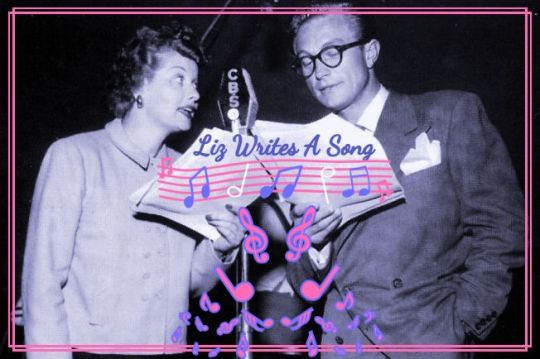
“Liz Writes a Song” is episode #73 of the radio series MY FAVORITE HUSBAND broadcast on January 27, 1950 over the Armed Forces Radio and Television Service.
Synopsis ~ Liz is convinced that she is a musical talent, but when a music professor tells her she’ll never be a singer, she decides to take up songwriting.

Portions of this script were later used as inspiration for “The Benefit” (ILL S1;E13) filmed on November 30, 1951 and first aired on January 7, 1952. The premise of the foursome gathering around the piano for a night of singing and discovering Lucy cannot hold a tune is identical to this radio script.
This was the 22st episode of the second season of MY FAVORITE HUSBAND, the second of the new year and of the new decade (1950). There were 43 new episodes, with the season ending on June 25, 1950.

“My Favorite Husband” was based on the novels Mr. and Mrs. Cugat, the Record of a Happy Marriage (1940) and Outside Eden (1945) by Isabel Scott Rorick, which had previously been adapted into the film Are Husbands Necessary? (1942). “My Favorite Husband” was first broadcast as a one-time special on July 5, 1948. Lucille Ball and Lee Bowman played the characters of Liz and George Cugat, and a positive response to this broadcast convinced CBS to launch “My Favorite Husband” as a series. Bowman was not available Richard Denning was cast as George. On January 7, 1949, confusion with bandleader Xavier Cugat prompted a name change to Cooper. On this same episode Jell-O became its sponsor. A total of 124 episodes of the program aired from July 23, 1948 through March 31, 1951. After about ten episodes had been written, writers Fox and Davenport departed and three new writers took over – Bob Carroll, Jr., Madelyn Pugh, and head writer/producer Jess Oppenheimer. In March 1949 Gale Gordon took over the existing role of George’s boss, Rudolph Atterbury, and Bea Benaderet was added as his wife, Iris. CBS brought “My Favorite Husband” to television in 1953, starring Joan Caulfield and Barry Nelson as Liz and George Cooper. The television version ran two-and-a-half seasons, from September 1953 through December 1955, running concurrently with “I Love Lucy.” It was produced live at CBS Television City for most of its run, until switching to film for a truncated third season filmed (ironically) at Desilu and recasting Liz Cooper with Vanessa Brown.
MAIN CAST

Lucille Ball (Liz Cooper) was born on August 6, 1911 in Jamestown, New York. She began her screen career in 1933 and was known in Hollywood as ‘Queen of the B’s’ due to her many appearances in ‘B’ movies. With Richard Denning, she starred in a radio program titled “My Favorite Husband” which eventually led to the creation of “I Love Lucy,” a television situation comedy in which she co-starred with her real-life husband, Latin bandleader Desi Arnaz. The program was phenomenally successful, allowing the couple to purchase what was once RKO Studios, re-naming it Desilu. When the show ended in 1960 (in an hour-long format known as “The Lucy-Desi Comedy Hour”) so did Lucy and Desi’s marriage. In 1962, hoping to keep Desilu financially solvent, Lucy returned to the sitcom format with “The Lucy Show,” which lasted six seasons. She followed that with a similar sitcom “Here’s Lucy” co-starring with her real-life children, Lucie and Desi Jr., as well as Gale Gordon, who had joined the cast of “The Lucy Show” during season two. Before her death in 1989, Lucy made one more attempt at a sitcom with “Life With Lucy,” also with Gordon.
Richard Denning (George Cooper) was born Louis Albert Heindrich Denninger Jr., in Poughkeepsie, New York. When he was 18 months old, his family moved to Los Angeles. Plans called for him to take over his father’s garment manufacturing business, but he developed an interest in acting. Denning enlisted in the US Navy during World War II. He is best known for his roles in various science fiction and horror films of the 1950s. Although he teamed with Lucille Ball on radio in “My Favorite Husband,” the two never acted together on screen. While “I Love Lucy” was on the air, he was seen on another CBS TV series, “Mr. & Mrs. North.” From 1968 to 1980 he played the Governor on “Hawaii 5-0″, his final role. He died in 1998 at age 84.
Gale Gordon (Rudolph Atterbury) had worked with Lucille Ball on “The Wonder Show” on radio in 1938. One of the front-runners to play Fred Mertz on “I Love Lucy,” he eventually played Alvin Littlefield, owner of the Tropicana, during two episodes in 1952. After playing a Judge in an episode of “The Lucy-Desi Comedy Hour” in 1958, he would re-team with Lucy for all of her subsequent series’: as Theodore J. Mooney in ”The Lucy Show”; as Harrison Otis Carter in “Here’s Lucy”; and as Curtis McGibbon on “Life with Lucy.” Gordon died in 1995 at the age of 89.
Bea Benadaret (Iris Atterbury) was considered the front-runner to be cast as Ethel Mertz but when “I Love Lucy” was ready to start production she was already playing a similar role on TV’s “The George Burns and Gracie Allen Show” so Vivian Vance was cast instead. On “I Love Lucy” she was cast as Lucy Ricardo’s spinster neighbor, Miss Lewis, in “Lucy Plays Cupid” (ILL S1;E15) in early 1952. Later, she was a success in her own show, “Petticoat Junction” as Shady Rest Hotel proprietress Kate Bradley. She starred in the series until her death in 1968.
Ruth Perrott (Katie, the Maid) was also later seen on “I Love Lucy.” She first played Mrs. Pomerantz, a member of the surprise investigating committee for the Society Matrons League in “Pioneer Women” (ILL S1;E25), as one of the member of the Wednesday Afternoon Fine Arts League in “Lucy and Ethel Buy the Same Dress” (ILL S3;E3), and also played a nurse when “Lucy Goes to the Hospital” (ILL S2;E16). She died in 1996 at the age of 96.
Bob LeMond (Announcer) also served as the announcer for the pilot episode of “I Love Lucy”. When the long-lost pilot was finally discovered in 1990, a few moments of the opening narration were damaged and lost, so LeMond – fifty years later – recreated the narration for the CBS special and subsequent DVD release.
GUEST CAST

Hans Conried (Professor Krausemeyer / Mr. Wood, the Cooper’s neighbor) first co-starred with Lucille Ball in The Big Street (1942). He then appeared on “I Love Lucy” as used furniture man Dan Jenkins in “Redecorating” (ILL S2;E8) and later that same season as Percy Livermore in “Lucy Hires an English Tutor” (ILL S2;E13) – both in 1952. The following year he began an association with Disney by voicing Captain Hook in Peter Pan. On “The Lucy Show” he played Professor Gitterman in “Lucy’s Barbershop Quartet” (TLS S1;E19) and in “Lucy Plays Cleopatra” (TLS S2;E1). He was probably best known as Uncle Tonoose on “Make Room for Daddy” starring Danny Thomas, which was filmed on the Desilu lot. He joined Thomas on a season 6 episode of “Here’s Lucy” in 1973. He died in 1982 at age 64.
Conried uses a German accent for the role of the Professor. He previously played Krausemeyer in “Piano and Violin Lessons” (aka “Professor Krausmeyer’s Talent Scouts”), episode #26, broadcast on January 14, 1949. Professor Krausmeyer is likely the inspiration for Professor Gitterman on “The Lucy Show.” It is unusual for Conried to play back to back characters in one episode, but he regularly plays Mr. Wood and listeners would know his voice.

Hal March (Radio Host) first appeared on the “I Love Lucy” in “Lucy Fakes Illness” (ILL S1;E16) using his own name to play an actor posing as the doctor who diagnoses Lucy with ‘golbloots.’ March got his first big break when he was cast as Harry Morton on “The George Burns and Gracie Allen Show” in 1950. He eventually lost the part to Fred Clark who producers felt was better paired with Bea Benaderet, who played Blanche, and here plays Iris Atterbury. He stayed with the show in other roles, the last airing just two weeks before his appearance as Eddie Grant in “Lucy is Matchmaker” (ILL S2;E27). In 1966 he was seen on “The Lucy Show.”

Norma Zimmer (Radio Singer) was one of the citizens of Kildoonan in
“Lucy Goes to Scotland” (ILL S5;E17). She also appeared as a chorus girl in Singin’ in the Rain (1952). She would become famous as Lawrence Welk’s Champagne Lady and 20 years later introduced the episode “Lucy Meets Lawrence Welk” (HL S2;E18) on the “Here’s Lucy” series 2 DVD.
EPISODE
ANNOUNCER: “As we look in on the Coopers, it’s evening and Liz and George are entertaining George’s boss, Mr. Atterbury, and his wife. Dinner’s over and the group is in the living room having coffee.”
George suggests they listen to the radio, but Mr. Atterbury hardly knows what the word means since he got his television set. George flips on the radio and here’s a singer (Norman Zimmer) performing “Bibbidi-Bobbidi-Boo”.
“Bibbidi-Bobbidi-Boo” (also called “The Magic Song”) was written by Al Hoffman, Mack David, and Jerry Livingston for the 1950 film Cinderella. Coincidentally, it was first performed by actress Verna Felton, who would go on to play the Ricardo’s maid, Mrs. Hudson, and star in the Desilu sitcom “December Bride” as Hilda. The song was nominated for the Academy Award for Best Original Song in 1951 but lost out to “Mona Lisa” from Captain Carey, U.S.A.
Mr. Atterbury doesn’t understand the song’s nonsense lyrics. Liz explains:
LIZ: “It’s ‘Mairzys Doates’ sung sideways.”

“Mairzy Doats” is a novelty song written in 1943 by Milton Drake, Al Hoffman, and Jerry Livingston, two of the same writers that would create “Bibbidi-Bobbidy-Boo.” The song made the pop charts several times, with a version by the Merry Macs reaching No. 1 in March 1944. The song was also a number-one sheet music seller, with sales of over 450,000. Bing Crosby also had a hit with the silly song.
George flips the radio off the radio and Mr. Atterbury complains that they don’t write songs like they used to. Iris sarcastically reminds him of his youth by asking him to sing ‘Vo-do-do-de-o.”

Iris is probably referring to “Vo-do-do-de-o Blues” a novelty song written by Jack Yellen and Milton Ager in 1927, although the term “Vo-do-do-de-o” was common slang in the 1920s and was found in a number of songs of the time.
Mr. Atterbury says that there was nothing like “When Francis Dances With Me” and “The Sheik of Araby” – even singing a few bars.

“When Francis Dances With Me” was written by Sol Violinsky and Ben Ryan in 1921 and covered by The Andrews Sisters in 1958. “The Sheik of Araby” was written in 1921 by Harry B. Smith and Francis Wheeler, with music by Ted Snyder. It was composed in response to the popularity of the Rudolph Valentino feature film The Sheik. On “I Love Lucy,” Lucy’s mother was a fan of Valentino and even sang a few bars of this song in “The Hedda Hopper Story” (ILL S4;E21) in 1955.
Liz notices Mr. Atterbury’s good singing voice. George chimes in with a few choruses of “Yes Sir, That’s My Baby.”

“Yes Sir, That’s My Baby” was written by Walter Donaldson and Gus Kahn in 1925. The title inspired a 1949 film of the same name starring Donald O’Connor and Gloria DeHaven, who will be reunited by Lucille Ball for “Lucy Moves To NBC” in 1980.
The foursome settle on spending a night singing around the piano, starting with a chorus of “When You Wore A Tulip”.

“When You Wore A Tulip And I Wore A Big Red Rose” was written in 1914 by Percy Wenrich and Jack Mahoney and popularized by Dolly Connolly (1888-1965). It was part of the 1942 film For Me And My Gal sung by Gene Kelly and Judy Garland.
It becomes apparent that somebody is out of tune.
MR. ATTERBURY: “One of our songbirds has gravel in his beak!”
No one will confess to being the clunker, so they sound one note at a team till it is revealed that it is Liz who has a tin ear! Iris suggests they sing “Button Up Your Overcoat,” but their quartet has become a trio. Liz must “button up her lip.”

“Button Up Your Overcoat” was written by Ray Henderson, B.G. DeSylva and Lew Brown in 1928, and was first performed by Ruth Etting, who appeared with Lucille Ball in Roman Scandals (1933). However, the most famous rendition of this song was by Helen Kane, the inspiration for the voice of Betty Boop.
Jack Haley and Zelma O’Neal sang it on Broadway in the musical, Follow Thru (1929). They reprised the song in the film version in 1930. It has since been heard in nine films and multiple television shows.Next day, George says good morning to Liz, who went to bed early while George and the Atterbury’s sang the night away.
LIZ: “Well, if it isn’t Al Jolson. What time did Bing and Dinah go home?”

Singer, comedian, and actor Al Jolson would die 9 months after this broadcast. He co-wrote and introduced the song “California, Here I Come” which was famously sung on “I Love Lucy” in an episode of the same name. Bing Crosby (1903-77) was one of the most successful multi-media stars of his time. He was mentioned by Ricky Ricardo on “I Love Lucy” in “Ricky’s Contract” (ILL S4;E10) in 1954. Dinah Shore (1916-94) was the top-charting female vocalist of the 1940s. Shore guest starred as herself on a 1971 episode of “Here’s Lucy” (HL S4;E7) and Ball made numerous appearances on her talk and variety shows.
Liz tells George that Professor Krausemeyer is coming over to give her voice lessons.
LIZ: “Don’t be surprised if I’m singing on radio before long.”
GEORGE: “Liz, television hasn’t hurt it that much!”
In early 1950, television was still considered an upstart medium, inferior to radio. the idea that television might woo listeners away from the radio was being voiced, but most were still skeptical. As is evidence from the above TV program grid for January 27, 1950, CBS and ABC had no new programs up against “My Favorite Husband” on radio at 8:30pm. Many early television shows, including “I Love Lucy” were aired on both radio and television well into the late 1950s.
GEORGE (leaving for work): “See ya at Carnegie Hall!”

Carnegie Hall is an iconic concert venue in Midtown Manhattan in New York City. It is at 881 Seventh Avenue, occupying the east side of Seventh Avenue between West 56th and 57th Streets. It was built by philanthropist Andrew Carnegie in 1891 and it is still considered the epitome of a vocalists career to sing there.
George bets that Liz will never sing on the radio – even going so far as to promise to roll an egg down main street with his nose if she does!

Katie the Maid opens the door to Professor Krausemeyer (Hans Conried). His theory of singing is that if you can talk, you can sing. The Professor is astounded just how tone deaf Liz really is, but he forges ahead. He tells Liz to just sing something for him. She choses “Stardust” – one of her favorites. Needless to say, she is terribly out of tune. He stops her.
PROFESSOR: “You love that song?
LIZ: “Yes.”
PROFESSOR: “I’d hate to hear you sing something you hate.”
“Star Dust” was composed in 1927 by Hoagy Carmichael with lyrics added by Mitchell Parish in 1929. The song became an American standard and is one of the most recorded songs of the 20th century with over 1,500 recordings. In “The Saxophone”
(ILL S2;E2) in 1952, Ethel requests Lucy play “Star Dust” but it keeps coming out as “The Glow-Worm.”
Professor Krausemeyer finally declares that there are two kinds of singers: those who sing, and those who listen. Liz is in the latter category!
In Part Two, Liz is crying to Katie that she will never be a nightingale. Katie says her sister writes songs and lets others sing them. She wrote the ‘hit’ songs: “Think of Your Friends as Bananas and Count Me as One of the Bunch” and “I Call My Little Boy Tripod Since He’s Grown Another Foot.” Katie tells Liz there’s a weekly song-writing contest at the local radio station and Liz intends on entering it.
LIZ: “Carrie Jacobs Cooper writes again!”

Carrie Jacobs-Bond (1862-1946) was a songwriter who composed some 175 pieces of popular music from the 1890s through the early 1940s. She is perhaps best remembered for writing the parlor song “I Love You Truly”, becoming the first woman to sell one million copies of a song.
The song was sung by Elizabeth Patterson when Lucy Ricardo renewed her vows to Ricky in “The Marriage License” (ILL S1;E26) and briefly by Viv Bagley in Chris Goes Steady (TLS S2;E16) in 1964.
After several hours of song-writing, Liz is going crazy repeating rhymes to write lyrics for her songs. Her neighbor, Mr. Wood (Hans Conried again) comes to the door and strikes a deal that they will be co-authors of songs for the contest. Liz plunks out the tune she has been working on. It is identical to “My Country ‘Tis Of Thee”! Mr. Wood tells her that this also happened to him. He was once accused of stealing a tune from Tchaikovsky.
but he didn’t. He actually stole from Freddy Martin who stole it from Tchaikovsky!

Freddy Martin (1906-83) was a bandleader and saxophonist who appeared as himself on a 1971 episode of “Here’s Lucy”. His theme song, “Tonight We Love,” was adapted from the first movement of Tchaikovsky’s First Piano Concerto. It sold over one million copies by 1946, and was awarded a gold record.

Mr. Wood says they should should seek inspiration on songs from the past. Liz reckons that their song should have a girl’s name in it.
“Look at “Margie”, “Dinah”, “Laura”, “Sweet Sue”.
-
“Margie” (aka “My Little Margie”) by Benny Davis, a vaudeville performer and songwriter. The song was introduced by the Original Dixieland Jazz Band in 1920.
- “Dinah” was written in 1925 by Harry Akst, Sam M. Lewis and Joe Young. One singer, Fannye Rose Shore, became so identified with the song that a DJ called her “Dinah Shore”, which then stuck as her stage name for the next 50 years.
- “Laura” was composed by David Raksin for the 1944 movie Laura, which starred Gene Tierney and Dana Andrews.
-
“Sweet Sue (Just You)” is a jazz standard of 1928, composed by Victor Young with lyrics by Will J. Harris. On “I Love Lucy,” it was one of the few songs Lucy Ricardo could play on the saxophone, next to the previously mentioned “Glow Worm.”
Mr. Wood says there should be a city in it, too:
“Like Chicago”, “Chattanooga Choo-Choo”, “Meet Me In Old St. Louis.”
-
”Chicago“ was written by Fred Fisher and published in 1922. The song has been recorded by many artists, but the best-known version is by Frank Sinatra. It was heard on screen in The Story of Vernon and Irene Castle (1930), Roxie Hart (1945), and Oh, You Beautiful Doll (1949).
-
”Chattanooga Choo Choo“ is a 1941 song written by Mack Gordon and composed by Harry Warren. It was originally recorded by Glenn Miller and His Orchestra and featured in the 1941 movie Sun Valley Serenade. It was the first song to receive a gold record in 1942.
- "Meet Me in St. Louis” is a song from 1904 with words by Andrew B. Sterling; and music by Kerry Mills. The song was the centerpiece of the 1944 Judy Garland movie, Meet Me in St. Louis.
Liz says it should also be a western, citing:
“Ghost Riders in the Sky” and “Mule Train.”
- “(Ghost) Riders in the Sky” is a cowboy-styled country / western song written in 1948 by Stan Jones. A number of versions were crossover hits on the pop charts in 1949, the most successful being by Vaughn Monroe.
- “Mule Train” was written by Johnny Lange, Hy Heath, Ramblin’ Tommy Scott and Fred Glickman. It is a cowboy song originally recorded by Ellis “Buz” Butler Jr. in 1947. The song was featured in the 1950 film Singing Guns (sung by Vaughn Monroe) and nominated for the Academy Award for Best Original Song in 1950, but lost to “Mona Lisa”.
LIZ: “All we need is a girl who is going to a city who falls in love with a ghost writer who beats her with a whip. Let’s get started!”
The day of the contest, Liz is nervously pacing by the telephone waiting to hear the results. Mr. Wood went down to the radio station to see what he could find out. Mr. Wood phones and tells Liz the good news that they won! They will both have to sing it on the radio that night, although Liz insists she will just stand nearby and look pretty while he does the singing.
Arriving at the radio station with the Atterburys and George in tow, she finds out that Mr. Wood has developed laryngitis. The radio host (Hal March) introduces Liz and Mr. Wood, and tells him that she will have to sing for Mr. Wood, who has lost his voice. Their song sounds suspiciously like “Home on the Range,” if Liz can only sing loud enough to be heard, that is.
The host volunteers sings with her to boost her volume.
LIZ & HOST (singing): “Oh, I’ve got a girl
Her first name is Pearl
She comes from Pittsburgh, PA.
She looks like a witch,
But her old man is rich,
and her last name is yippy ki-yay!”Liz wins the prize and George realizes he will have to roll an egg down main street with his nose!

In the bedtime tag, Liz wakes up George, who is snoring. She puts a pillow over his face to stop his snoring, but then fears he has stopped breathing – until he gives another great, big snore.
GEORGE: “Goodnight, Liz!”
-
-
GEORGE IS DRAFTED ~ LIZ’S BABY
January 27, 1951

“George is Drafted ~ Liz’s Baby” (aka “Liz Thinks George is Being Drafted”) is episode #116 of the radio series MY FAVORITE HUSBAND broadcast on January 27, 1951.
This was the 18th episode of the third season of MY FAVORITE HUSBAND. There were 31 new episodes, with the season ending on March 31, 1951.
Synopsis ~ George gets a letter asking him to serve on the local draft board, and Liz thinks he’s been drafted. George thinks Liz’s emotional state is because she is having a baby!

Note: This program was a basis for the “I Love Lucy” episode “Drafted” (ILL S1;E11) filmed on November 2, 1951 and first aired on December 24, 1951.

“My Favorite Husband” was based on the novels Mr. and Mrs. Cugat, the Record of a Happy Marriage (1940) and Outside Eden (1945) by Isabel Scott Rorick, which had previously been adapted into the film Are Husbands Necessary? (1942). “My Favorite Husband” was first broadcast as a one-time special on July 5, 1948. Lucille Ball and Lee Bowman played the characters of Liz and George Cugat, and a positive response to this broadcast convinced CBS to launch “My Favorite Husband” as a series. Bowman was not available Richard Denning was cast as George. On January 7, 1949, confusion with bandleader Xavier Cugat prompted a name change to Cooper. On this same episode Jell-O became its sponsor. A total of 124 episodes of the program aired from July 23, 1948 through March 31, 1951. After about ten episodes had been written, writers Fox and Davenport departed and three new writers took over – Bob Carroll, Jr., Madelyn Pugh, and head writer/producer Jess Oppenheimer. In March 1949 Gale Gordon took over the existing role of George’s boss, Rudolph Atterbury, and Bea Benaderet was added as his wife, Iris. CBS brought “My Favorite Husband” to television in 1953, starring Joan Caulfield and Barry Nelson as Liz and George Cooper. The television version ran two-and-a-half seasons, from September 1953 through December 1955, running concurrently with “I Love Lucy.” It was produced live at CBS Television City for most of its run, until switching to film for a truncated third season filmed (ironically) at Desilu and recasting Liz Cooper with Vanessa Brown.
MAIN CAST

Lucille Ball (Liz Cooper) was born on August 6, 1911 in Jamestown, New York. She began her screen career in 1933 and was known in Hollywood as ‘Queen of the B’s’ due to her many appearances in ‘B’ movies. With Richard Denning, she starred in a radio program titled “My Favorite Husband” which eventually led to the creation of “I Love Lucy,” a television situation comedy in which she co-starred with her real-life husband, Latin bandleader Desi Arnaz. The program was phenomenally successful, allowing the couple to purchase what was once RKO Studios, re-naming it Desilu. When the show ended in 1960 (in an hour-long format known as “The Lucy-Desi Comedy Hour”) so did Lucy and Desi’s marriage. In 1962, hoping to keep Desilu financially solvent, Lucy returned to the sitcom format with “The Lucy Show,” which lasted six seasons. She followed that with a similar sitcom “Here’s Lucy” co-starring with her real-life children, Lucie and Desi Jr., as well as Gale Gordon, who had joined the cast of “The Lucy Show” during season two. Before her death in 1989, Lucy made one more attempt at a sitcom with “Life With Lucy,” also with Gordon.
Richard Denning (George Cooper) was born Louis Albert Heindrich Denninger Jr., in Poughkeepsie, New York. When he was 18 months old, his family moved to Los Angeles. Plans called for him to take over his father’s garment manufacturing business, but he developed an interest in acting. Denning enlisted in the US Navy during World War II. He is best known for his roles in various science fiction and horror films of the 1950s. Although he teamed with Lucille Ball on radio in “My Favorite Husband,” the two never acted together on screen. While “I Love Lucy” was on the air, he was seen on another CBS TV series, “Mr. & Mrs. North.” From 1968 to 1980 he played the Governor on “Hawaii 5-0″, his final role. He died in 1998 at age 84.
Gale Gordon (Rudolph Atterbury) had worked with Lucille Ball on “The Wonder Show” on radio in 1938. One of the front-runners to play Fred Mertz on “I Love Lucy,” he eventually played Alvin Littlefield, owner of the Tropicana, during two episodes in 1952. After playing a Judge in an episode of “The Lucy-Desi Comedy Hour” in 1958, he would re-team with Lucy for all of her subsequent series’: as Theodore J. Mooney in ”The Lucy Show”; as Harrison Otis Carter in “Here’s Lucy”; and as Curtis McGibbon on “Life with Lucy.” Gordon died in 1995 at the age of 89.
Bea Benadaret (Iris Atterbury) was considered the front-runner to be cast as Ethel Mertz but when “I Love Lucy” was ready to start production she was already playing a similar role on TV’s “The George Burns and Gracie Allen Show” so Vivian Vance was cast instead. On “I Love Lucy” she was cast as Lucy Ricardo’s spinster neighbor, Miss Lewis, in “Lucy Plays Cupid” (ILL S1;E15) in early 1952. Later, she was a success in her own show, “Petticoat Junction” as Shady Rest Hotel proprietress Kate Bradley. She starred in the series until her death in 1968.
Ruth Perrott (Katie, the Maid)
was also later seen on “I Love Lucy.” She first played Mrs. Pomerantz (above right), a member of the surprise investigating committee for the Society Matrons League in “Pioneer Women” (ILL S1;E25), as one of the member of the Wednesday Afternoon Fine Arts League in “Lucy and Ethel Buy the Same Dress” (ILL S3;E3), and also played a nurse when “Lucy Goes to the Hospital” (ILL S2;E16). She died in 1996 at the age of 96.
Bob LeMond (Announcer) also served as the announcer for the pilot episode of “I Love Lucy”. When the long-lost pilot was finally discovered in 1990, a few moments of the opening narration were damaged and lost, so LeMond – fifty years later – recreated the narration for the CBS special and subsequent DVD release.
THE EPISODE

ANNOUNCER: “As we look in on the Coopers, it’s morning and we find Liz Cooper in the living room. Katie the Maid has just brought in the mail.”
Liz sorts through the mail – all of which seems to be for George. Liz is surprised to see a letter from the War Department. Both Liz and Katie immediately jump to the conclusion that he has been drafted. Liz is so curious, she tries to see through the address window on the envelope. Katie thinks that is unethical.
LIZ: “If they didn’t want people to peek in, they would have put a shade on it!”
Liz can’t stand the suspense and opens the envelope and read the letter.

LIZ (reads): “Katie! George is being drafted! That’s the thanks you get for doing a good job. George won the last war for them, now they want him to do it all over again!”
This line implies that George Cooper served during World War II. The Korean war began on June 25, 1950. By July, American troops had entered the war on South Korea’s behalf. As far as American officials were concerned, it was a war against the forces of communism.

Meanwhile, George asks to speak to his boss, Mr. Atterbury, privately. He would like a day off to substitute for his friend Dave Janus, who serves on the Draft Board. Mr. Atterbury thinks that his volunteering is commendable, but warns that he shouldn’t tell Liz about it. When he volunteered during the last war, the women of Iris’s bridge club all wanted favors – to station their sons near home or make them four-star generals!

Back at the Cooper home, Iris visits and Liz breaks the news that George has been drafted. Soon, both the women are awash in tears: Liz because George has been called, and Iris because Rudolph hasn’t been.
When George comes home from work, Liz and Katie make a big fuss over him. Once he’s comfortable in his favorite chair, he asks to see the mail. Liz watches him anxiously, but after reviewing all the envelopes, he isn’t the least concerned. In the kitchen, Liz tells Katie that George is being brave for her. Katie serves dinner – all George’s favorite foods: turkey, dressing, and sweet potatoes.
GEORGE: “What’s for dessert?”
LIZ (wailing): “Jell-Oooooooooooooooo!”
Liz runs out of the dining room in tears, the perfect cue for the end of Act One and a Jell-O commercial by announcer Bob LeMond.
ANNOUNCER: “As we look in on the Coopers once again, Liz mistakenly thinks George has been drafted and is trying to be brave about the whole thing. Well, all she’s succeeded in doing so far is completely confusing George, as Mr. Atterbury is finding out.”
At the bank, Mr. Atterbury asks to have a word with George, who has been so distracted that he filed his lunch and put a file in his lunchbox. George is worried about Liz’s behavior at dinner last night. When George explains her erratic behavior, Mr. Atterbury immediately comes to the conclusion that she’s going to have a baby! He tells George that she’ll probably play coy and be knitting little things.

Back at the Cooper home, Iris comes over to ask Liz if George has broken the news to her yet. He hasn’t but Liz has started knitting him some socks to take with him, although she isn’t very good at knitting. Iris promises not to tell Rudolph but hopes that the cat is out of the bag by the time they all play canasta that evening.
As Iris leaves, George comes home, surprising Liz who tries to hide her knitting behind her back. Mr. Atterbury’s hunch was correct! When the phone rings, George tells Liz she should get off her feet and relax, even calling her mother!
LIZ: “Well! You don’t have to get nasty about it!”
In the next room, George takes a call from Mr. Atterbury, confirming that Liz has indeed been knitting! George warns Mr. Atterbury not to tell Iris about Liz’s baby so she can do it herself – perhaps at their canasta night.
Later that evening, Iris and Rudolph arrive at the Coopers for canasta. Rudolph is shocked to see Liz up and around ‘in her condition’! Liz and Iris whisper between themselves. George and Rudolph whisper between themselves. No word from George about being drafted. No word from Liz about having a baby.
MR. ATTERBURY: “I’ll start the ball rolling. Liz? Do you know when it’s going to be?”
LIZ: “Well, I don’t know why you ask me, but yes, I know. Tomorrow morning.”
MR. ATTERBURY & GEORGE (shocked): “Tomorrow morning?! Oh, Liz, sit down. You have to rest!”At Iris’s suggestion, Liz gives George the socks she has knitted. George and Rudolph immediately assume they are little sweaters for infants! Liz wants to know why George is so glad.
GEORGE: “Well, certainly I’m glad. Aren’t you?”
LIZ: “I should say not. I’m mad! You know who’s to blame for the whole thing, don’t you? Those darn Chinese Communists!“
On October 1, 1949, Chinese Communist leader Mao Zedong declared the creation of the People’s Republic of China (PRC) also known as ‘Red China’. In the above political cartoon from 1951, the octopus of Communist China reaches from Tibet to Malaya, to Indo China, to Korea.
At the height of confusion, George denies he’s been drafted and Liz admits she’s not having a baby! George accuses her of snooping, and Liz is upset.
LIZ: “It’d be just like you to run away and join the army and leave me with our only child! (crying) Waaaaaaaa!”
End of Episode

In the live Jell-O commercial between Bob LeMond and Lucille Ball, Bob plays an explorer lost in the jungle, and Lucille Ball a shy, native flower.
Blooper Alert! Lucille Ball seems momentarily taken aback after LeMond’s use of the word ‘transpires’! She stops and repeats the word questioningly.
BALL: “I was brought up by the animals. My mother was a marmoset… my father was a papaset.”

ANNOUNCER: “Be sure to watch for Lucille Ball as a would-be cosmetic dealer in her latest Columbia picture, ‘The Fuller Brush Girl.’”

-
Subscribe
Subscribed
Already have a WordPress.com account? Log in now.
 Papermoon Loves Lucy