-
IDA LUPINO
February 4, 1914

Ida Lupino was born in Herne Hill, London, to actress Connie O’Shea and music hall comedian Stanley Lupino, a member of the theatrical Lupino family, which included Lupino Lane, a song-and-dance man. Her father, a top name in musical comedy in the UK and a member of a centuries-old theatrical dynasty, encouraged her to perform at an early age. He built a backyard theatre for Lupino and her sister Rita. Lupino wrote her first play at age seven and toured with a travelling theatre company as a child. By the age of ten, Lupino had memorized the leading female roles in each of Shakespeare’s plays. After her intense childhood training for stage plays, Ida’s uncle Lupino Lane assisted her in moving towards film acting by getting her work as a background actor at British International Studios.

Her first time on screen was in a minor, uncredited role in 1931′s The Love Race, starring her father Stanley. This was the first and last time she went uncredited in a film. In 1934, she moved to Hollywood.

She made her TV debut in an episode of the anthology series “The Ford Television Theatre” on February 25, 1954, co-starring with Jack Lemmon. Three months later she did a second episode of the series with her husband, Howard Duff.

Lupino and Duff co-starred on the CBS series “Mr. Adams and Eve” from 1957 to 1958 (66 episodes). The role earned her two Emmy nominations.

Although they played themselves in “Lucy’s Summer Vacation” (LDCH S2;E5), their performances were greatly influenced by their sitcom work.

The episode first aired on June 8, 1959. The premise has the Ricardos and the Duffs both thinking they are the only ones with access to a remote Vermont cabin.

Once they realize they are a foursome instead of a couple, the girls plot to get the boys attention away from fishing and poker.

Like many of Lucille Ball’s guest stars (Milton Berle, Victor Buono, Cesar Romero, Rudy Vallee, and Ethel Merman, to name just a few), Lupino and Duff became arch villains on “Batman” in 1968: Cabala and Dr. Casandra (above). Throughout the 1960s and ‘70s Lupino made many guest appearances on sitcoms including “Bewitched,” “Gilligan’s Island,” and “Family Affair.”

In addition to being an accomplished actress, Lupino was a respected director. From 1949 to 1968, she directed more than 40 films and television programs, including three episodes of Desilu’s hit crime show “The Untouchables.”
Before Howard Duff she was married to Louis Hayward and Collier Young. When Lupino filed for divorce from Young, she was already pregnant from an affair with future husband Howard Duff, whom she married in October 1951. Lupino and Duff divorced in 1983.

Her final screen appearance was in My Boys are Good Boys in 1979. She played Mrs. Morton, which was also Lucille Ball’s married name.
In August 1995 she died of a stroke while battling colon cancer.
-
SPEECH FOR CIVIC ORGANIZATION
February 4, 1949
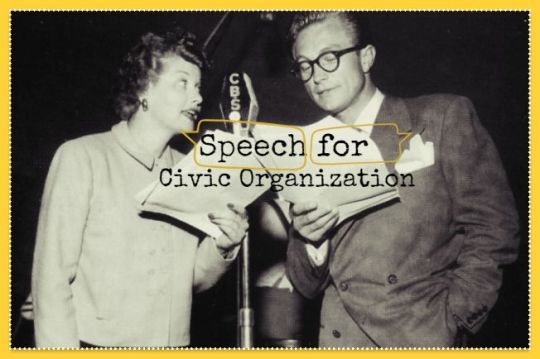
“Speech for Civic Organization” (aka “Liz Debates Alaska in Town Forum”) is episode #29 of the radio series MY FAVORITE HUSBAND broadcast on February 4, 1949 on the CBS radio network.
Synopsis ~ Liz, anxious to win the approval of an important dinner guest, simply agrees with everything he says. The guest is so impressed with her intelligence that he invites her to be a speaker at his next civic forum.

“My Favorite Husband” was based on the novels Mr. and Mrs. Cugat, the Record of a Happy Marriage (1940) and Outside Eden (1945) by Isabel Scott Rorick, which had previously been adapted into the film Are Husbands Necessary? (1942). “My Favorite Husband” was first broadcast as a one-time special on July 5, 1948. Lucille Ball and Lee Bowman played the characters of Liz and George Cugat, and a positive response to this broadcast convinced CBS to launch “My Favorite Husband” as a series. Bowman was not available Richard Denning was cast as George. On January 7, 1949, confusion with bandleader Xavier Cugat prompted a name change to Cooper. On this same episode Jell-O became its sponsor. A total of 124 episodes of the program aired from July 23, 1948 through March 31, 1951. After about ten episodes had been written, writers Fox and Davenport departed and three new writers took over – Bob Carroll, Jr., Madelyn Pugh, and head writer/producer Jess Oppenheimer. In March 1949 Gale Gordon took over the existing role of George’s boss, Rudolph Atterbury, and Bea Benadaret was added as his wife, Iris. CBS brought “My Favorite Husband” to television in 1953, starring Joan Caulfield and Barry Nelson as Liz and George Cooper. The television version ran two-and-a-half seasons, from September 1953 through December 1955, running concurrently with “I Love Lucy.” It was produced live at CBS Television City for most of its run, until switching to film for a truncated third season filmed (ironically) at Desilu and recasting Liz Cooper with Vanessa Brown.
REGULAR CAST

Lucille Ball (Liz Cooper) was born on August 6, 1911 in Jamestown, New York. She began her screen career in 1933 and was known in Hollywood as ‘Queen of the B’s’ due to her many appearances in ‘B’ movies. With Richard Denning, she starred in a radio program titled “My Favorite Husband” which eventually led to the creation of “I Love Lucy,” a television situation comedy in which she co-starred with her real-life husband, Latin bandleader Desi Arnaz. The program was phenomenally successful, allowing the couple to purchase what was once RKO Studios, re-naming it Desilu. When the show ended in 1960 (in an hour-long format known as “The Lucy-Desi Comedy Hour”) so did Lucy and Desi’s marriage. In 1962, hoping to keep Desilu financially solvent, Lucy returned to the sitcom format with “The Lucy Show,” which lasted six seasons. She followed that with a similar sitcom “Here’s Lucy” co-starring with her real-life children, Lucie and Desi Jr., as well as Gale Gordon, who had joined the cast of “The Lucy Show” during season two. Before her death in 1989, Lucy made one more attempt at a sitcom with “Life With Lucy,” also with Gordon.
Richard Denning (George Cooper) was born as Louis Albert Heindrich Denninger Jr., in Poughkeepsie, New York. When he was 18 months old, his family moved to Los Angeles. Plans called for him to take over his father’s garment manufacturing business, but he developed an interest in acting. Denning enlisted in the US Navy during World War II. He is best known for his roles in various science fiction and horror films of the 1950s. Although he teamed with Lucille Ball on radio in “My Favorite Husband,” the two never acted together on screen. While “I Love Lucy” was on the air, he was seen on another CBS TV series, “Mr. & Mrs. North.” From 1968 to 1980 he played the Governor on “Hawaii 5-0″, his final role. He died in 1998 at age 84.
Ruth Perrott (Katie, the Maid) was also later seen on “I Love Lucy.” She first played Mrs. Pomerantz (above right), a member of the surprise investigating committee for the Society Matrons League in “Pioneer Women” (ILL S1;E25), as one of the member of the Wednesday Afternoon Fine Arts League in “Lucy and Ethel Buy the Same Dress” (ILL S3;E3), and also played a nurse when “Lucy Goes to the Hospital” (ILL S2;E16). She died in 1996 at the age of 96.
Bob LeMond (Announcer) also served as the announcer for the pilot episode of “I Love Lucy”. When the long-lost pilot was finally discovered in 1990, a few moments of the opening narration were damaged and lost, so LeMond – fifty years later – recreated the narration for the CBS special and subsequent DVD release.
Gale Gordon (Rudolph Atterbury) and Bea Benadaret (Iris Atterbury) had not yet joined the cast as regular characters.
GUEST CAST

Frank Nelson (Mr. Barton) was born on May 6, 1911 (three months before Lucille Ball) in Colorado Springs, Colorado. He started working as a radio announcer at the age of 15. He later appeared on such popular radio shows as “The Great Gildersleeve,” “Burns and Allen,” and “Fibber McGee & Molly”. This is one of his 11 performances on “My Favorite Husband.” On “I Love Lucy” he holds the distinction of being the only actor to play two recurring roles: Freddie Fillmore and Ralph Ramsey, as well as six one-off characters, including the frazzled train conductor in “The Great Train Robbery” (ILL S5;E5), a character he repeated on “The Lucy Show.” Aside from Lucille Ball, Nelson is perhaps most associated with Jack Benny and was a fifteen-year regular on his radio and television programs.

Steve Allen (Scott Campbell, Expert on Alaska) was a talk show and variety host as well as a published composer. Although he was seen with Lucille Ball on awards and quiz shows, their first time acting together on screen didn’t come until 1978′s “Lucy Calls The President”. In 1980, Ball appeared on the premiere of “The Steve Allen Comedy Hour”. He died in 2000 at age 78.
TRIVIA: Madelyn Pugh and Bob Carroll Jr. were writers for the Steve Allen radio show and left that job to write for “My Favorite Husband.”
They paid Allen to write his own show one week so they could focus on creating a script submission for “My Favorite Husband.”
EPISODE
ANNOUNCER: “As we look in on the Coopers tonight, they’ve settled down for a quiet evening at home. Liz has discovered an intelligence quiz in a magazine, but she’s having George’s attention, because he is lost in a gripping, blood-curdling murder mystery.”

George is reading “The Mummy’s Tummy” but Liz spoils the ending to get his attention. George can’t seem to answer any of the IQ questions correctly.
- Q: “What is the name for the chemical formula H2S04?”
- A: Sulfuric Acid
- Q: “What does it say on the lid of a United States mailbox?”
- A: Pull Down
- Q: “For what was Ma Ferguson noted?”
- A: The first woman Governor of Texas
George decides to quiz Liz, asking her a few questions.
- Q: “What is the poop deck of the ship?”
- Liz’s Answer: “The deck where the sailor’s rest when they’re pooped.”
- Real Answer: “A raised portion of the rear deck.”
- Q: “Does sound travel faster or slower in water than it does in air?”
- Liz’s Answer: “Next question.”
- Q: “Chicle is the main ingredient in chewing gum. Where is the largest deposit found?”
- Liz’s Answer: “Under theatre seats.”
Liz realizes that they aren’t very smart and should probably do something about it. Dr. Guilfoyle, author of the quiz, suggests that a score under 50 needs to be addressed.

Liz is going to send for his book “How To Improve Yourself.”
LIZ: “Look at the people who recommend this book: Truman and Goldwyn.”
GEORGE: “Harry Truman and Sam Goldwyn?”
LIZ: “No, Sam Truman and Harry Goldwyn!”
Harry Truman (1884-1972) was the 33rd president of the United States from 1945 to 1953, succeeding Franklin D. Roosevelt after his death. He implemented the Marshall Plan to rebuild the economy of Western Europe, and established the Truman Doctrine and NATO. Sam Goldwyn (1879 -1974) was a film producer best known as the founder of several motion picture studios in Hollywood.
A few days later, the book has arrived and Katie the Maid notices Liz is engrossed in it. Liz states that the Doctor has three rules to impress people:
- Learn Ten New Words a Day
- Be a Good Listener
- Have One Subject Down Cold So You Can Steer The Conversation Around To It
Liz’s has already got her ten new words and has put them in a sentence.
LIZ: “By assiduous application, I have promulgated a plethora of altruistic ubiquity and lugubrious perspicacity.”
The telephone rings, it is George telling Liz he is bringing home an important person named Mr. Barton, to dinner.
LIZ: “How important is he, George? Sirloin, T-bone, meatloaf, or hash?”
GEORGE: “Strictly sirloin.”George explains that Mr. Barton is the one who picks the speakers for the open forums in town. George wants to get picked to be one of the first speakers so he can impress his boss, Mr. Atterbury, and possibly land a raise. George warns Liz to be herself and not try to impress him.
Liz decides to enact rule #3 and cracks open an encyclopedia to pick the subject. Much to her surprise, the subject she randomly picks is bees!
Walking up to the house that evening, Mr. Barton (Frank Nelson) confides in George that he is looking forward to meeting a simple housewife, since in his line of work the women are always trying too hard to impress him with their intellect.
George introduces Liz to Mr. Barton, who immediately notices that her vocabulary is amped up. Unfortunately, Liz is using the wrong words most of the time, saying ‘plethora’ for ‘pleasure’ and ‘diversify yourself’ for ‘divert yourself.’
George assures a nervous Mr. Barton that Liz is ‘just an old fashioned girl’.
MR. BARTON: “Sounds like she’s had too many Old- Fashioneds!”

An Old Fashioned is a cocktail made by mixing sugar with bitters and water, adding whiskey or brandy, and garnishing with orange zest and a cocktail cherry. It is traditionally served in a special glass called an Old Fashioned glass. A variation on this wordplay was used on “I Love Lucy” in “Million Dollar Idea” (ILL S3;E13) in 1954 when Lucy (disguised as an average housewife selected at random) describes the taste of Aunt Martha’s Old Fashioned Salad Dressing to deliberately encourage buyers to cancel.
LUCY: “Looks like Aunt Martha had too many Old-Fashioneds!”
In the kitchen, George tells Liz to stop using fancy words, so Liz moves on to rule #3 – her special subject: bees! She no sooner starts buzzing about bees when she is chided by George.
GEORGE (sternly aside): “Liz! Haven’t you forgotten? Mr. Barton’s forum!”
LIZ: “Well, I’m for ‘em, too!”
Coincidentally, Lucille Ball was one of several actors known as ‘Queen of the ‘B’s’ – which referred to ‘B’ pictures – films that were done quickly, on a budget, with lesser-known actors. In 1963′s “Lucy’s Barbershop Quartet” (TLS S1;E19) Lucy suggests they sing about bees!
Mr. Barton tells George he is going to sponsor a Shakespearean Company, if they can convince the City Council to fund them.
LIZ: “To bee or not to bee!”

“To be, or not to be” is the opening of a soliloquy by Prince Hamlet in William Shakespeare’s play Hamlet, Act 3, Scene 1. In the speech, Hamlet contemplates death and suicide. It is one of the most quoted phrases in all of literature. To Be or Not to Be is a also the title of a 1942 film starring Lucille Ball’s good friend Carole Lombard and Jack Benny, who later became her next door neighbor. The plot concerns a troupe of actors in Nazi-occupied Poland. The film was released one month after Lombard was killed in an airplane crash.
George drags Liz into the hall again, warning her to stop talking about bees! After telling him to “mind his own beeswax”, Liz reluctantly agrees just to listen attentively and agree with everything Mr. Barton says. This works so well, that Mr. Barton barely acknowledges George, but only talks to Liz! He is so impressed by Liz, he offers to have her on the panel of their very first forum on Saturday night! She instantly agrees!
Two days later she learns that the forum’s topic is “the effect of jet propulsion and supersonic flight on the future of aviation.” But Liz is un-phased. She has been preparing by buying a new dress, which she tells George has ‘a dive bomb neckline.’
George and Liz role play to prepare for the forum. Against George’s advice, Liz intends to talk about the Wright Brothers!

Orville and Wilbur Wright were inventors and pioneers of aviation. In 1903 the Wright brothers achieved the first powered, sustained and controlled airplane flight; they surpassed their own milestone two years later when they built and flew the first fully practical airplane.
At the meeting that night, Mr. Barton announces to the assembled crowd that their aviation expert, Colonel Davis, could not make it.
MR. BARTON: “He started her from Los Angeles, but he got slightly mixed up in a snowstorm and has just cabled us from Bombay, India.”

Bombay, India
is the capital city of the Indian state of Maharashtra. It was formerly renamed Mumbai in 1995 to better reflect the city’s roots and cut ties with its British origins. Coincidentally, a few months after this broadcast, the 1942 film Bombay Clipper was re-released. Although the Lucy gang never traveled to Bombay, it was mentioned in 1955′s “The Hedda Hopper Story” (ILL S4;E21) when everyone was looking for Mrs. McGillicuddy.
RICKY (Into phone): “Do you have any flights numbered 930? You do? Where’s it coming in from? Bombay?”
LUCY: “Bombay?”
RICKY: “Well knowing your mother… No, even she wouldn’t fly from New York to Los Angeles by way of India.”Instead, Mr. Barton announces that the guest speaker is a famous authority on Alaska, Mr. Scott Campbell (Steve Allen). Unfortunately, Liz knows nothing about Alaska – so she starts to talk about the Wright Brothers instead!

In 1949 Alaska was not yet one of the United States, but was a US territory. The statehood movement gained its first real momentum in 1946 and Alaska was officially proclaimed a state on January 3, 1959. To mark this event, Desilu created a special episode of “The Westinghouse Desilu Playhouse” in which the Ricardos and Mertzes travel to Nome to cash in on a land deal, although no actual filming was done in the 49th state.
In 1952’s “Lucy Gets Ricky on the Radio” (ILL S1;E32) Lucy presciently (but incorrectly) answers the question “What was the last state to be admitted to the union?” by saying Alaska. At the time, the correct answer to the question was Arizona, admitted on Valentine’s Day 1912.
MR. BARTON: “No! When are you going to get to Alaska?”
LIZ: “Let me get the plane invented and I’ll fly up there!”With nothing else to talk about, Liz starts to talk about bees, but Mr. Barton quickly cuts her off and turns the podium over to Mr. Campbell, who launches into a serious speech about the welfare of the children of Alaska. He suddenly turns to Liz and asks “Who is responsible for these children, Mrs. Cooper?”
LIZ: “You really want me to answer that? Wilbur and Orville Wright!”

In the bedtime tag, it is 4 o’clock in the morning and Liz is eating crackers in bed. Wrestling them away from her, George gets cracker crumbs all over the bed. A few seconds later, Liz is eating an apple! George takes it from her. He hears her eating a third time and goes to grab whatever it is away from her.
GEORGE: “Whoah! What was that!”
LIZ: “A glass of cold milk. Goodnight, George.”End of Episode
Bob LeMond reminds listeners that Lucille Ball will soon be seen in the Paramount Picture Sorrowful Jones.

-
EVENING GOWN, STREET FROCK & JACKET SUIT
February 4, 1936

On February 4, 1936, Lucille Ball modeled three fashion-forward outfits in photographs that appeared in newspapers nationwide.


-
RECONVERSION
February 3, 1946


By ERSKINE JOHNSON, NEA Staff Correspondent
HOLLYWOOD, Feb. 3 (NEA) ~ Lucille Ball is reconverting and we do not mean her hair is changing color again. It is natural blonde and not the shocking pink which M-G-M insisted upon for Technicolor and which caused prop boys and junior scenarists to wear blinkers last season.
Reconversion is necessary even in Hollywood, Lucille said, when a gal’s husband gets out of uniform. Lucille’s just did. He’s the Cuban conga cut-up, Dezi* Arnaz, now beating maracas, cabacas, bongos and people’s ears to pieces every night as the leader of his own band at Ciro’s.
Things have changed at the Ball-Dezi manse since Dezi came home from three years in the army. Among other things, Lucille moaned: “He gets out of the army and what happens? I have to get dressed up, put on orchids and pay a cover charge to talk to him.” But when she is working it is another story.
Lucille gets up at 5:30, gets home at 7 at night. Dezi sleeps all day, goes to work at 7:30 p.m. and gets home at 3:30 a.m.
“We meet at the door,” Lucille said.
There are other things, too.
Lucille sleeps with all the windows open. Dezi sleeps with them down. They are now down. Dezi likes hot Cuban dishes and cooks them himself. Lucille doesn’t like them. They are now eating hot Cuban dishes. Dezi likes to go fishing. Lucille gets seasick. “But,” said Lucille, “here we go fishing.”
As for her movie career, Lucille said that had been reconverted, too. Or will be when M-G-M gets around to releasing a new comedy, “Easy to Wed”. Lucille has the role she has been waiting 10 years for – a wacky, fast-talking, hip-swinging actress.
She’s now working in a new 20th Century-Fox flicker, "Dark Corner."
We were amazed to discover that both Lucille and Dezi are a couple of very sentimental people. They go every year on their wedding anniversary to the same booth in a Hollywood restaurant where they met.
Learned the Hard Way
They say in Hollywood that Lucille is the gal who knows all the answers. She ought to. She learned them the hard way, working as a New York model before Hollywood discovered her. A photographer sent her to Hattie Carnegie. Lucille was wearing something pink and all wrong. Hattie took one look and said, "Good grief.” But she hired her. Lucille’s first job was to model a mink coat.
“I slinked that mink all over the place,” Lucille recalled, and Hattie thought I was wonderful. “But she fired me five times while I worked for her – but always called the next day to bawl me out for not coming to work." Finally Lucille had to tell her she had a film offer from Sam Goldwyn. He had seen her photograph in a cigarette poster.
"Hattie was wonderful about it,” Lucille said. “She fired me again, saying, ‘You’re fired, Lucille, and this time I mean it. I won’t be calling you in the morning.’”
_____________
*The article consistently misspells Desi’s name as ‘Dezi’.


Lucy and Desi weren’t far from wrong. Although they were consistently trying to get pregnant, they had no luck until late 1950 – five years after this column was printed!

-
COUNTRY CLUB DANCE
February 3, 1950

“The Country Club Dance” is episode #74 of the radio series MY FAVORITE HUSBAND broadcast on February 3, 1950.
Synopsis ~ Iris and Liz want to go to the country club dance, but George and Rudolph want to go to the fights. The girls decide to get dates and go anyway, until their plan ends in disaster.

The plot later inspired elements of the story in “The Girls Want To Got To A Nightclub” (ILL S1;E1), the very first episode of “I Love Lucy” aired on October 15, 1951.

Parts of the story also inspired “Vacation from Marriage” (ILL S2;E6) aired on October 27, 1952. Despite the similar titles, this script does not have anything to do with “Country Club Dance” (ILL S6;E25), the episode that featured Barbara Eden on April 25, 1957.

“My Favorite Husband” was based on the novels Mr. and Mrs. Cugat, the Record of a Happy Marriage (1940) and Outside Eden (1945) by Isabel Scott Rorick, which had previously been adapted into the film Are Husbands Necessary? (1942). “My Favorite Husband” was first broadcast as a one-time special on July 5, 1948. Lucille Ball and Lee Bowman played the characters of Liz and George Cugat, and a positive response to this broadcast convinced CBS to launch “My Favorite Husband” as a series. Bowman was not available Richard Denning was cast as George. On January 7, 1949, confusion with bandleader Xavier Cugat prompted a name change to Cooper. On this same episode Jell-O became its sponsor. A total of 124 episodes of the program aired from July 23, 1948 through March 31, 1951. After about ten episodes had been written, writers Fox and Davenport departed and three new writers took over – Bob Carroll, Jr., Madelyn Pugh, and head writer/producer Jess Oppenheimer. In March 1949 Gale Gordon took over the existing role of George’s boss, Rudolph Atterbury, and Bea Benaderet was added as his wife, Iris. CBS brought “My Favorite Husband” to television in 1953, starring Joan Caulfield and Barry Nelson as Liz and George Cooper. The television version ran two-and-a-half seasons, from September 1953 through December 1955, running concurrently with “I Love Lucy.” It was produced live at CBS Television City for most of its run, until switching to film for a truncated third season filmed (ironically) at Desilu and recasting Liz Cooper with Vanessa Brown.
MAIN CAST

Lucille Ball (Liz Cooper) was born on August 6, 1911 in Jamestown, New York. She began her screen career in 1933 and was known in Hollywood as ‘Queen of the B’s’ due to her many appearances in ‘B’ movies. With Richard Denning, she starred in a radio program titled “My Favorite Husband” which eventually led to the creation of “I Love Lucy,” a television situation comedy in which she co-starred with her real-life husband, Latin bandleader Desi Arnaz. The program was phenomenally successful, allowing the couple to purchase what was once RKO Studios, re-naming it Desilu. When the show ended in 1960 (in an hour-long format known as “The Lucy-Desi Comedy Hour”) so did Lucy and Desi’s marriage. In 1962, hoping to keep Desilu financially solvent, Lucy returned to the sitcom format with “The Lucy Show,” which lasted six seasons. She followed that with a similar sitcom “Here’s Lucy” co-starring with her real-life children, Lucie and Desi Jr., as well as Gale Gordon, who had joined the cast of “The Lucy Show” during season two. Before her death in 1989, Lucy made one more attempt at a sitcom with “Life With Lucy,” also with Gordon.
Richard Denning (George Cooper) was born Louis Albert Heindrich Denninger Jr., in Poughkeepsie, New York. When he was 18 months old, his family moved to Los Angeles. Plans called for him to take over his father’s garment manufacturing business, but he developed an interest in acting. Denning enlisted in the US Navy during World War II. He is best known for his roles in various science fiction and horror films of the 1950s. Although he teamed with Lucille Ball on radio in “My Favorite Husband,” the two never acted together on screen. While “I Love Lucy” was on the air, he was seen on another CBS TV series, “Mr. & Mrs. North.” From 1968 to 1980 he played the Governor on “Hawaii 5-0″, his final role. He died in 1998 at age 84.
Gale Gordon (Rudolph Atterbury) had worked with Lucille Ball on “The Wonder Show” on radio in 1938. One of the front-runners to play Fred Mertz on “I Love Lucy,” he eventually played Alvin Littlefield, owner of the Tropicana, during two episodes in 1952. After playing a Judge in an episode of “The Lucy-Desi Comedy Hour” in 1958, he would re-team with Lucy for all of her subsequent series’: as Theodore J. Mooney in ”The Lucy Show”; as Harrison Otis Carter in “Here’s Lucy”; and as Curtis McGibbon on “Life with Lucy.” Gordon died in 1995 at the age of 89.
Bea Benadaret (Iris Atterbury) was considered the front-runner to be cast as Ethel Mertz but when “I Love Lucy” was ready to start production she was already playing a similar role on TV’s “The George Burns and Gracie Allen Show” so Vivian Vance was cast instead. On “I Love Lucy” she was cast as Lucy Ricardo’s spinster neighbor, Miss Lewis, in “Lucy Plays Cupid” (ILL S1;E15) in early 1952. Later, she was a success in her own show, “Petticoat Junction” as Shady Rest Hotel proprietress Kate Bradley. She starred in the series until her death in 1968.
Ruth Perrott (Katie, the Maid) does not appear in this episode.
Bob LeMond (Announcer) also served as the announcer for the pilot episode of “I Love Lucy”. When the long-lost pilot was finally discovered in 1990, a few moments of the opening narration were damaged and lost, so LeMond – fifty years later – recreated the narration for the CBS special and subsequent DVD release.
GUEST CAST

Richard Crenna (Dick) would make his television debut with Lucille Ball as Arthur Morton in “The Young Fans” (ILL S1;E20). The character is virtually a carbon copy of Walter Denton, the role he played for four years on radio’s “Our Miss Brooks” starring Eve Arden. In 1952, Desilu brought the show to television where Crenna recreated his role. He later starred in Desilu’s “The Real McCoys.” He would become one of Hollywood’s busiest actors, starring in “Vega$” and Sylvester Stallone’s Rambo films. He died in 2003.

Sam Edwards (Barney) played the star-struck bellboy in “Lucy Meets the Queen” (ILL S5;E15). He was also the voice of the adult Thumper in Bambi (1942).
EPISODE
ANNOUNCER: “As we look in on the Coopers tonight we find there’s nobody home because they’re over at the Atterbury’s. Liz and Iris must have something up their sleeve for they serve their husbands a tremendous dinner and they are now sprawled out helplessly in the living room.”
After a big meal, the men are ready to relax, when Liz and Iris spring a favor on them. They want to go to the county club dance on Friday night. The boys say absolutely not because they always go to the fights on Friday nights. Liz tries to romance into saying yes, but to no avail. Liz gives them an ultimatum: if they won’t take them to the dance, they’ll find dates who will.
LIZ: “We’ll go with some other fellas.”
MR. ATTERBURY: “Who?”
LIZ: “You’ll see!”
MR. ATTERBURY: “Who??”
LIZ: “Don’t worry!!”
MR. ATTERBURY: “Whoooo???”
LIZ: “Oh, shut up. You sound like an owl.”
The joke is a variation on one that will be heard the very first-aired episode of “I Love Lucy,” “The Girls Want To Go To a Nightclub” (ILL S1;E1) in 1951:
Ethel (to Lucy, who is dialing the phone): “Who are you calling? Who? Who? Who?”
Lucy: (to Ethel): “Quiet, you sound like an owl.”The joke was reinterpreted again in “Lucy Buys A Sheep” (TLS S1;E5) in 1962:
Viv: “Who got dinner last night? Who did the laundry last week? Who did the marketing yesterday? Who? Who?”
Lucy: “Apparently some crabby blonde owl.”Next day, Iris drops by to see Liz who is now determined to find dates for Friday night. They can’t think of any men other than their husbands. Liz suddenly remember her old college address book.
LIZ: “Girls called me from all over the campus to see if I could recommend a date. I was the Duncan Hines of Petter’s Point.”

Duncan Hines (1880-1959) was a pioneer of restaurant ratings for travelers. He is best known today for the brand of food products that bears his name. Petter’s Point was probably the local Lover’s Lane at Liz’s college.
In Liz’s Little Black Book, Iris finds a curious code:
- Bill Arnold COAD = Caution: One-Armed Driver
- Tom Crawford CNAD = Caution: No-Armed Driver
- George Cooper = Nothing in Common!
Liz decides to take a different tact. They will make-up boyfriends to make the boys jealous. Liz’s will be named Fred, and Iris will date Harry. In order to convince the boys, that evening, Iris (aka Fred) will call Liz, and then Harry (Liz) will call Iris to arrange their dates.

It should come as no surprise that the writers chose the name Fred, which was the real-life name of Lucille Ball’s younger brother, and later inspired the name of the landlord (and later Little Ricky’s dog) on “I Love Lucy.”
That night, sitting in the living room after dinner, George suspects something is up when Liz is reading a book upside down and has the phone in her lap! Iris rings and pretends to be Fred lowering her voice, even though George cannot hear her. They set a ‘date’ for Friday night.
When Liz hangs up, George jealously wants to know who was on the phone.
LIZ: “What’s sauce for the gander is sauce for the goose and I might tell you, Mr. Gander, that this Goose is going to honk!”
GEORGE: “If you do any honking, this goose is going to be pushing the button.”George relents and agrees to take her to the dance. The phone rings and George picks it up first. It is Mr. Atterbury who tells George he just heard Iris talking to Liz with her voice lowered. The girls’ game is up!
GEORGE: “That was Fred’s husband, Rudolph!”
On Friday night, George and Mr. Atterbury are ready to leave for the fights, but George is concerned that the wives are sitting in the living dressed for the dance. He isn’t so sure they are bluffing. The doorbell rings and two young men are at the door Dick (Richard Crenna) and Barney (Sam Edwards), there to take them to the dance!
Outside, Liz and Iris get into the boys’ car. It is revealed that they the sons of Liz’s friend and they are being paid $2 each to pick them up and flatter them. Their roadster has no windscreen or top and wreaks havoc with the girl’s hair.
They come to a stop at a nearby corner. The boys can’t take them all the way to the club because they are due at the school dance. Liz offers to give them $10 for use of the car, which they mistake for buying the whole vehicle outright!
LIZ: “Congratulations, Iris. You are now half-owner of…an Essex!”

The Essex was a brand of automobile produced by the Essex Motor Company between 1918 and 1922, and by Hudson Motor Car Company between 1922 and 1933. During its production, the Essex was considered a small car and was affordably priced.
Liz and Iris drive toward the club, hoping to find George and Rudolph there waiting for them. Suddenly, the heavens open up.
LIZ: “Something’s falling and it must be rain because pennies don’t splash like that.”

“Pennies from Heaven” is a song by Arthur Johnston and Johnny Burke introduced by Bing Crosby in the 1936 film of the same name. It was recorded in the same year by Billie Holiday. The song title is joked about again in “Lucy Buys A Sheep” (TLS S1;E5) in 1962 and (naturally) in “Lucy, the Coin Collector” (TLS S3;E13) in 1964.
The car then gets two flat tires and Iris notices they have driven into the middle of a cow pasture! The girls decide they must walk (in heels) back to the highway and hitchhike home. When they finally make it to the road, a car pulls up. It is George and Rudolph, who don’t at first recognize their soggy wives!
The men confess that didn’t go to the fights after all. They went to the dance to look for them right after they left!
End of Episode
-
VICTOR BUONO
February 3, 1938

Victor Charles Buono was born in San Diego, California. His grandmother was a vaudeville performer who taught him songs and recitations to perform for visitors.
He was best known for playing the villain King Tut on the TV series “Batman” and Edwin Flagg in the film What Ever Happened to Baby Jane? (1962), which earned him Oscar and Golden Globe nominations.
His large size and sonorous voice, he made a career of playing men much older than he was.

He made his screen debut as an uncredited performer on an episode of the TV series “Bronco” starring Ty Hardin, in December 1959, at age 19.

In 1961, he joined the Desilu family playing Dr. Blaine in three episodes of “Harrigan and Son”, a one-season show also filmed at Desilu Studios.

In 1961 and 1962, he did two episodes of Desilu’s “The Untouchables,” playing two different characters.

His next project would be his break-out role in Whatever Happened To Baby Jane (1962), a film that would be mentioned on the first season of “The Lucy Show.” Viv wants to see the film, but Lucy thinks it will be too scary.

On February 24, 1969, he guest-starred on “Here’s Lucy” in “Lucy Gets Her Man” (HL S1;E21).

Buono played Arthur Vermillion, who may be a Russian spy – or just a greeting card writer!

A few weeks later, in April 1969, Buono did a wordless cameo on the Dinah Shore special “Like Hep” which featured Lucille Ball and Diana Ross.

On August 16, 1971, Buono, Ball, and Ballard (Kaye) were all on the couch on “The Tonight Show with Johnny Carson.” This would be the last time Lucy and Victor would appear together.

Like many other of Lucille Ball’s guest stars (Ethel Merman, Milton Berle, Rudy Vallee, to name a few), Buono became one of the arch villains of “Batman” in ten episodes from 1966 to 1968. A Jekyll-and-Hyde character, William McElroy was a timid professor of Egyptology who, after being hit in the head with a brick at a peace rally, assumes the persona of the charismatic, monomaniacal Egyptian King Tut. The role proved to be the most frequently featured original villain in the series and was one of Buono’s favorites.
Buono was closeted like most gay actors at the time but lived with same-sex partners, and referred to himself as a “conscientious objector” in the “morality revolution” of the 1960s.
Buono was found dead at his home on New Year’s Day 1982; he died of a sudden heart attack at age 43.

His final screen appearance was in the TV pilot “Two Guys from Muck” which was filmed in 1979, but not aired until March 1982, three months after his death. He played a character named Mr. Big.

-
BENNY RUBIN
February 2, 1899

Benny Rubin was born on February 2, 1899 in Boston, Massachusetts. He worked in vaudeville and radio including “The Jack Benny Program” (1933-55).

His feature film debut came in 1928′s Naughty Baby.

His first time acting with Lucille Ball came in 1955′s “The Tour” (ILL S4;E30) filmed on April 15, 1955 and first aired on May 30, 1955. Rubin played the driver of the tour bus that takes Lucy and Ethel to the home of Richard Widmark – then leaves them there!

Rubin was featured on two episodes of Desilu’s “December Bride” with celebrity guest-stars: “The Rudy Vallee Show” (1956) and “The Mickey Rooney Show” (1958). Both Vallee and Rooney were seen as themselves on future Lucycoms.

In 1963, he teamed with another “I Love Lucy” veteran, Ellen Corby, as a couple on a park bench in “Lucy and the Runaway Butterfly” (TLS S1;E29) filmed March 21, 1963.

The episode first aired on CBS on April 22, 1963.

In February 1964, he made one more “Lucy Show” appearance when “Lucy and Viv Open a Restaurant” (TLS S2;E20). Rubin (center) played Mr. Jones, the linen supplier for the restaurant, although he is only identified by name in the closing credits.

Although this was the last appearance on a Lucycom, Rubin appeared with Ball on three Jack Benny specials:
- “Carnival Nights” ~ March 20, 1968
- “Birthday Special” ~ February 17, 1969
- “20th Anniversary Special” ~ November 16, 1970 (above)

Rubin did several shows filmed on the Desilu lot, including “Angel” (1962), “The Danny Thomas Show” (1955 & 1962), and “The Dick Van Dyke Show” (1961).

For Desi Arnaz, Rubin appeared in the ill-fated pilot for “The Carol Channing Show” (1966) and two episodes of “The Mothers-in-Law” in 1968 (above) and 1969.
On March 26, 1927, Rubin married actress Mary O’Brien. They had a daughter and were divorced in 1934

Rubin’s autobiography Come Backstage with Me was published by Vanity Press in 1980.
Rubin died of a heart attack on July 15, 1986 at age 87.

-
LIZ’S INFERIORITY COMPLEX
February 3, 1951

“Liz’s Inferiority Complex” (aka “Liz Develops an Inferiority Complex”) is episode #117 of the radio series MY FAVORITE HUSBAND broadcast on February 3, 1951.
This was the 19th episode of the third season of MY FAVORITE HUSBAND. There were 31 new episodes, with the season (and series) ending on March 31, 1951.

Synopsis ~ After messing up a joke, bombing at bridge, and lousing up George’s breakfast, Liz develops an inferiority complex.

Note: This program was the basis for the “I Love Lucy” episode “The Inferiority Complex” (ILL S2;E18) filmed on September 6, 1952 and first aired on February 2, 1953. Much of the dialogue is repeated verbatim from the radio program.

“My Favorite Husband” was based on the novels Mr. and Mrs. Cugat, the Record of a Happy Marriage (1940) and Outside Eden (1945) by Isabel Scott Rorick, which had previously been adapted into the film Are Husbands Necessary? (1942). “My Favorite Husband” was first broadcast as a one-time special on July 5, 1948. Lucille Ball and Lee Bowman played the characters of Liz and George Cugat, and a positive response to this broadcast convinced CBS to launch “My Favorite Husband” as a series. Bowman was not available Richard Denning was cast as George. On January 7, 1949, confusion with bandleader Xavier Cugat prompted a name change to Cooper. On this same episode Jell-O became its sponsor. A total of 124 episodes of the program aired from July 23, 1948 through March 31, 1951. After about ten episodes had been written, writers Fox and Davenport departed and three new writers took over – Bob Carroll, Jr., Madelyn Pugh, and head writer/producer Jess Oppenheimer. In March 1949 Gale Gordon took over the existing role of George’s boss, Rudolph Atterbury, and Bea Benaderet was added as his wife, Iris. CBS brought “My Favorite Husband” to television in 1953, starring Joan Caulfield and Barry Nelson as Liz and George Cooper. The television version ran two-and-a-half seasons, from September 1953 through December 1955, running concurrently with “I Love Lucy.” It was produced live at CBS Television City for most of its run, until switching to film for a truncated third season filmed (ironically) at Desilu and recasting Liz Cooper with Vanessa Brown.
MAIN CAST

Lucille Ball (Liz Cooper) was born on August 6, 1911 in Jamestown, New York. She began her screen career in 1933 and was known in Hollywood as ‘Queen of the B’s’ due to her many appearances in ‘B’ movies. With Richard Denning, she starred in a radio program titled “My Favorite Husband” which eventually led to the creation of “I Love Lucy,” a television situation comedy in which she co-starred with her real-life husband, Latin bandleader Desi Arnaz. The program was phenomenally successful, allowing the couple to purchase what was once RKO Studios, re-naming it Desilu. When the show ended in 1960 (in an hour-long format known as “The Lucy-Desi Comedy Hour”) so did Lucy and Desi’s marriage. In 1962, hoping to keep Desilu financially solvent, Lucy returned to the sitcom format with “The Lucy Show,” which lasted six seasons. She followed that with a similar sitcom “Here’s Lucy” co-starring with her real-life children, Lucie and Desi Jr., as well as Gale Gordon, who had joined the cast of “The Lucy Show” during season two. Before her death in 1989, Lucy made one more attempt at a sitcom with “Life With Lucy,” also with Gordon.
Richard Denning (George Cooper) was born Louis Albert Heindrich Denninger Jr., in Poughkeepsie, New York. When he was 18 months old, his family moved to Los Angeles. Plans called for him to take over his father’s garment manufacturing business, but he developed an interest in acting. Denning enlisted in the US Navy during World War II. He is best known for his roles in various science fiction and horror films of the 1950s. Although he teamed with Lucille Ball on radio in “My Favorite Husband,” the two never acted together on screen. While “I Love Lucy” was on the air, he was seen on another CBS TV series, “Mr. & Mrs. North.” From 1968 to 1980 he played the Governor on “Hawaii 5-0″, his final role. He died in 1998 at age 84.
Gale Gordon (Rudolph Atterbury) had worked with Lucille Ball on “The Wonder Show” on radio in 1938. One of the front-runners to play Fred Mertz on “I Love Lucy,” he eventually played Alvin Littlefield, owner of the Tropicana, during two episodes in 1952. After playing a Judge in an episode of “The Lucy-Desi Comedy Hour” in 1958, he would re-team with Lucy for all of her subsequent series’: as Theodore J. Mooney in ”The Lucy Show”; as Harrison Otis Carter in “Here’s Lucy”; and as Curtis McGibbon on “Life with Lucy.” Gordon died in 1995 at the age of 89.
Bea Benadaret (Iris Atterbury) was considered the front-runner to be cast as Ethel Mertz but when “I Love Lucy” was ready to start production she was already playing a similar role on TV’s “The George Burns and Gracie Allen Show” so Vivian Vance was cast instead. On “I Love Lucy” she was cast as Lucy Ricardo’s spinster neighbor, Miss Lewis, in “Lucy Plays Cupid” (ILL S1;E15) in early 1952. Later, she was a success in her own show, “Petticoat Junction” as Shady Rest Hotel proprietress Kate Bradley. She starred in the series until her death in 1968.
Ruth Perrott (Katie, the Maid) does not appear in this episode, although she is mentioned.
Bob LeMond (Announcer) also served as the announcer for the pilot episode of “I Love Lucy”. When the long-lost pilot was finally discovered in 1990, a few moments of the opening narration were damaged and lost, so LeMond – fifty years later – recreated the narration for the CBS special and subsequent DVD release.
GUEST CAST

Alan Reed (Dr. Auerbach) is probably best remembered as the voice of Fred Flintstone. He started his acting career in 1937. He played a cafe owner in “Lucy Visits the White House” (TLS S1;E25) first aired on March 25, 1963. In 1967, he made an appearance on the Desi Arnaz series “The Mothers-in-Law”. He died in 1977 at the age of 69.
The character was likely named for comic actor Artie Auerbach. In 1938, he announced plans to marry Cleo, Lucille Ball’s cousin. Ball intervened because she was underage, but the couple later married anyway. Like most psychiatrists on TV and radio, Reed speaks with a German accent, no doubt inspired by Sigmund Freud. On the television version of “The Inferiority Complex” the psychiatrist was played by Gerard Mohr and the character’s name was Dr. Henry Molin.
THE EPISODE
ANNOUNCER: “Let’s look in on the Coopers. It’s evening and they’re entertaining George’s boss, Mr. Atterbury, and his wife Iris. Dinner is over and the group are now in the living room.”
They discuss what a wonderful meal Liz prepared for them. Mr. Atterbury ate a 17 oysters! He’s even got a joke to accompany the oysters, about a deep sea diver and a mermaid, but Iris won’t let him tell it in mixed company.
LIZ: “Iris, this company isn’t mixed, it’s married!

Liz decides that she’ll try to tell one instead, but she’s not very good at telling jokes. She cannot decide whether it is about a man or a woman – or a restaurant or a cafeteria. Liz can’t remember the punch line, but George impatiently interrupts and tells the joke for her.
GEORGE: “The woman said I’ll take two pork chops and make them lean. And the waiter said ‘yes, ma’am, which way?’”

To change the subject, they decide to play bridge instead. Nobody wants to partner with Liz. This fuels her feelings of inferiority.

At breakfast the next day, Liz confesses that she’s not so bright and that she doesn’t do things well. The breakfast is undercooked, so George tells her to talk to Katie. Liz is in tears again – it is Katie’s day off and she has prepared breakfast herself. She can’t tell jokes, she can’t play bridge, and now she can’t cook. She challenges George to name one thing she’s good at.
GEORGE: “You’re very good at…. Well, your wonderful at… You’re really great at, uh…”
LIZ: “Waaah!”
GEORGE: “What are you crying for?”
LIZ: “I can’t think of anything either.”Later, Iris drops by and find Liz in bed, depressed. Iris refuses to believe that Liz is a failure.
IRIS: “You can… Well, for one thing you’re the best at…. Well, you’ve always been tops in…”
LIZ: “Those are the same ones George came up with.”Iris says that at the very least that there isn’t another person in the world who gets their hair the color Liz does! George comes home from work and is surprised to find Liz still in bed. He takes Iris aside and says that he will take Liz to a psychiatrist.
At the psychiatrist’s office, Dr. Auerbach (Alan Reed) examines Liz.DOCTOR: “Lie down on the couch.”
LIZ: “Why?”
DOCTOR: “I dunno. That’s what they do in the movies.”Liz can’t find anything interesting about herself to tell the Doctor, so she ask him to tell her something about himself. It isn’t long before he is the patient and she is the therapist.
In the television version, Ricky convinces the Doctor to pretend to be an old friend, and brings him home instead of Lucy going to his office to provide his ‘treatment’. Ricky gets jealous of the Doctor’s attentions, but Lucy reminds him it is all part of the “Treatment, Ricky! Treatment!”
Later, George invites the Atterburys over to tell them the results of Liz’s exam. The Doctor suggests they try to restore her confidence by building up her ego. George tells them that whatever Liz does, they should ‘lay it on thick’.MR. ATTERBURY (gushing): “Liz! Dream girl!”

Earlier, George also called Liz ‘Dream Girl’. In 1947, just prior to starting “My Favorite Husband,” Lucille Ball starred in a revival tour of the Edgar Rice play Dream Girl.

Everything Liz says or does, the others break out in laughter and compliments. Liz is emboldened by their enthusiasm and keeps telling story after story – until the entire room is nodding off from boredom and it is 2:30 in the morning.
Liz finally tells them to give it up – she heard George on the telephone with the psychiatrist and she’s been on to their scheme the whole time. Why did she let them go on for so long?
LIZ: “Because this is the first time in my life I’ve gotten to be the center of attention for the whole evening and I liked it.”
End of Episode
-
BRUCE GORDON
February 1, 1916

Bruce Gordon was born
Boris Benjamin Grabowsky
in Fitchburg, Massachusetts. He is best known for playing gangster Frank Nitti in the Desilu television series The Untouchables (1959-63). His acting career ranged over a half century and included stage, movies, and the small screen.

His first appearance on Broadway was in 1937 in the musical drama The Fireman’s Flame. From 1941-1945, he played the role of Officer Klein alongside Boris Karloff in the original cast of Arsenic and Old Lace on Broadway. He repeated the role on television in 1955. He did a dozen plays on Broadway through 1965 in Diamond Orchid, a flop that closed after just five performances.

His screen debut came in 1948′s Naked City playing a policeman (uncredited). His first credited role was in the 1949 Marx Brothers film Love Happy.

Gordon’s television debut came in an episode of the anthology series “Ford Theatre Hour” titled “Subway Express”.

In 1958, he joined the Desilu family appearing in two episodes of their helicopter series “Whirlybirds,” first playing a criminal named Bugsy.

His career kicked into high gear when he was cast as the lead in the NBC series “Behind Closed Doors’ which only lasted one season. A week after its premiere he did “Song of Bernadette” for the “Westinghouse Desilu Playhouse,” the same Desi Arnaz-hosted anthology series that would present the first (two-part) pilot of “The Untouchables” in which he played Frank Nitti, the role that would define the rest of his career.

“The Untouchables” (the series) premiered in January 1959 although Gordon only appeared in 30 of its 119 episodes through 1963. This allowed him to do other projects, including another episode of “The Westinghouse Desilu Playhouse” in November 1959 titled “Border Justice”.

Gordon finally acted with his ‘boss’ (Lucy) on an episode of “The Lucy Show” that parodied “The Untouchables” titled “Lucy the Gun Moll” (TLS S4;E25) aired on March 14, 1966. The entire cast of “The Untouchables” returned for the satire, although their character names were altered. Gordon played Big Nick.

A few years later, Gordon returned to working with Lucille Ball on “Here’s Lucy” in “Lucy and the Ex-Con” (HL S1;E15) first aired on January 13, 1969. He played a safecracker named ‘Doc’ Morgan alongside Wally Cox. He introduced the episode when it came to DVD in 2014.

In a real change of pace for Gordon, he played Greek Grandfather Konstantine Kasos in “Lucy’s Wedding Party” (HL S3;E8) on November 2, 1970. Although the character says he is 77, Gordon was just 54 at the time of filming.

Gordon returned to playing criminal types in “Dirty Gertie” (HL S5;E10) aired on November 13, 1972. Gordon played Rocky in an Apple Annie storyline inspired by Pocketful of Miracles.

Gordon was a mobster again in the March 1975 special “Lucy Gets Lucky” which also starred Jackie Coogan (center) and Dean Martin and was filmed on location in Las Vegas. His character name Max Siegel (although credited as Vogel) is likely named for gangster Bugsy Siegel, who was primarily responsible for the development of the Vegas strip in the 1950s. The fact that Max is being played by Bruce Gordon, famous for playing real-life gangster Frank Nitti on Desilu’s “Untouchables,” pretty much assures the comparison.

Gordon’s final screen credit came in 1985, playing a man who may (or may not) be FBI most wanted John Dillinger on “Simon and Simon”.
Gordon was married to Mary Jane Farrar Falvey from 1958 until her death in 1981. He then remarried Marla Gordon. The two were together until his death on January 20, 2011 at age 94.

-
BEST BATHTUB SCENES OF 1939
February 1, 1940


In advance of the whoop-de-do with which the Academy of Motion Picture Arts and Sciences grants its annual awards and closes the guessing season, almost everybody in town – from Mr. Benny’s Rochester to Miss Dietrich’s Sealyham – is making up a list. The best pictures, the best actor, best actress, best direction, best writing – they’re all making the same conventional, categorical selections.
But I’m not. If the boys will hang onto their hats, this leering correspondent will nominate the Ten Best Bathtub Scenes of 1939:

- Most Luxuriant Bather: Joan Crawford in “The Women."
- Most Startled Bather: Ann Sheridan in "Indianapolis Speed Way.’‘
- Most Voluptuous Bather: Hedwige Feuillere in "Lucrezia Borgia."
- Most Businesslike Bather: Marjorie Weaver in “The Honeymoon is Over.”
-
Dirtiest Bather: Golden-haired Lucille Ball in "Beauty for the Asking.” She took a mud bath which actually was more revealing than those of most actresses immersed in foam.
- Most Thoroughly Scrubbed Bather: Madeleine Carroll in “Safari."
- Merriest Soap-Bubble Queen: Ellen Drew in "French Without Tears."
- Best Singer-in-the-Bathtub: Jeanette MacDonald in "New Moon."
- Most Contented Bather: Isa Miranda in "Adventure in Diamonds."
- Most Startlingly R e-v-e-a-l-e-d Bather: Irene Dunne in "My Favorite Wife.”

-
Subscribe
Subscribed
Already have a WordPress.com account? Log in now.
 Papermoon Loves Lucy