-
KIDZ!
The Young People of the Lucyverse ~ Part 1
W.C. Fields famously warned performers never to work with children or animals. Luckily for us, Lucille Ball consistently disregarded his advice. Here’s a look at some of the young performers and characters of the Lucyverse.
“Baby Sitting” (1949) ~ To makes some extra cash, Liz (Lucille Ball) takes up babysitting. Mr. Wood (Hans Conried) suggests he take the job from his daughter, Adele. Mr. Wood has 11 children: Bob, Madelyn, Adele, Lucille, Ruth, Lucius, Jessie, Walter, Jess, Joanne, and Hugo. In reality, these are the names of some of the staff of My Favorite Husband. Keeping her sitting job from her favorite husband, Liz goes on her first assignment to take care of Tommy Pearson, who is a sure shot with a pea shooter. Liz’s husband George (Richard Denning) thinks she is having an affair and assualts Tommy’s father!
“The Elves” (1949) ~ Anne Whitfield played Joanne Wood, one of the 11 children of Mr. Wood (Hans Conried), neighbor of Liz and George Cooper on “My Favorite Husband.” She also appeared as Joanne Wood in “Liz’s Superstitions” also in 1949.
LIZ: “How are you?”
JOANNE: “Fine, thanks.”
LIZ: “How’s your father?”
JOANNE: “Fine, thanks.”
LIZ: “And your four sisters?”
JOANNE: “Fine, thanks.”
LIZ: “And your six brothers?”
JOANNE: “Fine, thanks.”
LIZ: “And your mother?”
JOANNE: “Exhausted, thanks.”
“Liz and George are Handcuffed” (1949) ~ We meet Tommy Wood, the smallest of Mr. Woods’ 11 children. He is played by 13 year-old Johnny McGovern.
LIZ: “Tommy, is it true that no two people in the whole world have the same fingerprints?”
TOMMY: “Nah, that’s a lot of bunk. I’ve already found three people who have exactly the same fingerprints; my daddy, Santa Claus, and the crook who broke into my piggy bank.”

Sorrowful Jones (1949) ~ A young girl (Mary Jane Sanders) is left with the notoriously cheap Sorrowful Jones (Bob Hope) and his girlfriend Gladys (Luiclle Ball) as a marker for a bet. When her father doesn’t return, they learn that taking care of a child interferes with their free-wheeling lifestyle. This is a remake of Little Miss Marker (1934) which starred Shirley Temple and was directed by Lucy’s once-time fiancee Alexander Hall.
The Fuller Brush Girl (1950) ~ When Sally (Lucile Ball) is mistaken for a babysitter and tied up by some children playing cowboys and indians, she is rescued by the real babysitter, played by actress Gail Bonney. Two years later, Gail Bonney would play Mrs. Hudson in the “The Amateur Hour,” hiring Lucy Ricardo to babysit her twin boys, who would tie Lucy up while playing cowboys and indians.

“Be A Pal” (1951) ~ When she thinks Ricky is homesick for Cuba, Lucy dresses up a group of dark-haired boys in sombreros and serapes to remind him of his brothers!
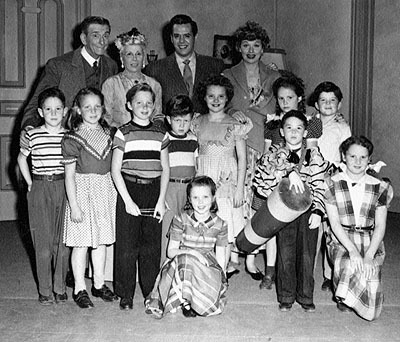
“Lucy Plays Cupid” (1952) ~ Knowing amorous grocer Mr. Ritter (Edward Everett Horton) doesn’t like children, Lucy trots out a stream of youngsters as her offspring. Mr. Ritter counts 25, although Lucy says 6 are missing. In reality, 10 uncredited child performers were featured in the episode, one even dressed as a “little” Ricky playing a conga drum! After filming, the young actors posed for a photo with Lucy, Horton, and guest-star Bea Benadaret.
“The Amateur Hour” (1952) ~ Lucy babysits for rambunctious twin boys, Jimmy and Timmy Hudson. In reality, the boys were not twins. They were played by Sammy Ogg (Jimmy) and David Stollery (Timmy).

Enrique Alberto Ricardo IV aka Little Ricky Ricardo ~ Probably one of the most famous children in television history due mainly to the fact that his birth coincided with the birth of Lucille Ball’s real-life baby, Desi Arnaz Jr. Contrary to popular myth, Desi Jr. never played Little Ricky. The character was played by a series of seven child actors, including two sets of twins and one ‘dream’ Little Ricky. They include (in chronological order): James John Ganzer (2 episodes), Richard and Ronald Lee Simmons (2 episodes) , Joseph and Michael Mayer (11 episodes), and Keith Thibodeaux (aka Richard Keith, 27 episodes). A dream Little Ricky in “Ricky’s Old Girlfriend” (1953) was uncredited. Despite the resemblance, he was not played by Jerry Mathers (”Leave it To Beaver”). An older dream Little Ricky in the same episode (definitely not a child) also went uncredited.
“Lucy Goes to the Hospital” (1953) ~ The same episode that introduces Little Ricky, we meet a new edition to the Stanley household – three newborn girls. Mr. Stanley (Charles Lane) already has six daughters. Fred suggests he start a softball team.
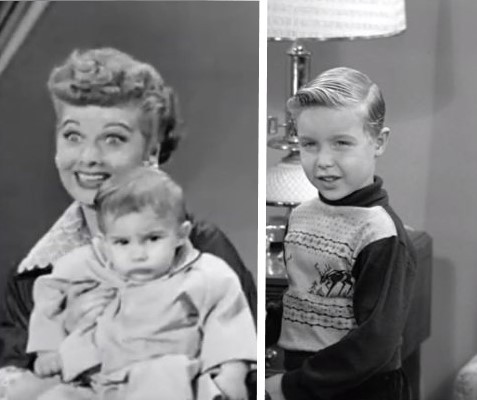
“Baby Pictures” (1953) / “Lucy and Superman” (1957) ~ Caroline and Charlie Appleby’s son Stevie appears in two episodes. The uncredited baby who played him in 1953 had just gotten over the measles before filming. Little Ricky and Little Stevie are both said to be 13 months old at the time. The next time we see Little Stevie is in “Lucy and Superman,” four years later, where his is played by Steven Kay.

“Mertz and Kurtz” (1954) ~ Fred’s former vaudeville partner Barney Kurtz (Charles Winninger) comes for a visit. He has been writing to his grandson telling him that he is a star, so Ricky stars him in a revue at the club and invites Little Barney (Stephen Wootton) to the Tropicana. Wootton was nine years old at the time of filming and had been acting since the age of seven. He returned to Desilu for 1959 episode of “Westinghouse Desilu Playhouse” which was introduced by Desi Arnaz and starred William Frawley.
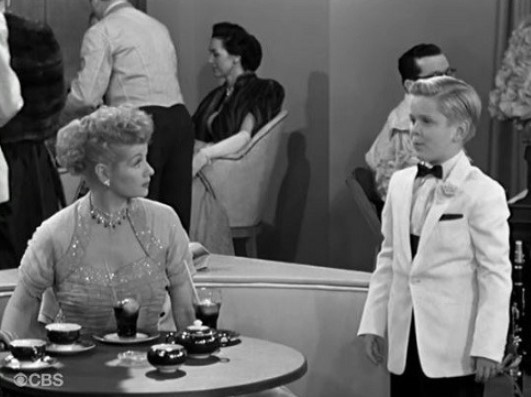
“Second Honeymoon” (1956) ~ When Ricky is kept busy playing gigs on the ship to Europe, Lucy strikes up a friendship with Kenneth Hamilton played by nine year-old Harvey Grant. Grant had played the youngest son in CBS TV’s “Life With Father” from 1953 to 1955.

“Lucy Gets Homesick in Italy” (1956) ~ Missing Little Ricky on his birthday, Lucy decides to lavish her attentions on shoeshine boy Giuseppe (Bart Braverman). Bartley Louis Braverman was born in Los Angeles in 1946. This was his fifth TV role, although he used the name Bart Bradley until 1962. The little girl Theresa (“She’s-a her birthday, too!”) was played by Kathleen Mazolo (nee Mazzola). This is her one and only screen credit of record.
Lucy and the Mertzes throw a birthday party for the children – until Giuseppe feels guilty about claiming it is his birthday, and tells the truth.

“Lucy’s Bicycle Trip” (1956) ~ Biking along the Riviera, the gang takes shelter in the barn of an Italian farmer (Mario Siletti). The farmer cannot give them lodging in his house because he has nine children: Teresa, Sofia, Luigi, Pietro, Dino, Gino, Rosa, Mario, and Antonio – all of whom remain off camera throughout the episode. “Mama Mia! Multi bambini!”
“Return Home from Europe” (1956) ~ On the flight home, Lucy disguises a souvenir cheese as a baby. Evelyn Bigsby, another new mother (Mary Jane Croft) sits next to her with her baby, a four month old named Caroline. Lucy mistakenly says her baby is named Chedder, then quickly corrects herself. “Chester!” In reality, both babies in bunting are props.

“Lucy and Bob Hope” (1956) ~ At Yankee Stadium, Bob Hope is approached by a young fan (David Saber) asking for an autograph. Before granting it, he asks the boy “Have you seen my latest picture, ‘The Iron Petticoat?’” The boy eagerly replies, “Yes, sir.” Coincidentally, this is the first episode to feature Keith Thibodeaux as Little Ricky.

“Little Ricky Gets Stage Fright” (1956) ~ Little Ricky is taking music lessons, but gets nervous at the recital. Like all the children in the episode, little Diana Van Fossen uses her own name, playing a squeaky, out-of-tune rendition of “Swanee River” on the violin. Earl Robie, the 10 year-old ukulele player, was the most experienced of the child performers on the show, having appeared in eight films and TV shows such as “Lassie” and “The Loretta Young Show.” Ironically, despite his credits, his character gets the measles and doesn’t get to perform with the Dixieland Band in the final scene at the Club Babalu.
Others in the music class include: Laurie Blaine (flute), Buddy Noble (bass), Robert Norman (trumpet), Larry Gleason (accordian), and Jeffrey Woodruff (trombone).

“Lucy and Superman” (1957) ~ Stevie Appleby (Steven Kay) attends Little Ricky’s birthday party with an apartment full of similarly-aged children. The tiny actors appear uncredited. During “London Bridge” Kay looks at Fred suspiciously.
“Little Ricky’s School Pageant” (1957) ~ The Ricardos and Mertzes are recruited to act in Little Ricky’s school pageant, “The Enchanted Forest”. Little Ricky, formerly in the chorus, is promoted to the lead role of Billy Brown. His ‘sister’ Suzy Brown was played by Candy Rogers Schoenberg. She was the prize pupil at Pepito and Joanne’s dancing school, which loaned the costumes, sets, and provided the student performers for the episode. We also hear about Jimmy Wilson, who’s mother played the role of the Fairy Princess the previous year.
After the filming, the more than 20 children took a photo with Lucy, Desi, Bill, Vivian, Pepito, and Joanne.

Little Ricky’s pal Bruce Ramsey was played by Ray Farrell in three 1957 episodes of “I Love Lucy”: “Lucy Gets Chummy With The Neighbors,” “Lucy Does the Tango,” and “Housewarming”. He was also known for 14 episodes of the TV series “Peck’s Bad Girl” (1959).
Little Ricky also had two unseen friends his age: Billy Munson, who lived in Westport with his parents Grace and Harry; and Bily Palmer, who gave Little Ricky the puppy who became Fred the dog.
“The Ricardos Dedicate a Statue” (1957) ~ In the very last half hour episode of “I Love Lucy,” Desi Arnaz Jr. appears in a crowd scene along with two unidentified young girls. Despite rumors to the contrary, one of them is NOT Lucie Arnaz.

“Lucy Goes To Mexico” (1958) ~ In Tijuana, ten year-old Alan Roberts (nee Costello) played Alfredo, the enterprising Mexican boy who wants nothing more than to see a great ‘flat top’ (air craft carrier). Two weeks after this episode aired, he appeared on “Leave it to Beaver” as a Spanish boy who is befriends by the Beaver.

At the end of the episode, Little Ricky performs Maurice Chevalier’s “Valentina” with a quartet of pint-sized dancers, the equivalent to the grown up chorines his father sings to.

“Lucy Makes Room for Danny” (1959) ~ The cast of “The Danny Thomas Show” aka “Make Room for Daddy” does a cross-over episode with “The Lucy-Desi Comedy Hour” to mark the show moving into Lucy’s time slot. The cast includes the Williams children, Rusty (Rusty Hamer) and Linda (Angela Cartwright). “Make Room for Daddy” was filmed at Desilu Studios.
RUSTY (about living in the country): “I have a feeling I’m gonna miss the bright lights of Broadway.”
DANNY (to Ricky): “Don’t mind him, he’s one of the beat generation.”
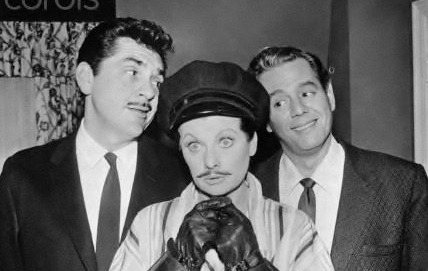
In the last hour-long episode, “Lucy Meets the Mustache” (1960) featuring Ernie Kovacs and Edie Adams, Little Ricky is said to go to school with Kovacs’ daughter Kippie, his second daughter by his first wife. Although Kippie does not appear in the episode, she would have been 10 years old at the time. Kippie’s older sister Bette is also mentioned. After their father’s death, the girls were the subject of a bitter custody battle between Edie Adams and their mother, Bette Wilcox.
STAY TUNED FOR PART 2 of KIDZ!
-
LUCY & THE JOANS!
Lucille Ball’s Collabs with Women Named Joan
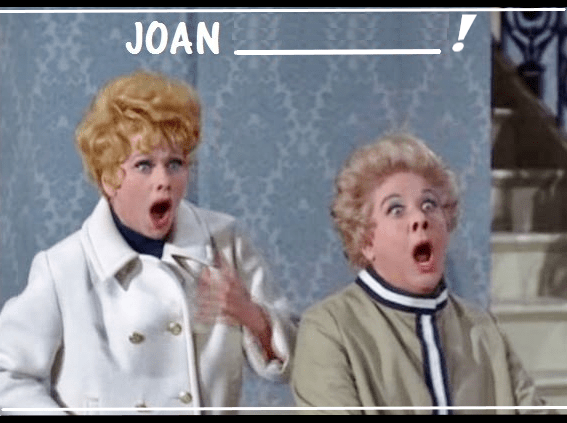
A remarkable number of talented women named Joan – and even a few memorable characters – were part of the Lucyverse. In alphabetical order…
JOAN BANKS (1918-1989)
Joan Banks’ only credit with Lucille Ball was in “Fan Magazine Interview” (1954) in which she played reporter Eleanor Harris, assigned to do a story on Ricky Ricardo’s wife aka Lucy Ricardo. Her character name was a tribute to real-life writer Eleanor Harris, who published a biography of Ball titled “The Real Story of Lucille Ball.”

JOAN BLONDELL (1906-1979)
Joan Blondell (sister of Gloria Blondell) was active as a performer concurrently with Lucille Ball. On “The Lucy Show,” she played Joan Brenner, a character intended to fill the gap after the departure of Vivian Vance. But she did not get along with Lucille Ball, and after a shouting match in front of the studio audience, Blondell was dismissed after just two episodes. They never spoke again.
JOAN CAREY (1921-2015)
Joan Carey was born as Joan Somerville Norbury in Yorkshire, England. As a background performer and stand-in, she appeared on many episodes of “I Love Lucy” and “The Lucy Show,” generally uncredited. She is seen above with Paul Douglas in “Lucy Wants a Career” (1959), an episode of “The Lucy-Desi Comedy Hour.”
JOAN CAULFIELD (1922-1991)
Joan Caulfield played the role of Liz Cooper on the television adaptation of “My Favorite Husband” (1953-55). Lucille Ball played the role on radio, but chose instead to play Lucy Ricardo so that she could work with Desi Arnaz. Caulfield and Ball were later both guest stars on “Bob Hope’s Leading Ladies” in 1966.
JOAN CRAWFORD (1905-1977)
Joan Crawford was born Lucille Fay LeSueur. The Oscar-winning actress was mentioned on several episodes of “I Love Lucy” and “The Lucy Show” before making a guest appearance in “Lucy and the Lost Star” in 1968. The episode was originally intended for Gloria Swanson, hence the non-specific title. The title “Lucy and Joan” had already been used when Joan Bennet guest-starred. As with Bennett there was off-stage friction between Crawford and Ball. Interestingly, in movies Lucy played a character named Joan (The Marines Fly High) and Joan played a character named Lucy (Strait-Jacket)!
JOAN COLLINS (1933)
English-born actress Joan Collins hosted the “All Star Party for Lucille Ball” in 1984. She was also seen with Ball on “Bob Hope’s Leading Ladies” (1966), “Women I Love: Beautiful But Funny” (1982), “Night of 100 Stars II” (1985), and “Friar’s Club Tribute to Gene Kelly” (1985).
JOAN CROSBY (1924-1992)
Joan Crosby was a journalist who wrote about Lucille Ball and was the one-time president of the Hollywood Women’s Press Club. As such, she played herself (above far right) in “Lucy Meets the Burtons” (1970). She is no relation to Bing or David.
JOAN FONTAINE (1917-2013)
Born Joan de Beauvoir de Havilland in Tokyo, she was the sister of Olivia de Havilland. She appeared with Lucy (and two other Joans) in “Bob Hope’s Leading Ladies” (1966). In 1959 she appeared on an episode of “Westinghouse-Desilu Playhouse” hosted by Desi Arnaz.
JOAN GRANT
Joan Grant is the character played by Lucille Ball in The Marines Fly High (1940). Grant runs a cocoa plantation in the South American jungle and allows a platoon of Marines to stay there. Two of the Marines (Richard Dix and Chester Morris) tussle over her affections. When she is kidnapped, they unite to save her. This was Ball’s 48th motion picture.
JOAN RIVERS (1933-2014)
Joan Alexandra Molinsky was born in New York City and became one of the top female comedians of all time. She co-starred with Lucille Ball on “Here’s Lucy” in “Lucy and Joan Rivers Do Jury Duty” (1973) where Rivers played Joan Reynolds. She was the first female guest-host of “The Tonight Show” interviewing Lucille Ball three times.
JOAN SWIFT (1933-2016)
Joan Swift was a frequent background player who generally had a few lines on “The Lucy Show” and “Here’s Lucy.” Three of her characters were also named Joan. Her final screen appearance before retiring was in “Lucy Gets Lucky” (1975).
During her long career in Hollywood, Lucille Ball also worked with or employed Joan Benny (Jack’s daughter), Joan Marshall (”Star Trek”), Joan O’Brien (”Shower of Stars”), Joan Fairfax (”Tonight Show with Jack Paar”), Joan Staley (”The Untouchables”), and Joan Woodbury (”There Goes My Girl”).
BONUS JOANS
JOAN OF ARC (1412-1431)
In “Lucy the Skydiver” (1970), Lucy Carter hears the voices of strong women like Florence Nightingale and Joan of Arc, the Americanized name of the French saint and warrior Jeanne d’Arc.
“I MARRIED JOAN” starring JOAN DAVIS
From 1952 to 1955 Joan Davis (1912-1961) starred in the sitcom “I Married Joan,” which was NBC’s answer to the popularity of “I Love Lucy.” Comic actress Davis had appeared with Lucille Ball in the 1933 film Bunker Bean. Like Lucy, Davis used her own first name and played a scatterbrained housewife. Her husband (Jim Backus) was a judge. Both shows featured Mary Jane Croft, Bobby Jellison, Shirley Mitchell, Sandra Gould, Margie Liszt, Jerry Hausner, Elvia Allman, Myra Marsh, Phil Arnold, Dick Elliott, Robert Foulk, Joseph Kearns, Maxine Semon, Don Brodie, Hal March, Richard Reeves, Herb Vigran, Norma Varden, Harry Bartell, Kay Wiley, Charlotte Lawrence, Frank Nelson, Frank Gerstle, Vivvi Janis, George Neise, Ross Elliott, Verna Felton, Fritz Feld, Mabel Paige, Rolfe Sedan, Paul Dubov, Maurice Marsac, Peter Leeds, Shepard Menken, Strother Martin, Junie Ellis, Florence Bates, Sam Hearn, Mary Treen, and Hans Moebus. Like Lucille Ball, Joan Davis also served as Executive Producer of her own series, which, like “I Love Lucy,” was filmed at General Service Studios.
-
BALL & THE BUTCHERS!
Butchers & Meat Markets of the Lucyverse
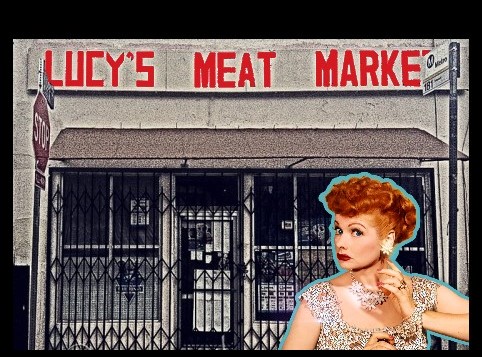
Before supermarkets and online ordering, consumers visited local buthers and meat markets to shop. Take a number! While waiting, here’s a look at the butchers of the Lucyverse!

Lucille Ball had a huge imagination when she was a child in Jamestown NY. In order to attempt to control her daughter, her mother made a deal with the local butcher for Lucy to run up and down the street between his shop and their home. It was in his butcher shop that Lucille first made her entertainment debut. In her autobiography, Ball shares details of her first performance on the butcher’s counter. Lucy loved to dance and twirl for them, as well as giving her rendition of a jumping frog. She would stick her tongue out and croak. Customers would give her some pennies or a sweet treat to show their appreciation.
In 1942 Lucille Ball was the subject of a newspaper article titled “Conversation in the Kitchen” by Susan Thrift. The article details how the wartime homemaker can save money and conserve resources.
“If you have a freezing unit in your refrigerator, you can buy meat for the week. You’ve probably learned that you can depend much on a reliable butcher and standard brands. For the rest, remember what your mother taught you about the purchase of meat:”

“Valentine’s Day” (1949)
Katie the Maid (Ruth Perrot), is sweet on Mr. Dabney the butcher (Hans Conried), and Liz (Lucille Ball) offers to help. But when Liz’s Valentine to her favorite husband gets switched with her check to pay the butcher’s bill, Mr. Dabney gets the wrong idea.
Katie says she has a written a Valentine poem for Mr. Dabney the butcher. Liz calls him “old heavy thumbs”.
KATIE: “Some people may have better beef, but his liver’s good. And no one has oxtails and pig’s feet like him!”
Mr. Dabney reads the Valentine aloud:
“If you’ll be mine, then I’ll be thyne; you set my heart a-quiver. Say you’ll be my Valentine, and send two pounds of liver.”
Hans Conreid also played Mr. Dabney the butcher in “Overweight” (1949) where a dieting weigh-in is held at his butcher shop.
Mr. Dabney returns in “Reminiscing” (1949), a re-dramatization of “Valentine’s Day” as part of a “My Favorite Husband” retrospective episode.

When the “Valentine’s Day” script was made for television in 1952 in “Lucy Plays Cupid”, Mr. Dabney the butcher, played by Hans Conried, became Mr. Ritter, a grocer, played by Edward Everett Horton.

“The Freezer” (1952)
Hoping to save money, Lucy and Ethel purchases a walk-in freezer from Ethel’s Uncle Oscar, a butcher. When Lucy hears Ethel say that he has a “big cold chest,” Lucy drily replies, “Why don’t you knit him a sweater?”

After buying the freezer, they buy the meat to fill it at 69 cents a pound. Lucy over-orders two sides of beef from Johnson’s Meat Packing, a wholesale butcher. Lucy tells Ricky that bacon costs 75 cents a pound. The girls end up ordering 700 pounds of meat for a total of $483! Lucy immediately demands they take it back.
DELIVERY MAN: “Look, ladies, even if you defrosted it, pasted it back together and taught it to walk, I couldn’t take it back!”
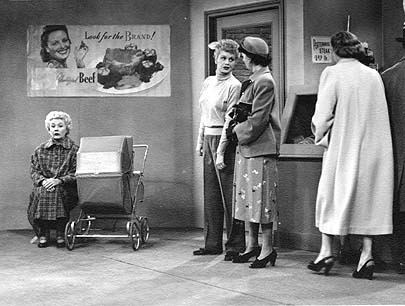
To shift some of the meat, Lucy and other stake out the local butcher shop, stashing the meat in a baby stroller.
LUCY (to a customer): “Are you interested in some high-class beef? Are you tired of paying high prices? Do you want a bargain? Tell you what I’m gonna do. I got sirloin, tenderloin T-bone, rump, pot roast, chuck roast, oxtail stump.”

Fred Aldrich plays the butcher who is none too happy about Lucy and Ethel poaching his customers.

A December 1952 Philip Morris cartoon ad starts with the butcher delivering a side of beef to Lucy and Ethel, inspired by “The Freezer”.

“Together for Christmas” (1962)
The holiday episode opens with Lucy and Viv at the butcher shop, where Ernie the butcher (Joe Mell) is wrapping up Lucy’s Christmas turkey, even though Viv’s family traditionally has a goose.
Ernie the butcher jokingly suggests stuffing the turkey with a goose!
“Lucy and the Plumber” (1964)
Lucy’s first talent discovery was made in Mr. Krause’s butcher shop when she saw his German Shepard Beauty “howl like the Beatles” when Mr. Krause (Tom G. Linder) played the harmonica.
”Lucy and the Great Bank Robbery” (1964)
Reading The Danfield Tribune, Viv notes that Oscar the butcher has a special on rump roast. This may be a throwback to Ethel Mertz’s Uncle Oscar the butcher.

“Lucy Gets Her Maid” (1965)
When Lucy and Viv take jobs as maids for a wealthy philanthopist, they realize that they not only have to prepare and serve the meals, but they have to act as their own butcher, too!

“Lucy and the Old Mansion” (1965)
A wrong number on the telephone keeps trying to reach Irving’s Meat Market.

“Lucy Meets Mickey Rooney” (1966)
The backdrop for the Charlie Chaplin sketch features a sign for a market that has “Low Prices on Meat’s”. The grammatically incorrect possessive apostrophe is particularly odd. By that logic, the episode should be titled “Lucy Meet’s Mickey Rooney”!

“Someone’s on the Ski Lift with Dinah” (1971)
Harry feels entitled to approach Dinah Shore because his butcher’s cousin’s son’s best friend is engaged to her manicurist.

“Mary Jane’s Boyfriend” (1974)
Mary Jane’s boyfriend of the title owns a meat market. His name is Walter Butley (Cliff Norton). Harry calls Walter “meathead” because when he walked in the door, Lucy had just plopped a package of ground round on his head.
Possibly the most famous butcher on television was Sam Franklin, played by Allan Melvin on “The Brady Bunch.” Desi Arnaz Jr. appeared on the show in 1970, although Melvin did not appear on that episode. Also, Eve Plumb (Jan Brady) played Lucy Carter’s niece on a 1972 episode of “Here’s Lucy.”
Melvin appeared with Lucille Ball in a 1959 episode of “Sergeant Bilko” (aka “The Phil Silvers Show”) titled “Bilko and the Ape Man.” Melvin also appeared in several Desilu series: “Vacation Playhouse”, “The Danny Thomas Show,” “The Joey Bishop Show,” “The Dick Van Dyke Show,” “The Andy Griffith Show,” “Gomer Pyle U.S.M.C.,” “Mayberry R.F.D.”

-
THE DESILU BAKE SHOP!
Freshly Baked Comedy!
Baked goods were popular on Lucycoms – whether it be competitve cake-baking or cream pies for throwing! And there was also some experiments in bread baking that failed in a big way!
“The Wonder Show” (1938) ~ A radio show sponsored by Wonder Bread that marked the first collaboration between Gale Gordon and Lucille Ball.

“The Audition” (1951) ~ The episode ends with Ricky mistakenly thinking Lucy might be pregnant – but the only thing in her ‘oven’ is his favorite pie!. When Lucy said the same lines in the un-aired pilot, she actually was!

“Pioneer Women” (1952) ~ Forced to do their own baking, Lucy mistakes the number of cakes of yeast in the recipe for homemade bread and produces a mammoth loaf. In reality, the bread was baked by L.A.’s Union Baking Company. The final product was rye bread, as rye lasts longer without spoiling. The bread was cut up and served to the studio audience after filming.
LUCY: “It’s a happy little loaf!”

“Job Switching” (1952) ~ When the girls go to work, the boys stay home to do the cooking and cleaning. Preparing dinner, Fred is in charge of baking a cake for dessert. It is a flop – literally. Ricky suggests he wait till breakfast and serve it as a pancake.

“Lucy’s Last Birthday” (1953) ~ Lucy thinks that Ricky has forgotten her birthday, but he plans to surprise her with a huge cake and party at the Tropicana.
“The Diner” (1954) ~ A bakery delivery boy (Don Garner) brings cream pies to Little Bit of Cuba / Big Hunk of America. Naturally they end up on the cast’s faces, not in their customer’s bellies.
“Ricky Minds the Baby” (1954) ~ When Ethel is still hungry after dinner, Lucy offers her some stale brownies which, when dumped on the table, actually break a plate. Too stale even for Ethel!
“Million Dollar Idea” (1954) ~ For dessert, Lucy brings out a plate of bite sized pastries. When Ricky wants to talk about her being overdrawn at the bank, Lucy doesn’t want to discuss it while she’s eating. Rather than have to ‘splain her finances, Lucy eats a dozen of the treats while Ricky waits patiently! What the props department used for the sweets is unknown, but they make an audible crispy crunch when Lucy bites into them.

“Home Movies” (1954) ~ The pastry chef at the Tropicana bakes a cake with the title of Ricky’s TV pilot film “Tropical Rhythms”.

“Ricky’s Hawaiian Vacation” (1954) ~ On a radio quiz show, Lucy is pelted with food and drink when Ricky sings key lyrics – from a safe distance. Like any good meal, the episode ends with coffee and pie!

“Lucy Learns to Drive” (1954) ~ To wake Fred from his catontonic state after losing money on an antique Cadillac, Lucy tempts him with homemade apple pie.

“Lucy Visits Grauman’s” (1955) ~ To celebrate Ricky’s success in Hollywood, Lucy throws him a party with a cake that compares him to 1954 Oscar-winner Maron Brando.

“Lucy Misplaces $2,000″ (1962) ~ The episode starts with Harry bringing over fresh donuts from Friehoffer’s Bakery. Unfortunately, Lucy and Viv are on a 253 calorie diet.

“Lucy’s Sister Pays a Visit” (1963) ~ For her sister’s wedding, Lucy and Viv bake a wedding cake – sipping from a heavily spiked punch bowl while they ice it.
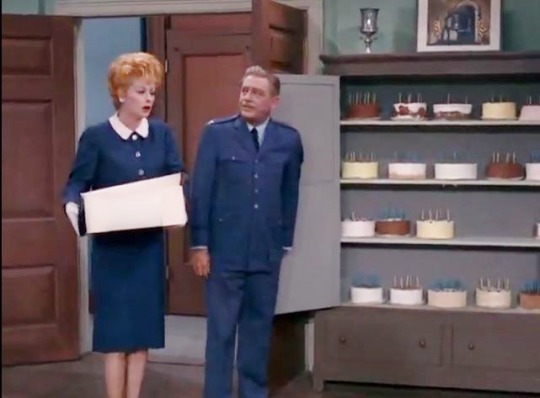
“Lucy and the Military Academy” (1963) ~ When her son is at a military academy, Lucy bakes him a birthday cake, although it is against the rules. When she arrives, she learns she isn’t the only mother to have the idea.
“Lucy Goes To Art Class” (1964) ~ To impress a handsome bachelor, Viv bakes him a pie. Jealous Lucy sneaks into his apartment and replaces Viv’s pie with her ‘poison pie’ containing three jars of hot peppers, two cans of anchovies, and one bottle of Tabasco sauce.

When Lucy is caught spying, she must eat a slice of her own concoction to hide her sabotage.
In the second kitchen scene, there is a pink bakery box on the counter. These same boxes will turn up later in the year in “Lucy’s Contact Lenses” (S3;E10) and “Lucy Gets Her Maid” (S3;E11). Pink bakery boxes were a California anomoly, instantly recognizable as fresh baked goods – usually (but not exclusively) – donuts.

“Lucy Enters a Baking Contest” (1964) ~ Lucy’s baking skills are always being compared unfavorably to Viv’s, so she decides to give her a run for her money by entering the Danfield Tribune’s annual pie-baking contest.
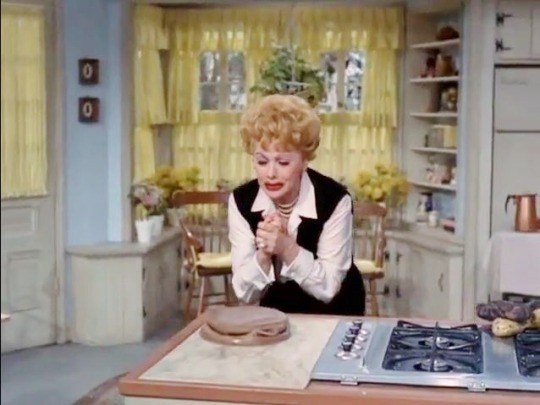
Baking for her bridge group, Lucy’s cake falls before it can be iced, so she calls Mr. Mooney and asks him to go by Trumbull’s Bakery and pick up a large sunshine cake with white icing thinking no one will be the wiser. During the bridge game, Viv reminds Audrey and Kathleen about the failure of Lucy’s brownies for the PTA bazaar.
Mr. Mooney ends the episode with a pie in the face, which will be (somewhat appropriately) the final image of season two of the series.

“Lucy’s Contact Lenses” (1964) ~ Lucy and Viv are baking a chocolate fudge cake to donate to Mrs. Mooney’s charity bake sale at the bank. Lucy drops one of her contact lenses into the icing.
After searching through 15 similar cakes, Lucy and Viv discover that Mr. Mooney has bought Lucy’s cake for his wife’s birthday. Lucy and Viv must now break into the Mooney home to steal the cake to retrieve the lost lens.
“Lucy Puts Main Street on the Map” (1966) ~ The town of Bancroft has a bakery on Main Street: Grandma Thompson’s. It is named in honor of Maury Thompson, who directed the episode.

“Lucy’s Birthday” (1968) ~ Kim and Craig take Lucy out to a Chinese restaurant to celebrate her birthday. The waiters present her with a birthday cake and sing “Happy Birthday” to her – in Chinese!
“Lucy’s Wedding Party” (1970) ~ While Harry is away, Lucy uses his home to host a big fat Greek wedding – complete with a two-tiered wedding cake.

When Harry comes home unexpectedly – he is greeted with cake – in his face!

“Lucy and the Great Airport Chase” (1969) ~ Trying to escape an international espionage ring, Lucy and Harry blend in at the airport kitchen, filling cream pies.
On the tarmac, bakers Kim and Craig get into the act.
At the end, the spy is caught – and pelted with pies!
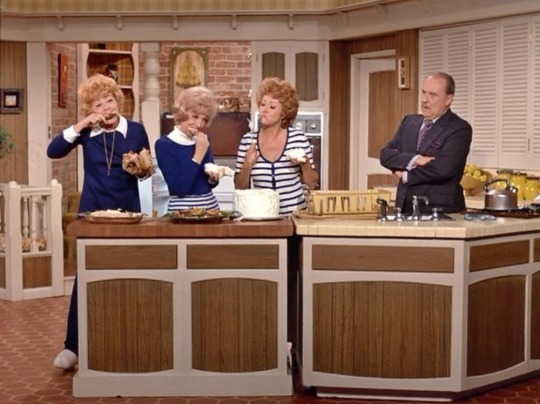
“Goodbye Mrs. Hips” (1973) ~ Lucy, Mary Jane, and Vanda all go on a crash diet. At the same time, Harry has been invited to join a prestigious food and wine society when his refrigerator breaks down. He stores his Chantilly cream cake with toasted hazelnuts at Lucy’s – in the same home with three ravenous women!
“Lucy and Chuck Connors Have a Surprise Slumber Party” (1973) ~ When Lucy rents out her home for Chuck Connors to shoot a movie, the studio commissary sends over slices of apple pie to feed the crew.
“Lucy the Sheriff” (1974) ~ A little old lady (Florence Halop) brings a homemade cake to a couple of prisoners. Sheriff Lucy immeditaly thinks it has a file in it. Turns out the little old lady is smarter than that and has a saw hidden under her shawl!

“Lucy Calls the President” (1974) ~ Lucy and Viv prepare for a visit by Jimmy Carter (peanut farmer turned president) by baking a cake with his face on it.
VIV: “Come see my cake. I’m so proud of it, Lucy.”
LUCY: “Oh, it’s a work of art. It was so clever of you to make President Carter’s teeth out of peanuts.”

“CBS on the Air: A Celebration of 50 Years″ (1978) ~ Lucille Ball and Bea Arthur, representing Monday Nights on CBS, end their tribute to comedy with pies in the face.
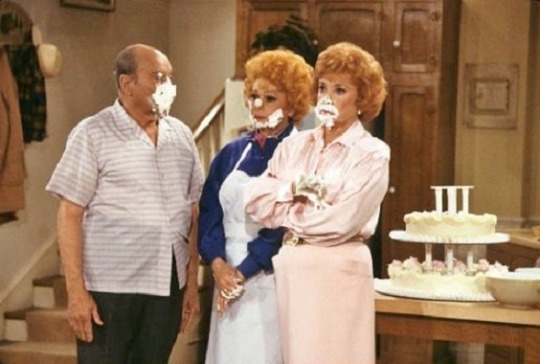
“Mother of the Bride” (1986) ~ In the last-aired episode of “Life With Lucy”, Lucy, Curtis and Lucy’s sister (Audrey Meadows) all end up wearing the wedding cake prepared for the vow renewal of Ted and Margo – a fitting way to mark the end of Lucille Ball’s 35 years on television.
-
LUCY & THE WRITERS
Wordsmiths of the Lucyverse

Whether Lucy was the writer, or it was one of the various characters in her universe, their creative output always made us laugh! Novelists, playwrights, screenwriters, journalists, composers, and columnists were all part of the Lucyverse.

“Liz Writes a Song” (1949)
Liz Cooper (Lucille Ball) is convinced that she is a musical talent, but when a music professor (Hans Conried) tells her she’ll never be a singer, she decides to take up songwriting instead!
LIZ: “Carrie Jacobs Cooper writes again!”
Carrie Jacobs-Bond (1862-1946) was a songwriter who composed some 175 pieces of popular music from the 1890s through the early 1940s. She is perhaps best remembered for writing the parlor song “I Love You Truly”, becoming the first woman to sell one million copies of a song.
“Lucy Writes a Play” (1952)
Lucy writes a play set in Cuba for Ricky to star in, but he refuses the part. She changes her play from Cuba to England and has Fred take Ricky’s spot. Once Ricky learns a famous producer will be in the audience, he decides to surprise Lucy and appear in the play, but he has the wrong script.
Ricky sarcastically calls Lucy “Mrs. Shakespeare.” Her first play is titled “A Tree Grows in Havana” and the revised version is titled “The Perils of Pamela”. He also drops the name of playwright Tennessee Williams, which Lucy originally thought was Tennessee Ernie!
“The Publicity Agent” (1952)
Peter Leeds plays the newspaper reporter who interviews the Scheherazade, Maharincess of Franistan (aka Lucy).
LEEDS: “Would Her Highness answer a few questions for the press?”
LUCY: “Yes.”
LEEDS: “Good. Your highness, is it true that Ricky Ricardo is your favorite vocalist?”
LUCY:“Yes.”
LEEDS: “Do you like any other American performers?”
LUCY: “No.”
LEEDS: “Now, let me see if I have this straight… You’ve never seen Ricky Ricardo in person, you first heard his records two years ago and you fell in love with his voice and decided to come to America to see him. Your father didn’t approve, but you came anyway and you can hardly wait to hear him sing. Is that right?”
LUCY: “Yes, no, yes, yes, yes, no, and yes.”
LEEDS: “I see. Now about the political situation in Franistan —”
“The Operetta” (1952)
The Wednesday Afternoon Fine Arts League is putting on an operetta and to save money Lucy decides to write the show herself. The final script is “The Pleasant Peasant” by Ethel ‘Romberg’ and Lucy ‘Friml’ and starring ‘John Charles’ Ricardo. Of course, Lucy, Ethel, and Fred are also in it. In reality, the songs were written by series composer Eliot Daniel, who wrote the show’s theme song.
“Ricky Has Labor Pains” (1953)
To crash Ricky’s ‘daddy shower’ (aka stag party), Lucy and Ethel disguise themselves as Sam and Fred, reporters for the New York Herald Times Tribune, a mash-up of several real New York dailies.
“Lucy Writes a Novel” (1954)
Hearing that a housewife got $10,000 for writing a book, Lucy decides to become a novelist. Much to the chagrin of Ricky, Fred and Ethel, her subject will be a thinly disguised (and outrageously romanticized) version of her own life titled “Real Gone With The Wind”.
Lucy says “My novel may turn out to be another ‘Gone with the Wind’!“ Ricky and the Mertzes find her scandalous manuscript hiddin in the window blinds and burn it in the fireplace.
ETHEL: “We pulled down the kitchen blind and changed the name of your novel to ‘Forever Ember.’”
FRED: “There’s nothing like a good book IN a roaring fire!”
Forever Amber is a 1944 romance novel by Kathleen Winsor set in 17th-century England. It was made into a film in 1947 starring Cornel Wilde.

LUCY: “You’ll get no more books from me, so go watch television!”

“Fan Magazine Interview” (1954)
Magazine journalist Eleanor Harris doing a feature story on the Ricardo marriage planting the idea that Ricky might be tempted into infidelity.
Eleanor Harris (played by Joan Banks) was the name of a real magazine writer who wrote about Lucy and Desi as early as 1940. She also authored a book titled The Real Story of Lucille Ball published about the same time this episode first aired.

“Ethel’s Hometown” (1955)
The last stop before Hollywood is Albuquerque, New Mexico, Ethel’s hometown, where she is given the star treatment instead of Ricky. Billy Hackett (Chick Chandler), editor of the Chronicle, is doing a front page story on Ethel Mae to herald her triumphant return on her way to Hollywood.

“Bullfight Dance” (1955)
Lucy is asked to write an article for Photoplay Magazine about what it’s like to be married to Ricky. Lucy keeps the content of the article secret until she’s given a plum role in his latest show.

“The Hedda Hopper Story” (1955) / “Lucy Takes a Cruise to Havana” (1957)
Both episodes featured Elda Furry, a film actress turned gossip columnist who renamed herself Hedda Hopper (1985-1966). She was the go-to source for what was going on in the personal and business relationships of Tinseltown.
She supported Lucy and Desi throughout their careers and they repaid them with these special appearance, as well as mentioning her name in several other episodes. Hopper was recognizable for her elaborate headwear.

“Homecoming” (1956)
Recently returned from Hollywood, Lucy is interviewed by gossip columnist Nancy Graham (played by Elvia Allman) about her life as wife to a famous movie star (aka Ricky). The character is a tribute to Sheilah Graham, who was an English-born Hollywood journalist. Along with Louella Parsons and Hedda Hopper, Graham wielded sufficient power to make or break Hollywood careers – prompting her to to say that she was “the last of the unholy trio.”

“Milton Berle Hides Out at the Ricardos” (1959)
Milton Berle appears here in the capacity of a published author, promoting his first (and only) novel, Earthquake written with John Roeburt.
Berle had previously written the joke books Laughingly Yours in 1938 and Out of My Trunk in 1948. He wrote his autobiography in 1974 with help from Haskel Frankel. His last book was a 1987 collection of sketches and reminiscences titled B.S. I Love You.
“Lucy Becomes a Reporter” (1963)
After just three days as the fill-in society reporter for the Danfield Tribune, Lucy’s job is hanging by a thread. The only thing that will save it is an interview with a press-shy financier visiting town.

Mr. Foley, the Tribune’s editor, refers to Lucy as Brenda Starr. Brenda Starr is the lead character in a comic strip about an adventurous female reporter. It debuted in 1940. Like Lucy, she had red hair. Lucy says that she was called ‘Clare Boothe Lucy’ in high school, a pun on Clare Boothe Luce (1903-87), who was a writer and journalist in her own right, in addition to being married to Henry Luce, a powerful publishing magnate in the magazine industry. Viv calls Lucy ‘Louella’ a reference to gossip columnist Louella Parsons. Lucy later invokes the name of Parsons’ chief rival, Hedda Hopper, another chronicler of Hollywood during the mid-twentieth century.
Critic’s Choice (1963)
Lucille Ball and Bob Hope play husband and wife theatre critics in the film based on the 1960 Broadway play of the same name written by Ira Levin.

“Lucy and the Soap Opera” (1966)
Curious to find out how “Camden Cove,” her favorite TV soap opera, will turn out, Lucy disguises herself in a number of outrageous get-ups to gain access to the show’s reclusive writer Peter Shannon (Jan Murray). When her efforts fail, she gets herself cast as an extra for a taping of the soap’s climactic courtroom scene.
“Lucy and Eva Gabor” (1968)
The author of a controversial novel (Eva Gabor) is in town and needs a quiet place to work, so Harry volunteers Lucy’s home. Naturally, it is anything but peaceful and far from quiet.
Eva Von Graunitz (Gabor) is writing a follow-up novel to her successful “Valley of the Puppets”, a title that parodies Jacqueline Susann’s Valley of the Dolls (1966). At the end of the episode, Eva says she is going to write a screenplay titled “Life With Loosel”!
“Lucy the Co-Ed” (1970)
Harry’s old flame is in town to help produce a musical for their college alumni. They resurrect a show Harry wrote in 1928 and cast Lucy, Kim, and Craig in supporting roles. It was written by Harry during his senior year there in 1928. Previous episodes have stated that Harry both performed and wrote shows while in college. The title of this musical is “It’s Always Do-Wacka-Do at Bullwinkle U”!

“Tipsy Through the Tulips” (1972)
Lucy is in charge of keeping a mystery novelist (Foster Brooks) sober long enough to finish his next book. The book writer David Benton Miller dictates to Lucy is titled “The Killer Wore Wodden Shoes,” a murder mystery set in Holland.
“Lucy and the Professor” (1973)
Kim is romantically interested in one of her college professors. Lucy mistakenly believes it is white-haired Professor Dietrich (Murray Matheson), author of the best-selling book Sex and the College Girl. It is actually her much younger music professor John Kleindorf (John Davidson).
“Lucy Goes on Her Last Blind Date” (1973)
Lucy dates eccentric Ben (Don Knotts) who is a prize-winning writer of verses for greeting cards! Which brings us back to…

“The Christmas Cards” (1950)
Liz and George have trouble deciding on photos and verses for their Christmas cards. Liz sells cards with personalized greetings…
LIZ: “This is the season of holly and spruce,
So Merry Christmas to you, Uncle Bruce!”Or, if you don’t have an Uncle Bruce…
LIZ: “This is the season of spruce and holly,
So Merry Christmas to you, Uncle Jolly!”George says his only Uncle’s name is Uncle Gilhooley.
LIZ: “This is the season that we know as Yule-y,
so Merry Christmas to you, Uncle Gilhooley.” -
RADIO on TV!
Radio Shows on Lucille Ball’s TV Sitcoms

Television was an outgrowth of radio. Many of our best loved shows originally came from radio – including “I Love Lucy,” which was inspired by the success of “My Favorite Husband”. Here are a few stragglers – radio shows and incidental broadcast that were featured on Lucy TV!
There was some thought about creating an “I Love Lucy” radio show to run in simultaneously with the television series as was being done with “Our Miss Brooks.” A pilot show was produced, but it never aired. It was created by editing the soundtrack of the television episode “Breaking the Lease”, with added narration by Desi Arnaz. It included commercials for Philip Morris, which sponsored the TV series. Philip Morris eventually sponsored a radio edition of “My Little Margie” instead. Here’s Desi / Ricky’s opening narration:
“Hello. I’m Ricky Ricardo and I’m the guy who loves Lucy. The whole thing started ten years ago. I had just come to this country from Cuba and I didn’t know much about your customs. The first girl I had a date with was Lucy. It was a romantic night and after all I had a reputation to live up to as a Latin lover so I kissed her goodnight. It was right then that she told me that under the Constitution of the United States if a man kisses a girl he has to marry her. Then I found out that she tricked me. I didn’t care. Because after all, if I hadn’t married her, I’d would have married someone else. And Lucy’s just like any other American girl, who is pretty, charming, witty, and partly insane.”

FREDDY FILLMORE QUIZ SHOWS

“The Quiz Show” (1951)
With Lucy’s household accounts in arrears, she goes on a radio quiz show to win a thousand dollars. All she has to do is pretend a complete stranger is her first husband in front of Ricky. A tramp arrives at the door and threatens to throw a monkey wrench into the scheme!
This is the first of three episodes to feature Frank Nelson in the role of Freddy Fillmore [variously spelled Freddie Filmore], game show host extraordinaire. He is the host of “Females Are Fabulous”. The announcer who encourages the studio audience to applaud is played by Lee Millar. Radio shows were generally broadcast live in front of a live audience in the studio. The premise of the quiz show has Lucy being pelted with various items (mostly liquids) when Ricky sings a trigger word – from a safe distance.
“Lucy Gets Ricky on the Radio” (1952)
When their TV breaks down, the gang tunes in to a radio quiz show. Surprisingly, Ricky correctly guesses the answers to all of the questions, so the next day Lucy signs them up to be on the show. Little does she know that the quiz was a delayed broadcast and that Ricky overheard the answers while at the studio! This episode is based on Lucy’s radio show, “My Favorite Husband” “Quiz Show,” which aired October 23, 1948. In the radio version, the show was called “His and Hers” and is hosted by Smiley Stembottom (also Frank Nelson).
On television, the quiz show is called “Mr. and Mrs. Quiz” and is hosted by Freddy Fillmore (Frank Nelson again).
Everyone on the series loved Roy Rowan’s on-screen announcing for “Mr. and Mrs. Quiz” so much that he then became the announcer for “I Love Lucy.” To be sure Ricky wins, Lucy steals the questions. Unbeknownst to her, Fillmore changes the questions at the last minute so Lucy’s rehearsed answers on the show make no sense.

The next time we see Freddy Fillmore he has made the transition to television with his latest quiz show “Be A Good Neighbor”.

“Off To Florida” (1956)
Radio plays an integral role in the plot of the roadtrip. Lucy and Ethel hitch a ride to Florida with a Mrs. Grundy (Elsa Lanchester), an eccentric woman who agrees to letting them share her backseat. Instead of a motel, they park in a darkened clearing. To fall sleep in the parked car, Lucy turns on the radio for some soothing music, until…
NEWSCASTER: “Now here’s the latest bulletin on the Evelyn Holmby case. Police have definitely established that Evelyn Holmby, famous gray-haired hatchet murderess who escaped from New York State Prison Thursday, is heading south in a cream-colored convertible coupe. Stand by for further bulletins. And now back to our recorded music.”
Having found a hatchet in the car’s trunk, Lucy wonders if their driver is actually Holmby! In the morning, they try to nap while Mrs. Grundy is driving. When they are sleeping, she turns on the radio.
NEWSCASTER: “That winds up the news from Washington today. And here’s the latest bulletin on Evelyn Holmby, escaped hatchet murderess. Police have learned that, before leaving New York, she dyed her gray hair red, and is heading south with a blonde companion.”
Now Mrs. Grundy suspects Lucy and Ethel of being the escaped criminal! The radio announcer is voiced by Roy Roberts. The big band music in the background will also heard in “Country Club Dance” (1957).
“Lucy is a Chaperone” (1963)
Lucy and Viv chaperone a group of Chris’s friends on a beach vacation. When the girls are dancing to music on the radio, Viv mistakes the Mashed Potato for the Jitterbug. When Lucy attempts the steps, Viv remarks that she’s got “lumps in her gravy.” The Mashed Potato was a popular dance craze of 1962 made famous by James Brown. A companion dance song was titled (appropriately) “Gravy”. This marks the first of many appearances by the red transistor radio – albeit in black and white!

“Ethel Merman and the Boy Scout Show” (1964)
During a tribute to show business, ‘Radio’ is represented by Mr. Mooney as a talent show host presenting a saxophonist (Lucy) from Altoona, Pennsylvania. Naturally, Lucy plays an off-key rendition of “Glow Worm”, one of only two songs Lucille Ball ever played on the sax.

“Lucy and the Beauty Doctor” (1965)
At the start of the episode, Lucy and Viv listen to the radio show “Morning Magazine of the Air” which presents Lady Cynthia’s Beauty Tips. It is from this broadcast that Lucy hears about a $25 beauty treatment by Dr. Fleischer.
LADY CYNTHIA (voice on radio): “Good morning, ladies. How would you like to have your biggest beauty problem behind you?”
VIV (listening to radio): “That’s where mine is now.”
Lady Cynthia is voiced by Carole Cook and Sid Gould is the announcer.
Now easily identified in color, Lucy’s red transistor radio will turn up many times on “The Lucy Show”, even after she moves to Los Angeles.
“Lucy the Disc Jockey” (1965)
Lucy wins a mystery sound contest on the radio, winning $25 and the chance to be disc jockey for a day. Naturally, things don’t go smoothly when she takes over the studio.
The host of the radio show Gordon ‘Fair’ Felson (Pat Harrington). The call letters of the radio station are WLDJ representing the first letter of each word in the episode’s title: “Lucy the Disc Jockey.”
After playing the mystery sound, Felson announces the return to “the swing sounds of Jan Garber.” Garber was a bandleader known for ‘sweet’ and ‘swing’ jazz. His nickname was “The Idol of the Air Lanes.” Left on her own in the radio station, Lucy hasn’t a clue how to operate the equipment.

Lucy and Viv frantically try to replicate the sound they heard on the radio. Mr. Mooney says that the ‘Name the Sound’ contest is the silliest thing since ‘Mrs. Hush’. The Mrs. Hush contest was a feature of “Truth or Consequences” radio show in 1947.

“Lucy the Rain Goddess” (1966)
Before the action shifts to the dude ranch, Herbie (Marc Cavell), the bank office boy, is blaring “Do The Watusi!” on his transistor radio. The song (without lyrics) was also heard in “Chris’s New Year’s Eve Party” (1962).

“Lucy’s Burglar Alarm” (1969)
At the start of the episode, Craig is practicing guitar and Kim is listening to a transistor radio playing an instrumental version of “I Know a Place” by Tony Hatch. The song was made popular in 1965 by Petula Clark. This is the third time the song has been heard on “Here’s Lucy.” Clark herself will make a guest appearance on the series in 1972.

“Lucy and Jack Benny’s Biography” (1970)
Helping Benny write his memoirs, Lucy plays all the women in Jack’s life. In the fourth flashback, Jack Benny is a radio star broadcasting with Mary Livingstone. In this sequence, Lucille Ball lip synchs to a recording of the voice of the real Mary Livingstone, who became Mrs. Jack Benny in 1927.

“Lucy, the Other Woman” (1972)
While having breakfast, Lucy listens to a radio news report about a marital triangle that caused a Mrs. Mercedes Smith of Sherman Oaks to shoot a Mrs. Vivian Boone for breaking up her happy home. The newscaster is once again voiced by Roy Rowan. This newscast sets up the appearance of Poopsie Butkus (Totie Fields) who accuses Lucy of being “the other woman”.
-
TV on TV!
Part 3 ~ The Television Shows of the Lucyverse

Although it may seem redundant, the worlds created by Lucille Ball on television frequently created and mentioned other TV shows as well as popular TV commercials! Here are a few from “Here’s Lucy” (1968-1974), and one from “Life With Lucy” (1986).
“Lucy Visits Jack Benny” (1968)
At the end of the episode, bus driver Ralph Kramden (Jackie Gleason) makes an appearance at Benny’s barbecue. Gleason played the iconic character on his own variety show as well as the sitcom “The Honeymooners” (1955-56).
“Lucy’s Impossible Mission” (1968)
Lucy mistakenly enters a phone booth meant for a secret agent and becomes embroiled in a mission impossible. This episode is a spoof of the TV series “Mission: Impossible” (1966-73) which was a Desilu / Paramount series. Had Lucille Ball not given the nod to the series in 1966, there would be no Mission: Impossible movies today!
The episode uses the “Mission: Impossible” theme and original underscoring by Lalo Schifrin. The theme won a Grammy Award earlier in 1968. The instantly recognizable theme song is saved for the final chase sequence.

“Lucy and Carol Burnett” (1969)
Lucy convinces Carol Burnett to participate in a benefit to raise money for Kim and Craig’s high school gymnasium.Lucy and the kids attend a taping of “The Carol Burnett Show,” a CBS program that Lucille Ball herself had already appeared on twice as a guest star and would return to twice more. “The Carol Burnett Show” always opened with her taking questions from the studio audience, so this is recreated on “Here’s Lucy”. A new episode of “The Carol Burnett Show” aired at 10pm on the same evening this “Here’s Lucy” was first broadcast.
“Here’s Lucy” attempts to physically reproduce “The Carol Burnett Show” studio and stage, even using the CBS eye gold curtain. The audience section, however, is much smaller on “Here’s Lucy.”

“Lucy and Tennessee Ernie’s Fun Farm” (1969)
A farmer (Ernie Ford) wanders into the Unique Employment Agency in need of farmhands. Instead, Lucy proposes they turn his farm into a vacation spot for city folks. They start with a TV variety show and commercial to get the word out!

The commercial that Lucy and Harry do for Ernie’s Fun Farm gives us a glimpse of them as a dysfunctional married couple, complete with two typical teenage kids!
The commercial turns into a fully-staged musical revue.

“Lucy and the Used Car Salesman” (1969)
When the Carters want to become a two-car family, Kim and Craig visit a used car dealer named Cheerful Charlie (Milton Berle).

Cheerful Charlie makes his pitch using a television commercial.
In the commercial, Charlie’s chatter is chock full of alliterative chit-chat!

“Lucy and Johnny Carson” (1969)
When Harry takes Lucy and the kids to the filming of an educational TV show, Lucy wangles their way into “The Tonight Show” instead. Playing ‘Stump the Band’, Lucy and Harry win dinner at the Brown Derby.
From 1968 to 1980 Lucille Ball made 16 appearances on “The Tonight Show” with Johnny Carson and Ed McMahon. One appearance was just two weeks before this episode initially aired. “Here’s Lucy” recreates the stage and studio audience of “The Tonight Show”. The iconic multi-colored stage curtain is reproduced and the show’s theme music is used.

In the office, Ed leaves Johnny a box containing a small tape recorder that leaves a message vowing he will “go on the wagon”. During the playback, the “Mission: Impossible” music plays on the soundtrack. The message concludes with “This tape will self-destruct in five seconds.” This is a spoof of the TV series “Mission: Impossible”(1966-73), which was a Desilu / Paramount series.
After Craig jokes that Kim should wear three earrings, she quips “Very funny. Which one are you today? Rowan or Martin?” This is yet another of almost bi-weekly references to “Rowan and Martin’s Laugh-In,” “Here’s Lucy’s” phenomenally successful competition on ABC.
“Lucy’s Burglar Alarm” (1969)
When Lucy surrenders a measly $1.19 to the burglar (Guy Marks), he remarks “For this I had to miss ‘Laugh-In’?”

“Lucy and the Generation Gap” (1969)
Kim and Craig are in charge of producing the school play. In a nod to Desilu’s series “Star Trek” (1966-69), at the opening of the space age segment, Craig (with the help of the Desilu special effects department) materializes in a transporter tube. Beam me up, Lucy!
“Lucy and Lawrence Welk” (1970)
VIVIAN (To ‘Lawrence Welk’): “I watch your show every Saturday night!”
When Vivian visits, she expects Lucy to fulfill her promise to arrange a date with Lawrence Welk. Lucy doesn’t know Welk, so she borrows a wax dummy and convinces Vivian to give up her glasses. “The Lawrence Welk Show” began airing in June 1955 and had a remarkable 16 year run on ABC TV before being syndicated for a further 11 years ending in 1982. Welk was as associated with Saturday nights as Lucille Ball was with Mondays. Two days before this episode first aired (January 17, 1970) Welk’s guest was Ted Mack, legendary bandleader and talent scout.
“Lucy and Ann-Margret” (1970)
A chance meeting with Ann-Margret leads to songwriter Craig performing with her on television. On December 6, 1969, Lucille Ball guest-starred on “Ann-Margret: From Hollywood with Love” on CBS. Ball played herself and a character named Celebrity Lu, an autograph hound, opposite Autograph Annie (Ann-Margret).
“Lucy Competes with Carol Burnett” (1970)
Lucy dresses like a charwoman identical to the character created by Burnett for her variety series “The Carol Burnett Show”. When Carol Krausmeyer (disguised as a hippie reporter) asks how Lucy Carter thought up such a goofy outfit, Lucy replies “from some goofy dame on TV.” Carol says “Well, she must be some kind of nut!”

“Lucy Loses Her Cool” (1970)
Lucy goes on “The Art Linkletter Show” and is challenged not to lose her temper for 24 hours in order to win $500. Lucy Carmichael also appeared on “The Art Linkletter Show” on “The Lucy Show.” Lucille Ball appeared on “House Party with Art Linkletter” in 1964.

“Lucy and Flip Go Legit” (1970)
Lucy takes a temp assignment with Flip Wilson in order to answer his fan mail. Although it is never explicitly stated, Flip Wilson is preparing for his weekly television variety show “Flip” (1970-74). His most famous creation is Geraldine, a sassy woman with the catch phrase “The devil made me do it” and an unseen boyfriend named Killer. In the episode he is rehearsing a “Three Musketeers” sketch.

“Lucy and Mannix are Held Hostage” (1970)
Lucy happens to see three crimes in one day. Convinced thugs are after Lucy, Harry contacts his old friend, private eye Joe Mannix (Mike Connors). The private detective series “Mannix” from 1967 to 1975, which ran on CBS concurrently with “Here’s Lucy.” “Mannix” was an hour-long crime drama that was saved from the scrap heap by Lucille Ball when she was in charge of Desilu Studios. CBS planned to cancel the show after one season, but Ball used her influence to convince them to renew it with the assurance that changes would be made. In the second season, Joe Mannix was changed into a more hard-boiled independent private detective. The changes worked and the series became a big hit running for eight seasons. It was the last successful TV show to be produced by Desilu.

“Lucy and the Astronauts” (1971)
Harry takes Lucy along to a NASA splash-down, but before the astronauts can be medically cleared, Lucy has kissed them forcing Lucy and Harry to join the space travelers in isolation. Before reporting to an aircraft carrier to watch the splash-down, Lucy watches a moon walk on TV at home. Apollo 15 was launched on July 30, 1971, just a few months before this episode aired. The two-day mission sent astronauts David Scott and James Irwin to the moon.

“Lucy Helps David Frost Go Night-Night” (1971)
Television host David Frost hires Lucy as his traveling companion to assure that he gets some sleep on his flight to London. When she gets to London, she is so exhausted she falls asleep on his television show. Frost hosted a US talk show “The David Frost Show” from 1969 to 1972. The evening this episode first aired “The David Frost Show” featured Frost interviewing Lauren Bacall. Starting in 1970, Lucille Ball appeared on “The David Frost Show” five times, with the fifth appearance just two weeks before this episode first aired.
Complimenting David Frost, Lucy mentions that she saw him on “The Carol Burnett Show.” Frost appeared on the variety show in May 1971, six months before this episode first aired.
“Lucy and Candid Camera” (1971)
Allen Funt has a criminal impostor who recruits Lucy, Harry and Kim to commit robberies under the pretense that they are doing stunts for his “Candid Camera” television show. “Candid Camera” began on radio as “Candid Microphone” and moved to television in 1948. Although aired on all three major networks and in syndication, the radio program was originally aired on CBS and sponsored by Philip Morris, just like “I Love Lucy.”

“Lucy’s Lucky Day” (1971)
To capitalize on what seems to be a lucky streak, Lucy goes on a TV game show. Dick Dunkirk (Dick Patterson) is the host of “The Milky Way to Riches” sponsored by Dover Dairy. Lucy must answer three geography questions to qualify to earn a chance to win $1,000:
DICK:Where is the lowest point in the world below sea level?
LUCY:Oh, boy. I’m dead, see —
~Answer: The Dead Sea
DICK:The Dead Sea is part of the border between Jordan and what other country?
LUCY:Oh, boy. That question is real tough –
~ Answer: Israel
DICK: It’s an autonomous region of China, bordered by China on the north and east, by India on the south and Cashmere on the West. Name this Chinese autonomous region.
LUCY: And I wanted to bet I’d win.
~Answer: Tibet
After answering three questions, Lucy has to pick between three doors, just like on the TV game show “Let’s Make a Deal.” Lucy picks door #2, which is the gag prize, an untrained chimpanzee named Jackie, which she must teach to do a trick to get the money.

“Lucy and Joe Namath” (1972)
Lucy and Namath watch “The National Football League’s Salute to the Quarterback” on her TV. Actual clips of Namath on the field for the New York Jets (#12) are featured.

Namath is delighted, but Lucy cringes at the physical violence. Coincidentally, “Here’s Lucy’s” main competition during the 1972-73 season was “Monday Night Football” on ABC. The night this episode first aired the Oakland Raiders bested the Houston Oilers 34 to 0.

“Lucy is Really in a Pickle” (1973)
Lucy’s show business aspirations get her cast in a pickle commercial. Her alliterative pitch is foiled by the sour taste of the pickles, just like the alcohol in Vitameatavegamin was the undoing of Lucy Ricardo’s television commercial.
LUCY: “Thank goodness I remembered to bring Polly Parker’s Perky Pickles. Mmmm, they’re delicious! Yes, Polly Parker’s Perky Pickles make any picnic perfect. Polly’s Pickles will tickle your pallet. So next time you’re planning a picnic, pick up a pint of Polly Parker’s Perky Pickles.”
The TV camera in the studio is labeled KBEX COLOR. Similar to the way 555 is the prefix used for fictional telephone numbers, KBEX were the call letters for fictional TV and radiostations. They were used in many TV shows and films, including in Desilu’s “Mannix” and “Mission: Impossible.”

When the commercial pitch is suddenly changed to a duet song and dance number, Lucy and Kim become singing and dancing pickles – literally.
“Lucy and Chuck Connors Have a Surprise Slumber Party” (1973)
When Connors is filming a movie in Lucy’s home, Harry mentions that he is also the star of a popular television show. “Thrill Seekers” was a syndicated television series that was produced in 1973 and 1974. Hosted by Connors, it featured people who did dangerous stunts. In Lucy’s kitchen, Connors wears his orange “Thrill Seekers” jacket. The name of the show is stitched on the sleeve. Lucy tells Connors that she has seen “The Rifleman” reruns three or four times. “The Rifleman” was a Western television program starring Chuck Connors as rancher Lucas McCain.The show aired on ABC from 1958 to 1963.
“Lucy Plays Cops and Robbers” (1973)
When Harry panics after being locked in the closet by the burglar, Lucy slaps him and he says “Thanks. I needed that.” This is a reference to a ubiquitous TV commercial for Mennen Skin Bracer Men’s Cologne. The TV ads originally starred John Goodman (“Roseann”).

“Milton Berle is the Life of the Party” (1974)
Milton Berle appears on a TV telethon auction raising money for a Day Care Center Fund. Berle offers his services as a guest at a party thrown by the highest bidder – Lucy!

“Lucy Carter Meets Lucille Ball” (1974)
A televised Lucille Ball look-alike contest is sponsored by Mais Oui Perfume. Lucy and Kim hope to win the grand prize – a sports car. The episode opens with Lucy and Kim rushing home to catch a movie on television.
“Lucy Gets Her Wires Crossed” (1986)
With competition from other hardware stores, Lucy gets Curtis booked on a morning TV show as Mr. Fix-It. Lucy goes along as his helper and ends up gluing herself to everyone! “Wake Up Pasadena” is hosted by Fred Dunlap (Dick Gautier) and Stacy Reynolds (D.D. Howard).
LUCY (to Curtis): “Let grandma be on television!”
[Photos of “Life with Lucy” property of Getty Images]
-
TV on TV!
Part 2 ~ The TV Shows of the Lucyverse
Although it may seem redundant, the worlds created by Lucille Ball on radio and television frequently created and mentioned other TV shows! Here are a few from “The Lucy Show” (1962-1968).

“Lucy Puts Up a TV Antenna” (1962)
When Lucy’s TV set doesn’t work, she discovers that the antenna has blown off the roof. Refusing to spend extra money to have one professionally installed, she talks Viv into helping her replace it. As the episode opens, Sherman and Jerry are excited that the All-American Football Team is going to be on TV. When the reception is poor, Lucy engages in the old practice of banging on the side of the set, something she claims she learned from her late husband.
LUCY: “What did we do before television?”
VIV: “We used to hit the radio.”
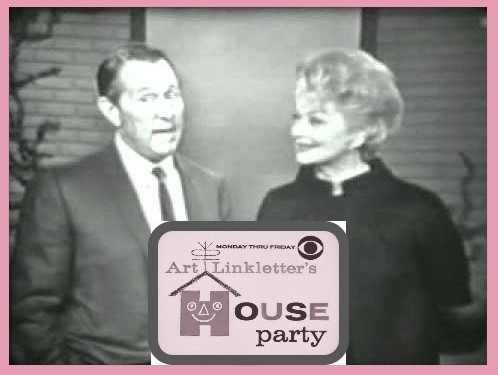
With Lucy on the roof, Viv yells up the chimney, “I got carried away watching Art Linkletter. Come on down Lucy. He’s about to go through a lady’s purse.” “The Linkletter Show” (also known as “Art Linkletter’s House Party”) was seen on CBS from 1952 to 1970. Lucille Ball appeared on the show in February 1965.

“Lucy and Viv Put in a Shower” (1963)
“Where’s Lloyd Bridges when you need him?” ~ Lucy Carmichael
Bridges starred “Sea Hunt” from 1958 to 1961, a series about a scuba diver which featured extensive underwater filming, so much so that his name become synonymous with underwater adventures. Bridges was seen in all 155 episodes of the CBS series. He was also mentioned in the same context in “Lucy Buys a Boat” (1963). Lucy says she bought the boat with the hull in the water so she didn’t notice the poor shape it was in. She adds that she didn’t have Lloyd Bridges with her at the time!
“Lucy’s Sister Pays a Visit” (1963)
Lucy’s son’s lunchbox features images from the television western “Lawman,” which ran on ABC from 1958-1962. A “Lawman” lunchbox is now part of the collection of the National Museum of American History at the Smithsonian Institution in Washington DC. The lunchbox shows up again in “Vivian Sues Lucy” (1963).

“Lucy Gets Locked in the Vault” (1963)
Danfield TV is on the scene when Lucy and Mr. Mooney finally get out of the vault.
“Lucy and the Safe Cracker” (1963)
Demonstrating how she got locked in the vault for Larry McAdoo (William Woodeson) of Danfield TV, Lucy accidentally locks Mr. Mooney back in the bank vault again! Taking advantage of the air time, Lucy gets in a commercial for Grandma’s Candy Shop, owned by the safecracker (Jay Novello).

“Lucy and the Plumber” (1964)
Lucy and her plumber (Jack Benny) appear on the television program “Talent Discoverer’s Show”.
Hosted by Greg Gregory (Willard Waterman), the show is sponsored by Kiddie Cookies, baked beans, and varnish!
Lucy was already on the show once, so this time she disguises herself as Lucretia Carmucci, the talent discoverer of the title, presenting her plumber Harry Tuttle, who plays an arrangement of Donizetti on the violin.
“Lucy Meets Danny Kaye” (1964)
Lucy writes away for tickets to “The Danny Kaye Show” but is turned down.

Kaye offers to give her a walk-on role in the telecast – but Lucy manages to steal the spotlight anyway. In 1962 and 1964 Lucille Ball guest-starred on Kaye’s CBS TV program “The Danny Kaye Show.”
Kaye telephones Bill Paley to see if he has any spare tickets to give Lucy. William S. Paley (1901-90), was the chief executive who built the Columbia Broadcasting System (CBS) from a small radio network into one of the foremost radio and television network operations in the United States.
“Lucy and the Beauty Doctor” (1965)
When Lucy hears about a $25 beauty treatment, she tells Mr. Mooney the money is for a doctor. When the treatment turns out to be a hidden camera show named “Boiling Point”, Lucy must do whatever she can to stop it from airing and revealing her secret to Mr. Mooney.
“Boiling Point” hosted by Dick Patterson is modeled loosely on “Candid Camera,” a TV show that started in 1948 and continues (in some form) to this day. Its heyday was from 1960 to 1967, when it was a ratings winner for CBS on Sundays at 10pm.

“Lucy in the Music World” (1965)
When Lucy takes a job in a music producer’s office, she wangles her new neighbor Mel Tinker (Mel Torme) into a gig on the musical variety television show “Wing Ding”.

“Wing Ding” is hosted by Reb Foster and presents The Six Bare Feet, The Torch Bearers, The DDTs, and The Tear Ducts (Lucy and Mel), who sing the plaintive ballad “My Trousseau Just Lies on the Shelf.”
“Lucy Helps Danny Thomas” (1965)
When Mr. Mooney hires Lucy to get some important papers signed at a TV studio, she finds herself dancing on Danny Thomas’s TV special instead!

Although this is not a real TV program, Thomas did host “The Danny Thomas Hour” for 22 episodes in 1967. Thomas was a Desilu regular, appearing in “Make Room for Daddy” (later “The Danny Thomas Show”) as well as doing a cross-over episode with “The Lucy-Desi Comedy Hour”.

“Lucy and Art Linkletter” (1966)
Lucy is picked from Art Linkletter’s studio audience and challenged not to utter a sound for 24 hours to win $200. In January 1966, CBS aired new episodes of “Art Linkletter’s House Party” daily at 2:30pm while “I Love Lucy” was in reruns at 10:30am.

During the 24 hours, Linkletter arranges for a one-armed man to burst into Lucy’s apartment waving a gun and say that a guy has been chasing him for three years. This is a reference to the hit ABC series “The Fugitive” (1963-67) on which David Janssen was on the trail of a one-armed man who killed his wife. Three weeks after this episode of “The Lucy Show” was filmed, Doris Singleton (Ruth Cosgrove on “Lucy and Art Linkletter”) guest-starred on “The Fugitive.” The series was a Quinn Martin Production. Quinn Martin was a producer at Desilu and also married Madelyn Pugh, one of Lucille Ball’s longest lasting writers.
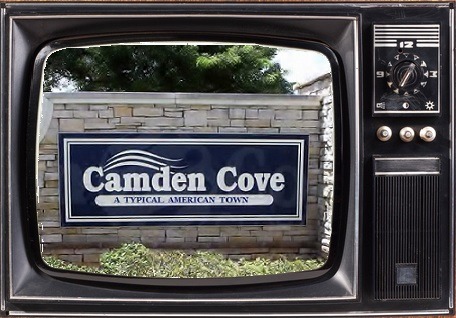
“Lucy and the Soap Opera” (1966)
Lucy disguises herself in a number of outrageous get-ups to gain access to the reclusive writer of “Camden Cove,” her favorite soap opera, to learn how the show will turn out.
Camden Cove is described at “the typical American town” so it was probably inspired by “Peyton Place,” a prime-time soap opera which aired on ABC from 1964 to 1969. Like “Camden Cove,” it aired three nights a week and dealt with the tangled relationships found in a small American town. Danfield was compared to Peyton Place in “Lucy and Joan” (1965).

“Lucy Goes to a Hollywood Premiere” (1966)
LUCY (to Edwards): “Oh, doctor! Oh, doctor!”
Lucy disguises herself as an usher to meet celebrities. On the reception line, she asks Vince Edwards for his autograph. Vincent Edwards (1928-96) was probably best known as the title character on ABC TV’s “Ben Casey” (1961-66) which was filmed on the Desilu lot. A new episode of “Ben Casey” aired on ABC at 10pm on the night this episode of “The Lucy Show” premiered. It was directed by Marc Daniels, one of the directors of “I Love Lucy” and Jesse Wayne was the stunt coordinator, as he was for “The Lucy Show.”
“Lucy and Bob Crane” (1966)
Crane was best known as the clever Colonel Hogan in the CBS POW camp sitcom “Hogan’s Heroes” (1965-1971), which was filmed at Desilu Studios.
In the episode, Crane is making a World War One film. A one-line gag features an appearance by John Banner, who played Sergeant Schultz on “Hogan’s Heroes”. He utters his famous catch-phrase from the sitcom.
SCHULTZ: “I know nothing!”
CRANE: “Schultz! You’re in the wrong war!”
Oscar Beregi plays Wolfgang Schmidt the director of the film. Beregi did two episodes of “Hogan’s Heroes.” He was probably cast here for his resemblance to Werner Klemperer, who played Colonel Klink on “Hogan’s Heroes” who also wore a monocle.
“Lucy the Robot” (1966)
Jay North plays Mr. Mooney’s spoiled brat nephew Wendell. North was best known as the star of “Dennis the Menace” (1959-1963). During the show’s final season, North played opposite Gale Gordon (Mr. Mooney) as John Wilson.
“You will keep that MENACE subdued for the next eight days!” ~ Mr. Mooney to Lucy about Wendell
“Dennis the Menace” also included a character named Theodore Mooney!

“Lucy the Gun Moll” (1966)
RUSTY: “So ya see, no one is really untouchable!”
The episode is a parody of “The Untouchables” (one of Desilu’s biggest hits) starring most of the original cast. Lucy plays a gun moll named Rusty. Robert Stack (who originally played Elliott Ness), agreed to appear as long as the character names were not the same as the original. Stack was joined by Walter Winchell, Bruce Gordon, and Steve London.
“The Untouchables” started out as a two-part pilot episode of “Westinghouse Desilu Playhouse” in April 1959. The show was introduced by Desi Arnaz and starred Robert Stack and the voice of Walter Winchell, both of whom were cast in the series, which began in October 1959 on CBS. The final episode was aired in May 1963.

“Lucy Puts Main Street on the Map” (1967)
To bring attention to the plight of the town of Bancroft, Lucy stages a spectacle on Main Street, calling all the television news programs to witness the event.
Dan McGowan (Dan Rowan) is a TV reporter with the National News Service.

“Lucy Meets Sheldon Leonard” (1967)
Mr. Mooney allows TV producer Sheldon Leonard to film a hold-up scene at the bank. Lucy thinks he is really a gangster and is determined to foil his robbery.
Over the telephone, Mr. Cheever tells Mr. Mooney that Sheldon Leonard produced “The Danny Thomas Show,” “Dick Van Dyke” and “I Spy.” Leonard himself adds “Andy Griffith” and “Gomer Pyle” to his credits. All of these shows were filmed at Desilu Studios.
The end of the episode Leonard says:
“I suddenly got this idea for a new television series. It would be about this kooky red headed girl. She works in a bank and she gets into all sorts of impossible situations and… forget it. Nobody would ever believe it.”

“Lucy Helps Ken Berry” (1968)
A dance instructor (Ken Berry) is about to default on his loan until Lucy arranges for him to be on “Ralph Story’s Los Angeles”, a local television show.
Ralph Story was well known in the Los Angeles area as a local TV personality as host of “Ralph Story’s Los Angeles” from 1963 until the late 1970s.
Ken and the his students perform “Steppin’ Out With My Baby” by Irving Berlin. For the finale, everyone sings “Pick Yourself Up” by Jerome Kern and Dorothy Fields.
Stay Tuned for Part 3!
Same Time, Same Station!
-
TV on TV!
Part 1 ~ The TV Shows of the Lucyverse
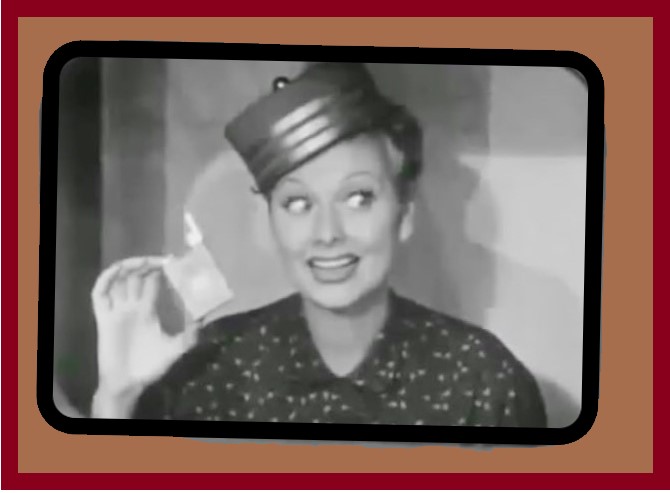
Although it may seem redundant, the worlds created by Lucille Ball on radio and television frequently created and mentioned other TV shows! Here are a few.
“Television” (1949)
Liz and George’s visit to their next door neighbors, the Stones, turns into a disaster when George tries to repair the Stones’ new television set by himself.
“Television throws ‘My Favorite Husband’ for a loss, and the whole neighborhood into night courts.” ~ Mason City Globe-Gazette radio listing

“Too Many Television Sets” (1949)
Liz (Lucilll Ball) can’t get George (Richard Denning) interested in buying a television set, until they spend an evening at the Atterburys, who have one. With his interest piqued, George arranges one be sent over on trial. Little does he know Liz has done the same thing – as have the Atterbury’s!
LIZ: “I never know who won the fights or what Kukla and Fran are doing to Ollie.”
“Kukla, Fran, and Ollie” was a children’s television show created by Burr Tillstrom that aired from 1947 to 1957. Kukla and Ollie were puppets and actress Fran Allison interacted with them. The show won a 1949 Peabody Award and went on to win two Emmys.
IRIS: “I did my knitting last night with Ed Wynn; I had breakfast with Tex and Jinx; and this afternoon I took a bath with Hopalong Cassidy!”

“The Ed Wynn Show” was a variety show broadcast from September 22, 1949 to July 4, 1950 on the CBS Television Network. Comedian and former vaudevillian Ed Wynn was the star of the program. Lucille Ball and Desi Arnaz made their television debut as a couple on the show on Christmas Eve 1949, just a few weeks after this episode of “My Favorite Husband”.
“Tex and Jinx” were Eugenia “Jinx” Falkenberg and her husband John “Tex” McCary. The couple were popular radio hosts who began on television in January 1947.
“Hopalong Cassidy” made the leap from books and movies to the small screen on June 24, 1949, kicking off the legacy of the Western on television. These were not new, but simply cut-down versions of the feature films that were in cinemas from 1935 to 1948.
Joe (Jay Novello) warns the Coopers not to sit behind Iris because they only have a ten inch screen. He advises that they visit the Schraders who watch “Pantomime Quiz” and serve sandwiches. “Pantomime Quiz” (later titled “Stump the Stars”), was a television game show hosted by Mike Stokey. Running from 1947 to 1959, it has the distinction of being one of the few television series to air on all four TV networks during the Golden Age of Television. Lucille Ball is reported to have been on the series in December 1947, which would make it her television debut.
“Liz Appears on Television” (1950)
Liz and Iris (Bea Benadaret) make an appearance on a television show celebrating Friendship Week. Their friendship is tested when they discover they’ve bought the same dress for the occasion. The name of the show is “Love Your Neighbor” the host of which is played by Frank Nelson. The episode mentions two of the same television programs as “Too Many Television Sets” a year earlier.
GEORGE: “I can see it now: ‘Kukla, Fran and Lizzie!”
LIZ: “Try Hopalong Cassidy. He looks good next to a horse!”
“Lucy Does a TV Commercial” (1952)
RICKY:“You’ve never even been on a television show!”
LUCY: “Maybe not, but I’ve watched them a lot.”
Lucy gets hired to do a TV commercial on Ricky’s new show, not realizing the health tonic she has to consume is full of alcohol!
LUCY: “When Ricky comes home tonight you’re going to turn on that television set, and you know who’s going to be on it?”
FRED: “Well, I can only hope it’s Faye Emerson.”
Faye Emerson (called the “first lady of television”) was a very glamorous stage and screen actress turned TV hostess who had her own variety show “Fay Emerson’s Wonderful Town” on CBS.
The TV show Ricky hosts is titled “Your Saturday Night Variety”. You can see Lucille Ball waiting in the wings, with the living room set behind her! The TV camera has had its identifying information redacted and replaced by TVC (TV Camera)!

“Lucy Gets Ricky on the Radio” (1952)
When their TV breaks down, the gang tunes in to a radio quiz show. Surprisingly, Ricky correctly guesses the answers to all of the questions, so the next day Lucy signs them up to be on the show. Placing the radio atop the malfunctioning TV set, the gang stares intently at the radio, just as they would television. Before the TV breaks down, the foursome are watching a movie, despite poor reception.
LUCY: “That little girl is Margaret O’Brien, isn’t it?”
RICKY: “Look again – it’s Shirley Temple.”
FRED: “Look again – it’s Mary Pickford!”

“New Neighbors” (1952)
“That’s pretty corny dialogue, even for television. Well, it’s a living!” ~ Mr. O’Brien
New neighbors the O’Briens have just moved into 323 East 68th Street. When Lucy gets stuck hiding in their closet, she overhears the couple practicing their lines for a TV show and jumps to conclusion that they are foreign spies! Hayden Rorke and K.T. Stevens play the acting couple.
“The Handcuffs” (1952)
To keep Ricky home, Lucy handcuffs them together – but then doesn’t have the key. Ricky needs to host a TV show that evening – “Your Favorite Celebrity Guest Stars on TV”. Lucy has no choice but to be part of the act – even if it is only her left arm!
Ricky (and Lucy’s arm) perform “In Santiago, Chile (’Tain’t Chilly at All). Ricky is interviewed and introduced by Veola Vonn, real-life wife of Frank Nelson.
“Readers keepers, losers go look at television!” ~ The Black Eye (1953)

“Ricky and Fred Are TV Fans” (1953)
Lucy and Ethel feel the boys are ignoring them to watch the fights on television. They go to elaborate lengths to stop their obsession. The championship boxing match that Ricky and Fred are watching pits The Kid against Murphy. A heavyweight boxer named Irish Bob Murphy famously fought Jake LaMotta in June 1952. Kid Gavilán was a welterweight boxer from (unsurprisingly) Cuba, who was world champion in 1952. Naturally Ricky bets on The Kid, while Irishman Fred is in Murphy’s corner.
“Lucy and Ethel Buy the Same Dress” (1953)
“We have a whole half hour on television!” ~ Lucy Ricardo
Lucy and Ethel are excited to appear on TV with their club, until they buy the same dress, which tests their “Friendship”.
Before Lucy and Ethel do their “Friendship” song, Ricky’s sings “Vaya con Dios.”
“Baby Pictures” (1953)
Trying to impress the Ricardos about his TV station’s offering of motion pictures Charlie Appleby says:
“We’ve got the newest moving pictures in town. I bought a block of films yesterday, and I want to tell you that they’re going to make television stars out of some of the actors. Now, just remember their names: Conway Tearle and Mabel Normand.” ~ Charlie Appleby
Both were silent film stars and died in the 1930s!

“Million Dollar Idea” (1954)
Lucy bottles her own salad dressing, then she and Ethel go on TV to sell it. When the episode was colorized in 2019, the image in the television monitor (above) was deliberately left black and white!
They appear on “The Dickie Davis Show,” a four-hour daily TV program produced at the station run by Caroline Appleby’s husband, Charlie. Frank Nelson plays Dickie Davis.
“The Charm School” (1954)
The episode opens with a party where the men are in one room and the women in the other. At the party, the men talk about how soon color might be introduced on television.
“Well, there are two schools of thought on that matter. Some people think it’s just around the corner. Others think it’s gonna be a year or two.” ~ Bill Hall
In reality, it was just six months away – but not on CBS and not on “I Love Lucy.” Ricky says he read an article by Harry Ackerman, a TV producer who supported the filming of “I Love Lucy” in front of a live studio audience.
“Home Movies” (1954)
“If I want to see old movies, I’ll watch television.” ~ Fred Mertz
When his feelings get hurt that no one is interested in his home movies, Ricky refuses to include Lucy, Fred and Ethel in his new TV pilot film. Lucy, however, has a plan to get into the action anyway!
“Ricky’s Hawaiian Vacation” (1954)
Lucy plans to win a trip to Hawaii on a television quiz show so that she can go with Ricky on a work trip.

The TV show is called “Be A Good Neighbor” and it is hosted by Freddy Fillmore, who has finally made the leap from radio to television. In reality, many radio shows made the transition to television during the early 1950s.
“The Black Wig” (1954)
When Ethel tries on Lucy’s wig. Fred recognizes her immediately, and isn’t impressed.
ETHEL: “This is that new Italian haircut.”
FRED: “Well, on you it looks like Life with Luigi.”
“Life With Luigi” was a radio comedy that transferred to television. It premiered on CBS one season after “I Love Lucy,” but was not a success, lasting only a year before briefly returning to radio. One of the ‘Italian’ characters was played by Alan Reed, who later voiced Fred Flintstone. Two years earlier, both “Luigi” and “Lucy” were part of “Stars in the Eye”, a 1952 CBS special that celebrated the opening of Television City Studios.
“Tennessee Ernie Hangs On” (1954)
The gang and Ernie sing on television to make money to send him back to Bent Fork. “Millikan’s Chicken-Mash Hour” was a fictional country music TV program, but there were real-life examples of the genre as well. The first ever was called “Village Barn,” broadcast from 1948 to 1950 from a New York City nightclub. Others included “Hayloft Hoedown,” “ABC Barn Dance,” “Saturday Night Jamboree,” “Windy City Jamboree,” “The Old American Barn Dance,” and “Midwestern Hayride” – all on rival networks. The most famous entry into the genre, “Hee Haw,” did air on CBS, but didn’t come along until 1969.

“Mr. and Mrs. TV Show” (1954)
“This is going to be one of the biggest television programs to hit town in years!” ~ Mr. Cromwell, Ad Executive
Ricky has a chance to do an ‘at-home’ TV breakfast show, and naturally Lucy wants to be in it. Things go well until Lucy discovers Ricky only let her do the show because the sponsor insisted. Then revenge is what is served for breakfast! The live show is named “Breakfast with Ricky and Lucy.”

“Breakfast with Ricky and Lucy” was inspired by “Breakfast with Dorothy and Dick.” This daily radio chat show aired from 1945 through 1963, and starred Dorothy Kilgallen, journalist and reporter, and her husband Richard Kollmar, a Broadway actor and producer. There was another popular husband and wife radio breakfast show called “Hi Jinx” that starred model and actress Jinx Falkenburg and publicist Tex McCrary, which made the leap to television in 1948.
“Ricky Minds the Baby” (1954)
As the episode opens, Lucy is watching television through the kitchen shutters while eating dinner. America’s obsession with television – greatly aided by the popularity of “I Love Lucy” – was growing by leaps and bounds. Although we hear the program’s background music (provided by the Desi Arnaz Orchestra) we don’t see the television, or learn the name of the show Lucy is so obsessed with.
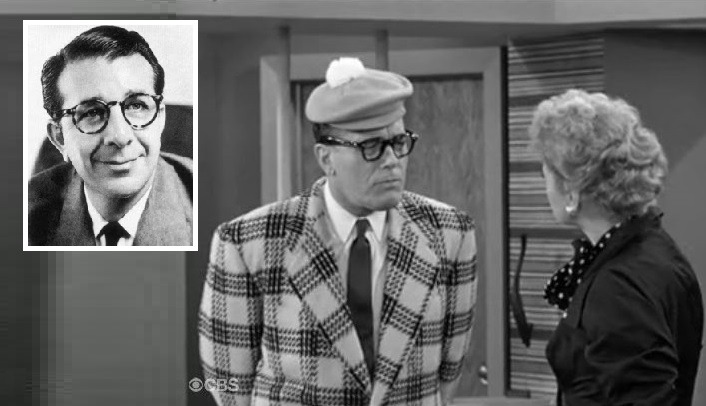
“Don Juan is Shelved” (1955)
When Ricky’s picture is canceled, Lucy hires an actor to play Dore Schary – who turns out to be the real Dore Schary!
“I don’t usually work this cheap, but things are tough, what with television and all.” ~ Dore Schary
But only on television. The real film producer Dore Schary was scheduled to play himself, but pulled out at the last minute. The reason of record was illness, but many feared it was pressure from the studio, feeling that television was replacing film-going by the American public. He was replaced by Vivian Vance’s husband, Phil Ober.

“Bullfight Dance” (1955)
When Lucy is asked to write an article for Photoplay about what it’s like being married to Ricky, she uses it to blackmail him to get to perform in a TV benefit for the Heart Fund, a cause that was near and dear to Lucy and Desi. The benefit television show is called “Coast-to-Coast”, hosted by Ricky and featuring Lucy in the bullfight number of the episode’s title.
The sequence is introduced with an establishing shot of the newly-opened CBS Television City building at 7800 Beverly Boulevard in Los Angeles, California. Although “I Love Lucy” was one of CBS’s strongest shows, Desilu was already happily ensconced at Ren Mar Studios.
“Face to Face” (1955)
Lucy and Ricky appear on a TV interview show from their apartment. But his new agent says the apartment is a dump, and urges them to move into ritzier quarters. The agent tells Ricky that he thinks he’s got him “planted on the Sullivan show next month”. “The Ed Sullivan Show” (aka “Toast of the Town”) was a Sunday night staple on CBS. In addition to hosting performers on the stage of their New York theatre, celebrities would also be in the audience, and get introduced by Sullivan to get camera time. This is what is meant by “planted” on the Sullivan show.
Ed Warren (Elliott Reid) is a parody of Edward R. Murrow (right), who hosted the interview show “Person to Person” from 1953 to 1959. Just like Murrow, Warren signs off by bidding the audience “Good night, and good luck!”
“Lucy Meets Charles Boyer” (1956)
Lucy thinks every man she sees is film star Charles Boyer. When she spots the real Boyer, Ricky convinces him to pretend to be a second rate actor who just happens to look like the star. Boyer mentions “Four Star Playhouse” (1952-56), an anthology series sponsored by Singer and Bristol Myers. The premise of the CBS series was that Boyer, Ida Lupino, David Niven, and Dick Powell would take turns starring in episodes.
“Lucy and Superman” (1957)
Lucy brags that she can get Superman for Little Ricky’s birthday party. When he isn’t available, Lucy dresses up as the man of steel instead.
As the episode opens, Ricky and Little Ricky are watching “Adventures of Superman” on TV. Superman fans have said that this excerpt was not from the original series, but created for “I Love Lucy” using a double. The wires holding Superman up are clearly visible in the shot and it was commonly known that George Reeves disliked using wires because of an incident early in the show’s creation.
“Lucy Gets Chummy with the Neighbors” (1957)
When a misunderstanding about the between Betty (Mary Jane Croft) and Lucy spreads to the boys, Ralph (Frank Nelson) rescinds his offer for Ricky to appear on one of his advertising agency’s TV shows, saying “We’ll get Cugat!” For Ricky, this is the ultimate insult. In the early days of television, advertising agencies could dictate whether a show would be aired or not. Such was the case with “I Love Lucy” in 1951. Biou Advertising represented Philip Morris, the show’s sponsor during the first several years.

“Lucy Goes To Sun Valley” (1958)
When Ricky, Little Ricky and Fred have to stay home to work on a television show, Lucy reluctantly takes Ethel to Sun Valley.
“Lucy Goes To Alaska” (1959)
The Ricardos and Merztes go to Alaska where Ricky and Fred have bought some land and Ricky is doing a TV show. When Red Skelton’s partner fails to appear, Lucy is recruited to perform with him.

“Lucy Wants a Career” (1959)
“I can’t believe it! Lucy on television!”
Looking for fulfillment outside the home, Lucy takes a job as a Girl Friday for Paul Douglas on the morning TV show “Early Bird.”
The first morning news program on television was “Three To Get Ready,” a local show hosted by comedian Ernie Kovacs that aired in Philadelphia from 1950 to 1952. Although it was mostly entertainment-oriented, the program did feature news and weather segments. Its success prompted NBC to look at producing something similar on a national basis and in January 1952 the “Today Show” premiered. CBS (Lucy’s network) entered the field in 1954, but was never able to compete in the ratings.
“Lucy Meets the Mustache” (1960)
Near the end of the episode, Ernie Kovacs tells Ricky to “take a good look” at Crandall (aka Lucy in disguise).
“Take a Good Look” was the name of a TV quiz show Kovacs moderated at the time. It involved a panel guessing answers based on short skits.
Stay Tuned for Part 2! Same Time, Same Channel!
-
MOVIES on TV!
Part 3 ~ The Movies of “Here’s Lucy”
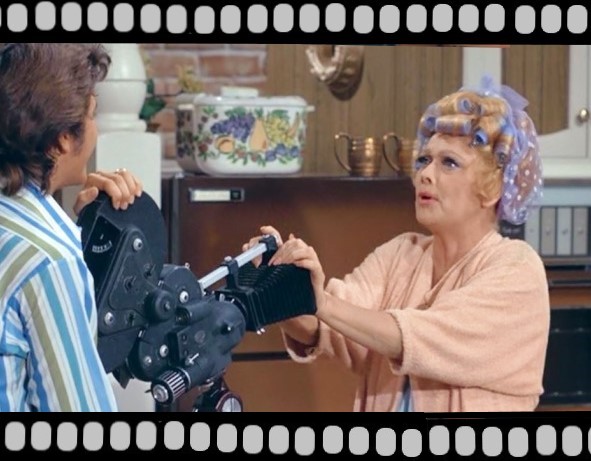
In “Here’s Lucy,” Lucille Ball had a new character, a new family, and a new show – but one thing remained constant, her love of movies! Here are some of the movies (real and imagined) of “Here’s Lucy.”
~FACTUAL FILMS~
“Lucy and Carol Burnett” aka “The Unemployment Follies” (1971)
Carol and Lucy stage a tribute to Hollywood using unemployed actors. The films mentioned and/or feted include:
- TO HAVE AND HAVE NOT (1944)
- BLUE ANGEL (1930)
- CASABLANCA (1942)
- 42ND STREET (1933)
- THE WIZARD OF OZ (1939)
- SINGIN’ IN THE RAIN (1952)
- ROSE MARIE (1954)

The set is decorated with posters from:
- HOLLYWOOD OR BUST (1956)
- SAMPSON AND DELILAH (1949)
- THE GREATEST SHOW ON EARTH (1952)
- SHORT CUT TO HELL (1957)
- GONE WITH THE WIND (1939)
- UNDER TWO FLAGS (1936)
“Ginger Rogers Comes To Tea” (1971)
Ginger Rogers leaves her purse in a movie theatre where she’s gone incognito to see one of her films for the first time. Lucy and Harry discover the purse and hope to get to meet the star in person by inviting her to tea. Instead of working late, Lucy tells Harry that she wants to go to a Ginger Rogers Film Festival. They are showing Tender Comrade (1943) and Flying Down To Rio (1933), two films made at RKO, which eventually became Desilu.

Rogers tells Lucy she has done 73 movies. Rattling off some of Rogers’ hits, Lucy adds a sugar cube to Ginger’s tea for each title: Top Hat, Roberta, Flying Down To Rio, Follow the Fleet, Shall We Dance, and The Barkleys of Broadway. When Lucy realizes she’s put six lumps of sugar in Ginger’s tea, Rogers says she only wanted Top Hat and Roberta (two lumps).
Trying to impugn the taste in films of the mystery woman (a disguised Ginger Rogers), Lucy tells her to try back next week and they might be showing Beach Blanket Bingo (1965). This was the fourth of the light comic films set on the California beach starring Frankie Avalon and Annette Funicello.

After dancing the Charleston with Lucy and Kim, Lucy asks Rogers to do a scene from Kitty Foyle, Ginger’s Oscar-winning role. Rogers graciously declines, asking Lucy to become a Katherine Hepburn fan instead!

“Guess Who Owes Lucy $23.50?” (1968)
Lucy loans Van Johnson money to fix his car – but the man turns out to be an impostor. This episode is written for Van Johnson to work in a not-so-subtle plug for their latest film Yours, Mine and Ours (1968) starring Henry Fonda.
VAN IMPOSTER: “I loved working with that kooky redhead.”
LUCY: “Personally, I thought she was much too young for Henry Fonda.”

Lucy says she remembers Johnson from his appearance inThe Romance of Rosy Ridge (1947). She later tells him she saw the film 17 times! When Lucy is escorted out by the studio guards at Van’s direction, Lucy says that now she’s glad he got court martialed in The Caine Mutiny (1954).

“Lucy and Aladdin’s Lamp” (1971)
When Lucy holds a garage sale, she discovers an old lamp that she believes may be make wishes come true. Lucy pulls out a fur-lined jacket she says was worn by Joan Crawford in Mildred Pierce. The 1945 film won Crawford an Academy Award. Craig says that judging by the shoulder pads she could have worn it in The Spirit of Notre Dame, a 1931 football-themed movie starring Lew Ayres.

“Lucy and Flip Go Legit” (1971)
Lucy takes a temp assignment with Flip Wilson in order to answer his fan mail. When she is caught sneaking into Wilson’s office to ask him a favor, she gets caught and fired. The favor is to appear in a community theatre production of Gone With The Wind (1939) – as Prissy. Lucy plays Scarlett O’Hara, Harry plays Rhett Butler, and Kim takes the role of Melanie Wilkes.

“Won’t You Calm Down Dan Dailey?” (1971)
Lucy gets a job working for Dan Dailey. When he starts to dictate a letter to Paul Newman at Universal Studios, Lucy says she saw Newman on the late show in Winning, a 1969 film about a race car driver.
“Lucy and Rudy Vallée” (1970)
Famous crooner Rudy Vallée is waiting tables to pass the time until his music comes back into style. Lucy convinces Kim to help update his look and sound while Harry gets him a booking at the local teen hangout. When a life-size portrait of Vallée in a raccoon coat is revealed, Vallée says he wore the coat in his first picture, Varsity Hero, a silent picture where critics raved about his singing!

In reality, Vallée’s first film (aside from two shorts playing himself) was The Vagabond Lover in 1929.

“Lucy and Chuck Connors Have a Surprise Slumber Party” (1974)
Harry rents out Lucy’s home for a movie shoot. After causing several re-takes, Lucy is banished from her own home. When she returns early, she doesn’t know that Chuck Connors is staying overnight – in her bed!

Jerry, the film’s director, tells Chuck that his film Good Morning, Miss Dove starring Jennifer Jones is on television that night. Connors says the film was one of the few times he got to nuzzle something besides a horse. Released in 1955 by 20th Century Fox, the film co-stars Mary Wickes, a frequent guest star on all of Lucille Ball’s sitcoms. It also features Jerry Paris, who directed two episodes of “Here’s Lucy” before being fired, and Robert Stack of Desilu’s “The Untouchables.” Other “Lucy” alumni in the film include Herb Vigran, Hal Taggart, and Arthur Tovey – all appearing uncredited.

“Lucy Meets the Burtons” (1972)
The hotel manager tells Burton that the back door is mobbed by the Elizabeth Taylor Fan Club – Glendale Chapter. Membership to the club requires seeing National Velvet 10 times! National Velvet (1945) was made when Taylor was just twelve years old.
~FICTIONAL FILMS~

“Lucy, the American Mother” (1970)
Craig makes a film about Lucy, a typical American mother. During the episode, Kim does impresssions of Katharine Hepburn in Stage Door (1937), a film that also featured Lucille Ball, Maurice Chevalier in Innocents of Paris (1929), and Bette Davis in The Great Lie (1941).

The title of Craig’s movie will be “A Day in the Life of My Mother.” When Lucy can’t seem to act natural in front of Craig’s camera, she suggests he get someone else to play his mother; someone like Raquel Welch, Carol Burnett, or Don Knotts.

“Lucy’s House Guest, Harry” (1971)
As Harry is finally is finally about to leave, Lucy has a horrible thought: what if he is like Sheridan Whiteside in The Man Who Came to Dinner and falls on his way out and must stay with them even longer? The play, by George S. Kaufman and Moss Hart, opened on Broadway in 1939. It starred Lucille Ball’s good friend (and “Here’s Lucy” performer) Mary Wickes as Nurse Preen. Wickes was one of several actors who recreated their roles in the 1942 film adaptation.
~FILM INSPIRATIONS~

“My Fair Buzzi” (1972)
Kim’s shy and awkward friend Annie (Ruth Buzzi) comes out of her shell in order to audition for a 1920s revue, only to find the director was looking for someone shy and awkward in the first place! The episode title and story of transformation were inspired by the 1956 Broadway musical and 1964 film My Fair Lady, which, in turn, was inspired by George Bernard Shaw’s Pygmalion. Both are mentioned in the dialogue of the episode.
“Dirty Gertie” (1972)
Lucy gets a surprise fruit basket and heads downtown to share her good fortune with her hairdresser. On the street she is mistaken for Dirty Gertie, an apple peddler who just happens to be the good luck charm of a local gangster. This episode was inspired by the 1961 Frank Capra film Pocketful of Miracles in which Bette Davis played Apple Annie, a poor woman reduced to selling apples on the street. The film featured previous “Lucy” co-stars Edward Everett Horton, Jay Novello, Ann-Margret (film debut), Sheldon Leonard, Jerome Cowan, Fritz Feld, Ellen Corby, Benny Rubin, Hayden Rorke, Bess Flowers, Vito Scotti, Bert Stevens, Arthur Tovey, and Romo Vincent.

“Lucy Runs the Rapids” (1969)
The Carters take a road trip in a camper. The episode opens with the soundtrack playing “Breezin’ Along”, the theme song from The Long, Long Trailer (1954), a film starring Lucy and Desi as a couple honeymooning in a trailer.
~FILM FAKES~

“Lucy Cuts Vincent’s Price” (1970)
Price is filming a new horror film titled Who’s Afraid of Virginia’s Wolfman? He says it has the best title since he starred in The Giant Chihuahua That Ate Chicago.
~FILM REFERENCES~

“Lucy, the Cement Worker” (1969)
In Pierre’s the knife thrower’s studio, there is a handbill on the bulletin board for ‘Cherokee Jim’s Rodeo and Wild West Show’, which is a direct reference to the 1945 film Incendiary Blonde starring Betty Hutton as Texas Guinan. The film was directed by George Marshall for Paramount, the same director and studio producing this episode of “Here’s Lucy” 25 years later!

“Lucy in the Jungle” (1971)
When Harry sees baby chimps Fido and Rover, he reminds Lucy and Kim that King Kong started out as a baby, too! King Kong, Hollywood’s tale of a giant ape, was first filmed in 1933, then re-made in 1976 and 2005. Fay Wray, one of the stars of the original film, also made The Bowery that same year, one of Lucille Ball’s first films.

“Lucy and the Ex-Con” (1969)
Lucy and Rocky (Wally Cox) go undercover as little old ladies to catch a crook. When Lucy and Rocky pass out (as planned) one of the crooks says to the bartender “Give me a hand with arsenic and old face.” Arsenic and Old Lace is a 1944 film where two elderly spinsters serve lethal glasses of elderberry wine to unsuspecting older gentlemen and bury them in their basement!

“Lucy and The Generation Gap” (1969)
Lucy and Uncle Harry help Kim and Craig stage the school musical. In the first act of the musical set in ancient Rome, Lucille Ball is reading a magazine called ‘Roman Scandals.’ Roman Scandals is also the title of Lucille Ball’s uncredited film debut in 1933.

“Lucy and Shelley Winters” (1968)
Hired to watch over dieting movie star Shelley Summers. On the mantle of Summers’ apartment is a photo of a svelte Shelley Winters from the 1950 film Frenchie. She glances guiltily at the photo when she is about to overeat.

“Lucy Carter Meets Lucille Ball” (1974)
Although Lucille Ball’s dressing room wall is lined with photographs of Mame and the soundtrack plays the title tune by Jerry Herman, the name of the movie is never specifically mentioned. The film was given its world premiere on March 7, 1974 three days after this episode first aired, and released nationally three weeks later. As Mame, Lucy failed to ‘charm the husk off of the corn.’


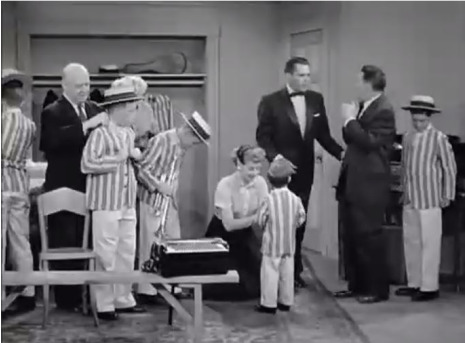


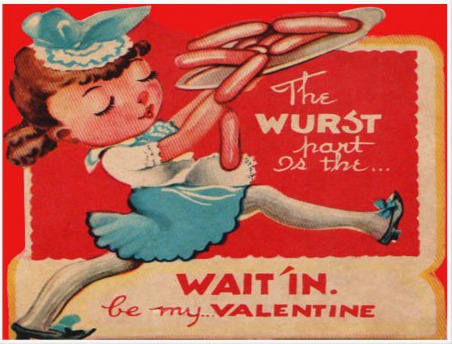


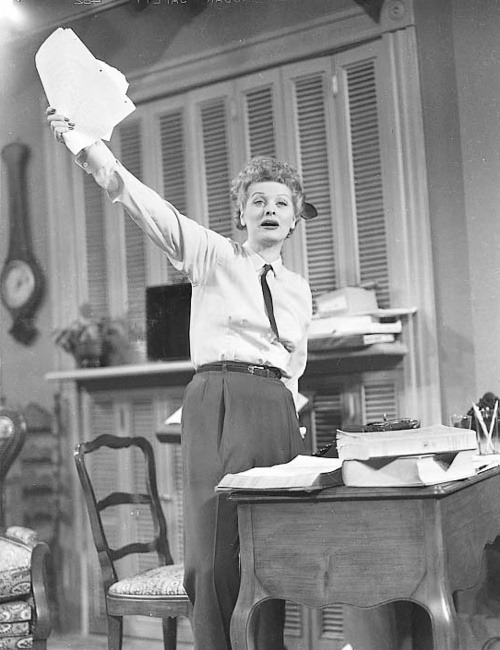
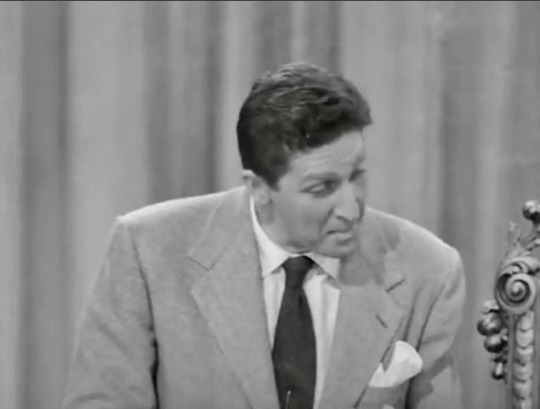

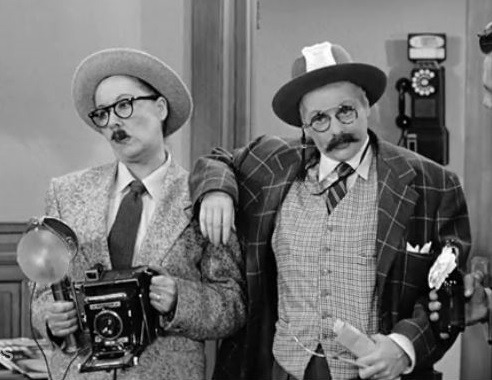


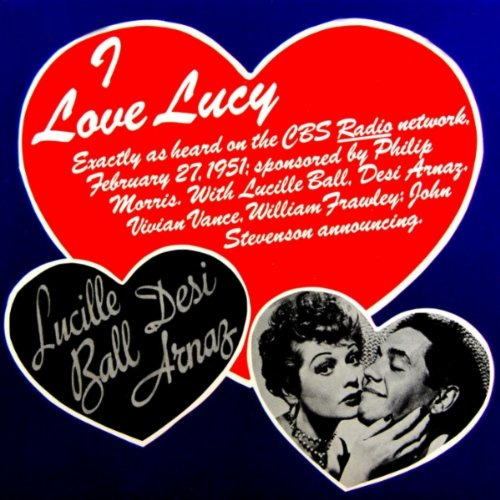



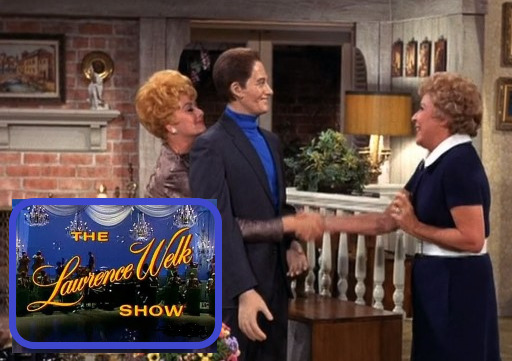


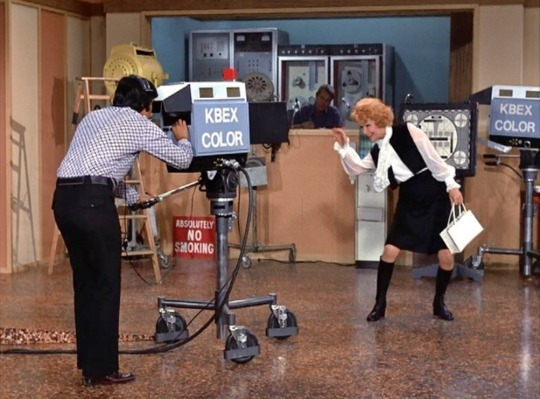

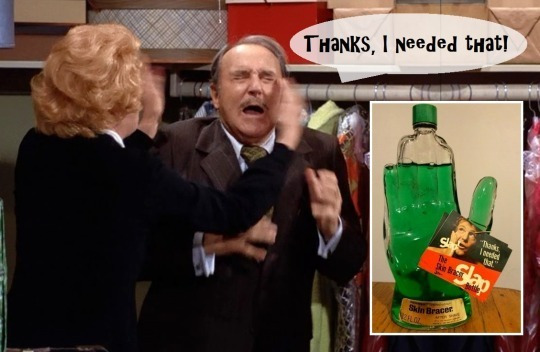


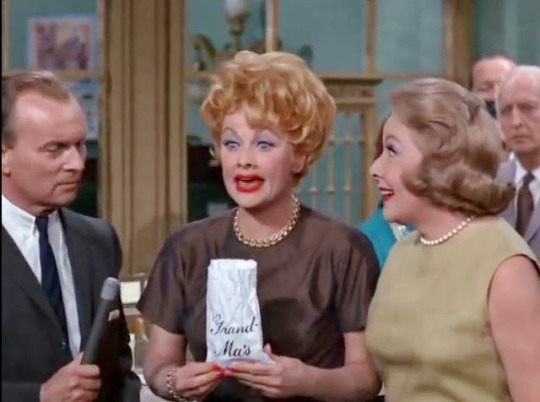



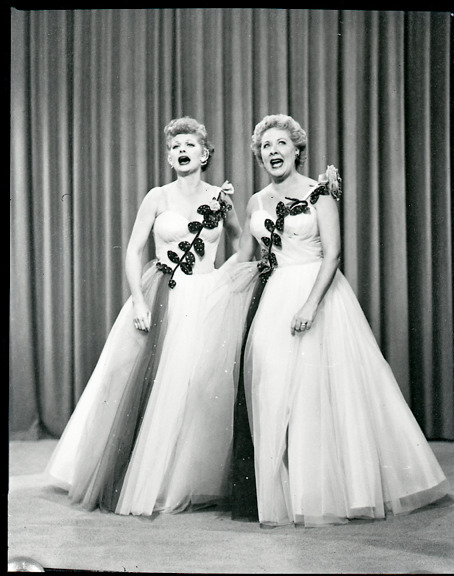






-
Subscribe
Subscribed
Already have a WordPress.com account? Log in now.
 Papermoon Loves Lucy