-
GREAT BALL OF FIRE!
Lucille Ball and the Fire Department
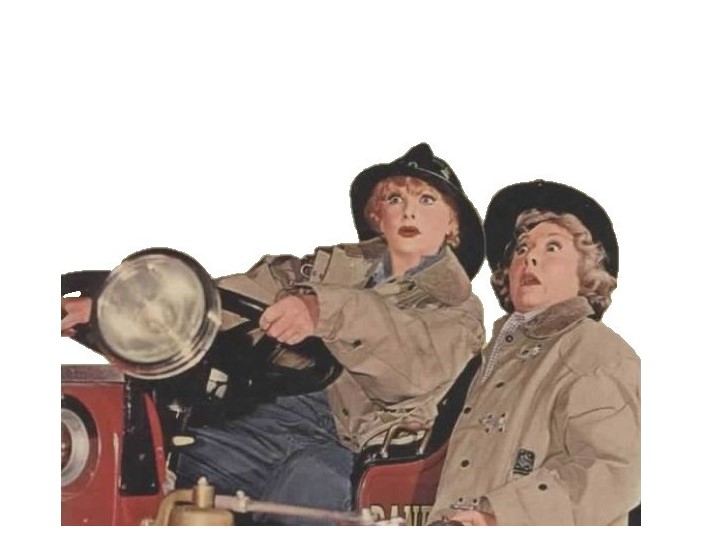
Where there’s smoke – there’s Lucy! Lucy’s encounters with the fire department are legendary – even becoming a volunteer firefighter on “The Lucy Show.”
“I Love Lucy” wouldn’t have been possible without the cooperation of the Los Angeles Fire Department, who helped bring the studio up to code for filming when live audiences were introduced to the mix. Previously, audiences were not permitted on film sets due to fire codes. Ironically, the show’s sponsor was a cigarette company, at a time when smoking indoors was commonplace.
In “Be A Pal” (1951), Lucy sets fire to Ricky’s newspaper to get his attention! Considering all the trouble and cost Desi had to assure the studio audience’s safety for the Los Angels Fire Department, it is amazing this gag was allowed!

“Fred and Ethel Fight” (1952) ~ When Fred and Ethel patch things up, Lucy and Ricky start feuding, leading to Lucy to pretend to be hit by a bus and Ricky to stage a fire in the apartment to test each other’s affection. Ricky and Fred use a toy siren and a beekeepers smoker to convince Lucy the building’s ablaze.
Moments from the episode, including the aftermath of the ‘fire’ were recreated for the 2021 film Being the Ricardos.

In “The Marriage License” (1953), one of the many hats worn by Mr. Willoughby (Irving Bacon) is fireman, presumably of the Connecticut town of Greenwich where the scene is set. Mr. Willoughby mistakes Lucy’s red hair for the flames of a fire. His helmet says “Engine 1″.

In “Too Many Crooks” (1953), suspecting Lucy to be Madam X, Fred and Ethel spy on her from the fire escape. Fire escapes were common features of New York City apartment buildings, a series of metal ladders allowing residents to get out of the building in case of a fire. They were most famously represented in the musical West Side Story.
A running plot point of the first season of “The Lucy Show” (1963) has Lucy and Viv recruiting their friends to serve as the Danfield Volunteer Fire Department. Naturally, Lucy serves as Captain.

Six weeks earlier, in “Lucy Puts Up a TV Antenna” (1962), two firemen help Lucy and Viv off the roof when their DIY installation of a TV aerial goes wrong. Chuck Roberson and Hubie Kerns play the firemen.

Lucy is dismayed that nearby towns have a fire department, while Danfield has none. In “Lucy and Viv are Volunteer Fireman” (1963), the first episode to begin the plotline, Lucy writes to her congressman about the situation.
Dear Senator Dodds;
I feel it is my duty to point out an alarming situation which exists here in Danfield. Because of re-zoning in the county our fire department has been transferred to Ridgebury many, many miles away. As a result, in case of a fire, defenseless women and little children will be left helpless to face a flaming inferno. Until this outrageous condition is rectified, the least you can do for Danfield is to create a volunteer fire department.
Yours very truly,
Lucille Carmichael
PS: I plan to vote for you in the next election. That is, if the polling place hasn’t burned down.

In response to their letter, they are visited by Captain Metcalf (Patrick McVey) of the Ridgebury Fired Department.
Jerry and Sherman are appointed Junior Firemen. This is a real-life program for youth run by most American and British fire departments to encourage home safety in fire prevention. Talking about the potential for a fire, Lucy says she doesn’t want to be known as one of the “Last of the Red Hot Mamas.”

The episode uses a fire pole and a Moreland fire truck. Both are employed for comic effect.
Lucy and Viv rehearse putting on their fire fighter uniforms, calmly timing themselves as they do. When a real fire alarm sounds, the moment is comically chaotic.

When Metcalf is training the women at the old firehouse, there is a Smokey Bear Forest Fire Prevention poster behind him. This particular design was first issued in 1953.
Captain Metcalf claims that the reason the Danfield volunteer fire brigade will consist of all females is because so many men commute to New York, further reinforcing that fictional Danfield is a bedroom community of Manhattan.
In connection with this episode, Lucille Ball and Vivian Vance were made honorary fire chiefs of the Los Angeles Fire Department. They were photographed wearing official white helmets with Henri O’Bryant, vice president of the Fire Commission, Fred Kline, commission president, and LA Fire Chief William L. Miller.
Because the episode was shot out of order, the fire fighter plotline is not mentioned in the next two episodes, but resumes in “Lucy’s Barbershop Quartet” (1962). Since all the members of the group are members of the Danfield Volunteer Fire Brigade, the quartet is named The Four Alarms.
Again, the storyline is put on the back burner for two episodes, until “Lucy Drives a Dump Truck” (1963). After promising the Volunteer Fire Department that the town council will pay for their new uniforms, the girls find that they will be stuck for the cost themselves. They want to relieve Lucy as captain, until she comes up with the idea of selling newspapers for salvage.

In addition to Lucy and Viv, the members of the Danfield Volunteer Fire Department are: Thelma Green (Carole Cook), Audrey Simmons (Mary Jane Croft), Dorothy Boyer (Ruth Crews, later Dorothy Konrad), Babette Edwards (Karen Norris), Frances (Mary Wickes), Colleen (Renita Reachi), Pauline Lopus, Grace, as well as background performers Bess Flowers and Hazel Pierce.
The next time we hear about the volunteer fire department, the show is being filmed (but not initially aired) in color! “Lucy Plays Cleopatra” (1963). The women recruite acting coach Professor Gitterman (Hans Conried) to help them stage the production.
“Lucy and Viv Play Softball” (1963) ~ Lucy and Viv are usually bench warmers when the Danfield Volunteer Fire Department plays softball, but a member’s preganancy lands them on the field.
“Lucy Puts Out a Fire at the Bank” (1963) ~ When the town council refuses to fund the Danfield Volunteer Fire Department, Lucy takes her brigade for some training to impress Mr. Mooney, then sets a small fire at the bank to demonstrate their worth! Mr. Mooney wants Danfield to be served by New Rochelle’s Fire Department. In previous episodes they were served by Ridgebury.

The Danfield Volunteer Fire Department has a service record of:
- 43 cat rescues; 12 of them of the same cat.
- 8 clogged up chimney flues unclogged.
- 16 piles of burning leaves were extinguished.
- 1 lawsuit against the city for water damage at the Armenian restaurant for an incident surrounding flaming shish-kabob on a sword.
Their training is led by Captain Burke (Alan Hale Jr.). This is the final episode of the fire brigade plotline, ending a year after it is introduced.

In “Lucy the Coin Collector” (1964), Lucy and Viv stand on the street in front of a bright yellow fire hydrant. Along with the mailbox, the fire hydrant was a standard set dressing for scenes taking place on city streets.

In “Lucy the Disc Jockey” (1965), the last episode set in Danfield, Lucy uses a fire extinguisher when the control board explodes. The radio station is covered in foam for the rest of the episode. The moment was included in the show’s opening montage.
“Lucy Makes a Few Extra Dollars” (1971) ~ Lucy Carter breaks out a fire extinguisher when Harry sets a fire in the office waste basket.
Larry J. Blake plays the fireman who comes to extinguish the trash can blaze.

“Lucy’s Punctured Romance” (1972) ~ Lucy burns the roast causing the fire department to smash the front door glass. Larry J. Blake returns as the Fire Cheif (wearing the same uniform), joined by Orwin C. Harvey and Sid Gould.
-
LUCY’S THIN BLUE LINE
Lucy and Law Enforcement ~ Part 3
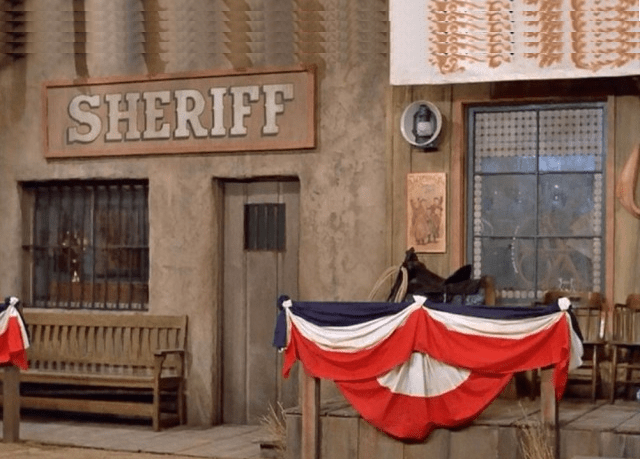
On “Here’s Lucy,” Lucy Carter not only had multiple run-ins with the police – she actually became Sheriff for a day! Here’s a look at Carter and Cops!

“Lucy’s Impossible Mission” (1968) ~ In this “Mission:Impossible” spoof, even the police are in on the caper. John J. “Red” Fox was best known for playing policemen, which is what he did on five of his eight appearances on “The Lucy Show” as well as three of his five episodes of “Here’s Lucy.” The policeman has no lines, but is kicked by Lucy to get his attention and says “Ouch!”

“Guess Who Owes Lucy $23.50?” (1969) ~ Van Johnson plays himself and his evil doppelganger.Orwin C. Harvey plays the Security Guard (right). Harvey has one line, spoken off screen. A second Security Guard goes uncredited and has no lines.

“Lucy and the Ex-Con” (1969) ~ Lucy and a safecracker (Wally Cox) go undercover as Little Old Ladies at a dive bar. Vince Howard played the policeman on the extreme left. Many of his 125 TV and film credits were as law enforcement officials. Howard also played a policeman on “Lucy and Mannix are Held Hostage” (1971). Larry J. Blake (policeman on right) is making the first of his eight “Here’s Lucy” appearances.

“Lucy Goes on Strike” (1969) ~ Harry refuses to give Lucy a raise so she goes on strike with the other secretaries in the building, including Isabel (Mary Wickes). John J. ‘Red’ Fox returns as the cop on the beat in front of the Bradshawe Building.

“Lucy and the Great Airport Chase” (1969) ~ Government Agent Bill (Morgan Jones) appears to investigate international epsionage in an episode shot on location at Los Angeles International Airport (LAX). The G-Man is never addressed by name but listed in the end credits.

“Lucy Helps Craig Get His Driver’s License” (1969) ~ A motorcycle cop (Ray Kellogg) faces off with driving test examiner Wibur Hurlow (Jack Gilford).
Inside the police station, the officers issuing licenses are played by (left to right): Herkie Styles, Joseph Mell, and Sid Gould.

“Lucy’s Burglar Alarm” (1969) ~ Detective Harvey Gaynes is played by Elliott Reid, who also appeared on “I Love Lucy” and “The Lucy Show.”

“Lucy, the Cement Worker” (1969) ~ Lucy disguises herself as a construction worker to find a valuable ring she’s lost. She encounters the cop on the beat, played by Harry Hickox in the first of his three episodes of “Here’s Lucy.”

“Lucy and Viv Visit Tijuana” (1970) ~ At the border, Harry is questioned by a customs officer played by Don Megowan, perhaps best remembered as the Sheriff in The Wolfman (1956). His final role was as a police sergeant in the 1979 TV movie Mrs. R’s Daughter.
“Lucy and Wall Cox” (1970) ~ Lucy helps Wally Manley (Wally Cox) get a job as a warehouse security guard where they encounter armed criminals.

“Lucy and Ma Parker” (1970) ~ Carole Cook plays an eccentric master criminal. The police convince Lucy to take her place in order to nab her criminal cohorts. Harry Hickox (Lieutenant L. Hickox, left) makes the second of his three episodes of “Here’s Lucy,” all as policemen. Stafford Repp (Police Detective Halloran, right) made a career of playing policemen even before he became famous as Police Chief O’Hara on TV’s “Batman” (1966-68). He played two different officers of the law on “Dennis the Menace” in 1962 and 1963.
“Lucy and the Raffle” (1971) ~ The Baliffs in the courtroom are played by Emile Autuori and John J. ‘Red’ Fox.

“Lucy and Carol Burnett aka The Hollywood Unemployment Follies” (1971) ~ Lucy and Carol stage a musical revue featuring a tribute to the operetta Rose Marie (1930 & 1940). Four Mounties (Royal Canadian Mounted Police) sing “Stout-Hearted Men”. From left to right: Sid Gould, Kay Kuter, Johnny Silver and Mike Wagner.
“Lucy and Mannix are Held Hostage” (1971) ~ In this cross-over with the Mike Connors private eye series “Mannix” (saved from cancellation by Lucille Ball), the policemen are played by Vince Howard (left) and Robert Foulk (right).

“Lucy and the Celebrities” (1971) ~ Sid Gould plays the Security Guard at the gate of Morton Pictures. Impressionist Rich Little stars with Jack Benny.
“Lucy and the Candid Camera” (1971) ~ Allen Funt plays himself and an evil imposter, getting the Carters to participate in criminal capers under the impression they are on “Candid Camera”. Law enforcement is played by (left to right): Peter Leeds, Robert Carson as Sergeant Lou Holmes, and Paul Sorenson, who played policemen many times during his career.
“Lucy and the Chinese Curse” (1972) ~ When Lucy saves a laundry owner (Keye Luke) from a safe falling in the street, reporters and the police are on the scene. Frequent background performer Walter Smith plays the policeman. He had appeared with Lucille Ball in Forever Darling (1956), as well as in Desilu’s “The Untouchables” and “The Lucy Show.”

“The Case of the Reckless Wheelchair Driver” (1972) ~ Lucy, in a wheelchair due to her broken leg, is set-up by a conman (Jesse White). Law enforcement officials are (left to right): Officer Rafferty (Robert Foulk), Sergeant Montgomery (Hal Hickox), and Officer Egan (Ed Hall).

“Dirty Gertie” (1972) ~ Lieutenant Egan is played by Craig Stevens, who is probably best remembered for playing the title role in the private eye series “Peter Gunn” (1958-61). Egan questions Lucy and says he’s “just trying to get the facts, ma’am.” This is a paraphrase of a quote from another famous TV detective, Joe Friday on “Dragnet” played by Jack Webb. The role of Lieutenant Egan was originally written with Webb in mind. Stevens even imitates Webb’s deadpan delivery.

“Lucy Goes to Prison” (1973) ~ Lucy goes undercover in jail to discover where Mumsie Westcott (Elsa Lanchester) hid her stolen loot. Matron Wilson is played by Jody Gilbert, who also played a prison matron on “The Lucy Show.”
Two uniformed policemen are played by uncredited actors and have no lines.

“The Big Game” (1973) ~ Jerry Jones plays a policeman on the prowl for ticket scalpers at the stadium. Prior to this, Jones played a policeman on “The Doris Day Show” and “The Brady Bunch.”

“Lucy Plays Cops and Robbers” (1973) ~ On the side of the law are Officers Spencer and Riggs, played by Dick Sargent and Gary Crosby. Rumor has it that the police officers were supposed to be played by “Adam-12” (1968-75) co-stars Martin Milner and Kent McCord. Like “Here’s Lucy,” the NBC police drama was filmed on the Universal lot. Gary Crosby played a recurring role on “Adam-12.” In the script, one officer says to the other “I think we’ve been riding together too long” which would have been even funnier had it been an already famous pair of policemen like Milner and McCord. The episode features Al Lewis, who famously played Officer Schnauser on “Car 54 Where Are You?” (1961-63).

“Lucy the Sheriff” (1974) ~ Lucy finds out that her grandmother was the first woman sheriff of a Montana town that is celebrating its centennial. She is asked to play her grandmother at the celebrations, which include the recreation of a bank robbery. Lucy is enjoying playing lawmaker until a couple of genuine robbers interrupt the celebration and take her hostage!
Flora Belle Orcutt (the fictional one) is supposedly the first lady sheriff in the West. In real life, the distinction of first woman sheriff has been disputed. Some say it was Texan Emma Banister (1918), but others claim it was Mary Roach (1922-27) because Emma had inherited the position from her husband. Still others believe the title belongs to Kansan Mabel Chase (1926). Mrs. James Latty of Burlington, Iowa, was known as the first “Unofficial Woman Sheriff” as far back as 1870.
Lucy the Sheriff meets Sheriff Bart Thomas, played by Orwin C. Harvey.

“Lucy Calls the President” (1977) ~ In the CBS special, Lucy Whittaker (Lucille Ball) is scheduled to get a visit from President Jimmy Carter. In advance of the visit, the Barker home is scoped out by Secret Service Agents Thatcher (Joey Forman) and Stockley (Stack Pierce).

Stone Pillow (1985) ~ Lucille Ball plays a homeless woman living on the streets of Manhattan. When another homeless woman dies on her corner, the police are called. Pat McNamara (Officer Daggett) played Sheriff Perkins in Silence of the Lambs (1991).

“Lucy and the Guard Goose” (1986) ~ This unaired episode of “Life With Lucy” was originally scheduled for broadcast November 22, 1986. When crime hits M&B Hardware, Lucy enlists the help of a guard goose. Charles Levin plays one of Pasadena’s finest, Sergeant Green. Levin played a policeman on two episodes of “Punky Brewster” (1987-88).
-
LUCY’S THIN BLUE LINE
Lucy and Law Enforcement ~ Part 2

On “The Lucy Show,” Lucy Carmichael not only had multiple run-ins with the police – she actually became one for a couple of episodes! Here’s a look at Carmichael and Cops!
“Lucy and Viv Become Tycoons” (1963) ~ When Lucy and Viv open their own business at home, they are visited by Sergeant Robbins (Bern Hoffman) to check on their permits and operating practices. In 1960, Hoddman appeared in the Lucille Ball / Bob Hope film The Facts of Life.

“Lucy Drives a Dump Truck” (1963) ~ Driving a truck to a nearby town, Lucy and Viv are pulled over by a Brewster policeman played by Richard Reeves, a veteran of nine episodes of “I Love Lucy” including playing a policeman in “Equal Rights” (1953). This is his only appearance on “The Lucy Show.”

“Lucy and the Safe Cracker” (1963) ~ When Mr. Mooney gets locked in the safe (again), Lucy contacts a safe cracker (Jay Novello) and Sergeant Wilcox (James Flavin) is on the scene. Coincidentally, Flavin played the Immigration Officer searching for Mario Orsatti (Jay Novello) in “Visitor from Italy” (1956). He will return to “The Lucy Show” two episodes later to play Sgt. Wilcox again in another bank-themed episode. He appeared in four films with Lucille Ball, including playing a police sergeant in Without Love (1945). During his long career he played so many officers of the law that his IMDB photo is of him in a police uniform!

“Lucy and the Bank Scandal” (1963) ~ Sergeant Wilcox (James Flavin) investigates a case of embezzelment at the Danfield Bank. Lucy suspects Mr. Mooney and digs up his yard to find the stolen cash.

“Lucy is Her Own Lawyer” (1964) ~ Officer Joe (Joe Mell) the Baliff, swears in Lucy Carmichael as well as Mr. Mooney and Nelson the dog! Mell returns as a Baliff in “Lucy the Meter Maid” (1964) and a Bank Guard in “Lucy the Stockholder” (1965).

“Lucy the Meter Maid” (1964) ~ Lucy joins the Danfield Police Force as meter maid. When Viv doesn’t feed the meter, Lucy issues her a summons and they land up in court. Once again, Joe Mell plays the Baliff.
“Lucy Makes a Pinch” (1964) ~ Still on the Force, Lucy is recruited to be part of a stake out. The episode features three of Danfield’s finest (left to right): Murdock (Jack Searl), Captain Bradford (Alan Carney), and Detective Bill Baker (Jack Kelly). As a child actor, Jack Searl was featured in the 1932 film Officer Thirteen, about motorcyle cops. Alan Carney played a policeman in the 1963 comedy classic It’s a Mad, Mad, Mad, Mad World. In 1955, Jack Kelly appeared on a TV series titled “City Detective.”

“Lucy the Coin Collector” (1964) ~ When Lucy drops a rare coin down the sewar grate, she is consoled by a cop on the beat (Ray Kellogg). This is the second of his seven episodes of “The Lucy Show.” He also did two episodes of “Here’s Lucy.” Just as in his other screen credits, most most times he played policemen, as he does here.

“Lucy and the Ceramic Cat” (1965) ~ While Lucy breaks into Bigelow’s Department Store, Viv stands guard outside, diverting the cop on the beat (John J. ‘Red’ Fox). Fox was best known for playing policemen, which is what he did on five of his eight appearances on “The Lucy Show” as well as three of his five episodes of “Here’s Lucy.”
“Lucy, the Stockholder” (1965) ~ After buying a single share of the Danfield Bank for $32, Lucy the stockholder pays the bank a visit. She warns the lackadaisical guard (Joe Mell) that she has a nine year-old nephew who is quicker on the draw than him.

“Lucy and the Undercover Agent” (1965) ~ Trying to get access to Carol Channing, who is performing at a military base, Lucy charms Military Police (MP) officer Sol Schwartz. The character name was specifically chosen so Lucy can sing “Hello, Solly” to the tune of “Hello, Dolly”.
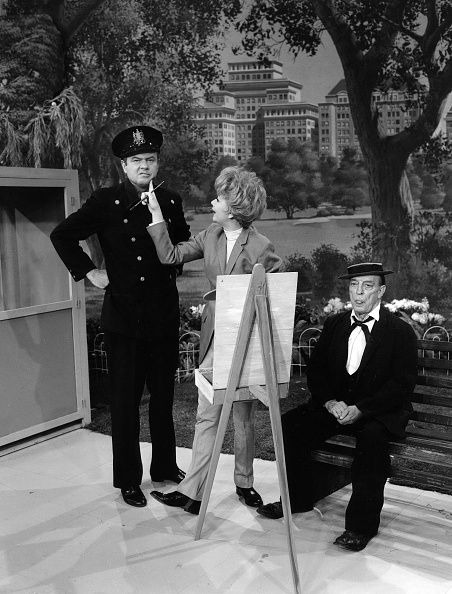
“Salute to Stan Laurel” (1965) ~ In a special tributing the late comic actor, Lucille Ball is part of a silent movie sketch featuring Buster Keaton and Harvey Korman as a policeman in the park.

“Lucy Meets Mickey Rooney” (1965) ~ A silent movie sketch based on Charlie Chaplin’s The Kid features the Keystone Kops (Sid Gould, above). Keystone Kops are humorously incompetent policemen featured in silent film slapstick comedies produced by Mack Sennett for his Keystone Film Company (1912 to 1917).

“Lucy Goes to a Hollywood Premiere” (1966) ~ Mr. Mooney is questioned by Officer Collins (Robert Foulk) of the Beverly Hills Police Department. He doesn’t have a permit to sell maps to the movie stars’ homes and is hauled down to the police station. Foulk played the Brooklyn policeman on the subway platform in “Lucy and the Loving Cup” (1956). He will go on to play six characters on “Here’s Lucy,” two of them policemen.

“Lucy the Gun Moll” (1966) ~ Robert Stack plays Federal Agent Briggs in this satire on Desilu’s “The Untouchables.” Stack played G-Man Eliot Ness on the Desilu TV series and only agreed to do the satire if the names were changed.

“Lucy and the Submarine” (1966) ~ When Lucy sneaks onto a submarine to get Mr. Mooney to sign some bank papers, she must get past a stoic Navy Shore Patrolman (SP) played by Steven Marlo in the first of his two appearances on “The Lucy Show.”

“Lucy and the Ring-a-Ding Ring” (1966) ~ Ray Kellogg plays the cop on the beat who discovers Mr. Mooney trying to get a nearly unconscious Lucy into his car because she has his wife’s ring is stuck on her finger.

“Viv Visits Lucy” (1967) ~ To find a wayward Danfield boy, Lucy and Viv go to the infamous Sunset Strip, where they are mistaken for hippie biker chicks by the police. Ray Kellogg plays the Motorcycle Cop (right) and John J. ‘Red’ Fox plays Patrolman Harry McLeod (left).

“Lucy Puts Main Street on the Map” (1967) ~ Mel Torme plays Mel Tinker, the deputy and Roy Barcroft plays his father, Police Chief Tinker, the law enforcement team in small town Bancroft. During his long career on screen, Barcroft played a sheriff 18 times between 1943 and 1966, including in Billy the Kid Versus Dracula (1966).

“Lucy Meets the Law” (1967) ~ Lucy thinks she’s being arrested for littering when she is actually being mistaken for a red-haired jewel thief. Claude Akins (Lieutenant Finch) is perhaps best remembered for playing Sheriff Lobo in “B.J. And the Bear” (1978-79) and its sequel “The Misadventures of Sheriff Lobo” (1979-81).

Jody Gilbert plays the matron aka ‘Tinkerbell’. Gilbert will also appear in two episodes of “Here’s Lucy,” in one of which she also plays a prison matron.
Ken Lynch (Officer Peters, left) started playing policemen on TV in 1950 and continued to do so for much of his career. Joseph Perry (Officer Miller, right) played a policeman on “My Living Doll” (1965) filmed at Desilu. He appeared on the police-themed shows “Policewoman,” “Police Story,” “Barney Miller,” “Hill Street Blues,” “CHiPs,” “The Rookies” “The Mod Squad,” “87th Precinct,” “The FBI,” “The Rookies,” and “The Sheriff of Cochise” a Desilu Production.

“Lucy Sues Mooney” (1967) ~ Irwin Charone (Bailiff) makes the third of his five appearances on “The Lucy Show.”
Two uncredited performers play Officers of the Court.
“Lucy and the Stolen Stole” (1968) ~ Lucy and Mr. Mooney go shopping for Mrs. Mooney’s birthday and wind up being arrested for possession of a stolen fur stole. The boys in blue are played by Ray Kellogg, Roy Shapiro, and John J. ‘Red’ Fox as Officer Shapiro.

“Lucy Gets Involved” (1968) ~ At Phil’s Fat Boy Drive-In, a policeman (John J. ‘Red’ Fox) interrogates motorcycle rider Tommy Watkins (Phil Vandervoort) with Mr. Burton (Jackie Coogan) overhearing.
“Lucy and Sid Caesar” (1968) ~ A forger who looks like Sid Caesar is passing bad checks at the bank. Lucy and Mr. Mooney try to figure out how to tell the real Sid Caesar from the forger. They enlist the help of the authorities (left to right): Irwin Charrone, John J. ‘Red’ Fox, and Ben Gage, who was mentioned on “I Love Lucy” in 1955, appeared on “Our Miss Brooks” (filmed at Desilu Studios) and in Desilu’s “Star Trek.” His last two screen appearances were in “Policewoman” and “Police Story.”
STAY TUNED FOR PART 3
-
LUCY’S THIN BLUE LINE
Lucy and Law Enforcement ~ Part 1
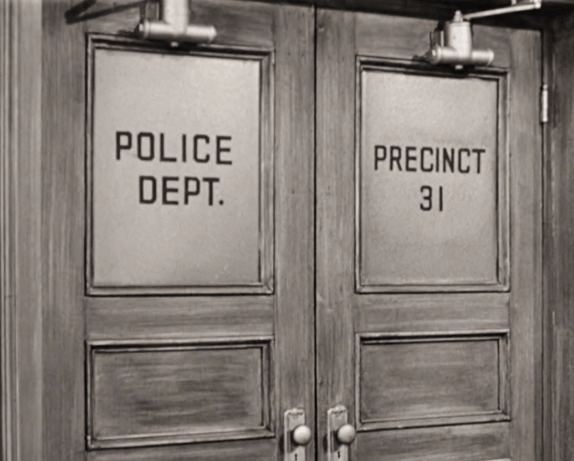
For a simple housewife and a bandleader, Lucy and Ricky got involved with the police on a surprising number of occasions. Here’s a line-up of Lucy’s encounters with the men in blue.
“Liz Learns To Drive” (1948) ~ Liz (Lucille Ball) goes to the police station to get her driver’s license. The officer is played by Frank Nelson.
NELSON: “Name?”
LIZ: “Elizabeth Cugat.”
NELSON: “Address?”
LIZ: “321 Bundy.”
NELSON: “Race?”
LIZ: “Of course not! I don’t even have a driver’s license!”
After much rhetorical to-ing and fro-ing, he takes her fingerprints and gives her the eye test:
NELSON: “Read the letters on the wall over there.”
LIZ: “M-E-N.”
Later in the complicated plot, Liz finds herself back at the police station, this time being questioned by Sergeant Lewis (Herb Vigran). She’s a suspect in a murder case!
“Safe Driving Week” (1950) ~ Liz is pulled over by a motorcycle cop (Sheldon Leonard), although she’s unclear why. He says that Liz made the wrong arm signal when turning left. When Liz asks what he is writing, he facetiously calls it a story for Reader’s Digest about ‘The Most Unforgettable Person I’ve Ever Met’! Naturally, it is a traffic ticket. Later, Liz passes a car on the wrong side of the road because she’s three feet from the left curb! A policeman pulls them over – the same officer who issued Liz the ticket. To explain her driving on the left, Liz decides to adopt a British accent.
LIZ: “Pip-pip, cheerio, hallo there, Bobbie!”
The Officer tests her by asking her to sing the British Anthem. Liz sings “London Bridge is Falling Down.” The policeman insists on driving the car away from the curb, but runs over his own motorcycle in the process! Liz drives away, leaving the motorcycle cop in tears, clutching only his handlebars.

“New Neighbors” (1952) ~ Believing their new neighbors are dangerous spies, Lucy forms a militia and calls the police. Sergeant Morton (Allen Jenkins) is nearly killed when they open fire at the sound of the doorbell!
LUCY: “These people are agents of some foreign government!”
SGT. MORTON: “What’s their name?”
LUCY: “O’Brien!”
Morton apathetically ask if she’s been nipping at the cooking sherry.

David Allen Curtis Jenkins (Sergeant Morton) made a career out of playing policemen and tough guys in films throughout the ’30s and ’40s including Five Came Back (1939) with Lucille Ball. This was the first of his three appearances as a policeman on “I Love Lucy.” From 1961-62, Jenkins voice Officer Dribble on the animated series “Top Cat”.
“The Courtoom” (1952) ~ Robert B. Williams played the Bailiff. Williams was a busy Hollywood day player who had recurring roles on “Dennis the Menace” and “Hazel.” His last role was as Garth Gimble Sr. (Martin Mull’s father) on “Fernwood Tonight” in 1977.

“Lucy Goes to the Hospital” (1953) ~ Ricky creates pandemonium at the hospital by showing up for the birth of his son in full Voodoo make-up! Ralph Montgomery plays the policeman called to the scene. He had appeared with Lucille Ball in the 1949 film Sorrowful Jones.

“Ricky and Fred are TV Fans” (1953) ~ When they are caught stealing from a diner cash register and trying to cut the wires to their apartment building, Lucy and Ethel are hauled down to the station (Precinct 31) by Officer Jenkins (Allen Jenkins) where they encounter Desk Sergeant Nelson (Frank Nelson). This is not the first time these actors have worn blue for Desilu – nor the last.
“The Girls Go Into Business” (1953) ~ Emory Parnell plays the cop on the beat. Although this is his only series appearance, the veteran character actor was in three films with Lucille Ball and seven with William Frawley.

“Equal Rights” (1953) ~ The arresting officers are played by Fred Aldrich (left), who appeared in four other episodes, and Louis Nicoletti, who was a veteran of 15 episodes.

When Ricky and Fred are jailed, the police officer in the final scene is Richard Reeves, who played Bill Foster for two episodes, but was also seen as the tall Indian in “The Indian Show” (1953).
“Too Many Crooks” (1953) ~ When the building is in an uproar over the identity of Madam X, a policeman arrives to sort things out. Once again, the officer on the scene is played by Allen Jenkins.

“Tennessee Bound” (1955) ~ While driving too quickly through Tennessee, the gang is arrested by the Sheriff of Bent Fork, played by Will Wright. He previously played Mr. Walters, the locksmith from Yonkers in “The Handcuffs” (1953). In 1949, he appeared with Lucille Ball in the film Miss Grant Takes Richmond.

“Lucy Visits Graumans” (1955) ~ While trying to steal John Wayne’s footprints, Lucy and Ethel are interupted by two cops on the beat, who indulge themselves trying to fit their feet into the cement shoe prints of celebrities. Clarence Straight and Ben Neims play the policemen. This is just one of many law enforcement officials Straight played throughout his career. Neims also played an officer (of another sort) on the S.S. Consitution in “Bon Voyage” (1956). His final role was as a Police Chief in the 1974 film Dirty Mary Crazy Larry.

“The Great Train Robbery” (1956) ~ The plainclothes Police Detective is played by Joseph Crehan, who had previously appeared with Lucille Ball in There Goes My Girl (1937), Ziegfeld Follies (1947), and The Fuller Brush Girl (1950). Throughout his fifty year screen career he played Ulysses S. Grant nine times!
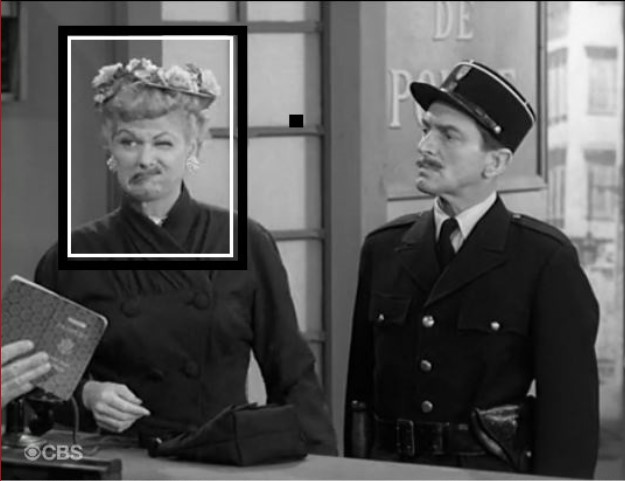
“Paris at Last” (1956) ~ Lucy is implicated in a conterfeiting scheme and arrested. Trevor Ward plays the gendarme who arrests Lucy for passing the fake Francs. He had just appeared as the Cockney groom at the English country estate in “The Fox Hunt” (1956) two episodes earlier. In real life Ward was not French, American, or English – he was Welsh!

At the police station, two more gendarmes are introduced. Ramsay Hill plays the police desk sergeant who only speaks French. This is his one and only role on the series, but he served as technical adviser on the 1947 film Lured starring Lucille Ball..Johnny Mylong plays the gendarme who speaks both French and German. He soon returns to the series as the Casino Manager in “Lucy Goes To Monte Carlo” (1956).
“Lucy’s Bicycle Trip” (1956) ~ Biking along the Med, Lucy encounters Border Control Officers for Italy and France. Henry Dar Boggia (left) plays the Italian Border Guard. Francis Ravel (in the booth) plays the French Border Guard. Felix Romano plays the Italian Border Guard who comes on duty in the episode’s final moments. For the record, Border Guards are considered Law Enforcement Officials in both France and Italy.
“Return Home from Europe” (1956) ~ Frank Nelson plays the Customs Officer who tries to solve the mystery of the cheese / baby. Nelson will soon take on his second recurring role on the series as Ralph Ramsey. A Customs Officer is considered a federal law enforcement officer.
“Visitor from Italy” (1956) ~ James Flavin plays the Immigration Officer searghing for Mario (Jay Novello). Flavin also appeared with Novello in “Lucy and the Safe Cracker” (1962) where he played a cop named Sergeant Wilcox. He returned two episodes later to play Sergeant Wilcox again in another bank-themed episode, “Lucy and the Bank Scandal” (1963). Flavin appeared in four films with Lucille Ball, including playing a police sergeant in Without Love (1945). During his long career he played so many officers of the law that his IMDB photo is of him in a police uniform!
“Lucy Hunts Uranium” (1958) ~ Racing through the Nevada desert the Ricardos and Fred MacMurray are pulled over by a motorcyle cop in this press photo for the episode.
“Lucy Goes to Mexico” (1958) ~ Returning to San Diego, Lucy and Ethel get stopped by a Border Guard played by Charles Lane, who suspects they may be smugglers.
In the opening scene, a Tijuana traffic cop tries to keep order when a donkey painted like a zebra rests in the middle of a busy street! The actor appears uncredited.
“Lucy Upsets the Williams Household” (1959) ~ Lucy and Desi play the Ricardos on “Make Room for Daddy” aka “The Danny Thomas Show”. Lucy gets in trouble with the law when out on a shopping spree. The policeman is played by an uncredited performer.
-
COMPUTER COMEDY
Computers & Robotics in Lucycoms
Although, Lucille Ball never lived to see the miracle of the internet, she was around to see the birth of the computer age. From 1956 to 1986 computers and robotics provided a source of comedy in the Lucyverse!

“Lucy and Bob Hope” (1956) ~ When Lucy disguises herself as a hot dog vendor at Yankee Stadium to talk to Bob Hope, she presses him into service making change for hungry spectators.
HOPE: “All of a sudden I feel like UNIVAC!”
UNIVAC (UNIVersal Automatic Computer) was an early computer made by Remington Rand. At first, it was mainly used for weather forecasting, but later would correctly predict that outcome of the 1956 Presidential election.

UNIVAC was mentioned again in “Chris Goes Steady” (1964). Viv says that UNIVAC “couldn’t have come up with a better match” than Chris and her new boyfriend, Ted.
“Lucy the Super Woman” (1966) ~ Mr. Mooney (Gale Gordon) installs a computer at the Westland Bank. When it falls on Mr. Mooney’s foot, Lucy has a sudden rush of adrenaline to lift it up. From then on, she has super-strength and wreaks havoc with her new-found power.
To decide where to put the computer in the office, Mr. Vigran (Herb Vigran) feeds it a punch card. Punch cards were widely used through much of the 20th century in the data processing industry. The IBM 12-row / 80-column punched card format came to dominate the industry. Many early digital computers used punched cards as the primary medium for input of both computer programs and data.
“Lucy and Bob Crane” (1966) ~ Lucy has a new responsibility at the bank: running a huge, loud, punch card-driven computer. After the computer sprays shredded paper in Mr. Mooney’s face, Lucy is re-assigned..

“Lucy the Matchmaker” (1968) ~ When Lucy wants to find a date for Harry, she visits Select-A-Spouse, a computer dating service that surprisingly matches Harry with her old friend Vivian.
The comic payoff of most episodes featuring computers was having them short-circuit and run amok!
Mr. Morton (Dick Patterson) tells Lucy that Select-A-Spouse does not give out names, only numbers. Vivian is #42-26-38 and Lucy’s computer date, Bradley Henshaw, is #74-32-59. Reducing people to numbers was a genuine concern during the initial popularization of computers.

“Lucy’s Replacement” (1972) ~ Harry gets a computer and fires Lucy, who then gets a job in a typing pool at an insurance company. When she starts to miss Harry, Lucy and Kim sabotage the computer to get her old job back. EXMO-III [Experimental Model #3] was designed by ‘Al Rylander.’ It is established that EXMO is a ‘he’. EXMO speaks, but his voice is uncredited.

In addition to its computation skills, EXMO-III also makes coffee!
Naturally, EXMO malfunctions and squirts coffee and cream in Harry’s face, thereby fulfilling one of “Here’s Lucy’s” staple comedytenets: Getting Harry wet!
Coincidentally, two weeks before this episode aired (but well after its filming in late 1971), the first scientific electronic pocket calculator, the HP-35, was introduced by Hewlett-Packard. Although hand-held electronics that could multiply and divide had been made since 1971, the HP-35 could handle higher functions, including logarithms and trigonometry.

“Lucy and the Generation Gap” (1974) ~ At the end of a three-part mini-musical, the Carters are in space sometime in the future, but contending with the same communication problems between parents and kids that plagued them in the past – this time with the aid of a space-age computer.
HARRY: “I’ve got the computer programmed with each of our personality traits and our relationships with one another. All I have to do is push a button and we’ll have the solution to the generation gap!”
LUCY, KIM & CRAIG: “Well, push it!”

As usual, the computer explodes – this time, in space age colored smoke and party snakes! Welcome to the festive future!
ROBOTS

“Lucy and the Ceramic Cat” (1965) ~ After breaking the original, Lucy must get a replacement for Mr. Mooney’s ceramic cat. The last one is in a window display at Bigelow’s Department Store. Unfortunately, it is part of a display involving a robotic butler played by Larry Dean, a mime who specialized in playing a robot. He also did this on episodes of “Lost in Space” and “Bewitched.”

“Lucy and the Robot” (1966) ~ Larry Dean returns to play Major Fun-Fun, a robot toy soldier Mr. Mooney buys for his rambunctious nephew Wendell (Jay North). When the Robot falls down a flight of steps, Lucy must take its place.

“Lucy Makes Curtis Byte the Dust” (1986) ~ Lucy’s attempt to computerize M&B Hardware results in a shop full of lawnmowers and with Curtis listed in the obituary column. As a result, Lucy returns the computer and buys a robot named Rupert! In 1928, British schoolboys built a robot named Rupert which contained mechanical representations of human organs!
CURTIS: “You know me, always keeping up with the times.”
LUCY: “Yeah, he’s almost up to 1956.”
1956 was the same year that UNIVAC was mentioned on “I Love Lucy,” which brings this blog full circle.
You may now log off and power down.
-
THE DESILU DAIRY
Milk! It does a sitcom good!

The Desilu Dairy is in business providing milk, cream, and yogurt to the Queen of Comedy! Mooo!

At their Chatsworth Ranch, Lucy and Desi had a dairy cow named the Duchess of Devonshire. Devonshire Cream is a clotted cream dairy product produced from North Devon Cattle in Cornwall and Somerset England.
“The Elves” (1949) ~ Liz (Lucille Ball) and George (Richard Denning) arrive home from vacation to find that someone has been ordering strawberry ice cream from the milkman every day, and the pink trail leads to the doorstep of their new neighbors.
Upon arriving home, the Coopers notice that their porch has been painted white. Upon closer inspection, they realize it isn’t paint – but milk. Their ‘milk card’ has been tampered with to order strawberry ice cream while they were away – yet none is found. During the early part of the twentieth century, dairy products were usually delivered to homes, rather than shopped in a market. The milkman was part of daily life. Housewives would leave notes (or cards, as above) to request items outside their standing delivery order: Milk, eggs, yogurt, butter, and ice cream, were all offered. It was not uncommon to see back porches with milk boxes and or empty bottles ready to be returned to the dairy. This service has all but disappeared in favor of supermarkets.
“The Sleigh Ride” (1949) ~ Mr. Negley the mailman decides to use his motorcycle to pull the holiday sleigh, but the load proves to much and the milkman’s old horse is pressed into service. Unfortunately, the horse stops at every milk stop on his route. In the days before milk truck delivery, the dairyman in rural America would deliver dairy products by horse and wagon.
“The Gum Machine” (1949) ~ When George finds the cream for the coffee has soured, he insists Liz tell the milkman about it – stand up for her rights. The milkman arrives, delivers the milk, and then leaves. Liz chickened out. George calls him back to tell him Hogan’s Frolicking Milkmaid Cream was sour. The milkman (Hans Conried) says that Mr. Hogan will take it out on the cow! He gives them free items instead of losing their business.
MILKMAN: “You see, we can’t afford a radio program!”
“Valentine’s Day” (1949) ~ When Mr. Negley the butcher storms off, Katie the maid (Ruth Perrott) isn’t too bothered. She has a date with the milkman instead! She’s written him a poem which she left it in an empty milk bottle.
I love you, dear, don’t be surprised.
Leave two quarts of homogenized!
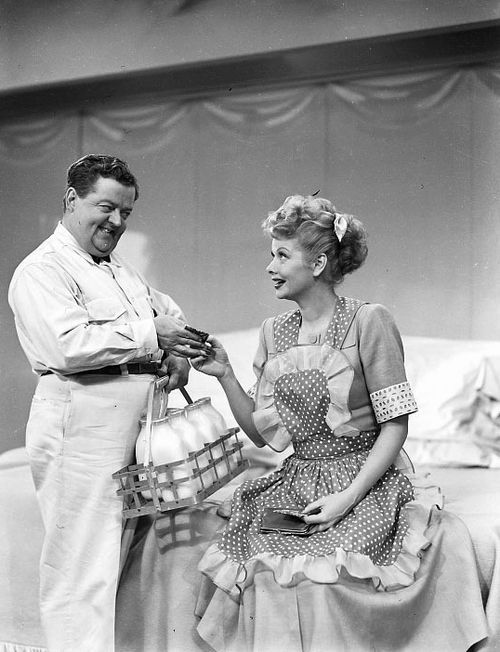
“The Gossip” (1952) ~ When Lucy overhears a juicy story about Grace Foster running away with the milkman, Ricky bets her she can’t go without gossiping. To win the bet, Lucy enlists the milkman and a jealous Mr. Foster in her scheme.
MILKMAN: “He’s after me! All my milk’s gone sour!”
Bobby Jellison played the milkman, the “cottage cheese Casanova” and “cow juice peddler” (as Bill Foster calls him).
MR. FOSTER: “From now on, we drink goat’s milk!”
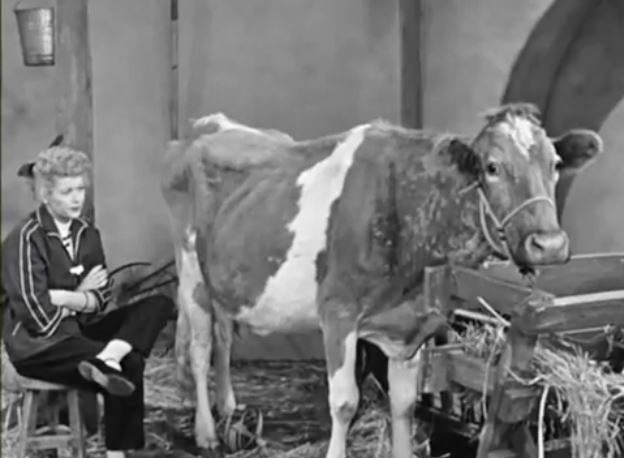
“Lucy’s Bicycle Trip” (1956) ~ The gang bikes from Italy to France and takes shelter in a barn for the night. For breakfast, the farmer brings them bread and cheese, but the milk must come from the cow!
Lucille Ball was able to produce one good stream of milk from the cow, but she didn’t think the lights caught the stream enough for it to show on camera. Writer Madelyn Pugh later said,
“It was the mangiest cow I’d ever seen. I went down to the set, and Lucy said, ‘You wrote it, YOU milk it!’”

Lucille Ball shared the cover of a March 1960 issue of “The Police Gazette” with a cover story claiming that “Milk Can be the Drink of Death”!
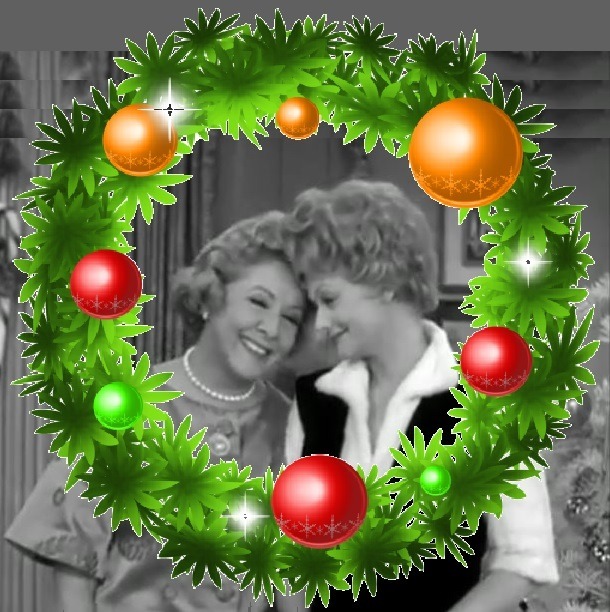
“Together For Christmas” (1962) ~ After trying in vain to share their holiday traditions, Lucy and Viv decide to go back to traveling to their respective relatives for the holidays. Lucy says she left a note for the milkman.
Until the end of the 1960s or so, most suburban homes had daily milk delivery, which involved leaving milk bottles on the porch (sometimes in a milk box). If a customer did not wish to have milk (or other dairy products) delivered that day – or for a period of days – it was standard procedure to ‘leave a note for the milkman’.
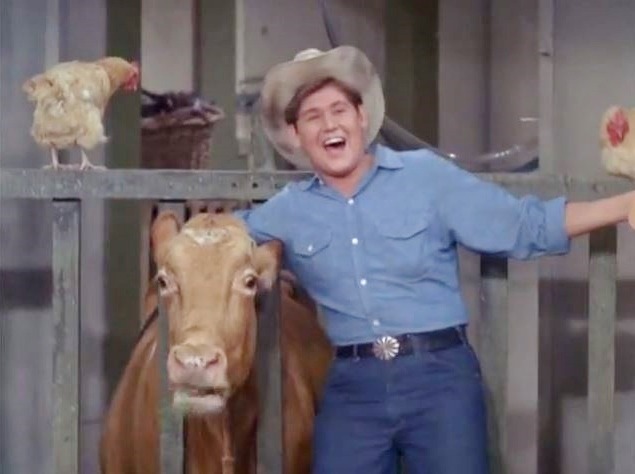
“Lucy Discovers Wayne Newton” (1965) ~ Newton sings an ode to his dairy cow, “Bessie the Heifer,” a 1951 country-western novelty song.
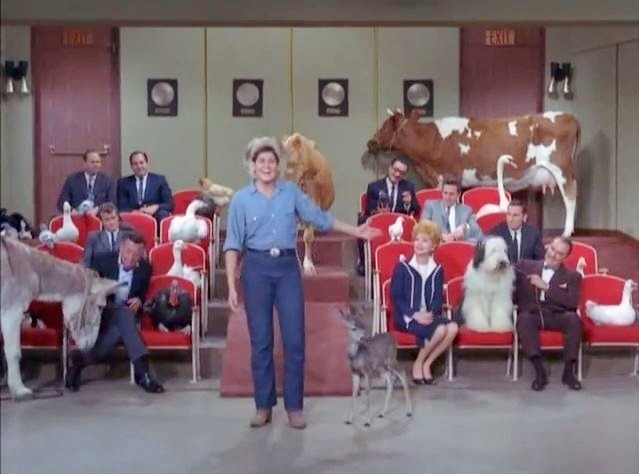
Bessie turns up again in the final recording studio sequence – with all Newton’s other farm animals.
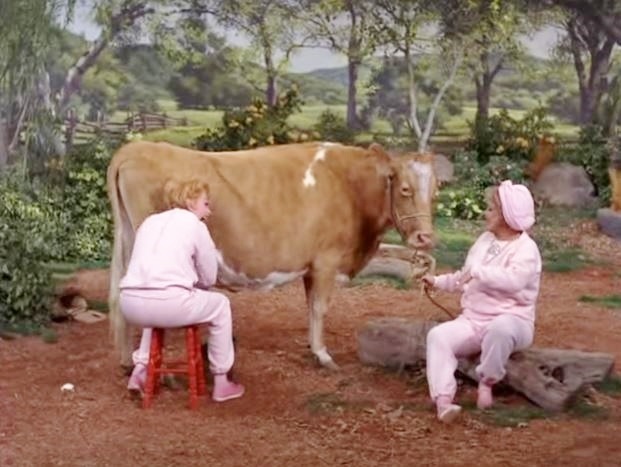
“Lucy and the Countess Lose Weight” (1965) ~ On a lunch break at the health farm, Lucy and the Countess realize if they want a drink with lunch, they are going to have to milk a cow.
To calm Bossie the cow while Lucy milks her, the Countess hums “The Blue Danube”. Lucy punctuates the downbeat with squirts of milk from the cow’s udder.

“Guess Who Owes Lucy $23.50?” (1968) ~ Van Johnson sings “Happy Birthday” to Ethel – the prize dairy cow of a Texas oil tycoon.
“Lucy the Shopping Expert” (1969) ~ Lucy teaches Kim about getting the best deals in the grocery store. In the dairy aisle, Lucy loses control of the nozzel on a can of whipped cream.
“Lucy’s Lucky Day” (1971) ~ Lucy goes on a game show named “The Milky Way to Riches” that is sponsored by the Dover Dairy.
When Mr. Larson the milkman (Billy Sands) rushes in with good news, Lucy teases him by guessing that Elsie the Cow had triplets. Elsie was the cartoon cow mascot of the Bordon Dairy Company from 1936 until it went out of business in the mid-1990s. Larson tells Lucy that she has won Dover Dairy’s customer of the year and will receive a free pint of raspberry apricot yogurt every week for a year.

“Lucy and the 20/20 Vision” (1971) ~ In order to pretend to be surprised by Harry at the door, Lucy acts as if she was putting out the milk bottle. At the time, rural delivery of milk and other dairy products to residential homes was common. In order to ‘recycle’ the milk bottles, homeowners would put the empty bottles on the porch at night, so the milkman could take them away early the next morning. A famous example of this was seen in the closing credits of the primetime cartoon sitcom satire “The Flintstones” (1960-66, inset photo).

“Lucy, the Other Woman” (1972) ~ Lucy’s milkman has a crush on her but his angry wife (Totie Fields) thinks Lucy is having an affair with the dairy deliveryman. Herbie Faye plays Lester Butkus the milkman. According to the insignia on his hat, he works for the Cloverleaf Dairy. This means that in the year since “Lucy’s Lucky Day” the Carter family has switched dairies. Mr. Butkas brings Lucy a free pint of banana fudge yogurt, adding to his wife’s conviction that he’s sweet as cream over Lucy.

The Butkus living room. A milkman lives here!
-
DESILU DOG POUND
Canine Companions on Lucycoms!
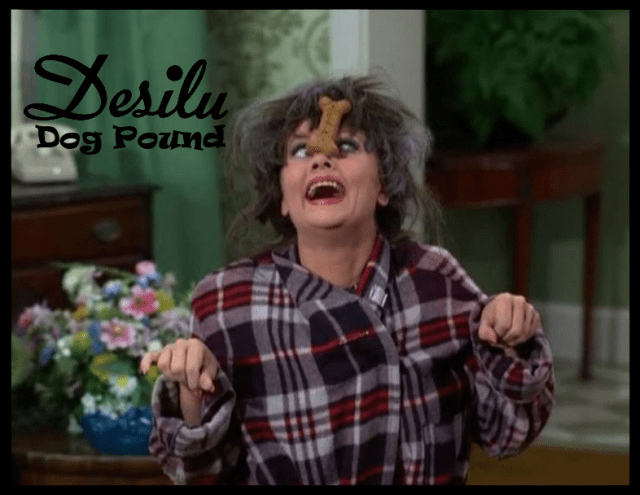
Woof! Open the kennels and take a look at all the dogs, pups, and canine pets in the Lucyverse!
In Annabel Takes a Tour (1938), Annabel (Lucille Ball) has a Terrier named Elmer.
In The Big Street (1942), Gloria Lyons (Lucille Ball) has a lap dog she calls Baby. Pinks (Henry Fonda) rescues Baby from being run over by a car.

Probably one of the most famous dogs on television was Fred the dog. Little Ricky’s friend Billy Palmer gave him a puppy to take home in January 1957 and he became part of the Ricardo family. Landlord Fred Mertz tells Lucy and Ricky their lease prohibits pets, but he bends the rules when Little Ricky names his puppy Fred.
LITTLE RICKY: “I always name my pets after people I like.”
Fred the dog was played by a Cairn Terrier named was Danny. He was trained by Bob Blair and was owned by Frank Inn. Danny also played Fremont, Mr. Wilson’s dog on “Dennis the Menace” (1959-63). In films, he was Snuffy in Pal Joey (1957), Muffy in Anatomy of Murder (1959), and Pepe in the final Three Stooges short Sappy Bullfighters (1959). Fred the dog would make the move to Connecticut with the Ricardos, but is not seen or mentioned during “The Lucy-Desi Comedy Hour” episodes. While he was the most popular, Fred was not the only dog seen on “I Love Lucy”…

At the end of “Lucy Thinks Ricky is Trying to Murder Her” (1951), the very first episode of “I Love Lucy” filmed, a dog act makes an appearance. An established vaudeville act, Hector and His Pals was also seen in the film Easter Parade in 1948. The dog trainer Hector, calls one of the dogs by its real name ‘Yorkie’. In the episode, the dogs are named Ann, Mary, Helen, Cynthia, Alice, and Theodore. Lucy hears the dogs’ names and thinks they are women Ricky is having an affair with – until she hears Theodore!
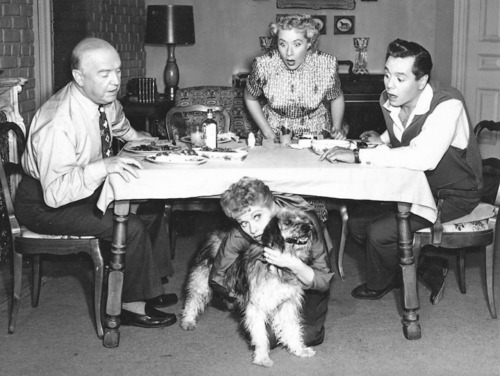
In the third episode aired, Butch, Fred’s mutt (as far as we can guess) stays under the table hoping for scraps in “The Diet” (1951) and then never heard of again. Unbeknownst to the others, a starving Lucy crawls under the table with Butch to intercept any tasty morsels meant for the dog.
Butch looks quite alarmed by the crazy lady under the table!

Sneaking into Richard Widmark’s mansion in “The Tour” (1955), Lucy hides under a bear rug – which just happens to be the favorite spot of Widmark’s St. Bernard Cap.

In “Second Honeymoon” (1956), a lonely Lucy asks Rocky the Bloodhound if he wants to play ping pong. Randy Rocky is tempted away by a French Poodle out for a stroll.
Lassie, the most famous canine in Hollywood history, turned up on “The Desilu Revue” in 1959. The series was filmed at Desilu Studios. Lucy and Desi enlisted the participation of all the Desilu stars in their Christmas special. Lassie was first mentioned by Lucy Ricardo in “The Young Fans” (1952).

In the very first episode of “The Lucy Show” in 1962, “Lucy Waits Up for Chris”, Tiger the dog belongs to Lucy’s neighbor and boyfriend Harry Connors (Dick Martin), who we meet in episode two. A dog named Tiger was also featured on TV’s “The Brady Bunch” (1969-1974). Here Tiger serves more as a plot device than pet. This is his one and only appeareance on the series.

When “Lucy and Viv Learn Judo” (1963), the Carmichaels dogsit with Alvin, played by Hey! The dog belongs to Jerry’s friend Amy Schaffer.

The final scene of the episode features a dozen dogs of various breeds, who come running at the silent sound of a dog whistle!
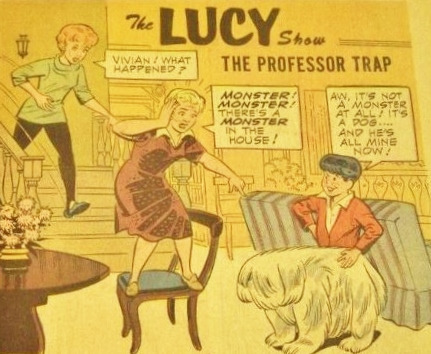
In the first frame of the June 1963 “The Lucy Show” Gold Key comic book, Jerry brings home a shaggy dog which Viv mistakes for a monster!
“Kiddie Parties Inc.” (1963) features Thunderbolt, a basset hound with more folds than an oragami swan.

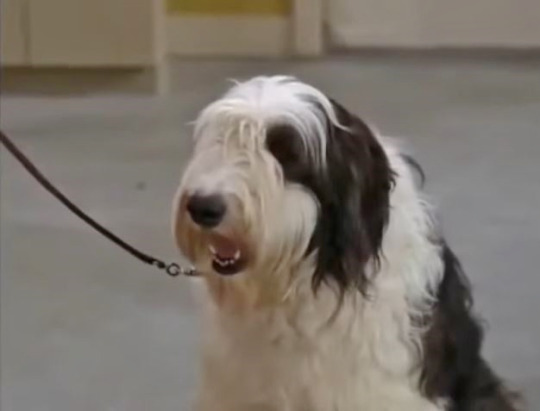
In “Lucy is Her Own Lawyer” (1964) Lucy complains when Mr. Mooney’s barking sheepdog Nelson (played by Lord Nelson) keeps her up all night. He tells her to sue him, and she does. After making a mockery of the court proceedings by acting as her own attorney, she finally wins her case by cross-examining Nelson. The neighborhood canines include:
- Howard McAdams’ Pomeranian
- Audrey Simmons’ Beagle
- Grandma Sutton’s Airedale
- The Hamilton’s Police Dog
Nelson is the only dog to appear on screen, with voice actor Pinto Colvig providing the off-screen barks for the other dogs.
Lord Nelson (Nelson) makes his first appearance as Mr. Mooney’s dog. He will also appear in “Lucy’s Contact Lenses” and would go on to appear on “Here’s Lucy” as Bogie in “Lucy and the Bogie Affair”. From 1965 to 1967, he played Ladadog (aka Lad) on “Please Don’t Eat the Daisies” and reprised the role of Nelson on “The Doris Day Show” from 1968 to 1971.
To keep Nelson in check, dog trainer Bob Blair plays the Bailiff.

In “Lucy and Clint Walker” (1965) Lightning, a lethargic Basset Hound, has a propensity to fall asleep, much like his master Frank Winslow (Clint Walker) did in “Lucy and the Sleeping Beauty”.

“Lucy Meets Mickey Rooney” (1966) has Lucy playing Charlie Chaplin in an acting school recital. The sketch features a stray mutt befriending the Tramp for his sandwich.

“Lucy at the Drive-In Movie” (1969) has Lucy searching through the passion pit for Kim and her new boyfriend. She mistakes an Afghan Hound for a long-haired woman.

In “Lucy and the Bogie Affair” (1969) Kim and Craig bring home a stray sheepdog (played by Lord Nelson) which they call Bogie because it has the same sad look standing in the rain as Humphrey Bogart does at the end of 1942’s Casablanca.

When Bogie turns out to be a she and gives birth to a litter of puppies, the Carters must find a home for the baby Bogies.
Lucy tries to give one of the pups to exercise guru Jack LaLanne, but only ends up taking one of Happy’s pups. Happy was LaLanne’s real-life dog appearing with him on many of his television shows.

“The Bow-Wow Boutique” (1973) has Lucy, Kim and Harry opening a dog grooming business. Their clients include:
- Louie, a French Spaniel
- Winston, a Bloodhound
- Teddy, an English Bulldog
- Tiger, a Yorkshire Terrier
- Tinkerbell, a St. Bernard
- and an un-named Daschund
LUCY THE PUP


-
Lucy’s PLANET OF THE APES
The Simian Citizens of the Lucyverse

During her long career on television, Lucille Ball worked with nearly every species of animal – but none more frequently than simians: monkeys, chimps, apes, gorillas, and even the rare (but fictional) gorboona!
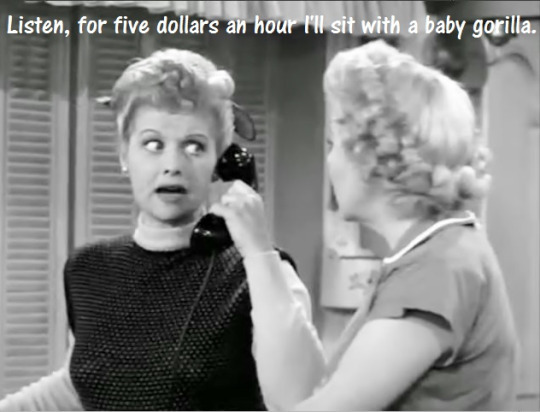
“The Amateur Hour” (1952) ~ Lucy says she’d babysit a baby gorilla for $5 an hour – but she hasn’t yet met the horrible Hudson twins! Her words will come back to haunt her in future incarnations of the Lucy character.

“Lucy Buys Westinghouse” (1958) ~ Desi Arnaz takes a Westinghouse representative on a tour of Desilu Studios (formerly RKO). At the props department Viv and Bill show off the model of Mighty Joe Young from the 1949 RKO film of the same name.
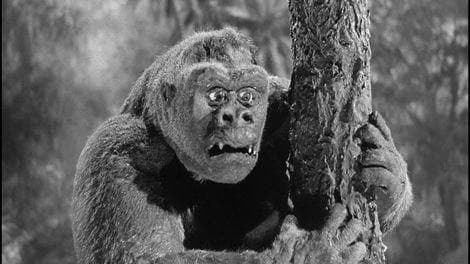
In this promotional film for Westinghouse executives, however, they refer to it as King Kong, another RKO film about a huge gorilla made by the same creative team. Lucie Arnaz remembers playing with the model as a child when set loose at Desilu Studios to play.

“Bilko’s Ape Man” (1959) ~ Lucille Ball guest stars in an 8-word cameo on “Sergeant Bilko” aka “The Phil Silvers Show”. In it, a fitness instructor is placed in Bilko’s platoon. To get rid of him (and to make some money) Bilko tries to get him cast in a Tarzan movie. Bilko tries to fix it so his man wins the Mr. Universe contest. First step: he hires a woman (Lucille Ball) to scream when his man goes on stage. When this fails, he dresses Private Doberman (Maurice Gosman) in a gorilla suit to fight his ‘Tarzan’. Colonel Hall (Paul Ford) sees the ‘gorilla’ and soon has the whole camp hunting for him.

“Lucy and Viv Take Up Chemistry” (1963) ~ At night school chemistry class, Lucy gets carried away trying to invent a youth serum.
LUCY: “Shouldn’t we test it on a monkey first?”
VIV: “If there’s one thing the world doesn’t need, it’s younger monkeys.”

“Lucy and the Monsters” (1965) ~ Lucy and Viv have a dream about monsters after seeing a horror movie. In the dream, the maid of a haunted house is a gorilla named Loretta, played by George Burrows. Burrows played a gorilla in his very first screen credit, Tarzan and His Mate (1934). He donned the gorilla suit 18 more times from 1954 to 1978. His final simian character was on “The Incredible Hulk.”
“Lucy and Art Linkletter” (1966) ~ Lucy is picked from Art Linkletter’s studio audience and challenged not to utter a sound for 24 hours to win $200. Linkletter arranges for various shocking events to occur at her apartment to get her to speak, including the attack of a giant gorilla named Hilda. George Burrows returns to play Hilda.
“Lucy and the Monkey” (1966) ~ Mary Jane warns an over-worked and over-tired Lucy that she could start having hallucinations. Meanwhile, Mr. Mooney gets a visit from his old college friend who has a monkey for a show business partner. Lucy sees the monkey and thinks it is Mr. Mooney!
Janos Prohaska played Max the Monkey. He was an actor, stunt man, and animal imitator who is probably best remembered as the talking cookie-mad bear on “The Andy Williams Show” (1969), although due to his thick Hungarian accent, his voice was dubbed.
He returned to play animals in three episodes of “Here’s Lucy.” Prohaska died in a plane crash in 1974.

“Lucy Goes to a Hollywood Premiere” (1966) ~ On the red carpet posing as an usher, Lucy meets a variety of clelebrities, including Mimi Van Tyson (Beverly Powers) and Coconuts Mulligan (George Barrows), stars of the movie “Love in the Jungle”. This is Barrows’ third and final female gorilla on the series.
Coconuts goes rogue when she sees Lucy’s yellow autograph book and thinks it is a banana!
“Lucy the Babysitter” (1967) ~ Lucy takes a job as a babysitter not knowing that they are baby chimps! They are played by The Marquis Chimps.

The rambunctious chimps tire out Lucy with their antics. Lucille Ball was forced to improvise based on the behavior of the chimpanzees.
The Marquis Chimps began appearing on television in 1955. They appeared in several TV commercials and on “The Ed Sullivan Show.” The chimps were the stars of the sitcom “The Hathaways” (1961-62) in which a suburban couple kept three performing chimps as their children. The program lasted just one season on ABC. The act’s last TV appearance was in 1976.

One of the toys in the chimp’s bedroom is Clancy the Great, a plastic-cast roller skating monkey, not unlike the Marquis Chimps, who also roller skate. Clancy had pose-able arms and a removable cap to accept tips! It was manufactured by Ideal Toys in 1963.

“Viv Visits Lucy” (1967) ~ On the Sunset Strip, Lucy and Viv track down a wayward Danfield boy to a hipster club named The Hairy Ape.

“Lucy Gets Jack Benny’s Account” (1967) ~ Lucy sets out to convince notorious miser Jack Benny to become a depositor at the bank. But first, they have to build a vault secure enough to satisfy Benny. One of the extreme methods of guarding the vault is Irving the Gorilla (who is managed by Benny). Although the actor inside the gorilla costume goes uncredited, it may be inhabited by George Barrows.
“Lucy’s Safari” (1968) ~ When a rare ‘Gorboona’ escapes from The Topanga Zoo, the Carters help a big game hunter (Howard Keel) trap him.

A ‘gorboona’ is a rare, nearly extinct, cross between a GORilla and a baBOON. Janos Prohaska returns to play the Gorboona.
“Lucy, the Helpful Mother” (1969) ~ Kim and Craig babysit for an entire pet shop – transporting all the residents to Lucy’s living room – including Irving, a baby chimpanzee.
Lucy sings a lullaby to the chimp:
“Rock-a-bye Irving
Hark to my chant.
You’re kinda cute
But you’re no Cary Grant.”
“Lucy and Viv Visit Tijuana” (1970) ~ Lucy, Harry and Vivian go sightseeing in Tijuana, but are stopped at the border after agreeing to take back a plush monkey that turns out to be carrying contraband!

“Lucy Cuts Vincent’s Price” (1970) ~ Lucy visits horror maestro Price to get a painting appraised and he thinks she is auditioning for a part in his new horror film. This monkey corpse is one of the most unusual props in the mansion – if not all of the Lucyverse!

“Lucy and the Raffle” (1971) ~ At the permit bureau, a stone-faced woman at the back of the line (Jody Gilbert) gets snide with Lucy.
LUCY: “Thank you, Mrs. Kong. Give my regards to your son, King.”
King Kong (1933) was a Hollywood film about a giant gorilla that attacked Manhattan. A sequel titled Son of Kong was released that same year.

“Lucy in the Jungle” (1971) ~ The Carters swap houses with a couple from the African jungle. The house comes with pets Fido and Rover – not dogs – but baby chimps.

When Harry sees Fido and Rover, he reminds Lucy and Kim that King Kong started out as a baby, too! Fay Wray, one of the stars of the original film, also made The Bowery that same year, which was the uncredited screen debut of Lucille Ball.

“Lucy’s Lucky Day” (1971) ~ Lucy goes on a TV game show and is challenged to teach an untrained chimpanzee to do a trick in order to win a thousand dollars. Jackie the Chimpanzee is the seventh chimpanzee to work with Lucille Ball on television.
Harry dresses up as a gorilla to try to coax Jackie into performing. In his DVD introduction to the episode, choreographer Jim Bates recalls that the chimpanzee only knew one trick – to cross its legs – so the entire routine was built around that. He also recalls that when Gale Gordon took off the gorilla head in the presence of the baby chimp, the chimp went into hysterics and had to be taken off set to calm down.
Finally, on “Milky Way to Riches” Lucy, Harry, Kim, and Jackie perform “Tell Me, Pretty Maiden” written in 1899 for the musical Floradora. They finish with “Daisy Bell / Bicycle Built for Two.”
The Planet of the Apes franchise began as a 1963 sci fi novel by Pierre Boulle. Boulle was also responsible for The Bridge Over the River Kwaii in 1952, which was referenced in “Lucy’s Summer Vacation” (1959). The first Planet of the Apes film was made in 1968. It was followed by four sequels, a television series and an animated series, as well as a several film reboots.

- Charleton Heston (Taylor) was mentioned in “Lucy Fights the System” (1974).
- Roddy McDowell (Cornelius / Caesar / Galen) attended (uncredited) the “All Star Party for Lucille Ball” in 1984.
- Claude Akins (Aldo) appeared on “I Love Lucy” (as the ‘Giant Native’) and “The Lucy Show” (as Lieutenant Finch).
- Ricardo Montalban (Armando) appeared as a Prince Hennepin on a 1972 episode of “Here’s Lucy.”
- Victor Buono (”Beneath the Planet of the Apes”) appeared on a 1969 episode of “Here’s Lucy” as a suspected international spy.
- Background players from the Lucyverse who appeared as humans or apes in some iteration of the franchise include: Jerry Maren, James Bacon, Jack Berle, Paul Bradley, Gail Bonney, James Gonzales, Shep Houghton, Arthur Tovey, James La Cava, Joyce Haber, Victor Romito, and Monty O’Grady.
-
KIDZ!
The Young People of the Lucyverse ~ Part 3
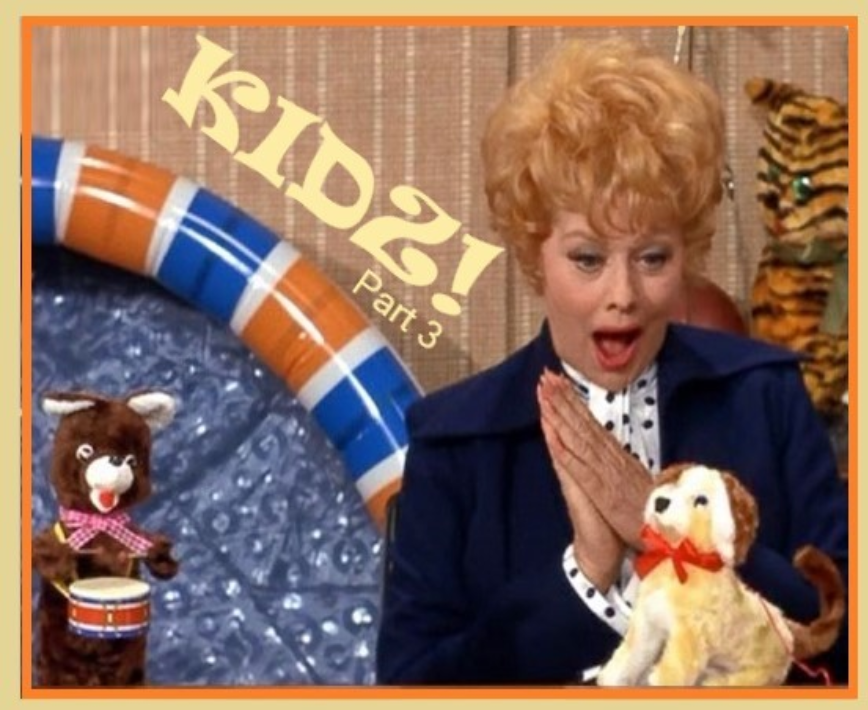
W.C. Fields famously warned performers never to work with children or animals. Luckily for us, Lucille Ball consistently disregarded his advice. Here’s a look at some of the young performers and characters of the Lucyverse.

“Lucy and the Drive-In Movie” (1969) ~ Jackie Berry is a married friend of Kim’s who has a newborn named Wendy. Her husband is said to be in the service. Jackie Berry uses her married name for the character. She ws the real-life wife of Ken Berry from 1960 to 1972, an actor championed by Lucille Ball.

“Lucy and Jack Benny’s Biography” (1970) ~ Lucy plays Jack’s mother and Michael Barbera plays Benny as a boy. Barbera was 12 years old at the time of filming. He accrued 18 screen credits before leaving the industry.

“Lucy Cuts Vincent’s Price” (1970) ~ Making small talk on the telephone with horror maestro Vincent Price, Lucy asks about Little Vicki. This is a reference to the Price’s 8 year-old daughter, Victoria. Although Lucy visits their home, Vicki remains off-screen.

“Lucy the Laundress” (1970) ~ Lucy smashes into a laundry truck. In order to pay for the repairs, she has to go to work at the laundry and encounters the owner’s two daughters Sue Chin Wong (left) and Linda Change Wong (right). Linda is played by Rosalind Chao who makes her screen debut with this episode. She created the role of Soon-Ye Klinger on “M*A*S*H” and “After M*A*S*H” but is perhaps best known for playing Keiko O’Brien on “Star Trek: The Next Generation” and “Deep Space Nine.” During that series she also filmed The Joy Luck Club. More recent credits include “Blackish,” “This is Us,” and “The Catch.” Heather Lee (Sue Chin Wong) makes her screen appearance in this episode. When Lucy meets the sisters, she greets them in an exaggerated and condescending Chinese accent. The girls look horrified and answer back in voices totally devoid of any Asian influence. To further the humor of Lucy’s backward thinking, the girls are eating hamburgers with ketchup, a typical American-style meal.
“Lucy and Ma Parker” (1970) ~ A criminal mastermind (Carole Cook) enlists two little people (Jerry Marin and Billy Curtis) to play her ‘children’. Milton (Marin) is dressed as ‘Little Mildred’ in the style of child star Shirley Temple. Curtis plays Herman Golab, who is dressed as Buster Brown.

“Lucy and the Italian Bombshell” (1971) ~ Harry’s former flame Donna Colucci (Kaye Ballard) is married and has a large brood of children: Ricardo, Anna Maria, Louisa, Luigi, Vincenzo, Dino, Lucrezia, Alfredo Jr., Margarito, Bruno, Rosa, and Frederico – all of whom appear uncredited.

“Lucy and Donny Osmond” (1972) ~ Lucy takes her pre-teen niece Patricia (Eve Plumb) to see her favorite singer, Donny Osmond. Plumb is probably best known as the middle daughter, Jan, on TV’s “The Brady Bunch” (1969-74). Coincidentally, Desi Arnaz Jr. made a guest-appearance on “The Brady Bunch” in 1970 where he was the ‘dream date’ of Jan’s sister Marcia (Maureen McCormick).
“Lucy and Her Prince Charming” (1972) ~ Harry hastily arranges a home wedding ceremony for Lucy and a Prince (Ricardo Montalban) – including a flower girl and a ring bearer – played by two uncredited young actors.

Mame (1974) ~ Lucille Ball plays Auntie Mame to orphaned nephew Patrick Dennis, played by Bruce Dern as a child.

“Life With Lucy” (1986) ~ Lucy Barker and Curtis McGibbon (Gale Gordon) are grandparents to Becky and Kevin McGibbon. Becky is played by Jenny Lewis. Ten year-old Lewis appeared in all 13 episodes, only 8 of which were aired.
“Yes, Lucy was a bit rough around the edges, and yes, she constantly smoked cigarettes on the set. She would pull her face back with tape, sort of like a cheap face-lift.“ ~ JENNY LEWIS
Philip Amelio (Kevin McGibbon) made his screen debut on “Life With Lucy” at the age of 10. He played Stephen Baldwin’s younger self in the film Born on the Fourth of July (1989). He gave up acting by his early teensPhilip died in 2005 at the age of 27 due to a mis-diagnosed bacterial infection.

Kelli Martin (right) played Becky’s friend Patty in two episodes of the series. Born in 1975, she made her acting debut at age 7 and went on to be seen as an Emmy-nominated regular on “Life Goes On” (1989-93) and “Christy” (1994-95) in which she played the title character.
BONUS KIDZ!

“Lucy the Diamond Cutter” (1970) ~ German diamond cutter Gustav (Wally Cox) calls Kim and Craig “the Katzenjammer Kids.” The Katzenjammer Kids was a comic strip created by German immigrant Rudolph Dirks which appeared from 1897 to 2006. The strip featured twins Hans and Fritz, who rebelled against authority.

“Lucy and the Generation Gap” (1969) ~ In the final sequence of the musical episode set in outer space, the Carters sing “Kids”, a song written by Lee Adams and Charles Strouse for the 1960 Broadway musical Bye Bye Birdie. The musical was filmed in 1963. It was sung on stage and screen by Paul Lynde, playing the father of free-thinking kids obsessed with an Elvis-like rock and roll singer.
-
KIDZ!
The Young People of the Lucyverse ~ Part 2

W.C. Fields famously warned performers never to work with children or animals. Luckily for us, Lucille Ball consistently disregarded his advice. Here’s a look at some of the young performers and characters of the Lucyverse.

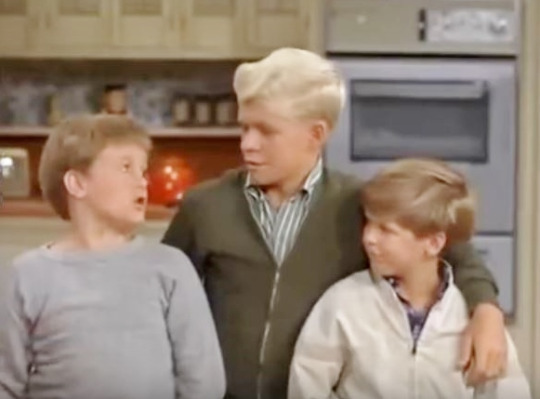
Jerry Carmichael (Jimmy Garrett) and Sherman Bagley (Ralph Hart) ~ Jerry was the son of Lucy and Ralph was Viv’s boy on “The Lucy Show”. Hart appeared in 44 episodes from 1962 to 1965. Garrett appeared in 55 episodes from 1962 to 1965. Jerry had a teenage sister named Chris and their father was deceased. Sherman was an only child whose dad Ralph was divorced his mother Vivian.

Chris’s young friend Susie (Lucie Arnaz) appeared in “Lucy is a Chaperone” (1962).
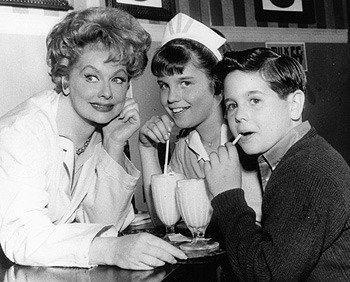
Susie turned up again as a waitress at Wilbur’s Ice Cream Parlor in “Lucy is a Soda Jerk” (1962). Desi Arnaz Jr. plays a customer, meaning that both of Lucille Ball’s real-life children appeared in the same episode.

In other episodes, Desi Arnaz Jr. played Billy Simmons, son of Audrey (Mary Jane Croft), a baseball player, football player, and cub scout. Billy was seen in “Lucy is a Referee” (1962), “Lucy and the Little League” (1963), “Lucy Visits the White House” (1963), and “Lucy and the Scout Trip” (1964, above), which also included Barry Livingston (as Arnold Mooney) and nine other uncredited scouts.

When the show shifted locations to Los Angeles leaving Susie and Billy behind, Lucie and Desi Jr. appeared as spectators in the grandstands in “Lucy At Marineland” (1965).

“Lucy Misplaces $2,000″ (1962) ~ Katie Sweet (Katie, Granddaughter of Woman on Bench) was just five years old when she filmed this episode, but had been acting since the age of two! Earlier that year, Sweet played the title role in the Desilu pilot “Sukuzi Beane”, which co-starred Jimmy Garrett and helped him land his role of Jerry Carmichael. Sweet left show business when she was 13.

“Together for Christmas” (1962) ~ Ends with Jerry and Sherman joining a group of carolers from the YMCA. The carolers were played by the real-life Mitchell Boys Choir.
“Lucy is a Referee” (1962) ~ In addition to Jerry, Sherman, and Billy, the cast featured Dennis Rush (left) as Tony Lawrence. The other football players are played by the Mighty Mites of the Venice Athletic Club, a pee-wee football team from Venice Beach, California.
“Lucy Goes to the White House” (1963) ~ Lucy and Viv take their cub scout troop to Washington DC to bring their sugar cube White House to President Kennedy. In addition to Jerry, Sherman, and Billy – the cast also includes 9 uncredited young boys as Cub Scout Pack 57.
Critic’s Choice (1963) ~ Ricky Kelman played John Ballentine, son of Parker (Bob Hope) and stepson of Angie (Lucille Ball), husband and wife theatre critics.
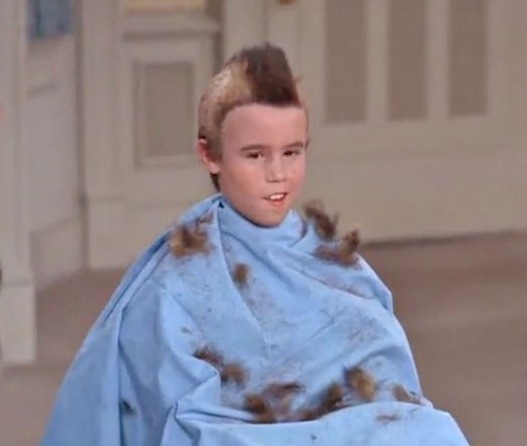
“Lucy Gets Locked in the Vault” (1963) ~ Barry Livingston plays Mr. Mooney’s son Arnold. Livingston is probably best remembered as Ernie, the adopted son on “My Three Sons.” His first appearance on that series was just one week after he played Arnold Mooney, a role he would return to in “Lucy and the Scout Trip” (1964).
When Livingston started on “My Three Sons” (also filmed at Desilu), the role of Arnold Mooney was taken over by Teddy Eccles in “Lucy’s Contact Lenses” (1964). Eccles began his show business career at the age of 4 and was 9 years old when he first appeared on “The Lucy Show.”

He will make two more appearances on the series as other characters, including as Harold, a young cadet in “Lucy At Marineland” (1965). Coincidentally, Eccles also appeared in two episodes of “My Three Sons” alongside Barry Livingston.

“Kiddie Parties, Inc.” (1963) ~ Lucy and Viv go into business hosting children’s birthday parties. Ronnie Dapo (David, above right) was a ten year-old actor whose first screen credit was in 1959 and his last in 1966. He made several appearances on “The Andy Griffith Show,” the second airing the very same night as this episode of “The Lucy Show.” There are 8 other young boys in the party scene.
“Lucy Becomes a Father” (1964) ~ Lucy accompanies Jerry on a father / son camping trip where Mr. Mooney is intent on making it so difficult that Lucy will pack up and go home. Five uncredited boys play the other sons on the trip. If Mr. Mooney’s son Arnold is among the boys, he is not singled out, nor are Barry Livingston or Ted Eccles in the cast.
“Lucy and the Stamp Collector” (1965) ~ Stamp collector Junior White is played by Flip Mark, who celebrated his 16th birthday the day after this episode first aired. He was born Philip Mark Goldberg in New York City. In 1965, he played a young Steve Olson on “Days of Our Lives.”
Flip Mark returned to “The Lucy Show” in “Lucy Goes to a Hollywood Premiere” (1966) as a kid selling maps to the stars homes. Curiously, this episode also mentions stamp collecting!

“Lucy the Choirmaster” (1965) ~ Lucy organizes a boys choir to entertain at the bank holiday show. The choir features her son Jimmy Garret as Jerry (his final appeareance), Ted Eccles as Barry, Robert Roter as Newton, Micahel Blake as Malcolm, and Theodore Miller as Stanley.

The other members of the choir (except for Mr. Mooney) were played by the St. Charles Boys Choir. Later that year, they formed the Disneyland Boys Choir and recorded the It’s a Small World album of folk songs still sold at Disney theme parks.

“Lucy the Robot” (1966) ~ Jay North, best known as the title character of “Dennis the Menace”, plays Mr. Mooney’s rambunctious nephew Wendell. Interestingly, Gale Gordon (Mr. Mooney) played Mr. Wilson on “Dennis the Menace” during its final season.

“Main Street U.S.A.” (1967) ~ Jackie Minty plays a Bancroft newspaper boy. Minty was a child actor who had done two episodes of “The Munsters.” A week after this episode of “The Lucy Show,” he appeared on “My Three Sons,” his final screen credit before leaving Hollywood.
Yours, Mine and Ours (1968) ~ Lucille Ball and Henry Fonda play parents of a blended family of 19 children. Among them are Tim Matheson, Gil Rogers, Nancy Howard, Morgan Brittany, Eric Shea, and Tracy Nelson.
BONUS KIDZ!
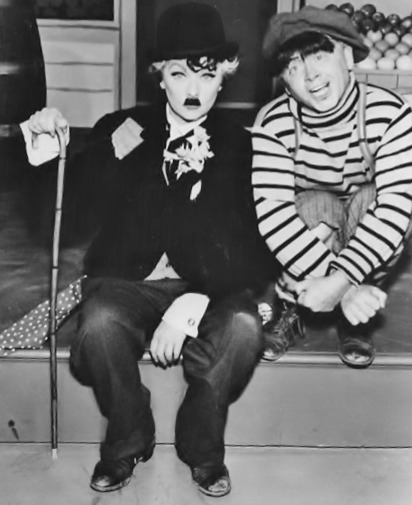
“Lucy Meets Mickey Rooney” (1966) ~ In an acting school show, Lucy plays Charlie Chaplin and Mickey Rooney plays ‘The Kid’, a character based on Chaplin’s 1921 silent classic The Kid starring Jackie Coogan in the title role.
“Lucy the Stockholder” (1965) ~ Lucy, Viv and Mr. Mooney participate in an age regression experiement conducted by an eccentric doctor.
STAY TUNED FOR PART 3










-
Subscribe
Subscribed
Already have a WordPress.com account? Log in now.
 Papermoon Loves Lucy