-
AL LEWIS
April 30, 1923 (or 1910)

Al Lewis was born Alexander Meister on April 30th in New York City; the son of a house painter from Minsk, and a garment worker from the Russian Empire. He had two brothers; Phillip and Henry. The year of his birth was generally accepted to be 1923, but could be as early as 1910 based on Lewis’s statements.

His acting career begins the well-documented portion of his life. He worked in burlesque and vaudeville theaters, then on Broadway in the dramas The Night Circus (1958) and One More River (1960) and as the character Moe Shtarker in the musical comedy Do Re Mi (1962).

His earliest television debut came on an episode of the the crime drama “Decoy” in late December 1957. Even in this earliest appearance he wore a tuxedo and smoked a cigar, two of his most identifiable traits.

Lewis will be best remembered for two television roles. The first is Officer Leo Schnauser with Fred Gwynn on “Car 54, Where Are You?” (1961 to 1963). He also played the character in the 1994 re-boot.

After the series was canceled, Lewis re-teamed with Gwynn on “The Munsters” a sitcom look at the Universal monsters where Lewis played Grandpa (aka Count Dracula) and Fred Gwynn played his son-in-law Herman Munster, the spitting image of the Frankenstein monster. He played Grandpa (or versions of him) for the rest of his career, including a color featured film based on the series in 1966.

In December 1968, he did day of filming at Desilu Studios just before it was turned over to Paramount. He was in an episode of “Gomer Pyle USMC” along with Kathleen Freeman. The series did a cross-over cameo with “The Lucy Show” in 1966.

On New Year’s Eve 1973, Al Lewis appeared on “Here’s Lucy” in “Lucy Plays Cops and Robbers” (HL S6;E14). Lewis and Mary Wickes played Lucy Carter’s neighbors, the Barkers, in a suburban crime-themed episode.

Lewis was an eccentric New Yorker who had his own radio show and often made appearances on “The Howard Stern Show.” He also made a run for Governor of New York.
He died on February 3, 2006, at the age of 83. He was married twice, and had three sons who he was very proud of .

-
BREAKFAST WITH VENORA
April 30, 1936

Lucille Ball with Lela Rogers, head of talent development at RKO, at the RKO Little Theater, later known as Desilu Playhouse.

The RKO RADIO DRAMA SCHOOL presents presents
BREAKFAST WITH VANORA by Fred Ballard
at the RKO LITTLE THEATRE
Directed and Produced by Leila E. Rogers
- Lucille Ball (Vanora) at the time, Lucille Ball was filming her 31st film, Bunker Bean, to be released in June 1936.
- Barbara Pepper (Chorus Girl) had done four films with Lucille Ball since 1933, and the two were about to also be cast in Winterset, which would be their last film together until 1950. Pepper and Ball had become friends, and Lucille often employed her in character roles on “I Love Lucy.”
- Cleo Mandicos was the first cousin of Lucille Ball, but raised as her sister. Later, she became known as Cleo Morgan and Cleo Smith. She worked for Lucille Ball as producer of “Here’s Lucy.”
- Edward Price (Husband) newspapers reported that Lela Rogers cast Price as a favor to him and that the next day he was cast in Swing Time, starring Ginger Rogers and Fred Astaire. However, no cast lists confirm that Price was in the picture, or any other RKO releases.
- Walter Armitage (Prosecuting Attorney) was a South African actor who only appeared in one film for RKO in 1934: Where Sinners Meet.
- Earl Eby (Trial Judge) acted in eleven films in 1936 alone, although none with Lucille Ball, before he turned to producing and directing for television.
- Allan Curtis (Broadway Publicity Man) was also about to do Winterset with Lucille Ball and Barbara Pepper. In 1936, he also did the RKO comedy short One Live Ghost with Lucy, as well as RKO’s Don’t Tell The Wife (1937).
- Vangie Beilby (Maiden Aunt) was a British character actress who did 50 Hollywood films (all in uncredited roles) between 1932 and 1950.
- Anita Colby is sometimes credited as “America’s first supermodel” – the first model to make more than $100 an hour. In 1936 she did three films for RKO, including Mary of Scotland, starring Katharine Hepburn.
- Tommy Graham appeared in RKO’s 1936 film Don’t Turn ‘Em Loose. His only other credit was in RKO’s Too Many Girls, starring Lucille Ball and Desi Arnaz.
- Marie Osborne was a child star in silent movies, but returned to acting in 1934. Her second talking film was RKO’s Roberta starring Ginger Rogers and Lucile Ball. With Lucy, she was also in Stage Door, and Having Wonderful Time.
- Walter Murray was seen in RKO’s The Toast of New York (1937) and only did three more films.
- Rollo Dix did only six films between 1930 and 1938.
- Russ Dudley has only one credit: Painted Faces (1929).
- Roy Brent made his screen debut in 1933 with RKO’s hit King Kong. He was also seen with Lucille Ball and Ginger Rogers in RKO’s Top Hat (1935).
- With Thomas Quinn, Joe Stansill, and Fred Parrish

“It was such a busy, happy time for me. Lela took the dungarees off us and put us into becoming dresses; she ripped off our hair bands and made us do our hair right. If we went to see a big producer in his office, she cautioned us to put on full makeup and look like somebody. She made us read good literature to improve our English and expand our understanding of character. She drummed into us how to treat agents and the bosses upstairs… ” ~ Lucille Ball


Lela Rogers shows John Shelton how to hold the gun in one of her Little Theatre productions while Lucy Ball looks on.

“Breakfast with Vanora” was not Lucille Ball’s first appearance at the RKO Little Theatre, she also appeared in Fly Away Home in January 1936. The Theater was open to the public. Tickets cost 25 cents each.Lela Rogers was reportedly related to Ball on her mother’s side, which made Lucy and Ginger distant cousins.
-
TV GUIDE: THE REAL BALL
April 30, 1966

Lucille Ball appeared in caricature by Ronald Searle on the cover of TV Guide (issue #683 / vol. 14 / No. 18) for April 30 through May 6, 1966.


Ronald Searle (1920 – 2011) was an English artist and cartoonist. He is perhaps best remembered as the creator of St Trinian’s School and for his collaboration with Geoffrey Willans on the Molesworth series.

He was a frequent contributor to TV Guide.
This was one of Lucille Ball’s 39 covers of TV Guide from 1953 till the magazine stopped publishing. This was the first of her two covers in 1966. In late October 1966 TV Guide used a shot of Lucy in “London Mod” attire with tagline “Lucy Goes Mod In London.”


“Direct, uncluttered, lovable, and above all, professional” ~ Searle about Lucy

“Her heart is in the right place and it is not on her sleeve” ~ Searle about Lucy


Although “The Lucy Show” was on summer hiatus from April 30 to May 5, 1966, on Sunday, May 1, CBS aired “The Magic of Broadcasting” in which Lucille Ball either appeared or narrated.
-
SPRING HOUSE CLEANING
April 30, 1950

“Spring House Cleaning” (aka “Spring Cleaning”) is episode #86 of the radio series MY FAVORITE HUSBAND broadcast on April 30, 1950.
Synopsis ~
Liz sends George an anonymous love letter that she wrote to him during his bachelor days, and he thinks its from his secretary, Gladys.

“My Favorite Husband” was based on the novels Mr. and Mrs. Cugat, the Record of a Happy Marriage (1940) and Outside Eden (1945) by Isabel Scott Rorick, which had previously been adapted into the film Are Husbands Necessary? (1942). “My Favorite Husband” was first broadcast as a one-time special on July 5, 1948. Lucille Ball and Lee Bowman played the characters of Liz and George Cugat, and a positive response to this broadcast convinced CBS to launch “My Favorite Husband” as a series. Bowman was not available Richard Denning was cast as George. On January 7, 1949, confusion with bandleader Xavier Cugat prompted a name change to Cooper. On this same episode Jell-O became its sponsor. A total of 124 episodes of the program aired from July 23, 1948 through March 31, 1951. After about ten episodes had been written, writers Fox and Davenport departed and three new writers took over – Bob Carroll, Jr., Madelyn Pugh, and head writer/producer Jess Oppenheimer. In March 1949 Gale Gordon took over the existing role of George’s boss, Rudolph Atterbury, and Bea Benadaret was added as his wife, Iris. CBS brought “My Favorite Husband” to television in 1953, starring Joan Caulfield and Barry Nelson as Liz and George Cooper. The television version ran two-and-a-half seasons, from September 1953 through December 1955, running concurrently with “I Love Lucy.” It was produced live at CBS Television City for most of its run, until switching to film for a truncated third season filmed (ironically) at Desilu and recasting Liz Cooper with Vanessa Brown.
MAIN CAST

Lucille Ball (Liz Cooper) was born on August 6, 1911 in Jamestown, New York. She began her screen career in 1933 and was known in Hollywood as ‘Queen of the B’s’ due to her many appearances in ‘B’ movies. With Richard Denning, she starred in a radio program titled “My Favorite Husband” which eventually led to the creation of “I Love Lucy,” a television situation comedy in which she co-starred with her real-life husband, Latin bandleader Desi Arnaz. The program was phenomenally successful, allowing the couple to purchase what was once RKO Studios, re-naming it Desilu. When the show ended in 1960 (in an hour-long format known as “The Lucy-Desi Comedy Hour”) so did Lucy and Desi’s marriage. In 1962, hoping to keep Desilu financially solvent, Lucy returned to the sitcom format with “The Lucy Show,” which lasted six seasons. She followed that with a similar sitcom “Here’s Lucy” co-starring with her real-life children, Lucie and Desi Jr., as well as Gale Gordon, who had joined the cast of “The Lucy Show” during season two. Before her death in 1989, Lucy made one more attempt at a sitcom with “Life With Lucy,” also with Gordon.
Richard Denning (George Cooper) was born Louis Albert Heindrich Denninger Jr., in Poughkeepsie, New York. When he was 18 months old, his family moved to Los Angeles. Plans called for him to take over his father’s garment manufacturing business, but he developed an interest in acting. Denning enlisted in the US Navy during World War II. He is best known for his roles in various science fiction and horror films of the 1950s. Although he teamed with Lucille Ball on radio in “My Favorite Husband,” the two never acted together on screen. While “I Love Lucy” was on the air, he was seen on another CBS TV series, “Mr. & Mrs. North.” From 1968 to 1980 he played the Governor on “Hawaii 5-0″, his final role. He died in 1998 at age 84.
Gale Gordon (Rudolph Atterbury) had worked with Lucille Ball on “The Wonder Show” on radio in 1938. One of the front-runners to play Fred Mertz on “I Love Lucy,” he eventually played Alvin Littlefield, owner of the Tropicana, during two episodes in 1952. After playing a Judge in an episode of “The Lucy-Desi Comedy Hour” in 1958, he would re-team with Lucy for all of her subsequent series’: as Theodore J. Mooney in ”The Lucy Show”; as Harrison Otis Carter in “Here’s Lucy”; and as Curtis McGibbon on “Life with Lucy.” Gordon died in 1995 at the age of 89.
Bea Benadaret (Iris Atterbury) does not appear in this episode.
Ruth Perrott (Katie, the Maid) was also later seen on “I Love Lucy.” She first played Mrs. Pomerantz, a member of the surprise investigating committee for the Society Matrons League in “Pioneer Women” (ILL S1;E25), as one of the member of the Wednesday Afternoon Fine Arts League in “Lucy and Ethel Buy the Same Dress” (ILL S3;E3), and also played a nurse when “Lucy Goes to the Hospital” (ILL S2;E16). She died in 1996 at the age of 96.
Bob LeMond (Announcer) also served as the announcer for the pilot episode of “I Love Lucy”. When the long-lost pilot was finally discovered in 1990, a few moments of the opening narration were damaged and lost, so LeMond – fifty years later – recreated the narration for the CBS special and subsequent DVD release.
EPISODE

ANNOUNCER: “As we look in on the Coopers, it’s a beautiful spring day, and Liz is just going into the kitchen to talk to Katie, the maid.”
Liz tells Katie that they are going to give her a raise. Katie thinks there’s a catch. And there is. Today is the day of Spring housecleaning. This year, George is going to help – although he doesn’t know it yet. After five marriages, Katie knows the only way to get a man to help with cleaning is to shame him into doing it.
Meanwhile, at the bank, Mr. Atterbury calls George into his office to tell him that he can’t make their golf date that afternoon. He suggests George stay at work and dictate to his new secretary Gladys. Mr. Atterbury says that Gladys is sweet on George – calling him “Cuddles Cooper” to the other secretaries. George wants Mr. Atterbury to transfer her so he can get some work done.

George found a poem on his desk:
Oh, what a lucky girl am I,
Who wouldn’t want to be me?
Who wouldn’t like to have a boss,
So handsome, tall, and dreamy?Mr. Atterbury says that if George still wants Gladys transferred, he’ll consider it on Monday, maybe switching with Joe Ridgely.
At home, Liz and Katie are putting their plan in action by pretending to lift heavy items just as George comes through the door. George sees her trying to lug a ‘heavy’ bucket of ashes, but makes no attempt to help her. He quickly realizes he needs to help – but when he tries to lift the ‘heavy’ can of ashes, the can goes flying across the room – along with the ashes. George says for her tricks she can do the cleaning herself.

Katie comes into the room from cleaning with an handful of love letters to George, written in a woman’s hand. Naturally, they can’t resist reading it. Katie does the reading so Liz can technically say she hasn’t read it.
Katie reads a mushy love letter to “Coopie Whoopie”. Katie lets it slip that she’s read the entire pile. The letters are signed E.E. Liz admits that she was E.E. Liz gets a fun idea. She’ll finish one of those letters and send it to George to see his reaction.
Later, Liz tells George that a letter came for him ‘special delivery’. George reads a few lines and immediately thinks it is from his secretary Gladys. He tells her it is just a bill from the gas company.
LIZ: “How come the gas company sends you special delivery? You got bigger burners?”
Liz taunts him a bit more and George gets angry and storms out – just as she is about to tell him that she wrote it! She breaks down in tears thinking there’s another woman in his life!
KATIE: “But you wanted him to think it was someone else!”
LIZ: “Sure, I wanted him to think it was from someone else. But he thinks it was from someone else!”End of Part One

Announcer Bob LeMond does a commercial for Jell-O Tapioca pudding.
ANNOUNCER: “As we return to the Coopers, Liz is burning up about the supposed other woman in George’s life. Right now, George has shut himself in the den to use the phone.”
George calls Mr. Atterbury to tell him that Gladys sent him a special delivery love letter. Mr. Atterbury asks whether she used bank stamps! Meanwhile, in the kitchen, Liz and Katie wonder who George is talking to on the phone. Liz is sure it is ‘her’. Liz wants to open the den door on the premise of letting the dog out. Katie reminds her that they don’t have a dog!
Liz and Katie have cracked the door enough to overhear:
GEORGE (on phone): “There’s just one thing to do: I’m going to get rid of her. I’d like to make it as painless as possible. First thing Monday morning I’ll ask her to leave. I’ll tell her you arranged for a transfer.
LIZ (to Katie): “Transfer? What does he expect me to do? Go to Reno on a streetcar?”
From 1904 to 1927 there was a network of streetcars in Reno, Nevada, that served as the main mode of public transit. While Las Vegas was known for quickie weddings, Reno was known for its fast divorces. Nevada divorce laws, allowed people to divorce each other after six weeks of residency, instead of six months. People wishing to divorce stayed in Reno while waiting out the mandatory period. The association of Reno with divorce has entered pop culture references.
GEORGE (on the phone): “Joe Ridgely can have her, and I’ll take his.”
LIZ (to Katie): “He’s going to trade me in on a later model!”
Here the plot is very similar to “Lucy Thinks Ricky Is Trying to Murder Her” (ILL S1;E4) the very first episode of “I Love Lucy” filmed, but the fourth aired. Ricky tells Jerry on the phone that he has decided to ‘get rid’ of his girl singer Marilyn. Lucy overhears and think she is “a future doornail”!
George tells Mr. Atterbury that he’ll call Gladys and tell her about the change. George hangs up and Liz and Katie pretend to be casual. Liz picks up the nearest book – the dictionary.
George says he has to do something. And Liz and Katie hide in the closet while he calls Gladys. Katie is straddling a vacuum cleaner. The dusty closet nearly makes her sneeze.

GEORGE (on phone): “I’ve decided to do something about it. I’ll be sorry to lose you. I don’t care what they told you in business school, I love my wife!”
Liz hears nothing but compliments from her hiding place in the closet. The dust makes her sneeze. George thinks it is Gladys. Or that the operator is listening in. He wants to give Gladys a second chance. George wants Gladys to talk to Liz on the telephone. From the closet, Liz tries to make it sound like she’s in the attic. Liz sneezes again. George realizes it came from the closet and throws open the door to find Liz giving Katie fine points on spring cleaning the closet!
-
VACATION TIME
April 29, 1949
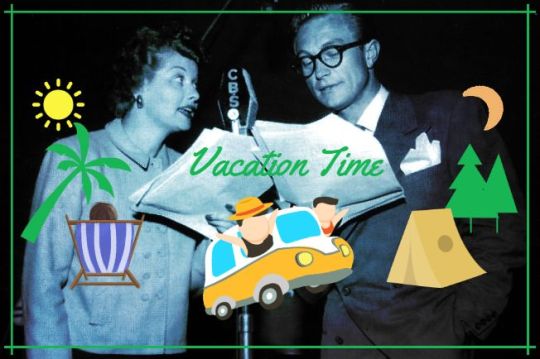
“Vacation Time” (aka “Trailer Vacation to Goosegrease Lake”) is episode #41 of the radio series MY FAVORITE HUSBAND broadcast on April 29, 1949 on the CBS radio network.
Synopsis ~ It’s vacation time, and Liz and George have decidedly different plans. He wants to go camping with a trailer he borrowed from a friend, while she’s set on a glamorous vacation at Moosehead Lodge.

This episode later partly inspired the premise of “Liz Learns To Swim” aired on June 11, 1950.

“My Favorite Husband” was based on the novels Mr. and Mrs. Cugat, the Record of a Happy Marriage (1940) and Outside Eden (1945) by Isabel Scott Rorick, which had previously been adapted into the film Are Husbands Necessary? (1942). “My Favorite Husband” was first broadcast as a one-time special on July 5, 1948. Lucille Ball and Lee Bowman played the characters of Liz and George Cugat, and a positive response to this broadcast convinced CBS to launch “My Favorite Husband” as a series. Bowman was not available Richard Denning was cast as George. On January 7, 1949, confusion with bandleader Xavier Cugat prompted a name change to Cooper. On this same episode Jell-O became its sponsor. A total of 124 episodes of the program aired from July 23, 1948 through March 31, 1951. After about ten episodes had been written, writers Fox and Davenport departed and three new writers took over – Bob Carroll, Jr., Madelyn Pugh, and head writer/producer Jess Oppenheimer. In March 1949 Gale Gordon took over the existing role of George’s boss, Rudolph Atterbury, and Bea Benaderet was added as his wife, Iris. CBS brought “My Favorite Husband” to television in 1953, starring Joan Caulfield and Barry Nelson as Liz and George Cooper. The television version ran two-and-a-half seasons, from September 1953 through December 1955, running concurrently with “I Love Lucy.” It was produced live at CBS Television City for most of its run, until switching to film for a truncated third season filmed (ironically) at Desilu and recasting Liz Cooper with Vanessa Brown.
MAIN CAST

Lucille Ball (Liz Cooper) was born on August 6, 1911 in Jamestown, New York. She began her screen career in 1933 and was known in Hollywood as ‘Queen of the B’s’ due to her many appearances in ‘B’ movies. With Richard Denning, she starred in a radio program titled “My Favorite Husband” which eventually led to the creation of “I Love Lucy,” a television situation comedy in which she co-starred with her real-life husband, Latin bandleader Desi Arnaz. The program was phenomenally successful, allowing the couple to purchase what was once RKO Studios, re-naming it Desilu. When the show ended in 1960 (in an hour-long format known as “The Lucy-Desi Comedy Hour”) so did Lucy and Desi’s marriage. In 1962, hoping to keep Desilu financially solvent, Lucy returned to the sitcom format with “The Lucy Show,” which lasted six seasons. She followed that with a similar sitcom “Here’s Lucy” co-starring with her real-life children, Lucie and Desi Jr., as well as Gale Gordon, who had joined the cast of “The Lucy Show” during season two. Before her death in 1989, Lucy made one more attempt at a sitcom with “Life With Lucy,” also with Gordon.
Richard Denning (George Cooper) was born Louis Albert Heindrich Denninger Jr., in Poughkeepsie, New York. When he was 18 months old, his family moved to Los Angeles. Plans called for him to take over his father’s garment manufacturing business, but he developed an interest in acting. Denning enlisted in the US Navy during World War II. He is best known for his roles in various science fiction and horror films of the 1950s. Although he teamed with Lucille Ball on radio in “My Favorite Husband,” the two never acted together on screen. While “I Love Lucy” was on the air, he was seen on another CBS TV series, “Mr. & Mrs. North.” From 1968 to 1980 he played the Governor on “Hawaii 5-0″, his final role. He died in 1998 at age 84.
Bea Benadaret (Iris Atterbury) and Gale Gordon (Rudolph Atterbury) do not appear in this episode.
Ruth Perrott (Katie, the Maid) was also later seen on “I Love Lucy.” She first played Mrs. Pomerantz (above right), a member of the surprise investigating committee for the Society Matrons League in “Pioneer Women” (ILL S1;E25), as one of the member of the Wednesday Afternoon Fine Arts League in “Lucy and Ethel Buy the Same Dress” (ILL S3;E3), and also played a nurse when “Lucy Goes to the Hospital” (ILL S2;E16). She died in 1996 at the age of 96.
Bob LeMond (Announcer) also served as the announcer for the pilot episode of “I Love Lucy”. When the long-lost pilot was finally discovered in 1990, a few moments of the opening narration were damaged and lost, so LeMond – fifty years later – recreated the narration for the CBS special and subsequent DVD release.
GUEST CAST

Frank Nelson (Policeman) was born on May 6, 1911 (three months before Lucille Ball) in Colorado Springs, Colorado. He started working as a radio announcer at the age of 15. He later appeared on such popular radio shows as “The Great Gildersleeve,” “Burns and Allen,” and “Fibber McGee & Molly”. This is one of his 11 performances on “My Favorite Husband.” On “I Love Lucy” he holds the distinction of being the only actor to play two recurring roles: Freddie Fillmore and Ralph Ramsey, as well as six one-off characters, including the frazzled train conductor in “The Great Train Robbery” (ILL S5;E5), a character he repeated on “The Lucy Show.” Aside from Lucille Ball, Nelson is perhaps most associated with Jack Benny and was a fifteen-year regular on his radio and television programs.

Wally Maher (Joe Risley) was born on August 4, 1908 in Cincinnati, Ohio. He was known for Mystery Street (1950), The Reformer and the Redhead (1950) and Hollywood Hotel (1937). He was heard with Lucille Ball in the Lux Radio Theatre version of “The Dark Corner” (1947), taking the role originated on film by William Bendix. He died on December 27, 1951.

Milton Stark (Filling Station Attendant) was a theatre actor and director, who also appeared on radio and television, although usually in supporting roles. He also worked as a dialogue coach and acting teacher. At UCLA a scholarship was established in his name. He lived to the age of 103.
EPISODE
ANNOUNCER: “As we look in on the Coopers, it is a cold rainy afternoon, but Liz is in her bedroom standing in front of the mirror wearing a back-less, strapless sun dress.”
Liz calls Katie in to show off her sun dress, but Katie is disapproving that is so revealing. Liz has shopped for summer vacation clothes. Liz’s bathing suit cost’s forty dollars.
KATIE: “That’s a lot of money for two doilies and a diaper.”
Liz says that husbands only approve of scanty swimsuits when they are on any woman but their wives.
LIZ: “I want to look good for George. He’s going to see a lot of me this summer.”
KATIE: “He’s not the only one!”
The topic of revealing bathing suits was later also mined for comedy on “I Love Lucy.”
In “Off To Florida” (ILL S6;E6) Ricky thinks Lucy’s new skimpy new swimsuit is for Little Ricky!
Lucy also buys a swimsuit that Ricky feels is too skimpy when shopping for their California trip in “Getting Ready” (ILL S4;E11)
Liz says they are going to Moosehead Lodge on Lake Okeechobee. Liz calls it a real swanky place. Katie reminds Liz that George prefers more rugged vacations. Liz says she will suggest it to George at dinner.

Lake Okeechobee is a real place, located in central Florida, although it is far more conducive to George’s type of vacation than Liz’s, highlighting nature through fishing and nature.

Although there are places called Moosehead Lodge in America, it unlikely that a moose would be associated with central Florida and that it would be an upscale resort of the type Liz is describing.
At the bank, George talks to his co-worker Joe about scheduling vacations. Joe says that his ideal vacation is in a trailer. If George likes the idea, he will lend the Coopers his trailer. George will suggest it to Liz at dinner.
After dinner, both Liz and George get cozy with the idea of easing the other into going on their dream destination. Liz ‘just happened’ to hear about a place that she vaguely remembers.
LIZ: “I did hear of some place called Moosehead Lodge. It’s probably situated in groves of stately pines, on the shores of an emerald green lake, its rustic beauty enhanced by lawns and flower beds. Each luxurious room is furnished with clean, comfortable box spring beds, modern bathroom and shower. Ten dollars a day, American plan. Oh, George, let’s go there. We can relax and enjoy a continual round of glorious entertainment, sports, good food, and true fellowship, see your travel agent for details.”
George realizes that Liz has been plotting a vacation. George says he has a better idea – two weeks in a trailer. Liz is less than keen. George says that they can borrow Joe Risley’s trailer!
LIZ: “Keen with mud on it.”
Liz is worried that nobody will see her new vacation wardrobe if they are cooped up in a trailer. They are at an impasse. Liz suggests they go on separate vacations. When George reluctantly agrees, she breaks down in tears.
Liz moans to Katie that she already misses George, and the vacation doesn’t begin for two months. George phones from work to talk to Liz. George offers a compromise. They will take a trial weekend trip in the trailer, and if she doesn’t like it, he will go to Moosehead Lodge!

Vacationing in a trailer was explored by Lucille Ball and Desi Arnaz in their 1953 comedy MGM’s The Long Long Trailer. The film mines a lot of physical comedy from the trailer’s unwieldy movement and how Lucy’s character Tacy Bolton copes with it.
ANNOUNCER: “George is just driving up with the trailer hooked up to the back of the car.”
Liz remarks how small the trailer is.
GEORGE: “Keep an open mind.”
LIZ: “I’ll have to close it or it won’t fit in that trailer.”They tour the inside, which is smaller than Liz thought. Just then, a knock at the trailer door and there’s a policeman (Frank Nelson) issuing them a parking ticket! Forty bucks for parking illegally!
The next morning George and Liz get an early start on their trial trailer trip. Liz has brought along a little light reading for the trip: “Inside Moosehead Lodge” by Liz Gunther.
Motoring along the highway, George is enjoying the drive.
LIZ: “Travel is great. I wouldn’t go anywhere without it.”
George says it is so smooth, you wouldn’t even know the trailer is back there. Liz notices that it isn’t! George forgot to hook it on!
Finally, they are off (again) to Goosegrease Lake. Liz reads one of those sequential signs along the roadside: “If Your Whiskers… Won’t Behave… Take a Tip Use….” Liz goes silent.
GEORGE: “Use what?”
LIZ: “The last sign’s torn down. Now we’ll never know.”
Almost everyone in the audience knew it was Burma-Shave. From 1926 until 1963
the ‘brushless’ shaving cream company dotted the American highways with small red signs, each containing a line of a short rhyme that the driver could read without slowing down as they drove by. At one time, there were over 600 different rhymes on signs!

The idea was given a nod on a 1955 “I Love Lucy” episode “First Stop” (ILL S4;E14) with the roadside signs for Aunt Polly’s Pecan Pralines.
LUCY: Fifty miles to Aunt Sally’s Pecan Pralines.
later…
LUCY: 300 yards to Aunt Sally’s!
ETHEL: 200 yards!
FRED: 100 yards!
RICKY: Just around the bend!
LUCY: You have just passed Aunt Sally’s.Liz is quite sure that George’s shortcut has gotten them lost. They stop to ask directions from a laid back filling station attendant (Milton Stark) who tells them they don’t want to go to Goosegrease Lake. He suggests they go to the hot springs, instead.
Oops! Milton Stark has trouble pronouncing ‘Goosegrease’ and the audience is aware of his flub. When he asks Lucille Ball “What ya gonna do there?” She deliberately says “We’re gonna goose a grease”, instead of “grease a goose”, which causes more giggles from the cast and gales of laughter from the audience.
FILLING STATION ATTENDANT: “You can’t get there from here!”

Next morning Liz wakes up and looks around. She sees beautiful green grass and a little flag with the number 18 on it! A golf ball comes crashing through the window. The policeman from who ticketed them earlier knocks on the trailer door. They have illegally camped out on the 18th green of the municipal golf course – only two miles from home! Liz said they didn’t know where they were going.
POLICEMAN: “Do you know where you’re going now?”
LIZ: “Yes! To Moosehead Lodge!”
POLICEMAN: “No, to the city jail! Come on!”End of Episode
-
EVE PLUMB
April 29, 1958

Eve Aline Plumb was born April 29, 1958, in Burbank, California, to Flora June (née Dobry) and Neely Ben Plumb. She has one sister, Flora, and a brother, Ben She is best known for playing middle daughter Jan Brady on the sitcom “The Brady Bunch” (1969-74).
She reprised the role on numerous reunion series and films, including “The Brady Brides” (1981) and “A Very Brady Christmas” (1988).

Plumb began appearing in commercials at age 7, and made her TV debut in a an episode of a sitcom titled “My Brother The Angel” aka “The Smothers Brothers Show.” The series also featured “Lucy” cast members like Shirley Mitchell, Gail Bonney, Barbara Pepper, Jonathan Hole, Charles Lane, Tyler McVey, Alan Reed, Mary Treen, Tol Avery, Jesslyn Fax, Kathleen Freeman, Jay Novello, Ross Elliott, William Fawcett, Chick Chandler, Madge Blake, Eleanor Audley, Mabel Albertson, Roy Roberts, Rolfe Sedan, and Elvia Allman. The series was created by Aaron Spelling.

“The Brady Bunch” (1969-74) was a sitcom take on the blended family. Plumb did all 117 episodes of the series, as well as returning as Jan for some (but not all) of the subsequent TV iterations, including “The Brady Kids” (animated), “The Brady Brides,” and “The Bradys”.

Lucille Ball had tackled this same territory the year before in the 1968 feature film Yours, Mine and Ours. There were rumors that Lucy was being considered to play Carol Brady, but she opted to employ her own children in “Here’s Lucy” instead. There was even legal action take against Brady producer, Sherwood Schwartz, regarding intellectual property, but it was settled before it came to court.

Coincidentally, Sherwood Schwartz, creator of “The Brady Bunch” wrote the play “Mr. and Mrs.” that inspired Lucille Ball’s 1964 TV special of the same.

Sherwood’s brother Al wrote for “Here’s Lucy” (although not the episode featuring Plumb)…

and their other brother Elroy wrote a few episodes of “The Lucy Show.”

In 1972, Plumb became part of the Lucy family – literally – when she played Patricia Carter, Lucy Carter’s niece, in “Lucy and Donny Osmond” (HL S5;E11) on “Here’s Lucy.”

In the episode, Young Patricia had a crush on Donny Osmond, while Donny had a crush on Patricia’s older cousin Kim. Plumb filmed this episode simultaneously with “The Brady Bunch” which aired Friday nights on ABC while “Lucy” was seen Monday nights on CBS. This is her only time acting with Lucille Ball.

Osmond, Bobby Sherman, and David Cassidy were the biggest pop stars for Tiger Beat magazine in the early 1970s. Naturally this “Here’s Lucy” episode got lots of press in the teen magazines.

Coincidentally, over at the Brady home, Jan’s older sister Marcia had a crush on Desi Arnaz Jr. on a 1970 episode of “The Brady Bunch” and Arnaz guest-starred as himself – at the same time as he was playing Craig Carter on “Here’s Lucy.”
After growing up, Plumb continued to work in television, portraying a teenage prostitute in the NBC television film Dawn: Portrait of a Teenage Runaway (1976), and as Elizabeth March in the 1978 miniseries Little Women.
“I’ll always be Jan Brady to so many people. I can’t escape it, but I can do other things.” ~ Eve Plumb
In the 1990s, Plumb began painting, fashioning for herself a second artistic career. She works out of a studio at her Laguna Beach home.
-
BACHELOR MOTHER
April 28, 1949

The Screen Guild Theater (aka The Screen Guild Players), was one of the most popular drama anthology series during the Golden Age of Radio. At this point it is being sponsored by Gulf Oil. From its first broadcast in 1939, up to its farewell in 1952, it showcased radio adaptations of popular Hollywood films. Many Hollywood names became part of the show, including Bette Davis, Bing Crosby, Clark Gable, Judy Garland, Frank Sinatra, and many more. The actors’ fees were all donated to the Motion Picture Relief Fund, an organization that provides aid to retired actors. Screen Guild Theater was heard on different radio networks, beginning with CBS from 1939 to 1948, NBC from 1948 to 1950, ABC from 1950 to 1951, and back to CBS until its last episode on June 29, 1952. Throughout its run, a total of 527 episodes were produced.
“Bachelor Mother” was sponsored by Camel cigarettes and heard on NBC radio. It was directed by Bill Lawrence.

Bachelor Mother (1939) is an RKO romantic comedy film directed by Garson Kanin, and starring Ginger Rogers, David Niven and Charles Coburn. The screenplay was written by Norman Krasna based on an Academy Award-nominated story by Felix Jackson written for the 1935 Austrian-Hungarian film Little Mother. It was included among the American Film Institute’s 2000 list of the 500 movies nominated for the Top 100 Funniest American Movies. The film featured future “Lucy” actors Barbara Pepper, Irving Bacon, Jack Chefe, Florence Lake, Nestor Paiva, Harold Miller, and Amzie Strickland.
It was remade as Bundle of Joy starring Debbie Reynolds and Eddie Fisher in 1952. The original film was re-released in 1945 and made its television debut in 1964.
RKO disliked the title Little Mother and tried out Nobody’s Wife and She Said I Do before settling on Bachelor Mother. In Denmark it was known as Polly’s Baby.
Bachelor Mother was adapted for radio on nine occasions between 1940 and 1952:
- January 22, 1940 ~ “Lux Radio Theater” starring *Ginger Rogers, Frederic March, and *Frank Albertson
- February 1, 1942 ~ “Screen Guild Theater” starring Laraine Day, Henry Fonda, and *Charles Coburn
- November 23, 1942 ~ “Screen Guild Theater” starring Ann Sothern, Fred MacMurray, and *Charles Coburn
- November 21, 1944 ~ “Theatre of Romance” starring Shirley Booth, Richard Kollmar, and Jack McBride
- December 24, 1944 ~ “Old Gold Comedy Theater” starring Brenda Marshall, Louis Haywood and Jack McBride
- May 6, 1946 ~ “Screen Guild Theater” starring *Ginger Rogers, *David Niven, and Francis X. Bushman
- April 28, 1949 ~ “Screen Guild Theater” starring Lucille Ball, Joseph Cotton, and *Charles Coburn
- March 8, 1951 – “Screen Director’s Playhouse” starring Lucille Ball, Robert Cummings, and Arthur Q. Bryan
- April 20, 1952 ~ “Screen Guild Theater” starring Ann Sothern and Robert Stack
* = original film cast repeating their roles
Synopsis ~ An unemployed woman discovers an abandoned baby on the steps of an orphanage, and accepts an offer to take responsibility for the child in return for a job.
CAST

Lucille Ball (Polly Parrish, Toy Department Clerk at Merlin & Son and Bachelor Mother) later appeared for Screen Directors Playhouse in “Her Husband’s Affairs” (May 22, 1949), “Miss Grant Takes Richmond” (May 19, 1950), both films she had appeared in on screen, and “A Foreign Affair” (March 1, 1951), the previous week.
On screen, the role was played by Ginger Rogers.
Joseph Cotten (David Merlin) had worked with Orson Welles on Citizen Kane (1941) and The Magnificent Ambersons (1942). This is his only time acting with Lucille Ball.
On screen, the role was played by David Niven.
Charles Coburn (J.B. Merlin) appeared with Lucille Ball in Lured (1947). He won an Oscar for The More The Merrier in 1943 and was nominated in 1941 and 1946.
Coburn played the same role in the feature film.
The characters of Freddy Miller, Orphanage Matron, Mrs. Weiss, Phillips the Butler, and Jerome Weiss, are played by uncredited and unidentified performers.
EPISODE

After acknowledging their sponsors, Camel Cigarettes, the announcer introduces “Bachelor Mother”.
The day before Christmas, Polly Parrish is let go from her job at Merlin & Son Department Store. Job hunting on her lunch hour, Polly notices an crying baby on the doorstep of the orphanage. When the door opens, the matron assumes that the baby is Polly’s and she was about to leave it with them. She is unable to change the Matron’s assumption. She rushes back to work to finish her last day.
At the store, David Merlin (James Cotten) mysteriously tells her that they have taken pity on her and re-hired her with a $5 a week raise. After she leaves, David tells his secretary that he is anxious to see her face when she gets his real present!
That night, Polly opens the door to a messenger from David Merlin who presents her with the baby from the orphanage. Her boyfriend and co-worker Freddy knocks on the door for their date. Polly tells Freddy that before their date, they are going to bring the baby back to the man who gave it to her – David Merlin!

Freddy and Polly arrive at the Merlin home and drop off the baby with the Phillips, the butler, before going out on their date. When they get back to Polly’s apartment at 2 A.M., David Merlin is there to return the baby to her, believing it is hers and that she is abandoning him. He threatens her with legal action. She decides to go along with his misapprehension of her motherhood, and David agrees to try to help her out.
Mrs. Weiss, the landlady, comes in. She thinks the baby is adorable and tells Polly she will help her take care of the baby so that she can go out to work.
Next day at the store, Freddy notices that Polly is exhausted. He asks her to put in a good word with Mr. Merlin for him regarding a promotion, and she sleepily agrees. Freddy is under the impression that David Merlin is the father of the baby, and he’s going to use the information for his own purposes.
At home Polly is trying to feed a fussy baby on New Year’s Eve when David Merlin shows up to take her out on the town. Freddy calls on the phone, and re-states that Polly better help him get a better job at Merlin and Sons.
~ INTERMISSION ~

Polly and David return from their New Year’s Eve revels. They kiss. Mrs. Weiss tells them that she is excited that her son Jerome is coming home. Polly reveals to David that there is someone who knows who the baby belongs to – Freddy – and warns David to expect a visit from him soon. Just then, David’s father, J.B. Merlin (Charles Coburn) knocks on the door of Polly’s apartment asking to see his son. J.B. asks if he can hold the baby. Polly tells him that the baby’s name is John. B, which pleases Mr. Merlin. David is confused by his father’s behavior. After J.B. leaves, Polly tells David that Freddy has already told J.B. that David is the father.
At home, J.B. is angry at David for not marrying Polly. David insists that it is not his baby! J.B. has gotten a letter that insists it is! As David goes off to find out who the baby’s real father is, J.B. smashes dishes.
Confronting Polly, David reveals that his father want him to marry her, making it sound like an inconvenience. Polly’s feelings are hurt, and she promises David that by tomorrow, the baby will have a new father.
At J.B.’s office, Polly presents Jerome Weiss as her husband. David bursts in with Freddy, who he introduces as the father of Polly’s baby! Freddy and Jerome both contend to be the father! David assumes that Jerome is the REAL dad. They all accuse each other of fatherhood while J.B. asserts his grandparent’s rights!
Back at home, Polly tearfully packs. As she is about to leave, David enters and says he is in love with her. They kiss, not noticing that J.B. has followed him there. David tells him that he is the father of the baby, and J.B. says that when they can come to him as a married couple, they would be welcome in his home. David says he got the license on the way there. They kiss again.
POLLY: “You know something, David? I bet this is the first time in history that a baby gave birth to a mother and father!”
The End
Lucille Ball, Joseph Cotten, and Charles Coburn, thank their sponsor Camels for sending complimentary cigarettes to men in uniform.
LUCILLE BALL: “Happy smoking, fellows!”

The announcer promotes next week’s program, “Undercurrent” starring Barbara Stanwyck and Robert Taylor.
Taylor recreates his original 1946 film role, with Stanwyck playing the role originated by Katharine Hepburn. It was broadcast on May 5, 1949.
‘BACHELOR’ TRIVIA

The film version of Bachelor Mother (1939), is mentioned in two episodes of “The RKO Story: Tales From Hollywood” as a film Ginger Rogers at first refused to do – until she was taken off payroll for three weeks and finally relented. Although audiences loved it, Rogers continued to loathe the film calling it “a dog.” Coincidentally, Lucille Ball is also interviewed in the same two episodes.

The wind-up ducks in the 1939 film were played by Disney’s Donald Duck, who even gets screen credit, although for this radio version, they are written out completely, likely to avoid the challenge of copyright, and to avoid visual gags. In other radio versions, the ducks are included, but not named.

The original film was set around Christmas and New Years, with several reference to the holidays and a huge New Year’s Eve party scene. Lucille Ball’s 1951 radio version of the script omits any references to the holidays.

The Lucy character worked at a department store in “Lucy Bags a Bargain” (TLS S4;E17) on January 17, 1966. In the original film, Polly works in the toy department, but this adaptation doesn’t mention her position at Merlin and Son.

Lucille Ball had done five films with the original Bachelor Mother Ginger Rogers, all of them before Rogers played Polly Parish for RKO. Ball and Rogers finally reunited on a 1971 episode of “Here’s Lucy” with Rogers playing herself.

An October 1976 episode of “Laverne and Shirley” is titled “Bachelor Mothers” and has the girls looking after a baby. Laverne and Shirley were often compared to Lucy and Ethel on “I Love Lucy.”

-
THE JIMMY DURANTE SHOW
“Women in Industry” ~ April 28, 1948

“The Jimmy Durante Show” aired on NBC from October 1, 1947 to June 30, 1950. It was a continuation of the NBC / CBS radio series “The Durante-Moore Show” after Garry Moore left when he was offered his own show on CBS Television. The series originally starred with recurring guest stars Peggy Lee and Florence Halop. In its last season, actor and personality Alan Young was brought in as Durante’s straight man. At the end of the 1947-48 season, the show was tied for the number 7 show on the air along with “Philco Radio Time” on ABC and “Dr. Christian” on CBS. The show managed to stay in the top ten throughout its entire run. The series ended in June 1950 after Durante made a move to television with a starring role on NBC’s “Four Star Revue.”
The program was televised at Club Durant. Each episode usually ended with Durante’s catchphrase, “Good night, Mrs. Calabash, wherever you are!”, an apparent reference to Durante’s deceased first wife. This program was sponsored by Rexall Drugs. It was produced and directed by Phil Cohan.
Synopsis ~ Jimmy and guest Lucille Ball tour the country to see how women fit into American industry.
CAST
Jimmy Durante (Host)
was a multi-talented performer who was distinguished by his bulbous nose. In “Lucy Meets Harpo Marx” (ILL S4;E28) Lucy Ricardo dons a novelty store mask and trench coat to impersonate Durante for a nearsighted Carolyn Appleby. His classic profile was featured on “I Love Lucy” when Lucy goes to the Hollywood Brown Derby, where his caricature takes up two frames above her booth. Lucille Ball has an uncredited role in his 1935 film Carnival. In “Lucy Goes to a Hollywood Premiere” (TLS S4;E20) on February 7, 1966, Durante makes a cameo appearance accompanied by his wife, Margie Little.

Lucille Ball (Guest Star) had previously been on Durante’s radio show on October 29, 1947. She had played an uncredited role in his film Carnival in 1935. Ball was just a few months from staring her radio series “My Favorite Husband,” which launched in July 1948. Her film Her Husband’s Affairs was in theatres. At the time of this broadcast she was filming Sorrowful Jones with Bob Hope.
Peggy Lee (Regular Cast) was a singer and actress who, like Lucille Ball, was also born in Jamestown – but in North Dakota, not New York. Lee was a Grammy-winning singer and composer.
Roy Bargy and his Orchestra (Music)
The Crew Chiefs (Singers)
Howard Petrie (Announcer) would appear with Lucille Ball in Fancy Pants (1950).
Victor Moore, usually part of the cast, is not in this episode.
EPISODE
Announcer Howard Petrie opens with a few bars of his signature songs “Inka Dinka Doo” and “You Gotta Start Off Each Day with a Song.” Petrie and Durante talk about the wedding of the year: Lana Turner to Bob Topping. Durante says that he picked out her torso. Petrie corrects him saying her ‘trousseau’ cost her $30,000. Durante says he picked out her wedding gown, especially the train.
DURANTE: “It wasn’t an ordinary train. Lana was wearing the Super Chief!”

Lana Turner married Henry ‘Bob’ Topping Jr. on April 26, 1948, just two days before this broadcast. He was her third husband, but she would marry four more times in her life!
Durante jokes about President Truman throwing out the first ball at the Washington Senators first game. Durante sings the novelty song “I’ll Never Forget the Day I Read a Book.”

After a Rexall commercial, Durante introduces Lucille Ball. Lucy talks about making Sorrowful Jones with Bob Hope. Durante is jealous of Hope’s nose!

LUCY: “When it comes to noses, he’s a retailer. You’re a wholesaler.”
Lucy wants to get down to the reason for her visit: woman in industry. They travel into the future to see how things might be different if women were captains of industry.
In the future, Lucy comes home from the office and Jimmy is doing housework. The banter is classic domestic role reversal. Lucy compliments him on his housekeeping.
Back in the present, Lucy and Durante introduce Peggy Lee. Lucy says her gown is an original by Schiaparelli. Peggy says hers is by Hattie Carnegie.

Before coming to Hollywood, Lucille Ball was a model for Hattie Carnegie in New York.
LUCY: “The shoes are by Capezio, the handbag is an Evans creation, and the hat is by John Frederick.”
DURANTE: “Notice they didn’t say anything about Adrian, who’s spending every moment whipping up my new spring halter.”
Peggy Lee sings “It’s the Sentimental Thing To Do”.
After another Rexall commercial, Peggy and Lucy are still interested in pursuing women in industry. Jimmy, Peggy, and Lucy sing “Any State in the 48″ as they take a magic carpet around the country.
First stop: Milwaukee, Wisconsin to visit the Shultz Pickle Works. Mr. Schultz mistakes Durante’s nose for a cucumber. They are curious to know if the pickle industry would be good for women. Lucy tries a pickle to see if it will make her pucker. While she is puckered, the phones rings and it is Governor Folsom of Alabama asking Durante to keep Lucy ‘puckered up’ till he gets there!

On March 3, 1948, Governor Jim Folsom’s name was in headlines across the nation when the 30-year-old Christine Johnston, a widow who had met Folsom in late 1944 while she was working as a cashier at the Tutwiler Hotel in Birmingham, filed a paternity suit against the governor by alleging that he was the father of her 22-month-old son. Nine days after the suit was filed Folsom appeared on the sidewalk in front of the Barbizon Modeling School in New York City, where he kissed a hundred pretty models who had voted him “The Nation’s Number One Leap Year Bachelor.” Johnston dropped the suit for a cash settlement. Years later, he admitted that he was indeed the father of Johnston’s child. On May 5, 1948, Folsom married 20-year-old Jamelle Moore, a secretary at the state Highway Department, whom he had met during his 1946 campaign and had been dating and seeing “almost daily” since then.
Next stop: Paris, Illinois. They are visiting the second largest perfume factory in the country, owned by Hot Breath Houlihan.
DURANTE: “Now I know who set B.O. Plenty’s house on fire!”

B.O. Plenty was a character from Dick Tracy comic strip by Chester Gould. In March 1948, his house mysteriously burned down and everyone feared the character was dead. Readers actually wrote to the newspaper begging Gould not to kill off B.O. Plenty and Gravel Gertie!
Houlihan sells perfumes named Abandon, Yield, Retreat, and Surrender.
DURANTE: “Haven’t you got something with a bit more will power?”
Houlihan says she became a success by developing a perfume called Go Away Henry Wallace.
HOULIHAN: “When a girl is sitting on the sofa with her boyfriend, she don’t want a third party!”

Henry Wallace was the 33rd vice president of the United States. He was also the presidential nominee of the left-wing Progressive Party in the 1948 election.
Last stop: Pittsburgh, Pennsylvania. They visit a steel factory and talk to the head man (who is obviously voiced by a female). She says that women have no place in the steel industry. But Lucille convinces her otherwise, and they conclude their magic carpet tour of the USA.

-
ANN-MARGRET
April 28, 1941

Ann-Margret Olsson was born in Stockholm, Sweden. The family moved back to Valsjöbyn, Jämtland a small town of she later described as one full of “lumberjacks and farmers high up near the Arctic Circle”.
Ann-Margret and her mother joined her father in the United States in November 1946, and her father took her to Radio City Music Hall on the day they arrived. They settled in Wilmette, Illinois, outside of Chicago. She became a naturalized American citizen in 1949.

She made her small screen debut on “Ted Mack and the Original Amateur Hour” on December 22, 1957.

Her feature film acting debut came in 1961′s Pocketful of Miracles starring Bette Davis and Glenn Ford, directed by Frank Capra. “Here’s Lucy” parodied the film in a 1972 episode titled “Dirty Gertie” (HL S5;E10). Ann-Margret followed up with the critically acclaimed film musicals State Fair and Bye Bye Birdie.
She was nominated for Oscars for Carnal Knowledge (1971) and Tommy (1975).

Lucille Ball and Ann-Margret were together for the first time on “The Tonight Show” on November 26, 1968. Peter Lawford sat in for Johnny Carson.

Three months later, Ann-Margret and Lucy would both participate in “Jack Benny’s Birthday Special” (February 17, 1969).
The announcer’s opening credit for Ann-Margret is “as the Valentine Girl.”
Ann-Margaret had been a guest on “The Jack Benny Program” on April 2, 1961. In December 1968, Jack Benny guest starred on “The Ann-Margret Show.”

On December 6, 1969, Lucille Ball guest-starred on “Ann-Margret: From Hollywood with Love” on CBS. Ball played herself and a character named Celebrity Lu, an autograph hound, opposite Autograph Annie (Ann-Margret). The scene culminates in a musical number.

In return, Ann-Margret guest-starred as herself on “Here’s Lucy” on February 2, 1970.

Ball satisfied her son’s adoration of Ann-Margret by having the script focus on Craig (Desi Arnaz Jr.) and his musical talent.

In November 1970, Lucy and Ann-Margret joined John Wayne for a patriotic special titled “Swing Out, Sweet Land” in which Ann-Margret played an entertainer at Valley Forge, and Lucy provided the voice of The Statue of Liberty. They did not share any scenes.
Lucille and Ann-Margret both played a part in a retrospect of Bob Hope’s first 30 years on TV, along with Milton Berle, Danny Thomas, George Burns, Glen Campbell, Sammy Davis Jr., Douglas Fairbanks Jr., Eydie Gorme, Steve Lawrence, Marie Osmond, Martha Raye, Brooke Shields, and many others.

In 1985, Lucille Ball, Lucie Arnaz, and Ann-Margret (plus 97 others) were part of “Night of 100 Stars 2″. Ann-Margret modeled a golden Emanuel gown.
In 1988, Lucille Ball and Ann-Margret made their final appearance on the same program in “America’s Tribute To Bob Hope”.

In 2010, Ann-Margret won her first Emmy Award for her guest appearance on “Law & Order: Special Victims Unit.”

Her latest project is titled the feature film comedy Queen Bees.

-
GRAFIC LUCY
April 26, 1953

On April 26, 1953, Lucille Ball appeared on the cover of the Chicago Sunday Tribune’s Grafic Magazine. Inside, the article is titled “Lucille and Desi. $8,000,000 TV Stars” by Hedda Hopper.

The photo on the cover is very similar to one that also appeared on this 1954 issue of Dell’s “I Love Lucy” comics. It is likely the phots were taken at the same time during the same photo shoot.

By HEDDA HOPPER
LUCILLE BALL, and Desi Arnaz. in their wildest dreams during their upsies and downsies, never imagined that one day they – a couple of strolling players – would be signed to a two-and-a-half year television contract for $8,000,000.
That’s a heap of cash in any man’s language, and in American money it’s like finding the Glory Hole gold mine or stubbing your toe in your own back yard and starting an oil gusher. For actors to sign that kind of contract it’s a Disney fantasy come to life.
Lucy has used a lot of gold dust in her hair, but she’s certain now that Peter Pan came to life and covered her from head to toe with pixie dust. But, being Lucy, her one comment after signing the fabulous deal with her TV sponsors was: “It couldn’t happen to a nicer pair of kids. I mean our two children, of course.”
And those kids are as famous as their ma and pa. All over America last January, second in news importance to Ike Eisenhower’s inauguration, was the birth of Lucille Ball’s baby boy. The interest in the big event was fantastic. Tho they’ve been kicking around Hollywood for a long time, Lucille and Desi have grown into an American Institution in two years via TV. They’ve received more than fifty awards; their names have become household words.
I was In Washington for the in inauguration, when Desidero [sp] Arnaz was born.
I’d like to straighten out one point. Lucy didn’t have her baby by caesarean to please her sponsors. The operation was necessary. She had her first child by the same process, and since the caesarean operation could be set for a definite date, the birth was worked into the script of the show. The writers took full advantage of it. Since the show deals with an average couple, the pre-natal period reflected that of millions who have, or were having, babies. And to make sure that nothing in poor taste crept in, the Amazes had a Catholic priest a Jewish rabbi, and a Protestant minister check each script.

Lucy wanted a boy, and her doctor told her she’d have one. “I didn’t pay any attention to his prediction,” says Lucy. “He told me my first baby would be a boy, too. So I had a girl.”
Their show sticks to real life situations and mirrors the trials, tribulations, and fun of marriages enjoyed by millions of average men and women.
Desi credits the success of the show to that fact “Its an average love story with humor,” he explains. “Audiences believe I’m in love with Lucy, and I am. Lucy ’ could be a straight dramatic show. In fact, I think there’s no really good comedy that couldn’t be turned into drama. I believe the average man gets a kick out of Ricky (the name he uses on the show), because he somehow always manages to dominate the woman, tho the victory is not great. Women love Lucy since she gets by with things they’d like to do, but wouldn’t dare try."
A fan wrote Desi: "I used to think my wife was crazy. But after following Lucy, I’m convinced all women are that way, so I’m reconciled to my wife’s behavior.”
Desi is proud of the fact that he and Lucy help many couples in distress. “Lucille and I used to fight a lot,“ says he. "Then we discovered a sense of humor about situations that came up at home. We learned to live together and like it just as Ricky and Lucy do on the show. In real life, we still have our differences, but we never go to bed without speaking. We may have a peeve between us, but one of us will always say, ‘All right What are you mad about? ’ That either settles It or starts a real battle, which gets the beef off our chests.”
I wanted to know how much Lucy and Ricky resembled the real life Amazes.
“A lot” Desi laughed. “For example, we can never agree on the temperature of our home. I like it hot Lucy wants it cold. We put that In the show. For television the characters have to be exaggerated for the sake of comedy. But sometimes situations come up at home that give our writers ideas. For instance, our baby. Writing him into the script was completely natural. We knew what happened to couples expecting a baby.”
“It was the first nine-months’ pregnancy that lasted only seven weeks,“ said Lucy, meaning that the baby business was only on seven programs.
“And neither of our writers, Madeline Pugh and Bob Carroll Jr., is married,” said Desi.
“But they know whereof they write,” said Lucy. “Within three weeks after the baby was born, we received 20,000 letters, 2,000 telegrams, and hundreds of packages.”
"How many products do you indorse?” [sp] I asked.
“It’s easier to tell you what we haven’t indorsed, [sp]” said Lucy. “We haven’t indorsed [sp] locomotives or aircraft. We have art office now on 5th Avenue in New York just to handle merchandising."
I asked how much money they could keep from their $8,000,000 contract.
"About four dollars and fifty-five cents,” said Desi. “In the dear old days before taxes we could have retired for life In one year. But the government needs money. We’re not complaining. Lucy doesn’t have much business sense anyway. When it comes time to pay taxes, she doesn’t bother trying to get exemptions. She just says, ‘Bring me the check, and I’ll sign it.’
"And you’re still expanding instead of cutting down?” I asked.
“Yes,” said Desi. “I put in 10 hours daily at my office.”
“I don’t bother with business,” said Lucy. “That’s Desi’s department.“
“We’ve got over a hundred people working for us now,” said Desi. “We’ll do 32 television films a year, and I’m getting a man to take over the business management so I can devote more time to the creative phase of our work. We. plan to produce other shows. Then there are pictures.”
“I’m happy you two are going to make ‘The Long, Long Trailer,’ ” I said.
“That,” said Desi, “is a dream. I read the book and tried to buy it But I didn’t have the money to compete with Metro. So Pandro Berman called me up and asked if Lucy and I would be interested in reading the script I told him sure, to send it over. And It was ‘Long, Long Trailer.”
"It’s a honey,” added Lucy. “I once lived with my family in a trailer. It was all right until we all got claustrophobia. That’s bad enough when you get it alone, but when it hits a whole family at the same time whew!”
“We can make pictures any time we like,” said Desi “But we’ll concentrate on television. But if either Lucy or I wants to do a movie, we can always pile up a backlog of TV films that will tide us over."
"I’m not particularly interested in going back to movies,” said Lucy. “TV is my dish. We don’t see a script at least I don’t until 10 o’clock Monday morning. On Tuesday, we read from 10 to 12, then lunch. After that we start shooting. The writers usually aren’t even on the set If I don’t understand something, either the producer, Jess Oppenheimer, or our director, Bill Asher, explains it to me. We work four days and rest three. You cant do that in picture-making.”
"Incidentally, Desi’s malapropisms aren’t written into the script. The script is written in straight English. But If Desi butchers the King’s English during a rehearsal, it stays in."
"Bill Frawley and Vivian Vance are wonderful additions to your cast,” I said.
“We were lucky to get them,” said Lucy. “When Bill’s name was mentioned, I almost dropped dead. He was a big star and we couldn’t afford him. But somebody said it wouldn’t hurt to try to get him. Remember this was two years ago; and everybody here was scoffing at TV. Nobody knew.”
People didn’t know many things. For years I’ve watched Lucy’s work and considered her one of our finest comediennes. She has versatility and great timing. But nobody gave her break. Tho he’d done several pictures, Hollywood just couldn’t see Desi for dust. He had to make a living with his band, and this put him on the road for long periods. Result: “I Love Lucy."
"When we got the idea for the show, people said audiences wouldn’t accept us as husband-and-wife team,” said Lucy. “They didn’t think audiences would believe that a girl like me and a Cuban like Desi could be married. I remember telling you this, Hedda, and you yelled back, ‘But for Pete’s sake, you’ are married!’”.
Because the Amazes finally decided to portray life as they found It regardless of how dizzy it was, they found their way of life, says Lucy. “If you have a hunch, back it,” is Lucy’s advice.

The headline of April 26, 1953.
-
Subscribe
Subscribed
Already have a WordPress.com account? Log in now.
 Papermoon Loves Lucy