-


- In a 1955 episode of I LOVE LUCY, Lucy visited her son, Little Ricky, who was in the hospital to have his tonsils out.
- In a 1969 episode of THE LUCY SHOW, Lucy visited her brother-in-law, Harry, who was in the hospital to have his tonsils out.
-
“Lucy Goes to Sun Valley”

(LDCH S1;E5 ~ April 14, 1958) Directed by Jerry Thorpe. Written by Madelyn Davis, Bob Carroll Jr., and Bob Schiller. Filmed in February 1958 at Sun Valley, Idaho, and Ren-Mar Studios, Hollywood.
Synopsis ~ Lucy and Ethel go to Sun Valley, at first without Ricky and Fred. While at the resort, the girls meet Fernando Lamas.

This is the fifth and final episode of season one (of three) of “The Lucille-Ball Desi Arnaz Show” (aka “The Lucy–Desi Comedy Hour” in syndication). The show was sponsored by Ford.
After completing this episode, writers Bob Carroll, Jr. and Madelyn Davis quit, feeling that they had exhausted the “Lucy” premise. Bob Schiller and Bob Weiskopf wrote the remaining eight episodes of the series with help by a third writer for the first two episodes of season two.

The episode opens in Westport with Lucy searching the living room closet for Ricky’s guitar strings. While doing so, she runs across Little Ricky’s teddy bear which seen in previous episodes and actually sold in stores. She also finds a pressed corsage of violets that Ricky gave to her during their courtship in “Lucy Takes a Cruise to Havana,” the first episode of the “Comedy Hour” format.

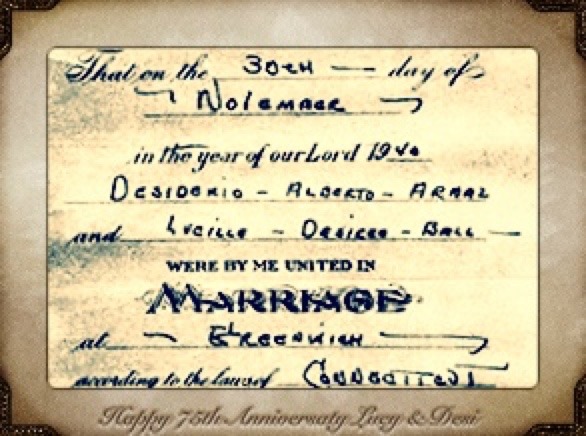
Discovering a broken record tied with ribbon, Lucy says that Ricky proposed to her at Christmastime, so their ‘song’ is "Jingle Bells,” or – as Ricky pronounces it – “Yingle Bells.” This varies from their past proposal stories. In “The Marriage License” (ILL S1;E26) the couple re-enacted Ricky’s proposal, on a bench embedded in a tree at the Byram River Beagle Club in Greenwich, Connecticut. Lucy and Desi were married there in real-life, on November 30, 1940. “Jingle Bells” was heard annually on the show as part of the Christmas Tag and then “The ‘I Love Lucy’ Christmas Show” (1956).
A teary-eyed Lucy says that “Our marriage used to be romantic and now it’s just plain stale.” The scene has added poignancy knowing that the romance had also gone out of Lucy and Desi’s relationship. Ricky promises her a trip to Sun Valley, a place they wanted to honeymoon when first married, but couldn’t afford.

When shopping for Sun Valley, Lucy returns with a variety of boxes, but a couple are definitely from Saks Fifth Avenue. Their distinctive beige thatched pattern boxes appear in many later episodes of “I Love Lucy.”
Lucy wants this trip to be a ‘second honeymoon,’ but it would actually be her third, as she said the same thing about their transatlantic crossing to Europe in an episode titled “Second Honeymoon” (ILL S5;E14) less than two years earlier.

When Ricky, Little Ricky and Fred have to stay home to work on a television show, Lucy reluctantly takes Ethel to Sun Valley.

Sun Valley was a favorite vacation spot for the Arnaz family. They spent part of their 1952 summer hiatus from “I Love Lucy” at the resort and later returned in 1959, after Lucy and Desi had separated, staying at Ann Sothern’s home.
The “Comedy Hour” cast and crew traveled from California to Idaho by train. In Westport, Ricky mentions Union Pacific regarding changing their reservations to travel to Sun Valley. However, Union Pacific does not service the Eastern United States and a train trip to Idaho from Westport, Connecticut, would have taken nearly a week. Despite this, there is second unit footage of a Union Pacific train before Lucy and Ethel arrive in Idaho. This is the second time an episode has started with stock footage of a Union Pacific train. The first was “Lucy Hunts Uranium” (S1;E3).

Coincidentally, the first time the gang was on the Union Pacific Railway in “The Great Train Robbery” (ILL S5;E5), the lounge car was decorated with posters for Sun Valley! The Idaho resort town was built around its access to the railroad.

During her career, Lucille Ball has worked with virtually every kind of animal, but this is the only time she has worked with a live antelope! Second unit footage also features horses.

Sun Valley, Idaho, is a resort city where tourists can enjoy ice skating, golfing, hiking, trail riding, cycling, tennis and (of course) skiing on Bald (“Mount Baldy”) Mountain and Dollar Mountain. The world’s first chair lift was erected in Sun Valley in 1936. In the episode Fred calls it “a strung out Ferris Wheel.” Sun Valley was featured (and promoted) in the 1941 movie Sun Valley Serenade, starring Sonja Henie, John Payne, Milton Berle, and bandleader Glenn Miller. Part of Abbott and Costello’s 1943 film Hit the Ice was shot in Sun Valley. In 1950 Esther Williams (Fernando Lamas’ future wife) played the Duchess of Idaho, in “MGM’s Technicolor Musical of Sun Valley Splendor”!

In addition to the Arnazes, the resort was popular with such celebrities as Clark Gable, Errol Flynn, and Marilyn Monroe. Lucy’s friend and “Comedy Hour” co-star Ann Sothern had a home in Sun Valley and is buried in the Ketchum cemetery nearby.

The centerpiece of the resort is the 220-room Sun Valley Lodge, which opened in December 1936 and is still in operation today. Ernest Hemingway completed his novel For Whom the Bell Tolls while staying in suite 206 in the fall of 1939.
Sun Valley, Idaho, should not be confused with Sun Valley, California, a neighborhood of Los Angeles in the San Fernando Valley where Desilu often hosted their annual staff picnics.

Lucie and Desi Jr. accompanied their parents on location and the family stayed at the Sun Valley Lodge for the two-week shoot. Lucy’s brother Fred Hunt also went along. Although rumors persist that Arnaz children were extras in the episode, Lucie Arnaz denies that she ever appeared in the series. She and her brother Desi Jr. did, however, appear in a Ford commercial that aired during the episode.

Guest star Fernando Lamas was born on January 9, 1915, in Buenos Aires, Argentina, where he did more than 30 films before making his U.S. film debut in The Avengers (1950). In 1956 he went to Broadway to star with Ethel Merman in the musical Happy Hunting for which he was nominated for a 1957 Tony Award. It was his only Broadway show.
He was married four times, having a son, Lorenzo Lamas, with his third wife, Arlene Dahl. His fourth wife was aqua-musical star Esther Williams. He died in 1982 of pancreatic cancer.

Lucy has a knack for interrupting celebrities in the bath. It happened with Cornel Wilde in “The Star Upstairs” (ILL S4;E25) and it will happen again when “The Ricardos Go to Japan” (LDCH S3;E2) and meets Bob Cummings in the penultimate “Comedy Hour” in 1959.

To establish that Ricky is at the television studio back in New York, a camera labeled CBS-TV is wheeled across the frame.

At the television studio, Little Ricky rehearses his drum solo, giving Keith Thibodeaux a chance to do what he does best.
When Fred and Ricky fly out to Sun Valley, it is said that Little Ricky is staying with Lucy’s mother. Mrs. McGillicuddy (Kathryn Card) does not appear here but will be briefly seen in “The Ricardos Go To Japan” (LDCH S3;E2).

While Fred (William Frawley) is rehearsing "My Melancholy Baby,” Ricky sits nearby getting melancholy for his baby, Lucy. During a May 3, 1965 appearance on "I’ve Got a Secret” Frawley claimed he was the first person to perform the song publicly at the Mozart Cafe in Denver, Colorado in 1912. The music was written by Ernie Burnett with lyrics by George A. Norton.
The banjo player and guitarist for the number is Perry Botkin Sr. He was a composer, songwriter, guitarist, accompanist associated with Al Jolson and Eddie Cantor on radio and recordings, and a guitarist with the orchestras of Paul Whiteman, John Scott Trotter, Victor Young, and Johnny Green. Botkin also appeared in previous “Comedy Hour” playing “The Bayamo” for Harry James and Betty Grable.
Oops! When Ricky decides to go to Sun Valley to see his wife, Fred asks him if he’s going UP there to see Lucy. Sun Valley is indeed north of Las Angeles, but if they were in New York City it would be west (”out there”) not north (”up there”).

Lucille Ball had a stunt double, Jannette Burr Johnson, for the skiing scene with Fernando Lamas. Nelson Bennett, one of the first directors of the Sun Valley Ski Patrol, fondly remembers working with Lucille Ball during the location filming. Stunt skier Johnson was meant to film a scene involving the start of Ball and Lamas’ speedy ski down Mount Baldy, but she fell and broke her leg.

So Bennett helped Ball prepare to do the shot herself, with several ski patrol members waiting to catch her 100 or so feet down slope.

Before the scene could be shot, the zipper on Lucy’s jumpsuit got stuck so Bennett came to her rescue. "I have had a little experience with zippers, so I have a picture of me kneeling in front of Lucille, fiddling with her zipper.”

Lucy’s camera and lighting stand-in Hazel Pierce plays a waitress at the Sun Valley Lodge cafe. In this, her only credited appearance on the series after many episodes of “I Love Lucy,” she also has a line! She also played a waitress in “Fred and Ethel Fight” (ILL S1;E22).

Oops! When Lucy is photo-bombing Lamas, he is banging the back of the pepper shaker. He then throws some over his right shoulder into Lucy’s face causing her to sneeze and ruin Ethel’s snapshot. Perhaps they do it differently in Argentina, but the old superstition goes that when SALT is spilled to throw a dash over your LEFT shoulder to blind the devil who lurks there. Here Lamas tosses PEPPER over his RIGHT shoulder!

After being labeled a “crazy redhead” Lucy goes undercover! Lucy is perusing Reader’s Digest, a magazine then in its 37th year. When Lamas recognizes her anyway, he says that he and Ricky worked together at MGM.
LAMAS: “When we left the studio the lion was roaring with a Spanish accent.”
Lamas is referring to Leo, the MGM lion who was their mascot and roared before every MGM film. Lamas was with MGM from 1949 to 1954.

When Ricky and Fernando argue in Spanish, Ricky accuses him of trying to win an Academy Award with his ‘performance’ of being sweet on his wife.

Even though she was not injured doing the ski stunt, Lucille took a fall and slid on the ice during the skating rink scene. The trick skating scene was accomplished using actual footage of Lamas and Ball on the ice, stunt skaters for distance shots, and a process shot using rear projection back in the studio in Hollywood.

Although it is a quick cut, if you look closely the wires holding Lucy up in the spin are clearly visible. The location shots of this stunt were filmed using a double.

Fighting for Lucy’s honor, both Ricky and Fernando Lamas end up with black eyes. This is reminiscent of “The Black Eye” (ILL S2;E20) where everyone ends up with shiners!
As he leaves the Lodge, Lamas tells the Ricardos he is going to Europe to film a musical in which he will sing and dance. In reality, his next motion picture was an action adventure fantasy called The Lost World (1960). The next time Lamas sang in a film was in 1964′s Magic Fountain with his wife, Esther Williams. It would be her final screen appearance.

Another series regular, Louis Nicoletti, plays the front desk clerk at the Lodge. Robert S. Carson (Mr. Fairchild, the Lodge Manager) makes his first appearance with Desilu, but will go on to be seen in five episodes of “The Lucy how.” The Director of the TV show is uncredited and unidentified.

What most people remember about this episode is that when footage shot on location at the lodge was sent back to the Los Angeles studio for processing it disappeared. Two days later there was a frantic call from Desilu wondering why they hadn’t received the film. When it didn’t turn up, everything had to be re-shot. The original film showed up three months later in the back of a Desilu station wagon!
FAST FORWARD!

This episode was first re-broadcast on Christmas Eve 1958 with a new introduction. It opened with a scene of Lucy and Ricky decorating a Christmas tree. For Christmas, Lucy bought Little Ricky skis, which prompts the flashback of their Sun Valley vacation. Also in the episode, Keith Thibodeaux (Little Ricky) recited the poem “Once Upon A Christmas Star.”

When the episode was repeated, the “Lucy-Desi Comedy Hour” was under the umbrella of “The Westinghouse-Desilu Playhouse” instead of being sponsored by Ford.

The day this episode was first aired (April 14, 1958) Desi Arnaz did a promo for the show on CBS’s daytime drama “Love of Life,” which that day went from 15 minutes to 30 minutes. Lucille Ball did not appear.

Snow was also a factor (albeit artificial snow) when “Lucy Goes to Alaska” (S2;E3) in 1959 to mark their statehood.

In 1963, home movies of Lucille Ball vacationing in Sun Valley were part of Hollywood Without Make-Up, a collection of amateur movie footage of celebrities put together by Ken Murray.

In a 1964 episode of “The Lucy Show” Lucy Carmichael prepares for a trip to Lake Placid by practicing her skiing in and around the house!

Lucille Ball broke her leg in a skiing accident just before the fifth season of "Here’s Lucy” resulting in a full leg cast. It was feared that the series might be canceled, but Lucy had her ‘temporary disability’ written into the scripts so the show could go on! The first episode began with home movie footage of Lucy / Lucille skiing in Snowmass, Colorado, before revealing her in a hospital bed.
Her broken leg limited her future dance abilities, especially in the film Mame (1974).


Ironically, the season before, she had gone skiing on screen with Dinah Shore in a 1971 episode of “Here’s Lucy.”

1991 collector’s series comic book with an image from the episode on the cover.
 1958, Ann Sothern, CBS, Desi Arnaz, Desilu, Ethel Mertz, Fernando Lamas, Fred Mertz, Hazel Pierce, Here’s Lucy, Ice Skating, Idaho, Keith Thibodeaux, Little Ricky, Lucille Ball, Lucy, Lucy Goes To Sun Valley, Lucy Ricardo, my melancholy baby, Ricky Ricardo, Skating Rink, ski, skiing, Stunts, Sun Valley, Sun Valley Lodge, The Lucy-Desi Comedy Hour, tv, Vivian Vance, William Frawley
 -

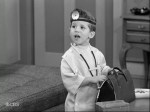


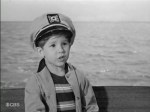

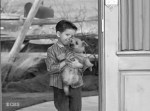

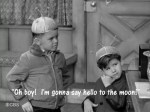
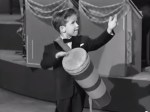
Happy 65th birthday to Keith Thibodeaux (aka Richard Keith), who memorably played Ricky Ricardo Jr. (aka Little Ricky) on I LOVE LUCY and THE LUCY-DESI COMEDY HOUR.
-

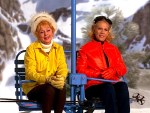
- In 1958, Lucy rode a chair lift during her ski vacation with Vivian Vance in “Lucy Goes to Sun Valley” on THE LUCY-DESI COMEDY HOUR.
- in 1971, Lucy rode a chair lift during her ski vacation with Dinah Shore in “Someone’s on the Ski Lift with Dinah” on HERE’S LUCY.
-
-
“Lucy Wins a Racehorse”

(LDCH S1;E4 ~ February 3, 1958) Directed by Jerry Thorpe. Written by Madelyn Martin, Bob Carroll, Jr., Bob Schiller, and Bob Weiskopf. Filmed in December 1957 at Ren-Mar Studios.

This is the fourth of five episodes of the first season of “The Lucille Ball Desi Arnaz Show” (aka “The Lucy–Desi Comedy Hour”).

Just as the last episode starred real-life husband and wife Fred MacMurray and June Haver, this episode stars married celebrities Betty Grable and Harry James playing themselves.

The Jameses and the Arnazes were horse racing fans as well as racehorse owners.

As with the previous episodes, Ricky steps before the curtain to welcome the audience and remind them that the show will introduce Ford’s new four-passenger Thunderbird. These intros were cut for repeats and syndication but restored for the DVD release. In the original broadcast a long commercial (an early infomercial) for Ford was hosted by Dick Powell.

Little Ricky wants a horse like his friend Billy Thompson, but Ricky predictably says he can’t afford it. Ricky says Billy’s father is wealthy.

Lucy enters a contest to win a horse sponsored by Korny Krinkles cereal. In fact, she sends in entries using the names of all her friends: Fred and Ethel Mertz, Betty Ramsey, Grace Munson, and Marion Van Vlack. Lucy reveals cupboards full of cereal boxes she’s bought to send in the required box tops.
Despite living nearby, Ralph and Betty Betty Ramsey, Grace Munson, and Marion Van Vlack will remain unseen in this and all of the “Lucy-Desi Comedy Hour” episodes. They join Little Ricky’s friend Billy Thompson off-screen.

Through the glass in the oven door you can see boxes of cereal in the oven, too, although in the final edit Lucy does not reveal these boxes to the audience. In the next scene the boxes are no longer visible in the oven. Although Korny Krinkles is a fictional cereal, during the 1950s Post marketed a cereal called Krinkles, which was subsequently known as Rice Krinkles, Sugar Coated Rice Krinkles, and even Sugar Sparkled Rice Krinkles, but never Korny Krinkles. The brand was discontinued in 1969, but tasted pretty much like sugar-coated Rice Crispies.

It turns out that Fred’s entry wins! The horse is worth a thousand dollars (more than $8,000 today), making Fred have second thoughts about giving away his prize to his Godson.
As of 2003 the State of Connecticut passed a law that animals cannot be given away as prizes in contests! In the USA, 27 other states have such laws.

Lucy names the horse Whirling Jet, which was no doubt a nod to the famous championship racehorse Whirlaway, winner of the triple crown in 1941. Whirlaway died in 1953. Whirling Jet was played by a trained ‘stunt horse’ named Tony.

Lucy decides not to tell Ricky about winning the horse, but Fred warns her that if he finds out it will be the “biggest Cuban explosion since the Battleship Maine.” This is a reference to a U.S. Navy ship that exploded in Havana Harbor during the Cuban War for Independence in 1898. More than 260 men were killed, inspiring the slogan “Remember the Maine!” The phrase is also referenced in the lyrics of The Music Man, which was set in 1912.

To coerce Whirling Jet up the stairs, Lucy promises him that the guest room has a television set where he can see “My Friend Flicka”. “My Friend Flicka” (1956-60) was a TV series based on the 1943 film of the same name about a boy and his horse living on a Montana ranch in 1900. Flicka was played by an Arabian mare named Wahana.

Trying to hide the horse from Ricky, Ethel suggest they tell him Whirling Jet is actually Ralph and Betty Ramsey going to a cocktail party! Ethel is suggesting that they are wearing a pantomime horse costume, similar to the one she and Lucy donned in “The Benefit” (ILL S1;E13) in 1952.

Betty Grable was born on December 18, 1916 in St. Louis, Missouri. She made her screen debut in 1929. She made two films with Lucille Ball when they were both at RKO in the mid-1930s. She married actor Jackie Coogan in 1937 but divorced him in 1940. A pin-up girl, she was known for her platinum blonde hair, blue eyes, and shapely legs. In the late 1940s, 20th Century Fox insured her legs with Lloyd’s of London for a quarter of a million dollars.

When Ricky invites Fred to go with him to the airport, he at first declines, saying that he is “in his union suit about to take a snooze.” When he finds out that they are picking up Betty Grable, however, Fred hastily dresses and rushes over!
A union suit is a type of one-piece long underwear. Traditionally made of flannel with long arms and long legs, it buttoned up the front and had a button-up flap in the rear covering the buttocks.
Although she never appeared on "I Love Lucy,” the mention of her name alone often stirred Fred’s libido, much to Ethel’s chagrin. In “Ricky’s Screen Test” (ILL S4;E7) Grable is mentioned as one of Ricky’s possible Don Juan co-stars.

She wed band leader and trumpet virtuoso Harry James in 1943 and they were married until 1965. This is her final screen acting appearance (albeit playing herself). From 1958 until her death in 1973 she only appeared on talk shows or game shows.

Harry James was born in Albany, Georgia, in 1916. His mother and father were circus folk: she as a trapeze artist and he as a band leader. Betty Grable was the second of his four wives. He appeared with Lucy and Desi in 1940’s Too Many Girls and played himself in Lucy’s Best Foot Forward in 1943. He passed away in 1983 and was inducted into the Big Band and Jazz Hall of Fame.

Betty Grable and Harry James are doing performing gigs in order to pay for their expensive race horses. Towards that end they are seen rehearsing “The Bayamo,” a Latin-style song and dance production number especially written for the show by Arthur Hamilton, who is mentioned by name when James asks Ricky who wrote it.
Choreographer Jack Baker actually appears in the episode, and even has a few lines of dialogue. Ricky calls him by his first name.
The guitarist for the number is played by Perry Botkin Sr. He was a composer, songwriter, guitarist, accompanist associated with Al Jolson and Eddie Cantor on radio and recordings, and a guitarist with the orchestras of Paul Whiteman, John Scott Trotter, Victor Young, and Johnny Green. He was a staff composer on “The Beverley Hillbillies” from 1962 to 1964.
The musical number was prerecorded with the actors lip-synching on the set.

It is performed as a full dress rehearsal in the Ricardo’s unusually spacious living room – complete with Ricky and Grable, ten dancers, four back-up singers, members of Ricky’s band, James on trumpet and an audience of one – Fred!

At Betty Grable’s suggestion, Lucy enters Whirling Jet in a race at Roosevelt Raceway. Roosevelt Raceway was a racetrack located in the town of Westbury in Long Island, New York, about an hour’s drive from the Ricardo home in Westport, Connecticut.

Initially created as a venue for motor racing, in 1940 it was converted to a ½-mile harness racing facility. In 1956 it became the first race track to be accepted by the American Stock Exchange. Attendance waned throughout the 1970s and the facility was closed for good in 1988. The name still graces a movie theatre located on the former parking lot. Over the actual racetrack stands the Meadowbrook Pointe condominiums, with surrounding streets named Trotting Lane, Harness Drive, and Pacing Way.

Despite the fact that the actors went on location to the Nevada desert in the prior “Comedy Hour,” this episode uses second unit footage of Roosevelt Raceway, rear projection, and actor doubles, while the cast stayed on their Hollywood sound stage.
The Ricardos, Mertzes, and James’ are sitting in box 77. The Cloud Room (a racetrack lounge) is directly behind them.
In the crowd at the Raceway:
- Walter Bacon – a busy Hollywood background player who went on to appear with Lucille Ball in Critic’s Choice (1963) and an episode of “The Lucy Show” in 1967.
- John Breen – also was busy populating the background of Hollywood films and television shows. He previously played a theatregoer in “Ethel’s Birthday” (ILL S4;E9) and will be seen in the grandstand in “Lucy and the Little League” (TLS S1;E28). He and Bacon were in 22 other TV and film projects together!
- Scott Seaton – played the Trailer Park Attendant in Lucy and Desi’s The Long, Long Trailer (1954, with Norman Leavitt) and went on to appear (with Walter Bacon) in Critic’s Choice (1963). He shares 14 films with Walter Bacon and 6 with John Breen. All three background actors were in The Music Man (1962).

Lucy had gotten up close and personal with horses before, in the film The Affairs of Annabel (1938) as well as when she went on “The Fox Hunt” (ILL S5;E16).

Oops! While Lucy races Whirling Jet (as a fake horse prop), you can very clearly see a string bobbing the horse’s head up and down.
In the fifth race, Whirling Jet races as #8 and sets a new world record for infraction of rules, being disqualified on 32 different counts!

The Classic 49’er Pendleton jacket was seen on Lucy, Desi, and Vivian in various episodes and promotional stills. Above Vivian Vance is wearing hers.

Tony the Racehorse (Whirling Jet) was one of the best trained horses in Hollywood. Tony would respond to the word “Action!” which caused some confusion when director Thorpe called action for other scenes. Thorpe decided to spell the word out but was still shocked to see the horse go into his tricks when it was spelled! It was later revealed that prankster Bill Frawley (Fred Mertz) had whispered “action” into Tony’s ear before the take.
Whirling Jet is never mentioned in subsequent episodes.

Although this is not Whirling Jet, this horse on Desilu’s 1960-61 series “Guestward Ho” was trained to do the same stunt – sitting in an easy chair!

Norman Leavitt (George, a jockey) had appeared in the previous “Comedy Hour” and would be featured in the final episode of the series. He was in the 1950 film A Woman of Distinction with Lucille Ball and The Long, Long Trailer (1953). After this episode, he went on to appear in The Facts of Life (1960) and two episodes of “The Lucy Show.”
Leavitt wears a rather unconvincing fake mustache which Lucy also wears when she takes his place in the race.

James Burke (the Horse Handler) had appeared as Mr. Watson, the man who sells the Ricardos and the Mertzes “The Diner” (ILL S3;E27) and then buys it back for a profit.

Veteran character actor Sid Melton played the fourth jockey in the race. Melton made two more appearances on the “Comedy Hour,” but is probably best remembered for his recurring roles on sitcoms: Charley Halper on "Make Room For Daddy,” Friendly Freddy on "Gomer Pyle: USMC,” and handyman Alf Monroe on "Green Acres.”

The doubles walk off into the sunset!
FAST FORWARD!

Later in the series, Lucy promotes Wakey Flakies breakfast cereal in “Lucy Wants a Career” (S2;E4) which has the same artwork on the box as Korny Krinkles. The same prop cereal boxes later turned up on several episodes of “The Lucy Show” (inset photo) – this time in glorious color!

1961 Dell Comic Book.

Lucy once again rode a ‘prop’ horse in a 1963 episode of “The Lucy Show”.

Ironically, William Frawley’s final screen appearance was a cameo as a horse trainer on a 1965 episode of "The Lucy Show,” in which Lucy Carmichael also dealt with a racehorse.

On “Here’s Lucy” Lucille left the riding to her children, Lucie and Desi, when they visited Wayne Newton’s ranch in 1970.
Live or ‘prop’ horses on “Lucy-coms” (including establishing / stock footage):
- “Pioneer Women” (ILL S1;E25)
- “Lucy’s Bicycle Trip” (ILL S4;E24)
- “The Fox Hunt” (ILL S5;E16)
- “Lucy Takes a Cruise to Havana” (LDCH S1;E1)
- “Lucy Hunts Uranium” (LDCH S1;E2)
- “Lucy Wins a Race Horse” (LDCH S1;E4)
- “Lucy Goes to Sun Valley” (LDCH S1;E5)
- “Lucy
Visits the White House” (TLS S1;E25) - “Kiddie
Parties Inc.” (TLS S2;E2) - “Lucy and Arthur Godfrey” (TLS S3;E23)
-
“Lucy and the Countess Have a Horse Guest”
(TLS S4;E6) - “Lucy Discovers Wayne
Newton” (TLS S4;E14) - “Lucy and Robert Goulet” (TLS S6;E8)
- “Lucy
and Tennessee Ernie’s Fun Farm” (HL S1;E23) - “Lucy and Wayne
Newton” (HL S2;E22)
1958, Arthur Hamilton, Betty Grable, Breakfast Cereal, CBS, Desi Arnaz, Ethel Mertz, Ford, Fred Mertz, Harry James, horse, I love lucy, James Burke, Lucille Ball, Lucy, Lucy Ricardo, Lucy Wins a Racehorse, Norman Leavitt, Racehorse, Ricky Ricardo, Roosevelt Raceway, Sid Melton, The Bayamo, The Lucy-Desi Comedy Hour, Trotters, tv, Vivian Vance, Whirling Jet, William Frawley -
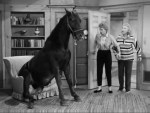
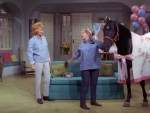
In 1958, Lucy and Ethel had a ‘horse guest’ in an episode of THE LUCY-DESI COMEDY HOUR.
In 1965, Lucy and Rosie had a ‘horse guest’ in an episode of THE LUCY SHOW. -
“Lucy Hunts Uranium”

(LDCH S1;E3 ~ January 3, 1958) Directed by Jerry Thorpe. Written by Madelyn Davis, Bob Carroll Jr., and Bob Schiller. Studio portions filmed November 15, 1957 at Ren-Mar Studios.

This is the third episode of the first season of “The Lucille Ball-Desi Arnaz Show” (aka “The Lucy–Desi Comedy Hour” in syndication) and the first to venture outside the studio for location shooting. This is the very first time Lucy and Desi have gone on location as the Ricardos, although the Bill and Vivian were sent to a local railroad station during season six of “I Love Lucy” to film location segments on the Union Pacific Domeliner for “The Great Train Robbery” (ILL S5;E5). The footage was eventually discarded. Previously, Lucy and Desi used actor doubles when the characters appeared to be on location.

The special guest stars (playing themselves) are Fred MacMurray and June Haver. The location is Las Vegas and the Mojave Desert. This episode does not feature any special musical moments.

By January 1958, “Lucy” was late to the Uranium craze, which was the theme of many films and television shows, including a few produced by Desilu:
- Ma and Pa Kettle Back on the Farm ~ feature film (June 1951)
- “Sky King” ~ “Wings of Justice” (November 1952)
- “Foreign Intrigue” ~ “The Uranium Mine” (December 1952)
- “The Life of Riley” ~ “Riley’s Uranium Mine” (January 1954)
- “The Amos ‘n’ Andy Show” ~ “Uranium Mine” (1955)
- “December Bride” ~ “The Uranium Show” (January 1955)
- “My Little Margie” ~ “Mr. Uranium” (March 1955)
- “Topper” ~ “Topper’s Uranium Pile” (April 1955)
- Canyon Crossroads ~ feature film (April 1955)
- “The George Burns and Gracie Allen Show” ~ “The Uranium Caper” (May 1955)
- Uranium Fever ~ short film (July 1955)
- “Tales of the Texas Rangers” ~ “Uranium Pete” (October 1955)
-
“The Jack Benny Program” ~ “Jack Hunts for Uranium” (December 1955)
- Dig That Uranium ~ Bowery Boys film (December 1955)
- “Sky King” ~ “The Crystal Trap” (January 1956)
- Uranium Blues ~ short film (February 1956)
- “The Phil Silvers Show” ~ “The Big Uranium Strike” (March 1956)
- Uranium Boom ~ feature film (1956)
- “Crusader Rabbit” ~ “The Great Uranium Hunt” (1957)
- “State Trooper” ~ “Trail of the Dead” (January 1957)
- Hot Angel ~ feature film (December 1958)
-
“Bozo: The World’s Most Famous Clown” ~ “Yoo-Hoo Uranium” (1959)
- “Popeye The Sailor” ~ “Uranium on the Cranium” (1960)
- “Felix the Cat” ~ “The Uranium Discovery” (1961)
- “King Leonardo and His Short Subjects” ~ “Uranium Cranium” (June 1961)
- “The Munsters” ~ “Knock Wood, Here Comes Charlie” (November 1964)

As with the previous two episodes, Desi (this time joined by Lucille) steps in front of the curtain to welcome the audience and remind them that the show is sponsored by Ford. He does the same at the show’s conclusion. While these scenes were cut for syndication to make room for more commercials, they have been restored for the DVD release.

One of the Ford commercials aired during the original broadcast of this episode featured three-time "I Love Lucy” guest star Tennessee Ernie Ford (no relation to Henry).

The episode opens in a train car headed to Las Vegas, where Ricky’s band is booked to perform at the Sands Hotel and Casino. The gang previously traveled by train in Italy during “Lucy’s Italian Movie” (ILL S5;E23) and on the way home from Hollywood in “The Great Train Robbery” (ILL S5;E5). Like that trip, this is also by Union Pacific Rail. In reality, getting to Las Vegas by train from Connecticut would have meant many transfers and route changes.

Lucy relaxes in her hotel room ‘pretending’ to read the September 2, 1957 edition of Newsweek. On the cover is J. Edgar Hoover, who wrote Lucille Ball a ‘fan’ letter after hearing his name mentioned in
“The Great Train Robbery” (ILL S5;E5).
Lucille Ball was on the cover of the news magazine in 1953.
Lucille Ball changed her hairstyle beginning with this episode to something called a ‘layered artichoke look,’ similar to what she would wear for the rest of her TV career. In fact, in one scene, when Lucy Ricardo reaches for a hatbox (in which she’s hidden her Geiger counter) Ethel mistakenly guesses: “Oh, you’ve bought a new hat to go with your new hairdo?”

Going off to rehearsal, Ricky doubles back for his conga drum and catches Lucy with her Geiger counter. He then leaves the room again – still without his drum!

A map of the gang’s trip to Hollywood included a stop in Las Vegas, although this (like several other stops) was not seen on screen. Ricky told Orson Welles that he caught his act while he was in Las Vegas, but that, too, was not dramatized.

A few exterior shots were filmed at the Sands, which opened in 1952 with a performance by Danny Thomas. Thomas would appear in a season two episode of the “Comedy Hour” as Danny Williams, the character he played on the Desilu sitcom “Make Room for Daddy” aka "The Danny Thomas Show.”

Although Las Vegas is famous for its casinos, none of the action of the episode takes place in a casino. Lucy and Ethel gambled their way into a fortune while visiting a casino in Monte Carlo during season 5.
For the filming, the Sands supplied various items to Desilu, including bedspreads featuring their logo.
The Ricardos are staying in Room 236.

Ricky mentions rehearsing in their Copa Room, named after New York’s Copacabana, which is the nightclub Lucy and Ethel want to visit in the very first aired episode of “I Love Lucy” in 1951. The tie-in was not doubt due to the Sands’ General Manager Jack Entratter (1914-71), who was previously the manager of the Copacabana. Known as “Mr. Entertainment,” his name is mentioned by Ricky in the dialogue and is also on the marquee outside the hotel.

The marquee announces Ricky Ricardo’s appearance, as well as the Kingpins, the Frankie Moore Four, Ernie Ross, and Tommy Doyle. A Sands billboard in the desert also announces Jerry Lewis.

Lewis, Thomas, and Lucille Ball were in attendance at the Sands fourth anniversary party in December 1956.

Ricky ‘runs into himself’ in the lobby of the Sands. Although there was exterior footage of the actual hotel, the interiors were shot on the Desilu soundstage in Hollywood.

The prop newspapers (which in this case were actually supposed to be fakes), were likely supplied by Hayes Press, Hollywood’s go-to supplier of screen newspapers and printed props.
RICKY: “Is that a Geiger counter?”
LUCY: “Have you ever seen a Geiger counter?”
RICKY: “No.”
LUCY: “Well, this is an electronic Popsicle.”
The main tool in prospecting for uranium was the Geiger counter, which emitted a loud clicking noise when in proximity of the element. Lucy demonstrates one in the episode’s opening scene. Radium dials on wristwatches could also trigger the clicking noise of the Geiger Counter, which results in some comic moments when Fred MacMurray goes to tie his shoe near where Lucy has hidden her Geiger counter from Ricky.
Geiger counter kits also sometimes came with a sample to test the Geiger counter. Both facts play a pivotal part in the plot of “Lucy Hunts Uranium.”

As early as 1949, Popular Science Magazine started highlighting uranium prospecting as a hobby. Uranium is a very heavy metal found in most rocks. It can be used as a source of concentrated energy. It was first identified in 1789 and named after the planet Uranus, which had been discovered eight years earlier. During the 1950s the U.S. Atomic Energy Agency would analyze rock samples for uranium free of charge. As is mentioned in this episode, the government paid $10,000 bonuses for uranium discoveries. During 1955 alone over $2,000,000 was paid out. No special license or permit was needed to prospect for uranium on public or private lands.

Time Warp? In the lobby before the Uranium rush caused by Lucy’s fake newspaper, she says it is after 8:15pm. In the next scene set in the desert 40 miles away, Ricky says they have cancelled his show and it will be getting dark soon. Even on the longest day of the year, the sun sets in Las Vegas by 8pm.

Fred MacMurray (1908-91) appeared in over 100 films in his career. He is perhaps best remembered for the film Double Indemnity (1944), which Lucy references in this episode. He also played single dad Steve Douglas on the long-running sitcom "My Three Sons” (1960-1972). After his run as Fred Mertz, William Frawley played MacMurray’s father-in-law on “My Three Sons.” MacMurray’s name was first mentioned by Ethel in 1953 in “The Black Eye” (ILL S2;E20) when flowers arrive for Lucy mistakenly signed “Eternally yours, Fred.”

Lucille Ball later said that MacMurray was “fine enough” in this episode, but she really had to work with him on his comic timing, especially in the telephone booth scene. Ball and MacMurray clearly had different styles.

During the location footage and the extensive automobile chase scenes in the episode’s second half, the Ricardos drive a Custom Cab Ford pickup truck and Fred MacMurray drives a 1957 Ford Thunderbird. The show was sponsored by the Ford Motor Company.

Fred and Ethel are still driving the same 1922 Cadillac roadster that Fred bought for the trip to California in 1955. However, in “Lucy Learns to Drive” (ILL S4;E11), Ricky states that he used it as a trade in to buy the new Pontiac.

Also in that episode, Ethel claims that she never learned how to drive, and she still apparently hasn’t – she stops the car by crashing it into a cactus. Interestingly, she was quite capable of driving during “The Camping Trip” (ILL S2;E29).

During the exterior prospecting scene, the actors actually fall asleep on a Hollywood sound stage and wake up on location in the Nevada desert!

Although they were present for the scene work, stunt doubles did most of the car chase and action sequences. Except for one…

While shooting in the Mojave Desert, the crew had difficulty making one of the cars come to a skidding stop to complete the scene. Frustrated, Desi Arnaz finally got into the car himself and performed the stunt perfectly. After receiving applause from the cast and crew, it was discovered that the camera had no film in it! Desi went ballistic while the rest of the crew got hysterical.

From 1954, Fred MacMurray was married to actress June Haver, who makes an uncredited guest appearance in this episode. It was the second marriage for both. They were introduced by another “I Love Lucy” celebrity guest star, John Wayne. She was nicknamed the ‘Pocket Betty Grable’ after appearing with the star in The Dolly Sisters (1945). This episode of the “Comedy Hour” was her final screen appearance. She died in 2005 at the age of 79.

Keith Thibodeaux (aka Richard Keith) plays Little Ricky. He appeared in all but one of the “Lucy-Desi Comedy Hours”. As usual, the pint-sized actor is simply billed as “Little Ricky.” Here he gets his turn on the donkey during the photo shoot with Lucille and June Haver.

In the opening scene on the train, Little Ricky says he ran into a classmate named Scotty Lawrence, a character we never see. To get the boy ‘out of the way’ for the main plot, the writers have Scotty Lawrence’s mother take him with them to see Boulder Dam.
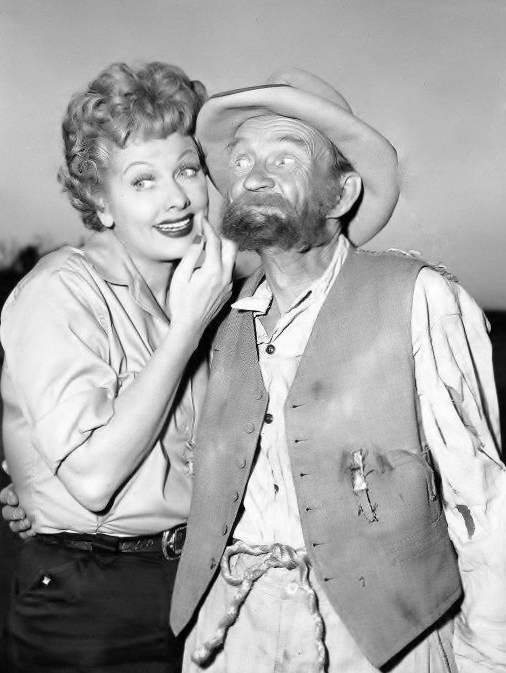
William Fawcett (Prospector) was an especially busy character actor who specialized in Westerns. He had appeared with Lucille Ball in the 1951 film The Magic Carpet. He would make one more appearance on the “Comedy Hour” in 1959.

Everyone’s favorite bellboy Bob Jellison returns to Desilu to play yet another hotel bell hop, this time named Henry. As Bobby the Bellboy, he was a recurring character during the Hollywood episodes of “I Love Lucy,” but made his series debut as the milkman in “The Gossip” (ILL S1;E24).

Maxine Semon (the Maid) had played Honeybee Gillis in the 1950 Jackie Gleason version of "The Life of Riley.” Her role was taken by Gloria Blondell (Grace Foster in “The Anniversary Present” ILL S2;E3) in the 1953 re-boot starring William Bendix. Semon made two appearances on "I Love Lucy.”

Charles Lane returns to play the Claims Office Clerk. This is his fifth interaction with the Ricardos and the Mertzes, and he would return to play a customs officer in when “Lucy Goes to Mexico” in a 1958 “Comedy Hour.”

Norman Leavitt (Service Station Attendant) never appeared on “I Love Lucy” but did appear with Lucille Ball in the films A Woman of Distinction (1950) and The Long, Long Trailer (1953). This is one of three appearances on the “Comedy Hour” after which he was in The Facts of Life (1960) and two episodes of "The Lucy Show.”

Hanging outside the Wagon Wheel service station is a sign for Pabst Blue Ribbon Beer. The brand name, however, is just outside of the top edge of the frame.

The episode garnered huge ratings again, topping “The Celebrity Next Door” (starring Tallulah Bankhead) aired the previous month. It was the second highest rated show of that week, only behind "Gunsmoke.”
Extra! Extra!
- Stuntman / extra Rick Warwick played the Sands Desk Clerk, but it is possible he also did some of the stunts in the desert chase sequences.
- Paul Powers played the Maitre ‘d.
- Richard King plays the Busboy.
- Series regular Louis Nicoletti played Prospector #2.
- Lucille Ball’s camera and lighting stand-in Hazel Pierce plays one of the patrons of the Sands. She enters the lobby just behind Lucy reading a magazine.
- The cast includes several live donkeys and horses!
FAST FORWARD!

This was the first, but not the last time Lucy and Ricky Ricardo were in Las Vegas. On November 1, 1959, they joined Milton Berle at the El Rancho Vegas as part of an NBC “Sunday Showcase: Milton Berle Special”.

1961 Dell Comic Book.

Lucy Carmichael and Viv Bagley went to Las Vegas in a 1965 episode of “The Lucy Show.”

In 1970, the exterior of the Sands was glimpsed again in a montage that opens “Lucy and Wayne Newton” (HL S2;E22). The Sands would be razed in 1996 to make way for the The Venetian Resort and Casino.

Prospecting – although for Gold, not Uranium – was also the subject of a 1968 episode of “Here’s Lucy”…

…and then again in 1973!

Although it did not premiere until five years after this episode first aired, viewers have remarked upon its similarities to the film It’s a Mad, Mad, Mad, Mad World (1963). The cast was comprised of virtually every comedy performer in Hollywood (except Lucille Ball, who was busy with “The Lucy Show”): Milton Berle, Sid Caesar, Buddy Hackett, Ethel Merman, Mickey Rooney, Dick Shawn, Phil Silvers, Edie Adams, Jim Bakus, Ben Blue, Joe E. Brown, Barrie Chase, Selma Diamond, Edward Everett Horton, Buster Keaton, Don Knotts, Charles Lane (who is also in “Lucy Hunts Uranium”), Marvin Kaplan, Roy Roberts, Jesse White, Jimmy Durante, Phil Arnold, Jack Benny, Allen Jenkins, Tyler McVey, Jerry Lewis (whose name is on the Sands marquee with Ricky’s), Monty O’Grady, Barbara Pepper, and Elliott Reid. ALL of whom had worked or would work with Lucille Ball!
Bobby Jellison, Charles Lane, Desi Arnaz, Ethel Mertz, Ford, Fred MacMurray, Fred Mertz, Geiger Counter, I love lucy, June Haver, Las Vegas, Lucille Ball, Lucy, Lucy Ricardo, maxine semon, Mojave Desert, Nevada, Norman Leavitt, Ricky Ricardo, Sands Hotel, The Lucy-Desi Comedy Hour, Uranium, Vivian Vance, William Fawcett, William Frawley -
“Lucy Takes a Cruise to Havana”

(LDCH S1;E1 ~ November 6, 1957) Directed by Jerry Thorpe. Written by Madelyn Martin, Bob Carroll, Jr., Bob Schiller, and Bob Weiskopf. Filmed June 28, 1957 at Ren-Mar Studio.

Synopsis ~ The Ricardo’s are interviewed by Hedda Hopper about how they first met, which results in a flashback to Havana, Cuba in 1940.

A promotional still for the series premiere. Overall, each episode would center on a guest star (or several), and feature more music, including production numbers.

This is the very first of the 13 hour-long specials known in syndication as “The Lucy-Desi Comedy Hour,” although during its first season it was sponsored by Ford and titled “The Lucille Ball-Desi Arnaz Show.”

On November 2, 1957 Lucille Ball was featured on the cover of TV Guide again, in a caricature by noted artist Al Hirchfeld. Nina, his daughter’s name, was famously hidden in his drawings. Here the ‘Nina’ is in Lucy’s fur collar!

Hirshfeld’s rendering of Desi Arnaz was found on the article inside, titled “You Can’t Stand Still” in which Desi explains why he ended “I Love Lucy.”

The timing of the article was in order to promote “The Lucy-Desi Comedy Hour” premiering that week.


That week, TV Life also did a cover story an inside article (”The Laughs They Didn’t Want”) on the debut of “The Lucy-Desi Comedy Hour” and “Lucy Takes a Cruise to Havana.”

Unusually, this first episode was 75 minutes long. Desi insisted that the program required the added 15 minutes and convinced U.S. Steel to delay the start of their “The U.S. Steel Hour” program “The Locked Door.” Both shows received record ratings.

The original broadcast included promos for “Zane Grey Theatre” a western anthology series aired Wednesday nights on CBS hosted by Dick Powell. Then in its second of five seasons, Cesar Romero did three episodes of the series.
The premiere episode is told in flashback format. In their Connecticut living room, Lucy and Ricky are being interviewed by Hedda Hopper, who wants to know how the Ricardos first met.
This telling of Lucy and Ricky’s first meeting contradictions the previously mentioned version that she went on a blind date arranged by Marion Strong.

Hedda Hopper returns to Desilu after being the subject of “The Hedda Hopper Story” (ILL S4;E20) in 1955. Hopper and Lucille Ball had starred in two films together in 1946. As one of Hollywood’s most powerful and colorful gossip columnists, her name was occasionally mentioned in “I Love Lucy” dialogue. Unfortunately, for syndication this episode had to be trimmed to an hour, and Hopper’s scenes were edited out as were Desi’s intro and wrap-up. These scenes were, however, restored for the DVD release. For the sixty minute repeats, Desi recorded voice-over narration to fill the gaps in the storyline.

Oops! In the opening scene, the Ricardos await Hedda Hopper’s arrival. Ricky’s handkerchief is in his left lapel pocket, but as Lucy begins to fix his socks, his handkerchief is on his right!

Little Ricky is reading “The Great Big Car and Truck Book” – a Big Golden Book by Richard Scarry, first published in 1951.
Here Ricky finally learns how to pronounce Hopper’s name. He continually called her Hedda HOOPER in Hollywood. The apple doesn’t fall far from the Latin-American tree: Little Ricky greets her by saying “How do you do, Miss Hepper!”

Although Keith Thibodeaux (aka Richard Keith) would be featured on 12 of the 13 “Comedy Hour” episodes, his on-screen credit would simply bill him as ‘Little Ricky’.

For those unfamiliar with Hopper’s trademark – her outrageous headgear – the show deals with it right off the bat, invoking the name of one of Lucille Ball’s movie and TV co-stars.
HEDDA HOPPER: “Bob Hope says it’s the only hat in Hollywood that gives him hay fever!”

A flashback takes the action back to 1940, where Lucy and co-worker Susie are singles on a tropical cruise to Cuba. There they meet Ricky Ricardo and his pal Carlos Garcia. Lucy and Ricky’s rocky courting takes up the remainder of the episode, before returning to Connecticut in 1957 for the show’s conclusion.

The episode is book-ended by Desi Arnaz talking to the audience in front of a show curtain.

It had only been a year since the gang traveled to Cuba from Miami in “The Ricardos Visit Cuba” (ILL S6;E9).

During Hopper’s interview we learn that before marrying Ricky, Lucy was a ‘private’ secretary in New York, in the same office as Susie MacNamara, played by Ann Sothern. Sothern had just finished playing the same character on the CBS sitcom “Private Secretary.” This is considered one of television’s first ‘cross-over’ appearances. One year later, Desilu produced “The Ann Sothern Show” which ran three seasons. She returned in 1965 for “The Lucy Show,” playing Lucy’s old friend Rosie Harrigan, the Countess Frambois.

The pair made five films together between 1933 and 1943 and although Sothern was announced to play the lead in the 1943 film DuBarry Was a Lady, the part eventually went to Lucille Ball. Later, Sothern is quoted as saying,
“Lucy used to complain that she got all the parts I turned down. Now I produce the [Ann Sothern] show, and she owns the studio. I guess that settles that.”

The ship that Lucy and Susie sail on is the RMS Caronia, which was a real-life Cunard Line vessel. However, the ship did not enter service until 1949 and this episode is set in 1940. Cunard was then known as Cunard-White Star Line.
Single Susie calls the ship the SS YWCA (Young Women’s Christian Association). Bachelorette Lucy mentions that she heard that this was the ship’s ‘maiden’ voyage – making a pun about the lack of available men on board.

Lucy says that the cruise cost $84.50, which is the equivalent of more than $1,500 today, a considerable sum on a secretary’s salary, let alone for skinflint Fred Mertz. Susie remarks that she’s had more fun on the Staten Island Ferry for a nickel. Lucy didn’t have much fun on the “Staten Island Ferry” (ILL S5;E12) when helping Fred get over seasickness.

Coincidentally, Fred and Ethel Mertz are on the ship as well – on a belated Honeymoon cruise – even though they were married in 1928! The length of the Mertzes marriage varies throughout “I Love Lucy” and this episode is no exception. Curiously, Fred’s seasickness is not mentioned here. Here, Ethel (Vivian Vance) looks noticeably younger and Fred (William Frawley) has a full head of hair!

ETHEL: “You pay more attention to that hair than you do to me. Sometimes I wish you were bald.”
FRED: “Oh, yeah? Well, don’t worry. That’s one thing that’ll never happen to me!”
The last time we saw Fred with hair was when he wore a toupee to the bald party in “Ricky Thinks He’s Going Bald” (ILL S1;E34). In 1957, Fred compares himself to famously bald Yul Brynner. Brynner had won the Best Actor Oscar the year before for The King and I. The movie will be mentioned by Tallulah Bankhead in the next episode of “The Lucy-Desi Comedy Hour”, “The Celebrity Next Door.”

Frank Nelson plays the Caronia’s Cruise Director. The actor has the distinction of being the only person to play more than one recurring character on the series: Freddie Fillmore (three appearances) and Ralph Ramsey (two appearances), in addition to five other one-off characters. Curiously, when “I Love Lucy” ended, he was playing the Ricardo’s Connecticut neighbor, but it was decided not to feature Ralph and Betty Ramsey on “The Lucy-Desi Comedy Hour.” They are, however, occasionally mentioned.

When the Cruise Director lets it slip that Rudy Vallee is aboard, he says:
“If Mr. Cunard ever hears about this I’ll be demoted to the Albany Night Boat.”
From the late 1800′s until 1941 (a year after this episode is set and 16 years prior to broadcast), the “Night Boats” from New York City to Albany could carry as many as 2,000 passengers up and down the Hudson River in luxury. They were also notorious for their romantic assignations. Passengers could be young couples on a weekend trip, married people evading detection by their spouse, or ladies of the evening.

There was even a Broadway musical in 1920 called The Night Boat. Two years earlier the song “Take the Night Boat To Albany” (music by Jean Schwartz; lyrics by Sam M. Lewis and Joe Young) was part of the Broadway musical Sinbad starring Al Joleson. In 1928 it inspired a silent film. But by 1941, the trip could be made by car, train or even airplane, so few cared about the “Night Boat” and it was discontinued.

Bemoaning the lack of men on the ship, Lucy says that they are showing the movie One Hundred Men and a Girl, a 1937 film starring Deanna Durbin. On the SS Constitution headed to Europe, Lucy analogizes the male to female ration by calling it the SS Noah’s Ark!

Oops! When Susie darts into the utility closet to hide that she is lurking around to meet Rudy Vallee, her dress gets caught in the door! When the shot changes, the dress is no longer caught in the door, and Susie and Lucy come sauntering out – their scheming revealed to one another.

When Rudy Vallee jumps ship (literally), we see that one of the many single ladies on the ship is played by Lucille Ball’s camera and lighting stand-in, Hazel Pierce, continuing her relationship with Desilu that began in 1951.
Singing star and bandleader Rudy Vallée plays himself. He is probably best remembered as boss Biggley in the Broadway musical and 1967 film How to Succeed in Business Without Really Trying. Vallee later played “Batman” villain Lord Marmaduke Fogg. He played himself again on a 1970 episode of “The Lucy Show.”
Susie infers that Lucy already has a a few boyfriends: Harold, who works in shipping at their office, and Wilbur in accounting.
The chase sequence (Rudy Vallee fleeing the clutches of Lucy and Susie) was obviously edited together from multiple takes. The cuts are noticeable on the door slams.

The dialogue mentions of one of his most popular songs “My Time Is Your Time.” Lucy tells Vallee that she’s had trouble keeping his fans from “swinging over to the Bing somebody-or-other.” She is referring to popular crooner Bing Crosby, of course. Vallee responds that he had similar problems with Nelson Eddy. Vallee gets to briefly croon his a few bars from his hits “Vagabond Lover,” “The Maine Stein Song,” and “The Whiffenpoof Song.” During a disagreement, Vallee calls Ricky an “unpleasant peasant” a possible reference to “The Pleasant Peasant” operetta Lucy wrote for the Wednesday Afternoon Fine Arts League in “The Operetta” (ILL S2;E5).

Ricky’s Cuban pal (and fellow cabbie) Carlos Garcia is played by Cesar Romero. The Latin-American performer is probably best known today for his portrayal of the Joker on TV’s “Batman.” He guest starred with Sothern on “Private Secretary” the year before this episode, and on “The Ann Sothern Show” the year after. He guest starred on a 1969 episode of “Here’s Lucy” as a possible date for Lucy Carter, echoing the plot of this episode. Although both Romero and Vallee played “Batman” villains, they never appeared in episodes together.
“Our Ship is Coming In” by Arthur Hamilton is the very first production number of the series. The song forwards the plot as in a Broadway musical, instead of the usual ‘performance-based’ songs found on the show. The singing was pre-recorded and lip synched on the set.

The number briefly features dancer Barrie Chase, one of Fred Astaire’s TV dance partners. When the show was repeated in July 1962, CBS promoted Chase as one of the Guest Stars because, by then, she had gained fame as Fred Astaire’s dancing partner on three acclaimed television specials.
Choreography was by Jack Baker, who started working at Desilu during season six of “I Love Lucy” and continued doing dance staging until “Here’s Lucy.”

Actor doubles were employed for the carriage ride through Havana.

The episode features second unit footage filmed in Cuba, although the actors never left the Hollywood sound stage. During the summer of 1957, the Cuban revolution started to escalate with the murder of Castro collaborator Frank Pais. Desi told editor Dann Cahn to get the footage and get out as soon as possible.

On first seeing Ricky, Susie calls him “the one with the shoe-button eyes,” which he has been called many times before. At first, Lucy prefers Carlos – because of his mustache. Cesar Romero was extremely proud of his mustache, and refused to shave it even to play the Joker on “Batman.” Desi, conversely, was always clean shaven, except for one episode of “I Love Lucy.”

SUSIE: “You’re only going for a sight-seeing tour. You’re not going to marry the guy!”
When Carlos expresses a preference for Susie, Ricky says he doesn’t like redheads!
CARLOS: “It’s only for one evening. You’re not going to see her again anyway!”

“Cielito Lindo” had been previously sung on four episodes of “I Love Lucy” and would also be heard in a future “Comedy Hour” episode. Here, Lucy remarks that she learned the song in High School and sings along, forcing Ricky to honestly assess her voice (for the first time, chronologically speaking) as terrible! It was written by composer Quirino Mendoza y Cortés, who died the same year this episode aired.

Ricky and Carlos take the girls to El Tambor (which translates to “The Drum”) owned by Ricky’s Uncle, although we never learn which one.
LUCY: “I’m not a foreigner. I’m an American.”
Veteran “I Love Lucy” bit player Louis Nicoletti plays the waiter at El Tambor, although he does not attempt any kind of an accent. He later went on to be assistant director of both “The Lucy Show” and “Here’s Lucy.”

The second original song is “That Means I Love You” in which Ricky courts Lucy by way of conga drum. It was especially written for the show by Arthur Hamilton.

After a disturbance in an outdoor cafe, Lucy and Susie end up in a Havana jail cell.

At the police station a drunk dumps a bottle of Bacardi Rum into a water jug. In real life, Desi Arnaz’s maternal grandfather Alberto was once an executive at Bacardi. Earlier Ricky says “Our Cuban rum is very famous.” Lucy says she doesn’t drink.

The spiked water jug later causes Lucy and Susie to get intoxicated, something Lucille Ball was proficient at from drinking all that Vitameatavegamin in “Lucy Does a TV Commercial” (ILL S2;E1).


Lucy has an unusual way of boarding a ship! This is the second time we’ve seen Lucy Ricardo on a ship, the first being the crossing to Europe on the SS Constitution during season 5 of “I Love Lucy.” In 1971, Lucy Carter would cruise to Hawaii (again with Vivian Vance) in a two-part “Here’s Lucy.” In 1974 she strolled the deck of The Queen Mary with Robert Preston in a scene from Mame.

- Jorge Treviño (the Judge, above) had played Ricky’s Uncle Alberto in “The Ricardos Visit Cuba” (ILL S6;E9).
- Nestor Paiva (the Jailer) had previously appeared with Lucille Ball in The Marines Fly High (1940). In 1958 he appeared in a Thanksgiving episode of “The Ann Sothern Show.”
- Argentinian-born Vincente Padula (Ricky’s Uncle, El Tambor Owner) had appeared as a Parisian drunk in “Paris at Last” (ILL S5;E18) and as the (sober) Italian hotel desk clerk in “Lucy Gets Homesick in Italy” (ILL S5;E22). He also guest starred in a 1960 episode of “The Ann Sothern Show.”
- Joaquin Del Rio (The Drunk)
- Another Desilu vet, Paul Cristo, is seen as one of the Cubans. The year before he was seen in the audience of The Most Happy Fella during “Lucy’s Night in Town” (ILL S6;E22). A Latino, he returns to the “Comedy Hour” in “Lucy Goes To Mexico” (1958). He made two appearances on “The Lucy Show,” both in 1962.
- Paul Revel (Cuban) was a popular Hollywood background player for 30 years.
- The episode includes a live horse!
When she show returns to the present day living room in Connecticut, we learn that Susie and Carlos broke up after a brief relationship. We also learn that Ricky only stayed with Rudy Vallee’s band for one night before being traded to Xavier Cugat for a xylophone player.
As we know Fred eventually went bald and tells Ethel “If it’s good enough for Mrs. Yul Brynner, it’s good enough for you!” comparing himself to the Oscar winning star of The King and I, one of the most famous bald actors in Hollywood. Fred compared himself to Yul Brynner in “Country Club Dance” (ILL S6;E25) just a few months earlier. In 1957, Mrs. Yul Brynner was Virginia Gilmore. The couple divorced in 1960.
FAST FORWARD!

Lucy was also locked up in “Tennessee Bound” (ILL S4;E14)…

…and in “New Neighbors” (ILL S1;E21).

Lucy Carmichael wound up behind bars in a 1967 episode of “The Lucy Show”.

Lucy Carter was caught drinking with her cellmate (Elsa Lanchester) in a 1973 episode of “Here’s Lucy.”

Lucy and Sothern also got inebriated together on “The Lucy Show” in 1965.

On May 25, 2007, Dann Cahn, the original film editor on “I Love Lucy” and who went on to build and manage the entire Desilu post-production department for nearly a decade was a special guests at the “Lucy-Desi Days” Festival in Jamestown, NY. “Lucy Takes A Cruise To Havana” was screened.

In “The Simpsons” November 13, 2016 episode “Havana Wild Weekend” (S28;E7), Homer is looking forward to his trip to Cuba so he can finally use the Spanish he learned on “I Love Lucy”!
1940, 1957, Ann Sothern, Arthur Hamilton, Bacardi, Barrie Chase, CBS, Cesar Romero, Cuba, Desi Arnaz, Ethel Mertz, Frank Nelson, Fred Mertz, Havana, I love lucy, Jorge Trevino, Keith Thibodeaux, Little Ricky, Louis Nicoletti, Lucille Ball, Nestor Paiva, Paul Cristo, Private Secretary, RMS Caronia, Rudy Vallee, The Lucy-Desi Comedy Hour, tv, Vincente Padula, Vivian Vance, William Frawley -
“The Celebrity Next Door”

(LDCH S1;E2 ~ December 3, 1957) Directed by Jerry Thorpe. Written by Madelyn Martin, Bob Carroll, Jr., Bob Schiller, and Bob Weiskopf. Filmed September 27, 1957 at Ren-Mar Studios.
Synopsis ~ Stage and screen star Tallulah Bankhead has moved in next door to the Ricardos and Mertzes! Once Lucy discovers that a celebrity is in her midst, she tries to win her friendship by inviting her to an elegant dinner party – with Fred and Ethel Mertz posing as hired help. Before long Lucy has gotten Bankhead and the entire gang involved with a local PTA show.

This is the second of 13 episodes of “The Lucy–Desi Comedy Hour.” After “I Love Lucy” ended its six season run in May 1957, Lucille Ball and Desi Arnaz convinced CBS to allow the program (using the same principal cast) to return as occasional one hour specials. In addition to the new hour-long format, the shows would be centered on a celebrity guest star, feature more music, and location shoots. The first season presented five episodes sponsored by the Ford Motor Company, under the title “The Ford Lucille Ball-Desi Arnaz Show.”

This is the last new episode aired in 1957.

Before the action begins, Desi Arnaz steps in front of a curtain to thank the viewers for their support of their first episode, “Lucy Takes a Cruise to Havana,” aired a month earlier. This is something he would do for most of the series, although in re-runs these intros are usually cut to make time for extra commercials. This is one of the few “Comedy Hours” that takes place entirely in Connecticut with no musical interludes. Of the 13, it also feels the most like an episode of “I Love Lucy.”
The celebrity of the title was stage and screen star Tallulah Bankhead, although it was originally intended to be Bette Davis, a drama school classmate of Lucille Ball’s. While the script was being developed, names also considered were William Holden and Gary Cooper. Davis requested $20,000, equal billing to Lucy and Desi, and the cost of her return airfare after filming. Lucy and Desi were considering the offer when Davis had a home accident and then fell off a horse and had to drop out. Bankhead was their second choice.

Tallulah Bankhead was born in 1903 in Huntsville, Alabama, and left home at the age of 15 to appear on the New York stage. Like Lucille Ball, she was considered for the role of Scarlett O’Hara in Gone With the Wind (1939). She was briefly married to John Emery who had appeared on “I Love Lucy” as Harold the Tramp in “The Quiz Show” (ILL S1;E5) and as angry neighbor Mr. Stewart in “Little Ricky Gets a Dog” (ILL S6;E14). Bankhead died in 1968.

Lucy Ricardo had impersonated Bankhead on “I Love Lucy” in “Lucy’s Fake Illness” (ILL S1;E16) and then quickly imitated her husky voice on the telephone in “Ricky Asks for a Raise” (ILL S1;E35). In this episode Bankhead angrily says to Lucy, “You do a revolting imitation of me!”
Although Lucille and Desi feared the studio audience would not immediately recognize stage star Bankhead, her entrance applause was so enthusiastic that it had to be edited for time!

The episode opens with Ricky and Little Ricky about to rehearse their number for the PTA show. Ricky gets distracted by the fact that Lucy is using binoculars to spy on the star’s moving men, just as she did in “New Neighbors” (ILL S1;E21), so we never know what the number is, but Little Ricky wears a Havana sombrero, so it had to have a Cuban theme.
It is also unclear exactly what house Bankhead is moving into, since it has been established that the Ramseys live next door to the Ricardos. Ralph and Betty Ramsey will not be featured in “The Lucy-Desi Comedy Hour,” but will be occasionally mentioned in the dialogue.

Lucy asks Fred and Ethel to play their ‘couple’ (maid and butler) when she invites Bankhead to dinner. Lucy had played maid to impress Fred’s old vaudeville partner in “Mertz and Kurtz” (ILL S4;E2). Both Lucy and Vivian pretend to be maids again in a 1964 episode of “The Lucy Show.”

‘Ethel Mae’ gushingly admits that she has seen Bankhead on stage in Dear Charles, The Green Hat, The Skin of Our Teeth, Rain, They Knew What They Wanted, Camille, Private Lives and The Little Foxes, which she saw five times! Ironically, Bette Davis did the 1941 film version of The Little Foxes, so the reference may be left over from an earlier script.

When Ethel Mae tries to leave the dining room at the same time that ‘Mertz’ is coming in with a strawberry pie, the resulting gag is instantly reminiscent of “The Great Train Robbery” (ILL S5;E5, left) two years earlier.
It’s a good thing that Tallulah never got to eat the strawberry pie, because it is revealed later in the episode that she is allergic to strawberries!

Oops! The writers must have cribbed from Bankhead’s resume for a list of her stage credits, but they neglected to notice that several of these plays were London productions only, not Broadway. When the gang visited England in season five of “I Love Lucy,” Ethel makes no mention of previously visiting London. The conversation then turns to the 1944 film Lifeboat, which Ethel says she saw in her hometown of Albuquerque.

During rehearsal for a telephone scene, Bankhead proclaimed that it was the first time a stage phone worked and she could actually hear someone on the other end! This is ironic considering that that a non-working stage phone had been the cause for a rift between Desi and Jerry Hausner (Jerry the Agent) which led to his departing the series.
Oops! After Tallulah Bankhead storms out of the Ricardo kitchen, Lucy slams the kitchen door. As she does this, the drawstring to the blind hanging on the door sways back and forth through the window, indicating that there is no glass in the window. This same blooper occurred in “The Sublease” (ILL S3;E31).
When Lucy passes by the kitchen window after slamming the door, she walks into the backdrop making it move.
For the scene in which Lucy serves Bankhead a Southern dinner, packages of frozen fried chicken (some of the first to be marketed) were used as food props. Bankhead, thinking it was homemade, raved that it was the best fried chicken she’d ever eaten!

Tallulah Bankhead attending a PTA meeting is likened by Ricky to Marilyn Monroe attending a Girl Scout rally. Movie star Bankhead has never even heard of the PTA (“PT-what?”) or a hardware store. When Bankhead shows up at the meeting, they abruptly cancel their planned musical in favor of a dramatic play called “The Queen’s Lament” starring (of course) Miss Tallulah Bankhead. This plot point is probably a hold-over from when Bette Davis was intended to be the ‘celebrity’ as she had recently played Queen Elizabeth I in film in The Virgin Queen in 1955 as well as in The Private Lives of Elizabeth and Essex in 1939.
“THE QUEEN’S LAMENT” produced by the Westport PTA
- The Queen ~ Miss Tallulah Bankhead
- Her Lady in Waiting ~ Mrs. Ricardo
- The Duke of Farthington ~ Mr. Ricardo
- Genevieve, The Royal Cook ~ Mrs. Mertz
- A Knight ~ Mr. Mertz
- Musical Entertainment by the Westport Glee Club
- Directed by Mrs. Ida Thompson
- Written by Mr. Thompson
- Costumes by Mrs. Wilson

When Fred is in his “Buster Brown bob” and knight’s armor, Ricky makes a joke about getting a can opener to let out the pants. This is reminiscent of when Ricky was in full amour at MGM for Don Juan and a joke was made about opening a ‘canned ham’ in “Hollywood at Last!” (ILL S4;E16, right).
A running gag throughout the second half hour is Ricky’s mispronunciation of “Queen” as “Quinn”. Particularly funny is when he addresses Bankhead as “My nubble Quinn”!
Naturally Lucy gets jealous of Bankhead playing the lead and arranges for her to be locked in the bathroom, just as she did to the original Sally Sweet dancer in “The Diet” (ILL S1;E3).
It’s a good thing Lucy learned how to curtsy when meeting the real Queen when she traveled to London so she can do it effortlessly for Miss Bankhead in “The Queen’s Lament”.

When the school glee club marches on prematurely during a rehearsal singing “Camptown Races,” Bankhead quips “Who are these children, left over from ‘The King and I’?” Chalk up yet another Rodgers & Hammerstein reference for Desilu. The Broadway musical had closed three years earlier, but the film version was barely a year old and earned five Oscars that year.

Stories about the clash between Lucille Ball and Bankhead mostly center on work ethic. Kathleen Brady’s biography Lucille: The Life of Lucille Ball says that Bankhead rehearsed in a haze of alcohol and refused to learn her lines. Lucy was a stickler for rehearsals so naturally their styles clashed.

At one point, it is reported that Vivian Vance admired Bankhead’s slacks during a production meeting so Tallulah took off her pants, gave them to Viv, and sat down naked!
LUCY: “As a peace offering, I’ve brought you some of my homemade jam.”
TALLULAH: “I’ve already been in one of your homemade jams.”
When the script called for Bankhead to get covered in paint by a paint sprayer, she surprised everyone by entering the scene wearing sunglasses and a head covering to protect herself from the spray. Physical comedy was not Bankhead’s forte. The verbal fireworks between Lucy and Bankhead in the kitchen scene are, however, palpably realistic! Bankhead later said “She’s divine to work with! And Desi! He’s brilliant! He has a temper, however. But that’s because he’s fat! It worries him.” Adding to the tension was the fact that it was during rehearsals for this episode that the Arnazes decided to purchase RKO, the studio where they first met, for $6.15 million.

In the dressing room scene, Lucy wears the same bathrobe she wore during “Little Ricky Learns to Play the Drums” (ILL S6;E2, right) a year earlier.
The dressing room is decorated with pennants that say Manchester and Dalewood, but none saying Westport!

Elvia Allman (Ida Thompson) is probably best remembered as the barking forewoman of Kramer’s Kandy Kitchen in “Job Switching” (ILL S2;E1). She made two more appearances on “I Love Lucy.” She would make one more appearance on “The Lucy-Desi Comedy Hour” in 1959 and would be seen on “The Lucy Show” as well.
The character is likely named in honor of Maury Thompson, who was the show’s long-time camera coordinator. In “The Benefit” (ILL S1;E13), Ethel thanks an off-stage character named Mrs. Thompson!

Richard Deacon (Winslow, Miss Bankhead’s Butler) was employed again by Desi as a regular on “The Mothers-in-Law” (1968). He also made two appearances on “Here’s Lucy” in the early 1970s.

Phyllis Kennedy (Elsie, Miss Bankhead’s Maid) was a good friend of Lucille Ball’s, the two having appeared together in Stage Door (1937) and Joy of Living (1938).
Mrs. Wilson, who is in charge of the costumes, is mentioned, but never seen.
The Glee Club members are played by a dozen pre-teen boys who are uncredited and unidentified.
FAST FORWARD!

Just as Tallulah is allergic to strawberries that make her break out in hives and have to scratch in public, Lucy Carmichael is allergic to caviar and broke out in hives in public in “My Fair Lucy” (TLS S3;E20). To help soothe her itching, Lucy finds respite in the ‘arms’ of a modern art sculpture!

To mark the 65th Anniversary of “I Love Lucy”, the Hamilton Collection issued a collectible figure based on the outfit Lucille Ball wore in this episode.

Lucy’s Lady-in-Waiting dress was on display at The Hollywood Museum in April 2019.
 1957, Bette Davis, Broadway, CBS, Desi Arnaz, Elvia Allman, Ethel Mertz, Ford, Fred Mertz, I love lucy, Lucille Ball, Lucy, Lucy Ricardo, Maid, Phyllis Kennedy, PTA, Richard Deacon, Ricky Ricardo, Tallulah Bankhead, The Celebrity Next Door, The Little Foxes, The Lucy-Desi Comedy Hour, tv, Vivian Vance, William Frawley
-
Subscribe
Subscribed
Already have a WordPress.com account? Log in now.
 Papermoon Loves Lucy