-
“Lucy’s Bicycle Trip”

(S5;E24 – April 23, 1956) Directed by James V. Kern. Written by
Jess Oppenheimer, Madelyn Pugh, Bob Carroll, Jr., Bob Schiller, and Bob Weiskopf. Filmed March 22, 1956 at Ren-Mar Studios.

Synopsis ~ When leaving Italy for France, Lucy has her heart set on biking across the border, until she can’t find her passport!

Lucy has a short memory. A bicycle was the cause of all the trouble when she missed the ship to Europe in “Bon Voyage” (S5;E13).

In an early episode, Lucy convinced Ricky she had regressed to childhood by riding a tricycle through the living room! This didn’t end well for Lucy, when Ricky turned the tables.

This episode was first aired on April 23, generally agreed to be Shakespeare’s Birthday. Lucy Ricardo played Juliet in High School under the direction of Miss Hannah. Herman Shlupp was Romeo. Shortly after she arrives home from Europe, Lucy has the opportunity to play Shakespeare opposite Orson Welles – but he has other ideas!

This episode opens in a hotel room on the Italian Riviera (a title card and establishing shot tells us so), which we later learn is in Sanremo, Italy. Since 1951 Sanremo has been the site of a world-famous music festival so perhaps that is why the Ricky Ricardo Orchestra makes it a destination city. The city is mentioned as a place they visited at the start of season six in “Visitor From Italy” (S6;E5), when Mario comes to New York (although he turns out to be from Venice).

The bicycles used in the episode were provided by Arnold Schwinn and Company in return for a screen credit.

The foursome have to travel 35 miles by bicycle to get to Nice. In Florence, they were winded from climbing five flights of stairs!
LUCY (to Ricky and the Mertzes): “You wouldn’t climb to the top of the Eiffel Tower. You wouldn’t ride the ski lift in Switzerland. You won’t swim in the Mediterranean and now you don’t want to bicycle along the Italian Riviera.”
Lucy fails to mention that the others climbed the Alps with her just to have a picnic on top of the world.

In “Lucy Goes to Sun Valley” (above), a 1958 episode of "The Lucy–Desi Comedy Hour,” Lucy rides the ski lift, but she is the one who is terrified while Ethel remains cool and calm.

After Lucy’s icy dip in the Mediterranean, Fred calls her “the poor man’s Florence Chadwick.”

Florence May Chadwick (1918-1995) was an American swimmer known for long-distance, open water swimming. She was the first woman to swim the English Channel in both directions, setting a record each time. In 1951 she appeared on the CBS variety show "Faye Emerson’s Wonderful Town.” A few months before this episode was filmed, she appeared on the network as a mystery guest on "What’s My Line?”

When the Italian farmer doesn’t speak English (and Ethel’s Italian is woefully inadequate) Lucy steps in to play charades. Lucille Ball loved to do pantomime. She previously demonstrated this in “The Gossip” (S1;E24) and on many other occasions.

When Lucy’s game of charades fails to get through to the farmer, Ethel says “You’ve done enough already, Marcel Marceau.”

Marcel Marceau (1923–2007) was a French actor and mime most famous for his stage persona as Bip the Clown. He referred to mime as the ‘art of silence’ and performed worldwide for over 60 years. The year this episode aired he won an Emmy Award for Best Specialty Act. Coincidentally, this episode was filmed on Marceau’s 33rd birthday!

Lucille Ball had to put honey on the goat’s cheek to get it to lick her face.

Lucy and Desi owned a cow named the Duchess of Devonshire at their Chatsworth ranch, although Lucy Ricardo claimed she had never milked a cow before.

Ball was able to produce one good stream of milk from the cow, but she didn’t think the lights caught the stream enough for it to show on camera.

Writer Madelyn Pugh later said,
"It was the mangiest cow I’d ever seen. I went down to the set, and Lucy said, ‘You wrote it, YOU milk it!’”

In addition to the goat and the cow, the farmer’s barn also housed a live horse and several chickens, one of which lays an egg on Fred’s chest! Ironically, shortly after the gang return from Europe, Fred and Ethel join the Ricardos in Connecticut where they raise chickens for eggs!

One last animal…at the border crossing a live donkey pulls a cart across from France into Italy. Surely if a jackass can cross the border with ease, so can Lucy? Wrong!

A poster for the Festival de Nice is tacked to a tree nearby the border with the date Avril (April) 23-25, which matches the date the episode was first aired.

Curiously, the poster is not on the tree when the gang first approach the border, but suddenly appears just before the scene where Lucy tears off the ’25’ to use as it as fake racing number.

The Festival de Nice probably refers to the Nice Carnival, which dates back to 1294, although it is typically held in February, not April. Another slight error is that Europeans typically put the date before month (ie: 23-25 Avril), the opposite of Americans.
Mario Siletti (Italian Farmer) had played Papa Caruso in the MGM film The Great Caruso (1951). The farmer says he has nine (unseen) children: Teresa, Sofia, Luigi, Pietro, Dino, Gino, Rosa, Mario, and Antonio.

Siletti’s co-star in this episode, Henry Dar Boggia (Italian Border Guard), played a bellhop in the same film, which was his screen debut. He was born in New York City. Francis Ravel (French Border Guard) was actually born in Casablanca, Morocco.

Felix Romano played the Italian Guard who comes on duty in the episode’s final moments.

Before the debacle with her passport (something that caused Lucy a lot of trouble when first obtaining it in New York), she says ‘goodbye’ to Italy.
LUCY: “Farewell, Italy, with your beautiful mountains and your lakes and your wonderful people. Goodbye, dear Italy. No, I’m not going to say goodbye. I’m going to say ‘arrivederci!’”

Although we only see the Ricardos and Mertzes in Rome, Florence, and Sanremo, we later learn that they also visited Genoa, Venice, and Naples. Here are some imagined episodes that might have been left in the writer’s room.
“Lucy the Gondolier”

Synopsis ~ While in Venice, Lucy gets separated from the gang while on a sightseeing tour. In order not to miss her train, Lucy disguises herself as a gondolier to navigate the canals, the fastest route to the station. Cameo appearance by Pat Boone.
“Lucy the Opera Star”

Synopsis ~ In Genoa, Lucy and Ethel sign up for a backstage tour of the Opera House. They don’t realize that they are actually signing up to be IN the opera! Knowing Ricky and the mayor are in the audience, Lucy tries to blend into the chorus – until a singer gets sick and Lucy must play the maid!
“Lucy Visits Pompeii”

Synopsis ~ Ricky and his band are playing Naples, so Lucy and Ethel take a side trip to the ruins of Pompeii. While touring the ruins, they are accused of breaking a priceless vase! Lucy blends in as a tour guide to get back to the hotel in time to sing “I Get Ideas” with guest star Tony Martin.
FAST FORWARD

The trip to Italy is recalled when the Ricardos are visited by Mario (Jay Novello), the “Visitor from Italy” (S6;E5).

Lucy Ricardo again has trouble crossing the border when she goes to Tijuana with Maurice Chevalier in “Lucy Goes to Mexico,” an episode of “The Lucy-Desi Comedy Hour.” This border confusion was repeated in “Lucy and Viv Visit Tijuana” (HL S2;E19) with Harry Carter behind the wheel.

Lucy Carmichael milks a cow in “Lucy and the Countess Lose Weight” (TLS S3;E21) with Ann Sothern looking on. Lucy Carter milks a cow (on a TV show) in “Lucy and Tennessee Ernie’s Fun Farm” (S1;E19).

A bicycle proves to be Lucy Carmichael’s unraveling (her dress that is) in “Lucy is Kangaroo for a Day” (TLS S1;E7). This is a direct callback to “Bon Voyage” where Lucy Ricardo loses a dress to a the spokes of a bike.

Mrs. Carmichael biked through London on a tandem bike with her tour guide Anthony Newley in “Lucy in London” (1966).

In “Bob Hope’s Leading Ladies” (1966) Lucille Ball arrives in Bob’s bedroom pedaling an adult-size tricycle with Smithers (Jerry Collona), her chauffeur, riding behind her.

Lucy goes back to the barnyard when “Lucy Discovers Wayne Newton” (TLS S4;E14) in 1965. Many of the same sorts of farm animals appear. [The publicity photo above includes Gary Morton, who was not in the episode.]

Another Italian with numerous children (played by guest star Kaye Ballard) appears in “Harry’s Italian Bombshell” (HL S4;E23). The Colucci children (who have a few moments camera time) are Ricardo, Anna Maria, Louisa, Luigi, Vincenzo, Dino, Lucrezia, Alfredo Jr., Margarito, Bruno, Rosa, and Frederico. The Italian farmer in “Lucy’s Bicycle Trip” also has bambini named Luigi, Dino, and Rosa. The names Luigi and Rosa were taken from the CBS radio and television series “Life With Luigi” (1948-53). Dino may be a nod to Arnaz friend and singer Dean Martin, who was nicknamed Dino.

All of Lucille Ball’s sitcoms have been dubbed in Italian! On the official Season 6 “Here’s Lucy” DVD package, one of the extras is “Lucy Earns Her Diploma” (HL S6;E5) with a dubbed Italian soundtrack.

Photo by Lori Mundy. Disney Studios, Florida.
1956, Bikes, border, CBS, Cow, Desi Arnaz, Ethel Mertz, Felix Romano, France, Francis Ravel, Fred Mertz, Henry Dar Boggia, I love lucy, Italian Riviera, Italy, Lucille Ball, Lucy, Lucy Ricardo, Lucy’s Bicycle Trip, Mario Siletti, medditeranean, Nice, Nice Carnival, passport, Ricky Ricardo, Sanremo, Schwinn Bicycles, tv, Vivian Vance, William Frawley -
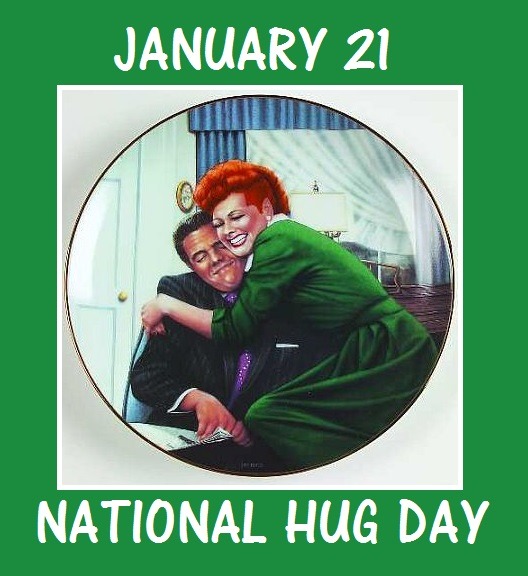
Celebrate National Hug Day by Giving Someone a Big Squeeze!
-


January 20th is National Cheese Lovers Day!
-
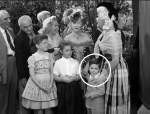
HAPPY BIRTHDAY DESIDERIO ALBERTO ARNAZ IV – January 19, 1953
-
Lucy and Hotels

From 1951 to 1960 the Ricardos and the Mertzes traveled to 8 countries and 13 states! Naturally, they had to find lodgings in a variety of hotels, motels, inns, and other accommodations along the way.

The first time we see the Ricardos away from home for the night is in 1952′s “The Marriage License” (S1;E26) where Lucy and Ricky re-new their vows in Greenwich, Connecticut, only a few miles from where they will eventually live during season six.

They stay overnight at the Eagle Hotel, which is run by a jack-of-all-hats proprietor, Bert Willoughby (Irving Bacon) and his wife, Mrs. Willoughby (Elizabeth Patterson).

Wealthy Cynthia Harcourt (Mary Jane Croft) took digs at the Waldorf-Astoria while canvassing for donations in 1954′s “Lucy is Envious” (S3;E23). The episode finds Lucy and Ethel dressed as women from Mars atop the Empire State Building to fulfill their pledges!

Lucy also took a room at the Waldorf, a popular hotel for visiting dignitaries, when she pretended to be the Maharincess of Franistan in 1952′s “The Publicity Agent” (S1;E31). “Hail, Tiger!”

New York’s Sherry-Netherland Hotel was where bachelor Eddie Grant (Hal March) stayed when he was in town in 1953′s “Lucy is Matchmaker” (S2;E27). In this episode, we get a glimpse of the hotel lobby, as well as Grant’s room.

There’s even a scene in the hotel corridor where a male passerby (Phil Arnold) mistakes Lucy and Ethel for a couple of “good time girls!”

We see a fictional Inn in “The Operettta” (S2;E5). Lucy pens the musical “The Pleasant Peasant” which featured Fred as Squire Quinn, innkeeper at the Inn on the River Out.

The road trip to California naturally included a couple of hotel stays. “First Stop” (S4;E13) finds the gang having no choice but to stay at the run-down One Oak Cabins and Cafe, which promises “Good Accommodations! Wonderful Food!” but supplies neither. It is run by the equally run-down Mr. Skinner (Olin Howland).

The cabin (he’s only got the one) is inconveniently located next to the railroad tracks. A sign over the bathroom door says “Home Sweet Home” but it proves to be anything but! The gangs flees in the middle of the night, forfeiting the $17 fee.

The next overnight stop we see is the Texas Ann Motel in Amarillo, which begins the leg of the trip to “Ethel’s Home Town” (S4;E15) of Albuquerque, New Mexico.

It is in this hotel room that Lucy and Ricky (and Fred and Ethel) hear Little Ricky speak his first words via long-distance telephone call. Unfortunately, this short scene is often cut in syndication to make room for more commercials.

The gang finally arrive at what is probably the most famous hotel of the series, the fictional Beverly Palms Hotel in Hollywood, California! From February 7, 1955 to October 24, 1955, the Ricardos and the Mertzes would call this home. The establishing shot of their Pontiac pulling into the hotel driveway was actually filmed at the real-life Beverly Carlton, now known as the Avalon Hotel Beverly Hills.

At the hotel we see the Ricardo’s third floor suite – living room and bedroom…

…the swimming pool (where we meet Harpo Marx and Hedda Hopper)…

…and the Mertzes room, where Lucy hides from Ricky when she gets her foot stuck in a bucket of cement at Grauman’s Chinese Theatre.

One of the most memorable characters of the series is Bobby the Bellboy (Robert Jellison), who somehow gets dragged into Lucy’s schemes in half a dozen Hollywood-set episodes.

A timid maid (Iva Shepard) seems to be the only one who can supply Ricky an alibi for staying out all night in “Don Juan and the Starlets” (S4;E17).

While in California, the couples take a break from marriage and the girls retreat to (usually) sunny Palm Springs, where they are virtual shut-ins at an un-named hotel due to a non-stop rainstorm.

When the sun finally does come out, Lucy and Ethel encounter Rock Hudson while lounging by the hotel pool (which naturally was just the Beverly Palms pool, slightly re-dressed).

In real life, the Arnaz family had a second home in Palm Springs, and in 1957 they opened the Desi Arnaz Western Hills Hotel, which is now known as the Indian Wells Resort Hotel.

After a successful road trip to Hollywood, the gang went international with a trip to Europe. Their first overnight was on a floating hotel called the S.S. Constitution, where (after an unusual boarding via helicopter) Lucy hoped for a “Second Honeymoon” (S5;E14).

The show even reproduced the real-life ship’s Boat and Bottle Bar.

First stop is England, where the foursome stay at the (fictional) Wimbelshire Hotel in central London, with a balcony that overlooks Buckingham Palace. The bellboy is played by Sam Edwards.

The chambermaid who teaches Lucy to curtsey in “Lucy Meets the Queen” (S5;E15) is played by future “Beverly Hillbillies” star Nancy Kulp, doing her best cockney accent.

Although there is an episode titled “Lucy Goes To Scotland” (S5;E17), it is really just a musical comedy dream she has in after seeing a London show. The town square of mythical Kildoonan features a whimsical Kildoonan Inn. Any resemblance to Lerner and Loewe’s 1947 musical “Brigadoon” is purely intentional!

There are three episodes set in Paris, where the group stays at Hotel Royal, where the Ricardo’s room naturally has a view of the Eiffel Tower.

The next hotel we see is in the Swiss town of Lucerne (not Locarno, Fred). We never learn the hotel’s name, but Lucy says that they make “man-sized” sandwiches for picnics on the Alps.

Lucy sits writing postcards by her open window with a view of the Swiss Alps.

The room is even decorated with traditional Swiss art:
a framed print from the “Codex Manesse” by Zurich-born minstrel and composer Walther von Klingen.

The elevator is out of service at the Hotel Grande in Florence, Italy, where the foursome have rooms on the fifth floor. Funny that living in a five-story walk-up brownstone in New York City never left them as winded as these stairs do in Florence!

The gregarious proprietor is named Signore Nicoletti (Vincente Padula), whose name is a nod to frequent “I Love Lucy” day player, Louis Nicoletti.

When in Rome (for her famous grape stomping escapade), Lucy and company stay in a centrally-located ‘albergo’ whose name goes unmentioned.

We do meet their bellboy (Saverio LoMedico), who translates a magazine article for Lucy about Vittorio Filippi’s upcoming film, “Bitter Grapes.”

“Lucy’s Bicycle Trip” (S4;E24) begins in an un-named hotel room in San Remo, Italy, where Lucy takes a dip in the Med. On their bike trip along the Riviera, the gang stay the night in a farmer’s barn! After some trouble at the border, they finally arrive in Nice, France.

Although the title of the episode is “Lucy Goes to Monte Carlo” (S5;E25) the title card that opens the show says “Nice, France.” In the previous episode Lucy telephones Ricky in Nice at the Plaza Hotel, but the episode seems to place the Monte Carlo casino very nearby when they are actually 15 miles apart. The above insert show is of the real-life Hotel de Paris in Monte Carlo.

The room (wherever it is located) is very glamorous, and Lucy and Ethel dress appropriately to match!

The restaurant where Lucy and Ethel go to eat also houses a casino, where Lucy gets into a trouble casually gambling her way into a small fortune!

The same hotel is seen in the following and final episode of the trip, “Return Home from Europe” (S5;E26), where Lucy gets the idea to disguise the cheese as a baby!

In season six, the gang travels to Miami Beach, Florida (the boys by train, and Lucy and Ethel by car with a suspected hatchet murderess). While there, they stay at the brand new Eden Roc Hotel, which opened in 1956 and is still in business today.

They spend two episodes in Miami Beach, before taking a quick jaunt to…

...Havana, Cuba, where Ricky Ricardo was born! While there, they stay at the stately Hotel Nacional.
Ten years earlier the real-life hotel was the site of a mob summit later depicted in the film The Godfather Part II (1974). The hotel is still in business today, and anxiously awaiting the return of American tourists.

In 1940, Lucy McGillicuddy and her ‘private secretary’ friend Susie MacNamara (Ann Sothern) also stayed in Havana, as part of a singles cruise! Back then their lodgings were far more modest. All this is depicted in the very first episode of “The Lucy-Desi Comedy Hour” in 1957.

In “Lucy Hunts Uranium” (1958) the group traveled to Las Vegas and stayed at the iconic Sands Hotel and Casino.

Once again Robert Jellison (aka Bobby the Bellboy) turns up to play a bellboy and Maxine Semon is their chambermaid. The Sands was razed in 1996 to make way for the Venetian.

The following year their destination was Sun Valley, Idaho, also a favorite destination of the Arnazes. The centerpiece of the resort town is the 220-room Sun Valley Lodge, which opened in December 1936 and is still in operation today. While there they run into Latin-American heartthrob Fernando Lamas.

Louis Nicoletti plays the Lodge desk clerk. You may remember that the actor’s name was given to the desk clerk of the hotel in Florence, Italy!

When “Lucy Goes to Mexico” in 1958, she actually stays at San Diego’s iconic Hotel del Coronado.
When it first opened in 1888, it was the largest resort hotel in the world. It has been featured in at least a dozen films, perhaps most memorably in Some Like It Hot. It is still welcoming guests today.

When Alaska became the 49th state in January 1959, Lucy and the gang went to Nome. Unfortunately, they arrived a day earlier than their hotel booking, and are forced to share a single room with one bed! An army cot, a sleeping bag, and an unwieldy hammock round out the sleeping arrangements!

The desk clerk who greets guest star Red Buttons is played by William Newell.

The bellboy of the unnamed Nome outpost is played by Sid Melton.

Although not strictly a hotel, in “Lucy’s Summer Vacation” (1959), the Ricardos are double-booked into a well-appointed Vermont cabin with movie stars Ida Lupino and Howard Duff.

The penultimate hotel the Ricardos and Mertzes book is the furthest of all – the Hotel Teito in Tokyo, Japan, in a 1959 episode of “The Lucy-Desi Comedy Hour.” The real-life hotel was razed in 1960.

Although they are not billed as ‘maids,’ the kimono-clad women who show them their rooms are played by Sondi Sonsai and Linda Wong. None of the actors ever left Hollywood; the entire episode was filmed at Desilu Studios in Hollywood.

The final destination in the final episode takes Ricky and guest star Ernie Kovacs to a posh country club hotel in “Lucy Meets the Mustache” (1960).

The desk clerk is played by Louis Nicoletti, who had also done the same duty at the Sun Valley Lodge.

The bellboy is played by Dick Kallman, a young actor who was taking acting classes from Lucille Ball on the Desilu / RKO lot.

Finally, and perhaps most appropriately, Bennett Green plays the waiter who takes away the room service. Green had been with “I Love Lucy” since the very beginning as Desi’s camera and lighting stand-in, as well as playing small roles in many episodes.
And, as Edie Adams sings the last time we see the Ricardos and the Mertzes,
“that’s all.” Alaska, Beverly Palms Hotel, CBS, Connecticut, Desi Arnaz, Ethel Mertz, Fred Mertz, Hotel Del Coronado, Hotel Teito, Hotels, I love lucy, Inns, Keith Thibodeaux, Little Ricky, Lucille Ball, Lucy, Lucy Ricardo, Motels, nyc, Ricky Ricardo, Sherry Netherlands, Sid Melton, Sun Valley, Sun Valley Lodge, The Lucy-Desi Comedy Hour, tv, Vivian Vance, Waldorf-Astoria, William Frawley, William Newell
 -
“The Ricardos Go to Japan”

(LDCH S3;E2 ~ November 27, 1959) Directed by Desi Arnaz. Written by Bob Schiller and Bob Weiskopf. Filmed during September 1959 at Desilu Studios, Hollywood.
This is the penultimate episode of “The Lucy–Desi Comedy Hour,” the second of a shortened three-episode third season. It is also the very last time we will see the Ricardos and Mertzes during the 1950s.

Like most other installments of the hour-long format, it features a celebrity guest star playing himself (Bob Cummings) and takes the Ricardos to an exotic location (Japan).

This episode was aired the day after Thanksgiving 1959. At the time, ABC daytime syndication aired “The Bob Cummings Show” at noon and CBS daytime syndication showed “I Love Lucy” at 11am!

Not including the flashback episode “Lucy Takes a Cruise to Havana” (S1;E1), this is the first time the characters have left the United States since traveling to Cuba in season six of "I Love Lucy.” In addition to Cuba and Japan, foreign countries we have seen the gang travel to are Mexico, England, Switzerland, France, Italy, and Monaco. As with all of these travel episodes, the main cast never left their Hollywood soundstage.

This was the second episode that Desi Arnaz is credited as director after the firing of Jerry Thorpe mid-way through “Lucy’s Summer Vacation” (S2;E5). ‘

There was no studio audience present for the filming. There was, however, a special preview screening at Glen Glen Studios (Desilu’s Sound Company) on November 11, 1959. This was likely to gauge audience reaction and perhaps where to sweeten the laugh track. Although no travel was involved, there are stock footage insert shots of the aircraft and the hotel.

A few weeks before this show first aired, Lucille Ball and Sammy Davis Jr. took part in an untelevised charity show to provide financial aid to Japan.

Lucille Ball was known in Japan, even before “I Love Lucy.” This 1950 Japanese movie magazine has Ann Sheridan on the cover, but inside has photos of Lucille Ball.
Because of the the flowers and elaborate silk kimonos this is one of those occasions where filming in color would have been beneficial. If the show had been filmed in color, viewers might have been able to see that Lucy’s eyes were red from crying due to continued marital tensions between her and Desi.

Robert “Bob” Cummings was born in 1910 in Joplin, Missouri. His godfather was the aviation pioneer Wilbur Wright, so naturally he got his pilot’s license and studied aeronautical engineering. After the stock market crash of 1929, he gave flying up to study drama in New York City, making his Broadway debut in 1931. In 1934 he moved to Hollywood and started making films. During World War II he was a captain in the Air Force Reserves. His television career kicked off in 1952, winning an Emmy for his role in the series “My Hero.” Starting in 1955, Cummings starred on a successful NBC sitcom, "The Bob Cummings Show” (aka “Love That Bob”), in which he played Bob Collins, an ex–World War II pilot who became a successful photographer. The show ended in July 1959, just a few months prior to filming this “Comedy Hour” episode. CBS revived the series in 1961, but it lasted just one season. He reprised the character of Bob Collins on a 1972 episode of "Here’s Lucy” and returned the following season for another episode. Cummings was married five times and fathered seven children. He died in 1990 at the age of 80.

In the episode, Cummings says he is in Japan to make a film. His next film, My Geisha (1962) starring Shirley MacLaine and Yves Montand, actually was filmed in Japan. Lucy always believed that it was best to stick as close to the truth as possible, and this was no exception.

The airport is decorated with travel posters, one of which is for Mexico, the location of first episode of season two of “The Lucy-Desi Comedy Hour.”
The airport scene required many background players.
- Sam Harris had done more than a dozen films with Lucille Ball between 1934 and 1956. On "I Love Lucy” he was glimpsed on the subway in “Lucy and the Loving Cup” (ILL S6;E12) and in the audience of “Over the Teacups” in “Ethel’s Birthday” (ILL S4;E8). He also appeared on six episodes of “The Lucy Show.”
- William Meader was a regular stand-in for Frederic March, but also found time to appear as a regular extra in 16 episodes of “The Lucy Show.”
- Monty O’Grady was a passenger on the S.S. Constitution in “Second Honeymoon” (ILL S5;E14) and was also an extra in The Long, Long Trailer (1953). Like Meader, O’Grady was a regular extra on “The Lucy Show,” appearing in 14 episodes. He was also seen on two episodes of "Here’s Lucy,” one of which was also as a traveler in an airport.
- Murray Pollack attended the Westport “Country Club Dance” (ILL S6;E25) as well as appearing in the film Critic’s Choice (1963) with Lucille Ball. He appeared in two episodes of “The Lucy Show,” one with Harris, the other with Meader. He was also an airport traveler with O’Grady on a 1969 episode of “Here’s Lucy.”
- Norman Stevans made his first appearance with Lucille Ball in the theatre audience in “Ethel’s Birthday” (ILL S4;E8) but went on to appear in the films Forever Darling (1956), Yours Mine and Ours (1968) and Mame (1974), in addition to two episodes “Here’s Lucy.”
- Waclaw Rekwart was a Polish-born actor who made his screen debut as a migrant worker in the Oscar-winning The Grapes of Wrath (1941).
- Chalky Williams was seen as a regular extra on the western TV series’ "Bonanza,” "Gunsmoke” and "The Wild Wild West.”

The foursome travels to Japan on United Airlines. Cheapskate Fred makes Ethel pay for her own airline ticket, and we later learn that she pawned the family silver to afford it. In “Lucy and Superman” (ILL S6;E13) it is Fred who wants to pawn the family silver because one of his apartments has been continually vacant.

Kathryn Card is briefly seen as Mrs. McGillicuddy at the start of the show. She will be staying home with Little Ricky (Keith Thibodeaux) during the trip. This is Card’s only appearance on the hour-long programs. The last time we saw the character was when Lucy called home from Italy in “Lucy Gets Homesick in Italy” (ILL S5;E22). As she waves goodbye to Lucy and Ricky at the airport (as well as to the show itself), she is still calling her son-in-law Mickey!

While in Japan the gang stays at the Hotel Teito in Tokyo. The real-life hotel was located across from the Imperial Palace, near Otemachi Gate, with Mount Fuji on the horizon. Constructed between 1910 and 1920, the building originally housed the Forestry Office of the Imperial Household. It was refurbished and reopened in 1947 as a hotel.

Although privately-owned, Hotel Teito was operated by Occupation forces until 1952. The building was razed in 1960, just a few months after this episode aired, and replaced with the Palace Hotel, which closed in 2009.

Trying to be savvy about Japanese customs, Lucy says she sat through Sayonara twice. The 1957 film details a romance between an Air Force pilot (Marlon Brando) and a Japanese woman (Miyoshi Umeki), winning four Oscars. Somewhat ironically, Bob Cummings was a real-life Air Force pilot traveling in Japan.
When the Japanese chambermaid unwittingly makes a joke, Lucy quips “I think maybe Milton Berle slept here.” TV comedian Milton Berle was the guest star of the previous episode of the “Comedy Hour.”
Ricky’s concession to their Japanese hosts is trying to say “sayonara” but it coming out “Cinerama”! Cinerama is a portmanteau of “cinema” and “panorama” and denotes a widescreen filming process that originally projected images simultaneously from three synchronized 35 mm projectors onto a huge, deeply curved screen. It was first introduced during the 1950s, when the movie industry was reacting to competition from television.

An entire movie theatre in Los Angeles was given over to the showing of Cinerama films. In 1974, it served as the location for the Hollywood premiere of Lucille Ball’s Mame, which was not filmed in Cinerama!

Lucy rattles off the tourist spots she wants to see:
- Mount Fujiyama (aka Mount Fuji) – the highest volcano in Japan, 2nd-highest volcano of an island in Asia, and 7th-highest peak of an island in the world.
- The Deer Park – Lucy is probably referring to Nara Park, located a three hour train ride from Tokyo in the city of Nara. Established in 1880,
over 1,000 deer have become a symbol of the city and have even been designated as a natural treasure.
- The Emperor’s Palace – the primary residence of the Emperor of Japan is a large park-like area located in the Chiyoda ward of Tokyo and contains buildings including the main palace. the private residences of the Imperial Family, an archive, museums, and administrative offices. Much of the Palace was destroyed by bombing during World War II and in 1959 was under reconstruction, not opening until the early 1960s.
Needless to say, Lucy’s ‘yen’ for real pearls supersedes sightseeing and none of these places get air time, even in stock footage.

When Fred tries on a kimono for the first time, Ethel calls him Madame Butterfly, a reference to the title character of an immensely popular 1904 opera by Puccini. A minute later she calls him Cho-Cho san, Madame Butterfly’s given name in the story.

Lucy compares Fred to Sessue Hayakawa, a Japanese-born actor who was nominated for a 1958 Oscar for The Bridge on the River Kwai. The Oscar-winning film is also referenced in “Lucy’s Summer Vacation,” a 1958 episode of the “Comedy Hour.”
Ethel reports that Fred is wearing a money belt during the trip. Lucy asks why he doesn’t trust Ethel with the money.
ETHEL: “Listen, if he doesn’t trust the Chase National Bank, he certainly isn’t going to trust me.”
The bank (then known as the Chase Manhattan Bank) was also mentioned when ‘Lucy the Lip’ and ‘Babyface Ethel’ went on a robbery spree in “The Kleptomaniac” (ILL S1;E27) in 1952.
FRED: “Wouldn’t you think in the biggest city in the world I could find a new money belt?”
Tokyo Japan overtook New York City as the largest city in the world during the 1950s. In 1960 Tokyo had more than 16 million people to New York’s 14 million. As of 2018, Toyko still led with 37,468,302 and Delhi India had moved into the #2 spot with 28.5 million. New York City had dropped to 8th with 18.7 million.

ETHEL (to Bob and Lucy about Fred): “My husband makes her husband [Ricky] look like Diamond Jim Brady.”
James Buchanan Brady (1856-1917) was a real-life millionaire and philanthropist who was fond of jewels (hence the nickname). He had a longtime relationship with singer Lillian Russell. In the late 1960s, Lucy announced she was to play Russell to Jackie Gleason’s Brady in a film project that never materialized. There was already a film about Brady made in 1935.
Fred was first compared to Brady in “The Business Manager” (ILL S4;E1). In future, the writers frequently compare thrifty (cheap) characters like Mr. Mooney, Harry Carter, and Jack Benny to Diamond Jim Brady.

While in the tub, Cummings idly sings a few bars of “The Japanese Sandman”, a song written by Richard A. Whiting and Raymond B. Egan in 1920. The year this episode was filmed it was recorded by Terry Snyder and the All-Stars.

The scene of Lucy and Ethel (and eventually Ricky and Fred) with their heads through a tear in the paper wall watching Cummings bathe ends with him saying “Welcome to the Knothole Gang”. The Knothole Gang was a term given for youth who peaked through the wall or fence at a ballpark because they could not afford a ticket. This led to donors subsidizing young people to attend baseball games. In the 1940s and ‘50s, the Brooklyn Dodgers gave away more than 2 million free passes to kids.

Lucy has a habit of interrupting celebrities mid-bath and Bob Cummings is no exception. In “The Star Upstairs” (ILL S4;E25) it was Cornel Wilde and in “Lucy Goes to Sun Valley” (1957) it was Fernando Lamas.

Oops! In 1952’s "The Anniversary Present” (ILL S2;E3), Ricky buys Lucy real pearls for their 12th anniversary. However, in this episode of “The Comedy Hour,” Lucy makes a big deal about wanting real pearls to replace the fake pearls that she bought at Macy’s basement. She never mentions the real ones Ricky bought from Grace Foster seven years earlier.

This is yet another mention for Macy’s department store, who were prominently featured in “Lucy Meets Orson Welles” (ILL S6;E3).
Lucy steels $200 from Fred’s money belt while he is asleep in a scene that is reminiscent of when she tried to steal the train tickets from napping Fred’s jacket pocket in “Ricky Sells the Car” (ILL S5;E4).

This time, however, Ethel is in on the caper and Lucy falls into a fish pond where she has a close encounter with a frisky gold fish.
At the Toma Geisha House Ricky sings “Tokyo Pete,” a Japanese version of “Cuban Pete,” a song originally sung in “The Diet” (ILL S1;E3) and then again in “The Hedda Hopper Story” (ILL S4;E20). Another variation called “Texas Pete” was performed in “Lucy Goes to the Rodeo” (ILL S5;E8).

To get into the geisha house where women are not allowed as guests, Lucy and Ethel disguise themselves as geisha girls.

When disguised as a geisha, Lucy is assigned to perform a fan dance. Naturally she makes a mess of it, just as she did when crashing the dance line in “Lucy is Jealous of Girl Singer” (ILL S1;E10). She still gets compliments from the men, which she acknowledges in broken English with a high-pitched voice.
LUCY (as Geisha): “Thank you very many.”

The jig is up when Lucy’s wig falls off revealing her red hair. This is yet another reason this episode would have been glorious in color.
Oops! After Lucy is discovered, she tries to escape by bursting through the paper wall. When she comes back into the room again a moment later, her formerly mussed up hair from being under the geisha wig is immaculately set! Lucy may not have been a geisha girl, but she was a movie star!

- Teru Shimada (Mr. Osato) was a Japanese-born actor who had appeared with Lucille Ball in Murder at the Vanities (1934).
- Sondi Sodsai (Maid) came to the US to compete in the 1960 Miss Universe pageant after being crowned Miss Thailand in 1959. She lost the title but used scholarship money to enroll at UCLA majoring in drama.
- Linda Wong (Maid) was a Korean born actor who was making her third screen appearance.
-
Along with Shimada, Wong and Sodsai,
May Lee (Mama-San Geisha) had appeared on the TV series “Hawaiian Eye,” a major employer of Asian actors at the time.

Sitcom Logic Alert! Although all ends happily, the question still remains – why would a successful actor like Bob Cummings be re-selling cameras and pearls for a Japanese businessman?
FAST FORWARD!

A few weeks after this episode first aired, both Lucille Ball and Bob Cummings were interviewed (separately) for “Hedda Hopper’s Hollywood” (January 10, 1960), a celebrity-filled look at Tinseltown.
While filming this for Hopper, his second TV series “The Bob Cummings Show” had just finished a five season run on CBS.

Lucille Ball and Danny Kaye tackle the demands of dining at a Japanese Restaurant on “The Danny Kaye Show” in 1962.

“The Lucy Show” (1962-68) was dubbed and translated into Japanese!

In a 1972 episode of “Here’s Lucy,” Cummings played Bob Collins, the character he was also playing on his own show “Love That Bob”!

In 1973, Cummings returned to "Here’s Lucy” to play a deceitful antiques dealer who is after a priceless chair Lucy Carter bought.

In 1999, this Japanese magazine had Lucy and Desi on the cover.
1959, Bob Cummings, CBS, Chalky Williams, Desi Arnaz, Ethel Mertz, Fred Mertz, geisha, Hotel Teito, I love lucy, japan, kimono, Lucille Ball, Lucy, Lucy Ricardo, Madame Butterfly, Murray Pollack, Ricky Ricardo, Robert Cummings, Sam Harris, Sayonara, Teru Shimada, The Lucy-Desi Comedy Hour, The Ricardos Go To Japan, Tokyo, tv, Vivian Vance, Waclaw Rekwart, William Frawley, William Meader -
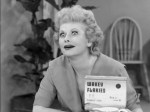

- In a 1957 episode of THE LUCY-DESI COMEDY HOUR, Lucy had trouble staying awake on television with Paul Douglas.
- In a 1971 episode of HERE’S LUCY, Lucy had trouble staying awake on television with David Frost.
-

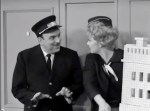
- In a 1955 episode of “I Love Lucy,” Lucy encounters a beleaguered train conductor played by Frank Nelson,
in a show that also includes Vivian Vance and Louis Nicoletti.
- In a 1963 episode of “The Lucy Show,” Lucy encounters a beleaguered train conductor played by Frank Nelson, in a show that also includes Vivian Vance and Louis Nicoletti.
- In a 1955 episode of “I Love Lucy,” Lucy encounters a beleaguered train conductor played by Frank Nelson,
-
TIME to LOOK at LIFE with LUCY

Magazines were the internet of the 1950s. A couple of episodes of “I Love Lucy” were built around getting magazine coverage of Ricky and his career. Most times characters were just seen casually reading magazines, the way we would check our phones. Lucy and Desi frequently featured magazines on camera as a way of thanking them for promoting “I Love Lucy”!

In “Men Are Messy” (1951) during the show’s first season, Lucy’s hillbilly antics turned up on the cover of Look! Although the real August 14, 1951, issue was used on camera, Lucy’s photo covered a trio of Hollywood starlets.

When Look turned up again in “Lucy
Gets Ricky on the Radio” (1952), the June 3, 1952, issue actually had Lucille Ball on the cover!
Look was part of a 1952 flashback intro during Lucy’s pregnancy. Vivian Vance has her hand over Ball’s photo. Inside is an article by Desi Arnaz about his wife.

Look showed up one last time in “Ricky Loses His Temper” (1954), showcasing the March 9, 1954, issue. Lucille Ball made the cover of Look nine times during from 1937 to 1971, when the magazine printed its final issue.

This cover of LIFE inspired Lucy and Desi to create the episode “Ricky’s Life Story” (1953), which featured an inside spread of photos on the Ricardo family.

LIFE’s May 11, 1953, issue was prominently featured in the episode, although the back page had to be replaced because it was a full-page ad for Lucky Strike cigarettes, the main competitor of “I Love Lucy” sponsor Phillip Morris. Even the writers were prohibited from using the word “lucky!” The cover featured model Gloria Barnes for an article “Denim Gets Dressy.”

This same issue of LIFE turns up again two years later in a stack of magazines Lucy purchases to read on her trip during “The Great Train Robbery” (1955).

When the girls return from shopping in “Lucy and Ethel Buy the Same Dress” (1953), Ricky is reading the September 21, 1953, issue of LIFE. Lucille Ball appeared on the cover of LIFE twice more: in 1962 and 1976. The photo magazine was a weekly from 1936 to 1972 and a monthly from 1978 to 2000. It maintained a web presence until 2012.

Although it is never seen on screen, Lucy says she saw “Ethel’s Birthday” (1954) present – an outrageous pair of hostess pants – in Harper’s Bazaar.

Another ‘meta’ magazine appearance was in “Ricky
Has Labor Pains” (1953) where a pregnant Lucy is reading the January 1953 McCall’s (January 1953), which clearly has a cover that say “Why I Love Lucy” by Desi Arnaz!
Also in 1953, in “Lucy Wants New Furniture,” Lucy tried to be casual when Ricky came home by glancing at a copy of Woman’s Home Companion (May 1953).

Lucy read this same issue of Woman’s Home Companion a month earlier in “Lucy Hires a Maid.”

Settling in to wait for the phone to ring during “Lucy Does a TV Commercial,” Fred picks up a copy of Radio and Television Mirror from April 1949, with Arthur Godfrey on the cover. Coincidentally, “Arthur Godfrey’s Talent Scouts” was “I Love Lucy’s” lead in. Godfrey closed his show asking viewers to stay tuned. This issue was already three years old at the time of filming. The issue also had an article about Red Skelton, one of Lucille Ball’s inspirations for her Vitameatavegamin routine.

McCall’s turned up “In
Palm Springs” (1955), when Ethel pages through the May 1955 issue to pass the time. Viewers never knew it, but Vivian Vance was actually reading about herself! This issue includes an article titled “I
Don’t Run Away Anymore – Vivian Vance”. Vance was a staunch advocate of mental health, and talks about her award from the National Association of Mental
Health. She shares with readers some of her darker days. Meanwhile, back in Los Angeles, Fred thumbs through the March 21, 1954, issue of Sports Illustrated. Both Mertzes are waiting out a rainstorm. Although McCall’s stopped publishing in 2002, Sports Illustrated is still on news stands as of this writing.
In “Little Ricky Learns to Play the Drums” (1956), Fred is trying to catch up on his reading with a November 1954 copy of Sports Illustrated. At the time of filming the issue was 19 months old! On the front cover is San Francisco 49′ers Quarterback Y.A. Tittle, the first professional football player on the cover. Y.A. Tittle will be mentioned again on a 1969 episode of “Here’s Lucy.”

The boys tended toward masculine publications like The Fisherman, as they do in “Deep Sea Fishing” (1956).

Although a specific issue of House & Garden was not seen on camera, the plot of “Lucy Raises Chickens” (1957) involved a team of reporters from the magazine visiting the Ricardo’s colonial home in Westport. When they show up at the end of the episode, they are horrified to see the gang herding hundreds of baby chicks through the living room! Its US edition ceased in 1993, and was closed again in 2007.

When traveling in Italy, Lucy reads about film director Vittorio Philippi in Teatro, a real-life Italian-language movie magazine that she must have translated by the bellboy. The result is the hilarious grape stomping scene in “Lucy’s Italian Movie” (1956).

In “The Sublease” (1954) both Lucy and Ethel catch up on the news by reading the same April 19, 1954, issue of Time. Lucille Ball had appeared on the cover of Time two years earlier.

In “Ricky Sells The Car” (1955), Lucy tries to look natural by perusing the
the September 13, 1954 issue of Time Magazine, more than a year old at the time of filming. On the cover is Alicia Patterson, the publisher of Long Island Newsday.

During the return home from Europe, Ethel reads the April 9 1956 issue of Time Magazine. Coincidentally, the cover story is about the President of American Express and also features a travelers cheque, a steamship, and an airplane!

Not to be outdone, September 2, 1957′s Newsweek got some airtime in “Lucy Hunts Uranium,” a 1958 episode of “The Lucy-Desi Comedy Hour” set in Las Vegas. Lucille Ball was on the cover of the news magazine in 1953.

Movie-star mad Lucy dreams about her future life in Hollywood in
“Ricky’s Screen Test” (1954) by pouring over the November 1954 issue of Modern Screen with Debbie Reynolds on the cover. Lucy shared a cover with Doris Day in 1969.

The American Weekly was a Sunday supplement magazine that turned up in “Lucy is Matchmaker” (1953). As the bottom banner says, this particular issue (May 3, 1953) contains the article “It Happened To Us” by Lucille Ball!


In that same episode, the action is set in a hotel lobby that displays a myriad of magazines on its rack: Showmen’s Trade Review, American Magazine, McCall’s, Collier’s, True Stories, True Love Stories, Liz Taylor, Companion, Newsweek (3 issues), Vogue, Sunset, Cosmopolitan, Good Housekeeping, and House & Garden.

In “Lucy’s Schedule” (1951), Alvin Littlefield (Gale Gordon) reads the May 25, 1952 issue of American Weekly. The cover art is titled “Raining Car Wash” by Euclid Shook.

In “The Courtroom” (1952) there is a rare glimpse of Mademoiselle magazine. This is the April 1952 issue, which was four months old at the time of filming.

Holiday was a travel magazine that was published from 1946 to 1977. Lucy looked through the November 1951 issue in “The Saxophone” (1952).
BUT WAIT – THERE’S MORE! KEEP READING…

For a look at TV Guide and “I Love Lucy,” CLICK HERE!
1950s, CBS, Desi Arnaz, Ethel Mertz, Fred Mertz, harper’s bazaar, Holiday, House & Garden, I love lucy, LIFE, Look, Lucille Ball, Lucy, Lucy Ricardo, Magazines, McCalls, Modern Screen, Newsweek, Ricky Ricardo, Sports Illustrated, Teatro, The American Weekly, The Fisherman, The Lucy-Desi Comedy Hour, Time, tv, Vivian Vance, William Frawley -
I LOVE LUCY & TV GUIDE
April 3, 1953

Lucille Ball is the TV Guide Cover Queen with a record 39 covers to her credit! Here’s a look at that very first issue and the magazine’s various appearances on “I Love Lucy.”

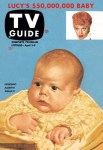
The national TV Guide’s first issue was released on April 3, 1953, accumulating a total circulation of 1,560,000 copies that were sold in the ten U.S. cities where it was distributed.
Desi Arnaz Jr. and Lucille Ball were on the cover.
The initial cost of each issue was 15¢ per copy (equivalent to $1.43 in 2019). The price of each issue has gradually risen over the years, selling for $4.99 per copy as of 2020.

The inside article “Lucy’s $50,000,000 Baby”.

The back cover also included a mini version of the issue.

The all-new national TV Guide was promoted in the local editions the week prior to its debut, including mentions of Lucy and her baby.

It was also promoted in newspaper ads nationwide.

The cover was part of Lucille Ball’s scrapbook (page 15) featuring coverage of the birth Desi Arnaz, Jr. From the Lucille Ball and Desi Arnaz Collection, Music Division, of the Library of Congress. Donated by Lucie Arnaz / Desilu, too, LLC.

On April 17, 1953, just two weeks after the first edition was published, Lucy and Little Ricky were on the cover of TV Guide in a drawing by Jack Weaver. Lucy was depicted as the top of a TV totem pole featuring Cid Caesar, Imogene Coca, Milton Berle, and Arthur Godfrey – all TV pioneers. Lucy is holding a pack of Philip Morris cigarettes and Little Ricky’s rattle has a TV antenna on it!

The back cover of the April 17, 1953 edition featured the premiere issue with Lucy and Little Desi on top of a television set.

Mother and son were back on the cover 20 years later on March 31, 1973.
TV GUIDE & I LOVE LUCY: On the Air!

But before that, Lucille Ball was on the cover of a local edition of TV Guide (January 25, 1952), which was casually left on the coffee table during “Breaking the Lease” (1952).

TV Guide turns up again in “Ricky
and Fred are TV Fans” (1953) which features Queen Elizabeth on the cover of its May
29, 1953, issue. It is worth noting that the birth of Little Ricky had better ratings than Her Majesty’s coronation!
“Ricky
Loses His Temper” (1954) features yet another TV Guide, this one with “I’ve Got A Secret” on the cover on January 12, 1954. Two years later Lucille Ball made the first of her four appearances on “I’ve Got a Secret.”
This same issue turns up again in “Lucy’s
Club Dance” (1954) where it joins the March 12, 1954 edition (featuring Maria Riva,daughter of actress Marlene Dietrich) and the February 26, 1954 issue (featuring Liberace) as set dressing for a corner news stand!

Liberace’s cover features his famous candelabra, which would be pivotal to the plot of his 1970 appearance on “Here’s Lucy.” Inside, it contained a review of “I Love Lucy” as Program of the Week.

Lucille Ball appeared in a thoughtful pose on the cover of TV Guide on October 9, 1954.

While this issue was never seen on “I Love Lucy,” it did turn up frequently on “The Andy Griffith Show”, a series filmed on the Desilu backlot.

Perhaps the most conspicuous TV Guide appearance is in “Milton
Berle Hides Out at the Ricardos” (1959) in which ‘Mr. Television’s’ January 10, 1959, cover by Al Hirschfeld is blown up to poster size to decorate Berle’s office!
In 1991, a commemorative edition of TV Guide dubbed Lucille Ball a TV Legend.

On October 13, 2001, TV Guide paid tribute to “I Love Lucy” with eight collectible covers and a cover story “The 50 Funniest Moments of I Love Lucy”!

Of the eight covers, two were portraits of Lucille Ball from the 1950s, and 5 were from episodes….

“Job Switching” (1952)…

“Redecorating the Mertzes’ Apartment” (1953)…

“L.A. at Last!” (1955)…

“Lucy Gets Into Pictures” (1955)…

“Lucy’s Italian Movie” (1956)…

In 2005 this cover was recreated by Reba McEntire as Lucy Ricardo marking the last of the small-sized editions of TV Guide.

“Lucy and Superman” (1957).
Interestingly, the covers do not include “Lucy Does a TV Commercial” (1952), which includes the memorable Vitameatavegamin sequence.

In addition, there was an individually numbered, limited edition, wrap-around cover collector’s issue, not sold in stores (note the inverted color logo), featuring “Lucy Gets a Paris Gown” (1956).

The November 10, 2001 Canadian TV Guide chimed in with this cover featuring “Lucy Tells The Truth” (1953).

TV Guide teamed up with the Paley Center for Media in New York City to salute Lucille Ball in her centennial year (2011) with a multi-dimensional exhibit titled “Loving Lucy.”

On April 8, 2013 TV Guide’s 60th anniversary reprised a Lucy cover from January 12, 1957 which marked TV’s first ten years.
Needless to say, there are many other Lucille Ball appearances on / in TV Guide, these are just a select few.
-
Subscribe
Subscribed
Already have a WordPress.com account? Log in now.
 Papermoon Loves Lucy