-
Lucy Buys a Sheep
S1;E5 ~ October 29, 1962
Synopsis
Lucy
solves the lawn mowing problem by buying a sheep to eat the grass.
Then winter weather makes the sheep, Clementine, have to spend the
night in the house with Lucy, Viv and the kids, and it keeps them all
awake.Regular
Cast
Lucille
Ball (Lucy Carmichael), Vivian Vance (Vivian Bagley), Jimmy Garrett
(Jerry Carmichael), Ralph Hart (Sherman Bagley), Candy Moore (Chris
Carmichael), Charles
Lane (Mr.
Barnsdahl)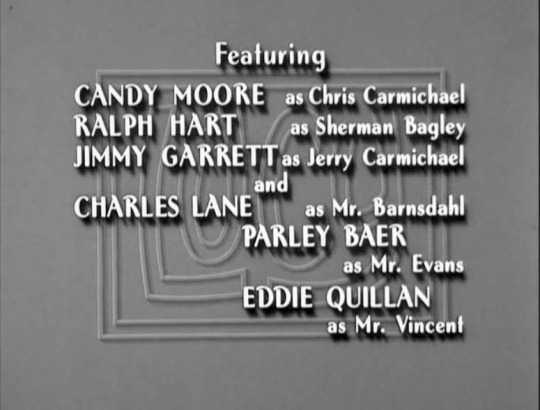
Dick
Martin
(Harry Connors) does not appear in this episodeGuest
Cast
Parley
Baer (Mr.
Evans) previously
played MGM’s Mr. Reilly in “Ricky
Needs an Agent” (ILL S4;E29) and the furniture salesman Mr. Perry
in “Lucy Gets Chummy with the Neighbors” (ILL S6;E18).
This is the first of his
five appearances on “The Lucy Show.” He also made two appearances
on “Here’s Lucy.” He is perhaps best known for his recurring
roles as Mayor Stoner on “The Andy Griffith Show” and Doc Appleby
in “The Dukes of Hazzard.”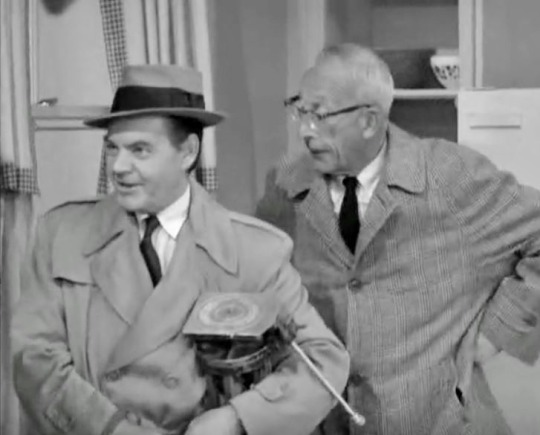
Eddie
Quillan (Mr.
Vincent, left) was born
in Philadelphia in 1907. At the age of seven he was already
performing in vaudeville with his sister and three brothers in an act
called "The Rising Generation.” He made his screen debut
in 1926 in a Mack Sennett short and went on to appear in such classic
films as Young
Mr. Lincoln
(1939), The
Grapes of Wrath
(1940), and Brigadoon
(1954).This is the first of his two appearances on “The Lucy Show.” He
also made two appearances on “Here’s Lucy.”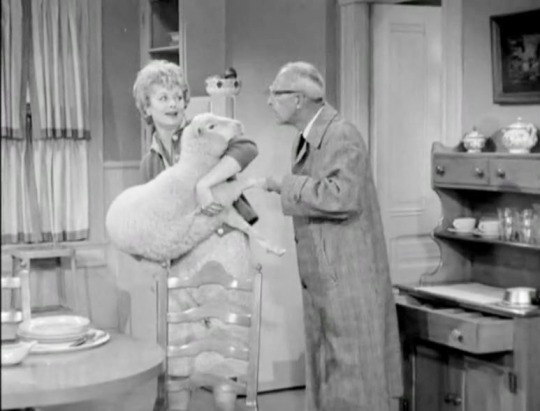
Ginny
Tyler
(uncredited voice of the sheep) started
out on radio before hosting a children’s TV show in Seattle. By the
late 1950s, she had moved to Hollywood and was narrating record
albums for Disney, including “Bambi” and “Babes in
Toyland”.
After this episode, she did the voice of the sheep in Disney’s 1964
hit Mary
Poppins.
She returned to do bird voices for “The Lucy Show” in “Lucy
Gets the Bird” (S3;E12) and a 1974 episode of “Here’s Lucy.”
Although she died in 2012, her voice can still be heard in the chorus
of birds outside The Enchanted Tiki Room at Disneyland and Walt
Disney World.Clementine the Sheep appears as herself.
Although
filming dates for “The Lucy Show” are not widely published, sources
indicate that this may have been the second episode to be filmed.
This would explain the lack of exposition about Lucy’s dead husband,
which is noticeably absent until episode four.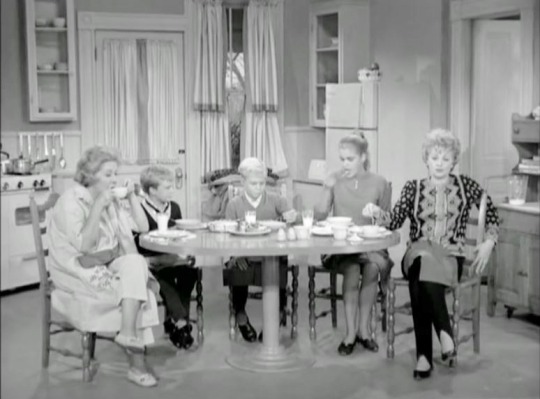
The
opening scene from this episode was used as the audition material for
the child actors. In all the scripts for the
first few weeks, Lucy’s daughter Chris was named Linda. It was changed because “Make Room for Daddy” (1953-1964), another CBS sitcom shot at Desilu studios, already had a daughter named Linda, played by Angela Cartwright.In
the opening breakfast scene between Lucy and Jerry, the close-up
shots of Jerry are obviously over-dubbed into the master scene,
causing Jerry’s voice to sound noticeably different.
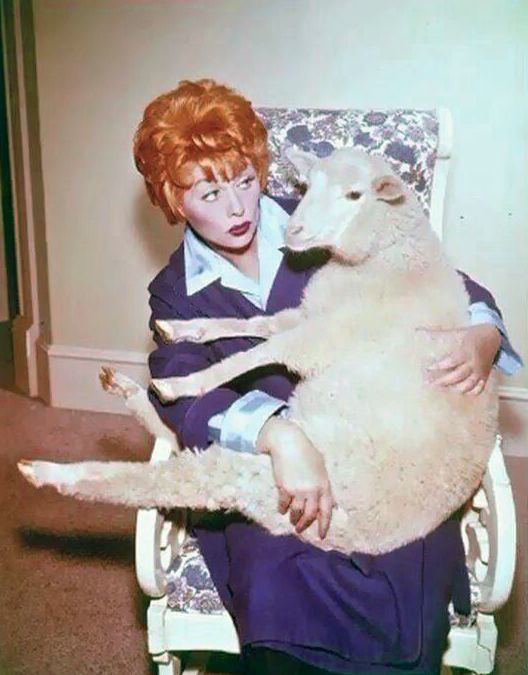
Lucy and a lamb were featured on the cover of this cut-out coloring book. Although Lucy sang to the sheep in the episode, she never played the guitar.
In
this episode we hear about Walter Brewer, a boy in the neighborhood
that Chris likes; Mrs. Farrington, a neighbor who wants to
rent Clementine; and that Lucy is a member of the Embroidery Club
(although she may be just joking). About the boys, we learn that
Jerry’s penmanship has improved but he is not a good speller, and
that Sherman takes piano lessons after school, but he’d rather not.Sherman
has a teacher named Miss Clementine, who tells him that Australian
farmers use sheep to keep their grass trim, giving Lucy the idea to
buy a sheep. The sheep Lucy buys is named after the teacher,
although the actual naming of the sheep is not part of the episode.
Chris suggests they buy a power mower,
which she says will cost $100. Adjusted for inflation, this would be
more than $860 in 2020.
Lucy:
“Compared to Mr. Barnsdahl,
Scrooge was a swinger.”Lucy
is comparing Mr. Barnsdahl to Ebenezer Scrooge, the curmudgeonly
miser who is the central figure of Charles Dickens’ 1843 novella “A
Christmas Carol.”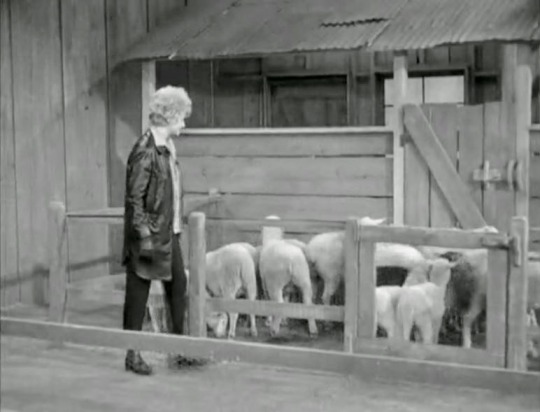
The
episode actually employs a dozen sheep, including a black one, which
Viv analogizes to her ex-husband, Ralph.Lifting
the sheep into the car, Lucy says “You
really are all wool and a yard wide.”
This is an old expression used to describe someone who is genuine
and honorable. The adage has its roots in the clothing trade of the
16th century.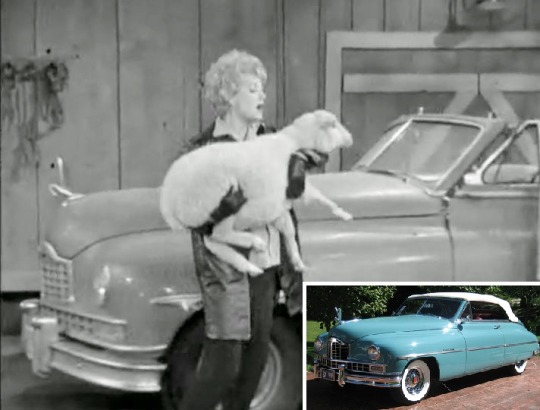
The
scene set at the farm includes a 1949 Packard convertible.
Packard started making automobiles in 1899 and went out of business
in 1958, four years before the series premiered. On “I Love Lucy”
the Ricardo’s drove a brand new 1955
Pontiac
Star
Chief Convertible during season four because Desilu had a promotional deal with Pontiac. Future episodes indicate that Lucy doesn’t own a car, so the Packard may belong to Viv. In “Lucy and Her Electric Mattress” (S1;E12) Viv talks about her old car breaking down.This
is the first episode not to have at least one scene set in the living
room. This is likely due to the fact that studio space was needed
for the farm and bedroom sets.
This is also the first (and only time
this season) that we see Lucy’s bedroom. We saw Viv’s bedroom in
“Lucy Waits Up for Chris” (S1;E1).The
episode includes quotes from the Mother Goose nursery rhymes “Sing
a Song of Sixpence” and “Little Bo
Peep.”
“My
Darling, Clementine” is a western
folk ballad usually
credited to Percy Montrose (1884), although it is sometimes
attributed to Barker Bradford. It was also the title of a 1946
western film directed by John Ford. Here Lucy adapts the lyrics to
“Go
to sleepy, little sheepy” and
“You’re
my lamby, I’m your mammy.”
In the scene in the sheep pen, Lucy and Viv harmonize on a verse of
the song. Later in the series, the girls will put their musical
skills to use by joining a barbershop quartet.
Searching
for Clementine among the other sheep in the pen Viv says, “Will
the real Clementine Carmichael please stand up?” This is a reference to the game
show “To Tell the Truth” (1956-1968), which always ended with the
host asking one of three contestants to stand if they were not
fibbing to a celebrity panel of questioners.
Viv
says that the falling snow isn’t “pennies from heaven.” This is
the title of a popular song and film (both from 1936) that later
inspired a 1978 BBC TV series and a 1981 feature film.
In
1962, Lucy wasn’t the only one singing to a live sheep. In the hit
film Gypsy,
Natalie Wood sang “Little Lamb,” a song by Jule Styne and Stephen
Sondheim.A 1956 episode of “Father Knows Best” begins with son Bud not wanting to mow the lawn. He suggests buying a cow to eat the grass instead.
Callbacks!
At
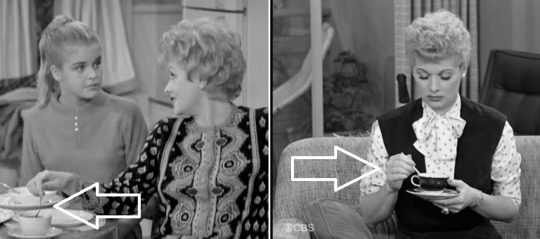
the breakfast table, Lucy absent-mindedly stirs her coffee for a full
minute, an annoying trait that Lucy Ricardo was accused of by Ricky
during “In Palm Springs” (ILL S4;E26).Lucy
and Ethel fantasize about buying mink coats with the money they make
by renting out sheep. Lucy Ricardo was always dreaming of a getting a
mink coat, and she nearly did in “The Fur Coat” (ILL S1;E9). She
nearly gets her mink in “Redecorating
the Mertzes’ Apartment” (ILL S3;E8),
but the cost of the coat ends up paying for new furniture.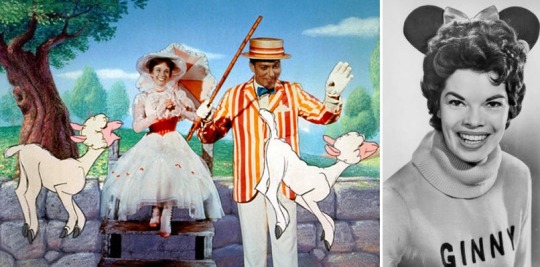
The
lamb’s bleats were provided by Disney voice artist Ginny Tyler. Other
Desilu actors to have voiced characters for Disney include: Verna
Felton, who played Mrs. Porter in “Lucy Hires a Maid” (ILL
S2;E23); Lee Millar Jr., who played Chip Jackson in “Lucy and the
Dummy” (ILL S5;E3); and Eleanor Audley, who played Mrs. Spaulding
in “Lucy Wants to Move to the Country” (ILL S6;E15). Like Tyler,
Audley’s voice is still heard in the Disney theme parks as Madam
Leota, the head in the crystal ball in the Haunted Mansion. In the same way Tyler was the voice of Clementine, voice artist June Foray provided the barks for Fred the dog.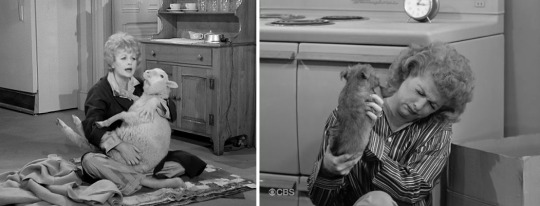
Lucy
sits on the floor and tries to convince Clementine to go to sleep
just the same way she did with Fred the dog in “Little Ricky Gets a
Dog” (ILL S6;E14) when he, too, keeps everyone awake all night.
Chris
suggest Lucy get a power mower, which was not a happy experience for
Lucy Ricardo when she borrowed one from the Ramsey’s in “Lucy
Raises Tulips” (ILL S6;E26)!Viv:
“Who
got dinner last night? Who did the laundry last week? Who did the
marketing yesterday? Who? Who?”
Lucy:
“Apparently
some crabby blonde owl.”The
joke is a variation on one from the very first episode of “I Love
Lucy,” “The Girls Want To Go To a Nightclub” (ILL S1;E1):Ethel
(to Lucy, who is dialing the phone): “Who
are you calling? Who, who, who?”
Lucy:
(to Ethel): “Quiet,
you sound like an owl.”Blooper
Alerts!
Time Check! The
kitchen clock reads 3:40 when Lucy and Viv are preparing dinner. In the next shot it says 5:30. The clock continually read 3:40 in
the first few episodes.ADR? When the kids run off to catch the school bus, a bleary-eyed Viv mutters “Don’t fall off the bus, children.” The line is partially covered by ad-libs from the others.
Clock Watchers! Speaking
of clocks, at the start of the bedroom scene, Lucy notes that it is
2:30 but a few minutes later she tells Viv it is “after midnight.”
While not exactly a blooper, why wouldn’t Lucy just say “it’s
after 2:30”?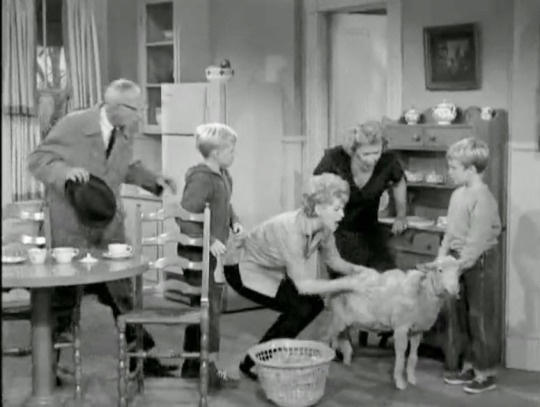

“Lucy Buys a Sheep” rates 4 Paper Hearts out of 5
-
Lucy Misplaces $2,000
S1;E4 ~ October 22, 1962


Synopsis
The
bank gives Lucy a check for $2,000 instead of $20 just minutes after
Mr. Barnsdahl had declared that his bank was perfect. To force him
into admitting a mistake, she cashes the check and hides the money in
a box of candy. When it comes time to return the cash, the box is
missing. Harry unknowingly gave the candy to the boys who took it to
a carnival, where they must track down the money.Regular
Cast
Lucille
Ball (Lucy Carmichael), Vivian Vance (Vivian Bagley), Jimmy Garrett
(Jerry Carmichael), Ralph Hart (Sherman Bagley), Dick
Martin
(Harry Connors)
Candy
Moore (Chris Carmichael) does not appear in this episode and is not listed in the credits.
Charles
Lane
(Mr. Barnsdahl) played more characters on “I Love Lucy” and “The
Lucy-Desi Comedy Hour” than any other performer, appearing in a
total of six episodes, mostly as authority figures such as Lucy’s
business manager Mr. Hicox, the passport office clerk, a casting
agent, the Tijuana border guard, and a Uranium claims officer. Most
memorably, however, he was Mr. Stanley (“Nine girls!”), the new
father in the waiting room with Ricky when Lucy gives birth. He was
born Charles
Gerstle Levison in 1905, and
went on to become one of the most familiar faces in America in more
than 350 films and television shows, including seven films with
Lucille Ball. Lane lived to the age of 102!Mr.
Barnsdahl is the banker charged with allocating money from Lucy’s
late husband’s trust. This is the first of his four appearances. He
was meant to be a continuing character, but Lane was replaced in
season two by banker Theodore J. Mooney (Gale Gordon). Lucy wanted
Gale Gordon to co-star in “The Lucy Show” from the beginning, but
he was under contract to play John Wilson on “Dennis the Menace.”
That show ended its run in July 1963, freeing him up to join the cast
of “The Lucy Show.” It is unclear whether Lane’s replacement
was a strategic move by Desilu to re-unite Lucy with Gordon (who had
also been on her radio show “My Favorite Husband”) or whether (as
was publicly stated) that Lane could not keep up with the rigors of
weekly television. He was only 57 and worked until he was 90, so
that seems unlikely.Guest
Cast
Reta
Shaw (Woman
on Bench) started her career on the stage in such hits as Picnic
(1953) and The Pajama Game (1954), for which she also did the film
versions. She is best known for playing maids, such as in Disney’s
Mary Poppins (1964) and TV’s “The Ghost and Mrs. Muir”
(1968-1970). This is the first of her three appearances on “The
Lucy Show” and she will make three more on “Here’s Lucy.” Here, Shaw was undoubtedly cast for her size.
Katie
Sweet (Katie,
Granddaughter of Woman on Bench) was just five years old when she
filmed this episode, but had been acting since the age of two!Earlier that year, Sweet played the title role in the Desilu pilot “Sukuzi Beane”, which co-starred Jimmy Garrett and helped him land his role of Jerry Carmichael.
Sweet left show business when she was 13.

Sandra
Gould (Miss
Thomas, Bank Secretary) is probably best remembered as the second
actor to play nosy neighbor Gladys Kravitz on TV’s “Bewitched.”
On “I Love Lucy” she was seen as Nancy Johnson, the wife of a
Texas oil tycoon in “Oil Wells” (ILL S3;E18), and one of the
subway strap hangers in “Lucy and the Loving Cup” (ILL S6;E12).
Murvyn
Vye
(Paper Picker) was a successful stage actor who created the role of
Jigger Crain in Rodgers and Hammerstein’s Carousel,
after taking over the role of Judd Frye in Broadway’s Oklahoma!
He was set to play the role of the Kralahome, the King’s translator,
in The
King and I,
but left the show in previews when his only song was cut for time.
Vye introduced
the song “Golden Earrings” in the 1947 film of the same
name.His birth name was really Marvin, although he was known
professionally as ‘Murvyn.’ To add even more confusion, the credits
for this episode spell his name ‘Mervyn.’
Tom
McDonough
(Bank Guard) was an extra who had appeared in the 1958 film Auntie
Mame (Lucille Ball did the film of the musical version in 1974). His last screen credit was a background gorilla on TV’s
“Planet of the Apes.”
Sonita the Elephant (Carnival Elephant) was born in 1950 and adopted by trainers Charlie and Madeline Frank when she was just five years old. With the Franks at her side, Sonita marched in parades, performed in circuses, and did personal appearances. Sonita retired to a San Diego animal preserve in 1971.

On
the evening of October 22, 1962, President
John
F. Kennedy
went on live television to announces
that U.S. spy planes had discovered Soviet missile bases in Cuba.
This important address may have delayed or pre-empted this episode
of “The Lucy Show” in some time zones.Adjusting for inflation, the $2,000 Lucy misplaces would is the equivalent of $17,100 in 2020!

We
learn that Danfield has a bakery called Friehoffer’s. Unfortunately, Lucy and Viv are on a 153 calorie diet!Among
her junk mail and bills, Lucy gets a letter from banker
Barnsdahl:My
Dear Mrs. Carmichael:Our Miss Thomas has informed me that your
checking account is overdrawn by the sum of $2.15. As executor of
your late husband’s estate, it is my duty to keep a close personal
watch on your finances. Will you please come in and straighten this
out at your earliest convenience.After
four episodes, it is finally established that Lucy Carmichael is a
widow.This is the first time the Danfield Bank is seen, but the location (using a different set) would figure into many future episodes, even employing Mrs. Carmichael.
When
Lucy reimburses Mr. Barnsdahl the $2.15 in cash she calls it his
“pound of flesh,” a reference that originated in Shakespeare’s
The
Merchant of Venice. “A
pound of flesh” is a figurative way of referring to a harsh
demand or spiteful penalty. But in the play money-lender Shylock
demands a literal pound of flesh as security when the merchant
Antonio comes to borrow money for a friend.
Lucy
calls the elephant Jumbo, which was the name of the elephant
exhibited by P.T. Barnum in the late 1800s. It was also the name of
an elephant in the 1935 Broadway musical Jumbo, which was released as
a film just six weeks after this episode aired.
One
bill is found by Lucy underneath a fat lady on a bench.
One
bill is found by Harry in a paper picker’s trash bag.
One
bill is found by Viv underneath an elephant’s foot.
Lucy promises the elephant that she’ll vote Republican if it will move its foot, but in an insert shot the elephant shakes his head ‘no’. Lucy quips that they got the only Democratic elephant. She is referring to the fact that the symbol of the Republican Party is an elephant, which first appeared in 1874 as a political cartoon in “Harper’s Weekly” drawn by Thomas Nast. The Democrats have the donkey, which originated with Andrew Jackson’s 1828 campaign.
One
bill is found by Mr. Barnsdahl stuck to the shoe of a woman in the
tunnel of love.
Unfortunately, this funny visual is not shown, just
reported by a soaking wet Barnsdahl, who apparently was tossed
overboard fighting for the shoe.Harry quickly shows Jerry how to pass a football, the second week in a row that the sport has been featured.
The audience reactions once again include loud guffaws from Lucy’s new husband, Gary Morton.
Callbacks & Fat Forwards!

The
last time Lucille and Vivian worked with a live elephant it was in
“The Kleptomaniac” (ILL S1;E27).
A rogue elephant would injure Mary Wickes in the final moments of “Lucy the Babysitter” (TLS S5;E16) in 1967.

The
last time Lucy was on a diet was in “The Diet” (ILL S1;E3). Lucy
repeats her gag of dabbing her wet finger tip around the plate to get
every last crumb.
Chocolates
also were a catalyst for the comedy in “Job Switching” (ILL S2;E1).Blooper
Alerts!
Butter Fingers! At
the bank, Lucy is wearing gloves, so the $2,000 check slips from her
fingers, but she grabs it before it can hit the floor. Later, in the
carnival scene, Harry drops one of the $500 bills on the ground, but Dick Martin
doesn’t notice it. He suddenly has it in his hand again a moment
later, so the recovery must have been edited out.
Never Work With… An animal trainer (probably Charlie Frank, the owner / trainer) can be glimpsed hiding behind the
elephant’s front left leg. The elephant lifts his rear right leg (the
one with the bill under it) long before the end of the scene, so Lucy
and Vivian just ignore it and keep going.Ball was nervous about working with such a large elephant. For a while, it looked like Ball would refuse to go through with a scripted stunt. Word eventually reached the writers that Ball had finally agreed to do the elephant gag. Why? Vivian told her, “If you don’t want to do it, I will!” That convinced her!

Current Currency! The
$500 bill was last printed in 1934 and officially discontinued in
1969, so it is unlikely, but not impossible for Lucy to go to a bank and get this
currency. However, no version of the $500 bill resembles the
back of the prop bills used in the episode. Lucy remarks that
President McKinley has a lovely smile, so the bills must be from the
final series minted from 1928 to 1934.
What’s In A Name? In the carnival scene, in her excitement, it sounds like Lucy accidentally calls her son Jimmy instead of Jerry. Three years later, when Jimmy Garret was written out of the series, Lucy Carmichael reads a letter from her son where he is referred to as Jimmy instead of Jerry! Ball insisted, despite entreaties from the writers, that the character was named Jimmy and she would not be change her mind!

Design Dilemma! The
wall over the buffet has a fourth look in four episodes. The
three small paintings have now been replaced by one large one.
“Lucy Misplaces $2,000″ rates 5 Paper Hearts out of 5
-
Lucy is a Referee
S1;E3 ~ October 15, 1962


Synopsis
Jerry and Sherman’s football game is going to be canceled due to the lack of a
referee, so Lucy volunteers. She learns all the signals, but cannot help
interfering on her son’s behalf and clumsily affecting the outcome of
the game. To make up for it, she offers to take both teams to a pro
football game, but a blizzard strands them all at Lucy’s house,
watching the game on TV.Regular
CastLucille Ball (Lucy Carmichael), Vivian Vance (Vivian Bagley), Candy
Moore (Chris Carmichael), Jimmy Garrett (Jerry Carmichael), Ralph
Hart (Sherman Bagley), Dick
Martin
(Harry Connors)Guest
Cast
Dennis
Rush
(Tony Lawrence, left) was just ten years old during this episode, but got his start
at age four playing Lon Chaney Jr. as a child in Man
of a Thousand Faces
starring James Cagney. His last screen credit was in 1966.Although the episode’s credits give the character’s surname as ‘Lawrence’ it is never mentioned in the dialogue.
Desi
Arnaz Jr. (#63) is, of
course, the real-life son of Lucille Ball. His 1953 birth was worked
into the plot of “I Love Lucy” although Desi Jr. never played the
role of Little Ricky Ricardo. He did, however, appear on the final
half-hour episode of the series “The Ricardos Dedicate a Statue”
(ILL S6;E27) in a crowd scene. Although is appearance in “Lucy is a
Referee” goes un-credited, he plays Billy Simmons in four future
episodes of the series. He also appeared with his mother and sister
on “Here’s Lucy.”
Lucie
Arnaz (Game Spectator, white coat) is the
real-life daughter of Lucille Ball and Desi Arnaz. She was born in
1951 just before the premiere of “I Love Lucy.” Lucille Ball was
actually pregnant during the filming of the show’s pilot. Despite
rumors to the contrary, Lucie Arnaz never appeared on “I Love
Lucy,” and although she returns to the series to play Chris’s
friend Cynthia (a character already mentioned in the
premiere), here she remains un-credited, just like her brother. She
also appeared with her mother and brother on “Here’s Lucy.”
The
Mighty Mites of the Venice Athletic Club
(Football Teams) was a pee-wee football team from Venice Beach,
California, that took the parts of both the home and away teams in
this episode. Venice is located about 30 minutes west of Hollywood.
A dozen un-credited woman play the football players’ moms, probably
the real-life mothers of the Mighty Mites.
Roy
Rowan
(TV Football Game Announcer) was the off-camera announcer for every
episode of “I Love Lucy” as well as “The Lucy Show” and
“Here’s Lucy.” He was also the voice heard when TV or radio
programs were featured on the plot of all three shows.Chris’s
friend Cynthia is mentioned again, interestingly in the same episode
that features Lucie Arnaz, who will play the character starting in
episode 23. It is possible, of course, that Lucie and Desi Jr. are
playing are playing Cynthia and Billy Simmons here, despite not being
named, identified, or credited.For this episode, to go along with the football theme, the title song is played in the style of a marching band.

To
reinforce the premise of the episode, Lucy says that it is tough on
the boys growing up without fathers, but the show had still not
established that she is a widow and not a divorcee.The
NFL
(National Football League) was established in 1920, adopting its current name in 1922. In 1966, four years after this episode was
filmed, the NFL began a merge with the AFL (American Football League) which
took four years to complete. The competition between NFL teams
culminates in the annual Super Bowl Game, held in January.
At
the start of this episode, Lucy is searching for her son’s lost Johnny
Unitas
football card. John Constantine Unitas (1933-2002) is considered one
of the greatest NFL players of all-time. He
was a quarterback who spent the majority of his career playing for
the Baltimore
Colts.
Unitas was the NFL’s most valuable player in 1957, 1959, 1964 and 1967.
From 1956 to 2012 he held the record
for most
consecutive games without a touchdown pass.
Lucy
says that Chris’s favorite pop stars are Frankie Avalon and Ricky
Nelson and that each has sold a million records. In 1967, Frankie
Avalon (above left) will make an appearance in the episode “Lucy and the Starmaker”
(S6;E4). He later played himself on “Here’s Lucy.” From
1952 to 1966, Ricky Nelson (above center) appeared on his parent’s television show “The Adventures of Ozzie
and Harriet,” an ABC sitcom that was a competitor of both “I
Love Lucy” and “The Lucy Show.” At first, Viv thinks that
Avalon and Nelson are football players, too, and compares them to Skinnay Ennis (above right), a popular bandleader and singer who toured the country.
He was also heard on radio and seen on the big screen. His given name was
Edgar, but when a record label misspelled his nickname ‘Skinny’ as ‘Skinnay,’ he decided to make it official. Eight months after
this episode aired, Ennis choked on a bone while dining in a
restaurant and died at the age of 55.
Lucy
reads out the sports cards of ‘Red’
Phillips, then a player for the Los
Angeles Rams, and Jimmy Brown,
of the Cleveland Browns. Phillips was actually named James and went
by ‘Jimmy’ or ‘Jim,’ but since both players share the same first name, the
writers used his nickname, ‘Red.’ Vivian laments that the players age and marital status is not given, despite the fact that age was
included on most all sports cards.
There
was spontaneous audience applause for Lucy’s frenetic dry-run of the referee signals. Throughout the episode the loud off-stage guffaw of
Lucy’s new husband, Gary Morton, can clearly be heard.
When
the two dozen stranded football players are sleeping throughout the
house, Lucy likens her home to Boys Town. Boys
Town
was
founded in December 1917 as an orphanage
for
boys. In 1938, Spencer Tracy played their founder, Father Flanagan,
in a film titled Boys
Town,
which won two Oscars and spawned the sequel Men
of Boys Town, also
starring Tracy.
With
all the beds full of boys, Lucy decides to sleep in the bathtub,
giving us our first glimpse of the Carmichael bathroom. Naturally,
we do not see the commode, just the tub where Lucy tries to bed down.
Of course, she accidentally triggers the shower and cannot seem to
turn it off before her pajamas get soaking wet. Lucy Carmichael’s
inability to control hoses and other spouts will become a repeated
gag on the series, taken to extremes in “Lucy and Viv Put in a
Shower” (S1;E18).We
learn that Danfield has a filling station where Harry has chains put
on his tires.Callbacks!
This episode aired 11 years to the day that “I Love Lucy” went on the air.

Sports Fans: On
“I Love Lucy” Lucy and Ethel got involved in such sports as
basketball and golf (“The Golf Game” ILL S3;E30), winter sports
like skiing and skating (“Lucy Goes To Sun Valley” (1958), and
baseball (“Lucy and Bob Hope” ILL S6;1). That episode was set in
Yankee
Stadium and featured actual
second unit location footage and scenes set in and around the
stadium. In 1963, “Lucy and Viv Play Softball” (S2;E3).
The
episode ends with the boys having a pillow fight which naturally
releases feathers into the air. This is similar to the comic ending
of “Redecorating the Mertzes’ Apartment” (ILL S3;E8), when a fan
accidentally hits the exposed stuffing of Fred’s recently gutted
armchair.Blooper
Alerts!
While
Lucy and the team are on the football field, Lucille Ball’s canvas
director’s chair, clearly marked LUCY, is visible in the background
at the left, behind the chain link fence.The
TV announcer says the name “Phillips,” so we know that the game is between the
the Los Angeles Rams and the New York Giants, who played at Yankee
Stadium. In 1962, however, the two teams did not play one other.It
is unlikely that either of the pee-wee teams didn’t have a knowledgeable
coach that could step in as referee.
This
is the third look (in just as many episodes) for the wall over the buffet.
The lighting sconces are gone and the wall now features three small
paintings. This was probably a “wild wall” – one that easily moved out
of the way so the cameras could quickly be re-positioned for the
kitchen scenes.
The clock in the kitchen still reads 3:40. While this may be an accurate time for the scene, it is the same time the clock read in “Lucy Waits Up for Chris” (S1;E1).

“Lucy is a Referee” rates 4 Paper Hearts out of 5
1962, Boys Town, Candy Moore, CBS TV, Dennis Rush, Desi Arnaz Jr., Dick Martin, Football, Frankie Avalon, Jimmy Brown, Jimmy Garrett, Johnny Unitas, Los Angeles Rams, Lucie Arnaz, Lucille Ball, Lucy Carmichael, Lucy is a Ref, NFL, Pee Wee Football, Ralph Hart, red phillips, Ricky Nelson, Roy Rowan, Skinnay Ennis, The Lucy Show, Venice Athletic Club, Vivian Bagley, Vivian Vance, Yankee Stadium -
Lucy Digs Up a Date
S1;E2 ~ October 8, 1962

Synopsis
Lucy
and Viv are looking for dates to an upcoming dance when Jerry comes home from school and announces that he got a “D” from “Old Man Taylor.” When the “old man” turns out to be young and handsome, Lucy
schemes to look at his driver’s license to find out if he’s married, but forgets
to put it back in his wallet. She and Viv sneak into the YMCA where
he’s staying to secretly return it – but things don’t go as planned.Regular Cast
Lucille
Ball (Lucy Carmichael), Vivian Vance (Vivian Bagley), Candy Moore
(Chris Carmichael), Jimmy Garrett (Jerry Carmichael), Ralph Hart
(Sherman Bagley)
Dick
Martin
(Harry Connors) is probably best remembered as the co-host of “Rowan
& Martin’s Laugh-In” from 1967 to 1973. He was born Thomas
Richard Martin on January 30, 1922, in Battle Creek, Michigan. As a
teenager he
lost a lung to tuberculosis and used bottled oxygen for the
rest of his life.
Martin
was a writer for the popular radio show “Duffy’s Tavern”
before teaming up with Dan Rowan in the 1950s. They played nightclubs and Las Vegasbefore Martin being cast as
Harry Conners, his ‘acting’ debut. He was married three times and died in 2008 of respiratory failure.In
this episode it is established that Harry is an airline pilot and
that he and Lucy have been dating, although their relationship is not serious. The character is referred to in the first
act, but only enters during the episode’s final moments. This is the first of his ten appearances on the series – all in season one. He is mentioned but not seen in the series premiere “Lucy Waits Up for Chris“ (S1;E1), where we also meet his dog, Tiger.Guest Cast

William
Windom
(Henry Taylor) was one of TV’s most recognizable character actors,
with his first credit in 1949. He won an Emmy for his series “My
World and Welcome To It” in 1970. The same year he guest-starred
on “The Lucy Show” Windom appeared opposite Gregory Peck as the
Prosecuting Attorney in To
Kill a Mockingbird.
This episode was his only screen appearance with Lucille Ball. He died in 2012 at
the age of 88.It
is established that Mr. Taylor has recently relocated to Danfield
from San Francisco and that he is a Sagittarius.
Don
Briggs
(Eddie Collins, above center) appeared
on the 1930s radio program “Welcome Valley” and played the
title role in “Frank Merriwell,” which led to his
first film, playing the character in the 1936 Universal serial The
Adventures of Frank Merriwell.
He also starred with Lucille Ball in the 1939 film Panama
Lady.
He played the recurring character of Eddie Collins for seven
episodes. He later turned up on a 1970 episode of “Here’s Lucy”.
Briggs died in 1986 at the age of 75.In
this episode it is established that Eddie Collins is a someone Viv sometimes dates, but like Harry and Lucy, they are not in a serious
relationship.Gene O’Donnell (Charley Graham, above left) makes his only appearance on “The Lucy Show” but he was glimpsed in the 1967 film A Guide for the Married Man, in which Lucille Ball had a cameo.

Robert
Rockwell
(Tom Bennett) was best known as the dreamboat teacher Mr. Boynton on
“Our Miss Brooks” starring Eve Arden, which ran on CBS at the same time as “I
Love Lucy.” Rockwell returned for a 1973 episode of “Here’s Lucy.” He died in 2003 at the age of 82.
Vito
Scotti (Vito,
the Fencing Instructor) was
born in San Francisco, but spent much of his youth in Naples, Italy. Prior to this heplayed a Tijuana shopkeeper on “Lucy Goes to Mexico,” a 1958 episode of “The Lucy-Desi Comedy Hour,” and had a small role in the Bob Hope /
Lucille Ball film The
Facts of Life (1960). He will return to “The
Lucy Show” for the 1966 episode “Lucy the Robot” (S4;E23). He
is probably best remembered for his recurring role as Captain Fomento
on “The Flying Nun” (1967-1969).
He died in 1996 at age 78.
James Gonzales (Stan Williams, above center) was a popular Hollywood extra who first acted with Lucille Ball in the 1953 film The Long, Long Trailer. He was seen in 23 episodes of “The Lucy Show” and 3 episodes of “Here’s Lucy.”

Robert
R. Stephenson (YMCA
Desk Clerk) was born in England in 1901. He returned to the series
to play the Parcel Post Deliveryman in “Together for Christmas”
(S1;E13).
When Viv is trying to decipher the initials “RB” in her phone directory, her guesses include former beaus Ronnie Belmont or Rudy Brown, but it turns out to be her own ex-husband, Ralph Bagley. Before this disappointing discovery, Lucy jokingly hopes “RB” stands for Richard Burton. This is the first celebrity reference on the series. Burton had just
finished up a run on Broadway in Camelot,
which opened two weeks before Wildcat starring Lucille Ball. Camelot
was
also a best-selling original cast album at the time. Burton and his wife
Elizabeth Taylor appeared on a well-publicized 1970 episode of “Here’s Lucy.”
Apparently Lucy does some of her laundry in the kitchen sink! Both All and Wisk are still sold in stores today. It is possible these products were sponsors or prospective sponsors.
It is established that Danfield has a clothing store called Kleinstaff’s and a new YMCA. The Young Men’s Christian Association was founded in 1844 to put Christian principles into practice by developing a healthy “body, mind, and spirit.” Toward that end, they serve as educational and community centers with gyms, classrooms, and sometimes swimming pools.

Until the late 1950s, YMCAs in the United States were built with hotel-like rooms called residences or dormitories. The rooms became a significant part of American culture, known as inexpensive and safe places for a visitor to stay in an unfamiliar city. In 1940 there were about 100,000 rooms at YMCAs, more than any hotel chain. Today YMCAs with residences have become extremely rare, although some still remain.
When looking at his driver’s license, Lucy notices that Mr. Taylor is a Sagittarius and she remarks that she is a Leo (same as Lucille Ball). In real life, William Windom was a Libra.
The premise of the episode has Lucy and Viv digging up dates to attend the Starlighter’s Charity Dance. Tickets are $10, which equates to $80 in 2017. No wonder Viv is reluctant not to attend!
This is the second episode to show Lucy outside a window.
Callbacks!
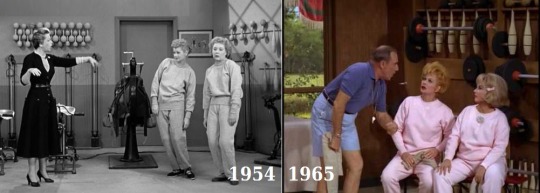
This isn’t the first time we have seen the girls in a gym. In “The Charm School” (ILL S3;E15) Miss Emerson (Natalie Schaffer) puts them through their paces in her salon’s gymansium. After Vivian Vance departs “The Lucy Show,” the Countess (Ann Sothern) and Lucy work out in “Lucy at the Fat Farm” (S3;E21) where Mr. Mooney (Gale Gordon) is the one making them sweat.

The fencing exercises between Lucy and coach Vito are comically similar to those of Lucy Ricardo and Madame DuMond (Mary Wickes) in “The Ballet” (ILL S1;E19).
Blooper
Alerts!Lucy calls Jerry’s former teacher “Mrs.
Lopus,” named after Lucille Ball’s childhood friend Flo Pauline Lopus. In the previous episode, Lucy talked about a manicurist neighbor named Flo, another nod to her school chum. However, when Mr. Taylor visits Lucy, he refers to the teacher he replaced as “Mrs. Lucas.”
Apparently the set designers were not yet happy with the wall over the buffet. In the previous episode “Lucy Waits Up for Chris” (S1;E1), the wall featured a large painting and outdoor-style lanterns. In this episode, the painting is gone and the lights have become candelabra style sconces.
The biggest gaffe in the episode is the idea that Lucy could discover Mr. Taylor’s marital status by looking at his driver’s license. Although California licenses of the time did have a checkbox for marital status, New York licenses have never included this information. Like “I Love Lucy,” “The Lucy Show” was filmed in California, but was set in New York. While Mr. Taylor is established as recently having moved from California and might still have a California license, it is unlikely that Lucy would know the kind of information contained on the driver’s licenses of other states in order to look for confirmation of whether a man is single or married.

Throughout the episode, the kitchen
clock over the stove continually reads 3:40. Lucy needs to get that fixed!
“Lucy Digs Up a Date” rates 4 Paper Hearts out of 5
1962, All, Candy Moore, CBS TV, Dick Martin, Don Briggs, Gene O’Donnell, I love lucy, James Gonzales, Jimmy Garrett, Lucille Ball, Lucy Carmichael, Lucy Digs up a Date, Ralph Hart, Richard Burton, Robert R. Stephenson, Robert Rockwell, The Lucy Show, Vito Scotti, Vivian Bagley, Vivian Vance, William Windom, Wisk, YMCA -
Lucy Waits Up for Chris
S1;E1 ~ October 1, 1962


Synopsis
Chris goes out on a date with Alan Harper, a prep school boy. Naturally, Lucy waits up for her and even runs out to the car when they return.
Lucy promises she won’t wait up on their next date. Of course, she does and has to make a quick getaway out the back door, locking herself out of the house. Luckily there’s a trampoline just outside of Viv’s window.
Regular
CastLucille Ball (Lucy Carmichael), Vivian Vance (Vivian Bagley),
Candy Moore (Chris Carmichael), Jimmy Garrett (Jerry Carmichael),
Ralph Hart (Sherman Bagley)
Lucille
Ball (Lucy Carmichael) was
born on August 6, 1911 in Jamestown, New York. She began her screen
career in 1933 and was known in Hollywood as ‘Queen of the B’s’ due
to her many appearances in ‘B’ movies. With Richard Denning, she starred in a radio
program titled “My Favorite Husband” which eventually led to the
creation of “I Love Lucy,” a television situation comedy in which
she co-starred with her real-life husband, Latin bandleader Desi Arnaz. The program
was phenomenally successful, allowing the couple to purchase what was
once RKO Studios, re-naming it Desilu. When the show ended in 1960 (in an
hour-long format known as “The Lucy-Desi Comedy Hour”) so did Lucy and Desi’s marriage. In 1962, hoping to keep Desilu financially solvent, Lucy
returned to the sitcom format with “The Lucy Show,” which lasted
six seasons. She followed that with a similar sitcom “Here’s Lucy”
co-starring with her real-life children, Lucie and Desi Jr., as well
as Gale Gordon, who had joined the cast of “The Lucy Show” during season
two. Before her death in 1989, Lucy made one more attempt at a
sitcom with “Life With Lucy,” also with Gordon, which was not a
success and was canceled after just 13 episodes.Vivian
Vance (Vivian Bagley, later Vivian Bunson) was born Vivian
Roberta Jones in Cherryvale, Kansas, in 1909, although her family
quickly moved to Albuquerque, New Mexico, where she was raised. She
had extensive theatre experience, co-starring on Broadway with Ethel
Merman in Anything Goes. She was acting in a play in Southern California
when she was spotted by Desi Arnaz and hired to play Ethel Mertz,
Lucy Ricardo’s neighbor and best friend. The pairing is credited with much
of the success of “I Love Lucy.” Vance was convinced to join the
cast of “The Lucy Show” in 1962, but stayed with the series only
through season three, making occasional guest appearances afterwards.
She made half a dozen appearances on “Here’s Lucy,” as well as
joining Ball for a TV special “Lucy Calls the President” in
1977. Vance died two years later.
Ralph
Hart (Sherman Bagley)
was a musical theatre kid who made his screen debut in The Music
Man (1962), quickly followed by Gypsy (1962)
and Bye Bye Birdie (1963).
Like his co-stars, he also made appearances on “My Three Sons.” He was featured in 44 episodes of “The Lucy Show,” leaving when
his screen mother, Vivian Vance, departed at the end of season three.Jimmy
Garrett
(Jerry Carmichael) was born on September 23, 1954 in Los Angeles,
California. Like guest star Tom Lowell, Garrett made his TV debut in
an episode of “The Twilight Zone.” Like Candy Moore, he also
appeared on an episode of “My Three Sons,” but before William
Frawley joined the cast. It was, however, directed by James V. Kern,
who had directed many episodes of “I Love Lucy.” Garrett appeared in
55 episodes of “The Lucy Show” through season four. His last screen
credit was in 1966.Candy Moore (Chris Carmichael) was born on August 26, 1947 in Maplewood, New Jersey, as Candace Lee Klaasen. She began her TV acting career at the age of 12 and was 15 when she began playing Lucy’s daughter Chris, a role she played for 39 episodes. The year before she had guest starred on an episode of “My Three Sons” with William Frawley (aka Fred Mertz). After leaving the business she became a high school English teacher in California as well as a writer.

Guest
CastTom Lowell (Alan
Harper) was
born on January 17, 1941 in Philadelphia, Pennsylvania. He makes
the first of three appearances as Chris’ boyfriend, Alan. He was 21
years old when he began his acting career with a June 1962 episode of
“The Twilight Zone.” “The Lucy Show” was his second TV
credit. He left show business and became a high school theatre
director.In this episode it
is established that Alan Harper is 16 and goes to prep school in
Connecticut. This is the first of the character’s three appearances
on the show.
Tiger
the dog belongs to Lucy’s
neighbor and boyfriend Harry Connors (Dick Martin), who we will meet
in episode two. A dog named Tiger was also featured on TV’s “The
Brady Bunch” (1969-1974). Lucille Ball was an animal lover and dog
owner and would frequently feature animals on “The Lucy Show.”
Here Tiger serves more as a plot device than pet.Background
In
April 1960 the final episode of “The Lucy-Desi Comedy Hour” (the
continuation of “I Love Lucy”) aired and Lucille Ball and Desi
Arnaz divorced. Desilu Studios had only one series in production,
“The Untouchables” and prospects were slim. The answer to their
financial woes was clear: Ball needed to return to series television.
The premise for the new show would be a 1961 book by Irene Kampen
called Life Without George about Kampen’s life after divorce
from her husband, George. Ball agreed with the stipulation the
series be aired on Monday nights (the old “I Love Lucy” time
slot) and Vivian Vance once again be her co-star. Tired of being known as
“Ethel,” Vance insisted her character be named Vivian. Lucy
chose the surname Carmichael because she was once told by her friend
Carole Lombard’s mother that the letter combination “AR” was
lucky for her: ARnaz, RicARdo, CARmichael and (in future) CARter and
BARker. Lucy may also may have been inspired by real-life composer Ralph Carmichael, who wrote incidental music for “I Love Lucy.”CBS was nervous about having two divorcee characters in prime time, let alone one, so
Lucy’s character was made a widow, although her late husband was
hardly ever mentioned. Death was not a subject for comedy in 1962. Vivian Vance would become the first divorced female principal character on
a prime time series. She already was the first actress to share a double-bed on national television with a man she wasn’t married to in real-life. This happened when Ethel and Fred shared a bed with a sagging mattress at One Oak outside Cincinnati, their “First Stop” (ILL S4;E13) on the way to Hollywood.Like Lucille Ball, Lucy Carmichael had two children: a teenage
girl named Chris (also the name of Kampen’s daughter); and a pre-teen
boy named Jerry. Vivian Bagley remained a divorcee with one child
named Sherman, slightly older than Jerry. They all lived together in a
house in (fictional) Danfield, New York. The show aimed to live up to the book’s tagline: “The Struggles of Two Whacky Dames Alone in a Suburban Jungle.” Lucy also
recruited her writers from “I Love Lucy” as well as much of her
crew. Desi Arnaz acted as Executive Producer for the first 15
episodes.
The
earliest scripts were entitled “The
Lucille Ball Show,”
but CBS rejected this title. “This
Is Lucy”
and “The
New Adventures of Lucy” were also considered. Season
one was filmed and broadcast in black and white with animated
stick figures of Ball and Vance as the opening credits, similar to
the ones used in the original opening sequence of “I Love Lucy.”
The theme music was composed by Wilbur
Hatch,
who was the show’s musical director, a role he also performed on “I
Love Lucy.” “The Lucy Show” was filmed before a live audience
with a laugh track used to fill any gaps in audience reactions or
missed punchlines.The
episode is directed by Jack Donohue and features some specially lit
medium shots of the star. These were also part of season one of “I Love Lucy” but
were discontinued for the sake of time. This episode also features
some obvious examples of ADR or over-dubbing, probably to clarify
sound recording glitches.
There
is very little exposition to explain the premise of the show, but Viv
establishes she has an ex-husband, pays alimony, and is paying Lucy
rent. Chris calls Vivian “Aunt Viv” despite them not being
related, which might lead first time viewers to think Lucy and Viv are sisters or sister-in-laws. The death of Lucy’s
husband is not established, leaving first time viewers to wonder why there is no
adult male living in the house.We
hear that Lucy’s Danfield neighborhood features a drugstore (which
also serves hot chocolate, so it has a soda fountain) and a local cinema called The Ritz. We
also hear about a frisky neighbor named Flo, who is a manicurist. She may
have been named after Flo Pauline Lopus, one of Lucille Ball’s
childhood friends from Jamestown.Lucy
talks about Cynthia, Chris’s girlfriend, a character that is often
mentioned but not seen until episodes 23 and 24 when she will
be played by an 11 year-old Lucie Arnaz. We also hear about Chris’s
friend Camille Metcalf, but this character is merely mentioned to support a joke about the film Camille (1936).
Before
bed, Lucy and Viv are playing cards dressed in fancy lingerie: Vivian in a
white Asian-inspired silk jacket and pants and Lucy in a flowing white bed
jacket that was designed to billow when she jumped on the
trampoline, resembling wings. Form-fitting white capri pants assured
modesty in the scenes. Interestingly, when Vivian goes to sleep she
has changed into plain pajamas. When she sits up to wait for Lucy’s
return near the end of the episode, she has changed back to her
lingerie. This may be due to the filming sequence of the living room
and bedroom scenes.


The
trampoline gives Lucille Ball an opportunity to do physical
humor, something she was extremely adept at. Ball performed some of
the scenes ‘free-form’ – without a double or wires, but wires were used
for the reverse scenes from inside Viv’s bedroom.Despite
this episode being in black and white, when Viv gives
Lucy one of her coats to wear, Lucy remarks that
it isn’t a good color for her and that she never liked the color on
Vivian either. Although it is obviously a light colored coat, the
viewers never discover exactly what color it really is.Callbacks!

Vivian eats a banana in this episode, a fruit Ethel Mertz was fond of in “Bon Voyage” (ILL S5;E13), “Second Honeymoon” (ILL S5;E14), and “Lucy Misses the Mertzes” (ILL S6;17).

Lucy wants the family to watch “The Early Show” on TV, which is airing Greta Garbo in Camille. On “I Love Lucy” Lucy Ricardo mentioned Garbo and Camille in “The Dancing Star” (ILL S4;E27). She also imitated Garbo in “The Saxophone” (ILL S2:E2) and named her snaggle-toothed gypsy character in “The Operetta” (ILL S2;E5) Camille. The 1936 film will be mentioned again in a 1978 episode of “Here’s Lucy.”

Blooper
Alert!When
Viv pushes Lucy out of her bedroom window there is no artwork on the
closet wall behind her. Moments later, when Viv looks out to make
sure Lucy has landed safely, there is a large framed painting where the
door to the hallway had been.
Also, the second time Lucy appears at the window calling for her, Viv is in bed
sleeping with the lights still on!

“Lucy Waits Up for Chris” rates 4 Paper Hearts out of 5
-
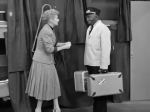
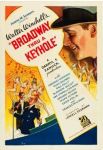
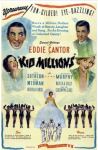
A Black History Month shout out to SAM McDANIEL, who played played Sam the porter in 1955′s “The Great Train Robbery” (S5;E5). He was the brother of Oscar-winner Hattie McDaniel of Gone With The Wind fame. He had appeared with a young Lucille Ball in her second film, Broadway Thru a Keyhole (1933) and Kid Millions (1934). McDaniel has the distinction of being the first and only African Americans to appear on “I Love Lucy” with a character name and lines.
-
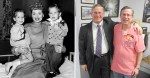

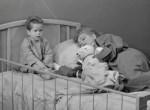


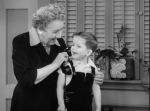

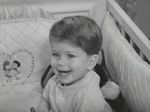
The Mayer Twins, Michael and Joseph (Little Ricky Ricardo, 1953-1956)
-


“We snuggle watchin’ Lucy, on our big, enormous twelve inch screen!” ~ “Somewhere That’s Green” from LITTLE SHOP OF HORRORS by Alan Menken & Howard Ashman
-
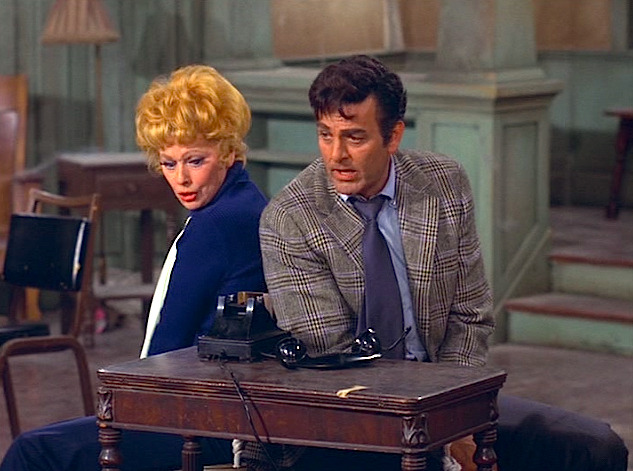
RIP Mike Connors. Desilu produced “Mannix” from 1967 to 1968, although the show ran until 1974, making Connors a household name. In return, he appeared as Mannix on a 1971 episode of “Here’s Lucy.”
-


On October 30, 1969, impressionist / actor Guy Marks (1923-1987), using his famous Humphrey Bogart voice, played an armed crook in an episode of ABC’s “The Ghost and Mrs. Muir”. Four days later he played an armed crook on CBS’s “Here’s Lucy,” (without doing Bogart).
-
Subscribe
Subscribed
Already have a WordPress.com account? Log in now.
 Papermoon Loves Lucy