-
My Fair Lucy
S3;E20 ~ February 8, 1965


Synopsis
When the Countess can’t pay her bills, Lucy suggests she open a charm school. To get the money from a wealthy couple of millionaires, Rosie pretends to transform a lowly charwoman (Lucy) into a highclass lady, much in the manner of My Fair Lady.
Regular Cast
Lucille Ball (Lucy Carmichael / Liza Lumpwhomper), Gale Gordon (Theodore J. Mooney)
Vivian Vance (Vivian Bagley), Jimmy Garrett (Jerry Carmichael), Ralph Hart (Sherman Bagley), and Candy Moore (Chris Carmichael) do not appear in this episode.
Guest Cast

Ann Sothern (Rosita “Rosie” Harrigan, the Countess Framboise)
makes the second of her seven appearances as a countess down on her luck. Sothern had appeared in the first “Lucy-Desi
Comedy Hour” “Lucy Takes a Cruise to Havana” (1957) as Susie MacNamara, the same character she played on her show “Private Secretary” from 1953 to 1957. In return Lucille Ball played Lucy Ricardo on her show in 1959. Sothern appeared with Ball in five films between 1933 and 1943. She was nominated for an Oscar
for her final screen appearance in The Whales of August
in 1987. She is buried near her home in Sun Valley, Idaho, a place
also dear to Lucy and Desi.Reta Shaw (Dora Dunbar) started her career on the stage in such hits as Picnic (1953) and The Pajama Game(1954), for which she also did the film versions. She is best known for playing maids, such as in Disney’s Mary Poppins (1964) and TV’s “The Ghost and Mrs. Muir” (1968-70). This is the second of her three appearances on “The Lucy Show” and she will make three more on “Here’s Lucy.” Shaw had played the recurring role of Flora on “The Ann Sothern Show” from 1958 to 1959.

Byron Foulger (Fred Dunbar) played the leader of the Friends of the Friendless in “Lucy’s Last Birthday” (ILL S2;E25). This is the first of his two appearances on “The Lucy Show.” He was also seen on two episodes of “My Mother the Car” in which Ann Sothern voiced the title role!
The Dunbars live in New York City and are in Danfield to visit Mr. Dunbar’s relatives. According to Mrs. Dunbar, her husband made his fortune in ‘crude’ oil. The character is named after Lucy’s brother, Fred Ball, who also gave his first name to the landlord on “I Love Lucy.”

Carole Cook (Mrs. Valance) makes her second appearance as Mrs. Valance after being seenas Thelma Green in four episodes. She was a protege of Lucille Ball’s during the Desilu Playhouse years. Although she was born as Mildred Cook, Ball suggested she take the name Carole, in honor of Lucy’s great friend, Carole Lombard. Cook also went on to appear in five episodes of “Here’s Lucy.”
In her first appearance as Mrs. Valance, she was the Society Editor of the Danfield Tribune, although that is not mentioned here.

John J. ‘Red’ Fox (Butler) was best known for playing policemen, which is what he did on five of his eight appearances on “The Lucy Show” as well as three of his five episodes of “Here’s Lucy.”

The uncredited Party Guests are played by:
- Monty O’Grady was first seen with Lucille Ball in The Long, Long Trailer (1953), and played a passenger on the S.S. Constitution in “Second Honeymoon” (ILL S5;E14). He was at the airport when “The Ricardos Go to Japan” (1959). He made a dozen appearances on the series and a half dozen more on “Here’s Lucy.”
- James Gonzales was a popular Hollywood extra who first acted with Lucille Ball in the1953 film The Long, Long Trailer. He was previously seen on the series as Stan Williams in “Lucy Digs Up a Date” (S1;E2). He was seen in more than 20 episodes of “The Lucy Show” and 3 episodes of “Here’s Lucy.”
- Sam Harris was born in Australia in 1877 and did a dozen films with Lucille Ball before appearing in the audience of Over the Teacups in “Ethel’s Birthday” (ILL S4;E8) and playing a subway passenger in “Lucy and the Loving Cup” (ILL S6;E12). In between, he was a wedding guest in Lucy and Desi’s film Forever Darling (1956). Along with Monty O’Grady and Murray Pollack, he was in the airport when “The Ricardos Go to Japan” in 1959. This is the last of his six appearances on “The Lucy Show.” Coincidentally, Harris was also a background performer in the 1964 movie of My Fair Lady!
- Murray Pollack was seen as one of the party guest in “Country Club Dance” (ILL S6;E25), the episode that introduced Barbara Eden. Coincidentally, he later appeared on half a dozen episodes of “I Dream of Jeannie.” Like Monty O’Grady, he was at the airport when “The Ricardos Go to Japan” (1959). He was seen in the 1963 movie Critic’s Choice with Lucille Ball. Here he makes the first of two appearances on “The Lucy Show” and returned for three episodes of “Here’s Lucy.”
- Jerry Rush makes the second of his nine (mostly uncredited) appearances on the series. He also did two episodes of “Here’s Lucy.” He had been in the 1950 film Nancy Goes to Rio starring Ann Sothern.
- Bert Stevens and Caryl Lincoln were a real-life husband and wife who made many appearances as background players on the series. Lincoln was one of Lucy’s friends from her Goldwyn Girl days. Stevens was the brother of actress Barbara Stanwyck, whose given name was Ruby Stevens. He was seen in the Tropicana audience for the Flapper Follies when “Ricky Loses His Voice” (ILL S2;E9) but along with Lincoln, probably appeared on other episodes as well.
- Ervin Richardson makes the third of four uncredited appearances on “The Lucy Show.” He also did two episodes of “Here’s Lucy.”
- Judith Woodbury makes the fourth of her eight (mostly) uncredited appearances on “The Lucy Show.” She also appeared in one episode of “Here’s Lucy.”

This episode was filmed on December 3, 1964. This is production #78, exactly halfway through the “Lucy Show” catalog of 156 episodes.

A clip of Lucy as the cleaning woman begins the season four kaleidoscope credit sequence.

In the previous episode, “Lucy and the Countess” (S3;E19), Lucy says Viv’s been out of town for a week and will be gone for two more. As Vivian Vance started to phase out her involvement on “The Lucy Show” in order to spend more time with her husband on the East Coast, Lucille Ball was looking to introduce a new character to fill the ‘second banana’ role. The Countess will appear in seven episodes through November 1965, the start of season 4. For episodes featuring Ann Sothern, Vivian Vance’s opening title sequence credit is eliminated. Instead of the freeze frame of Viv as the flapper in the silent movie sketch (and the screen title “co-starring Vivian Vance”), the freeze frame is on Lucy as Charlie Chaplin.

The episode is inspired by My Fair Lady, a 1956 stage musical by
Alan J. Lerner and Frederick Loewe that was turned into a major
motion picture in 1964. The film starred Audrey Hepburn and Rex
Harrison, recreating the role he played on stage. The film won eight Oscars and was phenomenally successful at the box office.It premiered in New York City on October 21, 1964, five weeks before this episode was filmed.

My Fair Lady played on Broadway at the same time in 1961 that Lucille Ball was starring in the musical Wildcat. In the above photo, Lucy goes to bat for Wildcat, while Julie Andrews catches for Camelot. The banner on the right indicates that My Fair Lady was the Broadway Show League softball champion three years running.

Among the many television shows riffing on the My Fair Lady theme and title were:
- “My Fair Vocal Coach” – a 1956 episode of “The Danny Thomas Show”
- “My Fair Landlord” – a 1957 episode of “The Jackie Gleason Show”
- “My Fair Deadly” – a 1958 episode of “Mike Hammer”
- “My Fair Olive” – a 1961 episode of “Popeye the Sailor”
- “My Fair Uncle” – a 1963 episode of “The Danny Thomas Show”
- “My Fair Ignatz” – a 1963 episode of “Krazy Kat”
- “My Fair Munster” – a 1964 episode of “The Munsters”
- “My Fair Gilligan” – a 1964 episode of “Gilligan’s Island”
- “My Fair Chinese Lady” – a 1964 episode of “My Three Sons”
- “My Fair Lucy” – a 1965 episode of “The Lucy Show”
- “My Fair Co-Ed” – a 1965 episode of “Hank”
- “My Fair Mermaid” – a 1965 episode of “Sinbad and His Magic Belt”
- “My Fair Cousin Itt” – a 1965 episode of “The Addams Family”
- “My Fair Andy” – a 1965 episode of “No Time For Sergeants”
- “My Fair Freddy” – a 1966 episode of “The Flintstones”
- “My Fair Sister” – a 1969 episode of “Gomer Pyle: USMC”
- “My Fair Buzzi” – a 1973 episode of “Here’s Lucy”

In the feature film, a couple of familiar faces from Lucy sitcoms appear: Walter Bacon, George Holmes, Barbara Morrison, Jerry Rush, Bert Stevens, Ben Wrigley, and Lucille Ball’s good friend, Barbara Pepper. Although set in England, the film was shot exclusively in Hollywood.

Sothern, a well known TV star in her own right, gets a warm round of entrance applause from the studio audience. She says the postman complimented her for having “a cute zip code”. Zip Codes were initiated in in the USA in July 1963, so they were relatively new at the time of filming.

Lucy says she is allergic to caviar and breaks out in hives every time she eats it. As Lucy is a middle class struggling mother of two, this can’t be very often.
Mr. Mooney claims that as an athletic young man he was supposed to go to the Olympics, but married (the perpetually unseen) Irma instead.

Rosie describes ‘Liza Lumpwhomper’ as “a wretched bit of flotsam”. Merriam Webster defines the rarely-used word as “people or things that have been rejected and are regarded as worthless.” The same writers also used the word to describe the Friends of the Friendless in “Lucy’s Last Birthday” (ILL S2;E25). Both times the word is used in the presence of actor Byron Foulger.
Rosie continues to mistakenly call Mr. Mooney ‘Mr. Money,’ a running gag for the Countess.
Lucy proposes that down-on-her-luck Rosie open a Charm School to pay the bills, but they have no money for the start-up costs.
LUCY: “Rosie, I have a plan. Did you see ‘My Fair Lady’?”
ROSIE: “Yes.”
LUCY: “Now listen…” [fade to commercial]
To con a rich couple into funding their charm school, Rosie claims that under her tutelage, she can transform an uncouth, slovenly woman into a refined lady at an elegant soiree. Lucy’s cleaning lady character is named Liza Lumpwhomper. Eliza Doolittle is the name of Audrey Hepburn’s character in My Fair Lady.

Rosie tries a variation on one of Henry Higgins’ diction exercise in My Fair Lady:
“The rain in Maine falls plainly on the grain.”
The actual quote is “The rain in Spain stays mainly on the
plain” which is also the basis for a song in the play and film.
As Liza Lumpwhomper, Lucy continually calls Dora Dunbar “fat lady.” This is the second time Reta Shaw has been cast for her size. In “Lucy Misplaces $2,000” (S1;E4, above) she played an overweight grandma who sits on Lucy’s hand while Lucy writhes in pain.

Lucy / Liza says she knows a ‘loverly’ poem. In My Fair Lady, cockney flower girl Eliza pronounces ‘lovely’ as ‘loverly’ which inspires a song called “Wouldn’t it Be Loverly.”
Mrs. Dunbar says that the Countess would be wasting her time trying to transform ‘Liza’. “You’ll never be a Pygmalion to this Galatea.”

Pygmalion is the title of the 1913 George Bernard Shaw play that was the basis for My Fair Lady. The non-musical play was filmed in 1938.

Shaw, in turn, based his story on the Greek legend of a sculptor
(Pygmalion) who falls in love with his beautiful statue (Galatea),
which comes to life.
As a transformed ‘Liza’ Lucy enters in a long, flowing gown, wearing a tiara and with a whippet on a leash. The dog is the only thing not found in Eliza Doolittle’s entrance to the ball in My Fair Lady. Lucille Ball, however, loved dogs.

There is a vigorous comic physicality between Ann Sothern and Lucille Ball that was never apparent in her partnership with Vivian Vance. Sothern isn’t afraid to get Lucy into a neck hold or do any of the physical stunts with Lucy. This is a change for Lucy, who is used to being the one doing all the physical comedy.

When Lucy gets hives from unknowingly eating caviar, the Countess scratches her itch by drawing a map of Paris on Lucy / Liza’s back! The fingernail drawing includes the Eiffel Tower (”It’s higher!”) and the Arc de Triomphe (”You should see both of them!). Lucy Ricardo saw both landmarks in “Paris at Last” (ILL S5;E18).

Mrs. Dunbar is unveiling a new work of art by Gabonzo (fictional) but she has two Picassos in New York City. Pablo Picasso (1881-1973) is regarded as one of the greatest and most influential artists of the 20th century. He is known for co-founding the cubist movement and the invention of constructed sculpture. His name was dropped in three previous “Lucy Show” episodes. The new Gabonzo is a statue, another nod to the legend of Pygmalion and Galatea.
Callbacks!

Lucy Ricardo and Ethel Mertz attended a “Charm School” (ILL S3;E15) run by Phoebe Emerson (Natalie Schaefer).

Lucy Ricardo also disguised herself as a cleaning woman in “Cuban Pals” (ILL S1;E28).

Lucy accidntally knocks over the Gabonzo statue, which breaks into many pieces. In “The Ricardos Dedicate a Statue” (ILL S6;E27), Lucy Ricardo backed up over the Minuteman Statue made by Mr. Silvestri causing it to break into many pieces as well.

Lucy Carmichael previously wore the pink evening gown in “Lucy Meets a Millionaire” (S2;E24). In a crazy turn of events, the pink gown is dyed green (along with Lucy herself) by episode’s end! [Thanks to Lucy fan Richard Swinburk for spotting the recycled dress!]
Fast Forward!

In 1965′s “Lucy Saves Milton Berle” (S4;E13), Lucy Carmichael disguises herself as a poor flower seller, bearing more than a passing resemblance to Eliza Doolittle. Despite that, Mr. Mooney compares her to Mary Poppins! Although Mary Poppins never dressed as a poor flower seller, Julie Andrews dressed this way on stage in My Fair Lady as Eliza Doolittle. My Fair Lady and Mary Poppins were both Oscar contenders in 1965.

In “Lucy in London” (1966), after Anthony Newley’s medley, there is a brief shot of Lucy as an Eliza Doolittle-type figure perched in the balcony. She is clutching a small bunch of violet flowers, just like Eliza in My Fair Lady.

One year later, in “Lucy and the Efficiency Expert” (S5;E13), a famous quote from My Fair Lady was uttered by Phil Silvers: “By George, I think she’s got it!”

On a 1971 episode of “Here’s Lucy”, Dan Dailey and Gale Gordon quote the lyrics (verbatim) to the song “I’ve Grown Accustomed to Her Face” from My Fair Lady. Dailey says “If Rex Harrison can talk through that song, we can too.”

In 1972, “Here’s Lucy” revived the premise with Ruth Buzzi going from frumpy to fabulous in “My Fair Buzzi” (HL S5;E13).

Lola Fisher, who played Bunny in “Lucy and the Franchise Fiasco” (HL S5;E20) in 1973 and Mrs. Pomeroy in “Lucy in the Jungle” (HL S4;E13), understudied and replaced Julie Andrews in the Broadway company of My Fair Lady.

Ann Sothern’s pink powder puff nightgown was worn by her again on a 1969 episode of “Love American Style” on ABC.
Blooper Alerts!

Fourth Wall MIA! In the opening shot from the kitchen to the living room, it is very apparent that we are looking at a set as the hatch between the two rooms is completely missing it’s fourth side!
Door Is Ajar! When Rosie brings in the morning mail, she leaves the front door wide open. This is not uncommon in the Carmichael home.

Over the Line! Ann Sothern jumps Reta Shaw’s line “What challenge?” but she recovers quickly.
Heel! The dog that Lucy / Liza enters with immediately starts sniffing the guests standing on the opposite side of Lucy. She must hand off the dog to the butler, but the animal is briefly reluctant to go!

Office Space! It is not mentioned how Lucy and Rosie got the use of the well-appointed office to interview to meet with the Dunbars. Perhaps Mr. Mooney at the Bank was persuaded by the Countess to loan his offices for the day?

“My Fair Lucy” rates 4 Paper Hearts out of 5
1965, Ann Sothern, Bert Stevens, Broadway Musical, Byron Foulger, Carole Cook, Caryl Lincoln, Caviar, CBS, Charm School, Ervin Richardson, Gale Gordon, James Gonzales, Jerry Rush, John J. Fox, Judith Woodbury, Lerner and Loewe, Lucille Ball, Monty O’Grady, Murray Pollack, My Fair Lady, My Fair Lucy, Picasso, Pygmalion, Pygmalion and Galatea, Reta Shaw, Sam Harris, tv -
Lucy and the Countess
S3;E19~
February 1, 1965

Synopsis
Lucy’s
old school chum Rosie is back in town and she’s now a countess. Rosie boards with Lucy and is immediately invited to a wine tasting by Mr.
Mooney where they she and Lucy drink each other under the table –
literally!Regular
Cast
Lucille
Ball (Lucy Carmichael), Gale Gordon (Theodore J. Mooney), Jimmy
Garrett (Jerry Carmichael), Ralph Hart (Sherman Bagley), Candy Moore
(Chris Carmichael)
Vivian
Vance (Vivian Bagley) does not appear in this episode, but she is
mentioned.Guest
Cast
Ann
Sothern (Rosita ‘Rosie’ Harrigan, the Countess Framboise)
makes the first of her seven appearances as a countess down on her
luck.
Sothern had appeared in the
first “Lucy-Desi
Comedy Hour”
“Lucy
Takes a Cruise to Havana”
(1957) as Susie MacNamara, the same character she played on her show
“Private Secretary” from 1953 to 1957. In return Lucille Ball
played Lucy Ricardo on her new show in 1959. Sothern appeared with Ball
in five films between 1933 and 1943. She was nominated for an Oscar
for her final screen appearance in The
Whales of August
in 1987. She is buried near her home in Sun Valley, Idaho, a place
also dear to Lucy and Desi.
Carole
Cook
(Mrs. Valance, Society Editor) was
seen as Thelma Green in four episodes and now is cast as a variety of
characters. She was a protégé of Lucille Ball’s during the Desilu
Playhouse years. Although she was born as Mildred Cook, Ball
suggested she take the name Carole, in honor of Lucy’s great
friend, Carole Lombard. Cook also went on to appear in five episodes
of “Here’s Lucy.”
Sid
Gould (Sam,
Delivery Man) made
more than 45 appearances on “The Lucy Show,” all as background
characters. He also did 40 episodes of “Here’s Lucy.” Gould
(born Sydney Greenfader) was Lucille Ball’s cousin by marriage to
Gary Morton. Gould was married to Vanda Barra, who also appeared on
“The Lucy Show” starting in 1967, as well as on “Here’s
Lucy.”Monty
O’Grady (Waiter)
was
first seen with Lucille Ball in The
Long, Long Trailer (1953),
and played a passenger on the S.S. Constitution in “Second
Honeymoon” (ILL S5;E14).
He was at the airport when “The
Ricardos Go to Japan”
(1959).
He made a dozen appearances on the series and a half dozen more on
“Here’s Lucy.”
The members of the Danfield Wine Tasting Society are played by:
- Leon
Alton appeared
with Lucille Ball in The
Facts of Life
(1960) and Critics
Choice (1963).
This is the first of his two appearances on “The Lucy Show.” He
also was seen in three episodes of “Here’s Lucy.” - Paul
Bradley makes
the fourth of his six appearances on “The Lucy Show” in various
roles. He will also be seen in two episodes of “Here’s Lucy.” - Steve
Carruthers was
one of the passengers on the S.S. Constitution in “Second
Honeymoon” (ILL S5;E14).
He was seen in the Lucille Ball / Bob Hope film The
Facts of Life. This
is second of his two appearances on “The Lucy Show.” - George
DeNormand had
appeared in three films with Lucille Ball from 1937 to 1963. This is
the third of his many appearances on “The Lucy Show” and “Here’s
Lucy.” - James
Gonzales
was
a popular Hollywood extra who first acted with Lucille Ball in the
1953 film The
Long, Long Trailer.
He was previously seen on the series as Stan Williams in “Lucy
Digs Up a Date” (S1;E2).
He was seen in more than 20 episodes of “The Lucy Show” and 3
episodes of “Here’s Lucy.” - Bert
Stevens and
Caryl Lincoln were
a real-life husband and wife who made many appearances as background
players on the series. Lincoln was one of Lucy’s friends from her
Goldwyn Girl days. Stevens was the brother of actress Barbara
Stanwyck, whose given name was Ruby Stevens. He was seen in the
Tropicana audience for the Flapper Follies when “Ricky
Loses His Voice” (ILL S2;E9)
but
along with Lincoln, probably appeared on other episodes as well. - Ervin
Richardson makes
the third of four uncredited appearances on “The Lucy Show.” He
also did two episodes of “Here’s Lucy.” - Jean
Vachon makes
the last of her six appearances on “The Lucy Show,” all but one
uncredited.

Five uncredited actors play the delivery men who bring on the luggage.

This
episode was filmed on November 19, 1964.
Lucy
says Viv’s been out of town for a week and will be gone for two more.
As Vivian Vance started to phase out her involvement on “The Lucy
Show” in order to spend more time with her husband on the East
Coast, Lucille Ball was looking to introduce a new character to fill
the ‘second banana’ role. The Countess will appear in seven episodes
through November 1965, the start of season 4.For episodes featuring Ann Sothern, Vivian Vance’s opening title sequence credit is eliminated. Instead of the freeze frame of Viv as the flapper in the silent movie sketch (and the screen title “co-starring Vivian Vance”), the freeze frame is on Lucy as Charlie Chaplin.

Rosie
Harrigan and Lucy Carmichael were school chums and on the basketball
team together. Rosie met her late husband the Count when she went to
Paris. She invited Lucy to go along, but Lucy went to Poughkeepsie instead.
As
soon as the audience hears Ann Sothern’s voice, she receives a warm
round of entrance applause from the studio audience, even before she
appears from behind the piles of luggage.Rosie’s
deceased husband was named The Count Henry Gaston Armand Jean-Louis
Philippe Framboise Le Cul de Sac (aka Saxy).
Mr.
Mooney has just been elected president of the Danfield Wine Tasting
Society. They are hosting an event at the Gourmet Room of the
Danfield Hotel. We previously visited a suite in the hotel in “Lucy
Becomes a Reporter” (S1;E17).Mrs.
Valance (Carole Cook) is said to be the Society Editor. She is the
fourth person to hold that position since the show began. In
“Lucy
Becomes a Reporter” (S1;E17),
Lucy
temporarily fills in for (unseen) society column editor Betty Gillis.
In “Lucy and Viv Open a Restaurant” (S2;E20) the editor’s name
was Mr. Dutton (Alan Hewitt).
A
drunken Lucy and Rosie sing “Jeanie
with the Light Brown Hair,” is
a song
by
Stephen
Foster
(1826–1864)
first published in 1854. Foster wrote the song with his estranged
wife Jane in mind.
They later burst into an inebriated chorus of “I
Love Paris”
written by Cole Porter in 1953 for the Broadway musical Can-Can.
In the 1960 film version of Can-Can
it was sung by Frank Sinatra and Maurice Chevalier. Between 1960 and
1961 it was covered by Andy Williams, Etta Jones, Al Hirt, and Jack
Jones.Under
the influence of nine different wines, Lucy says that 1939 was one of
the worst years of her life because she got the mumps and couldn’t go
to the seashore. In real life, 1939 was the year 28 year-old
Lucille Ball lost out on the role of Scarlett O’Hara in Gone With
the Wind. She did, however, make five other films that year.
Lucy
and Rosie’s posh hats and candid talk are vaguely reminiscent of Mame
Dennis and Vera Charles in the movie musical Mame (1974).Callbacks!

Lucille
Ball and Ann Sothern use the same drunk bit they had done on both the
first “Lucy-Desi
Comedy Hour” “Lucy
Takes a Cruise to Havana”
(1957) and on “The
Ann Sothern Show”
(1959), above.
Lucy
and Viv previously got intoxicated in “Lucy’s Sister Pays a Visit”
(S1;E15) on spiked punch.
Lucy
Ricardo was famously drunk on Vitameatavegamin (which had an alcohol
content of 23 percent) in “Lucy Does a TV Commercial” (ILL
S2;E1).
Lucy
Ricardo often had to contend with Ricky reading the morning newspaper
during breakfast.Blooper
Alerts!
Repeating Myself! While
the masses of luggage are being brought through the front door, Lucy
and Sid Gould ad lib, but repeatedly use the phrase “Stay out of
the way” to their kids – ten times!
“Lucy and the Countess” rates 3 Paper Hearts out of 5
 1939, 1965, Ann Sothern, Bert Stevens, Candy Moore, Carole Cook, Caryl Lincoln, CBS, Countess, Drunk, Ervin Richardson, Gale Gordon, George DeNormand, I Love Paris, James Gonzales, Jean Vachon, Jeanie with the Light Brown Hair, Jimmy Garrett, Leon Alton, Lucille Ball, Lucy and the Countess, Monty O’Grady, Paul Bradley, Ralph Hart, Sid Gould, Steve Carruthers, The Lucy Show, tv, Wine Tasting
 - Leon
-
Lucy and the Monsters
S3;E18~
January 25, 1965

Synopsis
When
Lucy and Viv decide to check out the horror movies their boys have
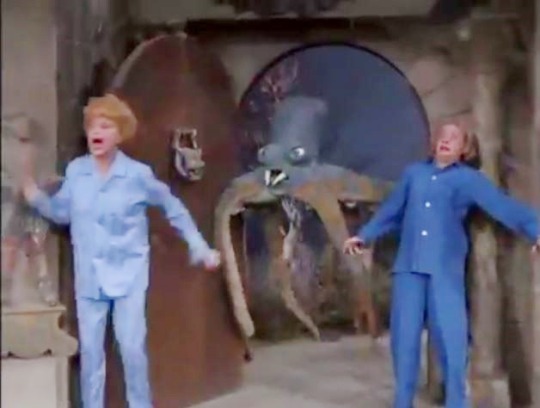
been watching, Lucy has a nightmare in which she and Viv are trapped in
a haunted castle where they encounter a variety of horror movie
characters – until their host turns them into witches themselves!Regular
Cast
Lucille
Ball (Lucy Carmichael), Vivian Vance (Vivian Bagley), Gale Gordon
(Theodore J. Mooney), Jimmy Garrett (Jerry Carmichael), Ralph Hart
(Sherman Bagley)Ralph Hart’s face is completely hidden by a Frankenstein mask and he has no dialogue, merely grunts. Viv says “I’m not even sure that is my son under that mask.” This is his first ‘appearance’ since “Lucy’s Contact Lenses” (S3;E10) two months earlier.
Candy
Moore (Chris Carmichael) does not appear in this episode.Guest
Cast
George
Barrows
(Loretta, the Gorilla Maid) played a gorilla in his very first screen
credit, Tarzan
and His Mate
(1934). He donned the gorilla suit 18 more times from 1954 to 1978.
His final simian character was on “The Incredible Hulk.” This is
his first appearance on “The Lucy Show” and he will return as a
gorilla in two more. He also played human characters on two
episodes.
Bob
Burns
(Ringo, the Werewolf Butler) also played the wolf man in two episodes
of TV’s “The Adventures of The Spirit” in 1963. Like George
Barrows, Burns played many on-screen gorillas, including on an
episode
of “My Three Sons” in 1966. Burns was a good friend of Glenn
Strange, the last actor to play Frankenstein in a Universal horror
film. He is also a world
renown archivist and historian of props, costumes, and other screen
used paraphernalia from science fiction, fantasy, and horror movies.
One of his prized possessions is the the wolf’s cane handle from The
Wolf Man (1941).The character’s unique moniker is likely a nod to the Beatles’ Ringo Starr. Early in their career’s the Beatles were known for their long hair!
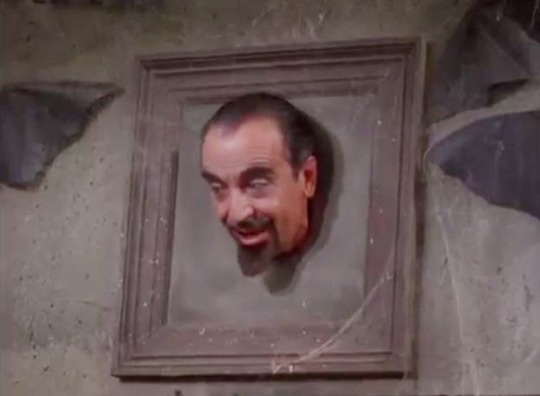
Jan
Arvan
(The ‘Head’ of the Household) played a waiter in Abbott
and Costello Meet the Mummy
in 1955 and a gypsy on “The Munsters” ten years later. From 1953
to 1971 he was a regular on “The Red Skelton Show” on CBS, often
playing Klem Kadiddlehopper’s father. This is his only appearance with
Lucille Ball.
Sid
Haig
(The Mummy) was first employed by Desilu in a 1962 episode of “The
Untouchables.” This “Lucy Show” marks his fourth of more than 140 screen
credits. He was also seen in a1969 episode of “Here’s Lucy.” Haig appeared in the horror re-boots Night
of the Living Dead 3D
(2006) and Halloween
(2007).
James
Gonzales
(Morris, the Chair) was
a popular Hollywood extra who first acted with Lucille Ball in the
1953 film The
Long, Long Trailer.
He was previously seen on the series as Stan Williams in “Lucy
Digs Up a Date” (S1;E2).
He was seen in more than 20 episodes of “The Lucy Show” and 3
episodes of “Here’s Lucy.”The character name puns on the Morris Chair, an early type of reclining chair by Morris & Company first marketed around 1866. Gonzales is completely concealed by the chair costume and does not speak.

Shepard
Sanders
(Costume Party Count Dracula) played a psychic on an episode of the TV series
“Werewolf” in 1987. This is his only appearance with Lucille
Ball.Several other costumed party-goers appear uncredited in the final scene, but do not speak. They may have been played by the other ‘monsters’ in Lucy’s dream.


Series
Camera Coordinator Maury Thompson (above left) and assistant director
/ associate producer Tommy Thompson (above right) came up with the
premise for this episode and receive screen credit for the story.
The episode opens with Lucy reading a magazine article titled “Psychological Reactions in Adolescents to Terror-Inspiring Visual Stimulation”:
“The over-abundance of spooky stuff in movies and TV can cause traumatic experience in our youngsters.”

Lucy reports that Jerry and Sherman are at the State Theater to see the double-feature The Surfing Werewolf and The Eggplant That Ate Philadelphia. Both of these are fictional films. This is the first mention of the State movie theatre. The Bijou and The Danfield Theatre were both mentioned in “No More Double Dates” S1;E21).

The title The Eggplant That Ate Philadelphia may have been inspired by the 1960 low-budget comedy / horror film The Little Shop of Horrors, about a mysterious eggplant-shaped plant that thrives on human blood and could be an alien sent to conquer earth. One of the film’s stars, Jackie Joseph, was married to Lucille Ball protégé Ken Berry and would appear on “Here’s Lucy” (using her married named) in 1969.
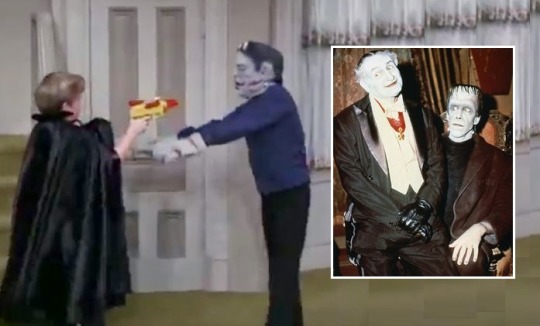
Jerry
wears a black cape and Sherman wears a Frankenstein mask. Other than
this visual image, the Frankenstein monster is not mentioned or
depicted in the dream. Frankenstein and Dracula were already
represented on CBS by “The Munsters” (1964-66) on Thursday
nights. The series imagined the Universal monsters in a family-based
sitcom similar to “Father Knows Best.”
Jerry (and later Lucy) use a Remco “Signal Action Ray Space Gun”. Starting in the 1950s, Remco made many variations on this gun, including different colors. It is likely that the electronic sound heard on the soundtrack was added in post-production.
The mothers resolve to check out these movies for themselves.
VIV: “I haven’t seen a movie with a monster since Gone With The Wind.”
LUCY: “There was no monster in Gone With The Wind.”
VIV: “You didn’t see my date!”
Lucille Ball was
considered for the role of Scarlett O’Hara during the 1939 film’s initial
casting. The role eventually went to British actress Vivian Leigh (right). The cinema classic will be mentioned several times throughout the series and on “Here’s Lucy.”Gale Gordon gets a smattering of entrance applause from the studio audience. Mr.
Mooney jokingly hums a few bars of “Funeral March” to scare Lucy
and Viv. Frédéric
Chopin’s composition
is formally known as Piano
Sonata No. 2 in B Flat
Minor, Opus 35 and was completed in
1839.Mr. Mooney mentions his wife, but not by name. Vivian mentions her husband, but also does not use his name. In other episodes, we discover they are named Irma and Ralph, respectively.
Both characters remain unseen throughout the series.

Throwing his coat over his shoulders like a cape, Mr. Mooney says
“It
isn’t a fit night out for man nor beast!”This is a paraphrase of a quote spoken by W.C.
Fields in the 1933 film short The
Fatal Glass of Beer, which was NOT a horror movie! More beastly wordplay happens later when Dracula (Mr. Mooney) turns the expression “Heavens to Betsy” into “Heavens to Beastie”!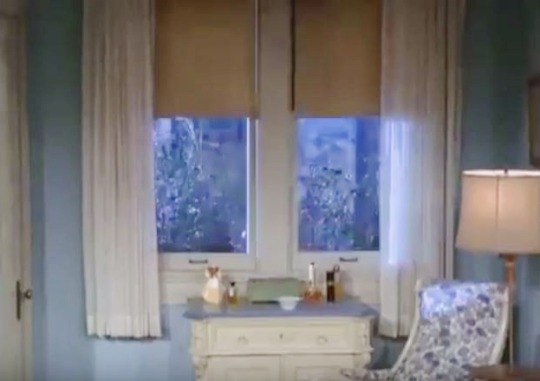
This
is only the second time a scene has taken place in Lucy’s bedroom.
The first was in “Lucy Buys a Sheep” (S1;E5).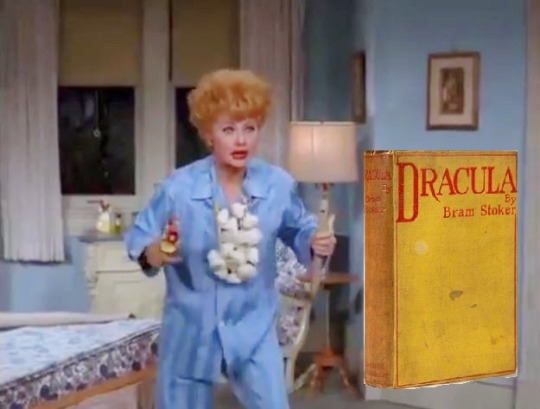
Lucy
protects herself from monsters by wearing a garlic necklace (to ward
off evil spirits) and holding one of Jerry’s wooden tent stakes (the
only way to kill a vampire). Both of
these tactics are part of the vampire mythology as set forth in Bram
Stoker’s 1897 novel Dracula.
The
monster characters featured are mostly from the Universal Studios
pantheon of monsters: Dracula (1931), The Mummy (1932)
and The Wolf Man (1941). Background player Monty O’Grady was a
villager in The Wolf Man and later appeared in 14 episodes of “The
Lucy Show” and 6 episodes of “Here’s Lucy.” One of Universal’s
most famous monsters was The Bride of Frankenstein (1935),
played by Elsa Lanchester. Lanchester guest-starred as a possible
hatchet murderess on “Off To Florida” (ILL S6;E6) and as a
hardened criminal in “Lucy Goes To Prison,” a 1973 episode of
“Here’s Lucy.” The Bride of Frankenstein is also mentioned in
“Lucy Writes a Play” (ILL S1;E17). Universal Studios theme parks
in Hollywood and Florida later hosted a Lucille Ball exhibit, also
selling collectible merchandise and souvenirs.
Count Dracula (Mr. Mooney) calls his werewolf butler by the name
‘Ringo.’ This is a joke about Ringo
Starr of
the Beatles, a popular singing group known for their long and shaggy
hairstyles. The Beatles have been mentioned several times on “The
Lucy Show.” 1965 saw the release of their motion picture Help!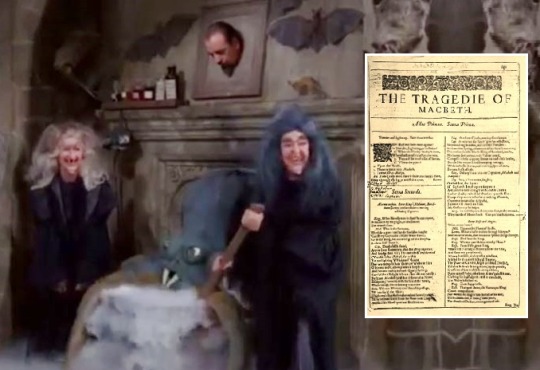
When
Lucy and Viv are transformed into witches, they quote the Weird
Sisters from William Shakespeare’s MacBeth:“Double
double, toil and trouble. Fire burn, and cauldron bubble.”
To
find out who is the prettiest witch, Lucy and Viv ask the magic
mirror by saying
“Mirror, mirror on the wall; Who’s the fairest of them all?”
This is the same query the Evil Queen asks her magic mirror in the
1937 animated Disney film Snow
White and the Seven Dwarves.
In the original Brothers Grimm story that the film is based upon,
however, the question posed is “Who
is the most beautiful in all the land?”In
the dream sequence, witch Lucy calls witch Viv ’Sassafrassa.’
This is actually the name Lucille Ball gave an imaginary childhood
friend who assured her she would one day be a movie star. Once she
moved from Jamestown to nearby Celoron, Lucy would often call her
best friend Pauline Lopus ‘Pauline Sassafrassa.’ Other sources say
Lucille Ball imagined herself to be a famous film star named
‘Sassafrassa.’
A
mouse also scares Lucy and Viv in “Vivian Sues Lucy” (S1;E10).
That episode also features an insert shot of a live mouse. Women being afraid of mice was a typical TV trope of the time.
When the Mummy tries to help strap Lucy to the operating table, she snaps and says “Please, Mummy! I’d rather do it myself!” The studio audience reacts with a big laugh of recognition. Here’s why…
In 1962, an advertisement for Anacin pain reliever featured a mother trying to assist her grown daughter prepare a meal. “Don’t you think it needs a little salt?”, the mother would say, only to have her nerve-racked daughter shout, “Mother, please, I’d rather do it myself!“ Variations on this scenario became popular and were parodied a number of times, including in the Allan Sherman song "Headaches” (”Mother, don’t hand me those pills from the shelf, I’d rather do it myself”), the 1966 film The Silencers, and the 1980 film Airplane.

A year and a day after this “Lucy Show” episode, “My Mother The Car” (starring Lucy’s pal Ann Sothern) aired an episode titled “I’d Rather Do It Myself, Mother” (S1;E20). Coincidentally, the show’s music was by Ralph Carmichael, a real-life combination of VIv’s ex-husband’s first name, and Lucy’s last name!
Callbacks!

Two years earlier, in the first frame of the June 1963 “The Lucy Show” Gold Key comic book, Viv also feared monsters! And shaggy dogs, apparently! Ironically, a shaggy dog was featured in the very first episode of “The Lucy Show”.
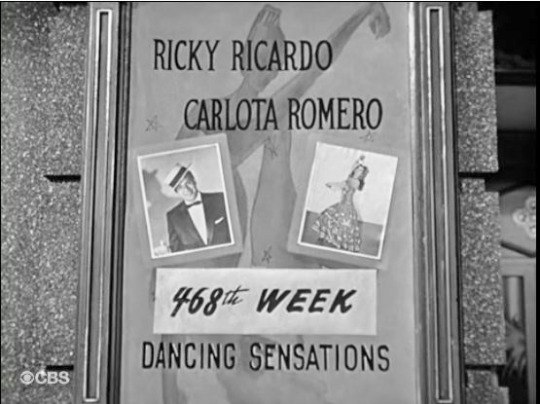
This
is the first time there has been a ‘dream sequence’ on “The Lucy
Show.” In “Ricky’s Old Girlfriend” (ILL S3;E12) Lucy dreams of
what life would be like without Ricky if he left her for Carlotta
Romero, a sexy Cuban dancer. The dream takes her 25 years into the
future.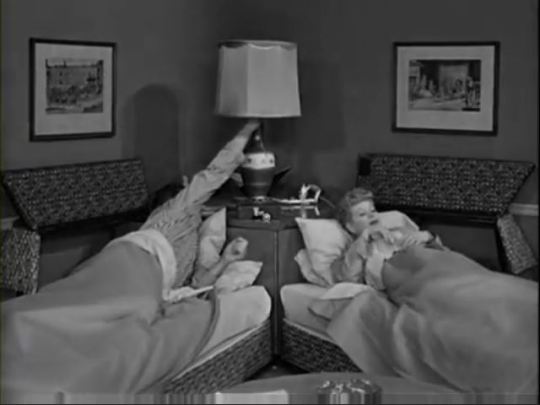
The
most famous dream sequence on “I Love Lucy” was “Lucy Goes To
Scotland” (ILL S5;E17) where Lucy Ricardo imagines re-visiting her
relatives in Scotland, but dreams in the musical comedy format.
Except for the brief opening and closing scenes, the entire episode
is comprised of a dream.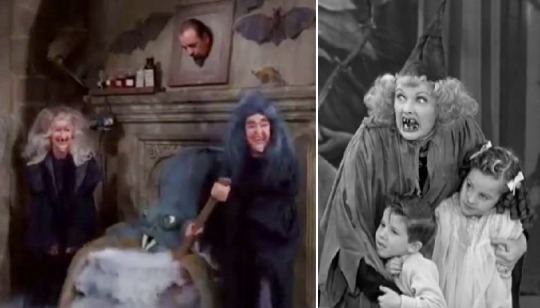
The witch voice Lucy uses is very similar to the one she used as the witch in “Little Ricky’s School Pageant” (ILL S6;E10) with a hint of Camille, the Queen of the Gypsies in “The Operetta” (ILL S2;E5).

When
witch Lucy and witch Viv try to flee Dracula’s castle, the escape
turns into an impromptu square dance, with the Head as the caller.
This is similar to the impromptu escape that helps the Ricardos and
the Mertzes get out of Bent Fork in “Tennessee Bound” (ILL S4;E14). In
that episode, Ernie Ford was the caller.
Lucy
Ricardo disguised herself as an armchair when spying on the “New
Neighbors” (ILL S1;E21). Like the Morris chair in this episode,
Lucy’s arms also were the arms of the chair.Fast Forward!

In a 1970 episode of “Here’s Lucy,” Lucy Carter met the Crown Prince of Horror, Vincent Price.

Trying to flee Count Dracula’s mansion, Lucy and Viv search for a secret passageway in the fireplace, touching all the stones, just like Lucy Carter did when trying to find Mumsie Westcott’s loot in “Lucy Goes To Prison” (HL S5;E18).
Blooper
Alerts!
Calendar Conundrum! This would have made a fun Halloween episode, but instead it inexplicably airs for the first time in January.
Sitcom Logic Alert! Mr. Mooney drops by the Carmichael home on the premise of hand-delivering Lucy’s bank statement. As usual, he leaves the door wide open for the duration of his scene.
Sitter Situation! Lucy and Viv recruit Mr. Mooney to ‘babysit’ with Jerry and Sherman, but it is not clear why Chris (now in her late teens) cannot watch them or even where she might be.

Whose Bed Is It Anyway? Although they are supposedly sleeping in Lucy’s bedroom, the bed frame and the painting above the bed are the same ones seen in Viv’s bedroom in previous episodes.
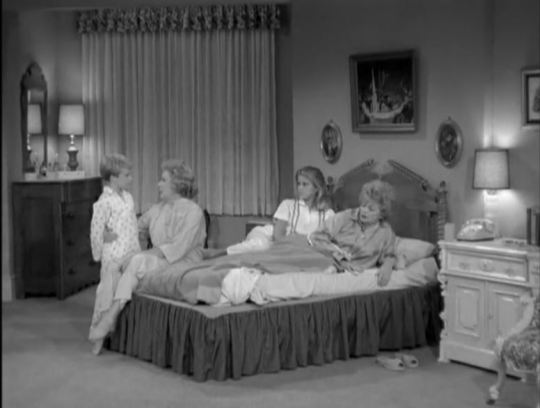
Layout Logic! Lucy’s bedroom in “Lucy Buys a Sheep” (S1;E5) has a completely different layout than this one. The rocking chair and the white wood dresser, however, are the same.
On / Off! In the bedroom, as Viv reaches for the switch, Lucy yells for her not to turn off the lights but the light switch is already in the ‘off’ position.
Made For TV Garlic! When Lucy shakes her garlic necklace to ward off the evil spirits, the hollow sound it makes indicates that they are fabricated cloves and not real garlic.
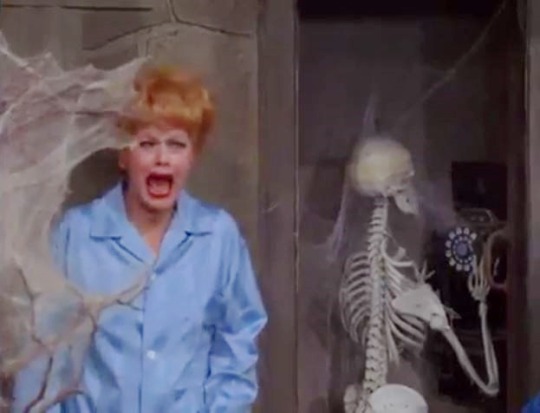
Quick Thinking Viv! When the telephone booth door is flung open to reveal the skeleton, it immediately starts to swing shut again, but Viv quickly grabs it with her right hand and holds it open so the skeleton can be seen on camera and by the studio audience, thus neatly avoiding a re-take.

Ouch! Backing out of the fireplace, Vivian Vance bumps her head on the mantle. She doesn’t react vocally, but does grab her head when it happens. The ‘Head’ sees the entire incident.
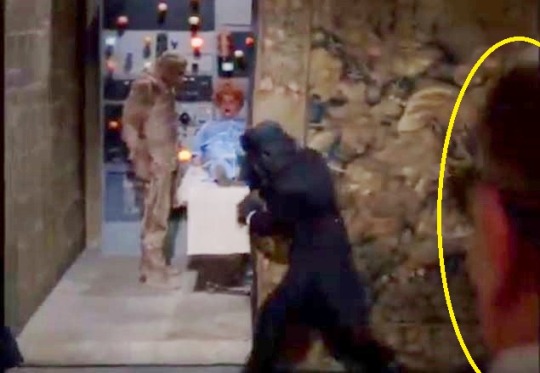
Check the Gate for Crew! When Lucy and Viv are strapped to a table so Dracula can turn them into witches, the screen fades to black for the commercial break and the head of a crew member prominently enters the camera frame on the right. Unfortunately, the newest DVD release did not eliminate this goof by cropping the frame, as they have done with other bloopers. This same mistake also happened on “I Love Lucy.”
Soggy Bottom! When the potted plant spits up the year-old tea, the spray lands on the tan sofa, making a large wet mark where Viv (dressed in pajamas) is supposed to sit. She scoots over a bit to avoid the wet patch. The sofa stays wet for the rest of the episode. When
the magic mirror comes crashing down to the floor rather than saying
who is the fairest in the land, Lucy or Viv, part of the Styrofoam
wall behind it also caves in!
Mirror, Mirror on the Floor! When the magic mirror comes crashing down to the floor part of the Styrofoam wall behind it also caves in!

“Lucy and the Monsters” rates 3 Paper Hearts out of 5
 1965, Bob Burns, CBS, Dracula, Frankenstein, Funeral March, Gale Gordon, George Barrows, Gone With The Wind, Gorilla, Horror Movies, James Gonzales, Jan Arvan, Jimmy Garrett, Lucille Ball, Lucy and the Monsters, Magic Mirror, Ralph Hart, Ringo Starr, Sassafrassa, Shepard Sanders, Sid Haig, Snow White, The Lucy Show, The Mummy, The Munsters, The Were Wolf, tv, Universal Monsters, Vivian Vance
 -
Lucy Goes to Vegas
S3;E17~
January 18, 1965
Synopsis
When
Lucy and Viv win an all-expenses paid trip to Las Vegas, they haven’t got any spending money, so Lucy decides to disguise herself as a
wealthy heiress in order to get comped into the shows. When
she’s pressed into gambling by a Texas oil tycoon, she makes a
windfall for him – but not for herself.Regular
Cast
Lucille
Ball (Lucy Carmichael), Vivian Vance (Vivian Bagley)Gale
Gordon (Theodore J. Mooney), Jimmy Garrett (Jerry Carmichael), Ralph
Hart (Sherman Bagley) and Candy Moore (Chris Carmichael) do not
appear in this episode.Guest
CastJim
Davis
(Mr. Cardenas, below right) is probably best remembered for playing
Jock Ewing on “Dallas” for which he was posthumously nominated
for an Emmy Award in 1981. Most of his 179 screen credits were in
Westerns. This is his only appearance opposite Lucille Ball.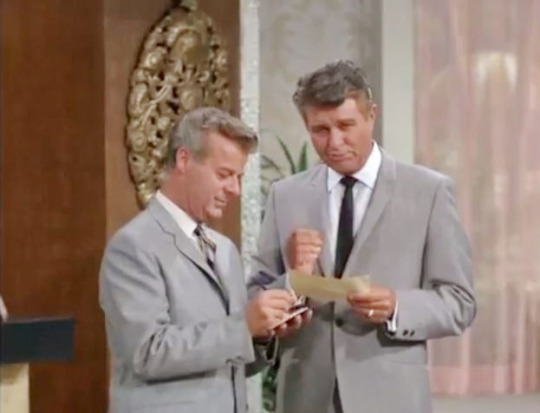
Dick
Winslow
(Hotel Clerk, above left) appeared in the films Thousands
Cheer
(1940) and Easy
To Wed (1943)
with Lucille Ball. This is the first of his two appearances on the
series. He also did two episodes of “Here’s Lucy.”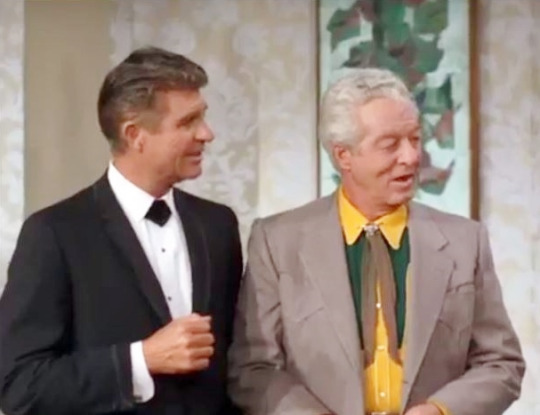
Robert
S. Carson
(Mr. Kelstrom, above right) was
a busy Canadian-born character actor making the second of his six
appearances on the series. He also made five appearances on “Here’s
Lucy.”
Hollis
Morrison
(Chauffeur) made his screen debut as a Party Guest in Breakfast
at Tiffany’s (1961).
This is his only appearance with Lucille Ball.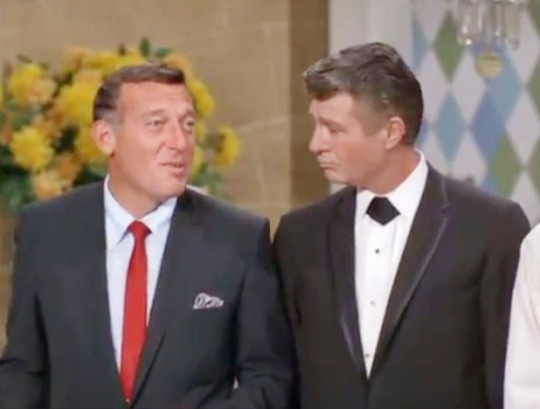
Gary Goldaper (Pit
Boss, above left) was better known as Gary Morton or Mr. Lucille Ball. Goldaper was his birth name. He previously was billed under his professional name in “Lucy
Takes Up Golf” (S2;E17). Before meeting and marrying Lucille Ball
in 1961, he was
a comedian who worked the famed ‘Borscht Belt’ in the Catskills
Mountains. At her request, Morton gave up his nightclub career and
became a producer of “The Lucy Show.” Morton also served as a
warm-up comic for the show’s studio audience. In early episodes of
the series, his loud guffaw can be heard on the laugh track. He will
make two more appearances on the show as well as three appearances on
“Here’s Lucy.” Morton passed away in 1999.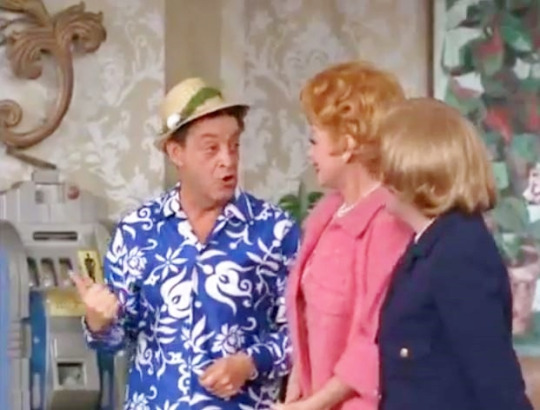
Sid
Gould (Tourist
at the Slot Machine) made
more than 45 appearances on “The Lucy Show,” all as background
characters. He also did 40 episodes of “Here’s Lucy.” Gould
(born Sydney Greenfader) was Lucille Ball’s cousin by marriage to
Gary Morton (born Gary Goldaper). Gould was married to Vanda Barra (aka Mrs. Sid Gould), who also appeared on
“The Lucy Show” starting in 1967, as well as on “Here’s
Lucy.”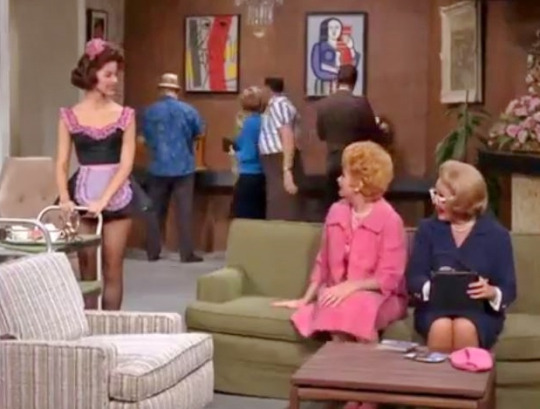
Virginia
Barbour (Waitress)
only has two screen credits on her resume; this episode, and “Lucy’s
Mother-in-Law” (ILL S4;E3) on “I Love Lucy”, where she played assistant to
mind reader Professor Bonanova.Brenda
Howard (Waitress)
aka Breena
Howard
appeared with Lucille Ball in the 1963 film Critic’s
Choice.Howard
has her back to the camera during her brief scene.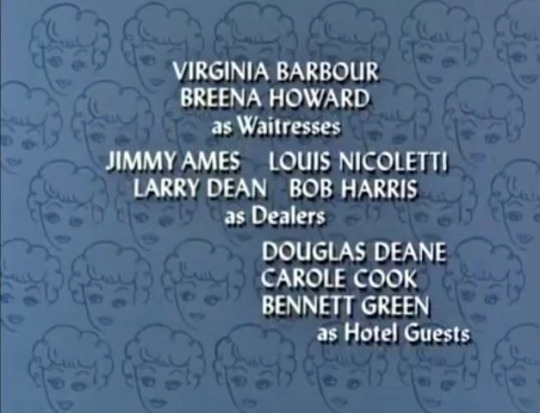
The casino dealers and croupiers are played by:
- Jimmy
Ames appeared with Lucille Ball in The Long, Long Trailer in 1953. This
is his penultimate screen credit. - Louis
A. Nicoletti was an integral part of the Desilu family working behind the
scene and on screen on “I Love Lucy” and “The Lucy-Desi Comedy
Hour.” This is the last of his three credited appearances on “The
Lucy Show” but in 1966 he becomes the show’s assistant director, a
job he also did for two seasons of “Here’s Lucy.” - Larry
Dean was a mime who specialized in playing a robot. He also did
this on episodes of “Lost in Space” and “Bewitched.” He previously played the mechanical butler in Bigelow’s store window in “Lucy and the Ceramic Cat” (S3;E17). He
returns to “The Lucy Show” in “Lucy and the Robot” (S4;E23),
as well as playing non-mechanical characters here and in one more
episode. - Bob
Harris was a Hollywood stuntman making his only appearance on “The Lucy
Show.”
Douglas
Deane
(Casino Patron, below left) only made a dozen screen appearances in
his career, including one more episode of “The Lucy Show.”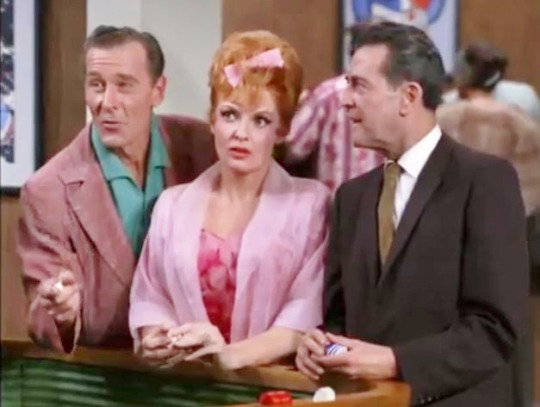
Carole Cook (Casino Patron, above center) was last seen as Thelma Green in “Lucy Enters a Baking Contest” (S2;28), a part she played in four other episodes. She was a protege of Lucille Ball’s during the Desilu Playhouse years. Although she was born as Mildred Cook, Ball suggested she take the name Carole, in honor of Lucy’s great friend, Carole Lombard. Cook also went on to appear in five episodes of “Here’s Lucy.”
Bennett
Green (Casino
Patron, above right) makes his first credited appearance on “The
Lucy Show,” but was an important member of the Desilu family,
having served as Desi Arnaz’s camera and lighting stand-in throughout
“I Love Lucy,” as well as making occasional appearances on
camera. He will make half a dozen more appearances on the series.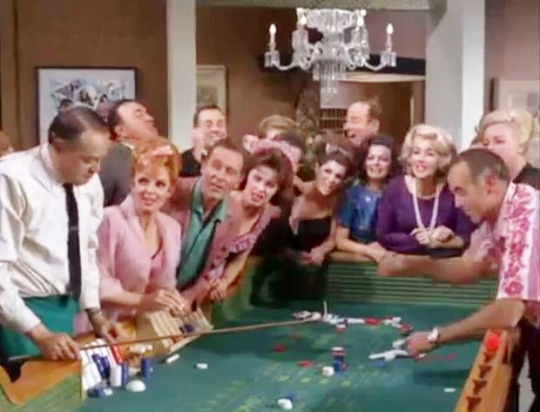
Some
of the uncredited casino patrons are played by:- Paul
Bradley makes
the third of his six appearances on “The Lucy Show” in various
roles. He will also be seen in two episodes of “Here’s Lucy.” - Ralph
Brooks made
four films with Lucille Ball between 1940 and 1956. This is his only
series appearance. - Jack
Clinton was
a background player who appeared in many Westerns. This is his only
series appearance. - George
DeNormand had
appeared in three films with Lucille Ball from 1937 to 1963. This is
the second of his many appearances on “The Lucy Show” and “Here’s
Lucy.” - Sam
Harris was
born in Australia in 1877 and did a dozen films with Lucille Ball
before appearing in the audience of Over
the Tea Cups in
“Ethel’s
Birthday” (ILL S4;E8)
and
playing a subway passenger in “Lucy
and the Loving Cup” (ILL S6;E12).
In between, he was a wedding guest in Lucy and Desi’s film Forever
Darling (1956).
He was in the airport when “The
Ricardos Go to Japan”
in
1959. He went on to do several more episodes of “The Lucy Show,”
the last being “My Fair Lucy” (S3;E20), a parody of My
Fair Lady,
a film he had also been in as an extra! - Monty
O’Grady was
first seen with Lucille Ball in The
Long, Long Trailer (1953),
and played a passenger on the S.S. Constitution in “Second
Honeymoon” (ILL S5;E14).
He was at the airport when “The
Ricardos Go to Japan”
(1959).
He made a dozen appearances on the series and a half dozen more on
“Here’s Lucy.” - Judith
Woodbury makes
the fourth of her more than 20 (mostly) uncredited appearances on “The Lucy
Show.” She also appeared in several episodes of “Here’s Lucy.”

This
episode was filmed on November 12, 1964. That same day, Lucy, Gary, Lucie, and Desi Jr. all were seen on (a previously recorded) installment of “Password,” a game show Lucy dearly loved.
This episode was originally aired on Danny Kaye’s birthday. Kaye and Lucille Ball were both born in 1911.
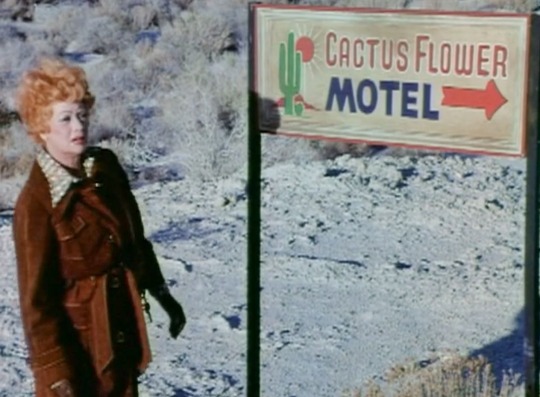
As the episode opens, Lucy and Viv are discovered sitting in the lobby of a swanky Las Vegas Hotel, although we soon discover that they are really sleeping at a “crummy motel down the street.” In 1975, Lucy Collins travels to Las Vegas’s MGM Grand in “Lucy Gets Lucky” (above), although we soon learn she is actually sleeping at a budget motel nearby.

Lucy
and Viv are in Las Vegas with just $5.50 spending money. Adjusting
for inflation, that would be like only having $45 today. Viv
doesn’t want Lucy to gamble with the money, but it saving it to give to Mr. Krause, the butcher, to buy sweepstakes tickets. Mr.
Krause was seen in “Lucy and the Plumber” (S3;E2) played by Tom
G. Lindner. Sweepstakes tickets likely means The Irish Sweepstakes, an early form
of lottery – another type of gambling, although Viv doesn’t seem to
realize it.
Lucy
won the trip to Las Vegas for being
the one millionth customer through the doorat Bigelow’s Department Store.
Hopefully,
Lucy entered the store through the front doors, and not the transom,
which she did when she broke in during the previous episode “Lucy
and the Ceramic Cat” (S3;E16, above), the series’ first mention of the
store. Bigelow’s
was named after a real-life Jamestown NY department store. Lucille Ball applied for a job there as a youth, but was rejected by owner Fred Bigelow. His cat is discussed on “I Love Lucy” in “The Passports” (ILL S5;E11) in 1955.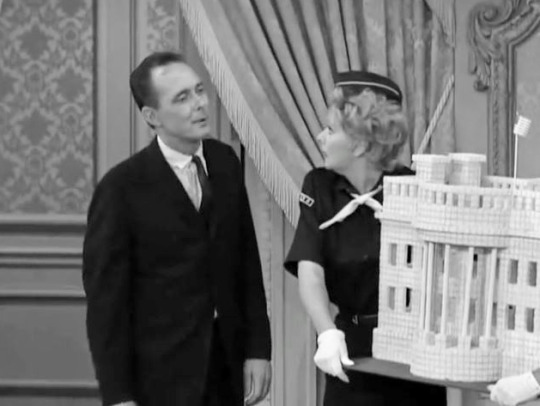
This
is only the second time the characters are seen traveling outside of
New York State. The first was in “Lucy Visits the White House”
(S1;E25, above) where den mothers Lucy and Viv chaperoned cub scouts to
Washington DC. Generally, the characters
have stayed in or around fictional Danfield, with occasional trips to
places such as nearby Ridgebury (also fictional), Manhattan, and
Albany (in “Lucy’s Barbershop Quartet” (S1;E19).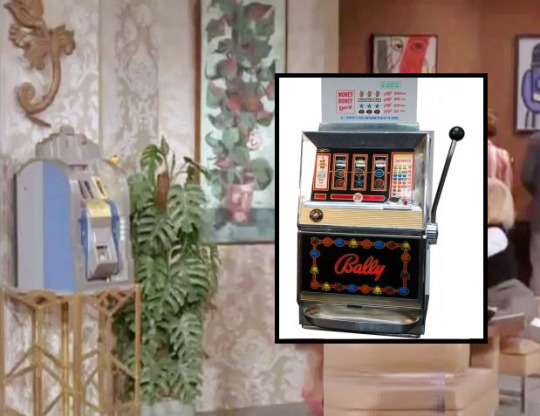
If
the small bank of slot machines looks antique compared to today’s
models, consider that it was in 1963 that Bally Manufacturing
invented ‘Money Honey’ (above inset photo), the first slot machine powered by
electricity. After that, slot
machines
began to ‘light up’ and produce various sound effects. At first, many
Nevada casinos were hesitant to buy the new machines, largely due to
quality concerns and the expense of replacing their entire stock at
once. The slot machine Sid Gould plays in the episode (above left) is a
1933 Extraordinary, manufactured by the Mills Novelty Company. Today,
slot machines operate primarily on paper currency and rarely pay out
coins, but distribute vouchers for later redemption. The machines
that were once nicknamed ‘one armed bandits’ due to their single pull
lever, are now primarily operated by push buttons and touch screens.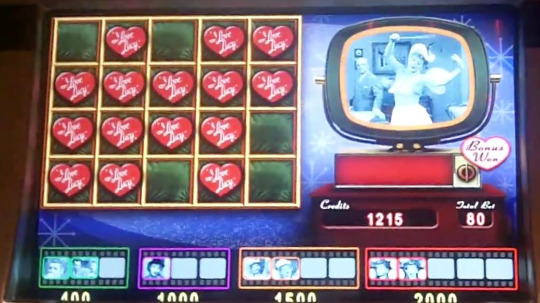
“I
Love Lucy” has inspired several slot machines, both in brick and mortar casinos and
online.
Viv
says that they got to hear Frank
Sinatra
– through the air conditioning vent in the hotel powder room. Sinatra
was a fixture in Vegas, and his name was seen on a marquee in a “Here’s Lucy” episode set in the city. A clip of him in the film Guys
and Dolls was inserted into the MGM executive show in “Lucy and the Dummy” (ILL
S5;E3) but due to copyright issues, the clip was never repeated and has
been edited out of the print, even on the restored DVDs. Prior to
that he was mentioned in “Don Juan is Shelved” (ILL S4;E21).
Sinatra later balked about the Desilu series “The Untouchables”
as promoting stereotypes about Italian-Americans and the Mafia.
In
order to get comped in to the shows, Lucy pretends to a be rich
gambler named Pamela Pettebone and Viv masquerades as her pal,
Penelope Poopendorf.
The name ‘Pamela’ was also the name of Lucy Ricardo’s heroine in
“The Perils of Pamela,” (above) the play she wrote for the Wednesday
Afternoon Fine Arts League in “Lucy Writes a Play” (ILL S1;E17).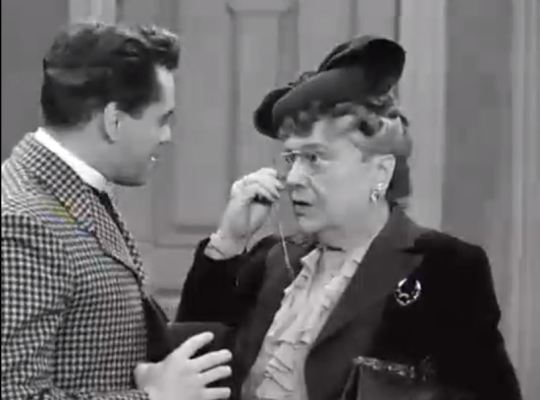
The surname ‘Pettebone’ was given to the haughty woman from the
Society Matron’s League in “Pioneer Women” (ILL S1;E25) played by Florence Bates (above).
VIV (as PENELOPE): “Ever since we were little girls, she always wanted me to play Jacks.”
MR. CARDENAS: “Well, all little girls play Jacks.”
VIV (as PENELOPE): “Jacks or better?”Jacks (the children’s game) is of ancient origin and involves bouncing a rubber ball while also scooping up small objects known as the jacks. The schoolyard game was associated with little girls at a time when more physical games that boys played were not deemed appropriate for young ladies. Viv’s pun here relies on it being compared with the Jacks in a deck of playing cards, a staple of casino gambling.
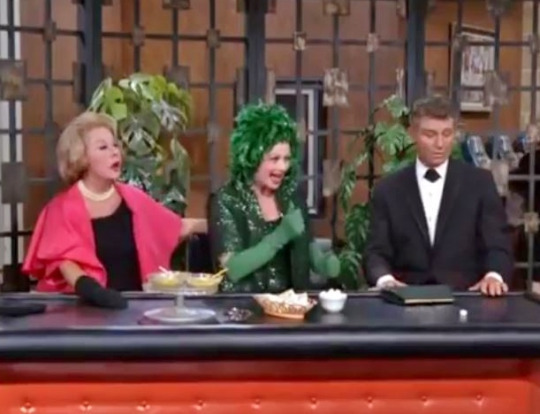
To
convince Mr. Cardenas that she’s actually an heiress addicted to gambling,
Lucy shuffles the crackers, rolls the sugar cubes, deals the toast,
and spins the condiment caddy!LUCY (as PAMELA): “Bet you a thousand it stops on the ketchup!”
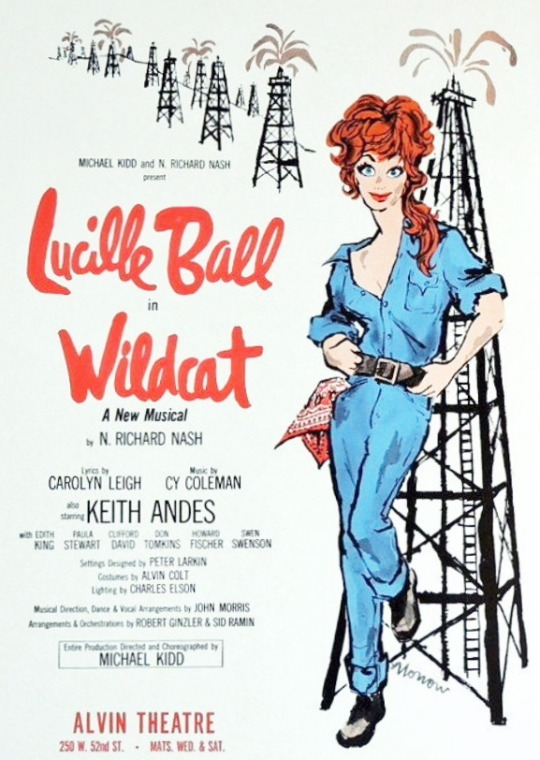
MR. KELSTROM: “Miss Pettebone, was your father a wildcatter?”
LUCY (as PAMELA): “A wildcatter? Well, not while mother was watching!”Lucille Ball played a wildcatter named Wildcat Jackson in the
Broadway musical Wildcat
(1960), a musical about a woman in 1912 Centavo City looking to strike it
rich with a gusher.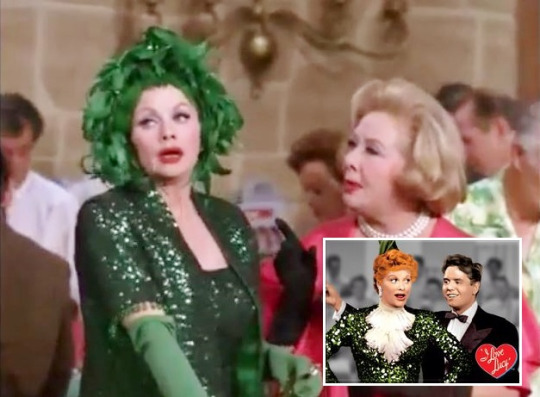
Viv
says Lucy’s green feathered hat looks like a fresh crop of crab
grass. In the opening moments of the episode we learn that their outfits were part of their prize for being Bigelow’s one millionth customer. Lucy’s green sequined dress and feathered hat are reminiscent
of her costume for Sally Sweet in “The Diet” (ILL S1;E3), although TV viewers only saw it in black and white!
Lucy’s ‘crab grass chapeau’ turns up again (without the dress) on a Hollywood starlet when “Lucy Goes To A Hollywood Premiere” (S4;E20) in 1966.
Casino Callbacks!
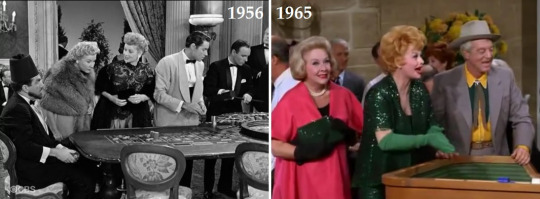
LUCY (as PAMELA): “Give me a thousand dollars in chips.”
VIV (as PENELOPE): “No, Pamela! Remember what happened in Monte Carlo?”Lucy
Ricardo and Ethel Mertz had extraordinary luck (much to their
chagrin) at the roulette tables in “Lucy Goes to Monte Carlo”
(ILL S5;E25). Just as in this episode of “The Lucy Show”, Lucy
wins big then looses it all in one careless bet.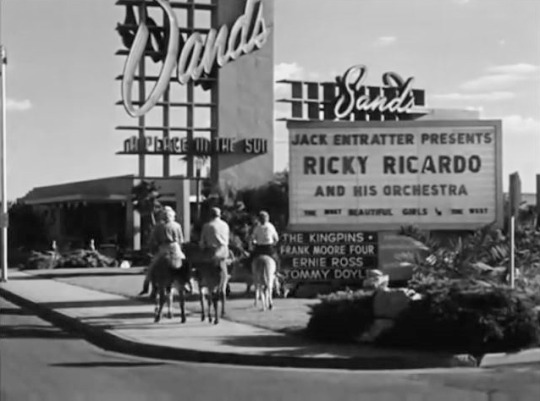
Lucy
Ricardo and Ethel Mertz traveled to Las Vegas in “Lucy Hunts
Uranium,” a 1958 episode of “The Lucy-Desi Comedy Hour.” They
don’t visit the casino, however, being too busy hunting uranium with
Fred MacMurray. Besides Ball and Vance, Louis A. Nicoletti, who plays a croupier in 1965, was also in this 1958 episode. Also, in “Lucy Meets Orson Welles” (ILL S6;E3), Ricky Ricardo says he caught Welles’ nightclub act while he was in Las Vegas. This is not shown on the series and it is never discussed just how or when Ricky went to Vegas.
On November 1, 1959, Lucy and Ricky Ricardo joined ‘Mr. Television’ Milton Berle at the El Rancho Vegas as part of an NBC “Sunday Showcase: Milton Berle Special”. The entire action of the special took place in Las Vegas.
Sin City Fast Forward!
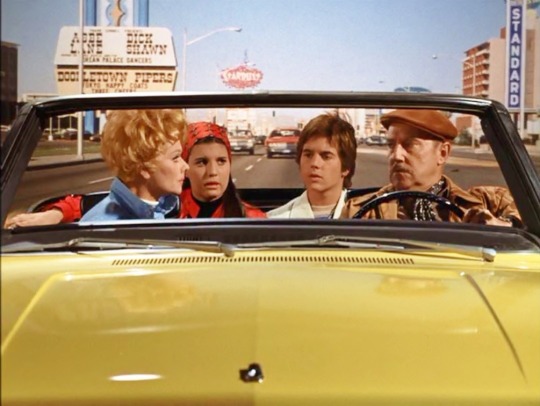
In “Lucy and Wayne Newton” (HL S2;E22) in 1970, the Carter Family drove to Vegas to see the Strip, but ended up at Wayne Newton’s nearby ranch.

In “Lucy Gets Lucky” (1975), one of the Lucille Ball Specials, Lucy Collins travels to Las Vegas to see Dean Martin. The special was shot on location at the MGM Grand.

Lucille Ball returned to Las Vegas with this remarkably life-like figure at Madam Tussaud’s, Las Vegas.
Blooper
Alerts?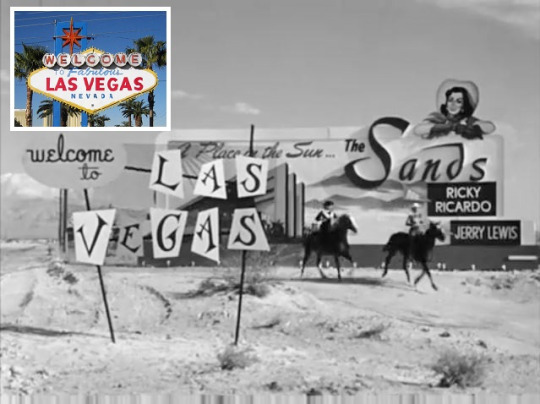
Not
a blooper exactly, but an opportunity lost. “Lucy Goes To Vegas” might have started the show with a
stock footage establishing shot or title screen reading “Las Vegas”
to indicate the unusual location. Although establishing shots and
location footage are rare on the series, they were not unknown.
Also, although Desilu had previously sought out partnerships with
hotels, casinos, car manufacturers, and other business on “I Love
Lucy” and “The Lucy-Desi Comedy Hour,” there is no specific
casino named mentioned when Lucy and Viv are praising the luxury
hotel they are visiting.
“Lucy Goes to Vegas” rates 4 Paper Hearts out of 5
 Bob Harris, Breena Howard, Brenda Howard, Carole Cook, Casino, Dick Winslow, Douglas Deane, Gambling, Gary Morton, George DeNormand, Hollis Morrison, Jack Clinton, Jim Davis, Jimmy Ames, Jock Ewing, Larry Dean, Las Vegas, Louis A. Nicoletti, Lucille Ball, Lucy Goes To Vegas, Monty O’Grady, Paul Bradley, Ralph Brooks, Robert S. Carson, Sam Harris, Sid Gould, Slot Machines, The Lucy Show, Virginia Barbour, Vivian Vance
 - Jimmy
-
Lucy and the Ceramic Cat
S3;E16~
January 11, 1965

Synopsis
When
Lucy and Viv are entrusted with Mrs. Mooney’s elegantly wrapped
birthday gift, they naturally drop it – shattering it to pieces.
Unable to recognize what it once was to replace it, they hunt down
the item, going so far as to break into a department store to get the
last one. Once inside, Lucy has a comical encounter with a
mechanical butler in the store window.
Regular
Cast
Lucille
Ball (Lucy Carmichael), Gale Gordon (Theodore J. Mooney), Vivian
Vance (Vivian Bagley)Jimmy
Garrett (Jerry Carmichael), Ralph Hart (Sherman Bagley) and Candy
Moore (Chris Carmichael) do not appear in this episode.Guest
Cast
Larry
Dean
(Mechanical Butler) was a mime who specialized in playing a robot.
He also did this on episodes of “Lost in Space” and “Bewitched.”
He returns to “The Lucy Show” in “Lucy and the Robot”
(S4;E23), as well as playing non-mechanical characters in in two
more.
John
J. ‘Red’ Fox (Policeman)
was
best known for playing policemen, which is what he did on five of his
eight appearances on “The Lucy Show” as well as three of his five
episodes of “Here’s Lucy.”
Sid
Gould (Mr.
Gould, McCullough’s Store Clerk) made
more than 45 appearances on “The Lucy Show,” all as background
characters. He also did 40 episodes of “Here’s Lucy.” Gould
(born Sydney Greenfader) was Lucille Ball’s cousin by marriage to
Gary Morton. Gould was married to Vanda Barra, who also appeared on
“The Lucy Show” starting in 1967, as well as on “Here’s
Lucy.”
William
Meader (Cafe
Cashier, right) appeared
as an airport extra in “The
Ricardos Go to Japan,”
a
1959 episode of “The Lucy-Desi Comedy Hour.” He made many
appearances on “The Lucy Show,” most times as a clerk in Mr.
Mooney’s bank.
Karen
Norris
(McCullough’s Sales Clerk) previously
appeared as Della Fox (aka Student #2 with a head cold) in “Lucy
and Viv Take Up Chemistry” (S1;E26)
and
Ella the maid in “Lucy
and the Runaway Butterfly (S1;E29).
This is her penultimate appearance on “The Lucy Show.” She also
did one episode of “Here’s Lucy” in 1968.
Gail
Bonney
(McCullough’s Customer) appeared with Lucille Ball in the 1950 films
A
Woman of Distinction and
The
Fuller Brush Girl.
She played Mrs. Hudson (above), the mother of the unruly twins, on “The
Amateur Hour” (ILL S1;E14). She makes an appearance on a 1968
episode of “Here’s Lucy.”Despite
receiving screen credit, Bonney has no dialogue.Other
uncredited extras play the café patrons and the passersby in the
street in front of Bigelow’s.

This
is the first new episode aired in 1965. There was no new “Lucy
Show” on Monday, January 4, 1965, due to newly re-elected President
Lyndon
B. Johnson’s televised
State
of the Union Address.
This episode was filmed on November 5, 1964, two days after Johnson
defeated Republican
challenger
Barry
Goldwater with
over 60 percent of the popular
vote.
Bigelow’s
Department Store was named for the biggest department store in Lucy’s
hometown of Jamestown, New York.
In “The Passports” (ILL S5;E11) we
learn that as a child Lucy Ricardo was bitten on the ear by Fred
Bigelow’s cat. In real-life, Fred Bigelow was the proprietor of
Bigelow’s
Department Store.
As a youth, Lucille Ball applied for a job at the ribbon counter, but
was turned down, a decision which allowed her to pursue her show
business aspirations.
Mr.
Mooney bought the ceramic cat at McCullough’s Gift Shop. Cameron
McCullough
was the name of a Desilu sound engineer responsible for editing the
laugh tracks into the soundtrack. He worked on all of Lucille Ball’s
television shows from 1953 to 1987.
The ceramic cat of the episode’s title was originally designed by
master ceramist Aldo Londi (1911-2003), who spent the most of his long and successful career creating exceptional work for Italian ceramics manufactory Bitossi Ceramiche.

Viv
says she got the last pair of stockings for thirty nine cents. At
the time, the least expensive pair of stockings cost about one dollar
(retail). Over the next decade, stockings would gradually be
replaced by pantyhose for use by most women.
Lucy and Viv see in Mr.
Mooney’s newspaper that Bigelow’s had a sale on dentures for $4.98
(made in Japan). Dentures, however, are generally fitted to an
individual’s mouth by a dentist or oral health care professional, not
sold over-the-counter at department stores.
When
Lucy opens the box and finds the ceramic cat in pieces, Lucille Ball
says “ewwwwwww”
and makes what is known as her ‘spider’ face, something she did on “I
Love Lucy” countless times. It was called the ‘spider’ by the
writers because Lucy first did it as part of a Jell-O commercial where she
played Little Miss Muffett. This is the first time Lucy Carmichael
has done the ‘spider’ face.
Watch for the ceramic cat to turn up again on “The Lucy Show” as set dressing in “Lucy and the French Movie Star” (S6;E3).

The ceramic cat props (probably purchased or made in bulk) will turn up again in other Desilu / Paramount sitcoms, like “The Mother’s-in-Law” (right), a show produced by Desi Arnaz.
Callbacks!

Viv
says the re-glued gift looks like “a rhinoceros wrestling a parrot.”
This reminiscent of when Little Ricky’s finger painting was called “an
elephant sailing a houseboat”
in “Nursery School” (ILL S5;E9).
Lucy
Ricardo also pretends to be a store window mannequin (albeit a
non-mechanized one) in “Lucy Changes Her Mind” (ILL S2;E21).Blooper
Alerts!
Frequent Birthdays! The
gift is for Mr. Mooney’s (unseen) wife Irma’s birthday, but Mrs.
Mooney just celebrated a birthday six episodes ago in “Lucy’s
Contact Lenses” (S3;E10).
Absent Furniture! The
living room coffee table has been removed in order to allow for the
stunts involved with Mr. Mooney and the gift.
Memory Loss! The
policeman must have an extremely short memory to not recognize Lucy
in the window after meeting her on the street only a few minutes
earlier. He even says…“The
man looks real, but that red-head. There could never be a human
being with that color hair.”
“Lucy and the Ceramic Cat” rates 4 Paper Hearts out of 5

-
Lucy Meets Danny Kaye
S3;E15~
December 28, 1964

Synopsis
When
Lucy writes away for tickets to “The Danny Kaye Show” but is
turned down, she wangles her way in to see Kaye, first at a fancy
Manhattan eatery then at his ritzy hotel suite. In order to get her
into the show, Kaye offers to give her a walk-on role in the telecast
– but Lucy manages to hog the spotlight anyway.Regular
Cast
Lucille
Ball (Lucy Carmichael), Gale Gordon (Theodore J. Mooney)Vivian
Vance (Vivian Bagley), Jimmy Garrett (Jerry Carmichael), Ralph Hart
(Sherman Bagley) and Candy Moore (Chris Carmichael) do not appear in
this episode. Chris and Jerry, however, are mentioned.Guest
Cast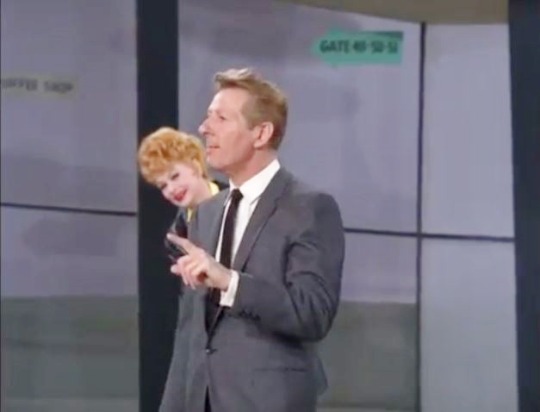
Danny
Kaye
(Himself) was
born David Kaminsky in 1911 and left
school at the age of 13 to work in the Borscht Belt of Jewish resorts
in the Catskill Mountains. It was there he learned the basics of show
biz. In 1939, he made his Broadway debut in Straw
Hat Revue,
but it was the stage production of the musical Lady
in the Dark
in 1940 that brought him acclaim and notice from agents. Also in
1940, he married Sylvia
Fine,
who went on to manage his career. She helped create the routines and
gags, and wrote most of the songs that he performed. Danny could sing
and dance like many others, but his specialty was reciting
tongue-twisting songs and monologues.
In 1962 Lucille Ball guest-starred on his CBS TV program “The
Danny Kaye Show.”
A month before this episode of “The Lucy Show”
Ball made a second appearance on the program. The two appeared
together on variety and tribute shows from 1965 to 1986, a year
before his death from heart failure.Leon
Belasco
(Bruno,
the Maitre d’) was
born in Russia in 1902. He was in three films with Lucille Ball
before playing the art store clerk in “Lucy
Becomes a Sculptress” (ILL S2;E15).
He previously played the violin in “No
More Double Dates” (S2;E21)
and
“Lucy Conducts the Symphony” (S2;E13).
This is his final appearance on the series.
Stanley
Farrar
(Man with Danny) was
seen on “I Love Lucy” in “Home Movies” (ILL S3;E20) and
“Staten Island Ferry” (ILL S5;E12). He will make one more
appearance on “The Lucy Show” in “Lucy and Arthur Godfrey”
(S3;E23).Hal
Taggart (Man
with Danny) makes
the fourth of five appearances on “The Lucy Show” after having
been seen in the Lucille Ball film The
Facts of Life (1960).
Ray
Kellogg
(Henderson, the Doorman) played
the loud, barking Assistant Director (“Roll
‘em!”)
in “Ricky’s
Screen Test” (ILL S4;E6)
and later appeared in “Bullfight
Dance” (ILL S4;E22).
This is the second of his seven episodes of “The Lucy Show.” He
also did two episodes of “Here’s Lucy.” Just as in his other
screen credits, most most times he played policemen.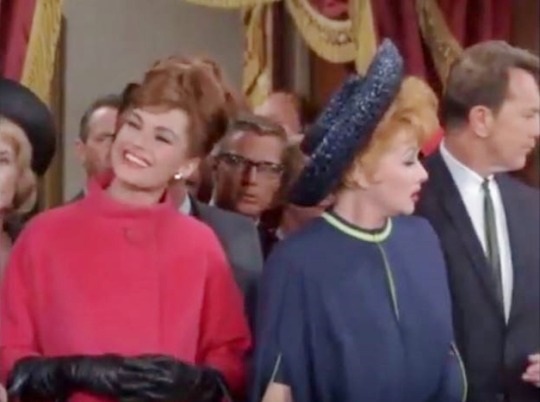
Sue
Casey
(Miss Holloway) was
a fashion model and actress who appeared in countless films. She
appeared in two Best Picture Academy Award winners which were
released 48 years apart: An
American in Paris (1951)
and American
Beauty (1999).
Casey was credited as ‘Miss Leg Girl’ on “Lucy Wants a Career,”
a 1959 episode of “The Lucy-Desi Comedy Hour.” This is her final
appearance with Lucille Ball.Monty
O’Grady (Mr.
Martin) was
first seen with Lucille Ball in The
Long, Long Trailer (1953),
and played a passenger on the S.S. Constitution in “Second
Honeymoon” (ILL S5;E14).
He was at the airport when “The
Ricardos Go to Japan”
(1959).
He made a dozen appearances on the series and a half dozen more on
“Here’s Lucy.”
Estelle
Etterre (Grand
Plaza Hotel Guest) makes her penultimate screen appearance in this
episode, her only time sharing the screen with Lucille Ball in her 35
year career. She retired in 1966 and died at the age of 96.
Paul
Bradley
(Grand Plaza Hotel Guest) makes
the third of his six appearances on “The Lucy Show” in various
roles. He will also be seen in two episodes of “Here’s Lucy.”Patrons
at the Park Royal Restaurant:- Hazel
Pierce was
Lucille Ball’s camera and lighting stand-in throughout “I Love
Lucy.” She also made frequent appearances on the show. Of her many
on-camera appearances on “The Lucy Show” only once was she given
a character name and credited, in “Lucy
Plays Cleopatra” (S1;E1).
She was also an uncredited extra in the film Forever
Darling (1956). - Caryl
Lincoln &
Bert Stevens
were
a real-life husband and wife who made many appearances as background
players on the series. Lincoln was one of Lucy’s friends from her
Goldwyn Girl days. Stevens was the brother of actress Barbara
Stanwyck, whose given name was Ruby Stevens. He was seen in the
Tropicana audience for the Flapper Follies when “Ricky
Loses His Voice” (ILL S2;E9)
but
along with Lincoln, probably appeared on other episodes as well. - Jerry
Rush
makes the first of his nine (mostly uncredited) appearances on the
series. He also did two episodes of “Here’s Lucy.”
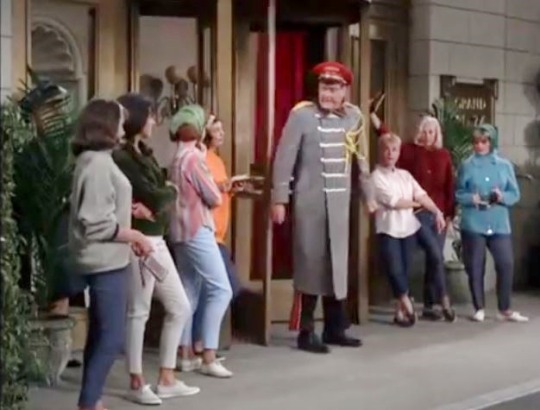
Other
uncredited background performers play the other diners at the
restaurant, Danny Kaye’s female fans, and the extras in the airport
sequence of Kaye’s TV show.

This
is the final episode aired in 1964. In many markets it aired an hour
earlier than usual to allow for a CBS News program looking back at
1964.
At
the start of the episode, Mr. Mooney is in his scout master khakis
with short pants. He is taking his son along with Jerry and some other boys, on a camping trip. He did this twice previously in “Lucy and the
Scout Trip” (S3;E26) and “Lucy Becomes a Father” (S3;E9).
Neither of the boys appears in this episode, however.Mr.
Mooney’s friend, Mr. Crawford, is a network executive. Mr. Mooney
also mentions his (never seen) wife Irma and her bridge club.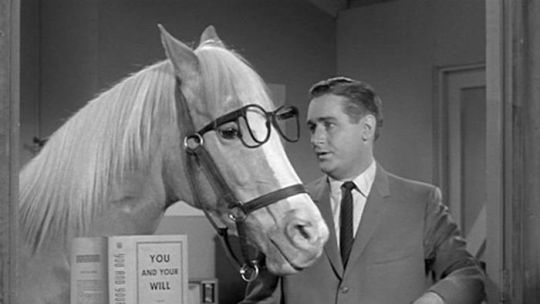
When
Lucy asks Mr. Mooney to put her in touch with Mr. Crawford (to get
tickets for Kaye’s show), he replies that he would be reluctant to
put her in touch with Mr. Ed! This is a reference to the TV series
about a talking horse, “Mr. Ed” (1958-66), also seen on CBS.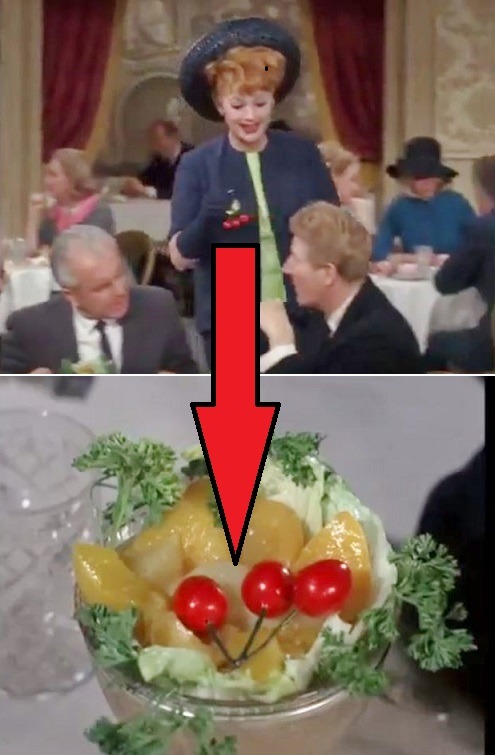
The
Park Royal is a fictional Manhattan restaurant. Its name implies it
may be located on or near Central Park or Park Avenue.
The
Grand Plaza Hotel is also a fictional New York City establishment.
The name is meant to evoke the famous Plaza Hotel, which sits on the
west side of Grand Army Plaza.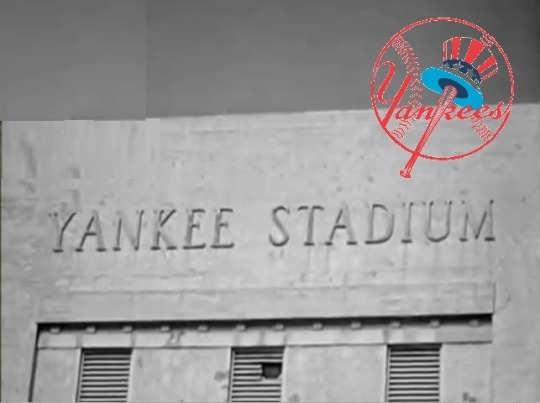
When
Danny Kaye joins Lucy in the doorman’s coat he makes a joke that he’s
just been to Yankee Stadium for a ‘double-header’! “Lucy and Bob
Hope” (ILL S6;E1) had scenes taking place at the legendary
ballpark. Hope and Kaye appeared together in the 1959 film The
Five Pennies,
as well as honoring Lucille Ball on a 1976 CBS Tribute show.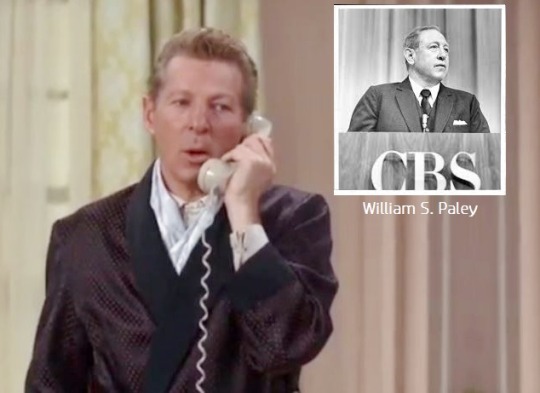
Danny
Kaye telephones Bill Paley to see if he has any spare tickets to give
Lucy. William S. Paley (1901-90), was
the chief executive who built the Columbia Broadcasting System (CBS)
from a small radio
network into
one of the foremost radio
and
television
network
operations
in the United States.
In “Lucy’s Barbershop Quartet” (S1;E19) Viv
mentions Barbara Cushing, who is a soloist in her church choir. In
real life, Barbara
Cushing
was
better known as Babs Paley, wife of William S. Paley.
The
opening of “The Danny Kaye Show” is here underscored with the
music to “Hey, Look Me Over,” a Cy Coleman song from the Broadway
musical Wildcat
introduced by Lucille Ball in 1960.
On
the phone, Paley mistakes Danny Kaye for Danny Thomas. Lucy had
appeared with Thomas on “Lucy Makes Room for Danny,” a 1958
episode of “The Lucy-Desi Comedy Hour.” “The Danny Thomas
Show” (aka “Make Room for Daddy”) was filmed on the Desilu lot.
He also guest-starred on “Lucy Helps Danny Thomas” (S4;E7), above, and a 1968 episode of “Here’s Lucy.”
The
best Paley can do is two tickets for “The Jackie Gleason Show”
next April. At the time this episode was filmed, Jackie Gleason had a series
on CBS called “Jackie Gleason: American Scene Magazine.” Gleason will make a cameo appearance as bus driver Ralph Kramden on a 1968 episode of
“Here’s Lucy.”
On
his TV show, Danny Kaye invites Lucy to dance along with him as he
sings “All
By Myself” by
Irving Berlin in 1921. The song was
covered by many singers, among them Bobby Darin in 1961 and Sue Raney
in 1963.Callbacks!

When
Lucy smashes Danny Kaye’s cigar into his face, he says, “I’m
just lucky she didn’t set fire to my nose.”
In the classic episode “Hollywood at
Last!”
(ILL S4;E16) Lucy
Ricardo sets fire to her own putty nose while pestering William
Holden.
Lucy
Ricardo crushed Uncle Alberto’s cigars in “The Ricardo’s Visit
Cuba” (ILL S6;E9).
She
also dumps a tray of food on Kaye’s head at a fancy restaurant just
as she’d done to Holden at the Brown Derby in “Hollywood at Last!” (ILL S4;E16).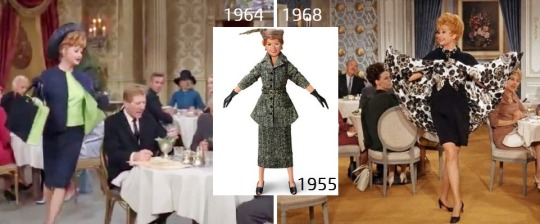
Lucille
Ball is also involved in a fashion show in “The Fashion Show”
(ILL S4;E19) and will be again on a 1968 episode of “Here’s Lucy.”
In
another reference to “I Love Lucy,” Lucy tells Danny Kaye she can
play "Glow Worm” on her saxophone. She’d croaked out that
tune many times as Lucy Ricardo.
“Lucy
Meets the Queen” (ILL S5;E15) was doubtless inspired by Danny
Kaye’s November 1948 Command performance for King George and
Princess Elizabeth at the Palladium Theatre. In fact, Kaye is
referenced in this episode:Lucy
(to the Bellboy): Have you ever seen the Queen?
Bellhop:
No, ma’am. But I came frightful close during the coronation. I
just missed her. But I did catch a glimpse of him.
Lucy:
Philip?
Bellhop: No, ma’am. Danny Kaye.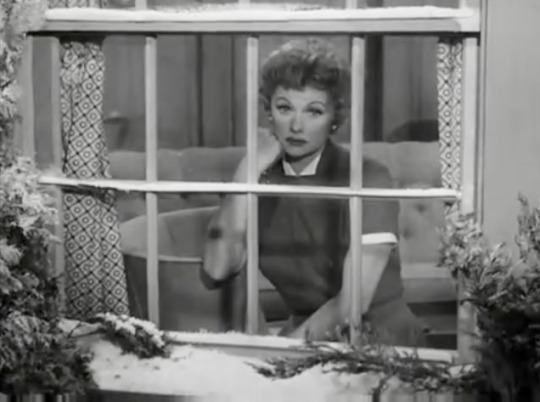
In
a
1959 episode of
“The Lucy–Desi Comedy Hour” Lucy complains about how many meals
she’s cooked as a housewife:Ricky
(reading Variety): It says here that Danny Kaye is going to
London to give another command performance for Queen Elizabeth.
Lucy:
I wonder what the Queen is cooking for Phil tonight?Blooper
Alerts!
Location Scout! “The
Danny Kaye Show” was shot in Los Angeles, California. Lucy
Carmichael lives in Danfield, New York. In the opening dialogue of
his TV show, Kaye admits to being in New York, so perhaps this was
supposed to be a rare exception to their normal West Coast filming
schedule.
Pole Vaulting! When
Lucy barges through the crowd waiting for a table at the restaurant,
she knocks over the velvet rope barrier pole. The Maitre d’
calmly rights it again.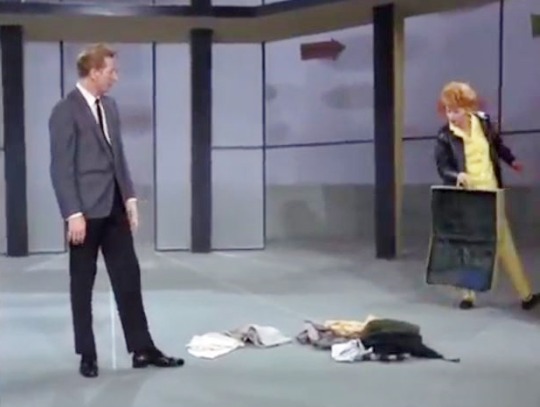
Backstage Logic Alert! In
the middle of Danny Kaye’s TV monologue, Lucy’s suitcase bursts open
and clothes fly out. It is unlikely, however, that a prop suitcase
that was not supposed to be opened on air would have anything inside
it.
“Lucy Meets Danny Kaye” rates 4 Paper Hearts out of 5
1964, All By Myself, Bert Stevens, Carly Lincoln, CBS, Danny Kaye, Danny Thomas, Estelle Etterre, Gale Gordon, Hal Taggart, Hazel Pierce, Hey Look Me Over, Jackie Gleason, Jerry Rush, Leon Belasco, Lucille Ball, Lucy Meets Danny Kaye, Monty O’Grady, Mr. Ed, Paul Bradley, Ray Kellogg, Stanley Farrar, Sue Casey, The Danny Kaye Show, The Lucy Show, tv, William S. Paley - Hazel
-
Lucy and the Missing Stamp
S3;E14 ~ December 21, 1964


Synopsis
When Lucy and Viv are selling vacuum cleaners door to door, Lucy
accidentally sucks up Mr. Mooney’s prize stamp worth $3,000. One of their potential customers unwittingly puts the stamp on an envelope and mails it, which means Lucy must contend with the US Post Office to get it back!Regular Cast
Lucille Ball (Lucy Carmichael), Vivian Vance (Vivian Bagley), Gale Gordon (Theodore J. Mooney)
Jimmy Garrett (Jerry Carmichael), Ralph Hart (Sherman Bagley) and Candy Moore (Chris Carmichael) do not appear in this episode.
Guest Cast

Mabel Albertson (Mrs. White) is probably best remembered by TV viewers as Darrin Stephens’ mother on “Bewitched” (1964-71). Her first appearance on “Bewitched” was aired just four days before this appearance (her only one) on “The Lucy Show.” In 1956, she had appeared with Lucille Ball in the film Forever
Darling. Her brother, Jack Albertson, appeared on “I Love Lucy” in “Bon Voyage” (ILL S5;E13) the same time when Forever Darling was in movie theatres.
Nestor Paiva (Mr. Perkins) firs appeared with Lucille Ball in the 1940 film The Marines Fly High. He played the Cuban Jailer in “Lucy Takes a Cruise to Havana,” the very first episode of “The Lucy-Desi Comedy Hour” in 1957. This is his only appearance on “The Lucy Show.”
Mr. Perkins is in charge at the Handy Dandy Vacuum Cleaners sales office.

Herb Vigran (Postman) playedJule, Ricky Ricardo’s music agent on two episodes of “I Love Lucy” in addition to playing movie publicist Hal Sparks in “Lucy is Envious” (ILL S3;23). He was seen in the Lucy-Desi film TheLong, Long Trailer (1953). He played the role of the baseball umpire (an eye doctor) in two previous episodes. He went on to play other characters in three more
episodes.
Robert S. Carson (Bennett, Postmaster) was a busy Canadian-born character actor making the first of his six appearances on the series. He also made five appearances on “Here’s Lucy.”
Despite the final credits, the character is never referred to by the name Bennett.

Flip Mark (Junior White) celebrating his 16th birthday the day after this episode first aired. He was born Philip Mark Goldberg in New York City. In 1965, he played a young Steve Olson on “Days of Our Lives.” He would appear on one more episode of “The Lucy Show.” Mark left show business to become a 911 operator.

Karl Lukas (Mail Sorter) was featured in the Lucille Ball films The
Long Long Trailer (1953) and TheFacts of Life (1960). This is his only appearance on the series. He played Stash Kadowski on nearly 100 episodes of “The Phil Silvers Show” (1955-58).
Sid Gould (Sid, Mail Clerk) made more than 45 appearances on “The Lucy Show,” all as background characters. He also did 40 episodes of “Here’s Lucy.” Gould (born Sydney Greenfader) was Lucille Ball’s cousin by marriage to Gary Morton. Gould was married to Vanda Barra, who also appeared on “The Lucy Show” starting in 1967, as well as on “Here’s Lucy.”

This is the second episode in a row to deal with collecting hobbies, first coins (numismatics), now stamps (philately).

The shot of Lucy in the mail bag seen during the opening title sequence of season 4 was taken from the final scene of this episode.

Mr. Mooney talks about acquiring a valuable un-canceled 1918
upside down airmail stamp. He buys for $3,000. He is referring to the “Inverted Jenny,” a stamp so rare that only 100 of them are known to exist. The last one sold at auction in 2015 sold for just over $1,000,000.
Lucy says that a standard 1964 airmail stamp costs eight cents. The price is now $1.20 for international airmail. The mail route poster on the wall behind the postmaster seems to suggest that Danfield is located on a large body of water – perhaps Long Island Sound.

This is the same city street set used in “Lucy, the Coin Collector”
(S3;E15) except that the yellow fire hydrant has been removed.
Postmaster: “Lady, we don’t mind the rain, or the snow or the sleet. It’s kooks like you that drive us nuts!”
The postmaster is paraphrasing the unofficial postman’s creed: “Neither snow nor rain nor heat nor gloom of night stays these couriers from the swift completion of their appointed rounds.” It is inscribed on the James Farley Post Office in New York City, facing Penn Station.


The US Post Office has twice honored Lucille Ball with a postage stamp. Many other countries have also featured Lucille Ball and “I Love Lucy” on their nation’s stamps.
Callbacks!

Eleven years earlier, Lucy Ricardo also sold Handy Dandy vacuum cleaners in “Sales Resistance” (ILL S2;E17).

In that episode, Lucy tries to sell a vacuum cleaner to Mr. Simpson
(Verna Felton) much the same way Lucy and Viv do here to Mrs. White. This is the most direct callback to an episode of “I Love Lucy” thus far.
In the back room of the post office, Lucy contends with conveyor belts,sorting bins, and canvas bags. These were also Lucy Ricardo’s nemesis in the laundry sorting room in “Bonus Bucks” (ILL S3;E21).
Blooper Alerts!

Sitcom Logic Alert! Mrs. White probably would not have used the stamp to mail a letter. While she wouldn’t have realized it was a rare and valuable stamp, its face value was three times the cost of a normal airmail stamp of that time. It would be like somebody today using a stamp that cost $1.50 to mail a standard first class letter.

“Lucy and the Missing Stamp” rates 4 Paper Hearts out of 5
-
Lucy, the Coin Collector
S3;E13~
December 14, 1964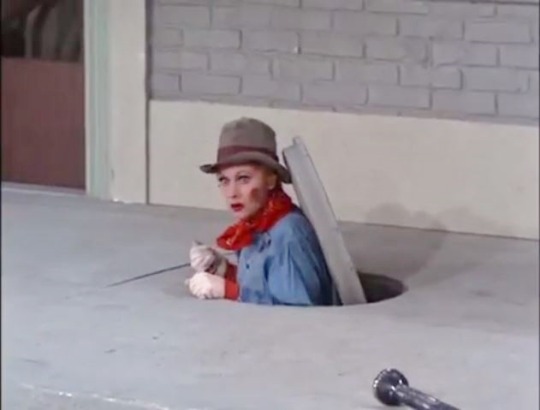

Synopsis
When
Jerry finds a rare penny worth $16.50, Lucy and Viv decide to search
through thousands of pennies to find a rare one and pay for a new
coat and fix their leaky plumbing. They finally succeed but clumsily
drop the coin down the storm drain in the street. To retrieve it,
they must go undercover as sewer workers.Regular
Cast
Lucille
Ball (Lucy Carmichael), Vivian Vance (Vivian Bagley),Gale Gordon
(Theodore J. Mooney), Jimmy
Garrett (Jerry Carmichael)Ralph
Hart (Sherman Bagley) and Candy Moore (Chris Carmichael) do not
appear in this episode. Chris is, however, mentioned by Lucy.Guest
Cast
Ray
Kellogg
(Policeman) played
the loud, barking Assistant Director (“Roll
‘em!”)
in “Ricky’s
Screen Test” (ILL S4;E6)and
later appeared in “Bullfight
Dance” (ILL S4;E22).
This is the second of his seven episodes of “The Lucy Show.” He
also did two episodes of “Here’s Lucy.” Just as in his other
screen credits, most most times he played policemen, as he does here.
Monya
Andre
(Miss Ferguson, Mr. Mooney’s Secretary) had appeared as an uncredited
background player in such Oscar-nominated films as Imitation of Life
(1934), Ninotchka (1939) and It’s a Wonderful Life (1946). This is
her only appearance on “The Lucy Show” and her final screen
credit before retiring from the business.Ferguson
is the perfect surname for Mr. Mooney’s secretary. It is Scottish in
origin, a people stereo-typically known for being thrifty. Ferguson
was also the name of the Mayor of Kildoonan in “Lucy Goes to
Scotland” (ILL S5;E17). In “Lucy Gets Locked in the Vault”
(S2;E4) Mr. Mooney’s secretary was Miss Tanner played by Ellen Corby.
William
Meader
(Bill, Bank Teller) had
appeared as an airport extra in “The
Ricardos Go to Japan,”
a
1959 episode of “The Lucy-Desi Comedy Hour.” He made many
appearances on “The Lucy Show,” most times as a clerk in Mr.
Mooney’s bank, as he does here.Mr.
Mooney calls him Bill during when he is requesting $20 for Lucy.
Meader has lines in this episode.
James
Gonzales
(Jim, Bank Teller) was
a popular Hollywood extra who first acted with Lucille Ball in the
1953 film The
Long, Long Trailer.
He was previously seen on the series as Stan Williams in “Lucy
Digs Up a Date” (S1;E2).
He was seen in more than 20 episodes of “The Lucy Show” and 3
episodes of “Here’s Lucy.”Mr.
Mooney calls him Jim during when he is requesting $20 in pennies for
Lucy. Gonzales has lines in this episode.
Tex
Brodus
(Sewer Worker) appeared in the stage to screen musical movies South
Pacific
(1958) and My
Fair Lady (1964).
This is his only appearance with Lucille Ball. He left the business
in 1967.The
character is dressed in a vest and hat with a pushed up brim, very
reminiscent of TV’s most famous sewer worker, Ed Norton (Art Carney, inset photo)
from “The Honeymooners.” It is possible that Carney was intended
to play this cameo role, but declined. In 1968, Jackie Gleason turned
up in full bus driver’s uniform as Ralph Kramden in a cameo on
“Here’s Lucy.”Sid
Gould
(Distracting Passerby) made
more than 45 appearances on “The Lucy Show,” all as background
characters. He also did 40 episodes of “Here’s Lucy.” Gould
(born Sydney Greenfader) was Lucille Ball’s cousin by marriage to
Gary Morton. Gould was married to Vanda Barra, who also appeared on
“The Lucy Show” starting in 1967, as well as on “Here’s
Lucy.”A
dozen background performers play the bank customers, staff, and
gawkers in the street.
This
is the first and only episode written by David Braverman and Bob
Marcus. The two wrote exclusively for television from 1964 to 1969.
The
date this episode first aired (December 14, 1964) actor William
Bendix
died. Although best known for playing the title role in “The Life
of Riley” (1953-1958) on NBC, Bendix and Lucille Ball had both
starred in the 1946 film The
Dark Corner.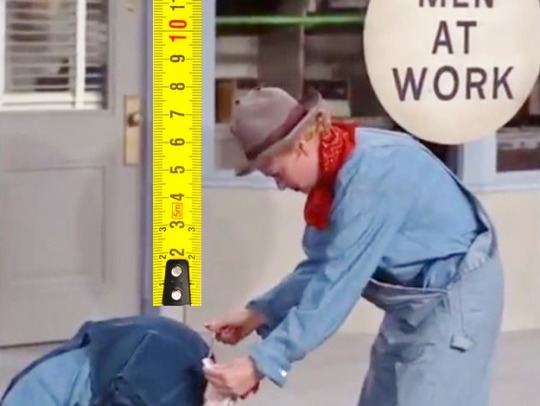
A
still photo from this episode with Lucy and Viv in overalls was
featured in the photo collage on the Official Season 3 DVD box.
A scene from this episode was included in “Lucy and Viv Reminisce” (S5;E16), a clips show retrospective aired during the second half of the final season.

The
opening scene has Viv debating whether to have a second cup of ‘rust’ (aka coffee). In the mid-1970s Vivian Vance became a spokesperson
for Maxwell House ‘rust’.Lucy
is having trouble with her kitchen sink garbage disposal. It bears
noting that these disposal units were common on the West Coast, but
rare in the New York metropolitan area because they were banned by
New York City law as a threat to the sewage system. The ban was
finally lifted in 1997. While not totally unknown in outlying areas
they were not at all common in the New York suburbs during the 1960s.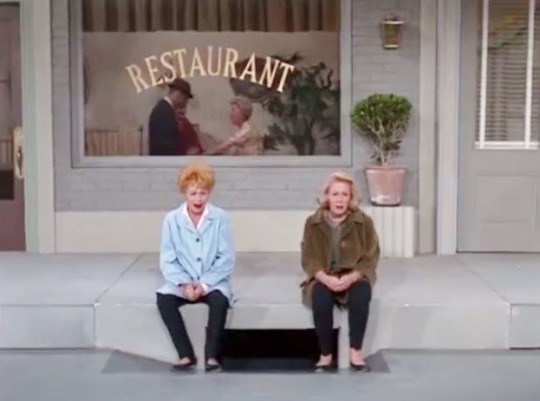
Lucy
complains that she can’t afford to call a plumber. Lucy has
previously employed plumbers Joe Melvin (Stafford Repp) in “Lucy
and Viv Put in a Shower” (S1;E18) and Harry Tuttle (Jack Benny) in
“Lucy and the Plumber” (S3;E2).
Viv
initially compares the geyser spurting from the sink to Yellowstone
National Park and later to Old Faithful. Mostly located in Wyoming,
Yellowstone
features dramatic canyons, alpine rivers, lush forests, hot springs
and gushing geysers, including its most famous, Old
Faithful. The kitchen sink also erupted in “Lucy and the Plumber” (S3;E2).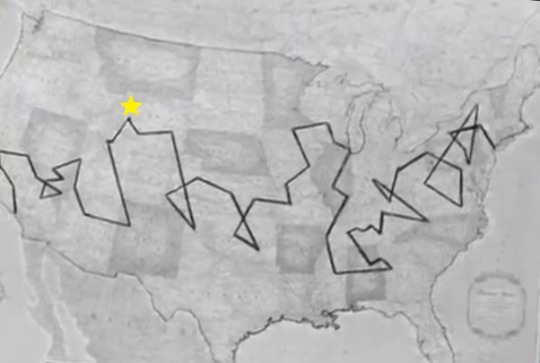
An early road map drawn by Lucy Ricardo of the gang’s car trip to
California shows a planned stop at Yellowstone, but it was not shown
on air or ever mentioned as being visited.
Among
the items Lucy and Viv pull out of their handbags to offer Mr. Mooney
as collateral are:- three earrings
- a collapsible cup
- Jerry’s Mickey
Mouse watch - Viv’s faux diamond wristwatch (from her cheap
ex-husband) - a tarnished brass compact Lucy said was jade
- a locket
of Chris’ hair - a doggie bag of spaghetti and meatballs (which Viv
snatches back) - a jeweled garter
- Jerry’s bronzed baby shoe (made
into a bank) - Lucy’s high school broad jump medal
Jerry’s bronzed baby shoes were mentioned by Lucy in a season one
episode, and were always on display on the top shelf of the bookcase
behind the dining room table, even in this episode (see “Blooper
Alert” below).
A visual gag about the many unusual items Lucy keeps in her handbag was featured in 1954′s “Bonus Bucks” (ILL S3;E21).

Viv
volunteers to sing a couple of choruses from “Pennies from Heaven”
or “Three Coins in the Fountain.” “Pennies
from Heaven”
is a song
written by
Arthur
Johnston
and
Johnny
Burke.
It was introduced by Bing
Crosby
in
the 1936 film
of the same name.
It has been covered by numerous artists, including Andy Williams, the
same year this episode was first aired. “Three
Coins in the Fountain”
was written by Jule
Styne
and Sammy
Cahn.
It was introduced in the 1955 film of the same name and won that
year’s Oscar for Best Original Song. “I Love Lucy” actors James
Conaty, Harold Miller, Alberto Morin, Vincent Padula, Mario Siletti
and Norma Varden, were all uncredited extras in the film. Varden played Mrs. Van Vlack in “Lucy Gets Her Maid” (S3;E11).
Jerry
finds a rare 1927S Lincoln penny
that is worth fifty cents. Currently, that coin is worth between
$1.75 and $125, depending upon condition. Jerry reads in a book that
an 1887 Indian Head penny
may be worth $800. Actually, most 1887 Indian Head pennies are
fairly common (45 million were made) and only fetch about $2.50.
However, proof specimens (only 2,900 were ever made) in excellent
condition can go for more then $6,000! The
1912S penny
found by Lucy and Viv is listed in their book as being worth $16.50.
Adjusting for inflation, that would be equivalent of nearly $130 today. As of 2017 the coin was
listed online for between $22 and $270, depending upon condition.2,000
pennies weigh 5 pounds 14.5 ounces.
In
2001, the Merrick Mint issued “I Love Lucy” commemorative 24
karat plated half dollar coins.Callbacks!
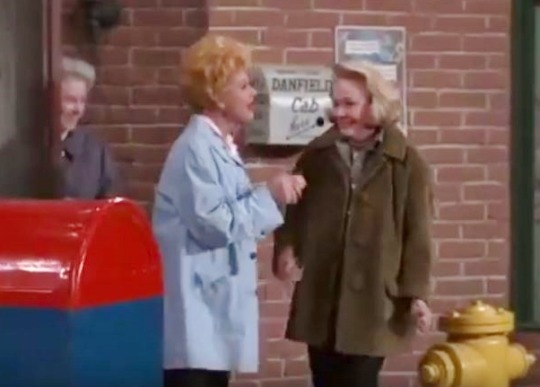
This
is a slightly re-dressed and re-painted version of the Danfield city
street used in “Lucy, the Meter Maid” (S3;E7). That episode’s
street also featured a florist, a restaurant, a realtors, a mailbox
and a Danfield Cab call box. The parking meters, however, have been
removed. The taxi call box was also seen in the train station during
“No More Double Dates” (S1;E21).Blooper
Alerts!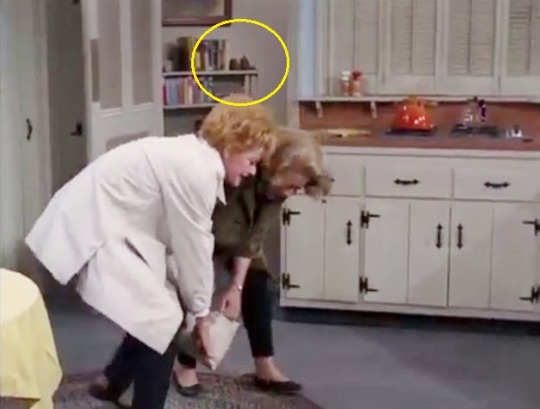
Inconsistencies! When
Lucy and Viv come back from the bank lugging the heavy sack of
pennies, Jerry’s baby shoe is already sitting back on the living room
shelf, when it should still be in Lucy’s purse!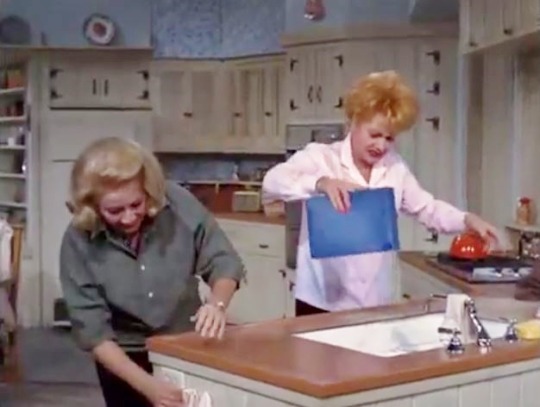
Generic! Lucy’s
box of dish washing soap has no label on it. This is a contrast with
“Lucy Digs Up a Date” (S1;E2), where brand name cleaning products
like All and Whisk were seen on camera next to the sink.
“Lucy, the Coin Collector” rates 4 Paper Hearts out of 5
1964, Bob Marcus, CBS, coins, David Braverman, Gale Gordon, garbage disposal, James Gonzales, Jimmy Garrett, Lucille Ball, Lucy the Coin Collector, Maxwell House Coffee, Monya Andre, numismatics, Old Faithful, pennies, Pennies from Heaven, Ray Kellogg, Sewers, Sid Gould, Tex Brodus, The Lucy Show, Three Coins in the Fountain, tv, Vivian Vance, William Bendix, William Meader, Yellowstone National Park -
Lucy Gets the Bird
S3;E12
~ December 7, 1964

Synopsis
When
Mr. Mooney’s home is being painted, he lets Lucy and Viv birdsit with
his prize cockatiel. When the bird flies away, they climb to the
roof to find him. When that fails, they try to replace it with a
similar bird, but Mr. Mooney is on to their scheme.Regular
Cast
Lucille
Ball (Lucy Carmichael), Vivian Vance (Vivian Bagley), Gale Gordon
(Theodore J. Mooney), Jimmy
Garrett (Jerry Carmichael)Ralph
Hart (Sherman Bagley) and Candy Moore (Chris Carmichael) do not
appear in this episode.Guest
Cast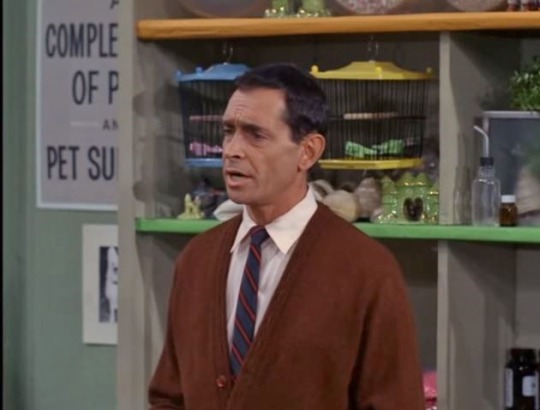
Tim
Herbert
(Sam) was born Herbert Timberg in 1914. In 1944 he appeared on
Broadway in the Jackie Gleason revue Follow
the Girls.
This is the first of his three appearances on “The Lucy Show.”
He also did one episode of “Here’s Lucy” in 1968.
John
J. ‘Red’ Fox
(Charlie) makes his second appearance on the series. He was
best known for playing policemen, which is what he did on five of his
eight appearances on “The Lucy Show” as well as three of his five
episodes of “Here’s Lucy.”
Ginny
Tyler
(Bird Voices) previously voiced Clementine the sheep in “Lucy Buys
a Sheep” (S1;E5). She
did the voice of the sheep in Disney’s 1964 hit Mary
Poppins.
She
started
out on radio before hosting a children’s TV show in Seattle. By the
late 1950s, she had moved to Hollywood and was narrating record
albums for Disney, including “Bambi” and “Babes in Toyland.”
She returned to do a 1974 episode of “Here’s Lucy.” Although
she died in 2012, her voice can still be heard in the chorus of birds
outside The Enchanted Tiki Room at Disneyland and Walt Disney World.Mr.
Mooney’s cockatiel (and all the other budgies in the pet shop) are
played by live birds.Sid
Gould
(Voice on the Telephone) made
more than 45 appearances on “The Lucy Show,” all as background
characters. He also did 40 episodes of “Here’s Lucy.” Gould
(born Sydney Greenfader) was Lucille Ball’s cousin by marriage to
Gary Morton. Gould was married to Vanda Barra, who also appeared on
“The Lucy Show” starting in 1967, as well as on “Here’s
Lucy.”
The
title puns on the slang expression “give/get the bird,” meaning
to make a rude gesture by raising
your middle
finger to
show that you are angry with someone.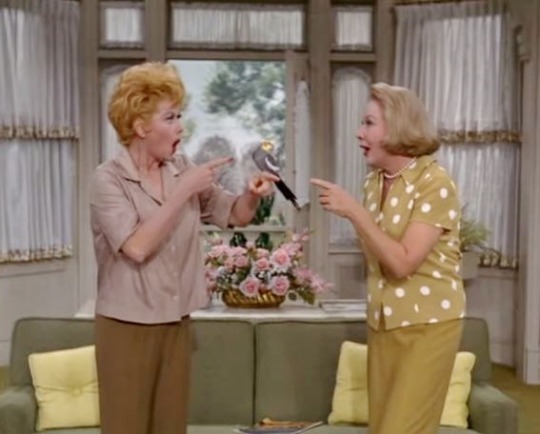
In real life, Lucille Ball is said to have had a bird phobia. When she was four years old her father died of typhoid fever. That same day, a bird got trapped inside their home. Other recollections say that the wallpaper in her room was of a bird pattern.

The
episode opens with Lucy and Viv collecting trading stamps. Viv
wonders if they have enough to get to Hawaii. Lucy says they have
enough to get to Harrisburg, Pennsylvania. Trading
Stamps
were
small paper coupons
given
to customers by merchants in loyalty
marketing
programs.
When a customer accumulated a number of them, they could be
exchanged for premiums,
such as toys, personal items, housewares, furniture and appliances.
The stamps were generally pasted into a booklet by licking the back,
much like a postage stamp. Although they were first introduced in
1891, they were most popular in the USA between 1930 and 1980. Today
they have been replaced by digital customer loyalty cards. There were
several companies responsible for sponsoring trading stamps, the
most popular being Blue Chip, S&H Green Stamps, and Plaid Stamps.
Mr.
Mooney’s pet bird is a female cockatiel named Greenback for its
coloration. “Greenback”
is also a slang word for US paper currency due to its dark green color; an
ideal name for a miserly banker’s bird!
Mr.
Mooney has taught the bird to say “E
pluribus unum”
(latin for “out of many, one”), the de facto motto of the United
States of America, appearing on the presidential seal and on many
denominations of US currency. Lucy
teaches it to say,
“Give Lucy more money.”
Greenback
calls Mr. Mooney “Poppsy-Whoppsy.”
Lucy
finds a “Vote for Dewey” button under her couch and says
she needs to clean more often. Thomas
P. Dewey,
was a Republican who lost the US presidential election of 1948 to
Democrat Harry S. Truman. This episode was broadcast right after the
1964 election. Dewey was a Republican, while Lucille
Ball was
a liberal Democrat. This discovery also implies that Lucy may have
lived there (or owned the sofa) at least 16 years, ten years longer than she and Viv have
lived together.
When
Lucy is on the telephone man’s zip line, Greenback says “It’s
the only way to fly!”
This was the advertising slogan for Western Airlines, a US carrier
that was in operation from 1926 to 1987, before merging with Delta
Airlines. In 1965 R&B singer Jewel Akens (“The Birds and the
Bees”) released a song titled “It’s the Only Way to Fly.”
Mr.
Mooney says that leaving his precious Greenback with Lucy was like
leaving General Custer with Sitting Bull. George
Armstrong Custer (1839-76)
was a United
States cavalry commander
in the Civil
War and
the American
Indian Wars.
Sitting
Bull was
a Sioux chief who rallied his tribe to defeat Custer and his men at
the Battle of Little Bighorn (1876), known as “Custer’s Last
Stand.” Jerry celebrates Sitting Bull’s birthday in “Lucy and
the Good Skate” (S3;E1).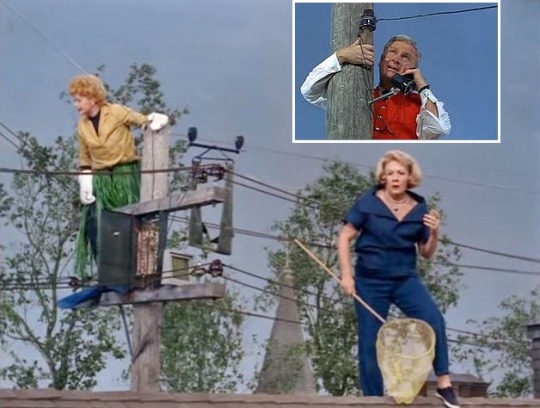
A
working phone on top of a telephone pole was also a running gag on
the TV series “Green Acres” (1965-71).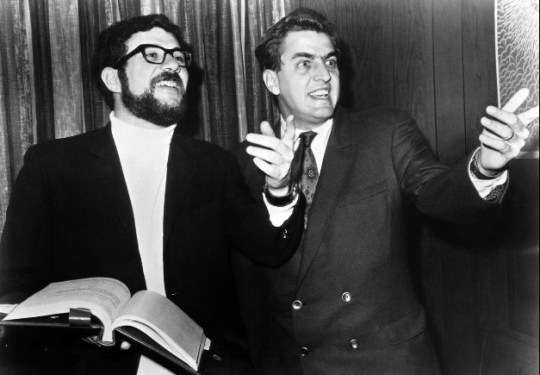
Sam
at the pet shop refers Mr. Mooney to pet psychiatrist Dr. Marshall
Belson PhD (parrots, horses and dogs). The doctor’s name is a
combination of the name of the two writers of this episode, Gary
Marshall (right) and
Jerry Belson (left).
Sam
tries to sell Lucy a mynah bird that says “rat fink.” “The Rat
Finks” was the name of Jerry and Sherman’s group at camp in “Lucy,
the Camp Cook” (S3;E6).
Viv
guesses that Greenback is “halfway to Capistrano.” This is a
reference to San Juan Mission in Capistrano, southern California. It
is there that the American
cliff swallow migrates
to every year from its winters in Argentina,
making the 6,000-mile trek in springtime. The Mission’s location near
two rivers made it an ideal location for the swallows to nest. The
expression “when
the swallows return to Capistrano”
has entered common usage.
Speaking of Hawaii and birds! (The red one is Lucy, naturally!)
Callbacks!
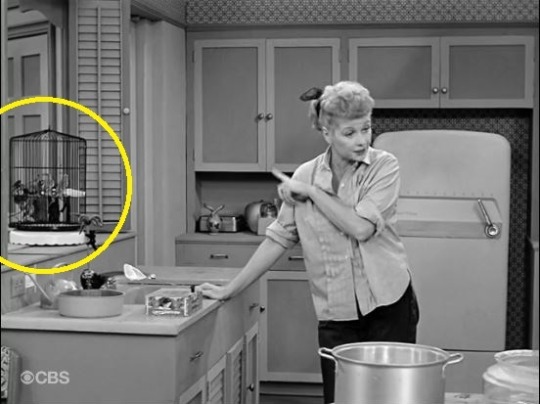
Little
Ricky had two parakeets Alice and Phil (“molting buzzards”
to Fred Mertz) in “Little Ricky Gets a Dog” (ILL S6;E14), who were named for husband and wife performers Alice Faye and Phil Harris. In
that episode, voice artist June Foray did the bark of Fred the dog,
much the same way Ginny Tyler voices the birds here.
Lucy
Ricardo contended with pigeons on the ledge outside her
apartment in “Lucy and Superman” (ILL S6;E13), one of the ten colorized episodes, and….
…500 baby chicks loose in her Connecticut living room in “Lucy
Raises Chickens” (ILL S6;E19).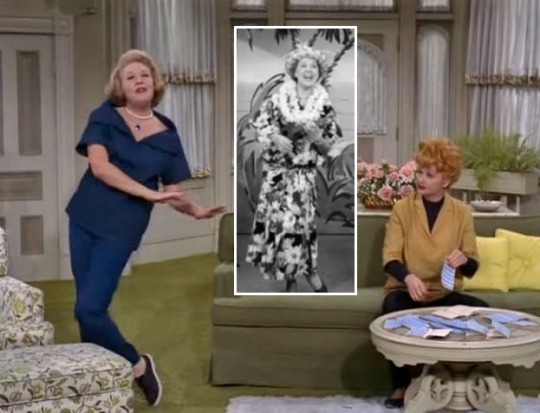
Lucy Ricardo and Ethel Mertz wanted to go to Hawaii on “I Love Lucy” (inset) but never got any further than the Ricardo living room!

While on the roof, Viv mentions that the last time she was up there was when the two put up the TV antenna in “Lucy Puts Up a TV Antenna” (S1;E9). This is one of the most direct callbacks to a previous episode thus far in the series. Lucy and Mr. Mooney were also on the home’s roof to break into Viv’s bedroom in “The Loophole in the Lease” (S2;E12).
Fast Forward!

In “Lucy is a Bird Sitter” a 1974 episode of “Here’s Lucy”
Lucy
Carter is enlisted by Harry (Gale Gordon) to care for a rare
Tongan Weewawk, a fictional creature made up by the writers. That
bird looks a lot like a common white pigeon, which makes finding him
difficult when he flies away.
On
a rare two-part episode of “Here’s Lucy” (1971) Lucy Carter and Vivian
Jones cruise to Hawaii. Hawaii was a favorite get-away destination
for the Arnaz family (inset).Blooper
Alerts!
Logistics! Even
though it’s the same house as in “Lucy Puts Up a TV Antenna”
(S1;E9), in “Lucy Gets the Bird” the antenna is in a different
location, the background landscape has more buildings, and the design
of the roof is slightly different.Too Close for Comfort? Close-ups
of Greenback sitting on the electrical wire reveal that the wire is
not metal, but rope. Stray threads of hemp can be seen.
“Lucy Gets the Bird” rates 4 Paper Hearts out of 5
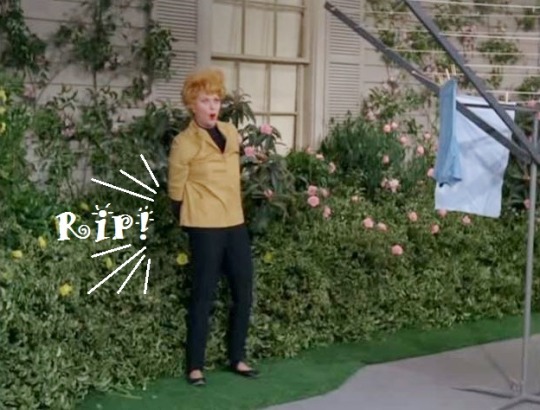 1964, birds, Capistrano, CBS, cockatiel, Gale Gordon, Gary Marshall, General Custer, Ginny Tyler, Hawaii, Jerry Belson, Jimmy Garrett, John J. Fox, Lucille Ball, Lucy Gets the Bird, pet shop, Roof, Sid Gould, Sitting Bull, Telephone Pole, The Lucy Show, Thomas P. Dewey, Tim Herbert, Trading Stamps, tv, TV Antenna, Vivian Vance, Western Airlines
 -
Lucy Gets Her Maid
S3;E11
~ November 30, 1964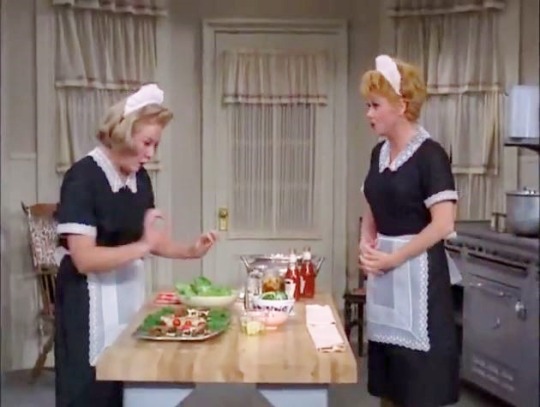
Synopsis
To
impress a local women’s club, Lucy hires a maid. But to
afford a maid, she must take a job – as a maid! When her new
employer hosts a dinner party she recruits Viv to help out – only
to have to serve dinner to the very women she is hoping to impress.
A quick-change parade of international costumes is contrived to
remain incognito.Regular
Cast
Lucille
Ball (Lucy Carmichael), Vivian Vance (Vivian Bagley), Gale Gordon
(Theodore J. Mooney)Jimmy
Garrett (Jerry Carmichael), Ralph Hart (Sherman Bagley) and Candy
Moore (Chris Carmichael) do not appear in this episode.Guest
Cast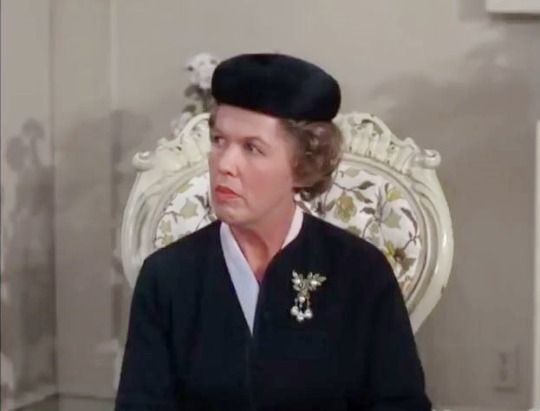
Kathleen
Freeman
(Miss Putnam) previously played the character of Kathleen, but is
making the third of her appearances playing various other characters
on the series. Freeman was
‘born in a trunk’ to a family of vaudevillians. She made her
stage debut at age two in her parents’ act. Equally at home on
screen and stage, Freeman was appearing on Broadway in The
Full Monty in
2001 when she died of lung cancer.Freeman gets entrance and exit applause from the studio audience!
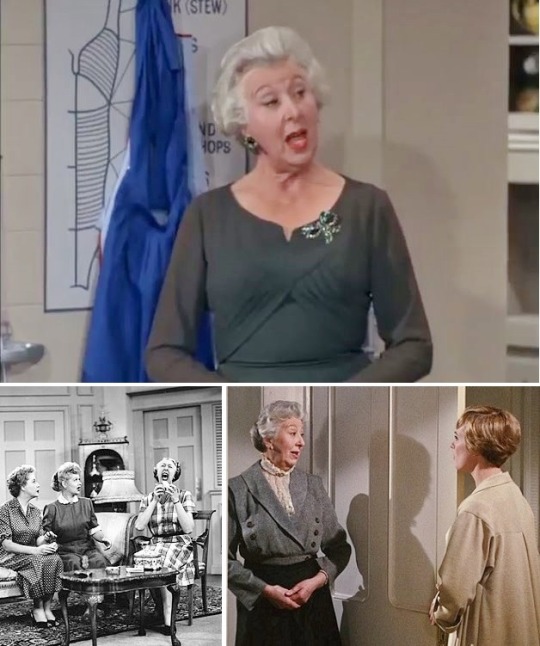
Norma
Varden
(Mrs. Van Vlack)
last
appeared with Lucille Ball and Vivian Vance in “The
Ricardos Change Apartments” (ILL
S2;E26) as Mrs. Benson, the weepy woman in apartment 3B who swapped
apartments with Lucy and Ricky after her daughter got married and
moved out. She
is probably best known for playing Frau Schmidt, the somewhat
circumspect housekeeper at the Von Trapp mansion in 1965′s The
Sound Of Music. She
first met Lucille Ball when she played Lady Maude in Fancy
Pants in
1950.Van
Vlack is the surname of one of Lucille Ball’s childhood friends,
Marion Strong Van Vlack, who was also a character on several episodes
of “I Love Lucy.”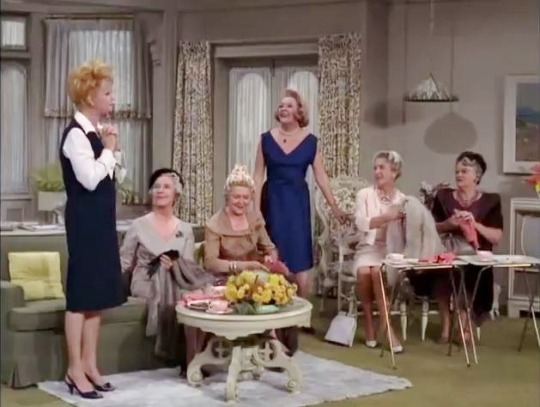
The
Danfield Art Society members are played by:- Jean
Vachon
making the fifth of her six appearances on “The Lucy Show,” all but this
one uncredited. - Paula
Ray
making the first of her three appearances on the series. This is the
only one where she gets screen credit. - Caryl
Lincoln was
one of Lucy’s friends from her Goldwyn Girl days. This is the
fourth of her seven appearances on the series, often appearing with
her husband, fellow extra Bert Stevens. This
is the only episode where she receives screen credit. - Luree
Wiese
makes her only appearance on “The Lucy Show” but will make a
single appearance on “Here’s Lucy” in 1970.

As
a movie star and mother, Lucille Ball had a maid named Harriet
McCain.
She was employed by Lucy from the late 1940’s until the 1980s.
Because Harriet was a woman of color, Ball insisted that the
elevators in her townhouse be integrated, a first for her
neighborhood. When McCain was hospitalized before her death, Ball
paid all her medical expenses.Lucy
says that the Danfield Art Society
is the most prestigious club in town. This is the group’s first mention on the series.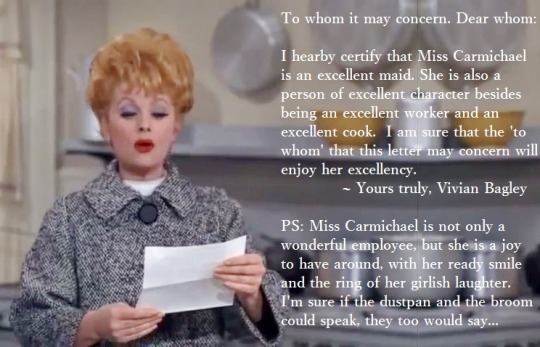
Viv
says she doesn’t want to work that hard to become a member of an
organization that is comprised solely of woman. Now the YMCA, on the
other hand…. Danfield’s new YMCA
was
often mentioned during the first season, with scenes set there during
“Lucy Digs Up a Date” (S1;E2).Lucy
figures it costs $3.00 for popcorn and candy at the movies. Today,
popcorn and candy can cost as much or more than the movie ticket
itself.
A
maid will cost Lucy $40 a week. In today’s money that would be a
salary of $365.Lucy
mistakes the Social Register with Social Security. The United States
Social Security act was
signed into law by President
Franklin Roosevelt
in
1935. In 1961, the early retirement age was lowered to 62 from 67 for
reduced benefits.
Mrs.
Van Vlack decides to call Lucy ‘Hilda,’ after her former maid.
Coincidentally, Verna Felton (who played Mrs. Porter, Lucy Ricardo’s
short-lived maid) played a character named Hilda on the radio show
“December Bride” (1952) and its TV sequel “Pete and Gladys”
(1960). On those shows, Hilda was the best friend to the main
character – much like Ethel Mertz and Vivian Bagley.
Hoping
to impress the new maid, Lucy replaces all their Mickey Spillane
detective paperbacks with encyclopedias. Mickey
Spillane
(1918-2006) was
an American crime novelist, whose stories often feature his signature
detective character, Mike
Hammer.
More than 225 million copies of his books have sold internationally.
In 1964 alone Spillane released four novels.Miss
Putnam asks Lucy whether there’s a color TV in the kitchen. Viv says
yes, “If
we drag it in from the living room.” Lucy
replies that it is a “light
beige walnut.”
CBS was still airing “The Lucy Show” in black and white, despite
it being filmed in color.Miss
Putnam gets a telephone call from Gladys Wentworth who gives her a
stock market tip.So
they won’t be recognized by the members of the Danfield Art Society,
Lucy and Viv don a series of disguises to serve their ‘international’
dinner:
Russian
Borscht
(actually Viv’s consommé with ketchup) – Lucy wears a napkin as a babushka
and puts on a shawl. She hums “The Song of the Volga Boatmen,” a
traditional Russian folk song as she ladles out the soup.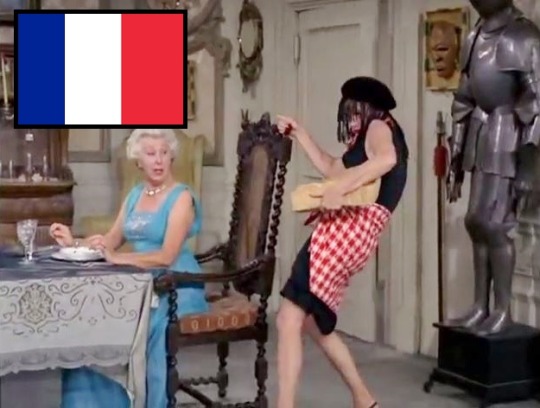
French
Bread
– Lucy makes a beret from a black pillow and ties a red checkered
table cloth around her waist. She sings “Frere Jacques” as she
distributes the baguettes.
Italian
Antipasto
– Viv makes an Italian chef’s outfit from uniforms found in the
kitchen closet, making a mustache from the fringe on a throw pillow.
She sings “O Solo Mio” while presenting the platter. The
Neapolitan song was written by Giovanni
Capurro
and
Eduardo
di Capua
in 1898.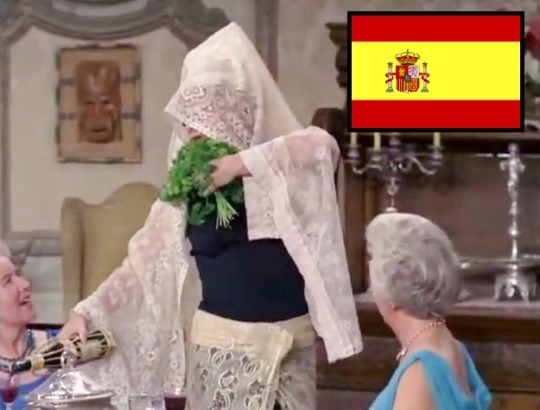
Spanish
Wine
– Lucy puts a lace curtain on her head and wraps herself in a lace
tablecloth. Holding a bunch of parsley in front of her face, she
sings “In a Little Spanish Town,” a
song by Mabel
Wayne, Sam M. Lewis, and Joe
Young
written in 1926.
Turkish
Shish-Ka-Bob
– Viv wraps a pink and red silk scarf around her head and cinches a print table throw around her waist. She hums “The
Streets of Cairo, or the Poor Little Country Maid”
(also known as “The Snake Charmer Song”) written by James
Thornton in the late 19th century. Vivian Vance gyrates her hips with her back to the camera,
earning a few surprised gasps and laughs from the studio audience.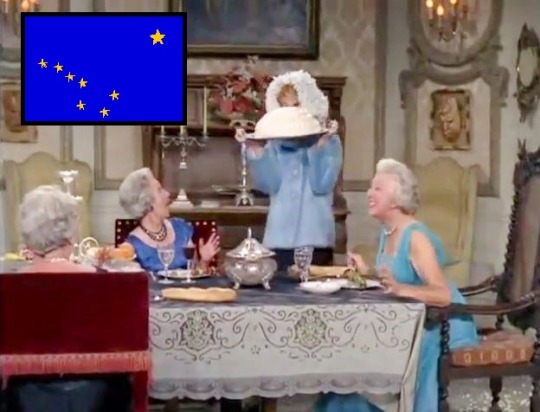
Baked
Alaska
– Lucy puts a dust mop on her head and wears a powder blue fur
jacket while Viv throws potato flakes in the air from the kitchen
door. She sings “Jingle Bells” – a song Ricky Ricardo called
“Yingle Bells” on “The Lucy-Desi Comedy Hour.” Ball and
Vance sang the song on the long-lost Christmas episode of “I Love
Lucy.”
Colombian Coffee
– Viv takes the same pink and red scarves and wraps them around her
waist while putting a floral arrangement on her head like Carmen
Miranda. She chants “Cha-cha-cha” as she serves the coffee.Callbacks!
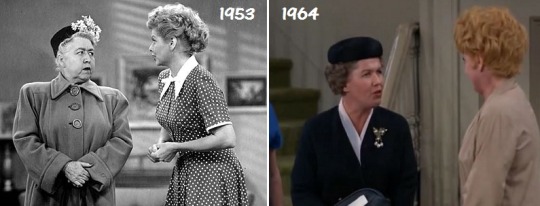
In
“Lucy
Hires a Maid”
(ILL S2;E23) Lucy
Ricardo hired Mrs. Porter, a maid who intimidates her and behaves
more like the employer than the employee. Both maids dislike
children, are overly concerned about their own meals, and demand to
be addressed by their last names.
As in 1953, Lucy ends up waiting on the maid, not the other way
around.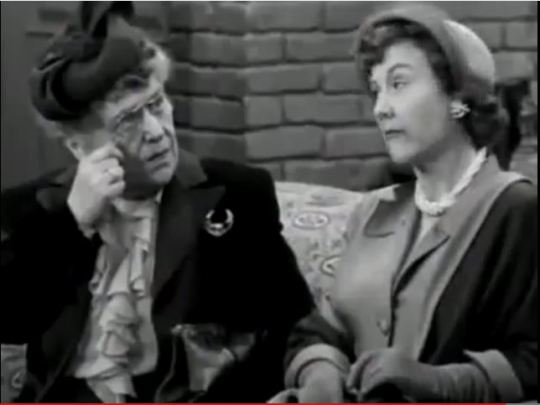
In
“Pioneer Women” (ILL S1;E23) Lucy Ricardo and Ethel Mertz go out
of their way to please The Society Matrons League headed by Mrs.
Pomerantz (Florence Bates, left) and Mrs. Pettibone (Ruth Perrot, right), a very close model for the Danfield Art
Society, but much snootier. It was based on a similar organization on Lucille Ball’s radio show “My Favorite Husband.”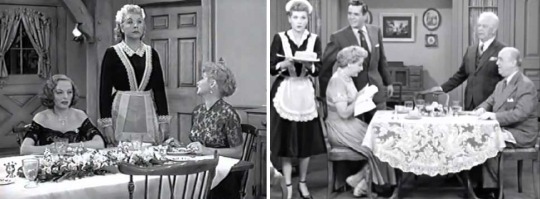
Lucy
Ricardo pretended to be a maid to impress Fred’s vaudeville partner
in “Mertz and Kurtz” (ILL S4;E2, right) while Ethel pretended to be a
maid to impress Tallulah Bankhead in “The Celebrity Next Door,” a
1957 episode of “The Lucy-Desi Comedy Hour.”Blooper
Alerts!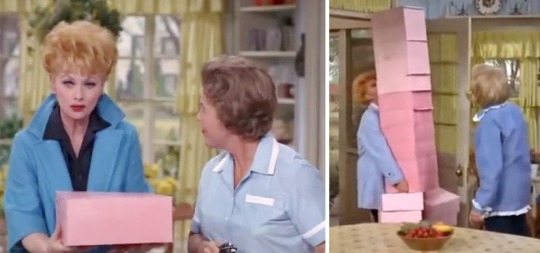
Lucy
buys Miss Putnam’s lunch from the delicatessen and brings it home in
a pink box. This is one of the same cake boxes used in “Lucy’s
Contact Lenses” (S3;E10) from Hoffstedder’s Bakery.
“Lucy Gets Her Maid” rates 5 Paper Hearts out of 5
 1964, Caryl Lincoln, CBS, Cha-Cha, Frere Jacques, Gale Gordon, Harriet McCain, Hilda Crocker, In A Little Spanish Town, Jean Vachon, Jingle Bells, Kathleen Freeman, Lucille Ball, Lucy Gets Her Maid, Luree Wiese, Maid, Mickey Spillane, Norma Varden, Oh Solo Mio, Paula Ray, Song of the Volga Boatmen, The Lucy Show, tv, Vivian Vance, YMCA
 - Jean
-
Subscribe
Subscribed
Already have a WordPress.com account? Log in now.
 Papermoon Loves Lucy